
Submitted:
18 August 2023
Posted:
18 August 2023
You are already at the latest version
Abstract
Plums are widely distributed in Türkiye and around the world. Different wild grown plum spe-cies such as Prunus spinosa, Prunus cerasifera and Prunus domestica shows abundance of different climatic zones in Türkiye. Seed propagated diverse plum trees has been growing Anatolia for centuries and fruits of wild plants has economic value. In this study a total of 8 wild grown blackthorn (Prunus spinosa) sampled from Ispir district of Erzurum province and subjected to morphological, biochemical and antioxidant characterization. Taste, aroma, and juiciness were used as the criteria for sensory analysis, and a trained panel of five experts established and evaluated the sensory characteristics of the fruits of the blackthorn. Fruit weight, fruit skin and flesh color as L*, a* and b* values were the main morphological parameters. For biochemical analysis, organic acids, SSC (Soluble Solid Content), vitamin C, total anthocyanins, total phenol-ic content and total antioxidant capacity were determined. Antioxidant capacity was determined by FRAP (ferric reducing antioxidant power) assay. Results indicated significant differences among genotypes. Fruit weight were found between 2.78-3.67 g. Skin L∗, a∗ and b∗ values were 13.11-16.12, 2.56-3.85 and 2.01-3.44, respectively. Flesh L∗, a∗ and b∗ values were in range of 17.45-20.37, 4.88-6.73 and 4.12-5.66, respectively. SSC content was ranged from 18.66% to 21.07%. The total phenolic content (TPC), total anthocyanin content (TAC) and ferric reducing antioxi-dant power (FRAP) were between 372-504 mg GAE/100 g; 53-72 mg cy-3-g eq./100 g and 107-134 mmol Fe (II) eq./g, respectively. The dominant organic acid was malic acid for all genotypes and varied from 1.04 g/100 g to 1.52 g/100 g fresh weight base. Results indicated the importance wild blackthorn fruits for human health.
Keywords:
plum
; underutilized
; characterization
; composition
1. Introduction
Fruits are adding value of earth's diversity and fundamental to all life. They include high content of non-nutritive, nutritive, and bioactive compounds such as flavonoids, phenolics, anthocyanins, phenolic acids, and as well as nutritive compounds such as sugars, essential oils, carotenoids, vitamins, and minerals. With their rich nutrients, fantastic flavor and taste, excellent medicinal value and health care functions, wild edible fruits have been continuously well received by consumers as important economic crops [1,2,3,4,5,6].
Plum is one of the biggest family of genus Prunus, which has many different species distributed throughout the world. They found both wild and cultivated conditions. Central and eastern Europe is the main growing area of plums [7,8,9,10]. In eastern Europe, particularly Balkan peninsula including Türkiye has very rich for plum genetic resources. The most widely distributed plum species in Türkiye are Prunus domestica L., Prunus salicina Lindl., Prunus cerasifera Ehrh., Prunus insititia L., and Prunus spinosa L. [11]. There was a great variation between and within species in particular for fruit and tree characteristics [12,13,14].
Türkiye is one of the most important diversity centers of wild plums. Seed propagated P. cerasifera and P. spinosa are abundant throughout temperate and semi-subtropical areas of Türkiye [11,12,15].
In Türkiye, local peoples using wild plum fruits for different purposes for centuries. Fruits can be consumed as unripe, fresh or either dried and processed into jam and marmalades. There are many different types of wild plum species and genotypes in particular rural areas in the country and one of these wild plum species is blackthorn (Prunus spinosa L.) [16].
It is a species of flowering plant in the rose family of the Prunoidae subfamily Rosaceae. Wild grown Prunus spinosa is an important part of the wild plant flora in some regions in Türkiye and has broad environmental adaptability. The blackthorn shrubs can grow on calcareous soils and shows drought and cold resistance. Wild Prunus spinosa shrubs widely grown in various eco-geographical regions of Türkiye distributed from the high plateaus of Eastern Anatolia to the dry and very hot regions of Southeastern Anatolia regions, from Southeast Anatolia to the Mediterranean, Aegean and Central Anatolia regions [13]. It is called locally as güvem, çakal eriği, ayı eriği, dağ eriği, kuş eriği, kum eriği, yaban eriği and domuz eriği in different regions in Türkiye.
Fruits of blackthorn high in anthocyanins and are valuable sources of nutrients, vitamins, minerals, dietary fibers, phytochemicals, and especially of antioxidant compounds. The fruit of this specie has food and medicinal value and widely used for nutritional, laxative, and digestive purposes and possesses beneficial health effects [17,18,19]. In some regions of Türkiye, its fruits are also consumed as a compote because of it increases resistance of body, provides blood-building effect and relieves rheumatic pain [18].
Different plant parts of the specie including fruits, leaves, flowers have been used for treatment for mucosal lesions of mouth and pharynx due to its anti-inflammatory effect. P. spinosa plant extracts are used traditionally in the treatment of hypertension, diabetes and gastrointestinal disorders, as diuretic, in the regulation of menstruation for centuries [19].
The fruits of P. spinosa contain a variety of bioactive compounds such as anthocyanins (cyanidin-3-routine, peonidine-3-routine, cyanidin-3-glycoside), phenolic acids, ascorbic acid, flavonoids, tocopherols (α-tocopherol, β-tocopherol, -tocopherol, δ-tocopherol), ascorbic acid and β-carotene [20,21,22].
The plant more recently gaining attention as a functional food and an underutilized source of bioactive compounds for application in the food and pharmaceutical industry in Türkiye. Previously health-promoted composition of a few number of Prunus spinosa genotypes were conducted. In addition, wild plums (Prunus spinosa) widely distributed throughout Ispir district have not been investigated for their biochemical and antioxidant characteristics so far. Thus, the present study aimed to investigate for the first time to assess the health-promoting potential of a large number of blackthorn fruits from Ispir district of Türkiye. The data obtained will provide more detailed information to the researchers about this unique plant, as more genotypes are used.
2. Materials and Methods
2.1. Plant materials
The plant material consists of 8 seed propagated P. spinosa genotypes (Figure 1) sampled from Goc village belongs to Ispir district of Erzurum province of Türkiye in 2021 year. The village is very rich for wild grown Prunus species. During field trip health and high-yielded blackthorn genotypes were pre-selected and fruit samples were obtained from 8 different genotypes. The climate of Ispir district is described as Humid Continental by the Köppen Climate System, abbreviated as Dfb. All genotypes are found similar climate and soil conditions in Goc village.
2.2. Morphological traits
Fruit weight were determined with a digital balance (±0.01 g) (Scaltec SPB31, Scaltec Instruments GmbH, Goettingen, Germany) using 30 fruits per genotype. Each Prunus spinosa plant was given a code number. These code numbers were preceded by the abbreviation of the specie name in Latin, the initials of the plant Latin name (PS) and finally the tree number. Accordingly, each identified genotype was named from PS1 to PS8.
The skin and flesh color of the blackthorn samples was detected using chromometer (Minolta CR-400, Konika Minolta Inc. Tokyo, Japan). Colorimetric data was taken from both sides of the fruit after calibration with a black and white standard tile. The results were expressed in terms of L*, a*, and b* values, where L* represents luminosity or lightness (where 0 to 100 represents black to white), a* represents chromaticity on a green (-) to red (+) axis, and b* represents chromaticity on a blue (−b) to yellow (+b) axis [13,14].
2.3. Biochemical parameters
Fresh blackthorn juices were obtained from each genotype. Three replicates of 500 g each were used at full maturity. Fruit juices was obtained from fresh fruit and homogenized with equal proportions of deionized water at room temperature, and the diluted homogenate was stored at -80°C until used for bioactive analysis. These triplicate homogenized samples were used for analysis of SSC, vitamin C, organic acids, total anthocyanins, total phenolics and antioxidant capacity. SSC was determined by extracting and mixing one drop of juice from each fruit into a digital refractometer (Kyoto Electronics Manufacturing Co. Ltd., Japan, Model RA-250HE) at 22 °C and expressed as %. Vitamin C (ascorbic acid) was quantified using a reflectometer (RQFlex, Merck, Darmstadt, Germany) and expressed in mg/100 g.
In the study, citric acid, malic acid, succinic acid, and fumaric acid contents of organic acids were determined in blackthorn fruits. Organic acids in fruit extract were determined by HPLC analysis developed by Bozan et al. [23]. For the extraction of organic acids, 1 g of the sample was mixed with 4 ml of 3% metaphosphorical acid. The mixture was placed in an ultrasound bath at 80 °C for 15 minutes and it was sonized and centrifuged at 5500 rpm for 15 minutes. The mixture was filtered and the HPLC vials were removed. The extract organic acids were analyzed using HPLC (Shimadzu LC 20A vp, Kyoto, Japan) equipped with a UV detector (Shimadzu SPD 20A vp) and we used an 87 H column (5 μm, 300 × 7.8 mm, Transgenomic). 0.05 M sulfiric acid was used as solvent. The operating conditions were: column temperature, 40 °C; injection volume, 20 μL; detection wavelength, 210 nm; flow rate 0.8 mL/min. The identification of organic acids and peak determination is based on peak retention times and the comparison of spectral data in accordance with standards. The identified acids were assessed in accordance with the corresponding standardized calibration curves.
Total phenolic content was determined using the Folin–Ciocalteu reagent in the modified method Singleton and Rossi [24]. In short, a methanol substance was added to one gram of samples. Water, Folin-Ciocalteu, and 20% sodium carbonate were added to the insoluble portion of the suspension and stored in darkness for 2 hours. Absorbance values for all samples used in the study were analyzed at 760 nm using a Multiscan GO microplate spectrophotometer spectrophotometer (Thermo Scientific, Waltham, MA, USA). Gallic acid (GA) standards prepared at determined concentrations in accordance with the study method were calculated by means of the daily calibration curve. The obtained results are expressed in milligram gallic acid equivalents (GAE) per 100 g fresh fruit sample (FW).
The total anthocyanin content of fruits was determined using Krawczyk and Petri method [26]. Anthocyanins were extracted from 2 g of fruits with 0.1% HCl (2 mL) in 96% ethanol, and 2% HCl (40 mL). The mixture was centrifuged at 5.500 rpm for 10 min. Results were expressed as mg of cyanidin-3-glucoside equivalents/100 g of FW.
FRAP (Ferric Reducing Antioxidant Power) [26] assay was used for antioxidant capacity analysis. The results were expressed as mmol Fe (II) eq./g fresh weight. The FRAP assay is based on the reduction of ferric-2,4,6-tripyridyl-S-triazine (Fe(III)- TPTZ) complex into the blue-colored Fe(II) form in the presence of antioxidants. Firstly, the FRAP solution was prepared. The contents of the solution are as follows: 25 mL of 300 mM acetate buffer (pH 3.6), 2.5 mL of 10 mM 2,4,6-tripyridyl-s-triazine (TPTZ) in 40 mM HCl solution, and 2.5 mL of 20 mM ferric chloride (FeCl3.6H2O). The methanol extract was then filtered using filtration paper, and 1 ml of the extract was mixed with 1.5 ml of freshly prepared FRAP solution. Then, absorbance values were measured at 515 nm wavelength using Multiscan GO microplate spectrophotometer (Thermo Fisher Scientific, Waltham, MA, USA). Finaly, the measurement values results were expressed mmol Fe (II) eq./g)
2.4. Data analysis
A statistical evaluation was employed to analyze the level of each parameter by using the software SPSS Statistics, version 19.0. All samples were four times replications for each experiment. For analysis of variance, the obtained data were used for means calculation. Duncan multiple range tests were performed at the significant level of p<0.05.
3. Results and Discussion
3.1. Sensory analysis
Table 1 shows sensory (taste, aroma, and juiciness) properties fruits of 8 wild grown blackthorn genotypes. Considering genotypes, 5 genotypes had high aroma (PS-1, PS-2, PS-3, PS-5, and PS-8), and rest of the genotypes (PS-4, PS-6 and PS-7) found moderate aroma. For taste evaluation, majority of genotypes had sweet taste (PS-1, PS-2, PS-4, PS-6 and PS-8) and 3 genotypes had Sweet-Sour taste (PS-3, PS-5 and PS-7). For juiciness evaluation, 5 genotypes had moderate juiciness (PS-1, PS-2, PS-4, PS-6 and PS-8) and 3 genotypes had high juiciness (PS-3, PS-5 and PS-7) (Table 1).
In fruit species special breeding activities to obtain fruits that have high bioactive content as well high sensory profiles. The fruit flavor is a combination of the sensations of aroma and taste. The combination of sugars, acids, phenolics, and hundreds of volatile compounds contribute to the fruit flavor. However, flavor and aroma depend on the cultivar, edaphoclimatic conditions, agronomical practices, and postharvest handling. Besides aroma, other sensory properties, such as taste, juiciness, etc., are preferred by consumers [27,28]. Studies on different fruit species have shown that aroma has a very complex structure [29,30], and its perception in consumers is the resultant effect of the interaction among different volatile organic compounds (VOCs).
3.2. Morphological traits
Table 2 shows morphological evaluation (fruit weight and fruit skin and flesh color values) of 8 blackthorn genotypes. Results indicate statistically significant differences (p<0.05) among genotypes for all searched morphological parameters.
Considering fruit weight of genotypes, the highest fruit weight was obtained from PS-5 as 3.85 g and followed by PS-3 as 3.71 g, PS-2 3.55 g while the lowest fruit weight was seen on PS-7 genotypes as 2.67 g (Table 2). Previously Ozzengin et al. [31] reported fruit weight of wild grown one P. spinosa genotype as 2.40 g indicating close values with our results. As a wild fruit there were no much studies on literature on fruit weight of blackthorn. Smaller fruits are general characteristics of wild edible fruits including blackthorn.
The genotypes exhibited skin L∗, a∗ and b∗ values between 13.11-16.12, 2.56-3.85 and 2.01-3.44, respectively. Flesh L∗, a∗ and b∗ values of 8 blackthorn genotypes were in range of 17.45-20.37, 4.88-6.73 and 4.12-5.66, respectively. Ozzengin et al. [31] found that wild blackthorn fruits had great variations in skin L* (lightness), a* (redness) and b* (yellowness) values and they found skin L∗, a∗ and b∗ values were ranged from 15.47 to 27.58, from 2.59 to 7.04 and from 1.77 to 6.55, respectively. They also reported flesh L*, a* and b* values in range of 19.34 to 31.28, from 0.98 to 5.32 and from 4.86 to 14.59, respectively. Our L*, a* and b* color indices results could be comparable with previous results [31,32]. The genotype PS-7 had the highest skin L* (16.12), PS-5 had the highest a* value (3.85) and PS-3 had the highest b* value (3.44). For the flesh of fruits, the highest L∗, a∗ and b∗ were detected in genotype PS-7, PS-3 and PS-3 as 20.37, 6.76 and 5.33, respectively. Blackthorn fruits characterized by very high anthocyanin content and concentrated on skins of fruits rather than flesh.
The studied blackthorn genotypes were found rich in color (anthocyanins) (Table 3) which are mainly concentrated in skin and flesh. Fruit color are the best indicators of quality and maturation for all plum species, although SSC and fruit acid level may have also important in plums including blackthorn [13]. As a wild fruit and found in rural areas, blackthorn fruit colors needed to attract and conscript animals to act as seed dispersers. Chromoplasts contribute the bright red, blue, orange, and yellow colors to many fruits and flowers [33].
Table 3 presents organic acid content in fruits of 8 wild grown blackthorn genotypes. All genotypes characterized by high malic acid content in its fruits. The malic acid content ranged from 1.04 g/100 g to 1.52 g/100 g fresh weight base. Citric acid content was between 14.07 mg/100 g and 18.64 mg/100 g among genotypes and there were statistically significant differences among genotypes at p<0.05 level (Table 3). The other detected organic acids in blackthorn fruits are succinic acid was between 1.95-3.44% and fumaric acid between 0.92-1.56%, respectively.
Malic acid and succinic acid significantly varied among genotypes (p<0.05) but there were no significant differences among genotypes for fumaric acid (Table 3). In contrast Ozkan [16] reported that blackthorn fruits had dominantly characterized by high citric acid content (21.45-28.37%) and malic acid, succinic acid and fumaric acid also presented in its fruits with variable ratios.
Celik et al. [35] analyzed organic acid contents in blackthorn sampled from Van province of eastern Türkiye and indicated that malic acid was the predominant organic acid, and had the highest value as 1.245 g/100 g fresh fruit. They also found citric acid in fruits of P. spinosa L. as 27.61 mg/100 g indicating similarities with our study. Ozcan (2008) also found that P. spinosa fruits are rich for malic acid and followed by citric acid and fumaric acid which in agreement with our present results. Organic acids, which affect the taste in fruits, provide the sugar balance and forms the main ingredient of many compounds. In general, dominant organic acid is malic acid in pome and stone fruit. Citric acid is found mostly in citrus fruits.
One of the compounds that important factors that make up the biochemical structure of plums are organic acids. Organic acids are effective on properties such as color, taste and flavor of plum fresh fruits and products derived from plums. Organic acids are used as an energy source for carbon respiration metabolism for the production of sugars in plums. It is also used in the determination of maturity with sugars. Organic acids are associated with some heavy metals in the human body to form salts and regulate the rate acid-base in the blood. They also eliminating the negative effects of food and serve human health [36].
Table 4 presents SSC, vitamin C, total phenolic content, total anthocyanin content and total antioxidant capacity in fruits of eight blackthorn genotypes. SSC, vitamin C, total phenolic content, total anthocyanin and total antioxidant capacity significantly differed among genotypes at p<0.05 (Table 4).
The highest SSC content was obtained from genotype PS-6 as 21.07% and followed by PS-8 (21.00%), PS-4 (20.70%), PS-2 (19.80%), PS-1 (19.15%), PS-5 (18.90%), PS-3 (18.66%), PS-7 (18.40%), respectively (Table 4). Previously SSC content of fruit juices of a blackthorn genotype was determined as 20.62% [31] which indicating good agreement with our present SSC result. SSC content of fruits change significantly with maturation and the ratio between SSC and titratable acidity is important for the practical determination of the ripening degree of the fruit. Soluble solid content (SSC) is also one of the most important quality indices of different fruits and it is mainly organic sugars, such as glucose, sucrose and fructose, which influence the taste and flavor of plum fruits [37]. SSC content of plum cultivars previously reported between 17.95-22.19% [37].
The eight blackthorn genotypes had vitamin C content between 16.50 mg/100 mg (PS-1)-21.30 mg/100 g (PS-6) (Table 4). Ozkan [16] reported that fruits of a number of Prunus spinosa genotypes had vitamin C content between 16-26 mg/100 g fresh fruit. Nergiz and Yildiz [38] found that vitamin C content in Victoria and Stanley plum cultivars were between 19-23 mg per 100 g. Celik et al. [35] found Vitamin C content in fruits of Prunus spinosa as 25.49 mg/100 g. The findings of the present study seem to be mostly consistent with above researches. Horticulture crops including fresh fruits, vegetables and grapes are the major sources of vitamin C, therefore increasing its concentration will have an important impact in human nutrition. Sikora et al. [7] also found similar vitamin C content (23.84 mg/100 g FW) in fruits of Blackthorn wildly grown in Poland.
The total phenolic contents (TPC) in fruits of eight Prunus spinosa genotypes ranged between 372 mg GAE/100 g (PS-8 genotype) to 504 mg GAE/100 g (PS-4 genotype), respectively (Table 3). Previously total phenolic content of a wild grown blackthorn genotype was found 440 mg GAE/100 g FW [31] which indicate similarities with our present results. Cinquanta et al. [32] previously reported TPC between 520-750 mg GAE/100 g which indicated higher values than our result. In Australia Johnson et al. [39] have reported TPC of 65.00-160.00 mg GAE/100 g in six plum samples which shows lower values than our result. The total content of polyphenolic compounds, expressed as gallic acid (GAE) equaled was found 599 mg GAE/100 g of fresh fruits in blackthorn grown in Poland [7]. Our results indicating that fruits of wild grown blackthorn genotypes rich for phenolic content. In fact, blackthorn fruits have been considered as having enhanced functional properties for a long time and this study is also confirm of this idea.
The total anthocyanin content (TAC) and ferric reducing antioxidant power (FRAP) were between 53-72 mg cy-3-g eq./100 g and 107-134 mmol Fe (II) eq./g in fruits of eight blackthorn genotypes, respectively (Table 4). Ozzengin et al. [31] reported total anthocyanin content and total antioxidant capacity as 64.57 mg/100 g and 149 mmol Fe (II) eq./g which shows similarity with our present results on total anthocyanin content and total antioxidant capacity. Sikora et al. [7] also found similar total anthocyanin content (71.75 mg/100 g FW) in fruits of Blackthorn wildly grown in Poland. Katanic Stankovic et al. [40] found that blackthorn fruits are rich for antioxidants.
The total anthocyanin content (TAC) and ferric reducing antioxidant power (FRAP) were between 53-72 mg cy-3-g eq./100 g and 107-134 mmol Fe (II) eq./g in fruits of eight blackthorn genotypes, respectively (Table 4). Ozzengin et al. [31] reported total anthocyanin content and total antioxidant capacity as 64.57 mg/100 g and 149 mmol Fe (II) eq./g which shows similarity with our present results on total anthocyanin content and total antioxidant capacity. Sikora et al. [7] also found similar total anthocyanin content (71.75 mg/100 g FW) in fruits of Blackthorn wildly grown in Poland. Katanic Stankovic et al. [40] found that blackthorn fruits is rich for antioxidants. Previous studies indicated that as with other stone fruits, several factors were shown to influence the fruit antioxidant capacity, including species, cultivars, genotypes, accessions, geographic region, maturity stage, length of the fruit development period etc. [41,42]. However, genotype proved to be the most important factor influencing the fruits’ anthocyanin content and antioxidant contents [43].
4. Conclusion
In this study carried out on Prunus spinosa genotypes, significant differences emerged between genotypes in terms of fruit morphological, biochemical and bioactive characteristics. The results could be important for industry because fruits of this specie have found a wide place especially in pharmacological applications in recent years. The genotypes had higher bioactive content is of great importance in terms of the bring most suitable genotypes for the relevant industry. In addition, studied blackthorn fruits are good natural sources of bioactive compounds which provide numerous opportunities for their application in the food industry for the development of new value-added foods or the improvement of existing food products. The results are clearly revealed that consumption of this fruit have beneficial effect on human health. Obtained results support further evaluation of the functional food potential of blackthorn fruit. Finally, the manuscript highlights the potential applications of blackthorn fruits in various industries, including the food, cosmetics, pharmaceutical, and functional product sectors.
Author Contributions
GA made Conceptualization, methodology, software, validation, formal analysis, investigation, data curation, writing—original draft preparation, writing—review and editing, project administration, funding acquisition. The author has read and agreed to the published version of the manuscript.
Funding
No funding for this research.
Institutional Review Board Statement
This study does not contain any studies with human or animal subjects performed by any of the authors.
Data Availability Statement
Not Applicable.
Acknowledgments
The authors extend their appreciation to the Ataturk University.
Conflicts of Interest
The author declare no conflict of interest.
References
- Ercisli, S.; Esitken, A.; Turkkal, C.; Orhan, E. The allelopathic effects of juglone and walnut leaf extracts on yield, growth, chemical and PNE composition of strawberry cv. Fern. Plant Soil Environ. 2005, 51(6), 283-387. [CrossRef]
- Erturk, Y.; Ercisli, S.; Cakmakci R. Yield and growth response of strawberry to plant growth-promoting rhizobacteria inoculation. J. Plant Nutr. 2012, 35(6), 817-826. [CrossRef]
- Abanoz, Y.Y.; Okcu, Z. Biochemical content of cherry laurel (Prunus laurocerasus L.) fruits with edible coatings based on caseinat, Semperfresh and lecithin. Turk J Agric For, 2022, 46 (6), 908-918. http://doi.org/10.55730/1300-011X.3052. [CrossRef]
- Daler, S.; Cangi, R. Characterization of grapevine (V. vinifera L.) varieties grown in Yozgat province (Turkey) by simple sequence repeat (SSR) markers. Turk J Agric For. 2022, 46 (1), 38-48. [CrossRef]
- Delialioglu, R.A.; Dumanoglu, H.; Erdogan, V.; Dost, S.E.; Kesik, A.; Kocabas, Z. Multidimensional scaling analysis of sensory characteristics and quantitative traits in wild apricots. Tur. J. Agric. For. 2022, 46 (2), 160-172. https://doi.org/10.55730/1300-011X.2968. [CrossRef]
- Ozer, G.; Makineci, E. Fruit characteristics, defoliation, forest floor and soil properties of sweet chestnut (Castanea sativa Mill.) forests in Istanbul-Turkey. Turk. J. Agric. For. 2022, 46 (5), 703-716. [CrossRef]
- Sikora, E.; Bieniek, M.I.; Borczak, B. Composition and antioxidant properties of fresh and frozen stored blackthorn fruits (Prunus spinosa L.). Acta Sci. Pol. Technol. Aliment. 2013, 12 (4), 365-372.
- Rampáčková, E.; Göttingerová, M.; Kiss, T.; Ondrášek, I.; Venuta, R.; Wolf, J.; Nečas, T.; Ercisli, S. CIELAB analysis and quantitative correlation of total anthocyanin content in European and Asian plums. Eur. J. Hortic. Sci, 2021, 86, 453–460. [CrossRef]
- Trendafilova, A.; Ivanova, V.; Trusheva, B.; Kamenova-Nacheva, M.; Tabakov, S.; Simova, S. Chemical Composition and Antioxidant Capacity of the Fruits of European Plum Cultivar “Čačanska Lepotica” Influenced by Different Rootstocks. Foods. 2022, 11(18), 2844. https://doi.org/10.3390/foods11182844. [CrossRef]
- Popović, B.; Mitrović, O.; Nikićević, N.; Tešević, V.; Urošević, I.; Miletić, N.; Milojević, S. Influence of Different Pre-Distillation Steps on Aromatic Profile of Plum Spirits Produced by Traditional and Modified Methods. Processes. 2023, 11(3), 863. https://doi.org/10.3390/pr11030863. [CrossRef]
- Bolat, I.; Ak, B.E.; Acar, I.; Ikinci, A. Plum culture in Turkey. Acta Hortic. 2017, 1175, 15-18. https://doi.10.17660/ActaHortic.2017.1175.4. [CrossRef]
- Ercisli, S. A short review of the fruit germplasm resources of Turkey. Genet. Resour. Crop Evol. 2004, 51(4), 419-435. [CrossRef]
- Erturk, Y.; Ercisli, S.; Tosun, M. Physicochemical characteristics of wild plum fruits (Prunus spinosa L.), Int. J. Plant Prod. 2009, 3, 89-92. [CrossRef]
- Gunduz, K.; Saracoglu, O. Variation in total phenolic content and antioxidant activity of Prunus cerasifera Ehrh. selections from Mediterranean region of Turkey. Sci. Hortic. 2012, 134, 88–92. [CrossRef]
- Cakir, G.; Tascioglu, T.; Cavdar, A.; Doganlar, S.; Frary, A.; Frary, A. Molecular Genetic Characterization of the Turkish National Green Plum (Prunus cerasifera Ehrh.) Collection. Anadolu, 2021, 31 (1), 61-73. https://doi.10.18615/anadolu.950008. [CrossRef]
- Ozkan, G. Phenolic compounds, organic acids, vitamin c and antioxidant capacity in Prunus spinosa. C.R. Acad. Bulg. Sci. 2019, 72 (2), 267–273. [CrossRef]
- Baytop T. Türkiye’de bitkiler ile tedavi 2. Nobel Tıp Kitabevleri, İstanbul, 1999; 204-5.
- Ayla, S.; Gunal, M.Y.; Sayin Sakul, A.A.; Biceroglu, O.; Ozdemir, E.M.; Okur, M.E.; Polat, D.C.; Okur, N.U.; Bilgic, BiE. Effects of Prunus spinosa L. fruits on experimental wound healing. Medeniyet Med J. 2017, 32, 152-158. [CrossRef]
- Karakas, N.; Okur, M.E.; Ozturk, I.; Ayla, S.; Karadag, A.E.; Polat, D.C. Antioxidant activity of blackthorn (Prunus spinosa L.) fruit extract and cytotoxic effects on various cancer cell lines. Medeniyet Med. J. 2019, 34(3), 297-304. https://doi.org/10.5222/MMJ.2019.87864. [CrossRef]
- Ruiz-Rodríguez, B.M.; de Ancos, B.; Sánchez-Moreno, C.; Fernandez-Ruiz, V.; Sanchez-Mata, M.C.; Camara, M.; Tardio, I. Wild blackthorn (Prunus spinosa L.) and hawthorn (Crataegus monogyna Jacq.) fruits as valuable sources of antioxidants. Fruits, 2014, 69, 61-73. [CrossRef]
- Marčetić, M.; Samardžić, S.; Ilić, T.; Božić, D.D.; Vidović, B. Phenolic Composition, Antioxidant, Anti-Enzymatic, Antimicrobial and Prebiotic Properties of Prunus spinosa L. Fruits. Foods. 2022, 11(20), 3289. https://doi.10.3390/foods11203289. [CrossRef]
- Negrean, O.R.; Farcas, A.C.; Pop, O.L.; Socaci, S.A. Blackthorn-A Valuable Source of Phenolic Antioxidants with Potential Health Benefits. Molecules. 2023, 28 (8), 3456. https://doi.10.3390/molecules28083456. [CrossRef]
- Bozan, B.; Baser, K.H.C.; Kara, S. Quantitative determination of naphthaquinones of Arnebia densiflora (Nordm.) Ledeb. by an improved high-performance liquid chromatographic method. J. Chromatogr. A, 1997, 782(1), 133-136. https://doi.org/10.1016/S0021-9673(97)00460-3. [CrossRef]
- Singleton, V.L.; Rossi, J.A. Colorimetry of total phenolics with phosphomolybdic-phosphotungstic acid reagents. Am. J. Enol. Vitic. 1965, 16, 144-158. [CrossRef]
- Krawczyk, U.; Petri, G. Application of RP-HPLC and spectrophotometry in standardization of bilberry anthocyanin extract. Archiv D. Pharm, 1992, 325, 147-149. [CrossRef]
- Benzie, I.F.F.; Strain, J.J. Ferric reducing ability of plasma (FRAP) as a measure of antioxidant power: The FRAP assay. Anal. Biochem. 1996, 239, 70-76. [CrossRef]
- Baldina, S.; Picarella, M.E.; Troise, A.D.; Pucci, A.; Ruggieri, V.; Ferracane, R.; Barone, A.; Fogliano, V.; Mazzucato, A. Metabolite profiling of Italian tomato landraces with different fruit types. Front. Plant Sci. 2016, 7, 664. [CrossRef]
- Karatas, N. Evaluation of nutritional content in wild apricot fruits for sustainable apricot production. Sustainability, 2022, 14 (3), 1063. [CrossRef]
- Sheng, L.; Ni, Y.; Wang, J.; Chen, Y.; Gao, H. Characteristic-aroma-component-based evaluation and classification of strawberry varieties by aroma type. Molecules, 2021, 14, 6219. [CrossRef]
- Mukherjee, S.; Pal, A.; Mitra, A. An insight into fruit aroma volatilome during postharvest maturation in two popular Musa cultivars of tropics. J. Sci. Food Agric. 2022, 102, 4276-4286. [CrossRef]
- Ozzengin, B.; Zannou, O.; Koca, I. Quality attributes and antioxidant activity of three wild plums from Prunus spinosa and Prunus domestica species. Measurement: Food, 2023, 10, 100079. [CrossRef]
- Cinquanta, L.; Di, M.; Esti, M. Physical pre-treatment of plums (Prunus domestica). Part 2. Effect on the quality characteristics of different prune cultivars, Food Chem. 2022, 79, 233-238. [CrossRef]
- Egea, I.; Barsan, C.; Bian, W.; Purgatto, E.; Latche, A.; Chervin, C.; Bouzayen, M.; Pech, J-C. Chromoplast differentiation: Current status and perspectives, Plant Cell Physiol. 2010, 51 (10), 1601-1611, https://doi.org/10.1093/pcp/pcq136. [CrossRef]
- Ozcan, T. Some vitamin and organic acid contents in the fruits of Prunus spinosa L. subsp. dasyphylla (Schur) Domin from Europe-in- Turkey. IUFS J. Biol. 2008, 67 (2), 105-114.
- Celik, F.; Gundogdu, M.; Alp, S.; Muradoglu, F.; Ercisli, S.; Gecer, M.K.; Canan, I. Determination of phenolic compounds, antioxidant capacity and organic acids contents of Prunus domestica L., Prunus cerasifera Ehrh. and Prunus spinosa L. fruits by HPLC. Acta Chromatographica, 2017, 29 (4), 507-510. [CrossRef]
- Gundogdu, M.; Guler, E.; Aglar, E.; Arslan, T.; Kan, T.; Celik, K. Use of spermidine to preserve organic acids, polyphenols, and quality of cold stored plum fruits. J Food Compos. Anal. 2023, 121,105411. [CrossRef]
- Bozhkova, V. Chemical composition and sensory evaluation of plum fruits. Trakya Univ. J. Nat. Sci. 2014,15 (1), 31-35.
- Nergiz, C.; Yildiz, H. Research on chemical composition of some varieties of European plums (Prunus domestica) adapted to the Aegean district of Turkey. J. Agric. Food Chem. 1997, 45, 2820–2823. [CrossRef]
- Johnson, J.B.; Collins, T.; Mani, J.S.; Naiker, M. Nutritional quality and bioactive con- stituents of six Australian plum varieties. Int. J. Fruit Sci. 2020, 21, 115-132. [CrossRef]
- Katanić Stanković, J.S.; Mićanović, N.; Grozdanić, N.; Kostić, A.Ž.; Gašić, U.; Stanojković, T.; Popović-Djordjević, J.B. Polyphenolic Profile, Antioxidant and Antidiabetic Potential of Medlar (Mespilus germanica L.), Blackthorn (Prunus spinosa L.) and Common Hawthorn (Crataegus monogyna Jacq.) Fruit Extracts from Serbia. Horticulturae. 2022; 8(11), 1053. https://doi.org/10.3390/horticulturae8111053. [CrossRef]
- Kim, I.; Lee, J. Variations in Anthocyanin Profiles and Antioxidant Activity of 12 Genotypes of Mulberry (Morus spp.) Fruits and Their Changes during Processing. Antioxidants. 2020, 9(3), 242. https://doi.org/10.3390/antiox9030242. [CrossRef]
- Memete, A.R.; Sărac, I.; Teusdea, A.C.; Budău, R.; Bei, M.; Vicas, S.I. Bioactive Compounds and Antioxidant Capacity of Several Blackberry (Rubus spp.) Fruits Cultivars Grown in Romania. Horticulturae. 2023, 9 (5), 556. https://doi.org/10.3390/horticulturae9050556. [CrossRef]
- Urbstaite, R.; Raudone, L.; Janulis, V. Phytogenotypic Anthocyanin Profiles and Antioxidant Activity Variation in Fruit Samples of the American Cranberry (Vaccinium macrocarpon Aiton). Antioxidants. 2022, 11 (2), 250. https://doi.org/10.3390/antiox11020250. [CrossRef]
Figure 1.
Wildly grown blackthorn (Prunus spinosa) in Ispir district.
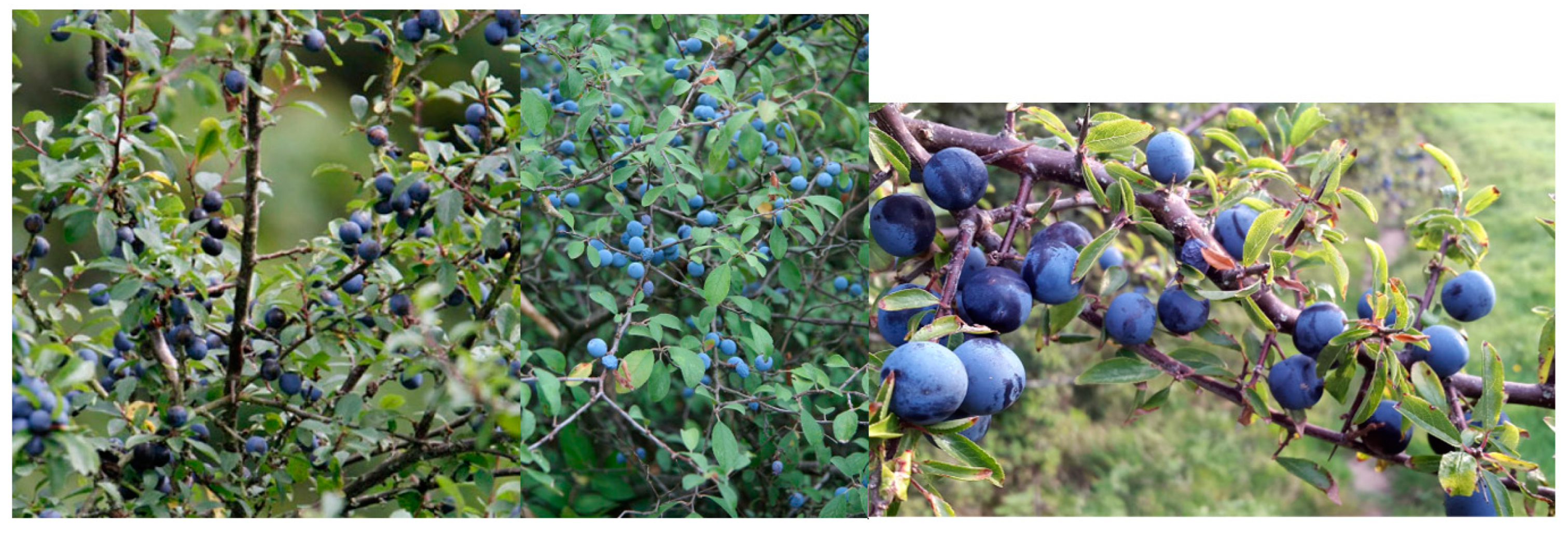

Table 1.
The sensory characteristics in the fruits of 8 blackthorn genotypes.
| Genotypes | Aroma | Taste | Juiciness |
|---|---|---|---|
| PS-1 | High | Sweet | Moderate |
| PS-2 | High | Sweet | Moderate |
| PS-3 | High | Sweet-Sour | High |
| PS-4 | Moderate | Sweet | Moderate |
| PS-5 | High | Sweet-Sour | High |
| PS-6 | Moderate | Sweet | Moderate |
| PS-7 | Moderate | Sweet-Sour | High |
| PS-8 | High | Sweet | Moderate |
Table 2.
Fruit weight and skin and flesh color indices of eight blackthorn genotypes.
| Genotypes | Fruit weight (g) |
Skin | Flesh | ||||
|---|---|---|---|---|---|---|---|
| L* | a* | b* | L* | a* | b* | ||
| PS-1 | 3.14e | 14.56cd | 3.12bc | 3.16a | 19.22ab | 4.88b | 4.43ab |
| PS-2 | 3.55c | 15.67b | 3.45b | 2.85ab | 17.68bc | 6.34ab | 5.18ab |
| PS-3 | 3.71b | 13.88e | 2.56d | 3.44ab | 17.45c | 6.73a | 5.66a |
| PS-4 | 2.95f | 13.11f | 2.83cd | 3.28ab | 19.04ab | 5.12ab | 4.33ab |
| PS-5 | 3.85a | 16.03ab | 3.85a | 2.38ab | 18.33b | 5.56ab | 4.98ab |
| PS-6 | 3.27d | 14.44d | 2.95c | 2.56ab | 18.56bc | 5.80ab | 4.49b |
| PS-7 | 2.67bc | 16.12a | 3.26bc | 2.01b | 20.37a | 4.96b | 4.12c |
| PS-8 | 2.88fg | 14.86c | 3.34bc | 2.63ab | 19.55ab | 5.44ab | 4.33ab |
There were significant (p < 0.05) differences among the different letters in the same lines.
Table 3.
Organic acid content in fruits of eight blackthorn genotypes.
| Genotypes | Citric acid (mg/100 g) | Malic acid (g/100 g) |
Succinic acid (mg/100 g) |
Fumaric acid (mg/100 g) |
|---|---|---|---|---|
| PS-1 | 17.12ab | 1.32ab | 3.12ab | 1.56NS |
| PS-2 | 17.80ab | 1.52a | 3.37ab | 1.35 |
| PS-3 | 15.38bc | 1.41ab | 3.44a | 1.12 |
| PS-4 | 14.07c | 1.25ab | 2.88ab | 1.20 |
| PS-5 | 15.03bc | 1.12b | 2.50ab | 0.92 |
| PS-6 | 14.68bc | 1.44ab | 3.20ab | 1.44 |
| PS-7 | 18.64a | 1.29ab | 1.95b | 0.97 |
| PS-8 | 16.50b | 1.04ab | 2.65ab | 1.25 |
There were significant (p < 0.05) differences among the different letters in the same lines.
Table 4.
Soluble Solid (SSC), vitamin C, total phenolic, total anthocyanin and total antioxidant capacity in fruits of eight blackthorn genotypes.
Table 4.
Soluble Solid (SSC), vitamin C, total phenolic, total anthocyanin and total antioxidant capacity in fruits of eight blackthorn genotypes.
| Genotypes | SSC (%) |
Vitamin C mg/100 g | Total phenolic (mg GAE/100 g FW) |
Total anthocyanin (mg cy-3-g eq./ 100 g) |
FRAP (mmol Fe (II) eq./g) |
|---|---|---|---|---|---|
| PS-1 | 19.15bc | 16.50b | 498ab | 60c | 116c |
| PS-2 | 19.80b | 18.90ab | 450c | 68b | 125b |
| PS-3 | 18.66c | 17.90ab | 390f | 72a | 112cd |
| PS-4 | 20.70ab | 20.44ab | 504a | 63bc | 134a |
| PS-5 | 18.90bc | 18.60ab | 424d | 68b | 121bc |
| PS-6 | 21.07a | 21.30a | 482b | 66bc | 128ab |
| PS-7 | 18.40bc | 19.50ab | 404e | 53d | 116c |
| PS-8 | 21.00a | 20.70ab | 372g | 56cd | 107d |
There were significant (p < 0.05) differences among the different letters in the same lines.
Disclaimer/Publisher’s Note: The statements, opinions and data contained in all publications are solely those of the individual author(s) and contributor(s) and not of MDPI and/or the editor(s). MDPI and/or the editor(s) disclaim responsibility for any injury to people or property resulting from any ideas, methods, instructions or products referred to in the content. |
© 2023 by the authors. Licensee MDPI, Basel, Switzerland. This article is an open access article distributed under the terms and conditions of the Creative Commons Attribution (CC BY) license (http://creativecommons.org/licenses/by/4.0/).
Copyright: This open access article is published under a Creative Commons CC BY 4.0 license, which permit the free download, distribution, and reuse, provided that the author and preprint are cited in any reuse.


