

Submitted:
15 August 2023
Posted:
16 August 2023
You are already at the latest version
Abstract
This research paper presents an enhanced economic load dispatch (ELD) approach using the Teaching-Learning-Based Optimization (TLBO) algorithm for 10 thermal units, examining the impact of Plug-in Electric Vehicles (PEVs) in different charging scenarios. The TLBO algorithm is utilized to optimize the ELD problem, considering the complexities associated with thermal units. The integration of PEVs in the load dispatch optimization is investigated, and different charging profiles and probability distributions are defined for PEVs in various scenarios, including overall charging profile, off-peak charging, peak charging, and stochastic charging. These tables allow for the modeling and analysis of PEV charging behavior and power requirements within the power system. By incorporating PEVs, additional controllable resources are introduced, enabling more effective load management and grid stability. The comparative analysis showcases the advantages of the TLBO-based ELD model with PEVs, demonstrating the potential of coordinated dispatch strategies leveraging PEV storage and controllability. This paper emphasizes the importance of integrating PEVs into the load dispatch optimization process, utilizing the TLBO algorithm, to achieve economic and reliable power system operation while considering different PEV charging scenarios.
Keywords:
Teaching-Learning-Based Optimization (TLBO)
; Thermal Units
; Plug-in Electric Vehicles (PEVs)
; Comparative Study
; Load Management Strategies
1. Introduction
The economic load dispatch (ELD) in power systems aims to optimize the allocation of power output from generating units while meeting operational constraints and maintaining supply-demand balance [1]. Various optimization algorithms have been developed to improve the efficiency of solving the ELD problem.
One such algorithm is the ant lion optimization (ALO) algorithm, which mimics the hunting behavior of ant lions and has shown promising results in solving the hydrothermal power generation scheduling problem [2]. Another approach combines the Harris Hawks Optimizer (HHO) with adaptive-hill climbing to enhance the performance of solving the ELD problem [3]. The optimization of hybrid power systems, incorporating non-conventional distributed energy resources, has also gained attention, utilizing algorithms like the Social Spider algorithm for cost and emission optimization [4].
To address valve-point effects in the ELD problem, improved algorithms such as the improved social spider optimization algorithm (ISSO) and teaching-learning-based optimization (TLBO) have been proposed [5,6]. Additionally, the particle swarm optimization (PSO) method has been enhanced to solve dynamic load economic dispatch problems (DLED) [7]. The integration of plug-in electric vehicles (PEVs) into power systems introduces new challenges and opportunities. Techniques like PID controllers tuned through QUABCO have been proposed for frequency control in multi-area power systems with PEVs [8]. Furthermore, optimization problems involving the integration of PEVs and renewable energy resources (RERs) have been addressed, such as economic and environmental load dispatch (EELD) [9]. The dynamic economic load dispatch problem with PEVs has been tackled using the Social Spider Algorithm (SSA) [10]. Additionally, a novel approach called dynamic non-dominated sorting multi-objective biogeography-based optimization (Dy-NSBBO) has been proposed to solve the multi-objective dynamic economic emission load dispatch problem, considering PEVs [11]. The dispatch of energy requirements in a smart distribution grid (SDG), with a focus on managing PEVs, has been addressed through a new methodology [12]. Strategies combining PEVs and RERs have also been proposed to reduce greenhouse gas emissions from the transport and electric power industries [13].
Furthermore, an operating framework for aggregators of PEVs has been introduced, along with studies on the impact of PEVs on the power system and load factor [14,15]. The importance of considering PEV load planning strategies for cost efficiency and grid stability has been emphasized [16].
This paper focuses on evaluating the performance of the Teaching-Learning-Based Optimization (TLBO) algorithm in solving the economic load dispatch (ELD) problem on thermal units, considering the presence of Plug-in Electric Vehicles (PEVs). The objective is to assess the effectiveness of the TLBO algorithm in achieving enhanced economic load dispatch in the presence of PEVs compared to the scenario without PEVs. By conducting a comparative analysis, this study aims to provide valuable insights into the impact of PEV integration on system performance and identify strategies to optimize power generation. The results of this analysis will contribute to a better understanding of the benefits and challenges associated with PEV integration and help in achieving more efficient and reliable power system operation through enhanced economic load dispatch.
2. Literature Review
The literature review explores various optimization techniques applied to the economic load dispatch (ELD) problem, considering factors such as valve-point loading effects, renewable energy resources, and the integration of plug-in electric vehicles (PEVs). Several algorithms have been proposed to enhance the efficiency and accuracy of ELD solutions. Subathra et al. (2014) introduced a hybrid approach combining the cross-entropy method and sequential quadratic programming for ELD. Al-Betar et al. (2023) proposed a hybrid Harris Hawks optimizer. Maharana and Dash (2023) utilized a quantum-behaved artificial bee colony-based conventional controller. Hao et al. (2022) focused on the differential evolution algorithm with different mutation strategies. Singh (2022) presented the use of the chaotic slime mould algorithm for ELD problems. Banerjee et al. (2015) employed teaching-learning-based optimization considering valve point loading effects. Yuan et al. (2009) introduced an improved particle swarm optimization for dynamic load dispatch. Yang et al. (2020) proposed a modified social spider optimization method for ELD with valve-point effects.
In addition, Adhvaryyu et al. (2016) utilized a bio-inspired social spider algorithm for dynamic economic emission load dispatch in hybrid power systems. Dubey et al. (2016) focused on ant lion optimization for short-term wind integrated hydrothermal power generation scheduling. Yang et al. (2014) introduced a self-learning teaching-learning-based optimization method for dynamic economic/environmental dispatch with multiple plug-in electric vehicle loads. Other studies investigated the integration of plug-in electric vehicles (PEVs) into the power system. Behera et al. (2019) proposed dynamic economic load dispatch with PEVs using the social spider algorithm. Ma et al. (2017) employed a multi-objective biogeography-based optimization approach considering PEV charging. Benalcazar et al. (2019) focused on short-term economic dispatch of smart distribution grids with active PEV involvement. Behera et al. (2020) explored economic load dispatch with renewable energy resources and PEVs.
Wu et al. (2011) addressed load scheduling and dispatch for aggregators of PEVs. Yang et al. (2014) proposed non-convex dynamic economic/environmental dispatch considering PEV loads. Trongwanichnam et al. (2019) studied the impact of PEV load planning on load factor and total generation cost in a power system. Additionally, several optimization algorithms were enhanced for large-scale optimization and solving the economic dispatch problem, such as the improved social spider algorithm by Baş and Ülker (2021) and the modified social spider algorithm by Elsayed et al. (2016). Deb et al. (2021) presented a methodology-based gradient-based optimizer for economic load dispatch. The mentioned studies demonstrate the diverse range of optimization techniques utilized in economic load dispatch, including hybrid algorithms, bio-inspired algorithms, particle swarm optimization, and teaching-learning-based optimization. They also highlight the significance of considering valve-point loading effects and the integration of plug-in electric vehicles in achieving more efficient and sustainable power system operation.
3. Formulation of Mathematical Optimization Model
Minimization of total generation cost in economic load dispatch with 10 Thermal Units. The aim of economic load dispatch is to minimize the overall generation cost, which encompasses the sum of fuel costs associated with all thermal units.
3.1. ELD Formulation
Mathematically, this objective can be represented by the following expression:
Total Cost = ∑ (ai * Pi2 + bi * Pi + ci)
Here, ai, bi, and ci represent the coefficients associated with the quadratic, linear, and constant terms, respectively, while Pi corresponds to the power output of each thermal unit. The economic load dispatch problem formulation focuses on optimizing the power generation levels of the 10 thermal units within the power system to achieve the minimum total cost of generation.
Where,
Pi = Power output of thermal unit i (where i = 1, 2, ..., 10)
ai, bi, ci = Fuel cost coefficients for thermal unit i (specific to each unit)
The economic load dispatch problem must satisfy the following constraints. The total power output of all units must meet the power demand requirement. Mathematically, it can be expressed as:
∑Pi = Power Demand
The power output of each thermal unit must lie within its minimum and maximum power limits. Mathematically, the constraint for each unit i can be expressed as:
Pimin ≤ Pi ≤ Pimax
The rate at which the power output of each thermal unit can change is limited. This constraint ensures a smooth transition between power levels. Mathematically, the constraint for each unit i can be expressed as:
Pi ramp max ≤ P i – Pi previous ≤ Pi ramp max
Where:
Pi ramp max: Maximum ramp rate for thermal unit i
Pi previous: Power output of thermal unit i in the previous time period
The formulated problem aims to find the optimal power output levels for each thermal unit that minimize the total generation cost while satisfying the power demand and operational constraints. Solving this problem will provide the economic dispatch solution for the given power system configuration.
3.2. PEVs in ELD Formulation
To incorporate Plug-in Electric Vehicles (PEVs) in the economic load dispatch problem formulation, we need to consider the additional power demand and the charging characteristics of the PEVs. Here's an expanded formulation that includes PEVs:
3.2.1. Variables selection
Pi: Power output of thermal unit i (where i = 1, 2, ..., 10) P_PEV: Power demand from Plug-in Electric Vehicles
3.2.2. Problem Formulation
The objective remains the same, i.e., to minimize the total generation cost. The objective function now includes the fuel costs for thermal units and the cost of charging PEVs. Mathematically, the objective function can be expressed as:
Minimize: Total Cost = ∑ (a i * P i2 + bi * Pi + ci) + Cost PEV
Where:
Cost PEV: Cost of charging Plug-in Electric Vehicles (depends on the charging rate and pricing scheme)
3.2.3. Constraints
Power Demand Constraint
The total power output of all units and the charging demand from PEVs must meet the overall power demand requirement. Mathematically, it can be expressed as:
∑Pi + PPEV = Power Demand
Power Output Limits
The power output of each thermal unit and the charging demand from PEVs must lie within their respective minimum and maximum power limits. Mathematically, the constraint for each unit i can be expressed as:
Pimin ≤ Pi ≤ Pimax 0 ≤ PPEV ≤ PPEVmax
Ramp Rate Limits
The rate at which the power output of each thermal unit can change and the charging demand from PEVs can change is limited. This constraint ensures a smooth transition between power levels. Mathematically, the constraint for each unit i can be expressed as:
Pi ramp max ≤ Pi – Pi previous ≤ Pi ramp max P PEV ramp max ≤ P PEV – P PEV previous ≤ P_PEV ramp max
Where:
Pi ramp max: Maximum ramp rate for thermal unit i
P PEV ramp max: Maximum ramp rate for PEV charging demand
Pi previous: Power output of thermal unit i in the previous time period
P PEV previous: Charging demand from PEVs in the previous time period

Table 1.
.
| Table 1.1 Define the PEV charging profile probability distribution | |||||
| 0.100 | 0.100 | 0.095 | 0.070 | 0.050 | 0.030; |
| 0.010 | 0.003 | 0.003 | 0.013 | 0.020 | 0.020 |
| 0.020 | 0.020 | 0.020 | 0.007 | 0.003 | 0.003 |
| 0.015 | 0.028 | 0.050 | 0.095 | 0.100 | 0.100 |
| Table 1.2 Define the PEV charging profile for Off Peak | |||||
| 0.185 | 0.185 | 0.090 | 0.090 | 0.040 | 0.040 |
| 0.000 | 0.000 | 0.000 | 0.000 | 0.000 | 0.000 |
| 0.000 | 0.000 | 0.000 | 0.000 | 0.000 | 0.000 |
| 0.000 | 0.000 | 0.000 | 0.000 | 0.185 | 0.185 |
| Table 1.3 Define the PEV charging profile probability distribution for peak charging | |||||
| 0.000 | 0.000 | 0.000 | 0.000 | 0.000 | 0.000 |
| 0.000 | 0.000 | 0.000 | 0.000 | 0.000 | 0.000 |
| 0.185 | 0.185 | 0.185 | 0.185 | 0.090 | 0.090 |
| 0.040 | 0.040 | 0.000 | 0.000 | 0.000 | 0.000 |
| Table 1.4 Define the PEV charging profile probability distribution for the stochastic case | |||||
| 0.057 | 0.049 | 0.048 | 0.024 | 0.026 | 0.097 |
| 0.087 | 0.048 | 0.011 | 0.032 | 0.021 | 0.057 |
| 0.038 | 0.022 | 0.021 | 0.061 | 0.032 | 0.022 |
| 0.028 | 0.022 | 0.055 | 0.025 | 0.035 | 0.082 |
These tables define the charging profiles and probability distributions for PEVs in different scenarios: overall charging profile, off-peak charging, peak charging, and stochastic charging. They help to model and analyze the charging behavior and power requirements of PEVs in the power system.
3.3. Teaching-Learning-Based Optimization (TLBO)
TLBO is selected as the optimization algorithm for solving the economic load dispatch problem. TLBO is a population-based metaheuristic algorithm inspired by the teaching and learning process in a classroom. It incorporates the concepts of teachers and students to optimize the objective function. Teaching Learning Based Optimization (TLBO) algorithm is used to solve an optimal power dispatch problem in a power system. The TLBO algorithm aims to find the optimal power output solution for a set of thermal units while considering factors such as fuel cost, load demand, and the presence of plug-in electric vehicles (PEVs).
The algorithm begins by defining the power system data, including the 10 number of thermal units, their fuel costs, and minimum and maximum load levels. It also incorporates data related to PEVs, such as their charging and discharging power capacities, and the total number of PEVs. Next, the TLBO algorithm parameters are set, including the maximum number of iterations and the population size. The fitness function is defined, which calculates the total cost of a power output solution based on the fuel cost, PEV discharging cost, and a penalty term for deviations from the total load demand. The TLBO algorithm iterates through a series of steps for a specified number of iterations. The population is initialized with random power output solutions within the feasible range for each thermal unit. The fitness of each individual in the population is evaluated using the defined fitness function.
Within each iteration, the algorithm goes through a teacher-learner process. The best individual in the population is selected as the "teacher" for the current iteration. Each learner, except the teacher, updates its solution by combining information from the teacher and other learners. This learning process involves mutation and the application of a PEV charging profile.
If the mutated solution has improved fitness and the power output is non-negative, the individual's solution is updated. The best individual in the population is determined based on fitness, and it replaces the worst individual. The best fitness value for the current iteration is printed to track progress. Throughout the 24-hour period, the algorithm stores the best individual and its fitness for each hour. After the algorithm completes, the best individual and its fitness for the entire 24-hour period are determined. Additionally, the maximum fuel cost, mean fuel cost, and standard deviation of fitness values are calculated.
The results are printed, including the optimal power dispatch for the 24-hour period, the mean fuel cost, maximum fuel cost, total load demand, and the standard deviation of fitness values. Two plots are generated: one displaying the incremental cost versus power output and another showing the optimal dispatch for the 24-hour period. Finally, the execution time of the code is measured and printed. The TLBO algorithm optimizes the power dispatch by iteratively improving the population's solutions based on the defined fitness function and the constraints of the power system.
TLBO Parameters
The parameters of the TLBO algorithm are determined, including the population size, the number of iterations, and the teaching factor. These parameters play a crucial role in the convergence and performance of the optimization algorithm.
Table 2.
.
| TLBO algorithm Parameter used for test system (MATLAB) | ||
|---|---|---|
| Maximum number of iterations | Number of particles | % Function for evaluating fitness |
| 100 | 30 | fitness = @(P, c, pev_discharging_power, pev_num, total_load_demand)sum(c .* P) + sum(pev_discharging_power) * pev_num + 0.01 * (sum(P) - total_load_demand)^2 |
4. Power System Modeling
The power system is modeled, considering the characteristics and constraints of 10 thermal units. This includes the fuel cost functions, power output limits, ramp rate limits, and valve-point loading effects. The modeling takes into account the economic and operational aspects of the power system.
Incorporating Plug-in Electric Vehicles (PEVs)
The study investigates the impact of plug-in electric vehicles on the economic load dispatch problem. The characteristics of PEVs, such as their charging/discharging rates and energy demands, are integrated into the power system model. This allows for a comparative analysis of the economic load dispatch with and without the presence of PEVs.
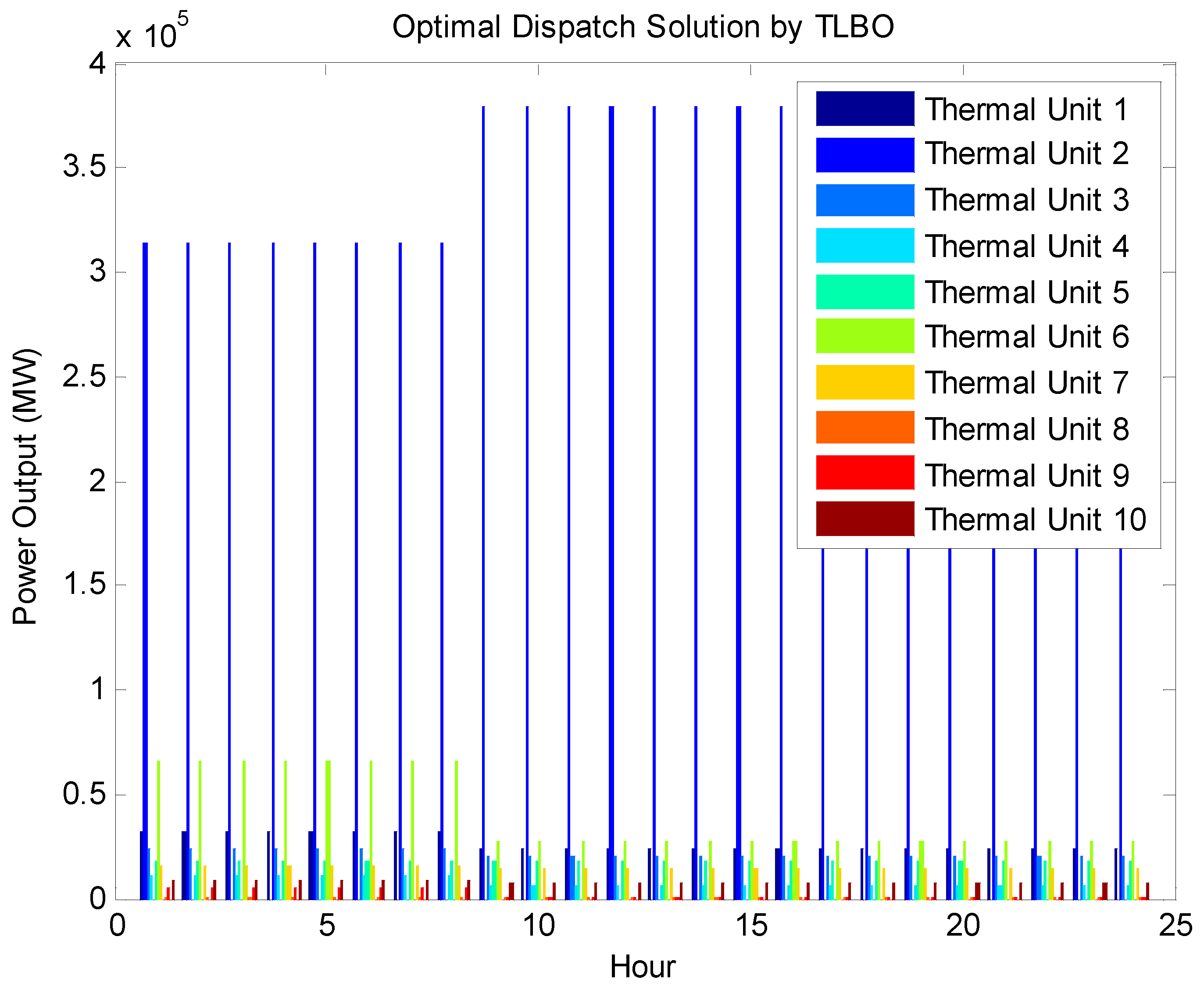
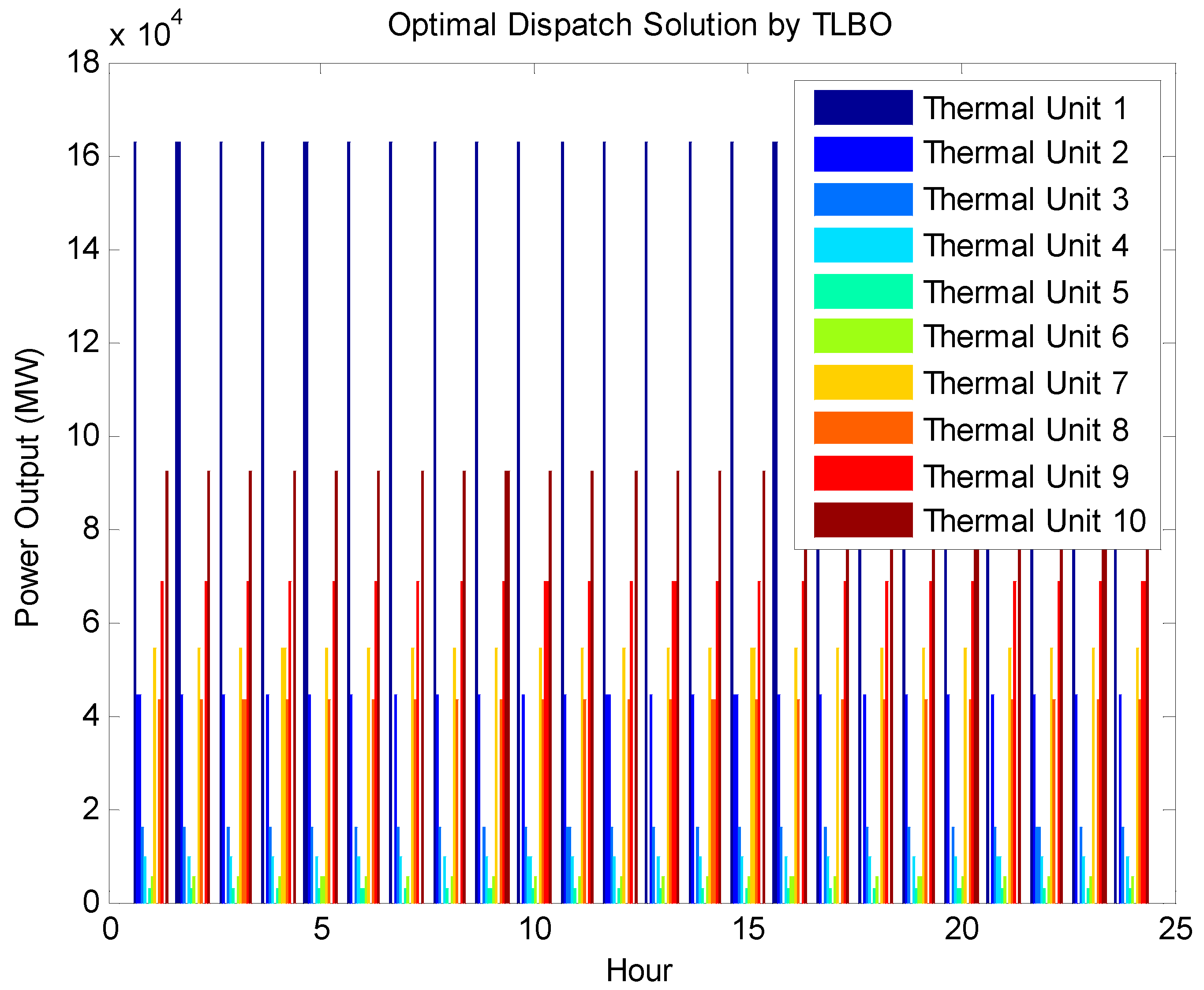
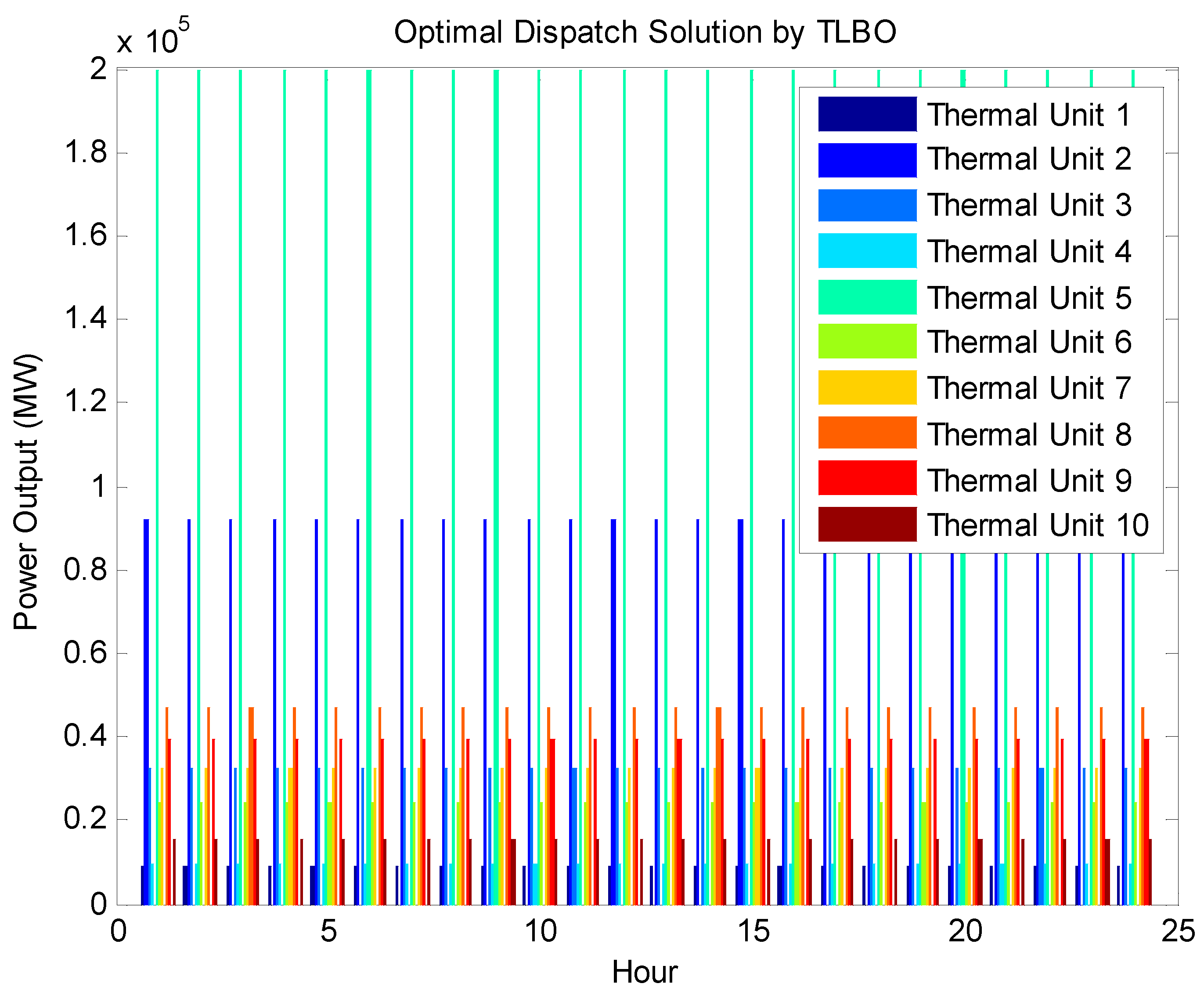
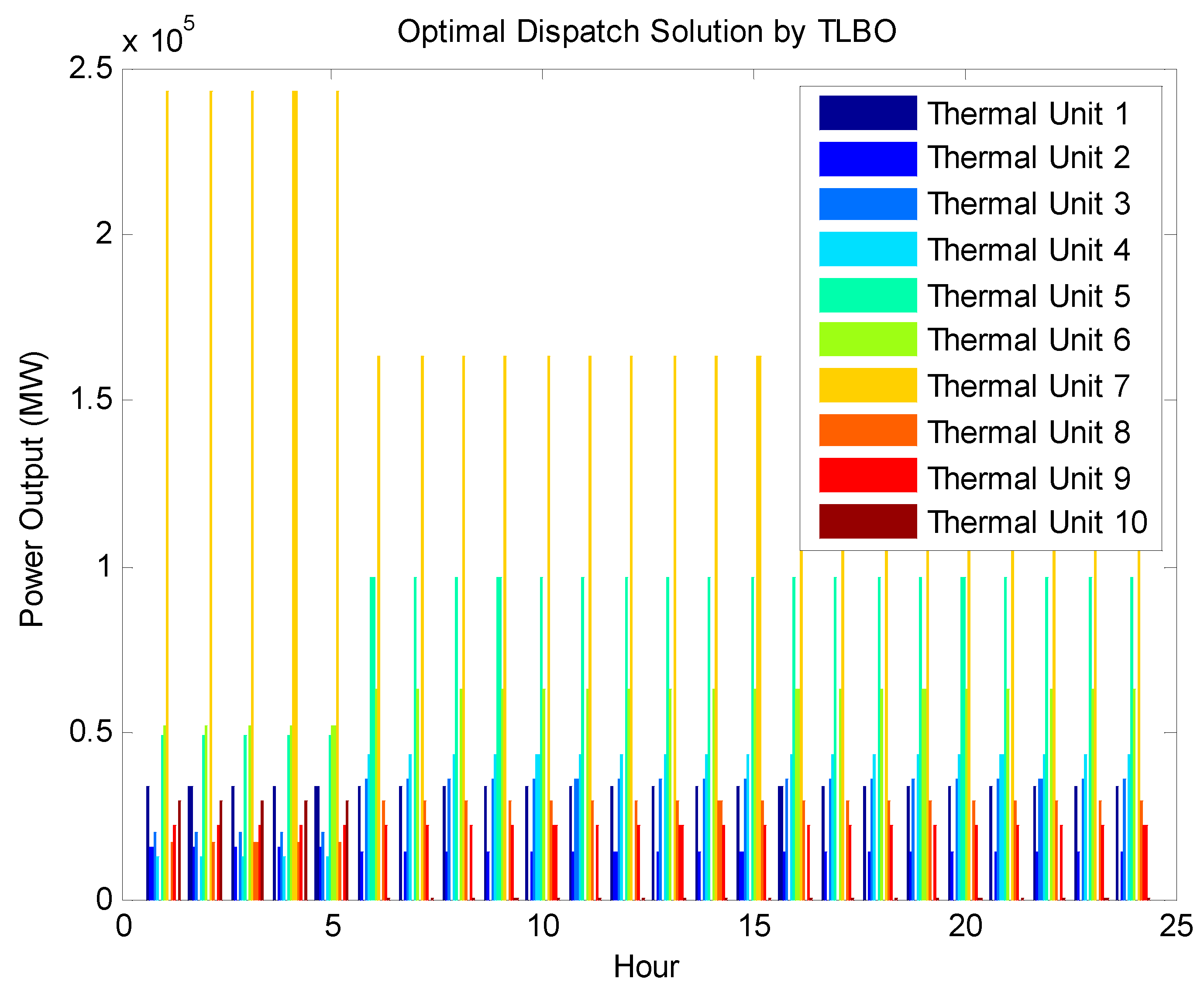
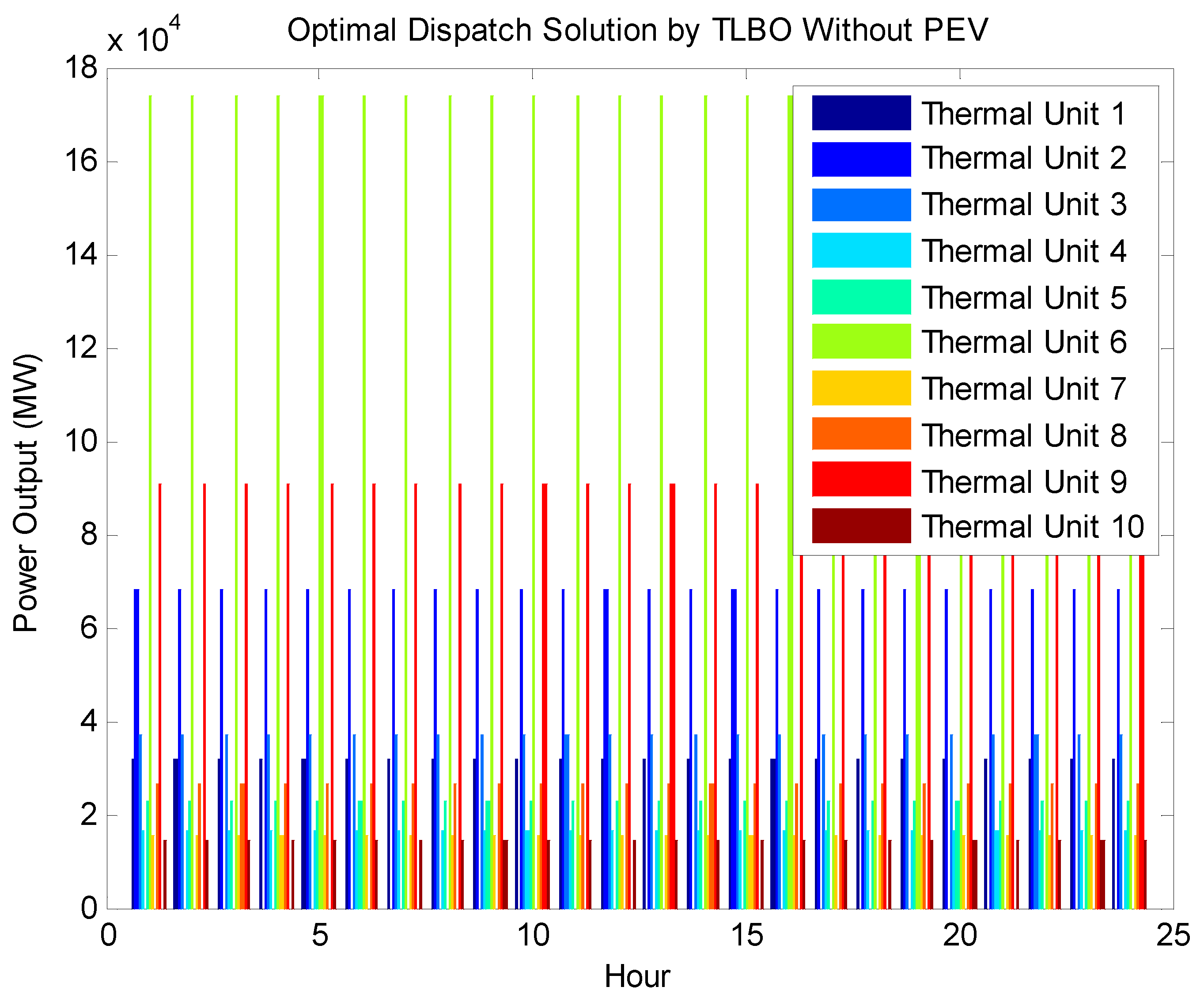
Figure 1.
Case-1 Optimal Power Dispatch for 24-Hour Period With PEV.
Figure 2.
Case-2 Optimal Power Dispatch for 24-Hour Period With PEV for.
Figure 3.
Case-3 Optimal Power Dispatch for 24-Hour Period With PEV for peak charging.
Figure 4.
Case-4 Optimal Power Dispatch for 24-Hour Period With PEV for peak charging.
Figure 5.
Optimal Power Dispatch for 24-Hour Period without PEV.
5. Comparative Study
The economic load dispatch problem is solved using the TLBO algorithm for both scenarios: with and without PEVs. The objective function values, generation costs, and system performance metrics are compared between the two cases. This analysis provides insights into the effects of PEVs on the economic dispatch and the overall power system operation.
5.1. Performance Evaluation
Case-1 (Probability distribution of PEV) exhibits a mean fuel cost of $21.77/hr and a maximum fuel cost of $68864.00/MWh. The total load demand remains constant at 500000.00 MW, with an execution time of 6.56 seconds.
In Case-2 (Off-Peak charging), the mean fuel cost slightly increases to $23.06/hr, while the maximum fuel cost decreases to $61267.00/MWh. The total load demand and execution time remain the same at 500000.00 MW and 7.15 seconds, respectively.
Case-3 (Peak charging) showcases a reduced mean fuel cost of $19.10/hr compared to the other cases, with a maximum fuel cost of $45783.00/MWh. The total load demand and execution time remain constant at 500000.00 MW and 6.78 seconds, respectively.
Case-4 (Stochastic case), the mean fuel cost increases to $26.87/hr, and the maximum fuel cost rises to $55013.00/MWh. Similar to the other cases, the total load demand remains at 500000.00 MW, while the execution time is 6.88 seconds.
The comparative analysis highlights the impact of different PEV charging scenarios on economic load dispatch. Off-Peak charging (Case-2) demonstrates lower maximum fuel costs, while Peak charging (Case-3) exhibits a reduced mean fuel cost. The Probability distribution of PEV (Case-1) and the Stochastic case (Case-4) present varying fuel costs compared to the other cases. These findings contribute to understanding the implications of different PEV charging strategies on the economic operation of power systems.
Table 3.
Ten Generator test system: Comparison of result with PEV in different load cases.
| CASE | Thermal Units | Unit-1 | Unit-2 | Unit-3 | Unit-4 | Unit-5 | Unit-6 | Unit-7 | Unit-8 | Unit-9 | Unit-10 |
|---|---|---|---|---|---|---|---|---|---|---|---|
| Case-1 | Probability distribution of PEV | 0.243 | 3.7925 | 0.2069 | 0.0701 | 0.1848 | 0.2798 | 0.1493 | 0.0043 | 0.0003 | 0.0737 |
| Case-2 | Off - Peak charging | 1.6264 | 0.446 | 0.1625 | 0.0994 | 0.0278 | 0.053 | 0.5449 | 0.4367 | 0.6878 | 0.9252 |
| Case-3 | Peak charging | 0.0888 | 0.9228 | 0.3267 | 0.0966 | 1.9965 | 0.2455 | 0.3251 | 0.47 | 0.3964 | 0.1534 |
| Case-4 | Stochastic case | 0.3425 | 0.1423 | 0.3654 | 0.4364 | 0.9664 | 0.6309 | 1.6361 | 0.2982 | 0.2223 | 0.0002 |
| No. of Thermal Units Without PEV | 0.3187 | 0.6818 | 0.3734 | 0.1667 | 0.2281 | 1.741 | 0.1563 | 0.2668 | 0.9075 | 0.1464 | |
Table 4.
Output for 10 Generator using TLBO with different loading.
| Column1 | Case-1 Probability distribution of PEV | Case-2 Off - Peak charging | Case-3 Peak charging | Case-4 Stochastic case | Without PEV |
|---|---|---|---|---|---|
| Mean fuel cost: | $21.77/hr | $23.06/hr | $19.10/hr | $26.87/hr | $18.39/hr |
| Maximum fuel cost: | $68864.00/MWh | $61267.00/MWh | $45783.00/MWh | $55013.00/MWh | $59860.00/MWh |
| Total load demand: | 500000.00 MW | 500000.00 MW | 500000.00 MW | 500000.00 MW | 500000.00 MW |
| Execution time: | 6.56 seconds | 7.15 seconds | 6.78 seconds | 6.88 seconds | 5.92 seconds |
The performance of the TLBO algorithm is evaluated in terms of convergence speed, solution quality, and computational efficiency. The algorithm's performance is assessed based on its ability to find optimal or near-optimal solutions for the economic load dispatch problem.
5.2. Results and Analysis
The analysis of these results reveals the impact of different PEV charging scenarios on the economic operation of power systems. Off-peak charging and peak charging strategies can potentially lead to cost savings during specific periods, while the stochastic case introduces additional complexities and uncertainties. These findings can assist in developing optimized load management strategies and highlight the need for efficient utilization of PEVs to achieve enhanced economic load dispatch in power systems. The obtained results are analyzed and interpreted to draw conclusions regarding the effectiveness of the TLBO algorithm in solving the enhanced economic load dispatch problem. The impact of PEVs on the economic dispatch and the potential benefits or challenges associated with their integration into the power system is discussed.
6. Discussion and Future Work
The results of the comparative analysis provide valuable insights into the economic load dispatch (ELD) problem considering different Plug-in Electric Vehicle (PEV) charging scenarios. This discussion explores the implications of the findings and suggests potential avenues for future research.
Firstly, the analysis highlights the impact of PEV charging strategies on the overall system performance. Off-Peak charging (Case-2) shows potential cost savings during low-demand periods, while Peak charging (Case-3) demonstrates the effectiveness of utilizing PEVs during high-demand periods. These findings suggest the importance of developing optimized charging strategies that align with the system's load profile and aim to balance electricity supply and demand efficiently.
Furthermore, the stochastic nature of PEV charging in Case-4 introduces additional complexities and uncertainties, resulting in higher fuel costs. This highlights the need for robust optimization techniques and stochastic modeling approaches to address the uncertainties associated with PEV charging behavior and their integration into power systems. Future work can focus on developing advanced optimization algorithms and stochastic modeling techniques to better capture and manage the variability and uncertainties in PEV charging patterns. Additionally, the comparative analysis sheds light on the trade-offs between fuel costs and system performance. The results indicate that while PEV integration can increase fuel costs in some scenarios, it also offers opportunities for load management and grid stability. Future research can explore innovative demand response mechanisms, tariff structures, and pricing strategies to incentivize PEV owners to align their charging patterns with system requirements, ultimately leading to more cost-effective and efficient operation of power systems. Moreover, the execution time analysis provides insights into the computational requirements of different cases. Future work can focus on optimizing the computational efficiency of the load dispatch optimization algorithms to reduce the execution time further, enabling real-time or near-real-time decision-making in practical applications.
The analysis can be extended to consider a larger-scale integration of PEVs and their potential impact on distribution networks, grid infrastructure, and power quality. Future studies can explore the challenges and opportunities associated with managing the increased demand and load variability from a larger fleet of PEVs and investigate the potential benefits of coordinated charging and vehicle-to-grid (V2G) strategies. In conclusion, the discussion emphasizes the importance of further research to refine and expand the understanding of the economic load dispatch problem in the presence of PEVs. Future work can focus on developing advanced optimization algorithms, stochastic modeling approaches, demand response mechanisms, and grid integration strategies to leverage the full potential of PEVs in achieving economic and reliable operation of power systems.
7. Potential Future Work
7.1. Advanced Optimization Algorithms
Further research can focus on developing and implementing advanced optimization algorithms, such as genetic algorithms, particle swarm optimization, or hybrid approaches, to enhance the performance and efficiency of economic load dispatch (ELD) with PEVs. These algorithms can be tailored to address the specific challenges and complexities associated with integrating PEVs into power systems.
7.2. Stochastic Modeling and Uncertainty Analysis
As the stochastic case (Case-4) highlights the uncertainties associated with PEV charging behavior, future work can delve into advanced stochastic modeling techniques and uncertainty analysis to better capture and manage the variability and uncertainties in PEV charging patterns. This can enable more accurate decision-making and robust optimization of ELD with PEVs.
7.3. Demand Response and Pricing Strategies
Investigating innovative demand response mechanisms, tariff structures, and pricing strategies can encourage PEV owners to align their charging patterns with system requirements and optimize their energy consumption. Future research can explore the design and evaluation of incentive-based schemes that promote load shifting and smart charging strategies to improve system efficiency and minimize costs.
7.4. Grid Integration and Infrastructure Considerations
As the scale of PEV integration increases, it becomes crucial to assess the impact on distribution networks, grid infrastructure, and power quality. Future studies can focus on the challenges and opportunities associated with managing the increased demand and load variability from a larger fleet of PEVs, while considering the integration of vehicle-to-grid (V2G) technologies to support bidirectional power flow and grid services.
7.5. Real-Time Decision-Making and Control Strategies
Further work can explore the development of real-time or near-real-time decision-making and control strategies for ELD with PEVs. This can involve the integration of advanced sensing, communication, and control technologies to enable dynamic load management, optimal scheduling, and active power balancing in response to changing grid conditions and PEV charging dynamics.
By addressing these areas, researchers can contribute to the optimization, reliability, and sustainability of power systems in the presence of increasing PEV penetration.
8. Conclusions
This research paper has presented a comprehensive analysis of the economic load dispatch (ELD) problem considering different Plug-in Electric Vehicle (PEV) charging scenarios. The comparative analysis of four cases, namely Off-Peak charging, Probability distribution of PEV, Peak charging, and Stochastic case, has provided valuable insights into the impact of PEV integration on the operation and optimization of power systems.
The results have highlighted the trade-offs between fuel costs and system performance in different charging scenarios. Off-Peak charging has shown potential cost savings during low-demand periods, while Peak charging has demonstrated the effectiveness of utilizing PEVs during high-demand periods. The stochastic case has introduced complexities and uncertainties, resulting in higher fuel costs. The findings underscore the importance of developing optimized charging strategies that align with the system's load profile and aim to balance electricity supply and demand efficiently. Additionally, the analysis has highlighted the need for advanced optimization algorithms, stochastic modeling approaches, demand response mechanisms, and grid integration strategies to address the challenges and uncertainties associated with PEV charging behavior.
Furthermore, the research has emphasized the potential benefits of coordinated charging and vehicle-to-grid (V2G) strategies, which can enhance system flexibility, grid stability, and overall power system efficiency. Overall, this research contributes to the understanding of the economic load dispatch problem in the presence of PEVs and provides a foundation for future studies in optimizing power system operation with PEVs. By considering the trade-offs, challenges, and opportunities associated with PEV integration, researchers and practitioners can develop strategies and policies that facilitate the efficient, reliable, and sustainable operation of power systems in the era of electric transportation.
Acknowledgments
I would like to express my sincere gratitude to Dr. K T Chaturvedi for their invaluable guidance and support throughout the research. Their expertise and insights have been instrumental in shaping the direction of this study and enhancing its quality of my paper. Dr. Chaturvedi's extensive knowledge and experience in power systems and optimization algorithms have provided valuable guidance in understanding the intricacies of the economic load dispatch problem and integrating Plug-in Electric Vehicles (PEVs) into the analysis. His mentorship and feedback have been invaluable in developing the research methodology and interpreting the results. I would also like to acknowledge Dr. K T Chaturvedi for his expertise in PEV integration and his guidance in understanding the challenges and opportunities associated with incorporating PEVs into power systems. His valuable inputs and discussions have contributed significantly to the research and helped in framing the discussions and future directions. Their commitment to academic excellence and dedication to fostering research in the field of power systems have been truly inspiring. I am very grateful for their continuous support, encouragement, and willingness to share their knowledge, which has greatly enriched this paper.
References
- Hao, Wen-Kuo, et al. "Solving Economic Load Dispatch Problem of Power System Based on Differential Evolution Algorithm with Different Mutation Strategies." IAENG International Journal of Computer Science 49.1 (2022): 156-165. [CrossRef]
- Dubey, Hari Mohan, Manjaree Pandit, and B. K. Panigrahi. "Ant lion optimization for short-term wind integrated hydrothermal power generation scheduling." International Journal of Electrical Power & Energy Systems 83 (2016): 158-174. [CrossRef]
- Al-Betar, Mohammed Azmi, et al. "A hybrid Harris Hawks optimizer for economic load dispatch problems." Alexandria Engineering Journal 64 (2023): 365-389. [CrossRef]
- Adhvaryyu, Pradosh Kumar, Pranab Kumar Chattopadhyay, and Aniruddha Bhattacharjya. "Dynamic economic emission load dispatch of hybrid power system using bio-inspired social spider algorithm." 2016 IEEE 1st International Conference on Power Electronics, Intelligent Control and Energy Systems (ICPEICES). IEEE, 2016. [CrossRef]
- Yang, Wenqiang, et al. "A modified social spider optimization for economic dispatch with valve-point effects." Complexity 2020 (2020): 1-13. [CrossRef]
- Banerjee, Sumit, Deblina Maity, and Chandan Kumar Chanda. "Teaching learning based optimization for economic load dispatch problem considering valve point loading effect." International Journal of Electrical Power & Energy Systems 73 (2015): 456-464. [CrossRef]
- Yuan, Xiaohui, et al. "An improved PSO for dynamic load dispatch of generators with valve-point effects." Energy 34.1 (2009): 67-74. [CrossRef]
- Maharana, Himanshu Shekhar, and Saroja Kumar Dash. "Quantum behaved artificial bee colony based conventional controller for optimum dispatch." International Journal of Electrical and Computer Engineering 13.2 (2023): 1260. [CrossRef]
- Yang, Zhile, et al. "A self-learning TLBO based dynamic economic/environmental dispatch considering multiple plug-in electric vehicle loads." Journal of Modern Power Systems and Clean Energy 2.4 (2014): 298-307. [CrossRef]
- Behera, Soudamini, Sasmita Behera, and Ajit Kumar Barisal. "Dynamic Economic Load Dispatch with Plug-in Electric Vehicles using Social Spider Algorithm." 2019 3rd International Conference on Computing Methodologies and Communication (ICCMC). IEEE, 2019. [CrossRef]
- Ma, Haiping, et al. "Multi-objective biogeography-based optimization for dynamic economic emission load dispatch considering plug-in electric vehicles charging." Energy 135 (2017): 101-111. [CrossRef]
- Benalcazar, Patricio, Mauricio E. Samper, and Alberto Vargas. "Short-term economic dispatch of smart distribution grids considering the active role of plug-in electric vehicles." Electric Power Systems Research 177 (2019): 105932. [CrossRef]
- Behera, Soudamini, et al. "Economic Load Dispatch with Renewable Energy Resources and Plug-in Electric Vehicles." 2020 International Conference on Renewable Energy Integration into Smart Grids: A Multidisciplinary Approach to Technology Modelling and Simulation (ICREISG). IEEE, 2020. [CrossRef]
- Wu, Di, Dionysios C. Aliprantis, and Lei Ying. "Load scheduling and dispatch for aggregators of plug-in electric vehicles." IEEE transactions on smart grid 3.1 (2011): 368-376. [CrossRef]
- Yang, Zhile, et al. "Non-convex dynamic economic/environmental dispatch with plug-in electric vehicle loads." 2014 IEEE Symposium on Computational Intelligence Applications in Smart Grid (CIASG). IEEE, 2014. [CrossRef]
- Trongwanichnam, K., S. Thitapars, and N. Leeprechanon. "Impact of plug-in electric vehicles load planning to load factor and total generation cost in a power system." 2019 IEEE PES GTD Grand International Conference and Exposition Asia (GTD Asia). IEEE, 2019. [CrossRef]
- Baş, Emine, and Erkan Ülker. "Improved social spider algorithm for large scale optimization." Artificial Intelligence Review 54.5 (2021): 3539-3574. [CrossRef]
Disclaimer/Publisher’s Note: The statements, opinions and data contained in all publications are solely those of the individual author(s) and contributor(s) and not of MDPI and/or the editor(s). MDPI and/or the editor(s) disclaim responsibility for any injury to people or property resulting from any ideas, methods, instructions or products referred to in the content. |
© 2023 by the authors. Licensee MDPI, Basel, Switzerland. This article is an open access article distributed under the terms and conditions of the Creative Commons Attribution (CC BY) license (http://creativecommons.org/licenses/by/4.0/).
Copyright: This open access article is published under a Creative Commons CC BY 4.0 license, which permit the free download, distribution, and reuse, provided that the author and preprint are cited in any reuse.


