
Submitted:
09 August 2023
Posted:
10 August 2023
You are already at the latest version
Abstract
Environmentally friendly lead-free K1-xNaxNbO3 (KNN) ceramics possess electromechanical properties comparable to lead-based ferroelectric materials, but cannot meet the needs of device miniaturization, and the corresponding thin films lack of theoretical and experimental studies. To this end, we developed the nonlinear phenomenological theory for ferroelectric materials to study the effects of non-equiaxed misfit strain on the phase structure, electromechanical properties and electrical response of K0.5Na0.5NbO3 epitaxial films and constructed the in-plane misfit strain (u1-u2) phase diagrams. The results show that K0.5Na0.5NbO3 epitaxial film under non-equiaxed in-plane strain can exhibit abundant phase structures, including orthorhombic a1c, a2c and a1a2 phases, tetragonal a1, a2 and c phases, and monoclinic r12 phases. Moreover, in the vicinity of a2c-r12, a1c-c and a1a2-a2 phase boundaries, K0.5Na0.5NbO3 epitaxial films exhibit excellent dielectric constant ε11, while at a2c -r12 and a1c-c phase boundaries large piezoelectric coefficient d15 is observed. It was also found that high permittivity ε33 and piezoelectric coefficients d33 exist near the a2c - a2, r12- a1a2 and a1c-a1 phase boundaries due to the existence of polymorphic phase boundaries (PPB) in the KNN system, which makes it easy to polarize near the phase boundaries, and the polarizability changes suddenly, leading to electromechanical enhancement. In addition, the results show that the K0.5Na0.5NbO3 thin films possess a large electrocaloric response at the phase boundary at the r12-a1a2 and a1c-a1 phase boundaries. And the maximum adiabatic temperature change ∆T is about 3.62 K when the electric field change is 30 MV/m at room temperature, which is significantly enhanced compared with equiaxed strain. This study provides theoretical guidance for obtaining K1-xNaxNbO3 epitaxial thin films with excellent properties.
Keywords:
non-equiaxed misfit strain
; K0.5Na0.5NbO3
; Electrocaloric effect
; Ferroelectric thin films
1. Introduction
Ferroelectric materials own electromechanical coupling properties due to the existence of spontaneous polarization [1,2], and have been widely used in electronic components such as capacitors, memories, actuators, etc [3,4]. Pb(ZrxTi1-x)O3 (PZT) ceramics is one of the most widely studied ferroelectric materials [5,6] which possesses excellent performance due to their polymorphic phase boundaries (PPB). The phase structure changes suddenly near the morphotropic phase boundary (MPB) leading to enhanced electromechanical response. However, lead-based ceramics is harmful to our human health and environment [7,8,9,10]. Therefore, the research and development of lead-free piezoelectric materials have become the general trend.
In 2004, Saito et al. firstly prepared K1-xNaxNbO3 (KNN) textured ceramics with excellent piezoelectric properties (pC/N) near the O-T phase boundary, and then reported that modified and highly textured KNN-based lead-free piezoelectric ceramics possess high piezoelectric coefficient reaching , equivalent to those in PZT [11,12]. KNN-based will be a very promising lead-free ferroelectric material, and it is the best substitute for PZT materials, which has aroused extensive interest of researchers.
Over the past years, researchers have studied the composition and the resulting performance of bulk KNN materials, and found that there is a great correlation between the phase boundary and the electromechanical performance [13,14,15,16]. Wang et al. designed the a new phase boundary coexisting tetragonal and rhombohedral phase in 2014 and found that the KNN-based ceramics near the phase boundary have excellent piezoelectric properties [17]. It is generally believed that the enhancement mechanism of tetragonal and rhombohedral phase boundary of KNN base is similar to the morphotropic phase boundary [18,19].
In recent years, with the rapid development of high-level integrated circuits, KNN-based bulk ceramics have been unable to meet the needs of device miniaturization [3,20]. However, there are few studies for high-performance KNN-based thin films. The theoretical exploration of thin films, such as the influence of misfit strain on its phase structure, electromechanical properties and electrocaloric performance are rarely reported, which makes the preparation lack of theoretical guidance.
Compared with the bulk structures, due to the constraints of the boundary conditions imposed in thin films, the film lattice does not match between the substrate and the film, resulting in in-plane misfit strain. It is well known that misfitmisfit strain can affect the phase structure of ferroelectric thin films [21], which can further affect the electromechanical properties and electrical response of thin films [22,23]. So it can be seen that misfit strain can effectively regulate the physical properties of ferroelectric thin films [24]. Currently, Bai et al. [25] studied the effect of misfit strain on the phase structure and electromechanical properties of KNN thin films grown on cubic substrates under different compositions. Zhou et al. [26] studied the phase transition of KNN films under an external electric field through thermodynamic theoretical calculations, but they focused on the influence of extrinsic properties on the film. However, for common KNN films grown on non-cubic substrates subjected to an in-plane non-equiaxed misfit strain, the correlations between the intrinsic phase structure, electromechanical and electrocaloric properties are lacking.
Using nonlinear thermodynamic theory, we construct the in-plane misfit strain phase diagram and study the effects of non-equiaxed in-plane biaxial misfit strain on the phase structure, intrinsic electromechanical properties and electrocaloric response of K0.5Na0.5NbO3 epitaxial films at room temperature. It provides some theoretical guidance for optimizing the performance and experimental preparation of K1-xNaxNbO3 thin films.
2. Theoretical Method
2.1. Thermodynamic Potential and Electromechanical Properties of Epitaxial Thin Films
Following the Landau-Devonshire theory applied to ferroelectric bulk at room temperature [27], conventional orthogonal coordinate systems with axes along [100], along [010] and along [001] are selected as reference. The free energy density of ferroelectric bulk grown along (001) orientation can be described by a polynomials in polarization and stress , which is expressed in Voigt notation as [28]:
where are the components of external electric fields; and are thedielectric coefficients; are the elastic compliance coefficients; are the electrostrictive coefficients. Moreover, the first dielectric coefficient is influenced by temperature via:
where C is the Curie constant, is the vacuum dielectric constant and is the Curie temperature of the involved material.
For thin films that are treated under the configuration of plane stress, assume the top surface is traction-free, then . Assume that the K1-xNaxNbO3 epitaxial film grown on anisotropic substrate are subjected to non-equal in-plane misfit axial strain [29], that is , with zero shear strain component ().
The Gibbs free energy of ferroelectric thin film can then be obtained by using Legendre transformation [30], that is , with . For instance, the thermodynamic potential for K1-xNaxNbO3 epitaxial films can be expressed by [29,30]:
where
Here, and refer to the normalized dielectric constants. The material-specific coefficients (parameters) are listed on Table 1.
Based on the principle of minimum energy, the polarization components of the thin films at equilibrium (stable phase) can be computed as [31]:
From the computed polarization components , the relative dielectric constants of the ferroelectric thin films are obtained as [32,33]:
where
The piezoelectric coefficient for the (001) orientation is calculated by [34]:
In this work, the piezoelectric coefficients and will be analyzed. The in-plane normal strain and shear strain are derived [33]:
2.2. Electrocaloric Effect Temperature Change
Electrocaloric effect refers to the phenomenon of temperature change caused by external electric field or entropy change caused by isothermal conditions of dielectric materials under adiabatic conditions [37,38]. Based on the principle of entropy conservation, the isothermal entropy change and adiabatic temperature change can be computed to characterize the electrocaloric performance of ferroelectric thin films. For instance, the system isothermal entropy change is the sum of dipole entropy and lattice entropy , that is [22,39],
where the dipole entropy is attributed to the electric dipole in the film, and it is a function of the polarization , which is related to the applied electric field, while the lattice entropy depends on temperature and is independent of the applied electric field.
where is the heat capacity per unit volume of the thin film. During the electrocaloric process, the total entropy of the system remains zero under adiabatic electric field; and denote the initial temperature and the final temperature respectively; and represent the initial electric field and the final electric field, respectively.
The final temperature of the material can be calculated from the formula:
3. Results and Analysis
The nonlinear thermodynamic model is applied to study the phase structure, electromechanical properties and electrocaloric response of K0.5Na0.5NbO3 epitaxial film at room temperature under non-equiaxed in-plane misfit strain. The correlation coefficients used in the calculation are shown in Table 1. With these parameters and the nonlinear thermodynamic model, the phase structure and dielectric properties of K0.5Na0.5NbO3 bulk material were accurately repeated [27], indicating that the calculated parameters are reliable. For instance, at 25°C, when the equiaxed compressive strain gradually transforms to tensile strain, the phase structure of the K0.5Na0.5NbO3 film changes with the routes , which is consistent with the phase structure corresponding to the phase diagram (-) along the diagonal line [26], which also validate the correctness of the calculation results
First, we studied the effect of non-equiaxed in-plane misfit strain on the phase structure of K0.5Na0.5NbO3 epitaxial film at room temperature (25°C), and constructed the phase diagram over in-plane strains -, as shown in Figure 1a, and the corresponding changes in the polarization components are shown in Figure 1b–d.
When subjected to equiaxed misfit strain, the phase structure corresponds to the diagonal line of the phase diagram in Figure 1a. It can be found that when the equiaxed compressive strain gradually transforms to tensile strain, the phase structure of K0.5Na0.5NbO3 film changes sequentially as , which is consistent with the literature results, as shown in Figure 2a [26], which shows the correctness of the calculation results.
Interestingly, when and are not equal, which corresponds to in-plane non-equiaxed misfit strain, the symmetry of the phase structure of the K0.5Na0.5NbO3 thin film is obviously broken at room temperature leading to the emergence of rich variety of phase structures. There are seven phase structures according to the applied misfit strains, and the polarization characteristics of each phase are featured in Table 2.
Among these phases, the monoclinic phase corresponds to the center of the phase diagram, and other phases are distributed around it. The pattern of the overall phase diagram is symmetric about the line . The tetragonal phase exists in the region subjected to larger compressive in-plane strain. It can be seen from Figure 1b that in the transition from compressive strain to tensile strain, the plane polarization component gradually decreases to zero, making the -phase disappear.
At the same time, induces leading unequal energies of the two phases and . The -phase is more likely to form in the region with , while -phase is more likely to form in the region . At the same time, the tetragonal phase is located in the region in the phase diagram with large tensile normal strain , while the phase exists in the region with large tensile normal strain . The -phase is located in the region with large tensile normal strains and .
From the diagram showing polarization components, it can be seen that the non-equiaxed in-plane misfit strains and can affect the polarization of the film at room temperature. Figure 1b indicates that the in-plane polarization increases with the increase of the tensile strain , Figure 1c indicates that the change of direction of polarization is parallel to the strain and becomes larger as it increases, while Figure 1d shows that the out-of-plane polarization exists stably in the region with compressive strain and increases with the increase of compressive strains and .
Next we observe the change of the polarization component with the misfit strain where the conditions with room temperature and no applied electric field are imposed. Figure 2b–d depict the relationships between polarization components and strains at , and respectively.
It is found that in Figure 2b, at , as the misfit strain increases from compressive strain to tensile strain (-2%~2%), the film undergoes a sequence of phase transitions , and the orthorhombic phase accounts for the majority, of which the polarization components and experience a sudden change in the phase, while the polarization component decreases continuously with the increase of strain. As observed in Figure 2c, at , the tetragonal phase degenerates while the monoclinic -phase emerges, and the strain of phase boundary extended to -0.55% . As the strain becomes tensile and as the misfit strain increases, the thin films undergo a sequence of phase transformations , the polarization component has no obvious change, but the abrupt change point of the polarization component has dropped to the region with compressive strain. Figure 1 and Figure 2 illustrate that, compared with the equiaxed misfit strain, the non-equiaxed misfit strain causes a change in the symmetry of the phase structure, thus inducing a rich variety of phase structures. Moreover, there co-exists multiple phases near the phase boundary leading to easy polarization which enhance the performance, which serve as the mechanism for effective control of the electromechanical properties of K0.5Na0.5NbO3 epitaxial film.
In order to explore the influence of non-equiaxed misfit strain on the electromechanical properties of K0.5Na0.5NbO3 epitaxial film, we calculated the dielectric constant and piezoelectric coefficient of K0.5Na0.5NbO3 epitaxial film under non-equiaxed misfit strain, as shown in Figure 3, Figure 4 and Figure 5.
Figure 3a–c shows the stack distribution of the dielectric constants on the phase diagram when the non-equiaxed misfit strain () interacts at room temperature. Figure 3a demonstrates that near the phase boundary exhibits excellent transverse permittivity , mainly due to the polarization component gradually decreasing to 0 as the strain decreases, as shown in Figure 1b. In Figure 3b, the scores of permittivity are mainly distributed near the multi-phase boundary , in the range of low compressive strain .In the region of Figure 3c with a larger tensile strain , application of induces large , indicating that non-equiaxed misfit strain enhances the dielectric constant near the phase boundaries with the coexistence of multi-phase at room temperature, which is consistent with the discovery in the KNN-based thin film by Lou et al. [43] where a monoclinic phase emerges at room temperature with an obvious performance enhancement near the phase boundary.
In order to further understand the influence of non-equiaxed strain on the dielectric properties, we selected the region of the phase diagram with high dielectric property to study the relationship between specific strain and polarization characteristics and electromechanical properties, as shown in Figure 4a–c. Figure 4a shows the relationship between the dielectric constant and the in-plane strain , when . Recall that the relationship between the corresponding polarization and the phase structure has been described in Figure 2b. In the figure, it can be seen that with the increase of strain , the dielectric constant increases slowly, and there is no obvious change near the phase boundary, mainly because the out-of-plane polarization component of the film remains relatively stable when the strain is applied. However, in the region of the phase diagram corresponding to the coexistence of the orthogonal and tetragonal phases, the lateral permittivity and exhibit peak values, when the applied strains are = -1.44% and respectively. A stable region with a permittivity of about 500 is also observed in the phase.
For the case with , when the applied electric field is 0, at 25°C, the phase diagram corresponding to its polarization component is shown in Figure 2c, and a sharp peak of the permittivity appears near the phase boundary, which can be seen as the abrupt change of the polarization component from Figure 1c. In addition, at this phase transition point, the in-plane polarization gradually decreases to 0, and its slope changes discontinuously. At the same time, the dielectric constant is located at the point where the slope of the out-of-plane polarization decreases, and due to the small decrease in the in-plane polarization , the dielectric constant remains basically unchanged, and can maintain good stability at room temperature, and the peak value of throughout the process is greater than .
We also calculated the relationship between dielectric constant and strain as shown in Figure 4c when the tensile strain is . Similar to Figure 4b, phase enhancement effect is also observed. The peaks of and are located at the orthogonal and tetragonal phase boundaries, and the strain difference between these peaks is small, which is related to the sudden change of the corresponding polarization component, where the discontinuity of is shifted towards the direction of compressive strain .
Next, we studied the influences of non-equiaxed misfit strain on the piezoelectric coefficients and of the K0.5Na0.5NbO3 epitaxial film. Figure 5a,b shows the cloud distribution of the piezoelectric coefficients and when the applied electric field is 0 at room temperature. It can be found that the piezoelectric coefficients are all 0 across the phase structures , and , which is mainly attributed to the distribution of polarization components in Figure 1d, which is consistent with the piezoelectric coefficients only when the asymmetric structure is met.
The distribution of the extreme value of the piezoelectric coefficient is similar to that of the dielectric constant , which exists at the phase boundary of and . The distribution of piezoelectric coefficient is similar to the dielectric constant follow similar trend, which undergo enhancement when the polarization component experiences suddenly change. While it is most well known in the PZT film, which has tetragonal and rhombohedral phases coexisting at MPB, but there is a certain difference in the mechanism of the two. MPB is due to the polarization reversal generated by the material itself, which causes the enhancement effect, and the polarization component will change discontinuously near the phase boundary. For the KNN film, it is regulated by external strain.
In Figure 6a when , the relationship between the piezoelectric coefficient and the misfit strain when it is changed from compressive strain to tensile strain, the phase structure undergoes a transformation: . It is found that the piezoelectric coefficient attains a peak value near the phase boundary, and the strain is mainly caused by the sharp change of the slope of in-plane polarization . is rising continuously. Along the diagonal region of the phase diagram, the influence of phase boundary on the electromechanical performance is minimal, because the polarization components at the phase transition point are all continuously changing with no sudden change in the slope.
Figure 6b,c show the relationship curves of piezoelectric coefficient and strain when the misfit strain is 0 and 1.5%, respectively. It can be seen the piezoelectric coefficient is almost close to 0 with no obvious change as the polarization in the phase diagram where the polarization component is in a stable state. When the misfit strain is not present, the piezoelectric coefficient attains peak values near the phase boundary, while away from the peak, it changes slowly in the orthorhombic phase. When it is subjected to tensile strain , the piezoelectric coefficient peaks at , which is similar to the dielectric constant because its value is the product of the polarization component and the dielectric constant.
In general, the enhancement of electromechanical properties often occurs near the O-M, O-T, and T-M phase boundaries, which is consistent with the existence of morphotropic phase boundaries in the KNN system and is regulated by external strain. At the same time, when the in-plane polarization changes suddenly, the dielectric constants and piezoelectric coefficient attain peak values, and when the in-plane polarization changes, the dielectric constants follows the change. When the dielectric constants and piezoelectric coefficient are at peaks, the slope of the out-of-plane polarization often changes abruptly, and when the value of is 0, the piezoelectric coefficients and are both zero. By adjusting the magnitude of the misfit strain, the position of the polymorphic phase boundary at room temperature can be controlled, thereby adjusting the electromechanical properties of the thin film system.
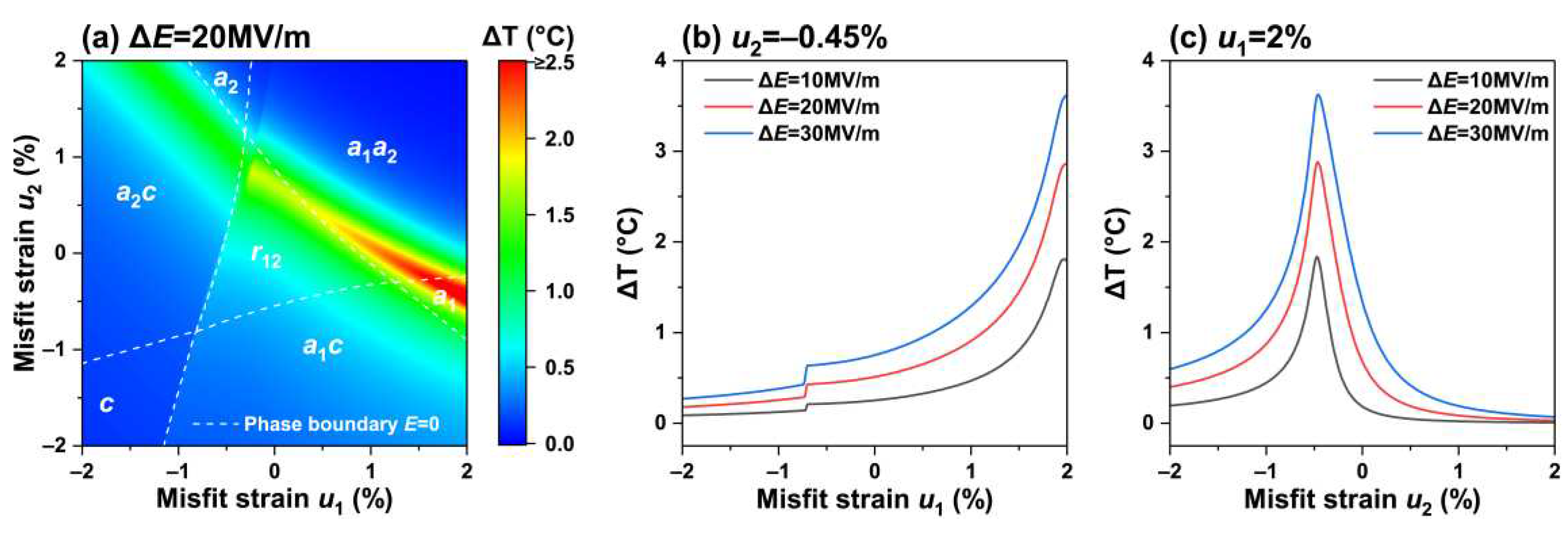
Finally, we studied the effect of non-equiaxed misfit strain on the adiabatic temperature change in the electrocaloric response of K0.5Na0.5NbO3 thin film. The results are shown in Figure 5a. At room temperature, an electric field change of 20MV/m along the [001] direction is applied from an initial electric field of 1 MV/m. The results show that at room temperature the phase boundaries -, - and - shift towards tensile strain compared to the case with no applied electric field (as indicated by the white dotted line versus phase boundary enhancement), which is due to the applied electric field along the direction of the out-of-plane polarization , leading to enhancement. At the same time, large adiabatic temperature changes appear near the -, - and - phase boundaries, because the polarization near these phase boundaries is zero when there is no external electric field, as shown in Figure 1d; when an external electric field in the [001] direction is applied, increases, causing a large entropy change, resulting in a large adiabatic temperature change .
There is a difference from the extreme value of the adiabatic temperature change near the ferroelectric phase, indicating that the enhancement is not caused by the Curie temperature of the ferroelectric material, and when the strain remains constant, enhancement of phase boundaries in Figure 5a shows an upward trend with the increase of the in-plane strain , which may be due to the continuous decrease of the polarization under this condition. To further understand the electrocaloric effect under the applied electric field and the in-plane misfit, we calculated the characteristics of the adiabatic temperature change with the misfit strain under different applied electric fields when and were 0.02 and -0.0045, respectively, as shown in Figure 4b,c. The study found that with the increase of the applied electric field, increases and remains unchanged upon reaching the peak value. In figure (b), as u1 increases, the adiabatic temperature change shows an upward trend. When is about -0.7%, experience a small mutation, which is caused by the emergence of the polarization component . In Figure (c), the adiabatic temperature change can reach 3.62K at , which is further improved compared to the equiaxed misfit strain, and the peak of is clearly seen at the phase transition in Figure 4c, indicating that an appropriate non-equiaxed misfit strain and an applied electric field can enhance the electrocaloric effect at room temperature. This provides certain guiding significance for the stable operation of the electrocaloric refrigeration device at room temperature.
Figure 7.
(a) Adiabatic temperature change on the strain phase diagram (red line) at 25℃ and electric field of MV/m. (b,c) Adiabatic temperature diagram when the electric field is applied at 10, 20, 30MV/m for in-plane misfit strain of (b) 0.45%; (c) 2%.
Figure 7.
(a) Adiabatic temperature change on the strain phase diagram (red line) at 25℃ and electric field of MV/m. (b,c) Adiabatic temperature diagram when the electric field is applied at 10, 20, 30MV/m for in-plane misfit strain of (b) 0.45%; (c) 2%.
4. Conclusion
In summary, this particle uses the nonlinear Landau-Devonshire thermodynamic theory to study the effects of non-equiaxed in-plane misfit strain on the phase structure, electromechanical properties and electrocaloric effect of K0.5Na0.5NbO3 epitaxial thin films grown on anisotropic substrates at room temperature. It is found that at room temperature, misfit strain can induce orthorhombic phases (), tetragonal phases (), and monoclinic phases (). Due to the sudden change in the slope of the in-plane and out-of-plane polarization components, the electromechanical properties and electrocaloric effects near the O-M, T-M, and O-T phase boundaries are enhanced. And the phase boundary generated by strain engineering is different from MPB in classical PZT. Among these phase structures, there are excellent dielectric constant and piezoelectric coefficient near the - phase boundary. At the same time, the applied electric field along the direction can make the phase boundary shift to the direction of strain increase. When the electric field changes to 30MV/m, the adiabatic temperature change can reach about 3.6K when the film is in the monoclinic phase . This work provides some theoretical guidance for the experimental research on the control of lead-free K1-xNaxNbO3 thin films by strain engineering.
Author Contributions
Y.W.: analysis of the data and review. Y.O.: conceptualization, theoretical calculations, and writing the original draft. J.P.: review, editing, and interpretation of the analyzed data. C.L.: Analysis of data, review, and editing. All authors have read and agreed to the published version of the manuscript.
Funding
This work was partially supported by the National Natural Science Foundation of China (11702092), and the project was supported by the Hunan Provincial Natural Science Foundation of China (2020JJ5182).
Institutional Review Board Statement
Not applicable.
Informed Consent Statement
Not applicable.
Data Availability Statement
Not applicable.
Conflicts of Interest
The authors declare no conflict of interest.
References
- Liu, Y.; Seidel, J.; Li, J. Multiferroics under the Tip: Probing Magnetoelectric Coupling at the Nanoscale. National Science Review 2019, 6, 626–628. [Google Scholar] [CrossRef] [PubMed]
- Jiang, P.; Huang, B.; Wei, L.; Yan, F.; Huang, X.; Li, Y.; Xie, S.; Pan, K.; Liu, Y.; Li, J. Resolving Fine Electromechanical Structure of Collagen Fibrils via Sequential Excitation Piezoresponse Force Microscopy. Nanotechnology 2019, 30, 205703. [Google Scholar] [CrossRef] [PubMed]
- Martin, L.W.; Rappe, A.M. Thin-Film Ferroelectric Materials and Their Applications. Nat Rev Mater 2016, 2, 16087. [Google Scholar] [CrossRef]
- Liu, Y.; Li, J. Multiferroics: Looking Back and Going Forward. Sci. China Technol. Sci. 2020, 63, 2735–2736. [Google Scholar] [CrossRef]
- Chen, X.; Xu, S.; Yao, N.; Shi, Y. 1.6 V Nanogenerator for Mechanical Energy Harvesting Using PZT Nanofibers. Nano Lett. 2010, 10, 2133–2137. [Google Scholar] [CrossRef]
- Zhu, Q.; Pan, K.; Xie, S.; Liu, Y.; Li, J. Nanomechanics of Multiferroic Composite Nanofibers via Local Excitation Piezoresponse Force Microscopy. Journal of the Mechanics and Physics of Solids 2019, 126, 76–86. [Google Scholar] [CrossRef]
- Li, J.F.; Wang, K.; Zhu, F.Y.; Cheng, L.Q.; Yao, F.Z. (K,Na)NbO3 -Based Lead-Free Piezoceramics: Fundamental Aspects, Processing Technologies, and Remaining Challenges. J. Am. Ceram. Soc. 2013, 96, 3677–3696. [Google Scholar] [CrossRef]
- Carl, K.; Härdtl, K.H. On the Origin of the Maximum in the Electromechanical Activity in Pb(ZrxTi1−x)O3 Ceramies near the Morphotropic Phase Boundary. Phys. Stat. Sol. (a) 1971, 8, 87–98. [Google Scholar] [CrossRef]
- Auciello, O.; Gifford, K.D.; Lichtenwalner, D.J.; Dat, R.; Al-Shareef, H.N.; Bellur, Kashyap. R.; Kincon, A.I. A Review of Composition-Structure-Property Relationships for PZT-Based Heterostructure Capacitors. Integrated Ferroelectrics 1995, 6, 173–187. [Google Scholar] [CrossRef]
- Pandey, D.; Singh, A.K.; Baik, S. Stability of Ferroic Phases in the Highly Piezoelectric Pb(ZrxTi1−x)O3 Ceramics. Acta Crystallogr A Found Crystallogr 2008, 64, 192–203. [Google Scholar] [CrossRef]
- Wang, K.; Malič, B.; Wu, J. Shifting the Phase Boundary: Potassium Sodium Niobate Derivates. MRS Bull. 2018, 43, 607–611. [Google Scholar] [CrossRef]
- Wu, J.; Xiao, D.; Zhu, J. Potassium–Sodium Niobate Lead-Free Piezoelectric Materials: Past, Present, and Future of Phase Boundaries. Chem. Rev. 2015, 115, 2559–2595. [Google Scholar] [CrossRef] [PubMed]
- Wang, Z.; Gu, H.; Hu, Y.; Yang, K.; Hu, M.; Zhou, D.; Guan, J. Synthesis, Growth Mechanism and Optical Properties of (K,Na)NbO3 Nanostructures. CrystEngComm 2010, 12, 3157. [Google Scholar] [CrossRef]
- Meng, X.; Wang, W.; Ke, H.; Rao, J.; Jia, D.; Zhou, Y. Synthesis, Piezoelectric Property and Domain Behaviour of the Vertically Aligned K1−xNax NbO3 Nanowire with a Morphotropic Phase Boundary. J. Mater. Chem. C 2017, 5, 747–753. [Google Scholar] [CrossRef]
- Jin, W.; Wang, Z.; Li, M.; He, Y.; Hu, X.; Li, L.; Gao, Y.; Hu, Y.; Gu, H.; Wang, X. Evolution of the Composition, Structure, and Piezoelectric Performance of (K1-xNax)NbO3 Nanorod Arrays with Hydrothermal Reaction Time. Appl. Phys. Lett. 2018, 112, 142904. [Google Scholar] [CrossRef]
- Esin, A.A.; Alikin, D.O.; Turygin, A.P.; Abramov, A.S.; Hreščak, J.; Walker, J.; Rojac, T.; Bencan, A.; Malic, B.; Kholkin, A.L.; et al. Dielectric Relaxation and Charged Domain Walls in (K,Na)NbO3 -Based Ferroelectric Ceramics. Journal of Applied Physics 2017, 121, 074101. [Google Scholar] [CrossRef]
- Wang, X.; Wu, J.; Xiao, D.; Zhu, J.; Cheng, X.; Zheng, T.; Zhang, B.; Lou, X.; Wang, X. Giant Piezoelectricity in Potassium–Sodium Niobate Lead-Free Ceramics. J. Am. Chem. Soc. 2014, 136, 2905–2910. [Google Scholar] [CrossRef]
- Ge, W.; Li, J.; Viehland, D.; Chang, Y.; Messing, G.L. Electric-Field-Dependent Phase Volume Fractions and Enhanced Piezoelectricity near the Polymorphic Phase Boundary of (K0.5Na0.5)1−xLixNbO3 Textured Ceramics. Phys. Rev. B 2011, 83, 224110. [Google Scholar] [CrossRef]
- Tan, Z.; Xing, J.; Peng, Y.; Zhang, Q.; Zhu, J. Polarization Rotation Boosts Strong Piezoelectric Response in the Lead-Free Perovskite Ferroelectric K0.5Na0.5NbO3. Phys. Rev. B 2021, 104, 014104. [Google Scholar] [CrossRef]
- Seog, H.J.; Ullah, A.; Ahn, C.W.; Kim, I.W.; Lee, S.Y.; Park, J.; Lee, H.J.; Won, S.S.; Kim, S.H. Recent Progress in Potassium Sodium Niobate Lead-Free Thin Films. J. Korean Phys. Soc. 2018, 72, 1467–1483. [Google Scholar] [CrossRef]
- von Helden, L.; Bogula, L.; Janolin, P.E.; Hanke, M.; Breuer, T.; Schmidbauer, M.; Ganschow, S.; Schwarzkopf, J. Huge Impact of Compressive Strain on Phase Transition Temperatures in Epitaxial Ferroelectric KxNa1−xNbO3 Thin Films. Appl. Phys. Lett. 2019, 114, 232905. [Google Scholar] [CrossRef]
- Shan, D.L.; Lei, C.H.; Cai, Y.C.; Pan, K.; Liu, Y.Y. Mechanical Control of Electrocaloric Response in Epitaxial Ferroelectric Thin Films. International Journal of Solids and Structures 2021, 216, 59–67. [Google Scholar] [CrossRef]
- Liu, Y.Y.; Vasudevan, R.K.; Pan, K.; Xie, S.H.; Liang, W.I.; Kumar, A.; Jesse, S.; Chen, Y.C.; Chu, Y.H.; Nagarajan, V.; et al. Controlling Magnetoelectric Coupling by Nanoscale Phase Transformation in Strain Engineered Bismuth Ferrite. Nanoscale 2012, 4, 3175. [Google Scholar] [CrossRef]
- Wang, J.J.; Su, Y.J.; Wang, B.; Ouyang, J.; Ren, Y.H.; Chen, L.Q. Strain Engineering of Dischargeable Energy Density of Ferroelectric Thin-Film Capacitors. Nano Energy 2020, 72, 104665. [Google Scholar] [CrossRef]
- Liu, D.; Bai, G.; Gao, C. Phase Diagrams Classification Based on Machine Learning and Phenomenological Investigation of Physical Properties in K1 −xNaxNbO3 Thin Films. Journal of Applied Physics 2020, 127, 154101. [Google Scholar] [CrossRef]
- Zhou, M.J.; Wang, J.J.; Chen, L.Q.; Nan, C.W. Strain, Temperature, and Electric-Field Effects on the Phase Transition and Piezoelectric Responses of K 0.5Na0.5NbO3 Thin Films. Journal of Applied Physics 2018, 123, 154106. [Google Scholar] [CrossRef]
- Pohlmann, H.; Wang, J.J.; Wang, B.; Chen, L.Q. A Thermodynamic Potential and the Temperature-Composition Phase Diagram for Single-Crystalline K 1-xNaxNbO3(0≤ x ≤ 0.5). Appl. Phys. Lett. 2017, 110, 102906. [Google Scholar] [CrossRef]
- Peng, J.; Shan, D.; Liu, Y.; Pan, K.; Lei, C.; He, N.; Zhang, Z.; Yang, Q. A Thermodynamic Potential for Barium Zirconate Titanate Solid Solutions. npj Comput Mater 2018, 4, 66. [Google Scholar] [CrossRef]
- Liu, Y.Y.; Zhu, Z.X.; Li, J.F.; Li, J.Y. Misfit Strain Modulated Phase Structures of Epitaxial Pb(Zr1−xTix)O3 Thin Films: The Effect of Substrate and Film Thickness. Mechanics of Materials 2010, 42, 816–826. [Google Scholar] [CrossRef]
- Pertsev, N.A.; Zembilgotov, A.G.; Tagantsev, A.K. Effect of Mechanical Boundary Conditions on Phase Diagrams of Epitaxial Ferroelectric Thin Films. Phys. Rev. Lett. 1998, 80, 1988–1991. [Google Scholar] [CrossRef]
- Liu, Y.Y.; Li, J.Y. Shear-Driven Morphotropic Phase Boundary in Epitaxial Ferroelectric Thin Films. Phys. Rev. B 2011, 84, 132104. [Google Scholar] [CrossRef]
- Haun, M.J.; Furman, E.; Jang, S.J.; Cross, L.E. Thermodynamic Theory of the Lead Zirconate-Titanate Solid Solution System, Part I: Phenomenology. Ferroelectrics 1989, 99, 13–25. [Google Scholar] [CrossRef]
- Liu, Y.Y.; Yang, L.; Li, J.Y. Strain-Engineered Orthorhombic-Rhombohedral Phase Boundary in Epitaxial Bismuth Ferrite Films. Journal of Applied Physics 2013, 113, 183524. [Google Scholar] [CrossRef]
- Pertsev, N.A.; Kukhar, V.G.; Kohlstedt, H.; Waser, R. Phase Diagrams and Physical Properties of Single-Domain Epitaxial Pb(Zr1−xTix)O3 Thin Films. Phys. Rev. B 2003, 67, 054107. [Google Scholar] [CrossRef]
- Tomeno, I.; Tsunoda, Y.; Oka, K.; Matsuura, M.; Nishi, M. Lattice Dynamics of Cubic NaNbO3 : An Inelastic Neutron Scattering Study. Phys. Rev. B 2009, 80, 104101. [Google Scholar] [CrossRef]
- Liang, L.; Li, Y.L.; Chen, L.Q.; Hu, S.Y.; Lu, G.H. A Thermodynamic Free Energy Function for Potassium Niobate. Applied Physics Letters 2009, 94, 072904. [Google Scholar] [CrossRef]
- Barman, A.; Kar-Narayan, S.; Mukherjee, D. Caloric Effects in Perovskite Oxides. Adv. Mater. Interfaces 2019, 6, 1900291. [Google Scholar] [CrossRef]
- Shan, D.; Pan, K.; Liu, Y.; Li, J. High Fidelity Direct Measurement of Local Electrocaloric Effect by Scanning Thermal Microscopy. Nano Energy 2020, 67, 104203. [Google Scholar] [CrossRef]
- Pirc, R.; Kutnjak, Z.; Blinc, R.; Zhang, Q.M. Electrocaloric Effect in Relaxor Ferroelectrics. Journal of Applied Physics 2011, 110, 074113. [Google Scholar] [CrossRef]
- He, N.; Li, Q.; Lei, C.; Pan, J.; Shan, D.; Pan, K.; Liu, Y. Electrocaloric Response Modulated by Misfit Strain in Different Oriented Epitaxial Ferroelectric Thin Films. International Journal of Solids and Structures 2022, 252, 111808. [Google Scholar] [CrossRef]
- Shan, D.; Cai, Y.; Lei, C.; Peng, J.; He, N.; Pan, K.; Liu, Y.; Li, J. Electric-Field-Driven Coexistence of Positive and Negative Electrocaloric Effects near Room Temperature for High-Efficiency Two-Stage Cooling. Appl. Phys. Lett. 2021, 118, 122905. [Google Scholar] [CrossRef]
- Lei, C.H.; Liu, Y. Correlations between Local Electrocaloric Effect and Domains in Ferroelectric Crystals. Appl. Phys. Lett. 2022, 121, 102902. [Google Scholar] [CrossRef]
- Luo, J.; Sun, W.; Zhou, Z.; Lee, H.Y.; Wang, K.; Zhu, F.; Bai, Y.; Wang, Z.J.; Li, J.-F. Monoclinic (K,Na)NbO3 Ferroelectric Phase in Epitaxial Films. Adv. Electron. Mater. 2017, 3, 1700226. [Google Scholar] [CrossRef]
Figure 1.
(a) Non-isometric misfit strain-strain Phase diagram for K0.5Na0.5NbO3 thin films at 25℃ without external electric field; (b–d) Pseudo-color maps on strained phase diagrams depicting respectively the polarization components .
Figure 1.
(a) Non-isometric misfit strain-strain Phase diagram for K0.5Na0.5NbO3 thin films at 25℃ without external electric field; (b–d) Pseudo-color maps on strained phase diagrams depicting respectively the polarization components .
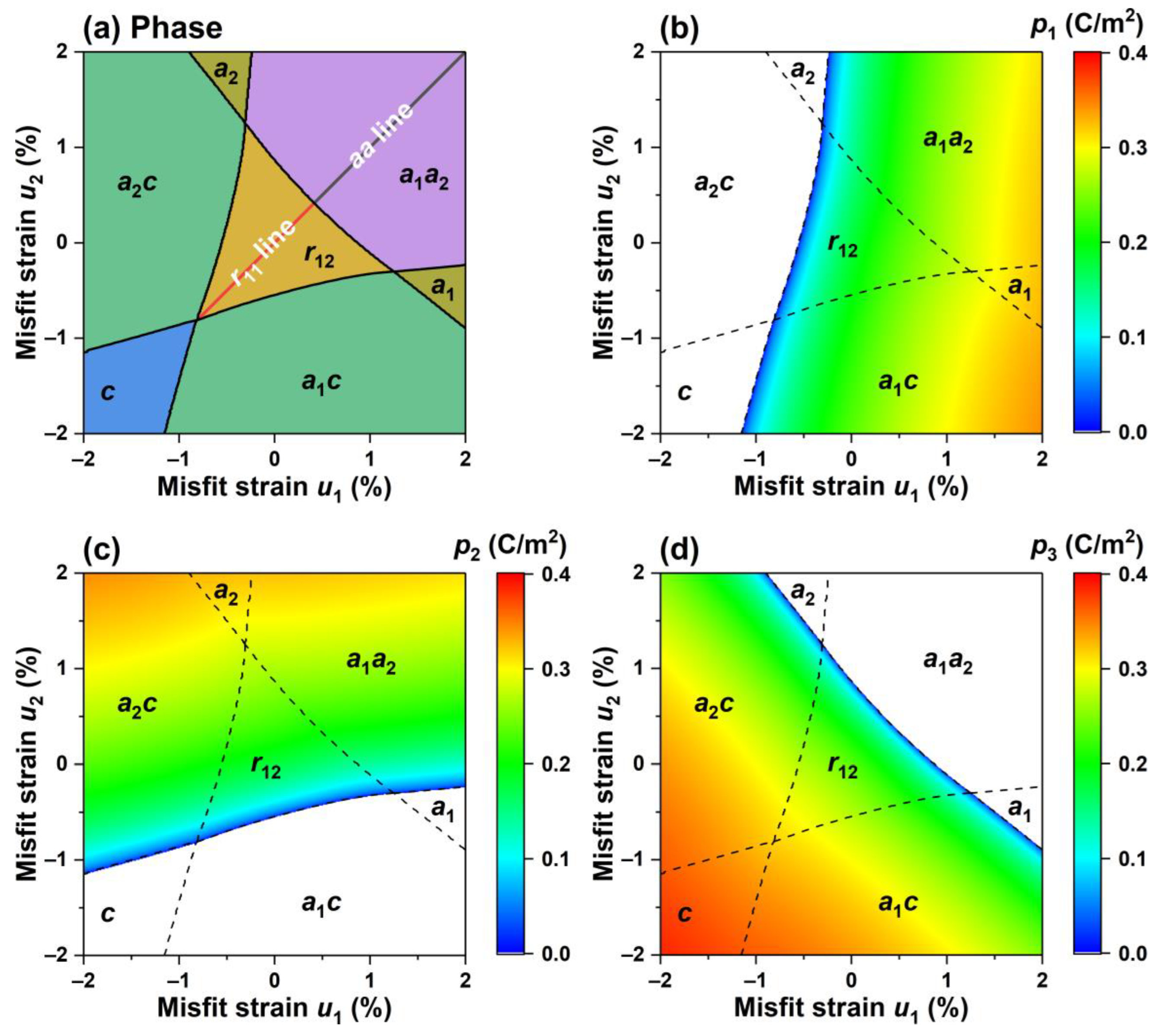
Figure 2.
(a) Strain-Polarization diagram with at 25℃ and subjected to no electric field. Strain -Polarization diagram with at 25℃ and subjected to no electric field: (b), (c), .
Figure 2.
(a) Strain-Polarization diagram with at 25℃ and subjected to no electric field. Strain -Polarization diagram with at 25℃ and subjected to no electric field: (b), (c), .
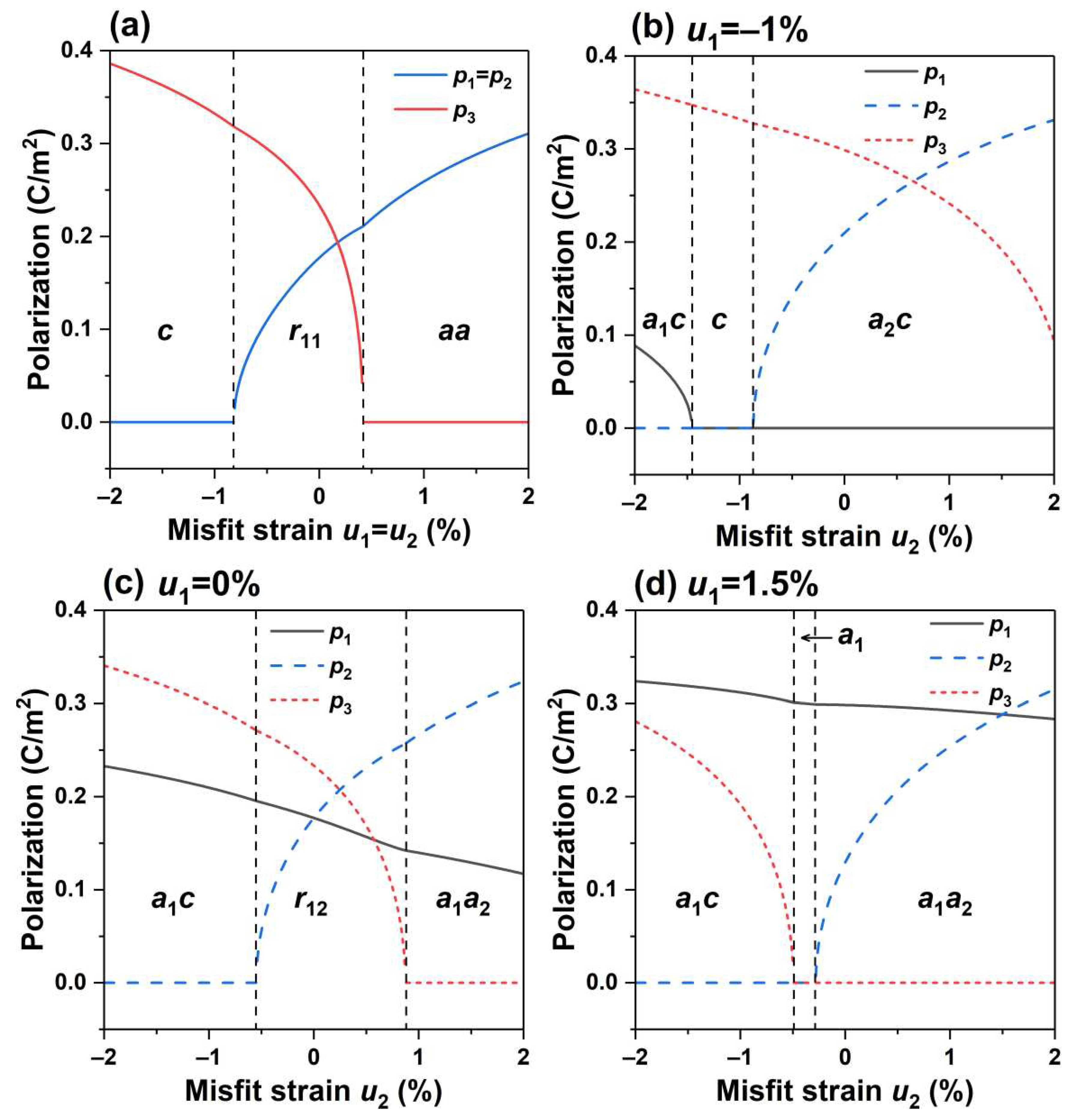
Figure 3.
The permittivity (a) , (b) , (c) on strain-strain phase diagram at 25℃ and subjected to an electric field of 0MV/m.
Figure 3.
The permittivity (a) , (b) , (c) on strain-strain phase diagram at 25℃ and subjected to an electric field of 0MV/m.
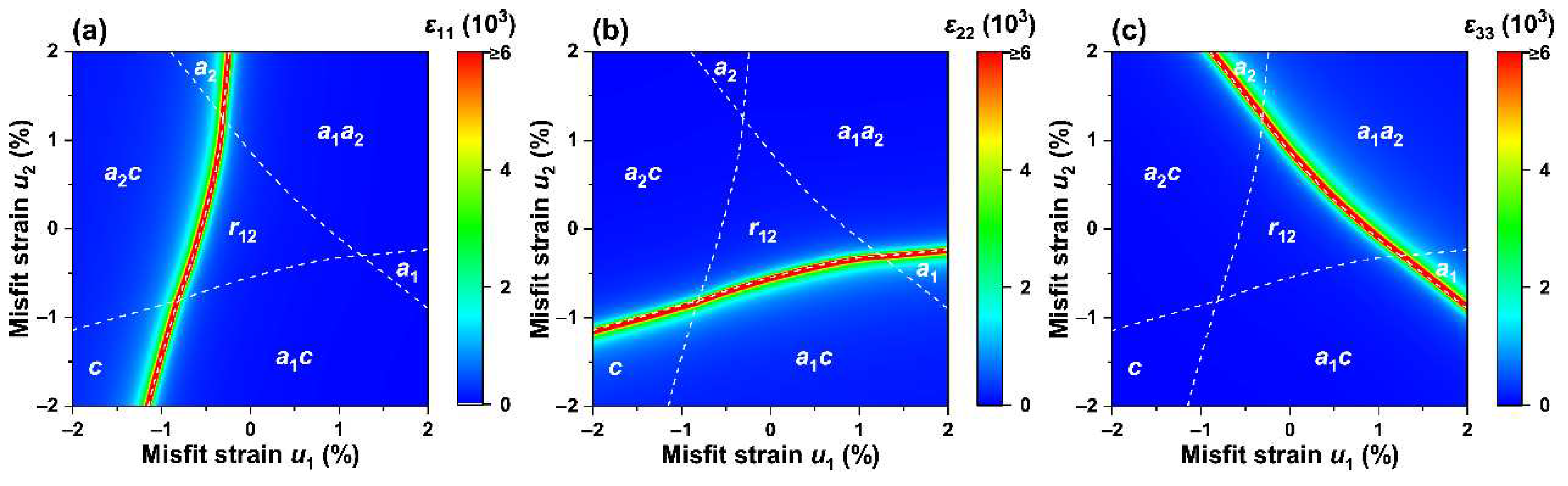
Figure 4.
Dielectric constants as a function of in-plane strain at 25℃ with electric field is 0 MV/): (a) (a); (b) (b); (c) .
Figure 4.
Dielectric constants as a function of in-plane strain at 25℃ with electric field is 0 MV/): (a) (a); (b) (b); (c) .
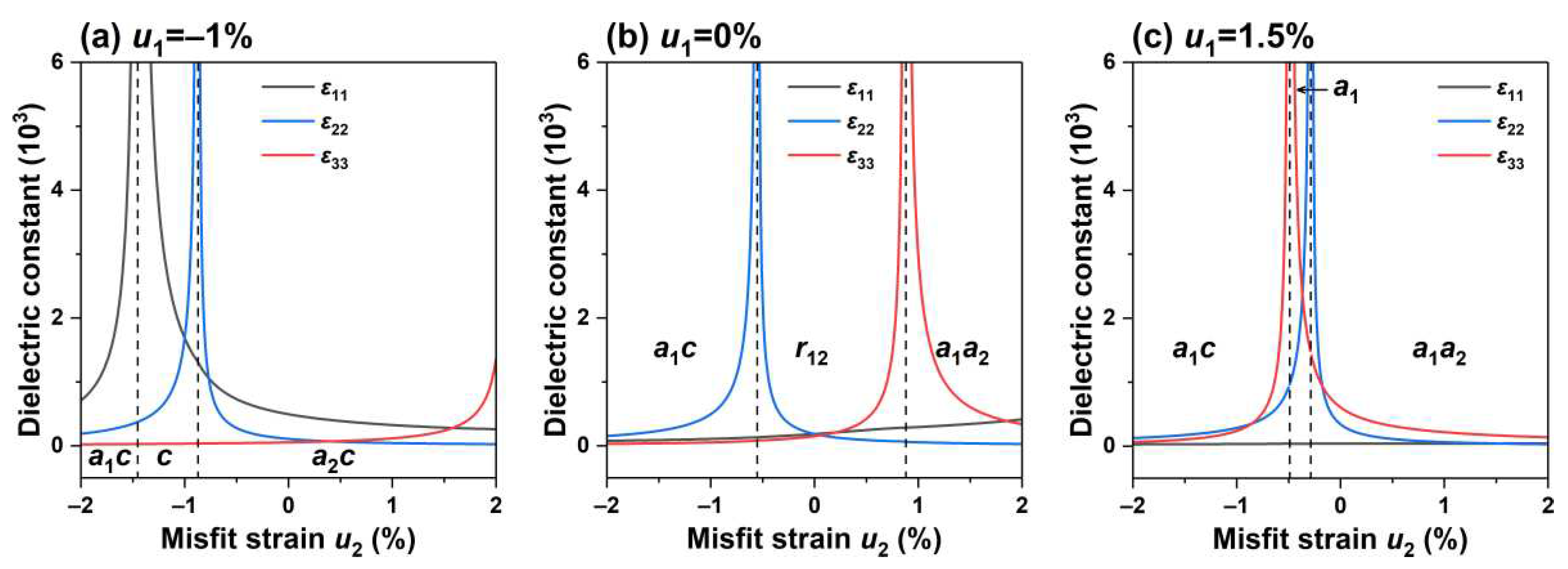
Figure 5.
Pseudo-color maps of piezoelectric coefficients on strained phase diagrams at 25℃ subjected to no electric field (0MV/m); (a) (b) .
Figure 5.
Pseudo-color maps of piezoelectric coefficients on strained phase diagrams at 25℃ subjected to no electric field (0MV/m); (a) (b) .
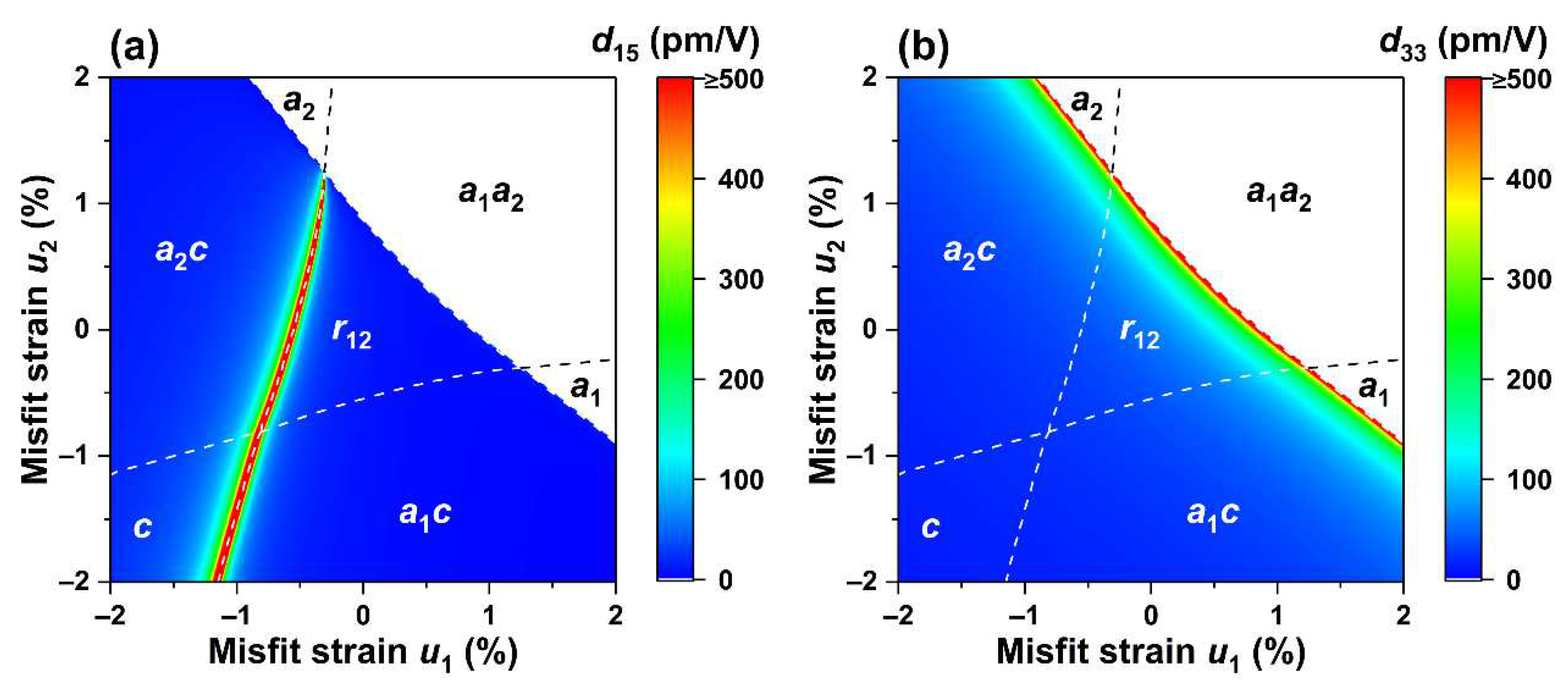
Figure 6.
Relation between piezoelectric coefficients and in-plane strain at 25℃ and subjected to no electric field (0MV/m) for (a) ; (b) ; (c) .
Figure 6.
Relation between piezoelectric coefficients and in-plane strain at 25℃ and subjected to no electric field (0MV/m) for (a) ; (b) ; (c) .
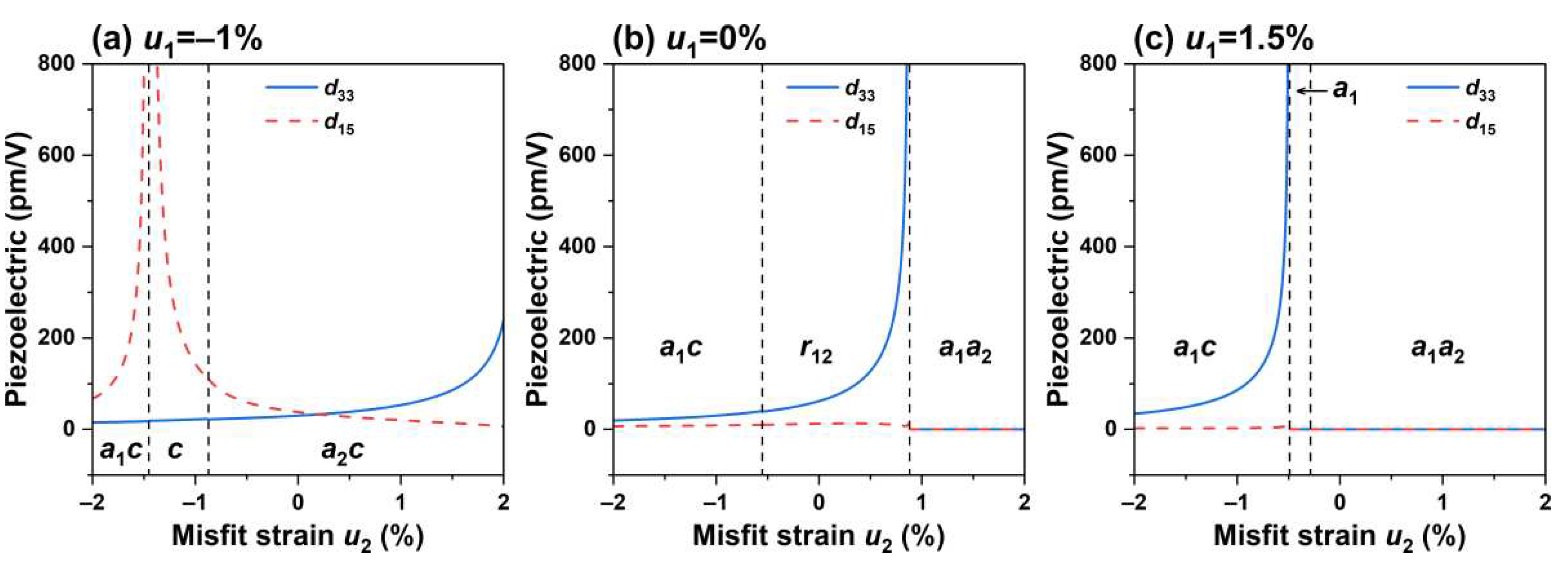

Table 1.
Coefficients used in the computation for K0.5Na0.5NbO3 thin films, where T represents the temperature at K [27,35,36].
| Coeff | Values | Units |
|---|---|---|
Table 2.
Phase structures and characteristic polarization components of K0.5Na0.5NbO3 thin films at room temperature and under no electric field.
Table 2.
Phase structures and characteristic polarization components of K0.5Na0.5NbO3 thin films at room temperature and under no electric field.
| Phase | Polarization |
|---|---|
Disclaimer/Publisher’s Note: The statements, opinions and data contained in all publications are solely those of the individual author(s) and contributor(s) and not of MDPI and/or the editor(s). MDPI and/or the editor(s) disclaim responsibility for any injury to people or property resulting from any ideas, methods, instructions or products referred to in the content. |
© 2023 by the authors. Licensee MDPI, Basel, Switzerland. This article is an open access article distributed under the terms and conditions of the Creative Commons Attribution (CC BY) license (http://creativecommons.org/licenses/by/4.0/).
Copyright: This open access article is published under a Creative Commons CC BY 4.0 license, which permit the free download, distribution, and reuse, provided that the author and preprint are cited in any reuse.


