

Submitted:
03 August 2023
Posted:
04 August 2023
You are already at the latest version
Abstract
The implementation of management systems has become a strategic advantage in achieving business goals, especially in industrial organizations, but the implementation of social responsibility requirements is especially ethical. Large multinational companies have long been developing and, in particular, implementing their own codes of conduct, which include their suppliers, to demonstrate their commitment to Corporate Social Responsibility (CSR). The compliance with CSR requirements from stakeholders is thus extended or intertwined with requirements in established management systems (MSs). The objectives of the study were to (1) analyze the different approaches to CSR in internationally recognized cross-industry and industry-specific standards and codes in different industries; (2) select the most appropriate framework for assessing the degree of applicability of CSR in the selected management systems and develop a methodology for its assessment; (3) apply the proposed methodology (referred to as SRIMS) in the selected areas: automotive industry, research organization, and metallurgical industry; (4) through ANOVA, validate its use for assessing the overall level of CSR applicability in an organization's established management systems. The application of the Bonferroni method confirmed the hypotheses that the developed SRIMS model is a sufficiently appropriate tool for assessing the overall level of applicability of CSR requirements to established MSs.
Keywords:
Corporate Social Responsibility (CRS)
; Management Systems (MSs)
; ANOVA
; Integration of Management Systems (IMS)
1. Introduction
The globalization of economics has created opportunities that lead to an ever-increasing number of suppliers of raw materials and products. Growing stakeholder interests, more complex business processes, and relationships have created pressure to develop and integrate socially responsible practices across global and local industries [1,2]. Organizations are increasingly required to balance the social, economic, and environmental domains of their business while increasing the value for their shareholders. Corporate social responsibility is not just about the organizations themselves, but also about the entire supply chain [3,4,5].
Today, large multinational organizations must be responsible not only for the environmental impacts among their global business partners (e.g., suppliers, logistics providers, and intermediaries) but also for their approaches to managing and caring for their employees [6]. Findings of abusive or illegal treatment of employees within the organization itself or in its supply chain can damage its reputation. According to Hofmann [7], examples of organizations where undesirable practices have been found in their supply chain are Zara, Apple, and Nestle's KitKat. CSR management in the supply chain can enhance the image and opportunities of an organization. Sustainability is considered a key component of competitive advantage [8,9,10,11].
Many corporate companies develop and implement their own codes of conduct, which are usually supported by sophisticated management systems (MSs), and in many cases, they also develop codes for their suppliers to demonstrate their CSR commitments and to meet the demands placed on them by their stakeholders. Codes of conduct are often based on local laws, international agreements, and standards and are complemented by the organizations' own CSR strategies and priorities [12]. The end customer sets the principles that suppliers must adhere to and must demonstrate that their activities are consistent with them if they are to successfully maintain a business relationship [13,14]. In addition, the organization can ask its suppliers for certificates to verify compliance with, for example, environmental, safety, and social requirements. Such policies provide valuable criteria for decision-making in the selection process and supplier evaluation, as well as for self-improvement of supplier performance in the supply chain [15,16,17]. Compliance with requirements can be verified using various self-assessment and auditing approaches [18].
In an effort to standardize CSR requirements, several universal and sector-specific international standards have been developed (e.g., in the electrical, automotive, raw material extraction, agricultural, construction, apparel, and other industries) with schemes for implementation, monitoring, and certification. The advantage of using universal CSR standards in organizations is that it reduces the burden on suppliers to apply and comply with them. They can also prevent inefficiencies in management and in the prevention of non-compliances [19]. However, many end-user organizations adapt these standards to their values and business objectives or create their own codes [20,21]. Hence, suppliers may be confronted many times with different CSR requirements from different customers.
There are many sources [6,22,23,24] that address the issue of CSR in the supply chain, but only a few studies have addressed the issue of the diversity of demands placed on suppliers resulting from different standards and codes applied by end-user organizations [25,26]. There is no evidence of studies addressing the challenges faced by supplier organizations in demonstrating CSR compliance with the different requirements of customers operating in different industries and applying different codes and standards within their supply chain.
The objective of the research was to identify the issues arising in supplier organizations in relation to demonstrating CSR compliance with different requirements and to propose a methodology for assessing the readiness to implement CSR requirements in established MSs (referred to as SRIMS).
The identification was based on an analysis of the problems encountered in CSR assessment, either through 2nd or 3rd party audits or self-assessment from the supplier organization's perspective.
A literature review was published [25] on universal and industry standards, codes, and specific CSR regulations implemented in the electrical, automotive, and metallurgical (steel) industries. The results of this research allowed the development of criteria and a framework for assessing the applicability of CSR to an organization's established MSs (SRIMS methodology). ANOVA was applied to test the hypothesis that the SRIMS methodology is an appropriate tool to assess the level of implementation of CSR requirements into an organization's established MSs.
2. Theoretical Framework
2.1. CSR Requirements in the Supply Chain
EU trade agreements now also include rules on social responsibility, in the areas of compliance with environmental, labour, and legal standards [27,28,29].
In fact, the very concept of corporate social responsibility (CSR) has evolved from a philanthropic approach to today's strategic business imperative in order for organizations to achieve competitive advantage [30,31]. Despite many efforts to provide a clear and unbiased definition of CSR, there is still ambiguity in both the business and academic worlds as to how CSR should be clearly defined. Berhringer [32] came to the conclusion that CSR is a business model that promotes business contributions to sustainable development, i.e. strikes a balance between economic, environmental needs, and ethical concerns. Schwart [33] introduced the so-called "Three Domain Model for CSR", which consists of three basic domains depicted in the shape of circles: economic, legal, and ethical. The model suggests that none of the three domains of CSR is more important or significant compared to the others and their application should be equally balanced. The ideal overlap for CSR lies in the middle of the three circles of the model, as the intersection of all three domains where economic, legal, and ethical responsibilities are simultaneously fulfilled in the organization. It can now be said that the legal and ethical domains overlap, and the environmental domain has been brought to the fore, with the legal domain actually being indirectly applied across all three domains [34,35].
The most common forms of ensuring social responsibility in supply chains are standards and codes of ethical conduct, the application and monitoring of which are then used to assess compliance and evaluate an organization's performance in the area of CSR. According to Yawar [36], the social domain in CSR is not immutable and depends on many factors such as culture, trust among stakeholders, organizational strategies, and others, which can be effectively managed through continuous dialogue with stakeholders and mutual understanding of the most important social requirements in the supply chain.
Just as the requirements on suppliers regarding CSR have evolved in recent years, so have the requirements of customers for the implementation and certification of the management systems they require from and of suppliers. There are now a number of management systems (MSs) with different focuses, standardized according to international standards, e.g. Quality Management (ISO 9001, IATF 16949, VDA 6. 1), Environmental Management (ISO 14001, EMAS), Occupational Health and Safety Management (ISO 45001), Energy Management (ISO 50001), Information Security Management (ISO/IEC 27001), Food Safety Management (EN ISO 22000), Anti-corruption behaviour Management (ISO 37001) Systems and many other standards and guides for different sectors [37,38,39].
Reflecting on CSR requirements, we can conclude that many of the above standards already help to partially meet some of the CSR requirements, but many times this is still not sufficient. As stated by Zhang [40], good CSR performance can enhance an organization's credibility, strengthen its relationships with stakeholders, and create a good reputation for the organization. Customer organizations use two main ways to evaluate and monitor supplier performance and that is auditing or self-assessment [41,42,43]. We can say that both of these ways are many times directly or indirectly coercive strategies on suppliers to meet the environmental, ethical and economic requirements.
As Bajwa [44] states in planning and conducting supplier audits, thanks to the so-called blockchain, easily accessible and transparent supplier data can be used to make more correct decisions about which suppliers to audit, and how and where to focus the efforts and resources needed to conduct audits. Stakeholder pressure, cooperation, and supplier development (e.g. training and education), the increase in ICT development can provide further opportunities to improve supplier organizations' performance in particular CSR areas.
In addition to auditing suppliers for verification of CSR practices in place, supplier self-assessment through a questionnaire is a frequently used tool, which is an increasingly used method, especially for global purchasing companies.
Fraser [45] analyzed supplier sustainability self-assessment questionnaires and concludes that they are one of the most common tools used in supply chain sustainability management in almost all industries. Many industry initiatives such as Drive Sustainability, the automotive industry peer group and its self-assessment questionnaire "Sustainability Assessment Questionnaire (SAQ)", the electronics industry citizens coalition (EICC), the ethical toy program (IETP) in the toy industry continue to develop common and standardized questionnaires, sustainability-related standards, in the supply chain [41,42,43].
Sustainability in supply chain management (SSCM) according to Yawar [36] is "The management of material, information, and capital flows, as well as collaboration between companies within the supply chain, taking into account objectives from all three dimensions of sustainable development i.e. economic, environmental and societal, which are derived from customer and stakeholder requirements". At the top, the scheme for assessing supplier sustainability in the context of organizational performance [45] describes six core areas (environment, social values, and ethics, economic stability, operational performance, internal impacts, and external impacts), which, by breaking them down, make up a total of eighteen items for assessing sustainability in CSR. At the bottom, the scheme is supplemented by auditing and evaluation as a separate process for assessing suppliers by auditing and/or self-assessment questionnaire.
The blockchain system [44,46,47] is a technology that enables data traceability, a way of identifying business requirements and data from the perspective of relevant organizations at the end of the chain, for transactional data when goods change ownership in the supply chain. Blockchain technology has two important aspects, and these are a database to record transactions physically stored in multiple copies, in different locations, and a system of "trust" between different users enabling and requiring them to give consensual and digital consent to any changes in the database [48].
Many organizations are focusing on blockchain implementation to facilitate transparency in product lifecycle, circular economy, and supply chains, and to better control their environmental footprint [48]. According to Bajwa [44], the use of blockchain minimizes the amount of redundant data because all information is entered only once and viewed by all who need it.
2.2. CSR Standards Framework
A study focusing on existing universal and selected industry CSR standards and codes of ethics was described in the paper by Sütőová[25]. It was divided into 3 parts: a review of universal standards; standards and requirements in the electrical and automotive industries.
The social responsibility management system is described by a single certification standard, IQNet SR10 [49], which is based on the principles and recommendations of ISO 26000 [50]. Although this standard provides guidance on CSR, it is not intended for certification. [51,52].
There are also other initiatives creating principles and standards for reporting on the sustainability impacts of the activities of the organizations concerned, e.g. GRI (Global Reporting Initiative). It is advantageous if CSR reports are provided by an independent organization to objectively assess compliance in supplier organizations and reduce information risk in communication [53,54].
In addition to the aforementioned cross-industry standards and codes (applicable to organizations of all types and sizes), industry codes are used to regulate negotiations between industry participants. Codes developed and used by individual organizations may also regulate relationships between customers and suppliers.
Table 1 provides an overview of the codes and assessment frameworks used in the electrical (EL), automotive (AU), and steel (ST) industries and the individual codes of the organizations cooperating within these industries.
Many organizations operating in the electronics industry (including leading companies such as LG, Samsung, BSH-Siemens, etc.) have adopted a common code of ethical conduct developed by the Responsible Business Alliance (RBA). It is the world's largest industry coalition focused on corporate social responsibility in global supply chains. The RBA criteria are also a condition of cooperation for suppliers of these organizations [55]. RBA members are predominantly companies operating in the electrical industry, but this does not mean that it is not applicable to other industries. Third party audits are conducted by RBA member affiliates and their supplier affiliates in accordance with the RBA under the name Validated Assessment Program (VAP) [56]. Despite the existence of the RBA, some organizations in the electrical sector have their own codes of conduct or have implemented other standards reflecting their values and priorities, and their suppliers must comply with these codes and standards.
IATF 16949, an industry certification standard used in the automotive supply chain, includes requirements for social responsibility in Chapter 5.1.1.1. These requirements appeared in the latest revision of the standard published in 2016. The requirements defined by the standard are the establishment of a social responsibility policy regarding bribery, rules of conduct for employees, and escalation of ethics.
In an effort to unify CSR requirements for suppliers in the automotive industry, the Drive Sustainability partner group made up of 18 leading automotive organizations (BMW Group, Daimler Truck, Ford, Geely, Honda, Jaguar Land Rover, Mercedes-Benz, Scania CV AB, Toyota Motor Europe, Volkswagen Group, Volvo Cars, Volvo Group and Ferrari, GWM, Polestar, Stellantis, UD Trucks, Volta Trucks) has created a common Sustainability Assessment Questionnaire (SAQ), a questionnaire that is regularly revised. [57]. In 2022, the fifth version of the questionnaire (SAQ 5.0) was published and is used by many automotive companies to assess supply chain sustainability, including sourcing, manufacturing, assembly, and logistics. The SAQ is aligned with the Global Automotive Sustainability Guiding Principles (GASGP) set by Drive Sustainability and partner group AIAG. The GASGP include expectations for suppliers on key responsibility issues including human rights, environment, working conditions, business ethics, health and safety, and responsible supply chain management.
Organizations from each stage of the steel supply chain have created an independent certification standard and program known as ResponsibleSteel, which was first published in late 2019. A revised version of the standard - ResponsibleSteel International Standard V2.0 - was published in 2022. The 13 principles of the Standard cover environmental, social, and governance issues, which were identified and agreed upon by members and stakeholders. AcelorMittal is the driving force behind the creation of the ResponsibleSteel program, along with other steel producers such as Voestapine, Blue Scope, Aperam (United States Steel will be added in 2021) and some OEMs such as Daimler and BMW, and civil society organizations [25].
2.3. Analysis of CSR Requirements across Multiple Management Systems
ISO management system standards are the most widely used and respected regulations, and in fact, there are already more than 80 different types [57]. One of the basic principles of these ISO standards is that they can interact with each other, i.e. they can be combined - integrated. Organizations that already use a standard for a selected management area can implement other areas in an easier way. This is due to their harmonized structure known as the "Harmonized Approach for Management System Standards". The principle of integration is set out by the SL Annex, the so-called "High Level Structure" (HLS) [58,59,60,61,62,63].
Based on the review of standards and approaches to CSR, the IQNet SR10 standard was chosen as the basis for the development of a methodology enabling the assessment of the level of applicability of CSR in the selected MSs. This standard is compatible in its structure with other management system standards (according to ISO Annex SL) and is also intended for auditing and certification. The research team compared the CSR requirements of IQNet SR10 to the following management systems: ISO 9001 (QMS), IATF 16949 (IATF), ISO 14001 (EMS), ISO 45001 (OHSMS), ISO 50001 (EnMS), which can be considered as an Integrated Management System (IMS) if implemented simultaneously in an organization (see Figure 1), in order to create a basic framework for the model.
The following facts were found:
Chapter 4: "Context of the organization", presents a 100% compliance rate of applying IMS requirements against the IQNet SR10 standard and no chapters of the IMS standards were moved to another IQNet SR10 chapter.
Chapter 5: "Leadership", it can be noted that there is only one difference in the IATF 16949 standard intended for the automotive sector, which is quite interesting and groundbreaking regarding CSR, compared to other standards in the IMS framework. This is Chapter 5.1.1.1 "Social Responsibility", which calls for the introduction of a requirement for social responsibility, the introduction of a policy aimed at least against bribery, rules of conduct for employees, and a policy of escalation of ethics. The escalation of ethics is the so-called imaginary policy of drawing attention to negative phenomena, a policy for "whistle - blowing". These requirements are new in the IATF standard (after the 2016 edition) and unique in quality management standards, although these requirements do not include all the policies that CSR contains. It could be noted that the IATF 16949 standard, with the aforementioned chapter, greatly helps to focus on CSR in addition to the quality requirements.
Chapter 6: "Planning". When analyzing Chapter 6 of IQNet SR10 against the other named ISO standards, it was possible to conclude that there are no major changes in the requirements compared to the other named standards. For the individual MSs, the requirements for objectives and planning for their achievement are shifted in the chapter numbering from Chapter 6.2 to Chapter 6.3, which has no impact on the integration of CSR with the other IMS standards. In addition, the IQNet SR10 standard includes Chapter 6.2 Identification and Assessment of Issues, which focuses on the positive and negative impacts of stakeholders, taking into account economic, environmental, social impacts and good organizational management of the organization with an impact on sustainability and social responsibility. It could be noted that only in ISO 50001, unlike other standards, the publishers of the standard have included in this chapter the establishment of requirements for defining energy indicators and a baseline for assessing energy use, which makes this standard specific. After considering Chapter 6, one of the 3 main chapters of all the IMS standards considered was moved in terms of subject matter to the IQNet SR10 standard, this was Chapter 6.2, subchapter 6.1.3 relating to EMS and SMBOZP was also moved, which may help to meet legal requirements.
Chapter 7: "Support". After reviewing Chapter 7, it was possible to conclude that there was a 100% compliance rate of applying the IMS requirements against the IQNet SR10 standard, and no chapters of the IMS standards were moved to another IQNet SR10 chapter. Some of the IMS standards even specify their requirements in more detail.
Chapter 8: "Operation". The main difference between IQNet SR10 and the other ISO standards mentioned above was evident in this chapter. Basically, Chapter 8.1 Planning and Management of Operations is the same for all standards. However, it could be clearly stated that the most important and fundamental requirements for CSR are defined in this Chapter 8 of IQNet SR10. These are eight chapters, which are subchapters 8.2 to 8.9. In a more detailed analysis of each chapter, we found that subchapters 8.2 Owners and Stakeholders, 8.6 Government, Public Authorities and Regulators, 8.7 Community, Society and Social Organizations, 8.9 Competition are completely new requirements that are not supported by other ISO standards, thus these requirements need to be implemented in a thorough way in the organization.
Other subchapters of Chapter 8 such as 8.3 Employees, 8.4 Customers, Users and Consumers, 8.5 Product Suppliers, Service Providers and Partners, 8.8 Environment are partially supported by other ISO standards, but the CSR requirements in the IQNet SR10 standard are more detailed and are linked to the requirements of meeting the global standards of the International Labour Organization, United Nations (ILO).
When analyzing sub-section 8.3.4 Health and Safety, it was possible to declare that if an organization has an HSE management system in place according to ISO 45001 this fundamentally addresses the area of HSE which is part of the CSR requirements. Similarly for subchapter 8.8 Environment, where it can also be stated that if the organization has an environmental management system in place according to ISO 14001 this fact substantially addresses the EMS area which is part of the CSR requirements.
When analyzing the requirements of subchapters 8.3.1, 2, 3, 4 and 8.3.6 of IQNet SR10, it can be pointed out that the introduction of the requirements of SA 8000, which focuses on human and labour rights, this standard, by its introduction in the organization, can fundamentally help to ensure the organization’s compliance with the requirements.
The requirements of IQNet SR10 in subsection 8.3.5 Accessible working environment help to fulfil the requirements of the SMK-focused standard by subchapter 7.1.4 Environment for the operation of processes.
In particular, the analysis took into account the subject matter comparison of the requirements and chapters of the standards, leading to the conclusion that in further developing the proposed methodology it would be worthwhile to consider moving some of the requirements of the IMS standards to another chapter of the IQNet SR10 standard, such as 7.1.2 Workers from the SMK standards to Chapter 8.3 for CSRs. Similarly, Chapter 8.3 Design and development of products and services from the SMK standards could be moved to Chapter 8.4.6 for CSR. In principle, however, this does not affect the final assessment of the level of compliance when scoring.
Chapter 9: "Managerial Review". When analyzing Chapter 9 of the IQNet SR10 standard, an additional requirement for assessing the performance of the organization was identified, and that is to monitor information attributable to stakeholder perceptions in Chapter 9.2 on a regular basis in a documented manner as part of the CSR. Chapter 9.3 "Internal audits" is moved from chapter 9.2 to 9.3 in relation to other ISO standards for IMS. This is similar to chapter 9.4 " Managerial Review" where the standard ISO standards define the area in chapter 9.3 and in IQNet SR10 it is in chapter 9.4. This is due to the decision of the publisher of the standard to insert the chapter for defining the assessment of stakeholder expectations under 9.2, which has consequently shifted the other chapter assignments, but this does not change the requirements and IQ Net SR10 introduces this essential requirement in chapter 9 against other ISO standards for IMS.
Chapter 10: "Improvement". When analyzing Chapter 10 of IQNet SR10, it was possible to conclude, as with Chapters 4 and 7, that there are no extra requirements over the other ISO standards mentioned for IMS. All the standards mentioned define two main areas of requirements and these include: Nonconformance and Corrective Action and Continuous Improvement. The difference is the numbering of the chapters in the other IMS standards, but this has no impact on the integration of CSR with the other MSs standards. The IATF 16949 standard defines more explicit requirements for nonconformance management, for elimination and non-recurrence of problems, and for focusing on customer complaints, which methodologically can only be beneficial for an established IMS in an organization [64,65].
3. Materials and Methods
3.1. Framework of the SRIM Model
In the previous part (chapter 2.3), the requirements of the chapters of the selected management systems were compared with the structure of the requirements described in IQNet SR10. The development of the framework for the methodology for assessing the applicability of CSR requirements to MSs was based mainly on the structural and subject matter consistency of these requirements.
A methodological proposal known as SRIMS (Social Requirements applicability in Management Systems) was created for organizations that need to implement social responsibility in their organization and, in particular, to evaluate its level of implementation in order to further improve their processes effectively.
In the development of the methodology, the sectoral different approaches were also taken into account, i.e. if the organization is a supplier to the automotive industry, the conformity check was applied by assessing the integration in quality management through the comparison of IATF 16949 requirements, otherwise only the ISO 9001 approach was applied (see Figure 1.).
Depending on the structure of the subchapter - requirements, if the weight of a Wi chapter was conditioned on compliance based on the conditional compliance of the performance of its subchapters , where , then the value of the weight reflected the sum of the weights assigned to the individual subchapters:
The calibration of the methodology was chosen according to the following criteria: for each subchapter (X.Y) a maximum of 20 points, in case of a large difference in the number of subchapters in a given Chapter X (e.g. Chapter 10) its importance in the overall structure of the MS was taken into account (similarly to the EFQM model) [66], and thus a double value of the calibration of the subchapter could be achieved, but a maximum of 2 x 20 points, see Table 2. Clearly, not every MS achieves the same total score.
The application of the methodology, known as SRIMS, has been verified in plants that have long-established management systems. These were:
- A research organization (TU), focused on the development of electronic systems, which has an ISO 9001 quality management system in place, but other management systems are not applied, even though it must comply with other requirements of its customers in its activities.
- Three organizations that are suppliers to the automotive industry. Two of them, AU1 and AU2, did not have an energy management system in place, but had a system in place for CSR according to IQNet SR10. Only AU3 has an energy management system in place. It also has CSR requirements in its policy but does not have one in place according to IQNet SR10.
- The last respondent for model verification was a metallurgical company, referred to as OC, which also has an energy management system in place, but a CSR policy, not compliant with IQNet SR10.
An overall summary of the respondents subjected to the SRIMS integration survey, with respect to the management systems implemented, is provided in Table 3 below.
3.2. Evaluation by SRIMS Methodology
The analysis was carried out in cooperation with the managers responsible for MSs in each organization, e.g. the quality manager, the occupational health and safety (OHS) manager, the manager for management systems integration (in OC), and the SRIMS project research team. Each respondent assigned weights to each requirement of the SRIMS methodology (processed in Excel) based on his/her experience, firstly assessing the effectiveness in the required compliance of the functioning of the MS in place (referred to as the MZ variable), then assessing whether the MS requirement is consistent with the IQNetSR10 requirement and the extent to which it is applicable in his/her organization (referred to as the MU variable). The two variables were summed and assessed as the Total variable, characterizing a comprehensive approach corresponding to the level of management of the MSs in place with the CSR applicability rate.
The results of the examination according to SRIMS in each organization were processed in graphs (see Figure 2).
The first TU organization (with only a QMS implemented) declared a total applicability compliance in SRIMS of only 38% (see Figure 2(a)), with the lowest scores in MU compliance and MU applicability in Chapters 6, 8, and 10.
The AU1 organization declared a total applicability fulfillment in SRIMS for MSs: IATF at 88%, scoring the lowest in Chapters 8 and 10; in EMS 67%, scoring the lowest in Chapter 10; and in OHSMS 71%, scoring the lowest in compliance and applicability in Chapters 8 and 10 (see Figure 2(b)) (see Figure 2(b)).
The AU2 organization declared an overall fulfillment of applicability according to SRIMS for MSs: IATF at 86%, where the lowest score was in Chapter 10; in EMS 64%, the lowest score was in Chapter 10; in OHSMS 69% where the lowest scores were in applicability and compliance in Chapters 8 and 10 (see Figure 2(c)) (see Figure 2(c)).
The AU3 organization declared an overall SRIMS applicability performance for MSs: IATF at 86%, with the lowest score in Chapter 10; in EMS 65%, with the lowest score in Chapter 10; in OHSMS 69%, with the lowest scores for applicability and compliance in Chapters 8 and 10; and in EnMS 70%, in Chapters 6 and 10 (see Figure 2d)).
The OC organization declared an overall applicability performance in the SRIMS model for MSs: IATF of 77%, scoring the lowest in Chapters 4, 5, and 8; in EMS 55%, scoring the lowest in Chapters 4, 5, and 10; in OHSMS 61%, scoring the lowest in applicability and compliance in Chapters 4, 7, 8, and 10; and in EnMS, 62%, scoring the lowest in Chapters 5, 4, and 10 (see Figure 6).
As the SRIMS methodology needed to evaluate more than one variable simultaneously, a multifactorial technique was applied in the next step to assess the relevance of the results obtained.
3. Results
For validation, multi-factor ANOVA analysis (Analysis of Variance), which is widely used as a powerful parametric statistical technique [67,68,69,70,71], was used.
The individual factors represented categorial explanatory variables: the first factor was called "Organization", which has five levels namely TU, AUT1, AUT2, AUT3, and OC. According to the enterprises in which the survey was conducted. We were interested in what are the differences between the enterprises in the requirements for the implementation of MSs.
The "Standard" was chosen as the next factor of the experiment. This factor also has five levels, according to the evaluated compliance requirements in MSs, i.e. for quality (QMS), automotive (IATF), safety (OHSMS), environment (EMS) and energy management (EnMS). For this factor, we were interested in the degree of variation in the level of implementation of the requirements of each MSs across the queries.
The third factor - "Chapter" was specifically concerned with the focus within the standards mentioned and the assessment of the level of integration of CSR requirements. Given the standardization of these standards, the individual Chapters (specifically Chapters 4 to 10) oriented each other equally across all the standards considered. However, this factor had seven levels, namely from Chapter 4 to Chapter 10 (see Table 3).
A general linear model was used. Based on the nature of the data, this was an unbalanced ANOVA model. As responses (or independent variables or explanatory variables) we used: a variable referred to as MZ (compliance rate) with the requirements of the established MSs, a variable MU (rate of applicability) and a parameter referred to as Total (rate of overall applicability of the CSR requirements in the MSs) numerically it is the sum of MZ and MU. The specific values obtained in SRIMS were used. The maximum values for each weight served as the basis for the scores, see Table 2. 3 independent expert assessments of the SRIMS were conducted in each organization by the involved top managers of each organization.
The ANOVA method was used to analyze the results, followed by the Bonferroni method as a post ANOVA analysis. Minitab software was used to evaluate the ANOVA method. Table 4 presents the designation of each factor level that was used in further analysis.
In the following, the conditions under which the ANOVA method can be used were verified. Table 5 and Table 6 present the verification of homoscedasticity for both MZ and MU responses (variables).
Multiple comparisons method showed that we could reject the hypothesis that the variances of the individual response factors of MZ and MU were statistically equal, since the P-Value was smaller than the alpha level. Thus, the condition for using the ANOVA method was not met. However, Levene's test showed that the hypothesis of equal variances for both MZ and MU responses could not be rejected, which supported the possibility of using the ANOVA method. Thus, this was an ambiguous result. Further conditions for the applicability of the ANOVA method resulted from the analysis of residuals.
Figure 3 shows a simple residual analysis performed for the MZ, MU and Total responses. The models corresponding to the presented residuals are described in Table 6. The residual analysis for each response is presented in four graphs. The first "Normal Probability Plot of Residuals" shows the normality of the distribution of residuals. The next plot, "Residuals versus Fits", plots the residuals according to their magnitude and shows that the residuals have a constant variance. The next graph is a "Histogram of residuals" where we can see if the data is skewed or if there are outliers in the data. Finally, the "Residuals versus Order" is presented in the order in which they were recorded.
In the following, we constructed a pseudo linear regression (PLR) model as described in [72]. Due to its large size, we have presented only the main factors without interactions in Table 6.
The ANOVA then performed confirmed statistically significant differences for each level for all factors and all responses. This was confirmed by the very low P-Value shown as "0.000" in Table 7. On the other hand, the index of determination indicated that the model explained the MZ response at only 40.69%, the MU response at 48.32%, and Total at 45.32%. Due to the controversial verification of homoskedasticity, we present the results of this method only informatively. In further validation, we focused on a procedure known as Bonferoni's method.
In a post hoc ANOVA test [73,74,75] at 95% of confidence intervals, it is evident that the results are completely independent of the results of the ANOVA used. This method does not require any specific assumptions about the dataset, as it is a multiple comparison correction that is used to control the overall level of Type I error. Table 8 clearly presents the groupings of the individual factor levels. The unequal position of some levels could already be observed with different model coefficients, but using a post hoc ANOVA test and Bonferroni analysis, these clusters were clearly determined.
For clarity, we presented the results in detail using Bonferroni Simultaneous 95% CIs (confidence intervals) for pairwise differences in means (see Figure 4). The present confidence intervals for pairwise differences of means of individual levels were performed separately for MZ response, MU response, and Total. We also conducted the analysis for each Organization, Standard, and Chapter factor separately.
Those confidence intervals that contain a value of 0 represent non-significant differences between the means of the two levels. Intervals that do not contain a value of 0 indicate significant differences between the means of the two levels. In the case of the MZ response factor Organization (see Figure 4 (a)), it is evident that there is one confidence interval that contains a value of 0 and that is between AUT2 - AUT1 organizations, which represents an insignificant difference. However, for the MU response (see Figure 4 (b)) with the same factor, there are three confidence intervals that contain a value of 0. This is a non-significant pairwise difference in means between the AUT3 - AUT1, OC - AUT1 and OC - AUT3 organizations. In the Total graph (see Figure 4(c)), the value 0 occurs only for the confidence intervals of the AUT2 - AUT1 and OC - AUT3 organizations.
In the graphs (see Figure 4), it is also possible to see confidence intervals that contain only negative values, which means that there is a statistically significant difference between the means, with the first mean being smaller than the second mean. In the case of the MZ response for the Standard factor (see Figure 4 (d)), it is possible to see a statistically significant pairwise difference of means between EnMS - EMS, QMS - EMS, OHSAS - IATF, QMS - IATF and QMS - OHSAS. The same is true for the MU and Total response.
Similarly, in Figure 4, confidence intervals containing only positive values, meaning that there is a statistically significant difference between the means and the first mean is larger than the second, are also evident according to the MU and Total response for the Chapter factor (see Figure 4(g) and 4(i)). There is a statistically significant pairwise difference in means between Chapters 7-4, 7-5 and 7-6, with Chapters 7-5, 8-5 and 7-6 for the MU response (see Figure 4 (h)).
4. Discussion
Using Bonferroni's method, a relatively well-explained PLR methodology was developed. The coefficients for each factor (Organization, Standard, and Chapter) accurately determine the differences in the ratings of the two MZ and MU responses as a function of the factor levels. The main effects graphs for the MZ and MU responses and also Total describe the situation much more clearly (see Figure 5).
In the MZ response and the evaluation of the Organization factor (see Figure 6 (a)), an even position can be seen, with relatively little change for AUT1 and AUT2 organizations. The other organizations form separate groups (see also Table 8). For the MU response (see Figure 6 (b)), it can be seen that AUT1 and AUT2 belong to the same group, AUT2 and OC, OC and AUT 1 form different groups. In the case of the Standard evaluation, except for some shift, the position of all considered standards for the MU, MZ, and Total responses ((see Figure 5) is very similar. The IATF standard has its own position. The OHSAS and EMS Standards are very similar, as well as the EnMS and QMS Standards. The aforementioned similarity in the rankings of the individual standards is also evident from the Bonferroni simultaneous 95% CIs (see Figure 4 (d), (e), (f)). When evaluating the individual chapters, except for Chapters 4 and 5, a high similarity of evaluation can also be noted.
As with the main factors, the individual interactions for the MZ and MU response ((and hence Total) were also graphed. For the MZ response (see Figure 6 (a)), groups of chapters 7, 8, 9 are formed, and for MU (see Figure 6 (b)), chapter 4 is added. The second group for MZ consists of all chapters except 7 and 10, and for MU it is chapters 8, 9, 4, and 6. The last group for MZ and MU responses consists of all but chapters 7 and 8.
The aforementioned similarity is also evident from the Bonferroni simultaneous 95% CIs (see Figure 4 (g), (h), (i)), which in most cases contain a null value.
While the low ranking of TU was to be expected given the number of standards (MSs) implemented, it is also interesting to note the large difference between the EnMS or QMS standards and the other three, with the IATF standard achieving the highest ranking and therefore the largest difference in ranking. Similarly, but not so differently, in the chapter-by-chapter ratings, Chapters 7 and 9 have significantly higher ratings than the other chapters for both the MZ and MU responses. When evaluating the interactions in both cases, the "chapter-enterprise" interaction is relatively insignificant (see Figure 6 (c)).
A more significant interaction can be observed in the case of "chapter and standard", which is probably due to the significant position of chapter 8 for the IATF standard. Relatively more significant interactions were recorded from the "standard and organization" perspective. However, the given situation can be interpreted as the absence of an evaluation of some standards by those organizations that have not implemented them.
5. Conclusions
The application of the Bonferroni method confirmed the hypotheses that the developed SRIMS model is a sufficiently appropriate tool for assessing the overall level of applicability of CSR requirements to established MSs. For the future development of this tool, its extension to other standardized requirements and codes is being considered, which may also lead to a change in its calibration based on the structure of CSR requirements for different suppliers. The development of a more appropriate application tool (software) will allow to extend the use of this tool to other MSs and thus also to extend the scope of its use to other (e.g. food) industries. The advantage of the initial SRIMS model is that it allows to assess the efficiency of MSs management itself also with regard to CSR requirements. When the model is complemented with the methodology of assessing the level of integration based on Risk Based Thinking [76,77], the model can be transformed into an effective tool for assessing even the level of integration of MSs themselves and evaluating their level of effectiveness for specific CSR requirements. The aim of such a model is not only to support the fulfilment of the certification requirements of MSs but, in particular, to create such a self-assessment tool that enables the management of the supplier organization, in particular, to react flexibly to changes in customer requirements. Another criterion would be to establish a framework for assessing the level achieved (e.g. poor level, medium to excellent level), thus this model would also set an incentive framework for improvement in those areas that are key to achieving the business objectives of the management of the organization.
The SRIMS methodology has demonstrated the necessity of measuring and assessing the level of applicability of CSR in MSs in organizations operating in different industries. Its application has verified the acceptability of this methodology as an effective tool for decision making of top management. SRIMS has created a prerequisite for the emergence of a supportive comprehensive tool for assessing various CSR requirements and selecting appropriate strategic tools for business development in the current global environment.
The objective of this paper was to analyze the different CSR approaches in internationally recognized cross-industry and industry specific standards and codes in different industries. A major challenge for the future is to analyze the aforementioned CSR approaches in those industrial enterprises that significantly implement the principles of the method and paradigm known as Industry 4.0.
Author Contributions
Conceptualization, H.P. and R.T.; methodology, F.K. and H.P.; validation, F.K., A.S. and P.D.; formal analysis, F.K. and R.T; resources, F.K. and P.D; writing—review and editing, A.S.; supervision, H.P. All authors read and agreed to the published version of the manuscript.
Funding
This contribution is the result of the projects implementation: APVV No. APVV-19-0367 Framework of the Integrated Process Safety Management Approach for the Intelligent Enterprise, and Research and development of intelligent traumatological external fixation systems manufactured by digitalisation methods and additive manufacturing technology (Acronym: SMARTfix), ITMS2014+: 313011BWQ1 supported by the Operational Programme Integrated Infrastructure funded by the European Regional Development Fund.”.
Data Availability Statement
Not applicable.
Conflicts of Interest
The authors declare no conflict of interest.
References
- Cheng, W.; Ahmad, J. Incorporating stakeholder approach in corporate social responsibility (CSR): A case study at multinational corporations (MNCs) in Penang. Social Responsibility Journal 2010, 6, 593–610. [Google Scholar] [CrossRef]
- Harms, D.; Hansen, E. G.; Schaltegger, S. Strategies in Sustainable Supply Chain Management: An Empirical Investigation of Large German Companies 2012. Corporate Social Responsibility and Environmental Management, Forthcoming, Avaliable at SSRN: https://ssrn.com/abstract=2046934. 2046. [Google Scholar]
- Chiesa, P.J.; Przychodzen, W. Social sustainability in supply chains: a review. Social Responsibility Journal 2020, 16, 1125–1148. [Google Scholar] [CrossRef]
- Modak, N, M. ; Sinha, S.; Raj, A.; Panda, S.; Merigó, J.M. Lopes de Sousa Jabbour, A.B. Corporate social responsibility and supply chain management: Framing and pushing forward the debate. Journal of Cleaner Production 2020, 273, 122981. [Google Scholar] [CrossRef]
- Zhu, C.; Du, J.; Shahzad, F.; Wattoo, M.U. Environment Sustainability Is a Corporate Social Responsibility: Measuring the Nexus between Sustainable Supply Chain Management, Big Data Analytics Capabilities, and Organizational Performance. Sustainability 2022, 14, 3379. [Google Scholar] [CrossRef]
- Andersen, M.; Skjoett-Larsen, T. Corporate social responsibility in global supply chains. Supply Chain Management 14, 75–86. [CrossRef]
- Hofmann, H.; Busse, C.; Bode, C.; Henke, M. Sustainability-Related Supply Chain Risks: Conceptualization and Management. Bus. Strat. Env. 2014, 23, 160–172. [Google Scholar] [CrossRef]
- Siwiec, D.; Pacana, A.; Gazda, A. A New QFD-CE Method for Considering the Concept of Sustainable Development and Circular Economy. Energies 2023, 16, 2474. [Google Scholar] [CrossRef]
- Kuncoro, W.; Suriani, W.O. Achieving sustainable competitive advantage through product innovation and market driving. Asia Pacific Management Review 2018, 23, 186–192. [Google Scholar] [CrossRef]
- Kamardi, A.A.; Mahdiraji, H.A.; Masoumi, S.; Jafari-Sadeghi, V. Developing sustainable competitive advantages from the lens of resource-based view: evidence from IT sector of an emerging economy. Journal of Strategic Marketing 2022. [Google Scholar] [CrossRef]
- Mahdi, O.R.; Almsafir, M.K. The Role of Strategic Leadership in Building Sustainable Competitive Advantage in the Academic Environment. Procedia - Social and Behavioral Sciences 2014, 129. International Conference on Innovation, Management and Technology Research, Malaysia, 22–23 September 2013, 289–296. [Google Scholar] [CrossRef]
- Hemphill, T. The ISO 26000 guidance on social responsibility international standard: what are the business governance implications? Corporate Governance 2013, 13, 305–317. [Google Scholar] [CrossRef]
- Colwell, S.R. , Zyphur, M.J. & Schminke, M. When does Ethical Code Enforcement Matter in the Inter-Organizational Context? The Moderating Role of Switching Costs. J Bus Ethics 2011, 104, 47–58. [Google Scholar] [CrossRef]
- D’Eusanio, M.; Tragnone, B.M.; Petti, L. From Social Accountability 8000 (SA8000) to Social Organisational Life Cycle Assessment (SO-LCA): An Evaluation of the Working Conditions of an Italian Wine-Producing Supply Chain. Sustainability 2022, 14, 8833. [Google Scholar] [CrossRef]
- Giacalone, M.; Santarcangelo, V.; Donvito, V.; Schiavone, O.; Massa, E. Big data for corporate social responsibility: blockchain use in Gioia del Colle DOP. Qual Quant. 2021, 55, 1945–1971. [Google Scholar] [CrossRef] [PubMed]
- Bai, C.; Sarkis, J. Determining and applying sustainable supplier key performance indicators. Supply Chain Management 2014, 19, 275–291. [Google Scholar] [CrossRef]
- Delbufalo, E.; Bastl, M. Multi-principal collaboration and supplier’s compliance with codes-of-conduct. The International Journal of Logistics Management 2018, 29, 1237–1254. [Google Scholar] [CrossRef]
- Fraser, I.J.; Schwarzkopf, J.; Müller, M. Exploring Supplier Sustainability Audit Standards: Potential for and Barriers to Standardization. Sustainability 2020, 12, 8223. [Google Scholar] [CrossRef]
- Castka, P.; Balzarova, M.A. ISO 26000 and supply chains—On the diffusion of the social responsibility standard. International journal of production economics 2008, 111, 274–286. [Google Scholar] [CrossRef]
- Rashidi, K.; Farzipoor Saen, R. Incorporating dynamic concept into gradual efficiency: Improving suppliers in sustainable supplier development. Journal of Cleaner Production 2018, 202, 226–243. [Google Scholar] [CrossRef]
- Boyd, D.E.; Spekman, R.E.; Kamauff, J.W.; Werhane, P. Corporate Social Responsibility in Global Supply Chains: A Procedural Justice Perspective. Long Range Planning 2007, 40, 341–356. [Google Scholar] [CrossRef]
- Formentini, M.; Taticchi, P. Corporate sustainability approaches and governance mechanisms in sustainable supply chain management. Journal of Cleaner Production 2016, 112, s–1920. [Google Scholar] [CrossRef]
- Anderson, T.; Liu, Z.; Cruz, J.; Wang, J. Social and Environmental Sustainability: An Empirical Analysis of Supply Chain Profitability and the Recession. Operations and Supply Chain Management 2020, 13, 176–193. [Google Scholar] [CrossRef]
- Ciliberti, F.; Baden, D.; Harwood, I.A. Insights into Corporate Social Responsibility Practices in Supply Chains: A Multiple Case Study of SMEs in the UK. Operations and Supply Chain Management: An International Journal 2009, 2, 154–166. [Google Scholar] [CrossRef]
- Sütőová, A.; Kóča, F. Corporate Social Responsibility Standards: Is it Possible to Meet Diverse Customer Requirements? Management Systems in Production Engineering 2022, 30, 54–61. [Google Scholar] [CrossRef]
- Baden, D.; Harwood, I. A.; &, *!!! REPLACE !!!*; Woodward, D. G. The effects of procurement policies on ‘downstream’ corporate social responsibility activity: Content-analytic insights into the views and actions of SME owner-managers. International Small Business Journal 2011, 29, 259–277. [Google Scholar] [CrossRef]
- Bronckers, M.; Gruni, G. Retooling the Sustainability Standards in EU Free Trade Agreements. Journal of International Economic Law 2021, 24, 24–25. [Google Scholar] [CrossRef]
- Poletti, A.; Sicurelli, D.; Yildirim, A. Promoting sustainable development through trade? EU trade agreements and global value chains. Italian Political Science Review / Rivista Italiana Di Scienza Politica 2021, 51, 339–354. [Google Scholar] [CrossRef]
- Yao, X.; Yasmeen, R.; Li, Y.; Hafeez, M.; Padda, I.U.H. Free Trade Agreements and Environment for Sustainable Development: A Gravity Model Analysis. Sustainability 2019, 11, 597. [Google Scholar] [CrossRef]
- Dahlsrud, A. How corporate social responsibility is defined: An analysis of 37 Definitions. Corporate Social Responsibility and Environmental Management 2008, 15(1–13). [CrossRef]
- Cochran, P.L. The evolution of corporate social responsibility. Business horizons 2007, 50, 449–454. [Google Scholar] [CrossRef]
- Behringer, K.; Szegedi, K. The Role of CSR In Achieving Sustainable Development – Theoretical Approach. European Scientific Journal, ESJ 2016, 12, 10. [Google Scholar] [CrossRef]
- Schwartz, M.S.; Carroll, A.B. Corporate Social Responsibility: A Three-Domain Approach. Business Ethics Quarterly 2003, 13, 503–530. [Google Scholar]
- Witek-Hajduk, M.K.; Zaborek, P. Does Business Model Affect CSR Involvement? A Survey of Polish Manufacturing and Service Companies. Sustainability 2016, 8, 93. [Google Scholar] [CrossRef]
- Torelli, R. Sustainability, responsibility and ethics: different concepts for a single path. Social Responsibility Journal 2021, 17, 719–739. [Google Scholar] [CrossRef]
- Yawar, S.A.; Seuring, S. Management of Social Issues in Supply Chains: A Literature Review Exploring Social Issues, Actions and Performance Outcomes. J Bus Ethics 2017, 141, 621–643. [Google Scholar] [CrossRef]
- González, P.; Sarkis, J.; Adenso-Díaz, B. Environmental management system certification and its influence on corporate practices: Evidence from the automotive industry. International Journal of Operations & Production Management 2008, 28, 1021–1041. [Google Scholar] [CrossRef]
- Chiarini, A. Designing an environmental sustainable supply chain through ISO 14001 standard. Management of Environmental Quality 2013, 24, 16–33. [Google Scholar] [CrossRef]
- Roshni, A.G.; Siti-Nabiha, A.K.; Jalaludin, D.; Abdalla, Y.A. Barriers to and enablers of sustainability integration in the performance management systems of an oil and gas company. Journal of Cleaner Production 2016, 136, 197–212. [Google Scholar] [CrossRef]
- Zhang, M.; Pawar, K.S.; Bhardwaj, S. Improving supply chain social responsibility through supplier development. Production Planning & Control 2017, 28, 500–511. [Google Scholar] [CrossRef]
- Ruxue, S.; Pingtao, Y.; Weiwei, L. ; Wang, L Sustainability self-determination evaluation based on the possibility ranking method: A case study of cities in ethnic minority autonomous areas of China. Sustainable Cities and Society 2022, 87, 104188. [Google Scholar] [CrossRef]
- Hsien, C.; Zi-Yu, K.; Eisner, E.; Sing Ying, Ch.; Ng Kuan Yuan, L.; Dönmez, J.; Mennenga, M.; Herrmann, Ch.; Sze Choong Low, J. Self-Assessment and Improvement Tool for a Sustainability Excellence Framework in Singapore. Procedia CIRP 2021, 98, 672–677. [Google Scholar] [CrossRef]
- Schöggl, J.-P.; Fritz, M.M.C.; Baumgartner, R.J. Sustainability Assessment in Automotive and Electronics Supply Chains—A Set of Indicators Defined in a Multi-Stakeholder Approach. Sustainability 2016, 8, 1185. [Google Scholar] [CrossRef]
- Bajwa, N.; Prewett, K.; Shavers, C. L. Is your supply chain ready to embrace blockchain? Journal of Corporate Accounting and Finance 2019, 2019. 28, 1–12. [Google Scholar] [CrossRef]
- Fraser, I.; Müller, M.; Schwarzkopf, J. Dear supplier, how sustainable are you? A multiple-case study analysis of a widespread tool for sustainable supply chain management. Nachhaltigkeits Management Forum 2020, 28, 127–149. [Google Scholar] [CrossRef]
- Friedman, N.; Ormiston, J. Blockchain as a sustainability-oriented innovation?: Opportunities for and resistance to Blockchain technology as a driver of sustainability in global food supply chains. Technological Forecasting and Social Change 2022, 2022. 175, 121403. [Google Scholar] [CrossRef]
- Munir, M. A.; Habib, M. S.; Hussain, A.; Shahbaz, M. A.; Qamar, A.; Masood, T.; Sultan, M.; Mujtaba, M. A.; Imran, S.; Hasan, M.; Akhtar, M. S.; Uzair Ayub, H. M.; Salman, C. A. Blockchain Adoption for Sustainable Supply Chain Management: Economic, Environmental, and Social Perspectives. Frontiers in Energy Research 2022, 10, 899632. [Google Scholar] [CrossRef]
- Hastig, G.M.; Sodhi, M.S. Blockchain for Supply Chain Traceability: Business Requirements and Critical Success Factors. Production and Operations Management 2020, 2020. 29, 935–954. [Google Scholar] [CrossRef]
- IQNet Association. (2015). IQ Net SR10 Social Responsibility Management Systems Requirements. Bern: IQNet Association - The International Certification Network.
- ISO 26000 Guidance on Social Responsibility. Ženeva: ISO. 2010.
- Szczuka, M. Social Dimension of Sustainability in CSR Standards. Procedia Manufacturing 2015, 3, 4800–4807. [Google Scholar] [CrossRef]
- Fritz, M.C.M.; Schöggl, J.P.; Baumgartner, R.J. Selected sustainability aspects for supply chain data exchange: Towards a supply chain-wide sustainability assessment. Journal of Cleaner Production 2017, 141, 587–607. [Google Scholar] [CrossRef]
- Odriozola, M. D.; Baraibar-Diez, E. Is Corporate Reputation Associated with Quality of CSR Reporting? Evidence from Spain. Corporate Social Responsibility and Environmental Management 2017, 88, 121–132. [Google Scholar] [CrossRef]
- Kohl, H. Certification and Accreditation: Types and Rules. In: Standards for Management Systems. Management for Professionals. Springer, (2020)Cham. [CrossRef]
- Responsible Business Alliance (RBA), https://www.responsiblebusiness.org/.
- McGrath, P.; McCarthy, L.; Marshall, D.; Rehme, J. Tools and Technologies of Transparency in Sustainable Global Supply Chains. California Management Review 2021, 2021. 64, 67–89. [Google Scholar] [CrossRef]
- Bartos, K.E.; Schwarzkopf, J.; Mueller, M.; Hofmann-Stoelting, Ch. Explanatory factors for variation in supplier sustainability performance in the automotive sector – A quantitative analysis. Cleaner Logistics and Supply Chain 2022, 5, 100068. [Google Scholar] [CrossRef]
- Nagyová, A.; Pačaiová, H.; Markulik, Š.; Turisová, R.; Kozel, R.; Džugan, J. Design of a Model for Risk Reduction in Project Management in Small and Medium-Sized Enterprises. Symmetry 2021, 13, 763. [Google Scholar] [CrossRef]
- Milovanović, V.; Paunović, M.; Casadesus, M. Measuring the Impact of ISO 9001 on Employee and Customer Related Company Performance. Quality Innovation Prosperity 2023, 27, 79–102. [Google Scholar] [CrossRef]
- Santos, G.; Sá, J.C.; Félix, M.J.; Barreto, L.; Carvalho, F.; Doiro, M.; Zgodavová, K.; Stefanović, M. New Needed Quality Management Skills for Quality Managers 4.0. Sustainability 2021, 13, 6149. [Google Scholar] [CrossRef]
- Maletič, D.; Marques de Almeida, N.; Gomišček, B.; Maletič, N. Understanding motives for and barriers to implementing asset management system: an empirical study for engineered physical assets. Production Planning & Control 2022, 34. [Google Scholar] [CrossRef]
- Wawak, S.; Rogala, P.; Dahlgaard-Park, S.M. Research trends in quality management in years 2000-2019. International Journal of Quality and Service Sciences 2020, 12, 417–433. [Google Scholar] [CrossRef]
- Pacana, A.; Czerwińska, K. A Quality Control Improvement Model That Takes into Account the Sustainability Concept and KPIs. Sustainability 2023, 15, 9627. [Google Scholar] [CrossRef]
- Ispas, L.; Mironeasa, C.; Silvestri, A. Risk-Based Approach in the Implementation of Integrated Management Systems: A Systematic Literature Review. Sustainability 2023, 15, 10251. [Google Scholar] [CrossRef]
- Zgodavova, K.; Bober, P. An Innovative Approach to the Integrated Management System Development: SIMPRO-IMS Web Based Environment. Quality Innovation Prosperity 2012, 16, 59–70. [Google Scholar] [CrossRef]
- Nenadál, J. The New EFQM Model: What is Really New and Could Be Considered as a Suitable Tool with Respect to Quality 4.0 Concept? Quality Innovation Prosperity 2020, 24, 17–28. [Google Scholar] [CrossRef]
- Kishore, R.A.; Sanghadasa, M.; Priya, S. Optimization of segmented thermoelectric generator using Taguchi and ANOVA techniques. Sci Rep 2017, 7, 16746. [Google Scholar] [CrossRef]
- Sauder, D.C.; DeMars, C.E. An Updated Recommendation for Multiple Comparisons. Advances in Methods and Practices in Psychological Science 2019, 2, 26–44. [Google Scholar] [CrossRef]
- Ruiz, R. ; Pan, Q-K. ; Naderi, B. Iterated Greedy methods for the distributed permutation flowshop scheduling problem. Omega 2019, 83, 213–222. [Google Scholar] [CrossRef]
- Trama, R.; Hautier, Ch.A.; Blache, Y. fctSnPM: Factorial ANOVA and post-hoc tests for Statistical nonParametric Mapping in MATLAB. Journal of Open Source Software 2021, 6, 3159. [Google Scholar] [CrossRef]
- Kováč, J.; Gregor, I.; Melicherčík, J.; Kuvik, T. Analysis of the Operating Parameters of Wood Transport Vehicles from the Point of View of Operational Reliability. Forests 2023, 14, 1511. [Google Scholar] [CrossRef]
- Malash, G.F.; El-Khaiary, M.I. ; Piecewise Linear Regression: A Statistical Method for the Analysis of Experimental Adsorption Data by the Intraparticle-Diffusion Models. Chemical Engineering Journal 2010, 163, 256–263. [Google Scholar] [CrossRef]
- Shafique, M.; Rafiq, M. An Overview of Construction Occupational Accidents in Hong Kong: A Recent Trend and Future Perspectives. Appl. Sci. 2019, 9, 2069. [Google Scholar] [CrossRef]
- Martinez-Daza, M.A.; Guzmán Rincón, A.; Castaño Rico, J.A.; Segovia-García, N.; Montilla Buitrago, H.Y. Multivariate Analysis of Attitudes, Knowledge and Use of ICT in Students Involved in Virtual Research Seedbeds. Eur. J. Investig. Health Psychol. Educ. 2021, 11, 33–49. [Google Scholar] [CrossRef]
- Lukavská, K.; Burda, V.; Lukavský, J.; Slussareff, M.; Gabrhelík, R. School-Based Prevention of Screen-Related Risk Behaviors during the Long-Term Distant Schooling Caused by COVID-19 Outbreak. Int. J. Environ. Res. Public Health 2021, 18, 8561. [Google Scholar] [CrossRef]
- Tomašková, M.; Balážiková, M.; Krajňák, J. Hazards related to activities of fire-rescue department members during the COVID-19 pandemic. Scientific Journal of Silesian University of Technology. Series Transport. 2022, 117, 247–260. [Google Scholar] [CrossRef]
Figure 1.
Framework for a methodology to assess the applicability of CSR in MSs (own processing).
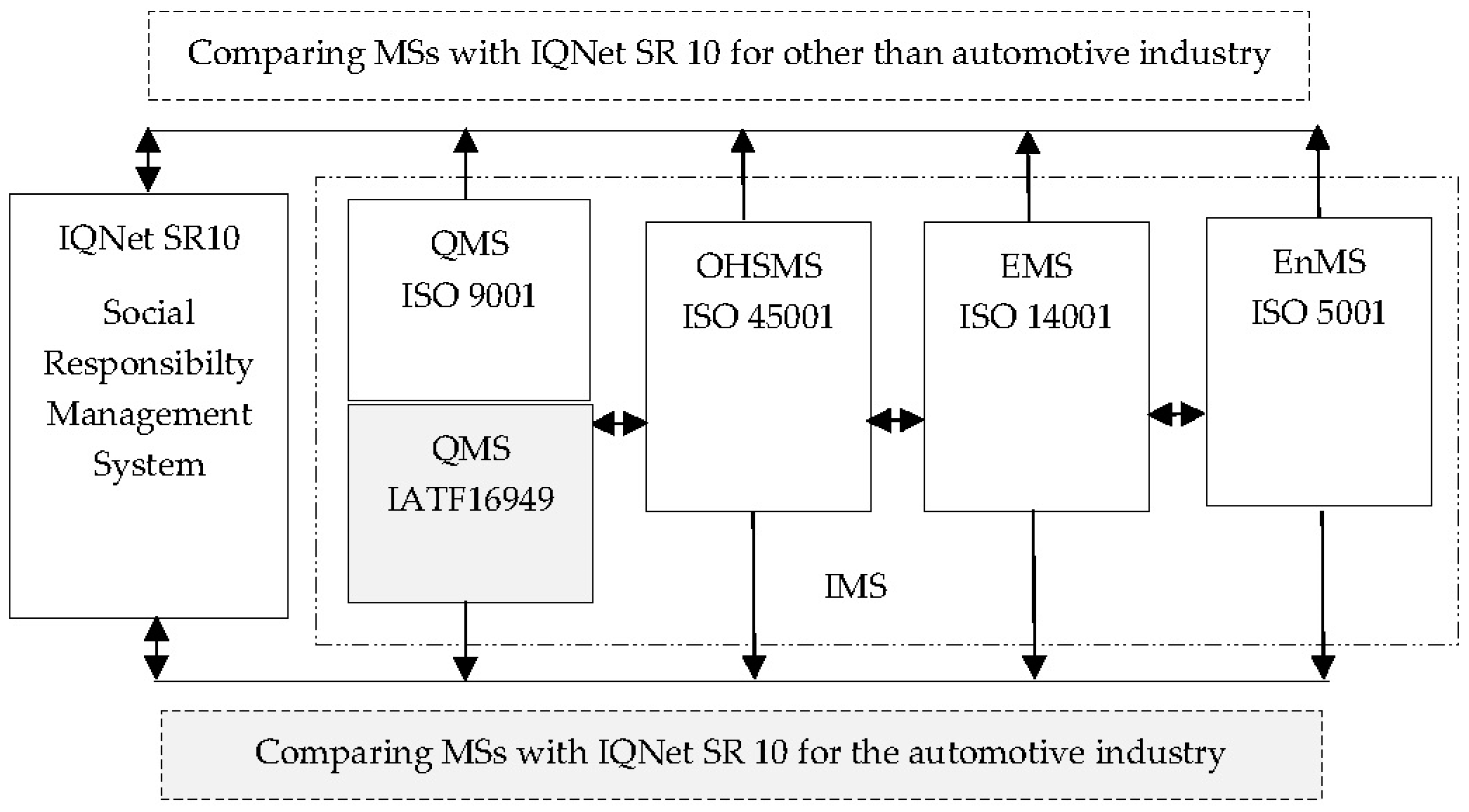
Figure 2.
A spider diagram to assess the overall level of applicability of CSR in established MSs among SRIMS respondents: TU (a); AU1 (b); AU2 (c); AU3 (d); OC (e) (own processing).
Figure 2.
A spider diagram to assess the overall level of applicability of CSR in established MSs among SRIMS respondents: TU (a); AU1 (b); AU2 (c); AU3 (d); OC (e) (own processing).
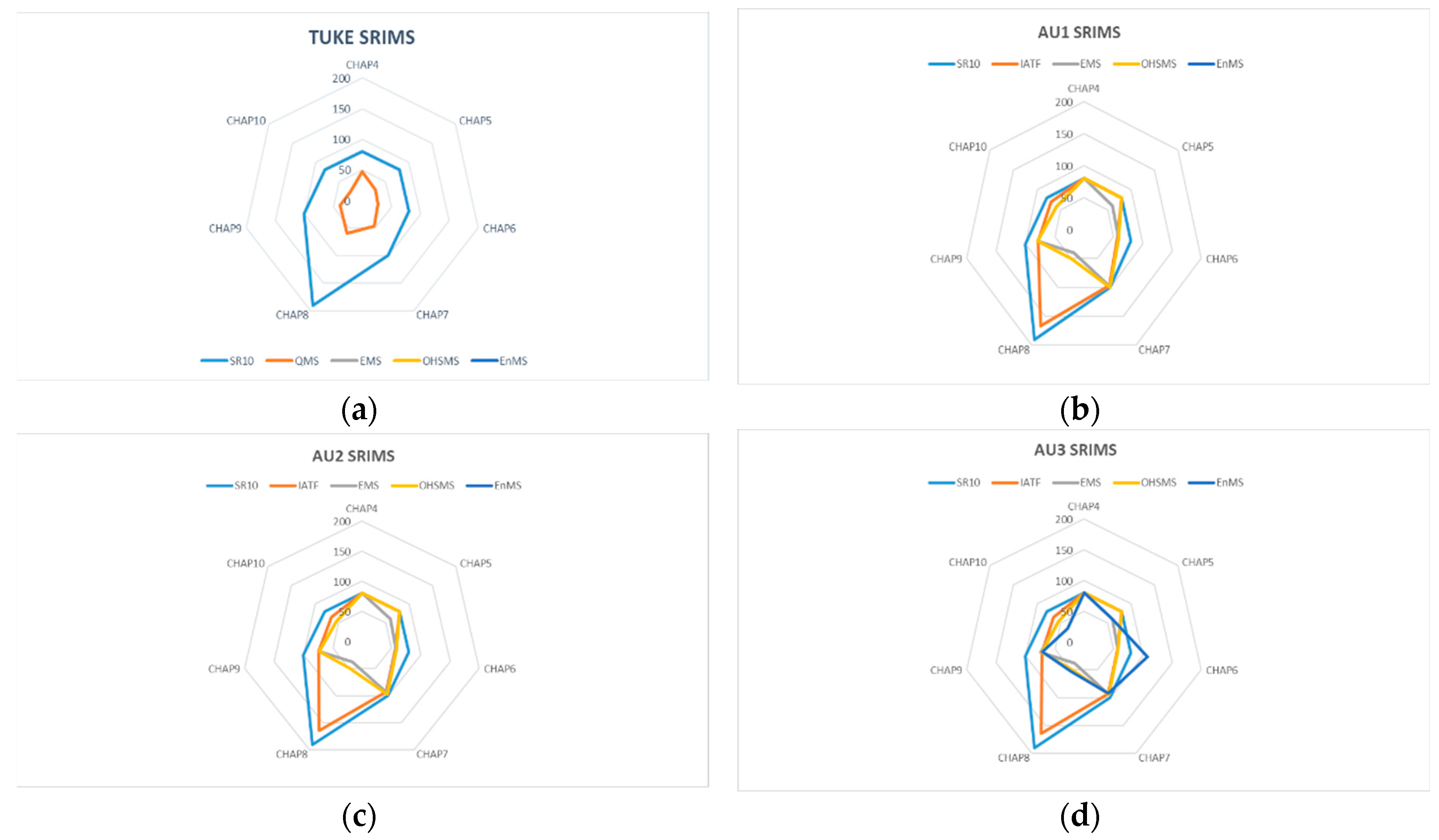
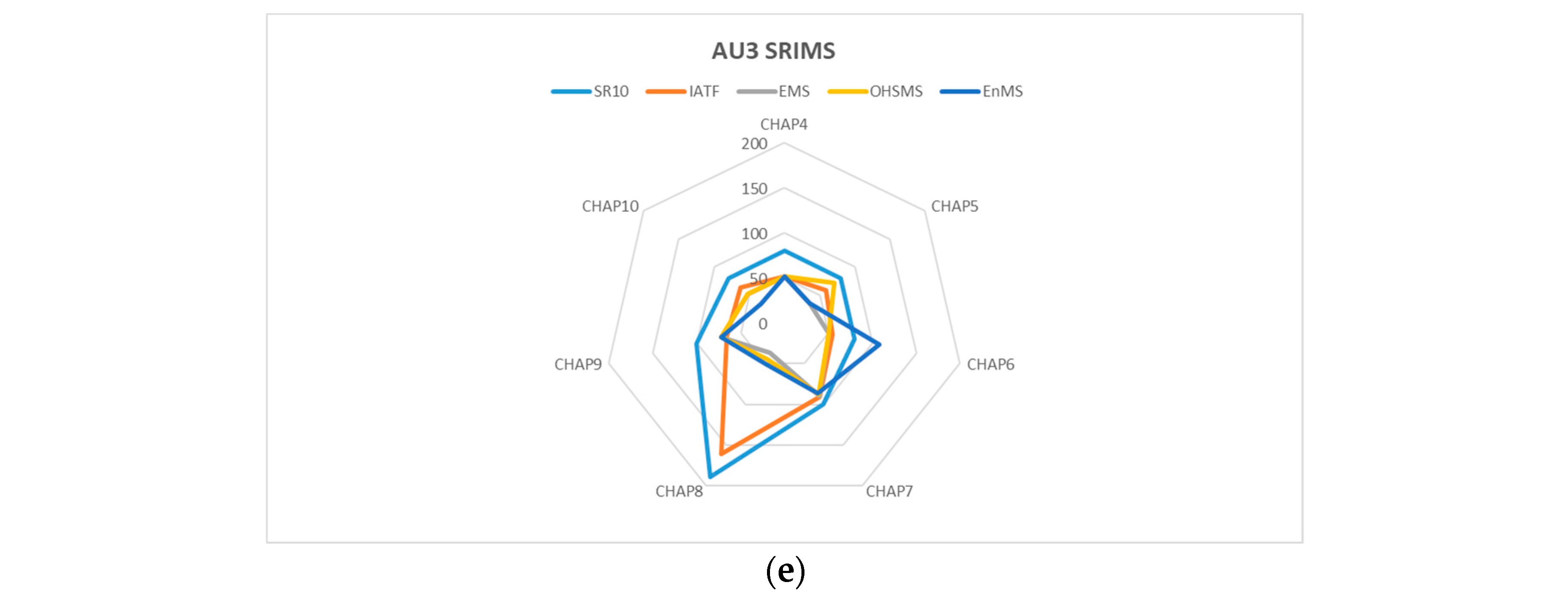
Figure 3.
Residual plots for MZ (a), MU (b) and Total (c).
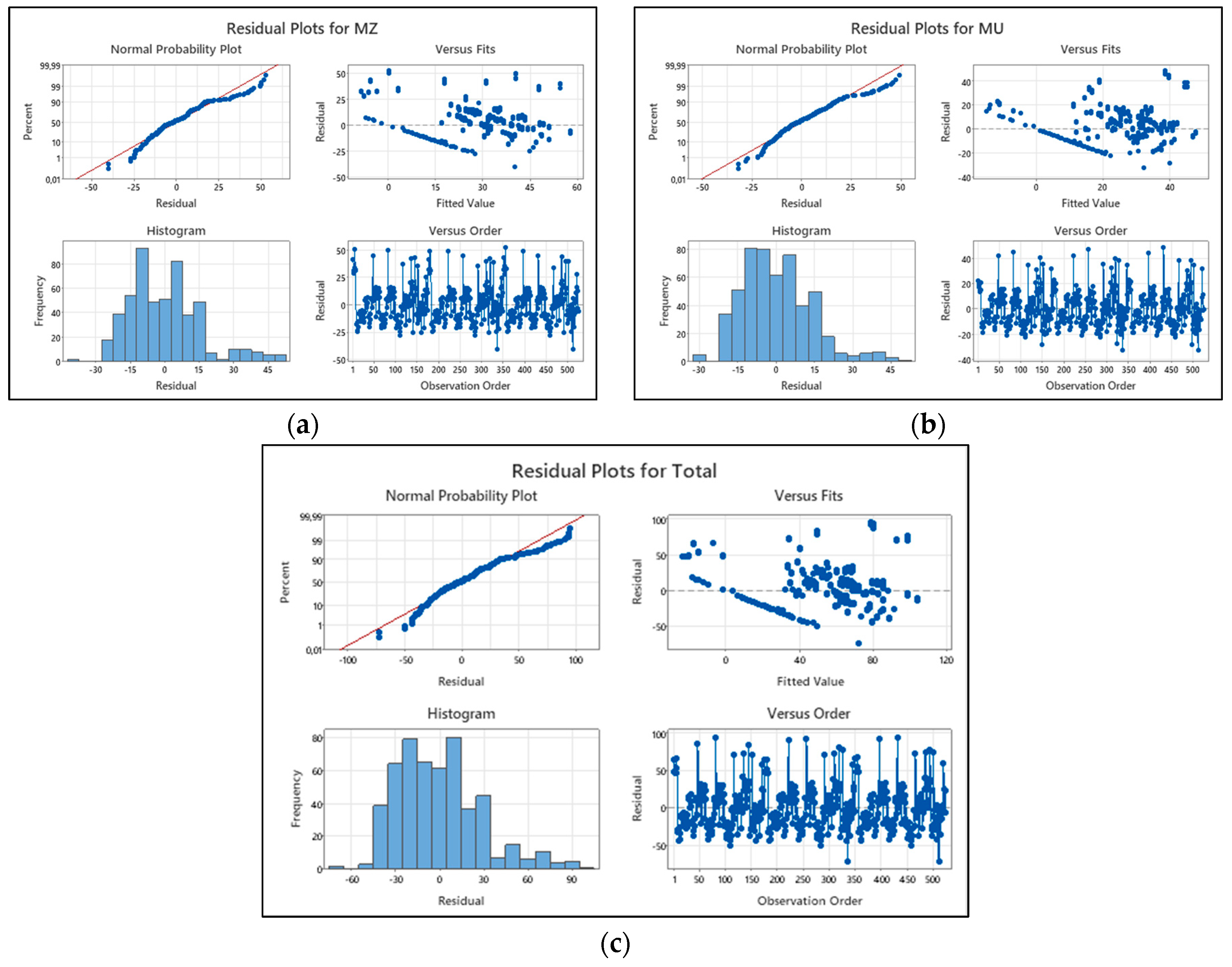
Figure 4.
Plots by Bonferroni Simultaneous 95% CIs.
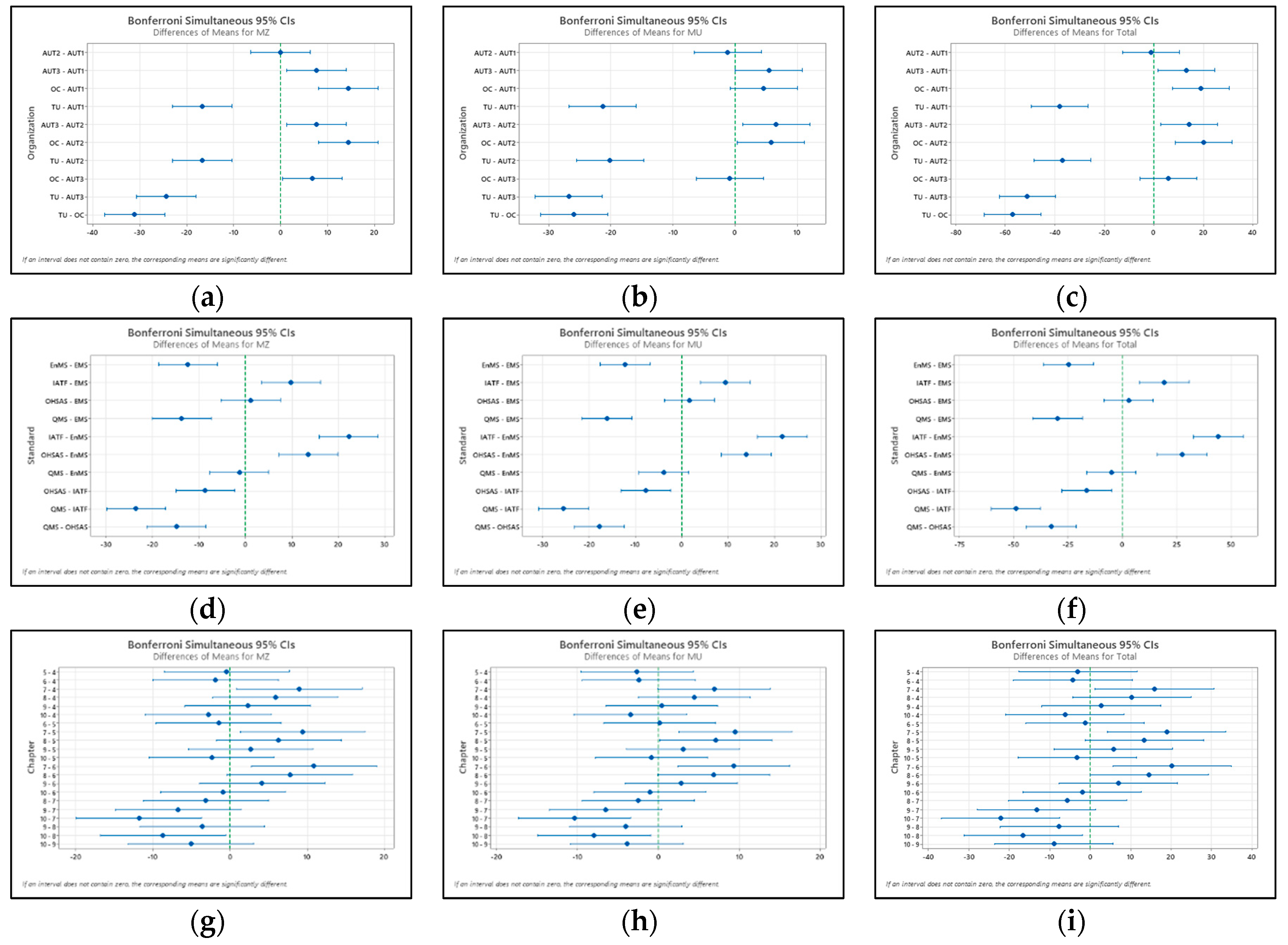
Figure 5.
Main Effects Plot for MZ (a), MU (b) and Total (c).
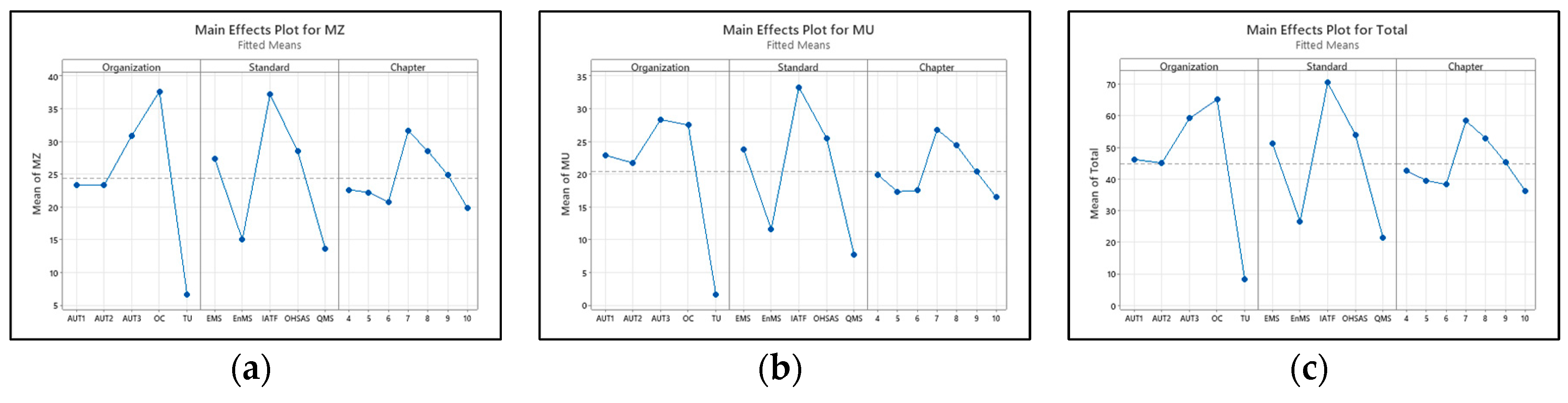
Figure 6.
Interaction Plot for MZ (a), MU (b) and Total (c).
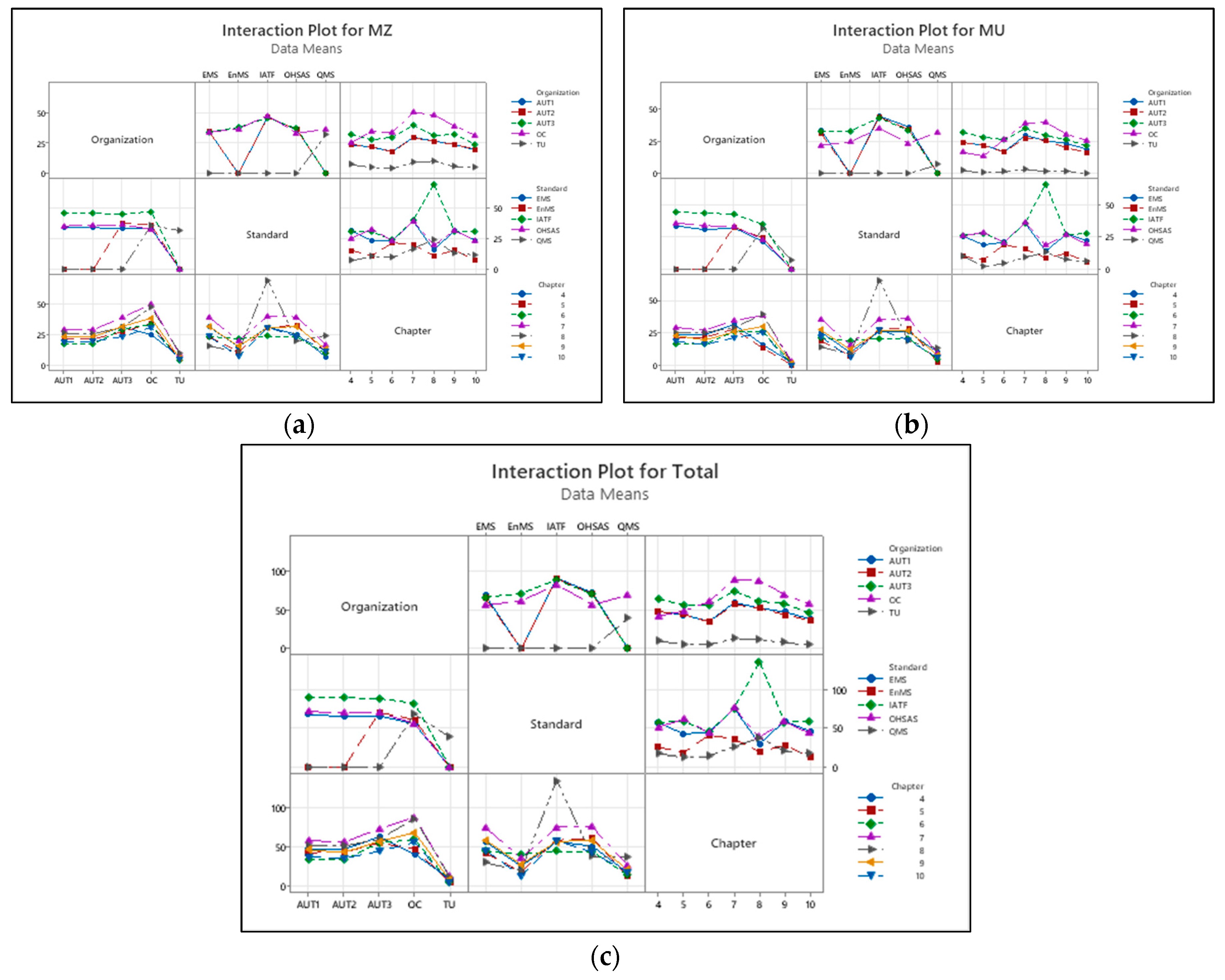

Table 1.
Overview of CSR codes and assessment frameworks used in selected industries.
| CSR standards and access to assessments | Basic subject and requirements | Access to auditing | EL | AU | ST |
|---|---|---|---|---|---|
| RBA (Responsible Business Alliance) 2020 | RBA Code of Conduct: 1. Staff; 2. Health and Safety; 3. Environment; 4. Ethics; 5. Management systems | RBA VAP, auditable by a third party. | √ | ||
| Electrolux Supplier standards in the workplace 2020 |
Child labour; Workforce; Safety measures; Health and safety; Non-discrimination; Harassment and abuse; Disciplinary and grievance procedures; Working time; Compensation; Freedom of assembly; Environmental compliance; Corruption and business ethics. | Electrolux Workplace Policy and Supplier Workplace Standard . (second and third party audits) | √ | ||
| BSH Supplier Code of Conduct 2021 |
Laws and regulations; Corruption and bribery; Human rights; Labour; Child labour; Harassment; Compensation; Hours of work; Non-discrimination; Health and safety; Freedom of assembly and collective bargaining; Environment; Supply chain. | CSR audit carried out by a third party towards BSH Supplier Code of Conduct. |
√ | ||
| IATF 16949 | CSR policy that, as a minimum, should include: Anti-Bribery Policy, Employee Code of Conduct, and Ethics Escalation Policy. | √ | |||
| SAQ ver 5.0 2021 |
Business Management, Working Conditions and Human Rights, Health and Safety, Business Ethics, Environment, Supplier Management, Responsible Sourcing of Raw Materials. | √ | |||
| BMW Group Supplier Sustainability Policy 2021 |
1. Environmental responsibility; 2. Social responsibility; 3. Public governance; 4. Supply chain responsibility |
SAQ 5.0 / RBA VAP (third party audit) | √ | ||
| FORD Human Rights Code, basic working conditions and social responsibility 2021 |
1. Human rights and working conditions; 2. Community involvement and indigenous peoples; 3. Bribery and corruption; 4. Environment and sustainability, 5. Accountability and implementation |
SAQ 5.0 / RBA VAP(third party audit) | √ | ||
| PSA Group Responsible Purchasing Rules 2020 |
1. Social principles; 2. Environmental protection; 3. Ethical principles; 4. Sustainable procurement | EcoVadis Platform/PSA Group Own methodology ( third party audits) |
√ | ||
| Volkswagen Group Code of Conduct for Business Partners 2020 |
1. Environmental protection; 2. Human and labour rights of employees; 3. Transparent business relations; 4. Fair market conduct; 5. Due diligence to promote a responsible mineral supply chain; 6. Integration of sustainability requirements in the organization and processes. |
SAQ 5.0 / RBA VAP (third party audit) | √ | ||
| FCA Group Sustainability guidelines for suppliers 2020 |
1. Human rights and working conditions; 2. Environment; 3. Business ethics and corruption; 4. Monitoring and corrective action. |
RBA (by third party towards Supplier Code of Conduct) | √ | ||
| ResponsibleSteel 2021 |
1. Company Management; 2.Social, Environment and Governance Management System; 3. Responsible Sourcing of Input Materials; 4. Decommissioning and Closure; 5.Occupational Health and Safety; 6. Labor rights; 7. Human Rights; 8.Stakeholder Engagement and Communication; 9. Local communities; 10. Climate Change and Greenhouse Gas; 11.Noise, Emissions, Efluents and Waste; 12. Water Stewardship; 13. Biodiverzity. |
Third party audit according to ResponsibleSteel standard. | √ | ||
| ThyssenKrupp Supplier Code of Conduct 2020 |
Human and labour rights; Employee health and safety; Environmental protection; Business conduct; Supplier relations; Compliance with the ThyssenKrupp Code of Conduct. |
ThyssenKrupp Supplier Code of Conduct (second or third party audit) |
√ |
Table 2.
Assignment of weights (calibration of the SRIMS methodology).
| Standard Chapters |
IQNet SR10 | QMS | IATF | EMS | OHSMS | EnMS | |
|---|---|---|---|---|---|---|---|
| 4 | Context of the organization | 80 | 80 | 80 | 80 | 80 | 80 |
| 5 | Leadership | 80 | 60 | 80 | 60 | 80 | 60 |
| 6 | Planning | 80 | 60 | 60 | 60 | 60 | 120 |
| 7 | Support | 100 | 100 | 100 | 100 | 100 | 100 |
| 8 | Operation | 190 | 150 | 180 | 40 | 60 | 60 |
| 9 | Performance evaluation | 100 | 80 | 80 | 80 | 80 | 80 |
| 10 | Improvement | 80 | 80 | 80 | 80 | 80 | 80 |
| 710 | 610 | 660 | 500 | 540 | 580 | ||
Table 3.
Respondent of SRIMS.
| Respondent | IQNet SR10 | QMS | IATF | EMS | OHSMS | EnMS | Area of activity | |
|---|---|---|---|---|---|---|---|---|
| 1 | TU | √ | EL | |||||
| 2 | AU1 | √ | √ | √ | √ | √ | √ | AU |
| 3 | AU2 | √ | √ | √ | √ | √ | AU | |
| 4 | AU3 | √ | √ | √ | √ | AU | ||
| 5 | OC | √ | √ | √ | √ | √ | ST | |
Table 4.
Designation of each factor level.
| Factor | Level | Values |
|---|---|---|
| Organization | 5 | AUT1; AUT2; AUT3; OC; TU |
| Standard | 5 | EMS; EnMS; IATF; OHSAS; QMS |
| Chapter | 7 | 4; 5; 6; 7; 8; 9; 10 |
Table 5.
Test for Equal Variances: MZ versus Organization; Standard; Chapter.
| Test for Equal Variances |
MZ versus Organisation; Standard; Chapter | MU versus Organization; Standard; Chapter | ||
|---|---|---|---|---|
| Method | Test Statistic | P-Value | Test Statistic | P-Value |
| Multiple comparisons | — | 0,002 | — | 0,042 |
| Levene | 0,51 | 1,000 | 0,66 | 0,993 |
Comment: Null hypothesis - All variances are equal; Alternative hypothesis - At least one variance is different; Significance level α = 0,05.
Table 6.
Regression Equation.
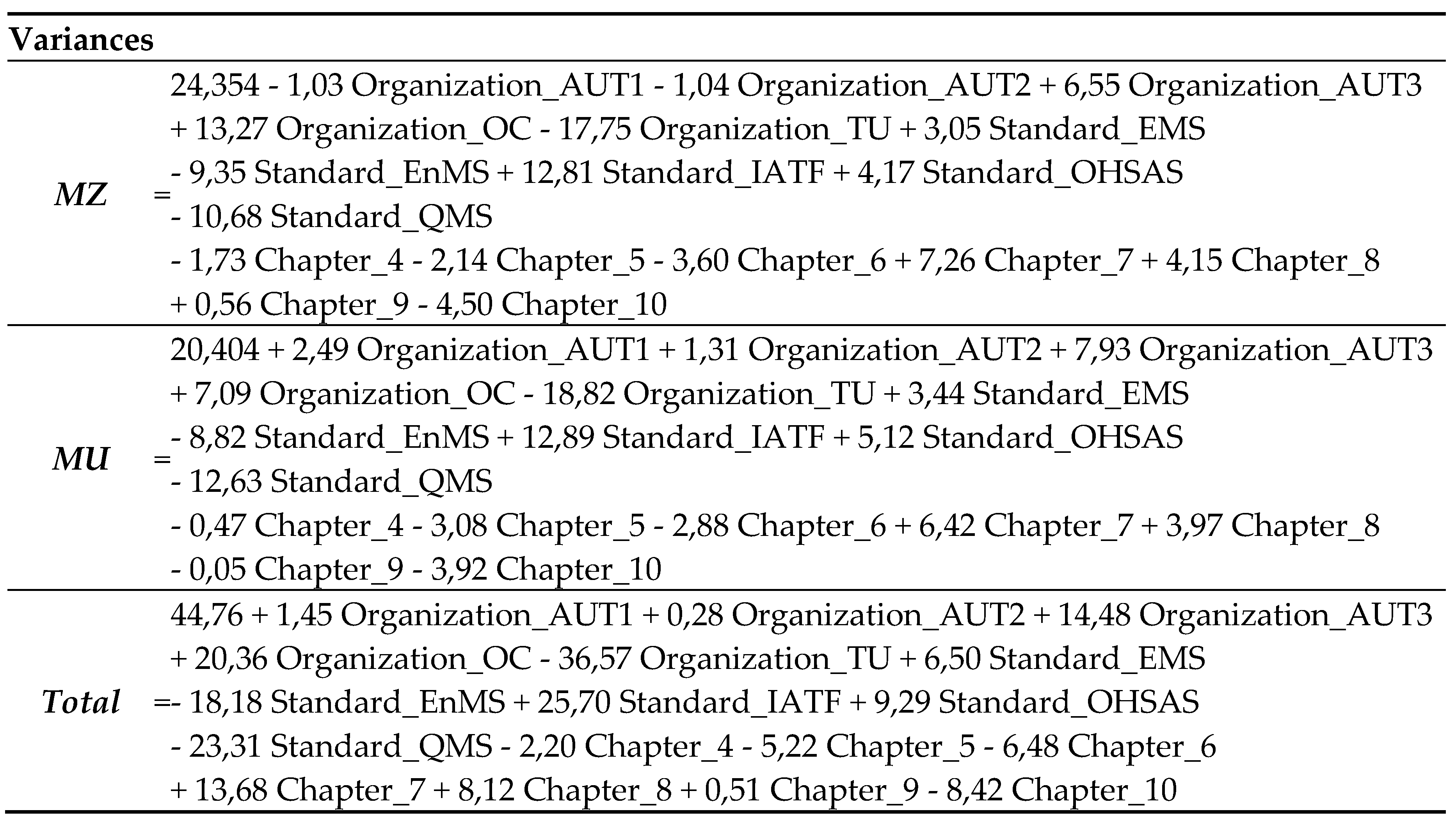
Table 7.
Analysis of Variance for MZ, MU and Total.
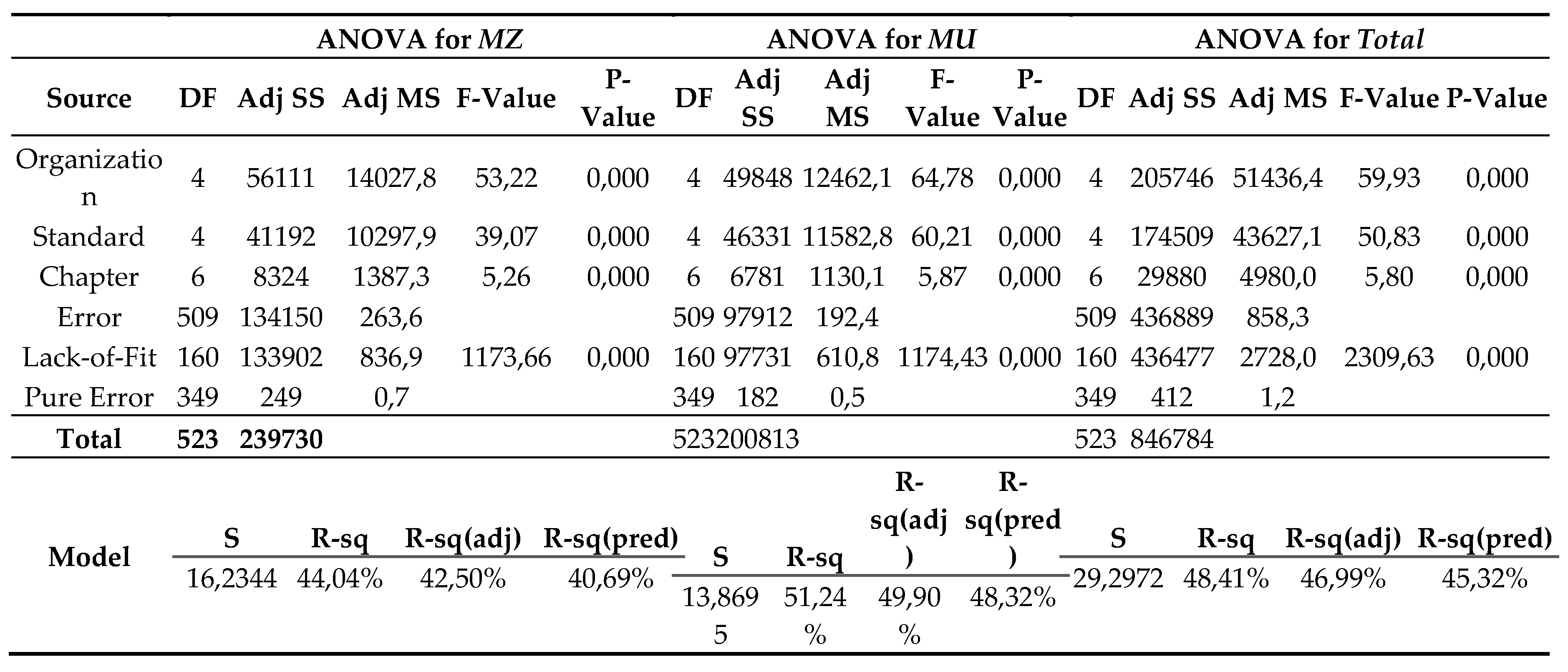
Table 8.
Grouping Information Using the Bonferroni Method and 95% Confidence.
| MZ | MU | Total | |||||||||||||
|---|---|---|---|---|---|---|---|---|---|---|---|---|---|---|---|
| Organization | N | Mean | Grouping | Mean | Grouping | Mean | Grouping | ||||||||
| OC | 104 | 37,6238 | A | 27,4940 | A | B | 65,1178 | A | |||||||
| AUT3 | 105 | 30,9007 | B | 28,3330 | A | 59,2337 | A | ||||||||
| AUT1 | 105 | 23,3214 | C | 22,8904 | B | C | 46,2118 | B | |||||||
| AUT2 | 105 | 23,3170 | C | 21,7191 | C | 45,0362 | B | ||||||||
| TU | 105 | 6,6053 | D | 1,5842 | D | 8,1895 | C | ||||||||
| Standard | N | Mean | Grouping | Mean | Grouping | Mean | Grouping | ||||||||
| IATF | 105 | 37,1635 | A | 33,2922 | A | 70,4557 | A | ||||||||
| OHSAS | 104 | 28,5268 | B | 25,5229 | B | 54,0497 | B | ||||||||
| EMS | 105 | 27,4081 | B | 23,8490 | B | 51,2570 | B | ||||||||
| EnMS | 105 | 14,9998 | C | 11,5825 | C | 26,5823 | C | ||||||||
| QMS | 105 | 13,6701 | C | 7,7743 | C | 21,4444 | C | ||||||||
| Chapter | N | Mean | Grouping | Mean | Grouping | Mean | Grouping | ||||||||
| 7 | 75 | 31,6125 | A | 26,8287 | A | 58,4412 | A | ||||||||
| 8 | 75 | 28,5033 | A | B | 24,3751 | A | B | 52,8784 | A | B | |||||
| 9 | 75 | 24,9143 | A | B | C | 20,3585 | A | B | C | 45,2728 | A | B | C | ||
| 4 | 74 | 22,6282 | B | C | 19,9340 | A | B | C | 42,5622 | B | C | ||||
| 5 | 75 | 22,2141 | B | C | 17,3245 | C | 39,5387 | B | C | ||||||
| 6 | 75 | 20,7540 | B | C | 17,5241 | B | C | 38,2781 | B | C | |||||
| 10 | 75 | 19,8492 | C | 16,4841 | C | 36,3333 | C | ||||||||
Disclaimer/Publisher’s Note: The statements, opinions and data contained in all publications are solely those of the individual author(s) and contributor(s) and not of MDPI and/or the editor(s). MDPI and/or the editor(s) disclaim responsibility for any injury to people or property resulting from any ideas, methods, instructions or products referred to in the content. |
© 2023 by the authors. Licensee MDPI, Basel, Switzerland. This article is an open access article distributed under the terms and conditions of the Creative Commons Attribution (CC BY) license (http://creativecommons.org/licenses/by/4.0/).
Copyright: This open access article is published under a Creative Commons CC BY 4.0 license, which permit the free download, distribution, and reuse, provided that the author and preprint are cited in any reuse.


