

Submitted:
01 August 2023
Posted:
03 August 2023
You are already at the latest version
Abstract
Yarrowia lipolytica is a widely used microorganism in biotechnology since it is capable of producing a wide range of products. A less studied related strain is Y. divulgata, which is also capable of erythritol production in even higher concenctration then most Y. lipolytica wild strains. Thus the aim of this work was to investigate Y. divulgata’s complex utilisation based on erythritol fermentation to establish a Yarrowia based biorefinery in which both the fermentation broth and separated cells are utilised in high-value products. An important parameter of erythritol fermentation is the adequate oxygen level, so the effect of it was investigated in baffled flasks and fermentor as well. Furthermore, we measured the cosmetic applicability of cell lysates and the efficiency of biodetergent produced during erythritol fermentation. The results were showed that Yarrowia divulagata NCAIM 1485 strain could produce relative high amount of erythritol (44.14±1 g/l) under adequate oxygen supply while its cell lysate could exert good skin moisturizing effect. In all cases, the collected samples had emulsification index above 50% of which stability was also high, above 50% even after 24 hours.Therefore, it can be considered as an effective bioemulsifier. In conclusion, the erythritol fermentation of Y. divulgata is suitable for complex utilisation in a biorefinery, since the fermentation broth can be used for isolation of sweetener and bioemulsifier, meanwhile the cells can be processed for cosmetic application as skin moisturizer.
Keywords:
Yarrowia divulgata
; fermentation
; oxygentransfer
; erythritol
; cosmetic ingredient
; cell-lysate
; bioemulsifier
1. Introduction
Yarrowia lipolytica is a widely used microorganism in biotechnology [1]. The first use of Y. lipolytica was in 1960s, when it was used to produce single-cell protein (SCP) using n-alkanes as a carbon source [2,3]. It is capable of producing and secreting a number of metabolites that can be used in industry. Y. lipolytica has a strong proteolytic and lipolytic activity as well [4,5]. The growth of Y. lipolytica and the quantity as wel as the quality of the different metabolites it secretes are influenced by various environmental factors. One of the most important is the amount of oxygen, which plays an important role in the growth of the microorganism. Y. lipolytica is a strictly aerobic microorganism. There are several intracellular enzymatic processes that require oxygen discussed in more detailed later [6]. Also, several literatures shows that Yarrowia lipolytica is able to produce erythritol by fermentation [7,8,9].
Yarrowia divulgata is a species described in the recent past, which can be isolated from meat of animal origin, among other sources, but is also found in oceanic fish. Y. divulgata NCAIM 1485 was isolated from chicken liver in 1999 [10] and was described as a strain, which is indistinguishable from Y. lipolytica and Y. deformans, and the latter is the closest genetical relative. A few studies have begun to investigate the ability of the strain to produce erythritol using a glycerol carbon source [11,12].
Erythritol (C4H10O4) is a naturally occurring 4-carbon sugar alcohol, also known as a polyol, which is widely used in the food industry. It occurs naturally in small amounts in alcoholic beverages, mushrooms and fruits such as pears, grapes and watermelon. However, sugar alcohols and functional sugars are present in smaller amounts in nature (in plants, fungi and algae). In plants, sugar alcohols accumulate temporarily in leaves during light hours and are transported to other organs during darkness. The low content makes the extraction of sugar alcohols from plants difficult [13]. Erythritol is 60-70% as sweet as table sucrose, yet has a very low caloric value (0.2 kcal/g), so it has no effect on human blood sugar levels and does not cause tooth decay [14]. Erythritol is well absorbed and does not ferment, so it can be consumed in relatively large quantities without side effects, unlike other polyols, which can cause gastrointestinal side effects if consumed in large quantities [15,16].
Many methods are available for the production of erythritol, both chemical and biotechnological. One of the known chemical production methods, which produces equimolar amounts of erythritol and ethylene glycol, is a multi-step process involving chemical synthesis from dialdehyde starch at high temperature in the presence of a metal catalyst, namely nickel. However, it is not used in industry due to its very low yield and relatively high costs [14].
Erythritol for industrial use is produced by microbial methods using osmophilic yeasts (Moniliella pollinis, Trichosporonoides megachiliensis and Y. lipolytica) and some bacteria (Oenococcus oeni, Leuconostoc mesenteroides and Lactobacillus sanfranciscensis) [17]. Table 1. shows the results obtained in the production of erythritol by different Yarrowia strains.

Table 1.
Erythritol fermentation with wild-type and mutant Yarrowia strains.
| Wild-type strains | Carbon source | Cultivation strategy | Titer | References |
| Y. lipolytica A-15 | 100 g/l glycerol |
Batch bioreactor | 28 g/l | [18] |
| Y. lipolytica A-3 | 150 g/l glycerol | Batch bioreactor | 25,3 g/l | [19] |
| Y. lipolytica A-6 | 150 g/l glycerol | Batch bioreactor | 32 g/l | [19] |
| Y. divulgata CBS11013 | 100 g/l glycerol | Batch bioreactor | 35,4 g/l | [11] |
| Mutant strains | Carbon source | Cultivation strategy | Titer | References |
| Y. lipolytica MK1 UV mutant | molasses and glycerol | Two-stage fermentation | 113,1 g/l | [21] |
| Y. lipolytica Wratislavia K1 | glycerol | Fed-batch | 81 g/l | [22] |
| Y. lipolytica CICC 1675 | glycerol | One-stage fed-batch fermentation | 194,3 g/l | [8] |
Most of the high erythritol production has been achieved by mutant strains, and metabolic engineering also represent an important step forward to enhance erythritol production. Yang et al. [23] produced high erythritol levels (150 g/l) by overexpressing glycerol kinase (GUT1), glycerol-3-P dehydrogenase (GUT2), and transketolase (TKL1) while knocking out erythritol dehydrogenase (EYD1), which is in the erythritol catabolic pathway. Janek et al. [24] investigated the effect of erythrose reductase enzyme overexpression on erythritol production. This enzyme reduces erythrose to erythritol by NAD(P)H oxidation, The strain (wild-type Y.lipolytica A101) was transformed with the YALI0F18590g gene which encoded and overexpressed the erythrose reductase enzyme thus produced 44.4 g/l erythritol compared to the control (MK1) reaching 37.1 g/l. Further studies were carried out to investigate the effect of zinc on erythritol production and enzyme function and found that the addition of zinc further increased erythritol production in both the mutant and control (MK1) strains, resulting in 54.1 g/land 51 g/l, respectively.
Osmotolerant yeasts are able to survive osmotic stress by accumulating various solutes of high osmolarity, called osmolytes. These substances protect and stabilize their enzymes and allow essential cellular functions to operate properly under higher osmotic pressure. The most common osmolyte is glycerol in yeasts, but sugar alcohols such as erythritol, and mannitol can also serve as osmolytes [25]. Da Silva et al. [26] looked for an alternative supplement to NaCl to increase osmolarity. They found that polyethylene glycol (PEG) is a good osmotic agent. They used a concentration to achieve the same osmolarity as with 25 g/l NaCl supplementation. The application of PEG resulted in an increase in erythritol productivity: Y. lipolytica W29 produced 42.5 g/l (44% increase) and Y. lipolytica IMUFRJ 50682 produced 25.38 g/l (40% increase) of erythritol. Jagtap et al. [27] showed that supplementing the glycerol carbon source with NaCl increased the amount of erythritol and led to perfect utilization of glycerol, as opposed to glucose. Quantitative PCR analysis clearly demonstrated that the expression of genes involved in the glycerol uptake and utilizating mechanism (e.g. glycerol kinase (GK), glycerol dehydrogenase (GCY1)) was increased in the presence of salt. The combined overexpression of sugar alcohol phosphatase (PYP), glycerol kinase (GK) and transketolase (TKL) further increases the glycerol utilization rate and erythritol titer. In case of Yarrowia lipolytica PO1f-PYP-GK-TKL strain 58.8 g/l erythritol was achieved which is 1.9-fold increase in erythritol compered to the wild-type strain (Y. l. PO1f).
Ribeiro [28] studied the effect of aeration on erythritol production. After selection, he found that strain Y. lipolytica W29 produced the most erythritol (34 g/l) from 100 g/l glycerol at 200 rpm at 27 °C. Among the strains tested, Y. divulgata 5257/2 produced 17 g/l erythritol under the same conditions. The test strain (Y. lipolytica W29) produced 35 g/l erythritol in 72 h at 3 vvm and 900 rpm aeration and agitation rate, and consumed all glycerol from the medium, with a productivity of 0.5 g/l/h. Machado [29] investigated the erythritol production of wild-type strain Y. lipolytica W29 at dissolved oxygen concentrations (20% and 40%), and found that at 20% oxygen, 21.33 g/l erythritol was produced by hour 55, but later was consumed by the strain up to the end of fermentation. At 40% oxygen level, the strain produces 23.3 g/l of erythritol. Upon further investigation, the strain produced 31.8 g/l erythritol at 900 rpm and 3 vvm aeration. In a fed-batch fermentation (900 rpm and 3 vvm aeration) at the best setting, 55.4 g/l of erythritol was produced in nearly 200 hours. It has been shown that the concentration of dissolved oxygen affects the amount of erythritol in the fermented media, so a higher percentage of dissolved oxygen increases erythritol production.
Yarrowia lipolytica is also capable of producing products that can be used in the cosmetic industry. This includes, among others, aroma components such as limonene, which is widely used in the cosmetic industry [30]. It is also capable of producing pigments, which are also used in the cosmetic industry for example as skin tanning. The produced pigment is pyomelanin, which is a brown pigment, so it can even be used in sunscreen creams [31]. The Yarrowia lipolytica ferment lysate is listed in the Cosmetics Ingredients Database (Cosing) as a skin conditioner, which is a product obtained after lysis of the cells grown during fermentation.
Bioemulsifiers are compounds that contain biological molecules with surfactant properties similar to those of well-known synthetic surfactants [32]. Biosurfactants are amphiphilic molecules whose hydrophilic part consists of amino acids, peptides, esters, carbohydrates or hydroxyl phosphate, alcohol and carboxyl groups; and the hydrophobic part consists of long-chain fatty acid residues, fatty acid β-hydroxyalkyls [33]. They are biodegradable, and this is one of their most important advantages because it prevents toxicity problems and accumulation in natural ecosystems [34]. Liposan was isolated by Cirigliano and Carman [35] from the nutrient medium supplemented with hexadecane by C. lipolytica ATCC 8662 (recently renamed to Y.lipolytica). Its composition was later determined and studies have shown that it consists of 83% carbohydrate and 17% protein [36]. The composition of the bioemulsifier produced from the 1.5% (w/v) glucose-based fermentation of Yarrowia lipolytica was 47% protein, 45% carbohydrate, 5% lipid [39]. The bioemulsifier, Yansan, was isolated also from a glucose-based fermentation medium containing 0.64% (w/v) glucose by Y. lipolytica (IMUFRJ 50682). Yansan is a lipid-carbohydrate-protein complex with high emulsification activity and stability in a wide pH range (3-9). Its composition was investigated and found to contain 62.1% carbon, 7.8% nitrogen, 29.2% oxygen, 0.6% sulfur [34]. In a medium supplemented with 5% animal fat and 2.5% corn steep liquor, the EI index of the produced bioemulsifier against sunflower oil was 47 % [38]. Da Silva et al. [33] fermented with 30 g/l crude residual glycerol and the ferment liquids tested showed an average EI index of 56% after 24 h and 48 h.
The main hypothesis of this study was, that an aerated Yarrowia broth has 3 phases (i.e. aquaeous, solid, and foam phase), and each of them have important features which can establish the fundament of a Y. divulgata based biorefinery. To verify this concept, we run and developed erythritol fermentations and verfied, that its byproduct foam phase is an effecive bioemulsifier, and the by-product cell’s lysate is a usefull cosmetic ingredient.
2. Materials and Methods
2.1. Fermentation
The strain was purchased from the National Collection of Agricultural and Industrial Microorganisms. The following microorganism was used in this study: Yarrowia divulgata (NCAIM 1485). The following media were used in this experiment:
Malt extract agar medium contains: Malt extract 30 g/l; Peptone 5 g/l; Bacteriological agar 15 g/l.
Inoculum [20]: Glycerol 50 g/l; Yeast extract 3 g/l; Malt extract 3 g/l; Peptone 5 g/l.
Fermentation medium [18]: Glycerol 100 g/l in case of fermentor; Ammonium-chloride 4.56 g/l; MgSO4 × 7 H2O 1 g/l; Yeast extract 1 g/l; CuSO4 0.7 × 10⁻³ g/l; MnSO4 × H2O 32.6 × 10⁻³ g/l; KH2PO4 97.8 g/l. For Erlenmeyer’s flask and baffled flasks we were used the same fermentation medium, supplemented to 150 g/l glycerol.
Inoculum cells for the fermentor and for the baffled flasks were grown in 250 ml Erlenmeyer’s flasks containing 25 ml of inoculum media at 200 rpm at 25 °C on a rotary shaker (New Brunswick Scientific Innova 40).
We used shaked baffled flask in triplicates and two size: 500 ml and 750 ml with 50 ml and 75 ml working volume and 10% v/v inoculum with the same settings as the inoculum. The fermentations were carried out in a recently developed jFermi bioreactor with Java based web-client (https://jfermi.com/, founded in 2018) and a working volume of 0.25 L including 10% v/v inoculum. For production, the temperature was adjusted to 25 °C. For the bioreactor fermentations, the pH was decreased by the cells to pH=3, and then controlled automatically to keep it 3 with addition of 6 N NaOH solution. DO was controlled at 4 different levels (10-20-30-40%) by PID controller varying stirrer rate. Standard deviations were determined through duplicate run of DO=40%, of which relative error was used for estimating variance. If it was necessary, the foam was collected through a cyclone or was reduced with polypropyleneglycol (PPG) antifoam in 1ml/L.
2.1.1. Analytical methods
Samples (1 ml) were taken from bioreactor and baffled flasks cultures, then were centrifugated (Heraeus BIOFUGE pico), and the cells pellets were washed with distilled water. The biomass was determined gravimetrically after drying at 105 °C (Sartorius MA35), and expressed in grams of cell dry weight per liter (g/l). Concentrations of glycerol, erythritol, mannitol were measured from supernatant by HPLC using BioRadAminexHPX87H column at 65°C and refractive index (Waters 2410 RI) detector at 40°C, and Waters 1515 Isocratic pump. The column was eluated 5 mM sulphuric acid with flow rate of 0.5 ml/min, and samples were diluted 30fold. Erythritol, mannitol and glycerol standard were used.
For osmolarity measurement (Gonotec Osmomat 3000) 60 µl sample of the supernatant of the fermented media was used.
Sulphite oxidation method for KLa measuring:
In sulphite measurement, the measurement of the rate of oxygen absorption is reduced to the rate of a chemical reaction (1):
The rate of the sulphation reaction is therefore determined only by the rate of oxygen absorption (2):
where r-the oxidation rate; C*- saturation oxygen concentration (mg/dm3); C- current dissolved oxygen concentration (mg/dm3); KLa- oxygen absorption coefficient (h-1).
The reaction rate was measured as follows: as the reaction time progressed, samples were taken in which the concentration of unreacted sulfite was determined, and these values were plotted against time and the directional tangent of the line was determined. The above equation assumes that the velocity is constant, so the concentrations decrease in a straight line with time. This slope was expressed in mg SO2/h-1 /1 ml to give the sulphite number. Converting this to oxygen by stoichiometry gives the OTR (mg O2/ h-1/1 ml). By following the sulfite → sulfate conversion by iodometry, the OTR (oxygen transfer rate) can be calculated from the slope of the thiosulfate reduction/time plot of the reaction rate. The following equation (3) was used to for this:
1 ml of 0.1 n I2 (or thiosulphate) solution is equivalent to 0.8 mg O2. From the OTR = Kla* C* obtained in this way, the KLa value for the aeration/mixing conditions can be calculated. [39]. The sulphite oxidation measurement was performed by titration, during which the loss of thiosulphate was monitored and plotted as a function of time. For the measurement at 25°C, 0.1 n thiosulphate solution, 1 ml of 1 M hydrochloric acid solution, 10 ml of 0.1 n KI solution and 1-2 drops of 1% starch solution and 1 ml of samples were used.
2.2. Skin Moisturising Measurement
For skin moisturising measurements cells were separated at the end of fermentation. For cell separation, 10 ml of fermented broth was used, centrifuged (HERMLE Z 200 A) for 10 min at 6000 rpm speed, then the supernatant was poured off and resuspended in 10 ml of distilled water. Cell disruption was performed by IKA ULTRA TURRAX Tube Drive cell disruption system with glass beads in 3 ml volume of distilled water. Cell debris was removed by centrifugation at 9000 rpm for 1 min in distilled water. Short term skin moisturising measurements were performed with Multi Dermascope MDS 800 as reported earlier by Tóth et al. [40] determining skin moisture conent versus time with the corneometer of the equipment after treatments on the same spots of european human adult skin. After treatments, skin moisture contetn jumped up, and slowly lost excess humidity maenwhile stabilized. This final stabilized values are compared depending on different cell-lysates.
2.3. Emulsifying Activity Measurement
This experiment was based on the measurement of Czinkóczky et al. [41]. For the measurement, a supernatant of fermented juice was used, of which 2 ml was added to 2 ml of sunflower oil in a test tube and vortexed for 2 min. The following equation (4) was used for the evaluation:
where He and Ht are the height of emulsion and total height of the liquid in the tube, respectively. The tubes were incubated at 25 ◦C for 1 day. The emulsification index (EI, %) was determined after 1 h and the EI measured after 24 h (EI24, %).
3. Results
3.1. Fermentations
3.1.1. Fermentor
The effect of oxygen on erythritol fermentation was investigated in the jFermi fermentor. Different oxygen levels (10%; 20%; 30%; 40%) were controlled through automaticly varying the impeller speed. One of the best results of such fermentations with DO=20% oxygen level is shown in Figure 1.
Figure 1.
Fermentation at DO=20% oxygen level (a) Parameters measured off-line during fermentation (b) online measured and controlled parameters.
Figure 1.
Fermentation at DO=20% oxygen level (a) Parameters measured off-line during fermentation (b) online measured and controlled parameters.
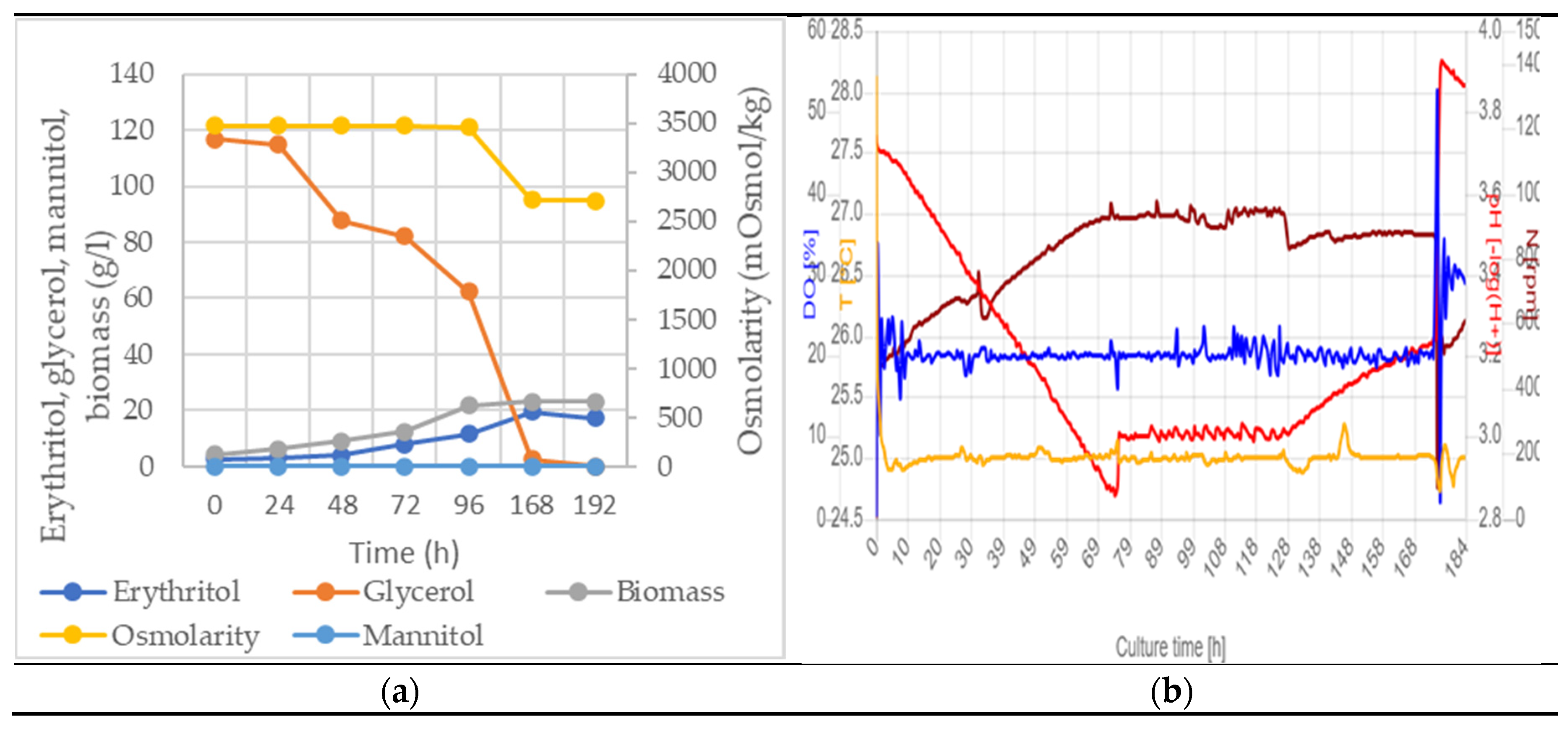
The fermentation was produced 19.65 g/l erythritol, with no mannitol as a by-product. The osmolarity was decreased from an initial 3474 mOsmol/kg to 2712 mOsmol/kg. The glycerol had completely run out of ferment media. In Figure 1. (b) clearly shows that the pH was decreased to under 3 and controlled with 6 N NaOH to 3. The dissolved oxygen level was kept at 20% during the fermentation. The biomass at the end of the fermentation was 23.1 g/l. The rise in pH was marked the end of fermentation, after which it was difficult to keep the oxygen level at 20%, and later it also rose. The results of fermentations at other oxygen levels are shown in Table 2.
Table 2.
Results of Y. divulgata fermentations under different oxygen levels.
| Oxygen level (%) | Eryhtritol (g/l) | Mannitol (g/l) | Initial osmolarity (mOsmol/kg) | Residual glycerol (g/l) | Biomass (g/l) | Yield (%) | Productivity (g/l)/h |
|---|---|---|---|---|---|---|---|
| 10 | 16.66±2.92 | 0 | 3405±57.88 | 23.8±3.84 | 20.9±0.94 | 22.99±4.64 | 0.06±0.039 |
| 20 | 19.65±3.44 | 0 | 3474±59.05 | 2.72±0.43 | 23.1±1.04 | 14.8±2.99 | 0.12±0.079 |
| 30 | 17.75±3.1 | 13.77±2.73 | 3475±59,07 | 13.33±2.15 | 23.62±1.06 | 14.29±2.88 | 0.123±0.08 |
| 40 | 19.81±3.47 | 2.62±0.52 | 3439±58.46 | 41.98±6.78 | 21±0.94 | 28.85±5.83 | 0.08±0.053 |
Most erythritol was obtained during the batch fermentation with 40% oxygen, 19.81±3.47 g/l, but a lot of glycerol (41.98 g/l) remained in the ferment media. Furthermore, the highest yield of 28.85±5.83 % was obtained here. However, the productivity was 0.08±0.053 (g/l)/h lower than the others due to the 10 days fermentation. The overall polyol production was the highest at 30% oxygen level, where 17.75 g/l erythritol and 13.77 g/l mannitol were produced as by-products. At the 20% oxygen level, 19.65 g/l erythritol was produced and at this fermentation setting, glycerol was completely consumed from the culture medium.
3.1.2. Comparison of Oxygen absorption
Since the above results suggested, that DO has special role in erythritol fermentation in accordance with previous reports ([28,29]), and in some of our preliminary shaking flask experiments we detected even higher product formation (data not shown), therfore we compared oxygen absorption (Kla) between two types of flasks and the jFermi bioreactor. The jFermi Kla was determined by the manufacturers using the "Gassing out" method, with Q=200 ml/min at 300 and 500rpm resulting 9,56 and 16,72 1/h respectively. Based on this, the Kla value of the fermentor, varying stirring rate between 600-1000rpm thus considered as an average speed of 800 rpm, was Kla=26.4 h-1.
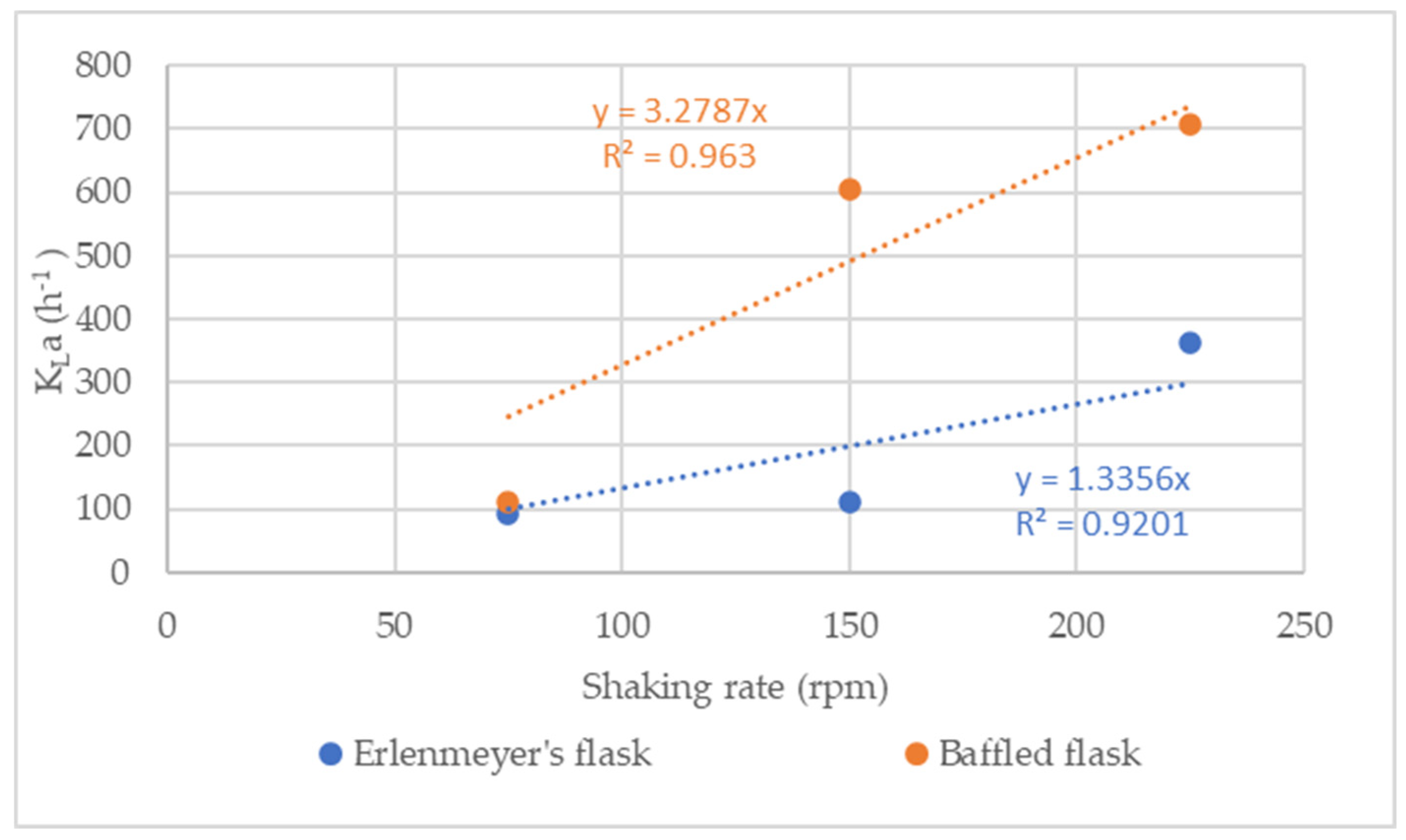
The oxygen absorption coefficient (KLa) of the two type flasks was determined and compared by sulphite oxidation method at 3-3 different shaking (stirring) rate in 500ml flasks, of which results are shown in Figure 2. The slope of the lines show that the baffled flask had a KLa of 2.45 fold higher, than classic Erlenmeyer flask of same size and filling. If a typical stirring rate (200rpm) is used for Kla calculation, a KLa of 267.12 h-1 and 655.74 h-1 were observed for normal and baffled flasks, respectively. This highlighted, that these shaking flask setups has ca. 10-25fold higher oxygen absorption compared to the jFermi bioreactor.
Figure 2.
Comparison of normal flask and baffled flask KLa measurements.
3.1.3. Baffled flasks experiments
For higher erythritol production, shaking flasks were used with increased initial glycerol concentration (150 g/l), thus also increasing the osmolarity during fermentation. During the fermentation in the normal flask, 14.5 g/l erythritol was produced, yielding 34.5% in 10 days. The glycerol was not well utilized by the strain during the fermentation, leaving 105.7 g/l in the fermented media on day 10 (data not shown). To achieve higher erythritol yields, the effect of increased aeration on erythritol production was investigated in baffled flasks. Table 3. summarises the results of the fermentations in 500 ml and 750 ml baffled flasks. While yields vary during fermentations the highest yields of each experiments are indicated in the Table 3.
Table 3.
Results of fermentations in Erlenmeyer’s flask and baffled flasks.
| Fermentations | Erythritol (g/l) | Yield (%) | Productivity (g/l)/h | Biomass (g/l) |
|---|---|---|---|---|
| Erlenmeyer’s flask 500 ml | 14.5±1.1 | 34.5±7.2 | 0.06±0.006 | 6.21±0.28 |
|
Baffled flask 500 ml |
44.14±1 | 26.43±3.37 | 0.19±0.03 | 27.83±0.24 |
|
Baffled flask 750 ml |
42.42±5.08 | 27.74±7.71 | 0.19±0.02 | 23.53±2.1 |
The 500 ml baffled flask was produced an average of 44.14±1 g/l of erythritol over the 3 replicates, the 750 ml baffled flask 42.42±5.08 g/l. The average yield of fermentations in the three replicates was 26.43%±3.37 for 500 ml flasks and 27.74%±7.71 for 750 ml flasks. The p-value of the paired t-test was 0.842132, so there was no significant difference in the yield of fermentations in different flask sizes. Productivity averaged 0.19±0.03 (g/l)/h for fermentations in 500 ml flasks and 0.19±0,02 (g/l)/h for 750 ml flasks.
3.2. Skin Moisture Effect Determination
Since Y.lipolytica cell lysate is registred cosmetic ingredients in the EU, we studied the same effects of Y.divulgata lysates. Moisiturizing effect is presented on Figure 3.
Figure 3.
Moisturising effect of Y. divulgata cell lysate under different oxygen concentration in jFermi bioreactor.
Figure 3.
Moisturising effect of Y. divulgata cell lysate under different oxygen concentration in jFermi bioreactor.
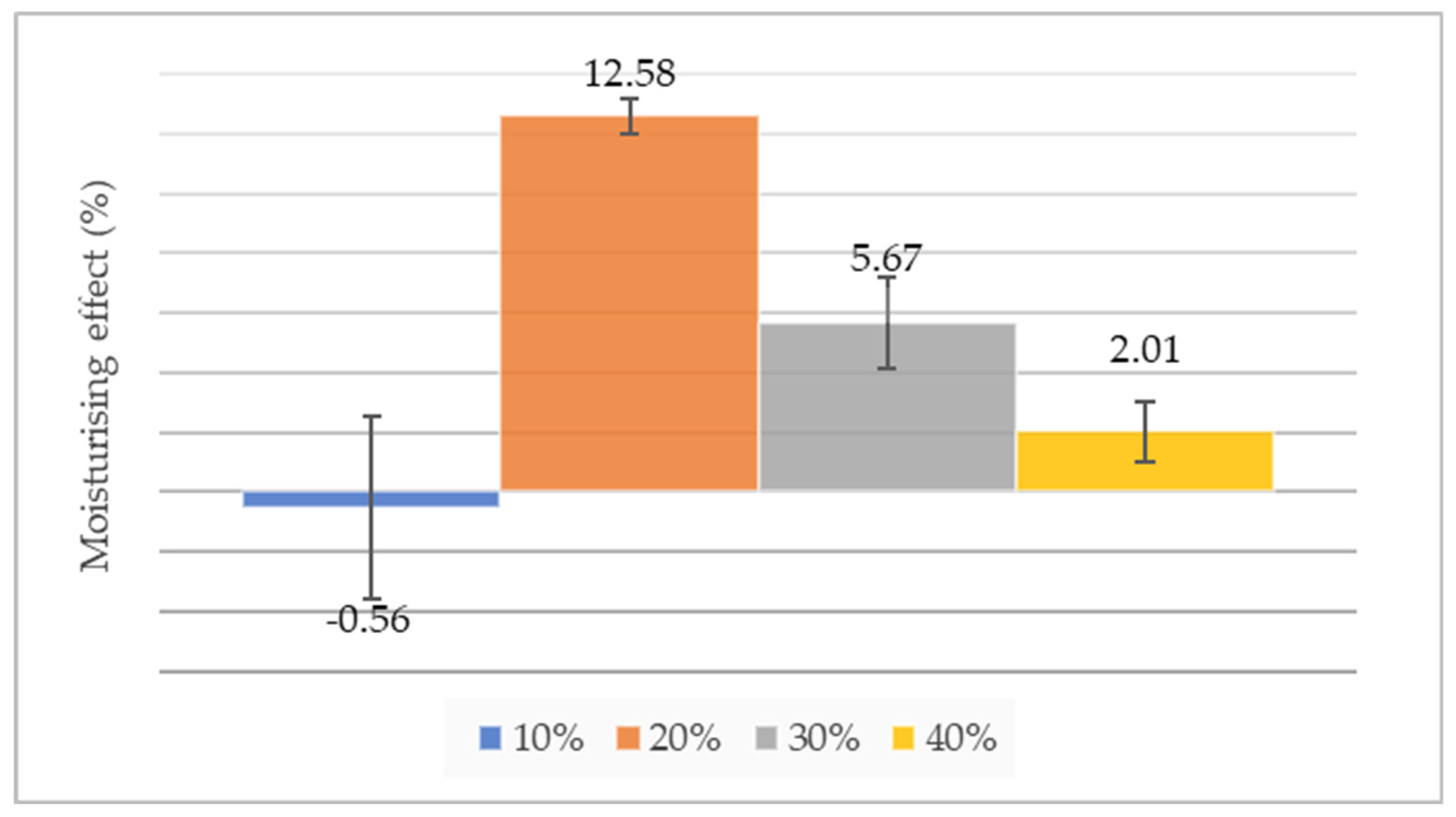
The highest skin moisiturizing effect was found at 20% oxygen level, where initial skin moisture was increased by 12.58%, which is a significant (p=0.048874) change at 0.05 significance level, and is detailed in Table 4.
Cell lysate which was fermented at 10% was not causing any significant difference from the original skin moisturising. Cell lysates grown under 30% and 40% oxygen levels were able to increase skin hydration, the former by 5.67% and the latter by 2.01%.
Table 4.
Calculated moisturising effect of Yarrowia ferment lysate with measured results in fermentor.
Table 4.
Calculated moisturising effect of Yarrowia ferment lysate with measured results in fermentor.
| Oxygen level (%) | Mean of initial values (%) | Mean of final measured values (%) | Calculated moisturising effect (%) | p* |
| 10 | 59.67±1.15 | 59.33±2.31 | -0.56 ± 3.06 | 0,704833 |
| 20 | 53±0 | 59.66±0.58 | 12.58 ± 0.58 | 0,048874 |
| 30 | 47±1 | 49.66±0.58 | 5.67± 1.53 | 0,267720 |
| 40 | 49.66±1.52 | 50.66±2.08 | 2.01 ± 1 | 0,640983 |
*p<0.05 was considered indicative of significance (t-test).
Cell disruption was also performed after fermentations in baffled flasks, after which we measured skin hydration. In each case, the measurement was carried out from the last sample, in which the erythritol level was no more at its maximum level. Figure 4. shows the final erythritol concentrations of the fermentation in two different sizes of flasks and the results of the moisturising measured from these.
Figure 4.
Moisturising effect and a function of the amount of erythritol in 500 ml and 750 ml baffled flasks.
Figure 4.
Moisturising effect and a function of the amount of erythritol in 500 ml and 750 ml baffled flasks.
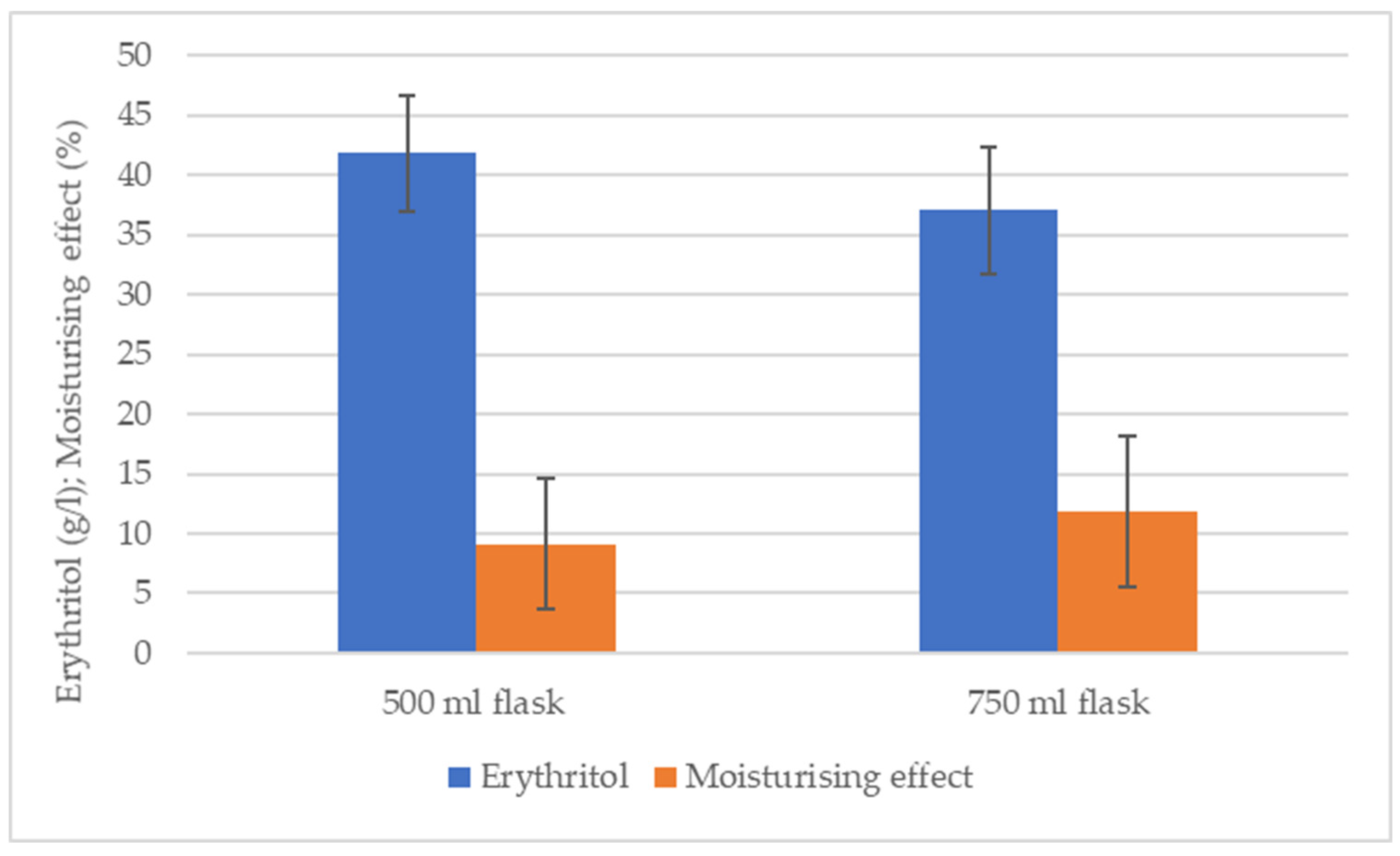
Table 5. shows the hydration results of cell lysate from flask fermentation, including initial and final values and which had a significant effect. In all cases, the lysates tested increased skin hydration, by 9.11±5.47% for the 500 ml flask and by 11.86±6.25% for the 750 ml flask. No significant difference between the two size baffled flasks (p=0.613744).
Table 5.
Calculated moisturising effect of Yarrowia cell lysate with measured results in baffled flasks.
Table 5.
Calculated moisturising effect of Yarrowia cell lysate with measured results in baffled flasks.
| Fermentations (500 ml) | Mean of initial values (%) | Mean of initial measured values (%) | Mean of final values (%) | Mean of final measured values (%) | Calculated moisturising effect (%) | Mean of calculated moisturising effect (%) | p* |
| 1. | 41.66±0.57 | 47.1±5.68 | 48±2.64 | 51.11±5.1 | 15.2±2.3 | 9.11±5.47 | 0.675562 |
| 2. | 53±1.73 | 57±2.64 | 7.54±3.6 | ||||
| 3. | 46.66±7.25 | 48.33±6.43 | 4.59±3.38 | ||||
| Fermentations (750 ml) | Mean of initial values (%) | Mean of initial measured values (%) | Mean of final measured values (%) | Mean of final measured values (%) | Calculated moisturising effect (%) | Mean of calculated moisturising effect (%) | p* |
| 1. | 36.6±0.57 | 43.19±6.37 | 42.6±2.08 | 48.08±4.82 | 16.36±2 | 11.86±6.25 | 0.380797 |
| 2. | 43.66±0.57 | 50±1.73 | 14.5±1.15 | ||||
| 3. | 49.33±0.57 | 51.66±1.15 | 4.72±0.57 |
*p<0.05 was considered indicative of significance (t-test).
3.3. Emulsifying activity measurements
Several studies have shown the ability of Yarrowia lipolytica to produce bioemulsifiers, therfore the emulsification index of the supernatant was measured at the end of all Y. divulgata fermentations. The emulsification index determines the ability of a molecule to emulsify hydrocarbons, and to be considered an effective emulsifier, the molecule must maintain at least 50% emulsification after 24 hours of rest [32].
The highest emulsification index was obtained after 1 hour (92.07%) in fermentation under 20% oxygen as shown in Figure 5. The EI24 index of te same sample decreased to 55.06% but still remained in the effective emulsification range. For all oxygen levels, EI24 was remained above 50%, making it an effective bioemulsifier.
Figure 5.
Emulsification index (%) results at different oxygen levels in jFermi bioreactor.
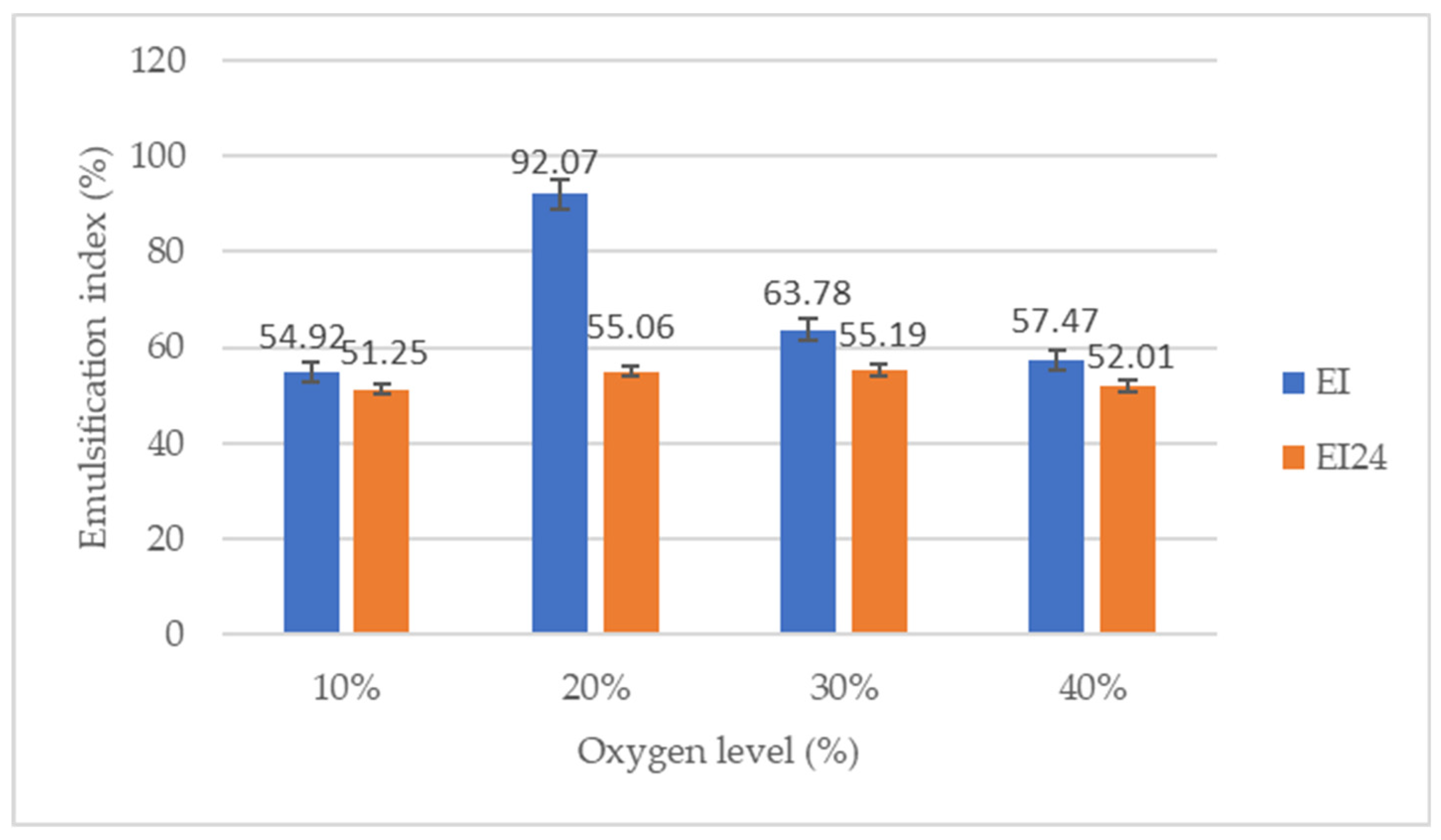
The emulsification index measurement was also performed for the baffled flasks, the results are summarised in Table 6., with EI24 of 53.63±1.85% for the 500 ml flasks and 55.58±6.76% for the 750 ml flasks. Since all remained above 50% after 24 h, they can all be considered as stable bioemulsifiers.
Table 6.
Emulsification index (%) results in baffled flasks.
|
Fermentations (500 ml) |
Emulsification index 1 h(%) | Mean of emulsification index 1 h (%) | Emulsification index 24 h(%) | Mean of emulsification index 24 h (%) |
| 1. | 82.6 | 68.55±13.5 | 52.15 | 53.63±1.85 |
| 2. | 67.38 | 54.91 | ||
| 3. | 55.67±1.96 | 53.85±1.17 | ||
|
Fermentations (750 ml) |
Emulsification index 1 h(%) | Mean of emulsification index 1 h (%) | Emulsification index 24 h(%) | Mean of emulsification index 24 h (%) |
| 1. | 64.36 | 56.45±6.83 | 63.40 | 55.58±6.76 |
| 2. | 52.5 | 51.7 | ||
| 3. | 52.5 | 51.64 |
4. Discussion
Our experiments aimed to study the erythritol fermentation by Yarrowia divulgata a related strain to the well described Y. lipolytica. The importance of aeration become obviuos, therfore we studied its effect first in a bioreactor at 4 different DO (%) levels. To have complex evaluation, we investigated the cosmetic applications of cell lysates and measured the efficiency of the bioemulsifier produced during erythritol fermentation.
The results were showed that oxygen plays a crucial role in erythritol fermentation. In bioreactor experiments , 19.81 g/l of erythritol was produced by fermentation at DO=40% oxygen level. However, a similar 19.65 g/l was obtained for 20% oxygen, but in this case the productivity was also much higher at 0.12 (g/l)/h. The cosmetic measurement also showed that the cell lysate obtained after cultivation at 20% oxygen level had the highest moisturizing effect which increased by 12.58% ± 0.58 the skin hydration. The emulsification index measurement showed a result of 92.07% after 1 hour. Thus, in fermentations with 100 g/l glycerol, the 20% oxygen level setting proved to be the most beneficial in terms of complex utilization.
In baffled flasks, 2.45 times higher KLa could be achieved than in conventional flasks and ca 25 fold higher then in the used bioreactor. Fermentation in the baffled flasks was carried out using 150 g/l glycerol, resulting in 26.43% yield and 0.19 (g/l)/h productivity in 500 ml flasks, compared to 27.74% yield and 0.19 (g/l)/h productivity in 750 ml flasks. A positive effect was observed for all samples in the hydration test. The emulsification index measured averaged above 50% and was therefore considered effective. The results show that oxygen has an effect on the production of erythritol, but the other products incl bioemulsifier and skin moisturizer had good activity independently of oxygen level during fermentation.
Author Contributions
Conceptualization, E.E. and Á.N.; methodology, Á.N.; investigation, E.E.; data curation, E.E.; writing—original draft preparation, E.E.; writing—review and editing, Á.N.; visualization, E.E.; supervision, Á.N.; All authors have read and agreed to the published version of the manuscript.
Funding
This research received no external funding.
Informed Consent Statement
Not applicable.
Data Availability Statement
The data presented in this study are available on request from the corresponding author.
Acknowledgments
Authors are very grateful to MÉL Biotech K+F Kft (AFo Biotech R&D Ltd.) for providing Ultra Turax Tube and MDS800 Multidermascope equipments.
Conflicts of Interest
The authors declare no conflict of interest.
References
- Gonçalves, F. A. G., Colen, G., & Takahashi, J. A. Yarrowia lipolytica and its multiple applications in the biotechnological industry. The Scientific World Journal, 2014. pp. 1-14. [CrossRef]
- Nicaud, Jean-Marc. Yarrowia lipolytica. Yeast, 2012, 29 (10) pp. 409-418. [CrossRef]
- Barth, Gerold; Gaillardin, Claude. Physiology and genetics of the dimorphic fungus Yarrowia lipolytica. FEMS microbiology reviews, 1997, 19 (4): pp. 219-237. [CrossRef]
- Nagy, E. S. Biodiversity of food spoilage Yarrowia group in different kinds of food, Doctoral dissertation, Corvinus University of Budapest, Budapest, 2015 . [CrossRef]
- Groenewald, Marizeth, Boekhout, T., Neuvéglise, C., Gaillardin, C., van Dijck, P. W., & Wyss, M. Yarrowia lipolytica: safety assessment of an oleaginous yeast with a great industrial potential. Critical reviews in microbiology, 2014, 40 (3) pp. 187-206. [CrossRef]
- Coelho, M.A.Z.; Amaral, P.F.F.; Belo, Isabel. Yarrowia lipolytica: an industrial workhorse. Current Research Technology and Education Topics in Applied Microbiology and Microbial Biotechnology, Formatex Research Center, Badajoz, 2010. 2. pp. 930-944.
- Tomaszewska, Ludwika, Rakicka, M., Rymowicz, W., & Rywińska, A. A comparative study on glycerol metabolism to erythritol and citric acid in Yarrowia lipolytica yeast cells. FEMS yeast research, 2014, 14 (6), pp. 966-976. [CrossRef]
- Yang, Li-Bo, Dai, X. M., Zheng, Z. Y., Zhu, L., Zhan, X. B., & Lin, C. C. Proteomic analysis of erythritol-producing Yarrowia lipolytica from glycerol in response to osmotic pressure. 2015. [CrossRef]
- Rymowicz, Waldemar; Rywinska, Anita; Marcinkiewicz, Marta. High-yield production of erythritol from raw glycerol in fed-batch cultures of Yarrowia lipolytica. Biotechnology Letters, 2009, 31, pp. 377-380. [CrossRef]
- Nagy, Edina, Niss, M., Dlauchy, D., Arneborg, N., Nielsen, D. S., & Peter, G. Yarrowia divulgata fa, sp. nov., a yeast species from animal-related and marine sources. International Journal of Systematic and Evolutionary Microbiology, 2013, 63. Pt_12, pp. 4818-4823. [CrossRef]
- Rakicka, Magdalena, Kieroń, A., Hapeta, P., Neuvéglise, C., & Lazar, Z. Sweet and sour potential of yeast from the Yarrowia clade. Biomass and Bioenergy, 2016, 92, pp. 48-54. [CrossRef]
- Rakicka-Pustulka, Magdalena, Joanna Miedzianka, Dominika Jama, Sylwia Kawalec, Kamila Liman, Tomasz Janek, Grzegorz Skaradziński, Waldemar Rymowicz & Zbigniew Lazar, High value-added products derived from crude glycerol via microbial fermentation using Yarrowia clade yeast. Microbial Cell Factories, 2021, 20, pp. 1-18. [CrossRef]
- Abbasi, Abdul Rahman, Jinle Liu, Zhi Wang, Anqi Zhao, Hanjie Ying, Lingbo Qu, Md. Asraful Alam, Wenlong Xiong, Jingliang Xu, Yongkun Lvet al. Recent advances in producing sugar alcohols and functional sugars by engineering Yarrowia lipolytica. Frontiers in Bioengineering and Biotechnology, 2021, 9: 648382. [CrossRef]
- Godswill, Awuchi Chinaza. Sugar alcohols: chemistry, production, health concerns and nutritional importance of mannitol, sorbitol, xylitol, and erythritol. International Journal of Advanced Academic Research, 2017, 3 (2), pp. 31-66. ISSN: 2488-9849.
- De Cock, Peter. Erythritol. Sweeteners and sugar alternatives in food technology, 1st ed., Wiley-Blackwell, Chichester, West Sussex, UK, 2012, pp. 213-241. ISBN: 978-1-118-37397-2.
- Martau, Gheorghe Adrian; Coman, Vasile; Vodnar, Dan Cristian. Recent advances in the biotechnological production of erythritol and mannitol. Critical reviews in biotechnology, 2020, 40(5), pp. 608-622. [CrossRef]
- Rakicka-Pustulka, Magdalena, M., Mirończuk, A. M., Celińska, E., Białas, W., & Rymowicz, W., Scale-up of the erythritol production technology–process simulation and techno-economic analysis. Journal of Cleaner Production, 2020, 257: 120533. [CrossRef]
- Tomaszewska, Ludwika; Rywinska, Anita; Gladkowski, Witold. Production of erythritol and mannitol by Yarrowia lipolytica yeast in media containing glycerol. Journal of Industrial Microbiology and Biotechnology, 2012, 39(9), pp. 1333-1343. [CrossRef]
- Tomaszewska-Hetman, Ludwika; Rywisnka, Anita. Erythritol biosynthesis from glycerol by Yarrowia lipolytica yeast: effect of osmotic pressure. Chemical Papers, 2016, 70 (3), pp. 272-283. [CrossRef]
- Rakicka, Magdalena, Rukowicz, B., Rywińska, A., Lazar, Z., & Rymowicz, W., Technology of efficient continuous erythritol production from glycerol. Journal of Cleaner Production, 2016, 139, pp. 905-913. [CrossRef]
- Mironczuk, Aleksandra M., Rakicka, M., Biegalska, A., Rymowicz, W., & Dobrowolski, A., A two-stage fermentation process of erythritol production by yeast Y. lipolytica from molasses and glycerol. Bioresource technology, 2015, 198, pp. 445-455. [CrossRef]
- Rymowicz, Waldemar; Rywisnka, Anita; Gladkowski, Witold. Simultaneous production of citric acid and erythritol from crude glycerol by Yarrowia lipolytica Wratislavia K1. Chemical Papers, 2008, 62 (3), pp. 239-246. [CrossRef]
- Yang, Shuling, Pan, X., Wang, Q., Lv, Q., Zhang, X., Zhang, R., & Rao, Z., Enhancing erythritol production from crude glycerol in a wild-type Yarrowia lipolytica by metabolic engineering. Frontiers in Microbiology, 2022, 13: 1054243. [CrossRef]
- Janek, T., Dobrowolski, A., Biegalska, A., & Mirończuk, A. M. Characterization of erythrose reductase from Yarrowia lipolytica and its influence on erythritol synthesis. Microbial Cell Factories, 2017, 16, pp. 1-13. [CrossRef]
- Moon, Hee-Jung, Jeya, M., Kim, I. W., & Lee, J. K., Biotechnological production of erythritol and its applications. Applied microbiology and biotechnology, 2010, 86, pp. 1017-1025. [CrossRef]
- Da Silva, Luana Vieira, Coelho, M.A.Z., Amaral, P.F.F., & Fickers, P., A novel osmotic pressure strategy to improve erythritol production by Yarrowia lipolytica from glycerol. Bioprocess and biosystems engineering, 2018, 41, pp. 1883-1886. [CrossRef]
- Jagtap, Sujit Sadashiv, Bedekar, A. A., Singh, V., Jin, Y. S., & Rao, C. V., Metabolic engineering of the oleaginous yeast Yarrowia lipolytica PO1f for production of erythritol from glycerol. Biotechnology for Biofuels, 2021, 14 (1), pp. 1-17. [CrossRef]
- Ribeiro, Ana Margarida Magalhães. Erythritol production from crude glycerol by Yarrowia species: strains comparison and oxygen influence. Master’s degree. Universidade do Minho (Portugal), 2021. https://hdl.handle.net/1822/71303.
- Machado, Ana Rita Araújo. Production of the sweetener erythritol by Yarrowia lipolytica strains. Master’s degree. Universidade do Minho (Portugal), 2018. https://hdl.handle.net/1822/59234.
- Li, Jian, Kun Zhu, Lin Miao, Lanxin Rong, Yu Zhao, Shenglong Li, Lijuan Ma, Jianxun Li, Cuiying Zhang, Dongguang Xiao, Jee Loon Foo, and Aiqun Yu., Simultaneous improvement of limonene production and tolerance in Yarrowia lipolytica through tolerance engineering and evolutionary engineering. ACS Synthetic Biology, 2021, 10 (4), pp. 884-896. [CrossRef]
- Ben Tahar, Imen, Kus-Liśkiewicz, M., Lara, Y., Javaux, E., & Fickers, P., Characterization of a nontoxic pyomelanin pigment produced by the yeast Yarrowia lipolytica. Biotechnology progress, 2020, 36.2: e2912. [CrossRef]
- Trindade, Joana R., Freire, M. G., Amaral, P. F., Coelho, M. A. Z., Coutinho, J. A., & Marrucho, I. M., Aging mechanisms of oil-in-water emulsions based on a bioemulsifier produced by Yarrowia lipolytica. Colloids and Surfaces A: physicochemical and engineering aspects, 2008, 324.1-3, pp. 149-154. [CrossRef]
- Da Silva, Joselma Ferreira, da Silva, L. A. R., Barbosa, M. R., Houllou, L. M., & Malafaia, C. B., Bioemulsifier produced by Yarrowia lipolytica using residual glycerol as a carbon source. Journal of Environmental Analysis and Progress, 2020, 5.1, pp. 031-037. [CrossRef]
- Amaral, P. F. F., Da Silva, J. M., Lehocky, B. M., Barros-Timmons, A. M. V., Coelho, M. A. Z., Marrucho, I. M., & Coutinho, J. A. P., Production and characterization of a bioemulsifier from Yarrowia lipolytica. Process Biochemistry, 2006, 41.8, pp. 1894-1898. [CrossRef]
- Cirigliano, Michael C.; Carman, George M. Isolation of a bioemulsifier from Candida lipolytica. Applied and environmental microbiology, 1984, 48.4, pp. 747-750. [CrossRef]
- Cirigliano, Michael C.; Carman, George M. Purification and characterization of liposan, a bioemulsifier from Candida lipolytica. Applied and environmental microbiology, 1985, 50.4, pp. 846-850. [CrossRef]
- Sarubbo, Leonie A., Marçal, M. D. C., Neves, M. L. C., Silva, M. D. P. C., Porto, L. F., & Campos-Takaki, G. M., Bioemulsifier production in batch culture using glucose as carbon source by Candida lipolytica. Applied Biochemistry and Biotechnology, 2001, 95, pp. 59-67. [CrossRef]
- Santos, Danyelle KF, Rufino, R. D., Luna, J. M., Santos, V. A., Salgueiro, A. A., & Sarubbo, L. A., Synthesis and evaluation of biosurfactant produced by Candida lipolytica using animal fat and corn steep liquor. Journal of Petroleum Science and Engineering, 2013, 105, pp. 43-50. [CrossRef]
- Béla, Sevella. Biomérnöki műveletek és folyamatok. 2nd ed.; Typotex, Budapest, 2012. pp. 392-393. ISBN 978-963-279-470-9.
- Tóth, Pál; Németh, Áron. Investigation and Characterisation of New Eco-Friendly Cosmetic Ingredients Based on Probiotic Bacteria Ferment Filtrates in Combination with Alginite Mineral. Processes, 2022, 10.12: 2672. [CrossRef]
- Czinkóczky, Réka; Németh, Áron. The effect of pH on biosurfactant production by Bacillus subtilis DSM10. Hungarian Journal of Industry and Chemistry, 2020, pp. 37-43. [CrossRef]
Disclaimer/Publisher’s Note: The statements, opinions and data contained in all publications are solely those of the individual author(s) and contributor(s) and not of MDPI and/or the editor(s). MDPI and/or the editor(s) disclaim responsibility for any injury to people or property resulting from any ideas, methods, instructions or products referred to in the content. |
© 2023 by the authors. Licensee MDPI, Basel, Switzerland. This article is an open access article distributed under the terms and conditions of the Creative Commons Attribution (CC BY) license (http://creativecommons.org/licenses/by/4.0/).
Copyright: This open access article is published under a Creative Commons CC BY 4.0 license, which permit the free download, distribution, and reuse, provided that the author and preprint are cited in any reuse.