

Submitted:
31 July 2023
Posted:
02 August 2023
You are already at the latest version
Abstract
Malignant peripheral nerve sheath tumors (MPNSTs) are deadly sarcomas that desperately need effective therapies. Half of all MPNSTs arise in patients with Neurofibromatosis Type I (NF1), a common inherited disease. NF1 patients can develop benign lesions called Plexiform Neurofibromas (PNFs), often in adolescence, and over time some PNFs, but not all, will transform into MPNSTs. A deeper understanding of the molecular and genetic alterations driving PNF-MPNST transformation will guide development of more targeted and effective treatments for these patients. This review focuses on an oncogenic transcription factor, FOXM1, that is a powerful oncogene in other cancers but little studied in MPNSTs. Elevated expression of FOXM1 was seen in patient MPNSTs and correlated with poor survival, but otherwise its role in the disease is unknown. We discuss what is known about FOXM1 in MPNSTs relative to other cancers and how FOXM1 may be regulated by and/or regulate the most commonly altered players in MPNSTs, particularly in the MEK and CDK4/6 kinase pathways. We conclude by considering FOXM1, MEK, and CDK4/6 as new, clinically relevant targets for MPNST therapy.
Keywords:
MPNST
; FOXM1
; MEK
; CDK4/6
; targeted therapy
; sarcoma
1. Introduction
Malignant Peripheral Nerve Sheath Tumors (MPNSTs) are a deadly form of sarcoma that originate from the Schwann cells in the myelinating nerve sheath [1]. Half of these tumors occur spontaneously in the population, but the other half occur in patients with a hereditary condition called Neurofibromatosis type I (NF1). All MPNSTs are initiated by loss of the Neurofibromin 1 tumor suppressor gene (NF1), resulting in hyperactive RAS signaling [2]. However, patients with NF1 first present with non-cancerous lesions called benign plexiform neurofibromas (PNFs) that have a 30% lifetime risk of transforming into malignant MPNSTs (Figure 1) [2]. More research into the molecular drivers of transformation is desperately needed for MPNST patients since effective therapies are lacking [3]. Standard treatment is surgical resection, but in many cases the MPNSTs are inoperable or cannot be fully resected due to their large size and/or location [2,4,5]. With incomplete local resection, radiotherapy and chemotherapy are used for local control of disease but offer no survival benefit [6,7,8]. The overall 5-year survival for MPNST patients is 20-35% which drops significantly for unresectable or metastatic disease [2,5,9].
To create targeted therapeutics for improved treatment of MPNSTs, we must better understand what triggers transformation of these benign lesions into malignant tumors. Benign PNFs have homozygous NF1 loss, typically by loss of heterozygosity via genetic mutation, without other known molecular alterations [10,11]. They usually slow or stop growing and do not display malignant behaviors [2,12]. Recently, an intermediate stage of benign lesion with more potential to transform into MPNST has been identified and termed Atypical Neurofibromatous Neoplasms of Uncertain Biological Potential (ANNUBPs) [13,14]. After NF1 loss, nearly all ANNUBPs are characterized by the deletion or silencing of the INK4a/ARF (originally called CDKN2A) tumor suppressor locus [15,16,17,18], which is inactivated in the majority of human cancers [15,19,20].
An increasing number of additional molecular alterations currently discriminate fully transformed human MPNSTs from ANNUBPs, although that understanding is incomplete and represents a major gap in the field [21,22,23]. While many changes have been observed in MPNSTs by our lab and others, this review is centered on the interplay between FOXM1, a little studied player in this disease, and the more commonly altered genes and pathways that have documented contributions to MPNST pathogenesis (Figure 1). FOXM1, an important oncoprotein and promising target in other cancers [24,25], is highly overexpressed and a marker of poor survival in patient MPNSTs [26] but its role in driving the disease is otherwise not known. Besides NF1 and INK4a/ARF, other key players in MPNST include the globally important tumor suppressor, p53, and two epigenetic regulators in the Polycomb Repressive Complex 2 (PRC2), EED and SUZ12, all of which are lost in MPNSTs [16,27,28]. Prominent oncoproteins besides FOXM1 that are often overexpressed in MPNSTs include cyclin dependent kinase 4 (CDK4), the Yes-associated protein 1 (YAP1, hereafter called YAP), and a Rab-like GTPase, called RABL6A [3,16,26]. How these factors are altered in MPNSTs and crosstalk with each other, as well as with FOXM1, is discussed below.
2. FOXM1 in cancer and MPNST
Forkhead box protein M1, a member of the Forkhead Box (Fox) transcription factor family, controls gene expression during embryonic development and maintains cell homeostasis throughout life by regulating essential biological processes such as cell cycle progression, differentiation, and apoptosis, among others [24]. FOXM1 is a ubiquitously expressed protein in tissues whose levels and activity fluctuate during the cell cycle. Its activation during G1/S and G2/M phases enable it to transcribe genes needed for cell cycle progression, including proteins required for DNA replication [29]. FOXM1 is a winged helix transcription factor, defined by its DNA binding domain of three α-helices, three β-sheets, and two wings/loops bookending the last β-sheet [24]. It has 10 exons that can be spliced into four different isoforms—FOXM1a, b, c, d [24]. FOXM1b and FOXM1c are the transcriptionally active forms of the protein and the most often overexpressed in cancers [30,31].
FOXM1 has been recognized as a powerful oncogene and was named the molecule of the year in 2010 for its promise as a cancer therapeutic target [30]. It is essential for growth and survival in many cancers including melanoma, lung, ovarian, breast, prostate cancers, and numerous sarcomas [29,32,33,34,35,36]. Relevant to MPNST, a tumor initiated by Ras hyperactivation, FOXM1 is required for growth in other RAS-driven tumors like hepatocellular carcinoma, colorectal cancer, and pancreatic ductal adenocarcinoma [37,38,39,40,41]. Mechanistically, FOXM1 has been implicated in many important oncogenic processes like angiogenesis [42,43], metastasis [44,45,46], stem cell maintenance and de-differentiation [47,48], DNA damage response/repair [49], and drug resistance [50,51].
Only one published study has measured FOXM1 gene and protein levels in MPNSTs. Yu et al. performed array-based comparative genomic hybridization on a large number of patient MPNSTs to uncover survival associated biomarkers [26]. They showed that increased copy number of the FOXM1 gene (chromosome 12p13.33) occurred in 29% of MPNSTs and correlated with worse patient survival. Concordantly, elevated protein expression of FOXM1 by immunohistochemical (IHC) staining was a significant independent predictor for poor survival. In an RNA sequencing (RNA-Seq) dataset from our lab used to compare the transcriptomes of patient-matched PNF/ANNUBPs and MPNSTs, FOXM1 mRNA and transcript levels of key transcriptional targets (e.g., AURKB, BIRC5, CENPA, CCNB1, CDK1) [52,53] were significantly increased in MPNSTs [54]. IHC of the same tumor samples likewise revealed robust upregulation of FOXM1 protein in MPNSTs relative to the benign precursors (Voigt and Quelle, unpublished data).
Beyond these correlative observations, however, the effect of FOXM1 on PNF transformation or MPNST tumor progression has not been evaluated.
3. Upstream Regulators of FOXM1
3.1. FOXM1 upregulation by INK4a/ARF loss
During the transition into the intermediate stage of premalignancy called ANNUBP, most PNFs lose the INK4a/ARF locus, which researchers have shown is required for this transformation [14,17,18]. INK4a/ARF encodes two powerful tumor suppressors, p16INK4a and the Alternative Reading Frame product, called ARF (p14 in human, p19 in mouse) [20,55]. INK4a and ARF have unique first exons spliced to shared exons 2 and 3, consequently their open reading frames and encoded proteins are entirely distinct [20]. p16INK4a is so named because it is a specific INhibitor of CDK4 and CDK6 [56], two nearly identical cyclin dependent kinases that inactivate the retinoblastoma (RB1) tumor suppressor [20]. As such, loss of INK4a heightens CDK4/6 activity and increases G1/S cell cycle progression [20]. The second protein product from this locus, ARF, is a small highly charged protein that prevents cancer through activation of p53, as well as numerous p53-independent mechanisms due to its interactions with over 40 proteins, one of which is FOXM1 [57].
ARF binds directly to FOXM1b at the C-terminus within its transcriptional activation domain, which inhibits FOXM1 transcriptional activity by mobilizing the protein into the nucleolus (Figure 2) [37,58]. In 2011, Park et al. examined the effects of liver-specific, Foxm1b expression in mice lacking Arf and found that dysregulated Foxm1b expression in Arf+/- and Arf-/- settings, but not in Arf+/+ wild-type mice, promoted the metastasis of hepatocellular carcinoma (HCC) [44]. Excitingly, a synthetic p19ARF peptide (amino acids 26 to 44) was sufficient to sequester Foxm1b in nucleoli [37], effectively inhibiting the primary and metastatic growth of Foxm1b transgenic;Arf-/- liver cancer cells without affecting normal hepatocytes [44,59]. ARF may also indirectly impair FOXM1 expression by upregulating miR-34a [60], which is one of many miRNAs able to downregulate FOXM1 [24]. Conversely, FOXM1c can downregulate ARF expression and impair p53 activation by promoting expression of the Polycomb group protein, Bmi-1, thereby blocking cell senescence and promoting proliferation [61].
While the above studies report data for either FOXM1b or FOXM1c since either isoform can be the predominant protein within a particular cancer, it is expected that both proteins will have similar biochemical activities. Thus, when ARF is upregulated in response to oncogenic stress, such as Ras activation in benign PNFs, its negative regulation of FOXM1 would block its function and enforce senescence. Conversely, loss of ARF in ANNUBPs and MPNSTs would be predicted to heighten FOXM1 activity and promote tumorigenesis.
The functional relationship between p16INK4a and FOXM1 is less direct but nonetheless impactful. FOXM1 represses transcription of the FOXO1 transcription factor, which normally transactivates the genes encoding several CDK inhibitory proteins p27KIP1, p15INK4b, and p16INK4a [62,63]. As such, knockdown of FOXM1 increases expression of p16INK4a and other CDK inhibitors whereas increased FOXM1 overexpression suppresses their transcription and causes elevated activity of tumor-promoting CDK2 and CDK4/6 [24,62]. As INK4a/ARF loss is central to the oncogenesis of MPNST, these functional interactions with FOXM1 suggest that FOXM1 may also be an important driver in this cancer (Figure 2).
3.2. FOXM1 control by MEK and CDK4/6
In PNFs, the inciting mutation is loss of heterozygosity of NF1, which produces the protein neurofibromin. Neurofibromin is a Ras-GTPase whose loss results in inefficient catalysis of the active GTP-bound Ras to inactive GDP-bound Ras, thereby hyperactivating Ras signaling [12]. A major downstream mediator of Ras is the MEK-ERK1/2 kinase cascade, which can act both directly and indirectly on FOXM1 to promote its activation (Figure 2). ERK1/2 phosphorylates FOXM1c at two different serine residues, which promotes its translocation into the nucleus and transcriptional activity [64,65]. Activated MEK-ERK1/2 signaling can also increase FOXM1 protein levels indirectly by promoting the expression and activation of cyclin D-CDK4/6 kinases, whose phosphorylation of FOXM1 effectively stabilizes and activates the protein [66,67]. Activation of FOXM1 by CDK4/6 is critical for CDK4/6-mediated cell cycle entry, suppressing levels of reactive oxygen species (ROS), and protecting cancer cells (breast, melanoma, sarcoma) from senescence [66].
As implied by the above findings, FOXM1 is a highly phosphorylated protein [24,66]. Some phosphorylation events facilitate FOXM1 association with CBP/p300, a transcriptional coactivator that supports FOXM1-mediated gene transcription [68]. Phosphorylation of FOXM1 at other residues regulates it degradation—some stabilize it while others mediate its ubiquitination and degradation [24]. Besides being phosphorylated by cyclin D-CDK4/6 in late G1-early S phase, this includes phosphorylation at other serine/threonine residues by cyclin E-CDK2 during G2/M phase, cyclin A-CDK2 during G2/M phase, and cyclin B-CDK1 during G2 phase [30,69,70,71,72]. In non-transformed cells, FOXM1 is typically hypo-phosphorylated during early G1 phase and minimally active, increasingly phosphorylated during late G1 and S phase to become more active, followed by the highest levels of phosphorylation and transcriptional activation through G2/M before becoming dephosphorylated at the end of M phase [30]. In MPNST, where INK4a is lost and CDK4 protein is overexpressed, CDK4/6 complexes are hyperactive and would be expected to aberrantly phosphorylate FOXM1, thereby increasing its stability and inappropriately increasing its transcriptional activity during G1/S phase [66]. Under such circumstances, FOXM1 would be expected to drive MPNST cell proliferation and prevent cells from undergoing senescence.
In sum, there is abundant evidence for upregulation of MEK and CDK4/6 in MPNST [3]. Both kinases promote increased FOXM1 protein levels, FOXM1 stability, and FOXM1 transcriptional activity. Together, those observations heighten the likelihood that FOXM1 is a major contributor to MPNST pathogenesis.
3.3. Opposing transcriptional regulation of FOXM1 by p53 and YAP
The p53 transcription factor is the most frequently inactivated tumor suppressor in human cancers [73]. Genetically, TP53 is mutated or deleted in about 55% of human cancers while p53 signaling is likely impaired in the remaining tumors [60]. Mutations of TP53 are either loss-of-function (missense, deletion) or gain-of-function in nature, with the latter often associated with heightened stability and an altered transcriptional program that is pro-oncogenic [73]. In human MPNSTs, the percentage of tumors bearing inactivated TP53 ranges from approximately 14% to 50%, depending on the study [26,74,75,76]. In a comprehensive analysis by Verdijk et al., 24% of MPNSTs had loss of the TP53 gene in their study of 145 cases as compared to 14% loss of TP53 in 411 cases in the literature at that time [75]. Nonetheless, loss of p53 tumor suppressive activity can clearly drive the disease, as shown by the number of p53-deficient mouse tumor models that develop MPNSTs [16,60,77].
Whether or not p53 may normally suppress MPNSTs, at least in part, by dampening FOXM1 expression and activity has not been tested. However, several lines of evidence in other models suggest that may be the case. In several cell types, it has been shown that FOXM1 transcription can be repressed by p53 (Figure 2) [78,79]. In breast cancer, p53 represses FOXM1 transcription through association with E2F1 at the FOXM1 promoter [78]. However, this effect on FOXM1 appears to be context dependent as p53 is reported to activate transcription of the FOXM1 gene during liver regeneration in mice [80]. Besides transcriptional control, wild type p53 is reported to negatively regulate FOXM1 mRNA [81]. This repression of FOXM1 by p53 is partially dependent on p21 and RB, and in some cells has been shown to be independently repressed by p21 [81]. In the development of a gastroesophageal cancer organoid model through the dual CRISPR/Cas9 knockout of Ink4a/Arf and Tp53, Zhao et al. showed FOXM1 was upregulated and mediated pro-tumorigenic epigenetic changes [82].
YAP is an oncogenic transcriptional coactivator that is turned off in non-transformed cells by tumor suppressive Hippo/LATS1/2 signaling and conversely upregulated in tumor cells [83]. Multiple points of crosstalk exist between YAP and p53 that are important to both normal cell control and tumorigenesis, the nuances and complexities of which are comprehensively reviewed elsewhere [83,84]. Of interest here are the connections to FOXM1. Nuclear YAP, in association with the TEAD transcription factor, can bind directly to the FOXM1 promoter and stimulate its expression (Figure 2) [85]. Wild-type p53, which can repress FOXM1 transcription through p21/RB/E2F mechanisms noted above, can also downregulate FOXM1 mRNA levels by inhibiting YAP. It does so by increasing expression of 14-3-3 or PTPN14, both of which retain YAP in the cytoplasm where it is unable to activate tumor-promoting transcriptional programs [86,87,88].
Although FOXM1 is just one of many YAP gene targets, it appears to be a critical mediator of YAP-dependent tumorigenesis. In a transgenic mouse model of hepatocellular carcinoma driven by constitutively active YAP (YAPS127A), inhibition of FOXM1 with thiostrepton blocked the YAP-induced chromosomal instability phenotype [89]. In soft tissue sarcomas, which include MPNSTs, the Hippo pathway is frequently dysregulated leading to increased expression of YAP and its transcriptional coactivator TAZ [90,91]. Not only do elevated YAP and TAZ independently predict worse overall and progression-free survival, especially in the absence of p53 [91], YAP’s upregulation of FOXM1 was found to be necessary for cell proliferation and tumorigenesis in a subset of sarcomas [90].
3.4. RABL6A and FOXM1
Our lab discovered an unusually large Rab-like GTPase, called RABL6A, that promotes cancer [3,54,91,92,93,94,95]. RABL6A overexpression is a marker of poor survival in several cancers and is required for growth in pancreatic, breast and esophageal cancers, among others [96,97,98,99,100,101]. Using a tissue microarray of patient-matched PNFs, ANNUBPs, and MPNSTs, RABL6A protein expression was found to be greatly increased in MPNSTs compared to low/undetectable levels in PNFs and moderately higher but still low levels in ANNUBPs [92]. Those findings prompted analyses of RABL6A silencing in MPNST cell lines, which showed that RABL6A loss causes significant cell death in vitro [92]. In agreement, genetic knockout of Rabl6 in mice delayed tumor growth in a de novo model of MPNST induced by Nf1-Ink4a/Arf deletion [54]. Together, these data revealed that MPNST cell survival and tumor growth are driven by RABL6A, but how it cooperates with Ink4a and Arf loss to promote MPNST progression is not known.
A connection between RABL6A and FOXM1 has yet to be explored but a functional link is likely since they engage many of the same factors and pathways shown in Figure 2. Most notably, RABL6A was originally discovered based on its ability to bind to ARF, and its expression in a mouse model of pancreatic neuroendocrine tumors (pNETs) was associated with ARF downregulation [94,97]. In both MPNST and pNET human cell lines, silencing of RABL6A caused robust upregulation of the CDK inhibitors, p27KIP1 and p21CIP1, leading to inhibition of CDK4/6-mediated RB1 phosphorylation and consequent cell cycle arrest and death [92,97]. RABL6A was also found to promote Schwann cell proliferation and abrogate their senescence by inhibiting RB1 [102]. A role for RABL6A in Schwann cell biology is relevant to PNF and MPNST development since Schwann cells are the non-transformed precursors of those tumors. In addition, RABL6A is a critical activator of MEK-ERK signaling [98,103] and its overexpression in patient MPNSTs is significantly associated with an activated Ras-MEK pathway [104]. Finally, in biomarker analyses of 163 sarcomas representing many different histological types, RABL6A expression was positively correlated with high levels of p53 (likely mutated) and YAP [91].
The above commonalities in RABL6A and FOXM1 pathways suggest that FOXM1 expression and activity may be upregulated by RABL6A in cells. It will be interesting to examine that possibility and to determine if FOXM1 and RABL6A act cooperatively to promote tumorigenesis, not only in driving PNF to MPNST transformation but in the malignant progression of other sarcoma types and solid tumors where both proteins are highly expressed.
4. Downstream Targets of FOXM1
4.1. FOXO1
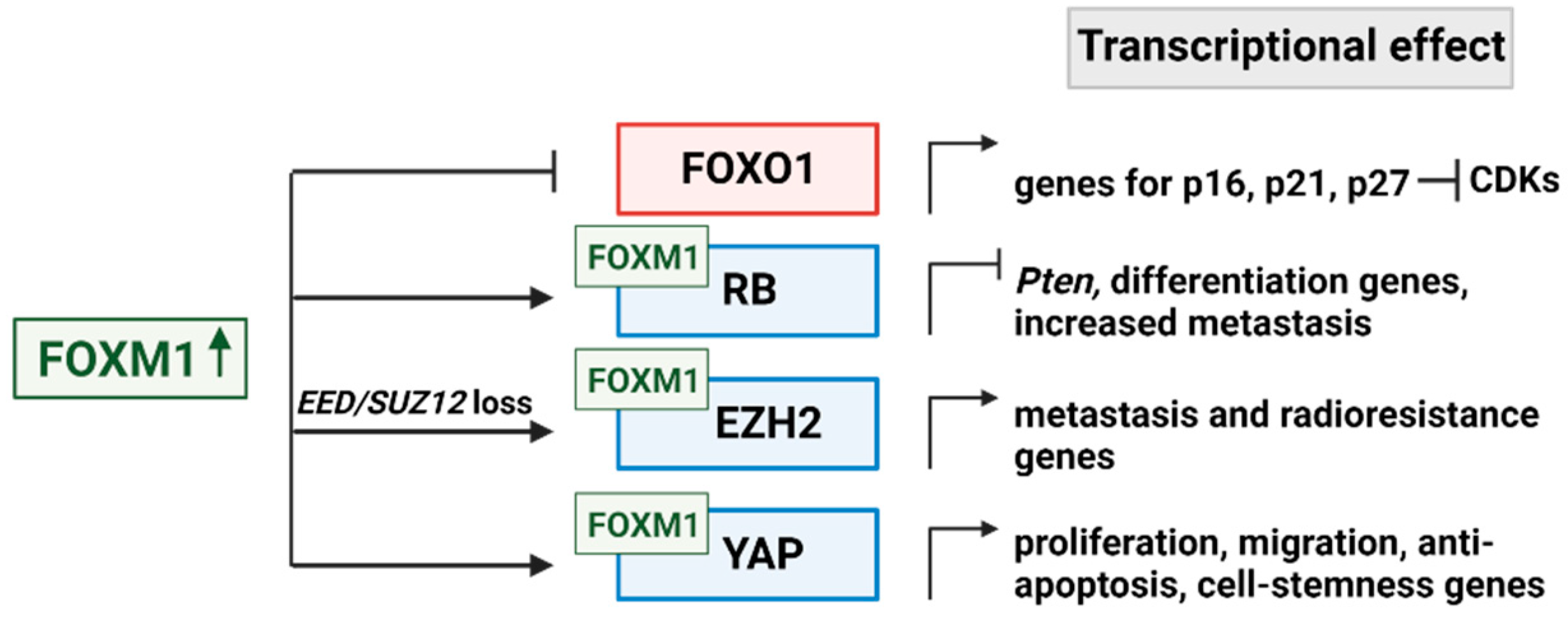
FOXO1 belongs to the large Forkhead box transcription factor superfamily just like FOXM1, but it forms part of a subclass along with FOXO3, FOXO4 and FOXO6 [105]. Like the other Fox family members, these transcription factors are important in the development of normal tissues and in stem cell maintainence/differentiation [106]. Unlike FOXM1, the FOXO transcription factors are tumor suppressors and are often inactivated in cancers [106,107]. FOXO1 is of particular interest in MPNST because it activates the transcription of multiple cell cycle inhibitory proteins including p27KIP1, p15INK4b, and p16INK4a [62,63]. FOXO1 has also been shown to inactivate metastasis programs. FOXO1 overexpression inversely correlates with genes that promote the epithelial-mesenchymal transition (EMT) [108]. Indeed, FOXO1 directly represses the transcription of ZEB2, itself a transcription factor that induces EMT and thereby increases tumor metastasis [108]. Importantly, FOXM1 and FOXO expression are also inversely correlated in cancers [109]. Chand et al. showed that FOXM1 represses FOXO1 transcriptionally through recruitment of RB1 and DNMT3B and increased methylation at the FOXO1 promoter in hepatocellular carcinoma cells [62]. If the same is true in MPNST, the elevated expression of FOXM1 would be expected to suppress FOXO1 transcription, thus downregulating expression of the FOXO1 protein and impairing its induction of CDK inhibitors (Figure 3).
4.2. Multiple modes of RB1 regulation by FOXM1
FOXM1 controls RB1 in two opposing ways, either to turn off the canonical cell cycle inhibitory function of RB1 to enhance cell proliferation or to engage RB1 within repressive transcriptional complexes that ultimately promote tumor metastasis.
In the first situation, recall that cyclin D-CDK4/6 and cyclin E-CDK2 kinase complexes phosphorylate and inactivate the RB1 tumor suppressor during the G1-to-S transition, thereby preventing its association with E2F transcription factors [110]. E2F is then free to transcribe genes needed for S phase entry and progression. In many cancers including MPNST, RB1 is kept in a hyperphosphorylated state such that the cell cycle progresses unchecked, and cells proliferate uncontrollably [92]. Since E2F activates transcription of FOXM1 [78], aberrant RB1 phosphorylation also results in abnormally high expression of FOXM1 protein. Upregulated FOXM1 can then amplify RB1 hyperphosphorylation through its inhibition of FOXO1, as described above, as that causes downregulation of CDK inhibitors and consequently elevated activity of CDK4/6 and CDK2 holoenzymes [62].
With regard to the second scenario, FOXM1 is generally regarded as a master activator of genes promoting cell proliferation, survival, metastasis, and drug resistance [45]. However, FOXM1 can also repress gene expression [111]. Recent studies in mouse breast cancer models showed that FOXM1 binds directly to the RB1 protein and forms repressive transcriptional complexes that suppress the Pten tumor suppressor and are essential for tumor cell plasticity and metastasis (Figure 3) [35]. This ‘prometastatic’ role of RB1 when bound to FOXM1 flies against the conventional view of RB1 as a tumor suppressor. Nonetheless, the study by Kopanja et al. effectively demonstrated that a FOXM1 mutant unable to bind to RB1 was deficient in supporting breast cancer de-differentiation and metastasis [35]. Human tumors that already display PTEN downregulation, such as the majority of MPNSTs [112,113], may contain a higher fraction of FOXM1-RB1 complexes that enhance their metastatic potential.
4.3. EZH2 cooperation with FOXM1
The Polycomb Repressive Complex 2 (PRC2) is a large, multi-protein complex composed of three main factors. Enhancer of Zeste Homolog 2 (EZH2) is a histone methyltransferase and the catalytic subunit of PRC2, while Suppressor of Zeste 12 (SUZ12) and Embryonic Ectoderm Development (EED) proteins are core regulatory and scaffolding subunits of the holoenzyme [114]. PRC2 is a global regulator of transcription whose dysregulation in cancer is complex and associated with metastasis, chemotherapy resistance, and poor prognosis [115]. While PRC2 is oncogenic in many cancers, the majority of MPNSTs (and some other tumor types) display loss-of-function mutations in SUZ12 and/or EED that inactivate PRC2 and cause broad epigenetic dysregulation [16,27,115,116]. Analyses of patient MPNSTs with or without PRC2 loss showed that its inactivation caused increased histone post-translational modifications associated with active transcription and loss of certain repressive histone modifications [117]. The resulting epigenome correlated with proteomic changes reflecting tumor progression and immune evasion. Most recently, Brockman et al. found that PRC2 inactivation (due to Suz12 or Eed loss in mouse MPNST models) induced expression of matrix-remodeling enzymes (matrix metalloproteinases, or MMPs) and increased lung metastasis [116]. Analysis of clinical samples similarly revealed increased metastatic disease and decreased survival in patients whose MPNSTs displayed PRC2 loss.
Several studies have demonstrated that FOXM1 cooperates with EZH2 to promote tumor growth, metastasis, and radioresistance (Figure 3) [118,119,120]. In glioblastoma stem cells, FOXM1 is phosphorylated by and associates with maternal embryonic leucine-zipper kinase (MELK), and both events are necessary for a MELK-FOXM1 protein complex to bind the EZH2 promoter and stimulate its transcription [119]. MELK and FOXM1 were found to be the predominant activators of EZH2 transcription in these tumor stem cells, and MELK-FOXM1-EZH2 signaling mediated cellular resistance to irradiation. In prostate cancer, FOXM1 is highly expressed and its regulation of EZH2 was essential for tumor cell proliferation and progression [118]. While those investigations focused only on EZH2 rather than PRC2, Mahara et al. examined EZH2 regulation in triple-negative breast cancer relative to PRC2 functionality [120]. They found that hypoxia causes PRC2 inactivation due to HIF-1α suppression of SUZ12 and EED, thus liberating EZH2 which then forms a complex with FOXM1 and transcriptionally induces the expression of MMP genes (Figure 3) [120]. The hypoxia-induced shift of EZH2 from PRC2 into FOXM1 complexes promoted tumor cell invasion. Based on those findings, we speculate that the loss of SUZ12 and EED in the majority of MPNSTs may similarly enhance the formation of EZH2-FOXM1 complexes that would then drive MMP expression and the metastatic phenotype.
4.4. YAP/ TEAD cooperation with FOXM1
In multiple sarcoma types, YAP expression is elevated through the Hippo signaling pathway, and is known to promote FOXM1 expression [29,85,90,91]. Interestingly, FOXM1 physically interacts with YAP/TEAD complexes in sarcoma and hepatocellular carcinoma to alter the transcription of genes necessary for promoting proliferation and blocking apoptosis [89,90]. In hepatocellular carcinoma, this trimeric complex containing FOXM1 was also associated with increased expression of genes responsible for aneuploidy and chromatin instability, features that enhance tumorigenic potential [89]. In breast cancer models, FOXM1 blocked the phosphorylation of YAP at S127, thereby enhancing YAP’s nuclear localization and ability to promote transcription of proliferation, migration, and cell stemness genes [121]. Using integrated omics and drug screening approaches, Nilsson et al. found that FOXM1-YAP signaling drove resistance to tyrosine kinase inhibitor therapy targeting the epidermal growth factor receptor (EGFR) by upregulating genes encoding spindle assembly checkpoint proteins such as polo-like kinase 1 (PLK1), aurora kinases, and survivin [122].
The above data reveal that FOXM1 is a biologically relevant activator of YAP. Since YAP also transactivates FOXM1, the cumulative findings establish a FOXM1-YAP positive feedback loop in which they can activate each other and drive oncogenesis. A recent transposon mutagenesis guided CRISPR screen in immortalized Schwann cells strongly implicates YAP hyperactivation in the transformation of PNFs, providing further evidence for a key role of the FOXM1-YAP axis in MPNST development [123].
5. Targeting the MEK-CDK4/6-FOXM1 axis to treat MPNST
5.1. Relevance of MEK and CDK4/6 inhibitor therapies
Effective therapeutic options for unresectable MPNSTs are woefully lacking, correlating with a dismal 5-year survival rate of 20-35% for these patients [91]. The challenges of performing clinical trials in a rare cancer have certainly delayed progress, but so has the aggressive nature and limited responsiveness of MPNSTs to standard chemotherapeutics. We recently sought to identify new drug combinations that would have sustained activity against MPNSTs. We began by querying the Connectivity Map (C-Map) database [124], using transcriptomes gathered from patient MPNSTs [104]. Consistent with molecular data from patient tumors that defined hyperactivated MEK and CDK4/6 as hallmark drivers of MPNSTs, small molecule drugs targeting MEK and CDK4/6 were among the top drug candidates identified. We had previously found that CDK4/6 inhibitor monotherapy had excellent antitumor effects against de novo MPNSTs in mice, but drug resistance occurred rapidly [92]. In the most recent study, MEK inhibitors alone were ineffective but low dose combinations of a MEK inhibitor (mirdametinib) and CDK4/6 inhibitor (palbociclib) acted synergistically in causing remarkable tumor regression and improved survival in immune competent mice bearing MPNSTs [104]. Excitingly, dual MEK-CDK4/6 inhibition induced an anti-tumor immune response that sensitized MPNSTs to immune checkpoint inhibitor therapy using anti-PD-L1 (programmed death-ligand 1) therapy with about 10% of mice showing cure with long-term treatment.
The Kohlmeyer and Lingo et al. study revealed a high potential for MEK-CDK4/6 inhibitor therapy, especially when combined with immunotherapy, to induce sustained tumor regression and better survival in MPNST patients. On the other hand, caution is warranted since all MEK-CDK4/6 inhibitor treated tumors eventually became resistant during continued therapy as did most of the tumors given the MEK-CDK4/6-PD-L1 inhibitor triple therapy [104]. Those results firmly established that one or more mechanisms in the tumors are mediating treatment resistance. Many possibilities exist, but as discussed throughout this review and below, upregulation of FOXM1 is a logical potential culprit. If so, it would make sense to include FOXM1 inhibitors in MPNST targeted therapies employing MEK and CDK4/6 inhibitors.
5.2. Targeting FOXM1 in MPNST
There is broad interest in targeting FOXM1 in cancer therapy and we have prioritized three reasons for doing so in MPNST. First, FOXM1 is a highly oncogenic protein whose expression in MPNSTs is associated with poor patient survival [26]. While its role in this disease has not been sufficiently investigated, it is well known that FOXM1 is required for the proliferation, survival, and metastasis of many other cancer types [24,25]. Second, dysregulated transcription factors in cancer, such as FOXM1, orchestrate impactful alterations in gene expression programs and biological processes that drive tumor pathogenesis. Inhibition of such ‘master regulators’ would therefore be expected to have wide and potentially sustained tumor suppressive effects. Third, FOXM1 mediates tumor cell resistance to irradiation [119], chemotherapies [125,126], and targeted therapeutics including PI3K inhibitors [127,128], EGFR inhibitors [122], and CDK4/6 inhibitors [66,128], among others. Kopanja et al. noted that CDK4/6 inhibitors, like palbociclib, not only activate RB1 but also decrease the levels of FOXM1 [35,66]. They speculated that mechanisms leading to FOXM1 accumulation may contribute to palbociclib resistance in RB1-positive breast tumors. Interestingly, in bladder cancer the opposite was observed. Specifically, high levels of FOXM1 conferred increased sensitivity to CDK4/6 inhibitors, which was regardless of RB1 status, and that treatment reduced phosphorylated FOXM1 [129]. Tumor type and RB1 context may affect exactly how FOXM1 expression influences CDK4/6 inhibitor efficacy, meriting further investigation, but there is growing evidence that FOXM1 plays a key role in determining tumor cell responsiveness and resistance to CDK4/6 targeting.
While neither CDK4/6 nor MEK inhibitors are currently approved for treating MPNSTs, patients with inoperable PNFs are given MEK inhibitors to slow growth and even shrink tumors [130,131]. In breast cancer, there is evidence that MEK-activated FOXM1 mediates resistance to lapatinib, a dual EGFR/HER2 tyrosine kinase inhibitor [132]. This suggests that FOXM1 upregulation could mediate resistance to MEK inhibitors, which we speculate might be intrinsic in MPNSTs that arise in patients whose PNFs were treated with those inhibitors. If FOXM1 upregulation in MPNSTs does mediate acquired resistance to CDK4/6 and/or MEK inhibition, pharmacologically blocking FOXM1 activity in combination with drugs targeting MEK and CDK4/6 could be highly effective in achieving sustained MPNST regression. Indeed, recent studies in ER-positive breast cancer models demonstrated that low doses of novel FOXM1 inhibitors acted synergistically with low doses of CDK4/6 inhibitors (abemaciclib, palbociclib, or ribociclib) to efficiently suppress tumor cell growth [133].
So, what agents are available to inhibit FOXM1 in cancer? Early studies revealed that a cell-penetrating ARF inhibitory peptide effectively blocked FOXM1 activity in cultured cancer cells and mice [59,134], but the pharmacokinetics of such peptides are not suitable for clinical use. FOXM1 is a transcription factor and for many years efforts to develop drugs that effectively target such proteins were largely unsuccessful. However, recently there have been technological advances in drug development along with novel approaches to abrogate transcription factor activity, resulting in a number of promising pharmaceuticals for transcription factor inhibition [135]. For FOXM1, several direct inhibitors have been reported. Two structurally similar thiazole antibiotics produced by Streptomyces species, siomycin A and thiostrepton, were identified through cell-based screens as effective FOXM1 inhibitors that had significant anticancer activity [136,137,138]. Using an affinity-tagged thiostrepton analogue and various biophysical analyses, Hedge et al. determined that thiostrepton binds both FOXM1b and FOXM1c directly and prevents them from associating with DNA, not only radiolabeled DNA in cell-free assays but also specific genomic promoters within cells [139]. In breast cancer studies, thiostrepton was found to be effective at inhibiting cell migration in vitro and metastasis in vivo; unfortunately, poor stability and solubility of this natural product make future application in the clinic challenging [140]. Clinical use of thiostrepton is also limited by its lack of specificity as it has other important molecular targets, namely the proteasome and mitochondrial translation machinery.
More recently developed compounds that are also able to bind FOXM1, promote its degradation, and inhibit breast cancer proliferation show greater clinical promise [141]. These compounds, representing a new class of synthetic 1,1-diarylethylene mono- and di-amine molecules, bound to FOXM1 with excellent affinity that correlated with their cellular potencies. Cell-based assays suggested that FOXM1 association with the compounds perturbed FOXM1 conformation, making the protein more susceptible to proteolysis. Importantly, several compounds displayed favorable pharmacokinetic properties at low micromolar doses in vivo and effectively suppressed breast tumor xenograft growth as well as FOXM1-regulated genes. A few of the inhibitors displayed excellent half-lives and blood levels after subcutaneous administration in mice, while one compound (NB-55) also had good (albeit not outstanding) activity when given orally. Most excitingly, several of these new FOXM1 inhibitors were tested in combination therapies and found to act synergistically with CDK4/6 inhibitors as well as proteasome inhibitors against ER positive breast cancer [133]. While the selectivity of these drugs to specifically inhibit FOXM1 has yet to be determined, this set of FOXM1 inhibitors has compelling translational potential to one day be clinically tested in logical combination therapies against cancers driven by FOXM1. That would likely include breast cancer, hepatocellular carcinoma, and prostate cancer to name a few, and possibly MPNST if future investigations verify our prediction, based on mounting evidence, that FOXM1 is a critical mediator of its pathogenesis.
6. Conclusion
MPNSTs are highly aggressive and deadly sarcomas with resection as the only curative option for patients. As half of these tumors originate in patients with Neurofibromatosis Type 1 and begin as benign PNFs, we must better understand the early genetic and molecular changes in these lesions that drive transformation. Many of the alterations observed in human tumors have not been fully characterized or evaluated experimentally. This includes the observed overexpression of FOXM1 in MPNSTs, which was found to be predictive of poor patient survival. As FOXM1 is known to regulate or be regulated by many of the frequently altered tumor suppressors and oncogenes in ANNUBPs and MPNSTs, it represents a novel opportunity for further study. In addition, promising new drugs have been developed to target FOXM1 and represent rational candidates for novel combination therapies to treat MPNSTs and potentially prevent resistance to other treatments.
Author Contributions
Conceptualization, E.V. and D.E.Q..; writing—review and editing, E.V. and D.E.Q.; funding acquisition, D.E.Q. All authors have read and agreed to the published version of the manuscript.
Funding
This research was funded by National Institutes of Health grants: R01 NS119322 and P30 CA086862.
Acknowledgments
We are grateful to Dr. Pradip Raychaudhuri for reading this review and providing his insights about FOXM1 signaling in cancer. Figures created with BioRender.com.
Conflicts of Interest
The authors declare no conflict of interest.
References
- Carroll, S.L. Molecular Mechanisms Promoting the Pathogenesis of Schwann Cell Neoplasms. Acta Neuropathol 2012, 123, 321–348. [Google Scholar] [CrossRef]
- Staedtke, V.; Bai, R.-Y.; Blakeley, J.O. Cancer of the Peripheral Nerve in Neurofibromatosis Type 1. Neurotherapeutics 2017, 14, 298–306. [Google Scholar] [CrossRef]
- Kohlmeyer, J.L.; Gordon, D.J.; Tanas, M.R.; Dodd, R.D.; Monga, V.; Darbro, B.W.; Quelle, D.E. Combination Therapies for MPNSTs Targeting RABL6A-RB1 Signaling. Oncotarget 2021, 12, 10–14. [Google Scholar] [CrossRef]
- Kolberg, M.; Høland, M.; Ågesen, T.H.; Brekke, H.R.; Liestøl, K.; Hall, K.S.; Mertens, F.; Picci, P.; Smeland, S.; Lothe, R.A. Survival Meta-Analyses for >1800 Malignant Peripheral Nerve Sheath Tumor Patients with and without Neurofibromatosis Type 1. Neuro Oncol 2013, 15, 135–147. [Google Scholar] [CrossRef]
- Widemann, B.C. Current Status of Sporadic and Neurofibromatosis Type 1-Associated Malignant Peripheral Nerve Sheath Tumors. Curr Oncol Rep 2009, 11, 322–328. [Google Scholar] [CrossRef]
- Higham, C.S.; Steinberg, S.M.; Dombi, E.; Perry, A.; Helman, L.J.; Schuetze, S.M.; Ludwig, J.A.; Staddon, A.; Milhem, M.M.; Rushing, D.; et al. SARC006: Phase II Trial of Chemotherapy in Sporadic and Neurofibromatosis Type 1 Associated Chemotherapy-Naive Malignant Peripheral Nerve Sheath Tumors. Sarcoma 2017, 2017, 8685638. [Google Scholar] [CrossRef]
- Pellerino, A.; Verdijk, R.M.; Nichelli, L.; Andratschke, N.H.; Idbaih, A.; Goldbrunner, R. Diagnosis and Treatment of Peripheral and Cranial Nerve Tumors with Expert Recommendations: An EUropean Network for RAre CANcers (EURACAN) Initiative. Cancers (Basel) 2023, 15, 1930. [Google Scholar] [CrossRef]
- Martin, E.; Coert, J.H.; Flucke, U.E.; Slooff, W.-B.M.; Ho, V.K.Y.; van der Graaf, W.T.; van Dalen, T.; van de Sande, M.A.J.; van Houdt, W.J.; Grünhagen, D.J.; et al. A Nationwide Cohort Study on Treatment and Survival in Patients with Malignant Peripheral Nerve Sheath Tumours. Eur J Cancer 2020, 124, 77–87. [Google Scholar] [CrossRef]
- Zou, C.; Smith, K.D.; Liu, J.; Lahat, G.; Myers, S.; Wang, W.-L.; Zhang, W.; McCutcheon, I.E.; Slopis, J.M.; Lazar, A.J.; et al. Clinical, Pathological, and Molecular Variables Predictive of Malignant Peripheral Nerve Sheath Tumor Outcome. Annals of Surgery 2009, 249, 1014–1022. [Google Scholar] [CrossRef]
- Ferrer, M.; Gosline, S.J.C.; Stathis, M.; Zhang, X.; Guo, X.; Guha, R.; Ryman, D.A.; Wallace, M.R.; Kasch-Semenza, L.; Hao, H.; et al. Pharmacological and Genomic Profiling of Neurofibromatosis Type 1 Plexiform Neurofibroma-Derived Schwann Cells. Sci Data 2018, 5, 180106–180106. [Google Scholar] [CrossRef]
- Hirbe, A.C.; Dahiya, S.; Miller, C.A.; Li, T.; Fulton, R.S.; Zhang, X.; McDonald, S.; DeSchryver, K.; Duncavage, E.J.; Walrath, J.; et al. Whole Exome Sequencing Reveals the Order of Genetic Changes during Malignant Transformation and Metastasis in a Single Patient with NF1-Plexiform Neurofibroma. Clin Cancer Res 2015, 21, 4201–4211. [Google Scholar] [CrossRef]
- Ratner, N.; Miller, S.J. A RASopathy Gene Commonly Mutated in Cancer: The Neurofibromatosis Type 1 Tumour Suppressor. Nat Rev Cancer 2015, 15, 290–301. [Google Scholar] [CrossRef]
- Beert, E.; Brems, H.; Daniëls, B.; De Wever, I.; Van Calenbergh, F.; Schoenaers, J.; Debiec-Rychter, M.; Gevaert, O.; De Raedt, T.; Van Den Bruel, A.; et al. Atypical Neurofibromas in Neurofibromatosis Type 1 Are Premalignant Tumors. Genes Chromosomes Cancer 2011, 50, 1021–1032. [Google Scholar] [CrossRef] [PubMed]
- Miettinen, M.M.; Antonescu, C.R.; Fletcher, C.D.M.; Kim, A.; Lazar, A.J.; Quezado, M.M.; Reilly, K.M.; Stemmer-Rachamimov, A.; Stewart, D.R.; Viskochil, D.; et al. Histopathologic Evaluation of Atypical Neurofibromatous Tumors and Their Transformation into Malignant Peripheral Nerve Sheath Tumor in Patients with Neurofibromatosis 1-a Consensus Overview. Hum Pathol 2017, 67, 1–10. [Google Scholar] [CrossRef]
- Magallón-Lorenz, M.; Fernández-Rodríguez, J.; Terribas, E.; Creus-Batchiller, E.; Romagosa, C.; Estival, A.; Perez Sidelnikova, D.; Salvador, H.; Villanueva, A.; Blanco, I.; et al. Chromosomal Translocations Inactivating CDKN2A Support a Single Path for Malignant Peripheral Nerve Sheath Tumor Initiation. Hum Genet 2021, 140, 1241–1252. [Google Scholar] [CrossRef] [PubMed]
- Lemberg, K.M.; Wang, J.; Pratilas, C.A. From Genes to -Omics: The Evolving Molecular Landscape of Malignant Peripheral Nerve Sheath Tumor. Genes (Basel) 2020, 11, 691. [Google Scholar] [CrossRef] [PubMed]
- Rhodes, S.D.; He, Y.; Smith, A.; Jiang, L.; Lu, Q.; Mund, J.; Li, X.; Bessler, W.; Qian, S.; Dyer, W.; et al. Cdkn2a (Arf) Loss Drives NF1-Associated Atypical Neurofibroma and Malignant Transformation. Hum Mol Genet 2019, 28, 2752–2762. [Google Scholar] [CrossRef] [PubMed]
- Chaney, K.E.; Perrino, M.R.; Kershner, L.J.; Patel, A.V.; Wu, J.; Choi, K.; Rizvi, T.A.; Dombi, E.; Szabo, S.; Largaespada, D.A.; et al. Cdkn2a Loss in a Model of Neurofibroma Demonstrates Stepwise Tumor Progression to Atypical Neurofibroma and MPNST. Cancer Res 2020, 80, 4720–4730. [Google Scholar] [CrossRef]
- Kim, W.Y.; Sharpless, N.E. The Regulation of INK4/ARF in Cancer and Aging. Cell 2006, 127, 265–275. [Google Scholar] [CrossRef]
- Quelle, D.E.; Nteeba, J.; Darbro, B.W. The INK4a/ARF Locus. In Encyclopedia of Cell Biology; Bradshaw, R.A., Stahl, P.D., Eds.; Academic Press: Waltham, 2016; pp. 447–457. ISBN 978-0-12-394796-3. [Google Scholar]
- Reilly, K.M.; Kim, A.; Blakely, J.; Ferner, R.E.; Gutmann, D.H.; Legius, E.; Miettinen, M.M.; Randall, R.L.; Ratner, N.; Jumbé, N.L.; et al. Neurofibromatosis Type 1-Associated MPNST State of the Science: Outlining a Research Agenda for the Future. J Natl Cancer Inst 2017, 109. [Google Scholar] [CrossRef]
- Kim, A.; Stewart, D.R.; Reilly, K.M.; Viskochil, D.; Miettinen, M.M.; Widemann, B.C. Malignant Peripheral Nerve Sheath Tumors State of the Science: Leveraging Clinical and Biological Insights into Effective Therapies. Sarcoma 2017, 2017, 7429697. [Google Scholar] [CrossRef] [PubMed]
- Pemov, A.; Li, H.; Presley, W.; Wallace, M.R.; Miller, D.T. Genetics of Human Malignant Peripheral Nerve Sheath Tumors. Neuro-Oncology Advances 2020, 2, i50–i61. [Google Scholar] [CrossRef]
- Kalathil, D.; John, S.; Nair, A.S. FOXM1 and Cancer: Faulty Cellular Signaling Derails Homeostasis. Frontiers in Oncology 2021, 10. [Google Scholar] [CrossRef]
- Liu, C.; Barger, C.J.; Karpf, A.R. FOXM1: A Multifunctional Oncoprotein and Emerging Therapeutic Target in Ovarian Cancer. Cancers 2021, 13, 3065. [Google Scholar] [CrossRef] [PubMed]
- Yu, J.; Deshmukh, H.; Payton, J.E.; Dunham, C.; Scheithauer, B.W.; Tihan, T.; Prayson, R.A.; Guha, A.; Bridge, J.A.; Ferner, R.E.; et al. Array-Based Comparative Genomic Hybridization Identifies CDK4 and FOXM1 Alterations as Independent Predictors of Survival in Malignant Peripheral Nerve Sheath Tumor. Clin Cancer Res 2011, 17, 1924–1934. [Google Scholar] [CrossRef]
- Lee, W.; Teckie, S.; Wiesner, T.; Ran, L.; Prieto Granada, C.N.; Lin, M.; Zhu, S.; Cao, Z.; Liang, Y.; Sboner, A.; et al. PRC2 Is Recurrently Inactivated through EED or SUZ12 Loss in Malignant Peripheral Nerve Sheath Tumors. Nat Genet 2014, 46, 1227–1232. [Google Scholar] [CrossRef]
- De Raedt, T.; Beert, E.; Pasmant, E.; Luscan, A.; Brems, H.; Ortonne, N.; Helin, K.; Hornick, J.L.; Mautner, V.; Kehrer-Sawatzki, H.; et al. PRC2 Loss Amplifies Ras-Driven Transcription and Confers Sensitivity to BRD4-Based Therapies. Nature 2014, 514, 247–251. [Google Scholar] [CrossRef]
- Kelleher, F.C.; O’Sullivan, H. FOXM1 in Sarcoma: Role in Cell Cycle, Pluripotency Genes and Stem Cell Pathways. Oncotarget 2016, 7, 42792–42804. [Google Scholar] [CrossRef] [PubMed]
- Liao, G.-B.; Li, X.-Z.; Zeng, S.; Liu, C.; Yang, S.-M.; Yang, L.; Hu, C.-J.; Bai, J.-Y. Regulation of the Master Regulator FOXM1 in Cancer. Cell Communication and Signaling 2018, 16, 57. [Google Scholar] [CrossRef]
- Lam, A.K.Y.; Ngan, A.W.L.; Leung, M.-H.; Kwok, D.C.T.; Liu, V.W.S.; Chan, D.W.; Leung, W.Y.; Yao, K.-M. FOXM1b, Which Is Present at Elevated Levels in Cancer Cells, Has a Greater Transforming Potential than FOXM1c. Front Oncol 2013, 3, 11. [Google Scholar] [CrossRef]
- Ito, T.; Kohashi, K.; Yamada, Y.; Maekawa, A.; Kuda, M.; Furue, M.; Oda, Y. Prognostic Significance of Forkhead Box M1 (FoxM1) Expression and Antitumour Effect of FoxM1 Inhibition in Melanoma. Histopathology 2016, 69, 63–71. [Google Scholar] [CrossRef] [PubMed]
- Kong, F.-F.; Qu, Z.-Q.; Yuan, H.-H.; Wang, J.-Y.; Zhao, M.; Guo, Y.-H.; Shi, J.; Gong, X.-D.; Zhu, Y.-L.; Liu, F.; et al. Overexpression of FOXM1 Is Associated with EMT and Is a Predictor of Poor Prognosis in Non-Small Cell Lung Cancer. Oncol Rep 2014, 31, 2660–2668. [Google Scholar] [CrossRef] [PubMed]
- Tassi, R.A.; Todeschini, P.; Siegel, E.R.; Calza, S.; Cappella, P.; Ardighieri, L.; Cadei, M.; Bugatti, M.; Romani, C.; Bandiera, E.; et al. FOXM1 Expression Is Significantly Associated with Chemotherapy Resistance and Adverse Prognosis in Non-Serous Epithelial Ovarian Cancer Patients. J Exp Clin Cancer Res 2017, 36, 63. [Google Scholar] [CrossRef]
- Kopanja, D.; Chand, V.; O’Brien, E.; Mukhopadhyay, N.K.; Zappia, M.P.; Islam, A.B.M.M.K.; Frolov, M.V.; Merrill, B.J.; Raychaudhuri, P. Transcriptional Repression by FoxM1 Suppresses Tumor Differentiation and Promotes Metastasis of Breast Cancer. Cancer Res 2022, 82, 2458–2471. [Google Scholar] [CrossRef] [PubMed]
- Liu, Y.; Liu, Y.; Yuan, B.; Yin, L.; Peng, Y.; Yu, X.; Zhou, W.; Gong, Z.; Liu, J.; He, L.; et al. FOXM1 Promotes the Progression of Prostate Cancer by Regulating PSA Gene Transcription. Oncotarget 2017, 8, 17027–17037. [Google Scholar] [CrossRef]
- Kalinichenko, V.V.; Major, M.L.; Wang, X.; Petrovic, V.; Kuechle, J.; Yoder, H.M.; Dennewitz, M.B.; Shin, B.; Datta, A.; Raychaudhuri, P.; et al. Foxm1b Transcription Factor Is Essential for Development of Hepatocellular Carcinomas and Is Negatively Regulated by the P19ARF Tumor Suppressor. Genes Dev 2004, 18, 830–850. [Google Scholar] [CrossRef]
- Kopanja, D.; Pandey, A.; Kiefer, M.; Wang, Z.; Chandan, N.; Carr, J.R.; Franks, R.; Yu, D.-Y.; Guzman, G.; Maker, A.; et al. Essential Roles of FoxM1 in Ras-Induced Liver Cancer Progression and in Cancer Cells with Stem Cell Features. J Hepatol 2015, 63, 429–436. [Google Scholar] [CrossRef]
- Egawa, M.; Yoshida, Y.; Ogura, S.; Kurahashi, T.; Kizu, T.; Furuta, K.; Kamada, Y.; Chatani, N.; Hamano, M.; Kiso, S.; et al. Increased Expression of Forkhead Box M1 Transcription Factor Is Associated with Clinicopathological Features and Confers a Poor Prognosis in Human Hepatocellular Carcinoma. Hepatol Res 2017, 47, 1196–1205. [Google Scholar] [CrossRef]
- Zhang, H.; Zhong, H.; Li, L.; Ji, W.; Zhang, X. Overexpressed Transcription Factor FOXM1 Contributes to the Progression of Colorectal Cancer. Mol Med Rep 2016, 13, 2696–2700. [Google Scholar] [CrossRef]
- Xie, D.; Yu, S.; Li, L.; Quan, M.; Gao, Y. The FOXM1/ATX Signaling Contributes to Pancreatic Cancer Development. Am J Transl Res 2020, 12, 4478–4487. [Google Scholar]
- Li, Q.; Zhang, N.; Jia, Z.; Le, X.; Dai, B.; Wei, D.; Huang, S.; Tan, D.; Xie, K. Critical Role and Regulation of Transcription Factor FoxM1 in Human Gastric Cancer Angiogenesis and Progression. Cancer Res 2009, 69, 3501–3509. [Google Scholar] [CrossRef] [PubMed]
- Zhang, Y.; Zhang, N.; Dai, B.; Liu, M.; Sawaya, R.; Xie, K.; Huang, S. FoxM1B Transcriptionally Regulates Vascular Endothelial Growth Factor Expression and Promotes the Angiogenesis and Growth of Glioma Cells. Cancer Res 2008, 68, 8733–8742. [Google Scholar] [CrossRef]
- Park, H.J.; Gusarova, G.; Wang, Z.; Carr, J.R.; Li, J.; Kim, K.-H.; Qiu, J.; Park, Y.-D.; Williamson, P.R.; Hay, N.; et al. Deregulation of FoxM1b Leads to Tumour Metastasis. EMBO Mol Med 2011, 3, 21–34. [Google Scholar] [CrossRef]
- Raychaudhuri, P.; Park, H.J. FoxM1: A Master Regulator of Tumor Metastasis. Cancer Res 2011, 71, 4329–4333. [Google Scholar] [CrossRef]
- Dey, P.; Wang, A.; Ziegler, Y.; Kim, S.H.; El-Ashry, D.; Katzenellenbogen, J.A.; Katzenellenbogen, B.S. Suppression of Tumor Growth, Metastasis, and Signaling Pathways by Reducing FOXM1 Activity in Triple Negative Breast Cancer. Cancers (Basel) 2020, 12, 2677. [Google Scholar] [CrossRef]
- Xie, Z.; Tan, G.; Ding, M.; Dong, D.; Chen, T.; Meng, X.; Huang, X.; Tan, Y. Foxm1 Transcription Factor Is Required for Maintenance of Pluripotency of P19 Embryonal Carcinoma Cells. Nucleic Acids Res 2010, 38, 8027–8038. [Google Scholar] [CrossRef] [PubMed]
- Wang, I.-C.; Zhang, Y.; Snyder, J.; Sutherland, M.J.; Burhans, M.S.; Shannon, J.M.; Park, H.J.; Whitsett, J.A.; Kalinichenko, V.V. Increased Expression of FoxM1 Transcription Factor in Respiratory Epithelium Inhibits Lung Sacculation and Causes Clara Cell Hyperplasia. Developmental Biology 2010, 347, 301–314. [Google Scholar] [CrossRef] [PubMed]
- Tan, Y.; Raychaudhuri, P.; Costa, R.H. Chk2 Mediates Stabilization of the FoxM1 Transcription Factor to Stimulate Expression of DNA Repair Genes. Mol Cell Biol 2007, 27, 1007–1016. [Google Scholar] [CrossRef]
- Kwok, J.M.-M.; Peck, B.; Monteiro, L.J.; Schwenen, H.D.C.; Millour, J.; Coombes, R.C.; Myatt, S.S.; Lam, E.W.-F. FOXM1 Confers Acquired Cisplatin Resistance in Breast Cancer Cells. Mol Cancer Res 2010, 8, 24–34. [Google Scholar] [CrossRef]
- Roh, Y.-G.; Mun, J.-Y.; Kim, S.-K.; Park, W.; Jeong, M.-S.; Kim, T.N.; Kim, W.-T.; Choi, Y.H.; Chu, I.-S.; Leem, S.-H. Fanconi Anemia Pathway Activation by FOXM1 Is Critical to Bladder Cancer Recurrence and Anticancer Drug Resistance. Cancers (Basel) 2020, 12, 1417. [Google Scholar] [CrossRef]
- Song, B.-N.; Chu, I.-S. A Gene Expression Signature of FOXM1 Predicts the Prognosis of Hepatocellular Carcinoma. Exp Mol Med 2018, 50, e418–e418. [Google Scholar] [CrossRef] [PubMed]
- Kim, S.-K.; Roh, Y.-G.; Park, K.; Kang, T.-H.; Kim, W.-J.; Lee, J.-S.; Leem, S.-H.; Chu, I.-S. Expression Signature Defined by FOXM1–CCNB1 Activation Predicts Disease Recurrence in Non–Muscle-Invasive Bladder Cancer. Clinical Cancer Research 2014, 20, 3233–3243. [Google Scholar] [CrossRef]
- Kohlmeyer, J.L.; Kaemmer, C.A.; Lingo, J.J.; Voigt, E.; Leidinger, M.R.; McGivney, G.R.; Scherer, A.; Koppenhafer, S.L.; Gordon, D.J.; Breheny, P.; et al. Oncogenic RABL6A Promotes NF1-Associated MPNST Progression in Vivo. Neuro-Oncology Advances 2022, vdac047. [Google Scholar] [CrossRef] [PubMed]
- Quelle, D.E.; Zindy, F.; Ashmun, R.A.; Sherr, C.J. Alternative Reading Frames of the INK4a Tumor Suppressor Gene Encode Two Unrelated Proteins Capable of Inducing Cell Cycle Arrest. Cell 1995, 83, 993–1000. [Google Scholar] [CrossRef] [PubMed]
- Serrano, M.; Hannon, G.J.; Beach, D. A New Regulatory Motif in Cell-Cycle Control Causing Specific Inhibition of Cyclin D/CDK4. Nature 1993, 366, 704–707. [Google Scholar] [CrossRef]
- Sherr, C.J. Divorcing ARF and P53: An Unsettled Case. Nat Rev Cancer 2006, 6, 663–673. [Google Scholar] [CrossRef]
- Costa, R.H.; Kalinichenko, V.V.; Major, M.L.; Raychaudhuri, P. New and Unexpected: Forkhead Meets ARF. Current Opinion in Genetics & Development 2005, 15, 42–48. [Google Scholar] [CrossRef]
- Gusarova, G.A.; Wang, I.-C.; Major, M.L.; Kalinichenko, V.V.; Ackerson, T.; Petrovic, V.; Costa, R.H. A Cell-Penetrating ARF Peptide Inhibitor of FoxM1 in Mouse Hepatocellular Carcinoma Treatment. J Clin Invest 2007, 117, 99–111. [Google Scholar] [CrossRef]
- Reed, S.M.; Quelle, D.E. P53 Acetylation: Regulation and Consequences. Cancers (Basel) 2014, 7, 30–69. [Google Scholar] [CrossRef]
- Li, S.K.M.; Smith, D.K.; Leung, W.Y.; Cheung, A.M.S.; Lam, E.W.F.; Dimri, G.P.; Yao, K.-M. FoxM1c Counteracts Oxidative Stress-Induced Senescence and Stimulates Bmi-1 Expression. J Biol Chem 2008, 283, 16545–16553. [Google Scholar] [CrossRef]
- Chand, V.; Liao, X.; Guzman, G.; Benevolenskaya, E.; Raychaudhuri, P. Hepatocellular Carcinoma Evades RB1-Induced Senescence by Activating the FOXM1–FOXO1 Axis. Oncogene 2022, 41, 3778–3790. [Google Scholar] [CrossRef]
- Diep, C.H.; Charles, N.J.; Gilks, C.B.; Kalloger, S.E.; Argenta, P.A.; Lange, C.A. Progesterone Receptors Induce FOXO1-Dependent Senescence in Ovarian Cancer Cells. Cell Cycle 2013, 12, 1433–1449. [Google Scholar] [CrossRef] [PubMed]
- 64. M., R.Y.; Tong, T.H.K.; Alice M. S. Cheung; Alice M. S. Cheung; Cheung, A.M.S.; Tsang, A.C.C.; Leung, W.Y.; Yao, K.-M. Raf/MEK/MAPK Signaling Stimulates the Nuclear Translocation and Transactivating Activity of FOXM1c. Journal of Cell Science 2005, 118, 795–806. [CrossRef]
- Kruiswijk, F.; Hasenfuss, S.C.; Sivapatham, R.; Baar, M.P.; Putavet, D.; Naipal, K. a. T.; van den Broek, N.J.F.; Kruit, W.; van der Spek, P.J.; van Gent, D.C.; et al. Targeted Inhibition of Metastatic Melanoma through Interference with Pin1-FOXM1 Signaling. Oncogene 2016, 35, 2166–2177. [Google Scholar] [CrossRef]
- Anders, L.; Ke, N.; Hydbring, P.; Choi, Y.J.; Widlund, H.R.; Chick, J.M.; Zhai, H.; Vidal, M.; Gygi, S.P.; Braun, P.; et al. A Systematic Screen for CDK4/6 Substrates Links FOXM1 Phosphorylation to Senescence Suppression in Cancer Cells. Cancer Cell 2011, 20, 620–634. [Google Scholar] [CrossRef] [PubMed]
- Yang, X.; Qu, K.; Tao, J.; Yin, G.; Han, S.; Liu, Q.; Sun, H. Inhibition of CIP2A Attenuates Tumor Progression by Inducing Cell Cycle Arrest and Promoting Cellular Senescence in Hepatocellular Carcinoma. Biochem Biophys Res Commun 2018, 495, 1807–1814. [Google Scholar] [CrossRef]
- Marceau, A.H.; Brison, C.M.; Nerli, S.; Arsenault, H.E.; McShan, A.C.; Chen, E.; Lee, H.-W.; Benanti, J.A.; Sgourakis, N.G.; Rubin, S.M. An Order-to-Disorder Structural Switch Activates the FoxM1 Transcription Factor. Elife 2019, 8, e46131. [Google Scholar] [CrossRef] [PubMed]
- Major, M.L.; Lepe, R.; Costa, R.H. Forkhead Box M1B Transcriptional Activity Requires Binding of Cdk-Cyclin Complexes for Phosphorylation-Dependent Recruitment of P300/CBP Coactivators. Mol Cell Biol 2004, 24, 2649–2661. [Google Scholar] [CrossRef]
- Laoukili, J.; Alvarez, M.; Meijer, L.A.T.; Stahl, M.; Mohammed, S.; Kleij, L.; Heck, A.J.R.; Medema, R.H. Activation of FoxM1 during G2 Requires Cyclin A/Cdk-Dependent Relief of Autorepression by the FoxM1 N-Terminal Domain. Mol Cell Biol 2008, 28, 3076–3087. [Google Scholar] [CrossRef] [PubMed]
- Fu, Z.; Malureanu, L.; Huang, J.; Wang, W.; Li, H.; van Deursen, J.M.; Tindall, D.J.; Chen, J. Plk1-Dependent Phosphorylation of FoxM1 Regulates a Transcriptional Programme Required for Mitotic Progression. Nat Cell Biol 2008, 10, 1076–1082. [Google Scholar] [CrossRef]
- Lüscher-Firzlaff, J.M.; Lilischkis, R.; Lüscher, B. Regulation of the Transcription Factor FOXM1c by Cyclin E/CDK2. FEBS Lett 2006, 580, 1716–1722. [Google Scholar] [CrossRef] [PubMed]
- Levine, A.J.; Oren, M. The First 30 Years of P53: Growing Ever More Complex. Nat Rev Cancer 2009, 9, 749–758. [Google Scholar] [CrossRef]
- Upadhyaya, M.; Kluwe, L.; Spurlock, G.; Monem, B.; Majounie, E.; Mantripragada, K.; Ruggieri, M.; Chuzhanova, N.; Evans, D.G.; Ferner, R.; et al. Germline and Somatic NF1 Gene Mutation Spectrum in NF1-Associated Malignant Peripheral Nerve Sheath Tumors (MPNSTs). Hum Mutat 2008, 29, 74–82. [Google Scholar] [CrossRef] [PubMed]
- Verdijk, R.M.; den Bakker, M.A.; Dubbink, H.J.; Hop, W.C.J.; Dinjens, W.N.M.; Kros, J.M. TP53 Mutation Analysis of Malignant Peripheral Nerve Sheath Tumors. J Neuropathol Exp Neurol 2010, 69, 16–26. [Google Scholar] [CrossRef]
- Thomas, L.; Mautner, V.-F.; Cooper, D.N.; Upadhyaya, M. Molecular Heterogeneity in Malignant Peripheral Nerve Sheath Tumors Associated with Neurofibromatosis Type 1. Human Genomics 2012, 6, 18. [Google Scholar] [CrossRef] [PubMed]
- Inoue, A.; Janke, L.J.; Gudenas, B.L.; Jin, H.; Fan, Y.; Paré, J.; Clay, M.R.; Northcott, P.A.; Hirbe, A.C.; Cao, X. A Genetic Mouse Model with Postnatal Nf1 and P53 Loss Recapitulates the Histology and Transcriptome of Human Malignant Peripheral Nerve Sheath Tumor. Neurooncol Adv 2021, 3, vdab129. [Google Scholar] [CrossRef]
- Millour, J.; de Olano, N.; Horimoto, Y.; Monteiro, L.J.; Langer, J.K.; Aligue, R.; Hajji, N.; Lam, E.W.F. ATM and P53 Regulate FOXM1 Expression via E2F in Breast Cancer Epirubicin Treatment and Resistance. Mol Cancer Ther 2011, 10, 1046–1058. [Google Scholar] [CrossRef]
- Pandit, B.; Halasi, M.; Gartel, A.L. P53 Negatively Regulates Expression of FoxM1. Cell Cycle 2009, 8, 3425–3427. [Google Scholar] [CrossRef]
- Kurinna, S.; Stratton, S.A.; Coban, Z.; Schumacher, J.M.; Grompe, M.; Duncan, A.W.; Barton, M.C. P53 Regulates a Mitotic Transcription Program and Determines Ploidy in Normal Mouse Liver. Hepatology 2013, 57, 2004–2013. [Google Scholar] [CrossRef]
- Barsotti, A.M.; Prives, C. Pro-Proliferative FoxM1 Is a Target of P53-Mediated Repression. Oncogene 2009, 28, 4295–4305. [Google Scholar] [CrossRef]
- Zhao, H.; Cheng, Y.; Kalra, A.; Ma, K.; Zheng, Y.; Ziman, B.; Tressler, C.; Glunde, K.; Shin, E.J.; Ngamruengphong, S.; et al. Generation and Multiomic Profiling of a TP53/CDKN2A Double-Knockout Gastroesophageal Junction Organoid Model. Science Translational Medicine 2022, 14, eabq6146. [Google Scholar] [CrossRef]
- Raj, N.; Bam, R. Reciprocal Crosstalk Between YAP1/Hippo Pathway and the P53 Family Proteins: Mechanisms and Outcomes in Cancer. Frontiers in Cell and Developmental Biology 2019, 7. [Google Scholar] [CrossRef]
- Furth, N.; Aylon, Y.; Oren, M. P53 Shades of Hippo. Cell Death Differ 2018, 25, 81–92. [Google Scholar] [CrossRef]
- Mizuno, T.; Murakami, H.; Fujii, M.; Ishiguro, F.; Tanaka, I.; Kondo, Y.; Akatsuka, S.; Toyokuni, S.; Yokoi, K.; Osada, H.; et al. YAP Induces Malignant Mesothelioma Cell Proliferation by Upregulating Transcription of Cell Cycle-Promoting Genes. Oncogene 2012, 31, 5117–5122. [Google Scholar] [CrossRef]
- Hermeking, H.; Lengauer, C.; Polyak, K.; He, T.C.; Zhang, L.; Thiagalingam, S.; Kinzler, K.W.; Vogelstein, B. 14-3-3sigma Is a P53-Regulated Inhibitor of G2/M Progression. Mol Cell 1997, 1, 3–11. [Google Scholar] [CrossRef]
- Mello, S.S.; Valente, L.J.; Raj, N.; Seoane, J.A.; Flowers, B.M.; McClendon, J.; Bieging-Rolett, K.T.; Lee, J.; Ivanochko, D.; Kozak, M.M.; et al. A P53 Super-Tumor Suppressor Reveals a Tumor Suppressive P53-Ptpn14-Yap Axis in Pancreatic Cancer. Cancer Cell 2017, 32, 460–473.e6. [Google Scholar] [CrossRef] [PubMed]
- Wang, C.; Zhu, X.; Feng, W.; Yu, Y.; Jeong, K.; Guo, W.; Lu, Y.; Mills, G.B. Verteporfin Inhibits YAP Function through Up-Regulating 14-3-3σ Sequestering YAP in the Cytoplasm. Am J Cancer Res 2016, 6, 27–37. [Google Scholar] [PubMed]
- Weiler, S.M.E.; Pinna, F.; Wolf, T.; Lutz, T.; Geldiyev, A.; Sticht, C.; Knaub, M.; Thomann, S.; Bissinger, M.; Wan, S.; et al. Induction of Chromosome Instability by Activation of Yes-Associated Protein and Forkhead Box M1 in Liver Cancer. Gastroenterology 2017, 152, 2037–2051.e22. [Google Scholar] [CrossRef] [PubMed]
- Eisinger-Mathason, T.S.K.; Mucaj, V.; Biju, K.M.; Nakazawa, M.S.; Gohil, M.; Cash, T.P.; Yoon, S.S.; Skuli, N.; Park, K.M.; Gerecht, S.; et al. Deregulation of the Hippo Pathway in Soft-Tissue Sarcoma Promotes FOXM1 Expression and Tumorigenesis. Proc Natl Acad Sci U S A 2015, 112, E3402–E3411. [Google Scholar] [CrossRef]
- Desai, C.; Thomason, J.; Kohlmeyer, J.L.; Reisetter, A.C.; Ahirwar, P.; Jahanseir, K.; Leidinger, M.; Ofori-Amanfo, G.; Fritchie, K.; Velu, S.E.; et al. Prognostic and Therapeutic Value of the Hippo Pathway, RABL6A, and P53-MDM2 Axes in Sarcomas. Oncotarget 2021, 12, 740–755. [Google Scholar] [CrossRef]
- Kohlmeyer, J.L.; Kaemmer, C.A.; Pulliam, C.; Maharjan, C.K.; Samayoa, A.M.; Major, H.J.; Cornick, K.E.; Knepper-Adrian, V.; Khanna, R.; Sieren, J.C.; et al. RABL6A Is an Essential Driver of MPNSTs That Negatively Regulates the RB1 Pathway and Sensitizes Tumor Cells to CDK4/6 Inhibitors. Clin Cancer Res 2020, 26, 2997–3011. [Google Scholar] [CrossRef] [PubMed]
- Montalbano, J.; Jin, W.; Sheikh, M.S.; Huang, Y. RBEL1 Is a Novel Gene That Encodes a Nucleocytoplasmic Ras Superfamily GTP-Binding Protein and Is Overexpressed in Breast Cancer. J Biol Chem 2007, 282, 37640–37649. [Google Scholar] [CrossRef]
- Tompkins, V.; Hagen, J.; Zediak, V.P.; Quelle, D.E. Identification of Novel ARF Binding Proteins by Two-Hybrid Screening. Cell Cycle 2006, 5, 641–646. [Google Scholar] [CrossRef]
- Kohlmeyer, J.L.; Kaemmer, C.A.; Umesalma, S.; Gourronc, F.A.; Klingelhutz, A.J.; Quelle, D.E. RABL6A Regulates Schwann Cell Senescence in an RB1-Dependent Manner. Int J Mol Sci 2021, 22, 5367. [Google Scholar] [CrossRef]
- Feng, Y.; Yan, S.; Huang, Y.; Huang, Q.; Wang, F.; Lei, Y. High Expression of RABL6 Promotes Cell Proliferation and Predicts Poor Prognosis in Esophageal Squamous Cell Carcinoma. BMC Cancer 2020, 20, 602. [Google Scholar] [CrossRef]
- Hagen, J.; Muniz, V.P.; Falls, K.C.; Reed, S.M.; Taghiyev, A.F.; Quelle, F.W.; Gourronc, F.A.; Klingelhutz, A.J.; Major, H.J.; Askeland, R.W.; et al. RABL6A Promotes G1-S Phase Progression and Pancreatic Neuroendocrine Tumor Cell Proliferation in an Rb1-Dependent Manner. Cancer Res 2014, 74, 6661–6670. [Google Scholar] [CrossRef] [PubMed]
- Muniz, V.P.; Askeland, R.W.; Zhang, X.; Reed, S.M.; Tompkins, V.S.; Hagen, J.; McDowell, B.D.; Button, A.; Smith, B.J.; Weydert, J.A.; et al. RABL6A Promotes Oxaliplatin Resistance in Tumor Cells and Is a New Marker of Survival for Resected Pancreatic Ductal Adenocarcinoma Patients. Genes Cancer 2013, 4, 273–284. [Google Scholar] [CrossRef] [PubMed]
- Li, Y.-Y.; Fu, S.; Wang, X.-P.; Wang, H.-Y.; Zeng, M.-S.; Shao, J.-Y. Down-Regulation of C9orf86 in Human Breast Cancer Cells Inhibits Cell Proliferation, Invasion and Tumor Growth and Correlates with Survival of Breast Cancer Patients. PLoS One 2013, 8, e71764. [Google Scholar] [CrossRef]
- Yoshimura, K.; Osman, M.; Inoue, Y.; Suda, T.; Sugimura, H. A Novel Prognostic Marker of Non-Small Cell Lung Cancer: Chromosome 9 Open Reading Frame 86 (C9orf86). J Thorac Dis 2016, 8, 2284–2286. [Google Scholar] [CrossRef]
- Tang, H.; Ji, F.; Sun, J.; Xie, Y.; Xu, Y.; Yue, H. RBEL1 Is Required for Osteosarcoma Cell Proliferation via Inhibiting Retinoblastoma 1. Mol Med Rep 2016, 13, 1275–1280. [Google Scholar] [CrossRef]
- Kohlmeyer, J.L.; Gordon, D.J.; Tanas, M.R.; Monga, V.; Dodd, R.D.; Quelle, D.E. CDKs in Sarcoma: Mediators of Disease and Emerging Therapeutic Targets. Int J Mol Sci 2020, 21, 3018. [Google Scholar] [CrossRef] [PubMed]
- Montalbano, J.; Lui, K.; Sheikh, M.S.; Huang, Y. Identification and Characterization of RBEL1 Subfamily of GTPases in the Ras Superfamily Involved in Cell Growth Regulation. J Biol Chem 2009, 284, 18129–18142. [Google Scholar] [CrossRef] [PubMed]
- Kohlmeyer, J.L.; Lingo, J.J.; Kaemmer, C.A.; Scherer, A.; Warrier, A.; Voigt, E.; Raygoza Garay, J.A.; McGivney, G.R.; Brockman, Q.R.; Tang, A.; et al. CDK4/6-MEK Inhibition in MPNSTs Causes Plasma Cell Infiltration, Sensitization to PD-L1 Blockade, and Tumor Regression. Clin Cancer Res 2023, CCR-23-0749. [Google Scholar] [CrossRef]
- Zhu, H. Targeting Forkhead Box Transcription Factors FOXM1 and FOXO in Leukemia (Review). Oncology Reports 2014, 32, 1327–1334. [Google Scholar] [CrossRef]
- Calissi, G.; Lam, E.W.-F.; Link, W. Therapeutic Strategies Targeting FOXO Transcription Factors. Nat Rev Drug Discov 2021, 20, 21–38. [Google Scholar] [CrossRef]
- Coomans de Brachène, A.; Demoulin, J.-B. FOXO Transcription Factors in Cancer Development and Therapy. Cell. Mol. Life Sci. 2016, 73, 1159–1172. [Google Scholar] [CrossRef]
- Dong, T.; Zhang, Y.; Chen, Y.; Liu, P.; An, T.; Zhang, J.; Yang, H.; Zhu, W.; Yang, X. FOXO1 Inhibits the Invasion and Metastasis of Hepatocellular Carcinoma by Reversing ZEB2-Induced Epithelial-Mesenchymal Transition. Oncotarget 2017, 8, 1703–1713. [Google Scholar] [CrossRef] [PubMed]
- Castaneda, M.; den Hollander, P.; Mani, S.A. Forkhead Box Transcription Factors: Double-Edged Swords in Cancer. Cancer Res 2022, 82, 2057–2065. [Google Scholar] [CrossRef]
- Hatakeyama, M.; Weinberg, R.A. The Role of RB in Cell Cycle Control. Prog Cell Cycle Res 1995, 1, 9–19. [Google Scholar] [CrossRef]
- Wierstra, I. The Transcription Factor FOXM1 (Forkhead Box M1): Proliferation-Specific Expression, Transcription Factor Function, Target Genes, Mouse Models, and Normal Biological Roles. Advances in Cancer Research 2013, 118, 97–398. [Google Scholar] [CrossRef]
- Gregorian, C.; Nakashima, J.; Dry, S.M.; Nghiemphu, P.L.; Smith, K.B.; Ao, Y.; Dang, J.; Lawson, G.; Mellinghoff, I.K.; Mischel, P.S.; et al. PTEN Dosage Is Essential for Neurofibroma Development and Malignant Transformation. Proceedings of the National Academy of Sciences 2009, 106, 19479–19484. [Google Scholar] [CrossRef]
- Bradtmöller, M.; Hartmann, C.; Zietsch, J.; Jäschke, S.; Mautner, V.-F.; Kurtz, A.; Park, S.-J.; Baier, M.; Harder, A.; Reuss, D.; et al. Impaired Pten Expression in Human Malignant Peripheral Nerve Sheath Tumours. PLoS One 2012, 7, e47595. [Google Scholar] [CrossRef]
- Cao, Q.; Wang, X.; Zhao, M.; Yang, R.; Malik, R.; Qiao, Y.; Poliakov, A.; Yocum, A.K.; Li, Y.; Chen, W.; et al. The Central Role of EED in the Orchestration of Polycomb Group Complexes. Nat Commun 2014, 5, 3127. [Google Scholar] [CrossRef]
- Comet, I.; Riising, E.M.; Leblanc, B.; Helin, K. Maintaining Cell Identity: PRC2-Mediated Regulation of Transcription and Cancer. Nat Rev Cancer 2016, 16, 803–810. [Google Scholar] [CrossRef]
- Brockman, Q.R.; Scherer, A.; McGivney, G.R.; Gutierrez, W.R.; Voigt, A.P.; Isaacson, A.L.; Laverty, E.A.; Roughton, G.; Knepper-Adrian, V.; Darbro, B.; et al. PRC2 Loss Drives MPNST Metastasis and Matrix Remodeling. JCI Insight 2022, 7. [Google Scholar] [CrossRef] [PubMed]
- Wojcik, J.B.; Marchione, D.M.; Sidoli, S.; Djedid, A.; Lisby, A.; Majewski, J.; Garcia, B.A. Epigenomic Reordering Induced by Polycomb Loss Drives Oncogenesis but Leads to Therapeutic Vulnerabilities in Malignant Peripheral Nerve Sheath Tumors. Cancer Res 2019, 79, 3205–3219. [Google Scholar] [CrossRef] [PubMed]
- Tian, J.-H.; Mu, L.-J.; Wang, M.-Y.; Zeng, J.; Long, Q.-Z. ; Bin-Guan, null; Wang, W. ; Jiang, Y.-M.; Bai, X.-J.; Du, Y.-F. FOXM1-Dependent Transcriptional Regulation of EZH2 Induces Proliferation and Progression in Prostate Cancer. Anticancer Agents Med Chem 2021, 21, 1835–1841. [Google Scholar] [CrossRef] [PubMed]
- Kim, S.-H.; Joshi, K.; Ezhilarasan, R.; Myers, T.R.; Siu, J.; Gu, C.; Nakano-Okuno, M.; Taylor, D.; Minata, M.; Sulman, E.P.; et al. EZH2 Protects Glioma Stem Cells from Radiation-Induced Cell Death in a MELK/FOXM1-Dependent Manner. Stem Cell Reports 2015, 4, 226–238. [Google Scholar] [CrossRef]
- Mahara, S.; Lee, P.L.; Feng, M.; Tergaonkar, V.; Chng, W.J.; Yu, Q. HIFI-α Activation Underlies a Functional Switch in the Paradoxical Role of Ezh2/PRC2 in Breast Cancer. Proc Natl Acad Sci U S A 2016, 113, E3735–E3744. [Google Scholar] [CrossRef] [PubMed]
- Sun, H.-L.; Men, J.-R.; Liu, H.-Y.; Liu, M.-Y.; Zhang, H.-S. FOXM1 Facilitates Breast Cancer Cell Stemness and Migration in YAP1-Dependent Manner. Arch Biochem Biophys 2020, 685, 108349. [Google Scholar] [CrossRef]
- Nilsson, M.B.; Sun, H.; Robichaux, J.; Pfeifer, M.; McDermott, U.; Travers, J.; Diao, L.; Xi, Y.; Tong, P.; Shen, L.; et al. A YAP/FOXM1 Axis Mediates EMT-Associated EGFR Inhibitor Resistance and Increased Expression of Spindle Assembly Checkpoint Components. Sci Transl Med 2020, 12, eaaz4589. [Google Scholar] [CrossRef]
- Vélez-Reyes, G.L.; Koes, N.; Ryu, J.H.; Kaufmann, G.; Berner, M.; Weg, M.T.; Wolf, N.K.; Rathe, S.K.; Ratner, N.; Moriarity, B.S.; et al. Transposon Mutagenesis-Guided CRISPR/Cas9 Screening Strongly Implicates Dysregulation of Hippo/YAP Signaling in Malignant Peripheral Nerve Sheath Tumor Development. Cancers (Basel) 2021, 13, 1584. [Google Scholar] [CrossRef]
- Subramanian, A.; Narayan, R.; Corsello, S.M.; Peck, D.D.; Natoli, T.E.; Lu, X.; Gould, J.; Davis, J.F.; Tubelli, A.A.; Asiedu, J.K.; et al. A Next Generation Connectivity Map: L1000 Platform and the First 1,000,000 Profiles. Cell 2017, 171, 1437–1452.e17. [Google Scholar] [CrossRef]
- Li, X.; Qiu, W.; Liu, B.; Yao, R.; Liu, S.; Yao, Y.; Liang, J. Forkhead Box Transcription Factor 1 Expression in Gastric Cancer: FOXM1 Is a Poor Prognostic Factor and Mediates Resistance to Docetaxel. J Transl Med 2013, 11, 204. [Google Scholar] [CrossRef] [PubMed]
- Zhang, N.; Wu, X.; Yang, L.; Xiao, F.; Zhang, H.; Zhou, A.; Huang, Z.; Huang, S. FoxM1 Inhibition Sensitizes Resistant Glioblastoma Cells to Temozolomide by Downregulating the Expression of DNA-Repair Gene Rad51. Clinical Cancer Research 2012, 18, 5961–5971. [Google Scholar] [CrossRef]
- Ros, S.; Wright, A.J.; D’Santos, P.; Hu, D.; Hesketh, R.L.; Lubling, Y.; Georgopoulou, D.; Lerda, G.; Couturier, D.-L.; Razavi, P.; et al. Metabolic Imaging Detects Resistance to PI3Kα Inhibition Mediated by Persistent FOXM1 Expression in ER+ Breast Cancer. Cancer Cell 2020, 38, 516–533.e9. [Google Scholar] [CrossRef]
- Álvarez-Fernández, M.; Malumbres, M. Mechanisms of Sensitivity and Resistance to CDK4/6 Inhibition. Cancer Cell 2020, 37, 514–529. [Google Scholar] [CrossRef] [PubMed]
- Rubio, C.; Martínez-Fernández, M.; Segovia, C.; Lodewijk, I.; Suarez-Cabrera, C.; Segrelles, C.; López-Calderón, F.; Munera-Maravilla, E.; Santos, M.; Bernardini, A.; et al. CDK4/6 Inhibitor as a Novel Therapeutic Approach for Advanced Bladder Cancer Independently of RB1 Status. Clinical Cancer Research 2019, 25, 390–402. [Google Scholar] [CrossRef]
- Galvin, R.; Watson, A.L.; Largaespada, D.A.; Ratner, N.; Osum, S.; Moertel, C.L. Neurofibromatosis in the Era of Precision Medicine: Development of MEK Inhibitors and Recent Successes with Selumetinib. Curr Oncol Rep 2021, 23, 45. [Google Scholar] [CrossRef] [PubMed]
- de Blank, P.M.K.; Gross, A.M.; Akshintala, S.; Blakeley, J.O.; Bollag, G.; Cannon, A.; Dombi, E.; Fangusaro, J.; Gelb, B.D.; Hargrave, D.; et al. MEK Inhibitors for Neurofibromatosis Type 1 Manifestations: Clinical Evidence and Consensus. Neuro-Oncology 2022, 24, 1845–1856. [Google Scholar] [CrossRef]
- Gayle, S.S.; Castellino, R.C.; Buss, M.C.; Nahta, R. MEK Inhibition Increases Lapatinib Sensitivity via Modulation of FOXM1. Curr Med Chem 2013, 20, 2486–2499. [Google Scholar] [CrossRef]
- Guillen, V.S.; Ziegler, Y.; Gopinath, C.; Kumar, S.; Dey, P.; Plotner, B.N.; Dawson, N.Z.; Kim, S.H.; Katzenellenbogen, J.A.; Katzenellenbogen, B.S. Effective Combination Treatments for Breast Cancer Inhibition by FOXM1 Inhibitors with Other Targeted Cancer Drugs. Breast Cancer Res Treat 2023, 198, 607–621. [Google Scholar] [CrossRef] [PubMed]
- Bergamaschi, A.; Madak-Erdogan, Z.; Kim, Y.J.; Choi, Y.-L.; Lu, H.; Katzenellenbogen, B.S. The Forkhead Transcription Factor FOXM1 Promotes Endocrine Resistance and Invasiveness in Estrogen Receptor-Positive Breast Cancer by Expansion of Stem-like Cancer Cells. Breast Cancer Research 2014, 16, 436. [Google Scholar] [CrossRef]
- Bushweller, J.H. Targeting Transcription Factors in Cancer — from Undruggable to Reality. Nat Rev Cancer 2019, 19, 611–624. [Google Scholar] [CrossRef] [PubMed]
- Radhakrishnan, S.K.; Bhat, U.G.; Hughes, D.E.; Wang, I.-C.; Costa, R.H.; Gartel, A.L. Identification of a Chemical Inhibitor of the Oncogenic Transcription Factor Forkhead Box M1. Cancer Res 2006, 66, 9731–9735. [Google Scholar] [CrossRef]
- Bhat, U.G.; Zipfel, P.A.; Tyler, D.S.; Gartel, A.L. Novel Anticancer Compounds Induce Apoptosis in Melanoma Cells. Cell Cycle 2008, 7, 1851–1855. [Google Scholar] [CrossRef] [PubMed]
- Bhat, U.G.; Halasi, M.; Gartel, A.L. Thiazole Antibiotics Target FoxM1 and Induce Apoptosis in Human Cancer Cells. PLoS One 2009, 4, e5592. [Google Scholar] [CrossRef]
- Hegde, N.S.; Sanders, D.A.; Rodriguez, R.; Balasubramanian, S. The Transcription Factor FOXM1 Is a Cellular Target of the Natural Product Thiostrepton. Nat Chem 2011, 3, 725–731. [Google Scholar] [CrossRef]
- Demirtas Korkmaz, F.; Dogan Turacli, I.; Esendagli, G.; Ekmekci, A. Effects of Thiostrepton Alone or in Combination with Selumetinib on Triple-Negative Breast Cancer Metastasis. Mol Biol Rep 2022, 49, 10387–10397. [Google Scholar] [CrossRef]
- Ziegler, Y.; Laws, M.J.; Sanabria Guillen, V.; Kim, S.H.; Dey, P.; Smith, B.P.; Gong, P.; Bindman, N.; Zhao, Y.; Carlson, K.; et al. Suppression of FOXM1 Activities and Breast Cancer Growth in Vitro and in Vivo by a New Class of Compounds. NPJ Breast Cancer 2019, 5, 45. [Google Scholar] [CrossRef]
Figure 1.
Diagram of known alterations (black, incomplete list) and their proposed interactions with FOXM1 (blue) to drive MPNST transformation.
Figure 1.
Diagram of known alterations (black, incomplete list) and their proposed interactions with FOXM1 (blue) to drive MPNST transformation.
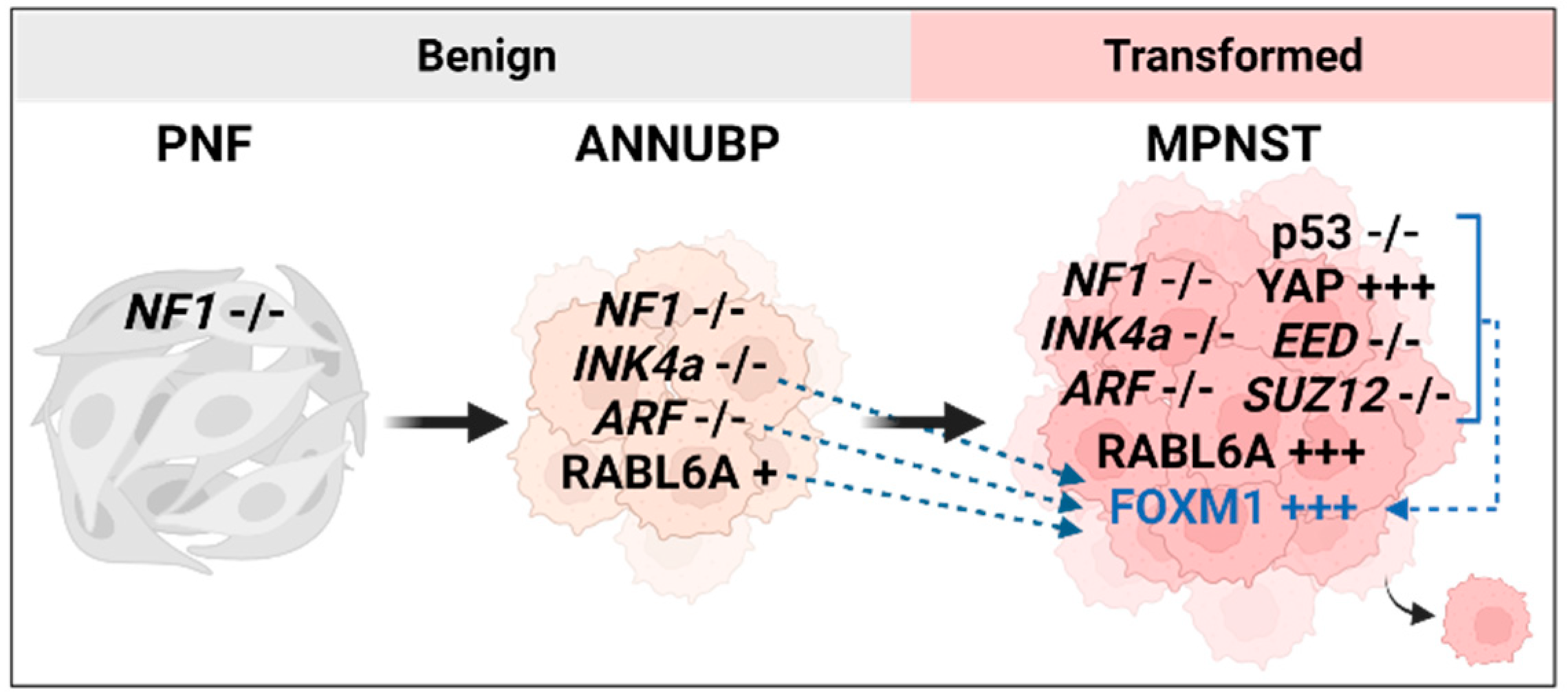
Figure 2.
Upstream regulators of FOXM1 that are key players in MPNSTs. Factors whose alterations are documented to drive MPNSTs, both NF1-associated and sporadic, and known to increase FOXM1 expression in other cancers.
Figure 2.
Upstream regulators of FOXM1 that are key players in MPNSTs. Factors whose alterations are documented to drive MPNSTs, both NF1-associated and sporadic, and known to increase FOXM1 expression in other cancers.
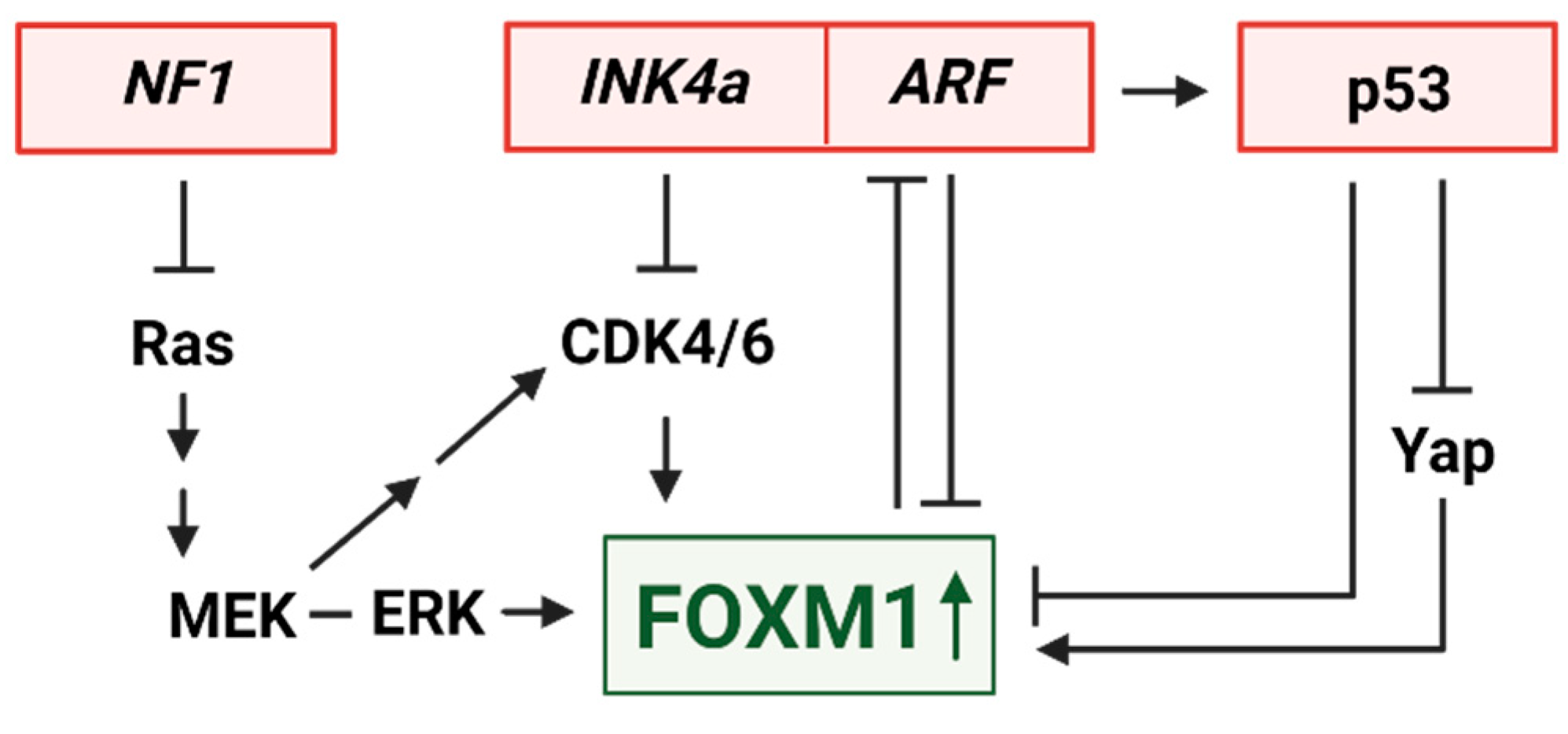
Figure 3.
Select transcriptional events downstream of FOXM1 with predicted relevance in MPNST. FOXM1 promotes cancer formation primarily through alteration of transcription. FOXM1 can inhibit other transcription factors (FOXO1, shown in red). Alternatively, FOXM1 can bind other proteins to activate or repress transcription (proteins in blue).
Figure 3.
Select transcriptional events downstream of FOXM1 with predicted relevance in MPNST. FOXM1 promotes cancer formation primarily through alteration of transcription. FOXM1 can inhibit other transcription factors (FOXO1, shown in red). Alternatively, FOXM1 can bind other proteins to activate or repress transcription (proteins in blue).
Disclaimer/Publisher’s Note: The statements, opinions and data contained in all publications are solely those of the individual author(s) and contributor(s) and not of MDPI and/or the editor(s). MDPI and/or the editor(s) disclaim responsibility for any injury to people or property resulting from any ideas, methods, instructions or products referred to in the content. |
© 2023 by the authors. Licensee MDPI, Basel, Switzerland. This article is an open access article distributed under the terms and conditions of the Creative Commons Attribution (CC BY) license (http://creativecommons.org/licenses/by/4.0/).
Copyright: This open access article is published under a Creative Commons CC BY 4.0 license, which permit the free download, distribution, and reuse, provided that the author and preprint are cited in any reuse.


