

Submitted:
28 July 2023
Posted:
31 July 2023
You are already at the latest version
Abstract
This work shows the potential of a new way of co-treatment of domestic wastewater (DWW) and a liquid stream coming from the thermal hydrolysis of the organic fraction of municipal solid waste (OFMSW) mediated by a mixed culture of purple phototrophic bacteria (PPB) capable of assimilating carbon and nutrients from the medium. The biological system is an open single-step process operated under microaerophilic conditions at an oxidative reduction potential (ORP) < 0 mV with a photoperiod of 12/24 h and fed during the light Stage only, so the results can be extrapolated to outdoors open ponds operation by monitoring the ORP. The effluent mostly complies with the discharge values of the Spanish legislation in COD and P values (<125mg/L <2 mg/L), respectively, and punctually on values in N (<15mg/L). Applying an HRT of 3 d and a ratio of 100:7 (COD:N), the presence of PPB in the mixed culture surpassed 50% of 16S rRNA gene copies, removing 78% of COD, 53% of N and 66% of P. Furthermore, increasing the HRT to 5 d, removal efficiencies of 83% of COD, 65% of N and 91% of P were achieved. In addition, the reactors were further operated in a membrane bioreactor, thus separating the HRT from the SRT to increase the specific loading rate. Very satisfactory removal efficiencies were achieved by applying HRT and SRT of 2.3 and 3 d, respectively: 84% of COD, 49% of N and 93% of P despite low presence of PPB due to more oxidative conditions, which anyway step-by-step re-colonized the mixed culture until reaching >20% of 16S rRNA gene copies after 49 d of operation. These results open the door to scale up the process in open photobioreactors capable of treating urban wastewater and municipal solid waste in a single stage and under microaerophilic conditions by controlling the ORP of the system. This novel urban biorefinery allows reducing treatment costs of two urban wastes and embed them in the circular bioeconomy through water recycling and valorizing PPB biomass as a source of carbon, nitrogen and phosphorus.
Keywords:
purple phototrophic bacteria
; photo-biorefineries
; domestic wastewater treatment
; resource recovery
; CSTR photobioreactors
; Membrane photobioreactors
1. Introduction
Worldwide, more than 80% of domestic wastewater (DWW) is discharged into rivers or the sea without any treatment to remove pollutants, which is why the United Nations has expressly set the 6th Sustainable Development Goal (SDG) to ensure the availability and sustainable management of water and sanitation for all [1]. At the same time, governments and institutions are focusing on wastewater reuse strategies to recover both: water and nutrients. These facts highlight the need to invest in different wastewater treatment, recycling, and reuse technologies, in line with the Circular Economy Action Plan proposed by the EU in 2020 to achieve a fully circular economy in Europe by 2050 [2].
The development of technologies capable of avoiding water scarcity is of great interest from an agri-food viewpoint that can recover wastewater as irrigation water for crops [3,4,5], as they are rich in nitrogen and phosphorus, which are the basis for stimulating plant growth [6]. All of this has promoted institutions to set limitations on discharge values; for example, in Europe, minimum COD (125 mg/L), nitrogen (15 mgN/L), or phosphorus (2 mgP/L) values are established to be able to reuse wastewater [7]. The key technology in wastewater treatment plants (WWTP) is biological treatment to not only comply with legislation but also to recover water resources in compliance with the concept of the circular economy [8,9,10]. Nowadays, biological treatments focus on activated sludge, but they involve a high energy cost in the aeration and flocculation of the process, consuming up to 45% and 75% of the plant's energy [11]. Aerobic granular sludge (AGS) reactors have been optimized to use only one SBR-type reactor. Still, the long start-up period to obtain maturated granules (up to months) limited their development [12]. Also, AGS is not usually efficient for full N removal, and other biological processes are needed. Other studies have shown that wastewater variability does not always ensure COD, N, and P removal, even using dedicated N and P biological removal systems [13]. Nevertheless, these systems don't consider resource recovery within a circular economy concept either in their design or operation.
Photosynthetic processes focus on using microalgae, consortia between microalgae and bacteria [14], or also activated sludge together with microalgae, known as activated microalgae, to improve the removal of nutrients in WWTP [11]. These processes have good results in removing N and P from wastewater [15]. Still, they cannot treat high amounts of COD, and the current studies usually need average COD inlet values between 178-390 mgCOD/L to reach the COD discharge limits [14,15,16]. Thus, some microalgae-bacteria studies needed an external addition of VFA but working in batch mode and still not reaching the COD, N, and P discharge limits depending on the process steps [17]. In addition, the need to incorporate aeration systems made the process more complex and expensive. Although microalgae-bacteria systems have achieved discharge values in a single stage, they have required aeration of the culture and anaerobiosis stages for optimal selection of the microorganisms, thus increasing their complexity [18].
In recent years, photosynthetic biological studies have focused on new emerging processes based on purple phototrophic bacteria (PPB) [19,20]. These anoxygenic photosynthetic microorganisms have gained interest due to their metabolic versatility, as they can grow chemotrophically in aerobic conditions and photoheterotrophically by obtaining energy from light in the IR spectrum [21]. Their secondary metabolism allows them to store C in the form of polyhydroxyalkanoates for the production of bioplastics [22,23,24,25,26], to accumulate P in the form of poly-P to be used as fertilizer [27], or to assimilate N to synthesize protein [28,29] of high biological quality due to their amino acids profile [30]. Also, mixed PPB cultures do not need strict anaerobic conditions to sustain the culture but rather a negative oxidative-reductive potential (ORP) [31]. Furthermore, their capacity to accumulate organic carbon makes them useful for co-treatment wastewater with organic waste fractions rich in organic fatty acids. In natural wastewater, which is an oligotrophic environment, it has been demonstrated that PPB can be dominant by adding an external carbon source (carboxylic acids, sugars, aminoacids or alcohols) to maintain their growth without being overtaken by microalgae [9,20,29,32]. In fact, at least an additional COD between 300-400 mgCOD/L is needed to support the growth of PPB and reach full COD, N, and P assimilation in a single-stage process [33]. A breakthrough way to achieve it is through the co-treatment of DWW and a carbon-rich waste source such as the solubilized organic fraction of municipal solid waste (OFMSW), the basis of the Deep Purple concept (https://deep-purple.eu/). The intention to co-treat both wastes in a single stage, without the need for fermentation of the OFMSW that increases the operational cost of the process, should also be emphasized. The OFMSW has already been individually used to promote the production of PHA using mixed PPB cultures [24]. However, the co-treatment of urban wastewater with the OFMSW using PPB remains unexplored. Variables such as the appropriate COD/N/P ratio, the effect of hydraulic and cell retention times (HRT and SRT, respectively), and the influence of the ORP should be adequately evaluated to propose this technology as an alternative for treating these wastes.
This study investigates the dynamics of mixed PPB cultures for the recovery of carbon, nitrogen, and phosphorus by co-treatment of DWW and the liquid phase of thermally hydrolyzed OFMSW in a single stage through monitoring the ORP to explore the influence of the redox potential over the cultures. This work proposes maintaining a negative ORP instead of strict anaerobic conditions. Reductive conditions hinder aerobic bacteria overgrowth and may avoid inhibiting the light-harvesting complexes of PPB, preventing them from losing their advantageous photoheterotrophic metabolism. First, the optimum urban waste mix was determined based on the COD/N/P assimilation in batch tests. After that, two continuous stirred-tank reactors (CSTR) were operated under strict anaerobic and microaerophilic conditions, and the influence of the ORP was evaluated. Finally, two microaerophilic reactors were overloaded by separating the HRT from the SRT through submerged membranes to analyze the effect of the organic overload on the development of microbial populations and the reactors' performance. Microbial composition along the process was also evaluated to establish the dynamics of the microbial populations inside the reactors.
2. Materials and Methods
2.1. Source of biowastes
This study used two urban wastes: DWW and the OFMSW. The OFMSW came from a municipal waste processing plant in Madrid (Spain). Samples were blended, homogenized, and stored in a cold chamber at 4ºC until further use. The OFMSW was thermally hydrolyzed in advance at 150ºC for 38 min, according to previous results [34], being the liquid fraction of the hydrolysate separated by centrifugation and used in this work. The DWW came from the outlet of the primary settlers of two domestic wastewater treatment plants (WWTP) located in Estiviel, Toledo (Spain), and La Gavia, Madrid (Spain). The biowastes were collected in three different periods. Table 1 shows the characterization of the residues along the different sampling campaigns.
2.2. Inoculum
The inoculum for this study was generated in a raceway photobioreactor fed in batch conditions (HRT of 7 days, equal SRT) with a mix between domestic wastewater from Rey Juan Carlos University (Móstoles, Madrid, Spain) and the liquid fraction of the hydrolysate resulting from the thermal hydrolysis of the OFMSW coming from a municipal waste processing plant located in Madrid (Spain). The DWW/OFMSW ratio was not optimized and a COD:N ratio of 100:5:was maintained, according to previous studies for promoting PHA accumulation. The raceway was illuminated with solar light and operated during summertime until obtaining a stable mixed culture enriched in PPB. Table 1 shows its main physical-chemical characteristics, whereas the supplementary information shows the microbial composition of those genus that appear in percentages greater than 1% in the mixed culture extracted from the raceway.
2.3. Experimental design
2.3.1. Specific phototrophic activity (SPA) tests
The SPA tests served to determine the optimum mix of the DWW from la Gavia with the liquid fraction (LF) of the OFMSW hydrolysate to maximize the growth of purple phototrophic bacteria, obtaining a complete COD, N and P assimilation from the mixture in a single process. Different DWW/LF mix ratios, resulting in COD:N ratios from 100:7 to 100:3, were tested in 100 mL anaerobic serum vials in a temperature-controlled shaker (at 30 ± 1°C) continuously shaken at 230 rpm. In all cases, 10 mgVSS·L-1 of the active phototrophic biomass from the anaerobic raceway was used as inoculum. Finally, the headspace of each vial was flushed with Argon for 3 min before being sealed with a rubber septum and aluminum crimp seal to ensure anaerobic conditions along the experiment. Two control experiments were also performed, using DWW alone, and the LF dissolved in ultrapure water up to COD ca.1600 mgCOD L-1. Table 2 shows the initial conditions in each experiment (mixtures and controls) evaluated. The vials were continuously illuminated with IR lamps (Philips, BR125 IR, Spain) at a 15 cm distance, with average irradiance of 45 ± 5 W m−2 and covered with a UV/VIS filtering foil to avoid inlet radiation at wavelength below 700 nm. The spatial distribution of the irradiance in the experimental set-up was determined by taking different measurements along the irradiated surface using a BLUE-Wave spectroradiometer (Stellar Net, USA). All SPA experiments were done in triplicate.
2.3.2. Semicontinuous photobioreactors
The co-treatment of the mixed urban wastes has been tested in two 2L cylindrical photobioreactors inoculated with 1% v/v of a mixed culture of PPB and continuously agitated with a magnetic stirring bar at 300 rpm. Four IR-LED lamps (emitting at 850 nm) illuminated the reactors from two sides for 12 h and switched off after that for the other 12 h, simulating daylight/night periods in the lab. The photobioreactors were operated under two different regimes, CSTR with no biomass retention (said CSTR mode) and CSTR with biomass retention (said membrane bioreactor or MBR mode). In both cases, the photobioreactors were fed in a semicontinuous mode only during the light period, and the temperature and ORP were continuously monitored in each bioreactor.
Table 3 shows the main inlet parameters and the operating conditions during the CSTR and MBR operation. The CSTR mode operation lasted 90 days, and both CSTR reactors were fed with variable proportions of DWW and LF, being the HRT varied between 3 and 5 days, resulting in four different operational periods (Stages I-IV, Table 3). These conditions were modified dynamically based on the real-time operational performance, trying to achieve discharge limits in terms of COD, N, and P. The CSTR-1 was opened to the air under microaerophilic conditions, simulating the environmental conditions of a scaled-up process. The CSTR-2 served as an anaerobic control and was hermetically closed to allow the theoretically optimum growth of these bacteria under photoanaerobic conditions.
During the MBR mode operation, which lasted 49 d, the effect of decoupling the HRT and SRT was evaluated, promoting the aging of the biomass to explore its effect on nutrient assimilation. Thus, both reactors operated under microaerophilic conditions, but the SRT was separated from the HRT by using hollow fiber membranes P60 (Zena, Czech Republic) with an average pore size of 0.1 µm and surface area of 0.95 m2 to extract the effluent from the photobioreactor. The MBR-1 was operated with fixed SRT and HRT (5 and 3.8 days), and the COD/N ratio was changed from 100/6 (stage V-a) to 100/5 (stage V-b). In the MBR-2, HRT and SRT were step-by-step decreased with a fixed SRT/HRT ratio of 3/4, resulting in different operational stages (VI-a to VI-d), where the COD/N ratio of the first two stages was 100/6, which was reduced to 100/5 in the last ones for a better comparison with the MBR-1 reactor.
2.4. Analytical methods
Analytical determination of pH, total suspended solids (TSS) and volatile suspended solids (VSS), TKN, and COD were carried out following Standard Methods for the Examination of Water and Wastewater [35]. The optical density of the mixed cultures was analyzed at 600 nm and 805 nm, as indicative of total bacteria and PPB, respectively, using a VIS-NIR spectrophotometer (V-630, Jasco, Madrid, Spain). NH4+, PO43-, and total phosphorus (TP) were quantified with a Smartchem-140 (Metrohm, Madrid, Spain). Liquid samples were filtered through a cellulose-ester filter of 0.45 μm of pore size (Advantech, Japan). The temperature and redox potentials were determined by probe-HI5221, and the dissolved oxygen was measured using probe-HI98193, both from Hanna Instrument (Gipuzkoa, Spain). All measurements were done in triplicate (SPA experiments) or duplicate (samples from photobioreactor), and the results are shown with the corresponding standard deviations in all cases.
2.5. Microbial community analysis
Different samples were taken from the biomass inside the photobioreactors during their operation and from the inoculum, DWW, and FL for microbial community analysis. The reactor samples corresponded to the beginning and end of the stages established in Table 3. All of them were stored at -20ºC until DNA extraction.
The DNA extraction of the samples was performed by a FastSpin for Soil Kit (MP-Biomedicals, Santa Ana, CA, USA) according to the manufacturer's protocol. Details of the method are given in Supplementary Material.
3. Results and Discussion
3.1. Specific Phototrophic Assay (SPA)
Figure 1 shows SCOD, ammonium, and phosphate assimilation during SPA experiments, PPB, and total bacteria growth through the absorbance ratio at 805 nm (peak absorbance related to the light-harvesting complexes of PPB). Results revealed an absence of the development of the characteristics of PPB's light-harvesting complexes during the experimental time during the treatment of LF or DWW alone. The inhibition of PPB phototrophic activity and growth can be due to the low pH of the FL [36] and low SCOD content in the case of DWW, not enough to provide a sufficient carbon source for the growth of the culture. In both cases, it was accompanied by limited nutrient assimilation (N and P) after 70 h.
The LF/DWW balance is essential to find the optimal COD:N ratio to assimilate the medium's nutrients fully. Discharge values for N (15 mgN/L) were achieved in the 100:5 and 100:6 tests at 28 h and before 48 h in the 100:3, 100:4 and 100:7 tests. P assimilation was like N except for the 100:3 ratio, leaving a residual P value of 2.7 mgP/L (Figure 1-B), higher than its maximum discharged value (>2 mgP/L).
The efficiency of SCOD assimilation is directly linked to the COD/N ratio. While the initial SCOD increased, the nutrients became more limiting, causing an excess of remnant SCOD at the end of the test. When checking the extremes, the 100:3 test started with the highest SCOD (2080 ± 90 mgSCOD/L), and its low COD:N ratio caused an excessive SCOD remaining in the medium (higher than 800 mg/L). After 48 h, the ammonium was assimilated entirely, but the SCOD was still being consumed during the rest of the experimental time. This cannot be due to biomass growth and is suggested to be related to carbon accumulation as PHA in a secondary metabolic pathway that PPB use to attain redox homeostasis [37]. In contrast, the 100:7 ratio test started with the lowest SCOD (1010 ± 60 mgSCOD/L), and therefore it achieved the lowest concentration by the end of the experiment (180 mgCOD/L). It is well-known that the assimilation of SCOD is directly related to the concentration of nutrients in the medium [38]. Thus, the N and P limitation at low COD/N ratios avoided reaching the COD discharge limits of 125 mgCOD/L.
Due to the similarity of the experiments' COD and nutrient assimilation results, the biomass yield was monitored as it is another key performance parameter for maintaining a stable continuous operation. The best values for this parameter were obtained within the intermediate values, notably in the 100:5 test that achieved 0.71 mgVSS/mgCOD. This value rounds around the highest reported in the literature in a previous work (0.72-0.76 mgVSS/mgCOD), where the SCOD came from sugars (fructose and glucose), and the growth was due to the inoculation of pure cultures of Rsp. rubrum and Rb. capsulatus [28]. Thus, the optimum value for further continuous experiments was set at a COD:N ratio of 100:5, but, in any case, the ratios 100:6 and 100:7 cannot be discarded and can be set during the reactor's operation to attain discharge values for COD, N and P. In short, it has been demonstrated that it is possible to optimize the mix between the DWW and the LF to maximize PPB growth, considerably improving the COD, N and P assimilation and, in the case of N and P, achieving discharge values in a single step.
3.2. Semicontinuous operation using CSTR to evaluate the anaerobic and aerobic conditions: ORP influence on the phototrophic mixed culture
As the SPA trials demonstrated that the co-treatment of both urban wastes using mixed phototrophic cultures improves considerably the COD, N, and P assimilation, a co-treatment using two CSTRs in semicontinuous mode operation was analyzed. First, the two systems were acclimatized to develop the PPB biomass properly (Stage I). They were operated maintaining a COD:N ratio of 100:5, the one maximizing the biomass yield in the batch experiments. The HRT of 3 d was higher than the minimum time required for the biomass growth reported in Figure 1, and long enough to avoid biomass washout as it corresponds to a dilution rate of 0.33 d-1, far below the specific maximum activities for mixed cultures of PPB (1.44-7.2 d-1) [39]. After 15 days, an absorbance ratio of 805/600 nm of almost 1.0 and a stable biomass concentration of around 500 mgVSS/L were obtained, providing evidence of a successful start-up of the system.
Figure 2 shows the general performance parameters of the CSTR reactors during the operational time. In general, the microaerophilic reactor (CSTR-1) performed similarly to the anaerobic one (CSTR-2) in terms of COD, N, and P assimilation. Evenly, the microaerophilic reactor occasionally achieved better results in terms of discharge parameters than the anaerobic system. These results were accompanied by a negative ORP throughout the 90 days of operation, as reported in Figure 3. This fact suggests that a negative ORP fulfills a photobioreactor's assimilative (non-oxidative) operation requirements. These results contrast with another study that affirms that operating a photobioreactor opened to the air entails an irremediable transition to an aerobic operation that strongly decreases the assimilative behavior of the system [40]. Indeed, negative ORP values avoid inhibiting the photoheterotrophic metabolism and preserve the growth of PPB [41] despite not working under anaerobic and agitated conditions, as suggested previously [25].
On the other hand, as the outdoor operation of the photobioreactors entails periods of light and darkness, the feed must be during the light periods, thus favoring the photoheterotrophic metabolism [23]. In fact, almost 56% of PPB dominated the mixed cultures all over Stages I and II, decreasing to 23% and 16.5% during Stages III and Stage IV, respectively (Figure 4), always being the most representative metabolic group of the consortium in both reactors, above aerobic heterotrophs, strict anaerobes, and facultative aerobes. It is worth mentioning the evident decrease of aerobic microorganisms such as the Xanthobacteraceae family and genera like Rhodococcus, Halomonas, or Luteolibacter as the ORP of the two CSTR turns into negative values (between -300 to -400mV) in Stage I, settling in all cases below 9% of the total 16S rRNA gene copies within the culture. The resilience of the PPB community despite the variations of the HRT and COD:N ratios in the open reactor is also highly relevant.
The HRT had a higher influence on the microbial composition than the COD:N ratios in the open reactor. During Stage I, Rhodobacter sp. played a crucial role, where up to 46.5% of the reactor was colonized by this genus, a k-strategist microorganism typical of CSTRs that prevails in low-strength wastewater treatment operations [31]. In this case, when the HRT is 3 days and the COD:N ratio is 100:5, the biomass renewal is higher than in the other posterior stages that operate with a 5-day HRT (III and IV). CSTRs tend to enrich Rhodopseudomonas before Rhodobacter in discontinuous start-ups, but the light/dark cycles favor the metabolism of Rhodobacter over Rhodopseudomonas [31], as happened during Stage I. However, Rhodopseudomonas, a r-strategist microorganism, appeared later in the CSTR-2 as the HRT increased to 5d (Stage III). The availability of nutrients in the culture seems to cause the relative abundance to be displaced into this genus [33]. Rhodobacter seems to have a higher affinity for the nutrients than other PPB genera, as the OLR at this Stage, 0.41(0.05) gCOD/L·d, is the highest of all (Figure 4). However, when changing the COD:N ratio to 100:7 during Stage II, e.g., under organic substrate limiting conditions, this genus disappears almost entirely and is replaced by C39 in CSTR-1 and Rhodopseudomonas in CSTR-2. This result contradicts the generally accepted fact that the Rhodobacter genus is a k-strategist [31]. Nevertheless, the literature generally considers the growth strategy for the assimilation of organic substrates, not nutrients [42]. Rhodobacter may have a lower saturation constant for N and P than Rhodopseudomonas, which favored its dominance along Stage I in both reactors, and in Stage IV in CSTR-2, when the HRT increased, and the nutrients became limiting again when Rhodobacter reappeared. In these fluctuations, the dilution rate may also have a role here. Indeed, it has been seen that nitrogen-fixing genera entail changes in microbial evolution where the k-strategists outnumber the r-strategists [43]. However, the results presented here are not conclusive regarding the role of the dilution rate.
Regardless of the conditions of the system, open (CSTR-1) or closed (CSTR-2), working in a 3-day HRT is too short a time to completely assimilate carbon and nutrients simultaneously from the medium by the mixed PPB culture. Stage I favored attaining discharge values for N and P in both reactors, whereas during Stage II SCOD discharge values were attained from 20 d onwards, especially in the CSTR-2. During these Stages, PPB prevailed over the rest of the microbial community. This may be due to low oxygen concentration (over-competing aerobes), which were always below 0.5 mg/L, and the generation times of the PPBs are shorter than those of the fermentative microorganisms [31]. Thus, PPB are more adaptable because they have less competition regarding substrate consumption. The microaerophilic conditions provided the CSTR-1 system with greater stability and performance by fixing the HRT in 5 days to reach the discharge values for SCOD and P instead of working in anaerobiosis. CSTR-1 during Stage III and IV removed 83% and 85% of SCOD (respectively) and between 86% and 91% of the P fed to the system. CSTR-2 did not exceed 65% N removal in any of the Stages III and IV and failed to reach P discharge values, with a maximum removal rate of 77% in Stage III, which was insufficient. Only the CSTR-1 achieved N discharge values between days 50-60. These results compare positively with other studies that used SBR in anaerobic conditions, where N and P removal was insufficient to reach discharge values and only were consumed by 62 ± 2.0 % and 51 ± 2.6 %, respectively [44]. Thus, strict anaerobic conditions are not the most suitable for nutrient assimilation by the mixed PPB cultures. As PPB maintained their dominancy within the system, microaerophilic operation favored SCOD, N, and P assimilations while maintaining their photoheterotrophic metabolism.
Figure 5 shows the relationship between the COD:N intake and uptake ratios. It compares how efficient the system is in nitrogen assimilation compared to the influent's COD:N ratios. The microaerophilic CSTR was more efficient in N assimilation than the CSTR-2 in all operative stages, but Stage IV (COD:N uptake ratios are 57% of the intake ratios versus almost 66%, respectively). This result also shows the stability and better performance of the microaerophilic reactor despite the HRT and COD:N conditions, which even allows a higher enrichment of the PPB cultures. Although PPB are microorganisms that have always been reported to have better COD:N removal performance in anaerobic conditions [45], the complexity of the two urban wastes makes these bacteria adapt to the environment by favoring their photoheterotrophic metabolism in periods of light and remaining resilient to other microorganisms thanks to their chemoorganotrophic metabolism in periods of darkness, as long as the COD:N ratio is optimal for their growth. Interestingly, in both cases, the intake-to-uptake COD:N ratios were better at lower HRT, accompanied by an increased abundance of non-PPB biomass when that efficiency decreased. The rise of anaerobic chemoheterotrophic microorganisms due to longer SRT may displace the PPB and negatively affect the reactors' nitrogen uptake efficiency. This suggestion has been furtherly explored by using MBR reactors.
3.3. Semicontinuous operation using MBR to evaluate the SRT and HRT parameters
Upon the finalization of the CSTR operation, the biomass from the CSTR-1 reactor was used to inoculate two microaerophilic MBR reactors, filling the reactors with half of the CSTR-1 reactor volume and the other half with DWW. Subsequently, the PPB mixed culture was adapted to the new operating conditions for one week by feeding with the mixture of DWW and the LF (see Table 3).
The HRT and SRT variations strongly impacted C, N, and P removals in both reactors. In MBR-1, average COD and P removal values were 86% and 77%, respectively, and on multiple occasions during Stage V-a (day 112-118), 96-100% removal allows reaching the discharge values in SCOD and P. In MBR-2, the best performance was achieved in Stage VI-a, reaching COD and P removal efficiencies of 87% and 55%, respectively. Despite the low abundance of PPB in both Stages (V-a and VI-a), the system operated within the legal limits for COD and P. However, neither reactor could remove enough N to achieve the discharge values of 15mgN/L during these Stages. An N removal of up to 56%, 42%, and 47% (Stage V-a, Stage VI-a and VI-b, respectively) was insufficient. This fact may be due to the high N concentration in the influent (Figure 6) and the low amount of assimilative microorganisms, like PPB, as will be furtherly discussed.
In the following Stages (V-b in MBR1, and VI-c and VI-d in MBR2) the COD:N ratio was decreased to 100:5, thus increasing the OLR to 0.3 gCOD/L·d in the V-b Stage and from 0.4 to 0.76 gCOD/L·d in the VI-c and VI-d Stage, respectively. Both MBR-1 and MBR-2 were able to remove a higher N percentage. The MBR-2 achieved N values between 29.9 (0.7) and 24.4 (0.65) mgN/L in Stages VI-c and VI-d, respectively. However, MBR-1 at Stage V-b reached values below the discharge limits (11.2 (0.2) mgN/L) or very close to 15 mgN/L at several points (days 126 to 133). The increase in the N assimilation was accompanied by the proliferation of PPB in the MBR systems, especially in the MBR-1 where, at the end of Stage V-b, around 22% of the microbial community was composed of PPB taxa such as genus Rhodobacter and family Rhodospirillales (Figure 7). Similar results have been reported working with DWW in the literature [46] but working under anaerobic conditions and continuous irradiation, which notably increases the process's costs during the scaling-up, unlike the operation carried out in the present study.
Due to the negative ORP favored inside the reactors, aerobic microorganisms had a limited proliferation in both systems, favoring anaerobic and facultative cultures (Figure 7). As shown in Figure 8, the ORP between days 100 to 111 turned into positive values in MBR-2, accompanied by increased dissolved oxygen for several days, rising to 1-2 mgO2/L. These conditions favored the appearance of aerobic genera up to 22% (Figure 7). During the rest of the Stages, the ORP remained negative, and the percentages of aerobes in both reactors never exceeded 10%. This presence of aerobic microorganisms might be promoted by the oxygenic condition of the influents and the contact of the reactors' surface with atmospheric oxygen. Bacteria such as Thauera [47] and other aerobes took advantage of the positive ORP to use the organic acids derived from the activity of the fermentative microorganisms as a substrate for their chemoorganotrophic metabolism.
The uncoupling of SRT and HRT substantially impacted the microbial population dynamics. PPB were not able at any point to outcompete anaerobic chemoheterotrophic bacteria (Figure 7), and was strongly displaced by anaerobic chemoheterotrophs at the beginning of the operation in both reactors. Given their fermentative metabolism to generate VFA [31], these taxa strongly impacted the PPB development, so understanding their coexistence is critical to improving and developing robust wastewater treatment systems. This fact was not a detriment to PPB development, as the fermentative metabolism promotes the maintenance of PPB redox homeostasis by sugars fermentation and conversion into VFA that PPB can assimilate easier than sugars [48]. The recovery of PPB populations started during the last operative Stages in both reactors, achieving up to 25% and 12% of total 16S rRNA gene copies in MBR-1 and MBR-2, respectively.
The COD:N uptake ratio is another key factor that indicates the presence of assimilative bacteria as PPB in the culture, as shown previously in Figure 5 for the semicontinous CSTR . The same analysis was conducted for the MBR reactors and it is depicted in Figure 9. Working at a COD:N ratio of 100:5 as in Stage V-b and Stages VI-b-c-d, values of 22% of relative abundance of PPB in MBR-1 were reached. In this reactor, the fermentative genus of Bacteroides [49] became highly relevant during Stage V-a, operating at a COD:N ratio of 100:6, but disappeared in Stage V-b when the ratio was changed to 100:5. Similar results are observed in MBR-2. Working back to the 100:5 ratio, the relative abundance of PPB increased and became competitive against fermentative genera and aerobes. The loss of aerobic microorganisms (Stage V-b and Stage VI-d) may be related to the recovery of the PPB population, supporting the possibility that their coexistence is not feasible because they compete for the same substrate. Therefore, it seems clear that aerobic or microaerophilic conditions with positive ORP are inadequate for developing a PPB community in open reactors, especially under high organic load.
4. Conclusions
This study has demonstrated the possibility of co-treatment of urban wastewater with the liquid fraction of OFMSW in a single step using PPB and in 12/12h light/dark systems, which lowers the economic costs of the process. Stable discharge values in SCOD and P have been consistently achieved by enrichment of up to 50-60% PPB in CSTR type reactors with a 3-day HRT and in microaerophilic conditions with negative ORP and in systems with membrane retention of and HRT of 3d and SRT of 4d. In these processes, the COD:N ratio should be between 100:4.37-6.63, thus ensuring the removal of C and P. The increase of the SRT by using an MBR improves the quality of the effluent, complying with the regulations for the water reuse in unprotected areas, but causes the anaerobic chemoheterotrophs to prevail in the system, especially at high COD:N ratios (around 100:6). Achieving N discharge limits is challenging but is feasible with strict control of the SRT and the ORP. These results strongly support the use of open anaerobic systems (e.g., open raceways), thus reducing operating costs and making a single-step domestic wastewater treatment that fulfills discharge limits feasible.
Supplementary Materials
The following supporting information can be downloaded at the website of this paper posted on Preprints.org. Figure S1: Qualification of the microbial population taking into account all genera >1% in the wastewater, the liquid fraction and the inoculum.; Figure S2: Evolution of the microbial population considering all genera >1% during CSTR-mode. Figure S3: Evolution of the microbial population taking into account all genera >1% during MBR-mode.
Author Contributions
Conceptualization, D.P. and R.M.; methodology, D.P., J.V. and S.C.; software, S.C.; validation, D.P., and R.M.; formal analysis, S.C., D.P. and R.M.; investigation, S.C. and J.V.; resources, D.P., F.M. and J.A.M.; data curation, S.C.; writing—original draft preparation, S.C.; writing—review and editing, D.P. and R.M.; visualization, S.C.; supervision, D.P. and R.M.; project administration, J.A.M. and D.P.; funding acquisition, J.A.M. and D.P. All authors have read and agreed to the published version of the manuscript.
Funding
This work has received funding from the Bio-based Industries Joint Undertaking (JU) under the European Union’s Horizon 2020 research and innovation program under grant agreement no. 837998. The JU receives support from the European Union’s Horizon 2020 research and innovation program and the Bio-based Industries Consortium.
Data Availability Statement
All dataset of this paper is available upon reasonable request.
Acknowledgments
The authors acknowledge the company FCC AQUALIA for providing domestic wastewater samples. D.P. greatly appreciates the economic support the Spanish Ministry of Economy provided through the Ramon y Cajal Program.
Conflicts of Interest
The authors declare no conflict of interest. The funders had no role in the design of the study; in the collection, analyses, or interpretation of data; in the writing of the manuscript; or in the decision to publish the results.
References
- “Agua y saneamiento - Desarrollo Sostenible.” https://www.un.org/sustainabledevelopment/es/water-and-sanitation/ (accessed Oct. 24, 2022).
- “EUR-Lex - 52020DC0098 - ES - EUR-Lex.” https://eur-lex.europa.eu/legal-content/EN/TXT/?qid=1583933814386&uri=COM:2020:98:FIN (accessed Oct. 24, 2022).
- L. Rizzo et al., "Best available technologies and treatment trains to address current challenges in urban wastewater reuse for irrigation of crops in EU countries," Science of The Total Environment, vol. 710, p. 136312, Mar. 2020. [CrossRef]
- A. Poustie, Y. Yang, P. Verburg, K. Pagilla, and D. Hanigan, "Reclaimed wastewater as a viable water source for agricultural irrigation: A review of food crop growth inhibition and promotion in the context of environmental change," Science of The Total Environment, vol. 739, p. 139756, Oct. 2020. [CrossRef]
- G. Deviller, L. Lundy, and D. Fatta-Kassinos, "Recommendations to derive quality standards for chemical pollutants in reclaimed water intended for reuse in agricultural irrigation," Chemosphere, vol. 240, p. 124911, Feb. 2020. [CrossRef]
- ilje pikaar et al., Resource Recovery from Water Principles and Application.
- “BOE.es - BOE-A-1998-24166 Real Decreto 2116/1998, de 2 de octubre, por el que se modifica el Real Decreto 509/1996, de 15 de marzo, de desarrollo del Real Decreto-ley 11/1995, de 28 de diciembre, por el que se establecen las normas aplicables al tratamiento de las aguas residuales urbanas.” https://www.boe.es/buscar/doc.php?id=BOE-A-1998-24166 (accessed Oct. 14, 2022).
- A. Oehmen et al., "Advances in enhanced biological phosphorus removal: From micro to macro scale," Water Res, vol. 41, no. 11, pp. 2271–2300, Jun. 2007. [CrossRef]
- D. Puyol, D. J. Batstone, T. Hülsen, S. Astals, M. Peces, and J. O. Krömer, "Resource Recovery from Wastewater by Biological Technologies: Opportunities, Challenges, and Prospects," Front Microbiol, vol. 7, no. JAN, Jan. 2016. [CrossRef]
- Y. da Du et al., "Wastewater treatment and simultaneous production of algal lipids in sequencing batch reactors containing a microalgal-bacterial consortium," Int Biodeterior Biodegradation, vol. 175, p. 105491, Nov. 2022. [CrossRef]
- A. Anbalagan, S. Schwede, C. F. Lindberg, and E. Nehrenheim, "Influence of hydraulic retention time on indigenous microalgae and activated sludge process," Water Res, vol. 91, pp. 277–284, Mar. 2016. [CrossRef]
- K. Tanavarotai et al., "Storage and reactivation of aerobic granular sludge: A review," Fuel, vol. 330, p. 125536, Dec. 2022. [CrossRef]
- Y. Hamid and A. Masłó, "Impact of Uneven Flow Wastewater Distribution on the Technological Efficiency of a Sequencing Batch Reactor," Sustainability 2022, Vol. 14, Page 2405, vol. 14, no. 4, p. 2405, Feb. 2022. [CrossRef]
- C. S. Lee, S. A. Lee, S. R. Ko, H. M. Oh, and C. Y. Ahn, "Effects of photoperiod on nutrient removal, biomass production, and algal-bacterial population dynamics in lab-scale photobioreactors treating municipal wastewater," Water Res, vol. 68, pp. 680–691, Jan. 2015. [CrossRef]
- Y. da Du et al., "Wastewater treatment and simultaneous production of algal lipids in sequencing batch reactors containing a microalgal-bacterial consortium," Int Biodeterior Biodegradation, vol. 175, p. 105491, Nov. 2022. [CrossRef]
- V. Díaz, J. C. Leyva-Díaz, M. C. Almécija, J. M. Poyatos, M. del Mar Muñío, and J. Martín-Pascual, "Microalgae bioreactor for nutrient removal and resource recovery from wastewater in the paradigm of circular economy," Bioresour Technol, vol. 363, p. 127968, Nov. 2022. [CrossRef]
- H. U. Cho, J. M. Park, and Y. M. Kim, "Enhanced microalgal biomass and lipid production from a consortium of indigenous microalgae and bacteria present in municipal wastewater under gradually mixotrophic culture conditions," Bioresour Technol, vol. 228, pp. 290–297, Mar. 2017. [CrossRef]
- V. C. F. Carvalho, M. Kessler, J. C. Fradinho, A. Oehmen, and M. A. M. Reis, "Achieving nitrogen and phosphorus removal at low C/N ratios without aeration through a novel phototrophic process," Science of The Total Environment, vol. 793, p. 148501, Nov. 2021. [CrossRef]
- K. Cao, R. Zhi, and G. Zhang, "Photosynthetic bacteria wastewater treatment with the production of value-added products: A review," Bioresour Technol, vol. 299, p. 122648, Mar. 2020. [CrossRef]
- T. Hülsen, D. J. Batstone, and J. Keller, "Phototrophic bacteria for nutrient recovery from domestic wastewater," Water Res, vol. 50, pp. 18–26, Mar. 2014. [CrossRef]
- S. Imam et al., "IRsp1095: A genome-scale reconstruction of the Rhodobacter sphaeroides metabolic network," BMC Syst Biol, vol. 5, no. 1, pp. 1–17, Jul. 2011. [CrossRef]
- J. R. Almeida, J. C. Fradinho, G. Carvalho, A. Oehmen, and M. A. M. Reis, "Dynamics of Microbial Communities in Phototrophic Polyhydroxyalkanoate Accumulating Cultures," Microorganisms, vol. 10, no. 2, p. 351, Feb. 2022. [CrossRef]
- J. R. Almeida, E. Serrano, M. Fernandez, J. C. Fradinho, A. Oehmen, and M. A. M. Reis, "Polyhydroxyalkanoates production from fermented domestic wastewater using phototrophic mixed cultures," Water Res, vol. 197, p. 117101, Jun. 2021. [CrossRef]
- L. D. Allegue, M. Ventura, J. A. Melero, and D. Puyol, "Unraveling PHA production from urban organic waste with purple phototrophic bacteria via organic overload," Renewable and Sustainable Energy Reviews, vol. 166, p. 112687, Sep. 2022. [CrossRef]
- J. C. Fradinho, M. A. M. Reis, and A. Oehmen, "Beyond feast and famine: Selecting a PHA accumulating photosynthetic mixed culture in a permanent feast regime," Water Res, vol. 105, pp. 421–428, Nov. 2016. [CrossRef]
- L. Lorini, F. di Re, M. Majone, and F. Valentino, "High rate selection of PHA accumulating mixed cultures in sequencing batch reactors with uncoupled carbon and nitrogen feeding," N Biotechnol, vol. 56, pp. 140–148, May 2020. [CrossRef]
- D. M. George, A. S. Vincent, and H. R. Mackey, "An overview of anoxygenic phototrophic bacteria and their applications in environmental biotechnology for sustainable Resource recovery," Biotechnology Reports, vol. 28, p. e00563, Dec. 2020. [CrossRef]
- A. Alloul, M. Muys, N. Hertoghs, F. M. Kerckhof, and S. E. Vlaeminck, "Cocultivating aerobic heterotrophs and purple bacteria for microbial protein in sequential photo- and chemotrophic reactors," Bioresour Technol, vol. 319, p. 124192, Jan. 2021. [CrossRef]
- T. Hülsen, K. Hsieh, Y. Lu, S. Tait, and D. J. Batstone, "Simultaneous treatment and single cell protein production from agri-industrial wastewaters using purple phototrophic bacteria or microalgae – A comparison," Bioresour Technol, vol. 254, pp. 214–223, Apr. 2018. [CrossRef]
- J. Spanoghe, K. J. Ost, W. van Beeck, P. Vermeir, S. Lebeer, and S. E. Vlaeminck, "Purple bacteria screening for photoautohydrogenotrophic food production: Are new H2-fed isolates faster and nutritionally better than photoheterotrophically obtained reference species?," N Biotechnol, vol. 72, pp. 38–47, Dec. 2022. [CrossRef]
- M. Cerruti, G. Crosset-Perrotin, M. Ananth, J. L. Rombouts, D. G. Weissbrodt, and D. Weissbrodt, "Syntrophy between fermentative and purple phototrophic bacteria for carbohydrate-based wastewater treatment," bioRxiv, p. 2021.05.13.444055, May 2021. [CrossRef]
- T. Hülsen, S. Stegman, D. J. Batstone, and G. Capson-Tojo, "Naturally illuminated photobioreactors for resource recovery from piggery and chicken-processing wastewaters utilising purple phototrophic bacteria," Water Res, vol. 214, May 2022. [CrossRef]
- T. Hülsen, E. M. Barry, Y. Lu, D. Puyol, J. Keller, and D. J. Batstone, "Domestic wastewater treatment with purple phototrophic bacteria using a novel continuous photo anaerobic membrane bioreactor," Water Res, vol. 100, pp. 486–495, Sep. 2016. [CrossRef]
- L. D. Allegue, D. Puyol, and J. A. Melero, "Food waste valorization by purple phototrophic bacteria and anaerobic digestion after thermal hydrolysis," Biomass Bioenergy, vol. 142, p. 105803, Nov. 2020. [CrossRef]
- R. Baird, A. D. Eaton, E. W. Rice, and L. Bridgewater, Standard methods for the examination of water and wastewater, 23rd ed. American Public Health Association, 2017. Accessed: Oct. 24, 2022. [Online]. Available: https://www.worldcat.org/es/title/standard-methods-for-the-examination-of-water-and-wastewater/oclc/1019687035.
- D. Puyol, T. Hülsen, B. Padrino, D. J. Batstone, F. Martinez, and J. A. Melero, "Exploring the inhibition boundaries of mixed cultures of purple phototrophic bacteria for wastewater treatment in anaerobic conditions," Water Res, vol. 183, p. 116057, Sep. 2020. [CrossRef]
- V. Montiel-Corona and G. Buitrón, "Polyhydroxyalkanoates from organic waste streams using purple non-sulfur bacteria," Bioresour Technol, vol. 323, p. 124610, Mar. 2021. [CrossRef]
- C. Nairn et al., "Alkalinity, and Not the Oxidation State of the Organic Substrate, Is the Key Factor in Domestic Wastewater Treatment by Mixed Cultures of Purple Phototrophic Bacteria," Resources 2020, Vol. 9, Page 88, vol. 9, no. 7, p. 88, Jul. 2020. [CrossRef]
- G. Capson-Tojo et al., "Purple phototrophic bacteria for resource recovery: Challenges and opportunities," Biotechnol Adv, vol. 43, p. 107567, Nov. 2020. [CrossRef]
- G. Capson-Tojo, S. Lin, D. J. Batstone, and T. Hülsen, "Purple phototrophic bacteria are outcompeted by aerobic heterotrophs in the presence of oxygen," Water Res, vol. 194, p. 116941, Apr. 2021. [CrossRef]
- M. Cerruti, H. T. Ouboter, V. Chasna, M. C. M. van Loosdrecht, C. Picioreanu, and D. G. Weissbrodt, "Effects of light / dark diel cycles on the photoorganoheterotrophic metabolism of Rhodopseudomonas palustris for differential electron allocation to PHAs and H2," bioRxiv, p. 2020.08.19.258533, Aug. 2020. [CrossRef]
- "The r/K selection theory and its application in biological wastewater treatment processes - ScienceDirect." [Online]. Available: https://www.sciencedirect.com/science/article/pii/S0048969722009287?ref=pdf_download&fr=RR-2&rr=74b94c6b4bec69bf#f0020.
- M. K. H. Winkler, P. Boets, B. Hahne, P. Goethals, and E. I. P. Volcke, "Effect of the dilution rate on microbial competition: R-strategist can win over kstrategist at low substrate concentration," PLoS One, vol. 12, no. 3, Mar. 2017. [CrossRef]
- T. Hülsen, K. Hsieh, and D. J. Batstone, "Saline wastewater treatment with purple phototrophic bacteria," Water Res, vol. 160, pp. 259–267, Sep. 2019. [CrossRef]
- C. A. Sepúlveda-Muñoz, I. de Godos, and R. Muñoz, "Wastewater Treatment Using Photosynthetic Microorganisms," Symmetry (Basel), vol. 15, no. 2, p. 525, Feb. 2023. [CrossRef]
- P. Dalaei, D. Ho, G. Nakhla, and D. Santoro, "Low temperature nutrient removal from municipal wastewater by purple phototrophic bacteria (PPB)," Bioresour Technol, vol. 288, Sep. 2019. [CrossRef]
- J. Heider and G. Fuchs, "Thauera ," in Bergey's Manual of Systematics of Archaea and Bacteria, Wiley, 2015, pp. 1–11. [CrossRef]
- A. Alloul, N. Blansaer, P. Cabecas Segura, R. Wattiez, S. E. Vlaeminck, and B. Leroy, "Dehazing redox homeostasis to foster purple bacteria biotechnology," Trends Biotechnol, vol. 41, no. 1, pp. 106–119, Jan. 2023. [CrossRef]
- M. T. Madrigan, J. M. Martinko, K. S. Bender, D. H. Buckley, and D. A. Stahl, Brock Biología de los Microorganismos 14a Edición.
Figure 1.
Time course of SCOD (A), ammonium (B), phosphate (C) and absorbance at 805 nm (D) in the SPA experiment with SCOD:N ratios 100:3 (-■-), 100:4 (-●-), 100:5 (-▲-), 100:6 (-▼-), 100:7 (-◆-), control of DWW (-◀-) and control of LF (-▶-). Error bars are standard deviations from triplicate measurements.
Figure 1.
Time course of SCOD (A), ammonium (B), phosphate (C) and absorbance at 805 nm (D) in the SPA experiment with SCOD:N ratios 100:3 (-■-), 100:4 (-●-), 100:5 (-▲-), 100:6 (-▼-), 100:7 (-◆-), control of DWW (-◀-) and control of LF (-▶-). Error bars are standard deviations from triplicate measurements.
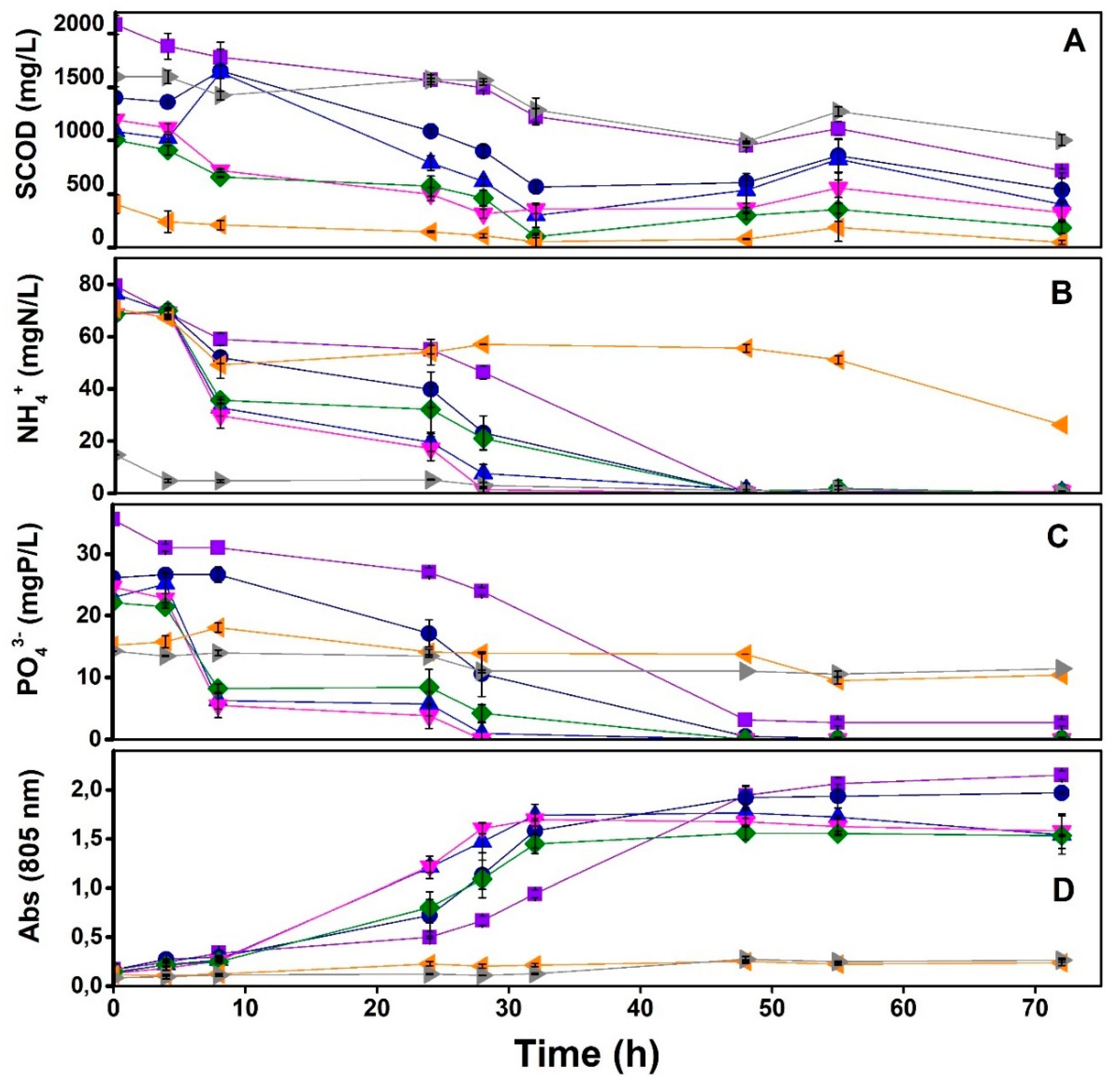
Figure 1.
Time course of SCOD (A). ammonium (B), phosphate (C), 805 to 660 nm absorbance ratio of the biomass (C), and volatile suspended solids (E) in the effluent of the microaerophilic CSTR-1 (■), the anaerobic CSTR-2 (●), and the influent of both reactors (-▲-). The horizontal dotted lines in panels A, B, and C show the limits of discharge values according to the Spanish legislation. The operative stages are shown over the graph (from I to IV).
Figure 1.
Time course of SCOD (A). ammonium (B), phosphate (C), 805 to 660 nm absorbance ratio of the biomass (C), and volatile suspended solids (E) in the effluent of the microaerophilic CSTR-1 (■), the anaerobic CSTR-2 (●), and the influent of both reactors (-▲-). The horizontal dotted lines in panels A, B, and C show the limits of discharge values according to the Spanish legislation. The operative stages are shown over the graph (from I to IV).
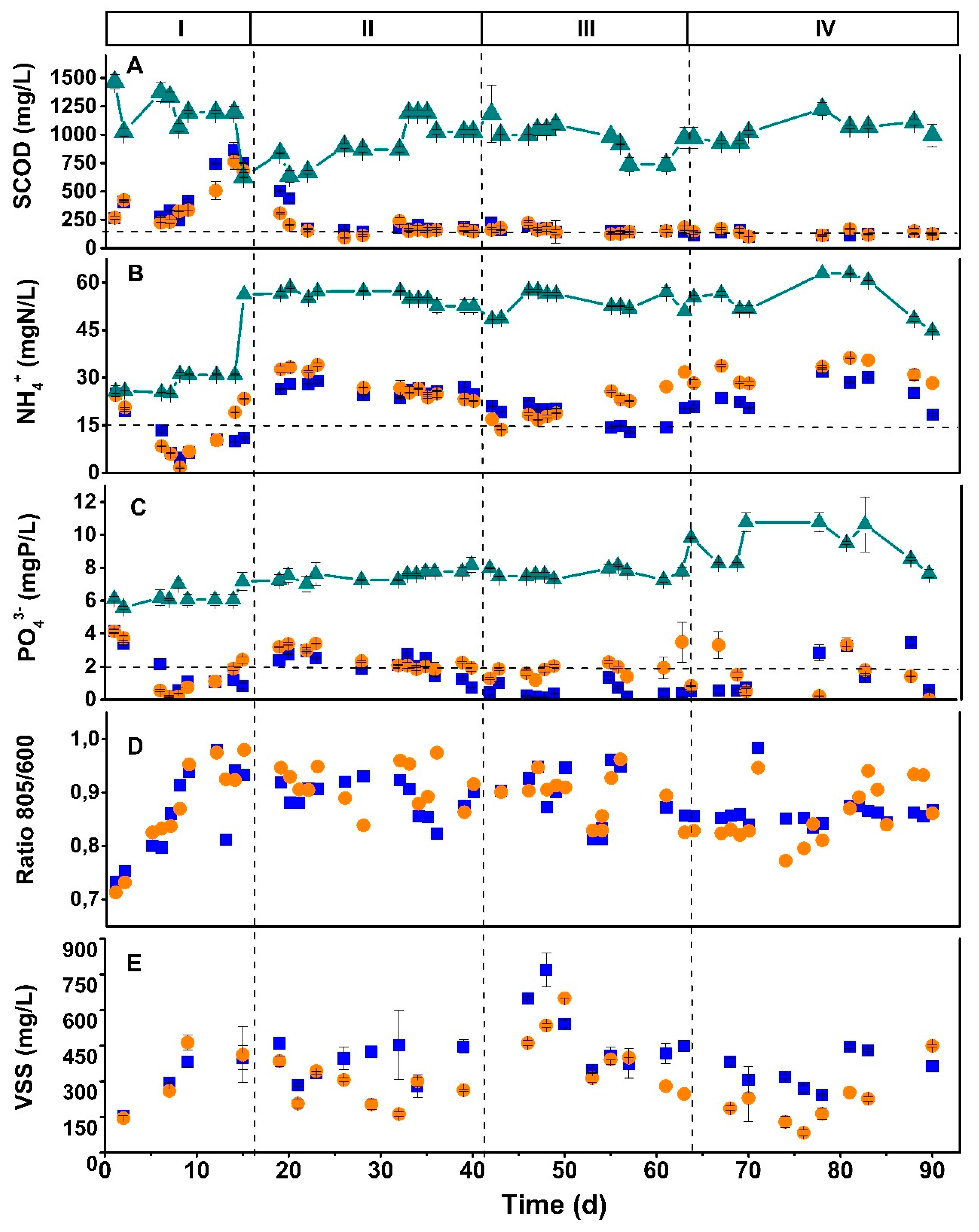
Figure 3.
Time course of ORP in the CSTR-1 microaerophilic (-■-) and CSTR-2 anaerobic (-●-) and room temperature (--). The operative stages are shown over the graph (from I to IV).
Figure 3.
Time course of ORP in the CSTR-1 microaerophilic (-■-) and CSTR-2 anaerobic (-●-) and room temperature (--). The operative stages are shown over the graph (from I to IV).
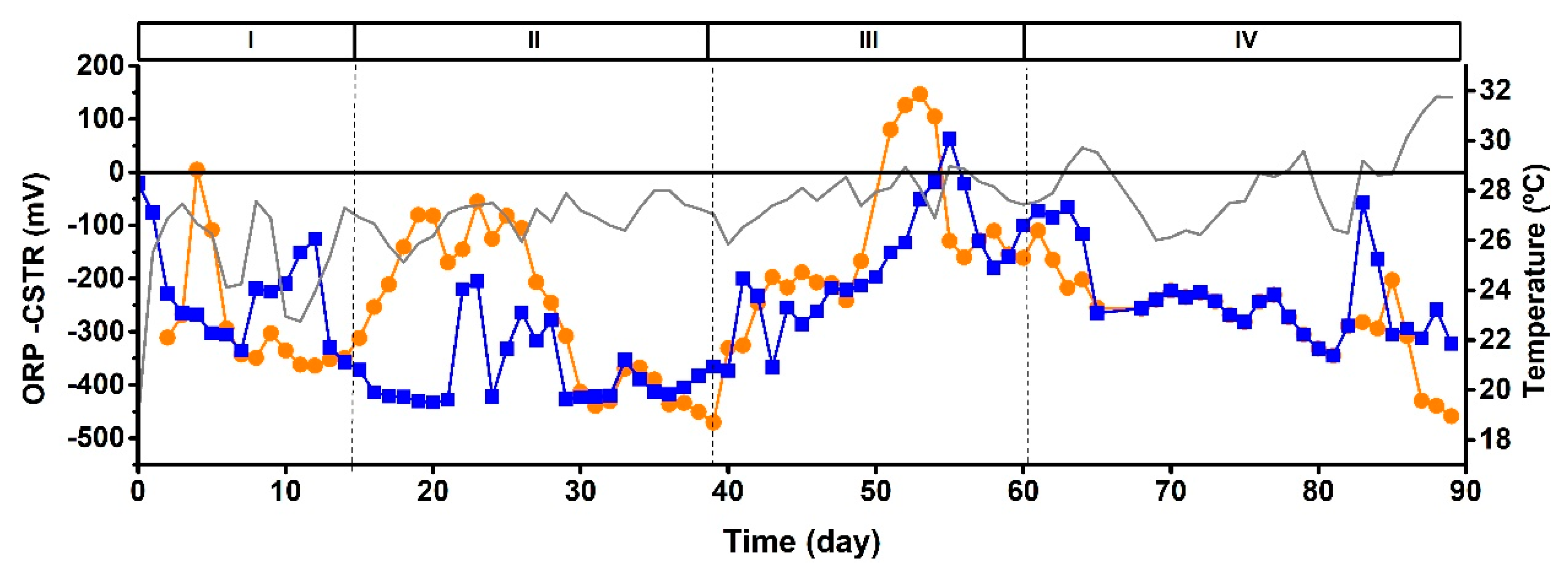
Figure 4.
Evolution of the microbial community of the CSTR mode operation during the different operative Stages. Values over zero represent non-PPB microorganisms, whereas values below zero show PPB microorganisms. Only taxa accounting for more than 4% of the 16S rRNA gene copies are identified, whereas the rest are summed up in a single identifier. The supplementary information also shows the taxa that appear in percentages from 1 to 4%.
Figure 4.
Evolution of the microbial community of the CSTR mode operation during the different operative Stages. Values over zero represent non-PPB microorganisms, whereas values below zero show PPB microorganisms. Only taxa accounting for more than 4% of the 16S rRNA gene copies are identified, whereas the rest are summed up in a single identifier. The supplementary information also shows the taxa that appear in percentages from 1 to 4%.
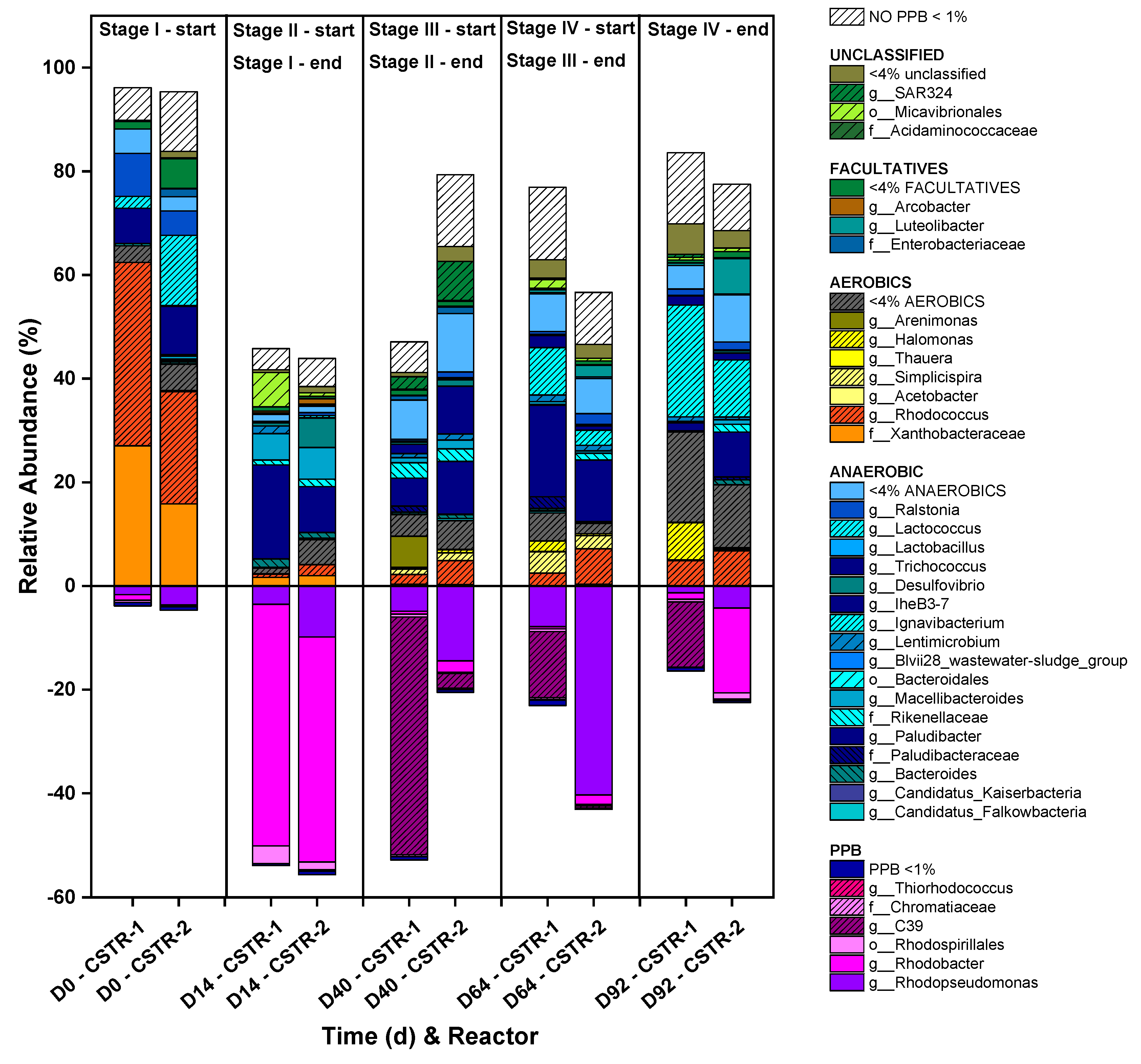
Figure 5.
Relation between COD:N intake and uptake ratios (bars) in each Stage compared with the relative abundance of non-PPB microorganisms (symbols), expressed as 16S rRNA gene copies. Graph A represents CSTR-1, and graph B represents CSTR-2.
Figure 5.
Relation between COD:N intake and uptake ratios (bars) in each Stage compared with the relative abundance of non-PPB microorganisms (symbols), expressed as 16S rRNA gene copies. Graph A represents CSTR-1, and graph B represents CSTR-2.
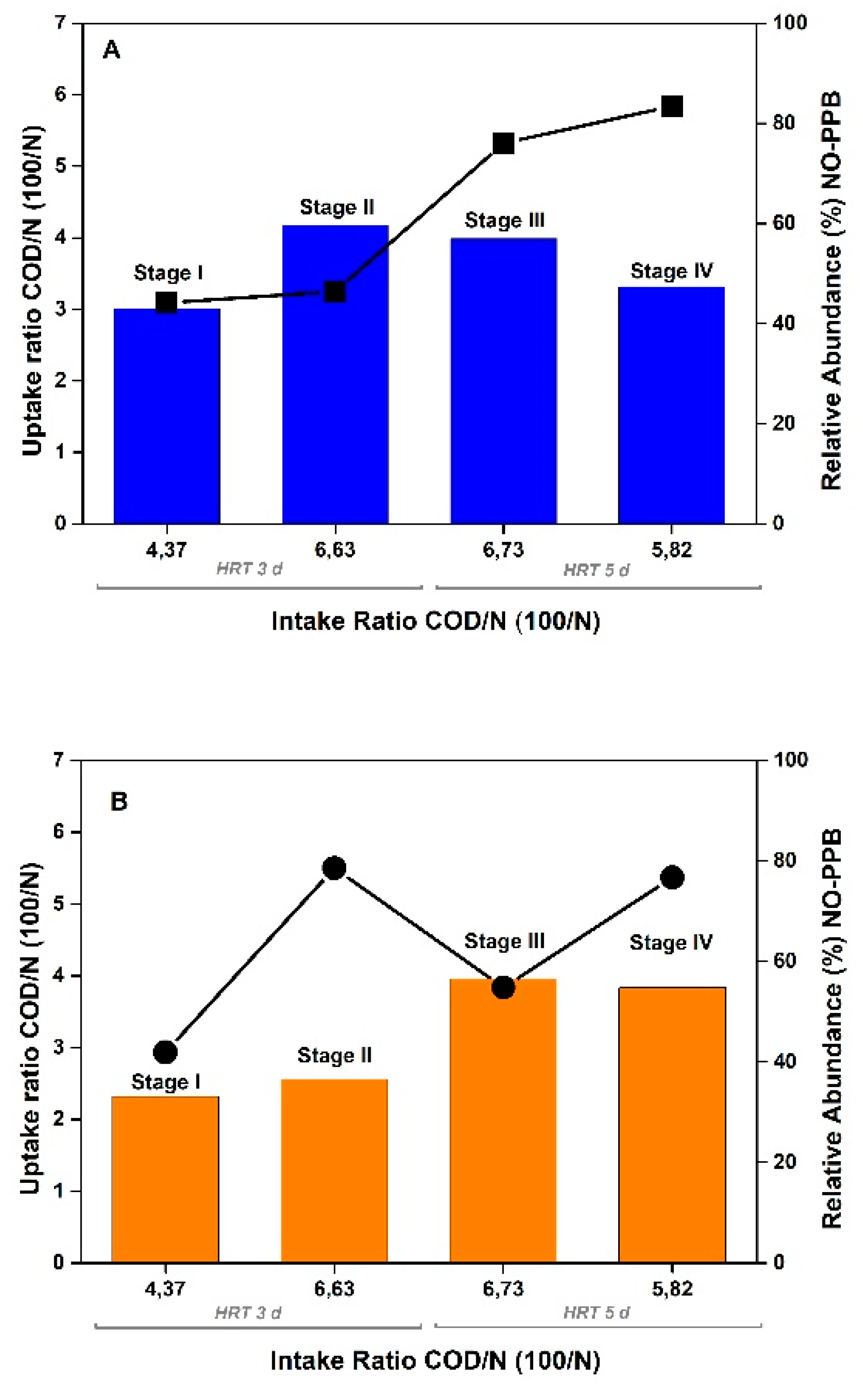
Figure 6.
Time course of SCOD (A). ammonium (B), phosphate (C), growth (C) and volatile solid suspension (E) in the MBR-1 (■) and MBR-2 (●) and influent (-▲-) in both reactors. The horizontals dotted lines in graphs A, B and C shown the limits of discharge values in Spanish legislation. On the top of the figure are represented the different stages (from V to VI).
Figure 6.
Time course of SCOD (A). ammonium (B), phosphate (C), growth (C) and volatile solid suspension (E) in the MBR-1 (■) and MBR-2 (●) and influent (-▲-) in both reactors. The horizontals dotted lines in graphs A, B and C shown the limits of discharge values in Spanish legislation. On the top of the figure are represented the different stages (from V to VI).
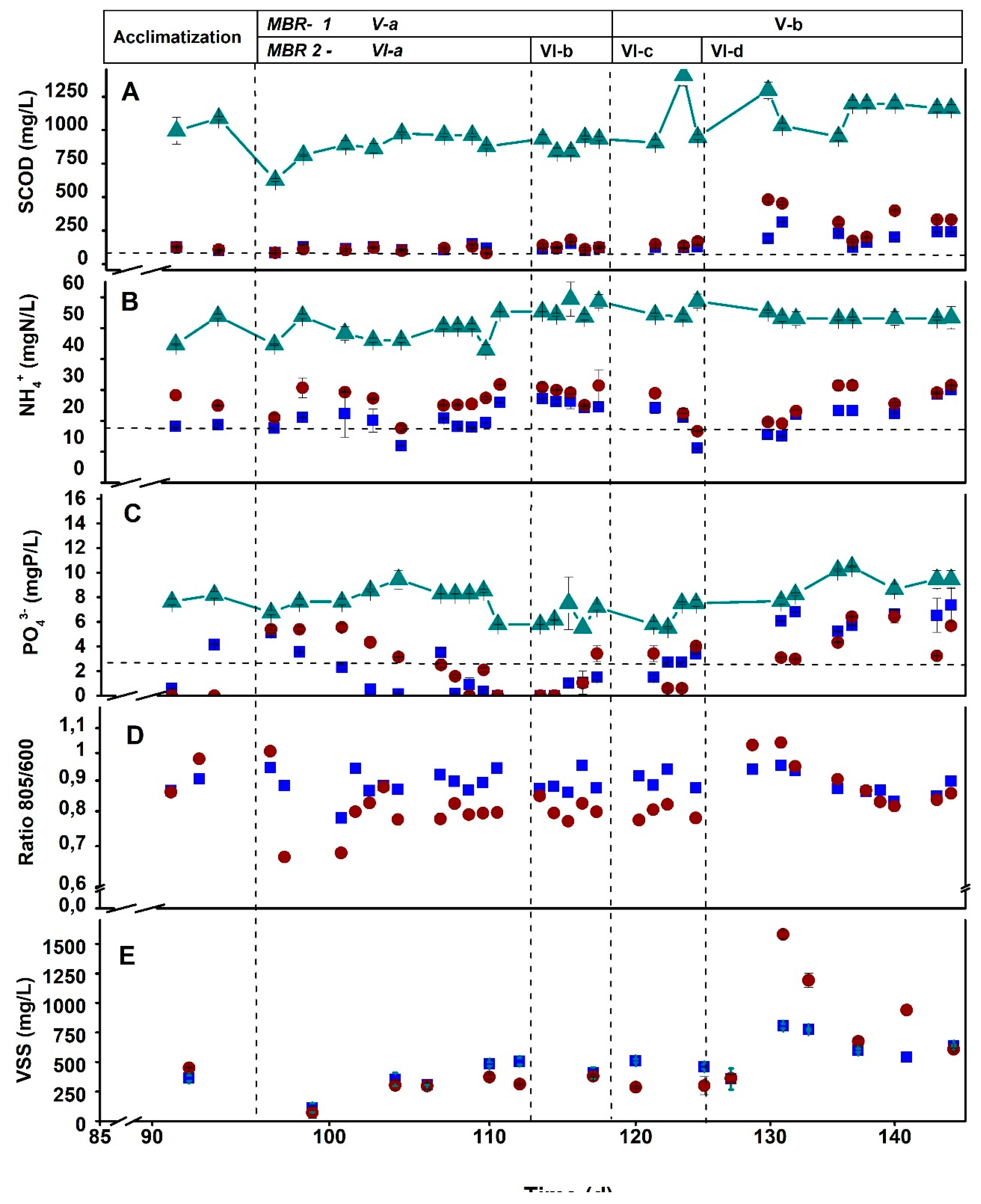
Figure 7.
Evolution of the microbial community of the MBR mode operation during the different stages. (The supplementary information shows the evolution of the microbial composition in more detail, including the genera that appear in percentages higher than 1%.).
Figure 7.
Evolution of the microbial community of the MBR mode operation during the different stages. (The supplementary information shows the evolution of the microbial composition in more detail, including the genera that appear in percentages higher than 1%.).
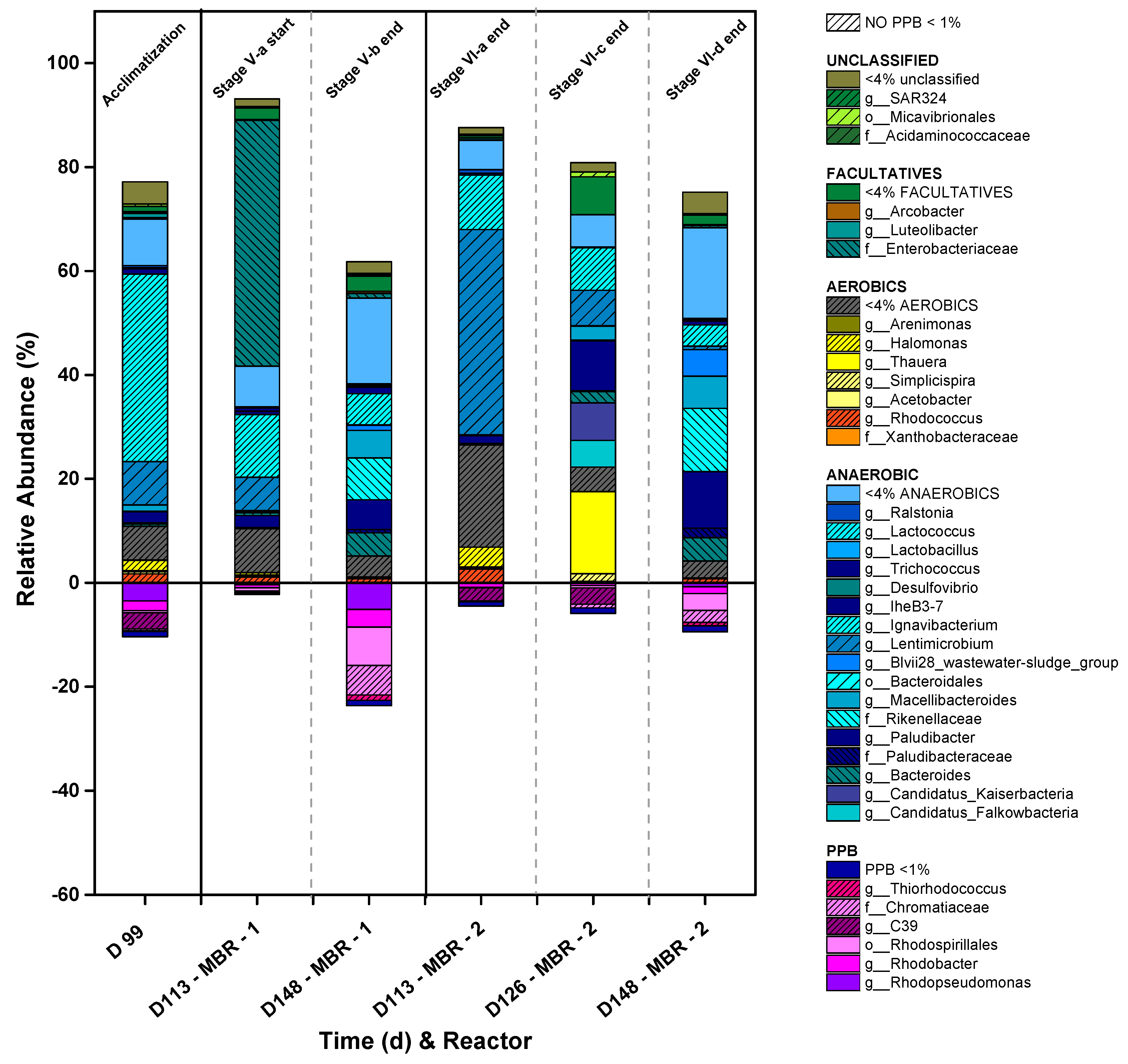
Figure 8.
Time course of ORP in the MBR-1 (-■-) and MBR-2 (-●-) and temperature (--) in both reactors. On the top of the figure are represented the different stages (from V to VI).
Figure 8.
Time course of ORP in the MBR-1 (-■-) and MBR-2 (-●-) and temperature (--) in both reactors. On the top of the figure are represented the different stages (from V to VI).
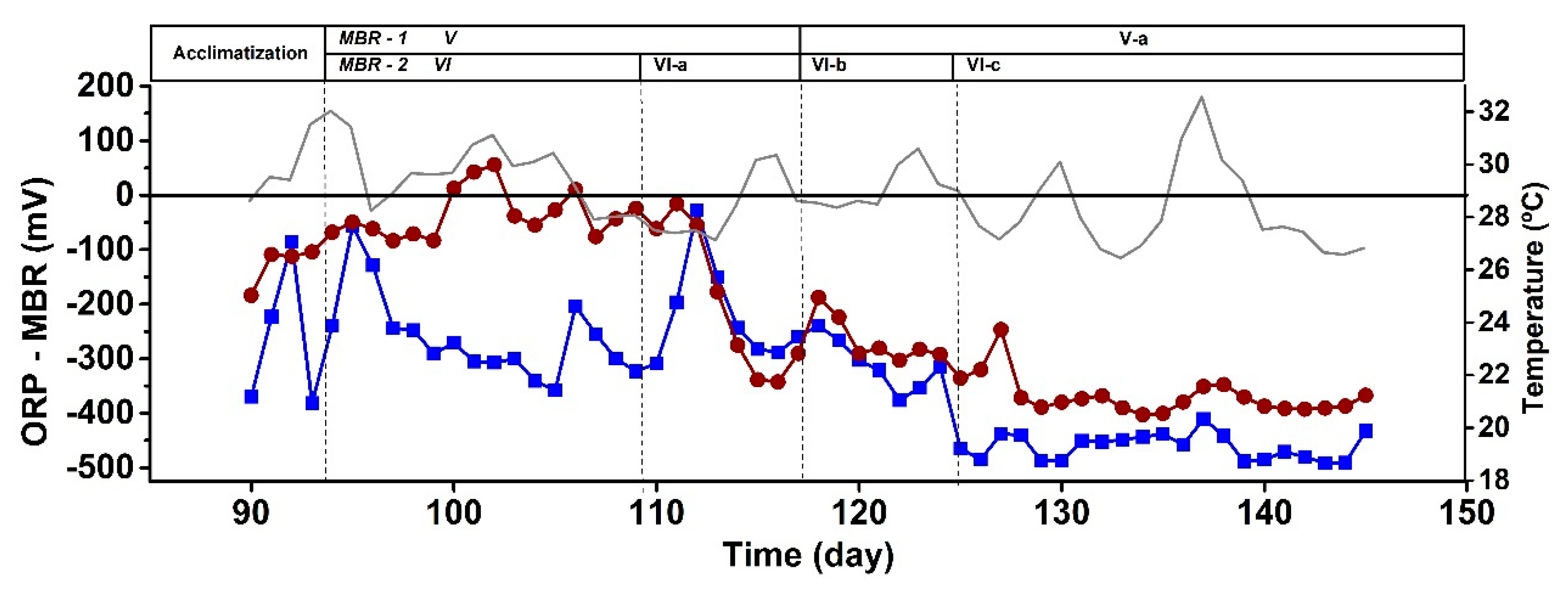
Figure 9.
Relation between COD:N intake and uptake ratios (bars) in each Stage compared with the relative abundance of non-PPB microorganisms (symbols) expressed as 16S rRNA gene copies. Graph A represents MBR-1 and graph B represents MBR-2.
Figure 9.
Relation between COD:N intake and uptake ratios (bars) in each Stage compared with the relative abundance of non-PPB microorganisms (symbols) expressed as 16S rRNA gene copies. Graph A represents MBR-1 and graph B represents MBR-2.
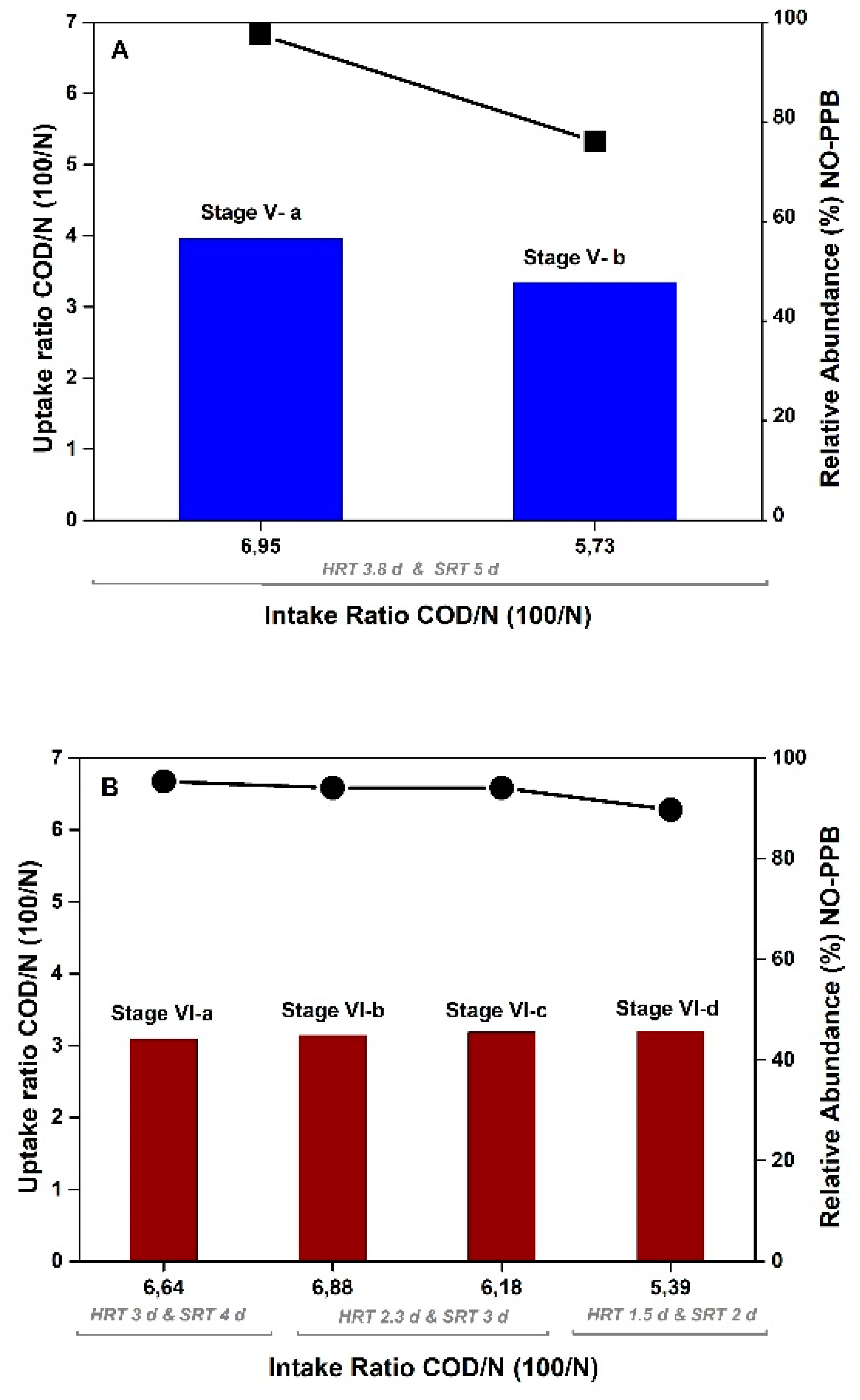

Table 1.
Average values with standard deviations (in brackets) for the soluble COD, ammonium (NH4+) and phosphate (PO43-) and volatile suspended solids (VSS) liquid fraction of the hydrolysate from the OFMSW, DWW from Estiviel, Toledo (Spain), DWW from La Gavia, Madrid (Spain) and inoculum of PPB.
Table 1.
Average values with standard deviations (in brackets) for the soluble COD, ammonium (NH4+) and phosphate (PO43-) and volatile suspended solids (VSS) liquid fraction of the hydrolysate from the OFMSW, DWW from Estiviel, Toledo (Spain), DWW from La Gavia, Madrid (Spain) and inoculum of PPB.
| SCOD (mg/L) |
TCOD (mg/L) |
NH4+ (mgN/L) |
PO43- (mgP/L) |
VSS (mg/L)* |
|
|---|---|---|---|---|---|
| Campaign 1: days 1-39 | |||||
| OFMSW hydrolysate (n=9) | 67000 (1000) | 78000 (3000) | 59 (1) | 75 (4) | 58 (1) |
| DWW Estiviel (n=18) | 196 (6) | 270 (8) | 48 (1) | 5 (1) | 26 (4) |
| Campaign 2: days 40-60 | |||||
| OFMSW hydrolysate (n=9) | 62000 (2000) | 78000 (3000) | 37 (2) | 132 (2) | 58 (1) |
| DWW Estiviel (n=18) | 168 (3) | 270 (8) | 54 (1) | 6 (1) | 24 (2) |
| Campaign 3: days 61-147 | |||||
| OFMSW hydrolysate (n=9) | 51000 (1000) | 57000 (300) | 85 (4) | 130 (20) | 53 (1) |
| DWW Estiviel (n=18) | 106 (3) | 500 (22) | 48 (2) | 5 (1) | 90 (15) |
| SPA source biowastes | |||||
| OFMSW hydrolysate (n=9) | 67000 (1000) | 78000 (3000) | 59 (1) | 75 (4) | 58 (1) |
| DWW La Gavia (n=4) | 155 (10) | 203 (20) | 65 (1) | 16 (1) | 69 (10) |
| Inoculum (SPA and semicontinuous photobioreactors) | |||||
| Inoculum of PPB (n=3) | 330 (10) | 800 (20) | 6 (1) | 5 (1) | 368 (3) |
Table 2.
Average and 95% Confidence Intervals from triplicates of measured macroscopic values of the 5 mixtures of LF and DWW and the two negative control experiments (LF and DWW).
Table 2.
Average and 95% Confidence Intervals from triplicates of measured macroscopic values of the 5 mixtures of LF and DWW and the two negative control experiments (LF and DWW).
| COD:N ratio | SCOD (mg/L) |
NH4+ (mgN/L) |
PO43 (mgP/L) |
VSS (mg/L) |
TOC (mg/L) |
pH |
|---|---|---|---|---|---|---|
| 100:3 | 2080 ± 90 | 62 ± 1 | 11.6 ± 0.6 | 92.0 ± 0.0 | 890.5 ± 59.4 | 6.92 ± 0.02 |
| 100:4 | 1400 ± 40 | 53 ±1 | 8.5 ± 0.4 | 100 ± 10 | 587.2 ± 39.1 | 6.91 ± 0.02 |
| 100:5 | 1080 ± 50 | 59 ± 2 | 8 ± 2 | 104 ± 5 | 554.8 ± 37.0 | 6.9 ± 0.02 |
| 100:6 | 1190 ± 50 | 53 ± 1 | 8.0 ± 0.7 | 92 ± 5 | 478.8 ± 31.9 | 7.03 ± 0.02 |
| 100:7 | 1010 ± 60 | 53 ± 3 | 7.2 ± 0.2 | 88 ± 5 | 401.3 ± 26.8 | 7.04 ± 0.02 |
| DWW (control) | 400 ± 90 | 54.8 ± 0.6 | 5.0 ± 0.9 | 86 ± 8 | 54.4 ± 3.6 | 7.55 ± 0.02 |
| LF (control) | 1600 ± 90 | 11.4 ± 0.6 | 4.7 ± 0.1 | 41 ± 2 | 716.8 ± 47.8 | 4.46 ± 0.02 |
Table 3.
CSRT and MBR mode operating conditions and inlet feed parameters during the trial. The average of the feed input values is represented with standard deviations (in brackets). The error in COD to N ratios is estimated with the 95% Confidence Intervals.
Table 3.
CSRT and MBR mode operating conditions and inlet feed parameters during the trial. The average of the feed input values is represented with standard deviations (in brackets). The error in COD to N ratios is estimated with the 95% Confidence Intervals.
| CSTR mode | MBR mode | |||||||||||||
|---|---|---|---|---|---|---|---|---|---|---|---|---|---|---|
| Reactor | CSTR-1 and CSTR-2 | MBR-1 | MBR-2 | |||||||||||
| Stage | I | II | III | IV | V-a | V-b | VI-a | VI-b | VI-c | VI-d | ||||
| Period (d) | 01-15 | 15-40 | 40-62 | 62-96 | 96-118 | 118-145 | 96-111 | 111-118 | 118-125 | 125-145 | ||||
| Time (d) | 15 | 25 | 22 | 34 | 22 | 27 | 15 | 7 | 7 | 20 | ||||
| HRT (d) | 3 | 3 | 5 | 5 | 3.8 | 3.8 | 3 | 2.3 | 2.3 | 1.5 | ||||
| SRT (d) | 3 | 3 | 5 | 5 | 5 | 5 | 4 | 3 | 3 | 2 | ||||
| COD:N | 100:4.4±1.7 | 100: 6.6±0.9 | 100:6.7±0.7 | 100:5.8±0.6 | 100:6.9±0.6 | 100:5.8±0.6 | 100:6.6±0.8 | 100:6.9±0.7 | 100:6.2±1.4 | 100:5.4±0.6 | ||||
| OLR (g COD / L·d) | 0.41 (0.05) | 0.30 (0.07) | 0.21 (0.04) | 0.21 (0.05) | 0.23 (0.03) | 0.30 (0.04) | 0.29 (0.05) | 0.39 (0.02) | 0.40 (0.01) | 0.76 (0.09) | ||||
| SLR (g COD / gVSS·d)* | 1.6 (0.6) | 1.6 (0.7) |
0.8 (0.3) | 1.0 (0.3) |
0.40 (0.09) | 0.49 (0.15) | 0.6 (0.2) | 1.0 (0.3) | 0.8 (0.5) |
0.6 (0.2) |
1.0 (0.1) |
1.17 (0.07) | 1.2 (0.3) | 1.2 (0.6) |
| Inlet parameters (mg/L) | ||||||||||||||
| SCOD | 1200 (40) | 970 (20) | 1010 (40) | 1100 (40) | 890 (20) | 1100 (30) | 890 (20) | 870 (30) | 910 (20) | 1210 (30) | ||||
| NH4+-N | 32 (1) | 56 (1) | 54 (1) | 55 (1) | 51 (1) | 55 (2) | 50 (1) | 54 (2) | 57 (2) | 54 (2) | ||||
| PO43--P | 6 (1) | 7 (1) | 8 (1) | 9 (1) | 8 (1) | 8 (1) | 8 (1) | 7 (1) | 7 (1) | 9 (1) | ||||
* In CSTR mode, R1 and R2 data is split.
Table 4.
Resume of the 5 set of COD:N ratios (100:3 to 100:7) and the controls for the SPA. Calculation of COD:N:P intake, removal rates, biomass yield, and pH variation during the SPA.
Table 4.
Resume of the 5 set of COD:N ratios (100:3 to 100:7) and the controls for the SPA. Calculation of COD:N:P intake, removal rates, biomass yield, and pH variation during the SPA.
| Ratio test | COD:N: P intake | Removal (%) | pH |
Y X/S (mgVSS/mgCOD) |
|||||
|---|---|---|---|---|---|---|---|---|---|
| COD | N | P | COD | N-NH4+ | P-PO43- | Initial | Final | ||
| 100:3 | 100 | 5.1 | 0.9 | 64.1 | 99.4 | 91.9 | 6.9 ± 0.1 | 6.9 ± 0.1 | 0.48 ± 0.01 |
| 100:4 | 100 | 7.4 | 1.2 | 58.6 | 98.8 | 100.0 | 6.9 ± 0.1 | 7.0 ± 0.1 | 0.68 ± 0.10 |
| 100:5 | 100 | 10.9 | 1.4 | 59.6 | 99.1 | 100.0 | 6.9 ± 0.1 | 6.9 ± 0.1 | 0.71 ± 0.03 |
| 100:6 | 100 | 6.4 | 1.0 | 74.2 | 98.8 | 100.0 | 7.0 ± 0.1 | 6.8 ± 0.0 | 0.46 ± 0.06 |
| 100:7 | 100 | 6.8 | 0.9 | 84.5 | 99.9 | 100.0 | 7.0 ± 0.1 | 6.9 ± 0.1 | 0.27 ± 0.09 |
| DWW | 100 | 10.9 | 0.7 | 86.8 | 62.9 | 41.7 | 7.5 ± 0.1 | 7.8 ± 0.1 | 0.26 ± 0.05 |
| LF | 100 | 1.4 | 0.3 | 30.6 | 52.4 | 28.7 | 4.5 ± 0.1 | 4.8 ± 0.1 | 0.21 ± 0.05 |
Disclaimer/Publisher’s Note: The statements, opinions and data contained in all publications are solely those of the individual author(s) and contributor(s) and not of MDPI and/or the editor(s). MDPI and/or the editor(s) disclaim responsibility for any injury to people or property resulting from any ideas, methods, instructions or products referred to in the content. |
© 2023 by the authors. Licensee MDPI, Basel, Switzerland. This article is an open access article distributed under the terms and conditions of the Creative Commons Attribution (CC BY) license (http://creativecommons.org/licenses/by/4.0/).
Copyright: This open access article is published under a Creative Commons CC BY 4.0 license, which permit the free download, distribution, and reuse, provided that the author and preprint are cited in any reuse.


