

Submitted:
01 December 2022
Posted:
14 December 2022
You are already at the latest version
Abstract
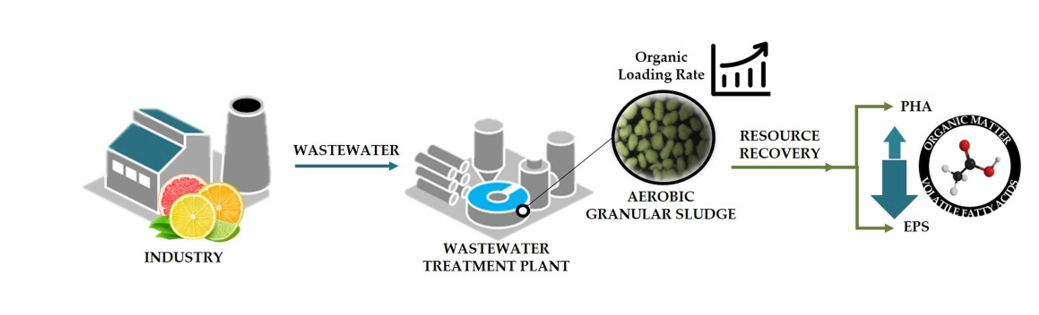
Valorization of excess sludge through the recovery of high-value products, such as biopolymers, could be a crucial step to implement circular economy principles in wastewater treatment plant (WWTP). In this frame, the present study was aimed at evaluating the simultaneous production of polyhydroxyalkanoates (PHA) and extracellular polymeric substances (EPS), obtainable from the treatment of an agro-industrial wastewater. Two biological systems, one implementing aerobic granular sludge (AGS) and the other a conventional activated sludge operating as a sequencing batch reactor (SBR) were operated for 204 and 186 days, respectively. Both the systems involved a three-stage process for mixed microbial culture enrichment and biopolymers accumulation. The maximum biopolymers accumulation capacity was close to 0.60 mg gVSS-1 in the AGS when the enrichment reactor was operated at 3 kgCODm-3d-1, whereas in the SBR it was slightly more than half (0.35 mg gVSS-1). Biopolymers extracted from the AGS were mainly constituted by EPS (>70%), which percentage increased with the organic loading rate applied in the enrichment reactor up to 95%. In contrast, SBR enabled to obtain a higher PHA production (50% of the biopolymers). Results suggested that organic carbon was mainly channeled toward metabolic pathways for extracellular storing in AGS, likely as a consequence of metabolic stressors (e.g., hydraulic selection pressure, shear forces) applied for promoting aerobic granulation.
Keywords:
Aerobic granular sludge
; Biopolymers
; Circular Economy
; Extracellular Polymeric Substances
; Polyhydroxyalkanoates
; Sewage Sludge
; Wastewater Treatment.
Copyright: This open access article is published under a Creative Commons CC BY 4.0 license, which permit the free download, distribution, and reuse, provided that the author and preprint are cited in any reuse.


