

Submitted:
26 July 2023
Posted:
27 July 2023
You are already at the latest version
Abstract
A commercial phage biocontrol for reducing Listeria monocytogenes has been described as an effective tool for improving fresh produce safety. Critical challenges in the phage application must be overcome for the industrial application. The validation studies were performed in two processing lines of two industry collaborators in Spain and Denmark, selecting shredded iceberg lettuce as the ready-to-eat (RTE) product of higher process volume. The biocontrol treatment optimized in lab-scale trials for the application of PhageGuard ListexTM was confirmed in industrial settings by four tests, two in Spain and two in Denmark. Results showed that the method of application that included the device and the processing operation step were appropriate for the correct application. The proper dose of Phage Guard ListexTM was reached in shredded iceberg lettuce and the surface was adequately covered for the successful application of phages. There was no impact on the headspace gas composition (CO2 and O2 levels), nor on the color when untreated and treated samples were compared. The post-process treatment PhageGuard ListexTM did not cause any detrimental impact on the sensory quality, including flavor, texture, browning, spoilage and visual appearance of over the shelf-life as the phage solution was applied as a fine, mist solution.
Keywords:
food safety
; fresh produce
; biocontrol
; foodborne
; phage application
1. Introduction
Listeria monocytogenes (Lm) is a foodborne pathogenic bacteria that cause a spectrum of human illnesses (listeriosis) of variable severity [1]. Listeria outbreaks and their detection in random sampling with the consequent product recalls have usually been linked to food of animal origin (FoAO) such as soft cheese or ready-to-eat (RTE) meats [2]. Given the recent records related to Lm outbreaks in fruits and vegetables, there is a growing concern about Lm contamination in fresh produce and the risk to public health, which also includes the RTE fruit and vegetable industry [3].
Environmental monitoring programs established by the industry or carried out by research groups have shown that Listeria spp. and specifically Lm can be isolated from fresh produce and processing environments [1,4]. Fortunately, the risk of final produce contamination occurring via the industry environment is relatively low because of current safety management strategies implemented by the industry. The severity of the listeriosis outbreaks highlights the importance of effective preventive control strategies to reduce, control, and/or eliminate Lm [3]. Environmental monitoring programs and cleaning and sanitation plans implemented by the industry are in constant revision and improvement because of the absence of infallibility [5]. However, there are limits to the effectiveness of these measures that could lead to bacteria persistence in postharvest environments [5,6,7,8] plus the difficulties in having a representative microbial sampling for Lm detection.
The implementation of different post-process treatments as an additional safety barrier in fresh produce manufacturing has been extensively studied in several food products such as meat and dairy products, although very little in fresh whole products and almost unknown in RTE products [9]. Increasing interest has been achieved in the post-process application of bacteriophages as natural pathogen-targeting bio-control agents to preserve food safety [10,11]. Phages are microorganisms of great abundance and ubiquity. These entities are involved in the dynamics of microbial populations in most ecosystems and have been used as antimicrobial agents for a century, but antibiotic use eclipsed their development [12]. Despite the institutional approval in some countries of the use of different phages as biocontrol agents [13], there are still important consumer and regulatory concerns. These concerns limit or delay the research in this area by hindering its application in commercial industrial environments and restricting its research studies to lab-scale trials [14,15]. In this sense, it is important to make a step forward in implementing research studies at the industrial level to validate Lm control strategies. This more applied research approach will help to gather information on phages optimization and effectiveness to gain the industry confidence for the application of biopreservation treatments [14].
This study aimed to determine the suitability of a commercial phage-based treatment to control Lm in leafy greens at an industrial scale. The application of the previously optimized conditions of selected phage-based treatment had the goal to evidence under an industrial setting, the challenges for the application in the industry as well as its impact on the quality of the final product. The main objective of the validation trials was to demonstrate that the target concentration of the active microorganisms needed to inhibit the growth of Lm was achieved under industrial conditions by adding the lowest amount of water to prevent any deterioration from the water excess on the product.
2. Materials and Methods
2.1. Biopreservative agent and application conditions
PhageGuard Listex™ was the commercial biopreservative agent that contained a cocktail of phages (Phage P100) at a 1011pfu/ml (Micreos, Wageningen, the Netherlands). The target concentration of the selected post-process treatment was 106-107 pfu/g. It was declared by the manufacturer to be effective against all Listeria strains. It is a USDA/FDA GRAS-approved (GRAS Notice No. 000218) and an FSIS processing aid approved when applied at a level of 107 to 109 pfu/g of the product (FSIS Directive 7120.1). It is further accepted as a processing aid in Australia, New Zealand, Israel, Switzerland, the Netherlands, Canada, and other countries.
Validation of PhageGuard Listex™ in an industrial setting was performed in two processing plants: one in Torre Pacheco (Murcia, Spain) and other in Central Jutland Region (Arhus, Denmark). The fresh-cut product selected and processing lines in both locations were shredded iceberg lettuce. The application point at the Spanish facility was the vibration conveyor belt after the pre-visual inspection control point before ascending the conveyor belt to the packaging operation. At Danish facility, the post-process treatment was applied in the vibrating conveyor belt just before the packaging machine entry. The two application points allowed the homogeneous mixture of the treated product before packaging.
For the application of the treatment in the processing plants, a prototype was built in an arc design above the selected conveyor belt with several nozzles to cover the conveyor width. The prototype consisted of a tank with the phage solution connected to a suction pump, which feed the nozzles that applied the treatment to the product. Nozzles were installed using a metallic structure placed above the conveyor belt that allowed the adjustment of the height of the nozzles. The same prototype was used in the two industrial settings. The post-process treatment was applied after washing and drying, just before packaging (Figure 1). For packaging, bags of RTE iceberg lettuce were flushed with nitrogen (N2) to reduce the oxygen (O2) concentration from 21 % to 0-3%. Samples were analyzed after processing (day 0) and during the shelf-life (1, 5, 9 and 15 days of storage at 7 ºC). However, the length of the shelf-life was adjusted depending on the product quality. Three out of four trials were cancelled after 9 days of storage because of the deterioration of the product, while in the other assay, a shelf-life of 15 days was reached. The short shelf life was expected as bags of 500 g of shredded iceberg are delivered for food service with a shelf life of a max of 6 days.
2.2. Microbiological analyses
Bacteriophage enumeration was performed as described in Truchado et al., 2020 [10]. Enumeration of Listeria spp. and Lm in iceberg lettuce was based on the ISO-11290-1 method with slight modifications. For enrichment, twenty-five grams of iceberg lettuce were mixed with 225 ml of Half Fraser Broth and 1% of pyruvate and incubated for 48 hours at 30ºC. Then 1 ml of the homogenate was transferred to 9 ml of Fraser broth and incubated at 37ºC for 24 h. Potentially positive colonies for Lm were confirmed by conventional polymerase chain reaction (PCR) using a PCR System (Applied Biosystems® thermal cycler) with specific primers to confirm the presence of virulence hly and iap genes.
2.3. Sensory evaluation
Commercial bags (n=40) obtained in the industrial validation were transported to the laboratory (40 km) and kept at refrigerated storage conditions of 7ºC for 15 days. Organoleptic tests as subjective measurements and visual images as objective analyses related to product quality were carried out in Spain due to the absence of the same equipment in the collaborating laboratory in Denmark.
Changes in the headspace gas composition (O2 and CO2 concentrations) within the bags were monitored each day of evaluation with a calibrated syringe and measured using a gas chromatograph (Shimadzu GC-14, Kyoto, Japan) equipped with a thermal conductivity detector (TCD). The gas was drawn from the bags using a septum attached to the bags.
The organoleptic attributes included browning, texture, flavor, spoilage, and overall visual quality of the control and treated product evaluated initially and after 5 and 9 days of storage. Coded (3 digits) samples were presented individually to six trained judges to make independent evaluations. Off-flavor and odor, texture and spoilage were scored on a continuous scale ranging from 0-10 (0= absence; 10= completely damaged). Overall visual quality was scored on a continuous 0-10 scale (0= extremely unpleasant; 10=extremely pleasant).
At each sampling point, photographs (n=4) of control and treated products were taken for the objective measurements of color changes [16]. The camera was a Canon EOS (70D) (Canon Lens: EF-S18-55mm f/3,5-5.6 IS). Photograph conditions were: 1/50 sec II shutter speed, ƒ / 5,6 ISO: 100 aperture and SpyderCheckr™ RGB spectrum (v 1.3; Datacolor; Electrical & Electronic Manufacturing Lawrenceville, New Jersey) as a reference color chart for calibration. Photographs were processed (background removed and format conversion) with Adobe® Photoshop® 2020 (V 21.1.0; Adobe Photoshop CS. (2004). Berkeley, CA: Peachpit Press). ImageJ (v 1.53 K; Rasband, W.S., ImageJ, U. S. National Institutes of Health, Bethesda, Maryland, USA. URL https://imagej.nih.gov/ij/, 1997-2018). RGB images were converted to Lab stack and the image values in the CIE L* a* b* color scale were obtained. In detail, L* indicates the lightness from black (0 value) to white (100 value), a* the redness (+) or greenness (-), and b* the yellowness (+) or blueness (-). The color was measured on the surface of 2 portions of lettuce for each replicate. The instrument was calibrated with a white plate as standard reference (L* = 97.55, a* = 1.32, b* = 1.41). The a* and b* color parameters recorded were used for the calculation of the hue angle (h°) using the formula: h° =arctg(b*/a*).
2.4. Statistical analysis
The microbial data generated were log10 transformed and analyzed using a non-parametric test. Based on the nature of the experiments and the final adjustment of the data, the selected approach was a mixed model. P values below 0.05 were considered statistically significant. Shapiro-Wilk test was performed to assess the normality of the microbiological data (P >0.05). Kruskal-Wallis test was used to determine differences between treatments for microbiological and organoleptic data during shelf life. The statistical analysis was performed using the R software (R Core Team, 2021) as a language and environment for statistical computing (R Foundation for Statistical Computing, Vienna, Austria. URL http://www.R-project.org/).
3. Results and discussion
3.1. Application challenges in the industrial settings
In the validation study, three main aspects were considered critical when bacteriophages were applied as post-process treatment in fresh produce. 1) the initial concentration of the bacteriophages achieved, 2) the amount of water added to the final product and its quality impact, and 3) the uniformity application of the bacteriophage on the produce surface [17].
The application of the bacteriophage solution in the industrial setting required a preliminary optimization setup for the processing line characteristics such as: the speed of the conveyor belt, the amount and high of the washed product placed on the conveyor belt, as well as the pressure of the nozzles system. As a result of these tests, it was concluded that the treatment should be applied to the product at a flow rate of 3.33 ml/s and a minimum pressure of the device of 7 bar with a spray pattern of full-cone nozzle [18].
The prototype was placed above the vibration conveyor belt for the homogeneity distribution of the product and the proper application of the phage solution. The post-process treatment was applied for approximately 1 sec and the product was passed during 15 min. From the whole production, a total of 40 bags (500 g) of treated and also untreated product was collected and transported to the lab for further analysis. After the treatment was applied, the processing lines were washed with water to eliminate any phage residue. Two trials were performed in each industrial setting. Some adjustments related to height and nozzle distribution were made after the first test. For the application point selection, the recommendations obtained by Leverentz et al. (2004) [19] that applied a commercial phage cocktail (phage mixture LMP-102, Listshield™, Intralytix, Inc) with a spray gun were considered. These authors studied if the timing had an impact on phage effectiveness against Lm. They concluded that on this type of product, phage application was most effective between 0 to 1 h before contamination with Lm. This fact suggests that application should be done before packaging to be effective against potential contamination occurred during processing. Truchado et al. (2020) [10] tested at lab scale two points of application of PhageGuard Listex™: the conveyor belt and the centrifuge. They observed that industrial application always poses challenges. These authors encountered in curly endive that initial levels of Lm were reduced without significant differences among the point of application. In agreement with these authors, recently Tong Lu et al.(2022) [20] confirmed that inlet water used for phage dilutions should be free of chlorine residue to avoid phage reduction due to antimicrobial activity. These authors also recommended that sufficient rinsing should take place after the use of sanitizers in the washing operation before phages are applied.
3.2. Antimicrobial effect
Based on the manufacturer recommendations and also in our previous research, the target concentration of bacteriophages in the product was established at a level of 106-107 pfu/g [10,21]. Figure 2 shows the changes in the concentration of the bacteriophages obtained in the four sets of trials and during the storage. While the initial concentration of bacteriophages in the product of three out of the four trials was within the selected range, in the first trial, a lower concentration in the treated product was reached. The lack of regulation in trial 1 was solved by the mechanical adjustments of the nozzle and the prototype height. The changes made in the application device over the conveyor belt helped to reach the desired concentration.
Nebulization has been demonstrated to have destructive effects on phage structural stability [22]. These authors compared three nebulizers that were able to apply a titer dose of bacteriophages on aerosol of about 108–109 pfu/ml and a loading dose on the product of 1010 pfu/g. In the present experiment, the loss observed in the out-let solution was less than 1 log unit (data not shown).
Another important aspect was the stability of the phages after application and during storage of the product. In these experiments, bacteriophage levels were determined at 0, 1, 5 and 9 days of shelf-life. As Test 2 lasted 12 days because the product was not spoiled, the product was examined until this day although for microbiological analyses only 9 days were considered. Table 1 shows the results of Kruskal Wallis tests comparing bacteriophage counts in produce among days of storage in each test. In tests 1, 3 and 4 no significant differences were found between bacteriophage counts through storage. In these tests, the differences in phage log between the beginning and the end of storage ranged from 0.53 to 1.38 log pfu/g in agreement with Guenter et al. (2008) [23]. These authors reported a reduction of bacteriophage AP511 in iceberg lettuce and cabbage stored at 6ºC for 6 days from 0.6 to 1.2 logs. The same authors reported a decrease in infective particles up to 2 logs when produce was stored at 20ºC. Many variables should be controlled in experiments at an industrial level compared to experiments at a laboratory level, especially when biocontrol treatments are involved [24].
Significant differences were found among tests in the phage titer of the produce ran in different places (Kruskal-Wallis chi-squared = 25.842, df = 3, p-value = 1.029e-05). These differences may be due to the variation in the scale operations in the two processing plants [25]. The design of the processing lines was similar but not the same and this could affect the efficiency of the prototype nebulizer as it was designed for one factory and adapted for the other.
The efficacy of the application of the bacteriophage treatment in commercial products can only be confirmed if Lm is naturally present. In the four trials performed in the industrial settings, colonies compatible with Listeria spp. were found up to 2.00 log. These microorganisms could be present in the raw material entering the processing plants (RTE and frozen produce industry) [26] while Lm contamination is a potential risk. Listeria spp. could serve as an index microorganism indicating the possible entrance of Lm in industrial settings [3]. However, none of the presumptive Listeria spp. were confirmed as Lm. Data obtained under lab-scale trials showed that at the level of phages achieved in iceberg lettuce, Lm log reductions were confirmed, up to 3.0 log CFU/g after 15 days of storage (data not shown). Guenter et al. (2009) [23], registered a decrease in more than 2 log units in two Lm strains in iceberg lettuce leaves treated with the phage A511. In the same study, a reduction in Lm counts up to 2 log units was achieved in cabbage treated with phage P100 [23]. In both cases, regrowth of Lm was registered. Truchado et al. (2020) [10] reported a decrease in Lm counts in fresh-cut curly endive of an average of about 2.5 logs but registered an increase in bacterial counts after 8 days of storage (3 days 5 °C + 5 days 8 °C). On the other hand, Leverentz et al. (2004) [19] achieved a reduction of Lm up to 6.8 log units after 7 days of storage of honeydew melons pieces at lab scale with another commercial phage cocktail (phage mixture LMP-102, Listshield™, Intralytix, Inc). Similar findings were reported by Lone et al. (2016) [27] in fresh-cut cantaloupe inoculated with Lm. These authors registered a decrease in pathogen counts higher than 2 logs when treated with a phage cocktail (LinM-AG8, LmoM-AG13, and LmoM-AG20) and stored at 4 and 12 °C.
The type of commodity can influence the efficacy of the treatment. Thus, Oliveira et al. (2014) [28] observed that higher pH and liquid formats of fruits influence positively treatment results. Leverentz et al. (2003) [11] found that phage mixtures LM-103 and LMP-102 were effective against Lm in honeydew melon but not in Red Delicious slices. Other authors have observed the same tendency and explained these findings due to the pH of the fresh product [28]. Interaction between phages and their hosts can be influenced by other factors apart from pH and food matrix. Some authors have highlighted that ionic strength, the presence of substances that interfere with phage particle diffusion or penetration through the cell wall and membrane among other parameters, are factors that influence interactions between the virus and the host [29]. Some bioactive compounds present in fresh produce can also have a negative effect on bacteriophage titer [30]. Iceberg lettuce has a pH of around 6 [31] which, in principle, it is not expected a negative effect on the bioagent mechanism. In our study, validation was performed following the commercial operations conducted by the industry which means that bacteriophages were applied to iceberg lettuce washed with chlorinated and rinse. This fact could reduce some natural compounds present in fresh produce such as ascorbic acid [32] whose oxidation products have been reported to inactive some bacteriophage strains [33].
3.3. Sensory analyses
A critical challenge to consider in the phage application is the amount of water used for the liquid solution. In previous studies used as a guide for the present trials, [21] a lab-scale spray system (Spraying Systems CO® device AUTOJET model 1550+) with a lab scale tank and a J series straight nozzle was used for treatment application. This device managed to reduce the amount of water applied to the product (0.3 ml/s) as well as reducing aerosol formation avoiding the possible dispersion of the treatment solution in the working environment. In the present study, a spraying system described in Material & Methods section was used with a higher flow of water (3.33 ml/s) which resulted in a greater addition of water to the product in comparison to lab scale described. In theory, this might be thought to accelerate deterioration processes in treated product compared to control, but no significant differences in the organoleptic evaluation were found between treated and untreated product [34,35].
Before opening the bags, headspace gas composition was measured including O2 and CO2 levels. The concentration of CO2 in both trials increased to approximately 30% while O2 concentration decreased to 0% approximately. No significant differences were found between treated and untreated samples or between trials (Table 2). The anaerobic conditions reached were due to the high respiration rate of shredded lettuce because of the high wound response that accelerated the metabolism and increased the respiration rate to pieces of higher size [36]. The temperature of storage also affected the increase in the respiration rate and consequence the modified atmosphere packaging, increasing CO2 levels as a consequence of the anaerobic metabolism, that reduced the shelf life. Similar tendencies have been observed by other authors as the expected evolution of this packaging conditions used [36]
When color changes were studied by hue angles and L* values, no significant differences were found between the color parameters of the product treated with phages and control samples in test 1 (Table 2, Figure 3 and Figure 4). Significant differences between treated and untreated lettuce in test 2 at day 0 were found regarding these two color parameters and these differences were maintained over the storage. These differences were not referable to the treatments but to the color differences between batches. These differences were captured by the objective measure of image analysis that was able to separate batches of and detected color differences as previously reported in vegetables with different degrees of green color [16].
Similarly, no differences were found among the organoleptic parameters measured by the sensory panelists when comparing treated and untreated shredded lettuce (Table 2). Sensory panel perception scored similarly in the case of untreated samples and samples treated with phages. Sensory results agree with previously reported results by the processors and expert panel regarding the impact of phages on the quality of the product [37].
4. Conclusions
Our results show that the validation of PhagueGuard Listex™ as a post-process treatment was a relevant achievement as counteracts the main challenges of phage application at an industrial level. i) the method of application that included the device and the procession operation step overcome one of the main technical challenges, ii) the application of the proper concentration was an achievement by a fine, mist-like spray with no phage inactivation, and iii) the adequate coverage of the product surface and thus the effective effect of biocontrol of Lm log reductions achieved. Future research is still ongoing about the fate of the possible persistence of phages once applied in an industrial environment, which is one important aspect for optimal application.
Author Contributions
Conceptualization, P. Truchado and A. Allende; methodology, M. Gómez-Galindo and P. Truchado; formal analysis, M. Gómez-Galindo.; data curation, M. Gómez-Galindo and P. Truchado; writing—original draft preparation, Gómez-Galindo; writing—review and editing, Gómez-Galindo, and M.I. Gil; supervision, P. Truchado and A. Allende; funding acquisition, A. Allende and M.I. Gil. All authors have read and agreed to the published version of the manuscript.
Funding
This research was funded by Center for Produce Safety (CPS Award No. 2019CPS01), and Ministerio de Ciencia e Innovación (Project PID2019-104931RB-I00 and PID2022-141708OB-I00). P. Truchado is holding a Ramón y Cajal contract from the Ministerio de Ciencia e Innovación. M. Gómez-Galindo is holding a Formación del Profesorado Universitario (FPU) contract from the Ministerio de Ciencia e Innovación.
Acknowledgments
The technical assistance of Natalia Hernández and Ginés Abellán is very much appreciated.
Conflicts of Interest
The authors declare no conflict of interest.
References
- Townsend, A.; Strawn, L.K.; Chapman, B.J.; Yavelak, M.; Mishra, A.; Dunn, L.L. Factors that predict Listeria prevalence in distribution centers handling fresh produce. Food Microbiol. 2022, 107, 104065. [CrossRef]
- Jordan, K.; McAuliffe, O. Listeria Monocytogenes in Foods; 1st ed.; Elsevier Inc., 2018; Vol. 86; ISBN 9780128139776.
- Townsend, A.; Strawn, L.K.; Chapman, B.J.; Dunn, L.L. A systematic review of Listeria species and Listeria monocytogenes prevalence, persistence, and diversity throughout the fresh produce supply chain. Foods 2021, 10. [CrossRef]
- Zhu, Q.; Gooneratne, R.; Hussain, M.A. Listeria monocytogenes in fresh produce: outbreaks, prevalence and contamination levels. Foods 2017, 6, 1–11. [CrossRef]
- Li, X.; Hospital, X.F.; Hierro, E.; Fernández, M.; Sheng, L.; Wang, L. Formation of Listeria monocytogenes persister cells in the produce-processing environment. Int. J. Food Microbiol. 2023, 390. [CrossRef]
- Hong, S.H.; Wang, X.; O’Connor, H.F.; Benedik, M.J.; Wood, T.K. Bacterial persistence increases as environmental fitness decreases. Microb. Biotechnol. 2012, 5, 509–522. [CrossRef]
- Wu, S.; Yu, P.L.; Flint, S. Persister cell formation of Listeria monocytogenes in response to natural antimicrobial agent nisin. Food Control 2017, 77, 243–250. [CrossRef]
- Taylor, A.J.; Stasiewicz, M.J. Persistent and sporadic Listeria monocytogenes strains do not differ when growing at 37 °c, in planktonic state, under different food associated stresses or energy sources. BMC Microbiol. 2019, 19, 1–13. [CrossRef]
- Zagory, D. Effects of post-processing handling and packaging on microbial populations. Postharvest Biol. Technol. 1999, 15, 313–321. [CrossRef]
- Truchado, P.; Elsser-Gravesen, A.; Gil, M.I.; Allende, A. Post-Process treatments are effective strategies to reduce Listeria monocytogenes on the surface of leafy greens: a pilot study. Int. J. Food Microbiol. 2020, 313. [CrossRef]
- Leverentz, B.; Conway, W.S.; Camp, M.J.; Janisiewicz, W.J.; Abuladze, T.; Yang, M.; Saftner, R.; Sulakvelidze, A. Biocontrol of Listeria monocytogenes on fresh-cut produce by treatment with lytic bacteriophages and a bacteriocin. Appl. Environ. Microbiol. 2003, 69, 4519–4526. [CrossRef]
- Stone, E.; Campbell, K.; Grant, I.; McAuliffe, O. Understanding and exploiting phage–host interactions. Viruses 2019, 11, 1–26. [CrossRef]
- Naureen, Z.; Malacarne, D.; Anpilogov, K.; Dautaj, A.; Camilleri, G.; Cecchin, S.; Bressan, S.; Casadei, A.; Albion, E.; Sorrentino, E.; et al. Comparison between American and European legislation in the therapeutical and alimentary bacteriophage usage. Acta Biomed. 2020, 91, 1–7. [CrossRef]
- Sommer, J.; Trautner, C.; Witte, A.K.; Fister, S.; Schoder, D.; Rossmanith, P.; Mester, P.J. Don’t Shut the Stable Door after the Phage Has Bolted—the Importance of Bacteriophage Inactivation in Food Environments. Viruses 2019, 11, 1–27. [CrossRef]
- Mahony, J.; Casey, E.; van Sinderen, D. The Impact and Applications of Phages in the Food Industry and Agriculture. Viruses 2020, 12, 135–210. [CrossRef]
- Manninen, H.; Paakki, M.; Hopia, A.; Franzén, R. Measuring the green color of vegetables from digital images using image analysis. Lwt 2015, 63, 1184–1190. [CrossRef]
- Vikram, A.; Callahan, M.T.; Woolston, J.W.; Sharma, M.; Sulakvelidze, A. Phage biocontrol for reducing bacterial foodborne pathogens in produce and other foods. Curr. Opin. Biotechnol. 2022, 78, 102805. [CrossRef]
- Andrade, R.D.; Skurtys, O.; Osorio, F.A. Atomizing spray systems for application of edible coatings. Compr. Rev. Food Sci. Food Saf. 2012, 11, 323–337. [CrossRef]
- Leverentz, B.; Conway, W.S.; Janisiewicz, W.; Camp, M.J. Optimizing concentration and timing of a phage spray application to reduce Listeria monocytogenes on honeydew melon tissue. J. Food Prot. 2004; Vol. 67. [CrossRef]
- Lu, Y.T.; Ma, Y.; Wong, C.W.Y.; Wang, S. Characterization and Application of Bacteriophages for the Biocontrol of Shiga-Toxin Producing Escherichia Coli in Romaine Lettuce. Food Control 2022, 140, 109109. [CrossRef]
- Gómez-Galindo, M.; Truchado, P.; Volpi, M.; Elsser-Gravesen, A.; Gil1, M.I.; Allende, A. Inactivation Efficacy of Four Commercial Bioprotective Post-Process Treatments against Listeria Monocytogenes and Impact on the Commercial Quality of Leafy Greens. Food Control 2023.(submitted).
- Astudillo, A.; Leung, S.S.Y.; Kutter, E.; Morales, S.; Chan, H.K. Nebulization Effects on structural stability of bacteriophage pev 44. Eur. J. Pharm. Biopharm. 2018, 125, 124–130. [CrossRef]
- Guenther, S.; Huwyler, D.; Richard, S.; Loessner, M.J. Virulent bacteriophage for efficient biocontrol of Listeria monocytogenes in ready-to-eat foods. Appl. Environ. Microbiol. 2009, 75, 93–100. [CrossRef]
- Crater, J.S.; Lievense, J.C. Scale-up of Industrial Microbial Processes. FEMS Microbiol. Lett. 2018, 365, 1–5. [CrossRef]
- Somasundaram, S. Scaling Up: A comprehensive comparison between laboratory-scale, pilot-scale, and full-scale studies in research available online: https://www.ilovephd.com/pilot-scale-lab-scale-full-scale/.
- Magdovitz, B.F.; Gummalla, S.; Thippareddi, H.; Harrison, M.A. Evaluating environmental monitoring protocols for listeria spp. and listeria monocytogenes in frozen food manufacturing facilities. J. Food Prot. 2020, 83, 172–187. [CrossRef]
- Lone, A.; Anany, H.; Hakeem, M.; Aguis, L.; Avdjian, A.C.; Bouget, M.; Atashi, A.; Brovko, L.; Rochefort, D.; Griffiths, M.W. Development of prototypes of bioactive packaging materials based on immobilized bacteriophages for control of growth of bacterial pathogens in foods. Int. J. Food Microbiol. 2016, 217, 49–58. [CrossRef]
- Oliveira, M.; Viñas, I.; Colàs, P.; Anguera, M.; Usall, J.; Abadias, M. Effectiveness of a bacteriophage in reducing Listeria monocytogenes on fresh-cut fruits and fruit juices. Food Microbiol. 2014, 38, 137–142. [CrossRef]
- Kawacka, I.; Olejnik-Schmidt, A.; Schmidt, M.; Sip, A. Effectiveness of phage-based inhibition of Listeria monocytogenes in food products and food processing environments. Microorganisms 2020, 8, 1–20. [CrossRef]
- Su, X.; Howell, A.B.; D’Souza, D.H. Antiviral effects of cranberry juice and cranberry proanthocyanidins on foodborne viral surrogates - a time dependence study in vitro. Food Microbiol. 2010, 27, 985–991. [CrossRef]
- Bridges, M.A.; Mattice, M.R. Over two thousand estimations of the pH of representative foods*. Am. J. Dig. Dis. 1939, 6, 440–449. [CrossRef]
- Kenny, O.; O’Beirne, D. The effects of washing treatment on antioxidant retention in ready-to-use iceberg lettuce. Int. J. Food Sci. Technol. 2009, 44, 1146–1156. [CrossRef]
- Richter, H.E.; Loewen, P.C. Effect of ascorbate on Phage DNA. 1982, 697, 25–30.
- Peng, H.; Sthapit Kandel, J.; Michelmore, R.W.; Simko, I. Identification of factors affecting the deterioration rate of fresh-cut lettuce in modified atmosphere packaging. Food Bioprocess Technol. 2020, 13, 1997–2011. [CrossRef]
- Sharkey, P.J.; Peggie, I.D. Effects of high-humidity storage on quality, decay and storage life of cherry, lemon and peach fruits. Sci. Hortic. (Amsterdam). 1984, 23, 181–190. [CrossRef]
- Tudela, J.A.; Marín, A.; Martínez-Sánchez, A.; Luna, M.C.; Gil, M.I. Preharvest and postharvest factors related to off-odours of fresh-cut iceberg lettuce. Postharvest Biol. Technol. 2013, 86, 463–471. [CrossRef]
- Połaska, M.; Sokołowska, B. Review Bacteriophages—a new hope or a huge problem in the food industry. AIMS Microbiol. 2019, 5, 324–347. [CrossRef]
Figure 1.
Conveyor belt selected as the point of application and the prototype installed above it for the phage solution application as a fine, mist-like spray covering uniform the entire product surface.
Figure 1.
Conveyor belt selected as the point of application and the prototype installed above it for the phage solution application as a fine, mist-like spray covering uniform the entire product surface.
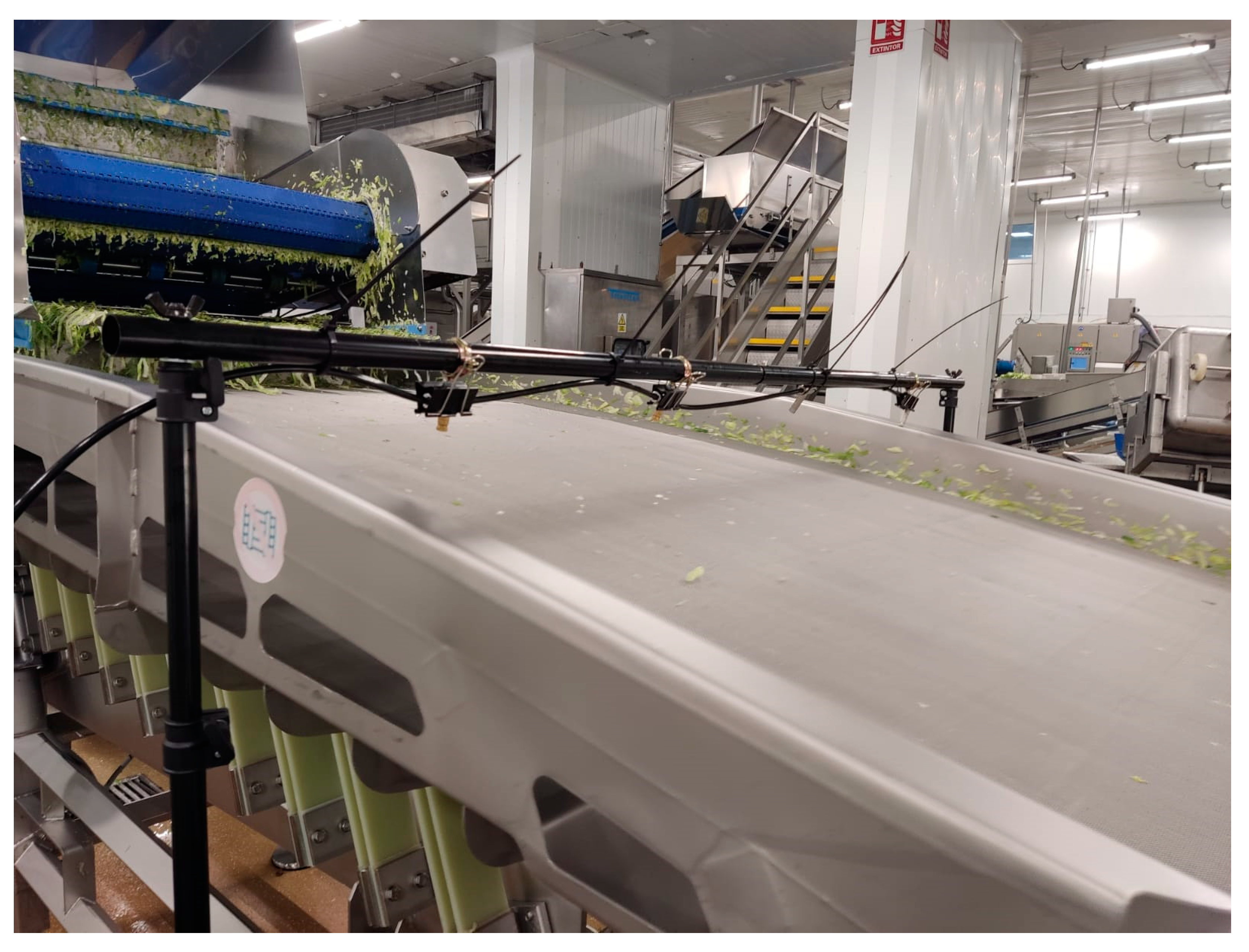
Figure 2.
Changes in the bacteriophage concentration applied in the 4 trials conducted in industrial settings in shredded iceberg lettuce stored for 9 days at 7 ºC.
Figure 2.
Changes in the bacteriophage concentration applied in the 4 trials conducted in industrial settings in shredded iceberg lettuce stored for 9 days at 7 ºC.
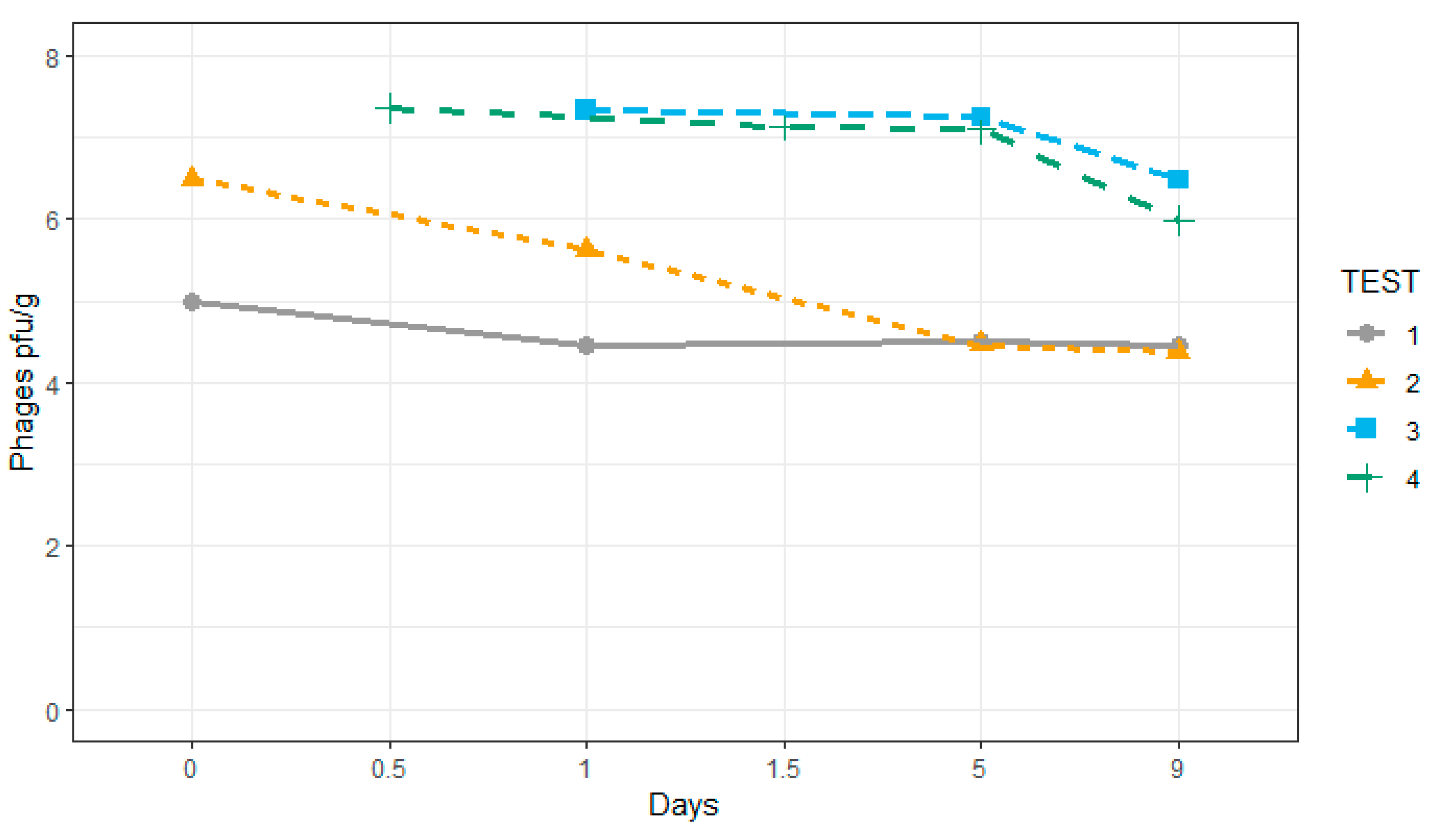
Figure 3.
Changes in hue angle between untreated and post-process Listex™ treated iceberg lettuce over 9 days of storage at 7ºC in test 1 (left graph) and test 2 (right graph). Box plots represent the interquartile interval, where 50% is the median (middle quartile) (n= 4 per day and treatment) and the lower and upper quartiles are 25 and 75% of the scores, respectively.
Figure 3.
Changes in hue angle between untreated and post-process Listex™ treated iceberg lettuce over 9 days of storage at 7ºC in test 1 (left graph) and test 2 (right graph). Box plots represent the interquartile interval, where 50% is the median (middle quartile) (n= 4 per day and treatment) and the lower and upper quartiles are 25 and 75% of the scores, respectively.
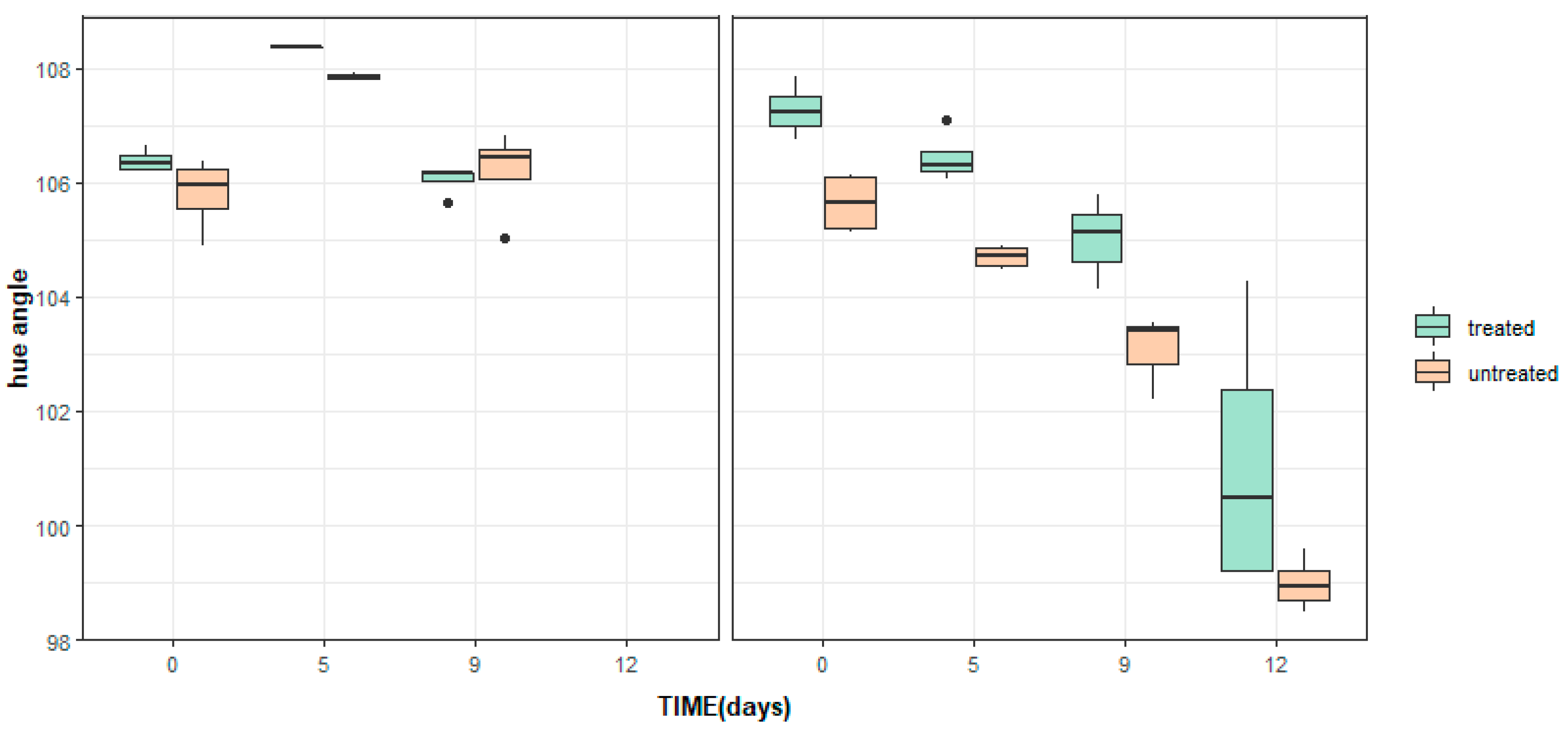
Figure 4.
Changes in L* value between untreated and post-process Listex™ treated iceberg lettuce over 9 days of storage at 7ºC in test 1 (left graph) and test 2 (right graph). Box plots represent the interquartile interval, where 50% is the median (middle quartile) (n= 4 per day and treatment) and the lower and upper quartiles are 25 and 75% of the scores, respectively.
Figure 4.
Changes in L* value between untreated and post-process Listex™ treated iceberg lettuce over 9 days of storage at 7ºC in test 1 (left graph) and test 2 (right graph). Box plots represent the interquartile interval, where 50% is the median (middle quartile) (n= 4 per day and treatment) and the lower and upper quartiles are 25 and 75% of the scores, respectively.
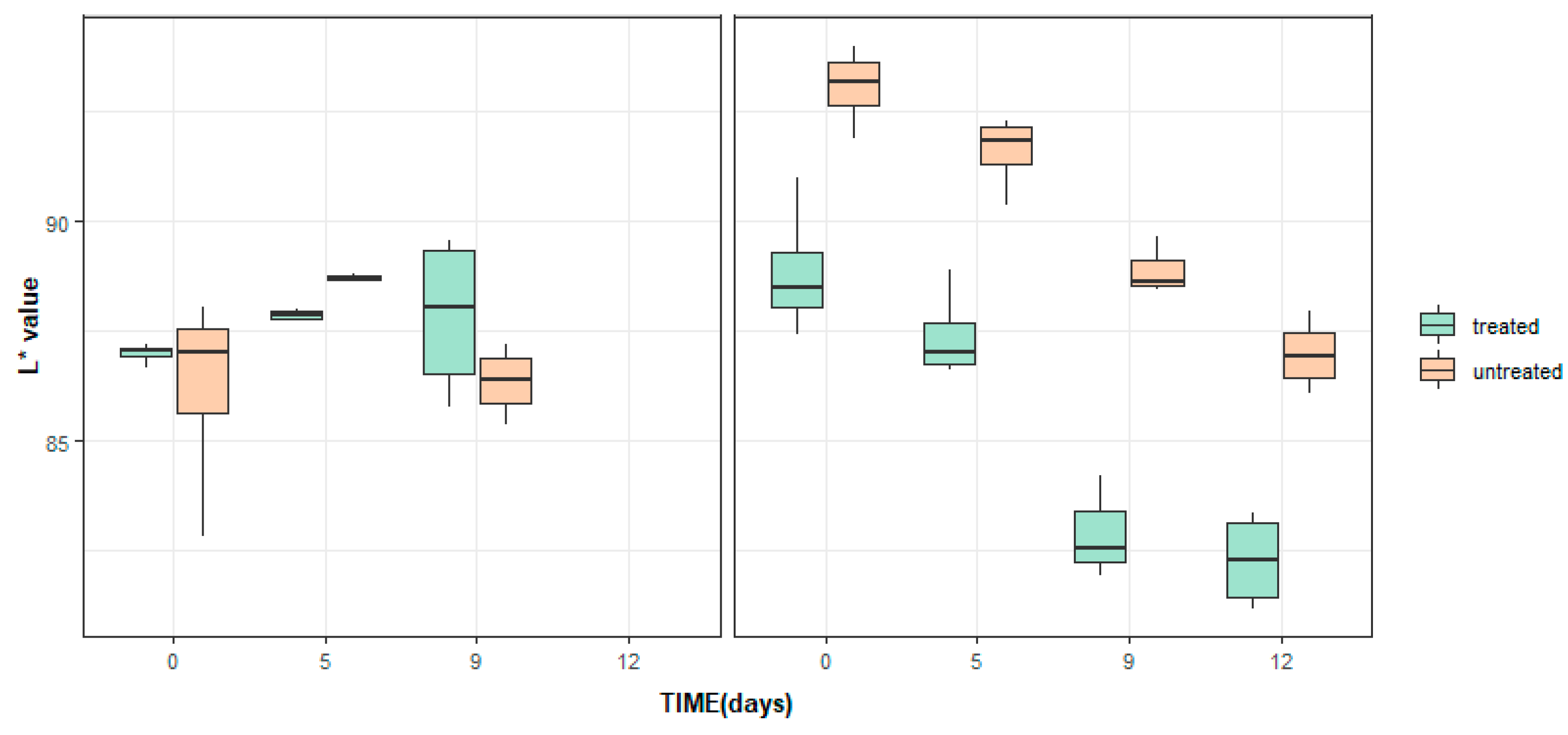

Table 1.
Kruskal- Wallis test comparison between tests of logs phages pfu/g of treated samples through 9 days of storage at 7ºC.
Table 1.
Kruskal- Wallis test comparison between tests of logs phages pfu/g of treated samples through 9 days of storage at 7ºC.
| TESTS | K-W Test |
|---|---|
| TEST 1 | Chi-square 6.633 |
| df 3 | |
| P value 0.084 | |
| TEST 2 | Chi-square 12.654 |
| df 4 P value 0.0131 | |
| TEST 3 | Chi-square 3.429 |
| df 2 | |
| P value 0.180 | |
| TEST 4 | Chi-square 6.167 |
| df 3 P value 0.103 |
Table 2.
Kruskal-Wallis test comparison between headspace gas composition (O2 and CO2), color parameters (hue angle and L*) and organoleptic parameters of treated and untreated samples through 9 days (test 1) and 12 days (test 2) of storage at 7ºC.
Table 2.
Kruskal-Wallis test comparison between headspace gas composition (O2 and CO2), color parameters (hue angle and L*) and organoleptic parameters of treated and untreated samples through 9 days (test 1) and 12 days (test 2) of storage at 7ºC.
| Quality parameters | TEST 1 | TEST 2 | ||||
|---|---|---|---|---|---|---|
| Chi-square | dF | P value | Chi-square | dF | P value | |
| CO2 | 0.404 | 1 | 0.525 | 3.411 | 1 | 0.065 |
| O2 | 0.270 | 1 | 0.603 | 0.460 | 1 | 0.498 |
| L* | 0.462 | 1 | 0.496 | 0.051 | 1 | 0.820 |
| Hue angle | 10.874 | 1 | 0.000 | 4.924 | 1 | 0.026 |
| Flavor | 0.009 | 1 | 0.922 | 0.000 | 1 | 1 |
| Texture | 0.001 | 1 | 0.974 | 0.000 | 1 | 0.987 |
| Browning | 0.003 | 1 | 0.958 | 0.031 | 1 | 0.860 |
| Spoilage | 0.018 | 1 | 0.895 | 0.028 | 1 | 0.868 |
| Visual appearance | 0.031 | 1 | 0.861 | 0.031 | 1 | 0.860 |
Disclaimer/Publisher’s Note: The statements, opinions and data contained in all publications are solely those of the individual author(s) and contributor(s) and not of MDPI and/or the editor(s). MDPI and/or the editor(s) disclaim responsibility for any injury to people or property resulting from any ideas, methods, instructions or products referred to in the content. |
© 2023 by the authors. Licensee MDPI, Basel, Switzerland. This article is an open access article distributed under the terms and conditions of the Creative Commons Attribution (CC BY) license (http://creativecommons.org/licenses/by/4.0/).
Copyright: This open access article is published under a Creative Commons CC BY 4.0 license, which permit the free download, distribution, and reuse, provided that the author and preprint are cited in any reuse.


