

Submitted:
25 July 2023
Posted:
26 July 2023
You are already at the latest version
Abstract
Indonesia's government anticipates waste problems by managing them through a large number of waste reduction programs. From a governance perspective in Indonesia, it is known that actors from diverse governmental levels and across sectors are involved in waste management, and their involvement largely depends on their institutional goals and problems. Hence, they are expected to coherently collaborate together by developing and implementing sustainable instruments and resources for improving waste management problems. However, it is necessary to understand how supportive and restrictive the governance of waste reduction programs is to encourage successful trash reduction. This study is designed to evaluate and examine the application of Community-Based Solid Waste Management (CBSWM) in Makassar. In this research, The Governance Assessment Tool (GAT) was applied to analyze the governance context of the waste reduction programs in Makassar qualitatively. From the assessment, contexts can be described as either supportive or restrictive of the processes of implementing public policies on waste management. As a result of such an assessment, this study shed light on some opportunities to improve the governance of waste management implementation's impact on reducing waste in Makassar, South Sulawesi, Indonesia. The conclusion of this study depicts that the most important actors are affiliated with the local government and the community. Moreover, this study shows that the assessment of contextual governance is predominantly restrictive.
Keywords:
Governance Assessment Tool (GAT)
; waste management
; community-based solid waste management (CBSWM)
; waste bank
1. Introduction
More than 55% of Indonesia's garbage is categorized as organic waste, with the remaining waste being non-organic [1]. In particular, the Waste Management Law was passed by the Indonesian government in 2008. To address Indonesia's issues with waste management, other rules, such as those of the Minister of Environment Regulation, were most recently modified in 2021. However, Indonesian waste management practices have not been able to move beyond the "collect, transport, and dispose the waste" model up to this point. In addition, Indonesian cities typically dispose of trash by depositing it in landfills [1], [2].
Furthermore, Indonesia faces waste management challenges such as a lack of community involvement in policymaking, insufficient waste management capabilities, confined strategies, unsustainable long-term methods for managing waste, and a lack of coordination and cooperation between the government and the community [3], [4]. The final section deals to the many actors engaged at multiple levels in Indonesia. The management of waste in Indonesia is supervised not only by the city government, but also at the federal, national, provincial, and local levels. Furthermore, Indonesia has more detailed systems in place that involve more institutions at each level of government. There are numerous governance entities participating in waste management in urban areas in the city government, for instance: kecamatan (sub-district/council), kelurahan (urban village), rukun warga/RW (Hamlet), and rukun tetangga/RT (Neighborhood). RW and RT are voluntarily controlled by community leaders [5], [6].
The waste bank (WB) was established to engage the community in sorting non-organic garbage, which is a potential target for recycling in Indonesia. Recycling communities, such as WB communities, function as informal institutions established by citizens. This group was developed to raise public awareness of the 3R and sustainability concepts of waste management. A WB's system is unique in that it is similar to a financial bank's system. Rather than saving money, WB users deposit recyclable waste and profit financially from the Waste Bank[7]–[12].
In particular, this study evaluates the policy implementation of community-based management through the WB in Makassar, South Sulawesi, Indonesia, which has approximately 373,653.931 tons of waste generated per year. [13]. This city also has 600 WBs spread across 15 districts, which are operated to combat unsustainable practices in waste management; however, only 118 WBs (20%) were active [13]. So it is necessary to look for things that encourage or hinder the implementation of this program and policy. The Makassar WB program has demonstrated the value of government intervention in municipal waste segregation schemes, particularly in enhancing community-based waste management, promoting community participation, and including all stakeholders [4], [9], [14], [15].
2. Research Methodology
This article employs the Governance Assessment Tool (GAT) [16] to assess policy implementation in order to determine if it supports or restricts the governance of CBSWM in a city. As a result, primary data was gathered from the outcomes of interviews with each stakeholder, which was conducted using simple questions as given in Table 1. In practice, these questions can be developed based on the facts of the situation. The core data for this study were gathered mostly through semi-structured, in-depth interviews. Meanwhile, secondary data were acquired from previously provided data by other parties, such as reports and regulations of relevant agencies. The following is a description of the research procedure.
Figure 1.
The Procedure of the study.
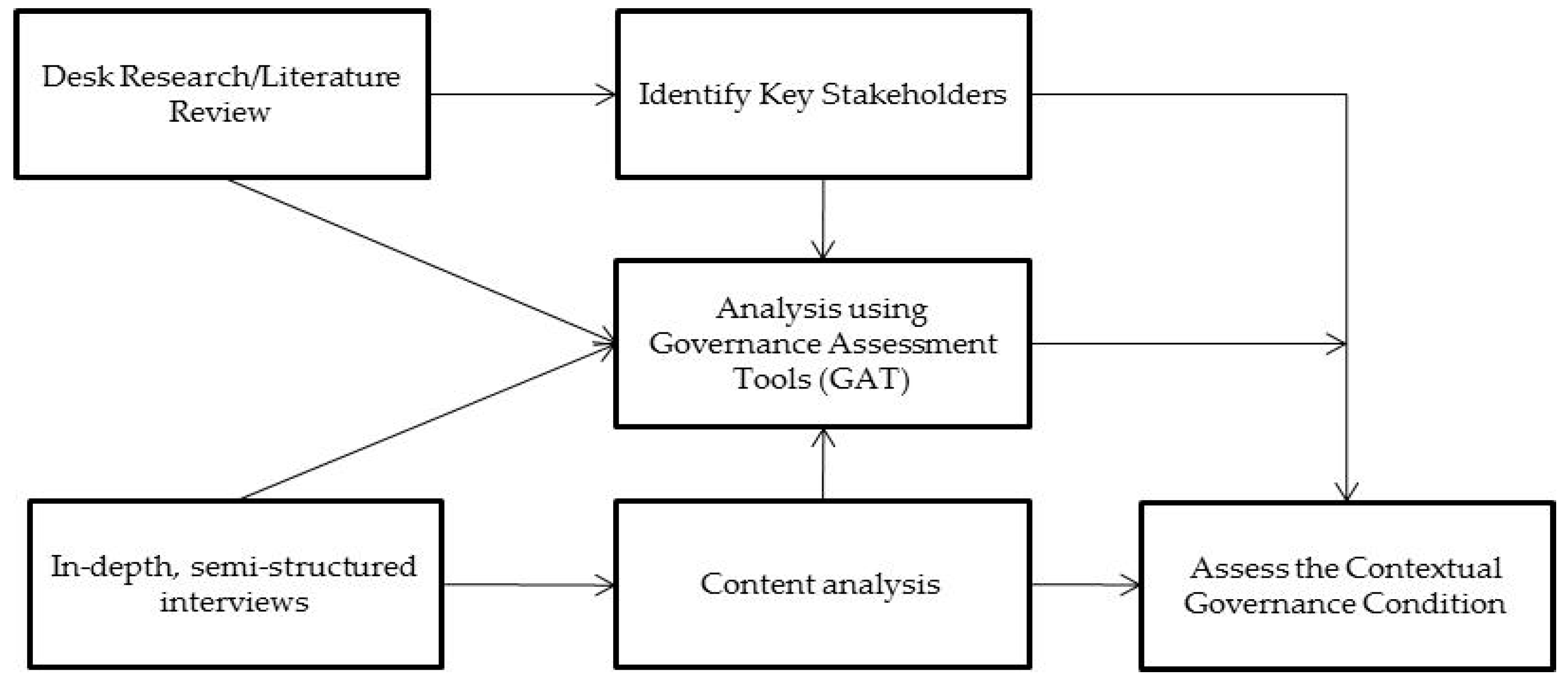
GAT is designed to provide a comprehensive understanding of the benefits and obstacles involved with policy implementation [17], [18]. It might express the difficulties encountered in implementing connected policies or programs, regardless of whether the conditions and techniques employed were favorable [19]. This assessment method comprises five governance dimensions that can be used to evaluate policy implementation, namely: level and scale, actors and networks, problem perspectives and goal ambitions, strategic and instruments, and responsibilities and resources. GAT also employs four evaluation criteria to assess each dimension which are: extent, coherence, flexibility, and intensity [19]. The use of GAT in this study can be seen based on the following dimensions and criteria matrix.
To conduct a more complex GAT analysis, the parties to be interviewed must be determined. They were chosen based on information gleaned by observing the flow of CBSWM installation. In general, national, provincial, and municipal governments are involved in this management. Furthermore, as illustrated in Figure 2, parties outside of the government, such as NGOs, academics, and the commercial sector, support the execution of this strategy.
In this study, the collected data was collated, analyzed, and reviewed in a specific manner to answer the questions. Data is gathered specifically by combining waste management-related questions. The acquired data is then analyzed using the GAT Assessment Matrix, as shown in Table 2.
Following the execution of the approach and analysis, the following more comprehensive results regarding the analysis may be explained.
3. Results
Table 4 summarizes the findings of the research, which were based on the results of interviews, observations, and literature searches. In summary, the GAT is divided into three primary categories: "Low" (shown in red), "Medium" (shown in yellow), and "Height" (shown in green). The "+" sign denotes a condition in which CBSWM policy execution has begun to improve (towards high), whereas the "-" sign denotes an inadequate condition.
This section may be divided by subheadings. It should provide a concise and precise description of the experimental results, their interpretation, as well as the experimental conclusions that can be drawn.

Table 2.
Quality Results of GAT Assessment on CBSWM Program in Makassar.
| Criteria | |||||
| Extent | Coherence | Flexibility | Intensity | ||
| Dimension | Levels and Scale | + | + | ||
| Actors and Networks | + | - | |||
| Problem Perspectives and Goal Ambitions | + | ||||
| Strategies and Instruments | + | ||||
| Responsibilities and Resources | - | ||||
| Assessed as | + | + | |||
Based on the results of interviews and evaluations, the implementation of the CBSWM policy in Makassar is classified as low to medium quality. This is because on the level and scale dimensions, the quality of governance is classified as low to moderate. The same phenomenon also occurs in the actor and network dimensions. Supporting conditions exist in the dimensions of problem perspective and goal ambition, as well as methods and instruments. While the condition of responsibility and resources are the lowest condition because it has three low (restrictive) criteria.
4. Discussion
4.1. Levels and Scale
This study's levels and scale dimensions produce balanced results. Two of the criteria yield moderate outcomes, while the other two yield low results. Extent and Flexibility are favorable indicators because the implementation of CBSWM policy has increased from the national to the local government level, although participation at the provincial level is felt to be lacking. This deficiency causes inequality in terms of evaluation and support from the provincial level. Furthermore, even though the strict bureaucratic system is a barrier to policy execution, any participant can provide flexible input and be actively involved.
Environmental awareness on a worldwide scale has been introduced in Indonesia, pushing the government to adopt long-term plans, as in earlier research explained. WB is supported by national and regional regulations in Indonesia, where the Ministry of Environment organizes these programs. The achievement of proper waste bank operations in Indonesia is one of their assessment criteria [22].
4.2. Actors and Networks
On the actor and network dimensions, similar findings were found using various criteria. The criteria of extent and coherence yield modest outcomes in this dimension, while flexibility and intensity remain low. The breadth of policy implementation can be seen from the many actors at every current level, regardless of whether they have effectively carried out their tasks and obligations. So far, the relevant parties have sat in appropriate positions to assist the execution of the CBSWM policy in Makassar in particular. Furthermore, contact and consistency among Makassar's environmental agency and other stakeholders can aid in the successful dissemination and implementation of CBSWM policies in Makassar. Constraints in this dimension arise from the difficulty for decision-makers to add new actors. This decision is left to the policy implementation leader.
A recycling company is one actor who is not involved in the policy's execution in Makassar. The paucity of recycling businesses in this city impedes the flow of recycled materials. Because there is no recycling company in this area, there is no certainty that this program will be viable or continue in the future. The waste management hierarchy should include workable strategies, i.e. strategies that can reduce or eliminate waste in a more sustainable way before it is disposed of [23]–[26]. When compared to Surabaya, another Indonesian city that also empowers residents for waste management, this region's program may be more sustainable in there because the city has recycling companies [1].
4.3. Problem Perspectives and Goal Ambitions
There are different outcomes on this dimension for each criterion, such as the coherence criterion, which scores high because the various goals to be achieved are seen as a parallel series for the main goal, namely better waste management, despite the fact that each level of government has a different role at each level. Determination of policies and management objectives to be more sustainable is the result of the formulation of the national government [27]. This policy must be obeyed by every lower level government.
The extent requirement, on the other hand, is seen as low, because the quick changes in political situations in Indonesia and Makassar have an impact on the aims to be reached. When the responsible party changes, so does the power that can be relied on to deliver the essential resources or facilities [4]. Similarly, the flexibility criterion is graded low since demanding change necessitates consent from the highest level of government; in other words, politics had a significant part in this transformation. This makes changing goals extremely difficult if the government in charge does not have the same vision as the prior government. The intensity of executing this policy, on the other hand, is moderate because the waste reduction program can be carried out extensively through WB. However, it has not properly attracted every citizen to participate in implementing a more sustainable waste management.
4.4. Strategies and Instruments
The strategies and instruments dimensions, like the problem perspectives and goal ambitions dimensions cause various disparities in each criterion. As evidenced by the supportive extent criterion, practically all significant tools, namely regulations, norms, policies/laws, programs, and initiatives, have been deployed although in some situations; law enforcement is still felt to be less stringent. In practice, the city administration collaborates with adjacent non-governmental organizations to deliver education through cooperative programs. Coherence is regarded as limited since law enforcement is not administered to its full extent, despite statutes governing administrative punishments for individuals who do not follow the norms. As a result, the emphasis has been solely on willingness to participate (the decision to be involved or not). This is also supported by socio-cultural aspects and other community conditions, such as local customs and the relationship between each group (those who sort and who don't), are also factors that influence the amount of waste that is generated and reprocessed [3], [28].
This component has modest flexibility because although governance can integrate numerous instruments as long as they are properly regulated, inflexibility arises as a result of ambiguous incentives for each region or community that has effectively adopted sustainable environmental management in its territory. Furthermore, new instruments such as incentives will raise the budget, and the additional budget will have to go via the bureaucratic system.
Many people refuse to sort or bring their garbage to WB, since they believe that they have already paid a charge to the government, so it is evident that the effective implementation of CBSWM required a perceived need. Typically, the greatest need for improved waste collection is in residential districts, where population density is high and waste storage capacity is limited. The community believes that sorting rubbish is the responsibility of the government. Nonetheless, concern for waste management can increase if it is initiated by the community itself [29].
4.5. Responsibilities and Resources
There are three criteria on this dimension that are regarded low: extent, coherence, and intensity. Because of Makassar City's inadequate resources, the extent is regarded modest. Furthermore, funding is now derived primarily from the municipal government budget, with no aid from other levels of government or outside entities. The coherence criterion is then deemed low due to a lack of support from the national and provincial governments. The CBSWM programs in Makassar are centralized due to segmented activities with solid organization. This make this program is more effectively manage when the parties involved are in adjacent locations [29].
Due to a lack of human and financial resources, the intensity criterion is regarded poor. Only those who participate in this program are willing to sort rubbish. Meanwhile, most rubbish is handled from their houses to houses, producing friction among some people who are unwilling to segregate waste. Flexibility, on the other hand, is seen as modest because the roles of each player do not overlap. The ability to integrate the collaboration of numerous players at various levels has a high potential for implementation.
5. Conclusions
This study examines the implementation of community-based solid waste management (CBSWM) policies in Makassar, South Sulawesi, Indonesia using the Governance Assessment Tool (GAT) as the instrument for this study. According to the findings of the study, policy implementation was limited due to a lack of support from one stakeholder. It produces a bleak situation in this implementation, where implementers require higher-level direction and evaluation.
Furthermore, participation at a higher level is not conceivable. Parties at the lowest level must abide by the mentioned rules and bureaucracy. Another element impeding the implementation of this program is a lack of waste management legislation enforcement. Changes in thinking are usually simple, but in the case of Indonesia, the influence of political conditions, such as changes in leadership, is more powerful. The government has not been able to ensure appropriate facilities and resources for CBSWM. Makassar also lacks a recycling company that can assist in the conversion of garbage into more valuable resources.
Meanwhile, the local government's cooperation has succeeded in encouraging the implementation of 3R through waste bank (WB) in Makassar. This party works with NGOs, the community, and the private sector to reduce garbage through the management of the waste. Cooperation with other parties ranges from providing facilities to drawing clear lines in the management of household waste. If an integrated waste management system is required in the future, it is envisaged that cooperation with parties outside of Makassar should be carried out.
Author Contributions
Conceptualization, Michael Denny Latanna, Budhi Gunawan, and Maria Laura Franco-Garcia; methodology, Michael Denny Latanna; validation, Budhi Gunawan, Maria Laura Franco-Garcia, and Hans Bressers; formal analysis, Michael Denny Latanna; investigation, Michael Denny Latanna; resources, Michael Denny Latanna; data curation, Michael Denny Latanna; writing—original draft preparation, Michael Denny Latanna; writing—review and editing, Michael Denny Latanna; visualization, Michael Denny Latanna; supervision, Budhi Gunawan, Maria Laura Franco-Garcia, and Hans Bressers; project administration, Michael Denny Latanna. All authors have read and agreed to the published version of the manuscript.
Funding
This research received no external funding.
Institutional Review Board Statement
The study was conducted in accordance with the Declaration of Helsinki, and approved by the Ethics Committee of UNIVERISTY OF TWENTE (protocol code 220703 and 29-04-2022).
Informed Consent Statement
Informed consent was obtained from all subjects involved in the study.
Acknowledgments
This research was conducted under financial support from The Ministry of National Development Planning (Bappenas).
Conflicts of Interest
The authors declare no conflict of interest. The funders had no role in the design of the study; in the collection, analyses, or interpretation of data; in the writing of the manuscript; or in the decision to publish the results.
References
- E. Damanhuri, W. E. Damanhuri, W. Handoko, and T. Padmi, “Municipal Solid Waste Management in Indonesia,” in Environmental Science and Engineering (Subseries: Environmental Science), 2014, pp. 139–155.
- E. Damanhuri and T. Padmi, Integrated Waste Management, 2nd ed. Bandung: ITB Press, 2019.
- Marshall, R.E.; Farahbakhsh, K. Systems approaches to integrated solid waste management in developing countries. Waste Manag. 2013, 33, 988–1003. [Google Scholar] [CrossRef] [PubMed]
- Kubota, R.; Horita, M.; Tasaki, T. Integration of community-based waste bank programs with the municipal solid-waste-management policy in Makassar, Indonesia. J. Mater. Cycles Waste Manag. 2020, 22, 928–937. [Google Scholar] [CrossRef]
- Pasang, H.; Moore, G.A.; Sitorus, G. Neighbourhood-based waste management: A solution for solid waste problems in Jakarta, Indonesia. Waste Manag. 2007, 27, 1924–1938. [Google Scholar] [CrossRef] [PubMed]
- Towolioe, S.; Permana, A.; Aziz, N.; Ho, C.; Pampanga, D. The Rukun Warga-based 3Rs and waste bank as sustainable solid waste management strategy. Plan. Malaysia 2016, 31–44. [Google Scholar]
- Nugraha, A.; Sutjahjo, S.H.; Amin, A.A. Analisis Persepsi Dan Partisipasi Masyarakat Terhadap Pengelolaan Sampah Rumah Tangga Di Jakarta Selatan. J. Pengelolaan Sumberd. Alam dan Lingkung. (Journal Nat. Resour. Environ. Manag. 2018, 8, 7–14. [Google Scholar] [CrossRef]
- Kristina, H.J.; Allo, E.D.L.; Christiani, A.; Gandi, K. Analisis Indikator Keberhasilan Pencapaian Program Bank Sampah yang Berkelanjutan: Studi Kasus Bank Sampah Gemah Ripah Yogyakarta. Semin. Nas. Tekneologi Ind. 2014, 1. [Google Scholar]
- Wijayanti, D.R.; Suryani, S. Waste Bank as Community-based Environmental Governance: A Lesson Learned from Surabaya. Procedia - Soc. Behav. Sci. 2015, 184, 171–179. [Google Scholar] [CrossRef]
- Wulandari, D.; Utomo, S.H.; Narmaditya, B.S. Waste bank: Waste management model in improving local economy. Int. J. Energy Econ. Policy 2017, 7, 36–41. [Google Scholar]
- Fadly S, A.R. Studi Pengelolaan Bank Sampah Sebagai Salah Satu Pendekatan Dalam Pengelolaan Sampah Yang Berbasis Masyarakat (Studi Kasus Bank Sampah Kecamatan Manggala). Universitas Hasanuddin, 2017.
- Ismawati, “Gambaran Partisipasi Masyarakat dalam Pengelolaan Sampah Pada Bank Sampah UKM Mandiri di RW 002 Kelurahan Tamamung, Kecamatan Panakkukang, Kota Makassar,” UIN Alaudin, 2013.
- Dinas Lingkungan Hidup Kota Makassar, Laporan Kinerja Instansi Pemerintah (LKjIP) 2021. Makassar, 2021.
- Fatmawati, A.; Muhsin, M.A.; Taufik, A. Makassar Waste Bank Service Performance. Makassar J. Innov. Public Serv. 2019, 1, 1–15. [Google Scholar]
- Purba, H.D.; Meidiana, C.; Adrianto, D.W. Waste Management Scenario through Community Based Waste Bank: A Case Study of Kepanjen District, Malang Regency, Indonesia. Int. J. Environ. Sci. Dev. 2014, 5, 212–216. [Google Scholar] [CrossRef]
- Bressers, H.; Bressers, N.; Kuks, S.M.M.; Larrue, C. The Governance Assessment Tool and Its Use. Gov. Drought Resil. L. Water Drought Manag. Eur. 2016, 45–65. [Google Scholar] [CrossRef]
- H. Bressers and G. Özerol, “Can water resilient city strategies and projects be realized in practice ? The Governance Assessment Tool,” pp. 1–21, 2020.
- C. C. Flores, Context Matters: Water Governance Assessment of The Wastewater Treatment Plant Policy in Central Mexico, no. March. 2017. March. 2017.
- H. Bressers et al., “Water governance assessment tool: with an eaboration for Drought Resilience,” no. June, pp. 1–42, 2013.
- H. Bressers, N. Bressers, S. Kuks, and C. Larrue, “The Governance Assessment Tool and Its Use,” 2016. [CrossRef]
- H. Gunawan et al., “A governance of climate change mitigation in transport sector and selected co-benefits in Indonesia : the case of Bandung City A governance of climate change mitigation in transport sector and selected co-benefits in Indonesia : the case of Bandung City,” 2019. [CrossRef]
- Raharjo, S.; Matsumoto, T.; Ihsan, T.; Rachman, I.; Gustin, L. Community-based solid waste bank program for municipal solid waste management improvement in Indonesia: a case study of Padang city. J. Mater. Cycles Waste Manag. 2017, 19, 201–212. [Google Scholar] [CrossRef]
- Cheremisinoff, N.P. Handbook of Solid Waste Management and Waste Minimization Technologies; Elsevier Science (USA), 2003. [Google Scholar]
- Z. Shrestha, “The Integration of Circular Economy into the Municipal Solid Waste Management of Kathmandu Metropolitan City in Nepal,” 2018.
- Andersen, M.S. An Introductory Note on The Environmental Economics of The Circular Economy,” Sustain. Sci. 2007, 2, 133–140. [Google Scholar] [CrossRef]
- The Ellen MacArthur Foundatio. Towards The Circular Economy; 2013. [Google Scholar]
- R. V. Ratnawati, “The Implementation Of Circular Economy In Indonesia Indonesia Best Practices EU-Indonesia,” 2018.
- A. Van de Klundert and J. Anschutz, Integrated sustainable waste management - the concept: Tools for decision-makers: Experiences from the Urban Waste Expertise Program. 2001.
- J. Anschutz, “Community-based solid waste management and water supply projects : Community Participation in Waste Management, Problems and Solutions Compared,” Waste, no. May, 1996, [Online]. Available: http://www.waste.nl.
Figure 2.
Waste Bank Activities.
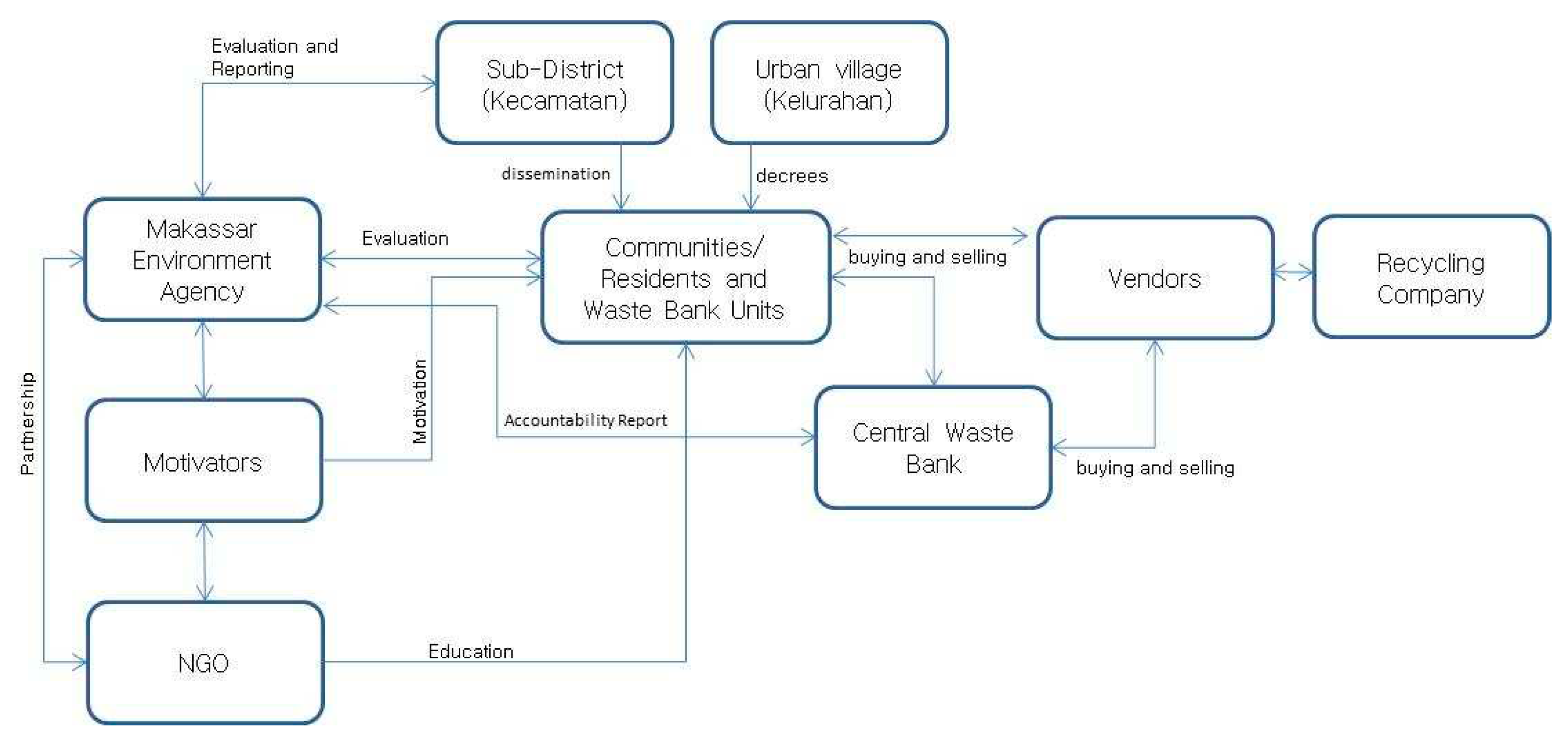
Table 1.
Governance Dimension and Governance Quality Matrix [20].
Table 1.
Governance Dimension and Governance Quality Matrix [20].
| Governance dimension | Quality of the governance system | |||
| Extent | Coherence | Flexibility | Intensity | |
| Levels and scales | “Are all levels of government involved and dealing with the issue? Are there any important gaps or missing level?” | “Is there collaboration and trust at all levels? At what point is interconnectedness acknowledged?” | “Is it possible to upscaling or downscaling given the circumstances at hand?” | “Is there a strong effect on behavioral improvement or management reform at a certain level?” |
| Actors and networks | “Are all essential stakeholders represented? Who is not allowed?” | “What are the positive aspects of stakeholder interactions? Do the stakeholders have prior experience working collaboratively? Do they have mutual trust and respect for one another??” | “Is it possible that a fresh actor will be cast or led when there are practical reasons for doing so? Do the actors have "social capital" that allows them to help each other with their tasks?” | “Is there a strong impact from an actor or actor coalition towards behavioral change or management reform?” |
| Problem perspectives and goal ambitions | “To what extent are differing points of view regarded as a problem?” | "To what extent do the various goals complement one another?" Is there any rivalry or conflict?" | “Is it possible to re-evaluate the goals?” | “What is the status quo or Business, and how is it different between goal and ambitions?” |
| Strategies and instruments | “Are any tools being used in government strategy?“ | “How many incentive programs are predicated on the presence or implementation of this program or policy? Are there any new conflicts or overlapping issues?“ | “Are there any options for merging or utilizing other types of instruments that correspond to policy implementation?“ | “What are the implicit behavioral deviations from the current implementation, and how stringent are the tools for requiring and enforcing it? “ |
| Responsibilities and resources |
“Are all duties and responsibilities clearly defined and supported by adequate resources?” | “To what extent do the given responsibilities foster competency struggles or cross-institutional cooperation? Do they have the support of the important stakeholders?” | “To what extent it is possible to pool the assigned responsibilities and resources as long as accountability are not compromised?” | “Is the amount of resources allotted sufficient to apply the required measure for the desired change?” |
| Governance dimension | Quality of the governance system | |||
| Extent | Coherence | Flexibility | Intensity | |
| Levels and scales | High: All levels are engaged. Moderate: The majority of the levels are engaged. Low: Minority groups are engaged. |
High: All levels collaborate. Moderate: Most levels are collaborating, although some trust concerns have been reported. Low: Some levels are absent or do not collaborate; the levels indicate some trust concerns. |
High: There is a possibility of moving up and down levels depending on the issue. Moderate: There is the possibility of moving up a level by reaching an agreement among the levels based on the issue. Low: There is no possibility of moving between levels. |
High: Everyone is working collaboratively to change behavior or better management. Moderate: The majority of levels are striving to influence behavioral change or managerial upgrades. Low: Only a small number of people are working to influence behavioral change or managerial reform. |
| Actors and networks | High: Every stakeholder is involved. Moderate: The majority of the stakeholders are engaged. Low: A minority of the public are involved. |
High: There is reciprocal confidence in all institutionalized and established connections. Moderate: The vast majority of connections are established and solid, but there are challenges with mutual trust. Low: Certain interactions have become institutionalized and resilient, and there are challenges with reciprocal confidence. |
High: There are chances to bring in new players, shift leadership, and exchange social capital. Moderate: An actor network supports new actor involvement, management transition, and/or social capital distribution. Low: The actor network inhibits the participation of new participants, changes in authority, and the transfer of social capital. |
High: There is a clash between several actors that has the potential to have a large impact on behavioral transformation or managerial reform. The intensity has been fractured to a moderate degree. A small number of actors are striving to have a big impact on behavioral change or management reform. Low: There is no actor who has a substantial impact on behavioral change or organization transformation. |
| Problem perspectives and goal ambitions | High: The performers consider that all points of view are represented. Moderate: Certain actors believe that the majority of opinions are represented. Low: certain actors believe that only a fraction of opinions are represented. |
High: All of the aims complement one another. Moderate: Most goals complement one another. Low: Goals compete with one another. |
High: There is an opportunity for a review of aims. Moderate: Goals can be somewhat re-evaluated. Low: There is minimal room for goal re-evaluation. |
High: The perspectives are typically in accord on how to achieve the goal and move away from the status quo. Moderate: More than half of the actors concur on their approaches to achieving the goal and departing from the status quo. Low: There is no strong consensus among the actors' points of view. |
| Strategies and instruments | High: There are no tools or strategies missing. Moderate: Some tools or tactics are missing. Low: A significant number of tools or techniques are missing. |
High: The framework enables policy instruments to collaborate and form teams. There are no instrument conflicts. Moderate: The system enables the development of tool collaboration, but it has some inconsistency. Low: The system lacks opportunities for collaboration and there are disagreements in the execution of the instruments. |
High: Various instruments can be blended. Moderate: Instruments can be mixed whenever it is indicated in an agreement or by law. Low: There is not a way to mix or use multiple instruments. |
High: For instruments that are strictly enforced. The prerequisite for behavioral divergence from existing practice is low. Moderate: Demand for behavioral deviation in specific operations, alongside compliance challenges in specific areas. Low: High demand for behavioral variation in practices, as well as challenges with adherence |
| Responsibilities and resources |
High: All obligations are clearly delineated, and appropriate resources are made available. Moderate: Most functions are clearly designated, although some have capabilities. Low: There are obviously delegated roles with insufficient resources. |
High: Objectives promote organizational cooperation and ensure that resources are used appropriately. Moderate: Certain obligations promote organizational collaboration, but only a small share of resources are deployed continuously. Low: Organizational expertise and conflict are created, and assets are not utilised effectively. |
High: The tasks outsourced can be combined with adequate monitoring systems. Moderate: While it is conceivable to combine allocated roles, no effective control framework exists. Low: There is no way to integrate the tasks that have been allocated. |
High: There are adequate assets to effect the intended improvements. Moderate: Certain assets are required to achieve the intended results. Low: The resources needed to effect the intended adjustments are in short supply. |
Disclaimer/Publisher’s Note: The statements, opinions and data contained in all publications are solely those of the individual author(s) and contributor(s) and not of MDPI and/or the editor(s). MDPI and/or the editor(s) disclaim responsibility for any injury to people or property resulting from any ideas, methods, instructions or products referred to in the content. |
© 2023 by the authors. Licensee MDPI, Basel, Switzerland. This article is an open access article distributed under the terms and conditions of the Creative Commons Attribution (CC BY) license (http://creativecommons.org/licenses/by/4.0/).
Copyright: This open access article is published under a Creative Commons CC BY 4.0 license, which permit the free download, distribution, and reuse, provided that the author and preprint are cited in any reuse.


