
Submitted:
20 July 2023
Posted:
21 July 2023
You are already at the latest version
Abstract
This study examined the status of Education for Sustainable Development (ESD) practices and the understanding of Sustainable Development (SD) among Saudi kindergarten teachers in a specific governorate. Two hundred twenty-seven kindergarten teachers participated, and data was collected through a questionnaire. The results indicated that most kindergarten teachers (89.9%) were unaware of SD. The overall status of ESD practices among the participating teachers was weak, with an average score of 2.60 out of 4. Among the different dimensions, values (2.74), competencies (2.69), and practice (2.65) obtained relatively higher scores, while the content dimension (2.49) received the lowest score. Significant differences were found in the mean scores of ESD practices based on teachers’ qualifications and the type of school. However, no differences were observed based on experience. The lack of awareness regarding SD emerged as the primary barrier to implementing ESD in kindergarten institutions. Expanding teacher training was identified as the most crucial step in promoting ESD in kindergartens. The findings highlight the importance of raising awareness among Saudi kindergarten teachers about SD, providing professional development opportunities to enhance ESD implementation in classrooms, and creating teaching materials aligned with ESD principles.
Keywords:
Sustainable development (SD)
; Kindergarten
; Early childhood education
; In-service teachers
; Barriers to SD
; Saudi Arabia
1. Introduction
In recent decades, sustainable development has blossomed as one of the most idealised and promising approaches to creating stable societies founded on equity, social justice, and citizenship. However, in a world where sustainable development challenges are becoming more complex [1], it is crucial to identify approaches to help individuals overcome the barriers and accomplish SD’s objectives. According to [2], education is the key to achieving sustainability. Individuals worldwide know that the current economic development tendencies are unsustainable and that raising public awareness and investing in education and training are essential to transforming societies into sustainable ones [3]. The United Nations General Assembly designated the years 2005 to 2014 as the Decade for Education for Sustainable Development (DESD) to incorporate values, activities, and principles that are inherently linked to sustainable development into all forms of education and learning as well as to help usher in a change in attitudes, behaviours, and values to ensure a sustainable future in social, environmental, and economic terms [4]. It further stated that eight basic competencies are required for individuals to become sustainability change-makers. Normative competency (as a skill for reflection on norms and values), strategic competency (a competency for innovative actions), collaboration, critical thinking, self-awareness, and integrated problem-solving are some key competencies. Other important competencies include systems thinking and anticipation. Accordingly, ESD has become a vital requirement. It is defined as education that promotes ‘changes in knowledge, skills, values, and attitudes to enable a more sustainable and just society for all’ [5] (p. 6).
The increased consideration of ESD has led to a significant governmental commitment to embracing ESD at all educational levels worldwide [6]. For example, The Saudi government has established some policies and initiatives to promote sustainable development. These include the National Transformation Program 2020 and Vision 2030. Together, these strategic plans provide broad objectives to convert the Kingdom of Saudi Arabia (KSA) into a sustainable one [7]. There are also more initiatives marked by establishing the Saudi Green Initiative, which aims to reduce carbon emissions and protect the environment, and the Middle East Green Initiative, which aims to create a regional coalition to combat climate change [8,9]. These initiatives are indeed a positive step towards sustainable development in KSA.
Moreover, KSA, as a member of the United Nations, adopted the Agenda 2030 goals for sustainable development, in particular, goal 4.7, which states that by 2030 it is important to ensure that all students of different ages have the knowledge and abilities necessary to advance SD, through instruction in sustainable living, gender equality, human rights, and the promotion of a culture of peace and non-violence; students should further be taught about global citizenship, respect for cultural diversity, and the role that culture plays in advancing sustainability [10]. The Saudi government firmly believes that the energies and aspirations of its youth represent the nation’s true wealth [11]. Therefore, the Saudi new generations should be well-educated in their early years on creating and sustaining a sustainable life. Thus, a Royal Order requiring the SDGs to be included in school curricula was published in 2018 [12].
The first stages of a human’s life are crucial. Children form their fundamental beliefs, attitudes, abilities, actions, and habits during the early years of life, which will have a long-term effect on them [13]. In line with this argument, [14] believes that the desired transformation must start in the kindergarten phase, asserting the prominence of high-quality education in the early years and the role of well-qualified teachers in children’s education environments [15]. Early childhood educators, including kindergarten teachers, have a huge opportunity to promote the attitudes, beliefs, abilities, and behaviours that promote sustainable development [13,16]. In this regard, the DESD has emphasised the role that teachers play in supporting sustainable development; the DESD further stated that to enable the next generation to create a more sustainable world, teacher educators, pre-service teachers, and in-service teachers must learn how to integrate SD issues into the curriculum and use pedagogical techniques associated with quality education for sustainable development [17]. Thus, more consideration should be given to teachers, notably kindergarten teachers, about their knowledge of and practical application of ESD to ensure their capacity to assimilate and transfer it to their students.
1.1. Education for Sustainable Development and Kindergarten Teachers
The term “sustainable development” was first used in the 1987 report Our Common Future by the World Commission on Environment and Development (WCED) [18]. According to the report, SD is defined as development that satisfies current demands without jeopardising the capacity of future generations to satiate their own needs. The goal of SD has gained widespread acceptance as a social and economic transformation strategy for the worldwide community [19]. According to [4], going along the path of sustainable development will demand a radical change in our thinking and behaviour; each individual must become a change agent for sustainability; individuals need the education, training, beliefs, and attitudes that will enable them to support sustainable development. As a result, education is seen as an essential vehicle to achieve sustainable development. The 17 Sustainable Development Goals (SDGs) of the 2030 Agenda for Sustainable Development centre around education for sustainable development. It has been argued that the years between birth and six [nursery and kindergarten] are critical learning years for a child’s development [21]. Research showed that young children can evaluate the benefits and drawbacks, form opinions about issues that affect them and their communities, and engage in actions that promote a sustainable society; they can also make changes in their own lives and those of their families [22,23]. At a 2007 worldwide workshop on the role of early childhood education for a sustainable society, the basic competencies were utilised to formulate policy, curriculum, and pedagogical suggestions for early childhood education toward sustainable development. Furthermore, the notion that children have rights and are actively involved in society, whose viewpoints and meanings are heard, taken into account, and influence the learning content and methodologies; the accessibility of opportunities for kids and adults to have conversations and take practical actions regarding sustainability; and the promotion of diversity, equality, solidarity, and fairness through education [23] were subjects of discussion.
Children need to be taught how to obtain sustainable lives and communities to achieve these gains. The responsibility for this may fall primarily on education stakeholders, especially teachers. The teacher’s role in achieving SD has been significantly recognised [24]. The quality of education for SD largely depends on the teachers’ ability to use techniques to incorporate sustainability topics into school curricula while considering the many unique influences on gaining awareness of SD [25]. Kindergarten teachers need to act as role models for sustainability by maintaining personal and professional engagement ethics and promoting attitudes and beliefs rooted in a sense of connection to nature and other living things [26]. Thus, they should be highly qualified to educate their students about SD. This matches Sustainable Development Goal 4. C: ‘By 2030, substantially increase the supply of qualified teachers, including through international cooperation for teacher training in developing countries, especially least developed countries and small island developing states [10] (p. 17).
Although the role of early childhood teachers in relation to sustainable development has been recognised, few studies have addressed early childhood teachers, including kindergarten teachers, in terms of understanding and implementing sustainable development, and they have recorded mixed results. For example, a comparative study found that Japanese and Australian early childhood educators lack well-developed theories and practices in education for sustainability [20]. The findings of another study showed that ESD practices among early childhood educators are usually positive [16]; however, although some early childhood educators claim they are educating the children about sustainable development, they frequently employ rigorous, traditional, direct, and prescriptive interactional methods [2,20]. These previous results might imply that early childhood and kindergarten educators must be given more support to develop a deeper knowledge of sustainability and how to apply it in their contexts and overcome challenges that could prevent them from achieving ESD.
1.2. Kindergarten Education in Saudi Arabia
Kindergarten is the first stage of education in KSA; however, it is not compulsory. It is directly tied to nursery school as well as primary education. The Saudi Ministry of Education (MOE) is responsible for administering kindergartens in the country; MOE sets the curriculum, provides teacher training, and inspects kindergartens to ensure they meet the required standards [27]. Saudi Arabia has two types of kindergartens: public and private. Public kindergartens are free to attend, while private kindergartens charge tuition [28].
The curriculum for kindergarten in KSA is based on the Islamic faith; children learn about the Quran, the Prophet Muhammad, and Islamic values. They also learn about the Arabic language, culture, and some subjects such as math, science, and social studies [27]. Kindergarten institutions have a vital role in the processes of education and upbringing because they are concerned with the child’s growth in all physical, linguistic, psychological, social, and behavioural aspects, in addition to their multiple educational roles, such as developing a child’s individuality, independence, and capacity for peer cooperation [14,27,29]. From this point of view, kindergartens are among the institutions gaining attention in the KSA’s Vision 2030 [29]. In Saudi Arabia, children are regarded as society’s wealth and the decision-makers of the future [27].
Young children exposed to sustainable development are more likely to make sustainable decisions as adults. Additionally, they are more likely to participate in the sustainable development process, which is crucial for building a more sustainable future [29]. There are several approaches to incorporating sustainable development into Saudi Arabia’s kindergarten curriculum. Teaching children about the environment is one strategy; activities like gardening, composting, and recycling can help with this. Children can learn the value of energy and water conservation. Teaching kids about social justice is another approach to incorporating sustainable development into kindergarten instruction. Participating in initiatives like advocating for gender equality, combating poverty, and defending human rights, children can also learn the value of harmony and collaboration [29]. In KSA, there is currently a focus on the efficiency of kindergarten teachers; they must have a bachelor’s degree in education. They must also be certified by the MOE, as they are responsible for planning and implementing lessons, assessing children’s learning, and creating a positive learning environment.
Although Saudi scholars know the promising contribution the kindergarten phase would make to support Saudi Arabia’s efforts to achieve sustainable development, very few investigations have been done on the topic. For example, this study intended to acknowledge the concept of ESD and identify the most crucial requirements for reaching it through kindergarten in the KSA from the perspective of the faculty at the College of Education in Riyadh. Hammad recommended incorporating activities and programs that value and work to actualise an educational plan for sustainable development [29]. Another study aimed to examine the role of SD in socialisation and childhood care in primary schools from the point of view of teachers in the Hail region [30]. The results revealed the need to hold educational courses for teachers and students to pay attention to personal and environmental health. Considering the literature review, few studies examine the concept and implementation of sustainable development from the perspective of Saudi kindergarten teachers, as well as the difficulties they can encounter doing so and how they could be overcome. To fill this knowledge gap, the current study will attempt to provide answers to the following questions:
- What does sustainable development mean from Saudi kindergarten teachers’ viewpoints?
- What is the current status of ESD practices among kindergarten teachers in a specific governorate in Saudi Arabia? Does it differ according to teachers’ educational qualifications, years of teaching experience, and the type of educational institution?
- What are the ESD barriers from Saudi kindergarten teachers’ point of view?
- What are the most important procedures necessary to implement ESD in Saudi kindergarten institutions?
2. Theoretical Framework
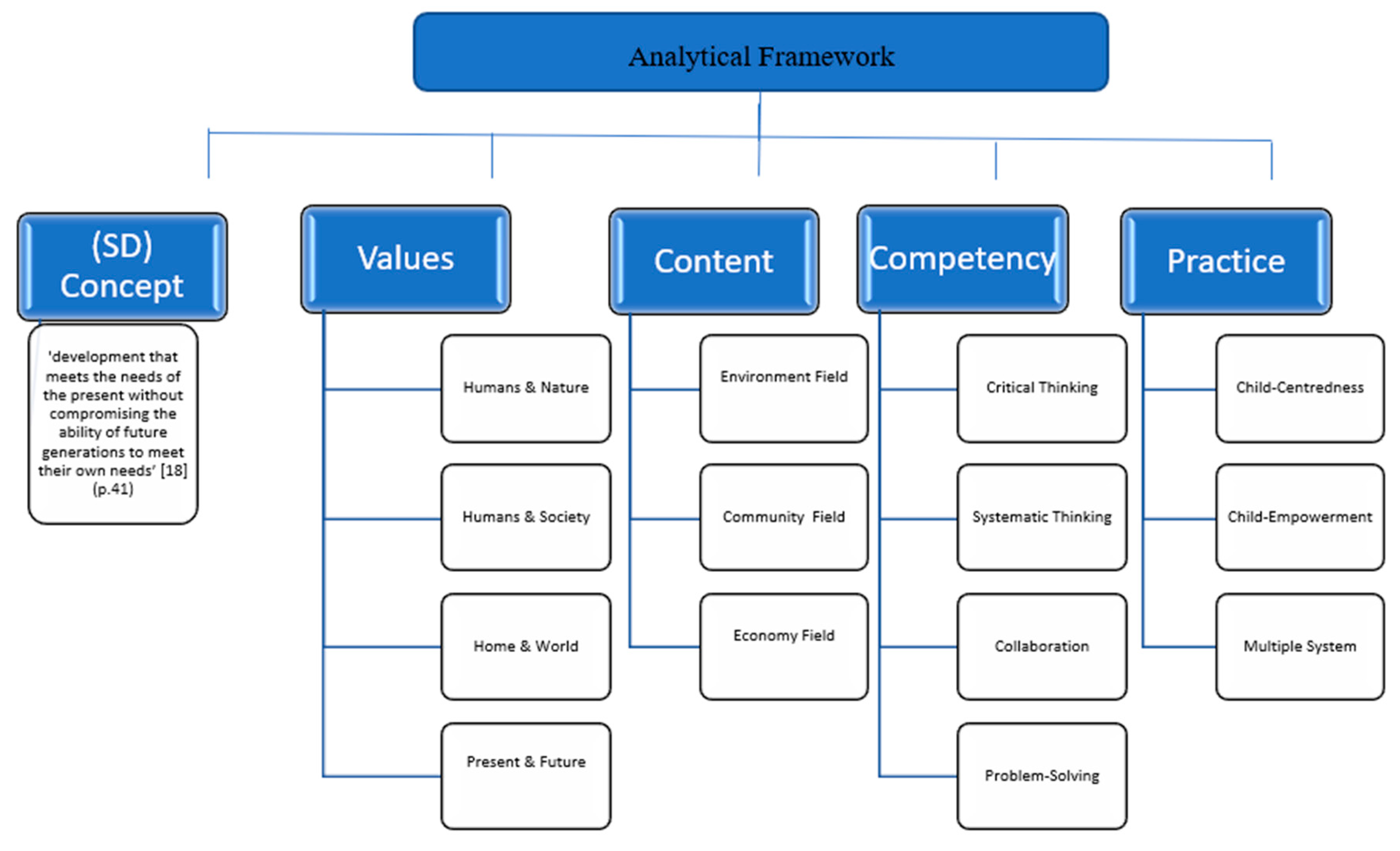
The United Nations’ Sustainable Development Goals provide educators with the content and context for Education for Sustainable Development. Yet, they cannot create educators capable of independently implementing critical ESD and global citizenship ESD [31]. Therefore, various initiatives have been taken to establish ESD competency frameworks to solve this issue. To carry out the current investigation, the researcher adopted the framework of [16], who established the “Early Childhood Educators’ Education for Sustainable Development Practices Scale” (ECEESDPS) to evaluate the ESD practices of early childhood educators in China. The framework, developed based on United Nations publications and associated research, categorised the core ESD concepts into four categories: values, content, competency, and implementation. It also identified the key characteristics of each concept [16]. In the current study, for further comprehensiveness, the researcher added the concept of sustainable development to Cheng and Yu’s analytical framework (see Figure 1) below).
Figure 1.
Figure 1. Adapted from the analytical framework of ESD [16]
2. Materials and Methods
2.1. Study Setting and Sample Selection
The researcher used the descriptive survey approach to achieve the study objective. A survey approach is ideal when the researcher wants to define benchmarks to which current conditions can be compared, explain the peculiarities of present situations, or ascertain the relationships between specific events [32]. It further gathers data that is explicative, descriptive, and inferential. The study community consisted of government and private kindergarten teachers in one of the governorates in Saudi Arabia, who numbered 797 female teachers in 2023, according to the statistics provided to the researcher electronically (e-mail) by the Education Department in the governorate in which the study took place. The researcher used the convenience sampling method, where an electronic link was made and circulated to the target group after determining the period of responses represented by thirty days to receive responses. Two hundred twenty-seven teachers (28.5%) of the study population responded to the questionnaire. Table 1 shows the distribution of study sample members according to experience, academic qualification, and kindergarten type.
2.2. Study Instrument: Development and Administration
The questionnaire was designed to identify kindergarten teachers’ understanding of sustainable development and how they employ it in their teaching practices in one governorate in the KSA. After reviewing previous studies, the questionnaire was designed based on the work of [16,33]. Its final form consisted of four parts: The first part concerns basic data for female teachers: educational qualification (bachelor or postgraduate), years of teaching experience, and type of kindergarten institution (governmental or private). The second part investigated teachers’ understanding of sustainable development; this section included four statements as the definitional statement to explain sustainable development as follows: “Environmental Protection”, “balancing economic, environmental, and social aspects within the boundaries of the Earth’s ecosystem”, “Development that meets the needs of the present without compromising the future”, and “Continuous economic development taking into account the environment”. The third part concerns Education for Sustainable Development Practices in Kindergartens; it consists of 52 items distributed to four basic dimensions according to the five-point Likert scale (always, often, sometimes, rarely, never). It takes grades (5, 4, 3, 2, 1), respectively. The four basic dimensions included: Values (10 items, α = 0. 88), content (17 items, α = 0. 92), competencies (14 items, α = 0.8 9), and practice (11 items, α = 0. 87). The fourth part of the questionnaire included close-ended questions about barriers to implementing ESD in kindergarten education, the most important procedures necessary to implement ESD in kindergarten institutions, and the importance of developing ESD in kindergarten institutions. The questionnaire also included one open-ended question related to adding any comments or Additions that the teacher believes may promote the development of ESD in kindergarten institutions.
The questionnaire was designed to take 8–10 minutes to answer. To ensure validity, the questionnaire was presented to two jury members specialising in the kindergarten field. The questionnaire was amended in light of their suggestions. The research instrument was also applied to an exploratory sample of 20 kindergarten teachers. Pearson’s correlation coefficient was calculated between the dimensions of ESD practices in kindergartens and the overall education practices score. The analysis shows that the Pearson correlation coefficients between the dimensions of education practices for sustainable development in kindergartens and the total degree of education practices are statistically significant at the level of significance (0.01). Pearson’s correlation coefficients ranged between 0. 952** and 0. 960**, all statistically significant at 0.01, as shown in Table 2.
Regarding reliability, the stability coefficient Cronbach’s alpha on the total degree of ESD practices was greater than 0.07 (0.96), which indicates that the research instrument has high reliability. The KFU Research Ethics Committee approved the conduct of this investigation [KFU-REC-2022-DEC-ETHICS385]. After that, the researcher communicated officially with the “Education Department” in the Governorate to obtain permission to implement the study and to obtain the number of the study population. Afterwards, “the Education Department” e-mailed the questionnaire to the kindergarten leaders for distribution to the teachers.
2.3. Data Analysis
The researcher utilised the Statistical Package for Social Sciences (SPSS) version 23 to analyse the collected data and answer the research questions, where Pearson’s correlation coefficient was used to verify the validity of consistency, Alpha Cronbach to verify the reliability of the research instrument, frequencies, ratios, and the chi-test to answer the first research question. The mean scores, standard deviations, and median are used to answer the second research question. Multiple variance analysis shows the significance of differences by variables, frequencies, and ratios to answer the third and fourth research questions. Furthermore, the following graduation was adopted for the degree of achievement of items, dimensions, and areas of the status quo: The current practices of ESD among kindergarten teachers in one of the governorates in the KSA to determine the degree of agreement based on the range equation are shown in Table 3 below.
3. Results
3.1. Kindergarten Teachers’ Understanding of Sustainable Development
The first research question examined kindergarten teachers’ conception of sustainable development. Sustainable development is defined as ‘development that meets the needs of the present without compromising the ability of future generations to meet their own needs’ [18] (p.41). The analysis of the participants’ responses revealed 23 correct answers to sustainable development (10.1%) and 204 wrong answers (89.9%). There are differences in favour of the wrong answers, where the chi-square value (144.322) and the significance level (0.00) indicate the lack of knowledge of SD among kindergarten teachers. See Table 4 below.
3.2. Kindergarten Teachers’ Practice of Education for Sustainable Development
Regarding the teachers’ application of ESD, the analysis showed that the overall score of the current status of ESD practices among kindergarten teachers came in with a weak score, with a mean score of 2.60 + 0.279, as presented in Table 5 below.
The available evidence from Table 5 further showed that the first dimension of values obtained an average score with a mean score of (2.74+0.266). The mean scores on the values ranged between 2.72 and 2.78, and all fields had an average degree. The third dimension, namely competencies, followed them, obtaining an average degree with a mean score of (2.69 + 0.308). The mean scores in the areas of competencies ranged between 2.66 and 2.73. All areas with an average degree. As for the practice dimension, it ranked third; it obtained a mean score of (2.65+ 0.331) and an average score. The mean scores in the practice areas ranged between 2.59 and 2.68. Regarding the content dimension, it was ranked last, with a mean score of (2.49 + 0.345) and a weak degree. The mean scores on the content areas ranged between 2.32 and 2.56, and all fields had a weak degree.
The survey also sought to examine whether kindergarten teachers’ practices of ESD differ according to their educational qualifications, years of teaching experience, and the type of educational institution. The mean scores of the current status of education for sustainable development practices among kindergarten teachers were extracted according to the variables of experience, academic qualification, and type of educational institution (see Table 6).
The researcher further conducted multiple variance analyses to show the significance of the differences between the mean scores of the current status of ESD practices among kindergarten teachers according to the variables of experience, academic qualification, and type of educational institution; see Table 7 below.
Regarding years of teaching experience, Table 7 showed no differences at the significance level of 0.05 between the mean scores of the current status of ESD practices among kindergarten teachers according to the experience variable. Data analysis also revealed that there were differences at the significance level of 0.05 between the mean scores of the current status of education practices for ESD among kindergarten teachers according to the qualification variable on the total degree and all dimensions except for the second dimension and the differences came in favour of the bachelor’s degree. For the educational institution variable, Table 7 showed differences at the significance level of 0.05 between the mean scores of the current situation of practices for ESD among kindergarten teachers according to the variable of the educational institution on the total degree and the third dimension. The differences were in favour of private kindergartens.
3.3. Barriers to Education for Sustainable Development Application
Analysis of the participants’ perspectives on the barriers to education for sustainable development is presented in Table 8 below.
According to kindergarten teachers, the obstacles are sequenced as follows: Lack of knowledge of the idea of sustainable development (47.58%); lack of teaching and learning resources (18.94%); parents’ lack of interest in ESD (13.66%); ignorance of the educational material (12.33%); and the school administrator’s lack of interest in ESD (4.85%); Lack of ESD interest among teachers (2.64%).
3.4 Proposal Procedures to Implement ESD In Kindergarten
The study also looked into the teachers’ thoughts on what might be done to implement ESD in kindergarten education.

Table 8.
The important actions necessary to implement education for sustainable development in kindergarten institutions.
Table 8.
The important actions necessary to implement education for sustainable development in kindergarten institutions.
| Percentage % |
Frequencies | Important actions for the implementation of ESD in kindergarten institutions | Median | No. |
|---|---|---|---|---|
| 61.23 | 139 | Expansion in teacher training (pre-service/in-service) | 1 | 1 |
| 48.46 | 110 | Development of teaching and learning materials | 2 | 2 |
| 46.26 | 105 | Integrating ESD into the curriculum | 3 | 3 |
| 39.65 | 90 | Developing schools’ interest in sustainable development | 4 | 4 |
| 36.12 | 82 | Connecting with family and community | 5 | 5 |
Expansion of teacher training (pre-service and in-service) (61.23%); development of teaching and learning materials (48.46%); integration of ESD into the curriculum (46.26%); fostering schools’ interest in sustainable development (39.55%); and fostering connections with family and community (36.1%) are the most critical actions required to implement education for sustainable development in kindergarten institutions, according to Table 9.
The study also centred on examining teachers’ perspectives on the importance of developing ESD in kindergarten institutions; see Table 10 below.
With a frequency of 163 and a percentage of 71.81%, Table 10 demonstrated the importance of developing ESD in kindergarten institutions from the participants’ perspective.
4. Discussion
Early childhood is a crucial time for laying the groundwork for values and attitudes related to ESD, making early childhood education an essential part of education for sustainable development [16,33]. Teachers of young children, including kindergarten instructors, can affect educational reforms and assist children’s learning for long-term development [16]. Kindergarten teachers should possess the necessary knowledge and skills to implement ESD and impart it to their children [34]. The main purpose of this study was to investigate kindergarten teachers’ understanding of SD and their implementation of ESD in their classrooms.
The study's results indicated that most kindergarten teachers incorrectly understand SD. This outcome aligns with the findings of another study which showed that just 14% of the early childhood instructors who responded to the survey understood the concepts of sustainable development very well [33]. Kindergarten teachers' lack of understanding of SD could be attributed to the fact that sustainable development is a relatively new concept; the term was first used in the 1980s [18], and it has only been in the last few decades that education for sustainable development has become a priority [17]. Thus, many kindergarten teachers may not have had the opportunity to learn about SD or ESD during their pre-service or in-service training. This interpretation is further evident by teachers’ responses to the most common obstacle to implementing ESD in kindergarten: a lack of familiarity with sustainable development.
Moreover, some teachers may not see SD or ESD as a priority; they may therefore be reluctant to teach certain sustainability-related topics [20]. Some kindergarten teachers may focus on teaching required basic academic skills, such as reading, writing, and math [2], which gain more focus from leaders in educational institutions [35]. Thus, the results suggest increasing awareness of sustainable development among kindergarten teachers and ensuring that the next generation of children is prepared to address sustainability challenges.
ESD is a comprehensive and transformative approach to education that addresses pedagogy, the learning environment, and learning content and outcomes [5]. Regarding implementing ESD in kindergarten classrooms, the results showed that teacher participants’ practice of ESD was weak. This result was confirmed by the findings of previous research which demonstrated that most teachers who responded to the study had not used ESD initiatives [33]. When teachers introduced SD-related activities, conversations during circle time were the most common practice. Teachers’ lack of knowledge of SD/ESD could represent the biggest obstacle to implementing it in their teaching practices [33].
Furthermore, they may not receive any training on SD or ESD during their professional preparation period [36] or their practice of the teaching profession; this was evident as 61.23% of the respondents chose “Expansion in teacher training (pre-service or in-service)” as the most important procedure for integrating ESD in kindergarten education. In addition to their response to the open question, some indicated the need for training programs in SD and ESD. Moreover, kindergarten teachers may not have the resources they need to implement ESD practices in their classrooms [33]; this could include access to curriculum materials, professional development opportunities, or support from their school administration; this was proven in the current study as the most important obstacle to integrating sustainable development in kindergarten education.
The results showed that the first dimension of values obtained an average score, followed by the competencies and practice dimensions. In contrast, the content dimension obtained the lowest mean score. Regarding the value dimension, results suggest that kindergarten teachers involved in the study know the importance of sustainable development. They appreciated the importance of developing sustainable development in kindergarten education, which amounted to 71.81%. However, kindergarten teachers’ positive appreciation of SD or ESD is not necessary to reflect a correct understanding of both terms [37] or a good implementation of ESD. The competencies dimension obtained the second-highest average score suggesting that kindergarten teachers may know the value of critical thinking, collaboration, and problem-solving in teaching and learning, especially since the KSA is currently more interested in such abilities. In line with this, learning should be a continuous process, and students should develop critical-thinking abilities to solve problems and use those abilities in real-world settings [38]. In this regard, the Fourth Conference on Teacher Preparation (2011) was held in the College of Education at the University of Umm Al-Qura in KSA. It promoted the development of students’ problem-solving, critical thinking, and communication skills [39]. However, teachers may not be as aware of how to teach their students about sustainable development effectively and engagingly [40]. They may also not be as confident using these skills in their classrooms. The results further showed that the content dimension obtained the lowest mean score; this could be attributed to the fact that SD is a complex concept encompassing a wide range of issues, including environmental protection, economic development, and social justice [5]. Thus, it would be difficult for kindergarten teachers to understand all of the different aspects of SD. These results are significant because they suggest the need for improvement in the kindergarten curriculum and how sustainable development is taught in kindergarten classrooms.
The study found no significant differences in ESD education practices' current status among kindergarten teachers according to their years of teaching experience. This result suggests that teachers with different levels of experience are equally likely to implement ESD practices in their classrooms if they have the knowledge and skills to do so, as well as if ESD is required of them by the Ministry of Education and is included in the objectives of education in the kindergarten stage. Results further showed significant differences between the mean scores of the current status of ESD practices among kindergarten teachers according to the qualification variable; those with a bachelor’s degree stated they practice ESD more than those with a postgraduate degree. This conclusion could be attributed to the small number of female participants with an academic degree higher than a bachelor’s degree in the current study, as their number reached 25, representing 11% of the sample size in the current study. Furthermore, there were differences at the significance level of 0.05 between the mean scores of the current status of education practices for ESD among kindergarten teachers according to the type of school in favour of private schools. Teachers in private kindergartens were more likely to implement ESD practices than teachers in public kindergartens. This result is consistent with the conclusion reached on the relationship between the type of early childhood institution and sustainable development education [41], suggesting that private kindergartens may be more supportive of ESD than public kindergartens. Possible explanations for this finding are that private kindergartens have more resources available, or they may have more access to resources on ESD. Another possibility is that private kindergartens have more autonomy than public kindergartens. They may be freer to make decisions about their curriculum and teaching methods, making it easier for them to implement ESD practices [41].
The current study agreed with previous studies on several obstacles to implementing ESD in kindergartens and other educational institutions. For example, a lack of knowledge of sustainable development was the most commonly cited obstacle to ESD [33,42]. This is especially true if they have not had the opportunity to learn about sustainable development during their pre-service or in-service training [43,44]. Another common obstacle to ESD was a lack of teaching and learning resources [42]. Some resources are available to help kindergarten teachers teach sustainable development. However, these resources can be expensive and difficult to find. Teacher participants’ further stressed some other factors that would prevent them from practising ESD, such as the school administrator’s lack of interest in ESD and the lack of ESD interest among teachers [42]. Due to these restrictions, they might not try incorporating ESD into their teaching methods. Given this justification, teachers should receive support through programs, training, resources, curriculum, and financing to expand their ESD teaching activities. This conclusion was confirmed by the teachers participating, who indicated that the most important steps needed to implement education for sustainable development in kindergarten institutions include expanding teacher training (pre-service and in-service), developing teaching and learning materials, integrating ESD into the curriculum, encouraging schools’ interest in sustainable development, and fostering ties with family and community [33,36,45].
5. Conclusions
Early childhood education, including kindergarten, is vital for forming ESD beliefs and values. Education for sustainable development is a holistic educational strategy to help students acquire the skills, values, and knowledge needed to create a more sustainable future. This study investigated the current status of ESD practices among kindergarten teachers in one of the governorates in KSA. The study found that kindergarten teachers have a limited understanding of SD and that the current status of ESD practices among teacher participants is weak. The most common barrier to implementing ESD in kindergarten institutions was a lack of awareness of SD or ESD. Thus, there is a need to increase awareness of the concept of SD among Saudi kindergarten teachers, provide them with professional development opportunities to help them implement ESD in their classrooms, develop teaching and learning materials that are aligned with the principles of ESD, integrate ESD into the curriculum, and foster kindergarten institutions’ interest in sustainable development. By taking these steps, we can help ensure that kindergarten children are prepared to be active participants in building a more sustainable future and addressing sustainability challenges.
6. Limitations & Suggestions for Further Research
One of the main limitations of this study is that it was conducted in a single governorate in Saudi Arabia. This means the findings may not be generalisable to other parts of the country or other countries. Additionally, the study used a self-reported survey subject to social desirability bias. This means that teachers may have been more likely to report that they were implementing ESD practices than they were. Finally, the study did not collect data on the actual implementation of ESD in kindergarten institutions. This means it is impossible to know how effectively ESD is being taught in kindergartens in Saudi Arabia. Despite these shortcomings, there are several advantages to this study. It is one of the first to examine how Saudi kindergarten instructors now use ESD methods. Moreover, the study offers insightful information about the difficulties and impediments to applying ESD in kindergarten settings. The study highlights the need for increased attention to ESD in kindergarten education to ensure that future generations are prepared to address sustainability challenges.
There are some directions for future research on ESD in kindergarten education. First, future research could replicate this study in other parts of Saudi Arabia and other countries. This replication will help determine if the findings of this study are generalisable to other settings. Second, future research could use a qualitative approach to understand better the barriers to implementing ESD in kindergarten institutions. This would help identify specific strategies for overcoming these barriers. Finally, future research could investigate the impact of ESD on children’s knowledge, attitudes, and behaviours related to sustainability. This will help to determine if ESD is an effective way to promote sustainability among young children.
Funding
This research received no external funding.
Institutional Review Board Statement
The study was conducted in accordance with the Declaration of Helsinki, and approved by the Research Ethics Committee at King Faisal University (protocol code KFU-REC-2022-DEC-ETHICS385 and 06/12/2022).
Informed Consent Statement
Participants voluntarily signed a consent form.
Data Availability Statement
N/A.
Acknowledgments
N/A
Conflicts of Interest
The author declares no conflict of interest.
References
- Cebrian, C.; Junyent, M. Competencies in Education for Sustainable Development: Exploring the Student Teachers’ Views. Sustain. 2015, 7, 2768–2786, https://www.mdpi.com/2071-1050/7/3/2768. [Google Scholar] [CrossRef]
- Bautista, A.; Moreno-Núñez, A.; Ng, S. C.; Bull, R. Preschool educators’ interactions with children about sustainable development: Planned and incidental conversations. Int J Early Child. 2018, 50, 15–32. [Google Scholar] [CrossRef]
- Mckeown, R.; Hopkins, C.A.; Rizzi, R.; Chrystalbridge, M. Education for sustainable development toolkit. Energy, Environment and Resources Center 2002, 2, 1–142, https://unesdoc.unesco.org/ark:/48223/pf0000152453. [Google Scholar]
- UNESCO. Education for Sustainable Development Goals: Learning Objectives; UNESCO: Paris. France, 2017; https://unesdoc.unesco.org/ark:/48223/pf0000247444. [Google Scholar]
- Leicht, A.; Heiss, J.; Byun, W. J. Issues and trends in Education for Sustainable Development. United Nations Educational, Scientific and Cultural Organization, 2018. https://unesdoc.unesco.org/ark:/48223/pf0000261954.
- Kagawa, F. Dissonance in students’ perceptions of sustainable development and sustainability Implications for curriculum change. Int. J. Sustain. High. 2007, 8, 317–338. [Google Scholar] [CrossRef]
- Alshuwaikhat, H.; Mohammed, I. Sustainability matters in national development visions—evidence from Saudi Arabia’s vision for 2030. Sustain. 2017, 9, 1–15. [Google Scholar] [CrossRef]
- Ghanem., A.M.; Alamri, Y. The impact of the Green Middle East initiative on sustainable development in the Kingdom of Saudi Arabia. J. Saudi Soc. Agric. Sci. 2023, 22, 35–46. [Google Scholar] [CrossRef]
- AIArjani, A.; Modibbo, U.M.; Ali, I.; Sarkar, B. A new framework for the sustainable development goals of Saudi Arabia. J. King Saud Univ. Sci. 2021, 33, 101477, https://www.sciencedirect.com/science/article/pii/S1018364721001385. [Google Scholar] [CrossRef]
- United Nations. Ten Years of the UNECE Strategy for Education for Sustainable Development: Evaluation report on the implementation of the UNECE Strategy for Education for Sustainable Development from 2005 to 2015; United Nations: New York, 2015; https://unece.org/DAM/env/esd/ESD_Publications/10_years_UNECE_Strategy_for_ESD.pdf. [Google Scholar]
- Alshuwaikhat, H. M.; Mohammed, I. Sustainability matters in national development visions—Evidence from Saudi Arabia’s Vision for 2030. Sustain. 2017, 9, 408. [Google Scholar] [CrossRef]
- Vision (2030). First Voluntary National Review Kingdom of Saudi Arabia, 2018. https://bit.ly/3hjYNzs.
- Salonen, A. O.; Tast, S. Finnish Early Childhood Educators and Sustainable Development. J. Sustain. Dev. 2013, 6, 70–85. [Google Scholar] [CrossRef]
- Abu-Muailiq, S. The degree of the practice of creative management by kindergarten principals in the central GGovernorate and its relationship to the reality of organisational upbringing there [published in Arabic]. Al-Aqsa University in Gaza: Palestine, 2020.
- Furu, A. C.; Heilala, C. Sustainability education in progress: Practices and pedagogies in Finnish early childhood education and care teaching practice settings. Int J Early Child Environ. Educ. 2021, 8, 16–29. [Google Scholar]
- Cheng, C.; Yu, Y. Early childhood educators’ practices in education for sustainable development in China: Evidence from Shandong Province. Sustain. 2022, 14, 2019. [Google Scholar] [CrossRef]
- UNESCO. United Nations Decade of Education for Sustainable Development (2005-2014). International implementation scheme; UNESCO: Paris: France, 2005; https://unesdoc.unesco.org/ark:/48223/pf0000148654. [Google Scholar]
- World Commission on Environment and Development (WCED). Our Common Future: The Report of the World Commission on Environment and Development. Oxford University Press, Oxford, 1987. https://sustainabledevelopment.un.org/content/documents/5987our-common-future.pdf.
- Liu, J.; Jiang, Y.; Zhang, B.; Zhu, X.; Sha, T. Paths to Promote the Sustainability of Kindergarten Teachers’ Caring: Teachers’ Perspectives. Sustain. 2022, 14, 8899. [Google Scholar] [CrossRef]
- Inoue, M.; O’Gorman, L.; Davis, J. Investigating Early Childhood Teachers’ Understandings of and Practices in Education for Sustainability in Queensland: A Japan-Australia Research Collaboration. Aust. J. Environ. Educ. 2016, 32, 1–18, https://www.jstor.org/stable/26422927. [Google Scholar] [CrossRef]
- Tilbury, D.; Coleman, V.; Garlick, D. A National Review of Environmental Education and its Contribution to Sustainability in Australia: School Education. Canberra: ARIES, 2005. http://aries.mq.edu.au/projects/national_review/files/volume3/Volume3_Revised05.pdf.
- Somerville, M.; Williams, C. Sustainability education in early childhood: An updated review of research in the field. Contemp. 2015, 16, 102–117. [Google Scholar] [CrossRef]
- Samuelsson, I. P.; Kraga, Y. The contribution of early childhood education to a sustainable society. UNESCO: Paris, France, 2008. https://unesdoc.unesco.org/ark:/48223/pf0000159355.
- Mitranic, N.; Miskeljin, L.; Breneselovic, D. Education for sustainable development and preschool teachers’ competencies Quality of Education: Global development goals and local strategies; UV. Orlović Lovren, J. Peeters, & N. Matović Eds.; Belgrade: Institute for Pedagogy and Andragogy, Faculty of Philosophy, University of Belgrade and Centre for Innovation in the Early Years, Ghent University, 2019; pp. 63–81.
- Martins, A., Mata, T. M.; Costa, C. A. Education for sustainability: Challenges and trends. Clean Techn Environ Policy 2006, 8, 31–37. [CrossRef]
- Ferdig, M. Sustainability leadership: Co-creating a sustainable future. J. Chang. Manag. 2007, 7, 25–35, https://www.tandfonline.com/doi/abs/10.1080/14697010701233809. [Google Scholar] [CrossRef]
- Aljabreen, H. H.; Lash, M. Preschool education in Saudi Arabia: past, present, and future. Child. Educ. 2016, 92, 311–319. [Google Scholar] [CrossRef]
- El-Hussein, I. A. The reality of the quality of kindergarten institutions in Al-Ahsa: an evaluation study [published in Arabic]. Journal of the Future of Arab Education 2015, 22, 135–188, http://search.mandumah.com//Record/704733. [Google Scholar]
- Hammad, N. Kindergarten institutions in the Kingdom of Saudi Arabia keep pace with the requirements of sustainable development (A descriptive-analytical study) [published in Arabic]. Journal of the Islamic University for Educational and Psychological Studies 2021, 29, 489–514, https://search.mandumah.com/Record/1166267/Details. [Google Scholar]
- Al-Shagrawi, S.; Al-Daman, F.; Al-Atoum, A. The Role of Sustainable Development in Socialization and Child Care in Primary Schools from the Perspective of Teachers in Hail Region [published in Arabic]. Journal of the College of Education - Al-Azhar University. 2017, 36, 295–318, https://journals.ekb.eg/article_7493.html. [Google Scholar]
- Vare, P. A rounder sense of purpose: developing and assessing competencies for educators of sustainable development. Open Journal per la Formazione in Rete 2018, 18, 164–173. [Google Scholar] [CrossRef]
- Cohen, L.; Manion, L.; Morrison, K. Research Methods in Education, 6th ed.; Routledge: London, Britain, 2002; pp. 1–657. [Google Scholar]
- Park, E.; Kim, H.; Yu, S. Perceptions and Attitudes of Early Childhood Teachers in Korea About Education for Sustainable Development. Int J Early Child. 2016, 48, 369–385. [Google Scholar] [CrossRef]
- Taimur, S. (2020). Pedagogical training for sustainability education. Quality Education, Encyclopedia of the UN Sustainable Development Goals. Leal Filho et al. Eds.; Springer Nature: Switzerland AG W, 2020; pp.611-702. 2020. [CrossRef]
- Stevenson, R.B.; Lasen, M.; Ferreira, J. A.; Davis, J. Approaches to embedding sustainability in teacher education: A synthesis of the literature. Teach. Teach. Educ. 2017, 63, 405–417. [Google Scholar]
- Maidou, A.; Plakitsi, K.; Polatoglou, H.M. Knowledge, Perceptions and Attitudes on Education for Sustainable Development of Pre-Service Early Childhood Teachers in Greece. World J. Educ. 2019, 9, 1–15, https://www.sciedupress.com/journal/index.php/wje/article/view/16065/10246. [Google Scholar] [CrossRef]
- Choi, H.; Shim, K.; So, K.; Yeau, S. A survey of pre-service elementary teachers’ perceptions, attitudes and practical intention toward sustainable development. Environ. Educ. 2010, 23, 129–144. [Google Scholar]
- Georghiades, P. From the general to the situated: Three decades of metacognition. Int. J. Sci. Educ. 2004, 26, 365–383, https://www.tandfonline.com/doi/abs/10.1080/0950069032000119401. [Google Scholar] [CrossRef]
- The fourth conference of teacher preparation/recommendations [published in Arabic]. Article published on Saudi Press Agency (22 September 2011). http://www.spa.gov.sa/viewstory.php?newsid=927510.
- Borg, C.; Gericke, N.; Hoglund, H.; Bergman, E. The barriers encountered by teachers implementing education for sustainable development: discipline-bound differences and teaching traditions. Res. Sci. Technol. 2012, 30, 185–207. [Google Scholar] [CrossRef]
- Korkmaz, A.; Yildiz, T.G. Assessing preschools using the Eco-Schools program in terms of educating for sustainable development in early childhood education. European Eur. Early Child. Educ. Res. J. 2017, 25, 595–611. [Google Scholar] [CrossRef]
- Sagdic, A.; Sahin, E. An Assessment of Turkish Elementary Teachers in the Context of Education for Sustainable Development. Int. Electron. J. Environ. Educ. 2016, 6, 141–155. [Google Scholar] [CrossRef]
- Corney, G. Education for sustainable development: An empirical study of the tensions and challenges faced by geography student teachers. Int. Res. Geogr. Environ. 2006, 15, 224–240, https://www.tandfonline.com/doi/abs/10.2167/irgee194.0?journalCode=rgee20. [Google Scholar] [CrossRef]
- Summers, M.; Childs, A.; Corney, G. Education for sustainable development in initial teacher training: issues for interdisciplinary collaboration. Environ. Educ. Res 2005, 11, 623–647. [Google Scholar] [CrossRef]
- Siraj-Blatchford, J.; Smith, K.C.; Samuelsson, I. P. Education for Sustainable Development in the Early Years. World Organization for Early Childhood Education: Buenos Aires, 2010. https://omepworld.org/wpcontent/uploads/2021/02/Education_for_Sustainabl_Early_Years.pdf.
Table 1.
Frequencies and percentages of the distribution of the study sample according to experience, academic qualification, and type of kindergarten.
Table 1.
Frequencies and percentages of the distribution of the study sample according to experience, academic qualification, and type of kindergarten.
| Variable | Category | Number | Percentage |
| Experience | (1-5) Years | 100 | 44.1 |
| (6-10) years | 87 | 38.3 | |
| (11-15) years | 23 | 10.1 | |
| (16) years and above | 17 | 7.5 | |
| Qualification | Bachelor | 199 | 87.7 |
| Postgraduate | 28 | 12.3 | |
| Type of Kindergarten | Government | 101 | 44.5 |
| Private | 126 | 55.5 | |
| Total | 227 | 100 |
Table 2.
Pearson’s correlation coefficient between the dimensions of education practices for sustainable development in kindergarten with the total degree of education practices.
Table 2.
Pearson’s correlation coefficient between the dimensions of education practices for sustainable development in kindergarten with the total degree of education practices.
| No. | Dimensions | Correlation coefficient | Statistical significance |
|---|---|---|---|
| 1 | Values | .952** | 0 |
| 2 | Content | .954** | 0 |
| 3 | Competencies | .960** | 0 |
| 4 | Practice | .957** | 0 |
Table 3.
Criteria for interpreting the values of mean scores according to the range equation.
| Agreement | Weak | Average | Large |
| Mean Scores | 1.33 – 2.66 | 1.00 -1.33 | 2.66 – 3.00 |
Table 4.
Frequencies and percentages of the responses of the study sample about the concept of sustainable development from kindergarten teachers’ point of view and the chi test to show the significance of the differences between the correct and wrong responses.
Table 4.
Frequencies and percentages of the responses of the study sample about the concept of sustainable development from kindergarten teachers’ point of view and the chi test to show the significance of the differences between the correct and wrong responses.
| Statistical significance | Degrees of freedom | Chi-square value | Expected Value | Observed Value | |||
| Percentage of wrong answers | Number of wrong answers | Percentage of correct answers | Number of correct answers | ||||
| .000 | 1 | 144.322 | 113.5 | 89.9 | 204 | 10.1 | 23 |
Table 5.
Mean Scores, standard deviations and median of the responses of the study sample members on the current status of education for sustainable development practices among kindergarten teachers.
Table 5.
Mean Scores, standard deviations and median of the responses of the study sample members on the current status of education for sustainable development practices among kindergarten teachers.
| No | Dimension | Mean Scores | Standard Deviations | Grade |
| I: Values | 2.74 | .266 | Average | |
| 1 | Human and Nature | 2.71 | .360 | Average |
| 2 | Human and Society | 2.78 | .313 | Average |
| 3 | Home & World | 2.74 | .335 | Average |
| 4 | Present and Future | 2.72 | .358 | Average |
| II: Content | 2.49 | .345 | Weak | |
| 1 | Environment Field | 2.56 | .383 | Weak |
| 2 | Community Field | 2.53 | .346 | Weak |
| 3 | Economy Field | 2.32 | .484 | Weak |
| III: Competencies | 2.69 | .308 | Average | |
| 1 | Critical Thinking | 2.69 | .342 | Average |
| 2 | Systematic Thinking | 2.68 | .378 | Average |
| 3 | Collaboration | 2.66 | .391 | Average |
| 4 | Problem-Solving | 2.73 | .370 | Average |
| IV: Practice | 2.65 | .331 | Average | |
| 1 | Child-Centredness | 2.68 | .384 | Average |
| 2 | Child Empowerment | 2.59 | .379 | Weak |
| 3 | Multiple Synergies | 2.65 | .399 | Average |
Table 6.
Mean scores of the current status of education for sustainable development practices among kindergarten teachers by experience, academic qualification and type of educational institution.
Table 6.
Mean scores of the current status of education for sustainable development practices among kindergarten teachers by experience, academic qualification and type of educational institution.
| Total Grade |
IV: Practice |
III: Competencies |
II: Content |
I: Values |
Mean Scores & Standard Deviation | Variable Dimensions | Variable |
| 2.63 | 2.66 | 2.69 | 2.48 | 2.77 | Mean score | (1 -5) yrs | Experience |
| 100 | 100 | 100 | 100 | 100 | Number | ||
| .282 | .320 | .314 | .378 | .255 | Standard deviation | ||
| 2.60 | 2.61 | 2.67 | 2.46 | 2.71 | Mean score | (6 -10) yrs | |
| 87 | 87 | 87 | 87 | 87 | Number | ||
| .286 | .352 | .315 | .334 | .284 | Standard deviation | ||
| 2.63 | 2.65 | 2.68 | 2.54 | 2.70 | Mean score | (11 - 15) years | |
| 23 | 23 | 23 | 23 | 23 | Number | ||
| .274 | .331 | .298 | .278 | .287 | Standard deviation | ||
| 2.73 | 2.74 | 2.80 | 2.60 | 2.82 | Mean score | More than (15) years | |
| 17 | 17 | 17 | 17 | 17 | Number | ||
| .217 | .287 | .236 | .265 | .175 | Standard deviation | ||
| 2.65 | 2.67 | 2.72 | 2.50 | 2.77 | Mean score | Bachelor | Qualification |
| 199 | 199 | 199 | 199 | 199 | Number | ||
| .276 | .326 | .303 | .354 | .246 | Standard deviation | ||
| 2.46 | 2.44 | 2.49 | 2.42 | 2.54 | Mean score | Postgraduate | |
| 28 | 28 | 28 | 28 | 28 | Number | ||
| .245 | .302 | .275 | .264 | .312 | Standard deviation | ||
| 2.58 | 2.61 | 2.63 | 2.45 | 2.70 | Mean score | Government | Educational Institution |
| 101 | 101 | 101 | 101 | 101 | Number | ||
| .299 | .358 | .335 | .343 | .286 | Standard deviation | ||
| 2.66 | 2.68 | 2.74 | 2.52 | 2.78 | Mean score | Private | |
| 126 | 126 | 126 | 126 | 126 | Number | ||
| .257 | .306 | .276 | .346 | .243 | Standard deviation |
Table 7.
Multiple variance analysis to indicate the significance of differences between mean scores of the current status of ESD practices among kindergarten teachers by experience, academic qualification and type of educational institution.
Table 7.
Multiple variance analysis to indicate the significance of differences between mean scores of the current status of ESD practices among kindergarten teachers by experience, academic qualification and type of educational institution.
| Statistical Significance | F | Mean scores of Squares | Degrees of Freedom | Sum Squares | Dimension | Variable |
|---|---|---|---|---|---|---|
| .212 | 1.513 | .097 | 3 | .292 | I: Values | Experience |
| .410 | .966 | .114 | 3 | .342 | II: Content | |
| .404 | .978 | .085 | 3 | .255 | III: Competencies | |
| .501 | .789 | .082 | 3 | .247 | IV: Practice | |
| .346 | 1.110 | .081 | 3 | .243 | Total Grade | |
| .000 | 19.236 | 1.238 | 1 | 1.238 | I: Values | Qualification |
| .188 | 1.743 | .206 | 1 | .206 | II: Content | |
| .000 | 15.288 | 1.327 | 1 | 1.327 | III: Competencies | |
| .000 | 12.871 | 1.342 | 1 | 1.342 | IV: Practice | |
| .001 | 11.635 | .850 | 1 | .850 | Total Grade | |
| .080 | 3.089 | .199 | 1 | .199 | I: Values | Educational institution |
| .120 | 2.440 | .288 | 1 | .288 | II: Content | |
| .007 | 7.349 | .638 | 1 | .638 | III: Competencies | |
| .179 | 1.818 | .190 | 1 | .190 | IV: Practice | |
| .035 | 4.525 | .330 | 1 | .330 | Total Grade | |
| .064 | 221 | 14.223 | I: Values | Error | ||
| .118 | 221 | 26.058 | II: Content | |||
| .087 | 221 | 19.182 | III: Competencies | |||
| .104 | 221 | 23.045 | IV: Practice | |||
| .073 | 221 | 16.139 | Total Grade | |||
| 227 | 1722.480 | I: Values | Total | |||
| 227 | 1434.048 | II: Content | ||||
| 227 | 1661.760 | III: Competencies | ||||
| 227 | 1613.900 | IV: Practice | ||||
| 227 | 1581.179 | Total Grade |
Table 8.
Barriers to ESD from kindergarten teachers’ point of view.
| Percentage % | Frequencies | Barriers | Median | No. |
|---|---|---|---|---|
| 47.58 | 108 | Lack of familiarity with the concept of sustainable development | 1 | 1 |
| 12.33 | 28 | Lack of knowledge of educational content | 2 | 4 |
| 18.94 | 43 | Lack of teaching and learning materials | 3 | 2 |
| 13.66 | 31 | Parents’ lack of interest in ESD | 4 | 3 |
| 4.85 | 11 | The school leader’s lack of interest in ESD | 5 | 5 |
| 2.64 | 6 | Teachers’ lack of interest in ESD | 6 | 6 |
Table 10.
Frequencies and percentage of the importance of developing ESD in kindergarten.
| Percentage % | Frequencies | Response | No. |
| 71.81 | 163 | Very important | 1 |
| 26.87 | 61 | Somewhat important. | 2 |
| 1.32 | 3 | Not important | 3 |
Disclaimer/Publisher’s Note: The statements, opinions and data contained in all publications are solely those of the individual author(s) and contributor(s) and not of MDPI and/or the editor(s). MDPI and/or the editor(s) disclaim responsibility for any injury to people or property resulting from any ideas, methods, instructions or products referred to in the content. |
© 2023 by the authors. Licensee MDPI, Basel, Switzerland. This article is an open access article distributed under the terms and conditions of the Creative Commons Attribution (CC BY) license (http://creativecommons.org/licenses/by/4.0/).
Copyright: This open access article is published under a Creative Commons CC BY 4.0 license, which permit the free download, distribution, and reuse, provided that the author and preprint are cited in any reuse.


