

Submitted:
19 July 2023
Posted:
20 July 2023
You are already at the latest version
Abstract
The participation of civil society is essential for environmental health policies to be effective. The objective of this study was to know the perceptions of government officials, members of civil society, and academics about environmental health problems and its governance in Bucaramanga Metropolitan Area, Colombia. In the region there is a strong citizen movement that defends the moorland ecosystem (paramo) as source of drinking water, of large-scale mining projects. A multi-method study was carried out including the review of newspaper and scientific articles, a citizen survey, and interviews and focus groups with identified key stakeholders. The findings indicate that government officials prioritize their actions on issues related to air and water pollution and environmental education. In contrast, citizens prioritize water availability from the moorland ecosystem. There are some advances in the management of environmental health, mainly related to greater citizen awareness. The participation of civil society in the environmental health governance must be enforced to broaden the issues of interest and prioritize the activities in the short- and long-term policy planning. An experience between high school students and the academy that measures air pollutants can be the first meeting point with government officials in the pathway to improve the environmental governance in the territory.
Keywords:
environmental health
; multilevel governance
; air pollution
; water pollution
; health policy.
1. Introduction
Environmental health in Colombia has been one of the most neglected areas of public health, despite its importance in a country with high biodiversity and natural wealth [1]. The country has a low number of experts in environmental health [2], and a high number of socio-ecological conflicts [3], with direct or indirect effects on human health, which are related to the systematic assassination of environmental leaders [4]. Adequate environmental health management requires the joint action of the government, civil society, and academia. Since the CONPES 3550 document was promulgated in 2008 [5], the process of creating a comprehensive environmental health policy began in Colombia. While the greatest success has been the creation of the National Intersectoral Technical Commission for Environmental Health (CONASA) at the national level, and the Territorial Environmental Health Councils (COTSA) at the local level [6], the greatest obstacle has been the difficulty of intersectoral action even though the National Public Health 10-years Plans include environmental health [7].
A public policy requires the support of politicians, implementing organizations, and citizens, as well as the evaluation of its effectiveness and efficiency. Public policies are an important way of addressing social problems and promoting societal well-being [8]. Furthermore, public policies are based on empirical analysis and seek to address market or political/social/economic system failures, promote economic growth, improve citizens' quality of life, and promote equity. They include resource allocation, implementation of regulations, provision of public services, and promotion of citizen participation. These collective decisions are made by political actors or groups of actors, influenced by broader social and political factors, and reflect values, coordinate actions, and determine the use of policy instruments to fulfill general criteria such as quality of life and human rights. Together, they form a complex network of interdependent decisions in different areas of society [8,9].
The case of Bucaramanga, Colombia, has drawn national attention because in recent years civil society has demonstrated massively in defense of the Santurbán moorland ecosystem (paramo), the main source of drinking water in the region [10]. Unlike other cases where mining was allowed and caused negative impacts on the environment and health, and then the process of claiming damages began, in Bucaramanga civil society mobilized against the permission for gold exploitation by a multinational mining company. This fact motivated this study to know the perceptions of government officials, members of civil society, and academics about environmental health problems and its governance in Bucaramanga metropolitan area, Colombia.
2. Materials and Methods
2.1. Bucaramanga Metropolitan Area (BMA) in context
Bucaramanga, capital of the department of Santander, is in the northeast of Colombia on a plateau of the eastern cordillera. The city is located at 959 m a.s.l. with a subtropical highland climate and annual mean temperature of 27ºC. The local economy depends mainly on activities in the education, health, and tourism sectors, as well as agribusiness, metal-mechanics, and the traditional production of footwear. Bucaramanga was known nationally in the past decade as “the city of the parks” for its conservation of green spaces across the city. The other municipalities of the BMA are Floridablanca, Piedecuesta, and Girón, and all four municipalities are closely related, since there is a permanent natural movement of population among them. In total, the BMA population in 2023 was estimated in ~1,112,000 inhabitants.
Although it is not one of the most polluted cities in Colombia, the BMA has been subject of scientific research related to water resources and wastewater treatments, most of it in connection with or supported by the oil and gas production research leaded by the Instituto Colombiano del Petróleo (ICP) located in Piedecuesta. The earliest studies identified procedures for oxygenation of wastewater and the development of water pollution indexes [11], and the more recent have evaluated the combination of rainwater harvesting systems (RWHS) and greywater reuse systems (GWRS) as alternatives for urban water management [12]. There have also been studies related to water quality and conditions related to gastrointestinal parasites and dengue prevention [13,14]. Bucaramanga also has an important tradition of studies on air pollution-related adverse effects. The first studies identified respiratory signs and symptoms among susceptible populations [15,16], and the more recent have reported a cluster of cases of childhood cancer possibly associated with air emissions from an industry in the north of the city [17].
2.2. Study approach
This study used multi-method approach with a multilevel governance perspective, in which government and non-government actors have a role in both the structure and processes related to environmental health management [18]. The methods included a review of newspaper and scientific articles, a citizen survey of perceptions on environmental health and governance, and interviews and focus groups with identified key stakeholders. More details of each method will be described below.
2.3. Environmental health topics in newspaper and scientific articles
A review of news in the main regional newspaper Vanguardia was conducted using the electronic digital archive search engine. Only news from Bucaramanga, Floridablanca, Girón or Piedecuesta between 2016 and April 2020 were considered. This news were summarized and classified by subject, which allowed the identification of actors and actions related to environmental health. Additionally, scientific articles on environmental health in the BMA were identified in PubMed/Medline database. The search strategy included the words: Bucaramanga AND (water pollution OR air pollution OR odor OR mining OR noise). Articles that did not have results from the city or its surroundings, and those that did not directly address environmental health issues (especially some review, studies in other sites or methodology articles) were excluded from the analysis.
2.4. Survey of citizen´s perceptions
The survey was carried out in times of a pandemic, so it was done virtually using Google Drive platform, taking advantage of the educational media. Snowball sampling was carried out, beginning with individuals known for one of the researchers in four different areas of the BMA. To guarantee anonymity, only sex, age, educational level, knowledge of environmental policies and regulations (11 questions), and citizen experiences related to environmental government were asked (7 questions) were included.
2.5. Interviews and focus groups with key stakeholders
The key actors identified with the review of news and scientific articles, allowed to have a broad list of government, civil society, and academic stakeholders in environmental health issues (see Figure 1). First, two focus groups were carried out with government official members of COTSA and a group of researchers and environmentalists in which they were inquired about their activities in environmental health, their relationship with other actors, the perception of environmental health and territorial governance in the BMA, and their proposals to improve the governance of environmental health in the BMA. Government officials were clearer about their role in environmental health governance, while it was not clear among civil society and academia members. Participation was mostly virtual because the focus groups and several interviews were done during the pandemic, between November 2020 and August 2022. In a second moment, interviews with stakeholders were carried out to deepen the themes addressed in the focus groups. Some of the interviewees participated in the focus groups.
For the analysis of the information, the following categories were defined a priori: relations between social actors, perception of environmental health problems in the territory, governance processes of environmental health in the territory, COTSA as a governance mechanism, perception of problems of the COTSA, and proposals for revitalization of COTSA. All the interviews were transcribed and later categorized with the support of Atlas.ti v7.0 software package.
2.6. Ethical considerations
The study followed the guidelines for research with humans defined in Colombian regulations and the Declaration of Helsinki, and it was endorsed by the Scientific Research Ethics Committee of the Universidad Industrial de Santander. Specifically, the participants gave their written informed consent to participate and allow the recording of the meetings.
3. Results
3.1. Findings from newspaper and scientific articles
A summary of the findings in journalistic notes is presented in Table 1. The most frequent news related to environmental health in the BMA were related to offensive odors, followed by noise and air pollution; in Bucaramanga the noise related with discos, bars, constructions, and automobile traffic were the most frequent. Offensive odors were related to sewage problems, a consequence of which ~89% are discharged into the Río de Oro without treatment, landfill that exceeded its storage capacity and industries dedicated to the manufacture of animal feed. Scientific articles in PubMed Medline addressed the issues of air pollution (n=25), mining (n=6), water pollution (n=2), noise and odor (n=0).
The main actors identified in the government were: Ministerio de Salud y Protección Social, Ministerio de Ambiente y Desarrollo Sustentable, Corporación Autónoma Regional para la Defensa de la Meseta de Bucaramanga (CDMB), Área Metropolitana de Bucaramanga (AMB), Secretaria de Salud Ambiental de Santander, Secretaria de Salud y Ambiente de Bucaramanga, Secretaria de Salud de Girón, Secretaria de Salud de Floridablanca, Secretaria de Salud de Piedecuesta, and the regional delegations of Instituto Colombiano Agropecuario (ICA) and Instituto Nacional de Vigilancia de Medicamentos y Alimentos (INVIMA). In the academia, the main actors identified were: Universidad Santo Tomás de Aquino (USTA), Universidad Pontificia Bolivariana (UPB), and Universidad Industrial de Santander (UIS).
The pro-environmental actions that are carried out have well differentiated actors. Odor annoyance is a matter for decision makers, since the interventions required are sanitary engineering that requires large investments. This includes improvements in wastewater treatment and reorganization of solid waste management, given that the capacity of the sanitary landfill has reached its maximum. The actions of civil society to clean up streams correspond to environmental awareness activities. Noise is an issue that affects civil society, which confronts it with complaints and legal demands. Air pollution is of interest to the academy and the environmental authority, and its main action has been to disseminate the findings of scientific research and in recent years defining an air quality managing plan, respectively.
3.2. Survey of citizen´s perceptions
The survey participants were mostly women. By age, the women were between 27 and 59 years old (64.4%), followed by ≥60 years old (23.7%); among men, the majority were between 27 and 59 years old (61.5%) followed by the group between 18 and 26 years old (23.1%). The educational level was high, with the majority having technical or university studies (88.8%) or secondary (11.2%), which is evidence that the survey was answered by a non-representative sample characterized by a greater interest in environmental issues. The answers about knowledge of policies and regulations, and their citizen experience in environmental governance are summarized in Table 2.
3.3. Interviews and focus groups with key stakeholders
The actors were mostly professionals from various disciplines, among which environmental and agro-industrial engineering, veterinary medicine, medicine, chemistry, and law were more frequent. It was notorious that actors from academia and civil society had more work and research experience in environmental health (generally >10 years). None of the government actors interviewed had training in public health, epidemiology, or environmental health.
Participants agree that there is not a good articulation between the actors, although there are exceptions (see Table 3). The environmental authorities are only aware of activities in the health sector when the health authority provides a report. In addition, coordination within the environmental authorities is also difficult, since there is one of a departmental level, another from the BMA and another from the rest of the municipalities. This, which is a problem of a political nature, more serious in the BMA, is complicated by the fact that there are some government officials who do not like to interact with other officials and focus exclusively on their duties. This same situation is repeated when dealing with information, where articulation seems to be limited. The information is obtained upon direct request between actors. It is not presented as a dynamic process, of frequent exchange, but is mediated by the need and priority in the face of an environmental problem. On the contrary, in terms of research, alliances between institutions and academia are positively identified, even some of them long-standing, to deepen and broaden the sphere of knowledge on environmental issues of interest and /or respond to problems that require attention. In general, all the informants agree that the joint action of the government, academia and civil society is required to achieve positive effects on environmental health in the territory. For government officials this means going beyond their missionary competencies, recognizing the importance of working with other institutions and a greater effort due to the time required and respect for understanding different ways of perceiving problems.
When inquiring about the concept of environmental health, it was notorious that academia and a small proportion of government officials provided a broad and complex definition including ecosystems, animals, and humans. Most government officials understand environmental health to be limited to those elements in the environment that affect human health. These differences in the concept of environmental health have deep implications for governance since it denies the possibility of understanding it as an intersectoral meeting point. Among the informants, the problem of odor annoyance is the most important, followed by air pollution and noise. A few mentioned as problems the use of toxins in homes such as asbestos in construction and pesticides in food, mishandling of pets, inadequate handling of farmyard animals, presence of wildlife in urban areas, the COVID-19 pandemic, insufficient mobility infrastructure, global warming, and food safety. An informant also pointed out Venezuelan immigration, poverty, and corruption as environmental health problems.
Participants identified three environmental health governance processes in the territory: water governance, air governance, and environmental health governance. Water governance is the most relevant process and is linked to the defense of the Páramo de Santurbán against large-scale gold mining. The Committee for the Defense of the Water of the Páramo de Santurbán emerged in 2010 from this process, an alliance in which academics, technicians and lawyers have carried out organized work that has prevented the approval of the large-scale mining license for transnational mining companies. This process has broad citizen support, including from private companies. In relation to air governance, academics and officials from environmental institutions recognize the importance of air quality. Actions based on scientific research have allowed decisions, mainly in the Bucaramanga mayor's office, to reduce pollution. The main measures have been the ban on car use for one day a week (“pico y placa”), “car-free days” and incentives to use bicycles. Unfortunately, its impact has been very small in terms of reducing pollution. Finally, the environmental health governance shows progress and setbacks (see Table 4).
In 2013, the Secretaria Departamental de Salud of the Santander promoted the creation of the departmental COTSA. It is currently made up of the DHS, CDMB, CAS, AMB, Secretaria de Educación Departamental, Secretarias de Salud of the BMA, Secretaria de Agricultura Departamental, Secretaria de Transporte e Infraestructura Departamental, Secretaria de Planeación Departamental, regional delegations of IDEAM, ICA, INVIMA, and ICBF, and the Procuraduria Ambiental y Agraria of Santander. The COTSA has a presidency, which alternates between the institutions, and a technical secretary who is always assumed by the Secretaria de Planeación Departamental. Internally, it is made up of work groups for water and basic sanitation, chemical safety, air quality, food quality and safety, vector-borne diseases, and healthy environments. Unfortunately, in the meetings only the activities carried out by each entity are reported, but no joint actions are planned. Minutes of the meetings are kept fulfilling the legal requirement to meet at least once a year, but the processes carried out by COTSA are not effective. It has not been possible to have a unified budget allocation among the institutions that manages to clearly impact the problems of contamination and environmental deterioration associated with adverse effects on health.
For some officials, the main problem is that Colombia does not have a comprehensive environmental health policy (PISA in Spanish) that serves as a guideline for the intersectoral activities of the institutions. Other problems are related to lack of a budget for its operation, the insufficient organization, management and planning of COTSA, high turnover of the personnel, ignorance of environmental health topics, corruption, lack of commitment and a culture that is reactive in the face of problems. The proposals of the participants to improve the operation of COTSA are that the direction be from the academy, the inclusion of new actors such as civil society, the establishment of a joint intersectoral action plan, increase the frequency of meetings and demand participation of undefined-term contract workers of government institutions.
On the other hand, in the BMA there is a very interesting experience of citizen participation in air quality monitoring that has not had sufficient support and dissemination. This is the case of the Environmental Citizen Monitoring Network (Red Ambiental Ciudadana de Monitoreo, RACIMO, in Spanish). RACIMO is a network of low-cost automatic and autonomous weather stations located in 6 public and private schools and the Universidad Industrial de Santander´s main campus, which provides information on air quality. The reports are disseminated in a didactic way on social networks, so that citizens can find out about the air quality and the associated risk of disease [19].
4. Discussion
The main finding of this study was the identification of two contrary perceptions about environmental health problems in the BMA. While civil society emphasized that the threat of drinking water contaminated per mining is the main problem, government officials have prioritized air pollution by restoring the monitoring network coupled with monitoring of offensive odors. Water sampling continues to be done routinely, and the CDMB works on the recovery of water basins. Environmental education continues especially with school children, while the search for a new sanitary landfill or the implementation of a new form of solid waste management has not had a solution. Academics think that citizen participation in environmental health governance at BMA is important, but their research interests focus on air pollution. This forces us to identify why the importance of air pollution and its effects on human health arises, which can be partially explained by the burden of the disease studies and the financing of studies on the subject.
Studies of the burden of environmental disease in Colombia [20] have emphasized air pollution, unsafe water, sanitation, and handwashing, occupational risks and “other risks”, because they have followed the international methodology of these type of studies [21], that describe the most representative environmental health problems in low and high-income countries [22,23]. This has been criticized because it does not include other environmental exposures and adverse health effects that may be specific to some regions [24], such as exposure to environmental agents associated with neurotoxicity and endocrine disruption, among many others. Moreover, there is evidence that international and national funding for air pollution research has been prioritized [25] to better understand global problems such as climate change.
Prioritization of air quality as an environmental health policy over other health problems is common in large Colombian cities. For instance, in Bogotá for being the capital of the country, with the largest number of inhabitants and automobiles, with an important industrial sector, having the largest air monitoring network in the country, and innovative experiences in mass urban transportation such as the Bus Rapid Transit System (Transmilenio) [26] and special routes for bicycle transportation (ciclo-rutas) [27] is an ideal place to research on air quality issues. Other good example of contradiction between lays and experts is Barranquilla, where the civil society perceives urban flooding, related to continuous dumping of solid waste to the sewer, as very important due to the damage, injuries, and deaths it causes during the rainy season [28].
When analyzing civil society, it is important to point out that the interested environmentalist groups present in the territory are small, with actions of local impact, which have not been able to manage a fluid dialogue with government officials and decision makers. This can be explained by i) ignorance of the adverse effects associated with environmental exposures, ii) ignorance of the reports generated by government institutions that indicate health problems due to environmental exposures, iii) the perception of risk that arises from facts considered closer, such as the possibility of reducing the availability or quality of water, the possibility of chemical contamination by mining activities, offensive odors and noise, in the face of the invisible risk of air pollutants, iv ) ignorance of the actions carried out by state institutions, control bodies and the academy itself in relation to environmental health issues, v) the denied participation in technical roundtables to discuss environmental health issues.
The RACIMO initiative [19] contributes to the construction of a change for social transformation supported by the Habermas triad, which includes technical, practical and emancipatory interests. Students while learning physics, analyze and appropriate social variables of participatory action research [29]. Although RACIMO data is valid and consistent with that of the government environmental monitoring network, according to an academic leader, there is no evidence of collaboration between citizens and government officials. They seem to perceive that their work can be replaced or audited by civil society. This can be understood since there is a high turnover of personnel in charge of environmental health, which has been related to governmental bureaucracy. Thus, there is evidence that not only is there a different prioritization of environmental health problems in the BMA, but also that citizen participation in issues that are considered specialized is minimal. In this sense, the RACIMO experience which has a strong relationship between civil society and academia, can serve as an example of integration with government officials. Until now, the case of the BMA is added to similar experiences where the construction and development of environmental public policies in Colombia has presented little or no participation from society [30,31].
Given that there are marked differences between men and women in relation to interest in environmental issues [32] and in the perception of risk in the face of environmental health problems [33], it is important to promote the participation of men and women among the civil society, academia and government officials. An analysis of environmental issues with a gender perspective allows for different visions of the problems, as well as proposing intervention strategies considering the particular needs and differential expectations between genders [34,35], as evidenced by ecofeminism [36].
5. Conclusions
In conclusion, while for government officials the most important environmental health problem is air pollution-related adverse effects, which is supported by scientific studies by academics, for citizens the main problems are offensive odors and drinking water quality and availability from Santurbán moorland. The latter is related to the possibility of open pit gold mining in high altitude mountainous regions. The care of the banks of the water sources that pass through the city and environmental education are a topic of shared interest. These different approaches can be understood with the difference in risk perception between lays and experts [30], which in the case of the BMA is reinforced by the national leadership of researchers in air quality issues and the adverse effects of air pollution that work in the BMA. While water is visible to society, air is invisible and there is no other option available to breathe. A pending action from the academy is to support so that the risk of air pollution is known by civil society.
For the environmental health governance to be truly effective, the encounter between government officials, citizens and academics is crucial. This will make it possible to make visible problems that are not currently addressed, and to prioritize actions to improve the environment and prevent environmental diseases under the surveillance and support of citizens. The multilevel governance approach is fundamental, since it will allow public policies to be oriented from the central level and actions in the territory to be the result of joint execution between decision makers, surveillance and control institutions, civil society and academia. supported by financial resources earmarked for this purpose.
Author Contributions
Conceptualization, Alexander Rojas, Andrea Hernández-Quirama, Mauricio Rojas-Betancur, Claudia Amaya-Castellanos and Alvaro J Idrovo; methodology, Alexander Rojas, Andrea Hernández-Quirama, Mauricio Rojas-Betancur, Claudia Amaya-Castellanos; validation, formal analysis, Alexander Rojas, Douglas Molina-Orjuela, Laura Peña-Rodríguez, Andrea Hernández-Quirama, Mauricio Rojas-Betancur, Claudia Amaya-Castellanos and Alvaro J Idrovo; investigation, Alexander Rojas and Laura Peña-Rodríguez; writing—original draft preparation, Alvaro J Idrovo; writing—review and editing, Alexander Rojas, Douglas Molina-Orjuela, Laura A Rodríguez-Villamizar; supervision Andrea Hernández-Quirama; project administration, funding acquisition, Laura A Rodríguez-Villamizar and Alvaro J Idrovo. All authors have read and agreed to the published version of the manuscript.
Funding
This research was funded by Ministerio de Ciencia Tecnología e Innovación (Minciencias) in Colombia under contract No. 905–2019 and Universidad Industrial de Santander.
Institutional Review Board Statement
The study was conducted in accordance with the Declaration of Helsinki and the regulations established in Resolution 8430 of 1993 of the Colombian Ministry of Health. It was approved by the Scientific Research Ethics Committee of the Universidad Industrial de Santander (act 23, December 19, 2019).
Informed Consent Statement
Informed consent was obtained from all subjects involved in the study.
Data Availability Statement
The data presented in this study are available on request from the corresponding author.
Acknowledgments
The authors thank the participants in the study, and Oscar Araujo-Quintana MD for his collaboration in some interviews.
Conflicts of Interest
The authors declare no conflict of interest. The funders had no role in the design of the study; in the collection, analyses, or interpretation of data; in the writing of the manuscript; or in the decision to publish the results.
References
- Wolf, M.J.; Emerson, J.W.; Esty, D.C.; de Sherbinin, A.; Wendling, Z.A., et al. 2022 Environmental Performance Index. Yale Center for Environmental Law & Policy: New Haven, CT, USA, 2022.
- Rodríguez-Villamizar, L.A.; González, B.E.; Vera, L.M.; Patz, J.; Bautista, L.E. Environmental and Occupational Health Research and Training Needs in Colombia: A Delphi Study. Biomedica 2015, 35(supl.2):58-65. [CrossRef]
- Pérez-Rincón, M.P.; Peralta-Ardila, M.; Vélez-Torres, I.; Méndez, F. Conflicto Armado Interno y Ambiente en Colombia: Análisis desde los Conflictos Ecológicos, 1960-2016. J Pol Ecol 2022, 29:672-703. [CrossRef]
- Albarracín, J.; Milanese, J.P.; Valencia, I.H.; Wolff, J. Local Competitive Authoritarianism and Post-Conflict Violence. An Analysis of the Assassination of Social Leaders in Colombia. Int Interact 2022, 49:237-67. [CrossRef]
- Consejo Nacional de Política Económica y Social (CONPES). Documento. 3550. Lineamientos para la formulación de la política integral de salud ambiental con énfasis en los componentes de calidad de aire, calidad de agua y seguridad química. República de Colombia, Departamento Nacional de Planeación, Bogotá, 2008.
- Ministerio de Salud y Protección Social. Documento técnico de avances de la Política Integral de Salud Ambiental, el CONPES 3550/2008 y los Consejos Territoriales de Salud Ambiental – COTSA. Bogotá DC, 2014.
- Ministerio de Salud y Protección Social. Plan Decenal de Salud Pública 2012-2021: La salud en Colombia la construyes tú. Bogotá DC, 2013.
- Lenihan, H.; McGuirk, H.; Murphy, K.R. Driving Innovation: Public Policy and Human Capital. Res Pol 2019, 48:103791. [CrossRef]
- Tummers, L. Public Policy and Behavior Change. Public Adm Rev 2019, 79:925-30. [CrossRef]
- Méndez-Villamizar, R.; Mejía-Jerez, A.; Acevedo-Tarazona, A. Territorialidades y Representaciones Sociales Superpuestas en la Dicotomía Agua vs. Oro: El Conflicto Socioambiental por Minería Industrial en el Páramo de Santurbán. Territorios 2020, 42-Esp:1-25. [CrossRef]
- Ramírez, N.E.; Restrepo, r.; Cardeñosa, M. Índices de Contaminación para Caracterización de Aguas Continentales y Vertimientos. Formulaciones. CT&F: Ciencia, Tecnología y Futuro, 1999; 1:89–99.
- Gómez-Monsalve, M.; Domínguez, I.C.; Yan, X.; Ward, S.; Oviedo-Ocaña, E.R. Environmental Performance of a Hybrid Rainwater Harvesting and Greywater Reuse System: A Case Study on a High Water Consumption Household in Colombia. J Clean Prod 2022, 345:131125. [CrossRef]
- Pinilla, J.C.; Morales, E.; Uribe Delgado, N.; Flórez, A.A. Prevalence and Risk Factors of Gastrointestinal Parasites in Backyard Pigs Reared in the Bucaramanga Metropolitan Area, Colombia Rev Bras Parasitol Vet 2020, 29:e015320. [CrossRef]
- Cáceres-Manrique, F.M.; Vesga-Gómez, C.; Angulo-Silva, M.L. Empoderamiento para la Prevención y Control del Dengue. Rev Salud Pública (Bogota) 2010, 12:798-806. [CrossRef]
- Hernández Jaruffe, L.A.; Zárate, A.; Díaz Martínez, L.A. Factores de Riesgo para Infección Respiratoria Aguda con Énfasis en la Contaminación Ambiental. Salud UIS 1993, 21:7–15. https://revistas.uis.edu.co/index.php/revistasaluduis/article/view/10438.
- Rodríguez-Villamizar, L.A.; Castro-Ortiz, H.; Rey-Serrano, J.J. The Effects of Air Pollution on Respiratory Health in Susceptible Populations: A Multilevel Study in Bucaramanga, Colombia. Cad Saúde Publica 2012, 28:749-57. [CrossRef]
- Valbuena-García, A.M.; Rodríguez-Villamizar, L.A.; Uribe-Pérez, C.J.; Moreno-Corzo, F.E.; Ortiz-Martínez, R.G. A Spatial Analysis of Childhood Cancer and Industrial Air Pollution in a Metropolitan Area of Colombia. Pediatr Blood Cancer 2020, 67:e28353. [CrossRef]
- Tortola, PD. Clarifying Multilevel Governance. Eur J Pol Res 2017, 56:234–50. [CrossRef]
- Peña-Rodríguez, J.; Salgado-Meza, P.A.; Asorey, H.; Núñez, L.A.; Núñez-Castiñeyra, A.; Sarmiento-Cano, C.; Suárez-Durán, M. RACIMO@Bucaramanga: A Citizen Science Project on Data Science and Climate Awareness. arXiv:2203.05431. [CrossRef]
- Instituto Nacional de Salud, Observatorio Nacional de Salud. Carga de Enfermedad Ambiental. Décimo Informe Técnico Especial. Instituto Nacional de Salud; Bogotá, D.C., 2018.
- Stanaway, J.D.; Afshin, A.; Gakidou, E.; Lim, S.S.; Abate, D.; Abate, K.H.; et al. Global, Regional, and National Comparative Risk Assessment of 84 Behavioural, Environmental and Occupational, and Metabolic Risks or Clusters of Risks for 195 Countries and Territories, 1990–2017: A Systematic Analysis for the Global Burden of Disease Study 2017. Lancet 2018, 392:1923–94. [CrossRef]
- Katz, AR. Noncommunicable Diseases: Global Health Priority or Market Opportunity? An Illustration of the World Health Organization at its Worst and at its Best. Int J Health Serv 2013, 43:437-458. [CrossRef]
- Cohen, J. The Global Burden of Disease Study: A Useful Projection of Future Global Health? Public Health Med 2000, 22:518-524. [CrossRef]
- Shaffer, R.M.; Sellers, S.P.; Baker, M.G.; Kalman, R.B.; Frostad, J.; Suter, M.K.; et al. Improving and Expanding Estimates of the Global Burden of Disease Due to Environmental Health Risk Factors. Environ Health Perspect 2019, 127:105001. [CrossRef]
- Lo, S.; Gaudin, S.; Corvalán, C.; Earle, A.J.; Hanssen, O.; Prüss-Ustun, A.; et al. The Case for Public Financing of Environmental Common Goods for Health. Health Syst Ref 2019, 5:366-381. [CrossRef]
- Belalcazar-Cerón, L.C.; Dávila, P.; Rojas, A.; Guevara-Luna, M.A.; Acevedo, H.; Rojas, N. Effects of Fuel Change to Electricity on PM2.5 Local Levels in the Bus Rapid Transit System of Bogota. Environ Sci Pollut Res Int 2021, 28:68642-68656. [CrossRef]
- Carvajal, G.A.; Sarmiento, O.L.; Medaglia, A.L.; Cabrales, S.; Rodríguez, D.A.; Quistberg, D.A.; López, S. Bicycle Safety in Bogotá: A Seven-Year Analysis of Bicyclists' Collisions and Fatalities. Accid Anal Prev 2020, 144:105596. [CrossRef]
- Milanes, C,B.; Martínez-González, M.B.; Moreno-Gómez, J.; Saltarín, J.A.; Suarez, A.; Padilla-Llano, S.E.; et al. Multiple Hazards and Governance Model in the Barranquilla Metropolitan Area, Colombia. Sustainability 2021, 13:2669. [CrossRef]
- Rincón-Bonilla, L.H. La Investigación Acción Participativa: Un Camino para Construir el Cambio y la Transformación Social. Ediciones Desde Abajo: Bogotá, DC; 2017.
- Molina-Orjuela, D.E.; Rojas, A. ¿Se está Construyendo Paz Ambiental Territorial con los Pueblos Ancestrales de Puerto Nariño, Amazonas-Colombia?: Una Mirada desde la Ecología Social y el Buen Vivir. Reflexión Política, 2019, 21:162–173. [CrossRef]
- Echeverri, A.; Furumo, P.R.; Moss, S.; Figot Kuthy, A.G.; García Aguirre, D.; Mandle, L.; et al. Colombian Biodiversity is Governed by a Rich and Diverse Policy Mix. Nat Ecol Evol 2023, 7:382–392. [CrossRef]
- Finkel, A.M. Perceiving others' Perceptions of Risk: Still a Task for Sisyphus. Ann N Y Acad Sci 2008, 1128:121-37. [CrossRef]
- Davidson, D.; Freudenburg, W. Gender and Environmental Risk Concerns A Review and Analysis of Available Research. Environ Behav 1996, 28,302–339. [CrossRef]
- Bolte, G.; Jacke, K.; Groth, K.; Kraus, U.; Dandolo, L.; Fiedel, L.; et al. Integrating sex/gender into environmental health research: development of a conceptual framework. Int J Environ Res Public Health 2021, 18:12118. [CrossRef]
- Gamboa-Arévalo, A.P. Género y Gestión Ambiental en los Humedales de Bogotá. Prospectiva. Rev Trab Soc Interv Soc 2019, 28:169–201. [CrossRef]
- Klier, G.; Núñez, P.G. Verde que te Quiero Verde: Una Mirada Feminista para la Conservación de la Biodiversidad. Intropica. [CrossRef]
Figure 1.
Participants in the focus groups and interviews, included in this study.
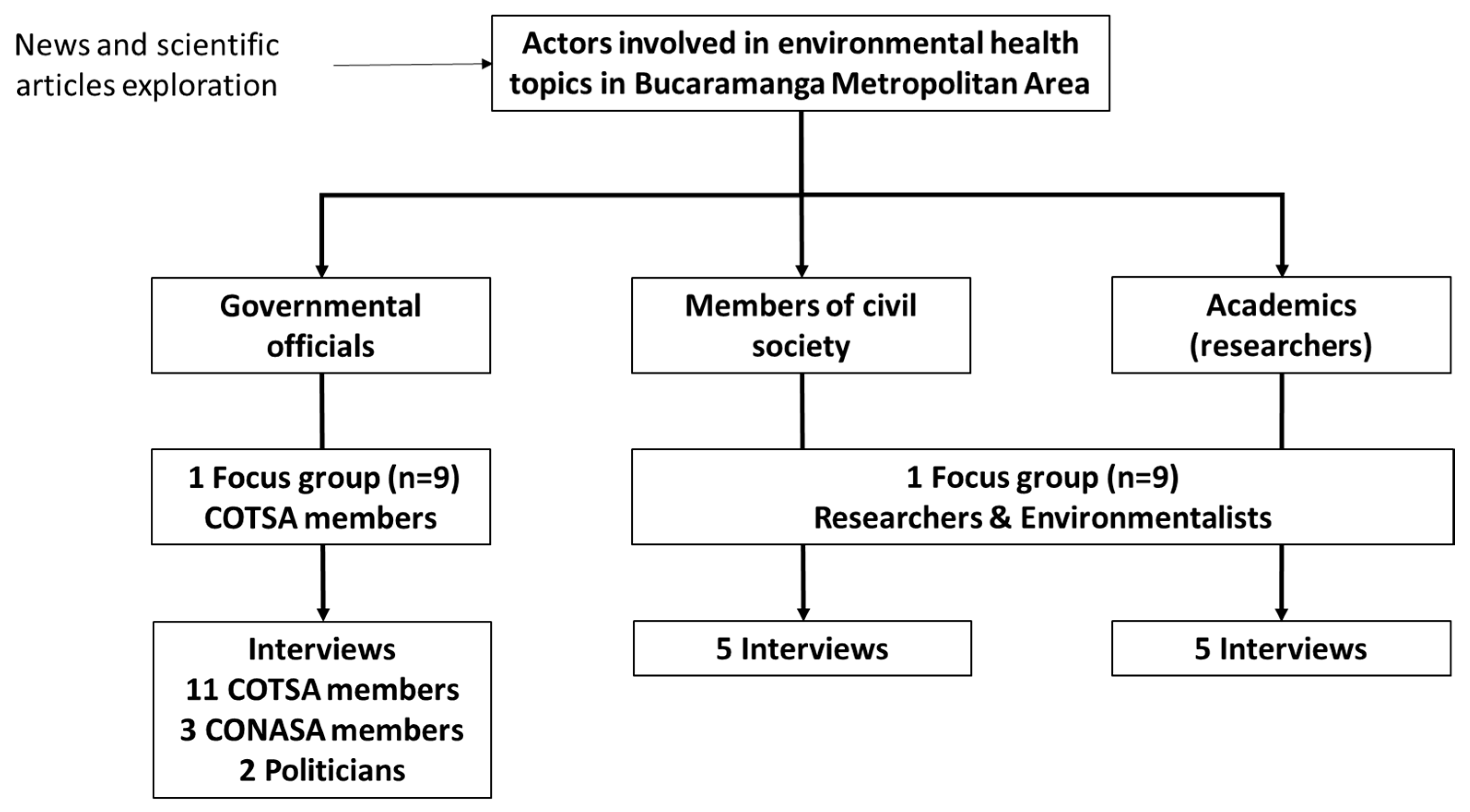

Table 1.
Mean findings in news in the Vanguardia newspaper (2016-2020) on environmental health problems in the Bucaramanga Metropolitan Area.
Table 1.
Mean findings in news in the Vanguardia newspaper (2016-2020) on environmental health problems in the Bucaramanga Metropolitan Area.
| Odor annoyance & Water pollution |
Noise | Air pollution | |
| Year publication | |||
| 2016 | 92 | 52 | 37 |
| 2017 | 105 | 86 | 45 |
| 2018 | 117 | 66 | 40 |
| 2019 | 26 | 46 | 42 |
| 2020 (until April) | 4 | 6 | 23 |
| Actions to solve problems (examples) | |||
| Actors | Environmental agency, mayor's offices, and civil society | Civil society | Universities and CDMB |
| Specific action | Cleaning of water sources Creek cleaning and environmental education |
Complaints, mobilizations, and lawsuits | Scientific studies and dissemination of results |
| Debate on landfill issues |
Table 2.
Findings obtained in the citizen´s survey in the Bucaramanga Metropolitan Area (n=105).
| Variable | Yes | No | No response |
|---|---|---|---|
| Knowledge of policies and regulations | |||
| Environmental protection | 48.0 | 46.9 | 5.1 |
| Protection of water sources | 31.6 | 62.2 | 6.2 |
| Air quality management | 36.7 | 55.1 | 8.2 |
| Recycling and solid waste management | 62.2 | 36.7 | 1.1 |
| Residential waste collection | 56.1 | 37.8 | 6.1 |
| Management of waste generated at home | 53.1 | 43.9 | 3.0 |
| Noise management | 35.7 | 58.2 | 6.1 |
| Vehicle gas emission control | 40.8 | 52.0 | 7.2 |
| Contamination control of commercial establishments | 26.5 | 64.3 | 9.2 |
| Pro-environmental culture | 25.5 | 67.3 | 7.2 |
| Encourage reforestation | 22.4 | 70.4 | 7.2 |
| Citizen experience in environmental governance | |||
| You know institutions in charge of environmental management | 72.4 | 23.5 | 4.1 |
| Participation in the generation of environmental policy | 10.2 | 87.8 | 2.0 |
| You have been asked for your opinion on environmental issues | 17.3 | 80.6 | 2.1 |
| Has received information for the generation of environmental policies | 18.4 | 79.6 | 2.0 |
| Citizen participation in the generation of environmental policies is important | 93.9 | 4.1 | 2.0 |
| If you are invited, you would participate in the generation of environmental policies | 88.8 | 4.1 | 7.1 |
| Decisions on environmental management d must be discussed and agreed between the government and citizens | 98.0 | 1.0 | 1.0 |
Table 3.
Examples of interaction between environmental health´s actors in the BMA.
| Control and surveillance | “When, for example, the CDMB requests an accompaniment to verify an odor problem with a farm, that does not happen every day. But when it happens, the ICA veterinarian goes to accompany them." (Int-11) “The truth is that I have not had very good articulation with the environmental authorities, we have not worked very well, it is a sad reality.” (Int-5) |
| Information management | "What we have had to do is demand from the State entities, so we have requested information from the different health entities such as the Bucaramanga Municipal Health Secretariat and the Departmental Health Secretariat." (Int-1) "Frequently we use, let's say, official or governmental air information, for example, so I have contact with the environmental, local, national and health authorities." (Int-8) |
| Development of research in environmental health. | “From coordination, we execute inter-administrative agreements with the academy, with the UPB, with the UDES, UIS, Pamplona, Santo Tomás, with the Colombian Meteorological Service in which we generate environmental research projects, taking into account the environmental priorities that exist in the region. The CDMB has an environmental research plan, which has several strategic lines, and we have research projects that we need to develop and those priority research projects are the ones that we develop with the academy.” (Int-4) “With the UIS, we have supported each other since 2007 in various phases of research on air quality and health, in different projects [...] We already had the first meeting this month; The sites where the different systems to be measured have been chosen. Here PM2.5 will be measured, in different strategic sites in Bucaramanga, ozone will also be measured..." (Int-4) |
| Coordination of activities | "The municipalities [of the BMA] have their own environmental health officers from their mayors' offices, but the other 82 remaining municipalities that are category 4, 5 and 6, those are the responsibility of the Department." (Int-5) “Here at the CDMB, we only know how environmental health is being managed when the Ministry of Health issues the reports [...] There is no more direct communication, each institution does its part according to what corresponds to them.” (Int-4) |
Table 4.
Progress and setbacks in environmental health governance in the Bucaramanga Metropolitan Area.
Table 4.
Progress and setbacks in environmental health governance in the Bucaramanga Metropolitan Area.
| More pro-environmental awareness | “… the pressure that there is towards the rulers, commitment of the same civil society, in reducing contaminants, trying to reduce water consumption, generating minimum waste; in other words, everything, between the public and the private, civil society, educational institutions have also collaborated a lot, there is a lot of commitment in recent years, it has been seen that young people are more committed.” (Int-7) |
| Increased data availability | “[about air data] there is information that was not available before and had to be managed in a particular way, waiting for them to consolidate it; now there is information that is more freely available, others not so much but it can be requested and accessed…” (Int-15) |
| Less technological and workforce capacity | “With the CDMB, many years ago, we had a study group on air quality that we moved in [scientific] congresses. The CDMB managed the equipment of the air quality system well, but due to economic problems that network fell down. It was a national example because they had automatic equipment and they had professionals who could manage the network" (Int-4) |
| Political disputes with technical consequences | “But here, too, each one does his own thing; look at the fight between the AMB and the CDMB a few years ago, instead of working together, many times the authorities fight among themselves, so there is no such integration” (Int-14) |
| Growth with environmental deterioration | “The results are not good, the processes have to be discussed with the results. We are already in the 21st century and Bucaramanga treats only 10% of its wastewater, to give you an example. And the city grows, more wastewater is produced, more problems occur, deforestation increases because in Bucaramanga in the 70s and 80s it was much greener, but that is being lost.” (Int-2) |
Disclaimer/Publisher’s Note: The statements, opinions and data contained in all publications are solely those of the individual author(s) and contributor(s) and not of MDPI and/or the editor(s). MDPI and/or the editor(s) disclaim responsibility for any injury to people or property resulting from any ideas, methods, instructions or products referred to in the content. |
© 2023 by the authors. Licensee MDPI, Basel, Switzerland. This article is an open access article distributed under the terms and conditions of the Creative Commons Attribution (CC BY) license (http://creativecommons.org/licenses/by/4.0/).
Copyright: This open access article is published under a Creative Commons CC BY 4.0 license, which permit the free download, distribution, and reuse, provided that the author and preprint are cited in any reuse.


