

Submitted:
16 July 2023
Posted:
18 July 2023
You are already at the latest version
Abstract
The airline sector is critical in today's globalized society, supporting the efficient movement of people and products worldwide. Airlines are continuously looking for methods to enhance their operational performance to remain competitive in the face of increased competition. This study focuses on the application of Multi-Criteria Decision Making (MCDM) techniques to improve low-cost carrier (LCC) also known or low-cost (budget) airlines' ground operational performance. MCDM techniques have gained considerable attention in recent years to address complex decision problems with multiple conflicting goals. This research aims to bridge this gap by proposing a comprehensive framework that combines MCDM techniques to enhance airline operational strategies to increase performance. The study utilizes qualitative and quantitative data, drawing on previously published materials on MCDM techniques in the aviation sector. It utilizes fuzzy Analytic Hierarchy Process (AHP) and fuzzy Technique for Order of Preference by Similarity to Ideal Solution (TOPSIS) methodologies. A case study is conducted to evaluate the ground operational performance of three airline companies based in Türkiye, considering five main criteria and 18 sub-criteria. The findings of this research will contribute to a comprehensive understanding of operational performance in the airline sector. It also highlights the implications and limitations of the research and suggests future research directions.
Keywords:
MCDM
; Multi-criteria decision making
; fuzzy AHP
; fuzzy TOPSIS
; selection
; evaluation
; airline sector
; operational performance
; low-cost carriers
; low-cost airline
1. Introduction
In today’s globalized world, the airline business is essential to the quick and effective transport of individuals and products worldwide. Airlines continually seek ways to improve their business operations and obtain a competitive edge due to the growing competition. Several main factors, including planning both long and short term, fleet and crew planning, safety, reliability, cost-effectiveness, customer satisfaction, and environmental impact, are included in operational performance. Airlines face several optimization and decision-making challenges. A robust decision-making structure that considers all the factors and offers efficient performance improvement solutions is needed to solve these multifaceted difficulties. Recently, the airline industry has drawn substantial attention to MCDM methods as a way to deal with complicated business decision problems comprising numerous divergent goals. The interdependencies and alternatives between various performance metrics are considered when using MCDM approaches to assess and rank alternatives in accordance with a set of criteria. Airlines can systematically evaluate their operational performance and discover opportunities for improvement by using a combined MCDM strategy and techniques.
The study will refer to previously published materials on MCDM techniques and their use in aviation sector. To build a robust decision-making model that can accurately represent the intricacies and dynamism of airlines’ operational performance, it will make use of both qualitative and quantitative data. The advancement of new methods for improving airlines performance is critical; however, that sort of problem takes time to solve due to the vast number of complicated factors concerned.
Even though MCDM techniques have been widely used in other industries, their use in the aviation sector still needs to be more consistent [1]. The few studies that examined the application of MCDM techniques to the airline industry have mainly concentrated on specific decision issues, including route selection and traffic management [2]. Earlier studies mostly concentrated on the different parameters regarding service quality issues. Wang et al. (2011) evaluated “customer perceptions on airline service quality in uncertainty” with the DEMATEL approach. The dimension on the study set as “reliability, care and concern, tangibility, assurance, and reaction” The sub-criteria for the ground services as “on-time flights, training of personnel, attitude, and behavior of service staff, handling complaints, easy booking process, and optimal ticket prices” [3]. Nejati et al. (2009) similarly ranked airline service quality using fuzzy TOPSIS [4]. Chen and Chen (2010) constructed “a revolutionary aviatic innovation system (AIS) to equip Taiwanese airlines with innovative strategies for future strategic development.” [5] They used fuzzy MCDM with the VIKOR model. Tsai et al. (2011) proposed a “model for the evaluation of web-based marketing” to attract loyal customers [6]. They employed DEMATEL, ANP, and VIKOR to rank and evaluate the criteria where web-based marketing actions were proposed to the managers for better strategic decision-making. Chen (2016) used “DEMATEL and ANP for the selection of quality improvement” of airline services in Taiwan [7]. The main criteria selected as “safety, service, satisfaction, and management.” Similarly, Delbari et al. (2016) examined “the key indicators and drivers” of airline services in terms of competitiveness [8]. They employed Delphi and AHP techniques. Those main eight criteria follow as “price, quality, profitability, productivity, cost, market share, timeliness, and safety.” Barros and Wanke (2015) analyzed airline efficiency in 29 African airlines using the TOPSIS method [9].
Some studies focused on the airport and facilities in relation to the airline service sector. Chien-Chang (2012] evaluated the quality of the airport services in addition to airline company offerings. The study concentrated on four main criteria: “check-in, immigration process, customs, inspection, and overall service parameters,” with 20 sub-criteria sets for Taoyuan and Kaohsiung Airports [10]. Pandey (2016) evaluated the quality of service in two main airports, namely Suvarnabhumi and Don Mueang airports in Thailand, using AHP and IPA methods [11]. The main criteria for evaluation were “access, check-in, security, finding your way, facilities, environment, and arrival services,” with 33 sub-criteria regarding “parking, baggage, ground transportation, waiting time, efficiency, staff assistance, safety, ease to find all information regarding flight or navigation, connection support, restaurants, facilities, wi-fi, lounges, cleanliness, passport control, and custom services.” Janic (2015) also studied the “solutions and alternatives for matching capacity to demand in an airport system facility” for building a runway to solve the problem in terms of given operating scenarios [12]. The study compared three airports in London respectively Heathrow, Gatwick, and Stansted.
Dincer et al. (2017) contributed MCDM field by utilizing “fuzzy DEMATEL, fuzzy ANP, and MOORA” on “balanced scorecard-based performance measurement of European airlines” [13]. The criteria used for the research were mainly “customer profitability, employee perspective, and strategic initiatives” to understand the overall performance indicators. Gudiel Pineda et al. (2018) proposed a solution on “improving airline operational and financial performance” using integrated MCDM by using DRSA data mining, DEMATEL ANP, and VIKOR [14]. The large-scale of criteria falls into two dimensions as operational and financial. Those factors were “freight, weather delays, diverted delays, canceled flights, security, aircraft arrivals late, labor, and baggage, operating revenue, and net income, fees for various services, fuel cost and consumption.” Dozic (2019) contributed to airline sector with detailed literature review and highlighted main dimensions and related criteria as follows; Airlines “service quality, partner selection, fleet management, competitiveness, financial performance, safety, responsibility, and operational factors.” Airports “performance, service quality, location, safety, others” Air traffic Management (ATM), Other dimensions are “maintenance, military issue, air cargo, mode of transport, web-based marketing, aircraft, helicopter, and sustainability.” [15]. Bakir et al. (2020) studied on MCDM approach (PIPRECIA and MAIRCA methods) of operational performance evaluation in the full-service airline carriers of emerging markets, namely Mexico, China, Indonesia, Brazil, India, and Türkiye [16]. The study covered 11 leading companies with a list of the criteria such as “operating cost, operating revenues, fleet size, load factor, number of employees, passengers carried, available seat kilometers, and revenue passenger kilometers.” Mahtani and Garg (2018) analyzed the factors affecting the airline’s financial performance in six main categories using fuzzy AHP [17]. One of the main categories is operational factors: “load factor, average passenger carried per departure, crew working hours, departures by per aircraft, pilots for each departure, international operations, average age of aircraft fleet, and different brands of aircraft.”
Moreover, various aviation applications considered various operational and technical aspects. Akyurt et al. (2021) suggested that airport selection is vital for pilot training academy programs, the right decisions lead positive impact on operations [18]. They employed a “Rough MACBETH and RAFSI-based decision-making analysis”. They identified four main criteria as “weather, cost, technical, environmental and social” and 24 sub-criteria related to them. Liang et al. (2022) proposed the effectiveness of airspace planning by evaluating ‘air traffic flow (ATC)’ with real-time simulation and utilized the MCDM TOPSIS method [19]. Those criteria were set as “air traffic flow, airspace operational performance, flight procedure quality, cost, controller workload, and pilot workload.” Deveci et al. (2022) concentrated on reducing the risk of schedule problems for carrier airline operations [20]. Their research’s four main criteria are “passenger preference, competition, availability, and connection” with 12 sub-criteria related to schedule, departure time, location-based slots availability, and types of availability in different levels. The information, frequency, operational and commercial constraints were the most prolific elements considered for the operational performance improvement areas.
Some of the other indirect but similar research concentrates on and contributes to the MCDM methods in a general perspective in addition to airline sector research. Wanke et al. (2015) analyzed the Asian airline companies using TOPSIS in efficiency, service operations proposals [21]. Sengul et al. (2015) studied “ranking renewable energy supply systems” using fuzzy TOPSIS [22]. Kavus et al. (2022) proposed “a three-level framework to evaluate airline service quality” using AHP [23]. Şahin et al. (2023) used fuzzy SWARA and fuzzy COPRAS methods for “Green Lean Supplier Selection” [24]. Pandey (2020) assessed “the strategic design parameters of Thailand airports”. The research aimed “to meet service expectations of Low-Cost” carriers [25]. The fuzzy-based QFD method was employed, and 22 main evaluation criteria were set.
Furthermore, studies are looking at different perspectives of how well airlines operate, and there is a research gap when it comes to creating a comprehensive framework for making decisions that incorporate Multiple Criteria Decision Making (MCDM) methods to improve operational performance in the airline industry. There is, however, a dearth of research that considers the multidimensional character of operational performance and offers a comprehensive strategy that concurrently addresses several performance criteria.
A research gap that must be filled in creating a thorough MCDM strategy designed particularly for enhancing airline operational performance. The suggested study intends to close this research gap by proposing a combined MCDM strategy that considers numerous main factors, such as quality assurance, employee perspective, process efficiency, capacity planning and management, and cost-effectiveness, to improve low-cost airline operational performance. This research will lead to a broader and complete knowledge of operational outcomes in the airline sector by combining multiple performance indicators into an integrated decision-making framework. This study also aims to evaluate the operational performance of the three airline companies within the abovementioned five main criteria and 18 sub-criteria. The company’s headquarters are located in Türkiye, and operates various domestic and international destinations. The paper focuses on selecting the best alternative airline due to business operational services and mainly qualities according to evaluation criteria. The research questions are formulated as follows in light of the study’s aims and scope:
RQ1_ What are the criteria for the operational performance evaluation of airlines?
RQ2_ What are the weights of operational performance criteria, and how to rank the alternatives?
RQ3_ How to select the best operationally performed airlines?
The paper is organized as follows: an introduction with an extensive literature review, materials and techniques (the fuzzy AHP and fuzzy TOPSIS methodologies utilized as hybrid multi-criteria decision-making approach), a case study conducted to evaluate the airline company’s operational performance. The criteria were chosen via a literature search with expert opinion, and after being categorized in the criteria list, they were weighted using fuzzy AHP. Fuzzy TOPSIS was used for the process evaluation step to identify and rank the top-performing airlines. The final part of the manuscript contains the discussion and conclusion, including implications, limitations of the study, and potential future research directions.
2. Materials and Methods
The goal of the research area known as “Multiple Criteria Decision Making” (MCDM) is to assist decision-makers when they must weigh several competing criteria or objectives. In such complex decision-making scenarios, MCDM provides a structured framework to analyze, evaluate, and rank alternatives based on performance across different criteria [26]. MCDM is significant because of its capacity to manage decision complexity, improve decision quality, involve stakeholders, and allow domain-specific solutions. MCDM enables decision-makers to negotiate the obstacles of multi-criteria decision problems while making more informed and beneficial decisions by providing organized methodologies and tools [27,28,29].
The study offers an evaluation approach that prioritizes the corresponding weights of three low-cost carriers (LCC), also known as low-cost (budget) airline’ companies ground service operations. The suggested method is comprised of several subsequent phases. In the first stage, five primary criteria and 18 distinct sub-criteria are developed from the support of the current literature provided in the “Introduction section” with expert opinions, the similar methodology steps applied as previous research [30]. In the second stage, defined criteria are weighted by relevant stakeholders using the Fuzzy AHP method, which helps further analysis. Hereafter, the Fuzzy TOPSIS approach was used to rank the three Turkish low-cost carriers (airlines) in the third stage. The fuzzy technique is utilized in decision-making because the selection criteria are not represented numerically. Figure 1 depicts the research flow of the assessment procedure.
2.1. The Fuzzy AHP Method
The fuzzy AHP approach was developed utilizing fuzzy logic [31] and classical AHP method [32,33,34] together and is commonly used to remove ambiguity from decision-making processes [35]. In fuzzy AHP method, fuzzy integers are employed in pairwise comparisons to convey expert judgments.
In the MCDM literature, there could be seen are many Fuzzy AHP methods such as “Buckley’s (1984) Fuzzy AHP method” [36], and “Chang’s extent analysis method” [37,38], Enea and Piazza (2004) Fuzzy AHP method [39], and Van Laarhoven and Pedrycz (1983) Fuzzy AHP method [40]. Chang’s extended analysis approach has become the most popular in the literature since it is extremely close to the traditional AHP phases and is simple to implement. This study explains the method in detail, and the solution is conducted with Chang’s method. According to this method, verbal comparisons between criteria are expressed using fuzzy triangular numbers (Table 1).
When the literature is screened, it is seen that the Fuzzy AHP method has a wide application area. Among these applications, The “shipping registry selection” [41], “supplier selection” [42,43], “evaluation of open and distance education websites” [1], “performance evaluation” [44], “evaluating machine tool alternatives” [45], “the evaluation of e-service quality in the airline industry” [46], “determining best teaching method” [47], “integrated Quality Function Deployment methodology for hazelnut production” [48], “evaluating teaching performance” [49], “hospital site selection” [50], “selecting the suitable bridge construction method” [51], “renewable energy dissemination program evaluation” [52] can be mentioned.
- Step_1:
With equation 2.1, the fuzzy synthetic order value for the criteria is calculated as shown below.
The following addition is performed to obtain the value in the equation.
According to equation 2.3, the expression in equation 2.1 is calculated.
- Step_2:
The probability of the expression 𝑀2=(𝑙2,𝑚2,𝑢2 ) ≥ 𝑀1=( 𝑙1,𝑚1,𝑢1) in obtaining the synthesis values is defined as follows:
In order to compare 𝑀1 and 𝑀2, both the values of V(𝑀2 ≥ 𝑀1) ve 𝑉(𝑀1 ≥ 𝑀2) are required.
- Step_3:
The minimum values are taken because of the comparisons for all rows among themselves. Similarly, the second row is compared to all previous rows, and the lowest value is chosen. This procedure is repeated for all rows. The weight vector is created by adding the lowest values obtained for every single row.
- Step_4:
W is computed by normalizing the weight vector produced in step 3.
W ceases to be a fuzzy number.
2.2. The Fuzzy TOPSIS Method
“Technique for Order Preference by Similarity to Ideal Solution (TOPSIS)” is a “comprehensive distance-based evaluation method” developed by Hwang and Yoon (1981) and can be expressed as a method for ranking by ideal solution [43,53]. TOPSIS focuses on locating the solution point nearest to the positive ideal solution while being the furthest away from the negative perfect solution [54]. The ideal solution or the most suitable alternative is the one that maximizes the benefit criterion and minimizes the cost criterion.
Fuzzy TOPSIS is a decision-making method used to select, rank, and evaluate alternatives in quantitative and qualitative multi-criteria decision-making problems [55,56,57,58,59,60,61,62]. Fuzzy decision methods are necessary to incorporate human thoughts and evaluations in the solution process and make more realistic evaluations in ambiguous situations and events. In applying the fuzzy TOPSIS method, decision-makers verbally express their judgments about the decision criteria and alternatives. The similarity coefficient for the alternatives is calculated by converting the decision makers’ assessments about the criteria and alternatives into fuzzy numbers. The alternatives are listed using the calculated similarity coefficients, and the solution is presented. The fuzzy TOPSIS method developed by Chen (2000) is a method that can be applied in individual or group decision-making. The linguistic evaluations and fuzzy number equivalents proposed by Chen and used in evaluating alternatives are shown below [63].

Table 2.
Linguistic variables for the ratings of alternatives [63].
Table 2.
Linguistic variables for the ratings of alternatives [63].
| Linguistic Variable | Triangular Fuzzy Number |
|---|---|
| Very Poor (VP) | (0, 0, 1) |
| Poor (P) | (0, 1, 3) |
| Medium Poor (MP) | (1, 3, 5) |
| Fair (F) | (3, 5, 7) |
| Medium Good (MG) | (5, 7, 9) |
| Good (G) | (7, 9, 10) |
| Very Good (VG) | (9, 10, 10) |
In a group of K decision makers, the aggregated fuzzy importance weight of the decision criteria affecting the problem and the aggregated fuzzy ratings of the alternatives according to each criterion can be calculated with the following equations.
The decision matrix ( and criterion weights ( of a multi-criteria decision problem can be represented as follows:
where ve are linguistic variables and , are alternatives; K decision makers and their number; are the decision criteria; is the criterion value of the alternative with respect to a decision criterion; and is the importance weight of the criterion . is expressed as a fuzzy decision matrix and as a matrix of fuzzy weights. The elements and weights of the matrix are represented as fuzzy numbers and .
The next step is to calculate the normalized fuzzy decision matrix. This matrix is represented as follows:
Each element of the normalized fuzzy decision matrix is calculated by the following equations, with B representing the benefit and C the cost criteria:
It is ensured that the fuzzy number values in a normalized matrix are in the range of [0,1]. After calculating the normalized decision matrix, the weighted normalized decision matrix is calculated by considering the importance weight of the criteria. The weighted normalized decision matrix is shown as
where .
The weighted normalized fuzzy decision matrix is obtained by multiplying the normalized fuzzy decision matrix with the fuzzy weights matrix. In this case, the calculated matrix is shown as:
After calculating the weighted normalized fuzzy decision matrix , the fuzzy positive ideal solution and the fuzzy negative ideal solution can define as;
Then it is necessary to calculate the distances of the alternatives from and In this calculation, d represents the distances between fuzzy numbers and the calculation is done with the following equations:
Finally, the closeness of the alternatives to the ideal solution is calculated. For this, the Vertex method, which is used to calculate the distances to one of the fuzzy numbers, is used. The distance between two triangular fuzzy numbers, such as and is calculated according to the Vertex method with the following equation:
To evaluate the alternatives and make a choice, the closeness coefficients are calculated for each alternative with the help of the following equation [64].
Alternatives are decided to rank according to (the closeness coefficient) values. Suppose the closeness coefficient is equal to 1. In that case, the value of the alternative in question equals the fuzzy positive ideal solution. If the closeness coefficient is equal to 0, the value of the alternative is equal to the fuzzy negative ideal solution.
3. Case Study Analyses and Results
In this study, three low-cost carriers (LCC), also known as budget or low-cost airline companies operating in Türkiye, were examined regarding their ground operations performance. The procedures performed at this study stage are discussed in four subsections and explained in detail. First, LCC companies considered in the case study were introduced in detail. In the second stage, the literature was reviewed widely, and the criteria to be used for evaluation were investigated. The criteria obtained were combined with expert opinions and arranged for study use. In the third stage, the fuzzy AHP method weighted the evaluation criteria. Finally, three airlines were evaluated and ranked regarding their ground operations performance using the Fuzzy TOPSIS method.
3.1. Background: Low-Cost (Carriers) Airlines in Türkiye
Three low-cost airline companies are operating in Türkiye. These are Anadolu Jet [65], Pegasus Airlines [66], and Sun Express [67], in alphabetical order. All companies take domestic and international flights and aim for the most convenient and best-paid flight for their passengers.
Anadolu Jet was founded in 2008, the parent company is Turkish Airlines, and its headquarters is in Ankara. The main operating bases of the airline are Ankara and Istanbul Sabiha Gokcen Airport. With a fleet size of 81, the flying destinations are 164 routes. The frequent flyer program is “Miles & Smiles”, a Star Alliance (affiliate) member.
Pegasus Airlines was founded in 1991, the parent company is Esas Holding, and its headquarters is in Istanbul. The airline’s Main hubs are Adana, Ankara, Antalya, Ercan, Istanbul Sabiha Gokcen Airport, and Izmir. With a fleet size of 95, the flying destinations are 126 routes. The frequent flyer program is “Pegasus Bol Bol”.
Sun Express was founded in 1989, the parent companies are Turkish Airlines and Lufthansa Group, and its headquarters is in Antalya. The airline’s main hubs are Izmir Adnan Menderes Airport and Antalya Airport. The fleet size of 53, and the flying destinations are 66 routes. The frequent flyer program is “SunExpress your benefits”.
3.2. Background: Low-Cost (Carriers) Airlines in Türkiye
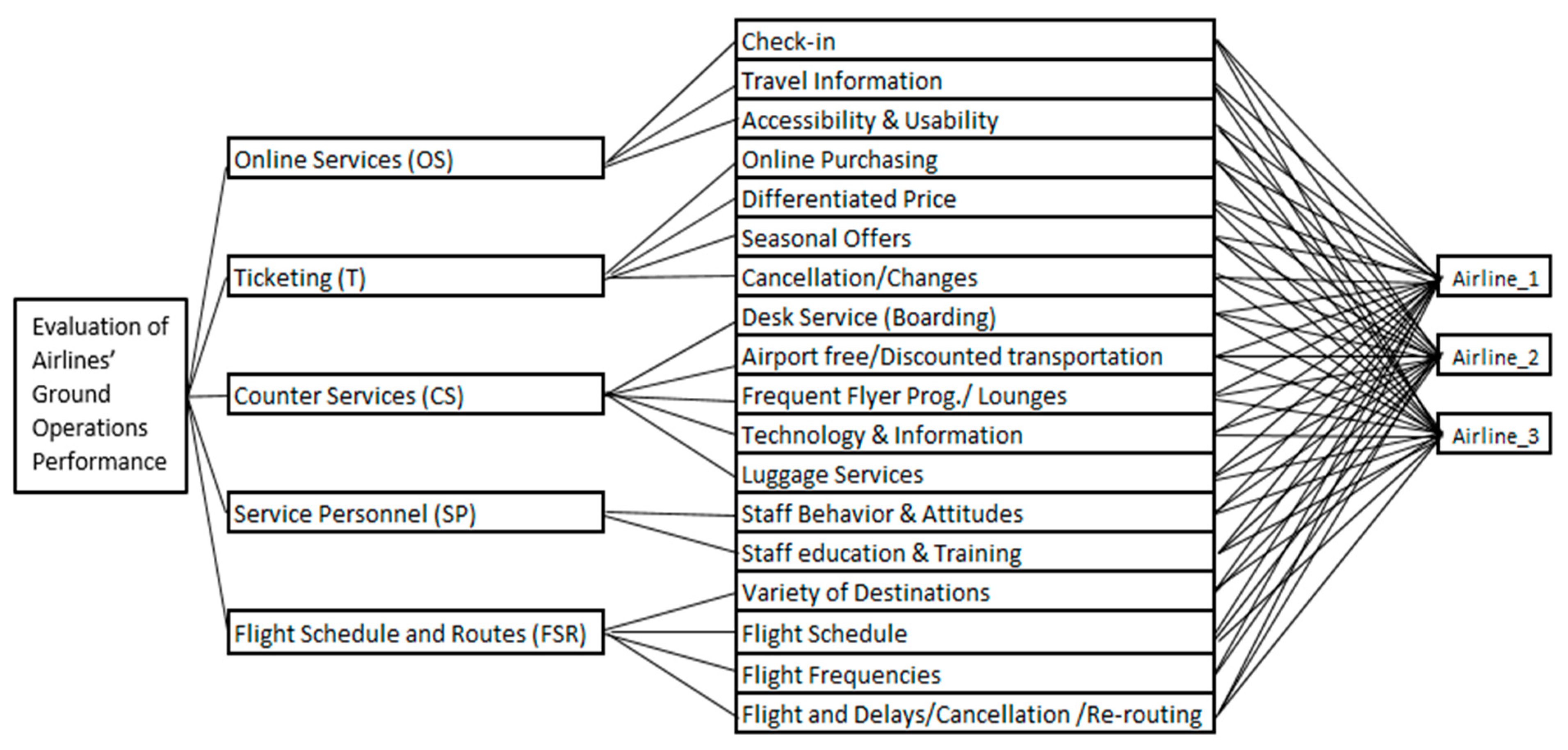
The second stage of the study is to determine the criteria to be used to evaluate alternatives. For this purpose, a detailed literature review was conducted, and five main criteria and 18 sub-criteria given in Table 3 were obtained with expert support.
These criteria categories are coded for each primary and sub-criterion as follows; Online Services (OS) (three sub-criteria; OS1 to OS3), Ticketing (T) (four sub-criteria; T1 to T4), Counter Services (CS) (five sub-criteria; CS1 to CS5), Service Personnel (SP) (two sub-criteria; SP1 and SP2) and Flight Schedule and Routes (FSR) (four sub-criteria; FSR1 to FSR4).
Six experts were consulted in the evaluation of the study. In order to categorize the criteria and compare them pairwise with the fuzzy AHP approach, the views of six experts were employed, and the evaluation of the airlines with the fuzzy TOPSIS method conducted. Three of them are professionals and passengers who travel frequently with airlines, and the other two are experts with many years of airline experience in various ground service roles. One is an airline employee with many years of flying experience. The other expert is an industrial/process engineer with experience in process management and specializes in airline and travel issues. The average experience of the experts is 10+ years. The five-point linguistic expression scale given in Table 1 is used for the pairwise comparisons. According to the results of the observations, the data obtained were summarized, and the average estimates of the six experts were used in this article.
Figure 2.
The hierarchical structure of the study.
3.3. The Weighting of Evaluation Criteria with Fuzzy AHP Method
The primary criteria, as well as sub-criteria of the decision issue, are weighted using the fuzzy AHP approach at this step. The critical criteria for the study were first established, and the experts then conducted pairwise comparisons utilized the fuzzy triangular numbers shown in Table 1. The verbal assessments were quantified by converting them into the fuzzy triangular numbers shown in Table 4. The calculations are completed by considering the equations supplied in the Fuzzy AHP application stages mentioned in the preceding sub-section, and the Fuzzy triangular weight values (W) for the primary criteria listed in Table 5 are generated.
Following steps demonstrate the evaluation of the main criteria and all sub-criteria. This reflects to evaluation in terms of relation degrees with the main criteria to each sub-criterion together. Pairwise comparison matrices showing the sub-criteria evaluations for each main criterion are given in Table 6, Table 7, Table 8, Table 9 and Table 10.
As a result of analyzing the expert opinions given in Table 6, Table 7, Table 8, Table 9 and Table 10 using the fuzzy AHP method, the final weighting values in Table 11 were obtained. In the next stage of the study, the fuzzy numbers provided in Table 5 are used to analyze the three airlines using the Fuzzy TOPSIS method. However, the defuzzified weighting numerical values calculations in Table 11 were introduced to understand the impact of each criterion for the solution results.
Table 11 shows that the Flight Schedule and Routes (FSR) criteria, with a weight value of 0.3, have the greatest effect on the solution results with the highest value among the five main criteria. Followed by Counter Services (CS), which ranks second highest weight value of 0.26, and Ticketing (T), the third criterion with a weight value of 0.19.
3.4. Evaluation of Operational Performance with Fuzzy TOPSIS Method
In this step of the study, fuzzy TOPSIS method was applied to rank the alternative airlines (Airline_1, Airlne_2 and Airline_3) taking into account the determined criteria. The Airline companies described alphabetically in Section 3.1 are named randomly, not in the order described in the previous section, to ensure data and analysis confidentiality.
At this study stage, the decision makers verbally expressed the three alternatives based on all sub-criteria. The expert opinions used in evaluating the alternatives are given in Table 12.
Fuzzy linguistic phrases are translated to triangular fuzzy integers using Table 2. As a result, the first fuzzy decision matrix is obtained. Equation (2.13) and equation (2.13) are used to create the normalized fuzzy decision matrix illustrated in Table 13. At this stage, each criterion should be treated as a benefit or cost criterion. In our study, since all criteria are benefit-based, the calculation was made using equation (2.12).
While obtaining the weighted normalized Fuzzy Decision Matrix in Table 14, the fuzzy criteria weights in Table 5 obtained from the Fuzzy AHP analysis in the previous section were used for weighting. Meanwhile, Equation (2.14) was used for the calculations performed.
Table 15 shows the calculated d^+ and d^- values for each alternative airline and Table 16 gives the final alternative ranking based on the calculated closeness coefficient.
When Table 16 is examined, it is understood that although Airline_3 ranks first in terms of its performance in ground operations with a weight value of 0.361, the alternatives generally achieve very close results.
4. Discussion and Conclusions
The fuzzy AHP and TOPSIS methodologies were used to evaluate the ground operations performance of three low-cost airlines in Türkiye. In this regard, the necessary references were first evaluated, and the assessment criteria for the study were established. The acquired criteria were categorized hierarchically with the assistance of expert judgments. All analyses and assessments conducted within the scope of the study were done in two stages. The first step used the fuzzy AHP approach to weight the assessment criteria. Fuzzy numbers were utilized since the criteria used in the evaluation did not have exact numerical values that could be represented in terms of all decision-makers.
After the analysis with Fuzzy AHP, weight values were calculated for each main and sub-criterion. When the study’s five primary criteria’s estimated weights are examined, it is seen that “Flight Schedule & Routes (FSR)” has the highest importance weight with 0.30. With a weight value of 0.26, “Counter Services (CS)” has the second most significant impact. “Ticketing (T)”, which ranks third in terms of its impact on the solution, has a weight value of 0.19. The first three criteria are followed by “Service Personnel (SP)” with a weight value of 0.14 and “Online Services (OS)” with a weight value of 0.11. When the “Flight Schedule & Routes (FSR)” criterion with the highest priority value is analyzed in terms of sub-criteria, Flight Frequencies (FSR3) and Flight Schedule (FSR2) stand out as the most prominent sub-criteria. When the results obtained are analyzed, it is seen that the alternative that is better in terms of “Flight Schedule & Routes (FSR)” stands out more than the others and takes the first place in the evaluation of three alternative airlines.
Following the calculation of the weights of the assessment criteria, three different airline firms were analyzed using the Fuzzy TOPSIS approach. Triangular fuzzy criteria weights were utilized in the studies at this step. Fuzzy TOPSIS was chosen since it is commonly utilized in the literature and produces excellent results. The options were ranked as a result of the Fuzzy TOPSIS Method study. Table 16 displays the importance of weights and alternative rankings based on the Fuzzy TOPSIS Method analysis results.
Upon reviewing the analysis’s findings, it can be seen that the third alternative is relatively prominent among the others. Airline_3 ranked first with a weight value of 0.361, while Airline_2 ranked the second with a weight value of 0.331. Airline_1 ranked at last with an actual weight of 0.308. When the fuzzy verbal evaluations of the decision makers for the first two alternatives Airline_3 and Airline_2 are analyzed, it can be seen that Airline_3 has the best values in terms of the first two main criteria that have more impact on the solution results.
However, considering the dynamics of the airline industry in which the study was conducted, it can be said that all three airline companies have managed to stand out as successful in certain areas in the current competitive conditions. Through a detailed examination of the study’s results, separate analyses can be carried out for each of the three companies, and areas where performance needs to be improved can be identified.
The closeness of performance values to each other is an important finding. It can be expected that the result will come close because of competition and service quality and regulations. In the aviation sector, companies follow strict rules and keep the service level as much as possible to meet the legal and regulatory requirements. Companies should incorporate different operational requirements into their daily practices to increase the quality of the service they provide. The positive effects of technology and new business understandings should also be reflected on airline companies’ operational strategies. Low-budget airlines, which are the subject of our research, may limit the diversity of their service offerings, which is a natural business necessity. Still, in comparative analysis, if one company has an advantage over the others, the others are expected to respond competitively. The downward cost trend makes it easier for service providers to update their portfolios and offer the appropriate ones at lower costs. The low-cost carrier (airlines) could improve their operations by considering the following factors: gathering operational and constituent data; making repairs more quickly so that fewer critical components fail; preventing flight delays; reducing the amount of time that aircraft are idle (on the ground); reducing the price of labor and replacement parts; and reducing the frequency of unplanned maintenance. Therefore, the size of aircraft most preferred ones in those companies are Boeing 737 in various model types and Airbus 320-321 are both operated for their size, efficiency, and economy as well as operationally easy to handle and manage since the aircraft is the primary input for the entire process.
4.1. Final Remarks and Significance of the Research
The significance of our study reveals its potential to positively impact the aviation sector and solve the complicated difficulties that airlines confront in improving their operational performance. The following are some significant justifications for the significance of this study topic:
• Improved decision-making: Creating a combined MCDM strategy designed significantly for enhancing airlines’ operational performance can offer decision-makers a comprehensive framework to assess and rank various strategies. Informed judgments that take into consideration a variety of performance parameters at once may be made by airlines, as a result, leading to more efficient resource allocation and operational enhancements.
• A combined MCDM method may offer a comprehensive perspective of an airline’s operational performance by integrating several performance criteria including safety, dependability, cost-effectiveness, customer happiness, and environmental impact. As a result, strengths, weaknesses, and potential improvement areas may be understood more thoroughly, allowing for focused interventions to improve performance.
• Operational performance is vital in establishing an airline’s competitiveness and market position in a highly competitive business-like aviation. Airlines may set themselves apart from their rivals by providing higher safety, dependability, customer happiness, and cost-effectiveness by utilizing a combined MCDM strategy to improve operational performance. Increased consumer loyalty, market share, and financial sustainability can all result from this.
• Allocating resources effectively is essential for successful operations since airlines operate in a resource-constrained environment. By considering many factors at once, a combined MCDM method could help optimize the allocation of resources, such as aircraft, personnel, and maintenance. Increased efficacy, cost-effectiveness, and capacity utilization may maximize the value and benefit of the resources.
• Impact on the entire industry: The research on a combined MCDM method for enhancing airlines’ operational performance may provide discoveries and insights that have larger ramifications for the entire aviation sector. The creation of best practices, frameworks for making decisions, and optimization models may be shared and used by airlines worldwide, improving operational performance and efficiency across the board.
• Sustainable operations: There is a growing demand on airlines to operate sustainably and to lessen their environmental impact. The evaluation and selection of solutions that improve operational performance and reduce the environmental effect of airline operations can be facilitated by a combined MCDM approach. This supports the sector’s sustainability objectives and reflects rising social and regulatory demands.
• By researching this subject, academics, industry practitioners, and authorities may work together to further the knowledge and execution of a combined MCDM strategy, eventually benefiting airlines, passengers, and the aviation sector.
4.2. Theoretical and Research Implications
Studying a combined MCDM method to enhance airline operational performance could have many theoretical and research implications. It advances decision-making by including many factors and offering a thorough framework for assessing operational performance in the airline sector. This can improve our conceptual understanding of MCDM techniques to solve complicated decision-making issues in multidimensional settings. The study could contribute to creating and improving MCDM techniques tailored to the aviation sector. The use of MCDM techniques in the overall picture of operational performance allows researchers to improve current models and suggest fresh ideas that better reflect the particular traits and difficulties experienced by airlines. Our study also theoretically contributes to the MCDM literature by using Fuzzy AHP and Fuzzy TOPSIS methods and supports the airline operational performance evaluation process. The evaluations and analyses in this article are based on a single-country case study. The study’s results expand our understanding of MCDM from a research perspective and direct new avenues for the development areas and research gaps.
4.3. Managerial and Practical Implications
From managerial and practical perspectives, the results of the study have significant management and operational implications for airlines and professionals in the field. Making decisions and prioritizing alternative criteria for enhancing operational performance can be made easier by decision-makers with the help of a combined MCDM strategy, which can offer insightful information. The suggested model can be used by airlines to determine areas for improvement, better manage resources, and create plans that complement various performance metrics. The comparison results assist decision-makers. Therefore, the research also enhances understanding of the operational structure with required performance level and administrative concerns to manage operations better.
The study results can also direct airlines to implement strategies to improve security, dependability, cost-effectiveness, customer loyalty, and environmental sustainability. This may lead to observable advantages, including higher operational effectiveness, cost savings, customer loyalty, and increased competitiveness. Strategists should focus on service requirements and quality characteristics with comprehensive features to enhance value propositions in service quality and efficiency in operations. Furthermore, with the aid of technological advancement and innovative service-providing strategies, we suggest customizing operations to meet customer needs to improve operational effectiveness and performance at large.
4.4. Research Limitations
Our study undertaken on a combined MCDM method for enhancing airline operational performance must be acknowledged for its limitations. Even though the MCDM evaluation study has significance for the research community, this study has several drawbacks. First, given that data gathering in the aviation sector can be difficult due to its sensitivity and confidentiality, one limitation may result from data availability and quality. Access to complete and consistent datasets may be restricted for researchers, which may have an impact on the precision and generalizability of the research findings. Second, the complexity and volatility of the airline sector could be a further constraint. The numerous facets of the performance of operations and the dynamic nature of the operational environment make it challenging to create a framework that can be used everywhere. Researchers should be conscious of these restrictions and carefully consider the unique context and circumstances in which the suggested approach is used. Third, airline companies’ service levels significantly influence the evaluation’s results when comparing a single country and location. Finally, The MCDM method’s application is viewed as a limitation as well, thus, a comparison with other approaches is not conducted.
4.5. Future Research Directions
Future studies can take a few paths to improve the subject and address the abovementioned limitations. This study’s outcomes emphasize the need for more research to analyze various performance improvements in the industry. Furthermore, the following future study directions might be suggested.
First, to validate and improve the suggested combined MCDM technique, researchers might conduct additional in-depth case studies and empirical analyses. This can increase the framework’s suitability for use in practical contexts and contribute to developing a solid empirical base. Research can also be expanded by looking into the intersection of cutting-edge “technologies like big data analytics, machine learning”, and artificial intelligence. Exploring how these technologies can improve the MCDM approach’s precision, effectiveness, and real-time application can have significant theoretical and practical implications for the airline sector. The Analytical Network Process (ANP) may be used to examine the probable feedback and interaction between the sub-criteria. To acquire a more complete review, future research might be conducted with various levels of stakeholders directly or indirectly involved in the entire process. Moreover, future studies should concentrate on the different level of the operations in more broadly covered as pre-flight (ground), in-flight, and post-flight main process parts, which would be the full coverage of the entire airline operation dimensions.
Additionally, comparative studies that evaluate the efficacy and efficiency of various MCDM methodologies and models may assist in determining the best strategies for enhancing airlines’ operational performance. To advance the comprehension and implementation of a combined MCDM approach in the airline industry, future research should concentrate on improving existing frameworks, investigating novel facets of operational performance, adopting emerging technologies, and performing thorough comparative analyses.
4.6. Conclusions
This study used a combined MCDM strategy to improve airline ground operations performance. Planning, fleet and crew management, safety, dependability, cost-effectiveness, customer satisfaction, and environmental impact are the general elements determined earlier for operational success in the sector. Previous research in the airline sector focused on individual decision concerns, but this study attempted to establish a robust MCDM technique explicitly geared to improve airline operational performance. To do this, the relevant literature was first reviewed, and the assessment criteria considered within the context of the study were proposed. Expert views were used to classify the acquired criteria. The analyses and assessments conducted as part of the research were conducted in two separate phases. A case study involving three Turkish low-cost airlines was conducted, with service quality, cost-effectiveness, revenue, process management, operational capacity, planning, and staff aspects all being considered. The five main criteria set as “ticketing, online services, counter services, flight schedule and routing, and service personnel” with related 18 sub-criteria.
The suggested technique combined the “fuzzy Analytic Hierarchy Process (AHP)” methods and the “fuzzy Technique for Order of Preference by Similarity to Ideal Solution (TOPSIS).” The fuzzy AHP approach was used to assign weights to the criteria, and fuzzy TOPSIS was used to rank and identify the best-performing airlines. The study’s findings emphasized the need to use a combined MCDM methodology to analyze operational performance in the airline sector. The suggested framework provides airlines with a systematic and comprehensive way of assessing their performance and identifying opportunities for improvement. Additional variables and criteria can be explored in future studies, such as pre-flight, in-flight, and post-flight process steps, as broadly covers the entire operations and the methodology and applicability of the proposed framework to diverse airline scenarios.
Author Contributions
Conceptualization, A.K and Y.S.; Methodology, Y.S. and A.K.; Software, Y.S. and A.K.; Validation, A.K. and Y.S.; Formal analysis, Y.S. and A.K.; Investigation, AK and Y.S.; Resources, Y.S. and A.K.; Data curation, A.K. and Y.S.; Writing—Original Draft, A.K. and Y.S.; Writing—Review & Editing, A.K. and Y.S. and; Visualization, Y.S. and A.K.; Supervision, A.K.; Project Administration, A.K and Y.S. All authors have read and agreed to the published version of the manuscript.
Funding
Not applicable.
Data Availability Statement
Not applicable.
Acknowledgments
We would like to thank the anonymous reviewers for their valuable suggestions and comments.
Conflicts of Interest
The authors declare no conflict of interest.
References
- Şahin, Y.; Kulakli, A. Evaluation of Open and Distance Education Websites: A Hybrid Multi-Criteria Decision-Making Approach. Systems 2023, 11, 58. [Google Scholar] [CrossRef]
- Bongo, M.F.; Ocampo, L.A. A Hybrid Fuzzy MCDM Approach for Mitigating Airport Congestion: A Case in Ninoy Aquino International Airport. Journal of Air Transport Management 2017, 63, 1–16. [Google Scholar] [CrossRef]
- Wang, R.; Shu-Li; Hsu; Lin, Y.H.; Tseng, M.-L. Evaluation of Customer Perceptions on Airline Service Quality in Uncertainty. Procedia - Social and Behavioral Sciences 2011, 25, 419–437. [CrossRef]
- Nejati, M.; Nejati, M.; Shafaei, A. Ranking Airlines’ Service Quality Factors Using a Fuzzy Approach: Study of the Iranian Society. International Journal of Quality & Reliability Management 2009, 26, 247–260. [CrossRef]
- Chen, J.K.; Chen, I.S. Aviatic Innovation System Construction Using a Hybrid Fuzzy MCDM Model. Expert Systems with Applications 2010, 37, 8387–8394. [Google Scholar] [CrossRef]
- Tsai, W.H.; Chou, W.C.; Leu, J.-D. An Effectiveness Evaluation Model for the Web-Based Marketing of the Airline Industry. Expert Systems with Applications 2011. [Google Scholar] [CrossRef]
- Chen, I.S. A Combined MCDM Model Based on DEMATEL and ANP for the Selection of Airline Service Quality Improvement Criteria: A Study Based on the Taiwanese Airline Industry. Journal of Air Transport Management 2016, 57, 7–18. [Google Scholar] [CrossRef]
- Delbari, S.A.; Ng, S.I.; Aziz, Y.A.; Ho, J.A. An Investigation of Key Competitiveness Indicators and Drivers of Full-Service Airlines Using Delphi and AHP Techniques. Journal of Air Transport Management 2016, 52, 23–34. [Google Scholar] [CrossRef]
- Barros, C.P.; Wanke, P. An Analysis of African Airlines Efficiency with Two-Stage TOPSIS and Neural Networks. Journal of Air Transport Management 2015, 44–45, 90–102. [CrossRef]
- Chien-Chang, C. Evaluating the Quality of Airport Service Using the Fuzzy Multi-Criteria Decision-Making Method: A Case Study of Taiwanese Airports. Expert Systems 2011, 29, 246–260. [Google Scholar] [CrossRef]
- Pandey, M.M. Evaluating the Service Quality of Airports in Thailand Using Fuzzy Multi-Criteria Decision Making Method. Journal of Air Transport Management 2016, 57, 241–249. [Google Scholar] [CrossRef]
- Janic, M. A Multi-Criteria Evaluation of Solutions and Alternatives for Matching Capacity to Demand in an Airport System: The Case of London. Transportation Planning and Technology 2015, 38, 709–737. [Google Scholar] [CrossRef]
- Dinçer, H.; Hacıoğlu, Ü.; Yüksel, S. Balanced Scorecard Based Performance Measurement of European Airlines Using a Hybrid Multicriteria Decision Making Approach under the Fuzzy Environment. Journal of Air Transport Management 2017, 63, 17–33. [Google Scholar] [CrossRef]
- Gudiel Pineda, P.J.; Liou, J.J.H.; Hsu, C.C.; Chuang, Y.C. An Integrated MCDM Model for Improving Airline Operational and Financial Performance. Journal of Air Transport Management 2018, 68, 103–117. [Google Scholar] [CrossRef]
- Dožić, S. Multi-Criteria Decision Making Methods: Application in the Aviation Industry. Journal of Air Transport Management 2019, 79, 101683. [Google Scholar] [CrossRef]
- Bakir, M.; Akan, Ş.; Kiraci, K.; Karabasevic, D.; Stanujkic, D.; Popovic, G. Multiple-criteria approach of the operational performance evaluation in the airline industry: Evidence from the emerging markets. Romanian Journal of Economic Forecasting 2020, 23(2), 149–172. [Google Scholar]
- Mahtani, U.S.; Garg, C.P. An Analysis of Key Factors of Financial Distress in Airline Companies in India Using Fuzzy AHP Framework. Transportation Research Part A: Policy and Practice 2018, 117, 87–102. [CrossRef]
- Akyurt, I.Z.; Pamucar, D.; Deveci, M.; Kalan, O.; Kuvvetli, Y. A Flight Base Selection for Flight Academy Using a Rough MACBETH and RAFSI Based Decision-Making Analysis. IEEE Transactions on Engineering Management 2022, 1–16. [Google Scholar] [CrossRef]
- Liang, B.; Han, S.; Li, W.; Han, Y.; Liu, F.; Zhang, Y.; Lin, C. Plithogenic Multi-criteria Decision-Making Approach on Airspace Planning Scheme Evaluation Based on ATC-flight Real-time Simulation. IET Intelligent Transport Systems 2022, 16, 1471–1488. [Google Scholar] [CrossRef]
- Deveci, M.; Rodríguez, R.M.; Labella, Á.; Ciftci, M.E. A Decision Support System for Reducing the Strategic Risk in the Schedule Building Process for Network Carrier Airline Operations. Annals of Operations Research 2022. [Google Scholar] [CrossRef]
- Wanke, P.; Pestana Barros, C.; Chen, Z. An Analysis of Asian Airlines Efficiency with Two-Stage TOPSIS and MCMC Generalized Linear Mixed Models. International Journal of Production Economics 2015, 169, 110–126. [Google Scholar] [CrossRef]
- Şengül, Ü.; Eren, M.; Eslamian Shiraz, S.; Gezder, V.; Şengül, A.B. Fuzzy TOPSIS Method for Ranking Renewable Energy Supply Systems in Turkey. Renewable Energy 2015, 75, 617–625. [Google Scholar] [CrossRef]
- Kavus, B.Y.; Tas, P.G.; Ayyildiz, E.; Taskin, A. A Three-Level Framework to Evaluate Airline Service Quality Based on Interval Valued Neutrosophic AHP Considering the New Dimensions. Journal of Air Transport Management 2022, 99, 102179. [Google Scholar] [CrossRef]
- Şahin, Y.; Kulakli, A.; Birgun, S.; Okumus, H.S. Green Lean Supplier Selection Using Fuzzy SWARA and Fuzzy COPRAS. Lecture Notes in Mechanical Engineering 2023, 618–632. [Google Scholar] [CrossRef]
- Pandey, M.M. Evaluating the Strategic Design Parameters of Airports in Thailand to Meet Service Expectations of Low-Cost Airlines Using the Fuzzy-Based QFD Method. Journal of Air Transport Management 2020, 82, 101738. [Google Scholar] [CrossRef]
- Birgün, S.; Ulu, M. Site Selection for a Training Centre Focused on Industry 4.0 by Using DEMATEL and COPRAS. In: Durakbasa, N.M., Gençyılmaz, M.G. (eds) Digital Conversion on the Way to Industry 4.0. ISPR 2020. Lecture Notes in Mechanical Engineering. Springer, Cham. 2021. [Google Scholar] [CrossRef]
- Hsieh, T.Y.; Lu, S.T.; Tzeng, G.H. Fuzzy MCDM approach for planning and design tenders selection in public office buildings. International Journal of Project Management 2004, 22(7), 573–584. [Google Scholar] [CrossRef]
- Chiou, H.K.; Tzeng, G.H.; Cheng, D.C. Evaluating sustainable fishing development strategies using fuzzy MCDM approach. Omega 2005, 33(3), 223–234. [Google Scholar] [CrossRef]
- Dursun, M.; Karsak, E. E. A fuzzy MCDM approach for personnel selection. Expert Systems with Applications 2010, 37(6), 4324–4330. [Google Scholar] [CrossRef]
- Şahin, Y.; Bozkurt, Y. Multi-criteria Decision Support with SWARA and TOPSIS Methods to the Digital Transformation Process in the Iron and Steel Industry. In Digitizing Production Systems; Springer: Cham, Switzerland 2022; 309–322.
- Zadeh, L.A. Fuzzy sets. Inf. Control. 1965, 8, 338–353.
- Saaty, T.L. The Analytic Hierarchy Process—What it is and how it is used. Math. Model. 1987, 9, 161–176. [Google Scholar] [CrossRef]
- Saaty, T.L. What is the analytic hierarchy process? In Mathematical Models for Decision Support; Springer: Berlin/Heidelberg, Germany 1988; 109–121.
- Saaty, T.L. Fundamentals of Decision Making and Priority Theory with the Analytic Hierarchy Process; RWS Publications: Pittsburgh, PA, USA, 1994.
- Saaty, T.L. Decision making with the analytic hierarchy process. Int. J. Serv. Sci. 2008, 1, 83–98. [Google Scholar]
- Buckley, J.J. The multiple judge, multiple criteria ranking problem: A fuzzy set approach. Fuzzy Sets Syst. 1984, 13, 25–37. [Google Scholar] [CrossRef]
- Chang, D.Y. Extent Analysis and Synthetic Decision Optimization Techniques and Applications; World Scientific: Singapore 1992; Vol 1, 352.
- Chang, D.Y. Applications of the extent analysis method on fuzzy AHP. Eur. J. Oper. Res. 1996, 95, 649–655. [Google Scholar] [CrossRef]
- Enea, M.; Piazza, T. Project selection by constrained fuzzy AHP. Fuzzy Optim. Decis. Mak. 2004, 3, 39–62. [Google Scholar] [CrossRef]
- Van Laarhoven, P.J.; Pedrycz, W. A fuzzy extension of Saaty’s priority theory. Fuzzy Sets Syst. 1983, 11, 229–241. [Google Scholar] [CrossRef]
- Celik, M.; Deha Er, I.; Ozok, A.F. Application of Fuzzy Extended AHP Methodology on Shipping Registry Selection: The Case of Turkish Maritime Industry. Expert Systems with Applications 2009, 36, 190–198. [Google Scholar] [CrossRef]
- Lima Junior, F.R.; Osiro, L.; Carpinetti, L.C.R. A Comparison between Fuzzy AHP and Fuzzy TOPSIS Methods to Supplier Selection. Applied Soft Computing 2014, 21, 194–209. [Google Scholar] [CrossRef]
- Kahraman, C.; Cebeci, U.; Ulukan, Z. “Multi-criteria supplier selection using fuzzy AHP”, Logistics Information Management 2003, 16(6), 382-394. [CrossRef]
- Sun, C.-C. A Performance Evaluation Model by Integrating Fuzzy AHP and Fuzzy TOPSIS Methods. Expert Systems with Applications 2010, 37, 7745–7754. [Google Scholar] [CrossRef]
- Ayağ, Z.; Özdemir, R.G. A Fuzzy AHP Approach to Evaluating Machine Tool Alternatives. Journal of Intelligent Manufacturing 2006, 17, 179–190. [Google Scholar] [CrossRef]
- Bakır, M.; Atalık, Ö. Application of Fuzzy AHP and Fuzzy MARCOS Approach for the Evaluation of EService Quality in the Airline Industry. Decision Making: Applications in Management and Engineering 2021, 4, 127–152. [CrossRef]
- Xu, S. L.; Yeyao, T.; Shabaz, M. Multi-criteria decision making for determining best teaching method using fuzzy analytical hierarchy process. Soft Computing 2023, 27(6), 2795–2807. [Google Scholar] [CrossRef]
- Ayyildiz, E.; Yildiz, A.; Taskin, A.; Ozkan, C. An interval valued Pythagorean Fuzzy AHP integrated Quality Function Deployment methodology for Hazelnut Production in Turkey. Expert Systems with Applications 2023, 120708. [Google Scholar] [CrossRef]
- Chen, J.F.; Hsieh, H.N.; Do, Q.H. Evaluating teaching performance based on fuzzy AHP and comprehensive evaluation approach. Applied Soft Computing 2015, 28, 100–108. [Google Scholar] [CrossRef]
- Vahidnia, M.H.; Alesheikh, A.A.; Alimohammadi, A. Hospital site selection using fuzzy AHP and its derivatives. Journal of Environmental Management 2009, 90(10), 3048–3056. [Google Scholar] [CrossRef]
- Pan, N.F. Fuzzy AHP approach for selecting the suitable bridge construction method. Automation in Construction 2008, 17(8), 958–965. [Google Scholar] [CrossRef]
- Heo, E.; Kim, J.; Boo, K. J. Analysis of the assessment factors for renewable energy dissemination program evaluation using fuzzy AHP. Renewable and Sustainable Energy Reviews 2010, 14(8), 2214–2220. [Google Scholar] [CrossRef]
- Hwang, C.L.; Yoon, K. Multiple attribute decision making: methods and applications. In Lecture notes in economics and mathematical systems Springer Verlag Berlin, 1981.
- Ma, J.; Zeng, Y.; Chen, D. Ramp Spacing Evaluation of Expressway Based on Entropy-Weighted TOPSIS Estimation Method. Systems 2023, 11, 139. [Google Scholar] [CrossRef]
- Sathyan, R.; Parthiban, P.; Dhanalakshmi, R.; Sachin, M. S. An integrated Fuzzy MCDM approach for modelling and prioritising the enablers of responsiveness in automotive supply chain using Fuzzy DEMATEL, Fuzzy AHP and Fuzzy TOPSIS. Soft Computing 2023, 27, 257–277. [Google Scholar] [CrossRef]
- Samvedi, A.; Jain, V.; Chan, F.T. Quantifying risks in a supply chain through integration of fuzzy AHP and fuzzy TOPSIS. International Journal of Production Research 2013, 51, 2433–2442. [Google Scholar] [CrossRef]
- Beskese, A.; Demir, H.H.; Ozcan, H.K.; Okten, H. E. Landfill site selection using fuzzy AHP and fuzzy TOPSIS: a case study for Istanbul. Environmental Earth Sciences 2015, 73, 3513–3521. [Google Scholar] [CrossRef]
- Awasthi, A.; Chauhan, S.S.; Omrani, H. Application of fuzzy TOPSIS in evaluating sustainable transportation systems. Expert Systems with Applications 2011, 38(10), 12270–12280. [Google Scholar] [CrossRef]
- Taylan, O.; Bafail, A.O.; Abdulaal, R.M.; Kabli, M.R. Construction projects selection and risk assessment by fuzzy AHP and fuzzy TOPSIS methodologies. Applied Soft Computing 2014, 17, 105–116. [Google Scholar] [CrossRef]
- Awodi, N.J.; Liu, Y.K.; Ayo-Imoru, R.M.; Ayodeji, A. Fuzzy TOPSIS-based risk assessment model for effective nuclear decommissioning risk management. Progress in Nuclear Energy 2023, 155, 104524. [Google Scholar] [CrossRef]
- Yeo, S.; Jeong, B.; Lee, W. J. Improved formal safety assessment methodology using fuzzy TOPSIS for LPG-fueled marine engine system. Ocean Engineering 2023, 269, 113536. [Google Scholar] [CrossRef]
- Toker, K.; Görener, A. Evaluation of circular economy business models for SMEs using spherical fuzzy TOPSIS: an application from a developing countries’ perspective. Environment, Development and Sustainability 2023, 25(2), 1700-1741. [CrossRef]
- Chen, C.-T. Extensions of the TOPSIS for Group Decision-Making under Fuzzy Environment. Fuzzy Sets and Systems 2000, 114, 1–9. [Google Scholar] [CrossRef]
- Chen, C.-T.; Lin, C.-T.; Huang, S.-F. A Fuzzy Approach for Supplier Evaluation and Selection in Supply Chain Management. International Journal of Production Economics 2006, 102, 289–301. [Google Scholar] [CrossRef]
- Anadolu Jet. Available online: https://www.anadolujet.com (accessed on 17 June 2023).
- Pegasus Airlines. Available online: https://www.flypgs.com (accessed on 17 June 2023).
- Sun Express. Available online: https://www.sunexpress.com (accessed on 17 June 2023).
Figure 1.
The research procedure.
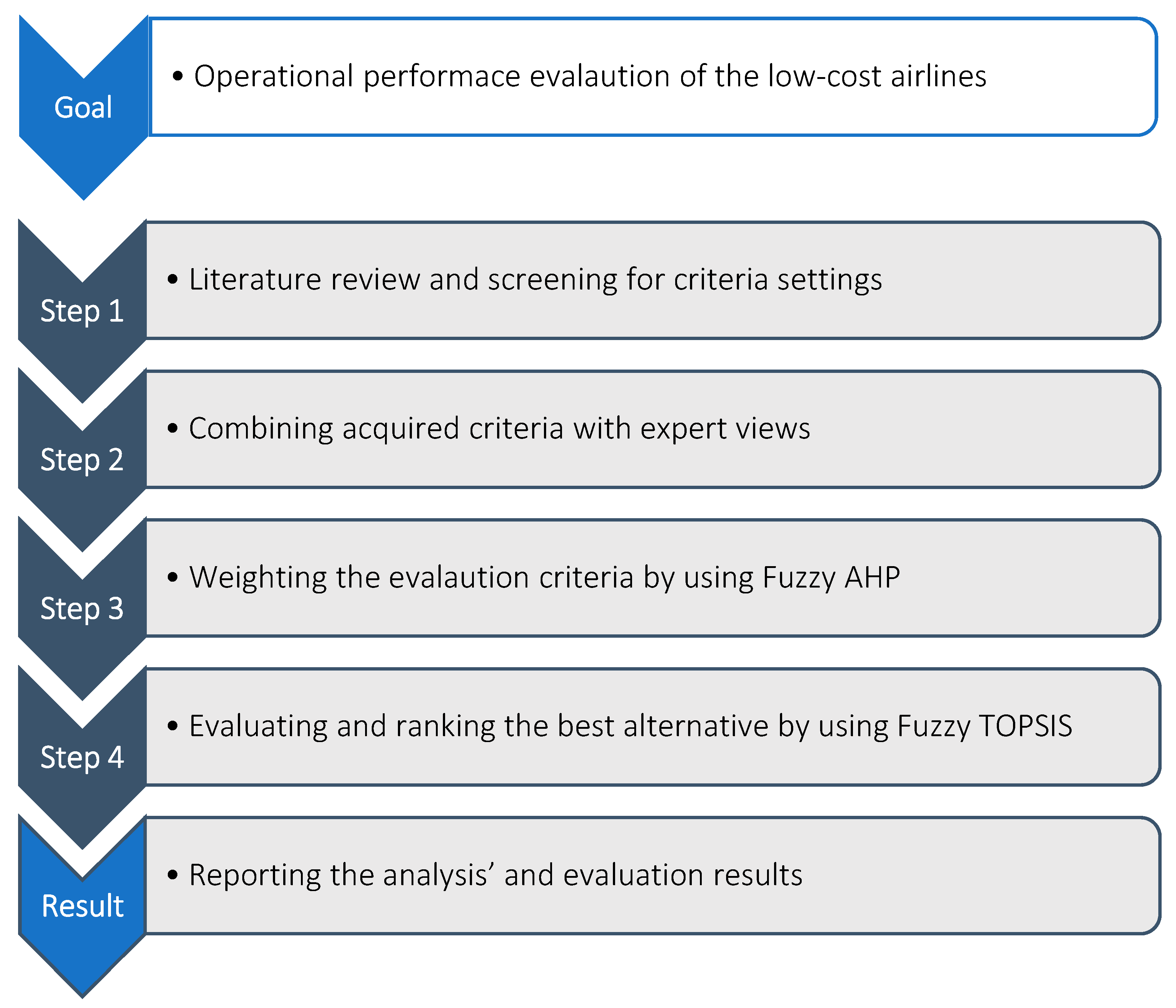
Table 1.
Fuzzy Numbers Corresponding to Linguistic Expressions [37].
Table 1.
Fuzzy Numbers Corresponding to Linguistic Expressions [37].
| Verbal Importance | Triangular Fuzzy Numbers | Inverse Triangular Fuzzy Numbers |
| Equal importance | (1,1,1) | (1/1,1/1,1/1) |
| A little more important | (1,3,5) | (1/5,1/3,1/1) |
| Strongly important | (3,5,7) | (1/7,1/5,1/3) |
| Very strongly important | (5,7,9) | (1/9,1/7,1/5) |
| Totally important | (7,9,9) | (1/9,1/9,1/7) |
Table 3.
Evaluation of Main and Sub-criteria.
| Main Criteria | Sub-Criteria | |
| Online Services (OS) | Check-in | (OS1) |
| Travel Information | (OS2) | |
| Accessibility & Usability | (OS3) | |
| Ticketing (T) | Online Purchasing | (T1) |
| Differentiated Price | (T2) | |
| Seasonal Offers | (T3) | |
| Cancellation/Changes | (T4) | |
| Counter Services (CS) |
Desk Service (Boarding) | (CS1) |
| Airport free/Discounted transportation | (CS2) | |
| Frequent Flyer Program/Lounges | (CS3) | |
| Technology & Information | (CS4) | |
| Luggage Services | (CS5) | |
| Service Personnel (SP) |
Staff Behavior & Attitudes | (SP1) |
| Staff education & Training | (SP2) | |
| Flight Schedule and Routes (FSR) |
Variety of Destinations | (FSR1) |
| Flight Schedule | (FSR2) | |
| Flight Frequencies | (FSR3) | |
| Flight and Delays/Cancellation/Re-routing | (FSR4) |
Table 4.
Main Criteria Pairwise Comparison Matrix with Fuzzy Numbers.
| Main Criteria Pairwise Comparison Matrix with Fuzzy Numbers | |||||
| Online Services | Ticketing | Counter Services | Service Personnel | Flight Schedule & Routes | |
| Online Services | (1,1,1) | (1/5,1/3.1/1) | (1/5,1/3.1/1) | (1,1,1) | (1/5,1/3,1/1) |
| Ticketing | (1,3,5) | (1,1,1) | (1/5,1/3,1) | (1,3,5) | (1/5,1/3,1) |
| Counter Services | (1,3,5) | (1,3,5) | (1,1,1) | (1,1,1) | (1,1,1) |
| Service personnel | (1,1,1) | (1/5,1/3,1/1) | (1,1,1) | (1,1,1) | (1/5,1/3,1) |
| Flight Schedule & Routes | (1,3,5) | (1,3,5) | (1,1,1) | (1,3,5) | (1,1,1) |
Table 5.
Calculated Fuzzy Weights for Main Criteria.
| Online Services (OS) | …….. | Flight Schedule and Routes (FSR) | ||||||||||
| OS1 | OS2 | …….. | FSR3 | FSR4 | ||||||||
| l | m | u | l | m | u | …….. | l | m | u | l | m | u |
| 0.293 | 0.325 | 0.310 | 0.414 | 0.440 | 0.501 | …….. | 0.418 | 0.401 | 0.320 | 0.114 | 0.098 | 0.174 |
Table 6.
Sub-criteria—Online Services Pairwise Comparison Matrix.
| Online Services (OS) | |||
| OS1 | OS2 | OS3 | |
| OS1 | (1,1,1) | (1/5,1/3,1/1) | (1,3,5) |
| OS2 | (1,3,5) | (1,1,1) | (1,1,1) |
| OS3 | (1/5,1/3,1/1) | (1/1,1/1,1/1) | (1,1,1) |
Table 7.
Sub-criteria—Ticketing Pairwise Comparison Matrix.
| Ticketing (T) | ||||
| T1 | T2 | T3 | T4 | |
| T1 | (1,1,1) | (1/5,1/3,1/1) | (1,1,1) | (1,3,5) |
| T2 | (1,3,5) | (1,1,1) | (1,1,1) | (1,3,5) |
| T3 | (1,1,1) | (1,1,1) | (1,1,1) | (1,3,5) |
| T4 | (1/5,1/3,1/1) | (1/5,1/3,1/1) | (1/5,1/3,1/1) | (1,1,1) |
Table 8.
Sub-criteria— Counter Services Pairwise Comparison Matrix.
| Counter Services (CS) | |||||
| CS1 | CS2 | CS3 | CS4 | CS5 | |
| CS1 | (1,1,1) | (5,7,9) | (5,7,9) | (1,1,1) | (1,3,5) |
| CS2 | (1/9,1/7,1/5) | (1,1,1) | (1,1,1) | (1/7,1/5,1/3) | (1/7,1/5,1/3) |
| CS3 | (1/9,1/7,1/5) | (1,1,1) | (1,1,1) | (1/5,1/3,1/1) | (1/5,1/3,1/1) |
| CS4 | (1,1,1) | (3,5,7) | (1,3,5) | (1,1,1) | (1,3,5) |
| CS5 | (1/5,1/3,1/1) | (3,5,7) | (1,3,5) | (1/5,1/3,1/1) | (1,1,1) |
Table 9.
Sub-criteria— Service Personnel Pairwise Comparison Matrix.
| Service Personnel (SP) | ||
| SP1 | SP2 | |
| SP1 | (1,1,1) | (1,3,5) |
| SP2 | (1/5,1/3,1/1) | (1,1,1) |
Table 10.
Sub-criteria— Flight Schedule & Routes Pairwise Comparison Matrix.
| Flight Schedule & Routes (FSR) | ||||
| FSR1 | FSR2 | FSR3 | FSR4 | |
| FSR1 | (1,1,1) | (1/5,1/3,1/1) | (1/7,1/5,1/3) | (1,3,5) |
| FSR2 | (1,3,5) | (1,1,1) | (1,1,1) | (1,3,5) |
| FSR3 | (3,5,7) | (1,1,1) | (1,1,1) | (1,3,5) |
| FSR4 | (1/5,1/3,1/1) | (1/5,1/3,1/1) | (1/5,1/3,1/1) | (1,1,1) |
Table 11.
Main and Sub-criteria Weightings.
| Main Criteria | Weights of Main Criteria | Sub-Crriteria | Weights of Sub-Criteria |
| Online Services (OS) | 0.11 | Check-in | 0.309 |
| Travel Information | 0.452 | ||
| Accessibility and usability | 0.239 | ||
| Ticketing (T) | 0.19 | Online Purchasing | 0.234 |
| Differentiated Price | 0.356 | ||
| Seasonal Offers | 0.283 | ||
| Cancellation/changes | 0.127 | ||
| Counter Services (CS) |
0.26 | Desk Service (Boarding) | 0.382 |
| Airport free/discounted transportation | 0.057 | ||
| Frequent Flyer Program/Lounges | 0.078 | ||
| Technology and information | 0.299 | ||
| Luggage services | 0.184 | ||
| Service Personnel (SP) |
0.14 | Staff Behavior and Attitudes | 0.694 |
| Staff education & training | 0.306 | ||
| Flight Schedule and Routes (FSR) |
0.30 | Variety of Destinations | 0.162 |
| Flight Schedule | 0.330 | ||
| Flight Frequencies | 0.380 | ||
| Flight and Delays/Cancellation/Re-routing | 0.129 |
Table 12.
Linguistic Expressions Used in the Evaluation of Alternatives.
| (OS1) | (OS2) | (OS3) | (T1) | (T2) | (T3) | (T4) | (CS1) | (CS2) | (CS3) | (CS4) | (CS5) | (SP1) | (SP2) | (FSR1) | (FSR2) | (FSR3) | (FSR4) | |
| Airline_1 | MP | VG | VG | MG | G | G | P | MP | MP | F | G | MG | MG | G | F | F | MP | F |
| Airline_2 | G | G | MG | G | F | MG | MP | MG | MP | VG | MG | G | F | MG | G | MG | G | F |
| Airline_3 | VG | MP | G | G | MG | VG | F | G | F | MG | MG | G | G | G | VG | G | MG | MP |
Table 13.
The Normalized Fuzzy Decision Matrix.
| (OS1) | (OS2) | ………. | (FSR3) | (FSR4) | |||||||||
| Airline_1 | 0.100 | 0.300 | 0.500 | 0.900 | 1.000 | 1.000 | ………. | 0.100 | 0.300 | 0.500 | 0.429 | 0.714 | 1.000 |
| Airline_2 | 0.700 | 0.900 | 1.000 | 0.700 | 0.900 | 1.000 | ………. | 0.700 | 0.900 | 1.000 | 0.429 | 0.714 | 1.000 |
| Airline_3 | 0.900 | 1.000 | 1.000 | 0.100 | 0.300 | 0.500 | ………. | 0.500 | 0.700 | 0.900 | 0.143 | 0.429 | 0.714 |
Table 14.
The Weighted Normalized Fuzzy Decision Matrix.
| (OS1) | (OS2) | ………. | (FSR3) | (FSR4) | |||||||||
| Airline_1 | 0.029 | 0.097 | 0.155 | 0.373 | 0.440 | 0.501 | ………. | 0.042 | 0.120 | 0.160 | 0.049 | 0.070 | 0.174 |
| Airline_2 | 0.205 | 0.292 | 0.310 | 0.290 | 0.396 | 0.501 | ………. | 0.292 | 0.361 | 0.320 | 0.049 | 0.070 | 0.174 |
| Airline_3 | 0.264 | 0.325 | 0.310 | 0.041 | 0.132 | 0.250 | ………. | 0.209 | 0.281 | 0.288 | 0.016 | 0.042 | 0.124 |
Table 15.
The distance of each alternative and .
| Airline_1 | 14.758 | 3.406 |
| Airline_2 | 14.483 | 3.662 |
| Airline_3 | 14.141 | 3.993 |
Table 16.
Rank of alternatives according to the closeness coefficient.
| Rank | Weights of Alternatives | ||
| Airline_3 | 0.220 | 1 | 0.361 |
| Airline_2 | 0.202 | 2 | 0.331 |
| Airline_1 | 0.188 | 3 | 0.308 |
Disclaimer/Publisher’s Note: The statements, opinions and data contained in all publications are solely those of the individual author(s) and contributor(s) and not of MDPI and/or the editor(s). MDPI and/or the editor(s) disclaim responsibility for any injury to people or property resulting from any ideas, methods, instructions or products referred to in the content. |
© 2023 by the authors. Licensee MDPI, Basel, Switzerland. This article is an open access article distributed under the terms and conditions of the Creative Commons Attribution (CC BY) license (http://creativecommons.org/licenses/by/4.0/).
Copyright: This open access article is published under a Creative Commons CC BY 4.0 license, which permit the free download, distribution, and reuse, provided that the author and preprint are cited in any reuse.


