

Submitted:
15 July 2023
Posted:
17 July 2023
You are already at the latest version
Abstract
In Mexico, the incorporation of deaf people into education has been lacking since only 14% of the deaf population in the age group between 3 and 29 years access education with the support of a hearing aid. Additionally, those who have been incorporated frequently face inappropriate educational strategies which poorly develop the use of Mexican Sign Language (MSL) and therefore academical success and opportunities for insertion in the workplace are difficult. This research explores a novel mexican sign language lexicon video dataset containing the dynamical gestures most frequently used by MSL. Each gesture consists of a set of different versions of videos under uncontrolled conditions. MX-ITESO-100 data set is composed of a lexicon of 100 gestures and 5,000 videos from three participants with different grammatical elements. Additionally, the data set is evaluated in a two-step neural network model with an accuracy greater than 99%. and thus serves as a benchmark for future training of machine learning models in computer vision systems. Finally, this research provides an inclusive environment within society and organizations in particular for people with hearing impairment.
Keywords:
Mexican sign language
; Dataset
; Hand-gestures
; Computer-vision
1. Introduction
In Mexico, the incorporation of deaf people into education has been lacking since only 14% of the deaf population in the age group between 3 and 29 years access education with the support of a hearing aid. Additionally, those who have been incorporated frequently face inappropriate educational strategies which poorly develop the use of Mexican Sign Language (MSL) and therefore academical success and opportunities for insertion in the workplace are difficult.
Sign language has enabled effective communication with people who have hearing loss. Current challenge is focused on the identification of statical or dynamical gestures in real time using systems based on machine learning techniques. In instance, in [1] has been proposed a novel automatic sign language recognition system that incorporates multiple gestures, including hands, body, and face, to overcome the limitations of focusing solely on hand gestures. Using a depth camera and recurrent neural networks, the system achieves high accuracy, with the best model reaching 97% accuracy on clean test data and 90% accuracy on highly noisy data after thorough evaluation and ablation studies.
Classical problem encountered by researchers in the realm of image or image sequence categorization revolves around the pursuit of an appropriate dataset that aligns with the specific requirements of their study [1,2,3]. Paramount factors to consider in this quest encompass language compatibility, format suitability, environmental characteristics, dimensions, as well as the presence of statical or dynamical signs. Presently, the acquisition of a comprehensive dataset catering to the Mexican Sign Language (MSL) has proven to be a challenging endeavor. Additionally, the format of the dataset plays a pivotal role in determining its compatibility with the research objectives. The dataset should ideally comprise a standardized format that enables seamless integration with various computational algorithms and models. This ensures that the data can be efficiently processed, analyzed, and classified, thereby facilitating meaningful insights into the categorization of MSL-based images.
Design of expert computer vision systems brings challenges to the acquisition of information. Data collected through videos and images constitute the core of the work. However, in most cases, metadata provides valuable information to assist in the classification of signs. Metadata acquisition can be achieved through thermal and depth sensors. According to the literature, Kinect is one of the most common sensors used by researchers for creating data sets. This device was introduced by Microsoft in 2010 and it consists of an RGB camera with an infrared depth sensor used for the recognition of human body gestures. In addition, the device can model a person’s skeleton with an emphasis on joints. Therefore, researchers find Kinect very useful for this purpose. In [4] this device has been used for MSL recognition by collecting color images with a size of 115x115 pixels. These images are pre-processed in order to be sent to a classification model. Finally, the system can recognize gestures in real time and display text on the screen related to their meaning.
During the development of a machine learning model, the use of a missing data set presents an additional challenge for researchers. Because of this, certain authors prefer to create their own datasets. In [5] researchers have generated a data set for Mexican signs. The Kinect device has been used to carry out this task. Metadata provides complementary information about an individual’s skeleton. According to the results, the precision reported for this work is greater than 95 percent and therefore evidence that the metadata contribute significantly. In [1] MSL recognition has been explored by producing 3000 samples with data from both hands, body and face of about 30 signs using the Kinect device. However, this data has been stored in a personalized format that makes it impossible to reuse the content.
On the other hand, in [6] a video dataset has been established in order to extract a specific sequence of frames. Subsequently, they have used image segmentation and feature extraction from three regions of interest to generate geometrical features. This approach eliminates the need to use additional devices such as Kinect sensors. This data set allows them to carry out machine learning techniques such as [7] Support Vector Machine (SVM), Nearest Neighbor (NN), Bayesian methods, and k-dimensional tree. Therefore, a data set is essential for the success of the methodologies used to recognize sign language. According to [8], there are two categories for this kind of methodologies: Continuous Sign Language Recognition (CSLR) and Isolated Sign Language Recognition (ISLR).
In the case of MSL, there are different words and phrases that can be used to relate the same objects/concepts, i.e. lexical variations. For instance, the position of objects or persons can be indicated by the dominant hand, followed by the main verb. This means that the non-dominant hand indicates the relative position of an object. Hand motion determines how an object executes the action. For example, as shown in Figure 1, the sign used to represent the CAMINAR(WALK) action, usually in a straight horizontal movement, stands for SALTAR(JUMP) if the hand performs a vertical rocking motion up and down using the palm of the non-dominant hand.
Sometimes objects or words lack a direct sign defined in the MSL. When this happens, the object is spelled using the alphabet. However, certain signs need no spelling. It is sufficient to quote the first letter of the word to refer to the object. For example, to represent the sign LUNES(MONDAY) the letter L is combined with the gesture of the DIA_DE_LA_SEMANA(WEEKDAY). Alternatively, you can use a suffix to name negative shapes of objects. This involves moving the palm of the open hand downwards.
Pronouns use an index finger to identify the subject of the action. There are two methods of carrying out the action. When the reference is present and visible, the hand moves toward it. if the reference is neither present nor visible, an arbitrary reference address is subsequently chosen to constitute an agreement. Pronouns can be categorized into both manual pronouns and non-manual pronouns [9].
Manual pronouns consist of hand movements, usually with a specific number of fingers, so INDEX-1 would indicate the singular pronoun in the first person. Non-manual pronouns are composed of movements of the eyes, body, and hands; in one sign, the glance provides additional information about the context of the affected object. For example:
INDEX-3 looking to the right followed by the IR gesture indicates the person is gone.
The fingers of the dominant hand, serve to indicate the number of people who have been referred. So, three fingers mean three people. Property of an object is represented by the sign of the dominant object, the spelling of the word D-E(OF), and the object dominated. For example:
God’s home, gestures should be displayed CASA D-E DIOS.
In order to better understand MSL, [10,11] have created support dictionaries. [11] describes a lexicon of signs commonly used in MSL. The author uses pictures containing information on the configuration, location, motion, representation and definition of each gesture. In the document, the signs are arranged in seven manual configurations represented by a letter where the shape of the letter is maintained when the sign is generated. The movement of the hands, face, and body complements the meaning of the sign. Moreover, [10] offers a bilingual dictionary divided into two sections: MSL-Spanish and the other way around, Spanish-MSL. This dictionary is made up of a glossary in labeled videos and each sign is associated with a word in Spanish. The access to the videos is carried out through an online graphical interface.
According to the information that has been shown so far, it is possible to establish that there is currently no video dataset with lexicon variations in uncontrolled environments for the MSL and therefore it represents a research challenge.
The manuscript is organized as follows: Section 2 briefly locates the relationship that the MX-ITESO-100 dataset has with similar work. In Section 3, the novel mexican sign language lexicon video dataset is introduced. In Section 4, the experimental procedures are presented. Section 5 presents the experimental results. Finally, in Section 6, some conclusions are drawn.
2. Related Work
Continuous Sign Language Recognition (CSLR) data sets are based on videos that contain a sequence of gestures rather than individual signs for the purpose of simulating real-world scenarios and testing dynamic continuous sign language recognition systems. Data sets from [2] have been produced in German, Chinese, Greek and English. The German Sign Language dataset Phoenix-2014 and Phoenix-2014-T come directly from German TV and contain 1,231 classes of 9 participants with a resolution of 210x210 pixels. In addition, the RWTH-PHOENIX-Weather dataset is an extension containing 190 recordings directly from the weather channel which have been collected between 2009 and 2010. The RWTH-BOSTON American Sign Language [12] dataset (ASL) has been designed as a subset of the BU-ASL corpus at Boston University and consists of 843 annotated classes in XML format that can be used to identify dynamical gestures in the same sequence. These videos have been recorded by a variety of people in controlled environments at a resolution of 210 x 60 pixels and accessible to the general public. In [13] the research has been based on two data sets described above: CSL and RWTH-PHOENIX. In this way, it offers a two-stage system for the recognition of video image sequences. First, it uses convolutional networks to extract functionality, and second, it uses attention networks to automatically generate sentences.
Isolated Sign Language Recognition (ISLR) data sets are based on videos that contain sequences of single sign frames. It is important to mention that this publication has based its proposal on that category of data set. CSL-500 Chinese Sign Language dataset includes videos of 500 signs of 50 people captured in 2016. ASL MS-ASL and WASL datasets contain videos distributed in 3000 signs of 341 participants from the YouTube platform using uncontrolled environments. Data set for Turkish Sign Language contains videos captured in 2020 from 226 signs and 43 participants at a resolution of 512x1512 pixels. Arabic Sign Language dataset was created in 2021 and consists of 502 signs from 3 participants. There are 75,300 video instances in total. Among today’s most popular data sets is the ASL Lexicon Video Dataset [3] which belongs to the ISLR category and it includes a total of 3,800 color video signals with controlled environment and different angles. All the CSLR and ISLR datasets that have been discussed before are summarized in Table 1.
There are authors in the literature who suggest a system to recognize sign language based on statical gestures [5,14,15,16]. In other words, they use images instead of videos to train their models. For example, [14] uses a standard ASL dataset called ASL-MNIST that has a total of 34,627 images. It is an alphabet of 21 signs and color images obtained from 18 participants with a resolution of 32x32 pixels. This data set has been used to optimize a neural network with Particle Swarm Optimization (PSO) obtaining a better recognition rate than other investigations that use the same data set. On the other hand, [15] experiments with a 21-sign MSL dataset using 10,500 images of both hands with a dimension of 1080x720 pixels from 10 participants. Finally, the research carried out in [16] implements an Indian Sign Language recognition system based on a dataset containing statical alphabetic signs. There are 25 color images of the hands in a controlled environment and the model evaluation goes through the TensorFlow API for object detection.
As far as MSL semantics are concerned, it is not necessary to use concatenation as it is enough to follow a syntactic convention during sentence formation. Also, people learning about MSL generally have no problem using it throughout Mexico because the geographic and generational differences are slightly small. In [17] a comparison between 100 words from different parts of Mexico has been carried out in order to find out the variations of each one. No less than 50 words have the same meaning and around 90% share a lexical identity. For this reason, the MSL has been shown to have the linguistic components to be considered a language or dialect. MSL lexicon resembles ASL. In [18] it has been established that MSL is closely related to ASL. However, [19] finds a significant difference when using MSL compared to ASL. A quick lexical comparison of 100 signs in both MSL and ASL shows that 12 out of 100 signs in ASL need an initializer while 37 out of 100 signs need an initializer in MSL. Signs for initializing use the first letter of the word in the corresponding language before executing the gesture. In [9] MSL spelling and initialization has been discussed. Fingerspelling is not used as much in MSL as it is in ASL. But it is regularly used to express the names of people and places where one of the participants does not know the sign. MSL lexicon consists of native and non-native vocabulary where words with initializers are considered native. K. Faurot found that 14% of deaf Americans who know ASL can recognize MSL gestures. Although this is positive, it is far from being an open and universal language. It is important to mention that understanding the Spanish language is not required to use MSL. Despite this, there are important grammatical differences such as verb conjugation due to MSL having no verb tenses. These are agreements that people make. In addition, there is a concordance agreement that verbs follow when they relate them to other objects. In the case of a verb with an argument, it indicates what or who it is. For verbs that have two arguments, the first indicates the consistency of the object of the action and the second indicates that it is affected.
3. MX-ITESO-100
The MX-ITESO-100 dataset is a meticulously curated collection of 5000 videos, thoughtfully organized into 100 distinct folders. This dataset stands out for its comprehensive coverage, capturing a wide range of signs and expressions representative of the selected Mexican lexicon. Each folder within the dataset is dedicated to a specific sign, ensuring a coherent and systematic arrangement. Within each folder, one can find a consistent compilation of 50 videos, all pertaining to the same sign. The videos themselves were meticulously generated, involving the collaborative efforts of two individuals with expertise in sign language. Moreover, it is important to mention that MX-ITESO-100 dataset serves as a valuable resource for various domains and applications. Researchers, linguists, and computer vision experts alike can leverage this extensive collection to advance the development of sign language recognition systems, gesture-based interfaces, and other related technologies. Furthermore, its incorporation of the Mexican lexicon ensures the dataset’s relevance and applicability within the cultural context it represents.
The MX-ITESO-100 data set is consistent with other authors and provides a video data set for the most representative words. Furthermore, it is oriented to MSL with the intention of being used in a real-time recognition system. In [20] a MSL dataset has been established in order to identify dynamical gestures using support vector machines (SVM) and it is composed of videos recorded by 22 people in a controlled environment. This research uses the segmentation technique through which they extract geometric features of both hands. Although the similarities are considerable, our MX-ITESO-100 dataset explores the inclusion of a rich and varied lexicon. In order to do this, it is necessary to generate ISLR content under uncontrolled conditions similar to real world viewing environments. Lexicon is essential for creating a sign language data set. MX-ITESO-100 contains the most basic grammatical elements that allow us to create simple but complete ideas, such as: nouns, pronouns, verbs, adjectives, adverbs, conjunctions, and commonly used phrases. Due to the fact that there is great variation in the construction of a model, MX-ITESO-100 presents different versions for the same gesture. Currently, the dataset is being oriented towards research with care networks. However, this does not restrict the fact that it can be shared publicly for benchmarking.
Lexical structure for establishing the data set includes one hundred signs of grammatical elements which have been distributed as shown in Table 2.
Each video recording has been related to the representation of an idea by the motion of hands, body, and facial expression. In addition, the actions are carried out over a period of time, when the final position of the hands, the body or the facial expression vary with respect to the initial signal. Therefore, the dynamic gestures consist of two stages to establish an idea and each stage defines the specific configuration of the movement, i.e.,the dynamic gesture is always performed from an initial stage to a final stage, as shown in Figure 2.
This proposal has been based on dynamical actions as opposed to the representations of ideas from unique states such as statical gestures. However, we have previously established data sets with statical signs that have represented each letter of the alphabet.
It is important to mention that the selection of the lexicon is based on the first 100 words/signs defined by a small inclusive community. This community has determined the minimum number of signals required for effective communication in an active environment. MX-ITESO-100 data set contains at least fifty different versions of the same dynamic movement for the same sign. Differences include variations in hand position, dominant hand selection, body position, and facial expression, as shown in Figure 3.
Regarding the format of video recordings in digital files, we have chosen Moving Picture Experts Group (MPEG-4) because it is an international standard for audiovisual coding according to ISO/IEC 14496-12:2001. Additionally, the frame size for each sample in the video is 512 x 512 pixels. Besides,the recording duration is five seconds with thirty images per second and finally, the average size of each video in MPEG-4 format is approximately 4 MB.
As it can be seen in Table 2, the grammatical elements represent different percentages with respect to the general structure of the lexicon. Next, the single-words of each grammatical section are shown in boxes for the Spanish (top) and English (bottom) versions. Firstly, thirty percent of the lexicon consists of signs that represent the actions of objects. This is the biggest group of grammatical items called verbs. As part of that group, it has the following elements
| ABRIR | APARTAR | APRENDER | AYUDAR | BAILAR |
| OPEN | SEPARATE | LEARN | HELP | DANCE |
| BESAR | BORRAR | COCINAR | COMER | CONSTRUIR |
| KISS | DELETE | COOK | EAT | BUILD |
| CONTAR | CORRER | DAR | ENCENDER | ENTRAR |
| COUNT | RUN | GIVE | TURN ON | ENTER |
| ESCRIBIR | ESTAR | EXPLICAR | GUSTAR | HABLAR |
| WRITE | BE | EXPLAIN | LIKE | TALK |
| HACER | JUGAR | LEER | MANEJAR | OLER |
| DO | PLAY | READ | DRIVE | SMELL |
| PASEAR | PONER | SALTAR | TOSER | VER |
| SIGHTSEEING | PUT | JUMP | COUGH | SEE |
After verbs, the second largest group of signs in the dataset corresponds to the adjective grammar element which has the purpose of altering nouns. There are twenty-seven signs in this group
| AZUL | BLANCO | BONITO | BUENO |
| BLUE | WHITE | NICE | GOOD |
| CAFÉ | CANSADO | CHISTOSO | CLARO |
| BROWN | TIRED | FUNNY | CLEAR |
| COQUETO | DURO | EGOÍSTA | ENANO |
| FLIRTATIOUS | HARD | SELFISH | DWARF |
| FÁCIL | FELIZ | FEO | FLACO |
| EASY | HAPPY | UGLY | SKINNY |
| FRÍO | GORDO | GRANDE | GRIS |
| COLD | FAT | BIG | GRAY |
| LARGO | MAL | MORENO | NEGRO |
| LONG | EVIL | BROWN | BLACK |
| OSCURO | SEDIENTO | TRISTE | |
| DARK | THIRSTY | SAD |
Third group of signs is established of nouns and it represents the fourth part of the data set with twenty-five signs. Nouns designate objects or abstractions independently such as some colors and the days of the week. These items are
| AGUA | ANARANJADO | AVIÓN | BANDERA | BICICLETA |
| WATER | ORANGE | PLANE | FLAG | BIKE |
| CALOR | COLOR | DEPORTE | DERECHA | DÍA |
| HEAT | COLOR | SPORT | RIGHT | DAY |
| DOMINGO | JUEVES | LUNES | MARTES | MIÉRCOLES |
| SUNDAY | THURSDAY | MONDAY | TUESDAY | WEDNESDAY |
| MUJER | NIÑO | NOCHE | PERRO | PIANO |
| WOMAN | CHILD | NIGHT | DOG | PIANO |
| QUESADILLA | SÁBADO | TELEVISIÓN | VIERNES | ZAPATO |
| QUESADILLA | SATURDAY | TV | FRIDAY | SHOE |
In the same way as adjectives, adverbs lead to the verb or adjective and change the idea. Eight adverbs have been incorporated into the lexicon and they are the following
| AQUÍ | AYER |
| HERE | YESTERDAY |
| BIEN | COMO |
| GOOD | HOW |
| HOY | MAÑANA |
| TODAY | TOMORROW |
| MUCHO | POCO |
| MUCH | LITTLE |
A pronoun is the lexicon structure that supersedes the name. It is important to mention that the selection of pronouns for this lexicon is limited to personal pronouns. Possessive, undefined, relative and interrogative pronouns are discarded. Personal pronouns are
| EL | ELLA | ELLOS | TU | YO |
| HE | SHE | THEY | YOU | I |
According to MSL, pronouns are associated with visible and present objects where the final stage indicates position in relation to the object. For the MX-ITESO-100 data set, the signs belonging to this grammatical element indicate the general idea of the agreed relationship between the speaker and a non-visible person. This must be taken into account by researchers for the generation of new models.
Furthermore, in MSL conjunctions are not frequent because the juxtaposition method suppresses the conjecture and shows nouns. The juxtaposition method in MSL conjunctions involves combining two or more separate signs without any specific transition or linking element. It relies on the spatial arrangement and sequencing of the signs to convey the intended meaning and relationship between the ideas or concepts being expressed. However, our approach includes a conjunction of the subordinating type through the alphabet letter “Y" in a gesture that requires movement and therefore it has been classified as a dynamical rather than a statical gesture. Finally, the data set includes dynamical gestures that refer to ideas based on compound words. These expressions have been used even by non-deaf people and they are
| GRACIAS | HOLA |
| THANK YOU | HELLO |
| LENGUA DE SEÑAS MEXICANA | POR FAVOR |
| MEXICAN SIGN LANGUAGE | PLEASE |
With the lexicon of the MX-ITESO-100 data set, it is possible to recognize sentences using a basical and simple grammatical structure such as the single phrase consisting of
SUJETO + VERBO + PREDICADO
SUBJECT + VERB + PREDICATE
For example, the simple sentences that can be generated or recognized with the lexicon are the following
MAÑANA NOCHE CAMINAR PERRO
This set of signs represents the idea of the sentence: Tomorrow night I will walk with my dog. Additionally, the sentence
HOLA YO APRENDER LENGUA_DE_SEÑAS_MEXICANA FÁCIL
represents the expression: Hello, I am learning MSL very easily.
Finally, a public preview version of the video dataset MX-ITESO-100 for MSL has been uploaded at the following link: https://acortar.link/J0XzZb
4. Experiments
It is important to emphasize that the principal purpose of this work is not to deepen into the experimentation for the validation of the MX-ITESO-100 data set because a parallel research is being carried out to insert the data into a machine learning model using neural and attentional networks.
Experimental evaluation of this work is based on [21]. This research uses three types of recurrent neural network architectures as part of his model, such as [22]: Recurrent Neural Network (RNN) and Long-Short Term Memory (LSTM). In addition, performance measures such as precision, recall and accuracy are established. According to the results of the research, the RNN tends to overfit with fewer units and the highest accuracy score has been for the LSTM architecture with 97%.
On the other hand, [8] provides a complete discussion of the methods for carrying out the evaluation of the various Continuous Sign Language Recognition (CSRL)-type data sets. This research examines the following architectures: Two- and three-dimensional Convolutional Neural Network (2D-CNN, 3D-CNN)[23], Bidirectional LSTM Networks (BLSTM) [24], Connectionist Temporal Classification (CTC) [25], Multi-Cue Spatio-Temporal Network (STMC) [26] and Sparse ReguLarized Generative Adversarial Network (SRLGAN) [27]. Moreover, this researcher measures the number of transactions required to transform a string of words using the Word Error Rate (WER). According to the results, the most efficient model is the STMC. However, CNNs are easier to implement with very similar results and therefore they have been integrated into our model.
Validation process for the MX-ITESO-100 dataset consists in a simple two-step model. First-step implements a CNN model that extracts features from individual frames, e.g., a frame sequence from a video recording. For each frame there is a sample that is processed independently through a layer distributed in time for later being connected to a LSTM network, as shown in Figure 4. Next in model training, common standard architectures have been exchanged as feature extraction networks, known as core networks. This implementation is carried out using version 2.9.1 of TensorFlow in the Python programming language. For all cases, the initial values of the neural weights are established since they come from a previous training on the ImageNet data set. At this point, the architectures that have been assessed are Xception [28], VGG16 [29], VGG19 [29], ResNet50 [29], ResNet101 [30], ResNet152 [30], MobileNet [31], DenseNet121 [32] and EfficientNetV2B0 [33]. In all cases, the dense layer at the end of the network has been removed and, in its place, a Flatten-type layer has been connected to feed the recurring layers of the next step.
Now in the second-step, a recursive network model for image sequencing is established. LSTM architecture is chosen due to the results in [21]. This architecture uses a Rectifying Linear Unit (ReLU) as activation function. Subsequently, the output of the network is connected to a dense layer that uses the softmax activation function with one hundred neurons. Each of the neurons in the output phase represents a sign from the lexicon of the MX-ITESO-100 data set.
In this work, all the images have been collected from the beginning to the end of the video recording in order to process them through a set of specific Python classes (signs) without discrimination between frames. The size of the individual samples have been formatted, modified and converted to a Numpy array. Subsequently, the data structure is incorporated into the model. The training model employed for this dataset adopts the Pareto distribution as its foundation, following a well-established statistical framework. This distribution methodology ensures a systematic division of videos within each sign, allocating approximately 80% of the videos for training purposes and reserving the remaining 20% for validation. It is important to note that both the training and validation sets are derived from a shared pool of 5000 meticulously recorded videos, ensuring consistency and continuity throughout the dataset. Specifically, out of the total 5000 videos, 4000 videos are dedicated to the training set, while the remaining 1000 videos form the validation set. Additionally, it is worth highlighting that people performing sign language are present in both the training and validation sets, enhancing the realism and authenticity of the dataset. Both sets encompasses signs from all 100 words contained within the dataset.
For the purpose of carrying out predictions, the most common way to evaluate the performance of a supervised model is through the identification of True Positives (TP), True Negatives (TN), False Positives (FP) and False Negatives (FP). TP represents the positive prediction that the model has successfully classified, for example, the model classified the sign ZAPATO within the shoe sign. TN means the negative prediction that the model has successfully classified, e.g., the model did not classify the sign ZAPATO within the shoe sign. FN depicts the negative prediction of an actual value, for example, the model has classified the sign ZAPATO within the piano sign. Finally, FP represents the positive prediction where the actual value is negative, e.g., a sign different from ZAPATO than the model has classified within the shoe sign.
Parameters for evaluating our model are the same as those used by [21], such as: accuracy, recall and precision. Mathematical expressions for these parameters are shown below
Precision metric shows in (1) is the proportion of positive predictions about the total of positive and negative declarations made by the model during sign classification.
Recall metric shows in (2) is the proportion of positive predictions that the model successfully classified concerning the total number of positive and negative statements. That is, the number of signs that our model qualifies as positive.
Accuracy metric shows in (3) is the proportion of predictions performed correctly by the model regarding the total number of correct and incorrect predictions. That is, how many signs have been successfully classified [34].
It is important to mention that F1 classification is not necessary to evaluate the performance because the intention is to identify the level of precision and recall individually.
5. Results
Measurements of accuracy, precision and recovery have been used in the training process of the model. Training and validation curves are shown in Figure 5.
According to the results shown in Figure 5, the best classification performance has been achieved by using the VGG19 backbone. In this case, the precision measurement value for the training and validation set was greater than 99%. Approximately 30 epochs have been required for convergence towards this value. Most of the backbone networks have converged in the 50 epochs. In most cases, simple minor adjustments have been made. However, by default a batch size of 10, 60 epochs and an RMSprop optimizer with a training ratio of 5x10 have been selected.
Accuracy of the Mobilenet backbone has reached 99% in the training set and above 93% in the validation set. 120 epochs have been necessary for the convergence in these values. Similarly, the DenseNet121 backbone converges to 99% in the training set. However, the validation set never exceeds 88% accuracy. Unlike MobileNet, the DenseNet121 core network has reached stabilization in 18 epochs.
Backbone networks such as Xception and the Residual Neural Network (ResNet) have achieved few useful results. For example, the accuracy of the ResNet50 backbone has registered only 78% accuracy in the training set and 35% in the validation set. Despite this, the claims curve has shown a downward trend. The EfficientNetV2B0 backbone shows the worst training behavior. It has not been possible to converge towards a value greater than 23% despite the increase in the number of epochs and the considerable reduction in time losses.
Finally, VGG19 backbone has been used as a reference for our two-step model. For a total of 5,000 videos, the TPS number is 4,956, 25 fn and 19 fp. Moreover, accuracy is 99.12%, precision is 99.62%, and recall is 99.5%.
6. Conclusion
Results from the evaluation of the MX-ITESO-100 data set are similar to the accuracy values reached by other authors. I. Papastratis shows the most significant results using the LSA64 [8] data set. Through an early comparison it is possible to establish that the performance values oscillate between 98.09% and 99.9% and therefore the results are similar to our approach. Experiment procedure has demonstrated the feasibility of the MX-ITESO-100 database for training models based on machine learning. Besides, dynamical gesture recognition is possible in uncontrolled environments. This provides researchers with an additional resource in order to validate their models in MSL’s dynamical gesture recognition systems.
MX-ITESO-100 dataset includes a variety of grammatical items for future research exploration. This is because there is not only one type of grammatical element but the lexicon assists in the enrichment of the semantical process through the generation of complete sentences. Principal contribution of this research is based on the exploration of a novel mexican sign language lexicon video dataset which represents the first step towards more complete future versions. Future work is focused on further development of this data set to include new grammatical elements, additional versions of current signs, more videos recorded in various locations in Mexico and the addition of regionalisms.
Finally, MX-ITESO-100 data set represents an indirect benefit for the inclusive community since it provides the basis for the development of inexpensive devices that facilitate communication with deaf people and therefore forge a more committed and inclusive Mexican society.
Statements and Declarations
On behalf of all authors, the corresponding author states that there is no conflict of interest.
References
- Mejía-Pérez, K.; Córdova-Esparza, D.M.; Terven, J.; Herrera-Navarro, A.M.; García-Ramírez, T.; Ramírez-Pedraza, A. Automatic Recognition of Mexican Sign Language Using a Depth Camera and Recurrent Neural Networks. Applied Sciences 2022, 12. [Google Scholar] [CrossRef]
- Dreuw, P.; Neidle, C.; Athitsos, V.; Sclaroff, S.; Ney, H. Benchmark Databases for Video-Based Automatic Sign Language Recognition. In Proceedings of the Sixth International Conference on Language Resources and Evaluation (LREC’08); 2008; pp. 1115–1120. [Google Scholar]
- Athitsos, V.; Neidle, C.; Sclaroff, S.; Nash, J.; Stefan, A.; Yuan, Q.; Thangali, A. The American Sign Language Lexicon Video Dataset. In Proceedings of the 2008 IEEE Computer Society Conference on Computer Vision and Pattern Recognition Workshops; 2008; pp. 1–8. [Google Scholar]
- Sosa-Jiménez, C.O.; Ríos-Figueroa, H.V.; Rechy-Ramírez, E.J.; Marín-Hernández, A.; González-Cosío, A.L.S. Real-time Mexican Sign Language recognition. In Proceedings of the 2017 IEEE International Autumn Meeting on Power, Electronics and Computing (ROPEC); 2017; pp. 1–6. [Google Scholar]
- Carmona-Arroyo, G.; Ríos-Figueroa, H.V.; Avendaño-Garrido, M.L. Mexican Sign-Language Static-Alphabet Recognition Using 3D Affine Invariants. In Proceedings of the Machine Vision Inspection Systems, Volume 2: Machine Learning-Based Approaches; 2021; pp. 171–192. [Google Scholar]
- Espejel-Cabrera, J.; Cervantes, J.; García-Lamont, F.; Ruiz Castilla, J.S.; D. Jalili, L. Mexican sign language segmentation using color based neuronal networks to detect the individual skin color. Expert Systems with Applications 2021, 183. [Google Scholar] [CrossRef]
- Ray, S. An Analysis of Computational Complexity and Accuracy of Two Supervised Machine Learning Algorithms—K-Nearest Neighbor and Support Vector Machine. In Proceedings of the Data Management, Analytics and Innovation; Sharma, N. Chakrabarti, A., Balas, V.E., Martinovic, J., Eds.; Springer Singapore: Singapore, 2021; pp. 335–347. [Google Scholar]
- Papastratis, I.; Chatzikonstantinou, C.; Konstantinidis, D.; Dimitropoulos, K.; Daras, P. Artificial Intelligence Technologies for Sign Language. Sensors 2021, 21. [Google Scholar] [CrossRef] [PubMed]
- Plumlee, M. Pronouns in Mexican Sign Language. Work Papers of the Summer Institute of Linguistics 1995, 39, 81–92. [Google Scholar] [CrossRef]
- Hawayek, A.; Del Gratta, R.; Cappelli, G. A Bilingual Dictionary Mexican Sign Language-Spanish/Spanish-Mexican Sign Language. In Proceedings of the Seventh International Conference on Language Resources and Evaluation (LREC’10); 2010; pp. 3055–3060. [Google Scholar]
- Serafin de Fleischmann, M.E.; Gonzalez Perez, R. Manos con voz. Diccionario de lengua de señas mexicana; CONAPRED, 2011.
- Forster, J.; Schmidt, C.; Koller, O.; Bellgardt, M.; Ney, H. Extensions of the Sign Language Recognition and Translation Corpus RWTH-PHOENIX-Weather. In Proceedings of the Ninth International Conference on Language Resources and Evaluation (LREC’14); 2014; pp. 1911–1916. [Google Scholar]
- Huang, J.; Zhou, W.; Zhang, Q.; Li, H.; Li, W. Video-based Sign Language Recognition without Temporal Segmentation. In Proceedings of the Thirty-Second AAAI Conference on Artificial Intelligence; 2018; Vol. 32, pp. 2257–2264. [Google Scholar]
- Fregoso, J.; Gonzalez, C.I.; Martinez, G.E. Optimization of Convolutional Neural Networks Architectures Using PSO for Sign Language Recognition. Axioms 2021, 10. [Google Scholar] [CrossRef]
- Alejandro, S.M.; Antonio, N.C.J. A real-time deep learning system for the translation of mexican signal language into text. In Proceedings of the 2021 Mexican International Conference on Computer Science (ENC); 2021; pp. 1–7. [Google Scholar]
- Srivastava, S.; Gangwar, A.; Mishra, R.; Singh, S. Sign Language Recognition System Using TensorFlow Object Detection API. In Communications in Computer and Information Science; Springer International Publishing, 2022; pp. 634–646.
- Bickford, J.A. Lexical Variation in Mexican Sign Language. In Proceedings of the Sign Language Studies; 1991. number 72. pp. 241–76. [Google Scholar]
- Quinto-Pozos, D. Sign language contact and interference: ASL and LSM. Language in Society 2008, 37, 161–189. [Google Scholar] [CrossRef]
- Faurot, K.; Dellinger, D.; Eatough, A.; Parkhurst, S. The identity of Mexican sign as a language. Journal of Language Survey Reports 2000, 1. [Google Scholar]
- Cervantes, J.; García-Lamont, F.; Rodríguez-Mazahua, L.; Rendon, A.Y.; Chau, A.L. Recognition of Mexican Sign Language from Frames in Video Sequences. In Proceedings of the Intelligent Computing Theories and Application; 2016; pp. 353–362. [Google Scholar]
- Solís, F.; Martínez, D.; Espinoza, O. Automatic Mexican Sign Language Recognition Using Normalized Moments and Artificial Neural Networks. Engineering 2016, 8. [Google Scholar] [CrossRef]
- Staudemeyer, R.C.; Morris, E.R. Understanding LSTM - a tutorial into Long Short-Term Memory Recurrent Neural Networks. ArXiv, 2019; abs/1909.09586. [Google Scholar]
- Kurmanji, M.; Ghaderi, F. A Comparison of 2D and 3D Convolutional Neural Networks for Hand Gesture Recognition from RGB-D Data. In Proceedings of the 2019 27th Iranian Conference on Electrical Engineering (ICEE); 2019; pp. 2022–2027. [Google Scholar]
- Syed, F.; Sipio, R.D.; Sinervo, P. Bidirectional Long Short-Term Memory (BLSTM) neural networks for reconstruction of top-quark pair decay kinematics. arXiv: High Energy Physics - Experiment.
- Li, H.; Wang, W. A Novel Re-weighting Method for Connectionist Temporal Classification. ArXiv, 2019; abs/1904.10619. [Google Scholar]
- Zhou, H.; gang Zhou, W.; Zhou, Y.; Li, H. Spatial-Temporal Multi-Cue Network for Continuous Sign Language Recognition. In Proceedings of the AAAI Conference on Artificial Intelligence; 2020. [Google Scholar]
- Shah, A.A.; Venkateswara, H. Sparsity Regularization For Cold-Start Recommendation. ArXiv, 2022; abs/2201.10711. [Google Scholar]
- Chollet, F. Xception: Deep Learning with Depthwise Separable Convolutions. 2017 IEEE Conference on Computer Vision and Pattern Recognition (CVPR) 2016, pp. 1800–1807.
- Mascarenhas, S.; Agarwal, M. A comparison between VGG16, VGG19 and ResNet50 architecture frameworks for Image Classification. In Proceedings of the 2021 International Conference on Disruptive Technologies for Multi-Disciplinary Research and Applications (CENTCON); 2021; Vol. 1, pp. 96–99. [Google Scholar]
- He, K.; Zhang, X.; Ren, S.; Sun, J. Deep Residual Learning for Image Recognition. 2016 IEEE Conference on Computer Vision and Pattern Recognition (CVPR) 2015, pp. 770–778.
- Howard, A.G.; Zhu, M.; Chen, B.; Kalenichenko, D.; Wang, W.; Weyand, T.; Andreetto, M.; Adam, H. MobileNets: Efficient Convolutional Neural Networks for Mobile Vision Applications. ArXiv, 2017; abs/1704.04861. [Google Scholar]
- Huang, G.; Liu, Z.; Weinberger, K.Q. Densely Connected Convolutional Networks. 2017 IEEE Conference on Computer Vision and Pattern Recognition (CVPR) 2016, pp. 2261–2269.
- Tan, M.; Le, Q.V. EfficientNet: Rethinking Model Scaling for Convolutional Neural Networks. ArXiv, 2019; abs/1905.11946. [Google Scholar]
- Kuhn, M.; Johnson, K. Applied Predictive Modeling; Springer, 2013.
Figure 1.
Movement of the hands for representing two different signs.
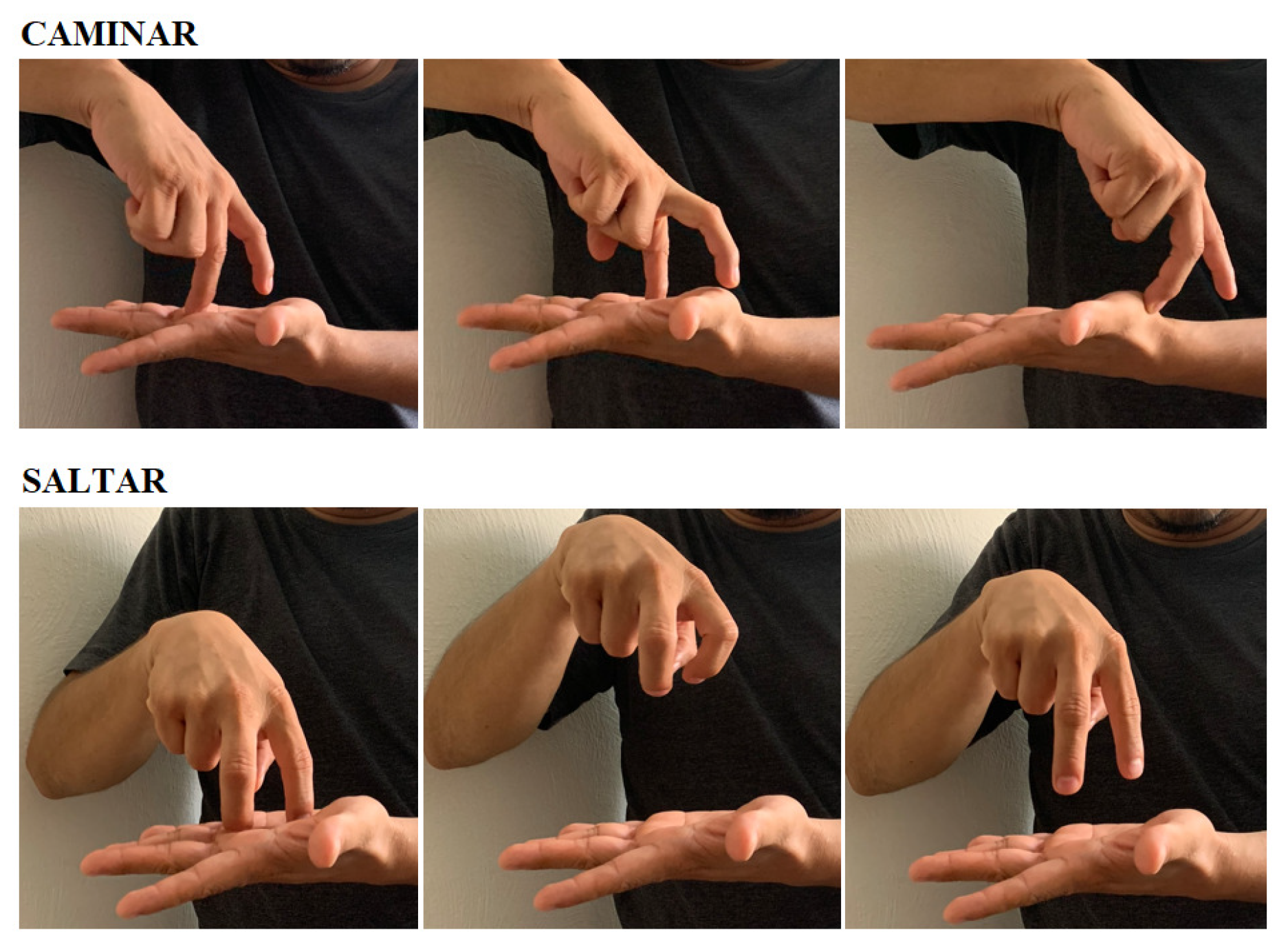
Figure 2.
Initial and final state of a dynamical gesture.
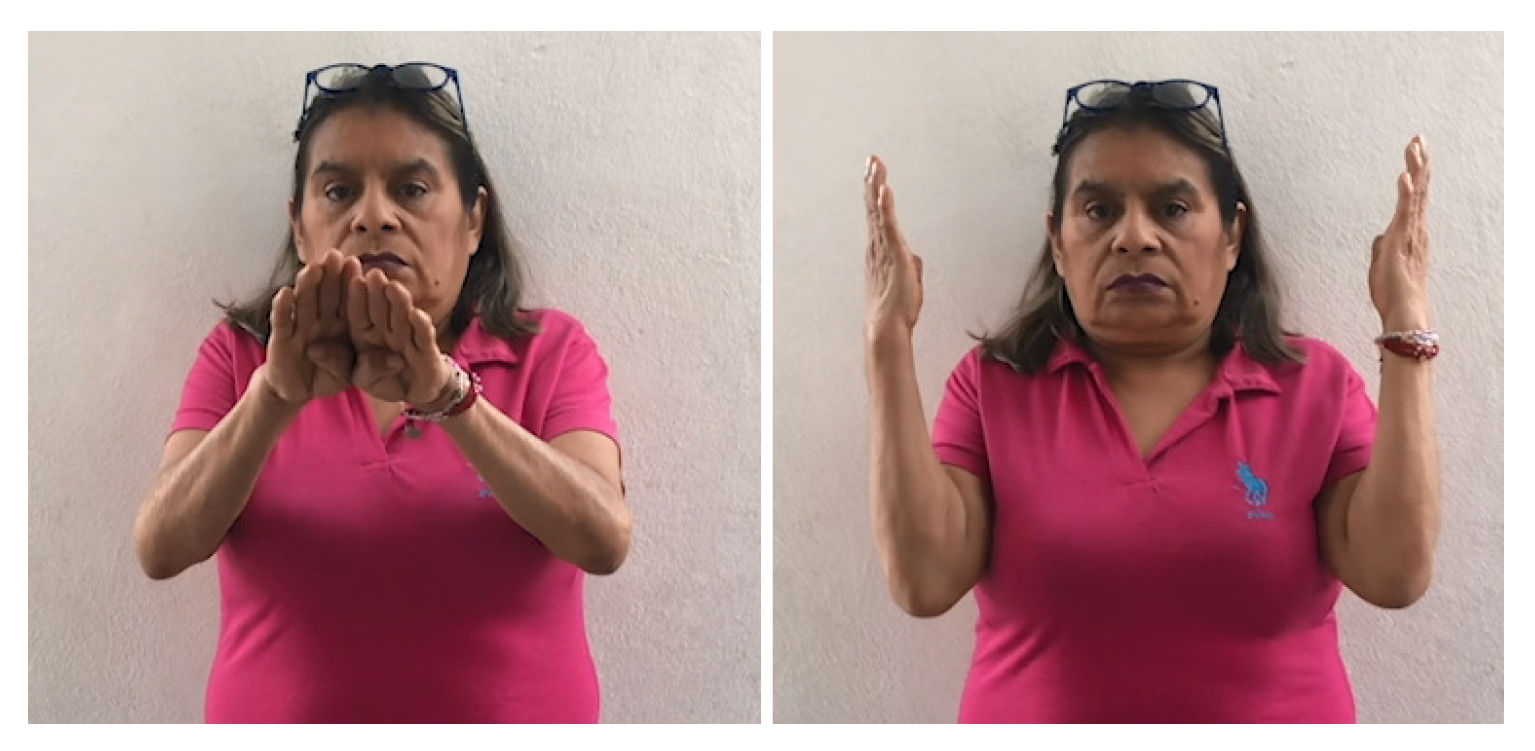
Figure 3.
Different versions in the characteristics of the environment and the participants.
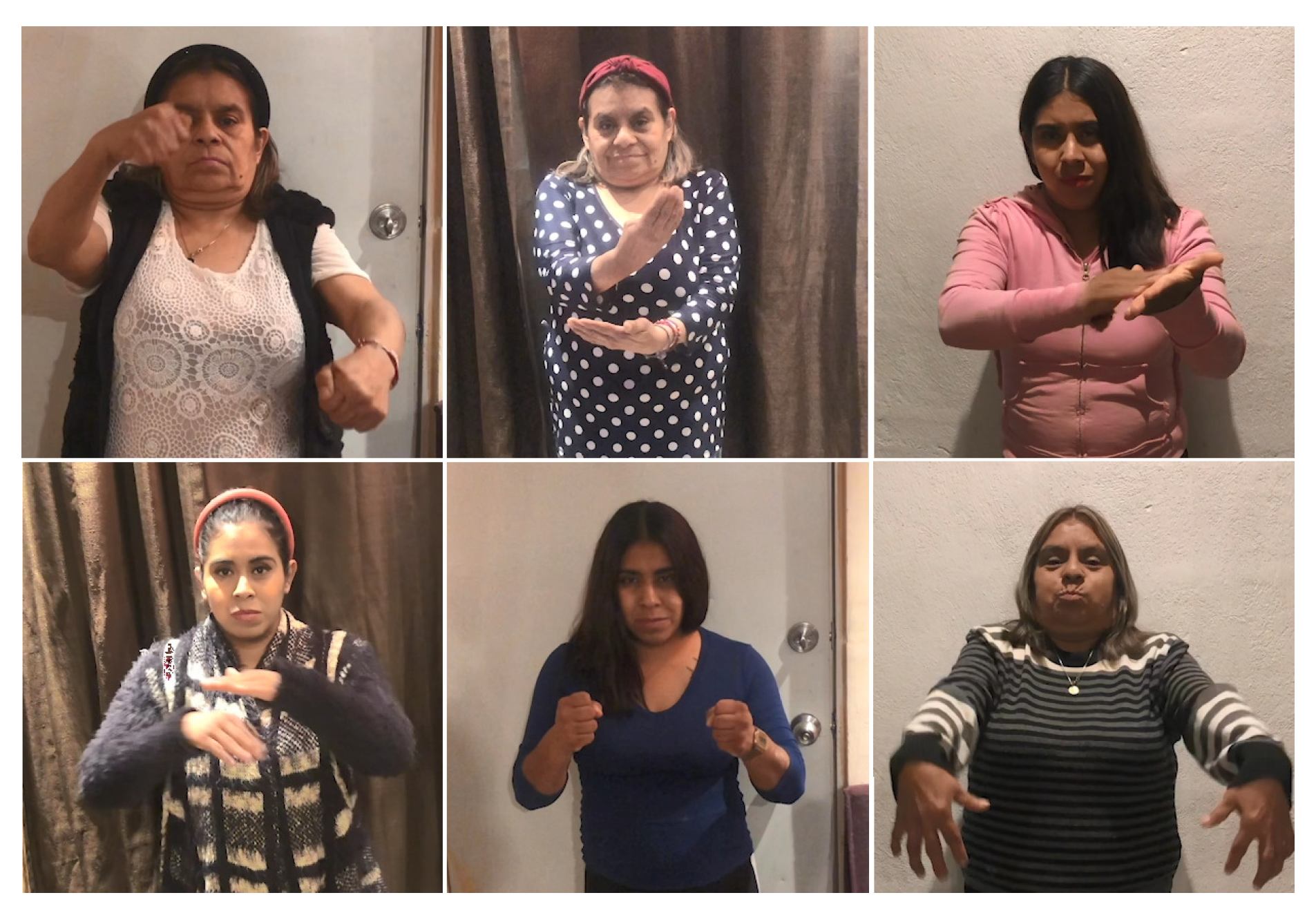
Figure 4.
Neural network model for the MX-ITESO-100 data set validation.
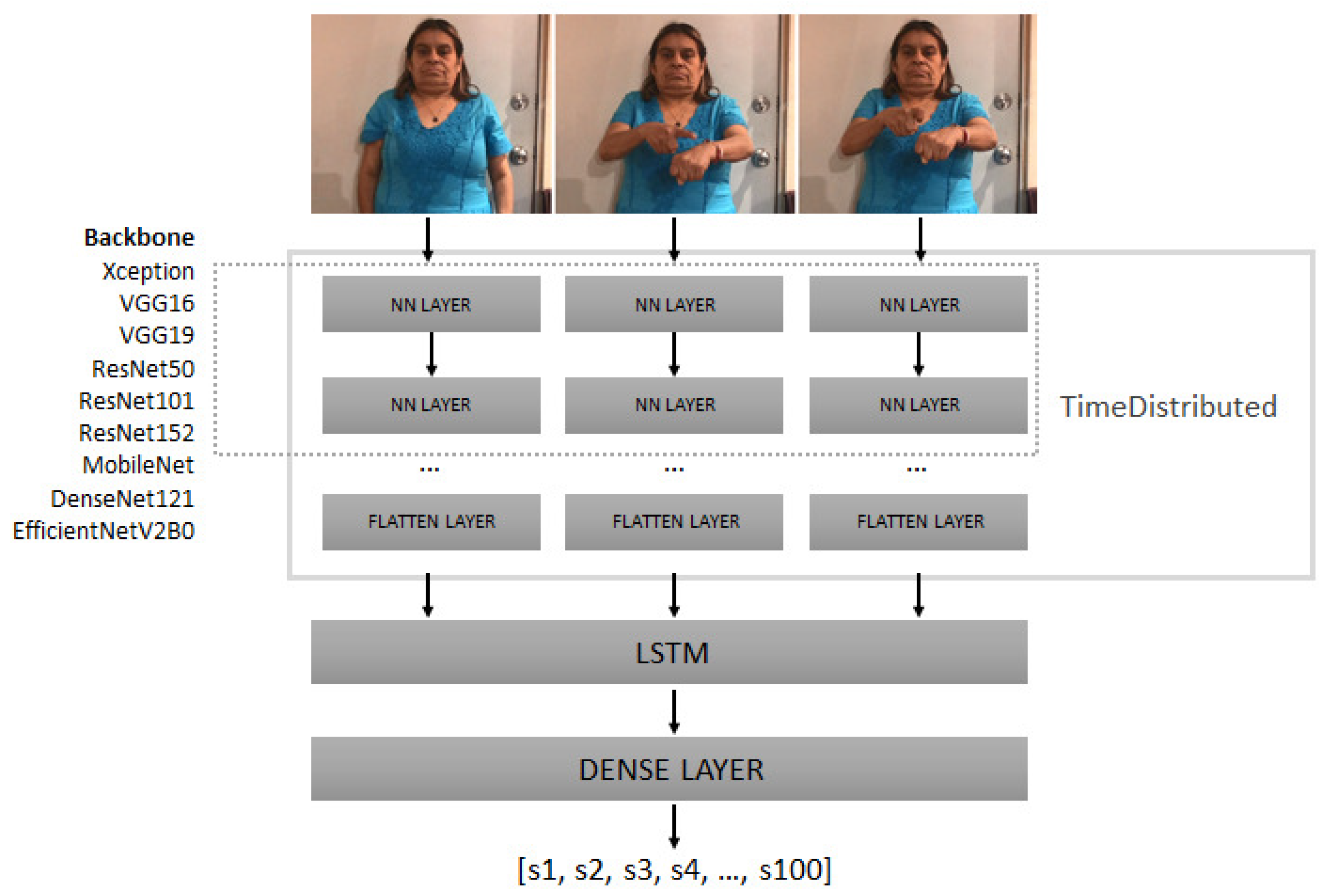
Figure 5.
Training and validation outstanding curves.
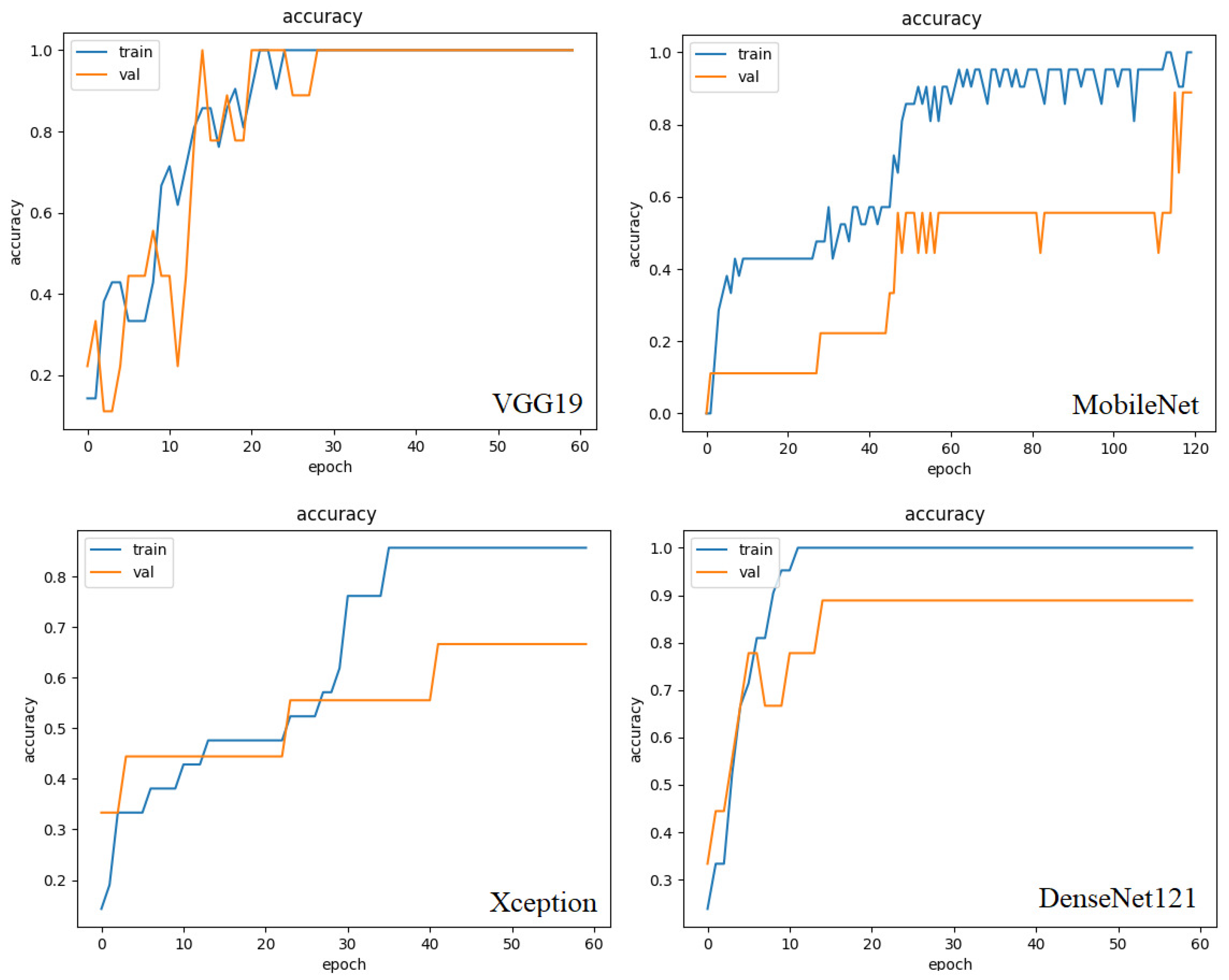

Table 1.
Summary of CSLR and ISLR datasets.
| Dataset | Description | Language | Signs |
|---|---|---|---|
| CSLR | RWTH-PHOENIX | German Sign Language | 1,231 |
| CSLR | RWTH-BOSTON | American Sign Language | 843 |
| ISLR | CSL-500 | Chinese Sign Language | 500 |
| ISLR | ASL MS-ASL and WASL | American Sign Language | 3,000 |
| ISLR | AUTSL | Turkish Sign Language | 226 |
| ISLR | KArSL | Arabic Sign Language | 502 |
| ISLR | ASL Lexicon Video Dataset | American Sign Language | 3,800 |
Table 2.
Distribution of grammatical elements in MX-ITESO-100.
| Grammatical element | Quantity |
|---|---|
| Verbs | 30 |
| Adjectives | 29 |
| Nouns | 25 |
| Adverbs | 6 |
| Pronouns | 5 |
| Phrases | 4 |
| Conjuntions | 1 |
Disclaimer/Publisher’s Note: The statements, opinions and data contained in all publications are solely those of the individual author(s) and contributor(s) and not of MDPI and/or the editor(s). MDPI and/or the editor(s) disclaim responsibility for any injury to people or property resulting from any ideas, methods, instructions or products referred to in the content. |
© 2023 by the authors. Licensee MDPI, Basel, Switzerland. This article is an open access article distributed under the terms and conditions of the Creative Commons Attribution (CC BY) license (http://creativecommons.org/licenses/by/4.0/).
Copyright: This open access article is published under a Creative Commons CC BY 4.0 license, which permit the free download, distribution, and reuse, provided that the author and preprint are cited in any reuse.


