Gauge Symmetry
The exponential function for the coupling energy exp3vΦ (5), as derived from experiment, represents a capturing of the magnetic condensate wavefunction through the interaction energy of the crystal-fluid material such that it becomes real and observable (1,2). Naively, a gauge monopole condensate appears to acquire a temporary critical mass mH through coupling of the Higgs-like gauge field Φ to the magnetization vector field Ms, as represented by the correlation length exponent ν. The exponential function exp3vΦ also expresses the scale-invariant and gauge-invariant properties of the critical system. Conservation of angular momentum requires the existence of a sink/ source for the associated changes in inertia (variable effective radius) together with a corresponding symmetry relation.
Scale-invariance is attributed to the hyperbolic curvature of Lorentz boosts that describe a conformal symmetry at the surface of the embedding vacuum manifold [
35,
36]. Conformal symmetry is able to represent the tetrahedral, hydrogen bonded, 3-dimensional spatial geometry of the crystal-fluid under non-extensive volume changes whilst its variable hyperbolic surface area maps to the gradient energy term of the Lagrangian (see below). Since a universality class of topologically invariant critical exponents has been determined for the continuous (second order) phase transition, the system can be modelled through conformal field theory in 4-spacetime dimensions, i.e., it is describable by a renormalizable quantum field theory in which the non-perturbative conformal bootstrap is irrelevant [
37].
Yang-Mills theory represents such a strongly coupled quantum field theory [
16], i.e., a gauge theory in which the low-energy dynamics are far removed from any classical description [
38]. It is in turn represented through the mathematical structure of Lie symmetry groups that provide for intricate topologies. The compact, simple Lie group
SU(3) describes the strong interaction in QCD, i.e., the binding of quarks and gluons through confinement mechanisms. The mechanical action of the piston expander can be described by the emergence of a gauge field
Φ (1.2 ≤
Φ ≤ 3.6 ks
-1) and the critical length exponent
ν (0.593) in 3-dimensions, which maps to the relativistic rapidity angle ±
φ (±
1.779), as equation (8). In QCD such gauge fields are collectively known as gluon fields. The field strength, or curvature
Fμν, takes the general form:
where
Aν provides for Lorentz invariance and
Aμ is the gauge connection.
The gauge connection depends upon a complex scaling symmetry that is exact but not directly observable [
39]. In the quantum state
Ψ →
eiθΨ, which could be interpreted as a potential sink/ source for the ‘hidden’ inertia of the false vacuum system (although later this is revealed not to be the case). It also represents the complex order parameter field of the Ginzburg-Landau superconducting phase transition included in equation (10).
Experimental results lead to a relativistic manifestation of length expansion and time contraction arising from false vacuum behaviour in a thermodynamically constrained condensed matter system. The local stability conditions maintained through dynamically responsive inhomogeneities in this soft matter are deemed equivalent to the property of asymptotic freedom, or antiscreening, which accounts for the mechanism of colour confinement in particle physics, i.e., scale-invariance is suggested across the micro- and macro-scales of the system. In micro-scale
SU(3) QCD it is the emergence of clouds of virtual gluons that establish the antiscreening phenomenon [
3]. In both mechanisms, increasing kinetic/ internal energy is mirrored by an increasing negative energy potential such that total energy remains constant.
Whilst the crystal-fluid material displays high stability in total energy and density, the embedding manifold always remains on the threshold of instability. Small positive or negative pressure perturbations produce divergent critical behaviour manifesting as large variations in swept volume V. However, this is not the specific volume of the material system (density remaining almost constant) but rather the non-extensive volume change associated with the condensation of magnetic entities and simultaneous emergence of a gradient energy term.
The ‘rolling’ critical response enabled through anisotropy in water ice cage structures appears to deliver net energy gains, either positive or negative, in a display of self-organized criticality [
40]. The angular momentum of the material is transferred to or from the embedding vacuum manifold through self-organizing behaviour and high energy degeneracy of the water ice cage structures. However, this brief statement does not provide a full description and a more detailed hypothesis follows.
Work derived from the piston expander can be expressed in terms of an electromagnetic pseudo-scalar gauge-invariantly coupled to the gauge field exponent
Φ and the critical correlation length exponent in 3-dimensions 3
ν (which is equal in magnitude to the rapidity angle ±
φ, as described in Appendix B). The relationship is similar in form to the cosmological inflation model proposed by Ratra [
41]:
where the covariant vector
Fμν and contravariant gradient potential
Fμν combine to produce Lorentz invariance for the pseudo-scalar field when rotated on a hyperbolic manifold, i.e., the electromagnetic field pseudo-scalar enables a non-additive energy contribution to enter the non-equilibrium system in the form of hyperbolic curvature. Expressing the exponential function in terms of the rapidity angle ±
φ reveals the action of positive and negative spinors that determine the critical correlation length
ξ, as (25,26,27), leading to either an increasing or decreasing negative gradient energy.
In the quasi-micro-canonical ensemble [
1], the electromagnetic field pseudo-scalar is involved in the coupling mechanism but contributes no work in itself. It expresses the Berry curvature that is indirectly derived from the vacuum manifold whilst hosting the magnetic exchange pathways that facilitate energy transfers either to or from the vacuum manifold. The inner-product of the E and B fields remains the same viewed in all relativistic frames [
42] with the pseudo-scalar field remaining Lorentz invariant such that:
where
c is the speed of light.
Ginzburg-Landau theory states that the free energy of a superconductor near a phase transition can be expressed in terms of a complex order parameter field [
43]:
Then a complex rendering of the coupling energy term maps to a complex wavefunction of the Berry phase:
where the quantity |
Ψ(
r)|
2 reflects the density of superconducting charge carriers; electrons for Type-II and the electroweak monopole counterpart arising from confined fractional magnetic charges for dual Type-I [
11].
Appendix C provides a summary of the Ginzburg-Landau theory of superconductors.
In the dual superconductor model of confinement [
9,
10], the Yang–Mills vacuum is also based on the condensate of a magnetically charged Higgs field. In the current findings, the critical correlation length
ξ similarly represents the coherence length
ξ’ of a massive macro-scale magnetic monopole condensate [
12] that manifests as a divergence in the hyperbolic volume
V of the system at the superconducting phase transition [
43]. In this case the coherence length
ξ’ becomes exceptionally large whilst still defining the distance over which the dual superconductor can be represented by a wavefunction.
Since the coherence length
ξ’ and maximum value for the Ginzburg-Landau parameter
κ for the Type-I dual superconductor are known [
1], the London penetration depth
λ can be derived (see
Appendix C).
ξ’ and
λ are equal to the inverse Higgs mass
mH and inverse vector boson mass
mV, respectively [
11]. In normal metallic superconductors
λ is the distance within which an externally applied magnetic field disappears inside the superconductor. However, for the dual superconductor
λ represents a distance beyond the developing flux tubes (confined fractionalized magnetic charges) within which the magnetic current and electric field are expelled as a result of the dual Meissner effect.
So, the Gaussian hyperbolic curvature
K of the embedding vacuum manifold derives from
mV. Then, the resulting magnetic monopole condensate is responsible for
mH, which manifests in the system volume
V.
Appendix C includes supporting quantitative analysis.
The complex form of the coupling energy term resembles a quantum mechanical wavefunction in which the energy spectrum is made entirely real and observable through dissipative structuring and interaction energy of the crystal-fluid material. Ψ0(r) initially appears to corresponds to the emergence of the gauge field Φ coupled with a magnetization vector field Ms at the Type-II to dual Type-I superconducting phase transition. Dissipation of either the scalar field Φ or the critical correlation length ξ would represent a collapse in the wavefunction.
Application of de Moivre’s formula and isomorphic mapping of the complex field to hyperbolic rotational matrix form gives:
and similarly expressing electromagnetic duality as rotations in the 2-dimensional hyperbolic plane:
The conjugate transpose of (12) is (13) and the determinant of VV
H = 1 suggesting that
PV work of the piston expander is contingent upon the decomposition of a Hermitian unitary matrix A into two 2 x 2 non-Hermitian unitary matrices (i.e., two complex matrices V and V
H containing both real and imaginary components such that V
H ≠ V) [
44]. The gauge field and the electromagnetic pseudo-scalar are thereby coupled through a reciprocal interaction in the hyperbolic plane.
Although this interpretation appears at odds with the expression for PV work stated in (8), in fact any 2 x 2 complex symmetric matrix A can be eigendecomposed into a diagonal matrix D sandwiched between two complex unitary matrices, i.e., VDVH in this case. Minkowski spacetime vectors can be represented by 2 x 2 orthogonally diagonalizable matrices and incorporated into the extended physical VDVH decomposition to reveal the coupling energy source.
For:
VDV
H can be expressed as the Pauli spin operators acting on a bivector [
45]:
and
where ±
φ represents the Lorentz rapidity
angle (with values of ±1.779) and Φ/2 is the spinor half-angle formulation. Both are incorporated into the Weyl spinors of (25) and (26). Additionally, VV
H corresponds to the Pauli identity matrix
σ0, also included in the Weyl spinors description. The sign of the rapidity angle
φ is associated with either a positive or negative spinor, i.e., an increasing or decreasing negative gradient energy.
The diagonal Hermitian matrices exhibit basic 3-dimensional rotation as well as 4-dimensional Lorentz transformation properties consistent with the relativistic length expansion and time contraction associated with the non-extensive element of
PV work, as also revealed through the experimental results [
1]. Thus, the 2 x 2 unitary matrix A as a member of the compact
U(2) symmetry group is decomposed into factors identifiable as both Hermitian and non-Hermitian.
When represented in terms of gauge symmetry groups [
44], the
U(1) group of electromagnetism (via its mapping to
SO(2) in the 2-dimensional real plane) and the
SU(2) group of the complex order parameter
Ψ(
r), are in fact subgroups of the
U(2) group such that:
which describes a mapping to a Yang-Mills electroweak symmetry group [
46] where ℤ
2 represents the topology associated with a gauge monopole condensate [
47]. Formation of the
U(2) group is accompanied by critical behaviour and emergence of the gauge field
Φ as predicted by the Yang-Mills theory.
The dual superconductor model has several interpretations that require condensation of monopoles, just as normal superconductivity results from the condensation of electric charges (or Cooper pairs – see
Appendix C) [
11,
12]. Theoretical frameworks for the condensation of monopoles have been structured in terms of Abelian projection for the
SU(2) gauge symmetry group or non-Abelian gauge-invariance for the
SU(3) gauge symmetry group. Recent efforts [
12] have sought to extract the Abelian component responsible for gauge-independent quark confinement from the non-Abelian gauge-invariance required for asymptotic freedom, without losing the essential feature of monopole condensation. From the experimental findings [
1], an alternative solution emerges where electroweak interactions with fractionalized magnetic charges lead to complex monopole condensation within an overarching
U(2) Abelian group, as detailed below.
In the vacuum of a QCD dual superconductor, the dual Meissner effect compresses the chromoelectric flux between a quark and antiquark into a thin flux tube to form the hadronic string [
11,
48]. As the distance between quark and antiquark increases, the flux tube becomes longer whilst maintaining a minimal thickness. This geometry ensures that the energy increases linearly with length to create a linear confining potential between the quark and antiquark that bears a similarity to the linear oscillating Hamiltonian of the macro-scale system. The flux tube determines the extent of QCD vacuum suppression, i.e., positions where the chromoelectric field is maximally expelled to leave a residual dual superconductivity [
49].
Yang-Mills theory requires the existence of both chromomagnetic monopole condensation (given by a coherence length) and the dual Meissner effect (given by a penetration depth) [
11,
12]. The force carrying gauge bosons of QCD are massless gluons which perform a similar role to photons in electromagnetism. Since the gluon field represents a local expulsion of the QCD vacuum, the (indirect) absorption of gluon emissions into the QCD vacuum would tend to reduce local ‘space density’ and effective magnetic permeability
μ0. The net effect is to increase the hyperbolic curvature
K of the embedding manifold, i.e., a quantum mechanical process manifests as an effective vector boson mass
mv or ‘strong gravity’ [
50].
Berry Phase and Parity-Time (PT) Symmetry
The foundations of Berry phase physics lie in the adiabatic theorem of quantum mechanics [
51] which provides a formal description for a system coupled to a slowly changing environment. If the system Hamiltonian
H(
t) varies adiabatically and │
Ψ(
t)⟩ is an associated eigenstate then, following cyclic evolution of the environmental parameters where
H(
T) =
H(0), the state returns to itself but gains an additional phase factor [
51,
52]:
where
α represents the angular momentum of the wavefunction. For the macro-scale dual superconductor, it originates from the exclusion of momentum resulting from gauge monopole condensation which is effectively stored in the electromagnetic field pseudo-scalar [
38].
The adiabatic theorem is based upon a single, non-degenerate eigenstate to which the system ‘clings’ as the environment is slowly changed [
53]. However, for the pressure-perturbed system being examined, asymptotic freedom constrains innumerable, degenerate and excited eigenstates to a singular value of total energy in the oscillating Hamiltonian function. External pressure perturbations applied to the crystal-fluid material see changes in kinetic/ internal energy mirrored by changes in negative energy potential such that total energy remains constant. Integration of the scalar potential ∇
Φ over a Hamiltonian cycle reveals the gradient energy term -½(∇
Φ)
2 that becomes observable in the
PV work extracted from the piston expander (see equation (29)).
When perturbations cease, the negative energy potential appears to be transferred to the sterically-induced interaction energy of the crystal-fluid, subject to some limited dielectric relaxation. Since hyperbolic geometry is retained in the crystal fluid, there is negligible net loss of mass as the Higgs mass
mH and vector boson mass
mV dissipate. The phase factor
Ψ(
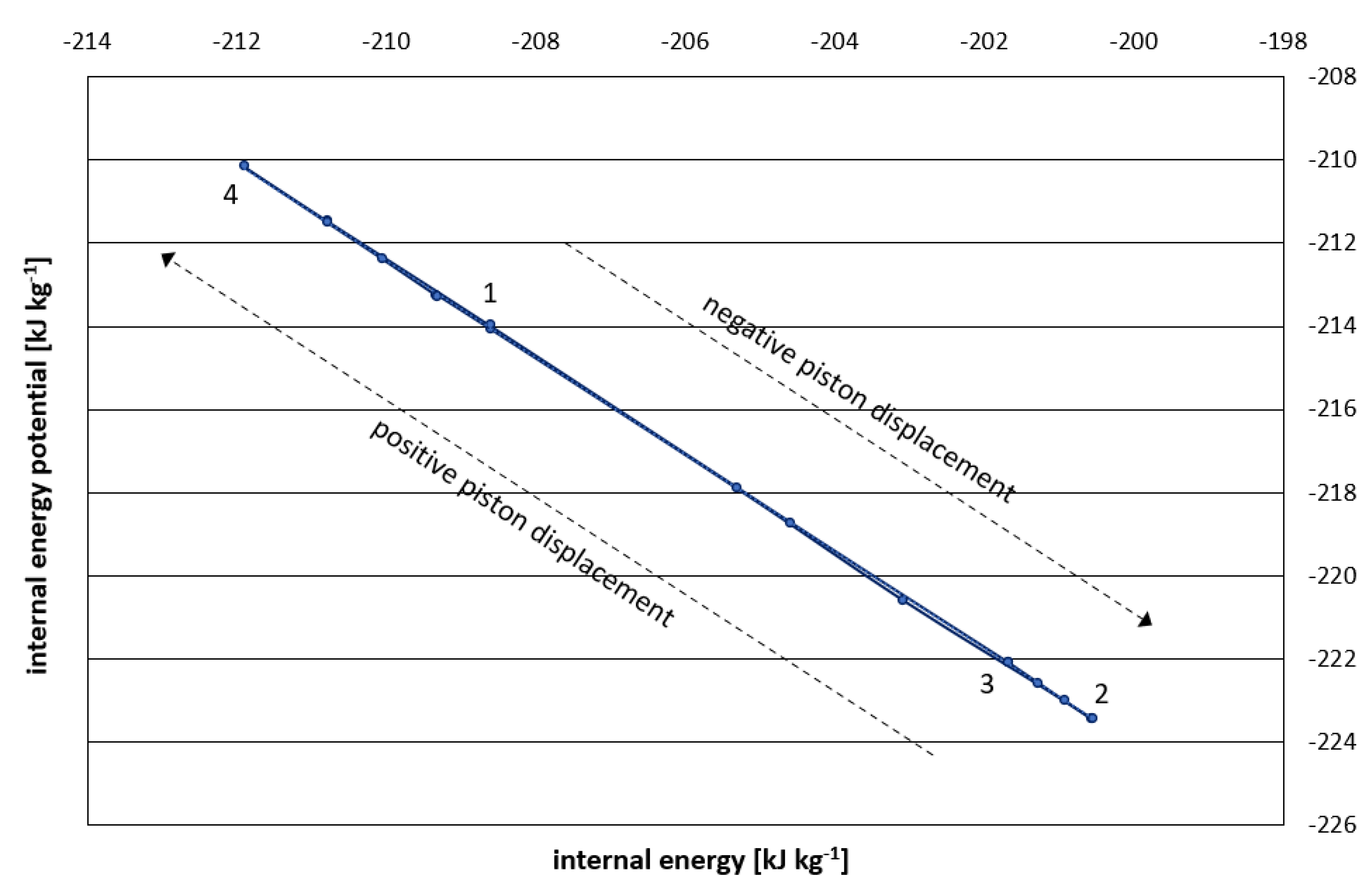
T) exists only for the duration of pressure perturbations with the Hamiltonian remaining constant under these perturbations (as
Figure 2). The resting values of total energy
E are then ‘propped’ and metastabilized through dissipative structuring of water ice cages, subject to limited dielectric relaxation, as quantified by Stage 2-3 and Stage 4-1 (
Figure 2). Following metastable decay, which can last several weeks, the mass associated with sterically-induced interaction energy (0.3 kg, approx.) eventually dissipates. For the metastable system, the internal energy potential
ue remains approximately constant:
For acceleration (Stage 1-2) the effective radius decreases, and for deceleration (Stage 3-4) the effective radius increases. However, the resulting ‘hidden’ inertia is deemed not to be directly responsible for the Berry curvature term within the geometrical phase (11) since the externally-induced momentum manifests entirely in non-additivity of the hyperbolic curvature K. Instead, the Berry curvature is linked to the condensation of magnetic entities whereby the resulting exclusion of charge momentum manifests in the energy potential of the electromagnetic field pseudo-scalar (9). The Berry curvature is subsequently captured to be made real and observable in the variable hyperbolic volume V of the embedding vacuum manifold. Again, this hyperbolic volume is metastabilized by the dissipative structuring of water ice cages within the crystal-fluid material so that the complex Berry phase is transformed into real work done.
For a classical thermodynamic system, changes in inertia ½mr2 represent changes in kinetic/ internal energy. However, since both internal energy and specific volume are highly constrained parameters within a false vacuum system, the energy of acceleration/ deceleration is prevented from manifesting in the crystal-fluid material. Thus, Pv work is limited to interactions with the walls of the vessel. For the synchronized U(2) symmetry group identified below, conservation of angular momentum may be understood in terms of accelerating/ decelerating quarks that result in the emission/ absorption of gluons, i.e., changes in negative energy potential.
Gluons emitted by quarks are indirectly absorbed by the QCD vacuum manifold whilst the gluons absorbed by quarks indirectly emerge from the QCD manifold, thereby tending to effect local ‘space density’ and effective permeability
μ0. A gluon-induced process for
gg →
W*W* →
leptons (where
W*W* represents an intermediate
W-boson/ vector boson pair) is described in [
54]. At some stage in the process, the fine structure constant α (≈ 1/137) appears to play a key role (see
Appendix D for analysis).
Lepton decay may therefore result in a chromoelectric confining potential that acts to transform fractionalized microscopic magnetic spin degrees of freedom into
SU(2) electroweak monopole entities [
31]. A sufficiently large number of
SU(2) electroweak monopoles could then generate a Planck mass such that a
U(2) magnetic condensate having Higgs mass
mH emerges. The associated gauge monopole topology facilitates the spontaneous magnetism M
s that maximally excludes the electric field E and establishes the macro-scale dual superconductor (see
Appendices D-
E for analysis). This phase-change is represented by the Ginzburg-Landau parameter
κ with values ≤ 1/√2 that describe the ratio of the Higgs mass
mH to the vector boson mass
mV.
Pv is insignificant in comparison to
PV such that it represents the negative energy potential of the crystal-fluid material only. Therefore, for a constant Hamiltonian oscillator of constant mass
m, ½
r2 ∝ 1/
Pv, as described in
Appendix B of [
1]. The average 1-dimensional radius
rx of the critical system is then found:
The Gaussian curvature
K for the 2-dimensional, hyperbolic surface of the critical system for the principal curvature relationship of
rx = -
ry, can then be determined:
or
Then, the average Gaussian radius of hyperbolic curvature (1/
K or
Rg) is given by:
Gaussian curvature
K has units of m
2 s
-2 that map directly to the effective vector boson mass
mV as the inverse of the penetration depth
λ (as described in
Appendix C). Through this mechanism, the negative energy potential of gluons is conserved in the associated hyperbolic curvature quantifiable by the non-equilibrium values of pressure
P and specific volume
v. Thereby, a quantum mechanical action is tuned thermodynamically under false vacuum conditions. Expressed in terms of the holographic principle, or the anti-de Sitter/ Conformal Field Theory (AdS/ CFT) correspondence, this hyperbolic geometry results from a renormalization group flow/ scaling flow. In other words, a scaling flow from the boundary surface (described by a 2-dimensional CFT) to the interior is encoded in the geometrical properties of the hyperbolic manifold (described by a 3-dimensional AdS) in accordance with the Einstein field equations [
35] (see
Appendix B).
Decomposition of the complex gauge connection (e
iΦ)
3ν in equations (12) and (13) suggests that complex Berry curvature is necessary for emergence of the coupling energy (5). It also determines the phase of electromagnetic duality, which in the extreme leads to dual superconducting behaviour, i.e., condensation of magnetic entities resulting in the exclusion of fractionalized magnetic current and the electric field. The cyclic evolution of the gauge connection results from the effective adiabatic property of the constrained false vacuum system (as revealed in the constant Hamiltonian oscillator of
Figure 2) to establish a novel form of the Berry phase [
51], one responsible for topological ordering in the macro-scale dual Type-I superconductor [
8]. As with the conventional ground-state Berry phase, this ‘excited-states’ variant exposes the gauge structure in quantum mechanics [
13,
55].
In addition to describing the emergence of a gauge field
Φ, the gradient energy term -½(∇
Φ)
2 of the Lagrangian also maps to the complex order parameter field
Ψ(
r) in accordance with Ginzburg-Landau theory. The
PV work generated in the piston expander suggests that the associated quantum mechanical wavefunction is made real and observable, a phenomenon recently uncovered by Gu et al. [
13]. More precisely, the VDV
H decomposition reveals that the wavefunction becomes entirely real as the coupling energy is exposed through the diagonal matrix D in the VDV
H decomposition (15).
Since the system can be described through a combination of Hermitian and non-Hermitian matrices, it resembles a PT symmetric system [
14]. Such systems are characterized as not being isolated from the environment (i.e., non-adiabatic) but subject to highly constrained interactions. This description is consistent with the false vacuum behaviour of the crystal-fluid material where both specific volume and internal energy are highly constrained. Energy and entropy gains and losses to the environment (including the embedding vacuum manifold in this case) are exactly balanced, i.e., a renormalized, scale-invariant interaction between condensed matter and quantum wavefunction becomes evident in the constant energy Hamiltonian.
PT symmetry requires both space reflection and time reversal symmetries. The upside-down potential of the quartic term as identified by Bender [
14] is consistent with the marginal interaction and negative gradient energy term derived from experiment [
1]. However, the results presented here reveal the symmetry of Lorentz boosts, i.e., symmetries in the expansion and contraction of both space and time, which may represent a more generalized form of PT symmetry.
Symmetry Synchronization and Conserved Quantities
Quark acceleration produces gluon emissions since a lower binding potential is necessary to maintain the momentum and energy of any given quark colour configuration [
56]. This results from a gluon recombination process whereby a quark and antiquark pair are annihilated. The emergence and absorption of gluons signifies a mediated exchange between the non-Abelian gauge symmetry of QCD and the Abelian gauge symmetry of the vacuum manifold, i.e., an electroweak interaction. In other words, the parameter space of the quantum mechanics is the spacetime manifold of an Abelian gauge theory such that the closed cycle of the Berry phase is formally identical to a Wilson loop observable [
57], as demonstrated below.
The following non-Abelian Faddeev-Niemi decomposition is considered [
58]:
This decomposition is a restricted one since splitting and recombining gluons in
SU(3) represents a mediated interaction with a
U(2) spacetime manifold rather than full symmetry breaking to
SU(2). The requirement for a Higgs-type scalar field is satisfied by the emergent gauge field
Φ [
12]. So:
Asymptotic freedom is thereby maintained through the dominant
SU(3) subgroup. Again,
U(2) appears as an electroweak symmetry group [
46] with ℤ
2 representing an Abelian topology consistent with gauge monopole condensation [
47]. For Kondo et al. [
12],
U(2) is the maximal stability group determined by the fundamental quark group
SU(3) where quark confinement is the non-Abelian micro-scale dual superconductivity associated with chromomagnetic monopoles. In the current exposition, this non-Abelian micro-scale dual superconductivity is subsumed into an Abelian gauge monopole condensate, as identified above, under the common
U(2) symmetry of macro-scale dual superconductivity.
A U(2) gauge symmetry that provides for a gauge monopole condensate has so far been identified in both the condensed matter system and the underlying QCD particle physics. However, it is also possible to determine a U(2) gauge symmetry for the vacuum manifold of local spacetime through which hyperbolic curvature is enacted. That is, where the splitting and recombining of massless, force-carrying gluons are associated with fictitious forces in non-inertial reference frames, as quantified by the effective vector boson mass (0.22 m2s-2 ≤ mV ≤ 0.46 m2s-2).
The Lorentz group
SO(4) provides for the conservation of energy and angular momentum in 4-dimensions (ℝ
4) through two continuous symmetries; rotations in 3-dimensional Euclidean space and Lorentz boosts which influence both space and time [
59]. The 4 x 4 orthogonal matrix representation of the metric tensor can also be cast in terms of a 2 x 2 unitary matrix operating on a complex 2-component spinor. The complete unitary 2 x 2 transformation matrix for spinor rotations and boosts can be expressed as:
or
where
θ is the Lorentz rotation angle,
σ is the Pauli spin matrix, and ϕ is the angle associated with the Lorentz boost (or rapidity) [
1,
60]. Equation (25) represents a ‘right-handed’ spinor
ϕR and (26) represents a ‘left-handed’ spinor
ϕL, i.e., the Weyl spinors.
For bidirectional Lorentz boost transformations having no rotational components, the Weyl spinors simplify to
ϕR = e
-σϕ/2 and
ϕL = e
σϕ/2, which is the half angle formulation given in equations (14) and (15) above. It is observed that the critical correlation length
ξ is equal to the average value of the combined rapidity angle exponentials with ±
φ. A change in direction of the scalar potential ∇
Φ is consistent with a reversal in direction of the rapidity angle exponents such that:
Later insights by Dirac led to the concept of the 4-component spinor which, unlike (25) and (26), preserves parity of the wavefunction under the sign reversal operation
Ψ(
x,
t) →
Ψ(-
x,
t), thereby accommodating changes in scalar potential direction explicitly whilst maintaining a positive gauge field plus positive energy [
45] (and also predicting the existence of antimatter). Then, retaining the 2 x 2 unitary matrix whilst acknowledging parity preservation requirements produces the following spacetime group representation [
59,
61]:
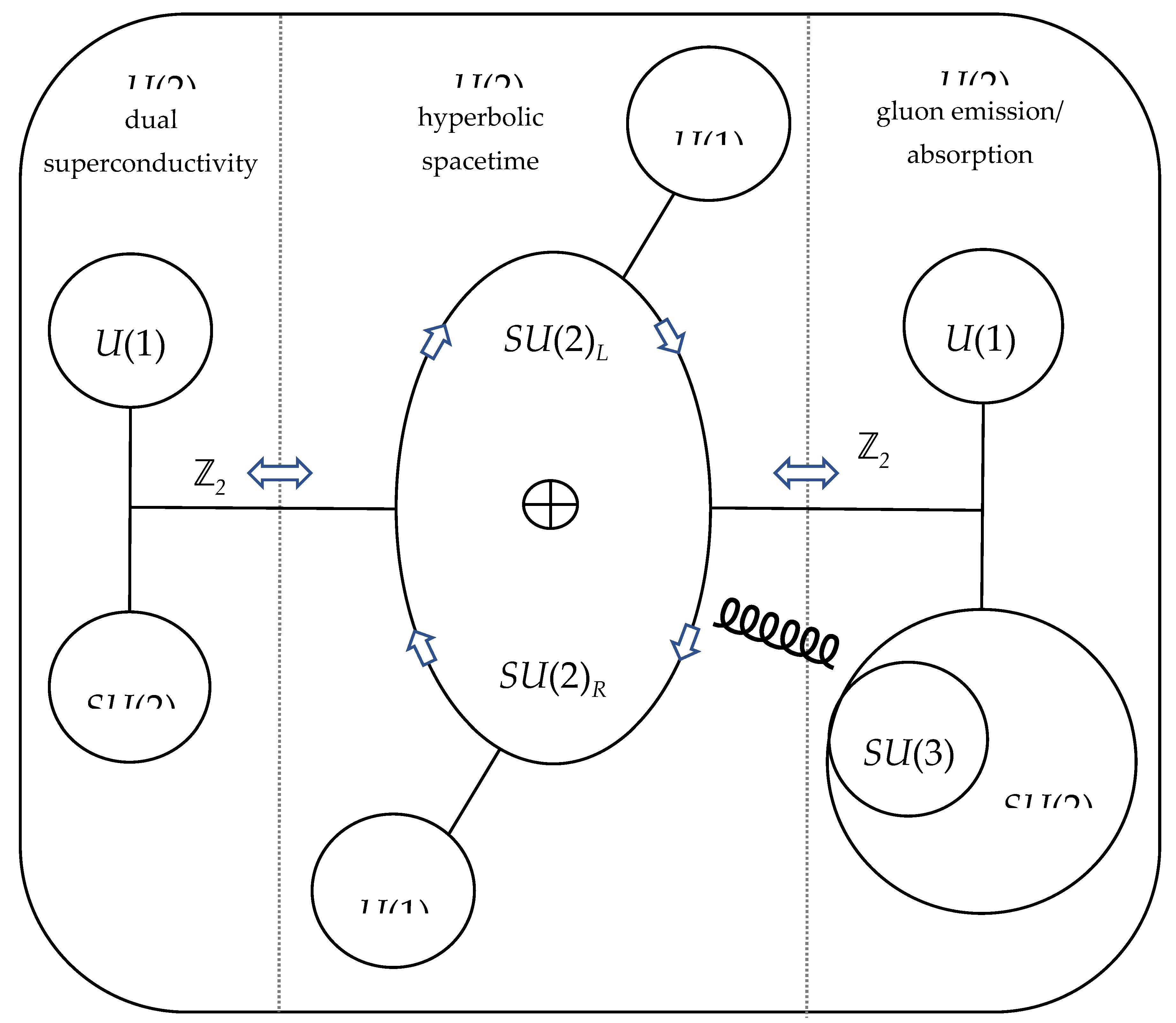
The symmetry group decompositions in (16), (24) and (28) are then amalgamated to describe a consolidated ‘symmetry synchronization’ that establishes common scale- and gauge-invariance in U(2), as shown schematically in Figure 4:
Figure 4.
Decomposition of symmetry groups to establish common U(2) scale- and gauge-invariance. This model of invariance provides a mechanism through which the pressure-induced ‘rolling’ critical response results in PV work that is either positive or negative. The complex reorganization of water ice cages produces variable inertia which, through the conservation of angular momentum, is responsible for either an acceleration or deceleration of quarks. In the case of acceleration, this leads to the emission of gluons that are indirectly absorbed into the QCD vacuum manifold. A corresponding tendency to reduce local ‘space density’ and effective magnetic permeability μ0 manifests as increased hyperbolic curvature K.
Figure 4.
Decomposition of symmetry groups to establish common U(2) scale- and gauge-invariance. This model of invariance provides a mechanism through which the pressure-induced ‘rolling’ critical response results in PV work that is either positive or negative. The complex reorganization of water ice cages produces variable inertia which, through the conservation of angular momentum, is responsible for either an acceleration or deceleration of quarks. In the case of acceleration, this leads to the emission of gluons that are indirectly absorbed into the QCD vacuum manifold. A corresponding tendency to reduce local ‘space density’ and effective magnetic permeability μ0 manifests as increased hyperbolic curvature K.
When a symmetry is broken, a corresponding order parameter that diminishes to zero can often be identified. However, in this case the complex order parameter Ψ(r) emerges where symmetry is synchronized.
Both energy and angular momentum are conserved within the common
U(2) group to reveal the time and space symmetries of a Lorentz boost in agreement with Noether’s theorem (see below). There is a gluon field for each of the eight colour charges and each gluon field is composed of a time-like component and three space-like components. These components relate to the electric potential and the magnetic potential, respectively, and will interact indirectly with the vacuum manifold to determine the values of effective permittivity
ε0 and effective permeability
μ0. Additionally, the chromoelectric and chromomagnetic components correspond to the temporal and spatial Wilson loops described below, where the Wilson loop represents an order parameter for quark confinement [
4].
Variations in effective
μ0 require that a spontaneous magnetism M
s, with associated spontaneous magnetic field H
s, emerges to conserve magnetic charge. Fractionalized magnetic charges arising from the geometrically frustrated crystal-fluid material appear confined into magnetic entities through lepton decay. These electroweak magnetic monopoles are interpreted as condensing into a gauge monopole topology that excludes magnetic current to leave magnetic exchange pathways available for the spontaneous magnetism M
s. Whilst magnetic exchange interactions are conventionally established through direct and super-exchange mechanisms between metal centres or metal centres and various ligands, exchange can also occur via intermolecular hydrogen bonding interactions [
62,
63]. Changes in bond lengths and angles along the exchange pathway affect the hopping integrals between magnetic centres, thereby altering the magnetic exchange effect.
The correlation length
ξ of the magnetic monopole condensate produces divergent critical behaviour that is shown to have a distinctive universality class of critical exponents. The gauge monopole topological defects act as both convergent sinks (under acceleration) and divergent sources (under deceleration) of the magnetism M
s [
8]. The nature of these defects is speculated in
Appendices C-
E.
Similar principles apply to variations in vacuum energy determined by the local ‘space density’ (which determines the embedding manifold curvature). Conservation of energy requires that negative
PV work is performed under false vacuum acceleration (energy is transferred to the vacuum manifold) whilst positive
PV work is performed under deceleration (energy is transferred from the vacuum manifold). Work is related to the gauge/ scalar field
Φ as follows [
1]:
The right-side of equation (29) represents the gradient energy term of the Lagrangian function resulting from the scalar potential ∇
Φ developed across the gauge monopole topology which is integrated. The Lagrangian action of the left-side, i.e., mechanical work, is also related to the critical response function revealed in the coupling relationship (1) to confirm energy renormalization in the synchronized
U(2) group complex parameter field
Ψ(
r). That is, energy equivalence between the long-range dissipative structuring of water ice cages and the short-range confinement mechanisms of sub-atomic particles, as illustrated in
Figure 4. This outcome aligns with Anderson’s speculative prediction [
64]:
‘Physics in the 20th century solved the problems of constructing hierarchical levels which obeyed clear-cut generalizations within themselves […]. In the 21st century one revolution which can take place is the construction of generalizations which jump and jumble the hierarchies, or generalizations which allow scale-free or scale transcending phenomena. The paradigm for the first is broken symmetry, for the second self-organized criticality.’
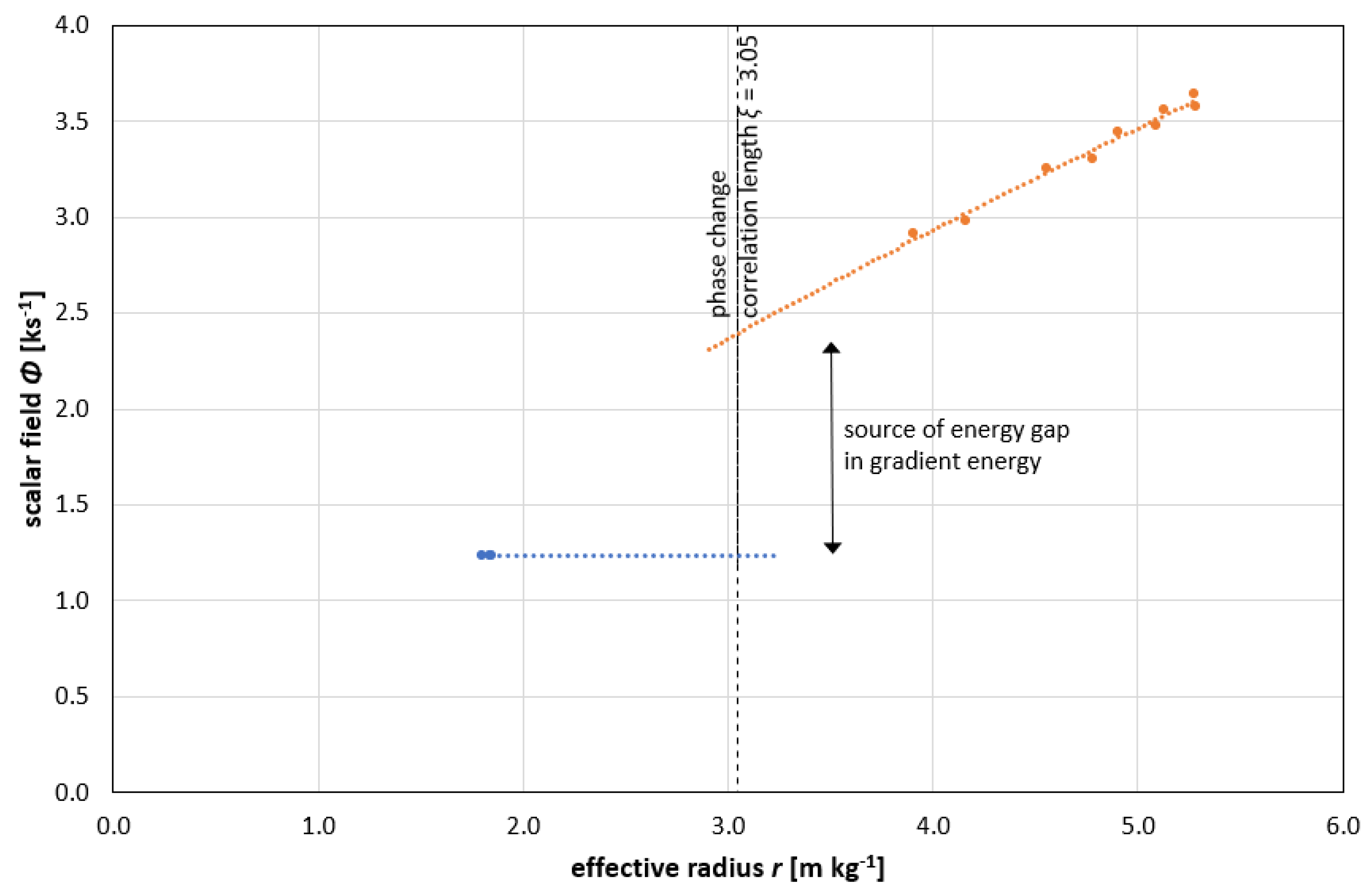
With U(2) scale- and gauge-invariance spanning the asymptotically-free behaviour of both the macro-scale dual superconducting system and the micro-scale quark-gluon system via electroweak interactions with the embedding vacuum manifold, a physical correspondence between non-equilibrium thermodynamics and quantum mechanics is established. Since the superconducting phase transition is represented by Ginzburg-Landau theory (i.e., gauge-invariant coupling of a scalar field to the Yang-Mills action is predicted) it seems reasonable to link the gradient energy gap of Figure 3 to the mass gap problem in QCD.
Gapped and Gapless Topologies
The results in
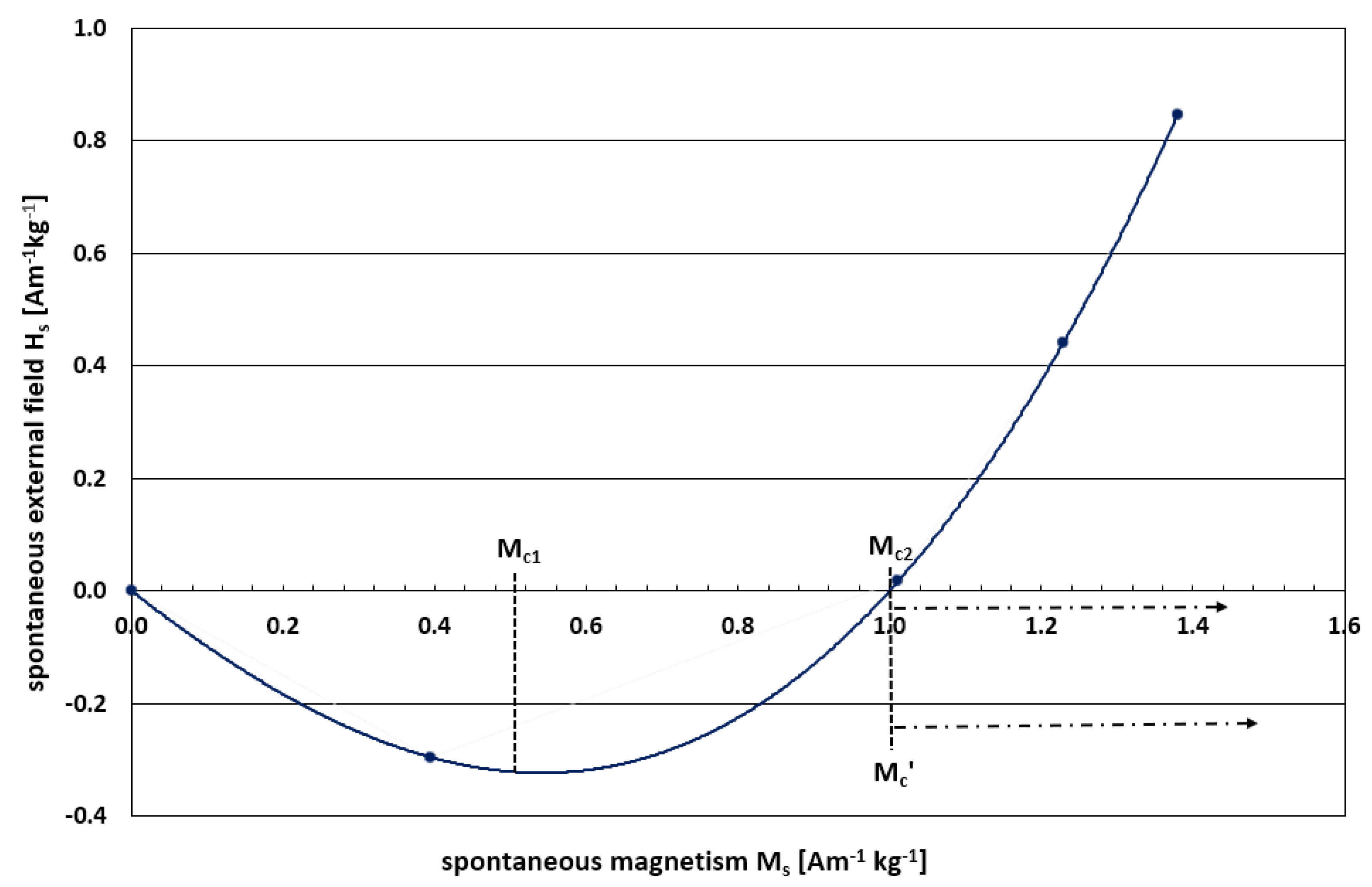
Figure3 show emergence of the gauge field
Φ as a gap (∆ 2.4 ks
-1) between Type-II superconductivity on the left and dual Type-I superconductivity on the right. This represents a transition between the gapped state of the magnetically ordered Type-II superconductor and gapless state of the topologically ordered dual Type-I superconductor. At this point, the gauge monopole condensate forms to release spontaneous magnetism M
s. The electric field E becomes excluded to be confined on the surface of the system (including the additional surface created through gauge topological defects that form the complex magnetic condensate). That is, a gapless surface is established so that the Berry phase manifests as a non-trivial topological insulator [
51].
The gapless surface may be protected from external perturbations tending to re-open the gap through Abelian topology, as represented by the ℤ
2 Chern number in the symmetry group decompositions of (16) and (24). In a review of topological superconductors [
65], Sato and Ando explore the connection between ℤ
2 and time reversal symmetry that is consistent with the symmetry of Lorentz boosts described above. The ℤ
2 Chern number can be interpreted as a
U(2) group that fibres over a circle as a 3-sphere bundle, i.e., a Hopf fibration results [
66].
Typically, a topological insulator is characterized by a non-robust, non-degenerate ground-state in which energy bands coincide and exceptional, or ‘diabolical’, points occur. However, the Berry phase variant identified above displays the following features: asymptotic behaviour (robustness against perturbations); a critical correlation length
ξ (long-range entanglement); conformal geometry (describable through quantum field theory); and degeneracy in non-trivial topology on a hyperbolic manifold [
66]. Thus, the system also appears to be topologically ordered and so describable by an effective, low-energy topological quantum field theory (TQFT) in which many-body states would typically have topological ground-state degeneracy [
67]. In TQFT the critical correlation length
ξ is topologically invariant and therefore insensitive to the geometry of the embedding manifold, i.e., the critical exponents within the universality class are background independent under Lorentz boosts.
Within the research field of topological phases of matter, as investigated to date, all the topologically ordered states realized experimentally or investigated theoretically are established through strong electron-electron interactions. The coinciding valence bands of gapless ‘diabolical’ points allow for degenerate electron movements between the bands. In a crystal structure, the electronic band structures are described by Bloch’s theorem as expressed by:
where
Ψ is the wavefunction,
r is position,
u is a periodic function, and
k is the crystal momentum vector.
However, the original formulation of the Berry phase was not specifically related to Bloch electrons. Instead, it was based on the general idea that quantum adiabatic transport of particles in slowly varying fields (e.g., electric, magnetic, or strain) could in principle modify the wavefunction by terms other than just the dynamical phase. So, equation (30) is seen to map to the experimentally derived equation (11) where variable electromagnetic duality of the pseudo-scalar field gives the periodic function
u(
r) and
eik.r represents the angular momentum of fractionalized magnetic charges that transfers into the pseudo-scalar field as the gauge monopole condensate forms [
38].
Since the degeneracy associated with the crystal-fluid material occurs in metastable excited-states (with non-zero temperatures), the gapless degeneracy of the crystal-fluid material cannot be attributed to Bloch electrons. So, whilst the gapless surface of the dual superconductor is protected through ℤ2 topology, an additional mechanism is necessary to supress excited-state fluctuations such that Bloch-wave behaviour can emerge.
A potential solution is presented in Figure 4 where the synchronized continuous symmetry group U(2) leads to descriptions of asymptotic freedom in both quantum and condensed matter systems. As conservation of angular momentum extends into the microscopic quantum realm, so confinement mechanisms extend out into the macroscopic condensed matter of the dual superconductor under a renormalized Noether symmetry. The non-Abelian SU(3) subgroup of QCD remains dominant so that excited-state fluctuations due to changes in momentum are suppressed through confinement mechanisms and the constant Hamiltonian function is preserved. Topological defects may be created by chromoelectric flux tubes, or penetrating vortices, resulting from electroweak lepton decay, which in turn enable the formation of quark-antiquark pairs together with an inherent confinement mechanism.
In a non-Abelian gauge theory, the expectation value of the confinement phase can be detected by the area law of a Wilson Loop [
68]. The Wilson loop average
W(C) is related the energy of the interaction of static (i.e., infinitely heavy) quarks. For large loops, the potential energy is a linear function of the distance between quarks since the gluon field contracts to a flux tube that establishes a string tension K.
If
Amin(C) is taken to be the hyperbolic area formed by the rapidity angle exponents |±
φ| of the Weyl spinors (25) and (26), then - K maps to the reciprocal of the scalar field
Φ, i.e., a temporal component with units ks
-1 is also represented, as shown in
Figure 3. The results in
Table A3 and
Table A8 reveal that the coupling energy, i.e., the expectation value, is expressed on the surface area of the hyperbolic manifold as topological defects emerge:
The rapidity angle exponents ±
φ of the Weyl spinors lead to the same invariant expectation value in both local Lorentz spacetime and the local non-Abelian Wilson loop associated with the critical system (±φ ≡ 3v). Background independence across the entire U(2) symmetry group is thereby demonstrated. Such an interpretation is consistent with the requirements of a TQFT [
69].
The Wilson loop operator is comprised of either time-like loops and space-like loops. There is no intrinsic difference between these objects which are related through Lorentz invariance [
4] and combined in equations (31) and (32). So, in Yang-Mills theory, the Wilson loop can describe the confined quark potential as a phenomenon that exists autonomous from matter. However, the gauge monopole condensate as identified represents a deconfined Higgs phase which, for the exceptional correlation length
ξ established, is expected to satisfy the area law of the ‘t Hooft loop in ℤ
2 gauge theory. These two loop operators describe opposite behaviours. Under such circumstances, a mixed phase that is both confined and deconfined is described and the non-Abelian
SU(3) can exist as a subgroup within the Abelian
U(2) group. Where Wilson loop and ‘t Hooft loop operators exhibit these anti-commutation relations, it is possible to construct a TQFT [
70].
Acceleration and deceleration of the crystal-fluid material thereby become confined interactions responsible for the splitting and recombining of gluons. Gluons are either indirectly absorbed by or indirectly emerge from the QCD vacuum manifold [
54]. The Higgs-like gauge field
Φ also emerges in the transition from gapped Type-II superconductivity to gapless dual Type-I superconductivity to establish a reciprocal gap in the gradient energy, as revealed in
Figure 3. For the gapless state, the spin-1 vector gluons are the force-carrying
SU(3) gauge bosons that indirectly generate the Bloch-wave description in the
U(2) gauge monopole condensate [
71]. These indirect gluon interactions with the embedding QCD vacuum manifold enable fictitious forces to emerge in non-inertial reference frames that lead to
PV work in the piston expander.
Whilst the massless spin-1 gluons either emitted or absorbed by accelerating or decelerating quarks give rise to gauge particles with effective spin-½ behaviour, gauge invariance is only established where the associated gauge field can emerge under
U(2) ‘symmetry synchronization’ at critical correlation length
ξ in the low-energy system. That is, a gauge monopole topology [
54] is necessary so that the scalar field potential can induce magnetic flux such that ∇. B
s = 0, where B
s is the spontaneous magnetic flux density.