

Submitted:
12 July 2023
Posted:
13 July 2023
You are already at the latest version
Abstract
Purpose: Social responsibility has been accepted as a core value of nursing profession, particularly in the area of health disparity, but it seems to be difficult to understand for what is meant by social responsibility. The purpose of this study was to explore ways to define the concept of social responsibility of nursing in order to understand the meaning of social responsibility in the field of nursing profession. Methods: The concept analysis process by Walker and Avant was used to clarify the meaning of social responsibility of nursing. Results: Defining attributes of social responsibility of nursing included praxis, as approach to strategizing for social and structural change of inequity, care for an oppressed group which is under social suffering caused by the privilege and power, and action for health policy change in social and political unequal contexts. The antecedents of social responsibility of nursing included reflectivities in identifying personal characteristics, taking seriously the perspective of other vulnerable population, recognizing social environmental status quo (‘fair or unfair’), developing competences in ethical and moral reasoning with social issues. Consequences of social responsibility of nursing were achieving social justice, as equal access to basic human health need in societal level, equal access to effective nursing practice delivery system and development of health promotion policy for world health administrative practices (“health for all”) in nursing. Conclusion: This study provides a guidance to direct future studies through the procedure of identifying conceptual attributes in the context of social responsibility of nursing. Future studies are suggested to develop instruments for social responsibility as well as development of educational programs to promote social responsibility competences in nursing students and nurses.
Keywords:
Social Responsibility
; Concept Analysis
; praxis
1. Necessity of Research
Recently, the International Organization for Standardization (ISO), the world's largest organization that develops and unifies international standards, has published international standards for "SR: Social Responsibility ISO 26000" covering the social responsibilities of organizations such as businesses, universities, government agencies and private organizations. This means that the organization should not only assume economic and legal responsibilities to stakeholders, but also actively carry out a wide range of social responsibilities. Research on various discussions and approaches to social responsibility has been actively conducted in an organizational environment such as a company. The concept of corporate social responsibility was first introduced in the 1950s, but it is only recently that its importance has been highlighted in terms of corporate macro-management strategy. The interest in corporate social responsibility began when it was accepted as a core task of corporate management that companies themselves must perform, and this has become a key factor in enhancing corporate image [1]. In addition, the demands of the members of the organization due to social diversification are becoming more diverse, and the rapid spread of activities for the organization's social responsibility through the media and the media has led to a management evaluation of whether the company practices social responsibility. In addition to enterprises, health care-related organizations have also attempted policy efforts to practice social responsibility as public management [2]. The nursing organization, the largest of Korea's medical workforce organizations, has also been practicing social responsibility, but the concept of social responsibility itself is still unfamiliar to the nursing organization and lacks awareness of it. Social responsibility is also a very important concept in nursing organizations from an individual or organizational level, and it is necessary to clearly define the concept of social responsibility in nursing organizations in order to carry out relevant organizational activities. Concepts are the main factors that include the attributes that describe phenomena and provide important ideas in developing nursing theory, providing a new perspective for the theorists, researchers, and practitioners to explain and observe phenomena of interest as concepts [3]. It is essential to go through the concept analysis phase to clearly define the concept [4]. Conceptual analysis is the work of clarifying the meaning of ambiguous concepts by clarifying the nature of the phenomena of interest [5]. The operational definition, lists of attributes, and prerequisites resulting from the conceptual analysis allow researchers to understand the basic properties of concepts and to clarify the relationships between concepts [3]. Thus, the purpose of this study is to apply the concept analysis method of Walker and Avant [3] to systematically identify its attributes through the concept analysis of social responsibility in nursing organizations, to clarify the operational definition of social responsibility concepts so that others who later use the concept can use the same meaning. Therefore, it is expected that this study will promote understanding of concepts of social responsibility and clearly use them to nurse practitioners and researchers, including nursing organizations interested in social responsibility.
2. Purpose of Research
The purpose of this study is to provide basic data for the development of knowledge focusing on social responsibility of nursing organization by grasping its properties and clearly understanding the concept through concept analysis of the social responsibility of nursing organization.
3. Research method
3.1. Research Design
This study attempted to analyze the concept of social responsibility of nursing organizations by applying the concept analysis method of Walker and Avant [3]. The concept analysis method of Walker and Avant [3] does not require observation of the site and analyzes the relevant literature to analyze how the concept of interest is defined in the existing literature. Therefore, in this study, concept analysis was conducted by first identifying the scope of use of the concept of social responsibility through literature review, identifying the preceding factors and properties of the concept presented in each literature, and checking the results accordingly.
3.2. Method of data collection and analysis
The literature search in this study was conducted using Pubmed and Cumulative Index of Nursing and Allied Health Literature (CINAHL) for foreign literature. The period was set from 1990 to 2017. The search term was 'Social Responsibility' AND 'nursing' [MeSH]. As a result, 537 articles were searched in Pubmed and 386 articles were searched in CINAHL. The search for domestic literature searched the academic journals and dissertations of RISS (www.riss4u.net) and DBpia (www.dbpia.co.kr), the search terms were 'social responsibility' and 'social response' and 'nursing', 68 in RISS and 20 in DBpia. Based on the literature review, this study was analyzed according to the concept analysis procedure of Walker and Avant [3], and its specific eight-step analysis process is as follows.
- First, select a concept.
- Second, establish the purpose of conceptual analysis.
- Third, confirm all use of concepts.
- Fourth, identify the defining attributes of a concept.
- Fifth, a model case of concept is presented.
- Sixth, provide additional examples of concepts (similar cases, opposite cases, related cases).
- Seventh, identify the factors and consequences that predate the concept.
- Eighth, identify empirical references to concepts
4. Research Results
4.1. Selection of concepts
There is a growing need for social responsibility of health care-related organizations within the health and medical environment, and among them, practice of social responsibility in nursing organizations has become more important than anything else. Thus, the concept was selected to clarify the concept of social responsibility in the nursing organization and to identify its leading factors.
4.2. Purpose of Concept Analysis
The purpose of this study is to clarify the concept through the concept analysis of the social responsibility of the nursing organization, to identify the leading factors and properties and to provide the basic data necessary for the practice of social responsibility of the nursing organization.
4.3. Confirm All Use of Concepts
4.3.1. Dictionary definition
The concept of social responsibility was not defined solely in advance. A separate search of the two words found that the Webster dictionary defines the definition of 'social' as 'a duty that is usually associated with an individual or society' and 'responsibility' as 'a duty that is required and expected of an individual or organization'. According to a search in the Hankyung Economic Terms Dictionary, it is defined as "a sense of responsibility for the impact of companies on society and the environment as members of society and taking the lead in transparent management and service." Therefore, the dictionary definition of social responsibility is interpreted as 'a consciousness or mission related to society that requires and expects from individuals or organizations'.
4.3.2. Use of concepts in literature (Table 1)
The definition of social responsibility is very diverse and has been identified mainly in the business field. In OECD (Organization for Economic Cooperation and Development), it is an action taken by companies to mature and develop symbiotic relations between companies and society [6], The International Chamber of Commerce (ICC) defined it as a voluntary willingness for an enterprise to engage in business in a responsible manner [7]. ISO defines an organization as a balanced approach to international behavior that affects society and the environment through transparent and ethical activities, seeking sustainable development that meets the expectations of stakeholders and contributes to society, health and welfare [8]. In addition, in the business area, each scholar defined social responsibility in various terms, Barnett[9] defined good activities to create a beautiful society, and Gariga & Mele [10] defined activities to manage various public social needs. Dahlsrud [11] said that corporate profit-seeking is a concept that contrasts with the company's existing values, a voluntary effort by the company to meet the needs and expectations of society, and that it is not limited to the corporate social contribution activities or donation activities, but also to the role and responsibility in the complex dimensions and areas that take into account the comprehensive influence of the enterprise in the modern capitalist society. As such, the definition of social responsibility in the corporate organization and business area is various and actively used, but even the conceptual definition of social responsibility is not clear in the nursing organization.
This is generally evidenced by the fact that the concept of social responsibility has already been very strongly melted within the value of nursing professionals, and that the basis of nursing, social responsibility, has already been practiced from historical figures representing nursing, such as 'Florence Nightingale' and 'Lavinia Lilian Wald' [12]. It's not easy to define the social responsibility of a nursing organization apart from the social justice concept. Pamela et al [13] said that the social responsibility of nursing is also considered in terms of social structure, such as human rights, service, poverty, safety, etc., as a concept that includes social justice. Reimer-Kirkham et al. [14] said that when nursing students conducted clinical practice on correctional facilities or community vulnerable groups, they had an experience of understanding the world in a new way called social justice as social issues, inequality, poverty, and the interest in the underprivileged increased. Experiencing this social justice and social participation is reported to be an important learning experience that leads to a sense of social responsibility in the field of nursing professionals [15].
4.4. Identify the defining attributes of a concept
Conceptual attributes of social responsibility, which are used in various ways in the literature, have been identified. The social responsibility of the nursing organization is the responsibility of the nursing profession on social issues such as health-related social policies, activities, justice, human rights, inequality, poverty, education, etc. The conceptual attributes identified from these definitions are as follows (Table 2).
First, the care of the socially oppressed and afflicted weak serves to change the nursing organization's perception of social responsibility.
Second, action on social issues promotes practice of social responsibility in nursing organizations.
Third, nursing policy approaches and strategies (Praxis) on social structural inequality are necessary for nursing organizations to carry out their social responsibilities continuously.
4.5. Model case of concept
Model case refers to an example that includes all of the main attributes of the concept, and based on the attributes of the three attributes for the social responsibility of the nursing organization: planning, action and policy approach strategy, the model case is organized as follows.
Mr. Nam, 55, is serving as chairman of the nursing organization. Not long ago, when the Sewol ferry disaster occurred, Nam couldn't just watch the national disaster situation, so he wondered how the nursing organization could join. Mr. Nam thoroughly planned what he had to do for this. First, he organized a volunteer organization centered on the nurses' association in the area to deliver medical assistance and necessary relief supplies to those affected by the disaster. It also showed a nursing organization working closely with the local community by continuing its strategic approach, such as reinforcing manpower and equipment at the local mental health center so that they can continue to overcome mental damage. This model makes plans for care by nursing organizations to fulfill their social responsibilities and puts them into action. And it is a model case that includes all the attributes that try to practice social responsibility at the nursing organization level, such as ensuring that a system is established to ensure that responsible activities are sustainable.
4.6. Additional cases of concepts (like cases, opposite cases, related cases)
4.6.1. Similar cases
Mr. Nam, 55, is serving as chairman of the OO nursing organization. After the MERS outbreak, Mr. Nam reviewed and planned what the nursing organization should do to protect the health of the people. After the MERS outbreak, Mr. Nam reviewed and planned what should be done by the nursing organization to protect the health of the people and did his best by selecting special personnel for the rapid suppression of the MERS outbreak and placing them in major hospitals. As a result, the dedication and hard work of frontline nurses and many medical staff quickly brought MERS under control. It also embodied systematic strategies such as establishing a system to prepare for infectious diseases such as MERS at all times in the future. Afterwards, the government encouraged the hard-working medical staff with proper compensation, but the hard-working nurses became frustrated when they belatedly learned that the most hard-working nurses were not given proper compensation and treatment. In this similar case, the nursing organization devoted itself to fulfilling its social responsibilities in the health and medical environment and made efforts to establish a strategic response system for post-care. However, the situation in which hard-working nurses in the nursing organization were excluded from proper treatment and compensation is a case in which the nursing organization failed to take care of them until the end, and it cannot be said that the nature of the care plan was included in the nature of social responsibility
4.6.2. Opposed cases
Mr. Nam, 55, is serving as chairman of the OO nursing organization. One day, Mr. Nam received an urgent request for help from Park, a nurse who works as a local female lawmaker. Mr. Park said he had endured sexual harassment and sexual insults often in a council composed of mostly males, but he could not endure anymore, so he turned to nursing organizations for help. Mr. Nam, chairman of the group, began to talk to Mr. Park. "I've been sexually harassed as a lawmaker, but I came here because I couldn't stand it and had nowhere to ask for help. I'm facing this injustice, so please help me with your support." After hearing Mr. Park's story, Mr. Nam flatly refused to give a statement of support because he was not currently a nurse. In response, Park reiterated her request, saying that she had never forgotten her identity as a nurse in her life and that she was now a member of the National Assembly, and Nam reluctantly said yes, but she did not have a thorough plan or strategy to resolve the situation. Even when the Council Ethics Committee was convened to find out the truth, Mr. Nam did not participate and only ordered his subordinates to show their faces. This case is a case in which nursing organizations do not include any attributes of social issues such as sexual harassment, care plans, actions, and policy strategies for sexual harassment.
4.6.3. Related cases
Yoon, 28, is a five-year intensive care unit nurse and works three shifts at a university hospital. Yoon was very interested in social issues and attended the candlelight rally at Gwanghwamun Square every week with great enthusiasm. Even though he was scheduled to work the next day, he attended the rally until the dawn of the previous day, and as a result, there were cases where medical accidents almost occurred due to his neglect of patient care because he was tired while on duty, but he thought it was a relief that he did not. In this case, the excessive participation in rallies has rather raised concerns about medical accidents in hospitals, and does not include care planning and policy approaches, an unplanned and eager attribute of social responsibility. And it is hard to say that taking care of patients in hospitals is also a proper practice of social responsibility because it has overlooked the fact that it is a responsibility to be taken care of as a nurse.
4.7. Identify the antecedents and consequences of a concept
In this process, the antecedents are an event or incidental condition that occurs before a concept occurs, and the consequences are an event or condition that occurs after the concept occurs [16].
4.7.1. Antecedents
The first leading antecedent in the concept of social responsibility in nursing organizations identified in the literature is the perception of social issues. Recognizing is a recognition of the need for action [16], which can be described as a key antecedent factor that clearly indicates the need for social responsibility of the nursing organization. The second antecedent factor is participation experience. This is because they practice positive social responsibility behaviors by participating in community service at the health care organization level and performing nursing for the socially vulnerable [15].
4.7.2. Checking the consequences
Recognizing the need for caring for social issues, we could further confirm from the start of participation experience that it was the social responsibility of the nursing organization to plan, act, and commit through a policy approach for continuous participation in social issues such as health-related policies, justice, human rights and inequality as a group of health experts. Thus, the conceptual framework embodied on the basis of the social responsibility of the nursing organization is the same as Figure 1.
4.8. Confirm Conceptual Empirical Reference
Empirical reference is the final stage of concept analysis that confirms that the attribute of concept exists in the phenomenon, and clarifies the vague concept used in clinical practice, which has not yet been conceptualized. In addition, if the attribute that the tool is trying to measure in the research design reflects the attribute shown in the conceptual analysis well, it can be used as an empirical reference. As an empirical reference to the social responsibility of the nursing organization identified through this study, Faithleh-Jahromi et al. [17] analyzed the perception of the social responsibility of nurses in five aspects in the qualitative study of the social responsibility of nurses, and confirmed that the awareness of social responsibility in these five aspects is a very strong leading factor in the development and promotion of nursing profession. Maze[18]'s study suggested that nursing practices should be planned and practiced regardless of personal bias for those who experience discriminatory inequalities arising from differences in age, ability, gender, race, religion, etc. in their social structure. This is because there is a critical attribute that nursing organizations must fulfill their social responsibilities for human rights and ethical dilemmas that they face and strategically approach in the rapidly changing medical environment.
5. Discussion
This study analyzes the concept of social responsibility of nursing organizations using the concept analysis method of Walker and Avant[3], and has not yet been used as a clear meaning as the concept of social responsibility, which is widely used in other areas. Therefore, this study was attempted to clarify its conceptual properties and to use them actively later as concepts of clear meaning. In this study, the first attribute of the concept of social responsibility of nursing organizations was derived: 'Planning care', which must be preceded in order to practice behavior effectively [19]. Planning includes a specific plan for carrying out the social responsibilities of the nursing organization, as well as a plan for situations that will not be able to carry out [20]. This care plan should be preceded by a clear awareness of human views, professional values, competencies, activities and problem-solving-oriented nursing [17]. Therefore, it would be necessary to consider the need for agreed strategies of leaders leading nursing organizations to establish care plans for social responsibility through this recognition and to ensure that planned actions are carried out.
The second attribute is action. It can be harder than you think to put a plan into action. Thus, recognizing and understanding the social responsibilities of nursing organizations while continuing to provide opportunities for participation experience will play an important role in developing care plans into action [21]. The third derived attribute is education and strategic access, which means "socially responsive education." This includes not only what education contains in relation to the value of social responsibility, but also the way in which education is conducted [22]. Therefore, education on social responsibility value at the site where various nursing education is conducted is a very important attribute directly related to behavior, so a systematic approach at the nursing organization level will be needed to ensure that this education is properly conducted. Based on the results of this study, it is thought that social responsibility concept of nursing organization can be clearly used through social responsibility recognition and behavior and nursing policy approach that are important in the preceding factors and attributes of social responsibility of nursing, while also enhancing social responsibility of nursing organization through program development and application for this. In addition, the lack of search for literature on social justice, which is being used similarly to the concept of social responsibility, could also be a limitation of this study. Therefore, it is thought that it will be necessary to repeatedly study the various attributes and related factors of the concept of social responsibility of nursing organizations that have not been identified in this study.
6. Conclusions
This study is an analysis of the nature of the concept of social responsibility in nursing organizations using the concept analysis method of Walker and Avant [3]. The concept of social responsibility of the nursing organization derived from this study has been identified as a care plan for issues related to social issues surrounding nursing, and a property that leads to a policy approach through practice. It is believed that the results derived will create an environment in which social responsibility values are delivered at all sites of the nursing organization, and that more social responsibilities given to the nursing organization can be fulfilled by continuously performing and evaluating the recognition and practice of social responsibility at the level of nursing college students, nurses and nursing organizations.
References
- Hahn JH, Lee JK(2009). Corporate Social Responsibility, Organizational Trust, and Organizational Citizenship Behavior with Cynicism as a Moderator. Corporate management study. 16:4.
- Brandão, C.; Rego, G.; Duarte, I.; Nunes, R. Social Responsibility: A New Paradigm of Hospital Governance? Health Care Anal. 2012, 21, 390–402. [Google Scholar] [CrossRef] [PubMed]
- Walker LO, Avant KC. Strategies for theory construction in nursing. 5th ed. Upper Saddle River, NJ: Prentice Hall; 2011. p.1-243.
- Kehr, H.M. Implicit/Explicit Motive Discrepancies and Volitional Depletion among Managers. Pers. Soc. Psychol. Bull. 2004, 30, 315–327. [Google Scholar] [CrossRef] [PubMed]
- Haggard, P.; Lau, H. What is volition? Exp. Brain Res. 2013, 229, 285–287. [Google Scholar] [CrossRef] [PubMed]
- OECD(Organization for Economic Cooperation and Development) Web. Available online: http://www.oecd.org/document/33/0,2340,en_2649_33765_1933025_1_1_1,00.hrm.
- ICC(International Chamber of Commerce, The World Business Organization) Web: ISO Web. Available online: http://www.iso.org/iso/home/standards/iso26000.htm.
- Available online: http://www.iccwbo.org/home/business_society/B%20in%20Society%20Booklet.pdf.
- Barnett, M.L. Stakeholder influence capacity and the variability of financial returns to corporate social responsibility. Acad. Manag. Rev. 2007, 32, 794–816. [Google Scholar] [CrossRef]
- Garriga, E.; Melé, D. Corporate social responsibility theories: Mapping the territory. J. Bus. Ethics 2004, 53, 51–71. [Google Scholar] [CrossRef]
- Dahlsrud, A. How corporate social responsibility is defined: An analysis of 37 definitions. Corp. Soc. Responsib. Environ. Manag. 2008, 15, 1–13. [Google Scholar] [CrossRef]
- Kelley MA, Kun KE (2008). Social responsibility: conseptualization and embodiment in a school of nursing. International Journal of nursing education scholarship. 5:1:article. a: 5:1.
- Pamela, J.G.; Danny, G.W. Nursing responsibility and social justice: An analysis in support of disciplinary goals. Nursing outlook 2012, 60, 198–207. [Google Scholar]
- Reimer-Kirkham S, Van Hofwegen L, Hoe-Hardwood, C(2005). Narratives of social justice: Learning in innovative clinical settings. International Journal of Nursing Education Scholarship, 2, 1-14. Available online: http://www.bepress.com/ijnes/vol2/iss1/art28.
- Redman, R.W.; Clark, L. Service-Learning as a Model for Integrating Social Justice in the Nursing Curriculum. J. Nurs. Educ. 2002, 41, 446–449. [Google Scholar] [CrossRef] [PubMed]
- Norman P, Abraham C, Conner M, editors. Understanding and changing health behavior: From health beliefs to self-regulation. 2nd ed. Amsterdam, NL: Harwood Academic Pubilshers; 2010.
- Faseleh-Jahromi, M.; Morttari, M.; Peyrovi, H. Iranian nurse’s perceptions of social responsibiliy: a qualitative study. Nursing Ethics 2014, 21, 289–298. [Google Scholar] [CrossRef] [PubMed]
- Maze, C.D. Registered Nurses’ personal rights vs. professional responsibility in caring for members of underserved and disenfranchised populations. Journal of Clinical Nursing 2005, 14, 546–554. [Google Scholar] [CrossRef] [PubMed]
- Sheeran, P.; Harris, P.R.; Epton, T. Does heightening risk appraisals change people’s intentions and behavior? A meta-analysis of experimental studies. Psychol. Bull. 2014, 140, 511–543. [Google Scholar] [CrossRef] [PubMed]
- Ziegelmann, J.P.; Lippke, S.; Schwarzer, R. Adoption and maintenance of physical activity: Planning interventions in young, middle-aged, and older adults. Psychol. Heal. 2006, 21, 145–163. [Google Scholar] [CrossRef] [PubMed]
- Doris MB(2008). Social justice as a framework for undergraduate community health clinical experiences in the United States. International Journal of Nursing Education Scholarship. 5:1:Article 35.
- Forbes SH. Holistic education: An analysis of its ideas and nature. Brandon, VT., Foundation for educational renewal; 2003.
Figure 1.
Conceptual structure of Social responsibility of Nursing.
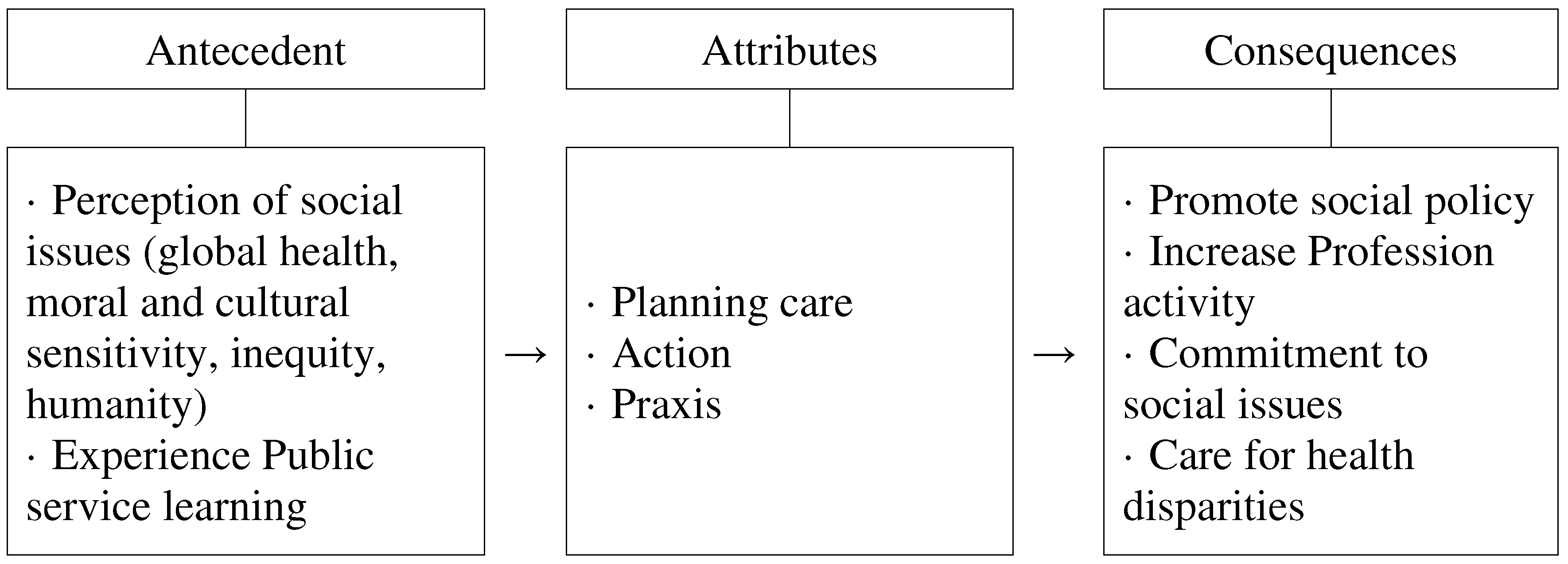

Table 1.
Definition of Social Responsibility of Nursing in Literature Review.
| Author(year) | Definition |
|---|---|
| Joan(2010) | Social responsibility is described in public service as a profession. |
| Kelley(2008) | Social responsibility is the obligation to promote equity, access and justice. |
| Bathum(2007) | Social responsibility is to promote social justice in global health nursing. |
| Belknap(2008) | Social responsibility is a pedagogy of engagement provides an effective strategy for exploring issues of race, class, gender and structural inequalities that underlie health disparities. |
| Boutain(2005) | Social responsibility is caring for the vulnerable. |
| Drevdahl(2001) | Social responsibility is reinvesting in social justice, as a capital idea for public health nursing. |
| Falk(2005) | Social responsibility of nursing is caring for humanity and environment. |
| Reimer-Kirkham(2005) | Social responsibility is commitment to issues pertaining to diversity, vulnerable populations, social determinants of health, advocacy and activism, and social justice. |
| Pamela(2012) | social justice is asserted as a nursing responsibility. |
| Faseleh- Jahromi(2013) | Social responsibility is to promote social justice in global health nursing. |
| Maze(2005) | Social responsibility is caring for health disparities. |
| Riley(2010) | Social responsibility is a socially engaged in public service. |
| Mayo(1996) | Social responsibility is instilled moral and professional practice obligations, cultural sensitivity. |
Table 2.
Antecedent, Attrbutes and Consequences of Social Responsibility of Nursing in Literature Review.
Table 2.
Antecedent, Attrbutes and Consequences of Social Responsibility of Nursing in Literature Review.
| Author(year) | antecedent | Attributes | Consequences |
|---|---|---|---|
| Joan(2010) | Experience Public service | Public service Action |
Profession activity |
| Kelley(2008) | Understand obligation | Access equity & justice | Promote social responsibility |
| Farcett(2005) | Perception of global health | participate in global health nursing | Promote social policy |
| Belknap(2008) | Explore effective strategy for social issues | Education for engagement | Engage activities for health disparities |
| Boutain(2005) | understanding of populations | Planning care | Care for the vulnerable |
| Drevdahl(2001) | understanding of social justice | Explore effective strategy for social issues | Change of public health education |
| Falk(2005) | understanding of inequity | Planning care | Care for human right and environment |
| Redman(2005) | Engage in service learning | Integrating | Promote nursing curriculum |
| Reimer-Kirkham(2005) | understanding of inequity environment | Planning care | Commitment to social issues |
| Pamela(2012) | understanding of social justice | Promote social responsibility | |
| Faseleh- Jahromi(2013) | Perception of global health | participate in global health nursing | Promote social responsibility |
| Maze(2005) | understanding of populations | Planning care | Care for health disparities |
| Riley(2010) | Experience Public service | Public service Action |
Increase profession activity |
| Mayo(1996) | Practice moral and cultural sensitivity | Explore effective strategy for social issues | Promote social responsibility |
Disclaimer/Publisher’s Note: The statements, opinions and data contained in all publications are solely those of the individual author(s) and contributor(s) and not of MDPI and/or the editor(s). MDPI and/or the editor(s) disclaim responsibility for any injury to people or property resulting from any ideas, methods, instructions or products referred to in the content. |
© 2023 by the authors. Licensee MDPI, Basel, Switzerland. This article is an open access article distributed under the terms and conditions of the Creative Commons Attribution (CC BY) license (http://creativecommons.org/licenses/by/4.0/).
Copyright: This open access article is published under a Creative Commons CC BY 4.0 license, which permit the free download, distribution, and reuse, provided that the author and preprint are cited in any reuse.