
Submitted:
11 July 2023
Posted:
12 July 2023
You are already at the latest version
Abstract
Animal-assisted pedagogy (AAP) is well known in classroom practice, but scientific evidence is still lacking. At the same time, the biggest challenge in education systems worldwide is the social in-tegration of students. In a pre-post design, 30 heterogeneous students (16f/14m) from four different school classes (grades 5-7) were interviewed (problem-centred interview) about their social inclu-sion and their social climate in class before and after being taught selected subjects with a school dog (of different breeds) for one school term. At the second measurement point, they were also asked about their perception of AAP. The data was analysed both qualitatively (Kuckartz) and in terms of the number of quotes on the main topics using MAXQDA analysis software. The presence of a dog in the classroom leads to an improved social climate and more social integration. In ad-dition, the perception of the other students and the teacher changes to a more positive and friendly image. Through AAP, a new social role is added to the classroom, where caring and bonding are prioritised. Social interaction and norms are influenced and sterotypical and individual roles can be changed. Therefore, AAP can be a key to promoting social inclusion in the school environment.
Keywords:
animal-assisted 1
; social inclusion 2
; social climate 3
; child development 4
; animalassisted pedagogy 5
; one health 6
; wellbeing 7
1. Introduction
The social inclusion of all children poses a particular challenge in the inclusive school setting. Children with special educational needs are at an increased risk of exclusion, in particular [1]. This is reflected through the fact that children with special educational needs experience less acceptance and more rejection from their fellow students [2,3,4,5]. The way children experience the lack of social participation and exclusion is also reflected in the way they perceive the situation around them. As a result, students with special educational needs feel less socially integrated [2], have a less favorable perception of the class environment, and feel less accepted by the teaching staff. [6]. The highest risk of social exclusion, according to Schürer [5], lies with children with the special educational focus on emotional and social development, who evaluate their own social integration, class environment, and school self-concept much more negatively than their fellow students. [7]. Special educational needs, however, do not represent the sole predictor of an increased risk of exclusion. Weak academic performance, as well as behavioral challenges, likewise have a negative correlation with social participation (even without special educational needs being identified) [8]. Another predictors for social exclusion could be the “labeling effect” created by the term “special educational needs” [9]. Crede et al. [7] argue that the exclusion of children is due to the fact that students choose their social interaction partners on the basis of characteristics that they share. As a consequence, social inclusion presents particular difficulties in heterogeneous settings. The studies related to social participation also reveal that a good classroom environment is conducive to the social participation of the individual and that an inclusive educational practice, such as exemplified by assessment with an individual reference norm, leads to more social participation [3,10]. Despite these initial pointers to improving social participation, there is a lack of concepts and opportunities for promoting inclusive social structures in school classrooms. The reason for this is that the situation is difficult to change since social participation – friendships, relationships, and mutual acceptance – rely on the free will of those involved [11].
Many teachers work using animals to promote social participation [12]. Positive implications can be confirmed in initial studies for the school setting. For example, Kotrschal and Ortbauer [13] observed a decrease in aggressive behavior, more attention towards the teacher, and fewer behavioral extremes in a heterogeneous first elementary school grade if daily lessons were taught with a dog for three months [13]. Hergovich et al. arrived at similar conclusions [14]. The prerequisites for social participation of students are also improved since animal-assisted education significantly reduces the stress level of students, especially for children with special educational needs [15]. The research situation, however, remains sketchy. Neither the experience of animal-assisted education from the perspective of the students was investigated, nor is there any solid data on everyday animal-assisted education involving a dog that is used in class on selected days. There is also a lack of studies that focus the spotlight on the use of school dogs in grades after elementary school.
The state of research on animal-assisted programs in education conducted outside of school or implemented over a period of time during the class period is more well-founded. Yet, in such programs, there are often fewer children taking part than are present in a regular school class, meaning that the setting does not correspond to the reality of school, while the intervention, e.g., the interaction with the animal and the intensity and duration of the contact with the animal, also differ significantly. Yet the results should be viewed as suggestive of the potential implications of animal-assisted education for social participation in the heterogeneous school setting:
Bresford et al. [16] concluded in their metanalysis that animal-assisted interventions have a positive impact on socio-emotional behavior, among other things. The authors deplore, though, that due to the heterogeneous nature of the studies, the research findings are unclear, which hinders the interpretation and reduces the informative value. Previously, Clarke [17] revealed that both in-school and out-of-school programs and interventions have predominantly positive effects on the emotional and social development of children and adolescents ages 4-20. More up-to-date research on programs also confirms these findings [18] and indicates that animal-assisted interventions contribute to the development of socio-emotional skills.
Work on specific target groups has shown further positive effects of animal-assisted interventions (AAI). The promotion of socio-emotional skills through AAI in children with autism spectrum disorder is a good example, resulting in significant improvements in social functioning, increases in social interaction, as well as the development of emotional and social skills [19,20,21].
The interdisciplinary research of human-animal studies similarly implies that social participation can be promoted by using school dogs in the classroom: Being around and in contact with animals is associated with socio-emotional health, reinforcement of social networks, rest and relaxation, and improved socio-emotional behaviors [12,22,23,24,25]. These findings go hand in hand with the most up-to-date explanatory approach, the activation of the oxytocin system through animal-assisted interventions, which is largely responsible for the implementation of social action [23,26]. It is remarkable that children exhibiting insecure-avoidant attachment patterns, in particular, benefit from the presence of a dog in stress tests, which results in lower cortisol levels and [27].
At the same time, teachers assume a pivotal role in reducing exclusion and promoting integration. They should be sensitive to social processes and group dynamics and, in the best case, adopt proactive strategies (preventive measures) before exclusion occurs [28].
In light of the study situation, on human-animal relationships on the one hand and social inclusion in the classroom on the other hand, animal-assisted pedagogy seems to be a good way to promote social inclusion. However it remains to be evaluated to what extent these results can be applied to the school setting. This raises the questions of how a dog can have an impact in a heterogeneous school setting, to what extent students perceive the AAI, and if there are effects on interpersonal relationships and how these can be explained. The questions of whether the implications can also be identified in an inclusive school setting when teaching is conducted with a presence dog (school dog that is mainly present) is to be examined in this study by interviewing students in this study.
2. Materials and Methods
2.1. Objective and analytical framework
The objective of the research is to evaluate the implications of animal-assisted education on the social participation of students and on the social climate of school classes. With this in mind, the following research questions need to be answered [29].
Question 1: What impact does animal-assisted education have on social participation opportunities and social climate?
Question 2: What potential does animal-assisted education harbor for the participation opportunities and social climate of heterogeneous groups?
The focus of research lies on the subjective theories and cognitions of students with the aim of mapping subjective contexts of meaning and constructions of reality [30,31]. Subjective theories are deemed to provide a basis for orientation and action for individuals [32] and serve definitional, explanatory, predictive, and planning functions for the individual and consequently form the basis for their actions [33]. The theoretical background is symbolic interactionism [29,34,35]. The role theory and identity concept based on this, according to Krappmann [36] will be used as a foundation for the theoretical categorization and will be used for the in-depth analysis.
2.2. Method and design
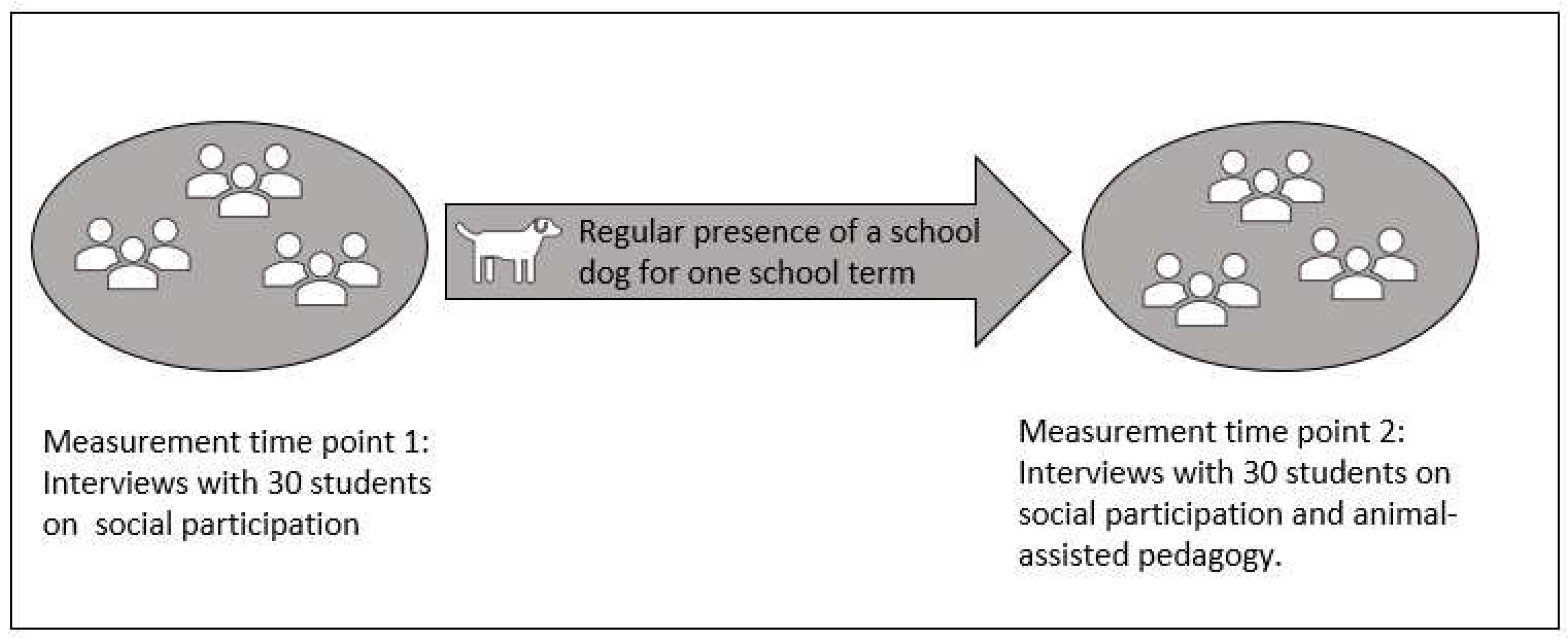
Thirty students were interviewed in a pre-post design feature using the problem-centered interview [37] regarding their social participation and the social climate in their class (topic block A). A question block (topic block B) regarding the special features of animal-assisted teaching was also added at measurement time point two. The children were taught with a presence dog at regular intervals (at least once a week) during selected school hours between the two measurement time points at the beginning and at the end of the school year. The design and the implementation thereof fulfill the conditions for good research on animal-assisted interventions [38]: The survey was conducted in a natural school environment, during the first weeks, there was a gradual acclimation for the animal, and the human-dog team were adequately trained to protect both humans and animal.
Figure 1.
Design of survey.
2.3. Sampling
The school classes that took part in the study (n=4) were compiled as an ad hoc sample. They were an eighth grade, a fifth grade, and a sixth grade from various comprehensive schools, as well as a fifth grade from a grammar school in the German state of North Rhine-Westphalia (NRW). Thirty children with different heterogeneity characteristics were selected from these four school classes according to Helferrich’s sampling method [39] (16 female, 14 male, eleven with international background, four foreign children and adolescents, two with diagnosed special educational needs in the field of emotional and social development). The average age at the first measurement time point was 12.52 years (SD 1.74 years). The selection criteria of the classes, teaching staff, and dogs required that the classes had not previously been taught with a dog and that the animal-assisted teacher and their dog had a proven qualification for animal-assisted work (specialist training or training as a human-dog team with verification that the dog is suitable and the teacher’s certificate or an equivalent attainment). The dogs used were always dogs kept by the teachers and varied in breed, age, and gender.
2.4. Analysis
Simple transcription rules, following the content-semantic transcription, were selected for the preparation of the data [40], and the transcription software F4 was used. The researcher also anonymized the data at this point. The qualitative content analysis, according to Kuckartz [41] was applied for the analysis and conducted with the use of QDA software (MAXQDA Analytics Pro 2018).
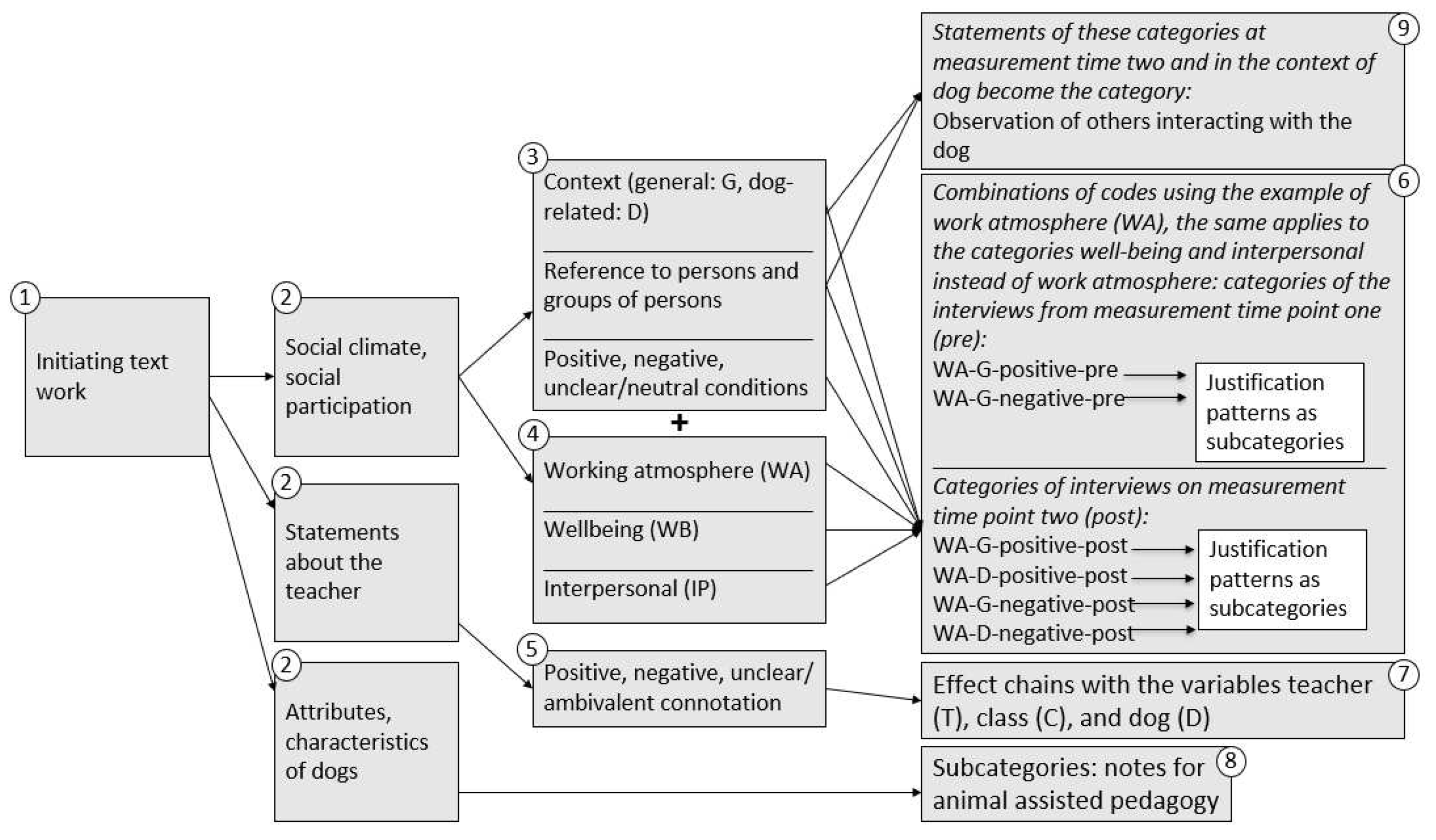
The forms of analysis used included the content structuring form and an analysis form following the evaluative form [41]. The procedure is detailed and in short form in Mombeck 2022 [29], which is why only the short form of the work steps is presented here. The analysis resulted in the following work packages, also illustrated in Figure 2 [29].
- Initiating text work with the aid of the postscripts and the full transcripts of the problem-centered interviews
- Coding of pre-formulated main categories: A Social climate and social participation, B Learners’ perceptions of the teacher, and C Comments on Attributes and characteristics of dogs, regardless of the topic of social climate
- Category formation: Coding along the main categories A in a) Assessment (positive, problematic, and unclear/neutral) and in b) Context (dog, no dog). Moreover, the main category A was categorized in a differentiated manner, in c) the References (to oneself, to individuals (others), and to everyone, that is to say, the whole class and generally formulated statements).
- Formation of subcategories along the main category A: Coding as Working atmosphere, Interpersonal, and Well-being
- Category formation: Coding along the main categories B in Assessment (positive, problematic, and unclear/neutral)
- Combination of subcategories and emphasis of Justification patterns as further subcategories along the categories Working atmosphere, Interpersonal, and Well-being and further Differentiation of the justification patterns if necessary
- The statements about the teacher from the post-interviews are coded into the Impact chains category. The impact refers to the interaction of teacher – dog – class.
- Along the main category C: The Statements about attributes and the Meaning attributions to dogs are coded into three thematic subcategories.
- Expanding on the subcategory Individuals and Everyone as well as Context dog at the second measurement time point, selected statements are coded as the category Observations of others interacting with the dog.
3. Results
3.1. Part 1: Implications of animal-assisted education for social participation and so-cial climate
The results of the qualitative content analysis are presented below along the main categories Working atmosphere, Well-being, Interpersonal (and the category Perception of the teacher). Subcategories of the categories Working atmosphere, Well-being, and Interpersonal include the positive and negative connotation of the statements of these categories (positive/negative), as well as justification patterns in the statements (justification) and the persons and groups of persons to which each statement is related (own self, individuals, class community). The statements on the different categories are compared with respect to the time of the survey (change from pre to post).
3.1.1. Working atmosphere
Statements of the category Positive working atmosphere are rarely cited at the first measurement time point (5), but significantly more frequently after the intervention (3 in the general context/ 27 in the dog context). It becomes clear that the working atmosphere has fundamentally changed from the point of view of the children and adolescents. This change is attributed to animal-assisted education. The dog being present creates a better learning environment, greater calm, discipline/respect, and cleanliness in the class, which makes it easier to concentrate. The implications can be divided into the categories of Actions for the dog and Actions by the dog in a further analysis step.
Actions for the dog refer to students consciously behaving in a way that meets the needs of the animal and makes it feel comfortable. The improved working atmosphere becomes a by-product of this.
“So yes, we’ve been very considerate of [dog’s name] there as much as possible. And yes, things got much calmer because everyone simply listens to the rules and cares for the dog” (F8_28, Group 2, Segment 52).
Actions by the dog is used to describe statements where the dog being present results in improved concentration or calm behavioral patterns that positively affect the working atmosphere.
“Well, I just think it’s great, because then (...) I can sometimes concentrate better when there’s [dog’s name] next to me.” (H6_5, Group 2, Segment 28).
Statements bearing negative connotations in this category (negative working atmosphere) are mentioned at both measurement points. The reasons for this are behavioral problems of individual students, restlessness, and increased noise levels. Both the rates at which negative statements are made in the general context (pre 17, post 4 in the general context), as well as the drastic nature of the content and the dramatic nature of the statements, decrease.
Pre: “Yes, because we don’t behave all the time” (F5_4, Group 1, Segment 10)
Post: “So when the dog is around, there’s no stress really, I’ll say that, but when there are other teachers around like that, there’s stress sometimes, and that’s actually still the same as always” (F5_21, Group 2, Segment 3)
Negative statements regarding the working atmosphere with justification due to the animal-assisted setting are relatively high in number (12 in the context of dog) and are associated with having unfulfilled needs in terms of actions and behaviors for the dog. Even minor or infrequent breaches against the rules established for the dog are considered a burden and an unfavorable working atmosphere. Distractions due to the dog are also referred to.
“So I can concentrate better because the class is quiet. But I can’t really concentrate so well when the dog is there because I always want to stroke the dog, and I also want him to develop trust in me” (F5_12, Group 2, Segment 35)
3.1.2. Well-being and uneasiness
Few statements bearing positive connotations are made about well-being at the first measurement time point (5), (“I feel good at the moment” S5_17, Group 1, Segment 6). Even the second measurement point only sees 5 people commenting positively on well-being in the general context. By contrast, almost all children (29 participants) cite well-being in connection with the dog at least once at measurement time point 2. The justification patterns in this category are particularly multifaceted:
With respect to the individual level (own self and individual children), the well-being (firstly) resulting from animal-assisted education is most often attributed to a positive stimulation (26 respondents): The animal brings fun, joy, and motivation.
“Because you feel somehow differently there, the room feels more alive because, in the class, you really only move your hand, yeah. And then everything is just a little bit more alive.” H6_21, Group 2, Segment 44.
“So you look forward to doing math a lot more. I never really wanted to go to math before, it was really boring, and I always wanted to just go home (laughs). But now I’m actually looking forward to math when (...) but only when the dog is there” (F8_7, Group 2, Segment 33).
“So the first time [dog’s name] was there, I was really excited at first, I was happy the whole day, so to say, while the last few days I wasn’t really excited because I already knew [dog’s name], I was just happy that she was with us. I was just happy all the time then, too. Whenever she was there” (F5_13, Group 2, Segment 18).
In addition to these positive stimulations, (secondly) the absence of negative stimulations also results in an increased sense of well-being (13 children), thereby creating feelings of happiness and satisfaction and/or relaxation, which causes the learners to experience a calmer and more serene state. In brief, there is a reinforcement of positive stimulations as well as a reduction of negative stimulations:
“It’s just that when you’re a little bit stressed, for example (...) writing a paper or something(...) and then [dog’s name] is sort of lying there quite relaxed, then you also become sort of relaxed” (S5_14, Group 2, Segment 63-65).
Third, well-being on an individual level is achieved through experiencing and observing how canine anxiety is managed through self-efficacy and overcoming fear over the course of the school year. Forth, the absence of external negative factors is cited, such as across-the-board disciplinary tasks by the teacher, something that no longer occurs since animal-assisted teaching has been introduced.
In relation to the class community, well-being tends to be attributed to the new identification as the ‘dog class’ and through the sense of belonging to it (4 children). A feeling of being at ease and well-being was also expressed by the participants (24) for several children or the entire class community:
“I actually feel, like if using a metaphor, for example, if you mix cocoa with milk now. Then it turns into a drink. And this drink certainly tastes good. And that’s the same feeling. I: Just a feeling of well-being. B: Yes. I: A little bit of enjoyment, relaxation too? B: A bit of relaxation (unintelligible). I: OK. Why is that so? Why do you get that feeling when there’s a dog around? B: I don’t exactly know, but it’s just that kind of feeling. It’s something I can only describe myself a little. I: OK. And you have this feeling? B: I think a few of us have, I’m not alone.” (F8_1, Group 2, Segment 48–56).
Feelings associated with negative connotations are mentioned by 4 participants at measurement time point 1; negative well-being in the general context is mentioned by one participant at the second measurement time point, although it is mentioned by 17 participants in the animal-assisted context. The feeling of uneasiness stems from the concern that other children may feel uneasy in the animal-assisted setting. This concern originates from the fact that some children had voiced reservations or fear prior to the start of the animal-assisted intervention yet had agreed to the gradual introduction toward animal-assisted education. These children were able, for the most part, to put aside any fears and reservations and are proud of their own self-development (category well-being). Other children apparently are unaware of this development or base their statement on the beginning of animal-assisted education.
“Yes, only some. Well, for example, Fe24 is a little frightened of dogs now, but generally, she’s also frightened of cats and stuff. That’s why, but she’s getting used to it, I think, anyway” (F5_18, Groupe 2, Segment 72).
This helps to explain the disparity between positive well-being in relation to the class as a whole and negative well-being in relation to individuals. This assumption can be confirmed by the fact that one’s own uneasiness is rarely mentioned.
“Yes, so (...) I’m not as scared (...) anymore, doesn’t faze me as much.” (F8_7, Group 2, Segment 152-153). If you ask those concerned whether they would therefore prefer to forego animal-assisted education, the answers given are no, meaning that it can be assumed that this is the case. (Remark: too much interpretation?). Contact that is too infrequent with the animal also becomes a cause of uneasiness in rather rare cases.
“I was a bit sad because the dog never came to me”. (F8_30, Group 2, Segment 28-43)
3.1.3. Interpersonal dimension
Statements regarding interpersonal relationships, acceptance, friendships, class cohesion, involvement with others, and attempts at de-escalation are named without direct reference to animal-assisted education at both the first (27 persons) and the second measurement time point (25). The statements of 18 participants can be assigned to the subcategory direct reference to the animal-assisted setting (context animal-assisted). A differentiation must be made between subcategories in this case: The dog is firstly perceived as something that binds class members together, as a shared goal or unifying theme (10 participants)
“Because before, everybody kind of had a goal for themselves, as a group. Like, for example, some wanted good grades, others wanted to be cool, and others just kept to themselves. And now, we all have our shared goal, so to speak, that the dog stays here.” (F8_3, Group 2, Segment 62-64).
Second, consideration for the animal also influences interpersonal interactions, with the animal perceived as having a de-escalating effect and other children perceived as less aggressive and more caring (9 participants):
“So when the dog is around, there’s no stress really” (F5_21, Group 2, Segment 3)
“There’s less conflict between people, between groups, so to speak.” (F8_6, Group 2, Segment 2).
Negative expressions of the category Interpersonal general context tend to be at high levels both before (23) and after the intervention (22). Bullying and the exclusion of individual children are frequently mentioned prior to the intervention (19). The reasons for this include dislike due to behavioral problems, physical appearance, or origin. The inability to regulate one’s own emotions also leads to exclusion and problematic interpersonal relationships. It is not only active exclusion that is named but also the absence of positive actions and lack of participation opportunities (18). Unfavorable group dynamics leading to the exclusion of children and adolescents are also mentioned (9), while one participant mentions that the class lacks a sense of cheerfulness, which leads to conflicts.
Similar categories are observed at the second measurement time point; the absence of positive actions (12), active negative actions (11), individual dislikes (9), and peer pressure (6). While it is true that some of the findings suggest that such marginalizations occur less frequently, we still cannot speak of negative social aspects being curtailed.
Only two participants described a negative influence of animal-assisted education on interpersonal dimensions: This was due, on the one hand, to jealousy because of an unequal level of animal contact, and on the other hand, to a boy hypothetically formulating that he would be protective of the dog, even with violence.
3.1.4. Perception of the teacher
The teaching staff are perceived positively by the participants (e.g., friendly, fair, close to the students, competent) (11), ambivalently - without clear assessment (6), and negatively (10) (e.g., unfriendly, unfair, or too strict). Insofar as the teaching staff is perceived positively, the participants describe them as friendly even after the intervention. Teaching staff who were perceived as negative are described with positive characteristics at measurement time point two, with the result that 26 participants rate the teaching staff positively at measurement time point two, and only one person continues to make a negative statement. The teacher of 8 children is described as ambivalent or as unchanged. The emphasis is to be placed on the statements of students who rate their teacher negatively at the first measurement point. Participants in classes with a negative perception of the teacher at measurement time point 1 perceived the teacher as unfair, authoritarian, or intimidating (10) or described questionable educational methods on the part of the teacher (6). After one school year involving animal-assisted education, this teacher is seen as happier, more cheerful, friendlier, and less strict. The dog is, therefore, a reason to interact on a personal level. The teacher is perceived as being fairer and less disciplinarian, more differentiated in their teaching, and more sensitive to volume. Some children theorize that the dog alerts the teacher to problems in the class.
“B: Firstly, I used to have such earache, or something (...) had kind of scared me constantly when Mr. FBO sort of started shouting like that. But somehow, since the dog has been there, that’s no longer the case” (F8_22, Group 2, Segment 50).
“B: Well, I noticed that Mr. FBO has become a bit more cheerful. I’ve never seen Mr. FBO laugh since [dog’s name] was there. Never. I: Before you mean? B: I never saw Mr. FBO laughing before. I: OK. B: Never. I: Yes. B: He’s been laughing since [dog’s name] came. He laughs (...) when he wants. I: OK. B: So the lessons with Mr. FBO have (...) so are more (...) fun”. (F8_1, Group 2, Segment 107–115).
3.2. Results part 2: Potential of animal-assisted education
In order to ascertain the potential of animal-assisted education, the categories and subcategories Meaning attributions and attributes of dogs, the category Description of Observations of others interacting with the dog (double coding_interpersonal), and the category Argumentation structures with respect to the mutual effect structure of the variables Class, teacher and dog, based on the statements about the teacher after the intervention, are illuminated.
Looking at the way the participants are structured, i.e., at the image of dogs and of the dog-human relationship, it is possible to draw valuable conclusions for animal-assisted interventions: For example, characteristics of dogs are named, such as their attraction and the affection that the participants feel for the dogs (10), dogs are regarded as givers and receivers of trust, love, and solace (8), they are interaction partners in shared experiences (2), the human-animal relationship is characterized by its healing and empowering qualities (4), one participant describes animal contact as a privilege and a unique asset of the class, and another child describes extensively the fascination that dogs exude.
“So it [a dog] is a special animal, so to speak, a living being in the truest sense. And that’s why I think you should also be good to animals as such […]. So I think it’s a special thing, something so special” (F5_18, Group 2, Segment 50).
Another perception and description of what the animal-assisted setting is like involves the dog’s behavior, which is perceived as an indicator of the dog’s unhappiness (4). On the one hand, this indicates that this is something that children perceive, and this is to be welcomed. Then again, it is critical to note that the dog seems to be stressed.
Four participants identified human actions, behaviors, or attitudes that might prevent human-animal relationships, such as when animal-assisted education is seen as a solution by the teacher but not by the students
“Yes, he [teacher] said that the dog would be quite beneficial for me, but (...). I: You personally don’t see it that way necessarily. B: No” (F8_6, Group 2, Segment 38-40)
The following section will examine the statements with which the participants describe and assess fellow students when they interact with the animal or when they behave differently than usual when animal-assisted teaching is taking place (13), three examples of which are given below. In addition, some participants (11) describe an increased intensity of feelings of fellow pupils towards the dog, but also towards other fellow pupils. A striking feature of these observations by others is how detailed and astonished they are when describing their interaction with the dog or their behavior in the animal-assisted setting. These observations are not consistent with previous assumptions or perceptions of the respective participants, leading the participants to revise or modify their subjective theories about individual classmates.
“B: As far as I’ve seen, whenever a dog has come to one of our boys, they’ve actually been quite careful. I: OK. B: So they weren’t as, you know, rough as they were to other students, for instance, but rather more careful with the animal. I: Oh, really? B: Yeah, so give the dog a stroke, or whatever, but they didn’t, for example, they didn’t talk so loudly either. So not yelled or, just very quietly. I: Would you have expected this before? B: Well, with some of them, I would have, but I was still a little bit unsure with others as to whether they would really show a little bit of change with the animals. I: OK. And it is then that you say that that was the case, that they were somehow different? B: Yes“ (F8_8w, Group 2, Segment 54–62).
“It was just that somehow F9 was so afraid of dogs, actually because he was the tough guy in our class (...) well he acted as if he was. Yes, and then I kind of heard that he was completely afraid of dogs. Then I didn’t really get to know why or what for. Yes, but that’s all there was to it.” (F8_22, Group 2, Segment 42).
“So, for example, F29, he is actually, actually also totally loud and such, but he is now fully concentrated, and he also asks me for help when he doesn’t understand something, and this is something that has surprised me a bit I: And this is quite new? OK B: Yes, so it was like this in fifth grade. But then we had another teacher, and he always played music for us. But then, a long time passed where F29 didn’t do anything at all. And now, he makes the effort again, and that has surprised me so positively. I: When did he start doing things again? B: I don’t know, now for a month, two. I: OK, yeah good. Can you figure out why that is, or is it something you just noticed? B: I just noticed it” (F8_3, Group 2, Segment 48–54).
It is also evident that some children use interaction or looking at the dog as a way to get out of awkward social situations or challenging learning situations: Animal-assisted education is therefore seen as a kind of coping strategy among fellow students (2).
“B: So I also think that they’re seeking a little bit of a relationship with the dog because it gives them a little bit of a distraction, so to speak, from the work that they’re dealing with. And with that, you can simply deal with the work better afterward. I: Why do you think that is, that you’re in a better position to deal with it afterward? B: Because your head might have been somewhere else for a little while, and you kind of had the chance to clear your head a little bit. Thanks to the dog being there” (F8_18, Group 2, Segment 14–16).
Another implicit indicator of the potential of animal-assisted education is the diversity of patterns of interpretation that students use to describe animal-assisted education [29]. There are 11 different interpretations of the teacher’s intention, so to speak, of the impact mechanisms of animal-assisted interventions from the students’ point of view. The pattern of interpretation, ‘Teacher uses dog for the benefit of the class’ (L-H-K, 6 participants), for example, is conducive since the teacher is seen as a caring person who is responsive to the students. The teacher works with the animal because she values and trusts the children.
“B: The dog is indeed present, and Mr. FBO gives us his deepest trust because of the dog’s presence. And the dog is, in fact, just like a child for Mr. FBO. Because, of course, he raised her, [dog’s name]” (F8_1, Group 2, Segment 75).
“B: Yes. We have to actually give [dog name 3] the greatest sense of security. Out of everyone in the class, she is our (...), so to speak, she’s our guest. And after all, Mr. FBO instills trust in us to take care of her. And that’s that” (F8_1, Group 2, Segment 77).
The perception that the students can influence the teacher’s behavior through the dog (K-H-L) or that animal-assisted education primarily benefits the teacher (H-L, 1 participant) is less conducive or neutral.
“B: Er (...) I think it’s also quite nice for her if she doesn’t have to leave [dog name 1] at home, she still can watch over her as well while doing lessons” (S5_20, Group 2, Segment 42).
This shows the relevance of communicating the intention on the part of the teacher and, with it, the opportunity to transparently present one’s own appreciation of and inclusive approach towards the students and the dog.
4. Discussion
The results of the qualitative exploratory survey about the influence of animal-assisted education on social participation and social climate both confirmed and complemented findings about animal-assisted interventions. It could be verified, for example, that animal-assisted education can reduce aggressive behavior in the school setting. Animal-assisted education is associated with reducing maladaptive strategies and improving the child’s own emotion regulation. Calmness and relaxation are encouraged in the school through the closeness and contact with animals, while the quality of the human-animal relationship makes an impact on the animal-assisted intervention. The development of children and adolescents can be fostered through animal-assisted education. The use of school dogs therefore has a positive influence on pro-social behavior, lifts the mood, activates caring behavior in students, while school dogs are seen as individuals to whom students form attachment-like relationships.
The previous knowledge (with school-specific findings that might be applied to other group settings) can be supplemented as follows: The use of school dogs encourages more bonding between students and between teacher and students since animal-assisted education is a shared goal. The school dog thereby constitutes a shared interest, exclusionary group structures can be reduced, and class cohesion and class identity can be reinforced. Shared interactions with the animal connect children who had previously had little interaction with each other, thus making animal-assisted education an opportunity for social participation for children who are marginalized. Children who have had little previous contact with dogs come to believe they are brave and empowered. The way fellow students and the teacher interact with the dog is observed by other children. This gives children and teachers the opportunity to transform previous individual unfavorable attributions. It might also be feasible to change stereotypical role structures. Fellow students are perceived as friendlier, more approachable, and more considerate. Teachers are seen as fairer, calmer, more competent, and easier to trust. In addition to having numerous positive impacts on inclusive structures and offering great potential for animal-assisted education, the use of school dogs also reveals some negative tendencies. The use of school dogs may put students under strain if they are concerned about the welfare of others, for example, if they have previously expressed concerns or fears. Situations where animal welfare is not ensured also become distressing experiences for the children (and must be prevented at all costs for the welfare of the animal. In this study, the focus was only on the children as discussed in the limitations).The welfare of animals represents a fundamental and under-appreciated pillar of animal-assisted education, which we will revisit in our conclusion.
Moreover, a mismatch in the intensity and quality of direct interaction with the dog can cause jealousy. Negative consequences of animal-assisted education also become obvious when children and adolescents are entrusted with too much responsibility for the animal.
A lack of interest in the dog, a reluctance or low affinity for dogs potentially could lead to exclusion. This is not something that can be empirically deduced from the interviews, but an individual statement by a student suggests that this is the case: The student expresses amazement at another student she particularly likes. This quote was assigned to ‘Observations of others interacting with the dog’ and is the only quote that expresses amazement at less than expected attention:
“I thought (...) yes, I thought, for example, F25 (...) I thought he was giving the dog more attention. But he’s not giving him any attention at all. So, he doesn’t pay attention to the dog. So as if he wasn’t there whatsoever. I: OK. B: Yes. I: You wouldn’t have thought so? B: Yeah, I just thought (...) looking more at him or something, but he doesn’t at all. He is fully focused on the work” (F8_7, Group 2, Segment 143-147). (upwards if necessary).
The finding that there are two assertions for the positive impact of animal-assisted education from the participants’ point of view is worth discussing: The first assertion is a thesis that is currently common in the research field: Behavior and well-being improve because of the dog (‘behavior from the dog). The second assertion is new, indicating that the children consciously make choices to perform actions that are in the best interests of the dog (‘actions for the dog) and choose to take responsibility and choose to care for the animal. The use of a school dog would seem to change social roles on the one hand, and on the other hand, new social roles emerge: the ‘Role of caring person for the dog’, in a nutshell, the social role of ‘Carer’. The following shall elaborate on how animal-assisted education influences social roles and how a new social role emerges, based on the role theory of Krappmann (1975) [36] and on the methodological basis of symbolic interactionism [34,35].
First of all, the role theory, according to Krappmann (1975) [36] will be briefly explained as a foundation so that the implications of animal-assisted education can be incorporated into this theory: Social action is subject to interpersonal negotiation processes and is dependent on social roles, role action, and norms [36]. With this in mind, the formation of an individual’s identity is both the result and the condition of the negotiation processes. By assuming a social role, an individual has the opportunity to shape this role to suit his or her identity, whereas, on the other hand, each social role shapes the person’s own identity too. Role actions, that is, social negotiation processes or social interaction, are conditioned not only by the individual’s own role design but also by the interaction partner, their expectations and needs, and by the norms in a setting. This means in the school context, that, a child, in addition to e.g. the social role of student and child with a social position in the class, interacts with other persons in the roles of student and teacher and that this interaction is driven by norms such as performance and selection. Students who are taught with a dog take on another social role, the role of the carer (for the dog). This role emphasizes emotional needs (role needs) for bonding and caring, meaning that norms of the class setting are also altered. Whereas previously, there were individual objectives to be achieved, there is now a shared desire to provide care for the dog. This facilitates the negotiation processes between individuals because you share the same objective, the same needs when you encounter each other in the role of the carer, e.g., when you collectively prepare a bed and water bowl for the dog or remind each other to be more considerate of the dog. When it comes to the class level, there is an increased identity with one’s own class (dog class); instead of exclusionary group structures, a common identity is shared. That’s because animal-assisted education only functions when all those involved are mindful of the dog’s needs. Moreover, students perceive themselves and others in a different way when interacting with the dog. In doing so, previous individual and stereotypical perceptions of a person are changed. Examples of this are: The child who was barely able to regulate their own emotions but now affectionately interacts with the dog or behaves more considerately (individual attributions are altered) or the boys who previously sought to appear standoffish to conform to the stereotypical image of masculinity yet communicate with the dog in an affectionate manner (individual and stereotypical perceptions are altered). Interpersonal interactions are also influenced by changing perceptions of others since even if a person does not engage in the role of carer, this role belongs to their repertoire of roles. On the one hand, this influences the self-image, making children confident in their ability to act with consideration and regulate their emotions, and on the other hand, it influences the expectations that students have of each other: If a child interacts considerately and kindly with the dog, there will be an increased expectation that they will interact nicely with other children as well.
Social norms not only shift because of the common goal (from individual achievement and social status to caring for the animal) but also because the behavior of dogs is not subject to social norms, and therefore dogs relax them (the animal’s naturalness and authenticity).
5. Limitations
The research project [29] only covered four school classes, meaning that the results cannot be generalized. The theoretical concept also requires further development and review but should represent an initial explanatory approach from the perspective of educational science for the school setting. A distinct weakness of the research has been that it lacked a multi-perspective approach; the perspectives of the teacher, not to mention the dog, were missing. For instance, the dog’s perspective should be explored by involving dog trainers to safeguard aspects of animal welfare and to compare whether the students’ statements (need for care) are reflected in reality. Research always only represents a small segment of reality, yet there is a special obligation for researchers in the field of animal-assisted interventions to ascertain the setting and burdens and implications of all participants as comprehensively as possible.
5. Conclusions
Students benefit from animal-assisted education, and students and teaching staff appear to take on another social role in the school setting, the role of carer (for the dog). The new social role includes new role needs, i.e., taking care of the animal but this does not guarantee, that care will be delivered in a way that actually safeguards the needs of the animal. Therefore teachers can and should combine both the child development through animal-assisted pedagogy and animal welfare in inclusive settings. An inclusive attitude on the part of the teacher towards the dog and the person is fundamental to this.
If the needs of the dog are recognized, valued, and safeguarded, and animal-assisted education is developed on this basis, then this can serve as an example of how respectful and considerate interpersonal relationships can also be developed.
If a teacher gives the dog an equal level of treatment, the dog is free to decide what level of closeness and distance it allows, whereby it can and may retreat if it wants to (e.g., a resting place protected out of sight, in line with the recommendations of the Quality Network School Companion Dogs e.V. [42]), then it is possible to use this as a means of conveying the dog’s needs and limits. A dog with protected boundaries and needs can serve as a role model for the students’ own resilience development. The attitude of the teacher is vital for both animal welfare and the quality of animal-assisted education so that the desire of the students to care for the animal can be fulfilled. The current aim in the development of animal-assisted education should be to move away from a “he has to endure it” to a “the dog is of equal value” mentality. This conclusion should be taken as the foundation for animal-assisted practice because it contains both: Animal welfare and conditions for successful animal-assisted education to foster social participation and social climate.
Author Contributions
For research articles with several authors, a short paragraph specifying their individual contributions must be provided. The following statements should be used “Conceptualization, Mona Mombeck; methodology, Mona Mombeck; software, Mona Mombeck.; validation, Mona Mombeck; formal analysis, Mona Mombeck; investigation, Mona Mombeck.; resources, Mona Mombeck.; data curation, Mona Mombeck; writing—original draft preparation, Mona Mombeck; writing—review and editing, Mona Mombeck and Timm Albers; visualization, Mona Mombeck; supervision, Mona Mombeck and Timm Albers.; project administration, Mona Mombeck; funding acquisition, Mona Mombeck. All authors have read and agreed to the published version of the manuscript.” Please turn to the CRediT taxonomy for the term explanation. Authorship must be limited to those who have contributed substantially to the work reported.
Funding
This research was funded by STUDIENSTIFTUNG DES DEUTSCHEN VOLKES, PhD scholarship”.
Institutional Review Board Statement
The study was approved by the Ethics Committee of UNIVERSITY OF PADERBORN (date of approval: 08.01.2018).
Informed Consent Statement
Informed consent was obtained from all subjects involved in the study.
Data Availability Statement
The MAXQDA-file containing the data has been submitted together with the draft of this article. People interested in the data can contact the authors and will receive the data in return.
Conflicts of Interest
The authors declare no conflict of interest. The funders had no role in the design of the study; in the collection, analyses, or interpretation of data; in the writing of the manuscript; or in the decision to publish the results”.
References
- Böttinger T. Förderbedarf gleich Ausgrenzung?: Ein systematischer Forschungsreview zur sozialen Dimension schulischer Inklusion in der Primarstufe in Deutschland. Empirische Sonderpädagogik 2021;13(3):216–37.
- Wüthrich S, Sahli Lozano C, Torchetti, L. & Lüthi, M. Zusammenhänge des peerbezogenen Klassenklimas und der sozialen Partizipation von Schüler*innen mit kognitiven und sozial-emotionalen Beeinträchtigungen. Empirische Sonderpädagogik 2022;14(2):123–38.
- Krawinkel S, Südkamp A, Tröster H. Soziale Partizipation in inklusiven Grundschulkassen: Bedeutung von Klassen- und Lehrkraftmerkmalen. Empirische Sonderpädagogik 2017;9(3):277–95.
- Schmitt R. Die soziale Partizipation von Schüler(inne)n in Lerngruppen der inklusiven Grundschule. In: Donie C, Foerster F, Obermayr M, Deckwerth A, Kammermeyer G, Lenske G et al., editors. Grundschulpädagogik zwischen Wissenschaft und Transfer: Jahrbuch Grundschulforschung. Wiesbaden: Springer VS; 2019, p. 290–295.
- Schürer S. Soziale Partizipation von Kindern mit sonderpädagogischem Förderbedarf in den Bereichen Lernen und emotionale-soziale Entwicklung in der allgemeinen Grundschule: Ein Literaturreview. Empirische Sonderpädagogik 2020;12(4):295–319.
- Blumenthal Y, Blumenthal S. Zur Situation von Grundschülerinnen und Grundschülern mit sonderpädagogischem Förderbedarf im Bereich emotionale und soziale Entwicklung im inklusiven Unterricht.: Longitudinale Betrachtung von Klassenklima, Lehrer-Schüler-Beziehung und sozialer Partizipation. Zeitschrift für Pädagogische Psychologie 2021:1–16.
- Crede J, Wirthwein L, Steinmayr R, Bergold S. Schülerinnen und Schüler mit sonderpädagogischem Förderbedarf im Bereich emotionale und soziale Entwicklung und ihre Peers im inklusiven Unterricht.: Unterschiede in sozialer Partizipation, Schuleinstellung und schulischem Selbstkonzept. Zeitschrift für Pädagogische Psychologie 2019;33(3-4):207–21.
- Zurbriggen C, Venetz M. Soziale Partizipation und aktuelles Erleben im gemeinsamen Unterricht. Empirische Pädagogik 2016;30(1):98–112.
- Henke T, Bosse S, Lambrecht J, Jäntsch C, Jaeuthe J., Spörer N. Mittendrin oder nur dabei?: Zum Zusammenhang zwischen sonderpädagogischem Förderbedarf und sozialer Partizipation von Grundschülerinnen und Grundschülern. Zeitschrift für Pädagogische Psychologie 2017;31(2):111–23.
- Vock M, Gronostaj A, Kretschmann J, Westphal A. “Meine Lehrer mögen mich” - Soziale Integration von Kindern mit sonderpädagogischem Förderbedarf im gemeinsamen Unterricht in der Grundschule.: Befunde aus dem Pilotprojekt “Inklusive Grundschule” im Land Brandenburg. DDS - Die Deutsche Schule 2018;110(2):124–38.
- Felder F. Die Grenzen eines Rechts auf schulische Inklusion und die Bedeutung für den Gemeinsamen Unterricht. Psychologie in Erziehung und Unterricht 2014;62(1):18–29.
- Beetz A. Hunde im Schulalltag: Grundlagen und Praxis. 5th ed. München: Ernst Reinhardt Verlag; 2021.
- Kotrschal K, Ortbauer B. Behavioral effects of the presence of a dog in a classroom. Anthrozös 2003;16(2):147–59.
- Hergovich A, Monshi B, Semmler G, Zieglmayer V. The effects of the presence of a dog in the classroom. Anthrozös 2002;15(1):37–50.
- Meints K, Brelsford VL, Dimolareva M, Mare’chal L, Pennigton K, Rowan E. Can dogs reduce stress levels in school children? effects of dog-assisted interventions on salivary cortisol in children with and without special educational needs using randomized controlled trials. PLoS One 2022;17(6).
- Brelsford VL, Meints K, Gee NR, Pfeffer K. Animal-assisted interventions in the classroom: A systematic review. Int. J.Environ. Res. Public Health 2017;14(7):669.
- Clarke AM, Morreale S, Field CA, Hussein Y, Barry MM. What works in enhancing social and emotional skills development during childhood and adolescence?: A review of the evidence on the effectiveness of school-based and out-of-school programmes in the UK; 2015.
- Dicé F, Santaniello A, Gerardi F, Menna LF, Freda M. Meeting the emotion!: Application of the Federico II Model for pet therapy to an experience of animal assisted education (AAE) in a primary school. Pratiques psychologiques 2017;23:455–63.
- O’Haire ME, McKenzie SJ, McCune S, Slaughter V. Effects of Classroom Animal-Assisted Activities on Social Functioning in Children with Autism Spectrum Disorder. The Journal of Alternative and Complementary Medicine 2014:162–8.
- Berry A, Borgi M, Francia N, Alleva E, Cirulli F. Use of assistance and therapy dogs for children with autism spectrum disorders: A critical review of the current evidence. J. Altern Complement Med. 2013;19(2):73–80.
- Bert F, Gualano MR, Camussi E, Pieve G, Voglino G, Siliquini R. Animal-assisted intervention: A systematic review of benefits and risks. Eur J Integr Med 2016;8(5):695–706.
- Wice M, Goyal N, Forsyth N, Noel K, Castano E. The Relationship Between Humane Interactions with Animals, Empathy, and Prosocial Behavior among Children. Human-Animal Interaction Bulletin 2020;8(1):38–49.
- Julius H, Beetz A, Kotrschal K, Turner DC, Uvnäs-Morberg K. Bindung zu Tieren: Psychologische und neurobiologische Grundlagen tiergestützter Interventionen. Göttingen: Hogrefe; 2014.
- Flynn E, Brandl Denson E, Mueller MK, Gandenberger J, Morris K. N. Human-animal-environment interactions as a context for youth social-emotional health and wellbeing: Practitioners’ perspectives on processes of change, implementation, and challenges. Complementary Therapies in Clinical Practice 2020;41.
- Purewal R, Christley R, Kordas K, Joinson C, Meints K, Gee N et al. Companion Animals and Child/Adolescent Development: A Systematic Review of the Evidence. International journal of environmental research and public health 2017;14(3).
- Beetz A, Uvnäs-Morberg K, Julius H, Kotrschal K. Psychosocial and psycho-physiological effects of human-animal interactions: the possible role of oxytocin. Frontiers in psychology 2012;3:1–15.
- Beetz A, Julius H, Turner DC, Kotrschal K. Effects of social support by a dog on tress modulation in male children with insecure attachment. Frontiers in psychology 2012(3):1–9.
- Juvonen J, Lessard LM, Rastogi R, Schacter HL, Smith DS. Promoting Social Inclusion in Educational Settings: Challenges and Opportunities. Educational Psychologist 2019;54(4):250–70.
- Mombeck M. Tiergestützte Pädagogik – Soziale Teilhabe – Inklusive Prozesse. Wiesbaden: Springer Fachmedien Wiesbaden; 2022.
- Flick U. Qualitative Sozialforschung: Eine Einführung. Reinbeck: Rowohlt; 2007.
- Groeben N, Wahl D, Schlee J, Scheele B. Das Forschungsprogramm Subjektive Theorien: Eine Einführung in die Psychologie des reflexiven Subjekts. Tübingen: Francke; 1988.
- Laucken U. Naive Verhaltenstheorie: Ein Ansatz zur Analyse des Konzeptrepertoires, mit dem im alltäglichen Lebensvollzug das Verhalten der Mitmenschen erklärt und vorhergesagt wird. Zugl.: Tübingen, Univ., Diss. 1st ed. Stuttgart: Klett; 1974.
- Dann H-D. Pädagogisches Verstehen: Subjektive Theorien und erfolgreiches Handeln von Lehrkräften. In: Reusser K, Reusser-Weyneth M, editors. Verstehen: Psychologischer Prozess und didaktische Aufgabe. Bern: Huber; 1994, p. 163–182.
- Flick U, Kardorff E von, Steinke I (eds.). Qualitative Forschung: Ein Handbuch. Reinbek: Rowohlt; 2015.
- Flick U, Kardorff E von, Steinke I. Was ist qualitative Forschung? Einleitung und Überblick. In: Flick, U; Kardorff, E. von; Steinke I. (Hg.), Qualitative Forschung: Ein Handbuch (11. Aufl., S. 13-29), p. 13–29.
- Krappmann L. Soziologische Dimensionen der Identität: Strukturelle Bedingungen für die Teilnahme an Interaktionsprozessen. Konzepte der Humanwissenschaften. 4th ed. Stuttgart: Klett-Cotta; 1975.
- Witzel A. Das problemzentrierte Interview. Forum Qualitative Sozialforschung 1985;1(1):0–25.
- Gee NR, Fine AH, Schuck S. Animals in Educational Settings: Research and Practice. In: Fine AH, editor. Handbook on Animal-Assisted Therapy: Foundations and Guidelines for Animal-Assisted Interventions, 4th ed. Burlington: Elsevier Science; 2015, p. 195–2010.
- Helfferich C. Die Qualität qualitativer Daten: Manual für die Durchführung qualitativer Interviews. 4th ed. Wiesbaden: VS Verlag für Sozialwissenschaften / Springer; 2011.
- Dresing T, Pehl T. Praxisbuch Interview, Transkription & Analyse: Anleitung und Regelsysteme für qualitativ Forschende. Marburg: Eigenverlag; 2018.
- Kuckartz U. Qualitative Inhaltsanalyse: Methoden, Praxis, Computerunterstützung. Grundlagentexte Methoden. 3rd ed. Weinheim: Beltz Juventa; 2016.
- Qualitätsnetzwerk Schulbegleithunde e.V. (2022). Available online: https://schulbegleithunde.de/kampagne-gleichwuerdigkeit/ (accessed on 20. June 2023).
Figure 2.
Origin of the categories.
Disclaimer/Publisher’s Note: The statements, opinions and data contained in all publications are solely those of the individual author(s) and contributor(s) and not of MDPI and/or the editor(s). MDPI and/or the editor(s) disclaim responsibility for any injury to people or property resulting from any ideas, methods, instructions or products referred to in the content. |
© 2023 by the authors. Licensee MDPI, Basel, Switzerland. This article is an open access article distributed under the terms and conditions of the Creative Commons Attribution (CC BY) license (http://creativecommons.org/licenses/by/4.0/).
Copyright: This open access article is published under a Creative Commons CC BY 4.0 license, which permit the free download, distribution, and reuse, provided that the author and preprint are cited in any reuse.


