

Submitted:
11 July 2023
Posted:
12 July 2023
You are already at the latest version
Abstract
Marine macroalgae have garnered significant attention in the field of cosmeceutical research due to their rich abundance of bioactive compounds. These compounds offer remarkable skin benefits without inducing any adverse effects on human health, such as cytotoxicity, reproductive toxicity, genotoxicity, mutagenicity, or carcinogenicity. Among the various bioactive compounds found in brown algae, phenolic compounds exhibit diverse chemical structures and are present in high concentrations. In addition to phenolic compounds, brown algae also contain terpenoids, bro-mophenols, mycosporine amino acids (MAAs), and flavonoids, with the well-studied poly-phenol compound, phlorotannin, being particularly prominent. Marine macroalgae further possess an array of pigments derived from their natural pigmentation, including chlorophylls, carotenoids (such as fucoxanthin and β-carotene), phycobiliproteins (such as phycoerythrin and phycocyanin), and melanin. These pigments have been extensively investigated for their potential cos-meceutical applications. The phenolic compounds and pigments derived from marine macroalgae have been thoroughly studied for their beneficial effects on the skin, including skin whitening, moisturizing, photoprotection, anti-aging, anti-wrinkle, anti-melanogenic, and anti-oxidant properties. This comprehensive review aims to explore the extraction, characterization, and skin cosmetic effects of phenolic compounds and pigments derived from marine macroalgae, as documented in the existing literature, thereby enhancing our understanding of their therapeutic potential.
Keywords:
Marine macroalgae
; Bioactive compounds
; Phenolic compounds
; Pigments
; Cosmeceutical applications
; Skin benefits
1. Introduction
In recent years, there has been a significant shift in consumer preferences towards natural skin care products, driven by concerns over the potential toxicity associated with synthetic formulations [1,2]. Consequently, industries have increasingly turned to natural bioactive ingredients derived from a wide range of natural resources [3,4]. Marine macroalgae have emerged as a popular choice in the field of cosmeceutical research, owing to their abundant reserves of bioactive compounds that offer notable skin benefits without inducing harmful effects on human health, such as cytotoxicity, reproductive toxicity, genotoxicity, mutagenicity, or carcinogenicity [5,6]. Marine macroalgae encompass a diverse group of eukaryotic, aquatic, photosynthetic, multicellular organisms commonly known as seaweeds. These organisms are ubiquitously found in saltwater environments and along coastal regions. They are taxonomically classified into three major groups: red algae (Rhodophyta), brown algae (Ochrophyta, Phaeophyceae), and green algae (Chlorophyta) [7,8,9,10]. Each group exhibits distinct characteristics and bioactive compound profiles.
One of the most promising natural skin care ingredients derived from marine macroalgae is seaweed. Seaweeds contain an array of bioactive constituents that possess unique biological activities, often absent or rare in other taxonomic groups, making them highly versatile for various applications in skin cosmeceuticals [11,12,13,14]. These bioactive compounds include lipids, fatty acids, polysaccharides, vitamins, minerals, amino acids, phenolic compounds, proteins, and pigments [15,16]. Phenolic compounds derived from marine algae have garnered considerable attention in the field of cosmeceutical research due to their potential for cosmetic applications [17]. Phenols are secondary metabolic products found in marine algae, which exhibit numerous benefits for the skin, making them attractive candidates for cosmetic formulations [18]. Structurally, phenols comprise a hydroxyl group attached to an aromatic hydrocarbon group, rendering them potent scavengers of free radicals, reactive oxygen species (ROS), and chelated metal ions [19]. Under certain environmental stimuli, phenolic compounds with multiple phenolic rings can form polyphenols [20]. Different classes of phenolic compounds have been identified in marine algae, including flavonoids, phlorotannins, mycosporine-like amino acids (MAAs), bromophenols, and terpenoids. These compounds are classified based on factors such as the number of carbons in the molecule, solubility, and the number of phenolic rings. Brown algae are predominantly composed of phlorotannins, while green and red algae primarily contain flavonoids, bromophenols, terpenoids, and mycosporine amino acids. Marine algae-derived phenolic compounds exhibit diverse bioactivities, serving as enzyme inhibitors, antimicrobials, antifungals, antioxidants, and anti-inflammatory agents, making them promising candidates for cosmetic and cosmeceutical applications [21].
One specific phenolic compound of interest is phlorotannin, which is widely utilized in cosmetics due to its ability to activate hyaluronic acid, inhibit allergic reactions, combat wrinkles, slow down the aging process, promote skin whitening, provide photoprotection, and improve overall skin health [22,23]. By exploring the extraction, characterization, and skin cosmetic effects of phenolic compounds and pigments derived from marine macroalgae, as documented in existing literature, this comprehensive review aims to enhance our understanding of the therapeutic potential of these natural compounds in sustainable beauty solutions. By harnessing the bioactive properties of marine macroalgae, we can pave the way for unleashing a new era of sustainable and effective beauty solutions that align with the increasing consumer demand for natural and environmentally friendly products. In addition to phenolic compounds, marine macroalgae are also a rich source of pigments derived from their natural pigmentation. These pigments include chlorophylls, carotenoids (such as fucoxanthin and β-carotene), phycobiliproteins (such as phycoerythrin and phycocyanin), and melanin. Extensive research has been conducted on the potential cosmeceutical applications of these pigments. They have been found to possess various skin benefits, including skin whitening, moisturizing, photoprotection, anti-aging, anti-wrinkle, anti-melanogenic, and antioxidant properties. The diverse array of pigments derived from marine algae presents exciting opportunities for the development of innovative and sustainable beauty solutions [24,25]. The extraction and characterization of phenolic compounds and pigments from marine macroalgae involve various techniques, such as solvent extraction, chromatography, spectroscopy, and mass spectrometry. These techniques allow for the identification and quantification of specific compounds, as well as the assessment of their bioactivity and stability. Understanding the extraction methods and characterizing the chemical properties of these compounds are crucial steps in optimizing their potential applications in skin care formulations [26,27].
By comprehensively reviewing the existing literature on marine algae-derived phenolic compounds and pigments, this study aims to provide a comprehensive overview of their extraction methods, chemical structures, and skin cosmetic effects. Such insights will not only enhance our understanding of the therapeutic potential of these natural compounds but also facilitate the development of sustainable and effective beauty products that harness the power of marine macroalgae.
1.2. Role of marine algae-derived phenolic compounds in skin benefits
Marine algae derived phenolic compounds exhibit diverse biological activities that are often correlated with their chemical properties. However, certain phenolic extracts have demonstrated interesting properties but have not been fully characterized. Notably, green seaweed-derived bromophenols and flavonoids have been shown to possess antioxidant activities. Studies conducted by Farasat et al. [28] and Cho et al. [29] have highlighted the high radical scavenging activities of various green (Chlorophyta) species, including Ulva clathrata, U. compressa, U. intestinalis, U. linza, U. flexuosa, U. australis, Capsosiphon fulvescens, and Chaetomorpha moniligera. Furthermore, the phenolic fraction of U. clathrata and U. flexuosa has demonstrated antibacterial and cytotoxic effects on breast ductal carcinoma cell lines [30,31]. The functions of phenol compounds in red marine algae are not extensively studied; however, they likely exhibit multifunctional actions in cell life, such as antioxidant and chelation properties, as well as acting as co-factors or hormones [32]. It should be noted that some research studies have focused on extracts enriched in polyphenolics rather than isolated phenolic compounds [33]. Marine macroalgae harbour a wide range of phenolic compounds, with more than 8000 different structures identified. These compounds play crucial roles in the growth, survival, and defence mechanisms of organisms. These compounds can be synthesized through various metabolic pathways, including the Pentose Phosphate Pathway (PPP), Phenylpropanoid pathway, and shikimate pathway. Researchers such as Giada [34] and Vermerris and Nicholson [35] have proposed different classification systems for phenolic compounds, which encompass a wide range of structures, from simple to highly polymerized forms. Simple phenolic compounds are characterized by the presence of hydroxyl groups at different positions, namely ortho, meta, and para (1,2-, 2,3-, and 1,4-, respectively). In some cases, simple phenolics may exhibit three functional groups, such as meta-tri or vic-tri substitution. Examples of simple phenolic compounds exclusively found in macroalgae include catechol, HQ, and phloroglucinol [36]. Catechol, in particular, has been detected in twenty-seven Japanese green and red seaweeds [37]. Bromophenols, which are bromine-substituted simple phenols, are commonly found in association with catechol. Another classification within the C6-CN phenolic group involves phenolic acids and aldehydes, characterized by the substitution of the phenol with a carboxylic group [35]. Examples of these include phenolic acid, hydroxybenzoic acids (C6-C1); acetophenones, phenylacetic acids, coumarins (C6-C2); coumarins, hydroxycinnamic acids, phenylpropanoids (C6-C3); naphthoquinones (C6-C4); xanthones (C6-C1-C6); stilbenoids, anthraquinones (C6-C2-C6); flavonoids, isoflavonoids (C6-C3-C6); lignans, neolignans ([C6-C3]2); lignins ([C6-C3]n); and condensed tannins ([C6-C3-C6]n). Gallic acid, a simple phenolic acid, is commonly used as a standard for estimating the total phenol content and can be found in high concentrations in the brown alga Halopteris scoparia. Another example is 4-hydroxybenzoic acid, which has been reported in the brown alga Undaria pinnatifida [38]. The C6-C2 category is not as prevalent in nature, but Tichocarpus crinitus, a red alga, has been studied for containing phenolic compounds such as coumarins, isocoumarins, chromones, monolignols, hydroxycinnamic acids, and cinnamic aldehydes within the C6-C3 classification [35,39]. Coumarins have also been found in the green alga Dasycladus vermicularis [40]. Furthermore, other phenolic compound classes include xanthones (C6-C1-C6), stilbenoids, anthraquinones, and anthrones (C6-C2-C6), flavonoids (C6-C3-C6), diarylheptanoids (C6-C7-C6), and (C6-C3-C6) compounds that can be classified based on the arrangement of the C3 group connecting two benzene rings. Flavonoids are further classified into various subclasses such as flavonols, flavones, isoflavones, anthocyanins, and flavanones. Cho et al. [29] found a higher content of flavonoids in red algae compared to green and brown algae. Additionally, Generalić Mekinić et al. [38] reported the presence of different flavonoids, such as catechin, epicatechin, gallate, and epigallocatechin, in brown algae species including Eisenia bicyclis, Sargassum fusiforme, and Saccharina japonica.
Polyphenolic compounds found in marine algae can be classified into different types, including phlorotannins and phloroglucinol. Phlorotannins are polymers of phloroglucinol, with the addition of halogen or hydroxyl groups, while phloroglucinol itself contains an aromatic ring structure with three hydroxyl groups [41,42]. These polyphenols can further be subclassified into six groups: eckols, fucophlorethols, fucols, phlorethols, carmalols, and fuhalols.
Another type of phenolic compound found in marine algae is lignans. Lignans are dimeric or oligomeric compounds formed by the union of monolignols, such as coniferyl alcohol and sinapyl alcohol. Freile-Pelegrín and Robledo [43] reported the presence of lignans in the calcified red marine algae Calliarthron cheilosporioides (Rhodophyta). It is worth noting that lignin, a polymeric phenol, is the most abundant organic polymer in nature. Although not extensively studied in marine algae, lignin is structurally composed of monolignols and lignan units randomly linked, forming a polymeric network.
Tannins, another class of polyphenols, can also be found in marine algae. They can be divided into three different chemical structures: hydrolysable tannins, flavonoid-based tannins, and phlorotannins. Hydrolysable tannins are derived from simple phenolic acids and carbohydrates, where the hydroxyl groups are partially or completely esterified with phenolic groups. Flavonoid-based tannins are synthesized through flavins and catechins. Phlorotannins, on the other hand, are exclusive to brown algae and are oligomers of phloroglucinol [44].
Phlorotannins have been extensively studied for their various biological activities. Studies conducted by Kong et al. [45], Kim et al. [46], Ahn et al. [47], Lee et al. [48], and Li et al. [49] have demonstrated the anti-proliferative, anti-inflammatory, and antiadipogenic activities of phlorotannins derived from the brown macroalga Ecklonia cava, such as dioxinodehydroeckol, dieckol, and phlorofucofuroeckol. Phlorotannins are considered one of the most extensively studied phenolic compounds in algae [50]. They exhibit powerful antioxidant properties, with antioxidant power 2 to 10 times higher than ascorbic acid or tocopherol, which highlights their potential as anti-inflammatory agents [51,52,53]. Phlorotannins, such as dioxinodehydroeckol from E. cava, have been suggested to act as protectors against ultraviolet B (UVB) radiation-induced apoptosis in HaCat cells [54]. Additionally, phlorotannins including dieckol, dioxinodehydroeckol, eckol, eckstolonol, phlorofucofuroeckol A, and 7-phloroeckol isolated from various marine algae are being investigated in the cosmetic industry for their potential as skin whitening and anti-wrinkle agents. They have shown promise as tyrosinase inhibitors and hyaluronidase inhibitors [55,56,57,58,59,60,61]. Bak et al. [62] have also demonstrated the hair growth-promoting activity of 7-phloroeckol derived from E. cava. Furthermore, phlorotannins from Ecklonia cava subsp. kurome have shown effective antibacterial effects against food-borne pathogenic bacteria, including methicillin-resistant Staphylococcus aureus (MRSA) strains, Campylobacter sp., and Streptococcus pyogenes [63,64,65].
Bromophenols are phenolic compounds that have been isolated and characterized from red seaweeds. Pérez et al. [66], Duan et al. [67], and Choi et al. [68] have studied the antioxidant activity of phenolic compounds derived from Vertebrata constricta, with the activity dependent on the brominated units and the degree of bromination. Symphyocladia latiuscula-derived bromophenols have also shown antioxidant activity [69]. Colon et al. [69] reported the cytotoxic effect on KB cells and antimicrobial activity of Avrainvillea nigricans-derived 5'-hydroxyisoavrainvilleol, which is an example of a bromophenol. Rawsonol, another bromophenol isolated from the species Avrainvillea rawsoni, has been found to inhibit HMG-CoA reductase activity, an enzyme involved in cholesterol production [70]. Additionally, brominated monoterpenoid quinol, isolated from Cymopolia barbata, has demonstrated antibacterial activity against Staphylococcus aureus and Pseudomonas aeruginosa [71].
Flavonoids, another class of phenolic compounds, have been investigated for their various applications in cosmetics. Tanna et al. [72] have identified antioxidant activity in flavonoids such as kaempferol and quercetin derived from Caluerpa spp. Acanthophora spicifera-derived flavonoids have been found to contain a mixture of chlorogenic acid, caffeic acid, vitexin-rhamnose, quercetin, and catechol, exhibiting antioxidant activity [73,74]. These findings highlight the potential of flavonoids from marine algae as valuable ingredients in cosmetic formulations.
Phenolic terpenoids are a class of compounds found in marine algae that have attracted scientific interest due to their potential antioxidant and anti-inflammatory activities. Makkar and Chakraborty [75] investigated a chromene-based phenolic compound derived from Gracilaria opuntia (Rhodophyta), which has demonstrated antioxidant and anti-inflammatory properties in in vitro assays. Additionally, diterpenes and sesquiterpenes have been commonly found in red macroalgae, as well as in the families Sargassaceae and Rhodomelaceae, as reported by Freile-Pelegrín and Robledo [43].
Mycosporine-Like Amino Acids Mycosporine-like amino acids (MAAs) are an exclusive class of phenolic compounds found in various marine algal species. These species include Asparagopsis armata, Chondrus crispus, Mastocarpus stellatus, Palmaria palmata, Gelidium sp., Pyropia sp. (formerly known as Porphyra sp.), Gracilaria cornea, Solieria chordalis, Grateloupia lanceola, and Curdiea racovitzae (Rhodophyta). MAAs are typically found free in the intracellular space and surrounding cell organelles, providing protection against ultraviolet (UV) rays. They are characterized by a cyclohexenone or cycloheximide chromophore conjugated to an imino alcohol or an amino acid residue [76,77]. Numerous MAAs, including palythine, shinorine, asterina-330, Porphyra-334, palythinol, and usujirene, have been studied extensively. These compounds have shown significant antioxidant properties, photoprotection capabilities, and anti-proliferative activity against cancer cell lines such as HeLa (human cervical adenocarcinoma cell line) and HaCat (human immortalized keratinocyte) [78,79]. Recent studies have also revealed their anti-inflammatory effects and potential as natural photoprotective agents, offering an alternative to synthetic UV-R filters commonly used in sunscreens. Therefore, MAAs represent a specific area of focus and application that holds promise for human use.

Table 1.
Applications of marine macroalgae-derived phenolic compounds in skin benefits.
| Nº | Name of Marine algae | Types of marine algae | Skin cosmetic properties/benefits | Marine algae derived compounds | References |
|---|---|---|---|---|---|
| 1 | Sargassum horneri (P) | Brown algae | Antiaging | Sargachromanol E | [80] |
| 2 | Pyropia vietnamensis (as Phycocalidia vietnamensis) (R) | Red algae | UV protection | Mycosporine-like amino acids (MAAs) | [81] |
| 3 | Ecklonia cava (P) | Brown algae | Skin whitening action | Phlorotannins | [82] |
| 4 | Macroalgal species | - | Antioxidant, | - | [83,84] |
| 5 | Macroalgal species | - | Anti-wrinkle, Antiaging | Phlorotannins | [85,86] |
| 6 |
Sargassum fusiforme (as Hizikia fusiformis) (P) |
Brown algae | Tyrosinase inhibition, Skin whitening |
Phlorotannins | [87] |
| 7 | Corallina pilulifera (R) | Red algae | Antiaging, Antiphotoaging, Antioxidant, Skin whitening Tyrosinase inhibition, | Phlorotannins, Eckol, Fucols, Fucophorethols, Fuhalols, Phlorethols | [88,89,90,91] |
| 8 | Macroalgal species | - | Inhibit melanin synthesis, Protection against UVB photodamage | Phlorotannins | [92] |
| 9 | Ecklonia cava (P) | Brown algae | Melanin synthesis, UV protection | Phlorotannins | [93,94] |
| 10 | Brown algae species (P) | Brown algae | Anti-aging, Antioxidant | Phlorotannins such as Phloroeckol, Tetrameric phloroglucinol | [95] |
| 11 | Corallina pilulifera (R) | Red algae | Inhibition of Metalloproteinase, UV protection, improve skin tightening by preventing collagen degradation, Antiwrinkle, | Phlorotannins | [96] |
| 12 | E. cava (P) | Brown algae | UVB protection | Phlorotannins | [97] |
| 13 |
Saccharina japonica (as Laminaria japonica), Ecklonia cava (P) |
Brown algae | UV protection, Antibacterial, Anti-acne | Phlorotannins | [98,99,100] |
| 14 | Ulva compressa (as Enteromorpha compressa) (Fig. 1a) (C) | Green algae | Antioxidant effect, Anti-aging | Flavonoids, Tannins, phlorotannins | [101] |
| 15 | Fucus vesiculosus (Fig. 1b) (P) | Brown algae | Tyrosinase inhibition, Inhibition of melanin for photoprotection | Flavonoids, Phenols, HQ, Saponin | [102] |
| 16 | Ecklonia cava (P) | Brown algae | Skin whitening | Phlorotannins; Eckol, Dieckol, Dioxinodehydroeckol, 7- phloroeckol, Phloroglucinol |
[103,104,105] |
| 17 | Eisenia bicyclis (P) | Brown algae | Anti-wrinkle and Inhibition of hyaluronidase | Phlorotannins (Phlorofucofuroeckol- A, Dieckol, Eckol, Phloroglucinol, 8,8’ bieckol |
[106] |
| 18 | Ecklonia cava subsp. kurome (as Ecklonia kurome) (P) | Brown algae | Anti-wrinkle and Inhibition of hyaluronidase | Phlorofucofuroeckol A, 8-8 bieckol, Dieckol, Eckol, Phloroglucinol | [107] |
| 19 | Ecklonia cava subsp. stolonifera (as Ecklonia stolonifera) (P) | Brown algae | Tyrosinase inhibition, Skin whitening Inhibition of Metalloproteinase, Anti-wrinkle |
Phlorotannins: Eckol, Phlorofucofuroeckol A, Dieckol, Eckstolonol | [108] |
| 20 | Ecklonia cava (P) | Brown algae | UVB protector | Phlorotannins | [109] |
| 21 | Ishige foliacea (P) | Brown algae | Tyrosinase inhibition, Skin whitening | Octaphlorethol A | [110] |
| 22 | Ishige okamurae (P) | Brown algae | Antioxidant, UV protection | Diphlorethohydroxycarmalol | [111] |
| 23 | Sargassum horneri (P) | Brown algae | Antiaging, Inhibition of metalloproteinase | Sargachromanol E | [111] |
| 24 | Gracilaria gracilis (Fig. 1c) (R) | Red algae | Antioxidant, Radical oxygen species scavenger | Phenol | [112] |
| 25 | Sargassum polycystum (P) | Brown algae | Inhibition of melanin (skin whitening agent) | Flavonoids, Tannins, Terpenoids, Phenols, Saponins | [112,113] |
| 26 | Laurencia sp. (Fig. 1d) (R) | Red algae | Antioxidant, Antimicrobial | Bromophenols | [114] |
| 27 | Ecklonia cava (P) | Brown algae | Inhibit melanin synthesis, Antioxidant | Phlorotannin | [115,116] |
| 28 | Ecklonia cava subsp. stolonifera (as Ecklonia stolonifera) (P) | Brown algae | Antiaging (Inhibit melanin synthesis) | Phlorofucofuroeckol A and B | [117] |
| 29 |
Sargassum fusiforme (as Hizikia fusiformis) (P) |
Brown algae | Antiaging (Inhibit melanin synthesis) | Fucosterol | [118] |
| 30 | Ecklonia cava (P) | Brown algae | Skin whitening | Eckol, dieckol | [118] |
| 31 | Ishige foliacea (P) | Brown algae | Downregulation of tyrosinase synthesis and melanin synthesis |
Phlorotannin | [119,120] |
| 32 | Ishige okamurae (P) | Brown algae | Downregulation of iNOS and cox-2 expression, and NF-κB activation | Diphlorethol, Hydroxycarmalol | [121] |
| 33 | Laminaria ochroleuca (Fig. 1e) (P) | Brown algae | Antioxidant | Polyphenol | [122] |
| 34 | Macrocystis pyrifera (P) | Brown algae | Antioxidant, Radical oxygen species scavenger | Phlorotannin | [123] |
| 35 | Saccharina latissima (Fig. 1f) (P) | Brown algae | Antioxidant | Phenol | [124] |
| 36 | Sargassum serratifolium (P) | Brown algae | Regulation of melanin synthesis | Sargachromenol | [125] |
| 37 | Schizymenia dubyi (Fig. 1g) (R) | Red algae | Inhibit melanin synthesis, Inhibition of tyrosinase | Phenol | [125] |
| 38 | Sargassum thunbergii (R) | Brown algae | Antioxidant | Thunbergol | [126] |
| 39 | Pyropia columbina (R) | Red algae | Antioxidant | Phenol | [127] |
| 40 | Rhodomela confervoides (R) | Red algae | Antioxidant | Bromophenol | [128] |
| 41 | Ulva prolifera (C) | Green algae | Antioxidant | Phenol, flavonoid | [129] |
| 42 | Ulva rigida (Fig. 1h) (C) | Green algae | Antioxidant | Phenol | [130] |
| 43 | Ecklonia cava (P) | Brown algae | UVB protection | Dioxinodehydroeckol | [131] |
| 44 |
Eisenia bicyclis, Ecklonia cava subsp. stolonifera (as E. stolonifera) (P) |
Brown algae | Inhibition of Tyrosinase | Ecokol | [132,133,134] |
| 45 | Ecklonia cava subsp. stolonifera (as E. stolonifera) (P) | Brown algae | UVB protection | Fucofuroeckol-A | [135] |
| 46 | Cystoseira compressa (Fig. 1i) (P) | Brown algae | Antioxidant | Fuhalol | [136] |
| 47 | Fucus vesiculosus (Fig. 1j) (P) | Brown algae | Antioxidant | Fucophloroethol | [137] |
| 48 | Ecklonia cava (P) | Brown algae | Antioxidant | Eckstolonol | [138] |
| 49 | Ishige foliacea (P) | Brown algae | Antioxidant | Octaphlorethol-A | [139] |
| 50 |
Chaetomorpha antennina (C), Padina gymnospora (P) |
Green algae Brown algae |
Photoprotection | Chlorophyll, Carotenoid, Xanthophylls, Antioxidant | [140] |
| 51 |
Ulva lactuca (Fig. 1k), Caulerpa racemosa (C) (Fig. 1L) (C), Bryopsis plumosa (Fig. 1m) (C), Gelidiella acerosa (R), Hypnea valentiae (R) |
Green algae Green algae Green algae Red algae Red algae |
Photoprotection | Chlorophyll Carotenoid | [141] |
| 52 | Sargassum ilicifolium (P) | Brown algae | Photoprotection Antioxidant | Fucoxanthin | [142] |
| 53 | Sargassum polycistum (P) | Brown algae | Antioxidant | Fucoxanthin β carotene α carotene | [143] |
| 54 | Sacharina latissima (Fig. 1f) (P) (formerly Laminaria Saccharina) | Brown algae | Photo-inhibition | Chlorophyll | [144] |
| 55 | Chondrus crispus (Fig. 1o) (R) | Red algae | Photoprotection | Carotenoid | [145] |
| 56 |
Kappaphycus alvarezii (R), Padina australis (P) |
Red algae Brown algae |
Photoprotection | Chlorophyll a β carotene Fucoxanthin Zeaxanthin | [146] |
| 57 | Gracilaria gracilis (Fig. 1c) (R), Porpyridium sp. (R) | Red algae | Antioxidant, Skin whitening activity by Antimelanogenic activity | Phycobiliprotein pigment such as R-phycoerythrin, Phycocyanin, Allophycocyanins | [147] |
| 58 | Cladophors glomerata (C) | Green algae | Antibacterial, Antioxidant, Colorants, Deodorizer | Chlorophyll a, Chlorophyll b, Chlorophyll c, Chlorophyll d | [148] |
| 59 | Ulva lactuca (Fig. 1k) (C) | Green algae | Anti-inflammatory, Antiaging, Tyrosinase inhibition, Antioxidants, Photoprotective | Carotenoids such as astaxanthin, beta-carotene, fucoxanthin, lutein | [149] |
| 60 | Undaria pinnatifida (Fig. 1o) (P) | Brown algae | Photoprotective | Fucoxanthin | [150] |
| 61 | Paraglossum lancifolium (R) | Red algae | Antioxidant, Anti-inflammatory, Antiphotoaging, Photoprotection, Anti-photoaging | Lipid soluble pigments such as Xanthophyll and Carotenoids Beta-carotene, Lutein | [151] |
| 62 | Sargassum siliquastrum (P) | Brown algae | Skin protector, Antiphotoaging, Antiwrinkle | Fucoxanthin | [152] |
| 63 | Gelidium crinale (R) | Red algae | Antioxidant | Carotenoids | [153] |
| 64 | Sargassum siliquastrum (P) | Brown algae | Anti-melanogenic (skin whitening effect), Antioxidant, Anti-inflammatory | Fucoxanthin | [154] |
| 65 | Ascophyllum nodosum (Fig. 1p) (P) | Brown algae | Antiaging, Antiwrinkle | Fucoxanthin | [155] |
| 66 | Fucus vesiculosus (Fig. 1b) (P) | Brown algae | Antioxidant | Fucoxanthin | [156] |
| 67 | Phaeophycae | - | Antiphotoaging | Fucoxanthin | [157] |
| 68 | Ulva lactuca (Fig. 1k) (C) | Green algae | Photoprotection, Antiphotoaging, Anti-inflammatory | Zeaxanthin, Neoxanthin, Antheraxanthin, Siphonein, Siphoxanthin | [158] |
| 69 | Porphyra sp. (R) | Brown algae | Anti-inflammatory, Photoprotection, Antioxidant, Antiaging | Zeaxanthin, Alpha and Beta Carotene | [159] |
(P: Phaeophyceae; C: Chlorophyta; R: Rhodophyta).
2. Phenolic Compound Extraction from Marine Algae
The extraction of phenolic compounds from marine macroalgae has undergone significant advancements, encompassing both conventional and nonconventional extraction methods. Conventional methods, including maceration, Soxhlet extraction, and heat-assisted extraction, have long been employed. Maceration involves the immersion of algae in suitable solvents to facilitate the extraction of desired compounds. Ethanol, known for its economic advantages in industrial-scale applications, is frequently utilized in maceration. On the other hand, Soxhlet extraction offers high yields but can potentially degrade temperature-sensitive compounds. Heat-assisted extraction is a two-step process that aims to strike a balance between efficient extraction and the preservation of target compounds [160,161].
Nonconventional extraction methods have garnered attention due to their ability to enhance extraction efficiency and yield higher quantities of phenolic compounds. Microwave-assisted extraction (MAE) utilizes microwave radiation to selectively heat the solvent, leading to reduced extraction times. Subcritical CO2 extraction involves the use of pressurized carbon dioxide, which exhibits both gas and liquid properties, to extract compounds at lower temperatures. Ultrasound-assisted extraction (UAE) capitalizes on the generation of cavitation bubbles through high-frequency ultrasound waves, facilitating the disruption of cell walls and the subsequent release of compounds. Pressurized liquid extraction (PLE) employs elevated pressure, short processing times, and elevated temperatures, using nontoxic solvents, to achieve efficient extraction [162,163].
Optimizing extraction parameters, such as solvent composition, extraction time, temperature, and pressure, is crucial for maximizing extraction efficiency and maintaining the quality of the extracted compounds. These parameters can vary depending on the target compounds, the specific algae species, and the available equipment. Advances in extraction technology have led to the development of innovative techniques, including PLE and nonconventional methods, expanding the possibilities for extracting phenolic compounds from marine macroalgae [164,165].
Further research and innovation in extraction methodologies are essential to fully explore the potential of these techniques and overcome challenges associated with the extraction process. Continuous exploration and refinement of extraction techniques will contribute to the development of a valuable library of bioactive phenolic compounds from marine macroalgae, thereby opening up new avenues for their utilization in various industries, including cosmetics and skincare formulations [166,167,168].
It is noteworthy that nonconventional techniques like PLE offer notable advantages such as reduced solvent usage, shorter extraction times, and environmentally friendly practices. This is particularly important in the context of sustainability and minimizing the environmental impact of extraction processes. Continuous research and advancements in extraction methodologies, including PLE, hold great promise for enhancing extraction efficacy, accuracy, and sustainability [169,170].
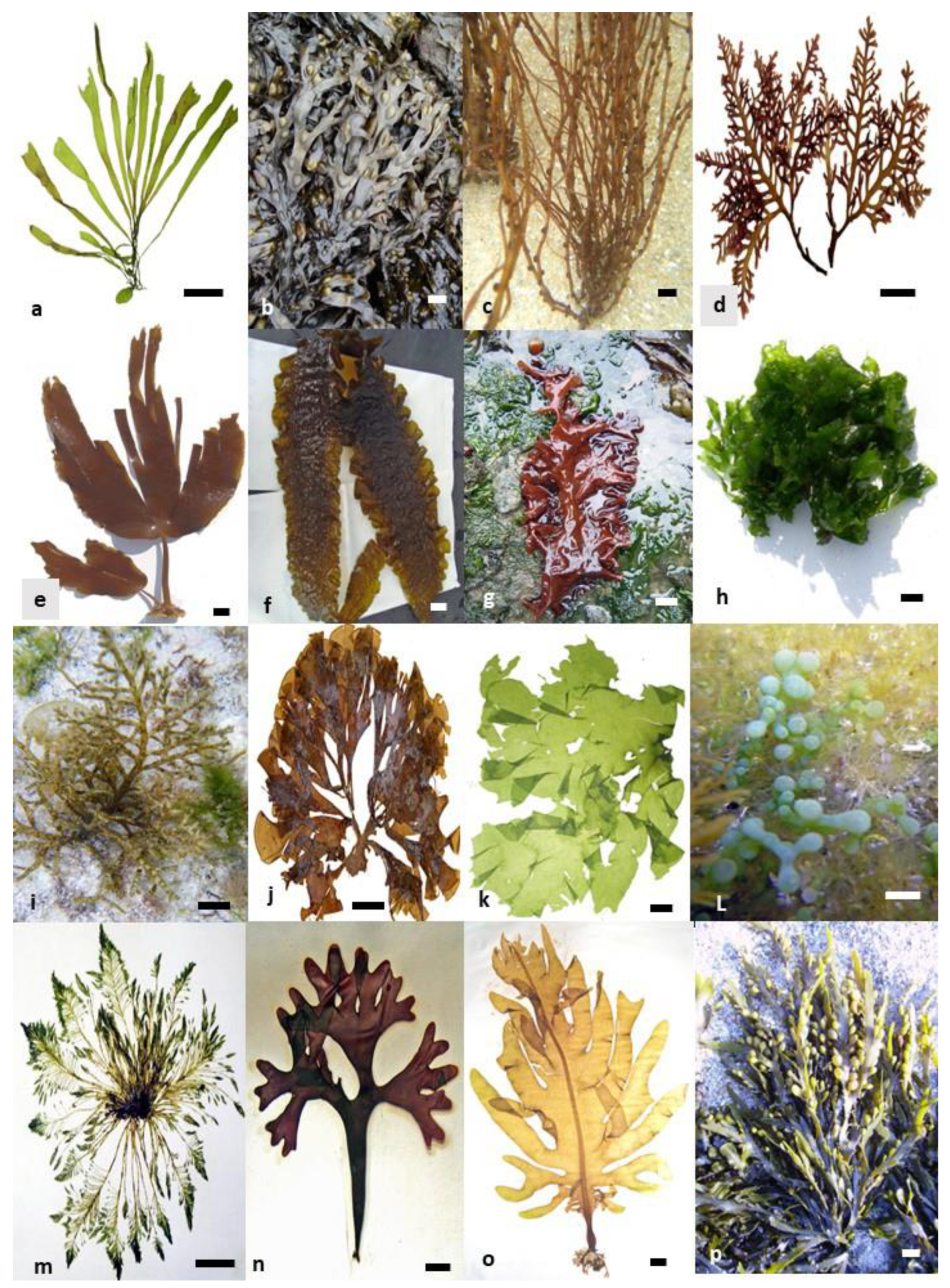
Figure 1.
Marine Algae: a – Ulva compressa (C); b – Fucus vesiculosus (P); c – Gracilaria gracilis (R); d – Laurencia sp. (R); e – Laminaria ochroleuca (P); f – Saccharina latissima (P); g – Schizymenia dubyi (R); h – Ulva rigida (C); i – Cystoseira compressa (P); j – Padina gymnospora (P); k – Ulva lactuca (C); L – Caulerpa racemosa (C); m – Bryopsis plumosa (C); n – Chondrus cispus (R); o – Undaria pinnatifida (P); p – Asophylum nodosum (P). C – Chlorophyta; P – Phaeophyceae; R – Rhodophyta. Scale = 1 cm.
Figure 1.
Marine Algae: a – Ulva compressa (C); b – Fucus vesiculosus (P); c – Gracilaria gracilis (R); d – Laurencia sp. (R); e – Laminaria ochroleuca (P); f – Saccharina latissima (P); g – Schizymenia dubyi (R); h – Ulva rigida (C); i – Cystoseira compressa (P); j – Padina gymnospora (P); k – Ulva lactuca (C); L – Caulerpa racemosa (C); m – Bryopsis plumosa (C); n – Chondrus cispus (R); o – Undaria pinnatifida (P); p – Asophylum nodosum (P). C – Chlorophyta; P – Phaeophyceae; R – Rhodophyta. Scale = 1 cm.
Optimization of extraction methods involving hydroalcoholic solvents has shown promise in maximizing the extraction of phenolic compounds. The addition of acidifiers, such as citric acid or HCl, to the solvents can enhance extraction efficiency by facilitating the release of phenolic compounds. Soxhlet extraction, although effective in terms of yield, should be approached with caution due to the potential degradation of temperature-sensitive compounds. Heat-assisted extraction, with its two-step process involving a rapid initial extraction followed by a slower extraction phase, allows for efficient extraction while minimizing the risk of compound degradation [171,172,173].
Nonconventional extraction techniques, such as MAE, subcritical CO2 extraction, UAE, and PLE, have demonstrated their ability to improve extraction efficiency and maintain the integrity of phenolic compounds. MAE, utilizing microwave radiation to selectively heat solvents, reduces extraction times and enhances the extraction kinetics. Subcritical CO2 extraction employs pressurized carbon dioxide, which exhibits gas and liquid-like properties, to achieve efficient extraction at lower temperatures. UAE utilizes high-frequency ultrasound waves to generate cavitation bubbles, leading to the disruption of cell walls and facilitating the release of phenolic compounds. PLE, characterized by high pressure, short processing times, and elevated temperatures with nontoxic solvents, offers rapid and efficient extraction with reduced solvent usage [174,175,176,177].
Various factors play critical roles in the extraction process. Solvent composition, extraction time, temperature, pressure, and the addition of acidifiers are important considerations for optimizing extraction efficiency and the concentration of phenolic compounds in the extract. The choice of solvent composition depends on the polarity of the target compounds and their affinity for specific solvents. Extraction time should be carefully determined to strike a balance between achieving high yields and avoiding the degradation of sensitive compounds. Temperature and pressure influence the solubility of phenolic compounds and their release from the matrix. The addition of acidifiers, such as citric acid or HCl, can enhance extraction efficiency by adjusting pH and promoting the extraction of phenolic compounds [178,179,180].
Ongoing research and advancements in extraction methodologies hold great potential for further enhancing the extraction efficacy and accuracy of phenolic compounds from marine macroalgae. Exploring the underlying principles and mechanisms of various extraction techniques can lead to the optimization of the extraction process, improved compound quality, and the development of sustainable and eco-friendly extraction practices.
3. Recent Advances, Developments, and Future Scope in Extraction of Phenolic Compounds from Marine Algae
Advancements in Extraction Techniques: Recent years have seen significant advancements in extraction techniques for phenolic compounds from marine algae. Nonconventional techniques such as microwave-assisted extraction (MAE), ultrasound-assisted extraction (UAE), and pressurized liquid extraction (PLE) have gained attention for their ability to enhance extraction efficiency and obtain higher yields. These techniques offer advantages such as reduced extraction times, improved compound solubility, and preservation of compound integrity [181].
Optimization of Extraction Parameters: Researchers have been focusing on optimizing various extraction parameters to achieve higher extraction efficiency and better compound quality. Factors such as solvent composition, extraction time, temperature, pressure, and the addition of acidifiers have been investigated to determine their impact on extraction outcomes. The development of optimized extraction protocols can significantly enhance the extraction efficiency of phenolic compounds from marine algae [182].
Novel Solvents and Green Extraction Approaches: There is growing interest in the use of alternative solvents and green extraction approaches for the extraction of phenolic compounds. Researchers are exploring the use of environmentally friendly solvents such as deep eutectic solvents (DES) and ionic liquids, which offer improved solubility and selectivity for phenolic compounds. Green extraction approaches, including subcritical water extraction and enzyme-assisted extraction, are also being explored as sustainable alternatives to conventional extraction methods [183,184].
Characterization and Identification of Phenolic Compounds: Advances in analytical techniques such as high-performance liquid chromatography (HPLC), mass spectrometry (MS), and nuclear magnetic resonance (NMR) have enabled more accurate characterization and identification of phenolic compounds from marine algae. This information is crucial for understanding the composition and bioactivity of these compounds and for their potential application in various industries [185,186,187].
Bioactivity and Health Benefits: Research focusing on the bioactivity and health benefits of phenolic compounds from marine algae has gained significant attention. These compounds have shown promising antioxidant, anti-inflammatory, anticancer, and antimicrobial properties, among others. Further studies are needed to explore their mechanisms of action, bioavailability, and potential applications in functional foods, nutraceuticals, and pharmaceuticals [188].
Industrial-Scale Extraction and Commercialization: As the demand for phenolic compounds from marine algae grows, there is a need to develop efficient and scalable extraction processes for industrial applications. Researchers are working on optimizing extraction technologies and scaling them up for commercial production. This involves addressing challenges such as cost-effectiveness, process efficiency, and the development of standardized extraction protocols.
Valorisation of Waste Biomass: The valorisation of waste biomass generated during the extraction process is an important area of research. Researchers are exploring the utilization of by-products and waste materials from marine algae to extract and recover additional value-added compounds, such as bioactive peptides and polysaccharides. This approach contributes to a more sustainable and efficient extraction process while minimizing waste and maximizing resource utilization [189].
Exploration of Untapped Algal Species: The vast biodiversity of marine algae offers a wealth of untapped potential for the extraction of phenolic compounds. Researchers are exploring lesser-known algal species and their unique phenolic profiles to discover new bioactive compounds and broaden the scope of their applications. This involves studying the composition, bioactivity, and extraction potential of underexplored marine algae [190].
4. Unlocking the Potential: Recent Progress in Seaweed Pigment Extraction
Pigment compound extraction from seaweed has attracted significant interest due to the potential applications of these pigments in various industries, including cosmetics, food, and pharmaceuticals. Seaweed-derived pigments, such as chlorophylls, carotenoids, and phycobiliproteins, possess diverse colours and bioactive properties that make them valuable for a range of purposes. To isolate and recover these pigments, several extraction methods have been employed, each offering unique advantages and challenges [A30, A31]. Solvent extraction is a commonly utilized technique for extracting seaweed pigments. This method involves using organic solvents to dissolve and extract the pigments from the algal biomass. The choice of solvent depends on the specific pigment of interest, as their solubilities vary in different solvents. For example, chlorophylls are typically soluble in organic solvents like acetone, methanol, or ethanol, while carotenoids are better extracted using nonpolar solvents such as hexane or diethyl ether [193].
Supercritical fluid extraction (SFE), particularly utilizing supercritical carbon dioxide (SC-CO2), has gained popularity as another extraction method for seaweed pigments. SC-CO2 is an environmentally friendly, non-toxic, and non-flammable solvent that effectively extracts pigments from seaweed. In this method, carbon dioxide is pressurized above its critical point, where it exhibits both gas and liquid properties. The high diffusion coefficient of SC-CO2 allows for efficient pigment extraction, and its low viscosity enables easy separation from the extract. Moreover, the extraction process in SC-CO2 can be easily controlled by adjusting pressure and temperature, making it a versatile technique for pigment recovery [194,195,196].
Physical techniques such as ultrasound-assisted extraction (UAE) and microwave-assisted extraction (MAE) have also garnered attention for their ability to enhance the efficiency of seaweed pigment extraction. UAE employs high-frequency ultrasound waves that create cavitation, resulting in the disruption of cell walls and improved mass transfer. This facilitates the release of pigments from the algal matrix into the solvent. Similarly, MAE utilizes microwave energy to generate internal heat within the algal biomass, accelerating the extraction process. These physical methods offer advantages such as reduced extraction time, increased yield, and improved extraction kinetics [197,198]. Enzyme-assisted extraction (EAE) has emerged as a promising approach for extracting pigments from seaweed. Enzymes such as cellulases, pectinases, or proteases can be employed to break down the cell wall structure of seaweed, facilitating the release of pigments. EAE not only enhances extraction efficiency but also reduces the need for harsh chemical solvents, making it a greener and more sustainable extraction method [199].
It is important to consider various factors when selecting an extraction method, including the pigment of interest, target application, cost considerations, and environmental impact. Each method has its own advantages and limitations, and optimization is necessary to achieve the desired pigment yield and quality. Factors such as solvent type, extraction time, temperature, and pressure should be carefully considered and tailored to the specific pigments and desired application [200]. Advancements in extraction technology and process optimization are ongoing, aiming to enhance the efficiency, sustainability, and cost-effectiveness of pigment extraction from seaweed. Continued research and development in the field of extraction methods will contribute to unlocking the full potential of seaweed pigments for diverse industrial applications [201].
In summary, the extraction of pigment compounds from seaweed involves a range of techniques, including solvent extraction, supercritical fluid extraction (SC-CO2), ultrasound-assisted extraction (UAE), microwave-assisted extraction (MAE), and enzyme-assisted extraction (EAE). Each method offers unique advantages and challenges, and their selection depends on various factors such as the pigment of interest, target application, target application, cost considerations, and environmental impact. It is important to optimize extraction conditions, such as solvent type, extraction time, temperature, and pressure, to maximize pigment yield and quality while preserving the integrity of the pigments.
Ongoing advancements in extraction technology and process optimization aim to improve the efficiency, sustainability, and cost-effectiveness of seaweed pigment extraction. Researchers continue to explore new methods and techniques to unlock the full potential of seaweed pigments for diverse industrial applications [202]. By further understanding the properties and potential applications of seaweed pigments, researchers can develop innovative extraction approaches that offer improved efficiency, reduced environmental impact, and enhanced product quality. These advancements will contribute to the utilization of seaweed pigments in various industries, including cosmetics, food, and pharmaceuticals [203].
5. Recent Advances, Developments, and Future Scope in Extraction of Pigment-Related Compounds from Marine Algae
Extraction of pigment-related compounds from marine algae has seen significant advancements in recent years, driven by the increasing demand for natural pigments in various industries. Researchers have focused on developing efficient, sustainable, and cost-effective extraction methods to harness the full potential of these valuable compounds. Here, we highlight some recent advances, developments, and future scopes in the field:
Green and Sustainable Extraction Techniques: One of the prominent trends in pigment extraction from marine algae is the exploration of environmentally friendly and sustainable extraction methods. This includes the use of non-toxic solvents, such as supercritical carbon dioxide (SC-CO2) and subcritical water, which eliminate the need for hazardous organic solvents. These methods not only enhance the safety and sustainability of the extraction process but also contribute to the preservation of pigment quality [204].
Biotechnological Approaches: Advancements in biotechnology have opened up new possibilities for pigment extraction from marine algae. Genetic engineering and metabolic engineering techniques are being employed to enhance the production of specific pigments of interest. This includes manipulating the biosynthetic pathways or introducing genes from other organisms to increase pigment yields or generate novel pigments. Biotechnological approaches offer the potential for tailoring pigment profiles and expanding the range of available pigments [205,206].
Integration of Green Extraction Technologies: The combination of different green extraction technologies has shown promising results in improving extraction efficiency and pigment recovery. For example, the integration of ultrasound-assisted extraction (UAE) with other methods such as enzyme-assisted extraction (EAE) or subcritical water extraction has demonstrated synergistic effects, leading to enhanced pigment extraction yields. These integrated approaches offer a comprehensive and sustainable solution for efficient pigment extraction [207,208].
Valorisation of Residual Biomass: Efforts are being made to maximize the utilization of marine algae biomass by valorising residual components after pigment extraction. The extracted algal biomass can be further processed to obtain high-value co-products such as bioactive compounds, functional ingredients, or biofuels. This approach not only enhances the economic viability of pigment extraction but also contributes to the development of a circular economy in the marine algae industry [209,210].
Nanotechnology Applications: Nanotechnology has emerged as a promising field for the development of innovative pigment extraction methods. Nanostructured materials, such as nanoparticles and nanofibers, can be utilized as adsorbents or carriers for improved pigment extraction and stabilization. Nanotechnology-based approaches offer enhanced extraction efficiency, increased stability, and improved bioavailability of extracted pigments [211].
Scale-up and Commercialization: As the demand for natural pigments continues to grow, the scale-up and commercialization of extraction processes from marine algae are gaining momentum. Efforts are being made to optimize extraction protocols, increase production capacity, and establish cost-effective large-scale extraction facilities. Collaborations between academia, industry, and government entities are crucial for accelerating the translation of laboratory-scale innovations into industrial applications [212,213,214].
Exploring New Pigment Sources: While marine algae are abundant and diverse sources of pigments, researchers are expanding their search for new pigment sources beyond traditional seaweeds. Microalgae, diatoms, and cyanobacteria are being explored for their unique pigment profiles and their potential in various applications. The identification and characterization of novel pigments from these sources present exciting opportunities for expanding the pigment palette and exploring new functional properties [215,216,217].
In conclusion, the extraction of pigment-related compounds from marine algae has witnessed significant advancements in recent years. Green and sustainable extraction techniques, biotechnological approaches, integration of green extraction technologies, valorisation of residual biomass, nanotechnology applications, scale-up, and commercialization efforts, and the exploration of new pigment sources are among the key developments in the field.
6. Future research should focus on
Optimization of Extraction Parameters: Further optimization of extraction parameters such as solvent composition, temperature, pressure, and extraction time can lead to improved pigment yields, extraction efficiency, and product quality. Advanced modelling techniques and experimental design methodologies can aid in determining the optimal conditions for different pigment types and desired applications [218,219].
Characterization of Pigment Bioactivity: Exploring the bioactive properties of extracted pigments and their potential applications in areas such as medicine, biotechnology, and nutraceuticals is an important avenue for future research. Understanding the bioactive components and their mechanisms of action can open up new opportunities for the development of value-added products [220].
Stability and Shelf-life Studies: Investigating the stability and shelf-life of extracted pigments under various storage conditions is crucial for their commercial viability. Studies on pigment degradation, antioxidant capacity, and colour stability over time will help in developing appropriate storage and preservation methods to maintain pigment quality [221,222].
Upstream Cultivation Strategies: Research on optimizing algae cultivation strategies, such as optimizing growth conditions, nutrient management, and genetic manipulation, can lead to increased pigment production and improved pigment profiles. Identifying algae strains with higher pigment content and better growth characteristics can significantly enhance the efficiency and sustainability of pigment extraction [223].
Industrial-Scale Extraction Technologies: Scaling up extraction processes to an industrial level requires the development of efficient and cost-effective technologies. Future research should focus on designing and implementing large-scale extraction systems that can handle high volumes of algal biomass while maintaining product quality and minimizing energy consumption [224,225].
Waste Management and Environmental Impact: As the demand for pigment extraction increases, it is crucial to address the environmental impact associated with the production and waste generated during the extraction process. Developing strategies for efficient waste management, including the utilization of by-products, and minimizing environmental footprint, should be a priority in future research [226,227].
Market Applications and Consumer Perception: Understanding market trends, consumer preferences, and regulatory aspects related to natural pigments is essential for successful commercialization. Market studies, consumer perception surveys, and collaborations with industry stakeholders can provide insights into the potential applications and acceptance of seaweed-derived pigments in various industries [228].
7. Discussion
The investigation of biological activities associated with phytochemicals derived from marine macroalgae, specifically in the context of their potential applications in cosmeceutical formulations, has been extensively explored [229]. Seaweed extracts naturally contain a diverse range of phenolic compounds, eliminating the need for additional extraction steps as these compounds are already present in the extracts. Noteworthy studies by Thomas and Kim [230], Naga-yama et al. [231], and Hwang [232] have underscored the anti-aging properties of chlorotannin, a phenolic compound derived from marine algae. In comparison to other natural antioxidants, chlorotannin has demonstrated lower toxicity, rendering it an appealing candidate for incorporation into cosmetic formulations. Marine algae extracts encompass a wide array of phenolic compounds, including phlorotannin, phloroglucinol, eckol, dieckol, fucol, phlorethol, fuhalols, lignans, bromophenol, flavonoids, phenolic terpenoids, and mycosporine amino acids (MAAs).
Extensive research has revealed significant skin health benefits associated with specific phenolic compounds, including their anti-aging, photoprotective, anti-wrinkle, anti-allergy, anti-inflammatory, antioxidant, antimicrobial, antifungal, tyrosinase inhibition, anti-melanogenic, skin whitening, UVB protection, and anti-acne properties [233,234,235]. For example, studies by Tang et al. [236] and Khanavi et al. [237] have demonstrated the cytotoxic and antibacterial activities of phenolic fractions extracted from Ulva clathrata and Ulva flexuosa species. Lavoie et al. [238] reported the antibacterial activity of phenolic compounds derived from Cladophora socialis, including 2,3,8,9-tetrahydroxybenzochromen-6-one, 3,4,30,40-tetrahydroxy-1,10-biphenyl, and cladophorol. Additionally, Ko et al. [239] discovered potential antimicrobial properties in bromophenols found in macroalgae, such as 5'-Hydroxyisoavrainvilleol. Flavonoids, such as kaempferol and quercetin, found in the green macroalga Caulerpa sp., have exhibited significant antioxidant properties [240]. Compounds derived from Vidalia colensoi (also known as Osmundaria colensoi), including lanosol methyl ether, lanosol butenone, and rhodomelol, have demonstrated notable antibacterial and antifungal properties against various pathogens, exhibiting bactericidal, bacteriostatic, and anti-acne effects in a dose-dependent manner [241]. Mycosporine amino acids (MAAs), such as palythine, shinorine, asterina-330, Porphyra-333, palythinol, and usujirene, have shown potential anti-cancer activity in cell lines derived from HeLa and HaCat, along with reported effects on inflammation and immunity [234,242,243]. Furthermore, these compounds can serve as effective UV filters, protecting the skin from photodamage. Phlorotannin extracted from Ecklonia cava, along with compounds like dieckol, dioxinodehydroeckol, eckol, eckstolonol, phlorofucofu-roeckol A, and 7-phloroeckol, have been investigated for their potential in skin whitening, wrinkle prevention, and the inhibition of enzymes involved in skin aging and pigmentation [244]. Remarkably, Bak et al. reported that 7-phloroeckol, isolated from E. cava, promotes hair growth in humans. These findings highlight the immense potential of macroalgae-derived compounds in various cosmetic applications and underscore their significance in promoting desirable skin benefits.
The broad spectrum of pigment profiles found in marine algae has also led to their application in various other fields, including photoprotection, anti-inflammatory effects, anticancer effects, and the inhibition of cell proliferation [245,246,247,248,249]. Algae species are recognized as significant sources of β-carotene, along with other compounds such as carotenoids, astaxanthin, and docosahexaenoic acid (DHA), which exhibit antioxidant activity [250,251,252]. In the cosmetic industry, green photosynthetic pigments from algae have been evaluated for their antioxidant and antimutagenic properties [253]. Chlorophyll, in particular, has shown potential as a natural coloring agent, with possible deodorizing and antibacterial properties. Additionally, chlorophyll exhibits high antioxidant activity and the ability to stimulate tissue growth, making it valuable in cosmetic formulations [254,255,256,257]. Carotenoids derived from marine algae find extensive applications as natural dyes and antioxidants, offering benefits such as antitumor, anti-inflammatory, and radical sequestering effects [258,259,260]. Carotenoids have also been found to modulate UVA-induced gene expression and protect the skin against UV light [261]. Astaxanthin, a carotenoid present in algae, plays various roles in preventing UV-mediated photo-oxidation, tumors, and inflammation [262]. Similarly, fucoxanthin, another carotenoid found in algae, exhibits protective effects on the skin, making it beneficial in cosmetic applications [263,264]. Studies have reported the antioxidant and anti-inflammatory properties of carotenoids, contributing to their potential for photoprotection and protection against UVA-induced damage [265].
In conclusion, the extensive research on marine macroalgae has shed light on the biological activities of phytochemicals derived from these sources. Their application in cosmeceutical preparations has shown promising results, particularly in relation to their anti-aging, photoprotective, and antioxidant properties. The diverse array of phenolic compounds, carotenoids, and other pigments present in marine algae offers immense potential for the development of novel cosmetic formulations. Further studies are warranted to explore the specific mechanisms of action and optimal utilization of these compounds in cosmetic applications, paving the way for the advancement of marine-derived ingredients in the beauty and skincare industry. To fully harness the potential of marine macroalgae, further exploration and characterization of diverse seaweed species are warranted. The extensive investigation of these species will enable their effective utilization in cosmetic formulations, unlocking their remarkable skin-enhancing properties. As the demand for natural bioactive extracts and formulations in the cosmetic industry continues to rise, marine macroalgae have garnered increased attention for their diverse biological benefits.
8. Conclusion
The exploration of macroalgae-derived compounds, including both phenolic compounds and pigments, holds great promise for the development of bioactive substances in the field of skin cosmetic preparations. Phycological research plays a vital role in advancing the cosmetic industry by enabling the extraction, characterization, and isolation of seaweed species. However, a significant challenge lies in concentrating the bioactive compounds present in macroalgae for formulation purposes. Ongoing research focuses on investigating polyphenolic compounds, pigments, and other chemical components to overcome this limitation. A current limitation in the existing knowledge is the lack of comprehensive information on the in vivo effects of phenolic compounds and pigments derived from seaweed and their interactions with human cells. To address this gap, it is essential to employ diverse methodologies and determination techniques to thoroughly evaluate their effects and ensure a robust and safe system. Further studies and research are imperative to characterize phytochemicals, extract them, perform comprehensive characterization, and examine their toxicity using various in vitro and in vivo approaches. For the cosmetic industry to achieve sustainability, new investigations are necessary to understand and fully exploit the biological benefits of macroalgae-derived compounds, including both phenolic compounds and pigments, in cosmetic formulations and their impact on the skin. Through in-depth research, we can uncover the potential of macroalgae-derived phenolic compounds and pigments as valuable assets to enhance the efficacy and safety of cosmetic products. This comprehensive exploration will contribute to the development of a rich library of bioactive compounds derived from macroalgae, fostering innovation in the cosmetic industry. Continued knowledge pursuit in this area will not only expand our understanding of the complex interactions between macroalgae-derived phenolic compounds, pigments, and the human body but also enable the development of effective and sustainable cosmetic solutions. By unlocking the full potential of these natural resources through comprehensive research efforts, we can pave the way for a future where the cosmetic industry thrives on the utilization of macroalgae-derived compounds, benefiting both the industry and consumers alike.
Author Contributions
Conceptualization, H.S.K. and L.P.; methodology, H.S.K.; investigation, H.S.K. and N.B.P.; writing—original draft preparation, H.S.K. and N.B.P.; writing—review and editing, H.S.K. and L.P. All authors have read and agreed to the published version of the manuscript.
Funding
This research received no external funding.
Acknowledgments
The authors would like to express their sincere gratitude to IIT Bombay-SAIF (Indian Institute of Technology, Sophisticated Analytical Instrument Facility) for providing the HRLCMS QTOF facilities used in this study. The authors would also like to thank MARE—Marine and Environmental Sciences Centre—ARNET, and the University of Coimbra, within the scope of the project LA/P/0069/2020 granted to the Associate Laboratory ARNET, and UIDB/04292/2020 granted to MARE—Marine and Environmental Sciences Centre.
Conflicts of Interest
The authors declare no conflict of interest.
References
- Martin, K.I.; Glaser, D.A. Cosmeceuticals: the new medicine of beauty.. Mo. Med. 2011, 108, 60–3.
- Yin, S.N.; Hayes, R.B.; Linet, M.S.; Li, G.L.; Dosemeci, M.; Travis, L.B.; Zhang, Z.N.; Li, D.G.; Chow, W.H.; Wacholder, S.; Blot, W.J. An expanded cohort study of cancer among benzene-exposed workers in China. Benzene Study Group. Environmental Health Perspectives. 1996, 104(suppl 6), pp.1339-1341.
- Kerdudo, A.; Burger, P.; Merck, F.; Dingas, A.; Rolland, Y.; Michel, T.; Fernandez, X. Development of a natural ingredient – Natural preservative: A case study. Comptes Rendus Chim. 2016, 19, 1077–1089. [CrossRef]
- Draelos, Z.D. The cosmeceutical realm. Clin. Dermatol. 2008, 26, 627–632. [CrossRef]
- Hafeez, F.; Maibach, H. An overview of parabens and allergic contact dermatitis.. Ski. Ther. Lett. 2013, 18.
- Mowad, C.M. Allergic contact dermatitis caused by parabens: 2 case reports and a review. American Journal of Contact Dermatitis. 2000, 11, 53–56. [CrossRef]
- Pangestuti, R.; Shin, K.-H.; Kim, S.-K. Anti-Photoaging and Potential Skin Health Benefits of Seaweeds. Mar. Drugs 2021, 19, 172. [CrossRef]
- Lopes, G.; Sousa, C.; Silva, L.R.; Pinto, E.; Andrade, P.B.; Bernardo, J.; Mouga, T.; Valentão, P. Can phlorotannins purified extracts constitute a novel pharmacological alternative for microbial infections with associated inflammatory conditions? PloS one. 2012, 7(2), p.e31145.
- Pereira, L. Therapeutic and Nutritional Uses of Algae; CRC Press: Boca Raton, FL, USA, 2018; ISBN 9781498755382. [CrossRef]
- Leandro, A.; Pereira, L.; Gonçalves, A.M.M. Diverse Applications of Marine Macroalgae. Mar. Drugs 2020, 18, 17. [CrossRef]
- Pereira, L. Algae. Litoral of Viana do Castelo; Câmara Municipal de Viana do Castelo: Viana do Castelo, Portugal, 2010; pp. 7–8. ISBN 978-972-588-217-7.
- Pereira, L. Guia Ilustrado das Macroalgas—Conhecer e Reconhecer Algumas Espécies da Flora Portuguesa; Universityde Coimbra Press: Coimbra, Portugal, 2009; p. 91. ISBN 978-989-26-0002-4.
- Pereira, L. Chapter 4—Cytological and cytochemical aspects in selected carrageenophytes (Gigartinales, Rhodophyta). In Advances in Algal Cell Biology; Heimann, K., Katsaros, C., Eds.; De Gruyter: Berlin, Germany, 2012; pp. 81–104. ISBN 978-3-11-022960-8. [CrossRef]
- González-Minero, F.J.; Bravo-Díaz, L. The use of plants in skin-care products, cosmetics and fragrances: Past and present. Cosmetics. 2018, 5(3), p.50.
- Ibañez, E.; Herrero, M.; Mendiola, J.A.; Castro-Puyana, M. Extraction and characterization of bioactive compounds with health benefits from marine resources: macro and micro algae, cyanobacteria, and invertebrates. In Marine bioactive compounds (pp. 55-98). 2012, Springer, Boston, MA.
- Venkatesan, J.; Kim, S.K. Osteoporosis treatment: Marine algal compounds. Advances in food and nutrition research. 2011, 64, pp.417-427.
- Komes, D.; Belščak-Cvitanović, A.; Horžić, D.; Rusak, G.; Likić, S.; Berendika, M. Phenolic composition and antioxidant properties of some traditionally used medicinal plants affected by the extraction time and hydrolysis. Phytochem. Anal. 2010, 22, 172–180. [CrossRef]
- Jesumani, V.; Du, H.; Aslam, M.; Pei, P.; Huang, N. Potential Use of Seaweed Bioactive Compounds in Skincare—A Review. Mar. Drugs 2019, 17, 688. [CrossRef]
- Port'S, P.d.S.; Chisté, R.C.; Godoy, H.T.; Prado, M.A. The phenolic compounds and the antioxidant potential of infusion of herbs from the Brazilian Amazonian region. Food Res. Int. 2013, 53, 875–881. [CrossRef]
- Dias, M.I.; Sousa, M.J.; Alves, R.C.; Ferreira, I.C. Exploring plant tissue culture to improve the production of phenolic compounds: A review. Ind. Crop. Prod. 2016, 82, 9–22. [CrossRef]
- Cotas, J.; Leandro, A.; Monteiro, P.; Pacheco, D.; Figueirinha, A.; Gonçalves, A.M.M.; Da Silva, G.J.; Pereira, L. Seaweed Phenolics: From Extraction to Applications. Mar. Drugs 2020, 18, 384. [CrossRef]
- Kalasariya, H.S.; Yadav, V.K.; Yadav, K.K.; Tirth, V.; Algahtani, A.; Islam, S.; Gupta, N.; Jeon, B.-H. Seaweed-Based Molecules and Their Potential Biological Activities: An Eco-Sustainable Cosmetics. Molecules 2021, 26, 5313. [CrossRef]
- Nasab, S.B.; Homaei, A.; Pletschke, B.I.; Salinas-Salazar, C.; Castillo-Zacarias, C.; Parra-Saldívar, R. Marine resources effective in controlling and treating diabetes and its associated complications. Process. Biochem. 2020, 92, 313–342. [CrossRef]
- Santos, S.A.O.; Félix, R.; Pais, A.C.S.; Rocha, S.M.; Silvestre, A.J.D. The Quest for Phenolic Compounds from Macroalgae: A Review of Extraction and Identification Methodologies. Biomolecules 2019, 9, 847. [CrossRef]
- Jimenez-Lopez, C.; Pereira, A.; Lourenço-Lopes, C.; Garcia-Oliveira, P.; Cassani, L.; Fraga-Corral, M.; Prieto, M.; Simal-Gandara, J. Main bioactive phenolic compounds in marine algae and their mechanisms of action supporting potential health benefits. Food Chem. 2020, 341, 128262. [CrossRef]
- Parys, S.; Rosenbaum, A.; Kehraus, S.; Reher, G.; Glombitza, K.-W.; König, G.M. Evaluation of Quantitative Methods for the Determination of Polyphenols in Algal Extracts. J. Nat. Prod. 2007, 70, 1865–1870. [CrossRef]
- Mateos, R.; Pérez-Correa, J.R.; Domínguez, H. Bioactive Properties of Marine Phenolics. Mar. Drugs 2020, 18, 501. [CrossRef]
- Farasat, M.; Khavari-Nejad, R.-A.; Nabavi, S.M.B.; Namjooyan, F. Antioxidant Activity, Total Phenolics and Flavonoid Contents of some Edible Green Seaweeds from Northern Coasts of the Persian Gulf. Iran. J. Pharm. Res. : IJPR 2014, 13, 163–170.
- Cho, M.; Kang, I.-J.; Won, M.-H.; Lee, H.-S.; You, S. The Antioxidant Properties of Ethanol Extracts and Their Solvent-Partitioned Fractions from Various Green Seaweeds. J. Med. Food 2010, 13, 1232–1239. [CrossRef]
- Tang, H.; Inoue, M.; Uzawa, Y.; Kawamura, Y. Anti-tumorigenic components of a sea weed, Enteromorpha clathrata. BioFactors. 2004, 22(1-4), pp.107-110.
- Khanavi, M.; Gheidarloo, R.; Sadati, N.; Ardekani, M.R.S.; Nabavi, S.M.B.; Tavajohi, S.; Ostad, S.N. Cytotoxicity of fucosterol containing fraction of marine algae against breast and colon carcinoma cell line. Pharmacogn. Mag. 2012, 8, 60–64. [CrossRef]
- Lavoie, S.; Sweeney-Jones, A.M.; Mojib, N.; Dale, B.; Gagaring, K.; McNamara, C.W.; Quave, C.L.; Soapi, K.; Kubanek, J. Antibacterial Oligomeric Polyphenols from the Green Alga Cladophora socialis. J. Org. Chem. 2019, 84, 5035–5045. [CrossRef]
- Torres, P.; Santos, J.P.; Chow, F.; dos Santos, D.Y. A comprehensive review of traditional uses, bioactivity potential, and chemical diversity of the genus Gracilaria (Gracilariales, Rhodophyta). Algal Res. 2018, 37, 288–306. [CrossRef]
- Giada, M.D.L.R. Food phenolic compounds: main classes, sources and their antioxidant power. Oxidative stress and chronic degenerative diseases-A role for antioxidants. 2013, pp.87-112.
- Vermerris, W.; Nicholson, R. Families of phenolic compounds and means of classification. In Phenolic compound biochemistry. 2008, (pp. 1-34). Springer, Dordrecht. [CrossRef]
- Tsimogiannis, D.; Oreopoulou, V. Classification of phenolic compounds in plants. In Polyphenols in plants. 2019, (pp. 263-284). Academic Press.
- Yoshie-Stark, Y.; Hsieh, Y.P.; Suzuki, T. Distribution of flavonoids and related compounds from seaweeds in Japan. Journal-Tokyo University of Fisheries. 2003, 89, pp.1-6.
- Mekinić, I.G.; Skroza, D.; Šimat, V.; Hamed, I.; Čagalj, M.; Perković, Z.P. Phenolic Content of Brown Algae (Pheophyceae) Species: Extraction, Identification, and Quantification. Biomolecules 2019, 9, 244. [CrossRef]
- Ishii, T.; Okino, T.; Suzuki, M.; Machiguchi, Y. Tichocarpols A and B, Two Novel Phenylpropanoids with Feeding-Deterrent Activity from the Red Alga Tichocarpus c rinitus. Journal of natural products. 2004, 67(10), pp.1764-1766.
- Hartmann, A.; Ganzera, M.; Karsten, U.; Skhirtladze, A.; Stuppner, H. Phytochemical and Analytical Characterization of Novel Sulfated Coumarins in the Marine Green Macroalga Dasycladus vermicularis (Scopoli) Krasser. Molecules 2018, 23, 2735. [CrossRef]
- Gupta, S.; Abu-Ghannam, N. Recent developments in the application of seaweeds or seaweed extracts as a means for enhancing the safety and quality attributes of foods. Innov. Food Sci. Emerg. Technol. 2011, 12, 600–609. [CrossRef]
- Cherry, P.; O'Hara, C.; Magee, P.J.; McSorley, E.M.; Allsopp, P.J. Risks and benefits of consuming edible seaweeds. Nutr. Rev. 2019, 77, 307–329. [CrossRef]
- Freile-Pelegrín, Y.; Robledo, D. Bioactive Phenolic Compounds from Algae. In B. Hernández-Ledesma, & M. Herrero (Eds.). Bioactive Compounds from Marine Foods: Plant and Animal Sources (pp. 113–129). 2013, Chichester: John Wiley & Sons Ltd.
- Kim, M.-M.; Kim, S.-K. Effect of phloroglucinol on oxidative stress and inflammation. Food Chem. Toxicol. 2010, 48, 2925–2933. [CrossRef]
- Kong, C.-S.; Kim, J.-A.; Yoon, N.-Y.; Kim, S.-K. Induction of apoptosis by phloroglucinol derivative from Ecklonia Cava in MCF-7 human breast cancer cells. Food Chem. Toxicol. 2009, 47, 1653–1658. [CrossRef]
- Kim, E.-K.; Tang, Y.; Kim, Y.-S.; Hwang, J.-W.; Choi, E.-J.; Lee, J.-H.; Lee, S.-H.; Jeon, Y.-J.; Park, P.-J. First Evidence that Ecklonia cava-Derived Dieckol Attenuates MCF-7 Human Breast Carcinoma Cell Migration. Mar. Drugs 2015, 13, 1785–1797. [CrossRef]
- Ahn, J.-H.; Yang, Y.-I.; Lee, K.-T.; Choi, J.-H. Dieckol, isolated from the edible brown algae Ecklonia cava, induces apoptosis of ovarian cancer cells and inhibits tumor xenograft growth. J. Cancer Res. Clin. Oncol. 2014, 141, 255–268. [CrossRef]
- Lee, Y.-J.; Park, J.-H.; Park, S.-A.; Joo, N.-R.; Lee, B.H.; Lee, K.B.; Oh, S.-M. Dieckol or phlorofucofuroeckol extracted from Ecklonia cava suppresses lipopolysaccharide-mediated human breast cancer cell migration and invasion. J. Appl. Phycol. 2019, 32, 631–640. [CrossRef]
- Li, Y.; Qian, Z.-J.; Kim, M.-M.; Kim, S.-K. Cytotoxic activities of phlorethol and fucophlorethol derivatives isolated from Laminariaceae Ecklonia cava. J. Food Biochem. 2011, 35, 357–369. [CrossRef]
- Pelegrin, Y.; Freile, A.; Robledo, D. Bioactive Phenolic Compounds from Algae. Bioactive Compounds from Marine Foods: Plant and Animal Sources. John Wiley & Sons Ltd, Chichester. 2013. [CrossRef]
- Shibata, T.; Ishimaru, K.; Kawaguchi, S.; Yoshikawa, H.; Hama, Y. Antioxidant activities of phlorotannins isolated from Japanese Laminariaceae. In Nineteenth International Seaweed Symposium. 2007, (pp. 255-261). Springer, Dordrecht. [CrossRef]
- Besednova, N.N.; Zvyagintseva, T.N.; Kuznetsova, T.A.; Makarenkova, I.D.; Smolina, T.P.; Fedyanina, L.N.; Kryzhanovsky, S.P.; Zaporozhets, T.S. Marine Algae Metabolites as Promising Therapeutics for the Prevention and Treatment of HIV/AIDS. Metabolites 2019, 9, 87. [CrossRef]
- Kim, A.R.; Lee, M.S.; Shin, T.S.; Hua, H.; Jang, B.C.; Choi, J.S.; Byun, D.S.; Utsuki, T.; Ingram, D.; Kim, H.R. Phlorofucofuroeckol A inhibits the LPS-stimulated iNOS and COX-2 expressions in macrophages via inhibition of NF-κB, Akt, and p38 MAPK. Toxicology in Vitro. 2011, 25(8), pp.1789-1795.
- Ryu, B.; Ahn, B.-N.; Kang, K.-H.; Kim, Y.-S.; Li, Y.-X.; Kong, C.-S.; Kim, S.-K.; Kim, D.G. Dioxinodehydroeckol protects human keratinocyte cells from UVB-induced apoptosis modulated by related genes Bax/Bcl-2 and caspase pathway. J. Photochem. Photobiol. B: Biol. 2015, 153, 352–357. [CrossRef]
- Ferreres, F.; Lopes, G.; Gil-Izquierdo, A.; Andrade, P.B.; Sousa, C.; Mouga, T.; Valentão, P. Phlorotannin Extracts from Fucales Characterized by HPLC-DAD-ESI-MSn: Approaches to Hyaluronidase Inhibitory Capacity and Antioxidant Properties. Mar. Drugs 2012, 10, 2766–2781. [CrossRef]
- Shibata, T.; Fujimoto, K.; Nagayama, K.; Yamaguchi, K.; Nakamura, T. Inhibitory activity of brown algal phlorotannins against hyaluronidase. Int. J. Food Sci. Technol. 2002, 37, 703–709. [CrossRef]
- Kang, H.S.; Kim, H.R.; Byun, D.S.; Son, B.W.; Nam, T.J.; Choi, J.S. Tyrosinase inhibitors isolated from the edible brown algaEcklonia stolonifera. Arch. Pharmacal Res. 2004, 27, 1226–1232. [CrossRef]
- Yoon, N.Y.; Eom, T.-K.; Kim, M.-M.; Kim, S.-K. Inhibitory Effect of Phlorotannins Isolated from Ecklonia cava on Mushroom Tyrosinase Activity and Melanin Formation in Mouse B16F10 Melanoma Cells. J. Agric. Food Chem. 2009, 57, 4124–4129. [CrossRef]
- Lee, S.H.; Kang, S.M.; Sok, C.H.; Hong, J.T.; Oh, J.Y.; Jeon, Y.J. Cellular activities and docking studies of eckol isolated from Ecklonia cava (Laminariales, Phaeophyceae) as potential tyrosinase inhibitor. Algae. 2015, 30(2), pp.163-170.
- Heo, S.-J.; Ko, S.-C.; Cha, S.-H.; Kang, D.-H.; Park, H.-S.; Choi, Y.-U.; Kim, D.; Jung, W.-K.; Jeon, Y.-J. Effect of phlorotannins isolated from Ecklonia cava on melanogenesis and their protective effect against photo-oxidative stress induced by UV-B radiation. Toxicol. Vitr. 2009, 23, 1123–1130. [CrossRef]
- Manandhar, B.; Wagle, A.; Seong, S.H.; Paudel, P.; Kim, H.-R.; Jung, H.A.; Choi, J.S. Phlorotannins with Potential Anti-Tyrosinase and Antioxidant Activity Isolated from the Marine Seaweed Ecklonia stolonifera. Antioxidants 2019, 8, 240. [CrossRef]
- Bak, S.-S.; Sung, Y.K.; Kim, S.-K. 7-Phloroeckol promotes hair growth on human follicles in vitro. Naunyn-Schmiedeberg's Arch. Pharmacol. 2014, 387, 789–793. [CrossRef]
- Pérez, M.J.; Falqué, E.; Domínguez, H. Antimicrobial Action of Compounds from Marine Seaweed. Mar. Drugs 2016, 14, 52. [CrossRef]
- Cherry, P.; O'Hara, C.; Magee, P.J.; McSorley, E.M.; Allsopp, P.J. Risks and benefits of consuming edible seaweeds. Nutr. Rev. 2019, 77, 307–329. [CrossRef]
- Holdt, S.L.; Kraan, S. Bioactive compounds in seaweed: functional food applications and legislation. J. Appl. Phycol. 2011, 23, 543–597. [CrossRef]
- Pérez, M.J.; Falqué, E.; Domínguez, H. Antimicrobial Action of Compounds from Marine Seaweed. Mar. Drugs 2016, 14, 52. [CrossRef]
- Duan, X.-J.; Li, X.-M.; Wang, B.-G. Highly Brominated Mono- and Bis-phenols from the Marine Red Alga Symphyocladia latiuscula with Radical-Scavenging Activity. J. Nat. Prod. 2007, 70, 1210–1213. [CrossRef]
- Choi, J.S.; Park, H.J.; Jung, H.A.; Chung, H.Y.; Jung, J.H.; Choi, W.C. A Cyclohexanonyl Bromophenol from the Red Alga Symphyocladia latiuscula. J. Nat. Prod. 2000, 63, 1705–1706. [CrossRef]
- Colon, M.; Guevara, P.; Gerwick, W.H.; Ballantine, D. 5'-Hydroxyisoavrainvilleol, a New Diphenylmethane Derivative from the Tropical Green Alga Avrainvillea nigricans. J. Nat. Prod. 1987, 50, 368–374. [CrossRef]
- Carte, B.K.; Troupe, N.; Chan, J.A.; Westley, J.W.; Faulkner, D.J. Rawsonol, an inhibitor of HMG-CoA reductase from the tropical green alga Avrainvillea rawsoni. Phytochemistry. 1989, 28(11), pp.2917-2919.
- Estrada, D.M.; Martín, J.D.; Pérez, C. A New Brominated Monoterpenoid Quinol from Cymopolia barbata. J. Nat. Prod. 1987, 50, 735–737. [CrossRef]
- Tanna, B.; Choudhary, B.; Mishra, A. Metabolite profiling, antioxidant, scavenging and anti-proliferative activities of selected tropical green seaweeds reveal the nutraceutical potential of Caulerpa spp.. Algal Res. 2018, 36, 96–105. [CrossRef]
- Jeyaprakash, R.R.K. HPLC Analysis of flavonoids in Acanthophora specifera (red seaweed) collected from Gulf of Mannar, Tamilnadu, India. Int. J. Sci. Res. 2017, 6, 69–72.
- Cotas, J.; Leandro, A.; Monteiro, P.; Pacheco, D.; Figueirinha, A.; Gonçalves, A.M.M.; Da Silva, G.J.; Pereira, L. Seaweed Phenolics: From Extraction to Applications. Mar. Drugs 2020, 18, 384. [CrossRef]
- Makkar, F.; Chakraborty, K. Highly oxygenated antioxidative 2H-chromen derivative from the red seaweed Gracilaria opuntia with pro-inflammatory cyclooxygenase and lipoxygenase inhibitory properties. Nat. Prod. Res. 2017, 32, 2756–2765. [CrossRef]
- Carreto, J.I.; Carignan, M.O. Mycosporine-Like Amino Acids: Relevant Secondary Metabolites. Chemical and Ecological Aspects. Mar. Drugs 2011, 9, 387–446. [CrossRef]
- Rosic, N.N.; Braun, C.; Kvaskoff, D. Extraction and Analysis of Mycosporine-Like Amino Acids in Marine Algae. (D. B. Stengel & S. Connan, Eds.), Natural Products from Marine Algae: Methods and Protocols. New York: Springer, 2015. [CrossRef]
- Guihéneuf, F.; Gietl, A.; Stengel, D.B. Temporal and spatial variability of mycosporine-like amino acids and pigments in three edible red seaweeds from western Ireland. J. Appl. Phycol. 2018, 30, 2573–2586. [CrossRef]
- Suh, S.-S.; Oh, S.K.; Lee, S.G.; Kim, I.-C.; Kim, S. Porphyra-334, a mycosporine-like amino acid, attenuates UV-induced apoptosis in HaCaT cells. Acta Pharm. 2017, 67, 257–264. [CrossRef]
- Ferreres, F.; Lopes, G.; Gil-Izquierdo, A.; Andrade, P.B.; Sousa, C.; Mouga, T.; Valentão, P. Phlorotannin Extracts from Fucales Characterized by HPLC-DAD-ESI-MSn: Approaches to Hyaluronidase Inhibitory Capacity and Antioxidant Properties. Mar. Drugs 2012, 10, 2766–2781. [CrossRef]
- Sanjeewa, K.K.A.; Kim, E.-A.; Son, K.-T.; Jeon, Y.-J. Bioactive properties and potentials cosmeceutical applications of phlorotannins isolated from brown seaweeds: A review. J. Photochem. Photobiol. B: Biol. 2016, 162, 100–105. [CrossRef]
- Stengel, D.B.; Connan, S.; Popper, Z.A. Algal chemodiversity and bioactivity: Sources of natural variability and implications for commercial application. Biotechnol. Adv. 2011, 29, 483–501. [CrossRef]
- Handelman, G.J. The evolving role of carotenoids in human biochemistry. Nutrition 2001, 17, 818–822. [CrossRef]
- Wang, T.; Jonsdottir, R.; Ólafsdóttir, G. Total phenolic compounds, radical scavenging and metal chelation of extracts from Icelandic seaweeds. Food chemistry. 2009, 116(1), pp.240-248.
- Lee, J.-H.; Kim, G.-H. Evaluation of Antioxidant Activity of Marine Algae-Extracts From Korea. J. Aquat. Food Prod. Technol. 2013, 24, 227–240. [CrossRef]
- Yoshie-Stark, Y.; Hsieh, Y.P.; Suzuki, T. Distribution of flavonoids and related compounds from seaweeds in Japan. Journal-Tokyo University of Fisheries. 2003, 89, pp.1-6.
- Cho, S.H.; Kang, S.E.; Cho, J.Y.; Kim, A.R.; Park, S.M.; Hong, Y.K.; Ahn, D.H. The antioxidant properties of brown seaweed (Sargassum siliquastrum) extracts. Journal of medicinal food. 2007, 10(3), pp.479-485.
- Lola-Luz, T.; Hennequart, F.; Gaffney, M. Enhancement of phenolic and flavonoid compounds in cabbage (Brassica oleraceae) following application of commercial seaweed extracts of the brown seaweed, (Ascophyllum nodosum). Agric. Food Sci. 2013, 22, 288–295. [CrossRef]
- Corona, G.; Ji, Y.; Anegboonlap, P.; Hotchkiss, S.; Gill, C.; Yaqoob, P.; Spencer, J.P.E.; Rowland, I. Gastrointestinal modifications and bioavailability of brown seaweed phlorotannins and effects on inflammatory markers. Br. J. Nutr. 2016, 115, 1240–1253. [CrossRef]
- Yan, X.; Yang, C.; Lin, G.; Chen, Y.; Miao, S.; Liu, B.; Zhao, C. Antidiabetic Potential of Green SeaweedEnteromorpha proliferaFlavonoids Regulating Insulin Signaling Pathway and Gut Microbiota in Type 2 Diabetic Mice. J. Food Sci. 2018, 84, 165–173. [CrossRef]
- Farvin, K.S.; Jacobsen, C. Phenolic compounds and antioxidant activities of selected species of seaweeds from Danish coast. Food Chem. 2013, 138, 1670–1681. [CrossRef]
- Chakraborty, K.; Maneesh, A.; Makkar, F. Antioxidant activity of brown seaweeds. Journal of Aquatic Food Product Technology. 2017, 26(4), pp.406-419.
- Vimaladevi, S.; Mahesh, A.; Dhayanithi, B.N.; Karthikeyan, N. Mosquito larvicidal efficacy of phenolic acids of seaweed Chaetomorpha antennina (Bory) Kuetz. against Aedes aegypti. Biologia 2012, 67, 212–216. [CrossRef]
- Corsetto, P.A.; Montorfano, G.; Zava, S.; Colombo, I.; Ingadottir, B.; Jonsdottir, R.; Sveinsdottir, K.; Rizzo, A.M. Characterization of Antioxidant Potential of Seaweed Extracts for Enrichment of Convenience Food. Antioxidants 2020, 9, 249. [CrossRef]
- Ariede, M.B.; Candido, T.M.; Jacome, A.L.M.; Velasco, M.V.R.; De Carvalho, J.C.M.; Baby, A.R. Cosmetic attributes of algae——A review. Algal Res. 2017, 25, 483––487. [CrossRef]
- Anyanwu, R.C.; Rodriguez, C.; Durrant, A.; Olabi, A.G. Micro-Macroalgae Properties and Applications. In Reference Module in Materials Science and Materials Engineering; Elsevier: Amsterdam, The Netherlands, 2018, pp. 1–28. ISBN 9780128035818.
- Ryu, B.; Ahn, B.-N.; Kang, K.-H.; Kim, Y.-S.; Li, Y.-X.; Kong, C.-S.; Kim, S.-K.; Kim, D.G. Dioxinodehydroeckol protects human keratinocyte cells from UVB-induced apoptosis modulated by related genes Bax/Bcl-2 and caspase pathway. J. Photochem. Photobiol. B: Biol. 2015, 153, 352–357. [CrossRef]
- Pimentel, F.B.; Alves, R.C.; Rodrigues, F.; Oliveira, M.B.P.P. Macroalgae-Derived Ingredients for Cosmetic Industry—An Update. Cosmetics 2017, 5, 2. [CrossRef]
- Pereira, L. Seaweeds as source of bioactive substances and skin care therapy—cosmeceuticals, algotheraphy, and thalassotherapy. Cosmetics. 2018, 5(4), p.68.
- Jesumani, V.; Du, H.; Aslam, M.; Pei, P.; Huang, N. Potential Use of Seaweed Bioactive Compounds in Skincare—A Review. Mar. Drugs 2019, 17, 688. [CrossRef]
- Green Confertii Extract-NS—The Garden of Naturalsolution—Datasheet. Available online: https://cosmetics.specialchem.com/product/i-natural-solution-green-confertii-extract-ns (accessed on 30 April 2023).
- Lopes, G.; Sousa, C.; Silva, L.R.; Pinto, E.; Andrade, P.B.; Bernardo, J.; Mouga, T.; Valentão, P. Can phlorotannins purified extracts constitute a novel pharmacological alternative for microbial infections with associated inflammatory conditions? PloS one. 2012, 7(2), p.e31145.
- Yoon, N.Y.; Eom, T.-K.; Kim, M.-M.; Kim, S.-K. Inhibitory Effect of Phlorotannins Isolated from Ecklonia cava on Mushroom Tyrosinase Activity and Melanin Formation in Mouse B16F10 Melanoma Cells. J. Agric. Food Chem. 2009, 57, 4124–4129. [CrossRef]
- Heo, S.-J.; Ko, S.-C.; Cha, S.-H.; Kang, D.-H.; Park, H.-S.; Choi, Y.-U.; Kim, D.; Jung, W.-K.; Jeon, Y.-J. Effect of phlorotannins isolated from Ecklonia cava on melanogenesis and their protective effect against photo-oxidative stress induced by UV-B radiation. Toxicol. Vitr. 2009, 23, 1123–1130. [CrossRef]
- Lee, S.H.; Kang, S.M.; Sok, C.H.; Hong, J.T.; Oh, J.Y.; Jeon, Y.J. Cellular activities and docking studies of eckol isolated from Ecklonia cava (Laminariales, Phaeophyceae) as potential tyrosinase inhibitor. Algae. 2015, 30(2), pp.163-170.
- Sugiura, Y.; Takeuchi, Y.; Kakinuma, M.; Amano, H. Inhibitory effects of seaweeds on histamine release from rat basophile leukemia cells (RBL-2H3). Fish. Sci. 2006, 72, 1286–1291. [CrossRef]
- Shibata, T.; Fujimoto, K.; Nagayama, K.; Yamaguchi, K.; Nakamura, T. Inhibitory activity of brown algal phlorotannins against hyaluronidase. Int. J. Food Sci. Technol. 2002, 37, 703–709. [CrossRef]
- Joe, M.-J.; Kim, S.-N.; Choi, H.-Y.; Shin, W.-S.; Park, G.-M.; Kang, D.-W.; Kim, Y.K. The Inhibitory Effects of Eckol and Dieckol from Ecklonia stolonifera on the Expression of Matrix Metalloproteinase-1 in Human Dermal Fibroblasts. Biol. Pharm. Bull. 2006, 29, 1735–1739. [CrossRef]
- Kong, C.-S.; Kim, J.-A.; Ahn, B.-N.; Kim, S.-K. Potential effect of phloroglucinol derivatives from Ecklonia cava on matrix metalloproteinase expression and the inflammatory profile in lipopolysaccharide-stimulated human THP-1 macrophages. Fish. Sci. 2011, 77, 867–873. [CrossRef]
- Kim, K.-N.; Yang, H.-M.; Kang, S.-M.; Kim, D.; Ahn, G.; Jeon, Y.-J. Octaphlorethol A isolated from Ishige foliacea inhibits α-MSH-stimulated induced melanogenesis via ERK pathway in B16F10 melanoma cells. Food Chem. Toxicol. 2013, 59, 521–526. [CrossRef]
- Heo, S.-J.; Ko, S.-C.; Kang, S.-M.; Cha, S.-H.; Lee, S.-H.; Kang, D.-H.; Jung, W.-K.; Affan, A.; Oh, C.; Jeon, Y.-J. Inhibitory effect of diphlorethohydroxycarmalol on melanogenesis and its protective effect against UV-B radiation-induced cell damage. Food Chem. Toxicol. 2010, 48, 1355–1361. [CrossRef]
- Song, T.-Y.; Yang, N.-C.; Fu, C.-S.; Chang, Y.-T.; Chen, C.-L. The correlation of in vitro mushroom tyrosinase activity with cellular tyrosinase activity and melanin formation in melanoma cells A2058. J. Food Drug Anal. 2010, 17, 4. [CrossRef]
- Chan, Y.Y.; Kim, K.H.; Cheah, S.H. Inhibitory effects of Sargassum polycystum on tyrosinase activity and melanin formation in B16F10 murine melanoma cells. J. Ethnopharmacol. 2011, 137, 1183–1188. [CrossRef]
- Liu, M.; Hansen, P.E.; Lin, X. Bromophenols in Marine Algae and Their Bioactivities. Mar. Drugs 2011, 9, 1273–1292. [CrossRef]
- Le Lann, K.; Surget, G.; Couteau, C.; Coiffard, L.; Cérantola, S.; Gaillard, F.; Larnicol, M.; Zubia, M.; Guérard, F.; Poupart, N.; et al. Sunscreen, antioxidant, and bactericide capacities of phlorotannins from the brown macroalga Halidrys siliquosa. J. Appl. Phycol. 2016, 28, 3547–3559. [CrossRef]
- Kang, K.A.; Lee, K.H.; Chae, S.; Koh, Y.S.; Yoo, B.S.; Kim, J.H.; Ham, Y.M.; Baik, J.S.; Lee, N.H.; Hyun, J.W. Triphlorethol-A from Ecklonia cava protects V79-4 lung fibroblast against hydrogen peroxide induced cell damage. Free Radical Research. 2005, 39(8), pp.883-892.
- Lee, M.S.; Kwon, M.S.; Choi, J.W.; Shin, T.; No, H.K.; Choi, J.S.; Byun, D.S.; Kim, J.I.; Kim, H.R. Anti-inflammatory activities of an ethanol extract of Ecklonia stolonifera in lipopolysaccharide-stimulated RAW 264.7 murine macrophage cells. Journal of agricultural and food chemistry. 2012, 60(36), pp.9120-9129.
- Hwang, E.; Park, S.-Y.; Sun, Z.-W.; Shin, H.-S.; Lee, D.-G.; Yi, T.H. The Protective Effects of Fucosterol Against Skin Damage in UVB-Irradiated Human Dermal Fibroblasts. Mar. Biotechnol. 2013, 16, 361–370. [CrossRef]
- Kim, K.-N.; Yang, H.-M.; Kang, S.-M.; Kim, D.; Ahn, G.; Jeon, Y.-J. Octaphlorethol A isolated from Ishige foliacea inhibits α-MSH-stimulated induced melanogenesis via ERK pathway in B16F10 melanoma cells. Food Chem. Toxicol. 2013, 59, 521–526. [CrossRef]
- Kim, K.-N.; Yang, H.-M.; Kang, S.-M.; Ahn, G.; Roh, S.W.; Lee, W.; Kim, D.; Jeon, Y.-J. Whitening Effect of Octaphlorethol A Isolated from Ishige foliacea in an In Vivo Zebrafish Model. J. Microbiol. Biotechnol. 2015, 25, 448–451. [CrossRef]
- Heo, S.-J.; Hwang, J.-Y.; Choi, J.-I.; Lee, S.-H.; Park, P.-J.; Kang, D.-H.; Oh, C.; Kim, D.-W.; Han, J.-S.; Jeon, Y.-J.; et al. Protective effect of diphlorethohydroxycarmalol isolated from Ishige okamurae against high glucose-induced-oxidative stress in human umbilical vein endothelial cells. Food Chem. Toxicol. 2010, 48, 1448–1454. [CrossRef]
- del Olmo, A.; Picon, A.; Nuñez, M. High pressure processing for the extension of Laminaria ochroleuca (kombu) shelf-life: A comparative study with seaweed salting and freezing. Innov. Food Sci. Emerg. Technol. 2019, 52, 420–428. [CrossRef]
- Ariede, M.B.; Candido, T.M.; Jacome, A.L.M.; Velasco, M.V.R.; De Carvalho, J.C.M.; Baby, A.R. Cosmetic attributes of algae——A review. Algal Res. 2017, 25, 483––487. [CrossRef]
- Sappati, P.K.; Nayak, B.; VanWalsum, G.P.; Mulrey, O.T. Combined effects of seasonal variation and drying methods on the physicochemical properties and antioxidant activity of sugar kelp (Saccharina latissima). J. Appl. Phycol. 2018, 31, 1311–1332. [CrossRef]
- Azam, M.S.; Choi, J.; Lee, M.-S.; Kim, H.-R. Hypopigmenting Effects of Brown Algae-Derived Phytochemicals: A Review on Molecular Mechanisms. Mar. Drugs 2017, 15, 297. [CrossRef]
- Seo, Y.; Park, K.E.; Kim, Y.A.; Lee, H.-J.; Yoo, J.-S.; Ahn, J.-W.; Lee, B.-J. Isolation of Tetraprenyltoluquinols from the Brown Alga Sargassum thunbergii. Chem. Pharm. Bull. 2006, 54, 1730–1733. [CrossRef]
- Cian, R.E.; Bacchetta, C.; Rossi, A.; Cazenave, J.; Drago, S.R. Red seaweed Pyropia columbina as antioxidant supplement in feed for cultured juvenile Pacú (Piaractus mesopotamicus). J. Appl. Phycol. 2018, 31, 1455–1465. [CrossRef]
- Li, K.; Li, X.-M.; Gloer, J.B.; Wang, B.-G. New nitrogen-containing bromophenols from the marine red alga Rhodomela confervoides and their radical scavenging activity. Food Chem. 2012, 135, 868–872. [CrossRef]
- Farasat, M.; Khavari-Nejad, R.A.; Nabavi, S.M.B.; Namjooyan, F. Antioxidant properties of two edible green seaweeds from northern coasts of the Persian Gulf. Jundishapur journal of natural pharmaceutical products. 2013, 8(1), p.47.
- Fernandes, H.; Salgado, J.M.; Martins, N.; Peres, H.; Oliva-Teles, A.; Belo, I. Sequential bioprocessing of Ulva rigida to produce lignocellulolytic enzymes and to improve its nutritional value as aquaculture feed. Bioresour. Technol. 2019, 281, 277–285. [CrossRef]
- Ryu, B.; Ahn, B.-N.; Kang, K.-H.; Kim, Y.-S.; Li, Y.-X.; Kong, C.-S.; Kim, S.-K.; Kim, D.G. Dioxinodehydroeckol protects human keratinocyte cells from UVB-induced apoptosis modulated by related genes Bax/Bcl-2 and caspase pathway. J. Photochem. Photobiol. B: Biol. 2015, 153, 352–357. [CrossRef]
- Manandhar, B.; Paudel, P.; Seong, S.H.; Jung, H.A.; Choi, J.S. Characterizing Eckol as a Therapeutic Aid: A Systematic Review. Mar. Drugs 2019, 17, 361. [CrossRef]
- Manandhar, B.; Wagle, A.; Seong, S.H.; Paudel, P.; Kim, H.-R.; Jung, H.A.; Choi, J.S. Phlorotannins with Potential Anti-Tyrosinase and Antioxidant Activity Isolated from the Marine Seaweed Ecklonia stolonifera. Antioxidants 2019, 8, 240. [CrossRef]
- Eom, S.H.; Lee, E.H.; Park, K.; Kwon, J.Y.; Kim, P.H.; Jung, W.K.; Kim, Y.M. Eckol from Eisenia bicyclis inhibits inflammation through the Akt/NF-κB signaling in Propionibacterium acnes-induced human keratinocyte Hacat cells. Journal of Food Biochemistry. 2017, 41(2), p.e12312.
- Vo, T.S.; Kim, S.-K.; Ryu, B.; Ngo, D.H.; Yoon, N.-Y.; Bach, L.G.; Hang, N.T.N.; Ngo, D.N. The Suppressive Activity of Fucofuroeckol-A Derived from Brown Algal Ecklonia stolonifera Okamura on UVB-Induced Mast Cell Degranulation. Mar. Drugs 2018, 16, 1. [CrossRef]
- Gheda, S.; Naby, M.A.; Mohamed, T.; Pereira, L.; Khamis, A. Antidiabetic and antioxidant activity of phlorotannins extracted from the brown seaweed Cystoseira compressa in streptozotocin-induced diabetic rats. Environ. Sci. Pollut. Res. 2021, 28, 22886–22901. [CrossRef]
- Hermund, D.B.; Plaza, M.; Turner, C.; Jónsdóttir, R.; Kristinsson, H.G.; Jacobsen, C.; Nielsen, K.F. Structure dependent antioxidant capacity of phlorotannins from Icelandic Fucus vesiculosus by UHPLC-DAD-ECD-QTOFMS. Food Chem. 2018, 240, 904–909. [CrossRef]
- Jang, J.; Ye, B.-R.; Heo, S.-J.; Oh, C.; Kang, D.-H.; Kim, J.H.; Affan, A.; Yoon, K.-T.; Choi, Y.-U.; Park, S.C.; et al. Photo-oxidative stress by ultraviolet-B radiation and antioxidative defense of eckstolonol in human keratinocytes. Environ. Toxicol. Pharmacol. 2012, 34, 926–934. [CrossRef]
- Lee, J.-H.; Eom, S.-H.; Lee, E.-H.; Jung, Y.-J.; Kim, H.-J.; Jo, M.-R.; Son, K.-T.; Lee, H.-J.; Kim, J.H.; Lee, M.-S.; et al. In vitro antibacterial and synergistic effect of phlorotannins isolated from edible brown seaweed Eisenia bicyclis against acne-related bacteria. Algae 2014, 29, 47–55. [CrossRef]
- Chinnadurai, S.; Kalyanasundaram, G. Estimation of major pigment content in seaweeds collected from Pondicherry coast. Int. J. Sci. Technol. 2013, 9, 522–525.
- Sudhakar, M.P.; Ananthalakshmi, J.S.; Nair, B.B. Extraction, purification, and study on antioxidant properties of fucoxanthin from brown seaweeds. J. Chem. Pharm. Res. 2013, 5, 169–175.
- Panjaitan, R.S. Pigment contents of Sargassum polycistum macroalgae lipid from Sayang heulang beach, Indonesia. Sci. Study Res. Chem. Chem. Eng. Biotechnol. Food Ind. 2019, 20, 365–375.
- O’Connor, I.; O’Brien, N. Modulation of UVA light-induced oxidative stress by β-carotene, lutein and astaxanthin in cultured fibroblasts. J. Dermatol. Sci. 1998, 16, 226–230.
- Gevaert, F.; Creach, A.; Davoult, D.; Holl, A.C.; Seuront, L.; Lemoine, Y. Photo-inhibition and seasonal photosynthetic performance of the seaweed Laminaria saccharina during a simulated tidal cycle: Chlorophyll fluorescence measurements and pigment analysis. Plant Cell Environ. 2002, 25, 859–872.
- Pessoa, M.F. Harmful effects of UV radiation in algae and aquatic macrophytes—A review. Emir. J. Food Agric. 2012, 24, 510–526.
- Indriatmoko, M.A.; Indrawati, R.; Limantara, L. Composition of the Main Dominant Pigments from Potential Two Edible Sea-weeds. Philipp. J. Sci. 2018, 147, 47–55I.
- Francavilla, M.; Franchi, M.; Monteleone, M.; Caroppo, C. The Red Seaweed Gracilaria gracilis as a Multi Products Source. Mar. Drugs 2013, 11, 3754–3776. [CrossRef]
- Le Lann, K.; Surget, G.; Couteau, C.; Coiffard, L.; Cérantola, S.; Gaillard, F.; Larnicol, M.; Zubia, M.; Guérard, F.; Poupart, N.; et al. Sunscreen, antioxidant, and bactericide capacities of phlorotannins from the brown macroalga Halidrys siliquosa. J. Appl. Phycol. 2016, 28, 3547–3559. [CrossRef]
- Spears, K. Developments in food colourings: the natural alternatives. Trends Biotechnol. 1988, 6, 283–288. [CrossRef]
- Matsui, M.; Tanaka, K.; Higashiguchi, N.; Okawa, H.; Yamada, Y.; Tanaka, K.; Taira, S.; Aoyama, T.; Takanishi, M.; Natsume, C.; et al. Protective and therapeutic effects of fucoxanthin against sunburn caused by UV irradiation. J. Pharmacol. Sci. 2016, 132, 55–64. [CrossRef]
- Marquardt, J.; Hanelt, D. Carotenoid composition of Delesseria lancifolia and other marine red algae from polar and temperate habitats. Eur. J. Phycol. 2004, 39, 285–292.
- Heo, S.-J.; Jeon, Y.-J. Protective effect of fucoxanthin isolated from Sargassum siliquastrum on UV-B induced cell damage. J. Photochem. Photobiol. B: Biol. 2009, 95, 101–107. [CrossRef]
- Panayotova, V.; Merzdhanova, A.; Dobreva, D.A.; Zlatanov, M.; Makedonski, L. LIPIDS OF BLACK SEA ALGAE: UNVEILING THEIR POTENTIAL FOR PHARMACEUTICAL AND COSMETIC APPLICATIONS. J. IMAB - Annu. Proceeding (Scientific Pap. 2017, 23, 1747–1751. [CrossRef]
- Dunaway, S.; Odin, R.; Zhou, L.; Ji, L.; Zhang, Y.; Kadekaro, A.L. Natural Antioxidants: Multiple Mechanisms to Protect Skin From Solar Radiation. Front. Pharmacol. 2018, 9, 392. [CrossRef]
- Joshi, S.; Kumari, R.; Upasani, V.N. Applications of algae in cosmetics: An overview. Int. J. Innov. Res. Sci. Eng. Technol. 2018, 7, 1269.
- Zaragozá, M.C.; López, D.; Sáiz, M.P.; Poquet, M.; Pérez, J.; Puig-Parellada, P.; Màrmol, F.; Simonetti, P.; Gardana, C.; Lerat, Y.; et al. Toxicity and Antioxidant Activity in Vitro and in Vivo of TwoFucus vesiculosusExtracts. J. Agric. Food Chem. 2008, 56, 7773–7780. [CrossRef]
- Urikura, I.; Sugawara, T.; Hirata, T. Protective Effect of Fucoxanthin against UVB-Induced Skin Photoaging in Hairless Mice. Biosci. Biotechnol. Biochem. 2011, 75, 757–760. [CrossRef]
- Jiang, H.; Gong, J.; Lou, W.; Zou, D. Photosynthetic behaviors in response to intertidal zone and algal mat density in Ulva lactuca (Chlorophyta) along the coast of Nan’ao Island, Shantou, China. Environ. Sci. Pollut. Res. 2019, 26, 13346–13353. [CrossRef]
- Schubert, N.; García-Mendoza, E.; Pacheco-Ruiz, I. Carotenoid composition of marine red algae. J. Phycol. 2006, 42, 1208–1216. [CrossRef]
- Abbas, M.; Ahmed, D.; Qamar, M.T.; Ihsan, S.; Noor, Z.I. Optimization of ultrasound-assisted, microwave-assisted and Soxhlet extraction of bioactive compounds from Lagenaria siceraria: A comparative analysis. Bioresour. Technol. Rep. 2021, 15, 100746. [CrossRef]
- Adeyi, O.; Adeyi, A.J.; Oke, E.O.; Okolo, B.I.; Olalere, O.A.; Taiwo, A.E.; Aremu, O.S.; Qwebani-Ogunleye, T.; Maphosa, Y.; Ogunsola, A.D. Heat-assisted extraction of phenolic-rich bioactive antioxidants from Enantia chlorantha stem bark: multi-objective optimization, integrated process techno-economics and profitability risk assessment. SN Appl. Sci. 2023, 5, 1–24. [CrossRef]
- Getachew, A.T.; Jacobsen, C.; Holdt, S.L. Emerging Technologies for the Extraction of Marine Phenolics: Opportunities and Challenges. Mar. Drugs 2020, 18, 389. [CrossRef]
- Cotas, J.; Leandro, A.; Monteiro, P.; Pacheco, D.; Figueirinha, A.; Gonçalves, A.M.M.; Da Silva, G.J.; Pereira, L. Seaweed Phenolics: From Extraction to Applications. Mar. Drugs 2020, 18, 384. [CrossRef]
- Setyaningsih, W.; Saputro, I.; Palma, M.; Barroso, C. Pressurized liquid extraction of phenolic compounds from rice (Oryza sativa) grains. Food Chem. 2016, 192, 452–459. [CrossRef]
- Bilek, S.E. The effects of time, temperature, solvent: solid ratio and solvent composition on extraction of total phenolic compound from dried olive (Olea europaea L.) leaves. Gıda. 2010, 35(6), pp.411-416.
- Freile-Pelegrín, Y.; Robledo, D. Bioactive phenolic compounds from algae. Bioactive compounds from marine foods: plant and animal sources. 2013, pp.113-129.
- Panzella, L.; Moccia, F.; Nasti, R.; Marzorati, S.; Verotta, L.; Napolitano, A. Bioactive Phenolic Compounds From Agri-Food Wastes: An Update on Green and Sustainable Extraction Methodologies. Front. Nutr. 2020, 7, 60. [CrossRef]
- Wong-Paz, J.E.; Muñiz-Márquez, D.B.; Aguilar-Zárate, P.; Ascacio-Valdés, J.A.; Cruz, K., Reyes-Luna, C.; Rodríguez, R.; Aguilar, C.N. Extraction of bioactive phenolic compounds by alternative technologies. In Ingredients extraction by physicochemical methods in food. 2017, 229-252, Academic Press. [CrossRef]
- Alara, O.R.; Abdurahman, N.H.; Ukaegbu, C.I. Extraction of phenolic compounds: A review. Curr. Res. Food Sci. 2021, 4, 200–214. [CrossRef]
- Pagano, I.; Campone, L.; Celano, R.; Piccinelli, A.L.; Rastrelli, L. Green non-conventional techniques for the extraction of polyphenols from agricultural food by-products: A review. J. Chromatogr. A 2021, 1651, 462295. [CrossRef]
- Jones, W.P.; Kinghorn, A.D. Extraction of plant secondary metabolites. Natural products isolation. 2005, pp.323-351. [CrossRef]
- Jeffery, D.W.; Mercurio, M.D.; Herderich, M.J.; Hayasaka, Y.; Smith, P.A. Rapid Isolation of Red Wine Polymeric Polyphenols by Solid-Phase Extraction. J. Agric. Food Chem. 2008, 56, 2571–2580. [CrossRef]
- Galanakis, C.M. Recovery of high added-value components from food wastes: Conventional, emerging technologies and commercialized applications. Trends Food Sci. Technol. 2012, 26, 68–87. [CrossRef]
- Selvamuthukumaran, M.; Shi, J. Recent advances in extraction of antioxidants from plant by-products processing industries. Food Quality and Safety. 2017, 1(1), pp.61-81.
- Fomo, G.; Madzimbamuto, T.N.; Ojumu, T.V. Applications of Nonconventional Green Extraction Technologies in Process Industries: Challenges, Limitations and Perspectives. Sustainability 2020, 12, 5244. [CrossRef]
- Manzoor, M.; Singh, J.; Gani, A.; Noor, N. Valorization of natural colors as health-promoting bioactive compounds: Phytochemical profile, extraction techniques, and pharmacological perspectives. Food Chem. 2021, 362, 130141. [CrossRef]
- Carreira-Casais, A.; Otero, P.; Garcia-Perez, P.; Garcia-Oliveira, P.; Pereira, A.G.; Carpena, M.; Soria-Lopez, A.; Simal-Gandara, J.; Prieto, M.A. Benefits and Drawbacks of Ultrasound-Assisted Extraction for the Recovery of Bioactive Compounds from Marine Algae. Int. J. Environ. Res. Public Heal. 2021, 18, 9153. [CrossRef]
- Cvjetko Bubalo, M.; Vidović, S.; Radojčić Redovniković, I.; Jokić, S. New perspective in extraction of plant biologically active compounds by green solvents. Food Bioprod. Process. 2018, 109, 52–73. [CrossRef]
- Hismath, I.; Wan Aida, W.M.; Ho, C.W. Optimization of extraction conditions for phenolic compounds from neem (Azadirachta indica) leaves. International Food Research Journal. 2011, 18(3).
- Kapoor, S.; Singh, M.; Srivastava, A.; Chavali, M.; Chandrasekhar, K.; Verma, P. Extraction and characterization of microalgae-derived phenolics for pharmaceutical applications: A systematic review. J. Basic Microbiol. 2021, 62, 1044–1063. [CrossRef]
- Kadam, S.U.; Tiwari, B.K.; O’donnell, C.P. Application of Novel Extraction Technologies for Bioactives from Marine Algae. J. Agric. Food Chem. 2013, 61, 4667–4675. [CrossRef]
- Topuz, O.K.; Gokoglu, N.; Yerlikaya, P.; Ucak, I.; Gumus, B. Optimization of Antioxidant Activity and Phenolic Compound Extraction Conditions from Red Seaweed (Laurencia obtuse). J. Aquat. Food Prod. Technol. 2015, 25, 414–422. [CrossRef]
- Ghosh, S.; Sarkar, T.; Pati, S.; Kari, Z.A.; Edinur, H.A.; Chakraborty, R. Novel Bioactive Compounds From Marine Sources as a Tool for Functional Food Development. Front. Mar. Sci. 2022, 9. [CrossRef]
- Besednova, N.N.; Andryukov, B.G.; Zaporozhets, T.S.; Kryzhanovsky, S.P.; Kuznetsova, T.A.; Fedyanina, L.N.; Makarenkova, I.D.; Zvyagintseva, T.N. Algae Polyphenolic Compounds and Modern Antibacterial Strategies: Current Achievements and Immediate Prospects. Biomedicines 2020, 8, 342. [CrossRef]
- Nursid, M.; Marasskuranto, E.; Atmojo, K.B.; Hartono, M.P.; Meinita, M.D.N.; R, R. Investigation on Antioxidant Compounds from Marine Algae Extracts Collected from Binuangeun Coast, Banten, Indonesia. Squalen Bull. Mar. Fish. Postharvest Biotechnol. 2017, 11, 59. [CrossRef]
- Agregán, R.; Munekata, P.E.; Franco, D.; Dominguez, R.; Carballo, J.; Lorenzo, J.M. Phenolic compounds from three brown seaweed species using LC-DAD–ESI-MS/MS. Food Res. Int. 2017, 99, 979–985. [CrossRef]
- Jimenez-Lopez, C.; Pereira, A.; Lourenço-Lopes, C.; Garcia-Oliveira, P.; Cassani, L.; Fraga-Corral, M.; Prieto, M.; Simal-Gandara, J. Main bioactive phenolic compounds in marine algae and their mechanisms of action supporting potential health benefits. Food Chem. 2020, 341, 128262. [CrossRef]
- Hamed, I.; Özogul, F.; Özogul, Y.; Regenstein, J.M. Marine Bioactive Compounds and Their Health Benefits: A Review. Compr. Rev. Food Sci. Food Saf. 2015, 14, 446–465. [CrossRef]
- Harb, T.B.; Chow, F. An overview of beach-cast seaweeds: Potential and opportunities for the valorization of underused waste biomass. Algal Res. 2022, 62, 102643. [CrossRef]
- Basily, H.S.; Nassar, M.M.; El Diwani, G.I.; El-Enin, S.A.A. Exploration of using the algal bioactive compounds for cosmeceuticals and pharmaceutical applications. Egypt. Pharm. J. 2018, 17, 109. [CrossRef]
- Kadam, S.U.; Álvarez, C.; Tiwari, B.K.; O’Donnell, C.P. Extraction of biomolecules from seaweeds. In Seaweed sustainability. 2015, 243-269, Academic Press.
- Polat, S.; Trif, M.; Rusu, A.; Šimat, V.; Čagalj, M.; Alak, G.; Meral, R.; Özogul, Y.; Polat, A.; Özogul, F. Recent advances in industrial applications of seaweeds. Crit. Rev. Food Sci. Nutr. 2021, 63, 4979–5008. [CrossRef]
- Saati, E.A.; Warkoyo, W. THE SOLVENT EFFECTIVENESS ON EXTRACTION PROCESS OF SEAWEED PIGMENT. Makara J. Technol. 2011, 15, 5-8. [CrossRef]
- Sivagnanam, S.P.; Yin, S.; Choi, J.H.; Park, Y.B.; Woo, H.C.; Chun, B.S. Biological Properties of Fucoxanthin in Oil Recovered from Two Brown Seaweeds Using Supercritical CO2 Extraction. Mar. Drugs 2015, 13, 3422–3442. [CrossRef]
- Yin, S.; Woo, H.-C.; Choi, J.-H.; Park, Y.-B.; Chun, B.-S. Measurement of Antioxidant Activities and Phenolic and Flavonoid Contents of the Brown Seaweed Sargassum horneri: Comparison of Supercritical CO2 and Various Solvent Extractions. Fish. Aquat. Sci. 2015, 18, 123–130. [CrossRef]
- Honda, M.; Murakami, K.; Takasu, S.; Goto, M. Extraction of Fucoxanthin Isomers from the Edible Brown Seaweed Undaria pinnatifida Using Supercritical CO2: Effects of Extraction Conditions on Isomerization and Recovery of Fucoxanthin. J. Oleo Sci. 2022, 71, 1097–1106. [CrossRef]
- Dhamole, P.B.; Kothawale, S.; Lele, S.S. Extraction of Value-Added and High-Value Food Products. Novel Processing Methods for Plant-Based Health Foods: Extraction, Encapsulation, and Health Benefits of Bioactive Compounds. 2023, p.47.
- Arellano, C.A.; Corpuz, A.; Nguyen, L.T. Microwave-Assisted Extraction. Valorization of Agro-Industrial Byproducts: Sustainable Approaches for Industrial Transformation. 2022, p.31.
- Terme, N.; Hardouin, K.; Cortès, H.P.; Peñuela, A.; Freile-Pelegrín, Y.; Robledo, D.; Bedoux, G.; Bourgougnon, N. Emerging seaweed extraction techniques: Enzyme-assisted extraction a key step of seaweed biorefinery?. In Sustainable Seaweed Technologies. 2020, (pp. 225-256). Elsevier.
- Freitas, M.V.; Pacheco, D.; Cotas, J.; Mouga, T.; Afonso, C.; Pereira, L. Red Seaweed Pigments from a Biotechnological Perspective. Phycology 2021, 2, 1–29. [CrossRef]
- Saati, E.A.; Warkoyo, W. The solvent effectiveness on extraction process of seaweed pigment. Makara J. Technol. 2011, 15, 5-8. [CrossRef]
- Cikoš, A.M.; Šubarić, D.; Roje, M.; Babić, J.; Jerković, I.; Jokić, S. Recent advances on macroalgal pigments and their biological activities (2016–2021). Algal Research. 2022, 65, p.102748.
- Poojary, M.M.; Barba, F.J.; Aliakbarian, B.; Donsì, F.; Pataro, G.; Dias, D.A.; Juliano, P. Innovative Alternative Technologies to Extract Carotenoids from Microalgae and Seaweeds. Mar. Drugs 2016, 14, 214. [CrossRef]
- Freitas, M.V.; Pacheco, D.; Cotas, J.; Mouga, T.; Afonso, C.; Pereira, L. Red Seaweed Pigments from a Biotechnological Perspective. Phycology 2021, 2, 1–29. [CrossRef]
- Kerton, F.M.; Liu, Y.; Omari, K.W.; Hawboldt, K. Green chemistry and the ocean-based biorefinery. Green Chem. 2013, 15, 860–871. [CrossRef]
- Bordoloi, A.; Goosen, N. Green and integrated processing approaches for the recovery of high-value compounds from brown seaweeds. In Advances in Botanical Research. 2020, 95, 369-413, Academic Press. [CrossRef]
- Herrero, M.; Ibáñez, E. Green processes and sustainability: An overview on the extraction of high added-value products from seaweeds and microalgae. J. Supercrit. Fluids 2015, 96, 211–216. [CrossRef]
- Torres, M.D.; Flórez-Fernández, N.; Domínguez, H. Integral Utilization of Red Seaweed for Bioactive Production. Mar. Drugs 2019, 17, 314. [CrossRef]
- Pardilhó, S.; Cotas, J.; Pereira, L.; Oliveira, M.B.; Dias, J.M. Marine macroalgae in a circular economy context: A comprehensive analysis focused on residual biomass. Biotechnol. Adv. 2022, 60, 107987. [CrossRef]
- Pardilhó, S.; Cotas, J.; Pacheco, D.; Gonçalves, A.M.; Bahcevandziev, K.; Pereira, L.; Figueirinha, A.; Dias, J.M. Valorisation of marine macroalgae waste using a cascade biorefinery approach: Exploratory study. J. Clean. Prod. 2023, 385. [CrossRef]
- Dubey, S.K.; Dey, A.; Singhvi, G.; Pandey, M.M.; Singh, V.; Kesharwani, P. Emerging trends of nanotechnology in advanced cosmetics. Colloids Surfaces B: Biointerfaces 2022, 214, 112440. [CrossRef]
- Gan, A.; Baroutian, S. Current status and trends in extraction of bioactives from brown macroalgae using supercritical CO 2 and subcritical water. J. Chem. Technol. Biotechnol. 2022, 97, 1929–1940. [CrossRef]
- Matos, G.S.; Pereira, S.G.; Genisheva, Z.A.; Gomes, A.M.; Teixeira, J.A.; Rocha, C.M.R. Advances in Extraction Methods to Recover Added-Value Compounds from Seaweeds: Sustainability and Functionality. Foods 2021, 10, 516. [CrossRef]
- Lomartire, S.; Gonçalves, A.M.M. Novel Technologies for Seaweed Polysaccharides Extraction and Their Use in Food with Therapeutically Applications—A Review. Foods 2022, 11, 2654. [CrossRef]
- Haryatfrehni, R.; Dewi, S.C.; Meilianda, A.; Rahmawati, S.; Sari, I.Z.R. Preliminary Study the Potency of Macroalgae in Yogyakarta: Extraction and Analysis of Algal Pigments from Common Gunungkidul Seaweeds. Procedia Chem. 2015, 14, 373–380. [CrossRef]
- Okai, Y.; Higashi-Okai, K.; Yano, Y.; Otani, S. Identification of antimutagenic substances in an extract of edible red alga, Porphyra tenera (Asadusa-nori). Cancer Lett. 1996, 100, 235–240. [CrossRef]
- Pardilhó, S.; Cotas, J.; Pereira, L.; Oliveira, M.B.; Dias, J.M. Marine macroalgae in a circular economy context: A comprehensive analysis focused on residual biomass. Biotechnol. Adv. 2022, 60, 107987. [CrossRef]
- Shannon, E.; Abu-Ghannam, N. Optimisation of fucoxanthin extraction from Irish seaweeds by response surface methodology. J. Appl. Phycol. 2016, 29, 1027–1036. [CrossRef]
- Freitas, M.V.; Pacheco, D.; Cotas, J.; Mouga, T.; Afonso, C.; Pereira, L. Red Seaweed Pigments from a Biotechnological Perspective. Phycology 2021, 2, 1–29. [CrossRef]
- Gomes, L.; Monteiro, P.; Cotas, J.; Gonçalves, A.M.M.; Fernandes, C.; Gonçalves, T.; Pereira, L. Seaweeds’ pigments and phenolic compounds with antimicrobial potential. Biomol. Concepts 2022, 13, 89–102. [CrossRef]
- Indrawati, R.; Sukowijoyo, H.; Indriatmoko; Wijayanti, R.D.E.; Limantara, L. Encapsulation of Brown Seaweed Pigment by Freeze Drying: Characterization and its Stability during Storage. Procedia Chem. 2015, 14, 353–360. [CrossRef]
- Roohinejad, S.; Koubaa, M.; Barba, F.J.; Saljoughian, S.; Amid, M.; Greiner, R. Application of seaweeds to develop new food products with enhanced shelf-life, quality and health-related beneficial properties. Food Res. Int. 2017, 99, 1066–1083. [CrossRef]
- Leong, Y.K.; Chen, C.-Y.; Varjani, S.; Chang, J.-S. Producing fucoxanthin from algae – Recent advances in cultivation strategies and downstream processing. Bioresour. Technol. 2021, 344, 126170. [CrossRef]
- Freitas, M.V.; Pacheco, D.; Cotas, J.; Mouga, T.; Afonso, C.; Pereira, L. Red Seaweed Pigments from a Biotechnological Perspective. Phycology 2021, 2, 1–29. [CrossRef]
- Aryee, A.N.A.; Agyei, D.; Akanbi, T.O. Recovery and utilization of seaweed pigments in food processing. Curr. Opin. Food Sci. 2018, 19, 113–119. [CrossRef]
- Farghali, M.; Mohamed, I.M.; Osman, A.I.; Rooney, D.W. Seaweed for climate mitigation, wastewater treatment, bioenergy, bioplastic, biochar, food, pharmaceuticals, and cosmetics: a review. Environmental Chemistry Letters. 2023, 21(1), pp.97-152.
- Pardilhó, S.L.; Machado, S.; F. Bessada, S.M.; F. Almeida, M.; Oliveira, M.B.; M. Dias, J. Marine macroalgae waste from northern Portugal: a potential source of natural pigments?. Waste and Biomass Valorization. 2021, 12, pp.239-249.
- Gullón, B.; Gagaoua, M.; Barba, F.J.; Gullón, P.; Zhang, W.; Lorenzo, J.M. Seaweeds as promising resource of bioactive compounds: Overview of novel extraction strategies and design of tailored meat products. Trends Food Sci. Technol. 2020, 100, 1–18. [CrossRef]
- Dias, R.; Oliveira, H.; Fernandes, I.; Simal-Gandara, J.; Perez-Gregorio, R. Recent advances in extracting phenolic compounds from food and their use in disease prevention and as cosmetics. Crit. Rev. Food Sci. Nutr. 2020, 61, 1130–1151. [CrossRef]
- Thomas, N.V.; Kim, S.-K. Potential pharmacological applications of polyphenolic derivatives from marine brown algae. Environ. Toxicol. Pharmacol. 2011, 32, 325–335. [CrossRef]
- Nagayama, K.; Iwamura, Y.; Shibata, T.; Hirayama, I.; Nakamura, T. Bactericidal activity of phlorotannins from the brown alga Ecklonia kurome. J. Antimicrob. Chemother. 2002, 50, 889–893. [CrossRef]
- Hwang, H.J. Skin elasticity and sea polyphenols. Seanol Sci. Centre Rev. 2010, 1(110), p.17.
- Pimentel, F.B.; Alves, R.C.; Rodrigues, F.; Oliveira, M.B.P.P. Macroalgae-Derived Ingredients for Cosmetic Industry—An Update. Cosmetics 2017, 5, 2. [CrossRef]
- Pereira, L. Seaweeds as source of bioactive substances and skin care therapy—cosmeceuticals, algotheraphy, and thalassotherapy. Cosmetics. 2018, 5(4), p.68.
- Panzella, L. Natural Phenolic Compounds for Health, Food and Cosmetic Applications. Antioxidants 2020, 9, 427. [CrossRef]
- Tang, H.; Inoue, M.; Uzawa, Y.; Kawamura, Y. Anti-tumorigenic components of a seaweed, Enteromorpha clathrata. BioFactors. 2004, 22(1-4), pp.107-110.
- Khanavi, M.; Gheidarloo, R.; Sadati, N.; Ardekani, M.R.S.; Nabavi, S.M.B.; Tavajohi, S.; Ostad, S.N. Cytotoxicity of fucosterol containing fraction of marine algae against breast and colon carcinoma cell line. Pharmacogn. Mag. 2012, 8, 60–64. [CrossRef]
- Lavoie, S.; Sweeney-Jones, A.M.; Mojib, N.; Dale, B.; Gagaring, K.; McNamara, C.W.; Quave, C.L.; Soapi, K.; Kubanek, J. Antibacterial Oligomeric Polyphenols from the Green Alga Cladophora socialis. J. Org. Chem. 2019, 84, 5035–5045. [CrossRef]
- Ko, S.-C.; Ding, Y.; Kim, J.; Ye, B.-R.; Kim, E.-A.; Jung, W.-K.; Heo, S.-J.; Lee, S.-H. Bromophenol (5-bromo-3,4-dihydroxybenzaldehyde) isolated from red alga Polysiphonia morrowii inhibits adipogenesis by regulating expression of adipogenic transcription factors and AMP-activated protein kinase activation in 3T3-L1 adipocytes. Phytotherapy Res. 2018, 33, 737–744. [CrossRef]
- Tanna, B.; Choudhary, B.; Mishra, A. Metabolite profiling, antioxidant, scavenging and anti-proliferative activities of selected tropical green seaweeds reveal the nutraceutical potential of Caulerpa spp.. Algal Res. 2018, 36, 96–105. [CrossRef]
- Barreto, M.; Meyer, J. Isolation and antimicrobial activity of a lanosol derivative from Osmundaria serrata (Rhodophyta) and a visual exploration of its biofilm covering. South Afr. J. Bot. 2006, 72, 521–528. [CrossRef]
- Lawrence, K.P.; Long, P.F.; Young, A.R. Mycosporine-Like Amino Acids for Skin Photoprotection. Curr. Med. Chem. 2018, 25, 5512–5527. [CrossRef]
- Orfanoudaki, M.; Hartmann, A.; Alilou, M.; Gelbrich, T.; Planchenault, P.; Derbré, S.; Schinkovitz, A.; Richomme, P.; Hensel, A.; Ganzera, M. Absolute Configuration of Mycosporine-Like Amino Acids, Their Wound Healing Properties and In Vitro Anti-Aging Effects. Mar. Drugs 2019, 18, 35. [CrossRef]
- Manandhar, B.; Wagle, A.; Seong, S.H.; Paudel, P.; Kim, H.-R.; Jung, H.A.; Choi, J.S. Phlorotannins with Potential Anti-Tyrosinase and Antioxidant Activity Isolated from the Marine Seaweed Ecklonia stolonifera. Antioxidants 2019, 8, 240. [CrossRef]
- La-Mer. My Skin—And What It Needs. 2018. Available online: https://www.la-mer.com/en (accessed on 22 September 2018).
- Lanfer-Marquez, U.M.; Barros, R.M.; Sinnecker, P. Antioxidant activity of chlorophylls and their derivatives. Food Res. Int. 2005, 38, 885–891. [CrossRef]
- Horwitz, B. Role of chlorophyll in proctology. Am. J. Surg. 1951, 81, 81–84. [CrossRef]
- Kawata, A.; Murakami, Y.; Suzuki, S.; Fujisawa, S. Anti-inflammatory activity of β-carotene, lycopene and tri-n-butylborane, a scavenger of reactive oxygen species. In Vivo. 2018, 32, 255–264.
- Borowitzka, M.A. High-value products from microalgae—Their development and commercialization. J. Appl. Phycol. 2013, 25, 743–756.
- Sies, H.; Stahl, W. Carotenoids and UV Protection. Photochem. Photobiol. Sci. 2004, 3, 749–752. [CrossRef]
- Spolaore, P.; Joannis-Cassan, C.; Duran, E.; Isambert, A. Commercial applications of microalgae. J. Biosci. Bioeng. 2006, 101, 87–96. [CrossRef]
- Peng, J.; Yuan, J.-P.; Wu, C.-F.; Wang, J.-H. Fucoxanthin, a marine carotenoid present in brown seaweeds and diatoms: Me-tabolism and bioactivities relevant to human health. Mar. Drugs. 2011, 9, 1806–1828.
- D’orazio, N.; Gemello, E.; Gammone, M.A.; De Girolamo, M.; Ficoneri, C.; Riccioni, G. Fucoxantin: A Treasure from the Sea. Mar. Drugs 2012, 10, 604–616. [CrossRef]
- Kirti, K.; Amita, S.; Priti, S.; Kumar, A.M.; Jyoti, S. Colorful World of Microbes: Carotenoids and Their Applications. Adv. Biol. 2014, 2014, 1–13. [CrossRef]
- Morabito, K.; Shapley, N.C.; Steeley, K.G.; Tripathi, A. Review of sunscreen and the emergence of non-conventional absorbers and their applications in ultraviolet protection. Int. J. Cosmet. Sci. 2011, 33, 385–390. [CrossRef]
- Chinnadurai, S.; Kalyanasundaram, G. Estimation of major pigment content in seaweeds collected from Pondicherry coast. Int. J. Sci. Technol. 2013, 9, 522–525.
- Von, E.; McDowell, R.H. Chemistry and Enzymology of Marine Algal Polysaccharides; Academic Press: London, UK; New York, NY, USA, 1967.
- Ponce, N.M.; Pujol, C.A.; Damonte, E.B.; Flores, M.L.; Stortz, C.A. Fucoidans from the brown seaweed Adenocystis utricularis: extraction methods, antiviral activity and structural studies. Carbohydr. Res. 2003, 338, 153–165. [CrossRef]
- Jayasankar, R.; Ramalingam, J.R. Photosynthetic pigment of marine algae from Mandapam coast. Seaweed Res. Util. 1993, 16, 41–43.
- Sudhakar, M.P.; Ananthalakshmi, J.S.; Nair, B.B. Extraction, purification, and study on antioxidant properties of fucoxanthin from brown seaweeds. J. Chem. Pharm. Res. 2013, 5, 169–175.
- Panjaitan, R.S. Pigment contents of Sargassum polycistum macroalgae lipid from Sayang heulang beach, Indonesia. Sci. Study Res. Chem. Chem. Eng. Biotechnol. Food Ind. 2019, 20, 365–375.
- O’Connor, I.; O’Brien, N. Modulation of UVA light-induced oxidative stress by β-carotene, lutein and astaxanthin in cultured fibroblasts. J. Dermatol. Sci. 1998, 16, 226–230.
- Gevaert, F.; Creach, A.; Davoult, D.; Holl, A.C.; Seuront, L.; Lemoine, Y. Photo-inhibition and seasonal photosynthetic performance of the seaweed Laminaria saccharina during a simulated tidal cycle: Chlorophyll fluorescence measurements and pigment analysis. Plant Cell Environ. 2002, 25, 859–872.
- Pessoa, M.F. Harmful effects of UV radiation in algae and aquatic macrophytes—A review. Emir. J. Food Agric. 2012, 24, 510–526.
- Indriatmoko, M.A.; Indrawati, R.; Limantara, L. Composition of the Main Dominant Pigments from Potential Two Edible Seaweeds. Philipp. J. Sci. 2018, 147, 47–55.
Disclaimer/Publisher’s Note: The statements, opinions and data contained in all publications are solely those of the individual author(s) and contributor(s) and not of MDPI and/or the editor(s). MDPI and/or the editor(s) disclaim responsibility for any injury to people or property resulting from any ideas, methods, instructions or products referred to in the content. |
© 2023 by the authors. Licensee MDPI, Basel, Switzerland. This article is an open access article distributed under the terms and conditions of the Creative Commons Attribution (CC BY) license (http://creativecommons.org/licenses/by/4.0/).
Copyright: This open access article is published under a Creative Commons CC BY 4.0 license, which permit the free download, distribution, and reuse, provided that the author and preprint are cited in any reuse.


