

Submitted:
11 July 2023
Posted:
12 July 2023
You are already at the latest version
Abstract
On the analyzed section of 2.4 km of the national road No. 50 of the Młodzieszyn bypass, it was carried out by a consortium of OAT and SAT companies in the period April-September 2019, under constant traffic in the field of repairing the concrete pavement by replacing slabs, levelling them and sealing expansion joints, roughening and roadside reinforcements.
Keywords:
fast-setting concrete
; repair of concrete pavement
; development of compressive strength
1. Introduction
In the last 10 years, in Poland, we have observed a rapid increase in the number of roads built in cement concrete technology, resulting from the fact that the main routes of motorways and expressways have been completed. The rapidly expanding road network requires preparation for possible repairs of the surface, which must be made under traffic within a certain operational time, minimizing difficulties for road users [1]. The available technologies for the repair of cement concrete pavements indicate limited possibilities of obtaining quick durability and cause great difficulties related to the exclusion of a lane or the entire roadway for up to 28 days. Therefore, an attempt was made to create fast-setting concrete that would allow for shortening the repair time of the concrete surface to 24 hours, minimizing the inconvenience for users. The aim of the work of the Lafarge technology and development team was to create a technological solution that would allow for a quick replacement of the concrete slab and achieve a minimum of 20 MPa after 8 hours from placing the concrete mix in order to reduce the traffic nuisance of users and the road administrator. It was assumed that the concrete mix for quick repair on the basis of generally available materials with the possibility of its production both at stationary nodes and the production of dry mix in a bag. A very important feature of the mixture, on which work was carried out in the laboratory and tests at the production center, concerned maintaining workability in consistency class S3/S4 for 2 hours. Fast-setting concrete, apart from meeting the requirements for obtaining very quick compressive strength, must be characterized by durability and resistance to frost and de-icing agents. An important element in the selection of the appropriate concrete pavement repair technology is the knowledge and proper identification of the causes of damage as part of the diagnostics of the exploited pavement [2,3,4,5]. Damage to concrete pavements can be divided into superficial and structural [6,7,8]. In the case of surface damage, these are primarily defects and chips of concrete, which are most often caused by the crushing of aggregates, micro-cracks in concrete and a network of cracks. Another phenomenon is the peeling and abrasion of concrete, which occurs in the case of, for example, excessive drying of the surface during implementation or improper subsequent care. Structural damage, on the other hand, includes keying expansion boards, damage to the expansion joints themselves, heaves under the pavement layer in the case of using the wrong foundation and fatigue cracks. Repairing such a concrete surface is not difficult to implement, and there are many ways. The repair process is conditioned by the condition of the surface and the type of damage, and it is the proper diagnosis, knowledge of the damage and the current condition of the entire road that is the most important element when carrying out repairs. Methods of repairing a concrete pavement are also divided into surface and structural ones [9,10,11,12]. In the case of the former, repairs consist mainly of grinding, smoothing or imparting texture to concrete by, for example, grinding [1,2], or supplementing small defects with filling or sealing compounds. Structural repairs are already more time consuming and require more work, as well as specialized equipment. One such example may be the injection of cement grout under the slab, when the slabs are unevenly level or key in relation to each other. In the case of damage to the concrete dilatation, the repair consists in milling the expansion joint and filling it with a suitable sealing compound, or in completely reconstructing such a gap. However, the most time-consuming process is the replacement of slabs in the case of concrete fatigue cracks [4,5,6]. This method consists in dismantling the existing concrete surface, cleaning the area after demolition, sometimes additional dowels or reinforcing anchors must be made in order to connect adjacent slabs, and only then filling the loss with fresh concrete mix. Demolition and the repair itself can be done in a very short time, the biggest inconvenience is the later waiting for the release of such a repaired layer for traffic. In the case of concrete maturing, it is technologically required that the repair site be out of use for a minimum of 7 days, and optionally up to 28 days - i.e. the full cement hydration process. The method to speed up this process is the use of quick-setting or quick-setting concrete, which reaches its nominal strength within one day and not during the standard 28-day curing period. When designing a quick-setting concrete mix, materials should be used that can reduce the carbon footprint both at the production stage and should be characterized by high durability allowing the use of such a surface over a long period of operation [13,14,15]. The opportunity to test the technology of quick-setting concrete appeared as a result of Lafarge's cooperation with OAT sp. z o.o. during the reconstruction of the concrete surface of the national road No. 50 in the village of Młodzieszyna. During the execution of this task, the general contractor, OAT, was able to test both the possibility of replacing concrete slabs with ready-made prefabricated ones, as well as to carry out repairs under traffic with quick-setting concrete. The concrete surface of the Młodzieszyn bypass was subjected to cyclical loads, especially heavy vehicles, and resistance to temperature differences and frost for many years. View of the surface before renovation in Figure 1:
On the analyzed section of 2.4 km of the national road No. 50 of the Młodzieszyn bypass, it was carried out by a consortium of OAT and SAT companies in the period April-September 2019, under constant traffic in the field of repairing the concrete pavement by replacing slabs, levelling them and sealing expansion joints, roughening and roadside reinforcements.
2. Materials and Methods
The selection of the type of materials for the design of SPRINT 8 quick-setting concrete was based on the requirements of the technical specification [16]. CEM I 52.5 R cement (the characteristics of the cement are presented in Table 1), granite aggregate with a fraction of 2/8 and 8/16 mm and sand with a fraction of 0/2 mm were used in the tests. In accordance with the requirements of the contract, a surface concrete of class C40/50 with a water/cement ratio below 0.40 was designed. The most important requirement for the high-speed concrete was to obtain a very high early strength (after 8 hours > 20 MPa) and to maintain the workability of the mix for 2 hours from production to incorporation into the pavement. In connection with the above, 3 types of chemical admixtures with a fluidizing effect and accelerating the setting of cement were used [25]. During the test batches at the concrete mixing plant in Warsaw, the properties of the concrete mix were verified after 5 and 120 minutes after mixing the ingredients in order to simulate the rheology behaviour during long transport to the construction site. In addition to the tests of the concrete mix, the main requirements for compressive strength were determined after 8 and 24 hours, and the final ones after 28 days of curing in conditions in accordance with the standard [17,18].
The design of the concrete mix began with determining the proportion between the aggregate of fractions 2/8 and 8/16 and sand in order to obtain the maximum saturation of the crumb pile and the minimum free space between the grains. The next step was the appropriate selection of cement to ensure high early compressive strength. The key stage was the selection of chemical admixtures that ensured maintaining the liquid consistency for 2 hours and obtaining a minimum of 20 MPa after 8 hours. In the process of designing the concrete mix, granite aggregate of fraction 2/8 and 8/16mm with a density of 2.65 and sand 0/2mm with a density of 2.64 [g/cm3] were used. The grain size of the aggregates used is presented in Table 2.
In order to eliminate the possible risk of alkali-silica reaction (ASR), tests were carried out to determine the reactivity of the aggregate. The category of alkaline reactivity of the aggregates was determined on the basis of elongation measurements of mortar and concrete samples (direct methods), performed according to the PB/2/18 (long-term 365 days) or PB/1/18 (short-term 14 days) test procedures, respectively. Accelerated elongation testing of mortar samples according to PB/1/18 is carried out separately for fine aggregate 0/2mm and coarse aggregate of fraction 2/8 and 8/16mm. The R0 reactivity category is assigned to the aggregate if the elongation of the samples after 14 days of immersion of the mortar bars in a 1M NaOH solution at 80°C is not greater than 0.10% (coarse aggregate) or 0.15% (fine aggregate) [26]. The long-term elongation test of concrete samples should be used to evaluate aggregates (for fine aggregate and for all fractions of coarse aggregate combined). If the elongation of concrete samples after 1 year does not exceed 0.04%, then the aggregate reactivity category is. The results are presented in Table 3 and Table 4:
The test results obtained in the field of fine aggregate 0/2mm and granite aggregate 2/8 and 8/16mm meet the requirements of the test procedures and the aggregates have been classified as R0, i.e. non-reactive. The detailed composition of the designed recipes is presented in Table 5:
As part of the experimental research carried out in the central laboratory in Warsaw, over 300 samples were prepared and tested in order to determine the required properties. As part of the quality control of the delivered quick-setting concrete for the implementation of the investment of the General Directorate for National Roads and Motorways [19] for the task of redevelopment of the Młodzieszyn bypass into DK50, over 160 samples were prepared and tested, which were formed and stored during curing in accordance with the requirements of the PN-EN 12390-2 standard. The detailed scope of testing the concrete mix and concrete is described in point 2.2 of the methods.
Methods
Compressive strength tests according to PN-EN 12390-3 [20] after 8, 24 hour and 28 days, concrete tensile strength according to PN-EN 12390-5 [22] and flexural strength according to PN-EN 12390-5 were performed [21] after 28 days of puberty. In the second part of the tests, the frost resistance was determined according to PN-B-06265 [23] and resistance to de-icing agents according to PKN-CEN/TS EN 12390-9 [24]. The frost resistance test was performed for 12 samples for each designed recipe. The components and their proportions in the concrete mix have been designed in accordance with the requirements for pavement concrete according to D-05.03.04 cement-concrete pavement [16] and the catalog of typical rigid pavement structures [19] presented in Table 6 below:
3. Results
3.1. Compressive strength
The compressive strength was determined in accordance with the PN-EN 12390-3 standard after 8 and 24 hours and after 28 days of concrete curing. As part of the compressive strength assessment, more than 150 samples were tested in accordance with the requirements of the EN 12390-2 standard. The test results are shown in Figure 2 and Figure 3.
When analysing the results of the quick-setting concrete compressive strength test, it should be noted that the most important requirement, i.e. a minimum of 20 MPa after 8 hours, was met because the average result was 27.48 ± 3.6 MPa. The results of the compressive strength after 24 hours are 42.77 ± 2.5 MPa, which, in the authors' opinion, allows the road surface to be approved for traffic. The compressive strength was also assessed after 28 days in accordance with the requirements of the GDDKiA technical specification [16,19], obtaining 63.88 ± 3.1 MPa.
3.2. Flexural strength and tensile strength of concrete
Flexural strength was determined in accordance with PN-EN 12390-5 after 28 days of curing. A total of 12 samples were prepared for the test, in accordance with the requirements of the EN 12390-2 standard. The tensile strength was determined in accordance with PN-EN 12390-6 for 15 samples in accordance with the requirements of EN 12390-2. The test results are presented in Table 7.
The flexural strength results obtained for the sprint8 quick-setting concrete met the requirements for concrete pavements for roads with very heavy traffic KR7, as they reached a minimum of 5.5 MPa and for tensile strength and exceeded 3.7 MPa in the tensile strength test. Analysing the obtained results, we can see that the average flexural strength obtained was 7.9 MPa and the average tensile strength was 5.1 MPa.
3.3. Determination of frost resistance after 150 cycles
Concrete frost resistance was tested in accordance with PN-B-06250: 1988 [23] by standard method, procedure for F150 freezing and thawing cycles. From each of the tested mixtures, 12 cubes of 100 mm were formed. The produced specimens were then immersed in water for 28 days. Six samples of each blend were then weighed and subjected to 150 freeze-thaw cycles. The remaining six samples were left immersed in water as reference samples. After 150 freeze-thaw cycles, the samples were weighed and visually inspected. The compressive strength of all samples was determined as the last step in the test procedure. According to the frost resistance criteria PN-B-06250: 1988 [23], the weight variation cannot exceed 5%, and the loss of compressive strength must not exceed 20% in relation to samples made of the same mixture that have not been subjected to cyclic freezing and thawing. Moreover, the samples after testing must not show any cracks. The test results are summarized in Table 8 below:
When analyzing the results of compressive strength tests obtained in the frost resistance test, it should be noted that the decrease in compressive strength after 150 cycles of freezing and thawing is only 2.3%. The tested samples of high-speed concrete built into the road surface met the condition required in the technical specification, because the decrease in compressive strength was less than 20%, and the weight loss of the samples was less than 5%.
3.4. Determination of resistance to freezing and thawing in the presence of de-icing salts
Resistance to freezing and thawing in the presence of de-icing salts was carried out in accordance with the procedure described in EN 12.390 PKN-CEN/TS 12390-9 [24]. Sealed and protected samples were subjected to freeze-thaw cycles in 3% NaCl according to the procedure. The weight of the shelled material was determined after 28 and 56 cycles. The average result of the three samples is shown in Table 9.
During the evaluation, it should be noted that for each of the samples, the weight loss of a single sample was less than 1.5 kg/m2, and the average weight loss determined after 28 and 56 test cycles was less than 1.0 kg/m2. The ratio of weight loss after 56 days to weight loss after 28 days was less than the required result 2. The freeze-thaw resistance values obtained in the presence of de-icing salts meet the requirements of the FT2 category for freeze-thaw specified in EN 13877-2:2013-08.
3.5. Technical and economic analysis of the use of fast-setting concrete
In order to perform a technical and economic analysis of the comparison of concrete pavement repair technologies, two technologies (traditional concrete and fast-setting concrete) were compared. The performed analysis consists of calculations of both road management costs related to the renovation and social costs of users and environmental costs.
3.5.1. Road operator costs
The basis for calculating the costs of the road administrator related to the renovation of the concrete pavement were the analyzed costs of concrete production, costs of technological facilities and labour, costs of concrete curing in the analyzed period, costs of occupying the right-of-way and costs of temporary traffic organization for the purposes of the works. In order to compare the costs of replacing slabs in the analyzed technologies, i.e. from traditional concrete pavement and quick-setting concrete, the following rates were adopted:
- -
- the area of occupation of the surface for the replacement of a single slab, taking into account the space needed for technological service, including machine settings - 4.5mx30m=135m²,
- -
- occupation of the roadway to a width of 3.5 m, traffic lane + 0.5 m, marking = 4.0 m
4.0m/8.0m = 56% - the rate for occupying the right-of-way when the roadway is occupied more than 50% - PLN 10 m²/day, for the purposes of further analysis we assume therefore 135m² x PLN 10/m² - PLN 1350/day,
- -
- costs of maintenance of the implemented temporary traffic organization - PLN 500/day,
- -
- cost of technological facilities and labour - PLN 4000/day,
- -
- costs of concrete care - PLN 500/day,
- -
- costs of traditional surface concrete - PLN 500/m³,
- -
- fast-setting concrete delivered from an external manufacturer - PLN 3,000/m³.
Calculations of the costs of replacing one slab of concrete pavement were made assuming that the slab has dimensions of 4.0 m x 6.0 m and a thickness of 0.25 m, i.e. 6.0 m3 of C35/45 cement concrete is needed to replace one slab.
A summary of the road manager's costs of replacing one slab of concrete pavement is presented in Table 10:
When analysing the costs of replacing one concrete slab, it should be noted that when comparing only the purchase cost of concrete, we obtain a much higher price for quick-setting concrete. However, if we analyse all the costs, such as road lane occupation, technical service costs of temporary traffic organization, maintenance costs, we can clearly see that the total cost of renovation using a traditional concrete mix is PLN 75,500 and is four times higher than the comparable quick-setting concrete mix. However, the social costs of users and environmental costs must be considered in order to fully evaluate the cost comparison of high speed concrete technologies.
3.5.2. Costs and benefits of road users and the environment
A very important, but often neglected, element of the analysis of the life cycle costs of concrete pavements are the costs of road users and the costs of the natural environment. For this purpose, the Manual for the Assessment of Economic Efficiency of Road and Bridge Projects of the Road and Bridge Research Institute in Warsaw was used. The economic cost categories of refurbishment are calculated on the basis of four main cost categories:
- -
- cost of operating vehicles based on technical data: type of vehicle (SO, SD, SCb, SCp, A), topography (flat, undulating, mountainous), road function (normal traffic - generally accessible, fast traffic - motorway, express road), technical condition of the surface according to SOSN (A, B, C, D), travel speed of the motor vehicle,
- -
- cost of time for road infrastructure users in passenger transport and goods,
- -
- the cost of road accidents and casualties,
- -
- the cost of emission of toxic exhaust components.
In order to determine the costs of users and the environment, in accordance with the results of the GPR 2020/2021, data on the average daily annual traffic (SDRR) was determined at the measurement point No. 10906 DK50 on the section from km 66+010 to km 78+725. On this basis, the SDR for heavy vehicles and the SDR for passenger vehicles were determined. Detailed calculations as well as coefficients and their values used for further calculations were used in accordance with the Instructions for assessing the economic effectiveness of road and bridge projects, IBDiM and Economic conditions for the operation of passenger regional transport in Poland according to the following formulas:
- ○
- vehicle operating costs:
According to the formula (1), the difference between the cost of operation at a speed of V=90 km/h and the cost of operation at a speed limited to V=40 km/h was calculated. The obtained result is the real cost incurred by users, related to the operation of vehicles during repair works:
- -
- renovation in the traditional concrete technology, Ke = PLN 96525,
- -
- renovation in the technology of fast-setting concrete, Ke = PLN 3217.
In the course of carrying out works in the traditional concrete technology for a period of 30 days, the costs of operating vehicles in connection with the speed limit from 90 km/h to 40 km/h incurred by traffic users amount to PLN 96525, in the case of using high-speed concrete, they amount to only PLN 3217 and constitute only 3.3% of the costs incurred by drivers in the traditional surface concrete technology.
- ○
- time costs of road infrastructure users in passenger transport:
According to the formula (2), the difference between the cost between the standard cost at a speed of V=90km/h and the cost at a speed limited to V=40km/h was calculated, the result is the difference, which is the real cost incurred by users, related to the time of road infrastructure users in passenger transport:
- -
- renovation in traditional concrete technology, KC = PLN 11266,
- -
- renovation in the technology of fast-setting concrete, KC = PLN 376.
The time costs of road infrastructure users in passenger and freight transport due to the speed limit from 90 km/h to 40 km/h incurred by traffic users amount to PLN 11266, and in the case of using high-speed concrete, they amount to only PLN 376 and account for only 3.3% of the costs incurred by drivers in the traditional surface concrete technology.
- ○
- costs of road accidents and victims of road infrastructure users:
Analysing the risk of road accidents on the section covered by the study, i.e. 1 km, taking into account the average costs of a road accident and accident victims, we obtain costs estimated on the basis of the risk of an event occurring during the works in individual technologies, taking into account the time of their implementation:
- -
- renovation in the traditional concrete technology, Kw = PLN 174135,
- -
- renovation in the technology of fast-setting concrete, Kw = PLN 5804.
The risk of an accident in the long term of the works is significantly higher than in the case of one-day works, the risk of costs incurred in the case of traditional surface concrete is estimated at PLN 174155, and in the case of high-speed concrete technology, only PLN 5804, which proves a significant reduction in the risk of an accident and minimizes social costs.
- ○
- environmental pollution costs of road infrastructure users:
Substituting the individual coefficients into the formula (4), and in particular the unit costs of environmental pollution in relation to the type of vehicle and the type of terrain on which the given vehicle is moving, we obtain the costs of environmental pollution of road infrastructure users:
- -
- renovation in traditional concrete technology, Ks = PLN 36985,
- -
- renovation in the technology of fast-setting concrete, Ks = PLN 1233.
The costs of environmental pollution mainly consist of air pollution with nitrogen oxides NO, carbon dioxide CO2 emissions and road noise. The greatest nuisance for the environment is generated by traffic restrictions related to the execution of works, in the traditional surface concrete technology they amount to PLN 36985, and in the quick-setting concrete technology, only PLN 1233, which is 3.3% of the costs compared to the traditional concrete technology. The costs of users and the environment are hidden costs, very often they are not directly analyzed and generated for the Investor, and thus most often omitted in the process of determining the cost of renovation. In order to show the actual costs incurred by the road user and the environment, a tabular summary was made, taking into account the conditions prevailing at the time before the renovation, i.e. for the travel speed of V=90km/h and with the traffic limited to the speed of V=40km/h. such a comparison of the costs and possible benefits of reducing the repair time from 30 to 1 day is presented in Table 11:
In the case of the traditional surface concrete technology, the costs of users and the environment are PLN 318911, and in the case of the use of high-speed concrete technology, the costs are only PLN 10630. Analysing the obtained results, it can be concluded that the greatest impact on such a large difference has the costs of road accidents, which account for 55% of the costs, and the costs of vehicle operation, which account for 30% of the costs of users and the environment.
However, the most important conclusion from the analysis is the possibility of generating savings for users and the environment through the use of quick-setting concrete, amounting to PLN 308281.
3.6. Discussion
The aim of the research project was to design and implement a quick-setting concrete that meets the requirements of the contracting authority, i.e. to achieve a minimum of 20 MPa after 8 hours and workability up to 2 hours. During the renovation of the Młodzieszyn bypass, an average of 24.5 MPa was achieved after 8 hours and over 42,8 MPA after 24 hours of construction. In addition, the concrete mix maintained the consistency of S4 after 2 hours of transport to the construction site, which greatly facilitated the placement of concrete. Analyzing the obtained concrete compressive parameters, a thesis can be put forward that after one day such a surface can be loaded with heavy traffic because the obtained compressive strength exceeded 42,8 MPa. The results of testing such features as flexural tensile strength and splitting significantly exceeded the requirements and amounted to 7.9 MPa and 5,1 MPa, respectively. In accordance with the requirements for surface concretes, frost resistance was determined after 150 cycles of alternating freezing and thawing to obtain a decrease in compressive strength of 2.3% and a loss of mass of 0.29%. It is worth noting that none of the tested samples showed cracks or damage after the frost resistance test. Such results testify to the very high quality and durability of the discussed concrete. In addition, the experimentally determined resistance to freezing and thawing in the presence of salt (NaCl) proves its resistance to combined exposure to frost and de-icing salt. The fast-setting concrete offered by Lafarge met all the requirements contained in the technical specification and can be successfully used as an alternative solution for the repair or partial replacement of concrete pavement for very heavy traffic. The most important advantage of this solution is shortening the repair time to 24 hours and reducing the nuisance for users by lowering economic and social costs. When analyzing the costs of renovation in traditional technology and quick-setting concrete, the full costs of the road infrastructure manager should be taken into account. These costs should include not only the costs of the concrete mix but also the costs of occupying the right-of-way, maintenance costs, costs of technological facilities and maintenance. After making full calculations, it turns out that the use of fast-setting concrete is economically justified. A very important element of the analysis is the possibility of generating additional economic benefits for road users and the natural environment, which in the analyzed case amount to over PLN 308000.
4. Conclusions
Based on the research and analysis of high-speed concrete carried out by the authors, the following conclusions can be drawn:
- (1)
- The compressive strength was 27.5 MPa after 8 hours and more than 42.8 MPa after 24 hours, which means that this concrete meets the highest requirements for repair concretes.
- (2)
- Values of frost resistance after 150 cycles of alternating freezing and thawing as well as determination of resistance to de-icing agents testify to very high quality and durability of concrete.
- (3)
- The concrete mix tested during delivery and after 2 hours of transport was characterized by high workability and the marked consistency was at the level of S3/S4.
- (4)
- An example of the practical use of concrete during the renovation of the Młodzieszyn bypass allows to shorten the time of repair or replacement of the concrete surface to one day, minimizing economic and social costs for road users and the road administrator.
References
- GLINICKI, M.A. Inżynieria betonowych nawierzchni drogowych. Wydawnictwo Naukowe PWN, Warszawa 2019.
- SHAHRAM, Asayesh; ALI AKBAR; SHIRZADI, Javid; HASAN, Ziari; MEHRI, Benyamin; Evaluating fresh state, hardened State, thermal expansion and bond properties of geopolymers for the repairing of concrete pavements under restrained conditions, Construction and Building Materials, Volume 292, 2021, 123398. [CrossRef]
- D.H. CHEN; W, ZHOU; L.i. KUN; Fiber reinforced polymer patching binder for concrete pavement rehabilitation and repair, Constr. Build. Mater. 48 (2013) 325–332. [CrossRef]
- P. DUAN; C. YAN; W. LUO; A novel waterproof, fast setting and high early strength repair material derived from metakaolin geopolymer, Constr. Build. Mater. 124 (2016) 69–73. [CrossRef]
- TIANXIONG, Guo; XINGZHONG, Weng; CONG, Liu; QINGKUN, Yu; CHUNXIAO, Zhang; YANZHAO, Li; Evaluation of the bonding and fatigue properties of an innovative rapid repair structure for concrete pavement, Constr. Build. Mater. 235 (2020). [CrossRef]
- I.-T. ROH; K.-C. JUNG; S.-H. CHANG; et al., Characterization of compliant polymer concretes for rapid repair of runways, Constr. Build. Mater. 78 (2015) 77–84. [CrossRef]
- Y.-L. CHEN; C.-J. LIN; M.-S. KO, et al., Characterization of mortars from belite-rich clinkers produced from inorganic wastes, Cem. Concr. Compos. 33 (2011) 261–266. [CrossRef]
- J.W. HAN; S.K. LEE; C. YU; C.G. PARK; Effect of rapid set binder on early strength and permeability of HES latex modified road repair pre-packed concrete, Mater. Sci. Eng. 103 (2015). [CrossRef]
- J.P. WON; J.M. KIM; S.J. LEE; S.W. LEE; S.K. PARK; Mix proportion of high-strength, roller-compacted, latex-modified rapid-set concrete for rapid road repair, Constr. Build. Mater. 25 (2011) 1796–1800. [CrossRef]
- Neeraj, BUCH; THOMAS, J; VAN DAM; Karl, PETERSON; Larry, SUTTER; Evaluation of high-early strength PCC mixtures used in full depth repairs, Constr. Build. Mater. 22 (2008) 162–174. [CrossRef]
- Kyung-Chae, JUNG; In-Taek, ROH; Seung-Hwan, CHANG; Evaluation of mechanical properties of polymer concretes for the rapid repair of runways, Compos.: Part B 58 (2014) 352–360. [CrossRef]
- Tianxiong, GUO; Yuchen, XIE; Xingzhong, WENG; Evaluation of the bond strength of a novel concrete for rapid patch repair of pavements, Constr. Build. Mater. 186 (2018) 790–800. [CrossRef]
- RUDNICKI, T.; The Impact of the Aggregate Used on the Possibility of Reducing the Carbon Footprint in Pavement Concrete. Sustainability 2022, 14, 16478. [CrossRef]
- RUDNICKI, T. The Influence of the Type of Cement on the Properties of Surface Cement Concrete. Materials 2022, 15, 4998. [Google Scholar] [CrossRef] [PubMed]
- JASICZAK, J.; WDOWSKA, A.; RUDNICKI, T.; Ultra-High Performance Concretes. Properties, technology, applications (in Polish). Association of Cement Producers (Stowarzyszenie Producentów Cementu), Kraków 2008.
- GDDKiA: Warunki Wykonania i Odbioru Robot Budowlanych D-05.03.04 Nawierzchnia z betonu cementowego. Warszawa 2017.
- PN-EN 206+A1:2016-12. Beton. Część 1: Wymagania, właściwości, produkcja i zgodność.
- EN 12390-2:2019 Testing hardened concrete - Part 2: Making and curing specimens for strength tests. Brussels, Belgium, 2019.
- Catalogue of Typical Structures of Rigid Pavements. GDDKiA, Warszawa, GDDKiA, 2014. Available online: https://www.gddkia.gov.pl/frontend/web/userfiles/articles/d/dokumenty-techniczne_8162/Dokumenty%20techniczne/KTKNS.pdf (accessed on 30 September 2020).
- EN 12390-3:2019 Testing hardened concrete - Part 3: Compressive strength of test specimens. Brussels, Belgium, 2019.
- EN 12390-6:2019. Testing hardened concrete - Part 6: Tensile splitting strength of test specimens. Brussels, Belgium, 2019.
- EN 12390-5:2019. Testing hardened concrete - Part 5: Flexural strength when splitting test specimens. Brussels, Belgium, 2019.
- PN-B-06250:1988 Polish Standard Normal Concrete (in Polish); PKN: Warsaw, Poland, 1988.
- EN 12390 PKN-CEN/TS 12390-9 testing hardened concrete - Part 9: Freeze-thaw resistance.
- Rudnicki, T.; Boroński. J.; Stałowski, P.; Kaczmarek, P.; Witkowski, P.; Modern repair system for concrete pavement based on fast-setting concrete mixes. 14th International Symposium on Concrete Roads 2023. Kraków 2023.
- Stałowski, P.; Pawlik, M.; Technical requirements for the prevention of aggregate reactivity and the availability of materials. 14th International Symposium on Concrete Roads 2023. Kraków 2023.
Figure 1.
View of the concrete pavement a) before the renovation, and b) after the renovation with the use of quick-setting concrete [GDDKiA archive].
Figure 1.
View of the concrete pavement a) before the renovation, and b) after the renovation with the use of quick-setting concrete [GDDKiA archive].
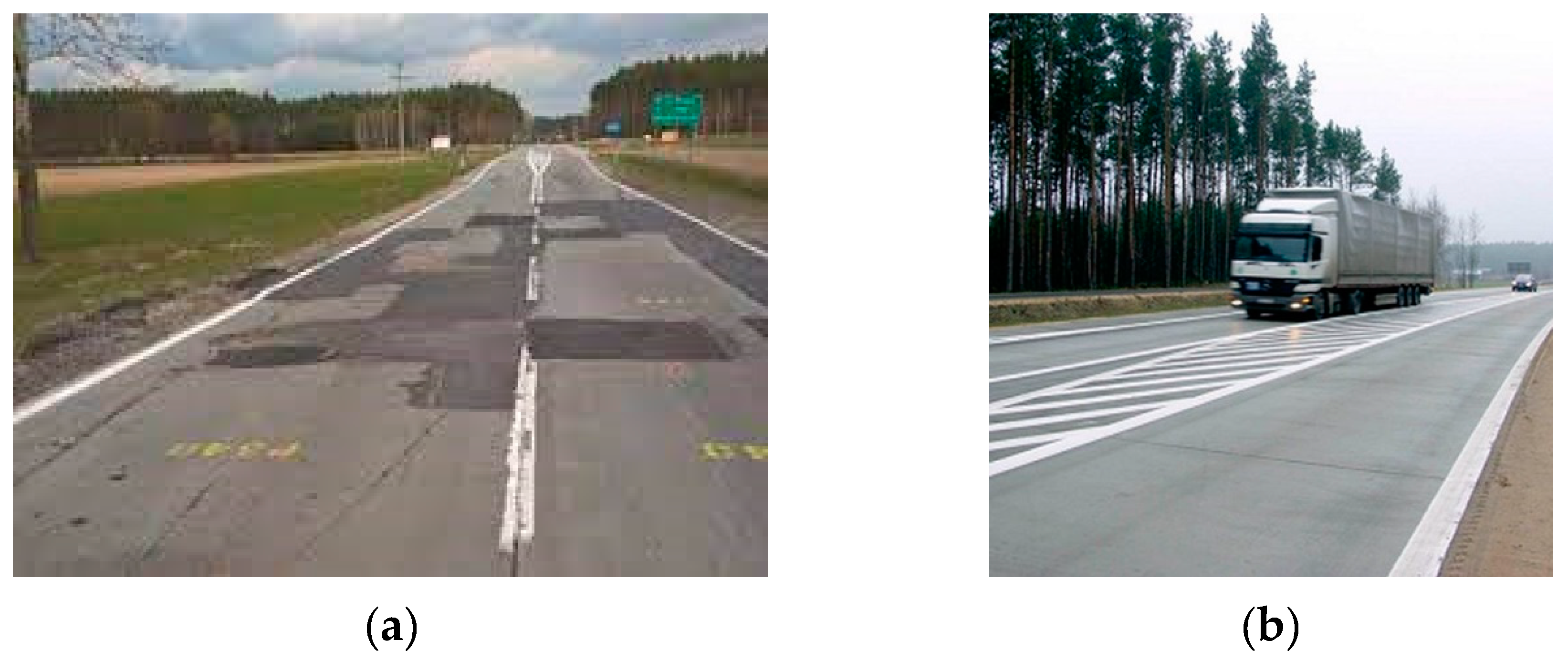
Figure 2.
Compressive strength after 8 hours.
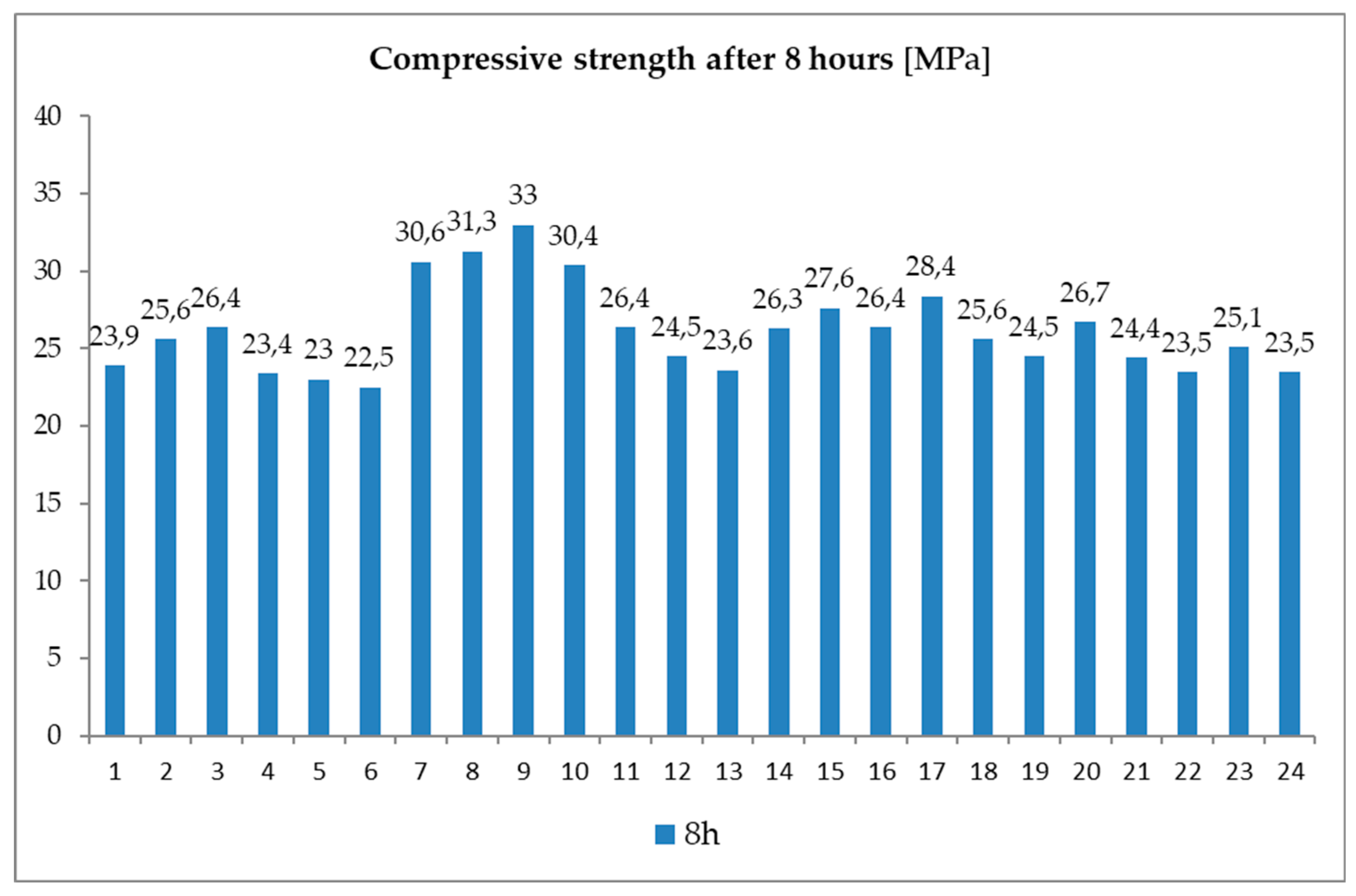
Figure 3.
Compressive strength after 8 and 24 hours and after 28 days.
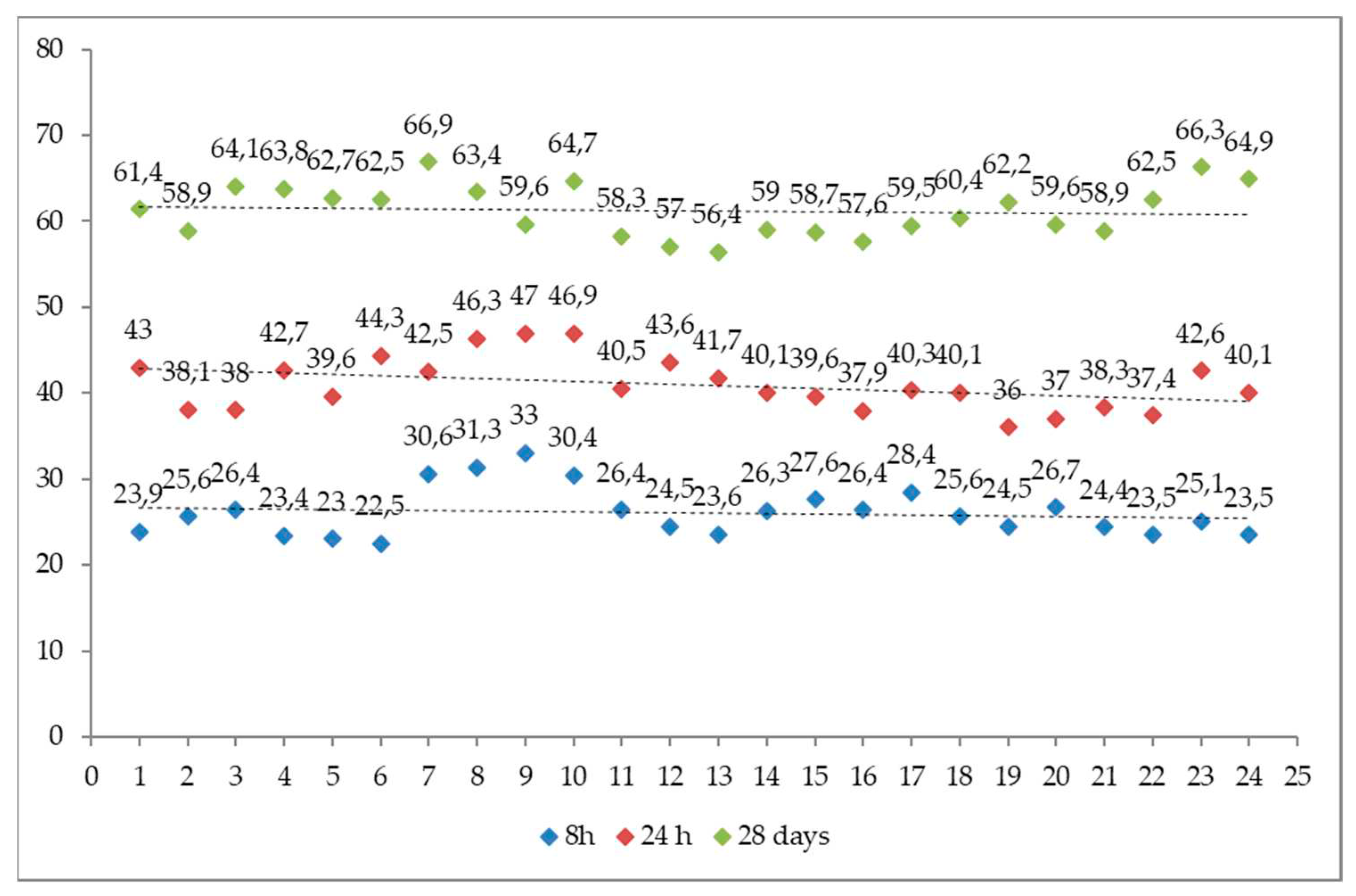

Table 1.
Properties of cement CEM I 52.5 R provided by the manufacturer.
| Property | Unit | Type of cement CEM I 52,5 R |
|---|---|---|
| Water Lust | % | 32.7 |
| Beginning of cement setting | min | 208 |
| End of cement setting | min | 266 |
| Consistency in volume | mm | 0.9 |
| Specific surface | cm2/g | 4612 |
| Specific density | cm3/g | 3.14 |
| Compressive strength F1 | MPa | 28.7 |
| Compressive strength F2 | MPa | 41.1 |
| Compressive strength F28 | MPa | 65.8 |
| SO3 | % | 3.1 |
| eqNa2O | % | 0.82 |
| Cl- | % | 0.07 |
Table 2.
Graining of materials.
| Sieve [mm] | Screening [%] | ||
|---|---|---|---|
| Granit 8/16 | Granit 2/8 | Sand 0/2 | |
| 16.000 | 1.7 | 0.0 | 0.0 |
| 8.000 | 96.3 | 1.2 | 0.0 |
| 4.000 | 2.0 | 59.7 | 0.0 |
| 2.000 | 0.0 | 39.1 | 2.5 |
| 1.000 | 0.0 | 0.0 | 15.9 |
| 0.500 | 0.0 | 0.0 | 25.5 |
| 0.250 | 0.0 | 0.0 | 43.4 |
| 0.125 | 0.0 | 0.0 | 11.9 |
| 0.000 | 0.0 | 0.0 | 0.8 |
Table 3.
Determination of the ASR alkali-silica reaction for 0/2mm aggregate.
| Samples | Length change over time [day] | |||||
|---|---|---|---|---|---|---|
| L7 | L14 | L28 | L91 | L182 | L365 | |
| 1 | -0.002 | 0.003 | 0.001 | 0.008 | 0.014 | 0.016 |
| 2 | -0.004 | 0.003 | 0.001 | 0.009 | 0.012 | 0.015 |
| 3 | -0.003 | 0.003 | 0.002 | 0.007 | 0.012 | 0.014 |
| Average value | -0.003 | 0.003 | 0.001 | 0.008 | 0.013 | 0.015 |
Table 4.
Okreslenie reakcji alkalia-krzemonka ASR dla kruszywa 2/8 i 8/16mm.
| Samples | Length change over time [day] | |||||
|---|---|---|---|---|---|---|
| L7 | L14 | L28 | L91 | L182 | L365 | |
| 1 | 0.000 | -0.001 | -0.002 | 0.006 | 0.018 | 0.027 |
| 2 | -0.001 | 0.000 | -0.003 | 0.006 | 0.016 | 0.019 |
| 3 | -0.001 | -0.001 | -0.001 | 0.006 | 0.016 | 0.022 |
| Average value | -0.001 | -0.001 | -0.002 | 0.006 | 0.017 | 0.023 |
Table 5.
Composition of concrete mixtures.
| Materials | Concrete mix compositions, % |
|---|---|
| CEM I 52,5 R | 16.46 |
| Water | 15.31 |
| Granit 2/8 | 23.81 |
| Granit 8/16 | 19.51 |
| Sand 0/2 | 22.82 |
| PC 1 | 0.19 |
| PC 2 | 0.10 |
| PC 3 | 1.81 |
Table 6.
Requirements for the concrete pavement for traffic categories KR5 ÷ KR7.
| Properties of pavement concrete | Requirements | Test method |
|---|---|---|
| Compressive strength class for traffic category KR5 ÷ KR7, not lower than: |
C40/50 | PN-EN 12390-3 |
| Flexural strength of concrete for traffic category KR5 ÷ KR7, not lower than: |
5.5 MPa | PN-EN 12390-5 |
| Tensile strength of concrete when splitting for traffic category KR5 ÷ KR7, not lower than: |
3.7 MPa |
PN-EN 12390-6 |
| Concrete frost resistance test F150: - weight loss of the sample, not more than, % - decrease in compressive strength, no more than, % |
5 % 20 % |
PN-B-06250 |
Table 7.
Flexural strength and tensile strength of concrete.
| Description of the designation | results | average result | requirement |
|---|---|---|---|
| Flexural strength, MPa | 7.2 | 7.9 | > 5.5 |
| 8.6 | |||
| 7.8 | |||
| Tensile strength, MPa | 4.8 | 5.1 | > 3.7 |
| 5.3 | |||
| 5.1 |
Table 8.
Influence of cement type on frost resistance after 28 days of maturation.
| Frost resistance test F150 | ||||
|---|---|---|---|---|
| Description of the designation | average result | Rc (MPa) |
Rc150 (MPa) | requirement |
| Mean decrease of the strength of specimens ΔR, % | 2.30% | 62.7 | 66.3 | < 20% |
| 68.4 | 66.7 | |||
| 73.8 | 70.1 | |||
| Mass change of specimens subjected to cyclical freezing and thawing ΔG, % | 2320 | 2314 | < 5% | |
| 0.29% | 2386 | 2378 | ||
| 2344 | 2337 | |||
Table 9.
Determination of resistance to freezing and thawing in the presence of de-icing salts.
| Mass loss (kg/m2) | Degree of defect | ||
|---|---|---|---|
| After 28 cycles | After 56 cycles | m56/m28 | requirement |
| 0.024 | 0.030 | 0.80 | < 2.0 |
| 0.013 | 0.015 | 0.87 | |
| 0.028 | 0.033 | 0.84 | |
| 0.027 | 0.032 | 0.85 | |
Table 10.
Costs of replacing one board.
| Renovation item | time | unit price | traditional concrete | fast-setting concrete |
|---|---|---|---|---|
| cost of concrete | 1 | 2000x6m3 | 12 000 | |
| 30 | 500x6m3 | 3 000 | ||
| roadway cost | 1 | 135m2x10pln | 1 350 | |
| 30 | 135m2x10pln | 40 500 | ||
| costs of technical service of temporary traffic organization | 1 | 500pln/day | 500 | |
| 30 | 500pln/day | 15 000 | ||
| cost of technological facilities and labor | 1 | 4000pln/day | 4 000 | |
| 3 | 4000pln/day | 12 000 | ||
| concrete curing costs | 1 | 500 pln/day | 500 | |
| 10 | 500 pln/day | 5 000 | ||
| Sum of costs | 75 500 | 18 350 |
Table 11.
Summary of user and environmental costs for selected technologies.
| User and environmental costs | Traditional road concrete | Fast-setting concrete |
|---|---|---|
| vehicle operating costs V=40km/h | 811 170 pln | 27 039 pln |
| vehicle operating costs V=90km/h | 714 645 pln | 23 822 pln |
| operating costs Ke V=40km/h – V=90km/h | 96 525 pln | 3 217 pln |
| User time costs V=40km/h | 20 279 pln | 676 pln |
| User time costs V=90km/h | 9 013 pln | 300 pln |
| User time costs Kc V=40km/h - V=90km/h | 11 266 pln | 375 pln |
| Costs of road accidents and casualties | 174 135 pln | 5 804 pln |
| Environmental pollution costs | 36 986 pln | 1 232 pln |
| User and environmental costs for V=40km/h | 318 911 pln | 10 630 pln |
| Savings compared to the use of traditional concrete | 0 pln | 308 281 pln |
Disclaimer/Publisher’s Note: The statements, opinions and data contained in all publications are solely those of the individual author(s) and contributor(s) and not of MDPI and/or the editor(s). MDPI and/or the editor(s) disclaim responsibility for any injury to people or property resulting from any ideas, methods, instructions or products referred to in the content. |
© 2023 by the authors. Licensee MDPI, Basel, Switzerland. This article is an open access article distributed under the terms and conditions of the Creative Commons Attribution (CC BY) license (http://creativecommons.org/licenses/by/4.0/).
Copyright: This open access article is published under a Creative Commons CC BY 4.0 license, which permit the free download, distribution, and reuse, provided that the author and preprint are cited in any reuse.


