

Submitted:
07 July 2023
Posted:
07 July 2023
You are already at the latest version
Abstract
The differential distribution, size, and quality of urban green spaces (UGS) among localities generate a differential distribution of benefits provided to users. We analyzed the spatial distribution of five size categories of UGS among 15 municipalities of Mexico City, compared their total surface per capita and associated them with the social marginality index. We found 1,353 UGSs accessible for public use with a total area of 2,643 ha. Seventy-four percent of them had <1 ha of surface area, and 51% were located in only three municipalities that were mostly middle- and high-income. These municipalities concentrated a higher area of green spaces per capita. We found a negative correlation between the marginality index and the area of UGS per municipality; the lower the marginality index, the higher the area of green spaces. We consider this a situation of environmental injustice since urban environmental services are distributed unequally with respect to marginalized populations.
Keywords:
urban parks
; urban nature
; environmental justice
; well-being.
1. Introduction
Planet earth is increasingly urbanized. Job opportunities and access to services generated within cities have favored the fact that more than 50% of the world’s population lives in these sites [1,2]. However, the urbanization process has had an impact on the well-being of the people who inhabit these sites, generating contradictions. For example, living in large cities allows their inhabitants to have better access to health services; at the same time, these sites also promote an environment of greater pollution and exposure to factors that make their population more vulnerable to diseases [3]. Such a scenario has increased interest in understanding which variables within cities influence human well-being, especially where sustainable cities are to be built.
Urban green spaces (UGS) are becoming more important in urban centers because of the environmental degradation that often characterizes mega-cities. Additionally, it is recognized that nature in cities plays a much more important role than pure urban beautification. There is growing evidence about the benefits that nature provides to cities through the fundamental environmental service of well-being in people's quality of life. Consequently, UGSs have been at the center of the scientific discourse of urban sustainability, especially since they provide essential services for the quality of life of people [4,5].
Nevertheless, the distribution of UGS within cities is usually highly uneven because of its association with socioeconomic indicators such as residents’ income, education, and ethnicity. In this sense, the inequitable distribution of UGS generates disparities in the benefits obtained [6]. This disparity in access to green areas has been widely recognized as a problem of environmental injustice that governments must address as a priority since ecosystem services are distributed unequally with respect to marginalized populations [7,8]. The theory of environmental justice postulates that the distribution of the risks and benefits that can be obtained in a city is disproportionately biased against ethnic minorities and the lowest socioeconomic level of the population, increasing the vulnerability of both sectors [9]. Therefore, to apply the concept of environmental justice to the geography of the green spaces of Mexico City, we would have to start by analyzing the concept of "green spaces" (also known as green areas) that are censed in official inventories.
However, as the concept of UGS has developed over time, there are different classifications that vary depending on criteria such as use, size or property regime [10]. Hence, it is necessary to consider the different analyses of which parks and other green spaces can influence people, starting with the concept of “green spaces”.
In Mexico City, UGSs have been defined by the Environmental Law as "All areas covered with natural or induced vegetation located in the Federal District (now México City). Urban green spaces correspond to those found on urban land in suburban areas and communities and towns located on the conservation floor". This definition includes parks, public and private gardens, pocket parks, pots, planters, areas with any vegetable cover on public roads (roundabouts, ridges, trees), malls and groves, hills, natural pastures, and rural production forest areas or areas that provide ecotourism services, ravines, and aquifer recharge zones [11].
The definition provided is so broad that even within the same city, each governmental institution redefines according to its criteria what is a green space, which translates into different data regarding official inventories and censuses [12]. For example, in 2009, the Environmental and Land Planning Agency (PAOT) conducted an inventory of green spaces, concluding that the inhabitants of Mexico City have 14.4 m2 per capita [13], which might be an acceptable figure according to the international guidelines that suggest a minimum of 9 m2 per inhabitant [1]. However, when considering green space as "any surface covered with vegetation", without discussing other attributes such as size, use, accessibility or characteristics, the effect that the use of these sites can generate on people is underestimated.
We have previously found that the specific characteristics of urban parks in Mexico City can differentially affect the well-being of their users by influencing how they relate to green spaces [14]. Such results emphasize the importance of a better understanding of the UGS of Mexico City. Indeed, there is a need to understand whether the presence, distribution, and size of UGSs within the municipalities of Mexico City have ecological and social implications that affect their inhabitants. It is anticipated that identifying and exposing the contrasting distribution and characteristics of UGSs in Mexico City should promote better urban planning and greater environmental justice [15]. Nonetheless, for this to happen, it is first necessary to map and characterize the UGS of the municipalities of Mexico City, considering their size and usability as a determining characteristic.
This work addresses the need for an analysis of the spatial distribution of UGSs that considers these sites based on their potential human use. For this, we suggest the following definition of UGS: “Public space whose fundamental element of composition is vegetation, whose characteristics and location are likely to be visited by people (individually or collectively), offering the opportunity to perform activities such as the practice of a sport, games and walks, moments of leisure and rest”. The above definition excludes those sites that are inaccessible for public use because when considering urban sustainability, UGS must favor a better quality of life for the inhabitants of cities, facilitating social interactions in their daily reality. This characterization encompasses the ability to use green spaces as a primary criterion, which allows considering these sites beyond the plant cover they possess and invites us to include their effect on society.
In this study, we analyzed the distribution, number, size, and surface of UGS in each of the municipalities of Mexico City to understand whether there is environmental injustice associated with the level of marginality.
2. Materials and Methods
2.1. Study site
Mexico City has 9.2 million inhabitants. From the political point of view, Mexico City is divided into 16 municipalities, and its total area is divided into urban and conservation zones. Indeed, the space assigned for conservation represents 58% (58,000 ha) of the total area of the city [16]. Nevertheless, in Mexico City, the use of conservation areas is restricted; therefore, conservation areas, private gardens, and inaccessible greenness were excluded from the concept of UGS defined in this study. In this sense, one of the 16 municipalities (Milpa Alta) was intentionally excluded from the study since its entire territory is considered a conservation area and thus entails a lack of data for the size, distribution, and characteristics of UGS within its territory.
2.2. Classification of urban green spaces
For the characterization of UGS in Mexico City, we considered five categories of green areas based on the size as the main criterion, which is the same as the information of the urban cartography elaborated by the National Institute of Statistics and Geography (INEGI 2015 version 6.2). From this cartographic information, we selected green spaces, parks, public gardens, wide ridges (with central passage) and sports facilities and classified them according to the following categories of UGS: Ridges (0.5 ha); 1 ha (>0.5 and <1 ha); 1-5 ha (>1 and <5 ha); 5-10 ha (>5 and <10 ha); and 10-40 ha (>10 and <40 ha). In the particular case of ridges, only those measuring >20 meters (wide) were included because they usually have a central walkway that allows the use of these sites.
We selected such categories because they represent a gradient of sizes that allows the realization of different activities that would potentially have a social impact on the community. The delimitation of each size category was based on a modification of the classification of UGSs proposed by Ballester and Morata (2001), which considers that for each of these classes, there are specific characteristics that allow distinguishing among them. After conducting a first characterization of the UGSs for this study, we eliminated those UGSs that, because of their geographical location, cannot be considered public or used. This ensured that the UGSs considered in this study were susceptible to being used by any inhabitants of Mexico City.
2.3. Spatial distribution, size, and number of urban green spaces among municipalities
We elaborated a basic characterization of the UGSs of Mexico City in ArcGis 10.1 using the existing cartographic information of urban localities and trees [16]. From these data, we obtained 1) the number and total surface of UGSs per size category and 2) the number and surface of UGSs by size category per municipality. The area of UGSs per capita was also obtained considering the number of people for each municipality according to the published data of the census 2014 (6.2 version) conducted by the National Institute of Statistics and Geography [17].
2.4. Association of urban green spaces and socioeconomic indicators
In addition, to examine a possible association between the spatial distribution and characteristics of the UGSs and the marginalization level of the municipalities, we included the marginality index [18]. According to the National Population Council (CONAPO), marginalization is a multidimensional and structural phenomenon that is expressed in the lack of opportunities and the unequal distribution of progress in the productive structure, influencing levels of well-being and capacity-building resources and therefore in development. The marginality index is a summary measure that allows differentiating the different geographical units according to the global impact of the deficiencies suffered by the population and can be used as a proxy of socioeconomic development (Table 1).
2.5. Statistical analysis
We used descriptive statistics to quantitatively characterize and compare the composition of UGSs in the municipalities according to size categories. One-tailed simple correlation analyses were used to assess the relationship between the area per capita of UGSs and the population density and marginality index of the municipalities. Additionally, to further examine the pattern of distribution of the UGSs within Mexico City, we first analyzed the percentile of distribution for each size category, and then we integrated with a multivariate analysis each size category per municipality to show similarities between localities. For the latter, we used heatmaps and cluster analysis to visualize the similarities in maps as described elsewhere [19,20].
3. Results
3.1. Number and surface of urban green spaces in the municipalities of Mexico City
Mexico City has 2,096 neighborhoods, of which 450 have restricted access, so their green spaces are not open to all the inhabitants of the city. We found 1,353 UGSs that coincided with the definition proposed in this study and were distributed as follows: ranges, 40.1% (543); 1 ha, 33.9% (458); 1-5 ha, 15.6% (211); 5-10 ha, 3.5% (48); and 10-40 ha, 6.9% (93) (Table 2). According to the size distribution, the smaller the size of the UGSs, the greater their abundance; furthermore, in Mexico City, 74% of the UGSs are <1 ha in size. The 1,353 UGSs represented a total of 2,643 hectares, of which 16.0% and 53.3% were found in the Ridges (424 hectares) and 10-40 ha UGSs (1,408 hectares), respectively. The remaining three groups contributed together with 30.7% of the total extension of UGSs in Mexico City: 1 ha, 167 hectares; 1-5 ha, 377 hectares; and 5-10 ha, 267 hectares.
Across the 15 municipalities of Mexico City, the number of UGSs ranged broadly between 1 and 271. Three municipalities (Coyoacan, M. Hidalgo, and Gustavo A. Madero) accounted for 51.4% of the total number of UGSs (695/1353) found in Mexico City. In clear contrast, municipalities such as Xochimilco, Cuajimalpa, and Tlahuac in conjunction had nine UGSs that represented only 6.6% of the total. As a consequence of this heterogeneous distribution of the number of UGSs, the total surface covered by all the size categories within each municipality also exhibited contrasting patterns (Table 2). In municipalities such as Coyoacan, Gustavo A. Madero, and M. Hidalgo, the extension of UGSs ranged from 472 to 602 hectares and accounted for 61.6% of the total surface of 2,643 hectares found in Mexico City. For the three municipalities with the lowest number of UGSs, their total surface of green areas was 15 hectares, which represented only 0.6% of the total. These results emphasize the disparities among municipalities regarding the distribution and surface covered by the different categories of UGSs.
3.2. Composition of the green spaces among municipalities of Mexico City
As depicted in Figure 1A, four municipalities showed a total surface >375 hectares of their UGSs. In these four municipalities, UGSs of 10-40 ha contributed the highest amount of surface: Gustavo A. Madero, 253 hectares (53.6%); Tlalpan, 313 hectares (78.4%); M. Hidalgo, 328 hectares (58.6%); and Coyocan, 352 hectares (58.5%). In contrast, Ridges contributed the greatest amount of UGS surfaces in places such as Iztapalapa (59 hectares, 64.1%), Iztacalco (27 hectares, 60%), and Xochimilco (3 hectares, 100%). In each municipality, the relative contribution of each size category of the UGS showed an interesting pattern, according to which there was both a disparate distribution of the UGSs across municipalities and a heterogeneous composition of the green spaces within each municipality (Figure 1B). For instance, Xochimilco, Cuajimalpa, and Tláhuac presented only one category of UGSs, while in contrast, five and seven municipalities had four to five size categories, respectively. Except for Tlahuac, the relative contribution of UGSs with a size of 5-10 ha was the lowest in the municipalities (2.21-25%). In M. Hidalgo and M. Contreras, the contribution of ridges was lower (10.4 and 12.5%), while UGSs of higher size were more frequent. Indeed, in these two municipalities, the percentage of UGSs 10-40 ha was the greatest among all locations (25.0 and 23.18%, respectively).
3.2. Spatial distribution of UGSs across the municipalities of Mexico City
To illustrate the pattern of distribution of the UGS across the municipalities of Mexico City, in Figure 2A, we depict the spatial distribution of all the green areas mapped in our study. As judged by the accumulation of a higher number of green spaces in some locations, there is a characteristic uneven distribution both in the number and surface of UGSs among the municipalities of Mexico City. Furthermore, to show these striking differences at a higher resolution, in Figure 2A1 and 2A2, we present two municipalities (M. Hidalgo and M. Contreras) as representatives of the inequity of the distribution of UGSs in Mexico City. According to Figure 1A, these two municipalities showed a similar composition of UGSs. Nevertheless, the number and size of the green spaces mapped in each locality varied broadly between them.
The maps shown in Figure 3A illustrate the heterogeneous spatial distribution for the percentile of UGS among the municipalities of Mexico City. Despite the contrasting pattern found across size categories, the adjacent municipalities of Xochimilco and Tlahuac were consistently distributed into the lowest percentile category (<16.6th). Likewise, a similar distribution was found for Cuajimalpa. In contrast, the percentile distribution for the UGS of Tlalpan, Coyoacan, and M. Hidalgo was consistently found in the higher values. As shown in the left panel of Figure 3B, the integrated analysis of the size categories of UGSs revealed the formation of two distinct groups of municipalities in Mexico City: those with below-average values (negative Z scores and green-colored) and municipalities with above-average scores (positive Z scores and red colored). Nine municipalities that were characterized by a reduced number of UGSs for each category formed a well-defined cluster in the upper portion of the dendrogram. In the middle section were Tlalpan and A. Obregon, which were grouped into a single cluster due to their increased number of UGS. Finally, Iztapalapa, Gustavo A. Madero, Coyoacan, and M. Hidalgo, all of which were characterized by above-average values for at least one of the size categories of UGSs, were separated into four distinct clusters in the dendrogram. Furthermore, as shown in the spatial representation of the multivariate analysis (Figure 3B, right panel), four of the municipalities grouped into one of the clusters were indeed adjacent localities (Cuauhtemoc, V. Carranza, B. Juarez, and Iztacalco). In addition, a central band of three municipalities that included A. Obregon, Coyoacan, and Iztapalapa showed an increased number of UGSs. Interestingly, the three municipalities with the highest Z scores (Gustavo A. Madero, M. Hidalgo, and Coyocan) were heterogeneously distributed across the middle-upper portion of Mexico City.
3.4. Association between UGS socioeconomic indicators in Mexico City
There was a differential distribution of the UGSs that varied according to the marginalization level of the localities (Figure 4A). We found a negative correlation (r = -0.47, p = 0.037) between the marginality index and the area of UGS per municipality; the lower the marginality index, the higher the area of green spaces (Figure 4B). We also observed an unequal distribution of the area per capita of green spaces among municipalities (Figure 4C). From the mapped UGS, we found an average value of 3.1 m2 of green spaces per inhabitant in Mexico City. However, there was a broad discrepancy in the values among localities; for instance, M. Hidalgo has 15.4 m2 per inhabitant, followed by Coyoacan with 9.9 m2, whereas marginal municipalities such as Iztapalapa, Azcapotzalco, Tlahuac, Xochimilco, and Cuajimalpa have less than 0.5 m2 of green spaces per inhabitant. Furthermore, we hypothesized that the area per capita of green spaces should be related to the population density of each municipality, although we did not find a correlation between these variables (r = -0.08, p = 0.769). This result indicated that in those municipalities with the highest population density per km2, there is a lack of a corresponding high value of green spaces per m2; thus, UGSs might not be enough for the inhabitants of the more populated locations. Interestingly, there were two municipalities (B. Juarez and Cuauhtemoc) that, despite their lower values of marginality, did not have a corresponding high per capita area of green spaces, as their values were 0.98 and 1.02 m2 per capita, respectively.
4. Discussion
In urban centers, the geographical location, size, and accessibility of UGS can facilitate or hinder the use of these spaces [21]. Therefore, these characteristics have an impact on the benefits that its inhabitants can enjoy by relating to UGS. Our results show that there is an asymmetry in the distribution and size of urban green spaces in Mexico City, which can be seen from environmental justice optics. For green spaces to serve as a promoter of people´s well-being, mere presence is not enough; thus, size and distribution are important characteristics that affect how people relate to nature [22,23]. Mexico City has a greater number of green spaces of small size, even though it is known that larger green spaces can promote the coexistence of groups of people of different ages and interests by allowing the performance of several activities simultaneously broadening the spectrum of possible uses and users, for example, running, resting and play [24,25,26]. Therefore, favoring the creation of green spaces of small size does not allow the interaction between diverse actors, which is crucial in the formation of social cohesion in a community [27,28,29].
In the same way, if people are prone to diseases related to sedentary lifestyle, obesity or living in neighborhoods without adequate green areas, it can be considered that we are going against the objectives of the concept of environmental justice, which point toward a fair distribution of the services that the city provides [30]. The heterogeneity of distribution, number, and size could be a situation of environmental injustice because it is related to various historical and social variables that should be analyzed more thoroughly.
Mexico City follows the international trend, especially in developing countries, with a gap between higher-income and marginal populations regarding access to green areas [18]. These results also coincide with the clear lack of parks in the vast majority of Mexico City districts, even when considering official inventories of green areas; some of the municipalities with the lowest level of poverty enjoy a greater number of parks [13]. This situation also denotes a clear environmental injustice, not only because of the unequal distribution of the benefits that parks can offer but also because it has been recognized that it is precisely the minorities and the most marginalized groups that are most vulnerable to environmental risk [31,32].
While the scientific evidence regarding the improvement in physical, mental, emotional and even social health to which green areas contribute is growing, it is urgent to integrate the research produced with the management of these sites from an environmental justice perspective. This can help us to see more clearly critical issues of urban marginalization that have thus far focused on only social factors [33]. For that, the academy must have an effective and constant communication channel with decision-makers, since both parties seek the good of the city and its inhabitants.
Our results also reveal that if we consider only the public green spaces (without considering tree-lined roads that are inaccessible to people's use), the inhabitants of Mexico City have five times less area of green spaces than reported by the Environmental and Land Management Agency (PAOT) in the census of 2014. These results prove that official inventories carried out by authorities tend to overlook UGS use and real accessibility. This allows making a distinction between the different scales to which urban problems can be addressed [34]. At the basin level, urban nature provides ecosystem services that benefit the inhabitants of the entire city, such as air purification or water infiltration [35]. Nevertheless, at the local level, the smallest green spaces for daily use, such as parks or walkable ridges, promote other types of benefits, which are linked to ecosystem processes at the basin level and to the quality of life of the inhabitants of the city because of their use [36]. The misunderstanding of both scales is often reflected in the management of UGSs, affecting official census data and decisions about small green spaces. While it is important to have a database that identifies any green surface within the territory of cities, it is also important that urban planning includes the scale at which human beings experience and use the infrastructure of the city [1,37].
5. Conclusions
Official inventories of the green areas of Mexico City underestimate their usability as a variable to obtain the benefits they grant. At the same time, the urbanization processes in Mexico City favor the proliferation of small green spaces inaccessible to people. Both situations have generated a heterogeneous distribution of these sites, linked to the level of marginalization of people, which can be seen as a situation of environmental injustice. This situation reflects the need to address the urban environment, including an environmental justice perspective, especially if the intention is to move forward under a sustainability model that reduces the inequality of the environmental benefits that citizens obtain from UGS. Thus, decision-making in Mexico City should consider the consequences of the urbanization model on the quality of life of its inhabitants.
Supplementary Materials
This manuscript has no supplementary information.
Author Contributions
Conceptualization, CAA and LZ; methodology, CAA, TF, and FCT; software and visualization, CAA, TF, and DD; formal analysis, CAA and DD; investigation and writing—review and editing, CAA, TF, FCT, and LZ; data curation, CAA and TF; writing—original draft preparation, CAA, TF, DD, LZ; project administration, CAA and LZ. All authors have read and agreed to the published version of the manuscript.
Funding
This research received no funding.
Data Availability Statement
All the datasets used to construct this study are available upon reasonable request to the corresponding author.
Acknowledgments
The first author gratefully acknowledges the PhD Program in Sustainability Sciences, UNAM (Posgrado en Ciencias de la Sostenibilidad, Universidad Nacional Autónoma de México). Additionally, to Ruth Luna Soria for support during the preparation of the manuscript.
Conflicts of Interest
The authors declare no conflict of interest.
References
- Gehl, J. Ciudades para la gente, 1st ed.; Infinito: Buenos Aires, Argentina, 2014; p. 260. [Google Scholar]
- Wu, J. Urban ecology and sustainability: The state-of-the-science and future directions. Landsc Urban Plan 2014, 125, 209–221. [Google Scholar] [CrossRef]
- Dye, C. Health and urban living. Science 2008, 319, 766–769. [Google Scholar] [CrossRef]
- Gómez-Baggethun, E. and David N. Barton, D.N. Classifying and valuing ecosystem services for urban planning. Ecol Econ 2013, 86, 235–245. [Google Scholar] [CrossRef]
- Kallis, G.; Gómez-Baggethun, E. and Zografos, C. To value or not to value? That is not the question. Ecol Econ. 2013, 94, 97–105. [Google Scholar] [CrossRef]
- Baker, L.A.; Brazel, A.J.; Selover, N.; Martin, C.; McIntyre, N.; Steiner, F.R.; Nelson, A. and Musacchio, L. Urbanization and warming of Phoenix (Arizona, USA): Impacts, feedbacks and mitigation. Urban Ecosyst. 2002, 6, 183–203. [Google Scholar] [CrossRef]
- Wolch, J.R.; Byrne, J. and Newell, J.P. Urban green space, public health, and environmental justice: The challenge of making cities “just green enough” Landsc Urban Plan 2014, 125, 234–244. [CrossRef]
- Nesbitt, Lorien, L. ; Meitner, M.J.; Girling, C.L.; Stephen Sheppard, S.R.J. and Lu, Y. Who has access to urban vegetation? A spatial analysis of distributional green equity in 10 US cities. Landsc Urban Plan 2019, 181, 51–79. [Google Scholar] [CrossRef]
- Fernández-Álvarez, R. Inequitable distribution of green public space in the Mexico City: an environmental injustice case. Econ. Soc. Territ. 2017, XVII, 399–428. [Google Scholar] [CrossRef]
- Ballester-Olmos, J.F. and Morata, C.A.A. Normas para la clasificación de los espacios verdes, Universidad Politécnica de Valéncia, España, 2001; pp. 194.
- ALDF, Asamblea Legislativa del Distrito Federal V Legislatura. 2007. Ley Ambiental del Distrito Federal.
- Checa-Artasu, M.M. Las áreas verdes en la Ciudad de México. Las diversas escalas de una geografía urbana. Revista Bibliográfica de Geografía y Ciencias Sociales 2016, XXI, 1-22. [CrossRef]
- PAOT. Presente y futuro de las áreas verdes y del arbolado de la Ciudad de México. 2010. México; pp. 259.
- Ayala-Azcárraga, C.; Diaz, D. and Luis Zambrano, L. Characteristics of urban parks and their relation to user well-being. Landsc Urban Plan 2019, 189, 27–35. [CrossRef]
- Heynen, N., Perkins, H. A., and Roy, P. The political ecology of uneven urban green space: the impact of political economy on race and ethnicity in producing environmental inequality in Milwaukee. Urban Aff Rev 2006, 42, 3-25. [CrossRef]
- Pérez-Campuzano, E.; Avila-Foucat, V.S. and Perevochtchikova, M. Environmental policies in the peri-urban area of Mexico City: The perceived effects of three environmental programs. Cities 2016, 50, 129–136. [Google Scholar] [CrossRef]
- INEGI, Instituto Nacional de Estadística y Geografía. Panorama sociodemográfico de Ciudad de México. 2015. México.
- CONAPO, Consejo Nacional De Población, C. Índice Absoluto De Marginación 2000-2010; 2010, México.
- Diaz, D; Vazquez-Polanco, A.M.; Argueta-Donohue, J.; Stephens, C.R.; Jimenez-Trejo, F.; Ceballos-Liceaga, S.E. and Mantilla-Beniers, N. Incidence of intestinal infectious diseases due to protozoa and bacteria in Mexico: Analysis of national surveillance records from 2003 to 2012. Biomed Res Int. 2018, 2018, 12. [CrossRef]
- Pacheco-Velázquez, S.C.; Gallardo-Pérez, J.C.; Díaz, D.; Adán-Ladrón de Guevara, A.; Robledo-Cadena, D.X.; Saavedra, E.; Ruiz-Godoy, L.; Jimenez-Hernández, L.R.; Vargas-Barrón, J.; Aguilar-Ponce, J.L. and Rodríguez-Enríquez, S. Heart myxoma develops oncogenic and metastatic phenotype. J Cancer Res Clin Oncol 2019, 145, 1283–1295. [Google Scholar] [CrossRef]
- Shanahan, D.F.; Fuller, R.A.; Robert Bush, R.; Lin, B.B. and Gaston, K.J. The health benefits of urban nature: How much do we need? BioScience 2015, 65, 476–485. [Google Scholar] [CrossRef]
- Schipperijn, J.; Bentsen, P.; Troelsen, J.; Toftager, M. and Ulrika K Stigsdotter, U.K. Associations between physical activity and characteristics of urban green space. Urban For Green 2013, 12, 109–116. [Google Scholar] [CrossRef]
- Kaczynski, A.T.; Besenyi, G.M.; Stanis, S.A.W.; Koohsari, M.J.; Oestman, K.B.; Bergstrom, R.; Luke R. Potwarka, L.R. and Reis, S.R. Are park proximity and park features related to park use and park-based physical activity among adults? Variations by multiple sociodemographic characteristics”, Int J Behav Nutr and Phys Act. 2014, 11, 1-14. [CrossRef]
- Netz, Y; Wu, M.; Becker, B.J. and Tenenbaum, G. Physical activity and psychological well-being in advanced age: a meta-analysis of intervention studies. Psychol Aging 2005, 20, 272–284. [CrossRef]
- Sugiyama, T. and Thompson, C.W. Associations between characteristics of neighborhood open space and older people’s walking. Urban For Urban Green 2008, 7, 41–51. [CrossRef]
- Reyes, P.S. and Figueroa A.I.S. Distribución, superficie y accesibilidad de las áreas verdes en Santiago de chile. Revista latinoamericana de estudios urbano regionales 2010, 36, 89–110. [Google Scholar] [CrossRef]
- Kaczynski, A.; Potwarka, L.R. and Saelens, B. Association of park size, distance, and features with physical activity in neighborhood parks. Am. J. Public Health 2008, 98, 1451–1456. [CrossRef]
- Peters, K; Elands, B. and Buijs, A. Social interactions in urban parks: Stimulating social cohesion? Urban For Urban Green 2010, 9, 93–100. [CrossRef]
- Gavareski, C.A. Relation of Park Size and Vegetation to Urban Bird Populations in Seattle, Washington. The Condor 2016, 78, 375–382. [Google Scholar] [CrossRef]
- Cutts, B.B.; Darby, K.J.; Boone, C. and Brewis, A. City structure, obesity and environmental justice: an integrated analysis of physical and social barriers to walkable streets and park access. Soc. Sci. Med. 2009, 69, 1314–1322. [Google Scholar] [CrossRef]
- Boone, C.G.; Buckley, G.L.; Grove, J.M. and Sister, C. Parks and People: An Environmental Justice Inquiry in Baltimore, Maryland. Ann Assoc Am Geogr 2009, 99, 767–787. [Google Scholar] [CrossRef]
- Nassauer, J.I. and Raskin, J. Urban vacancy and land use legacies: A frontier for urban ecological research, design, and planning. Landsc Urban Plan 2014, 125, 245–253. [Google Scholar] [CrossRef]
- Rutt, R. L. and Gulsrud, N.M. Green justice in the city: A new agenda for urban green space research in Europe. Urban For Urban Gree 2016, 19, 123–127. [Google Scholar] [CrossRef]
- Calderón-Contreras, R. and Quiroz-Rosas, L.E. Analyzing scale, quality and diversity of green infrastructure and the provision of Urban Ecosystem Services: A case from Mexico City. Ecosyst. Serv. 2017, 23, 127–137. [Google Scholar] [CrossRef]
- Jenerette, G.D.; Harlan, S.L.; Stefanov, E.L. and Martin, C.A. Ecosystem services and urban heat riskscape moderation: Water, green spaces, and social inequality in Phoenix, USA. Ecol Appl. 2011, 21, 2637–2651. [Google Scholar] [CrossRef]
- Peschardt, K.K.; Schipperijn, J. and Stigsdotter, U.K. Use of Small Public Urban Green Spaces (SPUGS). Urban For Urban Green. 2012, 11, 235–244. [Google Scholar] [CrossRef]
- Flores-Xolocotzi, R. and González-Guillén, M.J. Planificación de sistemas de áreas verdes y parques públicos. Revista mexicana de ciencias forestales 2010, I, 17–24.
Figure 1.
(a) Total surface (Ha) of the UGSs for each municipality and (b) proportion of each size category of UGSs per municipality.
Figure 1.
(a) Total surface (Ha) of the UGSs for each municipality and (b) proportion of each size category of UGSs per municipality.
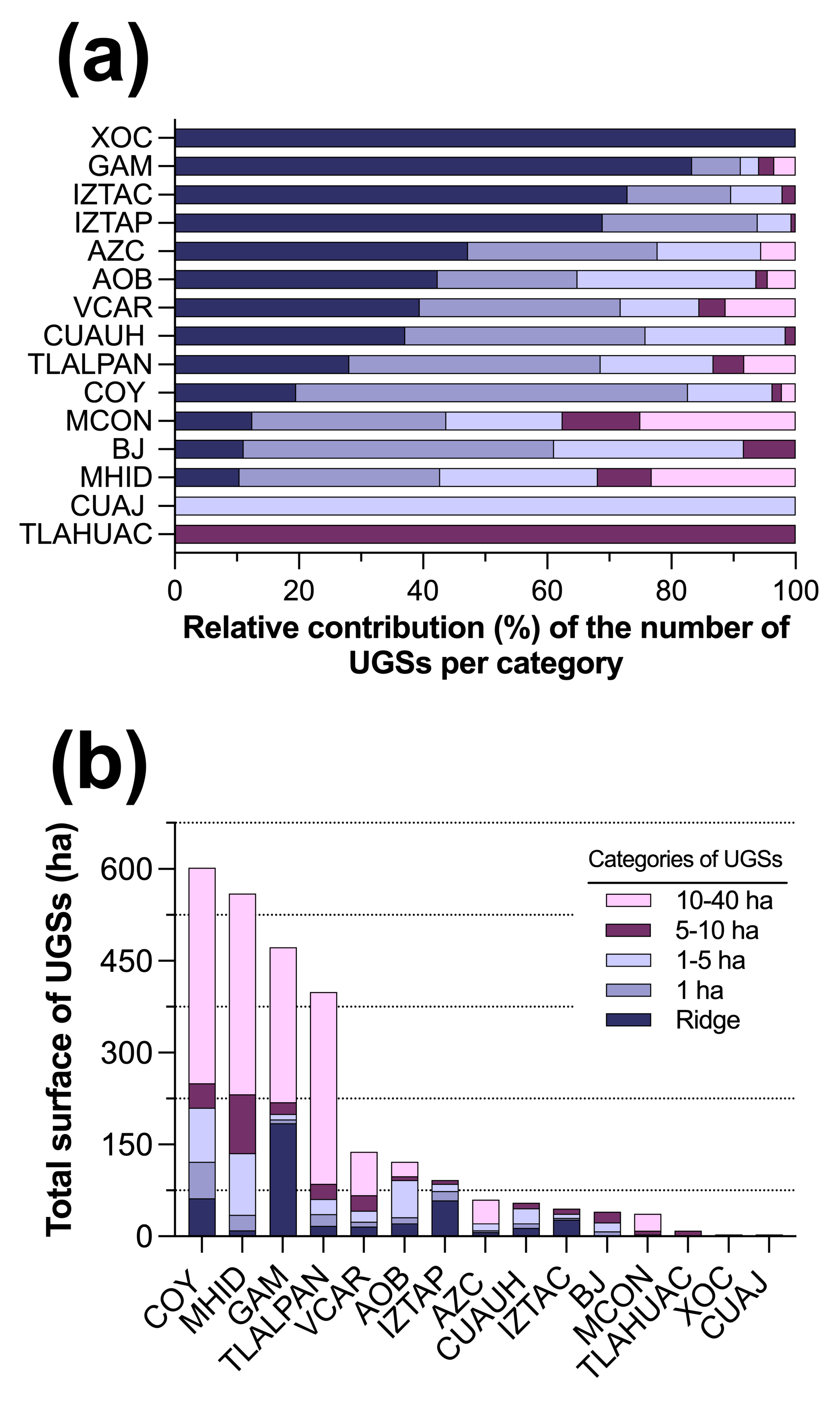
Figure 2.
(a) Spatial distribution of the UGSs in Mexico City and (a1) and (a2) mapping of the five categories of UGSs in two selected municipalities.
Figure 2.
(a) Spatial distribution of the UGSs in Mexico City and (a1) and (a2) mapping of the five categories of UGSs in two selected municipalities.
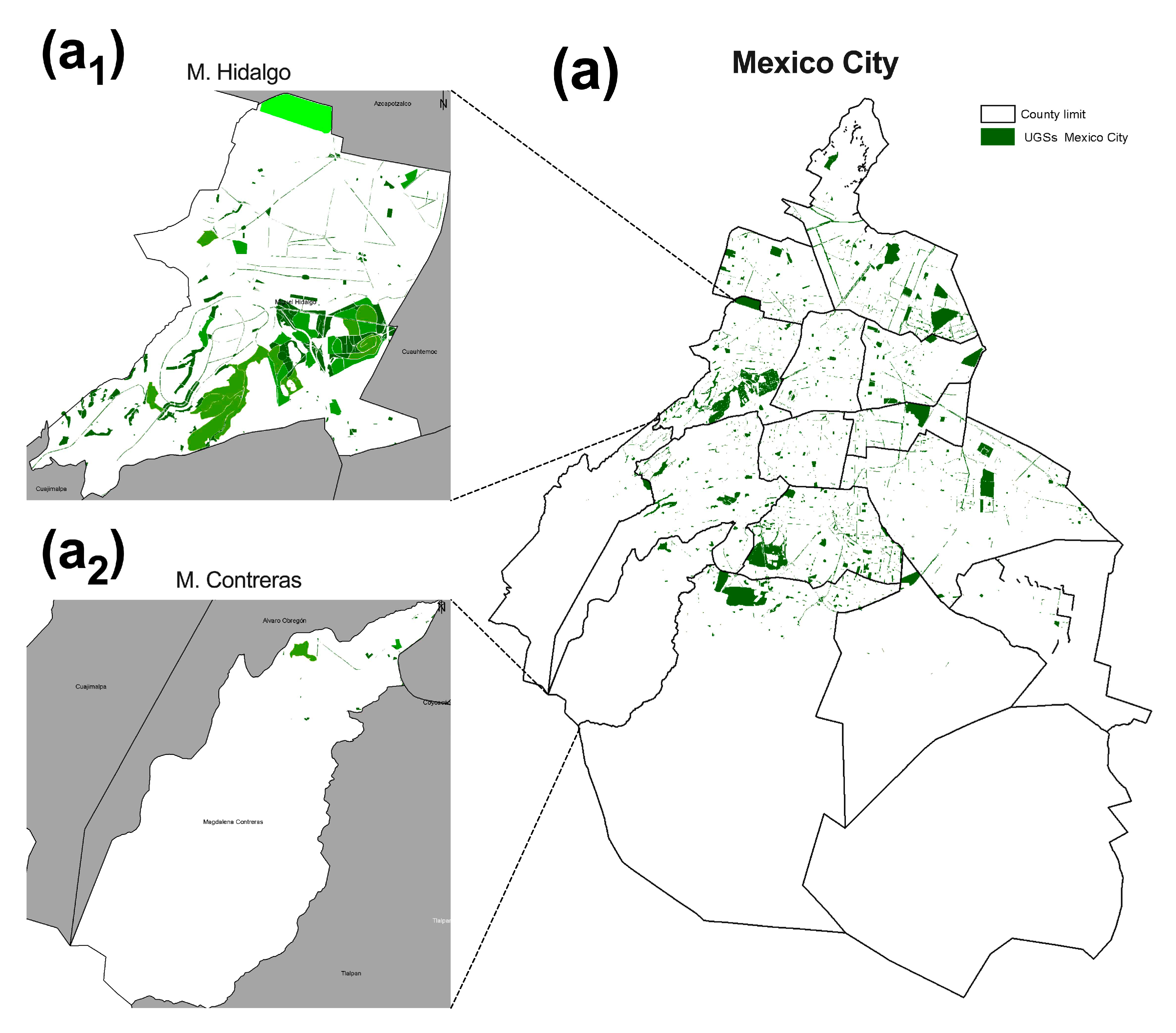
Figure 3.
(a) Spatial distribution of the percentile per size category of the UGSs among the municipalities of Mexico City, and (b) heatmap and cluster analysis of the Z score of the number of UGSs.
Figure 3.
(a) Spatial distribution of the percentile per size category of the UGSs among the municipalities of Mexico City, and (b) heatmap and cluster analysis of the Z score of the number of UGSs.
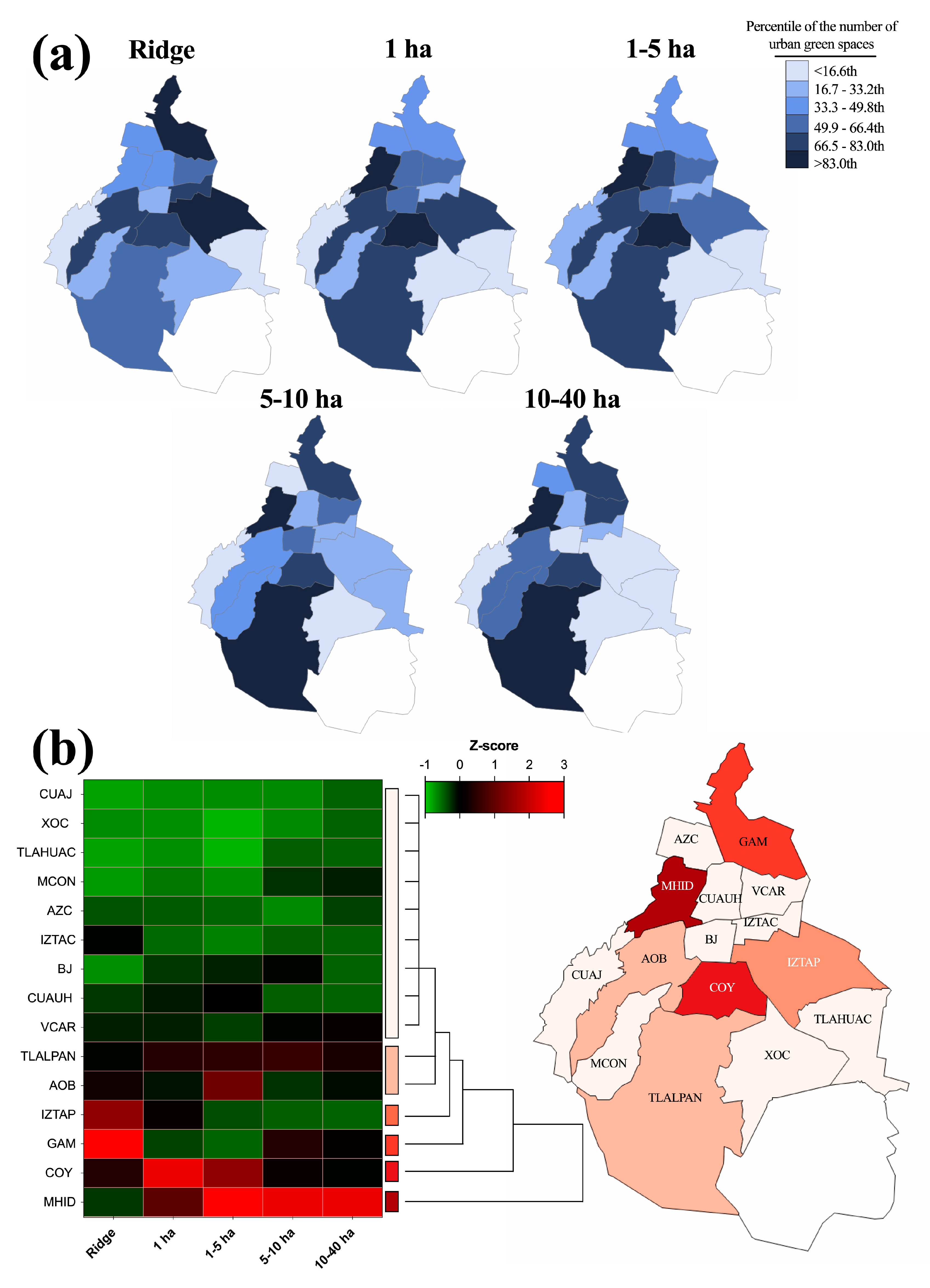
Figure 4.
(a) Merge of the spatial distribution of the UGS in Mexico City and the marginality index for the localities of each municipality, (b) association between the socioeconomic indices and the area per capita of UGS for the municipalities of Mexico City, and (c) comparison of the area per capita of UGS.
Figure 4.
(a) Merge of the spatial distribution of the UGS in Mexico City and the marginality index for the localities of each municipality, (b) association between the socioeconomic indices and the area per capita of UGS for the municipalities of Mexico City, and (c) comparison of the area per capita of UGS.
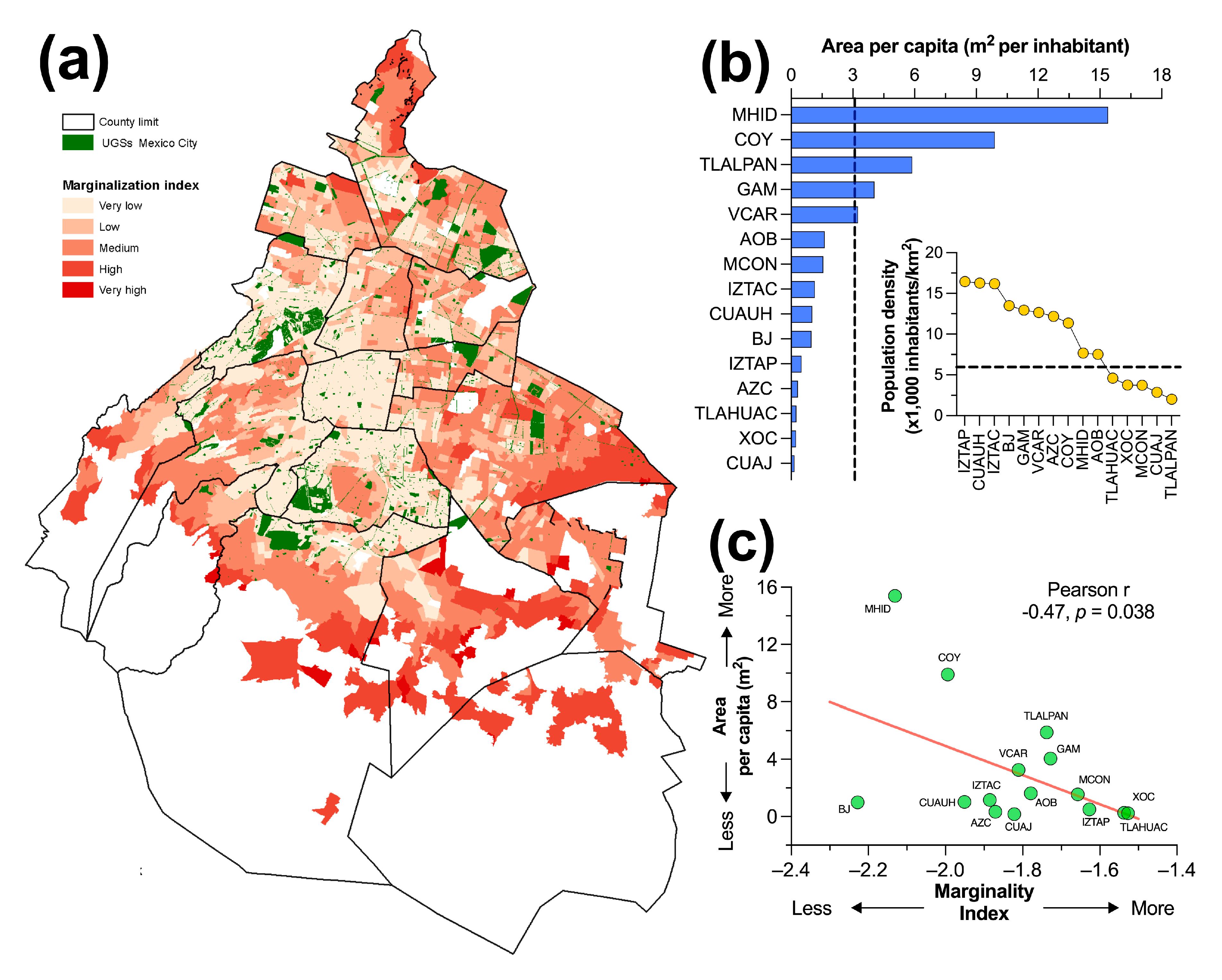

Table 1.
Socioeconomical indicators of the marginalization index (CONAPO, 2010).
| Socioeconomical dimentions | Ways of exclusion |
|---|---|
| Education | Illiteracy |
| Population without elementary school | |
| Dwelling | Private dwellings without drainage or sanitary service |
| Private dwellings without electricity | |
| Private dwellings without piped water | |
| Private dwellings with some level of overcrowding | |
| Private dwellings with dirt floor | |
| Population distribution | Localities with less than 5,000 inhabitants |
| Monetary income | Occupied population that receives up to two minimum wages |
Table 2.
Number of UGSs per size category and total surface for each municipality.
| Municipality | Categories of UGSs | Total number of UGSs | Total surface (ha) | ||||
| Ridge | 1 ha | 1-5 ha | 5-10 ha | 10-40 ha | |||
| Coyoacan | 53 | 171 | 37 | 4 | 6 | 271 | 602 |
| M. Hidalgo | 23 | 71 | 56 | 19 | 51 | 220 | 561 |
| Gustavo A. M. | 170 | 16 | 6 | 5 | 7 | 204 | 472 |
| Tlalpan | 34 | 49 | 22 | 6 | 10 | 121 | 399 |
| V. Carranza | 28 | 23 | 9 | 3 | 8 | 71 | 139 |
| A. Obregon | 47 | 25 | 32 | 2 | 5 | 111 | 122 |
| Iztapalapa | 102 | 37 | 8 | 1 | 0 | 148 | 92 |
| Azcapotzalco | 17 | 11 | 6 | 0 | 2 | 36 | 61 |
| Cuauhtemoc | 23 | 24 | 14 | 1 | 0 | 62 | 55 |
| Iztacalco | 35 | 8 | 4 | 1 | 0 | 48 | 45 |
| B. Juarez | 4 | 18 | 11 | 3 | 0 | 36 | 41 |
| M. Contreras | 2 | 5 | 3 | 2 | 4 | 16 | 38 |
| Tláhuac | 0 | 0 | 0 | 1 | 0 | 1 | 9 |
| Xochimilco | 5 | 0 | 0 | 0 | 0 | 5 | 3 |
| Cuajimalpa | 0 | 0 | 3 | 0 | 0 | 3 | 3 |
| Total | 543 | 458 | 211 | 48 | 93 | 1,353 | 2,643 |
Disclaimer/Publisher’s Note: The statements, opinions and data contained in all publications are solely those of the individual author(s) and contributor(s) and not of MDPI and/or the editor(s). MDPI and/or the editor(s) disclaim responsibility for any injury to people or property resulting from any ideas, methods, instructions or products referred to in the content. |
© 2023 by the authors. Licensee MDPI, Basel, Switzerland. This article is an open access article distributed under the terms and conditions of the Creative Commons Attribution (CC BY) license (http://creativecommons.org/licenses/by/4.0/).
Copyright: This open access article is published under a Creative Commons CC BY 4.0 license, which permit the free download, distribution, and reuse, provided that the author and preprint are cited in any reuse.


