

Submitted:
04 July 2023
Posted:
10 July 2023
You are already at the latest version
Abstract
In the last decades, cultivation of chia (Salvia hispanica L.) has expanded around the world and the seeds have become well known due to their rich composition in nutrients and bioactive compounds. The aim of this work was to evaluate the physical, chemical and nutritional profile of eight chia seeds grown in different Latin-American countries (Argentina, Bolivia, Chile, Ecuador, Mexico, Paraguay and Peru). The results showed that several nutritional parameters such as the protein content and amino acid profile, dietary fiber content, lipid content, mineral composition and phytate present in the seeds depend on the location they were grown in. Other parameters such as ash content, fatty acid profile or physical parameters were uniform across locations (except for color parameters). The results support the notion that nutritional characteristics of seeds are determined by the seed's origin, further analysis is needed to define the exact mechanisms that control the changes in the seeds nutritional properties.
Keywords:
Salvia hispanica L
; physical properties
; seed composition
; amino acid profile
; fatty acid profile
; mineral composition
; phytic acid
1. Introduction
Chia (Salvia hispanica L.) is an oilseed plant that belongs to the Lamiaceae family. The seeds are a natural source of α-linolenic acid (ALA, 18:3 n-3), an omega-3 polyunsaturated fatty acid (omega-3 PUFA), as well as dietary fiber, proteins, natural antioxidants, vitamins and minerals [1]. Chia seeds contain the highest known percentage of ALA among plant sources [2] which is associated with certain physiological functions. Its high content of dietary fiber content, ranged from 34 to 40 g in 100 g of seeds meet the daily recommendations of the EFSA and the American Dietetic Association for dietary fiber after an intake around 63-74 g of seeds [3,4]. Moreover, chia seed are a good source of proteins that range between 19 to 23 g in 100 g of seeds, which is higher than most utilized seeds [5]. In addition, the presence of mineral contents such as calcium, potassium and magnesium; along with the presence of vitamins and antioxidants compounds makes this seed very interesting from a nutritional point of view [6]. In a recent report from the Institute of Food Technology, consumers defined a healthy food as high in nutrients/healthy components, as well as fiber and proteins, in this context chia seed would be a promising source of these nutrients, among others [7].
Currently, chia seeds are considered a healthy ingredient in the frame of a balanced diet, and plant cultivation has expanded too many countries. In this context, chia seed grows naturally in tropical and subtropical environments in frost-free areas and in regions with annual frosts, from sea level to 2,500 m [8]. In this sense, it has been described that the chia seed composition and physical characteristics can vary according to the geographical location and climatic conditions and these environmental parameters can influence the profile and concentration of nutrients available in the seeds [9].
This situation occurs with a vast majority of crops, nevertheless, chia has some restrictions in terms of its chemical composition with minimum contents in lipids, dietary fiber and proteins because of its status as a novel food in European Union [10], including the oil composition [11]. Chia originated in the region of Mexico and Guatemala which was cultivated by Mayans and Aztecs around 3,500 BC [1]. According to a marketing study by Centre for the Promotion of Imports from developing countries (CBI), Ministry of Foreign Affairs (The Netherlands) published a few years ago the commercial production of chia was low and concentrated in specific areas [12]. Nowadays, chia is cultivated in many countries such as Mexico, Argentina, Australia, and Ecuador, even in Europe, although the seed quality is not the same as those produced in Latin America. In this context, the aim of this work was to characterize and comparatively analyze some physic-chemical and nutritional properties of chia seeds grown in different Latin American countries.
2. Materials and methods
2.1. Materials
Chia seeds were produced in different Latin-American countries and were obtained from local markets of each country: i) Bolivia, from this country two phenotypes were analyzed, white and dark seeds produced commercially in Tarija and commercialized by Benexia (Functional Products Trending S.A.); ii) Chile, commercially produced in San Vicente de Tagua Tagua by SPS Foods (South Pacific Seeds); iii) Argentina, produced in Salta and commercialized by Villares S.A.C.; iv) Ecuador, produced in Latacunga and commercialized by Inca´s Treasures; v) Peru, produced in Chorrillos and commercialized by Naturandes Company; vi) Mexico, produced in Jalisco and commercialized by EcoPan Organics Trends and vii) Paraguay, produced in San Pedro and commercialized by Natural Factor Company.
Unless otherwise stated, all solvents and reagents used in this work were purchased from Merck and Sigma-Aldrich (Darmstadt, Germany).
2.2. Physical properties of chia seeds from different origins
The seeds’ morphology was analyzed using a stereomicroscope Leica model S8 APO equipped with a digital camera Leica model MC 170 HD. To determine the average size of the seeds, samples of 100 units were randomly selected and positioned in two different orientations, vertically and horizontally in a slide with double contact tape [13], subsequently images from the different positions were acquired. The images were examined by image analysis using ImageJ software [14]. Firstly, the images were binarized (black and white) and then, the three dimensions: length (L), width (W) and thickness (T) were determined. The geometric diameter (Dg) and the sphericity (ɸ) were calculated using the equation (1) and (2) respectively [15]:
where L is the length, W is the width and T is the thickness, all of them expressed in mm.
Dg= (LWT) (1/3)
ɸ= (LWT) (1/3) / L *100
The surface area (S) expressed in mm2, was determined using the equation (3):
S= π Dg2
Where Dg corresponds to geometric diameter.
The average bulk density (ρb) was obtained by filling a 100 ml test tube with seeds and weighing the content, according to Ixtaina, et al. [16]. The true density (ρt) was determined with the displacement method in a pycnometer using hexane as liquid. The absorption of hexane was considered negligible due to the short duration of the method. The porosity of the bulk (), defined as the fraction of space not occupied by the grain, was calculated as percentage of porosity by using the equation 4 and the volume of one seed (V) measured in mm3 was determined according to the equation 5.
The equivalent diameter (De) was determined as the diameter of a sphere having the same volume of the seed (equation 6).
The weight of 1000 seeds (W1000) was determined analyzing five samples of 100 seeds of each country. Each sample was weighed in an electronic balance with a 0.0001 g accuracy (model BA2204B, BIOBASE, German) and the weight was extrapolated at 1000 seeds.
The color was determined for the seeds and its flours. The seeds were milled and then the colour parameters were determined using a Chromameter (model Chroma Meter CR-400, Konica Minolta, Japan). The values were expressed in L* (lightness); a* (red to green); b* (yellow to blue) in CIELab system.
2.3. Proximate chemical composition
The proximate composition was performed in triplicate by using AACC methods and results were reported as g/100 g on a dry basis [17]. The moisture was determined in an oven (model, Biobase, China) at 105 °C until a constant weight; the protein content was estimated by using the Kjeldahl technique (nitrogen conversion factor as 6.25), the lipid fraction was extracted with hexane under reflux conditions by the Soxhlet technique (Soxtec 2050, FOSS) and ash content was obtained by incineration in a muffle furnace at 600°C according to Official Methods 08-03 [18]; and the total (TDF), soluble (SDF) and insoluble (IDF) dietary fiber content was determined by the total dietary fiber assay procedure of AOAC Method 991.43 based on an enzymatic and gravimetric method [19].
2.4. Amino acid profile
The amino acid’ profiles were determined by using the adapted method of the European Commission. The content of cysteine and methionine were performed according to the oxidative hydrolysis, amino acid analyzer with ninhydrin method [20,21] the tryptophan according to alkaline hydrolysis and quantification by HPLC techniques [20,21]; and the others amino acids were determined by using the acid hydrolysis, amino acid analyzer with ninhydrin method by the same standards.
2.5. Oil extraction and fatty acids’ profile
The oil extraction was carried out according to the Folch extraction method [22]. Aliquots of 5 g of ground seeds were weighed and a mixture of chloroform:methanol 2:1 v/v) was added (20:1 v/w). The mixture was stirred and then vacuum filtered to remove the defatted seed meal. Then, the solvent was removed from the filtrate in a rotary evaporator at 40°C, and the resulting chia oil was kept at -20 ºC and under an inert nitrogen atmosphere until further analysis.
The fatty acids profile was determined by gas-liquid chromatography coupled with a flame ionization detection (GC-FID) by Rincón-Cervera, et al. [23] using an Agilent 6890N equipment and a 7683B autosampler (Agilent Technologies, Santa Clara, CA, USA). Fatty acid identification was carried out according to their respective retention time compared to analytical standards (37 FAME Mix components from Supelco, Sigma-Aldrich, St. Louis, MO, USA), through the capillary column Supelco SP-2560 (100 m x 0.25 mm x 0.2µm film) (Sigma-Aldrich, St. Louis, MO, USA).
2.6. Mineral composition and phytic acid determination
Minerals were measured with a flame atomic absorption spectrometer at the Analysis of Soils, Plants and Water Service in the Institute of Agricultural Sciences, Madrid (Spain).
The samples were previously digested by means of HNO3 and H2O2 attack by irradiating at 800 W (15 min at 180 °C) in a Microwave Accelerated Reaction System (MARS, Charlotte, United States).
The phytic acid (myo-inositol 1,2,3,4,5,6-hexakisphosphate, InsP6) was measured as phosphorus released by the action of phytase and alkaline phosphatase by a spectrophotometric method using a commercial kit (K-Phyt 07/11 Megazyme, Ireland). Samples were analyzed in triplicate.
2.7. Statistical analysis
All analysis were performed in triplicate and results were reported as mean value ± standard deviation. One-way ANOVA was used to compare means values, and significant differences (p<0.05) were calculated with the Tukey´s post-hoc test. All these tests were performed using the software Statgraphics Centurion XV.I.
3. Results and discussion
3.1. Physical properties and morphology of chia seeds from different origins
The physical properties and morphology of chia seeds from different origins are summarized in Table 1 and Figure 1, respectively, while the color of seeds and whole ground seeds is summarized in Table 2. The morphologic features of the seeds are an important issue, useful to the design of crop production and harvest tools, as well as to store them [24]. Significant differences (p<0.05) were found for the seeds in terms of size, color, and morphology regarding their country of origin. The longitudinal dimension (L) was ranged from 1.867±0.119 mm (Ecuador) to 2.059±0.104 mm (Paraguay), while width dimension ranged from 1.189±0.103 mm (Ecuador) to 1.370±0.093 mm (Chile), being the Ecuadorian seed the smallest and the white seed from Bolivia the biggest. Regarding to surface area, the white seeds also exhibit the highest value of 6.42±0.58 mm2.
In general, all the seeds show an obovoidal to ellipsoidal shape with a rounded base and apex. This makes the % sphericity lower than 1, between 0.67±0.02 % (Argentina and Peru) and 0.73% (Chile). In agreement to Muñoz, Cobos, Diaz and Aguilera [13] , the seeds displayed an oval flattened shape and ranged in color from dark coffee to beige. In addition, the color of the seed coat varied from black, grey, and black or dark spotted to white as it can be seen in Figure 1, these observations are also in agreement with Knez Hrnčič, et al. [25]. The main pigments associated to the seed color has been identified such as carotenoids and chlorophyll, as described by Amato, et al. [26]. Seeds from Mexico showed a narrower seed coat with more brown stretch marks than with seeds from Ecuador which showed less and wider stretch marks, while Chilean seeds have a more uniform colored coat with more translucent streaks. Finally, the white seeds from Bolivia showed small and fine darker brown indentations on the seed coat.
Table 2 shows the color in terms of L*, a* and b* of whole and ground seeds and Table 3 shows the comparison of total difference (ΔΕ) between seeds and whole ground seeds. Overall, the whole ground seeds showed significant differences among them (p<0.05). The highest L* value was found in the white seeds from Bolivia, as expected, followed by the Chilean seeds, while the lowest value was found in the seed from Peru. According to Mokrzycki and Tatol [27], when ΔΕ > 3.5 a standard observer sees the differences between two colors and can difference them. In the case of the white seed and chia seed from Chile, when compared to the rest of the seeds, all ΔΕ are greater than 3.5, which implies that the difference can be detected with the naked eye, however, among the other seeds it is not can detect that difference. The same behavior was observed to the whole ground seeds.
In general terms, the color of the whole ground seeds which is used to produce food products can influence the acceptability of the end product by the consumers [28].
3.2. Proximate chemical composition of seeds
The proximate composition shows in Table 4. In general, terms the moisture of the chia seeds from the different countries was ranged between 7.09±0.11 and 9.15±0.21g/100 g.
The protein concentration varied between 20.98±0.21 g/100 g (Ecuadorian chia) and 29.30±0.08 g/100 g (dark Bolivian chia) g/100 g of seeds in dry matter (Table 4). The levels of proteins in chia seeds from different origins were in the following descending order, dark Bolivian (dark) > Chile > Bolivia
(white) > Paraguay > Mexico > Peru > Argentina > Ecuador (Table 4). In general, those values are higher than those reported for seeds from subtropical ecosystems of South America, such as Brazilian and Ecuadorian chia seeds, in the last case in concordance with our results [9,29,30].
This variation can be attributed to agricultural factors, such as growing region, and others such as stage of plant development, temperature, soil, light, soil and genotype [31]. In the current study, all the chia seeds investigated showed a higher protein content than other seeds such as quinoa (ranged between 13 and 16.7%); amaranth (ranged from 12.5 to 16%); safflower (12.6%), even compared to other oilseeds such as flaxseed (17.9%), sunflower (19.3 %) and sesame seed (17.7 %) [32,33,34,35].
Regarding lipids, Chilean seeds showed the highest amount with 34.93±0.65 g/100 g, followed by seeds from Paraguay with 34.51±0.20 g/100 g and Bolivia (dark seeds) with 32.13±0.89 g/100 g, which were significantly higher than seeds from the other countries screened in this study. Lipid content is normally associated with climatic conditions, while lower temperatures increased the content of lipids and the level of fatty acid unsaturation, high temperatures lead to a decrease in the lipid content [29]. These results were similar to those previously reported by Shen, et al. [36] who analyzed chia seeds from Mexico and were consistent with data reported by Ayerza and Coates [9] from chia seeds from Ecuador.
In general, the total dietary fiber ranged from 25.97 and 16.79 g/100 g seed. According to EFSA and WHO/FDA, the daily recommendation of dietary fiber intake for adults is in the range of 20 to 35 g/day, which makes chia seeds analyzed in this work an excellent source of fiber [37,38]. The highest amount of dietary fiber was found in seeds from Peru with 25.97±0.35 g/100 g, followed by the seeds from Ecuador with 22.42±0.40 g/100 g and Chile with 21.05 g/100g seeds (Table 4). In all cases, the amount of dietary fiber was higher than those from grains and seeds such as quinoa, amaranth and flaxseed [1].

Table 4.
Proximal composition of commercial chia seeds.
| Component (g/100g d.m.) |
Bolivian | Argentina | Chile | Ecuador | Peru | Mexico | Paraguay | |||||||||
|---|---|---|---|---|---|---|---|---|---|---|---|---|---|---|---|---|
| Dark | White | |||||||||||||||
| Moisture | 8.62 | ± 0.13g | 7.09 | ± 0.11a | 8.20 | ± 0.10d | 9.15 | ± 0.21h | 7.89 | ± 0.15c | 8.46 | ± 0.08f | 8.35 | ± 0.08e | 7.13 | ± 0.10b |
| Protein | 21.4 | ± 0.4d | 24.3 | ± 0.0e | 20.3 | ± 0.1c | 22.2 | ± 0.1d | 17.7 | ± 0.1a | 19.4 | ± 0.0b | 20.2 | ±0.0c | 20.4 | ± 0.1c |
| Lipids | 32.1 | ± 0.8bc | 29.0 | ± 0.0a | 30.6 | ± 0.7ab | 34.9 | ± 0.6d | 30.8 | ± 0.1ab | 30.5 | ± 0.6ab | 30.1 | ±0.5ab | 34.5 | ± 0.2cd |
| Ash | 4.48 | ± 0.21a | 4.34 | ± 0.03a | 4.43 | ± 0.28a | 4.79 | ± 0.27a | 4.31 | ± 0.24a | 4.79 | ± 0.03a | 4.47 | ± 0.32a | 4.34 | ± 0.22a |
| Total Dietary Fiber* | 20.0 | ± 0.8de | 18.5 | ± 1.5bc | 18.4 | ± 1.3cd | 21.1 | ± 0.1ef | 22.4 | ± 0.4f | 26.0 | ± 0.3e | 17.0 | ± 0.6ab | 16.8 | ± 0.2a |
| Soluble (S) | 4.55 | ± 0.01bc | 5.41 | ± 1.20c | 2.80 | ± 0.61a | 4.21 | ± 0.65abc | 3.50 | ± 0.80ab | 5.46 | ± 1.50d | 4.25 | ± 0.10abc | 4.51 | ± 0.05abc |
| Insoluble (I) | 15.5 | ± 0.0c | 13.1 | ± 1.2b | 15.6 | ± 0.6c | 16.9 | ± 0.6cd | 18.8 | ± 0.9d | 20.5 | ± 1.5a | 12.8 | ± 0.1b | 12.3 | ± 0.1b |
| Ratio (S)/(I) | 1:4.4 | 1:2.5 | 1:5.6 | 1:4.1 | 1:5.5 | 1:3.8 | 1:3.0 | 1:2.7 | ||||||||
Mean±SD (n=3). Values followed by the same letter in the same row are not significantly different (p<0.05); *Adequate intake (AI) 25 g per day in adult ≥ 18 years [39]
Differences found regarding contents of lipids, proteins, dietary fiber, and minerals, among others, might be attributed to different seeds’ genotypes, environmental and climatic factors, which are related with the geographical location.
3.3. Amino acid profile
The high protein content makes chia seeds attractive from a nutritional point of view. The nutritional contribution of vegetable proteins to the maintenance of human health depends on their biological quality, given by the presence of all the essential amino acids. In this sense, Table 5 shows the amino acid composition of chia seeds from different origins, both essential and not essential. According to the results, essential amino acids (EAAs) amount in chia seeds from different origins did not follow the same trend found in the protein content, which was in the following descending order Bolivian (dark) > Bolivia (white) > Mexico > Chile > Paraguay > Argentina > Peru > Ecuador (Table 5) showing that protein quality is regardless of protein content as is shown in Figure 2. In this sense, the composition between the essential amino acids based on WHO/FAO/UNU [40] standard adults reference pattern (g/100 g protein) to the chia proteins, in general, showed that all of chia studied presented an adequate amino acids profile with the exception of lysine in the chia from Chile and white Bolivian seeds, which were 4.31±0.10 and 4.37±0.01 g/100 g of proteins < 4.5 g/100 g of pattern proteins (Figure 2). The highest amount of lysine was present in the Mexican chia protein, followed by the Ecuadorian chia protein (Figure 2). Previous investigations reported that chia seeds contained limiting amino acids such as lysine, and leucine and threonine as well [41], however in the current study limiting amino acids did not appear. This discrepancy could be due to the different varieties, soils and climatic conditions of the crop, as was reported by Ayerza [42].
3.4. Fatty acids profile
Fatty acid profiles of chia seeds are summarized in Table 6. In agreement with Venskutonis and Kraujalis [33], fatty acids composition of edible oils determines their nutritional, functional and technological properties. The main fatty acids available in all the seeds was α-linolenic acid (ALA) with values between 14.91 and 18.35 g/100g (55.2-65.9% of total lipids) followed by linoleic acid (LA) with values between 4.88 and 5.97 g/100g (17.8-22.1 % of total lipids) and palmitic acid ranged between 1.89 and 2.15 g/100g (6.9 -7.8% of total lipids). The proportion of polyunsaturated fatty acids (PUFA) was about 79.1 and 83.9% of total lipids in chia seeds, which is similar to the previously reported data by several authors [36,45,46], but higher than values from chia seeds from Africa (Kenya and Uganda) where the amounts of ALA and LA ranged from 45.3 to 57.0% and from 15.9 to 20.3%, respectively [47]. The seeds from Paraguay and Peru showed the highest amount of PUFAs, followed by Argentina and Chile. Regarding ALA, the highest content was found in seeds from Chile and Argentina followed by seeds from Peru and Paraguay. These differences may be attributed to several factors that can influence the biosynthesis of target compounds (i.e. essential fatty acids) such as environment and
The n-6/n-3 PUFAs ratio ranged between 1/2.5 and 1/3.7, in agreement with previously reported value by Knez Hrnčič, Ivanovski, Cör and Knez [25] and Shen, Zheng, Jin, Li, Fu, Wang, Guan and Song [36]. This is due to the high proportion of ALA, and n-3 PUFA present in the chia seed oil. The consumption of foods with low values of the n-6/n-3 PUFA ratio may contribute to prevent the risk of coronary heart disease, hypertension and metabolic syndrome, among others illness [50]; on the contrary, an imbalance of these fatty acids in favor of n-6 PUFA could contribute to the prevalence of atherosclerosis, obesity and diabetes, among others [51,52,53]. Conventional diets in most Western countries are rich in n-6 PUFA, reaching up to a 20:1 n-6:n-3 PUFA ratio. A 5:1 or 4:1 n-6:n-3 PUFA ratio is usually recommended to balance the intake of both types of PUFA. Therefore, the consumption of foods rich in n-3 PUFA such as chia seeds may be a suitable way to increase the dietary proportion of these key nutrients. The values of n-6/n-3 PUFA ratio found in the current work for chia seed oils were lower than those from other vegetable oils such as flaxseed, soybean, olive and canola oils, among others, which is highly desired for a healthy diet [54].
Based on the Dietary References Intake (DRI) from the National Academy of Sciences for ALA and LA, chia seed oil could be consumed as supplement [55].
3.5. Mineral composition
Mineral composition of chia seeds are shown in Table 7. According to the results, calcium (Ca) was the most abundant macro-elements found in seeds, ranging between 460 to 671 mg/100g, where seeds from Chile and Peru reached the highest values; phosphorus (P) ranged from 394 to 662 mg/100g being the highest values found in Chilean seeds (indicating higher phytates’ amount). Magnesium (Mg) ranged between 250 and 322 mg/100g, and sodium (Na) between 0.8 and 1.4 mg/100g. Differences in the content of microelements were found in the different samples of chia seeds, iron (Fe) (4.2 – 23.4 mg/100g), zinc (Zn) (2.7 – 5.2 mg/100g), manganese (Mn) (0.9 – 5.9 mg/100g) and cupper (Cu) (0.9 - 1.6 mg/100mg). Barreto, et al. [56] reported a similar value for calcium and higher values for phosphorous, iron, zinc and copper; whereas the United States Department of Agriculture reported similar values for Ca, Mg, Mn and Cu; and higher values for P, Na, Fe and Zn [57]. Peruvian chia seeds reached a Fe value of 23.4 mg/100 g, which could be related to the concentration of this mineral in the soil where the plant grow and the plant’s ability to absorb it. In turn, the concentration of some microminerals, such as Fe and Zn, could vary depending on the characteristics of the region (type of soil, precipitation level) and/or the application of fertilizers [58].
In terms of dietary references intakes (DRIs), and considering mineral absorption inhibitors are absent, the Table 7 shows the contribution to DRI of chia seeds expressed in % and calculated based on an intake of 15 g/day, because that is the maximum recommended intake level of chia seeds by EFSA NDA Panel [48]. In general, the results showed that the chia seed is a good source of minerals. In this context, the seeds from Chile presented the highest contributions of DRI of Na (6.71%), Ca (10.07%), P (18.05%), Mg (13.78/16.08%), Cu (14.81/18.23%) and with the white Bolivian seeds also provided
the highest contribution of Zn (6.59/9.06%). In addition, the seeds from Peru showed a significantly higher contribution of Fe (31.91/50.14%), while seeds from Paraguay and Ecuador stood out for their high contribution of Mn (38.80/49.58% and 25.76/32.92, respectively) (Man/Woman, respectively).
Regarding aluminium (Al), the lowest and highest values were found in seeds from Paraguay (0.25 ± 0.03 g/100 g) and Peru (41.15 ± 0.16 g/100 g) respectively (Table 7); whereas values in the other seeds ranged between 0.8 and 4.15 g/100 g. According to Bojórquez-Quintal, et al. [60], high Al amounts could be attributed to the soil with acid pH (≤ 5.5), because these soils are characterized by a nutrient deficiency and presence of metals as Al, which has beneficial effects on plants stimulating the absorption of nutrients. Effects of Al on humans is still a poorly studied area, however the World Health Organization [61] estimated a tolerable intake of 2 mg/day per kg body weight, due to the daily exposure to this metal through foods, cosmetics, etc.). Seeds from Mexico showed the lowest amount of sulphur (S) (166 ± 0.21 g/100 g) whereas the highest amount was found in seeds from Chile (222.8 ± 0.53 g/100 g). These results could be related to the amount of sulphur used during cultivation in order to obtain a higher yield and quality in the production of oilseeds [62]. There is not a Dietary Reference Intake (DRI), regarding sulphur intake, although the World Health Organization (WHO/OMS) recommended daily intake of S-containing amino acids estimated at a methionine requirement of 13 mg/day per kg body weight [55,63].
Phytic acid is an organic acid with chelating characteristics that binds di- and trivalent minerals, such as Ca, Mn, Fe and Zn, among others, reducing its bioavailability in the monogastric animals and human gut [29,64]. In this study, the phytate values obtained ranged between 1.55 and 2.65 g/100g. White Bolivian chia registered the lowest value corresponding to 1.55 g/100g, while the Chilean and dark Bolivian chia registered the highest values corresponding to 2.63 and 2.65 g/100g, respectively (Table 7). Similar results were obtained from chia seeds by Pereira da Silva, Anunciação, Matyelka, Della Lucia, Martino and Pinheiro-Sant'Ana [29]; and according to EFSA NDA Panel [48], these values do not represent a safety concern for consumers.
The inhibitor effect of phytates on the absorption of Ca, Fe and Zn can be estimated using the molar ratio of phytate/mineral; where the ratio phytate/Ca should be <0.24, phytate/Fe<1 and phytate/Zn<15 to present a low inhibition of these mineral bioavailability after intaking chia [39,65]. The absorption of these minerals is a key issue regarding the correct functioning of the human body because of their essential role on growth, immunity, etc. Particularly, Ca prevent bone fractures and osteoporosis; and it is involved in muscle contraction, blood clotting, nerve impulse and fluid balance within cells [66]. Fe participates in metabolic processes such as oxygen transport, DNA synthesis and electron transport, and its deficit could lead to learning and memory problems, anaemia, among others [67,68,69]. Zn deficiency causes growth retardation and undesired negative effects on the gastrointestinal, central nervous, immune, skeletal and reproductive systems [70]. The values obtained from the InsP6/Ca molar ratios ranged between 0.22 – 0.37, the InsP6/Fe molar ratios were 8.0 – 52.6; and the InsP6/Zn molar ratio between 37.1 – 94.9. Concerning calcium, the molar ratio being lower than the inhibition threshold value indicates no inhibition on its mineral availability, which presented only in seeds from Bolivia (white variety) and Peru. The rest of chia seeds will present inhibition in this mineral (Table 7). Additionally, the results indicate that after ingestion of any of the studied chia seeds, the bioavailability Fe and Zn will be strongly inhibited by phytic acid. In this sense, concerning the mineral availability, the chia should be included such as ground seeds in food formulations that require fermentation to serve phytic acid hydrolysis by the endogenous seed phytase.
4. Conclusions
In general, all the seeds show obovoidal to ellipsoidal shape with a rounded base. The seeds displayed an oval flattened shape and the seed coat color varied from black, grey, and black or dark spotted to white according to the variety and origin of the crop. There is a high amount of proteins in chia seeds with differences between the different countries, which may be due to the different varieties, soils and climatic conditions of the crop. However, the amino acid profile includes a good balance of essential amino acids comparing to the amino acid pattern of the reference protein for adults. Due to the high concentration of ALA in all samples investigated, the intake of chia could equilibrate the n-6:n-3 PUFA ratio in the diet usually unbalanced in western diets Chia seeds are a good source of minerals, but they will not be bioavailable due to the high concentration of phytic acid in their composition. In this sense, for chia to be a nutritious source of minerals it should be included as an ingredient in fermented food formulations to hydrolase the phytic acid by the endogenous phytases such as in bread products. Regardless of the origin of the crop, chia has high nutritional and functional values for the entire population to consume including populations at risk.
Author Contributions
For research articles with several authors, a short paragraph specifying their individual contributions must be provided. The following statements should be used “Conceptualization, L.A.M. and C.M.H.; methodology, M.A.R., L.A.M. and C.M.H.; software, L.A.M. and C.M.H.; validation, M.A.R., L.A.M. and C.M.H; formal analysis, N.V. and M.A.R.; investigation, N.V., L.A.M. and C.M.H.; resources, L.A.M. and C.M.H.; data curation, L.A.M. and C.M.H.; writing—original draft preparation, N.V..; writing—review and editing, L.A.M. and C.M.H.; visualization, N.V.; supervision, L.A.M. and C.M.H.; project administration, L.A.M. and C.M.H.; funding acquisition, L.A.M. and C.M.H. All authors have read and agreed to the published version of the manuscript.”
Funding
Please add: This work was carried out with the financial support of Food4ImNut Food4ImNut (PID2019-107650RB-C21 funded by MCIN/AEI/10.13039/501100011033, Spain, FONDECYT Regular grant 1201489 from the National Agency for Research and Development (ANID), Chile; Ia ValSe-Food (119RT0567) CYTED Program; and M.A. Rincón-Cervera is grateful to the “María Zambrano” Program.
Conflicts of Interest
“The authors declare no conflict of interest.”
References
- Muñoz, L.A.; Cobos, A.; Diaz, O.; Aguilera, J.M. Chia Seed (Salvia hispanica): An Ancient Grain and a New Functional Food. Food Reviews International 2013, 29, 394-408. [CrossRef]
- Ayerza, R.; Coates, W. Protein content, oil content and fatty acid profiles as potential criteria to determine the origin of commercially grown chia (Salvia hispanica L.). Industrial Crops and Products 2011, 34, 1366-1371. [CrossRef]
- American-Dietetic-Association. Position of the American Dietetic Association: Health Implications of Dietary Fiber; 0002-8223; 10// 2008; pp. 1716-1731.
- EFSA Panel on Dietetic Products, N., and Allergies (NDA). Scientific Opinion on Dietary Reference Values for carbohydrates and dietary fibre. EFSA Journal 2010, 8, 1462. [CrossRef]
- Sandoval-Oliveros, M.R.; Paredes-López, O. Isolation and Characterization of Proteins from Chia Seeds (Salvia hispanica L.). Journal of Agricultural and Food Chemistry 2013, 61, 193-201. [CrossRef]
- Marcinek, K.; Krejpcio, Z. Chia seeds (Salvia hispanica): health promoting properties and therapeutic applications – a review. Rocz Panstw Zakl Hig. 2017, 68, 123-129.
- Sloan, E. Top 10 functional food trends. Food Technology 2018.
- Orozco de Rosas, G.; Durán Puga, N.; González Eguiarte, D.R.; Zarazúa Villaseñor, P.; Ramírez Ojeda, G.; Mena Munguía, S. Proyecciones de cambio climático y potencial productivo para Salvia hispánica L. en las zonas agrícolas de México. Revista mexicana de ciencias agrícolas 2014, 5, 1831-1842.
- Ayerza, R.; Coates, W. Influence of environment on growing period and yield, protein, oil and α-linolenic content of three chia (Salvia hispanica L.) selections. Industrial Crops and Products 2009, 30, 321-324. [CrossRef]
- EFSA. Authorising the placing on the market of Chia seed (Salvia hispanica) as novel food ingredient under Regulation (EC) No 258/97 of the European Parliament and of the Council (2009/827/EC). Official Journal of the Europen Union 2009, L 294/14-294/15.
- EFSA. Authorising the placing on the market of chia oil (Salvia hispanica) as a novel food ingredient under Regulation (EC) No 258/97 of the European Parliament and of the Council (2014/890/EU). Official Journal of the Europen Union 2014, L 353/15-294/16.
- CBI. Exporting chia seeds to Europe. 2019.
- Muñoz, L.A.; Cobos, A.; Diaz, O.; Aguilera, J.M. Chia seeds: Microstructure, mucilage extraction and hydration. Journal of Food Engineering 2012, 108, 216-224. [CrossRef]
- Schneider, C.A.; Rasband, W.S.; Eliceiri, K.W. NIH Image to ImageJ: 25 years of image analysis. Nature methods 2012, 9, 671-675. [CrossRef]
- Tunde-Akintunde, T.Y.; Akintunde, B.O. Some Physical Properties of Sesame Seed. Biosystems Engineering 2004, 88, 127-129. [CrossRef]
- Ixtaina, V.Y.; Nolasco, S.M.; Tomás, M.C. Physical properties of chia (Salvia hispanica L.) seeds. Industrial Crops and Products 2008, 28, 286-293. [CrossRef]
- AACC. Method 30 - 20: Crude fat in grain and stock feeds, method 44 -15A: Moisture, method 46-13: Crude protein-Micro-Kjeldahl method, method 54 - 21: Farinograph method for flour.; AACC: Sain Paul, Minnesota, 1995.
- AACC. Method 08-03.01: Ash -- Rapid Method; AACC: Cereals & Grains Association, 2000.
- Lee, S.C.; Prosky, L.; De Vries, J.W. Determination of total, soluble, and insoluble dietary fiber in foods: enzymatic-gravimetric method, MES-TRIS buffer: collaborative study. Journal of the Association of Official Analytical Chemists 1992, 75, 395-416.
- ISO 13903. ISO 13903:2005 Animal feeding stuffs — Determination of amino acids content. 2005.
- EU 152/2009. No 152/2009 Methods of sampling and analysis for the official control of feed. 2009.
- Folch, J.; Lees, M.; Sloane Stanley, G.H. A simple method for the isolation and purification of total lipides from animal tissues. The Journal of biological chemistry 1957, 226, 497-509.
- Rincón-Cervera, M.Á.; Galleguillos-Fernández, R.; González-Barriga, V.; Valenzuela, R.; Speisky, H.; Fuentes, J.; Valenzuela, A. Fatty Acid Profile and Bioactive Compound Extraction in Purple Viper's Bugloss Seed Oil Extracted with Green Solvents. Journal of the American Oil Chemists' Society 2020, 97, 319-327. [CrossRef]
- Razavi, S.; Mortazavi, S.A.; Matia-Merino, L.; Hosseini-Parvar, S.H.; Motamedzadegan, A.; Khanipour, E. Optimisation study of gum extraction from Basil seeds (Ocimum basilicum L.). International Journal of Food Science & Technology 2009, 44, 1755-1762. [CrossRef]
- Knez Hrnčič, M.; Ivanovski, M.; Cör, D.; Knez, Ž. Chia Seeds (Salvia hispanica L.): An Overview-Phytochemical Profile, Isolation Methods, and Application. Molecules (Basel, Switzerland) 2019, 25, 11. [CrossRef]
- Amato, M.; Caruso, M.C.; Guzzo, F.; Galgano, F.; Commisso, M.; Bochicchio, R.; Labella, R.; Favati, F. Nutritional quality of seeds and leaf metabolites of Chia (Salvia hispanica L.) from Southern Italy. European Food Research and Technology 2015, 241, 615-625. [CrossRef]
- Mokrzycki, W.S.; Tatol, M. Colour difference ΔE - a survey. Machine Graphics & Vision International Journal 2011, 20, 1230-0535.
- Challacombe, C.A.; Seetharaman, K.; Duizer, L.M. Sensory Characteristics and Consumer Acceptance of Bread and Cracker Products Made from Red or White Wheat. Journal of Food Science 2011, 76, S337-S346. [CrossRef]
- Pereira da Silva, B.; Anunciação, P.C.; Matyelka, J.C.d.S.; Della Lucia, C.M.; Martino, H.S.D.; Pinheiro-Sant'Ana, H.M. Chemical composition of Brazilian chia seeds grown in different places. Food Chemistry 2017, 221, 1709-1716. [CrossRef]
- Ayerza, R.; Coates, W. Composition of chia (Salvia hispanica) grown in six tropical and subtropical ecosystems of South America. Tropical Science 2004, 44, 131-135. [CrossRef]
- Porras-Loaiza, P.; Jiménez-Munguía, M.T.; Sosa-Morales, M.E.; Palou, E.; López-Malo, A. Physical properties, chemical characterization and fatty acid composition of Mexican chia (<i>Salvia hispanica</i>L.) seeds. International Journal of Food Science & Technology 2014, 49, 571-577. [CrossRef]
- Maradini Filho, A.M.; Ribeiro Pirozi, M.; Da Silva Borges, J.T.; Pinheiro Sant'Ana, H.M.; Paes Chaves, J.B.; Dos Reis Coimbra, J.S. Quinoa: Nutritional, functional, and antinutritional aspects. Critical Reviews in Food Science and Nutrition 2017, 57, 1618-1630. [CrossRef]
- Venskutonis, P.R.; Kraujalis, P. Nutritional Components of Amaranth Seeds and Vegetables: A Review on Composition, Properties, and Uses. Comprehensive Reviews in Food Science and Food Safety 2013, 12, 381-412. [CrossRef]
- Bozan, B.; Temelli, F. Chemical composition and oxidative stability of flax, safflower and poppy seed and seed oils. Bioresource Technology 2008, 99, 6354-6359. [CrossRef]
- de Lamo, B.; Gómez, M. Bread Enrichment with Oilseeds. A Review. Foods 2018, 7. [CrossRef]
- Shen, Y.; Zheng, L.; Jin, J.; Li, X.; Fu, J.; Wang, M.; Guan, Y.; Song, X. Phytochemical and Biological Characteristics of Mexican Chia Seed Oil. Molecules (Basel, Switzerland) 2018, 23, 3219. [CrossRef]
- EFSA. Scientific Opinion on principles for deriving and applying Dietary Reference Values. EFSA Journal 2010, 8, 1458. [CrossRef]
- 38. FDA. Nutrition Facts Label: Dietary Fiber. 2018, 2018.
- EFSA. Dietary Reference Values for nutrients Summary report. 2017, 14, e15121E. [CrossRef]
- WHO/FAO/UNU. Protein and aminoacid requirements in human nutrition; WHO, World Health Organization: 2007.
- Olivos-Lugo, B.L.; Valdivia-López, M.; Tecante, A. Thermal and physicochemical properties and nutritional value of the protein fraction of Mexican chia seed (Salvia hispanica L.). Food Sci Technol Int 2010, 16, 89-96. [CrossRef]
- Ayerza, R. Seed composition of two chia (salvia hispanica L.) genotypes which differ in seed color. Emirates Journal of Food and Agriculture 2013, 27, 495-500.
- Ding, Y.; Lin, H.-W.; Lin, Y.-L.; Yang, D.-J.; Yu, Y.-S.; Chen, J.-W.; Wang, S.-Y.; Chen, Y.-C. Nutritional composition in the chia seed and its processing properties on restructured ham-like products. Journal of Food and Drug Analysis 2018, 26, 124-134. [CrossRef]
- Miranda-Ramos, K.; Millán-Linares, M.C.; Haros; Claudia, M. Effect of Chia as Breadmaking Ingredient on Nutritional Quality, Mineral Availability, and Glycemic Index of Bread. Foods 2020, 9, 663. [CrossRef]
- Ixtaina, V.Y.; Martínez, M.L.; Spotorno, V.; Mateo, C.M.; Maestri, D.M.; Diehl, B.W.K.; Nolasco, S.M.; Tomás, M.C. Characterization of chia seed oils obtained by pressing and solvent extraction. Journal of Food Composition and Analysis 2011, 24, 166-174. [CrossRef]
- Kulczyński, B.; Kobus-Cisowska, J.; Taczanowski, M.; Kmiecik, D.; Gramza-Michałowska, A. The Chemical Composition and Nutritional Value of Chia Seeds-Current State of Knowledge. Nutrients 2019, 11, 1242. [CrossRef]
- Mihafu, F.D.; Kiage, B.N.; Okoth, J.K.; Nyerere, A.K. Nutritional Composition and Qualitative Phytochemical Analysis of Chia Seeds (Salvia hispanica L.) Grown in East Africa. Current Nutrition & Food Science 2020, 16, 988-995. [CrossRef]
- EFSA NDA Panel. Safety of chia seeds (Salvia hispanica L.) as a novel food for extended uses pursuant to Regulation (EU) 2015/2283. 2019, 17, e05657. [CrossRef]
- Mohd Ali, N.; Yeap, S.K.; Ho, W.Y.; Beh, B.K.; Tan, S.W.; Tan, S.G. The Promising Future of Chia, Salvia hispanica L. Journal of Biomedicine and Biotechnology 2012, 2012, 9. [CrossRef]
- Chen, J.; Sun, B.; Zhang, D. Association of Dietary n3 and n6 Fatty Acids Intake with Hypertension: NHANES 2007–2014. Nutrients 2019, 11, 1232. [CrossRef]
- Simopoulos, A.P. The importance of the ratio of omega-6/omega-3 essential fatty acids. Biomedicine & Pharmacotherapy 2002, 56, 365-379. [CrossRef]
- Simopoulos, A.P. The omega-6/omega-3 fatty acid ratio: health implications. OCL 2010, 17, 267-275. [CrossRef]
- Simopoulos, A.P. An Increase in the Omega-6/Omega-3 Fatty Acid Ratio Increases the Risk for Obesity. Nutrients 2016, 8, 128.
- Boschin, G.; D’Agostina, A.; Annicchiarico, P.; Arnoldi, A. The fatty acid composition of the oil from Lupinus albus cv. Luxe as affected by environmental and agricultural factors. European Food Research and Technology 2007, 225, 769-776. [CrossRef]
- Food and Nutrition Board. Nutrient Recommendations: Dietary Reference Intakes (DRI). DRI Table: Recommended Dietary Allowances and Adequate Intakes, Total Water and Macronutrients 2017.
- Barreto, A.; Gutierrez, É.; Silva, M.; Silva, F.; Silva, N.; Lacerda, I.; Labanca, R.; Araújo, R. Characterization and Bioaccessibility of Minerals in Seeds of Salvia hispanica L. American Journal of Plant Sciences 2016, 07, 2323-2337. [CrossRef]
- USDA. FoodData Central Search Results: Seeds, chia seeds, dried. Available online: https://fdc.nal.usda.gov/fdc-app.html#/food-details/170554/nutrients (accessed on.
- Singh, B.; Schuelze, D.G. Soil Minerals and Plant Nutrition. Nature Education Knowledge 2015, 6.
- EFSA. Review of labelling reference intake values. EFSA Journal 2009, 1-14.
- Bojórquez-Quintal, E.; Escalante-Magaña, C.; Echevarría-Machado, I.; Martínez-Estévez, M. Aluminum, a Friend or Foe of Higher Plants in Acid Soils. Frontiers in Plant Science 2017, 8. [CrossRef]
- World Health Organization. Safety evaluation of certain food additives and contaminants. 2011, 119-207.
- Scherer, H.W. Sulphur in crop production — invited paper. European Journal of Agronomy 2001, 14, 81-111. [CrossRef]
- van de Poll, M.C.; Dejong, C.H.; Soeters, P.B. Adequate range for sulfur-containing amino acids and biomarkers for their excess: lessons from enteral and parenteral nutrition. J Nutr 2006, 136, 1694s-1700s. [CrossRef]
- Baroni, T.R. Caracterizacão nutricional e funcional da farinha de chia (Salvia Hispanica) e sua aplicacao no desenvolvimento de pães. Universidade de Sao Paulo, 2013.
- Hurrell, R.; Egli, I. Iron bioavailability and dietary reference values. The American Journal of Clinical Nutrition 2010, 91, 1461S-1467S. [CrossRef]
- Piste, P.; Sayaji, D.; Avinash, M. Calcium and its Role in Human Body. Int J Res Pharm Biomed Sci 2012, 4, 2229-3701.
- Fretham, S.J.B.; Carlson, E.S.; Georgieff, M.K. The Role of Iron in Learning and Memory. Advances in Nutrition 2011, 2, 112-121. [CrossRef]
- De Benoist, B.; Cogswell, M.; Egli, I.; McLean, E. Worldwide prevalence of anaemia 1993-2005; WHO Global Database of anaemia. 2008.
- Lieu, P.T.; Heiskala, M.; Peterson, P.A.; Yang, Y.J.M.a.o.m. The roles of iron in health and disease. 2001, 22, 1-87. [CrossRef]
- Brown, K.H.; Wuehler, S.E.; Peerson, J.M. The Importance of Zinc in Human Nutrition and Estimation of the Global Prevalence of Zinc Deficiency. 2001, 22, 113-125. [CrossRef]
Figure 1.
Morphologic characteristics of commercial chia seeds from different origins. A) Chia seed from Argentina; b) Chile, c) Bolivia (white seed); d) Bolivia (dark seed); e) Ecuador; f) Mexico; g) Paraguay; h) Peru.
Figure 1.
Morphologic characteristics of commercial chia seeds from different origins. A) Chia seed from Argentina; b) Chile, c) Bolivia (white seed); d) Bolivia (dark seed); e) Ecuador; f) Mexico; g) Paraguay; h) Peru.
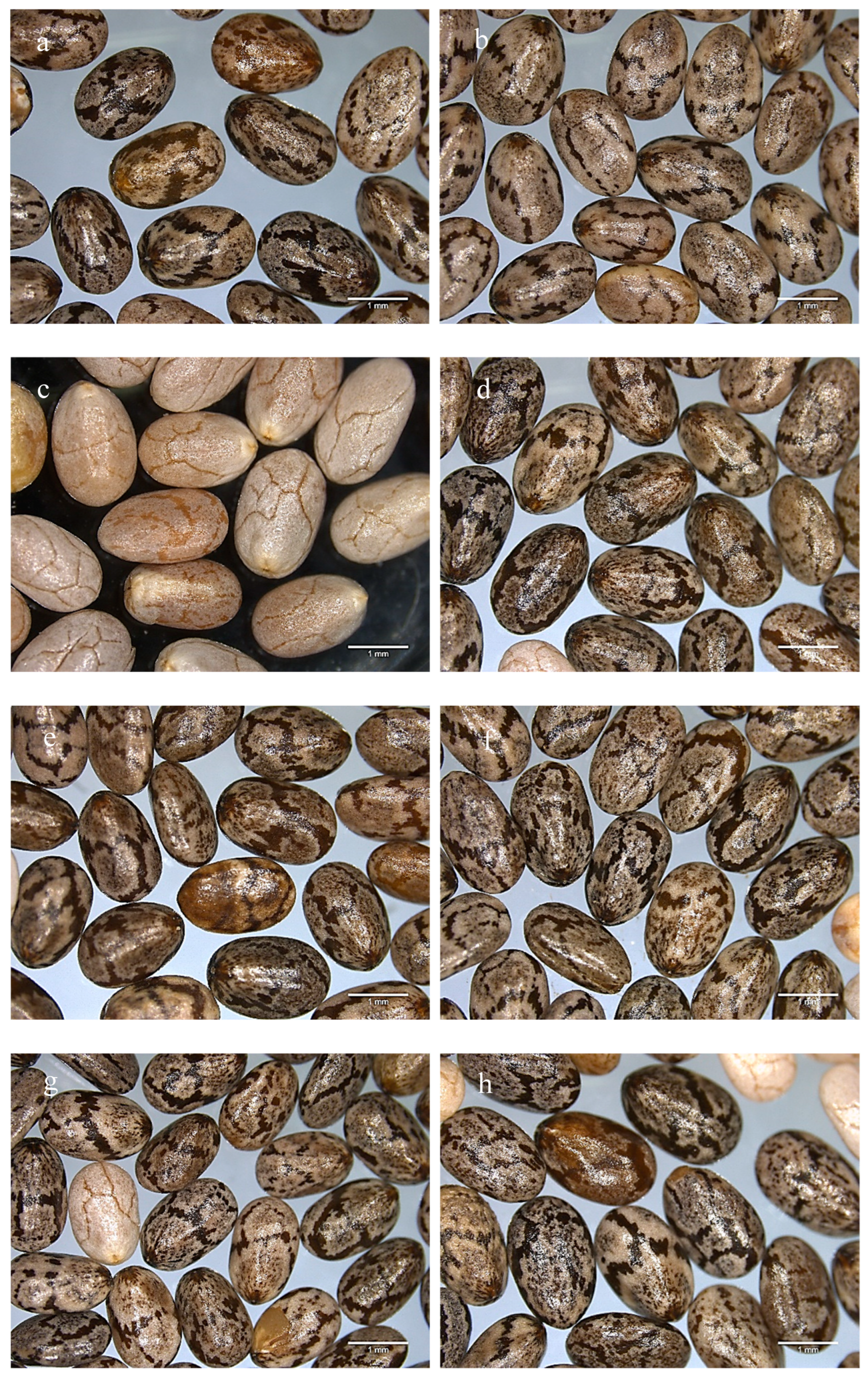
Figure 2.
Composition of amino acids (mg/g protein) based on FAO/WHO/UNU (Food and Agriculture Organization/World Health Organization/United Nations University) standard adults reference pattern (g/100 g protein) [40]. Values are expressed as mean ± standard deviation (n = 3). Bars followed by the same letter are not significantly different at 95% confidence level.
Figure 2.
Composition of amino acids (mg/g protein) based on FAO/WHO/UNU (Food and Agriculture Organization/World Health Organization/United Nations University) standard adults reference pattern (g/100 g protein) [40]. Values are expressed as mean ± standard deviation (n = 3). Bars followed by the same letter are not significantly different at 95% confidence level.
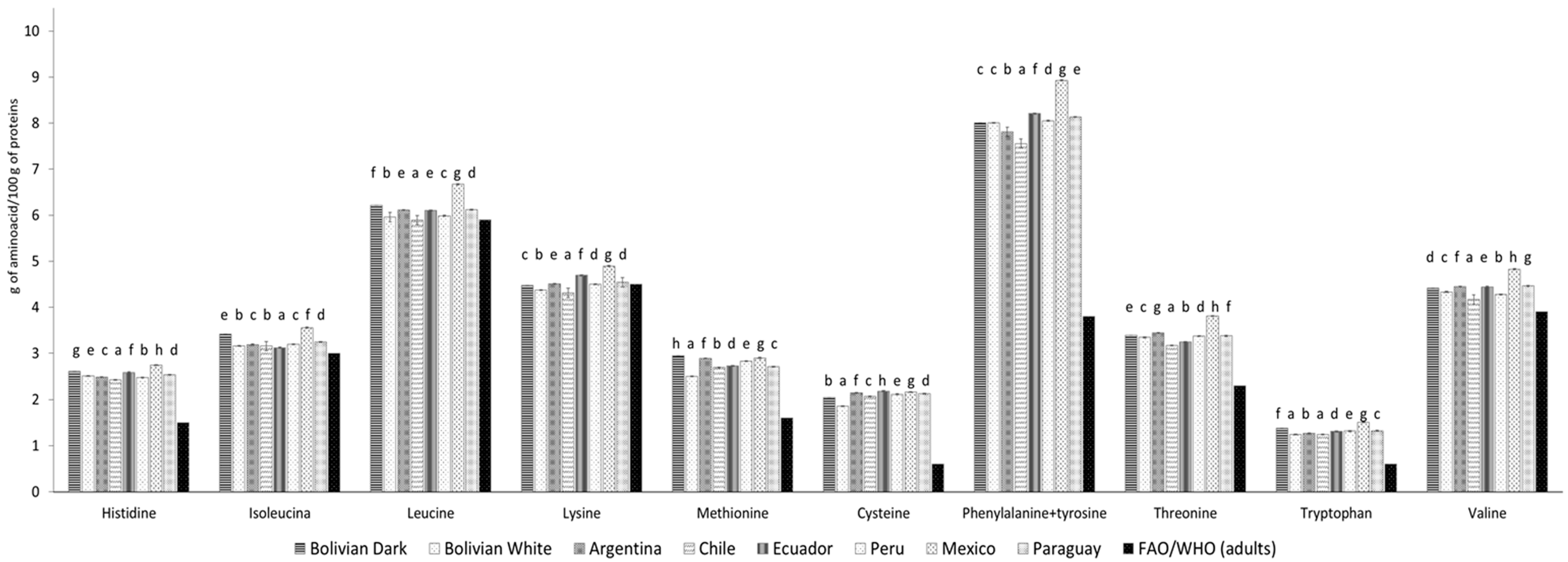
Table 1.
Physical properties of chia seeds from different origins.
| Parameter | Units | Bolivian | Argentina | Chile | Ecuador | Peru | Mexico | Paraguay | |||||||||
|---|---|---|---|---|---|---|---|---|---|---|---|---|---|---|---|---|---|
| Dark | White | ||||||||||||||||
| 1000-seed mass | g | 1.38 | ± 0.01e | 1.26 | ± 0.02b | 1.26 | ± 0.03b | 1.26 | ± 0.01b | 1.10 | ± 0.02a | 1.31 | ± 0.02d | 1.29 | ± 0.02d | 1.46 | ± 0.01c |
| Bulk density | g/m3 | 69.7 | ± 1.1d | 68.2 | ± 0.3abc | 69.4 | ± 0.4cd | 71.2 | ± 0.4e | 68.5 | ± 1.9bcd | 67.0 | ± 0.1a | 67.8 | ± 0.2ab | 72.9 | ± 0.1f |
| True Density | g/m3 | 1154 | ± 40cd | 1162 | ± 0cd | 1102 | ± 0b | 1163 | ± 0d | 1110 | ± 0ab | 1147 | ± 0c | 1122 | ± 0a | 1153 | ± 0cd |
| Porosity (ε) | % | 94.0 | ± 0.5e | 94.1 | ± 0.1f | 93.7 | ± 0.2b | 93.9 | ± 0.2d | 93.83 | ± 0.9a | 94.2 | ± 0.0g | 94.0 | ± 0.1e | 93.7 | ± 0.1a |
| Length | mm | 1.98 | ± 0.11b | 2.02 | ± 0.10cd | 2.00 | ± 0.12bd | 1.87 | ± 0.09a | 1.87 | ± 0.12a | 2.03 | ± 1.14cd | 2.01 | ± 0.10bd | 2.06 | ± 0.10c |
| Width | mm | 1.35 | ± 0.13e | 1.35 | ± 0.09de | 1.25 | ± 0.12b | 1.37 | ± 0.09e | 1.19 | ± 0.10a | 1.31 | ± 0.13cd | 1.30 | ± 0.12c | 1.31 | ± 0.08cd |
| Thickness | mm | 0.957 | ± 0.081a | 1.08 | ± 0.12c | 0.953 | ± 0.078a | 1.01 | ± 0.09b | 0.946 | ± 0.085a | 0.937 | ± 0.091a | 0.973 | ± 0.086a | 1.01 | ± 0.11b |
| Equivalent diameter | mm | 0.833 | ± 0.002a | 0.828 | ± 0.012a | 0.878 | ± 0.010c | 0.833 | ± 0.016a | 0.867 | ± 0.003c | 0.838 | ± 0.019ab | 0.859 | ± 0.010bc | 0.843 | ± 0.021ab |
| Sphericity (Φ) | % | 0.691 | ± 0.038c | 0.706 | ± 0.033d | 0.667 | ± 0.024b | 0.734 | ± 0.034e | 0.686 | ± 0.034ac | 0.667 | ± 0.034b | 0.678 | ± 0.028abc | 0.678 | ± 0.036ab |
| Surface area | mm2 | 5.86 | ± 0.52d | 6.42 | ± 0.58e | 5.61 | ± 0.63b | 5.93 | ± 0.55cd | 5.15 | ± 0.55a | 5.76 | ± 0.65bd | 5.84 | ± 0.57d | 6.11 | ± 0.55c |
| Volume | mm3 | 1.31 | ± 0.01a | 1.30 | ± 0.02a | 1.38 | ± 0.02c | 1.31 | ± 0.03a | 1.36 | ± 0.01c | 1.32 | ± 0.03ab | 1.35 | ± 0.02bc | 1.32 | ± 0.03ab |
| Arithmetic mean diameter | mm | 1.43 | ± 0.06d | 1.48 | ± 0.06c | 1.40 | ± 0.08b | 1.42 | ± 0.06bd | 1.33 | ± 0.07a | 1.42 | ± 0.08bd | 1.43 | ± 0.07bd | 1.46 | ± 0.06c |
| Geometric mean diameter | mm | 1.36 | ± 0.06d | 1.43 | ± 0.06e | 1.33 | ± 0.08b | 1.37 | ± 0.06cd | 1.28 | ± 0.07a | 1.35 | ± 0.08bd | 1.36 | ± 0.07d | 1.39 | ± 0.06c |
Mean± SD (n=100). Values followed by the same letter in the same row are not significantly different (p<0.05)
Table 2.
Color parameter of different commercial chia seeds and their whole ground seeds.
| Color parameters | Bolivian | Argentina | Chile | Ecuador | Peru | Mexico | Paraguay | ||||||||||
|---|---|---|---|---|---|---|---|---|---|---|---|---|---|---|---|---|---|
| Dark | White | ||||||||||||||||
| Seeds | L* | 39.6 | ± 0.5c | 59.2 | ± 0.9e | 36.3 | ± 0.2b | 42.1 | ± 0.8d | 33.5 | ± 0.6a | 35.7 | ± 0.8b | 36.3 | ± 0.6b | 32.6 | ± 0.5a |
| a* | 1.40 | ± 0.26a | 3.27 | ± 0.47de | 2.82 | ± 0.05cd | 1.66 | ± 0.47a | 2.84 | ± 0.13cd | 2.77 | ± 0.02bc | 2.31 | ± 0.07b | 3.35 | ± 0.22e | |
| b* | 11.1 | ± 0.3a | 12.1 | ± 0.1c | 12.2 | ± 0.1c | 10.8 | ± 0.4a | 11.6 | ± 0.2b | 12.2 | ± 0.1c | 12.2 | ± 0.2c | 11.9 | ± 0.1bc | |
| Whole Ground Seeds | L* | 49.8 | ± 0.0d | 58.9 | ± 0.0f | 46.0 | ± 0.0c | 54.0 | ± 0.1e | 45.8 | ± 0.1c | 41.7 | ± 0.0a | 45.7 | ± 0.1d | 45.7 | ± 0.1b |
| a* | 1.81 | ± 0.02c | 3.57 | ± 0.03f | 2.26 | ± 0.03e | 1.35 | ± 0.05a | 2.31 | ± 0.03e | 2.28 | ± 0.07a | 1.47 | ± 0.02b | 1.97 | ± 0.07d | |
| b* | 11.0 | ± 0.0f | 15.4 | ± 0.0h | 10.3 | ± 0.0d | 10.4 | ± 0.0e | 9.9 | ± 0.0c | 9.5 | ± 0.0b | 11.5 | ± 0.0g | 9.2 | ± 0.0a | |
Mean±SD (n=3). Values followed by the same letter in the same row are not significantly different (p<0.05)
Table 3.
Comparison of the total color difference (ΔE*) between commercial chia seeds and whole ground seeds.
Table 3.
Comparison of the total color difference (ΔE*) between commercial chia seeds and whole ground seeds.
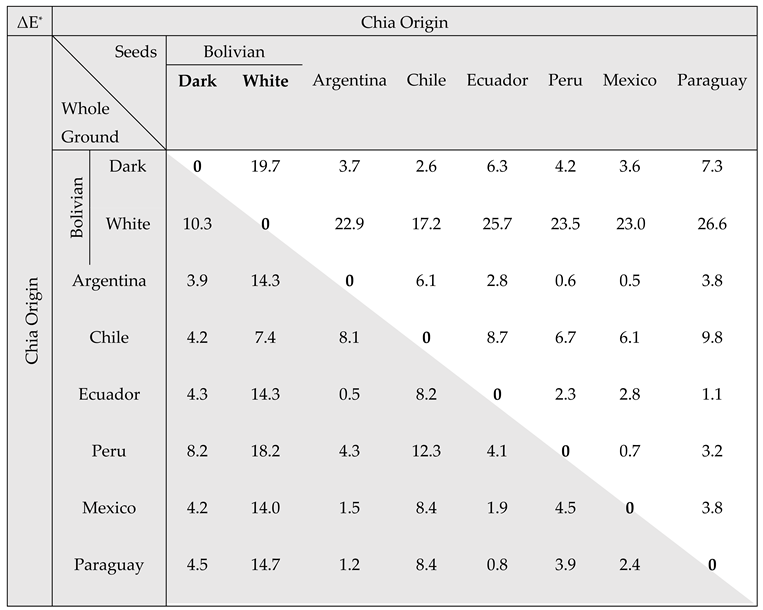 |
Table 5.
Amino acid composition of commercial chia seeds from different origin.
| Amino acid composition g/100g seeds |
Bolivian | Argentina | Chile | Ecuador | Peru | Mexico | Paraguay | |||||||||
| Dark | White | |||||||||||||||
| No essential | ||||||||||||||||
| Alanine | 1.21 | ± 0.01d | 1.09 | ± 0.04c | 0.969 | ± 0.011b | 1.10 | ± 0.06c | 0.897 | ± 0.002a | 0.942 | ± 0.020ab | 1.11 | ± 0.01c | 1.04 | ± 0.03c |
| Arginine | 2.62 | ± 0.05e | 2.18 | ± 0.15d | 1.98 | ± 0.04bc | 2.16 | ± 0.11cd | 1.78 | ± 0.08a | 1.92 | ± 0.01ab | 2.28 | ± 0.06d | 2.16 | ± 0.11cd |
| Aspartic acid | 2.25 | ± 0.02f | 1.93 | ± 0.08de | 1.75 | ± 0.01bc | 1.83 | ± 0.11cd | 1.47 | ± 0.02a | 1.65 | ± 0.01b | 2.03 | ± 0.01e | 1.81 | ± 0.06cd |
| Glutamic acid | 4.41 | ± 0.10c | 3.78 | ± 0.23b | 3.40 | ± 0.04a | 3.76 | ± 0.28b | 3.17 | ± 0.01a | 3.41 | ± 0.01a | 3.98 | ± 0.06b | 3.83 | ± 0.15b |
| Glycine | 1.14 | ± 0.01f | 1.03 | ± 0.03de | 0.955 | ± 0.029bc | 0.967 | ± 0.047bc | 0.880 | ± 0.011a | 0.937 | ± 0.004b | 1.06 | ± 0.01e | 1.00 | ± 0.01cd |
| Proline | 0.944 | ± 0.074d | 0.819 | ± 0.047bc | 0.821 | ± 0.044abc | 0.809 | ± 0.036bc | 0.752 | ± 0.041a | 0.875 | ± 0.069bcd | 0.933 | ± 0.037cd | 0.851 | ± 0.013abcd |
| Serine | 1.37 | ± 0.07e | 1.21 | ± 0.04d | 1.09 | ± 0.02bc | 1.17 | ± 0.06cd | 0.969 | ± 0.020a | 1.06 | ± 0.00ab | 1.22 | ± 0.04d | 1.12 | ± 0.03bcdc |
| Essential amino acid | ||||||||||||||||
| Tryptophan | 0.333 | ± 0.016a | 0.321 | ± 0.001 a | 0.268 | ± 0.001a | 0.299 | ± 0.001a | 0.253 | ± 0.005a | 0.278 | ± 0.016a | 0.331 | ± 0.013a | 0.297 | ± 0.020a |
| Cysteine | 0.497 | ± 0.004d | 0.475 | ± 0.004cd | 0.453 | ± 0.002bc | 0.497 | ± 0.009d | 0.422 | ± 0.000a | 0.447 | ± 0.023ab | 0.475 | ± 0.021cd | 0.479 | ± 0.002cd |
| Methionine | 0.671 | ± 0.006de | 0.686 | ± 0.025e | 0.610 | ± 0.018bc | 0.646 | ±0.042cde | 0.527 | ± 0.018a | 0.598 | ± 0.004b | 0.637 | ± 0.006bcd | 0.609 | ± 0.004bc |
| Histidine | 0.673 | ± 0.042d | 0.606 | ± 0.023c | 0.525 | ± 0.021ab | 0.583 | ± 0.042c | 0.500 | ± 0.008a | 0.524 | ± 0.000ab | 0.603 | ± 0.006c | 0.571 | ± 0.008bc |
| Isoluecine | 0.847 | ± 0.012d | 0.795 | ± 0.044cd | 0.673 | ± 0.023ab | 0.758 | ± 0.071c | 0.604 | ± 0.002a | 0.675 | ± 0.018ab | 0.781 | ± 0.003cd | 0.729 | ± 0.023bc |
| Leucine | 1.60 | ± 0.05d | 1.45 | ± 0.08c | 1.29 | ± 0.01ab | 1.42 | ± 0.11c | 1.18 | ± 0.00a | 1.27 | ± 0.04ab | 1.47 | ± 0.01c | 1.38 | ± 0.04bc |
| Lysine | 1.17 | ± 0.03d | 1.04 | ± 0.04c | 0.952 | ± 0.021ab | 1.04 | ± 0.05c | 0.907 | ± 0.008a | 0.951 | ± 0.006ab | 1.08 | ± 0.04c | 1.02 | ± 0.06bc |
| Phenylalanine | 1.27 | ± 0.01d | 1.12 | ± 0.06c | 0.985 | ± 0.049ab | 1.08 | ± 0.08bc | 0.939 | ± 0.038a | 1.01 | ± 0.04ab | 1.16 | ± 0.02c | 1.08 | ± 0.03bc |
| Threonine | 0.896 | ± 0.030e | 0.789 | ± 0.015cd | 0.726 | ± 0.004b | 0.762 | ± 0.042bc | 0.628 | ± 0.008a | 0.714 | ± 0.025b | 0.837 | ± 0.001d | 0.759 | ± 0.024bc |
| Tyrosine | 0.878 | ± 0.007c | 0.741 | ± 0.048ab | 0.663 | ± 0.054a | 0.734 | ± 0.040ab | 0.647 | ± 0.006a | 0.689 | ± 0.035a | 0.806 | ± 0.086bc | 0.748 | ± 0.045ab |
| Valine | 1.16 | ± 0.00d | 1.03 | ± 0.06c | 0.939 | ± 0.021ab | 1.00 | ± 0.07bc | 0.859 | ± 0.003a | 0.905 | ± 0.009a | 1.06 | ± 0.00c | 1.00 | ± 0.02bc |
| EAAs | 9.98 | 9.04 | 8.08 | 8.81 | 7.46 | 8.06 | 9.22 | 8.67 | ||||||||
Mean±SD (n=3). Values followed by the same letter in the same row are not significantly different (p<0.05); d.m. dry matter; EAAs, essential amino acids
Table 6.
Fatty acid composition of commercial chia seeds.
| Parameter Fatty acid |
Units or Reference Values | Bolivian | Argentina | Chile | Ecuador | Peru | Mexico | Paraguay | ||||||||||
| Dark | White | |||||||||||||||||
| Palmitic acid | C16:0 | g/100g d.m. | 2.11 | ± 0.15g | 2.15 | ± 0.25h | 1.89 | ± 0.22a | 1.91 | ± 0.12b | 2.10 | ± 0.13f | 1.95 | ± 0.11c | 2.02 | ± 0.25e | 2.00 | ± 0.14d |
| Stearic acid | C18:0 | g/100g d.m. | 0.94 | ± 0.23c | 1.01 | ± 0.18f | 0.84 | ± 0.47a | 0.86 | ± 0.04b | 0.95 | ± 0.04d | 1.01 | ± 0.06f | 1.05 | ± 0.11g | 1.00 | ± 0.11e |
| Arachidic acid | C20:0 | g/100g d.m. | 0.07 | ± 0.00b | 0.08 | ± 0.02c | 0.07 | ± 0.00b | 0.06 | ± 0.00a | 0.07 | ± 0.00b | 0.08 | ± 0.02c | 0.07 | ± 0.05b | 0.08 | ± 0.01c |
| ƩSFA | 3.12 | 3.24 | 2.80 | 2.83 | 3.12 | 3.04 | 3.14 | 3.08 | ||||||||||
| Palmitoleic acid | C16:1n7 | g/100g d.m. | 0.05 | ± 0.01a | 0.08 | ± 0.01d | 0.06 | ± 0.01b | 0.06 | ± 0.04b | 0.07 | ± 0.01c | 0.06 | ± 0.01b | 0.07 | ± 0.01c | 0.06 | ± 0.01b |
| Oleic acid | C18:1n9 | g/100g d.m. | 1.74 | ± 0.40d | 2.02 | ± 0.21g | 1.50 | ± 0.16b | 1.40 | ± 0.03a | 1.55 | ± 0.07c | 1.97 | ± 0.23f | 2.67 | ± 0.19h | 1.96 | ± 0.10e |
| Vaccenic acid | C18:1n7 | g/100g d.m. | 0.14 | ± 0.05c | 0.14 | ± 0.00c | 0.13 | ± 0.11b | 0.13 | ± 0.08b | 0.14 | ± 0.08c | 0.13 | ± 0.09b | 0.12 | ± 0.08a | 0.13 | ± 0.06b |
| ƩMUFA | 1.93 | 2.24 | 1.69 | 1.59 | 1.76 | 2.16 | 2.86 | 2.15 | ||||||||||
| Linoleic acid (LA) | C18:2n6c | g/100g d.m. | 5.56 | ± 0.25e | 5.66 | ± 0.11f | 5.28 | ± 0.30c | 4.88 | ± 0.31a | 5.15 | ± 0.34b | 5.50 | ± 0.66d | 5.97 | ± 0.13g | 5.56 | ± 0.52e |
| γ-Linolenic acid | C18:3n6 | g/100g d.m. | 0.05 | ± 0.01a | 0.06 | ± 0.04b | 0.05 | ± 0.01a | 0.05 | ± 0.01a | 0.06 | ± 0.00b | 0.06 | ± 0.01b | 0.05 | ± 0.02a | 0.05 | ± 0.01a |
| α-Linolenic acid (ALA) | C18:3n3 | g/100g d.m. | 16.9 | ± 1.1c | 15.6 | ± 0.5b | 18.2 | ± 0.8g | 18.4 | ± 0.6h | 17.4 | ± 0.0d | 18.1 | ± 0.6f | 14.9 | ± 0.2a | 18.0 | ± 0.3e |
| ƩPUFA | 22.49 | 21.32 | 23.57 | 23.28 | 22.64 | 23.62 | 20.93 | 23.59 | ||||||||||
| LA/ALA | C18:2n6c/ C18:3n3 | g/g | 1/3 | 1/2.8 | 1/3.5 | 1/3.8 | 1/3.4 | 1/3.3 | 1/2.5 | 1/3.2 | ||||||||
| % of contribution of AI E% for LAa | FAO | 2.5 E% | 13.2 | 13.5 | 12.6 | 11.6 | 12.3 | 13.1 | 14.2 | 13.2 | ||||||||
| EFSA | 4 E% | 8.27 | 8.42 | 8.27 | 7.26 | 7.66 | 8.18 | 8.88 | 8.27 | |||||||||
| % of DRI of LAa | EFSA | 17 g/day (Male) | 4.91 | 4.99 | 4.66 | 4.31 | 4.54 | 4.85 | 5.27 | 4.91 | ||||||||
| 12 g/day (Female) | 7.0 | 7.1 | 6.6 | 6.1 | 6.4 | 6.8 | 7.5 | 7.0 | ||||||||||
| % of contribution of AI E% for ALAa | FAO/EFSA | 0.5 E% | 201 | 186 | 217 | 218 | 208 | 215 | 177 | 214 | ||||||||
|
% of DRI of ALAa |
EFSA | 1.6 g/day (Male) | 158 | 146 | 171 | 172 | 164 | 169 | 140 | 169 | ||||||||
| 1.1 g/day (Female) | 230 | 213 | 249 | 250 | 238 | 246 | 203 | 245 | ||||||||||
Mean±SD (n=3). Values followed by the same letter in the same row are not significantly different (p<0.05); Adequate intake (AI) contribution expressed in energy percentage (E%) for LA and ALA for adults (≥18 age) [39,40]; SFA (short fatty acid), MUFA (monounsaturated fatty acid), PUFA (polyunsaturated fatty acid) and DRI (Dietary Recommendation Intake); aContribution based on limit intake chia seed (15g/day) taking in account a 2200 Kcal diet [48].
Table 7.
Phytic acid content and mineral composition of commercial chia seeds from different origins, mineral dietary reference intake contribution and their bioavailability prediction.
Table 7.
Phytic acid content and mineral composition of commercial chia seeds from different origins, mineral dietary reference intake contribution and their bioavailability prediction.
| Parameter | Units | Bolivian | Argentina | Chile | Ecuador | Peru | Mexico | Paraguay | ||||
| Dark | White | |||||||||||
| Ins P6 | g/100g d.m. | 2.6 ± 0.0d | 1.5 ± 0.03a | 2.2 ± 0.04c | 2.6 ± 0.05d | 2.2 ± 0.07c | 1.9 ± 0.0b | 2.3 ± 0.06c | 2.2 ± 0.01c | |||
| Macroelements | Na | mg/100g d.m. | 1.2 ± 1.4a | 1.0± 0.5a | 1.3 ± 0.1a | 1.0 ± 0.0a | 1.2 ± 0.0a | 1.4 ± 0.1a | 1.2 ± 0.6a | 0.8 ± 0.0a | ||
| Ca | mg/100g d.m. | 498.9 ± 0.1ab | 492.3 ± 0.3ab | 537.1 ± 0.1abc | 671.1 ± 0.2c | 481.5 ± 0.2ab | 613.4 ± 0.2bc | 530.9 ± 0.3ab | 460 ± 0.1a | |||
| P | mg/100g d.m. | 549.6 ± 0.4d | 393.9 ± 0.7a | 472.3 ± 0.5bc | 661.9 ± 0.4e | 482 ± 0.4bcd | 409.1 ± 0.8ab | 474.2 ± 1.1bc | 540.3 ± 0.7cd | |||
| Mg | mg/100g d.m. | 280.8 ± 0.5abc | 262.6 ± 0.2ab | 263.8 ± 0.3ab | 321.6 ± 0.3d | 301.2 ± 0.9bcd | 261.7 ± 0.3a | 250 ± 0.4a | 308.6 ± 0.2cd | |||
| Microelements | Zn | mg/100g d.m. | 3.69 ± 0.00e | 4.83 ± 0.01cd | 2.69 ± 0.03a | 5.16 ± 0.01f | 3.69 ± 0.00cd | 3.55 ± 0.01bc | 3.37 ± 0.04b | 3.94 ± 0.01d | ||
| Fe | mg/100g d.m. | 7.79 ± 0.58a | 7.55 ± 0.25a | 6.12 ± 0.06a | 5.57 ± 0.13a | 5.74 ± 0.02a | 23.4 ± 0.97b | 4.23 ± 0.05a | 4.64 ± 0.00a | |||
| Mn | mg/100g d.m. | 2.06 ± 0.04c | 1.47 ± 0.01b | 2.49 ± 0.00d | 0.94 ± 0.00a | 3.95 ± 0.02f | 2.58 ± 0.01d | 2.96 ± 0.04e | 5.95 ± 0.01g | |||
| Cu | mg/100g d.m. | 1.07 ± 0.01b | 1.50 ± 0.01cd | 0.91 ± 0.01a | 1.58 ± 0.00d | 1.42 ± 0.01cd | 1.28 ± 0.00c | 0.86 ± 0.01a | 1.32 ± 0.02c | |||
| Al | mg/100g d.m. | 1.95 ± 0.37a | 2.15 ± 0.11a | 3.02 ± 0.01a | 0.59 ± 0.03a | 4.35 ± 0.39a | 41.15 ± 0.16b | 0.8 ± 0.02a | 0.25 ± 0.03a | |||
| S | mg/100g d.m. | 180 ± 1abc | 216 ± 1d | 175± 0ab | 223± 1d | 170 ± 1a | 194 ± 1c | 166 ± 0a | 190 ± 1bc | |||
| Ratio | Ins P6/Ca < 0.24 | mol/mol | 0.37 | 0.22 | 0.29 | 0.27 | 0.32 | 0.22 | 0.30 | 0.35 | ||
| Ins P6/Fe < 1 | mol/mol | 32.9 | 20.2 | 35.6 | 46.1 | 37.9 | 8.0 | 52.6 | 47.8 | |||
| Ins P6/Zn < 15 | mol/mol | 81.4 | 37.1 | 94.9 | 58.3 | 69.1 | 61.3 | 77.3 | 65.8 | |||
| Contribution to DRIs (%)b | Na | DRIsa 1500 | mg/day | 4.7 | 4.9 | 5.4 | 6.7 | 4.8 | 6.1 | 5.3 | 4.6 | |
| Ca | DRIsa 1000 | mg/day | 7.4 | 7.4 | 8.1 | 10.1 | 7.2 | 9.2 | 8.0 | 6.9 | ||
| P | DRIsa 550 | mg/day | 15.0 | 10.7 | 12.9 | 18.1 | 13.2 | 11.2 | 12.9 | 12.9 | ||
| Mg | DRIsa 350*/300* | mg/day | 12.0/14.0 | 11.3/13.1 | 11.3/13.2 | 13.8/16.1 | 12.9/15.1 | 11.2/13.1 | 10.7/12.5 | 13.2/15.4 | ||
| Zn | DRIsa 11/8 | mg/day | 5.0/6.9 | 6.6/9.1 | 3.7/5.0 | 6.6/9.1 | 5.0/6.9 | 4.8/6.7 | 4.6/6.3 | 4.6/6.3 | ||
| Fe | DRIsa 11/7 | mg/day | 10.6/16.7 | 10.3/16.2 | 8.4/13.1 | 7.6/11.9 | 7.8/12.3 | 31.9/50.1 | 5.8/9.1 | 6.3/9.9 | ||
| Mn | DRIsa 2.3/1.8 | mg/day | 13.4/17.2 | 13.4/17.2 | 16.2/20.8 | 6.1/7.8 | 25.8/32.9 | 16.8/21.5 | 19.3/24.7 | 38.8/49.6 | ||
| Cu | DRIsa 1.6/1.3 | mg/day | 10.0/12.4 | 14.1/17.3 | 8.5/10.5 | 14.8/18.2 | 13.3/16.4 | 12/14.8 | 8.1/9.9 | 12.4/15.2 | ||
Mean±SD (n=3). Values followed by the same letter in the same row are not significantly different (p<0.05). InsP6: Myo-inositol phosphate. aDRIs: Dietary reference intakes: recommended dietary allowances and adequate intakes, elements (Male/Female). Life stage group: >18 years; [59]; bContribution based on limit intake chia seed (15g/day) by EFSA [48]
Disclaimer/Publisher’s Note: The statements, opinions and data contained in all publications are solely those of the individual author(s) and contributor(s) and not of MDPI and/or the editor(s). MDPI and/or the editor(s) disclaim responsibility for any injury to people or property resulting from any ideas, methods, instructions or products referred to in the content. |
© 2023 by the authors. Licensee MDPI, Basel, Switzerland. This article is an open access article distributed under the terms and conditions of the Creative Commons Attribution (CC BY) license (http://creativecommons.org/licenses/by/4.0/).
Copyright: This open access article is published under a Creative Commons CC BY 4.0 license, which permit the free download, distribution, and reuse, provided that the author and preprint are cited in any reuse.


