
Submitted:
04 July 2023
Posted:
04 July 2023
You are already at the latest version
Abstract
As most prominent plant-associated disease, photosensitization in large herbivores provides a substantial data base to evaluate the conditions under which animals are concerned. The purpose of this meta study was to investigate whether the level of feed plant diversity and feed choice influence the incidence of photosensitization. Case reports from 1900 to 2022 served as database. 113 publications described 178 cases of altogether 12 animal species, most of them being farm animals. 73.6% of the cases originated from three continents: South America, Australia and North-America. Of the 40 phototoxic agents, herbs represented the majority (63.6%). Brachiaria, Froelichia and other four genus were associated in almost 50% of the cases. Usually, animals received feed both of normal quality and in fresh state. Secondary photosensitization was most frequent only when associated with poor feed quality. If the animals had had access to high-diversity feed instead of low-diversity feed, the incidence was 27.5% smaller. If the animals had the choice between various kind of feed, the incidence was even reduced by 56.1%. Horses could select the least, however, suffered mainly from primary photosensitization. We conclude that farmers may prevent photosensitization in husbandry animals by allowing both more feed choice and feed diversity.
Keywords:
photosensitization
; feed diversity
; feed selection
; biodiversity
; phototoxic
; feed quality
; livestock
1. Introduction
Cases of plant poisoning in animals are not easy to verify by tracing them back to plants because the symptoms are either unspecific [1], subtle [2] or the suspicious plants ingested are simply not visible any more [3]. Moreover, signs of grazing are inconspicuous and thus often overlooked [4]. One prominent exception between plant poisoning diseases is photosensitization. Apart from the well-known outward symptoms of this disease, there are several and abundant plant species such as of the genus Heracleum and Hypericum that are well-known for their photoactive compounds that may accumulate in the skin and interact with sunlight, causing in worst case severe dermatitis [5,6]. Typically, white colored husbandry animals are affected most often by the disease, although except from a few cases in birds, unequivocal symptoms are to be observed in all kind of colored mammals. These striking features along with the popular aetiology of photosensitization and an unambiguous classification system of photosensitization available [7,8] provided appropriate conditions to get a sufficient number of evidence-based cases for our meta-study to understand why farm animals are poisoned by feed plants. One approach is to explore whether the animals could avoid potential toxic plants by selection behavior [9]. For that question, we reviewed case reports of photosensitization from as early as 1900 up to today by addressing two key variables, feed diversity and feed choice. The more floristically diverse a feed stuff is, the higher is the probability that it contains potentially phototoxic plant species, too. However, both variables have been widely discussed with regard to nutritional ecology [10,11,12] and animal welfare [13], however, they are still neglected topics in farming practice [13]. The goal of this meta study was to investigate whether the level of plant diversity in the feed and the extent of feed choice influence the case number of photosensitization.
2. Materials and Methods
2.1. Search for case reports
Electronical databases such as Web of Science, CAB abstracts and VetSearch were browsed to compile case reports of photosensitization between 1900 and 2022. Reviews as publication format served as data base for single case reports. However, if epidemiological data did not allow to separate several similar cases from each other, those case collections counted for one case. Except for birds, individuals of the typical herbivorous livestock species such as sheep or goat were considered, as well as omnivorous farm animals or wild animals such as kangaroo, wombat and llama.
For this meta study, in each paper any spontaneous outbreak or experiment that caused photosensitization counted as one case. Consequently, the total number of cases of the data base analyzed here, was supposed to be higher than the number of papers. If the disease was a secondary finding of studies with another research focus (e.g. [14]), those instances counted for case reports as well. In contrast, experiments with both artificial causes of photosensitization like medications or animals being force-fed were excluded. Publications stating a non-alimentary related background for hepatogenous photosensitization such as liver-migrating endoparasites (e.g. [15]) were not part of this meta study. Moreover, we supplemented the raw data by notes of doubtful evidence which either the authors themselves had mentioned or from our point of view, the authors failed to prove the agent scientifically sufficient.
2.2. Variables of evaluation case reports
The principal variables for evaluation cases of photosensitization included (1) level of feed examination, (2) kind of phototoxic agent, (3) type of photosensitization, (4) animal species, (5) kind and quality of feed, (6) plant species diversity of feed, and (7) possibility of feed choice. Some principal variables consisted of subsidiary variables (sub variables).
2.2.1. Level of feed examination
We materialized possible parameters of the second variable “level of feed examination” by asking whether the authors examined both the feed quality and botanical composition and whether they carried it out (a) completely, (b) partly or (c) did not indicate any kind of feed examination.
In detail, the criteria that the authors examined both criteria completely, were that they (a) inspected the pasture and indicated further plant species than the already identified phototoxic ones, (b) stated that no other phototoxic plants were growing there (c) noted that a phototoxic plant species was found in large quantities (d) counted fungi spores in case of the presence of any (e.g. [16]), (e) analyzed the feed botanically, (f) stated that no phototoxic plants were found, (g) named both main plant species and those with a mass portion of less than 5%.
The criteria that the authors examined the feed’s quality and botanical composition partly, were that they (a) searched for presence or absence of phototoxic plants (b) stated simply that no other phototoxic plants were present and (c) indicated the presence of “many” species with no further information.
2.2.2. Kind of phototoxic agent
Any associated feed-related ingested organisms were relevant as proven or suspected cause of photosensitization, subsumed as “agents”. All taxa identified in this study as agents corresponded to the following five functional groups, reflecting the classification of feed stuff for grazers and browsers, (1) grasses, (2) herbs, (3) woody plants, (4) bacteria and fungi, (5) unknown agents built another group. In cases where the authors failed to prove the kind of agent, we noted whether they have suspected it.
2.2.3. Type of photosensitization
Photosensitization manifests in four types: (1) primary (direct), (2) secondary (hepatogenous), (3) endogenous and (4) idiopathic type [7,8]. The first type, primary photosensitization, occurs when phototoxic components of plants are taken up through ingestion and arrive in the skin unchanged or through direct skin contact [17]. This first type of photosensitization appears within hours of the ingestion or contact [17]. In contrast, the delayed onset of the disease in the following types may make it difficult to identify the trigger. The second type, hepatogenous photosensitization, is a consequence of liver diseases caused through liver-toxic plant components [18] or fungi [19]. The damaged liver can no longer excrete photoactive phylloerythrin, a by-product of bacterial digestion of chlorophyll, through the bile [20]. Instead, it accumulates in blood and skin where it causes a range of typical photosensitization symptoms [2]. The third type, endogenous photosensitization, is a metabolic effect inherited in cattle and therefore not relevant for this study [21]. The fourth, idiopathic type, describes cases where the cause of the disease is not known so far.
For our study, primary, secondary and idiopathic type of photosensitization, were distinguished.
2.2.4. Animal species
Each mammal species noted as case of photosensitization in a publication accounted for one case, regardless whether it was a husbandry or wild animal species. This approach resulted in the first data base, the number of total single cases (n=x cases). In a few of these cases, more than one animal species was concerned. We added these additional cases to our data base, too. This resulted in the second data base, the number of all nominated animal species (n=x nominations).
2.2.5. Kind and quality of feed
The variable “kind of feed” appeared in the data set as the following sub variables, (1) “fresh” in case of ingestion of living plants either provided on pasture or after being recently harvested in a manger, (2) “conserved” in case of hay, silage or pellets, (3) “both” if animals had access to both kinds of feed and (4) “unknown” if no information about the kind of feed was given by the authors.
The variable “quality of feed” considered the hygienic state of the feed and consisted of two sub variables; (1) “normal hygienic quality” and (2) “poor hygienic quality”. In case of normal quality, there were neither direct nor indirect hints on quality deficiencies apparent in the paper. In case of poor quality, the authors stated either (a) Pithomyces chartarum on pasture grass or bacteria and fungi (mould) in conserved feed stuff or (b) moisture in case of hay, the latter according to criteria described in [22].
2.2.6. Plant species diversity of feed
This principal variable comprised five sub variables, (1) high level diversity, (2) supposed high level diversity, (3) low level diversity, (4) supposed low level diversity, (5) no information available.
In detail, the criteria for the sub variable (1), high level diversity, were if authors (a) stated that there were various weeds present (b) found several plants growing on the property or in conserved feed.
The criteria for the sub variable (2), supposed high level diversity, were when authors (a) mentioned certain key words such as “native vegetation”, “fallow” or plants that are indicator plants for a low nitrogen level in the soil or (b) listed at least four plant species without stating that one was dominating.
The criteria for the sub variable (3), low level diversity, were (a) if the pasture or conserved feed consisted of one or two species, only.
The criteria for (4), supposed low level diversity, were (a) if conserved or fresh feed was stated by the researchers to be dominated or massively invaded by one plant (b) if animals received pellets, only.
The criterion for the sub variable (5), no information available, was that authors did not mention any information on botanical diversity of feed.
2.2.7. Possibility of feed choice
For the second principal variable “possibility of feed choice”, we discerned three kinds of sub variables, (1) feed selection was possible (2) feed selection was not possible (3) feed selection was not known.
In detail, the criteria for the sub variable (1), feed selection was possible, were (a) various kinds of feed stuff were given simultaneously or shortly one after the other (b) the pasture or conserved feed contained at least two plant species without one plant dominating.
The criteria for the sub variable (2), feed selection was not possible, were if (a) a pasture was contaminated with fungi such as Pithomyces chartarum, (b) animals received only pellets, (c) the pasture vegetation was completely dried out, even if biodiversity was high.
The criterion for the sub variable (3), possibility for feed selection not known, was when any relevant information was missing.
2.3. Data analysis
Most of the data were analyzed descriptively, counting the presence or absence of defined traits corresponding to the above-mentioned variables. In addition, between the key variables “plant species diversity of feed” and “possibility of feed choice”, Pearson correlation coefficient r was calculated with Microsoft excel© on basis of the number of animal nominations. The level of significance was extracted from tables of critical values of correlation coefficient in Cann (2004) [23], based on one-sided test. In order to test whether the mean of differences between the number of cases of two distinct groups was different or not, a one-factorial ANOVA has been carried out. In detail, this procedure was applied on the following variables: (1) primary and secondary type of photosensitization, (2) normal and poor feed quality, (3) low and high feed diversity and (4) feed selection possible or not possible.
3. Results
3.1. Data material
Cases of photosensitization have been obtained from 113 publications and included 66 non-peer reviewed articles (58%) and two ones of unknown status (2%) from Europe, the American continent, Australia, Asia, New Zealand and Africa (Table 1). Besides one non-English study [14] and two German written studies [15,16], mainly English written literature contributed to this meta study. Apart from the German written ones, all other non-English written papers (n=20; 19.5 %) were evaluated on the basis of the English abstract. These abstracts were selected because they contained sufficient information as to the variables concerned here.
The publications described 178 cases (Appendix A). 45 of the papers (40%) were peer-reviewed, 66 ones were not peer-reviewed (58%) and in two cases (2%) it was unknown. Unfortunately, almost one fifth of all publications found, dealing with reports of photosensitization, was not published in English and therefore could not be considered.
73.6% of the cases arouse from only three continents: South America (33.79%), Australia (21.3%) and North-America (18.5%). The majority of feed (81.5%) was either completely (43.3%) or at least partly examined (38.2%). Thus, a minority of feed had not been examined (10.1%) or the status left unknown (8.4%). Only in a few cases, there was a list of the most prominent plant species, thus, our criterion “authors analyzed the feed botanically” was met here.
3.2. Phototoxic agents
In the above-mentioned total of 178 cases, 40 phototoxic agents caused photosensitization (Table 2). The 12 most often involved agents represented three size classes of cases (14-15 cases, 10-13 cases, 6-8 cases) and contained two, four and six agents, respectively. Thus, altogether 12 agents accounted for 118 (29+48+41) of 178 cases (66.3%). The most frequent phototoxic agent was signal grass (Brachiaria decumbens, Poaceae), followed by the herbaceous cottonweed (Froelichia humboldtiana; Amaranthaceae) that alone made up for 16.3% of the cases. Together with four plant genus allocated to the second size class (27.0%) these six out of 40 agents were associated with almost 50% (43.3%) of all cases. In contrast, those more rarely involved agents represented one large size class (n=28), however, accounted for only 60 cases (33.7%). Examples of this large size class were the two herbs tansy (Tanacetum vulgare; Asteraceae) and Dutchman’s breeches (Thamnosma texana; Polygonaceae). In 27 of 178 cases (15.2%), the authors suspected an agent, but failed to prove it.
Represented by 24 genus, phototoxic herbs were the most diverse functional group within the agents (Figure 1). In contrast, only three grasses turned out to be agents; apart from the already mentioned genus Brachiaria, these were Panicum and Alopecurus.
3.3. Animal species as well as kind and quality of feed
Five out of the 113 publications (no. 9, 52, 58, 157, 184; s. appendix A) presented cases in which more than one animal species was involved. This resulted in slightly more nominations of animals (n=184) than case reports (n= 178). In total, there were 184 nominations of animals with symptoms of photosensitization (Table 3).
The altogether 12 distinct species of animals comprised two groups. The first group consisted of four herbivorous typical husbandry animals; sheep, horse, cattle and goat. The second group (“other animals”) contained eight species such as omnivorous farm animals (pig) or those species that were rarely kept as husbandry animals (buffalo, donkey mule) as well as wild animals (fallow deer, grey and red kangaroo, hairy-nosed wombat, llama). Sheep and cattle, allocated to the first group, mainly contributed to the total case number (39.7% and 31.5%) while other animal species contributed the least (11%).
Animals received more feed of normal quality (165 individuals, 89.7%) than of poor quality (19 individuals, 10.3%) (p<0.020) (Table 4). 72.5% of the feed was available in fresh state, thus it was either grazed or recently cut and eaten from a manger. In 66.9% of the cases, fresh fodder was of normal quality. Photosensitization went in 89.3% of the cases back to both fresh forage and normal hygienic quality. In other words, only in a minority (10.7%) poor feed quality resulted in photosensitization.
With 117 of 184 nominations of animals (63.6%), herbs clearly represented the majority of phototoxic agents in all animal species, distantly followed by grasses (25 of 184 nominations; 13.6%) (Table 5).
There was a tendency of higher incidence of secondary photosensitization (97 cases, 98 nominations) than of primary photosensitization (61 cases, 66 nominations; p=0.3524) (Table 6 and Table 7). However, in horses, the incidence of primary photosensitization was clearly higher than of secondary photosensitization (20 versus eight nominations). Moreover, in general, the portion of secondary photosensitization associated with feed of poor quality was higher (73.7%) than the portion of secondary photosensitization associated with feed of normal quality (52.2%). In particular, the relation secondary/primary photosensitization referring to feed quality was 52.7% with feed of poor quality and only 16.4% with normal quality (Table 8).
3.4. Feed diversity and feed choice
The introduction of two key variables “feed diversity” and “feed selection” served to survey whether the case number was associated with the level of diversity or selection possibility. Both variables were positively correlated (r=0.88; p<0.005). The incidence of photosensitization with low feed diversity was significantly higher than the incidence with high feed diversity (80 versus 31 cases; Table 9) (83 versus 32 nominations; Table 10) (p<0.050). Moreover, there were more cases of photosensitization without feed selection (114 cases, 119 nominations) than cases with feed selection (14 cases, 15 nominations) p<0.010. In other words, if the animals had access to high-diversity feed instead of low-diversity feed, the incidence of photosensitization was 27.5% smaller (difference between 44.9% “low diversity” and 17.4% “high diversity”; s. Table 9). However, if the animals had the choice, the incidence of photosensitization was even 56.1% smaller (difference between 64.0% “no selection” and 7.9% “selection possible”). A significant portion of cases was of unknown diversity (37.6%) or unknown selection possibility (28.1%).
Compared to the other animal species, horses showed the lowest ratio of low/high diversity (1.5; s. Table 10), but the highest ratio of no/yes selection possibility (10.5). Thus, horses ingested most often feed of high diversity, however, could select the least between plant species or feed stuff.
4. Discussion
In case reports where animals had been diagnosed or suspected with primary, secondary or idiopathic photosensitization we considered distinct levels of plant species diversity in the forage along with the extent of feed choice. Our goal was to evaluate to which degree both variables influence the incidence of photosensitization.
Symptoms of photosensitization are external, prominent and resemble human photodermatitis (“sunburn”). Therefore, they are easily recognizable for farmers and other animal keepers. This is probably the reason why the compilation of evidence-based English-written reports is as large as 184 nominations of animals. As in other studies (e.g. [6]), too, sheep and cattle are statistically overrepresented in the data as natural consequence of common farming in which these animals are kept in large flocks [6].
Along with the distinctly low portion of unknown agents of photosensitization of 3.3%, this shows that the usual problems of undiscovered aetiology with plant poisoning are not applicable for our meta study. Moreover, we scrutinized both the status of quality assurance and the author’s proof of a suspected agent. Since only in 18.5% of the papers the authors did not examine the feed (10.1%) or the examination status was unknown (8.4%), we took 81.5% of the data as trustworthy although more than half of the papers (58%) is not peer-reviewed.
Neither does an unknown level of diversity (37.6%) and feed choice (28.1%) seriously question our results. Authors of studies that miss the variable "feed plant diversity" or “possibility of feed selection” are not expected to have them considered relevant, probably because the feed lacks a certain species diversity or the animals were not given any feed choice. Otherwise, both variables would have been a significant observation, since dealing with phototoxic agents presumes that the authors thoroughly look at the feed composition and choice. Consequently, it is unlikely that unknown feed diversity and choice could be cases of high diversity or selection possibility. The portion of unknown status would rather lead to an underestimation of the effects of variables instead of false positive or negative results. However, since only few cases with a full botanical survey were found, it was not feasible to apply concrete definitions of biodiversity to our research. Instead, it was necessary to rely on the authors´ statements of varying accuracy which might have weakened the quality of data that contributes to this variable.
4.1. Diversity and selection
One can assume that phototoxic agents such as the most frequently involved plants such as Brachiaria and Froelichia as well as the other four members of two largest sizes classes are most potent phototoxic agents. Such degree of potential phototoxic toxicity may mask any effects of diversity or feed choice because the animals cannot evade even a single, short or superficial contact [24]. Indeed, low incidence of photosensitization under high diversity and free-choice shows that even optimal conditions do not guarantee that animals remain automatically unaffected when they encounter phototoxic plants in good quality feed stuff. However, since no control group such as “no photosensitization” exists in case reports, cases of healthy animals exist neither. Thus none of the variables addressed here can cause an incidence of zero.
Nevertheless, significantly higher incidences associated with the respective opposite sub variables show that high-diversity feed and possible feed selection diminish the incidence of photosensitization by roughly 30% (diversity) and 60% (selection). This finding confirms Provenza et al. (1992) who suggested that an animal is capable of avoiding phototoxic plant species [25]. Both conditions probably prevent photosensitization to a far higher extent together than alone.
The assumably synergistic combination of two correlated variables can be demonstrated in horses. This animal species turns out to be an exception in various regard. First, unlike other animals, horses suffer more often from primary photosensitization than from secondary photosensitization. Primary photosensitization goes back to direct contact to the agent via ingestion or physical contact [26] and thus would represent the typical setting to avoid the disease through allowing feed choice. Second, our data reveal that horses are not only exposed to the most diverse feed, but could the least select between plant species or feed stuff compared to all other animal species regarded here.
4.2. Agents and feed stuff
Herbs as class of highest species diversity itself, cause most of the cases, too. In herbs, the chemical diversity of phototoxic agents is higher than in other functional plant groups [27]. In addition, the majority of cases occurred with fresh feed that includes the unimpaired species-specific composition and concentration of secondary plant metabolites. Therefore, fresh plants are more phototoxic than their dried or conserved counterparts [28]. The significantly smaller number of cases of conserved compared to fresh food may be attributed to still present phototoxic compounds that decompose, yet not completely during any procedure of conservation. For example Araya and Ford (1981) showed that 80% of the hypericin content was lost when St. John´s Wort (Hypericum perforatum) was dried in the sun [29]. Ecologically functional features of living plants such as the complete garniture of secondary metabolites explain the higher number of cases of fresh feed compared with the number of cases where conserved feed is involved.
Moreover, exposed to fresh forage, animals have had the optimal chance to avoid phototoxic plants. In this context it is interesting that at least in 33.7% of the cases, agents were involved that seldom had been identified as phototoxic. This demonstrates that although there are only six plants dominating the majority of cases, a numerous variety of phototoxic agents may cause problems of animal health.
The lower incidence with possible feed choice indicates that large herbivorous animals may sense a significant array of phototoxic substances in plants and are able to avoid those plants to a certain degree. For that ability, normal food quality is essential because it may reduce at least the case number of secondary photosensitization. For example, Minervino et al. [30] write: “Secondary hepatogenous photosensitization is the most important form of photosensitization in Brazil with significant losses to the local cattle industry principally in ruminants raised extensively […]”. However, our data reveal that the significant higher incidence of secondary photosensitization applies only under the condition of poor feed quality. This suggests that not only phototoxic plants but liver-toxic bacteria and fungi, too, described for example in [19,31], have caused the higher portion of secondary photosensitization in other studies.
5. Conclusions
We showed that even optimal conditions, such as a high diversity of feed, a possibility of feed choice and forage of normal quality do not guarantee that all animal individuals keep sound when they encounter phototoxic plants. However, the incidence of photosensitization is remarkably reduced by a third, given there is diet diversity, and even halved, given there is the possibility to select within the feed or within different kind of feed stuffs. We conclude that the more choice an animal has regarding its diet, both in respect to plant diversity and feed choice, the less frequent the incidence of photosensitization is – given an acceptable forage quality. Thus, farmers may prevent photosensitization with their animals by allowing them choice, diversity and quality in feed and feed stuffs.
Author Contributions
Conceptualization, R.M. and S.A. methodology, R.M..; software, S.A. and R.M.; validation, R.M. and S.A.; formal analysis, R.M. and S.A; investigation, R.M.; resources, R.M.; data curation, R.M. and S.A.; writing—original draft preparation, R.M. and S.A.; writing—review and editing, R.M. and S.A.; visualization, S.A.; supervision, S.A.; project administration, S.A.; funding acquisition, S.A. All authors have read and agreed to the published version of the manuscript.
Funding
This research received no external funding.
Institutional Review Board Statement
Not applicable.
Data Availability Statement
Not applicable.
Acknowledgments
We thank Bernd Reckels for his administration, Konstanze Friedrich for helping with a translation problem as well as Jana Höner for the possibility to study a case of photosensitization with her horses that fully recovered.
Conflicts of Interest
The authors declare no conflict of interest.
Appendix A
The appendix contains the title of all 113 references. Moreover, it comprises raw data on plant and animal species, kind of feed stuff and disease as well as on the level of diversity of feed and the extent of selection possibility.
References
- Gupta, R.C. Veterinary toxicology; Elsevier: Amsterdam, 2007.
- Plumlee, K.H. Veterinary Toxicology; Mosby (Elsevier): 2004; Volume 1, p. 477.
- Aboling, S.; Scharmann, F.; Bunzel, D. Equine atypical myopathy: selection of sycamore maple seedlings (Acer pseudoplatanus L.) in pasture horses is driven by seedling maturity and might be associated with phenolic compounds. Veterinary Record 2020. [CrossRef]
- Aboling, S.; Rottmann, S.; Wolf, P.; Jahn-Falk, D.; Kamphues1, J. Case Report: Complex Plant Poisoning in Heavily Pregnant Heifers in Germany. Journal of Veterinary Science and Technology 2014, 5. [CrossRef]
- Kümper, H. Hypericum perforatum poisoning in sheep. In Tagung der Fachgruppe "Krankheiten der kleinen Wiederkauer", Giessen, 10. Juni 1988; Deutsche Veterinärmedizinische Gesellschaft: Giessen, German Federal Republic, 1988; pp. 86–89.
- Yuchi Chen, J.C.Q., Leslie A. Weston, Panayiotis Loukopoulos. The aetiology, prevalence and morbidity of outbreaks of photosensitisation in livestock: A review. PlosOne 2019, February. [CrossRef]
- Clare, N.T. Photosensitization in diseases of domestic animals. A review; Commonwealth Agric. Bureaux: 1952.
- Collett, M.G. Photosensitisation diseases of animals: Classification and a weight of evidence approach to primary causes. Toxicon: X 2019, 3, 100012. [CrossRef]
- Provenza, F.D.; Villalba, J.J.; Bryant, J.P. Foraging by herbivores: linking the biochemical diversity of plants to herbivore culture and landscape diversity. In Landscape Ecology and resource management. Linking theory with practice, Bissonette, J.A., Storch, I., Eds.; Island Press: Washington, Covelo, London, 2003; pp. 387-421.
- Cuchillo-Hilario, M.; Wrage-Mönnig, N.; Isselstein, J. Forage selectivity by cattle and sheep co-grazing swards differing in plant species diversity. Grass and Forage Science 0, doi: 10.1111/gfs.12339.
- JAMES A. PFISTER, C.D.C., AND FREDERICK D. PROVENZA. Behavioral toxicology of livestock inngesting plant toxins J. Range Management 1992, 45 30-36. doi: 10.2307/4002522.
- Miller, S.M.; Thompson, R.P. Seasonal patterns of diet composition, herbage intake and digestibility limit the performance of cattle grazing native pasture in the Falkland Islands. Grass and Forage Science 2007, 62, 135-144. [CrossRef]
- Forbes, J.M. Voluntary food intake and diet selection in farm animals, 2nd edition ed.; CABI: UK King's Lynn, 2007.
- Smith, B.L.; Asher, G.W.; Thompson, K.G.; Hoggard, G.K. Hepatogenous photosensitisation in fallow deer (Dama dama) in New Zealand. New Zealand veterinary journal 1997, 45, 88–92. [CrossRef]
- Sargison, N.D.; Baird, G.J.; Sotiraki, S.; Gilleard, J.S.; Busin, V. Hepatogenous photosensitisation in Scottish sheep casued by Dicrocoelium dendriticum. Veterinary parasitology 2012, 189, 233–237. [CrossRef]
- Diamantino, G.M.L.; Pierezan, F.; Ferreira, M.I.C.; Rocha, W.S.D.; Veiga, V.M.O.; Martins, C.E.; Veiga, M.O.; Soto-Blanco, B. Photosensitization by Brachiaria ruziziensis in a sheep herd. Toxicon: official journal of the International Society on Toxinology 2020, 185, 1–4. [CrossRef]
- Johnson, A.E. Toxicologic Aspects of Photosensitization in Livestock. JNCI: Journal of the National Cancer Institute 1982, 69, 253–258. [CrossRef]
- C.J., G. Outbreak of ragwort (Senecio jacobea) poisoning in horses. Equine Veterinary Journal 1983, 15, 248–250. doi: 10.1111/j.2042-3306.1983.tb01781.x.
- Vesonder, R.H., J.; Stubblefield, R.; Gilmore, W.; Peterson, S. Aspergillus flavus and aflatoxins B1, B2, and M1 in corn associated with equine death. Arch. Environ. Contam. Toxicol. 1991, 151–153. doi: 10.1007/BF01065342.
- Gehlen, H.; May, A.; Venner, M. Lebererkrankungen beim Pferd. Pferdeheilkunde 2010, 26, 668-679.
- Smith, B.L.; O'Hara, P.J. Bovine photosensitization in New Zealand. New Zealand veterinary journal 1978, 26, 2–5. [CrossRef]
- Stickdorn, T., Ellis, A.D., Kienzle, E. Horse feed hygiene evaluation with microbial and sensory examination. In Forages and grazing in horse nutrition, Saastamoinen, M., Fradinho, M.J., Santos, A.S., Miraglia, N., Ed.; Wageningen Academic Publisher: Wageningen, 2012; Volume 132.
- Cann, A.J. Mathe für Biologen; Wiley VCH-Verlag, Weinheim, Germany: Mörlenbach, Germany, 2004.
- Calapai, G.; Miroddi, M.; Minciullo, P.L.; Caputi, A.P.; Gangemi, S.; Schmidt, R.J. Contact dermatitis as an adverse reaction to some topically used European herbal medicinal products - Part 1: Achillea millefolium-Curcuma longa. Contact Dermatitis 2014, 71, 1-12. doi: 10.1111/cod.12222.
- FREDERICK D. PROVENZA, J.A.P., AND CARL D. CHENEY Mechanisms of learning in diet selection withr eference to phytotoxicosis in herbivores J. Range Management 1992, 36-45. doi:10.2307/4002523.
- Chizzola, R.; Tollemache, D.O. Skin lesions of horses- provoked by poisonous plants?. Wiener Tieraerztliche Monatsschrift 1992, 79, 120-121.
- Langenheim, J.H. Higher plant terpenoids: A phytocentric overview of their ecological roles. Journal of Chemical Ecology 1994, 20, 1223-1280. [CrossRef]
- Iason, G.R.; Villalba, J.J. Behavioral Strategies of Mammal Herbivores Against Plant Secondary Metabolites: The Avoidance-Tolerance Continuum. J Chem Ecol 2006 32, 115–1132. [CrossRef]
- Araya, O.S.; Ford, E.J.H. An investigation of the type of photosensitization caused by the ingestion of St John's Wort (Hypericum perforatum) by calves. Journal of Comparative Pathology 1981, 91, 135–141. [CrossRef]
- Minervino, A.H.H.; Júnior, R.A.B.; Rodrigues, F.A.M.L.; Ferreira, R.N.F.; Reis, L.F.; Headley, S.A.; Ortolani, E.L. Hepatogenous photosensitization associated with liver copper accumulation in buffalos. Research in veterinary science 2010, 88, 519–522. [CrossRef]
- Casteel, S.W.R., G.E.; Johnson, G.C.; Wicklow, D.T. Liver disease in cattle induced by consumption of moldy hay. Vet. Hum. Toxicol. 1995, 37, 248–251.
Figure 1.
Functional groups of phototoxic agents. N=178 cases.
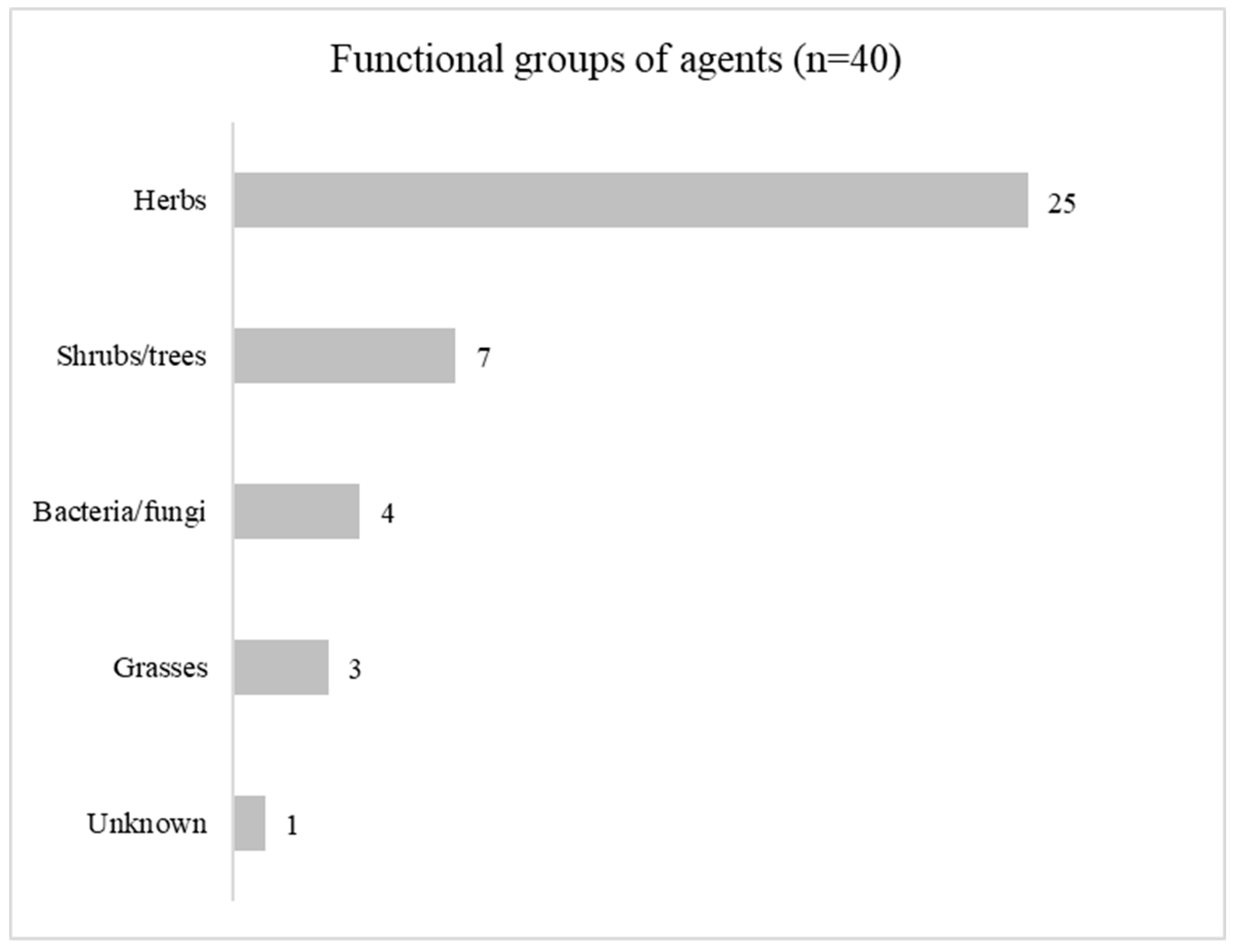

Table 1.
Origin of case reports and level of feed examination. N=178 cases.
| Continent | Unit | Cases | Feed examination | |||
|---|---|---|---|---|---|---|
| Completely | Partly | Not | Unknown | |||
| South America | n | 60 | 36 | 14 | 2 | 8 |
| % | 33.7 | 60.0 | 23.3 | 3.3 | 13.3 | |
| Australia | n | 38 | 14 | 20 | 3 | 1 |
| % | 21.3 | 36.8 | 52.6 | 7.9 | 2.6 | |
| North America | n | 33 | 18 | 10 | 3 | 2 |
| % | 18.5 | 54.5 | 30.3 | 9.1 | 6.1 | |
| Europe | n | 14 | 2 | 9 | 1 | 2 |
| % | 7.9 | 14.3 | 64.3 | 7.1 | 14.3 | |
| Asia | n | 12 | 3 | 5 | 2 | 2 |
| % | 6.7 | 25.0 | 41.7 | 16.7 | 16.7 | |
| New Zealand | n | 11 | 3 | 4 | 4 | 0 |
| % | 6.2 | 27.3 | 36.4 | 36.4 | 0 | |
| Africa | n | 8 | 1 | 6 | 1 | 0 |
| % | 4.5 | 12.5 | 75.0 | 12.5 | 0 | |
| India | n | 2 | 0 | 0 | 2 | 0 |
| % | 1.1 | 0 | 0 | 100 | 0 | |
| Total | n | 178 | 77 | 68 | 18 | 15 |
| % | 100 | 43.3 | 38.2 | 10.1 | 8.4 | |
Table 2.
Agents of photosensitization. N=178 cases.
| N/size class | Phototoxic agent | Cases (n) | Functional groups of phototoxic agents | Sum cases (n) | Portion (%) | ||||
|---|---|---|---|---|---|---|---|---|---|
| Grass | Herb | Shrub/tree | Bacteria/fungi | Unknown | |||||
| 2 | Brachiaria | 15 | x | 29 | 16.3 | ||||
| Froelichia | 14 | x | |||||||
| 4 | Chamaecrista | 13 | x | 48 | 27.0 | ||||
| Medicago | 13 | x | |||||||
| Panicum | 12 | x | |||||||
| Tribulus | 10 | x | |||||||
| 6 | Hypericum | 8 | x | 41 | 23.0 | ||||
| Pithomyces | 8 | x | |||||||
| Biserrula | 7 | x | |||||||
| Mould | 6 | x | |||||||
| Pastinaca | 6 | x | |||||||
| Unknown | 6 | x | |||||||
| 28 | Ammi | 5 | x | 60 | 33.7 | ||||
| Enterolobium | 5 | x | |||||||
| Myoporum | 5 | x | |||||||
| Brassica | 4 | x | |||||||
| Trifolium | 4 | x | |||||||
| Alternaria | 3 | x | |||||||
| Cyanobacteria | 3 | x | |||||||
| Lotus | 3 | x | |||||||
| Narthecium | 3 | x | |||||||
| Senecio | 3 | x | |||||||
| Cynoglossum | 2 | x | |||||||
| Heliotropeum | 2 | x | |||||||
| Persicaria | 2 | x | |||||||
| Stryphnodendron | 2 | x | |||||||
| Phytolacca | 1 | x | |||||||
| Alopecurus | 1 | x | |||||||
| Alternanthera | 1 | x | |||||||
| Crotalaria | 1 | x | |||||||
| Erodium | 1 | x | |||||||
| Heracleum | 1 | x | |||||||
| Heterophyllaea | 1 | x | |||||||
| Holocalyx | 1 | x | |||||||
| Lantana | 1 | x | |||||||
| Malachra | 1 | x | |||||||
| Petroselinum | 1 | x | |||||||
| Ranunculus | 1 | x | |||||||
| Tanacetum | 1 | x | |||||||
| Thamnosma | 1 | x | |||||||
| Sum | 40 | 178 | 3 | 25 | 7 | 4 | 1 | 178 | 100 |
Table 3.
Feed quality, distinguished by animal species. N=184 nominations.
| Animal | Unit | Normal quality | Poor quality | Total |
|---|---|---|---|---|
| Sheep | n | 66 | 7 | 73 |
| % | 35.9 | 3.8 | 39.7 | |
| Cattle | n | 48 | 10 | 58 |
| % | 26.1 | 5.4 | 31.5 | |
| Horse | n | 30 | 1 | 31 |
| % | 16.3 | 0.5 | 16.8 | |
| Goat | n | 11 | 0 | 11 |
| % | 6.0 | 0 | 6.0 | |
| Other animals | n | 10 | 1 | 11 |
| % | 5.4 | 0.5 | 6.0 | |
| Total | n | 165 | 19 | 184 |
Table 4.
Kind of feed and its hygienic quality. N=178 cases.
| State | Unit | Normal quality | Poor quality | Total |
|---|---|---|---|---|
| Fresh | n | 119 | 10 | 129 |
| % | 66.9 | 5.6 | 72.5 | |
| Conserved | n | 17 | 7 | 24 |
| % | 9.6 | 3.9 | 13.5 | |
| Both | n | 12 | 2 | 14 |
| % | 6.7 | 1.1 | 7.9 | |
| Unknown | n | 11 | 0 | 11 |
| % | 6.2 | 0.0 | 6.2 | |
| Total | n | 159 | 19 | 178 |
| % | 89.3 | 10.7 | 100 |
Table 5.
Functional groups of agents. N=184 nominations.
| Functional groups of agents | Unit | Goat | Other | Horse | Cattle | Sheep | Total |
|---|---|---|---|---|---|---|---|
| Herbs | n | 6 | 8 | 27 | 31 | 45 | 117 |
| % | 3.3 | 4.3 | 14.7 | 16.8 | 24.5 | 63.6 | |
| Grasses | n | 5 | 1 | 1 | 2 | 16 | 25 |
| % | 2.7 | 0.5 | 0.5 | 1.1 | 8.7 | 13.6 | |
| Bacteria/fungi | n | 0 | 2 | 1 | 10 | 7 | 20 |
| % | 0.0 | 1.1 | 0.5 | 5.4 | 3.8 | 10.9 | |
| Shrubs/trees | n | 0 | 0 | 0 | 13 | 3 | 16 |
| % | 0 | 0 | 0 | 7.1 | 1.6 | 8.7 | |
| Unknown | n | 0 | 0 | 2 | 2 | 2 | 6 |
| % | 0 | 0 | 1.1 | 1.1 | 1.1 | 3.3 | |
| Total | n | 11 | 11 | 31 | 58 | 73 | 184 |
| % | 6.0 | 6.0 | 16.8 | 31.5 | 39.7 | 100 |
Table 6.
Quality of feed and kind of photosensitization. N=178 cases.
| Kind of photosensitization | Unit | Normal quality | Poor quality | Total |
|---|---|---|---|---|
| Primary | n | 57 | 4 | 61 |
| % | 32.0 | 2.2 | 34.3 | |
| Secondary | n | 83 | 14 | 97 |
| % | 46.6 | 7.9 | 54.5 | |
| Unknown | n | 19 | 1 | 20 |
| % | 10.7 | 0.6 | 11.2 | |
| Total | n | 159 | 19 | 178 |
| % | 89.3 | 10.7 | 100 |
Table 7.
Kind of photosensitization per animal species. N=184 nominations.
| Animal | Unit | Primary photosensitization |
Secondary photosensitization |
Unknown kind of photosensitization | Total | |
|---|---|---|---|---|---|---|
| Sheep | n | 26 | 44 | 3 | 73 | |
| % | 14.1 | 23.9 | 1.6 | 39.7 | ||
| Cattle | n | 14 | 31 | 13 | 58 | |
| % | 7.6 | 16.8 | 7.1 | 31.5 | ||
| Horse | n | 20 | 8 | 3 | 31 | |
| % | 10.9 | 4.3 | 1.6 | 16.8 | ||
| Goat | n | 4 | 7 | 0 | 11 | |
| % | 2.2 | 3.8 | 0.0 | 6.0 | ||
| Other animals |
n | 2 | 8 | 1 | 11 | |
| % | 1.1 | 4.3 | 0.5 | 6.0 | ||
| Total | n | 66 | 98 | 20 | 184 | |
| % | 35.9 | 53.3 | 10.9 | 100 |
Table 8.
Relation between secondary and primary photosensitization1. N=178 cases.
| Feed quality | Unit | Primary photosensitization |
Secondary photosensitization |
Relation between secondary and primary photosensitization |
Reference |
|---|---|---|---|---|---|
| Not evaluated |
n | - | - | - | Chen et. al. [6] |
| % | 22.5 | 68.5 | 46.0 | ||
| Normal | n | 57 | 83 | - | Moritz & Aboling |
| % | 38.5 | 52.2 | 13.7 | ||
| Poor | n | 4 | 14 | - | |
| % | 21 | 73.7 | 52.7 |
1Selected data from Table 6.
Table 9.
Diversity of feed and options of selection possibility. N=178 cases.
| Feed | Diversity | Selection | ||||||
|---|---|---|---|---|---|---|---|---|
| Unit | High | Low | Unknown | Possible | Not possible | Unknown | Total | |
| Fresh | n | 20 | 60 | 49 | 8 | 84 | 37 | 129 |
| % | 11 | 34 | 28 | 4 | 47 | 21 | 72.5 | |
| Conserved | n | 5 | 11 | 8 | 2 | 22 | 0 | 24 |
| % | 3 | 6 | 4 | 1 | 12 | 0 | 13.5 | |
| Both | n | 6 | 5 | 3 | 4 | 6 | 4 | 14 |
| % | 3 | 3 | 2 | 2 | 3 | 2 | 7.9 | |
| Unknown | n | 0 | 4 | 7 | 0 | 2 | 9 | 11 |
| % | 0 | 2 | 4 | 0 | 1 | 5 | 6.2 | |
| Total | n | 31 | 80 | 67 | 14 | 114 | 50 | 178 |
| % | 17.4 | 44.9 | 37.6 | 7.9 | 64.0 | 28.1 | 100 | |
Table 10.
Incidence of photosensitization associated with diversity and choice of feed. N=184 nominations.
Table 10.
Incidence of photosensitization associated with diversity and choice of feed. N=184 nominations.
| Animal | Diversity | Selection | ||||||||
| Unit | High | Low | Ratio low/high | Unknown | Yes | No | Ratio no/yes | Unknown | Total | |
| Goat | n | 2 | 4 | 2 | 5 | 0 | 8 | - | 3 | 11 |
| % | 1.1 | 2.2 | 2.7 | 0.0 | 4.3 | - | 1.6 | 6.0 | ||
| Other animals | n | 2 | 5 | 2.5 | 4 | 1 | 5 | 5 | 5 | 11 |
| % | 1.1 | 2.7 | 2.2 | 0.5 | 2.7 | 2.7 | 6.0 | |||
| Horse | n | 8 | 12 | 1.5 | 11 | 2 | 21 | 10.5 | 8 | 31 |
| % | 4.3 | 6.5 | 6.0 | 1.1 | 11.4 | 4.3 | 16.8 | |||
| Cattle | n | 12 | 23 | 1.9 | 23 | 4 | 38 | 9.5 | 16 | 58 |
| % | 6.5 | 12.5 | 12.5 | 2.2 | 20.7 | 8.7 | 31.5 | |||
| Sheep | n | 8 | 39 | 4.9 | 26 | 8 | 47 | 5.9 | 18 | 73 |
| % | 4.3 | 21.2 | 14.1 | 4.3 | 25.5 | 9.8 | 39.7 | |||
| Total | n | 32 | 83 | 2.6 | 69 | 15 | 119 | 7.9 | 50 | 184 |
| % | 17.4 | 45.1 | 37.5 | 8.2 | 64.7 | 27.2 | 100 | |||
Disclaimer/Publisher’s Note: The statements, opinions and data contained in all publications are solely those of the individual author(s) and contributor(s) and not of MDPI and/or the editor(s). MDPI and/or the editor(s) disclaim responsibility for any injury to people or property resulting from any ideas, methods, instructions or products referred to in the content. |
© 2023 by the authors. Licensee MDPI, Basel, Switzerland. This article is an open access article distributed under the terms and conditions of the Creative Commons Attribution (CC BY) license (http://creativecommons.org/licenses/by/4.0/).
Copyright: This open access article is published under a Creative Commons CC BY 4.0 license, which permit the free download, distribution, and reuse, provided that the author and preprint are cited in any reuse.


