
Submitted:
19 July 2023
Posted:
21 July 2023
You are already at the latest version
Abstract
The object of this paper is the analysis of isotropic rectangular thin plates supported (simply supported or clamped) along two opposite edges whereby the other edges have arbitrary support conditions; the plates are subjected to external bending moments, concentrated or distributed, and perpendicular to the supported edges. The standard approach to this problem is to replace the bending moment with a couple of forces infinitely close and to use the known expressions of efforts and deformations for the plate subjected to concentrated forces; the results are then related to the first derivatives of those efforts and deformations with respect to the position of application of the load. In this study, the external bending moment was expanded into a Fourier series, leading to a distributed external bending moment, and the boundary conditions and continuity equations were applied. Various types of rectangular plates were analyzed, as well as plates of infinite length whose results were identical to those in the literature. In addition, results for cantilever plates of infinite length were presented.
Keywords:
Isotropic rectangular thin plate
; concentrated/distributed bending moment
; plates of infinite length
; Lévy solution
; Fourier sine series
1. Introduction
The Kirchhoff–Love plate theory (KLPT) was developed in 1888 by Love using assumptions proposed by Kirchhoff [1]. The KLPT is governed by the Germain−Lagrange plate equation; this equation was first derived by Lagrange in December 1811 in correcting the work of Germain [2] who provided the basis of the theory. Lévy [3] proposed in 1899 an approach for rectangular plates simply supported along two opposite edges; the applied load and the deflection were expressed in terms of Fourier components and simple trigonometric series, respectively. Many exact solutions for isotropic elastic thin plates were developed by Timoshenko [4] and Girkmann [5]; the simple trigonometric series of Lévy was mostly considered. Jian et al. [6] presented the equations for the lateral buckling analysis of fixed rectangular plates under the lateral concentrated load whereby the critical buckling strength of the plate calculated by finite element method was analyzed. Xu et al. [7] got exact solutions for rectangular anisotropic plates with four clamped edges through the state space method whereby the Fourier series in exponential form were adopted. Onyia et al. [8] presented the elastic buckling analysis of rectangular thin plates using the single finite Fourier sine integral transform method. Imrak et al. [9] presented an exact solution for a rectangular plate clamped along all edges in which each term of the series is trigonometric and hyperbolic, and identically satisfies the boundary conditions on all four edges. Fogang [10] used the flexibility method and a modified Lévy solution to analyze arbitrarily loaded isotropic rectangular thin plates with two opposite edges supported (simply supported or clamped), from which one or both are clamped, and the other edges with arbitrary support conditions. Mama et al. [11] presented the single finite Fourier sine integral transform method for the flexural analysis of rectangular Kirchhoff plate with opposite edges simply supported, and the other edges clamped for the case of triangular load distribution on the plate domain. Kamel [12] described the operational properties of the finite Fourier transform method, with the purpose of solving boundary value problems of partial differential equations.
In this paper, isotropic rectangular thin plates were analyzed; they were simply supported or clamped along two opposite edges with the other edges having arbitrary support conditions, and were subjected to external bending moments, concentrated or distributed and perpendicular to the supported edges. The external bending moment was expanded into a Fourier series, leading to a distributed external bending moment, and the boundary conditions and continuity equations were applied.
2. Materials and methods
2.1. Governing equations of the plate
The Kirchhoff–Love plate theory (KLPT) [1] is used for thin plates whereby shear deformations are not considered. The spatial axis convention (X, Y, Z) is represented in Figure 1 below.
The equations of the present section are related to the KLPT. The governing equation of the isotropic Kirchhoff plate, derived by Lagrange, is given by
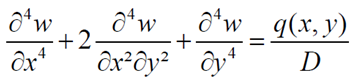 where w(x,y,z) is the displacement in z-direction, q(x,y) the applied transverse load per unit area, and D the flexural rigidity of the plate.
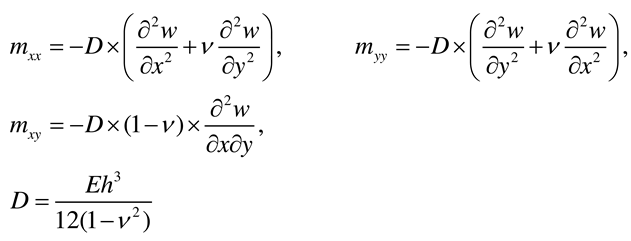
The bending moments per unit length mxx and myy, and the twisting moments per unit length mxy are given by
 The shear forces per unit length are given by
 The Kirchhoff shear forces per unit length used along the free edges combine shear forces and twisting moments, and are expressed as follows:
 In these equations, E is the elastic modulus of the plate material, h is the plate thickness, and ν is the Poisson’s ratio.
2.2. Rectangular plate supported along two opposite edges and subjected to external concentrated bending moments
The plate dimensions in x- and y-direction are denoted by a and b, respectively. The rectangular plate is assumed simply supported or clamped along the opposite edges x = 0 and x = a. The external concentrated bending moment denoted by Mx0 is applied at the position (x0, y0) and oriented along the + x-axis (see Figure 2).
For rectangular plates simply supported along the edges x = 0 and x = a, bending moment loading parallel to those edges are satisfactorily treated in the literature and will not be analyzed in this paper.
First, the standard solution to this problem will be recalled. Second, the approach of this study will be presented whereby plates with two opposite edges simply supported and plates of infinite length will be considered. Third, plates with two opposite edges clamped will be treated.
2.2.1. Standard solution to the problem
Let the external concentrated moment Mx0 be applied at the position (x0, y0) as shown in Figure 2.
The standard approach is to replace the bending moment with a couple of forces -P and P applied at the positions (x0, y0) and (x0, y0 + c), respectively, with c approaching zero and Mx0 = P×c.
Let S (x, y, x0, y0) and S* (x, y, x0, y0) be values of interest (efforts, deformations …) at positions (x, y) for the plate subjected to a load P and a unit load, respectively, at a position (x0, y0). The values of interest are determined by combining the effect of the forces -P and P as follows
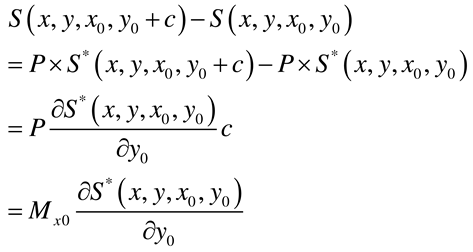 Hence the determination of a quantity of interest for the case of the plate subjected to an external concentrated moment Mx0 at a position (x0, y0) requires the analytical formulation of the quantity of interest for the case of the plate subjected to a unit load at the position (x0, y0) and its first derivative with respect to y0; this result can be found in Girkmann [5].
2.2.2. Rectangular plate with two opposite edges simply supported and subjected to an external concentrated bending moment Mx0
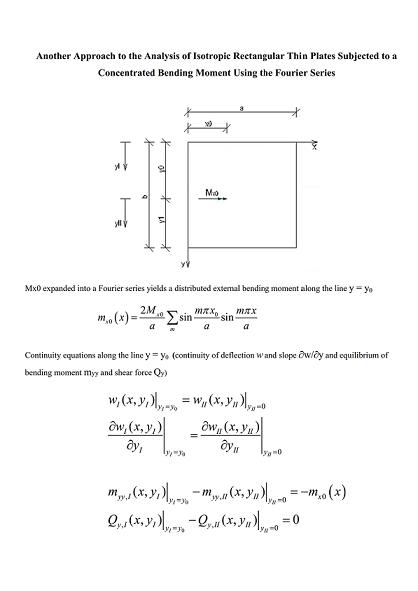
In this paper the external concentrated bending moment Mx0 (see Figure 2) is expanded into a Fourier series as follows
 Therefore, the external concentrated moment Mx0 is replaced with the distributed external moment mx0(x) along the line y = y0.
Referring further to Figure 2, the efforts and deformations are represented with the subscripts I and II for the plate zones 0 ≤ yI ≤ y0 and 0 ≤ yII ≤ y1, respectively. The continuity equations along the line y = y0 express the continuity of deflection w and slope ∂w/∂y and the equilibrium of bending moment myy and shear force Qy; observing that the position y = y0 corresponds to yI = y0 and yII = 0, these equations are given by
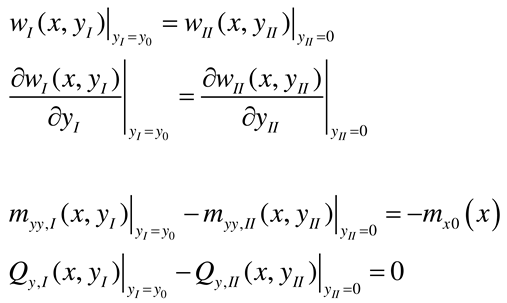 Assuming the rectangular plate simply supported along the edges x = 0 and x = a, the solution by Lévy [4] that satisfies the boundary conditions at these edges is considered for the deflection curve w(x,y) as follows:
 The solution to Equation (7e) as derived in the literature (e.g., Timoshenko [4], Girkmann [5]) is given by
 Hence the efforts and deformations needed for the continuity equations for the plate zone I (0 ≤ yI ≤ y0) can be expressed using Equations (7f), (2b), and (3b) as follows
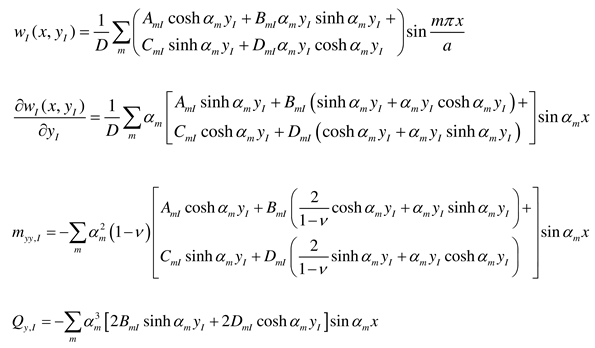 The efforts and deformations for the plate zone II (0 ≤ yII ≤ y1) are expressed by replacing the subscript I with II in Equations (8a-d). Recalling that the position y = y0 corresponds to yI = y0 and yII = 0, the continuity equations can be formulated using Equations (7a-d) and (8a-d) as follows
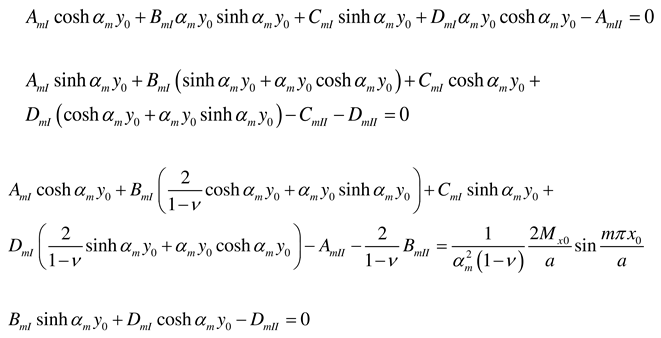 The Kirchhoff shear forces needed for boundary conditions at free edges are expressed using Equations (4b) and (8a)

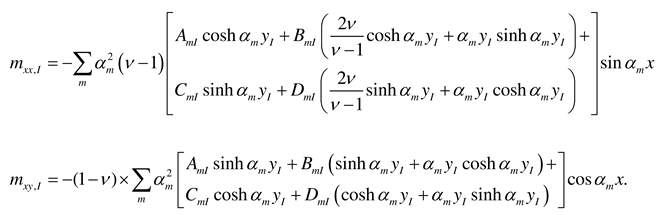
In summary, the coefficients AmI, BmI, CmI, and DmI and AmII, BmII, CmII, and DmII are determined by satisfying the boundary conditions at y = 0 and y = b and the continuity conditions at y = y0. They are calculated for various boundary conditions at y = 0 and y = b in Appendix A whereby the cases of bending moment applied at the edge y = 0 are also considered. Then, the bending moments myy are calculated using Equation (8c), and the bending moments mxx and twisting moments mxy are calculated using Equations (2a, c) and (8a) as follows
- Load case “Concentrated bending moment applied at the edge x = 0”
Let now the external concentrated moment My0 be applied at the position (0, y0) as represented in Figure 3
The concentrated moment assumed applied at a position (x0, y0), with x0 later set to zero, is replaced with a couple of forces -P and P applied at the positions (x0 + c, y0) and (x0, y0), respectively, with c approaching zero and My0 = P×c. The combined forces can then be expanded into a Fourier series along the line y = y0 as follows
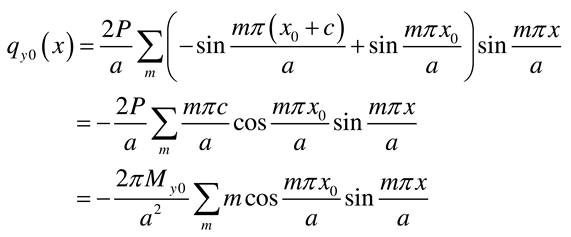 Observing that x0 = 0 it yields the following distributed load along the line y = y0 that replaces My0
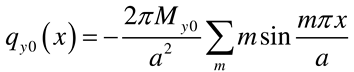 The continuity equations along y = y0 can then be formulated using Equations (7a-d) whereby (7c-d) are modified as follows
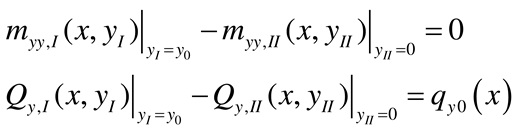 Equation (11e) corresponds to (9c) by setting to zero the term on the right-hand side of (9c) and (11f) is expressed using (8d), (11d), and (11f) as follows

- Load case “Distributed bending moment applied along the edge x = 0”
Assuming a distributed moment my0 (y) applied along the edge x = 0 as represented in Figure 4
Inspired by Fogang [10], the deflection curve can be taken
 It is noted that Equation (11h) satisfies the boundary conditions at edges x = 0 and x = a. Substituting Equation (11h) into (1) yields
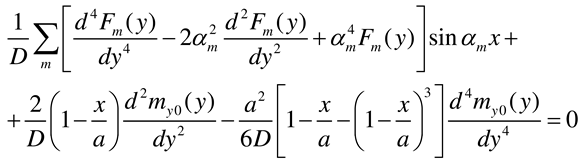 The following functions contained in Equation (11i) are expanded in Fourier sine series
 Substituting Equations (11j) into (11i) and given that the latter holds for any value of x, it results the following differential equation

The solution to Equation (11k) is
 where the coefficients Am, Bm, Cm, and Dm are determined by satisfying the boundary conditions at y = 0 and y = b, and Fmp(y) is a particular solution to Equation (11k). Substituting Equation (11l) into (11h) yields
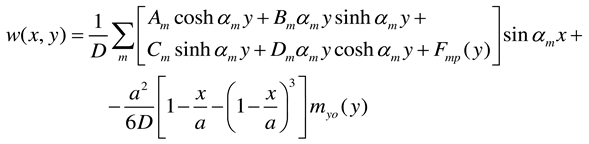 To satisfy the boundary conditions at y = 0 and y = b, the Fourier series of Equation (11j) is used; so Equation (11m) becomes
 With respect to the boundary conditions at y = 0 and y = b the equations for the slope ∂w/∂y, the bending moment myy and the Kirchhoff shear forces are formulated using Equations (2b) and (4b) as follows
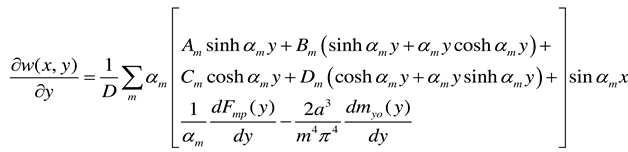
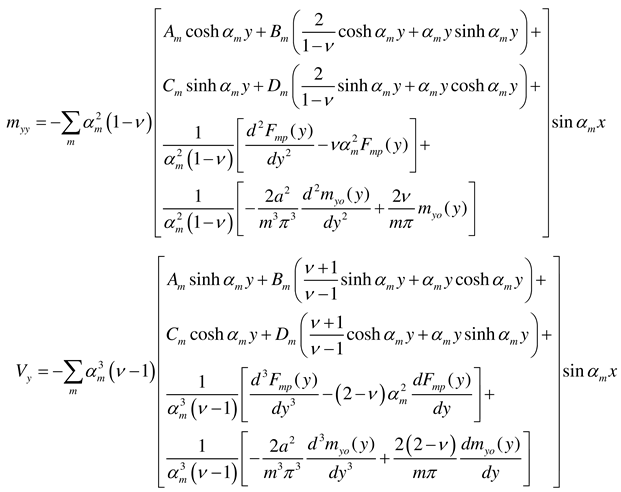 The special case of a constant bending moment my0 applied along the edge x = 0 will be treated in the Results section.
2.2.3. Rectangular plate of infinite length loaded near its end and having two opposite edges simply supported
The case of loading around the plate middle will be treated in the Results section.
Let us analyze here a plate of infinite length with two opposite edges x = 0 and x = a simply supported and subjected near its end to an external concentrated moment Mx0, as shown in Figure 5
The efforts and deformation in plate zone I (0 ≤ yI ≤ y0) are formulated according to Section 2.2.2.
The edges x = 0 and x = a being simply supported, the deflection curve for the plate of infinite length (plate zone yII ≥ 0 in Figure 5) as derived in the literature (e.g., Timoshenko [4], Girkmann [5]) is given by
 It yields as follows the slope ∂wII/∂yII, the bending moment myy and the shear force Qy needed for the continuity conditions along y = y0
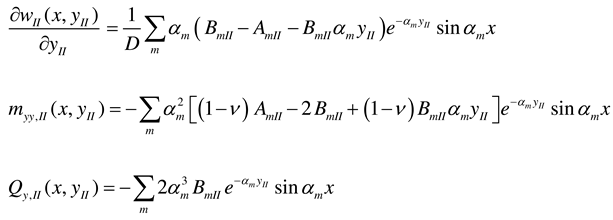 The Kirchhoff shear force needed for boundary conditions at free edges is given by
 Reminding that the position y = y0 corresponds to yI = y0 and yII = 0, the continuity equations between the plate zone I (0 ≤ yI ≤ y0) and the plate zone II of infinite length (yII ≥ 0) can be expressed using Equations (7a-d), (8a-d), (12), and (13a-c)
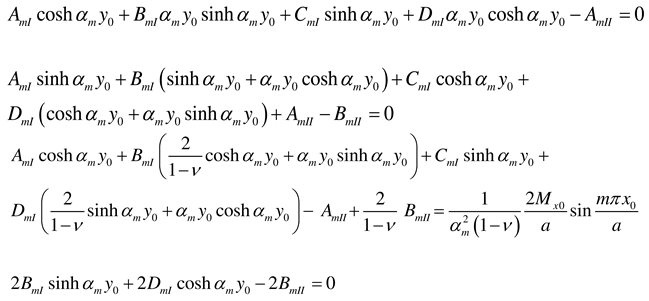 In summary, the coefficients AmI, BmI, CmI, DmI, AmII, and BmII are determined by satisfying the boundary conditions at y = 0 and the continuity conditions at y = y0. They are calculated for various support conditions at y = 0 in Appendix B.
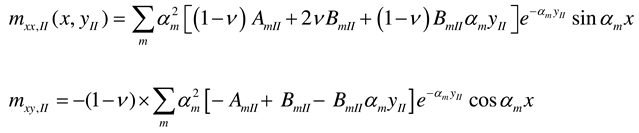
Then, in the plate zone of infinite length the bending moments myy are calculated using Equation (13b), and the bending moments mxx and twisting moments mxy are calculated using Equations (2a, c) and (12) as follows
2.2.4. Rectangular plate of infinite length loaded around the plate middle and having two opposite edges arbitrarily supported
A rectangular plate with dimensions a and b in x- and y- direction, respectively, and loaded around the plate middle or at a large distance from the edges x = 0 and x = a is analyzed. The plate with a very high aspect ratio a/b is then considered of infinite length while the edges y = 0 and y = b are arbitrarily supported, as represented in Figure 6
The edges x = 0 and x = a are at a large distance from the loading. Therefore, the structural behavior of the plate subjected to this loading does not depend on the support conditions at these edges; then the latter can be assumed simply supported and so the Lévy solution (Equation (7e)) can be applied. Finally the results are obtained by letting a tend to infinity. This reasoning can be found in Courbon et al. [13].
Furthermore, it is observed that the structural behavior of the plate of infinite length subjected to an external concentrated bending moments at a large distance from the edges x= 0 and x = a is the same as if the loads were applied at the middle. The y0- axis of application of the loads is then considered as the middle of the plate.
- Load case “Distributed bending moment mx0(y) applied along x = a/2”
The distributed bending moment mx0 (y) is replaced at any position y with a couple of forces and so it yields the distributed load -dmxo(y)/dy along x = a/2. The Fourier series expansion of the load applied at x0 yields the following load per unit area throughout the plate
 The deflection curve follows Equation (7e) and observing that x0 = a/2 the differential equation is given by
 Then the analysis continues using Equations (11l-q) whereby my0 (y) is set to zero.
- Load case “Distributed bending moment my0(y) applied along x = a/2”
Using Equation (11c) the Fourier series expansion of the load applied at x0 yields the following load per unit area throughout the plate
 The deflection curve follows Equation (7e) and observing that x0 = a/2 the differential equation is given by

- Load case “External concentrated bending moments applied at (x = a/2, y = b)”
These load cases will be treated in the Results section.
2.2.5. Solution of this study: Rectangular plate with one or two opposite edges clamped
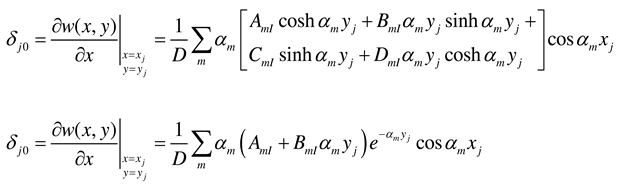
It is assumed that from the two supported opposite edges x = 0 and x = a, one or both are clamped. The analysis can then be conducted using the flexibility method according to Fogang [10]. The primary system is the rectangular plate simply supported along the edges x = 0 and x = a, and is treated according to the previous sections. The flexibilities δj0 (slopes at positions j of the opposite edges where the compatibility equations will be set) for the primary problem are calculated for an ordinary plate and a plate of infinite length, respectively, as follows
 The redundant system is the plate simply supported along the opposite edges and subjected to bending moments along those edges.
3. Results and discussion
3.1. Plate of infinite length subjected to an external concentrated moment at the middle
The plate of infinite length is subjected to an external concentrated moment at the middle or at a large distance from the y edges, as represented in Figure 7.
Given the anti-symmetrical nature of the load and the symmetry of the system, the deflections are zero along the line y = 0. And since the load is equally divided between the two halves of the plate it yields myy(x, y = 0) = mxo(x)/2. Substituting these conditions into Equations (12), (13b), and (6) yields for y ≥ 0
 This result can be found in Girkmann [5].
3.2. Plate of infinite length subjected to a concentrated moment at its end
The plate of infinite length is subjected at its end y = 0 to an external concentrated moment, as represented in Figure 8.
- Case 1: Edge y = 0 simply supported
The deflections are zero along the line y = 0 and the bending moment myy at y = 0 is equal to the distributed moment mxo (x) (the concentrated moment Mx0 expanded into a Fourier series according to Equation (6)). Substituting these conditions into Equations (12) and (13b) yields

- Case 2: Edge y = 0 free
The Kirchhoff shear force is zero along the line y = 0 and the bending moment myy at y = 0 is equal to the distributed moment (the concentrated moment Mx0 expanded into a Fourier series according to Equation (6)). Substituting these conditions into Equations (13b) and (14) yields

3.3. Rectangular plate with the edges x = 0 and x = a simply supported and subjected to a constant bending moment loading along x = 0
The plate simply supported along the edges x = 0 and x = a is subjected at x = 0 to a constant bending moment loading myo, as represented in Figure 9. The edges y = 0 and y = b are taken both simply supported and both clamped; therefore, for simplification purpose the x-axis can be shifted to the middle of the plate
- Case y = 0 and y = b simply supported
Using Equation (11k) yields the particular solution Fmp(y) is zero. From the conditions of symmetry Cm = Dm = 0.
The satisfaction of the boundary conditions yields the deflection curve as follows
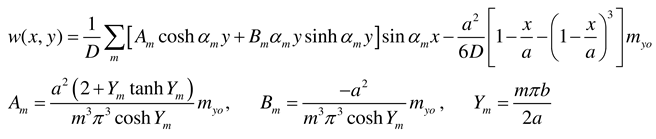 Then the bending moments per unit length mxx and myy, and the twisting moments per unit length mxy are calculated using Equations (2a-c) and (20).
- Case y = 0 and y = b clamped
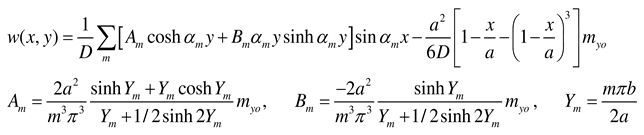
Similarly, the deflection curve is as follows
3.4. Cantilever plate of infinite length subjected to external concentrated moments at the middle
The cantilever plate of infinite length is subjected to concentrated bending moments at the middle, as shown in Figure 10
- Load case “Concentrated bending moment Mx0 applied at (x = a/2, y = b)”
The dispositions of Section 2.2.4 are applied whereby the Poisson’s ratio is not considered for simplification purpose. The following boundary conditions are set using Equations (6), (8a-c), and (10)
 Then the coefficients Am, Bm, Cm, and Dm are determined as follows
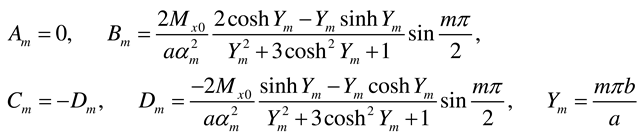 Setting Ym = mρ with ρ = πb/a → 0, the bending moments myy at any position (x = a/2, y = kb) are
 The summation F(k) in Equation (22c) for ρ tending to zero is evaluated depending on k and the values are calculated in the Supplementary Material “Cantilever plate of infinite length under bending moment Mxo” and listed in Table 1
So, the bending moments myy at the middle of the clamped edge and at y = b/2, respectively, are
 At the point of application of the load (k = 1.0) the summation F(k) did not converge. This result is in agreement with Timoshenko [4].
Moreover, the calculated moments in the vicinity of the load (k = 0.80, 0.90) showed a rapid increase and must be verified. For this purpose the external concentrated moment is replaced with a distributed moment Mx0 /2c acting over a length 2c; this distributed moment is expanded in Fourier series as follows
 Equation (22e) replaces then (6) in the analysis whereby x0 = a/2. Setting c = λb and ρ = πb/a → 0, the bending moments myy at positions (x = a/2, y = kb) are expressed as follows
 The summation F(k, λ) in Equation (22f) for ρ tending to zero is evaluated depending on k for λ = 0.05 and 0.10, and the values are calculated in the above mentioned Supplementary Material and displayed in Table 2.
At the point of application of the load (k = 1.0) the summation F(k, λ) did not converge; however the bending moment at this position is a boundary condition namely myy = -Mx0 /2c.
In the vicinity of the load (k = 0.80, 0.90) the results for a distributed moment acting over a length 2c (c = 0.05b) were in good agreement with those of a concentrated moment.
In addition, the results showed that away from the point of application of the load the results for concentrated load are identical to those with the load distributed over a small length: this is in agreement with the Saint Venant’s principle.
The values of deflection along the axis x = a/2 of application of the concentrated moment for positions y = kb are
 The summation F(k) in Equation (22g) for ρ tending to zero is evaluated depending on the position k and the values calculated in the above mentioned Supplementary Material are listed in Table 3
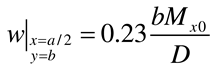
So, the maximal deflection is at the tip and its value is
- Load case “Concentrated bending moment My0 applied at (x = a/2, y = b)”
Using Equation (11c) the concentrated moment Myo is replaced with a distributed load whereby x0 = a/2. The boundary conditions are identical to Equation (22a) with following modifications
 Then the coefficients Am, Bm, Cm, and Dm are determined as follows
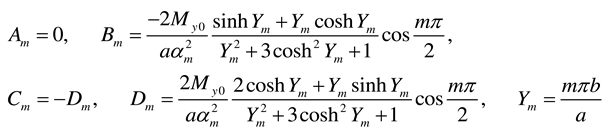 The bending moments myy along the clamped edge, at a distance x0 from the middle, are given by
 The bending moment myy is zero along the axis x = a/2 (x0 = 0) of application of the concentrated moment.
Setting Ym = mρ with ρ = πb/a → 0, and x0 = kb, the bending moment myy along the clamped edge is
 The summation F(k) in Equation (23d) for ρ tending to zero is evaluated depending on k and the values calculated in Supplementary Material “Cantilever plate of infinite length under bending moment Myo” are listed in Table 4
The maximal/minimal value of F(k) is obtained by a parabolic interpolation between k = 0.45 and k = 0.60: it yields the value F(k),max,min = ±0.2730 for k = ±0.5759.
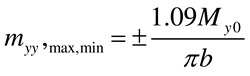
So the maximal/minimal bending moments myy are found ± 0.5759×b from the middle of the plate and the values are
3.5. Plate of infinite length subjected to a concentrated moment Mx0 at (x = a/2, y = b)
- Case y = 0 clamped and y = b simply supported
The plate of infinite length is subjected to a concentrated moment Mx0 at the middle of the simply supported edge.
The coefficients Am, Bm, Cm, and Dm are determined as follows
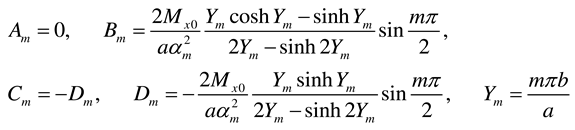 Setting Ym = mρ with ρ = πb/a → 0, the bending moments myy at positions (x = a/2, y = kb) are
 The summation F(k) in Equation (24b) for ρ tending to zero is evaluated depending on k and the values are calculated in the Supplementary Material “Plate of infinite length clamped simply supported under moment Mxo” and listed in Table 5
So, the bending moments myy at the middle of the clamped edge and in the middle of the y-dimension b, respectively, are

- Case y = 0 and y = b simply supported
The coefficients Am, Bm, Cm, and Dm are determined as follows
 Setting Ym = mρ with ρ = πb/a → 0, the bending moments myy at positions (x = a/2, y = kb) are given by
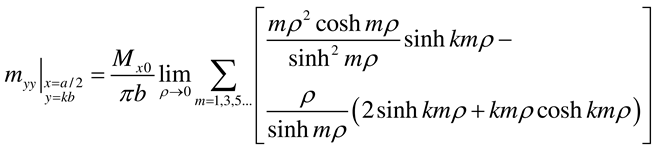 The summation F(k) in Equation (24e) for ρ tending to zero is evaluated depending on k and the values are calculated in the Supplementary Material “Plate of infinite length simply supported under bending moment Mxo”and listed in Table 6
4. Conclusions
In this paper, isotropic rectangular thin plates were analyzed; they were simply supported or clamped along two opposite edges with the other edges having arbitrary support conditions, and were subjected to external bending moments perpendicular to the supported edges. Bending moments parallel to the supported opposite edges are satisfactorily treated in the literature and were less analyzed in this study. The standard approach to this problem is to replace the bending moment with a couple of forces infinitely close and to use the known expressions of efforts and deformations for the plate subjected to concentrated forces; the results are then related to the first derivatives of these efforts and deformations with respect to the position of application of the load. In this study the external bending moment was expanded into a Fourier series, leading to a distributed external bending moment, and the boundary conditions and continuity equations were applied. Various types of rectangular plates were so analyzed and also plates of infinite length whose results were identical to those in the literature.
The following aspect was not addressed in this study but could be analyzed in the future: Rectangular anisotropic plate
Supplementary Materials
The following supporting information can be downloaded at the website of this paper posted on Preprints.org. “Cantilever plate of infinite length under bending moment Mxo”; “Cantilever plate of infinite length under bending moment Myo”; “Plate of infinite length clamped simply supported under moment Mxo”; “Plate of infinite length clamped simply supported under moment Mxo.”.
Conflicts of Interest
The author declares no conflict of interest.
Appendix A. Coefficients AmI, BmI, CmI, and DmI and AmII, BmII, CmII, and DmII for various support conditions at y = 0 and y = b
Edges y = 0 and y = b clamped
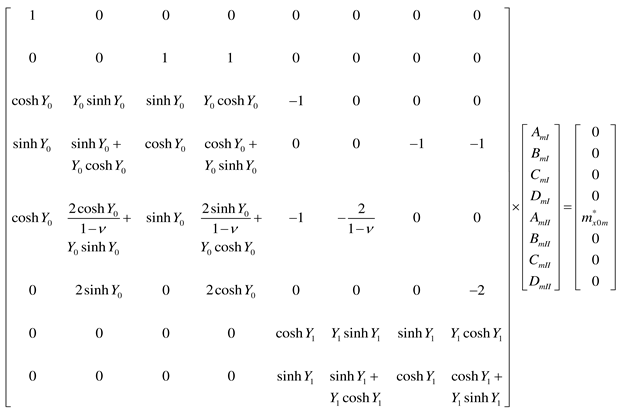
The plate is represented in Figure 2. We set
 The boundary conditions and continuity equations are expressed in matrices form as follows, whereby the first two rows and the last two rows represent the boundary conditions at the edges y = 0 and y = b, respectively.
 Edge y = 0 simply supported and edge y = b free
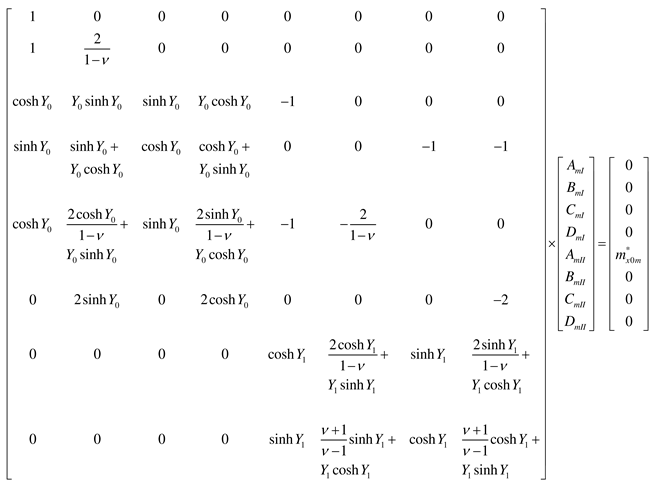 Plates with other combinations of support conditions at y = 0 and y = b can be analyzed similarly. The first two rows and last two rows are modified accordingly.
Edge y = 0 simply supported and edge y = b free: bending moment acting at (x0, y0 = 0)
The plate is represented in Figure 2 with y0 = 0. We set
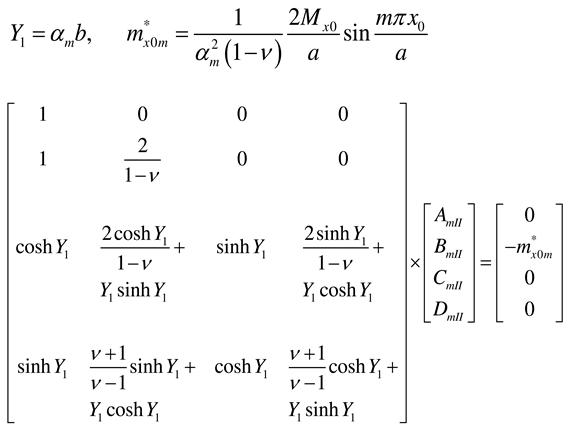
Edge y = 0 free and edge y = b clamped: bending moment acting at (x0, y0 = 0)
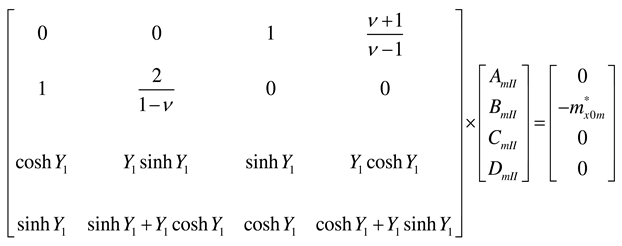
Plates with other support conditions at y = b can be analyzed similarly, the last two rows being modified accordingly. Then, the bending moments myy are calculated using Equation (8c), and the bending moments mxx and twisting moments mxy are calculated using Equations (11a-b).
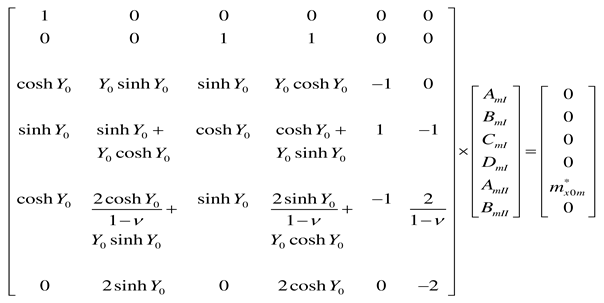
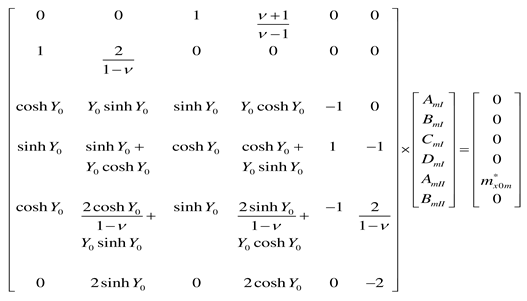
Appendix B. Plate of infinite length: coefficients AmI, BmI, CmI, DmI, AmII, and BmII for various support conditions at y = 0
Edge y = 0 simply supported
The plate is represented in Figure 2. We set
 The boundary conditions and continuity equations are expressed in matrices form as follows, whereby the first two rows represent the boundary conditions at the edge y = 0.
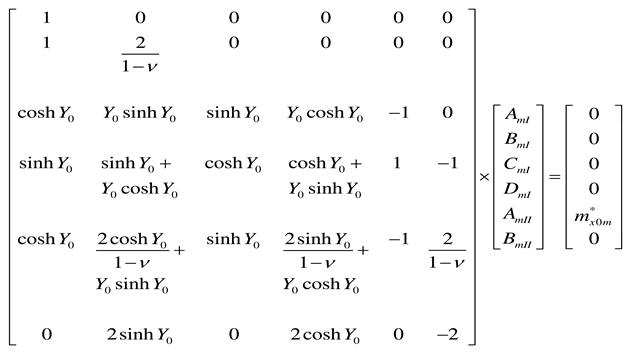 Edge y = 0 clamped
Edge y = 0 free
References
- Kirchhoff, G. Über das Gleichgewicht und die Bewegung einer elastischen Scheibe. J. für die Reine und Angew. Math. 1850, 18, 51–88. [Google Scholar]
- Germain, S. Remarques sur la nature, les bornes et l’étendue de la question des surfaces élastiques et équation générale de ces surfaces. impr. de Huzard-Courcier, paris, 1826.
- Lévy, M. Sur l’équilibre élastique d’une plaque rectangulaire. Comptes rendus l’Académie des Sci. Paris 1899, 129, 535–539. [Google Scholar]
- Timoshenko, S.; Woinowsky-Krieger, S. Theory of plates and shells, 2nd ed.; McGraw Hill: New York, 1959. [Google Scholar]
- Girkmann, K. Flächentragwerke; Springer-Verlag: Wien, New York, 1986. [Google Scholar]
- Jiang, L. Trends in Developing Critical Elastic Buckling Formula for Fixed Rectangular Plate Subjected To a Concentrated Load. Trends Civ. Eng. its Arch. 2018, 1, 001–003. [Google Scholar] [CrossRef]
- Xu, Y.; Wu, Z. Exact solutions for rectangular anisotropic plates with four clamped edges. Mech. Adv. Mater. Struct. 2020, 29, 1756–1768. [Google Scholar] [CrossRef]
- Onyia, M.E.; Rowland-Lato, E.O.; Ike, C.C. Elastic Buckling Analysis of SSCF and SSSS Rectangular Thin Plates using the Single Finite Fourier Sine Integral Transform Method. Int. J. Eng. Res. Technol. 2020, 13. [Google Scholar] [CrossRef]
- Imrak, C.E.; Gerdemeli, I. An Exact Solution for the Deflection of a Clamped Rectangular Plate under Uniform Load. Applied Mathematical Sciences 2007, 1, 2129–2137. [Google Scholar]
- Fogang, V. Analysis of Arbitrarily Loaded Rectangular Thin Plates with Two Opposite Edges Supported, One or Both of them Clamped, Using the Flexibility Method and a Modified Lévy Solution. Preprints.org 2023, 2023052121. [Google Scholar] [CrossRef]
- Mama, B.O.; Oguaghamba, O.A.; Ike, C.C. Single Finite Fourier Sine Integral Transform Method for the Flexural Analysis of Rectangular Kirchhoff Plate with Opposite Edges Simply Supported, Other Edges Clamped for the Case of Triangular Load Distribution. IJERT 2020, 13, 1802–1813. [Google Scholar] [CrossRef]
- Kamel, A.-K. Finite Fourier transform for solving potential and steady-state temperature problems. Advances in Difference Equations 2018, 98. [Google Scholar] [CrossRef]
- Courbon, J.; Theillout, J.N. Formulaire de résistance des matériaux. Techniques de l’Ingénieur, Traité Construction 1987, 106–107. [Google Scholar] [CrossRef]
Figure 1.
Spatial axis convention X, Y, Z.
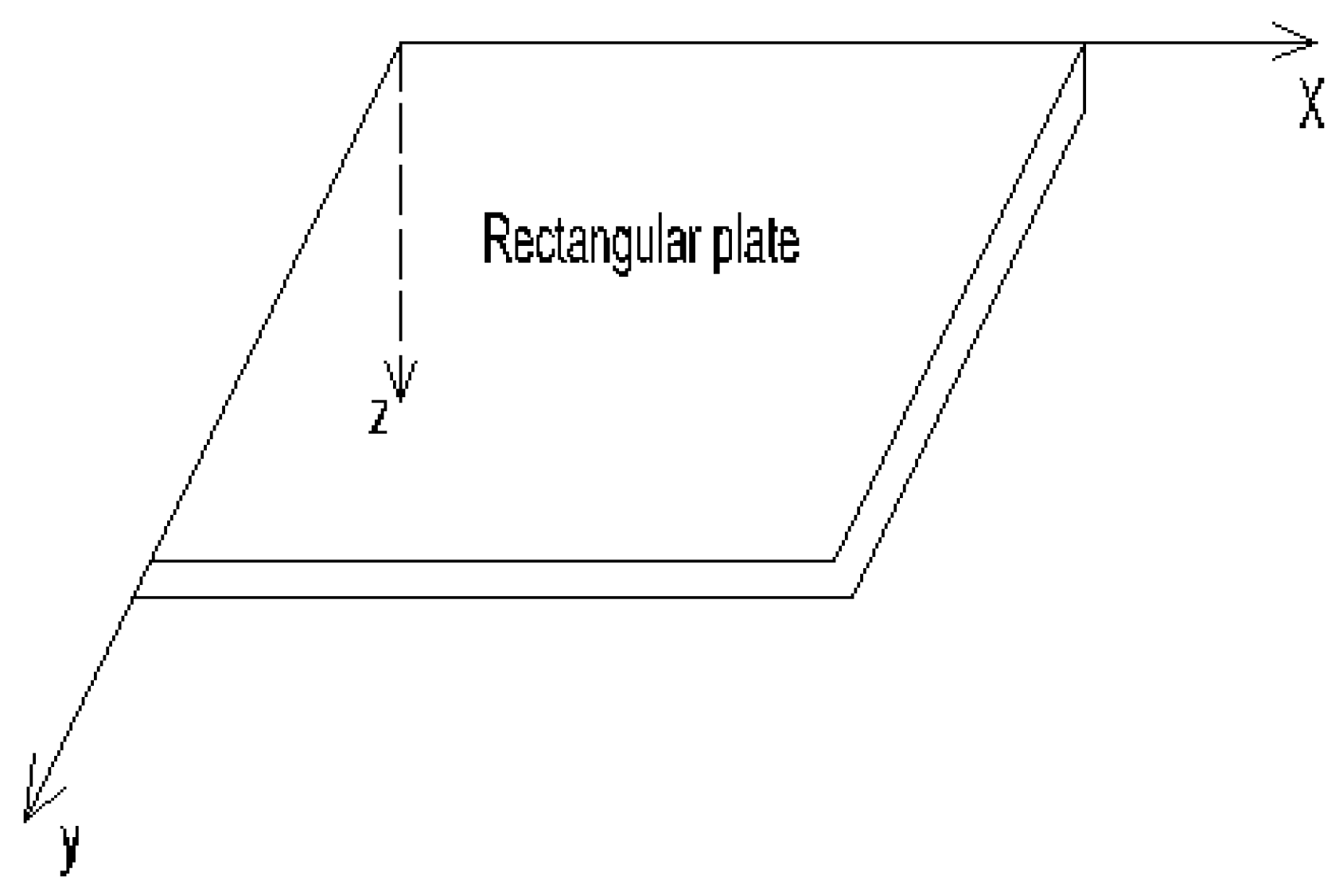
Figure 2.
Rectangular plate subjected to a concentrated moment Mx0 at (x0, y0).
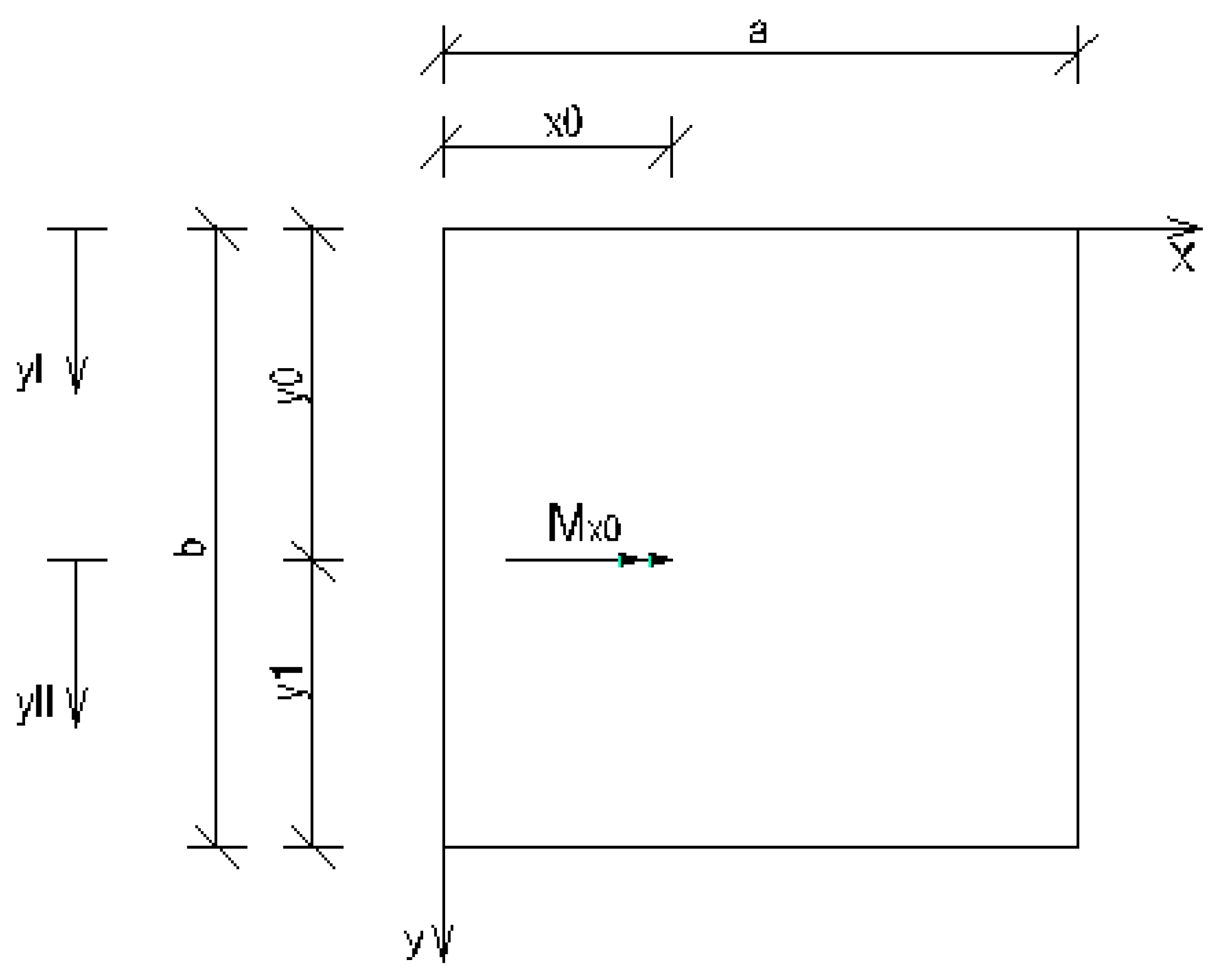
Figure 3.
Rectangular plate subjected to an external concentrated moment My0 at (0, y0).
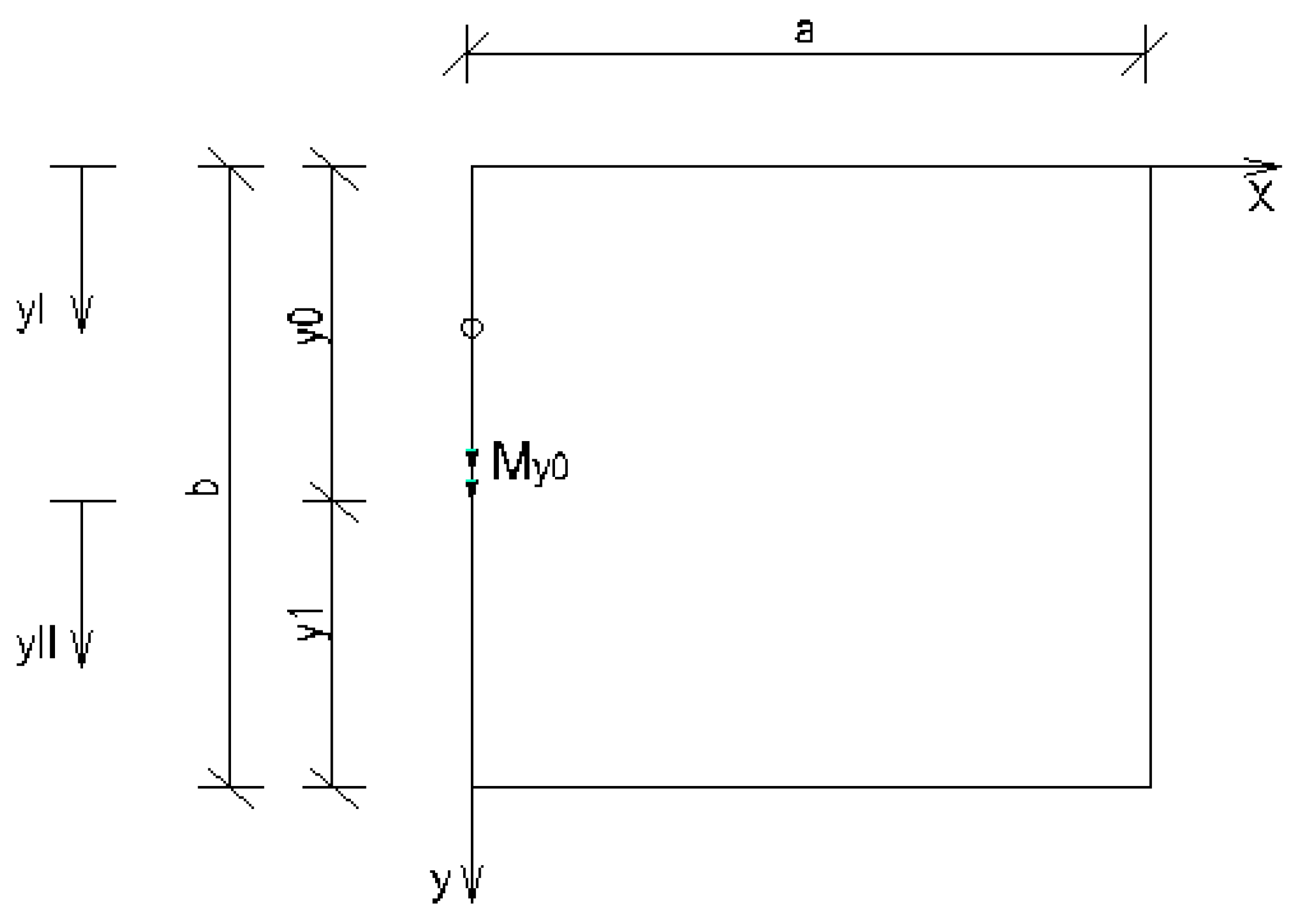
Figure 4.
Rectangular plate subjected to a distributed bending moment along the edge x = 0.
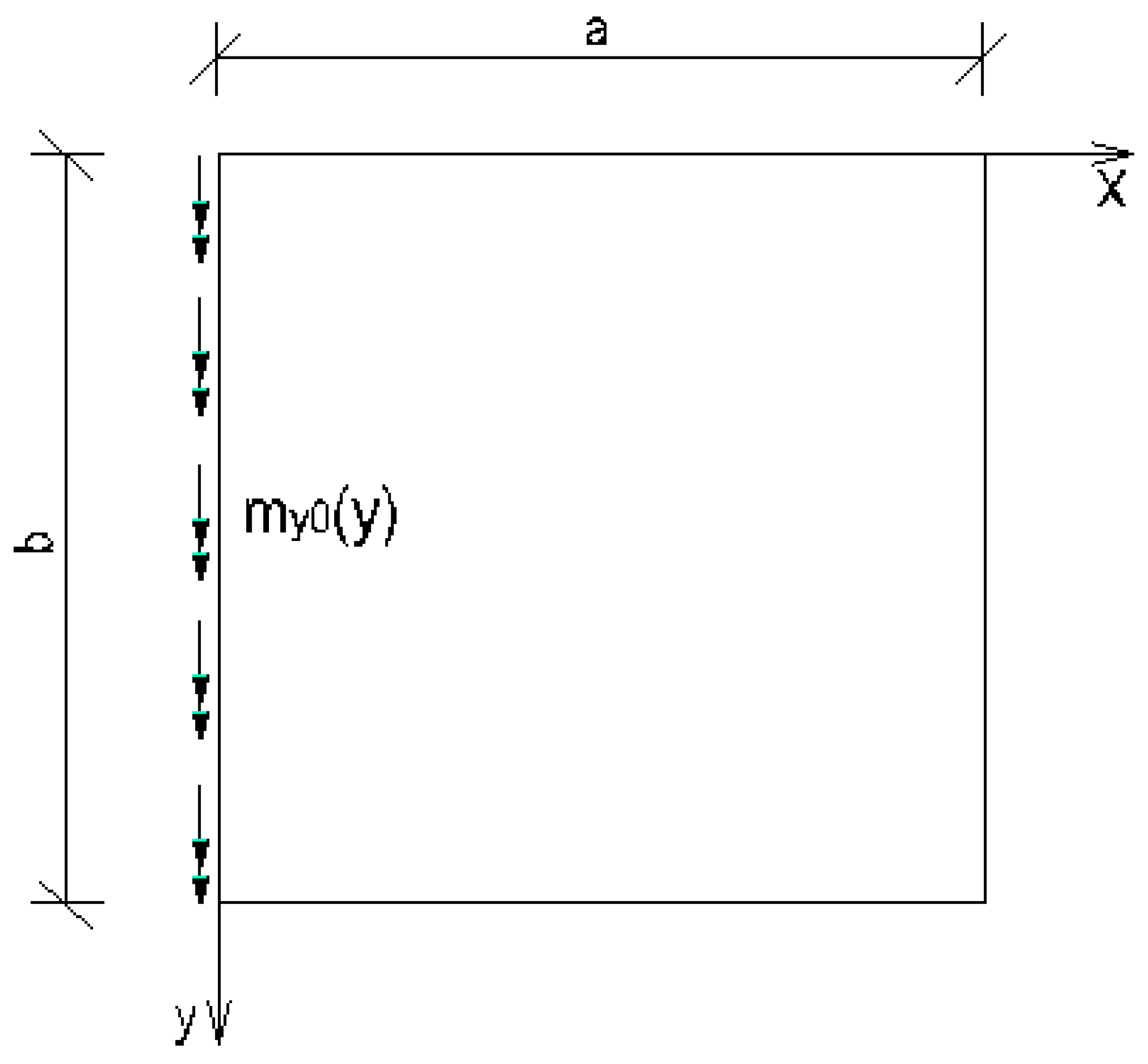
Figure 5.
Rectangular plate of infinite length subjected near its end to an external concentrated moment Mx0.
Figure 5.
Rectangular plate of infinite length subjected near its end to an external concentrated moment Mx0.
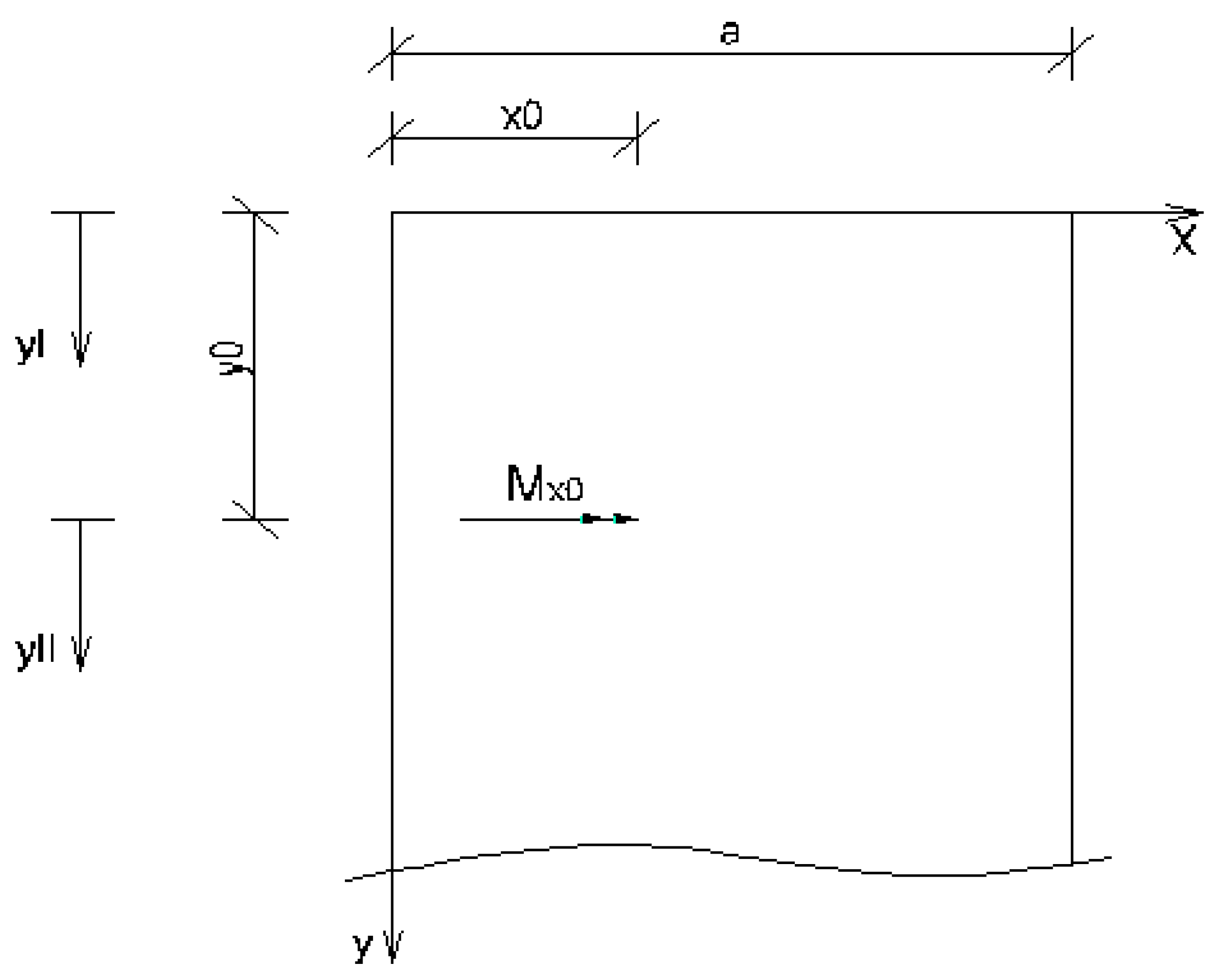
Figure 6.
Rectangular plate of infinite length loaded around the plate middle.
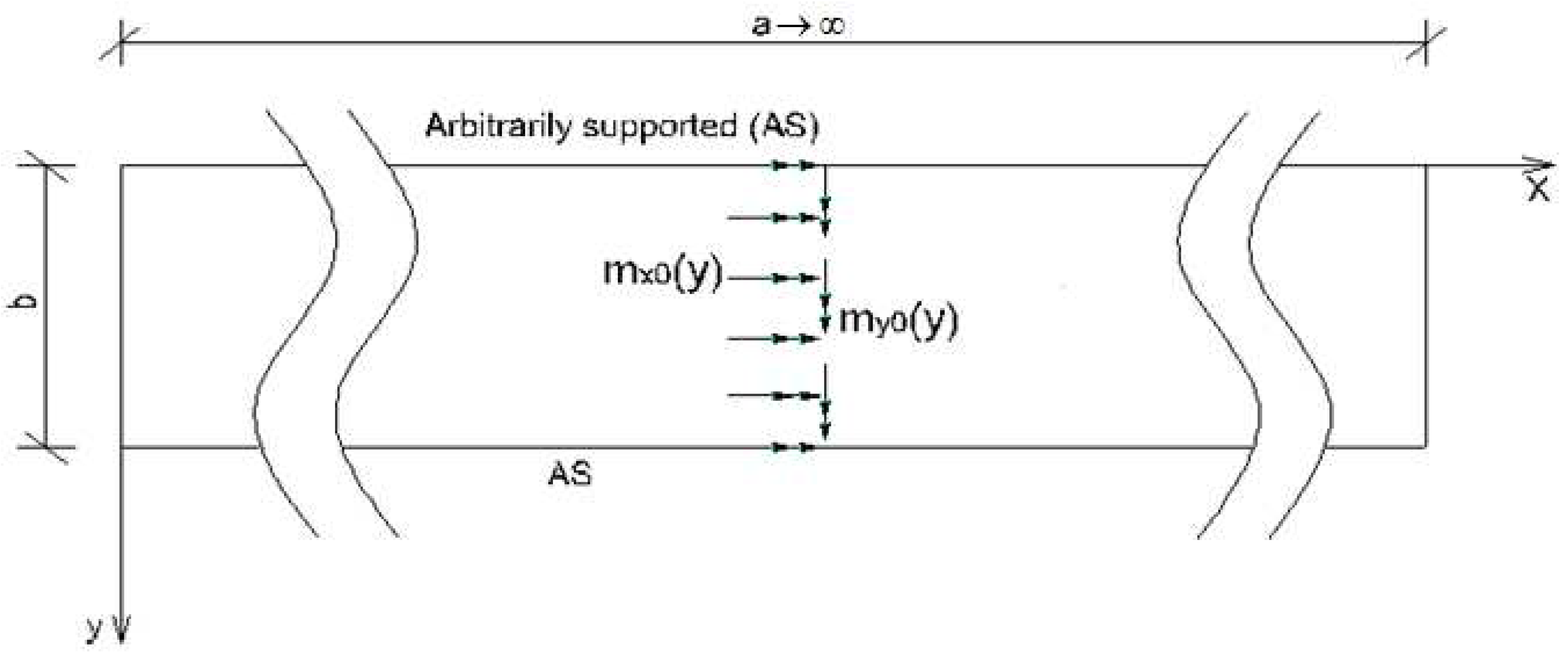
Figure 7.
Rectangular plate of infinite length subjected to an external concentrated moment Mx0 at the middle.
Figure 7.
Rectangular plate of infinite length subjected to an external concentrated moment Mx0 at the middle.
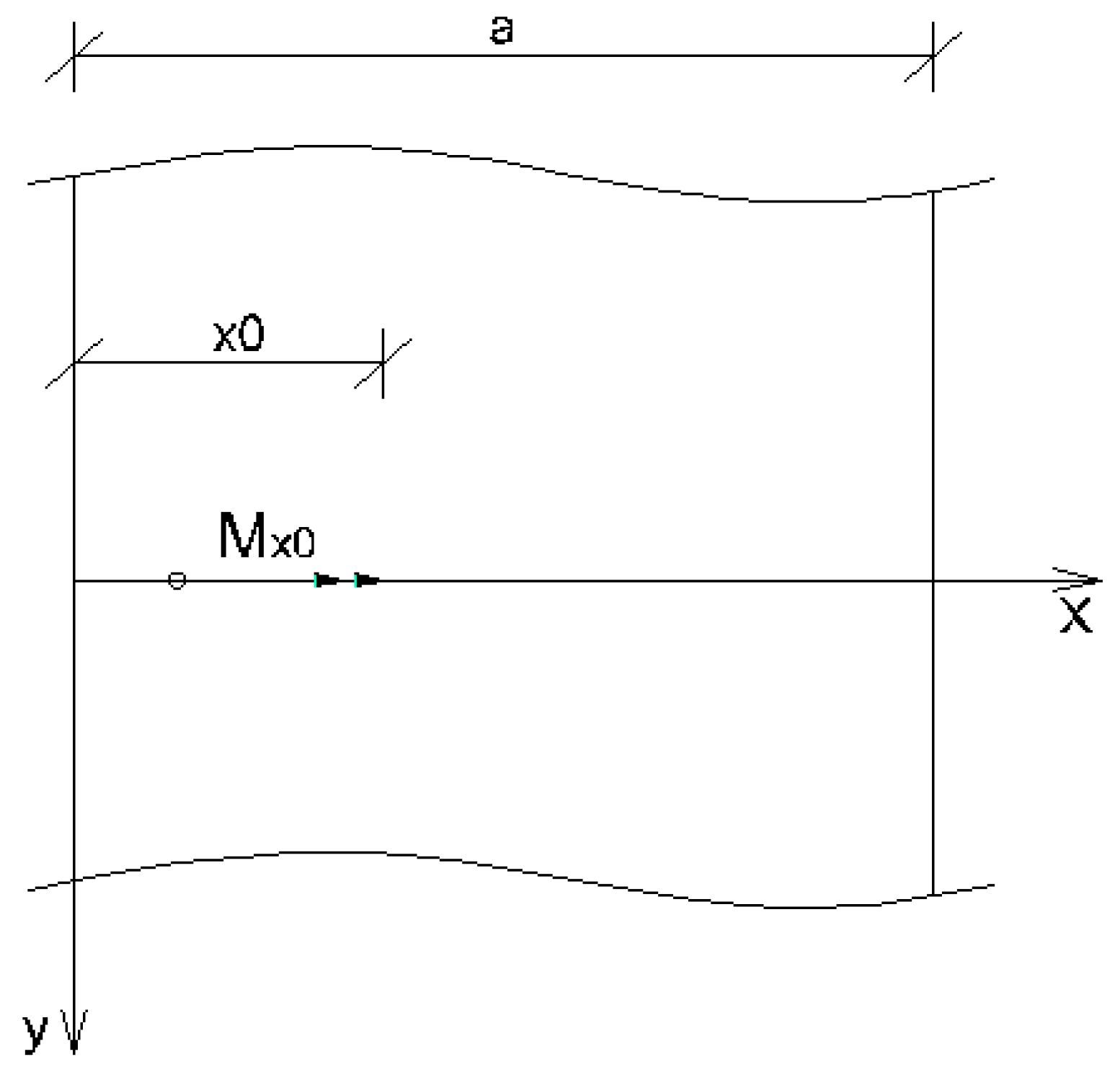
Figure 8.
Rectangular plate of infinite length subjected at its end to an external concentrated bending moment Mx0.
Figure 8.
Rectangular plate of infinite length subjected at its end to an external concentrated bending moment Mx0.
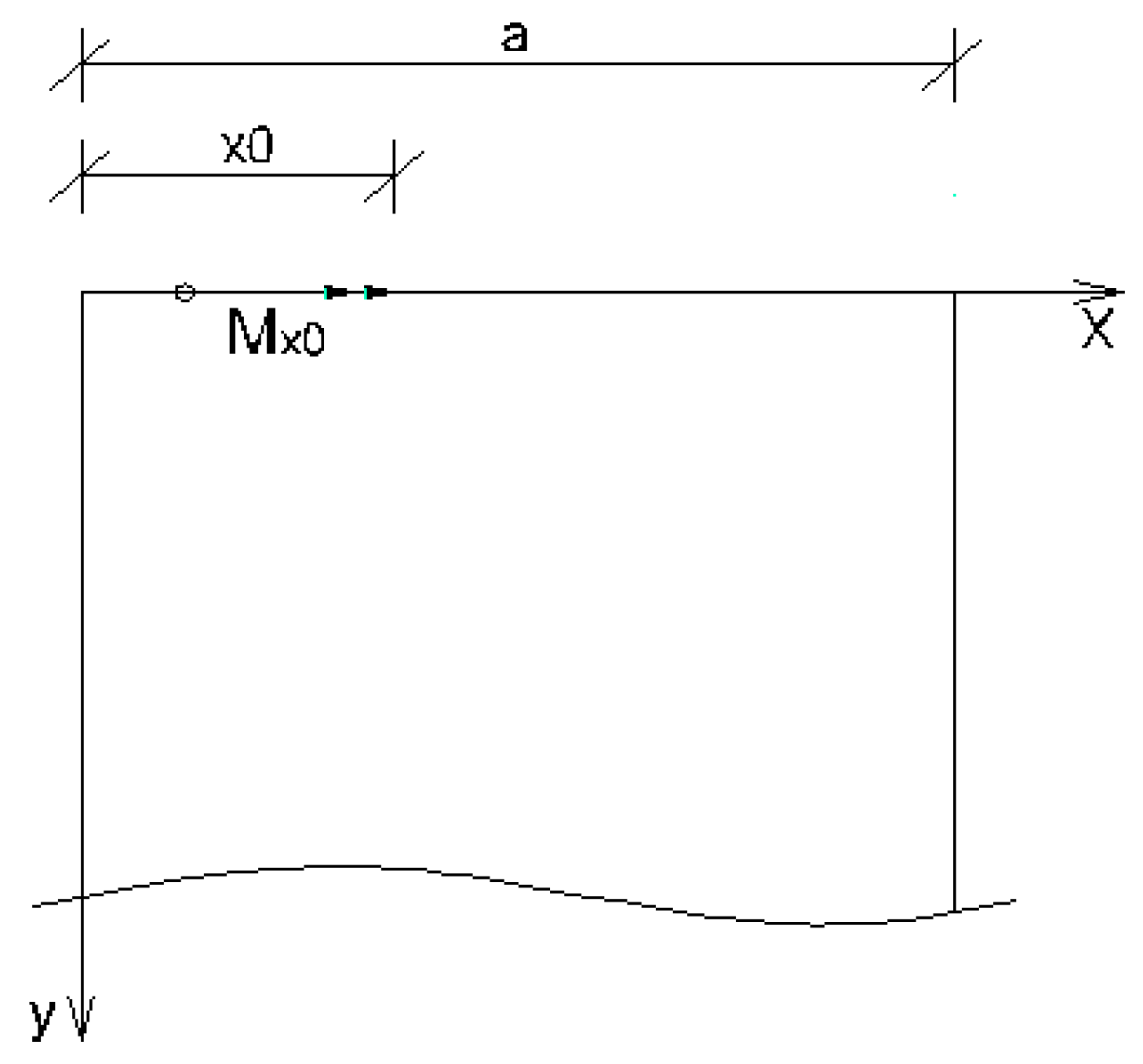
Figure 9.
Rectangular plate subjected at the edge x = 0 to a constant bending moment loading myo.
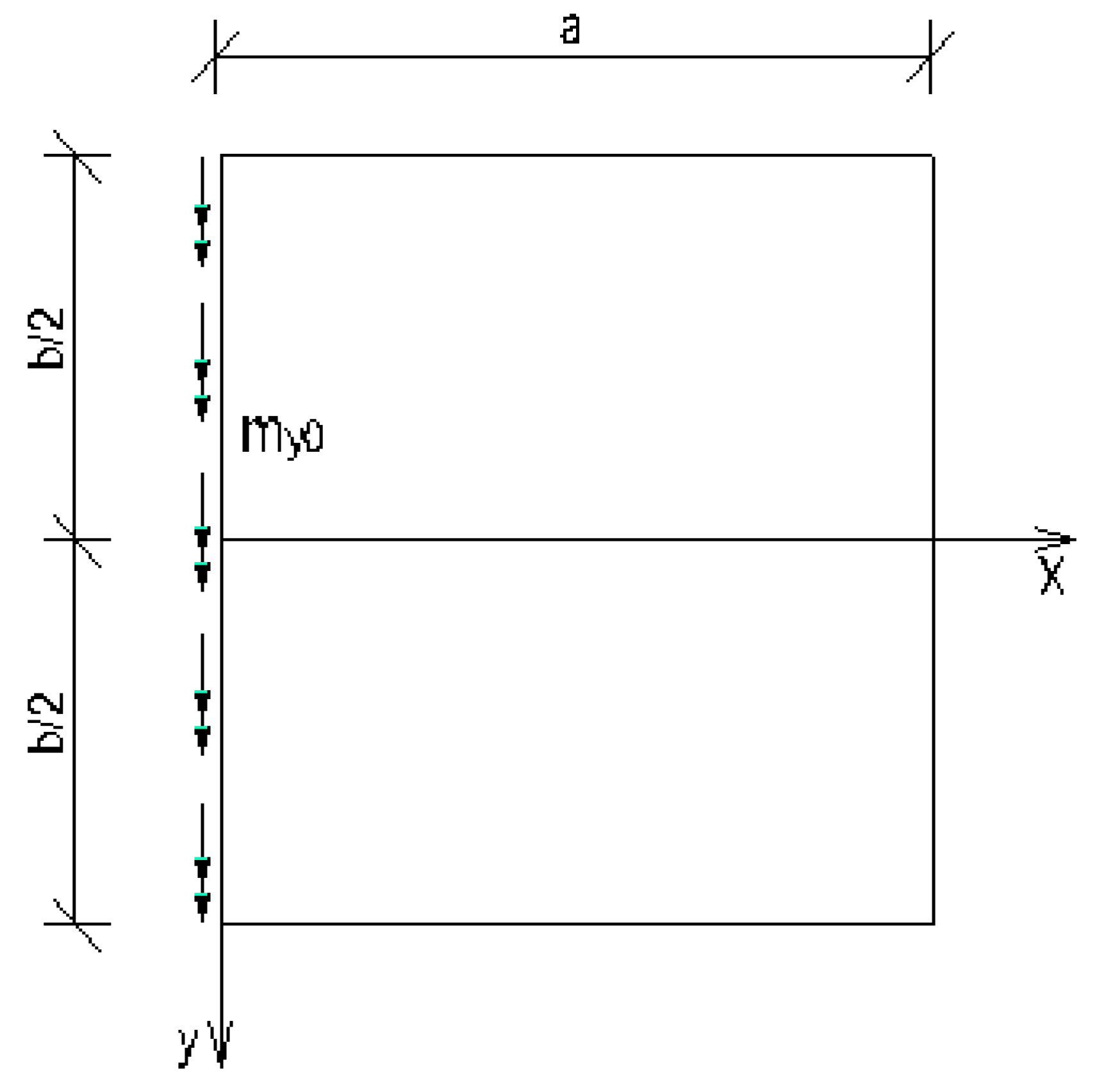
Figure 10.
Cantilever plate of infinite length subjected to external concentrated bending moments at the middle.
Figure 10.
Cantilever plate of infinite length subjected to external concentrated bending moments at the middle.
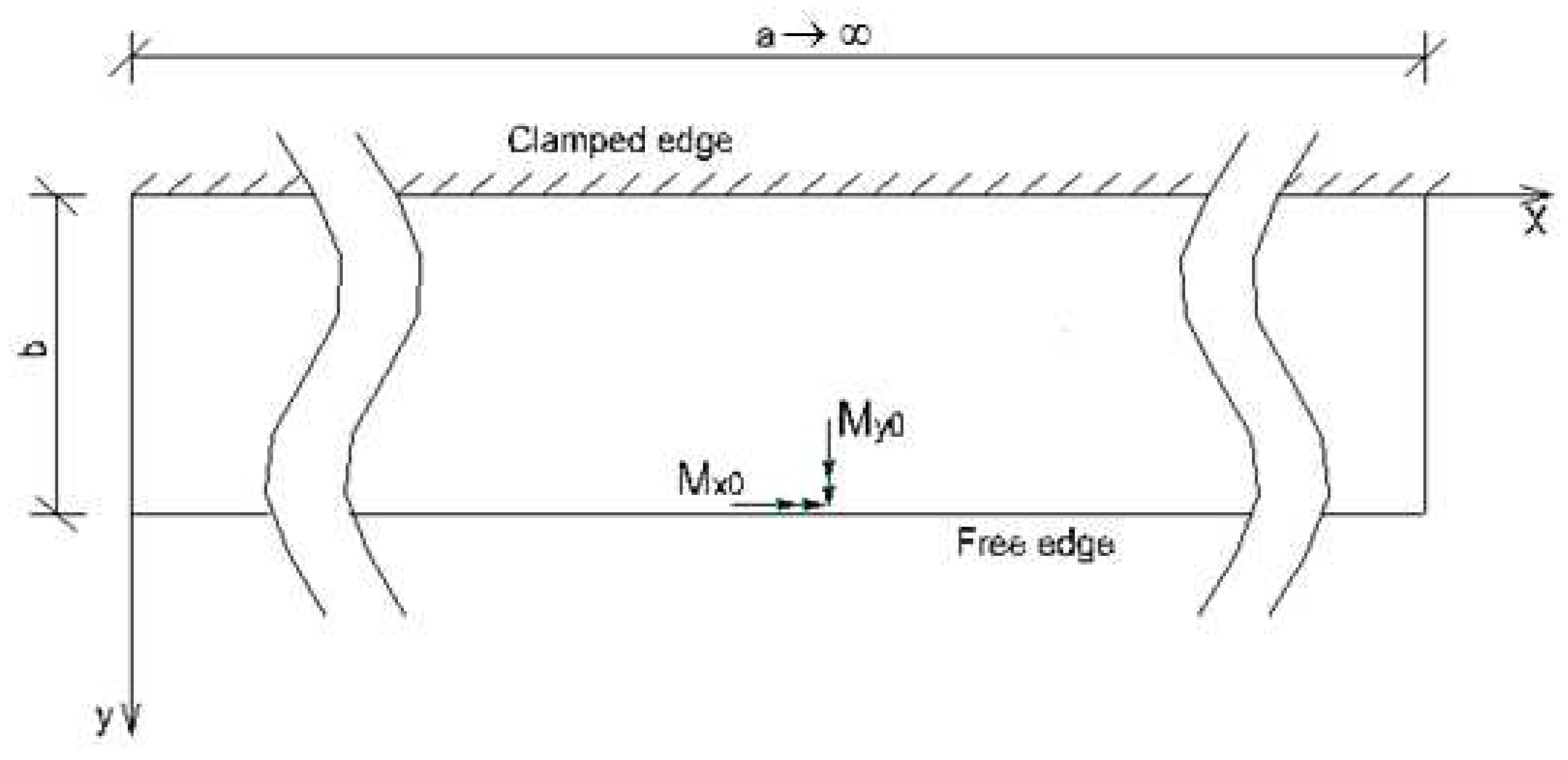

Table 1.
Coefficient F(k) of the bending moment myy at a position y = kb along x = a/2.
| k = | 0,00 | 0,20 | 0,40 | 0,50 | 0,60 | 0,70 | 0,80 | 0,90 |
| F(k) = | 0,3820 | 0,4992 | 0,6289 | 0,7302 | 0,8853 | 1,1514 | 1,7021 | 3,4303 |
Table 2.
Coefficients F(k, λ) of the bending moments myy at (x = a/2, y = kb) for λ = 0.05, 0.10.
| k = | 0,00 | 0,20 | 0,40 | 0,50 | 0,60 | 0,70 | 0,80 | 0,90 |
| F(k, λ = 0.05) = | 0,3826 | 0,4992 | 0,6288 | 0,7300 | 0,8853 | 1,1510 | 1,6970 | 3,3397 |
| F(k, λ = 0.10) = | 0,3842 | 0,4994 | 0,6287 | 0,7297 | 0,8846 | 1,1484 | 1,6779 | 3,0979 |
Table 3.
Coefficient F(k) of the deflection at a position y = kb along the axis x = a/2.
| k = | 0,20 | 0,40 | 0,50 | 0,60 | 0,70 | 0,80 | 0,90 | 1,00 |
| F(k) = | 0,0085 | 0,0370 | 0,0603 | 0,0910 | 0,1307 | 0,1821 | 0,2513 | 0,3610 |
Table 4.
Coefficient F(k) of the bending moment myy at a position x0 = kb of the clamped edge.
| k = | 0,00 | 0,25 | 0,50 | 0,75 | 1,00 | 1,50 | 2,50 |
| F(k) = | 0,000 | 0,1846 | 0,2686 | 0,2577 | 0,2070 | 0,1081 | 0,0264 |
| k = | 0,45 | 0,5 | 0,6 | ||||
| F(k) = | 0,2610 | 0,2686 | 0,2725 | ||||
Table 5.
Coefficient F(k) of the bending moment myy at a position y = kb along x = a/2.
| k = | 0,00 | 0,30 | 0,40 | 0,50 | 0,60 | 0,70 | 0,80 | 0,90 |
| F (k) = | -0,7258 | -0,1205 | 0,0369 | 0,2018 | 0,3984 | 0,6782 | 1,1577 | 2,6953 |
Table 6.
Coefficient F(k) of the bending moment myy at a position y = kb along x = a/2.
| k = | 0,00 | 0,30 | 0,40 | 0,50 | 0,60 | 0,70 | 0,80 | 0,90 |
| F (k) = | 0,0000 | -0,4002 | -0,5707 | -0,7858 | -1,0839 | -1,5619 | -2,5538 | -5,4557 |
Disclaimer/Publisher’s Note: The statements, opinions and data contained in all publications are solely those of the individual author(s) and contributor(s) and not of MDPI and/or the editor(s). MDPI and/or the editor(s) disclaim responsibility for any injury to people or property resulting from any ideas, methods, instructions or products referred to in the content. |
© 2023 by the author. Licensee MDPI, Basel, Switzerland. This article is an open access article distributed under the terms and conditions of the Creative Commons Attribution (CC BY) license (http://creativecommons.org/licenses/by/4.0/).
Copyright: This open access article is published under a Creative Commons CC BY 4.0 license, which permit the free download, distribution, and reuse, provided that the author and preprint are cited in any reuse.


