

Submitted:
30 June 2023
Posted:
04 July 2023
You are already at the latest version
Abstract
Despite the popularity of infant swimming programs, no evidence exists to determine whether they influence infants’ judgements and behavior when confronted with bodies of water. In the current study we examined whether the total number of swimming sessions an infant had participated in predicted whether they avoided a body of water they could enter via an edge (n = 101 infants) or a slope (n = 77 infants). An initial regression analysis revealed no association between the number of sessions and avoidance of the water via either type of entry. However, a secondary analysis of infants who had participated in fewer or more than 10 sessions revealed a significant interaction between number of sessions and type of entry into the water. Infants who participated in more than 10 sessions were more likely to avoid the water if they could access it via an edge but significantly more likely to enter the water if they could access it via a slope. Because we tested the two groups of infants in different countries, further research is warranted to determine if cultural differences in child rearing practices or variations in the content and/or teaching of the swimming programs might explain these intriguing findings.
Keywords:
Water Slope
; Water Cliff
; drowning
; perceptual-motor development
; affordances
1. Introduction
Water immersion is the leading cause of hospitalized non-fatal drownings [1] and unintentional deaths among children 1–4 years [2]. The United Nations recently recognized drowning as a global burden of mortality, especially among children, and made an urgent plea to researchers to develop research programs and strategies to understand and prevent drowning. They also recommended the adoption of drowning prevention actions proposed by the World Health Organization [3]. Both the World Health Organization [4] and the American Academy of Pediatrics (AAP) [5] recommend teaching children basic swimming skills as one of several multifactorial actions to prevent drowning. However, the scientific literature does not yet support the effectiveness of swimming programs for the prevention of drowning among children younger than 2 years of age [6].
Although teaching swimming competencies can reduce the odds of drowning among children 2-4 years of age, infants younger than 2 years of age cannot intentionally control their breathing in order to survive in the water for long periods of time [6]. In addition to young children’s inability to exit the water by themselves, another possible reason for the overrepresentation of young children in drowning statistics is that when infants become mobile, they are too young to perceive the risks imposed by bodies of water and, therefore, their risk of falling into the water increases [7].
The AAP initially advised that children should only start swimming programs after the age of 3 years; first because no evidence existed to determine if swimming programs for very young children would impact the likelihood of drowning and, second, because enrolling babies in swimming programs could develop a false sense of security in caregivers and a consequent reduction of proper supervision [8,9]. They also expressed concern that baby swimming programs could “reduce a child’s fear of water and unwittingly encourage the child to enter the water without supervision” [10] (p179). In light of a case-control study showing that swimming lessons did not increase the risk of drowning in 1-4 year-olds [11], the AAP subsequently changed the recommendation [10]. They softened their stance stating that swimming programs could be beneficial to children of all ages, including babies, provided other layers of protection against drowning (e.g., constant and capable supervision, effective pool barriers) were in place. Nevertheless, the AAP [10] made clear that swimming lessons do not promote ‘drown-proofing’ skills in young children. Videos on the internet and anecdotal reports of infants saving themselves from drowning by turning to float on their backs require scientific validation [12].
A lingering concern is that parents might overestimate their babies’ swimming skills and neglect responsibility for close supervision because their children are enrolled in swimming programs [8,9]. Indeed, Morrongiello and colleagues [13] reported that parents’ judgment of their young children’s swimming skills tends to be poor, even when they are enrolled in swimming programs, and they underestimate their need for supervision. Yet, parents’ overestimation did not increase as their children accumulated swimming lessons. Interestingly, Borioni and colleagues [14] recently showed that a 10-week swimming intervention for infants provided some positive benefits in terms of general motor development (i.e., gross, fine and total motor skills). Unfortunately, however, this study did not consider the impact that the swimming lessons had on the infant’s behavior around water. To our knowledge, no previous studies have investigated how swimming lessons influence young children’s perception of the risk of entering the water and their resulting behavior around water bodies.
In line with the ecological approach, pioneered by J. J. Gibson [16] and E. J. Gibson [17], Burnay and colleagues recently established a novel ecological line of research on infants’ risk perception and behavior that can address some of the aforementioned questions and potentially contribute to the prevention of pediatric drowning (see Burnay et al. [15]). By understanding the dynamic relationship between infants’ perceptual-motor development and experiences and aquatic environments, we can better understand infants’ adaptive behavior around bodies of water that can lead to drowning incidents.
The ecological approach was first used to investigate infants’ relationship with bodies of water when Burnay and colleagues tested infants’ avoidance behavior on a Water Cliff apparatus (i.e., drop-off leading into the water) and on a Water Slope apparatus (i.e., ramp leading into the water). Focusing on the role of locomotor experience on infants’ perception and action around these risky environments, Burnay and colleagues reported that when infants first start crawling, they tend to fall into the water in the cliff scenario [18,19], but after weeks of crawling experience they start to perceive the danger and avoid these falls [18,19], even when they start walking [20]. Burnay and colleagues also showed that when the entrance to a body of water is smooth and gradual, with a slope instead of a drop-off leading into the water, infants’ tendency to venture into deep water increases considerably, but is not linked to locomotor development or experience [21]. The different findings on the water cliff and the water slope relative to the contribution made by locomotor experience to avoidance behavior highlights the importance of context as a regulator of behavior. They also have important implications for our understanding of drowning in young children and how to prevent it because they suggest young children might be at much greater risk for drowning when they can enter a body of water via a slope than a drop off. Finally, the findings raise the interesting possibility that other experiences that influence young children’s tendency to venture into a body of water might have different effects depending on the nature of the access to the body of water.
The prior work by Burnay and colleagues has established the effect of locomotor experience and the type of access to bodies of water on infants’ perception and action around water. The aim of the present article is to examine to what degree infants’ participation in baby swimming programs influences their perception and behavior around ramps and drop-offs leading into the water. Specifically, this article reports the effect that the number of swimming sessions has on infants’ avoidance of venturing into deep water through ramps and drop-offs and, consequently, on their potential to engage in drowning incidents on these different types of accesses to the water. From an ecological perspective, we predicted that infants who had more swimming lessons would have a greater appreciation of the different actions possible in water and on land. Using the language of ecological psychology, we predicted that infants with more swimming experience would have learned that solid surfaces afford safe locomotion whereas bodies of water do not (at least not for unskilled swimmers). Consequently, we expected to see greater avoidance of the water in the cliff and slope scenarios in infants who had attended more swimming lessons.
2. Methodology
2.1. Participants
We analyzed the avoidance behavior of 101 infants on the Water Cliff (WC) (Mage = 13.01 ± 2.39 months) and 77 infants on the Water Slope (WS) (Mage = 12.52 ± 2.94 months) relative to the number of baby swimming sessions they attended. The infant samples used in this experiment are the same as those reported in a previous article on the effect of locomotor experience on their avoidance of the WC [19] and the WS [21]. The novel contributions of this study are the combination of the two samples and consideration of the additional covariate of baby swimming program attendance on behavior. We excluded one infant from the original sample of 102 infants due to missing data on the number of swimming sessions attended. Infants tested on the WC were from Lisbon, Portugal, with the approval of the CEFMH Human Ethical Research Committee (Ref 15/2014) and infants tested on the WS were from Dunedin, New Zealand, with the approval of the Otago Human Ethical Research Committee (Ref 19/007). In both studies, parents provided written informed consent before testing began.
2.2. Testing Apparatuses
The WC apparatus is a part of the Real Cliff / Water Cliff (RC/WC) apparatus. It consists of a 75 cm high platform, connected on one side (the WC side) to a 20 cm deep tub filled with water and with no protection from falling on the opposite side (the RC side) (see Burnay & Cordovil [18]). The WS apparatus is a 10° inclined 10 × 2.5 × 1.5 m ramp installed in a swimming flume leading to a 75 cm deep body of water (see Burnay et al. [21]). The surfaces of the WC and WS apparatuses are covered with a black and white checkerboard pattern and surrounded by 20 cm high side protection barriers. The infants’ safety is ensured by climbing equipment controlled by the lead experimenter. The infant wears a harness and a rope connects the harness and infant to the experimenter via a pulley system. The equipment allows a maximum 5 cm fall on the WC and limits the submersion to the infants’ chin (i.e., maximum submersion point) on the WS.
2.3. Procedures
After signing the informed consent, mothers helped the experimenter to put the adapted climbing harness on their infant and held them so the experimenter could attach the rope to the harness. The infants were clothed. Mothers were then asked to play with their infant on the starting platform until the infant was calm. Then, the mothers moved to the opposite end of the water tub in the case of the WC (Figure 1) and sat on a platform over the water with their feet touching the water in the case of the WS (Figure 2).
Mothers were asked to encourage their infant to get to them using positive language and showing toys. Mothers were also asked to touch the water, with their hands, in the case of the WC, and with their feet, in the case of the WS, so the infant would have the visual information of the water. Infants were free to explore both apparatuses and to decide whether to go over the cliff, in the case of the WC, or into the water, in the case of the WS.
2.4. Data Analysis
Before the testing, mothers were asked to complete a questionnaire with their infant’s information, (e.g., date of birth, day of locomotor achievements), including number of swimming sessions the infant had participated in up until the day of testing. Infants’ behavior was coded as non-avoiders if they fell into the water on the WC or ventured into the water until the water touched their chin on the WS or as avoiders if they stood on the platform or safely descended from the platform on the WC and, on the WS, if they did not venture into the water deep far enough for the water to touch their chin.
Logistic regressions were performed to ascertain the effect of number of the swimming sessions attended on the likelihood that infants avoided the WC and the WS. A logistic regression that included type of entrance (WC vs WS) and number of swimming sessions was also performed to analyze if there was an interaction between these two variables on infants’ behavior. For that analysis, all data from infants tested on the WC and on the WS were considered together. We also conducted Fisher’s test to investigate the difference in avoidance behavior between infants that participated in at least one and those who never attended swimming sessions (i.e., zero vs. at least one swimming session attended), and between infants that had at least ten and those who attended less than ten swimming sessions (i.e., less than ten vs. more than ten swimming lessons attended). The rationale for selecting ten swimming sessions as the cut-off was based on prior research showing that ten sessions can produce positive effects on infants’ general motor behavior (see Borioni et al. [14]).
3. Results
3.1. Water Cliff vs Water Slope
When analyzing the behavior of infants tested on the WC and on the WS together, no significant effect of number of swimming sessions on infants’ avoidance behavior was found (χ2(1) = 0.29, p = 0.593) but there was a significant effect of type of entrance (WC vs WS) on infants’ avoidance behavior (χ2(1) = 18.15, p < 0.001). Infants avoided the WC more than the WS. The interaction between type of entrance and number of swimming sessions on infants’ behavior was statistically significant (χ2(1) = 3.93, p = 0.047). Surprisingly, the interaction revealed that the more swimming sessions infants had participated in, the more likely they were to avoid immersion on the WC and, conversely, the less likely they were to avoid immersion on the WS.
3.2. Water Cliff
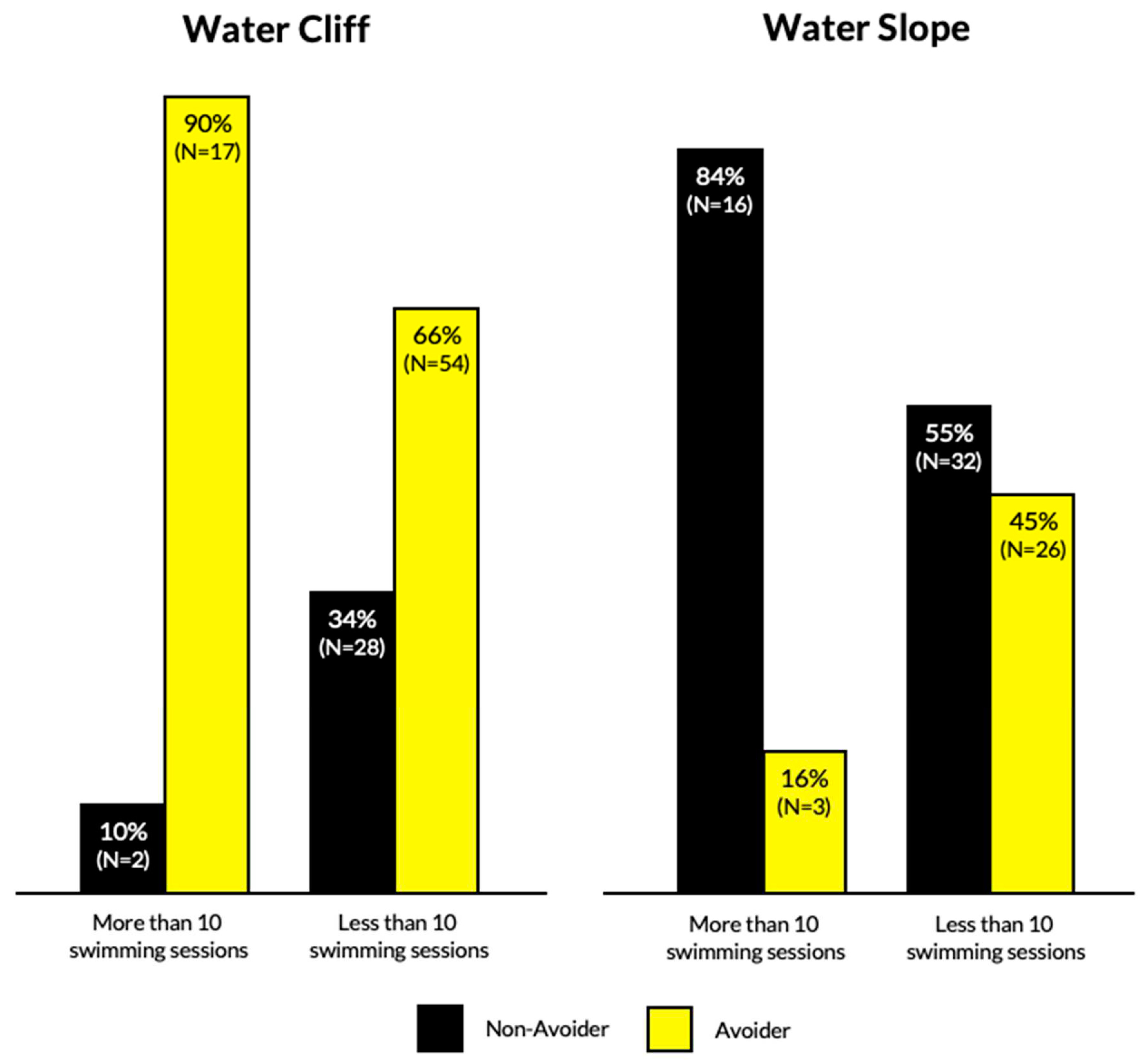
From the 101 infants tested on the WC, 30 (30%) fell and 71 (70%) avoided falling (Figure 3). Statistically, there was no effect of the number of swimming sessions on infants’ avoidance behavior (non-avoider: M = 2.57 ± 4.56 swimming sessions; avoider: M = 5.31 ± 10.63 swimming sessions; χ2(1) = 1.698, p = 0.193). There were also no significant differences in avoidance behavior between infants that had at least one swimming session (n = 33) and infants that had attended no swimming sessions (n = 68) (p = 0.818, Fisher’s exact test). However, infants that had more than ten swimming sessions (n = 19) were more likely to avoid the WC than those who had attended less than ten sessions (n = 82), though the statistical comparison just failed the threshold for significance (p = 0.052, Fisher’s exact test).
3.3. Water Slope
In marked contrast to the findings on the WC, of the 77 infants tested on the WS, 48 (62%) reached the submersion point and 29 (38%) avoided it (Figure 3). There was no significant effect of the number of swimming sessions on infants’ avoidance behavior (non-avoiders: M = 7.46 ± 8.61 swimming sessions, avoiders: M = 3.72 ± 8.13 swimming sessions, χ2(1) = 3.196, p = 0.074), nor was there a significant difference in avoidance behavior between infants that had at least one swimming session (n = 40) or no swimming sessions (n = 37) (p = 0.064, Fisher’s exact test). However, when analyzing the difference in avoidance behavior between infants that had more (n = 19) or less (n = 58) than ten swimming sessions, a significant difference was observed (p = 0.030, Fisher’s exact test). Infants with more than ten swimming sessions were significantly more likely to reach the submersion point than infants who had attended less than ten swimming sessions.
4. Discussion
The effectiveness of baby swimming programs on the swimming skills and propensity for drowning in children younger than 2-years of age is not well established in the literature [6]. Researchers have debated whether baby swimming programs make infants safer around bodies of water by teaching them potential survival skills when they fall into the water or whether they make them less safe by giving them or their caregivers a false sense of confidence around bodies of water. Evidence exists for both sides of the debate. Instead of focusing on the effect of swimming programs on infants’ behavior in the water (i.e., swimming competency or survival skills), the present study investigated the impact of baby swimming programs on infants’ behavior when they approach the water, their perception of the risk and their tendency to venture into the water. Previous studies have shown that locomotor experience influences infants’ avoidance of falling into the water [18,19,20] but has no effect on infants’ avoidance when the water can be entered via a slope [21]. These prior results did not identify the influence of other factors, such as experience in baby swimming programs, on water avoidance. However, they did foreshadow the current findings by showing that a particular type of experience made a significant contribution to infant’s avoidance behavior in one context, when the infant could access the water via a drop-off, but made no contribution to avoidance behavior in another context, when the infant could access the water via a slope.
The present analyses of the impact of baby swimming programs on infants’ perception and action around bodies of water showed no effect of the total number of swimming sessions attended on infants’ avoidance of drop-offs (WC) or slopes (WS) leading into the water. When comparing infants that attended more or less than ten swimming sessions, we found a marginal effect on infants’ avoidance on the WC (p = 0.052) and a significant effect was observed on infants’ avoidance of the WS (p = 0.030). These findings were supported by a significant interaction between the type of entrance to the water and the number of swimming sessions attended on infants’ avoidance behavior. Of the infants who attended more than ten swimming sessions, 90% avoided the WC whereas only 38% avoided the WS. These data appear to support the assumption that baby swimming programs have a positive impact on infants’ perception and action around drop-offs leading into the water but an opposite effect when a sloped surface offers access to the water.
A possible explanation for these results is the potential differences in the perception of the affordances (i.e., possibilities for behavior, see Gibson [22]) in the two scenarios. As previously established in the literature, a drop-off does not afford safe locomotion and locomotor experience teaches infants to avoid drop-offs [23], whether they lead into the water or not [15]. It appears that the experience in baby swimming programs can enhance this perception of the risk of falling into the water acquired through locomotor experience. Perhaps the swimming lessons enhance the salience of the distress associated with a sudden plunge into the water or the swimming lessons highlighted the differences between the affordances provided by solid surfaces and water—one affords safe locomotion and the other does not—when an abrupt transition separates land and water. On the other hand, a shallow slope affords safe locomotion [24], and infants tend to locomote down one even when it leads into the water [21]. Infants might have much greater difficulty differentiating the affordances provided by solid surfaces and water when the two merge into each other gradually, as with a slope leading into deep water. Young children and even adults have a difficult time discriminating affordances when the boundary conditions between affordances are subtle [25]. Another possibility is that perhaps infants perceive water as a medium that affords exploration and play when they have attended ten or more swimming sessions and can immerse themselves into it gradually or under their own volition. The perception of the affordances for exploration and play might overwhelm the perception of the affordance for safe locomotion.
As initially proposed by the AAP [8], the current findings suggest that baby swimming programs may increase the risk of drowning among young children, but not in our opinion because they offer caregivers a false sense of security and overconfidence of their babies’ swimming skills, an argument later dismissed by Morrongiello et al. [13] Instead, we suggest that experience in baby swimming programs may offer infants’ a false sense of confidence and security to explore the aquatic environment that leads them to risk going deeper and deeper into the water only when the access is smooth, gradual and affords playful interaction. However, the same baby swimming programs may promote a safer approach to the water if the entrance is sudden and less enticing.
Nevertheless, these initial results need to be interpreted with caution and cannot be extrapolated to the general population due to limitations. Infants tested on the WC were from Lisbon, Portugal, and infants tested on the WS were from Dunedin, New Zealand. These differences suggest at least two potentially profitable lines of future research to help untangle the factors contributing to the current findings. First, researchers could explore whether variations in attitudes towards risk taking or child rearing increase risk aversion in Portuguese infants and decrease risk aversion in infants from New Zealand to confirm or rule out a cultural explanation for the current findings. Cultural differences in child rearing deserve serious attention given prior research showing disparities exist in drowning mortality rates in some countries as a function of race and ethnicity [26]. Children identified as racial and ethnic minorities have a much greater likelihood of dying from drowning than other children [26,27]. The World Health Organization calls for further investigation on the contribution of swimming experience and ability in the water to the disparities observed in the risk of drowning among racial and ethnic groups, recognizing that these contributing factors are poorly understood and mainly speculative [7]. It remains plausible that cultural differences in risk taking or encouragements given to children during child rearing make a contribution to drowning fatality rates.
The second potentially profitable line of future research to help untangle the factors contributing to the current findings involves determining whether the content of baby swimming programs differ in Portugal and New Zealand. Differences might exist in the locations baby swimming programs take place (e.g., open water vs. pool, deep pool vs. shallow pool, pool with vs. pool without sloped accesses), strategies taught to enter and exit the water, if the methodologies encompass drowning safe rules, whether infants experience complete submersion, and the age at which lessons begin, to name a few. Such differences could in turn explain differences in risk aversion between the two groups of infants. Of course, the combination of cultural differences in attitudes toward risk taking in young children combined with differences in the content of baby swimming programs could together explain differences in risk aversion between the two groups of infants in the current study better than either factor alone.
5. Conclusion
The evidence from this study suggests that the effects of baby swimming programs on infants’ avoidance of bodies of water depends on the type of access available to enter the water when infants have participated in ten or more swimming sessions. Infants with more swimming experience avoid abrupt entrances into the water but venture down gradual slopes into deep water. Because the population tested on the Water Cliff and on the Water Slope were from different countries and cultural backgrounds (Portugal and New Zealand), in future studies the same infants should be tested on both scenarios and in a more ecological environment (swimming pool instead of laboratory). Nevertheless, the current findings, in concert with prior findings showing infants’ greater likelihood of venturing into deep water via a sloped surface than an abrupt edge, suggest that caregivers might need to exercise much greater vigilance while supervising young children around bodies of water that the children can access via a ramp or slope.
Key Messages
- Baby swimming programs influence infants’ perception and behavior around bodies of water.
- The effects of baby swimming programs on infants’ avoidance of bodies of water depends on the type of access.
- Swimming experience enhance infants’ avoidance of falling into the water via drop-offs.
- Swimming experience increases the likelihood of infants’ venturing into deep water via a sloped surface.
Acknowledgments
The authors would like to thank the children and their parents who participated in this study.
References
- Leavy, J.E.; Crawford, G.; Franklin, R.; Denehy, M.; Jancey, J. Drowning. In International Encyclopedia of Public Health; Elsevier: Amsterdam, The Netherlands, 2017; Volume 2, pp. 361–365. [Google Scholar] [CrossRef]
- Franklin, R.C.; Peden, A.E.; Hamilton, E.B.; et al. The burden of unintentional drowning: Global, regional and national estimates of mortality from the Global Burden of Disease 2017 Study. Inj Prev. 2020, 26, i83–i95. [Google Scholar] [CrossRef]
- United Nations. Global Drowning Prevention: Draft Resolution/Bangladesh and Ireland; UN, 2021; Available online: https://digitallibrary.un.org/record/3908441.
- World Health Organization. Preventing Drowning: An Implementation Guide; World Health Organization: Geneva, Switzerland, 2017; Available online: http://apps.who.int/iris/bitstream/10665/255196/1/9789241511933-eng.pdf?ua=1.
- Denny, S.A.; Quan, L.; Gilchrist, J.; et al. Prevention of Drowning. Pediatrics 2019, 143. [Google Scholar] [CrossRef] [PubMed]
- Taylor, D.H.; Franklin, R.C.; Peden, A.E. Aquatic Competencies and Drowning Prevention in Children 2–4 Years: A Systematic Review. Safety 2020, 6, 31. [Google Scholar] [CrossRef]
- World Health Organization. Global Report on Drowning: Preventing a Leading Killer; World Health Organization: Geneva, Switzerland, 2014; Available online: http://www.who.int/violence_injury_prevention/global_report_drowning/en/.
- Flynn, T.G.; Kennell, J.H.; McLeod, R.N.; et al. Swimming Instructions for Infants. Pediatrics 1980, 65, 847–847. [Google Scholar] [CrossRef]
- Committee on Sports Medicine and Fitness. Swimming Programs for Infants and Toddlers. Pediatrics 2000, 105, 868–870. [Google Scholar] [CrossRef]
- Committee on Injury, Violence and PP. Prevention of Drowning. Pediatrics 2010, 126, 178–185. [CrossRef] [PubMed]
- Brenner, R.A.; Taneja, G.S.; Haynie, D.L.; et al. Association between swimming lessons and drowning in childhood: A case-control study. Arch Pediatr Adolesc Med. 2009, 163, 203–210. [Google Scholar] [CrossRef] [PubMed]
- Langendorfer, S.J. Oh, Baby, Baby: Examining Claims for Water Safety and Drowning Prevention of Infants. Int J Aquat Res Educ. 2015, 9, 9–11. [Google Scholar] [CrossRef]
- Morrongiello, B.A.; Sandomierski, M.; Schwebel, D.C.; Hagel, B. Are parents just treading water? The impact of participation in swim lessons on parents’ judgments of children’s drowning risk, swimming ability, and supervision needs. Accid Anal Prev. 2013, 50, 1169–1175. [Google Scholar] [CrossRef] [PubMed]
- Borioni, F.; Biino, V.; Tinagli, V.; Pesce, C. Effects of Baby Swimming on Motor and Cognitive Development: A Pilot Trial. Percept Mot Skills 2022, 129, 977–1000. [Google Scholar] [CrossRef] [PubMed]
- Burnay, C.; Anderson, D.I.; Button, C.; Cordovil, R.; Peden, A.E. Infant Drowning Prevention: Insights from a New Ecological Psychology Approach. Int J Environ Res Public Health 2022, 19, 4567. [Google Scholar] [CrossRef] [PubMed]
- Gibson, J.J. The Ecological Approach to Visual Perception; Houghton Mifflin Harcourt (HMH), 1979. [Google Scholar]
- Gibson, E.J.; Walk, R.D. The “visual cliff”. Sci Am. 1960, 202, 64–71. Available online: https://www.jstor.org/stable/24940447. [CrossRef] [PubMed]
- Burnay, C.; Cordovil, R. Crawling Experience Predicts Avoidance of Real Cliffs and Water Cliffs: Insights from a New Paradigm. Infancy 2016, 21, 677–684. [Google Scholar] [CrossRef]
- Burnay, C.; Cordovil, R.; Button, C.; et al. The effect of specific locomotor experiences on infants’ avoidance behaviour on real and water cliffs. Dev Sci. 2021, 24, 1–16. [Google Scholar] [CrossRef] [PubMed]
- Burnay, C.; Cordovil, R.; Button, C.; Croft, J.L.; Anderson, D.I. Experienced crawlers avoid real and water drop-offs, even when they are walking. Infancy 2021, 26, 770–779. [Google Scholar] [CrossRef] [PubMed]
- Burnay, C.; Button, C.; Cordovil, R.; Anderson, D.I.; Croft, J.L. Do infants avoid a traversable slope leading into deep water? Dev Psychobiol. 2021, 63, 1–9. [Google Scholar] [CrossRef] [PubMed]
- Gibson, J.J. The theory of affordances. In The Ecological Approach to Visual Perception; 1979; pp. 41–64. [Google Scholar]
- Anderson, D.I. Motor Development: Far More Than Just the Development of Motor Skills. Kinesiol Rev. 2018, 7, 99–114. [Google Scholar] [CrossRef]
- Adolph, K.E.; Tamis-LeMonda, C.S.; Ishak, S.; Karasik, L.B.; Lobo, S.A. Locomotor experience and use of social information are posture specific. Dev Psychol. 2008, 44, 1705–1714. [Google Scholar] [CrossRef] [PubMed]
- Klevberg, G.L.; Anderson, D.I. Visual and haptic perception of postural affordances in children and adults. Hum Mov Sci. 2002, 21, 169–186. [Google Scholar] [CrossRef] [PubMed]
- Clemens, T.; Moreland, B.; Lee, R. Persistent Racial/Ethnic Disparities in Fatal Unintentional Drowning Rates Among Persons Aged ≤29 Years—United States, 1999–2019. MMWR Morb Mortal Wkly Rep. 2021, 70, 869–874. [Google Scholar] [CrossRef] [PubMed]
- Peden, M.; Oyegbite, K.; Ozanne-Smith, J.; et al. World Report on Child Injury Prevention; World Health Organization: Geneva, Switzerland, 2008; Available online: https://www.who.int/publications/i/item/9789241563574.
Figure 1.
Water Cliff apparatus front image (left) and back image (right). Photo reproduced with the permission of the infant’s mother.
Figure 1.
Water Cliff apparatus front image (left) and back image (right). Photo reproduced with the permission of the infant’s mother.
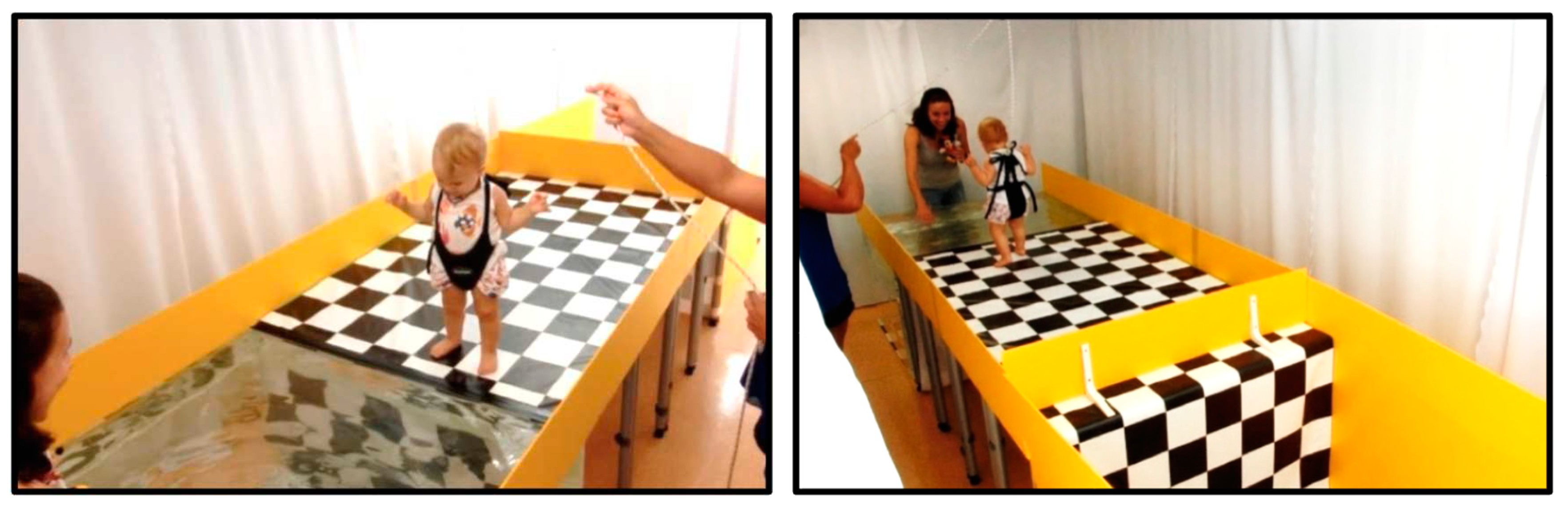
Figure 2.
Front view (left) and back view (right) of the infants on the Water Slope apparatus. Photo reproduced with the permission of the infant’s mother.
Figure 2.
Front view (left) and back view (right) of the infants on the Water Slope apparatus. Photo reproduced with the permission of the infant’s mother.
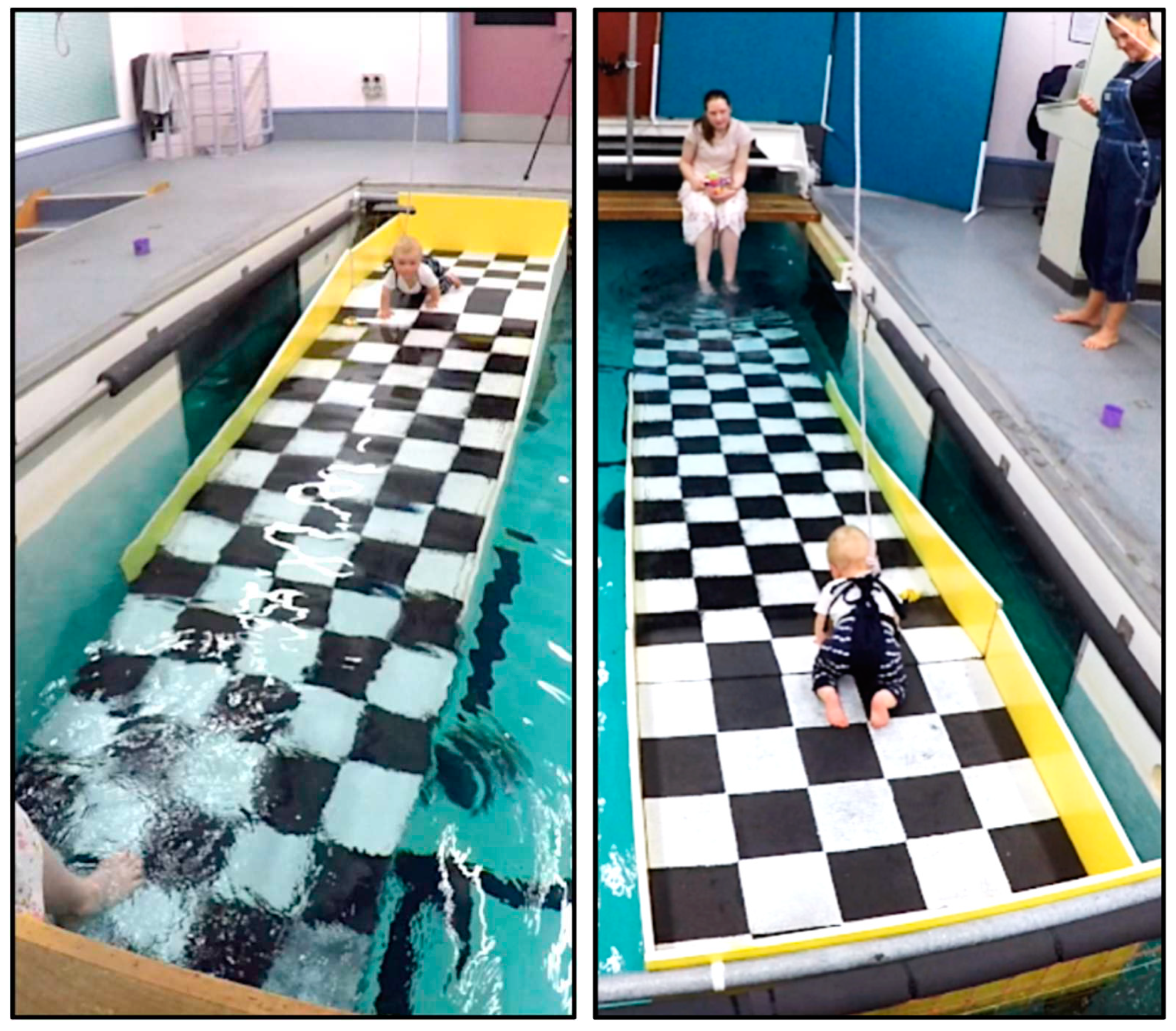
Figure 3.
Comparison of avoidance behavior on the Water Cliff and on the Water Slope between infants that attended more or less than ten swimming sessions.
Figure 3.
Comparison of avoidance behavior on the Water Cliff and on the Water Slope between infants that attended more or less than ten swimming sessions.
Disclaimer/Publisher’s Note: The statements, opinions and data contained in all publications are solely those of the individual author(s) and contributor(s) and not of MDPI and/or the editor(s). MDPI and/or the editor(s) disclaim responsibility for any injury to people or property resulting from any ideas, methods, instructions or products referred to in the content. |
© 2023 by the authors. Licensee MDPI, Basel, Switzerland. This article is an open access article distributed under the terms and conditions of the Creative Commons Attribution (CC BY) license (http://creativecommons.org/licenses/by/4.0/).
Copyright: This open access article is published under a Creative Commons CC BY 4.0 license, which permit the free download, distribution, and reuse, provided that the author and preprint are cited in any reuse.


