
Submitted:
22 June 2023
Posted:
30 June 2023
You are already at the latest version
Abstract
Purpose: For businesses of all sizes, turnover is a significant issue that has a detrimental impact on organizational performance. This study investigates the variables influencing SME workers' intentions to leave their current employers. This study also examines the moderating effect of organizational commitment on the relationships between attitude, subjective norms, perceived behavioral control, and turnover intentions. Methodology: Six hypotheses were proposed regarding the connections between the initial TPB components and organizational commitment. Results: The PLS-SEM structural path analysis findings revealed that the three fundamental predictors of TPB significantly influence turnover intention, with perceived behavioral control most strongly influencing intention. Furthermore, the results revealed that organizational commitment moderated the relationship between TPB constructs and turnover intention. Practical Implications and Originality: This study used an extended TPB model to introduce fresh perspectives into the literature on SME workers' organizational commitment.
Keywords:
Organizational commitment
; turnover intention
; theory of planned behavior
; SMEs
Introduction
Employee turnover is a critical concern for organizations in terms of its financial impact and the disruption it causes to productivity and efficiency (Osazefua, 2019). According to a Work Institute (2020), the cost of losing an employee typically amounts to around 33% of their base salary. According to Collins et al. (2019), hiring a replacement can cost between 50% and 75% of an employee's pay. Such figures highlight the necessity of understanding and addressing turnover within organizations.
The negative effects of employee turnover extend beyond financial implications. When employees leave, valuable resources are diverted from the organization, decreasing efficiency and effectiveness (Kanchana & Jayathilaka, 2023). Additionally, the costs of recruiting, training, and retaining new employees rise significantly. These consequences have been extensively studied and documented (Anwar & Abdullah, 2021).
A concept that has gained considerable attention in turnover research is turnover intention (TOI). TOI refers to an employee's inclination or thoughts of leaving their current organization within a specific timeframe, even if they have not taken concrete steps to leave. Several studies have examined various factors that can effectively predict TOI (Heilala et al., 2021; Skelton et al., 2020). The Theory of Planned Behavior (TPB) is an extensively utilized theoretical framework to examine behavioral intents, particularly TOI. According to TPB, three main predictors—attitude (ATT), subjective norm (SN), and perceived behavioral control (PBC)—influence a person's behavioral intentions (Ajzen, 1991).
ATT represents an individual's evaluation of favorable or unfavorable perspectives when engaging in a specific behavior (Poon & Tung, 2022). It is shaped by behavioral beliefs and outcome evaluations whereby individuals assess and predict their actions’ desired consequences. The second predictor, SN, pertains to the influence of social norms on an individual's behavior (Irimia-Diéguez et al., 2023). It is influenced by how others perceive and express trust in a person's feelings and actions. Lastly, PBC shows a person's belief in their capacity to control resources and choices while engaging in an activity.
Understanding the predictors of behavioral intention, as elucidated by the TPB model, holds significant implications for organizations aiming to address turnover issues effectively. By comprehending the factors that impact an employee's intention to leave, organizations can develop targeted strategies to mitigate turnover and retain valuable talent.
The TPB model has been widely applied in studying various human behaviors, including employee behavior and purchasing intentions (Liu et al., 2020; Zaremohzzabieh et al., 2021). This study delves into the three primary predictors of TPB and their influence on TOI, drawing upon existing research and exploring the potential implications for organizations seeking to improve employee retention and reduce turnover rates.
High turnover rates among small and medium-sized enterprise (SME) employees are a persistent issue in Nigeria, adversely affecting the productivity and sustainability of these businesses (Agwaniru, 2023). Previous studies consistently found a high TOI among SME employees nationwide (Samuel et al., 2021). This turnover trend has been identified as a contributing factor to the poor performance of SMEs in Nigeria (Siyanbola & Gilman, 2017). Employee turnover has been cited as a significant reason why only a small percentage of SMEs remain operational after five years in Nigeria (Amah & Oyetuunde, 2020).
SMEs play a vital role in Nigeria's economy, comprising approximately 97% of all businesses and contributing 50% to the country's national GDP (Muriithi, 2017). However, their potential to drive economic growth and transformation is hindered by the high turnover rates among employees and the inability of managers to retain efficient personnel (Charles et al., 2018). While employee skills and qualifications are essential, commitment to the organization is equally crucial. Committed employees are likelier to perform their job diligently and exceed organizational expectations (Naz et al., 2020). Therefore, addressing the issue of employee turnover is critical for enhancing SMEs' effectiveness and overall economic growth in Nigeria.
The existing literature presents inconsistent findings regarding the relative strength of the three predictors of behavioral intention within the TPB framework. Some studies suggest that ATT is the strongest predictor (e.g., Wang et al., 2020). Meanwhile, others highlight SN as the most influential factor (e.g., Bananuka et al., 2020). PBC is often reported as having the least or no significant impact on TOI (e.g., Torlak et al., 2021). Due to these inconsistencies, there is a need to investigate further the relationship between the three TPB predictors and TOI.
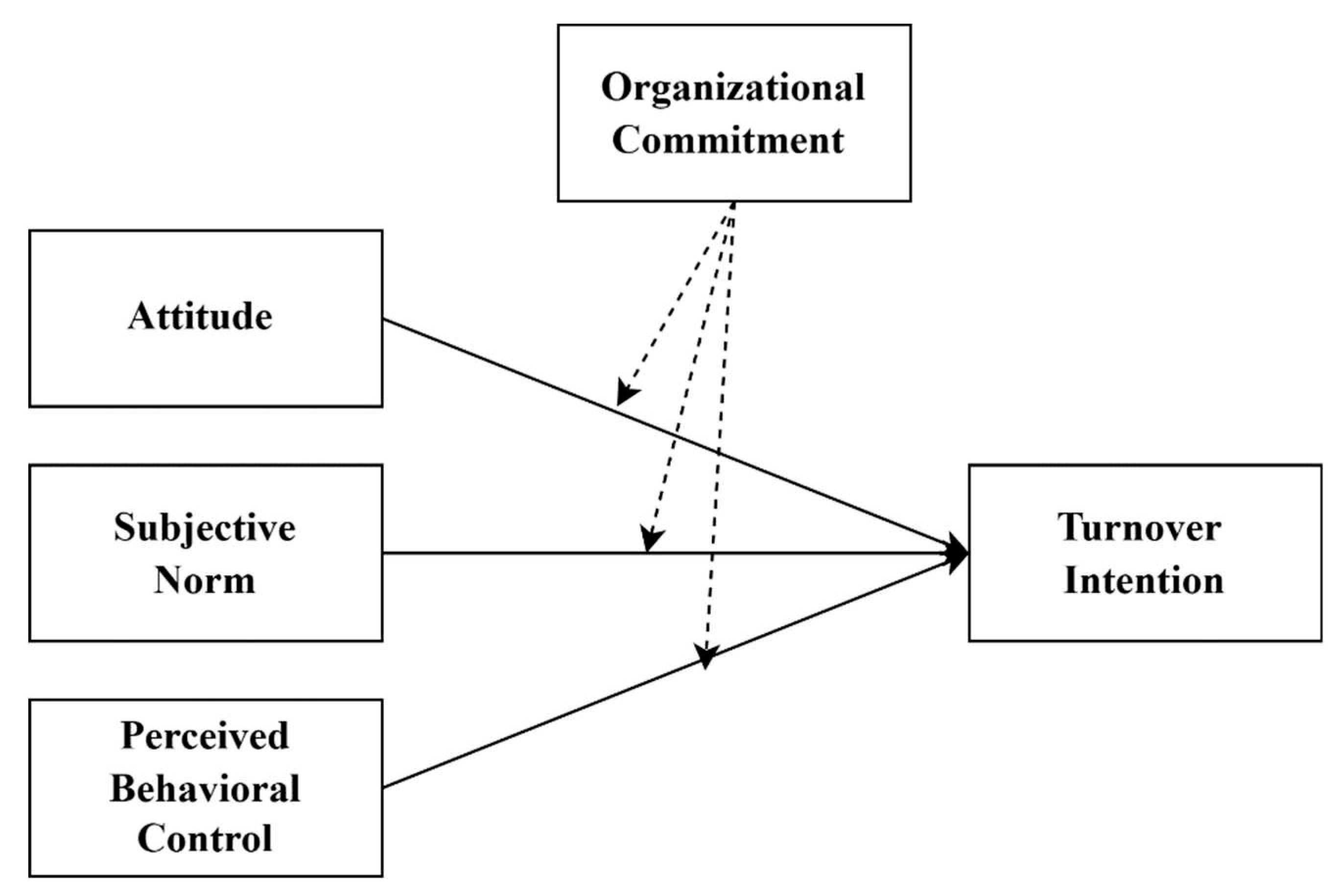
In light of these considerations, this study aims to explore the predictive effect of ATT, SN and PBC on TOI among SME employees in Nigeria. Moreover, it examines the moderating role of organizational commitment in the relationship between these TPB constructs and TOI. By investigating the role of organizational commitment as a potential moderator, the study seeks to illuminate the influence of individual commitment levels on TOI. Thus, the study’s objectives are twofold: to examine the effects of ATT, SN, and perceived behavioral control on TOI among SME employees in Nigeria and to investigate whether organizational commitment moderates the relationship between these TPB constructs and TOI. By better understanding these dynamics, organizations can develop targeted strategies to mitigate turnover and enhance employee retention in Nigeria’s SME sector.
Literature Review
Attitude and Turnover Intention
Various models have been proposed recently to explore TOI and its relationship to actual behavior (e.g., Nandialath et al., 2018). TPB is among the most helpful theories, garnering interest in various fields and contexts. Ajzen (1991) added perceived behavioral control (PBC) to the basic model of reason action (TRA). The growth of the TPB was based on Ajzen's observation that most individual behaviors are not under complete self-imposed control. The intention to engage in a specific behavior is the immediate antecedent of that behavior following the TPB (Ajzen, 2002). Therefore, the more individuals demonstrate the intention to perform an intended behavior, the higher the possibility they would do so (Conner & Armitage, 1998). The three predictors of intention in the TPB model are categorized as “ATT", "SN", and "PBC". Employee ATTs are crucial in an organization because they influence their intention and performance (Cherian et al., 2021). Employees' ATTs are shaped by their favorable or unfavorable assessments of their likelihood of engaging in a given action. ATT is supposed to have a direct effect on behavioral intention. Numerous studies have revealed a significant relationship between ATT and intention in different contexts. For example, several studies on employee TOI confirmed that ATTs positively influence TOI (Costan et al., 2022). However, other studies found that ATT negatively influences TOI (Romeo et al., 2020). Lei (2018) pointed out that employees' positive ATT to the organization increases employees' desire to stay. From the discussion, it is anticipated that an employee's positive ATT to their current workplace will enhance their desire to remain and, consequently, reduce their TOI. Thus we hypothesized that:
H1.
ATT will negatively influence employee TOI.
Subjective Norm and Turnover Intention
According to Taylor and Todd (1995), employees' SNs and compliance ATTs are influenced by their peers, significant others, and role models. Ajzen (1980) stated that social and peer influences impact behavior more than personal ATTs. For instance, individuals significant to an employee can influence their decision to remain in their organization. At this stage, the employee might be compelled to comply with the significant other’s expectations. Lam (2002) found that SNs negatively influence TOI. A recent study on the behaviors of health workers revealed that SN substantially negatively influenced the OCB of nurses (Torlak et al. 2021). Based on previous findings, this study postulated that:
H2.
SNs will negatively influence employee TOI.
Perceived Behavioral Control and Turnover Intention
Numerous researchers have examined the predictive validity of PBC on intention and behavior (Lei, 2018). Van Breukelen et al. (2004) investigated the relationship between TPB constructs and TOI in the Dutch navy; their study findings revealed no correlation between PBC and TOI. However, previous findings have been inconsistent on the relationship between PBC and behavioral intentions. Several studies found a strong association between PBC and intention. For instance, Torlak et al. (2021) revealed a significant association between PBC and intention. Other studies found no association between PBC and intention (Kumar & Smith, 2018; Xu et al., 2020; Chemseddine & Kamel, 2021). However, Chaichi’s (2018) study on hotel employee TOI in Malaysia reported a significant negative influence of PBC on TOI. Thus we hypothesized that:
H3.
PBC will negatively influence employee TOI.
Moderating Role of Organizational Commitment
Organizational commitment (OC) has drawn most organizational scholars’ attention as it appears to predict organizational outcomes such as performance, organizational citizenship behavior, TOI and turnover (Cohen & Aaron, 2014; Torlak et al., 2021). To be committed to an organization means sharing its beliefs and priorities, being willing to put in significant work on its behalf, and wanting to remain a member of that organization (Mowday, 1979). OC is important because it supports employees’ contributions and loyalty to their organization, thereby promoting organizational development. According to Porter et al. (1974), organizational commitment may be able to predict turnover. However, dedication to an organization has long been a deciding factor in whether a person chooses to stay or quit (Ali et al., 2018; Guzeller & Celiker, 2020). From the previous literature, OC is one of the strongest and imperative predictors in determining whether an employee will leave their current organization (e.g., Zhou et al., 2009). Furthermore, previous studies on OC revealed a strong association between OC and employee TOI (Ayari & AlHamaqi, 2021). Therefore, based on past literature, it can conclude that OC predicts behavioral outcomes such as employee TOI.
Ajzen's (2011) meta-analysis showed that other factors often moderate the relationship between TPB's constructs (ATT, SN, and PBC) and TOI. OC serves as a moderator in various contexts. For example, in a meta-analysis on the antecedents of employee turnover, Griffeth et al. (2000) revealed that commitment moderates employee job ATT and TOI relationship. Moreover, the importance of OC in understanding employee behavior and ATTs is widely acknowledged (Alhmood et al., 2023). Furthermore, according to Mobley et al. (1979), commitment might influence TOI and, consequently, turnover behavior. Additionally, recent research showed that commitment has a major impact on employee behavior and ATTs (e.g., Puspitawati & Atmaja, 2019). Therefore, OC can be utilized within the TPB model as a moderator to improve the correlation between the TPB constructs and TOI. Additionally, TPB is open to modification and expansion by introducing a moderator or antecedent variables (Ajzen, 1991). Despite substantial research on the direct association between the three basic predictors (ATT, SN, and PBC) and intentions (Costan et al., 2022), findings are inconsistent regarding the relationship between these constructs and TOI (Van Breukelen et al., 2004). Although OC may directly impact work-related outcomes, it may be more beneficial to consider it as a construct that facilitates the effects of other factors on TOI. Therefore, OC can be used as a moderator in the TPB model to improve the predictive effects of the TPB constructs and TOI. Thus, this study hypothesized that:
H4:
OC moderates the effect of ATT on employee TOI.
H5:
OC moderates the effect of SN on employee TOI.
H6:
OC moderates the effect of PBC on employee TOI.
Figure 1.
An extended model of the TPB.
Methodology
Participants and Procedures
Quantitative data were collected using self-administered questionnaires. The study population consisted of manufacturing SME employees in Lagos state, Nigeria. A stratified random sampling technique was used to select the study’s respondents to enhance the representativeness of the various population segments (Hair et al., 2010). After conducting the stratified random sampling, subjects from each stratum were chosen randomly to take part in the study. A total of 420 questionnaires were distributed, and 366 questionnaires were returned. However, after thorough checks, only 330 questionnaires were considered usable for analysis. Thus, the response rate in this study was 78.6%.
Measurements
The questionnaire contained questions about demographic variables, TPB's constructs (ATT, SN, and PBC), OC, and TOI. The survey instrument consisted of 45 questions designed to test the study's variables. Each item was adapted from previously conducted research and modified to meet the current research investigation’s purposes. There were five latent variables in this study. The items were measured on a seven-point Likert scale ranging from 1 (strongly disagree) to 7 (strongly agree). Six items from Bothma and Roodt's (2013) study were used to ascertain TOI. OC was measured by nine items from Mowday et al.’s (1979) OCQ. For TPB's constructs, employees' ATT was measured using six items; SN had five items; and five questions were utilized to measure PBC, all adapted from Kim and Han’s study (2010). The questionnaires were completed anonymously to ensure confidentiality.
Ethical consideration
The Universiti Putra Malaysia Ethics Committee for Research Involving Human Subjects (JKEUPM), with reference number JKEUPM-2021-413, gave the research its ethical approval. Informed consent was sought before participant recruitment by the researcher. An exception to the requirement for parental consent was made since the study posed no danger to the participants. The teenagers were made aware that participation was completely optional and that they had the option of agreeing or declining. In order to take part, individuals entered their personal information on a secure website, including their name, birthdate, email address(es), and optional cellphone number.
Data analysis
The respondents’ demographics were described using descriptive statistics. PLS-SEM was utilized to estimate the model fit and evaluate the presented hypotheses since Hair et al. (2017) argued for its appropriateness to test models spanning from simple to complicated as well as small to medium sample sizes.
Results
Profile of Respondents
The demographic variables were measured considering five items: gender, age groups, educational level, length of work, and monthly income. According to the results on the demographics of the respondents, approximately 63.64% were male (n = 210), and approximately 36.36% were female students (n = 120). Respondents were also categorized into five age groups according to their age range: younger than 20, 20 to 30, 31 to 40, 41 to 50, and above 50. In this survey, participants were requested to choose an age range. The result indicates that the respondents' age 4.55% (n=15) are from the range less than 20 years of age, which is the lowest. The age 41.21% (n=136) is from 21 to 30 years, which is high in representation; age 32.73% (n=108) are from 31 to 40 years, the age 17.58% (n=58) are from 41 to 50 years, and age 3.94% (n=13) is from above 50 years in representation. The demographic profile was not included in further analysis in this study.
Descriptive analysis
Table 1 depicts the five latent variables' mean scores and standard deviation. The range of mean scores for the variables, which extends from 4.67 to 5.35, reveals that all variables were evaluated favorably (out of a seven-point scale).
Measurement model
Exploratory factor analysis (EFA) and PLS-SEM confirmatory factor analysis (CFA) were used to test the measurement model. To determine the factor structure, EFA was applied to all 54 components. In the early phases of EFA, principal components analysis (PCA) with varimax rotation was utilized. The Kaiser-Meyer-Olkin (KMO) score of 0.79 and the findings of Bartlett's test of sphericity (χ2 = 1755.94; p = 0.000) suggested that the data were suitable for EFA. The Kaiser criteria determined the number of components, with eigenvalues greater than only items with loadings greater than 0.60. Consequently, three entries with factor loadings less than 0.6 were removed from consideration. The study's results revealed that ATT with the value of (0.037), SN (0.052), and OC (0.031) have a minor effect on TOI. However, PBC with a value of (0.167) has a moderate effect on TOI as the value is higher than 0.15%.
According to the PLS-SEM output, the CFA model satisfactorily suited the data (SRMR = 0.067; NFI = 0.908 (Hair et al. 2017). Significant associations were discovered between the components when the latent variable associations were analyzed (p < 0.01). All extracted average variance (AVE) values were larger than 0.5, and all factor loadings were greater than 0.70, showing convergent validity (Table 2). Additionally, all composite dependability (CR) ratings demonstrated internal consistency and varied from 0.873 to 0.953. Finally, all constructions had Rho_A values higher than 0.7 (Henseler et al., 2015).
This investigation utilised the variance inflation factors (VIF) to explore multicollinearity. A VIF of more than 5 indicates multicollinearity. The results of this investigation indicated that the most significant inner VIF value is 1.561, and the lowest VIF value is 1.004, showing no multicollinearity in the data (Table 3) (Tabachnick & Fidell, 2013).
Discriminant validity compares the degree of one concept to another using empirical criteria. This study used the Fornell-Larcker criteria, suggested by academics as a method to integrate different methodologies (Tabachnick & Fidell, 2013). Since the square root of the AVE for each construct was larger than the correlation coefficients between any construct pairings, the Fornell-Larcker criteria was met, indicating that discriminant validity was attained and these findings verified the study's discriminant validity (Table 4).
Structural model
The R2, Q2, and significance of paths were employed to evaluate the structural model. The R2 result of the TPB model revealed that the total explained variance of TOI is 9%, indicating a weak predictive accuracy. However, the variance explained in TOI when the moderating variable (OC) was included in the model reached 15%. This is 6% higher than the original model. This finding indicates a satisfactory impact of OC in moderating the factors predicting the model. In this study’s path model, the predictive relevance Q2 of TOI has a value of 0.120, suggesting that the model has predictive relevance. Since the Q2 value is greater than zero, the model is well-fitted and has high predictive relevance.
The direct effect of TPB's three basic predictors on TOI was confirmed as hypothesized. As displayed in Table 5, ATT significantly impacted TOI (β= -0.146, t = 2.349, p = 0.019). Hence, H1 was supported. In addition, SN substantially impacted TOI (β= -0.140, t = 2.422, p = 0.016). Therefore, H2 was supported. Finally, PBC robustly negatively affects TOI (β= -0.202, t = 3.558, p = 0.000). Therefore, H3 was supported.
The Moderating Test of OC
It was hypothesized in this study that OC would moderate the relationship between TPB constructs and TOI. A moderator is a third factor that modifies the relationship between the independent and dependent variables (Baron & Kenny, 1986). The moderating effect in structural models can be analyzed through several means. Bootstrapping was used in this study to observe the moderating effect. The study's findings show that OC significantly moderates TPB constructs and TOI. The results in Table 6 reveal each TPB's constructs' t values and p values. The results showed ATT and TOI with a t-value of (2.430) and a p-value of (< 0.015), followed by SN and TOI with a t-value of (2.033) and a p-value of (< 0.043). Lastly, PBC and TOI had a t-value of (2.012) and a p-value of (< 0.045).
Discussions
This study tested the hypothesis that the three fundamental predictors of TPB significantly influence TOI among SME employees and that OC moderates the relationship between TPB's constructs (ATT, SN, and PBC) and TOI. The results revealed that the SME employee TOI mainly depends on their ATT toward the organization, SN, and PBC, among which PBC and SN had the highest impact on TOI. When SME employees have positive ATTs towards their organization and perceive more favorable factors in the organization, their TOI will decrease. This indicates that employees' positive ATT towards their organization and their sense of behavioral control and efficacy over situations or circumstances in the organization are more relevant for forming behavioral intentions to remain in the organization.
Surprisingly, this study’s findings revealed PBC as the best predictor of TOI among the three basic predictors of TPB. This discovery contrasts Ajzen's TPB, which asserted that ATT is the strongest component in predicting intention and that PBC has a less predictive effect on intention (Ajzen, 1991). Similarly, some studies on TOI found a lower or insignificant relation between PBC and TOI (Xu & Liu, 2020). However, PBC emerged as the strongest predictor of TOI. The result demonstrates a significant negative association with TOI. This finding aligns with Hilverda et al.’s study (2018), which found PBC to be the strongest predictor of employee voice among the three basic predictors of TPB. This finding may be attributable to the study's varied cultural environment, which also influenced the employees’ PBC and their intention to leave their jobs (Zellweger et al., 2011).
This study’s findings on the three predictors of TPB align with previous studies, which found that one's ATT, SN, and perception of control significantly influence TOI (e.g., Chaichi, 2018). In a study on teachers' intentions to leave their jobs, Costan et al. (2022) found that PBC was the most critical factor in determining teaching intentions out of the three basic predictors based on the TPB. Furthermore, social influences, especially from those with direct power over employees (e.g., spouses, parents, mentors, supervisors, colleagues, and family members), substantially impact the likelihood of an employee's decision to leave their current workplace. Finally, the employee's ability to control situations at work could lead to a high level of PBC and a low TOI (TOI). This suggests that SME employees must gain the required control reflected by a supportive organization, which will subsequently reduce their TOI.
This study revealed that OC robustly negatively moderates the relationship between the three basic predictors of the TPB and TOI. The findings indicated that ATT had the most significant impact on TOI when OC moderates the relationship between the TPB predictors and TOI. The study's findings revealed that ATT with a high level of OC negatively influences employees' TOI (B= -0.139, p<0. 015). Considering the results, it may be affirmed that a positive ATT will lead to lower TOI when there is a high level of OC. SN was found to influence TOI (B=-0.107, t=2.033). This implies individuals people are likelier to intend to engage in an activity if they sense social pressure from most of their referents to act accordingly. Likewise, in PBC, the intention to leave the organization would decrease with any improvement in the employees' view of behavioral control. Employees who are committed to the organization and feel they have control over work situations could have high PBC, ultimately reducing TOI.
TPB's three basic predictors negatively influence TOIs, and organizational commitment significantly moderates the relationship between ATT and TOI, SN and TOI, and PBC and TOI. It was concluded that those employees who have favorable ATTs and SNs and also perceive a high level of control would be more committed to their organization, thus reducing TOI. The endogenous variable TOI’s R2 was 0.150 when the moderator was included in the model, indicating that the exogenous variables explained 15.0% of the variation, which is moderate (Cohen, 1989).
Conclusion
This study proposed and evaluated an empirical model investigating SME employees' TOI in Nigeria. To explain SME employees' TOI, Ajzen's (1991) TPB model was expanded to ascertain the variations of the TOI with OC as a moderator between TPB's three basic predictors and TOI. This study's contributions are as follows. Firstly, the three fundamental predictors of TPB predict the SME employee's TOI, with the PBC construct having the greatest influential predictive effect (f2 = 0.167). Thus, policymakers must focus on initiatives that enhance SME employees' perception of control by providing a supportive work environment to assist employees in controlling circumstances in the organization. Secondly, management should encourage a family-like atmosphere by facilitating and developing good relationships and strong bonds between management and employees and among colleagues through social activities such as recreation. Also, management should foster a healthy work environment to develop good employee ATTs by communicating the organization's goals, mission, values, and culture to help employees adapt to the work environment. Another notable finding is that commitment moderates the relationship between TPB's predictors and TOI. Employees' commitment to the organization reduces TOI. Therefore, management should formulate policies and implement effective practices that bind employees and make them feel emotionally obligated and committed to the organization.
Limitations and Direction for Future Studies
In addition to the highlighted contributions, the current study also includes several significant limitations. The study employed a self-administered survey, an approach that does not provide in-depth comprehension of the topic studied. A more in-depth understanding of the issue at hand would be possible by utilizing a mixed-method approach, which entails employing both qualitative and quantitative research approaches to investigate the factors that influence the intention of the employee to leave an organization. This study did not attempt to measure actual employee turnover. Instead, it focused on employees' intentions. It is recommended that subsequent studies track the behavioral prediction power of the employed TPB model. Future research should also consider using longitudinal designs to examine how extensively TPB predicts SME employee TOI.
References
- Agwaniru, A. (2023). ICT as a Strategy for Sustainable Small and Medium Enterprises in Nigeria [PhD Thesis]. California Baptist University.
- Ajzen, I. (1991). The theory of planned behavior. Organizational Behavior and Human Decision Processes, 50(2), 179–211. [CrossRef]
- Alhmood, M., Shaari, H., Al-Dhamari, R., & Sani, A. A. (2023). Does ownership concentration matter for the relationship between CEO characteristics and real earnings management: Evidence from Jordan. EuroMed Journal of Business, ahead-of-print(ahead-of-print). [CrossRef]
- Ali, A., ZhongBin, L., JianPing, H., Ali, Z., & Sultan, U. (2018). Examining the relationships among job satisfaction, organizational commitment, and turnover intentions in manufacturing sector of Pakistan. International Journal of Academic Research in Business and Social Sciences, 8(8), 24–41.
- Amah, O. E., & Oyetuunde, K. (2020). The effect of servant leadership on employee turnover in SMEs in Nigeria: The role of career growth potential and employee voice. Journal of Small Business and Enterprise Development, 27(6), 885–904. [CrossRef]
- Anwar, G., & Abdullah, N. N. (2021). The impact of Human resource management practice on Organizational performance. International Journal of Engineering, Business and Management (IJEBM), 5(1), 35–47. [CrossRef]
- Ayari, A., & AlHamaqi, A. (2021). Investigation of Organizational Commitment and Turnover Intention: A Study of Bahraini Oil and Gas Industry. Employee Responsibilities and Rights Journal, 34, 1–16. [CrossRef]
- Bananuka, J., Kasera, M., Najjemba, G. M., Musimenta, D., Ssekiziyivu, B., & Kimuli, S. N. L. (2020). Attitude: Mediator of subjective norm, religiosity and intention to adopt Islamic banking. Journal of Islamic Marketing, 11(1), 81–96. [CrossRef]
- Baron, R. M., & Kenny, D. A. (1986). The moderator–mediator variable distinction in social psychological research: Conceptual, strategic, and statistical considerations. Journal of Personality and Social Psychology, 51(6), 1173–1182.
- Bothma, C. F. C., & Roodt, G. (2013). The validation of the turnover intention scale. SA Journal of Human Resource Management, 11(1), 1–12. [CrossRef]
- Charles, E., Abimbola, U. A., & Ibanga, U. U. (2018). Multivariate Analysis of Organisation’s Internal Environment Drivers on Employees Turnover Intention in Small and Medium Scale Enterprises in Cross River State, Nigeria. International Journal of Business Strategies, 3(1), 17–54. [CrossRef]
- Cherian, J., Gaikar, V., Paul, R., & Pech, R. (2021). Corporate culture and its impact on employees’ attitude, performance, productivity, and behavior: An investigative analysis from selected organizations of the United Arab Emirates (UAE). Journal of Open Innovation: Technology, Market, and Complexity, 7(1), 45. [CrossRef]
- Collins, B., Garin, A., Jackson, E., Koustas, D., & Payne, M. (2019). Is gig work replacing traditional employment? Evidence from two decades of tax returns. Unpublished Paper, IRS SOI Joint Statistical Research Program.
- Conner, M., & Armitage, C. J. (1998). Extending the theory of planned behavior: A review and avenues for further research. Journal of Applied Social Psychology, 28(15), 1429–1464. [CrossRef]
- Costan, F., Gonzales, G., Gonzales, R., Valle, L., Dela Cruz, J., Alcantara, G., Mahilum, R., Lauro, M. D., Atibing, N. M., & Burdeos, A. (2022). Teachers’ Turnover Intentions in View of Implementing a Flexible Learning System: An Extended Theory of Planned Behavior. Sustainability, 14(20), 13009. [CrossRef]
- Griffeth, R. W., Hom, P. W., & Gaertner, S. (2000). A meta-analysis of antecedents and correlates of employee turnover: Update, moderator tests, and research implications for the next millennium. Journal of Management, 26(3), 463–488.
- Guzeller, C. O., & Celiker, N. (2020). Examining the relationship between organizational commitment and turnover intention via a meta-analysis. International Journal of Culture, Tourism and Hospitality Research, 14(1), 102–120. [CrossRef]
- Hair, J., Black, W., Babin, B., & Anderson, R. (2010). Multivariate data analysis. Prentice Hall.
- Hair, J. F., Hult, G. T. M., Ringle, C. M., & Sarstedt, M. (2017). A primer on partial least squares structural equation modeling (PLS-SEM) (2nd ed.). Sage.
- Heilala, C., Kalland, M., Lundkvist, M., Forsius, M., Vincze, L., & Santavirta, N. (2021). Work demands and work resources: Testing a model of factors predicting turnover intentions in early childhood education. Early Childhood Education Journal, 50, 1–11. [CrossRef]
- Henseler, J., Ringle, C. M., & Sarstedt, M. (2015). A new criterion for assessing discriminant validity in variance-based structural equation modeling. Journal of the Academy of Marketing Science, 43(1), 115–135. [CrossRef]
- Hilverda, F., Van Gils, R., & De Graaff, M. C. (2018). Confronting co-workers: Role models, attitudes, expectations, and perceived behavioral control as predictors of employee voice in the military. Frontiers in Psychology, 2515. [CrossRef]
- Irimia-Diéguez, A., Velicia-Martín, F., & Aguayo-Camacho, M. (2023). Predicting FinTech innovation adoption: The mediator role of social norms and attitudes. Financial Innovation, 9(1), 1–23. [CrossRef]
- Kanchana, L., & Jayathilaka, R. (2023). Factors impacting employee turnover intentions among professionals in Sri Lankan startups. Plos One, 18(2), e0281729. [CrossRef]
- Kim, Y., & Han, H. (2010). Intention to pay conventional-hotel prices at a green hotel–a modification of the theory of planned behavior. Journal of Sustainable Tourism, 18(8), 997–1014. [CrossRef]
- Liu, M. T., Liu, Y., & Mo, Z. (2020). Moral norm is the key: An extension of the theory of planned behaviour (TPB) on Chinese consumers’ green purchase intention. Asia Pacific Journal of Marketing and Logistics, 32(8), 1823–1841. [CrossRef]
- Mowday, R. T., Steers, R. M., & Porter, L. W. (1979). The measurement of organizational commitment. Journal of Vocational Behavior, 14(2), 224–247. [CrossRef]
- Muriithi, S. M. (2017). African small and medium enterprises (SMEs) contributions, challenges and solutions. European Journal of Research and Reflection in Management Sciences, 5(1), 36–48.
- Naz, S., Li, C., Nisar, Q. A., Khan, M. A. S., Ahmad, N., & Anwar, F. (2020). A study in the relationship between supportive work environment and employee retention: Role of organizational commitment and person–organization fit as mediators. Sage Open, 10(2), 2158244020924694. [CrossRef]
- Osazefua, I. J. (2019). Operational efficiency and financial sustainability of listed manufacturing companies in Nigeria. Journal of Accounting and Taxation, 11(1), 17–31.
- Poon, W. C., & Tung, S. E. H. (2022). The rise of online food delivery culture during the COVID-19 pandemic: An analysis of intention and its associated risk. European Journal of Management and Business Economics, ahead-of-print(ahead-of-print). [CrossRef]
- Puspitawati, N. M. D., & Atmaja, N. P. C. D. (2019). The role of organizational commitment mediating organizational climate with turnover intention. International Journal of Applied Business and International Management (IJABIM), 4(3), 23–32. [CrossRef]
- Samuel, Z. A., Anuar, M. A. M., Arshad, M. M., & Ismail, I. A. (2021). Predictors of Turnover Intention among SME Employees in Lagos, Nigeria: A Preliminary Study. International Journal of Academic Research in Business and Social Sciences, 11(12), 1746x2013;1758.
- Siyanbola, T. O., & Gilman, M. W. (2017). Extent of employee turnover in Nigerian SMEs: Employees’-owner/managers’ standpoint. Employee Relations, 39(7), 967–985.
- Skelton, A. R., Nattress, D., & Dwyer, R. J. (2020). Predicting manufacturing employee turnover intentions. Journal of Economics, Finance and Administrative Science, 25(49), 101–117. [CrossRef]
- Tabachnick, B. G., & Fidell, L. S. (2013). Using multivariate statistics (International edition). Pearson.
- Torlak, N. G., Kuzey, C., Sait Dinç, M., & Budur, T. (2021). Links connecting nurses’ planned behavior, burnout, job satisfaction, and organizational citizenship behavior. Journal of Workplace Behavioral Health, 36(1), 77–103.
- Van Breukelen, W., Van der Vlist, R., & Steensma, H. (2004). Voluntary employee turnover: Combining variables from the ‘traditional’turnover literature with the theory of planned behavior. Journal of Organizational Behavior: The International Journal of Industrial, Occupational and Organizational Psychology and Behavior, 25(7), 893–914. [CrossRef]
- Wang, X., Qin, X., & Zhou, Y. (2020). A comparative study of relative roles and sequences of cognitive and affective attitudes on tourists’ pro-environmental behavioral intention. Journal of Sustainable Tourism, 28(5), 727–746. [CrossRef]
- Work Institute. (2020). 2020 Retention Report (Insights on 2019 Turnover Trends, Reasons, Costs & Recommendations). https://info.workinstitute.com/hubfs/2020%20Retention%20Report/Work%20Institutes%202020%20Retention%20Report.pdf.
- Xu, L., & Liu, J. (2020). The turnover intention among grassroots family planning staff in the context of china’s universal two-child policy: A case study of the xi’an city. International Journal of Environmental Research and Public Health, 17(22), 1–18. [CrossRef]
- Zaremohzzabieh, Z., Ismail, N., Ahrari, S., & Samah, A. A. (2021). The effects of consumer attitude on green purchase intention: A meta-analytic path analysis. Journal of Business Research, 132, 732–743. [CrossRef]
- Zellweger, T., Sieger, P., & Halter, F. (2011). Should I stay or should I go? Career choice intentions of students with family business background. Journal of Business Venturing, 26(5), 521–536. [CrossRef]
- Zhou, H., Long, L. R., & Wang, Y. Q. (2009). What is the most important predictor of employees’ turnover intention in Chinese call centre: Job satisfaction, organisational commitment or career commitment? International Journal of Services Technology and Management, 12(2), 129–145.

Table 1.
Descriptive results of constructs.
| Construct | Mean | SD |
|---|---|---|
| TOI | 5.04 | 1.06 |
| OC | 5.01 | 1.01 |
| ATT | 4.67 | 1.32 |
| SN | 4.94 | 1.02 |
| PBC | 5.35 | 1.11 |
Notes: TOI = Turnover intention; OC = Organizational commitment; ATT = attitude; SN = subjective norm; PBC = perceived behavioral control.
Table 2.
Construct reliability and validity.
| Constructs | rho_A | AVE | CR | α |
|---|---|---|---|---|
| ATT | 0.884 | 0.827 | 0.966 | 0.958 |
| OC | 0.895 | 0.798 | 0.973 | 0.968 |
| PBC | 0.824 | 0.831 | 0.961 | 0.949 |
| SN | 0.922 | 0.791 | 0.950 | 0.934 |
| TOI | 0.977 | 0.844 | 0.970 | 0.963 |
Notes: TOI = Turnover intention; OC = Organizational commitment; ATT = attitude; SN = subjective norm; PBC = perceived behavioral control; AVE = average variance extracted; CR= composite reliability;.
Table 3.
Multicollinearity test for exogenous latent constructs.
| Construct | 1 | 2 | 3 | 4 |
|---|---|---|---|---|
| 1. ATT | 1.561 | |||
| 2. OC | 1.004 | |||
| 3. PBC | 1.286 | |||
| 4. SN | 1.026 | |||
| 5. TOI |
Note. TOI = Turnover intention; OC = Organizational commitment; ATT = attitude; SN = subjective norm; PBC = perceived behavioral control.
Table 4.
Measurement model: discriminant validity- Fornell–Larcker Criterion.
| Constructs | 1 | 2 | 3 | 4 | 5 |
|---|---|---|---|---|---|
| 1. ATT | 0.909 | ||||
| 2. OC | 0.561 | 0.893 | |||
| 3. PBC | 0.006 | -0.015 | 0.912 | ||
| 4. SN | -0.087 | -0.125 | 0.136 | 0.889 | |
| 5. TOI | -0.194 | -0.141 | -0.212 | -0.125 | 0.919 |
Note. TOI = Turnover intention; OC = Organizational commitment; ATT = attitude; SN = subjective norm; PBC = perceived behavioral control. The diagonal represents the square root of AVE, whereas the off-diagonal numbers represent correlations between latent variables.
Table 5.
Result for assessing the structural model.
| Path | OS/Beta | SM | SD | Confidence Interval 95%Bias Corrected | T | P | |
|---|---|---|---|---|---|---|---|
| LL | UL | ||||||
| ATT → TOI | -0.146 | -0.143 | 0.062 | -0.285 | -0.040 | 2.349 | 0.019 |
| SN → TOI | -0.140 | -0.144 | 0.058 | -0.247 | -0.023 | 2.422 | 0.016 |
| PBC → TOI | -0.202 | -0.200 | 0.057 | -0.321 | -0.099 | 3.558 | 0.000 |
Note: TOI = Turnover intention; OC = Organizational commitment; ATT = attitude; SN = subjective norm; PBC = perceived behavioral control. OS= Original sample SM= Sample mean SD= Standard deviation.
Table 6.
Indirect path.
| Hypotheses | Beta | T | P |
|---|---|---|---|
| ATT×OC → TOI | -0.139 | 2.430 | 0.015 |
| SN×OC → TOI | -0.107 | 2.033 | 0.043 |
| PBC×OC → TOI | -0.120 | 2.012 | 0.045 |
Note. TOI = Turnover intention; OC = Organizational commitment; ATT = attitude; SN = subjective norm; PBC = perceived behavioral control.
Disclaimer/Publisher’s Note: The statements, opinions and data contained in all publications are solely those of the individual author(s) and contributor(s) and not of MDPI and/or the editor(s). MDPI and/or the editor(s) disclaim responsibility for any injury to people or property resulting from any ideas, methods, instructions or products referred to in the content. |
© 2023 by the authors. Licensee MDPI, Basel, Switzerland. This article is an open access article distributed under the terms and conditions of the Creative Commons Attribution (CC BY) license (http://creativecommons.org/licenses/by/4.0/).
Copyright: This open access article is published under a Creative Commons CC BY 4.0 license, which permit the free download, distribution, and reuse, provided that the author and preprint are cited in any reuse.


