
Submitted:
29 June 2023
Posted:
29 June 2023
You are already at the latest version
Abstract
Solar energy is a rapidly growing sector, and solar farms are playing an increasingly important role in meeting the world's energy needs. However, as the size and complexity of these farms increase, so do the challenges associated with managing them efficiently. This article presents a comprehensive analysis of the fundamental parameters that underpin solar energy systems. Focusing on the latest research, we examine the challenges and opportunities intrinsic to the implementation of solar energy systems, paying particular attention to the various parameters that contribute to their performance. These parameters encompass a range of factors such as thermal performance, atmospheric boundary layer, solar energy meteorology, heat islands, cloud influences, agrivoltaic systems, shading factors, and surface energy budget. The review underscores the importance of considering a diverse array of parameters when developing solar energy systems to optimize their efficiency and effectiveness. Ultimately, by unraveling these challenges and opportunities, we can work towards creating more sustainable and reliable renewable energy sources and reducing our dependence on non-renewable alternatives.
Keywords:
PV
; Shading Factor
; Heat Island
; Agrivoltaic System
; Surface Energy Budget
1. Introduction
Solar energy is an abundant and renewable source of clean energy that has the potential to play a significant role in meeting the world’s energy needs. The popularity of solar farms is increasing as the cost of solar energy continues to decrease [1]. However, efficiently managing these large-scale installations of solar panels poses challenges as their size and complexity increase. A major challenge solar farms face is the decrease in efficiency experienced by photovoltaic (PV) modules as temperature increases [2]. Various methods, such as water spray, heat sinks, and forced air, have been employed to counteract this effect, but they lead to increased installation and maintenance costs [3,4,5,6]. An alternative approach to improving efficiency is to improve the internal heat transfer properties of PV modules [7]. Convection is the primary passive cooling mechanism for PV modules, and modifying the convection coefficient can have a direct impact on efficiency. Furthermore, the performance of solar farms can be enhanced by flow control, which can be used to modify the convection coefficient and thus improve efficiency. Flow control involves manipulating the airflow around solar panels to improve their efficiency and increase their power output [8]. The integration of flow control with the study of solar panel aerodynamics is aimed at optimizing their design, placement, and operation to increase their operational lifespan while reducing costs. While flow control has shown promise in laboratory settings, its implementation in real-world solar farms presents several challenges that must be navigated.
Within the confines of this article, we undertake a comprehensive appraisal of the latest literature on the pivotal parameters governing solar energy systems, emphasizing the formidable challenges and auspicious opportunities intrinsic to their implementation. The plethora of parameters associated with solar energy systems encompasses the thermal performance of solar farms, atmospheric boundary layer and solar energy meteorology, heat islands, cloud influences, agrivoltaic systems, shading factors, and surface energy budget. Furthermore, we delve into the intricacies of the technical obstacles that arise when attempting to accomplish flow control in solar farms and propose prospective avenues for further investigation. This work also brings to light the research gaps that need to be addressed to enhance the efficiency of solar energy systems. In sum, this review underscores the criticality of duly considering various parameters when devising solar energy systems to maximize efficiency and effectiveness.
2. PV Solar Research Objectives
Research on photovoltaic systems involves several areas of study, each with its unique objectives and methods [9,10,11,12,13]. One study area is the performance evaluation of PV panels, which involves assessing their electrical and thermal performance under various environmental conditions [14,15]. Another area is PV system design and optimization, which aims to maximize the energy output and efficiency of PV systems by considering various factors, such as the system location, panel orientation and tilt, and module type and size. In addition, research on PV module and system reliability investigates their long-term durability and reliability under different stress factors through various testing methods [16]. Integrating PV systems with other energy systems, such as battery storage, microgrids, and electric vehicles, is also a subject of research to optimize energy distribution and consumption, reduce costs and improve efficiency [14]. Finally, PV policy and market analysis studies the impact of policy and market factors on the growth and adoption of PV systems using statistical and economic models [17]. These various research areas contribute to the development of more efficient, reliable, and cost-effective PV systems and are critical in promoting the widespread adoption of renewable energy sources.
The field of photovoltaic solar panel research can be also classified into several types, each focusing on a particular aspect of PV solar panels. One area of research focuses on the impact of wind speed, direction, and turbulence on the efficiency of PV solar farms [18,19,20,21]. Such studies aim to optimize the design and operation of solar farms for maximum energy generation. Another area of research explores the effect of temperature on the performance of solar panels, examining their thermal behavior and electrical output under different temperature conditions. Optimal tilt angle and spacing are crucial parameters for maximizing energy generation, and research in this area aims to identify the best possible combinations for different locations, climates, panel types, and applications [20,22,23,24]. Novel PV solar panel designs that use nanotechnology, new materials, and advanced manufacturing techniques are also being explored to improve efficiency and reduce costs. PV solar tracking systems are another area of research, analyzing different types of tracking systems and their effectiveness in improving energy generation. Studies also investigate the behavior of PV solar panels in extreme conditions, such as high altitude, desert, and polar regions, to determine their suitability for different environments. PV solar panels for building integration represent another area of research, where the design, installation, and performance of solar panels for power generation in buildings are examined. These studies focus on various aspects of PV solar panels, including their design, installation, performance, and economic viability. Finally, the research investigates the degradation of PV solar panels due to environmental factors and the effectiveness of different maintenance strategies. The durability and optimal performance of PV solar panels are critical to their long-term effectiveness as a source of renewable energy.
Achieving maximum energy output and minimizing losses in solar energy systems can be a daunting task. Fortunately, various technologies and strategies can be implemented to optimize the flow of energy through solar farms. These approaches include intelligent control systems, advanced monitoring technology, energy storage systems, advanced inverters, modular designs, bifacial solar panels, predictive maintenance, dynamic control systems, microgrids, weather forecasting, distributed energy resources (DERs), and incorporating artificial intelligence (AI). Intelligent control systems can adjust the flow of energy in real-time to maximize energy output while minimizing losses [25,26]. Advanced monitoring technology can detect performance issues early on and allow for quick repairs [27,28]. Energy storage systems can store excess energy and release it during high-demand periods. Advanced inverters can optimize the flow of energy between solar panels and the grid, while modular designs allow for easy component additions and removals. Bifacial solar panels capture energy from both sides, improving energy output and reducing shading effects [29,30,31]. Predictive maintenance identifies issues early on and prevents unexpected downtime [32]. Dynamic control systems adjust the angle and position of solar panels to optimize energy output, and microgrids provide localized energy storage and distribution [33,34,35]. Weather forecasting provides advanced warnings of weather events, while DERs provide additional sources of energy storage and demand response [36,37].
3. Thermal Performance of Solar Farm
In this review, we focus only on the thermal performance of PV panels under various environmental conditions. These conditions include the effect of wind, temperature, arrangement and strategic placement. Some of the key findings and methodologies from these studies are summarized here.
The influence exerted by wind upon the operational performance of solar farms represents a pivotal parameter necessitating careful deliberation in the evaluation of their performance and output. The presence of wind can concurrently bestow beneficial augmentations or impede the functioning of solar panels, thereby impacting the dissipation of heat, cooling mechanisms, and holistic effectiveness. Profound comprehension of the intricate interplay between wind dynamics and solar panels assumes paramount significance in order to refine and maximize their operational efficiency across diverse environmental contexts. Ladas et al. [38] presents a wind tunnel study on the effect of wind on the performance of solar collectors on rectangular flat roofs. The study investigates the flow patterns, pressure distribution, and the impact on the collector’s efficiency at different wind speeds and angles of attack. The results show that the wind has a significant effect on the performance of solar collectors. The study suggests that the orientation and positioning of the collector on the roof, as well as the height of the roof, can affect the wind flow and therefore the collector’s performance. The study concludes that careful consideration should be given to the placement and orientation of solar collectors on rectangular flat roofs to optimize their performance and minimize the impact of wind. Liu et al. [39] studied the effect of wind direction on the aerodynamic performance of solar panels. They found that the lift and drag coefficients of the panels varied significantly depending on the angle of attack and wind direction. The study used a wind tunnel with a velocity range of 5-15 m/s and measured the lift and drag forces using a strain gauge and a load cell. Adeh et al. [40] investigates the impact of wind direction on the performance of a photovoltaic system. The authors conducted experiments to measure the module temperature and energy output of a PV system under different wind directions. They found that the wind direction significantly affects the module temperature and, therefore, the efficiency of the PV system. The paper provides insights into the importance of considering wind direction in the design and operation of PV systems. Chen et al. [41] investigated the aerodynamic performance of bifacial solar panels in a wind tunnel. The study found that the lift and drag coefficients of the panels varied significantly depending on the panel orientation and wind speed. In a recent study conducted by Glick et al. [2,7,8], the impact of module inclination on system-level flow and the convective heat transfer coefficient was examined. The findings revealed that the convective heat transfer coefficient is notably influenced by various factors, such as wind direction, wind speed, and module inclination. The study further demonstrated that an array-flow-informed approach to layout design can substantially increase convection by 30-45%, thereby offering the potential to boost overall power output by approximately 5% while concurrently reducing solar panel degradation by 0.3% annually. These results highlight the significance of considering the intricate interplay between system-level factors and design variables when optimizing solar PV array performance. Also the results are align with The latest module degradation rate targets have been established at an impressively low level of 0.2% per year [42]. Rossa [43] showed that local wind dynamics bear significant influence in the computation of losses, with greater losses observed in sites experiencing major frontal incidences compared to those undergoing major rear incidences. Moreover, this phenomenon persists irrespective of whether the photovoltaic generator is actively injecting energy into the grid or not.
Despite the existence of numerous cooling solutions, the cost and impracticality associated with many of them have hindered their implementation in large-scale photovoltaic plants. Nevertheless, a glimmer of hope shines through as researchers espouse the notion that strategic arrangements of solar panels hold the capacity to ameliorate the inherent convective heat transfer between these panels and the ambient air. By delving into these novel configurations, a realm of possibility arises, promising heightened efficiency and greater accessibility in the realm of photovoltaic energy cooling. This is based on prior research into how temperature differences affect the movement of air between the land and the atmosphere. Stanislawski et al. [44] investigates the effects of the spatial arrangement of solar panels in large-scale solar farms on convective cooling and module temperature. To quantify the arrangement of each solar farm, a non-dimensional packing parameter is formulated. The numerical simulations conducted in this study reveal that dense configurations with larger packing parameters are more conducive to convective cooling than sparse ones. Specifically, the most tightly packed configuration resulted in a 14.8% increase in convective heat transfer compared to the baseline. These findings underscore the significance of module arrangement in facilitating convective cooling within solar farms. Stanislawski et al. [45] investigated the creation of six different solar farm models with varying row spacing through high-resolution numerical simulations. Through the examination of flow and heat transfer, the authors identified the processes that affect convective cooling in solar farms. The results showed that larger row spacing generated more coherent structures and higher-energy frequencies in the flow, leading to better convective cooling and lower interior air temperatures compared to smaller row spacing. By increasing row spacing by a factor of 1.63, the average convective heat transfer coefficient was improved by 14.8%, which led to a reduction in module temperature by 6.6 ºC and an average increase in power output by 4.0%. The techno-economic analysis also suggested that increasing row spacing can lead to levelized cost of energy (LCOE) improvements by as much as 2.15% in certain climates, making it a viable option for improving solar farm performance.
The artful orchestration and astute placement of solar panels have assumed paramount significance in augmenting the effectiveness and yield of solar farms. With a discerning eye towards optimizing the spatial arrangement of these photovoltaic modules, researchers have unlocked unprecedented pathways for harnessing the bountiful energy of the solar farm. For example, by elevating the panels, they are afforded protection from erratic air currents and are exposed to more consistent and favorable wind speeds, thereby boosting their efficiency. As per the research conducted by Smith et al. [46,47], who explored the effects of height augmentation on the cooling of photovoltaic solar farms by examining three distinct height arrangements - nominal height, double height, and staggered height configuration, it was observed that elevating the panel height resulted in a concomitant increase in wind velocity, leading to an augmented cooling effect. For a given inflow velocity, panels installed at greater heights produced an enhancement of over 1.88 times in comparison to the nominal case. The staggered height arrangement facilitated a swifter sub-panel flow than in the nominal array, even with some sub-array obstruction due to the lower panel interaction. Nevertheless, the heat dissipation at panel surfaces stimulated improvements in convectivity that were over 1.3 times that of the nominal height case. Smith et al. [48] studied convective cooling in different PV array designs, taking into account the combined effects of spatial and atmospheric variation on panel temperature and production. They used wind tunnel experiments, high-resolution numerical simulations, and field data to explore parameters like row spacing, panel inclination, module height, and wind velocity. All aspects of the arrangement, including angle and height, were encompassed in a single value by utilizing a length scale based on fractal lacunarity [49]. A unified heat transfer correlation between convection and farm-specific geometry was identified.
Numerous investigations have been conducted to explore the impact of module temperature on the operational efficacy of a photovoltaic system. For example, Kaplani and Kaplanis [50] conducted experiments to measure the energy output of a PV system under different module temperatures and found that high temperatures significantly reduce the efficiency of the system. The paper provides insights into the importance of thermal management in the design and operation of PV systems. Otth and Ross [51] presents a study of the effect of temperature on the performance of photovoltaic cells. The authors measured the power output of cells under different temperatures and analyzed the data to determine the temperature coefficient of power. They found that the power output of the cells decreased with increasing temperature and used the data to develop a model for predicting the performance of cells under different environmental conditions. Dupré et al. [52] reports on an experimental investigation of the temperature distribution in a photovoltaic cell under concentrated solar radiation. The authors used an infrared camera to measure the temperature distribution and compared it to predictions from a numerical model. They found good agreement between the experimental and numerical results and used the model to study the effect of various parameters on the cell’s performance. Vaillon et al. [53] presents a numerical investigation of radiative transfer in a photovoltaic cell under concentrated solar radiation. The authors developed a radiative transfer model that takes into account the complex geometry of the cell and its constituent materials. The model was validated against experimental data and used to study the effect of various parameters, such as cell temperature and incident radiation intensity, on the cell’s performance. Recently, the work conducted by Rossa et al. [54] delves into an analysis of the phenomenon of mismatch losses (MML) in photovoltaic arrays. MML is characterized by a situation where the combined power output of a PV array is less than the sum of power outputs of its individual modules when they operate autonomously, arising from variances in the electrical conductivities of these modules. They have inferred that the underlying cause of the overall MML could be traced back to deviations in the operating temperatures of the modules.
Numerous scholarly investigations have delved into the application of active flow control mechanisms with the aim of augmenting the performance of solar panels. For example, Bastidas and Roy [55] used a wind tunnel to test the effectiveness of vortex generators in controlling the boundary layer flow over solar panels, finding that the vortex generators improved the power output by up to 10%. Scognamiglio et al. [56] conducted a review of flow control methods in the wind and solar energy systems, identifying the potential of active flow control methods such as boundary layer control to significantly improve the efficiency of solar panels. Ramanathan et al. [57] used numerical simulations to design and test an active flow control system, finding that the system increased the power output of solar panels by up to 4%. Abdul-Rahman et al. [58] proposed a power smoothing technique for grid-connected solar photovoltaic systems using active flow control, reducing power fluctuation by up to 90%. Zhou et al. [59] proposed an intelligent control algorithm for the flow control of air distribution systems in solar greenhouses, which improved microclimate control. Hossain et al. [60] investigated the use of active flow control for reducing the boundary layer thickness on a solar panel, resulting in a reduction of the impact of wind on the performance of solar panels. Abu El-Nasr and Abdelaziz [61] presented active flow control for increasing the efficiency of solar panels in solar farms and used numerical simulation to demonstrate that vortex generators can increase the energy output of solar panels. Anderson and Mokry [62] examined the utilization of active flow control in the context of renewable energy and emphasized the possible advantages of applying flow control to enhance the efficiency of wind turbines and solar panels. Prasanth et al. [63] performed a numerical investigation of active flow control using vortex generators on a solar panel, resulting in a reduction of turbulence and an increase in energy output. Overall, these studies demonstrate the potential of active flow control methods to improve the performance of solar panels. The efficiency of solar energy systems can be enhanced through the use of flow control, which has been gaining attention in recent years. Yu et al. [64] conducted a numerical study of active flow control on the performance of solar farms and found that flow control using synthetic jets could improve the energy output of solar panels. Šarka et al. [65] provides a comprehensive overview of flow control techniques proposed for enhancing solar energy collection. The authors discuss both passive techniques, such as surface texturing and roughness, and active techniques, such as vortex generators and boundary layer control. Another recent study by Mahfouz [66] focuses specifically on active flow control in solar greenhouses to optimize the microclimate for plant growth. The author proposes a fuzzy logic controller to regulate airflow and temperature inside the greenhouse, resulting in improved plant growth and energy efficiency. Both studies highlight the potential benefits of flow control in enhancing the performance of solar energy systems. Future research in this area may focus on optimizing the use of active flow control for various solar energy applications and developing new control strategies to further improve system efficiency. Jangra et al. [67] experimentally investigated the performance enhancement of a solar farm through active flow control using a plasma actuator and found that the use of flow control led to a significant improvement in the energy output of the solar panels. Afriyie et al. [68] performed a numerical investigation of flow control strategies for improving energy output in wind-solar hybrid farms and found that a combination of vortex generator and synthetic jet actuator led to the highest power output. El-Sayed et al. [69] investigated airflow control in solar farms using a dielectric barrier discharge plasma actuator and found that the use of flow control increased the energy output of the solar panels. Hossain et al. [70] optimized active flow control of a solar panel using a genetic algorithm and found that the optimized flow control using a combination of synthetic jet and vortex generator led to a significant improvement in the energy output of the solar panel. Huang et al. [71] investigated active flow control on the performance of solar farms under various weather conditions and found that synthetic jets and plasma actuators could effectively enhance the energy output of solar panels.
4. Atmospheric Boundary Layer and Solar Energy Meteorology
The formulation of effective strategies to fulfill energy demands requires a comprehensive understanding of the intricate and complex interplays between the atmosphere and the earth’s surface. The chaotic nature of the atmospheric system, like the butterfly effect elucidated by Edward Lorenz [72], showcases interconnectivity of a profound magnitude. A pivotal determinant of the effectiveness of a solar farm is the atmospheric boundary layer (ABL), which denotes the lowest stratum of the Earth’s atmosphere where the movement of air is influenced by the terrain and other variables such as temperature, pressure, and humidity. The ABL exerts a profound impact on the velocity and direction of the wind, the distribution of solar radiation, and the temperature and moisture content of the air. The consequences of the ABL on the efficiency of a solar farm are miscellaneous, for instance, during the daytime, the ABL is often turbulent, engendering fluctuations in wind speed and direction [73]. These erratic variations affect the temperature of the solar panels, thereby regulating the amount of heat exchange between the panels and the surrounding air. High temperatures can diminish the efficacy of solar panels, augment the likelihood of thermal damage, and yield a heat island phenomenon. Figure 1 provides an overview of all feasible flow dynamics pertinent to a solar farm.
4.1. Heat Island
The main objective of this section is to review the potential impact of large solar parks on boundary layer meteorology. The researchers’ goal is to evaluate the hypothesis that these solar parks hold the capacity to substantially disrupt the meteorological properties of the boundary layer. This perturbation is believed to arise due to two key factors, including changes in the surface energy budget and inducing large secondary circulations engendering a PV heat island (PVHI) phenomenon. The high temperatures generated by the solar panels can instigate potent convective cells and secondary circulations in the ambient air, thereby altering the microclimatic conditions of the region. It would be highly advantageous to have the capability to pre-determine the convective cooling potential of a given region prior to the installation of future solar parks to optimize the system’s efficiency from the outset. However, the investigation of the impact of large solar farms is currently constrained by limited research, with most studies solely examining the effect of solar canopies in numerical models by modifying the surface albedo. Despite the overly simplistic approach, the available data indicated significant alterations in the near-surface air temperature.
In a distinct investigation, Fthenakis and Yu [74] developed computational simulation capabilities to scrutinize the influence of large solar photovoltaic farms on the local microclimate by simulating air velocity, turbulence, and energy flow fields. The researchers performed three-dimensional simulations on a 1 MW portion of a solar farm in North America and compared the results with measured wind and temperature data from the entire solar farm. Their analyses revealed that the yearly average of air temperatures in the center of the PV field can escalate by up to 1.9 °C above the ambient temperature, and this thermal energy disperses into the environment at altitudes ranging from 5 to 18 meters. Moreover, the thermal energy swiftly dissipates with distance from the solar farm, with air temperatures nearing the ambient temperature at a distance of about 300 meters from the perimeter of the solar farm. An analysis of 18 months of data established that the solar array effectively cools down at night, making it improbable that a heat island effect would occur [74]. An experimental study conducted by Barron-Gafford et al. [75] revealed that solar canopies, typically found in regular-sized solar plants (around 1 MW and less than 1 km in size), can raise local air temperatures by as much as 3-4 ºC during the nighttime, compared to the surrounding wilderness. This finding confirms the hypothesis that solar farms can create photovoltaic heat islands, similar to those seen in urban canopies.
As solar panels can heat up to temperatures that are significantly higher than the ambient and surrounding surface temperature, it is possible that large solar parks could generate powerful convective cells and secondary circulations. However, the range and scale of these flow dynamics, as well as the potential modifications they could cause, remain unclear. Moreover, because large solar parks alter the local surface roughness, it is reasonable to speculate that they could impact atmospheric flow in a similar manner as vegetated or urban canopies. Broadbent et al. [76] used field measurements to investigate the effects of a large PV farm on local temperature and energy balance. They found that the installation of a large PV farm can reduce local temperatures during the day by up to several degrees Celsius, due to the shading effect of the panels and the cooling effect of the evapotranspiration from the vegetation under the panels. At night, however, the PV panels can trap longwave radiation and emit it back into the atmosphere, leading to slightly warmer temperatures. Additionally, they discovered that the PV farm could alter the local energy balance by reducing incoming solar radiation and increasing the amount of energy available for evapotranspiration and sensible heat flux. The authors noted that these effects can vary depending on factors such as the size and design of the PV farm, local weather conditions, and the type of ground cover used under the panels. Adeh et al. [77] showed that installing solar photovoltaic parks on agricultural lands can be highly beneficial. The study suggests that the evapotranspiration process of plants can help cool down the PV modules, leading to increased energy harvesting of the system. Additionally, the shading provided by the modules can lead to increased agricultural yield. To reduce the thermal effects of solar PV, two possible approaches are either to decrease the heat generated at the cell level or to enhance heat dissipation.
Recently, Zhang and Xu [78] analyzed 23 of the world’s largest PV power plants and found that the installation of PV power plants significantly reduced the daily mean surface temperature in the PV power plant areas by 0.53 °C, with a stronger cooling effect observed during the daytime compared to nighttime (0.81 °C vs. 0.24 °C). The study also found that the cooling effect was dependent on the capacity of the power plants, with a cooling rate of -0.32, -0.48, and -0.14 °C/TWh for daily mean, daytime, and nighttime temperatures, respectively. Moreover, the study showed that the construction of PV power plants decreased the surface albedo, but increased the effective albedo (surface albedo plus electricity conversion). This suggests that the conversion of solar energy to electrical energy is a significant contributor to observed surface cooling. The study also found that the nighttime cooling effect of the power plants was significantly correlated with latitude and elevation, as well as annual mean temperature, precipitation, solar radiation, and normalized difference vegetation index. Studying the heat island should be linked to the secondary flow motion, bulk advection, and dispersive fluxes [79,80,81,82] and heterogeneity effect [83,84,85]. It is our contention that particular arrangements of solar farms possess the capacity to augment or impede the inherent convective heat transfer transpiring between the photovoltaic panels and the ambient atmosphere, consequently diminishing or intensifying the heat island phenomenon [86].
4.2. Cloud Influences
The influence of clouds on the aerodynamics of solar panels can be a determining factor in their overall efficiency. The total cloud cover represents a primary contributor to notable intermittency in solar energy provision, given that a photovoltaic panel’s output may precipitously plummet by as much as 60% within seconds due to a cloud formation[87,88]. This phenomenon may also occur when the sun is obstructed by a transitory cloud band during its celestial trajectory, leading to considerable fluctuations in the direct normal irradiance that penetrates a solar PV panel and consequent decrease in power generation [88,89]. The impact of clouds is contingent upon various factors, one of which is the cloud type [90,91,92]. Thin, high-altitude clouds, such as cirrus clouds, have a less pronounced effect on solar panel aerodynamics than thicker, low-altitude clouds like stratus clouds [93,94,95]. The latter not only restricts the amount of sunlight that reaches the panels but also causes more turbulence in the surrounding air, thereby elevating wind load and reducing efficiency. Another factor is the orientation and layout of the solar panels. The typical angle at which solar panels are installed can alleviate the impact of wind turbulence resulting from clouds passing overhead. Additionally, the spacing between solar panels can also impact aerodynamics during cloudy weather. If panels are installed too closely, a "wind tunnel" effect may be created, which further exacerbates wind load and reduces efficiency. Therefore, proper spacing must be ensured to mitigate this effect. To address the impact of cloud movement on solar panel performance, Nnamchi et al. [96] developed a dynamic model of cloud movements, which allowed them to simulate the motion of clouds across the sky. The authors then utilized an experimentally validated model of a photovoltaic generator to examine the effect of moving clouds on its performance. The results highlighted the significance of cloud movements on the fluctuation of power output from the photovoltaic generator, emphasizing the importance of dynamic analysis over static analysis for a more accurate representation of solar panel performance under varying cloud conditions.
Weather forecasting is a valuable tool for optimizing the performance of solar farms in multifarious ways [97,98,99]. One of the approaches is through flow control of the generated energy. Solar farms can leverage machine learning algorithms to analyze historical and real-time weather data to predict future weather patterns accurately [88,100]. This information can then be used to regulate the flow of energy to match anticipated demand, thus ensuring efficient use of energy. During periods of cloud cover, for example, solar farms can reduce energy fed into the grid or divert excess energy to storage systems [92,93,94]. In addition, weather forecasting can also optimize the positioning of solar panels to maximize energy generation and minimize shade impact. It can facilitate better management of energy storage systems by adjusting charge/discharge cycles during periods of high or low energy generation. Furthermore, it can aid in scheduling maintenance activities during periods of low energy generation and prevent disruptions to the energy supply. Weather forecasting can also aid in energy demand management by anticipating changes in energy demand and adjusting energy flow accordingly. Finally, it can enhance the planning and development of new solar farms by identifying the optimal locations for optimal energy generation.
Developing a model to examine the impact of clouds on the aerodynamics of solar panels requires a combination of expertise in aerodynamics, solar panel design, and cloud behavior. One potential approach to such a model would involve an initial analysis of the aerodynamic properties of the solar panel, such as the airfoil shape, angle of attack, and lift and drag forces. Subsequently, the model would consider the solar panel’s design, including its size, shape, and weight, which can also impact its aerodynamic performance. Cloud behavior is another crucial factor to consider as it can affect the flow of air over the panel, and thus, the lift and drag forces generated. To predict the solar panel’s performance under varying cloud conditions, the model should integrate all the available information into a comprehensive simulation. This simulation should be able to forecast the lift and drag forces and any changes arising due to the presence of clouds. Finally, to validate the model, experimental data could be collected by testing solar panels under various cloud conditions in a wind tunnel or another controlled environment.
5. Agrivoltaic System
An agrivoltaic system is created by integrating a solar farm consisting of solar panels with an agricultural system. The main purpose of this combination is to benefit both systems simultaneously [101,102]. The solar panels are used to control the amount of sunlight reaching the crops, resulting in improved water usage efficiency, see Figure 2. Additionally, the evapotranspiration from the crops cools down the solar panels, increasing their power efficiency and lifespan. This mutually beneficial approach is expected to address the food-water-energy nexus, a critical challenge in modern times. By implementing a photovoltaic system, the associated products can benefit from reduced heat and insolation stress, as well as improved water usage efficiency. To understand the dynamic interplay between the photovoltaic and agricultural systems, it is necessary to develop detailed models that incorporate shading and cooling of solar panels [77], as well as comprehensive models of the soil-plant-atmosphere continuum, such as [103]. These models will integrate the sensible and evaporative heat fluxes with soil moisture and solar panel temperature. By doing so, we can predict the effect of different photovoltaic setups on soil moisture, crop water usage, and crop yield. In a recent investigation, Williams et al. [104] have scrutinized the impact of integrating agrivoltaic design elements on the microclimate and surface temperature of solar photovoltaic modules deployed in a solar farm. The researchers have developed a microclimate model utilizing computational fluid dynamics, which was further validated with experimental data to assess the impact of panel height, ground albedo, and evapotranspiration on a solar PV site. The results of the study have shown that elevating an agrivoltaic solar farm at a height of 4 meters and growing soybeans underneath can effectively lower the temperature of solar modules by up to 10 °C in comparison to a solar farm erected at a mere height of 0.5 meters over barren soil. These findings highlight the importance of panel height and ground conditions in solar farm cooling and demonstrate the potential of agrivoltaic systems to tackle the global food-energy crisis by improving solar PV conversion efficiency and simultaneously promoting agricultural production on the same land.
The primary aims of the system are multifaceted, encompassing the maintenance of optimal temperature ranges conducive to maximizing crop yield, the attainment of light levels proximate to the light saturation point, thereby ensuring high power production, while preserving crop yields, and the mitigation of soil and crop water loss to minimize irrigation needs and water stress [102,105]. Given that these objectives fluctuate throughout the day and the growing season, it is incumbent upon us to concentrate on a supple solar panel array that can accommodate ever-changing environmental conditions and facilitate crop management and soil preparation during different seasons. Anticipated outcomes include the amplification of productivity and the alleviation of water stress for cool-season crops via the reduction of temperatures and insolation. However, these results are inextricably linked to the specific characteristics of the photovoltaic system, such as height, orientation, and surrounding environmental conditions [103]. Therefore, in order to gain a comprehensive understanding of the benefits and limitations of the agrivoltaic system, it is crucial to conduct meticulously controlled laboratory experiments, field measurements, and numerical simulations. Such empirical investigations will enable the development of a reliable comprehension of the workings of the system, thereby facilitating its widespread implementation on a grand scale.
To attain the coveted operating temperature for the system, it is imperative to increase both heat dissipation and convective heat transfer coefficient. The key to heightening energy harvesting efficiency by 10% lies in maintaining the solar module at a temperature close to the ambient temperature. Our expectation is that the cooling effect of the crops in the system, via evapotranspiration, will engender this heightened thermal diffusivity, or cooling. However, the proposed agrivoltaic systems, while efficacious in mitigating soil and crop temperatures, can also reduce the intensity of solar radiation on crops. This reduction in solar radiation can have a salutary impact on crop and soil temperatures, thereby augmenting crop water use efficiency, which in turn, can raise soil moisture content and reduce crop water stress. This, in turn, leads to superior product quality by averting ’bolting’, a phenomenon engendered by warm temperatures and water stress, which results in a bitter flavor and poor-quality harvest [106]. Effective temperature control is of paramount importance since lower temperatures during the seedling phase can impede growth, while higher temperatures can stimulate accelerated bolting and yield an inferior harvest. Crop shading techniques are often employed to mitigate photoinhibition, a phenomenon caused by a reduction in photosynthetic capacity due to excessive exposure to light. The agrivoltaic system is uniquely suited to mitigate photoinhibition by offering shading under high-light conditions. Moreover, the system is also efficacious in increasing soil moisture content by curbing the rate of soil moisture loss through evapotranspiration, which is directly proportional to temperature.
One of the main challenges posed by agrivoltaic systems lies in the potential competition for light between solar panels and crops. However, this can be effectively mitigated by carefully analyzing the light-response curves of each crop. Crop yield typically shows a linear increase in response to light intensity, up to a certain saturation point, beyond which yield may decline due to photoinhibition [107]. Experimental evidence suggests that the productivity of certain crops is optimized under solar radiation levels that fall below typical maximum solar radiation intensities [107,108]. This implies that a portion of the solar radiation can be harnessed without adversely affecting crop yields. Another concern surrounding agrivoltaic systems is the potential for increased disease risk due to higher humidity levels. To gain a comprehensive understanding of how carbon and water cycles in crops are affected by different stress scenarios, it is crucial to focus on the underlying physiological responses to stress [109]. Such responses may include tree hydraulics, gas exchange, carbon allocation, growth, and recovery from stress, among others. Additionally, it is crucial to evaluate the severity and timing of stress/shading in crops to fully appreciate the effects of agrivoltaic systems.
The research conducted by Hartzell et al. [110] underscores the various mechanisms that plants have evolved to contend with hydraulic stress. These mechanisms are contingent on the frequency and intensity of the stress, as well as factors such as evaporative demand, which changes daily due to fluctuations in temperature and vapor pressure, and soil moisture, which is influenced by seasonal shifts in climate patterns and rainfall events that can have sustained effects lasting several days [111,112]. To cope with these stressors, plants have developed a range of coping strategies, one of which is transpiration, which is the process by which water moves from the soil through the plant and into the atmosphere, following a decreasing water potential gradient. The flow of water through each medium, such as soil, plant xylem (vascular tissue), plant stomata (microscopic pores), and atmosphere, is dependent on hydraulic conductance and the water potential gradient across the medium. In most plants, water typically flows continuously from the roots to the leaves, where it evaporates into the atmosphere through open stomata. Transpiration is often modeled using a steady-state water balance assumption, whereby the flux of water entering the plant is equal to the flux leaving the plant, as long as plant water storage is minimal. Under this assumption, transpiration is proportional to the product of the plant’s water conductance and the water potential gradient between the soil and the leaf. The work of Chopard et al. [113] has led to the creation of a sophisticated decision support tool that assists in evaluating the health of crops grown under solar panels. This system comprises an integration of three critical indicators - predawn water potential, canopy temperature, and carbon production - to provide a comprehensive assessment of crop status. The system is thoughtfully designed to account for the intricate interplay between crops and their environment, taking into consideration factors such as panel orientation and crop growth stages. In addition, this advanced decision support system is equipped with the capability to provide valuable recommendations on optimal agricultural practices based on changes in solar panel configuration. The findings of Smith et al. [47] offer compelling evidence supporting the integration of their study with diverse plant species to create multifaceted agrivoltaic systems. Such systems possess the potential to revolutionize traditional farm design by facilitating the implementation of efficient and customized agricultural practices that can adapt to various spatial, agricultural, and environmental limitations. Furthermore, these compound agrivoltaic systems can be implemented at a modest cost, rendering them a practical and economically feasible approach for streamlining farming operations. In essence, this research illuminates a promising trajectory for the development of sustainable and pioneering farming practices capable of surmounting the challenges confronting modern agriculture.
5.1. Shading Factor
In designing an agrivoltaic system, an essential aspect to consider is the shading factor emanating from the solar panels on the crops beneath. The degree of shading, expressed as a percentage, caused by solar panels can significantly impact crop growth and yield. To calculate the shading factor, one can conduct a shading analysis using either computer modeling software or physical measurements. Optimal shading factors depend on various factors such as the panel orientation, tilt angle, height above the crops, and crop type [114,115]. Typically, a shading factor of approximately 30% is considered ideal for most crops [116]. Striking the perfect balance between maximizing solar panel energy production and minimizing shading on crops is crucial in achieving optimal results in an agrivoltaic system. Hence, a modern control adjusting the panel orientation and tilt angle, as well as the height above the crops, can help regulate the shading factor and attain the desired balance.
A multitude of advanced computer modeling software programs exists for carrying out shading analysis in agrivoltaic systems, which utilize intricate algorithms and mathematical models to simulate the shading impacts of solar panels on crops. Notable among them are PVsyst [117], HelioScope [118], SAM [119], and PVSOL [120]. PVsyst, a widely used program for designing and simulating solar energy systems, incorporates a shading analysis tool that factors in various parameters such as geographical location, orientation, tilt angle, size of the solar panels, and position and height of the surrounding objects. Meanwhile, HelioScope, a web-based software program, employs a fusion of 3D modeling and satellite imagery to develop a detailed model of the designated site and can generate comprehensive reports and proposals for the system design. SAM, on the other hand, is a free software program, created by the National Renewable Energy Laboratory, that can simulate the performance of diverse renewable energy systems, including solar, wind, geothermal, and biomass systems. Finally, PVSOL is a sophisticated software program created by Valentin Software, which utilizes a 3D model of the site to simulate the shading effects of the surrounding vegetation and objects on the solar panels and generates comprehensive reports and proposals for system design.
Shading analysis in agrivoltaic systems can also be carried out through physical measurements, albeit they can be time-consuming and require specialized equipment and expertise. Among the methods employed is the utilization of sun path diagrams, which graphically depict the sun’s position in the sky at various times of the year. Additionally, solarimeters can be used to measure solar irradiance and the degree of sunlight blocked by a solar panel at different times of the day and year. Shadow analysis can also be employed, whereby the length and direction of shadows cast by objects are measured to approximate shading effects. Furthermore, on-site observations of the solar panel and crops can be conducted to record the duration of crop shading by the panel. Nevertheless, despite their accuracy, physical measurements can be inefficient, and computer modeling software presents a more efficient and extensive analysis of shading effects, incorporating geographical location, orientation, tilt angle, and size of the solar panels, as well as the position and height of surrounding objects. An illustrative instance of this is the pioneering work of Bany and Appelbaum [121], who developed an algorithm to determine the shading impact on a solar collector field across the course of a day and to assess its ramifications for the design of the field. Their investigation revealed that the shadow cast on a collector is influenced by various parameters, such as the height of the collector, row length, inter-collector spacing, and latitude of the location. The equations they devised further account for different types of solar collector fields, taking into consideration the levels of insolation, including direct, diffuse, and global irradiance. In a study by Cascone et al. [122], a sophisticated calculation procedure was developed to determine shading factors under complex boundary conditions. The tool was designed to provide shading factor values for any oriented and tilted surface, taking into account generic-shaped windows and external environment, including obstructions and vegetation. The simulation is capable of running for various sky conditions and time frames, providing instantaneous, daily average, or monthly average shading factor values. This state-of-the-art approach offers a more accurate and comprehensive evaluation of solar heat gains, thus elevating the performance and efficiency of energy assessment models. This study stands as a testament to the continuous advancements in the field of agrivoltaics and the ever-increasing demand for cutting-edge research in sustainable energy.
Moreover, recent literature has presented several studies that delve into the modeling and analysis of photovoltaic systems and their performance under shading conditions, as well as their impact on crop yield. For instance, Gilman et al. [123] comprehensively describes the widely-used SAM PV model, which considers the electrical and thermal characteristics of the PV system and accounts for shading and soiling effects. The model’s algorithms and parameters are presented in detail, along with validation results against experimental data. Meanwhile, Prilliman et al. [124] conducted an empirical study on the effects of shading on PV modules’ performance, which involved measuring the modules’ power output under varying shading conditions. They developed a model based on the experimental data to predict shaded module performance accurately. Furthermore, Campana et al. [125] introduced an optimization model that optimizes the performance of vertically-mounted agrivoltaic systems with bifacial PV modules. This model comprises three sub-models that consider solar radiation and shading, photovoltaics, and crop yield. The multi-objective optimization model allows for trade-off exploration between various agrivoltaic performance indicators. Their results highlight the significant impact of bifacial module row distance on the distribution of photosynthetically active radiation (PAR), which directly affects crop yield. In addition, Zainali et al. [103] developed mathematical models that precisely calculate shading factors for three different agrivoltaic system configurations. These models accurately estimate the shaded beam and diffuse shaded horizontal irradiance at ground level, which is crucial in assessing the agrivoltaic systems’ impact on crop yield.
Despite notable advancements in enhancing the efficiency of PV systems, they remain vulnerable to a plethora of environmental and natural factors that impede their optimal functionality. These include but are not limited to the accumulation of soil, salt, avian excrement, and snow on PV module surfaces, leading to inefficiencies in their performance [126,127,128,129]. The introduction of particles onto the surfaces of PV modules can result in a multitude of physical and chemical interactions, such as the formation of hot spots [130,131]. The phenomenon of shading-induced soiling can be broadly classified into two distinct categories, including the more benign form of "soft" shading, caused by airborne pollutants, and the more severe "hard" shading, stemming from the accumulation of solid materials, such as dust, that obstruct the transmission of sunlight [128]. The effect of soft shading on the performance of photovoltaic modules is limited to a reduction in the electrical current generated, while the voltage output remains unaffected. In contrast, the extent of the damage inflicted by hard shading is contingent upon whether the entire module or only a subset of its constituent cells are obstructed. When only a portion of the cells are shaded, the module continues to produce electricity as long as the remaining, unobstructed cells are exposed to solar irradiance, albeit with a decrease in voltage output. The degree of dust buildup on the surface of photovoltaic modules exerts a notable influence on the total energy output of said modules across daily, monthly, seasonal, and annual timeframes [132,133,134,135]. Thus, the characterization of the accumulation of soiling on solar panels is determined by two interrelated factors: the properties of the dust and the characteristics of the local environment [130,136,137]. It is worth mentioning that certain soil patches, such as leaves, bird droppings, and dirt patches, which obstruct only certain cells of a PV module rather than the entire module, may still have a substantial impact on PV performance [138,139,140].
5.2. Surface Energy Budget
The surface energy budget and evapotranspiration are fundamental concepts in the study of the Earth’s hydrological and energy cycles, as they are closely interrelated. The former refers to the balance between the incoming and outgoing energy fluxes at the Earth’s surface, while the latter describes the process of water transformation into water vapor and its release into the atmosphere. These complex processes are modulated by a myriad of interacting factors, including atmospheric temperature, humidity, wind speed, vegetation cover, and incoming solar radiation. Land surface models (LSMs) are sophisticated computational tools that enable the representation of physical processes occurring at the Earth’s surface, including water and energy fluxes, as well as the calculation of energy balance [141]. LSMs accomplish this by accounting for the exchange of heat and moisture between the surface and the atmosphere, as well as incoming solar radiation and outgoing longwave radiation. The available energy for evapotranspiration is subsequently estimated based on this balance. The rate of evapotranspiration is modeled by considering the transport of water through the soil, the uptake of water by vegetation, and the transfer of water from vegetation to the atmosphere through transpiration. The rate of evapotranspiration is determined by the availability of energy and the water supply at the surface. The seamless integration of these complex processes through LSMs is indispensable for the comprehensive understanding and accurate simulation of the Earth’s water and energy cycles.
The endeavor of modeling the surface energy budget and evapotranspiration entails various approaches, each dependent on the specific research inquiry and the data availability. Land surface models (LSMs) can be integrated into broader climate models to evaluate the interaction between the land surface and the atmosphere and appraise the repercussions of climate change on the Earth’s water and energy cycles. The Penman-Monteith model is another prevalent model used to estimate evapotranspiration, based on empirical equations that incorporate weather data to evaluate the rate of evapotranspiration [142]. It considers both the aerodynamic and energy components of the evapotranspiration process and can be applied to a wide range of land surfaces, including natural and agricultural ecosystems. The Priestley-Taylor model is an alternative to the Penman-Monteith model and is used for simpler applications [143]. It assesses evapotranspiration based on the net radiation and air temperature at the Earth’s surface, provided that the soil has enough moisture and the vegetation is well-watered. The Shuttleworth-Wallace model is also used to simulate the surface energy budget and evapotranspiration, based on the premise that the transfer of energy and water vapor from the surface to the atmosphere is governed by a resistive layer of air at the surface [142]. This model integrates a parameter that represents the resistance of this layer, dependent on variables such as vegetation cover and soil moisture. The Simplified Surface Energy Balance (SSEB) Model is yet another model that uses satellite data to estimate evapotranspiration [144]. It employs two essential parameters, the surface temperature and vegetation index, which are measured by remote sensing satellites, and combines them with the energy balance equation to estimate Evapotranspiration over large areas. This makes it particularly useful for applications such as irrigation management and water resource planning. The Hargreaves-Samani Model estimates evapotranspiration using air temperature and extraterrestrial radiation, making it a simpler model compared to others as it only requires temperature data and can estimate evapotranspiration for areas where other input parameters are not available [145]. However, this model has limited accuracy compared to more complex models that utilize additional parameters. The Turc Model is another widely used model that estimates evapotranspiration using mean air temperature, sunshine hours, and latitude [146]. It is valuable for assessing evapotranspiration in areas where data is limited, as it only requires basic weather data. Nonetheless, like the Hargreaves-Samani Model, its accuracy is limited compared to more complex models. Finally, the Blaney-Criddle Method estimates evapotranspiration using mean daily air temperature and monthly mean percentage of daylight hours [147]. This model is also relatively simple and requires limited data inputs, making it useful for areas where other input parameters are not available. However, its accuracy is also limited compared to more complex models.
The nexus linking surface energy budget, evapotranspiration, and solar farms derives from the fundamental principles of energy balance and water cycle dynamics. The surface energy balance on the Earth’s surface is upheld by the interplay of energy exchange between the surface and the atmosphere [148]. Upon installation, solar farms can significantly modify the energy balance at the Earth’s surface in multiple ways. Firstly, solar panels absorb a portion of the incoming solar radiation that would have been absorbed by the surface otherwise. This occurrence may potentially reduce the energy available for evapotranspiration, which may result in implications for local water resources and the health of the ecosystem [149,150]. Additionally, the solar panels may alter the surface reflectivity, which can influence the equilibrium of incoming and outgoing energy. This change can cause shifts in temperature and patterns of atmospheric circulation, which can further affect evapotranspiration and other surface processes [151]. The correlation between solar farms and the surface energy budget is likewise impacted by factors such as the regional climate, vegetation coverage, and the design and placement of the solar panels. For instance, in arid regions with scanty vegetation, the impact of solar farms on evapotranspiration may be less pronounced than in humid regions with dense vegetation [152]. Similarly, the placement and design of solar panels can influence the amount of energy that the surface absorbs or reflects, which, in turn, can affect the local energy balance and water cycle dynamics.
6. Modeling and Control Strategies under Non-Uniformity Irradiation Conditions
Since the advent of PV modules, the phenomenon of partial shading has emerged as an inherent predicament when uneven irradiation is cast upon these modules [153,154]. The solar module’s exposure to shade results from an adjacent building in close proximity to the installation site. Consequently, this partial shading scenario, coupled with the absence of an effective maximum power point tracker, precipitates an annual average reduction in production of 20%. In such cases, the power generation potential undergoes a decline attributable to the intrinsic resistors stemming from solar cell physics. To counteract this issue, a commercially available safeguard in the form of a "Bypass Diode" is integrated by the manufacturer. This diode is connected in parallel to the module’s terminals and effectively prevents the dissipation of energy through the internal resistors within the photovoltaic material [155,156]. Through the utilization of sophisticated modeling techniques and comprehensive investigations, the challenges associated with PV panels operating under non-uniform irradiation conditions have been extensively examined [154]. These studies encompass a broad range of practical PV applications, such as developing mathematical models for PV fields experiencing partial shading [157], exploring the reverse characteristics of solar cells [158], assessing the accuracy of PV models [159], analyzing the generation of multiple power peaks resulting from partial shading [160], and devising models to quantify power losses attributed to partial shading scenarios [161,162].
The pivotal role of power electronic converters in photovoltaic technology is indispensable for optimizing the utilization of solar energy harnessed through panels. Given the varying voltage levels and fluctuating power generation capacities inherent in photovoltaic applications, a stable output is essential to attain optimal plant performance. This necessitates the incorporation of specific components, such as deep discharge lead-acid batteries for "Off-Grid" systems, or the synchronization of alternating current and voltage levels with an "On-Grid" electricity network [156]. The meticulous design of a photovoltaic system, encompassing the integration of all requisite features to address underlying issues in solar cell physics, is of paramount importance in rendering photovoltaics a viable solution for the energy industry. In the realm of solar energy conversion, algorithms known as Maximum Power Point Trackers (MPPT) assume the responsibility of governing and orchestrating the efficient operation of photovoltaic plants. The magnitude and caliber of power extracted from the PV panels hinge upon the adeptness exhibited by these trackers across a wide spectrum of illuminative conditions. As the characteristics of PV panels exhibit nonlinearity and are subject to fluctuations induced by irradiation and temperature, a swift and adaptable response mechanism becomes imperative for the system to thrive [154,155].
It is widely recognized that for PV cells connected in a series chain, harmonization of their characteristics is imperative. This requirement arises from the fact that the operating points of cells are determined by the load imposed on the string, with the series configuration enforcing a uniform current flow through all cells. Even slight disparities in cell properties can result in cells operating at divergent voltage points. This discrepancy in operating points engenders losses that undermine the overall performance of the panel [154]. An increment in current magnitude induces a negative (reverse) voltage across the shaded cell, rendering it a load rather than a power source. Consequently, the output power derived from the panel diminishes substantially, as it is consumed by the shaded cell. This dissipation of power can result in detrimental consequences for both the cell material and the module encapsulation. By employing an equivalent circuit model to scrutinize the situation, it becomes apparent that the equivalent diode within the shaded cell operates in reverse bias, necessitating the current to traverse through the resistances. Such an effect may lead to physical damage in the form of a "hotspot" within this particular cell [163,164].
To address the challenge posed by partial shading, the integration of bypass diodes in parallel with the PV modules has proven to be an effective solution [165]. Typically, each diode is connected to a cluster of cells. The bypass diode exhibits a rapid switching response when a slight negative voltage is applied, contingent upon the specific diode type [154]. This negative voltage materializes when the voltage of the shaded cell matches the combined voltage of the irradiated cells and the bypass diode. While the integration of bypass diodes provides a straightforward remedy for partial shading, it is not the most efficient solution due to the inherent drawback of energy loss from the shaded PV panel. When a shadow swamps a panel, the corresponding bypass diode conducts, effectively diverting the current away from the shaded portion. While this protective measure shields the shaded panel from potential harm, it concurrently obstructs its ability to generate any power, resulting in an energy harvesting shortfall [166,167,168]. Recent research efforts can be classified into five distinct categories, each addressing specific facets of the problem at hand. These categories encompass Partial Shading investigations, Bypass Diode Topology explorations, Field Tests scrutinizing real-world scenarios, studies incorporating Artificial Intelligence methodologies, and the development of novel Mitigation Techniques [169].
In recent studies, novel approaches have been explored to address the challenges associated with shading, hotspots, and bypass diodes. Notably, research conducted by Pannebakker et al. [170], Dhimish et al. [171,172] introduced innovative techniques such as smart bypass diodes and metal–oxide–semiconductor field-effect transistor (MOSFET) replacements for conventional bypass diodes. These alternative strategies have demonstrated remarkable efficacy in mitigating hotspot formation and minimizing power losses. However, it should be noted that, like any emerging technology, these approaches often entail higher costs. Field Tests, a pivotal category within the research landscape, play an indispensable role in evaluating the performance of PV systems under real-world conditions. The results obtained from such tests provide invaluable insights for researchers and serve as a foundation for addressing key issues in PV system design [90]. However, it is important to acknowledge that conducting field tests can be costly compared to simulation studies and may necessitate a longer time frame. Nevertheless, the analysis of field tests highlighted the essential role of bypass diodes in ensuring the reliability of PV modules, despite their susceptibility to potential failures that can result in power losses and the emergence of hotspots. Artificial intelligence techniques are being increasingly employed in the field of PV systems. These techniques hold significant promise for modeling and predicting the performance of PV systems, particularly in relation to shading, hotspots, and bypass diodes. These studies have enhanced the detection of device faults, facilitated visual inspections, and enabled the identification of shading in PV systems. Artificial intelligence serves as a valuable tool, as it allows for early detection of potential failures that could lead to losses or system damage [173,174]. However, it is important to recognize that there may be certain unforeseen scenarios that were not accounted for during the training of the artificial intelligence models.
7. Research Gaps
Notwithstanding the extensive research that has been conducted on solar energy systems, there remain several gaps in our understanding that necessitate further investigation to enhance our understanding of the complex interplay between solar panel design, wind conditions, and environmental factors, ultimately leading to more efficient and reliable solar energy systems. Several areas of potential inquiry include comprehending the impact of varying wind conditions, turbulence, gusts, and shear on the aerodynamic performance of solar panels. Moreover, the design and layout of solar panels can substantially influence their aerodynamic behavior, necessitating meticulous examination of different panel shapes, sizes, and layouts. Furthermore, the effect of varying levels of roughness and surface properties on solar panel performance has yet to be fully comprehended. In addition, exploring the impact of atmospheric factors such as temperature, humidity, pressure, and airflow directionality on the aerodynamic behavior of solar panels is critical.
Wind tunnel experiments are an essential tool for examining the flow control of solar panels, as they allow for controlled testing of design variables and environmental conditions. These experiments offer several opportunities for improving solar farm design and performance, including gaining a better understanding of aerodynamic performance, validating computational models, testing innovative panel designs, optimizing panel placement and spacing, and developing advanced tracking systems [8,175]. However, wind tunnel experiments encounter several challenges when simulating airflow over solar panels. One primary obstacle is the scale of experiments, as wind tunnels are often limited in size, making it difficult to match the size of large solar farms. Additionally, wind tunnel experiments are conducted under controlled conditions that may not replicate real-world conditions accurately [176,177,178]. Replicating the complex geometry of solar farms can also be challenging, with panels mounted at different angles and orientations, and the presence of other structures and terrain features impacting airflow over the panels. While wind tunnel experiments provide valuable insights into solar panel aerodynamics, various factors can influence the accuracy of results, including wind tunnel type and boundary conditions. Furthermore, further research is necessary to understand the long-term durability of solar panels under various environmental conditions, such as UV radiation and moisture exposure. Combining solar power with other renewable energy sources can create a more stable energy system, and investigating the effects of different panel materials and coatings on solar panel performance can provide more efficient approaches for enhancing endurance and productivity. Finally, analyzing the impact of wind-induced vibrations on solar panel structural soundness can help develop more robust solar panel systems capable of withstanding a variety of wind conditions, making them more reliable and efficient.
Despite significant research on the benefits of agrivoltaics, several research gaps remain that require further exploration to fully optimize this technology. Some of these areas include crop selection optimization, assessing the impacts of climate change on agrivoltaic systems, determining their economic feasibility, designing and optimizing the system, and ensuring social acceptance. One of the research gaps in agrivoltaics is the need to optimize crop selection and placement within the photovoltaic array to maximize both electricity generation and crop yields. While agrivoltaics has been shown to increase crop yields in some cases, the selection of crops and their location within the system can significantly impact its overall performance. Furthermore, another critical area that requires further research is the potential impact of climate change on agrivoltaic systems. Although these systems have the potential to mitigate the impacts of climate change, their ability to sustain crop yields and energy production under the effects of climate change requires further exploration. The economic feasibility of agrivoltaic systems is also a vital research area. Despite their benefits such as increased crop yields and reduced land use, their economic feasibility is not yet fully understood. Hence, further research is necessary to optimize agrivoltaic systems for different regions and crops and determine their costs and benefits. Additionally, designing and optimizing agrivoltaic systems, including the placement and orientation of PV panels, the use of tracking systems, and the integration of energy storage, remains an important research area. Finally, social acceptance is an essential consideration for agrivoltaic systems, and further research is necessary to understand how farmers and local communities perceive them and how to promote their adoption, given that they may require changes to traditional farming practices and land use.
8. Conclusion
The review paper highlights the potential benefits of understanding the flow dynamics of solar farms. The thermal efficiency of a solar farm is subject to a myriad of influential factors, notably including the complex interplay of turbulence, wakes, and the atmospheric boundary layer. Furthermore, the heat island effect and cloud impact are crucial determinants that significantly impact the solar farm’s overall performance. Implementing agrivoltaic systems and shading factors offers promising opportunities to boost the solar farm’s efficiency by mitigating the adverse effects of the heat island phenomenon and optimizing the usage of available land. Additionally, to guarantee that the solar farm operates sustainably and efficiently, a thorough assessment of its surface energy budget is imperative. In light of these findings, ongoing research and development in this domain are pivotal to the long-term viability and success of the renewable energy industry.
Although considerable research has been conducted on solar energy and agrivoltaic systems, several research gaps remain that need further exploration to enhance the effectiveness, efficiency, and long-term viability of these technologies. In solar energy systems, further investigation is required to understand the complex interplay between wind conditions, environmental factors, and panel design to optimize their aerodynamic behavior. Additionally, the durability of solar panels under various environmental conditions and the impact of different materials and coatings on their performance requires further examination. In agrivoltaic systems, optimizing crop selection, assessing the impacts of climate change, determining economic feasibility, designing and optimizing the system, and ensuring social acceptance are all vital areas of research. By addressing these research gaps, we can create more efficient, reliable, and sustainable solar energy and agrivoltaic systems, contributing to the ongoing expansion of renewable energy and sustainable agriculture.
Author Contributions
Conceptualization, N.A.; investigation, N.A.; writing—original draft preparation, N.A.; writing—review and editing, N.A. and D.G.; visualization, N.A. and D.G.
Acknowledgments
N.A acknowledges the Helmholtz Information and Data Science Academy (HIDA) for providing financial support enabling a short-term research stay at Karlsruhe Institute of Technology Campus Alpin in Garmisch-Partenkrichen.
Conflicts of Interest
The authors declare no conflict of interest.
References
- Vignesh, R.; Feldman, D.; Desai, J.; Margolis, R.U.S. U.S. Solar photovoltaic system and energy storage cost benchmarks: Q1 2021. Technical report, NREL, 2021.
- Glick, A.; Ali, N.; Bossuyt, J.; Calaf, M.; Cal, R.B. Utility-scale solar PV performance enhancements through system-level modifications. Scientific Reports 2020, 10, 10505. [Google Scholar] [CrossRef] [PubMed]
- Krauter, S. Increased electrical yield via water flow over the front of photovoltaic panels. Solar Energy Materials and Solar Cells 2004, 82, 131–137. [Google Scholar] [CrossRef]
- Abdolzadeh, M.; Ameri, M. Improving the effectiveness of a photovoltaic water pumping system by spraying water over the front of photovoltaic cells. Renewable energy 2009, 34, 91–96. [Google Scholar] [CrossRef]
- Odeh, S.; Behnia, M. Improving photovoltaic module efficiency using water cooling. Heat Transfer Engineering 2009, 30, 499–505. [Google Scholar] [CrossRef]
- Sargunanathan, S.; Elango, A.; Mohideen, S.T. Performance enhancement of solar photovoltaic cells using effective cooling methods: A review. Renewable and Sustainable Energy Reviews 2016, 64, 382–393. [Google Scholar] [CrossRef]
- Glick, A.; Ali, N.; Bossuyt, J.; Recktenwald, G.; Calaf, M.; Cal, R.B. Infinite photovoltaic solar arrays: Considering flux of momentum and heat transfer. Renewable Energ 2020, 156, 791–803. [Google Scholar] [CrossRef]
- Glick, A.; Smith, S.E.; Ali, N.; Bossuyt, J.; Recktenwald, G.; Calaf, M.; Cal, R.B. Influence of flow direction and turbulence intensity on heat transfer of utility-scale photovoltaic solar farms. Solar Energy 2020, 207, 173–182. [Google Scholar] [CrossRef]
- Köntges, M.; Kurtz, S.; Packard, C.E.; Jahn, U.; Berger, K.A.; Kato, K.; Friesen, T.; Liu, H.; Van Iseghem, M.; Wohlgemuth, J.; et al. Review of failures of photovoltaic modules. IEA International Energy Agency 2014. [Google Scholar]
- Akella, A.; Saini, R.; Sharma, M.P. Social, economical and environmental impacts of renewable energy systems. Renewable energy 2009, 34, 390–396. [Google Scholar] [CrossRef]
- Ghosh, S.; Yadav, R. Future of photovoltaic technologies: A comprehensive review. Sustainable Energy Technologies and Assessments 2021, 47, 101410. [Google Scholar] [CrossRef]
- Siddiqui, M.U.; Arif, A.F.; Kelley, L.; Dubowsky, S. Three-dimensional thermal modeling of a photovoltaic module under varying conditions. Solar Energy 2012, 86, 2620–2631. [Google Scholar] [CrossRef]
- Al-chaderchi, M.; Sopain, K.; Alghoul, M.; Salameh, T. Experimental study of the effect of fully shading on the Solar PV module performance. In Proceedings of the E3S web of conferences. EDP Sciences; 2017. Vol. 23. p. 01001. [Google Scholar]
- Husin, H.; Zaki, M. A critical review of the integration of renewable energy sources with various technologies. Protection and Control of Modern Power Systems 2021, 6, 1–18. [Google Scholar]
- Hassan, A.; Al-Abdeli, Y.M.; Masek, M.; Bass, O. Optimal sizing and energy scheduling of grid-supplemented solar PV systems with battery storage: Sensitivity of reliability and financial constraints. Energy 2022, 238, 121780. [Google Scholar] [CrossRef]
- Zhang, P.; Li, W.; Li, S.; Wang, Y.; Xiao, W. Reliability assessment of photovoltaic power systems: Review of current status and future perspectives. Applied Energy 2013, 104, 822–833. [Google Scholar] [CrossRef]
- Honrubia-Escribano, A.; Ramirez, F.J.; Gómez-Lázaro, E.; Garcia-Villaverde, P.M.; Ruiz-Ortega, M.J.; Parra-Requena, G. Influence of solar technology in the economic performance of PV power plants in Europe. A comprehensive analysis. Renewable and Sustainable Energy Reviews 2018, 82, 488–501. [Google Scholar] [CrossRef]
- Miller, R.D.; Zimmerman, D.K. Wind loads on flat plate photovoltaic array fields. Phase III, final report. Technical report, Boeing Engineering and Construction Co., Seattle, WA (USA), 1981.
- Meroney, R.N.; Neff, D.E. Wind effects on roof-mounted solar photovoltaic arrays: CFD and wind-tunnel evaluation. In Proceedings of the The Fifth International Symposium on Computational Wind Engineering (CWE 2010), 2010.
- Abiola-Ogedengbe, A.; Hangan, H.; Siddiqui, K. Experimental investigation of wind effects on a standalone photovoltaic (PV) module. Renewable Energy 2015, 78, 657–665. [Google Scholar] [CrossRef]
- Castellani, F.; Eltayesh, A.; Natili, F.; Tocci, T.; Becchetti, M.; Capponi, L.; Astolfi, D.; Rossi, G. Wind Flow Characterisation over a PV Module through URANS Simulations and Wind Tunnel Optical Flow Methods. Energies 2021, 14, 6546. [Google Scholar] [CrossRef]
- Radu, A.; Axinte, E.; Theohari, C. Steady wind pressures on solar collectors on flat-roofed buildings. Journal of Wind Engineering and Industrial Aerodynamics 1986, 23, 249–258. [Google Scholar] [CrossRef]
- Hussain, I.Y.; Ali, N. Natural convection heat transfer from a plane wall to thermally stratified environment. Journal of Engineering 2012, 18. [Google Scholar] [CrossRef]
- Hasan, K.; Yousuf, S.B.; Tushar, M.S.H.K.; Das, B.K.; Das, P.; Islam, M.S. Effects of different environmental and operational factors on the PV performance: A comprehensive review. Energy Science & Engineering 2022, 10, 656–675. [Google Scholar]
- Hsu, C.Y.; Huang, P.H.; Yang, K.S. Dynamic analysis of power system with photovoltaic generation. In Proceedings of the MATEC Web of Conferences. EDP Sciences; 2016. Vol. 61. p. 01005. [Google Scholar]
- Wang, F.; Zhu, Y.; Yan, J. Performance of solar PV micro-grid systems: A comparison study. Energy Procedia 2018, 145, 570–575. [Google Scholar] [CrossRef]
- Varma, R.K.; Siavashi, E.M. Enhancement of solar farm connectivity with smart PV inverter PV-STATCOM. IEEE Transactions on Sustainable Energy 2018, 10, 1161–1171. [Google Scholar] [CrossRef]
- Horowitz, K.A.; Peterson, Z.; Coddington, M.H.; Ding, F.; Sigrin, B.; Saleem, D.; Baldwin, S.E.; Lydic, B.; Stanfield, S.C.; Enbar, N.; et al. An overview of distributed energy resource (DER) interconnection: Current practices and emerging solutions. National Renewable Energy Lab.(NREL), Golden, CO (United States) 2019.
- Appelbaum, J.J.R.E. Bifacial photovoltaic panels field. Renewable Energy 2016, 85, 338–343. [Google Scholar] [CrossRef]
- Riaz, M.H.; Imran, H.; Butt, N.Z. Optimization of PV array density for fixed tilt bifacial solar panels for efficient agrivoltaic systems. In Proceedings of the 2020 47th IEEE Photovoltaic Specialists Conference (PVSC). IEEE; 2020; pp. 1349–1352. [Google Scholar]
- Jouttijärvi, S.; Lobaccaro, G.; Kamppinen, A.; Miettunen, K. Benefits of bifacial solar cells combined with low voltage power grids at high latitudes. Renewable and Sustainable Energy Reviews 2022, 161, 112354. [Google Scholar] [CrossRef]
- Mellit, A.; Kalogirou, S.A. Machine learning and deep learning for photovoltaic applications. In Artificial Intelligence for Smart Photovoltaic Technologies; AIP Publishing LLC Melville, New York, 2022; pp. 1–20.
- Ye, H.; Yang, B.; Han, Y.; Chen, N. State-of-the-art solar energy forecasting approaches: Critical potentials and challenges. Frontiers in Energy Research 2022, 10, 268. [Google Scholar]
- Gevorgian, V.; Koralewicz, P.; Shah, S.; Mendiola, E.; Wallen, R. ; H., V.P. Photovoltaic Plant and Battery Energy Storage System Integration at NREL’s Flatirons Campus. Technical report, National Renewable Energy Lab.(NREL), Golden, CO (United States), 2022.
- Okedu, K.E. Advanced intelligent control strategies for solar and wind farms, 2022.
- Lorenz, E.; Hurka, J.; Heinemann, D.; Beyer, H.G. Irradiance forecasting for the power prediction of grid-connected photovoltaic systems. IEEE Journal of Selected Topics in Applied Earth Observations and Remote Sensing 2009, 2, 2–10. [Google Scholar] [CrossRef]
- Antonanzas, J.; Osorio, N.; Escobar, R.; Urraca, R.; Martinez-de Pison, F.J.; Antonanzas-Torres, F. Review of photovoltaic power forecasting. Solar Energy 2016, 136, 78–111. [Google Scholar] [CrossRef]
- Ladas, D.I.; Stathopoulos, T.; Rounis, E.D. Wind effects on the performance of solar collectors on rectangular flat roofs: A wind tunnel study. Journal of Wind Engineering and Industrial Aerodynamics 2017, 161, 27–41. [Google Scholar] [CrossRef]
- Liu, X.; Yu, D.; Zhang, X.; Huang, L.; Zhang, J.; Zhao, H. Experimental analysis of the wind effect on a solar farm by using a wind tunnel. Renewable Energy 2018, 125, 233–239. [Google Scholar]
- Adeh, E.H.; Good, S.P.; Calaf, M.; Higgins, C.W. Solar PV Power Potential is Greatest Over Croplands. Scientific Reports 2019, 9, 11442. [Google Scholar] [CrossRef] [PubMed]
- Chen, Y.; Guo, Z.; Liu, X.; Zhang, X. Aerodynamic performance of solar panels under turbulent wind conditions. Journal of Wind Engineering and Industrial Aerodynamics 2020, 198, 104125. [Google Scholar]
- Woodhouse, M.; Jones-Albertus, R.; Feldman, D.; Fu, R.; Horowitz, K.; Chung, D.; Jordan, D.; Kurtz, S. On the path to sunshot. The role of advancements in solar photovoltaic efficiency, reliability, and costs. Technical report, National Renewable Energy Lab.(NREL), Golden, CO (United States), 2016.
- Rossa, C. Energy losses in photovoltaic generators due to the wind patterns 2023.
- Stanislawski, B.; Margairaz, F.; Cal, R.; Calaf, M. Potential of module arrangements to enhance convective cooling in solar photovoltaic arrays. Renewable Energy 2020, 157, 851–858. [Google Scholar] [CrossRef]
- Stanislawski, B.J.; Harman, T.; Silverman, T.J.; Cal, R.B.; Calaf, M. Row spacing as a controller of solar module temperature and power output in solar farms. Journal of Renewable and Sustainable Energy 2022, 14, 063702. [Google Scholar] [CrossRef]
- Smith, S.E.; Glick, A.; Ali, N. and Bossuyt, J. ; McNeal, J.; Recktenwald, G.; Calaf, M.; Cal, , R.B. Configuration effects on flow dynamics and convective behavior in large-scale solar arrays. In Proceedings of the 2020 47th IEEE photovoltaic specialists conference (PVSC). IEEE, 2020; pp. 2195–2196. [Google Scholar]
- Smith, S.E.; Viggiano, B.; Ali, N.; Silverman, T.J.; Obligado, M.; Calaf, M.; Cal, R.B. Increased panel height enhances cooling for photovoltaic solar farms. Applied Energy 2022, 325, 119819. [Google Scholar] [CrossRef]
- Smith, S.E.; Stanislawski, B.J.; Eng, B.K.; Ali, N.; Silverman, T.J.; Calaf, M.; Cal, R.B. Viewing convection as a solar farm phenomenon broadens modern power predictions for solar photovoltaics. Journal of Renewable and Sustainable Energy 2022, 14, 063502. [Google Scholar] [CrossRef]
- Scott, R.; Kadum, H.; Salmaso, G.; Calaf, M.; Cal, R.B. A Lacunarity-Based Index for Spatial Heterogeneity. Earth and Space Science 2022, 9, e2021EA002180. [Google Scholar] [CrossRef]
- Kaplani, E.; Kaplanis, S. Thermal modelling and experimental assessment of the dependence of PV module temperature on wind velocity and direction, module orientation and inclination. Solar Energy 2014, 107, 443–460. [Google Scholar] [CrossRef]
- Otth, D.H.; Ross, R.G. Assessing photovoltaic module degradation and lifetome from long term environmental tests. In Proceedings of the Institute of Environmental Sciences 29th Annual Meeting; 1983. [Google Scholar]
- Dupré, O.; Vaillon, R.; Green, M. Physics of the temperature coefficients of solar cells. Sol. Energ. Mat. Sol. C. 2015, 140, 92–100. [Google Scholar] [CrossRef]
- Vaillon, R.; Dupré, O.; Cal, R.B.; Calaf, M. Pathways for mitigating thermal losses in solar photovoltaics. Scientific Reports 2018, 8, 13163. [Google Scholar] [CrossRef]
- Rossa, C.; Martínez-Moreno, F.; Lorenzo, E. Experimental observations in mismatch losses in monofacial and bifacial PV generators. Progress in Photovoltaics: Research and Applications 2021, 29, 1223–1235. [Google Scholar] [CrossRef]
- Bastidas, J.R.E.; Roy, S. On the use of active flow control for improving solar panel performance. Applied Energy 2016, 184, 929–938. [Google Scholar]
- Scognamiglio, A.; Di Carlo, A.; Graditi, G. Flow control in wind and solar energy systems: A review. Renewable and Sustainable Energy Reviews 2017, 78, 723–739. [Google Scholar]
- Ramanathan, K.; Akhil, M.K.; DiOrio, N.A. Optimizing solar photovoltaic plant performance through active flow control. Solar Energy 2017, 157, 52–60. [Google Scholar]
- Abdul-Rahman, A.O.A.; Sinnott, A.R.P.; Sharkh, S.M. Power smoothing using active flow control for a grid-connected solar photovoltaic system. Applied Energy 2017, 193, 326–337. [Google Scholar]
- Zhou, J.; Cheng, L.; Chen, Z.; Shi, Y. Flow control of the air distribution system in solar greenhouses based on an intelligent control algorithm. Energy and Buildings 2018, 176, 293–303. [Google Scholar]
- Hossain, S.S.; Roy, S.; Sherif, S.A. Active flow control of boundary layer on a solar panel. Applied Energy 2018, 214, 67–77. [Google Scholar]
- Abu El-Nasr, F.M.E.; Abdelaziz, M.A. Active flow control for increasing efficiency of solar panel in solar farms. In Proceedings of the Proceedings of the International Conference on Renewable Energy Research and Applications, 2018; pp. 391–396.
- Anderson, T.N.; Mokry, J.L. The use of active flow control for wind and solar energy applications. Journal of Renewable and Sustainable Energy 2019, 11, 053302. [Google Scholar]
- Prasanth, N.; Mandal, B.K.; Das, M.K. Numerical investigation of active flow control on solar panel using vortex generator. Renewable Energy 2020, 157, 784–794. [Google Scholar]
- Yu, Y.; Zhang, X.; Huang, L.; Zhao, H. Numerical study of active flow control on the performance of solar farms. Journal of Physics: Conference Series 2020, 1548, 012044. [Google Scholar]
- Šarka, D.D.; Mohamed, A.; Siddiqui, A.B.A.; Cervantes, M.J. Enhanced solar energy collection through air flow control: A review. Renewable and Sustainable Energy Reviews 2021, 141, 110865. [Google Scholar]
- Mahfouz, S.A. Modeling and control of microclimate in solar greenhouses using fuzzy logic and active flow control. Renewable Energy 2021, 184, 614–625. [Google Scholar]
- Jangra, S.K.; Mandal, B.K.; Das, M.K. An experimental investigation on the performance enhancement of a solar farm through active flow control using plasma actuator. Renewable Energy 2020, 152, 630–641. [Google Scholar]
- Afriyie, R.O.; Zhao, L.; Luo, X. Numerical investigation of flow control strategies for improving energy output in wind-solar hybrid farms. Energy Conversion and Management 2021, 226, 114454. [Google Scholar]
- El-Sayed, A.; El-Batawy, A.A.; El-Kotb, M.M.; El-Emam, M. Airflow control in solar farms using dielectric barrier discharge plasma actuator. Energy Conversion and Management 2021, 230, 113879. [Google Scholar]
- Hossain, S.S.; Roy, S.; Sherif, S.A. Optimization of active flow control of a solar panel using genetic algorithm. Renewable Energy 2021, 166, 793–801. [Google Scholar]
- Huang, L.; Yu, Y.; Zhang, X.; Zhao, H. Active flow control on the performance of solar farms under various weather conditions. Journal of Renewable and Sustainable Energy 2021, 13, 013101. [Google Scholar]
- Lorenz, E. The butterfly effect. World Scientific Series on Nonlinear Science Series A 2000, 39, 91–94. [Google Scholar]
- Ali, N.; Hamilton, N.; Calaf, M.; Cal, R.B. Turbulence kinetic energy budget and conditional sampling of momentum, scalar, and intermittency fluxes in thermally stratified wind farms. Journal of Turbulence 2019, 20, 32–63. [Google Scholar] [CrossRef]
- Fthenakis, V.; Yu, Y. Analysis of the potential for a heat island effect in large solar farms. In Proceedings of the 2013 IEEE 39th Photovoltaic Specialists Conference (PVSC). IEEE; 2013; pp. 3362–3366. [Google Scholar]
- Barron-Gafford, G.A.; Minor, R.L.; Allen, N.A.; Cronin, A.D.; Brooks, A.E.; Pavao-Zuckerman, M.A. The Photovoltaic Heat Island Effect: Larger solar power plants increase local temperatures. Scientific Reports 2016, 6, 1–7. [Google Scholar] [CrossRef]
- Broadbent, A.M.; Krayenhoff, E.S.; Georgescu, M.; Sailor, D.J. The observed effects of utility-scale photovoltaics on near-surface air temperature and energy balance. Journal of Applied Meteorology and Climatology 2019, 58, 989–1006. [Google Scholar] [CrossRef]
- Adeh, E.H.; Good, S.P.; Calaf, M.; Higgins, C.W. Solar PV power potential is greatest over croplands. Scientific Reports 2019, 9, 11442. [Google Scholar] [CrossRef] [PubMed]
- Zhang, X.; Xu, M. Assessing the effects of photovoltaic powerplants on surface temperature using remote sensing techniques. Remote Sensing 2020, 12, 1825. [Google Scholar] [CrossRef]
- Raupach, M.R.; Shaw, R.H. Averaging procedures for flow within vegetation canopies. Boundary-layer meteorology 1982, 22, 79–90. [Google Scholar] [CrossRef]
- Ali, N.; Bossuyt, J.; Viggiano, B.; Ganapathisubramani, B.; Meyers, J.; Cal, R.B. Boundary layer development over a staggered multifractal roughness array. In Proceedings of the 11th International Symposium on Turbulence and Shear Flow Phenomena, 2019, Vol. 30. 2019. [Google Scholar]
- Morrison, T.; Pardyjak, E.R.; Mauder, M.; Calaf, M. The heat-flux imbalance: the role of advection and dispersive fluxes on heat transport over thermally heterogeneous terrain. Boundary-Layer Meteorology 2022, 183, 227–247. [Google Scholar] [CrossRef]
- Viggiano, B.; Bossuyt, J.; Ali, N.; Meyers, J.; Cal, R.B. Secondary motions above a staggered multi-scale rough wall. Journal of Fluid Mechanics 2022, 941, R1. [Google Scholar] [CrossRef]
- Margairaz, F.; Pardyjak, E.R.; Calaf, M. Surface thermal heterogeneities and the atmospheric boundary layer: the relevance of dispersive fluxes. Boundary-Layer Meteorology 2020, 175, 369–395. [Google Scholar] [CrossRef]
- Bou-Zeid, E.; Anderson, W.; Katul, G.G.; Mahrt, L. The persistent challenge of surface heterogeneity in boundary-layer meteorology: a review. Boundary-Layer Meteorology 2020, 177, 227–245. [Google Scholar] [CrossRef]
- Desai, A.R.; Paleri, S.; Mineau, J.; Kadum, H.; Wanner, L.; Mauder, M.; Butterworth, B.J.; Durden, D.J.; Metzger, S. Scaling Land-Atmosphere Interactions: Special or Fundamental? Journal of Geophysical Research: Biogeosciences 2022, 127, e2022JG007097. [Google Scholar] [CrossRef]
- Stanislawski, B.; Margairaz, F.; Cal, R.B.; Calaf, M. Potential of module arrangements to enhance convective cooling in solar photovoltaic arrays. Renewable Energy 2020, 157, 851–858. [Google Scholar] [CrossRef]
- Markvart, T.; Castaner, L. Practical handbook of photovoltaics: fundamentals and applications; Elsevier, 2003.
- Deo, R.C.; Ahmed, A.A.M.; Casillas-Pérez, D.; Pourmousavi, S.A.; Segal, G.; Yu, Y.; Salcedo-Sanz, S. Cloud cover bias correction in numerical weather models for solar energy monitoring and forecasting systems with kernel ridge regression. Renewable Energy 2023, 203, 113–130. [Google Scholar] [CrossRef]
- Matuszko, D. Influence of the extent and genera of cloud cover on solar radiation intensity. International Journal of Climatology 2012, 32, 2403–2414. [Google Scholar] [CrossRef]
- Woyte, A.; Nijs, J.; Belmans, R. Partial shadowing of photovoltaic arrays with different system configurations: literature review and field test results. Solar energy 2003, 74, 217–233. [Google Scholar] [CrossRef]
- Woyte, A.; Belmans, R.; Nijs, J. Fluctuations in instantaneous clearness index: Analysis and statistics. Solar Energy 2007, 81, 195–206. [Google Scholar] [CrossRef]
- Cai, C. and Aliprantis, D.C. Cumulus cloud shadow model for analysis of power systems with photovoltaics. IEEE Transactions on Power Systems 2013, 28, 4496–4506. [Google Scholar] [CrossRef]
- Suri, M.; Cebecauer, T.; Skoczek, A.; Marais, R. and Mushwana, C. ; Reinecke, J.; Meyer, R. Cloud cover impact on photovoltaic power production in South Africa. In Proceedings of the Southern African Solar Energy Conference SASEC 2014, 2014, Vol 1, p 8. [Google Scholar]
- Abdellatif, Y.; Alsalaymeh, A.; Muslih, I.; Alshduifat, A. Cloud Effect on Power Generation of Grid Connected Small PV Systems. International Journal of Electrical and Computer Engineering 2015, 9, 1054–1059. [Google Scholar]
- Bonkaney, A.; Madougou, S.; Adamou, R. Impacts of cloud cover and dust on the performance of photovoltaic module in Niamey. Journal of Renewable Energy 2017, 2017. [Google Scholar] [CrossRef]
- Nnamchi, S.N.; Nnamchi, O.A.; Sanya, O.D.; Mundu, M.M.; Gabriel, V. Dynamic analysis of performance of photovoltaic generators under moving cloud conditions. Journal of Solar Energy Research 2020, 5, 453–468. [Google Scholar]
- Bloomfield, H.C.; Wainwright, C.M.; Mitchell, N. Characterizing the variability and meteorological drivers of wind power and solar power generation over Africa. Meteorological Applications 2022, 29, e2093. [Google Scholar] [CrossRef]
- Craig, M.T.; Wohland, J.; Stoop, L.P.; Kies, A.; Pickering, B.; Bloomfield, H.C.; Browell, J.; De Felice, M.; Dent, C.J.; Deroubaix, A.; et al. Overcoming the disconnect between energy system and climate modeling. Joule 2022. [Google Scholar] [CrossRef]
- Gopi, A.; Sharma, P.; Sudhakar, K.; Ngui, W.K.; Kirpichnikova, I.; Cuce, E. Weather impact on solar farm performance: A comparative analysis of machine learning Techniques. Sustainability 2023, 15, 439. [Google Scholar] [CrossRef]
- Baran, A.; Lerch, S.; El Ayari, M.; Baran, S. Machine learning for total cloud cover prediction. Neural Computing and Applications 2021, 33, 2605–2620. [Google Scholar] [CrossRef]
- Trommsdorff, M.; Gruber, S.; Keinath, T.; Kopf, M.; Hermann, C.; Schönberger, F.; Högy, P.; Zikeli, S.; Ehmann, A.; Weselek, A.; et al. Agrivoltaics: opportunities for agriculture and the energy transition. Fraunhofer Institute for Solar Energy Systems ISE: Breisgau, Germany, 2020. [Google Scholar]
- Gorjian, S.; Bousi, E.; Özdemir, Ö.E.; Trommsdorff, M.; Kumar, N.M.; Anand, A.; Kant, K.; Chopra, S.S. Progress and challenges of crop production and electricity generation in agrivoltaic systems using semi-transparent photovoltaic technology. Renewable and Sustainable Energy Reviews 2022, 158, 112126. [Google Scholar] [CrossRef]
- Zainali, S.; Lu, S.M.; Stridh, B.; Avelin, A.; Amaducci, S.; Colauzzi, M.; Campana, P.E. Direct and diffuse shading factors modelling for the most representative agrivoltaic system layouts. Applied Energy 2023, 339, 120981. [Google Scholar] [CrossRef]
- Williams, H.J.; Hashad, K.; Wang, H.; Zhang, K.M. The potential for agrivoltaics to enhance solar farm cooling. Applied Energy 2023, 332, 120478. [Google Scholar] [CrossRef]
- Giri, N.C.; M., R.C.; Shaw, R.N.; Poonia, S.; Bajaj, M.; Belkhier, Y. Agriphotovoltaic system to improve land productivity and revenue of farmer. In Proceedings of the 2022 IEEE Global Conference on Computing, Power and Communication Technologies (GlobConPT), 2022; pp. 1–5.
- Robert, J.D.; Brian, K.W.; Richard, L.H. Dynamic relationships between field temperatures and romaine lettuce yield and head quality. Scientia Horticulturae 2009, 120, 452–459. [Google Scholar]
- Weiguo, F.; Pingping, L.; Yanyou, W.; Jianjian, T. Effects of different light intensities on anti-oxidative enzyme activity, quality and biomass in lettuce. Horticultural Science 2012, 39, 129–134. [Google Scholar]
- Wahid, A.; Gelani, S.; Ashraf, M.; Foolad, M.R. Heat tolerance in plants: an overview. Environmental and Experimental Botany 2007, 61, 199–223. [Google Scholar] [CrossRef]
- Ruehr, N.K.; Grote, R.; Mayr, S.; Arneth, A. Beyond the extreme: recovery of carbon and water relations in woody plants following heat and drought stress. Tree physiology 2019, 39, 1285–1299. [Google Scholar] [CrossRef]
- Hartzell, S.; Bartlett, M.S.; Porporato, A. The role of plant water storage and hydraulic strategies in relation to soil moisture availability. Plant and Soil 2017, 419, 503–521. [Google Scholar] [CrossRef]
- Daly, E.; Porporato, A.; Rodriguez-Iturbe, I. Coupled dynamics of photosynthesis, transpiration, and soil water balance. Part I: Upscaling from hourly to daily level. Journal of Hydrometeorology 2004, 5, 546–558. [Google Scholar] [CrossRef]
- Hartzell, S. Ecohydrology of Photosynthesis. In Dryland Ecohydrology; Springer, 2019; pp. 101–120.
- Chopard, J.; Bisson, A.; Lopez, G.; Persello, S.; Richert, C.; Fumey, D. Development of a decision support system to evaluate crop performance under dynamic solar panels. In Proceedings of the AIP Conference Proceedings. AIP Publishing LLC; 2021. Vol. 2361. p. 050001. [Google Scholar]
- Riaz, M.H.; Imran, H.; Younas, R.; Alam, M.A.; Butt, N.Z. Module technology for agrivoltaics: vertical bifacial versus tilted monofacial farms. IEEE Journal of Photovoltaics 2021, 11, 469–477. [Google Scholar] [CrossRef]
- Al Mamun, M.A.; Dargusch, P.; Wadley, D.; Zulkarnain, N.A.; Aziz, A.A. A review of research on agrivoltaic systems. Renewable and Sustainable Energy Reviews 2022, 161, 112351. [Google Scholar] [CrossRef]
- Laub, M.; Pataczek, L.; Feuerbacher, A.; Zikeli, S.; Högy, P. Contrasting yield responses at varying levels of shade suggest different suitability of crops for dual land-use systems: a meta-analysis. Agronomy for Sustainable Development 2022, 42, 51. [Google Scholar] [CrossRef]
- SA, P. PVsyst, 2021. [Computer software].
- Labs, F. HelioScope, 2021. [Computer software].
- Laboratory, N.R.E. SAM (System Advisor Model), 2022. [Computer software].
- Software, V. PVSOL, 2022. [Computer software].
- Bany, J.; Appelbaum, J. The effect of shading on the design of a field of solar collectors. Solar Cells 1987, 20, 201–228. [Google Scholar] [CrossRef]
- Cascone, Y.; Corrado, V.; Serra, V. Calculation procedure of the shading factor under complex boundary conditions. Solar Energy 2011, 85, 2524–2539. [Google Scholar] [CrossRef]
- Gilman, P.; Dobos, A.; DiOrio, N.A.; Freeman, J.M.; Janzou, S.; Ryberg, D. SAM Photovoltaic Model Technical Reference 2016 Update. Technical Report NREL/TP–6A20-67399, 1429291, Sandia, 2018.
- Prilliman, M.; Stein, J.S.; Riley, D.; Tamizhmani, G. Transient Weighted Moving-Average Model of Photovoltaic Module Back-Surface Temperature. IEEE J. Photovolt. 2020, 10, 1053–1060. [Google Scholar] [CrossRef]
- Campana, P.E.; Stridh, B.; Amaducci, S.; Colauzzi, M. Optimisation of vertically mounted agrivoltaic systems. Journal of Cleaner Production 2021, 325, 129091. [Google Scholar] [CrossRef]
- Sarver, T.; Al-Qaraghuli, A.; Kazmerski, L.L. A comprehensive review of the impact of dust on the use of solar energy: History, investigations, results, literature, and mitigation approaches. Renewable and Sustainable Energy Reviews 2013, 22, 698–733. [Google Scholar] [CrossRef]
- Nobre, A.M.; Karthik, S.; Liu, H.; Yang, D.; Martins, F.R.; Pereira, E.B.; Rüther, R.; Reindl, T.; Peters, I.M. On the impact of haze on the yield of photovoltaic systems in Singapore. Renewable Energy 2016, 89, 389–400. [Google Scholar] [CrossRef]
- Maghami, M.R.; Hizam, H.; Gomes, C.; Radzi, M.A.; Rezadad, M.I.; Hajighorbani, S. Power loss due to soiling on solar panel: A review. Renewable and Sustainable Energy Reviews 2016, 59, 1307–1316. [Google Scholar] [CrossRef]
- Micheli, L.; Smestad, G.P.; Bessa, J.G.; Muller, M.; Fernandez, E.F.; Almonacid, F. Tracking Soiling Losses: Assessment, Uncertainty, and Challenges in Mapping. IEEE Journal of Photovoltaics 2021, 12, 114–118. [Google Scholar] [CrossRef]
- Liu, S.; Yue, Q.; Zhou, K.; Sun, K. Effects of Particle concentration, deposition and accumulation on Photovoltaic device surface. Energy Procedia 2019, 158, 553–558. [Google Scholar] [CrossRef]
- Li, X.; Mauzerall, D.L.; Bergin, M.H. Global reduction of solar power generation efficiency due to aerosols and panel soiling. Nature Sustainability 2020, 3, 720–727. [Google Scholar] [CrossRef]
- El-Shobokshy, M.S.; Hussein, F.M. Degradation of photovoltaic cell performance due to dust deposition on to its surface. Renewable Energy 1993, 3, 585–590. [Google Scholar] [CrossRef]
- El-Nashar, A.M. Effect of dust deposition on the performance of a solar desalination plant operating in an arid desert area. Solar Energy 2003, 75, 421–431. [Google Scholar] [CrossRef]
- Asl-Soleimani, E.; Farhangi, S.; Zabihi, M.S. The effect of tilt angle, air pollution on performance of photovoltaic systems in Tehran. Renewable Energy 2001, 24, 459–468. [Google Scholar] [CrossRef]
- Darwish, Z.A.; Kazem, H.A.; Sopian, K.; Al-Goul, M.A.; Alawadhi, H. Effect of dust pollutant type on photovoltaic performance. Renewable and Sustainable Energy Reviews 2015, 41, 735–744. [Google Scholar] [CrossRef]
- El-Nashar, A.M. The effect of dust accumulation on the performance of evacuated tube collectors. Solar Energy 1994, 53, 105–115. [Google Scholar] [CrossRef]
- Alamoud, A.R.M. Performance evaluation of various flat plate photovoltaic modules in hot and arid environment. Journal of King Saud University-Engineering Sciences 2000, 12, 235–242. [Google Scholar] [CrossRef]
- Vivar, M.; Herrero, R.; Antón, I.; Martínez-Moreno, F.; Moretón, R.; Sala, G.; Blakers, A.W.; Smeltink, J. Effect of soiling in CPV systems. Solar Energy 2010, 84, 1327–1335. [Google Scholar] [CrossRef]
- Pavan, A.M.; Mellit, A.; De Pieri, D. The effect of soiling on energy production for large-scale photovoltaic plants. Solar Energy 2011, 85, 1128–1136. [Google Scholar] [CrossRef]
- Ibrahim, A.; et al. Effect of shadow and dust on the performance of silicon solar cell. Journal of Basic and Applied Scientific Research 2011, 1, 222–230. [Google Scholar]
- Fisher, R.A.; Koven, C.D. Perspectives on the future of land surface models and the challenges of representing complex terrestrial systems. Journal of Advances in Modeling Earth Systems 2020, 12, e2018MS001453. [Google Scholar] [CrossRef]
- Stannard, D.I. Comparison of Penman-Monteith, Shuttleworth-Wallace, and modified Priestley-Taylor evapotranspiration models for wildland vegetation in semiarid rangeland. Water Resources Research 1993, 29, 1379–1392. [Google Scholar] [CrossRef]
- Flint, A.L.; Childs, S.W. Use of the Priestley-Taylor evaporation equation for soil water limited conditions in a small forest clearcut. Agricultural and Forest Meteorology 1991, 56, 247–260. [Google Scholar] [CrossRef]
- Senay, G.B.; Budde, M.E.; Verdin, J.P. Enhancing the Simplified Surface Energy Balance (SSEB) approach for estimating landscape ET: Validation with the METRIC model. Agricultural Water Management 2011, 98, 606–618. [Google Scholar] [CrossRef]
- Hargreaves, G.H.; Samani, Z.A. Estimating potential evapotranspiration. Journal of the Irrigation and Drainage Division 1982, 108, 225–230. [Google Scholar] [CrossRef]
- Turc, L. Estimation of irrigation water requirements, potential evapotranspiration: a simple climatic formula evolved up to date. Annales Agronomiques 1961, 12, 13–49. [Google Scholar]
- Allen, R.G.; Pruitt, W.O. Rational use of the FAO Blaney-Criddle formula. Journal of Irrigation and Drainage Engineering 1986, 112, 139–155. [Google Scholar] [CrossRef]
- Su, Z. The Surface Energy Balance System (SEBS) for estimation of turbulent heat fluxes. Hydrology and Earth System Sciences 2002, 6, 85–100. [Google Scholar] [CrossRef]
- Elamri, Y.; Cheviron, B.; Lopez, J.M.; Dejean, C.; Belaud, G. Water budget and crop modelling for agrivoltaic systems: Application to irrigated lettuces. Agricultural Water Management 2018, 208, 440–453. [Google Scholar] [CrossRef]
- Omer, A.A.A.; Liu, W.; Li, M.; Zheng, J.; Zhang, F.; Zhang, X.; Mohammed, S.O.H.; Fan, L.; Liu, Z.; Chen, F.; et al. Water evaporation reduction by the agrivoltaic systems development. Solar Energy 2022, 247, 13–23. [Google Scholar] [CrossRef]
- Dinesh, H.; Pearce, J.M. The potential of agrivoltaic systems. Renewable and Sustainable Energy Reviews 2016, 54, 299–308. [Google Scholar] [CrossRef]
- Randle-Boggis, R.J.; Lara, E.; Onyango, J.; Temu, E.J.; Hartley, S.E. Agrivoltaics in East Africa: opportunities and challenges. In Proceedings of the AIP Conference Proceedings. AIP Publishing LLC; 2021. Vol. 2361. p. 090001. [Google Scholar]
- Bishop, J.W. Computer simulation of the effects of electrical mismatches in photovoltaic cell interconnection circuits. Solar Cells 1988, 25, 73–89. [Google Scholar] [CrossRef]
- Garza, J.G.; Chong, B.; Zhang, L. Control of integrated Ćuk converter and photovoltaic modules for maximum power generation. In Proceedings of the 2012 3rd IEEE International Symposium on Power Electronics for Distributed Generation Systems (PEDG). IEEE; 2012; pp. 175–181. [Google Scholar]
- Kjaer, S.B.; Pedersen, J.K.; Blaabjerg, F. A review of single-phase grid-connected inverters for photovoltaic modules. IEEE Transactions on Industry Applications 2005, 41, 1292–1306. [Google Scholar] [CrossRef]
- Ali, A.N.A.; Saied, M.H.; Mostafa, M.Z.; Abdel-Moneim, T.M. A survey of maximum PPT techniques of PV systems. In Proceedings of the 2012 IEEE Energytech. IEEE; 2012; pp. 1–17. [Google Scholar]
- Di Dio, V.; La Cascia, D.; Miceli, R.; Rando, C. A mathematical model to determine the electrical energy production in photovoltaic fields under mismatch effect. In Proceedings of the 2009 International Conference on Clean Electrical Power. IEEE; 2009; pp. 46–51. [Google Scholar]
- Alonso-García, M.C.; Ruíz, J.M. Analysis and modelling the reverse characteristic of photovoltaic cells. Solar Energy Materials and Solar Cells 2006, 90, 1105–1120. [Google Scholar] [CrossRef]
- Xiao, W.; Edwin, F.F.; Spagnuolo, G.; Jatskevich, J. Efficient approaches for modeling and simulating photovoltaic power systems. IEEE Journal of Photovoltaics 2012, 3, 500–508. [Google Scholar] [CrossRef]
- Ramabadran, R. and Mathur, B. Matlab based modelling and performance study of series connected SPVA under partial shaded conditions. Journal of Sustainable Development 2009, 2, 85–94. [Google Scholar] [CrossRef]
- Petrone, G.; Spagnuolo, G.; Vitelli, M. Analytical model of mismatched photovoltaic fields by means of Lambert W-function. Solar Energy Materials and Solar Cells 2007, 91, 1652–1657. [Google Scholar] [CrossRef]
- Seyedmahmoudian, M.; Mekhilef, S.; Rahmani, R.; Yusof, R.; Renani, E.T. Analytical modeling of partially shaded photovoltaic systems. Energies 2013, 6, 128–144. [Google Scholar] [CrossRef]
- Bishop, J.W. Microplasma breakdown and hot-spots in silicon solar cells. Solar Cells 1989, 26, 335–349. [Google Scholar] [CrossRef]
- Logeswaran, T.; SenthilKumar, A. A review of maximum power point tracking algorithms for photovoltaic systems under uniform and non-uniform irradiances. Energy Procedia 2014, 54, 228–235. [Google Scholar] [CrossRef]
- Silvestre, S.; Boronat, A.; Chouder, A. Study of bypass diodes configuration on PV modules. Applied Energy 2009, 86, 1632–1640. [Google Scholar] [CrossRef]
- Vemuru, S.; Singh, P.; Niamat, M. Modeling impact of bypass diodes on photovoltaic cell performance under partial shading. In Proceedings of the 2012 IEEE international conference on electro/information technology. IEEE; 2012; pp. 1–5. [Google Scholar]
- Ko, S.W.; Ju, Y.C.; Hwang, H.M.; So, J.H.; Jung, Y.S.; Song, H.J.; Song, H.E.; Kim, S.H.; Kang, G.H. Electric and thermal characteristics of photovoltaic modules under partial shading and with a damaged bypass diode. Energy 2017, 128, 232–243. [Google Scholar] [CrossRef]
- Teo, J.C.; Tan, R.H.G.; Mok, V.H.; Ramachandaramurthy, V.K.; Tan, C. Impact of bypass diode forward voltage on maximum power of a photovoltaic system under partial shading conditions. Energy 2020, 191, 116491. [Google Scholar] [CrossRef]
- Vieira, R.G.; de Araújo, F.M.U.; Dhimish, M.; Guerra, M.I.S. A comprehensive review on bypass diode application on photovoltaic modules. Energies 2020, 13, 2472. [Google Scholar] [CrossRef]
- Pannebakker, B.B.; de Waal, A.C.; van Sark, W.G.J.M. Photovoltaics in the shade: one bypass diode per solar cell revisited. Progress in Photovoltaics: Research and Applications 2017, 25, 836–849. [Google Scholar] [CrossRef]
- Dhimish, M.; Holmes, V.; Mehrdadi, B.; Dales, M.; Mather, P. PV output power enhancement using two mitigation techniques for hot spots and partially shaded solar cells. Electric Power Systems Research 2018, 158, 15–25. [Google Scholar] [CrossRef]
- Dhimish, M.; Holmes, V.; Mather, P.; Sibley, M. Novel hot spot mitigation technique to enhance photovoltaic solar panels output power performance. Solar Energy Materials and Solar Cells 2018, 179, 72–79. [Google Scholar] [CrossRef]
- Elshatter, T.F.; Elhagry, M.T.; Abou-Elzahab, E.M.; Elkousy, A.A.T. Fuzzy modeling of photovoltaic panel equivalent circuit. In Proceedings of the Conference Record of the Twenty-Eighth IEEE Photovoltaic Specialists Conference-2000 (Cat. No. 00CH37036). IEEE; 2000; pp. 1656–1659. [Google Scholar]
- Kalogirou, S.A. Applications of artificial neural-networks for energy systems. Applied Energy 2000, 67, 17–35. [Google Scholar] [CrossRef]
- López, A.; Parnás, V.E.; Cataldo, J. Wind tunnel experiments on ground-mounted photovoltaic solar panels. Revista Ingeniería de Construcción 2019, 34, 15–24. [Google Scholar] [CrossRef]
- Moss, G.M. Low-Speed Wind Tunnel Testing—Second edition. WH RaeJr, and A. Pope. John Wiley & Sons, Incorporated, New York. 1984. 534pp. The Aeronautical Journal 1985, 89, 118–118. [Google Scholar]
- Simpson, J.; Landman, D. , Low-speed wind tunnel testing via designed experiments: Challenges and ways forward. In 2008 US Air Force T&E Days; 2008; p. 1664.
- Placek, R. Errors and problems while conducting research studies in a wind tunnel-selected examples. Prace Instytutu Lotnictwa 2016. [Google Scholar]
Figure 1.
Illustration of a solar farm system, highlighting the pivotal mechanisms that determine its efficiency and output.
Figure 1.
Illustration of a solar farm system, highlighting the pivotal mechanisms that determine its efficiency and output.
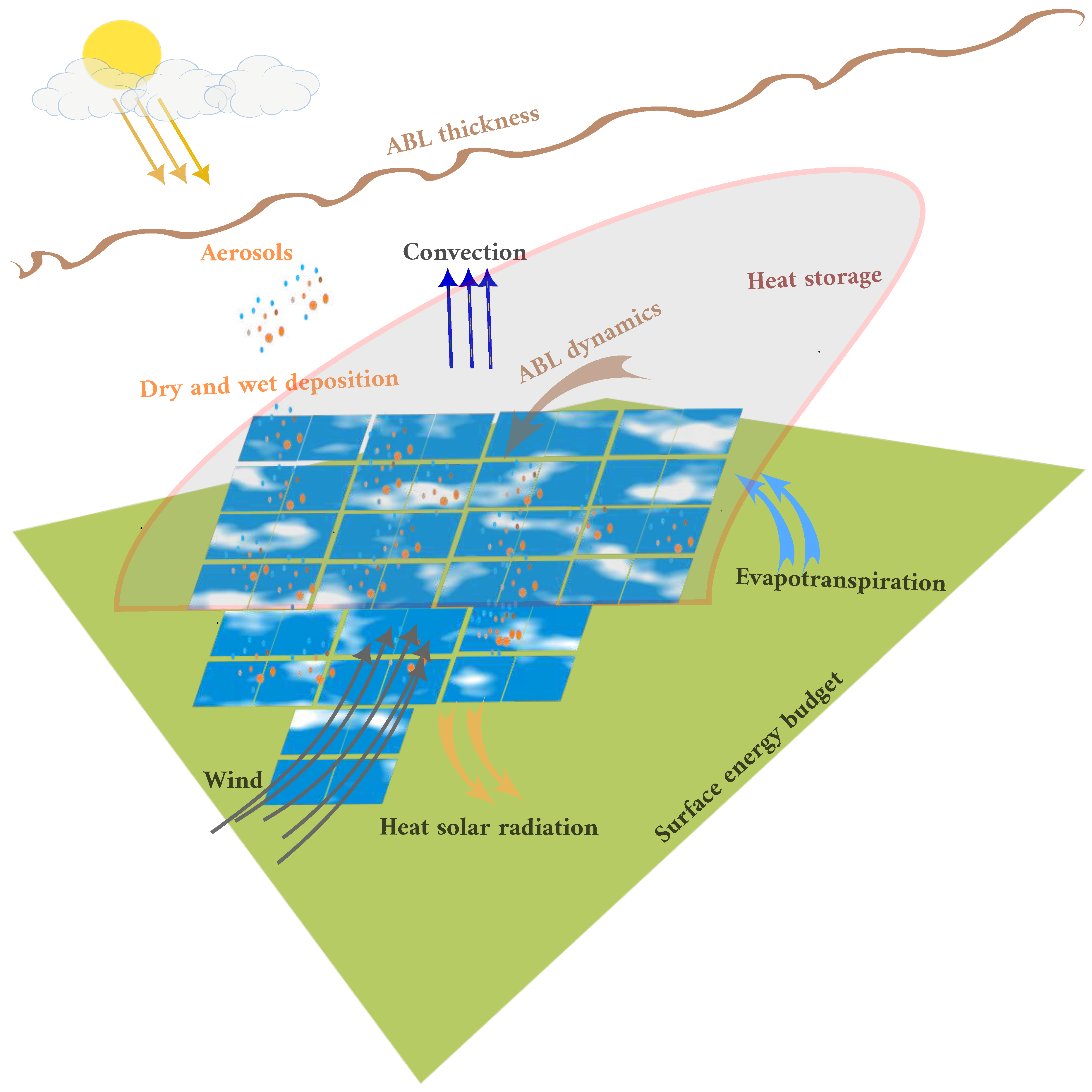
Figure 2.
Illustration of an agrivoltaic system and integrating model representation for fluxes and storage of water within the plants.
Figure 2.
Illustration of an agrivoltaic system and integrating model representation for fluxes and storage of water within the plants.

Disclaimer/Publisher’s Note: The statements, opinions and data contained in all publications are solely those of the individual author(s) and contributor(s) and not of MDPI and/or the editor(s). MDPI and/or the editor(s) disclaim responsibility for any injury to people or property resulting from any ideas, methods, instructions or products referred to in the content. |
© 2023 by the authors. Licensee MDPI, Basel, Switzerland. This article is an open access article distributed under the terms and conditions of the Creative Commons Attribution (CC BY) license (http://creativecommons.org/licenses/by/4.0/).
Copyright: This open access article is published under a Creative Commons CC BY 4.0 license, which permit the free download, distribution, and reuse, provided that the author and preprint are cited in any reuse.


