

Submitted:
27 June 2023
Posted:
28 June 2023
You are already at the latest version
Abstract
The implementation of grey and green infrastructure is an effective mean to address urban flooding and nonpoint source pollution, but due to the complexity of the process and the diver-sity of benefits, there is a lack of measurement for their comprehensive benefits. Adopting a typ-ical university in Beijing as an example, this paper simulated the multidimensional benefits of the water quantity, water quality, and ecology of grey and green facility renovation by coupling the storm water management model (SWMM) and InfoWorks Integrated Catchment Manage-ment (ICM). Monetization methods and economical means were employed to characterize the comprehensive benefits. The results showed that grey and green infrastructure retrofitting re-duces the number of severe overflow nodes in the study area by 54.35%, the total overflow vol-ume by 22.17%, and the nonpoint source pollution level by approximately 80% under the heavy rain scenario and 60% under the rainstorm scenario. The annual benefits of grey and green infra-structure renovation reached ¥765,600/year, of this amount, ¥83,100/year is from hydrological regulation, ¥454,100/year is from nonpoint source pollution reduction, and ¥228,300/year is from ecological improvement. The benefits of green facilities were higher than those of grey facilities, and the combined benefits were negatively correlated with the rainfall level, with a total bene-fit–cost ratio of 1.19. The results provide methodological and data support for grey and green in-frastructure retrofitting within the context of sponge cities.
Keywords:
sponge city
; grey and green infrastructure
; stormwater management model
; integrated environmental benefits
; monetary value
; stormwater use
1. Introduction
The urbanization process is often accompanied by an increase in impervious underlying surfaces such as buildings and roads, which leads to difficult rainfall infiltration and, in severe cases, the formation of urban flooding, which adversely affects the normal functioning of cities as well as the lives of residents [1,2]. At the same time, human activities release a large number of pollutants, which settle and accumulate on the surface and cause serious nonpoint source pollution under the effect of rainfall erosion [3]. The main pollutants include COD from industrial pollution emissions, vehicle exhaust emissions; SSs from urban waste, building construction site stockpiles, etc.; TN and TP from agricultural pollution, leaf litter and animal manure; heavy metals and PAHs from road wear, tyre wear, oil spills and corrosion of construction materials [4]. Runoff carrying large amounts of pollutants into the sewers leads to high concentrations of pollutants in the drainage system, which, combined with erosion, pollute both groundwater and surface water [5]. In addition to the destruction of water quality, aquatic ecosystems are degraded as a result, human health is greatly endangered and the world's biodiversity is reduced [6]. These urban water problems often occur simultaneously, which in turn increases the difficulty of their solution. In response to the multidimensional water problems in cities, Sustainable Stormwater Management (SSM) is widely used in various countries, such as Low Impact Development (LID) in the USA, Sustainable Urban Drainage (SuDS) in the UK, Water Sensitive Urban Design (WSUD) in Australia, Best Management Practices (BMPs) in Europe, etc [7]. In 2013, the concept of ‘sponge cities’ was introduced in China to address related issues [8]. Sponge cities constitute a new urban development model that uses small source control facilities to control rainfall, reduce surface runoff, and improve the urban water quality under the premise of harmonious coexistence between humans and nature [9,10]. In recent years, the construction of sponge cities has emphasized the combination of grey and green infrastructure [11,12], namely, green infrastructure is the main focus, supplemented by traditional grey engineering drainage facilities. The concept of the combination of grey and green infrastructure has been widely adopted worldwide, but infrastructure construction requires high investments [13], so the provided multidimensional benefits must be fully studied to comprehensively evaluate the construction feasibility [14].
The hydrological and nonpoint source pollution control benefits of grey and green infrastructure are the most important. Among them, green infrastructure can solve the problem of moderate or low rainfall runoff to a greater extent, whereas under high rainfall, green facilities can hardly completely dissipate rainfall, and grey infrastructure can then quickly achieve runoff evacuation, which can avoid flooding and control nonpoint source pollution to a certain extent [15]. In addition to water quantity and quality benefits, green infrastructure provides various ecological benefits: for example, plants can mitigate the greenhouse effect by absorbing carbon dioxide through photosynthesis, alleviate the urban heat island effect by absorbing heat through transpiration, reduce soil erosion through soil sequestration by plant roots, and protect urban biodiversity by restoring the ecological environment. For example, Glick et al. [16], Abduljaleel et al. [17], and Quichimbo-Miguitama et al. [18] simulated the hydrological benefits in their study areas, among which Quichimbo-Miguitama also focused on the inundation reduction benefits; Seo et al. [19] and Deng et al. [20] conducted simulations to evaluate the hydrological and nonpoint source benefits in the study area. In regard to ecological improvement benefits, LeBleu et al. [21] found that LID stormwater control measures would reduce the heat load of stormwater runoff and mitigate the urban heat island effect to some extent; Shen [22] simulated the heat island effect mitigation effect of green roofs; Lin et al. [23] used the life cycle assessment method to quantify the carbon reduction in the study area. In cost-benefit research of grey and green infrastructure, Wilbers et al. [24] divided the benefits of grey and green facilities into direct benefits (avoidance of sewage overflows and urban flooding) and co-benefits (aesthetic value, increase in house prices due to green roof installation, prevention of sewage disposal, water use, etc.) for cost-benefit accounting. Wei et al. [25], and Li et al. [26] divided the benefits of these facilities into economic, social, and environmental benefits. Raei et al. [27], and Saadatpour et al. [28] made a comprehensive decision based on construction costs and hydrological and nonpoint source benefits. The hydrological, nonpoint source or ecological benefits for the grey and green facilities in some of these studies are shown in Table 1. There is an urgent need to integrate the benefits of these three aspects. Fewer previous studies on grey and green facilities have examined hydrological, nonpoint source, and ecological benefits in an integrated manner. In addition, previous studies have rarely considered construction costs, and cost-benefit accounting of the hydrological, nonpoint source, and ecological aspects of grey and green facilities is becoming increasingly complicated and must be explored by introducing methods of monetization.
This study adopted the Beijing Normal University as the study area and simulated the comprehensive benefits of hydrological regulation, nonpoint source reduction, and ecological improvement before and after the retrofitting of grey and green facilities. This study coupled the storm water management model (SWMM) and InfoWorks Integrated Catchment Management (ICM). This study also constructed a comprehensive evaluation index system for the benefits of grey and green infrastructure and monetized the benefits of the above three aspects. Finally, the benefit-cost ratio of grey and green infrastructure renovation in the study area was evaluated.
2. Methodology
2.1. Simulation of the benefits of grey and green facilities
The study of the hydrological control benefits of grey and green infrastructure mainly examines their control on runoff and waterlogging [29]. The Technical Guide for Sponge City Construction, issued by the Ministry of Housing and Urban-Rural Construction in 2014, mentioned the planning control objectives for sponge city construction including the total runoff control and peak runoff control [20]. Therefore, four indicators were selected for runoff control, including the total runoff reduction, peak flow reduction, and the ratios of these two reduction quantities [30]. Since cities focus on the environmental risk of sewer overflows [31], two indicators, namely, overflow reduction and the reduction rate of overflow nodes, were selected for flooding mitigation [32].
The water quality benefit reflects the ability of grey and green infrastructure to absorb and transform pollution resulting from rainfall runoff [33]. It has been found that the pollutants commonly present at high levels in rainfall runoff include the chemical oxygen demand (COD), suspended solids (SSs), total nitrogen (TN), total phosphorus (TP), and heavy metal pollutants [34]. Among them, heavy metal pollutants are various and complex, which are difficult to be fully explored in the study. It was found that SS correlates well with most particulate-bound metals, so SS is used to represent heavy metal contaminants in this study [35]. Therefore, the reductions in COD, SS, TN and TP levels were used as the main indicators of water quality benefits simulation.
There are numerous ecological improvement benefits, including groundwater replenishment, urban heat island effect mitigation, storm water and sewage recycling, soil erosion improvement, and carbon sequestration and oxygen release from green areas [36,37]. Since the ecological benefits of different regions and different grey green infrastructures vary, the evaluation indexes for ecological benefits must be selected according to the specific study area.
2.2. Evaluation of the benefits of grey and green infrastructure
Figure 1 shows the aspects covered in the cost-benefit evaluation of grey and green infrastructure. Specific calculations should be screened and adjusted to the actual situation in the study area.
2.2.1. Runoff control benefits
The discharge of stormwater runoff increases urban construction costs, such as the maintenance and refurbishment costs of impervious and permeable underlying surfaces, construction and operation and maintenance costs of drainage networks, as well as rainwater-saving facilities, and energy use costs [38], while the construction of grey and green infrastructure reduces runoff discharge and lowers these costs to a certain extent, yielding economic benefits. Because of the wide variety of factors, the cost statistics are highly complex. There is no uniform domestic fee standard in China, so this study referred to the stormwater drainage fees levied on stormwater in other countries to obtain the economic value [39], which can be calculated as follows:
where is the runoff control benefit, [CNY]; is the precipitation in the study area, [mm]; is the discharge cost of rainfall runoff, [CNY/m3]; is the catchment area of the study area, [m2]; and is the total runoff reduction rate.
Where the cost of discharging rainfall runoff is referenced to the levy in countries with more established systems for collecting stormwater drainage fees; the catchment area is the projected area of the catchment area in the study area; and the total runoff reduction rate is the reduction rate of the total runoff before and after the facility modification for the same rainfall level. The amount of rainfall in the study area is selected according to the actual measurement needs, such as annual/daily/field rainfall. In this paper, the benefits of runoff control are calculated separately for different rainfall levels, as the amount of rainfall varies considerably between different rainfall levels. Precipitation in the study area is averaged over the eight rainfall events measured in the field for the different rainfall levels.
2.2.2. Flood control benefits
Under large rainfall, the flooding problem can be effectively alleviated and the economic and social losses can be reduced through the implementation of permeable paving, water storage ponds and upgraded pipe network systems. Using the shadow engineering method to estimate the economic losses caused by flooding by assuming the cost of manually constructing a flood control reservoir. The monetization of the flood control benefits can be calculated as follows:
where is the flood control benefit, [CNY]; is the flood control volume, [m3]; and is the flood control reservoir cost per unit volume, [CNY/m3].
Among them, the flood control volume is the reduction of the overflow volume after the installation of additional renovation facilities. The cost of the flood control reservoir is determined with reference to the standard of relevant documents on construction in the study area or the average market cost after market research.
2.2.3. Water quality benefits
If a combined drainage system is adopted, rainwater and domestic sewage, industrial wastewater, etc. are sent together to the sewage treatment plant for treatment, which increases the treatment cost of the sewage treatment plant. If a divided drainage system is adopted, rainfall runoff is discharged directly into the water without treatment, causing pollution to the water. Residential areas and campuses, etc. mainly adopt a divided drainage system [40]. Green infrastructure can effectively dissipate various pollutants, such as COD, SS, TN, and TP, decrease the concentration of pollutants in runoff, which can be converted into a reduction in treatment costs using the opportunity cost approach in the case of diversion systems. In addition, the reduction in pollutant inflow to the water will reduce the negative impacts of eutrophication, non-carcinogenic toxicity and ecotoxicity of the water, resulting in certain nonpoint source reduction benefits [40]. Therefore the monetization of water quality benefits can be seen as the sum of the reduction in treatment operation costs and the reduction in the negative impacts of the receiving water, which can be calculated as follows:
where is the water quality benefit, [CNY]; is the unit cost of pollutant treatment, [CNY/t]; is the economic benefit of reducing the negative impact of water per unit of pollutant treated, [CNY/t]; and is the amount of pollutants abated, [kg].
Where and varies by region, calculations are based on relevant regional studies or public financial data from regional governments. can be fitted using the SWMM, which has different modelling equations for different LID facilities and will fit the amount of pollutants from the additional LID facilities to the corresponding equations based on the amount of monitored rainfall runoff pollution.
2.2.4. Benefit of hydrological regulation and water quality
As the benefits calculated in this study are for a single rainfall event of different rainfall classes, in order to obtain data that can be compared, they should be converted into annual benefits and discounted according to the proportion of annual rainfall classes in the study area, which can be calculated as follows:
where is the average annual benefit of hydrological regulation and water quality, [CNY]; is the economic benefits of a single rainfall event for a given rainfall level, [CNY/field]; and is the annual average of the number of rainfall events at a given level.
Where is discounted based on the total number of years of rainfall at different levels divided by the number of years in the study area.
2.2.5. Resource utilization benefits
LID facilities increase the amount of available water resources through the retention of rainwater, where storage LID facilities collect and store rainwater, which can be used for urban green space irrigation, road cleaning, fire fighting, etc., saving water costs [41], calculated as in (5) [42], and infiltration LID facilities increase rainwater infiltration to replenish groundwater resources, alleviating groundwater overdraft to a certain extent, with benefits calculated as in (6) [43]:
where is the precipitation resource storage benefit, [CNY]; is the average annual precipitation in the study area, [mm]; is the construction area of LID facilities, [m2]; is the runoff coefficient; and is the economic benefit per unit of the rainwater volume, [CNY/m3]; is the infiltration benefit of precipitation resources, [CNY]; is the infiltration benefit coefficient; and is the controlled stormwater volume, [m3].
Where the calculation is based on the shadow price of water resources in the study area and the saturated water content of the soil (28.90%) [43].
2.2.6. Energy saving benefits
Green roofs can increase the area of urban green space and alleviate the heat island effect; besides, they also have a regulating effect on the temperature of the building roof and indoor. As the indoor temperature decreases in summer by using green roofs, the frequency and duration of cooling equipment use decrease, which results in the reduction in the energy consumption of air conditioners and electric fans [44,45], this benefit can be calculated as follows:
where is the energy saving benefit, [CNY]; is the reduction in electricity consumption by green roofs, [kWh/m2]; is the total green roof area, [m2]; and is the electricity price, [CNY/kWh].
A hectare of green space can absorb 8.1×10⁴ kJ of heat in the surrounding environment in summer, and its cooling effect is the same as 189 air conditioners in a full day. The total amount of heat absorbed is calculated based on the area of green roof construction, and the electricity consumption of cooling equipment required to achieve the same cooling effect is measured as [46].
2.2.7. Soil and water sequestration benefits
Soil erosion leads to a significant loss of soil nutrients, especially nutrients such as nitrogen (N), phosphorus (P) and potassium (K). Green infrastructure can effectively reduce the flow and speed of rainwater runoff, thus weakening soil erosion runoff, weakening urban soil erosion to a certain extent, maintaining the original soil fertility. The economic value of soil fertility maintenance is assessed using the opportunity cost approach and is calculated as follows [46]:
where denotes the soil and water sequestration benefits, [CNY]; is soil retention, [t/a]; refers to N, P and K nutrients respectively; is the percentage of pure content of N, P and K in the soil; is the average price of N, P and K fertilizers, [CNY/t]; is the rainfall erosion force factor; is the soil erodibility factor; is the slope length factor; is the slope factor; and is the vegetation cover factor.
The calculation of is based on the average value of GIS in different regions; the calculation of is based on the average value of the market in different regions after market research; the calculation of , , , and is based on the study of Ouyang et al. [47] and ‘The Technical Specification for Investigation and Assessment of National Environmental Standards’ in China.
2.2.8. Carbon sequestration and oxygen release benefits
Green roofs, constructed wetlands, and concave herbaceous fields are planted with a large number of plants, which are highly valuable in carbon sequestration and oxygen release and very important for urban carbon emission reduction. Therefore, we focused on quantifying the carbon sequestration and oxygen release benefits of green infrastructure as follows:
where denotes the carbon sequestration and oxygen release benefits, [CNY]; and are the new green space carbon sequestration and oxygen release benefits, respectively, [CNY]; is the new green space carbon dioxide fixation amount, [t]; is the carbon sequestration price, [CNY/t]; is the new green space area, [m2]; and is the green space carbon dioxide fixation amount, [kg/(m2·d)].
Among them, due to different climatic conditions such as temperature and humidity in different regions, different topography and different types of plants grown, the amount of CO2 fixed per unit area per unit time varies and is determined according to the specific study area or relevant studies in areas with similar conditions. The calculation uses the internationally accepted carbon tax method, and the price of carbon sequestration is determined according to the carbon tax rate in the specific study area, with reference to carbon tax rates in other countries where carbon taxes are not implemented or where the carbon tax market mechanism is less mature.
where is the amount of oxygen released from the new green space, [t]; is the price of industrial oxygen production, [CNY/t]; and is the amount of oxygen released from the green space, [kg/(m2·d)].
Where is again determined based on specific study areas or relevant studies in areas with similar conditions.
2.2.9. Biodiversity benefits
Concave herbaceous fields, green roofs, and constructed wetlands can effectively increase the urban plant diversity through vegetation planting and improve the urban ecological environment while also attracting various animals, such as insects and birds, thus contributing to biodiversity improvement [48]. Since it is difficult to quantify the changes in the number of plant and animal species resulting from the application of these green infrastructures in detail, the biodiversity improvement benefits were calculated using the results of the study of Xie et al. [49] on the ecological service value equivalent per unit area of different ecosystems, as follows:
where denotes the biodiversity improvement benefits, [CNY]; is the amount of economic value of an ecological service value equivalent factor, [CNY/hm2]; and is the equivalent value of biodiversity maintenance.
2.3. Accounting for the benefit–cost ratio of grey and green infrastructure
2.3.1. Benefit accounting in the life cycle
Benefit accounting can be expressed as follows:
where is the present value of the total benefits of the facility over the life cycle, [CNY]; and is the average annual total benefits of the facility, [CNY/a].
2.3.2. Cost accounting in the life cycle
The cost includes the construction cost and operation and maintenance cost of the project, which can more comprehensively reflect the life cycle cost of grey and green infrastructure and can be calculated as follows:
where is the present value of the life cycle facility engineering cost, [CNY]; is the facility construction cost, [CNY]; is the facility operation and maintenance cost, [CNY/a]; is the facility design life, [a]; is the discount rate; , , and are the green infrastructure, water storage facility, and drainage network system construction costs, respectively, [CNY]; is the construction cost of green infrastructure per unit area, [CNY/m2]; is the construction area of green infrastructure, [m2]; is the construction cost of water storage facilities per unit volume, [CNY/m3]; is the construction volume of water storage facilities, [m3]; is the construction cost of the drainage pipe network per unit length, [CNY/m]; and is the construction length of the drainage pipe network, [m].
Among these parameters, existing studies usually set the operation and maintenance cost as a percentage of the initial cost, and this study followed this method and set the operation and maintenance cost to 3% of the facility construction cost [50,51].
Figure 2 shows the cost of green infrastructure according to the Technical Guide for Sponge City Construction.
2.3.3. Benefit–cost ratio accounting
Cost-benefit accounting is conducive to deepening the understanding of the investment, operation and maintenance of grey and green facilities. The benefit–cost ratio, which can measure the economic effectiveness, is generally used for systematic assessment and can be calculated as follows:
where B/C is the benefit–cost ratio, and the higher the B/C value is, the higher the effectiveness under the same investment conditions.
3. Study Case
3.1. Overview of the study area
The Beijing Normal University selected in this study covers an area of 58.3 ha, with nine types of underlying surfaces, including roads, sidewalks, roofs, green areas, mixed land, artificial grass sports fields, real grass sports fields, permeable pavements and asphalt pavements. According to the type of underlying surface, the study area can be divided into 748 catchment areas, as shown in Figure 3. The stormwater pipe network in the study area contains a total of 5 outlets, of which the catchment area controlled by outlet 3 accounts for more than 80% of the total study area, so this outlet was used as the flow and water quality monitoring object. Due to the low construction standard of the stormwater pipe network system in the study area, it is difficult to drain water in a timely manner, and the area is therefore prone to flooding, while the stormwater runoff pollution problem is very prominent; at the same time, the campus exhibits a high population density and complex functions, and the total amount of pollution discharge is large [52]. Therefore, Beijing Normal University was purposefully selected as the case study area.
Since the study area belongs to a relatively mature community, it is difficult to renovate grey facilities, so the renovation of facility in the study area is based on green infrastructure. However, due to the high building density and limited surface space in the study area, the addition of green facilities alone cannot completely solve the water quantity and quality problems, so they should be supplemented with grey facilities. In terms of green infrastructure, flat roofs, nonmain roads and asphalt pavements were selected for renovation, impervious pavements were replaced with permeable pavements, and flat roofs were transformed into green roofs, with a total renovation area of 33,000 m2, occupying approximately 5.52% of the total study area, of which 27,435 m2 comprised green roofs. Regarding grey facilities, due to the obvious lack of drainage capacity of the current pipe network, the existing system should be renovated and upgraded. When the ratio of the backflow volume of the downstream pipe section to the incoming volume of the upstream pipe section is less than 0.5, it means that excessive upstream incoming flow is the main cause of nodal overflow, and such a pipe section should be retrofitted by increasing the pipe diameter of the downstream pipe. The locations of green and grey infrastructure renovation and design are shown in Figure 3. The green facility retrofit design parameters are shown in Table 2.
3.2. Rainfall data collection
3.2.1. Rainfall in Beijing
Based on the hourly rainfall data retrieved from the National Basic Weather Station Beijing Nanjiao Observatory (54511) from 2010 to 2019 and considering the classification guideline of recognizing the next rain event if no rainfall has occurred for more than 10 hours [53], a total of 631 rainfall events were obtained, and the average number of rainfall events per year in Beijing was chosen as 63.1. According to the meteorological department's standard classification, rainfall between 0.1 mm to 9.9 mm in 24 hours is considered light rain, between 10.0 mm to 24.9 mm is moderate rain, between 25.0mm to 49.9mm is heavy rain, and greater than 49.9mm is rainstorm. Thus of the 631 rainfall events, 408 are light rain events, 154 are moderate rain events, 57 are heavy rain events and 12 are rainstorm events, and the probability of occurrence of each level of rainfall in Beijing each year is shown in the bottom right of Figure 3.
3.2.2. Rainfall monitoring in the field
In this study, field monitoring was conducted for eight rainfall events, focusing on the process of hydrological and water quality changes at the outlets of the drainage pipes on campus during rainfall. The sampling points were divided into surface subsurface sampling and underground stormwater network outlet sampling, taking into account the land use types that have a significant impact on surface water pollution, and sub-surface monitoring of rainfall runoff from five subsurface types, namely residential areas, high-density traffic areas, medium-density traffic areas, high-rise building rooftops and low-rise building rooftops, in conjunction with human and material resource considerations. The outlet of the underground storm water network was selected as outlet 3 (outlet to the municipal drainage network), which has the largest catchment area in the study area, for flow and concentration monitoring. The HOBO weather station was set up on the roof of the low-rise building and recorded detailed data including atmospheric pressure, temperature, relative humidity, solar radiation values, wind speed and rainfall at 5-minute intervals. A flow meter (HACH, FL900) is set up at drainage outlet 3 for real-time monitoring of network flow at the same time interval as above, this was subsequently collated as time series data and entered into the model. The samples collected in 500 mL polyethylene bottles were immediately bottled and taken back to the laboratory for water quality determination [54]. Transient runoff samples are mainly collected by hand sampling. This method is more flexible as it allows the sampling interval to be adjusted at any time depending on the prevailing rainfall conditions. Road surface rainwater is collected at road rainwater grates, roof rainwater is collected at down pipes and underground pipe network samples are collected in rainwater wells. Besides, the water quality data were obtained through the analysis of runoff samples collected in the rainfall process. The rainfall information and hydrological and water quality data are shown in Table 3. All the data were used for subsequent modelling, including 2 light rain events, 2 moderate rain events, 3 heavy rain events and 1 rainstorm event, which helped to analyse the differences in the benefits under the different rainfall levels. It should be noted that rainfall event 0926 was 7.8mm, but it lasted only 25 minutes. Given the intensity of the rainfall, this rainfall was classified as moderate rain.
3.3. Model construction
In this study, the urban storm sewer and watershed stormwater management modelling software PCSWMM was used to simulate runoff and pollutants in the study area. The data required for the SWMM simulations include catchment data (land use types, pipe network data, digital elevation data), meteorological data and hydrological observations for the rate and validation of the model [55]. The land use data and pipe network data are taken from the school platform; the digital elevation data are taken from all rainwater nodes (2048 points) and elevation data provided by the sounding company (622 points); and the other data are taken from field monitoring results. Of the parameters to be entered, the main physical characteristics of the catchment characterization data such as area and imperviousness were obtained using Arc GIS analysis of spatial data. The average slope of the sub-catchment area is 1.7%, which is calculated from the DEM data of all nodes; the pipe diameter, pipe length and slope are obtained from the pipe network data. According to the actual situation, the Horton model was selected for the infiltration simulation model [56], the saturation function was selected for the accumulation model, and exponential flushing was selected for the flushing model. Model calibration and validation were performed using the data for the eight actual monitored rainfall sites listed in Table 3, where the initial calibration (sensitivity-based radio tuning calibration) was performed using the SRTC tool in PCSWMM [57], followed by more accurate calibration via the availability-aware scheduling algorithm by using the nondominated sorting genetic algorithm II (NSGAII) [58]. The rainfall events used for calibration were 0729, 0804, 0809 and 0823 and for validation were 0830, 0831, 0901 and 0926, taking into account the number of peaks in the rainfall events and the amount of rainfall. Both the calibration and validation NSE values were above 0.8 [59,60], and R2 exceeded 0.9 [61], which indicates satisfactory simulation results. The simulation of the validation event 0831 was less effective than the other three rainfall events, presumably because the rate period didn’t include the type of short duration heavy rainfall like 0831, so the parameter set obtained from the rate was not as effective as the other rainfall events for this type of rainfall simulation. The model parameters are summarized in Table 4, and the results are shown in Figure 4. The SWMM model tends to overestimate peak flows, which can cause peak flow reductions to be somewhat overestimated. Based on the actual monitoring pollutant characteristics and rainfall pattern characteristics, COD, NH3-N and TP, which are conventional pollutants, were selected for nonpoint source pollution simulation, and the rainfall events collected were 0729, 0804, 0830, 0831 and 0926, and the results are shown in Table 5.
The validated SWMM was imported into InfoWorks ICM for debugging to ensure the accuracy of the simulation results. Before 2D flooding simulation, digital elevation model (DEM) data for flooding simulation was obtained by interpolation (using the inverse distance-weighted interpolation method) in ArcGIS based on the ground elevation data of 374 inspection wells to create a ground irregular triangular network (TIN) model in InfoWorks ICM, based on the aforementioned total of 2670 elevation data. A 2D simulation polygon was created within the TIN model, and the building area was defined as a blank area to preclude runoff flow in the simulation process. The polygon was gridded, a 2D flooding calculation was performed, and the data were read to obtain a time–flooded area curve [62]. As the subsequent evaluation of the flood control effect of grey and green facilities mainly considered the event 0831, it could not be used to test the validity of the model. Among the remaining seven rainfall events, the one with the highest intensity of rainfall, which is the most prone to flooding, was selected for simulation. The precipitation of 0729, 0830 and 0901 were close to each other, but the rainfall duration was significantly different, so the event 0830 with the shortest rainfall duration was selected for SWMM simulation. The amount of water overflowing from the check wells was selected as the input data for the flooding simulations, and the simulated waterlogging points were basically consistent with the actual observed waterlogging locations, which verified the validity of the model simulation process.
3.4. Cost-effectiveness evaluation
The calculation parameters are shown in Table 6. As many countries charge plot owners for stormwater fees on the basis of impervious surface area [63,64], it is difficult to reflect the difference in fees for different rainfall levels, and the average value of the levy per unit volume of rainwater discharge in Godyń's study [65] was chosen, where the value in his study was used directly because the exchange rate of the EUR against the CNY is close to purchase power parity [66]. Reservoir construction unit reservoir capacity investment reference national forestry department uniform value standard. The reduced flood control cost per unit area of runoff reduction was based on the annual emergency fund for flood control in Beijing. The amount of carbon dioxide fixed and oxygen released from the green space was based on the field observation results of Li et al. [67]. China launches a national carbon emissions trading system in 2021, but the foundation of the market-based mechanism for carbon price formation is still weak, and the trading structure needs to be improved, so refer to the median carbon tax rate values of other countries in State and Trends of Carbon Pricing 2021. The price per unit mass of oxygen refers to the China Price Statistical Yearbook. The COD reduction cost per unit was based on the study results of Li et al. [68]. The cost of treating other pollutants and the economic benefits of reducing the negative impacts on water per unit of pollutant treated, with reference to the study by Zhu et al. [40]. She [69] found that the construction cost of pipe networks with pipe diameters of 600-1000 mm was 247-990 RMB/m in China. The construction costs of permeable pavements, green roofs, and pipe network systems in this study area were chosen as average values, i.e., 130 CHY/m2, 200 CHY/m2, and 618.5 CHY/m, respectively.
4. Results and Discussion
4.1. Quantitative analysis of the benefit indicators
The runoff control results for the eight rainfall events are shown in Table 7. The retrofitting measures yielded favorable runoff control effects at the different levels of rainfall, but the effect decreased with increasing rainfall level. This is consistent with the findings of Guo et al. [61] that LID facilities are more effective in controlling runoff during smaller and more frequent rainfall events. After retrofitting, runoff was almost not discharged under the light rain and moderate rain scenarios, which suggests that the grey and green infrastructure can absorb the runoff generated under low-level rainfall completely. The runoff control effect of the retrofitting measures under the rainstorm scenario was significantly lower than that under the other scenarios, but the total runoff reduction rate still reached more than 80% relative to before retrofitting, and the peak flow rate was reduced by nearly 70%, which indicates that grey and green infrastructure retrofitting still provided suitable rainwater absorption under heavy rainfall. The effect was still satisfactory.
At the same time, simulation of event 0831 before and after the renovation revealed that the number of severe overflow nodes in the study area was reduced from 46 to 21, and the total overflow volume was reduced from 5,030 to 3,915 m3 after the renovation, which indicates that the renovation of grey and green infrastructure improved the ability to discharge water from the road surface in the study area. It is conducive to reducing the economic loss caused by flooding and the impact on the activities of residents.
The nonpoint source reduction results for the eight rainfall events are shown in Figure 5. Facility retrofitting produced satisfactory reduction and purification effects on COD, SS, TN and TP, but the control effect also decreased with increasing rainfall level because the pollutant content is related to the rainfall level, and the pollutant reduction capacity of the retrofitted facilities reached saturation after a certain rainfall level was attained, resulting in a decrease in the pollutant reduction rate. This is also in line with the study by Li et al. [70] where the resilience of LID facilities in sponge cities decreases with the increase of the rainfall return period.
The total amount of each pollutant was significantly reduced in the outfall3 under the light and moderate rainfall scenarios after the renovation, indicating that green infrastructure imposes a strong control effect on the nonpoint source pollution problems generated by low-level rainfall, with the best control effect on the TP level. Under the rainstorm scenario, the water quality effect of the facilities was significantly smaller than that under the other scenarios, among which the COD and SS control effects decreased more significantly than the TN and TP control effects (approximately 30% difference), which is due to the high content and proportion of COD and SSs in runoff and the high runoff accumulation under the rainstorm scenario, resulting in the inability to reduce pollutants promptly. This is in line with She et al. [71] who conducted a study of residential and commercial areas where COD and TSS emissions were significantly higher than TN and TP by tens to thousands of times, with TP reduction rates higher than TSS and COD by about 15%-18%.
Due to the small study area, some benefits were not obvious, and the green roof accounted for more than 80% of the total green infrastructure transformation area, which is the main green infrastructure aspect, so the ecological benefits mainly included the carbon sequestration and oxygen release benefits of the green area, which is considered the ecological benefit index in the study area. The calculated carbon dioxide absorption of green roofs in the study area is 356.66 kg/d, and the oxygen release amount is 493.83 kg/d. The green roof retrofitting area accounts for 15.53% of the total roof area in the study area. According to the Carbon Emission Accounts & Datasets (CEADs) [72], the apparent carbon dioxide emissions in Beijing in 2019 reached 70.61 Mt. Due to the lack of data specific to the study area scale, assuming that the apparent CO2 emissions per unit area per unit time in Beijing remain the same, i.e. CO2 emissions of 0.012 kg/(m2·d). Based on the area of the study area, it can be concluded that the study area emissions are 6872.77 kg/d, so the new green space can reduce the daily CO2 emissions of the study area by 5.19%, which could contribute to urban carbon emission reduction. The actual amount of carbon dioxide absorbed and oxygen released may vary due to various factors, such as the specific plant types and ages of lawns in different regions [73], but these differences were not described in this paper due to the difficulty of obtaining statistical information on the variability of lawn plant types, numbers, and distribution patterns.
4.2. Cost monetization analysis
The total cost of grey and green infrastructure renovation in the study area is shown in the Table 8. The cost of green infrastructure was higher than that of grey infrastructure, namely, 11.30 times higher, which occurs because the renovation mainly involved green renovation, and the total cost of green infrastructure, especially green roof renovation, was high due to the large area.
4.3. Benefit monetization analysis
The runoff control benefits at the different rainfall levels are shown in Table 8, and the benefits were positively correlated with the rainfall level. The runoff control benefits of the retrofitting measures under the heavy rainfall and rainstorm scenarios were higher, namely, three to ten times, than those under the light and moderate rainfall scenarios, which occurs because the rainfall level under the rainstorm scenario is 7 and 14 times that under the moderate and light rainfall scenarios, respectively, and the rainfall level under the heavy rainfall scenario is approximately 3 and 6 times that under the moderate and light rainfall scenarios, respectively. The flood control benefits under heavy rainfall is 1.73-2.73 times the runoff control benefits during light and moderate rain, and 27%-52% of that during heavy rain and rainstorm, with a higher flood control benefit due to the comprehensive use of various grey and green facilities for the renovation of the overflow nodes of the pipe network in this study, with a significant reduction in overflow nodes and a degree of reduction in overflow volume that can be equated to the construction price of a larger volume flood control reservoir. The monetized results of the single rain nonpoint source reduction benefits for different rainfall levels, calculated on the basis of eight actual observed rainfall events, are listed in Table 8. The TN and TP control benefits are positively correlated with the rainfall level. The COD and SS control benefits are positively correlated with the rainfall level under the nonextreme rainfall scenarios, and the benefits were reduced by 30%-40% under the extreme rainfall scenarios. As the COD and SS control benefits accounted for 66%-91% of the total benefits, the water quality benefits follow the same trend as the changes in the benefits of both. The main reason for the trend of increasing and then decreasing COD and SS control benefits is that the rate of pollutant transport under extreme rainfall scenarios exceeds the capacity and rate of pollutant absorption at the retrofit facility.
The total annual runoff control benefits, total flood control benefits, and total water quality benefits at each rainfall level in Beijing were calculated, as summarized in Table 8. The runoff control benefit of the retrofitted facilities in the study area was the highest under the light rainfall scenario, which is 1.67-3.36 times higher than that under the other scenarios. This occurs because the rainfall in Beijing is mainly light rainfall, accounting for more than 60% of the annual rainfall, and the proportion of the other rainfall scenarios is low, so a single high-value rainfall event slightly impacts the total annual benefit. The annual effectiveness of facility retrofitting in controlling nonpoint pollution in the study area was highest under the moderate rainfall scenario and lowest under the rainstorm scenario, with the retrofitted facilities under the moderate rainfall scenario 11.30 times more effective than those under the rainstorm scenario. The most significant annual economic benefits of retrofitting the facility can therefore be achieved under a medium rainfall scenario. In this regard, the reduction of pollutants relies mainly on green infrastructure rather than grey infrastructure. The vegetation in the facility slows down the flow of runoff and traps and deposits pollutants there, using the biochemical reaction of the plants and the absorption and infiltration of the soil to avoid pollutants from flowing into natural water bodies and causing water pollution. It is important to note that as the biochemical reaction of vegetation consumes a limited variety and quantity of pollutants and the soil has a certain carrying capacity, there is a risk that when the concentration of pollutants is too high, the sustainable and stable functioning of the green infrastructure is threatened, resulting in a situation where the total effectiveness of nonpoint source reduction decreases with the duration of use of the facility.
Since the flooding control benefits were only examined under the rainstorm scenario with a very low frequency, the runoff control and water quality benefits of the retrofitted facilities were first discussed under the full suite of rainfall scenarios. The total annual runoff control and water quality benefits of the retrofitted facilities are highest under the moderate rainfall scenario and lowest under the rainstorm scenario, while the benefits under each rainfall scenario were 3.38-4.53 times higher than those under the rainstorm scenario, which occurs because the probability of rainstorm in Beijing is considerably lower than that of the other classes and because the retrofitted facilities provide a limited pollutant reduction capacity under the heavy rainfall scenario. Hence, the benefits under the rainstorm scenario were low. The retrofitting of grey and green infrastructure in the study area should focus more on the control of light, moderate, and heavy rainfall.
The flood control benefits are further included in the discussion. The annual flood control benefit accounted for 16.4% of the hydrological regulation and water quality benefits, which brought very significant economic benefits. At the same time, rainstorm is more harmful to the study area, and waterlogging seriously affects the production and life of people. Therefore, specific control measures for rainstorms should be moderately implemented if the budget allows.
The annual nonpoint source reduction benefit and the annual hydrological regulation benefit of the retrofit facility are basically the same, with the hydrological benefit slightly higher than the water quality benefits, exceeding the water quality benefits by 1.8%. The high water quality benefits were due to the high unit pollutant reduction costs and the fact that the retrofits mainly involved green facilities with large green roofs providing a high ability to absorb and dissipate pollutants. The high hydrological benefit is due to the fact that both grey and green retrofitted facilities generate hydrological control effects, of which green infrastructure focuses on runoff control under lower rainfall scenarios, and grey infrastructure focuses on higher rainfall scenarios. Green infrastructure can retain most of the rainfall when rainfall is low, resulting in significant runoff control benefits; although the degree of grey infrastructure retrofitting is low, the study area has a temperate monsoon climate with limited rainfall, and statistics show that the study area has a low probability of extreme rainfall, so grey infrastructure retrofitting can meet most of the needs of the study area, resulting in significant runoff and flood control benefits.
The annual ecological benefits of the renovated facilities are approximately 80% and 79% of the annual hydrological and water quality benefits respectively, accounting for 28.5% of the total annual benefits, which is slightly lower than the hydrological and water quality benefits, but still about 1/3 of the overall, indicating that the potential for ecological benefits of the renovated facilities is huge. The fact that only green facilities have ecological improvement benefits leads to a significantly higher monetary value of green facilities than grey facilities. The total benefits of green infrastructure are approximately ten times greater than those of grey facilities.
4.4. Cost-benefit ratio analysis
The benefit–cost ratio over the life cycle is 1.19, of which the benefit–cost ratios of green and grey infrastructure are 1.23 and 0.73, respectively, and green infrastructure is slightly more economically effective than grey infrastructure. To completely solve the flooding problem in the study area, a large amount of grey and green infrastructure was renovated and constructed, and the total runoff amount, peak flow, degree of flooding, and runoff pollutants were significantly reduced, resulting in greater mitigation of the water problem in the study area, but at the same time, as a mature community, the construction and maintenance costs of its facilities significantly increased, thus yielding a limited actual economic value and low net benefits. The grey infrastructure in this study exhibited low alteration and maintenance costs, high rainstorm scenario benefits, and notable alteration of the existing pipe network system, which plays a supporting role under the high to heavy rainfall scenarios but provides poor net benefits due to the extremely low frequency of heavy rainfall in Beijing.
In summary, the modification of grey and green infrastructure in the study area can produce certain economic values of rainfall runoff, internal flooding, and water quality benefits, but the benefit–cost ratio is only slightly higher than 1. If the grey and green facilities in the study area are modified, more suitable types of facilities should be used, and their locations should be optimized, considering the costs and benefits of these facilities.
In addition, the low benefit–cost ratio is due to the small study area in this paper, which does not include the external benefits of grey and green infrastructure in the calculation process. In the actual situation, it is still necessary to consider the following: (1) the reduction in external runoff will impose an ameliorating effect on river scouring as well as flooding, thus reducing the occurrence of disasters such as landslides and mudslides caused by excessive scouring as well as the personal and property losses caused by downstream flooding to local residents; (2) the facilities intercept rainwater, increase the amount of rainwater infiltration, replenish groundwater, and raise the groundwater level, and this part of rainwater can be used as urban green space irrigation water, water for road cleaning, water for firefighting, etc., which to a certain extent reduces tap water development and utilization and eases the pressure on the urban water supply; and (3) green infrastructure can alleviate the heat island effect and reduce energy use, while the synergy between the study area and other green infrastructure can reduce the growth rate of urban energy consumption. To better assess the cost–effectiveness of grey and green infrastructure, the retrofitting effect of the entire system should be evaluated on a larger scale to reduce the possibility of misestimation.
4.5. Uncertainty and applicability analysis
In terms of model simulation, the SWMM tends to overestimate peak flows, which results in higher peak flow and total runoff simulation values than actual values, making the peak flow and total runoff reduction and reduction rate calculations large.
In terms of calculating the benefits of runoff control, as the study area has not yet implemented a mature stormwater charging system, the stormwater fees of other countries are used as a proxy in this paper. As Poland is relatively similar to China in terms of price levels, while the Euro to CNY exchange rate is close to purchasing power parity, using the Polish levy for stormwater fees reduces the error. However, the stormwater fee is the total cost of all urban drainage infrastructure, including cisterns, pumping stations, pipes, etc. The campus drainage facilities in this study are relatively simpler and the maintenance and construction cost expenditure is relatively less than the reference value, resulting in a high benefit calculation. In addition, the Polish stormwater fee levy is related to the capacity of water storage facilities in impervious areas, and this paper uses the average value, which will lead to some error.
Flood control benefits are proxied using the cost of a flood control reservoir of the same volume as the overflow reduction. In practice, the benefits may not be linearly related to the volume of overflow reduction. The actual benefits are quantified monetarily based on the impact of flooding on various aspects such as travel, personal safety and property damage to residents, and corrosion and destruction of buildings when no grey and green facilities are built. However, due to differences in many aspects such as population density, average income of residents, building heights, and the way buildings are constructed with materials, as well as the amount of rainfall in each rainstorm, it is difficult to make specific and detailed calculations of their flood control benefits based on each storm. The use of the shadow engineering method can simplify the calculation steps and prevent the lack of some of the measured data in the study area from making monetary calculations difficult, but it can also lead to certain errors.
The cost per unit of pollutant treated and the economic benefits of reducing the negative impacts of treatment on water are also calculated using empirical values. The cost per unit of COD treatment is calculated using the results of COD reduction during China's 11th Five-Year Plan period. The development of science and technology have led to a reduction in pollutant emissions, which combined will result in some error in the unit COD treatment cost. Other pollutant treatment costs are calculated from studies in recent years, and the influence of the time factor is relatively small, but due to the scale of the studies, there is still some error when applying it to the current study area.
The indicators of ecological benefits are also calculated based on reference values. Due to the varying degrees of variability in climate, hydrological characteristics, land use, economic and other regional characteristics of different regions, the calculation is subject to a certain degree of error. Because of the high human and material costs and the specificity of the study area, it is difficult to generalize, so it is easier to use the average values of the region or country to which the study area belongs and the formulaic monetization method.
In this study, due to the small size of the study area and the simplicity of the renovation facilities, the ecological benefits other than the carbon sequestration and oxygen release benefits may be limited, so they are not calculated in detail in this paper, which may result in small total benefits.
We are currently only evaluating based on limited scenarios and have not evaluated and compared the reliability, resilience and sustainability of different types and proportions of mixed grey and green facilities. Casal-Campos et al. [74] have done a good job in this regard and future comparisons of different mixed facilities could also be conducted for the current study area to achieve a higher benefit-cost ratio.
The current benefits are based on the results of current climate conditions, but as the global climate is changing considerably, rainfall patterns in the study area may change somewhat and Beijing may experience more rainy days or an increase in average daily precipitation and an increase in the proportion of extreme rainfall [75], which may lead to an increase in the benefits of grey facilities over that of green facilities, the current results will change somewhat and the conclusions will change somewhat as a result.
4.6. Risk analysis
Green facilities reduce the velocity of rainwater runoff and use vegetation and soil to trap pollutants so that they do not enter natural water and cause pollution. Vegetation and microorganisms can break down some pollutants or use their own biochemical reactions to convert some pollutants into harmless substances, however, there are some pollutants such as heavy metals that are difficult to be converted by vegetation and microorganisms, and the runoff containing these pollutants seeps down through the soil pores, causing soil pollution and possibly groundwater contamination. As the pollutant reductions and reduction rates in the study were mainly based on observing the pollutant concentrations at the outfalls and focusing on the pollution of surface water, etc., where the stormwater runoff flows directly, the results of the total reduction of each type of pollutant were obtained, and in practice the threat of pollutants to the soil and groundwater also needs to be looked at.
5. Conclusion
This study comprehensively assessed and monetized the hydrological, nonpoint source, and ecological benefits of grey and green infrastructure. The main findings are as follows:
The retrofitting of grey and green infrastructure could effectively reduce the total volume and peak flow of stormwater runoff and had a good effect on the control of flooding in the study area. Under different rainfall scenarios, the reduction rates of total runoff and peak flow in the study area were higher than 65%. Grey and green infrastructure had a good reduction effect on surface pollution from stormwater, with the reduction of all pollutants close to 100% under the light and moderate rain scenarios, 75%-90% under the heavy rain scenario and 40%-80% under the rainstorm scenario. The combined benefits of grey and green infrastructure are highest in the medium rainfall scenario, and the economic effectiveness of grey and green facilities in relieving flooding and drainage pressure on the network is limited in the heavy rainfall scenario. Both grey and green facilities can improve the sustainability of urbanized areas and bring significant economic benefits, but green infrastructure has more multifaceted benefits and higher monetized values of benefits.
The relative control of runoff and pollution with a positive benefit can be achieved in smaller scale campus areas with a relatively simple grey and green facilities consisting of green roofs, permeable pavements and pipe modifications, which can be a reference for similarly situated areas. As the scale of the area increases, or as the area becomes more urbanized, additional types or numbers of facilities can be considered to achieve better results.
The comprehensive benefit evaluation system for grey and green facilities in this study can be applied to the comprehensive accounting of hydrological, nonpoint source pollution and ecological benefits as well as costs in other regions, providing some reference on the economic aspects of the feasibility of facility construction in other regions. However, the current method still suffers from ambiguity in the data and uncertainty in the alternative calculation of benefits, and further refinement is needed in region-specific studies.
Green infrastructure traps pollutants and mitigates pollution in water such as rivers, but soil contamination and groundwater contamination from pollutant infiltration needs to be further considered subsequently.
Author Contributions
Writing—original draft preparation by J.W.; writing—review and editing by X.Z., S.W., L.C. and Z.S. All authors have read and agreed to the published version of the manuscript.
Funding
This research was funded by The Fund for Innovative Research Group of the National Natural Science Foundation of China (No. 52221003), and the National Natural Science Foundation of China (No. 42277044).
Declaration of Competing Interest
The authors declare that they have no known competing financial interests or personal relationships that could have appeared to influence the work reported in this paper.
References
- Qi, B.; Xu, P.; Wu, C. Analysis of the Infiltration and Water Storage Performance of Recycled Brick Mix Aggregates in Sponge City Construction. Water 2023, 15, 363. [Google Scholar] [CrossRef]
- Lyu, H.-M.; Xu, Y.-S.; Cheng, W.-C.; Arulrajah, A. Flooding Hazards across Southern China and Prospective Sustainability Measures. Sustainability 2018, 10, 1682. [Google Scholar] [CrossRef]
- Fletcher, T.D.; Andrieu, H.; Hamel, P. Understanding, Management and Modelling of Urban Hydrology and Its Consequences for Receiving Waters: A State of the Art. Advances in Water Resources 2013, 51, 261–279. [Google Scholar] [CrossRef]
- Vinck, E.; De Bock, B.; Wambecq, T.; Liekens, E.; Delgado, R. A New Decision Support Tool for Evaluating the Impact of Stormwater Management Systems on Urban Runoff Pollution. Water 2023, 15, 931. [Google Scholar] [CrossRef]
- Godyń, I.; Bodziony, M.; Grela, A.; Muszyński, K.; Pamuła, J. Determination of Pollution and Environmental Risk Assessment of Stormwater and the Receiving River, Case Study of the Sudół River Catchment, Poland. International Journal of Environmental Research and Public Health 2023, 20, 504. [Google Scholar] [CrossRef]
- Kshirsagar, M.P.; Khare, K.C. Support Vector Regression Models of Stormwater Quality for a Mixed Urban Land Use. Hydrology 2023, 10, 66. [Google Scholar] [CrossRef]
- Qi, W.; Ma, C.; Xu, H.; Chen, Z.; Zhao, K.; Han, H. A Review on Applications of Urban Flood Models in Flood Mitigation Strategies. Nat Hazards 2021, 108, 31–62. [Google Scholar] [CrossRef]
- Hou, J.; Mao, H.; Li, J.; Sun, S. Spatial Simulation of the Ecological Processes of Stormwater for Sponge Cities. Journal of Environmental Management 2019, 232, 574–583. [Google Scholar] [CrossRef]
- Nguyen, T.T.; Ngo, H.H.; Guo, W.; Wang, X.C.; Ren, N.; Li, G.; Ding, J.; Liang, H. Implementation of a Specific Urban Water Management - Sponge City. Science of The Total Environment 2019, 652, 147–162. [Google Scholar] [CrossRef]
- Wang, Z.; Qi, F.; Liu, L.; Chen, M.; Sun, D.; Nan, J. How Do Urban Rainfall-Runoff Pollution Control Technologies Develop in China? A Systematic Review Based on Bibliometric Analysis and Literature Summary. Sci Total Environ 2021, 789, 148045. [Google Scholar] [CrossRef]
- Wang, K.; Zhang, L.; Zhang, L.; Cheng, S. Coupling Coordination Assessment on Sponge City Construction and Its Spatial Pattern in Henan Province, China. Water 2020, 12, 3482. [Google Scholar] [CrossRef]
- Qiao, X.-J.; Liao, K.-H.; Randrup, T.B. Sustainable Stormwater Management: A Qualitative Case Study of the Sponge Cities Initiative in China. Sustainable Cities and Society 2020, 53, 101963. [Google Scholar] [CrossRef]
- Zhang, J.; Han, Y.; Qiao, X.-J.; Randrup, T.B. Citizen Willingness to Pay for the Implementation of Urban Green Infrastructure in the Pilot Sponge Cities in China. Forests 2023, 14, 474. [Google Scholar] [CrossRef]
- Sample, D.J.; Heaney, J.P.; Wright, L.T.; Fan, C.-Y.; Lai, F.-H.; Field, R. Costs of Best Management Practices and Associated Land for Urban Stormwater Control. J. Water Resour. Plann. Manage. 2003, 129, 59–68. [Google Scholar] [CrossRef]
- Cheng, T.; Huang, B.; Yang, Z.; Qiu, J.; Zhao, B.; Xu, Z. On the Effects of Flood Reduction for Green and Grey Sponge City Measures and Their Synergistic Relationship—Case Study in Jinan Sponge City Pilot Area. Urban Climate 2022, 42, 101058. [Google Scholar] [CrossRef]
- Glick, R.; Jeong, J.; Srinivasan, R.; Arnold, J.G.; Her, Y. Adaptation of SWAT Watershed Model for Stormwater Management in Urban Catchments: Case Study in Austin, Texas. Water 2023, 15, 1770. [Google Scholar] [CrossRef]
- Abduljaleel, Y.; Demissie, Y. Identifying Cost-Effective Low-Impact Development (LID) under Climate Change: A Multi-Objective Optimization Approach. Water 2022, 14, 3017. [Google Scholar] [CrossRef]
- Quichimbo-Miguitama, F.; Matamoros, D.; Jiménez, L.; Quichimbo-Miguitama, P. Influence of Low-Impact Development in Flood Control: A Case Study of the Febres Cordero Stormwater System of Guayaquil (Ecuador). Sustainability 2022, 14, 7109. [Google Scholar] [CrossRef]
- Seo, M.; Jaber, F.; Srinivasan, R.; Jeong, J. Evaluating the Impact of Low Impact Development (LID) Practices on Water Quantity and Quality under Different Development Designs Using SWAT. Water 2017, 9, 193. [Google Scholar] [CrossRef]
- Deng, Y.; Deng, J.; Zhang, C. Sponge City and Water Environment Planning and Construction in Jibu District in Changde City. Sustainability 2022, 15, 444. [Google Scholar] [CrossRef]
- LeBleu, C.; Dougherty, M.; Rahn, K.; Wright, A.; Bowen, R.; Wang, R.; Orjuela, J.A.; Britton, K. Quantifying Thermal Characteristics of Stormwater through Low Impact Development Systems. Hydrology 2019, 6, 16. [Google Scholar] [CrossRef]
- Shen, Z. Green Roof Design of Residential Area Based on Sponge City Theory. Wireless Communications and Mobile Computing 2022, 2022, 1–8. [Google Scholar] [CrossRef]
- Lin, X.; Ren, J.; Xu, J.; Zheng, T.; Cheng, W.; Qiao, J.; Huang, J.; Li, G. Prediction of Life Cycle Carbon Emissions of Sponge City Projects: A Case Study in Shanghai, China. Sustainability 2018, 10, 3978. [Google Scholar] [CrossRef]
- Wilbers, G.-J.; de Bruin, K.; Seifert-Dähnn, I.; Lekkerkerk, W.; Li, H.; Budding-Polo Ballinas, M. Investing in Urban Blue–Green Infrastructure—Assessing the Costs and Benefits of Stormwater Management in a Peri-Urban Catchment in Oslo, Norway. Sustainability 2022, 14, 1934. [Google Scholar] [CrossRef]
- Wei, Z.; Yumiao, L.; Chengdan, W. A Discussion on the Construction Ideas of Sponge City in A Green Eco-District. IOP Conf. Ser.: Earth Environ. Sci. 2021, 657, 012058. [Google Scholar] [CrossRef]
- Li, X.-J.; Deng, J.-X.; Xie, W.-J.; Jim, C.-Y.; Wei, T.-B.; Lai, J.-Y.; Liu, C.-C. Comprehensive Benefit Evaluation of Pervious Pavement Based on China’s Sponge City Concept. Water 2022, 14, 1500. [Google Scholar] [CrossRef]
- Raei, E.; Reza Alizadeh, M.; Reza Nikoo, M.; Adamowski, J. Multi-Objective Decision-Making for Green Infrastructure Planning (LID-BMPs) in Urban Storm Water Management under Uncertainty. Journal of Hydrology 2019, 579, 124091. [Google Scholar] [CrossRef]
- Saadatpour, M.; Delkhosh, F.; Afshar, A.; Solis, S.S. Developing a Simulation-Optimization Approach to Allocate Low Impact Development Practices for Managing Hydrological Alterations in Urban Watershed. Sustainable Cities and Society 2020, 61, 102334. [Google Scholar] [CrossRef]
- Song, J.; Wang, J.; Xi, G.; Lin, H. Evaluation of Stormwater Runoff Quantity Integral Management via Sponge City Construction: A Pilot Case Study of Jinan. Urban Water Journal 2021, 18, 151–162. [Google Scholar] [CrossRef]
- Grimaldi, S.; Serinaldi, F. Asymmetric Copula in Multivariate Flood Frequency Analysis. Advances in Water Resources 2006, 29, 1155–1167. [Google Scholar] [CrossRef]
- Dong, X.; Guo, H.; Zeng, S. Enhancing Future Resilience in Urban Drainage System: Green versus Grey Infrastructure. Water Research 2017, 124, 280–289. [Google Scholar] [CrossRef] [PubMed]
- Su, J.; Li, J.; Gao, X.; Yao, Y.; Jiang, C. Comprehensive Analysis of Waterlogging Control and Carbon Emission Reduction for Optimal LID Layout: A Case Study in Campus. Environ Sci Pollut Res 2022, 29, 87802–87816. [Google Scholar] [CrossRef]
- Zhang, Z.; Gu, J.; Zhang, G.; Ma, W.; Zhao, L.; Ning, P.; Shen, J. Design of Urban Runoff Pollution Control Based on the Sponge City Concept in a Large-Scale High-Plateau Mountainous Watershed: A Case Study in Yunnan, China. Journal of Water and Climate Change 2021, 12, 201–222. [Google Scholar] [CrossRef]
- Tang, S.; Jiang, J.; Zheng, Y.; Hong, Y.; Chung, E.-S.; Shamseldin, A.Y.; Wei, Y.; Wang, X. Robustness Analysis of Storm Water Quality Modelling with LID Infrastructures from Natural Event-Based Field Monitoring. Science of The Total Environment 2021, 753, 142007. [Google Scholar] [CrossRef] [PubMed]
- Han, Y.H.; Lau, S.L.; Kayhanian, M.; Stenstrom, M.K. Correlation Analysis among Highway Stormwater Pollutants and Characteristics. Water Sci Technol 2006, 53, 235–243. [Google Scholar] [CrossRef] [PubMed]
- Xie, Z.; Xie, L.; Li, J. Direct Subsidies or Tax Credits The Effects of Different R&D Policy Tools. IJTM 2021, 86, 25. [Google Scholar] [CrossRef]
- Xu, Y.-S.; Shen, S.-L.; Lai, Y.; Zhou, A.-N. Design of Sponge City: Lessons Learnt from an Ancient Drainage System in Ganzhou, China. Journal of Hydrology 2018, 563, 900–908. [Google Scholar] [CrossRef]
- Ma, J.; Liu, D.; Wang, Z. Sponge City Construction and Urban Economic Sustainable Development: An Ecological Philosophical Perspective. IJERPH 2023, 20, 1694. [Google Scholar] [CrossRef]
- Zhao, J.; Fonseca, C.; Zeerak, R. Stormwater Utility Fees and Credits: A Funding Strategy for Sustainability. Sustainability 2019, 11, 1913. [Google Scholar] [CrossRef]
- Zhu, Y.; Xu, C.; Yin, D.; Xu, J.; Wu, Y.; Jia, H. Environmental and Economic Cost-Benefit Comparison of Sponge City Construction in Different Urban Functional Regions. Journal of Environmental Management 2022, 304, 114230. [Google Scholar] [CrossRef]
- Hotchkiss, J.L.; Rupasingha, A. Individual Social Capital and Migration. Growth and Change 2021, 52, 808–837. [Google Scholar] [CrossRef]
- Gao, Z.; Zhang, Q.H.; Xie, Y.D.; Wang, Q.; Dzakpasu, M.; Xiong, J.Q.; Wang, X.C. A Novel Multi-Objective Optimization Framework for Urban Green-Gray Infrastructure Implementation under Impacts of Climate Change. Science of The Total Environment 2022, 825, 153954. [Google Scholar] [CrossRef] [PubMed]
- Zhu, Y.; Xu, C.; Liu, Z.; Yin, D.; Jia, H.; Guan, Y. Spatial Layout Optimization of Green Infrastructure Based on Life-Cycle Multi-Objective Optimization Algorithm and SWMM Model. Resources, Conservation and Recycling 2023, 191, 106906. [Google Scholar] [CrossRef]
- Souza, C.R.B.; Souza, S.N.M. de; Secco, D.; Lenz, A.M.; Cruz Siqueira, J.A. <b>Green Roofs and Their Contribution for the Reduction of Room Temperature in Buildings in Cascavel-State Paraná/Green Roofs and Energy Efficiency. Acta Sci. Technol. 2018, 40, 35267. [Google Scholar] [CrossRef]
- Cascone, S.; Leuzzo, A. Thermal Comfort in the Built Environment: A Digital Workflow for the Comparison of Different Green Infrastructure Strategies. Atmosphere 2023, 14, 685. [Google Scholar] [CrossRef]
- Ouyang, Z.; Zhu, C.; Yang, G. Xu, W.; Zheng, H.; Zhang, Y.; Xiao, Y. Accounting for Gross Ecosystem Product: Concepts, Accounting Methods and Case Studies. Journal of Ecology 2013, 33, 6747–6761. (in Chinese). [Google Scholar]
- Ouyang, Z.; Zheng, H.; Xiao, Y.; Polasky, S.; Liu, J.; Xu, W.; Wang, Q.; Zhang, L.; Xiao, Y.; Rao, E.; et al. Improvements in Ecosystem Services from Investments in Natural Capital. Science 2016, 352, 1455–1459. [Google Scholar] [CrossRef]
- Toledo-Gallegos, V.M.; My, N.H.D.; Tuan, T.H.; Börger, T. Valuing Ecosystem Services and Disservices of Blue/Green Infrastructure. Evidence from a Choice Experiment in Vietnam. Economic Analysis and Policy 2022, 75, 114–128. [Google Scholar] [CrossRef]
- Xie, G.; Zhang, C.; Zhang L; Chen, W. ; Li, S. Gross ecosystem product: Concept, accounting framework and case study. Journal of Natural Resources 2015, 30, 1243–1254. (in Chinese). [Google Scholar]
- Wang, M.; Zhang, D.; Adhityan, A.; Ng, W.J.; Dong, J.; Tan, S.K. Assessing Cost-Effectiveness of Bioretention on Stormwater in Response to Climate Change and Urbanization for Future Scenarios. Journal of Hydrology 2016, 543, 423–432. [Google Scholar] [CrossRef]
- Xie, J.; Chen, H.; Liao, Z.; Gu, X.; Zhu, D.; Zhang, J. An Integrated Assessment of Urban Flooding Mitigation Strategies for Robust Decision Making. Environmental Modelling & Software 2017, 95, 143–155. [Google Scholar] [CrossRef]
- Jiayu, H.; Jiewei, X.; Qiaohui, T.; Yang, S. Application of the Technology in Sponge Campus in China. International Journal of Architecture, Arts and Applications 2019, 5, 105. [Google Scholar] [CrossRef]
- Hung, F.; Harman, C.J.; Hobbs, B.F.; Sivapalan, M. Assessment of Climate, Sizing, and Location Controls on Green Infrastructure Efficacy: A Timescale Framework. Water Resour. Res. 2020, 56. [Google Scholar] [CrossRef]
- Cao, Q.; Cao, J.; Xu, R. Optimizing Low Impact Development for Stormwater Runoff Treatment: A Case Study in Yixing, China. Water 2023, 15, 989. [Google Scholar] [CrossRef]
- Sidek, L.M.; Chua, L.H.C.; Azizi, A.S.M.; Basri, H.; Jaafar, A.S.; Moon, W.C. Application of PCSWMM for the 1-D and 1-D–2-D Modeling of Urban Flooding in Damansara Catchment, Malaysia. Applied Sciences 2021, 11, 9300. [Google Scholar] [CrossRef]
- Li, W.; Wang, H.; Zhou, J.; Yan, L.; Liu, Z.; Pang, Y.; Zhang, H.; Huang, T. Simulation and Evaluation of Rainwater Runoff Control, Collection, and Utilization for Sponge City Reconstruction in an Urban Residential Community. Sustainability 2022, 14, 12372. [Google Scholar] [CrossRef]
- Munir, B.A.; Ahmad, S.R.; Hafeez, S. Integrated Hazard Modeling for Simulating Torrential Stream Response to Flash Flood Events. ISPRS International Journal of Geo-Information 2020, 9, 1. [Google Scholar] [CrossRef]
- Krebs, G.; Kokkonen, T.; Valtanen, M.; Setälä, H.; Koivusalo, H. Spatial Resolution Considerations for Urban Hydrological Modelling. Journal of Hydrology 2014, 512, 482–497. [Google Scholar] [CrossRef]
- Zhang, D.; Mei, C.; Ding, X.; Liu, J.; Fu, X.; Wang, J.; Wang, D. Impacts of Rainstorm Characteristics on Runoff Quantity and Quality Control Performance Considering Integrated Green Infrastructures. Sustainability 2022, 14, 11284. [Google Scholar] [CrossRef]
- Yang, Y.; Zhang, W.; Liu, Z.; Liu, D.; Huang, Q.; Xia, J. Coupling a Distributed Time Variant Gain Model into a Storm Water Management Model to Simulate Runoffs in a Sponge City. Sustainability 2023, 15, 3804. [Google Scholar] [CrossRef]
- Guo, X.; Guo, Q.; Zhou, Z.; Du, P.; Zhao, D. Degrees of Hydrologic Restoration by Low Impact Development Practices under Different Runoff Volume Capture Goals. Journal of Hydrology 2019, 578, 124069. [Google Scholar] [CrossRef]
- Cheng, T.; Xu, Z.; Hong, S.; Song, S. Flood Risk Zoning by Using 2D Hydrodynamic Modeling: A Case Study in Jinan City. Mathematical Problems in Engineering 2017, 2017, 1–8. [Google Scholar] [CrossRef]
- Wilkerson, B.; Romanenko, E.; Barton, D.N. Modeling Reverse Auction-Based Subsidies and Stormwater Fee Policies for Low Impact Development (LID) Adoption: A System Dynamics Analysis. Sustainable Cities and Society 2022, 79, 103602. [Google Scholar] [CrossRef]
- Yoo, J.; Park, K. Stormwater Utility Fee Estimation Method for Individual Land Use Areas. Sustainability 2022, 14, 10211. [Google Scholar] [CrossRef]
- Godyń, I. Economic Incentives in Stormwater Management: A Study of Practice Gaps in Poland. Water 2022, 14, 3817. [Google Scholar] [CrossRef]
- Qiu, D.; Deng, X. Does RMB purchasing power parity hold? --A multi-country cointegration analysis based on the RMB-EUR. Financial Theory and Practice 2020, 41–51. (in Chinese).
- Li, H.; Zhao, W.; Gu, R.; Li, Y.; Chen, Z.; Zhang, X. Effects of three different green-lands in plantation structure on the O2-emitting,CO2-fixing,heat-absorbing and temperature-decreasing in residential quarters. Environmental Science 1999, 41–44. (in Chinese). [Google Scholar] [CrossRef]
- Li, H.; Wang, J.; Ge, C. A cost-benefit analysis of the pollution reduction during the eleventh five-year period in China. Journal of Environmental Science 2013, 33, 2270–2276. (in Chinese). [Google Scholar] [CrossRef]
- She, J. Cost analysis of grooving construction of reinforced concrete drainage pipeline in loess area. Construction Economy 2019, 40, 70–72. (in Chinese). [Google Scholar] [CrossRef]
- Li, J.; Jiang, Y.; Zhai, M.; Gao, J.; Yao, Y.; Li, Y. Construction and Application of Sponge City Resilience Evaluation System: A Case Study in Xi’an, China. Environ Sci Pollut Res 2023, 30, 62051–62066. [Google Scholar] [CrossRef]
- She, L.; Wei, M.; You, X. Multi-Objective Layout Optimization for Sponge City by Annealing Algorithm and Its Environmental Benefits Analysis. Sustainable Cities and Society 2021, 66, 102706. [Google Scholar] [CrossRef]
- Guan, Y.; Shan, Y.; Huang, Q.; Chen, H.; Wang, D.; Hubacek, K. Assessment to China’s Recent Emission Pattern Shifts. Earth’s Future 2021, 9. [Google Scholar] [CrossRef]
- Escobedo, F.; Varela, S.; Zhao, M.; Wagner, J.E.; Zipperer, W. Analyzing the Efficacy of Subtropical Urban Forests in Offsetting Carbon Emissions from Cities. Environmental Science & Policy 2010, 13, 362–372. [Google Scholar] [CrossRef]
- Casal-Campos, A.; Sadr, S.M.K.; Fu, G.; Butler, D. Reliable, Resilient and Sustainable Urban Drainage Systems: An Analysis of Robustness under Deep Uncertainty. Environ. Sci. Technol. 2018, 52, 9008–9021. [Google Scholar] [CrossRef]
- Wang, Y.; Zhang, Z.; Zhao, Z.; Sagris, T.; Wang, Y. Prediction of Future Urban Rainfall and Waterlogging Scenarios Based on CMIP6: A Case Study of Beijing Urban Area. Water 2023, 15, 2045. [Google Scholar] [CrossRef]
Figure 1.
Grey and green infrastructure cost-benefit evaluation system.
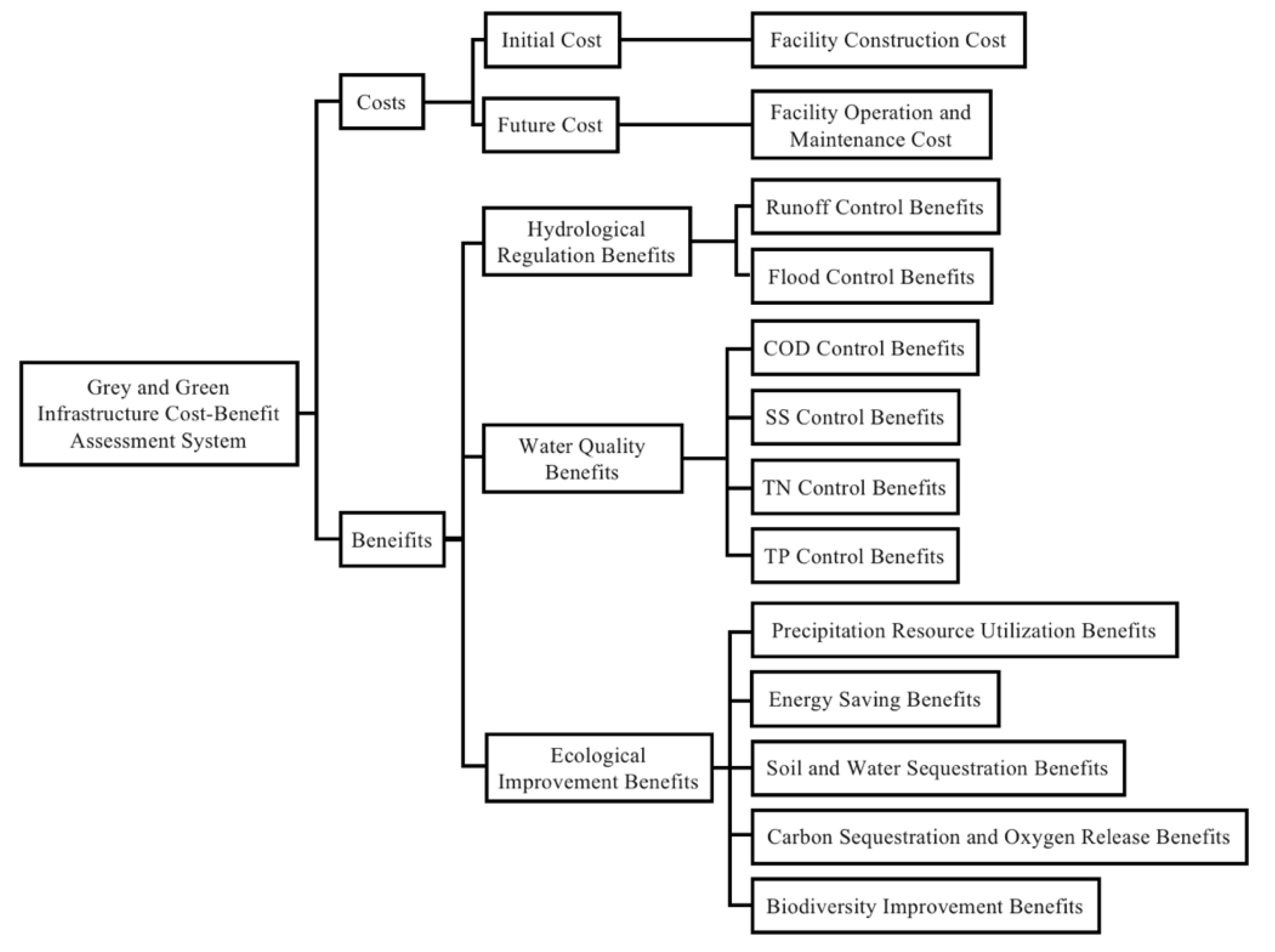
Figure 2.
Construction cost of major green infrastructure project.
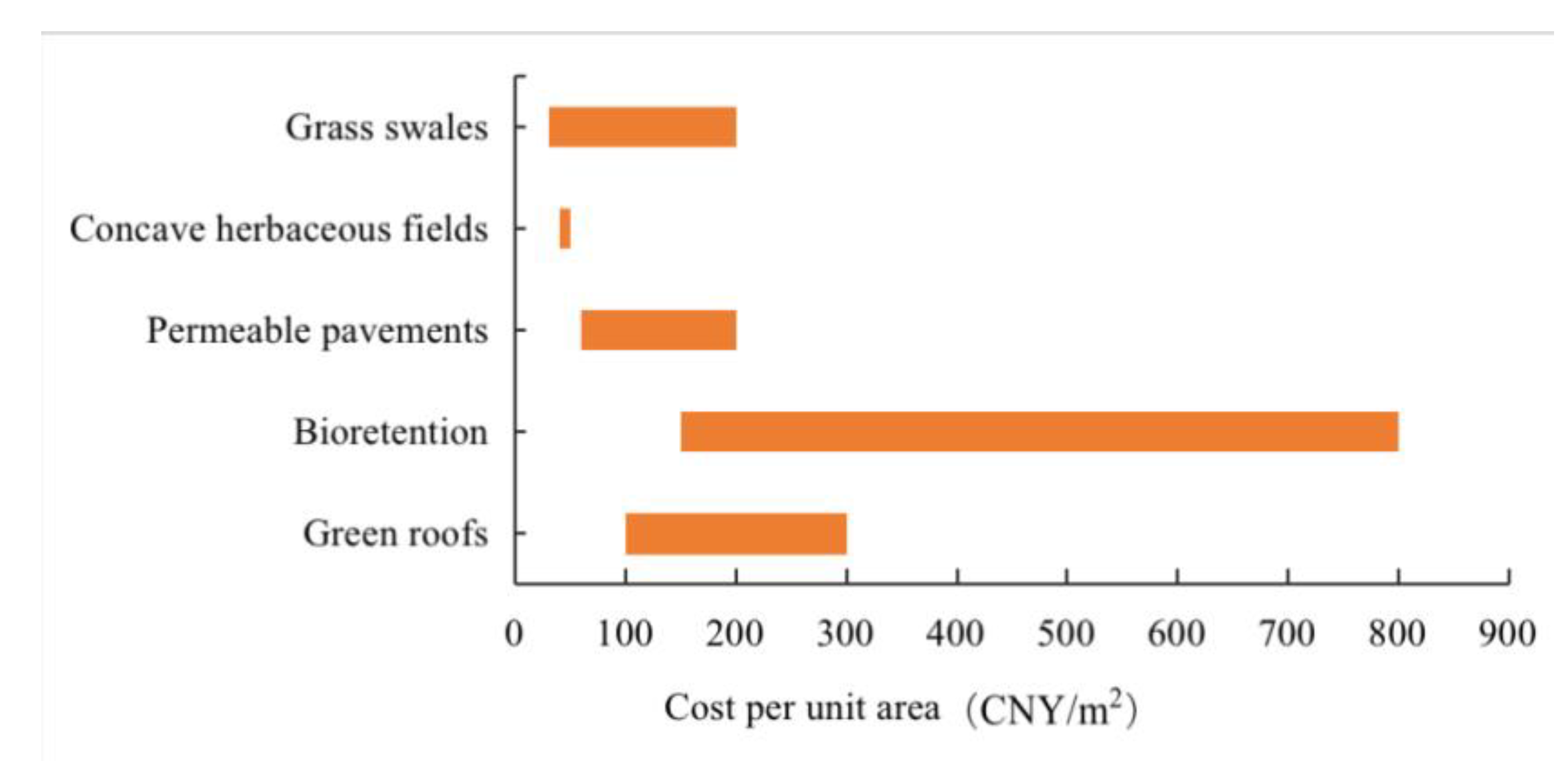
Figure 3.
(a) Distribution of land use types and layout of pipe networks in the study area; (b) Design location of grey and green infrastructure renovation in the study area & Probability of rainfall occurrence by level in Beijing from 2010 to 2019 (at the bottom right).
Figure 3.
(a) Distribution of land use types and layout of pipe networks in the study area; (b) Design location of grey and green infrastructure renovation in the study area & Probability of rainfall occurrence by level in Beijing from 2010 to 2019 (at the bottom right).
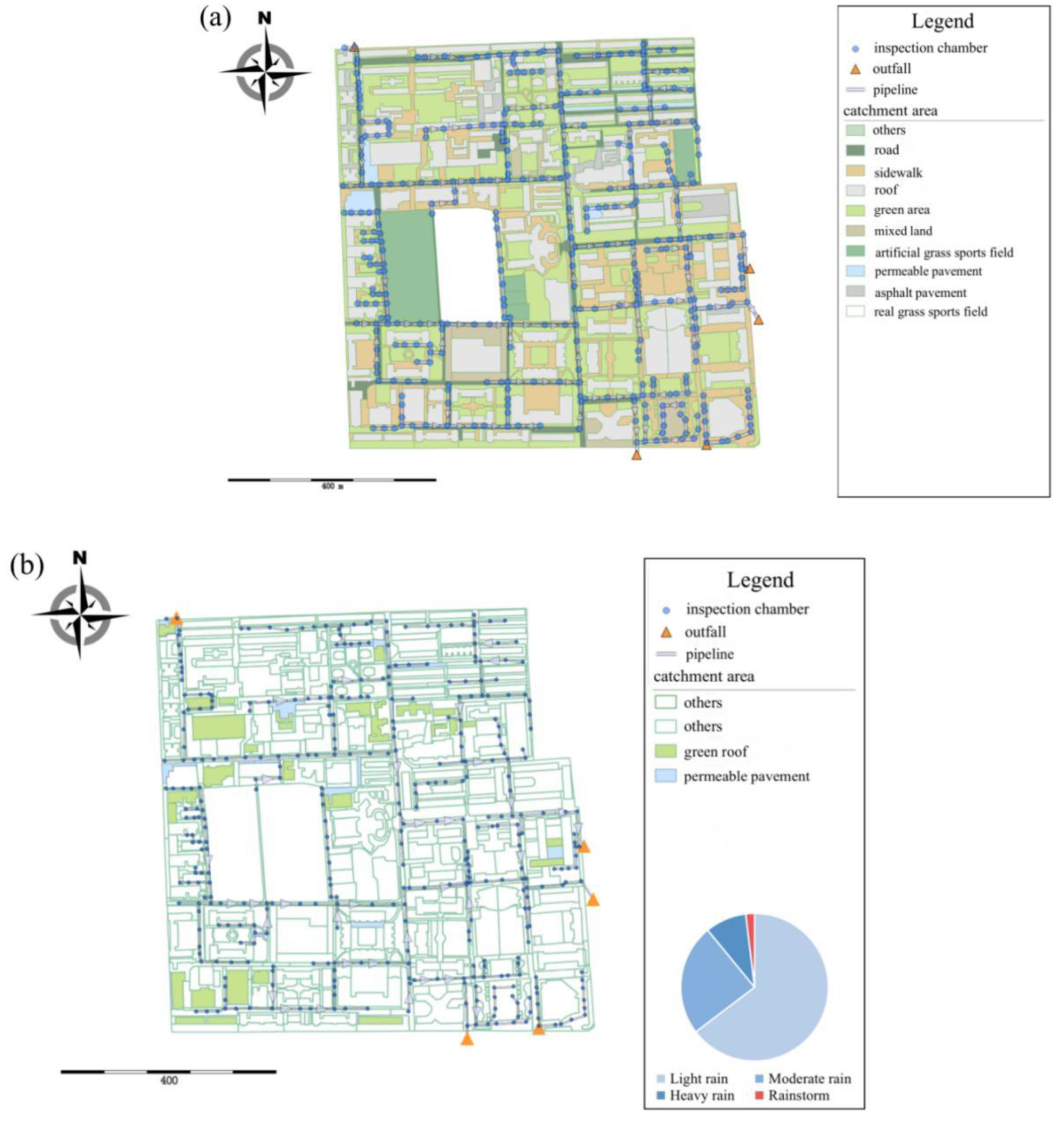
Figure 4.
Water quantity simulation calibration and validation results of SWMM in the study area.
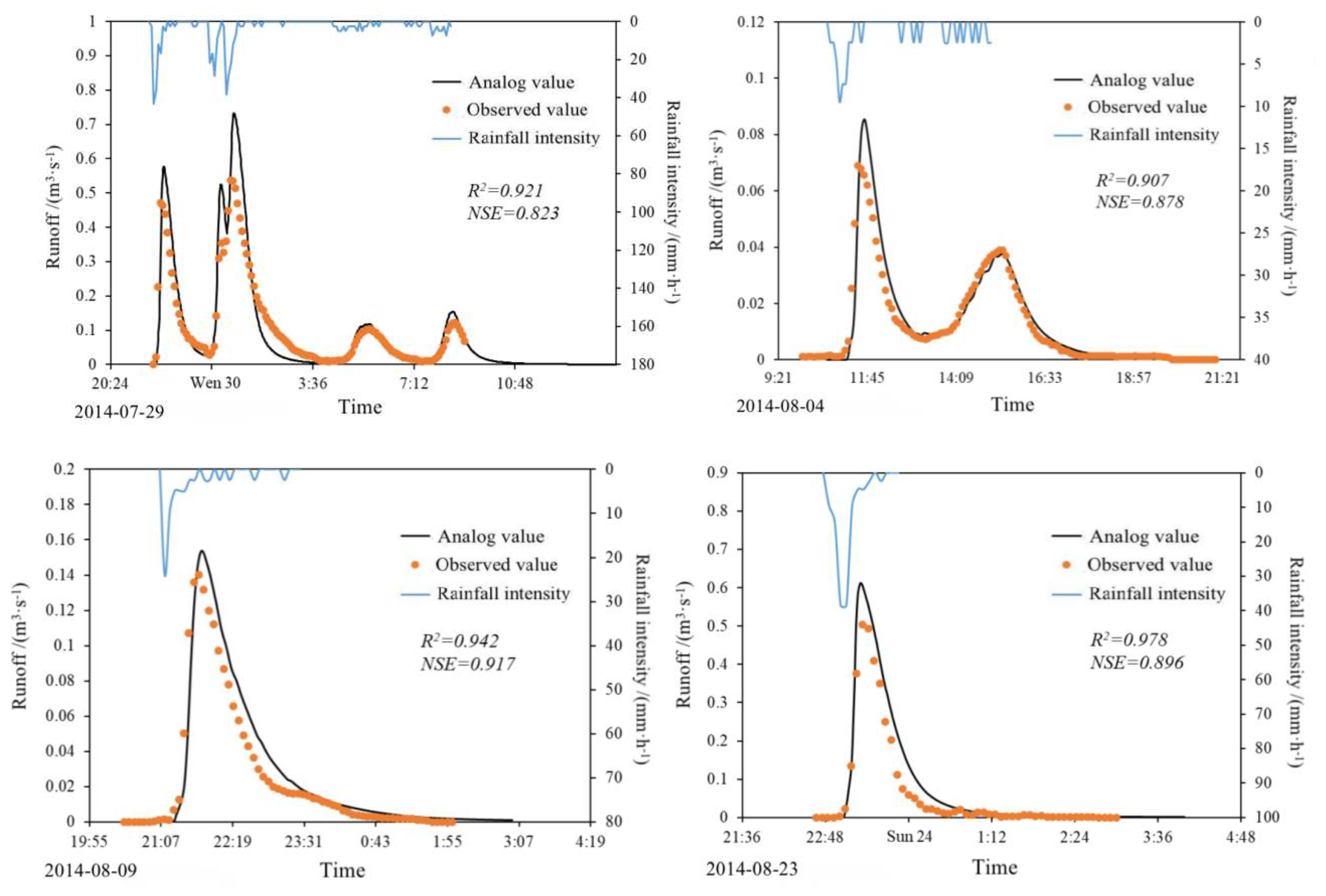
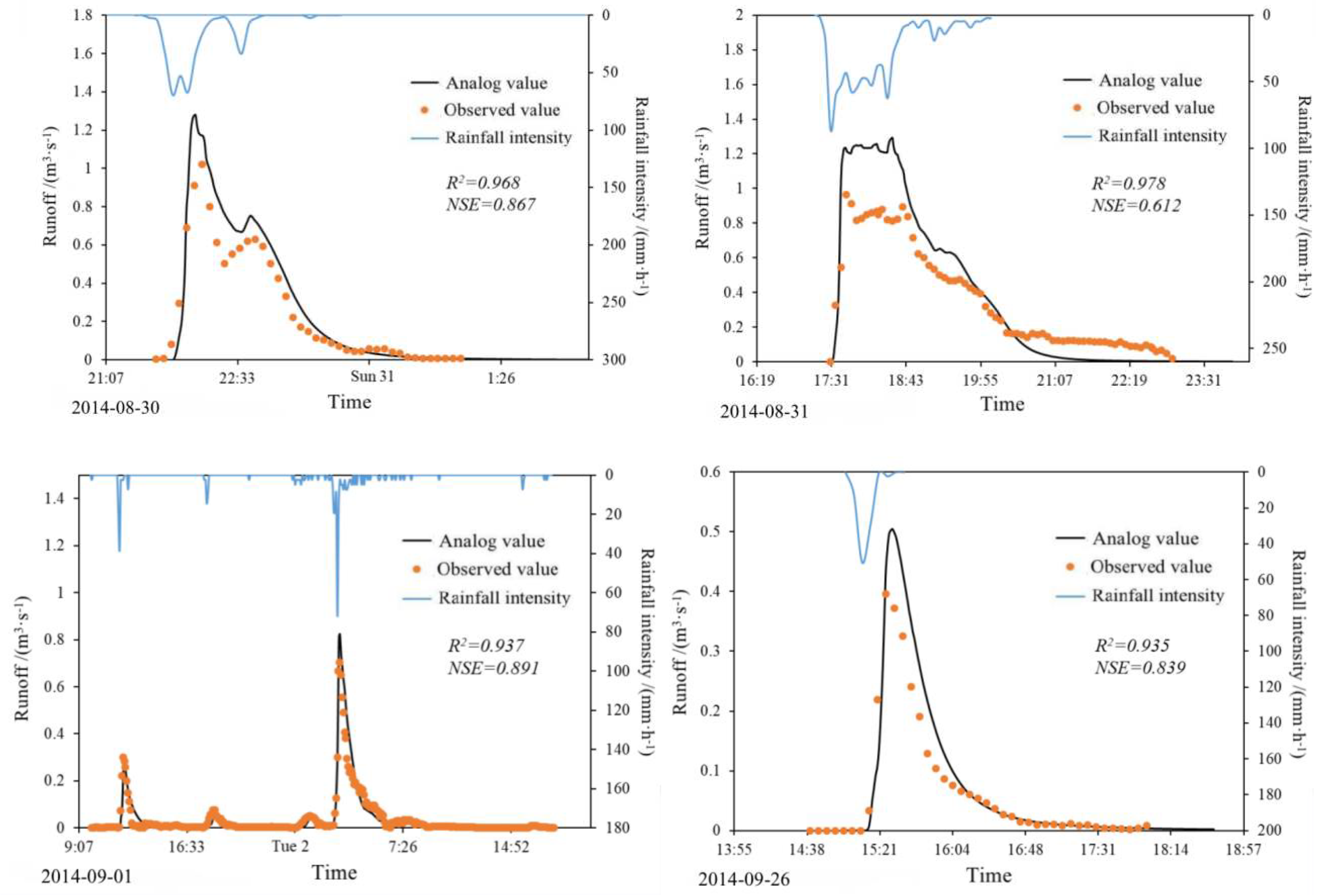
Figure 5.
Simulation results of nonpoint source pollution reduction in the study area.
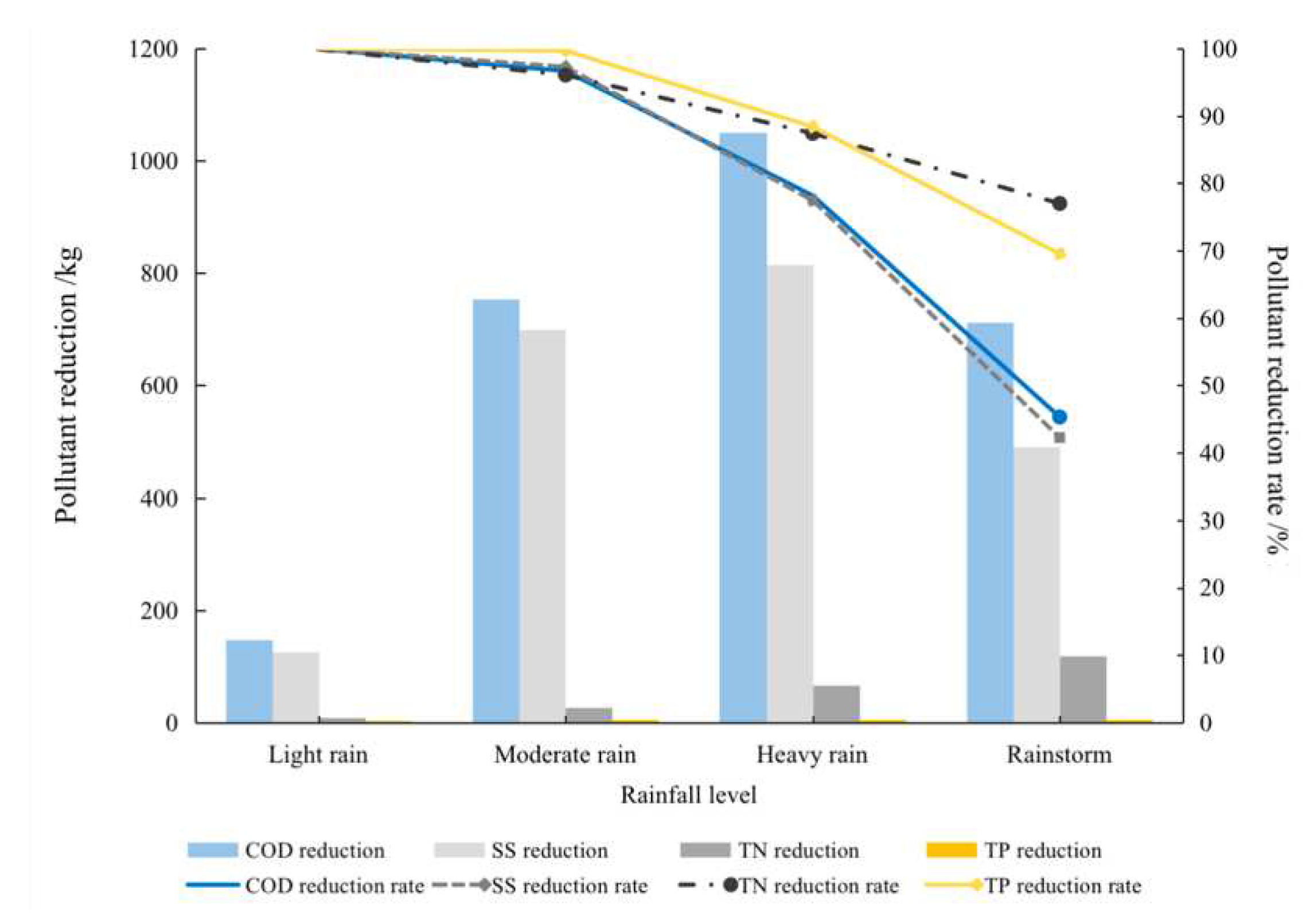

Table 1.
Hydrological, nonpoint source and ecological benefits in selected studies.
| Authors | Aspects |
|---|---|
| Glick et al. [16] | Runoff reduction rates were 77% for rain gardens, 29% for porous pavements and 15% for both green roofs and cisterns. |
| In realistic scenarios where all LIDs were implemented simultaneously, stormwater runoff was reduced by 30%. | |
| Peak flow rate reduced by 24%. | |
| Yasir Abduljaleel et al. [17] | The total runoff reduction rate is 80% under current conditions and 29% under future climate change conditions. |
| The total peak reduction rate is 62% under current conditions and 13% under future climate change conditions. | |
| The optimum combination of LIDs in the city could reduce the peak flow and total runoff volume by up to 62.25% and 80% for past storms and by13% and 29% for future storms, respectively. | |
| Infiltration trenches are the most effective in reducing peak and runoff flows, with rain gardens and bioretention ponds being less effective in reducing peak and total flows. | |
| The combined use of rain barrels, bioretention basins and infiltration trenches was the most effective LID for reducing peak flows and volumes in our study area. | |
| Quichimbo-Miguitama et al. [18] | The peak flows are reduced to 22% for general rainfall events and 15% for extreme rainfall events. |
| The total runoff reduction rate is approximately 20%. | |
| Flooded nodes were reduced to 27% in short-term events and 4% in extreme events. | |
| The reduction in flood overflow points was 27% for events with a rainfall return period of 2 years, 23% for events with a return period of 5 years and 13% for events with a return period of 10 years. | |
| Seo et al. [19] | The total land runoff reduction rate is 29% in conventional medium density cities and 25% in conservation medium density cities. |
| Nitrate loads from land use were reduced by 24%, 31% and 30% for different urban types. | |
| TP loads in land use fell by 11%, 25% and 22% for different urban types. | |
| Deng et al. [20] | The total runoff reduction rate is 35.08%. |
| The peak flow reduction rate is 26.82%. | |
| The nonpoint source pollution reduction rate is 45.18%. | |
| LeBleu et al. [21] | The average leachate temperature in permeable paving is approximately 2 degrees Celsius lower than in pavement runoff. |
| Shen [22] | Before 8 a.m., the temperature difference between the green roof and the concrete roof is 1 degree Celsius. |
| 2 p.m. is the point at which the temperature difference between the green roof and the concrete roof is greatest, with a difference of 18 degrees Celsius. | |
| Lin et al. [23] | The carbon sequestration of green land is 5450 kg carbon dioxide equivalent·a-1. |
| The carbon sequestration of rainwater utilization is 15379 kg carbon dioxide equivalent·a-1. | |
| The carbon sequestration of runoff pollutant removal is 19552 kg carbon dioxide equivalent·a-1. | |
| Saadatpour et al. [28] | The peak flow reduction rate is 80%. |
| The SS reduction rate is 81.86%. |
Table 2.
Design parameters for green infrastructure retrofit.
| Green Roof | Indexes | Value | Permeable Pavement | Indexes | Value |
|---|---|---|---|---|---|
| Surface | Height of the berm/mm | 250 | Surface | Height of the berm/mm | 20 |
| Vegetation coverage | 0.9 | Vegetation coverage | 0.15 | ||
| Surface roughness | 0.1 | Surface roughness | 0.02 | ||
| Surface slope | 1 | Surface slope | 1 | ||
| Soil | Thickness/mm | 100 | Pavement | Thickness/mm | 150 |
| Porosity | 0.463 | Voids ratio | 0.21 | ||
| Actual water content volume | 0.232 | Permeability /(mm·h-1) | 2000 | ||
| Withering point | 0.116 | Blockage coefficient | 83 | ||
| Conductivity /(mm·h-1) | 3.6 | Soil | Thickness/mm | 100 | |
| Conductivity slope | 10 | Porosity | 0.463 | ||
| Suction head/mm | 88.9 | Actual water content volume | 0.232 | ||
| Drainage mat | Thickness/mm | 100 | Withering point | 0.116 | |
| Voids ratio | 0.5 | Conductivity /(mm·h-1) | 3.6 | ||
| Manning roughness | 0.02 | Conductivity slope | 10 | ||
| Suction head/mm | 88.9 | ||||
| Storage | Thickness/mm | 300 |
Table 3.
Water quality conditions of eight representative rainfall events in the study area in 2014.
Table 3.
Water quality conditions of eight representative rainfall events in the study area in 2014.
| Rainfall Events | Duration of Rainfall/min | Precipitation/mm | volume Capture Ratio of Annual Rainfall/% | Average Concentration of COD /(mg·L-1) |
Average Concentration of SS /(mg·L-1) |
Average Concentration of TN /(mg·L-1) |
Average Concentration of TP /(mg·L-1) |
|---|---|---|---|---|---|---|---|
| 0804 Light rain |
266.00 | 5.66 | 0.79 | 5.06 | 2.67 | 0.28 | 0.01 |
| 0809 Light rain |
125.00 | 5.64 | 0.76 | 7.96 | 4.47 | 0.36 | 0.01 |
| 0823 Moderate rain |
50.00 | 10.40 | 0.69 | 39.63 | 23.47 | 1.36 | 0.11 |
| 0926 Moderate rain |
25.00 | 7.80 | 0.71 | 35.08 | 21.14 | 1.10 | 0.09 |
| 0729 Heavy rain |
640.00 | 35.74 | 0.65 | 64.10 | 33.41 | 3.73 | 0.22 |
| 0830 Heavy rain |
115.00 | 29.00 | 0.67 | 62.06 | 29.97 | 3.37 | 0.25 |
| 0901 Heavy rain |
1885.00 | 33.60 | 0.70 | 76.06 | 36.67 | 3.54 | 0.25 |
| 0831 Rainstorm |
170.00 | 70.56 | 0.68 | 63.05 | 31.05 | 5.76 | 0.30 |
Table 4.
Calibration results of main parameters of SWMM in the study area.
| Parameter | Calibration Result | Parameter | Calibration Result |
|---|---|---|---|
| N-Imperv | 1.20E-02 | Dstore-Asphalt Pavements/mm | 1.15 |
| N-Perv | 0.80 | Dstore-Roofs/mm | 1.23 |
| Max.Infil.Rate/(mm·h-1) | 150.00 | Dstore-Concrete Pavements/mm | 1.34 |
| Min.Infil.Rate/(mm·h-1) | 20.00 | Dstore-Sports Field 1/mm | 1.77 |
| Decay Constant/(h-1) | 2.00 | Dstore-Sports Field 2/mm | 1.68 |
| Zero-Imperv/% | 25.00 | Dstore-Mixed Land/mm | 2.22 |
| Pipe Roughness | 1.50E-02 | Dstore-Perv/mm | 10.20 |
Table 5.
Water quality simulation calibration and validation NSE results of SWMM in the study area.
| Determination of Model Parameters | Rainfall Events | COD | NH3-N | TP |
|---|---|---|---|---|
| Calibration | 0729 | 0.613 | 0.625 | 0.594 |
| 0830 | 0.483 | -5.420 | 0.542 | |
| 0926 | 0.507 | 0.523 | 0.341 | |
| Validation | 0804 | 0.546 | 0.487 | -0.344 |
| 0831 | 0.669 | 0.373 | 0.477 |
Table 6.
Cost-effectiveness evaluation method parameters.
| Parameter | Value | Parameter | Value |
|---|---|---|---|
| 30a | 5% | ||
| 1.23 CNY/(m3) | 6.11 CNY/(m3) | ||
| 0.013kg/(m2·d) | 0.018kg/(m2·d) | ||
| 141 CNY/t | 1108 CNY/t | ||
| 4.14 CNY/kg | 52.4 CNY/kg | ||
| 23 CNY/kg | 4.96 CNY/kg | ||
| 1.24 CNY/kg | 0.176 CNY/kg | ||
| 0.996 CNY/kg |
Table 7.
Simulation results of runoff control in the study area.
| Rainfall Level | Total Runoff Reduction/m3 | Total Runoff Reduction Rate/% | Peak Flow Reduction/(m3·s-1) | Peak Flow Reduction Rate/% |
|---|---|---|---|---|
| Light rain | 7.53E-07 | 99.69 | 0.12 | 99.61 |
| Moderate rain | 1.59E-06 | 97.96 | 0.55 | 99.17 |
| Heavy rain | 5.58E-06 | 90.52 | 0.84 | 89.80 |
| Rainstorm | 1.07E-05 | 80.88 | 0.89 | 68.51 |
Table 8.
Benefits and costs of grey and green infrastructure in the study area.
| Benefits and Costs | Indexes | Light Rain | Moderate Rain | Heavy Rain | Rainstorm |
|---|---|---|---|---|---|
| - | Average number of fields/(a-1) | 40.80 | 15.40 | 5.70 | 1.20 |
| Runoff control benefits | Runoff control benefit/(CNY·field-1) | 2492.00 | 3944.24 | 13128.96 | 25251.08 |
| Runoff control benefit/(CNY·a-1) | 101673.57 | 60741.30 | 74835.10 | 30301.30 | |
| Flood control benefits | Flood control benefit/(CNY·field-1) | NA | NA | NA | 6812.65 |
| Flood control benefit/(CNY·a-1) | NA | NA | NA | 8175.18 | |
| Water quality benefits | COD control benefit/(CNY·field-1) | 796.13 | 4055.82 | 5657.12 | 3828.30 |
| SS control benefit/(CNY·field-1) | 621.29 | 3472.64 | 4045.43 | 2432.43 | |
| TN control benefit/(CNY·field-1) | 190.76 | 634.80 | 1601.59 | 2830.35 | |
| TP control benefit/(CNY·field-1) | 14.20 | 119.35 | 251.31 | 312.30 | |
| Water quality benefit/(CNY·field-1) | 1622.37 | 8282.62 | 11555.45 | 9403.39 | |
| Water quality benefit/(CNY·a-1) | 66192.85 | 127552.27 | 65866.07 | 11284.07 | |
| Hydrological regulation and water quality benefits | Hydrological regulation and water quality benefits/(CNY·a-1) | 167866.42 | 188293.57 | 140701.17 | 49760.54 |
| Ecological benefits | Carbon sequestration benefit/(CNY·d-1) | 50.29 | |||
| Oxygen release benefit/(CNY·d-1) | 547.16 | ||||
| Ecological benefits/(CNY·a-1) | 218070.24 | ||||
| Total benefits | Total benefits/(CNY) | 11755189.30 | |||
| Construction costs of green infrastructure | Construction cost of permeable pavement/(CNY) | 723450.00 | |||
| Construction cost of green roof/(CNY) | 5487000.00 | ||||
| Total costs of green infrastructure/(CNY) | 9074545.15 | ||||
| Construction costs of grey infrastructure | Construction cost of pipe network /(CNY) | 549368.40 | |||
| Total costs of grey infrastructure/(CNY) | 802722.56 | ||||
| Total costs | Total costs/(CNY) | 9877267.72 | |||
Disclaimer/Publisher’s Note: The statements, opinions and data contained in all publications are solely those of the individual author(s) and contributor(s) and not of MDPI and/or the editor(s). MDPI and/or the editor(s) disclaim responsibility for any injury to people or property resulting from any ideas, methods, instructions or products referred to in the content. |
© 2023 by the authors. Licensee MDPI, Basel, Switzerland. This article is an open access article distributed under the terms and conditions of the Creative Commons Attribution (CC BY) license (http://creativecommons.org/licenses/by/4.0/).
Copyright: This open access article is published under a Creative Commons CC BY 4.0 license, which permit the free download, distribution, and reuse, provided that the author and preprint are cited in any reuse.


