
Submitted:
26 June 2023
Posted:
27 June 2023
You are already at the latest version
Preprints on COVID-19 and SARS-CoV-2
Abstract
Fasting, a practice with historical roots in various cultures, has recently garnered significant interest in the field of medicine. In this article, we delve into the mechanisms underlying fasting-induced autophagy and its therapeutic applications for spike protein associated pathology. We explore the therapeutic potential of fasting on spike protein-related pathology and the role of interventions to upregulate autophagy, including compounds like spermidine, resveratrol, rapamycin, and metformin. In conclusion, fasting, coupled with an understanding of its nuances, holds promise as a therapeutic intervention for spike protein related diseases; with broad implications for human health. This review presents the therapeutic possibility of using autophagy to treat spike protein related diseases, and details the interventions to deploy this therapeutic modality.
Keywords:
Fasting
; autophagy
; long-COVID
; post-vaccination syndrome
; spike protein
; mitochondria
; mitophagy
1. Introduction
Fasting has been used by multiple different spiritual [1,2,3,4,5,6,7,8] and medicinal traditions [9], including ancient Greek medicine, traditional Chinese medicine, Ayurveda, Indigenous medicine of the Americas, shamanic medicine, the Islamic world (Table 1).
There are a great many indigenous cultures that practice some form of fasting or food deprivation. Additionally, fasting may help in various diseases, particularly metabolic disorders, cancers and neurodegenerative diseases [16,17,18].
While fasting is identified for its therapeutic effect in these other instances, there is a potential therapeutic course for fasting in removing spike protein, an associated factor [19] and possible aetiological agent [20] in long COVID. This article describes the therapeutic potential of autophagy in treating spike protein related ailments, including long COVID-19 and post-vaccination syndrome from COVID-19 vaccines encoding the spike protein. Induction of autophagy can be facilitated via several therapeutic avenues, including fasting [21], fasting mimetics [22] and nutritional support [21]. Clinical use of autophagy is still limited, however, clinical trials are demonstrating positive results [23], and knowledge is disseminating from practitioners to the scientific field and vice-versa.
This review presents the pathophysiology of spike protein and its interference with the autophagic machinery of the body [24], and how autophagy can be used to clear its lingering damage, especially in mitochondria [25]. We then explore the various ways to upregulate autophagy and mitophagy, as well to restore mitochondrial function through promotion of mitogenesis and improving mitochondrial efficiency.
2. Pathophysiology related to spike protein
Spike protein can increase levels of pyroptosis, an inflammatory process for destroying cells [26], and downregulates autophagy [27], though spike protein can upregulate autophagy and apoptosis in ACE2 expressing cells [28]. In the latter case of spike protein-induced autophagy and apoptosis, this is a highly inflammatory process [28,29].
Spike protein S1 subunit, as well as the full trimer, can induce mitochondrial damage [25,30,31], lowering to decreased mitochondrial energy production [25,30] and the accumulation of ROS [25]. Under normal physiological conditions, damaged mitochondria are cleared via PINK1/Parkin mediated mitophagy [32,33,34], however, spike protein S1 subunit (S1) and Receptor binding domain (RBD) segments both inhibit mitophagy and increase mitochondrial ROS [24]. Here, the impact on mitophagy differs between vaccination and infection; in SARS-CoV-2 infection, the ORF10 element upregulates mitophagy [35], which may partially compensate for the inhibition of mitophagy by spike protein. In addition to damaging mitochondria [25,30,31], and inhibiting turnover via mitophagy [24], energy production can also be affected by blood clots interfering with tissue oxygenation, which many COVID-19 patients experienced [36,37]. Hypoxic conditions negatively impact mitochondrial energy production [38,39].
A wide variety of other harms are attributed to the spike protein [40], including inflammation [41,42,43], vascular damage [44,45,46], potential disruption of the blood-brain barrier [47], and the formation of aggregates [48,49]. Several autopsies from those deceased soon after vaccination show spike protein in cardiac [50,51,52] and brain [53] tissue. Lack of the nucleocapsid protein in these autopsies rules out SARS-CoV-2 infection as the cause of death [50,53], supporting vaccination as the primary cause of death.
3. Autophagy mechanism
Autophagy in mammals proceeds through a series of steps, whereby abnormal proteins are marked for degradation, and an autophagosome forms around the cell contents marked for degradation. Then, a lysosome fuses to the autophagosome, and the cellular contents of the lysosome break down the contents of the autophagosome. This can be induced towards the degradation of specific cell components or towards the degradation of general cytoplasmic contents.
It was observed in the initial experiments by Ohsumi that yeast cells deficient in genes necessary for autophagy rapidly died under nutrient starvation, whereas control yeast cells survived [54]. This difference in robustness was later attributed to the accumulation of defective mitochondria in the autophagy deficient yeast cells [55]. Several lines of evidence converge to the understanding that spike protein both impairs mitochondrial function [30,31,56], as well as the process of mitophagy [56]. Mitophagy is important for the maintenance of cellular energy production [57], and it is downregulated or completely inhibited in various cancers [58], neurodegenerative diseases [32,59].
One of the pathological features of COVID-19 is the negative impact on kidney function. This may possibly be through the induction of reactive oxygen species by damaged mitochondria [60], which may explain why those with pre-existing kidney disorders suffered far worse COVID-19 outcomes than other groups, [61,62].
Autophagy has two major roles in treating spike-protein related illness. As spike protein both damages mitochondria [30,31,56] and also inhibits their clearance through mitophagy [56], it is important to clear out the damaged mitochondria and restore proper energy function. Additionally, the other role is the removal of the spike protein itself, whether as a protein or composing an aggregate, where the aggregate can be composed of possibly misfolded proteins.
3.2. Regulation of Autophagy
Autophagy is regulated by a complex network of genes [63,64,65], and can broadly be divided into non-selective and selective autophagy, though both proceed through the formation of an autophagosome, fusion with a lysosome to form an autolysosome, and degradation of the contents (Figure 1). Selective autophagy requires the process of ubiquitination before autophagy, where the targets are marked by ubiquitin chains, which stimulate the formation of an isolation membrane around the target contents. Targets are usually damaged organelles, misfolded proteins, or aggregates, which are sensed by the ubiquitin-proteasome system [66].
Misfolded proteins are sensed by a network of protein specific chaperones, which can refold misfolded proteins [67]. In cases where the protein is irreversibly misfolded, the chaperone can induce protein degradation via the proteasome [68], or through the chaperone-mediated autophagy (CMA) pathway [69], presumed to be only present in mammals and birds [70,71]. The CMA pathway is stimulated by ketone bodies [72], which is a possible mechanism of its upregulation during fasting [73,74]. Dysregulation of CMA is observed in several disorders, and is a potential therapeutic moiety for several disorders, including age-related diseases and cancer [16,17,18].
4. Autophagy of spike protein and aggregates
Removal of spike protein can be accomplished in part by autophagy [79], which can be upregulated via interventions such as fasting, heat therapy and ozone. Additionally, there are also some specific compounds that may be taken to hasten the removal of spike protein. Concerningly, spike protein bodies have been found in the autopsies of both people dying from severe COVID-19 outcomes, as well as those dying in temporal relation to receiving COVID-19 vaccines.
Specifically, these compounds include nattokinase, which has been observed in vitro to degrade extracellular and membrane-bound spike protein [80], and also prevents SARS-CoV-2 infection in vitro [81]. In addition, for proteolytic agents to even have solvent access to proteins, it is necessary to break apart aggregates [82]. Nattokinase, is a fibrinolytic compound derived from the fermentation of soy [83,84] which functions as a thrombolytic and fibrinolytic compound [83,85,86,87,88]. It is likely that nattokinase breaks down spike protein incorporated in fibroid-amyloid clots [89] as well as membrane bound spike protein and extracellular spike protein [80]. Nattokinase’ s ability to break down intracellular spike has not been tested, and little is known about its membrane permeability. However, computational prediction of membrane permeability for the nattokinase structure (PDB ID: 4DWW) [90] using the webserver BChemRF-CPPred [91] provides a permeability probability of 83%, so it is possible that nattokinase can enter the cell to degrade intracellular spike protein.
Bulk autophagy has some use in degrading cellular components indiscriminately, however, selective autophagy is useful for degrading specific targets, in our cases mitochondria (mitophagy) and aggregates (aggrephagy). Selective autophagy marks targets (often with ubiquitin) prior to encapsulation in the autophagosome and degradation in the autolysosome [63].
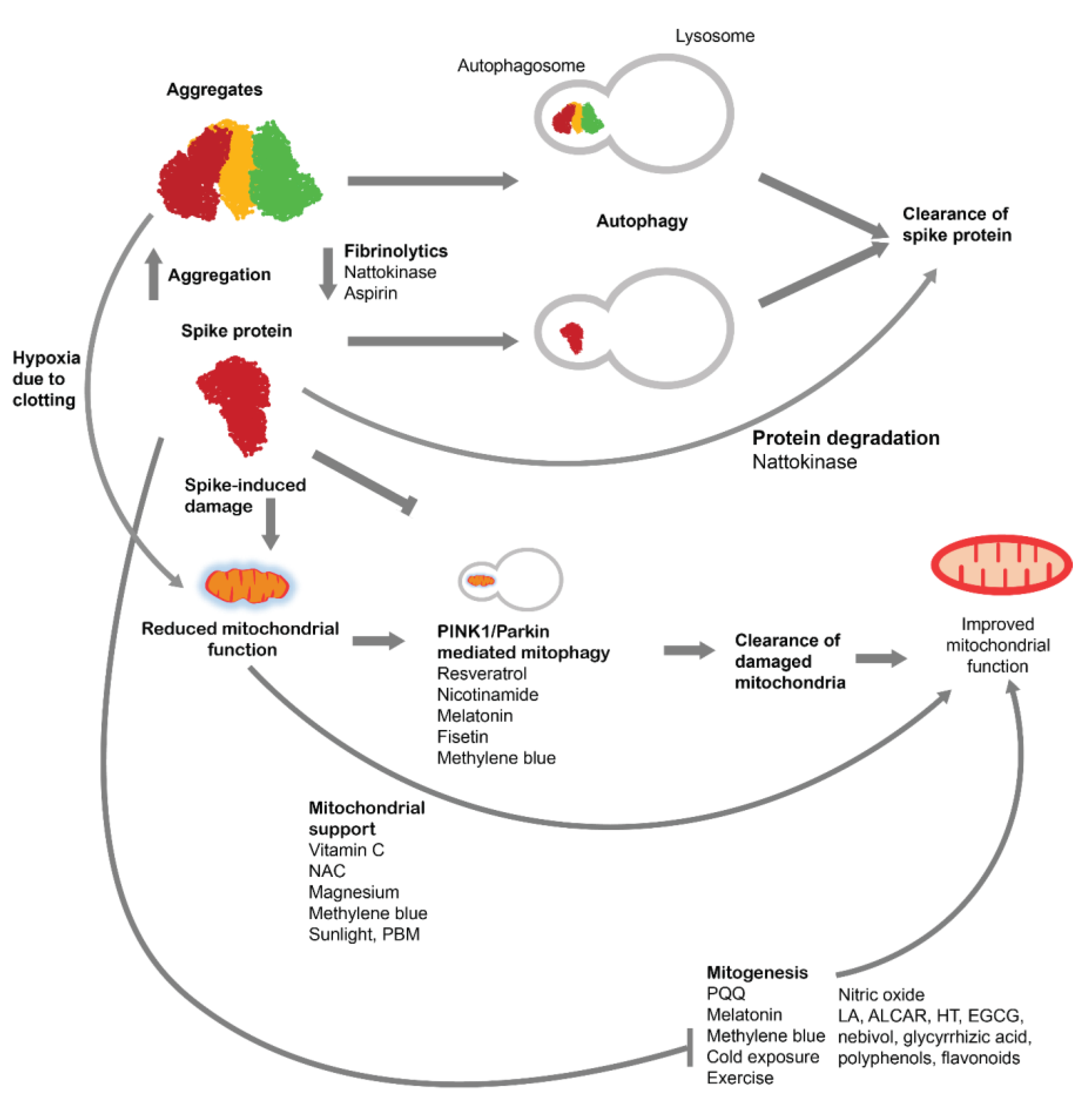
Figure 2.
Pathways involved in the pathogenesis of spike-protein induced damage and available therapeutic pathways.
Figure 2.
Pathways involved in the pathogenesis of spike-protein induced damage and available therapeutic pathways.
4. Autophagy for treatment of spike protein-induced pathologies
There are multiple points at which autophagy can be influenced, as there are many genes and signaling mechanisms regulating autophagy. The factors which influence autophagy are broadly broken into two classes, lifestyle (fasting) and pharmacological.
4.1. Fasting and autophagy
Time -restricted eating (TRE) and Intermittent fasting (IF) are effective methods to activate autophagy and mitophagy [92,93,94,95]. The mammalian target of rapamycin (mTOR) is a nutrient sensor and regulator of cell growth that is activated by glucose and protein (leucine) which switch on the pathway, inhibiting autophagy [96,97]. Under low nutrient conditions, mTOR is deactivated, which enables autophagy [98].
Fasting, by definition, means abstaining from eating. TRE is a type of fasting where food intake is limited to a short window during the day (1 to 8 hours), with only fluids such as water, tea, or coffee for the rest of the day [99]. IF usually involves a longer period of fasting; the most common is alternative day fasting (24-hour fasting, followed by a 24-hour eating window) [8]. However, many people fast for several days (3-7 days, or up to 14 days) followed by slow refeeding. [100]
TRE and IF have many metabolic, cellular, and immunologic benefits [101,102,103]. It is important to emphasize that TRE/IF are not synonymous with caloric restriction (CR), though people do tend to eat less ad libitum following a fasting regimen [104]. Additionally, eating nutrient-dense [105] and high-protein [106] foods can decrease the sensation of hunger. More extended (1-2 days) fasting, can increase basal metabolic rate (BMR) [107,108] and growth hormone (GH) levels [109,110]. Calorie-matched studies show a greater improvement in metabolic parameters (insulin sensitivity) in individuals adopting IF as opposed to CR [111,112].
TRE/IF has a profound effect on promoting immune system homeostasis [113]. Fasting improves mitochondrial health [114,115,116,117] and protects hematopoietic stem cells from damage [118]. TRE/IF may be an effective therapy for the treatment of insulin resistance [119], metabolic syndrome [120,121], and type II diabetes [122,123]. In addition, Intermittent fasting has additional benefit in prolonging health-span, alleviating the symptoms/curing many chronic diseases as well as preventing cardiovascular disease [124], neurodegenerative diseases [125] (e.g. Alzheimer’s Disease) and cancer [126].
4.2. Compounds for increasing autophagy
Increasing the level of autophagy is important to increase the rate at which foreign proteins and aggregates can be cleared. This section describes pharmacological strategies to induce or upregulate autophagy.
4.2.1. Spermidine
Spermidine is produced endogenously from the precursor putrescine. It is a polyamine which can stimulate autophagy via inhibition of the acetyltransferase EP300 [127]. It can be consumed exogenously and is found in high concentrations in wheat germ and other vegetables [128,129], though conflicting information exists on whether supplementation raises polyamine levels. Studies show that oral polyamine intake raises levels [130,131] supplementation does not appear to raise spermidine levels [132]. However, spermidine supplementation shows improvement in cognitive function in animal models [133]. In human trials, spermidine improved memory performance in older adults at risk for dementia [134] though this effect was not seen in a different study on older adults experiencing cognitive decline [135,136].
4.2.2. Caffeine
4.2.3. Resveratrol
Resveratrol is a plant phytochemical (non-flavonoid polyphenol) that is a potent inducer of autophagy [139,140]. In addition, resveratrol has anti-inflammatory [141] and antiviral [142] (incl. SARS-CoV-2) properties and has beneficial effects on the microbiome [143]. Resveratrol activates the fasting state [144] and inhibits mTOR-related inhibition of autophagy [145].
4.2.4. Curcumin
Curcumin, the active ingredient in turmeric, has antiviral activity against SARS-CoV-2. In addition, this spice has anti-inflammatory, immune-modulating properties, and potent anti-cancer activity [146]. Curcumin activates autophagy. [147,148] Curcumin has low solubility in water and is poorly absorbed by the body [149]; consequently, it is traditionally taken with full-fat milk and black pepper, the latter of which greatly enhances bioavailability [150]. Nano-curcumin preparations or formulations designed to enhance absorption are recommended [149].
4.2.5. Other compounds
There is some that evidence that Epigallocatechin gallate (EGCG) may increase autophagy [151,152]. The diabetes drug rapamycin is also a potent inducer of autophagy [153,154,155,156]. There are other compounds which may increase autophagy through various pathways, and some have supporting in vitro evidence. These were covered in a recent review [157].
4.2.6. Other non-pharmacological modalities
5. Improving mitochondrial function
In addition to clearing damaged mitochondria, it may be of therapeutic benefit to improve the mitochondrial function of the other mitochondria. Ideally, we do not want these processes to interfere.
5.1. Mitophagy
Spike protein can damage mitochondria [25,165], and is therefore important to both clear spike and restore the damaged mitochondria. Degradation of mitochondria via a selective form of autophagy, named mitophagy, is a fundamental mechanism conserved from yeast to humans that regulates mitochondrial quality and quantity control. Mitophagy is promoted via specific mitochondrial outer membrane receptors, or ubiquitin molecules conjugated to proteins on the mitochondrial surface (PINK1 and Parkin) leading to the formation of autophagosomes surrounding mitochondria. PINK1 is a protein that surveils for damaged mitochondria [33,166]. In healthy mitochondria, PINK1 is imported into the mitochondria, and then is subsequently cleaved by proteases (PARL and Oma1) on the inner mitochondrial membrane [167]. When mitochondria lose their membrane potential, PINK1 cannot reach the inner membrane [34] and accumulates in the outer mitochondrial membrane, where it begins to phosphorylate serine 65 on ubiquitin chains, which in turn activates Parkin [168,169,170,171], and subsequently signals mitophagy [172].
Disrupted mitochondrial membrane potential is the signal which ultimately leads to mitophagy, and several pathological mechanisms work by downregulating mitophagy via increasing the membrane potential [173]. There are several pharmacological pathways through which mitophagy can be induced [174]. Notably, this list includes the natural compounds resveratrol [175], fisetin [176], and nicotinamide [177], which have been examined for their potential therapeutic impacts in acute- or long-COVID [178,179,180]. Melatonin is another compound which can increase mitophagy [181,182,183].
5.2. Mitochondrial biogenesis
Clearing damaged mitochondria will leave a lack of energy production capacity in the cell if not replaced. Mitochondrial population is regulated through multiple processes, including mitochondrial fission (breaking apart to form more mitochondria), fusion [184] (two or more mitochondria fusing to reduce mitochondrial population), mitophagy [185] and mitochondrial biogenesis (MB) [186].
5.2.1. PQQ
Pyrroloquinoline quinone (PQQ) increases mitochondrial biogenesis via elevation of peroxisome proliferator-activated receptor γ coactivator-1α (PGC-1α), a biochemical marker for mitochondrial biogenesis [187].
5.2.2. Cold exposure
5.2.3. Endurance exercise
5.2.4. Nitric Oxide
Additionally, one pathway which increases mitochondrial biogenesis is via the production of nitric oxide (NO) [192,192,193], which can be upregulated during exercise [194,195], ultraviolet A light [196]. Plant studies also observe an increase in NO production during cold stress [197,198]. NO can also be upregulated by ROS [199], estrogen [200], statins [201].
5.2.5. Melatonin
5.2.6. Others
Other compounds have demonstrated potential in improving both mitochondrial biogenesis as well as mitochondrial function [115,205,206].
Lipoic acid (LA) has demonstrated capability to increase mitochondrial biogenesis [207,208,209]. Acetyl-L-Carnitine (ALCAR) also shows benefits when combined with LA [209], and other studies show ALCAR increases the expression of gene pathways in mitochondrial biogenesis [210,211,212]. Hydroxytyrosol, a compound in extra-virgin olive oil may also stimulate mitochondrial biogenesis [213]. The compound nebivolol, a beta blocker, also stimulates mitochondrial biogenesis [214]. EGCG [215,216,217], green tea polyphenols [218], isoflavones [219], quercetin [220], mulberry [221,222], anthocyanins [223], rutin [224], curcumin [225], glycyrrhizic acid (licorice) [226], cyanidin-3-glucoside [227], citrus tangeretin [228], isorhamnetin [229], nobiletin [230], eriocitrin (citrus lemon compound) [231], sudachitin (a flavone found in citrus fruit) [232], Amla (Indian medicinal plant) [233], and Platycodon grandiflorum extract [234] also may stimulate mitochondrial biogenesis [206].
5.3. Improving Mitochondrial Function
In addition to removing damaged mitochondria and restoring tissue oxygenation via the removal of clotting bodies, it is important to increase mitochondrial energy production. Studies demonstrate deleterious impacts of the spike protein [25], SARS-CoV-2 [235] and the COVID-19 mRNA vaccines [236] on mitochondrial parameters.
Mitochondrial dysfunction is a hallmark of long COVID [237,238,239,240], and multiple agents with a mitochondrial mode-of-action are currently being investigated therapeutically for long COVID [79]. Below, we include several factors known to improve mitochondrial function.
5.3.1. Vitamin C
Vitamin C has important anti-inflammatory [241], antioxidant [242], and immune-enhancing properties [243]. It is transported into the mitochondria and confers protection against oxidative injury [242], though little is known about its influence on mitochondria [244].
Oral Vitamin C helps promote the growth of protective bacterial populations in the microbiome [245]. As gut dysbiosis is associated with long COVID [246,247], supplemental vitamin C may confer benefit to those experiencing long COVID [248]. Trials on the impact of L-Arginine combined with Vitamin C showed positive results for long-COVID [249,250].
5.3.2. N-acetyl cysteine
N-acetyl cysteine (NAC) is the precursor of hepatic glutathione (GSH) [251]. NAC penetrates cells where it is deacetylated to yield L-cysteine thereby promoting GSH synthesis [251]. GSH is an important intracellular antioxidant [252]. In addition, NAC has anti-inflammatory and immune-modulating properties [253]. NAC is well absorbed by the intestine and supplementation with NAC is effective for increasing GSH levels [254]. NAC acts as a protective factor for mitochondrial energy production [255] and supplementation with glycine improves mitochondrial markers in older adults [256].
5.3.3. Magnesium
5.3.4. Methylene Blue
5.3.5. Light therapy
Modern humans currently spend the majority of their time indoors [267], approximately 93% by one survey of medical students [268]. Early humans were exposed to sunlight daily, likely with profoundly important health benefits [269]. A recent large prospective study demonstrated that avoiding sun exposure is a risk factor for all-cause mortality, demonstrating lower life expectancies (0.6 to 2.1 years) in those avoiding sun exposure when compared to the highest sun exposure group [270]. Apart from UV radiation stimulating vitamin D synthesis [271], red and near-infrared (NIR) radiation have a profound effect on human physiology [272], notably acting as a mitochondrial stimulant and increasing ATP production [273]. Indeed, during the 1918 influenza pandemic, “open-air treatment of influenzae” appeared to be an effective treatment for seriously ill patients [274].
The most well-studied mechanism of action of PBM centers around enhancing the activity of cytochrome c oxidase, which is unit four of the mitochondrial respiratory chain, responsible for the final reduction of oxygen to water. [275] In addition, one of the most reproducible effects of PBM is an overall reduction in inflammation [276]. It has also been demonstrated that NIR light increases the expression of genes associated with mitochondrial biogenesis [277].
5.3.6. Others
6. Conclusion
The spike protein, notably the S1 segment, is likely a pathogenetic factor leading to both long COVID and post-vaccination syndrome. Multiple intersecting and overlapping pathophysiologic processes contribute to the vast spectrum of pathology caused by spike-protein, including inflammation, clotting (fibrin-amyloid clots), autoantibodies, mitochondrial dysfunction, and endothelialitis. This is a novel pathology and requires the development of treatment protocols to meet this pressing need. Autophagy is a promising technique to remove foreign proteins and restore cellular function, as well as restoring cellular energy production. Some of the interventions discussed in this manuscript have been subject to study in the context of spike protein diseases [79], we include a table of current clinical trials and evidence summaries for the interventions in this manuscript in the appendix (Supplementary Table S1) [282,283,284,285,286,287,288,289,290,291,292,293,294,295,296,297,298,299,300,301,302,303,304,305,306,307,308,309,310,311,312,313,314,315,316,317,318,319,320,321,322,323,324,325].
Autophagy has a long and broad history in medicine as well as spiritual practice, its use in medicine, pending validation, is sure to increase, given its therapeutic potential. Modifiable lifestyle factors as well as pharmacological factors can upregulate autophagy. Further work is of course required in the development of spike-protein therapeutics, and their clinical validation, as well as extending the therapeutic use of fasting to other disorders. Autophagy has much potential in the future of medicine.
Supplementary Materials
The following supporting information can be downloaded at the website of this paper posted on Preprints.org. Table S1: Summary of current evidence on interventions mentioned in article for treating spike protein related diseases .
Author Contributions
Conceptualization, M.T.J.H. and P.E.M.; validation, P.E.M. and Y.M.S.; investigation, M.T.J.H., P.E.M. and Y.M.S.; writing—original draft preparation, M.T.J.H., P.E.M. and Y.M.S.; writing—review and editing, M.T.J.H., P.E.M. and Y.M.S.; visualization, M.T.J.H.; supervision, M.T.J.H.; project administration, M.T.J.H.; funding acquisition, M.T.J.H. and P.E.M. All authors have read and agreed to the published version of the manuscript.
Funding
This work was funded by donations to the World Council for Health and the Frontline Covid-19 Critical Care Alliance.
Institutional Review Board Statement
Not applicable.
Data Availability Statement
Clinical trials referenced in this manuscript may be found at clinicaltrials.gov.
Conflicts of Interest
M.T.J.H. is a member of the World Council for Health, a non-profit health advocacy organization.
References
- Venegas-Borsellino, C.; Sonikpreet; Martindale, R.G. From Religion to Secularism: The Benefits of Fasting. Curr Nutr Rep 2018, 7, 131–138. [CrossRef]
- Fazel, M. Medical Implications of Controlled Fasting. J R Soc Med 1998, 91, 260–263. [Google Scholar] [CrossRef] [PubMed]
- Sanchetee, P.; Sanchetee, P.; Garg, M.K. Effect of Jain Fasting on Anthropometric, Clinical and Biochemical Parameters. Indian J Endocrinol Metab 2020, 24, 187–190. [Google Scholar] [CrossRef] [PubMed]
- Cohen, K. Native American Medicine. Altern Ther Health Med 1998, 4, 45–57. [Google Scholar]
- Sanz-Biset, J.; Cañigueral, S. Plant Use in the Medicinal Practices Known as “Strict Diets” in Chazuta Valley (Peruvian Amazon). Journal of Ethnopharmacology 2011, 137, 271–288. [Google Scholar] [CrossRef]
- Krakoff, L.R. Fasting and Ambulatory Blood Pressure Monitoring. Blood Pressure Monitoring 2017, 22, 258. [Google Scholar] [CrossRef]
- Hoffman, V.J. Eating and Fasting for God in Sufi Tradition. Journal of the American Academy of Religion 1995, 63, 465–484. [Google Scholar] [CrossRef]
- Patterson, R.E.; Laughlin, G.A.; Sears, D.D.; LaCroix, A.Z.; Marinac, C.; Gallo, L.C.; Hartman, S.J.; Natarajan, L.; Senger, C.M.; Martínez, M.E.; et al. INTERMITTENT FASTING AND HUMAN METABOLIC HEALTH. J Acad Nutr Diet 2015, 115, 1203–1212. [Google Scholar] [CrossRef]
- Visioli, F.; Mucignat-Caretta, C.; Anile, F.; Panaite, S.-A. Traditional and Medical Applications of Fasting. Nutrients 2022, 14, 433. [Google Scholar] [CrossRef]
- Gaikwad, S.; Gaikwad, P.; Saxena, V. Principles of Fasting in Ayurveda. International Journal of Science, Environment and Technology 2017, 6, 787–792. [Google Scholar]
- Wang, C.; Ming, L.; Jia, L.; Wang, Q.; Cao, T.; Wang, L.; Zhou, Z.; Tong, D.; Li, W.; Wu, Y.; et al. Long-Term Extreme Fasting Following a Traditional Chinese “Bigu” Regimen: A Preliminary Retrospective and Prospective Cohort Study 2019.
- Ganesh Iyyer, S.; Mooventhan, A.; Nandakumar, B. Effectiveness of Liquid Fasting with Yoga and Naturopathy Treatments in Reducing Metabolic and Cardiovascular Risks in Obesity. Adv Mind Body Med 2021, 35, 24–28. [Google Scholar] [PubMed]
- Chockalingam, A.; Kumar, S.; Ferrer, M.S.; Gajagowni, S.; Isaac, M.; Karuparthi, P.; Aggarwal, K.; Shunmugam, S.; Amuthan, A.; Aggarwal, A.; et al. Siddha Fasting in Obese Acute Decompensated Heart Failure May Improve Hospital Outcomes through Empowerment and Natural Ketosis. EXPLORE 2022, 18, 714–718. [Google Scholar] [CrossRef] [PubMed]
- Ljungqvist, O.; Søreide, E. Preoperative Fasting. British Journal of Surgery 2003, 90, 400–406. [Google Scholar] [CrossRef]
- Temkin, O. The Falling Sickness: A History of Epilepsy from the Greeks to the Beginnings of Modern Neurology; JHU Press: Baltimore, MD, USA, 1994; Volume 4, ISBN ISBN 0-8018-4849-0. [Google Scholar]
- Hubert, V.; Weiss, S.; Rees, A.J.; Kain, R. Modulating Chaperone-Mediated Autophagy and Its Clinical Applications in Cancer. Cells 2022, 11, 2562. [Google Scholar] [CrossRef]
- Galan-Acosta, L.; Xia, H.; Yuan, J.; Vakifahmetoglu-Norberg, H. Activation of Chaperone-Mediated Autophagy as a Potential Anticancer Therapy. Autophagy 2015, 11, 2370–2371. [Google Scholar] [CrossRef]
- Kaushik, S.; Cuervo, A.M. The Coming of Age of Chaperone-Mediated Autophagy. Nat Rev Mol Cell Biol 2018, 19, 365–381. [Google Scholar] [CrossRef]
- Swank, Z.; Senussi, Y.; Manickas-Hill, Z.; Yu, X.G.; Li, J.Z.; Alter, G.; Walt, D.R. Persistent Circulating Severe Acute Respiratory Syndrome Coronavirus 2 Spike Is Associated With Post-Acute Coronavirus Disease 2019 Sequelae. Clinical Infectious Diseases 2023, 76, e487–e490. [Google Scholar] [CrossRef]
- Theoharides, T.C. Could SARS-CoV-2 Spike Protein Be Responsible for Long-COVID Syndrome? Mol Neurobiol 2022, 59, 1850–1861. [Google Scholar] [CrossRef]
- Attinà, A.; Leggeri, C.; Paroni, R.; Pivari, F.; Dei Cas, M.; Mingione, A.; Dri, M.; Marchetti, M.; Di Renzo, L. Fasting: How to Guide. Nutrients 2021, 13, 1570. [Google Scholar] [CrossRef]
- Kepp, O.; Chen, G.; Carmona-Gutierrez, D.; Madeo, F.; Kroemer, G. A Discovery Platform for the Identification of Caloric Restriction Mimetics with Broad Health-Improving Effects. Autophagy 2020, 16, 188–189. [Google Scholar] [CrossRef] [PubMed]
- Patikorn, C.; Roubal, K.; Veettil, S.K.; Chandran, V.; Pham, T.; Lee, Y.Y.; Giovannucci, E.L.; Varady, K.A.; Chaiyakunapruk, N. Intermittent Fasting and Obesity-Related Health Outcomes: An Umbrella Review of Meta-Analyses of Randomized Clinical Trials. JAMA Network Open 2021, 4, e2139558. [Google Scholar] [CrossRef]
- Liang, S.; Bao, C.; Yang, Z.; Liu, S.; Sun, Y.; Cao, W.; Wang, T.; Schwantes-An, T.-H.; Choy, J.S.; Naidu, S.; et al. SARS-CoV-2 Spike Protein Induces IL-18-Mediated Cardiopulmonary Inflammation via Reduced Mitophagy. Sig Transduct Target Ther 2023, 8, 1–15. [Google Scholar] [CrossRef] [PubMed]
- Clough, E.; Inigo, J.; Chandra, D.; Chaves, L.; Reynolds, J.L.; Aalinkeel, R.; Schwartz, S.A.; Khmaladze, A.; Mahajan, S.D. Mitochondrial Dynamics in SARS-COV2 Spike Protein Treated Human Microglia: Implications for Neuro-COVID. J Neuroimmune Pharmacol 2021, 16, 770–784. [Google Scholar] [CrossRef]
- Sun, X.; Yu, J.; Wong, S.H.; Chan, M.T.V.; Zhang, L.; Wu, W.K.K. SARS-CoV-2 Targets the Lysosome to Mediate Airway Inflammatory Cell Death. Autophagy 2022, 18, 2246–2248. [Google Scholar] [CrossRef]
- Nguyen, V.; Zhang, Y.; Gao, C.; Cao, X.; Tian, Y.; Carver, W.; Kiaris, H.; Cui, T.; Tan, W. The Spike Protein of SARS-CoV-2 Impairs Lipid Metabolism and Increases Susceptibility to Lipotoxicity: Implication for a Role of Nrf2. Cells 2022, 11, 1916. [Google Scholar] [CrossRef]
- Li, F.; Li, J.; Wang, P.-H.; Yang, N.; Huang, J.; Ou, J.; Xu, T.; Zhao, X.; Liu, T.; Huang, X.; et al. SARS-CoV-2 Spike Promotes Inflammation and Apoptosis through Autophagy by ROS-Suppressed PI3K/AKT/MTOR Signaling. Biochimica et Biophysica Acta (BBA) - Molecular Basis of Disease 2021, 1867, 166260. [Google Scholar] [CrossRef] [PubMed]
- Davidovich, P.; Kearney, C.J.; Martin, S.J. Inflammatory Outcomes of Apoptosis, Necrosis and Necroptosis. Biol Chem 2014, 395, 1163–1171. [Google Scholar] [CrossRef]
- Kim, E.S.; Jeon, M.-T.; Kim, K.-S.; Lee, S.; Kim, S.; Kim, D.-G. Spike Proteins of SARS-CoV-2 Induce Pathological Changes in Molecular Delivery and Metabolic Function in the Brain Endothelial Cells. Viruses 2021, 13, 2021. [Google Scholar] [CrossRef]
- Huynh, T.V.; Rethi, L.; Lee, T.-W.; Higa, S.; Kao, Y.-H.; Chen, Y.-J. Spike Protein Impairs Mitochondrial Function in Human Cardiomyocytes: Mechanisms Underlying Cardiac Injury in COVID-19. Cells 2023, 12, 877. [Google Scholar] [CrossRef]
- Pickrell, A.M.; Youle, R.J. The Roles of PINK1, Parkin, and Mitochondrial Fidelity in Parkinson’s Disease. Neuron 2015, 85, 257–273. [Google Scholar] [CrossRef]
- Tanaka, K. The PINK1–Parkin Axis: An Overview. Neuroscience Research 2020, 159, 9–15. [Google Scholar] [CrossRef]
- Jin, S.M.; Lazarou, M.; Wang, C.; Kane, L.A.; Narendra, D.P.; Youle, R.J. Mitochondrial Membrane Potential Regulates PINK1 Import and Proteolytic Destabilization by PARL. Journal of Cell Biology 2010, 191, 933–942. [Google Scholar] [CrossRef]
- Li, X.; Hou, P.; Ma, W.; Wang, X.; Wang, H.; Yu, Z.; Chang, H.; Wang, T.; Jin, S.; Wang, X.; et al. SARS-CoV-2 ORF10 Suppresses the Antiviral Innate Immune Response by Degrading MAVS through Mitophagy. Cell Mol Immunol 2022, 19, 67–78. [Google Scholar] [CrossRef]
- Couzin-Frankel, J. The Mystery of the Pandemic’s ‘Happy Hypoxia'. Science 2020, 368, 455–456. [Google Scholar] [CrossRef] [PubMed]
- Pujhari, S.; Paul, S.; Ahluwalia, J.; Rasgon, J.L. Clotting Disorder in Severe Acute Respiratory Syndrome Coronavirus 2. Reviews in Medical Virology 2021, 31, e2177. [Google Scholar] [CrossRef] [PubMed]
- Adzigbli, L.; Sokolov, E.P.; Wimmers, K.; Sokolova, I.M.; Ponsuksili, S. Effects of Hypoxia and Reoxygenation on Mitochondrial Functions and Transcriptional Profiles of Isolated Brain and Muscle Porcine Cells. Sci Rep 2022, 12, 19881. [Google Scholar] [CrossRef] [PubMed]
- Solaini, G.; Baracca, A.; Lenaz, G.; Sgarbi, G. Hypoxia and Mitochondrial Oxidative Metabolism. Biochimica et Biophysica Acta (BBA) - Bioenergetics 2010, 1797, 1171–1177. [Google Scholar] [CrossRef]
- Halma, M.T.J.; Rose, J.; Lawrie, T. The Novelty of MRNA Viral Vaccines and Potential Harms: A Scoping Review. J 2023, 6, 220–235. [Google Scholar] [CrossRef]
- Khan, S.; Shafiei, M.S.; Longoria, C.; Schoggins, J.W.; Savani, R.C.; Zaki, H. SARS-CoV-2 Spike Protein Induces Inflammation via TLR2-Dependent Activation of the NF-ΚB Pathway. Elife 2021, 10, e68563. [Google Scholar] [CrossRef]
- Hsu, A.C.-Y.; Wang, G.; Reid, A.T.; Veerati, P.C.; Pathinayake, P.S.; Daly, K.; Mayall, J.R.; Hansbro, P.M.; Horvat, J.C.; Wang, F.; et al. SARS-CoV-2 Spike Protein Promotes Hyper-Inflammatory Response That Can Be Ameliorated by Spike-Antagonistic Peptide and FDA-Approved ER Stress and MAP Kinase Inhibitors in Vitro 2020, 2020.09.30.317818.
- Forsyth, C.B.; Zhang, L.; Bhushan, A.; Swanson, B.; Zhang, L.; Mamede, J.I.; Voigt, R.M.; Shaikh, M.; Engen, P.A.; Keshavarzian, A. The SARS-CoV-2 S1 Spike Protein Promotes MAPK and NF-KB Activation in Human Lung Cells and Inflammatory Cytokine Production in Human Lung and Intestinal Epithelial Cells. Microorganisms 2022, 10, 1996. [Google Scholar] [CrossRef] [PubMed]
- Lei, Y.; Zhang, J.; Schiavon, C.R.; He, M.; Chen, L.; Shen, H.; Zhang, Y.; Yin, Q.; Cho, Y.; Andrade, L.; et al. SARS-CoV-2 Spike Protein Impairs Endothelial Function via Downregulation of ACE 2. Circulation Research 2021, 128, 1323–1326. [Google Scholar] [CrossRef] [PubMed]
- Choi, J.-Y.; Park, J.H.; Jo, C.; Kim, K.-C.; Koh, Y.H. SARS-CoV-2 Spike S1 Subunit Protein-Mediated Increase of Beta-Secretase 1 (BACE1) Impairs Human Brain Vessel Cells. Biochem Biophys Res Commun 2022, 626, 66–71. [Google Scholar] [CrossRef] [PubMed]
- Bhargavan, B.; Kanmogne, G.D. SARS-CoV-2 Spike Proteins and Cell-Cell Communication Inhibits TFPI and Induces Thrombogenic Factors in Human Lung Microvascular Endothelial Cells and Neutrophils: Implications for COVID-19 Coagulopathy Pathogenesis. Int J Mol Sci 2022, 23, 10436. [Google Scholar] [CrossRef]
- Buzhdygan, T.P.; DeOre, B.J.; Baldwin-Leclair, A.; Bullock, T.A.; McGary, H.M.; Khan, J.A.; Razmpour, R.; Hale, J.F.; Galie, P.A.; Potula, R.; et al. The SARS-CoV-2 Spike Protein Alters Barrier Function in 2D Static and 3D Microfluidic in-Vitro Models of the Human Blood-Brain Barrier. Neurobiol Dis 2020, 146, 105131. [Google Scholar] [CrossRef]
- Nyström, S.; Hammarström, P. Amyloidogenesis of SARS-CoV-2 Spike Protein. J Am Chem Soc 2022, 144, 8945–8950. [Google Scholar] [CrossRef]
- Petrlova, J.; Samsudin, F.; Bond, P.J.; Schmidtchen, A. SARS-CoV-2 Spike Protein Aggregation Is Triggered by Bacterial Lipopolysaccharide. FEBS Letters 2022, 596, 2566–2575. [Google Scholar] [CrossRef]
- Gill, J.R.; Tashjian, R.; Duncanson, E. Autopsy Histopathologic Cardiac Findings in 2 Adolescents Following the Second COVID-19 Vaccine Dose. Archives of Pathology & Laboratory Medicine 2022, 146, 925–929. [Google Scholar] [CrossRef]
- Schwab, C.; Domke, L.M.; Hartmann, L.; Stenzinger, A.; Longerich, T.; Schirmacher, P. Autopsy-Based Histopathological Characterization of Myocarditis after Anti-SARS-CoV-2-Vaccination. Clin Res Cardiol 2023, 112, 431–440. [Google Scholar] [CrossRef]
- Choi, S.; Lee, S.; Seo, J.-W.; Kim, M.-J.; Jeon, Y.H.; Park, J.H.; Lee, J.K.; Yeo, N.S. Myocarditis-Induced Sudden Death after BNT162b2 MRNA COVID-19 Vaccination in Korea: Case Report Focusing on Histopathological Findings. J Korean Med Sci 2021, 36, e286. [Google Scholar] [CrossRef] [PubMed]
- Mörz, M. A Case Report: Multifocal Necrotizing Encephalitis and Myocarditis after BNT162b2 MRNA Vaccination against COVID-19. Vaccines 2022, 10, 1651. [Google Scholar] [CrossRef]
- Tsukada, M.; Ohsumi, Y. Isolation and Characterization of Autophagy-Defective Mutants of Saccharomyces Cerevisiae. FEBS Letters 1993, 333, 169–174. [Google Scholar] [CrossRef]
- Suzuki, S.W.; Onodera, J.; Ohsumi, Y. Starvation Induced Cell Death in Autophagy-Defective Yeast Mutants Is Caused by Mitochondria Dysfunction. PLoS ONE 2011, 6, e17412. [Google Scholar] [CrossRef] [PubMed]
- Shang, C.; Liu, Z.; Zhu, Y.; Lu, J.; Ge, C.; Zhang, C.; Li, N.; Jin, N.; Li, Y.; Tian, M.; et al. SARS-CoV-2 Causes Mitochondrial Dysfunction and Mitophagy Impairment. Front Microbiol 2021, 12, 780768. [Google Scholar] [CrossRef]
- Yang, X.; Zhang, R.; Nakahira, K.; Gu, Z. Mitochondrial DNA Mutation, Diseases, and Nutrient-Regulated Mitophagy. Annu Rev Nutr 2019, 39, 201–226. [Google Scholar] [CrossRef]
- Chourasia, A.H.; Boland, M.L.; Macleod, K.F. Mitophagy and Cancer. Cancer & Metabolism 2015, 3, 4. [Google Scholar] [CrossRef]
- Park, H.; Kang, J.-H.; Lee, S. Autophagy in Neurodegenerative Diseases: A Hunter for Aggregates. International Journal of Molecular Sciences 2020, 21, 3369. [Google Scholar] [CrossRef]
- Su, L.; Zhang, J.; Gomez, H.; Kellum, J.A.; Peng, Z. Mitochondria ROS and Mitophagy in Acute Kidney Injury. Autophagy 2023, 19, 401–414. [Google Scholar] [CrossRef] [PubMed]
- Cheng, Y.; Luo, R.; Wang, K.; Zhang, M.; Wang, Z.; Dong, L.; Li, J.; Yao, Y.; Ge, S.; Xu, G. Kidney Disease Is Associated with In-Hospital Death of Patients with COVID-19. Kidney International 2020, 97, 829–838. [Google Scholar] [CrossRef]
- Bruchfeld, A. The COVID-19 Pandemic: Consequences for Nephrology. Nat Rev Nephrol 2021, 17, 81–82. [Google Scholar] [CrossRef] [PubMed]
- Vargas, J.N.S.; Hamasaki, M.; Kawabata, T.; Youle, R.J.; Yoshimori, T. The Mechanisms and Roles of Selective Autophagy in Mammals. Nat Rev Mol Cell Biol 2023, 24, 167–185. [Google Scholar] [CrossRef] [PubMed]
- Yamamoto, H.; Zhang, S.; Mizushima, N. Autophagy Genes in Biology and Disease. Nat Rev Genet 2023, 24, 382–400. [Google Scholar] [CrossRef] [PubMed]
- Lei, Y.; Klionsky, D.J. Transcriptional Regulation of Autophagy and Its Implications in Human Disease. Cell Death Differ 2023, 1–14. [Google Scholar] [CrossRef]
- Kriegenburg, F.; Ellgaard, L.; Hartmann-Petersen, R. Molecular Chaperones in Targeting Misfolded Proteins for Ubiquitin-Dependent Degradation. The FEBS Journal 2012, 279, 532–542. [Google Scholar] [CrossRef]
- Hartl, F.U.; Bracher, A.; Hayer-Hartl, M. Molecular Chaperones in Protein Folding and Proteostasis. Nature 2011, 475, 324–332. [Google Scholar] [CrossRef]
- Arndt, V.; Rogon, C.; Höhfeld, J. To Be, or Not to Be — Molecular Chaperones in Protein Degradation. Cell. Mol. Life Sci. 2007, 64, 2525. [Google Scholar] [CrossRef]
- Dice, J.F. Chaperone-Mediated Autophagy. Autophagy 2007, 3, 295–299. [Google Scholar] [CrossRef]
- Lescat, L.; Véron, V.; Mourot, B.; Péron, S.; Chenais, N.; Dias, K.; Riera-Heredia, N.; Beaumatin, F.; Pinel, K.; Priault, M.; et al. Chaperone-Mediated Autophagy in the Light of Evolution: Insight from Fish. Molecular Biology and Evolution 2020, 37, 2887–2899. [Google Scholar] [CrossRef]
- Liao, Z.; Wang, B.; Liu, W.; Xu, Q.; Hou, L.; Song, J.; Guo, Q.; Li, N. Dysfunction of Chaperone-Mediated Autophagy in Human Diseases. Mol Cell Biochem 2021, 476, 1439–1454. [Google Scholar] [CrossRef]
- Finn, P.F.; Dice, J.F. Ketone Bodies Stimulate Chaperone-MediatedAutophagy *. Journal of Biological Chemistry 2005, 280, 25864–25870. [Google Scholar] [CrossRef] [PubMed]
- Cuervo, A.M.; Knecht, E.; Terlecky, S.R.; Dice, J.F. Activation of a Selective Pathway of Lysosomal Proteolysis in Rat Liver by Prolonged Starvation. American Journal of Physiology-Cell Physiology 1995, 269, C1200–C1208. [Google Scholar] [CrossRef] [PubMed]
- Schneider, J.L.; Suh, Y.; Cuervo, A.M. Deficient Chaperone-Mediated Autophagy in Liver Leads to Metabolic Dysregulation. Cell Metabolism 2014, 20, 417–432. [Google Scholar] [CrossRef]
- Hurley, J.H.; Young, L.N. Mechanisms of Autophagy Initiation. Annual Review of Biochemistry 2017, 86, 225–244. [Google Scholar] [CrossRef] [PubMed]
- Montella-Manuel, S.; Pujol-Carrion, N.; Mechoud, M.A.; de la Torre-Ruiz, M.A. Bulk Autophagy Induction and Life Extension Is Achieved When Iron Is the Only Limited Nutrient in Saccharomyces Cerevisiae. Biochem J 2021, 478, 811–837. [Google Scholar] [CrossRef]
- Bento, C.F.; Renna, M.; Ghislat, G.; Puri, C.; Ashkenazi, A.; Vicinanza, M.; Menzies, F.M.; Rubinsztein, D.C. Mammalian Autophagy: How Does It Work? Annu. Rev. Biochem. 2016, 85, 685–713. [Google Scholar] [CrossRef]
- Cheng, X.; Chen, Q.; Sun, P. Natural Phytochemicals That Affect Autophagy in the Treatment of Oral Diseases and Infections: A Review. Frontiers in Pharmacology 2022, 13. [Google Scholar] [CrossRef] [PubMed]
- Halma, M.T.J.; Plothe, C.; Marik, P.; Lawrie, T.A. Strategies for the Management of Spike Protein-Related Pathology. Microorganisms 2023, 11, 1308. [Google Scholar] [CrossRef]
- Tanikawa, T.; Kiba, Y.; Yu, J.; Hsu, K.; Chen, S.; Ishii, A.; Yokogawa, T.; Suzuki, R.; Inoue, Y.; Kitamura, M. Degradative Effect of Nattokinase on Spike Protein of SARS-CoV-2. Molecules 2022, 27, 5405. [Google Scholar] [CrossRef]
- Oba, M.; Rongduo, W.; Saito, A.; Okabayashi, T.; Yokota, T.; Yasuoka, J.; Sato, Y.; Nishifuji, K.; Wake, H.; Nibu, Y.; et al. Natto Extract, a Japanese Fermented Soybean Food, Directly Inhibits Viral Infections Including SARS-CoV-2 in Vitro. Biochemical and Biophysical Research Communications 2021, 570, 21–25. [Google Scholar] [CrossRef]
- Grune, T.; Jung, T.; Merker, K.; Davies, K.J.A. Decreased Proteolysis Caused by Protein Aggregates, Inclusion Bodies, Plaques, Lipofuscin, Ceroid, and ‘Aggresomes’ during Oxidative Stress, Aging, and Disease. The International Journal of Biochemistry & Cell Biology 2004, 36, 2519–2530. [Google Scholar] [CrossRef]
- Fujita, M.; Nomura, K.; Hong, K.; Ito, Y.; Asada, A.; Nishimuro, S. Purification and Characterization of a Strong Fibrinolytic Enzyme (Nattokinase) in the Vegetable Cheese Natto, a Popular Soybean Fermented Food in Japan. Biochemical and Biophysical Research Communications 1993, 197, 1340–1347. [Google Scholar] [CrossRef]
- Sumi, H.; Hamada, H.; Tsushima, H.; Mihara, H.; Muraki, H. A Novel Fibrinolytic Enzyme (Nattokinase) in the Vegetable Cheese Natto; a Typical and Popular Soybean Food in the Japanese Diet. Experientia 1987, 43, 1110–1111. [Google Scholar] [CrossRef]
- Chen, H.; McGowan, E.M.; Ren, N.; Lal, S.; Nassif, N.; Shad-Kaneez, F.; Qu, X.; Lin, Y. Nattokinase: A Promising Alternative in Prevention and Treatment of Cardiovascular Diseases. Biomark�Insights 2018, 13, 1177271918785130. [Google Scholar] [CrossRef] [PubMed]
- Jang, J.-Y.; Kim, T.-S.; Cai, J.; Kim, J.; Kim, Y.; Shin, K.; Kim, K.S.; Park, S.K.; Lee, S.-P.; Choi, E.-K.; et al. Nattokinase Improves Blood Flow by Inhibiting Platelet Aggregation and Thrombus Formation. Lab Anim Res 2013, 29, 221–225. [Google Scholar] [CrossRef] [PubMed]
- Pais, E.; Alexy, T.; Holsworth, J.; Meiselman, H.J. Effects of Nattokinase, a pro-Fibrinolytic Enzyme, on Red Blood Cell Aggregation and Whole Blood Viscosity. Clinical Hemorheology and Microcirculation 2006, 35, 139–142. [Google Scholar] [PubMed]
- Kurosawa, Y.; Nirengi, S.; Homma, T.; Esaki, K.; Ohta, M.; Clark, J.F.; Hamaoka, T. A Single-Dose of Oral Nattokinase Potentiates Thrombolysis and Anti-Coagulation Profiles. Sci Rep 2015, 5, 11601. [Google Scholar] [CrossRef]
- Hsu, R.-L.; Lee, K.-T.; Wang, J.-H.; Lee, L.Y.-L.; Chen, R.P.-Y. Amyloid-Degrading Ability of Nattokinase from Bacillus Subtilis Natto. J. Agric. Food Chem. 2009, 57, 503–508. [Google Scholar] [CrossRef]
- Yanagisawa, Y.; Chatake, T.; Chiba-Kamoshida, K.; Naito, S.; Ohsugi, T.; Sumi, H.; Yasuda, I.; Morimoto, Y. Purification, Crystallization and Preliminary X-Ray Diffraction Experiment of Nattokinase from Bacillus Subtilis Natto. Acta Crystallogr Sect F Struct Biol Cryst Commun 2010, 66, 1670–1673. [Google Scholar] [CrossRef]
- Frallicciardi, J.; Gabba, M.; Poolman, B. Determining Small-Molecule Permeation through Lipid Membranes. Nat Protoc 2022, 17, 2620–2646. [Google Scholar] [CrossRef]
- Jamshed, H.; Beyl, R.A.; Della Manna, D.L.; Yang, E.S.; Ravussin, E.; Peterson, C.M. Early Time-Restricted Feeding Improves 24-Hour Glucose Levels and Affects Markers of the Circadian Clock, Aging, and Autophagy in Humans. Nutrients 2019, 11, 1234. [Google Scholar] [CrossRef]
- Alirezaei, M.; Kemball, C.C.; Flynn, C.T.; Wood, M.R.; Whitton, J.L.; Kiosses, W.B. Short-Term Fasting Induces Profound Neuronal Autophagy. Autophagy 2010, 6, 702–710. [Google Scholar] [CrossRef] [PubMed]
- Godar, R.J.; Ma, X.; Liu, H.; Murphy, J.T.; Weinheimer, C.J.; Kovacs, A.; Crosby, S.D.; Saftig, P.; Diwan, A. Repetitive Stimulation of Autophagy-Lysosome Machinery by Intermittent Fasting Preconditions the Myocardium to Ischemia-Reperfusion Injury. Autophagy 2015, 11, 1537–1560. [Google Scholar] [CrossRef] [PubMed]
- Martinez-Lopez, N.; Tarabra, E.; Toledo, M.; Garcia-Macia, M.; Sahu, S.; Coletto, L.; Batista-Gonzalez, A.; Barzilai, N.; Pessin, J.E.; Schwartz, G.J.; et al. System-Wide Benefits of Intermeal Fasting by Autophagy. Cell Metabolism 2017, 26, 856–871.e5. [Google Scholar] [CrossRef] [PubMed]
- Fernandes, S.A.; Demetriades, C. The Multifaceted Role of Nutrient Sensing and MTORC1 Signaling in Physiology and Aging. Frontiers in Aging 2021, 2. [Google Scholar] [CrossRef]
- Kim, J.; Guan, K.-L. MTOR as a Central Hub of Nutrient Signalling and Cell Growth. Nat Cell Biol 2019, 21, 63–71. [Google Scholar] [CrossRef]
- Yu, L.; McPhee, C.K.; Zheng, L.; Mardones, G.A.; Rong, Y.; Peng, J.; Mi, N.; Zhao, Y.; Liu, Z.; Wan, F.; et al. Termination of Autophagy and Reformation of Lysosomes Regulated by MTOR. Nature 2010, 465, 942–946. [Google Scholar] [CrossRef]
- Regmi, P.; Heilbronn, L.K. Time-Restricted Eating: Benefits, Mechanisms, and Challenges in Translation. iScience 2020, 23, 101161. [Google Scholar] [CrossRef]
- Longo, V.D.; Mattson, M.P. Fasting: Molecular Mechanisms and Clinical Applications. Cell Metab 2014, 19, 181–192. [Google Scholar] [CrossRef]
- Mattson, M.P.; Longo, V.D.; Harvie, M. Impact of Intermittent Fasting on Health and Disease Processes. Ageing Research Reviews 2017, 39, 46–58. [Google Scholar] [CrossRef]
- Anton, S.D.; Moehl, K.; Donahoo, W.T.; Marosi, K.; Lee, S.A.; Mainous, A.G.; Leeuwenburgh, C.; Mattson, M.P. Flipping the Metabolic Switch: Understanding and Applying the Health Benefits of Fasting. Obesity (Silver Spring) 2018, 26, 254–268. [Google Scholar] [CrossRef]
- Patterson, R.E.; Sears, D.D. Metabolic Effects of Intermittent Fasting. Annual Review of Nutrition 2017, 37, 371–393. [Google Scholar] [CrossRef]
- Chowdhury, E.A.; Richardson, J.D.; Tsintzas, K.; Thompson, D.; Betts, J.A. Effect of Extended Morning Fasting upon Ad Libitum Lunch Intake and Associated Metabolic and Hormonal Responses in Obese Adults. Int J Obes 2016, 40, 305–311. [Google Scholar] [CrossRef]
- Fuhrman, J.; Sarter, B.; Glaser, D.; Acocella, S. Changing Perceptions of Hunger on a High Nutrient Density Diet. Nutr J 2010, 9, 51. [Google Scholar] [CrossRef] [PubMed]
- Oliveira, C.L.P.; Boulé, N.G.; Berg, A.; Sharma, A.M.; Elliott, S.A.; Siervo, M.; Ghosh, S.; Prado, C.M. Consumption of a High-Protein Meal Replacement Leads to Higher Fat Oxidation, Suppression of Hunger, and Improved Metabolic Profile After an Exercise Session. Nutrients 2021, 13, 155. [Google Scholar] [CrossRef]
- Zauner, C.; Schneeweiss, B.; Kranz, A.; Madl, C.; Ratheiser, K.; Kramer, L.; Roth, E.; Schneider, B.; Lenz, K. Resting Energy Expenditure in Short-Term Starvation Is Increased as a Result of an Increase in Serum Norepinephrine. The American journal of clinical nutrition 2000, 71, 1511–1515. [Google Scholar] [CrossRef] [PubMed]
- Catenacci, V.A.; Pan, Z.; Ostendorf, D.; Brannon, S.; Gozansky, W.S.; Mattson, M.P.; Martin, B.; MacLean, P.S.; Melanson, E.L.; Troy Donahoo, W. A Randomized Pilot Study Comparing Zero-calorie Alternate-day Fasting to Daily Caloric Restriction in Adults with Obesity. Obesity 2016, 24, 1874–1883. [Google Scholar] [CrossRef] [PubMed]
- Thissen, J.-P.; Ketelslegers, J.-M.; Underwood, L.E. Nutritional Regulation of the Insulin-like Growth Factors. Endocrine reviews 1994, 15, 80–101. [Google Scholar] [CrossRef] [PubMed]
- Ho, K.Y.; Veldhuis, J.D.; Johnson, M.L.; Furlanetto, R.; Evans, W.S.; Alberti, K.; Thorner, M. Fasting Enhances Growth Hormone Secretion and Amplifies the Complex Rhythms of Growth Hormone Secretion in Man. The Journal of clinical investigation 1988, 81, 968–975. [Google Scholar] [CrossRef]
- Harvie, M.N.; Pegington, M.; Mattson, M.P.; Frystyk, J.; Dillon, B.; Evans, G.; Cuzick, J.; Jebb, S.A.; Martin, B.; Cutler, R.G. The Effects of Intermittent or Continuous Energy Restriction on Weight Loss and Metabolic Disease Risk Markers: A Randomized Trial in Young Overweight Women. International journal of obesity 2011, 35, 714–727. [Google Scholar] [CrossRef]
- Harvie, M.; Wright, C.; Pegington, M.; McMullan, D.; Mitchell, E.; Martin, B.; Cutler, R.G.; Evans, G.; Whiteside, S.; Maudsley, S. The Effect of Intermittent Energy and Carbohydrate Restriction v. Daily Energy Restriction on Weight Loss and Metabolic Disease Risk Markers in Overweight Women. British Journal of Nutrition 2013, 110, 1534–1547. [Google Scholar] [CrossRef]
- He, Z.; Xu, H.; Li, C.; Yang, H.; Mao, Y. Intermittent Fasting and Immunomodulatory Effects: A Systematic Review. Frontiers in Nutrition 2023, 10. [Google Scholar] [CrossRef] [PubMed]
- Lettieri-Barbato, D.; Cannata, S.M.; Casagrande, V.; Ciriolo, M.R.; Aquilano, K. Time-Controlled Fasting Prevents Aging-like Mitochondrial Changes Induced by Persistent Dietary Fat Overload in Skeletal Muscle. PLOS ONE 2018, 13, e0195912. [Google Scholar] [CrossRef]
- Singh, R.; Mohapatra, L.; Tripathi, A.S. Targeting Mitochondrial Biogenesis: A Potential Approach for Preventing and Controlling Diabetes. Future Journal of Pharmaceutical Sciences 2021, 7, 212. [Google Scholar] [CrossRef]
- Rojas-Morales, P.; León-Contreras, J.C.; Granados-Pineda, J.; Hernández-Pando, R.; Gonzaga, G.; Sánchez-Lozada, L.G.; Osorio-Alonso, H.; Pedraza-Chaverri, J.; Tapia, E. Protection against Renal Ischemia and Reperfusion Injury by Short-Term Time-Restricted Feeding Involves the Mitochondrial Unfolded Protein Response. Free Radical Biology and Medicine 2020, 154, 75–83. [Google Scholar] [CrossRef] [PubMed]
- Real-Hohn, A.; Navegantes, C.; Ramos, K.; Ramos-Filho, D.; Cahuê, F.; Galina, A.; Salerno, V.P. The Synergism of High-Intensity Intermittent Exercise and Every-Other-Day Intermittent Fasting Regimen on Energy Metabolism Adaptations Includes Hexokinase Activity and Mitochondrial Efficiency. PLOS ONE 2018, 13, e0202784. [Google Scholar] [CrossRef]
- Cheng, C.-W.; Adams, G.B.; Perin, L.; Wei, M.; Zhou, X.; Lam, B.S.; Da Sacco, S.; Mirisola, M.; Quinn, D.I.; Dorff, T.B.; et al. Prolonged Fasting Reduces IGF-1/PKA to Promote Hematopoietic-Stem-Cell-Based Regeneration and Reverse Immunosuppression. Cell Stem Cell 2014, 14, 810–823. [Google Scholar] [CrossRef]
- Sutton, E.F.; Beyl, R.; Early, K.S.; Cefalu, W.T.; Ravussin, E.; Peterson, C.M. Early Time-Restricted Feeding Improves Insulin Sensitivity, Blood Pressure, and Oxidative Stress Even without Weight Loss in Men with Prediabetes. Cell Metabolism 2018, 27, 1212–1221.e3. [Google Scholar] [CrossRef]
- Rajpal, A.; Ismail-Beigi, F. Intermittent Fasting and ‘Metabolic Switch’: Effects on Metabolic Syndrome, Prediabetes and Type 2 Diabetes. Diabetes, Obesity and Metabolism 2020, 22, 1496–1510. [Google Scholar] [CrossRef]
- Guo, Y.; Luo, S.; Ye, Y.; Yin, S.; Fan, J.; Xia, M. Intermittent Fasting Improves Cardiometabolic Risk Factors and Alters Gut Microbiota in Metabolic Syndrome Patients. The Journal of Clinical Endocrinology & Metabolism 2021, 106, 64–79. [Google Scholar] [CrossRef]
- Furmli, S.; Elmasry, R.; Ramos, M.; Fung, J. Therapeutic Use of Intermittent Fasting for People with Type 2 Diabetes as an Alternative to Insulin. Case Reports 2018, 2018, bcr. [Google Scholar] [CrossRef]
- Albosta, M.; Bakke, J. Intermittent Fasting: Is There a Role in the Treatment of Diabetes? A Review of the Literature and Guide for Primary Care Physicians. Clinical Diabetes and Endocrinology 2021, 7, 3. [Google Scholar] [CrossRef] [PubMed]
- Mattson, M.P.; Wan, R. Beneficial Effects of Intermittent Fasting and Caloric Restriction on the Cardiovascular and Cerebrovascular Systems. The Journal of Nutritional Biochemistry 2005, 16, 129–137. [Google Scholar] [CrossRef] [PubMed]
- Martin, B.; Mattson, M.P.; Maudsley, S. Caloric Restriction and Intermittent Fasting: Two Potential Diets for Successful Brain Aging. Ageing Research Reviews 2006, 5, 332–353. [Google Scholar] [CrossRef] [PubMed]
- Clifton, K.K.; Ma, C.X.; Fontana, L.; Peterson, L.L. Intermittent Fasting in the Prevention and Treatment of Cancer. CA: A Cancer Journal for Clinicians 2021, 71, 527–546. [Google Scholar] [CrossRef] [PubMed]
- Pietrocola, F.; Lachkar, S.; Enot, D.P.; Niso-Santano, M.; Pedro, J.M.B.-S.; Sica, V.; Izzo, V.; Maiuri, M.C.; Madeo, F.; Mariño, G.; et al. Spermidine Induces Autophagy by Inhibiting the Acetyltransferase EP300. Cell Death and Differentiation 2015, 22, 509. [Google Scholar] [CrossRef]
- Ali, M.A.; Poortvliet, E.; Strömberg, R.; Yngve, A. Polyamines in Foods: Development of a Food Database. Food & Nutrition Research 2011. [CrossRef]
- Madeo, F.; Hofer, S.J.; Pendl, T.; Bauer, M.A.; Eisenberg, T.; Carmona-Gutierrez, D.; Kroemer, G. Nutritional Aspects of Spermidine. Annual Review of Nutrition 2020, 40, 135–159. [Google Scholar] [CrossRef]
- Soda, K.; Kano, Y.; Sakuragi, M.; Takao, K.; Lefor, A.; Konishi, F. Long-Term Oral Polyamine Intake Increases Blood Polyamine Concentrations. J Nutr Sci Vitaminol (Tokyo) 2009, 55, 361–366. [Google Scholar] [CrossRef]
- Soda, K.; Uemura, T.; Sanayama, H.; Igarashi, K.; Fukui, T. Polyamine-Rich Diet Elevates Blood Spermine Levels and Inhibits Pro-Inflammatory Status: An Interventional Study. Med Sci (Basel) 2021, 9, 22. [Google Scholar] [CrossRef]
- Senekowitsch, S.; Wietkamp, E.; Grimm, M.; Schmelter, F.; Schick, P.; Kordowski, A.; Sina, C.; Otzen, H.; Weitschies, W.; Smollich, M. High-Dose Spermidine Supplementation Does Not Increase Spermidine Levels in Blood Plasma and Saliva of Healthy Adults: A Randomized Placebo-Controlled Pharmacokinetic and Metabolomic Study. Nutrients 2023, 15, 1852. [Google Scholar] [CrossRef]
- Madeo, F.; Eisenberg, T.; Pietrocola, F.; Kroemer, G. Spermidine in Health and Disease. Science 2018, 359, eaan2788. [Google Scholar] [CrossRef]
- Wirth, M.; Benson, G.; Schwarz, C.; Köbe, T.; Grittner, U.; Schmitz, D.; Sigrist, S.J.; Bohlken, J.; Stekovic, S.; Madeo, F.; et al. The Effect of Spermidine on Memory Performance in Older Adults at Risk for Dementia: A Randomized Controlled Trial. Cortex 2018, 109, 181–188. [Google Scholar] [CrossRef] [PubMed]
- Schwarz, C.; Benson, G.S.; Horn, N.; Wurdack, K.; Grittner, U.; Schilling, R.; Märschenz, S.; Köbe, T.; Hofer, S.J.; Magnes, C.; et al. Effects of Spermidine Supplementation on Cognition and Biomarkers in Older Adults With Subjective Cognitive Decline: A Randomized Clinical Trial. JAMA Netw Open 2022, 5, e2213875. [Google Scholar] [CrossRef] [PubMed]
- Schwarz, C.; Stekovic, S.; Wirth, M.; Benson, G.; Royer, P.; Sigrist, S.J.; Pieber, T.; Dammbrueck, C.; Magnes, C.; Eisenberg, T.; et al. Safety and Tolerability of Spermidine Supplementation in Mice and Older Adults with Subjective Cognitive Decline. Aging 2018, 10, 19–33. [Google Scholar] [CrossRef] [PubMed]
- Ray, K. Caffeine Is a Potent Stimulator of Autophagy to Reduce Hepatic Lipid Content—a Coffee for NAFLD? Nat Rev Gastroenterol Hepatol 2013, 10, 563–563. [Google Scholar] [CrossRef]
- Pietrocola, F.; Malik, S.A.; Mariño, G.; Vacchelli, E.; Senovilla, L.; Chaba, K.; Niso-Santano, M.; Maiuri, M.C.; Madeo, F.; Kroemer, G. Coffee Induces Autophagy in Vivo. Cell Cycle 2014, 13, 1987–1994. [Google Scholar] [CrossRef]
- Ferraresi, A.; Titone, R.; Follo, C.; Castiglioni, A.; Chiorino, G.; Dhanasekaran, D.N.; Isidoro, C. The Protein Restriction Mimetic Resveratrol Is an Autophagy Inducer Stronger than Amino Acid Starvation in Ovarian Cancer Cells. Molecular Carcinogenesis 2017, 56, 2681–2691. [Google Scholar] [CrossRef]
- Josifovska, N.; Albert, R.; Nagymihály, R.; Lytvynchuk, L.; Moe, M.C.; Kaarniranta, K.; Veréb, Z.J.; Petrovski, G. Resveratrol as Inducer of Autophagy, Pro-Survival, and Anti-Inflammatory Stimuli in Cultured Human RPE Cells. Int J Mol Sci 2020, 21, 813. [Google Scholar] [CrossRef] [PubMed]
- Meng, T.; Xiao, D.; Muhammed, A.; Deng, J.; Chen, L.; He, J. Anti-Inflammatory Action and Mechanisms of Resveratrol. Molecules 2021, 26, 229. [Google Scholar] [CrossRef]
- Pasquereau, S.; Nehme, Z.; Haidar Ahmad, S.; Daouad, F.; Van Assche, J.; Wallet, C.; Schwartz, C.; Rohr, O.; Morot-Bizot, S.; Herbein, G. Resveratrol Inhibits HCoV-229E and SARS-CoV-2 Coronavirus Replication In Vitro. Viruses 2021, 13, 354. [Google Scholar] [CrossRef]
- Chen, K.; Zhao, H.; Shu, L.; Xing, H.; Wang, C.; Lu, C.; Song, G. Effect of Resveratrol on Intestinal Tight Junction Proteins and the Gut Microbiome in High-Fat Diet-Fed Insulin Resistant Mice. International Journal of Food Sciences and Nutrition 2020, 71, 965–978. [Google Scholar] [CrossRef]
- Chatam, O.; Chapnik, N.; Froy, O. Resveratrol Induces the Fasting State and Alters Circadian Metabolism in Hepatocytes. Plant Foods Hum Nutr 2022, 77, 128–134. [Google Scholar] [CrossRef]
- Park, D.; Jeong, H.; Lee, M.N.; Koh, A.; Kwon, O.; Yang, Y.R.; Noh, J.; Suh, P.-G.; Park, H.; Ryu, S.H. Resveratrol Induces Autophagy by Directly Inhibiting MTOR through ATP Competition. Scientific reports 2016, 6, 1–11. [Google Scholar] [CrossRef] [PubMed]
- Hewlings, S.J.; Kalman, D.S. Curcumin: A Review of Its Effects on Human Health. Foods 2017, 6, 92. [Google Scholar] [CrossRef] [PubMed]
- Lee, Y.J.; Kim, N.-Y.; Suh, Y.-A.; Lee, C. Involvement of ROS in Curcumin-Induced Autophagic Cell Death. Korean J Physiol Pharmacol 2011, 15, 1–7. [Google Scholar] [CrossRef]
- Shakeri, A.; Cicero, A.F.G.; Panahi, Y.; Mohajeri, M.; Sahebkar, A. Curcumin: A Naturally Occurring Autophagy Modulator. J Cell Physiol 2019, 234, 5643–5654. [Google Scholar] [CrossRef] [PubMed]
- Anand, P.; Kunnumakkara, A.B.; Newman, R.A.; Aggarwal, B.B. Bioavailability of Curcumin: Problems and Promises. Mol. Pharmaceutics 2007, 4, 807–818. [Google Scholar] [CrossRef] [PubMed]
- Shoba, G.; Joy, D.; Joseph, T.; Majeed, M.; Rajendran, R.; Srinivas, P.S. Influence of Piperine on the Pharmacokinetics of Curcumin in Animals and Human Volunteers. Planta Med 1998, 64, 353–356. [Google Scholar] [CrossRef]
- Ferrari, E.; Bettuzzi, S.; Naponelli, V. The Potential of Epigallocatechin Gallate (EGCG) in Targeting Autophagy for Cancer Treatment: A Narrative Review. International Journal of Molecular Sciences 2022, 23, 6075. [Google Scholar] [CrossRef]
- Zhou, J.; Farah, B.L.; Sinha, R.A.; Wu, Y.; Singh, B.K.; Bay, B.-H.; Yang, C.S.; Yen, P.M. Epigallocatechin-3-Gallate (EGCG), a Green Tea Polyphenol, Stimulates Hepatic Autophagy and Lipid Clearance. PLOS ONE 2014, 9, e87161. [Google Scholar] [CrossRef]
- Rubinsztein, D.C.; Nixon, R.A. Rapamycin Induces Autophagic Flux in Neurons. Proceedings of the National Academy of Sciences 2010, 107, E181–E181. [Google Scholar] [CrossRef]
- Rangaraju, S.; Verrier, J.D.; Madorsky, I.; Nicks, J.; Dunn, W.A.; Notterpek, L. Rapamycin Activates Autophagy and Improves Myelination in Explant Cultures from Neuropathic Mice. J. Neurosci. 2010, 30, 11388–11397. [Google Scholar] [CrossRef]
- Sarkar, S.; Ravikumar, B.; Floto, R.A.; Rubinsztein, D.C. Rapamycin and MTOR-Independent Autophagy Inducers Ameliorate Toxicity of Polyglutamine-Expanded Huntingtin and Related Proteinopathies. Cell Death Differ 2009, 16, 46–56. [Google Scholar] [CrossRef] [PubMed]
- Sotthibundhu, A.; McDonagh, K.; von Kriegsheim, A.; Garcia-Munoz, A.; Klawiter, A.; Thompson, K.; Chauhan, K.D.; Krawczyk, J.; McInerney, V.; Dockery, P.; et al. Rapamycin Regulates Autophagy and Cell Adhesion in Induced Pluripotent Stem Cells. Stem Cell Res Ther 2016, 7, 166. [Google Scholar] [CrossRef]
- Lin, S.-R.; Fu, Y.-S.; Tsai, M.-J.; Cheng, H.; Weng, C.-F. Natural Compounds from Herbs That Can Potentially Execute as Autophagy Inducers for Cancer Therapy. Int J Mol Sci 2017, 18, 1412. [Google Scholar] [CrossRef] [PubMed]
- Martin-Rincon, M.; Morales-Alamo, D.; Calbet, J. a. L. Exercise-Mediated Modulation of Autophagy in Skeletal Muscle. Scandinavian Journal of Medicine & Science in Sports 2018, 28, 772–781. [Google Scholar] [CrossRef]
- He, C.; Bassik, M.C.; Moresi, V.; Sun, K.; Wei, Y.; Zou, Z.; An, Z.; Loh, J.; Fisher, J.; Sun, Q.; et al. Exercise-Induced BCL2-Regulated Autophagy Is Required for Muscle Glucose Homeostasis. Nature 2012, 481, 511–515. [Google Scholar] [CrossRef] [PubMed]
- Vainshtein, A.; Hood, D.A. The Regulation of Autophagy during Exercise in Skeletal Muscle. Journal of Applied Physiology 2016, 120, 664–673. [Google Scholar] [CrossRef]
- Summers, C.M.; Valentine, R.J. Acute Heat Exposure Alters Autophagy Signaling in C2C12 Myotubes. Frontiers in Physiology 2020, 10. [Google Scholar] [CrossRef]
- Moser, J.C.; Salvador, E.; Deniz, K.; Swanson, K.; Tuszynski, J.; Carlson, K.W.; Karanam, N.K.; Patel, C.B.; Story, M.; Lou, E.; et al. The Mechanisms of Action of Tumor Treating Fields. Cancer Research 2022, 82, 3650–3658. [Google Scholar] [CrossRef]
- He-Ling, D.; Hong-Yuan, W.; Zhen-Xiang, T.; Zhi, L.; Yi-Fen, W.; Jun, Z. Electrical Stimulation Induces Mitochondrial Autophagy via Activating Oxidative Stress and Sirt3 Signaling Pathway. Chinese Medical Journal 2021. [Google Scholar] [CrossRef]
- Lyamzaev, K.G.; Tokarchuk, A.V.; Panteleeva, A.A.; Mulkidjanian, A.Y.; Skulachev, V.P.; Chernyak, B.V. Induction of Autophagy by Depolarization of Mitochondria. Autophagy 2018, 14, 921–924. [Google Scholar] [CrossRef] [PubMed]
- Denaro, C.A.; Haloush, Y.I.; Hsiao, S.Y.; Orgera, J.J.; Osorio, T.; Riggs, L.M.; Sassaman, J.W.; Williams, S.A.; Monte Carlo, A.R.; Da Costa, R.T.; et al. COVID-19 and Neurodegeneration: The Mitochondrial Connection. Aging Cell 2022, 21, e13727. [Google Scholar] [CrossRef] [PubMed]
- Narendra, D.; Tanaka, A.; Suen, D.-F.; Youle, R.J. Parkin Is Recruited Selectively to Impaired Mitochondria and Promotes Their Autophagy. Journal of Cell Biology 2008, 183, 795–803. [Google Scholar] [CrossRef] [PubMed]
- Yamano, K.; Youle, R.J. PINK1 Is Degraded through the N-End Rule Pathway. Autophagy 2013, 9, 1758–1769. [Google Scholar] [CrossRef] [PubMed]
- Kazlauskaite, A.; Kondapalli, C.; Gourlay, R.; Campbell, D.G.; Ritorto, M.S.; Hofmann, K.; Alessi, D.R.; Knebel, A.; Trost, M.; Muqit, M.M.K. Parkin Is Activated by PINK1-Dependent Phosphorylation of Ubiquitin at Ser65. Biochemical Journal 2014, 460, 127–141. [Google Scholar] [CrossRef]
- Shiba-Fukushima, K.; Arano, T.; Matsumoto, G.; Inoshita, T.; Yoshida, S.; Ishihama, Y.; Ryu, K.-Y.; Nukina, N.; Hattori, N.; Imai, Y. Phosphorylation of Mitochondrial Polyubiquitin by PINK1 Promotes Parkin Mitochondrial Tethering. PLOS Genetics 2014, 10, e1004861. [Google Scholar] [CrossRef]
- Koyano, F.; Okatsu, K.; Kosako, H.; Tamura, Y.; Go, E.; Kimura, M.; Kimura, Y.; Tsuchiya, H.; Yoshihara, H.; Hirokawa, T.; et al. Ubiquitin Is Phosphorylated by PINK1 to Activate Parkin. Nature 2014, 510, 162–166. [Google Scholar] [CrossRef]
- Kane, L.A.; Lazarou, M.; Fogel, A.I.; Li, Y.; Yamano, K.; Sarraf, S.A.; Banerjee, S.; Youle, R.J. PINK1 Phosphorylates Ubiquitin to Activate Parkin E3 Ubiquitin Ligase Activity. Journal of Cell Biology 2014, 205, 143–153. [Google Scholar] [CrossRef]
- Heo, J.-M.; Ordureau, A.; Paulo, J.A.; Rinehart, J.; Harper, J.W. The PINK1-PARKIN Mitochondrial Ubiquitylation Pathway Drives a Program of OPTN/NDP52 Recruitment and TBK1 Activation to Promote Mitophagy. Molecular Cell 2015, 60, 7–20. [Google Scholar] [CrossRef] [PubMed]
- Hu, Y.; Li, X.-C.; Wang, Z.; Luo, Y.; Zhang, X.; Liu, X.-P.; Feng, Q.; Wang, Q.; Yue, Z.; Chen, Z.; et al. Tau Accumulation Impairs Mitophagy via Increasing Mitochondrial Membrane Potential and Reducing Mitochondrial Parkin. Oncotarget 2016, 7, 17356–17368. [Google Scholar] [CrossRef] [PubMed]
- Georgakopoulos, N.D.; Wells, G.; Campanella, M. The Pharmacological Regulation of Cellular Mitophagy. Nat Chem Biol 2017, 13, 136–146. [Google Scholar] [CrossRef] [PubMed]
- Huang, R.; Xu, Y.; Wan, W.; Shou, X.; Qian, J.; You, Z.; Liu, B.; Chang, C.; Zhou, T.; Lippincott-Schwartz, J.; et al. Deacetylation of Nuclear LC3 Drives Autophagy Initiation under Starvation. Mol Cell 2015, 57, 456–466. [Google Scholar] [CrossRef] [PubMed]
- Schiavi, A.; Maglioni, S.; Palikaras, K.; Shaik, A.; Strappazzon, F.; Brinkmann, V.; Torgovnick, A.; Castelein, N.; De Henau, S.; Braeckman, B.P.; et al. Iron-Starvation-Induced Mitophagy Mediates Lifespan Extension upon Mitochondrial Stress in C. Elegans. Curr Biol 2015, 25, 1810–1822. [Google Scholar] [CrossRef] [PubMed]
- Jang, S.; Kang, H.T.; Hwang, E.S. Nicotinamide-Induced Mitophagy: Event Mediated by High NAD+/NADH Ratio and SIRT1 Protein Activation. J Biol Chem 2012, 287, 19304–19314. [Google Scholar] [CrossRef] [PubMed]
- Block, T.; Kuo, J. Rationale for Nicotinamide Adenine Dinucleotide (NAD+) Metabolome Disruption as a Pathogenic Mechanism of Post-Acute COVID-19 Syndrome. Clin Med�Insights�Pathol 2022, 15, 2632010X221106986. [Google Scholar] [CrossRef]
- Domi, E.; Hoxha, M.; Kolovani, E.; Tricarico, D.; Zappacosta, B. The Importance of Nutraceuticals in COVID-19: What’s the Role of Resveratrol? Molecules 2022, 27, 2376. [Google Scholar] [CrossRef]
- Wissler Gerdes, E.O.; Vanichkachorn, G.; Verdoorn, B.P.; Hanson, G.J.; Joshi, A.Y.; Murad, M.H.; Rizza, S.A.; Hurt, R.T.; Tchkonia, T.; Kirkland, J.L. Role of Senescence in the Chronic Health Consequences of COVID-19. Translational Research 2022, 241, 96–108. [Google Scholar] [CrossRef]
- Kang, J.-W.; Hong, J.-M.; Lee, S.-M. Melatonin Enhances Mitophagy and Mitochondrial Biogenesis in Rats with Carbon Tetrachloride-Induced Liver Fibrosis. Journal of Pineal Research 2016, 60, 383–393. [Google Scholar] [CrossRef]
- Chen, C.; Yang, C.; Wang, J.; Huang, X.; Yu, H.; Li, S.; Li, S.; Zhang, Z.; Liu, J.; Yang, X.; et al. Melatonin Ameliorates Cognitive Deficits through Improving Mitophagy in a Mouse Model of Alzheimer’s Disease. J Pineal Res 2021, 71, e12774. [Google Scholar] [CrossRef] [PubMed]
- Coto-Montes, A.; Boga, J.A.; Rosales-Corral, S.; Fuentes-Broto, L.; Tan, D.-X.; Reiter, R.J. Role of Melatonin in the Regulation of Autophagy and Mitophagy: A Review. Molecular and Cellular Endocrinology 2012, 361, 12–23. [Google Scholar] [CrossRef] [PubMed]
- Bertholet, A.M.; Delerue, T.; Millet, A.M.; Moulis, M.F.; David, C.; Daloyau, M.; Arnauné-Pelloquin, L.; Davezac, N.; Mils, V.; Miquel, M.C.; et al. Mitochondrial Fusion/Fission Dynamics in Neurodegeneration and Neuronal Plasticity. Neurobiology of Disease 2016, 90, 3–19. [Google Scholar] [CrossRef] [PubMed]
- Hattori, N.; Saiki, S.; Imai, Y. Regulation by Mitophagy. Int J Biochem Cell Biol 2014, 53, 147–150. [Google Scholar] [CrossRef]
- Jornayvaz, F.R.; Shulman, G.I. Regulation of Mitochondrial Biogenesis. Essays in Biochemistry 2010, 47, 69–84. [Google Scholar] [CrossRef]
- Hwang, P.S.; Machek, S.B.; Cardaci, T.D.; Wilburn, D.T.; Kim, C.S.; Suezaki, E.S.; Willoughby, D.S. Effects of Pyrroloquinoline Quinone (PQQ) Supplementation on Aerobic Exercise Performance and Indices of Mitochondrial Biogenesis in Untrained Men. Journal of the American College of Nutrition 2020, 39, 547–556. [Google Scholar] [CrossRef]
- Chung, N.; Park, J.; Lim, K. The Effects of Exercise and Cold Exposure on Mitochondrial Biogenesis in Skeletal Muscle and White Adipose Tissue. J Exerc Nutrition Biochem 2017, 21, 39–47. [Google Scholar] [CrossRef]
- Booth, F.W.; Ruegsegger, G.N.; Toedebusch, R.G.; Yan, Z. Chapter Six - Endurance Exercise and the Regulation of Skeletal Muscle Metabolism. In Progress in Molecular Biology and Translational Science; Bouchard, C., Ed.; Molecular and Cellular Regulation of Adaptation to Exercise; Academic Press, 2015; Vol. 135, pp. 129–151.
- Coyle, E.F. Physiological Determinants of Endurance Exercise Performance. Journal of Science and Medicine in Sport 1999, 2, 181–189. [Google Scholar] [CrossRef]
- Cattadori, G.; Di Marco, S.; Baravelli, M.; Picozzi, A.; Ambrosio, G. Exercise Training in Post-COVID-19 Patients: The Need for a Multifactorial Protocol for a Multifactorial Pathophysiology. Journal of Clinical Medicine 2022, 11, 2228. [Google Scholar] [CrossRef]
- Nisoli, E.; Clementi, E.; Paolucci, C.; Cozzi, V.; Tonello, C.; Sciorati, C.; Bracale, R.; Valerio, A.; Francolini, M.; Moncada, S.; et al. Mitochondrial Biogenesis in Mammals: The Role of Endogenous Nitric Oxide. Science 2003, 299, 896–899. [Google Scholar] [CrossRef]
- Leary, S.C.; Shoubridge, E.A. Mitochondrial biogenesis: Which part of “NO” do we understand? BioEssays 2003, 25, 538–541. [Google Scholar] [CrossRef] [PubMed]
- Shen, W.; Zhang, X.; Zhao, G.; Wolin, M.S.; Sessa, W.; Hintze, T.H. Nitric Oxide Production and NO Synthase Gene Expression Contribute to Vascular Regulation during Exercise. Med Sci Sports Exerc 1995, 27, 1125–1134. [Google Scholar] [CrossRef] [PubMed]
- Roberts, C.K.; Barnard, R.J.; Jasman, A.; Balon, T.W. Acute Exercise Increases Nitric Oxide Synthase Activity in Skeletal Muscle. American Journal of Physiology-Endocrinology and Metabolism 1999, 277, E390–E394. [Google Scholar] [CrossRef]
- Hazell, G.; Khazova, M.; Cohen, H.; Felton, S.; Raj, K. Post-Exposure Persistence of Nitric Oxide Upregulation in Skin Cells Irradiated by UV-A. Sci Rep 2022, 12, 9465. [Google Scholar] [CrossRef]
- Puyaubert, J.; Baudouin, E. New Clues for a Cold Case: Nitric Oxide Response to Low Temperature. Plant, Cell & Environment 2014, 37, 2623–2630. [Google Scholar] [CrossRef]
- Sánchez-Vicente, I.; Lorenzo, O. Nitric Oxide Regulation of Temperature Acclimation: A Molecular Genetic Perspective. Journal of Experimental Botany 2021, 72, 5789–5794. [Google Scholar] [CrossRef] [PubMed]
- Zhen, J.; Lu, H.; Wang, X.Q.; Vaziri, N.D.; Zhou, X.J. Upregulation of Endothelial and Inducible Nitric Oxide Synthase Expression by Reactive Oxygen Species. American Journal of Hypertension 2008, 21, 28–34. [Google Scholar] [CrossRef]
- Kauser, K.; Rubanyi, G.M. Potential Cellular Signaling Mechanisms Mediating Upregulation of Endothelial Nitric Oxide Production by Estrogen. Journal of Vascular Research 2008, 34, 229–236. [Google Scholar] [CrossRef]
- Laufs, U.; La Fata, V.; Plutzky, J.; Liao, J.K. Upregulation of Endothelial Nitric Oxide Synthase by HMG CoA Reductase Inhibitors. Circulation 1998, 97, 1129–1135. [Google Scholar] [CrossRef]
- Kato, H.; Tanaka, G.; Masuda, S.; Ogasawara, J.; Sakurai, T.; Kizaki, T.; Ohno, H.; Izawa, T. Melatonin Promotes Adipogenesis and Mitochondrial Biogenesis in 3T3-L1 Preadipocytes. Journal of Pineal Research 2015, 59, 267–275. [Google Scholar] [CrossRef]
- Niu, Y.-J.; Zhou, W.; Nie, Z.-W.; Shin, K.-T.; Cui, X.-S. Melatonin Enhances Mitochondrial Biogenesis and Protects against Rotenone-Induced Mitochondrial Deficiency in Early Porcine Embryos. Journal of Pineal Research 2020, 68, e12627. [Google Scholar] [CrossRef] [PubMed]
- Cardinali, D.P.; Brown, G.M.; Pandi-Perumal, S.R. Possible Application of Melatonin in Long COVID. Biomolecules 2022, 12, 1646. [Google Scholar] [CrossRef]
- Lewis Luján, L.M.; McCarty, M.F.; Di Nicolantonio, J.J.; Gálvez Ruiz, J.C.; Rosas-Burgos, E.C.; Plascencia-Jatomea, M.; Iloki Assanga, S.B. Nutraceuticals/Drugs Promoting Mitophagy and Mitochondrial Biogenesis May Combat the Mitochondrial Dysfunction Driving Progression of Dry Age-Related Macular Degeneration. Nutrients 2022, 14, 1985. [Google Scholar] [CrossRef] [PubMed]
- Chodari, L.; Dilsiz Aytemir, M.; Vahedi, P.; Alipour, M.; Vahed, S.Z.; Khatibi, S.M.H.; Ahmadian, E.; Ardalan, M.; Eftekhari, A. Targeting Mitochondrial Biogenesis with Polyphenol Compounds. Oxidative Medicine and Cellular Longevity 2021, 2021, e4946711. [Google Scholar] [CrossRef] [PubMed]
- Fernández-Galilea, M.; Pérez-Matute, P.; Prieto-Hontoria, P.L.; Houssier, M.; Burrell, M.A.; Langin, D.; Martínez, J.A.; Moreno-Aliaga, M.J. α-Lipoic Acid Treatment Increases Mitochondrial Biogenesis and Promotes Beige Adipose Features in Subcutaneous Adipocytes from Overweight/Obese Subjects. Biochim Biophys Acta 2015, 1851, 273–281. [Google Scholar] [CrossRef]
- Shen, W.; Hao, J.; Feng, Z.; Tian, C.; Chen, W.; Packer, L.; Shi, X.; Zang, W.; Liu, J. Lipoamide or Lipoic Acid Stimulates Mitochondrial Biogenesis in 3T3-L1 Adipocytes via the Endothelial NO Synthase-CGMP-Protein Kinase G Signalling Pathway: Lipoamide, Lipoic Acid and Mitochondrial Biogenesis. British Journal of Pharmacology 2011, 162, 1213–1224. [Google Scholar] [CrossRef]
- Shen, W.; Liu, K.; Tian, C.; Yang, L.; Li, X.; Ren, J.; Packer, L.; Cotman, C.W.; Liu, J. R-Alpha-Lipoic Acid and Acetyl-L-Carnitine Complementarily Promote Mitochondrial Biogenesis in Murine 3T3-L1 Adipocytes. Diabetologia 2008, 51, 165–174. [Google Scholar] [CrossRef]
- Nicassio, L.; Fracasso, F.; Sirago, G.; Musicco, C.; Picca, A.; Marzetti, E.; Calvani, R.; Cantatore, P.; Gadaleta, M.N.; Pesce, V. Dietary Supplementation with Acetyl-l-Carnitine Counteracts Age-Related Alterations of Mitochondrial Biogenesis, Dynamics and Antioxidant Defenses in Brain of Old Rats. Exp Gerontol 2017, 98, 99–109. [Google Scholar] [CrossRef]
- Pesce, V.; Nicassio, L.; Fracasso, F.; Musicco, C.; Cantatore, P.; Gadaleta, M.N. Acetyl-L-Carnitine Activates the Peroxisome Proliferator-Activated Receptor-γ Coactivators PGC-1α/PGC-1β-Dependent Signaling Cascade of Mitochondrial Biogenesis and Decreases the Oxidized Peroxiredoxins Content in Old Rat Liver. Rejuvenation Res 2012, 15, 136–139. [Google Scholar] [CrossRef]
- Pesce, V.; Fracasso, F.; Cassano, P.; Lezza, A.M.S.; Cantatore, P.; Gadaleta, M.N. Acetyl-L-Carnitine Supplementation to Old Rats Partially Reverts the Age-Related Mitochondrial Decay of Soleus Muscle by Activating Peroxisome Proliferator-Activated Receptor Gamma Coactivator-1alpha-Dependent Mitochondrial Biogenesis. Rejuvenation Res 2010, 13, 148–151. [Google Scholar] [CrossRef] [PubMed]
- Hao, J.; Shen, W.; Yu, G.; Jia, H.; Li, X.; Feng, Z.; Wang, Y.; Weber, P.; Wertz, K.; Sharman, E.; et al. Hydroxytyrosol Promotes Mitochondrial Biogenesis and Mitochondrial Function in 3T3-L1 Adipocytes. The Journal of Nutritional Biochemistry 2010, 21, 634–644. [Google Scholar] [CrossRef] [PubMed]
- Huang, C.; Chen, D.; Xie, Q.; Yang, Y.; Shen, W. Nebivolol Stimulates Mitochondrial Biogenesis in 3T3-L1 Adipocytes. Biochem Biophys Res Commun 2013, 438, 211–217. [Google Scholar] [CrossRef]
- Valenti, D.; De Rasmo, D.; Signorile, A.; Rossi, L.; de Bari, L.; Scala, I.; Granese, B.; Papa, S.; Vacca, R.A. Epigallocatechin-3-Gallate Prevents Oxidative Phosphorylation Deficit and Promotes Mitochondrial Biogenesis in Human Cells from Subjects with Down’s Syndrome. Biochimica et Biophysica Acta (BBA) - Molecular Basis of Disease 2013, 1832, 542–552. [Google Scholar] [CrossRef]
- Lee, M.-S.; Shin, Y.; Jung, S.; Kim, Y. Effects of Epigallocatechin-3-Gallate on Thermogenesis and Mitochondrial Biogenesis in Brown Adipose Tissues of Diet-Induced Obese Mice. Food & Nutrition Research 2017.
- Ha, T.; Kim, M.K.; Park, K.; Jung, W.; Choo, H.; Chong, Y. Structural Modification of (−)-Epigallocatechin Gallate (EGCG) Shows Significant Enhancement in Mitochondrial Biogenesis. J. Agric. Food Chem. 2018, 66, 3850–3859. [Google Scholar] [CrossRef]
- Rehman, H.; Krishnasamy, Y.; Haque, K.; Thurman, R.G.; Lemasters, J.J.; Schnellmann, R.G.; Zhong, Z. Green Tea Polyphenols Stimulate Mitochondrial Biogenesis and Improve Renal Function after Chronic Cyclosporin A Treatment in Rats. PLOS ONE 2013, 8, e65029. [Google Scholar] [CrossRef]
- Rasbach, K.A.; Schnellmann, R.G. Isoflavones Promote Mitochondrial Biogenesis. J Pharmacol Exp Ther 2008, 325, 536–543. [Google Scholar] [CrossRef]
- Henagan, T.M.; Cefalu, W.T.; Ribnicky, D.M.; Noland, R.C.; Dunville, K.; Campbell, W.W.; Stewart, L.K.; Forney, L.A.; Gettys, T.W.; Chang, J.S.; et al. In Vivo Effects of Dietary Quercetin and Quercetin-Rich Red Onion Extract on Skeletal Muscle Mitochondria, Metabolism, and Insulin Sensitivity. Genes Nutr 2014, 10, 2. [Google Scholar] [CrossRef] [PubMed]
- You, Y.; Liang, C.; Han, X.; Guo, J.; Ren, C.; Liu, G.; Huang, W.; Zhan, J. Mulberry Anthocyanins, Cyanidin 3-Glucoside and Cyanidin 3-Rutinoside, Increase the Quantity of Mitochondria during Brown Adipogenesis. Journal of Functional Foods 2017, 36, 348–356. [Google Scholar] [CrossRef]
- You, Y.; Yuan, X.; Lee, H.J.; Huang, W.; Jin, W.; Zhan, J. Mulberry and Mulberry Wine Extract Increase the Number of Mitochondria during Brown Adipogenesis. Food Funct. 2015, 6, 401–408. [Google Scholar] [CrossRef]
- Gomes, J.V.P.; Rigolon, T.C.B.; Souza, M.S. da S.; Alvarez-Leite, J.I.; Lucia, C.M.D.; Martino, H.S.D.; Rosa, C. de O.B. Antiobesity Effects of Anthocyanins on Mitochondrial Biogenesis, Inflammation, and Oxidative Stress: A Systematic Review. Nutrition 2019, 66, 192–202. [Google Scholar] [CrossRef] [PubMed]
- Su, K.-Y.; Yu, C.Y.; Chen, Y.-W.; Huang, Y.-T.; Chen, C.-T.; Wu, H.-F.; Chen, Y.-L.S. Rutin, a Flavonoid and Principal Component of Saussurea Involucrata, Attenuates Physical Fatigue in a Forced Swimming Mouse Model. International Journal of Medical Sciences 2014, 11, 528–537. [Google Scholar] [CrossRef] [PubMed]
- Hamidie, R.D.R.; Yamada, T.; Ishizawa, R.; Saito, Y.; Masuda, K. Curcumin Treatment Enhances the Effect of Exercise on Mitochondrial Biogenesis in Skeletal Muscle by Increasing CAMP Levels. Metabolism - Clinical and Experimental 2015, 64, 1334–1347. [Google Scholar] [CrossRef] [PubMed]
- Rashedinia, M.; Saberzadeh, J.; Khosravi Bakhtiari, T.; Hozhabri, S.; Arabsolghar, R. Glycyrrhizic Acid Ameliorates Mitochondrial Function and Biogenesis Against Aluminum Toxicity in PC12 Cells. Neurotox Res 2019, 35, 584–593. [Google Scholar] [CrossRef] [PubMed]
- Mogalli, R.; Matsukawa, T.; Shimomura, O.; Isoda, H.; Ohkohchi, N. Cyanidin-3-Glucoside Enhances Mitochondrial Function and Biogenesis in a Human Hepatocyte Cell Line. Cytotechnology 2018, 70, 1519–1528. [Google Scholar] [CrossRef]
- Kou, G.; Li, Z.; Wu, C.; Liu, Y.; Hu, Y.; Guo, L.; Xu, X.; Zhou, Z. Citrus Tangeretin Improves Skeletal Muscle Mitochondrial Biogenesis via Activating the AMPK-PGC1-α Pathway In Vitro and In Vivo: A Possible Mechanism for Its Beneficial Effect on Physical Performance. J. Agric. Food Chem. 2018, 66, 11917–11925. [Google Scholar] [CrossRef]
- Lee, M.-S.; Kim, Y. Effects of Isorhamnetin on Adipocyte Mitochondrial Biogenesis and AMPK Activation. Molecules 2018, 23, 1853. [Google Scholar] [CrossRef]
- Dusabimana, T.; Kim, S.R.; Kim, H.J.; Park, S.W.; Kim, H. Nobiletin Ameliorates Hepatic Ischemia and Reperfusion Injury through the Activation of SIRT-1/FOXO3a-Mediated Autophagy and Mitochondrial Biogenesis. Exp Mol Med 2019, 51, 1–16. [Google Scholar] [CrossRef]
- Hiramitsu, M.; Shimada, Y.; Kuroyanagi, J.; Inoue, T.; Katagiri, T.; Zang, L.; Nishimura, Y.; Nishimura, N.; Tanaka, T. Eriocitrin Ameliorates Diet-Induced Hepatic Steatosis with Activation of Mitochondrial Biogenesis. Sci Rep 2014, 4, 3708. [Google Scholar] [CrossRef]
- Tsutsumi, R.; Yoshida, T.; Nii, Y.; Okahisa, N.; Iwata, S.; Tsukayama, M.; Hashimoto, R.; Taniguchi, Y.; Sakaue, H.; Hosaka, T.; et al. Sudachitin, a Polymethoxylated Flavone, Improves Glucose and Lipid Metabolism by Increasing Mitochondrial Biogenesis in Skeletal Muscle. Nutrition & Metabolism 2014, 11, 32. [Google Scholar] [CrossRef]
- Yamamoto, H.; Morino, K.; Mengistu, L.; Ishibashi, T.; Kiriyama, K.; Ikami, T.; Maegawa, H. Amla Enhances Mitochondrial Spare Respiratory Capacity by Increasing Mitochondrial Biogenesis and Antioxidant Systems in a Murine Skeletal Muscle Cell Line. Oxidative Medicine and Cellular Longevity 2016, 2016, e1735841. [Google Scholar] [CrossRef]
- Kim, H.-L.; Park, J.; Park, H.; Jung, Y.; Youn, D.-H.; Kang, J.; Jeong, M.-Y.; Um, J.-Y. Platycodon Grandiflorum A. De Candolle Ethanolic Extract Inhibits Adipogenic Regulators in 3T3-L1 Cells and Induces Mitochondrial Biogenesis in Primary Brown Preadipocytes. J. Agric. Food Chem. 2015, 63, 7721–7730. [Google Scholar] [CrossRef] [PubMed]
- Ajaz, S.; McPhail, M.J.; Singh, K.K.; Mujib, S.; Trovato, F.M.; Napoli, S.; Agarwal, K. Mitochondrial Metabolic Manipulation by SARS-CoV-2 in Peripheral Blood Mononuclear Cells of Patients with COVID-19. American Journal of Physiology-Cell Physiology 2021, 320, C57–C65. [Google Scholar] [CrossRef] [PubMed]
- Abramczyk, H.; Brozek-Pluska, B.; Beton, K. Decoding COVID-19 MRNA Vaccine Immunometabolism in Central Nervous System: Human Brain Normal Glial and Glioma Cells by Raman Imaging 2022, 2022.03.02.482639.
- Nunn, A.V.W.; Guy, G.W.; Brysch, W.; Bell, J.D. Understanding Long COVID; Mitochondrial Health and Adaptation—Old Pathways, New Problems. Biomedicines 2022, 10, 3113. [Google Scholar] [CrossRef]
- Díaz-Resendiz, K.J.G.; Benitez-Trinidad, A.B.; Covantes-Rosales, C.E.; Toledo-Ibarra, G.A.; Ortiz-Lazareno, P.C.; Girón-Pérez, D.A.; Bueno-Durán, A.Y.; Pérez-Díaz, D.A.; Barcelos-García, R.G.; Girón-Pérez, M.I. Loss of Mitochondrial Membrane Potential (ΔΨm) in Leucocytes as Post-COVID-19 Sequelae. Journal of Leukocyte Biology 2022, 112, 23–29. [Google Scholar] [CrossRef]
- Guntur, V.P.; Nemkov, T.; de Boer, E.; Mohning, M.P.; Baraghoshi, D.; Cendali, F.I.; San-Millán, I.; Petrache, I.; D’Alessandro, A. Signatures of Mitochondrial Dysfunction and Impaired Fatty Acid Metabolism in Plasma of Patients with Post-Acute Sequelae of COVID-19 (PASC). Metabolites 2022, 12, 1026. [Google Scholar] [CrossRef]
- Prasada Kabekkodu, S.; Chakrabarty, S.; Jayaram, P.; Mallya, S.; Thangaraj, K.; Singh, K.K.; Satyamoorthy, K. Severe Acute Respiratory Syndrome Coronaviruses Contributing to Mitochondrial Dysfunction: Implications for Post-COVID Complications. Mitochondrion 2023, 69, 43–56. [Google Scholar] [CrossRef]
- Mikirova, N.; Casciari, J.; Rogers, A.; Taylor, P. Effect of High-Dose Intravenous Vitamin C on Inflammation in Cancer Patients. Journal of Translational Medicine 2012, 10, 189. [Google Scholar] [CrossRef]
- Kc, S.; Càrcamo, J.M.; Golde, D.W. Vitamin C Enters Mitochondria via Facilitative Glucose Transporter 1 (Gluti) and Confers Mitochondrial Protection against Oxidative Injury. The FASEB Journal 2005, 19, 1657–1667. [Google Scholar] [CrossRef]
- Carr, A.C.; Maggini, S. Vitamin C and Immune Function. Nutrients 2017, 9, 1211. [Google Scholar] [CrossRef]
- Vineetha, R.C.; Mathews, V.V.; Nair, R.H. Chapter 28 - Ascorbic Acid and the Mitochondria. In Mitochondrial Physiology and Vegetal Molecules; de Oliveira, M.R., Ed.; Academic Press, 2021; pp. 613–624 ISBN 978-0-12-821562-3.
- Otten, A.T.; Bourgonje, A.R.; Peters, V.; Alizadeh, B.Z.; Dijkstra, G.; Harmsen, H.J.M. Vitamin C Supplementation in Healthy Individuals Leads to Shifts of Bacterial Populations in the Gut-A Pilot Study. Antioxidants (Basel) 2021, 10, 1278. [Google Scholar] [CrossRef] [PubMed]
- Giannos, P.; Prokopidis, K. Gut Dysbiosis and Long COVID-19: Feeling Gutted. J Med Virol 2022, 94, 2917–2918. [Google Scholar] [CrossRef] [PubMed]
- Ancona, G.; Alagna, L.; Alteri, C.; Palomba, E.; Tonizzo, A.; Pastena, A.; Muscatello, A.; Gori, A.; Bandera, A. Gut and Airway Microbiota Dysbiosis and Their Role in COVID-19 and Long-COVID. Frontiers in Immunology 2023, 14. [Google Scholar] [CrossRef]
- Vollbracht, C.; Kraft, K. Feasibility of Vitamin C in the Treatment of Post Viral Fatigue with Focus on Long COVID, Based on a Systematic Review of IV Vitamin C on Fatigue. Nutrients 2021, 13, 1154. [Google Scholar] [CrossRef]
- Izzo, R.; Trimarco, V.; Mone, P.; Aloè, T.; Capra Marzani, M.; Diana, A.; Fazio, G.; Mallardo, M.; Maniscalco, M.; Marazzi, G.; et al. Combining L-Arginine with Vitamin C Improves Long-COVID Symptoms: The LINCOLN Survey. Pharmacol Res 2022, 183, 106360. [Google Scholar] [CrossRef]
- Tosato, M.; Calvani, R.; Picca, A.; Ciciarello, F.; Galluzzo, V.; Coelho-Júnior, H.J.; Di Giorgio, A.; Di Mario, C.; Gervasoni, J.; Gremese, E.; et al. Effects of L-Arginine Plus Vitamin C Supplementation on Physical Performance, Endothelial Function, and Persistent Fatigue in Adults with Long COVID: A Single-Blind Randomized Controlled Trial. Nutrients 2022, 14, 4984. [Google Scholar] [CrossRef]
- Rushworth, G.F.; Megson, I.L. Existing and Potential Therapeutic Uses for N-Acetylcysteine: The Need for Conversion to Intracellular Glutathione for Antioxidant Benefits. Pharmacology & Therapeutics 2014, 141, 150–159. [Google Scholar] [CrossRef]
- Cnubben, N.H.P.; Rietjens, I.M.C.M.; Wortelboer, H.; van Zanden, J.; van Bladeren, P.J. The Interplay of Glutathione-Related Processes in Antioxidant Defense. Environmental Toxicology and Pharmacology 2001, 10, 141–152. [Google Scholar] [CrossRef] [PubMed]
- Tenório, M.C. dos S.; Graciliano, N.G.; Moura, F.A.; Oliveira, A.C.M. de; Goulart, M.O.F. N-Acetylcysteine (NAC): Impacts on Human Health. Antioxidants 2021, 10, 967. [Google Scholar] [CrossRef] [PubMed]
- Atkuri, K.R.; Mantovani, J.J.; Herzenberg, L.A.; Herzenberg, L.A. N-Acetylcysteine—a Safe Antidote for Cysteine/Glutathione Deficiency. Current Opinion in Pharmacology 2007, 7, 355–359. [Google Scholar] [CrossRef]
- Aparicio-Trejo, O.E.; Reyes-Fermín, L.M.; Briones-Herrera, A.; Tapia, E.; León-Contreras, J.C.; Hernández-Pando, R.; Sánchez-Lozada, L.G.; Pedraza-Chaverri, J. Protective Effects of N-Acetyl-Cysteine in Mitochondria Bioenergetics, Oxidative Stress, Dynamics and S-Glutathionylation Alterations in Acute Kidney Damage Induced by Folic Acid. Free Radical Biology and Medicine 2019, 130, 379–396. [Google Scholar] [CrossRef]
- Kumar, P.; Liu, C.; Hsu, J.W.; Chacko, S.; Minard, C.; Jahoor, F.; Sekhar, R.V. Glycine and N-Acetylcysteine (GlyNAC) Supplementation in Older Adults Improves Glutathione Deficiency, Oxidative Stress, Mitochondrial Dysfunction, Inflammation, Insulin Resistance, Endothelial Dysfunction, Genotoxicity, Muscle Strength, and Cognition: Results of a Pilot Clinical Trial. Clinical and Translational Medicine 2021, 11, e372. [Google Scholar] [CrossRef] [PubMed]
- Barbagallo, M.; Veronese, N.; Dominguez, L.J. Magnesium in Aging, Health and Diseases. Nutrients 2021, 13, 463. [Google Scholar] [CrossRef]
- Nouri-Majd, S.; Ebrahimzadeh, A.; Mousavi, S.M.; Zargarzadeh, N.; Eslami, M.; Santos, H.O.; Taghizadeh, M.; Milajerdi, A. Higher Intake of Dietary Magnesium Is Inversely Associated With COVID-19 Severity and Symptoms in Hospitalized Patients: A Cross-Sectional Study. Frontiers in Nutrition 2022, 9. [Google Scholar] [CrossRef]
- Racay, P. Effect of Magnesium on Calcium-Induced Depolarisation of Mitochondrial Transmembrane Potential. Cell Biology International 2008, 32, 136–145. [Google Scholar] [CrossRef]
- Pilchova, I.; Klacanova, K.; Tatarkova, Z.; Kaplan, P.; Racay, P. The Involvement of Mg2+ in Regulation of Cellular and Mitochondrial Functions. Oxidative Medicine and Cellular Longevity 2017, 2017, e6797460. [Google Scholar] [CrossRef]
- Di, Y.; He, Y.-L.; Zhao, T.; Huang, X.; Wu, K.-W.; Liu, S.-H.; Zhao, Y.-Q.; Fan, M.; Wu, L.-Y.; Zhu, L.-L. Methylene Blue Reduces Acute Cerebral Ischemic Injury via the Induction of Mitophagy. Mol Med 2015, 21, 420–429. [Google Scholar] [CrossRef]
- Tucker, D.; Lu, Y.; Zhang, Q. From Mitochondrial Function to Neuroprotection—an Emerging Role for Methylene Blue. Mol Neurobiol 2018, 55, 5137–5153. [Google Scholar] [CrossRef]
- Poteet, E.; Winters, A.; Yan, L.-J.; Shufelt, K.; Green, K.N.; Simpkins, J.W.; Wen, Y.; Yang, S.-H. Neuroprotective Actions of Methylene Blue and Its Derivatives. PLOS ONE 2012, 7, e48279. [Google Scholar] [CrossRef] [PubMed]
- Chuang, S.-T.; Papp, H.; Kuczmog, A.; Eells, R.; Condor Capcha, J.M.; Shehadeh, L.A.; Jakab, F.; Buchwald, P. Methylene Blue Is a Nonspecific Protein–Protein Interaction Inhibitor with Potential for Repurposing as an Antiviral for COVID-19. Pharmaceuticals 2022, 15, 621. [Google Scholar] [CrossRef] [PubMed]
- Kidd, S.A.; Lancaster, P. a. L.; Anderson, J.C.; Boogert, A.; Fisher, C.C.; Robertson, R.; Wass, D.M. Fetal Death After Exposure to Methylene Blue Dye During Mid-Trimester Amniocentesis in Twin Pregnancy. Prenatal Diagnosis 1996, 16, 39–47. [Google Scholar] [CrossRef]
- Gillman, P.K. CNS Toxicity Involving Methylene Blue: The Exemplar for Understanding and Predicting Drug Interactions That Precipitate Serotonin Toxicity. J Psychopharmacol 2011, 25, 429–436. [Google Scholar] [CrossRef] [PubMed]
- Brasche, S.; Bischof, W. Daily Time Spent Indoors in German Homes – Baseline Data for the Assessment of Indoor Exposure of German Occupants. International Journal of Hygiene and Environmental Health 2005, 208, 247–253. [Google Scholar] [CrossRef]
- Dörre, W.H. Time-Activity-Patterns of Some Selected Small Groups as a Basis for Exposure Estimation: A Methodological Study. J Expo Anal Environ Epidemiol 1997, 7, 471–491. [Google Scholar]
- Wang, S.-J.; Chen, M.-Y. The Effects of Sunlight Exposure Therapy on the Improvement of Depression and Quality of Life in Post-Stroke Patients: A RCT Study. Heliyon 2020, 6, e04379. [Google Scholar] [CrossRef]
- Lindqvist, P.G.; Epstein, E.; Nielsen, K.; Landin-Olsson, M.; Ingvar, C.; Olsson, H. Avoidance of Sun Exposure as a Risk Factor for Major Causes of Death: A Competing Risk Analysis of the Melanoma in Southern Sweden Cohort. J Intern Med 2016, 280, 375–387. [Google Scholar] [CrossRef]
- Holick, M.F. Chapter 4 - Photobiology of Vitamin D. In Vitamin D (Fourth Edition); Feldman, D., Ed.; Academic Press, 2018; pp. 45–55 ISBN 978-0-12-809965-0.
- Walski, T.; Dąbrowska, K.; Drohomirecka, A.; Jędruchniewicz, N.; Trochanowska-Pauk, N.; Witkiewicz, W.; Komorowska, M. The Effect of Red-to-near-Infrared (R/NIR) Irradiation on Inflammatory Processes. Int J Radiat Biol 2019, 95, 1326–1336. [Google Scholar] [CrossRef]
- Begum, R.; Calaza, K.; Kam, J.H.; Salt, T.E.; Hogg, C.; Jeffery, G. Near-Infrared Light Increases ATP, Extends Lifespan and Improves Mobility in Aged Drosophila Melanogaster. Biology Letters 2015, 11, 20150073. [Google Scholar] [CrossRef] [PubMed]
- Hobday, R.A.; Cason, J.W. The Open-Air Treatment of PANDEMIC INFLUENZA. Am J Public Health 2009, 99, S236–S242. [Google Scholar] [CrossRef] [PubMed]
- Tsai, S.-R.; Hamblin, M.R. Biological Effects and Medical Applications of Infrared Radiation. J Photochem Photobiol B 2017, 170, 197–207. [Google Scholar] [CrossRef] [PubMed]
- Shamloo, S.; Defensor, E.; Ciari, P.; Ogawa, G.; Vidano, L.; Lin, J.S.; Fortkort, J.A.; Shamloo, M.; Barron, A.E. The Anti-Inflammatory Effects of Photobiomodulation Are Mediated by Cytokines: Evidence from a Mouse Model of Inflammation. Frontiers in Neuroscience 2023, 17. [Google Scholar] [CrossRef]
- Nguyen, L.M.-D.; Malamo, A.G.; Larkin-Kaiser, K.A.; Borsa, P.A.; Adhihetty, P.J. Effect of Near-Infrared Light Exposure on Mitochondrial Signaling in C2C12 Muscle Cells. Mitochondrion 2014, 14, 42–48. [Google Scholar] [CrossRef]
- Díaz-Resendiz, K.J.G.; Covantes-Rosales, C.E.; Benítez-Trinidad, A.B.; Navidad-Murrieta, M.S.; Razura-Carmona, F.F.; Carrillo-Cruz, C.D.; Frias-Delgadillo, E.J.; Pérez-Díaz, D.A.; Díaz-Benavides, M.V.; Zambrano-Soria, M.; et al. Effect of Fucoidan on the Mitochondrial Membrane Potential (ΔΨm) of Leukocytes from Patients with Active COVID-19 and Subjects That Recovered from SARS-CoV-2 Infection. Marine Drugs 2022, 20, 99. [Google Scholar] [CrossRef]
- Vásquez-Reyes, S.; Velázquez-Villegas, L.A.; Vargas-Castillo, A.; Noriega, L.G.; Torres, N.; Tovar, A.R. Dietary Bioactive Compounds as Modulators of Mitochondrial Function. The Journal of Nutritional Biochemistry 2021, 96, 108768. [Google Scholar] [CrossRef]
- Forbes-Hernández, T.Y.; Giampieri, F.; Gasparrini, M.; Mazzoni, L.; Quiles, J.L.; Alvarez-Suarez, J.M.; Battino, M. The Effects of Bioactive Compounds from Plant Foods on Mitochondrial Function: A Focus on Apoptotic Mechanisms. Food and Chemical Toxicology 2014, 68, 154–182. [Google Scholar] [CrossRef]
- Rai, P.K.; Russell, O.M.; Lightowlers, R.N.; Turnbull, D.M. Potential Compounds for the Treatment of Mitochondrial Disease. British Medical Bulletin 2015, 116, 5–18. [Google Scholar] [CrossRef]
- McCreary, M.R.; Schnell, P.M.; Rhoda, D.A. Randomized Double-Blind Placebo-Controlled Proof-of-Concept Trial of Resveratrol for Outpatient Treatment of Mild Coronavirus Disease (COVID-19). Sci Rep 2022, 12, 10978. [Google Scholar] [CrossRef]
- Mittra, I.; Souza, R. de; Bhadade, R.; Madke, T.; Shankpal, P.D.; Joshi, M.; Qayyumi, B.; Bhattacharjee, A.; Gota, V.; Gupta, S.; et al. Resveratrol and Copper for Treatment of Severe COVID-19: An Observational Study (RESCU 002) 2020, 2020.07.21.20151423.
- Vahedian-Azimi, A.; Abbasifard, M.; Rahimi-Bashar, F.; Guest, P.C.; Majeed, M.; Mohammadi, A.; Banach, M.; Jamialahmadi, T.; Sahebkar, A. Effectiveness of Curcumin on Outcomes of Hospitalized COVID-19 Patients: A Systematic Review of Clinical Trials. Nutrients 2022, 14, 256. [Google Scholar] [CrossRef]
- Pawar, K.S.; Mastud, R.N.; Pawar, S.K.; Pawar, S.S.; Bhoite, R.R.; Bhoite, R.R.; Kulkarni, M.V.; Deshpande, A.R. Oral Curcumin With Piperine as Adjuvant Therapy for the Treatment of COVID-19: A Randomized Clinical Trial. Frontiers in Pharmacology 2021, 12. [Google Scholar] [CrossRef] [PubMed]
- Bettuzzi, S.; Gabba, L.; Cataldo, S. Efficacy of a Polyphenolic, Standardized Green Tea Extract for the Treatment of COVID-19 Syndrome: A Proof-of-Principle Study. COVID 2021, 1, 2–12. [Google Scholar] [CrossRef]
- Camell, C.D.; Yousefzadeh, M.J.; Zhu, Y.; Prata, L.G.P.L.; Huggins, M.A.; Pierson, M.; Zhang, L.; O’Kelly, R.D.; Pirtskhalava, T.; Xun, P.; et al. Senolytics Reduce Coronavirus-Related Mortality in Old Mice. Science 2021, 373, eabe4832. [Google Scholar] [CrossRef]
- Hu, Q.; Zhang, Q.-Y.; Peng, C.-F.; Ma, Z.; Han, Y.-L. Efficiency of Nicotinamide-Based Supportive Therapy in Lymphopenia for Patients with Ordinary or Severe COVID-19: A Randomized Controlled Trial. Medicine (Baltimore) 2022, 101, e31138. [Google Scholar] [CrossRef]
- Khalaji, A.; Behnoush, A.H.; Alilou, S.; Rezaee, M.; Peiman, S.; Sahebkar, A. Adjunctive Therapy with Lipid-Lowering Agents in COVID-19: A Systematic Review and Meta-Analysis of Randomized Controlled Trials. Lipids Health Dis 2023, 22, 61. [Google Scholar] [CrossRef]
- Lan, S.-H.; Lee, H.-Z.; Chao, C.-M.; Chang, S.-P.; Lu, L.-C.; Lai, C.-C. Efficacy of Melatonin in the Treatment of Patients with COVID-19: A Systematic Review and Meta-Analysis of Randomized Controlled Trials. Journal of Medical Virology 2022, 94, 2102–2107. [Google Scholar] [CrossRef]
- Pattnaik, B.R.; Bhatraju, N.; Kashyap, S.; Verma, U.; Madan, K.; Guleria, R.; Agrawal, A.; Mohan, A. Effect of a Nutraceutical Drug in COPD Condition: A Pilot Study of in Vitro, in Vivo and Clinical Trial. European Respiratory Journal 2022, 60. [Google Scholar] [CrossRef]
- Barbara, C.; Clavario, P.; De Marzo, V.; Lotti, R.; Guglielmi, G.; Porcile, A.; Russo, C.; Griffo, R.; Mäkikallio, T.; Hautala, A.J.; et al. Effects of Exercise Rehabilitation in Patients with Long Coronavirus Disease 2019. European Journal of Preventive Cardiology 2022, 29, e258–e260. [Google Scholar] [CrossRef] [PubMed]
- Nopp, S.; Moik, F.; Klok, F.A.; Gattinger, D.; Petrovic, M.; Vonbank, K.; Koczulla, A.R.; Ay, C.; Zwick, R.H. Outpatient Pulmonary Rehabilitation in Patients with Long COVID Improves Exercise Capacity, Functional Status, Dyspnea, Fatigue, and Quality of Life. Respiration 2022, 101, 593–601. [Google Scholar] [CrossRef]
- Romanet, C.; Wormser, J.; Fels, A.; Lucas, P.; Prudat, C.; Sacco, E.; Bruel, C.; Plantefève, G.; Pene, F.; Chatellier, G.; et al. Effectiveness of Exercise Training on the Dyspnoea of Individuals with Long COVID: A Randomised Controlled Multicentre Trial. Annals of Physical and Rehabilitation Medicine 2023, 66, 101765. [Google Scholar] [CrossRef] [PubMed]
- Winchester, S.; John, S.; Jabbar, K.; John, I. Clinical Efficacy of Nitric Oxide Nasal Spray (NONS) for the Treatment of Mild COVID-19 Infection. Journal of Infection 2021, 83, 237–279. [Google Scholar] [CrossRef]
- Zhong, M.; Sun, A.; Xiao, T.; Yao, G.; Sang, L.; Zheng, X.; Zhang, J.; Jin, X.; Xu, L.; Yang, W.; et al. A Randomized, Single-Blind, Group Sequential, Active-Controlled Study to Evaluate the Clinical Efficacy and Safety of α-Lipoic Acid for Critically Ill Patients With Coronavirus Disease 2019 (COVID-19). Frontiers in Medicine 2022, 8. [Google Scholar] [CrossRef] [PubMed]
- Altay, O.; Arif, M.; Li, X.; Yang, H.; Aydın, M.; Alkurt, G.; Kim, W.; Akyol, D.; Zhang, C.; Dinler-Doganay, G.; et al. Combined Metabolic Activators Accelerates Recovery in Mild-to-Moderate COVID-19. Advanced Science 2021, 8, 2101222. [Google Scholar] [CrossRef] [PubMed]
- Li, C.; Ou, R.; Wei, Q.; Shang, H. Carnitine and COVID-19 Susceptibility and Severity: A Mendelian Randomization Study. Frontiers in Nutrition 2021, 8. [Google Scholar] [CrossRef]
- Negro, R.W.D.; Turco, P.; Povero, M. Nebivolol: An Effective Option against Long-Lasting Dyspnoea Following COVID-19 Pneumonia - a Pivotal Double-Blind, Cross-over Controlled Study. Multidisciplinary Respiratory Medicine 2022, 17. [Google Scholar] [CrossRef]
- Cheema, H.A.; Sohail, A.; Fatima, A.; Shahid, A.; Shahzil, M.; Ur Rehman, M.E.; Awan, R.U.; Chinnam, S.; Nashwan, A.J. Quercetin for the Treatment of COVID-19 Patients: A Systematic Review and Meta-Analysis. Reviews in Medical Virology 2023, 33, e2427. [Google Scholar] [CrossRef]
- Gomaa, A.A.; Mohamed, H.S.; Abd-ellatief, R.B.; Gomaa, M.A.; Hammam, D.S. Advancing Combination Treatment with Glycyrrhizin and Boswellic Acids for Hospitalized Patients with Moderate COVID-19 Infection: A Randomized Clinical Trial. Inflammopharmacol 2022, 30, 477–486. [Google Scholar] [CrossRef]
- Banerjee, S.; Baidya, S.K.; Adhikari, N.; Ghosh, B.; Jha, T. Glycyrrhizin as a Promising Kryptonite against SARS-CoV-2: Clinical, Experimental, and Theoretical Evidences. Journal of Molecular Structure 2023, 1275, 134642. [Google Scholar] [CrossRef]
- Gomaa, A.A.; Abdel-Wadood, Y.A.; Gomaa, M.A. Glycyrrhizin and Boswellic Acids, the Golden Nutraceuticals: Multitargeting for Treatment of Mild–Moderate COVID-19 and Prevention of Post-COVID Cognitive Impairment. Inflammopharmacol 2022, 30, 1977–1992. [Google Scholar] [CrossRef]
- Semmarath, W.; Mapoung, S.; Umsumarng, S.; Arjsri, P.; Srisawad, K.; Thippraphan, P.; Yodkeeree, S.; Dejkriengkraikul, P. Cyanidin-3-O-Glucoside and Peonidin-3-O-Glucoside-Rich Fraction of Black Rice Germ and Bran Suppresses Inflammatory Responses from SARS-CoV-2 Spike Glycoprotein S1-Induction In Vitro in A549 Lung Cells and THP-1 Macrophages via Inhibition of the NLRP3 Inflammasome Pathway. Nutrients 2022, 14, 2738. [Google Scholar] [CrossRef]
- Jaimes-Gualdrón, T.; Flórez-Álvarez, L.; Zapata-Cardona, M.I.; Rojano, B.A.; Rugeles, M.T.; Zapata-Builes, W. Corozo (Bactris Guineensis) Fruit Extract Has Antiviral Activity in Vitro against SARS-CoV-2. Functional Foods in Health and Disease 2022, 12, 534–546. [Google Scholar] [CrossRef]
- Dabholkar, N.; Gorantla, S.; Dubey, S.K.; Alexander, A.; Taliyan, R.; Singhvi, G. Repurposing Methylene Blue in the Management of COVID-19: Mechanistic Aspects and Clinical Investigations. Biomedicine & Pharmacotherapy 2021, 142, 112023. [Google Scholar] [CrossRef]
- Hamidi-Alamdari, D.; Hafizi-Lotfabadi, S.; Bagheri-Moghaddam, A.; Safari, H.; Mozdourian, M.; Javidarabshahi, Z.; Peivandi-Yazdi, A.; Ali-Zeraati, A.; Sedaghat, A.; Poursadegh, F.; et al. Methylene Blue for Treatment of Hospitalized COVID-19 Patients: A Randomized, Controlled, Open-Label Clinical Trial, Phase 2. Revista de investigación clínica 2021, 73, 190–198. [Google Scholar] [CrossRef]
- Patidar, V.; Sharma, A.; Bhoraskar, S.; Tripathi, A.P.; Dhaneriya, S. The Role of Nebulized Methylene Blue [NMB] in The Management of COVID-19 Cases: An Observational Study. International Journal of Medical Arts 2022, 4, 2129–2132. [Google Scholar] [CrossRef]
- Alamdari, D.H.; Moghaddam, A.B.; Amini, S.; Keramati, M.R.; Zarmehri, A.M.; Alamdari, A.H.; Damsaz, M.; Banpour, H.; Yarahmadi, A.; Koliakos, G. Application of Methylene Blue -Vitamin C –N-Acetyl Cysteine for Treatment of Critically Ill COVID-19 Patients, Report of a Phase-I Clinical Trial. European Journal of Pharmacology 2020, 885, 173494. [Google Scholar] [CrossRef]
- Mahale, N.; Godavarthy, P.; Marreddy, S.; Gokhale, S.D.; Funde, P.; Rajhans, P.A.; Akole, P.V.; Pawar, B.; Bhurke, B.; Dalvi, P.; et al. Intravenous Methylene Blue as a Rescue Therapy in the Management of Refractory Hypoxia in COVID-19 ARDS Patients: A Case Series. Indian J Crit Care Med 2021, 25, 934–938. [Google Scholar] [CrossRef] [PubMed]
- Yella, S.H.T.; Yella, S.S.T.; Sasanka, K.S.B.S.K.; Thangaraju, P. Does Methylene Blue Satisfy an Option in COVID-19 ARDS. Infectious Disorders - Drug TargetsDisorders) 2022, 22, 62–65. [Google Scholar] [CrossRef] [PubMed]
- Henry, M.; Summa, M.; Patrick, L.; Schwartz, L. A Cohort of Cancer Patients with No Reported Cases of SARS-CoV-2 Infection: The Possible Preventive Role of Methylene Blue. Substantia 2020, 888–888. [Google Scholar] [CrossRef]
- Rawat, D.; Roy, A.; Maitra, S.; Gulati, A.; Khanna, P.; Baidya, D.K. Vitamin C and COVID-19 Treatment: A Systematic Review and Meta-Analysis of Randomized Controlled Trials. Diabetes & Metabolic Syndrome: Clinical Research & Reviews 2021, 15, 102324. [Google Scholar] [CrossRef]
- Hemilä, H.; de Man, A.M.E. Vitamin C and COVID-19. Frontiers in Medicine 2021, 7. [Google Scholar] [CrossRef] [PubMed]
- Assimakopoulos, S.F.; Aretha, D.; Komninos, D.; Dimitropoulou, D.; Lagadinou, M.; Leonidou, L.; Oikonomou, I.; Mouzaki, A.; Marangos, M. N-Acetyl-Cysteine Reduces the Risk for Mechanical Ventilation and Mortality in Patients with COVID-19 Pneumonia: A Two-Center Retrospective Cohort Study. Infectious Diseases 2021, 53, 847–854. [Google Scholar] [CrossRef]
- Paraskevas, T.; Kantanis, A.; Karalis, I.; Michailides, C.; Karamouzos, V.; Koniari, I.; Pierrakos, C.; Velissaris, D. N-Acetylcysteine Efficacy in Patients Hospitalized with COVID-19 Pneumonia: A Systematic Review and Meta-Analysis. Romanian Journal of Internal Medicine 2023, 61, 41–52. [Google Scholar] [CrossRef]
- La Carrubba, A.; Veronese, N.; Di Bella, G.; Cusumano, C.; Di Prazza, A.; Ciriminna, S.; Ganci, A.; Naro, L.; Dominguez, L.J.; Barbagallo, M.; et al. Prognostic Value of Magnesium in COVID-19: Findings from the COMEPA Study. Nutrients 2023, 15, 830. [Google Scholar] [CrossRef]
- Segev, A.; Sagir, A.; Matetzky, S.; Segev, A.; Atar, S.; Shechter, M. Admission Serum Magnesium Levels Is Associated with Short and Long-Term Clinical Outcomes in COVID-19 Patients. Nutrients 2023, 15, 2016. [Google Scholar] [CrossRef] [PubMed]
- Pulido Perez, P.; Póndigo de los Angeles, J.A.; Perez Peralta, A.; Ramirez Mojica, E.; Torres Rasgado, E.; Hernandez-Hernandez, M.E.; Romero, J.R. Reduction in Serum Magnesium Levels and Renal Function Are Associated with Increased Mortality in Obese COVID-19 Patients. Nutrients 2022, 14, 4054. [Google Scholar] [CrossRef]
- Díez, J.J.; Iglesias, P.; García, A.; Martín-Casasempere, I.; Bernabéu-Andréu, F.A. Serum Calcium, Magnesium, and Phosphorus Levels in Patients with COVID-19: Relationships with Poor Outcome and Mortality. Horm Metab Res 2023, 55, 31–39. [Google Scholar] [CrossRef] [PubMed]
- Guerrero-Romero, F.; Mercado, M.; Rodriguez-Moran, M.; Ramírez-Renteria, C.; Martínez-Aguilar, G.; Marrero-Rodríguez, D.; Ferreira-Hermosillo, A.; Simental-Mendía, L.E.; Remba-Shapiro, I.; Gamboa-Gómez, C.I.; et al. Magnesium-to-Calcium Ratio and Mortality from COVID-19. Nutrients 2022, 14, 1686. [Google Scholar] [CrossRef]
- Tian, J.; Tang, L.; Liu, X.; Li, Y.; Chen, J.; Huang, W.; Liu, M. Populations in Low-Magnesium Areas Were Associated with Higher Risk of Infection in COVID-19’s Early Transmission: A Nationwide Retrospective Cohort Study in the United States. Nutrients 2022, 14, 909. [Google Scholar] [CrossRef] [PubMed]
- Tan, C.W.; Ho, L.P.; Kalimuddin, S.; Cherng, B.P.Z.; Teh, Y.E.; Thien, S.Y.; Wong, H.M.; Tern, P.J.W.; Chandran, M.; Chay, J.W.M.; et al. Cohort Study to Evaluate the Effect of Vitamin D, Magnesium, and Vitamin B12 in Combination on Progression to Severe Outcomes in Older Patients with Coronavirus (COVID-19). Nutrition 2020, 79–80, 111017. [Google Scholar] [CrossRef] [PubMed]
- Nejatifard, M.; Asefi, S.; Jamali, R.; Hamblin, M.R.; Fekrazad, R. Probable Positive Effects of the Photobiomodulation as an Adjunctive Treatment in COVID-19: A Systematic Review. Cytokine 2021, 137, 155312. [Google Scholar] [CrossRef] [PubMed]
- Vetrici, M.A.; Mokmeli, S.; Bohm, A.R.; Monici, M.; Sigman, S.A. Evaluation of Adjunctive Photobiomodulation (PBMT) for COVID-19 Pneumonia via Clinical Status and Pulmonary Severity Indices in a Preliminary Trial. J Inflamm Res 2021, 14, 965–979. [Google Scholar] [CrossRef] [PubMed]
Figure 1.
The process of autophagy. Degradation requires encapsulation by the isolation membrane (process shown in (1)) and the formation of the autophagosome (2). Lysosomes, containing proteases fuse to the autophagosome (3), forming the autolysosome (4). Contents can then be degraded and recycled (5). Reproduced from [78] under the terms of the Creative Commons Attribution License (CC BY).
Figure 1.
The process of autophagy. Degradation requires encapsulation by the isolation membrane (process shown in (1)) and the formation of the autophagosome (2). Lysosomes, containing proteases fuse to the autophagosome (3), forming the autolysosome (4). Contents can then be degraded and recycled (5). Reproduced from [78] under the terms of the Creative Commons Attribution License (CC BY).
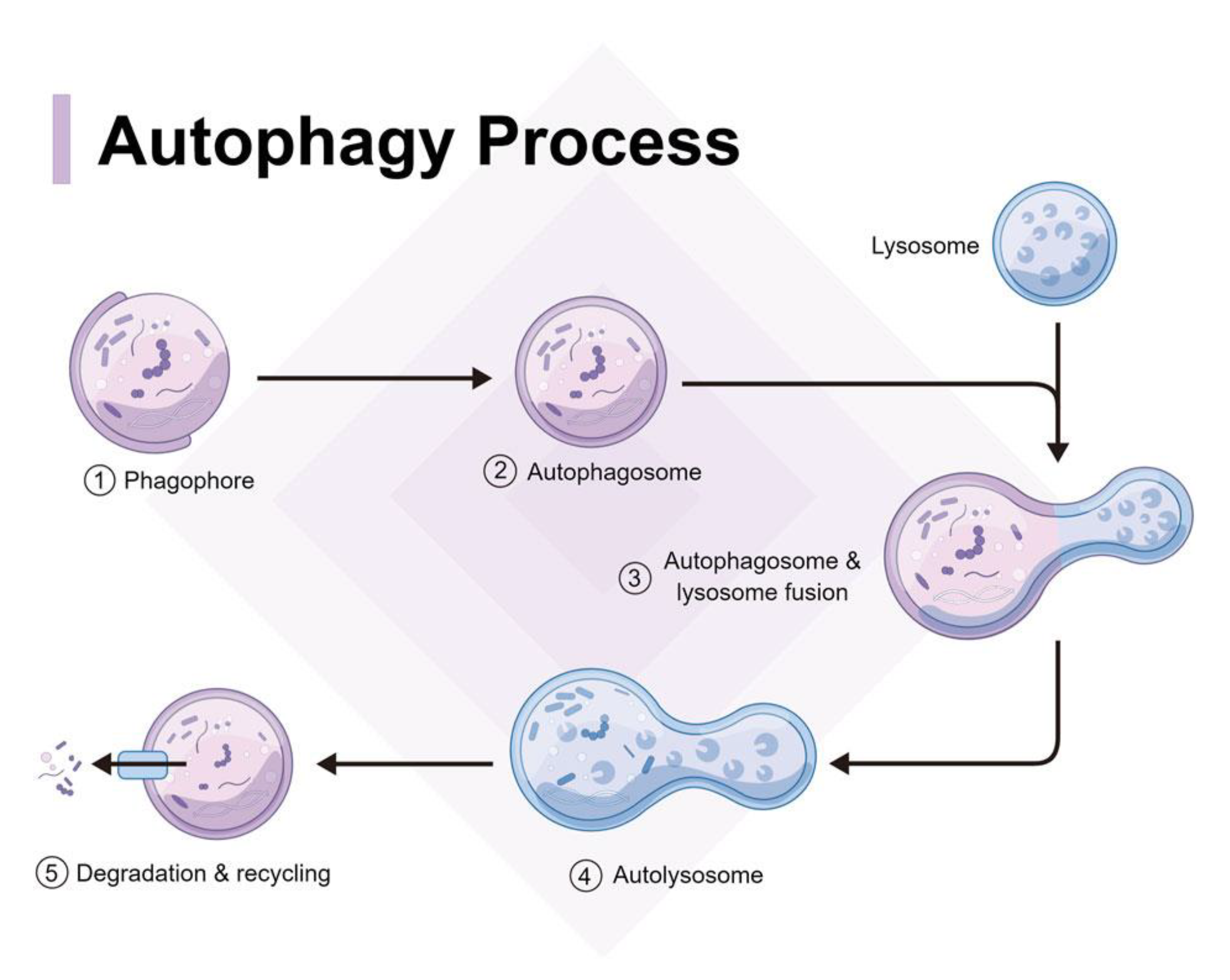

Table 1.
An overview of fasting in different spiritual and medical traditions, showing wide use across the Earth.
Table 1.
An overview of fasting in different spiritual and medical traditions, showing wide use across the Earth.
| Spiritual Tradition | World Region | Fasting Rituals |
|---|---|---|
| Islam | Middle East, Africa, Asia, and beyond | Ramadan: Observing a month-long fast from sunrise to sunset as a religious obligation [6]. |
| Christianity | Europe, Americas, Africa, Asia, and beyond | Lent: Fasting for a period of 40 days leading up to Easter, often involving specific dietary restrictions [6]. |
| Buddhism | East Asia, Southeast Asia, South Asia | Uposatha: Observing monthly fasting days to purify the mind and reaffirm spiritual commitments [6]. |
| Hinduism | South Asia, Southeast Asia, Mauritius | Ekadashi: Fasting on the 11th day of each lunar fortnight, abstaining from grains and certain foods [6]. |
| Judaism | Middle East, Europe, Americas, Africa, Asia | Yom Kippur: Observing a 24-hour fast as a day of atonement and repentance [6]. |
| Bahá'í Faith | Global | Nineteen-Day Fast: Fasting from sunrise to sunset during the last month of the Bahá'í calendar [6]. |
| Jainism | India, East Africa | Ayambil: Observing a one-day fast by consuming only boiled water and specific foods. [3] |
| Native American | Americas | Vision Quest: Fasting and solitary retreat to seek spiritual guidance and connection with nature.Sun dance: Fasting and dancing, without water for multiple straight days [4]Plant dietas: Preparation for ceremony [5] |
| Sufism | Middle East, South Asia, North Africa, Europe | Chilla: Engaging in extended periods of fasting and meditation for spiritual growth and purification. [7] |
| Mormonism(Church of Latter Day Saints) | North America | Fasting one day each month [6] |
| Medical Tradition | Region | Fasting Rituals |
| Ayurveda | India, South Asia | Upavasa: Observing occasional fasting as a means to cleanse the body, balance doshas, and support digestion [10]. |
| Traditional Chinese Medicine | China, East Asia | Daoist Fasting: Engaging in intermittent or prolonged fasting to restore harmony and promote vitality [11]. |
| Naturopathy | Europe, Global | Juice Fasting: Consuming only fresh fruit or vegetable juices for a specific duration to support detoxification and rejuvenation [12]. |
| Siddha Medicine | India | Ekadashi Fasting: Observing fasting on specific lunar days to eliminate toxins, promote purification, and enhance energy levels [13]. |
| Western Medicine | Global | Preoperative Fasting: Temporarily refraining from food and drink before surgical procedures to minimize the risk of complications [14]. |
| Greek Medicine | Ancient Greece, Mediterranean | Fasting was used in the treatment of epilepsy [15]. |
Disclaimer/Publisher’s Note: The statements, opinions and data contained in all publications are solely those of the individual author(s) and contributor(s) and not of MDPI and/or the editor(s). MDPI and/or the editor(s) disclaim responsibility for any injury to people or property resulting from any ideas, methods, instructions or products referred to in the content. |
© 2023 by the authors. Licensee MDPI, Basel, Switzerland. This article is an open access article distributed under the terms and conditions of the Creative Commons Attribution (CC BY) license (http://creativecommons.org/licenses/by/4.0/).
Copyright: This open access article is published under a Creative Commons CC BY 4.0 license, which permit the free download, distribution, and reuse, provided that the author and preprint are cited in any reuse.


