
Submitted:
26 June 2023
Posted:
28 June 2023
You are already at the latest version
Abstract
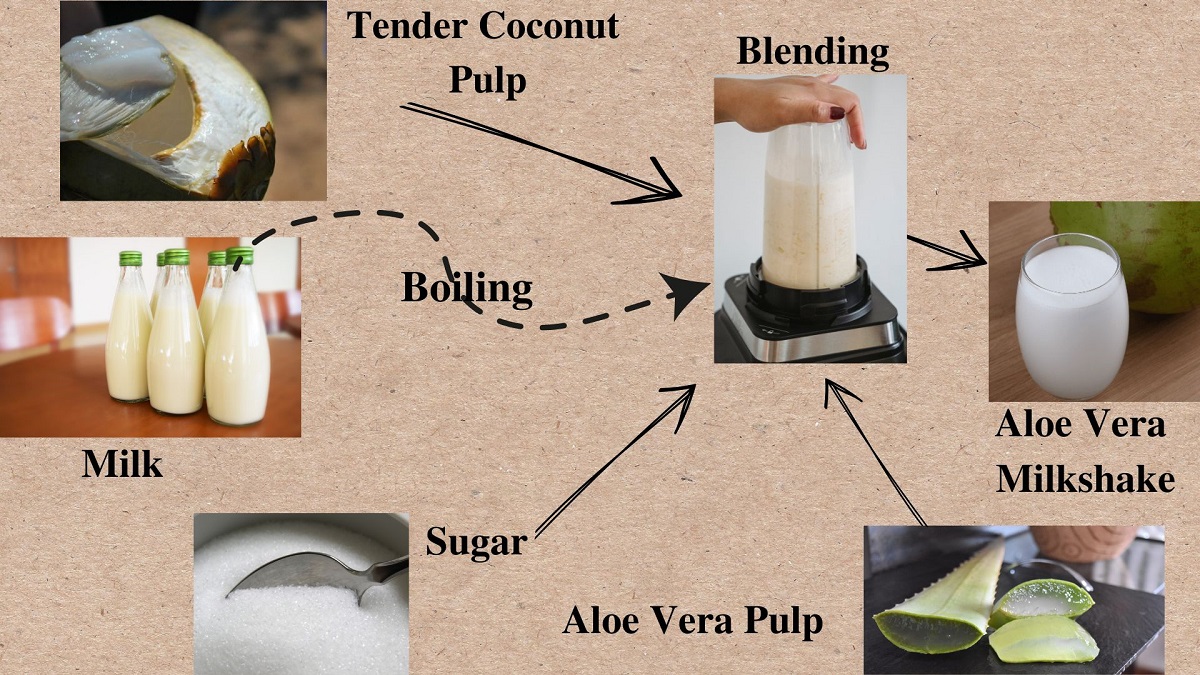
Advanced food processing techniques have drastic effects on the food, mainly on the nutritional profile; furthermore, the sedentary lifestyle led by people makes the body starve for nutrients and has a negative impact on proper growth and health. Addressing those major issues, various organic and functional foods have been widely recognised in recent times. The current work intends to prepare and evaluate a functional food made out of Aloe Vera. The health claims of Aloe Vera were uncountable. From the organoleptic profiling of the milk shake up to the 5% addition of Aloe Vera, all the sensory parameters were more satisfying. Incorporating Aloe Vera in the milkshake will be an innovative novel food product while enhancing the functional properties of Aloe Vera.
Keywords:
Aloe Vera
; Milkshakes
; Functional Foods
Introduction:
Food makes life on earth possible. Food plays a pivotal role in maintaining health and proper growth. With advancements in human life, the pattern of food habits has changed and evolved into a new dimension. The choice of food determines the major health factors for individuals. The nutrients are crucial to developing a great immune system, function and growth of cells and tissues. Due to the wide range of complexity, the nutrients readily available in the food were diminished, which is mainly due to over-farming, advanced food processing techniques, and the usage of synthetic food additives. Nutritional depletion is a major concern among consumers. To combat such issues, various highly nutritious and health-promoting foods were discovered. One such food is functional food. The whole progress of functional foods originated in Japan in the 1980s, when the government approved the consumption of such foods [1]. Functional foods are foods that provide health benefits beyond the basic nutritional support they provide by incorporating new or existing ingredients that have functional bioactive compounds [2]. Consumer demand for such foods is considerably escalating, which promotes the fast growth of the functional food industry. Such food products satisfy the needs of health-conscious individuals who need organic sources of nutrients, yet the food products regulatory agencies were sceptical about those health claims made by the food business operators. Upon scrutiny, some research studies have proven the associated health benefits of functional foods. The methodologies of functional foods are often linked with novel foods. Novel foods are foods that don’t have any previous history of consumption, or the methods employed were not previously used in the production or processing of such foods [3]. Milk and milk products are highly consumed by people around the world for its tremendous nutritional benefits. Surplus quantities of milk get converted into various milk-based products. Milk shakes are highly popular nowadays and are consumed by people of all ages for added nutrition and flavour to plain milk. The milkshake business market was estimated at US$323.84 million in 2023 [4]. The incalculable growth of the market makes it exigency for business operators to develop more novel products to make a run in the business and to gratify the consumers.
Aloe vera has been used by humans for its medicinal properties for millennia. Aloe vera was also described as a heavenly plant, a gift of nature, and even a miraculous plant by the ancient people because of its incredible benefits. The most widely used variety of aloe vera is Barbadensis millar. Numerous health benefits of aloe vera have been proven by various studies. Aloe vera is highly used for its antimicrobial properties and for controlling diabetes mellitus [5]. Aloe vera contains nearly 75 active constituents [6], making it a miraculous plant, which include vitamins, enzymes, minerals, amino acids, saponins, sugars, lignin, hormones, and salicylic acids [7]. Evidence-based studies claim healing properties [8], anti-inflammatory effects [9], enhanced immune system [10], antiviral [11], cancer prevention [12], radiation damage [13], and anti-tumour [14]. Aloe vera is commercially used in various food and pharmaceutical industries for its versatile purposes. It is employed in food products for shelf life extension; aloe vera-based herbal/edible coatings on fruits and vegetables show a marked increase in shelf life, widely in grapes [15], Andean blackberry [16], sweet cherry [17], oranges [18], and papaya [19]. Aloe based coatings reduce loss of moisture, microbial proliferation, respiration rate, senescence, and oxidative browning [20]. Aloe vera was also approved as a flavouring agent by the FDA. It is extensively used in various commercial products such as soft drinks, ready-to-serve drinks, laxative drinks, sports drinks, and health drinks [21]. It is also used in making yoghurts, vinegar, whisky, bread, jam, jellies, squashes, tea, and biscuits [22,23]. The current work focuses on producing a novel milkshake with a blend of functional components from aloe vera, making it a functional food.
Ingredients and preparation:
Ingredients: skimmed milk (SNF- 8.7% & FAT- < 0.5%), sugar/ sweeteners, tender coconut pulp, aloe vera pulp.

Table 1.
Volume of Aloe Vera used.
| Sample | Aloe Vera (%) |
|---|---|
| T0 | 0 |
| T1 | 2.5 |
| T2 | 5 |
| T3 | 7.5 |
| T4 | 10 |
Sample preparation:
Skimmed milk was used for its low fat content, and tender coconuts were scooped and made into pulp, which is used to add creaminess and to reduce the viscosity of the aloe vera. Aloe vera pulp extraction follows the method prescribed by [24], with some minor variations stated.
Aloe Vera Processing:
 |
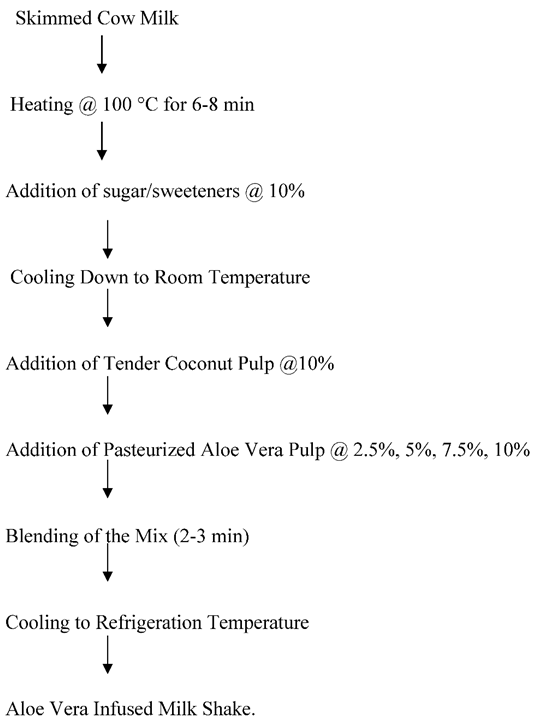
Aloe vera leaves were harvested from the field. The leaves should be sturdy, green, juicy, sound, free from black spots, solid, undamaged, and mature. In the next process, the green rind of the leaves was trimmed; this process is known as filleting, and it has to be done within 36 hours of harvesting. The flesh obtained is grinded in a blender, and the resultant is filtered to remove fibrous materials. The pulp is pasteurised at 80 °C for 1 minute, then cooled and stored. The flow chart for the preparation of the milk shake is shown below.
Flow chart for preparation of Aloe Vera milk shake:
 |
 |
Organoleptic Profiling of the Milk Shake:
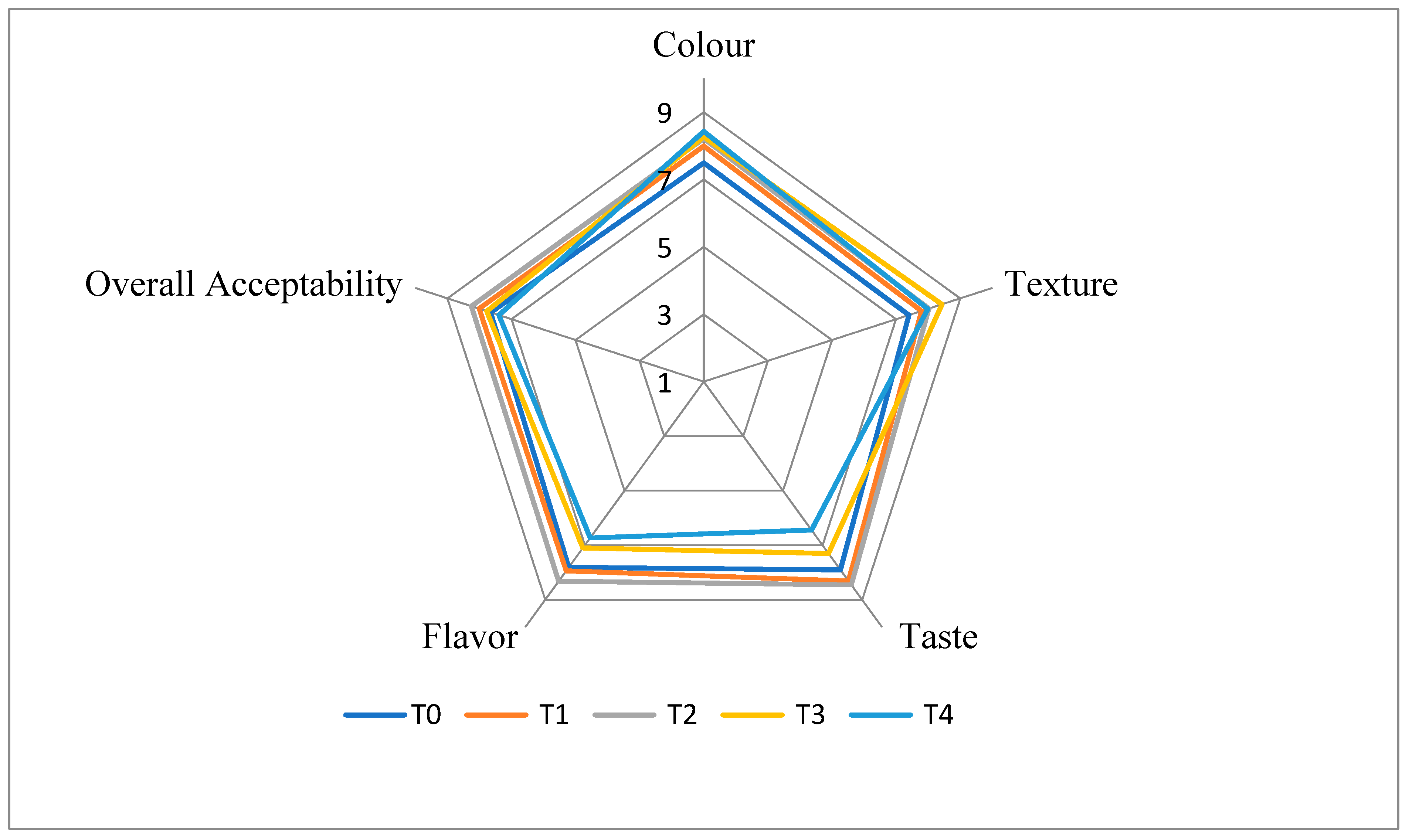
The Aloe Vera milk shake prepared from different blends of Aloe Vera was subjected to sensory evaluation by trained panellist. The panellists assessed for colour, taste, flavour, texture, and overall acceptability. Each sensory attribute was rated based on 9 point hedonic scale: like extremely—9, like very much—8, moderately like—7, like slightly—6, neither liked nor disliked—5, dislike slightly—4, moderately dislike—3, very much dislike—2 and extremely dislike—1 [24].
Table 2.
Sensory score of the Milkshakes.
| Colour | Texture | Taste | Flavour | Overall acceptability | |
|---|---|---|---|---|---|
| T0 | 7.5 | 7.4 | 7.90 | 7.81 | 7.65 |
| T1 | 8 | 7.79 | 8.31 | 7.94 | 8.01 |
| T2 | 8.22 | 8.02 | 8.45 | 8.32 | 8.25 |
| T3 | 8.27 | 8.43 | 7.3 | 7.1 | 7.77 |
| T4 | 8.43 | 7.99 | 6.44 | 6.73 | 7.39 |
Colour:
The maximum score for the colourful appearance is for T4 (8.43), and the lowest is for T0 (7.5). It can be clearly seen that an increase in the concentration of Aloe Vera enhances the colour and appearance of the milkshake, which is primarily due to the shiner properties of the Aloe pulp. [25] Studies also demonstrate that an increase in the concentration of Aloe Vera enhances the colour and appearance of the milkshake. Also, the tender coconut pulp adds a bright white appearance, and the control has a dull appearance, probably due to the skimmed milk used.
Texture:
A higher score for texture is for T3 (8.43), and a lower score is for T0 (7.4). The texture of the milkshake also increased with an increase in concentration, and this is mainly because of the viscous property of Aloe vera. However, when the concentration exceeds a saturation limit, the milkshake loses its authenticity. Too much viscosity makes the drink have a semi jelly consistency and a silky mouthfeel, which is quite unacceptable.
Taste:
The sample with 5% aloe vera has the highest score at T2 (8.45) and the lowest at T4 (6.44). The taste was more desirable at T2, but at higher concentrations above 7.5%, the milkshake tasted slightly astringent and bitter, and at 10%, the taste was contradictory to the stated taste of a milkshake; it tastes like a mix-up of salty, bitter, and tangy notes. The control had a more blank taste; the added tender coconut pulp tends to nullify the Aloe Vera notes at lower amounts, but at higher concentrations it fails to conceal them.
Figure 1.
Sensory score of formulated Aloe Vera Milk Shake.
Flavour:
The maximum score for flavour for T2 (8.32) and lower for T4 (6.73) indicate that the flavour profile is undesirable with an increase in the concentration of Aloe Vera pulp. Acidic odours are more prevalent in T3 and T4. Further, the acidic flavour can be masked by flavouring agents.
Overall Acceptability:
The treatment T2 (8.25) has higher acceptability; all of its parameters were more desirable: appetising, smoother, even creamier texture, and a sweet, balanced taste. T4 (7.39) has fewer acceptability points than the control T0; T4 has a more intense taste and flavour, which is unappealing.
Conclusions
The current work demonstrated an effective way of utilising the functional properties of Aloe Vera. The Aloe Vera milkshake produced can be further fortified with additional ingredients that boost the nutritional profile of the milkshake. From sensory analysis, it can be seen that up to 5% addition of Aloe Vera pulp is more desirable without affecting any parameters of the milkshake, but when the concentration exceeds 7.5% and more, the characteristics are not acceptable. These findings suggest that infusing the Aloe Vera in the milk shake makes it super healthy, tasty, and more of a functional food.
References
- Lang, T. Functional foods. BMJ 2007, 334, 1015. [Google Scholar] [CrossRef] [PubMed]
- What are Functional Foods and Nutraceuticals? > Functional Foods and Nutraceuticals > Agri-Industries. (13 April 2007).
- Verhagen, H.; te Boekhorst, J.; Kamps, L.; van Lieshout, M.J.; Ploeger, H.; Verreth, D.; Salminen, S.; van Loveren, H. Novel foods: An explorative study into their grey area. The British Journal of Nutrition 2009, 101, 1270–1277. [Google Scholar] [CrossRef] [PubMed]
- Packaged Milkshake Market. Packaged Milkshake Size, Share & Growth Analysis 2033|FMI. Available online: https://www.futuremarketinsights.com/reports/packaged-milkshake-market (accessed on 1 February 2023).
- Choudhary, M.; Kochhar, A.; Sangha, J. Hypoglycemic and hypolipidemic effect of Aloe vera L. in non-insulin dependent diabetics. Journal of Food Science and Technology 2014, 51, 90–96. [Google Scholar] [CrossRef] [PubMed]
- Atherton, P. Aloe vera revisited. Br J Phytother. 1998, 4, 76–83. [Google Scholar]
- Atherton, P. The Essential Aloe Vera: The Actions and the Evidence, 2nd ed.; 1997. [Google Scholar]
- Heggers, J.; Kucukcelebi, A.; Listengarten, D.; Stabenau, J.; Ko, F.; Broemeling, L.D.; et al. Beneficial effect of aloe on wound healing in an excisional wound model. J Altern Complement Med. 1996, 2, 271–277. [Google Scholar] [CrossRef] [PubMed]
- Hutter, J.A.; Salmon, M.; Stavinoha, W.B.; Satsangi, N.; Williams, R.F.; Streeper, R.T.; et al. Anti-inflammatory C-glucosyl chromone from Aloe barbadensis. J Nat Prod. 1996, 59, 541–543. [Google Scholar] [CrossRef] [PubMed]
- Ro, J.Y.; Lee, B.; Kim, J.Y.; Chung, Y.; Chung, M.H.; Lee, S.K.; et al. Inhibitory mechanism of aloe single component (Alprogen) on mediator release in guinea pig lung mast cells activated with specific antigen-antibody reactions. J Pharmacol Exp Ther. 2000, 292, 114–121. [Google Scholar] [PubMed]
- Sydiskis, R.J.; Owen, D.G.; Lohr, J.L.; Rosler, K.H.; Blomster, R.N. Inactivation of enveloped viruses by anthraquinones extracted from plants. Antimicrob Agents Chemother. 1991, 35, 2463–2466. [Google Scholar] [CrossRef]
- Furukawa, F.; Nishikawa, A.; Chihara, T.; Shimpo, K.; Beppu, H.; Kuzuya, H.; et al. Chemopreventive effects of Aloe arborescens on N-nitrosobis (2-oxopropyl) amine-induced pancreatic carcinogenesis in hamsters. Cancer Lett. 2002, 178, 117–122. [Google Scholar] [CrossRef]
- Roberts, D.B.; Travis, E.L. Acemannan-containing wound dressing gel reduces radiation-induced skin reactions in C3H mice. Int J Radiat Oncol Biol Phys. 1995, 32, 1047–1052. [Google Scholar] [CrossRef]
- Kim, H.S.; Kacew, S.; Lee, B.M. In vitro chemopreventive effects of plant polysaccharides (Aloe barbadensis Miller, Lentinus edodes, Ganoderma lucidum, and Coriolus vesicolor). Carcinogenesis 1999, 20, 1637–1640. [Google Scholar] [CrossRef] [PubMed]
- Kumar, S.; Bhatnagar, T. Studies to Enhance the Shelf Life of Fruits Using Aloe Vera Based Herbal Coatings: A Review. International Journal of Agriculture and Food Science Technology. 2014, 5, pp. 211–218.
- Arrubla Vélez, J.P.; Guerrero Álvarez, G.E.; Vargas Soto, M.C.; Cardona Hurtado, N.; Pinzón, M.I.; Villa, C.C. Aloe Vera Gel Edible Coating for Shelf Life and Antioxidant Proprieties Preservation of Andean Blackberry. Processes 2021, 9, 999. [Google Scholar] [CrossRef]
- Asghari, M.; Khalili, H.; Rasmi, Y.; Mohammadzadeh, A. Influence of Postharvest Nitric oxide and Aloe vera Gel Application on Sweet Cherry Quality Indices and Storage Life. International Journal of Agronomy and Plant Production 2013, 4, 2393–2398. [Google Scholar]
- Arowora, K.A.; Williams, J.O.; Adetunji, C.O.; Fawole, O.B.; Afolayan, S.S.; Olaleye, O.O.; Adetunji, J.B.; Ogundele, B.A. Effects of Aloe vera Coatings on Quality Characteristics of Oranges Stored Under Cold Storage. Greener Journal of Agricultural Sciences 2013, 3, 39–47. [Google Scholar] [CrossRef]
- Marpudi, S.L.; Abirami, L.S.S.; Srividya, N. Enhancement of storage life and quality maintenance of papaya fruits using Aloe vera based antimicrobial coating. Indian Journal of Biotechnology 2011, 10, 83–89. [Google Scholar]
- Devlieghere, F.; Vermeullen, A.; Debevere, J. Chitosan: Antimicrobial activity, interactions with food components and applicability as a coating on fruits and vegetables. Food Microbiol 2004, 21, 703–714. [Google Scholar] [CrossRef]
- Eshun, K.; He, Q. Crit. Rev. Food Sci. Nutr. 2004, 44, 91–96. [CrossRef]
- Singh, A.; Singh, A.K. J. Food Sci. Technol. 2009, 46, 335–338.
- Ahlawat, K.S.; Khatkar, B.S. Processing, food applications and safety of aloe vera products: a review. Journal of Food Science and Technology 2011, 48, 525–533. [Google Scholar] [CrossRef]
- Peryam, D.R.; Girardot, N.F. Advanced taste-test method. Food Engineering 1952, 24, 58–61. [Google Scholar]
- More, D.; Desale, R.J.; Mukhekar, A.; More, K. Microbiological and Sensory Evaluation of Aloe vera Added Custard Apple (Annona squamosa L.) Milkshake. Trends in Biosciences 2017, 10, 1517–1519. [Google Scholar]
Disclaimer/Publisher’s Note: The statements, opinions and data contained in all publications are solely those of the individual author(s) and contributor(s) and not of MDPI and/or the editor(s). MDPI and/or the editor(s) disclaim responsibility for any injury to people or property resulting from any ideas, methods, instructions or products referred to in the content. |
© 2023 by the authors. Licensee MDPI, Basel, Switzerland. This article is an open access article distributed under the terms and conditions of the Creative Commons Attribution (CC BY) license (http://creativecommons.org/licenses/by/4.0/).
Copyright: This open access article is published under a Creative Commons CC BY 4.0 license, which permit the free download, distribution, and reuse, provided that the author and preprint are cited in any reuse.


