

Submitted:
26 June 2023
Posted:
27 June 2023
You are already at the latest version
Abstract
Today, the digital economy has pursued the required social and economic development, and enterprises can achieve long-term sustainability by relying on the digital platform ecosystem. However, the development of the digital economy and the rapid growth of platform ecosystems have also generated some problems. To study effective digital platform ecosystem governance, this study used the tripartite evolutionary game method and analyzed the changes and effects of platform regulation under different development stages from the perspectives of government, platforms, and enterprises. The results indicate that in the early stages, digital platforms primarily relied on the government’s obligation to regulate. With the digital platform ecosystem’s evolution, the platform organization and settled enterprises’ governance effects gradually appeared, establishing the three common constraints of governance mode. Finally, when the digital platform ecosystem is in its self-renewal period, the government effect is reduced, with the platform itself and settled enterprises taking primary supervisory roles. This study provides reasonable methods for effective platform governance at different stages and enriches the theoretical basis and management practices of platform ecosystems.
Keywords:
Digital Economy
; Platform Governance
; Life Cycle
; Tripartite Evolutionary Game
1. Introduction
The digital economy is fundamentally altering how businesses innovate and maintain competitiveness and is continually promoting corporate growth [1,2]. The creation and usage of digital technologies, which are widely used by platforms, tech entrepreneurs, and users, have changed from being a disruptive wave that only affected some industries to being a key factor in global economic growth [3,4]. Enterprises are undergoing a digital transformation because of the information technology wave, which is transforming corporate strategies, business models, innovation policies, and marketing tactics [5]. Digital innovations, such as the Industrial Internet of Things (IIoT), grant companies the ability to make products and services smarter [6]; they also blur the lines between physical products and digital services [7]; and they open up enormous opportunities for innovation [8].
However, even in today’s rapid development of the digital economy, very few companies can survive in such a fierce market by themselves. Conceptualizing the company as an autonomous, independent entity fighting for competitive advantage does not fully explain today’s reality [9]. In the technology-driven digital world, many of the largest and most successful companies now operate as “digital platforms.” Such organizations have subverted many industries, including retail, hotels, and taxis, and are actively entering new areas such as financial services [10,11]. In the past few decades, digital platforms have redefined business models, disrupted existing industries, launched new products and services, and created huge value for society [12,13].
However, to realize the full potential of digital platforms, a new trend in strategic development is the construction of a digital platform-based ecosystem [14]. Ecosystem theory regards enterprises as part of a highly interdependent and interconnected network of collaborative and competitive entities. Moore [15] believes that members of the ecosystem have common goals and visions and develop together in a dynamic business environment. In addition to the platform, the digital platform ecosystem also includes the government, enterprises, scientific research institutions, financial institutions, intermediaries, and other stakeholders. In the digital platform ecosystem, digital platforms utilize digital technologies to develop and control digital resources beyond the scope of the company, create value by facilitating multi-party connectivity, and affect enterprises through network effects [16]. Different organizations continue to exchange knowledge and information to promote the sustainable development of digital platforms.
As digital platforms dominate, platform owners have accumulated tremendous power and influence; they often play an important role in leading key stakeholders to create value for their platform ecosystem [17,18,19,20]. However, without effective checks and balances, platform owners can sometimes lead the platform to act at other stakeholders’ expense [13,21,22,23,24]. With time, stakeholders are paying increasing attention to the power of platform owners and the problems caused by the power imbalance between platform owners and other stakeholders [25]. By using "platform choice," "big data to kill familiarity," "search power reduction" and other means, platforms caused by the restriction of competition, price discrimination, damage to the rights and interests of settled enterprises, and other issues have been criticized [26]. Karle and Peitz [27] studied the extent to which targeted advertising can be implemented in monopoly search engines. Hagiu [28] and White [29] consider a platform that can garble the consumer search process to redirect settled enterprises to sellers who generate higher income for the platform. Casner [30] analyzed the motivation of platforms to increase consumer search costs in the search environment and found that platforms that charge proportionally have the incentive to confuse searches to maintain sellers’ price increases.
Therefore, in the context of the digital economy, proper governance concepts are the key to coordinating a successful platform ecosystem with all stakeholders [31]. As Tiwana, Konsynski, and Venkatraman [32] stated, new organizational forms enabled by IT such as digital platform ecosystems raise the questions "Who is governed?", “What is being governed?”, "What is governed?”, and "How is it governed?” Answering these questions in the right way is crucial for platform owners, particularly given the fierce competition between ecosystems [33]. Policymakers are increasingly devoting efforts to upgrading digital infrastructures and regulating the interactions between platforms and other system participants regarding the development of the digital platform economy [34]. However, when it comes to the governance of digital platforms, government regulation alone is insufficient. Thus, in addition to traditional government regulation, platform ecosystem governance includes two strategies. The most common strategy requires platform operators to control governance, establish policy teams, and develop research capabilities to evaluate these policies [35,36]. For self-management, the second strategy relies on the supervision and management of platform users and enterprises [37,38]. The organization and management mechanism of the digital platform can be further improved through the supervision of the enterprises, such as evaluation, feedback, complaints, and suggestions.
However, the digital platform ecosystem’s evolutionary ecosystem is not static [39,40]. As a complex socio-technical ecosystem, the digital platform-based ecosystem also has an unexpected evolutionary trajectory, which is still an elusive topic in the early literature [41]. Life cycle theory proposes several stages in the evolutionary process, tracking phenomena from birth and growth to maturity and decline [42]. Researchers and managers are paying increasing attention to understanding how platform ecosystems are formed and managed, and how they evolve over time [43]. Teece [44] uses a four-stage model of birth, expansion, leadership, and self-renewal to analyze the needs of each stage of the platform life cycle and its dependence on high-level dynamic capability categories. Muzellec et al. [45] divided the development of multi-sided platforms into embryonic, emerging, growth, and maturity stages. Isckia et al. [46] designed a life cycle for platform-based ecosystems including the birth, expansion, maturity, leadership, and renewal stages. Therefore, different digital platform development stages should have different governance methods.
The current platform literature lacks a process perspective on how the digital platform governance mechanism evolves and develops [47]. The evolution of platform ecology is a process of gradual maturity and renewal [48]. As some platform ecosystems have been maintained for more than ten years, researchers have begun to outline the evolution path of platform ecosystems mainly by studying life cycle models [42]. Although these studies detail the evolution of successful platform ecosystems, they are still mostly descriptive [49]. Researchers have realized that the digital economy architecture can evolve, the number of platform ecosystem participants will also increase over time, and there will be co-evolutionary activities [50]. Still lacking is a systematic method to study the evolution of the digital platform governance ecosystem, particularly from the perspective of life cycle and growth [51].
In summary, this study adopts a four-stage model of birth, expansion, leadership, and self-renewal to analyze the governance needs for each stage of the digital platform; through the evolutionary game method, we study the development of different subjects (government, platform, and settled enterprises) in the digital platform ecosystem, including co-governance effects at different stages. In the remainder of this article, we first propose model assumptions and then construct a tripartite evolutionary game model, which presents the results by constructing contributions from different platform ecosystem perspectives and influence factors. Finally, we discuss the propositions generated from this analysis to propose suggestions for digital platform ecosystem development.
2. Evolutionary Game Model
2.1. Model variables and assumptions
Based on the previous discussion and some assumptions, a tripartite evolutionary game model including the government, platform organizations, and settled enterprises is proposed.
2.1.1. Assumption 1
Digital platforms have constraints related to local government laws and regulations. Under such effective governance, if the platform organization claims a monopoly, it will face punishment; however, if good competition is maintained, the platform organization will also receive subsidies or awards, although there is a related government expense for platform regulation. However, orderly platform market competition can enhance the government’s reputation. If the government does not take any platform regulation measures, it will also face public dissatisfaction and complaints.
is the government’s social reputation brought about by the platform governance; is the social sensitivity of the platform monopoly problems; is government governance costs for the platform; is the degree of a platform’s monopoly; is platform autonomous subsidies; is punishment for monopoly platforms; is the benefit for the government from platform autonomy; is the loss for the government from the platform monopoly; is the benefits brought to the government by settled enterprises’ participation in platform governance; and is the loss caused by consumer complaints faced by the government’s failure to regulate.
2.1.2. Assumption 2
For the platform organization, in addition to daily operating costs, there is an expense for autonomy; if the autonomous effect is good, a good reputation will develop among settled enterprises. Improving its own reputation will bring simultaneous benefits to the government; however, if a monopoly platform develops this can cause damage to the platform’s reputation and will also bring losses to the government.
is the basic operating income of the platform organization; is the basic operating cost of the platform organization; is the additional cost for platform autonomy; is the reputation improvement resulting from the platform’s autonomy; and is the complaint loss faced by a monopoly platform ( is the loss coefficient).
2.1.3. Assumption 3
For settled enterprises, if they can actively participate in platform governance, it promotes platform regulation, which is related to settled enterprises’ awareness of rights protection. Meanwhile, if a platform monopoly occurs, it will cause some losses to settled enterprises.
is the opportunity cost of settled enterprises’ participation in platform governance; is the enthusiasm of settled enterprises to participate in platform governance; is the welfare brought by platform autonomy to settled enterprises; is the infringement of platform monopoly to settled enterprises; and is the level of improving settled enterprises’ awareness of rights protection.
2.2. Evolutionary Game Model
Governments, platform organizations, and settled enterprises belong to an evolutionary game group with bounded rationality. Based on the above assumptions, if the government can actively manage the platform, it will pay a certain governance cost. However, a good platform can bring a good social reputation to the government, and in turn, the government can also earn profits. If the platform organization can achieve autonomy, it can obtain relevant government subsidies and become favored by settled enterprises. If settled enterprises are willing to participate in platform governance, they can play a restraining role. However, if the platform does not act with autonomy and allows a monopoly to develop, it will be punished by the government. Simultaneously, the platform’s reputation will be affected, and settled enterprises will take corresponding actions to resist.
Based on the above analysis, beginning with the different behavioral strategies of the government, platform, and settled enterprises, this study constructs the payment matrix of the tripartite evolutionary game, as presented in Table 1 and Table 2.
Assume the probability that the government chooses the “valid governance” strategy is x and the probability of choosing the “invalid governance” strategy is (1-x); suppose the probability that the platform chooses the "governance" strategy is y and the probability of choosing the “monopoly” strategy is (1-y); and suppose the probability that enterprises choose the ”Participation” strategy is z and the probability of choosing the “Nonparticipation” strategy is (1-z), of which 0<x<1, 0< y<1, and 0<z<1. The values of x, y, and z change in the government’s, platform’s, and settled enterprise’s constant imitating and learning processes, but the initial value is established.
3. Modern Analysis
3.1. Analysis of the government
The government’s expected benefit when it chooses the “valid formal governance” strategy is calculated as:
Based on Table 1, it can calculate that the expected returns of the government choosing “Valid government regulation” and “Invalid government regulation” are respectively and ,
The government’s average expected benefit is
while the government’s dynamic replicator equation is
The first derivative of and the setare respectively:
Based on the stability theorem of differential equations, the probability that the government chooses “valid government regulation” as a stable state must be satisfied:
and, as , is the increasing function of y.
Thus, when ,, then . Government governance cannot determine a stabilization strategy; when , then ,is the government’s Evolutionarily Stable Strategy (ESS); conversely,is the government’s ESS. The strategy evolution phase diagram of government is shown in Figure 1.
3.2. Analysis of the platform organization
The platform organization choosing "governance" and " monopoly " are respectively and ,
The platform organization’s average expected benefit is
while the platform organization’s dynamic replicator equation is
The first derivative of and the setare respectively:
Based on the stability theorem of differential equations, the probability that the platform chooses “governance” as a stable state must be satisfied:
and, as , is the minus function of z.
Thus, when ,, then . Government regulation cannot determine a stabilization strategy; when , then ,is the platform’s ESS; conversely,is the platform’s ESS. The strategy evolution phase diagram of the platform is shown in Figure 2.
3.3. Analysis of the settled enterprise
The platform organization choosing "Participation" and "Nonparticipation" are respectivelyand
The settled enterprise’s average expected benefit is .
while the settled enterprise’s dynamic replicator equation is
The first derivative of and the setare respectively:
Based on the stability theorem of differential equations, the probability that the platform chooses “participation” is in a stable state must be satisfied:
and, as , is the increasing function of x.
Thus, when , , then . Government regulation cannot determine a stabilization strategy; when , then ,is the settled enterprise’s ESS; conversely,is the settled enterprise’s ESS. The strategy evolution phase diagram of settled enterprises is shown in Figure 3.
4. Evolution Strategy Analysis
According to the replicating dynamic equations, eight stable points can be obtained: ,,,,,,,, and. The asymptotic stability of the eight stable points depends on the positive and negative properties of the system’s Jacobian matrix; that is, the system satisfies the ESS only if all the eigenvalues of the Jacobian matrix are negative. The Jacobian matrix is
Including:
By bringing eight equilibrium points into the Jacobian matrix, the eigenvalues of all the equilibrium points can be calculated, and whether they are the ESS of the system can be determined according to the positive and negative eigenvalues. According to the actual situation, the reputation improvement of platform autonomy should be greater than platforms’ autonomy’s additional cost; the infringement of platform monopoly to settled enterprises is greater than zero, and the promotion of settled enterprises’ rights protection consciousness is greater than zero. Table 3 presents the analysis results.
5. Numerical Analysis of the Tripartite Game in Different Life Cycle Stages
Based on extant research, this study argues that the digital platform life cycle can be divided into four stages: birth, expansion, leadership, and self-renewal. Government subsidies are gradually increasing in these four development processes. With the gradual standardization of platform development, the cost of platform autonomy will be reduced, and settled enterprises’ awareness of the rights protection of platform governance will also be continuously enhanced. Consequently, the opportunity cost of settled enterprises’ participation in platform governance and the effect of platform autonomy on platform reputation will also continuously increase. Based on the above phenomena, this study conducts a numerical simulation analysis of the evolution of the digital platform’s three parties in different stages.
5.1 Birth stage
In the early stage of platform ecosystem formation, the government, platform organizations, and settled enterprises are all in the stage of continuous exploration. The government invests relatively little in platform governance, and the level of subsidies is relatively low. Platform autonomy has just started, and governance has not yet formed a scale effect, which leads to a high governance cost and the platform reputation’s small influence. As settled enterprises are new to the platform ecosystem, they do not have a clear understanding of the boundaries of their rights and interests; lack a high awareness of rights protection; and there is a high threshold to participate in platform governance. At this stage, government regulation can rapidly even out and implement positive regulation strategies, while platform organizations cannot achieve good autonomy, and settled enterprises’ participation remains weak. This corresponds to the equilibrium point (1,0,0), but this point is not the ESS of the system.
To further verify the validity of the evolutionary stability analysis, the results of a 100-time evolution through simulation of the birth stage in the digital platform ecosystem are shown in Figure 5. The three-dimensional evolution results show that in the birth stage, the stable point of the model’s layout is (1,0,0); that is, at this stage, only the government tends to valid government regulation, while the platform tends to monopolize and settled enterprises tend not to participate, which is consistent with the conclusion in Figure 4.
5.2 Expansion stage
Figure 5.
Dynamic evolution process in the expansion stage.
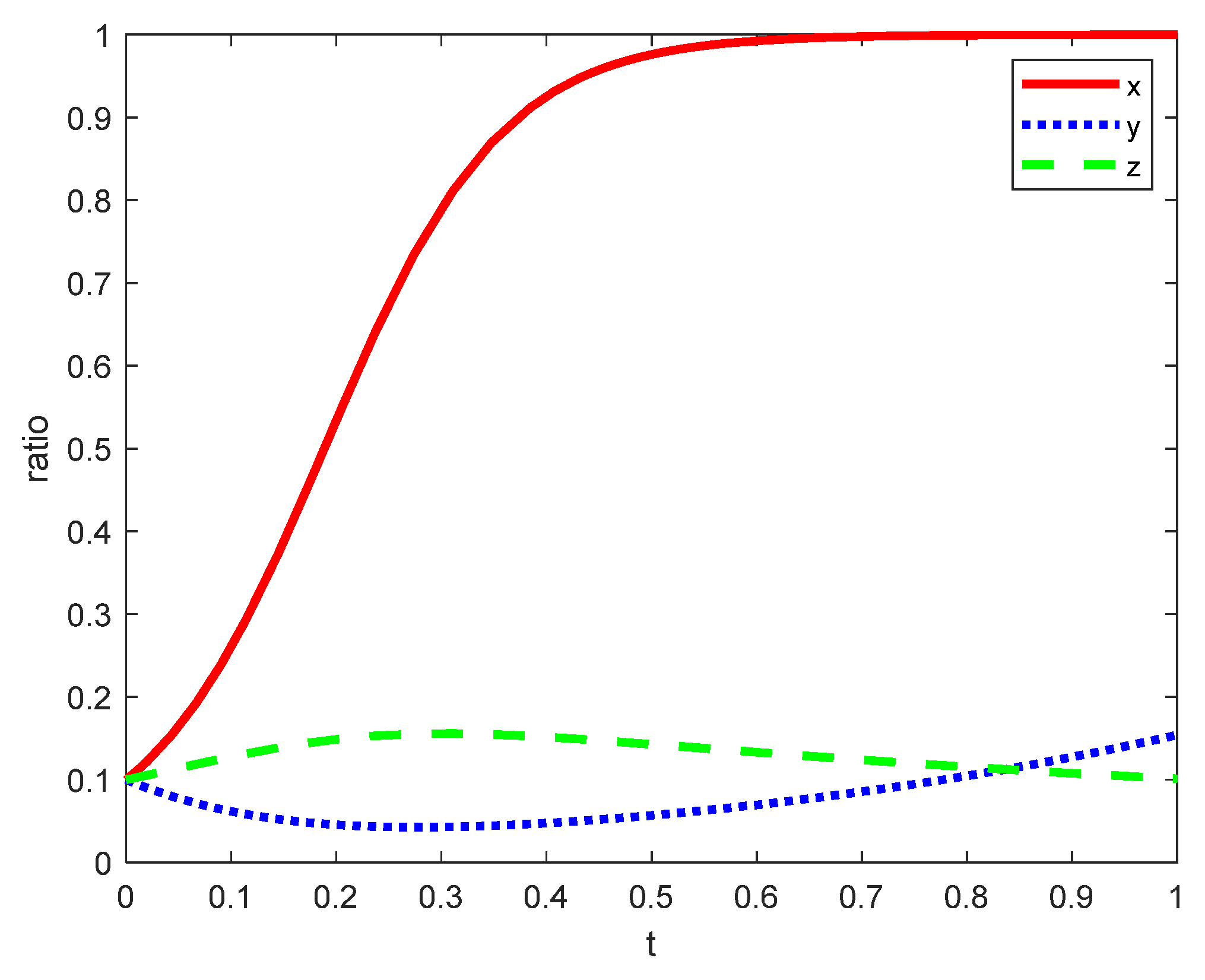
In the expansion stage of platform ecosystems, platform organizations are in the stage of explosive growth, and the government gradually attaches importance to investment in platform regulation. Platform autonomy has not adapted to the rapid enhancement of platform organizations, resulting in high governance costs. More settled enterprises have come into contact with platform organizations; however, they remain in the trial and exploration stage with enthusiasm for platform governance still not high. At this stage, governance is still dominated by government regulation, and the government can rapidly turn to the governance strategy. Although the participation of settled enterprises is still not strong, the platform autonomy strategy starts gradually and shows an upward trend. This corresponds to the ESS point (1,1,0).
On this basis, the results of a 100-time evolution through simulation of the expansion stage in the digital platform ecosystem are shown in Figure 6. The three-dimensional evolution results show that in the expansion period, the model’s layout stability point is (1,1,0); that is, at this stage, the government still tends to valid government regulation, while the platform tends to self-governance, and settled enterprises still tend not to participate, which is consistent with the conclusion in Figure 5.
5.3 Leadership stage
In the platform ecosystem’s leadership stage, the platform organization grows further, but the development rate is relatively slow. At this time, the government continues to increase investment in platform regulation, which has gradually adapted to the platform ecosystem’s development mode, and the cost of autonomy has decreased. Settled enterprises have an improved understanding of the platform organization, a preliminary awareness of rights protection has been formed, and they are gradually willing to participate in the platform governance. At this stage, the government, platform, and settled enterprises gradually tend to balance and jointly manage the platform ecosystem. This corresponds to the equilibrium point (1,1,1).
On this basis, the results of a 100-time evolution through simulation of the leadership stage in the digital platform ecosystem are shown in Figure 8. The three-dimensional evolution results show that in the leadership stage, the stable point of the model layout is (1,1,1); that is, in this stage, the government still tends to valid government regulation, while the platform tends to self-governance, and settled enterprises tend to participate, which is consistent with the conclusion in Figure 7.
5.4 Self-Renewal stage
In the self-renewal stage of the platform ecosystem, platform development is relatively mature, and the government continues to invest in regulating the platform. Platform autonomy gradually normalized, leading to a decline in autonomy costs. Settled enterprises’ awareness of rights protection has greatly improved, and they can actively participate in platform governance. At this stage, both platforms and settled enterprises can rapidly reach a balance and participate in platform governance, while government decision-making gradually tends to be “ungovernance,” which means that government regulation at this stage is not the dominant regulatory mode, but relies more on platform autonomy and settled enterprises’ participation in the governance of platform ecosystems. This corresponds to the ESS point (0,1,1).
On this basis, the results of a 100-time evolution through the simulation of the self-renewal stage in the digital platform ecosystem are shown in Figure 10. The three-dimensional evolution results show that in the maturity stage, the model’s layout stability point is (0,1,1); that is, in this stage, the platform tends to self-governance, settled enterprises tend to participate, and the government tends to not govern, which is consistent with the conclusion in Figure 9.
6. Influencing Factors Analysis of Digital Platform Governance
Based on the analysis of the evolution trend of the government, platform, and settled enterprises at each stage, some factors will still affect the overall evolution trend at each stage of the development of the platform ecosystem. Therefore, considering the self-renewal stage parameter as an example, we further select three factors from the government’s social reputation, platform monopoly degree, the degree of a platform’s monopoly, and the level of improving settled enterprises’ awareness of rights to explore the influence of different factors on the evolution trend of the digital platform governance model.
6.1 Impact on government reputation
With the development of democratic politics and the expansion of citizenship in the digital economy, civil society has proposed higher requirements for the reputation of the government. The reputation of the government represents whether the political power of the government can be generally recognized by society, which means whether the government can be generally recognized by the public when holding state power [52]. A good reputation for the government can effectively enable the government to manage social public affairs and provide public goods effectively [53], thus improving the overall welfare level of the public. Figure 12 depicts the effect of government reputation on model evolution trends.
Figure 11.
Impact on government reputation.

As shown in Figure 11, with the continuous improvement of government reputation E1, the probability of government regulation increases, the probability of platform self-governance first increases and then decreases, and the probability of consumer participation decreases. This is probably because the improvement in the reputation of the government indicates that the public has a stronger sense of trust in the government. To continue to maintain a good reputation, the government will strengthen the supervision of social issues like digital platform governance. It is also because the public has more trust in the government, making the platforms and settled enterprises more dependent on the supervision of the government while the degree of their governance and participation is weakened.
6.2 Influence of platform monopoly
In the era of the digital economy, relying on the development of information technology such as big data, cloud computing, and artificial intelligence and the popularization of the Internet, several digital platforms have built new business models, risen rapidly, and already have a high market share and number of users, showing the attitude of oligopoly and monopoly, which is an unavoidable problem in the process of digital platform governance [54,55]. Figure 13 depicts the effect of platform monopoly on evolution trends.
Figure 12.
Impact on platform monopoly.
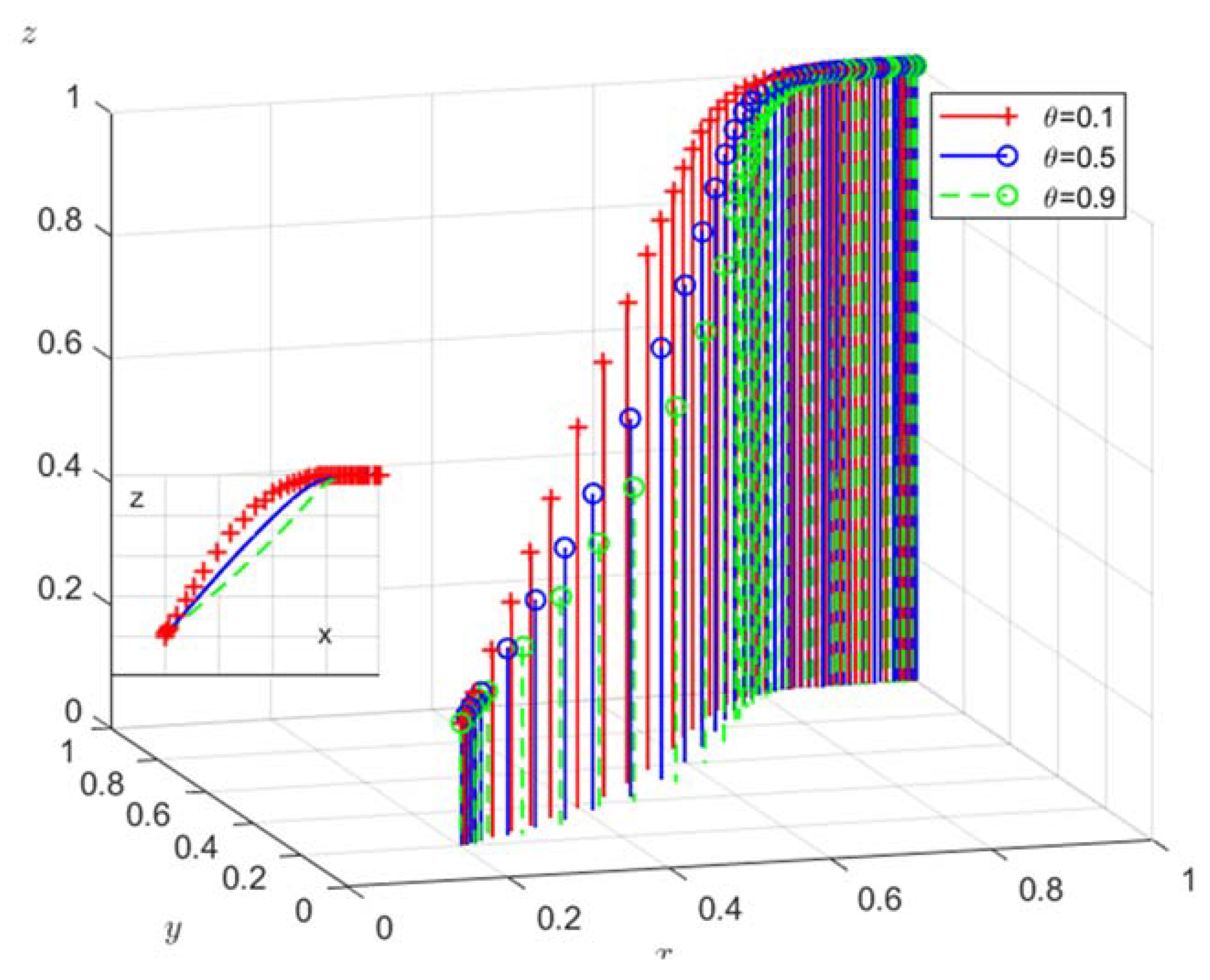
As shown in Figure 12, as the degree of platform monopoly continues to increase, the probability of government supervision also increases, while the degree of consumer participation decreases. This is probably because if the degree of platform monopoly increases, the willingness to self-govern the monopolistic platform giants decreases after they gain monopoly benefits. At this time, the government should assume the responsibility of supervision. If the platform monopoly situation has been formed, it will make enterprises think that participation in governance will have little effect; thus, it will increase their enthusiasm to participate in platform governance.
6.3 Impact on the rights protection consciousness of settled enterprises
The enterprises on the platform are the direct beneficiaries of the digital platform. The digital platform can provide more information and knowledge to the enterprises on it, and help them find suitable partners, and so on. Therefore, the development of the digital platform is also an important guarantee for its sustainable growth. The evaluation, feedback, complaints, and suggestions of the enterprises on the platform are important forces to promote the development of the digital platform [56].
Figure 13.
Impact on platform monopoly.
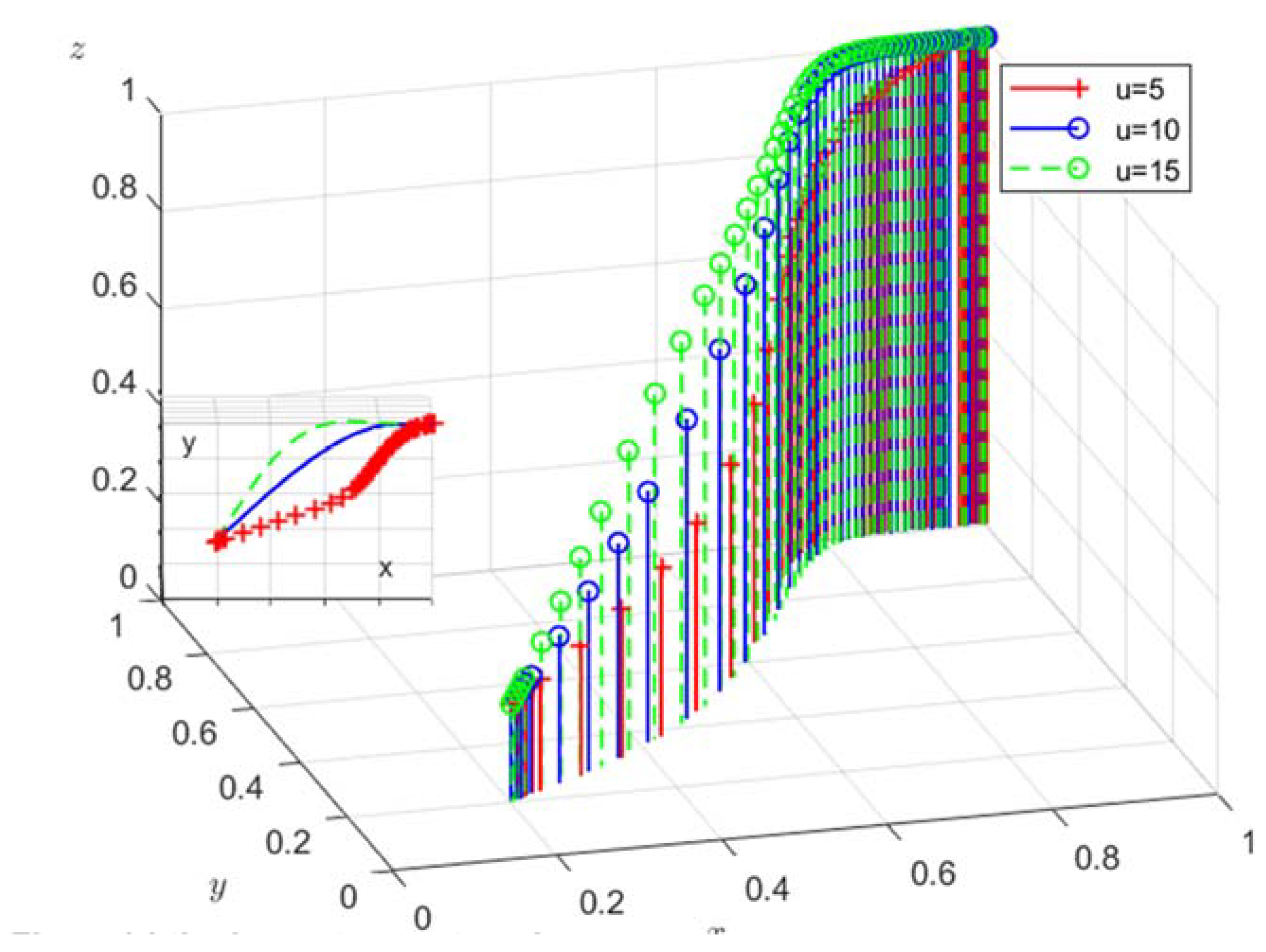
As shown in Figure 13, with the continuous improvement of the awareness of rights protection among settled enterprises, the probability of government supervision gradually decreases, and the probability of platform self-governance increases. This is probably because the improvement of the awareness of the rights protection of the settled enterprises to some extent is beneficial to the platform supervision, and the burden of government governance is shared to some extent. Therefore, the probability of government governance decreases with the improvement of enterprises’ awareness of safeguarding their rights, while the increase of enterprises’ awareness of safeguarding their rights also puts pressure on digital platforms, forcing them to focus on their governance, so the probability of platform self-governance increases.
7. Discussion
This study uses the evolutionary game method to analyze the governance methods and effects of different life cycle digital platform ecosystems from the perspective of a digital economy network. In this study, three dimensions of government governance platform structure empowerment and platform relationship empowerment were selected to reveal the differences in the governance effects of external regulation and platform autonomy on platform issues, show the influence of different factors on platform governance, identify the best platform governance mode in different development stages, and propose policy suggestions to overcome obstacles and promote digital platform development.
First, digital platform ecosystems often rely on mandatory government regulation in the early developmental stages. Digital platform ecosystems have evolved from scratch. At the beginning of the platform ecosystem, the number of internal platform organizations and settled enterprises were small, and the operation of the platform ecosystem was still in the exploratory stage [57,58]. Most platform organizations and settled enterprises took a wait-and-see attitude and did not act. At this time, government departments continued to formulate and improve relevant regulations and impose mandatory constraints for the platform ecosystem’s orderly operation [54]. It can be seen from the research that in the formative period, the constraint effects of platform organizations and settled enterprises are not obvious, and only government supervision is effective. On the one hand, in the early stages, the rational autonomy mechanism of platform organization has not been formed, and settled enterprises have also come into contact with this emerging model; the legal awareness and rights protection channel is not perfect. On the other hand, government regulation of the platform and settled enterprises is stricter. Therefore, in a platform’s early stage, government plays a greater role in guiding, restraining, and helping the platform ecosystem to follow good governance.
Second, with greater ecosystem development, governments, platforms organization, and settled enterprises all come to play an important role in platform regulation. It has entered a period of expansion and leadership. These two stages are processes in which the scale of the platform organization continues to steadily expand. The research shows that in this stage, the constraint effect of platform organizations and settled enterprises gradually emerges. Specifically, in the expansion period, the constraint effect of platform organization gradually increases, and in the leadership period, the constraint effect of settled enterprises becomes more obvious, and even tends to overtake that of the platform. This may be because, with the ecosystem’s continuous maturation, the platform’s own governance and development mechanisms are also constantly rebuilt and improved, which produces a set of effective methods to deal with the problems encountered in development [59]. At the same time, platform settled enterprises’ awareness of their rights has also steadily increased. Through continuous experimentation, effective and reasonable safeguards are formed; through the word-of-mouth effect, the platform’s non-compliant behaviors have become restrained [60]. At this time, the government, platform organization, and settled enterprises impose joint constraints.
Third, at the last stage, the common constraints of platform organizations and settled enterprises prevail, and compulsory government regulation is weakened. In the self-renewal stage, owing to technological or market changes, platforms encounter the need for fundamental renewal. The search for new alternatives must begin before this point. In other words, perception is a continuous process [44]. At this time, the platform ecosystem’s autonomy and consumer supervision play major roles, while the government’s supervision effect gradually weakens. This shows that with further platform development, if the platform wants to thrive and resist market elimination, it must rely on its strong governance mechanism, cooperating with consumer supervision. At this stage, the government’s compulsory supervision is gradually withdrawn as a primary constraint.
8. Implications
The drive toward digital platformization has gained significant impetus over the past decade. However, it is still a contradictory process, causing serious problems such as platform monopolies. This study provides some theoretical and practical contributions.
8.1 Theoretical implications
This study enriches the research on platform governance. Previous studies on platform governance have somewhat considered it from the perspective of the government, through legislation, subsidies, fines, and other mandatory ways to govern the platform [61,62]; however, from the governance effect perspective, they cannot fundamentally address the problem of platform development. In addition to government governance, this study introduces the perspective of platform autonomy to analyze platform self-governance using empowerment. This study discusses the platform embedded in the digital economy network and relies on the advantages of network structure and network relationships to empower small and medium-sized enterprises (SMEs) on the platform, thus serving the growth and development of SMEs to the maximum extent, forming a benign platform ecosystem, and realizing the sustainable development of the platform.
This study studies platform empowerment from the perspective of a digital economy network. Previous studies have focused on the important role of platform empowerment in the development of the platform itself and the growth of SMEs on the platform [63,64]. Platform empowerment provides more autonomy to the platform and enterprises so that enterprises can achieve the development of the platform while realizing their development. Based on the digital economy network, combined with the actual situation of the development of the digital economy, and relying on the perspective of the network, this study divides platform empowerment into two dimensions: structural empowerment and relational empowerment, further refining the specific impact mechanism of platform empowerment and enriching the research on platform empowerment to a certain extent.
This study expands the research on the life cycle of the platform ecosystem. Previous studies on platform governance rarely consider the platform lifecycle and ignore the particularity of different stages of platform development [39], which will inevitably deviate from the effectiveness of platform governance. This study combined the life cycle theory with the platform governance theory and divided the platform life cycle into start-up, explosion, leadership, and maturity periods. Additionally, the platform governance mechanism under different life cycles was studied in detail to further improve the research on the platform life cycle.
8.2 Practical implications
This study also provides practical implications for the government and platform managers. First, the government should strengthen the supervision and governance of the platform. Research shows that government regulation plays an important role in the early stages of platform development. The government can identify and regulate anti-monopoly through price mechanisms and competition effects. The government should focus on the construction of a reasonable platform supervision system, particularly when the development of the platform is imperfect, to formulate corresponding supporting rules and institutional explanations for the system and policy supply to make the implementation of laws and regulations more accurate and scenario-oriented. Simultaneously, the government must innovate the big data supervision path, use the Internet, artificial intelligence, big data, and other technologies to empower platform supervision, prevent platform enterprises from performing exploitative pricing and damaging the overall social welfare of settled enterprises through data monopoly, data abuse, and other behaviors, and establish a new intelligent supervision system with multi-department coordination and multi-level unified command.
Second, platform autonomy has become an important part of the chain of supervision. The types and tools of the platform itself to exercise the regulatory functions are numerous and complex, and the self-governance of the platform focuses on the needs of the platform’s survival, such as consumer rights protection, intellectual property protection, consumer dispute settlement, transaction credit maintenance, and correct value orientation. The government should propose requirements for the platforms to clarify what problems the platforms should manage themselves, and the platforms should be able to express to the government and society the effectiveness of their internal compliance management and accept supervision.
Third, the government should vigorously promote the construction of a digital economy, accelerate the construction of a digital economy network framework, create a good digital ecology, promote the deep integration of traditional industries and digital technologies, and build a digital economy network with the platform as the core. The development of digital technology can further promote the integration of data and reality, and through the use of digital technology to perform all-round and whole-chain transformations of traditional industries, it can effectively improve total factor productivity and promote the digital, networking, and intelligent development of traditional industries. In the process of digital transformation of traditional industries, beginning in various fields, building a digital economy service platform for industry, society, and other fields, fully utilizing information and resources provided by major information and data exchange platforms, and strengthening the platform-based economic network can provide several opportunities for the development of SMEs to promote the development of new forms of the digital economy.
9. Limitations and Future Research
Our study has several limitations that should be addressed in future research. First, this study only considers the platforms and enterprises in the digital economy network and can adopt more cooperative thinking for heterogeneous subjects in the future, such as universities and research institutions. Second, this study did not distinguish different industries when classifying the platform life cycle. In the future, the governance of platforms in different industries can be further refined. Finally, many factors affect the effect of platform governance in reality, and this study can further add more relevant parameters for discussion.
10. Conclusions
Despite their economic significance, successful platform ecosystems remain difficult to build and sustain over time. Internal and external triggers such as competitor behavior, regulatory uncertainty, and consumer preference may prompt platform ecosystems to evolve [41]. Therefore, operating in an environment characterized by uncertainty and unpredictability, platform ecosystems must constantly evolve to ensure their long-term survival [56]. With the development of the digital economy, the platform is embedded in the complex digital economic network, and the abundant information, knowledge, and other resources in the network continue to help the platform develop and grow [65,66]. The platform makes use of the advantages of the structure and relationships in the network to empower the platform and constantly improve the self-governance mechanism of the platform. Simultaneously, as platform ecosystem development is a process of continuous change, different governance methods should be adopted for different stages of platform ecosystem development. Therefore, based on the digital economy network, this study analyzes the effective mechanism of platform governance in different life stages under the joint action of government regulation and platform empowerment. This study finds that both government supervision and platform empowerment are effective methods of platform governance. In the early stages of platform development, the government can achieve good governance effects through coercive means. With the development and maturity of the platform, platform empowerment, as an effective means of autonomy, can achieve a benign state of self-organization. This study constructs the stage analysis framework of platform governance under the digital economy network and provides a useful direction for government supervision and platform management.
Funding
This research was funded by the National Social Science Foundation of China, grant number 21CGL021.
Data Availability Statement
Not applicable.
Conflicts of Interest
The authors declare no conflict of interest.
References
- Jovanovic, M.; Sjödin, D.; Parida, V. Co-evolution of platform architecture, platform services, and platform governance: Expanding the platform value of industrial digital platforms. Technovation. 2022, 118. [Google Scholar] [CrossRef]
- Hanelt, A.; Bohnsack, R.; Marz, D.; Antunes, C. A systematic review of the literature on digital transformation: Insights and implications for strategy and organizational change. J Manag Stud. 2020. [CrossRef]
- Tushev, M.; Ebrahimi, F.; Mahmoud, A.M. A systematic literature review of anti-discrimination design strategies in the digital sharing economy. IEEE Trans Software Eng. 2022, 48, 1–1. [Google Scholar] [CrossRef]
- Deng, T.; Qiao, L.; Yao, X.; Chen, S.; Tang, X.A. A Profit framework model for digital platforms based on value sharing and resource complementarity. Sustainability. 2022, 14, 11954. [Google Scholar] [CrossRef]
- Chen, L.; Li, S.; Wei, J.; Yang, Y. Externalization in the platform economy: Social platforms and institutions. J Int Bus Stud. 2022, 53, 1805–1816. [Google Scholar] [CrossRef]
- Raff, S.; Wentzel, D.; Obwegeser, N. Smart products: Conceptual review, synthesis, and research directions. J Prod Innov Manag. 2020, 37, 379–404. [Google Scholar] [CrossRef]
- Jocevski, M. Blurring the lines between physical and digital spaces: Business model innovation in retailing. Calif Manag Rev. 2020, 63, 99–117. [Google Scholar] [CrossRef]
- Lanzolla, G.; Pesce, D.; Tucci, C.L. The digital transformation of search and recombination in the innovation function: Tensions and an integrative framework. J Prod Innov Manag. 2021, 38, 90–113. [Google Scholar] [CrossRef]
- Mukhopadhyay, S.; Bouwman, H. Multi-actor collaboration in platform-based ecosystem: Opportunities and challenges. J Inf Technol Case Appl. 2018, 20, 47–54. [Google Scholar] [CrossRef]
- Evans, D.S.; Schmalensee, R. Matchmakers: The New Economics of Multisided Platforms; Harvard Business Review Press: Boston, MA, 2016. [Google Scholar]
- Constantinides, P.; Henfridsson, O.; Parker, G.G. Platforms and infrastructures in the digital age. Inf Syst Res. 2018, 29, 381. [Google Scholar] [CrossRef]
- Cusumano, M.A.; Gawer, A.; Yoffie, D.B. The Business of Platforms: Strategy in the Age of Digital Competition, Innovation, and Power; HarperBusiness: New York, 2019. [Google Scholar]
- Chen, Y.; Pereira, I.; Patel, P.C. Decentralized governance of digital platforms. J Manag. 2020, 47, 1305–1337. [Google Scholar] [CrossRef]
- Parker, G.; Van Alstyne, M. Innovation, openness, and platform control. Manag Sci. 2018, 64, 3015–3032. [Google Scholar] [CrossRef]
- Moore, J.F. Predators and prey: A new ecology of competition. Harv Bus Rev. 1993, 71, 75–86. [Google Scholar] [PubMed]
- Gawer, A. Digital platforms’ boundaries: The interplay of firm scope, platform sides, and digital interfaces. Long Range Plann, American Psychological Association. 2021, 54, 102045. [CrossRef]
- Boudreau, K. Open platform strategies and innovation: Granting access vs. devolving control. Manag Sci. 2010, 56, 1849–1872. [Google Scholar] [CrossRef]
- Kyprianou, C. Creating value from the outside in or the inside out: How nascent intermediaries build peer-to-peer marketplaces. Acad Manag Discov. 2018, 4, 336–370. [Google Scholar] [CrossRef]
- Reischauer, G.; Mair, J. How organizations strategically govern online communities: Lessons from the sharing economy. Acad Manag Discov. 2018, 4, 220–247. [Google Scholar] [CrossRef]
- Rietveld, J.; Schilling, M.A.; Bellavitis, C. Platform strategy: Managing ecosystem value through selective promotion of complements. Organ Sci. 2019, 30, 1232–1251. [Google Scholar] [CrossRef]
- Cohen, J.E. Between Truth and Power: The Legal Constructions of Informational Capitalism; Oxford University Press: New York, 2019. [Google Scholar]
- Srnicek, N. Platform Capitalism; Polity Press: Cambridge, UK, 2017. [Google Scholar]
- Van Dijck, J.; Poell, T.; De Waal, M. The Platform Society: Public Values in a Connective World; Oxford University Press: New York, 2018. [Google Scholar]
- Zuboff, S. The Age of Surveillance Capitalism: The Fight for a Human Future at the New Frontier of Power; Public Affairs: New York, 2019. [Google Scholar]
- Ansell, C.; Miura, S. Can the power of platforms be harnessed for governance? Public Admin. 2020, 98, 261–276. [Google Scholar] [CrossRef]
- Cingolani, L. The survival of open government platforms: Empirical insights from a global sample. Gov Inf Q. 2021, 38, 101522. [Google Scholar] [CrossRef]
- Karle, H.; Peitz, M.; Reisinger, M. Segmentation versus agglomeration: Competition between platforms with competitive sellers. J Pol Econ. 2020, 128, 2329–2374. [Google Scholar] [CrossRef]
- Hagiu, A.; Jullien, B. Why do intermediaries divert search? RAND J Econ. 2011, 42, 337–362. [Google Scholar] [CrossRef]
- White, A. Search engines: Left side quality versus right side profits. Int J Ind Organ. 2013, 31, 690–701. [Google Scholar] [CrossRef]
- Casner, B. Seller curation in platforms. Int J Ind Organ. 2020, 72. [Google Scholar] [CrossRef]
- Gorwa, R. What is platform governance? Inf Commun Soc. 2019, 22, 854–871. [Google Scholar] [CrossRef]
- Tiwana, A.; Konsynski, B.; Venkatraman, N. Special issue: Information technology and organizational governance: The IT governance cube. J Manag Inf Syst. 2013, 30, 7–12. [Google Scholar] [CrossRef]
- Tiwana, A. Konsynski, B., & Bush, A. A. Platform evolution: Coevolution of platform architecture, governance, and environmental dynamics. Inf Syst Res 2010, 21, 675. [Google Scholar]
- Upadhyay, P.; Kumar, A.; Dwivedi, Y.K.; Adlakha, A. Continual usage intention of platform-based governance services: A study from an emerging economy. Gov Inf Q. 2022, 39, 101651. [Google Scholar] [CrossRef]
- Cho, S.; Mossberger, K.; Swindell, D.; Selby, J.D. Experimenting with public engagement platforms in local government. Urban Aff Rev (Thousand Oaks, CA) 2020, 57, 763–793. [Google Scholar] [CrossRef]
- Jung, D.; Kim, B.C.; Park, M.; Straub, D.W. Innovation and policy support for two-sided market platforms: Can government policy makers and executives optimize both societal value and profits? Inf Syst Res. 2019, 30, 1037–1050. [Google Scholar] [CrossRef]
- Fenwick, M.; McCahery, J.A.; Vermeulen, E.P.M. The end of “Corporate” governance: Hello “Platform” governance. Eur Bus Org Law Rev. 2019, 20, 171–199. [Google Scholar] [CrossRef]
- Matias, J.N.; Mou, M. Civil Servant: Community-led experiments in platform governance. In Proceedings of the 2018 CHI Conference on Human Factors in Computing Systems 2018; pp. 1–13.
- Ding, L.; Ye, R.M.; Wu, J. Platform strategies for innovation ecosystem: Double-case study of Chinese automobile manufactures. J Clean Prod. 2019, 209, 1564–1577. [Google Scholar] [CrossRef]
- Hult, G.T.M.; Gonzalez-Perez, M.A.; Lagerström, K. The theoretical evolution and use of the Uppsala model of internationalization in the international business ecosystem. J Int Bus Stud. 2020, 51, 38–49. [Google Scholar] [CrossRef]
- Rong, K.; Wu, J.; Shi, Y.; Guo, L. Nurturing business ecosystems for growth in a foreign market: Incubating, identifying and integrating stakeholders. J Int Manag. 2015, 21, 293–308. [Google Scholar] [CrossRef]
- O’Mahony, S.; Karp, R. From proprietary to collective governance: How do platform participation strategies evolve? Strateg Manag J. 2022, 43, 530–562. [Google Scholar] [CrossRef]
- Mukhopadhyay, S.; Bouwman, H.; Jaiswal, M. Portfolios of control in mobile eco-systems: Evolution and validation. Info. 2015, 17, 36–58. [Google Scholar] [CrossRef]
- Teece, D.J. Dynamic Capabilities and (Digital) Platform Lifecycles, Entrepreneurship, Innovation, and Platforms (Advances in Strategic Management, Vol. 37); Emerald Publishing Limited: Bingley, 2017; pp. 211–225. [Google Scholar]
- Muzellec, L.; Ronteau, S.; Lambkin, M. Two-sided internet platforms: A business model lifecycle perspective. Ind Mark Manag. 2015, 45, 139–150. [Google Scholar] [CrossRef]
- Isckia, T.; de Reuver, M.; Lescop, D. Digital innovation in platform-based ecosystems: An evolutionary framework. In Proceedings of the 10th International Conference on Management of Digital Ecosystems 2018; 2018; pp. 149–156. [Google Scholar] [CrossRef]
- Teh, T.H. Platform governance. Am Econ J: Microecon 2022 14(3). American Economic Journal: Microeconomics. 2022, 14, 213–254. [Google Scholar] [CrossRef]
- Zhong, Q.; Sun, Y. The more the better? relational governance in platforms and the role of appropriability mechanisms. J Bus Res. 2020, 108, 62–73. [Google Scholar] [CrossRef]
- Cennamo, C.; Santaló, J. Generativity tension and value creation in platform ecosystems. Organ Sci (Providence, RI). 2019, 30, 617–641. [Google Scholar] [CrossRef]
- Foerderer, J. Interfirm exchange and innovation in platform ecosystems: Evidence from Apple’s worldwide developers conference. Manag Sci. 2020, 66, 4772–4787. [Google Scholar] [CrossRef]
- Tiwana, A. Evolutionary competition in platform ecosystems. Inf Syst Res. 2015, 26, 266–281. [Google Scholar] [CrossRef]
- Navarro-Chávez, C.; Delfín-Ortega, O.V.; Moreno Manzo, J.M. Municipal evaluation in Mexico: A measurement of the government reputation. Corp Reputation Rev. 2022, 25, 106–121. [Google Scholar] [CrossRef]
- Wei, Y.; Guo, Y.; Su, J. Dancing on a tightrope: The reputation management of local governments in response to public protests in China. Public Admin (London). 2021, 99, 547–562. [Google Scholar] [CrossRef]
- Jeon, D.S.; Kim, B.C.; Menicucci, D. Second-degree price discrimination by a two-sided monopoly platform. Am Econ J: Microecon 2022. American Economic Journal: Microeconomics 2022, 14, 322–369. [Google Scholar] [CrossRef]
- Vasudevan, R. Digital platforms: Monopoly capital through a classical-Marxian lens. Camb J Econ. 2022, 46, 1269–1288. [Google Scholar] [CrossRef]
- Geradin, D.; Katsifis, D. Strengthening effective antitrust enforcement in digital platform markets. Eur Compet J. 2022, 18, 356–405. [Google Scholar] [CrossRef]
- Mo, D.; Yu, J.; Chen, X.M. Modeling and managing heterogeneous ride-sourcing platforms with government subsidies on electric vehicles. Transp Res B Methodol. 2020, 139, 447–472. [Google Scholar] [CrossRef]
- Seo, H.; Myeong, S. The priority of factors of building government as a platform with analytic hierarchy process analysis. Sustainability. 2020, 12, 5615. [Google Scholar] [CrossRef]
- Marjanovic, O.; Cecez-Kecmanovic, D. Open government data platforms – A complex adaptive sociomaterial systems perspective. Inf Organ. 2020, 30. [Google Scholar] [CrossRef]
- Just, N. Governing online platforms: Competition policy in times of platformization. Telecommun Policy. 2018, 42, 386–394. [Google Scholar] [CrossRef]
- Song, P.; Xue, L.; Rai, A.; Zhang, C.; Nanjing University; Fudan University; Georgia State University. The ecosystem of software platform: A study of asymmetric cross-side network effects and platform governance. MIS Q. 2018, 42, 121–142. [Google Scholar] [CrossRef]
- Sapraz, M.; Han, S. Users’ evaluation of a digital government collaborative platform (DGCP). Interface Sci, (Lanka); Transforming Government. 2023. [Google Scholar] [CrossRef]
- Chen, L.; Yi, J.; Li, S.; Tong, T.W. Platform governance design in platform ecosystems: Implications for complementors’ multihoming decision. J Manag. 2022, 48, 630–656. [Google Scholar] [CrossRef]
- Jiang, H.; Yang, J.; Gai, J. How digital platform capability affects the innovation performance of SMEs—Evidence from China. Technol Soc. 2023, 72, 102187. [Google Scholar] [CrossRef]
- Rakshit, S.; Islam, N.; Mondal, S.; Paul, T. Influence of blockchain technology in SME internationalization: Evidence from high-tech SMEs in India. Technovation. 2022, 115, 102518. [Google Scholar] [CrossRef]
- Andreoni, A.; Roberts, S. Governing digital platform power for industrial development: Towards an entrepreneurial-regulatory state. Camb J Econ. 2022, 46, 1431–1454. [Google Scholar] [CrossRef]
Figure 1.
Phase diagram of government strategy evolution.
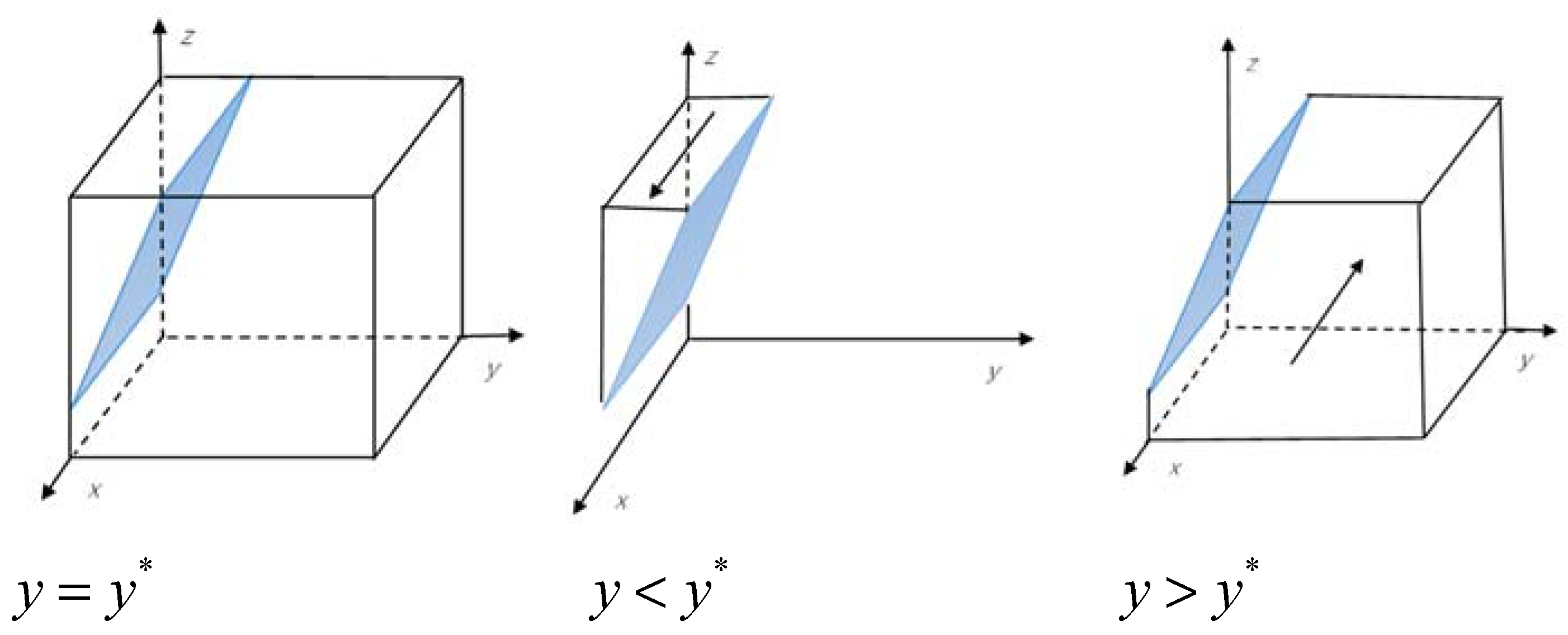
Figure 2.
Phase diagram of platform strategy evolution.

Figure 3.
Phase diagram of settled enterprise strategy evolution.
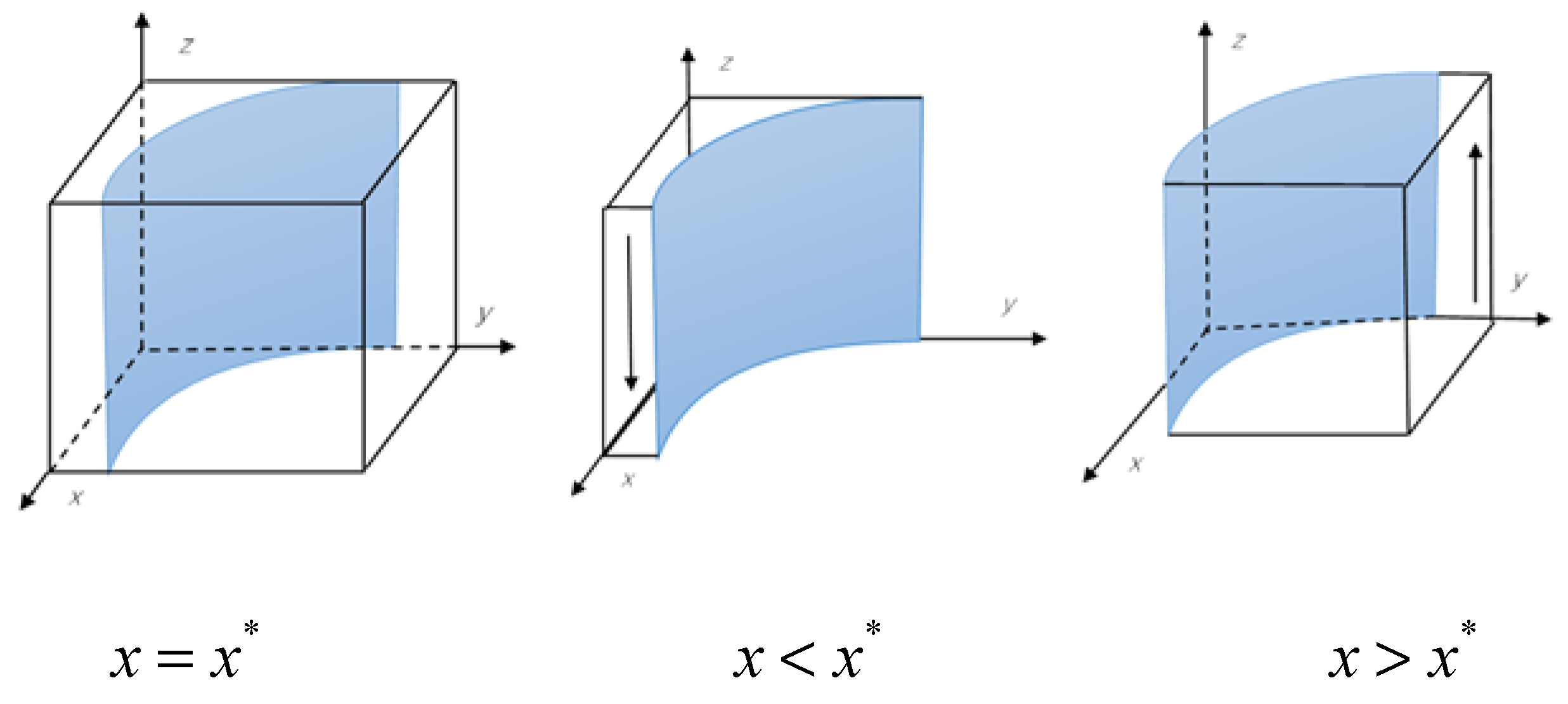
Figure 4.
Dynamic evolution process in the birth stage.
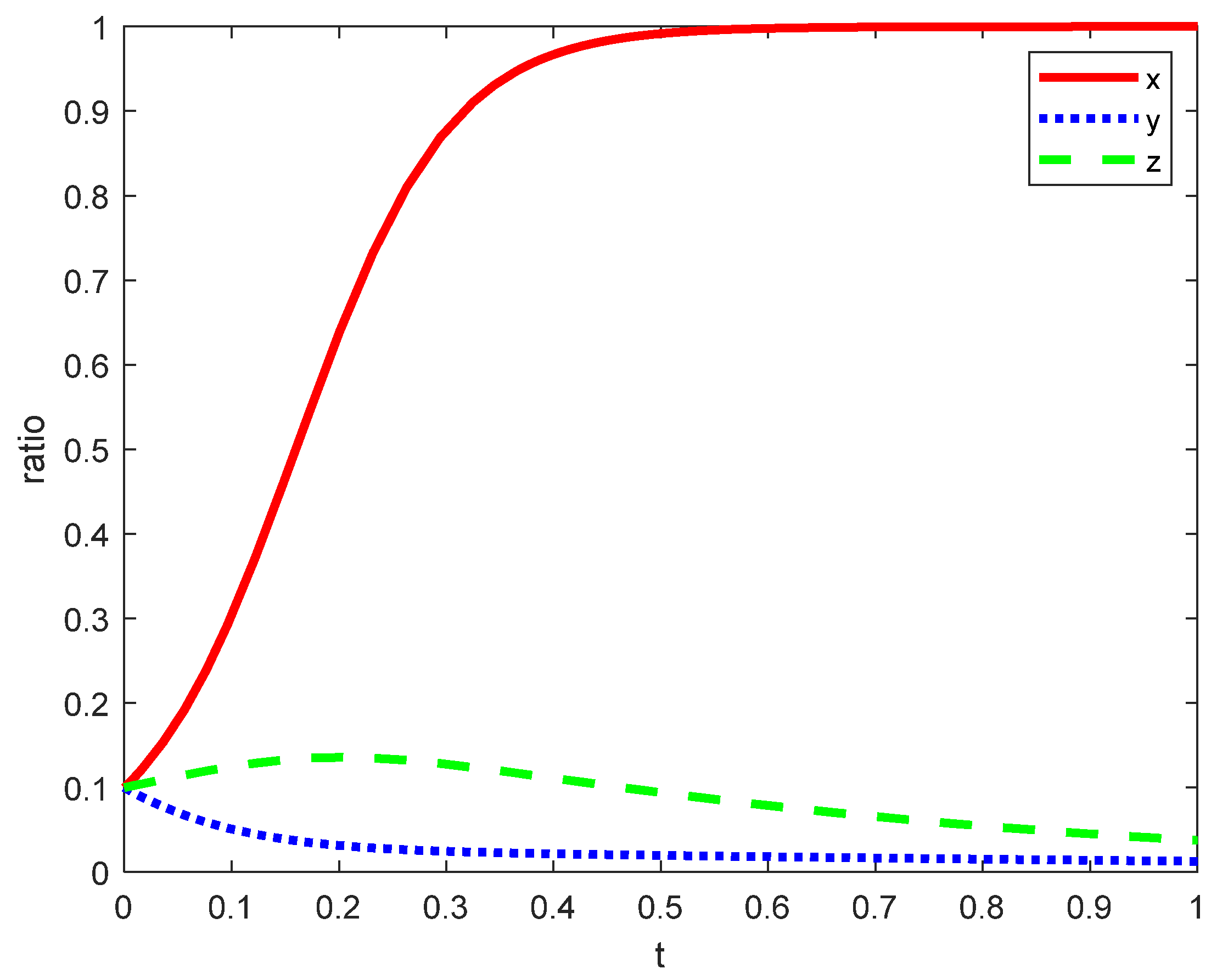
Figure 5.
Array Evolution 100 results of the birth stage.

Figure 6.
Array Evolution 100 results of the expansion stage.

Figure 7.
Dynamic evolution process in the leadership stage.
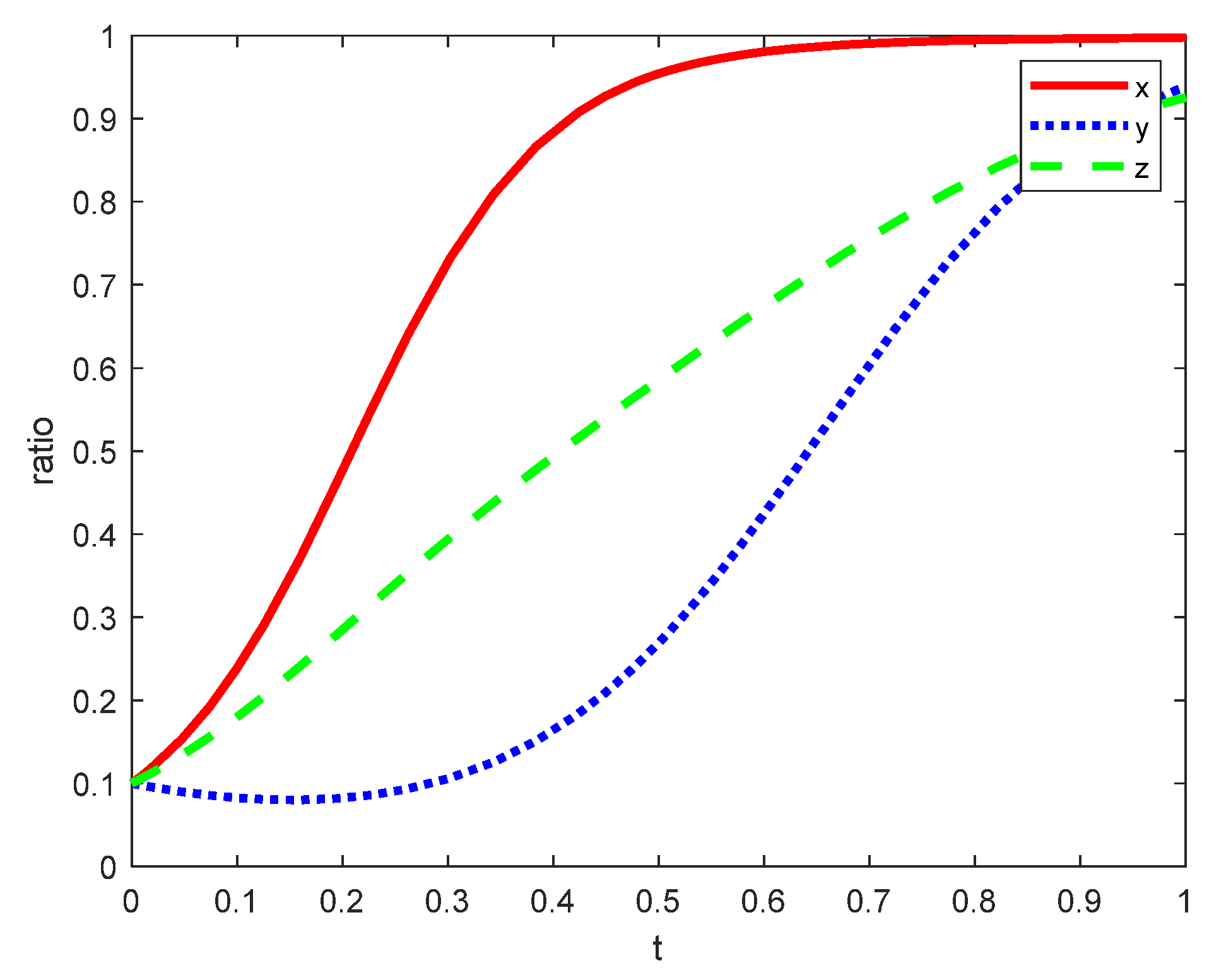
Figure 8.
Array Evolution 100 results of the leadership stage.

Figure 9.
Dynamic evolution process in the self-renewal stage.
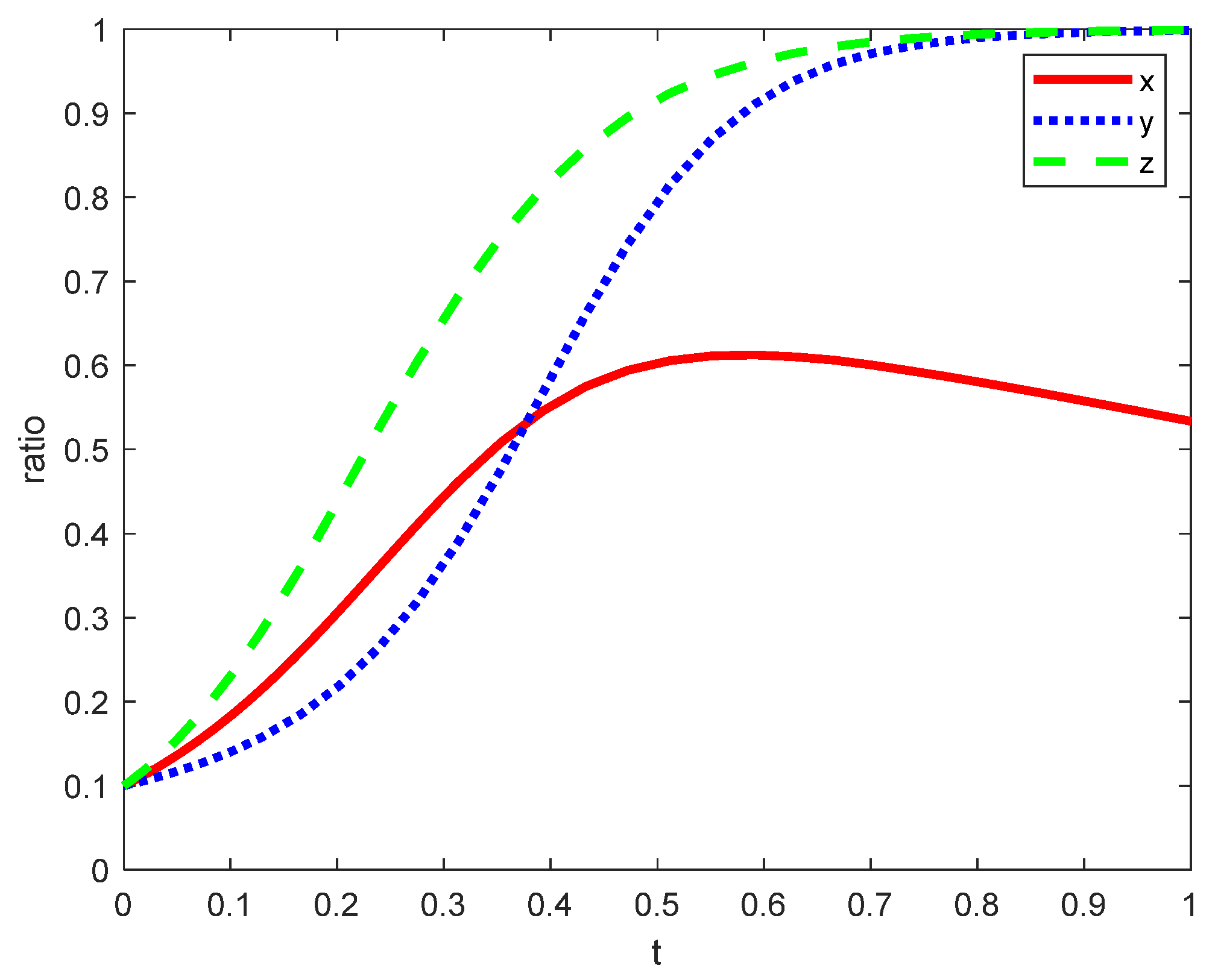
Figure 10.
Array Evolution 100 results of the self-renewal stage.


Table 1.
Payoff matrix for the game’s three sides.
| Strategies | Settled enterprise | ||
| Participation | Nonparticipation | ||
| Valid government regulation | Platform governance | ||
| Platform monopoly | |||
| Invalid government regulation | Platform governance | ||
| Platform monopoly | |||
Table 2.
Benefits of the game’s three sides.
| Game strategies | Government | Platform organizations | Settled enterprise |
|---|---|---|---|
Table 3.
Eigenvalues and stability conditions of the equilibrium point.
| Equilibrium Points | Eigenvalues | ESS conditions | ||
| unstable equilibrium point | ||||
| unstable equilibrium point | ||||
| unstable equilibrium point | ||||
| unstable equilibrium point | ||||
| unstable equilibrium point | ||||
Disclaimer/Publisher’s Note: The statements, opinions and data contained in all publications are solely those of the individual author(s) and contributor(s) and not of MDPI and/or the editor(s). MDPI and/or the editor(s) disclaim responsibility for any injury to people or property resulting from any ideas, methods, instructions or products referred to in the content. |
© 2023 by the authors. Licensee MDPI, Basel, Switzerland. This article is an open access article distributed under the terms and conditions of the Creative Commons Attribution (CC BY) license (http://creativecommons.org/licenses/by/4.0/).
Copyright: This open access article is published under a Creative Commons CC BY 4.0 license, which permit the free download, distribution, and reuse, provided that the author and preprint are cited in any reuse.


