

Submitted:
19 June 2023
Posted:
20 June 2023
You are already at the latest version
Abstract
The industry is in a continuous evolution in the context of Industrial Internet of Things (IIoT) and Industry 4.0 requirements and expected benefits. Some sectors allow a higher reconfiguration dynamics considering the interference capabilities and process/equipment renewals, but others have considerable inertia that is many times justified. In most encountered situations, the reality confirms that the industry is struggling with new demands as interoperation and efficiency improvements. The water industry makes no difference, being a sector with critical infrastructures and highly varied subsystems, where invasive interference in legacy solutions tends to be avoided. Following previous successful footsteps in researching a proactive decentralized historian, the current work focuses on a case-study that refers to a water treatment and distribution facility that is operated for several years and the current operating regime was established by local operators following accumulated observations, restrictions and response strategies. The proactive historian was tailored for the current case-study and it was applied and tested in the suboptimal functioning scenario where the water sources configuration was manually selected and used for water availability and energy efficiency, but without assuming current/future failures or different water demands. The proposed low-cost historian targeted to improve the functioning and operation of the water facility considering energy efficiency and other impacting outcomes of the current strategy, and to establish an automatic functioning regime in a completely non-invasive manner towards the local legacy solution. The results were satisfactory, proving that the historian is able to adapt to a particular and suboptimal functioning real industrial scenario, to establish recipes in a process-aware manner, and to interoperate with the local legacy solution in order to apply improving actions.
Keywords:
proactive historian
; IIoT
; Industry 4.0
; legacy systems
; water industry
; industrial automation
; SCADA.
1. Introduction
Sustainability in automation and SCADA impacts directly the associated industrial processes and must be argued together. A sustainable system has to focus on long lasting productivity and quality, on the environmental impact, and on cost issues. These outcomes may derive from each other, or a proper strategy may impact their majority. A new solution has to foresee future sustainability but obviously a higher impact derives from adapting legacy systems. The pace of progress in the Operational Technology (OT) and Information Technology (IT) is usually higher than in the actual industrial process structuring related research. However, the industrial processes need constant improvements, changes, expansions. Also, the current status of Industrial Internet of Things (IIoT) and Industry 4.0 is providing various opportunities to raise the level of improvements and sustainability [1,2,3].
Companies from various sectors are targeting IIoT/Industry 4.0 benefits, and are struggling with interoperation and efficiency improvements. By promising very high potential towards improvements in productivity, cost reduction, availability and safety, the aforementioned concepts became main areas of focus for both academic and industrial actors. In order to achieve this high potential, efforts are channeled on obtaining better connectivity, information exchange and interoperability between different industrial entities, with the aim of creating links between previously isolated subsystems. The new frameworks that are being created will serve as the backbone of intelligent software solutions that are expected to gain capabilities to optimize technical systems, maximizing their performances and durability. Such advances are crucial in the light of growing concerns regarding the industrial sustainability in the context of climate changes, the transformations started by Industry 4.0 and IIoT presenting undeniable contributions towards emission reduction, energy savings, reduced pollution and a cleaner environment [4]. This aspect is commonly underrated because it is indirectly derived, compared to the more direct, measurable, observable outcomes of the new solutions.
Numerous research directions have branched out under Industry 4.0 guidance [5], consistent advances being noted lately in machine learning [6], artificial intelligence [7], security [8,9] and edge computing [10]. By focusing on superior interoperability and information exchange as core features, the Industry 4.0 concept naturally led to research results in the communication protocols area as well. Different solutions around the Open Platform Communications Unified Architecture (OPC UA) [11] have supported a general acceptance in recent years of OPC UA as the standard Industry 4.0 communication protocol, required by technical systems that need to become Industry 4.0 compliant, even though alternatives are available [12]. Those improvements into communication are supporting the data accumulation, which is demanding for the integration of Big Data techniques into the Industry 4.0 development directions, researches such as [13,14] recently exploring this path. Further emerging directions under Industry 4.0 umbrella can be noted, briefly enumerating cloud computing, networking, plug & produce, information models, data models, fog computing and standardization, among others.
Depending on the industrial sector, the access to reconfigure, to change, to interfere, to renew processes, solutions, equipment, can be more or less restricted. All industries have inertia but some of them have a lower reconfiguration dynamic. For example, the automotive manufacturing industry is often expanding or changing its production lines due to new or changing requests from its clients, but the water industry is much more reluctant to solution change or to invasive interference in its current systems. Therefore, legacy systems are predominating in the water industry and constituting a multitude of different technical solutions and processes, maintaining a heterogeneous and chronologically dispersed perspective. Processes and process components change through time, control strategies need adjustments, efficiency increase is necessary, so improvements are mandatory with respect to non-invasive interference and sustainability. This practical reality of struggling to adapt to Industry 4.0, in the context of water treatment and distribution facilities, means that issues like high energy consumption, equipment failures, high consumption of substances, maintenance or water sources quality changes are continuing to persist on a large scale [15]. Although representing viable solutions at the time of their development, many technical implementations from the water industry became outdated and more efforts are required from both academic and industrial actors in order to leverage the massive potential benefits and opportunities for improvements into this industry that is critical for human health and the environment in the same time [16].
After previous successful footsteps in researching a proactive decentralized historian, the current work focuses on a case-study that refers to a water treatment and distribution facility that is operated for several years. Regarding various process changes, observations, restrictions, behaviors, and learned response strategies, the operators were establishing a local operating regime. The proactive historian is tailored for the current case-study and it is applied and tested in the suboptimal functioning scenario where the water sources configuration was manually selected and used for water availability and energy efficiency, but without assuming current/future failures or different water demands. This suboptimal scenario was chosen because it represented a very important challenge considering some criteria. The energy consumption was close to minimal, respectively the water demand in this period could be assured by two water sources at their close to optimal functioning point throughout each day. The proposed low-cost historian targeted to improve the functioning and operation of the water facility considering energy efficiency and other impacting outcomes (e.g. longer working hours of the personnel, inability to respond to rapidly changing water demands, process equipment fault due to heavy use, etc.) of the current strategy, and to establish an automatic functioning regime in a completely non-invasive manner towards the local legacy solution. The strong partnership and previous joint research between the academia and the industry allowed important solution tailoring and real-world testing with only few restrictions, assuring faster reach to higher technological readiness levels. The aim was to prove that the historian is able to adapt to a particular and suboptimal functioning real industrial scenario, to establish recipes in a process-aware manner, and to interoperate with the local legacy solution in order to apply improving actions.
The paper continues in the second chapter to present the previous work regarding the proactive historian, that is the essential starting point of the current research. The third chapter depicts the case-study solution tailoring in the context of the water treatment and distribution facility. The fourth chapter is presenting and discussing the obtained results, respectively the last chapter concludes the work.
2. Previous Work
Local data collecting tools are crucial for offering the possibility of having insights into local processes. From a more practical perspective, the most often available data collecting tools are placed at top supervisory levels only and are offered by well-known automation software producers, which are still preserving their own ecosystems in terms of collected data availability and means to access it. Or, recently, the data collection is conceived even further away, towards the IT level or even the cloud. But the gathered data from the Operational Technology (OT) level is relying only on the central control center SCADA software data, that is usually filtered and reduced in volume, adapted for the central operators’ perspective, with lower level of knowledge regarding the local processes. A water distribution company may have hundreds or thousands local processes, dispersed in a large geographical area. The level of understanding the local technological process functioning and the access to all variables is the highest locally, within the water plants. Water plants are typically containing redundant SCADA servers, but few SCADA software environments are allowing proper data storage and access. SCADA software is representing the locally available data collection alternative. Usually, SCADA software solutions are relying on logging services for a certain tag set and rudimentary archiving services. The backwards data access is many times almost impossible (e.g. long waiting times, access only through trend graphs, few tags perspective, some with own format databases, etc.), respectively no real data processing and manipulation possibilities are available. The classical historians are costly and general-purpose data gathering and manipulation systems, therefore being placed on central or regional control centers, or larger water plants. The availability of historic data regarding equipment and processes operation, proves to be the first obstacle for some potential exploratory research ideas or solutions. As researched and developed in [17], lightweight and low-cost historians with abilities to interface using emerging Industry 4.0 (e.g. OPC UA) and classic protocols are key elements for local data collection and storage.
With the data available, the evolution of software tools is opening up the possibility of analyzing the collected data and identifying optimizing recipes in an autonomous manner. The research towards data dependency analysis and pattern recognition within the historian was presented in [18], as a step towards even more intelligent and sophisticated solutions, capable of optimizing the monitored system without requiring human supervision or intervention. The non-invasive character of the solution was important, as the historian was foreseen to be implemented also for legacy systems.
The historian was applied also for wastewater sector in [19], where weather data was used for predicting plant behavior. This work consolidated the services using external data and integrate them for prediction.
The proactive historian concept further advanced in [20], where the accumulated data, the dependency analysis, were added with implemented recipes to reach an objective function, considering inserted constraints. The solution was applied for a water facility in two steps. First step was only collecting data that was applied on the plants’ model. A 9% energy consumption reduction resulted by selecting water sources according to a quality indicator and functioning hours, respectively setting a flow requirement for each water well. The second step consisted in applying a reduced form of the solution on the real water facility. The test scenario was short-term and the solution was not allowed to set the flow requirement exactly as calculated by the algorithm, and some actions were strictly controlled by the operators. The historian only selected the water sources, the flow set point was a fix value for the local control loops. However, the results showed a reduction of energy consumption by 30% in the water plant.
Work [21] closed the general control loop, bridging the gaps for an autonomous functioning. In the sense that the water quality indicators were automatically adapted, and steps were made towards a process-aware historian, adapted for the water sector.
3. Case-Study Solution Tailoring
3.1. Water treatment facility revisited. Challenges
An efficiency increasing solution cannot be researched without real data and real industrial scenarios. The hypothesis that guided the current research relied on a water treatment facility that represented the testbed for previous status of the proactive historian. The water treatment facility consists of 6 water wells that are foreseen with flow based main local control loops and a level based secondary control loop. The water enters into the treatment plant on a common pipe. It is aerated and filtered with sand and charcoal filters, respectively chlorinated in 3 points before distributed in the network. Figure 1 depicts the mentioned components within the process aware setting interface of the proactive historian, where all process components are represented, with all constraints and objective function.
The historian is using the collected data to establish well priorities and flow set-points according to estimated water quality indicators (water quality based on the previous impact over the energy consumption) and functioning times (impacting the future availability of the water well), respectively to current and predicted water demand (output flow in the distribution network and water accumulation necessities in the reservoirs for peak consumption hours).
As mentioned in [20], the previous research was focusing on reducing energy consumption in the context of all process components functioning in automatic regime, limited historian deployment (only selecting the water sources but without setting the calculated flow set-points within the control loops of the wells), respectively limited-time testing. The results were very satisfactory, reducing the energy consumption in the plant by 30%. Throughout the following years, the situation changed within the water facility. Targeting minimal energy consumption and following several observations regarding water demand and components functioning (including the inability to automatically establish flow set-points within the water wells), the automatic activation and selection of water sources based on functioning hours and level in the reservoirs was stopped by the operators. Therefore, the current situation provided several challenges for research:
- -
- The close to minimal room for energy reduction. The operators are selecting the water sources choosing the best available options according to previous research and observations. Depending on the season and the weather, some situations allow minimal number of well selection (e.g. the test scenario within the current work covered a situation when only 2 water sources were able to assure the necessary water for normal expected demand, using flow set-points that determine close to optimal frequencies for the drives).
- -
- The number of selected wells are functioning all day at the same flow set-point regardless of the water demand. This behavior benefits energy consumption pricing due to lower night tariffs. But, the manual water well selection regime will not cover situations of varying water demand, nor situations where faults occur. The outcome would be either wasted water (usually water is wasted) or lack of water for the population (later accumulation of water can be difficult in some periods of time).
- -
- The manual regime cannot distribute the functioning time correctly for the water sources. This may lead to faulty behavior or defects within the well. Currently, the first water source cannot function on flow-based control loops anymore because of slower provision of water, and the fourth water well is not able to keep the flow set-point, having large fluctuations. This leads to an even more limited room for energy efficiency improvement, but considerable necessity for a complete automatic regime.
Besides the mentioned challenges, a supplementary challenge is to tailor and to stress the proactive historian for longer testing periods in an autonomous functioning and a non-invasive interoperation with the legacy system.
Therefore, these challenges are transformed into historian tailoring and testing tasks, briefly presented as follows:
- -
- To assure the automatic selection of water wells according to accumulated data with the energy efficiency increase as primary objective function but considering also functioning hours of the water wells.
- -
- To assure the automatic activation of the water wells according to varying current water demands, but considering the accumulation perspective for peak hours, the varying flow set-points in the local control loops of the water sources, and other constraints as the upper, lower and optimal limits in pumps driving frequencies.
- -
- To interoperate with the legacy system in order to set the flow references and to start/stop the pumps. These task assumes multiple checking and protection functions according to the current manual regime and other functioning regimes at the water source level (e.g. steps in starting and stopping the pumps, level-based regime check, faulty behavior check, faults detected in the local systems, interoperation sampling periods proper setting, etc.).
- -
- To generate general safety procedures to deactivate properly the historian-based interference that provides the automatic regime in case of malfunction signs or on operator demand, with an option to reestablish the previous settings within the local system before decoupling.
- -
- To evaluate the overall performance in the current suboptimal regime and longer-term functioning.
3.2. Architecture and Solution Deployment
The proactive historian solution developed in [21] formed the basis for the practical implementation of the current research, but special tailoring for the current case-study was required, in order to fit the software solution to the specific particularities of the tested scenario. All 5 tasks identified at the end of the previous subsection were considered and the adjustments made to the historian software solution in order to meet those aforementioned requirements are briefly described below.
Firstly, the optimizing algorithm described in [21] was adjusted in order to include a hysteresis h, as percent of the minimum flow of the water source. More specifically, if the difference from the total flow delivered towards population and the sum of the water flows offered by the sources that are running is not greater than ½ of the minimum flow that can be offered by the next idle source (in the order of its priority), then the respective water source is not started, to avoid excessive water pump wear down. The same hysteresis limit applies for stopping a water source.
if
or
The percent was established at a fixed value using the historian and it proved to be more efficient than varying hysteresis correlated to the water accumulation necessities and minimal values of the flow for a specific water source. A varying h value for each water well is requiring a proper frequency of updating and proper correlation with the evolution of each water source. No benefit was encountered for a varying h.
Secondly, the Historian was updated in order to read the minimum and maximum flows that can be offered by each water source from a configuration file, so that those limits can be easily adjusted by operators if necessary. The limit values are important as it was noticed that through time, these limits were changing for each water well. Also, the automation from the drinking water treatment plant (DWTP) used in this research takes into account a specific OPC UA tag for determining when to start or stop the water pump of a source, instead of using a 0-based convention for the reference flow tag, which led to the necessity of adjusting the algorithm from [21] in order to properly set this start/stop command tag value as well when it is required. Taking the manual selection of the water wells towards the automatic regime required more condition checks and further reaction towards the local functioning of the legacy solution. As examples, the names of the OPC UA tags used for start/stop command, sources reference flows and total flow delivered towards population had to be set (together with proper verification procedures), as well, particularly for this DWTP. Comparing to [21], the magnitude of algorithmic and protection structures referring to local system interoperation following the efficiency recipes provided by the historian increased significantly.
Lastly, in the targeted DWTP the filters washing operation takes place at approximately 24 hours intervals and it consumes around 50 m3 of water from the water tank containing the treated water which will be sent in the network. The respective water tank has a maximum capacity of around 400 m3 and the filters washing operation takes just around 30 minutes to complete. So, in order to compensate for this significant drop in the distribution tank’s water level in a short time interval, the historian was adjusted to compute the target water flow (total flow that must be offered by the water sources) not as equal to the water flow towards the distribution network, but as:
flow_required_from_sources = p%* DWTP_output_flow.
(where p% was set for 120%, but it can change between 110%-130% depending on the the actual value of the treated daily volumes within the DWTP that is varying according to the season).
This way, the water level in the tank is slowly, but constantly rising, compensating the big drop during filters cleaning. In this context, all experiments were monitoring the frequency of the filter washing cycles and filters clogging status.
The interfacing between the specifically developed version of the historian application and the legacy system from the DWTP targeted by the current research is presented in Figure 2.
The historian implementation has 2 loops through which it communicates with the legacy system: monitoring loop and optimizing loop. The monitoring loop is used by the historian to collect data, reading the OPC UA tags values at 20 seconds intervals from the OPC UA Server that is functioning in the DWTP. The values are collected inside the legacy system from the field equipment (pumps, air blowers, filters, chlorine injectors, flowmeters, etc.) and exposed into the OPC UA Server, where only real time values are available. Those real time values are being read by the Historian at 20 seconds intervals and the values are being stored within a SQLite database, thus collecting historical data about DWTP’s functioning parameters. The values associated with OPC UA tags are components of internal DWTP control systems. For example, the reference flow for water sources represents the set-point of the flow-based control loop within each water source (primary closed-loop control system for each well), and the actuators are frequency converters that are adjusting the revolution speed of the pumps (see simplified scheme of the flow-based closed-loop control within each water source of the legacy system in Figure 3).
The optimizing loop starts by reading from historian’s database the most recent value recorded for the water flow distributed towards population, which is fed into the optimizing algorithm described in [20,21], resulting the optimized reference flows for each water source, which are being written alongside the necessary command tags values (for start/stop) on the OPC UA Server from the legacy systems. The consequence of writing new values on the OPC UA Server is that DWTP’s automation takes the new values into consideration, thus the historian being able to influence the functioning of the DWTP in a non-invasive manner regarding the legacy system’s existing automation. The operations from the optimizing loop are repeating at 60 seconds intervals. The historian can run in 2 separate regimes: monitoring only (monitoring loop runs and optimizing loop does not run) or optimizing (both loops are running), the applying of the optimization over the monitored system being a decision left at the historian’s user choice, Figure 4 showing the settings area from the historian’s graphical user interface (GUI) which allows this choice to be made.
In advance of running the optimizing loop, the historian must analyze the recorded data and identify the water sources priority indices (by running the algorithms described in [18,20]), this analysis operation being started manually by the user clicking a button in the ‘Analyzer’ tab from Figure 4. Because the quality of the water from sources changes over time, the historian’s user has the possibility of repeating this analysis periodically, when considered appropriate, so that the energy optimizing strategy is not considering some outdated priority indices.
From a more physical standpoint, the historian is installed on a Raspberry Pi 4 Model B hardware platform, which is located inside the DWTP’s command room, alongside the existing computers hosting the local SCADA software and OPC UA Server. The Raspberry Pi is connected to an uninterruptible power supply (UPS) and secure remote access to historian’s GUI was implemented as well, through SSH tunneling.
The deployed software solution represents not just a simple data collecting tool, but a step forward, in the form of a process-aware historian, that understands the meaning of the monitored OPC UA tags and also possesses proactive capabilities. The historian can autonomously analyze the stored data, compute an optimizing recipe and apply it to the monitored system in a fully automated and non-invasive manner. The optimizing strategy applied by the historian starts by analyzing the stored data, considering the water flows of water sources and the total energy consumption of the DWTP, the data dependencies identification algorithm detailed in [18] offering an output based on which a priority indicator regarding water quality can be computed for each water source. Afterwards, a priority indicator regarding equipment wear down is computed for each water source based on the functioning hours recorded for each water source. Those 2 priority indicators are used to compute a global priority indicator for each water source, which is then considered in the optimizing algorithm for deciding the usage of the water sources. The algorithm attempts to match a specific total water flow that must enter the DWTP, which is computed based on the water flow distributed into the network from the station, and also keep the running water sources closest possible to a computed optimum flow for each. The target water flow that must be matched represents the sum of the flows of the water sources, the algorithm maximizing the usage of the highest priority water sources to the detriment of lower priority water sources, thus obtaining better energy efficiency and equipment wear down balancing, depending on the weights of the 2 priority indexes when computing the global priority indicator for a water source. More details regarding the optimizing strategy and algorithm are available in [18,20].
Furthermore, the process of tailoring the historian solution developed in previous researches supported an increase of the software application’s technological readiness level (TRL) at level 7.
The historian software solution described in the current section was deployed at a DWTP located in Timiș, Romania, supplying a population of around 8000 people. The historian was operational for the current testing and validation purposes, in monitoring only regime since 30 August 2022, continuously gathering data from the DWTP until the current moment. Following previous testing experiments, the presented testing of the optimizing regime was realized during a 50 hours long interval, between 27 February 2023 at 13:30 local time and 01 March 2023 at 15:30 local time. During the aforementioned interval, the local operators did not make any adjustments to the functioning of the DWTP, which was left entirely under the control of the historian application with regards to the water sources usage. The results of the test conducted in the optimizing regime are presented and discussed in the following section.
4. Results and discussion
4.1. Energy consumption related considerations
Being the primary objective of the applied optimizing strategy, the electricity consumption is presented at the beginning of the results section, considering 4 different points of view. All data referred below was collected with the historian application installed in the DWTP and the energy consumption mentioned is global, per entire DWTP.
The first analyzed aspect was the energy consumption per day, considering stored data from the 3 months preceding the test. The recorded energy indexes were used to compute the total energy consumption per each respective month, which was then divided to the number of days in the respective month. Regarding the test period, the energy consumption was divided by 2,083 (the result of dividing 50 hours of test interval by 24 hours in a day). The conclusions are summarized in Table 1 below and they highlight an energy consumption reduction during test.
The second analysis was focused on comparing the total energy consumption during the test interval with other similar intervals. For this, the same interval inside a week (Monday 13:30 – Wednesday 15:30) was considered from 3 of the 4 weeks preceding the test. Also, similar 50 hours long intervals, but in Wednesday – Friday period were considered from the week preceding test and in the week of the test (immediately after test finished). In all 5 intervals, the comparison of the energy consumption with the test denote reductions using the optimizing strategy, as illustrated in Table 2.
The third analyzed perspective takes into consideration the water volume that entered the DWTP to be treated, the chosen metric being the energy consumption relative to the water volume. In this case, 2 time intervals were considered for comparison with the test period: the entire week before the test period and a similar 50 hours interval, the results of this analysis composing Table 3, which shows good energy consumption optimizations during the test.
The final point of view in the data analysis regarding energy consumption focused, also, on water volumes, but this time, the total water volume that was offered by sources (sum of the individual water volume that left each source towards DWTP, during a considered interval). The comparison made between the test and the similar interval from the preceding week is detailed in Table 4 and an improvement of energy consumption by using the historian application’s optimizing strategy was detected in this case, as well.
As stated before, in all time intervals with which the test was compared with, the DWTP’s water sources were operated manually by the local operators, through the local SCADA software. The manual operation techniques that are being applied in this DWTP were refined during years of experience and were focused solely on energy consumption and water availability. As a consequence, the energy consumption was already very close to the minimum possible in the respective intervals and being able to further improve that energy efficiency with the historian solution in this particular, unfavorable test case represents a very good result under the given circumstances.
4.2. Other considerations
Besides the energy related information from the previous subsection, there are other remarks derived from the same test using the historian application in optimizing regime that can be brought into discussion.
Firstly, no stability issues were identified regarding the historian software application, errors or normal service interruption not occurring during the 50 hours test period. Also, the interoperability with the monitored system did not raise any problems. On the other side, no stability issues were identified regarding the DWTP’s functioning, during the entire 50 hours the DWTP operating under normal parameters considering water quality at output and the water level in the distribution tank being well above any risk limit (including after filters washing operation finished). No human operator intervention was required during the test. This stability, concomitant with the energy related results presented in the previous subsection proves the increase of TRL level for the historian that was obtained during the current research.
Using the historian application for controlling the water sources usage instead of the manual source selections and activations by human operators based approach presents major advantages. The water necessities can change either by varying demand from the population, local equipment failures, sudden bad quality of water causing clogged filters and increased washing cycles, or by broken pipes. This way, water can be wasted or the reservoirs could empty. The case of a sudden change in the water flow distributed towards the population, could result in a highly delayed water sources flow increase command that could lead to an empty distribution tank in the DWTP and an interruption of water supply in the entire network. Using the described historian solution, the water sources flows are adjusted appropriately after maximum 60 seconds after any sudden change, regardless of the time of its occurrence, thus, possibly avoiding a full interruption of water supply.
Another observation is linked to the equipment wear down, which is not currently taken into account with the current manual operation of the DWTP. Overusing a specific water source because it offers better water quality wears down the pump and, in the long term, could result in higher financial costs for the water company in the event of wear down-induced failures. The optimizing strategy from the historian taken into consideration the functioning hours of the water sources as well when deciding the operation mode of the sources. However, the hypothesis of reducing the wear down-induced equipment failures by using the historian compared to the current manual operation requires long time data (several years) of both usage cases to verify, data that is not available at the moment.
5. Conclusion
The rapid pace of development that represents a prominent characteristic of Industry 4.0 is forcing various industrial actors to remain competitive through updating and adapting to new standards of industrial efficiency, performance and flexibility. One important mean through which this can be achieved is strong partnerships between academic and industrial spheres, oriented towards researching and developing solutions that possess a very significant practical applied character. This way, the perfect context is set for facilitating the transition of research results and improvements into real-world, daily-basis used systems, thus delivering research benefits to many people.
Constituting such a research, the current paper presented the development and deployment of a historian software solution into an industrial environment represented by a DWTP. Besides the data collecting capabilities, proactive and process-aware intelligence of the solution was highlighted through a detailed case study, the results of which were presented and discussed from the energy efficiency and other points of view. The presented solution proved high technological readiness level, very good stability and interoperability with the associated technical system, posing valuable benefits for the future operation of the considered DWTP.
Also, considering the fact that approximately 50% of the electrical energy consumed by the DWTP is still produced from fossil fuels, through the energy efficiency increase provided by the usage of the historian solution, the current research indirectly contributes to a more sustainable operation of the DWTP by decreasing the associated carbon emissions.
The authors consider that the results of tailoring and applying the proactive historian in the current suboptimal scenario are highly notable. The targeted suboptimal perspective success rate was minimal from the energy reducing perspective, respectively the increased interoperation with the legacy system running for around 10 years raised many issues. The proactive historian was able to increase the energy efficiency in the worst possible context with almost no room of maneuver considering the current energy focusing strategy, reduced water source availability, water demand. Also, the manual perspective was replaced with the automatic regime only through the proactive historian and its interoperation with the legacy system, raising the level of availability for the water sources, the reaction to varying water demands, and reducing the human intervention.
Regarding future development directions, numerous possibilities are opened up by the presence of a local data collecting solution that is process-aware and capable of understanding and analyzing the monitored data. Different objective function can be chosen that would lead to researching other types of optimizations, such as reduction of substances (chlorine) consumption, for example. On a different note, the large quantities of stored data can be used to investigate the feasibility of application of Machine Learning or Artificial Intelligence techniques towards the Predictive Maintenance area, in an attempt to develop the ability to predict equipment failures. Furthermore, tailoring the historian solution to slightly different environments, such as waste water treatment plants, brings new possibilities regarding development directions that have potential in optimizing the respective processes.
Author Contributions
Conceptualization, A.K.; methodology, A.K, A.N..; software, A.N.; validation, A.K., A.N.; investigation, A.K. and A.N.; writing—original draft preparation, A.K. and A.N.; writing—review and editing, A.K. and A.N.; supervision, A.K., I.D.; project administration, I.D., A.K. All authors have read and agreed to the published version of the manuscript.
Funding
This work was supported by UEFISCDI, inside the Transfer to the economic operator programme, project code PN-III-P2-2.1-PTE-2021-0039, contract number 77PTE/2022.
Institutional Review Board Statement
Not applicable.
Informed Consent Statement
Not applicable.
Conflicts of Interest
The authors declare no conflict of interest.
References
- Bansal, M.; Goyal, A.; Choudhary, A. Industrial Internet of Things (IIoT): A Vivid Perspective. Inventive Systems and Control. Lecture Notes in Networks and Systems. 2021, 204, 939–949. [Google Scholar] [CrossRef]
- Meindl, B.; Ayala, N. F.; Mendonca, J.; Frank, A. G. The four smarts of Industry 4.0: Evolution of ten years of research and future perspectives. Technological Forecasting and Social Change 2021, 168, 120784. [Google Scholar] [CrossRef]
- Jamwal, A.; Agrawal, R.; Sharma, M.; Giallanza, A. Industry 4.0 Technologies for Manufacturing Sustainability: A Systematic Review and Future Research Directions. Appl. Sci. 2021, 11, 5725. [CrossRef]
- Ching, N. T.; Ghobakhloo, M.; Iranmanesh, M.; Maroufkhani, P.; Asadi, S. Industry 4.0 applications for sustainable manufacturing: A systematic literature review and a roadmap to sustainable development. Journal of Cleaner Production 2022, 334, 130133. [Google Scholar] [CrossRef]
- Nicolae, A.; Korodi, A.; Silea, I. An Overview of Industry 4.0 Development Directions in the Industrial Internet of Things Context. Rom. J. Inf. Sci. Tech. 2019, 22, 183–201. [Google Scholar]
- Cakir, M.; Guvenc, M. A.; Mistikoglu, S. The experimental application of popular machine learning algorithms on predictive maintenance and the design of IIoT based condition monitoring system. Computers & Industrial Engineering 2021, 151. [Google Scholar] [CrossRef]
- Latif, S.; Driss, M.; Boulila, W.; Huma, Z.e.; Jamal, S.S.; Idrees, Z.; Ahmad, J. Deep Learning for the Industrial Internet of Things (IIoT): A Comprehensive Survey of Techniques, Implementation Frameworks, Potential Applications, and Future Directions. Sensors. 2021, 21, 7518. [Google Scholar] [CrossRef] [PubMed]
- Tidrea, A.; Korodi, A.; Silea, I. Elliptic Curve Cryptography Considerations for Securing Automation and SCADA Systems. Sensors 2023, 23, 2686. [Google Scholar] [CrossRef] [PubMed]
- Xu, D.; Yu, K.; Ritcey, J. A. Cross-Layer Device Authentication With Quantum Encryption for 5G Enabled IIoT in Industry 4.0. IEEE Transactions on Industrial Informatics. 2022, 18, 6368–6378. [Google Scholar] [CrossRef]
- Zhu, S.; Ota, K.; Dong, M. Green AI for IIoT: Energy Efficient Intelligent Edge Computing for Industrial Internet of Things. IEEE Transactions on Green Communications and Networking. 2022, 6, 79–88. [Google Scholar] [CrossRef]
- Ladegourdie, M.; Kua, J. Performance Analysis of OPC UA for Industrial Interoperability towards Industry 4.0. IoT 2022, 3, 507–525. [Google Scholar] [CrossRef]
- Ioana, A.; Korodi, A. DDS and OPC UA Protocol Coexistence Solution in Real-Time and Industry 4.0 Context Using Non-Ideal Infrastructure. Sensors 2021, 21, 7760. [Google Scholar] [CrossRef] [PubMed]
- Javaid, M.; Haleem, A.; Singh, R. P.; Suman, R. Significant Applications of Big Data in Industry 4.0. Journal of Industrial Integration and Management. 2021, 6, 429–447. [Google Scholar] [CrossRef]
- Papadopoulos, T.; Singh, S. P.; Spanaki, K.; Gunasekaran, A.; Dubey, R. Towards the next generation of manufacturing: implications of big data and digitalization in the context of industry 4.0. Production Planning & Control 2022, 33, 101–104. [Google Scholar] [CrossRef]
- Goh, K. H.; See, K. F. Twenty years of water utility benchmarking: A bibliometric analysis of emerging interest in water research and collaboration. Journal of Cleaner Production. 2021, 284, 124711. [Google Scholar] [CrossRef]
- Kesari, K. K.; Soni, R.; Jamal, Q. M. S.; Tripathi, P.; Lal, J. A.; Jha, N. K.; Siddiqui, M. H.; Kumar, P.; Tripathi, V.; Ruokolainen, J. Wastewater Treatment and Reuse: a Review of its Applications and Health Implications. Water, Air, & Soil Pollution 2021, 232, 208. [Google Scholar] [CrossRef]
- Nicolae, A.; Korodi, A. Node-Red and OPC UA Based Lightweight and Low-Cost Historian with Application in the Water Industry. In Proceedings of the IEEE 16th International Conference on Industrial Informatics (INDIN), Porto, Portugal, 18-20 July 2018; pp. 1012–1017. [Google Scholar]
- Nicolae, A.; Korodi, A.; Silea, I. Identifying Data Dependencies as First Step to Obtain a Proactive Historian: Test Scenario in the Water Industry 4.0. Water. 2019, 11, 1144. [Google Scholar] [CrossRef]
- Nicolae, A.; Korodi, A.; Silea, I. Weather-Based Prediction Strategy inside the Proactive Historian with Application in Wastewater Treatment Plants. Applied Sciences. 2020, 10, 3015. [Google Scholar] [CrossRef]
- Korodi, A.; Crisan, R.; Nicolae, A.; Silea, I. Industrial Internet of Things and Fog Computing to Reduce Energy Consumption in Drinking Water Facilities. Processes. 2020, 8, 282. [Google Scholar] [CrossRef]
- Nicolae, A.; Korodi, A.; Silea, I. Complete Automation of an Energy Consumption Reduction Strategy from a Water Treatment and Distribution Facility, Inside an Industrial Internet of Things-Compliant Proactive Historian Application. Sensors. 2021, 21, 2569. [Google Scholar] [CrossRef] [PubMed]
Figure 1.
Process components within the process-aware proactive historian interface.
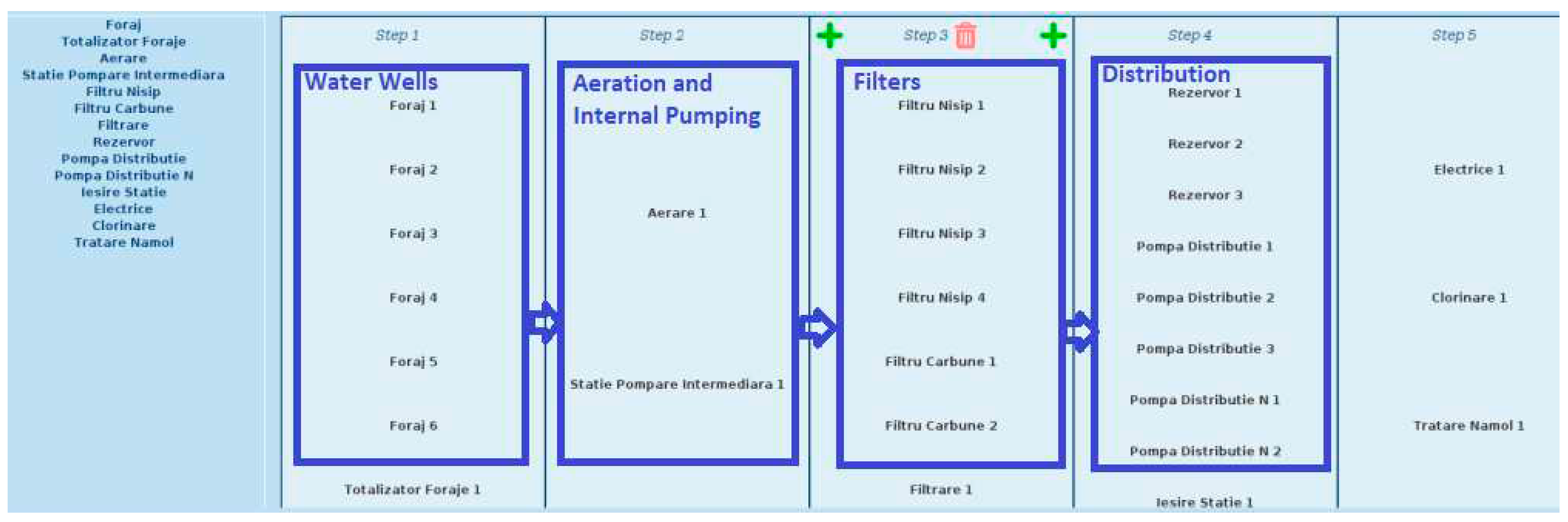
Figure 2.
Interfacing between historian and the legacy system.
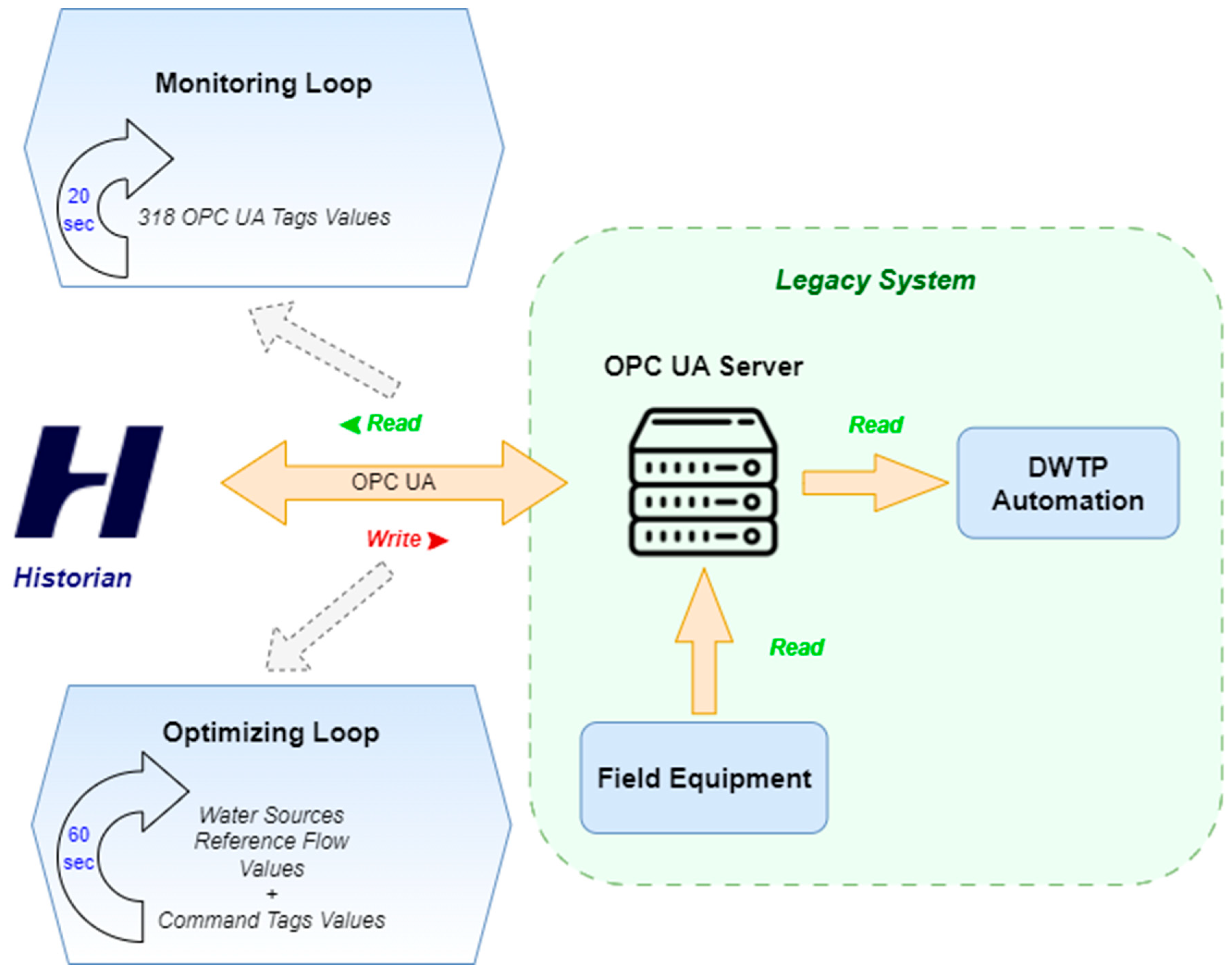
Figure 3.
The flow-based control loop within the legacy solution of each water source.
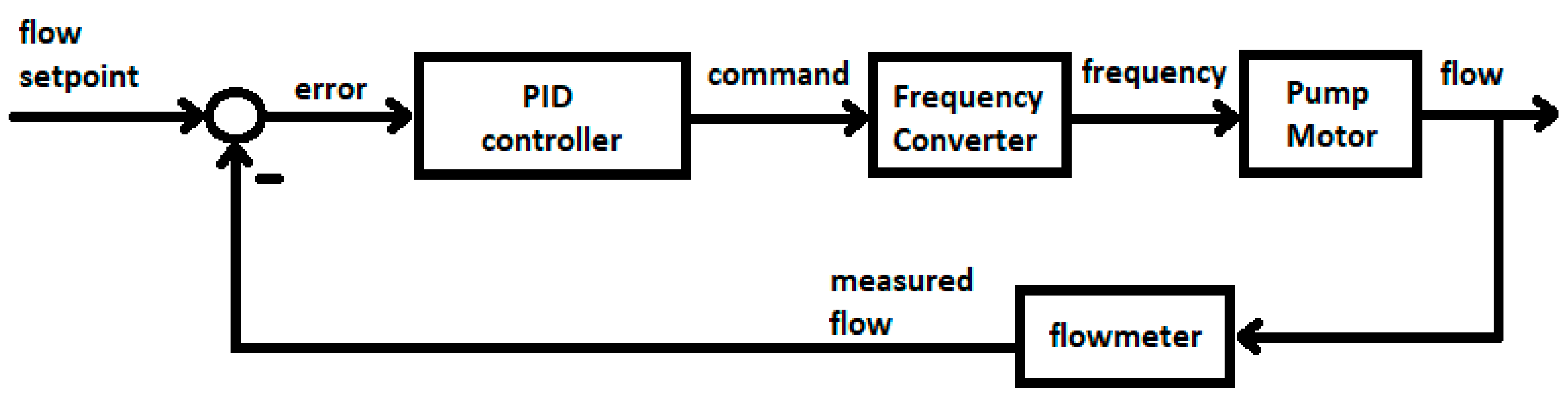
Figure 4.
The settings area from the historian’s GUI.
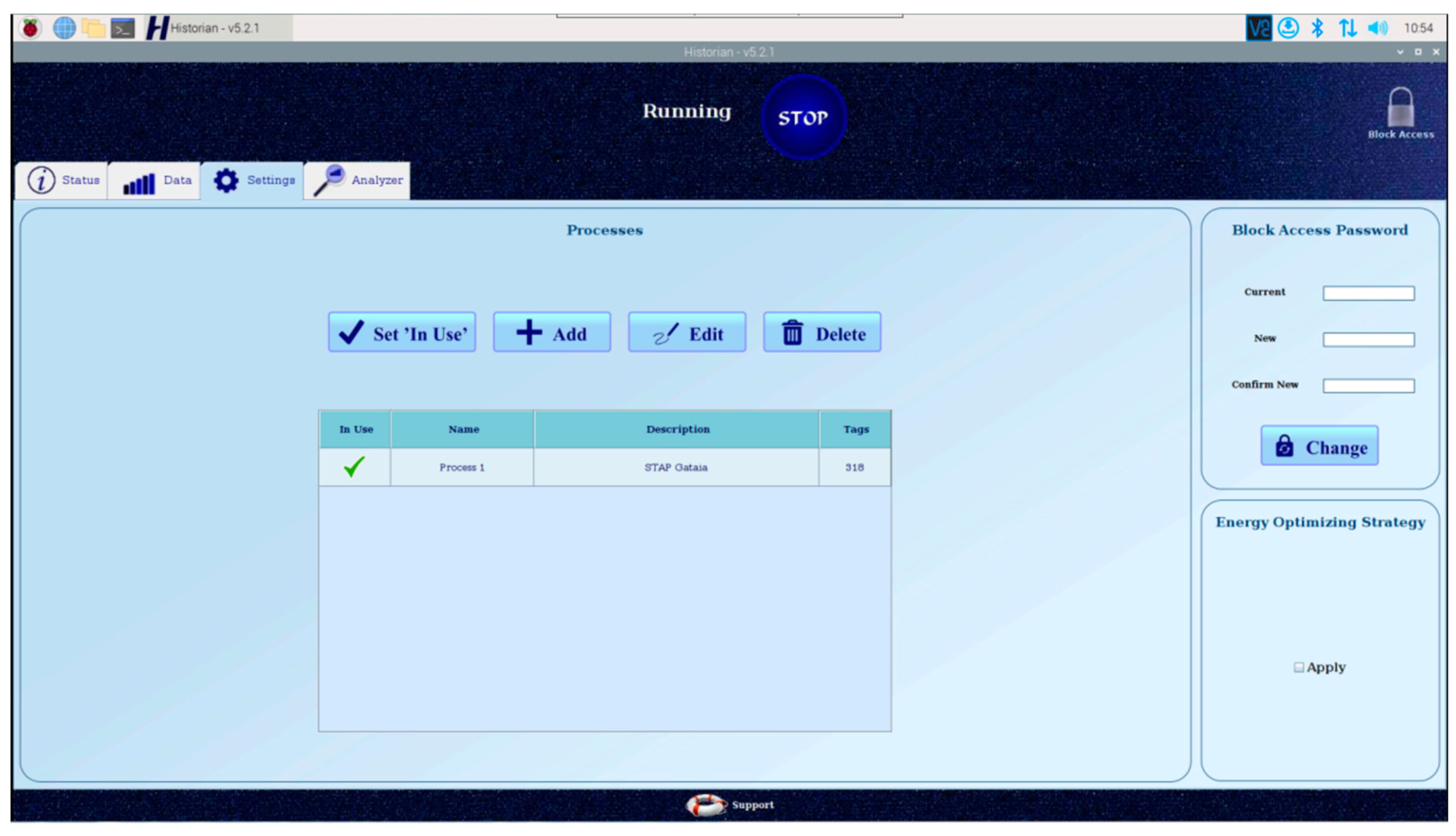

Table 1.
Total energy consumption per day comparison during test with previous months.
| December 2022 | January 2023 | February 2023 01.02 - 27.02 (before test) |
|
|---|---|---|---|
| Energy index start (kWh) | 1252010,25 | 1266546,5 | 1281298,75 |
| Energy index end (kWh) | 1266546,25 | 1281298,625 | 1293673,25 |
| Total energy consumed (kWh) | 14536 | 14752,125 | 12374,5 |
| Energy per day (kWh) | 468,90 | 475,875 | 475,942 |
| Energy per day (kWh) during test | 454,38 | ||
| Comparison | - 14,52 kWh/day - 3,1% |
- 21,495 kWh/day - 4,51% |
- 21,562 kWh/day - 4,53% |
Table 2.
Total energy consumption comparison during test with other similar 50-hours long intervals.
Table 2.
Total energy consumption comparison during test with other similar 50-hours long intervals.
| 30.01.2023 13:30 - 01.02.2023 15:30 (Monday – Wednesday) |
06.02.2023 13:30 - 08.02.2023 15:30 (Monday – Wednesday) |
13.02.2023 13:30 - 15.02.2023 15:30 (Monday – Wednesday) |
22.02.2023 13:30 - 24.02.2023 15:30 (Wednesday – Friday) |
01.03.2023 15:30 - 03.03.2023 17:30 (Wednesday – Friday) |
||
|---|---|---|---|---|---|---|
| Energy index start (kWh) | 1280569,5 | 1283990,5 | 1287399 | 1291612,875 | 1294833 | |
| Energy index end (kWh) | 1281572,5 | 1284977 | 1288386,5 | 1292580,5 | 1295789,5 | |
| Total energy consumed (kWh) | 1003 | 986,5 | 987,5 | 967,625 | 956,5 | |
| During test (27.02.2023 13:30 - 01.03.2023 15:30 Monday - Wednesday) | ||||||
| Energy index start (kWh) | 1293886,25 | |||||
| Energy index end (kWh) | 1294832,875 | |||||
| Total energy consumed (kWh) | 946,625 | |||||
| Comparison | - 56,375 kWh - 5,95% |
- 39,875 kWh - 4,21% |
- 40,875 kWh - 4,31% |
- 21 kWh - 2,22% |
- 9,875 kWh - 1,03% |
|
Table 3.
Total energy consumption per m3 entering DWTP comparison during test with previous intervals.
Table 3.
Total energy consumption per m3 entering DWTP comparison during test with previous intervals.
| 20.02.2023 00:00:00 – 27.02.2023 00:00:00 (the week before test) |
22.02.2023 13:30 – 24.02.2023 15:30 |
||
|---|---|---|---|
| Total energy consumed (kWh) | 3156,125 | 967,625 | |
| Total water volume entering DWTP (m3) | 2813,8 | 816 | |
| Total energy consumed per water volume (kWh / m3) | 1,121 | 1,186 | |
| During test (27.02.2023 13:30 - 01.03.2023 15:30) | |||
| Total energy consumed (kWh) | 946,625 | ||
| Total water volume entering DWTP (m3) | 882,9 | ||
| Total energy consumed per water volume (kWh / m3) | 1,072 | ||
| Comparison | - 0,049 kWh/m3 - 4,37% |
- 0,114 kWh/m3 - 9,61% |
|
Table 4.
Total energy consumption per m3 from water sources comparison during test with previous similar interval.
Table 4.
Total energy consumption per m3 from water sources comparison during test with previous similar interval.
| Week before test interval 20.02.2023 13:30:00 – 22.02.2023 15:30:00 Monday – Wednesday |
During test 27.02.2023 13:30 – 01.03.2023 15:30 Monday – Wednesday |
|
|---|---|---|
| Total energy consumed (kWh) | 914,75 | 946,625 |
| Total water volume offered by water sources (m3) | 881,25 | 936,25 |
| Total energy consumed per water volume (kWh / m3) | 1,038 | 1,011 |
| Comparison | - 0,027 kWh/m3 - 2,60% |
Disclaimer/Publisher’s Note: The statements, opinions and data contained in all publications are solely those of the individual author(s) and contributor(s) and not of MDPI and/or the editor(s). MDPI and/or the editor(s) disclaim responsibility for any injury to people or property resulting from any ideas, methods, instructions or products referred to in the content. |
© 2023 by the authors. Licensee MDPI, Basel, Switzerland. This article is an open access article distributed under the terms and conditions of the Creative Commons Attribution (CC BY) license (http://creativecommons.org/licenses/by/4.0/).
Copyright: This open access article is published under a Creative Commons CC BY 4.0 license, which permit the free download, distribution, and reuse, provided that the author and preprint are cited in any reuse.


