

Submitted:
18 June 2023
Posted:
19 June 2023
You are already at the latest version
Abstract
This paper presents an analysis of the sensitivity of controlling an autonomous surface object among a group of encountered objects to the inaccuracy of state control process data. For this purpose, a safe and optimal model of the control process was defined. An algorithm for determining the optimal and safe trajectory of an object, based on the multi-object game model, was developed; for comparative analysis, an algorithm for calculating only the optimal trajectory, not taking into account the maneuverability of other objects, was additionally developed. First, simulation-based studies of the algorithms enabled a comparative analysis of a number of different acceptable strategies for optimally shifting the trajectory of maneuvering objects from a single initial direction. Thereafter, the main goal of this paper was implemented: an analysis of the sensitivity characteristics of safe control, assessed with the risk of collision, both on the inaccuracy of navigation data and on the number of possible control strategies. Finally, final conclusions and a plan for further research on the subject of the paper were formulated.
Keywords:
maritime autonomous surface ships
; remote sensing
; optimal control
; game control
; computer simulation
1. Introduction
Currently, in marine technology, autonomous
navigation of such marine objects as ships, offshore units, and unmanned
vehicles is gaining increasing importance from the perspective of maritime
traffic safety.
1.1. State of Knowledge
One of the oldest reviews of the state of
development of autonomous surface vehicles is the work of Zhao et al. [1], which describes ASCs (autonomous surface
crafts), also called ASVs (autonomous surface vehicles), as autonomous marine
vehicle without direct human service.
The research, production, and service development
of USVs (unmanned surface vehicles) in shipping were described by Barrera et
al. [2], showing a multidisciplinary approach
to this field.
Choi et al. [3]
presented a test stand for the validation of basic navigation technologies for
autonomous marine robots for the purpose of tracking waypoints and avoiding
obstacles. Two methods of underwater location were used, in the forms of
acoustic navigation, based on the Kalman filter, and navigation based on
geophysics, using a particle filter.
Much work has been devoted, in recent years, to the
use of autonomous surface vehicles for the detection, recognition, and tracking
of various objects. Thus, Chen et al. [4]
presented a solution in the form of an autonomous USV that could acquire and
process mission data, as well as use a deep convolutional neural network in
order to identify approaching vehicles and transmit their information to the
ground station controlling the sea area.
The design of a surface vehicle, which was capable
of detecting objects at the bottom of a larger reservoir, navigating in the
direction of the object, and picking the object up using the attached grapple,
was presented by Sneha [5]. Control is first
performed with a PID controller for proof of concept, and then with an LQR
controller and observer for optimal control.
Omrani et al. [6] presented the use of
an aircraft ASV for monitoring marine facilities and ports by implementing a
stereovision system for detecting and tracking both static and dynamic
obstacles.
Zhang et al. [7] proposed a method of
accurate target detection with long-strip targets on the water, based on a
convolutional neural network, for detecting and tracking targets in the
processes of sea exploration and protection. The closed control system with a
PID controller ensures its optimal approximation to the longitudinal target.
In addition, Lee and Lin [8], using an extensive neural
network, designed a process for identifying and controlling an unmanned surface
vehicle.
Currently, there is a
growing interest in technology regarding the intelligent navigation of
autonomous ships in planning the optimal voyage route and preventing collisions.
For this purpose, Hongguang and Yong [9] proposed the use of the artificial potential field method
for the synthesis of anti-collision trajectories.
Zhou et al. [10] and Due et al. [11] reviewed research on
the route planning of USVs based on the multimodality constraint, which can be
divided into the following stages: route planning, trajectory planning, and
traffic planning.
Martins et al. [12] designed a docking
system for a surface ASV cooperating with an underwater AUV in a river
environment.
Park et al. [13] described object
recognition based on images from several cameras in order to detect obstacles
on autonomous ships and then to track the movements of recognized ships.
Moreover, Li et al.
[14] designed a USV and a
UAV path-following system in the presence of structural uncertainties and
external disturbances, consisting of three-dimensional mapping guidance and an
adaptive fuzzy control algorithm.
Wang et al. [15] introduced Roboat’s
autonomy system for urban waterways, based on the extended Kalman filter,
calculation of optimal trajectories to avoid static and dynamic obstacles, and
predictive steering to accurately track the trajectory from the planner in
rough water.
Hongguang and Yong [16] presented a
deterministic method of real-time route planning for autonomous ships or
unmanned surface vehicles (USVs), taking into account the function of the
repulsive potential field and the corresponding virtual forces, constrained by
COLREG rules for own-ship actions.
Recently, USVs that
ensure traffic safety by taking the COLREG rules into account, thus preventing
collisions with other vessels, have been actively developed. Thus, Kim et al. [17] proposed an algorithm
that predicts dangerous situations based on the distance to the nearest DCPA
approach point and the time to the nearest TCPA approach point.
However, Zhong et al. [18] proposed an
ontological model of ship behavior based on the COLREGs using knowledge graph
techniques, aiming to help the machine interpret the rules of COLREGs; in this
model, the ship is perceived as a spatiotemporal object and its behavior is
described as changing the elements of the object on spatiotemporal scales using
resource description framework, function, and method mappings for set
expressions.
Moreover, Hu et al. [19] reviewed recent
advances in COLREG rules-compliant ASV navigation from a traditional approach
to a learning-based approach in implementing the three steps of safe
navigation, namely from collision detection, to decision making, and then to
rerouting.
Furthermore, the topic of
ensuring the safety of a USV moving among a group of other USVs has been
raised.
Sun et al. [20] proposed a method of
cooperation for many USVs in the process of chasing intelligent escapees, in
which the collision avoidance method is based on the artificial field potential
for ships between USVs and the strategy for dynamic obstacle–ship collision
avoidance is based on the COLREG rules.
1.2. Paper Thesis and Objectives
An analysis of the
literature review shows that, so far, the problem of the dependence of the game
control motion security level of an autonomous surface object acting among a
group of other encountered objects on both the inaccuracy of navigation
information and on the range of acceptable control strategies has not been
addressed.
Therefore, the aim of
this article is to show that, by analyzing the sensitivity of the collision
risk, it is possible to assess the range of acceptable values for both the
inaccuracy of individual components of navigation information and the number of
acceptable control strategies.
The scientific goal is to
analyze the game and optimal control sensitivity to changes in the state and
control process of autonomous surface object movement among a group of other
encountered objects. The index of the game control is the collision risk value,
and the index of the optimal control is the final deviation of the trajectory
from its predetermined direction.
The aim of this research
is to conduct an experimental comparative analysis of game control against
non-game control with a number of different acceptable strategies for
controlling objects.
1.3. Paper Content Plan
This paper is organized
as follows. First, the autonomous control process of a surface object is
described, in the forms of state equations, constraints, and control objective
functions. The next section describes our new safe trajectory algorithms:
first, the game control algorithm, and then, for comparison, the non-game
control algorithm. The subsequent section presents a computer simulation using
the developed algorithms on the example of a real navigational situation at
sea. The test results, as a comparison of trajectory optimalty and safe control
sensitivity characteristics, are illustrated. The conlusion section summarizes
the results of the research and presents the scope of future work on the
subject of this paper.
2. Autonomous Surface Object Control Process
The control process for a
group of autonomous surface objects, where our autonomous surface object 0,
which controls collision avoidance by using the change in course ψ0
as control u0, is positioned at (X0, Y0),
and a group of other autonomous surface objects k, which controls their
course ψk via control uk, are positioned at
(Xk, Yk), is presented in Figure 1.
The control of individual
objects affect their relative movement and the distance at which they will pass
each other, which becomes the basis for whether the model involves a cooperative
game or a non-cooperative game. When following COLREGs, we are dealing with a
cooperative game.
However, difficult
environmental conditions, disturbances in the measurements of data-controlled
autonomous objects, and various subjective factors make up a non-cooperative
game.
The control process of
our autonomous surface object 0 among the group of k autonomous surface
objects, shown in Figure 2, consists of the state equations of this process:
where x(Dk,
Nk, Xk, Yk) are state variables; u(ψk)
is the control variable; k = 1, 2, ..., K—represents the number
of autonomous objects; Dk and Nk are,
respectively, the distance from and bearing to the k autonomous surface
object; Xk, Yk are the position coordinates
of k autonomous surface objects; and ψk is the course of autonomous surface object k.
State and control constraints in general notation have the following form:
while, here, they result
from the need to keep a safe distance between objects
The control objective
function as an index of optimal control quality in general form:
takes the form of rk
collision risk in the process of safe object control:
where
is the shortest passing
time of our autonomous surface object and autonomous surface object k,
and Ts is a safe passing
time, depending on the state of visibility at sea.
3. Algorithms for Determining a Safe Trajectory
3.1. Game Control Algorithm
Our autonomous surface
object has control , where i = 1,
2, ..., I is the number of times it is allowed to change courses in
order to carry out an anti-collision maneuver at a distance of no less than Ds
(see Figure 3). Similarly, at each k, another autonomous surface object uses control , where j = 1, 2,
…, J is the number of times it is allowed to change courses in order to
carry out an anti-collision maneuver.
A collision risk matrix is created, where the
risk of collision rk is the relative measure of safety when
autonomous objects pass each other. The current situation CS is
described by values
. A safe situation SS
is defined by quantities SS(Ds, Ts). The
author of this paper defines the collision risk rk as the
mean squared reference measure of the assessment of the current situation CS
and the proximity of objects to the assessment of the expected safe situation SS:
where cd, ct, and c represent weighting factors depending on environmental conditions, with values from 0 to 1; for example, in situations with concentrated object movement, cd = ct = 0.4 and c = 0.5 and in situations with greater distances between objects, cd = ct = 0.5 and c = 0.1 [21] .
The safe and optimal game trajectory for our autonomous surface object 0 in a group of other autonomous surface objects k can be computed via dual linear programming:
It is assumed that, for
various unknown reasons, a k autonomous object’s course leads to a
collision using strategy j, maximizing the risk of collision.
Thereafter, its own autonomous surface object, in response, determines its area
of acceptable strategies and, from there, selects the strategy i,
minimizing the risk of collision, and implements the anti-collision maneuver.
The operation of the game
control algorithm G, developed by the author of the article for
determining the safe trajectory of an autonomous surface object among a group
of autonomous surface objects as a multi-stage decision-making process, was
tested using MATLAB/Simulink version R2023a software (Algorithm 1).
| Algorithm 1: Game control of autonomous surface object. |
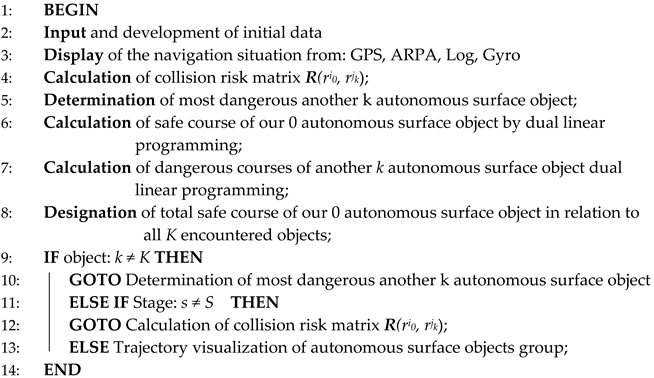 |
The original, innovative
algorithm G segment forms a collision risk matrix based on current
information about the navigation situation from the ARPA anti-collision system
and then applies dual linear programming in order to find optimal strategies in
each subsequent step of the game flow. In this way, a multi-step game control
algorithm is synthesized. Therefore, Algorithm G computes the elements
of the collision risk matrix, where the number of rows equals the number of
strategies available to our autonomous surface object, and the number of
columns equals the total number of strategies available to all other autonomous
surface objects.
3.2. Non-Game Control Algorithm
Assuming that other
autonomous objects move without changing course over time, the game control
task is reduced to the non-game control task:
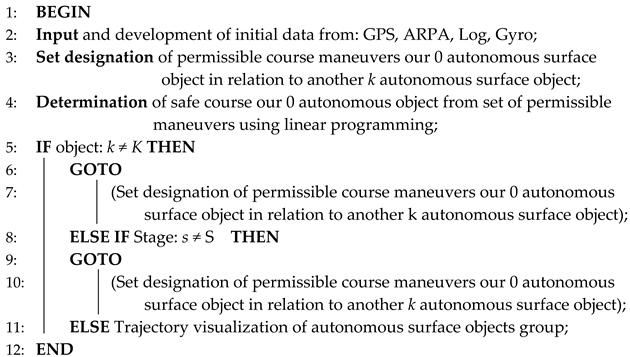
The NG algorithm
is used in this paper only for the comparative analysis of game control with
classic optimal control. The operation of the non-game control algorithm
for determining a safe trajectory in a group of autonomous surface objects as a
multi-stage decision-making process was tested using MATLAB/Simulink version
R2023a software (Algorithm 2).
| Algorithm 2: Non-game control of autonomous surface object. |
 |
4. Computer Simulation
4.1. Comparison of Trajectories for Optimality
The G and NG
algorithms for calculating the safe path of our autonomous surface vehicle
through a group of k = 14 autonomous surface targets were subjected to
simulation tests on the example described in Table 1 and shown in Figure 4, Figure 5, Figure 6, Figure 7 and Figure 8.
We assume that autonomous
surface objects are equipped with regulators programmed in a microcontroller or
programmable logic controller (PLC), and their motion control takes
predetermined discrete values, which are called control strategies.
For the simulation tests,
five sets of object maneuvering strategies were adopted, which are presented in Table 2.
Figure 7a and Figure 8a for non-game NG algorithm are
the same for comparison with the game G algorithm results for different
quantities control strategies shown in Figure 7b
and Figure 8b.
Comparing the results from experimental studies of
the safe path algorithms for our autonomous surface
object through a group of other autonomous surface targets, we can conclude the
following:
- The greater number of admissible strategies available for the objects, i.e., the greater the angular resolution of the course change, the smaller the deviation d* of the safe trajectory: for the non-game algorithm NG, about three times and for the game algorithm G, about two times;
- With a small number of acceptable strategies, the deviation of the safe path is 30–60% greater for the G algorithm than for the NG algorithm;
- With a greater number of acceptable strategies, the safe path deviation becomes 200 ÷ 300% greater for the G algorithm than for the NG algorithm.
The above differences result from the specificity of the G algorithm, which takes unforeseen maneuvers of other autonomous surface objects into account.
4.2. Safe Control Sensitivity
Sensitivity analysis concerns an assessment of the quality of optimal and safe system control of autonomous surface objects. The sensitivity functions sx of the optimal and safe control u of the game process described by state variables x can be presented as partial derivatives of the quality control index Q [22,23]:
where Q is an index of the optimal control quality described by Formula (4).
The sensitivity of safe control is treated as the sensitivity sx of the collision risk rk to deviations of the measured values xe of the individual components of the process state from their actual values x, as follows:
where x(V0, ψ0, Vk, ψk, Dk, Nk, Ds, ts, n) is a set of real values about the process state; ts is the step time calculation trajectory; n = i + j is the number of admissible strategies for autonomous surface objects; and xe(V0 ± δV0, ψ0 ± δψ0Vk ± δVk, ψk± δψk, Dk ± δDk, Nk ± δNk, Ds ± δDs, ts ± δts, n ± δn) is a set of real values about the process state with measurement errors or possibility control.
Figure 9, Figure 10, Figure 11 and Figure 12 show the sensitivity characteristics of the collision risk to changes in the eight components involved in the motion of objects and to a different number of acceptable strategies for autonomous surface objects.
The sensitivity of the control process depends on the inaccuracy of information from the ARPA anti-collision radar about the current situation and on changes in its parameters.
The inaccuracy of the sensors are as follows:
- Log speed δV0, δVk: ±0.5 kn;
- Gyrocompass course δψ0, δψk: ±0.5°;
- Radar distance δDk: ±0.05 nm, bearing δNk: ±0.25°;
- COLREG safe distance δDs: +100%/−40%; subjective error of the navigator in assessing the situation.
The algebraic sum of all errors affecting the image of the navigational situation cannot exceed ±5% for absolute values and ±3° for angular parameters.
The course of the sV and sVk characteristics shows that, in order to reduce the sensitivity of the safe control by half, the velocity of the objects should be measured with an acceptable error of no more than δV0 = δVk = 0.2 kn.
On the other hand, the course of the sψ and sψk characteristics shows that, in order to reduce the sensitivity of the safe control by half, the course of the objects should be measured with an acceptable error of no more than δψ0 = δψk = 0.2 deg.
The course of the sD and sDk characteristics shows that, in order to reduce the sensitivity of the safe control by half, the distances of the objects should be measured with an acceptable error of no more than δDk = 0.02 nm.
On the other hand, the course of the sN and sNk characteristics shows that, in order to reduce the sensitivity of the safe control by half, the bearings of the objects should be measured with an acceptable error of no more than δNk = 0.1 deg.
The analysis of the sensitivity characteristics for the collision risk of the autonomous surface object’s control allows us to draw the following conclusions:
- Sensitivity is the greatest source of measurement errors for angular variables of the process state in the form of course and bearing;
- Sensitivity increases with increasing traffic safety requirements, defined by safe distance Ds between objects;
- Sensitivity decreases with increasing step time ts value;
- Underestimating own speed V0 is better than overestimating because the risk of collision increases as the speed of the moving object increases;
- Sensitivity decreases with an increase in the number of acceptable strategies, n, of autonomous surface objects k, which is a positive feature of robust control systems on the impact of any external influences, and results from the possibility of more accurate control with a larger number n of acceptable control strategies.
5. Conclusions
Based on the analysis of the algorithms for the safe control of a group of autonomous surface objects, and the results of their computer simulation studies, the following final conclusions were formulated:
- The multi-stage matrix game model enables the synthesis of a computer program for calculating the safe path of an autonomous surface object through a group of other autonomous surface objects that can perform unforeseen maneuvers;
- The safe path of an autonomous surface feature and its deviation from its initial trajectory depends on the number of allowed strategies for this autonomous surface feature and other autonomous surface features; the greater the angular resolution of the course change, the smaller the deviation of the safe path from the initial direction of motion;
- Based on the sensitivity characteristics of the collision risk, the required accuracy of measurement can be determined for individual state variables—the speed and course of objects, as can the distance and bearing to objects.
This article has not yet solved many of the problems associated with the design, testing, and application of new game control systems for autonomous surface objects. Future research should consider the following:
- Development of a process model that takes the non-linear dynamic properties of objects into account;
- Appropriate semantic interpretation of COLREG requirements;
- More accurate representation of the optimal control process using selected methods of artificial intelligence.
Funding
This research was funded by a research project of the Electrical Engineering Faculty, Gdynia Maritime University, Poland, No. WE/2023/PZ/02: “Control algorithms synthesis of autonomous objects”.
Institutional Review Board Statement
Not applicable.
Informed Consent Statement
Not applicable.
Data Availability Statement
This study did not report any data.
Conflicts of Interest
The author declares no conflict of interest. The funders had no role in the design of the study; in the collection, analyses, or interpretation of data; in the writing of the manuscript; or in the decision to publish the results.
References
- Zhao, J.; Yan, W.; Jin, X. Brief review of autonomous surface crafts. ICIC Express Lett. 2011, 5, 4381–4386. [Google Scholar]
- Barrera, C.; Padron, I.; Luis, F.S.; Llinas, O. Trends and challenges in unmanned surface vehicles (USV): From survey to shipping. TransNav Int. J. Mar. Navig. Saf. Sea Transp. 2021, 15, 135–142. [Google Scholar] [CrossRef]
- Choi, J.; Park, J.; Jung, J.; Lee, Y.; Choi, H.T. Development of an Autonomous Surface Vehicle and Performance Evaluation of Autonomous Navigation Technologies. Int. J. Control Autom. Syst. 2020, 18, 535–545. [Google Scholar] [CrossRef]
- Chen, Y.; Chen, X.; Zhu, J.; Lin, F.; Chen, B.M. Development of an Autonomous Unmanned Surface Vehicle with Object Detection Using Deep Learning. In Proceedings of the IECON 2018—44th Annual Conference of the IEEE Industrial Electronics Society, Washington, DC, USA, 26 December 2018; pp. 5636–5641. [Google Scholar] [CrossRef]
- Sneha, T. The Design and Control of an Economical Autonomous Surface Vehicle for Object Detection; Princeton University: Princeton, NJ, USA, 2020. [Google Scholar]
- Omrani, E.; Mousazadeh, H.; Omid, M.; Masouleh, M.T.; Jafarbiglu, H.; Salmani-Zakaria, Y.; Makhsoos, A.; Monhaseri, F.; Kiapei, A. Dynamic and static object detection and tracking in an autonomous surface vehicle. Ships Offshore Struct. 2020, 15, 711–721. [Google Scholar] [CrossRef]
- Zhang, M.; Zhao, D.; Sheng, C.; Liu, Z.; Cai, W. Long-Strip Target Detection and Tracking with Autonomous Surface Vehicle. J. Mar. Sci. Eng. 2023, 11, 106. [Google Scholar] [CrossRef]
- Lee, M.F.R.; Lin, C.Y. Object Tracking for an Autonomous Unmanned Surface Vehicle. Machines 2022, 10, 378. [Google Scholar] [CrossRef]
- Hongguang, L.; Yong, Y. Fast Path Planning for Autonomous Ships in Restricted Waters. Appl. Sci. 2018, 12, 2592. [Google Scholar] [CrossRef]
- Zhou, C.; Gu, S.; Wen, Y.; Du, Z.; Xiao, C.; Huang, L.; Zhu, M. The review unmanned surface vehicle path planning: Based on multi-modality constraint. Ocean. Eng. 2020, 200, 107043. [Google Scholar] [CrossRef]
- Du, Z.; Negenborn, R.R.; Reppa, V. Review of floating object manipulation by autonomous multi-vessel systems. Annu. Rev. Control. 2022, 1, 1. [Google Scholar] [CrossRef]
- Martins, A.; Almeida, J.M.; Ferreira, H.; Silva, H.; Dias, N.; Dias, A.; Almeida, C.; Silva, E.P. Autonomous Surface Vehicle Docking Manoeuvre with Visual Information. In Proceedings of the IEEE International Conference on Robotics and Automation, Roma, Italy, 10–14 April 2007. [Google Scholar] [CrossRef]
- Park, H.; Ham, S.H.; Kim, T.; An, D. Object Recognition and Tracking in Moving Videos for Maritime Autonomous Surface Ships. J. Mar. Sci. Eng. 2022, 10, 841. [Google Scholar] [CrossRef]
- Li, J.; Zhang, G.; Shan, Q.; Zhang, W. A Novel Cooperative Design for USV-UAV Systems: 3D Mapping Guidance and Adaptive Fuzzy Control. IEEE Trans. Control. Netw. Syst. 2022, 11, 1–11. [Google Scholar] [CrossRef]
- Wang, W.; Gheneti, B.; Mateos, L.A.; Duarte, F.; Ratti, C.; Rus, D. Roboat: An Autonomous Surface Vehicle for Urban Waterways. In Proceedings of the IEEE/RSJ International Conference on Intelligent Robots and Systems (IROS), Macau, China, 3–8 November 2019; pp. 6340–6347. [Google Scholar] [CrossRef]
- Hongguang, L.; Yong, Y. COLREGS-Constrained Real-time Path Planning for Autonomous Ships Using Modified Artificial Potential Fields. J. Navig. 2018, 72, 588–608. [Google Scholar] [CrossRef]
- Kim, H.G.; Yun, S.J.; Choi, G.H.; Ryu, J.K.; Suh, J.H. Collision Avoidance Algorithm Based on COLREGs for Unmanned Surface Vehicle. J. Mar. Sci. Eng. 2021, 9, 863. [Google Scholar] [CrossRef]
- Zhong, S.; Wen, Y.; Huang, Y.; Cheng, X.; Huang, L. Ontological Ship Behavior Modeling Based COLREGs for Knowledge Reasoning. J. Mar. Sci. Eng. 2022, 10, 203. [Google Scholar] [CrossRef]
- Hu, L.; Hu, H.; Naeem, W.; Wang, Z. A review on COLREGs-compliant navigation of autonomous surface vehicles: From traditional to learning-based approaches. J. Autom. Intell. 2022, 1, 100003. [Google Scholar] [CrossRef]
- Sun, Z.; Sun, H.; Li, P.; Zou, J. Self-organizing cooperative pursuit strategy for multi-USV with dynamic obstacle ships. J. Mar. Sci. Eng. 2022, 10, 562. [Google Scholar] [CrossRef]
- Lisowski, J. Multi-criteria Optimization of Multi-step Matrix Game in Collision Avoidance of Ships. TransNav—Int. J. Mar. Navig. Saf. Sea Transp. 2019, 13, 125–131. [Google Scholar] [CrossRef]
- Eslami, M. Theory of Sensitivity in Dynamic Systems; Springer-Verlag: Berlin, Germany, 1994; ISBN 978-3-662-01632-9. [Google Scholar]
- Rosenwasser, E.; Yusupov, R. Sensitivity of Automatic Control Systems; CRC Press: Boca Raton, FL, USA, 2000; ISBN 978-0-849-3229293-8. [Google Scholar]
Figure 1.
Graphical model of a group game involving autonomous surface objects.
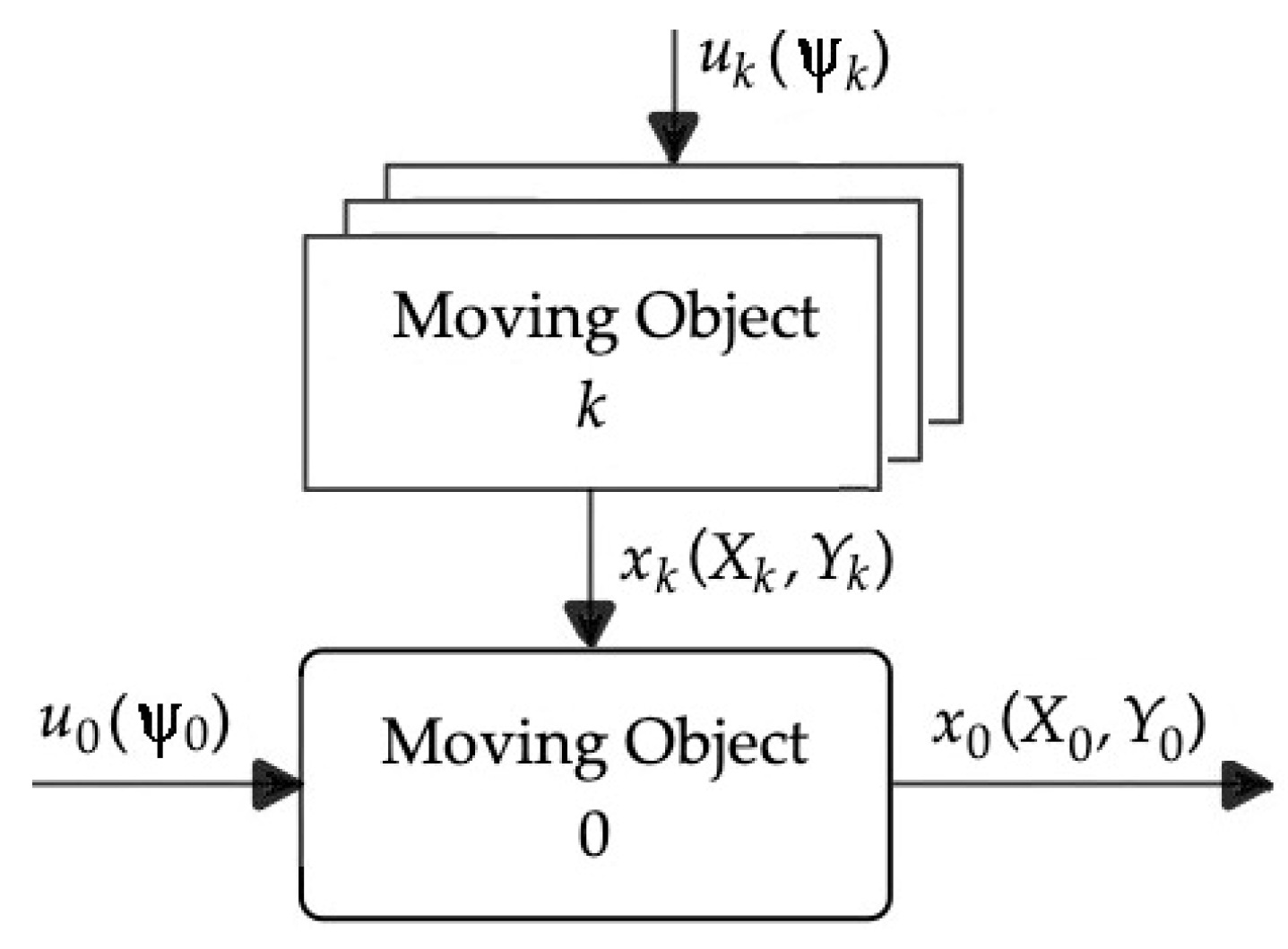
Figure 2.
Variables describing the movement of a group of autonomous surface objects: V0 and ψ0 are, respectively, the speed and the course of our autonomous surface object; Vk and ψk are, respectively, the speed and the course of another autonomous surface object k; Dk and Nk are, respectively, the distance from and the bearing to the k autonomous surface object; and stand, respectively, for
the minimum distance from and the time of passing autonomous surface objects; Ds
is the safe passing distance of autonomous surface objects; and (X, Y)
are the position coordinates of autonomous surface objects.
Figure 2.
Variables describing the movement of a group of autonomous surface objects: V0 and ψ0 are, respectively, the speed and the course of our autonomous surface object; Vk and ψk are, respectively, the speed and the course of another autonomous surface object k; Dk and Nk are, respectively, the distance from and the bearing to the k autonomous surface object; and stand, respectively, for
the minimum distance from and the time of passing autonomous surface objects; Ds
is the safe passing distance of autonomous surface objects; and (X, Y)
are the position coordinates of autonomous surface objects.
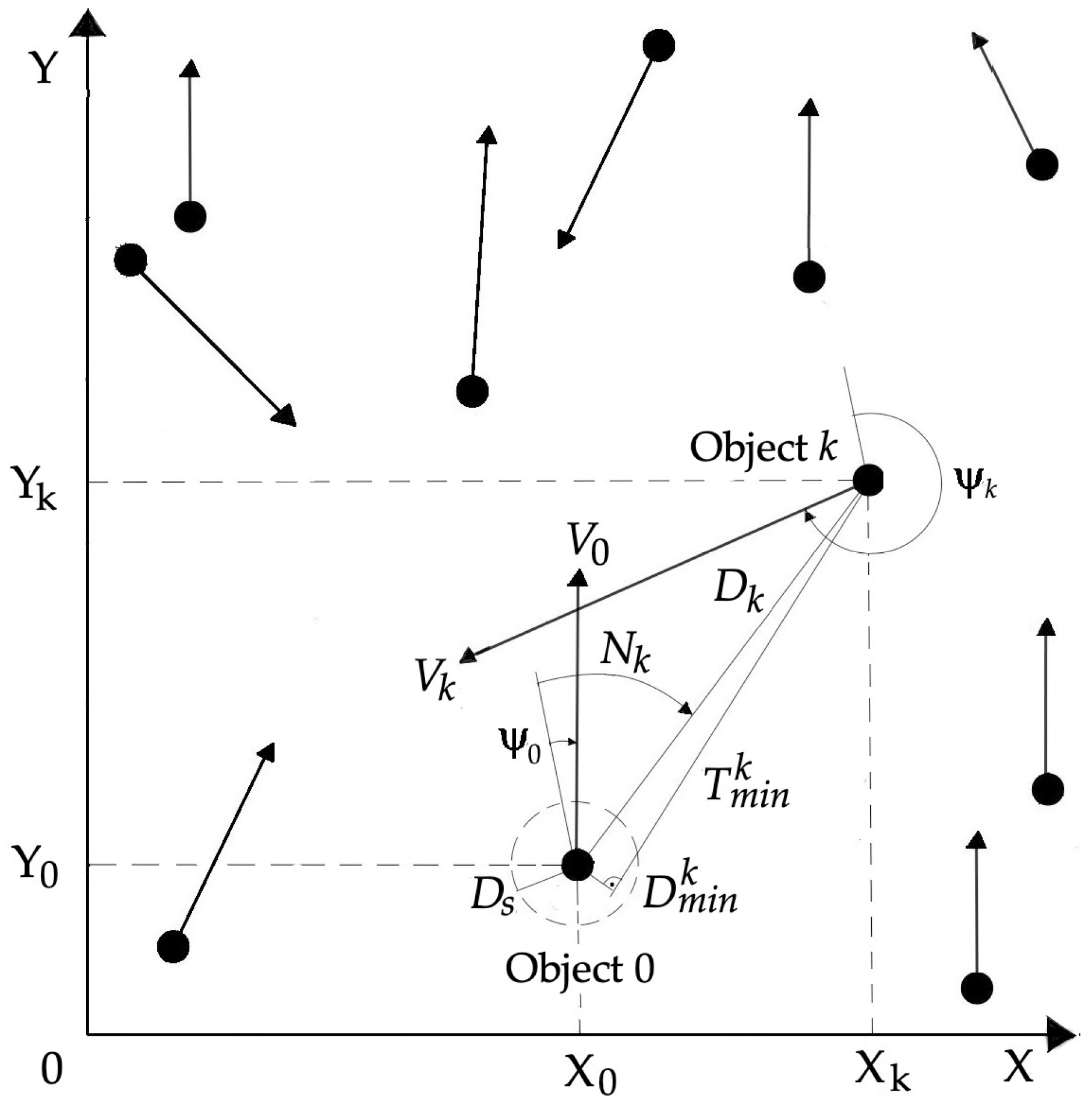
Figure 3.
Sets of the number of acceptable strategies i for our autonomous surface object 0 and the number of acceptable strategies j for another autonomous surface object k.
Figure 3.
Sets of the number of acceptable strategies i for our autonomous surface object 0 and the number of acceptable strategies j for another autonomous surface object k.
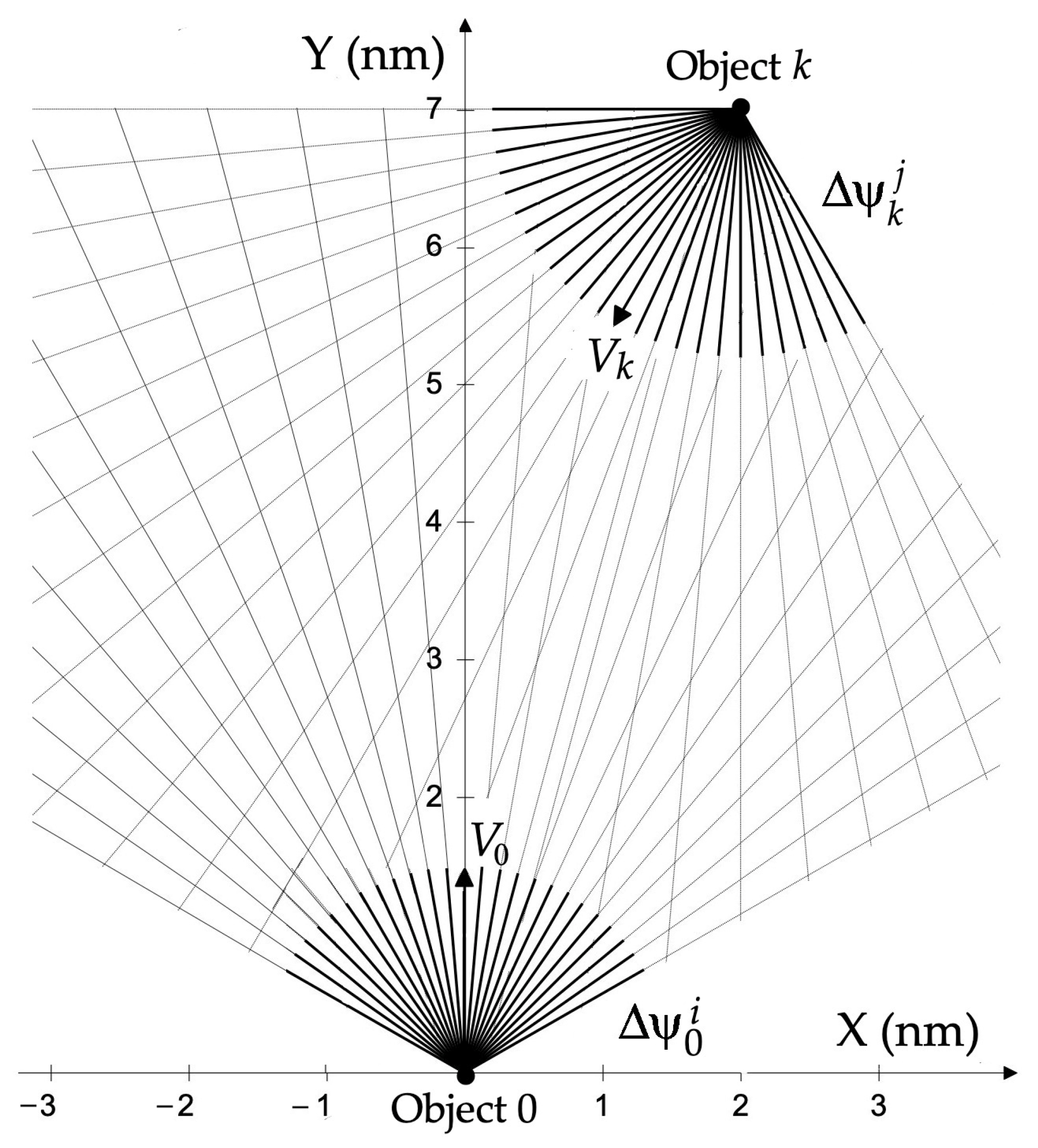
Figure 4.
Safe trajectory of our autonomous surface object, using set A of object maneuvering strategies: (a) non-game control; (b) game control.
Figure 4.
Safe trajectory of our autonomous surface object, using set A of object maneuvering strategies: (a) non-game control; (b) game control.
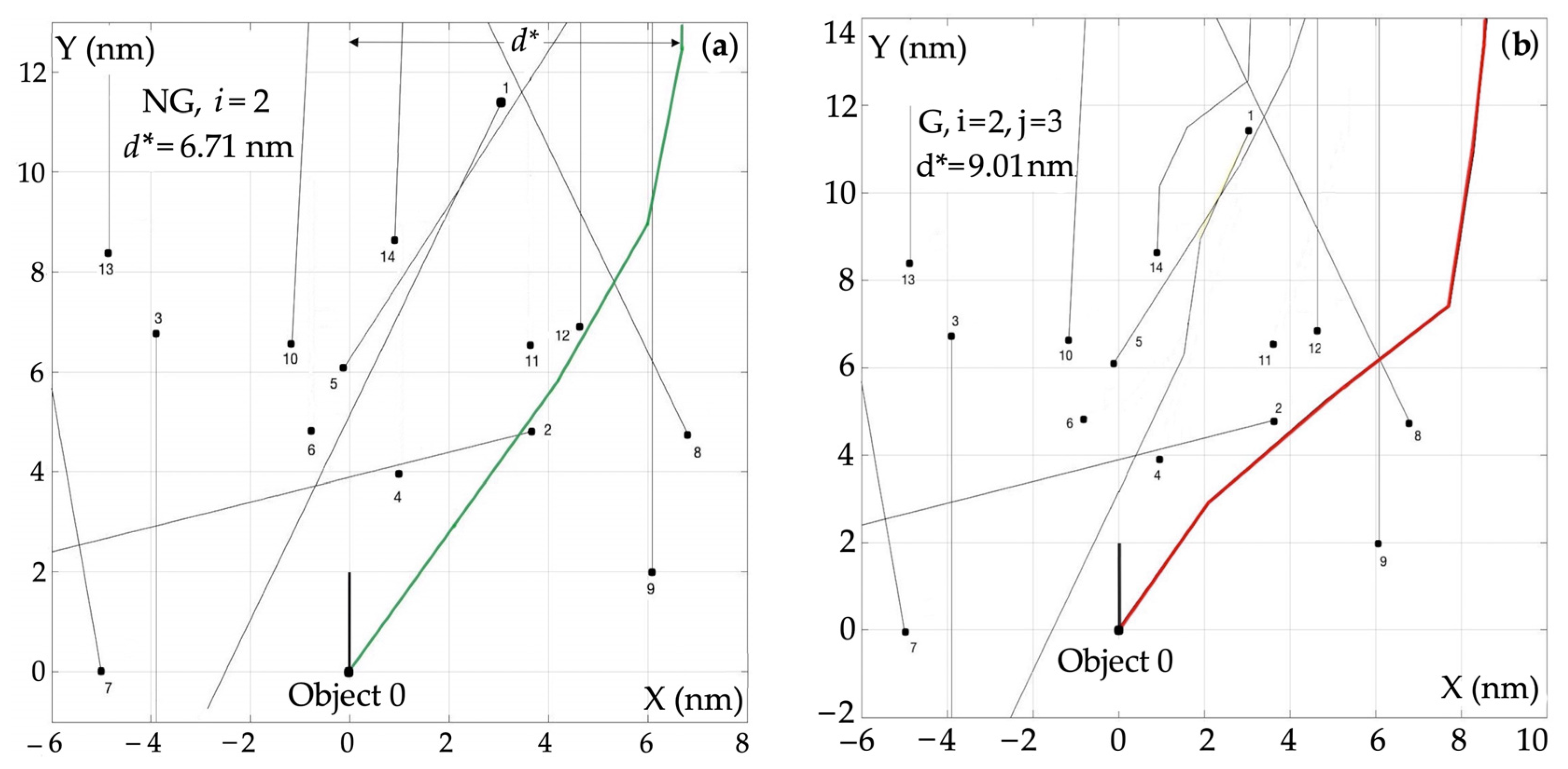
Figure 5.
Safe trajectory of our autonomous surface object, using set B of object maneuvering strategies: (a) non-game control; (b) game control.
Figure 5.
Safe trajectory of our autonomous surface object, using set B of object maneuvering strategies: (a) non-game control; (b) game control.
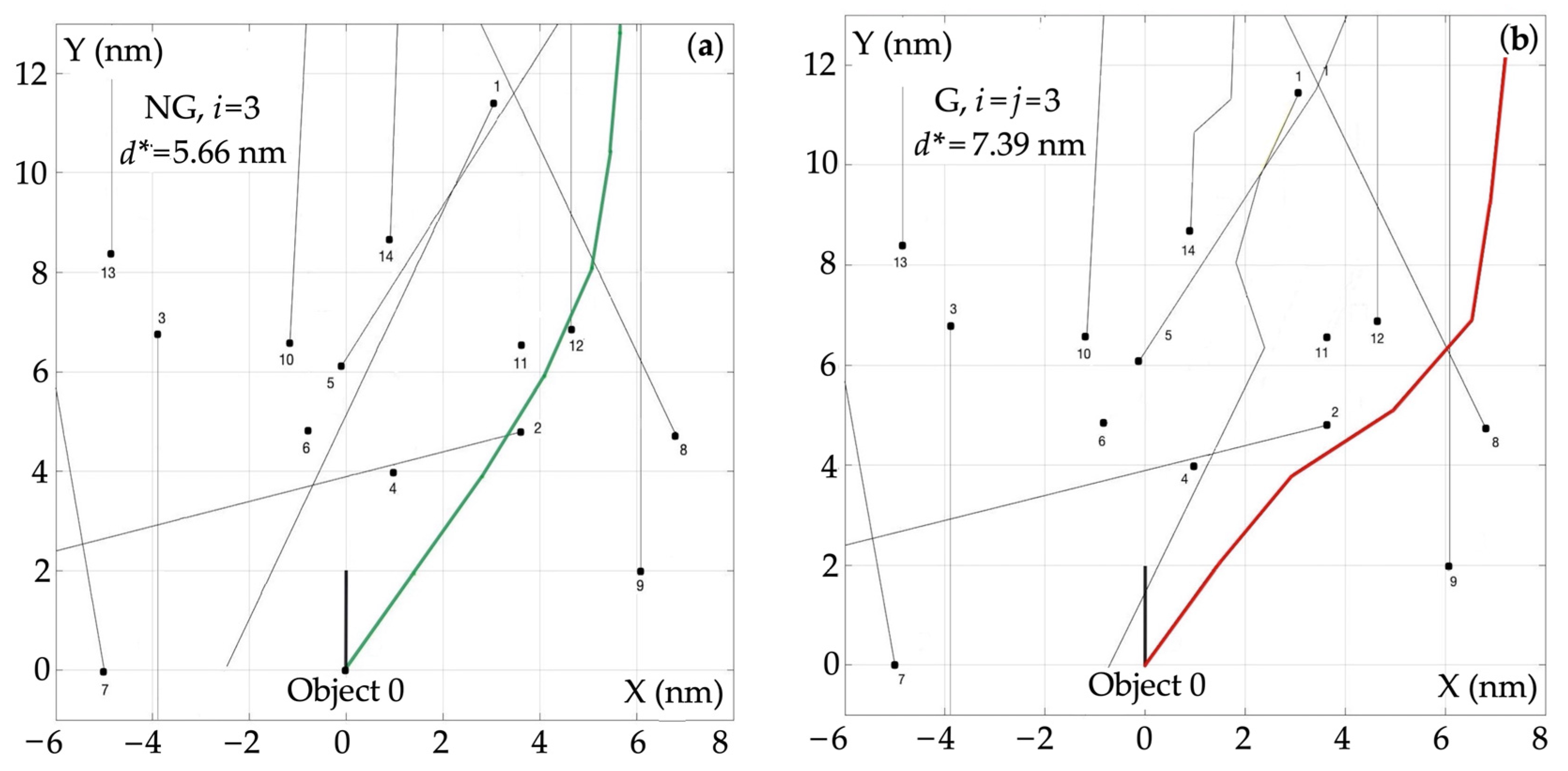
Figure 6.
Safe trajectory of our autonomous surface object, using set C of object maneuvering strategies: (a) non-game control; (b) game control.
Figure 6.
Safe trajectory of our autonomous surface object, using set C of object maneuvering strategies: (a) non-game control; (b) game control.
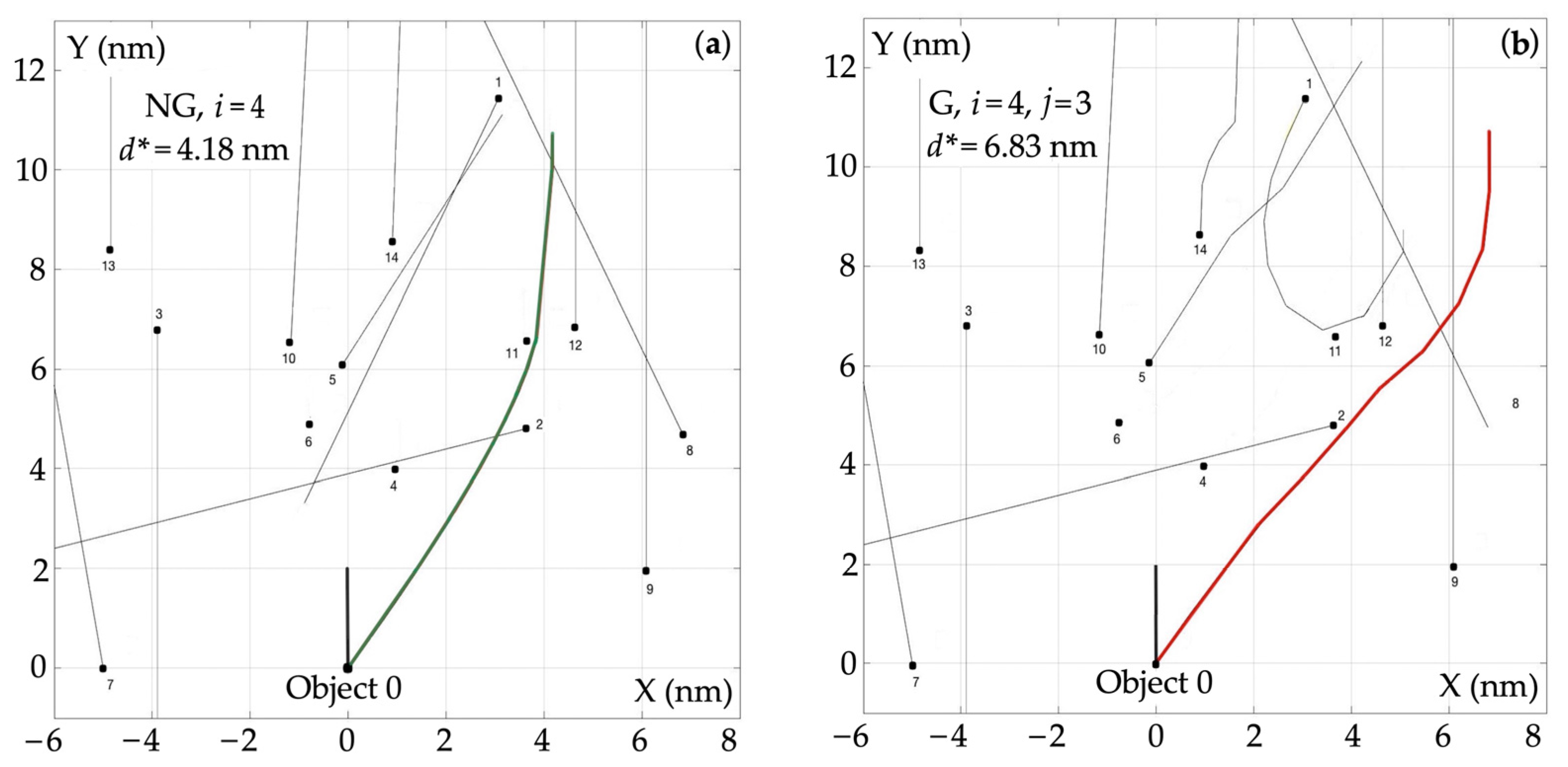
Figure 7.
Safe trajectory of our autonomous surface object, using set D of object maneuvering strategies: (a) non-game control; (b) game control.
Figure 7.
Safe trajectory of our autonomous surface object, using set D of object maneuvering strategies: (a) non-game control; (b) game control.
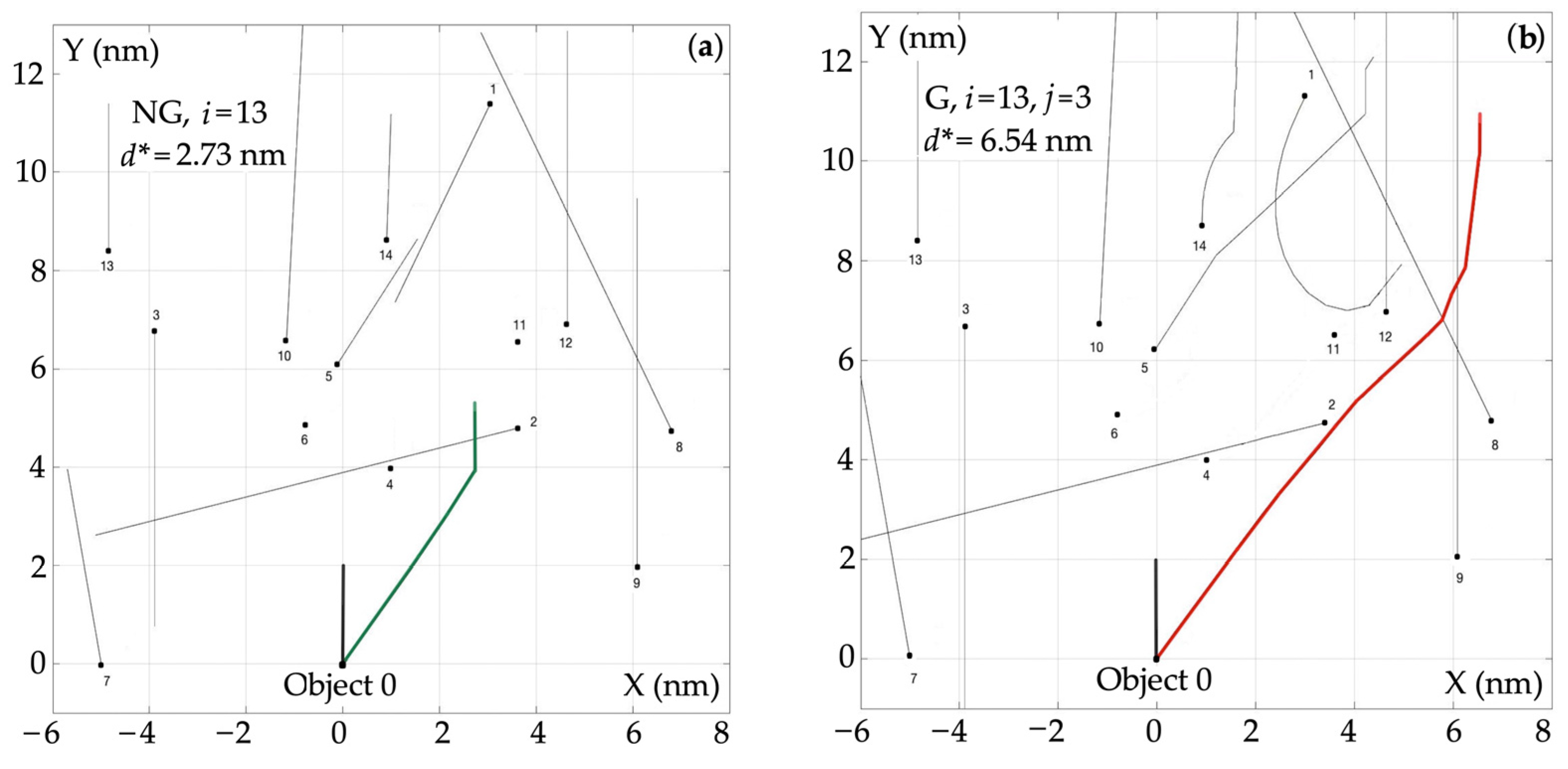
Figure 8.
Safe trajectory of our autonomous surface object, using set E of object maneuvering strategies: (a) non-game control; (b) game control.
Figure 8.
Safe trajectory of our autonomous surface object, using set E of object maneuvering strategies: (a) non-game control; (b) game control.
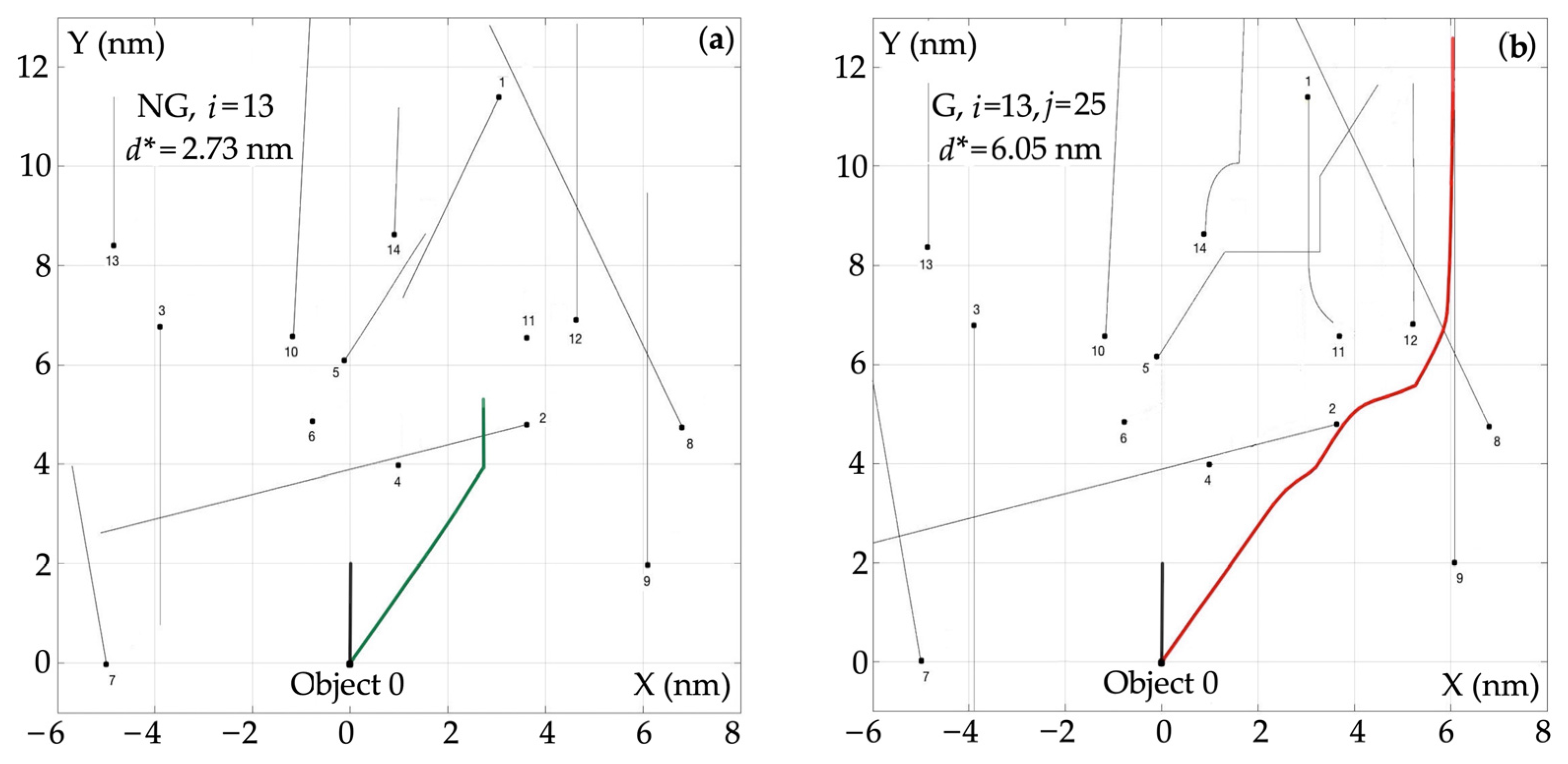
Figure 9.
The dependence of the collision risk sensitivity of sV0 and sψ0 on the inaccuracy of the measurement of the (a) speed δV0 and (b) course δψ0 of our autonomous surface object 0, and the number of acceptable strategies, n, for autonomous surface objects.
Figure 9.
The dependence of the collision risk sensitivity of sV0 and sψ0 on the inaccuracy of the measurement of the (a) speed δV0 and (b) course δψ0 of our autonomous surface object 0, and the number of acceptable strategies, n, for autonomous surface objects.
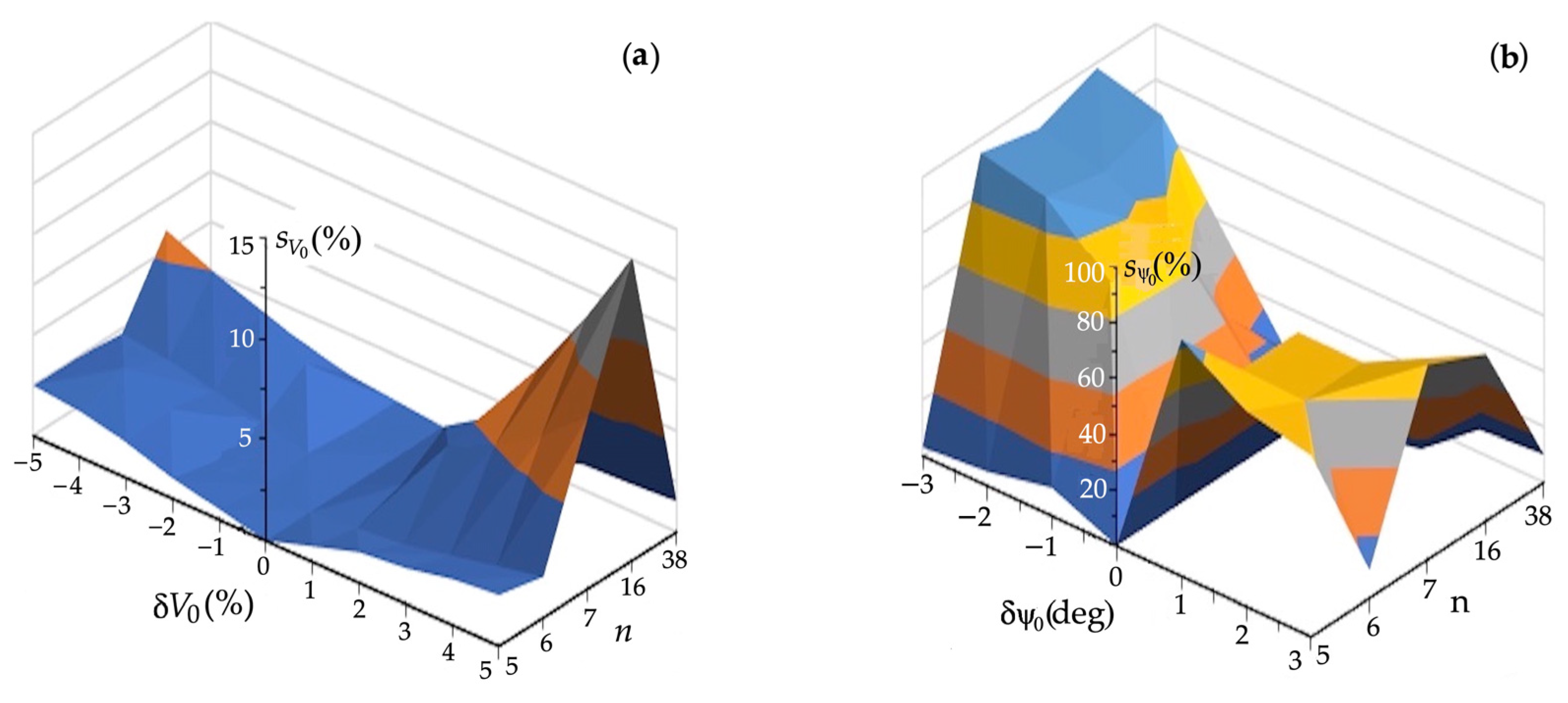
Figure 10.
The dependence of the collision risk sensitivity of sVk and sψk on the inaccuracy of the measurement of the (a) speed δVk and (b) course δψk of another autonomous surface object k, and the number of acceptable strategies, n, for autonomous surface objects.
Figure 10.
The dependence of the collision risk sensitivity of sVk and sψk on the inaccuracy of the measurement of the (a) speed δVk and (b) course δψk of another autonomous surface object k, and the number of acceptable strategies, n, for autonomous surface objects.
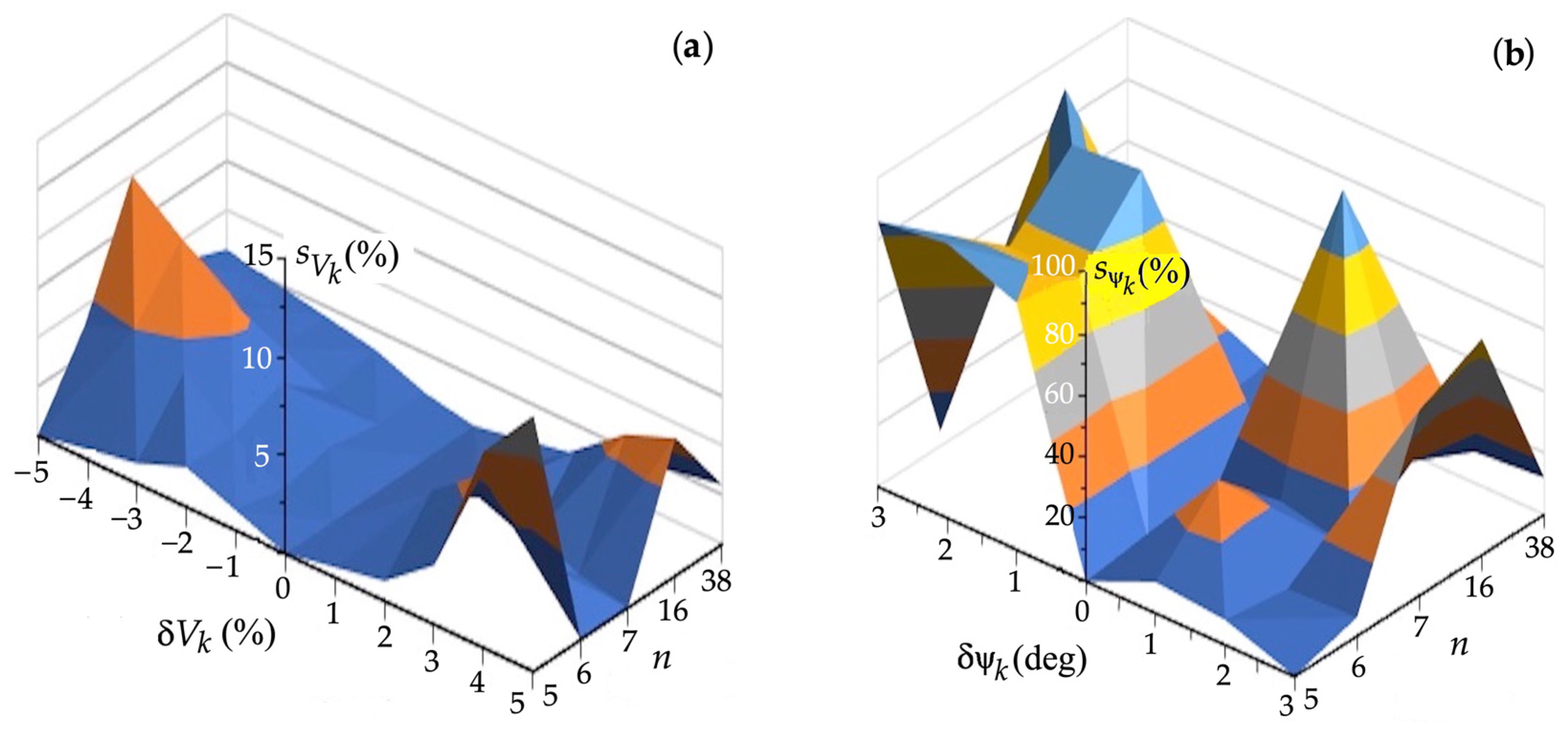
Figure 11.
The dependence of the collision risk sensitivity of sDk and sNk on the inaccuracy of the measurement of the (a) distance δDk and (b) bearing δNk of another autonomous surface object k, and the number of acceptable strategies, n, for autonomous surface objects.
Figure 11.
The dependence of the collision risk sensitivity of sDk and sNk on the inaccuracy of the measurement of the (a) distance δDk and (b) bearing δNk of another autonomous surface object k, and the number of acceptable strategies, n, for autonomous surface objects.
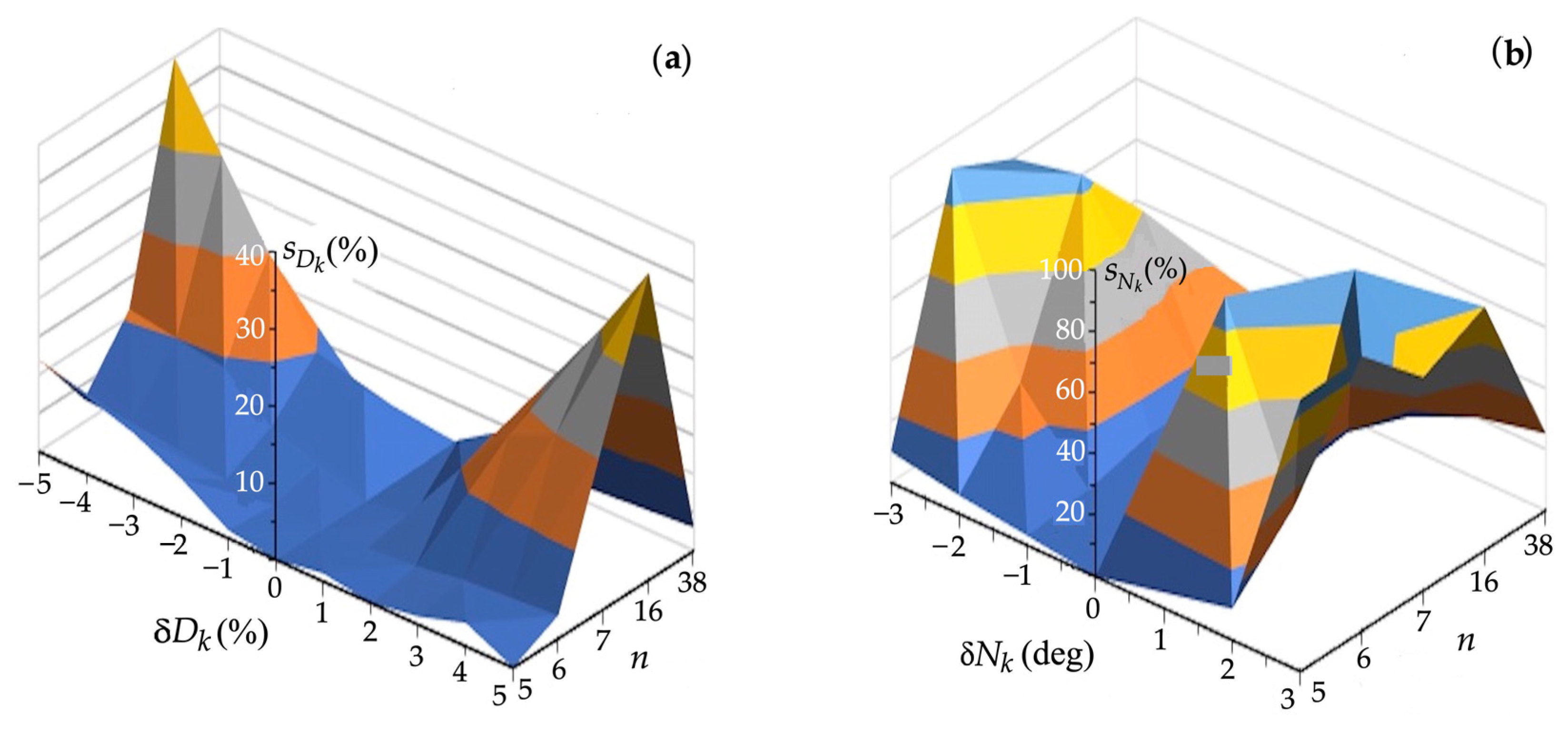
Figure 12.
The dependence of the collision risk sensitivity of sDs and sts on the inaccuracy of the measurement of the (a) safe distance δDs and (b) step time δts of calculations, and the number of acceptable strategies, n, for autonomous surface objects.
Figure 12.
The dependence of the collision risk sensitivity of sDs and sts on the inaccuracy of the measurement of the (a) safe distance δDs and (b) step time δts of calculations, and the number of acceptable strategies, n, for autonomous surface objects.
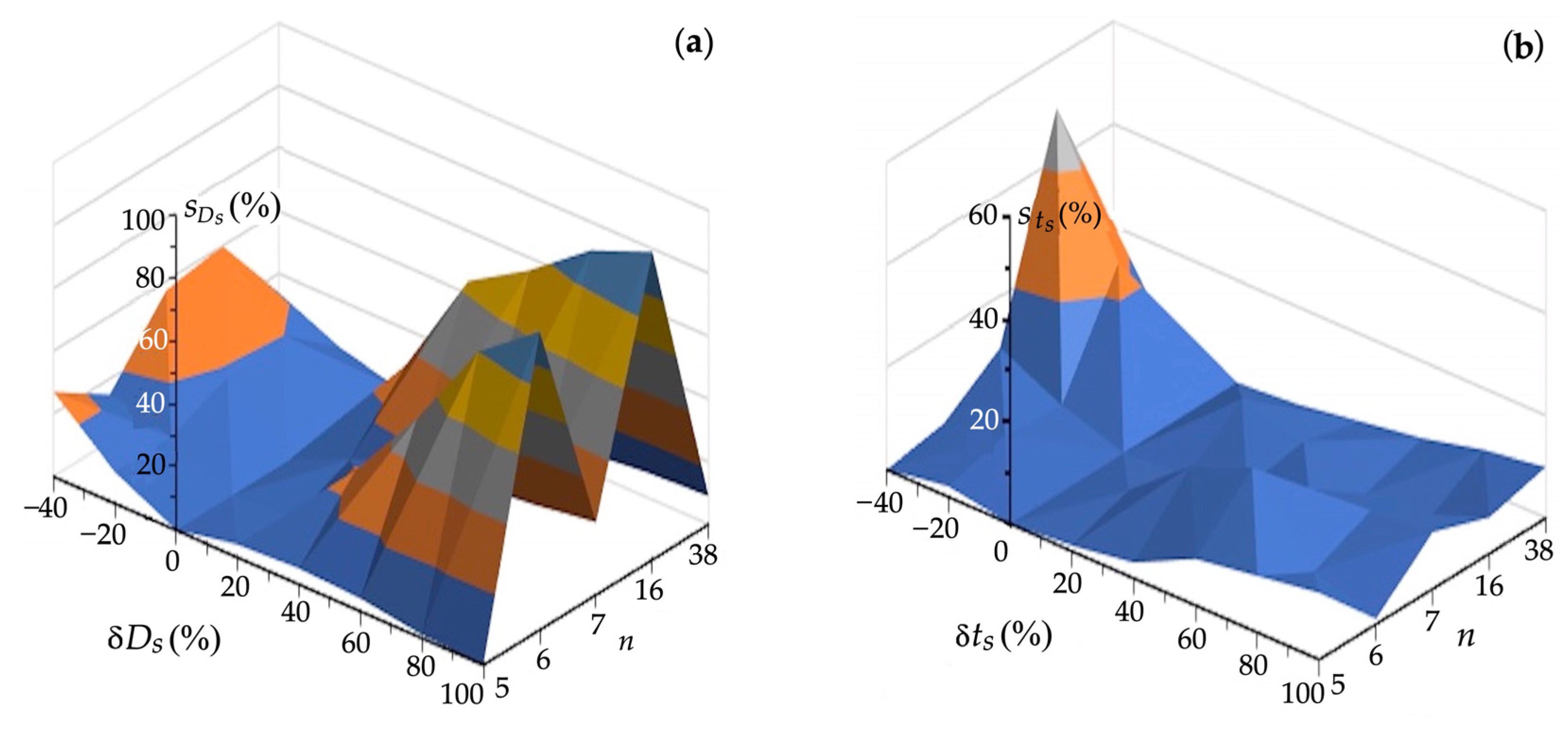

Table 1.
Parameters describing the movement of a group of autonomous surface objects.
| Autonomous Surface Object k |
Speed Vk (kn) |
Course ψk (deg) |
Distance Dk (nm) |
Bearing Nk (deg) |
|---|---|---|---|---|
| 0 | 12 | 0 | 0 | 0 |
| 1 | 9 | 206 | 11.8 | 15 |
| 2 | 18 | 256 | 6.0 | 37 |
| 3 | 12 | 180 | 7.8 | 330 |
| 4 | 0 | 0 | 4.1 | 14 |
| 5 | 6 | 33 | 6.1 | 359 |
| 6 | 0 | 0 | 4.9 | 270 |
| 7 | 8 | 359 | 5.0 | 85 |
| 8 | 18 | 334 | 8.3 | 55 |
| 9 | 15 | 0 | 6.4 | 72 |
| 10 | 13 | 3 | 6.7 | 350 |
| 11 | 0 | 0 | 7.5 | 29 |
| 12 | 12 | 0 | 8.3 | 34 |
| 13 | 6 | 0 | 9.7 | 330 |
| 14 | 5 | 2 | 8.7 | 6 |
Table 2.
The sets of strategies controlling the movement of the autonomous surface vehicles adopted for simulation tests.
Table 2.
The sets of strategies controlling the movement of the autonomous surface vehicles adopted for simulation tests.
| Strategies Sets | Our Autonomous Surface Object 0 | Other Autonomous Surface Objects k |
|---|---|---|
| A |
i = 2 |
j = 3 |
| B |
i = 3 |
j = 3 |
| C |
i = 4 |
j = 3 |
| D |
i = 13 |
j = 3 |
| E |
i = 13 |
j = 25 |
Disclaimer/Publisher’s Note: The statements, opinions and data contained in all publications are solely those of the individual author(s) and contributor(s) and not of MDPI and/or the editor(s). MDPI and/or the editor(s) disclaim responsibility for any injury to people or property resulting from any ideas, methods, instructions or products referred to in the content. |
© 2023 by the authors. Licensee MDPI, Basel, Switzerland. This article is an open access article distributed under the terms and conditions of the Creative Commons Attribution (CC BY) license (http://creativecommons.org/licenses/by/4.0/).
Copyright: This open access article is published under a Creative Commons CC BY 4.0 license, which permit the free download, distribution, and reuse, provided that the author and preprint are cited in any reuse.


