

Submitted:
13 June 2023
Posted:
14 June 2023
You are already at the latest version
Abstract
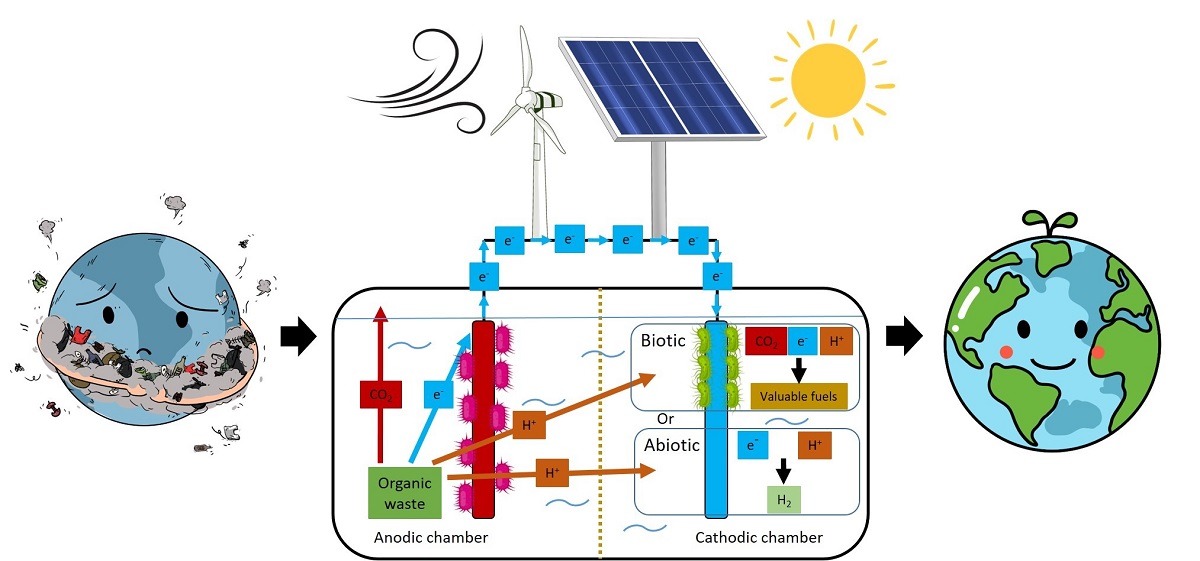
Bioelectrochemical systems (BESs) have great potential in renewable energy production technologies. BES can generate electricity via Microbial Fuel Cell (MFC) or use the electric current for the synthesis of valuable commodities in Microbial Electrolysis Cells (MECs). The number of various reactor configurations and operational protocols increasing rapidly although, the industrial scale operation is still facing difficulties. This article reviews the recent BES related to literature, with special attention to electrosynthesis and the most promising reactor configurations. We also attempted to clarify the numerous definitions proposed for BESs. The main components of BES are highlighted. Although the comparison of the various fermentation systems is we collected useful and generally applicable operational parameters to be used for comparative studies. A brief overview to link the appropriate microbes to the optimal reactor design is given.
Keywords:
bioelectrochemical systems (BES)
; microbial electrolysis cells (MEC)
; reactor configurations
; electro-fermentation
; biomethane
; direct electron transfer (DIET)
1. Introduction
The expanding human population increases proportionally the energy demand of mankind, required to maintain the living standards [1]. The fossil energy resources, e.g. coal, oil and natural gas are running out, and their excessive exploitation leads to catastrophic environmental destructions in the foreseeable future [2]. Therefore, replacement of fossil fuels with renewable energy carriers is now more urgent than ever.
Bioelectrochemical systems (BESs) are relatively new technological developments. In these devices substrates are transformed either to electricity (via using microbial fuel cell (MFC)) [3], or to valuable chemical molecules (in microbial electrolysis cell (MEC)) [4]. The typical BES reactor (both MFC and MEC) basically consists of two electrodes, the anode and cathode, which are connected via external power source (MEC) or a resistance (MFC). The reactor body design concept reflects the need for separation of anodic and cathodic spaces, which can be separated with specific membrane(s) or not [5]. The MEC reactors have gained increasing interest recently (Figure 1.).
It is apparent from Figure 1 that MFC enjoys wider interest among BES researchers, who published almost 6 times as many publications as those dealing with MEC. A very recent exhaustive review compiled the knowledge gathered about MFC during the past 20-25 years [6] therefore we will focus our interest on the less mature MEC aspects in this review. The MEC concept comprises the production of various chemicals using electricity [7]. The proportion of renewable, but fluctuating “green electricity” production increases worldwide, e.g. from photovoltaic and wind technologies, the MEC technology offers a promising way to redirect the excess “green” electricity from the grid. Numerous engineering, microbial and molecular difficulties hinder the development of a robust, industrial MEC technology. This review aims to update the current trends, particularly from the point of view of new designs, used materials.
2. How it started?
One of the first MEC prototypes was assembled in 1994 [8]. One year later the same design was used to achieve electromethanogenesis [9]. Nevertheless, as the MEC technology received wide attention in the early 21th century, hydrogen was the main target product [10,11,12]. Liu et al. suggested to use MFC with external voltage to produce H2 via water electrolysis [13]. Soon membrane-less systems were designed to reduce the costs [10,12,14,15]. The first proof-of-concept experiments of direct interspecies electron transfer (DIET) were performed in 2010 by Summers et al. the development of technological background started in the 90s [16]. In the early reports methane appeared as parasitic by-product of the electrohydrogenezis. Methane was gradually recognized as a potential main MEC product in the middle of 2010s [17,18,19,20]. The electrosynthesis processes became more complex, valuable commodities, i.e. biohytane [21,22,23], acetate [24], alcohols, volatile fatty acids and terpenoids [25] production, have been demonstrated in laboratory scale studies. In the following sections we will focus on MEC-based bioelectromethanation.
3. Which is what?
In searching the relevant BES/MEC scientific literature one cannot escape to take note of the diversity of nomenclature as well as designs and performance measures, which make the various reports difficult to compare. Through the years, numerous definitions and designs have been proposed, which are sometimes confusing. To clarify the vocabulary, a collection of the most relevant designations and synonyms are listed as follows.
Bioelectrochemical system (BES): BES consists of an anode, where the oxidation takes place and a cathode, where reduction occurs and at least one of the electrodes utilizes microorganisms to catalyse the redox reaction via interaction with the electrode directly or through mediators. Collectively the electrode and surrounding microbiota, usually organized in biofilm, is called bioelectrode. The anode and the cathode can be separated by membrane but the membrane is not indispensable component of BES. Frequently used synonyms: microbial electrochemical technology (MET) or microbial electrochemical system (MES) [26,27,28,29,30,31,32,33].
Biogas cleaning is the process to remove impurities, like water, hydrogen sulphides, etc. from the raw biogas by physico-chemical means, such as adsorption, differential solubility or membrane separation. Biogas cleaning can be divided into specific processes according to the target, for example biogas desulphurization (removal of H2S) or biogas drying (removal of water moisture) [34,35].
Biogas upgrading: Raw biogas contains mostly methane (CH4), CO2, and other gasses, such as H2S. The non-CH4 gas components decrease the calorific value of biogas, can be harmful to the living organisms, and some of them (for example H2S) are extremely corrosive, so they have to be removed before injection to the natural gas grids or use as alternative engine/vehicle fuel. As per definition, biogas upgrading refers to the removal of CO2 via transformation by catalytic conversion or separation of this major biogas component [34,35].
Biohythane: Hythane is a balanced mixture of hydrogen (10-30 v/v%) and methane (70-90 v/v%), which is a promising alternative to the conventional fossil gaseous energy carriers. Hythane has a higher fuel and heat efficiency, it can reduce carbon emission, increases burning speed, extends flammability range, and enhances combustion efficiency. Biohytane is produced from renewable biomass [21,36,37].
Direct interspecies electron transfer (DIET): DIET is a syntrophic microbial interaction, where free electrons are transferred/exchanged between microorganisms [38].
Electroactive microorganisms: Electroactive microorganisms are capable to transfer electrons to the environment from the intracellular space, or vice versa through the cell membrane [39,40]. Electroactive microorganisms together with the electrodes used in BES participate in DIET.
Electrohydrogenesis: During electrohydrogenesis the protons and the electrons, generated on the anode, are transferred to the cathode. The microbial catalyst components, driven by the applied potential combine electrons and protons to H2 , which is released from the cathode compartment [41].
Electromethanogenesis: Electromethanogenesis is a process of producing methane via electroactive microbes using CO2 as the sole carbon source in an engineered system (biocathode) powered with electric current. Electromethanogenesis is a specific form of BES/MES, when only CH4 is produced from CO2 with the additional input from electricity to provide the extra energy needed to carry out the recombination of CO2 with electrons and protons [42]. Electromethanogenesis is thus a subset of BES/MES, the microbial electrosynthesis of a variety of chemicals.
Electrotrophic microorganisms: Electrotrophic microorganisms act as electron acceptors in electrogenic reactions. They are capable take up electrons from the environment and utilize in their own metabolic reactions [43].
Exoelectrogenic microorganisms: Exoelectrogenic microorganisms are capable to generate electrical energy via transfer the electrons, produced by substrate oxidation, to extracellular electron acceptors [44].
Microbial electrolysis cell (MEC): MECs is a distinct BES construction, in which an external power source supplements the energy generated at the bioanode, via biomass fermentation. Valuable commodities are formed at the cathode by overcoming the thermodynamically unfavourable reduction reactions. MECs may also operate with abiotically evolved H2 in the cathodic chamber. Alternatively, the electrons are harvested from the cathode by electroactive microorganisms or soluble electron acceptors to produce H2, CH4, or other chemicals [15,45,46,47,48].
Microbial electrosynthesis (MES): Microbial electrosynthesis (MES) is a cathode-related process, when electroactive microorganisms convert electricity to chemicals through CO2 reduction. MES is a promising technology for renewable electricity storage, CO2 capture and valuable commodities’ production. Methane, various alcohols, volatile fatty acids, terpenoids, bioplastics etc. can be produced in a MES reactor [24,25,31,48,49,50,51,52]. “Electrofermentation” (EF) is used as a synonym of MES in some literature reports [50,53].
Microbial fuel cell (MFC): MFC is a type of BES, where organic matter is decomposed via exoelectrogenic microbes near the anode, which serves as terminal electron acceptor. The spontaneous electron movement from the electronegative bioanodes to the electropositive cathode in a circuit generates electric current [14,26,27,54,55,56,57].
4. The BES drivers
Extracellular electron transfer (EET) is an electron exchange process between the microorganisms in a mixed microbial community [59]. (Figure 2.) There are two mechanisms to perform EET, i.e. the indirect (IEET), and direct (DEET) processes.
EET is established between microorganisms and their environment. If the exchange occurs between two microorganisms, it is also called interspecies electron transfer (IET), which could be indirect (IIET) or direct (DIET) [60].
Indirect, or mediated extracellular electron transfer (IEET) has been first recognized as the only route for EET in anaerobic microbial communities. The direct extracellular electron transfer (DEET) was described as alternative mechanism between syntrophic microorganisms involving physical contact between the partners [61].
In IEET there is no need for direct connection between the donor and the acceptor [62], because a carrier, or mediator, such as hydrogen, formate, or soluble electron shuttles, reduced or oxidized by the cell are used to transfer the electrons between the redox partners [63]. In DEET a direct physical contact is needed between electron donor and electron acceptor microbes [62]. The direct contact is maintained frequently by pili, conductive biofilm formation, or flavins and cytochromes [64], although in many cases the exact molecular mechanism is not clear [65]. Electroactive microorganisms possess these molecular structures, hence they are capable of DEET [43].
DEET has several advantages over IEET, like faster electron transfer [66], the more efficient reduction of CO2 [4,60]. A complex enzyme system to produce mediators, or carriers is not required for efficient DEET [61], but special, conductive structures are needed on the surface of the microbes.
Electrofermentation, i.e. generation of reducing equivalents by electric current assisted fermentative process was reported [67]. Daniels and co-workers reported the reduction of CO2 to CH4 by the electrons from elemental iron [68]. The first electrofermentation of CH4 in a self-designed BES was demonstrated by Kuroda [9], although the term “electromethanogenesis” was born only in 2009 [41]. The classical DIET between Geobacter sulfurreducens and Geobacter metallireducens was first reported [16]. In 2014 Rotaru et al. observed and proved the DIET mechanism in a methanogenic culture, following the fate of (14C)-bicarbonate [69]. Since then more and more microorganisms have been recognized as having the capability to electron exchange, import and export, confirming that DIET could be a frequent pathway of syntrophic metabolism in the microbial world [43].
5. Bioelectrochemical system (BES) concepts
Microbial Fuel Cells (MFCs) (Figure 3.) are a type of Fuel Cells (FCs), where the chemical energy, stored in organic substrates, is transformed to electrical energy via microbial catalysis [70]. Conventional MFCs have two chambers, anodic and a cathodic ones, separated by a proton exchange membrane (PEM) or salt bridge [71].
After the oxidation of organic matter, the electrons are transferred to the anode, which acts as terminal electron acceptor, and the protons are released in the electrolyte [72]. The protons diffuse through the PEM to the cathode, while electrons travel through an external circuit, generating electric current [73]. In the aerobic cathode chamber oxygen is reduced by electrons and protons and produce water [64]. In practice, there are several problems with the aerobic cathode chamber, like oxygen leakage through the PEM, and low electric potential [13]. To solve these problems, the cathode chamber of MFC is usually made anaerobic. In this case an external power source may be inserted into the circuit to overcome the theoretical thermodynamic barrier to produce H2, the storable green fuel [13].
Theoretically, the potential, needed for the reduction of protons to hydrogen is E0= -0.410 mV vs. Standard Hydrogen Electrode (SHE), while reduction of CO2 to methane via direct electron transfer, requires only E0= -0.244 mV vs. SHE [53]. The following equations show clearly why DEET (Eq. 1.) is more energetically efficient, than IEET (Eq. 2, 3) during electromethanogenesis [48].
CO2 + 8 H+ + 8 e− → CH4 + 2 H2O E0= −0.244 V vs. SHE
2 H+ + 8 e− → H2 E0= −0.421 V vs. SHE
CO2 + 4 H2 → CH4 + 2 H2O ΔG0= −131 kJ/mol
In MEC (Figure 4.) the electrons are generated from the decomposition of organic substrates at the anodic side via oxidation, so the external power supply does not act as the electron source of the system, but the potential difference between the electrodes increases [54], therefore the overall reaction of electromethanogenesis is not favourable in MEC [74].
Due to the energy losses, overpotentials, like internal resistance caused by the PEM membrane [32], low conductivity of the electrolyte [75] and the activation energy of the imperfect catalyst [75], the theoretical electrode potential is not sufficient in real systems [76],. To lower the energy losses in the reactor, the membrane could be eliminated [32], the conductivity can be increased [77], and more efficient catalyst can be applied to reduce the overpotential [18]. Precious metals, like platinum, seem the best catalyst, but the use of such catalysts at industrial scale is deterred by their high price [18,36]. An alternative possibility to reduce the overpotential is the application of a special microbial community as biocatalyst, in which the electrotrophic microbes are enriched by the environmental stress caused by the voltage [32]. The enriched microbial community is capable for self-regeneration so the long-term application is possible even under industrial scale operational conditions if regular evaluation and microbial community management is provided [76]. The appropriate microorganisms are able to reduce the system resistance, they lower the activation energy barrier and increase current density by taking up the electrons for use in their own metabolism, or mediate to the other microorganism via DIET [78]. To achieve the best performance, the optimum external potential is one of the pivotal parts, and the enriched microbiome drives the substrate oxidation and CO2 reduction [32]. In an elegant series of experiments Zhen and co-workers demonstrated, that more negative cathode potential caused higher methane yields [79,80], although exceedingly high negative potential may be accompanied by by-product generation, like acetate [32] within the domain of MES. An important contribution to electro-biochemistry also comes from the electrode material, and electrode geometry, which are vital parameters determining the formation of the electroactive biofilm. The related issues are discussed in detail in section “Electrodes”.

Table 1.
One chamber reactor configurations with carbon-based cathodes and their efficiency. Some of the articles provided the methane production rate in mol/L/d, to convert this unit to L/L/d, the Ideal Gas Law was used.
Table 1.
One chamber reactor configurations with carbon-based cathodes and their efficiency. Some of the articles provided the methane production rate in mol/L/d, to convert this unit to L/L/d, the Ideal Gas Law was used.
| One chamber reactors | |||||||||
|---|---|---|---|---|---|---|---|---|---|
| Carbon based cathode | |||||||||
| Methane production rate (L/L/d) | Voltage (V) | Cathode | Anode | Anode surface (cm2) | Cathode surface (cm2) | Membrane | Temperature | Reactor volume | Reference |
| 29.7 | 0.7 | Carbon cloth | Carbon cloth | 40.0 | 40.0 | No | 55 °C | 250 mL | [81] |
| 1.6 | 0.75 | Carbon felt | Carbon felt | 40.0 | 40.0 | No | 55 °C | 250 mL | [27] |
| 1 | -0.8 - -1.2 vs Ag/AgCl | Carbon felt | Graphite electrode | 11.9 | 132.0 | No | 55 °C | 350 mL | [82] |
| 0.7 | 1 | Coated carbon paper | Carbon paper | 3.0 | 3.0 | No | 60 °C | 10 mL | [17] |
| 0.1 | 0.6 | Carbon cloth | Carbon fiber brush | No | 30 °C | 40 mL | [83] | ||
| 0.1 | 0.9 | Graphite felt | Graphite felt | 36.0 | 36.0 | No | 25 °C | 500 mL | [29] |
| 0.1 | 0.8 | Graphite felt | Graphite felt | 36.0 | 36.0 | No | 25 °C | 500 mL | [29] |
| 0.1 | 0.7 | Thermally activated carbon felt | Thermally activated carbon felt | 77.0 | 77.0 | No | 32 °C | 32 L | [30] |
| 0.1 | 2.0 vs Ag/AgCl | Carbon felt | Carbon felt | 388.0 | 388.0 | No | 22 °C | 2.8 L | [84] |
| 0.1 | 0.7 | Graphite felt | Graphite felt | 36.0 | 36.0 | No | 25 °C | 500 mL | [29] |
| 0.01 | 0.6 | Graphite rod + graphite granules bed (10 g) | Graphite rod | 2.1 | 4.0 | No | 41 °C | 50 mL | [85] |
Table 2.
One chamber reactor configurations with metal-based and composite cathodes and their efficiency. Some of the articles provided the methane production rate in mol/L/d, to convert this unit to L/L/d, the Ideal Gas Law was used.
Table 2.
One chamber reactor configurations with metal-based and composite cathodes and their efficiency. Some of the articles provided the methane production rate in mol/L/d, to convert this unit to L/L/d, the Ideal Gas Law was used.
| One chamber reactors | |||||||||
|---|---|---|---|---|---|---|---|---|---|
| Metal-based and composite cathode | |||||||||
| Methane production rate (L/L/d) | Voltage (V) | Cathode | Anode | Anode surface (cm2) | Cathode surface (cm2) | Membrane | Temperature | Reactor volume | Reference |
| 1.8 | 0.24 | Stainless steel pipe | Graphite felt sandwiched between cylindral Ti collector | 800.0 | 220.0 | No | 40 °C | 6 L | [77] |
| 0.9 | 1.0 | Stainless steel | Carbon felt | 25.0 | 76.0 | No | 25 °C | 250 mL | [78] |
| 0.9 | 0.3 | Graphite carbon mesh coated with Ni, Cu, Fe | Graphite carbon mesh coated with Ni | 2700.0 | 2700.0 | No, nonwoven fabric separator | 35 °C | 20 L | [86] |
| 0.8 | 3 - 3.5 | Stainless steel mesh | Ti mesh + Ir mixed metal oxides coating | 20.0 | 20.0 | No | 35 °C | 500 mL | [87] |
| 0.6 | -1.0 vs Ag/AgCl | Stainless steel | Carbon felt | 10.0 | 183.7 | No | 31 °C | 180 mL | [88] |
| 0.5 | -0.4 vs Ag/AgCl | Stainless steel | Carbon felt | 10.0 | 183.7 | No | 30 °C | 180 mL | [88] |
| 0.3 | 1.2 | Stainless steel cylinder | 11 graphite plate inserted to a Stainless steel cylinder | 247.5 | 294.0 | No | 16 °C - 35 °C | 153 mL | [56] |
| 0.2 | 0.9 | Stainless steel | Graphite fiber brush | No | 31 °C | 1000 L | [89] | ||
Table 3.
Two or more chamber reactor configurations with carbon-based cathodes and their efficiency. Some of the articles provided the methane production rate in mol/L/d, to convert this unit to L/L/d, the Ideal Gas Law was used.
Table 3.
Two or more chamber reactor configurations with carbon-based cathodes and their efficiency. Some of the articles provided the methane production rate in mol/L/d, to convert this unit to L/L/d, the Ideal Gas Law was used.
| Two or more chamber reactors | |||||||||
|---|---|---|---|---|---|---|---|---|---|
| Carbon-based cathode | |||||||||
| Methane production rate (L/L/d) | Voltage (V) | Cathode | Anode | Anode surface (cm2) | Cathode surface (cm2) | Membrane | Temperature | Reactor volume | Reference |
| 12.5 | 0.85 | Graphite felt | Ti mesh, Ir oxide coated (12 g Ir/m2) | 0.1 | 0.4 m2/ g | Nafion 117 proton exchange | 30 °C | 2*85 mL | [58] |
| 5.2 | -0.7 vs SHE | Graphite felt | Ti mesh, Pt coated (50 g/m2) | 250.0 | 250.0 | Fumasep FKB cathion exchange | 31 °C | 2*250 mL | [33] |
| 2.4 | -0.7 vs. SHE | Graphite felt | Graphite felt | 290.0 | 290.0 | Fumasep FKB cathion exchange | 30 °C | 2*620 mL | [90] |
| 1.8 | - 0.5 | Carbon cloth | Carbon cloth | 40.0 | 40.0 | Nafion 117 proton exchange | 55 °C | 2*250 mL | [81] |
| 1.4 | -0.6 V | Graphite felt | Graphite felt | 290.0 | 290.0 | Fumasep FKB cathion exchange | 30 °C | 2*620 | [90] |
| 1 | -0.8 - -1.2 vs Ag/AgCl | Carbon felt | Graphite electrode | 11.9 | 132.0 | AS2S Cathion exchange | 55 °C | 2*350 mL | [82] |
| 0.8 | 1 | Carbon fiber felt | Carbon nanotubes | PEM | 25 °C | 2*290 mL | [23] | ||
| 0.5 | -0.85 - -1.15 | Carbon felt | Carbon felt | 49.0 | 49.0 | AMI 7001 cation exchange | 30 °C | 2*245 mL | [20] |
| 0.5 | 0.8 | Carbon cloth coated with activated carbon (5 mg/cm2) + Pt (0.1 mg/cm2) | Carbon brush | 1705.0 | AEM anion exchange tubes | room tp | A: 18 L C: 1 L | [37] | |
| 0.2 | 0.1 | Graphite granule bed (2-6 mm) | Graphite granule bed (2-6 mm) | Fumasep FAD anion exchange + Fumasep FKE cathion exchange | 25 °C | 3*860 mL | [91] | ||
| 0.2 | -0.5 vs. Ag/AgCl | Carbon brush | Graphite rod | 4.8 | 13700.0 | CMI 7000 cathion exchange | 37 °C | 800 mL | [92] |
| 0.1 | -0.5 vs. Ag/AgCl | Graphite plate | Graphite rod | 4.8 | 40.3 | CMI 7000 cathion exchange | 37 °C | 800 mL | [92] |
| 0.1 | -0.5 vs SHE | Graphite plate | Graphite rod | 15.6 | 15.0 | CMI 7000 cathion exchange | 37 °C | 850 mL | [93] |
| 0.1 | 0,7 | Carbon paper | Carbon paper | 10.0 | 10.0 | Nafion 117 proton exchange | 37 °C | 2*150 mL | [94] |
| 0.1 | -1,4 vs Ag/AgCl | Carbon stick with graphite felt layer | Pt | 23 cm | 11.0 | Nafion 117 proton exchange | 35 °C | 200 mL | [80] |
| 0.1 | -0.4 vs Ag/AgCl | Activated carbon fabric | Carbon fabric | 150.0 | 138.0 | Nafion 117 proton exchange | 30 °C | C:1 L | [55] |
| 0.1 | -0.8 vs Ag/AgCl | Granular graphite bed | Carbon felt | 168.0 | CMI 7000 cathion exchange | 23 °C | 2*500 mL | [42] | |
| 0.1 | -0.9 vs Ag/AgCl | Graphite rod | Carbon fabric | 150.0 | 69.0 | Nafion 117 proton exchange | 35 °C | C: 1 L | [55] |
| 0.03 | -1.04 vs Ag/AgCl | Carbon cloth + carbon black | Graphite fiber brush | 1.0 | 7.0 | Nafion 117 proton exchange | 30 °C | 2*152 mL | [95] |
| 0.01 | -1.02 vs. Ag/AgCl | Graphite fiber brush | Graphite fiber brush | 1.0 | 6.3 | Nafion 117 proton exchange | 30 °C | 2*152 | [95] |
| 0.01 | 0.7 | Carbon felt | Carbon felt + Pt | 49.0 | 49.0 | CMI 7000 cathion exchange | 30 °C | 2*240 mL | [19] |
| 0.01 | 0.55 | Graphite felt | Ti mesh, Pt coated (50 g/m2) | 250.0 | 250.0 | Ralex CM cation exchange | 30 °C | 2*280 mL | [74] |
| 0.01 | -1.1 vs Ag/AgCl | Carbon laying | Carbon fabric | 15900.0 | 30000.0 | FKS-PET-130 cathion exchange | 35 °C | A:145 L C: 50 L | [25] |
| 0.003 | -0.55 - -0.65 vs. Ag/AgCl | Carbon fiber brush | Carbon fiber brush | 7400000.0 | 7400000.0 | Nafion | 34 °C | 2*100 mL | [18] |
Table 4.
Two- or more chamber reactor configurations with metal-based and composite cathodes and their efficiency. Some of the articles provided the methane production rate in mol/L/d, to convert this unit to L/L/d, the Ideal Gas Law was used.
Table 4.
Two- or more chamber reactor configurations with metal-based and composite cathodes and their efficiency. Some of the articles provided the methane production rate in mol/L/d, to convert this unit to L/L/d, the Ideal Gas Law was used.
| Two or more chamber reactors | |||||||||
|---|---|---|---|---|---|---|---|---|---|
| Metal-based and composite chatode | |||||||||
| Methane production rate (L/L/d) | Voltage (V) | Cathode | Anode | Anode surface (cm2) | Cathode surface (cm2) | Membrane | Temperature | Reactor volume | Reference |
| 1.4 | 1 | Stainless steel mesh | Ti mesh, IrO2 coated | 72.0 | 450.0 | CEM | 37°C | A: 1 L C: 4.5 L |
[51] |
| 0.01 | 0.8 | Wet proof carbon cloth + Pt (0.5 g/cm2) | Non-wet-proof carbon brush (pretreated) | 2 CEM | 21 °C | A:150 mL C: 80 mL | [53] | ||
| 0.1 | -0.86 vs. Ag/AgCl | Stainless steel mesh + Pt | Graphite fiber brush | 1.0 | 7.0 | Nafion 117 proton exchange | 30 °C | 2*152 mL | [95] |
| 0.02 | −0.7 vs. Ag/AgCl | Pt sheet | TiO2/CdS photoanode | 3.0 | 4.0 | Ultrex CMI 7000 cation exchange membrane | 31 °C | 2*350 mL | [96] |
| 0.01 | -0.55 - -0.65 | Graphite bloch + carbon black + metals (Pt, Ni, Stainless steel) | Carbon fiber brush | 7400000.0 | 10.6 | Nafion | 32 °C | 2*100 mL | [18] |
When the published data for the optimum potential are compared, the results are difficult to relate, because of the varying experimental conditions, e.g. electrode, electrolyte, temperature, membrane, inoculum, etc. Standardized experimental conditions to make the various parameters comparable would be needed. The difficulties associated with the complex and interrelated set of parameters can partially be resolved by calculations, (see section “Calculations”). Nevertheless, the intricate relationships of the contributions of the individual parameters make the system difficult to describe and control precisely. According to Martín and co-workers, the overall energy (E), needed for the reactions can be described as the sum of the thermodynamically required energy for the desired reaction (En), and the overpotentials (η):
where ηact is the overpotential of the electrodes’ kinetic activations, ηohm shows the energy loss due to ohmic resistance and ηmt represents the overpotential because of the limited mass transport at the electrodes [97].
6. Trends in reactor design
In early developmental stages reactors incorporating selective membranes were primarily studied [13,98,99]. The reactor design trends diverged towards simple, membrane-less, cost-effective systems [15,27,100] on the one hand and sophisticated constructs equipped with membrane(s) on the other hand [20,42,58,81,101]. The variety of BESs schemes fulfil the requirements for multifunctional tasks, e.g. NH4 recovery [42], CO2 removal [102], biohythane production [53]. Most systems contain at least one, or two membranes. Membrane containing, and membrane-less set-ups have their advantages and disadvantages. In the next section some of the reactor designs are discussed.
6.1. Single chamber systems
In single chamber reactors the anode and the cathode are located in a single container, the various ions and molecules can be exchanged unimpeded [48]. These arrangements have several advantages, such as lowering the construction and operation costs and simplifying the reactor design [103]. In certain applications the separation of the biofilms formed on the anode and cathode, respectively offers improvements in system operation and sustainability. Reactors, in which a separator, e.g., nonwoven fabric, is used to prevent short circuit is considered as single-chamber reactor because the different molecules developed via the electrodes and the biofilm are capable to exchange through the separator.
Glass vessel-type reactors are the simplest constructs at laboratory scale. This reactor configuration requires only typical laboratory items like sealable serum bottles for reactor body. The electrodes are inserted from the top of the glass vessel and a separator or an inert insulation are usually applied to avoid short circuit. As small as 5-10 mL vials have been converted to MEC systems [17,100]. Theoretically, roughly 6,000 reactors can be assembled in one block using a single power supply in the right arrangement [100].
The first electromethanogenesis experiments were performed in a cylindrical reactor [9]. In these designs one of the electrodes is located in the center of the reactor, while the other electrode is arranged around the central electrode in barrel shape arrangement (Figure 5.). Either the anode [9] or the cathode [77] can be designated in the central position. In cylindrical reactors the electrodes may have a relatively high surface area. The distance between the electrodes is critical. The “distant” electrode, and the “adjacent” electrode arrangements differ in the gap width between the central and the barrel-shaped electrodes. Sometimes the barrel-shaped electrode is placed next to the inner wall of the reactor [56]. To the contrary, in the “adjacent” configuration the electrodes are close to one another, hence a membrane or separator is placed between them to prevent short circuit. The small distance between the electrodes decreases the internal resistance of the system [37]. Hou et al. made a special version of cylindric reactor, where spiral wound electrode was used. This design resulted in large specific surface area and possible potential scalability [104].
Following the BES reactor concept without membrane, a rectangular box type reactor was introduced to increase the current density via increasing the electrode surface and an economically more attractive device was constructed [89,105]. In these simple equipments the electrodes face each other in a vertical assembly (Figure 6.). This design is suitable for scaling-up as well, because the specific surface area of the electrodes is easily changeable by increasing the number of the electrode stacks. For example, a pilot scale continuous reactor configuration consisted of 24 modules and in total 144 electrode pairs in 1,000 L volume [89]. The rectangular box type reactor has been built in versions containing membranes as well, the membranes inserted in between the electrodes [106].
A more sophisticated design is the column-type reactor model. In the column-type reactors one electrode is positioned at the bottom, the other is near the top of the reactor. Both “cathode-on-top” and “anode-on-top” configurations have been tested for special applications. The advantage is in separating the products to a certain degree even without involving membrane. For instance, cathode-on-top configuration prevents the product generated at the cathode, from the biofilm situated on the anode. Guo et al. constructed an innovative column-type cathode-on-top reactor with fixed graphite granules bed. In this arrangement, the anode is at the bottom of the reactor. H2 gas, formed at the cathode is separated from the microorganisms at the anode, which could consume it [107]. In the opposite configuration, i.e. “anode-on-the top”, a higher voltage (over 1.23 V) could be applied and the oxygen formed at the cathode from water electrolysis exited the system without damaging the strictly anaerobe methanogenic biofilm on the cathode [49,108].
6.2. Two chamber systems
In these designs the chambers are separated by an ion-selective membrane. The use of membrane facilitates the production of pure product(s) [74]. The membrane can protect the obligate anaerobic methanogens from inhibitory products, like oxygen [95]. Although a membrane increases the internal resistance, generates pH gradient and increases the price and complexity of the system, in some applications may be worth to employ for maintaining a selective BES operating sustainably in extended time period [85].
H-cell reactors consist of two vessels, usually made of glass and separated by a membrane (Figure 7.) This configuration is convenient for laboratory-scale experimentation, although the geometry of H-shape devices limits the gassing and stirring of the liquids around the electrodes, the distance between the electrodes, and the relative low surface of the membrane increases the internal resistance [55]. Allen and co-workers designed the H-cell arrangements in electrochemistry [109], later this design was used by Hongo et al. to microbial electrosynthesis (MES) of L-glutamic acid [110]. H-cell shaped reactors are one of the most commonly used two chamber setups. The H-cell reactor acted as microbial electrolysis devices (MEC), when Liu at el added extra voltage to a MFC and achieved electrolytic hydrogen production [13]. The process was reported as electrohydrogenesis for the first time [13]. Further development yielded the first microbial electrosynthesis (MES) systems producing acetate and other multicarbon organic compounds from CO2 [111].
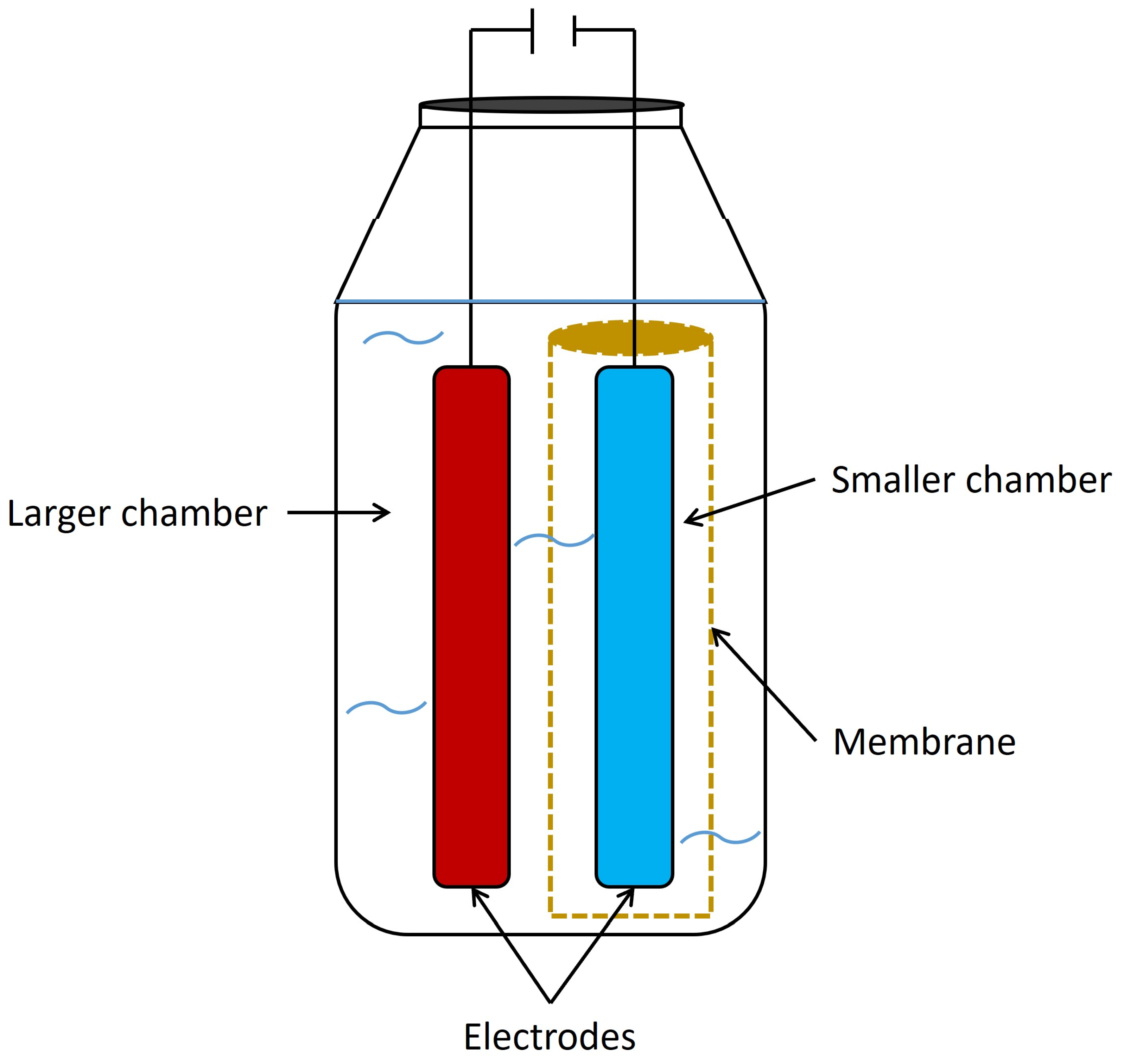
While the two chambers are arranged in juxtaposition in the H-cell reactors, separated by the membrane assembly, in the concentric tubular reactors the chambers are asymmetric, i.e. a larger chamber contains a smaller one (Figure 9.). The larger “container” chamber can be the one housing either the anode [55] or the cathode [93]. Concentric tubular reactors have certain benefits relative to the H-cells, being more flexible than H-cells to assemble and to alter the electrode chambers’ geometry. The internal resistance can be adjusted by changing the electrodes distances and the membrane surface area can be easily modified. Enzmann et al. constructed a reactor in which the membranes were inserted in windows on the cylindrical wall of the cathode chamber [55], whereas in the system designed by Liu and co-workers, the anodic chamber was separated with a membrane bag [93].
Figure 8.
Schematic figure of cylindrical tubular hybrid system constructed by Luo et al. [37]. It contains five tubes with titanium wire - carbon cloth - stainless steel mesh inner electrode (cathode) and carbon brush outer electrode (anode), separated with membrane. There is a continuous electrolyte (catholyte) flow in the inner space of the tubes.
Figure 8.
Schematic figure of cylindrical tubular hybrid system constructed by Luo et al. [37]. It contains five tubes with titanium wire - carbon cloth - stainless steel mesh inner electrode (cathode) and carbon brush outer electrode (anode), separated with membrane. There is a continuous electrolyte (catholyte) flow in the inner space of the tubes.
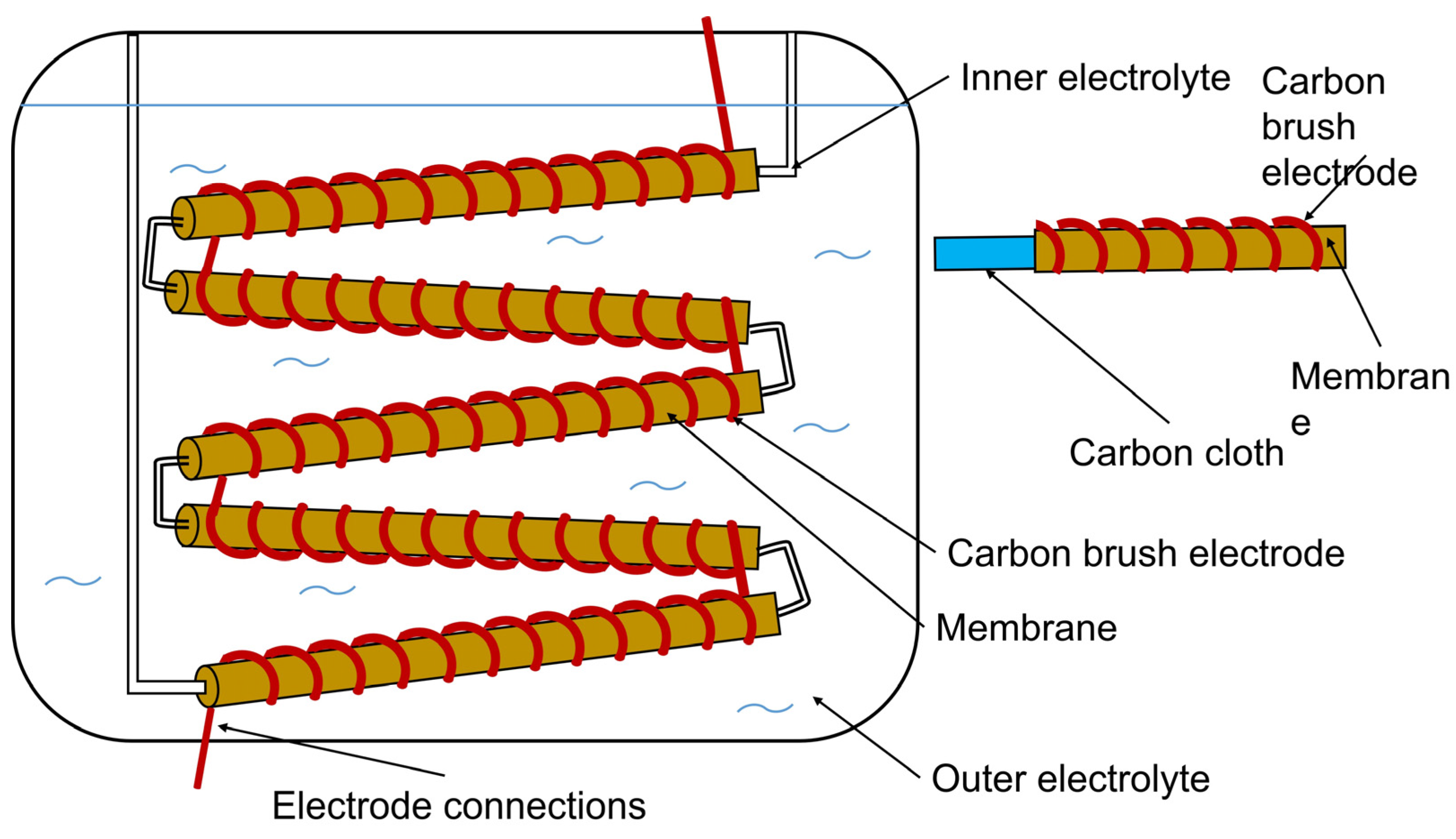
In a more complex cylindrical-tubular hybrid system the cathode chamber was made of 5 connected tubes, while the outer surface was covered with membrane and carbon brush to serve as an anode [37].
Figure 9.
Concentric tubular reactors containing a smaller chamber inside a larger one. The two chambers are separated via separator, or membrane to increase the membrane surface. Either the anode or the cathode can be placed in the smaller chamber.
Figure 9.
Concentric tubular reactors containing a smaller chamber inside a larger one. The two chambers are separated via separator, or membrane to increase the membrane surface. Either the anode or the cathode can be placed in the smaller chamber.
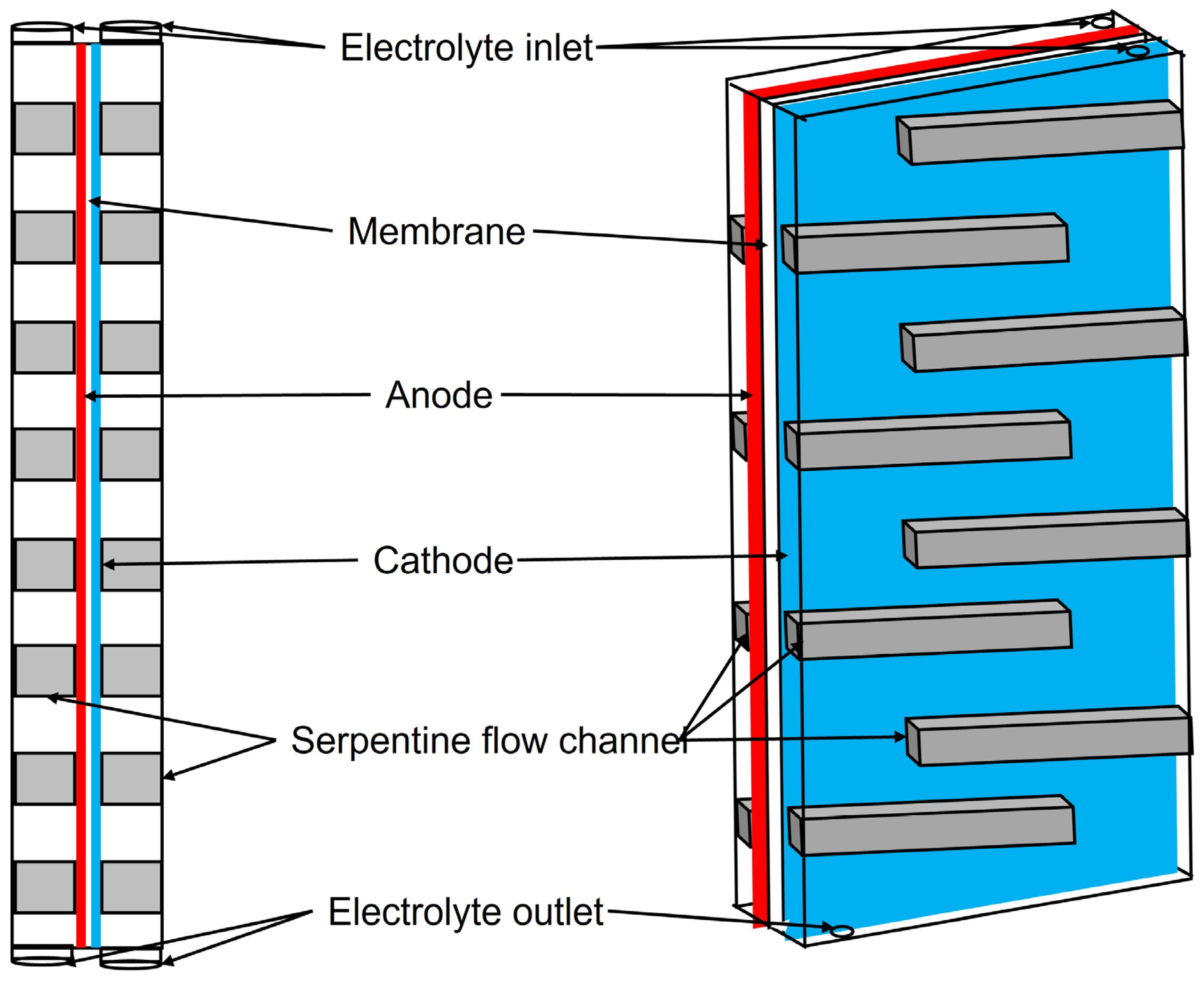
In flat plate reactors the electrodes are placed close to each other, which reduces the internal resistance. In this arrangement the specific surface area can be exceptionally large. For example, using graphite granules bed as electrode a dramatic 1,290 m2 m-3 surface [99] has been achieved. The high surface favored the formation of a dense biofilm, hence improved performance [112]. The mass transfer was facilitated via serpentine flow in both chambers [113]. Nevertheless, flat plate reactors are not widely used even at small scale operations. They are too complicated for routine laboratory studies and scaling-up seems costly due to the energy consumption of the continuous recirculation of the liquid phase [114].
Figure 10.
In flat plate reactors the anode and the cathode are separated with membrane. The specific surfaces are extraordinary large thanks to the serpentine flow channels, which can be further increased by granules. Needs continuous flow of the liquid phase.
Figure 10.
In flat plate reactors the anode and the cathode are separated with membrane. The specific surfaces are extraordinary large thanks to the serpentine flow channels, which can be further increased by granules. Needs continuous flow of the liquid phase.
6.3. Advanced designs
The first of the ingenious alternative BES concepts is the rotating bioelectrochemical reactor systems (BESs) [45]. The novel components of this reactor type include rotating disk electrodes and a control engine to change the position of the disks from time to time. One half of the disk is submerged in the electrolyte, while the other half is exposed to the gaseous phase. The half-disk in the liquid phase serves as anode and the other half functions as cathode in the gaseous phase. The anode and the cathode functions are thus altered in time. Unique, uniform but distinct biofilms are built up on the surface of the two half disks. The number of the electrode arrays can be increased creating batteries of the basic units, scaling-up is limited by the energy requirement of the rotating engine and sustainability of the biofilm on the electrode surfaces.
In a different design concept more than two reactor chambers are coupled together. The multiple chamber BESs usually serve specific tasks. As an example, the microbial desalination reactor system deserves special attention. In this reactor system an accumulation chamber is inserted between the anodic and cathodic chambers [6,102] . The anodic chamber is separated from the accumulation chamber via proton exchange membrane, while the cathodic chamber is separated via an anion exchange membrane. This arrangement allows the accumulation chamber to recover the simultaneous ammonium and bicarbonate ions along with high methane production rate. In a different version of the three-chamber construct a two-sided cathode BES/MEC was tested for municipal waste water purification [91]. The device consisted of two cathodic chambers and one anodic chamber inserted in between them. The two cathodic chambers were connected in parallel by a titanium wire. The anodic chamber was separated from the cathodes by an anion exchange membrane (AEM) on one side, and a cation exchange membrane (CEM) on the other side. In the CEM cathode compartment biogas, as well as ammonia-nitrogen was produced by the microbial biofilm formed from activated wastewater sludge, which was fed into the reactor. The produced biogas was recirculated to the AEM cathode compartment, where biomethane was produced via biogas upgrading by reducing HCO3- to CH4.
A further improvement of bioelectrochemical cells (BES) was achieved with microbial electrochemical separation cell (MESC), also referred to as microbial electrolytic capture, separation and regeneration cell (MECS) [115,116]. The MESC consists of four different chambers, i.e., anodic, regeneration, absorption and cathodic chambers, separated with anion exchange membrane and bipolar membrane. The multiple-chamber reactors, like MESC offer a great opportunity to simultaneous wastewater treatment, biogas production, biogas upgrading, and carbon and nitrogen recovery, though their complexity limits their application in scale-up systems [115].
Other multifunctional and sophisticated BES reactor systems include systems, like MFC-MEC coupled system [19], or microbial photoelectrochemical system (MPES), which utilize the solar energy 6 times more efficiently than the natural microbial systems [96]. Luo et al. described a microbial reverse-electrodialysis methanogenesis cell (MRMC), which did not require an external power supply, because energy was generated from the salinity gradient in the dialysis system [95]. An advanced anaerobic osmotic membrane bioreactor-microbial electrolysis cell (AnOMBR-MEC) system achieved a simultaneous biogas upgrading, enhancing CH4 yield and wastewater treatment [117].
7. The components of the BES systems
7.1. Membranes
Research and development on ion exchange membranes (IEMs) dates back to the work of Oswald in 1890, who discovered that the semipermeable membranes have impermeable properties to certain cations or anions present in the electrolytes [118]. The “Donnan exclusion potential” was delineated in 1911 and the extensive experimental work on IEMs started by Michelis and Fujita in 1925. Shöller and co-workers presented the idea of amphoteric and mosaic-membranes, which generated interest in industrial applications [118]. Electrodialysis via membranes became an industrial process and simultaneously the bipolar membrane was introduced [119]. The first large scale desalination of sea water using membranes was carried out in the 1960s [118]. A major step forward was the development of Nafion, the chemically stable cation exchange membrane based on sulfonated polytetra-fluorethylene by Dupont [118].
The use of membranes offers pros and contras. On the one hand, one can list among the benefits that membranes are essential to produce chemically pure products [74]. The presence of the membrane protects the methanogens from inhibitory compounds [95] or keeps the cathodic H2 gas clean [103] and prevents the mixing of undesired molecular species, such as oxygen [85]. On the other hand, in a system incorporating membrane the pH gradient [116] and ohmic-loss lowers the efficiency of the product formation, while the complexity increases the investment and operational costs of the BES reactors [85].
The membranes used in BES can be classified in two groups, i.e., proton exchange membranes (PEMs) and ion exchange membranes (IEMs). IEMs include the cation exchange membranes (CEMs) and anion exchange membranes (AEMs). A variety of IEMs, including inorganic–organic (hybrid), amphoteric, mosaic, bipolar membranes (ion exchange composite membranes) have been introduced in the IEM market [118].
7.1.1. Proton exchange membranes (PEMs)
Proton exchange membranes (PEMs) were introduced in 1970s by DuPont. The sulfonated polytetra-fluorethylene based polymers, called Nafion membrane showed not only high conductivity, but also had long lifetime [120]. PEMs can be categorized into five main groups according to the materials used in synthesis such as [121]:
- Perfluorinated
- Partially fluorinated
- Non-fluorinated
- Acid-base blend
- Others
In general, there are two mechanisms for transport of the protons across the membrane, while electrons are repelled. The “proton hopping” or “Grotthus mechanism” and the “diffusion mechanism” or “vehicular mechanism” [122]. In the Grotthhus mechanism a molecular vehicle is not required, because protons are moving via breaking and forming hydrogen bonds. Protons are hopping from one hydrolysed ionic site to another through the membrane. According to the vehicular mechanism, the protons are transferred via hydrated proton (H3O+) [123]. The most important properties of PEMs are the proton conductivity, water uptake, ion exchange capacity, gas permeability and physical stability [124]. These properties can be improved or modified, via thinning the membrane [125], or via blending with various minor components, such as inorganic oxides, zeolites, proton conductive materials, etc [123].
7.1.2. Ion exchange membranes (IEMs)
Ion Exchange Membranes (IEMs) control the traffic of charged molecules/ions within the electrolyte. These are semipermeable chemical structures, consisting of a polymeric backbone and functionalized ionic groups attached to this scaffold [126].
The physico-chemical properties of membranes are determined by the material of the basic “backbone” polymer chemistry, which provides the mechanical, thermal and chemical stability. The membrane backbone is frequently made of organic polymers, but there have been several other available proposed backbone materials, such as cellulose, metallic, ceramic compounds [126,127]. The membrane backbone should possess properties for the industrial application like [121,128].
- High permselectivity
- Low electrical resistance
- Good mechanical plasticity
- High chemical stability
- Easy and cheap production
The selectivity and specificity of IEMs are bestowed by the type, concentration and pattern of the attached functionalised groups, which define the permselectivity and electrical resistance [128]. According to the functionalised groups, the membranes can serve as cation exchange membranes (CEMs), anion exchange membranes (AEMs) and bipolar membranes (BPMs) [126]. AEMs are equipped with positively charged groups, like: –NH3+, –NRH2+, –NR2H+, –NR3+, –PR3+, –SR2+, etc., which do not let cations to pass through, but make the membrane permeable to anions. CEMs contain negatively charged ions like: –SO3−, –COO−, –PO32−, –PO3H−, –C6H4O−, etc., hence they are not permeable for anions [118]. BPM is a special construction, which contains a CEM and an AEM layers, respectively [126].
The ionic groups are attached to the membrane polymeric core by chemical bonds to form a homogenous membrane, or by weaker physical contact to form a heterogeneous membrane [121]. In general, homogenous IEMs have good electrochemical properties, but weak mechanical strength. In contrast, heterogeneous IEMs have great mechanical strength and dimensional stability, poor electrochemical performance [123].
Cation exchange membranes (CEMs)
CEMs contain negatively charged groups, attached to diverse polymer backbones [129]. The pattern of the charged moieties alters the character of membranes. Their low conductivity is the main obstacle in industrial application [129]. To improve the conductivity, the functionalized membrane surface can be interrupted repeatedly with non-functionalized segments. This leads to a well-defined nanoscale separation, which increase the conductivity to create block CEM [129]. Alternatively, the functionalized groups can be attached to each other closely, to make aggregates and result in densely functionalized CEMs [130] There are several other modifications to alter the properties of the membrane [129].
Anion exchange membranes (AEMs)
In contrast to CEMs, AEMs contain positively charged groups to attract the anions and repel cations or neutral molecules [131]. There are concerns about the utilization of AEMs in industry, because of the poor conductivity and weak chemical stability. To improve these properties, new types of ionic groups and designs of the polymeric architecture has been developed [129,132,133,134].
Bipolar membranes (BPMs) and other composite membranes
Bipolar membranes are made by the incorporation of at least one cation exchange layer (CEL) and an anion exchange layer (AEL) laminated together [119], or an interfacial layer inserted between the CEL and AEL [118,129]. Since their introduction, the industrial applications are interested in the use of BPMs in the fields of water electrolysers, and CO2 fuel cells, and flow batteries. The required features of BPM for an industrial application [135] include:
- fast chemical kinetics at the interface
- high conductivity of the individual bulk layers
- high water permeability
- low parasitic (ion) crossover
- long lifetime under operational current densities
Amphoteric ion exchange membranes (AIEMs) contain both weak acidic (negative charge) and weak basic (positive charge) groups that are randomly distributed within the membrane matrix [118]. This makes the AIEMs easily controllable, because both of the charges can be found on the surface, the change of the pH can regulate precisely the separation of the samples by altering the overall charge of the membrane surface [126], [136].
Mosaic membranes (MMs) are a version of AIEM technology [118]. In MMs the positive and negative ions are not randomly inserted into the membrane core polymer, the various ions are arranged in ordered positions relative to each other [126]. The “ion-exchange mosaic membrane” and “charged mosaic membrane” are synonyms of this approach. MMs can be used for separation of electrolytes from nonelectrolytes [137].
Monovalent ion perm-selective membranes (MIPMs) can select monovalent ions and block the passage of multivalent ions [138]. Several factors can influence the perm-selectivity of monovalent ions, such as [138]:
- distinct hydrated ionic radii
- different migration rate within the membrane
- affinity of the ions to the membrane
There are monovalent anion perm-selective membranes (MAPMs), which are selective to monovalent anions and monovalent cation perm-selective membranes (MCPMs), which transport only monovalent cation through the membrane.
7.2. Electrodes
Choosing the suitable electrodes is a pivotal part of the design. The electrode and the microorganisms form a bioelectrode together to achieve high efficiency [91]. In general, there are three types of electrode materials: carbon-based, metal-based and metal-carbon composite [139].
7.2.1. Carbon-based electrodes
A simple carbon rod was used in the first MEC by Kuroda et al. [9]. In the following research and development works various forms of graphite and carbon were used like such as carbon cloth [41,83], glassy carbon rod [113], carbon paper [17], graphite brush [12], graphite plate [100], graphite granules bed [91], etc. Carbon based materials are commonly used as either anode or cathode electrodes or as current collector [114]. They usually have high specific surface area to be offered for the microorganisms [116]. Furthermore, good adhesion properties [18] and remarkably biocompatibility [65] promote the biofilm formation on the electrode surfaces, which is required for the functional bioelectrode [91].
Graphite is a well-known and the most stable allotrope of carbon, which is commonly applied in BES systems [140,141]. The unique structure of the bonds between the carbon atoms offers special benefits for the graphite. It is essentially formed of graphene layers where each carbon atom is bonded to three other carbon atoms with strong sigma bonds, creating continuous hexagons. The layers are connected to each other with weaker van der Waals bonds [142]. This particular layered structure empowers the graphite with unique benefits, like chemical and physical stability, great thermal and electrical conductivity [140,142]. Graphite electrodes are the preferred ones among carbon-based BES materials. They are relatively cheap [57] and reusable [65]. There are several commercially available forms of the graphite, for instance; rod [11], block [18], brush [92], plate [143] or sheet [144].
Other well-studied form of carbon is carbon nanotube. Carbon nanotubes (CNTs) can be divided into multi-walled (MW-CNT) and single-walled structures (SW-CNT). These are two dimensional layers in cylindrical or planar shape [145]. CNTs have unique chemical, electronic, mechanical, and optical properties [146]. They are one of the most promising materials in BES and MFC electrode construction. Because of the excellent biocompatibility, great conductivity, extraordinary huge specific surface (up to 1,315 m2/g) and adsorbent properties, the CNTs are used in biosensors, MFC systems and other BES applications, although CNT is still a relatively expensive commodity and has potential cytotoxic effect [65,145,147,148]. Carbon nanotube hollow-fiber was tested with mixed microbial cultures and 34% higher CH4 production was achieved relative to the non-electro conductive polymeric hollow-fiber media and a shift in the microbiome was observed as well [149].
Nevertheless, carbon-based materials have their own Achilles’ heel in electrochemistry. For instance, graphene is a hydrophobic material, therefore it has relatively low biocompatibility, and potentially toxic to fabricate [150]. Although, stability is one of the benefits of carbon-materials, like graphite, Siegert et al. achieved an extraordinary high Coulombic recovery, over 1,100 % [18]. Coulombic recovery over 100% indicate that the product was delivered from external sources, not only from the electrical circuit. In this case, overpotential and methanogenic corrosion of the carbon electrode caused the extra methane production simultaneously with hydrogen formation; 2CO + 3H2O -> CH4 + HCO3- + H+, ΔG0 = 17 kJ/mol. The generated H2 is consumed by the surface colonizer methanogens, which cause further cathode corrosion [18,80]. Finally, carbon materials have higher internal resistance compared to metal-based electrodes, which cause a significant energy loss during scaling-up [114].
7.2.2. Metal-based electrodes
Overpotential is one of the major problems in BES. To reduce its deleterious effects, the surface of the electrode should be expanded and/or the resistance of the electrode should be reduced by choosing a suitable electrode material [18]. Metal-based electrodes are widely used, due to their enhanced conductivity and lower internal resistance, relative to the carbon-based electrodes. They come in various forms, i.e., mesh [151], sheet [96], plate [152], wire [100], etc. Platinum (Pt) is one of the best noble metals for the electrochemical systems, because it is inert and has a low overpotential [153]. At the early times of the MEC technology development, Pt was used commonly as catalyst for hydrogen production [10,13,15,41]. Unfortunately, Pt is expensive and has a harmful impact on the environment upon disposal. Therefore current research intends to lower the usage of Pt, or totally replace it with other metals [153]. Promising alternatives are nickel (Ni) [104], titanium (Ti) [154] and stainless steel (SS) [56] as electrode materials. Other metals, like gold, silver, copper, and iron are great conductors (e.g. SS: 1.45 MS/m, copper: 59 MS/m) [155], but during long-term application their operational stability is low [141]. Relative to the carbon-based electrodes, metal electrodes have a lower specific surface area, low biocompatibility and the risk of corrosion is high [156]. It is fairly complicated to manufacture them in 3-dimensional form, so most of the metal-electrodes work in a 2-dimensional fashion. The conventional 2-dimensional electrodes have some disadvantages. Their specific surface area is small, hence they have low electrocatalytic activity, high internal resistance, high overpotential and quick formation of deactivating layer on the surface [65]. Nevertheless, the high mechanical strength and conductivity, are advantageous in large-scale systems [157].
Table 5.
The electrical conductivity of various electrode materials. Data are taken from ThoughtCo. (https://www.thoughtco.com/).
Table 5.
The electrical conductivity of various electrode materials. Data are taken from ThoughtCo. (https://www.thoughtco.com/).
| Material | Conductivity (S/m) at 20 °C |
|---|---|
| Silver | 6.30*107 |
| Copper | 5.96*107 |
| Gold | 4.10*107 |
| Nickle | 1.43*107 |
| Platinum | 9.43*106 |
| Titanium | 2.38*106 |
| Stainless steel | 1.45*106 |
| Carbon (graphite) | 2-3*105 |
7.2.3. Composite electrodes and surface modifications
To achieve the best efficiency, the electrode should possess the following abilities: good conductivity, non-toxicity, high corrosion resistance, high specific surface area and excellent biocompatibility [36,48]. Most of the pure materials (carbon or metal) have only a few of these preferred properties, but their effectiveness can be improved via surface modification.
Composite materials are made by surface modification, i.e. blending two electrode materials (carbon-carbon, carbon-metal, metal-metal composite) to exploit their benefits. Typically, the carbon-based materials form the basis and metals are the modifiers, thereby the electrocatalytic properties of biocompatible carbon are improved via the metal modifier [48]. For instance, Park et al. prepared a complex metal mixture to be fixed on a graphite carbon mesh. This increased the Chemical Oxygen Demand (COD) removal efficacy and the methane production rate increased 1.7 times relative to the controls [86]. Similarly, a graphite fiber sheet with multiwall carbon nanotubes improved the electrical conductivity upon Ni addition [144]. Pt has several negative features, like cost or impact on the environment, nevertheless it is still a popular choice to modify carbon or metal electrode surfaces [37,47]. In contrast, modification of metal-based electrode with carbon deposits is rare, although carbon electrodes are used often with a metal collector, to improve the conductivity [18,77].
Other surface modifications, such as coating [151], oxidation [158] or heating [22] have been tested with mixed results [48,53,58,158,159]. One of the aims in altering the surface of the electrode by coating is to change the electrostatic charge distribution and thereby facilitating the appropriate microbial biofilm formation. Most of the Gram-negative microorganisms have negative surface charge [160], therefore positively charged groups on the electrode surface improves the microbial adhesion to the electrode [65]. Accordingly, Zhang et al. modified carbon cloths with several compounds, i.e. melamine, ammonia, chitosan, cyanuric chloride, 3-aminopropyltriethoxysilane and polyaniline [161] with mostly positive results.
The other aim of the modification with coating is to increase the conductivity. The N-groups in the NH4Cl interfered with the electrode surface, via changing the porosity of the graphite and the conductivity increased [162].
8. BES operational parameters
Numerous factors and parameters are variable in BES reactors as discussed above. In addition, the introduction of various sludge, substrates, electron donors make the comparison of the systems [114] very difficult. In 2016 Rosa et al. recommended a design for general use but it did not receive widespread acceptance [163]. Several models have been developed instead and the experimental data are fitted to them in order to rationalize the observations. In this chapter the frequently used models are briefly summarized.
8.1. Modified Gompertz model
The Gompertz model was originally developed in 1825 to analyze the relationship between age and death rate in biological systems. The formula describes processes that begin and end relatively slowly, like growth [164]. The modified Gompertz model and a first-order kinetic model predicts the biomethane production precisely [165]. The modified Gompertz model and the first-order kinetic model describe the process with an error of 1.2-3.4% and 4.6-18.1%, respectively.
8.2. Coulombic efficiency
Coulombic efficiency is often calculated in the scientific reports and the formula can change according to the authors’ definition of coulombic efficiency. Although η indicates the coulombic efficiency in physics [167], in many cases “CE” is used instead of η. CE represents the efficiency of electron utilization for product conversion, taking into account the various losses in a BES system, e.g. thermodynamic, side reactions, recombination of the products, etc. Faraday efficiency (FE), faradaic efficiency, faradaic yield or current efficiency are the frequently mentioned synonyms [96]. To calculate CE there are variations of the basic formula according to the available data sets. A very simple equation [79] is as follows
where m is the number of moles of products harvested, n is the number of electrons required for the formation of the products, F is the Faraday constant (96,486 C/mol of electrons), and I is the circuit current (A).
Siegert et al. used the following [18] version:
m is the number of moles of CH4 or H2 formed, respectively, n is the number of electrons required for the formation of the products [80].
If the CE represents the electrons utilized to produce a specific product, then current-to-product name is in use as well [112]. For example, current-to-methane calculation:
nCH4 (mol) is total moles of CH4 produced; zCH4 is moles of electrons per mole of CH4 [168].
Optimally CE = 100 %, though there are examples in the literature of higher numbers [25,80,169,170]. The common mistake in these CE calculations is disregarding the Faraday loss, i.e. a certain amount of current (= electrons) are diverted towards unwanted side reactions in real systems. To take into account this loss, the CE equation is scaled to COD removal [144]:
where n is the stoichiometric number of electrons produced per mole of substrate (24 for glucose),), V (L) is the liquid volume of the reactor and ΔCOD is the removed COD (mol glucose/L) [144]. Other parameters are the same as above.
8.3. Current density
Current density (j) is the amount of charge per unit time that flows through a unit area of a chosen cross section [171]. The production rate of the BES reactor is tightly connected to the current density, i.e. low current density prevents scaling-up due to the insufficient current density caused by low conductivity [51,77]. There are several methods to resolve this situation, such as increasing the conductivity of the catholyte [77], leaving the membrane out from the reactor [18], enrichment of electroactive microorganisms and modification of electrode materials [51].
8.4. Methane production rate
Methane production rate (MPR) gives information about the methane producing capacity of reactors. The formula is used not only in BES [50,91], but conventional AD reactors [173,174] so MPR can be considered as a bridge across the gap between the BES and conventional AD system.
VCH4 is the amount of methane in the gas phase (L), Vliquid is the working volume (L or m3), t is the experimental time between headspace measurement (d) [50,174]. The formula is expressed taking into account the projected surface area ratio.
Here Aproj refers to the projected surface area, which could be the membrane, anode, cathode, both electrodes, or all three together [168].
8.5. CO2 conversion rate
CO2 conversion rate represent the efficiency of the conversion of bicarbonates into methane. The formula is the following:
where mC/CH4 is the mass of carbon in the methane produced in one batch (mg); TIC0 is the total mass of inorganic carbon in the initial substrate (mg); and TICend is the total mass of inorganic carbon at the end of the batch (mg) [112].
8.6. Other indicative parameters
Additional parameters are usually considered as less important for the thorough characterization of the BES electrobiomethanation systems although they could be important for the comparison of the various constructs [55]. For example, Reynold number (Re) is used to predict the flow regimes, since it combines viscous and internal forces [175], while Bond (Bd) and Weber (We) numbers can predict the stable bubble size in bubble column reactors [25]. Power number, or Newton number (Ne) is a dimensionless number, which describe the relationship between the resistance force and inertia force [176]. In reactors, it is commonly used to describe the power requirements for stirring purposes [114].
9. Microbial background
The fuel production rates of the BES systems are strictly related to the microbiota in the form of biofilm at the electrodes, and in bulk. The efficiency of the biotechnological process depends on the composition and biological activity of the microbial community in the vicinity of the electrodes [95]. To achieve electrosynthesis, the microorganisms have to pick-up electrons to use them for the reduction of CO2 to CH4 or other commodity. This can be achieved through extracellular electron transfer or EET. There are two known mechanisms of EET, i.e. direct (DEET) and indirect (IEET) extracellular electron transfer. In IEET the electrons are transferred via electron carriers like H2, i.e. interspecies hydrogen transfer or IHT, or formate, i.e. interspecies formate transfer or IFT [177]. The direct route (DEET) should be distinguished from microbial respiration, where the microorganisms take up the electron carrier molecule and utilize the reducing power inside the cell [178]. To achieve DEET, electroactive microorganisms, called electrogens or electrotrotrophs are needed in the system [179]. DEET is achieved via soluble electron shuttles, conductive particles, or direct contact by a cellular structures between the electron donor and electron acceptor partners [177]. If DEET takes place between two microorganisms without any external conductor, the phenomenon is called direct interspecies electron transfer (DIET) [60]. Complex enzyme structures are not required for DEET/DIET, so the speed of the electron transfer is 106 times faster than in IEET [66]. Hence the reduction of CO2 is more efficient, results in higher product yield [4], lower CO2 content [60] and more stable reaction [180]. The electroactive microorganisms need special structures for the electron conduction, like electroactive pili, c-type cytochromes or archaellum [144,181]
Both mixed [42,84,154,159] and pure cultures [25,55,163,182,183] have been employed in BES applications. The first conclusive evidences for DEET and DIET was made with well-defined co-cultures [16,69]. Since then, Geobacter sulfurreducens strain PCA and KN 400 and Shewanella oneidensis strain MR-1 became the preferred model organisms of microbial electrochemistry [184]. The experimental potential in sterile cultures is straightforward, there is less unknown biochemical events, while the different microbial metabolism pathways involved in the process is decreased. In contrast, mixed cultures have benefits, such as better tolerance against stress and fluctuation, higher production rate, and better biofilm forming ability, which make mixed cultures more attractive in scaling-up for industrial application [31,65]. Up to now, more than 100 microorganisms have been described as electroactive [57], the majority (about 80 %) of them is gram negative [184], and 91% possess biofilm building ability [184]. Biofilm formation was observed after 24 h on the electrode surface [76]. Certain microorganisms act as an anchor to help the attachment of methanogens, while the electroactive microorganisms [166]., for example Shewanella, secretes redox shuttles, to improve the electron transfer [57]. In mixed cultures, many microorganisms can accomplish the various tasks. Table 6. summarizes a few typical members involved in BES and their potential role in the process.
Since electroactive microorganisms have an impact on CO2 reduction [48], enrichment of them enhances the production of valuable commodities [93]. Several approaches have been tested to improve the microbial community in BES reactors, such as applying fixed potential [57], bioaugmentation with pure electroactive cultures, Geobacter species [78]. Inocula taken from already running reactors [36], or genetically modified microbes have proven promising results [51]. Table 7 lists the Archaea that colonized the electrodes effectively and therefore probably possess electroactive abilities, though in several cases the mechanism is still not proven. The most frequently found Archaea participating in cathode biofilms are Methanobacterium sp., Methanobrevibacter sp., Methanosaeta sp., Methanosarcina sp., Methanotrix sp.[24,51,86,93,112,117,143,151,166].
10. Conclusions
- In this review, we compiled a cross section of the ongoing research on bioelectrochemical systems (BES) with emphasis on the electrochemical biomethane formation. In this endeavor the first observation has been the large number and exponential growth of the relevant scientific publications. In light of the recommenced interest towards renewable energy research and development, this is not surprising.
- We note that the various BES systems developed in numerous laboratories all over the world, comprise a very distinct and diverse collection of the infrastructure, i.e. reaction vessels and parts thereof. This reflects the inventive approaches of the scientists working in the field and the pioneering efforts should be welcomed by the scientific community. This can be rationalized as well, when the multitude reactor designs, electrodes, membranes are selected to perform optimally in specific applications. Unfortunately, the almost chaotic infrastructural assortments make the comparison of the various BES systems extremely difficult. Therefore, it is advised to specify a few “general or basic BES reactor systems” to be included in the related studies as sort of built–in controls to compare to the new or novel system designs.
- This kind of standardization may help the development of BES systems beyond the curiosity driven laboratory scale studies towards industrial applications, which is now hindered by the variety of the diverse laboratory studies using a number of reactor designs and components’ selection.
- A consensus is needed regarding the indicator parameters in the evaluation of the various BES performances.
- Equally important aspect is the need to take into account that all BES systems employs biological components, i.e. pure strains of specific microbes or mixed microbial communities. These microbes do fundamental contribution to the job accomplished and thus they have a great share in the success of the BES electrobiomethanization systems. The complexity of the physiology and biochemistry of these microbial participants significantly alter the success of the electrochemical process. The associated tasks to optimize electrochemistry with microbial fermentation/conversion is largely beyond the scope of this review, only a short sketch of this viewpoint is outlined here. The amalgamation of the electrochemistry and biotechnology issues will be the subject of an upcoming report and many related research.
Author Contributions
N.N.G. and K.L.K. conceived this research and N.N.G., M.Sz. collected the relevant literature references. N.N.G., Z.B., and K.L.K. wrote the paper, M. Sz., G. R. critically read the manuscript. All authors read and approved the final version of this paper. All authors have read and agreed to the published version of the manuscript.
Funding
This study has been supported in part by the Hungarian National Research, Development and Innovation Fund project 2020-3.1.2-ZFR-KVG-2020-00009., ZB and KLK received support from the Hungarian NRDIF fund projects, PD132145, K143198, FK123902 and 2019-2.1.13-TÉT_IN-2020-00016.
Conflicts of Interest
The authors declare no conflict of interest. The funders had no role in the design of the study; in the collection, analyses, or interpretation of data; in the writing of the manuscript; or in the decision to publish the results.
References
- Ritchie, H.; Roser, M.; Rosado, P. Energy Available online: https://ourworldindata.org/energy.
- Palanisamy, G.; Jung, H.Y.; Sadhasivam, T.; Kurkuri, M.D.; Kim, S.C.; Roh, S.H. A Comprehensive Review on Microbial Fuel Cell Technologies: Processes, Utilization, and Advanced Developments in Electrodes and Membranes. J. Clean. Prod. 2019, 221, 598–621. [CrossRef]
- Wang, J.; Ren, K.; Zhu, Y.; Huang, J.; Liu, S. A Review of Recent Advances in Microbial Fuel Cells: Preparation, Operation, and Application. BioTech 2022, 11, 44. [CrossRef]
- Qin, X.; Lu, X.; Cai, T.; Niu, C.; Han, Y.; Zhang, Z.; Zhu, X.; Zhen, G. Magnetite-Enhanced Bioelectrochemical Stimulation for Biodegradation and Biomethane Production of Waste Activated Sludge. Sci. Total Environ. 2021, 789. [CrossRef]
- Roy, M.; Aryal, N.; Zhang, Y.; Patil, S.A.; Pant, D. Technological Progress and Readiness Level of Microbial Electrosynthesis and Electrofermentation for Carbon Dioxide and Organic Wastes Valorization. Curr. Opin. Green Sustain. Chem. 2022, 35, 100605. [CrossRef]
- Naderi, A.; Kakavandi, B.; Giannakis, S.; Angelidaki, I.; Rezaei Kalantary, R. Putting the Electro-Bugs to Work: A Systematic Review of 22 Years of Advances in Bio-Electrochemical Systems and the Parameters Governing Their Performance. Environ. Res. 2023, 229, 115843. [CrossRef]
- Blasco-Gómez, R.; Batlle-Vilanova, P.; Villano, M.; Balaguer, M.D.; Colprim, J.; Puig, S. On the Edge of Research and Technological Application: A Critical Review of Electromethanogenesis. Int. J. Mol. Sci. 2017, 18, 1–32. [CrossRef]
- Sakakibara, Y.; Araki, K.; Tanaka, T.; Watanabe, T.; Kuroda, M. Denitrification and Meutralization with an Electrochemical and Biological Reactor. Water Sci. Technol. 1994, 30, 151–155. [CrossRef]
- Kuroda, M.; Watanabe, T. CO2 Reduction to Methane and Acetate Using a Bio-Electro Reactor with Immobilized Methanogens and Homoacetogens on Electrodes. Energy Convers. Manag. 1995, 36, 787–790. [CrossRef]
- Call, D.F.; Merrill, M.D.; Logan, B.E. High Surface Area Stainless Steel Brushes as Cathodes in Microbial Electrolysis Cells. Environ. Sci. Technol. 2009, 43, 2179–2183. [CrossRef]
- Parameswaran, P.; Torres, C.I.; Lee, H.S.; Krajmalnik-Brown, R.; Rittmann, B.E. Syntrophic Interactions among Anode Respiring Bacteria (ARB) and Non-ARB in a Biofilm Anode: Electron Balances. Biotechnol. Bioeng. 2009, 103, 513–523. [CrossRef]
- Selembo, P.A.; Merrill, M.D.; Logan, B.E. The Use of Stainless Steel and Nickel Alloys as Low-Cost Cathodes in Microbial Electrolysis Cells. J. Power Sources 2009, 190, 271–278. [CrossRef]
- Liu, H.; Grot, S.; Logan, B.E. Electrochemically Assisted Microbial Production of Hydrogen from Acetate. Environ. Sci. Technol. 2005, 39, 4317–4320. [CrossRef]
- Call, D.; Logan, B.E. Hydrogen Production in a Single Chamber Microbial Electrolysis Cell Lacking a Membrane. Environ. Sci. Technol. 2008, 42, 3401–3406. [CrossRef]
- Ye, Y.; Wang, L.; Chen, Y.; Zhu, S.; Shen, S. High Yield Hydrogen Production in a Single-Chamber Membrane-Less Microbial Electrolysis Cell. Water Sci. Technol. 2010, 61, 721–727. [CrossRef]
- Summers, Z.M.; Fogarty, H.E.; Leang, C.; Franks, A.E.; Malvankar, N.S.; Lovley, D.R. Direct Exchange of Electrons within Aggregates of an Evolved Syntrophic Coculture of Anaerobic Bacteria. Science (80-. ). 2010, 330, 1413–1415. [CrossRef]
- Hara, M.; Onaka, Y.; Kobayashi, H.; Fu, Q.; Kawaguchi, H.; Vilcaez, J.; Sato, K. Mechanism of Electromethanogenic Reduction of CO2 by a Thermophilic Methanogen. Energy Procedia 2013, 37, 7021–7028. [CrossRef]
- Siegert, M.; Yates, M.D.; Call, D.F.; Zhu, X.; Spormann, A.; Logan, B.E. Comparison of Nonprecious Metal Cathode Materials for Methane Production by Electromethanogenesis. ACS Sustain. Chem. Eng. 2014, 2, 910–917. [CrossRef]
- Jiang, Y.; Su, M.; Li, D. Removal of Sulfide and Production of Methane from Carbon Dioxide in Microbial Fuel Cells-Microbial Electrolysis Cell (MFCs-MEC) Coupled System. Appl. Biochem. Biotechnol. 2014, 172, 2720–2731. [CrossRef]
- Jiang, Y.; Su, M.; Zhang, Y.; Zhan, G.; Tao, Y.; Li, D. Bioelectrochemical Systems for Simultaneously Production of Methane and Acetate from Carbon Dioxide at Relatively High Rate. Int. J. Hydrogen Energy 2013, 38, 3497–3502. [CrossRef]
- Liu, W.; He, Z.; Yang, C.; Zhou, A.; Guo, Z.; Liang, B.; Varrone, C.; Wang, A.J. Microbial Network for Waste Activated Sludge Cascade Utilization in an Integrated System of Microbial Electrolysis and Anaerobic Fermentation. Biotechnol. Biofuels 2016, 9. [CrossRef]
- Ma, X.; Li, Z.; Zhou, A.; Yue, X. Energy Recovery from Tubular Microbial Electrolysis Cell with Stainless Steel Mesh as Cathode. R. Soc. Open Sci. 2017, 4, 0–7. [CrossRef]
- Shen, R.X.; Lu, J.W.; Zhu, Z.B.; Duan, N.; Lu, H.F.; Zhang, Y.H.; Liu, Z.D. Effects of Organic Strength on Performance of Microbial Electrolysis Cell Fed with Hydrothermal Liquefied Wastewater. Int. J. Agric. Biol. Eng. 2017, 10, 206–217. [CrossRef]
- Marshall, C.W.; Ross, D.E.; Fichot, E.B.; Norman, R.S.; May, H.D. Electrosynthesis of Commodity Chemicals by an Autotrophic Microbial Community. Appl. Environ. Microbiol. 2012, 78, 8412–8420. [CrossRef]
- Enzmann, F.; Holtmann, D. Rational Scale-Up of a Methane Producing Bioelectrochemical Reactor to 50 L Pilot Scale. Chem. Eng. Sci. 2019, 207, 1148–1158. [CrossRef]
- Villano, M.; Aulenta, F.; Ciucci, C.; Ferri, T.; Giuliano, A.; Majone, M. Bioelectrochemical Reduction of CO2 to CH4 via Direct and Indirect Extracellular Electron Transfer by a Hydrogenophilic Methanogenic Culture. Bioresour. Technol. 2010, 101, 3085–3090. [CrossRef]
- Kuramochi, Y.; Fu, Q.; Kobayashi, H.; Ikarashi, M.; Wakayama, T.; Kawaguchi, H.; Vilcaez, J.; Maeda, H.; Sato, K. Electromethanogenic CO2 Conversion by Subsurface-Reservoir Microorganisms. Energy Procedia 2013, 37, 7014–7020. [CrossRef]
- Geppert, F.; Liu, D.; van Eerten-Jansen, M.; Weidner, E.; Buisman, C.; ter Heijne, A. Bioelectrochemical Power-to-Gas: State of the Art and Future Perspectives. Trends Biotechnol. 2016, 34, 879–894. [CrossRef]
- Yu, J.; Kim, S.; Kwon, O.S. Effect of Applied Voltage and Temperature on Methane Production and Microbial Community in Microbial Electrochemical Anaerobic Digestion Systems Treating Swine Manure. J. Ind. Microbiol. Biotechnol. 2019, 46, 911–923. [CrossRef]
- Ceballos-Escalera, A.; Molognoni, D.; Bosch-Jimenez, P.; Shahparasti, M.; Bouchakour, S.; Luna, A.; Guisasola, A.; Borràs, E.; Della Pirriera, M. Bioelectrochemical Systems for Energy Storage: A Scaled-up Power-to-Gas Approach. Appl. Energy 2020, 260, 114138. [CrossRef]
- Saratale, R.G.; Saratale, G.D.; Pugazhendhi, A.; Zhen, G.; Kumar, G.; Kadier, A.; Sivagurunathan, P. Microbiome Involved in Microbial Electrochemical Systems (MESs): A Review. Chemosphere 2017, 177, 176–188. [CrossRef]
- Lee, M.; Nagendranatha Reddy, C.; Min, B. In Situ Integration of Microbial Electrochemical Systems into Anaerobic Digestion to Improve Methane Fermentation at Different Substrate Concentrations. Int. J. Hydrogen Energy 2019, 44, 2380–2389. [CrossRef]
- van Eerten-Jansen, M.C.A.A.; Jansen, N.C.; Plugge, C.M.; de Wilde, V.; Buisman, C.J.N.; ter Heijne, A. Analysis of the Mechanisms of Bioelectrochemical Methane Production by Mixed Cultures. J. Chem. Technol. Biotechnol. 2015, 90, 963–970. [CrossRef]
- Angelidaki, I.; Xie, L.; Luo, G.; Zhang, Y.; Oechsner, H.; Lemmer, A.; Munoz, R.; Kougias, P.G. Biogas Upgrading: Current and Emerging Technologies; 2nd ed.; Elsevier Inc., 2019; ISBN 9780128168561.
- Batlle-Vilanova, P.; Puig, S.; Gonzalez-Olmos, R.; Vilajeliu-Pons, A.; Balaguer, M.D.; Colprim, J. Deciphering the Electron Transfer Mechanisms for Biogas Upgrading to Biomethane within a Mixed Culture Biocathode. RSC Adv. 2015, 5, 52243–52251. [CrossRef]
- Noori, M.T.; Min, B. Fundamentals and Recent Progress in Bioelectrochemical System-Assisted Biohythane Production. Bioresour. Technol. 2022, 361, 127641. [CrossRef]
- Luo, S.; Jain, A.; Aguilera, A.; He, Z. Effective Control of Biohythane Composition through Operational Strategies in an Innovative Microbial Electrolysis Cell. Appl. Energy 2017, 206, 879–886. [CrossRef]
- Dubé, C.D.; Guiot, S.R. Direct Interspecies Electron Transfer in Anaerobic Digestion: A Review. In Biogas Science and Technology; Springer International Publishing, 2015; pp. 101–115 ISBN 9783319219936.
- Sydow, A.; Krieg, T.; Mayer, F.; Schrader, J.; Holtmann, D. Electroactive Bacteria—Molecular Mechanisms and Genetic Tools. Appl. Microbiol. Biotechnol. 2014, 98, 8481–8495. [CrossRef]
- Holmes, D.E.; Zhou, J.; Smith, J.A.; Wang, C.; Liu, X.; Lovley, D.R.; Yang, Y. Different Outer Membrane c -type Cytochromes Are Involved in Direct Interspecies Electron Transfer to Geobacter or Methanosarcina Species . mLife 2022, 1, 272–286. [CrossRef]
- Cheng, S.; Xing, D.; Call, D.F.; Logan, B.E. Direct Biological Conversion of Electrical Current into Methane by Electromethanogenesis. Environ. Sci. Technol. 2009, 43, 3953–3958. [CrossRef]
- Cerrillo, M.; Burgos, L.; Bonmatí, A. Biogas Upgrading and Ammonia Recovery from Livestock Manure Digestates in a Combined Electromethanogenic Biocathode—Hydrophobic Membrane System. Energies 2021, 14. [CrossRef]
- Logan, B.E.; Rossi, R.; Ragab, A.; Saikaly, P.E. Electroactive Microorganisms in Bioelectrochemical Systems. Nat. Rev. Microbiol. 2019, 17, 307–319. [CrossRef]
- Guang, L.; Koomson, D.A.; Jingyu, H.; Ewusi-Mensah, D.; Miwornunyuie, N. Performance of Exoelectrogenic Bacteria Used in Microbial Desalination Cell Technology. Int. J. Environ. Res. Public Health 2020, 17, 10–12. [CrossRef]
- Cheng, K.Y.; Ho, G.; Cord-Ruwisch, R. Novel Methanogenic Rotatable Bioelectrochemical System Operated with Polarity Inversion. Environ. Sci. Technol. 2011, 45, 796–802. [CrossRef]
- Villano, M.; Scardala, S.; Aulenta, F.; Majone, M. Carbon and Nitrogen Removal and Enhanced Methane Production in a Microbial Electrolysis Cell. Bioresour. Technol. 2013, 130, 366–371. [CrossRef]
- Park, S.G.; Rhee, C.; Shin, S.G.; Shin, J.; Mohamed, H.O.; Choi, Y.J.; Chae, K.J. Methanogenesis Stimulation and Inhibition for the Production of Different Target Electrobiofuels in Microbial Electrolysis Cells through an On-Demand Control Strategy Using the Coenzyme M and 2-Bromoethanesulfonate. Environ. Int. 2019, 131, 105006. [CrossRef]
- Zhang, Z.; Song, Y.; Zheng, S.; Zhen, G.; Lu, X.; Takuro, K.; Xu, K.; Bakonyi, P. Electro-Conversion of Carbon Dioxide (CO2) to Low-Carbon Methane by Bioelectromethanogenesis Process in Microbial Electrolysis Cells: The Current Status and Future Perspective. Bioresour. Technol. 2019, 279, 339–349. [CrossRef]
- Giddings, C.G.S.; Nevin, K.P.; Woodward, T.; Lovley, D.R.; Butler, C.S. Simplifying Microbial Electrosynthesis Reactor Design. Front. Microbiol. 2015, 6, 1–6. [CrossRef]
- Roy, M.; Aryal, N.; Zhang, Y.; Patil, S.A.; Pant, D. Technological Progress and Readiness Level of Microbial Electrosynthesis and Electrofermentation for Carbon Dioxide and Organic Wastes Valorization. Curr. Opin. Green Sustain. Chem. 2022, 35. [CrossRef]
- Cai, W.; Cui, K.; Liu, Z.; Jin, X.; Chen, Q.; Guo, K.; Wang, Y. An Electrolytic-Hydrogen-Fed Moving Bed Biofilm Reactor for Efficient Microbial Electrosynthesis of Methane from CO2. Chem. Eng. J. 2022, 428, 132093. [CrossRef]
- Jourdin, L.; Freguia, S.; Flexer, V.; Keller, J. Bringing High-Rate, CO2-Based Microbial Electrosynthesis Closer to Practical Implementation through Improved Electrode Design and Operating Conditions. Environ. Sci. Technol. 2016, 50, 1982–1989. [CrossRef]
- Li, X.; Liu, G.; He, Z. Flexible Control of Biohythane Composition and Production by Dual Cathodes in a Bioelectrochemical System. Bioresour. Technol. 2020, 295, 122270. [CrossRef]
- Rosenbaum, M.; Aulenta, F.; Villano, M.; Angenent, L.T. Cathodes as Electron Donors for Microbial Metabolism: Which Extracellular Electron Transfer Mechanisms Are Involved? Bioresour. Technol. 2011, 102, 324–333. [CrossRef]
- Enzmann, F.; Mayer, F.; Stöckl, M.; Mangold, K.M.; Hommel, R.; Holtmann, D. Transferring Bioelectrochemical Processes from H-Cells to a Scalable Bubble Column Reactor. Chem. Eng. Sci. 2019, 193, 133–143. [CrossRef]
- Hassanein, A.; Witarsa, F.; Lansing, S.; Qiu, L.; Liang, Y. Bio-Electrochemical Enhancement of Hydrogen and Methane Production in a Combined Anaerobic Digester (AD) and Microbial Electrolysis Cell (MEC) from Dairy Manure. Sustain. 2020, 12, 1–12. [CrossRef]
- Amrut Pawar, A.; Karthic, A.; Lee, S.; Pandit, S.; Jung, S.P. Microbial Electrolysis Cells for Electromethanogenesis: Materials, Configurations and Operations. Environ. Eng. Res. 2020, 27, 200484–0. [CrossRef]
- Geppert, F.; Liu, D.; Weidner, E.; Heijne, A. ter Redox-Flow Battery Design for a Methane-Producing Bioelectrochemical System. Int. J. Hydrogen Energy 2019, 44, 21464–21469. [CrossRef]
- Tanaka, K.; Yokoe, S.; Igarashi, K.; Takashino, M.; Ishikawa, M.; Hori, K.; Nakanishi, S.; Kato, S. Extracellular Electron Transfer via Outer Membrane Cytochromes in a Methanotrophic Bacterium Methylococcus Capsulatus (Bath). Front. Microbiol. 2018, 9, 1–7. [CrossRef]
- Nguyen, L.N.; Vu, M.T.; Abu Hasan Johir, M.; Pernice, M.; Ngo, H.H.; Zdarta, J.; Jesionowski, T.; Nghiem, L.D. Promotion of Direct Interspecies Electron Transfer and Potential Impact of Conductive Materials in Anaerobic Digestion and Its Downstream Processing - a Critical Review. Bioresour. Technol. 2021, 341, 125847. [CrossRef]
- Baek, G.; Kim, J.; Kim, J.; Lee, C. Role and Potential of Direct Interspecies Electron Transfer in Anaerobic Digestion. Energies 2018, 11. [CrossRef]
- Umar, M.F.; Abbas, S.Z.; Mohamad Ibrahim, M.N.; Ismail, N.; Rafatullah, M. Insights into Advancements and Electrons Transfer Mechanisms of Electrogens in Benthic Microbial Fuel Cells. Membranes (Basel). 2020, 10, 1–18. [CrossRef]
- Paquete, C.M.; Rosenbaum, M.A.; Bañeras, L.; Rotaru, A.E.; Puig, S. Let’s Chat: Communication between Electroactive Microorganisms. Bioresour. Technol. 2022, 347. [CrossRef]
- Thapa, B. Sen; Pandit, S.; Patwardhan, S.B.; Tripathi, S.; Mathuriya, A.S.; Gupta, P.K.; Lal, R.B.; Tusher, T.R. Application of Microbial Fuel Cell (MFC) for Pharmaceutical Wastewater Treatment: An Overview and Future Perspectives. Sustain. 2022, 14. [CrossRef]
- Aryal, N.; Ammam, F.; Patil, S.A.; Pant, D. An Overview of Cathode Materials for Microbial Electrosynthesis of Chemicals from Carbon Dioxide. Green Chem. 2017, 19, 5748–5760. [CrossRef]
- Paritosh, K.; Yadav, M.; Chawade, A.; Sahoo, D.; Kesharwani, N.; Pareek, N.; Vivekanand, V. Additives as a Support Structure for Specific Biochemical Activity Boosts in Anaerobic Digestion: A Review. Front. Energy Res. 2020, 8, 1–17. [CrossRef]
- Electrical Effects Accompanying the Decomposition of Organic Compounds. Proc. R. Soc. London. Ser. B, Contain. Pap. a Biol. Character 1911, 84, 260–276. [CrossRef]
- Daniels, L.; Belay, N.; Rajagopal, B.S.; Weimer, P.J. Bacterial Methanogenesis and Growth from CO2 with Elemental Iron as the Sole Source of Electrons. Science (80-. ). 1987, 237, 509–511. [CrossRef]
- Rotaru, A.E.; Shrestha, P.M.; Liu, F.; Shrestha, M.; Shrestha, D.; Embree, M.; Zengler, K.; Wardman, C.; Nevin, K.P.; Lovley, D.R. A New Model for Electron Flow during Anaerobic Digestion: Direct Interspecies Electron Transfer to Methanosaeta for the Reduction of Carbon Dioxide to Methane. Energy Environ. Sci. 2014, 7, 408–415. [CrossRef]
- Shirkosh, M.; Hojjat, Y.; Mardanpour, M.M. Boosting Microfluidic Microbial Fuel Cells Performance via Investigating Electron Transfer Mechanisms, Metal-Based Electrodes, and Magnetic Field Effect. Sci. Rep. 2022, 12, 1–16. [CrossRef]
- Nawaz, A.; ul Haq, I.; Qaisar, K.; Gunes, B.; Raja, S.I.; Mohyuddin, K.; Amin, H. Microbial Fuel Cells: Insight into Simultaneous Wastewater Treatment and Bioelectricity Generation. Process Saf. Environ. Prot. 2022, 161, 357–373. [CrossRef]
- Baby, M.G.; Ahammed, M.M. Nutrient Removal and Recovery from Wastewater by Microbial Fuel Cell-Based Systems – A Review. Water Sci. Technol. 2022, 86, 29–55. [CrossRef]
- Ahmed, S.F.; Mofijur, M.; Islam, N.; Parisa, T.A.; Rafa, N.; Bokhari, A.; Klemeš, J.J.; Indra Mahlia, T.M. Insights into the Development of Microbial Fuel Cells for Generating Biohydrogen, Bioelectricity, and Treating Wastewater. Energy 2022, 254. [CrossRef]
- Van Eerten-Jansen, M.C.A.A.; Heijne, A. Ter; Buisman, C.J.N.; Hamelers, H.V.M. Microbial Electrolysis Cells for Production of Methane from CO2: Long-Term Performance and Perspectives. Int. J. Energy Res. 2012, 36, 809–819. [CrossRef]
- Rabaey, K.; Rozendal, R.A. Microbial Electrosynthesis - Revisiting the Electrical Route for Microbial Production. Nat. Rev. Microbiol. 2010, 8, 706–716. [CrossRef]
- Schlager, S.; Haberbauer, M.; Fuchsbauer, A.; Hemmelmair, C.; Dumitru, L.M.; Hinterberger, G.; Neugebauer, H.; Sariciftci, N.S. Bio-Electrocatalytic Application of Microorganisms for Carbon Dioxide Reduction to Methane. ChemSusChem 2017, 10, 226–233. [CrossRef]
- Rousseau, R.; Ketep, S.F.; Etcheverry, L.; Délia, M.L.; Bergel, A. Microbial Electrolysis Cell (MEC): A Step Ahead towards Hydrogen-Evolving Cathode Operated at High Current Density. Bioresour. Technol. Reports 2020, 9, 100399. [CrossRef]
- Yin, Q.; Zhu, X.; Zhan, G.; Bo, T.; Yang, Y.; Tao, Y.; He, X.; Li, D.; Yan, Z. Enhanced Methane Production in an Anaerobic Digestion and Microbial Electrolysis Cell Coupled System with Co-Cultivation of Geobacter and Methanosarcina. J. Environ. Sci. (China) 2016, 42, 210–214. [CrossRef]
- Zhen, G.; Kobayashi, T.; Lu, X.; Xu, K. Understanding Methane Bioelectrosynthesis from Carbon Dioxide in a Two-Chamber Microbial Electrolysis Cells (MECs) Containing a Carbon Biocathode. Bioresour. Technol. 2015, 186, 141–148. [CrossRef]
- Zhen, G.; Lu, X.; Kobayashi, T.; Kumar, G.; Xu, K. Promoted Electromethanosynthesis in a Two-Chamber Microbial Electrolysis Cells (MECs) Containing a Hybrid Biocathode Covered with Graphite Felt (GF). Chem. Eng. J. 2016, 284, 1146–1155. [CrossRef]
- Fu, Q.; Kuramochi, Y.; Fukushima, N.; Maeda, H.; Sato, K.; Kobayashi, H. Bioelectrochemical Analyses of the Development of a Thermophilic Biocathode Catalyzing Electromethanogenesis. Environ. Sci. Technol. 2015, 49, 1225–1232. [CrossRef]
- Liu, S.Y.; Charles, W.; Ho, G.; Cord-Ruwisch, R.; Cheng, K.Y. Bioelectrochemical Enhancement of Anaerobic Digestion: Comparing Single- and Two-Chamber Reactor Configurations at Thermophilic Conditions. Bioresour. Technol. 2017, 245, 1168–1175. [CrossRef]
- Liu, Q.; Ren, Z.J.; Huang, C.; Liu, B.; Ren, N.; Xing, D. Multiple Syntrophic Interactions Drive Biohythane Production from Waste Sludge in Microbial Electrolysis Cells. Biotechnol. Biofuels 2016, 9, 1–10. [CrossRef]
- Dou, Z.; Dykstra, C.M.; Pavlostathis, S.G. Bioelectrochemically Assisted Anaerobic Digestion System for Biogas Upgrading and Enhanced Methane Production. Sci. Total Environ. 2018, 633, 1012–1021. [CrossRef]
- Giang, H.; Zhang, J.; Zhu, Z.; Suni, I.I.; Liang, Y. Single-Chamber Microbial Electrochemical Cell for CH4 Production from CO2 Utilizing a Microbial Consortium. Int. J. Energy Res. 2018, 42, 1308–1315. [CrossRef]
- Park, J.; Lee, B.; Tian, D.; Jun, H. Bioelectrochemical Enhancement of Methane Production from Highly Concentrated Food Waste in a Combined Anaerobic Digester and Microbial Electrolysis Cell. Bioresour. Technol. 2018, 247, 226–233. [CrossRef]
- Tartakovsky, B.; Mehta, P.; Bourque, J.S.; Guiot, S.R. Electrolysis-Enhanced Anaerobic Digestion of Wastewater. Bioresour. Technol. 2011, 102, 5685–5691. [CrossRef]
- Bo, T.; Zhu, X.; Zhang, L.; Tao, Y.; He, X.; Li, D.; Yan, Z. A New Upgraded Biogas Production Process: Coupling Microbial Electrolysis Cell and Anaerobic Digestion in Single-Chamber, Barrel-Shape Stainless Steel Reactor. Electrochem. commun. 2014, 45, 67–70. [CrossRef]
- Cusick, R.D.; Bryan, B.; Parker, D.S.; Merrill, M.D.; Mehanna, M.; Kiely, P.D.; Liu, G.; Logan, B.E. Performance of a Pilot-Scale Continuous Flow Microbial Electrolysis Cell Fed Winery Wastewater. Appl. Microbiol. Biotechnol. 2011, 89, 2053–2063. [CrossRef]
- Van Eerten-Jansen, M.C.A.A.; Veldhoen, A.B.; Plugge, C.M.; Stams, A.J.M.; Buisman, C.J.N.; Ter Heijne, A. Microbial Community Analysis of a Methane-Producing Biocathode in a Bioelectrochemical System. Archaea 2013, 2013. [CrossRef]
- Zeppilli, M.; Simoni, M.; Paiano, P.; Majone, M. Two-Side Cathode Microbial Electrolysis Cell for Nutrients Recovery and Biogas Upgrading. Chem. Eng. J. 2019, 370, 466–476. [CrossRef]
- Liu, C.; Yuan, X.; Gu, Y.; Chen, H.; Sun, D.; Li, P.; Li, M.; Dang, Y.; Smith, J.A.; Holmes, D.E. Enhancement of Bioelectrochemical CO 2 Reduction with a Carbon Brush Electrode via Direct Electron Transfer. ACS Sustain. Chem. Eng. 2020, 8, 11368–11375. [CrossRef]
- Liu, C.; Sun, D.; Zhao, Z.; Dang, Y.; Holmes, D.E. Methanothrix Enhances Biogas Upgrading in Microbial Electrolysis Cell via Direct Electron Transfer. Bioresour. Technol. 2019, 291, 121877. [CrossRef]
- Fu, X.Z.; Li, J.; Pan, X.R.; Huang, L.; Li, C.X.; Cui, S.; Liu, H.Q.; Tan, Z.L.; Li, W.W. A Single Microbial Electrochemical System for CO2 Reduction and Simultaneous Biogas Purification, Upgrading and Sulfur Recovery. Bioresour. Technol. 2020, 297, 122448. [CrossRef]
- Luo, X.; Zhang, F.; Liu, J.; Zhang, X.; Huang, X.; Logan, B.E. Methane Production in Microbial Reverse-Electrodialysis Methanogenesis Cells (MRMCs) Using Thermolytic Solutions. Environ. Sci. Technol. 2014, 48, 8911–8918. [CrossRef]
- Xiao, S.; Li, Z.; Fu, Q.; Li, Y.; Li, J.; Zhang, L.; Liao, Q.; Zhu, X. Hybrid Microbial Photoelectrochemical System Reduces CO2 to CH4 with 1.28% Solar Energy Conversion Efficiency. Chem. Eng. J. 2020, 390, 124530. [CrossRef]
- Martín, A.J.; Larrazábal, G.O.; Pérez-Ramírez, J. Towards Sustainable Fuels and Chemicals through the Electrochemical Reduction of CO2: Lessons from Water Electrolysis. Green Chem. 2015, 17, 5114–5130. [CrossRef]
- Clauwaert, P.; Tolêdo, R.; van der Ha, D.; Crab, R.; Verstraete, W.; Hu, H.; Udert, K.M.; Rabaey, K. Combining Biocatalyzed Electrolysis with Anaerobic Digestion. Water Sci. Technol. 2008, 57, 575–579. [CrossRef]
- Villano, M.; Monaco, G.; Aulenta, F.; Majone, M. Electrochemically Assisted Methane Production in a Biofilm Reactor. J. Power Sources 2011, 196, 9467–9472. [CrossRef]
- Call, D.F.; Logan, B.E. A Method for High Throughput Bioelectrochemical Research Based on Small Scale Microbial Electrolysis Cells. Biosens. Bioelectron. 2011, 26, 4526–4531. [CrossRef]
- Batlle-Vilanova, P.; Rovira-Alsina, L.; Puig, S.; Balaguer, M.D.; Icaran, P.; Monsalvo, V.M.; Rogalla, F.; Colprim, J. Biogas Upgrading, CO2 Valorisation and Economic Revaluation of Bioelectrochemical Systems through Anodic Chlorine Production in the Framework of Wastewater Treatment Plants. Sci. Total Environ. 2019, 690, 352–360. [CrossRef]
- Zeppilli, M.; Mattia, A.; Villano, M.; Majone, M. Three-Chamber Bioelectrochemical System for Biogas Upgrading and Nutrient Recovery. Fuel Cells 2017, 17, 593–600. [CrossRef]
- Clauwaert, P.; Verstraete, W. Methanogenesis in Membraneless Microbial Electrolysis Cells. Appl. Microbiol. Biotechnol. 2009, 82, 829–836. [CrossRef]
- Hou, Y.; Zhang, R.; Luo, H.; Liu, G.; Kim, Y.; Yu, S.; Zeng, J. Microbial Electrolysis Cell with Spiral Wound Electrode for Wastewater Treatment and Methane Production. Process Biochem. 2015, 50, 1103–1109. [CrossRef]
- Call, D.; Logan, B.E. Hydrogen Production in a Single Chamber Microbial Electrolysis Cell Lacking a Membrane. Environ. Sci. Technol. 2008, 42, 3401–3406. [CrossRef]
- Ditzig, J.; Liu, H.; Logan, B.E. Production of Hydrogen from Domestic Wastewater Using a Bioelectrochemically Assisted Microbial Reactor (BEAMR). Int. J. Hydrogen Energy 2007, 32, 2296–2304. [CrossRef]
- Guo, K.; Tang, X.; Du, Z.; Li, H. Hydrogen Production from Acetate in a Cathode-on-Top Single-Chamber Microbial Electrolysis Cell with a Mipor Cathode. Biochem. Eng. J. 2010, 51, 48–52. [CrossRef]
- Butler, C.S.; Lovley, D.R. How to Sustainably Feed a Microbe: Strategies for Biological Production of Carbon-Based Commodities with Renewable Electricity. Front. Microbiol. 2016, 7, 1–6. [CrossRef]
- Allen, M.J. Symposium on Bioelectrochemistry of Microorganisms. II. Electrochemical Aspects of Metabolism. Bacteriol. Rev. 1966, 30, 80–93. [CrossRef]
- Hongo, M.; Iwahara, M. Application of Electro-Energizing Method to L-Glutamic Acid Fermentation. Agric. Biol. Chem. 1979, 43, 2075–2081. [CrossRef]
- Nevin, K.P.; Woodard, T.L.; Franks, A.E.; Summers, Z.M.; Lovley, D.R. Microbial Electrosynthesis: Feeding Microbes Electricity To Convert Carbon Dioxide and Water to Multicarbon Extracellular Organic Compounds. MBio 2010, 1, 1–4. [CrossRef]
- Zhou, H.; Xing, D.; Xu, M.; Su, Y.; Ma, J.; Angelidaki, I.; Zhang, Y. Optimization of a Newly Developed Electromethanogenesis for the Highest Record of Methane Production. J. Hazard. Mater. 2020, 124363. [CrossRef]
- Villano, M.; Aulenta, F.; Ciucci, C.; Ferri, T.; Giuliano, A.; Majone, M. Bioelectrochemical Reduction of CO2 to CH4 via Direct and Indirect Extracellular Electron Transfer by a Hydrogenophilic Methanogenic Culture. Bioresour. Technol. 2010, 101, 3085–3090. [CrossRef]
- Krieg, T.; Madjarov, J.; Rosa, L.F.M.; Enzmann, F.; Harnisch, F.; Holtmann, D.; Rabaey, K. Reactors for Microbial Electrobiotechnology. Adv. Biochem. Eng. Biotechnol. 2019, 167, 231–271. [CrossRef]
- Kokkoli, A.; Zhang, Y.; Angelidaki, I. Microbial Electrochemical Separation of CO2 for Biogas Upgrading. Bioresour. Technol. 2018, 247, 380–386. [CrossRef]
- Aryal, N.; Zhang, Y.; Bajracharya, S.; Pant, D.; Chen, X. Microbial Electrochemical Approaches of Carbon Dioxide Utilization for Biogas Upgrading. Chemosphere 2022, 291, 132843. [CrossRef]
- Gao, T.; Zhang, H.; Xu, X.; Teng, J. Integrating Microbial Electrolysis Cell Based on Electrochemical Carbon Dioxide Reduction into Anaerobic Osmosis Membrane Reactor for Biogas Upgrading. Water Res. 2021, 190, 116679. [CrossRef]
- Xu, T. Ion Exchange Membranes: State of Their Development and Perspective. J. Memb. Sci. 2005, 263, 1–29. [CrossRef]
- Frilette, V.J. PREPARATION AND CHARACTERIZATION OF BIPOLAR ION-EXCHANGE MEMBRANES. Permut. Co. 1955, 60, 435–439.
- Parekh, A. Recent Developments of Proton Exchange Membranes for PEMFC: A Review. Front. Energy Res. 2022, 10. [CrossRef]
- Ogungbemi, E.; Ijaodola, O.; Khatib, F.N.; Wilberforce, T.; El Hassan, Z.; Thompson, J.; Ramadan, M.; Olabi, A.G. Fuel Cell Membranes – Pros and Cons. Energy 2019, 172, 155–172. [CrossRef]
- Zuo, Z.; Fu, Y.; Manthiram, A. Novel Blend Membranes Based on Acid-Base Interactions for Fuel Cells. Polymers (Basel). 2012, 4, 1627–1644. [CrossRef]
- Peighambardoust, S.J.; Rowshanzamir, S.; Amjadi, M. Review of the Proton Exchange Membranes for Fuel Cell Applications; Elsevier Ltd, 2010; Vol. 35; ISBN 2177491223.
- Jiao, K.; Xuan, J.; Du, Q.; Bao, Z.; Xie, B.; Wang, B.; Zhao, Y.; Fan, L.; Wang, H.; Hou, Z.; et al. Designing the next Generation of Proton-Exchange Membrane Fuel Cells. Nature 2021, 595, 361–369. [CrossRef]
- Atifi, A.; Mounir, H.; El Marjani, A. Effect of Internal Current, Fuel Crossover, and Membrane Thickness on a PEMFC Performance. Proc. 2014 Int. Renew. Sustain. Energy Conf. IRSEC 2014 2014, 907–912. [CrossRef]
- Peterson, D.S. Encyclopedia of Microfluidics and Nanofluidics. Encycl. Microfluid. Nanofluidics 2013, 3–7. [CrossRef]
- Belafi-Bako, K.; Bakonyi, P. Integration of Membranes and Bioreactors;
- Strathmann, H.; Grabowski, A.; Eigenberger, G. Ion-Exchange Membranes in the Chemical Process Industry. Ind. Eng. Chem. Res. 2013, 52, 10364–10379. [CrossRef]
- Ran, J.; Wu, L.; He, Y.; Yang, Z.; Wang, Y.; Jiang, C.; Ge, L.; Bakangura, E.; Xu, T. Ion Exchange Membranes: New Developments and Applications. J. Memb. Sci. 2017, 522, 267–291. [CrossRef]
- Takamuku, S.; Wohlfarth, A.; Manhart, A.; Räder, P.; Jannasch, P. Hypersulfonated Polyelectrolytes: Preparation, Stability and Conductivity. Polym. Chem. 2015, 6, 1267–1274. [CrossRef]
- Tong, X.; Zhang, B.; Fan, Y.; Chen, Y. Mechanism Exploration of Ion Transport in Nanocomposite Cation Exchange Membranes. ACS Appl. Mater. Interfaces 2017, 9, 13491–13499. [CrossRef]
- Vengatesan, S.; Santhi, S.; Sozhan, G.; Ravichandran, S.; Davidson, D.J.; Vasudevan, S. Novel Cross-Linked Anion Exchange Membrane Based on Hexaminium Functionalized Poly(Vinylbenzyl Chloride). RSC Adv. 2015, 5, 27365–27371. [CrossRef]
- Babiak, P.; Schaffer-Harris, G.; Kainuma, M.; Fedorovich, V.; Goryanin, I. Development of a New Hydrogel Anion Exchange Membrane for Swine Wastewater Treatment. Membranes (Basel). 2022, 12. [CrossRef]
- Das, G.; Choi, J.H.; Nguyen, P.K.T.; Kim, D.J.; Yoon, Y.S. Anion Exchange Membranes for Fuel Cell Application: A Review. Polymers (Basel). 2022, 14. [CrossRef]
- Blommaert, M.A.; Aili, D.; Tufa, R.A.; Li, Q.; Smith, W.A.; Vermaas, D.A. Insights and Challenges for Applying Bipolar Membranes in Advanced Electrochemical Energy Systems. ACS Energy Lett. 2021, 6, 2539–2548. [CrossRef]
- Liu, L.; Wang, C.; He, Z.; Das, R.; Dong, B.; Xie, X.; Guo, Z. An Overview of Amphoteric Ion Exchange Membranes for Vanadium Redox Flow Batteries. J. Mater. Sci. Technol. 2021, 69, 212–227. [CrossRef]
- Friess, K. Mosaic Membranes. In Encyclopedia of Membranes; Springer Berlin Heidelberg: Berlin, Heidelberg, 2014; Vol. 47, pp. 1–2.
- Besha, A.T.; Tsehaye, M.T.; Aili, D.; Zhang, W.; Tufa, R.A. Design of Monovalent Ion Selective Membranes for Reducing the Impacts of Multivalent Ions in Reverse Electrodialysis. Membranes (Basel). 2020, 10. [CrossRef]
- Guo, K.; Prévoteau, A.; Patil, S.A.; Rabaey, K. Engineering Electrodes for Microbial Electrocatalysis. Curr. Opin. Biotechnol. 2015, 33, 149–156. [CrossRef]
- Das, P.; Banerjee, S.; Das, N.C. Polymer-Graphene Composite in Aerospace Engineering. In Polymer Nanocomposites Containing Graphene; Elsevier, 2022; Vol. 13, pp. 683–711 ISBN 9780128216392.
- Mahmoud, R.H.; Gomaa, O.M.; Hassan, R.Y.A. Bio-Electrochemical Frameworks Governing Microbial Fuel Cell Performance: Technical Bottlenecks and Proposed Solutions. RSC Adv. 2022, 12, 5749–5764. [CrossRef]
- Pierson, H.O. Graphite Structure and Properties. Handb. Carbon, Graph. Diamonds Fullerenes 1993, 43–69. [CrossRef]
- Liu, C.; Xiao, J.; Li, H.; Chen, Q.; Sun, D.; Cheng, X.; Li, P.; Dang, Y.; Smith, J.A.; Holmes, D.E. High Efficiency In-Situ Biogas Upgrading in a Bioelectrochemical System with Low Energy Input. Water Res. 2021, 197, 117055. [CrossRef]
- Feng, Q.; Song, Y.C.; Ahn, Y. Electroactive Microorganisms in Bulk Solution Contribute Significantly to Methane Production in Bioelectrochemical Anaerobic Reactor. Bioresour. Technol. 2018, 259, 119–127. [CrossRef]
- Bharati, R.; Sundaramurthy, S.; Thakur, C. Nanomaterials and Food-Processing Wastewater; Elsevier Inc., 2017; ISBN 9780128043004.
- Gomez-Gualdrón, D.A.; Burgos, J.C.; Yu, J.; Balbuena, P.B. Carbon Nanotubes: Engineering Biomedical Applications; 2011; Vol. 104; ISBN 9780124160200.
- Peigney, A.; Laurent, C.; Flahaut, E.; Bacsa, R.R.; Rousset, A. Specific Surface Area of Carbon Nanotubes and Bundles of Carbon Nanotubes. Carbon N. Y. 2001, 39, 507–514. [CrossRef]
- Kang, S.; Mauter, M.S.; Elimelech, M. Physicochemical Determinants of Multiwalled Carbon Nanotube Bacterial Cytotoxicity. Environ. Sci. Technol. 2008, 42, 7528–7534. [CrossRef]
- Yang, S.; Han, S.; Yun, Y.M.; Kang, S. Stimulation of Biomethane Productivity in Anaerobic Digestion Using Electro-Conductive Carbon-Nanotube Hollow-Fiber Media. Minerals 2021, 11, 1–10. [CrossRef]
- Deng, F.; Sun, J.; Hu, Y.; Chen, J.; Li, S.; Chen, J.; Zhang, Y. Biofilm Evolution and Viability during: In Situ Preparation of a Graphene/Exoelectrogen Composite Biofilm Electrode for a High-Performance Microbial Fuel Cell. RSC Adv. 2017, 7, 42172–42179. [CrossRef]
- Zhou, H.; Xing, D.; Xu, M.; Su, Y.; Zhang, Y. Biogas Upgrading and Energy Storage via Electromethanogenesis Using Intact Anaerobic Granular Sludge as Biocathode. Appl. Energy 2020, 269, 115101. [CrossRef]
- Kim, K.R.; Kang, J.; Chae, K.J. Improvement in Methanogenesis by Incorporating Transition Metal Nanoparticles and Granular Activated Carbon Composites in Microbial Electrolysis Cells. Int. J. Hydrogen Energy 2017, 42, 27623–27629. [CrossRef]
- Sangeetha, T.; Guo, Z.; Liu, W.; Cui, M.; Yang, C.; Wang, L.; Wang, A. Cathode Material as an Influencing Factor on Beer Wastewater Treatment and Methane Production in a Novel Integrated Upflow Microbial Electrolysis Cell (Upflow-MEC). Int. J. Hydrogen Energy 2016, 41, 2189–2196. [CrossRef]
- Tartakovsky, B.; Lebrun, F.; Guiot, S.R.; Bock, C. A Comparison of Microbial and Bioelectrochemical Approaches for Biogas Upgrade through Carbon Dioxide Conversion to Methane. Sustain. Energy Technol. Assessments 2021, 45. [CrossRef]
- Matula, R.A. Electrical Resistivity of Copper, Gold, Palladium, and Silver. J. Phys. Chem. Ref. Data 1979, 8, 1147–1298. [CrossRef]
- Dumas, C.; Mollica, A.; Féron, D.; Basséguy, R.; Etcheverry, L.; Bergel, A. Marine Microbial Fuel Cell: Use of Stainless Steel Electrodes as Anode and Cathode Materials. Electrochim. Acta 2007, 53, 468–473. [CrossRef]
- Noori, M.T.; Vu, M.T.; Ali, R.B.; Min, B. Recent Advances in Cathode Materials and Configurations for Upgrading Methane in Bioelectrochemical Systems Integrated with Anaerobic Digestion. Chem. Eng. J. 2020, 392. [CrossRef]
- Guo, K.; Donose, B.C.; Soeriyadi, A.H.; Prévoteau, A.; Patil, S.A.; Freguia, S.; Gooding, J.J.; Rabaey, K. Flame Oxidation of Stainless Steel Felt Enhances Anodic Biofilm Formation and Current Output in Bioelectrochemical Systems. Environ. Sci. Technol. 2014, 48, 7151–7156. [CrossRef]
- Prajapati, K.B.; Singh, R. Bio-Electrochemically Hydrogen and Methane Production from Co-Digestion of Wastes. Energy 2020, 198, 117259. [CrossRef]
- Wilhelm, M.J.; Sharifian Gh., M.; Wu, T.; Li, Y.; Chang, C.M.; Ma, J.; Dai, H.L. Determination of Bacterial Surface Charge Density via Saturation of Adsorbed Ions. Biophys. J. 2021, 120, 2461–2470. [CrossRef]
- Zhang, T.; Nie, H.; Bain, T.S.; Lu, H.; Cui, M.; Snoeyenbos-West, O.L.; Franks, A.E.; Nevin, K.P.; Russell, T.P.; Lovley, D.R. Improved Cathode Materials for Microbial Electrosynthesis. Energy Environ. Sci. 2013, 6, 217–224. [CrossRef]
- Shanthi Sravan, J.; Butti, S.K.; Sarkar, O.; Vamshi Krishna, K.; Venkata Mohan, S. Electrofermentation of Food Waste – Regulating Acidogenesis towards Enhanced Volatile Fatty Acids Production. Chem. Eng. J. 2018, 334, 1709–1718. [CrossRef]
- Rosa, L.F.M.; Hunger, S.; Gimkiewicz, C.; Zehnsdorf, A.; Harnisch, F. Paving the Way for Bioelectrotechnology: Integrating Electrochemistry into Bioreactors. Eng. Life Sci. 2017, 17, 77–85. [CrossRef]
- Tjørve, K.M.C.; Tjørve, E. The Use of Gompertz Models in Growth Analyses, and New Gompertz-Model Approach: An Addition to the Unified-Richards Family. PLoS ONE 2017, 12, 1–17. [CrossRef]
- Kafle, G.K.; Kim, S.H. Anaerobic Treatment of Apple Waste with Swine Manure for Biogas Production: Batch and Continuous Operation. Appl. Energy 2013, 103, 61–72. [CrossRef]
- Ren, G.; Hu, A.; Huang, S.; Ye, J.; Tang, J.; Zhou, S. Graphite-Assisted Electro-Fermentation Methanogenesis: Spectroelectrochemical and Microbial Community Analyses of Cathode Biofilms. Bioresour. Technol. 2018, 269, 74–80. [CrossRef]
- Wang, S.; Fan, Y.; Stroe, D.-I.; Fernandez, C.; Yu, C.; Cao, W.; Chen, Z. Battery State Estimation Methods. In Battery System Modeling; Elsevier, 2021; Vol. 11, pp. 125–156.
- Liu, D.; Roca-Puigros, M.; Geppert, F.; Caizán-Juanarena, L.; Na Ayudthaya, S.P.; Buisman, C.; Heijne, A. Granular Carbon-Based Electrodes as Cathodes in Methane-Producing Bioelectrochemical Systems. Front. Bioeng. Biotechnol. 2018, 9, 1–10. [CrossRef]
- Lee, H.S.; Rittmann, B.E. Significance of Biological Hydrogen Oxidation in a Continuous Single-Chamber Microbial Electrolysis Cell. Environ. Sci. Technol. 2010, 44, 948–954. [CrossRef]
- Rader, G.K.; Logan, B.E. Multi-Electrode Continuous Flow Microbial Electrolysis Cell for Biogas Production from Acetate. Int. J. Hydrogen Energy 2010, 35, 8848–8854. [CrossRef]
- Walker, J.; Halliday, D.; Resnick, R. Fundamentals of Physics / Volume Two; 10.; Wiley, 2014; Vol. 2; ISBN 9781118230732.
- Jin, X.; Zhang, Y.; Li, X.; Zhao, N.; Angelidaki, I. Microbial Electrolytic Capture, Separation and Regeneration of CO2 for Biogas Upgrading. Environ. Sci. Technol. 2017, 51, 9371–9378. [CrossRef]
- Namal, O.O. Investigation of the Effects of Different Conductive Materials on the Anaerobic Digestion. Int. J. Environ. Sci. Technol. 2020, 17, 473–482. [CrossRef]
- Buitrón, G.; Martínez-Valdez, F.J.; Ojeda, F. Evaluation of the Methane Production Rate from an Acidogenic Effluent Generated in a Two-Stage Process Treating Winery Wastewater. Biomass Convers. Biorefinery 2020, 10, 987–995. [CrossRef]
- Shah, Y.T.; Kelkar, B.G.; Godbole, S.P.; Deckwer, W. -D Design Parameters Estimations for Bubble Column Reactors. AIChE J. 1982, 28, 353–379. [CrossRef]
- Shah, Y.T. Design Parameters for Mechanically Agitated Reactors. In Advances in chemical engineering; Wei, J., Anderson, J.L., Bischoff, K.B., Eds.; 1992; Vol. 17 ISBN 0-12-008517-8.
- Baek, G.; Kim, J.; Kim, J.; Lee, C. Role and Potential of Direct Interspecies Electron Transfer in Anaerobic Digestion. Energies 2018, 11. [CrossRef]
- Lovley, D.R. Live Wires: Direct Extracellular Electron Exchange for Bioenergy and the Bioremediation of Energy-Related Contamination. Energy Environ. Sci. 2011, 4, 4896–4906. [CrossRef]
- Lovley, D.R.; Holmes, D.E. Electromicrobiology: The Ecophysiology of Phylogenetically Diverse Electroactive Microorganisms. Nat. Rev. Microbiol. 2022, 20, 5–19. [CrossRef]
- Baek, G.; Kim, J.; Lee, C. A Long-Term Study on the Effect of Magnetite Supplementation in Continuous Anaerobic Digestion of Dairy Effluent – Enhancement in Process Performance and Stability. Bioresour. Technol. 2016, 222, 344–354. [CrossRef]
- Gao, K.; Lu, Y. Putative Extracellular Electron Transfer in Methanogenic Archaea. Front. Microbiol. 2021, 12. [CrossRef]
- Hara, M.; Onaka, Y.; Kobayashi, H.; Fu, Q.; Kawaguchi, H.; Vilcaez, J.; Sato, K. Mechanism of Electromethanogenic Reduction of CO2 by a Thermophilic Methanogen. In Proceedings of the Energy Procedia; Elsevier Ltd, 2013; Vol. 37, pp. 7021–7028.
- Beese-Vasbender, P.F.; Grote, J.P.; Garrelfs, J.; Stratmann, M.; Mayrhofer, K.J.J. Selective Microbial Electrosynthesis of Methane by a Pure Culture of a Marine Lithoautotrophic Archaeon. Bioelectrochemistry 2015, 102, 50–55. [CrossRef]
- Koch, C.; Harnisch, F. Is There a Specific Ecological Niche for Electroactive Microorganisms? ChemElectroChem 2016, 3, 1282–1295. [CrossRef]
- Hirano, S.; Matsumoto, N.; Morita, M.; Sasaki, K.; Ohmura, N. Electrochemical Control of Redox Potential Affects Methanogenesis of the Hydrogenotrophic Methanogen Methanothermobacter Thermautotrophicus. Lett. Appl. Microbiol. 2013, 56, 315–321. [CrossRef]
- Xu, H.; Wang, K.; Holmes, D.E. Bioelectrochemical Removal of Carbon Dioxide (CO2): An Innovative Method for Biogas Upgrading. Bioresour. Technol. 2014, 173, 392–398. [CrossRef]
Figure 1.
Number of relevant publications in the last 1.5 decadees indicate clearly the increasing interest in MEC (A) and MFC (B) technologies. Data taken from web of science (https://www.webofscience.com), using the key words “microbial electrolysis cell” and “microbial fuel cell”.
Figure 1.
Number of relevant publications in the last 1.5 decadees indicate clearly the increasing interest in MEC (A) and MFC (B) technologies. Data taken from web of science (https://www.webofscience.com), using the key words “microbial electrolysis cell” and “microbial fuel cell”.
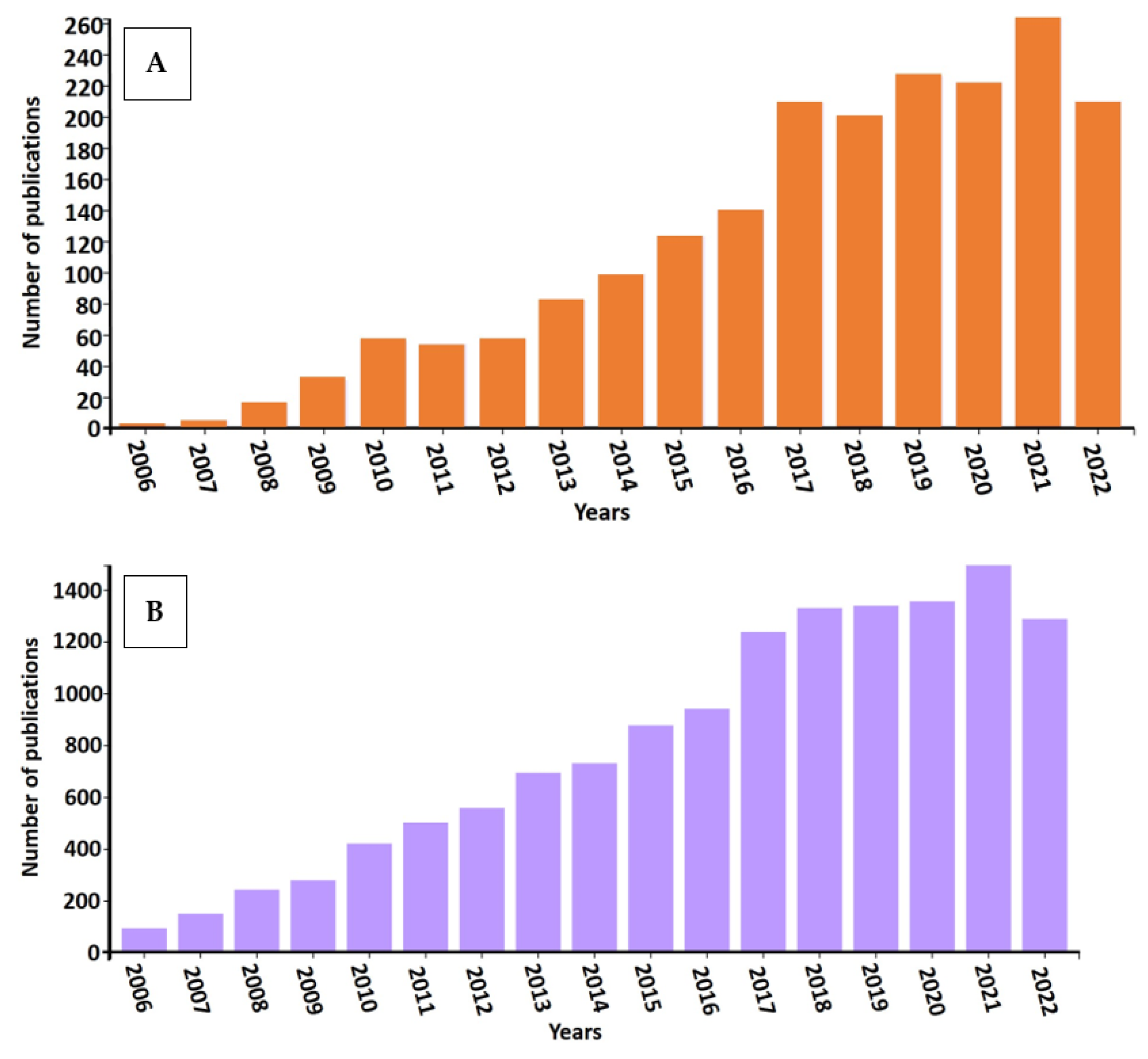
Figure 2.
Extracellular electron transfer can take place as indirect (IEET) and direct extracellular electron transfer (DEET). For IEET there is no need for a direct connection between the microorganisms, because molecules, for example (A) hydrogen, (B) formate, or (C) soluble electron shuttles serve as electron carriers. On the contrary, DEET requires a direct contact, such as (D) cythocromes and e-pili, (E) conductive material, or (F) conductive biofilm formation.
Figure 2.
Extracellular electron transfer can take place as indirect (IEET) and direct extracellular electron transfer (DEET). For IEET there is no need for a direct connection between the microorganisms, because molecules, for example (A) hydrogen, (B) formate, or (C) soluble electron shuttles serve as electron carriers. On the contrary, DEET requires a direct contact, such as (D) cythocromes and e-pili, (E) conductive material, or (F) conductive biofilm formation.
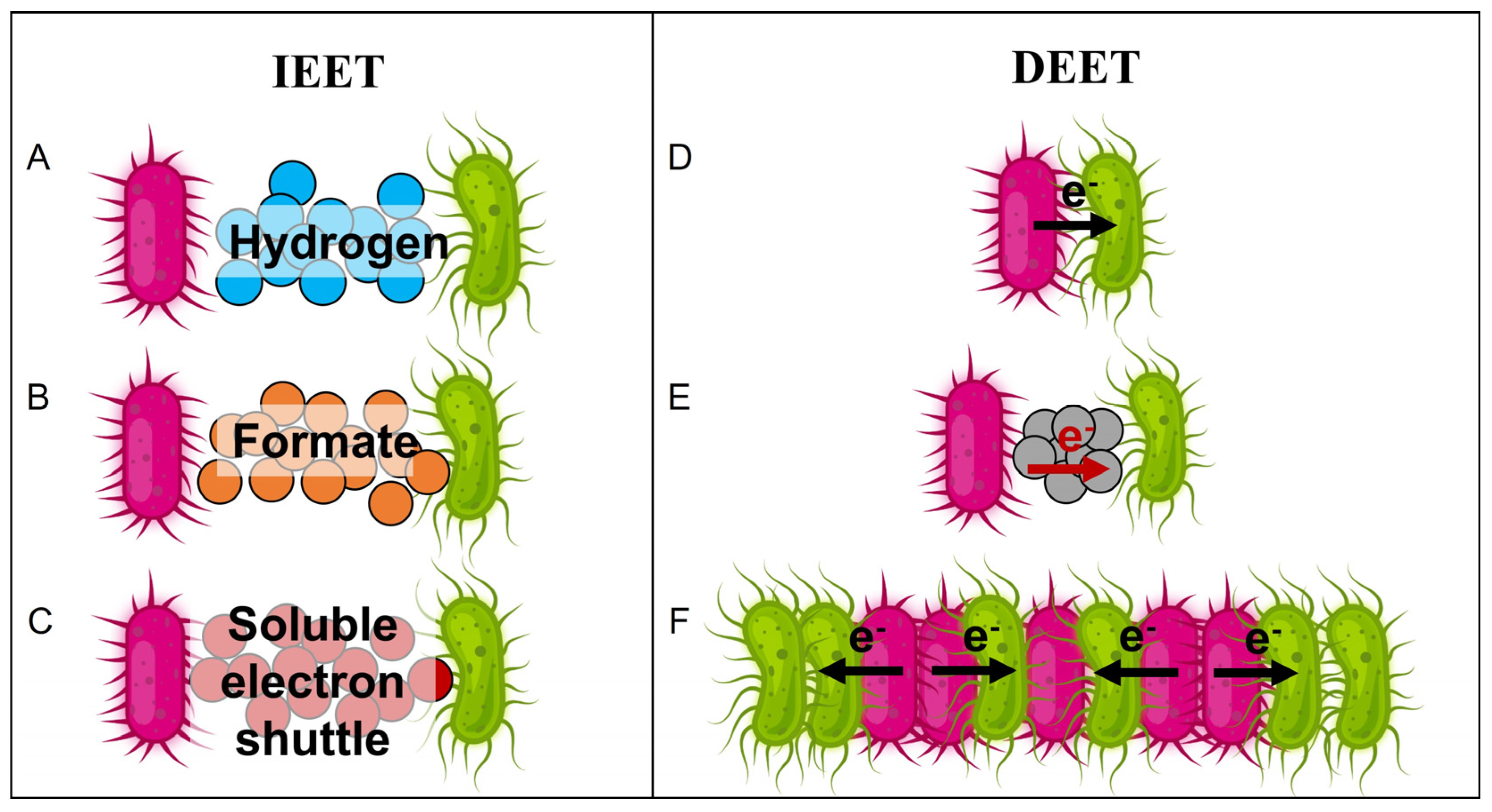
Figure 3.
In microbial fuel cell (MFC) the organic substrates are oxidised by microorganisms. The anode serves as terminal electron acceptor, the protons are released to the solution. The reactor contains a resistance, or consumer and a membrane. Protons diffuse through the selective membrane and recombine with the electrons again at the cathode. If the cathodic chamber is aerobic, the product is water, if anaerobic, the product is hydrogen, though it is thermodinamically not favourable.
Figure 3.
In microbial fuel cell (MFC) the organic substrates are oxidised by microorganisms. The anode serves as terminal electron acceptor, the protons are released to the solution. The reactor contains a resistance, or consumer and a membrane. Protons diffuse through the selective membrane and recombine with the electrons again at the cathode. If the cathodic chamber is aerobic, the product is water, if anaerobic, the product is hydrogen, though it is thermodinamically not favourable.
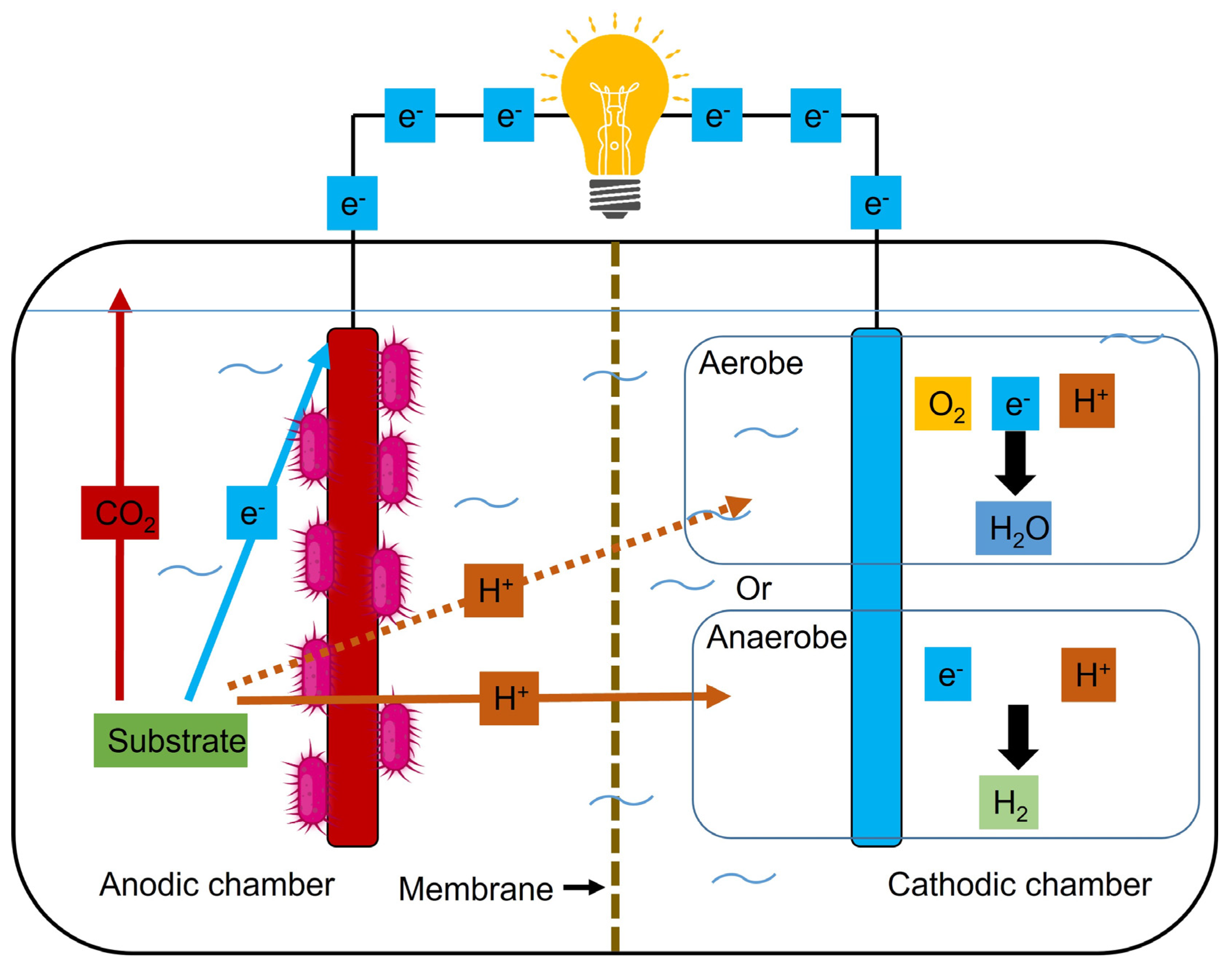
Figure 4.
In a microbial electrolysis cell (MEC), the substrate is oxidised in the same way like in MFC. The electrons are transferred to the anode, while the protons are released into the electrolyte solution. The reactor contains a power source and sometimes a PEM membrane. The power source increases the potential difference between the electrodes, so hydrogen generation is favourable on the cathode. If the cathodic chamber contains electroactive microorganisms, beside hydrogen other valuable chemicals are produced depending on the microbial community developed on the biocathode.
Figure 4.
In a microbial electrolysis cell (MEC), the substrate is oxidised in the same way like in MFC. The electrons are transferred to the anode, while the protons are released into the electrolyte solution. The reactor contains a power source and sometimes a PEM membrane. The power source increases the potential difference between the electrodes, so hydrogen generation is favourable on the cathode. If the cathodic chamber contains electroactive microorganisms, beside hydrogen other valuable chemicals are produced depending on the microbial community developed on the biocathode.
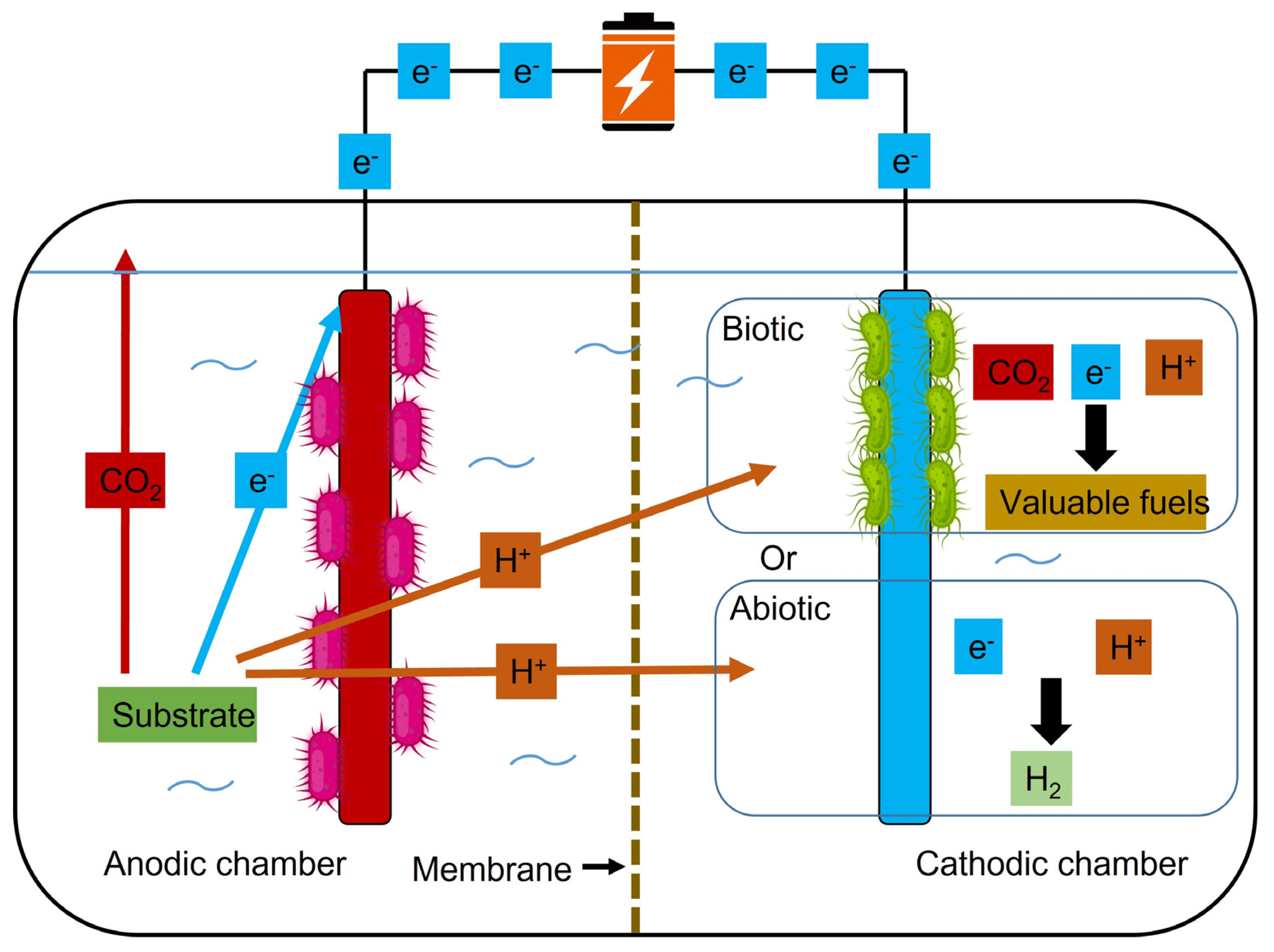
Figure 5.
In cylindrical reactors, one electrode is inside the centre, while the other is placed around it. In “distant” design, there is a gap between the electrodes filled with electrolyte or the solution, while in “adjacent” design there is only a membrane separation between the electrodes. Both the anode and the cathode can be the central electrode.
Figure 5.
In cylindrical reactors, one electrode is inside the centre, while the other is placed around it. In “distant” design, there is a gap between the electrodes filled with electrolyte or the solution, while in “adjacent” design there is only a membrane separation between the electrodes. Both the anode and the cathode can be the central electrode.
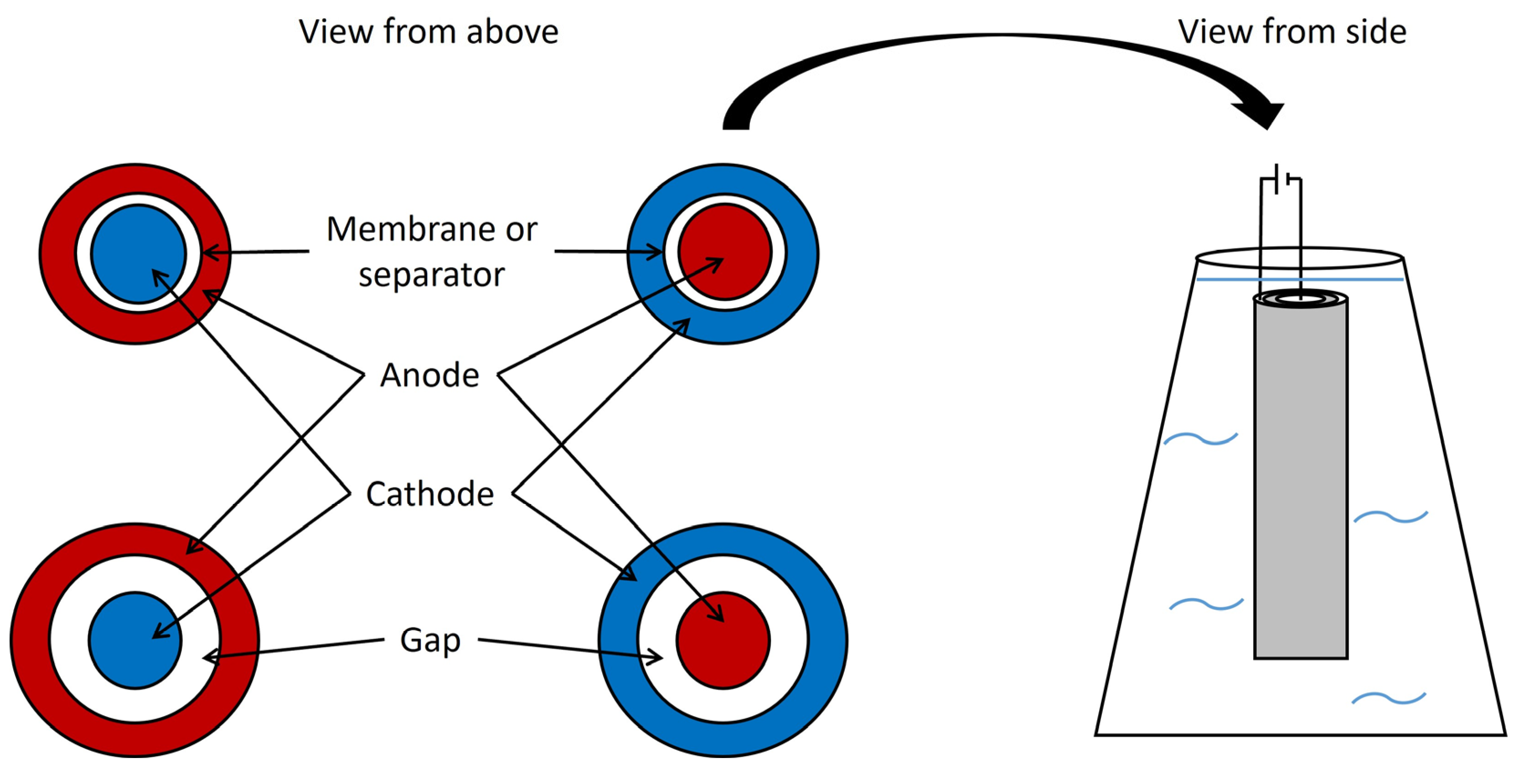
Figure 6.
Rectangular box type reactors are suitable for scale-up experiments. The electrodes are placed opposite each other, the electrode surface and current density is increased.
Figure 6.
Rectangular box type reactors are suitable for scale-up experiments. The electrodes are placed opposite each other, the electrode surface and current density is increased.
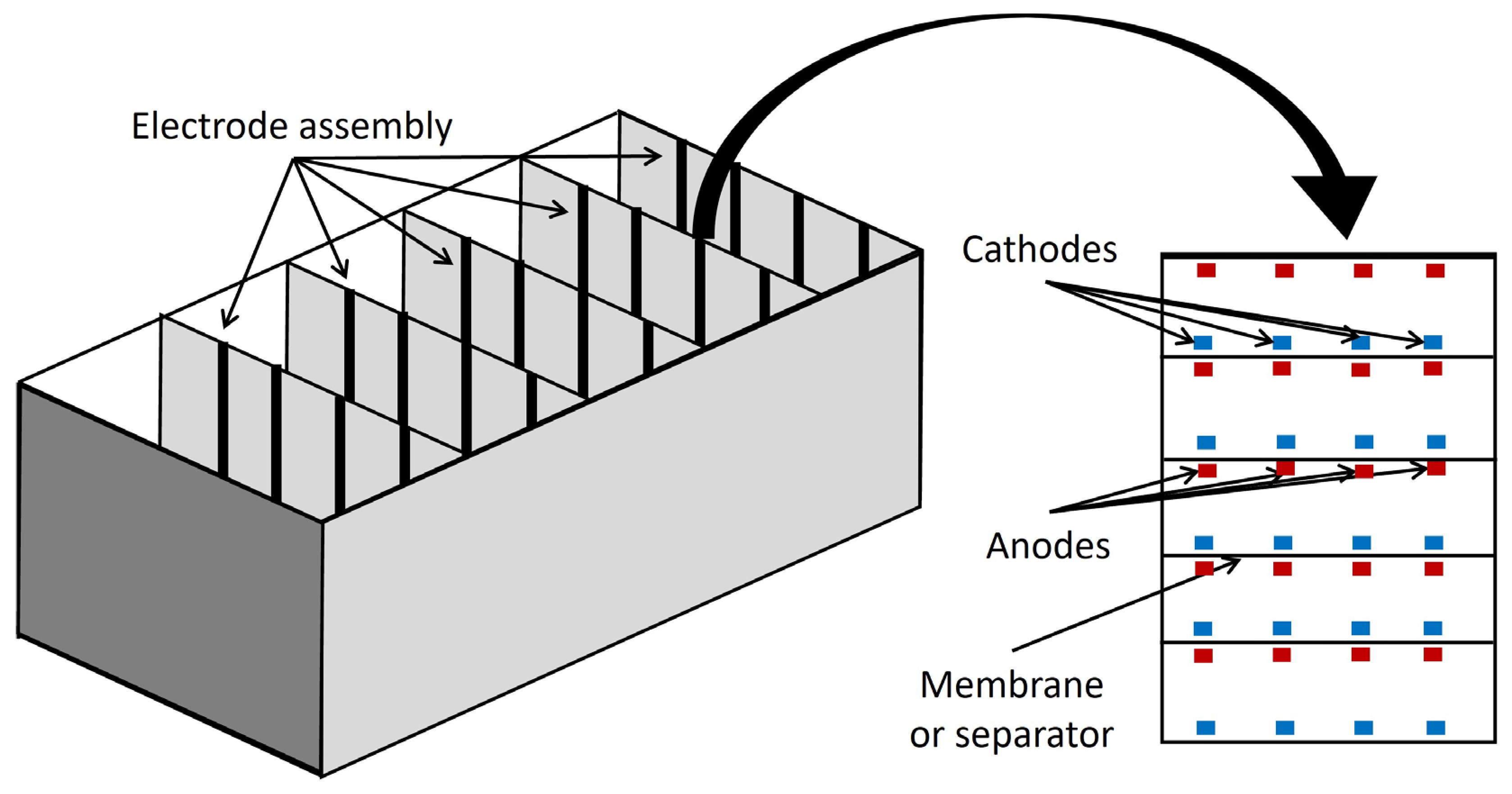
Figure 7.
H-cell reactors are one of the most popular laboratory test designs for BES. It is easy to set up, though the size of the membrane and the possibility to stirring are limited.
Figure 7.
H-cell reactors are one of the most popular laboratory test designs for BES. It is easy to set up, though the size of the membrane and the possibility to stirring are limited.
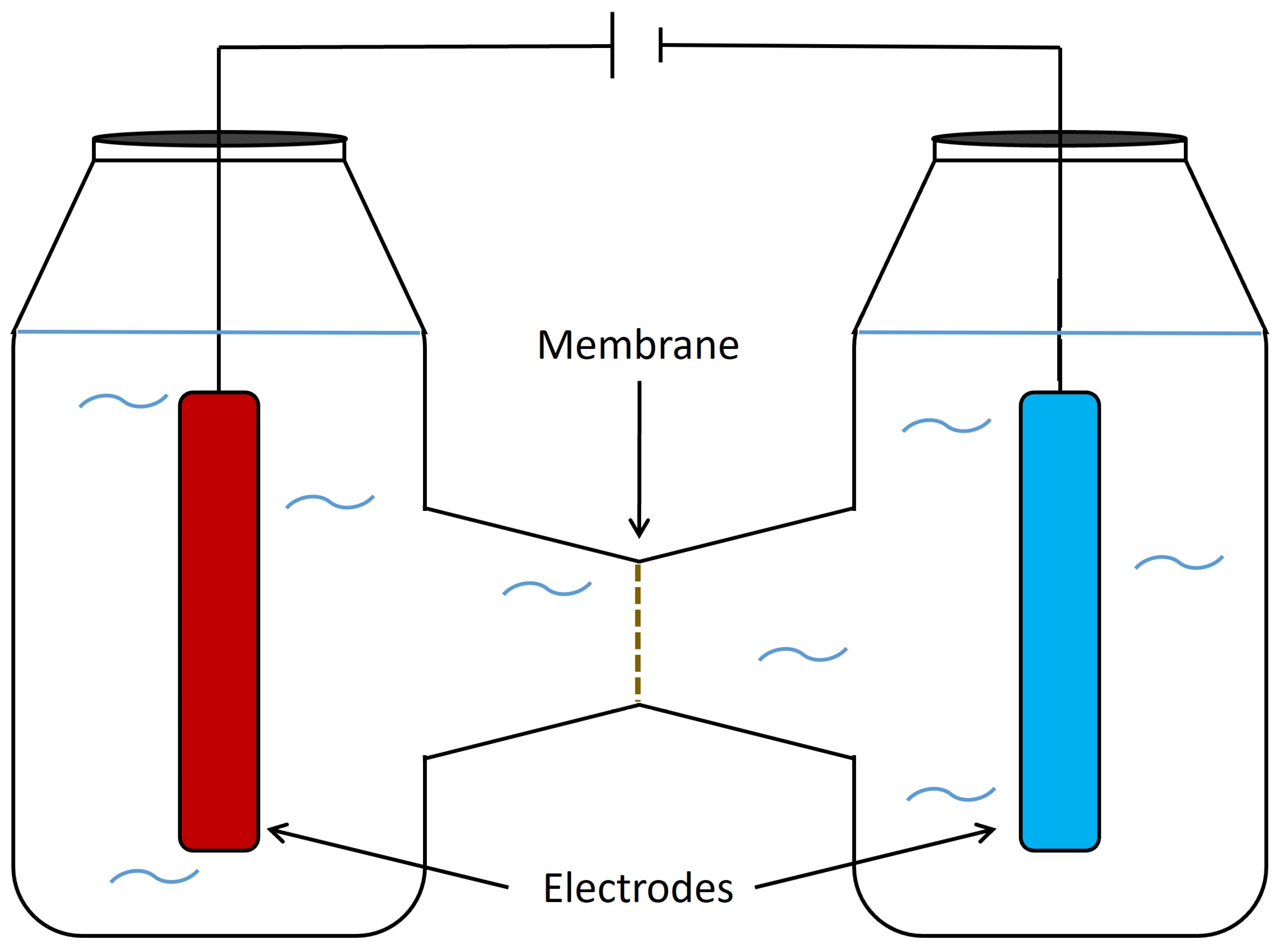
Table 6.
Typical members in BES reactors and their potential roles.
| Taxon | Chamber/electrode | Possible role | References |
|---|---|---|---|
| Desulfovibrio sp. | cathode | Catalyses BES H2 production at cathode potentials ≤–0.44V versus NHE | [90] |
| Acetobacterium spp. | cathode | Most prevalent and active bacteria on the electrode in acetate production | [24] |
| Clostridium sp. | Bulk solution | Transferred electrons directly to outside electron acceptor | [144] |
| Geobacter sp. | cathode | Well known DIET partner | [83,166] |
| Hydrogenophaga sp | cathode | Electroactive bacterium. Its role in electromethanogenesis is unclear | [166] |
| Azoarcus sp. | cathode | Facultative electroactive, the role in BES needs further investigation | [151] |
| Tangfeifania sp. | cathode | It is detected frequently in BES reactors, they probably facilitate methanogenesis | [92] |
| Aminomonas sp. | cathode | Syntrophic methanogen partner electron transfer has not been documented | [92] |
| Desulfuromonas sp. | anode | Electroactive microbe | [78] |
| Bacteroidia sp. | Bulk solution | Hydrolyzes proteins and transforms the amino acids generated in the process into acetate | [86] |
| Azonexus sp. | cathode | Acetate oxidising bacterium, capable for DIET and to DEET, it can be found frequently on anode as well | [93] |
Table 7.
Most frequently detected archea in BES reactors.
| Archea | References |
|---|---|
| Methanobacterium palustre | [90] |
| Methanobacterium aarhusense | [90] |
| Methanothermobacter thermoautotrophicus | [81,185] |
| Methanothrix concillii | [29,92,93,186] |
| Methanospirillum hungatei | [29] |
| Methanosarcina flavescens | [29] |
| Methanoculleus bourgensis | [29] |
| Methanosphaera cuniculi | [29] |
| Methanobacterium formicicum | [84,86] |
| Methanobacterium petrolearium | [186] |
| Methanobacterium subterraneum | [35,186] |
| Methanosarcina thermophile | [86] |
Disclaimer/Publisher’s Note: The statements, opinions and data contained in all publications are solely those of the individual author(s) and contributor(s) and not of MDPI and/or the editor(s). MDPI and/or the editor(s) disclaim responsibility for any injury to people or property resulting from any ideas, methods, instructions or products referred to in the content. |
© 2023 by the authors. Licensee MDPI, Basel, Switzerland. This article is an open access article distributed under the terms and conditions of the Creative Commons Attribution (CC BY) license (http://creativecommons.org/licenses/by/4.0/).
Copyright: This open access article is published under a Creative Commons CC BY 4.0 license, which permit the free download, distribution, and reuse, provided that the author and preprint are cited in any reuse.


