

Submitted:
16 November 2023
Posted:
21 November 2023
You are already at the latest version
Abstract
Lithium-ion batteries with improved energy densities have made understanding the Solid Electrolyte Interphase (SEI) generation mechanisms that cause mechanical, thermal, and chemical failures more complicated. SEI processes reduce battery capacity and power. Thus, a review of this area's understanding is important. It is essential to know how batteries degrade in EVs to estimate battery lifespan as it goes, predict, and minimize losses, and determine the ideal time for a replacement. Lithium-ion batteries used in EVs mainly suffer two types of degradation: calendar degradation and cycling degradation. Despite the existence of several existing works in the literature, several aspects of battery degradation remain unclear or have not been analyzed in detail. This work presents a systematic review of existing works in the literature. The results of the present investigation provide insight into the complex relationships among various factors affecting battery degradation mechanisms. Specifically, this systematic review examined the effects of time, side reactions, temperature fluctuations, high charge/discharge rates, depth of discharge, mechanical stress, thermal stress, and the voltage relationship on battery performance and longevity. The results revealed that these factors interact in complex ways to influence the degradation mechanisms of batteries. For example, high charge currents and deep discharges were found to accelerate degradation, while low temperatures and moderate discharge depths were shown to be beneficial for battery longevity. Additionally, the results showed that the relationship between cell voltage and State-of-Charge (SOC) plays a critical role in determining the rate of degradation. Overall, these findings have important implications for the design and operation of battery systems, as they highlight the need to carefully manage a range of factors to maximize battery performance and longevity. The result is an analysis of the main articles published in this field in recent years. This work aims to present new knowledge about fault detection, diagnosis, and management of lithium-ion batteries based on battery degradation concepts. The new knowledge is presented and discussed in a structured and comprehensive way.

Keywords:
Prognostics
; Ageing
; Lithium-Ion Batteries
; EV Batteries
; Degradation
; Electric vehicles
; Failure
; Solid Electrolyte Interphase
; Lifespan Estimation
; Battery Performance
; Diagnostics
; Lifetime Prediction
1. Introduction
Several governments worldwide are interested in reducing their country’s dependence on oil. Among the alternatives for replacing oil, the growing use of renewable energy sources is the most promising. Renewables generate power intermittently and require storage batteries to meet peak regulations. Most renewable energy sources are intermittent, opening spatial and temporal gaps between the availability of the energy and its consumption by end users. In order to address these issues, it is necessary to develop suitable energy storage systems for the power grid [1].
Electric vehicles use energy storage batteries, which can avoid using traditional fuel in vehicles. Hence, they are preferred and are becoming more and more popular nowadays. There is an urgent need to replace traditional fuel vehicles with electric vehicles charged using renewable energy sources [2]. The carbon dioxide (CO2) emissions make the land transport sector one of the main ones responsible for climate change [3]. Quantitative assessments indicate that the transportation sector accounts for approximately 24% of global CO2 emissions. Road, rail, and off-road vehicles account for 75% of these emissions within this sector [4,5,6,7].
Several public policies have been proposed to decarbonize the transport sector. The European Union Parliament created Regulation 2019/631 on April 17, 2019, setting stricter CO2 emission standards for new passenger and light commercial vehicles starting in 2020. This regulatory policy requires automotive CO2 emissions to decrease by 15% by 2025 and 37.5% by 2030 compared to 2021 [7,8]. Globally, many governments have passed transportation CO2 emission reduction laws [7,9,10,11,12,13]. Although EVs are an alternative to decarbonizing the transport sector, several challenges are still to be overcome. Among them, it is worth highlighting the price of battery modules. Although battery module prices have fallen in recent years, it is estimated that battery modules cost approximately 2/3 of the total EV cost [7]. The price of battery modules must be reduced by half its current value to make these vehicles economically viable and competitive with combustion engine vehicles [14,15,16,17].
Lithium-Ion Batteries (LIBs) are used in most EVs because of their high specific energy, low self-discharge, extended lifespan, safety, and cost [18,19,20,21]. During the operation of EVs, the batteries undergo various degradation processes that depend on numerous factors (e.g., road conditions, driver behavior, ambient temperature, and cabin temperature) [3]. These degradation mechanisms reduce battery capacity and power. The battery capacity and power reduction result in a shorter EV range, causing range anxiety in customers. Accelerated battery degradation also reduces charging and discharging efficiency, increasing internal resistance and shortening the battery's lifetime [22].
Vehicle manufacturers expect to replace batteries when the batteries reach 70 to 80% % of the initial charge range [23]. This limit is still uncertain, and many studies have reported that batteries will be used below this limit. On the other hand, early battery replacement will be recommended if the battery's degradation mechanisms are not adequately mitigated [24].
Battery deterioration processes are critical to understanding the battery for technical, economic, and scientific purposes. Understanding the degradation process of batteries will allow companies to determine the best time to replace EV batteries, optimize their design (i.e., maximize their efficiency), accelerate the product development cycle, and ensure that the battery is safe and has the adequate performance to operate on EVs and a second application.
In terms of economic aspects, it is possible to estimate and reduce the return on the investment, identify new ways to capture the value and maximize the value captured during the operation of the batteries based on the degradation mechanisms. Understanding battery degradation mechanisms is essential for optimizing battery models in embedded systems responsible for battery control and monitoring. These systems can extend battery life and enable the market for second-life batteries [25]. From the research perspective, it is possible to identify the factors that accelerate the batteries' degradation, predict the moment that the battery will fail, identify new viable applications for the batteries, and identify possible battery defects. Thus, it is possible to design new models and solutions to overcome the existing issues [24]. Automating battery disassembly and categorization requires an in-depth understanding and accurate models of secondary-life battery degradation. This will reduce the time and cost associated with battery disassembly and classification. This method reduces or eliminates the need for exhaustive battery testing, thereby enhancing the overall efficacy of battery lifecycle management [26].
Predictive maintenance is also essential to ensure battery safety. Most battery manufacturers provide predictive maintenance services based on vehicle distance traveled and lifetime. However, this process has high costs, low efficiency, and is time-consuming. Therefore, understanding battery degradation is essential for the manufacturer to provide the maintenance service at the ideal moment, avoid unscheduled maintenance, and reduce costs and maintenance time. This is relevant for the tooling and EV markets. This process can be optimized using machine learning algorithms defining the optimal time to provide service intelligently based on previous maintenance histories and battery operation data [27].
Battery degradation processes are complex, and their understanding is not trivial due to the numerous factors influencing each other. However, identifying the optimal operating range of current, voltage, and temperature for this Energy Storage System (ESS) operation is crucial for diagnosing and prognosis battery failures and predicting and extending battery life. A systematic literature review is needed to understand battery behavior in critical situations, predict failures and lifespan, and implement safety functions in the Battery Management System (BMS).
The non-linear characteristics of the Solid-Electrolyte Interphase (SEI), lithium coating, and loss of active material make it challenging to comprehend, model, and manage battery degradation mechanisms. Numerous events coexist and impact one another, making it difficult to simulate each degradation mechanism. Therefore, more research is necessary to comprehend the battery deterioration mechanism and to develop dependable novel monitoring and diagnostic technologies.
Usually, the degradation mechanisms are investigated in analyses carried out after the batteries reach their lifespan, called post-mortem analyses. In these analyses, the components of the aged cells are separated and individually analyzed. The cell must be disassembled to perform this type of analysis. This technique's advantage is that it makes pinpointing each cell's component's unique contribution feasible. However, one of the main disadvantages is the need to carry out stress tests on the cell to evaluate the degradation mechanisms, making this analysis time-consuming and costly [28].
Battery degradation is a complex phenomenon that needs to be modeled and controlled by systems capable of keeping battery operation within operating limits, increasing battery life in EVs and other applications. Several works have been proposed in the literature. In [29], the authors investigated the current collector's aging mechanism for power reduction and increased battery impedance. In [30], the authors showed that the loss of capacity occurs due to changes in the cyclable lithium and active material loss. In [31], a review of the battery degradation mechanisms is presented. The collected information in [31] motivated new works focusing on diagnosing battery degradation, offering prognoses, understanding the effects of cycling conditions on degradation, and understanding how the degradation mechanisms are interrelated.
Despite many scientific and technical papers in the literature that aim to clarify the battery degradation process, issues still need to be clarified. Therefore, this work seeks to clarify the mechanisms of battery degradation, focusing on comprehensively explaining how cycle and calendar effects affect battery degradation and diagnosing and predicting these mechanisms and their impact on battery safety. Unlike most studies in the literature (see Table 1), the contribution of this work is to provide a systematic review of battery degradation mechanisms, the causes of battery failure, and ways to mitigate these effects. In addition, this systematic review presents several ways of diagnosing and proposing the different battery degradation mechanisms. In a lithium-ion battery, the cathode is one of the key components responsible for storing and releasing lithium ions during the charging and discharging processes. The Cathode-Electrolyte Interface (CEI) is the boundary or interface between the cathode material and the electrolyte solution in the battery. CEI plays a crucial role in overall battery performance and degradation that is still little discussed in the literature.
This work aims to present the working principle of LIBs and their main degradation mechanisms simply and directly. The purpose of Section 2 is to present the motivation for this work. The goal of Section 3 is to answer the following questions: “How do LIBs work?”, “Which are the main components of LIBs?”, “Which LIB chemicals are most used in EVs?”, “Which cell types are most used in EVs?” and “How is the degradation behavior of these cells?”. Section 3 aims to investigate the LIBs degradation in Evs, including large format cell degradation modes. Section 4 presents the degradation mechanisms of LIBs, and Section 5 discusses the results. Finally, a conclusion is presented.
2. Diagnostic Methods
The volume of data derived from batteries has increased due to technological advancements, particularly in the Internet of Things (IoT) and smart sensor systems. This information is vital for enhanced monitoring of batteries in EVs, facilitating their remanufacturing, reuse, and recycling, and enhancing automated disassembly procedures. Additionally, it aids in accurately estimating battery residual value, thereby informing strategic decisions regarding battery lifecycle management [26].
The digitalization of batteries is crucial for conducting fault diagnoses, identifying fundamental causes, and facilitating the efficient collection, classification, and determination of environmental implications. Facilitating detailed digital characterization reduces the need for repeated and overlapping battery supply chain examinations, significantly optimizing time and cost parameters.
Recent research has shown a significant advance in developing models to predict degradation mechanisms. These models can be classified as electrochemical, empirical, semi-empirical, and data-driven models. Different classifications of models can be developed to predict battery parameters.
Electrochemical models are used to simulate the behavior of cells. They are accurate because they are based on mathematical equations describing the chemical characteristics of the cell's materials and the design variables. The main disadvantage of these models is the difficulty of describing mathematical equations. The chemical behavior of cells and their degradation mechanisms are complex once many of these phenomena co-occur. They depend on numerous external factors and have non-linear characteristics. From a computational perspective, these complex mathematical equations require a high computational cost to be solved, which can take a long time to model and predict. From a practical point of view, this kind of model usually requires cell disassembly and the exposition of its operator to high voltages, making the procedure slow and challenging to be scalable [24,40].
Empirical models are built from direct measurements of battery observables. Although empirical models do not require battery disassembly, their major drawback is performing cycle tests to measure the model's variables. These tests can be expensive and take a long time. This model is built for a specific scenario, e.g., batteries employed in EVs, and consequently, cannot be used to forecast the battery deterioration processes in a different scenario, such as the battery's use in a second application [41]. Semi-empirical models combine batteries' physical and chemical characteristics with measured [24,42]. Electrochemical Impedance Spectroscopy (EIS) is a non-invasive method for analyzing a battery's increase in ohmic resistance. By employing alternating current perturbations across a range of frequencies and analyzing the resulting impedance, EIS provides detailed insights into the intrinsic electrochemical processes, making it an indispensable tool for real-time battery diagnostics [43]. This technique often identifies equivalent circuit model parameters that estimate battery states such as internal impedance, Li-ion diffusion dynamics, electrode contact impedance, SOC, and State of Health (SOH) [43]. The EIS are signals rich in information about the aging of batteries and are often used as input parameters to estimate the useful life of batteries. However, most commercial BMSs still do not collect EIS on board the vehicle due to the high cost of the equipment. In addition, the results are subject to variations in temperature, and the test is time-consuming [45]. Figure 1 shows a methodology for modeling batteries to predict their remaining useful life.
The most well-known empirical models are the coulomb counting method [46,47,48,49], the ampere-hour counting method [50,51,52,53,54], and the event-driven aging accumulation method. The coulomb counting technique accumulates the coulombs dissipated since the start of the discharge cycle and estimates the remaining capacity based on the difference between the accumulated value and a pre-recorded total charge capacity. The coulomb counting method has difficulties estimating the SOH in real applications with variable loads because the discharge cycles can be irregular. In other words, there are complete and incomplete cycles.
The ampere-hour method operates on the principle of determining the electric current's integral over time, which corresponds, in theory, to the change in a battery's state of charge. Nonetheless, any inaccuracies in the current sensor or variations in the Coulombic efficiency - the ratio of the total charge extracted from the battery to the total charge placed into the battery during a complete discharge-charge cycle - can contribute to accumulated errors in estimating the SOC. In addition, the available battery capacity can fluctuate over time due to aging, temperature, and discharge rate, which the ampere-hour method does not account for, compounding the estimation error.
The use of high-precision sensors can substantially reduce the SOC estimation errors associated with the ampere-hour method in order to address these deficiencies. High-precision sensors provide a more precise reading of the electric current, reducing the possibility of error in the integral calculation. The weighted ampere-hour method provides a sophisticated approach to estimating RUL. It considers the total charge/discharge, battery age, and temperature effects. By applying weighted factors to the current, considering the rate of battery deterioration and the impact of operating conditions, it provides a more accurate estimation, thereby reducing the errors inherent to the traditional ampere-hour method. This method improves the predictability of the remaining battery life, enhancing the dependability and efficacy of battery-dependent systems.
Incremental Capacitance Analysis (ICA) [55,56,57] and Differential Voltage Analysis (DVA) [58,59] are non-destructive techniques that provide accurate and reliable data on electrode degradation. These techniques can identify battery deterioration mechanisms with a high level of precision.
ICA is an instrumental technique that converts voltage plateaus into observable charge differences to voltage. Under conditions analogous to potentiostats, these differentials reveal intercalation mechanisms within biphasic regions, typically associated with phase transitions during charge/discharge processes. This arrangement of peaks and valleys is a unique identifier of electrode materials. This method is typically carried out at a low C rate to allow for a thorough investigation of intercalation mechanisms and material properties. Infrared thermography can supplement ICA and DVA by validating the battery surface temperature calculated by thermal models [43].
The open-circuit voltage methods are methods that have a very long measurement time and have margins of error. In the open-circuit voltage method, the open-circuit voltage curve of the lithium-ion battery is obtained, and the SOC is estimated from the battery's mathematical model. However, this method cannot be used in real time and requires initial conditions that may not be known. Finally, the internal resistance method needs to measure the frequency response of the battery to determine its state. As this method usually requires extra function generators and a separate testing period, it is expensive and challenging to implement as part of the battery.
Physical model-based methods attempt to build a mathematical model that describes battery degradation behavior. The implementation of this approach largely depends on the effect on the battery's internal structure and material qualities and considers the battery's aging condition and degradation mechanism in detail. The decay mechanism model is primarily concerned with the internal reaction mechanism of the battery, with the Solid Electrolyte Interphase (SEI) and ion concentration serving as objects of observation [63,64,65].
The Equivalent Circuit Model (ECM)-based method estimates the SOH of the battery by first describing the variation of each parameter in the battery using equivalent circuits composed of capacitors, resistors, and voltage sources. However, working conditions significantly affect these parameters, making it challenging to identify the parameters, which limits the method to describe the dynamic and static characteristics of batteries [66]. Capacity deterioration can also be presented through observation and state equations. It is then processed by algorithms such as Extended Kalman Filter (EKF) [67,68,69], Unscented Kalman Filter (UKF) [70,71], and Particle Filter (PF) [62] to estimate the SOH of the battery.
The physics-based approaches offer numerous benefits. These include: (i) the capacity for physical insights, contributing to a comprehensive understanding of the battery. Therefore, this method has good interpretability, facilitating the comprehension of the model's predictive behavior, (ii) good accuracy, including in scenarios beyond the operating region, with good extrapolation capability and transferability through chemistry. On the other hand, the high computational cost, overparameterization, the need to identify several parameters, and the complexity of understanding the different degradation modes can limit the application of physics-based models in real applications [44,72,73].
Data-based Models (DbMs) have become attractive due to the greater processing power of computers [44,74]. DbMs are increasingly being applied in the industry because they can reduce the design time, predict premature battery failures, and do not require the batteries to disassemble to build these models. Data from EIS [75,76] and Open-Circuit Voltage (OCV) [21,24,74,77,78,79], among others, are employed to build models using pattern recognition and machine learning techniques [80]. DbM can be classified as empirical when parametric, i.e., built based on the battery’s prior knowledge. On the other hand, DbM can also be classified as non-empirical when built from real-time measurements, i.e., the model emits an output for each new sample measured [81,82]. Figure 2 shows a flowchart of data-driven models applied to batteries.
Machine learning algorithms widely used successfully in data-driven models are: the time series model [83], Artificial Neural Network (ANN) [84], Support Vector Machine (SVM) [83], and Gaussian Process Regression (GPR) [85]. Time series and linear regression models map the non-linear relationships between resources and capacity or remaining battery life. Most relationships are non-linear, which makes non-linear mapping more popular. Neural networks learn the implicit rules of a given pair of inputs and outputs during an offline training phase and then form a non-linear black box model for use during the online operating phase. A well-trained ANN can distinguish between a battery system’s normal and abnormal states. Despite strong self-learning from historical data, ANN needs a large amount of historical data, has high training time, low generalization ability, and overfitting problems [85].
The main function of SVM-based fault diagnosis is to transform the input space into a high-dimensional space through a kernel function and find the optimal hyperplane in this new space. This method treats LIBS fault diagnosis as a sample classification problem and trains an accurate classifier based on historical data. Information fusion represents a process of reasoning and decision-making based on uncertain information [86,87]. Based on the SVM, the literature has proposed the relevance vector machine (RVM) method, a probability prediction method. Because of its super simple parameters and generalizability advantages, RVM has already been applied to the prediction field [88].
GPR is a variant of non-parametric regression techniques and can effectively decipher the complex non-linear tendencies observed in battery degradation profiles. This machine-learning technique uniquely quantifies uncertainty in regression estimations, which confers a high level of robustness in predictive contexts [85].
In an in-depth examination of its benefits, the capability of GPR to perceive non-linear data associations is highlighted first. It makes no assumptions about the underlying distribution of the data and can therefore model complex nonlinear relationships with flexibility. This is especially advantageous when coping with complex battery degradation patterns. Second, the ability of GPR to quantify the uncertainty associated with predictions is an indispensable advantage. In specific contexts, the absence of this characteristic from other traditional regression methods can render their predictions less reliable. GPR's measure of uncertainty assists in identifying forecasts that should be interpreted with caution due to their high degree of uncertainty.
On the other hand, GPR has several limitations. The computational complexity associated with Gaussian Processes is a significant drawback. Particularly for large datasets, the computational cost of GPR can become prohibitive due to the necessity of calculating the inverse covariance matrix. In addition, selecting a suitable kernel, which is essential to the model's success, can be a challenging endeavor. Without the proper kernel, the ability of GPR to characterize nonlinearities may be compromised. In addition, GPR tends to perform inadequately with high-dimensional data due to the curse of dimensionality, which necessitates an exponential increase in data to sample the high-dimensional space representatively [84].
Estimating the State of Health (SOH) of second-life batteries is difficult due to the lack of historical data and the variety of battery module chemistries and architectures. The lack of historical battery data makes predicting long-term battery data challenging [87]. Non-invasive diagnostic methods, such as X-ray computed tomography (CT), are preferable for cell analysis as they eliminate potential cell damage associated with disassembly. X-ray CT enables the quantification of the three-dimensional internal cell structure, providing diverse volumetric data crucial for assessing the State of Health (SOH) of batteries. These data sets include grayscale values, electrode deformation indications, electrolyte consumption measures, thickness metrics, and information on the size and distribution of aging-induced gas products. Together, these parameters provide a comprehensive evaluation of battery health, informing predictive maintenance and battery design optimization efforts [89].
3. Motivation
To design more efficient, reliable, safe, and long-lasting batteries, it is crucial to comprehend the mechanisms of battery degradation. By analyzing the causes of battery degradation, researchers can develop new materials and technologies to mitigate these effects and enhance the performance of batteries. Better BMSs that can monitor battery health in real-time and adjust their operation accordingly are one method to enhance the next generation of batteries. For instance, if a battery exhibits degradation due to overcharging or high temperatures, a BMS can reduce the charge rate or decrease the operating temperature to prevent further degradation. In addition, the battery test matrix can be designed condensed based on knowledge of degradation mechanisms to capture only the most essential data for validating the design parameters.
While the mechanisms of degradation in small cells are presently comprehended, further investigation is needed in specific domains, such as the particular aging behavior of large cells compared to small cells. For example, the precise chemical and physical processes that lead to electrode degradation are not yet fully understood, and more research is needed to develop new materials and manufacturing techniques to mitigate this effect.
Despite existing works in the literature, several degradation mechanisms have not yet been described clearly and comprehensively. Some concepts remain ambiguous in the literature, and an in-depth discussion is still needed. Therefore, the present systematic review revisits the main battery degradation mechanisms, avoiding ambiguity in the description of complex chemical phenomena, and, finally, we present ways to mitigate these problems in the future.
4. Basic Structure of LIBs
The major components of the LIBs comprise the positive electrode, negative electrode, electrolyte, current collector, separating membrane, and casing. Figure 3 details the atomic structure of a LIB.
The battery has a positive electrode and a negative electrode. The positive electrode presents a crystalline structure, e.g., generally made of lithium manganese oxide (LMO); lithium cobalt oxide (LCO); lithium nickel oxide, cobalt, and aluminum (NCA); and lithium oxide, nickel manganese, and cobalt (NMC). They can also comprise olivine-type materials, such as lithium iron phosphate (LFP) [91,92,93,94]. Positive electrodes generally consist of materials whose specific capacity is less when compared to harmful electrode materials. However, when high-capacity materials are inserted into the positive electrode, the battery's degradation process is accelerated, reducing its lifespan [95,96,97,98,99]. For this reason, several studies are being performed to develop new materials to increase the positive electrode's specific capacity.
Initially, the LIBs that dominated the battery market contained LCO as positive electrodes. Batteries with the LCO cathode have high working voltage, excellent performance rate, and good cycling performance even at high temperatures. The main disadvantage of this technology is that cobalt has a low specific capacity and high cost and can cause severe environmental impacts due to its toxicity [100]. Furthermore, charging LCO-based batteries at high voltages causes instability [101,102]. Recent research has shown that some strategies can be adopted to mitigate this limitation, such as (i) the use of additives in electrolytes [103,104], (ii) lattice element doping [105,106,107,108,109], and (iii) surface coating/modification with other active/inactive materials [100].
According to [100], deep discharge in batteries constructed with LCO cathode causes mechanical damage and a significant change in the dimension c of the shaft. The degradation of batteries starts in the first cycles with a structural change of the structure that causes the increase of the grain size, reduction of the surface potential, and loss of the contact rigidity, concomitant with the irreversible fading of the capacity [105].
However, with the development of new technologies and the need to increase battery life and safety, new technologies have been developed, such as NMC (LiNixMnyCozO2) with the following limits 0≤x, y, z≤1 [108]. The significant advantages of LIBs comprising NMC-positive electrodes are that they present reversible capacity, lower cost, and are environmentally friendly. However, they may show cycle and chemical instability when exposed to air, restricting their use from an industrial point of view [110]. The increase in nickel content in the electrodes of battery cells allows greater extraction of lithium ions at the same cut-off voltage. Therefore, it is possible to affirm that the increase in the proportion of nickel in the battery cells allows an increase in the capacity of the battery cells [93,108,109,110,111,112,113,114]. Manganese improves the battery's Depth of Discharge (DOD) [95,110,111,112,113,114,115,116]. The exposition of NMC-based batteries with air components (e.g., CO2 and H2O) produces a reaction that forms Li2CO3 and LiOH, considered impurities on the NCM surface. This phenomenon produces a large amount of highly reactive Li, which causes serious safety issues and reduces the electrochemical performance of the battery [117].
The main degradation mechanisms of NMC-based batteries are particle breakdown, gasification, phase transformations, and cation mixing. The breakage and deformation mechanisms within electrode particles are triggered by the voltage differentials produced by ion diffusion processes, in which concentration gradients lead to the movement of charged particles across the electrode medium [99,118]. These factors are mainly caused by the formation of highly reactive nickel in batteries. Among the main strategies adopted to reduce the instability caused by the high reactivity of nickel is a surface coating on the electrode of the active material, doping of the active material of the electrode, and conversion of the morphology of the NMC particles from a polycrystalline structure to a monocrystalline structure.
Still, other materials, such as titanate or silicone, can also be employed. Specific characteristics of lithium titanate (LTO) have attracted the attention of academia in recent years, e.g., long lifespan, without significant structural changes during each cycle [100], safety, thermal stability, and high potential. Also, these advantages prevent the formation of dendrites [32,100] at the cost of a reasonably lower voltage [119].
LFP-based batteries are highly thermally stable and have high cycle life and power. This battery technology is also beneficial in high-power applications requiring high discharge rates. Lithium intercalation and deintercalation during charge and discharge cycles can cause phase transitions in the active material, leading to volume changes and mechanical stress. Specific crystalline structures can more effectively accommodate these volume variations, reducing mechanical stress and deterioration. For instance, anisotropic structures like those found in LiFePO4 (olivine) can ameliorate mechanical stress during phase transitions, contributing to a longer shelf life. The primary mechanisms associated with this type of battery are the decomposition of electrolytes, the loss of active material, the formation of lithium dendrites, the structural degradation of the electrodes, and the modification of the separator's morphology.
The negative electrode usually consists of graphite-like material. Graphite dominates commercial batteries because its main advantages are high cycle stability, small voltage hysteresis, and high tap density. However, batteries with graphite anodes still have limited power and energy density in EV scenarios and large-scale power supplies. Furthermore, new anode materials that have low redox potential for high output voltage, excellent Li+ reversibility, intercalation/deintercalation (or plating/stripping for lithium metal anodes), structural stability during cycling, high ionic/electronic conductivity, low cost, and should be friendly to the environment [115].
As mentioned above, LIBs have a high energy density and low memory effect, and they are lightweight, whose benefits have targeted them as the best option for EV application. The high energy density is critical because it enables the cell to reach a high capacity to store energy in the same cell volume. The low memory effect allows the cell to be recharged at any current charge level without significantly losing the maximum energy capacity [118].
LIBs' electrodes are prepared by mixing binders (i.e., polymeric-based to "glue" particles) to connect materials among themselves and to the current collector [120]. The electrodes are assembled face-to-face and separated by a mesoporous membrane (i.e., separator), and electrodes are soaked in electrolytes. Under polarization, the ions move out from the positive electrode and into the negative electrode. Electrolytes transport lithium ions and also directly influence battery electrochemistry [107]. The electrolyte's ions move in the same direction, i.e., from the positive electrode to the negative electrode, neutralizing each piece of the system locally. Most of the electrolytes employed comprise carbonate solvent blends. The most widely used electrolytes are mixtures of various carbonates (e.g., ethylene, dimethyl, and propylene carbonate) and dissolved salt (e.g., LITFSI and LiPF6) [109].
During the charging phase, Lithium ions (Li+) migrate towards the negatively charged electrode, a process scientifically called intercalation. Concurrently, electrons are compelled to traverse from the cathode to the anode, facilitated by an external Direct Current (DC) source, thus maintaining the overall equilibrium of the electrochemical cell. In the discharge cycle, the ions return from the electrolyte to the positive electrode, and electrons are extracted spontaneously from the positive electrode to the external circuit. In these processes, the materials are oxidized or reduced. The positive electrode consumes electrons from the external circuit during reduction, while the negative electrode undergoes oxidation and releases electrons to the external circuit. This electron flow is essential for the battery's operation and the storage and release of lithium ions [103].
EV batteries can have three structural shapes: pouch, prismatic cells, and cylindrical cells. Cylindrical cells have a lower manufacturing cost ($/kWh) because they have been mass-manufactured for a long time, providing fast production compared to other types of cells. The assembly of cylindrical cells consists of wrapping the electrodes in a cylindrical shape encapsulated with a metal. This type of encapsulation reduces the delamination of the active material of the current collector, increasing the resistance of this type of cell to mechanical shocks, thermal charging, discharging cycles, and current collectors' mechanical expansion. They have a high energy density, and if one cell fails on a battery package, it will culminate in a low impact. Also, the temperature control of these cells is more accessible than that of prismatic cells [121]. Cylindrical cells are combined into packages and modules, and the circular cross-section of the cell does not optimally utilize the available space, which is a significant disadvantage compared to other types of shapes [103].
Prismatic cells have higher manufacturing costs, lower energy density, and mechanical stability than cylindrical batteries. Prismatic cells can undergo swelling due to their operation, and this degradation mechanism is intensified when the cell operates outside of safe conditions. This swelling is due to increased pressure in the cell when the safety vent opening is obstructed. This cell shape presents a lower energy density than cylindrical cells [121].
Soft pouch cells have the advantages of being lightweight, their manufacturing cost is not very high, and they have a greater density when compared to the other two models mentioned above. On the other hand, they need a robust mechanical structure for their protection. They are more likely to suffer an increase in volume because they may not have a designated ventilation mechanism. The swelling effect observed in pouch cells is due to battery degradation, which is caused by the physical expansion of the battery as a consequence of gas accumulation or other factors [121]. This expansion can increase internal pressure, which may eventually cause the battery to rupture. Several technical factors influence the expansion effect, including the increased thickness and flexibility of electrodes and separators, the cell design, and the battery shape. It is essential to carefully consider and optimize these technical parameters to prevent and mitigate battery enlargement in pouch cells.
Gas generation is an additional form of battery deterioration that can be influenced by battery shape. Gases can be produced inside the battery due to the chemical reactions that occur during the charging and discharging process, leading to swelling, pressure build-up, and even battery rupture. The leading gases these chemical reactions produce inside the battery are H2, C2H4, CH4, CO, CO2, HF, SO2, NO2, NO, and HCl. There are several ways in which the design of the battery can affect gas production. For example, flat pouch batteries have a higher ratio of surface area to volume than cylindrical batteries, which can increase gas production due to increased electrochemical reactions on the battery's surface. Due to the design of the electrodes and separators, certain regions of a pouch battery may be more susceptible to gas accumulation [122].
The study presented in [122] examined thermal runaway in lithium-ion batteries under various abuse conditions and SOCs. The results showed that the first indication of thermal runaway is the ejection of white vapor. This white vapor can contain flammable and toxic gases, some of which are heavier than air and which include vaporized solvent.
The investigation [122] examines thermal runaway at different battery charge levels. This study contributed to understanding the initial signs of thermal runaway, the most prominent of which is an opaque, white vapor emission. The white vapor contains a mixture of flammable and toxic gases. Intriguingly, a subset of these gaseous constituents, including the vaporized solvent specified in [123], has a relative density more significant than that of atmospheric air. Such a gaseous mixture naturally condenses when exposed to an environment with a reduced temperature. The effects of this condensation process within a confined spatial domain are of particular interest. Given an adequate oxygen concentration, the condensed aerosol mixture is capable of causing a phenomenon known as a vapor cloud detonation [100,101]. Extrapolating these observations necessitates additional research into the requisite safety measures and operational parameters for systems susceptible to these potentially dangerous reactions.
The results in [105,123] explain the significant SO2 emission at reduced SOCs in the investigated systems. In addition, it identifies CO as the predominant gaseous component, whose abundance is directly proportional to the SOC concentration. According to the results shown in [124], a comparison of the LCO and NMC chemistries reveals that both emit the same amount of CO. This similarity does not apply to the LFP cell, which exhibits a more moderate CO release than the NCA cell. These findings highlight the variation of gaseous emissions as a function of battery chemistry, SOC, and possibly other operational parameters, highlighting the complex interplay of factors contributing to lithium-ion batteries' overall safety profile. This concept necessitates further investigation to comprehend better and mitigate the dangers associated with such energy storage systems.
Lithium plating is another form of battery deterioration that can occur, particularly during rapid charging or at low temperatures. This occurs when metallic lithium accumulates on the anode's surface, decreasing the quantity of available lithium ions and causing a capacity loss. The geometry of the battery can influence lithium plating in several ways. For example, cylindrical batteries have a lower ratio of surface area to volume than flat pouch batteries, thereby reducing the likelihood of lithium plating. In addition, the geometry of the anode and cathode can influence the distribution of lithium ions and the likelihood of lithium plating.
The formation of an SEI occurs when a layer of solid electrolyte forms on the anode's surface, reducing the availability of lithium ions and resulting in capacity loss. By affecting the ratio of surface area to volume and the geometry of the electrodes and separators, the battery's configuration can influence the distribution of lithium ions and the likelihood of SEI formation.
Separator cracking is an additional form of battery degradation that can occur, especially in LIBs. This occurs when the separator, typically made of polymer, dissolves due to excessive heat or flame exposure. The geometry of the battery can affect this process by altering the thickness and thermal conductivity of the separator, as well as the cell's design.
Generally, these EV batteries can reach an energy density of nearly 300 Wh/kg [105,124], and the predominant average cost of current battery generation is approximately 100 to 200 $/kWh [105,125]. During the phase design of LIBs, the goal is to maximize the potential difference between the positive and negative electrodes, minimize the active material mass and volume, and prevent the electrolyte from undergoing the oxidation/reduction process [126].
- 4. Degradation of LIBs
LIBs are subject to the “thermal runaway” phenomenon when subjected to abuse conditions, such as vehicle collision, overvoltage, overcurrent, and deep discharge [127,128]. Thermal runaway is an exothermic phenomenon in which reactions inside the cell cause an increase in temperature [129,130,131,132]. These reactions within the cell can lead to electrolyte decomposition, gas formation, voltage drop, and internal pressure increase. It can culminate in the cell's rupture and swell, causing electrolyte leakage, which may cause fire/flame and explosion in contact with air.
The gases inside the cell can also be produced by the electrolyte reduction, resulting from the decomposition reaction of electrolyte solvent and by the structural release of cathodic materials [36,133]. These released gases, such as hydrogen, organic products, and ethylene, can be toxic and flammable, which can cause severe harm to the individual's health [44,107,124,133]. These gases can also cause uncontrolled thermal runaway in the cell and compromise the vehicle's safety [36,107,133]. The gas evolution inside the cell is also associated with electrolytic displacement, increased internal resistance that reduces the battery's efficiency, the number of cycles, and its lifespan [36,107,134]. The aging of LIBs is still the subject of research to understand and minimize electrolyte decomposition and gas evolution. By understanding the phenomena at the electrode/electrolyte interface, researchers can gain insights into the mechanisms that cause battery degradation. The electrode/electrolyte interface facilitates the transfer of ions between the electrode and the electrolyte during battery operation. Any changes or disruptions in this interface can affect ion transfer efficiency and lead to degradation. The electrode combines lithium ions and electrons in the electrode/electrolyte interface. The ion is stored in the electrode, intercalated, as an alloy, or as Li metal. The Li+ intercalation implies electron absorption for electrode neutrality [44,107,126,135]. The charge transfer in and out of the electrode also affects the current collector, which suffers from corrosion due to cycling. This corrosion effect occurs at the negative electrode (the degradation mechanisms that occur at this electrode are discussed in more detail in Section 3.2) and causes irreversible capacity loss in the cell [44,95,104,109,110,135].
In aging, the main problems are the effects of the cycle and the calendar, as these effects influence both the energy (capacity) and the power (impedance) of the battery due to loss of lithium inventory, loss of active material, negative electrode capacity, and positive electrode capacity [44,95,104,109,110,136]. Loss of cell power happens due to loss of local contact, reduction of electrode reaction surface, structural changes in host materials, changes in electrolyte properties, structural changes in the separator, and the current collector's corrosion [95]. The decrease in battery capacity refers to reducing the charge that a battery can store per unit of time, usually expressed as a percentage. The decrease in energy minimizes the ability to supply energy because of increased internal resistance [105,106,111,112,113,125]. In practice, the cycling and calendar effects are interrelated, especially when batteries have low cycle depth and low current rates [105,106,111,112,113,126]. The two effects coexist simultaneously, undergoing a mutual action with each other. Thus, every degradation mechanism has its behavior influenced by each other [113,115,116,120].
The cycling effect is directly related to the battery charging and discharging and refers to the degradation mechanisms and capacity loss caused by the electrode and electrolyte decomposition [72,104,120]. In cycling, detecting battery degradation due to impedance increases is possible. That is caused by the formation of passivation layers in the electrode-electrolyte interfaces, resulting from the mechanical stress in the electrode's active materials or lithium coating [72,114]. Therefore, the cycling effect mainly impairs the reversibility of materials, and it is directly related to battery parameters, such as SOC, high/low temperature, time, charge and discharge currents, deep-of-discharge, and charge efficiency [72,105,106,114].
The calendar effect is irreversible and refers to all battery degradation processes over time regardless of the battery's charge/discharge cycle. When batteries are stored in open circuit conditions, no current flows inside the battery [105,120]. This effect has no linear behavior on the SOH and can be accelerated at high temperatures that increase the dissolution of the metal and produce a reduction in the cell capacity [130]. Calendar aging results from electrolyte reduction, oxidation, and surface film growth on active materials [44,74,125,135]. It is accelerated at higher SOC, longer time intervals, and/or high temperatures [131].
In general, some factors greatly influence the battery degradation process. They are (i) temperature, (ii) SOC variation, (iii) DOD, and (iv) voltage limits on charging and discharging. The temperature affects cell aging because high temperatures increase the agitation of the molecules and consequently accelerate the processes of insertion and/or removal of lithium in the host network. At low temperatures, lithium metal grows due to the slow transport of lithium into and within the negative electrode host network. This increases the local lithium-ion concentration and makes the lithium metal stable. The high temperatures accelerate the side reactions, alter the composition of the SEI layer and its thickness, increase the battery's internal resistance, and enhance the degradation process. This makes the cell more prone to thermal leakage, leading to the fire and explosion of batteries. It is also important to mention that a very thick SEI layer is the main factor for the power loss in the cell. Low temperatures only matter if the cell is operating. Low temperatures can reduce the electrolyte viscosity, decrease the lithium-ion conductivity process, and cause the slow diffusion of the lithium ions within the electrode, reducing the battery discharge capacity [137,138,139,140].
The thermal stability of battery cells and the kinetics of internal battery reactions can be evaluated using the Accelerated Rate Calorimetry (ARC) technique. ARC involves heating the battery at a high rate while monitoring its temperature and heat output using a sensitive calorimeter. This enables the observation and analysis of the battery's thermal behavior, including the onset and peak temperature of thermal events, the heat generated during thermal events, and the heat generation rate. This is feasible because ARC is an adiabatic system. It facilitates quantifying the system's inherent heat generation and the development of gaseous products via pressure evaluation. Battery safety can be investigated by lithium content, particle size, material density, lithium salt, solvent, additive, binder, and initial heating temperature using ARC [44,74,127,137]. By analyzing the data obtained from ARC experiments, researchers can gain a detailed understanding of the thermal behavior of LIBs under different conditions, such as changes in SOC, c-rate of discharge, and temperature. This information can be used to develop more accurate models of LIBs, which can be used to design safer and more reliable batteries.
The SOC refers to the amount of lithium stored in the electrode, which means that a higher SOC implies an increase in the amount of cycling active material and, consequently, a reduction in battery capacity. In [44,74,127,141], it is shown that the variation of SOC (ΔSOC) strongly influences battery degradation. The scientists demonstrated that more significant battery degradation is achieved at high ΔSOC rates caused by changes in the material structure of the positive electrode associated with phase changes. Another study published in [138] shows that the cathode and anode SOC imbalance reduces capacitance and complicates the relationship between cell voltage and internal resistance. The results were obtained by investigating the EIS for a given SOC of the electrode and suggesting that the electrodes should be designed in a way to minimize this imbalance. Another parameter widely discussed and investigated in the literature is the DOD, which is complementary to the SOC. The study shown in [142] shows that high DOD rates cause a reduction in cell capacity and energy. Finally, the battery charge/discharge voltage threshold can also accelerate or reduce the degrading effects of the battery. This means that high and low charge and discharge voltages increase impedance and accelerate cell degradation mechanisms [3,21,33,143].
The SOC should be estimated mainly to equalize the cells and reduce the customers' range anxiety. However, collecting labeled samples for training data-driven models is expensive and time-consuming. In [140,141,142], the authors investigated this problem by developing a deep neural network to estimate the SOC for a limited number of available labeled samples and considering many unlabeled samples. The results were promising, and the SOC estimation error was less than 0.6%.
The SEI layer process can explain these effects associated with battery degradation. In the SEI, there is a thin layer of electrolyte decomposition products (i.e., carbonates) known as the SEI layer. It is formed at the electrolyte/electrode interface when the electrode's redox potential is not within the electrolyte's Electrochemical Stability Window (ESW) [144,145,146]. The composition of the SEI layer is not yet known in detail, but it is known that this layer is formed by the products of the decomposition reactions between the electrolyte, electrode, and lithium [147]. The main products reported in the literature are lithium fluoride (LiF), lithium carbonate (Li2CO3), lithium methyl carbonate (LiOCO2CH3), lithium ethylene dicarbonate (LiOCO2CH2)2, and lithium oxide (Li2O) [143,148]. The reactions must take place within the electrode's ESW. Thus, reversibility is guaranteed, and the batteries are rechargeable [149]. This passivation layer is usually (but not exclusively) formed in the first load cycles of the LIBs, mainly at the negative electrode because this electrode operates at voltages outside the electrolyte’s ESW.
The SEI layer is also formed at the electrode/electrolyte interface on the surface of the positive electrode and, in such cases, is called the CEI. It is crucial to note that one of the significant shortcomings of the literature concerns the lack of an adequate description of CEI. The CEI improves coulombic efficiency and overall battery capacity retention [150]. This layer's detection, measurement, and characterization are not trivial due to the high potentials in this electrode that are close to the stability window of commercial carbonate electrolytes [33,151,152,153]. In addition, the complexity of determining and understanding the formation phenomena of CEI is increased due to the numerous chemical reactions that occur near the positive electrode. Among them, nucleophilic reactions, induced polymerizations, and dissolution of transition metals stand out.
On the other hand, understanding SEI is also of great importance. The formation of SEI consumes cyclable lithium and electrolytic materials due to the irreversible electrochemical process of electrolyte decomposition. Therefore, there is a reduction at the negative electrode interface and oxidation at the positive electrode interface [31,146,152].
It is essential to mention that SEI prevents Li ions from bringing their solvation layer during intercalation. Any graphite electrode would break into pieces without this protection function after a few cycles. The most significant development in LIB technology was the discovery of an electrolyte that could produce stable SEI layers. These layers can perform this filtering operation while limiting their sustained growth.
The SEI layer is essential to ensure the chemical and electrochemical stability of the battery because it allows the transportation of Li+ while blocking electrons, ensuring the continuation of the electrochemical reactions but avoiding the additional electrolyte decomposition because it is almost impenetrable by the electrolyte molecules [145,152,154,155]. In addition to these factors, SEI stabilizes the electrode, allowing a more significant number of battery charge and discharge cycles [156]. However, the SEI layer is formed by four main factors: (i) breakdown of solvents and electrolytic salts, (ii) chemical breakdown of electrode materials, (iii) consumption of lithium, and (iv) co-insertion of organic solvents in the electrodes. These effects cause battery capacity loss, reducing the energy density and increasing the cell's internal resistance and temperature. Consequently, it is going to accelerate the battery degradation mechanisms [147,157,158].
A parameter that significantly impacts the battery degradation process is the temperature. The temperature affects cell aging because high temperatures increase the agitation of the molecules and consequently accelerate the insertion and/or removal of lithium in the host network. At low temperatures, lithium metal grows due to the slow transport of lithium into and within the negative electrode host network. This increases the local lithium-ion concentration and makes the lithium metal stable. The high temperatures accelerate the side reactions, alter the composition of the SEI layer and its thickness, increase the battery's internal resistance, and certainly enhance the degradation process. This makes the cell more prone to thermal leakage, leading to the fire and explosion of batteries. It is also important to mention that a very thick SEI layer is the main factor for the power loss in the cell. Low temperatures only matter if the cell is operating. Low temperatures can reduce the electrolyte viscosity, decrease the lithium-ion conductivity process, and cause the slow diffusion of the lithium ions within the electrode, reducing the battery discharge capacity. Consequently, there is an increase in the internal resistance of the batteries and the parasitic reactions during the battery charging process, such as the metallic lithium coating and the growth of lithium dendrite. Therefore, low temperatures also accelerate the degradation of batteries, reducing their safety [31,159,160,161].
Battery degradation can happen in two ways: decreased capacity and decreased power due to loss of inventory lithium, loss of active material, negative electrode capacity, and positive electrode capacity. The decrease in battery capacity refers to the decrease in the charge that a battery can store per unit of time, usually expressed as a percentage. The energy decrease refers to reducing the ability to supply energy because of increased internal resistance [139].
The negative and positive electrodes are related to several battery aging mechanisms. Therefore, the following sections aim to explain in detail the degradation processes that occur in the negative electrode, positive electrode, separator, and electrolyte, and, finally, a discussion will be presented.
4.1. Degradation Process at the Negative Electrode
Negative electrode aging is mainly caused by lithium coating, electrolyte decomposition, solvent co-intercalation, gas evolution, decreased accessible surface area (due to the SEI layer formation), changes in porosity, loss of particle contact (due to changes in volume due to cycling), decomposition of the binder and electrolyte, and corrosion of the current collector, as detailed in Figure 4 [157,158,159,160].
After assembly, the batteries are initially discharged because the carbon lithium is unstable in the air. Therefore, lithium ions may exist only in the electrolyte or interspersed at the cathode. As mentioned above, the SEI layer is formed in the battery's first cycle, which is a thin film formed at the anode due to the reaction of the lithium ions of the cathode and the organic compounds of the electrolyte solvent [158,159,160,161].
The formation of the SEI layer can consume 10 to 15% of the battery's initial capacity, but during the operation, this capacity loss is lower than when the SEI layer is formed, and this passivation layer is stable most of the time, the batteries operate within their stability window [162,163,164,165]. This SEI layer formation process requires controlled conditions and technical knowledge about the batteries.
The battery manufacturers must carry out the first charge before placing them on the market to prevent them from losing much of their capacity on the first charge [147]. Despite this capacity loss, batteries can be used in EVs for many years [152]. The SEI depends on the Specific Surface Area (SSA) of graphite and the conditions of the passivation layer. The specific surface area is related to the type and morphology of the graphite. On the other hand, the formation conditions of SEI depend on the electrolyte's concentration, electrochemical conditions, and cell temperature. After long periods, corrosion of the SEI occurs, and the formation of an additional SEI produces a new capacity loss [162].
The interaction between the solvent and the graphite induces the exfoliation of the graphite and produces a gas capable of breaking the SEI. Therefore, it expands, increasing the internal cell's pressure and causing mechanical stress [166]. The cycling effect increases and reduces the graphite particle diameter, which implies a variation in the cell volume, and the graphite structure is lithiated and de-lithiated in this process. This volume variation causes an increase in the cell's mechanical tension, which results in graphite exfoliation by breaking the particles. The reduction in the amount of active material available allows the growth of the SEI layer in a more significant number of locations that become available at the electrode/electrolyte interface. The simultaneous insertion of the electrolyte components with the insertion of lithium in the spaces available by the cracks caused by the negative electrode expansion in the SEI layer increases the thickness and the cell's resistance, consuming the cyclable lithium and reducing the system's capacity [89,147].
Moreover, the accumulation of lithium ions on the SEI causes an increase in localized resistances [43]. In conjunction with the lithium plating, this factor results in non-uniform resistances and current distribution [43]. This non-uniformity contributes to the non-uniform degradation of second-life batteries.
An observed correlation exists between the augmentation of the SEI layer thickness and the corresponding rise in the rate of battery over-discharge. Based on the findings presented in reference [167], it is evident that there is a notable rise in cell temperature as the thickness of the SEI layer and discharge rate increase. The capacity of batteries tends to decrease as the particle size of both the anode and cathode increases.
Delamination can occur in two ways: the first occurs when the increase in the electrode volume breaks the connection between the electrode and the collector. The second possible way of delamination is caused when the current collector is not able to insert lithium. In that case, the electrode does not increase in volume but increases the surface tension of the interface between the negative electrode and current collector, causing the connection between the electrode and current collector and resulting in delamination. Delamination implicates higher internal resistance and current congestion at the interface, which can cause short circuits [168,169]. Current congestion at the interface can induce local lithium metal growth, which can eventually lead to dendrites and short circuits.
A high SOC decreases the potential of the negative electrode that is highly lithiated, allowing for a thermodynamic process where lithium is deposited on the electrode instead of being intercalated during charging. To avoid this problem and to prevent the negative electrode from being fully lithiated, battery manufacturers design this electrode with 10% of the positive electrode capacity [89,168]. In addition to the SOC, the temperature also influences the batteries' degradation; once the high-temperature increases, the SEI solubility can create lithium crystals less permeable to lithium ions, which increases the negative electrode impedance [168,169].
The lithium coating and the SEI formation are some of the main degradation mechanisms and compromise the safety of batteries. The lithium coating consists of the coating of negative electrodes with lithium. This is caused because the lithium ions (Li+) move from the positive electrode to the negative electrode while the battery is charging. Then, they intercalate in the active material of the negative electrode, which in most cases is graphite.
Two factors cause lithium coating. The first factor is charging batteries at low temperatures with a high current rate and high SOC. This factor is caused by charging batteries at low temperatures, with high current rates and high SOC, which limits lithium diffusion and the transfer of charge at the interface formed by the particle and the SEI. This makes the graphite particle surface saturated with lithium ions, polarising the negative electrode and forcing the graphite potential to reduce below the lithium potential limit (0 V). Consequently, the negative electrode is coated by lithium [169,170]. In this context, the potential difference between Li intercalation in graphite and the formation of metallic lithium must be less than 90 mV if the cell is nearly fully charged [171]. Other negative electrode materials (e.g., LTO) are safer than graphite-like electrodes but at the cost of lower cell voltage and reduced energy density.
The second factor is an imbalance in the capacity of a cell, specifically a capacity loss of the negative electrode, which drives it below one of the positive electrodes. This can create (local) litigation and lithium plating even at higher temperatures. The lithium coating can be responsible for serious safety failures because the deposition of lithium on the negative electrode forms dents or mosses, which can cause a short circuit in the cell and capacity loss [169,170]. It also increases cell resistance due to the formation of thin films in the coated lithium metal and reduces electrolyte ionic conductivity [169].
Negative electrodes of batteries that have reached the end of their useful life can be recycled. Such procedures necessitate the purification of graphite impurities and the reconstitution of particle morphology. This can be accomplished by applying acid-washing techniques for graphite decontamination and high-temperature annealing for particle structure restoration. Further research is required to address the significant initial cycle losses resulting from the graphite's increased exposure to the electrolyte during annealing and morphology restoration. Innovative, low-temperature refining techniques for electrodes are advantageous. The effectiveness of the anode recycling procedure depends on the ultimate lifecycle conditions of the electrode, which include cycle history and battery usage variation [35,148,154].
4.2. Degradation Process at the Positive Electrode
The positive electrode degradation mainly results from material loss and SEI layer growth. The active material loss occurs due to the dissolution of the transition metals in the positive electrode and reacts with the electrolyte. These effects can occur, and they are accelerated at high temperatures. Water in the batteries can cause hydrolysis with the LiPF6 salt to form hydrofluoric acid, causing the dissolution of the transition metals. Positive electrodes containing manganese usually dissolve the transition metals when the electrode is fully discharged. The cathode transition metals that have been dissolved in the electrolyte can react with the SEI layer formed on the negative electrode's surface, increasing the conductivity, forming additional SEI and dendrites, and reducing the amount of active material available in the electrode [167].
When the cathode is exposed to the electrolyte, a reaction between them causes the loss of inventory lithium. The SOC also influences the positive electrode degradation, considering that a low SOC can reduce the amount of lithium that can intercalate in the positive electrode, promoting structural changes in this electrode and reducing the amount of active material in that electrode. At the positive electrode, high temperatures can culminate in the loss of oxygen from the metal oxide, and, together with the electrolytic decomposition promoted by high voltages, it can generate the cracking of particles and produce gases inside the batteries [171].
Therefore, based on the factors that affect the battery's degradation mechanisms, it is possible to say that the batteries are degraded more quickly when the cell operates outside its ESW. The ESW consists of a voltage range and temperature the cell can safely operate with minimized degradation mechanisms. When the cell operates outside its ESW, effects can occur that accelerate cell degeneration, and other more severe effects that degrade the cell quickly can also compromise its safety. That is why a BMS is required to control the parameters (e.g., voltage, current and temperature) to keep the cell operating within its stability window.
To summarize the degradation mechanisms, it is possible to highlight that the positive electrode degrades due to a combination of factors. These include active mass attrition, electrolyte degradation, gas generation, binder corrosion, and the formation of an SEI (please, see Figure 5). Concerning the positive electrode, wear is strongly related to SOC and temperature [168].
4.3. Degradation Process in the Electrolyte
Electrolytes undergo a degradation process caused by the decomposition of salts and solvents and the formation of electrolyte interphases during cycling [172]. In the first few cycles of the cell, the electrolyte comes into contact with the negative electrode, which generally operates at voltages below the window of electrochemical stability of the electrolyte. This contact between the electrolyte and the negative electrode on the surface of the electrode accelerates the redox processes, causing the electrolyte's decomposition and reducing the battery's performance. In a nutshell, it is possible to say that the decomposition of electrolyte solvents is the main degradation mechanism that occurs in electrolytes.
The products formed by the reactions that result from electrolyte decomposition can be used as a marker of the health status of electrolytes in batteries [173]. In [173], the authors noted that organophosphate molecules can be a type of marker to assess the health status of LiPF6-based electrolytes. However, the products of the reaction can have a variety of molecules, such as ether, organocarbonate, and organophosphate species [174]. Therefore, further studies should be performed to identify more markers that can be used to assess electrolyte health status. This will make it possible to assess the need for predictive battery maintenance for the second-life battery market, develop a unique identifier, and estimate the battery safety level.
The decomposition of solvents also causes the formation of CEI and SEI. Multifunctional additives can be used to form protective films on the cathode and anode surfaces to prevent these electrolyte decompositions. In [174], researchers evaluated the degradation mechanisms in an electrolyte of lithium hexafluorophosphate dissolved in a binary mixture of cyclic and linear organic carbonates. The results showed that the electrolytes undergo thermally and electrochemically induced degradation. Furthermore, therefore, high temperatures can accelerate the degradation mechanisms in certain types of batteries because it causes the formation of ethylene glycols via EC polymerization and subsequent decarboxylation. Ways to suppress electrolyte decomposition still need to be explored to increase batteries' thermal and electrochemical stability.
The results discussed in [175] show that the performance of batteries built with nickel-rich cathodes, for example, NMC811 (LiNi0,8Mn0,1Co0,1O2), can be limited by the main component of conventional electrolytes, known as Ethylene Carbonate (EC). The main reason for this limitation is that in scenarios where batteries are charged at high potentials (above 4.4 V vs Li/Li+), EC can increase oxygen release, causing oxidation/breakdown of electrolytes and degradation of the cathode surface. However, this increase in oxygen release was not observed in NMC111-based batteries independent of the electrolyte. Therefore, it is possible to observe that the development of electrodes with different chemistries has increased the useful life of the batteries and improved their performance. On the other hand, electrolytes compatible with these electrodes need to be developed to ensure battery safety.
Degradation of NMC811-based batteries can also occur below the cutoff potential. In this case, the electrolyte over-decomposition processes are mainly caused by electrolytic oxidation of electrolytic solvents [175]. This electrolytic oxidation is caused by the release of oxygen, as discussed earlier.
Existing literature on investigating electrolyte degradation mechanisms in secondary lifecycle batteries is limited. The findings delineated in [43] elucidate the impact of electrolyte degradation on ionic mobility and ion diffusion phenomena. Lithium-ion deposition on the SEI subsequently causes an increase in local resistance. Subsequently, this phenomenon induces lithium plating, resulting in an uneven resistance and current distribution. This results in selective conduction pathways due to the thickness of the SEI and the consequential loss of material conductivity.
4.4. Degradation Process in the Separator
The separator is of fundamental importance to avoid short circuits and, consequently, to ensure the safety and reliability of the batteries. The separators are a fundamental component for battery safety and must be disconnected in the event of an abnormal temperature increase or a thermal runaway [127,177]. Short circuits are responsible for serious safety failures in batteries. The short circuit can cause fires and explosions. A brief circuit occurs when a path of minimal resistance connects both electrodes, causing a sudden current surge and accelerating the generation of ohmic heat [177]. Short circuits can be classified as external or internal. An external short circuit occurs when the tabs are aligned along a low-resistance path; in contrast, an internal short circuit occurs when the separator layer between the electrodes fails. In the case of nail penetration, a metallic nail penetrates the separator, connecting the positive and negative current collectors and causing an internal short circuit. In addition, the penetration of the separator by impurities or lithium dendrites, which facilitate low-resistance connections between the electrodes, can cause an internal short circuit [177]. As a result, an increase in temperature is observed and, consequently, the melting of the separator [178].
In [178], the authors highlighted four main phenomena that cause separator degradation: (i) growth of lithium dendrites caused by separator pores, (ii) blocking passes in the separator during cycling, and (iii) structural degradation due to high temperature or a high number of cycles. Internal Short Circuit (ISC) was also investigated in [179]. The authors conducted electrochemical impedance spectroscopy tests of cells without LiPF6 to assess the short-circuit resistance. Additionally, accelerated calorimetry and separator oven tests were used to evaluate thermoelectric behaviors and short-circuit failure modes. The findings suggest that voltage failure occurs due to self-discharge brought on by ISC, such as those of the Al-Cu and Al-An types, at low SOC. In contrast, voltage failure occurs due to separator collapse, and at high levels of SOC, a distinct extension of the ISC region, such as the Al-An type of ISC, indicates a more significant potential hazard. The expansion behavior of ISC, which affects the safety characteristics of the battery, is significantly influenced by the separator's thermal stability.
The aging of the separators causes a reduction in the mechanical strength of the separator as the number of cycles increases. This reduces the battery's ability to withstand mechanical impact, reducing battery safety.
However, high temperatures can overheat the cell, causing thermal shrinkage or even melting the separator, resulting in short-circuit. The first stage of separator disintegration is dependent on the separator's constituents. The melting values of polyethylene and polypropylene are 130 °C and 170 °C, respectively, according to existing literature [36,179]. Thermal shrinkage is typified by a decrement in the polymer separator's pore size, an effect induced by the separator's swelling. This, in turn, curtails the comprehensive coverage of the separator, leading to a consequential decrease in pore dimensions. This alteration precipitates a decline in the velocity at which lithium ions traverse the separator, thereby impairing the battery's capacity to supply elevated current rates. Existing works in the literature also showed that increasing the number of cycles causes a reduction in pore size. The reduction of separator pores is accentuated at high temperatures. Pore reduction causes an increase in battery impedance and a reduction in ionic conductivity.
The electrode cycling process influences the separator. the battery charging process, the electrode undergoes expansion and compresses the separator. This understanding causes the reduction of the useful life of the separator. The electrolyte can also influence the elasticity of the separator and, consequently, the performance of the separator. Therefore, elasticity is an important indicator of the degradation level of the separator. The penetration of the electrolyte liquid into the separator causes a reduction in the elasticity of this separator.
In [180], the authors evaluated the performance of polyolefin separators in puncture, expansion, and softening tests in electrolytic solvents. The exposure of the separators to cyclic understanding caused a reduction in the ionic conductivity, a reduction of the C-rate capacity, and a worsening of the electrochemical performance of the separator in the scenarios of cyclic understanding. Consequently, the battery has reduced its useful life.
4.5. Degradation of Large-Format LIBs
Large-format cells are designed to provide the necessary power and energy for the vehicle's operation. Increasing the size of the cells, however, causes higher energy density and vulnerability to safety-related incidents due to the more significant stored energy and cooling difficulties because of the lower surface/volume ratio [181]. The increase in battery size also leads to an increase in degradation processes. Degradation refers to the gradual loss of battery capacity and performance over time. Inhomogeneities mainly cause the degradation processes in large-format EV batteries. Inhomogeneities refer to the lack of uniformity or consistency within the battery pack. This can be due to variations in cell manufacturing, differences in cell performance, or uneven distribution of electrical and thermal loads within the battery pack [182].
These inhomogeneities can have a significant impact on the degradation processes of the battery. They can lead to uneven distribution of current and heat within the battery pack, which can accelerate degradation in specific cells or regions. Inhomogeneities can also result in variations in the cells' current density, voltage, SOC, temperature, and SOH, further contributing to degradation [183].
The degradation process involves the initiation of lithium deposits in regions with high current density, which then propagate and cause pore closure in the separator. A peak height in the differential voltage curve can be used as an indicator to detect inhomogeneity and guide the design and management of large-format cells [184].
Temperature variations across the cell accelerate degradation in hot spots. Temperature fluctuations can cause inhomogeneous temperature ranges, influencing degradation behavior. High temperatures accelerate side reactions, altering SEI layer composition and increasing internal resistance. In the reference [184], researchers confirm that homogeneities affect battery degradation. This is because the authors observed that battery degradation first occurred in regions close to the battery tabs, which experienced the initial degradation effects before spreading to the central regions of the battery. Furthermore, the authors employed Scanning Electron Microscopy (SEM) and Nuclear Magnetic Resonance (NMR) techniques and discovered that lithium plating was the primary side reaction responsible for the non-uniform degradation. This lithium plating caused the deformation of the battery during the aging process. Finally, the results showed that the region with a high current density, which is the area where the most degradation occurs, shifted towards the center of the battery after the tab-near regions were covered with deposited lithium. This shift in the high-current-density region supports the idea that the degradation starts in the tab-near regions and then spreads to the central regions.
The current inhomogeneities in large-format cells are discussed in many papers on the literature. Another important factor refers to the distance that ions need to travel within the battery during electrochemical reactions. In [185], the authors observed the uneven distribution of the degree of lithiation/delithiation within the cathode material. According to the authors, this distribution is generally uneven and causes particle damage, cracks and spraying. Like the authors of [184], the authors also identified that the effect of degradation was more severe in regions close to the near flap and the bottom of the electrode.
In [186], the authors investigated degradation in large-format prismatic LIBs under a preload force of 2.5 kN at 25°C while charged and discharged. The authors observed that degradation occurs in two stages. The first stage is characterized by a linear degradation, meaning that the degradation occurs at a constant rate. The second stage is characterized by a nonlinear degradation, meaning the degradation rate varies. The two-stage degradation behavior is also referred to as rollover failure. The term “rollover” is used to describe the phenomenon where the degradation rate of the batteries increases significantly after a certain point, leading to a rapid decline in their performance. The postmortem analysis revealed that in the curved areas of the jelly roll, there were instances of lithium plating, which is the formation of metallic lithium on the surface of the electrodes.
Additionally, the cathode materials were found to be delaminated, meaning that they were separated or detached from the electrode structure. The SEM images showed that the graphite particles in the curved areas of the jelly roll were deformed and cracked. When the LIBs were subjected to a higher preloading force of 5.5 kN, it was observed that their cycle life, which refers to the number of charge-discharge cycles the batteries can undergo before their performance significantly deteriorates, was reduced. This suggests that mechanical force is one of the factors contributing to the rollover failure. The Shift Voltage-Resistance Voltage analysis (SV-RV) indicated that the formation of lithium plating on the electrodes typically occurs after approximately 300 charge-discharge cycles. The results showed that battery degradation in the non-linear stage is attributed to two factors: loss of active materials, which refers to the degradation or depletion of the electrode materials, and loss of lithium inventory, which refers to the loss of available lithium ions in the battery. Finally, the loss of lithium inventory and the loss of active materials are the dominant degradation mechanisms in this stage, as these factors contribute to the increase in resistance within the battery.
In large-format cells, the non-uniform distribution of the SOC leads to local degradation, necessitating a deeper understanding to improve battery management systems. The non-uniform distribution of SOC in large-format cells is mainly caused by the non-uniform distribution of current during charge and discharge cycles, temperature differences that cause side reactions, and the change in the voltage window within which a battery operates due to side reactions such as passive film formation. Side reactions can lead to an incompatibility in lithiation levels between the cathode and anode, increasing the risk of thermal runaway. Furthermore, SOC window slippage is the main cause of irreversible capacity loss in NCA-type large-format battery cells [187].
The aging of large-format cells should be investigated under fast-charging conditions. In [188], the authors investigated the aging of large format cells under fast charging conditions. The result showed that cell aging is mainly due to electrolyte consumption in fast-charging scenarios. The cell's charging capacity was lost due to the deposition of metallic lithium and its reaction with the electrolyte. According to the authors, the electrodes did not significantly impact the batteries' fast charging capacity. Furthermore, the authors found that battery aging caused a significant loss of accessible cathode material but no loss of accessible anode material. These results are important for optimizing the BMS design to adjust the charging currents based on the battery's health status. Furthermore, controlling the amount of electrolyte in the design contributes to increasing the useful life of the batteries.
The battery’s internal impedance is also an important parameter for evaluating battery degradation. In [189], the authors observed a more significant degradation in pouch-type cells that were cycled under a high-pressure level. Furthermore, the authors reported that cell heterogeneity increases as cells age. This result is important for the second-life scenario, in which many cells with high heterogeneity are expected. Therefore, BMSs for these applications must be designed to deal with these degrees of heterogeneity.
For small-scale Li-ion batteries, the macroscopic parameters, such as aspect ratio, the thickness of active materials, current collector, separator, or tab size, do not play a significant role. However, when the cells are upscaled, these dimensional parameters gain importance and may not be neglected anymore [183]. Because of the size, inhomogeneities are also more noticeable than in small format Li-ion cells [190].
When increasing the size of the cells, higher effects of inhomogenous current distribution result [191]. Inhomogeneities in the discharge currents become apparent, particularly in case of higher discharge rates. Especially in the area of the cell tabs, the discharge currents are significantly higher than in the surrounding area. This also results in an inhomogeneous discharge of different cell areas [192]. With unevenly distributed discharge currents, inhomogeneous temperature ranges across the cell co-occur [183].
The temperature gradients within large-format battery cells profoundly impact their degradation mechanisms. The surface-to-volume ratio decreases when the cell size increases, reducing heat dissipation efficiency. This phenomenon results in elevated heat flux within the cell. Concurrently, the diminished cooling surface relative to volumetric heat generation reduces the cell's overall cooling capacity. Furthermore, the more considerable heat diffusion distances in such cells increase thermal resistance, further complicating heat removal efficiency. These factors contribute to developing temperature inhomogeneities within the cell, accelerating aging processes such as electrolyte oxidation, SEI layer growth, and lithium plating [181]. Finally, elevated cycling temperatures facilitate local overload reactions, accelerating degradation [187].
Moreover, localized hotspots, potentially due to internal short circuits, can initiate a thermal runaway, which is particularly hazardous in large format cells due to their substantial energy content. This can lead to uneven aging across the cell, causing capacity to fade and impedance to rise, ultimately reducing the cell's lifespan and operational safety. Mitigating these thermal effects through advanced thermal management systems and cell design optimization is crucial for enhancing the longevity and safety of large-format battery cells [181].
During their service life, Li-ion batteries undergo various forms of deformation. A distinction can be made between reversible and irreversible deformation. While reversible deformation is defined as the deformation during the charging and discharging process [193], irreversible deformation is due to degradation processes [194]. At higher levels of deformation, this can also negatively affect further degradation behavior. Increasing deformation may cause significant mechanical stress on the cell. This can further expand the porosity of the relatively weak separators and thus accelerate degradation [195].
The study presented in [196] investigated the deformation behavior of a 100 Ah prismatic cell and found that the deformation over the battery is inhomogeneous. The main reasons for this were local differences in the SOC, temperature variations, and variations in stiffness between the central and peripheral areas of the battery.
The irreversible deformation can exceed 45% of the total thickness of new cells. Aged cells can, therefore, have significant internal forces, which particularly stress the separator. These effects can thus lead to severe cell degradation. Such an intense deformation can be reduced by using spacers within the cell [195].
Over time, the previously described inhomogeneities in large-format Li-ion cells can lead to localized cell aging. This results in creating more robust and weaker regions in the cell. This leads to faster aging compared to smaller cells, especially for large-format cells [183].
Then, Li-ion cells are placed in the vehicle. The individual packs often have a different orientation. Due to the different orientations, gravity causes some cell areas to be wetter than others. This leads to local temperature differences, which in the long term lead to inhomogeneities in aging. Orientation should thus also be considered in the second life application.
5. Discussion
5.1. Main Findings
Concerns regarding batteries, particularly those utilized in EVs, focus on the potential mechanical pressures induced by incidents such as vehicle collisions. Such pressures may exert force on the electrodes, resulting in their breaking or shredding across the separator. This may result in a short circuit within the cell, compromising its functionality. The cell short-circuit can also be caused by the separator break due to the formation of dendrites on the electrode surface. Therefore, battery manufacturers design electronic circuits to control the voltage so that its value is not reduced below the cut-off voltage, so as not to make the negative electrode decompose, ensure safety, protect the cell, and increase the remaining useful life [195].
A battery module in field deployments typically consists of electrochemical cells connected in series, parallel, or hybrid configuration. Different degradation rates among cells are possible in this context. Due to degradation differences, cells in the same module may have heterogeneous States of Charge. Variability in cell characteristics causes differential cell degradation. Manufacturing errors, material defects and contamination, cell architecture, and the susceptibility of large-format ion cells to mechanical, thermal, and chemical stresses can cause variability. Generally, individual cells show performance variations depending on the operational conditions. Due to differences in the SOC, a battery module imbalance can result in an unequal distribution of current levels among the cells. Cells that are not in synchrony with one another could experience deep discharges or operational overloads as a result of this less-than-ideal current distribution [196]. To minimize this problem, the batteries are equipped with an energy management circuit that seeks to maintain the charge state of the cells uniformly. To balance the SOC of each cell, the BMS seeks to transfer the charge from the most charged cell to a less charged cell to balance the entire battery module [158,194,195].
The BMS should monitor and estimate the parameters cell by cell because a defect in only one cell compromises the performance of the entire package, jeopardizing all of its package security. The cells have different degradation levels, capacities, and loading and unloading times. A cell with low capacity reaches full charge in a shorter time than non-degraded cells with nominal capacity. If there is a heterogeneous pack, i.e., composed of cells with different levels of degradation and, consequently, different capacities, the cell with the lowest capacity reaches the state of full charge in a shorter time, and its voltage will increase beyond the limit of the cell, causing an overvoltage, and degrading the cell. Degraded cells have less capacity than non-degraded cells and discharge faster. A protection circuit is necessary to prevent the cells from exhausting their voltage or reducing their voltage to a value lower than their threshold [197].
Understanding the causes and mechanisms of degradation and how they relate to degradation modes to produce effects on batteries is critical for EV batteries to be safely reused. As shown in Figure 6, the battery capacity reduction depends on the lithium inventory loss and the active material loss of both positive and negative electrodes. Irreversible chemical reactions cause the loss of lithium inventory in lithium-ion batteries. These reactions result in the reduction of cyclable lithium-ion batteries by decreasing the number of locations available for lithium intercalation. This reduction is accompanied by the loss of active material from the electrodes, leading to a decrease in the capacity and energy of the battery electrodes. Reducing the number of locations available for lithium intercalation results in the loss of active material from the electrodes and decreases the capacity and energy in the battery electrodes [158,196,197].
It is important to note that the loss of capacity and energy can co-occur [158,197,198]. The leading causes of battery degradation are time, high and low temperatures, high charge current, mechanical stress, and the high and low relationship between the cell voltage and the SOC [197]. The parameters affecting heat generation are electrolyte volume fraction, contact resistance, and capacity [198]. Therefore, those factors should be considered to optimize the design and control of the thermal management system.
The aging process of the cells during the operation in the EVs is not uniform, so the cells degrade individually. After reaching 70 to 80% of the remaining charge, some cells may suffer an abrupt fall in health when they reach 60% of SOH, causing their sudden death and making it impossible to reuse. Meanwhile, other cells may continue to work beyond that limit. This fact is not yet clearly explained in the literature and requires future studies to explain this phenomenon [158,199,200].
Battery manufacturers recommend discharging batteries to a cut-off voltage level to preserve the device, minimize degradation effects, reduce battery stress, preserve some energy for maintenance, and prevent self-discharge.When charging the batteries, users should also follow some recommendations, such as charging the batteries at a constant voltage for a specific period, allowing enough lithium to intercalate at the negative electrode [199].
Battery storage must also follow safety standards and protocols to prevent fires and explosions in these locations. It is recommended that batteries are stored at low temperatures when not in operation [201]. In summary, it can be noted that batteries can age in EVs due to three main factors related to operating conditions [202]:
- Battery charging type: slower battery charging provides a lower rate of battery degradation.
- Battery composition and chemical properties: battery characteristics such as voltage level, chemistry, performance, and efficiency can influence the battery’s degradation process.
- Climate: When exposed to low or high temperatures, batteries degrade quickly.
Figure 6 shows an overview of different aging mechanisms and how they are interlinked. This reveals how complex the aging behavior of lithium-ion cells is and points out that thorough investigations need to be performed before using lithium-ion cells in a second-life application. This will help determine the state of used cells/batteries and distinguish which second-life application the cells can be released. After understanding the degradation mechanisms in second-life batteries, it is possible to understand the reusing of this type of battery.
When using large-format Li-Ion cells, as is often the case with EVs, it must be noted that aging can be faster than small cells and locally different due to inhomogeneity. Other factors, such as the original orientation in the vehicle, must also be taken into account, as these also influence aging behavior.
5.2. Comparison with Other Studies
There is great interest in describing, understanding, and modeling battery degradation. Numerous reviews in the literature discuss battery diagnosis, SOH prediction [203,204], SOX estimation [205,206], RUL estimation [207,208,209,210,211,212,213,214,215,216,217], battery charging, and fault prognostic methods. However, most models described in the literature are not chemical-agnostic and extrapolating from cell to pack level. In [203], the authors divide the degradation modes of batteries into loss of lithium stock, loss of active material in the electrodes, and increase in resistance. The authors present a short discussion on the main degradation mechanisms but approach the subject in sufficient depth to explain all the phenomena, the causes, and forms of mitigation. However, the authors present an interesting discussion about the techniques for estimating the SOH and the useful life of batteries.
In [152,216,217], the authors present a description of battery diagnostic methods that were classified into empirical, model-based, data-driven, and hybrid methods. The authors present an excellent discussion of promising techniques for diagnosing batteries and future opportunities and challenges. However, the authors did not profoundly investigate battery degradation mechanisms, SOH estimation methods, and short-circuit diagnostic methods.
The results presented in [218,219] show that the degradation effects of LFP-based batteries are related to the formation of cracks that increase surface roughness. These cracks are mainly formed in the first charge and discharge cycles and are accelerated at high rates of SOC and depth of discharge. The authors also observed that the loss of cell capacity is directly related to the degradation mechanisms at the anode.
Briefly, there are excellent review papers [152,218,219] that try to explain battery degradation phenomena. The main internal factors highlighted in the literature are the loss of inventory lithium [220,221], loss of active material, and loss of electrolyte conductivity. The phenomena that cause battery capacity and power loss depend on the application. The main causes reported are high temperatures, high battery charge, and discharge rates, cycles with high discharge depth, voltage, and current.
5.3. Implication and Explanation of Findings
In general, studies are still needed to improve existing battery self-diagnosis methods. Diagnostic methods that use non-destructive techniques to avoid the need to disassemble or destroy batteries tend to be faster and cheaper and, therefore, more promising [220]. In addition, ideally, batteries should be able to self-diagnose to reduce testing time and cost.
According to [222], NMC and NCA cells have accelerated degradation mechanisms at high discharge depth rates. On the other hand, LFP cells are more stable. The authors showed that cells with different chemistry are influenced by temperature in different ways. LFP cells suffer a more significant loss of capacity than NMC and NCA cells when exposed to high or low temperatures. Therefore, efficient thermal management is essential to extend the useful life of batteries and ensure that the cells will have the ideal conditions for a second use.
Understanding the aging mechanisms of batteries becomes easier with understanding the factors that cause the formation of the SEI layer. The existing works in the literature [222] report that the change of positive potential in the anode causes an overload in the active material of the cathode, accelerating its degradation. The loss of capacity of LIBs is related to the loss of oxygen and the loss of free lithium in the SEI. These phenomena can be mitigated with the use of solid electrolytes.
Data extracted from the literature show that battery control systems must be appropriately designed to guarantee that the batteries will operate within the appropriate temperature, voltage, current, and SOC limits. In this way, it is possible to avoid overload, over-discharge, external short circuits, internal short circuits, electrolyte leakage, swelling, thermal runaway, and accelerated degradation [220]. However, battery modeling is challenging because (i) the degradation mechanisms are non-linear and the parameters are time-varying, (ii) the internal states of the battery can only be measured indirectly, and (iii) the high variability of cells and constant change of technology make it challenging to extrapolate the model from the cell level to the pack level [223].
Different LIB operating scenarios produce different degradation phenomena and must be carefully described. Each application has different protocols for loading, unloading (direction), and resting time [222].
In the case of EVs, driving habits, driving frequency, ambient temperature, charging habits, road conditions, and terrain conditions influence battery degradation mechanisms [222]. Commercial chargers generally use the CCCV protocol to charge batteries. According to recent studies published in the scientific literature [224], the utilization of pulse current for the charging and discharging of batteries has been shown to enhance the safety and stability of the batteries. Pulse currents have advantages over existing charging protocols because they balance charge diffusion and electron transfer rates. The pulse charging can effectively prevent the formation of dendrites, which are known to form during charging and can cause short circuits that may result in thermal runaway. This phenomenon occurs due to the deposition of lithium ions on the anode, creating an uneven surface and forming dendrites. Pulse charging mitigates this issue by limiting the number of lithium ions deposited on the anode at any given time, thereby reducing the likelihood of dendrite formation. Pulse protocols can also regulate the temperature of the battery, which is a critical factor that can significantly impact the safety and stability of the battery. By limiting the amount of charge or discharge that occurs at any given time, pulse protocols can help to reduce the heat generated by the battery and prevent temperature spikes that may lead to thermal runaway [224].
Furthermore, pulse protocols can optimize the charging and discharging rates and patterns to improve the efficiency and performance of the battery. By reducing energy losses during charge-discharge cycles, pulse protocols can increase the overall efficiency of the battery, resulting in longer battery life and improved performance. In summary, pulse current charging and discharging protocols offer several advantages over existing battery charge-discharge protocols, including mitigating dendrite formation, regulating battery temperature, and optimizing battery efficiency and performance. However, new loading protocols have been investigated to mitigate degradation mechanisms and reduce loading time. Despite the efforts of the scientific community to unravel the degradation mechanisms of batteries, further studies must be conducted to understand the degradation mechanisms in fast-charging scenarios.
5.4. Strengths and Limitations
This systematic review comprehensively describes the main phenomena that cause battery degradation, focusing on LIBs. This paper also discusses the main differences between the degradation of EV batteries and other batteries, such as mobile phone and computer batteries. This systematic review focuses on not discussing the degradation mechanisms that occur in solid-state batteries. However, the authors encourage the development of new studies that seek to understand and describe the phenomena that occur at the electrolyte-electrode interface of this type of battery.
The diversity of battery chemistry, format, and application poses several challenges in describing battery degradation phenomena. These phenomena can affect the safety and reliability of these ESSs. Moreover, new studies must be carried out to describe battery degradation phenomena and produce high-fidelity models agnostic to chemistry. Diagnosis and self-diagnosis of battery health status in real-time are still limited due to a lack of quality data and the low processing capacity of current computers.
Additional research is needed to investigate how smart sensors can contribute to data acquisition capable of updating real-time battery models. These models can be robust and consider the uncertainties of the electronic and battery components. Machine learning algorithms can be used to estimate battery health and system confidence levels, predict severe failures, and provide predictive maintenance services.
5.5. Current Problems and Future Research Directions
Due to the numerous battery deterioration mechanisms that influence the modules, it is still difficult to estimate the SOH of batteries at the pack level. The degradation of batteries is not uniform, resulting in an electrical imbalance between cells [26].
These factors assume more significant concern in rapid charging settings, characterized by increased battery charging rates, a trend that is expected to become increasingly prevalent. The accurate prediction of battery health state is of utmost importance to mitigate the necessity of costly, time-consuming, and hazardous battery disassembly procedures. This necessitates the development of robust battery-aging models [26].
Battery degradation is a complex phenomenon that arises due to various factors, such as temperature, SOC, cycling frequency, and chemical reactions within the battery. The most promising research problems in this area include:
- Elucidating the degradation mechanisms: Battery degradation mechanisms are not yet fully understood. Developing accurate models and simulation tools that can explain the physical and chemical processes responsible for degradation is a crucial research problem.
- Developing advanced battery materials: Novel materials with high stability and degradation resistance are required to enhance battery performance and durability. Advanced cathode materials and solid-state electrolytes are currently being studied for this purpose.
- Developing effective BMSs: BMSs are crucial to ensure safe and optimal battery operation. Developing new algorithms and control strategies to optimize battery performance and mitigate degradation is a pressing research problem.
- Developing reliable testing methodologies: Accurate measurement of battery degradation is critical to developing effective strategies to combat it. Developing testing methods that provide accurate and dependable battery performance and degradation measurements is a critical research problem.
- Developing predictive models: Predictive models anticipating battery performance and degradation are needed to create effective maintenance and replacement strategies. Developing models that can account for various factors that contribute to battery degradation, such as temperature, cycling frequency, and SOC, is an essential research problem.
In recent years, several new research topics have emerged that seek to deepen our understanding of battery degradation and develop strategies to mitigate its effects. Some of the newest issues related to battery degradation include:
- Studying the effects of fast charging: Fast charging is becoming increasingly popular but can also accelerate battery degradation. Researchers are investigating the impact of fast charging on different types of batteries and analyzing how it affects battery degradation. Researchers aim to develop new charging strategies to minimize battery degradation by studying the fundamental mechanisms of fast charging.
- Investigating the effects of aging on batteries: Researchers have explored advanced characterization techniques to gain more precise insights into the formation and composition of the SEI layer, co-intercalation phenomena and Li+ diffusion from the electrolyte to graphite bulk, and principles for designing graphite materials, electrolytes, and cellular structure. Researchers are exploring the mechanisms behind aging and developing models to predict how batteries degrade over time. By understanding the factors that contribute to battery aging, researchers can develop strategies to extend battery life.
- Developing recycling and second-life strategies: Battery recycling is an important issue, as batteries contain valuable materials that can be reused. However, the degradation of these materials can make recycling difficult. Researchers are developing new recycling strategies that can recover valuable materials from degraded batteries and exploring second-life strategies that can extend the useful life of batteries.
- Investigating the effects of extreme temperatures: Temperature significantly impacts battery degradation, and extreme temperatures can accelerate the degradation process. Researchers are studying the mechanisms behind temperature-induced battery degradation and developing strategies to mitigate its effects. Researchers can develop new battery materials and cooling strategies to minimize temperature-related degradation by analyzing how temperature affects the chemical reactions within batteries.
- Developing machine learning models for predicting battery degradation: Machine learning models can be used to predict battery degradation and optimize battery performance. Researchers are developing new machine-learning models that can account for various factors contributing to battery degradation, such as temperature, cycling frequency, and SOC. Researchers can develop effective maintenance and replacement strategies by accurately predicting battery degradation.
6. Conclusions
LIBs can be used in EVs and stationary applications such as microgrids, power tools, short-range vehicles, ships, and grid-connected applications. The degradation mechanisms that occur in batteries can be accelerated depending on the application. The accelerated degradation of batteries can lead to severe safety failures, cause accidents, and increase the safety risk of people and equipment. Therefore, understanding battery degradation mechanisms is critical to increasing safety and reliability and extending battery life.
However, mitigating the effects of battery degradation is challenging. Despite the relevance of this subject to the scientific community and industry, a review of recent discoveries in this field was warranted. Therefore, this paper aims to present a comprehensive and didactic review of battery degradation mechanisms. The systematic review also presents some recommendations on how the EV owner can operate his vehicle and the factors that affect the equipment’s health to minimize battery degradation mechanisms and reduce damage. In addition, companies will be able to improve the existing BMS and the user manuals. Updating user manuals is essential to avoid contradictory information incompatible with battery behavior, preserving your customer's life.
The results of the work show that understanding battery degradation mechanisms influences each other and occurs on a microscopic scale. Some phenomena that occur mainly in the CEI layer are poorly understood and need further studies. The results show that several factors can accelerate battery degradation, including operating conditions, temperature, SOC, DOD, voltage, and current. All battery components are affected by calendar aging and cyclic aging.
Knowledge of battery degradation mechanisms helps to understand batteries' behavior when operating on Evs and a second application. From this, it is possible to control the conditions of use and the parameters of the batteries to minimize the mechanisms of battery degradation, maximizing and predicting their helpful life in both the first life (in EVs) and the second life (in an application secondary).
Extending the life of EV batteries enables company revenue because the longer the batteries operate on EVs, the greater the product is added value, and the lower the recycling costs for these batteries. It is also possible to generate value for the environment by reducing the number of batteries that will reach their end of life and will be discarded in the environment or recycled.
This systematic review aims to stimulate future studies investigating the degradation mechanisms, particularly the SEI and CEI layers, describing each phenomenon more reliably. The results show the need to understand battery degradation mechanisms for developing new BMS that are battery agnostic and easily adaptable to second-life batteries.
There are still many gaps to be filled, and more studies are needed to clarify the mechanisms of battery degradation and how to manage them for companies and users. In this way, it will be possible for companies to improve the existing manuals and devise new materials to instruct the EV owner and the user of an ESS manufactured with second-life batteries on how to operate the vehicle or system to maximize its use and avoid accidents.
Acknowledgments
The authors would like to thank Moura Batteries for the financial support, especially Gustavo Tinelli, Business Director. Also, the authors would like to thank financial CNPq (159332/2019-2, 301486/2016-6), FAPESP (2014/02163-7, 2017/11958-1, 2018/20756-6, and Total Energies company through ANP (Brazil’s National Oil, Natural Gas, and Biofuels Agency) funded part of this research. The authors would also like to thank the BloRin Project – “Blockchain for renewables decentralized management”, PO FESR Sicilia 2014/2020 – Action 1.1.5 – identification code: SI_1_23074 CUP: G79J18000680007 for all the support given to the authors. This work was partially funded by the German Academic Exchange Service (DAAD), grant number DAAD Förderkennzeichen 57680517, through the 2LifeBat project.
Conflicts of Interest
The authors report no conflict of interest.
References
- Sun, C.; Negro, E.; Vezzù, K.; Pagot, G.; Cavinato, G.; Nale, A.; Herve Bang, Y.; Di Noto, V. Hybrid Inorganic-Organic Proton-Conducting Membranes Based on SPEEK Doped with WO3 Nanoparticles for Application in Vanadium Redox Flow Batteries. Electrochim. Acta 2019, 309, 311–325. [Google Scholar] [CrossRef]
- Song, K.; Lan, Y.; Zhang, X.; Jiang, J.; Sun, C.; Yang, G.; Yang, F.; Lan, H. A Review on Interoperability of Wireless Charging Systems for Electric Vehicles. Energies 2023, 16, 1653. [Google Scholar] [CrossRef]
- Yang, F.; Xie, Y.; Deng, Y.; Yuan, C. Predictive Modeling of Battery Degradation and Greenhouse Gas Emissions from U.S. State-Level Electric Vehicle Operation. Nat. Commun. 2018, 9, 2429. [Google Scholar] [CrossRef] [PubMed]
- Glaeser, E.L.; Kahn, M.E. The Greenness of Cities: Carbon Dioxide Emissions and Urban Development. J. Urban Econ. 2010, 67, 404–418. [Google Scholar] [CrossRef]
- Chu, S.; Majumdar, A. Opportunities and Challenges for a Sustainable Energy Future. Nature 2012, 488, 294–303. [Google Scholar] [CrossRef] [PubMed]
- Wanitschke, A.; Hoffmann, S. Are Battery Electric Vehicles the Future? An Uncertainty Comparison with Hydrogen and Combustion Engines. Environ. Innov. Soc. Transit. 2020, 35, 509–523. [Google Scholar] [CrossRef]
- Zhou, W.; Cleaver, C.J.; Dunant, C.F.; Allwood, J.M.; Lin, J. Cost, Range Anxiety and Future Electricity Supply: A Review of How Today’s Technology Trends May Influence the Future Uptake of BEVs. Renew. Sustain. Energy Rev. 2023, 173, 113074. [Google Scholar] [CrossRef]
- Regulation (EU) 2019/631 of the European Parliament and of the Council of 17 April 2019 Setting CO2 Emission Performance Standards for New Passenger Cars and for New Light Commercial Vehicles, and Repealing Regulations (EC) No 443/2009 and (EU) No 510/2011; Off J Eur Union L, 2019.
- Greene, D.L.; Park, S.; Liu, C. Public Policy and the Transition to Electric Drive Vehicles in the U.S.: The Role of the Zero Emission Vehicles Mandates. Energy Strat. Rev. 2014, 5, 66–77. [Google Scholar] [CrossRef]
- Li, C.; Negnevitsky, M.; Wang, X.; Yue, W.L.; Zou, X. Multi-Criteria Analysis of Policies for Implementing Clean Energy Vehicles in China. Energy Policy 2019, 129, 826–840. [Google Scholar] [CrossRef]
- Åhman, M. Government Policy and the Development of Electric Vehicles in Japan. Energy Policy 2006, 34, 433–443. [Google Scholar] [CrossRef]
- Liu, Z.; Qian, Q.; Hu, B.; Shang, W.-L.; Li, L.; Zhao, Y.; Zhao, Z.; Han, C. Government Regulation to Promote Coordinated Emission Reduction among Enterprises in the Green Supply Chain Based on Evolutionary Game Analysis. Resour. Conserv. Recycl. 2022, 182, 106290. [Google Scholar] [CrossRef]
- Yu, H.; Jiang, Y.; Zhang, Z.; Shang, W.-L.; Han, C.; Zhao, Y. The Impact of Carbon Emission Trading Policy on Firms’ Green Innovation in China. Financ. Innov. 2022, 8. [Google Scholar] [CrossRef]
- Brooker, A.; Thornton, M.; Rugh, J. Technology Improvement Pathways to Cost-Effective Vehicle Electrification. In Proceedings of the SAE Technical Paper Series; SAE International: 400 Commonwealth Drive, Warrendale, PA, United States, April 12 2010. [Google Scholar]
- Keefe, M.; Brooker, A.; Johnson, C.; Mendelsohn, M.; Neubauer, J.; Pesaran, A. Battery Ownership Model: A Tool for Evaluating the Economics of Electrified Vehicles and Related Infrastructure. 2011.
- Neubauer, J.; Pesaran, A. The Ability of Battery Second Use Strategies to Impact Plug-in Electric Vehicle Prices and Serve Utility Energy Storage Applications. J. Power Sources 2011, 196, 10351–10358. [Google Scholar] [CrossRef]
- Turton, H.; Moura, F. Vehicle-to-Grid Systems for Sustainable Development: An Integrated Energy Analysis. Technol. Forecast. Soc. Change 2008, 75, 1091–1108. [Google Scholar] [CrossRef]
- Dunn, B.; Kamath, H.; Tarascon, J.-M. Electrical Energy Storage for the Grid: A Battery of Choices. Science 2011, 334, 928–935. [Google Scholar] [CrossRef] [PubMed]
- Nykvist, B.; Nilsson, M. Rapidly Falling Costs of Battery Packs for Electric Vehicles. Nat. Clim. Chang. 2015, 5, 329–332. [Google Scholar] [CrossRef]
- Schmuch, R.; Wagner, R.; Hörpel, G.; Placke, T.; Winter, M. Performance and Cost of Materials for Lithium-Based Rechargeable Automotive Batteries. Nat. Energy 2018, 3, 267–278. [Google Scholar] [CrossRef]
- Severson, K.A.; Attia, P.M.; Jin, N.; Perkins, N.; Jiang, B.; Yang, Z.; Chen, M.H.; Aykol, M.; Herring, P.K.; Fraggedakis, D.; et al. Data-Driven Prediction of Battery Cycle Life before Capacity Degradation. Nat. Energy 2019, 4, 383–391. [Google Scholar] [CrossRef]
- Guo, J.; Yang, J.; Cao, W.; Serrano, C. Evaluation of EV Battery Degradation under Different Charging Strategies and V2G Schemes. In Proceedings of the 8th Renewable Power Generation Conference (RPG 2019); Institution of Engineering and Technology; 2019. [Google Scholar]
- Chen, H.; Shen, J. A Degradation-Based Sorting Method for Lithium-Ion Battery Reuse. PLoS One 2017, 12, e0185922. [Google Scholar] [CrossRef]
- Lucu, M.; Martinez-Laserna, E.; Gandiaga, I.; Camblong, H. A Critical Review on Self-Adaptive Li-Ion Battery Ageing Models. J. Power Sources 2018, 401, 85–101. [Google Scholar] [CrossRef]
- Rufino Júnior, C.A.; Riva Sanseverino, E.; Gallo, P.; Koch, D.; Kotak, Y.; Schweiger, H.-G.; Zanin, H. Towards a Business Model for Second-Life Batteries – Barriers, Opportunities, Uncertainties, and Technologies. J. Energy Chem. 2023, 78, 507–525. [Google Scholar] [CrossRef]
- Harper, G.D.J.; Kendrick, E.; Anderson, P.A.; Mrozik, W.; Christensen, P.; Lambert, S.; Greenwood, D.; Das, P.K.; Ahmeid, M.; Milojevic, Z.; et al. Roadmap for a Sustainable Circular Economy in Lithium-Ion and Future Battery Technologies. J. Phys. Energy 2023, 5, 021501. [Google Scholar] [CrossRef]
- Antônio Rufino Júnior, C.; Sanseverino, E.R.; Gallo, P.; Koch, D.; Schweiger, H.-G.; Zanin, H. Blockchain Review for Battery Supply Chain Monitoring and Battery Trading. Renewable Sustainable Energy Rev. 2022, 157, 112078. [Google Scholar] [CrossRef]
- Rauhala, T. Electrochemical Studies on Degradation Mechanisms of Electrode Materials in Lithium-Ion Batteries, School of Chemical Technology, 2020.
- Braithwaite, J.W. Corrosion of Lithium-Ion Battery Current Collectors. J. Electrochem. Soc. 1999, 146, 448. [Google Scholar] [CrossRef]
- Christensen, J.; Newman, J. Cyclable Lithium and Capacity Loss in Li-Ion Cells. J. Electrochem. Soc. 2005, 152, A818. [Google Scholar] [CrossRef]
- Vetter, J.; Novák, P.; Wagner, M.R.; Veit, C.; Möller, K.-C.; Besenhard, J.O.; Winter, M.; Wohlfahrt-Mehrens, M.; Vogler, C.; Hammouche, A. Ageing Mechanisms in Lithium-Ion Batteries. Journal of Power Sources 2005, 147, 269–281. [Google Scholar] [CrossRef]
- Li, Y.; Sogaard, A.J.; Sorensen, J.I.; Guo, J.; Stroe, D.-I.; Pedersen, K.; Gurevich, L. Aging Mechanisms of Electrodes in LiFePO4/Graphite Batteries. In Proceedings of the 2022 IEEE Energy Conversion Congress and Exposition (ECCE); IEEE, October 9 2022. [Google Scholar]
- Zhang, Z.; Yang, J.; Huang, W.; Wang, H.; Zhou, W.; Li, Y.; Li, Y.; Xu, J.; Huang, W.; Chiu, W.; et al. Cathode-Electrolyte Interphase in Lithium Batteries Revealed by Cryogenic Electron Microscopy. Matter 2021, 4, 302–312. [Google Scholar] [CrossRef]
- Keil, P. Aging of Lithium-Ion Batteries in Electric Vehicles, Technical University of Munich, 2017.
- Broussely, M.; Biensan, P.; Bonhomme, F.; Blanchard, P.; Herreyre, S.; Nechev, K.; Staniewicz, R.J. Main Aging Mechanisms in Li Ion Batteries. Journal of Power Sources 2005, 146, 90–96. [Google Scholar] [CrossRef]
- Wang, Q.; Mao, B.; Stoliarov, S.I.; Sun, J. A Review of Lithium Ion Battery Failure Mechanisms and Fire Prevention Strategies. Prog. Energy Combust. Sci. 2019, 73, 95–131. [Google Scholar] [CrossRef]
- Hu, X.; Xu, L.; Lin, X.; Pecht, M. Battery Lifetime Prognostics. Joule 2020, 4, 310–346. [Google Scholar] [CrossRef]
- Birkl, C.R.; Roberts, M.R.; McTurk, E.; Bruce, P.G.; Howey, D.A. Degradation Diagnostics for Lithium Ion Cells. Journal of Power Sources 2017, 341, 373–386. [Google Scholar] [CrossRef]
- Guo, L.; Thornton, D.B.; Koronfel, M.A.; Stephens, I.E.L.; Ryan, M.P. Degradation in Lithium Ion Battery Current Collectors. J. Phys. Energy 2021, 3, 032015. [Google Scholar] [CrossRef]
- Falconi, A. Electrochemical Li-Ion battery modeling for electric vehicles, Communaute Universite Grenoble Alpes, 2017.
- Xu, B.; Oudalov, A.; Ulbig, A.; Andersson, G.; Kirschen, D.S. Modeling of Lithium-Ion Battery Degradation for Cell Life Assessment. IEEE Trans. Smart Grid 2018, 9, 1131–1140. [Google Scholar] [CrossRef]
- Ecker, M.; Gerschler, J.B.; Vogel, J.; Käbitz, S.; Hust, F.; Dechent, P.; Sauer, D.U. Development of a Lifetime Prediction Model for Lithium-Ion Batteries Based on Extended Accelerated Aging Test Data. J. Power Sources 2012, 215, 248–257. [Google Scholar] [CrossRef]
- Attidekou, P.S.; Milojevic, Z.; Muhammad, M.; Ahmeid, M.; Lambert, S.; Das, P.K. Methodologies for Large-Size Pouch Lithium-Ion Batteries End-of-Life Gateway Detection in the Second-Life Application. J. Electrochem. Soc. 2020, 167, 160534. [Google Scholar] [CrossRef]
- Guo, J.; Che, Y.; Pedersen, K.; Stroe, D.-I. Battery Impedance Spectrum Prediction from Partial Charging Voltage Curve by Machine Learning. J. Energy Chem. 2023, 79, 211–221. [Google Scholar] [CrossRef]
- Hosen, M.S.; Jaguemont, J.; Van Mierlo, J.; Berecibar, M. Battery Lifetime Prediction and Performance Assessment of Different Modeling Approaches. iScience 2021, 24, 102060. [Google Scholar] [CrossRef] [PubMed]
- Huang, C.-S. A Lithium-Ion Batteries Fault Diagnosis Method for Accurate Coulomb Counting State-of-Charge Estimation. J. Electr. Eng. Technol. 2023. [Google Scholar] [CrossRef]
- Zine, B.; Bia, H.; Benmouna, A.; Becherif, M.; Iqbal, M. Experimentally Validated Coulomb Counting Method for Battery State-of-Charge Estimation under Variable Current Profiles. Energies 2022, 15, 8172. [Google Scholar] [CrossRef]
- Zine, B.; Marouani, K.; Becherif, M.; Yahmedi, S. Estimation of Battery Soc for Hybrid Electric Vehicle Using Coulomb Counting Method. Int. J. Emerg. Electr. Power Syst. 2018, 19. [Google Scholar] [CrossRef]
- Movassagh, K.; Raihan, A.; Balasingam, B.; Pattipati, K. A Critical Look at Coulomb Counting Approach for State of Charge Estimation in Batteries. Energies 2021, 14, 4074. [Google Scholar] [CrossRef]
- Wu, G.; Lu, R.; Zhu, C.; Chan, C.C. An Improved Ampere-Hour Method for Battery State of Charge Estimation Based on Temperature, Coulomb Efficiency Model and Capacity Loss Model. In Proceedings of the 2010 IEEE Vehicle Power and Propulsion Conference; IEEE, September 2010. [Google Scholar]
- Zhang, X.; Hou, J.; Wang, Z.; Jiang, Y. Study of SOC Estimation by the Ampere-Hour Integral Method with Capacity Correction Based on LSTM. Batteries 2022, 8, 170. [Google Scholar] [CrossRef]
- Xiao, F.; Li, C.; Fan, Y.; Yang, G.; Tang, X. State of Charge Estimation for Lithium-Ion Battery Based on Gaussian Process Regression with Deep Recurrent Kernel. Int. J. Electr. Power Energy Syst. 2021, 124, 106369. [Google Scholar] [CrossRef]
- Ren, X.; Liu, S.; Yu, X.; Dong, X. A Method for State-of-Charge Estimation of Lithium-Ion Batteries Based on PSO-LSTM. Energy (Oxf.) 2021, 234, 121236. [Google Scholar] [CrossRef]
- Zhongxiaoi, L.; Zhe, L.I.; Jianbo, Z. Alternate Adaptive Extended Kalman Filter and Ampere-Hour Counting Method to Estimate the State of Charge. In Proceedings of the 2018 IEEE International Power Electronics and Application Conference and Exposition (PEAC); IEEE, November 2018. [Google Scholar]
- Wang, S.; Fernandez, C.; Yu, C.; Fan, Y.; Cao, W.; Stroe, D.-I. A Novel Charged State Prediction Method of the Lithium Ion Battery Packs Based on the Composite Equivalent Modeling and Improved Splice Kalman Filtering Algorithm. J. Power Sources 2020, 471, 228450. [Google Scholar] [CrossRef]
- Feng, X.; Weng, C.; He, X.; Wang, L.; Ren, D.; Lu, L.; Han, X.; Ouyang, M. Incremental Capacity Analysis on Commercial Lithium-Ion Batteries Using Support Vector Regression: A Parametric Study. Energies 2018, 11, 2323. [Google Scholar] [CrossRef]
- Tang, X.; Liu, K.; Lu, J.; Liu, B.; Wang, X.; Gao, F. Battery Incremental Capacity Curve Extraction by a Two-Dimensional Luenberger–Gaussian-Moving-Average Filter. Appl. Energy 2020, 280, 115895. [Google Scholar] [CrossRef]
- Kato, H.; Kobayashi, Y.; Miyashiro, H. Differential Voltage Curve Analysis of a Lithium-Ion Battery during Discharge. J. Power Sources 2018, 398, 49–54. [Google Scholar] [CrossRef]
- Lewerenz, M.; Marongiu, A.; Warnecke, A.; Sauer, D.U. Differential Voltage Analysis as a Tool for Analyzing Inhomogeneous Aging: A Case Study for LiFePO4|Graphite Cylindrical Cells. J. Power Sources 2017, 368, 57–67. [Google Scholar] [CrossRef]
- Brosa Planella, F.; Ai, W.; Boyce, A.M.; Ghosh, A.; Korotkin, I.; Sahu, S.; Sulzer, V.; Timms, R.; Tranter, T.G.; Zyskin, M.; et al. A Continuum of Physics-Based Lithium-Ion Battery Models Reviewed. Prog. Energy 2022, 4, 042003. [Google Scholar] [CrossRef]
- Mckay, M.B.; Wetton, B.; Gopaluni, R.B. Learning Physics Based Models of Lithium-Ion Batteries. IFAC-PapersOnLine 2021, 54, 97–102. [Google Scholar] [CrossRef]
- Pozzato, G.; Onori, S. Combining Physics-Based and Machine Learning Methods to Accelerate Innovation in Sustainable Transportation and beyond: A Control Perspective. arXiv [eess.SY] 2023.
- Naseri, F.; Schaltz, E.; Stroe, D.-I.; Gismero, A.; Farjah, E. An Enhanced Equivalent Circuit Model with Real-Time Parameter Identification for Battery State-of-Charge Estimation. IEEE Trans. Ind. Electron. 2022, 69, 3743–3751. [Google Scholar] [CrossRef]
- Sihvo, J.; Roinila, T.; Stroe, D.-I. Novel Fitting Algorithm for Parametrization of Equivalent Circuit Model of Li-Ion Battery from Broadband Impedance Measurements. IEEE Trans. Ind. Electron. 2021, 68, 4916–4926. [Google Scholar] [CrossRef]
- Sui, X.; He, S.; Stroe, D.-I.; Huang, X.; Meng, J.; Teodorescu, R. A Review of Sliding Mode Observers Based on Equivalent Circuit Model for Battery SoC Estimation. In Proceedings of the 2019 IEEE 28th International Symposium on Industrial Electronics (ISIE); IEEE, June 2019. [Google Scholar]
- Xu, W.; Wang, S.; Fernandez, C.; Yu, C.; Fan, Y.; Stroe, D.-I. High-Precision State of Charge Estimation for the Power Lithium Ion Batteries by Introducing an Improved Extended Kalman Filtering Algorithm with Complex Varying Temperatures. In Proceedings of the 2020 5th International Conference on Advanced Robotics and Mechatronics (ICARM); IEEE, December 2020. [Google Scholar]
- Bhandarkar, M.S.; Kulkarni, R.J.; Kumbhar, T.S.; Patankar, M.; Mukherji, P. Comparative Study of Unscented and Extended Kalman Filtering Methods for State-of-Charge Estimation of Lithium-Ion Battery in EVs. In Proceedings of the 2021 31st Australasian Universities Power Engineering Conference (AUPEC); IEEE, September 26 2021. [Google Scholar]
- Lv, J.; Jiang, B.; Wang, X.; Liu, Y.; Fu, Y. Estimation of the State of Charge of Lithium Batteries Based on Adaptive Unscented Kalman Filter Algorithm. Electronics (Basel) 2020, 9, 1425. [Google Scholar] [CrossRef]
- Wang, L.; Ma, J.; Zhao, X.; Li, X.; Zhang, K.; Jiao, Z. Adaptive Robust Unscented Kalman Filter-Based State-of-Charge Estimation for Lithium-Ion Batteries with Multi-Parameter Updating. Electrochim. Acta 2022, 426, 140760. [Google Scholar] [CrossRef]
- El-Dalahmeh, M.; Al-Greer, M.; El-Dalahmeh, M.; Bashir, I. Physics-Based Model Informed Smooth Particle Filter for Remaining Useful Life Prediction of Lithium-Ion Battery. Measurement (Lond.) 2023, 214, 112838. [Google Scholar] [CrossRef]
- Ahwiadi, M.; Wang, W. An Enhanced Particle Filter Technology for Battery System State Estimation and RUL Prediction. Measurement (Lond.) 2022, 191, 110817. [Google Scholar] [CrossRef]
- Liu, X.; Zhang, X.-Q.; Chen, X.; Zhu, G.-L.; Yan, C.; Huang, J.-Q.; Peng, H.-J. A Generalizable, Data-Driven Online Approach to Forecast Capacity Degradation Trajectory of Lithium Batteries. J. Energy Chem. 2022, 68, 548–555. [Google Scholar] [CrossRef]
- Ma, L.; Zhang, T. Deep Learning-Based Battery State of Charge Estimation: Enhancing Estimation Performance with Unlabelled Training Samples. J. Energy Chem. 2023, 80, 48–57. [Google Scholar] [CrossRef]
- Xiong, R.; Tian, J.; Shen, W.; Lu, J.; Sun, F. Semi-Supervised Estimation of Capacity Degradation for Lithium Ion Batteries with Electrochemical Impedance Spectroscopy. J. Energy Chem. 2023, 76, 404–413. [Google Scholar] [CrossRef]
- Chen, C.; Xiong, R.; Yang, R.; Li, H. A Novel Data-Driven Method for Mining Battery Open-Circuit Voltage Characterization. Green Energy and Intelligent Transportation 2022, 1, 100001. [Google Scholar] [CrossRef]
- Liu, M.; Xu, J.; Jiang, Y.; Mei, X. Multi-Dimensional Features Based Data-Driven State of Charge Estimation Method for LiFePO4 Batteries. Energy (Oxf.) 2023, 127407. [Google Scholar] [CrossRef]
- Seh, Z.W. Interpretable Hybrid Machine Learning Demystifies the Degradation of Practical Lithium–Sulfur Batteries. J. Energy Chem. 2023, 79, 54–55. [Google Scholar] [CrossRef]
- Ando, K.; Matsuda, T.; Imamura, D. Degradation Diagnosis of Lithium-Ion Batteries Using AC Impedance Technique in Fixing the State of Charge of an Electrode. J. Energy Chem. 2021, 53, 285–289. [Google Scholar] [CrossRef]
- Ji, S.; Zhu, J.; Lyu, Z.; You, H.; Zhou, Y.; Gu, L.; Qu, J.; Xia, Z.; Zhang, Z.; Dai, H. Deep Learning Enhanced Lithium-Ion Battery Nonlinear Fading Prognosis. J. Energy Chem. 2023, 78, 565–573. [Google Scholar] [CrossRef]
- Galatro, D.; Silva, C.D.; Romero, D.A.; Trescases, O.; Amon, C.H. Challenges in Data-based Degradation Models for Lithium-ion Batteries. Int. J. Energy Res. 2020, 44, 3954–3975. [Google Scholar] [CrossRef]
- Zhou, Y.; Huang, M. Lithium-Ion Batteries Remaining Useful Life Prediction Based on a Mixture of Empirical Mode Decomposition and ARIMA Model. Microelectron. Reliab. 2016, 65, 265–273. [Google Scholar] [CrossRef]
- Cao, L.; Xu, R.; Bi, Y. Research on Life Prediction of Lithium-Ion Battery Based on WEMD-ARIMA Model. In Proceedings of the 2022 34th Chinese Control and Decision Conference (CCDC); IEEE, August 15 2022. [Google Scholar]
- Che, Y.; Zheng, Y.; Wu, Y.; Sui, X.; Bharadwaj, P.; Stroe, D.-I.; Yang, Y.; Hu, X.; Teodorescu, R. Data Efficient Health Prognostic for Batteries Based on Sequential Information-Driven Probabilistic Neural Network. Appl. Energy 2022, 323, 119663. [Google Scholar] [CrossRef]
- Zhang, L.; Li, K.; Du, D.; Zhu, C.; Zheng, M. A Sparse Least Squares Support Vector Machine Used for SOC Estimation of Li-Ion Batteries. IFAC-PapersOnLine 2019, 52, 256–261. [Google Scholar] [CrossRef]
- Hu, X.; Zhang, K.; Liu, K.; Lin, X.; Dey, S.; Onori, S. Advanced Fault Diagnosis for Lithium-Ion Battery Systems 2020.
- Guo, W.; He, M. An Optimal Relevance Vector Machine with a Modified Degradation Model for Remaining Useful Lifetime Prediction of Lithium-Ion Batteries. Appl. Soft Comput. 2022, 124, 108967. [Google Scholar] [CrossRef]
- Qin, X.; Zhao, Q.; Zhao, H.; Feng, W.; Guan, X. Prognostics of Remaining Useful Life for Lithium-Ion Batteries Based on a Feature Vector Selection and Relevance Vector Machine Approach. In Proceedings of the 2017 IEEE International Conference on Prognostics and Health Management (ICPHM); IEEE, June 2017. [Google Scholar]
- Takahashi, A.; Allam, A.; Onori, S. Evaluating the Feasibility of Batteries for Second-Life Applications Using Machine Learning. iScience 2023, 26, 106547. [Google Scholar] [CrossRef] [PubMed]
- Woody, M.; Arbabzadeh, M.; Lewis, G.M.; Keoleian, G.A.; Stefanopoulou, A. Strategies to Limit Degradation and Maximize Li-Ion Battery Service Lifetime - Critical Review and Guidance for Stakeholders. Journal of Energy Storage 2020, 28, 101231. [Google Scholar] [CrossRef]
- Ruiz, V.; Pfrang, A.; Kriston, A.; Omar, N.; Van den Bossche, P.; Boon-Brett, L. A Review of International Abuse Testing Standards and Regulations for Lithium Ion Batteries in Electric and Hybrid Electric Vehicles. Renewable and Sustainable Energy Reviews 2018, 81, 1427–1452. [Google Scholar] [CrossRef]
- Whittingham, M.S. Lithium Batteries and Cathode Materials. Chem. Rev. 2004, 104, 4271–4301. [Google Scholar] [CrossRef] [PubMed]
- Winter, M.; Besenhard, J.O.; Spahr, M.E.; Novák, P. Insertion Electrode Materials for Rechargeable Lithium Batteries. Adv. Mater. 1998, 10, 725–763. [Google Scholar] [CrossRef]
- Liu, C.; Neale, Z.G.; Cao, G. Understanding Electrochemical Potentials of Cathode Materials in Rechargeable Batteries. Mater. Today (Kidlington) 2016, 19, 109–123. [Google Scholar] [CrossRef]
- Rowden, B.; Garcia-Araez, N. A Review of Gas Evolution in Lithium Ion Batteries. Energy Reports 2020, 6, 10–18. [Google Scholar] [CrossRef]
- Chen, Z.; Wang, J.; Huang, J.; Fu, T.; Sun, G.; Lai, S.; Zhou, R.; Li, K.; Zhao, J. The High-Temperature and High-Humidity Storage Behaviors and Electrochemical Degradation Mechanism of LiNi0.6Co0.2Mn0.2O2 Cathode Material for Lithium Ion Batteries. J. Power Sources 2017, 363, 168–176. [Google Scholar] [CrossRef]
- Sun, Y.-K.; Kim, D.-H.; Yoon, C.S.; Myung, S.-T.; Prakash, J.; Amine, K. A Novel Cathode Material with a Concentration-Gradient for High-Energy and Safe Lithium-Ion Batteries. Adv. Funct. Mater. 2010, 20, 485–491. [Google Scholar] [CrossRef]
- Liu, S.; Xiong, L.; He, C. Long Cycle Life Lithium Ion Battery with Lithium Nickel Cobalt Manganese Oxide (NCM) Cathode. J. Power Sources 2014, 261, 285–291. [Google Scholar] [CrossRef]
- Kong, J.-Z.; Zhai, H.-F.; Ren, C.; Gao, M.-Y.; Zhang, X.; Li, H.; Li, J.-X.; Tang, Z.; Zhou, F. Synthesis and Electrochemical Performance of Macroporous LiNi0.5Co0.2Mn0.3O2 by a Modified Sol–Gel Method. J. Alloys Compd. 2013, 577, 507–510. [Google Scholar] [CrossRef]
- Hsieh, C.-T.; Chen, Y.-F.; Pai, C.-T.; Mo, C.-Y. Synthesis of Lithium Nickel Cobalt Manganese Oxide Cathode Materials by Infrared Induction Heating. J. Power Sources 2014, 269, 31–36. [Google Scholar] [CrossRef]
- Pender, J.P.; Jha, G.; Youn, D.H.; Ziegler, J.M.; Andoni, I.; Choi, E.J.; Heller, A.; Dunn, B.S.; Weiss, P.S.; Penner, R.M.; et al. Electrode Degradation in Lithium-Ion Batteries. ACS Nano 2020, 14, 1243–1295. [Google Scholar] [CrossRef] [PubMed]
- Zhu, Y.; Luo, X.; Zhi, H.; Yang, X.; Xing, L.; Liao, Y.; Xu, M.; Li, W. Structural Exfoliation of Layered Cathode under High Voltage and Its Suppression by Interface Film Derived from Electrolyte Additive. ACS Appl. Mater. Interfaces 2017, 9, 12021–12034. [Google Scholar] [CrossRef] [PubMed]
- Zhou, M.; Qin, C.; Liu, Z.; Feng, L.; Su, X.; Chen, Y.; Xia, L.; Xia, Y.; Liu, Z. Enhanced High Voltage Cyclability of LiCoO2 Cathode by Adopting Poly[Bis-(Ethoxyethoxyethoxy)Phosphazene] with Flame-Retardant Property as an Electrolyte Additive for Lithium-Ion Batteries. Appl. Surf. Sci. 2017, 403, 260–266. [Google Scholar] [CrossRef]
- Kim, S.; Choi, S.; Lee, K.; Yang, G.J.; Lee, S.S.; Kim, Y. Self-Assembly of Core–Shell Structures Driven by Low Doping Limit of Ti in LiCoO2: First-Principles Thermodynamic and Experimental Investigation. Phys. Chem. Chem. Phys. 2017, 19, 4104–4113. [Google Scholar] [CrossRef] [PubMed]
- Yu, J.; Han, Z.; Hu, X.; Zhan, H.; Zhou, Y.; Liu, X. Solid-State Synthesis of LiCoO2/LiCo0.99Ti0.01O2 Composite as Cathode Material for Lithium Ion Batteries. J. Power Sources 2013, 225, 34–39. [Google Scholar] [CrossRef]
- Kalluri, S.; Yoon, M.; Jo, M.; Park, S.; Myeong, S.; Kim, J.; Dou, S.X.; Guo, Z.; Cho, J. Li-Ion Cells: Surface Engineering Strategies of Layered LiCoO2 Cathode Material to Realize High-Energy and High-Voltage Li-Ion Cells (Adv. Energy Mater. 1/2017). Adv. Energy Mater. 2017, 7. [Google Scholar] [CrossRef]
- Kalluri, S.; Yoon, M.; Jo, M.; Liu, H.K.; Dou, S.X.; Cho, J.; Guo, Z. Feasibility of Cathode Surface Coating Technology for High-energy Lithium-ion and Beyond-lithium-ion Batteries. Adv. Mater. 2017, 29, 1605807. [Google Scholar] [CrossRef]
- Lee, K.T.; Jeong, S.; Cho, J. Roles of Surface Chemistry on Safety and Electrochemistry in Lithium Ion Batteries. Acc. Chem. Res. 2013, 46, 1161–1170. [Google Scholar] [CrossRef]
- Fu, L.J.; Liu, H.; Li, C.; Wu, Y.P.; Rahm, E.; Holze, R.; Wu, H.Q. Surface Modifications of Electrode Materials for Lithium Ion Batteries. Solid State Sci. 2006, 8, 113–128. [Google Scholar] [CrossRef]
- Zhou, A.; Wang, W.; Liu, Q.; Wang, Y.; Yao, X.; Qing, F.; Li, E.; Yang, T.; Zhang, L.; Li, J. Stable, Fast and High-Energy-Density LiCoO2 Cathode at High Operation Voltage Enabled by Glassy B2O3 Modification. J. Power Sources 2017, 362, 131–139. [Google Scholar] [CrossRef]
- Degradation Mechanism of Monocrystalline Ni-Rich Li[NixMnyCoz]O2 (NMC) Active Material in Lithium Ion Batteries.
- Zhuang, G.V.; Chen, G.; Shim, J.; Song, X.; Ross, P.N.; Richardson, T.J. Li2CO3 in LiNi0.8Co0.15Al0.05O2 Cathodes and Its Effects on Capacity and Power. J. Power Sources 2004, 134, 293–297. [Google Scholar] [CrossRef]
- Oh, P.; Song, B.; Li, W.; Manthiram, A. Overcoming the Chemical Instability on Exposure to Air of Ni-Rich Layered Oxide Cathodes by Coating with Spinel LiMn1.9Al0.1O4. J. Mater. Chem. A Mater. Energy Sustain. 2016, 4, 5839–5841. [Google Scholar] [CrossRef]
- Shizuka, K.; Kiyohara, C.; Shima, K.; Takeda, Y. Effect of CO2 on Layered Li1+zNi1−x−yCoxMyO2 (M=Al, Mn) Cathode Materials for Lithium Ion Batteries. J. Power Sources 2007, 166, 233–238. [Google Scholar] [CrossRef]
- Liu, W.; Hu, G.; Du, K.; Peng, Z.; Cao, Y. Enhanced Storage Property of LiNi0.8Co0.15Al0.05O2 Coated with LiCoO2. J. Power Sources 2013, 230, 201–206. [Google Scholar] [CrossRef]
- Eom, J.; Kim, M.G.; Cho, J. Storage Characteristics of LiNi[Sub 0.8]Co[Sub 0.1+x]Mn[Sub 0.1−x]O[Sub 2] (X=0, 0.03, and 0.06) Cathode Materials for Lithium Batteries. J. Electrochem. Soc. 2008, 155, A239. [Google Scholar] [CrossRef]
- Li, J.; Zheng, J.M.; Yang, Y. Studies on Storage Characteristics of LiNi[Sub 0.4]Co[Sub 0.2]Mn[Sub 0.4]O[Sub 2] as Cathode Materials in Lithium-Ion Batteries. J. Electrochem. Soc. 2007, 154, A427. [Google Scholar] [CrossRef]
- Zhou, W.; Hao, F.; Fang, D. The Effects of Elastic Stiffening on the Evolution of the Stress Field within a Spherical Electrode Particle of Lithium-Ion Batteries. Int. J. Appl. Mech. 2013, 05, 1350040. [Google Scholar] [CrossRef]
- Kong, J.-Z.; Zhou, F.; Wang, C.-B.; Yang, X.-Y.; Zhai, H.-F.; Li, H.; Li, J.-X.; Tang, Z.; Zhang, S.-Q. Effects of Li Source and Calcination Temperature on the Electrochemical Properties of LiNi0.5Co0.2Mn0.3O2 Lithium-Ion Cathode Materials. J. Alloys Compd. 2013, 554, 221–226. [Google Scholar] [CrossRef]
- Zhang, L.; Zhu, C.; Yu, S.; Ge, D.; Zhou, H. Status and Challenges Facing Representative Anode Materials for Rechargeable Lithium Batteries. J. Energy Chem. 2022, 66, 260–294. [Google Scholar] [CrossRef]
- Fang, C.; Tran, T.-N.; Zhao, Y.; Liu, G. Electrolyte Decomposition and Solid Electrolyte Interphase Revealed by Mass Spectrometry. Electrochim. Acta 2021, 399, 139362. [Google Scholar] [CrossRef]
- Aalund, R.; Endreddy, B.; Pecht, M. How Gas Generates in Pouch Cells and Affects Consumer Products. Front. Chem. Eng. 2022, 4. [Google Scholar] [CrossRef]
- Christensen, P.A.; Milojevic, Z.; Wise, M.S.; Ahmeid, M.; Attidekou, P.S.; Mrozik, W.; Dickmann, N.A.; Restuccia, F.; Lambert, S.M.; Das, P.K. Thermal and Mechanical Abuse of Electric Vehicle Pouch Cell Modules. Appl. Therm. Eng. 2021, 189, 116623. [Google Scholar] [CrossRef]
- Yokoshima, T.; Mukoyama, D.; Maeda, F.; Osaka, T.; Takazawa, K.; Egusa, S.; Naoi, S.; Ishikura, S.; Yamamoto, K. Direct Observation of Internal State of Thermal Runaway in Lithium Ion Battery during Nail-Penetration Test. J. Power Sources 2018, 393, 67–74. [Google Scholar] [CrossRef]
- Golubkov, A.W.; Scheikl, S.; Planteu, R.; Voitic, G.; Wiltsche, H.; Stangl, C.; Fauler, G.; Thaler, A.; Hacker, V. Thermal Runaway of Commercial 18650 Li-Ion Batteries with LFP and NCA Cathodes – Impact of State of Charge and Overcharge. RSC Adv. 2015, 5, 57171–57186. [Google Scholar] [CrossRef]
- Yu, Y.; Cui, C.; Qian, W.; Xie, Q.; Zheng, C.; Kong, C.; Wei, F. Carbon Nanotube Production and Application in Energy Storage. Asia-Pac. J. Chem. Eng. 2013, 8, 234–245. [Google Scholar] [CrossRef]
- Kalluri, S.; Yoon, M.; Jo, M.; Park, S.; Myeong, S.; Kim, J.; Dou, S.X.; Guo, Z.; Cho, J. Surface Engineering Strategies of Layered LiCoO2Cathode Material to Realize High-Energy and High-Voltage Li-Ion Cells. Adv. Energy Mater. 2017, 7, 1601507. [Google Scholar] [CrossRef]
- Xiong, R.; Ma, S.; Li, H.; Sun, F.; Li, J. Toward a Safer Battery Management System: A Critical Review on Diagnosis and Prognosis of Battery Short Circuit. iScience 2020, 23, 101010. [Google Scholar] [CrossRef]
- Wang, Z.; Yuan, J.; Zhu, X.; Wang, H.; Huang, L.; Wang, Y.; Xu, S. Overcharge-to-Thermal-Runaway Behavior and Safety Assessment of Commercial Lithium-Ion Cells with Different Cathode Materials: A Comparison Study. J. Energy Chem. 2021, 55, 484–498. [Google Scholar] [CrossRef]
- Liu, J.; Wang, Z.; Bai, J. Influences of Multi Factors on Thermal Runaway Induced by Overcharging of Lithium-Ion Battery. J. Energy Chem. 2022, 70, 531–541. [Google Scholar] [CrossRef]
- Liu, S.; Ma, T.; Wei, Z.; Bai, G.; Liu, H.; Xu, D.; Shan, Z.; Wang, F. Study about Thermal Runaway Behavior of High Specific Energy Density Li-Ion Batteries in a Low State of Charge. J. Energy Chem. 2021, 52, 20–27. [Google Scholar] [CrossRef]
- Yun, F.; Liu, S.; Gao, M.; Bi, X.; Zhao, W.; Chang, Z.; Yuan, M.; Li, J.; Shen, X.; Qi, X.; et al. Investigation on Step Overcharge to Self-Heating Behavior and Mechanism Analysis of Lithium Ion Batteries. J. Energy Chem. 2023. [Google Scholar] [CrossRef]
- Ouyang, D.; Chen, M.; Weng, J.; Wang, K.; Wang, J.; Wang, Z. Exploring the Thermal Stability of Lithium-Ion Cells via Accelerating Rate Calorimetry: A Review. J. Energy Chem. 2023. [Google Scholar] [CrossRef]
- Zhou, H.; Fear, C.; Jeevarajan, J.A.; Mukherjee, P.P. State-of-Electrode (SOE) Analytics of Lithium-Ion Cells under Overdischarge Extremes. Energy Storage Mater. 2023, 54, 60–74. [Google Scholar] [CrossRef]
- Zhitao, E.; Guo, H.; Yan, G.; Wang, J.; Feng, R.; Wang, Z.; Li, X. Evolution of the Morphology, Structural and Thermal Stability of LiCoO2 during Overcharge. J. Energy Chem. 2021, 55, 524–532. [Google Scholar] [CrossRef]
- Wang, L.; Chen, B.; Ma, J.; Cui, G.; Chen, L. Reviving Lithium Cobalt Oxide-Based Lithium Secondary Batteries-toward a Higher Energy Density. Chem. Soc. Rev. 2018. [Google Scholar] [CrossRef] [PubMed]
- Guo, J.; Li, Y.; Pedersen, K.; Stroe, D.-I. Lithium-Ion Battery Operation, Degradation, and Aging Mechanism in Electric Vehicles: An Overview. Energies 2021, 14, 5220. [Google Scholar] [CrossRef]
- Wiemers-Meyer, S.; Winter, M.; Nowak, S. Mechanistic Insights into Lithium Ion Battery Electrolyte Degradation – a Quantitative NMR Study. Phys. Chem. Chem. Phys. 2016, 18, 26595–26601. [Google Scholar] [CrossRef]
- Ouyang, D.; Weng, J.; Chen, M.; Wang, J. Impact of High-Temperature Environment on the Optimal Cycle Rate of Lithium-Ion Battery. J. Energy Storage 2020, 28, 101242. [Google Scholar] [CrossRef]
- Stroe, D.-I.; Swierczynski, M.; Kar, S.K.; Teodorescu, R. Degradation Behavior of Lithium-Ion Batteries during Calendar Ageing—the Case of the Internal Resistance Increase. IEEE Trans. Ind. Appl. 2018, 54, 517–525. [Google Scholar] [CrossRef]
- Gao, T.; Bai, J.; Ouyang, D.; Wang, Z.; Bai, W.; Mao, N.; Zhu, Y. Effect of Aging Temperature on Thermal Stability of Lithium-Ion Batteries: Part A – High-Temperature Aging. Renew. Energy 2023, 203, 592–600. [Google Scholar] [CrossRef]
- Aiken, C.P.; Self, J.; Petibon, R.; Xia, X.; Paulsen, J.M.; Dahn, J.R. A Survey of In Situ Gas Evolution during High Voltage Formation in Li-Ion Pouch Cells. Journal of The Electrochemical Society 2015, 162, A760–A767. [Google Scholar] [CrossRef]
- Abada, S.; Marlair, G.; Lecocq, A.; Petit, M.; Sauvant-Moynot, V.; Huet, F. Safety Focused Modeling of Lithium-Ion Batteries: A Review. Journal of Power Sources 2016, 306, 178–192. [Google Scholar] [CrossRef]
- Liu, T.; Lin, L.; Bi, X.; Tian, L.; Yang, K.; Liu, J.; Li, M.; Chen, Z.; Lu, J.; Amine, K.; et al. In Situ Quantification of Interphasial Chemistry in Li-Ion Battery. Nat. Nanotechnol. 2019, 14, 50–56. [Google Scholar] [CrossRef]
- Goodenough, J.; Kim, Y. Challenges for Rechargeable Li Batteries †. Chemistry of Materials 2010, 22, 587–603. [Google Scholar] [CrossRef]
- Wang, A.; Kadam, S.; Li, H.; Shi, S.; Qi, Y. Review on Modeling of the Anode Solid Electrolyte Interphase (SEI) for Lithium-Ion Batteries. npj Computational Materials 2018, 4, 15. [Google Scholar] [CrossRef]
- Pinson, M.; Bazant, M. Theory of SEI Formation in Rechargeable Batteries: Capacity Fade, Accelerated Aging and Lifetime Prediction. Journal of The Electrochemical Society 2012, 160. [Google Scholar] [CrossRef]
- Nicholas Dane Williard Degradation Analysis and Health Monitering of Lithium Ion Batteries, University of Maryland, 2011.
- Edge, J.S.; O’Kane, S.; Prosser, R.; Kirkaldy, N.D.; Patel, A.N.; Hales, A.; Ghosh, A.; Ai, W.; Chen, J.; Yang, J.; et al. Lithium Ion Battery Degradation: What You Need to Know. Phys. Chem. Chem. Phys. 2021, 23, 8200–8221. [Google Scholar] [CrossRef]
- Xu, K.; Wang, C. Batteries: Widening Voltage Windows. Nature Energy 2016, 1, 16161. [Google Scholar] [CrossRef]
- Da Silva, L.M.; Cesar, R.; Moreira, C.M.R.; Santos, J.H.M.; De Souza, L.G.; Pires, B.M.; Vicentini, R.; Nunes, W.; Zanin, H. Reviewing the Fundamentals of Supercapacitors and the Difficulties Involving the Analysis of the Electrochemical Findings Obtained for Porous Electrode Materials. Energy Storage Mater. 2020, 27, 555–590. [Google Scholar] [CrossRef]
- Hendricks, C.; Williard, N.; Mathew, S.; Pecht, M. A Failure Modes, Mechanisms, and Effects Analysis (FMMEA) of Lithium-Ion Batteries. Journal of Power Sources 2015, 297, 113–120. [Google Scholar] [CrossRef]
- Barré, A.; Deguilhem, B.; Grolleau, S.; Gérard, M.; Suard, F.; Riu, D. A Review on Lithium-Ion Battery Ageing Mechanisms and Estimations for Automotive Applications. Journal of Power Sources 2013, 241, 680–689. [Google Scholar] [CrossRef]
- Koltypin, M.; Aurbach, D.; Nazar, L.; Ellis, B. More on the Performance of LiFePO4 Electrodes—The Effect of Synthesis Route, Solution Composition, Aging, and Temperature. Journal of Power Sources 2007, 174, 1241–1250. [Google Scholar] [CrossRef]
- Zhang, S.S. A Review on Electrolyte Additives for Lithium-Ion Batteries. J. Power Sources 2006, 162, 1379–1394. [Google Scholar] [CrossRef]
- Wang, Z.O.H. Chapter 3: Carbon Anode Materials. In Lithium-ion batteries science and technologies; A, Y.M.B.R.J.K., Ed.; Springer: New York, 2009; p. 51. [Google Scholar]
- Ramanujapuram, A.; Gordon, D.; Magasinski, A.; Ward, B.; Nitta, N.; Huang, C.; Yushin, G. Degradation and Stabilization of Lithium Cobalt Oxide in Aqueous Electrolytes. Energy Environ. Sci. 2016, 9, 1841–1848. [Google Scholar] [CrossRef]
- Ahmadi, L.; Young, S.B.; Fowler, M.; Fraser, R.A.; Achachlouei, M.A. A Cascaded Life Cycle: Reuse of Electric Vehicle Lithium-Ion Battery Packs in Energy Storage Systems. The International Journal of Life Cycle Assessment 2017, 22, 111–124. [Google Scholar] [CrossRef]
- Casals, L.C.; Amante García, B.; Canal, C. Second Life Batteries Lifespan: Rest of Useful Life and Environmental Analysis. J. Environ. Manage. 2019, 232, 354–363. [Google Scholar] [CrossRef]
- Ma, S.; Jiang, M.; Tao, P.; Song, C.; Wu, J.; Wang, J.; Deng, T.; Shang, W. Temperature Effect and Thermal Impact in Lithium-Ion Batteries: A Review. Progress in Natural Science: Materials International 2018, 28, 653–666. [Google Scholar] [CrossRef]
- Scrosati, W. van S.A.B. Advances in Lithium-Ion Batteries; van Schalkwijk, W.A., Scrosati, B., Eds.; 1st ed.; Springer US: Boston, MA, 2002; ISBN 9780306473562. [Google Scholar]
- Danzer, M.A.; Liebau, V.; Maglia, F. Aging of Lithium-Ion Batteries for Electric Vehicles. In Advances in Battery Technologies for Electric Vehicles; Scrosati, B., Garche, J., Tillmetz, W., Eds.; Woodhead Publishing Series in Energy; Woodhead Publishing, 2015; pp. 359–387 ISBN 9781782423775.
- Wissler, M. Graphite and Carbon Powders for Electrochemical Applications. Journal of Power Sources 2006, 156, 142–150. [Google Scholar] [CrossRef]
- Ng, S.H.; Vix-Guterl, C.; Bernardo, P.; Tran, N.; Ufheil, J.; Buqa, H.; Dentzer, J.; Gadiou, R.; Spahr, M.E.; Goers, D.; et al. Correlations between Surface Properties of Graphite and the First Cycle Specific Charge Loss in Lithium-Ion Batteries. Carbon 2009, 47, 705–712. [Google Scholar] [CrossRef]
- An, S.J.; Li, J.; Daniel, C.; Mohanty, D.; Nagpure, S.; Wood, D.L. The State of Understanding of the Lithium-Ion-Battery Graphite Solid Electrolyte Interphase (SEI) and Its Relationship to Formation Cycling. Carbon 2016, 105, 52–76. [Google Scholar] [CrossRef]
- Lin, Y.-X.; Liu, Z.; Leung, K.; Chen, L.-Q.; Lu, P.; Qi, Y. Connecting the Irreversible Capacity Loss in Li-Ion Batteries with the Electronic Insulating Properties of Solid Electrolyte Interphase (SEI) Components. Journal of Power Sources 2016, 309, 221–230. [Google Scholar] [CrossRef]
- Dai, K.; Wang, Z.; Ai, G.; Zhao, H.; Yuan, W.; Song, X.; Battaglia, V.; Sun, C.; Wu, K.; Liu, G. The Transformation of Graphite Electrode Materials in Lithium-Ion Batteries after Cycling. Journal of Power Sources 2015, 298, 349–354. [Google Scholar] [CrossRef]
- Andriunas, I.; Milojevic, Z.; Wade, N.; Das, P.K. Impact of Solid-Electrolyte Interphase Layer Thickness on Lithium-Ion Battery Cell Surface Temperature. J. Power Sources 2022, 525, 231126. [Google Scholar] [CrossRef]
- Waldmann, T.; Hogg, B.-I.; Wohlfahrt-Mehrens, M. Li Plating as Unwanted Side Reaction in Commercial Li-Ion Cells – A Review. Journal of Power Sources 2018, 384, 107–124. [Google Scholar] [CrossRef]
- Petzl, M.; Kasper, M.; Danzer, M.A. Lithium Plating in a Commercial Lithium-Ion Battery – A Low-Temperature Aging Study. Journal of Power Sources 2015, 275, 799–807. [Google Scholar] [CrossRef]
- Liu, Q.; Du, C.; Shen, B.; Zuo, P.; Cheng, X.; Ma, Y.; Yin, G.; Gao, Y. Understanding Undesirable Anode Lithium Plating Issues in Lithium-Ion Batteries. RSC Adv. 2016, 6, 88683–88700. [Google Scholar] [CrossRef]
- Collins, G.A.; Geaney, H.; Ryan, K.M. Alternative Anodes for Low Temperature Lithium-Ion Batteries. Journal of Materials Chemistry A 2021, 9, 14172–14213. [Google Scholar] [CrossRef]
- Zhang, C. Deciphering Electrolyte Degradation. Nat. Energy 2019, 4, 1006–1006. [Google Scholar] [CrossRef]
- Weber, W.; Kraft, V.; Grützke, M.; Wagner, R.; Winter, M.; Nowak, S. Identification of Alkylated Phosphates by Gas Chromatography-Mass Spectrometric Investigations with Different Ionization Principles of a Thermally Aged Commercial Lithium Ion Battery Electrolyte. J. Chromatogr. A 2015, 1394, 128–136. [Google Scholar] [CrossRef] [PubMed]
- Clarification of Decomposition Pathways in a State-of-the-Art Lithium Ion Battery Electrolyte through 13C-Labeling of Electrolyte Components.
- Dose, W.M.; Li, W.; Temprano, I.; O’Keefe, C.A.; Mehdi, B.L.; De Volder, M.F.L.; Grey, C.P. Onset Potential for Electrolyte Oxidation and Ni-Rich Cathode Degradation in Lithium-Ion Batteries. ChemRxiv 2022. [CrossRef]
- Li, A.; Yuen, A.C.Y.; Wang, W.; De Cachinho Cordeiro, I.M.; Wang, C.; Chen, T.B.Y.; Zhang, J.; Chan, Q.N.; Yeoh, G.H. A Review on Lithium-Ion Battery Separators towards Enhanced Safety Performances and Modelling Approaches. Molecules 2021, 26, 478. [Google Scholar] [CrossRef] [PubMed]
- Abaza, A.; Ferrari, S.; Wong, H.K.; Lyness, C.; Moore, A.; Weaving, J.; Blanco-Martin, M.; Dashwood, R.; Bhagat, R. Experimental Study of Internal and External Short Circuits of Commercial Automotive Pouch Lithium-Ion Cells. J. Energy Storage 2018, 16, 211–217. [Google Scholar] [CrossRef]
- Liu, L.; Feng, X.; Rahe, C.; Li, W.; Lu, L.; He, X.; Sauer, D.U.; Ouyang, M. Internal Short Circuit Evaluation and Corresponding Failure Mode Analysis for Lithium-Ion Batteries. J. Energy Chem. 2021, 61, 269–280. [Google Scholar] [CrossRef]
- Feng, X.; Ouyang, M.; Liu, X.; Lu, L.; Xia, Y.; He, X. Thermal Runaway Mechanism of Lithium Ion Battery for Electric Vehicles: A Review. Energy Storage Mater. 2018, 10, 246–267. [Google Scholar] [CrossRef]
- Yuan, Z.; Xue, N.; Xie, J.; Xu, R.; Lei, C. Separator Aging and Performance Degradation Caused by Battery Expansion: Cyclic Compression Test Simulation of Polypropylene Separator. J. Electrochem. Soc. 2021, 168, 030506. [Google Scholar] [CrossRef]
- Kim, G.-H.; Pesaran, A.; Spotnitz, R. A Three-Dimensional Thermal Abuse Model for Lithium-Ion Cells. J. Power Sources 2007, 170, 476–489. [Google Scholar] [CrossRef]
- Kim, H.-K.; Kim, C.-J.; Kim, C.-W.; Lee, K.-J. Numerical Analysis of Accelerated Degradation in Large Lithium-Ion Batteries. Comput. Chem. Eng. 2018, 112, 82–91. [Google Scholar] [CrossRef]
- Arunachala, R.; Parthasarathy, C.; Jossen, A.; Garche, J. Inhomogeneities in Large Format Lithium Ion Cells: A Study by Battery Modelling Approach. ECS Trans. 2016, 73, 201–212. [Google Scholar] [CrossRef]
- Xie, Y.; Wang, S.; Li, R.; Ren, D.; Yi, M.; Xu, C.; Han, X.; Lu, L.; Friess, B.; Offer, G.; et al. Inhomogeneous Degradation Induced by Lithium Plating in a Large-Format Lithium-Ion Battery. J. Power Sources 2022, 542, 231753. [Google Scholar] [CrossRef]
- Zhou, S.; Zhang, X.; Chen, C.; Chen, M.; Kong, F.; Qiao, Y.; Wang, J. Uncovering the Degradation Mechanism Induced by Ion-Diffusion Kinetics in Large-Format Lithium-Ion Pouch Cells. J. Energy Chem. 2023, 83, 98–105. [Google Scholar] [CrossRef]
- Li, X.; Zeng, T.; Qin, H.; Huo, R.; Liu, Y.; Wei, D.; Ding, X. Investigation of Inhomogeneous Degradation in Large-Format Lithium-Ion Batteries. J. Energy Storage 2021, 42, 103113. [Google Scholar] [CrossRef]
- Zhu, X.; Revilla, R.I.; Jaguemont, J.; Van Mierlo, J.; Hubin, A. Insights into Cycling Aging of LiNi0.80Co0.15Al0.05O2 Cathode Induced by Surface Inhomogeneity: A Post-Mortem Analysis. J. Phys. Chem. C Nanomater. Interfaces 2019, 123, 30046–30058. [Google Scholar] [CrossRef]
- Sieg, J.; Schmid, A.U.; Rau, L.; Gesterkamp, A.; Storch, M.; Spier, B.; Birke, K.P.; Sauer, D.U. Fast-Charging Capability of Lithium-Ion Cells: Influence of Electrode Aging and Electrolyte Consumption. Appl. Energy 2022, 305, 117747. [Google Scholar] [CrossRef]
- Li, R.; Ren, D.; Wang, S.; Xie, Y.; Hou, Z.; Lu, L.; Ouyang, M. Non-Destructive Local Degradation Detection in Large Format Lithium-Ion Battery Cells Using Reversible Strain Heterogeneity. J. Energy Storage 2021, 40, 102788. [Google Scholar] [CrossRef]
- Hou, M.; Hu, Y.; Zhang, J.; Cao, H.; Wang, Z. Development of Electrochemical-Thermal Modelling for Large-Format Li-Ion Battery. Electrochim. Acta 2020, 347, 136280. [Google Scholar] [CrossRef]
- Kim, U.S.; Shin, C.B.; Kim, C.-S. Effect of Electrode Configuration on the Thermal Behavior of a Lithium-Polymer Battery. J. Power Sources 2008, 180, 909–916. [Google Scholar] [CrossRef]
- Kim, G.-H.; Smith, K.; Lee, K.-J.; Santhanagopalan, S.; Pesaran, A. Multi-Domain Modeling of Lithium-Ion Batteries Encompassing Multi-Physics in Varied Length Scales. J. Electrochem. Soc. 2011, 158, A955. [Google Scholar] [CrossRef]
- Sturm, J.; Spingler, F.B.; Rieger, B.; Rheinfeld, A.; Jossen, A. Non-Destructive Detection of Local Aging in Lithium-Ion Pouch Cells by Multi-Directional Laser Scanning. J. Electrochem. Soc. 2017, 164, A1342–A1351. [Google Scholar] [CrossRef]
- Sauerteig, D.; Ivanov, S.; Reinshagen, H.; Bund, A. Reversible and Irreversible Dilation of Lithium-Ion Battery Electrodes Investigated by in-Situ Dilatometry. J. Power Sources 2017, 342, 939–946. [Google Scholar] [CrossRef]
- Li, R.; Ren, D.; Guo, D.; Xu, C.; Fan, X.; Hou, Z.; Lu, L.; Feng, X.; Han, X.; Ouyang, M. Volume Deformation of Large-Format Lithium Ion Batteries under Different Degradation Paths. J. Electrochem. Soc. 2019, 166, A4106–A4114. [Google Scholar] [CrossRef]
- Chen, H.; Fan, J.; Zhang, M.; Feng, X.; Zhong, X.; He, J.; Ai, S. Mechanism of Inhomogeneous Deformation and Equal-Stiffness Design of Large-Format Prismatic Lithium-Ion Batteries. Appl. Energy 2023, 332, 120494. [Google Scholar] [CrossRef]
- Cyril A. Truchot Study of State-Of-Charge and Degradation in Lithium Ion Battery Pack, University of Hawaii at Manoa, 2012.
- Song, M.; Hu, Y.; Choe, S.-Y.; Garrick, T.R. Modeling and Analysis of Heat Generation Rate of a Large Format Pouch-Type Lithium-Ion Battery Considering Degradation. J. Electrochem. Soc. 2022, 169, 070502. [Google Scholar] [CrossRef]
- Martinez-Laserna, E.; Sarasketa-Zabala, E.; Stroe, D.I.; Swierczynski, M.; Warnecke, A.; Timmermans, J.M.; Goutam, S.; Rodriguez, P. Evaluation of Lithium-Ion Battery Second Life Performance and Degradation. In Proceedings of the ECCE 2016 - IEEE Energy Conversion Congress and Exposition, Proceedings; 2016. [Google Scholar]
- Martinez-Laserna, E.; Sarasketa-Zabala, E.; Villarreal Sarria, I.; Stroe, D.I.; Swierczynski, M.; Warnecke, A.; Timmermans, J.M.; Goutam, S.; Omar, N.; Rodriguez, P. Technical Viability of Battery Second Life: A Study from the Ageing Perspective. IEEE Transactions on Industry Applications 2018, 54. [Google Scholar] [CrossRef]
- Sarasketa-Zabala, E.; Gandiaga, I.; Rodriguez-Martinez, L.M.; Villarreal, I. Calendar Ageing Analysis of a LiFePO4/Graphite Cell with Dynamic Model Validations: Towards Realistic Lifetime Predictions. Journal of Power Sources 2014, 272, 45–57. [Google Scholar] [CrossRef]
- Olsson, L.; Fallahi, S.; Schnurr, M.; Diener, D.; Van Loon, P. Circular Business Models for Extended EV Battery Life. Batteries 2018, 4, 57. [Google Scholar] [CrossRef]
- Li, Y.; Liu, K.; Foley, A.M.; Zülke, A.; Berecibar, M.; Nanini-Maury, E.; Van Mierlo, J.; Hoster, H.E. Data-Driven Health Estimation and Lifetime Prediction of Lithium-Ion Batteries: A Review. Renew. Sustain. Energy Rev. 2019, 113, 109254. [Google Scholar] [CrossRef]
- Bonfitto, A.; Ezemobi, E.; Amati, N.; Feraco, S.; Tonoli, A.; Hegde, S. State of Health Estimation of Lithium Batteries for Automotive Applications with Artificial Neural Networks. In Proceedings of the 2019 AEIT International Conference of Electrical and Electronic Technologies for Automotive (AEIT AUTOMOTIVE); IEEE, July 2019. [Google Scholar]
- Hossain Lipu, M.; Karim, T.; Ansari, S.; Miah, M.; Rahman, M.; Meraj, S.; Elavarasan, R.; Vijayaraghavan, R. Intelligent SOX Estimation for Automotive Battery Management Systems: State-of-the-Art Deep Learning Approaches, Open Issues, and Future Research Opportunities. Energies 2022, 16, 23. [Google Scholar] [CrossRef]
- Shrivastava, P.; Soon, T.K.; Idris, M.Y.I.B.; Mekhilef, S.; Adnan, S.B.R.S. Model-based State of X Estimation of Lithium-ion Battery for Electric Vehicle Applications. Int. J. Energy Res. 2022, 46, 10704–10723. [Google Scholar] [CrossRef]
- Li, S.; Fang, H.; Shi, B. Remaining Useful Life Estimation of Lithium-Ion Battery Based on Interacting Multiple Model Particle Filter and Support Vector Regression. Reliab. Eng. Syst. Saf. 2021, 210, 107542. [Google Scholar] [CrossRef]
- Gao, D.; Zhou, Y.; Wang, T.; Wang, Y. A Method for Predicting the Remaining Useful Life of Lithium-Ion Batteries Based on Particle Filter Using Kendall Rank Correlation Coefficient. Energies 2020, 13, 4183. [Google Scholar] [CrossRef]
- Hell, S.M.; Kim, C.D. Development of a Data-Driven Method for Online Battery Remaining-Useful-Life Prediction. Batteries 2022, 8, 192. [Google Scholar] [CrossRef]
- Gao, K.; Xu, J.; Li, Z.; Cai, Z.; Jiang, D.; Zeng, A. A Novel Remaining Useful Life Prediction Method for Capacity Diving Lithium-Ion Batteries. ACS Omega 2022, 7, 26701–26714. [Google Scholar] [CrossRef] [PubMed]
- Chen, L.; An, J.; Wang, H.; Zhang, M.; Pan, H. Remaining Useful Life Prediction for Lithium-Ion Battery by Combining an Improved Particle Filter with Sliding-Window Gray Model. Energy Rep. 2020, 6, 2086–2093. [Google Scholar] [CrossRef]
- Zhang, D.; Dey, S.; Perez, H.E.; Moura, S.J. Remaining Useful Life Estimation of Lithium-Ion Batteries Based on Thermal Dynamics. In Proceedings of the 2017 American Control Conference (ACC); IEEE, May 2017. [Google Scholar]
- Wu, Y.; Li, W.; Wang, Y.; Zhang, K. Remaining Useful Life Prediction of Lithium-Ion Batteries Using Neural Network and Bat-Based Particle Filter. IEEE Access 2019, 7, 54843–54854. [Google Scholar] [CrossRef]
- Su, C.; Chen, H.J. A Review on Prognostics Approaches for Remaining Useful Life of Lithium-Ion Battery. IOP Conf. Ser. Earth Environ. Sci. 2017, 93, 012040. [Google Scholar] [CrossRef]
- Chen, L.; Xu, L.; Zhou, Y. Novel Approach for Lithium-Ion Battery on-Line Remaining Useful Life Prediction Based on Permutation Entropy. Energies 2018, 11, 820. [Google Scholar] [CrossRef]
- Pan, C.; Huang, A.; He, Z.; Lin, C.; Sun, Y.; Zhao, S.; Wang, L. Prediction of Remaining Useful Life for Lithium-ion Battery Based on Particle Filter with Residual Resampling. Energy Sci. Eng. 2021, 9, 1115–1133. [Google Scholar] [CrossRef]
- Wang, S.; Jin, S.; Deng, D.; Fernandez, C. A Critical Review of Online Battery Remaining Useful Lifetime Prediction Methods. Front. Mech. Eng. 2021, 7. [Google Scholar] [CrossRef]
- Matsuda, T.; Ando, K.; Myojin, M.; Matsumoto, M.; Sanada, T.; Takao, N.; Imai, H.; Imamura, D. Investigation of the Influence of Temperature on the Degradation Mechanism of Commercial Nickel Manganese Cobalt Oxide-Type Lithium-Ion Cells during Long-Term Cycle Tests. J. Energy Storage 2019, 21, 665–671. [Google Scholar] [CrossRef]
- Pelletier, S.; Jabali, O.; Laporte, G.; Veneroni, M. Battery Degradation and Behaviour for Electric Vehicles: Review and Numerical Analyses of Several Models. Trans. Res. Part B: Methodol. 2017, 103, 158–187. [Google Scholar] [CrossRef]
- Lifetime Rapid Evaluation Method for Lithium-Ion Battery with Li (NiMnCo)O-2 Cathode.
- Castro, L.; Dedryvère, R.; Ledeuil, J.-B.; Bréger, J.; Tessier, C.; Gonbeau, D. Aging Mechanisms of LiFePO4// Graphite Cells Studied by XPS: Redox Reaction and Electrode/Electrolyte Interfaces. J. Electrochem. Soc. 2012, 159, A357–A363. [Google Scholar] [CrossRef]
- Preger, Y.; Barkholtz, H.M.; Fresquez, A.; Campbell, D.L.; Juba, B.W.; Romàn-Kustas, J.; Ferreira, S.R.; Chalamala, B. Degradation of Commercial Lithium-Ion Cells as a Function of Chemistry and Cycling Conditions. J. Electrochem. Soc. 2020, 167, 120532. [Google Scholar] [CrossRef]
- Wang, Y.; Tian, J.; Sun, Z.; Wang, L.; Xu, R.; Li, M.; Chen, Z. A Comprehensive Review of Battery Modeling and State Estimation Approaches for Advanced Battery Management Systems. Renew. Sustain. Energy Rev. 2020, 131, 110015. [Google Scholar] [CrossRef]
- Zhu, S.; Hu, C.; Xu, Y.; Jin, Y.; Shui, J. Performance Improvement of Lithium-Ion Battery by Pulse Current. J. Energy Chem. 2020, 46, 208–214. [Google Scholar] [CrossRef]
Figure 1.
Example methodology for modeling batteries' Remaining Useful Life (RUL). Adapted from [46,47,48].
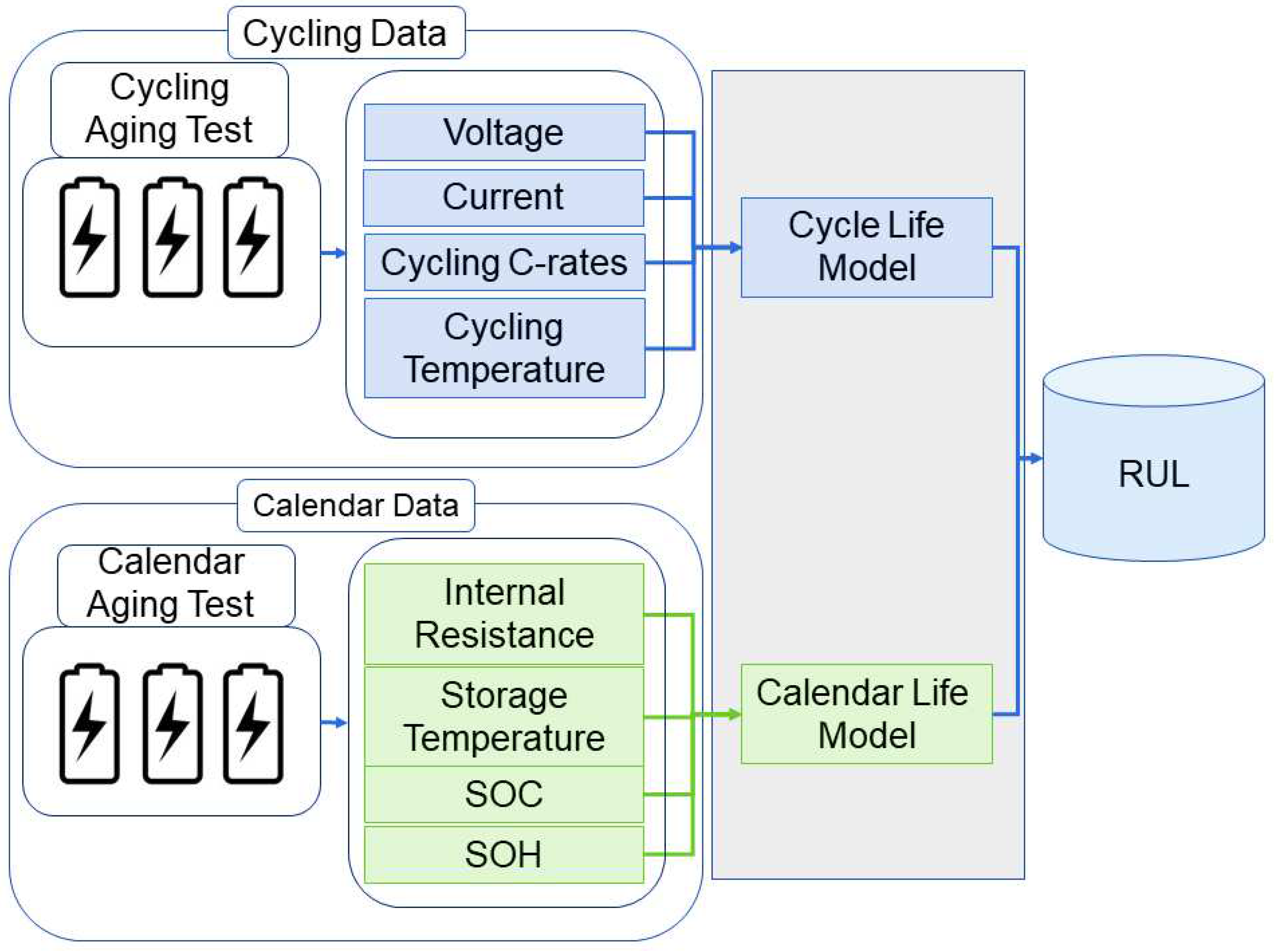
Figure 2.
Flowchart of battery data-driven models.
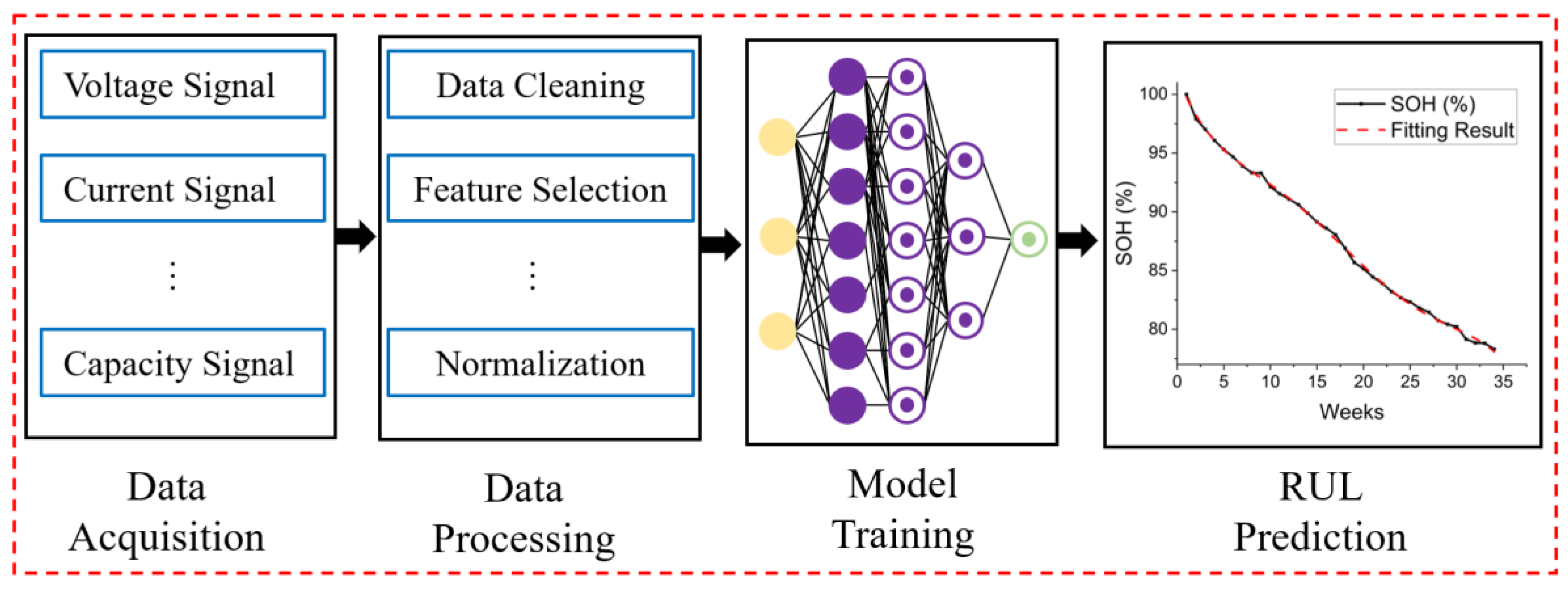
Figure 3.
Technical Scheme of LIBs. Adapted from ref. [90].
Figure 3.
Technical Scheme of LIBs. Adapted from ref. [90].
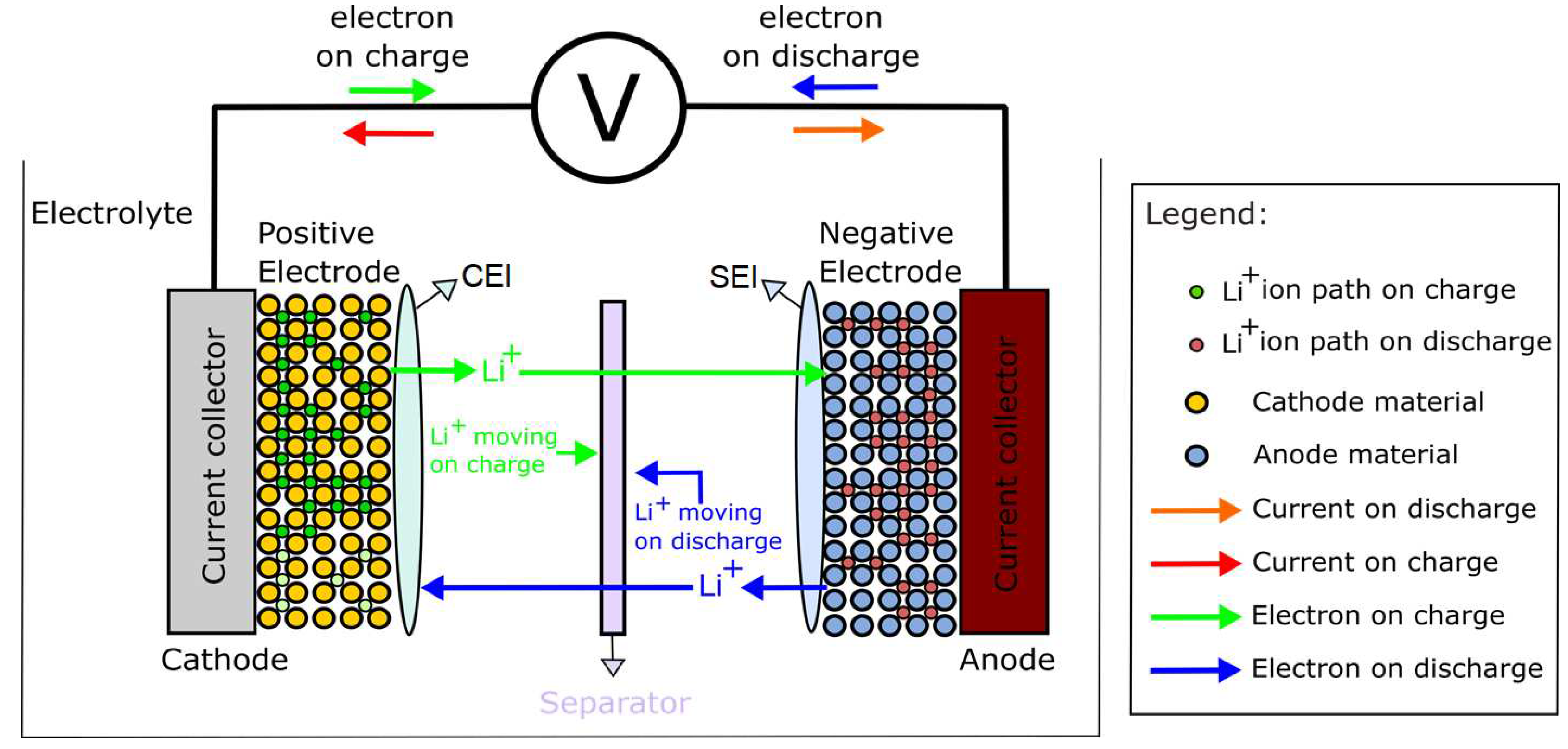
Figure 4.
Lithium-ion negative electrode aging: causes, effects, and influences. Adapted from ref. [143].
Figure 4.
Lithium-ion negative electrode aging: causes, effects, and influences. Adapted from ref. [143].
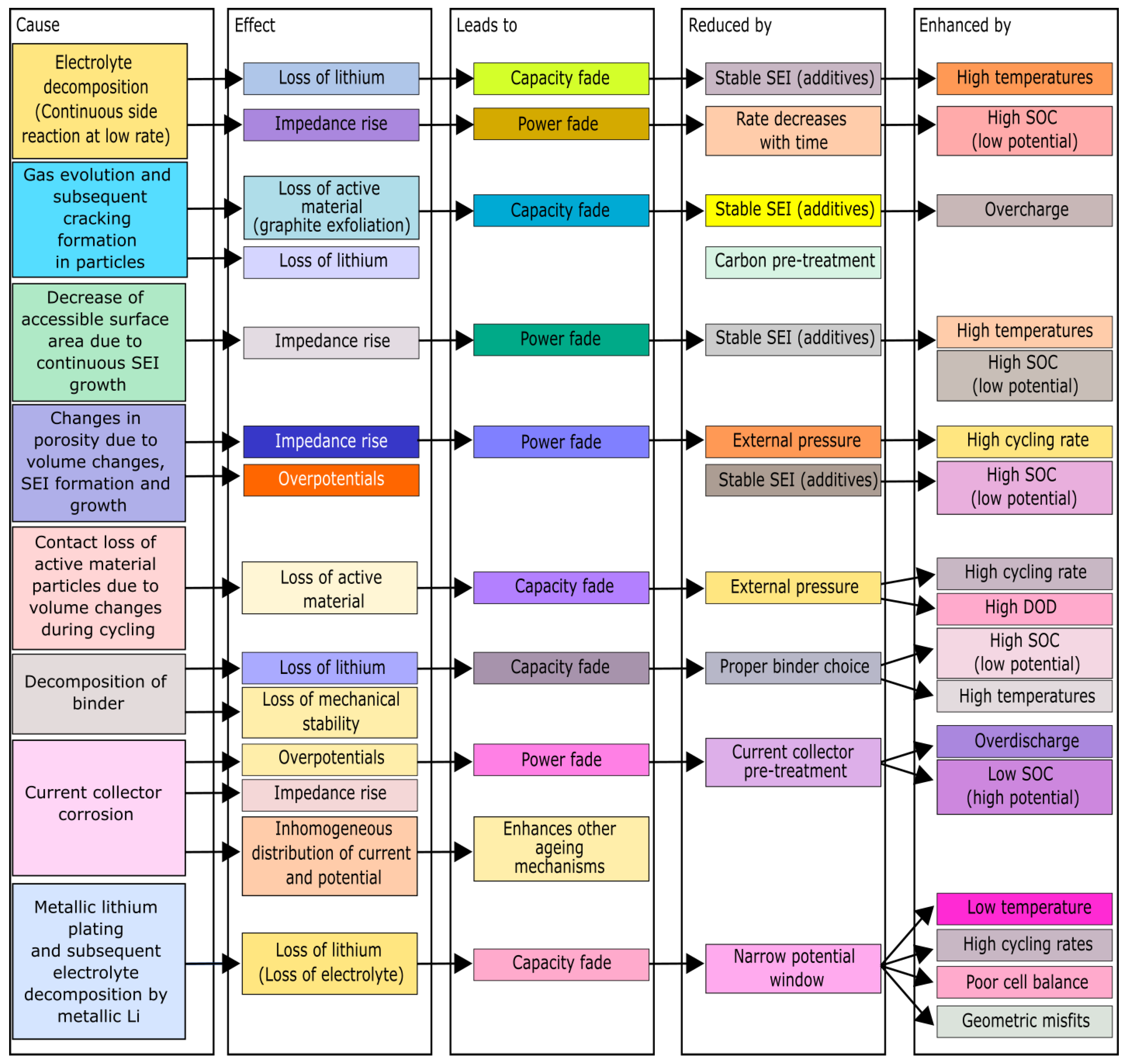
Figure 5.
Cause and effect of aging mechanisms of cathode materials. In (a) degradation due to inactive components and (b) degradation of lithium oxide metal. Adapted from ref. [172].
Figure 5.
Cause and effect of aging mechanisms of cathode materials. In (a) degradation due to inactive components and (b) degradation of lithium oxide metal. Adapted from ref. [172].
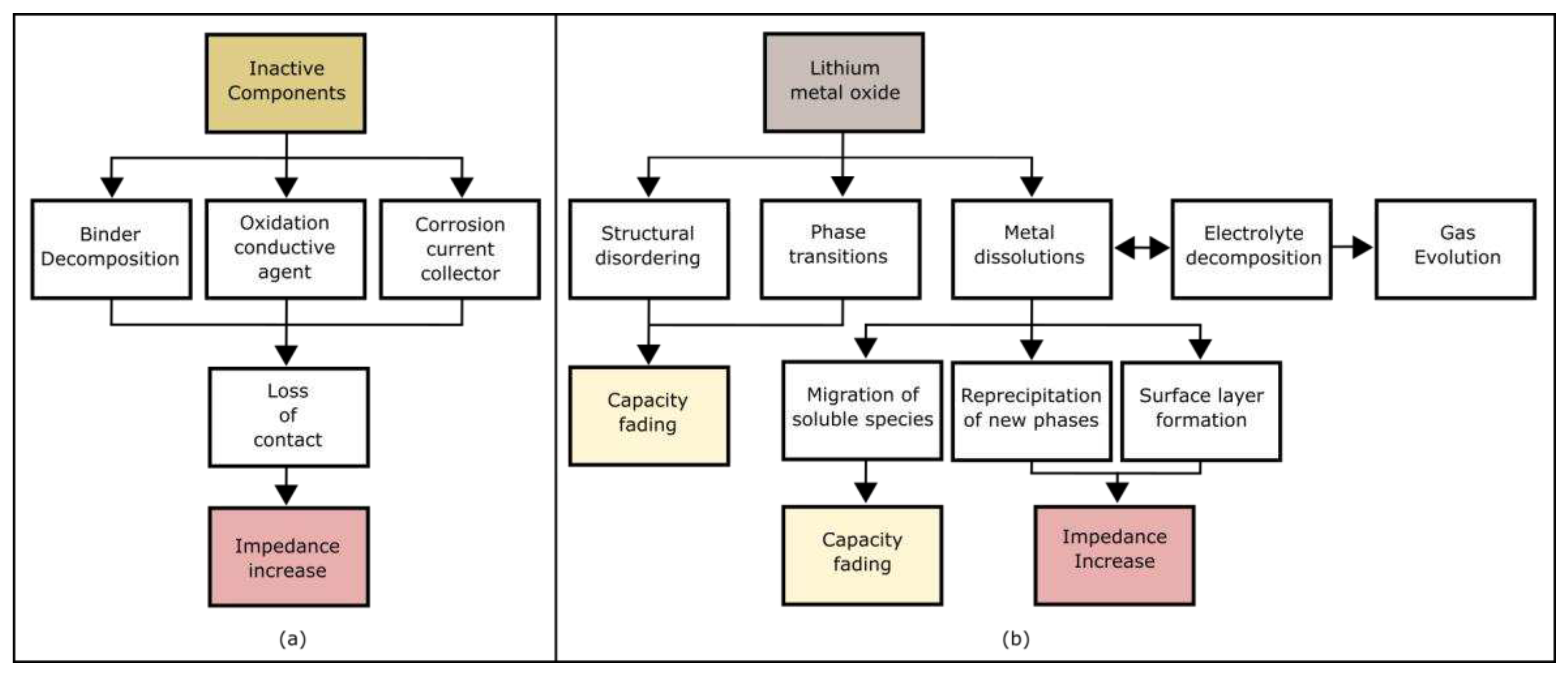
Figure 6.
Cause and effect of battery degradation mechanisms and associated degradation modes. Adapted from ref. [200].
Figure 6.
Cause and effect of battery degradation mechanisms and associated degradation modes. Adapted from ref. [200].
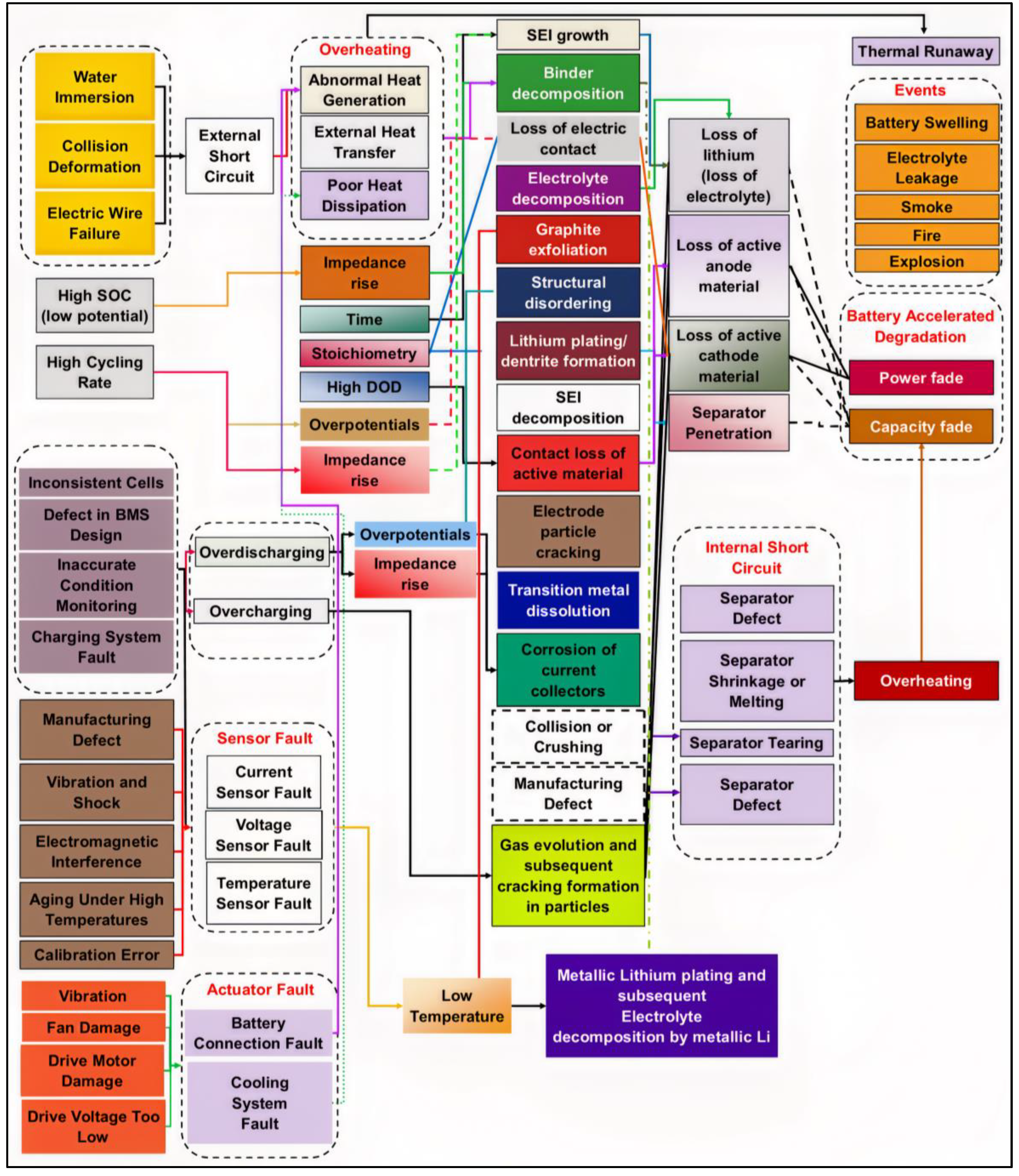

Table 1.
Main papers reviews published in the literature on degradation mechanisms of LIBs.
| Aging Mechanism | Year | Reference |
| SEI formation | 2022 | [32] |
| 2021 | [33] | |
| 2017 | [34] | |
| 2005 | [35] | |
| Electrolyte decomposition | 2022 | [32] |
| 2021 | [33] | |
| 2019 | [36] | |
| 2017 | [34] | |
| Loss of cyclable lithium | 2022 | [32] |
| 2020 | [37] | |
| 2019 | [36] | |
| 2005 | [35] | |
| Loss of active anode material | 2017 | [38] |
| Internal resistance increase | 2005 | [31] |
| Loss of adhesion of the active material | 2021 | [39] |
| Capacity loss due to reduced electronic conductivity and lithium mobility. | 2021 | [39] |
| Short circuit due to increased temperature and current caused by corrosion of current collectors. | 2021 | [39] |
| Internal short circuits are caused by mechanical, electrical, or therm abuse. | 2017 | [34] |
| Lithium plating | 2017 | [34] |
| Mechanical stress | 2017 | [34] |
| Structural changes and mechanical degradation. | 2017 | [34] |
| Transition metal dissolution. | 2017 | [34] |
| Surface film formation. | 2017 | [34] |
| Mechanical compression and loss of mechanical stability. | 2017 | [34] |
| Overpotentials | 2005 | [31] |
| Inhomogeneous distribution of current and potential. | 2005 | [31] |
| Oxidation of electrolyte components. | 2005 | [35] |
| Increased impedance due to gas formation. | 2005 | [35] |
Disclaimer/Publisher’s Note: The statements, opinions and data contained in all publications are solely those of the individual author(s) and contributor(s) and not of MDPI and/or the editor(s). MDPI and/or the editor(s) disclaim responsibility for any injury to people or property resulting from any ideas, methods, instructions or products referred to in the content. |
© 2023 by the authors. Licensee MDPI, Basel, Switzerland. This article is an open access article distributed under the terms and conditions of the Creative Commons Attribution (CC BY) license (http://creativecommons.org/licenses/by/4.0/).
Copyright: This open access article is published under a Creative Commons CC BY 4.0 license, which permit the free download, distribution, and reuse, provided that the author and preprint are cited in any reuse.