

Submitted:
14 June 2023
Posted:
14 June 2023
You are already at the latest version
Abstract
Supply Chain Management (SCM) encompasses a wide variety of decision-making problems that affect business and supply chain performance as a whole. Since most of these problems involve uncertainty and hesitation on the part of Decision Makers (DMs), various studies have emerged recently that present SCM applications of techniques based on Hesitant Fuzzy Linguistic Term Sets (HFLTSs) and HFLTS extensions. Given the relevance of this subject and the lack of literature review studies, this study presents a systematic review of HFLTS and HFLTS extension applications to SCM decision-making problems. In order to answer a set of research questions, the selected papers have been classified in accordance with a group of factors that are pertinent to the origins of these studies, SCM, HFLTSs, and decision-making. The results demonstrate that the Source and Enable processes have been studied with greater frequency, while the most common problems have to do with supplier selection, failure evaluation, and performance evaluation. The companies of the automotive sector and Sustainable SCM and Green SCM strategies predominate in the analyzed studies. Even though most of the studies use techniques based on HFLTSs, we have identified applications of seven distinct HFLTS extensions, with Double Hierarchy Hesitant Fuzzy Linguistic Term Sets and Probabilistic Linguistic Term Sets being the most utilized. The identification of gaps in the literature presents avenues for future studies focused on innovative applications, integrations of techniques, comparisons of techniques, group decision-making, and validation procedures for new models. The results of this study offer a panorama of the state of the art in regard to this subject and can help researchers and practitioners develop new studies which involve the use of methods that employ HFLTSs and HFLTS extensions in SCM decision-making problems.
Keywords:
Hesitant Fuzzy Linguistic Term Sets
; Supply Chain Management
; Decision Making
; Systematic Literature Review
MSC: 90B50
1. Introduction
The importance of SCM is recognized by researchers and practitioners as a way to ensure operational efficiency and seek global growth, increased profitability and stakeholder satisfaction [1,2]. Various studies have corroborated the fact that company performance for supply chain members can be improved by better strategic management of the flow of goods, services, finance, and information throughout the supply chain as a whole [1,3]. In addition to seeking a reduction in costs and improved goods and services, current SCM practices frequently look to help firms comply with socio-environmental requirements [4] and develop resilient capacities to prevent and/or overcome operational disruptions [2].
Given that SCM requires the integration and alignment of the activities of factories, suppliers, and distributors as well as other chain components, various challenges emerge and contribute to increasing complexity [3]. One of the main difficulties is related to making assertive decisions in the face of the uncertainties that frequently affect the business environment [2]. These uncertainties are due to a wide range of factors, including fluctuations in demand, changes in stakeholder requirements and competition, political conflicts, infectious diseases, and catastrophic events such as earthquakes and hurricanes [5]. As a consequence, the difficulty of obtaining reliable, complete, and updated information leads to many SCM decisions being made based on the knowledge of specialists (or decision makers, DMs) [6]. In this scenario, quantitative decision-making techniques that use DM linguistic evaluations have been adopted more and more often in making decisions which are inherent to SCM, such as supplier selection [7] supplier development [8], the selection of emergency logistic plans [9], and risk evaluations [10], among other issues.
The literature features a wide variety of approaches to modeling linguistic information which have been employed to support SCM, with those based on Fuzzy Set Theory, as well as the most recent extensions of this theory, playing a prominent role [11,12,13]. Among these extensions, Hesitant Fuzzy Linguistic Term Sets (HFLTSs) have been attracting more and more attention. In contrast to traditional decision-making methods, the use of HFLTSs supports complex linguistic expressions when DMs have hesitation in choosing the linguistic terms that best represent their preferences [12]. Ever since HFLTSs were proposed by Rodríguez et al. [14], there have been various advances by other researchers which have led to the appearance of extensions such as Extended HFLTSs [15], Proportional HFLTSs [16] and Interval-Valued 2-Tuple HFLTSs [17]. In parallel, a wide array of decision-making processes based on a combination of HFLTSs and MCDM methods have appeared [18,19]. In addition to their being suitable in helping DMs deal with uncertainty and hesitation, the use of HFLTS approaches frequently is justified by their ability to support group decision-making (GDM) processes which are recurrent in SCM [14].
Given the relevance of SCM, there have been a variety of studies devoted to reviews of this subject’s literature, including those focused on approaches to managing supply chain risks [2], SCM artificial intelligence techniques [13], SCM machine learning methods [5], supply chain performance evaluation models [6,13], and the application of fuzzy logic in supply chains [20,21], among other areas. However, to the best of our knowledge, there are no reviews of the literature focused on the application of HFLTS techniques to problems inherent in SCM.
Using searches of the ACM Digital Library, EBSCO, El Compendex, Emerald Insight, Google Scholar, IEEE Digital, Science Direct, Scopus, Springer, Taylor & Francis, Web of Science, and the Wiley Online Library databases, we found five literature review studies which cover HFLTSs. Based on Table 1, we may observe that most of the literature review studies that involve HFLTSs are devoted to compiling a comprehensive review of existing theoretical developments to compare linguistic information modeling approaches [11,12,22,23]. There is also a bibliometric review based on metadata from 1,080 studies of Hesitant Fuzzy Sets (HFSs) and their extensions [24]. Even though these studies are of great importance in summarizing theoretical knowledge about linguistic information modeling, they do not discuss HFLTS applications in practical problems. Moreover, the conducting of a systematic review of the literature focusing on HFLTS applications for SCM is justified for the following reasons:
- There is a need to map the contexts where HFLTS techniques have been applied in order to identify which SCM processes have received the most attention, which are the most studied types of SCM strategies, and which economic sectors are represented by the participating companies in these studies. The realization of a systematic review of this subject has the potential to make a contribution for researchers and practitioners by indicating trends and opportunities for future study.
- It is important to investigate issues regarding SCM decision-making processes and methods, such as for example, the types of decision-making problems in which HFLTS techniques are applied, the most often used techniques, support for GDM, and the way the application results are validated. In addition to contributing to the generation of knowledge related to the interface between SCM areas and decision making, the mapping of the state of the art of this subject will also indicate paths for the development of new computational tools to support managers in the decision-making processes in SCM.
Given this information, this study will present a systematic review of the literature about HFLTS and HFLTS extension applications used to solve SCM decision-making problems in order to answer relevant research questions about this subject (which will be detailed in Section 3). The PRISMATM (Preferred Reporting Items for Systematics Reviews and Meta-Analyses) method was adopted to structure this study. The analyzed papers were selected from several databases and classified according to 17 factors. The mapping of these studies makes it possible to identify a set of opportunities for the realization of future studies. In terms of the structure of the rest of this article, Section 2 will present a brief review of HFLTSs and HFLTS extensions. Section 3 will describe the methodology for this systematic review of the literature. Section 4 will discuss the results. Section 5 will present recommendations for future studies. Section 6 will consist of our conclusions and the limitations of this study.
2. HFLTSs and HFLTS Extensions
Ever since it was proposed by Professor Lofti [25], Fuzzy Set Theory has been applied successfully to various problems which involve imprecise, vague, and imperfect information [14,26]. This theory is also the foundation of new approaches to deal with decision-making problems under conditions of uncertainty. These approaches are based on various forms of representing information which are used by DMs to express their preferences [16,27].
Based on Fuzzy Set Theory, Torra [28] proposed Hesitant Fuzzy Set Theory, which provides a framework for supporting DMs in situations in which there are a set of possible values to define the membership of an element. Based on the work of Torra [28], Rodríguez et al. [14] proposed HFLTSs, which differ from previous approaches because they allow DMs to use more than one linguistic term and complex linguistic expressions to represent their preferences. In this manner, HFLTSs offer greater flexibility in eliciting linguistic preferences and at the same time support expressions that are closer to natural language [29].
Considering a set of defined linguistic terms such as , an HFLTS defined as consists of a finite ordered subset of linguistic terms of S. Thus, and are examples of HFLTS. Any other HFLTS consists of at least one of the linguistic terms in S [14]. The HFLTS approach makes it possible for DMs to use linguistic expressions that employ more than one linguistic term simultaneously in each judgement. Examples of linguistic expressions include “between very low and low" {}, “at least high” {}, “at most medium” {}, and “lower than high” {} } [8,29]
Based on the pioneering work of Rodríguez et al. [14], other authors proposed new operators for HFLTSs [30,31,32], measures of distance and similarity [33,34], techniques that support GDM [18,19], and consistency and consensus methods for group decision making [35], among other advances. Extensions for HFLTSs also appeared, which opened new possibilities for modeling uncertainty in decision-making processes. Table 2 presents examples of the main HFLTS extensions which are described below:
- Extended HFLTS (EHFLTS): makes it possible to create sets of non-consecutive ordered terms based on a combination of HFTLSs given by a group of DMs. As indicated in Equation (1) (Table 1), represents the set of all possible linguistic terms that express the preferences of the DMs, and indicates each of the linguistic terms chosen by them [15]. An EHFLTS can be especially useful in situations in which the DMs are divided into subgroups, and there is no consensus among the DMs which therefore leads to the need to represent evaluations in non-consecutive terms [44];
- Hesitant Intuitionistic Fuzzy Linguistic Term Set (HIFLTS): this approach deals with situations in which the DMs evaluate each alternative using a possible linguistic interval and an impossible linguistic interval. As presented in Equation (2), each HIFLTS is composed of the functions h and h’ which return finite ordered subsets of consecutive linguistic terms. h(x) and h’(x) indicate the respective possible membership degrees and non-membership degrees of element x and an HIFLTS [18];
- Interval-Valued Hesitant Fuzzy Linguistic Set (IVHFLS): is an HFLTS extension based on Interval-Valued HFSs. As shown in Equation (3), IVHFLSs incorporate the possible interval-valued membership degrees that an alternative has in relation to a linguistic term. These membership degrees are quantified by finite numbers of closed intervals which are defined in (0, 1] [36];
- Proportional HFLTS (PHFLTS): is formed by the union of the HFLTSs that correspond to the individual assessments of the DMs, which can contain consecutive or non-consecutive linguistic terms. It takes into account proportional information for each generalized linguistic term. As indicated in Equation (4), each linguistic term which makes up an PHFLTS is associated with a value, which denotes the degree of possibility that the alternative carries an assessment value provided by a group of DMs [16]. The values are computed as a function of the terms and values of ;
- Probabilistic Linguistic Term Set (PLTS): this approach adds probability distributions to an HFLTS in order to prevent the loss of any linguistic information provided by the DMs. Thus, PLTSs allow DMs to attribute possible linguistic values to an alternative or criterion at the same time that they reflect the probabilistic information of a group of attributed values. In Equation (5), is made up of the linguistic term which is associated with the probability , and is the total number of different linguistic terms in [37];
- Interval-Valued Dual Hesitant Fuzzy Linguistic Set (IVDHFLTS): considers a function for the possible membership degrees and another function for the possible degrees which do not belong to the terms selected by the DMs. In Equation (6), (x) is a set of closed interval values defined in [0, 1], which denote the possible membership degrees of ; (x) is a set of closed interval values defined in [0, 1] which represent the possible non-membership degrees [38];
- Multi-Hesitant Fuzzy Linguistic Term Set (MHFLTS): is an extension based on HFLTS and HFL elements, in which each set can contain repeated and non-consecutive linguistic terms. As shown in Equation (7), considering the sets of terms and X as the reference set, an MHFLTS in X is represented by a function which generates a finite ordered multi-subset of . indicates the possible membership degrees of element x in X [39];
- Double Hierarchy Hesitant Fuzzy Linguistic Term Set (DHHFLTS): is composed of two independent hierarchies of linguistic terms. As presented in Equation (8), considering as the first hierarchy and as the second, is defined as a DHHFLTS in which is the second term of the hierarchy when the first term is . The use of this approach makes it possible for DMs to use expressions such as “very very good”, “medium or just right”, and “between a little bad and very bad” [40];
- Hesitant Fuzzy 2-Dimension Linguistic Term Set (HF2DLTS): was proposed based on the concept of two-dimensional linguistic variables. Each set is made up of possible linguistic terms which represent a DM’s assessment of an alternative, with each term having a degree of importance denoted by a linguistic term. As represented in Equation (9), if X is a fixed set and and two sets of linguistic terms, each HF2DLTS has a function , is a set of consecutive terms in , and is a two-dimensional piece of linguistic information which expresses a DM’s assessment of the importance of . The adoption of this approach enables DMs to use linguistic expressions such as “it is certain () that () is fair”, and “it is uncertain () whether () is very good” [41];
- Probabilistic Hesitant Intuitionistic Linguistic Term Set (PHILTS): arose from the combination of HIFLTS and PLTS to reflect the probabilities of DM assessments. Thus, as shown in Equation (10), this approach takes into account membership probability data () and non-membership probability data (, with these probabilities being considered independent [27];
- Interval-Valued 2-Tuple HFLTS (IV2THFLTS): is a combination of HFLTS with interval numbers. As presented in Equation (11), each IV2THFLTS has a function (x), defined in a closed subinterval of [0, 1], which denotes the possible interval-valued membership degrees of x in This approach helps DMs avoid a loss of information and improves the accuracy of the decision-making results [17];
- Dual HFLTS (DHFLTS): is the result of a combination of HFLTSs and Dual HFSs. As shown in Equation (12), DHFLTSs include the possible membership and non-membership degrees of hs(xi) in the set S. It is useful in very risky decision-making situations, in which DMs consider not only the advantages of a decision, but also the risks of taking this decision [42];
- Hesitant Picture Fuzzy Linguistic Set (HPFLTS): is based on Picture 2-Tuple Linguistic Term Sets and arose to avoid the loss of DM information. In Equation (13), each term selected by the DM is accompanied by the crisp values of the positive membership degrees , of the undetermined membership degrees , and the negative membership degrees ( [43]. Another distinguishing characteristic of it is that this approach takes into account the refusal information concerning DMs for each assessment.
More information about HFLTS extensions can be consulted in the references indicated in Table 2. It is important to emphasize that even though the research presented in Table 2 provides an overview of HFLTS extensions, it is not exhaustive, given that there are other variations that have recently appeared based on the presented approaches.
The following section will present the methodological procedures adopted in this systematic review of the literature.
3. Methodological Procedures
This systematic review of the literature was developed using the PRISMATM methodology. According to Page et al. [45], literature review studies “can provide a synthesis of the status of knowledge in a field, from which future priorities can be identified”. The PRISMATM methodology provides a guide for the preparation of transparent, complete, and concise reviews. It provides an evidence-based minimum set of items which help ensure the robustness and reliability of systematic literature review studies [45].
Table 3 presents the research protocol developed based on the PRISMATM methodology used to conduct this study. The Parsifal software was used to support the planning and conducting steps. Later, during the reporting step, MS Excel software was used to prepare our graphs to summarize the findings. A set of research questions was defined by the authors to present information which makes it possible to provide an overview of the use of HFTLS and HFLTS extension techniques in SCM. The research questions RQ1.1 to RQ1.4 deal with information related to the origin of the selected studies, while RQ2.1 to RQ2.4 investigate questions related to SCM, and RQ3.1 to RQ3.8 are focused on questions about HFLTSs and decision making.
The keywords used in the search string were defined to cover studies which involve the application of HFLTSs in various subareas of SCM. The databases utilized were the ACM Digital Library, EBSCO, El Compendex, Emerald Insight, the Google Scholar tool, IEEE Digital, Science Direct, Scopus, Springer, Taylor & Francis, Web of Science, and the Wiley Online Library. The time frame considered in our search ranged from 2012 to 2023, given that the first publication about HFLTS dates from 2012 [14]. The searches were performed in March 2023. During the selection of our study sample, we only included journal articles published in English which presented real HFLTS or HFLTS extension applications used in SCM problems. We excluded books, book chapters, proceedings, literature review articles, and works that did not present real HFLTS applications in SCM, as well as other studies which were not within the scope of this review of the literature. In addition to the cited databases, we also selected studies using citation searching and searches of the Research Gate website (https://www.researchgate.net/).
Figure 1 illustrates the steps of the research method adopted in this study. In Step 1, using the search string in our database search we obtained a total of 1,085 results. 173 duplicates were excluded. Considering the remaining 912 studies, the initial selection was performed by the two authors in an independent manner by reading the titles, keywords, and abstracts. The goal of this step was to only select articles which are within the scope of this review. Later, in the assessment of the quality of the articles, the two authors read the complete articles to confirm that they perform real applications, are written in English, and have been peer-reviewed. After the eligibility criteria were applied and after the quality evaluation, we included 28 studies from these databases. In Step 2, several more studies were collected through a search of the Research Gate website and a search for citations referenced in the studies selected in Step 1. These studies were also evaluated in terms of their eligibility and quality, which made it possible to identify 6 studies which were included in our review. Thus, a total of 34 studies were included.
In Step 3, the studies were classified according to the factors and categories presented in Table 4. These factors were defined based on systematic literature review studies dealing with SCM [6,13], supplier selection [7], supply management [46], GDM [47], and the modeling of complex linguistic expressions [12]. The categories related to each factor were defined initially based on these studies. Then the categories were reviewed and updated according to the findings based on a thorough reading of the selected articles. After the extraction of the data and the classification of the studies in accordance with Table 4, a set of graphs and tables was prepared to better visualize the results. The information has been summarized to answer the research questions presented in Table 3. The obtained results were compared with other systematic review studies regarding this subject. Finally, a framework with recommendations for future research was proposed based on the identified research gaps.
4. Results and Discussion
4.1. Presentation of the selected studies
4.1.1. HFLTS-based studies
This section presents the selected studies which are based on HFLTS applications. Among them, there are six studies which proposed models focused on supply management. Liao et al. [49] combined HFLTSs with the Best Worst Method (BWM) and Additive Ratio Assessment (ARAS) methods to support supplier selection in a digital supply chain. Dolatabad et al. [50] also proposed a supplier selection model for a digital supply chain, however they used a fuzzy cognitive map combined with the HFLTS-VIKOR (Vlsekriterijumska Optimizacija I KOmpromisno Resenje, in Serbian) method. Liu et al. [51] developed a method which combines HFLTS with Dempster–Shafer evidence theory to achieve consensus in GDM problems. The application was realized in a supplier selection problem for chemical products in a retail supermarket. Lima-Junior and Hsiao [52] developed a model to monitor supplier performance in an automobile factory. In this study, the HFLTS-TOPSIS (Technique for Order of Preference by Similarity to Ideal Solution) method was utilized to classify suppliers in a two-dimensional matrix based on operational performance and supply costs.
Another HFLTS-TOPSIS model based on a bi-dimensional matrix was proposed by Borges et al. [4] to support the segmentation of sustainable suppliers. In this study, the application involved the classification of suppliers in a hydroelectric plant. Finger and Lima-Junior [8] developed an approach based on Quality Function Deployment (QFD) and HFLTS to support decision making during the elaboration of programs to develop sustainable suppliers. The application took place in an automotive firm considering criteria related to the economic, environmental, and social performance of the suppliers. In addition to the studies by Borges et al. [4] and Finger and Lima-Junior [8], we identified two other studies focused on the promotion of sustainable supply chains. Osiro et al. [19] proposed a method which combines HFLTS with QFD to select evaluation measures for sustainable supply chains. Erol et al. [53] applied the HFLTS-QFD, HFLTS-Delphi, HFLTS-ANP (Analytic Network Process), and HFLTS-TOPSIS methods to analyze barriers to the adoption of circular economics.
There are four studies which involved the application of HFLTSs to performance management. Tüysüz and Şimşek [54] applied HFLTS-based AHP (Analytic Hierarchy Process) to evaluate the factors which affect the performance of a transport company’s affiliates. Pérez-Domínguez et al. [55] evaluated the impact of using lean tools for organizational performance using a combination of AHP and HFLTS-TOPSIS methods. Through a combination of the HFLTS-AHP and HFLTS-MULTIMOORA (Multi-Objective Optimization on the basis of Ratio Analysis Multiplicative Forms) methods, Büyüközkan and Güler [56] created a methodology to support managers in evaluating supply chain analytics tools. Zheng et al. [57] presented a Hesitant Fuzzy Linguistic DEMATEL (Decision Making Trial and Evaluation Laboratory) model to evaluate the importance of critical success factors in a health company.
In terms of risk management in supply chains, we found three related applications. Wu et al. [58] presented a new approach to risk evaluation in supply chains which integrates HFLTSs, the fuzzy synthetic method, and the eigenvalue method. A pilot application of this approach was realized to evaluate risks in electric vehicle supply chains. Chang et al. [59] combined the Failure Mode and Effect Analysis (FMEA), DEMATEL and HFLTS methods to analyze risks that failures will occur in an electronic company’s production processes. More recently, Qin et al. [9] integrated the swaps method based on the prospect theory with HFLTS. The objective of the application of this proposal was to help select emergency logistics plans during the COVID-19 pandemic.
Finally, we identified two studies related to location selection, one for human resources management and another for packaging design selection. More recently, Wu et al. [60] developed a new method that combines HFLTSs, TODIM (Tomada de Decisão Interativa Multicritério, in Portuguese), and DEA. The method was applied for the selection of the most appropriate location a new health management center. Another model for location selection was developed by Ren et al. [35] based on Incomplete Hesitant Fuzzy Linguistic Preference Relations, which was applied to selecting the location of hydroelectric plants. Yalçın and Pehlivan [61] proposed a personnel selection model for a manufacturing company. The use of the Fuzzy Combinative Distance-based Assessment (CODAS) Method Based on Fuzzy Envelopes for HFLTS proved effective in dealing with this problem.
Lima et al. [8] developed a method which combines HFLTS, AHP, QFD, and Preference Ranking Organization Method for Enriched Evaluation (PROMETHEE) for packaging design selection. This method was applied in an automotive firm and the results were compared with other multicriteria decision methods.
4.1.2. Studies based on HFLTS Extensions
Among the 15 studies based on extensions of HFLTS, we have identified the use of seven distinct approaches. The use of DHHFLTS has predominated, and it is present in seven of these studies. Krishankumar et al. [62] presented a framework for supplier selection based on DHFLTS, which is focused on situations in which the weights of the criteria are unknown. Krishankumar et al. [63] proposed a DHHFLTS-based framework for green supplier selection with partial weight information. Krishankumar et al. [64] applied DHHFLTS to generate a ranking of sustainable suppliers.
In addition to these three studies regarding supply management, we found three applications of DHHFLTS for risk analysis. Shen and Liu [65] evaluated the risk of logistics firms based on a combination of DHHFLTS and FMEA. Dai et al. [66] evaluated the risk of failures in an electronic products firm utilizing DHHFLTS, FMEA, and the K-means algorithm. Similarly, Duan et al. [67] combined DHHFLTS, FMEA, and the K-means algorithm to analyze the risk of failures in a firm in the energy sector. Finally, Wang et al. [68].proposed a study which uses DHHFLTS and ORESTE (Organísation, Rangement et Synthèse de Données Relarionnelles, in French) to evaluate traffic congestion.
The use of PLTSs has also emerged in SCM problems. Li et al. [69] developed a methodology which integrates PLTS with DEMATEL to evaluate sustainable recycling partners. Zhang et al. [70] proposed the use of PLTSs to deal with sustainable logistics suppliers. Zhang et al. [71] applied PLTSs to supplier selection for a construction company. In this application, the authors also used the BWM and Combined Compromise Solution (CoCoSo) methods based on rough boundary intervals.
The other identified extensions appear in only one application apiece. Wang et al. [72] proposed an MHFLTS model to support the outsourcing of logistics services, which is especially useful in situations in which the weight information for the criteria is incomplete. Based on the performance indicators of the Supply Chain Operations Reference (SCOR) model, Divsalar et al. [73] created a model to evaluate the supply chain performance which integrates the EHFLTS-VIKOR, Fuzzy Delphi, Interval-valued Hesitant Fuzzy, and DANP (DEMATEL-ANP) methods. A distinguishing characteristic of this model is that it combines criteria, paradigms and LARG (Lean, Agile, Resilient, and Green) practices to improve supply chain performance.
Qu et al. [74] developed a stochastic method based on DHFLTSs and HFLTSs for sustainable supplier selection in a high-tech manufacturing center. Wu et al. [75] combined HPLTSs with the Weighted Cross-Entropy TOPSIS method to support the decision-making process for personnel selection in a firm in the automotive sector. Zolfaghari and Mousavi [75] created a risk evaluation methodology based on FMEA, MULTIMOORA, Technique of Precise Order Preference (TPOP), and IVHFLTS. A pilot application of this methodology was created to manage failures in a healthcare company.
Based on the characterizations of the studies presented in Section 4.1.1 and 4.1.2, it was possible to answer the research questions displayed in Table 3. Section 4.2 to 4.4 will discuss the obtained results.
4.2. Information about the origins of these studies
This section is dedicated to answering the research questions RQ1.1 to RQ1.4, presenting the classification results for these studies in terms of year of publication, journal, country, and most cited articles. Figure 2 presents the distribution of the number of articles by year of publication (RQ1.1). This figure demonstrates that our subject is quite emergent in the literature, given that the first publication we found occurred in 2017. Roughly 58.8% of the studies were published within the past three years (beginning with 2021). In addition, the trend line of Figure 2 indicates a growth trend in terms of the number of publications about this subject. It is important to mention that the results displayed in the last column of the graph only include studies published in the first few months of 2023, given that our study sample was selected in March 2023.
Figure 3(a) presents the distribution of publications classified according to the country of the first author’s affiliated institution for each study (RQ1.2). China has the largest number of publications with 17 studies, which represented 50% of our analyzed sample. It was followed by Brazil (5 studies), Turkey (4 studies), India (3 studies), and Iran (3 studies). As shown in Figure 3(b), production related to this subject was concentrated in Asia (24 studies), South America (5 studies), and Europe (4 studies).
Table 5 presents the journals in which the selected studies were published (RQ1.3). A wide variety of journals published articles about this subject, with there being a total of 27 distinct journals. The journal which most published articles on this subject was IEEE Transactions on Engineering Management. Following it there was a tie between the journals Applied Soft Computing, Computers and Industrial Engineering, Environmental Science and Pollution Research, the Journal of Intelligent & Fuzzy Systems, and Symmetry, each with two publications. The other 21 journals had one publication apiece.
By collecting the number of citations in Google Scholar, it was possible to identify the most influential articles. Table 6 presents the number of citations received by the 11 most cited studies within our analyzed sample (RQ1.4). The article which had the greatest number of citations was Osiro et al. [19], with a total of 86 citations. The works of Wang et al. [72], Yalçın and Pehlivan [72], Tüysüz and Şimşek [54], and Liu et al. [51] followed with 84, 72, 71, and 65 citations respectively.
4.3. Aspects related to SCM
To answer the research questions RQ2.1 to RQ2.4, this section presents the results regarding the objectives of HFLTS applications in SCM processes, their industrial sector, and the company’s type of SCM strategy. In order to identify what have been the most common decision-making problems in SCM that have been addressed using HFLTSs and HFLTS extensions, the selected studies have been classified based on the application objective. Based on this, to elucidate which SCM processes have received the greatest attention in these applications each study has been classified as dealing with one of the following SCM processes: Source, Plan, Make, Deliver, Return, and Enable. These are the six main SCM processes according to the SCOR model (Supply Chain Operations Reference), which is an SCM reference that has been widely adopted by practitioners and researchers [48]. Table 7 displays the results of the classification of our studies in terms of the objectives of their applications and the associated SCM processes (RQ2.1). Studies dealing with supplier selection have been the most frequent, totaling 23.5% of the sample. They have been followed by failure evaluations (11.8%) and performance evaluations (8.8%).
According to the results displayed in Figure 4(a), the source process had the most associated applications and represented 38.2% of the studies. This process is dedicated to acquiring goods and hiring external services which are necessary to meet actual or planned demand. It was followed by the enable process with 29.4% of the studies. The high frequency of applications related to the source process seems to be related to the fact that this process requires decision-making processes that affect several areas of the business. The main one is supplier selection, which determines part of the supply chain structure and also influences production costs, product quality, and customer satisfaction. Similarly, the enable process encompasses other decision-making processes that are essential for supply chain structuring and operation, such as personnel selection, location selection, performance evaluation, and risk assessment [48].
The plan process appeared in 14.7% of the applications. This process encompasses planning activities to create the actions that will best achieve the requirements of the make, delivery, and return processes. The studies dealing with the make process totaled 11.8% of the sample, including activities dealing with the transformation of products or the execution of services. Finally, the delivery process, which involves order, transportation, and distribution management appears with just one application (2.9%). Similarly, the return process, related to receiving products that are returned for any reason [48], was also associated with just a single application.
Figure 4(b) displays the results of the classification of these studies by the type of SCM strategy adopted by the company where the model was applied (RQ2.3). While 58.8% of the studies did not clearly identify the type of SCM strategy employed, 20.6% of the studies involved companies which adopted a sustainable strategy. In general, sustainable SCM studies are based on triple bottom line dimensions and include decision-making criteria related to economic, environmental, and social aspects. Applications in companies employing green supply chains represented 8.8% of the sample and are oriented towards minimizing environmental pollution and improving the environmental performance of products and processes. They were followed by 5.9% of the companies with digital (or smart) supply chains, which are focused on promoting digitalization, automation, and the integration of operations throughout the supply chain. The lean strategy, which focuses on the reduction of costs and the elimination of waste, was represented by one application (2.9%). Similarly, the LARG strategy, which combines aspects of the Lean, Agile, Resilient, and Green strategies, was also represented by just one application. We did not find applications devoted exclusively to agile or resilient supply chains.
The predominance of applications in sustainable and green SCM is due to the importance that environmental management and social responsibility have achieved in recent decades. Companies began adapting to deal with stricter regulations and customers who were more concerned about the socio-environmental impacts of business activities [8,76]. As the use of environmental and social performance indicators is relatively recent in most companies, and these indicators usually involve qualitative aspects or variables for which there is no performance history, the use of HFLTS techniques and HFLTS extensions is quite appropriate [19].
Finally, Figure 5 displays the classification of these studies according to the sector of the participating company (RQ2.4). The automotive sector stands out with 10 applications (29.4%). It was followed by the health and electro-electronic sectors with 5 and 4 applications respectively. The food, glass, high-technology, infrastructure, manufacturing, retail, and transportation sectors were represented by just one application apiece. Five of the studies did not specify the company’s sector. The large number of company applications seems to be related to the fact that these chains are of great economic importance and have a complex structure. Assembly companies purchase many components externally, for which there is often more than one supplier. Moreover, many automotive companies have traditionally been among the early adopters of management tools and practices [83,84].
4.4. Aspects related to Decision Making and HFLTSs
This section deals with subjects related to research questions RQ3.1 to RQ3.8. In the graph displayed in Figure 6, the selected studies are classified according to the main decision-making problem that they deal with (RQ3.1). The results indicate that half of the applications are devoted to ranking problems, or in other words, problems with ranking alternatives by global preference. This was followed by 32.4% of the applications, which deal with choice problems, in which there is a desire to choose a subgroup of alternatives within the available options. Finally, with 17.6% of the applications, we have studies which deal with sorting issues, or in other words, problems in which the objective is to classify each alternative in a predetermined category.
In Figure 7(a) the studies were classified according to the adopted HFLTS approach (RQ3.2). The HFLTS approach was used in 23 studies (67.6%), while 15 studies (44.1%) adopted an HFLTS extension. Among the 13 HFLTS extensions discussed in Section 2, we found applications based on just seven of them: DHHFLTS (seven studies), PLTS (three studies), and DHFLTS, EHFLTS, HPFLS, IVHFLTS, and MHFLTS (with one study apiece). Four studies combined HFLTSs with an HFLTS extensions, such as PLTSs and DHFLTSs.
The great frequency of the HFLTS approach originally proposed by Rodríguez et al. [14] may be related to its ease of use by DMs and the ease of calculations. Meanwhile, the use of DHHFLTSs may be associated with the possibility of using complex linguistic expressions, which combine two scales of linguistic terms in each judgement. In addition to increasing the flexibility of DM preferences, the use of DHHFLTSs increases the possibilities of values that can be attributed to the evaluated object [40]. Furthermore, the interest of using PLTSs lies in the fact that this approach takes into account a possibility degree for each linguistic term selected by a DM. For each judgment provided by a DM, the sum of the possibility degrees must be equal to 1. For example, if a DM selects only the term “: Medium”, without hesitation, his judgment will be quantified by (, 1.0). When selecting “between :good and :extremely good”, the DM judgment will be quantified by (, 0.33; , 0.33; , 0.33). Since the values of the degrees of possibility act as weighting factors for the linguistic terms, the terms chosen in situations of greater hesitation will have less influence on the final result [37].
Table 8 displays the techniques that were applied in each of the analyzed studies. It also describes how the criteria weights were determined and which techniques were employed in calculating these weights. In terms of research question RQ3.3, we verified that all of the studies propose the integration of HFLTS or HFLTS extension techniques with other techniques, which include Multicriteria Decision-Making (MCDM) methods, quality management, and statistical techniques. Integration occurs through the hybridization or sequential application of these techniques.
In terms of the approaches adopted to manipulate the individual preferences of the DMs (RQ3.7), 31 (88.2%) applied a decision-making technique or a mathematical operator to aggregate DM preferences, such as for example, VHFLPWA, Interval Weighed Geometric Aggregation (IWGA), OWA, HFLWA, DHHLWA, GWOWA, and GMSM. Three studies (11.8%) presented a decision-making matrix obtained by consensus, without specifying how this consensus among the various DM evaluations was achieved. Only four studies (11.8%) applied iterative methods in the search for consensus. These methods make it possible to suggest modifications to the DM evaluations by calculating measures of consensus during the evaluation rounds. Examples of iterative methods seeking consensus are presented in Liu et al. [51], Wu et al. [75], Divsalar et al. [73], and Erol et al. [53].
Finally, another important aspect of these applications has to do with how their results were validated. As presented in Figure 9, in 12 studies (35.3%) the results were validated by comparing them with the results of other decision-making methods applied to the same problem (RQ3.8). In general, this comparison is based on the ranking or categorization (sorting) supplied for each analyzed method. In 11 studies (23.5%) the authors compared the obtained results with those furnished by other methods and also conducted sensitivity analysis tests. Sensitivity analysis was utilized in an isolated manner in four studies (11.8%). The main purpose of sensitivity analyses is to verify alterations in the outputs furnished by the model when the input parameter values are varied. In three studies (8.8%) the results were validated through a combination of sensitivity analysis, comparisons with other methods, and statistical tests. In addition, three studies featured just one application without specifying how the results were validated. Just one study validated the results by comparing them with real data.
4.5 Comparison of the results of previous studies
The results of this study were compared to those of previous literature review studies on subjects related to our objective. Thus, as in Yu et al. [24], which analyzed 1,080 studies based on HFS and HFS extensions, this study finds that the HFLTS approach proposed by Rodríguez et al. [14] has been the most utilized in the analyzed studies. In terms of the type of SCM strategy, our results are similar to the study by Lima-Junior and Carpinetti [6] which investigates decision-making models to evaluate supply chain performance. Both studies indicate the predominance of sustainable and green supply chains. In terms of the procedures adopted to validate their results, Lima-Junior and Carpinetti [6] related the prevailing use of sensitivity analysis, followed by statistical techniques and comparisons with other methods, while our study has concluded that comparisons with other methods have been the most utilized validation procedure, followed by sensitivity analysis combined with comparisons with other methods.
The results of this study indicate that the most frequently adopted techniques in integrated models have been TOPSIS, FMEA, AHP, DEMATEL and QFD, while in Lima-Junior and Carpinetti’s study [6] the AHP and Data Envelopment Analysis (DEA) techniques and linear programming predominated. In terms of the SCM processes which had the most applications, in analyzing artificial intelligence techniques in SCM, Yang et al. [5] found that the return and make processes had fewer applications, while our study has found that the least studied processes have been return and delivery. On the other hand, while Yang et al. [5] found that the enable and plan processes had the most applications, this study has found that the source and enable processes have had the most applications.
Finally, in terms of the economic sectors of the participating companies which have received these applications, Yang et al.’s study [5] noted the predominance of retail, food, and manufacturing, while our study showed a prevalence in the automotive, health, and electro-electronic industries. These results are somewhat similar to those found by Lima-Junior and Carpinetti [6], who related that the sectors that received the most applications of decision-making models were the automotive, food, and electro-electronic industries.
5. Recommendations for Future Research
The results of our systematic review of the literature have identified various research gaps on this subject. Based on the such gaps, as well as in SCC [48], Lima-Junior and Carpinetti [6], Wang et al. [11], Kabak [47], and Yang et al. [5], we propose a framework which seeks to help researchers and managers develop future studies on this subject. The framework presented in Figure 10 encompasses pertinent recommendations regarding the following topics: innovative applications of techniques; new combinations of decision-making techniques; comparative studies of decision-making techniques; GDM issues, and validation procedures for new decision-making support models.
5.1 Innovative applications
The results of this study indicate that the use of HFLTS and HFLTS extension techniques has still not been tested in various decision-making problems which are important to ensure effective SCM. Problems related to the delivery and return processes have been less studied up till now. There are also various types of industries which have not participated in HFLTS and HFLTS extension applications.
As Figure 10 illustrates, SCM processes span various business areas that present multiple criteria decision-making problems for which few or no applications have been applied. The use of HFLTS and HFLTS extension techniques has great potential to contribute to applications dealing with these problems due to the capacity of these techniques to provide support for GDM under conditions of uncertainty. Based on the research opportunities that we have identified, here is a list of SCM problems which involve selecting, ordering, and categorizing that can be explored in future works. It includes problems associated with various business areas which involve strategic, tactical, and/or operational decision making:
- Asset management: prioritization of asset management investments, strategic asset allocation, selecting the location of new installations, and layout selection;
- CRM (Customer relationship management) and marketing: marketplace selection, marketing strategy selection, market segmentation, customer satisfaction analysis, and customer relationship management software selection;
- Finance: credit risk evaluation, corporate financial performance analysis, investment appraisal, budget allocations, and the evaluation of financial plans;
- IT (Information Technology): information system selection, computer workstation selection, software quality evaluation, IT service provider selection, and disruptive industry 4.0 technology evaluation;
- Maintenance: maintenance strategy selection, maintenance service provider selection, maintenance machine selection, and the prioritization of maintenance activities;
- Occupational safety & health: accident risk evaluation, the selection of key indicators for improving the occupational safety system, the prioritization of emergency plans, individual protection equipment selection, and system reliability evaluation;
- Order management: prioritization of production orders, order delivery evaluation, and the prioritization of plans to improve order management;
- Performance evaluation: performance indicator selection, performance measurement system evaluation, and organizational performance evaluation;
- Product development: product development strategy selection, new product material selection, prototype evaluation, and product portfolio evaluation;
- Project management: project proposal selection, project risk evaluation, project performance indicator selection, project management practice maturity evaluation, and program and/or project success evaluation;
- Quality management: six sigma project selection, benchmarking, product or service requirement prioritization, selection of the certifying body for the implementation of ISO 9001 certification, and prioritization of continual improvement actions;
- Risk management: risk evaluation tool selection, organizational risk evaluation, and supply chain risk evaluation;
- Stock management: stock management strategy selection, ABC classification of stocks, warehouse location selection, and warehouse structure selection;
- Supply management: make or buy, supplier performance monitoring; supplier segmentation, and supplier development program evaluation;
- Personnel management: organizational climate evaluation, personnel selection, position evaluation, and skills and qualifications evaluation;
- Sustainability: waste treatment alternative evaluation, prioritization of sanitary landfill location selection actions, prioritization of actions designed to promote sustainability, evaluation of the barriers to the adoption of sustainable practices, and product lifecycle evaluation;
- Transportation: route selection, modes of transport evaluation, logistics service provider selection, vehicle selection, and geographic information system selection.
The suggested applications open a gamut of possibilities for new studies. On one hand, one can explore problems which still have not been addressed with applications, such as those related to asset management, finance, IT, maintenance, marketing, occupational safety & health, order management, and stock management, among other areas. On the other, one can test the use of techniques which still have not been applied to problems that have received more attention, such as supplier selection, failure evaluation, and performance evaluation. These applications can involve companies in sectors that have not been very studied up until now, or firms in sectors that have not had any applications, such as aerospace, agriculture, education, entertainment, fashion, finance, hospitality, media and news, mining, pharmaceuticals, and telecommunications. It is also important to take SCM strategies into account in each case. Applications related to agile, flexible, and resilient supply chains have received less attention in recent studies. Different combinations of SCM strategies could also be studied in future studies.
5.2 Technique integration
There are various combinations of HFLTS and HFLTS extension techniques, and other types of methods that still have not been tested in SCM problems. Given the low frequency of applications that employ the DHFLTS, EHFLTS, HPFLS, IVHFLTS, and MHFLTS techniques, as well as the absence of applications based on HIFLTS, PHFLTS, IVDHFLTS, HF2DLTS, PHILTS, IV2THFLTS techniques, future studies could test new combinations of these approaches with MCDM methods, quality management techniques, risk evaluation techniques, optimization methods, and/or artificial intelligence techniques.
More specifically, new hybrid methods can be created based on MCDM methods, which have great potential for integration with HFLTS approaches, but have rarely or never been used, such as ORESTHE, ARAS, CODAS, CoCoSo, Delphi, ELECTRE (ÉLimination Et Choix Traduisant la REalité, in French), Measurement of Alternatives and Ranking according to Compromise Solution (MARCOS), Measuring Attractiveness by a Categorical Based Evaluation Technique (MACBETH), ORESTE, PROMETHEE, Qualitative Flexible Multiple Criteria Method (QUALIFLEX), Simple Multi-Attribute Rating Technique (SMART), and SWARA.
There are also quality management techniques such as QFD, Service Quality Measurement (SERVQUAL), and the GUT matrix (a process prioritization matrix based on Gravity, Urgency, and Tendency) which are multicriteria in nature and can be integrated with HFLTS extensions to create new MCDM methods. Similarly, FMEA, risk matrix, and fault tree analysis can be combined with these approaches to generate new methodologies for risk evaluation.
In cases in which a problem step seeks to order, select or sort alternatives, while another step seeks to optimize resources, one can use combinations with optimization methods such as linear programming, non-linear programming, stochastic programming, and dynamic programming. On the other hand, for problems which seek to classify patterns or predictions and/or group values, and/or require the analysis of a large quantity of data, HFLTS approaches can be combined with AI methods such as artificial neural networks, neuro-fuzzy systems, genetic algorithms, and case-based logic.
5.3 Comparison of techniques
The results of our study also demonstrate the need to conduct comparative studies involving MCDM techniques based on HFLTSs and HFLTS extensions. Even though some of the analyzed studies have compared the numeric outputs of distinct techniques when applied to the same problem, the literature offers few comparative studies which discuss the benefits and limitations of HFLTS and HFLTS extension techniques in specific problem domains.
The realization of these comparative studies would contribute to a greater understanding of the technical characteristics being compared and could assist researchers and practitioners in choosing the most appropriate techniques for given SCM problems. In addition to comparing the outputs generated by each technique, it is recommended that these studies take into account comparison factors such as computational complexity, limitations in terms of the number of input variables, the effect of variations in criteria and alternatives, support for GDM, and agility in the decision-making process [26].
The realization of studies which compare various HFLTS extensions could also be valuable in mapping the advantages in use, as well as the similarities and differences among these approaches. These comparative studies could take into account factors such as the complexity of modeling and processing, the effect of differences in the representation of DM preferences, and the appropriateness of each approach in dealing with various types of uncertainty. The behavior of various aggregation operators for HFLTS and HFTLS extension information could also be analyzed.
5.4 GDM issues
There are some topics related to GDM in SCM that have been little studied and deserve more attention. Even though all of the analyzed studies provide support for GDM, we have verified that there are few methods which make it possible to attribute weights to the DMs. This may be especially useful when one wants to weight the opinion of DMs based on their level of experience, positions, and/or knowledge of a problem. In addition, since methods that allow the attribution of weights to DMs using linguistic expressions were not found, we suggest the development of methods which make this possible to deal appropriately with uncertainty in the definition of DM weights.
An important emergent research topic is large GDM problems. These problems are a special case in terms of GDM processes in which the opinions of a large number of people are collected. There are various large GDM problems inherent in SCM which could be investigated in future works, for example, strategic decisions which involve DMs from various departments or organizations, or product or service evaluations made by a gamut of customers. In cases in which the number and diversity of DMs are large, we recommend the adoption of EHFLTS techniques which make it possible to organize DMs in subgroups and avoid losses of information in situations in which there is no consensus among the DMs.
Finally, another relevant topic regarding GDM which requires more investigation has to do with models based on the consensus reaching process. There are a variety of opportunities to develop new models of this type which can be explored through a combination of iterative methods with HFLTS and/or HFLTS extension techniques. One of them consists of the development of new approaches that combine the Delphi method with HFLTS extensions. In addition, it would be interesting to test new consensus models that propose modifications in DM preferences, as well as models based on adaptive consensus strategies which automatically update DM weights with each iteration.
5.5 Validation of new decision-making models
Future studies could use validation procedures which have been little explored to evaluate the reliability of the results of new decision-making models. Given that most studies currently conduct sensitivity analysis tests and compare their results with other methods, it is plausible to adopt statistical techniques that analyze the obtained results such as hypothesis tests, variance analysis, and error measurements. The use of similarity measures is also a useful way to compare the results generated by different techniques. In addition, the realization of factor analysis experiments would make it possible to identify which input variables have the greatest influence over the results.
To verify the consistency of the obtained results, it is important to conduct tests considering a larger number of application cases, in order to evaluate the performance of these techniques under distinct scenarios, varying the number of alternatives, criteria, and linguistic terms. We also recommend verifying the usability of HFLTS and HFLTS extension techniques by users who are not specialists in dealing with these techniques. To accomplish this, we suggest that future studies develop software with graphic interfaces based on these techniques to verify their usability in various organization areas.
6. Conclusion
This study has presented a systematic review of the literature on applications of HFLTS and HFLTS extension techniques in SCM decision-making problems. In order to answer a series of research questions regarding this subject, the selected studies have been characterized in accordance with a group of factors related to their origin, SCM, HFLTSs and decision making. The results demonstrate that this research subject is quite recent and there has been substantial growth in the number of publications about this topic. The applications we have identified provide support for a wide variety of decision-making problems, with their main focuses being on supplier selection, failure evaluation, and performance evaluation. The results reinforce the high applicability of HFLTSs and their extensions to business practices, since companies from any economic sector can adopt these techniques in their decision-making processes, no matter whether they are strategic, tactical or operational.
We have verified the predominance of the use of HFLTS, TOPSIS and FMEA techniques. Among HFLTS extensions, we can highlight DHHFLTS and PLTS applications. Applications in automotive firms and sustainable supply chains have received the most attention. It has been confirmed that all of the analyzed models are appropriate for providing support for GDM, even though few of them permit the attribution of distinct weights to DMs. There are also few models designed to obtain a consensus among DMs. The results of this study demonstrate that even though there is a wide variety of HFLTS extensions, we did not find SCM applications for around half of them. There are also various types of SCM strategies, industries, and decision-making problems which deserve greater attention from researchers and practitioners. A challenge for real applications is to computationally implement HFLTS techniques and their extensions, since decision-making software products based on these techniques are still rare. Although most of them can be implemented using spreadsheet software, such as MS Excel, the development of new forms of software with a graphical interface can simplify their use and contribute to the greater adoption of these techniques by users who are not specialists in HFLTSs.
The main contribution of this study consists of presenting an overview of the use of HFLTSs and HFLTS extensions in SCM in practice, highlighting trends and research opportunities. Our study presents a wide array of directions for future studies which encompass topics related to innovative applications, combinations of techniques, comparisons of techniques, GDM issues, and validation procedures for new decision-making models. To our knowledge this is the first study to present a systematic review which focuses on real applications of HFLTS and HFLTS extension techniques. It is also the first study to analyze applications of decision-making techniques that deal with uncertainty and hesitation in SCM. The analyzed techniques can be applied to various fields in SCM. That being said, we believe that this study can contribute to the dissemination of the use of HFLTSs and HFLTS extensions to minimize the effects of uncertainty on the results.
Finally, a limitation of this study is that there may be works which present HFLTS or HFLTS extension applications that were not identified in our searches. Even though we consulted various databases, this list is not exhaustive. In addition, we opted to include just articles in English and did not include gray literature or non-realistic numerical applications. Future studies can complement the results of this systematic review of the literature by including new works in the study sample. Other reviews can also be conducted that consider applications of techniques derived from HFSs and HFS extensions in various areas of knowledge such as the engineering, health, construction, and energy fields.
Author Contributions
Conceptualization, F. Lima-Junior and M.E. B. Oliveira; Methodology, F. Lima-Junior and M.E. B. Oliveira; Formal Analysis, C.H. Resende. and M.E. B. Oliveira; Investigation, C.H. Resende. and M.E. B. Oliveira; Data Curation, C.H. Resende and F. Lima-Junior; Writing – Original Draft Preparation, F. Lima-Junior; Writing – Review & Editing, F. Lima-Junior; Visualization, C.H. Resende; Supervision, F. Lima-Junior; Funding Acquisition, F. Lima-Junior.
Funding
This research was funded by the National Council for Scientific and Technological Development (CNPq) (Code 409529/2021-4).
Acknowledgments
We thank the Journal Mathematics for the invitation to publish a review paper. We also thank the anonymous reviewers for their suggestions for improving this work.
Conflicts of Interest
The authors declare no conflict of interest.
References
- Lambert, D.M.; Enz, M.G. Issues in Supply Chain Management: Progress and Potential. Ind. Mark. Manag. 2017, 62, 1–16. [Google Scholar] [CrossRef]
- Rinaldi, M.; Murino, T.; Gebennini, E.; Morea, D.; Bottani, E. A Literature Review on Quantitative Models for Supply Chain Risk Management: Can They Be Applied to Pandemic Disruptions? Comput. Ind. Eng. 2022, 170, 108329. [Google Scholar] [CrossRef] [PubMed]
- Lima-Junior, F.R.; Carpinetti, L.C.R. An Adaptive Network-Based Fuzzy Inference System to Supply Chain Performance Evaluation Based on SCOR® Metrics. Comput. Ind. Eng. 2020, 139, 106191. [Google Scholar] [CrossRef]
- Borges, W.V.; Lima Junior, F.R.; Peinado, J.; Carpinetti, L.C.R. A Hesitant Fuzzy Linguistic TOPSIS Model to Support Supplier Segmentation. Rev. Adm. Contemp. 2022, 26. [Google Scholar] [CrossRef]
- Yang, M.; Lim, M.K.; Qu, Y.; Ni, D.; Xiao, Z. Supply Chain Risk Management with Machine Learning Technology: A Literature Review and Future Research Directions. Comput. Ind. Eng. 2023, 175, 108859. [Google Scholar] [CrossRef]
- Lima-Junior, F.R.; Carpinetti, L.C.R. Quantitative Models for Supply Chain Performance Evaluation: A Literature Review. Comput. Ind. Eng. 2017, 113, 333–346. [Google Scholar] [CrossRef]
- Resende, C.H.L.; Geraldes, C.A.S.; Lima Junior, F.R.; Lima, F.R. Decision Models for Supplier Selection in Industry 4.0 Era: A Systematic Literature Review. Procedia Manuf. 2021, 55, 492–499. [Google Scholar] [CrossRef]
- Finger, G.S.W.; Lima-Junior, F.R. A Hesitant Fuzzy Linguistic QFD Approach for Formulating Sustainable Supplier Development Programs. Int. J. Prod. Econ. 2022, 247, 108428. [Google Scholar] [CrossRef]
- Qin, R.; Liao, H.; Jiang, L. An Enhanced Even Swaps Method Based on Prospect Theory with Hesitant Fuzzy Linguistic Information and Its Application to the Selection of Emergency Logistics Plans under the COVID-19 Pandemic Outbreak. J. Oper. Res. Soc. 2022, 73, 1227–1239. [Google Scholar] [CrossRef]
- Wu, Z.; Xu, J.; Jiang, X.; Zhong, L. Two MAGDM Models Based on Hesitant Fuzzy Linguistic Term Sets with Possibility Distributions: VIKOR and TOPSIS. Inf. Sci. (Ny). 2019, 473, 101–120. [Google Scholar] [CrossRef]
- Wang, H.; Xu, Z.; Zeng, X.-J.J.X.-J. Hesitant Fuzzy Linguistic Term Sets for Linguistic Decision Making: Current Developments, Issues and Challenges. Inf. Fusion 2018, 43, 1–12. [Google Scholar] [CrossRef]
- Wang, H.; Xu, Z.; Zeng, X.-J.J.X.-J. Modeling Complex Linguistic Expressions in Qualitative Decision Making: An Overview. Knowledge-Based Syst. 2018, 144, 174–187. [Google Scholar] [CrossRef]
- Riahi, Y.; Saikouk, T.; Gunasekaran, A.; Badraoui, I. Artificial Intelligence Applications in Supply Chain: A Descriptive Bibliometric Analysis and Future Research Directions. Expert Syst. Appl. 2021, 173, 114702. [Google Scholar] [CrossRef]
- Rodriguez, R.M.; Martinez, L.; Herrera, F. Hesitant Fuzzy Linguistic Term Sets for Decision Making. IEEE Trans. Fuzzy Syst. 2012, 20, 109–119. [Google Scholar] [CrossRef]
- Wang, H. Extended Hesitant Fuzzy Linguistic Term Sets and Their Aggregation in Group Decision Making. Int. J. Comput. Intell. Syst. 2015, 8, 14. [Google Scholar] [CrossRef]
- Chen, Z.-S.; Chin, K.-S.; Li, Y.-L.; Yang, Y. Proportional Hesitant Fuzzy Linguistic Term Set for Multiple Criteria Group Decision Making. Inf. Sci. (Ny). 2016, 357, 61–87. [Google Scholar] [CrossRef]
- Si, G.; Liao, H.; Yu, D.; Llopis-Albert, C. Interval-Valued 2-Tuple Hesitant Fuzzy Linguistic Term Set and Its Application in Multiple Attribute Decision Making. J. Intell. Fuzzy Syst. 2018, 34, 4225–4236. [Google Scholar] [CrossRef]
- Beg, I.; Rashid, T. Hesitant Intuitionistic Fuzzy Linguistic Term Sets. Notes Intuitionistic Fuzzy Sets 2014, 20, 53–64. [Google Scholar]
- Osiro, L.; Lima-Junior, F.R.; Carpinetti, L.C.R. A Group Decision Model Based on Quality Function Deployment and Hesitant Fuzzy for Selecting Supply Chain Sustainability Metrics. J. Clean. Prod. 2018, 183, 964–978. [Google Scholar] [CrossRef]
- Lu, K.; Liao, H.; Kazimieras Zavadskas, E. An Overview of Fuzzy Techniques in Supply Chain Management: Bibliometrics, Methodologies, Applications and Future Directions. Technol. Econ. Dev. Econ. 2021, 27, 402–458. [Google Scholar] [CrossRef]
- De, A.; Singh, S.P. Analysis of Fuzzy Applications in the Agri-Supply Chain: A Literature Review. J. Clean. Prod. 2021, 283, 124577. [Google Scholar] [CrossRef]
- Liao, H.; Gou, X.; Xu, Z. A Survey of Decision Making Theory and Methodologies of Hesitant Fuzzy Linguistic Term Set. Xitong Gongcheng Lilun yu Shijian/System Eng. Theory Pract. 2017, 37, 35–48. [Google Scholar] [CrossRef]
- Morente-Molinera, J.A.; Pérez, I.J.; Ureña, M.R.; Herrera-Viedma, E. On Multi-Granular Fuzzy Linguistic Modeling in Group Decision Making Problems: A Systematic Review and Future Trends. Knowledge-Based Syst. 2015, 74, 49–60. [Google Scholar] [CrossRef]
- Yu, D.; Sheng, L.; Xu, Z. Knowledge Diffusion Trajectories in the Hesitant Fuzzy Domain in the Past Decade: A Citation-Based Analysis. Int. J. Fuzzy Syst. 2022, 24, 2382–2396. [Google Scholar] [CrossRef]
- Zadeh, L.A. Fuzzy Sets. Inf. Control 1965, 8, 338–353. [Google Scholar] [CrossRef]
- Lima Junior, F.R.; Osiro, L.; Carpinetti, L.C.R. A Comparison between Fuzzy AHP and Fuzzy TOPSIS Methods to Supplier Selection. Appl. Soft Comput. 2014, 21, 194–209. [Google Scholar] [CrossRef]
- Malik, M.G.A.; Bashir, Z.; Rashid, T.; Ali, J. Probabilistic Hesitant Intuitionistic Linguistic Term Sets in Multi-Attribute Group Decision Making. Symmetry (Basel). 2018, 10, 392. [Google Scholar] [CrossRef]
- Torra, V. Hesitant Fuzzy Sets. Int. J. Intell. Syst. 2010, 25, 529–539. [Google Scholar] [CrossRef]
- Rodríguez, R.M.; Martı́nez, L.; Herrera, F.; Martínez, L.; Herrera, F. A Group Decision Making Model Dealing with Comparative Linguistic Expressions Based on Hesitant Fuzzy Linguistic Term Sets. Inf. Sci. (Ny). 2013, 241, 28–42. [Google Scholar] [CrossRef]
- Liu, P.; Shi, L. The Generalized Hybrid Weighted Average Operator Based on Interval Neutrosophic Hesitant Set and Its Application to Multiple Attribute Decision Making. Neural Comput. Appl. 2015, 26, 457–471. [Google Scholar] [CrossRef]
- Kong, M.; Ren, F.; Park, D.-S.; Hao, F.; Pei, Z. An Induced Hesitant Linguistic Aggregation Operator and Its Application for Creating Fuzzy Ontology. KSII Trans. Internet Inf. Syst. 2018, 12, 4952–4975. [Google Scholar] [CrossRef]
- Zhang, Z.; Wu, C. Hesitant Fuzzy Linguistic Aggregation Operators and Their Applications to Multiple Attribute Group Decision Making. J. Intell. \& Fuzzy Syst. 2014, 26, 2185–2202. [Google Scholar] [CrossRef]
- Liao, H.; Xu, Z.; Zeng, X.J. Distance and Similarity Measures for Hesitant Fuzzy Linguistic Term Sets and Their Application in Multi-Criteria Decision Making. Inf. Sci. (Ny). 2014, 271, 125–142. [Google Scholar] [CrossRef]
- Liu, D.; Liu, Y.; Chen, X. The New Similarity Measure and Distance Measure of a Hesitant Fuzzy Linguistic Term Set Based on a Linguistic Scale Function. Symmetry (Basel). 2018, 10. [Google Scholar] [CrossRef]
- Ren, P.; Wang, X.; Xu, Z.; Zeng, X.-J. Hesitant Fuzzy Linguistic Iterative Method for Consistency and Consensus-Driven Group Decision Making. Comput. Ind. Eng. 2022, 173, 108673. [Google Scholar] [CrossRef]
- Wang, J.; Wu, J.; Wang, J.; Zhang, H.; Chen, X. Interval-Valued Hesitant Fuzzy Linguistic Sets and Their Applications in Multi-Criteria Decision-Making Problems. Inf. Sci. (Ny). 2014, 288, 55–72. [Google Scholar] [CrossRef]
- Pang, Q.; Wang, H.; Xu, Z. Probabilistic Linguistic Term Sets in Multi-Attribute Group Decision Making. Inf. Sci. (Ny). 2016, 369, 128–143. [Google Scholar] [CrossRef]
- Qi, X.; Liang, C.; Zhang, J. Multiple Attribute Group Decision Making Based on Generalized Power Aggregation Operators under Interval-Valued Dual Hesitant Fuzzy Linguistic Environment. Int. J. Mach. Learn. Cybern. 2016, 7, 1147–1193. [Google Scholar] [CrossRef]
- Wang, J.; Wang, J.; Zhang, H.; Chen, X. Multi-Criteria Group Decision-Making Approach Based on 2-Tuple Linguistic Aggregation Operators with Multi-Hesitant Fuzzy Linguistic Information. Int. J. Fuzzy Syst. 2016, 18, 81–97. [Google Scholar] [CrossRef]
- Gou, X.; Liao, H.; Xu, Z.; Herrera, F. Double Hierarchy Hesitant Fuzzy Linguistic Term Set and MULTIMOORA Method: A Case of Study to Evaluate the Implementation Status of Haze Controlling Measures. Inf. Fusion 2017, 38, 22–34. [Google Scholar] [CrossRef]
- Liu, X.; Ju, Y.; Qu, Q. Hesitant Fuzzy 2-Dimension Linguistic Term Set and Its Application to Multiple Attribute Group Decision Making. Int. J. Fuzzy Syst. 2018, 20, 2301–2321. [Google Scholar] [CrossRef]
- Zhang, R.; Li, Z.; Liao, H. Multiple-Attribute Decision-Making Method Based on the Correlation Coefficient between Dual Hesitant Fuzzy Linguistic Term Sets. Knowledge-Based Syst. 2018, 159, 186–192. [Google Scholar] [CrossRef]
- Yang, L.; Wu, X.H.X.-H.; Qian, J. A Novel Multicriteria Group Decision-Making Approach with Hesitant Picture Fuzzy Linguistic Information. Math. Probl. Eng. 2020, 2020, 1–19. [Google Scholar] [CrossRef]
- Ghadikolaei, A.S.; Madhoushi, M.; Divsalar, M. Extension of the VIKOR Method for Group Decision Making with Extended Hesitant Fuzzy Linguistic Information. Neural Comput. Appl. 2018, 30, 3589–3602. [Google Scholar] [CrossRef]
- Page, M.J.; McKenzie, J.E.; Bossuyt, P.M.; Boutron, I.; Hoffmann, T.C.; Mulrow, C.D.; Shamseer, L.; Tetzlaff, J.M.; Akl, E.A.; Brennan, S.E.; et al. The PRISMA 2020 Statement: An Updated Guideline for Reporting Systematic Reviews. BMJ 2021, n71. [Google Scholar] [CrossRef] [PubMed]
- Zimmer, K.; Fröhling, M.; Schultmann, F. Sustainable Supplier Management – a Review of Models Supporting Sustainable Supplier Selection, Monitoring and Development. Int. J. Prod. Res. 2016, 54, 1412–1442. [Google Scholar] [CrossRef]
- Kabak, Ö.; Ervural, B. Multiple Attribute Group Decision Making: A Generic Conceptual Framework and a Classification Scheme. Knowledge-Based Syst. 2017, 123, 13–30. [Google Scholar] [CrossRef]
- SCC Supply Chain Council; 2012.
- Liao, H.; Wen, Z.; Liu, L. INTEGRATING BWM AND ARAS UNDER HESITANT LINGUISTIC ENVIRONMENT FOR DIGITAL SUPPLY CHAIN FINANCE SUPPLIER SECTION. Technol. Econ. Dev. Econ. 2019, 25, 1188–1212. [Google Scholar] [CrossRef]
- Dolatabad, A.H.; Heidary Dahooie, J.; Antucheviciene, J.; Azari, M.; Razavi Hajiagha, S.H.; Dolatabad, A.H.; Heidary Dahooie, J.; Antucheviciene, J.; Azari, M.; Razavi Hajiagha, S.H. Supplier Selection in the Industry 4.0 Era by Using a Fuzzy Cognitive Map and Hesitant Fuzzy Linguistic VIKOR Methodology. Environ. Sci. Pollut. Res. 2023, 30, 52923–52942. [Google Scholar] [CrossRef]
- Liu, P.; Zhang, X.; Pedrycz, W. A Consensus Model for Hesitant Fuzzy Linguistic Group Decision-Making in the Framework of {Dempster}–{Shafer} Evidence Theory. Knowledge-Based Syst. 2021, 212, 106559. [Google Scholar] [CrossRef]
- Lima Junior, F.R.; Hsiao, M. A Hesitant Fuzzy Topsis Model to Supplier Performance Evaluation. DYNA 2021, 88, 126–135. [Google Scholar] [CrossRef]
- Erol, I.; Murat Ar, I.; Peker, I.; Searcy, C. Alleviating the Impact of the Barriers to Circular Economy Adoption Through Blockchain: An Investigation Using an Integrated MCDM-Based QFD With Hesitant Fuzzy Linguistic Term Sets. Comput. Ind. Eng. 2022, 165, 107962. [Google Scholar] [CrossRef]
- Tüysüz, F.; Şimşek, B. A Hesitant Fuzzy Linguistic Term Sets-Based AHP Approach for Analyzing the Performance Evaluation Factors: An Application to Cargo Sector. Complex Intell. Syst. 2017, 3, 167–175. [Google Scholar] [CrossRef]
- Pérez-Domínguez, L.; Luviano-Cruz, D.; Valles-Rosales, D.; Hernández Hernández, J.; Rodríguez Borbón, M.; Hernández, J.I.H.J.I.H.; Borbón, M.I.R.M.I.R.; Hernández Hernández, J.; Rodríguez Borbón, M. Hesitant Fuzzy Linguistic Term and TOPSIS to Assess Lean Performance. Appl. Sci. 2019, 9, 873. [Google Scholar] [CrossRef]
- Büyüközkan, G.; Güler, M. A Combined Hesitant Fuzzy MCDM Approach for Supply Chain Analytics Tool Evaluation. Appl. Soft Comput. 2021, 112, 107812. [Google Scholar] [CrossRef]
- Zheng, C.; Peng, B.; Zhao, X.; Wei, G.; Wan, A.; Yue, M. A Large Group Hesitant Fuzzy Linguistic DEMATEL Approach for Identifying Critical Success Factors in Public Health Emergencies. Aslib J. Inf. Manag. 2022; ahead-of-p. [Google Scholar] [CrossRef]
- Wu, Y.; Jia, W.; Li, L.; Song, Z.; Xu, C.; Liu, F. Risk Assessment of Electric Vehicle Supply Chain Based on Fuzzy Synthetic Evaluation. Energy 2019, 182, 397–411. [Google Scholar] [CrossRef]
- Chang, K.-H.; Wen, T.-C.; Chung, H.-Y. Soft Failure Mode and Effects Analysis Using the OWG Operator and Hesitant Fuzzy Linguistic Term Sets. J. Intell. Fuzzy Syst. 2018, 34, 2625–2639. [Google Scholar] [CrossRef]
- Wu, H.; Xu, Z. Cognitively Inspired Multi-Attribute Decision-Making Methods Under Uncertainty: A State-of-the-Art Survey. Cognit. Comput. 2022, 14, 511–530. [Google Scholar] [CrossRef]
- Yalçin, N.; Pehlivan, N.Y.N.Y. Application of the Fuzzy CODAS Method Based on Fuzzy Envelopes for Hesitant Fuzzy Linguistic Term Sets: A Case Study on a Personnel Selection Problem. Symmetry (Basel). 2019, 11, 493. [Google Scholar] [CrossRef]
- Krishankumar, R.; Ravichandran, K.S.; Shyam, V.; Sneha, S.V.; Kar, S.; Garg, H. Multi-Attribute Group Decision-Making Using Double Hierarchy Hesitant Fuzzy Linguistic Preference Information. Neural Comput. Appl. 2020, 32, 14031–14045. [Google Scholar] [CrossRef]
- Krishankumar, R.; Ravichandran, K.S.; Kar, S.; Gupta, P.; Mehlawat, M.K. Double-Hierarchy Hesitant Fuzzy Linguistic Term Set-Based Decision Framework for Multi-Attribute Group Decision-Making. Soft Comput. 2021, 25, 2665–2685. [Google Scholar] [CrossRef]
- Krishankumar, R.; Pamucar, D.; Pandey, A.; Kar, S.; Ravichandran, K.S. Double Hierarchy Hesitant Fuzzy Linguistic Information Based Framework for Personalized Ranking of Sustainable Suppliers. Environ. Sci. Pollut. Res. 2022, 29, 65371–65390. [Google Scholar] [CrossRef]
- Shen, M.; Liu, P. Risk Assessment of Logistics Enterprises Using FMEA Under Free Double Hierarchy Hesitant Fuzzy Linguistic Environments. Int. J. Inf. Technol. Decis. Mak. 2021, 20, 1221–1259. [Google Scholar] [CrossRef]
- Dai, J.; Pang, J.; Luo, Q.; Huang, Q. Failure Evaluation of Electronic Products Based on Double Hierarchy Hesitant Fuzzy Linguistic Term Set and K-Means Clustering Algorithm. Symmetry (Basel). 2022, 14, 2555. [Google Scholar] [CrossRef]
- Duan, C.-Y.; Chen, X.-Q.; Shi, H.; Liu, H.-C. A New Model for Failure Mode and Effects Analysis Based on k -Means Clustering Within Hesitant Linguistic Environment. IEEE Trans. Eng. Manag. 2022, 69, 1837–1847. [Google Scholar] [CrossRef]
- Wang, X.; Gou, X.; Xu, Z. Assessment of Traffic Congestion with ORESTE Method under Double Hierarchy Hesitant Fuzzy Linguistic Environment. Appl. Soft Comput. 2020, 86, 105864. [Google Scholar] [CrossRef]
- Li, P.; Liu, J.; Wei, C. Factor Relation Analysis for Sustainable Recycling Partner Evaluation Using Probabilistic Linguistic DEMATEL. Fuzzy Optim. Decis. Mak. 2020, 19, 471–497. [Google Scholar] [CrossRef]
- Zhang, X.; Su, T.; Xin, B. The Dominance Degree-Based Heterogeneous Linguistic Decision-Making Technique for Sustainable 3PRLP Selection. Complexity 2020, 2020. [Google Scholar] [CrossRef]
- Zhang, Z.; Liao, H.; Al-Barakati, A.; Zavadskas, E.K.E.K.; Antuchevičienė, J. Supplier Selection for Housing Development by an Integrated Method with Interval Rough Boundaries. Int. J. Strateg. Prop. Manag. 2020, 24, 269–284. [Google Scholar] [CrossRef]
- Wang, J.; Wang, J.; Tian, Z.; Zhao, D. A Multihesitant Fuzzy Linguistic Multicriteria Decision-Making Approach for Logistics Outsourcing with Incomplete Weight Information. Int. Trans. Oper. Res. 2018, 25, 831–856. [Google Scholar] [CrossRef]
- Divsalar, M.; Ahmadi, M.; Nemati, Y. A SCOR-Based Model to Evaluate LARG Supply Chain Performance Using a Hybrid MADM Method. IEEE Trans. Eng. Manag. 2020. [Google Scholar] [CrossRef]
- Qu, G.; Xue, R.; Li, T.; Qu, W.; Xu, Z. A Stochastic Multi-Attribute Method for Measuring Sustainability Performance of a Supplier Based on a Triple Bottom Line Approach in a Dual Hesitant Fuzzy Linguistic Environment. Int. J. Environ. Res. Public Health 2020, 17, 2138. [Google Scholar] [CrossRef]
- Wu, X.-H.; Yang, L.; Qian, J. Selecting Personnel with the Weighted Cross-Entropy TOPSIS of Hesitant Picture Fuzzy Linguistic Sets. J. Math. 2021, 2021, 1–26. [Google Scholar] [CrossRef]
- Karmaker, C.L.; Aziz, R. Al; Palit, T.; Bari, A.B.M.M. Analyzing Supply Chain Risk Factors in the Small and Medium Enterprises under Fuzzy Environment: Implications towards Sustainability for Emerging Economies. Sustain. Technol. Entrep. 2023, 2, 100032. [Google Scholar] [CrossRef]
- Krishankumar, R.; Ravichandran, K.S.; Liao, H.; Kar, S. An Integrated Decision Framework for Group Decision-Making with Double Hierarchy Hesitant Fuzzy Linguistic Information and Unknown Weights. Int. J. Comput. Intell. Syst. 2020, 13, 624–637. [Google Scholar] [CrossRef]
- Krishankumar, R.; Arun, K.; Kumar, A.; Rani, P.; Ravichandran, K.S.; Gandomi, A.H. Double-Hierarchy Hesitant Fuzzy Linguistic Information-Based Framework for Green Supplier Selection with Partial Weight Information. Neural Comput. Appl. 2021, 33, 14837–14859. [Google Scholar] [CrossRef]
- Zolfaghari, S.; Mousavi, S.M. A New Risk Evaluation Methodology Based on FMEA, MULTIMOORA, TPOP, and Interval-Valued Hesitant Fuzzy Linguistic Sets with an Application to Healthcare Industry. Kybernetes 2021, 50, 2521–2547. [Google Scholar] [CrossRef]
- Wu, P.; Zhou, L.; Martínez, L. An Integrated Hesitant Fuzzy Linguistic Model for Multiple Attribute Group Decision-Making for Health Management Center Selection. Comput. Ind. Eng. 2022, 171, 108404. [Google Scholar] [CrossRef]
- Ren, P.; Hao, Z.; Wang, X.; Zeng, X.-J.; Xu, Z. Decision-Making Models Based on Incomplete Hesitant Fuzzy Linguistic Preference Relation With Application to Site Selection of Hydropower Stations. IEEE Trans. Eng. Manag. 2022, 69, 904–915. [Google Scholar] [CrossRef]
- Lima, B.P.; da Silva, A.F.; Marins, F.A.S. New Hybrid AHP-QFD-PROMETHEE Decision-Making Support Method in the Hesitant Fuzzy Environment: An Application in Packaging Design Selection. J. Intell. Fuzzy Syst. 2022, 42, 2881–2897. [Google Scholar] [CrossRef]
- Kumar Singh, R.; Modgil, S. Assessment of Lean Supply Chain Practices in Indian Automotive Industry. Glob. Bus. Rev. 2023, 24, 68–105. [Google Scholar] [CrossRef]
- Dang, T.-T.; Nguyen, N.-A.-T.; Nguyen, V.-T.-T.; Dang, L.-T.-H. A Two-Stage Multi-Criteria Supplier Selection Model for Sustainable Automotive Supply Chain under Uncertainty. Axioms 2022, 11, 228. [Google Scholar] [CrossRef]
Figure 1.
Research Method Adopted for the Systematic Review.
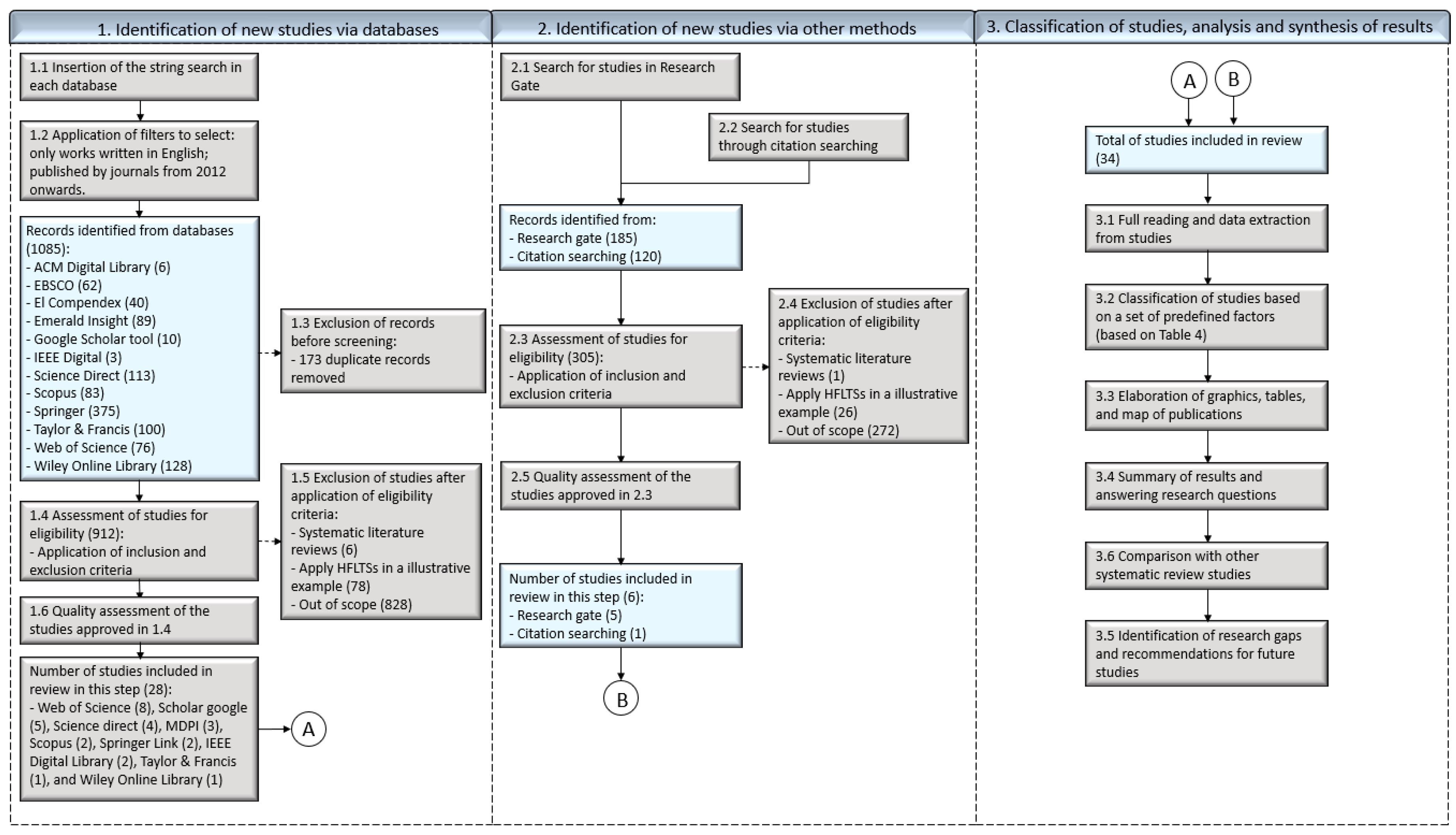
Figure 2.
Frequency of Articles Published by Year.
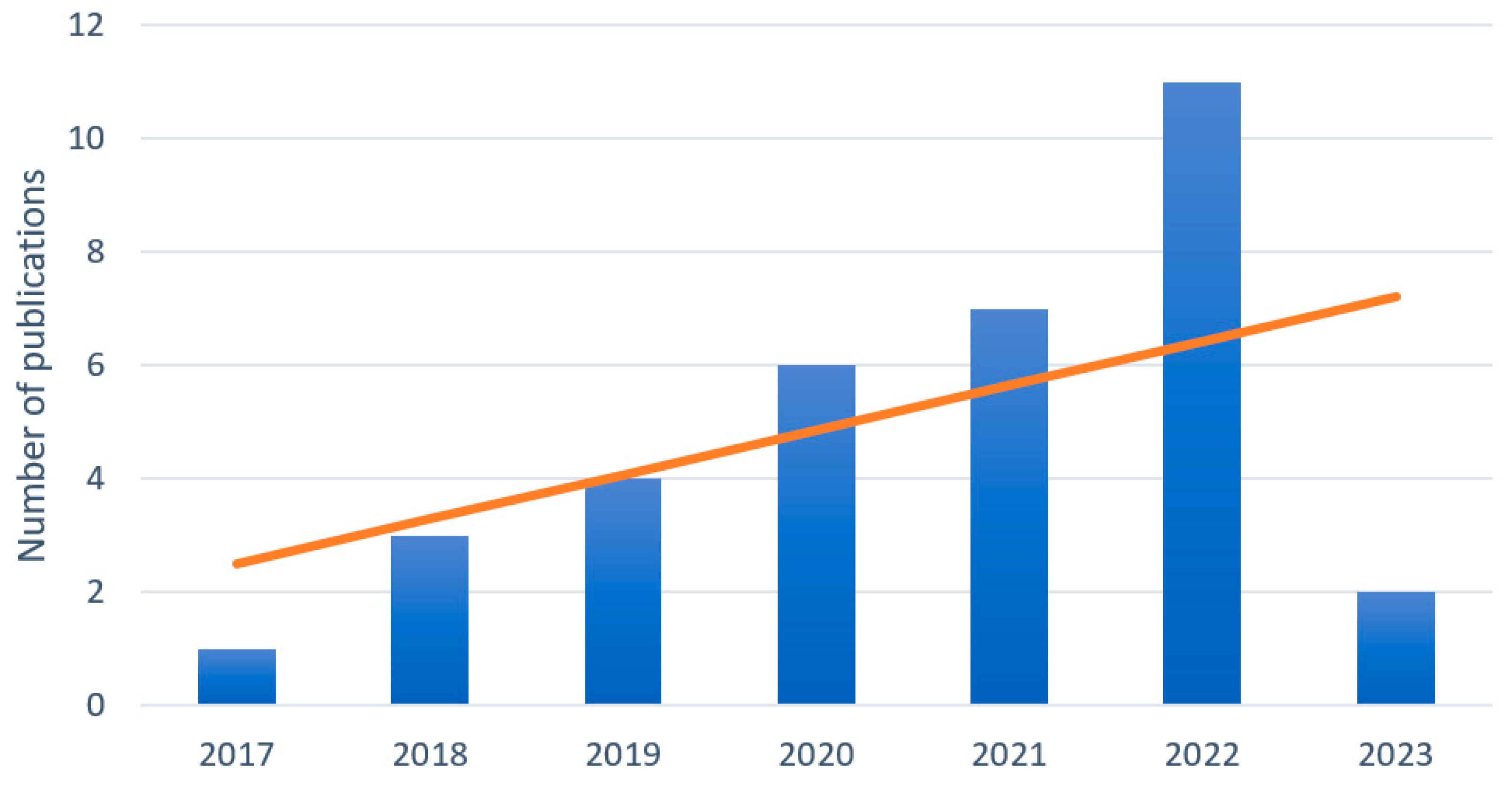
Figure 3.
(a) Distribution of the Publications by Country and (b) a Map of the Publications.
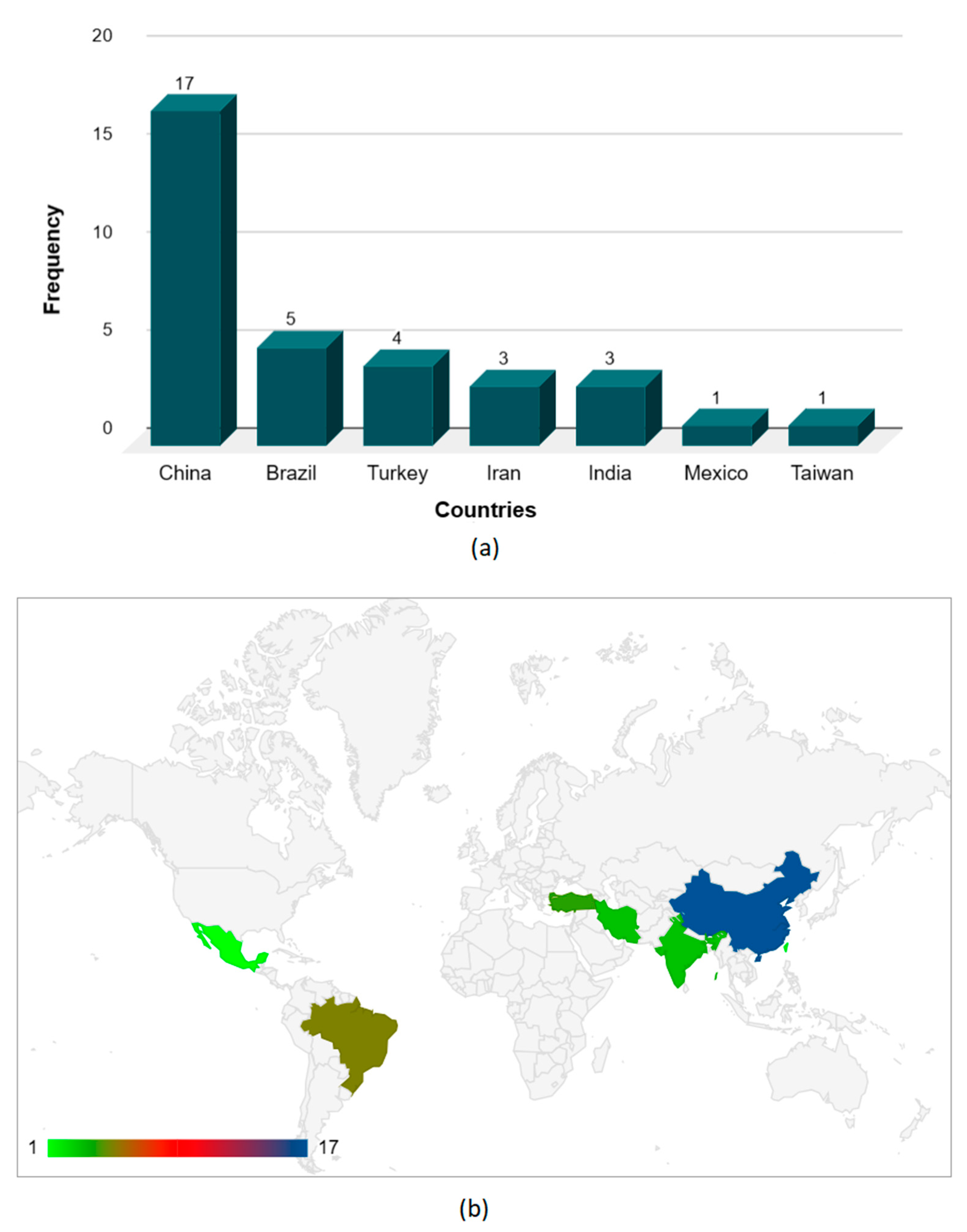
Figure 4.
(a) SCM Process Results and (b) Types of SCM Strategies.
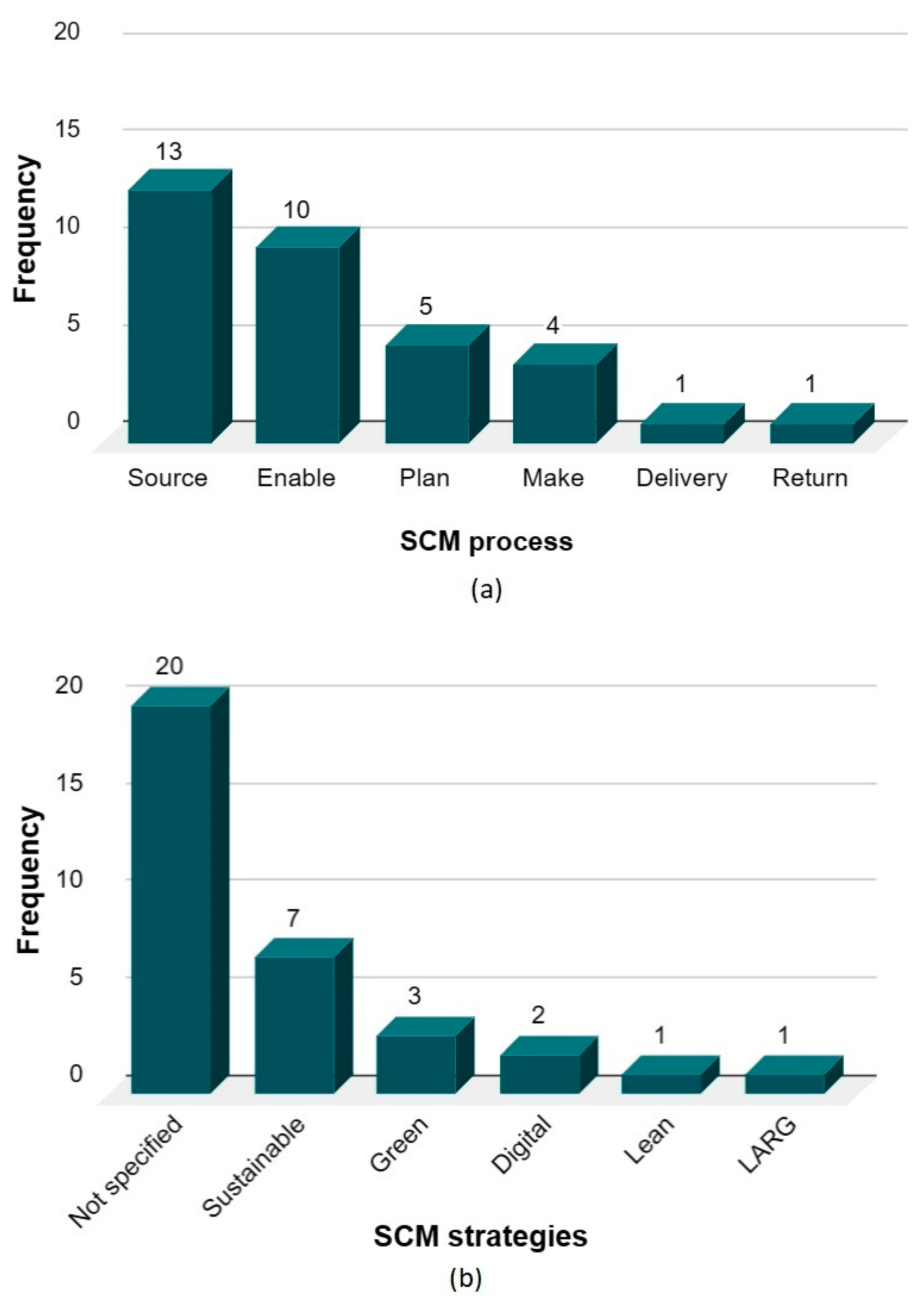
Figure 5.
Classification of the Studies according to Economic Sector.
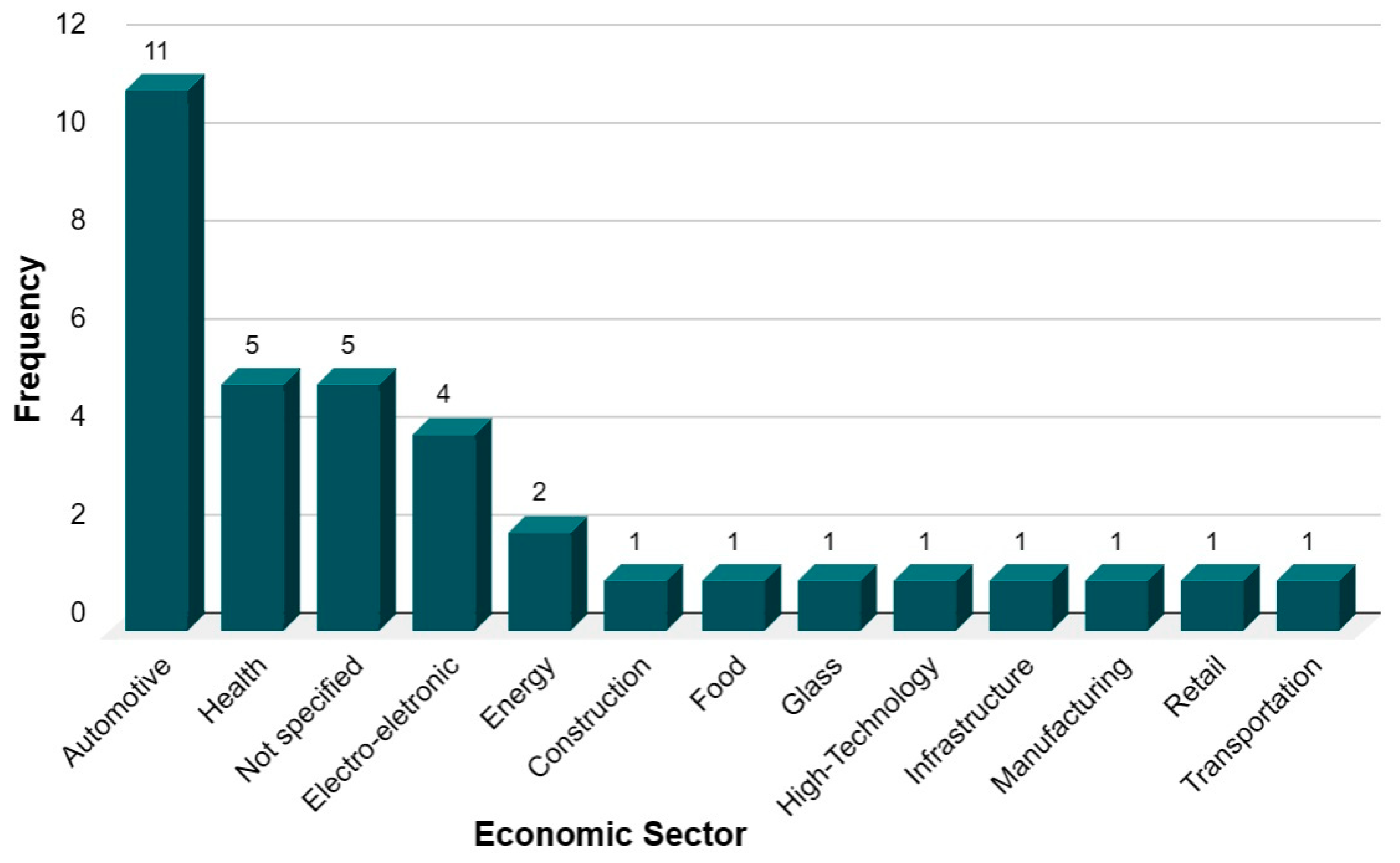
Figure 6.
Classification of the Studies by Type of Decision-Making Problem.
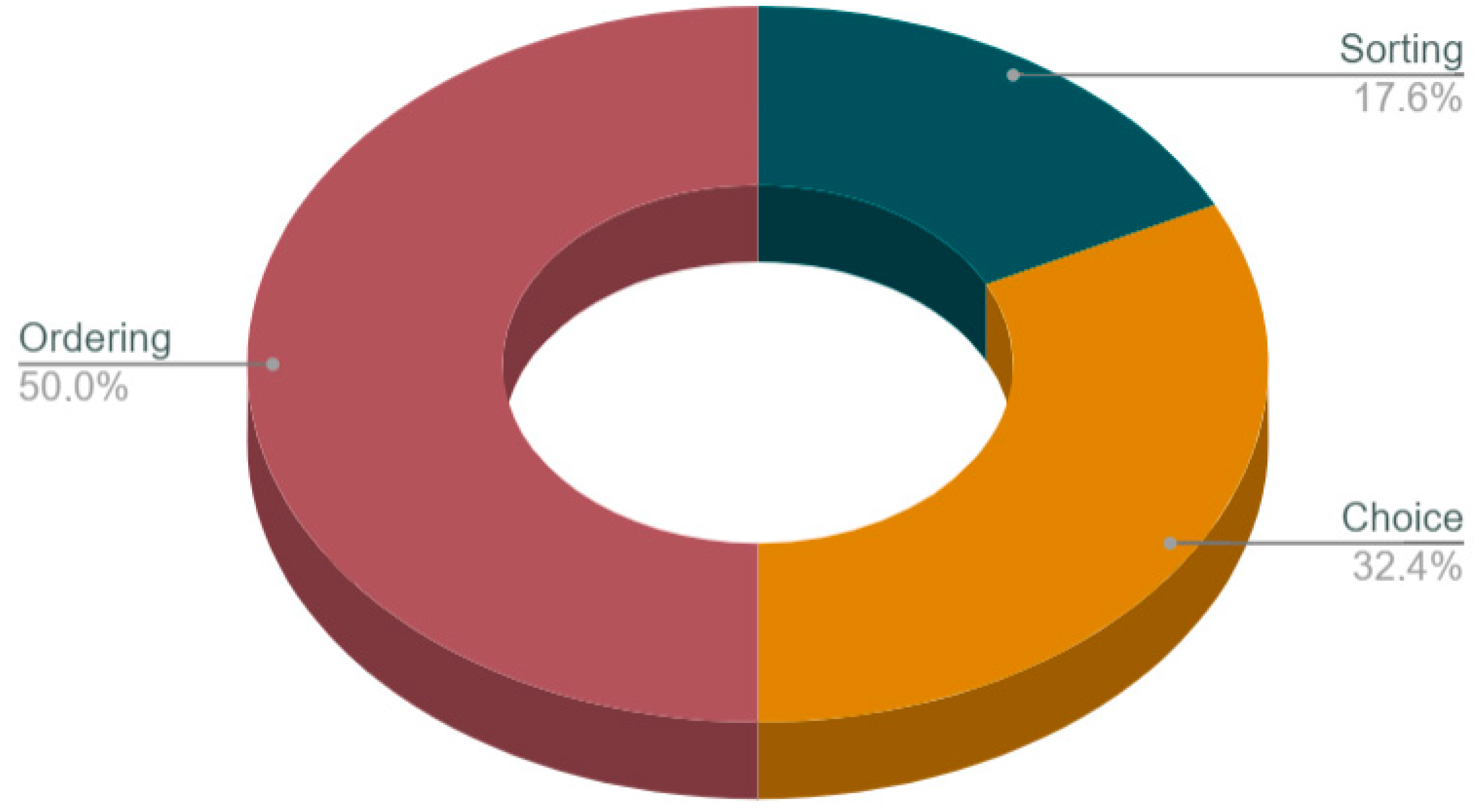
Figure 7.
Frequency of Use of HFLTSs and HFLTS Extensions.
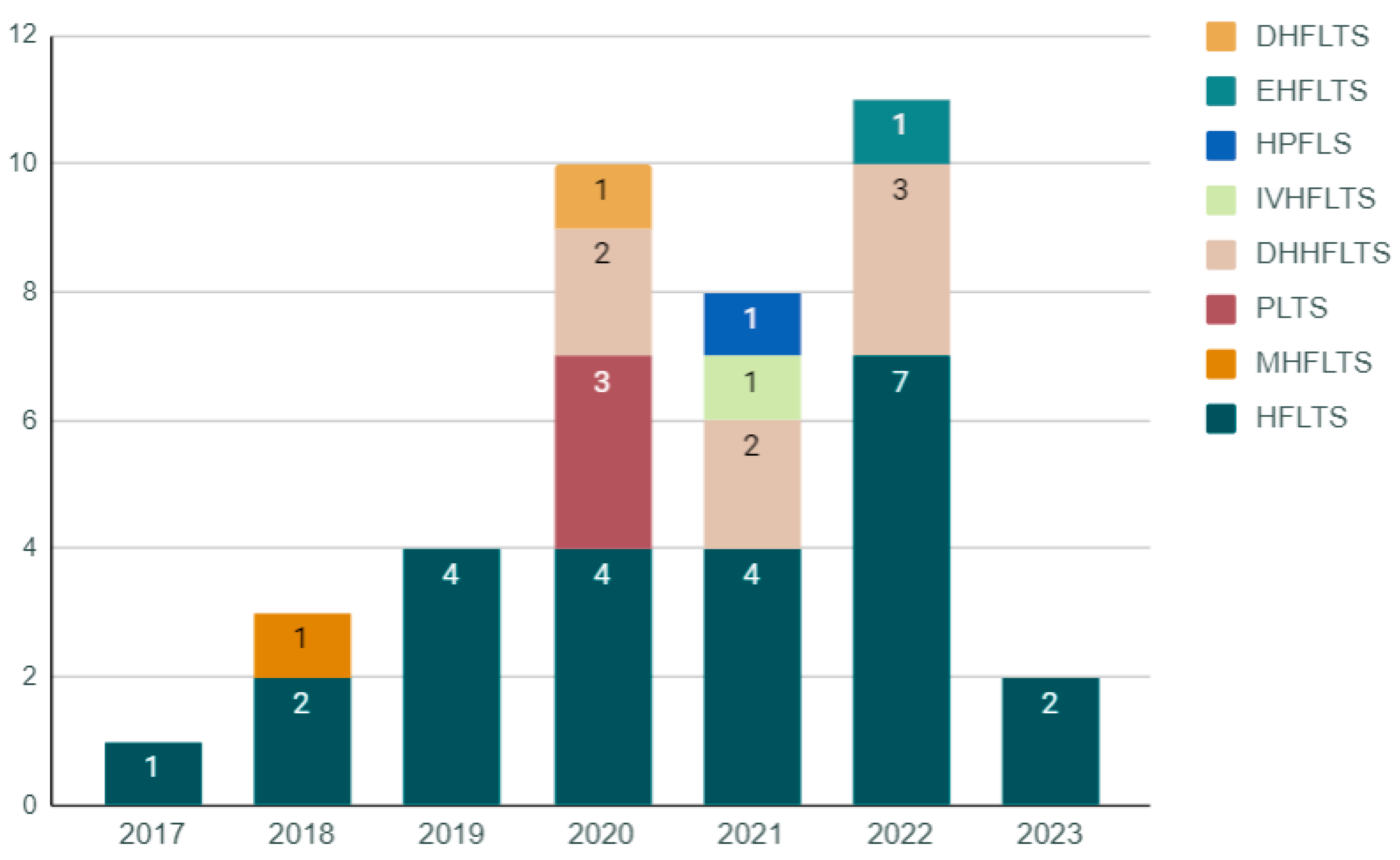
Figure 9.
Approaches Utilized to Validate the Analyzed Study Results.
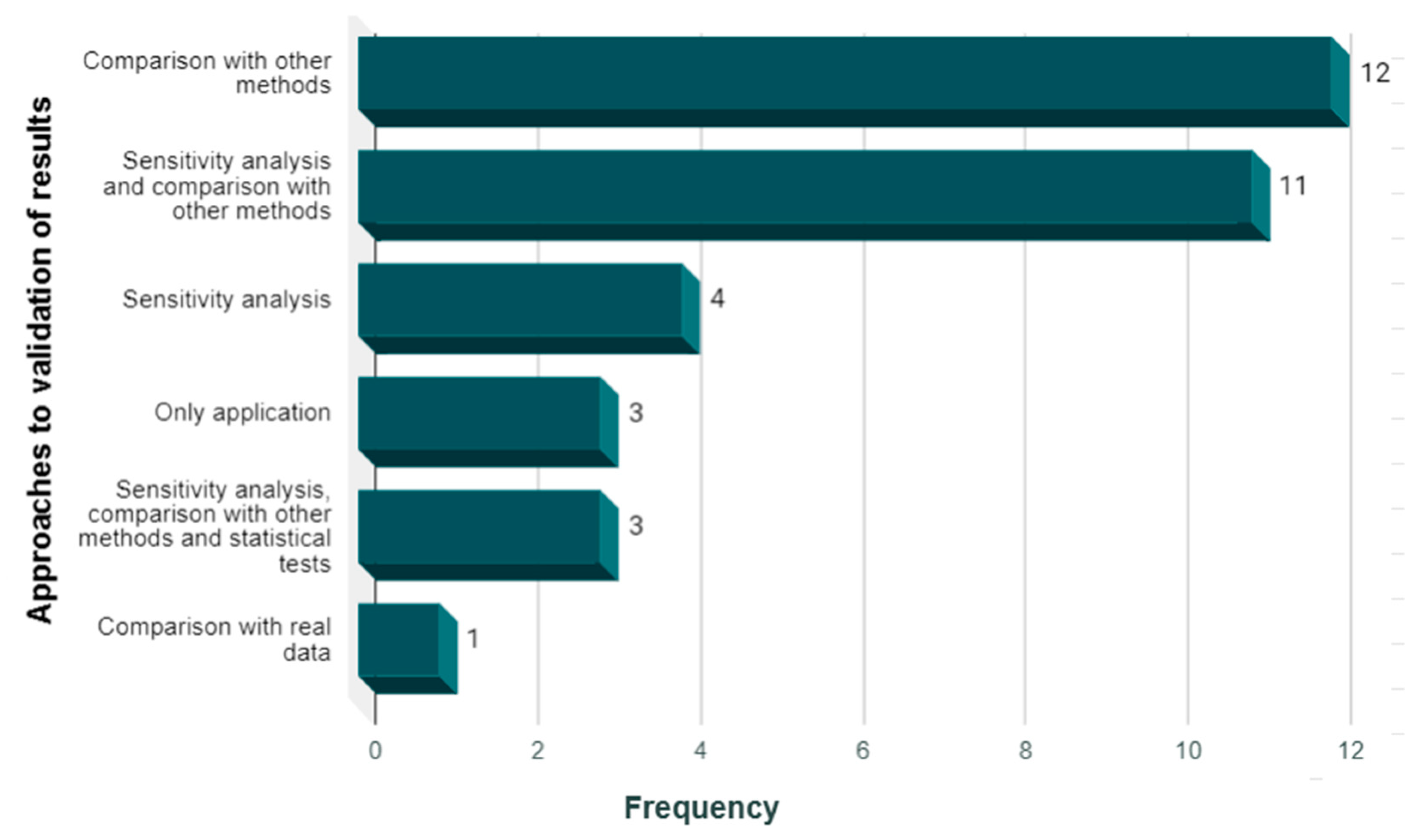
Figure 10.
Framework to Guide the Development of Future Studies on this Subject.
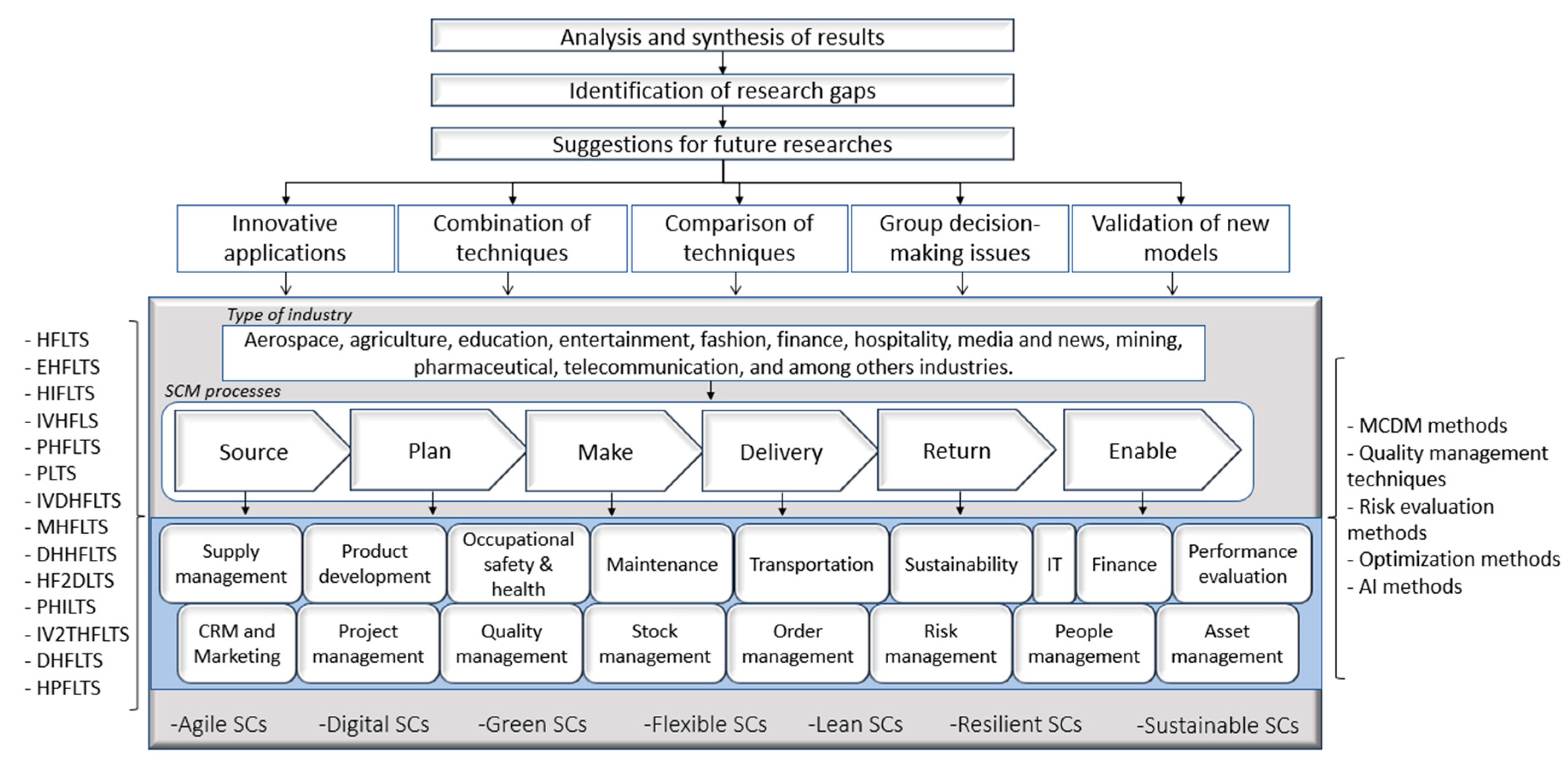

Table 1.
Literature review studies which encompass HFLTSs.
| Liao et al. [22] | Morente-Molinera et al. [23] | Wang et al. [11] | Wang et al. [12] | Yu et al. [24] | |
|---|---|---|---|---|---|
| Focus | Survey of decision-making theory and HFLTS methodologies | Review of approaches to multi-granular fuzzy linguistic modeling | Review of HFLTS developments and their classification according to computational strategies | Mapping of complex modeling techniques which employ linguistic expressions | Bibliometric analysis of 1,080 articles about HFSs and their extensions |
| Approaches analyzed | HFLTSs, fusion theory, Hesitant Fuzzy Linguistic preference relationship theory, among others. | Fuzzy membership functions, HFLTSs, 2-tuples, discrete fuzzy numbers, among others. | HFLTSs, EHFLTSs, linguistic HFSs, and 2-dimensional linguistic terms, among others. | Aggregation operators, information measures, preference relationships, and HFS extensions | |
| Analysis of applications | No | No | Identifies 20 applications in various areas | No | No |
| Comparison between approaches | Yes | Yes | Yes | Yes | No |
Table 2.
Summary of HFLTS extensions.
| ID | Approaches | Author(s) | Mathematical representation | Example |
|---|---|---|---|---|
| 1 | EHFLTS | Wang [15] | (1) | |
| 2 | HIFLTS | Beg and Rashid [18] | (2) | |
| 3 | IVHFLS | Wang et al. [36] | (3) | |
| 4 | PHFLTS | Chen et al. [16] | (4) | |
| 5 | PLTS | Pang et al. [37] | (5) | |
| 6 | IVDHFLTS | Qi et al. [38] | (6) | |
| 7 | MHFLTS | Wang et al. [39] | (7) | |
| 8 | DHHFLTS | Gou et al. [40] |
(8) |
{} |
| 9 | HF2DLTS | Liu et al. [41] | (9) | |
| 10 | PHILTS | Malik et al. [27] | (10) | |
| 11 | IV2THFLTS | Si et al. [17] | (11) | |
| 12 | DHFLTS | Zhang et al. [42] | (12) | |
| 13 | HPFLTS | Yang et al. [43] | (13) |
Table 3.
Research Protocol Developed for this Study.
| Steps | Research elements | Description | |
|---|---|---|---|
| Planning | Population | Studies which present decision-making problems in SCM. | |
| Intervention | HFLTS and HFLTS extension techniques. | ||
| Comparison | Factors related to the origin of these studies, SCM, HFLTSs and decision making. | ||
| Outcome | - Mapping of the use of HFLTS-based techniques in SCM problems. - Identification of research trends and gaps. - Proposal of directions for future studies. |
||
| Research questions |
RQ1.1. What has been the trend in terms of the number of publications since 2012? RQ1.2. Which countries stand out in terms of the production of articles on this subject? RQ1.3. Which journals have published more studies about this subject? RQ1.4. Which are the most cited studies? RQ2.1. What has been the focus of HFLTS techniques in SCM related problems? RQ2.2. Which SCM processes have received the most attention among the analyzed studies? RQ2.3. With what frequency are these studies devoted to specific types of SCM strategies? RQ2.4. Which economic sectors have received the greatest attention among the identified applications? RQ3.1. Which types of decision-making problems have been addressed by the analyzed studies? RQ3.2. Which HFLTS extension are most frequently used? RQ3.3. How often are techniques integrated in the same problem? What is the frequency of the use of each identified technique? RQ3.4. How are the criteria weights defined? RQ3.5. With what frequency do applications support group decision making? RQ3.6. The weighting of the DMs is considered in which applications? How are these weights defined? RQ3.7. In terms of applications that deal with group decision making, do they use methods to obtain a consensus among the DMs and/or do they perform aggregation operations? RQ3.8. How were the application results validated? |
||
| Keywords | - Hesitant Fuzzy Linguistic Terms Set | Synonyms: HFL, and Hesitant Fuzzy Linguistic. | |
| - Supply Chain Management | Synonyms: supply chain, customer relationship management, customer service management, demand, distribution, location selection, logistics provider, manufacturing flow, order fulfilment, partner selection, procurement, product development, risk, stock, supplier development, supplier evaluation, supplier selection, and transport. | ||
| Databases | - ACM Digital Library, EBSCO, El Compendex, Emerald Insight, the Google Scholar tool, IEEE Digital, Science Direct, Scopus, Springer, Taylor & Francis, Web of Science, and the Wiley Online Library. | ||
| Time frame | 2012-2023 | ||
| Language | - English | ||
| Inclusion criteria | - Studies in English which feature real HFLTS and/or HFLTS extension applications in SCM problems, approved or published in a peer-reviewed journal. | ||
| Exclusion criteria | - Studies which realize simulated applications of HFLTSs and/or HFLTS extensions in SCM problems; - Studies about SCM decision-making that do not apply HFLTSs or HFLTS extensions; - Studies which apply HFLTSs in problems outside of SCM; - Systematic literature review studies; or - Gray literature. |
||
| Conducting | Search string | ("Hesitant fuzzy linguistic" OR "HFL") AND ("supply chain" OR "customer relationship management" OR "customer service management" OR "demand " OR "logistic provider" OR “manufacturing flow” OR "stock " OR "supplier development" OR "supplier evaluation" OR "supplier selection" OR "location selection" OR "order fulfilment" OR “risk” OR "partner selection" OR "distribution" OR "procurement" OR "product development" OR "transport") | |
| Filters | Exhibits only journal published articles in its results; and Exhibits articles published in 2012 or later. |
||
| Study selection | - Realized by the two authors in an independent manner through reading titles, keywords and abstracts. | ||
| Quality assessment | - Realized by the two authors through a complete reading of the article to confirm whether the study performed a real application, was in English, and was peer-reviewed. | ||
| Data extraction | - Performed by the two authors with the help of the Parsifal software, through a complete reading of the articles. The factors considered in the data extraction are presented in Table 4. The data generated in this step was exported into MS Excel. | ||
| Reporting | Classification of the studies | - The classification was performed in accordance with the factors and categories displayed in Table 4. | |
| Summary of the information | - Creation of graphs using MS Excel; - Analysis and summary of the results; and - Identification of research gaps and proposed recommendations for future studies. |
||
Table 4.
Factors Considered in the Classification of the Selected Studies.
| Factors | Categories | References | |
|---|---|---|---|
| Information about the origin of the studies | Year of publication: classifies the selected studies by year of publication and analyzes trends over the years. | - Frequency of publications per year. | Lima-Junior and Carpinetti [6] Resende et al. [7], and Zimmer et al. [46] |
| Country: classifies the selected studies according to the country of the first author’s affiliated institution. | - Frequency of publications per journal. | ||
| Journal: classifies the studies according to the journals in which they were published, in order to find the journals that published the most on this subject. | - Frequency of publications by country, defined based on the affiliation of the authors of each study. | ||
| Number of citations: identifies the most cited articles based on information from Google Scholar. | - Total citations of each study in Google Scholar. | ||
| Factors related to SCM | Application objective: classifies the selected studies based on the main objective of the decision-making problem in question. | - Failure evaluation, risk evaluation, performance evaluation, supplier selection, logistics service provider selection, among others. | Riahi et al. [13], Zimmer et al. [46], Lima-Junior and Carpinetti [6] |
| SCM Processes: based on the application objective, the studies were classified into one of the six main SCM processes. | - Source, plan, make, delivery, return, and enable. | SCC [48], and Riahi et al. [13] | |
| Type of SCM Strategy: groups the studies according to the SCM Strategy adopted by the participating company in the application. | - Agile, digital, flexible, green, lean, resilient, or sustainable. | Lima-Junior and Carpinetti [6], and Resende et al. [7] | |
| Sector | - Automotive, electro-electronics, energy, construction, food, and health, among others. | Riahi et al. [13] | |
| Factors related to decision making and HFLTS | Type of problem: classifies the studies based on the type(s) of decision-making problems in question. | - Choice, ordering, or categorization. | Zimmer et al. [46] |
| Type of HFLTS approach: identifies the frequency of applications of HFLTSs and HFLTS extensions over the years. | - HFLTS, EHFLTS, HIFLTS, IVHFLS, PHFLTS, PLTS, IVDHFLTS, MHFLTS, DHHFLTS, HF2DLTS, PHILTS, IV2THFLTS, DHFLTS, and HPFLTS. | Wang et al. [12] | |
| Combination of techniques: identifies the frequency with which HFLTSs and HFLTS extensions have been integrated with other techniques. | - Frequency of isolated applications and combined applications. | Lambert and Enz [1], Lima-Junior. and Carpinetti [6], and Riahi et al. [13] | |
| Frequency of use of each technique: identifies the frequency of use of each the techniques that have been integrated with HFLTSs or HFLTS extensions. | - Frequency of the applications for each technique | ||
| Criteria weights: identifies whether the selected studies provide support for criteria weights. When they do, it maps how the criteria weights were defined. | - Enable the use or non-use of weights for criteria; - Weights attributed directly by the DMs, or calculated weights; - Method(s) adopted for the weight calculations. |
Kabak [47] | |
| Group decision making: investigates whether the selected studies support group decision-making processes. | - Focused on individual or GDM; - Number of DMs who participated in the application. |
Kabak [47] | |
| Weights for DMs: analyzes whether the selected studies consider weights for the DMs. When they do, it analyzes how these weights have been defined. | - Considers or ignores the weights for the DMs; - Weights attributed by DMs or calculated by some method. |
Kabak [47] | |
| Consensus among DMs: identifies whether the selected studies perform aggregation operations and whether they use methods to obtain a consensus among the DMs. | - Frequency of the use of aggregation methods for the DMs’ preferences and the techniques used to obtain consensus in GDM. | Kabak [47] | |
| Validation: classifies the approaches used for validation of the results for each selected study. | - Based on sensitivity analysis, the application of statistical techniques, and comparisons with other methods or real data. | Lima-Junior and Carpinetti [6] |
Table 5.
Distribution of Published Articles by Journal
| Journal | 2017 | 2018 | 2019 | 2020 | 2021 | 2022 | 2023 | Total |
|---|---|---|---|---|---|---|---|---|
| IEEE Transactions on Engineering Management | 3 | 3 | ||||||
| Applied Soft Computing | 1 | 1 | 2 | |||||
| Computers and Industrial Engineering | 2 | 2 | ||||||
| Environmental Science and Pollution Research | 1 | 1 | 2 | |||||
| Journal of Intelligent & Fuzzy Systems | 1 | 1 | 2 | |||||
| Symmetry | 1 | 1 | 2 | |||||
| Applied Sciences | 1 | 1 | ||||||
| Aslib Journal of Information Management | 1 | 1 | ||||||
| Complex & Intelligent Systems | 1 | 1 | ||||||
| Complexity | 1 | 1 | ||||||
| DYNA | 1 | 1 | ||||||
| Energy | 1 | 1 | ||||||
| Fuzzy Optimization and Decision Making | 1 | 1 | ||||||
| Int. J. of Computational Intelligence Systems | 1 | 1 | ||||||
| Int. J. of Environmental Research and Public Health | 1 | 1 | ||||||
| Int. J. of Information Technology & Decision Making | 1 | 1 | ||||||
| Int. J. of Production Economics | 1 | 1 | ||||||
| Int. J. of Strategic Property Management | 1 | 1 | ||||||
| Int. Transactions in Operational Research | 1 | 1 | ||||||
| J. of Cleaner Production | 1 | 1 | ||||||
| J. of Contemporary Administration | 1 | 1 | ||||||
| J. of Mathematics | 1 | 1 | ||||||
| J. of the Operational Research Society | 1 | 1 | ||||||
| Knowledge-Based Systems | 1 | 1 | ||||||
| Kybernetes | 1 | 1 | ||||||
| Neural Computing & Applications | 1 | 1 | ||||||
| Technological and Economic Development of Economy | 1 | 1 |
Table 6.
List of the Most Cited Articles.
| Rank | Author(s) | Number of citations |
|---|---|---|
| 1st | Osiro et al. [19] | 86 |
| 2nd | Wang et al [72] | 84 |
| 3rd | Yalçın and Pehlivan [61] | 72 |
| 4th | Tüysüz and Şimşek [54] | 71 |
| 5th | Liu et al. [51] | 67 |
| 6th | Wu et al. [58] | 56 |
| 7th | Wang et al. [68] | 56 |
| 8th | Liao et al. [49] | 41 |
| 9th | Duan et al. [67] | 32 |
| 10th | Erol et al. [53] | 28 |
| 10th | Chang et al. [59] | 28 |
Table 7.
Classification of the Studies according to the Application Objective.
| Application objective | Author(s) | SCM process | Total |
|---|---|---|---|
| Supplier selection | Liao et al. [49]; Zhang et al. [71]; Krishankumar et al. [77]; Krishankumar et al. [78]; Liu et al. [49]; Dolatabad et al. [50]; Qu et al. [74]; Krishankumar et al. [64]. | Source | 8 |
| Failure evaluation | Chang et al. [59]; Zolfaghari and Mousavi [79]; Dai et al. [66]; Duan et al. [67]. | Make | 4 |
| Performance evaluation | Tüysüz and Şimşek [54]; Büyüközkan and Güler [56]; Divsalar et al. [73]. | Enable | 3 |
| Risk evaluation | Wu et al. [58]; Shen and Liu [65]. | Enable | 2 |
| Logistics service provider selection | Wang et al. [72]; Zhang et al. [70]. | Source | 2 |
| Personnel selection | Wu et al. [75]; Yalçın et al. [61]. | Enable | 2 |
| Location selection | Wu et al. [80]; Ren et al. [81]. | Enable | 2 |
| Barrier assessment | Erol et al. [53]. | Plan | 1 |
| Traffic congestion assessment | Wang et al. [68]. | Delivery | 1 |
| Critical success factor evaluation | Zheng et al. [57]. | Plan | 1 |
| Lean tools evaluation | Pérez-Domínguez et al. [55]. | Plan | 1 |
| Supplier evaluation | Lima-Junior and Hsiao [52]. | Source | 1 |
| Supplier segmentation | Borges et al. [4] | Source | 1 |
| Emergency logistics plan selection | Qin et al. [9]. | Plan | 1 |
| Packaging design selection | Lima et al. [82]. | Plan | 1 |
| Recycling partner selection | Li et al. [69]. | Return | 1 |
| Supplier development program selection | Finger and Lima-Junior [8]. | Source | 1 |
| SC performance indicator selection | Osiro et al. [19]. | Enable | 1 |
Table 10.
Classification of the Studies in terms of Group Decision-Making (GDM).
| Author(s) | Supports GDM? | Number of DMs | Allows weighting of DM opinions? | How were DM weights assigned? | Method used to calculate DM weights | Aggregates DM opinions? | Procedure used to aggregate DM opinions | Applies iterative consensus method? |
|---|---|---|---|---|---|---|---|---|
| Tüysüz and Şimşek [54] | Yes | 3 | No | N/A | N/A | Yes | HFLTS-AHP | No |
| Osiro et al. [19] | Yes | 3 | Yes | N/A | N/A | Yes | HFLTS-QFD | No |
| Wang et al. [11] | Yes | 3 | No | N/A | N/A | Yes | HM | No |
| Chang et al. [59] | Yes | 4 | No | N/A | N/A | Yes | OWGA | No |
| Wu et al. [58] | Yes | 30 | No | N/A | N/A | Yes | Fuzzy arithmetic mean | No |
| Liao et al. [49] | Yes | 4 | Yes | Attributed numeric values | N/A | Yes | IWGA | No |
| Pérez-Domínguez et al. [55] | Yes | 6 | No | N/A | N/A | Yes | HFLTS-TOPSIS | No |
| Yalçın et al. [61] | Yes | 5 | No | N/A | N/A | Yes | Ordered Weighted Average (OWA) | No |
| Krishankumar et al. [77] | Yes | 3 | No | N/A | N/A | Yes | GMSM | No |
| Li et al. [69] | Yes | 5 | No | N/A | N/A | Yes | GWOWA | No |
| Qu et al. [74] | Yes | 3 | No | N/A | N/A | Yes | Degree of group satisfaction and the regret theory | No |
| Wang et al. [68]. | Yes | Not informed | No | N/A | N/A | Yes | DHHFLTS-ORESTE | No |
| Ren et al. [81] | Yes | 4 | No | N/A | N/A | Yes | Programming model | No |
| Zhang et al. [70] | Yes | Not informed | No | N/A | N/A | Yes | Ratio index-based probabilistic linguistic | No |
| Zhang et al. [71] | Yes | 5 | No | N/A | N/A | Yes | HFLTS-BWM | No |
| Krishankumar et al. [78] | Yes | 3 | Yes | Calculated | Mathematical model | Yes | GMSM | No |
| Liu et al. [51] | Yes | 4 | Yes | Attributes numeric values | N/A | Yes | Based on degrees of hesitancy and similarity | Yes |
| Büyüközkan and Güler [56] | Yes | 3 | No | N/A | N/A | Yes | AHP and OWA | No |
| Lima-Junior and Hsiao [52] | Yes | 2 | No | N/A | N/A | Yes | HFLTS-TOPSIS | No |
| Zolfaghari and Mousavi [79] | Yes | 3 | No | N/A | N/A | Yes | Interval-valued Hesitant Fuzzy Linguistic Prioritized Weighted Average | No |
| Shen and Liu [65] | Yes | Not informed | No | N/A | N/A | Yes | DHHFLTS-COPRAS | No |
| Wu et al. [75] | Yes | 10 | No | N/A | N/A | No | N/A | Yes |
| Finger and Lima-Junior [8] | Yes | 1 | No | N/A | N/A | Yes | HFLTS-QFD | No |
| Erol et al. [53] | Yes | 19 | No | N/A | N/A | Yes | HFLTS-Delphi and HFLTS-ANP | Yes |
| Qin et al. [9] | Yes | Not informed | No | N/A | N/A | No | N/A | No |
| Divsalar et al. [73] | Yes | 12 | No | N/A | N/A | No | N/A | Yes |
| Borges et al. [4] | Yes | 2 | No | N/A | N/A | Yes | HFLTS-TOPSIS | No |
| Duan et al. [67] | Yes | 5 | Yes | Calculated | Nonlinear programming and genetic algorithm | Yes | Double Hierarchy Hesitant Linguistic Weighted Average (DHHLWA) | No |
| Dai et al. [66] | Yes | 3 | Yes | Calculated | Entropy weight method | Yes | Entropy weight method | No |
| Wu et al. [80] | Yes | 3 | Yes | Calculated | Optimization model | Yes | Optimization model | No |
| Lima et al. [82] | Yes | 4 | No | N/A | N/A | Yes | HFLTS-AHP and OWA | No |
| Krishankumar et al. [64] | Yes | 3 | Yes | Calculated | WDA algorithm | Yes | Attitudinal-CRITIC approach | No |
| Dolatabad et al. [50] | Yes | 11 | Yes | Calculated | Method not defined | Yes | Hesitant Fuzzy Linguistic Weighted Average (HFLWA) | No |
| Zheng et al. [57] | Yes | 22 | Yes | Calculated | Maximizing consensus approach | Yes | HFLTS-DEMATEL | No |
Disclaimer/Publisher’s Note: The statements, opinions and data contained in all publications are solely those of the individual author(s) and contributor(s) and not of MDPI and/or the editor(s). MDPI and/or the editor(s) disclaim responsibility for any injury to people or property resulting from any ideas, methods, instructions or products referred to in the content. |
© 2023 by the authors. Licensee MDPI, Basel, Switzerland. This article is an open access article distributed under the terms and conditions of the Creative Commons Attribution (CC BY) license (http://creativecommons.org/licenses/by/4.0/).
Copyright: This open access article is published under a Creative Commons CC BY 4.0 license, which permit the free download, distribution, and reuse, provided that the author and preprint are cited in any reuse.


