
Submitted:
29 May 2023
Posted:
30 May 2023
You are already at the latest version
Abstract
In various countries of the global south, school feeding programs are implemented in order to alleviate short-time hunger in children, improved their nutrition and provide employment for food vendors. The impact of these programs is important not only in terms of pupils’ nutrition but also in improving farmers’ livelihoods. This study analyzes the impact of the school feeding program on smallholders' food security based on data collected in 2021 from 240 farmers surveyed in northeast Nigeria. Differently from other studies, several econometric methods are used to analyze the data, namely, binary probit regression, propensity score matching, inverse probability weighted adjusted regression and endogenous switching regression. The results show that about 40% of the beneficial smallholder farmers are food secure compared to 20% of the non-beneficiary households. Findings revealed that the Homegrown school feeding program (HGSF) positively improved smallholder farmers improve household food security status. Results provide evidence for the need to expand school feeding programs vis-a-vis interventions in facilitating farmers’ access to capital and capacity building for better integration in the supply chain.
Keywords:
smallholder farmers
; food security
; school feeding
; Nigeria
; propensity score matching
1. Introduction
School feeding programs (SFPs) serve as an important safety net program to ensure that every child has access to quality education, health, and nutrition. In recent years, the goals of SFPs have been expanded, and some programs have included local smallholder farmers as food suppliers to improve their livelihoods [1]. Such expanded programs are called Homegrown School Feeding Programs (HGSF). HGSF objectives and tools vary from country to country, but they are all characterized by the integration of local food suppliers into the supply chains that provide agricultural commodities or food to schools [2].
Several countries such as Brazil, Ethiopia, Mali, Ghana, India and South Africa have incorporated direct purchase (decentralized model) of food products from local farmers into their SFP in order to improve the smallholder farmer household food security [3]. The decentralized purchase model of HGSF, enables district authorities, firms, schools, and caterers to buy food products directly from smallholder farmers or their organizations [4,5,6]. To facilitate direct purchases and reduce transaction costs, besides the role of the service supplier or the catering company, in some cases, the role of procurement committees is witnessed, which are established and made up of parents' associations, community members, and teachers [4,5]. Caterers are also supported with information and guidelines for adapting food supply sources to pupils' nutritional needs [5]. In a decentralized procurement system, caterers are not restricted or guided in their procurement rules, thus giving impetus to purchases from local smallholders [7].
Theoretically, the HGSF instruments have been recognized as having a positive impact on agricultural and overall rural livelihood [8]. Several studies have revealed evidence that HGSF has improved smallholder farmers' income, livelihood and food security status by increasing the demand for vegetable products, cereals and other staple foods cultivated by the farmers [9,10,11,12,13]. An increase in opportunities to sell has reduced farmers’ losses encountered, especially vegetable farmers, and improved their profits [14]. The market guarantee through HGSF can stimulate an increase in agricultural productivity and reduce marketing risks for farmers [8,9,15] since they can produce and market non-staple perishable foods such as vegetables and legumes [16]. Furthermore, the activation of HGSF offers additional benefits of job creation and empowerment to caterers and processors, providing a steady market opportunity for smallholder farmers, hence improving their livelihoods and local economy through the decentralized system of procurement [2,5].
Despite the theoretical and empirical justifications of HGSFs, the potential to improve agricultural productivity and food security among smallholder farmers is constrained by some conditions related to the sustainability of the HGSF. The first condition is that farmers must be willing to supply food products consistently throughout the school year, and secondly, the seasonality in local food production can limit continual procurements [4]. Therefore, the farming experience and access to services, inputs, market information and collective action are incremental to overcome these challenges.
Considering these limitations, the capacity of HGSF to improve farmers’ food security is a key issue to be explored and the influence of institutional and farm characteristics is to be further analysed. This study investigates the factors affecting smallholders' food security, with a focus on farmers’ access and sales to HGSF suppliers, namely caterers and processors. Access to HGSF is also observed vis a vis with other factors namely access to credit, and smallholder household characteristics as well as other vectors of food security.
The study analyzes the impact of the HGSF on smallholders' food security, based on data collected in February 2021 from 240 farmers surveyed in northeast Nigeria which is a suitable research environment for exploring the benefits of school feeding programs in an area dominated by smallholders, suffering from high food insecurity [5,17] and under continual security risk from Boko Haram attacks [18]. Due to the vicinity of the conflict areas, some of the farmers in the sample had no access to the HGSF program, thus missing the potential benefits of access to caterers. This sample, being divided into two groups with similar characteristics, creates a suitable laboratory for observing the impact of participation on farmers’ performance and food security. As such, this study brings additional findings in the case of a country suffering from food insecurity and life insecurity.
In Nigeria, HGSF is launched in 2016 in order to increase enrollment, attendance, performance and improve pupils' nutrition in schools [2,19]. The program is currently benefiting about 9.9 million pupils in 33 states. There are about 107,000 cooks who are benefiting and around 150,000 smallholder farmers linked to the program supplying locally sourced ingredients [5,20]. Despite the large coverage and the relatively long duration, to the best of our knowledge, no prior studies have concentrated on how HGSF instruments affect the food security of smallholder farmers' households. Furthermore, previous studies conducted across the globe [9,12,21,22] scarcely use factual and counterfactual analyses (experimental versus control). To close the empirical gaps, our study adopts the Propensity Score Matching (PSM), Inverse Probability Weighted Adjusted Regression (IPWRA), and Endogenous Switching Regression (ESR) approaches to control for endogeneity resulting from observed and unobserved individual characteristics, selection bias that may persist in the absence of random selection. The analytical method allows for treating possible biases rooted in non-random data samples.
The remainder of this paper is as follows. Section 2 introduces the theoretical background and the review of the literature. The later section presents the methodological approach. Results are presented in section 4, which is followed by the discussions. In the final section, the main conclusions and implications are provided.
2. Theoretical background and literature review
The HGSF is underpinned by the theory of change [23], which is a framework that explains how strategies, activities, or programs contribute to a set of specific outcomes through a series of intermediate outcomes in a systematic way. For instance, [24] used the theory of change as well as the combined group model building (GMB) approach to analyse the HGSF in the Caribbean. An additional theory is a Polytheoretical Model for Food and Garden-based Education in School Settings (PMFGBE) which is a framework of components representing the underpinning forces for adopting the program [25]. On the demand side, the theoretical base is the [26] Theory of Planned Behavior (TPB) which is used to explain changes in individuals' dietary habits and behaviors that result from individuals' intentions which can be influenced by a dietary-induced program.
Even though there is no unified model of HGSF, the programs aim to tackle both social protection and agricultural development benefits [8]. The literature mainly views the effect of HGSF as an option for providing smallholders a reliable market by increasing farmers’ access to capital to improve production, linking farmers to caterers [27] and food processors to sell their surpluses or during periods when schools are on the break [8,27,28]. These interventions create market opportunities for farmers, reduce their variable costs and enable them to better utilization of their labour endowment, thus bringing higher incomes, fewer food losses and higher food security (Figure 1).
For instance, several studies emphasize the effect of linking smallholder farmers with caterers [9,10,11] and food processors [29,30,31,32,33] on the farmer’s household food security status. The effect is mainly indicated by the effect of access on production and income increases [30,34,35] in food security.
In addition to ensuring market space, HGSF has also benefited farmers with access to credit or loans. Access to capital, as is the case of African countries reported [36,37,38] has raised farmers’ revenues.
School feeding programs provide an important new opportunity to assist low-income families and feed hungry children while reserving food at home for others and improving household food security status. Several studies have reported that households, where children benefit from the feeding program, are more likely to be food secure because the food they receive at school supplements the little food they receive at home [15,39,40].
Other controlling variables influence household food security statuses, namely demographic and institutional variables, such as age, gender of the household head, access to extension service, and input subsidy [34,37,41]. For instance, studies conducted in Nigeria, Pakistan, and Tanzania have demonstrated that an increase in the age of smallholder farmers increases their household food security status [32,41,42]. Contrary to these studies, other authors [43,44] revealed that as age increases, household food security decreases.
There is contrasting evidence in relation to the gender of the household head. Studies by [37,45] reported that female-headed households are better off in terms of food than their male counterparts, while other studies provide evidence for the contrary [34,36,41,42].
The household head's marital status is also important [34,42] and household size is an important factor in the food security status of smallholder farmers. Thus, larger household size increases the likely chance of the farming household being food-secured [36,37,42]. Several studies, on the other hand, have found that a larger household size among smallholder farmers affects household food security status positively, as demonstrated by [34,41,46].
Farming experience is also a noted vector for food security. Farmers with longer farming experience have a better chance of being food secure than farmers with fewer years of farming experience [34,37].
Education is expected to have a significant impact on food security status. An increase in farmers' years of formal education by household heads is likely to be food secure [32,34,37,47,48], while the contrary is true for a few authors, see [41].
As emphasized earlier, institutional characteristics of the environment where farmers operate are important. Several studies analyzed the role of extension services in influencing household food security. Smallholder farmers with access to extension services are more likely to be food secure than their counterparts who lack access to the services [29,36,37,42,47,48,49].
According to [50], access to market information is the primary driver of market participation. When a household has access to market information, they can make informed decisions about what to produce, when to sell it, whom to sell it to, and what price to accept. They are therefore more likely to have higher cash incomes, which they can use to purchase a variety of foods, including their favourites. In fact, compared to their counterparts, households with access to market information are more likely to be food secure [50,51].
3. Methodology
3.1. The study area
Nigeria is a country with a rapid increase in population (growth rate of 3.2%) achieving 213 million in 2021. Considering this demographic trend, the country is expected to have 410 million inhabitants by 2050. The mortality rate of below five years is 101 of 1,000 live births [53] and food security is a major issue for development.
The study area was chosen due to high levels of household insecurity and acute malnutrition among children, with many at risk of death [54]. This is caused by climate change vulnerability and the Boko Haram insurgency attacks in northeast Nigeria (i.e our study area). Approximately, 60% of the 13 million out-of-school children in Nigeria live in the Northeast region [17]. More than 800,000 children in Northeast Nigeria are projected to be acutely malnourished by 2021 Food consumption in Northeast Nigeria has worsened compared to previous years, with poor and borderline food consumption (reported by 44% of households) nearly as high as at the peak of the crisis [5,55]. In 2019, an estimated 7.1 million people who lived in the region needed assistance, this included 2 million displaced people from the conflict [56].
3.1.1. Definition of the study sample
The Homegrown School Feeding Program (HGSF) is a value chain arrangement that encourages local smallholder farmers to grow or produce locally and sell to caterers (food vendors) responsible for feeding pupils in schools. This allows farmers to sell to a readily available market with fewer losses. In our sample, beneficiary smallholder farmers (i.e, treatment variable) are those registered farmers under the program who have been linked to caterers and already selling any of the following to the caterers in the past 1-2 years (i.e., vegetables, staple foods, and egg sales). While our non-beneficiary smallholders were newly registered farmers under the program, they are yet to be linked with prospective caterers to start enjoying the benefits of the program.
3.2. Sampling Procedure and Sample Size
Respondents for the study are HGSF-registered and non-registered smallholder farmers from across the study area. A multi-stage sampling procedure was used to select smallholder farmers. The first approach involves the purposeful selection (due to accessibility and low threat of death) of three northeastern Nigerian states, namely Adamawa, Bauchi, and Gombe, reason is due to the threat to life due to the Boko Haram attacks and kidnapping. In addition, these areas are from the same agroclimatic zone cultivating the same types of crops and rearing livestock. Figure 2 illustrates the targeted areas.
Stage two involved the selection of four local government areas at random (lottery) from each of the three states, for a total of 12 local government areas. In stage three, five wards are drawn at random (lottery) from the initial list of local government areas, yielding a total of 60 wards (a ward: a city or borough administrative division that elects and represents a councilor). In the fourth stage, we used systematic random sampling to select farmers from the program's registered participants in each ward. Each ward has between 6 and 12 registered farmers, depending on the population size. A registered list of smallholder farmers registered with the program was obtained from the Ministry of Agriculture in their respective states for selection and contact with farmers. Systematic random sampling was used to select 2 farmers from the registered, whereas in 6 wards 3 registered farmers were selected due to the proportion of registered farmers. According to the program's objectives, registered farmers will benefit from credit access to support the production, farmers linked to caterers, and farmers linked to processors in situations of excess production.
3.3. Data Collection
The study is based on structured face-to-face survey data collected using a mobile phone application "kobotoolbox ". Data was collected from 240 smallholder farmers in three states of Northern Nigeria. The lead author of the paper carried out the interviews.
The study questionnaire, based on a literature review and in-depth interviews, was explicitly designed for smallholder farmers and was divided into four sections. The first section of the questionnaire contains information on the socioeconomic variables of the farmers such as (age, years of farming experience, level of education, marital status, household size and number of pupils benefiting from the school feeding program). The second section contains information on the benefits of farmers' involvement in HGSF, such as (what type of products farmers sell to caterers). The third section contains information on institutional factors that affect the food security status of smallholder farmers, such as (access to credit, access to extension services, access to market information, membership in the cooperative society and access to input subsidies, etc.). The fourth section of the questionnaire deals with the measurement of food security using the Food Consumption Score (FCS) indicator, a seven-day recall of food consumed by the household.
The questionnaire was pre-tested and finetuned with 24 smallholders or 10% of the study sample size as recommended [57]. The aim was to assess if the questionnaire components were long enough, and questions were easily understood. The data collected was cleaned using Excel but was coded and analyzed using Stata 14 statistical software.
3.4. Data Analysis
3.4.1. Probit Model
A probit model was used to determine factors affecting smallholder farmer household food security status. Average marginal effects were estimated and are presented in the results section. As demonstrated by [31,32,33,37].
The probit model in the following form was used:
where Xi represents a set of all explanatory variables presented in the study, 𝛽1 is a vector of estimated parameters and 𝜀𝑖 is an error term. 𝑌𝑖𝑘 is the level of consumption score where 0 = poor and borderline food security with FCS up to 35; 1 = acceptable food security with FCS higher than 35 points.
The system of equations describing the binary choices of smallholder farmers is given as follows:
3.4.2. Empirical Strategy
3.4.2.1. Propensity Score Matching and Endogenous Switching Regression
Due to observable and unobservable bias, determining the causal effects of HGSF on potential outcome indicators (household food security status) is not straightforward. Controlling for both observable and unobservable characteristics through the random assignment of individuals to treatments is necessary for accurate impact measurement. Selection bias may persist in the absence of random assignment because observed and unobserved characteristics of individuals may influence the likelihood of receiving treatments as well as outcome indicators. To account for endogeneity bias, we use propensity score matching (PSM), inverse probability weighted adjusted regression (IPWRA), and endogenous switching regression (ESR) techniques in this study [58,59,60,61]. These analytical frameworks used help to eliminate selection bias (i.e., observable and unobservable) associated with establishing conditional causality with observational data when randomized trials are infeasible [38,62,63]. To determine the average difference in the outcome variable between treated and untreated households, PSM first matches each treated household to a comparable untreated household. In other words, we want to know: "What would have happened to the food security status of a smallholder farmer who benefited from HGSF (treated) if that same farmer did not benefit from the HGSF (control)?”. The Average Treatment Effect (ATT) is described by [64] as:
where Y (1) and Y (0) are outcome indicators (in this case, household food security status). T is the treatment indicator. However, in our dataset, we only see E[Y(1)|T = 1 and E[Y(0)|T = 1 is missing. In essence, we cannot observe the household food security status of treated households if they had not been treated [58,59]. A simple comparison of household food security status of those with and without treatment status introduces self-selection bias into the estimated impacts. The extent of self-selection bias is formally reported.
ATT =E[Y (1) – Y(0)|T = 1]
E[Y (1) – Y(0)|T = 1] = ATT + E[Y(0)|T = 1 – Y(0)|T = 0
PSM reduces the bias introduced by observables by constructing comparable counterfactual households for treated households. PSM assumes that there are no systematic differences in unobservable characteristics between treated and untreated households once households are matched with observables [65]. Given this conditional independence assumption and the overlap requirements, the ATT is calculated as follows:
ATT = E[Y(1)|T =1, p(x)] – E[Y(0)|T =0, p(x)]
However, in the presence of misspecification in the propensity score model, ATT from PSM can still produce biased results [60,66]. The use of inverse probability-weighted adjusted regression (IPWRA) could be a remedy for such misspecification bias. According to [67] IPWRA estimates will be consistent in the presence of treatment/outcome model misspecification, but not both. As a result, the IPWRA estimator has the double-robust property, which ensures reliable estimates by accounting for misspecification in both the outcome and the treatment model [38,68]. [64] proposed two steps for estimating ATT in the IPWRA model. Assume the outcome model is represented by a linear regression function of the form Yᵢ=αᵢ+φᵢxᵢ+ɛᵢ for i = [0 1] and the propensity scores are given by p(x; ︢͡γ). The propensity scores are estimated in the first step as p(x; γ). In the second step, we use linear regression to estimate (α0, φ0) and (α1, φ1) using inverse probability weighted least squares as the regression model.
The ATT is then computed as the difference between Equation (6) and Equation (7)
where, (︢α₁,︢φ₁) are estimated inverse probability-weighted parameters for HGSF beneficiary households while (︢α0,︢φ0) are estimated inverse probability-weighted parameters for non-beneficiary households. Finally, NW stands for the total number of treated households.
Matching techniques can only overcome selection bias caused by observables, regardless of misspecification bias adjustments. When unobservable heterogeneity, such as a farmer's inherent skill, causes endogeneity, estimates of the matching technique will be biased. As a result, we used the endogenous switching regression (ESR) model in the final step to account for both observed and unobserved bias [69,70]. The ESR method solves the endogeneity problem by estimating the selection and outcome equations with full information maximum likelihood (FIML) [68,71].
Furthermore, proper ESR identification necessitates the use of at least one instrumental variable that influences the treatment rather than the outcome of interest. The possible instrument in the first ESR model for example “farmers benefiting HGSF” was identified as “access to input subsidy”. Thus, from the question "Do you have access to input subsidy?" we created a dummy variable "those with access to input subsidy" that takes a value of 1 and 0 otherwise. The assumption is that farmers who have access to input subsidies have a better chance of benefiting from HGSF. However, access to input subsidies is not supposed to have a direct impact on the outcome variable of interest because simply having access to input subsidies does not directly improve or decrease household food security, as adopted [72].
We assume that a particular farming household would consider receiving treatment, i.e., benefit from the HGSF if the expected benefit of the treatment (in terms of food security status) is positive. Let F0 be the food security status of farmer households not benefiting the HGSF (i.e., control group), and let F1 be the corresponding food security status of the treatment group. The farmer will choose to be in the treatment of the food security improvement defined as, Yᵢ*=F1-F0, which is positive. However, the food security status that the farmer derives from treatment (Yᵢ*) is a latent variable determined by observed characteristics (Zi) as follows:
Variables affecting expected gains from having benefited the HGSF are represented by the vector Z. The conditional outcome function can then be specified as an ESR model in the following way.
where Y1i is the outcome indicator for treated farmer households and Y2i is the outcome indicator for untreated farmer households, and xi is a vector of exogenous variables. The outcome variable's error term is in the selection equation (i.e., Eq. 9) and the outcome equation (i.e., Eq. 10 and 11) the error terms are assumed to have a trivariate normal distribution with a mean of zero and a covariance matrix (Ω) in the following way:
where = var(µᵢ), = var(ᵋ₁), = (ᵋ₂), = cov(µᵢ, ε₁), = cov(µᵢ, ε₂) Furthermore, = is estimable up to a scale factor and can be assumed to be equal to 1 [61] and cov(ε₁, ε₂) is not defined as Y₁ and Y₂ cannot be observed simultaneously. Moreover, the correlation between the error term of the selection equation and the outcome equation is not zero (i.e., corr(µ₁, ε₁) ≠ 0 and corr(µ₁, ε₂) ≠ 0) which creates selection bias. ESR addresses this selection bias by estimating the inverse mills ratios (λ₁ᵢ and λ₂ᵢ) and the covariance terms ( and ) and including them as auxiliary regressors in Eq. (10) and (11). If and are significant, we reject the absence of selection bias. In addition, < 0 represents positive selection bias (i.e., households with above-average food security are more likely to choose to be in the treatment). The ESR model estimates can then be used to estimate ATT (Average treatment effect on untreated households) as follows:
Regime1: Y1ᵢ = γ1x1i + ᵋ1i if Ti = 1
Regime2: Y2ᵢ = γ2x2i + ᵋ2i if Ti = 0 …
Equations (12) and (13) along the diagonal of Table 2 represent the actual expectations observed in the sample. Equations (14) and (15) describe the counterfactual expected outcome (15). In addition, we calculate the average treatment of the treated " beneficiaries' farmers" on the treated (ATT) as the difference between equations (12) and (14) following the [73],
which represents the impact of HGSF on the household food security status of a beneficiary smallholder farmer. For the impact on the household food security status of non-beneficiary smallholder farmers, we calculate the effect of treatment (HGSF) on the untreated (ATU) as the difference between equations (15) and (13).
To account for the effects of heterogeneity, of beneficiaries of HGSF. For example, beneficiary farmers may have a higher household food security status than non-beneficiaries, even though they benefit due to unobservable characteristics such as their skills. We chose to adapt because of the difference between (a) and (d) (see Table 2).
The difference between equations (16) and (17) is "transitional heterogeneity," or whether the effect of benefiting from HGSF is larger or smaller among beneficiaries or non-beneficiaries in the counterfactual case that they did benefit (i.e., ATT and ATU).
Ti = 1if farmers are beneficiaries; Ai = 0 if farmers are non-beneficiaries.
Y1i: changes in household food security status if farmers are beneficiaries.
Y2i: changes in household food security status if farmers are non-beneficiaries.
ATT: Average effect of the treatment (i.e., beneficiaries) on the treated (i.e., beneficiaries' farmers of HGSF).
ATU: the effect of the treatment (i.e., HGSF) on the untreated (i.e., non-beneficiaries’ farmers of HGSF).
BHi: the effect of base heterogeneity for beneficiaries’ farmers (i = 1), and non-beneficiaries’ farmers (i = 2)
TH = (ATT - ATU), i.e., transitional heterogeneity
3.5. Sample Description
3.5.1. Selection of Variables in the Models
Several studies indicate that demographic, socioeconomic, and institutional factors can all affect smallholder farmers' household food security status. The following proxy variables that may affect smallholder farmers' household food security were identified in the previous empirical literature as detailed in section 2. These include age, education level, marital status, years of farming experience, extension service, input subsidies, and market information, as well as participation in HGSF and types of food items farmers sell to caterers.
3.5.2. Description of variables in the probit model
The Food Consumption Score
The World Food Programme developed the FCS as a frequency-weighted dietary diversity score [74]. The FCS is the sum of the number of times a food group from the household dietary score was eaten in the previous seven-day period. Information on the frequency of consumption in the week prior of cereals, tubers, pulses, vegetables, fruits, meats and fish, milk, sugar and oil, multiplied by the weight (importance in the diet) assigned to each group by the World Food Program [75]. The scores are then classified into three categories: poor (<21.5), borderline (21.5–35), and acceptable (>35) categories. The model used is as follows:
where a = weight of each food, 1-8 = Food group, and b = Frequency of food consumption (days consumed from each food group over the previous 7 days).
FCS = a1b1 + a2b2 + a3b…………a8b8 ……………………
Table 3 furthermore, displays the variables the main variables, as identified from the literature, which are expected to influence the food security of smallholder farmers as proxied by the food consumption score. A majority (67.1%) of the respondents were male with a mean age of 42.09. Slightly more than 88% of the respondents are married. The result indicated that 35% of the smallholder farmers obtained a secondary education and about 31% of farmers had no formal education. Respondents’ average length of farming experience is 17.67 years. The results, furthermore, revealed that among the 126 beneficiary farmers majority (55.6 %) of the farmers supply different forms of vegetables to caterers’ access, while 27.8% of the registered farmers supply staple food and 16.7% of them supply eggs and others to caterers involved in cooking for the pupils. funding under the school feeding program for farmers to produce. Approximately 18% of the farmers had access to extension service delivery. In addition, 35.0% of the farmers had access to input subsidy, and 42.5% had access to market information. Slightly more than 22.5% of the respondents were members of a cooperative group.
4. Result and Discussion
4.1. Socio demographic information of smallholder farmers
Table 4 compares socio-demographic information from beneficiaries and non-beneficiary smallholder farmers. The findings reveal that HGSF beneficiary smallholder farmers have a mean age of 41.98 years, while non-beneficiary smallholder farmers have a mean age of 42.20 years, indicating a non-significant difference in the age of the farmers. There is no statistically significant difference in the gender of beneficiary farmers – no significant dominance of male farmers in one group although the number of male farmers is higher for the non-beneficiary group (i.e., 69%) than the beneficiaries (65%). The beneficiary household size has a mean of 7.7 people, while the non-beneficiary household size is 8.2 people, implying a non-significant dominance in household size. There is no statistically significant difference in years of farming experience of HGSF beneficiary smallholder farmers and non-beneficiary smallholder farmers with the former having a mean of 17.38 years of farming experience, while the latter has a mean of 17.98 years of farming experience.
Findings revealed that there is a significant difference in educational attainment between HGSF beneficiaries with a mean of 3.23 and non-beneficiary farmers with a mean of 2.40. About 75% of the beneficiary HGSF smallholder farmers had access to credit, while 12% of non-beneficiary farmers had access to credit. Access to input subsidies revealed that (18%) of HGSF beneficiaries of smallholder farmers have access to input subsidies while (30%) of the non-beneficiary farmers had access to input subsidies. Implying a significant difference in their access to input subsidy, indicating that non-beneficiary farmers have more access to input subsidy. We assume that due to the significant difference in their educational attainment, access to credit and access to input subsidies, they are likely to influence the outcome variable in the study (i.e., household food security status). We therefore adopted the PSM/ESR model to help us deal with any observed bias that may arise due to statistically significant differences between beneficiary and non-beneficiary smallholder farmers in sample selection process.
4.2. Household Food Security Status of Farmers
Table 5 result shows the food security status of smallholder farming households’ status. Findings revealed that 0.5% of beneficiary farming households fell within the poor category against 9.26% of the non-beneficiary, 60.32%of the beneficiary households were in the borderline category, while 70.56% of the non-beneficiary fell within the borderline and 39.18% of the HGSF beneficiary were within acceptable levels compared to 20.18% of the non-beneficiary households. Inferring that most of the households were food insecure. This is consistent with the World Bank Group's report [76], which reported that up to 73% of households in northeast Nigeria are poor. Similarly, the National Bureau of Statistics [53] stated that about approximately 78 % of the population in northern Nigeria live below the country's poverty level.
4.3. HGSF Instruments’ effect on smallholder farmers' household food security
The results of the probit model presented in Table 6 indicate that participation in the HGSF has a statistically positive and significant effect on the household food security status of smallholder farmers, with a marginal effect of 0.404. The result implies that smallholder farmers who participate in the HGSF are likely to experience a 40% increase in their household food security status. Findings revealed that increase in age of smallholder farmer negatively affect his household food security status with a marginal effect of -0.008, implying a year increase is likely to negatively affect the household food security by 0.8%. Smallholder farmers access to credit has a statistically positive and significant effect on household food security status with a marginal effect of 0.270, meaning that access to credit is likely to increase household food security by 27%. Farmer contact with an extension agent has a statistically significant positive relationship with smallholder household food security, with a marginal effect of 0.061. This means that farmers who have contact with an extension agent are expected to have 6% higher food consumption than farmers who do not have access to extension services.
4.4. Effect of homegrown school feeding program on the food security status
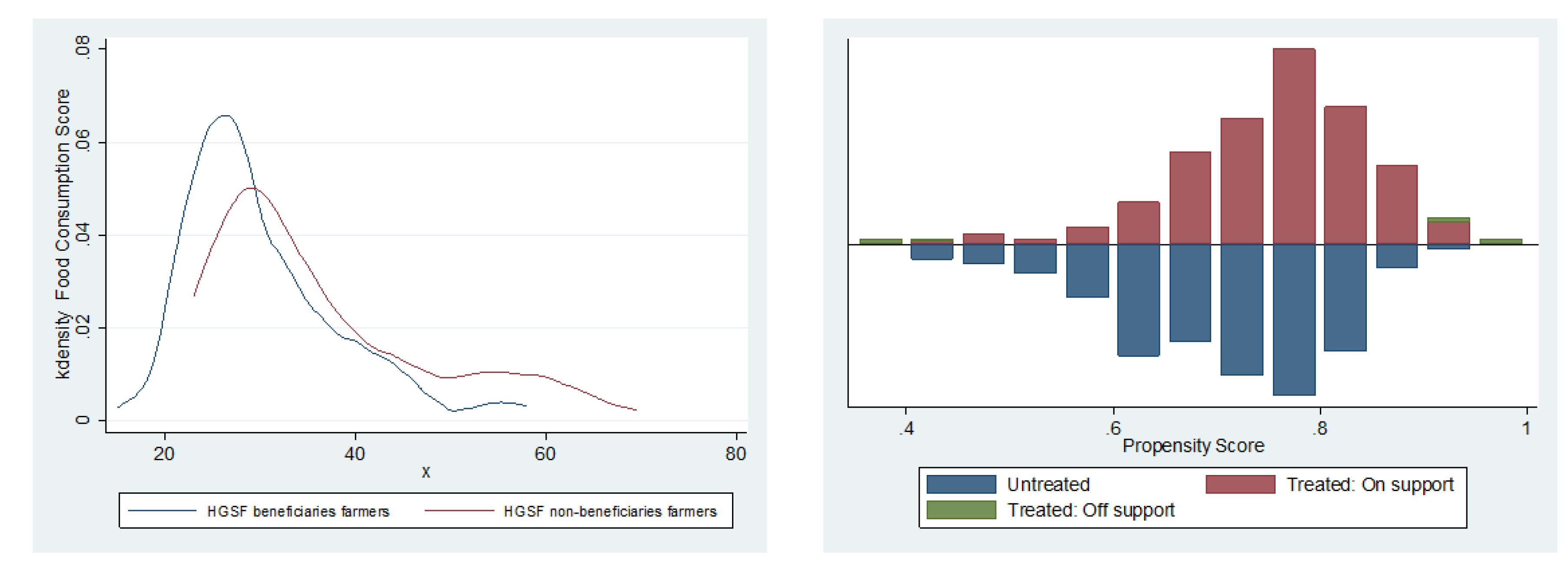
The result of treatment effect estimates on HGSF smallholders on their household food security using alternative estimation techniques are presented in Table 7 below. Columns 1, 2, and 3 present treatment effect results based on PSM, IPWRA, and ESR specifications. The results are robust across all estimation strategies, demonstrating the impact of HGSF on smallholder farmer household food security status. The results from all the three models show that the HGSF program has a positive effect on the food security status of smallholders, though the impact is heterogenous in respect to the approach. From Table 7, estimate of the PSM method (model 1) shows that farmers benefiting from the HGSF would have been 4.9 points worse off if they had not benefited from the program. When using the IPWRA specifications (model 2), the household food security status of smallholder farmers increases by 3.3 points for benefiting from HGSF. The ESR model (model 3), where we accounted for both observable and unobservable bias, indicates that a beneficiary smallholder farmer’s household food security status increases by 5.6 points more than if that same farmer had not benefited from the program. (see Appendix A1, A2 and Figure A1). The estimation produces different results because PSM produces bias estimates in the presence of misspecification in the model and the IPWRA remedies such misspecification bias using the double-robust property which ensures reliable estimation by accounting for misspecification both in the outcome and treatment model.
5. Discussion
The result was triangulated in our study using four different models to assess the impact of HGSF on smallholder farmers' household food security using alternative estimation techniques: Probit regression (dummy variable beneficiary and non-beneficiary), PSM, IPWRA, and ESR specifications. The results are robust to all estimation strategies and show a positive impact of HGSF on the food security status of smallholder households.
The results imply that the HGSF has created an avenue for linking smallholder farmers with caterers to create a readily available market (value chain) for farmers to sell their produce with limited losses due to perishability and fast return which in turn helps to improve their household food security status. This is in line with the findings of other authors [9,12,21,22,77], who found that farmers who collaborated with caterers to sell their goods saw an improvement in their household food security status. This implies that when farmers are linked to selling their produce to caterers, it creates a reliable market and reduces post-harvest losses usually encountered by smallholder farmers. Farmers’ linkage to caterers tends also to increase these farmers' household incomes and expenditures, improving their food security status. Several authors [31,32] reported that farmers with market links have a reliable market and are more commercialized, with significantly higher producer prices and household food security status than those without such linkages.
Furthermore, farmers selling vegetables to caterers under the HGSF have been shown to improve smallholder house food security status. When smallholder farmers have a market guarantee, they are more likely to produce and market non-staple perishable foods such as vegetables and legumes [16,78]. Similarly, farmers selling eggs to caterers has demonstrated to increase in their household food security status. The HGSF has improved smallholder farmers' income, livelihood and food security status by increasing the demand for vegetable products, cereals and other staple foods cultivated by the farmers [10,11]. For example, farmers in Indonesia reported having more opportunities to sell their products as a result of the HGSF's purchases [14].
The result of treatment effect estimates reveals that access to credit has been shown to improve the food security of smallholder farmer households. Making credit available to all participating farmers will thus provide them with funds to purchase needed farming incentives, resulting in improved smallholder household food security. This finding supports [79,80] who reported that smallholder farmers with access to credit can provide a variety of options for improving agricultural production, including access to inputs that can boost productivity and household food security. Furthermore, access to the extension has ensured higher food security. In support of this finding few authors [37,47,48,49], reported that access to extension service delivery improves smallholder farmers' household food security status.
6. Conclusions and implications
The research examined how HGSF impacted smallholder farmer households' food security in Northeastern Nigeria. Overall HGSF has a positive impact on smallholder farmers’ household food security status. The influence of HGSF, namely farmers selling vegetables to caterers and farmers selling eggs positively influences household food security. The implication of our findings is that a consistent and reliable market has been created for farmers to sell their products, thereby increasing their household income and food security. Thus, the better synergy between farmers and caterers will strengthen the supply chain relevant added value, which will provide a reliable market for the farmer to sell her or his product, thereby improving household food security.
The limitation of the study is of the missing baseline data on farmers' previous food security status and lack of other food security indicators such as household income food security indicators were our limitations in this study. Thus, to make better policy recommendations, it is critical to emphasize the need for a follow-up longitudinal study that considers the program's long-term viability and potential long-term impacts. To obtain more robust and reliable information, baseline data should be included in future studies. Baseline data may assist in better understanding the farmers' households' food security status in the areas before different programs are implemented in the future. As a support, a system of monitoring and supervision should be put in place to ensure the HGSF program's success. This intervention would have also practical benefits, since it will help to increase the percentage of smallholder farmers involvement in the program too.
Conflicts of interest The authors stated that there is no conflict of interest.
Appendix A

Table A1.
Endogenous switching regression results in the effect of HGSF on the household food security status.
Table A1.
Endogenous switching regression results in the effect of HGSF on the household food security status.
| Effect of HGSF on household food security | ||||||
|---|---|---|---|---|---|---|
| HGSF Status | HGSF beneficiaries | Non-beneficiaries | ||||
| Variables | Coef. | Std. Err. | Coef. | Std. Err. | Coef. | Std. Err. |
| Age | 0.022 | 0.022 | -0.386 | 0.196** | -0.156 | 0 .218 |
| Gender | -0.116 | 0.211 | 2.811 | 2.173 | -1.128 | 2.003 |
| Household size | 0.015 | 0.037 | 0.893 | 0.302*** | -0.591 | 0.389 |
| Years of experience | -0.015 | 0.022 | -0.085 | 0.191 | 0.210 | 0.220 |
| Education qualification | 0.619 | 0.079*** | ||||
| Access to input subsidy | -0.771 | 0.268*** | ||||
| Market information | 0.688 | 0.418* | ||||
| Constant | -3.127 | 0.852*** | 41.064 | 6.132*** | 45.647 | 5.997*** |
| /lns1 | 2.275 | 0.082*** | ||||
| /lns2 | 2.354 | 0.062*** | ||||
| /r1 | -0.695 | 0.223*** | ||||
| /r2 | 0.032 | 0.266 | ||||
| sigma_1 | 9.726 | 0. 805 | ||||
| sigma_2 | 10.531 | 0. 651 | ||||
| rho_1 | -0.601 | 0.142 | ||||
| rho_2 | 0. 032 | 0.265 | ||||
| Log-likelihood | -1000.408 | |||||
| Wald test χ 2 (4) | 4.67 | |||||
| LR test of independent equations χ 2 (1) 8.64*** | ||||||
*** 1% level of significance; **5% level of significance; *10% level of significance.
Table A2.
Average expected effect of HGSF on smallholder farmer household food security status; treatment and heterogeneity effects.
Table A2.
Average expected effect of HGSF on smallholder farmer household food security status; treatment and heterogeneity effects.
| Decision stage | |||
|---|---|---|---|
| Sub-samples | HGSF beneficiaries | Non-beneficiaries | Treatment effect |
| HGSF beneficiaries’ farmers | 39.853 (0.344) |
34.299 (0.319) |
TT= 5.554*** (0.476) |
| Non-beneficiaries’ farmers | 32.706 (0.340) |
31.741 (0.292) |
TU=0.965*** (0.964) |
| Heterogeneity effects | BH2=7.147 | BH1=2.558 | TH=4.589*** |
BHi: the effect of base heterogeneity for HGSF beneficiaries (i = 1), and Non-beneficiaries of HGSF (i = 0);.
Figure A1.
Kdensity estimate and propensity scores distribution between HGSF beneficiaries and non-beneficiaries smallholder farmers on their household food security status. Source Authors’ own elaboration.
Figure A1.
Kdensity estimate and propensity scores distribution between HGSF beneficiaries and non-beneficiaries smallholder farmers on their household food security status. Source Authors’ own elaboration.
References
- WFP (2019). School Feeding Programmes in 2019 report. www.wfp.org/publications/2019-wfp-school-feeding-infographic.
- FAO & WFP. (2018). Home-Grown School Feeding Resource Framework. Technical Document, Rome. 170 pp. www.fao.org/3/ca0957en/CA0957EN.pdf.
- FAO, FIDA & PMA (2015), El estado de la inseguridad alimentaria en el mundo: Cumplimiento de los objetivos internacionales para 2015 en relación con el hambre: balance de los desiguales progresos, Organización de las Naciones Unidas para la alimentación y la agricultura (FAO), Roma. https://www.fao.org/hunger/es/.
- WFP (2014). Improving links between smallholder farmers and school feeding programmes. purchase for progress (p4p) a ug u s t 2 0 1 4 august 2014 newsletter WFP267759.pdf.
- WFP (2020). State of School Feeding Worldwide 2020. Rome, World Food Programme. ISBN 978-92-95050-04-4. https://docs.wfp.org/api/documents/WFP-0000123923/download/.
- WFP & Anthrologica (2018). Bridging the Gap: Engaging Adolescents for Nutrition, Health and Sustainable Development. A multi country study. https://bit.ly/2z7489K.
- WFP (2021). Homegrown school feeding, 46 countries have WFP-supported homegrown school feeding programmes. Home grown school feeding | World Food Programme (wfp.org).
- Sumberg, J. & Sabates-Wheeler, R. (2011). Linking agricultural development to school feeding in Sub-Saharan Africa: Theoretical perspectives. Food Policy 36(3): 341–349. [CrossRef]
- Masset, E., Gelli, A. (2013). Improving community development by linking agriculture, nutrition and education: design of a randomised trial of "homegrown" school feeding in Mali. Trials 14, 55. [CrossRef]
- Soares, P. Martinelli, S.S., Melgarejo, L., Cavalli, S.B., and Davó-Blanes, M.C. (2017) Using local family farm products for school feeding programmes: effect on school menus, British Food Journal, 119 (6):1289-1300,. [CrossRef]
- Singh, S., Fernandes, M. (2018). Home-grown school feeding: promoting local production systems diversification through nutrition sensitive agriculture. Food Sec. 10:111–119. [CrossRef]
- Zenebe, M., Gebremedhin, S., Henry, C. J., and Regassa, N. (2018). School feeding program has resulted in improved dietary diversity, nutritional status and class attendance of school children. Italian Journal of Pediatrics, 44(1), 16. [CrossRef]
- Metwally A. M., El-Sonbaty, M.M., El Etreby, L. A., El-Din, E. M. S., N. Abdel Hamid., H. A. Hussien., A. M. Hassanin., Z. M. Monir (2020). Impact of National Egyptian school feeding program on growth, development, and school achievement of school children. World Journal of Pediatrics 16, 393–400. [CrossRef]
- Sabates-Wheeler. R., Devereux, S., and Hodges, A. (2009). Taking the Long View: What Does a Child Focus Add to Social Protection? 40(1), 109–119. [CrossRef]
- Bundy, D. A., de Silva, N., Horton, S., Jamison, D., and Patton, G.C., 2018. Optimising Education Outcomes: High-Return Investments in School Health for Increased Participation and Learning, World Bank, Washington, DC, USA. Available at http://dcp-3.org/sites/default/files/resources/DCP3%20Education%20Edition_Final.pdf.
- Joshi, P. K., Joshi, L., & Birthal, B. S. (2006). Diversification and its impact on smallholders: evidence from a study on vegetable production. Agricultural Economics Research Review, 19. [CrossRef]
- UNICEF (2020). An estimated 10.4 million children in the Democratic Republic of the Congo, northeast Nigeria, the Central Sahel, South Sudan and Yemen will suffer from acute malnutrition in 2021. Impact evaluation report 2020 https://www.unicef.org/turkiye/en/press-releases/estimated-104-million-children-democratic-republic-congo-northeast-nigeria-central.
- Adelaja, A. and George, J. (2019). Effects of conflict on agriculture: Evidence from the Boko Haram insurgency. World Development, 117, 184–195. [CrossRef]
- NHGSFP (2017). Nigeria Home Grown School Feeding Strategic Plan 2016-2020 report nig169078.pdf (fao.org).
- AUDA-NEPAD (2020). African Union Development Agency. Home Grown School Feeding (HGSF) Handbook. Lessons from Botswana, Ghana and Nigeria. ISBN: 978-1-928527-25-1 https://www.nepad.org/publication/home-grown-school-feeding-handbook.
- Mensah, C. (2019). Incentivising smallholder farmer livelihoods and constructing food security through homegrown school feeding: evidence from Northern Ghana. Brazilian Journal of International Law 15(3) 490-504. [CrossRef]
- Fortes A. R., Ferreira. V., Simões. E.B., Baptista, I., Grando, S. and Sequeira, E. (2020). Food Systems and Food Security: The Role of Small Farms and Small Food Businesses in Santiago Island, Cabo Verde. Agriculture 10, 216; [CrossRef]
- Weiss, C. H. (1995). Nothing as practical as good theory: exploring theory-based evaluation for comprehensive community initiatives for children and families. In J. P. Connell, A. C. Kubisch, L. B. S., & C. H. Weiss (Eds.), New approaches to evaluating community initiatives: Concepts, methods, and contexts. Washington DC: Aspen Institute.
- Saint Ville, A., Hickey, G. M., Rouwette, E., Samuels, A., Guariguata, L., Unwin, N., & Phillip, L. E. (2022). A Combined Theory of Change-Group Model Building Approach to Evaluating “Farm to Fork” Models for School Feeding in the Caribbean, Front. Sustain. Food Syst. 6:801731. [CrossRef]
- Ratcliffe, M. M. (2012). A sample theory-based logic model to improve program development, implementation, and sustainability of farm to school programs. Childhood Obesity (Formerly Obesity and Weight Management), 8(4), 315-322. [CrossRef]
- Ajzen, I. (1991). The theory of planned behavior. 50(2), 179–211. [CrossRef]
- Espejo, F., Burbano, C., Galliano, E. (2009). Home Grown School Feeding: A Framework to Link School Feeding with Local Agricultural Production. ISBN: WFPWFP261 World Food Programme, Rome. https://wfp.tind.io/record/7264?ln=en.
- Morgan, K., Bastia, T., Kanemasu, T., (2007). Home Grown: The New Era of School Feeding. [Project Report]. Rome: World Food Programme. https://orca.cardiff.ac.uk/id/eprint/24443.
- Corsi, S., Marchisio, L. V., & Orsi, L. (2017). Connecting smallholder farmers to local markets: Drivers of collective action, land tenure and food security in East Chad. Land Use Policy, 68, 39–47. [CrossRef]
- Devereux, S. (2016). Social protection for enhanced food security in sub-Saharan Africa Food Policy 60, 52–62. [CrossRef]
- Kissoly, L., Faße, A. & Grote, U. (2017). The integration of smallholders in agricultural value chain activities and food security: evidence from rural Tanzania. Food Sec. 9, 1219–1235. [CrossRef]
- Herrmann, R., Nkonya, E. & Faße, A. (2018). Food value chain linkages and household food security in Tanzania. Food Sec. 10, 827–839. [CrossRef]
- Geday, E.A., Degefa, T., Martine, P. and Etienne, M. (2016). Food Security and Nutrition Impacts of Smallholder Farmers' Participation in Dairy Value Chain in Ethiopia. Journal of International Business and Economics 16 (2), 21-38. [CrossRef]
- Maziya, M., Mudhara, M. and Chitja, J. (2017). What factors determine household food security among smallholder farmers? Insights from Msinga, KwaZulu-Natal, South Africa, Agrekon, 56:1, 40-52. [CrossRef]
- Salazar, L., Aramburu, J., González-Flores, M. & Winters, P. (2016). Sowing for food security: A case study of smallholder farmers in Bolivia. Food Policy 65, 32–5233. [CrossRef]
- Danso-Abbeam, G., Ehiakpor, D.S. and Aidoo, R. (2018). Agricultural extension and its effects on farm productivity and income: insight from Northern Ghana. Agric and Food Security 7:74. [CrossRef]
- Ogunniyi, A. I., Omotoso, S. O., Salman, K. K., Omotayo, A. O., Olagunju, K. O., & Aremu, A. O. (2021). Socioeconomic Drivers of Food Security among Rural Households in Nigeria: Evidence from Smallholder Maize Farmers. Social Indicators Research, 155(2), 583–599. [CrossRef]
- Wossen, T., Berger, T., Haile, M. G. & Troost, C. (2018). Impacts of climate variability and food price volatility on household income and food security of farm households in East and West Africa Agricultural Systems 163, 7–15. [CrossRef]
- Gelli, A., Masset, E., Folson, G. et al. (2016). Evaluation of alternative school feeding models on nutrition, education, agriculture and other social outcomes in Ghana: rationale, randomised design and baseline data. Trials 17, 37. [CrossRef]
- Afridi F., Bidisha, B. and Rohini, S. (2014). School meals and classroom effort: Evidence from India. Mimeo. https://ssrn.com/abstract=3457671.
- Abdullah, D. Z., Tariq S., Sajjad A., Waqar A., Izhar, U.D and Aasir I. (2019). Factors affecting household food security in rural northern hinterland of Pakistan. Journal of the Saudi Society of Agricultural Sciences 18, 201–210. [CrossRef]
- Mustapha, M., Kamaruddin, R.B. and Dewi, S. (2018). Factors affecting rural farming households’ food security status in Kano, Nigeria. International journal of management research & reviews IJMRR [online]. [S.I.]: SatyaDham Foundation, 2018, 8(9), 1 [retrieved 2023-05-08]. ISSN 2249-7196.
- Oduniyi, O.S., and Tekana, S.S. (2020). Status and Socioeconomic Determinants of Farming Households' Food Security in Ngaka Modiri Molema District, South Africa, Social Indicators Research 149, 719–732. [CrossRef]
- Alpízar., F., Saborío-Rodríguez., M., Martínez-Rodríguez., R., Viguera, B., Vignola, R. Capitán, T. and Harvey, C. A. (2020). Determinants of food insecurity among smallholder farmer households in Central America: recurrent versus extreme weather-driven events. Regional Environmental Change 20: 22. [CrossRef]
- Milazzo, A. van de Walle, D. (2015). Women Left Behind? Poverty and Headship in Africa. Policy Research Working Paper; No. 7331. World Bank, Washington, DC. © World Bank. License: CC BY 3.0 IGO. https://openknowledge.worldbank.org/handle/10986/22212.
- Ogundari, K. (2014). The Paradigm of Agricultural Efficiency and its Implication on Food Security in Africa: What Does Meta-Analysis Reveal, World Development 64, 690–702. [CrossRef]
- Kehinde A.D., Adeyemo, R. and Ogundeji, A.A. (2021). Does social capital improve farm productivity and food security? Evidence from cocoa-based farming households in Southwestern Nigeria, Heliyon 7, e06592. [CrossRef]
- Gebru, G. W., Ichoku, H. E., & Phil-Eze, P. O. (2020). Determinants of smallholder farmers’ adoption of adaptation strategies to climate change in Eastern Tigray National Regional State of Ethiopia. Heliyon, 6(7), e04356. [CrossRef]
- Mango, N., Zamasiya, B., Makate, C., Nyikahadzoi, K., and Siziba, S. (2014). Factors influencing household food security among smallholder farmers in the Mudzi district of Zimbabwe, Development Southern Africa, 31:(4) 625-640,. [CrossRef]
- Nyikahadzoi, K., Siziba, S., Mango, N., Mapfumo, P., Adekunhle, A. and Fatunbi, O. (2012). Creating food self-reliance among the smallholder farmers of eastern Zimbabwe: exploring the role of integrated agricultural research for development. Food Sec. 4, 647–656. [CrossRef]
- Bacon, C.M. (2015). Food sovereignty, food security and fair trade: the case of an influential Nicaraguan smallholder cooperative, Third World Quarterly, 36 (3), 469-488 https://10.1080/01436597.2015.1002991.
- National Bureau of Statistics. (2021). Nigerian Gross Domestic Product Report (Expenditure and Income Approach) (Q1, Q2, Q3, & Q4 2020) www.nigerianstat.gov.ng.
- UNICEF, (2019). Futures of 370 million Children in Jeopardy as School Closures Deprive them of School Meals. Available online at: https://www.unicef.org/press-releases/futures-370-million-children-jeopardy-school-closures-deprive-them-school-meals.
- National Bureau of Statistics. (2020). Nigeria in 2019: Economic review and 2017-2019 outlook. Retrieved from https://www.nbs.org/.
- Stoddard, A., Harvey, P., Czwarno, M., Breckenridge, M.-J. (2020). Humanitarian access SCORE report: northeast Nigeria. Survey on the coverage, operational reach, and effectiveness of humanitarian aid. Humanitarian Outcomes. https://www.humanitarianoutcomes.org/.
- Hertzog, M. A. (2008). Considerations in determining sample size for pilot studies. Research in Nursing and Health 31, 180-191. [CrossRef]
- Heckman, J.J., Ichimura, H. and Todd, P.E. (1997). Matching as an econometric evaluation estimator: evidence from evaluating a job training programme, Review of Economic Studies, 64 (4), 605-654. [CrossRef]
- Wadud, A. (2013). Impact of microcredit on agricultural farm performance and food security in Bangladesh, Working Paper No. 14, Institute of Microfinance (InM), Newcastle, February. Pp 1-33. https://www.findevgateway.org/sites/default/files/publications/files/mfg-en-paper-impact-of-microcredit-on-agricultural-farm-performance-and-food-security-in-bangladesh-feb-2013.pdf.
- Wooldridge, J.M. (2010). Econometric Analysis of Cross Section and Panel Data, second edition. ISBN 978-0-262-23258-6. https://books.google.cz/books?hl=en&lr=&id=hSs3AgAAQB.
- Maddalla, G.S. (1983). Limited Dependent and Qualitative Variables in Econometrics. Cambridge University press, Cambridge, UK. https://books.google.cz/books?hl=en&lr=&id=-Ji1ZaUg7gcC&oi=fnd&pg=PR11&dq=Maddalla,+G.S.+(1983).
- Guo, S., Fraser., M., Chen, Q. (2020). Propensity Score Analysis: Recent Debate and Discussion. Journal of the Society for Social Work and Research, 11(3), 463-482 . [CrossRef]
- Peel, M.J. (2018). Addressing Unobserved Selection Bias in Accounting Studies: The Bias Minimization Method, European Accounting Review, 27 (1), 173-183, . [CrossRef]
- Imbens, G. W., and Wooldridge J.M. (2009). Recent Developments in the Econometrics of Program Evaluation. Journal of Economic Literature, 47 (1) 5-86. https://10.1257/jel.47.1.5.
- Rosenbaum, P.R. and Rubin, B.D. (1985). Constructing a control group using multivariate matched sampling methods that incorporate the propensity score, The American Statistician, 39 (1), 33-38. [CrossRef]
- Robins, J., Sued, M., Lei-Gomez, Q., & Rotnitzky, A. (2007). Comment: Performance of Double-Robust Estimators When "Inverse Probability" Weights Are Highly Variable. Statistical Science, 22(4), 544–559. [CrossRef]
- Wooldridge, J.M. (2007). Inverse probability weighted estimation for general missing data problems., 141(2), 1281–1301. [CrossRef]
- Wossen, T., Abdoulaye, T., Alene, A., Haile, M.G., Feleke, S., Olanrewaju, A., Manyong, V. (2017). Impacts of extension access and cooperative membership on technology adoption and household welfare, Journal of Rural Studies 54, 223-233. [CrossRef]
- Bidzakin, J.K., Fialor, S.C., Awunyo-Vitor, D. & Yahaya, I. (2019). Impact of contract farming on rice farm performance: Endogenous switching regression, Cogent Economics & Finance, 7: 1618229. [CrossRef]
- Shiferaw, B., Hellin, J., Muricho, G., (2011). Improving market access and agricultural productivity growth in Africa: what role for producer organizations and collective action institutions. Food Sec. 3: 475-489. [CrossRef]
- Ma, W. & Abdulai, A. (2016). Does cooperative membership improve household welfare? Evidence from apple farmers in China, Food Policy 58, 94–102. [CrossRef]
- Adjin, K. C., Goundan, A., Henning, C. H. C. A. and Sarr, S. (2020). Estimating the impact of agricultural cooperatives in Senegal: Propensity score matching and endogenous switching regression analysis, (Working Papers of Agricultural Policy, No. WP2020-10) http://hdl.handle.net/10419/235900.
- Heckman, J. J. (2001). Micro Data, Heterogeneity, and the Evaluation of Public Policy: Nobel Lecture. Journal of Political Economy, 109(4), 673–748. [CrossRef]
- Leroy JL, Ruel M, Frongillo EA, Harris J, Ballard TJ. (2015). Measuring the food Access Dimension of food Security: A Critical Review and Mapping of indicators. Food and Nutrition Bulletin 36 (2), 167-195. [CrossRef]
- WFP (2006). Vulnerability Analysis and Mapping Branch (ODAV) Picture: WFP/Andrea Berardo. http://www.wfp.org/odan/senac.
- World bank group (2021) Poverty and equity brief, African western and central Nigeria report. https://www.worldbank.org/en/topic/poverty/publication/poverty-and-equity-briefs.
- Montalbano, P., Pietrellib, R. and Salvatici, L. (2018). Participation in the market chain and food security: The case of the Ugandan maize farmers. Food policy 76, 81-98. [CrossRef]
- IFAD. (2014) Investing in smallholder family agriculture for global food security and nutrition. IFAD post-2015 Policy Brief 3. Rome: IFAD https://www.ifad.org/documents/38714170/39135645/IFAD+Policy+brief+3+-++Investing+in+smallholder+family+agriculture+for+global+food+security+and+nutrition.pdf/f81a75f1-854f-4b79-b569-d5b8566ca2fe.
- Jimi, N.A., Nikolov, P.V., Malek, M.A. et al. (2019). The effects of access to credit on productivity: separating technological changes from changes in technical efficiency. J Prod Anal 52, 37–55. [CrossRef]
- Bocher, T.F., Alemu, B.A. and Kelbore, Z.G. (2017). Does access to credit improve household welfare? Evidence from Ethiopia using endogenous regime switching regression, African Journal of Economic and Management Studies, 8 (1) 51-65. [CrossRef]
Figure 1.
Conceptual framework Source: Authors illustration, (2022).
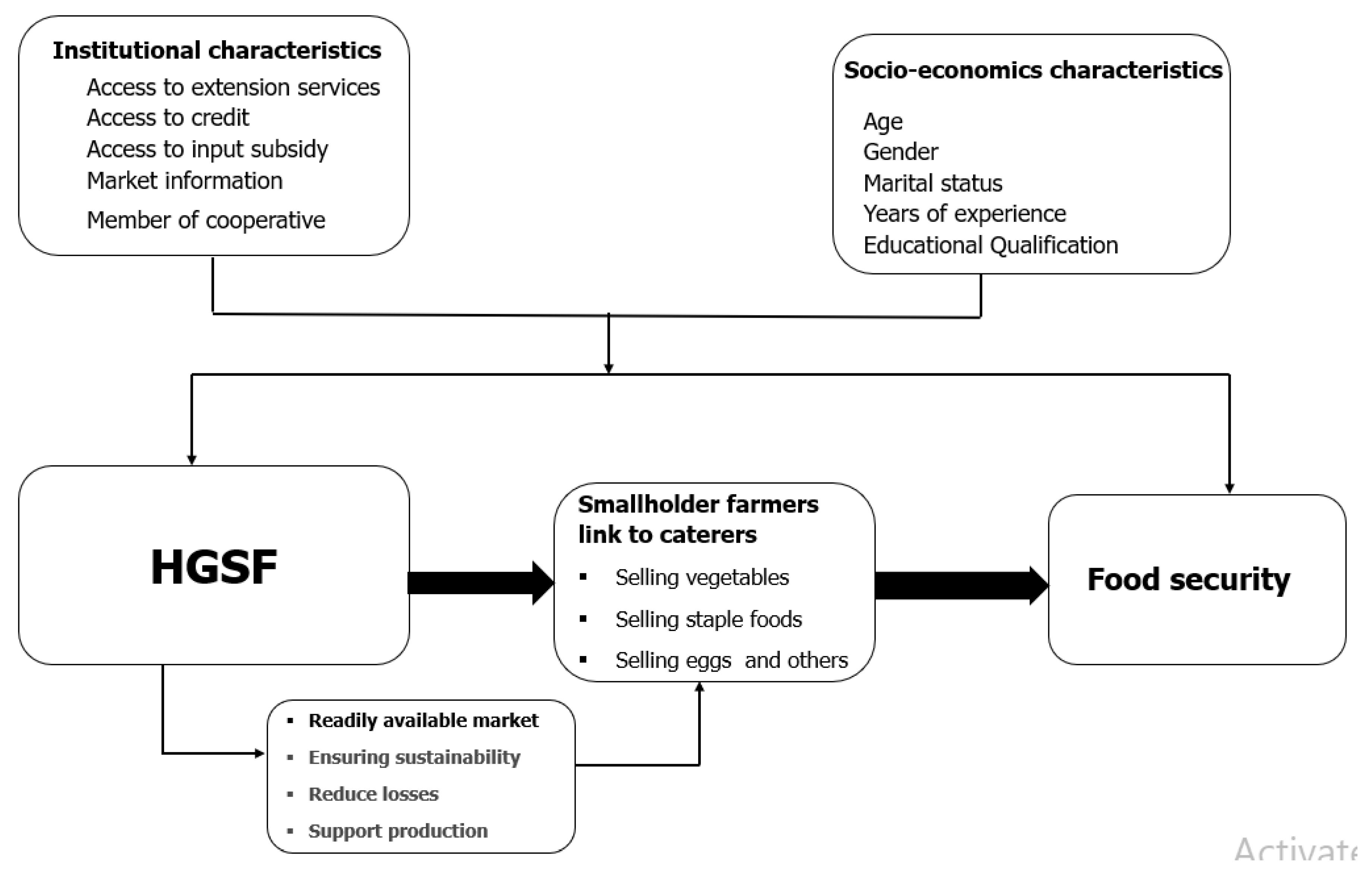
Figure 2.
The study area (Author, 2021).
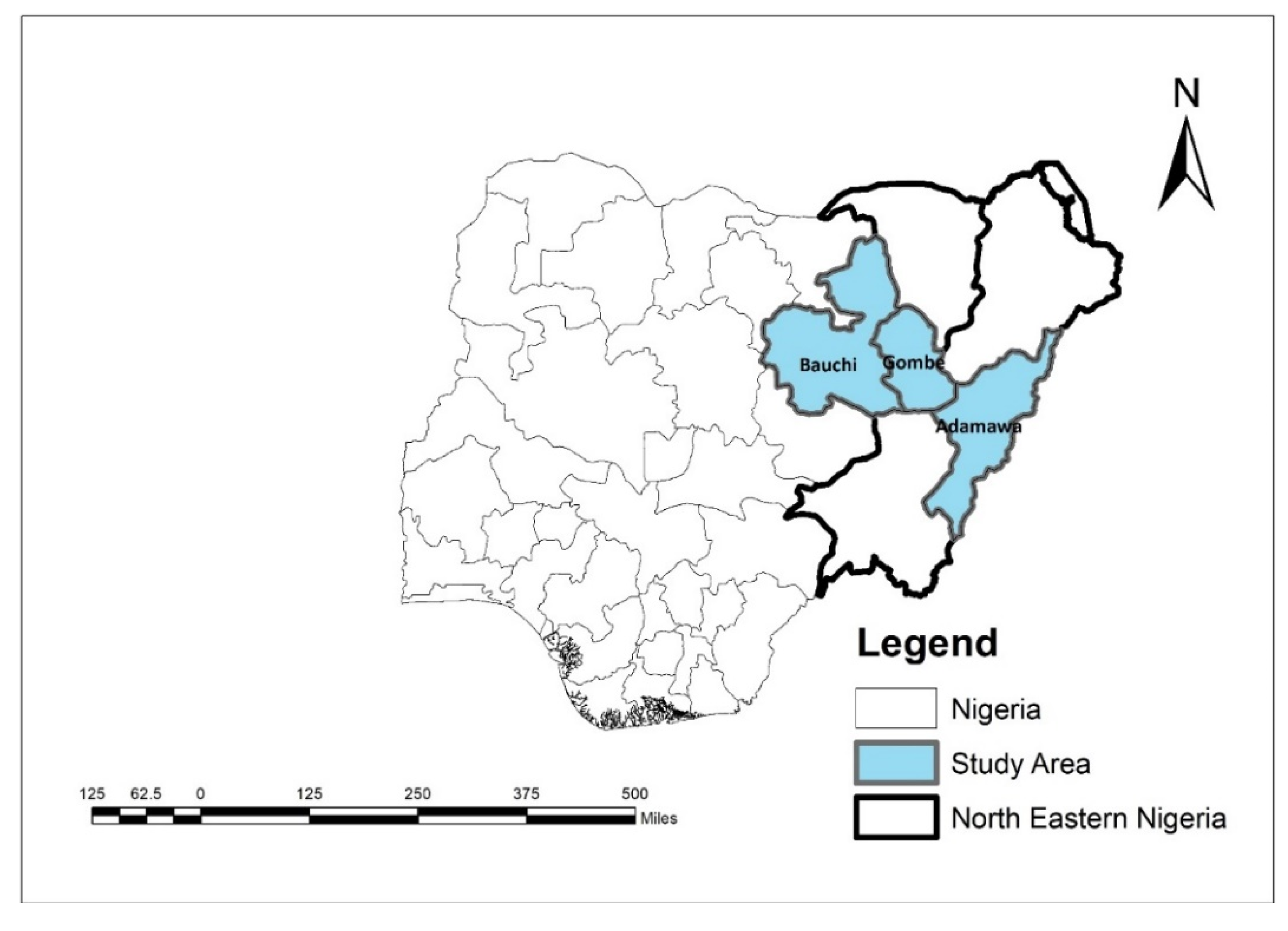
Table 1.
Sample Selection.
| State | LGAs | Wards | Beneficiary farmers | Non-beneficiary farmers |
|---|---|---|---|---|
| Adamawa | Yola north | 5 | 11 | 10 |
| Demsa | 5 | 10 | 9 | |
| Numan | 5 | 11 | 10 | |
| Mayo -Belwa | 5 | 10 | 9 | |
| Bauchi | Alkaleri | 5 | 10 | 9 |
| Bauchi | 5 | 11 | 10 | |
| Dass | 5 | 10 | 9 | |
| Katagum | 5 | 11 | 10 | |
| Gombe | Akko | 5 | 11 | 10 |
| Billiri | 5 | 10 | 9 | |
| Gombe | 5 | 11 | 10 | |
| Bajoga | 5 | 10 | 9 | |
| Total | 12 | 60 | 126 | 114 |
LGA – Local governmental area.
Table 2.
Conditional Expectations, Treatment, and Heterogeneity Effects.
| Decision stage | |||
|---|---|---|---|
| Sub-samples | Beneficiaries | Non-beneficiaries | Treatment effects |
| Beneficiaries’ farmers | (a) E(Y₁ᵢ|Tᵢ = 1) | (c) E(Y₂ᵢ|Tᵢ = 1) | ATT |
| Non-beneficiaries’ farmers | (d) E(Y₁ᵢ|Tᵢ = 0) | (b) E(Y₂ᵢ|Tᵢ = 0) | ATU |
| Heterogeneity effects | BH1 | BH2 | TH |
Note:(a) and (b) represent observed expected farmers' benefiting the HGSF ;(c) and (d) represent counterfactual expected farmers' not benefiting the HGSF.
Table 3.
Summary statistics of dependent, independent and treatment variables (n = 240).
| Variables | Description and measurement | Mean | Std. Dev. | |
|---|---|---|---|---|
| Dependent variable | ||||
| Food security indicators | ||||
| Food consumption score | 0 = poor and borderline (up to 35), 1 = acceptable (>35) | 0.30 | 0.46 | |
| Independent Variables | ||||
| Household head characteristics | ||||
| Age | Age of household head (years) | 42.09 | 8.48 | |
| Gender | Male= 1, Female = 0 | 0.67 | 0.47 | |
| Marital status | Married = 1, unmarried = 0 | 0.89 | 0.31 | |
| Years of experience | Farming experience in years | 17.67 | 8.91 | |
| Educational Qualification | Quranic Edu. = 1, primary = 2, secondary = 3, NCE = 4, graduate = 5, postgraduate = 6 | 2.83 | 1.44 | |
| Household characteristics | ||||
| Household size | The household size in numbers | 7.94 | 3.88 | |
| Households with children benefiting from SFP | Yes = 1 No = 0 | 0.61 | 0.49 | |
| Homegrown school feeding program | ||||
| HGSF program | Beneficiary farmers = 1 non-beneficiary =0 | 0.53 | 0.50 | |
| Institutional variables | ||||
| Access to extension services | Yes = 1 No = 0 | 0.18 | 0.38 | |
| Access to credit | Yes = 1 No = 0 | 0.45 | 0 .50 | |
| Access to input subsidy | Yes = 1 No = 0 | 0.24 | 0.42 | |
| Market information | Yes = 1 No = 0 | 0.03 | 0.16 | |
| Member of cooperative | Yes = 1 No = 0 | 0.21 | 0.14 | |
NCE: National Certificate of Education, HGSF: Home-Grown School Feeding Program, SFP: School Feeding Program.
Table 4.
Socio-demographic and institutional between the beneficiary and non-beneficiary farmers.
| Beneficiary farmers (n=126) | Non-beneficiary farmers (n=114) | Mean difference | t-statistics | |
|---|---|---|---|---|
| Variables | Mean ± S.D. | Mean ± SD | ||
| Age of farmers | 41.98 (8.77) | 42.20 (8.19) | -0.22 | 0.20 |
| Gender | 0.65 (0.48) | 0.69 (0.46) | -0.04 | 0.69 |
| Marital status | 0.86 (0.35) | 0.93 (0.35) | -0.07 | 1.81 |
| Household size | 7.71 (3.82) | 8.19 (3.95) | -0.48 | 0.95 |
| Years of farming experience | 17.38 (9.03) | 17.98 (8.80) | -0.60 | 0.52 |
| Educational Qualification | 3.23 (1.50) | 2.40 (1.23) | 0.83*** | 4.69 |
| HH Children benefiting SFP | 0.56 (0.50) | 0.66 (0.48) | -0.10 | 1.496 |
| Access to credit | 0.75 (0.43) | 0.12 (0.32) | 0.63*** | 12.616 |
| Access to extension services | 0.21 (0.41) | 0.14 (0.36) | 0.07 | 1.153 |
| Access to input subsidy | 0.18 (0.38) | 0.30 (0.46) | -0.12** | 2.242 |
| Market information | 0.02 (0.15) | 0.03 (0.16) | -0.01 | 0.123 |
| Cooperative membership | 0.02 (0.15) | 0.02 (0.13) | 0.00 | 0.338 |
| FCS (Household) | 36.88 (11.55) | 29.64 (7.56) | 7.24*** | 5.682 |
Source: Own survey 2021, *** 1% level of significance; **5% level of significance; *10% level of significance. Standard deviations are reported in parentheses. FCS: Food consumption score, SFP: School feeding programme
Table 5.
Food Security Status of the Farming Household.
| FCS | Profile | Beneficiary farmers % (n = 126) | Non-beneficiary farmers% (n = 114) |
|---|---|---|---|
| - 21 | Poor | 0.5 | 9.26 |
| 21.5-35 | Borderline | 60.32 | 70.56 |
| >35 | Acceptable | 39.18 | 20.18 |
re reported in parentheses. FCS .
Table 6.
Factors affecting the level of food security – results of binary probit model.
| Variable | Marginal effect | Std. Err. |
|---|---|---|
| Social safety net program | ||
| HGSF status | 0.404*** | 0.087 |
| Household head characteristics | ||
| Age | -0.008* | 0.004 |
| Gender | 0.002 | 0.044 |
| Marital status | -0.016 | 0.065 |
| Years of farming experience | 0.003 | 0.004 |
| Educational Qualification | 0.022 | 0.019 |
| Household characteristic | ||
| Household size | 0.010 | 0.007 |
| Households with children benefiting SFP | 0.022 | 0.043 |
| Institutional characteristic | ||
| Access to credit | 0.270*** | 0.087 |
| Extension service delivery | 0.063* | 0.065 |
| Input subsidy | 0.101 | 0.066 |
| Market information | 0.289 | 0.338 |
| Number of observations | 240 | |
| Constant | 4.348 | |
| LR chi2 | 52.56 | |
| Pseudo R2 | 0.251 | |
| Prob > chi2 | 0.000 | |
Statistical significance: * = 10% level ** =5% level *** = 1% level. HGSF: Home-Grown School Feeding Program, SFP: School Feeding Program .
Table 7.
Effect of HGSF on smallholder farmer household food security status.
| Variables | Average treatment effect on the treated (ATT) | |||||
|---|---|---|---|---|---|---|
| PSM | IPWRA | ESR | ||||
| 1 | 2 | 3 | ||||
| HGSF | 4.931** | 3.258** | 5.554*** | |||
| (1.997) | (1.582) | (0.476) | ||||
| N | 240 | 240 | 240 | |||
PSM: Propensity score matching, IPWRA: Inverse probability weighted adjusted regression, ESR: Endogenous switching regression, ATT: average treatment effect on the treated, FCS: Food consumption score, Robust standard errors are reported in parentheses, α level of significance; 0.01 = ***; 0.05 = **; 0.1 = *. Source: Authors' estimations.
Disclaimer/Publisher’s Note: The statements, opinions and data contained in all publications are solely those of the individual author(s) and contributor(s) and not of MDPI and/or the editor(s). MDPI and/or the editor(s) disclaim responsibility for any injury to people or property resulting from any ideas, methods, instructions or products referred to in the content. |
© 2024 by the authors. Licensee MDPI, Basel, Switzerland. This article is an open access article distributed under the terms and conditions of the Creative Commons Attribution (CC BY) license (https://creativecommons.org/licenses/by/4.0/).
Copyright: This open access article is published under a Creative Commons CC BY 4.0 license, which permit the free download, distribution, and reuse, provided that the author and preprint are cited in any reuse.


