

Submitted:
29 May 2023
Posted:
30 May 2023
Read the latest preprint version here
Abstract
Regional organisations (ROs) are important in that they can enable states in their regions to pros-per and develop for improvement. Interest here lies in the European Union (EU) and the Associa-tion of South East Asian Nations (ASEAN). Their political development involves complex process-es for collective actions involving ingroup member RO states. To explore development, we firstly examine the rise of both the EU and ASEAN. The literature gives some attention to the behaviour-alist political approach to explain developmental differences using social organisation theory, often in terms of the Gemeinschaft-Gesellschaft paradigm of Tönnies. However, here we adopt a social psychology approach that distinguishes between operative structure (which directly determines behaviour), and substructure (housing normative personality deemed to be responsible for behav-ioural imperatives). This enables a relationship to be made between the Tönnies paradigm and the Collectivism-Individualism paradigm of Triandis. The theoretical approach adopted involves a complex adaptive systems model deriving from metacybernetics, and this also delivers Mindset Agency Theory as a qualitative methodology. Consistent with the general view, it is shown that the EU is more or less a coherent rational organisation, while ASEAN is more idealistic delivering pragmatic paradox. In particular, ASEAN is frequently descried as an organisation with contra-dictions, and for this reason its pathologies are explored in some detail
Keywords:
Regional organisations
; Gemeinschaft-Gesellschaft
; Collectivism-Individualism
; Cultural Agency Theory
; metacybernetics
; political development
; social psychology
; Mindset Agency Theory
; normative personality
; EU
; ASEAN
1. Introduction
This paper is interested in regional organisations (ROs) and their ability to efficaciously satisfy their mission, something that should shape their cognitive and behavioural orientation. Following Alagappa [1], ROs are agencies that adopt regional approaches. As agencies, they have a population of nation state members that create its population of agents, and which are therefore collectively responsible for its existence. ROs ideally promote a shared identity and purpose, combined with the creation and implementation of institutions manifesting regional identity and shaping activity within that particular region [2]. The institutions in this context are organisations that have specific role functionality, norms and expectations, where the application of functions through actor interactions is intended to meet perceived RO needs. They in particular provide specific regulative and normative structures that shape and constrain individual behaviour [3]. To engender a degree of success in satisfying RO mission requirements, there is a need to recognise and appropriately respond to the complex dynamic processes involved. The agents of an RO interact and have relationships that both affect and are shaped by the agency system, and which in turn impacts the potential for both its development and that of its agents.
ROs may be defined in terms of the degree of integration and cooperation among governments or non-governmental institutions in three or more geographically proximate and interdependent countries for the mutual gain of its membership in one or more issue-areas. Regional integration is largely dependent on the ability of an RO to broker and forge convergence among its agent member states [4], and for Kelly [5] this hinges on the degree of heterogeneity in its population of actors. It also depends on cooperation [6], this being a function of strategic substructural regulations from which arise the structural rules that agents should abide by, and which can, in turn, shape the development of regional integration. The rules determine the nature of structural control and decision-making, and this influences the organisation‘s ability to cooperate and shape its future. The relationship between substructure and structure is that the former influences the latter by providing basic influences on behaviour and its expression. The structure influences the substructure through an inherent framework through which acquired agency experience is interpreted.
The advantages to a region in forming an RO are described by De Lombaerde ( [7]: 77) who says that “regional integration processes are complex social processes [that involve economic, political and social variables [8]; they are expressions of worldwide and long-term trends towards larger scales and higher levels of mobility in human activity, and – it is believed – they have the potential to generate higher levels of growth and welfare and thus to contribute to poverty reduction.” Strictly speaking, our interest lies in intergovernmental relationships in ROs, and these are sometimes referred to as Formal Intergovernmental Organisations (FIGO), which constitute a subset of ROs. FIGOs are entities which have been created with sufficient organisational structure and autonomy to enable formal and ongoing multilateral processes of decision-making between states, together with the capacity to take action on the collective will of their member states (as agents) to satisfy common objectives [9], a notion summarised by the term collective action. However, a question arises concerning the nature of sufficiency (i.e., the ability to meet the needs of a situation) in organisational structure and autonomy. Now, structure, autonomy, and substructure through, for instance, culture, deliver parameters that, only under analysis, can determine whether there is sufficiency, thus leading to uncertainty about whether an RO can be classed as a FOGO. For this reason, we shall adopt the more frequently used term RO in addressing the theme of this paper. When referring to structure we mean that which has been arranged in a definite pattern of organisation, and where culture can be generally defined as the characteristic features of everyday existence. However, autonomy is more complex. Reflecting on Aguilera’s [10] idea of autonomy, consider an agency that has open exposure to rich interactive environmental contexts that are constantly changing and evolving. An agency is autonomous when it can change how it interacts with its environmental contexts as it develops patterns of behaviour that (like regulations and their manifestation as behavioural rules) are not constructed endogenously, but are rather a consequence of emergence from the interactions that occur between agency’s endogenous and exogenous flows of self-organisational processes. Within the political context, this compares with the notion of sovereignty, which concerns the mechanisms and processes of agencies concerning their endogenous and authoritative self-control in their rich contextual environment.
It has already been indicated that the primary purpose of this paper is to explore RO efficacy in mission servicing, where a mission is an expression of purpose and aspiration. This involves an appreciation of the RO social organisation and the substructural attributes that form it. Firth ( [11]: 1) explains that social organisation is a dynamic concept with both a narrow and broad context: “In a narrow context, organisation implies a systematic ordering of positions and duties which defines a chain of command and makes possible the administrative integration of specialized functions towards a recognized limited goal. In a broader context, it implies a diversity of the ends and activities of individuals in society, a pattern for their co-ordination in some particular sphere, and specific integration of them there by processes of choice and decision into a coherent system, to yield some envisaged result. It can be phrased again as that continuous set of operations in a field of social action which conduces to the control and combination of elements of action into a system by choice and limitation of their relations to any given ends.” The substructure is responsible for the pattern that has emerged.
Satisfying the primary purpose requires a secondary purpose, which is to explore ROs pragmatically, this calling on a case study approach, which is “particularly useful to employ when there is a need to obtain an in-depth appreciation of an issue, event or phenomenon of interest, in its natural real-life context” ( [12]: 1), where theory and any capacity for mensuration underpin the design, selection, conduct and interpretation of case studies. The two cases we shall adopt are the Association of South East Asian Nations (ASEAN), and the European Union (EU) to illustrate social organisation differences and consequently political nature. To obtain an initial sense of an RO, it is always useful to look at its mission. The EU's mission is to enable people in its region to realise their full potential and create lasting improvement in the economy and quality of life for everybody, wherever they live, this being underpinned by its values of human dignity, freedom, democracy, equality, rule of law, and human rights [13]. The mission of ASEAN is to maintain political security in its community, and to provide for its well-integrated economics and a socioculture that enhances the quality of life among the citizens of its member states [14]. These are underpinned by its values, which may be identified as “respect, peace and security, prosperity, non-interference, consultation/dialogue, adherence to international law and rules of trade, democracy, freedom, promotion and protection [of dignity and equality as] human rights, unity in diversity, inclusivity, and ASEAN centrality in conducting external relations” ( [15]: 1). How these values are manifested strategically and behaviourally is reflected in RO social organisational differences.
Any study of ROs is essentially problematic because according to de Lombaerde et al. ( [16]: 731) “there is virtually no systematic debate on the fundamentals of comparative research in the study of international regionalism. The field of research is very fragmented and there is a lack of interaction between EU studies and regionalism in the rest of the world. There is also a lack of communication between scholars from various theoretical standpoints and research traditions. Related to these two divides is the tension between idiographic and nomothetic methodology.” Ideographic methodology relates to the study of a group entity with specific individualistic properties, while the nomothetic form relates to the generalised properties of a given context. This tension can be responded to using systems modelling, which is capable of systematically organising effective ways of modelling organisations and their contexts while enabling specific cases to be visited. Here, some consideration will be given to exploring the interagency interactive complexity of RO agencies like the EU and ASEAN. The two have different aspirations, with ASEAN being much vaguer in its aims than the EU. Thus, the EU seeks to promote peace, its values and the well-being of its citizens, offer freedom, security and justice without internal borders, while also taking appropriate measures at its external borders to regulate asylum and immigration and prevent and combat crime [17]. ASEAN however is rather less promotional, seeking to develop friendly relations and mutually beneficial dialogues, cooperation and partnerships with countries and sub-regional, regional and international organisations and institutions [18]. Distinctions between them are that while the EU seeks to promote peace, ASEAN just wants friendliness; while the EU supports freedom, security and justice, ASEAN just wants mutually beneficial dialogues, presumably to encourage cooperation and partnerships. The interest here lies in understanding the consequences for each of these ROs in terms of their social organisation, their policies, and the potential for policy implementation.
It has been said that cooperation is central to ROs, and it is of interest to determine the capability that a particular RO has for any degree of cooperation, and so to determine how this relates to its successfully manifesting its mission and progressing its aims. Cooperation can be seen as a complex phenomenon, and this complexity can be described in a western context as a “spaghetti bowl’ [19] [20], or in an Asian context as a “noodle bowl” [21,22]. These have equivalence where RO member states have overlapping and not necessarily synergistic goals and logic. That there is such complexity delivers a realisation of the need for regional integration, this helping agency to overcome the agent divisions that impede the flow of goods, services, capital, people and ideas, the divisions constraining economic growth [23]. ROs may be seen to be successful when they can generate and engage in multinational arrangements. These may be coordinated, but where they are not, a growing repertoire of non-coordinated multilateral agreements can negatively impact regional integration by creating geopolitical tensions that have the potential to distort trading incentives [24]. This reflects on the capacity of ROs to adequately cooperate, and this in turn impacts on their capacity to efficaciously generate collective actions. It also refers to any action that an agent engages in on behalf of its agency to achieve group goals [25], though this may arise from different orientations in social organisation. RO agent cooperation is often motivated by national self-interest and viewed as a necessary vehicle to resolve common problems and pursue complementary interests. However, degrees of cooperation may vary with different agencies. A theory that can explain this variation has been proposed by Tönnies [26] which explains differences between the social organisation of agencies. This has been explained by Bell ( [27]: 182) who notes that “when properly applied, the old theoretical tradition best represented by Tönnies' s [26] famous distinction between Gemeinschaft and Gesellschaft provides an important solution to the problem of collective action.” Another relatable paradigm is that of Collectivism-Individualism arising from the ideas of Hofstede [28] and paradigmatically formulated by Triandis [29,30]. The Tönnies and Triandis paradigms are epistemologically related but ontologically distinguishable, and we shall explain their relationship more fully in a later section.
The EU and ASEAN may be argued to be the first and second most successful ROs to have arisen. However, the development of ASEAN as an integrative socio-economic regional organisation is significantly less successful when compared to the EU. This paper seeks to explore why this is, and in doing so it will offer a general model that applies to ROs. It will do this by adopting a complex adaptive system theory to explore their complexity and distinctions. This provides a way of thinking about and analysing complex situations by recognising their complexity and their patterns and interrelationships, rather than only examining their cause and effect [31]. Complex adaptive systems thinking suggests that in any agency, the agents in its population are components of that system, and they interact with each other in ways that are globally (with respect to the agency) unpredictable and unplanned, while the rationality of those interactions is a local function of the interactive agents. When a complex adaptive system is expressed in terms of autopoiesis (the self-production of elements of itself deemed to be requisite for adaptive processes), it may also be referred to as a generic living system. This provides a rationale for our choice of modelling ROs through Cultural Agency Theory (CAT). This is a complex adaptive system modelling approach which derives from metacybernetic theory [32], a reflexive schema that can provide greater insights into the development potential and pathologies of ROs like ASEAN. While many studies of intergovernmental alliances offer behavioural analyses that consider only tangible variables (those that can be directly measured), CAT provides an analytical approach that can explore both tangible and intangible variables to explain their differences. The tangible variables emanate from a behavioural system that operates as the organisational residence of a population of related agents, and the action that results occurs as mutual interaction. The intangible variables emanate from a substructure defined through an ontologically higher-order system (a metasystem) that cannot be directly measured. A development of CAT is Mindset Agency Theory, formulated as a methodology by Yolles and Fink [33], from which qualitative methodology arises, and which we apply to ASEAN and the EU in order to explain their potential for efficaciously manifesting their respective mission pragmatically.
To explore the social organisation of the EU and ASEAN as prime examples of ROs, the structure of this paper is as follows. In section 2 we provide a background to the EU and ASEAN and then relate the two. In section 3 we explore some principles of social organisation when consideration is made of the Tönnies Gemeinschaft-Gesellschaft paradigm, and how it relates to the Triandis paradigm of Collectivism-Individualism. In section 4 we provide background theory and then model ROs through the use of a CAT model, and explain Mindset Agency Theory and its use as a qualitative methodology. Part of this involves exploring the intangible aspects of an RO by modelling its normative personality, and showing that mindsets can be used to evaluate the potential for RO coherence. When referring to normative personality, and following Yolles and Fink ( [34]: 85), the propositional assumption is made that “durable groups use collective logical processes to make choices, are cognitively [and affectively] using information to develop and operate successfully, and have traits that create underlying cultural, operative and personality control processes. In particular, an agent is seen as having the cognitive capacities of intention, forethought and the ability to react and to reflect, and it is from these capacities that the agentic perspective arises through which adaptation and change of the coherent social collective develops [35]. To be an agent is to influence intentionally one’s functioning and life circumstances, and personal influence is part of the causal structure. Agential systems are seen to be self-organizing, proactive, self-regulating, and self-reflecting, and they are participative in creating their behaviour and contributors to their life circumstances.” Since the EU is usually seen as being more coherent in its behaviour than ASEAN (which, as will duly be explained, is responsible for behavioural paradoxes), greater attention will be given to the analysis of ASEAN as a reflection of the model provided. Finally, we will discuss our considerations and provide a conclusion.
2. The EU and ASEAN
In this section, we shall provide an introduction to both the EU and to ASEAN as ROs, and this will include a background to their origin and social organisation. It will also compare them.
2.1. The EU as a Regional Organisation
The EU is a centralised supranational organisation in which the states that comprise it have agreed, in certain areas like trade, to pool their sovereignties in certain specific areas of policy [36]. The imperative for this came about to avoid the rise of rogue states like Nazi Germany (or perhaps today the Russian Federation: [37] [38] to wage war on its neighbours principally for its imperialist gain. This World War 2, as it is called, ended with the Nazi defeat in 1945. The early development of the EU came about with the Marshall Plan of 1948, and the security provisions of the Atlantic Alliance from which NATO was formed in 1949 [39]. In the same year, the Council of Europe (CoE) was also formed to promote the main principles of human rights, democracy and the rule of law. This organisation became a bedrock for the rise of the EU. As Kelly notes, the principles of sovereignty and non-interference were of less significance than committing the CoE.
The EU has continued its slow development from those early days to form a European-wide RO [40]. It began with the European Economic Community (EEC) in 1957 with 6 member states. This had the aim of ending the frequent violent conflicts that resulted in the Second World War. The European parliament was created a year later. In the 1960s the European Free Trade Association (EFTA) was formed, intending to promote free trade and economic integration between certain countries not already in the EEC, including Austria, Denmark, Norway, Portugal, Sweden, Switzerland and the United Kingdom, expanding by 2020 to include Iceland, Liechtenstein, Norway and Switzerland. In 1962 the EEC agreed on implementing the European Common Agricultural Policy to enable collective control of food production. In 1968 the EFTA countries set up a customs union, and this removed customs duties on goods that moved between them, also now permitting free cross-border trade. Then, in 1972, EFTA was enlarged with the admission of Denmark, Ireland and the United Kingdom. The single market, designed to service the needs of member states, came into existence in 1993. This required the four freedoms of movement for people, goods, services, and money. It came about with the Maastricht Treaty, agreed upon by participating member states, which created rules for a future single currency, a foreign and security policy, and greater cooperation in justice and home affairs. The treaty was also responsible for the creation of the EU. Two years later, Austria, Finland and Sweden also joined. In 1995 the Schengen Agreement was signed between 7 member countries to enable travellers to move across their boarders with no frontier passport control. It enabled EU states, except for the UK and Ireland, to have enhanced co-operation on asylum, law enforcement and immigration issues. In 1997 the EU had a summit in Amsterdam that focussed on drafting a treaty to update and clarify the previous Maastricht Treaty and seek enlargement for the EU. The intention was to include some of the former Soviet bloc such as interested Countries of Central and Eastern Europe (CCEE), and Malta and Cyprus. In 1999 a new currency was created, the euro, which 11 countries signed up to. Initially, it was only for commercial and financial transactions but was later extended to notes and coins. Not all countries adopted this new currency, pointing to issues of integration.
The decision-making process of the EU required unanimous voting. With an increasing population of state participants, this was becoming problematic. Thus, in 2014 the EU Council of Ministers (composed of Heads of State and Governments of the member states) agreed on a new voting procedure called “qualified majority.” This required that for a vote on a decision to be passed, 55% of member states needed to vote in favour. At the meeting that decided on qualified majority voting, European Variable Geometry (EVG) was also introduced. In this, a variety of developmental profiles can co-exist, this permitting pioneer groups and a vanguard of developmental activity [41] [42], this giving leeway for reluctant member states not to join a particular configuration, like the introduction of the Euro as a common currency. It permitted some member states to avoid necessarily joining all of the EU configurations as they developed. For instance, Denmark, Sweden and the United Kingdom decided not to join the Euro.
To better understand the development of the EU it is valuable to more closely consider EVG and its procedures. The Treaty of Nice provided for three pillars of policy provision. These are the European Community (EC) Treaty, the common foreign and security policy, and the police and judicial cooperation in criminal matters. The first pillar Treaty established the EC and the third pillar the police and judicial cooperation. The decision to authorize enhanced co-operation is the concern of the second pillar relating to common foreign and security policy. Enhanced co-operation is associated with the implementation of a common action/position, excluding military implications or defence. The European Council (which defines the political direction of the EU) is responsible for decision-making concerning issues that relate to the three pillars, and voting by its membership of the heads of each member state on decisions must be unanimous. Any country wishing to participate in enhanced co-operation within the EVG may request the Council and the Commission. The final decision is subject to different procedures from one pillar to another.
The European Project has developed through two decision-making bodies. These are the European Parliament and the Council of Ministers. There is also the European Commission, this being a bureaucracy that is intended to service EU requirements. It proposes laws that its parliament can vote on, but parliament cannot itself initiate laws. There are arguments concerning the pros and cons of a bureaucracy-led RO [43,44], but we shall not pursue this here. The main legislative procedure that the Maastricht Treaty introduced was something called co-decision. This gives the European Parliament the power to adopt legislation together with the EU Council, where both bodies must agree on identical texts before any proposal can become law. Codecision procedure allows different members of the European Project to accept (or not) policy distinctions on certain matters. Examples are policing and judicial cooperation in criminal matters, asylum, refugees and displaced persons. Policy provision can occur through a European Council Declaration, for instance in respect of free movement for nationals of third countries and illegal immigration.
Due to co-decision, policy-making and implementation can operate in a contoured political plane that satisfies the requirements of political factions. Such a differential has also been referred to as a Two-Speed Europe (TSE), a term equivalent to EVG, but where the latter may also drive a multispeed Europe which may occur where several EU political factions arise around a variety of issues. EVG is related to policies that are more or less methodically carried on outside the existing treaty rules, though they must comply with the spirit of the integration process and be open to new 'opters-in' [45].
EVG arises through the idea of pioneer groups, when Jacques Chirac (the then French President) tried to create pre-requirements for the emergence of TSE. In March 2004 this resulted in a mini-summit consisting of the leaders of France, Germany and the UK. The intention was to create a common position for the European Council, and two arguments on EVG arose:
- (1)
- Supporting arguments: EVG would create provision for closer co-operation between those counties that wish for greater progress on certain issues connected with closer integration.
- (2)
- Opposing arguments: factions that develop within EVG can result in a “vanguard of countries” the intention of which is to face up to the reality of an enlarged Europe without reference to the conflicts of the constitutional Treaty.
As noted by Brandier [46], position (2) is consistent with the formation of a process of “prior consultation.” This involves various member states working together prior to discussion within the Council. Brandier suggests that this European process should enable the EVG to come about. Barbier [41] proposed that this process should not be seen as one of “differentiation”, but instead as a tool of an EU menu that enables a multi-speed Europe. This could ultimately result in a loss of institutional cohesion (occurring when a collection of agents in an agency have identifiable institutional relations between them, where an institution refers to collective values and norms). Ultimately, this could lead to the demise of the European Project. Barbier also suggests that to avoid this, there is a need for a process of reflection that offers prospects for everyone and is not merely designed to mask other interests. We note that agency cohesion refers to the ability of its agents to maintain some degree of unity in connection with some parameter. Institutional cohesion is supported by structural cohesion which can be defined as the minimum number of actors who, if removed from a group, would disconnect the group ( [47]: 103).
The Chairperson for the European Parliament's constitutional affairs committee and German Social Democrat MEP Jo Leinen welcomed EU treaty reform discussed in London in 2007 but said concessions to Britain meant a "two-speed" Europe [48]. It was noted that EU Treaty concessions agreed on new guidelines for the 27 member European Project’s future on the outline of a treaty of reform to replace the failed constitution. According to Leinen, the new treaty was agreed which in substance preserved the intended constitution. It unveiled a new voting system to come into force and confirmed the existence of a two-speed Europe. As part of this, Britain, for instance, had a four policy “red line”: it had not adopted the euro, not joined the Schengen visa-free travel zone; was not to be bound by the charter on fundamental rights, and elements of judicial and penal policy; and was not attached to aspects of the common defence policy. This development would appear to underscore the imminent arrival of both EVG and a multi-speed Europe. Leinen noted that if participants were able to define their own red lines and ultimatums then it would be the end of the European Union. More, the Hungarian Foreign Minister Kovacs, having had talks with his Italian counter-part in Budapest on 19 February 2004, explained that TSE was ‘very negative’ and might ‘lead to the collapse of the EU’ [49]. He argued that such a model would make it difficult for new member states to catch up with long-standing members and this would widen, not diminish, existing national differences. Others in agreement, were the Italian Foreign Minister Frattini and Austrian agricultural commissioner Fischler, the latter warning that TSE may be ‘the beginning of the end’ for a united Europe, this breaking the EU into several smaller groups [50].
Adopting TSE was thus controversial, impacting both structural variety within the EU and dynamic agent processes. TSE, supported by the notion of EVG, came into being after earlier failures to agree on a planned EU constitution. This was mainly driven by France and Germany, suggesting that a group of EU members (mostly comprised of the original six countries of the Treaty of Rome, minus Italy) might move more clearly towards closer integration. Others could follow at a later stage [51].
Consequently, two EU factions emerged: the EVG group and the New Europe group. Each group constituted the potential emergence of a political structure that was contrary to the other in the position of variable geometry as opposed to constant geometry. The result was political conflict. Of particular interest is that the EVG group included those most opposed to the Iraq war while also favouring further development of the EU that could enhance EU cohesiveness, and politically challenge the ‘hegemony’ of the US ‘hyper-power’ in a more ‘multi-polar’ world. The non-EVG group, which came to be called “New Europe,” tended to support the Iraq war, and the widening, but not deepening of the EU. The policy positions of the two groups are summarised in Table 1. Drafting the constitution, monetary union, and the creation of a Common Foreign and Security policy were seen to be technocratic, ‘top- down’ efforts to ‘deepen’ integration, and these were seen to have led to economic troubles, and diminished public support for the European idea (Gillingham, 2004). In this frame, EU enlargement would only exacerbate existing problems.
Both France and Germany, the apparent driving forces of the EU, were staunch supporters of TSE. However, according to Fray [52], issues of discontent arose through the:
- Decline of German economic power after the union with East Germany following the collapse of the Berlin Wall in 1989.
- Widespread German questioning of its ‘social-market’ model in the face of globalisation and resurgent Anglo-Saxon economic challenges.
- Economic development of the UK.
- Rapid substitution of French by English as the dominant language of the EU with the joining of the Nordic and CCEE nations.
The fear by France and Germany was of a danger of an Anglo-Saxon, transatlantic, free-market ‘takeover’ of the EU. With TSE, a Franco-German “core” would push for closer integration voluntarily on a number of closely defined projects. France and Germany also pushed for a permanent seat on the UN Security Council. The difference between the core group and others lay not only in geopolitical differences but also in social, economic, employment and human resource policy. The ‘core’ group favoured an economic model closer to ‘Rhenish capitalism’ [53] that was characteristic of Germany, with its social market, a ‘communitarian’ focus that emphasised dialogue between social partners (the State, employers and trade unions), a long-term collaborative emphasis, close relations between banks and industry, and a high degree of ‘social protection’ that included an emphasis on employee participation, consultation and representation. Other group interests tended to favour an ‘Anglo-Saxon’ model directed towards shareholders and a more short-term, adversarial ‘free market,’ and a more individualist neoliberal position.
The EU retained the EVG, which still operates as a policy. By 2015 the EU had expanded to 28 member states, with others having submitted applications to join. Domestic political issues in the UK, however, drove its government to seek an exit from the EU, something that was to challenge both the EU and the UK, since this had never been done before, but it would be found to be a significant major detriment to UK development through the loss of its prime market and political centrality [54].
2.2. ASEAN as a Regional Organisation
ASEAN began its regional existence in August 1967 with a meeting in Bangkok by the Foreign Ministers of Indonesia, Malaysia, the Philippines, Singapore and Thailand, signing the ASEAN Declaration [55]. This defined its aims and purposes, concerned with the cooperation that included economic, social, cultural, technical, and educational fields, as well as the promotion of regional peace and stability through a common respect for justice and the rule of law, as well as an adherence to the principles of the United Nations Charter. ASEAN was seen to represent the collective will of the nations of Southeast Asia, and states would bind themselves together in friendship and cooperation. This would be done through joint efforts and sacrifices, and it was intended to provide peace, freedom and prosperity. How central these ideas are to ASEAN must be judged by their behaviour in the face of adversity. With the ASEAN Declaration, it set up permanent missions in Jakarta, Indonesia, each Mission headed by an Ambassador to ASEAN who serves on the Council of Permanent Representatives (CPR), headed by a Secretary General. The council has the responsibility of local decision-making duties and coordination with their respective governments. ASEAN has many different working groups to coordinate efforts across different sectors and programs. Its Secretariat, also located in Jakarta, provides logistical and support services to the ASEAN working groups, representative bodies, and other ASEAN entities.
ASEAN has sought to improve the development of its region with respect to trade and diplomacy, but it is a weak organisation that makes grandiose statements that have little substance, no mechanism to enforce its agreements and treaties, unintegrated regional banking systems and capital markets, and where member states set their intellectual-property, land-use and immigration policies, and where there is a tension over issues of cooperation and competition [56] [57]. ASEAN promotes its successful intentions of improving the quality of life in the region with people-centred opportunities that collectively deliver and fully realise a capacity for human development, and this includes areas such as [58]:
- (a)
- economic development plans
- (b)
- conflicts over border demarcations
- (c)
- problems with minorities within countries and border areas
- (d)
- human rights development
- (e)
- democratic development
Unfortunately, ASEAN is an operationally weak organisation [59], and there is little evidence that significant movement has occurred concerning any of these issues, and where some movement has occurred, actions have been quite modest. For instance: the different economies in the region remain competitive and externally oriented (with respect to ASEAN), rather than complementary and cooperative [60]; conflicts over border demarcations have resulted in little resolution, for instance concerning border issues concerning Indonesia and Malaysia [61], and Thailand-Cambodia; problems with border minorities have not been resolved [62]; human rights developments have been stymied [63]; and democratic development has been stalled [64] [65]. If ASEAN were to explain itself as a political body, it needs to address why it has been incapable of resolving such issues, or unable to manage or develop its operations. Despite high-flying rhetoric [66], the outcomes of ASEAN’s political aspirations, while claimed to be at a high level, rather remain at a quite low level. ASEAN member states have been traditionally described as collectivist countries [67] [68]. This results from surveys using Hofstede’s [69] cultural values model, which has had important criticism [70], and we shall explore this further in due course. In principle, collectivist countries should be able to work well together, and we shall explain why ASEAN does not conform to this image, apparently with little ability to create collective actions.
ASEAN, as an intergovernmental organisation, is part of the public sector with its institutions, and hence it is a public organisation with a public administration. In systems like ASEAN, public administration literacy evokes negative images, and this leads to particularistic forms of decision-making, a managerial euphemism for favouritism and nepotism in public organisations, and this can easily lead to a lack of confidence and mistrust against the organisations ( [71]: 58).
Perhaps because of the issues that ASEAN has, its ability to act as a coherent international strategic alliance has declined [72] [73]. For Kurlantzick [74], in the 1990s and early 2000s the ASEAN region was perceived to be one of the world’s bright spots for democracy. However, after the 2010 stalled Bali III Concord, democratic and human rights issues deteriorated. On page 4 of the Bali agreement, it states that an intention was to: “Promote and protect human rights and fundamental freedoms, as well as promote social justice” ( [75]: 4). However, after the signing of the ASEAN Human Rights Declaration of 2012, the human rights issues deteriorated further as illustrated by the Rohingya crises in Myanmar in 2017, the military coup in Thailand in 2014, and labour issues in Cambodia. Jones ( [76]: 79) has underscored the incapacity of ASEAN to develop by saying it “seems to be taking steps backwards rather than forward”. Related issues occur in democratic development, this being on the same page as the BALI concord III where a statement promotes and ensures a democratic environment. Some agreements also promote economic development and internal trade and intra-investment in the region: despite the agreements, ASEAN has a low level of efficacy in implementing its goals. It also has low levels of efficacy in its ability to implement actions that correspond to its aspirations and goals. The fact is that little economic importance is attached to ASEAN goals, with internal trade at around 25% and no significant changes in the last 25 years, though there has been a slight decrease in more recent years [77]. In contrast, EU intra-trade has been around 70% [78]. It is not only political and socio-cultural factors that result in ASEAN's inefficacy in manifesting its mission behaviourally as actions. The lack of an independent character is one of the principal reasons why ASEAN is slow not only to reach agreements but also in implementing them [79]. Before the passage of the ASEAN Charter, scholars had criticised ASEAN's organisational ineffectiveness due to its requirement of consensus and harmony for decision-making [80].
ASEAN was constructed as a diplomatic community and was never intended to be a body for functional integration [81] and even less for structural integration with institutionalisation. That ASEAN integration is based on regionalisation recognises that it embraces an Asian mercantilist philosophy that favours national sovereignty, and impacts the creation of institutions and institutional development. Although ASEAN has a secretariat, it is neither a decision-making body nor has it the power to implement policy decisions that are presented to it, and nor does the ASEAN Secretary-General have any political power, rather taking a purely administrative bureaucracy and serving meetings.
ASEAN expanded political cooperation in 1976 and adopted principles for regional stability and action for this ( [82]: 313). These principles includes the creation of the Treaty of Amity and Cooperation (TAC) in Southeast Asia, as a conflict-resolution mechanism, which has never been implemented [83]. Later it created its ASEAN Regional Forum (ARF), with its inaugural meeting in July 1994. This had two purposes: to foster constructive dialogue and consultation on political and security issues of common interest and concern and to make significant contributions in efforts towards confidence-building and preventive diplomacy in the Asia-Pacific region. The caveat for this was that decision-making would be by consensus, non-interference, incremental progress and moving at a pace comfortable to all. Here, ASEAN was able to create a protocol and strengthen the mechanism of the Dispute Settlement Mechanism. However, such organisations are weak and lack the resources to take on a functional role. It may be noted that the ASEAN Regional Forum’s “institution” comprises just five role positions under the special unit of the ASEAN secretariat, the main responsibilities of which are storage, registration and administer of the ARFs agreements. Within this, there is also one part-time officer, the role of which is to observe and determine whether member states follow agreements [84]. ARF constitutes an informal regional security community that sponsors annual high-level discussions within ASEAN and between ASEAN and external powers. It is an international organisation that reduces uncertainty and risk so that with more trust and cooperation the need for defence expenditures is reduced thereby freeing up resources to be used domestically. It also contributes towards transparency, improved monitoring of actor behaviour, and provides increased opportunities for communication and side deals. This is an improvement over ASEAN agents who are “unaffiliated, individual countries living cheek by jowl, surrounded by major powers with competing interests in their region” ( [85]: 814).
Of the institutional bodies of the ASEAN agency, the ARF is the best-known and most significant. It services a membership that includes not only ASEAN agent membership, but also 10 dialogue partners (Australia, Canada, China, the European Union, India, Japan, New Zealand, the Republic of Korea, Russia and the United States), and Bangladesh, the Democratic People's Republic of Korea, Mongolia, Pakistan, Sri Lanka, and Timor-Leste; and one ASEAN observer (Papua New Guinea). It functions as an instrument of security dialogue for ASEAN in the Indo-Pacific and facilitates discussions by members on current security issues. It also seeks to develop cooperative measures to enhance peace and security in the region. As such it can act as a stabilising body in the Indo-pacific region. The ASEAN institutional structure is agreement centred, with agreements taking the form of declarations, as a form of ritualism. For Murray [82], these treaty-like documents are rather non- obligatory orders or EU-style directives that negatively influence the nature and efficacy of ASEAN intra-regional trade or common security policy or peace. It may be noted that the trade being referred to has not increased over the last 25 years [86]. Koga [87] explains that ASEAN is simply a set of forums where its institutional norms and rules operate, these are supported by mantras like the ASEAN Way or ASEAN Centrality. In so doing, ASEAN draws diplomatic attention from great powers, and since ASEAN is a 10-member state regional organisation that can (at times) speak with one voice, great powers find it attractive because if they support what they are doing, their actions are underscored by Southeast Asian labels of “legitimacy”.
2.3. Relating ASEAN and the EU
Here, we shall explore the differences between the EU and ASEAN. As part of this, we shall distinguish between EU regionalist and ASEAN regionalisation. Then we shall make a strategic comparative distinction between the Ros.
2.3.1. Similarities and Differences between the EU and ASEAN
Koh [36] explains that the EU and ASEAN have several theoretical similarities, and these include a commitment to human rights, and a similar core purpose to promote peace through economic integration. Also, the EU arose after two world wars, and ASEAN after regional fracturing through territorial disputes and explosive political conflicts [88]. The predecessor of ASEAN, the Association of Southeast Asia (ASA), was formed in 1961 with Malaya, the Philippines and Thailand. However, this had a set of problematic issues that ASEAN inherited 50 years later. These include territorial conflicts, irredentist and minority issues; personal disputes among leaders; and conflicts that can be traced to Cold War alignments [89]. While the Cold War internal to ASEAN membership has ended, this was not due to interventions by ASEAN, but rather for external reasons to embrace a common identity against the threat of communism. To this can be added the regional threat of international conflicts, not helped by the political, religious and cultural diversity between the nations that were to compose ASEAN membership [90].
Koh [36] also highlights the difference between the two ROs. The EU is a centralised supranational organisation in which its member states have agreed, in certain areas like trade, to pool their sovereignties in certain specific areas of policy. Conversely, ASEAN is a purely decentralised system with an inter-governmental structure under national control. The word sovereignty has been highlighted because the word is controversial. For Lara [91] it stands against the idea of human values when it is used to shield states and their leaders from liability under international law for human rights violations, or when it is used to undermine cooperation amongst nations. Lauterpacht ( [92]: 141) takes this further noting that “…to invoke the concept of national sovereignty as in itself a decisional factor is to fall back on a word which has an emotive quality lacking meaningful specific content. It is to substitute pride for reason.”
An issue surrounding ASEAN member states is that, while they are willing to rely on regional institutions to undertake actions on their behalf, they have little interest in surrendering any degree of sovereignty [93]. While it may be claimed that EU members give up some of their sovereignty in exchange for improved socio-political gains, Schiemann [94] notes that on the one hand, no nation is sovereign in the sense that it is free to do what it wants within its borders and not subject to influences from outside, and on the other the EU seeks to transcend the sovereign state rather than simply replicating it in some new super-state. Now, the notion of sovereignty concerns the ability of an agent to maintain independent control of its own decisions and processes without reference to its RO agency. In contrast, the EU has institutions and legal capacities that cut across the traditional distinctions made between sovereign states and international organisations, and it has developed into a multifunctional RO committed to promoting an increasing union among its membership without forcing its sovereign Member States to surrender certain areas of sovereignty [95]. Loss of sovereignty is, however, a spurious idea and needs to be replaced by that of strategic sovereignty which we referred to earlier. This is explained by Leonard and Shapiro [96] when they say that “European countries are increasingly vulnerable to external pressure that prevents them from exercising their sovereignty. This vulnerability threatens the European Union’s security, economic health, and diplomatic freedom of action, allowing other powers to impose their preferences on it. To prosper and maintain their independence in a world of geopolitical competition, Europeans must address the interlinked security and economic challenges other powerful states present – without withdrawing their support for a rules-based order and the transatlantic alliance. This will involve creating a new idea of ‘strategic sovereignty’, as well as creating institutions and empowering individuals that see strategic sovereignty as part of their identity and in their bureaucratic interest.”
The term strategic sovereignty may be seen as an intention to diminish the emotive aspects of the word sovereignty. A less emotive representation of the capacity for self-determination of a nation is autonomy, which indicates the quality of self-determined decisions as they respond to international influences. The notions of autonomy and self-determination are frequently adopted in systemic perspectives of political science. This recognizes the ability of a nation-state to self-determine its responses to the interactive influences that arise from beyond its borders. In a self-determining autonomous RO with agency capability, members must determine which influences they should adopt, assuming that they have some cooperative participation in defining those imperatives. This is not the same as giving up sovereignty since, as we have explained, the term so frequently has an emotive rather than rational functionality and is better abandoned because of this. Thus, the EU has a legal system from which it a system of rules emanates, and these apply across its member states. ASEAN is a pure inter-governmental organisation without any supra-national structures or forms, but it operates through consensus rather than law – where laws may be determined through voting.
While the EU has a common currency called the euro (with 19 of the 27 members participating) in the euro zone, ASEAN has no common currency and has no plans to introduce one, according to Pavel and Supinit [97]. They also explains that state-own currencies constitute a sensitive issue as far as nationalistic perspectives are concerned, and states are not willing to give way for external institutions to control their currencies, and abide by the wishes of independent central banks. Supinit also explains that a similar nationalistic worldview occurs in questions concerning the creation of a customs union. The creation of a customs union means that ASEAN has supranational institutional control over its agents with respect to common external trade policy. So, ASEAN is an economic community without a current custom union and little political focus on the creation of a common trade policy. This is true even after the post-1997 Asian Financial Crisis, when the Chiang Mai Initiative resulted in ASEAN, with 13 finance ministers (including China, Japan and South Korea) and central bank governors maintaining an agenda to promote greater financial cooperation among their membership.
ASEAN does not have a parliament, unlike the EU which does. The European Parliament can legislate and veto budgets and appointments. In contrast, ASEAN has its Inter-Parliamentary Assembly, which only has the power of moral persuasion. In another area, the EU has a powerful secretariat called the European Commission, while ASEAN has a relatively small and weak secretariat, the main responsibility of which is to facilitate and organize its meetings [98]. This means that the EU can act with agency through powers of governance, and is entitled to enter into treaties and can put forward proposals for legislation. In contrast, the ASEAN Charter has only enhanced the power of the secretary-general who provides an annual report card on each member state's compliance with its obligations. While ASEAN makes its decisions through consensus, the EU decides by qualified majority voting, though in the area of common foreign and security policy, decisions must be unanimous. While the EU has various approved developmental strategies, like membership in the Eurozone, not all members need to conform to this. This is enabled by the concept of a Europe of “Variable Geometry” [99] [100], which enables different nations to determine the velocity they adopt towards a defined goal of integration. This is somewhat similar to the case of ASEAN in which there is an exception to the consensus rule: economic agreements can be adopted by a majority, using the "ASEAN minus X" formula, this enabling the majority to proceed first and the minority to catch up later without prior scheduled notice. As noted by Zeti Akhtar Aziz, governor of Bank Negara Malaysia, the Malaysian central bank Nations must have the flexibility to do things at their own pace [101].
Finally, concerning communication, the EU has 24 official languages of which three, (English, French and German) have a higher status of "procedural" languages. The working (and hence procedural) language for ASEAN is English. While Koh [36] appears to have indicated this to be a difference between the two ROs, it is only by degree, and for us, this appears more to be a similarity than a difference in that both ROs adopt procedural languages.
Adapting the summary from Koh [36] with the other considerations above, we summarize the propositional similarities and differences between the EU and ASEAN ROs in Table 2.
Table 2 has also drawn on the theoretical similarities and differences between the two ROs [102] by undertaking a public policy analysis through the use of the Most Similar Systems Design (MSSD) [103]. MSSD explores variable differences and involves picking similar systems and studying the differences in the main variables. This occurs by comparing very similar cases which only differ in the dependent variables. This assumption makes it easier to find the independent variables to explain the presence or absence of the dependent variables. The MSSD design is also particularly relevant in understanding that the differences between the systems are as important as the similarities ( [104]: 39). Differences are crucial to the logic of the MSSD design. The nature of the EU and ASEAN are defined by the social organisational paradigms that each adopts.
2.3.2. Regionalism and Regionalisation
Integration is not a new idea, and the have been many endeavours to achieve this among regional groups over world history; so, the EU and ASEAN integration process is nothing new. However, there have only been a few successful outcomes, if success is defined as the capability to achieve integration to manifest a mission and deliver goals and aims [66]. Mattli ( [105]: 42-43) has identified three significant pre-conditions for successful integration. A summary of these is the need for (1) strong market pressure for integration, where there is significant potential for economic benefits; (2) undisputed leadership, so that the region must have a leading country which serves as a focal point in the coordination of rules, regulations, and policies; (3) provision by an integration treaty for the establishment of committed institutions, such as centralised monitoring or third–party enforcement, this helping to catalyse the integration process. Mattli [105] has noted that it is impossible to underestimate the institutional role in fostering regional integration. Following these three preconditions, we can see the distinctions between the EU and ASEAN. The EU satisfies all three preconditions, but ASEAN does not. This can be determined, not from an expression of either EU or ASEAN ideologies, but rather from the basic principles adopted for processes of integration.
The European integration process was created mainly for internal reasons after WWII. Germany, like other European countries, needed to rebuild and develop their countries and states. Rebuilding the country means that infrastructure must be renovated first and that the processes involved need products from heavy industry. Reopening the steel and heavy industry made the French feel nervous because of the memory of WWII. The French were still afraid that Germany needed such an organisation to control production, as well as to dismantle the German war machines. That approach also created preconditions for the creation of European supranational institutions. As with the history of the EU, the resolution to such problems involves the pooling of resources, and the control of production through a supranational institution. Bradley [106] explains that the French had reservations about rebuilding Germany after the war, especially with respect to external factors like the threat of the Soviet Union and the impact of the cold war.
In contrast, in South East Asia, the covert reason for the creation of ASEAN was external, relating to the threat of Communism from both China and the Soviet Union during the Vietnam War and with communist expansion in the region. ASEAN’s first two decades of ASEAN existence were based on the idea of anti-communism [66]. ASEAN was founded with a limited charter and goals with a purely decentralised system, even compared to many other regional organisations [74]
As already noted, there has been significant interest in explaining the creation and development of the ASEAN and its future aspirations, and the potential it has to meet them. A Euro-centric view affects the analysis of ASEAN integration and regionalism in South East Asia so it is better to talk of regionalization in the ASEAN integration process rather than regionalism. The basic, if imperceptible, factor behind closer integration is a worldview and philosophy behind the integration process that affects the style of closer cooperation. The ASEAN integration process is based on some form of mercantilism; this is as opposed to European-style integration, which has taken a neo-liberal approach and philosophy.
One of the issues that are likely to be central to the distinction between the EU and ASEAN is that members of the former have sacrificed sovereignty in very specific areas for the sake of strategy to enable improved interactive support and strength among the RO agents. There are two RO orientations of interest here, and these determine the nature of an RO in terms of its support mechanisms: regionalism or regionalisation. ASEAN adopts a development paradigm of regionalisation while the EU adopts a paradigm of developmental regionalism. One can distinguish between the regionalism of the EU, which is the political project of building a community of states, as opposed to the regionalisation of ASEAN, which is the regional expression of global processes of integration and changing structures of production and power in a given geographic area [107]. Hoshiro [108] makes the following distinctions between them:
- Regionalism: a political will to create a formal arrangement among states on a geographically restricted basis. Since its main participants are governments, it can be expressed as an artificial, top-down process. Regionalism when in process refers to the agreement of regionally close governments to establish kinds of formal institutions, and it is characterised by preferential trade agreements.
- Regionalisation: an increase in the cross-border flow of capital, goods, and people within a specific geographical area that is a spontaneous bottom-up process and societally driven through markets, private trade, and investment flows, none of which is strictly controlled by governments. Core players are non-governmental actors, like firms or individuals. The development of regionalisation results in an increase in the number of regional economic transactions, like money, trade, and foreign direct investment, and it can be characterized by trade and foreign direct investment.
Regionalism has permitted the EU to develop some degree of integration in specific areas of interest, whereas ASEAN remains a looser RO. Early approaches to investigating RO member relationships have tended to centre on liberal realism and an exploration of structural forces that emerge from the international system. Embracing broader frameworks that involve the examination of sociocultural, psychoanalytic, and structural and functional frameworks (represented by internal aspects of an agency) can therefore be more successful. This is due to a multidisciplinary ability to consider theoretical options from other fields as legitimate in politics, even though they may not originate there.
Regionalism is a (more) formal (de jure) and more organized stage of regional cooperation. It can be seen as the formation of formal regional organisations or institutions arranged by the actions of member states in any field in question [109]. Regionalization is less formal and it is a continuous process rather than a project. The integration process comes - de facto – from markets and trade, private investments, company and corporation policies, and decision-making rather than government treaties and decisions and plans [110]. Regionalization is the creation of complex networks of flows across state boundaries, including goods and services, technology, information investment and so on [111]. Regionalization is easily opposed in supranational institutions. Pimoljinda ( [109]: 64), notes that “nation-states, especially newly independent states, might oppose forces of regionalization that imply moves to transform governmental power in a supranational direction by setting limits and constraints to the development of regional identities and supranational institutions”, which is not very different from a mercantilist approach. It has already been noted that the EU adopts a paradigm of regionalism in its development, while ASEAN adopts a development paradigm of regionalization, the distinction between them being illustrated in Table 3.
So, the paradigm of regionalism refers to those more formal state-led projects of co-operation that emerge as a result of intergovernmental dialogues and treaties ( [112]: 344) with supranational institutions. In contrast, the paradigm of regionalization is a more informal process of integration which comes from market processes, private trade and investment flows, and from the policies and decisions of companies rather than the result of the predetermined plans of national governments.
European Union integration-based on (neo)liberalist philosophy, perhaps better said to be an ideology of neoliberalism [113] within the neoliberal paradigm [114]. The central idea of neoliberalism is economic liberalization, open markets and free trade. The extreme form of economic neoliberalism recommends free market techniques in commerce and business by the creation of new markets in areas such as health, education, and energy, which have been traditionally under the governmental sector (cf. [115]). It has also controversially [116] supported privatization, deregulation and the role of the private sector instead of the public sector and state intervention must be kept to a minimum [117]. EU integration also therefore operates within a neoliberal framework with neoliberal agenda [118].
ASEAN integration is based on mercantilism or more particularly, some form of East Asian Mercantilism. It must be realised that a central idea in mercantilism is that economic activities are, and should be, subordinate to the goal of state building and the interests of the state [119]. The Asian mercantilist economic philosophy may not help the progress of economic integration, where the state power is unquestionable and the Mercantilist approach limits the level of co-operation between ASEAN member states. State power over ASEAN is undisputed. Neomercantilism and different forms of mercantilism see international the political economy as a zero-sum game, which means that when some win, some must lose, or any gain by one party requires a loss by another [120]. From this perspective, mercantilist states prefer building strong national institutions rather than supranational or international institutions as ASEAN has done, which is different from the EU paradigm. The EU, with its neoliberalist ideology, realises the importance of institutions (thus, embracing institutional liberalism). International institutions may help to promote mutual trust and increase co-operation between states and avoid international anarchy [121].
Different institutional approaches affect the structure of the EU and ASEAN. In the EU, there are both supranational and intergovernmental structures, while ASEAN has only intergovernmental structures. It is worth reminding ourselves that the ASEAN Economic community (AEC) - with its common market - is an economic community without a common customs policy and customs union. This creates challenges for the potential for deeper ASEAN integration. International institutions need to have a common policy and use custom unions having common external–trade policy (as well as internal), and individual countries no longer have sovereign control over, for instance, their trade policies (cf. [122]). This limits the preference for international institutions because mercantilist ideology prefers state sovereignty over international institutions. Mercantilist philosophy sees it as weakening their sovereignty. Here it must be said again that state sovereignty is one and first basic principle of ASEAN and is undisputed, so it means that ASEAN does not have its own strong common (economic) culture, but rather a loose collection of operative systems.
Institutional weaknesses also affect ASEAN's legal formality and its capacity to ratify any agreements unlike the EU, which can sign and ratify agreements on behalf of its member states. Currently, three of ten ASEAN member countries have Free Trade Agreements with the EU. ASEAN member states made their negotiation bilaterally and ASEAN do not take on any role relating to negotiations. This is due to the lack of ASEAN institutionalisation and state power, where state sovereignty is unquestionable. In contrast, the EU negotiates instead for all EU agent member states to their benefit. ASEAN Institutional weaknesses also have a negative impact on Free Trade Associations (FTAs). The lack of a collective position in ASEAN leads to multiple FTAs which overlap, and are organisationally and financially harmful to business activities [123].
Probably, ASEAN is best known for Economic Integration and its ASEAN Economic Community (AEC). It has similar economic results in many sectors, and it is touted as the most successful part of ASEAN’s co-operation. Intra-ASEAN trade is still relatively low - around 25% - and extra-ASEAN trade is around 75%, compared with the EU with internal trade of around 70% [124] [125]. It may be noted that 25 years ago the value of the Intra-ASEAN trade was around 20 present, so there has been little increase within this period. Intra-foreign and direct investment (FDI) shows an even poorer result. This is despite the ASEAN aspiration of creating greater interdependence between its member countries, and less dependence on the west (by which is meant North America and Europe in this context). Intra-ASEAN FDI inflows count for only 16% and the rest of the FDI inflow (76%) comes from outside of ASEAN, despite most ASEAN member countries having huge amounts of foreign receivers (as compared with the EU), where the internal FDI inflow is around 70 per cent [125]. ASEAN’s statistics from 2018 have shown ever poorer degrees of both ASEAN trade and Intra ASEAN –FDI was 15.7% and ASEAN internal trade decreased by 23% [126]. Thus, the level of internal trade has not shown significant development over the past 25 years, with ASEAN internal FDI showing a similar pattern.
ASEAN is more a cooperative organisation than a functional one, having strategic alliances devoid of institutional support. Without functional institutions, ASEAN is unable to take its mission forward. Another consideration is that ASEAN does not have a leading country or undisputed leadership. Aa an illustration of the importance of having a leading nation in an RO, Germany through Angela Merkel (the then-German Chancellor between 2016 and 2021), was frequently referred to as the de facto leader of the European Union (EU), having taken on the role of the EU coordination centre, and for buffering tensions. Another focal point is that Europe has had strong leadership which has influenced integration in a positive way [66]. Europe was able and is still able, to find leadership in the integration process, not only through Angela Merchel, but also through others like Helmut Coll, Tony Blair, or Jagues de Lores. In contrast, ASEAN has been unable to find undisputed leadership or a leading country in its integration process.
The differences in the characteristics associated with the EU and ASEAN lead to a question: will ASEAN develop, thus enabling it to change into a more coherent organisation with its own political culture? An answer to this question can be guided by Table 4 which shows the comparative distinctions between the two ROs.
3. The Social Organisation of Ros—the Pragmatics of ASEAN with Comparative EU Reference
To understand the capability of ROs to undertake collective action to manifest and satisfy their mission, there is also an essential requirement for inter-agent cooperation. It is therefore of value to consider some basic theory that relates to cooperation. A dictionary definition of this is an association of entities the behaviour of which is for common benefit. The degree of benefit provided to an RO, as an agency, will depend on the paradigmatic principles that have been adopted. Historically, this has been expressed in terms of the Tönnies Gemeinschaft-Gesellschaft paradigm. An epistemologically related but ontologically distinct paradigm is that of the Triandis Collectivism-Individualism paradigm. Here, we shall describe both paradigms and their epistemic and ontological relationships and pragmatically reflect on these ideas in connection with the EU and ASEAN.
3.1. The Gemeinschaft-Gesellschaft Paradigm
Tönnies [26] created an idea of social groups which was based on a dichotomous concept of social action and agency behaviour, the dichotomy being constituted through the notions of Gemeinschaft (community service) and Gesellschaft (company service) [127]. Here, we shall consider this paradigm, and explore how it may be related to collective action.
3.1.1. The Natures of Gemeinschaft and Gesellschaft
Gemeinschaft is a structural condition of community that is enabled by norms, values and beliefs, while Gesellschaft is rather a condition that relates to society in which structural relationships are driven by self-interest as a primary justification. This distinction directs the actions of social agents. Social agents, in this theory, can be individuals, communities, societies, or a state or region. While Gemeinschaft creates a location for productive work, Gesellschaft does not produce any utilities at all [128].
Gemeinschaft arises structurally when there are shared values and collective goals, and involves the subjective experience of group membership—an enduring, trans-situational affective attachment that binds people to groups [129] [130] [131]. It includes a sense of collective self-identity [132] and perceptions and feelings of social solidarity [133]. For Willer [134], it is an identification with the group. It also involves strong altruistic feelings, illustrated for instance by the idea of the spirit of public goods [135].
Gesellschaft arises structurally through values that are based on rationality, and hence goal rationality is the dominant attribute and means by which certain goals can be achieved; it is also instrumental and calculating [135]. More, a characteristic of the Gesellschaft perspective is that the world should be left unchanged and unimproved, this perspective shares similar characteristics to the idea of harmony, where the world should be understood and appreciated rather than exploited. Gesellschaft decisions are based on instrumental (i.e., goal-directed) and (optimal) economical calculations, and it is blind to feelings of security, trust and intimacy between members of a community( [135]:6). Associates are defined in terms of objectives rather than in inter-agent relationships, and sensitive to time, location and situation [128].
Following Rodriguez [136], Gemeinschaft is driven by natural and spontaneously arising emotions and expressions of sentiment (Wesenwille, or natural will). However, Gesellschaft is connected with bureaucratic processes, and with rational self-interest and calculating conduct act that weakens the traditional bonds of family, kinship, and religion (Kürwille, or rational will). Gesellschaft operates within the Gemeinschaft structure, and when connected with human relations is more impersonal and indirect, where rationally is constructed in the interest of efficiency or other economic and political considerations.
Thus, in large agency contexts, agents have neither pure Gemeinschaft nor Gesellschaft structural relationships. This varies in a way that depends on the characteristics that dominate the organisation. The paradigm as constructed in the 1880s was relevant to a European social structure in which there was a different dominating culture. In those days, social and economic inequality was normal, and not something to be overcome. Tönnies argued that members of the society obtain status by birth (Gemeinschaft), and 19 century Europe was an unequal class society. A Gesellschaft orientation indicates that membership in a society is determined by status, education and work. While this may be an appropriate view for the current European situation, it is not so current in Asia, where societies embrace class and hierarchy, and where social status depends on birth and family. In other words, the Gemeinschaft-Gesellschaft paradigm is Western-centric.
3.1.2. The Tönnies-Triandis Connection
The Gemeinschaft-Gesellschaft paradigm of Tönnies looks at the social organisation in terms of tangible agent behaviour and social action, linking to intangibles like values. Triandis [29] rather came to a similar consideration from the paradigm of Collectivism-Individualism intangibilities, and this has consequences for both social organisation and agent behaviour. Triandis came to his paradigm from a detailed examination of Hofstede’s [28] propositions concerning the cultural dimensions of cross-cultural communication. Like the Tönnies paradigm, that of Triandis has had significant interest over the last two generations [137] [138] [139] [140] [141] [142] [143]. This is illustrated by its manifestation in other fields of study, for instance in economics which adopts the terms ‘methodological individualism’ versus ‘methodological institutionalism’ [144], and in politics with ‘transactional individualism’ versus ‘relational collectivism’ [145]. However, Schwartz ( [146]: 139) noted three criticisms of the individualism-collectivism dichotomy concerning the over-generality of the paradigm: “The dichotomy leads one to overlook values that inherently serve both individual and collective interests (e.g., wisdom), it ignores values that foster the goals of collectivities other than the ingroup (e.g., universal values like social justice), and it promotes the mistaken assumption that individualistic and collectivistic values each form coherent syndromes that are in polar opposition.” In his research involving a more fine-tuned analysis of ten types of values he postulated to be present in all cultures [147], analysis from extensive empirical studies revealed meaningful group differences that are obscured by the individualism-collectivism dichotomy. He, therefore, developed what he considered to be an alternative value system theory that was devoid of the concepts of Collectivism-Individualism. As if in a full circle, however, his theory has been returned to the Collectivism-Individualism paradigm by Yolles and Fink [148].
We earlier introduced the concept of normative personality, and this has become the basis for Mindset Agency Theory [148]. It adopted Schwartz’s value system, set within the context of Maruyama’s [149] Mindscape theory. From these beginnings, a set of cognitive traits were formulated that coalesce into a variety of mindsets, neatly falling into a variety of collectivistic and individualistic categories. The construct enables that, for a given agency, the Tönnies paradigm of tangibles can be shown to be ontologically distinguishable from the Triandis paradigm of intangibles. Epistemologically, the two paradigms operate with relatable knowing about values and structural relationships in social organisations, but they are ontologically distinct in terms of their respective material/tangible and immaterial/intangible aspects.
The relationship between these two paradigms is summarised by Neff [150], where collectivist-individualist relationships strongly echo Gemeinschaft-Gesellschaft connections. A Gemeinschaft agency operates through collective structural relationships with collective goals and understandings, and its agents are connected with shared customs and traditions. Gesellschaft agencies are associated with explicit contracts and pursue rational self-interest that overrides any concern they may have with others. Individualist agencies have weak group boundaries and reduced constraints on individual activities and are characterised as having an autonomous view of life, adopting abstract principles of morality, and seeing themselves as independent, competitive, creative, and self-reliant, with personal goals placed ahead of group goals. Greenfield [143] is consistent in this by noting that sociocultural environments are not static either in the developed or the developing world and should be considered to involve dynamic processes. Agencies can adapt to changing situations. Through their adaptive processes, social variables may shift between Gemeinschaft and Gesellschaft. These are coherent with cognitive shifts towards either collectivism or individualism.
Collectivism and individualism create social adaptative imperatives for Gemeinschaft-Gesellschaft sociocultural environments. Independence and interdependence are more psychological variations of the same concepts. In collectivism, sharing occurs among agents and is adapted to the daily practices that occur in Gemeinschaft environments like sharing a social good. Individualistic values like privacy are adapted to the characteristics of Gesellschaft environments like distinguishing attributes of social good. However, the terms individualism and collectivism are not adequate to describe cognitive adaptation in the two classes of the social environment. Individualism and collectivism summarize social adaptations to the two types of the environment of independence and interdependence. However, due to their cultural values origin, they do not immediately explain causal behaviour [151]. Connecting with other value theories, like that of the sociocultural dynamics of Sorokin [152], both the Tönnies and Triandis paradigms can be elaborated on [33]. The Tönnies ontology is connected with a structure, while that of Triandis is connected with a substructure.
In the Triandis Collectivism-Individualism paradigm, these attributes are the result of a collection of values that develop into an attitude [153] [154]. To illustrate this, agencies with collectivist attitudes have firm group boundaries with strong collective constraints on individual activities. Such agencies have a connected view of self (being socio-centric), placing value on attachment and interdependence, with the moral world seen in terms of interpersonal responsibilities of care and duty. While the Tönnies paradigm has been usefully applied to agencies in the past, the developments that have occurred in the Triandis paradigm make it more suitable for the analysis of ROs.
Essentially, collectivism when manifested as a societal orientation promotes the well-being of the agency as a collective, whereas individualism is rather directed toward the well-being of its agents as individuals. Collectivism ideally relates to people coming together in a collective to act unitarily through normative processes to satisfy some commonly agreed and understood purpose or interest [155]. In contrast, individualism is the doctrine that all social phenomena, including their structure and potential towards change, are in principle explicable only in terms of agents and, for instance, their properties, goals, and beliefs. Agencies that are either collectivistic or individualistic have realities that are differently framed. They, therefore, maintain ontological distinctions the boundaries of which determine their frames of reality and influence the capacity of agencies for coherent and meaningful communications.
3.2. Collective Action in the EU and ASEAN
Collective action requires solidarity to enable agency well-being and protection [156] [157]. Indeed, an agency that acts through a sense of solidarity develops as a sociopolitical-cultural organisation that both respects and stimulates equality and social justice [158]. But in hierarchical structures and societies, unequal distribution of power, roles, and resources is legitimate, and this underscores the importance of those with power and power-based processes [152] [159] [148] [33]. So, solidarity is a parameter that is important to ROs, just as there are cultural values which underpin social organisation, and hence come to define the Gemeinschaft-Gesellschaft orientation of an agency. By solidarity is meant unity as a group or class that produces or is based on a community of interests, objectives, and standards. Shelly and Bassin [160] consider Durkheim’s notion of mechanical (or locally based) and organic (or globally based) solidarity, from which within the context of the global agency, unity is an instrumental relationship that occurs between agents. This stands against the idea of agency coherence, a condition that occurs with greater integration. Both organic and mechanical solidarity is required for integration. Shelly and Bassin further note that beyond the concept of solidarity is that of coherence. They define this in terms of three dimensions of solidarity: normative integration which occurs when cultural and agency norms specify degrees of agency interdependence; interpersonal integration which occurs when there is agency or inter-agent attractiveness; and functional integration where the agency has instrumental importance for agents in creating purposes and seeking goals. But clearly, it is not only cultural and agency norms that have relevance here since cultural values underpin instrumentality thereby creating coherence. To understand cultural values, one must also appreciate the nature of culture. Culture is constituted through shared cognitive beliefs, values, and assumptions, and it involves shared behavioural symbols, rites, rituals, customs, and forms of expression. Cultural values are abstract ideas representing longer-lasting beliefs that assign importance to modes of conduct.
To provide a pragmatic illustration, one can distinguish between the EU and ASEAN in terms of an orientation towards collective solidarity in that the former has a greater degree among its population of agents than does the latter. This can be demonstrated when difficult problems and crises arise that require resolution. Thus, for instance, there is little evidence that ASEAN manifests solidarity when natural disasters or human catastrophes occur [161] [162]. This is demonstrated behaviourally through ASEAN’s lack of solidarity in the South China dispute and Chinese aggression against Vietnam and the Philippines [163] [64], or the limits of regional Search and Rescue cooperation that were evident following the disappearance in the case of missing Malaysian flight MH370 [164].
EU values are well-known and based on principles that include democracy and human rights [165]. Indeed, in 2012 it was awarded the Nobel Peace Prize, recognising its contribution towards promoting peace, reconciliation, democracy and human rights, the values espoused within its mission. Values are also shown to be important in EU foreign policy, and the promotion of its norms and values beyond its borders [166]. Anastasakis [167] has referred to the values of the EU in terms of the ideology that underpins Europeanisation. In contrast, despite ASEAN referring to itself as a “Community” intended to represent Gemeinschaft values, there is no easily visible ASEAN common political culture. This is despite Thailand's former Deputy Foreign Minister and Secretary-General of ASEAN, Surin Pitsuwan, who identified tolerance and moderation as twin values that would become the basis of a pan-Asian political culture [168]. Curiously, however, there seems to be confusion here between attitudes and values, the former deriving from the latter ( [33]: 303). This notion is supported elsewhere, for instance, when it is said that tolerance is not a value but an attitude called for by other values or principles [169], just as is moderation [170] which can be gained through experience and practice [171].
ASEAN agents (its member states) maintain a central role within their multilateral framework which they call “the ASEAN way,” and which is intended to define ASEAN political identity [172]. ASEAN’s relatively weak identity arises from a lack of political legitimacy and limited national capacity [173]. Roberts confirms the results in his survey of 2007 which shows that ASEAN identity remains quite weak within ASEAN states at all layers of society, even among the elites. More than that, the same survey shows that the level of distrust within ASEAN remains surprisingly high. For this, ASEAN shows a quite clear Gesellschaft orientation with values and common culture or level of trust. The ASEAN way can also be described as a “nation-first” mentality [174]. This mentality negatively affects ASEAN collective interest, in a way described by [175], since it never responds collectively to any regional crises when they occur, but rather prefers to create new post-hoc ASEAN mechanisms (i.e., after crises have passed). The ASEAN way also includes an Asian mercantilist approach, where the sovereignty of international institutions is weakened even though formal ASEAN political institutions theoretically exist [172].
To illustrate this, consider Cambodia as an agent member of ASEAN. Both Gemeinschaft and Gesellschaft can be demonstrated to have community and social effects. Traditionally, Gemeinschaft refers to kinship, relations within extended families and neighbours, and their capacity to create collective action. Collective action is undertaken by collectives that have degrees of group width, this is determined by the identification of categories that are considered to be either ingroup or outgroup. An ingroup is a social category with which the group can strongly identify, and conversely, the outgroup is a social category with which the group does not identify [176]. In Cambodia, the collective community is small and narrow, while in other parts of Asia, it is likely to be even narrower, with neighbours being classed as outgroups. For Thion [177], Cambodian society does not historically carry an action or exchange of views beyond the extended family and neighbours. Oveson et al. [178] see that villages and communities have a similar perspective, recognising that relationships appear to be atomised, and where every household is an island, this emphasising the lack of trust and bond between different kinship groups, this limiting the potential for collective action. Oveson et al. ( [178]: 66–67) have gone even further, stating that “Cambodians had little faith in collective action, to begin with beyond family boundaries”. Chou [179] and Öjendal [180] also note that at the village level, participation, solidarity, and collective action does not come out easily, even though there are traditional cooperative measures at the village level. A similar situation occurs in the ASEAN RO, as shown in its 2023 Survey report of member states ( [181]: 2), indicating that 61 % of the respondents see ASEAN to be increasingly disunited, and 83 % see that it is slow and ineffective and unable to adequately pursue political and economic development. The same survey also shows that respondents see ASEAN as becoming an irrelevant organisation in the world order. More, 73% of the respondents see that ASEAN is becoming an arena of major power competition, with its member states likely to become major power proxies.
Gemeinschaft is a common characteristic in Cambodia, for example, when considering small social groups like the family. In ASEAN, groups are homogenous and relatively small, while in Europe the groups are larger and relatively diverse. Collective action research that compares Cambodia with Finland [182] has shown that in Cambodia, balance, stability and harmony are achieved through moral and social control, tradition and conformism. In comparison, in Finland trust between groups requires laws, formal organisations, and institutional arrangements. Thus, Cambodia has shown more Gemeinschaft within the context of a small community, and with an orientation towards Gesellschaft when the context is beyond family boundaries. This means that Cambodians can create collective action in the family and at extended family levels, but they find difficulty in creating collective actions beyond family boundaries. In contrast, Finland shows a Gemeinschaft orientation with respect to the family and can create collective action beyond family.
So, while ASEAN has difficulties in creating collective action, the EU has not. The two ROs are quite different in all aspects of the integration and cooperation process. Yoshimatsu ( [183]: 116) explains that the EU has established institutionalized mechanisms for inter-state cooperation, this being largely under the leadership of major states and the creation and advancement of supranational agents. This means that EU member states are prepared to delegate authority to their supranational organisation to enable it to undertake collective actions and make common decisions. This authority relates to both supranational and intergovernmental structures, as opposed to ASEAN which is only able to delegate membership authority intergovernmentally. A central feature of regional cooperation and integration is leadership, not only personal but also national [105]. Unlike in the EU, there is a lack of leadership in ASEAN countries. Mattli [105] has identified the following characteristics for integration: (1) a need for strong market pressure; (2) undisputed leadership from a leading country; (3) committed institutions. The EU has all three factors, while ASEAN has only market pressure, and the development of this is not significant over the last 25 years.
The ASEAN slogan of “One Vision, One Identity, One Community” refers to the core values of Gemeinschaft, but pragmatically ASEAN has shown a strong Gesellschaft orientation. So, why is it that the EU has shown a greater Gemeinschaft orientation and ASEAN a more Gesellschaft orientation in questions of collective action and “we-feelings.” The answer lies in the fact that the theories of Tönnies nor Triandis are inadequate to provide an analysis that can better explain their behaviour. To gather greater insight, we shall apply Cultural Agency Theory, and then Mindset Agency Theory, to determine if we can provide increased clarity about such organisations. This will involve identifying traits that affect the intentions and potentials for the development of ROs and their capacity to create collective action, and how such collective actions affect the ROs themselves.
4. Modelling Regional Organisations
Here, we shall initially consider some essential theory, then provide a model, and then relate the model principally to ASEAN since it has very clear issues. To begin, we shall consider some theories relating to ROs as agencies, and as part of this, we shall consider integration and identity as important attributes, in particular in relation to collective action. Following Yang and Cormican [184], problems in organisations like that of lack of integration, with its impact on communication and fragmented responses to issues, can be overcome by untangling the complexity of organisational processes and interactions through theories of complex adaptive systems. We shall introduce one such approach, a complex adaptive system model formulated as a third-order generic cybernetic model that is capable of representing ROs. Where culture is a central attribute, the model becomes Cultural Agency Theory (CAT) which can be related to both cognition and affect. While cognition is concerned with rational processes, affect determines underlying emotional processes that essentially direct cognition. An extension to CAT is Mindset Agency Theory (MAT), which is capable of modelling agency personality issues that might result in such disorders as the “narcissism of minor differences,” and that can impact collective action [185].
4.1. The Modelling Underlay
Interest in international relations often refers to dominant behavioural, relational, and structural characteristics that define the behaviour of a state and its relationship to others [186]. Within this context, and particularly with respect to ROs as agencies and their development, there needs to be recognition that an evolving complex balance occurs between the structure of the regional system and the efficaciousness of its agency functionality, as enabled by the interactions between member states that constitute its population of agents. One of these elements of functionality is collective action. This has a complex nature, and how successfully it is conducted has baring on the capacity of agencies to create plans and implement them efficaciously through cooperation among their population of agents. Collective action is a derivative of cooperation, especially where it relates to regional integration and the formulation of intention and the creation of requisite outcomes. Such considerations require ROs to have a capacity for coherence and efficacy, and this is in part a function of their capacity for cohesiveness. Since the agency is composed of a sociopolitical population of agents, so, following Louis et al. [187], collective action may be suitably examined from not only a political perspective but also a social perspective. The latter creates an entry point for the recognition from social psychology that agency political identity is paramount to collective action. This is because agency responses to sociopolitical conditions are contingent on an ability to define such a political identity. Salient identity becomes central to the collective action process, which can be connected to action through instrumental motives, and through a sense of efficacy where the action enables group purposes to become enacted through affective motivation. Identity can also facilitate solidarity to develop in an agency population, and this can enhance the possibility of creating efficacious strategic trajectories towards collective action. Essentially, political identity is a manifestation of sociopolitical interaction, and it is through this that communication is facilitated. Communication creates a capacity for agreement through strategic norms that determine how the agency should act, though an identity-based agreement is a significant attribute of this. Hence, collective action may be problematic when an agency suffers from identity conflicts, either due to: (a) an identity schism creating multiple identities [188] that may lead to agency sociopathic and narcissistic disorders [33,189]; or (b) to interactive agency contradictions that inhibit collective action. In the case of identity schism, political positioning may result in behaviour that may be seen by others as pathological and paradoxical. In the case of agency identity conflicts, collective action may arise as a unitary phenomenon in an empirical process in which aggregative outcomes develop. These can be a function of individual agency needs to satisfy their interests, while still affirming agency values and norms, and these interests may involve multiple motives that imply multiple forms of action. Here, interactive agency relationships need to be heeded that might refer to, for instance, stability, legitimacy, and permeability.
While collective action is a central agency functionality, understanding the capacity of an RO for such action requires that it can be generally modelled. To do so adequately requires the determination of the generic parameters that characterise them. As we have considered, this might include pointers towards integration, homogeneity, cooperation, cultural values and norms. Integration is a function of interdependence, and according to De Lombaerde and Pietrangeli [190], the degree of this can be assessed by examining economic, political, cultural, security and infrastructural dimensions. Integration is determined by interconnectedness and might include political-legal, military, economic, migratory, and cultural indicators. Measurement of the degree of interdependence can involve tangible and intangible attributes. De Lombaerde and Pietrangeli, when referring to tangible attributes, indicate, for instance, the flow of people, goods, capital and information. These interconnect actors, and measures and assessments can be made from the statistical correlation of variables like business cycles symmetries and interest rate spreads. Intangible measures of integration (like values, norms and attitudes) could derive from the evaluation of such factors as political interdependence, and perhaps patterns of voting behaviour that could be an indicator of regional policy convergence/divergence. The development of homogeneity is important for RO integration. For instance in economics, integration is a function of the homogeneity in domestic economic institutions, reinforced by processes of regional integration. In politics, integration can be reflected in policy goals and their efficacious implementation. Cultural integration is reflected in political framework, perceptions, and common values and norms.
Some ROs move relatively quickly towards integration (e.g., the EU), while others do not (e.g., ASEAN). For Olofsson [191], the analysis of integration with respect to either social relations or social systems involves the concept of embeddedness. While integration refers to social relations that occur in an agency, embeddedness rather refers to the system integration with a focus on both the relations between parts of society, and the socio-political as well as socio-cultural forms of social integration. Inadequate integration among its agents leads to agency problems with respect to their collective actions and cooperation. Embeddedness is agency directed when it has formed an effectively stable culture, with some degree of homogeneity in its set of values. This enables a definition of a collective self, and if it has an embeddedness orientation, then it seeks to maintain a status quo through restraining actions. It also influences inclinations that might disrupt group solidarity or the traditional order of things ( [148]: 33). Ultimately, Olofsson notes, the embedding of economic processes in socio-political and socio-cultural institutions, and their regulating mechanisms establish the connection between social and system integration.
Yoshimatsu [192] explains that regional integration is an attempt to create a common advantage from cooperation within a group of self-motivated states in what may be an anarchic international system. This requires a degree of regional cohesion, and for this, the states have to overcome collective action problems that may be endemic to international cooperation and regional collective interests. Koga ( [193]: 89) explains the collective action problem as follows: “Some member countries focus on their national development and interest, and some other members seek to develop institutional functions, which eventually makes it ever more difficult to reach consensus.” For Koga ( [194]: 28), changing institutional strategy is more difficult than changing state strategy as it is difficult for member states to achieve consensus quickly.
The collective act is influenced by normative processes. Guo et al. [195] explain that collectivism relates to agents coming together collectively to act unitarily through normative processes to satisfy some commonly agreed and understood purpose or interest. More, collectivist perspectives have realities that are differently framed and maintain distinct ontological and epistemic boundaries. This leads to different kinds and forms of collectivism as collective action. Embedded cultures are consistent with a collectivistic view, where meaning in life can be found largely through social relationships, identifying with the group, participating in a shared way of life, and adopting shared goals. Values like social order, respect for tradition, security, and wisdom are important. There tends to be a conservative attitude in that support is provided for the status quo and restraining actions against inclinations towards the possible disruption of in-group solidarity or the traditional order [196].
Thus, for instance, in trying to explain the relationships associated with political processes and structures, Easton [197] adopts the notion of the political system, which operates within various environments (e.g., economic, social, cultural, religious, and folkways). As such, the analysis of political events is not isolated, since all of these environments create a multidimensional ecology that contributes to political processes. Another political scientist, Gabriel Almond, developed a structural-functional approach (e.g., Almond and Bingham Powell [198]). In this approach, systems have both structures and functions, and a political system is a special system of interaction that exists in all societies performing certain functions. According to him, the main characteristics of a political system are comprehensiveness, interdependence and the existence of boundaries. Almond and Bingham Powell essentially argued that political systems have generic functions, and while the nature of functions is determined by the properties associated with individual contexts (like individual behaviours associated with a political situation), generic functions (like policy-making, organising, and financing), are maintained for different contexts generically.
Jaturapol ( [199]: [200]) recognises that political systems are complex and involve uncertainty (for instance in decision-making), as well as being adaptive. For Kim [201], adaptive processes need to move beyond behaviouralist explanations that centre on tangible aspects of a situation, requiring access to intangible cognitive structures, for instance, where dispositions coalesce into clusters of traits [202]. Such traits can be demonstrably underpinned by values [159] when they act as imperatives for behaviour [33,195]. While tangible attributes are functional in that they are associated with action, intangible agency attributes are meta-functional, determining functional characteristics that can be applied to given contexts. Young [203] recognises that adaptive systems are meta-functional. According to Wheatley [186], meta-functionalism provides a theoretical basis for exploring political collective evolutionary processes and involves modified functionalism, evolution, realism, liberalism, international class theory, and structural functionalism, and is intended to explain state behaviour and relations. The state is held to be analogous to a living organism in that both society and organisms are made up of interdependent working parts and systems that must operate together for the greater body to function.
Dobuzinskis [204], following in Steinbruner’s steps, was also interested in autonomous political systems that self-organise through meta-functionalism using a cybernetic perspective that reflects on: (i) recursive processes; (2) the self-reference of political action relating to the expression of political consciousness; and (3) how systems can build upon themselves. He looked beyond what is called “first cybernetics” which defines operative and structural behaviouralism, towards “second cybernetics” involving a substructure of self-strategic meta-functionalities in which there is a reflexive relationship between operations and strategy. This includes the self-reference of political action concerning the expression of political consciousness, and processes of self-organisation and self-production. This can be extended to the “third cybernetics” of self-stabilising meta-meta-functionalities that stabilise the interactional processes that occur between operative and strategic processes. However, this general approach seems not to have had significant academic interest, perhaps due to the lack of transparency that adaptive complex systems theory has had.
Cybernetic theory can be useful in locating such ideas for political scientists. Recognising that there is a significant distinction in political processes between the EU and ASEAN, one is drawn towards an explanation through the examination of political development (cf. [205]), just as economic and sociocultural distinctions draw one towards economic and sociocultural development. However, in our intention to deliver an RO model, our interest lies in using a theory that can be more specific, seeking to find underlying intangible reasons for political conditions that relate to development. Cultural Agency Theory (CAT) can satisfy this requirement and may be seen as a theoretical extension of functionalist concepts that began with Easton’s [206] [207] [208] systems theory. This makes CAT capable of theoretically explaining the meta-functional attributes of an RO, and of addressing political development in some detail. Due to its nature, it can also provide a deep (meta-meta-functionalist) explanation concerning the capacity of a political system to maintain dynamic or static stability and facilitate desirable outcomes. We note that dynamic stability refers to an ability to respond to shocks, while static stability refers to an ability to maintain an overall political trajectory. It has two components, a structure from which behaviour directly emanates, and a qualitative substructure that determines the potentials for behaviour, and which therefore provides indirect pressure on behaviour. While the structure defines an agency’s immediate operative and physical capabilities, its substructure can be used to model attributes that enable homeostatic and regulative controls on the structure, important where there is a need for agency behavioural adaptation in a changing agency environment. A CAT framework is thus able to provide an explanation of underlying substructural intangible factors that lie behind political development, and also provide an explanation for adaptive, self-organising, proactive, self-regulating, socio-cognitive processes, using a plural autonomous agency paradigm that enables the consequences of agent interactions to be explored ( [209]: 833). It is a general cybernetic theory that arises from the broader paradigm of metacybernetics [32], centring on cultural phenomena to provide homeostatic stability for agencies and their activities. CAT emerged originally as a cognitive theory that accepts that thoughts are determinants for patterns of behaviour that develop within the personality. Here, one can talk of normative or corporate personality, and in the field of social psychology the term normative personality has been used to refer to the generalizable trends of trait expression across a person’s lifespan [210]. Here, this is considered to emerge from the normative value structures of an organisation, giving it a “collective mind,” and a psychological personality with collective traits that are indicative of its organisational behaviour ([32,211]. These may deliver both cognitive and affective/emotional states [212] [213], using information to guide thinking, motivations, and actions, and enable agency to monitor and discriminate its own collective feelings and that of others. The interactive influences between cognitive and affective processes can also be considered. Such considerations have an earlier history. Kets de Vries [214] recognised that agencies are prone to pathologies since their agents create complex patterns of interaction. As a result, he introduced ideas concerning corporate personality in terms of its pathology and dysfunction, noting the psychological tendencies that they are prone to, such as corporate neurosis, guilt, collective psychological defences which reduce pain (through denial and cover-up), and unproductive power processes. Sperry [215] identified classes of corporate dysfunction, and these include strategy/structure mismatch, structural problems, environmental problems, human resource problems, strategy/structure/culture problems, and issues concerning corporate personality disorder, like corporate neurosis. CAT should in principle be able to represent such pathologies in its modelling process.
The CAT model embraces Simon’s [216] concept of system hierarchy, where systemic levels embed other lower systemic levels within it. Thus, an agency may be described in terms of its population of agents, where an agent may be an agency in its own right at a lower level of hierarchy. Lower-level agents embedded into a higher-level agency operate under common generic principles, this being a modelling need suggested, for instance, by Ashkanasy [217] and Yolles [218]. This approach explains the self-stabilising endogenous meta-functionality for the political actions and behavioural adaptations of ROs, which occurs through political culture. This is an endogenous structure that emerges from the value-laden interactions that occur between the ROs agents.
4.2. Modelling the RO Agency
Here we shall introduce the CAT model that is intended to represent RO agencies, discussing their nature. Then we shall consider agency mindset theory, and explain how this connects with both social organisation and its associated identity through the model of Mindset Agency Theory. This is formulated as a qualitative methodology to examine the ASEAN and EU
4.2.1. The CAT Model
Beer [219] studied the relationship between the system and metasystem, arguing for a 2nd order cybernetic model in which the system that delivers behaviour is cognitively informed by its hierarchically related metasystem. This connection between the system and metasystem is logically closed, so that its processes are driven by internal contexts, not environmental ones which can only stimulate it. Schwarz [220] developed a 3rd order model representative of living systems in which the derivation of metasystem processes starts to become transparent. As a living system theory, it involves processes of autopoiesis [221] and its higher-order form called autogenesis. Autopoiesis is a network of processes that satisfies the strategic needs of a system and operates as a process of intelligence autogenesis (or self-creation). Autogenesis, as a higher-order strategic process, stabilises autopoietic processes. Yolles [211] has connected these networks of processes with Piaget's [222] notions of operative and figurative intelligence, and incidentally sets the scene to demonstrate that ROs can be characterised in terms of a normative personality. Operative intelligence is taken as the active aspect of intelligence, involving all actions, overt or covert, undertaken to enable an agency to follow, recover, or anticipate the transformations of effects that are of interest. Figurative intelligence is a more or less static aspect of intelligence and involves the means of representation used to retain transformational states of mind. As such, autopoiesis enables the system to self-produce those strategic processes required for its self-maintenance and to adapt to changing environmental contexts. Understanding derives from operative intelligence, and figurative intelligence is dependent on operative intelligence to derive meaning, since cognitive states do not exist independently of the adaptive transformations that interconnect them.
In the theory of autonomous complex adaptive systems theory developed by Schwarz [220], autopoiesis (or rather operative intelligence) is essential to the viability of a system since it enables it to “digest” any unexpected fluctuation. It does this through what he calls entropic drift to regenerate the system’s structure, and through autopoiesis by modifying structural form and the behaviour of the organisation. The higher-order intelligence of autogenesis acts to stabilise the relationship between the substructural metasystem and the structural operative system.
We can focus on an RO as being and agency with an operative system composed of a population of agents each with their own operative system, and each an independent member state, the agents being in mutual interaction. From a cybernetic perspective, the relationship between a set of interactive systemic objects can be explored through purpose, teleology, control and feedback ([223]: 4). A modelling structure that satisfies this can be represented through a third-order cybernetic model deriving from CAT. The particular model given in Figure 1 is representative of cognition processes and Figure 2 of affect processes. Reflexive crossover between cognition and affect occurs through the operative system so cognition is influenced by affect, and vice versa [32]. The feedback processes enable the present state of a system to be seen as a function of its preceding states so that the future is always a result of the past. Feedback systems may be susceptible to pathologies that inhibit two-way communications between agents that do not allow for responsive behaviours to a given set of actions. Pathologies may also occur within agency, for instance through a pathological filter or a network of processes disconnect in the intelligences, such a situation being indicated in both Figure 1 and Figure 2 concerning figurative intelligence. A disconnect here means that the RO functions instrumentally, responding to situations according to its existing repertoire of strategies, and unable to either learn or apply what it has learned.
Agency refers to autonomous social human groups. Autonomy creates organisational capabilities, procedures and implementation of policy without pressure or interest from social forces or social groups [102] and provides a platform for critical thinking. Cerinšek and Dolinsek [224] notes that autonomy and thinking critically are also relevant for innovation. These can be modelled as systems that are “self-organising, proactive, self-regulating, and self-reflecting, and they are participative in creating their own behaviour and contributors to their life circumstances linked to information processes with both the self-efficacy (the belief one has about one’s efficacy) of an agency and its ‘collective efficacy’ (the collective belief about its efficacy). Efficacy is conditioned by emotive imperatives (deriving from emotions and feelings) that can be controlled [225] by emotional intelligence [226].
The autopoietic nature of an agency provides it with the capability of producing for itself essential aspects of itself that enables it to self-maintain and adapt by producing a self-image and its future as a pattern of behaviour. Beer ([219]: 408-412) highlights a particular issue that sometimes arises for agencies, called pathological autopoiesis. To understand this, consider that its strategic personality is responsible for its regulatory processes, and these are invoked to enable it to control itself such that its purposes can be achieved behaviourally. However, pathologies might arise when its regulative capacity is repurposed as a thing in itself, so that agency strategic purpose becomes subsumed to the function of control itself, and is a possible indicator of (pathological) narcissistic personality disorder [227,228]. So, pathological autopoiesis is a condition in which agency becomes locked into its image so that operative intelligence inputs from its environment are pathological. Following Yolles [229], this leads agency to a stationary image of itself and its future. It may adapt, but if none of the possibilities available within that image is adequate to deal with the changing environment, then its capacity for adaptation is bounded by its stationarity. In general, while it might appear that an evolutionary process is underway, this is not the case since a host of variations available to its environment will be called on, but no new evolutionary ones will develop. As a consequence, there is no possibility for a co-evolutionary process.
CAT has been formulated as a personality theory of cognition/affect that is hierarchically and recursively embedded in agency. Its autopoietic nature is delivered through operative intelligence, referring to the capacity for beliefs, values, emotions, attitudes and knowledge that can be assembled in an operative function. In the normative personality, ontologically distinct traits exist, each having bipolar options with different epistemic states. Consider the operative system of the personality with a cognition trait that may take one of two bipolar values: hierarchy and egalitarianism. The hierarchical distribution of roles is taken for granted and to comply with the obligations and rules attached to their roles ( [230]:16). As egalitarian approach promotes the view that people recognize one another as moral equals who share basic interests. There is an internalisation of a commitment towards cooperation and to feelings of concern for everyone's welfare. There is an expectation that people will act for the benefit of others as a matter of choice. Sagiv and Schwartz, ( [159]: 179-180) were concerned with cultural values in the organisation and distinguished between them by assigning two bipolar states to each identified value. In hierarchy, agents belonging to an agency population, are expected to comply with role obligations and to put the interests of the organisation before their own. Egalitarian organisations are built on cooperative negotiation among employees and management ( [159]: 180). Concerning affect, the operative system also has the two options of dominance (relating to the imposition of control) and submission (relating to compliance). These interact with other traits through emotional forms of intelligence.
The figurative system of the personality model also involves the figurative trait, which can take one of the values of mastery plus affective autonomy, and harmony. The former is concerned with self-assertion and egocentric/altruistic ends, the latter with an appreciation of others as opposed to their exploitation. The third domain of personality is the cognition/affect system. The cognition system has a trait that may take values of either intellectual autonomy or embeddedness. Since this system provides self-stabilisation for the personality, whether it has an intellectual autonomy or an embeddedness orientation respectively determines whether it is individualist or collectivist in its nature. In the affect system, the affect trait may take values of either stimulation towards the ascendency of emotional attitude or a balance with containment. Containment is the other value the trait can adopt which delivers dependability and restraint. The tri-domain personality model sits inside an agency model that has cultural and social functionality in both cognition and affect. Cultural functionality provides agency self-stabilisation, and social functionality determines its mode of interaction with its environment. The trait for the cultural system in cognition arises from Sorokin [152] and may take the values of sensate (materialism) or ideational (ideas). The social trait is an imperative for social behaviour, determines agency’s orientation in the environment, and directs its potential for actions, interactions, and reactions that (re)constitute the social environment [230]. These cultural values mutually interact in any culture, and over time may take ascendency over the other as societies change. Idealistic cultures combine elements of sensate and ideational cultures in a balance.
The cognition social trait is ultimately responsible for how policy will be applied (cf. [231]), influenced by the social affect trait. The cognition social trait can take one of two bipolar values or a balance between them: Dramatising and Patterning, deriving from Shotwell et al. [232]. With Dramatism, the key characteristic is goal formation for individual benefit, and self-centred agencies operate through social contracts between individual members. Communication and individual relationships with others are important [230]. Patternism is distinct from dramatising, with the key values of symmetry, pattern, balance, and the dynamics of social relationships. There is some connection between Dramatising social orientation and Sensate cultural orientation while Patterning social orientation is more connected with Ideational cultural orientation ( [233]: 16). Park [233] tested the performance of organisations under the influence of culture and has shown that the performance of Dramatisers was significantly more successful than those of Patterners. Any agency develops its own schema (or self-schema) as part of the figurative system. This will include ideology, ethics and goals, and can serve as a self-script for a Dramatising appearance in a given social context. If in a specific social context, the figurative self-schema is appropriate then self-script Dramatising will turn out to be effective, and it will contribute to success. In the affect system, emotional climate traits may be either missionary or empathy, the former imposing perspectives on others, the latter being responsive to others. In the affect agency, the cultural domain is concerned with emotional climate through values of either fear or security and the social domain where the trait may take missionary or empathetic values.
Perhaps at this point, it is worth relating the concepts of Dramatism/Patternism to those of Gemeinschaft/Gesellschaft. Summarising, Gemeinschaft is connected with informal arrangements and emotion, while Gesellschaft is connected with formal arrangements (like contracts) and rationality. In contrast, Patternism is about symmetry, pattern, balance, and the dynamics of social relationships, while Dramatism is about goal formation for self-centred benefit social inter-agent contracts. Hence, there is an equivalence relationship between Gesellschaft and Dramatism, and Gemeinschaft and Patternism, and while they are not exactly coincident, Dramatism/Patternism can be used to broadly represent Gesellschaft/Gemeinschaft contexts Also, in the same way that Gesellschaft social organisational structures may be embedded within Gemeinschaft ones, so dramatist social organisational structures may be embedded within Patterning ones.
Having introduced culture, it is valuable to take a little space to reconsider its nature, calling also on Yolles and Fink [33]. We will recall that culture is constituted as shared cognitive beliefs, values, and assumptions. It involves shared behavioural symbols, rites, rituals, customs, and forms of expression. There are also shared preconscious factors of ideology, symbols, and norms that are involved in the organising of beliefs and attitudes and their expression. Culture has dimensions of cognition and affect, each of which provides fields of influence for agency behaviours. Cognition culture is concerned with cognitive processes including rational thought, being structurally stable when its values are sufficiently well-ordered. It has a value system in which the collection of values may be homogenous or heterogeneous. A homogeneous value system is inherently ordered, and different value types are mostly mutually supportive. A heterogeneous value system is complex with value types being mixed and mutually unsupportive, resulting in value inconsistencies and sociocultural confusion. Cognition culture may be defined through knowledge, beliefs, values, and norms. Affect culture is concerned with emotion. It involves emotional climate and affect norms. Its structural stability is dependent on its emotional climate. Its dynamic stability is dependent on its network of practices of socialisation. Affect culture can be represented through emotional values (emotional feelings and how mental states of being are perceived) associated with a particular set of environmental interactions and other attributes. Culture may also be tight or loose - indicating actor compliance with cultural norms. Tight cultures have strong norms and tend to be traditional and repressive with low tolerance to deviance, and they maintain homogeneous beliefs so that members of a social broadly agree with and abide by normative patterns of (usually beneficial) behaviour. Loose cultures have weak norms and an emotionally high tolerance to deviant behaviour, with few rules or standards; beliefs are relatively heterogeneous, and thus not widely shared. There is also the concept of a weak culture in which “core values are not clearly defined, communicated or widely accepted by those working for the organisation. It can also occur if there is little alignment between the way things are done and the espoused values. This can lead to inconsistent behaviour…” ( [234]: 1). A culture may also be passive culture, which occurs when the values it espouses are not manifested.
As previously noted, an agency’s intelligences determine the efficacy of its action ( [235]: [222]). Efficacy requires effective decision-making processes which arise from figurative intelligence and develop through operative intelligence, and this involves mental model abstractions and the self-creation of formulated goals. Operative intelligence involves all actions from figurative intelligence and is overt or covert, undertaken to follow, recover, or anticipate the transformations of the objects or persons of interest [236]. Operative intelligences enables the implementation of policy provisions.
4.2.2. The Intelligences
Operative intelligence is, in essence, a network of processes that arises from Piaget [222] and is not a theory of general intelligence [237,238] the nature of which is different. Intelligence is the ability to understand and realize one’s knowledge of the environment to construct new knowledge and convert information about its experiences and past, and thus pursue its goals. Intelligences enable the consideration of interests and influences of the external environment, an agency's own goals, the goals of others, and facilitation of the development of ideas about the possible reactions of others concerning the action taken by the agency [239]. intelligence is the capacity of an agent to discover its own knowledge and information about its environment, to construct new knowledge converted from information and experiences from the past, and to pursue its goals effectively and efficiently; all of which are terms associated with the concept of efficacy.
For any system or organisation to be efficacious and viable, it needs a meta-system, which defines the relationship between the operative system and figurative system. The metasystem includes executive and control systems, which interact between operative systems which represent an organisation’s operations, management and process. It is also the simplest model of a living system following Maturana and Varela [221]. The core idea of the relationship between the two traits is autopoiesis. ASEAN lacks both factors, an executive- and control system, which affects negatively its operations, management and process.
The operative system needs operative intelligence which can be explained in the following way: operative intelligence (often referred to as autopoiesis) is a network of processes capable of agency self-production, defines a living system and creates an operative couple between the figurative and operative systems [220,240]. As a living system, it regenerates its operational codes, implements its system requirements, and follows its own laws and regulations. Operative intelligence is a term coined by Piaget [222] and is representable as a form of autopoiesis, defined here as a network of processes that can manifest information between trait systems. Following both Piaget and Bandura [241,242], operative intelligence may be taken to have an efficacious capacity in an agency to create a cycle of activity that manifests figurative objects as operative objects, hence operative intelligence provides for a capacity to evidence its figurative attributes. A summary of the different intelligences can be given as follows (adapted from Yolles [243]):
- Behavioural intelligence connects environmental parameters with the operative system. Its action enables the contextual and perhaps dynamic parameters in the environment to be identified, selected and measured. The intelligence structures the data used as a data model used for operations. The intelligence works in two directions, towards the environment where it informs agent behaviour, and towards the operative system where structured data can be updated.
- Operative intelligence enables autopoiesis (self-production through its network of processes) that connects the operative and figurative systems, wh [226]ere autopoiesis services the processes of agency self-regulation. Structural information is acquired from the structure data deriving from the environment, and this is transformed autopoietically so that it can be referred to by the figurative system. Autopoietic circular causality occurs when the regulatory map is updated enabling new regulatory processes to arise, and an alternative flow can adjust the structured data model.
- Figurative intelligence enables autogenesis (self-creation). It acquires information from parameters in the agency personality, and it determines if there are any indications of instability in that personality. Where there are, it determines the causes and takes self-stabilising control action to correct this. The reverse action also occurs to enable adjustments.
We are aware that the intelligences can refer to cognition or affect. Cognition intelligence is part of the cognition system from which rationality emanates, and it is responsible through its network of processes for efficacious action [243]. The second is affect/emotional intelligence which is responsible for controlling and manifesting emotion, as well as recognising it in a social setting. The notion of emotional intelligence arises from Salovey and Mayer ([226]: 185), who define it as a “set of skills that contribute to the accurate appraisal and expression of emotion in oneself and others, the effective regulation of emotion in self and others, and the use of feelings to motivate, plan, and achieve in one's life.” Cognition and affect forms of intelligence are independent, but they are also mutually responsive to influences that occur through cognition and affect crossover interaction.
4.3. From Traits to Mindsets
We are aware that collective action is identity dependent. Following Yolles and Fink [33], one can identify possible organisational mindsets, and these indicate the normative orientation of an agency that creates its personality attributes. Five ontologically distinct traits correspond to Figure 1 and Figure 2. We present the cognition and affect traits in Table 5 and Table 6 respectively.
The relationship between cognition and affect traits is shown in Table 7. The traits can coalesce into groups that define cognition and affect mindsets, as shown in Table 8. These are strategic personality mindsets since they are composed of only three personality traits. Another agency mindset model can be constructed for agency cognition and affect mindsets [33], where each mindset is composed of five traits. They have also delivered a methodology that can establish whether there are likely to be agency-personality identity conflicts, resulting in a comparison between personality and agency mindsets. The methodology developed by Yolles and Fink involves differentiating between the agency and personality identities as indicated in Figure 1 and Figure 2. These two forms of identity are equivalent to the personal and social identities where for Lupien [244], personal identity refers to self-definition in terms of personal attributes, and social identity refers to self-definition in terms of social category memberships. For Ashforth and Mael [245], the latter provides the mental mechanisms that make group behaviour possible. Differences indicate an identity conflict, the nature of which is determined by the mindsets involved. This can occur concerning the cognition system or the affect system. The theory recognises that there are two forms of identity, cognitive and emotional. Cognitive identity is meant a cognitive structure that provides a frame of reference for interpreting self-relevant cognitive information for solving problems, and making decisions (cf. [246]). Emotional identity is an agency’s awareness of affective attributes associated with social interactions and includes how agencies define themselves by their (handling of) emotions and how others may use emotions as social markers to define an agency or its agents [247]. It involves an affect structure that provides a frame of reference for interpreting self-relevant emotional information for recognising and imitating the attitudes, thoughts, emotions, and behaviours of others or groups and becomes assimilated when it becomes the internal motivation for cognitive identity (cf. [248]).
Personal and agency identities are different, and identity conflicts may arise which give a sense of discrepancy between the beliefs, norms and expectations held by an individual [249]. When identity conflicts occur that can be classed as cognition identity conflict, a consequence can be irrational behaviours [250]. Similarly, when affect identity conflicts arise, a consequence may be an internal emotional tension that creates an emotional climate/emotional attitude dilemma (an elaboration of the security dilemmas of Heraclides [251], and leads to recalcitrant emotions: those emotions that are in tension with agency’s evaluative (cognition) judgements [252].
Noting that all conflicts are identity conflicts [253], a methodology has been developed that provides a relatively simple theoretical and pragmatic approach to evaluate whether an agency has a cognition identity conflict [33], here extended to affect identity conflicts. In Table 8 we present personality mindsets. However, the individualist or collectivist nature of agency may not only depend on the tendency of its personality but also on its cultural and operative orientations. Here, then, it is clear that individualism is directly associated with intellectual autonomy and collectivism with embeddedness.
In Table 9 we present both personality (3 traits) mindsets, and agency (2 additional traits) mindsets for both affect and cognition. The methodology uses analyses texts produced by agencies by looking for trait keywords associated with each mindset type, statistically evaluated, and the 3-trait personality and 5-trait agency mindsets compared for the best fit, from which identity conflicts can be inferred. Where the two mindsets are the same, there is no identity conflict, but where they are different, there will be, its severity depending on the nature of the personality-agency mindsets identified. While it is not certain how affect and cognition mindsets relate, we have connected them in Table 9 according to a particular rationale. This is because connecting ‘intellectual autonomy’ with ‘stimulation’ implies that the affect ‘stimulation’ is cognitively directed primarily at freedom, creativity, curiosity, and broad-mindedness and only secondary to values of ‘affective autonomy.’ It is similarly possible to make connections between embeddedness and containment. Thus, for instance, following Matsumoto [254], containment is a means by which power holders organise relationships through which embeddedness occurs. Now, in Table 9 only some of the mindset types are listed. This is because 32 agency mindset types are possible using the various combinations of the five trait types, though it is not currently known if all of these are stable. Those that are listed are quite possibly stable, though research here is wanting. So, it does need to be tested as to whether stimulation-oriented agencies tend to see security, but vary according to whether they are missionary or fear oriented, and containment-oriented agencies are driven by empathy.
Yolles and Fink [33] undertook the above identity analysis for Donald Trump, the US president during the period 2017 to 2021. It uncovered an identity conflict that would be consistent with a narcissistic personality disorder. Such an analysis could similarly be applied to ROs to determine whether they have identity conflicts. Now, identity conflict happens when an agency encounters difficulties in reconciling different components of identity that prescribe behaviours which are incompatible with each other [255]. Identity is important to collective action because it explains the coherence and organisation of agencies as collective actors [256]. This is elaborated on by Yolles and Fink ( [33]: 65), who explain that the development of identity pathologies can be reflected in the multiple identity literature and that a theory of cleavage between multiple identities can arise that is indicative of trait instabilities and personality pathologies. Trait instabilities result in the development of uncertainties in processes of communication and cooperation, leading to likely instabilities in any capacity to organise collective action.
It is likely that where there is a conflict between personality and agency mindset (the latter also involves cultural and social traits), inherent potential conflicts arise internally in the agency. Thus, for instance, where personality is individualist and agency involves ideational culture and social pattering traits, individualism is converted to a form of uncommitted conflictual collectivism that lies in conflict with its personality imperatives.
It must be noted here that while agencies can be associated with mindsets, these can change with qualitatively distinct contexts, the qualities being defined by a set of parameters that are different from those in another distinct context. This has been shown by Tamis-LeMonda et al. [257] (cf. [33]), who were interested in the socialization of children by their parents concerning the dominating influence of collectivist and individualistic mindsets, thus indicating a potential for adaptive mindsets with contextual change. While we have shown that there are a variety of collectivist and individualist mindsets, there is still an effective collectivist-individualism duality. This is dynamic in that it has a duality of coexisting cultural value systems in which one tends to dominate to some degree over time. This duality may be viewed as being conflicting, additive, or functionally dependent, and the interaction between the dual parts, which are individually dynamic, can change across situations, develop over time, and have responsiveness to sociopolitical and economic contexts. The dominant cultural tendency as set in a given situation should be seen as a variable that is sensitive to fluctuating contexts, contained within a single continuum that maintains characteristics that can embrace both value sets. This is reflected in the different traits that may be associated with any of the collectivist or individualist mindsets. The dynamic nature of the collectivist-individualist relationship also implies discontinuities in mindset shifts that impact behaviour so that while the traits that compose mindsets may be subject to continuous variation, they coalesce into only a few stable personality states that can result in particular modes of behaviour. It may also be noted that the potential for a shifting Collectivism-Individualism orientation is reflected in the Gemeinschaft/dramatising and Gesellschaft/dramatising duality dynamics.
This also applies to the political sphere, where the context may be identified in terms of collections of cultural values. For Boeree [258] these can coalesce into 7 worldviews, and within the context of this paper, the two that are of particular relevance are: (a) political epistemological liberalism characterised by tolerance towards political differences, through variations like the shift towards political neoliberalism, characterised by neoliberalism migrated to right-wing political conservatism, and a trending intolerance toward other political positions [259]; and (b) political authoritarianism characterised by intolerance towards political differences through the rejection of political plurality, and the use of strong central power to preserve the political status quo, but with variations like mercantile authoritarianism represented by market capitalism, rule by law, and nationalism [260].
5. The ASEAN Mindset
Djalante et al. [261] provide a detailed investigation of ASEAN's positioning during the COVID-19 pandemic. They identify failings there which include: a lack of regional cohesiveness in regional health frameworks to develop a coherent response to the pandemic, administrative fragmentation and decentralization, policy implementation ill-definition, inability to adequately formulate non-conflictual strategy, an unstable global policy initiative, uncertain relationships with health experts, shifting policy agendas, coproduction being subject to collective action challenges, legitimizing policy initiatives through emotions rather than cognitions, and the description of success or failure in policy initiatives is narrative rather than fact dependent. The use of CAT theory for the analysis of ASEAN can generate a better understanding of its inability to undertake collective action.
ASEAN may be seen as a patterner RO since relationships are extremely important to it, as is the goal formation that it deems to be for the benefit of its collective membership. It is culturally ideational in that it supports pragmatism with an externally related orientation, and its interest in greater integration does not extend to the creation of mechanisms that can facilitate this. Its strategic personality may be understood by initially referring to the ASEAN slogan indicated earlier of “One Vision, One Identity, One Community,” and this highlights a Gemeinschaft social organisation that is underpinned by collectivist values and is comfortable with a Patterning trait. It also appears that ASEAN personality is essentially individualism, though its social organisation is one of Gemeinschaft. As already suggested, this could create issues that result in uncommitted collectivism due to the inherent contradiction between personality imperatives and their operative social orientation. However, it must be said that its individualist personality is Asian, this creating a particular stamp on its character. To explain this, Safitr [262] recognises that ASEAN embraces the Asian values of Confucian ethics in which harmony, unity, and community come first. She also includes consensus in this, but consensus bears a similarity to Confucian harmony [263], which is conditioned by the important Confucian dedication to hierarchy. Thus, to deal with hierarchy Asian cultures have developed their own manifestation of individualism. This is illustrated by Brindley [264], who explains how Confucian individualism does not stress an individual’s separation, total independence, and uniqueness from external authorities of power, as tends to be adopted in Western individualism. Rather, it centres on an emphasis on power relationships as connected to unity (or harmony) with external authorities of power. Confucian individualism, unlike Western radical individualism, provides an agent with a holistic integration with the authoritative forces that exist in its agency environment. The agent is recognised as a significant integrated component of agency, where individual values, empowerment, authority, control, creativity, and self-determination have individualised attributes. These attributes are represented by the cognition mindset of Hierarchical Collectivism from Table 9, where intellectual autonomy is conditioned by harmony and hierarchy. The distinction between Hierarchical Collectivism and Hierarchical Individualism lies in the agency traits allocated (which are either Patterning, dramatising and sensate or ideational). For instance, the distinctions between the individualist mindsets are highlighted by the differences in individualism in the West or Asia. Western individualism might be typified as say the cognition mindset of either Hierarchical or Egalitarian Individualism, depending on the dominant agency political ideology. Confucian individualism is both relative and relational, giving agents the freedom to make their own decisions in a global agency, thereby shaping their own trajectories within the complexity of the existential interactive interrelationships. This gives agents the authority to satisfy their potential while negotiating environmental influences, commands, and responsibilities. This results in an agency-authority tension that many see as a paradox. It may be seen that this tension occurs in ASEAN. So, despite the promotion of its motto that supports a Gemeinschaft social organisation, its Confucian individualism collides with its collectivist values creating figurative intelligence pathologies, thereby failing to implement them either strategically or operatively. A likely association with the cognition mindset of Hierarchical Collectivism is the affect mindset of Defensive Choleric, with its personality traits of containment, protection and dominance, and agency traits of missionary and empathetic traits. Its interest in protection is illustrated by its report into fiscal matters characterised through a variety of measures that include: liberalization intended to improve national investment, facilitation to ease administrative needs concerning fiscal and business matters, promotion through support by information flows and facilitation agencies, and regulations to enable an improved fiscal environmental [265]. It also seeks to become a dominant regional influencer [266], consistent with the ideas from Zheng Guoxiang [267], who notes that Confucian independence is also subject to the extensive responsibilities and obligations that exist in a network of relationships. This illustrates the inseparable relationship between the individual and the community whilst highlighting the independent personality, and achieving a distinctive self while penetrating the community. The self creates a relationship that is both internal and transcendent to society.
The EU is a more Dramatism-oriented organisation, where goal formation and communication and the rational wills of individuals are important. The EU is also culturally sensate oriented. ASEAN is patterner-oriented, where key attributes are configuration and personal relationships, where Allocentric collectives are important, and where members operate subjectively and are culturally ideational. Hence, ASEAN is ideational, unconditionally embracing moral positions and creating an environment having the potential for increased integration. The EU, as an egalitarian organisation, supports intellectual autonomy and one might assign the cognition mindset of Egalitarian Individualism to it, a form of collectivism that is determined by embeddedness, conditioned by its attachment to mastery plus affective autonomy, under the influence of hierarchy. It is supposed to be associated with Dramatism and the sensate, the former illustrating its penchant towards agreements occurring through social contracts, action-oriented and where processes of communication are important, and the latter with an orientation towards the material. However, configuring into this the malignant individualist economic policies that it has supported since the 2007/8 economic crisis might better indicate a sensate condition, this delivering a cognition mindset of Egalitarian Individualism. Malignant individualism, we note, is the condition in which individualised, interiorised explanations of misery, hopelessness and despair occur while at the same time, the social and political contexts of poverty and destitution that those afflicted by it are utterly powerless to change are ignored or denied [268]. EU figurative intelligence arises from a mastery and affective autonomy orientation that draws on its values and then manifests them as an operative function of its personality. The figurative system shown in Figure 1 enables perception to result in mental imagery. It can provide preferred ideological images that may facilitate action, this is located in the operative system (hence, egalitarianism) which provides the ability of an agency to implement values in action [230]. The EU has mechanisms to implement and force its values, like those relating to human rights, manifesting them as action. The EU can override human rights in the name of economic integration [269], where its formal standards were formulated in 1999 through the Copenhagen Criteria. Membership requires that candidate countries achieve stability in their institutions thus guaranteeing democracy, the rule of law, human rights, and respect for and protection of minorities, the existence of a functioning market economy as well as the capacity to cope with competitive pressure and market forces within the Union.
While post hoc analysis like this is very illuminating and useful to understand the capabilities of an organisation, understanding its collective mindset can suggest likely issues with its social organisation from which issues can be anticipated, enabling the potential for anticipatory resolution. To illustrate how mindsets can be used in this way, let us suppose that ASEAN has a cognition mindset of Reformer Melancholic, and an affective mindset interacting with Hierarchic Synergism. From the definitions provided, we can summarise its mindset traits from Table 7 below.
5.1. ASEAN Agency Traits for the Cognition Mindset of Hierarchical Collectivism
- Agency Cultural ideationality: Idea-centred rather than pragmatic, unconditional morality, supporting tradition, a tendency toward idea creation, and self-examination self.
- Personality Cognitive intellectual Autonomy: Supports notions of autonomy/uniqueness among agents, expresses internal attributes (like feelings), and independently pursues ideas/intellectual directions.
- Personality Figurative harmony: As a pluralistic organisation, agents pursue their own ideas and intellectual directions independently, with mutual understanding and appreciation (not exploitation), unity with nature, and the world at peace.
- Personality Operative hierarchy: Power is hierarchical, normally unequally distributed, and supporting a chain of authority.
- Agency Social operative Patterning: Social and other forms of relational configurations, social influence in dynamic relationships, persistent curiosity, symmetry, pattern, balance, and collective goal formation is important, as are subjective perspectives.
5.2. ASEAN Agency Traits for the Affect Mindset of Defensive Choleric:
- Agency Cultural Emotional Climate Missionary: the imposition of ideas on others, and idea converting, heralding, promoting, susceptible to propagandism and revivalism.
- Personality Affect Containment: dependability, restraint, self-possession, self-containment, self-control, self-discipline, self-governance, self-mastery, self-command, moderateness and continence.
- Personality Figurative Protection: safety, stability/security, protective shield, safety, conservation, insurance, preservation, safeguarding.
- Personality Operative Dominance: control, domination, rules giving supremacy/hegemony, power, pre-eminence, sovereignty, ascendancy, authority, command, susceptibility to narcissism and vanity.
- Agency Social Operative Empathetic: accepting, compassionate, sensitive, sympathetic.
Consideration had been made as to whether rather than fear, ASEAN might be security oriented, which is a function of trust. However, according to Roberts [270], the frequency of interaction throughout the region has not strongly influenced the level of trust in each of the ASEAN agents.
While these characteristics predict behaviour, they do not predict pathologies. These depend on the self-producing stability of ASEAN and its capacity for self-stabilisation. This in turn depends on its network of processes that define its operative and figurative intelligence, as shown in Figure 1 and Figure 2, where pathological filtering of figurative intelligence can be responsible for an inability to self-stabilise, and a pathological filter on operative intelligence is responsible for strategy-operations stability.
The paradox that typifies ASEAN makes this RO a prime candidate for deeper exploration. Thus, in the next section, we shall examine ASEAN to determine whether its behaviour is determined by the proposed traits that depict its character.
6. The Efficacy of ASEAN Performance and its Mindsets
One way to assess the performance of ASEAN as an RO, as it seeks to promote developmental improvement through economic growth, social progress, and cultural development among its member states, is to use the concept of pragmatics. While pragmatism is concerned with the ability of an agency to undertake practical tasks, pragmatics enhances the concept by referring to the agency’s ability to cope in its behaviour with complexity, uncertainty, and change in its environment [271]. Successful pragmatics can be measured by applying the criteria of development evaluation [272,273], which considers the relationship between agency intervention and the context of that intervention, and can be used to determine the meaning and value of such intervention [271]. The criteria are: relevance, effectiveness, efficiency, sustainability, and impact. Relevance means how well the intervention addresses the needs and priorities of the ASEAN member states and the challenges and opportunities in the region and beyond. Effectiveness means how well the intervention achieves the objectives and outcomes of the ASEAN agreements and decisions, as they conform to the ASEAN Vision 2025 [274], and the ASEAN Community Blueprints [275]). The ASEAN Vision 2025 outlines the aspirations and goals of ASEAN for the following decade, while the ASEAN Community Blueprints outline the goals, strategies, and actions for each of the three pillars of the ASEAN Community: political-security, economic, and socio-cultural [276]. Efficiency means how well the intervention uses the available resources and capacities of the ASEAN institutions and mechanisms. Sustainability means how well the intervention contributes to the long-term development and integration of ASEAN, and to its peace and stability. Impact means how well the intervention creates positive changes and benefits for the ASEAN member states and for the region.
In addition to these criteria, we also introduce efficacy, which refers to the pragmatic attainability and feasibility to achieve an intervention, given the constraints and opportunities of a given context. Efficacy relates to the potential and capacity of the ASEAN institutions and mechanisms to implement and deliver interventions, as well as to the alignment and coherence of any interventions with respect to ASEAN values and principles. Efficacy also reflects the responsiveness and adaptability of the ASEAN institutions and mechanisms to changing circumstances and emerging issues. Efficacy can be seen as a precondition for effectiveness, efficiency, sustainability, and impact, assuming relevance, as well as a criterion for evaluating the quality and value of the intervention (cf. [271]). This is so since efficacy refers to how well the intervention is attainable and feasible, given the constraints and opportunities of a context. If an intervention is not feasible or attainable, then it cannot be effective, efficient, sustainable, or impactful, regardless of how relevant it is. Efficacy may also be seen as a criterion for evaluating the quality and value of the intervention since it relates to the potential and capacity of the ASEAN agents and mechanisms to implement and deliver interventions, as well as to the alignment and coherence of any interventions with the ASEAN values and principles. Efficacy also reflects the responsiveness and adaptability of the ASEAN agents and mechanisms to changing circumstances and emerging issues. Such aspects of efficacy enable the assessment of the successfulness of an intervention in relation to any standards and expectations of ASEAN.
Alternative regimes might be used to evaluate ASEAN with respect to its pragmatic outputs. These should reflect agency learning and adaptive capacity, at least through inquiry and reflexive considerations [271], where learning enables prediction, problem resolution, and pragmatic action (cf. [277]). Pragmatics can be seen as an important aspect of assessing ASEAN’s performance as an RO because it captures how well ASEAN responds to its complex dynamic environment, and its capability to achieve its intended outcomes. Here, we shall not concern ourselves with the development evaluation criteria as such, but will be interested in preconditional efficacy that would permit further analysis to occur. To examine the efficacy of ASEAN performance, we shall reflect on our mindset model through qualitative arguments from the literature. As we shall see from this, ASEAN capacity towards pragmatics will demonstrate significant inefficacy.
Mindset agency theory can be used to explain the potential to satisfy pragmatics by providing an understanding of how an agency perceives and interprets the world, how it communicates and interacts with others, and how it adapts and is able to respond to changing environments. The theory provides a framework for such analysis, and can indicate how this affects the pragmatics of agency communication and behaviour. ASEAN has been qualitatively explored, and it has been deemed to have the cognitive mindset of Hierarchical Collectivism, with an affective mindset of Defensive Choleric. It may be realised, however, that under complexity, new parameters emerge that can better represent a given changing context, and mindsets may change to become more successful in responding to such changing contexts. This is in line with the realisation that an agency may in principle develop multiple mindset options that better respond to qualitatively distinct contexts defined by a distinct set of parameters. Its current mindset is truncated by its instrumentality, so that it is only capable of making “process not progress” through non-pragmatic trajectories [80]. At present, vague policy ideas are relatively prolific, but pragmatic policy initiatives (i.e., policy details and processes of implementation) reside at some distant inaccessible horizon [278].
Here, we shall keep in mind the theory so far introduced, and explore ASEAN through literature citations. We shall then reflect on the ASEAN culture. We recollect that a loose culture has weak norms and an emotionally high tolerance to deviant behaviour, few rules and heterogeneous beliefs, a weak culture occurs when core values are not clearly defined, communicated or widely accepted by agents, and a passive culture occurs when the values it espouses are not operatively manifested. We will then consider other aspects of the ASEAN’s agency cultural system, including its structure and its intelligences.
6.1. ASEAN Culture
Cultures can have an orientation, and this is determined by an agency political and social culture. It is influenced by the ambient host culture in which the agency is embedded. Cultural anchors are created that are represented within the paradigm that the agency carries. This enables the development of formal and informal norms for patterns of behaviour, modes of conduct and expression, forms of thought, attitudes and values that are more or less adhered to by its agent membership [279].
We have deemed that ASEAN has an ideational cultural trait. While agencies may take cultural traits that are ideational or sensate, following Sorokin [152], the traits are locked in an interactive dynamic embrace that can generate an outcome that enables one or other of the two traits to dominate, but where the other trait may have a sufficient presence to make an impact. ASEAN, however, is dominated by its ideational trait, this being illustrated by its ability to generate ideas that it is unable to implement. This lack of pragmatics unconditionally supports the creation of ideas, morality and tradition [280]. Its ideational force operates beyond its normative underpinnings and plays a significant part in its self-maintenance. This trait affects its notions of regional integration and provides explanations concerning its collective identity, which can always potentially provide an influential approach to the analyses of subjective issues [281]. As an illustration of its ideationality, Cambodia (if taken as a representative agent of ASEAN) supports balance, stability and harmony, and this is achieved through moral and social control, tradition and conformism [182]. Moral positioning is also an attribute of ASEAN within its “ASEAN way” with respect, for instance, to its position on human rights and its duties towards community, where public morality plays a part [282]. The ideas-centred ideational culture is often unable to apply and then implement its ideas in action, and it may lack the practical capabilities or material governing controls necessary to manifest the ideas behaviourally [283].
ASEAN has a loose culture with a few ill-defined norms, and these are projected as an integrated identity framed through discourse that is delivered beyond the region of Southeast Asia; however, this creates only an illusion of substance ( [80]: 149). Its culture is also passive since the values it espouses are not pragmatically manifested in action. The nature of the cultural trait is that it determines what type of leader it appoints, what laws are created, and what rules are imposed and policed. The values that determine the trait are reflected in the political culture, which consists of not only norms and values, but also beliefs, and knowledge that includes the rules and procedures and rituals that they rely on [284]. These components are formulated as operative intentions, where all agents interpret rules and values as procedures from their own perspective, and this can change over time and with situational change. This does not define a strong or common ASEAN political culture that drives common ASEAN political behaviour and procedures. This is not surprising recalling the Jones and Smith realisation that ASEAN political culture is substantively illusory, and has only a set of competing agent cultures and no dominant influence to determine how they may work together as a whole.
ASEAN agency is also deemed to have a cultural emotional climate with a missionary trait, involving the imposition of ideas on others, and idea converting, heralding, promoting, and susceptibility to propagandism and revivalism. The imposition of ideas on others also appears to be a characteristic of ASEAN, as illustrated in Vietnam where managers tend to apply executive power according to the missionary trait, thus influencing technical, communication and information flow processes [285].
ASEAN member states are traditional top-down societies, and under normal circumstances, through the legitimisation of selected patterns of behaviour, top-down influences can constrain the nature of the interactions at the lower level [286]. However, such constraints by legitimisation may become ineffective in situations in which there is uncertainty, especially where crises arise [287,288].
Organisational culture determines how laws (which are longer-term social regulators) and rules (the result of shorter-term political regulators) are implemented and acted upon [148]. The legal formality of ASEAN does not specify any legal rights to do anything. Rather, it requires its 10-dialogue partners to sign individually when agreements are made on behalf of ASEAN, in a way similar to FTA agreements. This is in contrast to the EU, where it can sign as a unitary agency on behalf of its agent members to ratify agreements.
The fact that ASEAN does not function adequately as an independent unity is one of the principal reasons why it is slow, not only in reaching agreements but also in implementing them [79]. The ASEAN mercantilist and state-centric ideology, through figurative intelligence, can represent the cultural belief system (of values, attitudes and beliefs) as a coalescence of normative ideological and ethical standards of the culture that ultimately defines what it is that constitutes legitimate modes and means of behaviour [289]. This leads to the situation that ASEAN agents are not willing to adopt legal power for its control processes, thus diminishing their capacity to manage and direct their sovereign status. ASEAN leaders also lack explicit, legally-binding provisions. This has led to a situation where ASEAN statements are more like political communiqués without legal status, and that commitment need not be followed with implementation and action. The statements are intentions of what should be done, written in conditional forms, rather than commonly accepted agreement of what must be done collectively.
6.2. ASAN and Its Agents
ASEAN essentially disregards external influences, despite ASEAN member states signing up to international agreements and laws. This is a classic example of closed system behaviour as explained by Nulad [290], when she notes that ASEAN member states stipulate that domestic laws can trump universal human rights. This constitutes an extreme level of state-centrism.
ASEAN has a population of agents, each with its ideology. Collectively, this conforms to some form of Asian mercantilist economic policy with the idea of harmony and consensus following ASEAN statements and concords. As such, ASEAN is an idea-centred organisation, rather than an organisation with problem-solving and implementation capacity. As such there is no mechanism to inhibit the creation of conflicts and obstacles that may arise where decision-making is to be manifested in operations. Lin [79] notes that although many of its agreements are technically binding, most ASEAN agreements have been dependent on the voluntary compliance of member states because those agreements provide no recourse for the ASEAN system on how state governments should implement the measures. There are also no mechanisms for calling member states to account in case of non-compliance with binding agreements. ASEAN has no central institutions, power and authority to uphold compliance with them and force action. Neither do the ASEAN agreements force member states to do anything, but rather recommend what ASEAN states “shall” do, and the statements it does make are more like intentions than agreements. Thirdly, as Kurlantzick [64] observes, in the ASEAN Charter 2007, ASEAN did indeed draft and sign a new charter in 2007, but it maintained most of the ideals of consensus and non-intervention of the original ASEAN Declaration. Though the new charter did commit to creating a “just, democratic, and harmonious environment in the region,” it did not define any of these terms and contained no provisions, as exist in other ROs, for agents to intervene in the affairs of other agents, for instance in the case of gross abuses of human rights [64]. Later, the 2011 Bali Concord III refers to the promotion of human rights, democracy and economic cooperation and disaster management, but still there is no definition of what human rights and democracy mean, or how to measure and define disasters. So, agents only have recourse to interpret and implement the statements independently, this possibly leading to contradiction and conflict. Lin ( [79]: 836) note that ASEAN leaders lack explicit legally-binding provisions in most of their agreements, with no effective compliance mechanisms or credible dispute settlement systems. Further, ASEAN does not often carry out measures already agreed on to integrate the regional economy or deal with transnational problems.
As already noted, human rights and democratic development have even declined. Following a working paper of the Council on Foreign Relations [291], ASEAN was not able to create more coherent and interdependent economic ties between its agents, and for example, assist with the Philippine typhoon catastrophe in 2013, nor offer practical help to find the missing Malaysian Airlines flight MH370 and the leading position of missing aeroplane rescue operations (noting that information came from Australia, not from ASEAN). ASEAN’s basic orientation is consensus with harmony, and harmony arises from figurative orientation. Harmony is pluralistic, and within it, one tries to understand and appreciate rather than to direct or exploit. Harmony orientation organisations base their ideas on the notion that the world should accept it as it is and understand and appreciate (where its possible need to change is not a consideration), direct or exploit the environment and be static [230]. This is opposite to a mastery orientation, which embraces the opposite idea of the world, where self-assertion is needed to master, direct, and change the natural and social environment to attain group or personal goals (values: ambition, success, daring, competence). Mastery organisations tend to be dynamic, competitive, and oriented to achievement and success and are likely to develop and use technology to manipulate and change the environment to achieve goals. These orientations arise from figurative traits including cognitive and cultural traits. Harmony is associated with collectivism. ASEAN countries represent some form of Hierarchical Collectivism from mindset theory ( [230]: 41) being harmony and idea-centred, and tend to embrace the creation of ideas [292]. However, idea creators often tend to be unable to apply their ideas and may lack the practical capabilities or material governing controls necessary to manifest the ideas as behavioural aspects of the system. Agencies with a predominantly ideational mindset generate possibilities through the pursuit and maturation of a variety of ideas, with little emphasis on how to use them materially. Thus, they create variety, but they cannot harness and apply it ( [230]: 31).
Following the idea of harmony, an excessive harmony orientation may abolish all incentives to do anything. Thus, nothing would be achieved, no response is sought to survival challenges, and the delight in nature itself may also find its limits when the threats of nature are not mastered. Harmony ensures coherence of the social fabric because it makes social life enjoyable, in particular, if something is collectively achieved.
6.3. ASEAN Personality
Figurative images create mental models and abstractions that have been solidified from the strategic parts of an agency, earlier referred to as its normative personality. The personality is deemed to have a cognitive trait of Intellectual Autonomy, which strongly supports autonomy/uniqueness among agents, expresses internal attributes (like feelings), and independently pursues ideas/intellectual directions.
ASEAN offers a paradox that results from contradictions in its processes, permitted by its polity [293‒296]. The goal of ASEAN was to preserve long-term peace based on inter-governmental talks, without formal regional institutions, preferring a purely decentralized system. ASEAN members have agreed on a set of procedural norms which have become the principles of the “ASEAN way” [297]. These constitute a set of working guidelines for the management of conflicts that occur within the boundary of ASEAN. Norms lead to cooperation among states, but not to the establishment of institutions following the basic idea of mercantilism. However, ASEAN is not very effective in creating cooperation among its member agents. This is because while it is good at generating ideas that conform to its ideology, its inherent contradictions deliver paradox. These contradictions arise due to the informality of ASEAN [298], which has grown more fractured through its inability to deal with conflictual situations like the civil war in Myanmar or the admission of Papua New Guinea as a member, and where trust across the region is extremely low [299]. As an example, with security issues, ASEAN generates contradictory/paradoxical rather than pragmatic solutions [293], for instance concerning terrorism in the region, and where there are no mechanisms in place to deal with this [295].
Its figurative system is deemed to have a harmony trait, and as a pluralistic organisation, its agents pursue their own ideas and intellectual directions independently, though there is a supposed mutual understanding and appreciation (rather than exploitation), and a search for unity and peace. Its plurality is reflected in the varying components of its different ethnic groups [300], but that plurality is heterogeneous, with variations in its institutions and regional political security based on the divergence of agent political cultures and historical experience ([301]: 2). As an RO, it adopts a principle of mutual understanding, predictability, trust, confidence, and goodwill among member agents [302]. The idea of agent appreciation within RO plurality arises historically with Asia’s Buddhism which, while a minority religion in ASEAN, is a major factor there [303] that promotes principles that seek to enhance growth potential provided the content of growth reflects the broad principles of sustainability and nonexploitation [304].
The operative personality trait of ASEAN is hierarchy, where power is hierarchical and normally unequally distributed, and a chain of authority is supported. ASEAN operates through a hierarchical power structure [305]. Power is also centralised and concentrated, and it is unequally distributed; for instance, a global leader and their subordinates working in Malaysia might rarely “think outside the box,” and would expect to be told what to do. They are also, therefore, individually less innovative, and avoid speaking to their bosses directly, especially with controversial positioning [306].
This brings us to the affect personality, the trait of which is deemed to be containment. It involves a need for dependability, restraint, self-possession, self-containment, self-control, self-discipline, self-governance, self-mastery, self-command, and both moderateness and continence. As Antolik [307] explains, ASEAN was a product of the combination of common fears and weaknesses rather than common strengths, and so to foster group solidarity, its leadership has adopted three tactics. The first of these is to create a stress on the virtue of dependability, followed by an incremental approach to decision-making and the promotion of community consciousness. Also, as a representation of ASEAN positioning, “moderateness” is a hallmark of Thailand [308].
Its affect figurative trait is deemed to be one of protection, oriented towards safety, stability/security, the creation of a safeguarding protective shield, safety, conservation, insurance, and preservation. It has already been said that the mission of ASEAN is to maintain political security in its community, and to provide for its well-integrated economics and a socioculture that enhances the quality of life among the citizens of its member states [14]. These are underpinned by its values, which may be identified as “respect, peace and security, prosperity, non-interference, consultation/dialogue, adherence to international law and rules of trade, democracy, freedom, promotion and protection of human rights, unity in diversity, inclusivity, and ASEAN centrality in conducting external relations” ([15]: 1).
Finally, the ASEAN operative trait of personality is deemed to be dominance, involving control, domination, and the production of rules that are given to supremacy/hegemony, power, pre-eminence, sovereignty, ascendancy, authority, and command. There is also a susceptibility to narcissism and vanity. Hegemony, as a part of dominance, refers to the ascendency or domination in an RO agency of one of its agents over another, can be argued to be an alternative approach to hierarchy in regional governance, but according to Misalucha [309], ASEAN hierarchy is projected as a benign hegemon, so that there exist multiple types of regional rule that provides a demonstration of ongoing efforts by agents towards building and maintaining deeper relations with each other.
While ASEAN may be susceptible to narcissism, it may also become a pathological condition that creates maladaptive efforts to self-regulate. Pathological narcissism is likely to be seen when an identity schism occurs, and it is conceptualised by the two features of narcissistic grandiosity, and narcissistic vulnerability, where the former refers to specific deficits in interpersonal functioning, and the latter to vulnerability as associated with all forms of dysfunction [310]. Benign narcissism may be seen to occur in ASEAN as a “narcissism of minor differences” which describes its tendency to exaggerate the difference between it and others [296]. There is a connection between the narcissism of minor differences and the narcissistic personality. From a political perspective, certain political orientations, for instance, represented by forms of populism, differentiating between “us and them,” where the “them” are in some way inferior to our context, and this exaggeration is essentially a narcissistic position. The Freudian notion of narcissism of minor differences explains rivalry amongst people with common ties and, more broadly speaking, amongst neighbouring states, where there tends to be a focus on minor differences from others for defining their ‘uniqueness’ and thus their identity. It relates to “the ‘ASEAN way” (that recommends sensitivity, avoidance of narcissism, and knowing one’s place: ( [311]: 389) and which is a decision-making approach blind to alternative positioning concerning the cultural perception of the radical nature of the word ‘no,’ leading to its official exclusion. This exclusion limits the possibility of regional growth in terms of member states or diversity, and Timor-Leste does not fit into the ‘Asian profile’ because of its European influences, its democratic system, and its human rights records [296]. If it is perceived that ASEAN is susceptible to corporate narcissism, then an analysis must move beyond tangible attributes to its intangible corporate personality profile, seeking to identify any pathologies that might arise therein. One of the indicative signs of narcissism is self-contradiction [312], which ASEAN is guilty of [313]. Other attributes are personality characteristics like: excessive or grandiose self-importance, entitlement, exploitation of others, and a lack of ability to understand or care about others, this perhaps being reflective of ASEAN’s position concerning minorities like the Rohingya.
The cultural system includes self-identification information and functions as a self-stabilising/homeostatic control that regulates the relationship between the substructural metasystem and structural system. This involves values and norms which facilitate the development of strategic structures like goals, ideologies and ethics in the figurative system. Self-regulation defines and formulates goals, standards and motivations toward identifiable outcomes [314] [315] [316], like the ASEAN Economic Community (AEC) of 2015. Without defining information or self-regulation, no progress can occur and development is difficult or even impossible. Thus, Kurlantzick, ( [64]: 4) notes that “although ASEAN vowed to form one “Economic Community” by 2015, including a single market and production base, it likely will not realize that goal.” Neither is there any detailed information or definition of what the ASEAN Economic Community means. Benny et al. ( [317]: 5) note that: “Regarding the concept of Economic Communities, a review of the literature found no specific definition of it despite the many kinds of economic integration”. The ASEAN Economic Community was a goal intended to come into being on 1st January 2015 but was then reset to 4th January 2016. There are still unsolved problems like goods or products of origin and how to measure the origin of the product. So, ASEAN was able to create the notion of the ASEAN Economic Community, but was unable to respond to the issues that arise with its creation. Another problem is the origin of information, especially where “digger” information becomes available as illustrated by laws only being available in local languages. As is revealed on the ASEAN Secretariat’s website, there is no disclosure of any internal law that governs the being of member states. If there is no information and interaction between member states of ASEAN, it is difficult or even impossible to find real information about what, for example, a researcher needs, with no common language. Also, government offices are not willing to give any information to outsiders from inside the organisation. ASEAN defines its agreements in wide frameworks without clear and exact definitions, but seems to interpret and implement economic agreements with little coordination with its member agents [318].
6.4. The Failings of ASEAN Political Culture
Political culture is constituted through the political values and norms that a political organisation adheres to. The political culture may be strong when the values and norms are strongly manifested in strategic and behavioural attributes of the organisation, or weak when they are not. The political culture of an RO will affect its degree and scope concerning the kind of political integration that is possible, and political institutions will also affect (i.e., reinforce or change) the values of the political culture. Political culture and political institutions affect each other and have interrelated connections [205,319]. As noted earlier, ASEAN member states have been concerned primarily with state building rather than the building of an RO. States in a region that together build within a mercantilist philosophy may also limit the level and efficacy of regional processes, and the creation of regional institutions.
Naturally, this impacts the efficacy of ASEAN performance, and as a result, it suffers from weak state regionalism [163]and notably weak ASEAN identity [320]. Ayoob [321] also observed that a distinct subaltern (social/political marginalisation) realism practised among weak states ultimately aims at creating national rather than regional identities. As weak regionalism or weak member states, embracing harmony to support the notion of non-interference in other member states can be seen to be devoid of the potential to create an effective platform for social coherence between member states and their people. Despite ASEAN regarding itself as the most successful organisation in Asia since its inception 50 years ago [322], its achievements in the region during its existence leaves a lot to be desired. Since ASEAN has a general lack of interest in closer or ‘substantive’ direct political and economic integration for its agents, cooperation and a shift towards integration has occurred without any institutional frameworks [323]. ASEAN leaders and national ruling elites have not shown any interest in creating institutional frameworks that enable the creation of an Asian superpower, or a major national power [324]. ASEAN integration is at best shallow, proportional, or conditional. Also, ASEAN declarations, charters or agreements are written without specific meanings and definitions of issues. The ASEAN model is typical of other regional cooperative organisations operating through norms and statements. The mechanism is divergent like other regional cooperative organisations. A distinctive difference is the mechanisms (procedures and principles) of cooperation and the decision-making process. As already noted, ASEAN is a diplomatic community with private and informal procedures that seek to avoid institutionalisation.
There is thus considerable evidence to support the realisation that the ASEAN regional community is weak, and can account for very little of ASEAN’s actions [325] [326] [65] [64]. Since its inception, ASEAN has not shown itself to be relevant, and may even be classed as a permanently nascent community with lots of unrealised potential. Its own principles and political culture, and the ASEAN way, are obstacles to its taking coherent action, as shown in the latest Myanmar military coup d’état occurring in February 2021. After the coup, ASEAN stated that there is “dialogue, reconciliation and the return to normalcy” in Myanmar while citing the principles of democracy of the ASEAN Charter [327]. The coup also demonstrates the value of the principles of the rule of law, good governance, human rights, democracy, and constitutional government in the ASEAN Charter [327]. There is little reason to think that most ASEAN states will respect these commitments [325] [74], since ASEAN charters are not obligatory, but are rather statements of aspirations [325] with no mechanisms provided for manifesting these. Seng [327] notes member states are left to manifest the values and principles of the Charter concerning their establishment, implementation and preservation, while ASEAN follows its principle of non-interference. When Thailand was informed by Myanmar that its coup d'état was a domestic internal issue and that it needed to resolve the problem on its own, the ASEAN organisation was quiet. Similarly, Cambodia’s Prime Minister Hun Sen gave statements indicating that Cambodia would not comment on a country’s internal issues, following the ASEAN basic principle of non-interference. Optimistically, Malaysia just hoped for peaceful negotiations. ASEAN had a similar response to Myanmar’s Rohingya crisis, while the international community expected more than this from ASEAN [327]. If the RO could confront new challenges, then this could lead to a new framework of activities. For this, the Indonesian Foreign Minister Retno Marsudi noted that to do nothing is not an option [327]. ASEAN’s future accreditation in the international arena will depend on how it can handle such current issues. Pongsudhirak [328] predicted that Myanmar's putsch will likely become a lose-lose outcome for ASEAN credibility and centrality. He notes that similarly, ASEAN was quiet about Thailand’s coup d'état earlier. He notes that so far, ASEAN's efforts have been unimpressive.
Since the onset of COVID-19 ASEAN member states suffered from the global pandemic at the same time that Myanmar had its political problems. The RO´s collective action in response to Covid-19 was controversial, though Tan [329] notes that while ASEAN’s response to the pandemic was underappreciated, relatively little data was obtained from member countries. Tan also notes that ASEAN member states are stepping up to cooperate substantively during a crisis, but there is still a problem of lack of information access and communication. The problem here is that there is an inadequate sharing mechanism in ASEAN, which leads to a lack of robust information that can mitigate the RO´s collective effects. Despite this, Kliem [330] sees the situation differently, noting that the ASEAN region has done reasonably well in the pandemic compared to that of the European Union, despite the latter’s substantially larger resources. As a caveat to this, he explains that the EU and ASEAN have been unable to match the resolve of their member states, and there is a substantial gap between timely and robust national pandemic management and inadequacy at the regional level. According to Almuttaqi [331] the ASEAN regional grouping appeared sluggish in developing a regional response to COVID-19 and had instead adopted what he described as a nation-first mentality. He criticises the member states for acting independently for their own interests, rather than for ASEAN's collective interest. Nandyatama [175] recognises an underlying problem due to the lack of shared information among the nation-state agents, and the problem of ASEAN leadership inadequacy since it does not have a leading country to provide leadership.
Earlier, we noted that ASEAN has a weak degree of cohesiveness, and as Buendia [332] notes, inter-state relations and regional cooperation consists of avoidance of formal mechanisms and legalistic procedures for decision-making and a reliance on consultation consensus to achieve collective goals. In an extension of this, Nandyatama [175] underlines that ASEAN never responds collectively to any regional crises when it occurs, but is creatively is more willing to formulate a new ASEAN mechanism after a crisis has passed. He gave a similar example of the Chiang Mai Initiative (CMI), noting that the bloc's legacy from the 1997 Asian financial crisis, was only formed after 2000.
Probably the best example of ASEAN’s weak political culture and level of efficacy is shown through the South China Sea dispute and the creation of a Code of Conduct (CoC). The South China Sea dispute has a history that begins with the ASEAN Ministerial Meeting in Jakarta in 1996 when the Manila Declaration was reaffirmed [333]. In 2002, Peking’s comfort with the ASEAN process culminated in 2002 in the signing of a nonbinding Declaration on the Conduct of Parties in the South China Sea and that declaration reaffirmed China's five principles of peaceful coexistence [333]. A weak constitution of boundaries, and a loose membership in the ASEAN framework, may have a beautifully designed façade, but very weak foundations (cf. [334]) that lead to ASEAN diplomatic limitations in the South China Sea dispute [333]. Gamas [335] explains the weakness of ASEAN consensus and principles as ASEAN ritualism. Here, the role of ASEAN political culture is shown in the case of the CoC that resulted in a lack of consensus in the 2012 biannual ASEAN summit, chaired by Cambodia, which concretised ritualism rather than providing a clear pragmatic statement. He explained ASEAN’s failure in the 2012 summits in Cambodia to provide a cohesive platform among its members and produce a binding CoC. This is due to the underlying political culture in South East Asia [335], despite the talk of unity among the members. Because of the absence of unity and coherence in ASEAN or even solidarity between member states, ASEAN came to suffer the effects of weak state regionalism. Both the Philippines and more remarkably, Vietnam, looked increasingly to the United States when confronted by China’s renewed assertiveness [333].
Later, at the ASEAN Summit in Singapore on April 2018, the RO was again unable to manage the South China Sea dispute, when a divided ASEAN rather than a collective strong RO was shown to be in effect. Kurlantzick [74] observed that ASEAN 32nd summit took the same pattern as previous ASEAN summits, with a traditional consensus style that hampers the possibility of addressing issues. He noted that public statements made during the summit were meaningless since any language that could be construed as critical had been eliminated. After the summit, ASEAN was still unable to develop a position on the CoC in the South China Sea, but instead began negotiations with China on a code [74]. Heydarian [336] notes that it has been more than twenty years since the idea of a Code of Conduct had been raised, and 15 years since the signing of the (non-binding) Declaration on the Conduct of Parties (DoC). However, ASEAN was still in the middle of what some see as a never-ending negotiation. The never-ending CoC story is also reflective of the ASEAN Agreement on Disaster Management and Emergency Response (AADMER). Since its appearance in 2005, AADMER has not been able to assist in the resolution of problems. It is better seen as more of a surveillance and observatory group organisation, rather than an organisation with implementation skills and action capacity, and where its financial base comes from voluntary fees. ASEAN catastrophe aid is based on bilateral aid, rather than ASEAN RO aid, with the illustration provided by South Thailand’s floods of 2017. Malaysia wished to assist in Thailand, but ASEAN did not. ASEAN structure with harmony orientations does not favour action, and it prefers to make statements and provide ritual outcomes.
6.5. The ASEAN Way as an Attitude
A manifestation of ASEAN culture is its attitude against pragmatism cementing its commitment to ideationality, and referred to as the ASEAN Way. ASEAN was constructed as a diplomatic community [162], and its weak political culture is underpinned by the norm of non-interference in the affairs of member states. This formulates the “ASEAN way” which Jones and Smith [80]define as the process through which inter-member interactions occur, through a process of discretionary cultivation, informality, expediency, consensus building, and non-confrontational bargaining. The ASEAN way also includes an Asian mercantilist approach, where the sovereignty of international institutions is weakened even though formal ASEAN political institutions exist in theory [297]. The philosophical base that underpins ASEAN does not create a favourable platform for institutional development or the creation of a strong ASEAN political culture. This norm is consistent with a general tendency in Asia for interactive processes that are non-confrontational, with the avoidance of open disagreement between discussants. This is unpinned by the ASEAN principles that offer a code of conduct to govern inter-State relations in Southeast Asia, stated in the Treaty of Amity and Cooperation from 1976, and defined as: (1) respect for member state sovereignty and territorial integrity; (2) non-interference in internal and issues and politics; (3) settlement of disputes by peaceful means, and the renunciation of the threat or use of force [297].
The goal of ASEAN was to preserve long-term peace based on inter-governmental talks, without formal regional institutions, preferring a purely decentralized system. ASEAN members have agreed on a set of procedural norms that have become the principles of the ASEAN way [297]. These constitute a set of working guidelines for the management of conflicts that occur within the boundary of ASEAN. Norms lead to cooperation among states, but not to the establishment of institutions following the basic idea of mercantilism. The ASEAN way states that the principle of non-interference is the original core foundation upon which regional relations between ASEAN member-states are based [337]. Biziouras [338] has described the ASEAN way as an informal, consensus-oriented decision-making process. Antolik [339] notes that this level of decision-making flexibility has been deemed necessary in creating a regional structure that has not assumed initiatives that are not fully and wholly supported by its member agents, thus increasing the chances for survival of the regional organisation. As a counter to this, ASEAN needs to carry out actions rather than aim at ends. Koga ( [193]: 91) has made a strong statement about the ASEAN way when saying that it promotes an excuse for relegating ASEAN to a “talk shop,” or as Webber [161] notes, it offers high-flying rhetoric. Koga ( [193]; 2022), recognising how contexts may change, notes that the ASEAN Way has been found to be a means for other ends.
An illustration of the ASEAN way can be seen in the RO’s approach to issues of security, which appear to be most commonly seen in terms of contradictory, or more particularly paradoxical, positions. Leifer [293] is interested in ASEAN regional peace and security, recognising that it has not instituted a structure that is capable of fulfilling this need. Davies [295] in his discussion of security about terrorism in the region, notes that there are no mechanisms in place to deal with this. Hazri [294] is concerned with the problem of the Rohingya, in which the Myanmar Military government is accused of genocide against the country’s Rohingya minority [340], and where while a more integrated ASEAN is being sought, groups like the Rohingya are peripheral entities that are disconnected from government-to-government affairs, and devoid of ASEAN interest. Another paradox, this time not concerning security, but rather membership eligibility, is considered by Sefixas et al. [296] in their examination of the case of Timor-Leste. This small state expressed its desire to join ASEAN in 2008. It was admitted "in principle" as the organisation's 11th member, but its full membership is pending [341]. Its difficulty in joining appears to be because of a perception in ASEAN that it is more European than Asian, despite broadly satisfying membership criteria. This presents an issue of paradox that centres on ASEAN’s “narcissism of minor differences” which, as already noted, describes an agency’s tendency to exaggerate the difference between it and others [296]. It signifies a differentiation that ignores important differences and pluralities among those in favour of differentiation based on trivialities, this being perceived as a threat to the sense of self of the narcissistic personality ( [342]:184).
The ASEAN way is the second principle of non-interference for ASEAN [343], which exists together with a state-centric approach. This provides a weak platform upon which to build a strong and coherent connection between ASEAN agents, diminishing any ability to act as a global player in the international arena. The resulting incoherence [344] still occurs after half a century, and it is still an obstacle to closer cooperation, so it is nothing new. The same territorial conflicts still occur between Thailand and Cambodia, Cambodia and Vietnam or the Philippines and Indonesia, Indonesia and Malaysia and so on. There are also minority problems in almost all ASEAN member countries, and they have increased rather than decreased. Personal disputes between leaders have occurred between Malaysia and Indonesia. Conflicts related to the cold war are solved, but they were not resolved by ASEAN, but rather by the collapse of the Soviet Union and other external events. Incoherence also affects ASEAN Unity and its capacity to create a common security policy as the South China Sea dispute shows. While Vietnam and the Philippines protest China, aggression continues in the region, like that of the Spratly Islands and the Philippines Exclusive Economic Zone (Reuters, 2018). In these cases, ASEAN was unable to create any protection or show any solidarity or unity for Vietnam and the Philippines. From an analysis undertaken by Kurlantzick [74], the ASEAN summit of 2018 produced little substance on important issues like the South China Sea. Despite territorial problems, ASEAN was unable to give any statements about the South China Sea dispute or show any coherence and unity for its member states.
Heydarian [336] explains that ASEAN proposed a CoC in the year 1996 for long-term stability for the region. It has taken three years for ASEAN to submit a proposal to China. China agreed to the declaration of the Conduct of Parties in the South China Sea in the year 2002. It has taken a while for ASEAN to be able to respond to its own declaration in any way. The ASEAN summit in Singapore in 2018 had similar results concerning the South China Sea, as with previous summits. Kurlantzick [74] explains that ASEAN removed any language that could be critical. He also notes that it is unclear whether ASEAN member states will be able to unite to develop a relatively tough common position on a CoC in the South China Sea, having just begun negotiations with China on a code. All these actions from the past to the current time show a low degree of coherence, solidarity and unity between its member states.
The ASEAN Way had its uses during the early years of this RO, when its member agents did not have strong domestic bureaucracies and governance, and where RO coherence was a result of a shared fear of domestic instability and external interference. However, Thompson and Chong [345] argue that such instability has gradually reduced as the nature of the agent regimes and the challenges they face have developed through increasing complexity. As such, they argue, preferences for informal side-line engagements of ASEAN meetings are gradually being replaced by an institutionalized framework of regular summits and official meetings. However, while the shift may have consequences for the way that ASEAN operates, it is not a substantive. The reason is that in ASEAN, like in much of Asia, decision making is a two stages process, first stage is the result of informal/invisible decision-making, and the second is formal, instituted for the sake of appearance, which simply ratifies the informal decisions. However, this still constitutes a shifting position of, if what Thompson and Chong [345] say is true, that the formality is relatively new. This shifting position suggests a movement tendency in social organisation from Gemeinschaft/Patterning to Gesellschaft/dramatising. This being said, currently, the fear engendered by lack of trust is still a motivator for ASEAN, a position consistent with findings by Roberts [270] [173].
6.5. The Social Organisation/Structure of ASEAN
Consideration has been made of the nature of social organisation through the relationship between Gemeinschaft/Patterning and Gesellschaft/dramatising, and here it is useful to relate this more closely to ASEAN. In its social cognition trait of Patterning, social and other forms of relational configurations occur, with social influence in dynamic relationships, persistent curiosity, symmetry, pattern, balance, and collective goal formation being important, as are subjective perspectives. ASEAN is also classified as having a Gemeinschaft social organisation where it operates through collective structural relationships with collective goals and understandings, and its agents are connected with shared customs and traditions [136].
The affect trait of ASEAN is fear, which encourages agents to seek isolation, supports non-cooperation due to insecurity and anxiety, and may become concerned with aggression. ASEAN was designed as a trust-building mechanism for its member agents, rather than as a platform for mediating disputes [345]. It has been able to reduce interstate conflict because it adhered to principles of consensus, non-interference, and the peaceful resolution of disputes. It's many meetings and informal social gatherings create interpersonal trust, and this enables disputes to be addressed without resorting to formal legal mechanisms. However, this approach prevents an effective interventional mechanism into inter-agent conflicts that are deemed to be domestic issues. It is also unable to handle interstate disagreements which cannot be resolved on the side-lines.
The structure of ASEAN is different from other regional organisations and institutions. It cannot force member countries to comply with agreed regulations because there are no mechanisms for this, and there is an absence of sanction clauses, political power or authority, and a weak and only informal means by which disputes can be resolved [318]. More, ASEAN does not have the authority to enforce human rights, cannot manage natural disasters, and has no mechanisms for conflict resolution [318]. Such structural weaknesses generate a lack of confidence in the organisation or trust in its ability to pragmatically manifest goals.
ASEAN member states can be characterised as countries that are traditionally state-centric within their political culture [346]. By state-centric is meant that the state is of central importance and state sovereignty is undisputed. A state-centric approach together with a harmony orientation and non-interference principles become a weak basis and platform to create ASEAN as a strong and coherent unit between member countries, and it is still further away from being a global player in the international arena. This unfortunate combination of factors that leads it towards inefficacy has been referred to positively as “the ASEAN way.” This positivity simply permits political pathology that negatively affects ASEAN procedures and operative systems to be brushed aside with an empty phrase that distracts one from recognising reality and validates that negativity. So, rather than being in a stage of improving development concerning its aspirations, ASEAN may well be in a state of declining development. When ASEAN engages in intergovernmental discussions, the role of the state and its sovereignty needs to be implicitly considered, as well as its potential for interference in domestic member issues. ASEAN member-states are characterised as countries that are traditionally state-centric, and this may even extend to state fetishism [343]. The state-centric approach is embedded in the ASEAN hybrid governance system that underpins its weak and passive culture, one that allows its values to create an agency anchor, but does not actively participate in strategic or operative functions concerning knowledge processes, learning or creativity [347] [348].
6.6. The Intelligences
Agency operates through various process intelligences. From Figure 1, cultural figurative intelligence is an agency’s capacity to represent cultural values/beliefs as a coalescence of normative ideological, ethical and behavioural standards that ultimately indicate social legitimacy [223]. Efficaciousness improves system viability while inefficaciousness impedes it. So efficacious cultural figurative intelligence can moderate the potential for conflict and hence increase system viability under a plurality of competing cultural factions. Figurative intelligence enables the creation of appropriate and suitable policy instruments that are consistent with its ideology and ethics to deal with what it sees around it, so ‘figurative intelligence’ while a network of processes, embraces a set of figurative images (including mental models and abstractions). Normative agency personality is an agency’s capacity to choose and pursue its conception of a worthwhile life ( [349]: 45). Normative agents must satisfy the regular notions associated with artificial agents and possess the capability to represent norms in a format that allows them to be reasoned over and modified during the lifetime of the agent, including (a) knowledge representation; (b) learning; (c) morality and law [350]. Normative agent architectures are largely based on belief, desire, and intention [351].
The figurative system is concerned with driving appreciation and goal formulation which should derive from data collection and involve the careful weighing of arguments as opposed to spontaneous decisions following from the spontaneous desires of the decision makers ( [352]: 10). Figurative intelligences influence effective decision-making, but they may be subject to pathologies that inhibit the capacity of an agency to implement policies.
Such a pathology can be shown in the case of ASEAN. Thus, Kurlantzick [65] criticised Concord III concerning its incapacity to promote human rights, facilitate economic and democratic development and establish processes of disaster management. It did not help that ASEAN did not offer definitions of what these things meant to it. Similarly, criticism of the ASEAN Charter 2007 can be applied to the notion of a democratic and harmonious environment in the region, which had not been defined, and which contains no provisions to enable state members to intervene, as exist for other regional bodies ( [64]: 5). An absence of such definitions also denies the creation of a measurement system including measures of outcomes [79]. This interconnected issue between definitions and measurement is important, for what is to be measured and how? The Herald Tribune, on December 15 in 2008, went as far as to say “Up until now, the 10-nation organisation has been little more than a talk shop, forging agreements through consensus and steering away from confrontation.” The Council on Foreign Relations in 2014, also noted that despite the statements about human rights and democracy, the fact is that both sectors are in decline.
It has been noted that ASEAN has high aspirations in producing statements and ideas and declarations but with little evaluation of those statements [353]. Smith further notes that the ASEAN Bali Concord II of 2003 was a recursive (or one might say regurgitated) statement that was regenerated from old ones. The same problem occurs in the ASEAN statement in 2007, which repeats ASEAN’s original declaration instead of creating a new charter with new ideas [64]. Indeed, ASEAN has not implemented measures and often does not carry out measures [79]., nor does it provide detailed strategies or time frames to implement plans. The strategy should rise from figurative intelligences, and be pragmatically formulated through operative intelligence.
6.7. ASEAN Instrumentality
We have noted that instrumentality occurs in an agency when it has no anchors that enable it to maintain homeostatic self-sustainability. The anchors have both a cultural and operative dimension. The cultural dimension is the most important because this is where knowledge, values and norms are maintained, and it operates as a meta-self-regulative (or self-sustaining) influence that engenders homeostatic control of the agency. When culture is weak or lose, or in any other way passive, it does not provide the controls necessary for the network of figurative information processes that enable the agency to maintain homeostasis. The agency also requires a representative voice, and this is dependent on a coherent culture. This is because a coherent culture can create a sense of trust and collaboration among the agents, enabling them to express their views and concerns freely and constructively, and engender agency relevance. A representative voice may also emerge as a result of a shared vision and common values that guide the agency’s actions and decisions. This does not mean that a coherent culture will always result in a representative voice, especially if there are factors that influence agency culture. Such factors may include environmental complexity and diversity, including the different political systems, cultures, religions, languages, levels of development, and interests. In the case of ASEAN, another factor might be the principle of non-interference in the internal affairs of any of the agents, and this limits the scope and depth of cooperation and dialogue on sensitive issues. Yet another factor might be the fact that decision-making is consensus-based, this requiring unanimity among all member states; this may result in delays or compromises. The influence and interests of external powers, such as China, the United States, India, Japan, and Australia, might also be a factor, and this may affect the unity and autonomy of ASEAN. The representative voice may arise from different mechanisms in ASEAN. For Inama and Sim [318], a strong executive is required for ASEAN to implement and enforce its agreements and decisions, and to coordinate and supervise the various ASEAN bodies and mechanisms it has. Such an executive would require certain aspects of agent sovereignty to be delegated to ASEAN, the nature of which would be bounded by prior specification. However, Inama and Sim note that the ASEAN Secretariat is currently too weak and understaffed to perform such functions effectively. Rather it needs to establish a supranational executive body that is adequately resourced, and has sufficient power and accountability, as has the EU.
Whether the executive is strong or weak, it may be subject to pathological autopoiesis, damaging its potential for viability and autonomy, and may lead to poor performance, loss of trust, resistance to change, and inability to adapt to changing environments. This is also typical of an instrumental organisation. A weak executive is more prone to pathological autopoiesis, as it may lack the authority, resources, or accountability to monitor and correct the agency’s behaviour and culture. It may also be more influenced by internal pressures or interests that reinforce the agency’s self-image and worldview. The weakness of ASEAN is shown by its lack of a central authority to speak on its behalf with its agents in order to regulate processes, achieve agreements, or conduct actions. Seemingly consistent with a condition of autopoietic pathology, Jetschke [313] explains that ASEAN continues a rhetoric that declares its intention to enhance cooperation and devise projects the materialisation of which lies at some distant horizon. As an illustration, it has been devoid of major institutional innovations with limited levels of inter-agent interactions.
As an instrumental system, ASEAN has very few norms that are not shared and have not engendered a sense of unity in the face of transboundary threats, such a condition leading to a weak institutional structure [80]and a lack of structural cohesion. ASEAN faces a lack of integration and hence cohesiveness among its member states, and this impacts on communication and information flows, the potential for policy making, and creates fragmented responses to issues. ASEAN’s weak degree of cohesiveness ( [332]: 5) highlights that it has significant issues concerning its regional unity, given the cultural variation across the region, its ethnic diversity, its distinct stages of economic development, and the variety of political systems practised in Southeast Asian countries. This also implies a reduced capacity for ASEAN to develop any improvement in its institutions. An institution may be considered to assume connected values and structures, the latter formulated as collections of formal and informal norms, rules, procedures, protocols, sanctions, and habits and practices (cf. [354]), all of which contribute to behavioural coherence and the intersection of the workings of social norms. To develop improvement, institutions require evolving generic political structures and behaviours, and conventions or norms.
The non-intervention norm of ASEAN together with its harmony orientation and its weak political platform severely limits any processes for regional integration. It should be noted that the Myanmar coup d'état on 1 February 2021 is a classic example of ASEAN's incapacity to handle domestic issues. Consistent with the non-interventionism of ASEAN agents, Thailand’s deputy prime minister Prawit Wongsuwanin has noted that Thailand does not express a view on this issue and that it is an internal one for Myanmar [355]. Consistent with this position the prime minister of Cambodia, Hun Sen, said that they do not comment on any internal issues of any other country [356]. Similarly, Malaysia only highlighted the importance of a peaceful settlement, while Singapore and Indonesia only sought to follow the situation. Such positioning follows the principle of harmony between member states, and the non-interference in internal and domestic issues and politics. Before this conflict, neither ASEAN nor its member states commented on Thailand’s coup d'état in 1999/2000.
Cohesive organisational groups, with common dominant values and norms, are better able to deliver information and generate normative, symbolic, and cultural structures that impact agency behaviour, according to Granovetter [357], who also states that (structural) embeddedness refers to the fact that economic action and outcomes, like all social action and outcomes, are affected by dyadic/pairwise relations, and by the structure of the overall network of relations. While ASEAN may have a mindset of Hierarchical Collectivism that is led by the embeddedness trait, its dominant ideationality and harmony traits create issues for coherence and, curiously enough, embeddedness. Embeddedness is enabled in extended kinship and social trust network contexts through a Gemeinschaft social organisation. The social trust network (called Guanxi in Chinese) develops as nonfamilial relationships are transformed into familial ties with a growth in interpersonal trust that enables the progress of complex transactions [358]. Beyond such familial and trust relationship networks, Gesellschaft social organisation is enabled that impacts on regional collective actions and cooperation. This illustrates how different traits in a given mindset can interfere with each other, just as they can control the network of processes that create the agency intelligences.
While ASEAN may be an instrumental agency, its agent membership will likely not be instrumental agents since their cultures create anchors for their own developmental processes. As a reflection of this we can consider the cultural trait values of some illustrative agents, and ascertain how small differences in trait values can result in mindsets with minor mindset variations and hence behaviours, thereby explaining to some limited degree the distinctions that can be observed between the different characters of the ASEAN agents. For instance, consider the impact of small shifts in the cultural trait values between ideational and sensate cultural traits for ideationally dominated societies [359], recalling that sensate cultures are more focused on empirical evidence and material facts, while ideational cultures are more focused on spiritual or religious beliefs. Such respective orientations will contribute to variations in the agent characteristics. When expressing differences, it must be recognised that all the considered nation states (as agent members of ASEAN with their dominant ideational trait values) have aspects of sensate culture that provides some degree of mix, as the ideational and sensate values interact through the daily sociopolitical and economic behaviours of individuals. This mix, according to Sorokin [152], can move towards an idealistic trait values (a fusion of ideational and sensate cultural trait values) that only occurs as the culture takes on a sensate trajectory, where and ideational and sensate values maintain a balance.
So, to provide some generalised illustration, while there does not appear to be clear empirical evidence that ASEAN agents have variational cultural values, one can surmise some character differences for, say, the arbitrary selection of Thailand, Cambodia, Indonesia and Myanmar. One might surmise the following variations from the above discussions, and the literature (e.g., [360] [361] [362] [363] [364] [365]).
Thailand might be more sensate than Indonesia. This is because Thailand has a more secular and modernized society with a higher level of human development (i.e., well-being and potential for individuals), economic growth, and scientific education. It also has a more pragmatic and tolerant attitude towards different religions and beliefs, as well as a more hedonistic and materialistic lifestyle. In contrast, Indonesia might be more ideational than Thailand because it has a more religious and traditional society, and a lower level of human development, economic growth, and scientific education. Indonesia also has a less pragmatic (more dogmatic and conservative) attitude towards different religions and beliefs, especially Islam, which is the dominant faith and the source of moral values for most Indonesians. Using the same type of generalisations for Cambodia, one might surmise that it is less sensate than Thailand, with a less secular and modernised society, and a lower level of human development, economic growth, and scientific education. It also has a less pragmatic and tolerant attitude towards different religions and beliefs, influenced as it is by the Theravada Buddhist tradition, and with a history of conflict and violence. The Cambodian lifestyle tends to be less hedonistic and materialistic, faces significant challenge to meet basic needs and to improve standards of living. It might also be more sensate than Indonesia, with a more secular and modernised society, with a higher level of human development, economic growth, and scientific education. Cambodia also tends to have a more pragmatic and tolerant attitude than Indonesia towards different religions and beliefs, with a more diverse and pluralistic culture, and a more open political system. It also has a more materialistic lifestyle than Indonesia through the influence of globalisation and consumerism. One can extend this sort of analysis to Myanmar, which has a complex and diverse culture that may be averse to any attempt at a stereotypical representation. However, based on some general observations, one might tentatively suggest that: Myanmar is likely less sensate since it has a more religious and traditional society, with a lower level of human development, economic growth, and scientific education. Myanmar also has a more dogmatic and conservative attitude towards different religions and beliefs, especially Buddhism, which is the dominant faith and the source of moral values for most Burmese. Myanmar is less ideational than Indonesia, as it has a less religious and traditional society, with a higher level of human development, economic growth, and scientific education. Myanmar also has a less dogmatic and conservative attitude towards different religions and beliefs, as it has a more diverse and pluralistic culture and a more open political system. Myanmar is likely less ideational than Cambodia, since it has less of a religious and traditional society, with a higher level of human development, economic growth, and scientific education. Myanmar also has more tolerance towards different religions and beliefs, as it is influenced by its exposure to globalisation and consumerism.
6.8. The Lack of ASEAN Pragmatics in Dispute Settlement
The ASEAN Dispute Settlement Mechanism has been shown to be incapable of solving any controversial questions or issues related to economics and trade, security or border disputes among ASEAN member agents. Perhaps this is because, as Locknie (2013) explains, it exists nowhere other than on paper. To give it real functionality, Locknie suggests that its location should be moved from Jakarta to Geneva. It has already been noted that ASEAN prefers external bodies to resolve issues that it is connected with. This is supported by Sim (2008), who notes that international issues between ASEAN countries are currently resolved through the World Trade Organisation (WTO) or the International Court of Justice (ICJ). The absence of dispute resolution mechanisms in every aspect of the ASEAN way has already been noted, and this impacts the possibilities of cooperation. A good example is the Phra Wihan Temple border problems between Thailand and Cambodia. ASEAN was unable to address the issue, and the International Court of Justice made a decision (effectively on its behalf) in November 2013. In another case, Indonesia and Malaysia disputed Pulau Ligitan and Pulau Sipadan in 2002, and there was also the case of the Malaysian and Singaporean issue over Polyethylene in 1995. Like the Dispute Settlement Mechanism, many of the so-called ASEAN institutions exist only on paper (Jones, 2010) or in theory [115] [297]. Jones [366] sees ASEAN’s institutional capacity and its existence critically. ASEAN has no range of internal mechanisms to foster its political co-operation, financial cooperation or socio-cultural cooperation. It does have, however, an internal-external mechanism to foster economic cooperation like AMRO or CMIMM, and that means that force and pressure come from outside of ASEAN [367], and it is this that drives its behavioural responses.
ASEAN has a figurative orientation that arises from its preferred position of stability, and the acceptance of situations as they are, rather than directly exploiting them. ASEAN does not have any effective behavioural and operative intelligence due to the underdevelopment of its structure and its weak supportive institutions, therefore making it unable to adequately support collective actions. Weak states create weak institutions that create weak institutional and political structures. Where these states are members of an RO like ASEAN, they operate there independently, seeking their own interests in a way that is likely to be devoid of collective interest. The states operate, and independent states operate by the intergovernmental system, without ASEAN political culture. ASEAN does not include also political control, political direction or any control system which leads to a weak institutional structure [80]. Institutionalisation makes organisations more than just an instrument to achieve certain purposes [368]. Referring back to Figure 1, the pathology filter it has on its figurative intelligence is indicative of a culture that is either weak or passive, or both, when ASEAN then simply operates as an instrumental agency. We recall that a weak culture has core values that are not clearly defined, communicated or widely accepted by those working for the organisation, and where there is little alignment between the way things are done and the espoused values, this leading to inconsistent behaviour. We also recall that a passive culture is one in which cultural aspects do not actively participate in strategic or operative functions concerning knowledge processes, learning or creativity, and it is, therefore, unable to provide a stabilising mechanism to enable its autonomous decision-making. Thus, in such a case individual agents respond to ASEAN significant events through the local anchors of their own agent cultures rather than any common ASEAN culture.
Following Chilton [369], one can distinguish between political, economic and social cultures, each being a repository for values and norms that permit political, economic and social strategies and behaviours to develop. Irina [370] comments on these cultural classifications, noting that political culture determines what political behaviours are possible for whatever political persuasion is common, and this may, for instance, relate to political interactive alinements. Similarly, economic culture determines what economic behaviours are possible under, for instance neoliberalism, especially when connected to free trade agreements. Finally, agency culture relates to attitudes towards civil society, for example concerning human rights. There is an indication, however, that some ASEAN members are developing economically [371] (Hill, 1994). This may be the result of ASEAN’s coordinated interventions, as opposed to individual regional states adopting similar but uncoordinated developmental strategies. This latter possibility is more likely since ASEAN has a lack of identity [372] that would be necessary for such coordination, and this would support the view that ASEAN has both a weak and a passive culture.
If it is the case that passive cultures exist for ASEAN, then this confronts the Huntington paradox [373], the of political development - a tendency of political institutions to decay and become less effective over time as societies complexify. Here, policy innovations are encouraged by a distribution of power, which is neither highly concentrated nor widely spread. A study of the literature on innovation in organisations indicates that systems in which power is dispersed have many proposals for innovative reforms, but few adoptions, and vice versa ( [373]: 85). In support of this, Jreaisat [374] suggests that what is needed in the development process is not the dispersion of power, but its centralisation. We shall return to this later.
The distinction between a developmental agency and one that is purely instrumental is that in the former it is capable of learning, while in the latter it is not, simply responding to its environment through a selected option in its existing repertoire of possible behaviours, whether appropriate or not [375]. All cultural agencies have their own active or passive culture, the former being the case for the EU, and the latter for ASEAN. If organisations are devoid of an active culture, it is problematic to create commonly shared values. Thus, in the case of ASEAN, it has an announced set of values (which include cultural pluralism, peace and security, cultural understanding, prosperity, non-interference, consultation/dialogue, adherence to international law and rules of trade, democracy, freedom, promotion and protection of human rights, and fostering a common voice in tackling: extremism, lack of tolerance and respect for life as well as social disharmony and distrust: Mun, 2019). However, as already noted, none of these values has achieved a pragmatic outcome, indicating a stalled organisation, just as with such other attributes as human rights issues, democracy development, and equal distribution of income [346] [318] [74] [174] [327].
7. General Discussion and Conclusion
In this paper we have sought to explain the differences between the EU and ASEAN, and have then given particular attention to ASEAN because of the inherent conflicts it produces and the paradoxes it manifests. The study has initially embraced a literature review, and has then presented theory that centres on complex adaptive systems, with adaptive characteristics defined by formative trait qualitative/quantitative mensurational attributes. Formative traits are core agency shaping characteristics that influence agency structure and behaviour in different contexts, and can be quantified through appropriate methods either directly or indirectly. They can be used to measure and compare the similarities and differences among agents or agencies in terms of their phenomenal and epiphenomenal attributes, the former being structural-situational that relate to behaviour, the latter being substructural, forming social psychological and cultural imperatives that shape and motivate the structural-situational. Traits may also be seen as variables that can be used to predict and explain the outcomes and behaviours of agents and agencies in different contexts.
The Tönnies parameter of social organisation (with its bipolar trait values of Gemeinschafts-Gesellschafts) has on its own been used to distinguish between individual RO differences. In complex adaptive systems like ROs, hidden epiphenomenal traits exists that influence observable phenomena. This is described by Mindset Agency Theory with its 5 parameters, 3 of which relate to personality, and two of which are sociocultural through the Patterning-Dramatising and Ideational-Sensate trait values. There is some degree of commonality between the trait values of Gemeinschafts-Gesellschafts and the mindset traits values of Patternism-Dramatising, as there is between the Gemeinschafts-Gesellschafts and Triandis’ trait values of Collectivism-Individualism. The Tönnies social organisation trait is intimately connected with the operative system trait of mindset theory, and both theories may be envisaged to constitute interactive bipolar trait values. While mindset theory explains how the 4 epiphenomenal traits are able to influence the social organisation trait with values of Patterning-Dramatising, they must necessarily also influence the trait in its selection or application of Gemeinschafts-Gesellschafts values. Indeed, all the 5 traits have inherent interactive influences on each other.
Gemeinschaft-Gesellschaft values are directly related to agency cultural orientation, where Gemeinschaft orientation agents tend to be associated with collectivism, so that agencies likely act in accordance with the norms and values of their agency. Agencies with a Gesellschaft orientation tend to be individualistic, so that they tend to act in accordance with their own interests and goals. The Patternism-Dramatising values reflect the situational orientation of agency towards either Patternism (conventionality) or Dramatism (spontaneity). Agents with a Patternism orientation tend to have a conformist agency, so that they tend to be more predictable and rule-conformist. Agents with a Dramatism orientation tend to be more creative, expressive and innovative. The Collectivism-Individualism trait is such that the Collectivism orientation tends to drive relational behaviour, with a tendency towards cooperative and harmonious orientations. The Individualism orientation tends to create more self-reliance, encouraging competitive behaviour. Balances may occur between these traits.
Mindset Agency Theory is a formative trait psychology bedded in a substructure that explains how mindsets (patterns of affect, cognition, and behaviour) are formed and changed by interaction between agents and contexts. It is related to both the paradigms of Tönnies’s and Triandis. Mindset agency theory can be applied to different levels of analysis, such as individuals, groups, organisations, societies, and cultures. It can explain how different types of mindsets interact and influence each other across different levels and contexts. The Tönnies’ and Triandis paradigms are linked with Mindset Agency Theory by recognising that they are complementary and interrelated. They can be seen as different dimensions of formative traits that can be applied in related forms of analysis. The three paradigms can explain how different types of formative traits interact and influence each other across different levels and contexts, though the mindset theory is overarching. This means that it can incorporate the insights from the Tönnies and Triandis paradigms into a more comprehensive framework that accounts for the complexity and diversity of social systems and their personalities.
So, we have provided a more comprehensive theory related to social organisation through Mindset Agency Theory, this having the potential for an improved RO analysis that can provide behavioural predictions for determinable contexts. This approach enables a substructural understanding of ASEAN that focuses on different kinds of intelligence, and that can explain ASEAN outcomes and its efficacy or inefficacy. ASEAN is claimed to be the most successful organisation in Asia within the last half-century. However, the meaning of the word “success” needs to be questioned, since as a functioning body, its efficacy as an RO has hardly been impressive. Despite the long history of the organisation, its ability to achieve its declared aspirations and goals (that include its economic cooperation, its stability in the region, its non-interference in each other’s internal affairs, its social equality, it's human rights or democratic development) is highly questionable, and already indicated, demonstrates a capacity towards pragmatics that shows significant inefficacy.
So, why is this the case? ASEAN is an agency having a mindset with a Patterner-Ideational sociocultural orientation, and the cognition personality of Hierarchical Collectivism defined in terms of embeddedness, harmony, and hierarchy. Hence, as an agency embedding a normative personality, it is classed as a hierarchical collectivist organisation. It has a patterner social orientation, where configurations tend to be important in social and other forms of relationships. Symmetry, pattern, balance, and the dynamics of relationships are important. The ideational cultural attribute sees reality as super-sensory. The strategic personality determines how ASEAN culture understands and responds to reality. The ASEAN mindset involves embeddedness, where values like social order, respect for tradition, security, and wisdom are especially important. The status quo is important, as are restraining actions or inclinations that might disrupt in-group solidarity or the traditional order. That these things may be important does not necessarily mean that they function well, due to the interactive interference of the different traits. Its affect mindset is Defensive Choleric, this having affect personality traits of containment, protection and dominance. Its sociocultural agency traits take missionary and empathetic values, the former imposing perspectives on others, the latter being responsive to others. It protection trait value is manifested through its attitude, characterised by measures of liberalisation (intended to improve the situation for agent investments), facilitation (to ease administrative needs concerning fiscal and business matters), promotion (through support by information flows and facilitation agencies), and regulation (to enable an improved fiscal environmental).
ASEAN has a forum in which its institutional norms and rules (like the ASEAN Way or ASEAN Centrality) operate. In so doing, ASEAN draws diplomatic attention from great powers, and since it is a 10-member state regional organisation that can (at times) speak with one voice, great powers find it attractive because if they support what they are doing, their actions take on “legitimised” labels from Southeast Asia. So, external powers then support ASEAN diplomatically and financially, and even though the secretariat is small, it functions well. This means that ASEAN depends on attention deriving from the great powers, and if they ignore these, then the organisation will be weakened, and its dependency on external influences/forces will make its self-reliability limited. So, ASEAN development and process are related to external forces and players, and these are therefore able to direct ASEAN, putting into question its degree of autonomy.
ASEAN’s own basic principles seem to have been an obstacle to closer integration between its member states, examples being harmony, non-interference or a consensus-based decision-making process with a decentralised structure. All of these principles alone can weaken integration and co-operation in any organisation. Harmony organisation is idea-centred rather than problem-solving centred. ASEAN can create proposals with little capacity for adaptation and implementation, and in its decentralised system power is widely distributed. Following Huntington’s proposition that systems in which power is concentrated have few reform proposals but many adoptions, there is an argument that for development towards improvement, centralisation is better than decentralisation, with a potential to create a burden across the population of agents that enhances such facets as knowledge deficits, goal conflicts, and miscommunication. A third distributed option is possible, this being decentralised since it has no central authority. Rather it consists of many independent and equal nodes that cooperate and communicate with each other. This can be can be more resilient and democratic than the alternatives that is beyond any single point of failure or control, though it can suffer from challenges concerning communication, coordination, security, and performance. ASEAN is challenged in all of these areas.
The institutions of ASEAN have a relatively low level of development for improvement as defined by their mission, and this is because of the state-centric approach to cooperation. This results in national interest being of greater importance than ASEAN common interest, and where national state sovereignty is unquestioned. ASEAN's autonomy has not increased significantly, it has not made any major institutional innovations, and no objective functional demand arises from any specific interactions between member states. We have already noted the comment by Jones and Smith that goes even further, indicating that ASEAN is making process rather than progress, and it can only offer a platform of limited inter-governmental and bureaucratically rigid interaction. Decision-making is based on consensus, making it difficult to reach conclusions, and this often results in policy detail being delivered later, at some unreachable temporal horizon. ASEAN’s legal base also affects obstacles that inhibit the creation of positive outcomes, and the lack of an independent entity character is one of the principal reasons why ASEAN is slow, not only in reaching agreements, but also in implementing them ( [376]: 18).
This is not to say that ASEAN does not implement agreements, and an example might be useful [377] [378] [379] [380]. It established two centres to implement the ASEAN Agreement on Disaster Management and Emergency Response (AADMER), which is a legally binding regional policy framework for disaster risk reduction and management, and intended to primarily act as a monitor for ASEAN. The humanitarian assistance centre and the coordinating centre for humanitarian assistance were set up in 2011 to facilitate and coordinate the delivery of humanitarian aid and disaster relief in the ASEAN region. These centres played a role in the 2017 crisis in Bangladesh and Myanmar, where the Rohingya people faced persecution and violence by the Myanmar military government. The centres provided rice, personal protective equipment, medical supplies, and food items to Rakhine State for the Rohingya refugees and asylum seekers. However, ASEAN’s support for the crisis was insufficient and ineffective. ASEAN only issued statements that expressed concern but did not propose any concrete actions. It also sought dialogue to create trust and understanding between actors, but without any tangible outcomes. Moreover, it proposed a 5-point consensus plan that was unclear, voluntary, and lacked a timeline for implementation. A more effective approach would have been to apply sanctions to the Myanmar military government, as some countries outside ASEAN have done, to create negative consequences and incentives for them to stop their repression and violence. This would only work within ASEAN if there were a regulatory framework that could control the benefits that its agents receive from being part of the regional bloc. Such a loss would have to be more substantial than the huge reduction in trade that Myanmar has experienced (caused as a spontaneous response to protests over its violent behaviour). However, unlike the EU, ASEAN does not have such a framework, and has been unable to create pressure to resolve the Myanmar conflict. In particular, while ASEAN has provided some humanitarian assistance to the Rohingya crisis, it has failed to address the root causes of the conflict or to hold the Myanmar military government accountable.
In order to avoid conflicts with its member agents, ASEAN adopts a wide frame of reference that is intended to take into account multiple attributes, perspectives, values, and interests. In principle, this should enable issues to be classified, where each classification has a general regulatory response that, with reflexive analysis, might be considered appropriate for conflict resolution. This would require specific local contexts to be explored in sufficient detail, enabling a set of rules to be created for local ASEAN action. However, this does not occur since, as we have argued, ASEAN does not delve into the detail of given situations. A wide frame of reference seeks a balance between responding to specific issues and maintaining regional peace and stability, thereby, it is claimed, allowing an adaptive and evolving approach to changing circumstances and needs. It also enables ASEAN to claim that it respects the sovereignty and autonomy of its membership by not intervening. A further claim is that this enables a dynamic and flexible response to situations. However, any said responses are meaningless since ASEAN does not intervene, and its lack of pragmatism means that it avoids action for specific issues. In place of this, ASEAN creates agreements that are dependent on the ad hoc voluntary compliance of member agents without the anchor of a common political culture. This is illustrated by the realisation that ASEAN declarations and statements commonly adopt the word “shall,” and this refers to intention. This highlights that despite conditional wording, definitions and statements are devoid of meaning, especially with respect to undefined terms like democracy, human rights, or integral economic development. ASEAN has not even been able to resolve tensions between member countries or respond to intraregional or regional military conflicts or issue common statements or adopt common policy/politics, for example in the current South China Sea conflicts. With the absence of definitions and a lack of a measurement system, it has no means of measuring outcomes against intentions. All of this taken together makes ASEAN integration rather shallow, with conditional statements that lead to proportional integration, which means statements without a plan and real aspiration for implementation. Processes of integration and an increased level of co-operation occur mainly on paper, but not in practice, and they are devoid of a legal basis. Proportional integration has led to poor performance. Such factors are normally adopted to measure degrees of regional integration. The level of integration it has managed, as well as ASEAN’s performance with respect to democracy and human rights, are seen to be regressive, and the level of economic cooperation it has is shown not to have significantly developed during the last 25 years concerning intra-trade or intra-Foreign Direct Investment.
The proposition has been offered that ASEAN's development as an operatively efficacious organisation is only feasible if it can maintain a personality driven by a coherent political culture that is neither weak nor passive. Here, political culture orients the agent macroscopically, influencing its personality and potential for behaviour. We can explain the potential for a declining, increasing or stationary RO development in cybernetic terms. While declining or increasing development is dependent on the cultural orientation of an RO, stationary development (or non-development) occurs when the culture is incapable of change. While figurative intelligences can be used for ideational creativity, its pragmatic capacity is not supported and it may therefore suffer from learning inefficacy in this respect. This appears to be the case with ASEAN. Its member agents have all the factors that can establish it as a global-level player and an actor in international as well as regional affairs. It has a young population, a strong production base, a high number of foreign currencies in central banks, and fast economic growth. All these factors should create a strong and coherent platform for ASEAN cooperation. However, its member agents must increase their level of collective action, and it seems that the traditional ideas for a “collective ASEAN” that its agents still adhere to mean that it is unable to create state-level collective actions.
To enable ASEAN to overcome its stagnation (if not decline), it requires a language shift, referring to “must” rather than “should” or “shall” thus moving away from a weak political culture and identifying its figurative intelligence pathologies enabling it to maintain an active and pragmatic political culture, this requiring a degree of shift towards a sensate cultural trait. This would enable it to develop a paradigm that enables it to operate coherently and an orientation that satisfies its potential for efficaciousness, moving from a state-centric approach to a region-centric one. This shift would depend on the ruling elites at the state level, and their willingness to support development and share power. Also, ASEAN member states must question the harmony organisation with a consensus-oriented decision-making process. When consensus is the priority over ASEAN efficacy, ASEAN will hardly be able to achieve any of its desires. ASEAN agents need to become more autonomous, so that their behaviour can shift from being an instrumental organisation, thereby enabling it to be less dependent in its functionality on arbitrary environmental events.
While we have mainly concentrated out attention on ASEAN, we have also, for comparison, discussed the EU. Their mindsets, defined in terms of traits create imperatives for RO behaviours. Mindsets enable the potential for levels of cooperation and collective action. The collective agency operates through shared beliefs, pooled understanding, group aspirations, incentive systems, collective action, and efficacious processes and behaviours, associated with particular mindsets. Collective action refers to action taken together (collectively) based on a collective decision by a group of people whose goal is to enhance their condition and achieve a common objective. The traits that underpin the mindsets derive from the dominant values in a society. People and organisations with these values are therefore likely to do better in that society than those who have different values. Combinations of traits, expressed in terms of bipolar value pairs, are determinants for behaviour, though it must be realised that the traits can mutually influence each other. It cannot be assumed that some traits are “better” or more effective than others, they just create the tendential ambient characteristics indicative of individuals, organisations, or states, thus providing tools to predict how they might respond to given situations in given contexts. Eight different types of cognition mindset collectivism/individualism and affect mindset stimulation/containment have been identified. The type of these mindsets are trait dependent and guide how agents may interact together, and that interaction can in turn influence the agency mindset.
A summary of the characteristics of the EU can be stated as follows. It is individualist with a dramatist-sensate sociocultural orientation and with the strategic personality of egalitarian individualism (EI) defined in terms of intellectual autonomy, mastery, affective autonomy, and egalitarianism. The social orientation of the EU is dramatist, which means that relationships and communication are important values. Behaviour is ideocentric and behaviour operates through social contracts between the rational wills of individual member countries. The cultural orientation of the EU tends to be sensate so that reality is sensorially important, as is the material and pragmatism is normal. In sensate orientation is an interest in becoming rather than being. Organisations are externally oriented and tend to be instrumental in relying on empiricism as a validation process.
The EU has an individualist mindset that involves intellectual autonomy, where its agents are autonomous if structurally bounded in their behaviours. Its strategic personality encourages it to pursue its own ideas and intellectual directions independently, with a tendency to embrace mastery and affective autonomy. It is through this that they can actively self-assert themselves to achieve group or personal goals and master, direct, and change the natural and social environment.
A summary of ASEAN can also be offered. It is collectivist with a patterner-ideational sociocultural orientation and the strategic personality of Hierarchical Collectivism defined in terms of embeddedness, harmony, and hierarchy. As an agency, its social orientation is that of a patterner, where configurations tend to be important in social and other forms of relationship, indicating the relative positions individuals and groups have with one another, affecting the nature of society. Symmetry, pattern, balance, and the dynamics of relationships are important implying a trust role. ASEAN has a passive culture that is hardly capable of applying cultural knowledge or learning or creativity, such constrictions due to its beliefs about authority, inhibiting self-sustaining responses to significant environmental situations. It has an orientation that supports the ideational, for which reality is seen as super-sensory, and where the consequences of the psyche and thought are significant, morality unconditional, and tradition (nationality) is of importance. Strategic personality determines how agents of ASEAN understand and respond to reality. ASEAN Hierarchical Collectivism involves embeddedness, where others are viewed as entities embedded. Values like social order, respect for tradition, security, and wisdom are especially important. The status quo is important, as are restraining actions or inclinations that might disrupt ingroup (state) solidarity or the traditional order also embeddedness emphasises the maintenance of the status quo. While ASEAN tends to rely on personal relationships cemented by trust in their ingroups, they are more careful with outgroups, implying that ingroup collective action is much easier to create than outgroup, for which there is little process of socialisation.
Now, ASEAN has a weak, passive and loose culture that lacks strong influences or values. It also follows a principle of non-intervention, which means that it does not interfere with the internal affairs of its member states or other countries. This makes it appear to be an illusory rather than a real organization. ASEAN’s process intelligences, which are its abilities to access and apply knowledge, to self-organise, and to create appropriate behaviour relative to contexts, are not effective. Its agency function through an ability to manifest its mission and goals pragmatically, indicates both organisational instability and inconsistency. It seems to be declining rather than improving as it faces increasing complexity and challenges from its environment, including conflicts, disasters, and globalisation. To survive, it has made some adjustments, such as adopting more formal meetings instead of informal ones. Formal meetings have more structure, preparation, and documentation than informal ones. However, this is only a small change that does not make ASEAN more pragmatic or proactive.
The EU is different from ASEAN in that it has a soft form of individualism, which means that it respects the autonomy and diversity of its member states but also encourages cooperation and solidarity among them. This makes it more likely to engage in collective action with other groups or organizations outside the EU. In collective action, the relationship between the ingroup (state) and the outgroup (RO) is both important. The ingroup is the group that one belongs to or identifies with, while the outgroup is the group that one does not belong to or opposes. The type of collectivism or individualism that an agency has affects how it relates to the ingroup and the outgroup. Earley (1993) identified some aspects of collectivism and individualism that vary in importance depending on the type. One of these aspects is harmony, which means that attempts are made to understand and appreciate others rather than to direct or exploit them. Additionally, goals like unity with nature are valued, and this may discourage any development for improvement that disrupts existing balance. Another aspect is the acceptance of the unequal distribution of power, roles, and resources, which means that one recognises and respects the authority and status of those who have more power or resources. This can result in the maintenance inequalities that diminish the potentials of others. These aspects may explain why ASEAN has uneven development among its member states.
It is clear from the study analysis that the trait values, and hence, the resulting mindsets of ASEAN and European Union, are distinct, and this leads to different expectations concerning their behaviour or capacity to understand each other. It seems, therefore, that in the sociocultural context, concerning the normative agent, intellectual autonomy, mastery, and egalitarianism also have a more positive effect on collective action than embeddedness, harmony, and hierarchical trait values, perhaps due to the ideational influence. It should be noted here that there is some connection between dramatising and sensatism, while Patterning is connected with ideationalism. It seems that the traits exhibited by the EU are more favourable for creating collective actions than those of ASEAN.
The complex adaptive model of CAT, and its derivative of mindset theory, have been used to illustrate that ROs, as cultural agencies, always have the potential to be dynamic, adaptive, self-organising, proactive, self-regulating socio-cognitive and socio-affective autonomous plural. They interact with their social environments, and from these they acquire intrinsic information [381] [382]. This can be defined as the information that is inherent to a complex and uncertain structure or process that reflects its essential nature or character, and is valuable for decision processes regardless. It can be can be contrasted with extrinsic information, which is the information that is derived from or influenced by external sources, such as observations, feedback, models, or expectations. Intrinsic information enables agencies to maintain their stability, unless they are subject to inherent pathological conditions, as in the case of ASEAN.
This study could be enhanced by two possible steps. The first would be to conduct a quantitative evaluation of both the EU and ASEAN, which would corroborate the qualitative evaluations we have developed. The second would be to further investigate Mindset Agency Theory with the aim of identifying the stability of the different mindsets indicated. It would seem, for instance, that the cognition agency mindset of Hierarchical Collectivism we have assigned to ASEAN is not inherently stable, though the personality mindset is likely stable. In contrast, the agency mindset of the EU, deemed to be Egalitarian Individualism, would appear to be inherently stable. Maruyama’s [149] inquiries originally identified 4 stable mindscape that have meaning equivalence to 4 personality mindsets [33], and so in investigation the stability of mindsets, some attention might be allocated there.
8. Finale
As a relatively light finale to this paper, we offer a short story of ASEAN and its poten-tial to move away from inefficacious pragmatics.
A long time ago, ten countries in Southeast Asia joined forces to form ASEAN. They were Indonesia, Malaysia, Philippines, Singapore, Thailand, Brunei, Vietnam, Laos, My-anmar, and Cambodia. They wanted to be safe and improve themselves as a regional group. They wanted to adapt to the complex and changing world around them. They wanted to deal with uncertainty, ambiguity, and change in their communication and in-teraction with each other and with other regions.
However, they soon found out that it was not easy to achieve their goals. They faced many sources of complexity and variability in their situations. They had different political systems, cultures, religions, languages, and interests that made it hard to understand and agree with each other. They also had disputes over borders, resources, and sovereignty that made it hard to cooperate and coordinate with each other. For example, some of them have conflicting claims over parts of the South China Sea that are rich in oil and gas. They also faced humanitarian challenges such as the plight of the Rohingya refugees who fled from Myanmar to Bangladesh and other countries. They also had to cope with the impact of the COVID-19 pandemic that disrupted their economies and societies. They also faced compe-tition from other regional organisations like the European Union with its greater resources, power, and influence in the world. They also had to deal with the rising presence and pressure of big powers like China and the United States that had conflicting interests and agendas in the region.
They tried to overcome these difficulties by following some principles such as consen-sus, non-interference, dialogue, and consultation. They also created various mechanisms and institutions to facilitate cooperation in various fields such as trade, security, culture, education, and health. For example, they established the ASEAN Free Trade Area (AFTA) in 1992 to reduce tariffs and barriers among themselves. They also launched the ASEAN Regional Forum (ARF) in 1994 to promote dialogue and confidence-building on security issues. They also adopted the ASEAN Human Rights Declaration (AHRD) in 2012 to af-firm their commitment to human rights and democracy. They also signed agreements and treaties with other countries and regions to expand their partnerships and networks. For example, they have free trade agreements with China, Japan, Korea, India, Australia, and New Zealand. They also have strategic partnerships with the United States, the European Union, Russia, and others.
But they also encountered many challenges and limitations in their efforts. They often struggled to adapt to the complexity and variability of their situations. They often failed to deal with uncertainty, ambiguity, and change in their communication and interaction. They lacked the resources, capacity, and authority to implement and enforce their deci-sions and commitments. They also faced criticism from some quarters for being too slow, weak, or irrelevant in addressing regional and global problems.
One of the main reasons for their poor pragmatics was their mindset of hierarchical collectivism that determined their thinking combined with defensive choleric that deter-mined their feelings. This meant that they valued their group identity over their individual-ity but also respected the authority and status of those above them in the social order. This coupled mindset reflected their cognition and rationality as well as their emotion and mo-tivation. It was not wrong but just unbalanced indicating differences from those with other mindsets that might have different advantages and disadvantages. This thinking-feeling mindset made them loyal obedient conformist and dependent on their leaders. It also made them defensive aggressive hostile and intolerant of those who challenged or threat-ened them or their group. This mindset made them reluctant to share information, trust others, or compromise or collaborate with different partners. It also made them prone to conflicts rivalries and power struggles within and outside the association. It additionally made them resistant to change innovation or learning from others.
In the past they used to have mainly informal meetings among the membership. This reflected their preference for personal relationships over formal procedures. But recently they have started to have formal meetings as well. This indicates a response to the increas-ing complexity and pressure of their environment that requires more strength and legiti-macy in the eyes of others. However they still make their decisions informally behind closed doors before confirming them formally in public. This indicates a tension between their mindset and the new demands of their situation that might see impulses for an evolv-ing change in their mindset. This would develop with increasing complexity between and around them as new elements in situations emerge that create more challenges and offer potential for opportunity. This would force rather minor mindset shifts that might avoid them, within their regional organisation, becoming obsolete or irrelevant. This requires that they learn how to: balance their group identity with their individuality; respect authority while being critical and creative; be loyal while being open-minded; be defensive while be-ing cooperative; recognise their narcissism while expressing their intention to avoid it; be aggressive while being diplomatic; be hostile while being tolerant; be intolerant while be-ing flexible; share information while protecting privacy; trust others while being cautious; compromise while maintaining principles; collaborate while being competitive; avoid con-flicts while pursuing interests; resolve rivalries while respecting diversity; handle power struggles while seeking harmony; resist change while embracing innovation; and learn from others while preserving identity.
Despite these shortcomings they have not given up on their vision of building an ASEAN Community that is peaceful, prosperous and people-oriented, even if they seem to be pragmatically ineffectual. While they have celebrated their minimal achievements loud-ly in the face of their diversity, they have not learned sufficiently from their lack of pragma-tism in the face of challenges. They have tried to adjust in response to the pressures that they have felt, and this has forced some tiny change in their procedures, and possibly their mindsets.
Author Contributions
Conceptualization, Tuomo Rautakivi and Maurice Yolles; Investigation, Tuomo Rautakivi and Maurice Yolles.
References
- Alagappa, M., “Regionalism and conflict management: a framework for analysis,” in In M. Alagappa & M. Yoshitomi (Eds.), The changing regional security order in Asia: the role of the United States, Tokio, Japan Center for International Exchange, 1995, pp. 367-390.
- Bloor, K., Understanding Global Politics, Bristol, England. https://www.e-ir.info/publication/understanding-global-politics/, accessed Oct. 14, 2022.: E-International Relations, 2022.
- Nabafu, R., Moya, M. B., Isoh, A. V., Kituyi, G. M., Ngwa, O., “Towards use of capability, opportunity and motivation model in predicting Ugandan citizens’ behavior towards engagement in policy formulation through e-participation,” The African Review, vol. 1(aop), no. https://brill.com/view/journals/tare/50/1/article-p111_7.xml?language=en, pp. 1-25, 2013.
- El Taraboulsi, S., Krebs, H.B., Zyck, S.A., Willets-King, B., “Regional Organisations and Humanitarian Action: Rethinking Regional Engagement,” Overseas Development Group, London. http://cdn-odi-production.s3-website-eu-west-1.amazonaws.com/media/documents/10579.pdf, 2016.
- Kelly, R., Regional integration: choosing plutocracy, New York: Palgrave Macmillan., 2010.
- Booth, D., “Development as a collective action problem: Addressing the real challenges of African governance,” Africa Power and Politics Programme (APPP), London. https://cdn.odi.org/media/documents/appp-synthesis-report-development-as-a-collective-action-problem-david-booth-o_7un7DOu.pdf. Aceesed September 2022, 2012.
- De Lombaerde, P., “Monitoring Regional Integration in the Caribbean and the Role of the EU,” in In Isa-Contreras, Pável (ed.) Anuario de la Integración Regional en el Gran Caribe 2004-2005, Buenos Aires & Caracas, Argentina, CIECA – CIEI – CRIES, 2005, pp. 77-88.
- De Lombaerde, P. Söderbaum, F., van Langenhove, L., Baert, F., “The problem of comparison in comparative regionalism,” Review of International Studies, vol. 36, no. 3. http://www.jstor.org/stable/40783293, p. 731–753, 2010.
- Volgy, T.J., Fausett, E., Grant, K., Rodgers, S. , “Ergo FIGO: Identifying Formal Intergovernmental Organisations,,” Working Papers Series in International Politics: Department of Political Science, University of Arizona (October), pp. http://www.u.arizona.edu/~volgy/ErgoFigo32907.pdf,accessed October 14, 2022, 2006.
- Aguilera-Lizarraga, M., Interaction dynamics and autonomy in cognitive systems, Zaragoza, Spain. https://zaguan.unizar.es/record/47407/files/TESIS-2016-015.pdf: Doctoral dissertation, University of Zaragoza, 2015.
- Firth, R., “Some Principles of Social Organisation,” The Journal of the Royal Anthropological Institute of Great Britain and Ireland, vol. 85, no. 1/2, p. 1–18. https://doi.org/10.2307/2844179, 1955. [CrossRef]
- Crowe,S., Cresswell, K., Robertson, A., Huby, G., Avery, A., Sheikh, A., “The case study approach.,” BMC Med Res Methodol , vol. 11, no. 100, pp. https://doi.org/10.1186/1471-2288-11-100. https://bmcmedresmethodol.biomedcentral.com/articles/10.1186/1471-2288-11-100, 2011. [CrossRef]
- EU-Aims&Values, “Aims and values. https://european-union.europa.eu/principles-countries-history/principles-and-values/aims-and-values_en,” Aims and values, Brussels. https://european-union.europa.eu/principles-countries-history/principles-and-values/aims-and-values_en, 2023.
- ASEAN-Mission, “ASEAN Community Vision 2025: Integrating Countries, Integrating Development,” https://asean.org/, 2020.
- ASEAN-Identity, “ASEAN: A Sharedx Identity,” Becoming ASEAN, vol. 1, no. 1, pp. 1-56. https://asean.org/wp-content/uploads/2017/09/The-ASEAN-Magazine-Issue-1-May-2020.pdf. Accessed May 2022, 2020.
- deLombaerde, P., Söderbaum, F., Van Langenhove, L., Baert, F., “The problem of comparison in comparative regionalism,” Review of International Studies, vol. 36, no. 3, pp. 731-753. https://doi.org/10.1017/S0260210510000707, 2010. [CrossRef]
- EuropeanUnionAims, “Aims and values,” European Uninion, Brussels, https://european-union.europa.eu/principles-countries-history/principles-and-values/aims-and-values_en, (n.d.).
- ASEAN-Aims, “What We Do,” ASEAN. https://asean.org/what-we-do/, 2020.
- Laruelle, M., Peyrouse, S., Uca, I., “Regional Organisations in Central Asia: Patterns of Interaction, Dilemmas of Efficiency,” Working Paper no. 10 of the Institute of Public Policy and Administration, pp. DOI: 10.13140/RG.2.2.15202.94409, https://www.researchgate.net/publication/315783076, 2012. [CrossRef]
- Alter, K.J., Meunier, S., “The Politics of International Regime Complexity,” Perspectives on Politics, vol. 7, no. 1, pp. 13-24. https://www.jstor.org/stable/40407209, 2009. [CrossRef]
- Kawai, M., Wignaraja, G., “The Asian “Noodle Bowl”: Is It Serious for Business?,” Asian Development Bank Institute, no. Working paper, pp. https://www.adb.org/sites/default/files/publication/155991/adbi-wp136.pdf, 2009.
- J. Kang, “The Noodle Bowl Effect: Stumbling or Building Block?,” Asian Development Bank, p. http://hdl.handle.net/11540/5114, 2015.
- World-Bank, “Regional Integration,” The World Bank, https://www.worldbank.org/en/topic/regional-integration/overview, 2023.
- Linn, J.,F., Pidufala, O. , “Lessons for Central Asia. Experience with Regional Economic Cooperation, Manila,” Asian Development Bank, 2009.
- van Zomeren, M., “Synthesizing individualistic and collectivistic perspectives on environmental and collective action through a relational perspective,” Theory & Psychology, vol. 24, no. 6, pp. 775-794. https://citeseerx.ist.psu.edu/document?repid=rep1&type=pdf&d, 2014. [CrossRef]
- Tönnies, F., “Fünfzehn Thesen zur Erneurung des “Familienlebens”,” in In C.P. Loomis (Ed.), Gemeinschaft und Gesellschaft (1st ed), vol. 1, Mineola, NY., Courier Corporation, 1983, pp. 35-132.
- Bell, M.M., “The Dialogue Of Solidarities, Or Why The Lion Spared Androcles,” Sociological Focus, vol. 31, no. 2, p. 181–199. http://www.jstor.org/stable/20831986, 1998. [CrossRef]
- Hofstede, G., Culture's consequences, Beverly Hills, CA, USA: Sage., 1980.
- Triandis, H.C., “Review of Culture's Consequences: International Differences in Work-Related Values,” Human Organisation, vol. 41`1, pp. 86-90. https://www.jstor.org/stable/44125611, 1982.
- Triandis, H.C., Individualism and collectivism, Boulder, USA: Westview, 1995.
- Health-Foundation, “Research Scan: Complex adaptive systems,” The Health Foundation, https://www.health.org.uk/sites/default/files/ComplexAdaptiveSystems.pdf, 2010.
- Yolles, M., “Metacybernetics: Towards a General Theory of Higher Order Cybernetics,” Systems, vol. 9, no. 2, p. 34. https://doi.org/10.3390/systems9020034, 2021. [CrossRef]
- Yolles, M., Fink, G., A Configuration Approach to Mindset Agency Theory: A Formative Trait Psychology with Affect, Cognition and Behaviour, Cambridge: Cambridge University Press, 2021.
- Yolles, M.I., Fink, G., “Agencies, Normative Personalities, and the Viable Systems Model,” l, Journal Organisational Transformation and Social Change, vol. 8, no. 1, pp. 83-116, 2011. [CrossRef]
- Bandura, A., “Toward a psychology of human agency,” Perspectives on Psychological Science, vol. 1, no. 2, pp. 164-180. https://doi.org/10.1111/j.1745-6916.2006.00011.x, 2006. [CrossRef]
- Koh, T., “ASEAN and the EU: Differences and challenges,” The Straits Times, August 22, https://www.straitstimes.com/opinion/ASEAN-and-the-eu-differences-and-challenges, accessed August 2020. 2017.
- Bremmer, I., Kupchan, C., “Risk 1: Rogue Russia Top Risks,” Report of the Eurasia Group, January 3, https://www.eurasiagroup.net/live-post/top-risks-2023-1-Rogue-Russia, 2023.
- Dobbins, J., Shatz, H.J., Wyne, A., “Russia Is a Rogue, Not a Peer; China Is a Peer, Not a Rogue: Different Challenges, Different Responses,” RAND Corporation, October, https://www.rand.org/pubs/perspectives/PE310.html., Santa Monica, CA, 2019.
- Kelly, G., “.The European Union and its institutions as ‘identity builders’,” in In E. O. Eriksen (Ed.), The unfinished democratization of Europe, Oxford., Oxford University Press, 2010, pp. 157-178.
- Historymole, “Timeline of European Union history,” http://www.historymole.com/cgi-bin/main/results.pl?type=theme&theme=European_Union, 2007.
- Barbier, C., “Tomorrow Europe: The constitution and its ratification,” Centre d’Information sur la Grande Europe. http://www.ciginfo.net/demain/files/tomorrow21en.pdf, 2004.
- De Witte, B., “Variable geometry and differentiation as structural features of the EU legal orderIn Between Flexibility and Disintegration (pp. 9-27). Edward Elgar Publishing. https://www.elgaronline.com/downloadpdf/edcoll/9781783475889/9781783475,” 2017.
- Pettinger, T., “Disadvantages of EU Membership,” Economic Help, July 28, https://www.economicshelp.org/europe/disadvantages-eu/, 2019.
- Tupy, M.L., “The European Union: A Critical Assessment,,” Economic Development Bulletin No. 26, CATO Institute, June 22, https://www.cato.org/economic-development-bulletin/european-union-critical-assessment, 2016.
- Missiroli, A., Cameron, F., Noël, E., “European variable geometry: Past, present and future,” European Policy Centre, Brussels. https://www.iss.europa.eu/sites/default/files/EUISSFiles/cp038e.pdf. Retrieved January 15, 2022, 1999.
- C. Brandier, “Tomorrow Europe: The constitution and its ratification.,” Centre d’Information sur la Grande Europe, Brussels. https://www.iss.europa.eu/sites/default/files/EUISSFiles/cp038e.pdf. Retrieved January 15, 2022, 2004.
- Moody, J., White, D., “Structural Cohesion and Embeddedness: A Hierarchical Concept of Social Groups,” American Sociological Review, vol. 68, pp. 103-127. DOI: 10.2307/3088904., 2003. [CrossRef]
- EU-Business, “EU treaty reform: Two-speed Europe looms.,” https://www.eubusiness.com/news-eu/1192715629.36, 2007.
- Thorp, T., “Hungary opposes two-speed Europe,” https://www.templetonthorp.com/en/news120, 2004.
- Carter, P., Managing offenders, reducing crime: A new approach, London: Strategy Unit, 2003.
- Yolles, M., “Understanding the Dynamics of European Politics,” European Intergation Online Papers, vol. 13, no. 27, pp. 1-28. DOI: 10.1695/2009027 (citing Fray, 2003), 2009. [CrossRef]
- Fray, P., “Two-speed Europe push as constitution talks collapse,” Herald Correspondent in London, p. http://www.smh.com.au/articles/2003/12/14/1071336813329.html?from=storyrhs&oneclick=true, 12 December 2004.
- Albert, M.,, Capitalisme contre Capitalisme, Paris: Le Seuil, 1991.
- Spisak, A., Tsoukalis, C., “Three Years On, Brexit Casts a Long Shadow Over the UK Economy,” Tony Blair Institute for Global Change, February 3, https://www.institute.global/insights/geopolitics-and-security/three-years-brexit-casts-long-shadow-over-, 2023.
- ASEAN-Origins, “The Founding of ASEAN,” ASEAN, https://asean.org/the-founding-of-asean/, 2020.
- Mahbubani, K, Tang, K., “ASEAN: An Unexpected Success Story,” The Cairo Teview, Spring, https://www.thecairoreview.com/essays/asean-an-unexpected-success-story/ 2018.
- Zhang, R., “Beating the Odds: How ASEAN Helped Southeast Asia Succeed,” Harvard Political Review, pp. https://harvardpolitics.com/asean-beats-the-odds/, 15 March 2021.
- ASEAN-Sec, “ASEAN Investment,” Report 2020–2021: Investing in Industry 4.0, ASEAN Secretariate, https://asean.org/wp-content/uploads/2021/09/AIR-2020-2021.pdf, 2021.
- Mahbubani, K., Tang, K., “ASEAN: An Unexpected Success Story,,” The Cairo Review of International Affairs, pp. https://www.thecairoreview.com/essays/ASEAN-an-unexpected-success-story/, accessed August 2021, Spring 2018.
- Dosch, J., “Examining ASEAN’s effectiveness in managing South China Sea disputes,” The Pacific Review, vol. 36, no. 1, pp. 119-147. https://www.tandfonline.com/doi/full/10.1080/09512748.2021.1934519, 2017. [CrossRef]
- Druce, S.D., Baikoen. E.,Y., “Circumventing Conflict: The Indonesia–Malaysia Ambalat Block Dispute,” in in Oish, M. (ed.), Contemporary Conflicts in Southeast Asia,Asia in Transition 3, Singapore, Springer Science+Business Media, 2016, pp. 3, DOI 10.1007/978-981. [CrossRef]
- Fisher, D., “The ‘Regional and National Context’ Under the ASEAN Human Rights Declaration and Its Implications for Minority RightsFaculty of Law,” Stockholm University Research Paper No. 50, p. https://ssrn.com/abstract=307643, 2017. [CrossRef]
- Chachavalpongpun, P., “Is Promoting Human Rights in ASEAN an Impossible Task? Developments in the region suggest that the goal remains far from becoming a reality anytime soon,” The Diplomat, Japan, pp. https://thediplomat.com/2018/01/is-promoting-human-rights-in-asean-an-impossible-task/, 8 January 2018.
- Kurlantzick, J., “ASEAN’s Future and Asian Integration,” Working Paper from the Council on Foreign Relations, New York, 2012.
- Kurlantzick, J., “Southeast Asia: Democracy Under Siege,” The Diplomat, pp. https://thediplomat.com/2014/11/southeast-asia-democracy-under-siege/, 20 November 2014.
- Webber, D., “Two funerals and a wedding? The ups and downs of regionalism in East Asia and Asia-Pacific after the Asian crisis,” The Pacific Review, vol. 14, no. 3, pp. 339-372. https://doi.org/10.1080/09512740110064839, 2001. [CrossRef]
- Hutt, D., “Europe-ASEAN relations: What to expect in 2023,” The Diplomat, Japan, pp. https://www.dw.com/en/europe-asean-relations-what-to-expect-in-2023/a-64196399, 19 January 2023.
- FL., “ASEAN Nations’ Scores as per the Hofstede Model: Scores of six ASEAN nations are evaluated as per the Hofstede model,” https://www.futurelearn.com/info/courses/multiculturalism-in-asean/0/steps/217697, 2023.
- Hofstede, G., Neuijen, B.D., Ohayv, D., Sanders, G., “Measuring organisational cultures: A qualitative and quantitative study across twenty cases,” Administrative Science Quarterly, vol. 35, pp. 286–316. https://www.researchgate.net/profile/Peter-Kindle/post/Can-anyone-provide-Hofstedes-organisational-culture-measurement-survey-instrument/attachment/59d64bc879197b80779a5be4/AS%3A481735231184897%401491866037824/download/Hofstede+et+al+%281990%29.p, 1990.
- McSweeney, B., “Dynamic Diversity: Variety and Variation Within Countries,” , Organisation Studies, vol. 30, no. 9, pp. 933–957, DOI: 10.1177/0170840609338983. https://www.academia.edu/download/36684099/McSweeney_OS_2009-1.pdf, 2009. [CrossRef]
- Jreisat, J.E., Comparative Public Administration and Policy, Boulder, CO: Westview Press, 2002.
- Nuland, V., “ASEAN Declaration and Human Rights,” U.S. Department of State, Press Statement Victoria Nuland, Department Spokesperson, Office of the Spokesperson Washington, DC, pp. https://2009-2017.state.gov/r/pa/prs/ps/2012/11/200987.htm, 20 November 2012.
- ICJ, “Asia,” International Commissions of Jurists, http://www.ijrcenter.org/regional/asia/, 2012.
- Kurlantzick, J., “ASEAN Meets, But Remains Mostly Silent on Major Regional Issues,” Council on Foreign Relations, New York. https://www.cfr.org/blog/ASEAN-meets-remains-mostly-silent-major-regional-issues, 2018.
- ASEAN-Bali-Concord, “Bali Declaration on ASEAN Community in a Global Community of Nations “Bali Concord III”,” https://cil.nus.edu.sg/wp-content/uploads/2019/02/2011-Bali-Concord-III.pdf, 2011.
- Jones, W.J., “Universalizing human rights the ASEAN way,” International Journal of Social Sciences, vol. 3, no. 3, pp. 1-15. https://www.academia.edu/35065363/Universalizing_Human_Rights_The_ASEAN_Way, 2014.
- ASEAN-Development-Bank, “ASEAN Economic Intergration Report,” ASEAN Development Bank. https://www.adb.org/publications/series/asian-economic-integration-report (pp. 16-17, 22-23), 2011 and 2014.
- Eurostat., “Intra-EU trade in goods - main features,” European Union. https://ec.europa.eu/eurostat/statistics-explained/index.php?oldid=452727, Brussels, 2015.
- Lin, H.C., “ASEAN Charter: Deeper Regional Integration under International Law?,” Chinese Journal of International Law, vol. 9, no. 4, pp. 821-837. doi: 10.1093/chinesejil/jmq025. First published online: November 29, 2010 http://chinesejil.oxfordjournals.org/, 2010. [CrossRef]
- Jones, D.M., Smith, M.L.R., “Making process, not progress: ASEAN and the evolving East Asian regional order,” International Security, vol. 32, no. 1, pp. 148-184. https://www.mitpressjournals.org/doi/abs/10.1162/isec.2007.32.1.148, 2007. [CrossRef]
- Smith, A.L., “ASEAN's Ninth Summit: Solidifying Regional Cohesion, Advancing External Linkages,” Contemporary Southeast Asia, vol. 26, no. 3, pp. 416-433. https://www.jstor.org/stable/25798702, 2004.
- Murray, P., “Comparative regional integration in the EU and East Asia: Moving beyond integration snobbery,” International Politics, vol. 47, no. 3, pp. 308-323. https://www.researchgate.net/profile/Philomena-Mur-ray/publication/228420298, 2010. [CrossRef]
- L. Jones, “Still in the “Drivers’ Seat”, But for How Long? ASEAN’s Capacity for Leadership in East-Asian International Relations,” Journal of Current Southeast Asian Affairs, vol. 29, no. 3, pp. 95-113. https://journals.sagepub.com/doi/full/10.1177/186810341002900305, 2010. [CrossRef]
- Lee, J., “The ASEAN Regional Forum and Preventive Diplomacy: Built to Fail?,” Asian Security, vol. 7, no. 1, pp. 44-60. Retrieved from https://www.tandfonline.com/doi/full/10.1080/14799855.2011.548211, 2010. [CrossRef]
- Arase, D., “Non-Traditional Security in China-ASEAN Cooperation: The Institutionalization of Regional Security Cooperation and the Evolution of East Asian Regionalism,” Asian Survey, vol. 50, no. 4, p. 808–833. https://doi.org/10.1525/as.2010.50.4.808, 2010. [CrossRef]
- Raha, A., “A fighting chance: ASEAN’s year ahead,” BNP Paribas, https://cib.bnpparibas.com/think/a-fighting-chance-ASEAN-s-year-ahead_a-1-3875.html, 2020.
- Koga, K., “Personal communication,” 2023.
- R. Severino, “ASEAN: Building the Peace in Southeast Asia,” Association of South East Nations, https://ASEAN.org/?static_post=ASEAN-building-the-peace-in-southeast-asia-2, accessed August 2021., 2001.
- G. B.K., “Problems of Regional Cooperation in Southeast Asia,” World Politics, vol. 16, no. 2, pp. 222-253. http://www.jstor.org/stable/2009506, 1964. [CrossRef]
- Vejjavava, “Policy of Non-interference must give way to better systems of representation,” Bangkok Post, pp. http://www.bangkokpost.com/opinion/opinion/1731815/for-a-prosperous-future-we-must-rethink-the-ASEAN-way, 17 August 2019.
- Lara, R.L., “The Problem of Sovereignty, International Law, and Intellectual Conscience,” Journal of Philosophy of International Law, vol. 5, no. 1, pp. 1-26. https://papers.ssrn.com/sol3/papers.cfm?abstract_id=2615135, 2014.
- Lauterpacht, E., “Sovereignty-Myth or Reality? International Affairs,” International Affairs, vol. 73, no. 1, pp. 137-150. https://doi.org/10.2307/2623554, 1997. [CrossRef]
- Sukma, R., “ASEAN beyond 2015: The imperatives for further institutional changes,” ERIA Discussion Paper, pp. Series 1. https://www.eria.org/ERIA-DP-2014-01.pdf, accessed Dec. 17, 2022., 2014.
- Schiemann, K., “Europe and the Loss of Sovereignty,” The International and Comparative Law Quarterly, vol. 56, no. 3, pp. 475-489. https://www.researchgate.net/publication/248629059_Europe_and_the_Loss_of_Sovereignty1, 2007. [CrossRef]
- L. Aggestam, “The European Union at the Crossroads,” in In Landau, A., Whitman, R.G. (eds) Rethinking the European Union, London, Palgrave Macmillan, 1997, pp. 69-86. https://doi.org/10.1007/978-1-349-25226-8_5. [CrossRef]
- Leonard, M., Shapiro, J., “EMPOWERING EU MEMBER STATES WITH STRATEGIC SOVEREIGNTY.,” European Council on Foreign Relations. http://www.jstor.org/stable/resrep21489, 2019.
- Pavel, S., Supinit, V., “Bangladesh Invented Bioplastic Jute Poly Bag and International Market Potentials,” Open Journal of Business and Management, vol. 5, pp. 624-640. doi: 10.4236/ojbm.2017.54053. https://www.google.com/url?sa=i&rct=j&q=&esrc=s&source=web&cd=&cad=rja&uact=8&ved=0CAIQw7AJahcKEwjA9unF9YX_AhUAAAAAHQAAAAAQCg&url=https%3A%2F%2Fpapers.ssrn.com%2Fsol3%2Fpapers.cfm%3Fabstract_id%3D3396267&psig=AOvVaw1, 2017. [CrossRef]
- Angresano, J., “ASEAN + 3 is an economic community their future,” in In M. G. Plummer & A. Jones (Eds.), International economic integration and Asia, Singapore, World Scientific, 2006, pp. 50-88. https://www.worldscientific.com/doi/abs/10.1142/9789812773777_0004. [CrossRef]
- Yolles, M.I., Iles, P., “Two-speed Europe and international joint alliance theory,” in in Owsiński, J.W., (ed), Modelling Economies and Societies in Transition: Integration, Trade, Innovation & Finance: From Continental to Local Perspectives, 2004, pp. 229-246. URL: https://www.researchgate.net/profile/Maurice-Yolles/publication/352539806_A_Metahistorical_Information_Theory_of_Social_Change_the_theory/links/60ce0fdf458515dc1795050b/A-Metahistorical-Information-Theory-of-Social-Change-the-theory.pdf.
- Yolles, M.I., Organisation as complex systems: An introduction to knowledge cybernetics, Greenwich, England. https://www.google.com/url?sa=i&rct=j&q=&esrc=s&source=web&cd=&cad=rja&uact=8&ved=0CAIQw7AJahcKEwjg6uf2-YX_AhUAAAAAHQAAAAAQAw&url=https%3A%2F%2Furanos.ch%2Fresearch%2Freferences%2FYolles_2006%2FMtC_V2.pdf&psig=AOvVaw0yJytM64vYZZVP3MkKB: Information Age Publishing, 2006.
- Timms, A., “Malaysia’s Zeti Is a Liberal Voice at a Time of Political Uncertainty,” Institutional Investor. https://www.institutionalinvestor.com/article/b14zbd1dbymht2/malaysias-zeti-is-a-liberal-voice-at-a-time-of-political-uncertainty, 2013.
- T. Rautakivi, “The Role and Effects of Efficacy in Socio-Economic Development and Foreign Direct Investment: A Comparative Study of South Korea and Singapore,” Doctoral Thesis, Institute of International Studies, Ramkamhaeng University, Bangkok, 2012.
- De Meur, G., Berg-Schlosser, D., “Comparing political systems: Establishing similarities and Dissimilarities,” European Journal of Political Research, vol. 26, pp. 193-219. https://www.researchgate.net/profile/Dirk-Berg-Schlosser/publication/255664224_Comparing_political_systems_Establishing_similarities_and_dissimilarities/links/607d4c7f8ea909241e0cef1b, 1994. [CrossRef]
- Lim, L., “On the applicability of the most similar systems design and the most different systems design in comparative research,” International Journal of Social Research Methodology, vol. 11, no. 5, pp. 389-401. https://www.tandfonline.com/doi/full/10.1080/, 2006.
- Mattli, W., The logic of regional integration: Europe and beyond, Cambridge, . URL: https://www.cambridge.org/core/books/logic-of-regional-integration/1001F7BE284C55D67F3B3F34E7D6F1F1: Cambridge University Press, 1999.
- Bradley, B., “Post-war European Integration: How We Got Here. E-International Relations,” E-Internaltional Relations. https://www.e-ir.info/2012/02/15/post-war-european-integration-how-we-got-here/, 2012.
- Lambrechts, K., Alden, C., “Regionalism and Regionalisation,” in In Haynes, J. (eds). Palgrave Advances in Development Studies, London, Palgrave Macmillan, 2005, pp. 288-321. https://doi.org/10.1057/9780230502864_14. [CrossRef]
- Hoshiro, H., “Does regionalization promote regionalism? Evidence from East Asia,” Journal of Contemporary East Asia Studies, vol. 8, no. 2, pp. 99-219. doi: 10.1080/24761028.2019.1693944. https://www.tandfonline.com/doi/full/10.1080/24761028.2019.1693944, 2019. [CrossRef]
- Pimoljinda, T., Thianthong A., “Human Trafficking in Burma and the Solutions Which Have Never Reached,” Journal of Asia Pacific Studies, vol. 1, no. 3, pp. 524-544, 2010.
- Breslin, N.S., Higgott, R., “Studying Regions: Learning from the Old, Constructing the New,” New Political Economy, vol. 5, no. 3, pp. 333-352, 2020. [CrossRef]
- Hurrell, A., “Explaining the resurgence of regionalism in world politics,” Review of International Studies, vol. 21, no. 4, pp. 331-358. https://www.jstor.org/stable/20097421, 1995. [CrossRef]
- Breslin, S., Higgott, R., “Studying regions: Learning from the old, constructing the new,” New Political Economy, vol. 5, no. 3, pp. 333-352. https://www.tandfonline.com/doi/abs/10.1080/713687778, 2000. [CrossRef]
- Hermann, C., “Neoliberalism in the European Union,” Studies in Political Economy, vol. 79, no. 1, pp. 61-90. URL: https://www.tandfonline.com/doi/abs/10.1080/19187033.2007.11675092, 2007. [CrossRef]
- Sliwinski, A., “The European Union and the neoliberal paradigm: A critical analysis of the EU’s economic governance framework,” Journal of Contemporary European Studies, vol. 26, no. 4, pp. 443-458. URL: https://www.tandfonline.com/doi/full/10.1080/14782804.2018., 2018. [CrossRef]
- Geyer, R., Exploring European social policy, Bistol: Polity Press, 2000.
- Kay, J.A., Thompson, D.J., “Privatisation: A Policy in Search of a Rationale,” The Economic Journal, vol. 96, no. 381, pp. 18-32. https://doi.org/10.2307/2233423., 1986. [CrossRef]
- Harvey, D., A brief history of neoliberalism, Oxford, UK: Oxford University Press., 2005.
- Sliwinski, K., The European Union and the neoliberal agenda, Abingdon-on-Thames, UK.: Routledge, 2018.
- Gilpin, R., The political economy of international relations, Princeton, USA: Princeton University Press., 1987.
- Ekelund Jr, R.B., Tollison, R.D., Mercantilism as a rent-seeking society: Economic regulation in historical perspective, Texas: Texas A & M University Press, 1981.
- Jackson, R. H., Sørensen, G., Introduction to international relations: Theories and approaches, Oxford: Oxford University Press., 1998.
- Baldwin, R., Wyplosz, C., The economics of European integration (5th ed.), New York: McGraw-Hill Education, 2015.
- Kawai, M., Wignaraja, G., “Asian FTAs: Trends, Prospects, and Challenges. ADB Economics,” Working Paper Series No. 226. Asian Development Bank, 2009.
- ASEAN-Delelopmental-Progress, “ASEAN economic community 2015: Progress and key achievements,” https://www.asean.org/storage/images/2015/November/aec-page/AEC-2015-Progress-and-Key-Achievements.pdf, 2012.
- ASEAN-Secretariat2014, “ASEAN trade in goods agreement (ATIGA),” https://www.asean.org/storage/images/2015/February/ATIGA/ATIGA%202014.pdf, 2014.
- ASEAN-Secretariat, “ASEAN investment report 2019: FDI in services: Focus on health care.,” ASEAN Secretariat. https://unctad.org/publication/asean-investment-report-2019, Jakarta, 2019.
- Asplund, J., “Aubert And Soft Data,” Sociological Research, vol. 3, no. 2, pp. 96-104. https://www.jstor.org/stable/20851308, translated by https://translate.google.com/?sl=auto&tl=en&op=docs, 1966.
- Asplund, J., Essä om Gemeinschaft och Gesellschaft, Göteborg: Bokförlaget, Korpen, 1991.
- Cooley, C.,H., Social Organisation: A Study of the Larger Mind, New York: Charles Scribner’s Sons., 1909.
- Vaisey, S., “Structure, Culture, and Community: The Search for Belonging in 50 Urban Communes.,” American Sociological Review, vol. 72, no. 6, p. 851–73., 2007. [CrossRef]
- Beckwith, C., “Who Belongs? How Status Influences the Experience of Gemeinschaft,” Social Psychology Quarterly, vol. 82, no. 1, p. 31–50. DOI: 10.1177/0190272518811812, 2019. [CrossRef]
- Brewer, M.B., Gardner, W., “Who Is This ‘We’? Levels of Collective Identity and Self Representations,” Journal of Personality and Social Psychology, vol. 7, p. 83–93, 1996. [CrossRef]
- Molm,L.D., Collett,J.L., Schaefer, D.L., “Building Solidarity through Generalized Exchange: A Theory of Reciprocity,” American Journal of Sociology, vol. 113, no. 1, p. 205–42., 2007. [CrossRef]
- Willer, R., “Groups Reward Individual Sacrifice: The Status Solution to the Collective Action Problem,” American Sociological Review, vol. 74, no. 1, p. 23–43., 2009. [CrossRef]
- Wolvén, L.,E., Vinberg, S., “Gemeinschaft, Gesellschaft and Leadership in Non-Profit Organisations - A Comparative Study between Non-Profit Organisations and Organisations within the Public and Private Sector in the Northern Part of Sweden,” in EGPA 2004 Annual Conference, Ljubljana. https://www.google.com/url?sa=i&rct=j&q=&esrc=s&source=web&cd=&cad=rja&uact=8&ved=0CAIQw7AJahcKEwjArf6Cuob_AhUAAAAAHQAAAAAQCQ&url=https%3A%2F%2Fstudieplan.miun.se%2Fconveris%2Fportal%2Fdetail%2FPublication%2F377780%3Fauxfun%3D%26lang%3Dsv_SE&ps, 2004.
- Rodriguez, E., “Gemeinschaft and Gesellschaft,” in Encyclopedia Britannica, 2016, pp. https://www.britannica.com/topic/Gemeinschaft-and-Gesellschaft.
- Triandis, H.C., Bontempo, R., Villareal, M.J., “Individualism and Collectivism: Cross-Cultural Perspectives on Self-Ingroup Relationships,” Journal of Personality and Social Psychology, vol. 54, no. 2, pp. 323-338, 1988. [CrossRef]
- Triandis, H.C., “Collectivism and individualism: A reconceptualization of a basic concept in cross-cultural social psychology,” in In G. K. Verma, C. Bagley (Eds.), Personality, attitudes, on motivation., Lincoln, University of Nebraska Press, 1989, pp. 41-133.
- Hofstede, G., Culture’s Consequences: Comparing Values, Behaviors, Institutions, and Organizations Across Nations, Los Angeles and London: Sage Publications, 2001.
- Schwartz, S.H., “Beyond individualism/collectivism: New dimensions of values,” in In U. Kim, H.C. Triandis, C. Kagitcibasi, S.C. Choi and G. Yoon, (eds.), Individualism and Collectivism: Theory Application and Methods, Newbury Park, CA, Sage, 1994, pp. 85-119.
- Minkov, M., What makes us different and similar: a new interpretation of the World Values Survey and other cross-cultural data, Sofia, Bulgaria: Klasika I stil Publishing House, 2007.
- Hofstede, G.J., Jonker, C.M., Verwaart, T., “Individualism and Collectivism in Trade Agents,” IEA/AIE '08: Proceedings of the 21st international conference on Industrial, Engineering and Other Applications of Applied Intelligent Systems, pp. 492-501. https://doi.org/10.1007, https://ii.tudelft.nl/~catholijn/publications/sites/default/files/CultureIND2008.pdf, 2008. [CrossRef]
- Greenfield, P.M., “Linking Social Change and Developmental Change: Shifting Pathways of Human Development,” , Developmental Psychology, vol. 45, no. 2, pp. 401–418. DOI: 10.1037/a0014726. https://greenfieldlab.psych.ucla.edu/wp-content/uploads/sites/168/2019/01/47-Greenfield-Theory-of-Social-Change-and-Human-Development-2009.pdf, 2009. [CrossRef]
- Davis, J., Marciano. A., Runde, J., The Elgar Companion to Economics and Philosophy, Cheltenham, UK: Edward Elgar Publishing Limited., 2004.
- Herrmann-Pillath, C., “Social Capital, Chinese Style: Individualism, Relational Collectivism and the Cultural Embeddedness of the Institutions-Performance Link,” Working Paper Series no 132, Frankfurt School of finance and Management, Frankfurt, 2009.
- Schwartz, S.H., “Individualism-collectivism: Critique and proposed refinements,” Journal of Cross-Cultural Psychology, vol. 21, no. 2, pp. 139-157. https://doi.org/10.1177/002202219021200, 1990. [CrossRef]
- Schwartz, S. H., Bilsky, W., “Toward a universal psychological structure of human values,” Journal of Personality and Social Psychology, vol. 53, no. 3, pp. 550–562. https://doi.org/10.1037/0022-3514.53.3.550, 1987. [CrossRef]
- Yolles, M.I., Fink, G., “An Introduction to Mindset Theory,” Working Paper of the Organisational Coherence and Trajectory (OCT), p. https://papers.ssrn.com/sol3/papers.cfm?abstract_id=2272169, 2013.
- M. Maruyama, “Mindscapes and science theories,” Current Anthropology, vol. 21, pp. 589-599. https://pensamientocomplejo.org/?mdocs-file=351, 1980.
- Neff, C.D., “Reasoning About Rights and Duties in the Context of Indian Family Life,” Doctoral Thesis, Dept. Education, University of California, Berkeley, USA. https://www.proquest.com/openview/ca713fdd8d0d245e90b07480b0879845/1?pq-origsite=gscholar, 1997.
- Greenfield, C., “Can run, play on bikes, jump the zoom slide, and play on the swings: Exploring the value of outdoor play,” Australian Journal of Early Childhood, vol. 29, no. 2, pp. 1-5. https://journals.sagepub.com/doi/abs/10.1177/183693910402900202, 2004. [CrossRef]
- Sorokin, P., Social and Cultural Dynamics, in 4 volumes, New York: Bedminster Press. Originally published in 1937-1942 by the Amer, Book, Co, N,Y,, 1962.
- Browning, M.A., “Self-Sacrifice vs. Collectivism: Examining Construct Overlap with Asian-Americans,” PhD dissertation for the Faculty of the California School of Professional Psychology, Alliant International University Fresno, Fresno. Alliant International University ProQuest Dissertations Publishing, 2017. 10284531. https://www.proquest.com/openview/c4e5d256796a4c59d6bdb3c5584d9814/1?pq-origsite=gscholar&cbl=18750, 2017.
- Kim, I., Jung,, H..J., Lee, Y., “Consumers’ Value and Risk Perceptions of Circular Fashion: Comparison between Second hand, Upcycled, and Recycled Clothing,” Sustainability, vol. 13, p. 1208. https://doi.org/10.3390/su13031208. https://intelligentfood.nl/, 2021. [CrossRef]
- Oyserman, D., Coon, H. M., Kemmelmeier, M., “Rethinking individualism and collectivism: evaluation of theoretical assumptions and meta-analyses,” Psychological bulletin, vol. 128, no. 1, p. 3–72, 2002. [CrossRef]
- Rayner, J., “When Participation Begins with a “NO”: How Some Costa Ricans Realized Direct Democracy by Contesting Free Trade,” Etnofoor, vol. 26, no. 2, p. 11–32. http://www.jstor.org/stable/43264057, 2014.
- Craigie, A., “Regional and national identity mobilization in Canada and Britain: Nova Scotia and North East England compared.,” Doctoral dissertation, School of Social and Political Studies, University of Edinburgh, Edinburgh. https://era.ed.ac.uk/handle/1842/4482, 2010.
- Garrafa, V., “Solidarity and Cooperation,” in Handbook of Global Bioethics, Los Angelese and London, Springer Science+Business Media Dordrecht Volume 1, Section II Principles of Global Bioethics,, 2014, pp. 169-186. DOI 10.1007/978-94-007-2512-6_42. https://www.researchgate.net/publication/278692471_Handbook_of_Global_Bioethics. [CrossRef]
- Sagiv, L., Schwartz, S.H., “Cultural values in organisations: insights for Europe,” EuropeanJ. International Management, vol. 1, no. 3, pp. 176-190. https://www.researchgate.net/publication/234021865_Cultural_Values_in_Organisations_Insights_for_Europe, 2007. [CrossRef]
- Shelly, R.K., Bassin, E., “Cohesion, Solidarity, and Interaction,” Sociological Focus, vol. 22, no. 2, p. 143–50. http://www.jstor.org/stable/20831507. Accessed 13 Mar. 2023., 1989.
- Webber, C., “Revaluating relative deprivation theory,” Theoretical Criminolog, vol. 7, no. 2, pp. 201-221. https://doi.org/10.1177/1362480607072737, 2003. [CrossRef]
- Smith, A.L., “Weak states’ regionalism: ASEAN and the limits of security cooperation in Pacific Asia,” International Relations of the Asia-Pacific,, vol. 16, no. 2, pp. 209-240, 2004.
- Jones, D.,M. , Jenne, N., “Weak states' regionalism : ASEAN and the limits of security cooperation in Pacific Asia,” International relations of the Asia-Pacific, vol. 16, no. 2, pp. 209-240, 2016. [CrossRef]
- Thayer, C., “Flight MH370 Shows Limits of ASEAN’s Maritime Cooperation,” The Diplomat, pp. https://thediplomat.com/2014/03/flight-mh370-shows-limits-of-aseans-maritime-cooperation/, 18 March 18 2014.
- Scharfbillig, M., Smillie, L., Mair, D., Sienkiewicz, M., Keimer, J., Pinho Dos Santos, R., Vinagreiro Alves, H., Vecchione, E., & Scheunemann L., “Values and Identities - a policymaker’s guide: Executive Summary.,” Publications Office of the European. https://doi.org/10.2760/128665, 2021. [CrossRef]
- Manners, I., “Normative Power Europe: A contradiction in Terms?,” Journal of Common Market Studies, vol. 40, no. 2, pp. 235-258. https://doi.org/10.1111/1468-5965.00353, 2002. [CrossRef]
- Anastasakis, O., “The Europeanization of the Balkans,” Brown Journal of World Affairs, vol. 12, no. 1, pp. 77-89. https://www.jstor.org/stable/24590667, 2005.
- M. Vatikiotis, “ASEAN 10: The Political and Cultural Dimensions of Southeast Asian Unity,” Southeast Asian Journal of Social Science, vol. 27, no. 1, pp. 77-88. https://www.jstor.org/stable/24590667, 1999. [CrossRef]
- Forst, R., “Toleration, justice and reasoning,” in in C. McKinnon and D. Castiglione (eds.), The culture of toleration in diverse socities, Manchester, Manchester University Press, 2003, pp. 71-85. https://www.culturalpolicies.net/wp-content/uploads/2019/10/Fors.
- Achmad, S., “Digital Literacy As a Foundation for Religious Moderation Learning at Salatiga's Al-Hijrah Tingkir Islamic Boarding School,” Paedagogia: Jurnal Pendidikan, vol. 11, no. 1, pp. 119-129. https://www.academia.edu/download/91016044/208-Article_Text-695-1, 2022. [CrossRef]
- Craiutu, A., Faces of Moderation: The Art of Balance in an Age of Extremes, Victoria, BC and Munich, Germany: AbeBooks, 2016.
- Goh, G.H.L., “The ‘ASEAN way’: Non-intervention and ASEAN’s role in conflict management,” Stanford Journal of East Asian Affairs, vol. 3, no. 1, pp. 113-118. https://www.academia.edu/download/31542602/geasia1.pdf, 2000.
- Roberts, C., “State weakness and political values: ramifications for the ASEAN community,” in in R. Emmers, (eds), ASEAN and the Institutionalisation of East Asia, London, Routledge., 2012, p. 11–26.
- Almuttaqi, I., “ASEAN unity in doubt as Indonesia calls for special COVID-19 summit,” The Jakarta Post, pp. https://www.thejakartapost.com/seasia/2020/04/02/asean-unity-in-doubt-as-indonesia-calls-for-special-covid-19-summit.html, 2 April 2020.
- Nandyatama, R., “ASEAN unity in doubt as Indonesia calls for special COVID-19 summit,” The Jakarta Post, pp. https://www.thejakartapost.com/seasia/2020/04/02/asean-unity-in-doubt-as-indonesia-calls-for-special-covid-19-summit.html, 2 February 2020.
- Giles, H., Giles, J., “Ingroups and Outgroups,” in In Giles H., Reid S. A., Harwood J. (Eds.). The dynamics of intergroup communication, New York, Peter Lang, 2010, pp. DOI:https://dx.doi.org/10.4135/9781544304106. https://www.sagepub.com/sites/default/files/upm-.
- Thion, S., “What is the Meaning of Community?,” Cambodia Development Review, vol. 3, no. 3, p. 12–13, 1999.
- Oveson, J., Trankell, I. B., Öjendal, J., “When every household is an island: Social organization and power structures in rural Cambodia,” Uppsala Research Reports in Cultural Anthropology, vol. 15, pp. 1-28, 1996.
- Chou, C., “The Local Governance of Common Pool Resources: The Case of Irrigation Water in Cambodia,” Working Paper Series No. 47, Cambodian Development Resource Institute, Phnom Penh, 2010.
- Öjendal, J., “Sharing the Good – Modes of Managing Water Resources in the Lower Mekong River Basin,” Doctoral thesis at Dept. Peace and Development Research, University of Gothenburg, Gothenburg, Sweden, 2000.
- Seah, S., Lin. J., Martinus, M., Suvannaphakdy, S., Thao, P.T.P., “The State of Southeast Asia: 2023 Survey Report,” ISEAS-Yusof Ishak Institute, Singapore. https://www.iseas.edu.sg/wp-content/uploads/2025/07/The-State-of-SEA-2023-Final-Digital-V4-09-Feb-2023.pdf, 2023.
- Rautakivi, T., Siriprasertchok, R., Melin, H., A Critical Evaluation of Individualism, Collectivism and Collective Action, Tampere, Finland: Tampere University Press, 2022.
- Yoshimatsu, H., “Collective action problems and regional integration in ASEAN,” CSGR Working Paper, vol. 198, no. 6, p. https://warwick.ac.uk/fac/soc/pais/research/csgr/papers/workingpapers/2006/wp19806.pdf, 2006.
- Yang, L., Cormican, K., “The crossovers and connectivity between systems engineering and the sustainable development goals: a scoping study,” Sustainability, vol. 13, no. 6, pp. 3176. https://www.mdpi.com/2071-1050/13/6/3176, 2021. [CrossRef]
- Dorronsoro, G., Grojean, O., Identity, Conflict and Politics in Turkey, Iran and Pakistan, Oxford: Oxford University Press., 2018.
- Wheatley, R., “African international relations: A metafunctional approach,” Doctoral dissertation, dept. Political Science, Clark Atlanta University, Atlanta, 2011.
- Louis, W. R., Thomas, E. F., McGarty, C., Lizzio-Wilson, M., Amiot, C. E., Moghaddam, F. M., “When social movements fail or succeed: social psychological consequences of a collective action’s outcome,” Frontiers in Psychology, vol. 11, p. 1155950. doi: 10.3389/fpsyg.2020.1155950, 2020. [CrossRef]
- Yolles, M., Di Fatta, D., “Modelling identity types through agency: part 1 defragmenting identity theory,” Kybernetes, vol. 46, no. 6, pp. 1068-1084. https://www.researchgate.net/publication/317057374_Modelling_identity_types_through_agency_part_1_defragmenting_identity_theory, 2018. [CrossRef]
- Di Fatta, D., Yolles, M., “Modelling multiples identity types through agency: Part 3 - mindsets and the Trump election,” Kybernetes, vol. 47, no. 4, pp. 638-655. , 2018. [CrossRef]
- De Lombaerde. P., Pietrangeli, G., “Systems of Indicators for Monitoring Regional Integration Processes: Where Do We Stand?,” The Integrated Assessment Journal, vol. 8, no. 2, p. 39–67. https://iaj.journals.publicknowledgeproject.org/index.php/iaj/article/download, 2008.
- Olofsson, G., “Embeddedness and Integration,” in In Gough, I., Olofsson, G. (eds) Capitalism and Social Cohesion, London, Palgrave Macmillan, 1999, p. https://www.researchgate.net/publication/304701247_Embeddedness_and_Integration_An_Essay_on_Karl_Polanyi%27s_%27The_Great_Transformation%27.
- Yoshimatsu, H., “Collective Action Problems and Regional Integration in ASEAN,” Contemporary Southeast Asia, vol. 28, no. 1, p. 115–140. http://www.jstor.org/stable/25798770, 2006. [CrossRef]
- Koga, K., “The Normative Power of The "ASEAN Way,” Stanford Journal of East Asian Affairs, vol. 10, no. 1, pp. 80-95. https://www.researchgate.net/publication/325360676_The_Normative_Power_of_the_ASEAN_Way_Potentials_Limitations_and_Implications_for_East_Asian_Regionalism, 2010.
- Koga, K., Managing Great Power Politics: ASEAN, Institutional Strategy, and the South China Sea, London: Palgrave Macmillan., 2022.
- Guo, K., Yolles, M., Fink, G., Iles, P., The changing organization: Agency theory in a cross-cultural context, Cambridge: Cambridge University Press, 2016.
- Foucault, M., The archaeology of knowledge and the discourse on language, New York: Pantheon Books., 1972.
- Easton, D., The political system: An inquiry into the state of political science, New York: Knopf, 1953.
- Almond, G.A., Bingham Powell Jr., A., Comparative Politics: A Developmental Approach, Boston: Little, Brown, 1966.
- Jaturapol, L., “The role of social science research in Thailand: A case study of the Thai Khadi Research Institute. Social Science Asia,” Social Science Asia, vol. 3, no. 4, pp. 121-130., 2002.
- Steinbruner, J.D., The cybernetic theory of decision: New dimensions of political analysis, Princeton, New Jersey: Princeton University Press, 1974.
- Kim, K.W., “The Limits of Behavioural Explanation in Politics,” The Canadian Journal of Economics and Political Science, vol. 31, no. 3, pp. 315-327. https://www.jstor.org/stable/139732, 1965. [CrossRef]
- Moulin-Stożek, D., “The social construction of character,” Journal for the Theory of Social Behaviour, vol. 49, no. 1, pp. 24-39. http://pure-oai.bham.ac.uk/ws/files/55069505/The_social_construction_of_character.pdf, 2019. [CrossRef]
- Young, R.M., “Scientism in the history of management theory,” Science as Culture, vol. 1, no. 8, pp. 118-143. http://ww.psychoanalysis-and-therapy.com/human_nature/papers/shmt.doc, 1990. [CrossRef]
- Dobuzinskis, L., The Self-Organizing Polity: An Epistemological Analysis of Political Life, Boulder, USA: Westview Press, 1987.
- Huntington, S.P., No Easy Choice: Political Participation in Developing Countries, , Cambridge, MA.: Harvard University Press, 1986.
- Easton, D., A Systems Analysis of Political Life, New York: Wiley, 1965.
- Easton, D., “The new revolution in political science,” American Political Science Review, vol. 63, p. 1051–61, 1969. [CrossRef]
- Easton, D., The Analysis of Political Structure, New York: Routledge, 1990.
- Fink, G., Yolles, M., “Collective emotion regulation in an organisation – a plural agency with cognition and affect,” Journal of Organizational Change Management, vol. 28, no. 5, pp. 832-871. https://papers.ssrn.com/sol3/papers.cfm?abstract_id=2681040, 2015. [CrossRef]
- Caspi, A., Roberts, B.W., Shiner, R.L., “Personality development: Stability and changengs%20595/Caspi%2005%20per%20dev%20copy.pdf,” Annual Review of Psychology, vol. 56, p. 453–484. https://academic.udayton.edu/JackBauer/Readi, 2005.
- Yolles, M., “A social psychological basis of corruption and sociopathology,” Journal of Organisational Change Management, vol. 22, no. 6, pp. 691-731. DOI: 10.1108/09534810910997078, 2009. [CrossRef]
- C. I. S. von Scheve, “Towards a Theory of Collective Emotions,” Emotion Review, vol. 5, no. 4, pp. 406-413. DOI: 10.1177/1754073913484170. https://www.researchgate.net/publication/258997923_Towards_a_Theory_of_Collective_Emotions, 2013. [CrossRef]
- G. Sullivan, “Collective emotions,” Social and Personality Psychology Compass, vol. 9, no. 8, pp. 383-393. https://doi.org/10.1111/spc3.12183, 2015. [CrossRef]
- Kets de Vries, M.F.R., Organisations on the Couch: Clinical Perspectives on Organisational Behaviour and Change, NY, USA.: Jossey-Bass Inc (a Wiley publication), 1991.
- Sperry, L., “Classification System Proposed for Workplace Behavior,” Academy of Organisational and Occupational Psychiatry, vol. 4, no. 1, pp. http://www.aoop.org/archive-bulletin/1995springcategry.shtml, accessed July 2010., 1995.
- Simon, H., A., “The Architecture of Complexity,” Proceedings of the American Philosophical Society, vol. 106, no. 6, pp. 467-482., 2 December 1962.
- Ashkanasy, N.M., “Emotions in organizations: A multilevel perspective,” in In F. Dansereau & F. J. Yammarino (Eds.), Research in multi-level issues: Vol. 2. Multi-level issues in organizational behavior and strategy, Amsteedam, Elsevier, 2003, pp. 9-54.
- Yolles, M., “Agency, Generic Ecosystems and Sustainable Development: Part 1 The Foundation,” Kybernetes, vol. 49, no. 7, pp. 1813-1836, 2020. [CrossRef]
- Beer, S., The Heart of Enterprise, London: Wiley, 1979.
- Schwarz, E., “Towards a Holistic Cybernetics: From Science through Epistemology to Being,” Cybernetics and Human Knowing, vol. 4, no. 1, pp. 17-50, 1997.
- Maturana H.R., Varela F.J.,, Autopoiesis and Cognition, Boston:: Boston Studies in the Philosophy of Science, 1979.
- Piaget, J.,, The Psychology of Intelligence, New York: Harcourt and Brace (Republished in 1972 by Totowa, NJ: Littlefield Adams), 1950.
- Yolles, M., Fink, G., “Generic Agency Theory, Cybernetic Orders and New Paradigms.,” SSRN Electronic Journal, DOI: 10.2139/ssrn.2463270, https://ssrn.com/abstract=2463270., 2014. [CrossRef]
- Cerinšek, G., Dolinsek, S., “Identifying employees’ innovation competency in organisations,” International Journal of Innovation and Learning, vol. 6, no. 2, p. 64–177., 2009. [CrossRef]
- Adeyemo, D.A., “Moderating influence of emotional intelligence on the link between academic self-efficacy and achievement of university students,” Psychology Developing Societies, vol. 19, no. 2, p. 199–213., 2007. [CrossRef]
- Salovey, P., Mayer, J.D., “Emotional intelligence,” Imagination, cognition and personality, vol. 9, no. 3, pp. 185-211. https://aec6905spring2013.files.wordpress.com/2013/01/saloveymayer1990emotionalintelligence.pdf, 1990.
- McComas, S., “Pathological Control: What you should know about Control Freaks! Are they All Narcissist?,” Medium, https://medium.com/@shannon_57963/pathological-control-what-you-should-know-about-control-freaks-are-they-all-narcissist-10f234e15954, 2021.
- Zepinic, V., “Psychopathy in serial killers and political crime,” Psychology, vol. 9, no. 6, pp. 1262-1283, 2018. [CrossRef]
- Yolles, M., “Viable Systems Theory, Anticipation, and Logical Levels of Management,” International Conference on Creativity and Complexity, London School of Economics, 16th - 18th September, , http://emk-complexity.s3.amazonaws.com/events/Conference/MauriceYollesPaper.pdf, 2003.
- Yolles, M., Fink, G., “Agency Mindset Theory,” Acta Europeana Systemica, vol. 3, pp. http://aes.ues-eus.eu/aes2013/enteteAES2013.html, 2013.
- Surel, Y., “The role of cognitive and normative frames in policy-making,” Journal of European Public Policy, vol. 7, no. 4, pp. 495-512. https://doi.org/10.1080/13501760050165334, 2000. [CrossRef]
- Shotwell, J.M., Wolf, D., Gardner, H., “Styles of Achievement in Early Symbol Use,” in In Brandes, F., (ed), Language, Thought, and Culture, New York, Academic Press, 1980, pp. 175-199. https://citeseerx.ist.psu.edu/viewdoc/download;jsessionid=C3F5F32F257CDD193149F674A3670597?doi=10.1.1.726.7490&rep=rep1&type=pdf.
- Park, J.H., “The relationship between social orientation and cultural orientation: A study of Korean American college students,” Journal of Intercultural Communication Research,, vol. 34, no. 1, pp. 1-17. https://doi.org/10.1080/17475750500277836, 2005. [CrossRef]
- Riley, R., “Organisational Culture: Strong v Weak,” Business Blog, pp. https://www.tutor2u.net/business/blog/organisation-culture-strong-v-weak, 1 October 2014.
- Yolles, M.I., “Revisiting the Political Cybernetics of Organisations,” Kybernetes, vol. 34, no. 5/6, pp. 617-636. https://www.researchgate.net/publication/228193718_Revisiting_the_Political_Cybernetics_of_Organisations, 2006.
- Piaget, J., Inhelder, B., Memory and Intelligence, London: Routledge and Kegan Paul , 1973.
- Cherry, K., “Theories of Intelligence in Psychology,” Very Well Mind, pp. https://www.verywellmind.com/theories-of-intelligence-2795035, 3 November 2022.
- Cherry, K., The Everything Psychology Book, Avon, Mas, USA. https://www.scribd.com/read/336815701/The-Everything-Psychology-Book-Explore-the-human-psyche-and-understand-why-we-do-the-things-we-do: Adams Media, 2010.
- Fink,G., Yolles, M., “Understanding Organisational Intelligences as Constituting Elements of Normative Personality,” SSRN Working paper, p. DOI: 10.2139/ssrn.1979593. https://www.researchgate.net/publication/228237685_Understanding_Organisational_Intelligences_as_Constituting_Elements_of_Normative_Personality, 2011. [CrossRef]
- Maturana, H.R., Varela, F.J., The Tree of Knowledge, London.: Shambhala, 1987.
- Bandura, A., Social foundations of thought and action: a social cognitive theory, Englewood Cliffs, N.J.: Prentice-Hall, 1986.
- Bandura, A., “A social cognitive theory of personality,” in in Pervin, L. and John, O. (Eds.): Handbook of Personality, 2nd ed, New York, Reprinted in Cervone, D. and Shoda, Y. (Eds.): The Coherence of Personality, Guilford Press, New York., Guilford Publications, 1999, p. 154–196..
- Yolles M., “Consciousness, Sapience and Sentience—A Metacybernetic View,” Systems, vol. 10, no. 6, pp. 254. https://doi.org/10.3390/systems10060254. https://www.mdpi.com/2079-8954/10/6/254, 2022. [CrossRef]
- Lupien, P., “Identity: Personal AND social,” in In P. Lupien (Ed.), The dynamics of identity in online civic activism, Abingdon, UK, Routledge, 2020, pp. 1-14. . https://doi.org/10.4324/9780429437743-1. [CrossRef]
- Ashforth, B.E., Mael, F., “Social Identity Theory and the Organisation,” The Academy of Management Review, vol. 14, no. 1, p. 20–39. https://doi.org/10.2307/258189. https://www.jstor.org/action/doBasicSearch?Query=Social+Identity+Theory+and+the+Organisation., 1989. [CrossRef]
- Berzonsky, M., “A Social-Cognitive Perspective on Identity Construction,” in , in S.J. Schwartz et al. (eds.), Handbook of Identity Theory and Research, New York, NY, Spinger, 2011, pp. 55-76. DOI: 10.1007/978-1-4419-7988-9_3. [CrossRef]
- Sturkenboom, D., “Understanding Emotional Identities: The Dutch Phlegmatic Temperament as Historical Case-Study,” Low Countries Historical Review, vol. 129, no. 2, pp. 63-191. https://www.academia.edu/download/37688011/Understanding_Emotional_Identities.pdf, 2014. [CrossRef]
- Li, Y., “Exploration on the Path of Emotional Identification of University Students in New Era on Socialist Core Values,” in In J. Jiao (Ed.), Proceedings of the 2018 2nd International Conference on Education Innovation and Social Science (ICEISS 2018), Jinan, China, Beijing, China, Atlantis Press, 2018, pp. 1-4. https://doi.org/10.2991/iceiss-18.2018.1. [CrossRef]
- Carminati, L., Gao Héliot, Y.F., “Between Multiple Identities and Values: Professionals’ Identity Conflicts in Ethically Charged Situations,” Front. Psychol, vol. 13, p. :813835. doi:10.3389/fpsyg.2022.813835. https://www.frontiersin.org/articles/10.3389/fpsyg.2022.813835/pdf , 2022. [CrossRef]
- Watson, P.J., Morris, R.J., “Irrational beliefs and the problem of narcissism,” Personality and Individual Differences, vol. 11, no. 11, pp. 1137-1140. https://doi.org/10.1016/0191-8869(90)90025-M. https://www.sciencedirect.com/science/article/pii/019188699090025M., 1990. [CrossRef]
- Heracldes, A., “The ending of unending conflicts: separatist wars,” Millennium, vol. 26, no. 3, pp. 679-707., 1997. [CrossRef]
- Majeed, R., “What Not to Make of Recalcitrant Emotions,” Erkenn, vol. 87, pp. 747–765. https://doi.org/10.1007/s10670-019-00216-0. https://link.springer.com/article/10.1007/s10670-019-00216-0, 2022. [CrossRef]
- Lederach, J.P., “Editoria,” South Asian Journal of Peacebuilding, vol. 3, no. 2, pp. 1-6. http://wiscomp.org/pubn/wiscomp-peace-prints/3-2/editorial.pdf, 2010.
- Matsumoto, D., “Culture, context, and behavior,” Journal of personality, vol. 75, no. 6, pp. 1285-1320. https://davidmatsumoto.com/content/2007%20Matsumoto%20JOP.pdf, 2007. [CrossRef]
- Leong, C. H., Ward, C., “Identity conflict in sojourners,” International journal of intercultural relations, vol. 24, no. 6, pp. 763-776. https://www.academia.edu/download/33907280/sojourners_identity_conflict.pdf, 2000. [CrossRef]
- Priante A, Ehrenhard ML, van den Broek T, Need A., “Identity and collective action via computer-mediated communication: A review and agenda for future research,” New Media Soc, vol. 20, no. 7, pp. 2647-2669. doi: 10.1177/1461444817744783. Epub 2017 Dec 7., 2018. [CrossRef]
- Tamis-LeMonda, C.S., Yoshikawa, H., Niwa, K., Niwa, E.Y., “Parents’ Goals for Children: The Dynamic Coexistence of Individualism and Collectivism in Cultures and Individuals,” Social Development, vol. 17, no. 1, pp. 183-209. https://citeseerx.ist.psu.edu/document?repid=rep1&type=pdf&doi=88dc162e135bb117d92842b90ec5359e61677220, 2008. [CrossRef]
- Boeree, C.G., “Seven Perspectives,” https://webspace.ship.edu/cgboer/sevenpersp.html, 1998.
- Gromyko, A.A., “Metamorphoses of Political Neoliberalism,” Her Russ Acad Sci, vol. 90, no. 6, pp. 645-652. doi: 10.1134/S1019331620060064. PMID: 33495679; PMCID: PMC7818069. https://www.ncbi.nlm.nih.gov/pmc/articles/PMC7818069/, 2021. [CrossRef]
- Klein, B., “Democracy Optional: China and the Developing World's Challenge to the Washington zconsensus,” UCLA Pacific Basin Law Journal, vol. 22, no. 1, pp. 89-149. https://escholarship.org/uc/item/5g57c5bb, 2004.
- Djalante R, Nurhidayah L, Van Minh H, Phuong NTN, Mahendradhata Y, Trias A, Lassa J, Miller, M.A., “COVID-19 and ASEAN responses: Comparative policy analysis,” Prog Disaster Sci, vol. 8, p. 100129. doi: 10.1016/j.pdisas.2020.100129. https://www.ncbi.nlm.nih.gov/pmc/articles/PMC7577870/, 2020. [CrossRef]
- Safitr, D.M., “From ASEAN to the world: values for a new economy,” July 6, https://francescoeconomy.org/from-asean-to-the-world-values-for-a-new-economy/, 2022.
- Van Doan, J.B.T. , “Harmony and Consensus: Confucius and Habermas on Politics,” May 26, https://vntaiwan.catholic.org.tw/theology/harmony.htm, 1997.
- Brindley, E., “Individualism in Classical Chinese Thought,” Internet encyclopaedia of Philosophy, https://iep.utm.edu/ind-chin/, 2023.
- ASEAN-Sec., “ASEAN Development Outlook: Inclusive and Sustainable Development,,” ASEAN Secretariate, July, https://asean.org/wp-content/uploads/2021/07/ASEAN-Development-Outlook-ADO_FINAL.pdf, 2021.
- De Dios, A.P.T., “The Future of ASEAN,” https://www.academia.edu/68550003/ASEAN_future?from_sitemaps=true&version=2, 2021.
- Zheng, G.X., “Lighting the World with Truth,” Pu Shi Institute for Social Science, p. http://www.pacilution.com/ShowArticle.asp?ArticleID=12719, 23 September 2022.
- Thomas, P., Knight, T., “Happiness, austerity and malignant individualism,” Self & Society, vol. 46, no. 3, pp. 229-244. https://ahpb.org/wp/wp-content/uploads/2019/01/nl-2019-1-04_Thomas-and-Knight-paper.pdf, 2018.
- Schrepel, K.,L., Kochenov, D.,V., Grabowska-Moroz, B., “EU Values Are Law, after All: Enforcing EU Values through SystemiInfringement Actions by the European Commission and the Member States of the European Union,” Yearbook of European Law, Volume 3, 2020.
- Roberts, C., “The ASEAN Community: Trusting Thy Neighbour? RSIS Commentaries, 110. https://www.rsis.edu.sg/wp-content/uploads/2014/07/CO07110.pdf,” RSIS Commentaries 10, pp. https://www.rsis.edu.sg/wp-content/uploads/2014/07/CO07110.pdf, 2007.
- Hill, E.W., Coufal, K L, “Pragmatic assessment: Analysis of a clinical discourse. Journal of Medical Speech-Language,” Pathology, vol. 13, no. 1, pp. 35-44. Retrieved from https://www.ncbi.nlm.nih.gov/pmc/articles/PMC4093796/, 2005.
- OECD-2023, “Development Criteria,” OECD papers. https://www.oecd.org/dac/evaluation/daccriteriaforevaluatingdevelopmentassistance.htm, 2023.
- OECD-2006, “Guidance for Managing Joint Evaluations,” OECD Papers, vol. 6/2, https://doi.org/10.1787/oecd_papers-v6-art6-en., 2006.
- ASEAN-Vision, “ASEAN 2025: Forging ahead together,” Jakarta: ASEAN Secretariat. Retrieved from https://asean.org/wp-content/uploads/2015/12/ASEAN-2025-Forging-Ahead-Together-final.pdf, 2015.
- Severino, R.C., “The ASEAN Community: Unblocking the roadblocks,” Singapore: ISEAS-Yusof Ishak Instfitute. https://doi.org/10.1355/9789812308443. https://www.perlego.com/book/1161272/asean-community-unblocking-the-roadblocks-pdf, 2016.
- ASEAN-Secretariat-2015, “ASEAN 2025: Forging ahead together,” https://asean.org/wp-content/uploads/2015/12/ASEAN-2025-Forging-Ahead-Together-final.pdf, 2015.
- Simpson, B., “Pragmatism, Mead and the practice turn,” Organization Studies, vol. 30, no. 12, pp. 1329-1347., 2009. [CrossRef]
- Smith L.J., “The legal personality of the European Union and its effects on the development of space activities in Europe,” in In Schrogl KU., Pagkratis S., Baranes B. (eds) Yearbook on Space Policy 2009/2010. Yearbook on Space Policy, Vienna, Springer, 2011, pp. 199-216. (https://doi.org/10.1007/978-3-7091-0942-7_4. [CrossRef]
- Yolles, M., Fink, G., Dauber, D., “Understanding Normative Personality,” Cybernetics and Systems, vol. 42, no. 6, pp. 447-480. DOI: 10.1080/01969722.2011.600663. https://www.researchgate.net/publication/220231517_Understanding_Normative_Personality, 2011. [CrossRef]
- Montaperto, R.N., “China-Southeast Asia Relations: Thinking Globally, Acting Regionally,” Comparative Connections, vol. 4, pp. 75-87. https://csis-website-prod.s3.amazonaws.com/s3fs-public/legacy_files/files/media/csis/pubs/0404qchina_seasia.pdf, 2005.
- Rattanasevee, P., “Towards institutionalised regionalism: the role of institutions and prospects for institutionalisation in ASEAN,” Springerplus, vol. 24, no. 3, pp. 556. doi: 10.1186/2193-1801-3-556. PMID: 25279335; PMCID: PMC4182320. https://www.ncbi.nlm.nih.gov, 2014. [CrossRef]
- Müller, D.M., “Paradoxical Normativities in Brunei Darussalam and Malaysia: Islamic Law and the ASEAN Human Rights Declaration,” Asian Survey, vol. 56, no. 3, p. 415–441. https://www.jstor.org/stable/26364367, 2016.
- Kemp, G., “Cultural Implicit Conflict: A Re-Examination of Sorokin’s Socio-Cultural Dynamics,” Journal of Conflict Processes, vol. 3, no. 1, pp. 15-24, 1977.
- Vihalemm, P., Lauristin, M., Tallo, I., “Development of Political Culture in Estonia,” in In Return to the Western World - Cultural and Political Perspectives on the Estonian Post-Communist Transition, Tartu: Tartu University Press, Tartu University Press, 1997, pp. 197-210.
- Nguyen, N.T.D., Aoyama, A., “Does the Hybridizing of Intercultural Potential Facilitate Efficient Technology Transfer? An Empirical Study on Japanese Manufacturing Subsidiaries in Vietnam,” Asian Social Science, vol. 8, no. 11, pp. )26-43. https://citeseerx.ist.psu., 2012. [CrossRef]
- Yolles, M.I., Fink, G., “Generic Agency Theory, Cybernetic Orders and New Paradigms,” The Organisational, Coherence and Trajectory (OCT) Project, http://www.octresearch.net. Available July 7, 2014. at SSRN: http://ssrn.com/abstract=2463270, 2014.
- Dempster, B., “Post-normal science: Considerations from a poietic systems perspective,” School of Planning, University of Waterloo, online publications., Waterloo, Canada, 1999.
- Tognetti, S.S., “Science in a double-bind: Gregory Bateson and the origins of postnormal science,” Futures, vol. 31, pp. 689–703. See www.sylviatognetti.org/data/tognetti1999.pdf, accessed June 2008., 1999. [CrossRef]
- Yolles, M., Fink, G., Dauber, D., “Understanding organisational culture as a trait theory,” European Journal of International Management, vol. 6, no. 2, pp. 199-220. https://doi.org/10.1504/EJIM.2012.045948, 2012. [CrossRef]
- Nulad, E., “The ASEAN human rights declaration and the implications of recent Southeast Asian initiatives in human rights institution-building and standard-setting,” International Journal of Human Rights, vol. 17, no. 5/6, pp. 662-678. https://doi.org/10.1080, 2013.
- CoFR, “Global governance monitor: Public health,” Council on Foreign Relations. https://www.cfr.org/interactives/global-governance-monitor#!/public-health, 2014.
- Kemp, S., “The ASEAN way and regional security cooperation: The case of ARF,” Pacifica Review: Peace, Security & Global Change, vol. 9, no. 3, pp. 217-231. https://doi.org/10.1080/09512749708719251, 1997. [CrossRef]
- Leifer, M., “The paradox of ASEAN,” The Round Table, vol. 68, no. 271, pp. 261-268, DOI: 10.1080/00358537808453337 , 1978. [CrossRef]
- Hazri, T.A., “The Rohingyas and the Paradox of ASEAN Integration, Islam and Contemorary Issues,” Malaysia Bulletin, no 25, p. https://www.academia.edu/13728756/The_Rohingyas_and_the_Paradox_of_ASEAN_Integration, March-April 2015.
- Davies, M., Ritual and Region: The Invention of ASEAN, Cambridge: Cambridge University Press, 2018.
- Seixas, P. C., Mendes, N. C., Lobner, N., The Paradox of ASEAN Centrality: Timor-Leste Betwixt and Between, Leiden, Netherlands: Brill. https://brill.com/display/title/60399, 2023.
- Goh. K., “The ASEAN Way. Non-Intervention and ASEAN's Role in Conflict Management,” Stanford Journal of East Asian Affairs Volume 3, Number, vol. 3, no. 1, pp. 113-122. https://web.stanford.edu/group/sjeaa/journal3/geasia1.pdf, 2003.
- Biziouras, N., “Constructing a Mediterranean Region in Comparative Perspective: The Case of ASEAN,” University of California, Institute of European Studies, Med Conference Draft Paper, Berkeley, 2002.
- Jackson, V., “Relational peace versus pacific primacy: Configuring US strategy for Asia's regional order,” Asian Politics & Policy, vol. 15, p. 141–152. DOI: 10.1111/aspp.12675. https://onlinelibrary.wiley.com/doi/pdf/10.1111/aspp.12675, 2023. [CrossRef]
- Sucharitkul, S., “Asean Society, a Dynamic Experiment for South-East Asian Regional Co-Operation,” in . In K. S. Sik, M. C. W. Pinto, & J. J. G. Syatauw (Eds.). Asian Yearbook of International Law, Volume 1, Brill, 1993, p. 113–148. http://www.jstor.org/stable/10.1163/j.ctv2gjwsxk.8. [CrossRef]
- Acharya, A. and Johnston, A.I., “Comparing regional institutions: An introduction,” in In A. Acharya, A.I. Johnston (eds.) Crafting Cooperation. Regional International Institutions in Comparative Perspective, Cambridge, Cambridge University Press, 2007, pp. 1-33. https://www.cambridge.org/core/books/crafting-cooperation/comparing-regional-institutions-an-introduction/56D70F85A52A72FAB24C75E5E635ADEE.
- Kurus, B., “Understanding ASEAN: Benefits and Raison d’Etre,” Asian Survey, vol. 33, no. 8, p. 819–831. https://doi.org/10.2307/2645090, 1993. [CrossRef]
- Peoples, D., “Revised role for Buddhism in ASEAN: Conquering the education crisis,” ASEAN Library. http://asean.dla.go.th/download/attachment/20170613/48CFB86D-D0E3-4EA0-0471-98013D03BC67_Revised_Role_for_Buddhism_in_ASEAN_Conquering_the_Education_Crisis.pdf, 2015.
- Kittiprapas, S., “Buddhist Sustainable Development Through Inner Happiness,” , International Research Associates for Happy Societies (IRAH). https://www.happysociety.org/downloads/index/9502/HsoDownload , Bangkok, Thailand, 2016.
- Goh, E., “Great Powers and Hierarchical Order in Southeast Asia: Analyzing Regional Security Strategies,” International Security, vol. 32, no. 3, pp. 113-157. https://www.google.com/url?sa=t&rct=j&q=&esrc=s&source=web&cd=&cad=rja&uact=8&ved=2ahUKEwj1o7ys8uz-AhXTFcA, 2007. [CrossRef]
- Sangaji, R., “How to Do Business in Southeast Asia?,” Bright Indonesia, pp. https://brightindonesia.net/2021/01/21/how-to-do-business-in-southeast-asia/, 21 January 2021.
- Antolik, M., ASEAN and the Diplomacy of Accommodation, New York. https://www.google.co.uk/books/edition/ASEAN_and_the_Diplomacy_of_Accommodation/FszxDwAAQBAJ?hl=en&gbpv=1: East Gate Books, 1990.
- Anantasirikiat, S., “The Evolution of Thai-Style Public Diplomacy,” in in Chia, S.A. (Ed), Winning Hearts and Minds: Public Diplomacy in ASEAN, Singapore, The Nutgraf, 2021, pp. 94-102. https://www.worldscientific.com/doi/10.1142/9789811250446_0010.
- Misalucha, C.G., “Southeast Asia-US Relations: Hegemony or Hierarchy?,” Contemporary Southeast Asia, vol. 33, no. 2, pp. 209-228. https://www.jstor.org/stable/41288827, 2011. [CrossRef]
- Dashineau, S.C., Edershile, E.A., Simms, L.J., Wright, A.G.C., “Pathological narcissism and psychosocial functioning,” Personal Disord, vol. 10, no. 5, pp. 473-478. doi: 10.1037/per0000347. Epub 2019 Jul 1. PMID: 31259606; PMCID: PMC6710132. https://www.ncbi.nlm.n, 2019. [CrossRef]
- Nair, D., “Saving the States’ Face: An Ethnography of the ASEAN Secretariat and Diplomatic Field in Jakarta,” Doctoral Thesis, Department of International Relations of the London School of Economics, London. http://etheses.lse.ac.uk/3176/1/Nair_Savin, London, 2015.
- Vaknin, S., “Dissociation and Confabulation in Narcissistic Disorders,” J. Addict Addictv Disord, vol. 7, no. 39, pp. https://www.heraldopenaccess.us/openaccess/dissociation-and-confabulation-in-narcissistic-disorders, 2020.
- Jetschke, A., “Institutionalizing ASEAN: celebrating Europe through network governance,” Cambridge Review of International Affairs, vol. 22, no. 3, pp. 407-426. https://www.tandfonline.com/doi/full/10.1080/0955757090310768812, 2009. [CrossRef]
- Williams, S.L., “Perceived self-efficacy and phobic disability,” in in Schwarzer, R. (Ed.): Self-Efficacy: Thought Control of Action, Hemisphere, Washington, DC, Taylor Francis, 1992, p. 149–176. https://searchworks.stanford.edu/view/2375268.
- Bandura, A., Social foundations of thought and action: A social cognitive theory, Engewood Cliffs, USA. . https://www.worldcat.org/title/social-foundations-of-thought-and-action-a-social-cognitive-theory/oclc/1209442812: Prentice-Hall, 1986.
- Bandura, A., “Social cognitive theory of personality,” in In L. Pervin & O. John (Eds.), Handbook of personality 2nd ed., Guilford, UK, Guilford Publications, 1999, pp. 154-196. https://www.uky.edu/~eushe2/Bandura/Bandura1999HP.pdf3.
- Benny, G., Rashila, R., Tham, S. Y., “Public Opinion on the Formation of the ASEAN Economic Community: An Exploratory Study in Three ASEAN Countries,” International Journal of Asia Pacific Studies, vol. 11, no. 1, p. 85–114, 2015.
- Inama, S., Sim E. W., The Foundation of the ASEAN Economic Community: An Institutional and Legal Profile, Cambridge/New York/ Melbourne: Cambridge University Press, 2015.
- Mason, D. S., “Political culture and political change in post-communist societies,” in In A. Brown (Ed.), Political culture and communist studies, London, Macmillan, 2008, pp. 1-22.
- Roberts, C.B., “Weak states’ regionalism: ASEAN and the limits of security cooperation in Pacific Asia,” International Relations of the Asia-Pacific, vol. 16, no. 2, pp. 209-240. https://www.researchgate.net/publication/280737296_Weak_states%27_regionalism_ASEAN_and_the_limits_of_security_cooperation_in_Pacific_Asia, 2012.
- Ayoob, M., “Subaltern realism: international relations theory meets the third world,” in In International Relations Theory and the Third World, Edited by: G Neuman, Stephanie, Basingstoke, UK, Macmillan, 1998, p. 31–54.
- ASEAN-inception, “The Founding of ASEAN, https://asean.org/the-founding-fof-asean/,” ASEAN, 2020.
- Angresano, J., “European Union integration lessons for ASEAN+3: the importance of contextual specificity,” Journal of Asian Economics, vol. 17, no. 3, pp. 479-496., 2006. [CrossRef]
- Letiche, J.M., The Asian economic catharsis: how Asian firms bounce back from crisis, Westport, CT: Praeger, 2000.
- Narine, S., “ASEAN in the twenty-first century: a sceptical review,” Cambridge Review of International Affairs, vol. 22, p. 369–386. https://www.academia.edu/52019367/ASEAN_in_the_twenty_first_century_a_sceptical_review, 2009.
- Heydarian, R.J., “ASEAN-China Code of Conduct: Never-ending negotiations,” The Straits Times, pp. https://www.straitstimes.com/opinion/asean-china-code-of-conduct-never-ending-negotiations, 9 March 2017.
- Seng, T.S., “Commentary: ASEAN can do better on Myanmar this time,” Channelnewsasia, pp. https://www.channelnewsasia.com/news/commentary/myanmar-coup-junta-military-aung-san-ASEAN-14111926, 5 February 2021.
- Pongsudhirak, T., “The global tremors of Myanmar’s coup,” Project Syndicate, pp. https://www.project-syndicate.org/commentary/myanmar-coup-international-response-asean-by-thitinan-pongsudhirak-2021-04, 2 April 2021.
- Tan, S.S., “ASEAN’s response to Covid-19: Underappreciated but insufficient. ISEAS,” Perspective, vol. 2021, no. 11, pp. 1-10., 2021.
- Kliem, F., “ASEAN and the EU amidst COVID-19: overcoming the self-fulfilling prophecy of realism,” Asia Europe Journal, vol. 19, no. 3, pp. 371-389., 2021. [CrossRef]
- Almuttaqi, I., “Asean holds special coronavirus summit, but will its plans come to fruition?,” South China Morning Post, pp. https://www.scmp.com/week-asia/politics/article/3079899/asean-holds-special-coronavirus-summit-will-blocs, 14 April 2020.
- Buendia, R.G., “ASEAN ‘Cohesiveness and Responsiveness’ and Peace and Stability in Southeast Asia,” E-International Relations, pp. https://www.e-ir.info/2020/07/21/can-asean-cohesiveness-and-responsiveness-secure-peace-and-stability-in-southeast-asia/, 21 July 2020.
- Jones, D.M., Jenne, N., “China’s five principles of peaceful coexistence: a historical perspective,” in In S. Tiezzi & S. M. Pekkanen (Eds.), China’s rise and rebalance in Asia: implications for regional security, London, Routledge, 2015, pp. 13-32.
- Putra, A.S., Suryadinata, L., Hwang, J.C., “The South China Sea dispute: ASEAN’s role and challenges,” in In L. Suryadinata (Ed.), The 21st century maritime Silk Road: challenges and opportunities for Asia and Europe, London, Routledge, 2019, pp. 67-86.
- Gamas, J.H.D., “The tragedy of the Southeast Asian commons: ritualism in ASEAN’s response to the South China Sea maritime dispute,” European Journal of East Asian Studies, vol. 13, no. 1, pp. 33-54, 2014.
- Heydarian, R.J., “Tragedy of small power politics: Duterte and the shifting sands of Philippine foreign policy,” The Pacific Review, vol. 30, no. 6, pp. 923-938. https://www.tandfonline.com/doi/full/10.1080/14799855.2017.1354569, 2017. [CrossRef]
- Keling, M.F., Shuib, M.S., Ajis, M.N., Sani, M.A.M., “The ASEAN way: The role of non-interference policy in preserving the stability of the region,” Journal of Asia Pacific Studies, vol. 2, no. 2, pp. 232-247. http://www.japss.org/upload/12.Keling%20et%20a, 2011.
- Biziouras, N., “Constructing a Mediterranean region in comparative perspective: The case of ASEAN,” in Paper presented at the Annual Meeting of the American Political Science Association, Boston, MA. https://www.semanticscholar.org/paper/Constructing-a-Mediterranean-Region-in-Comparative-Biziouras/056cb0ffeedb348edfa8646e47525482c8b91a05, 2002.
- Antolik, M., ASEAN and the diplomacy of accommodation. M.E. Sharpe., Armonk, N.Y.: M.E. Sharpe, 1990.
- Ratcliffe, R., “Genocide case against Myanmar over Rohingya atrocities cleared to proceed,” The Guardian, pp. https://www.theguardian.com/world/2022/jul/22/genocide-case-against-myanmar-over-rohingya-atrocities-cleared-to-proceed, 22 July 2022.
- Min, C.H., “ASEAN agrees in principle to admit Timor-Leste as 11th member,” China News Agency, pp. https://www.channelnewsasia.com/asia/timor-leste-asean-summit-2022-member-observer-status-306370, 11 November 2022.
- Kleimberg, L., “Some reflections on the connections between aggression and depression,” in in Harding, C. (Ed.). Psychoanalytic Perspectives, Hove, UK and New York, USA, Routledge, 2006, pp. 181-193. Available through https://books.google.co.uk/.
- Collins, A., “A people-oriented ASEAN: A door ajar or closed for civil society organisations?,” Contemporary Southeast Asia, vol. 30, no. 2, pp. 313-331, 2008.
- Gordon, M.M., Assimilation in American life: The role of race, religion, and national origins, Oxford.. https://www.worldcat.org/title/assimilation-in-american-life-the-role-of-race-religion-and-national-origins/oclc/1144769: Oxford University Press, 1964.
- Thompson, D., Chong, B., “Built for Trust, Not for Conflict: ASEAN Faces the Future,” US Institute of Peace. http://www.jstor.org/stable/resrep26022, 2020.
- Collins, A., “Forming a security community: lessons from ASEAN,” International Relations of the Asia-Pacific, vol. 7, no. 2, pp. 203-225. doi: 10.1093/irap/lcl007, 2007. [CrossRef]
- Diaz-Guerrero, R., “The active and the passive syndrome. Revista Interamericana de Psicología/Interamerican,” Journal of Psychology, vol. 1, no. 4, pp. 263-272. https://journal.sipsych.org/index.php/IJP/article/download/454/378, 1967.
- Shaikh, S., “The Study on the Relationship between Organisational Culture and Knowledge Management,” Journal of Money, Investment and Banking, vol. 19, pp. 21-28. https://www.academia.edu/download/4409571/JMIB_19_02.pdf, 2011.
- Griffin, J., On human rights, Oxford: Oxford University Press., 2008.
- Hollander, C.D., Wu, A.S., “The current state of normative agent-based systems,” Journal of Artificial Societies and Social Simulation, vol. 14, no. 2, p. 6. https://www.jasss.org/14/2/6/6.pdf, 2011.
- Neuman, Y., “On human and artificial intelligence: The role of complexity and embodiment,” AI & Society, vol. 25, no. 1, pp. 29-36. https://link.springer.com/article/10.1007/s00146-009-0239-3, 2010. [CrossRef]
- Yolles, M., Fink, G., “Agencies, Normative Personalities and the Viable Systems Model,” Journal of Organisational Transformation and Social Change, vol. 8, no. 1, p. 83–116., 2010. [CrossRef]
- Smith, A.L., “ASEAN’s ninth summit: What did it achieve?,” India Quarterly, vol. 60, no. 3, pp. 1-25. https://journals.sagepub.com/doi/full/10.1177/097492840406000301, 2004. [CrossRef]
- Little, D., “Institutions, procedures, norms, Understanding Society,” Academic Blog, https://understandingsociety.blogspot.com/2009/02/institutions-procedures-norms.html, 2009.
- Bangkok-Post, “DPM Prawit calls Myanmar coup 'their internal affair,” Bangkok Post, pp. https://www.bangkokpost.com/thailand/general/2060655/dpm-prawit-calls-myanmar-coup-their-internal-affair, 1 February 2021.
- VoA, “Cambodian Leader Hun Sen Terms Myanmar Coup "Internal Affairs",” Voice of America, pp. https://www.voacambodia.com/a/cambodian-leader-hun-sen-terms-myanmar-coup-internal-affairs-/5759503.html, 1 February 2021.
- Granovetter, M., “Problems of Explanation in Economic Sociology,” in In N. Nohria & R. G. Eccles (Eds.), Networks and organizations: Structure, form, and action, Harvard, USA, Harvard Business School Press, 1992, pp. 25-56.
- Luo, J.D., “Guanxi revisited: An exploratory study of familiar ties in a Chinese workplace,” Management and Organization Review, vol. 7, no. 2, pp. 329-351. http://socialbigdata.cn/css/team/doc/luo/Guanxi%20Revisited--An%20Exploratory%20Study%20of%20Familiar%20, 2011.
- Sharer, H., “Exploring the Middle Ground Between Ideational and Sensate Cultures,” The Enlightened Mindset Blog Post, pp. https://www.lihpao.com/a-middle-point-between-ideational-and-sensate-cultures/, 10 January 2023.
- World-Bank, “Thailand Overview: Development news, data,” https://www.worldbank.org/en/country/thailand/overview,, 2023.
- Asian-Development-Bank, “Economic Forecasts for Cambodia,” https://www.adb.org/countries/cambodia/economy, 2023.
- CIA-Thailand, “The World Factbook 2021-2022: Thailand. https://www.cia.gov/the-world-factbook/countries/thailand/,” Central Intelligence Agency. https://www.cia.gov/the-world-factbook/countries/thailand/, 2021.
- CIA-Cambodia, “The World Factbook 2021-2022: Cambodia,” Central Intelligence Agency. https://www.cia.gov/the-world-factbook/countries/cambodia/, 2021.
- CIA- Myanmar, “The World Factbook 2021-2022: Myanmar,” CentraiIntelligence Agency. https://www.cia.gov/the-world-factbook/countries/myanmar/, 2021.
- CIA-Indonesia, “The World Factbook 2021-2022: Indonesia,” Central Intelligence Agency. https://www.cia.gov/the-world-factbook/countries/indonesia/, 2021.
- Jones, L., “Still in the “Drivers’ Seat”, but for how Long? ASEAN’s Capacity for Leadership in East-Asian International Relations,” Journal of Current Southeast Asian Affairs, vol. 29, no. 3, pp. 95-120. https://journals.sagepub.com/doi/full/10.1177/1868103410029, 2010. [CrossRef]
- Supinit, S., “ASEAN’s economic security and regional economic cooperation: Past, present, and future,” Asian Journal of Comparative Politics, vol. 7, no. 1, pp. 3-23. https://journals.sagepub.com/doi/10.1177/20578911211032135, 2017. [CrossRef]
- Selznick, P., Leadership in administration: A sociological interpretation, New York. https://archive.org/details/leadershipinadmi00selz: Harper & Row, 1957.
- Chilton, S., “Defining Political Culture,” The Western Political Quarterly, vol. 41, no. 3, pp. 419-445. https://repositorio.cuc.edu.co/bitstream/handle/11323/8086/Political%20Culture%20and%20Citizen%20Participation.pdf?sequence=1&isAllowed=y, 1988.
- Irina, D., “A Culture Of Human Rights and the Right to Culture,” Journal for Communication & Culture, vol. 1, no. 2, pp. 31-48. https://kalanga.org/wp-content/uploads/2015/12/Human-Rights-and-Culture.pdf, 2011.
- Hill, H., “ASEAN Economic Development: An Analytical Survey—The State of the Field,” The Journal of Asian Studies, vol. 53, no. 3, p. 832–866. https://doi.org/10.2307/2059732, 1994. [CrossRef]
- Roberts, C., “Region and identity: The many faces of Southeast Asia,” Asian Politics & Policy, vol. 3, no. 3, pp. 365-382. https://doi.org/10.1111/j.1943-0787.2011.01276.x, 2012. [CrossRef]
- Huntington, S.P., “Political development and political decay,” World politics: A quarterly journal of international relations, vol. 28, no. 3, pp. 386-430. https://doi.org/10.2307/2009962, 1976. [CrossRef]
- Jreisat, J., Comparative public administration and policy, Boulder, CO.: Westview Press., 2002.
- Yolles, M., “The socio-cultural dynamics of development: part 2 the cultural basis of political evolution,” Kybernetes, vol. 49, no. 7, pp. 1837-1869. https://doi.org/10.1108/K-02-2019-0084, 2019. [CrossRef]
- Lin, C.Y., “ASEAN’s legal base and its developmental challenges,” in in H. H.H. M. Hsiao, C.H. Chang, A.C.Y. Chen (Eds.), Asian regional integration review: Volume 2, Taipei, Taiwan, Institute of Sociology, Academia Sinica., 2010, pp. 1-26. https://www.researchgate.net/publication/275126474_ASEAN_Charter_Deeper_Regional_Integration_under_International_Law.
- BBC News, “Myanmar Rohingya: What you need to know about the crisis,” BBC, pp. https://www.bbc.com/news/world-asia-41566561, 23 January 2020.
- Chalermpalanupap, T., “ASEAN’s five-point consensus on Myanmar: A step forward or just another statement?,” The Diplomat, pp. https://thediplomat.com/2021/04/aseans-five-point-consensus-on-myanmar-a-step-forward-or-just-another-statement/, 28 April 2021.
- Kurlantzick, J., “ASEAN’s future and Asian integration,” Council on Foreign Relations, pp. https://www.cfr.org/report/aseans-future-and-asian-integration, 4 November 2019.
- Lee, T., “The ASEAN way and regional security cooperation in the South China Sea,” The Pacific Review, vol. 31, no. 3, p. 362–379. https://doi.org/10.1080/09512748.2017.1375007, 2018. [CrossRef]
- Achakul, C., Yolles, M., “Intrinsic and extrinsic motivation in personality: Assessing knowledge profiling and the work preference inventory in a Thai population,” Journal of Organisational Transformation & Social Change, vol. 10, no. 3, p. 196–217. https://www.researchgate.net/publication/256018579_Intrinsic_and_Extrinsic_Motivation_in_Personality_Assessing_Knowledge_Profiling_and_the_Work_Preference_Inventory_in_a_Thai_Population, 2013.
- Yolles, M., Frieden, R., “Viruses as Living Systems—A Metacybernetic View,” Systems, vol. 10, no. 3, pp. 70. https://www.mdpi.com/2079-8954/10/3/70/pdf, 2022.
- Lorino, P., Pragmatism and Organization Studies, Oxford: Oxford University Press, 2018.
Figure 1.
RO Cognition Agency with Substructure, Operative Structure, with Cognition Agents (adapted from Yolles & Fink [33]).
Figure 1.
RO Cognition Agency with Substructure, Operative Structure, with Cognition Agents (adapted from Yolles & Fink [33]).
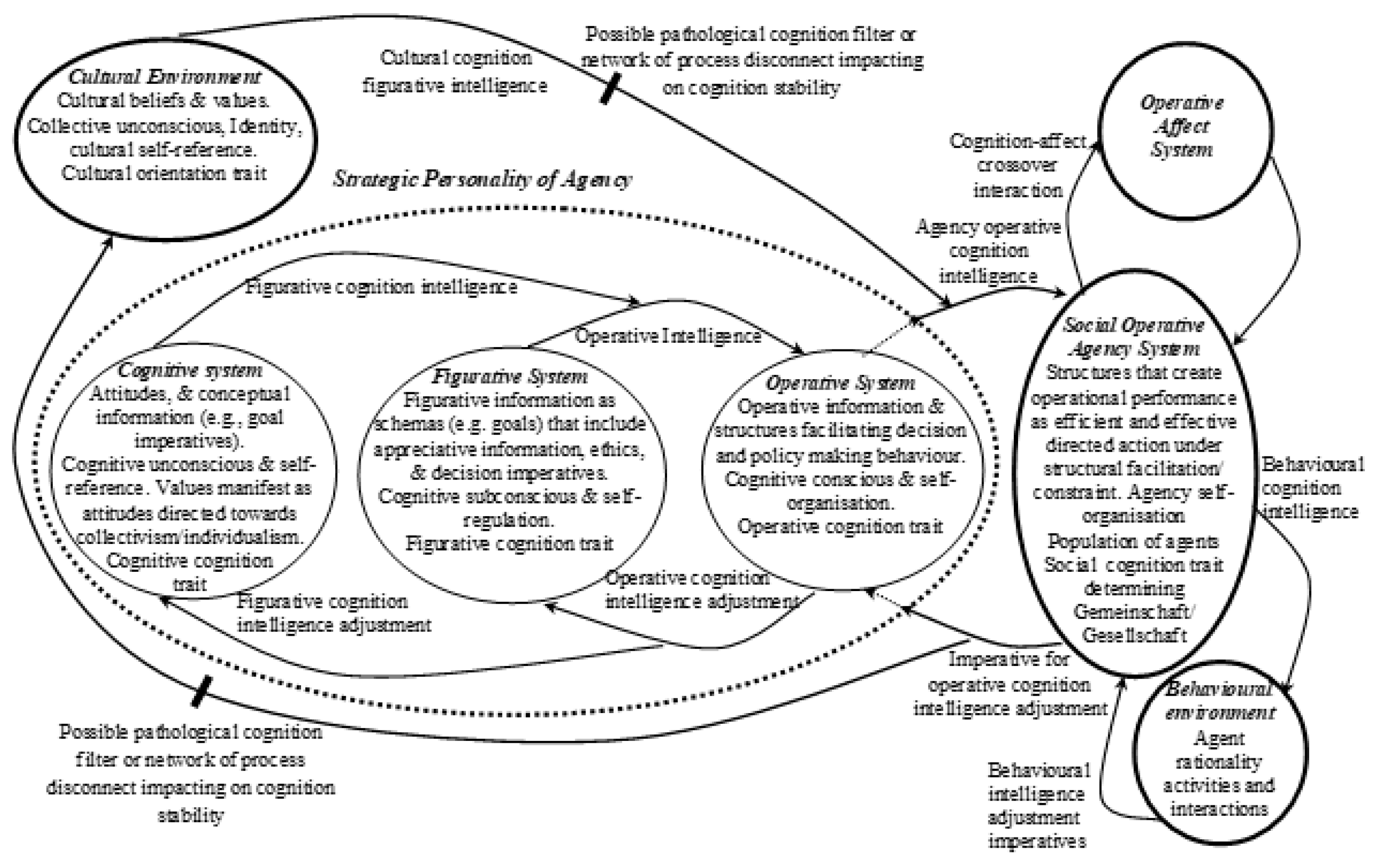
Figure 2.
RO Affect Agency with Substructure, Operative Structure with Affect Agent (adapted from Yolles & Fink [33]).
Figure 2.
RO Affect Agency with Substructure, Operative Structure with Affect Agent (adapted from Yolles & Fink [33]).
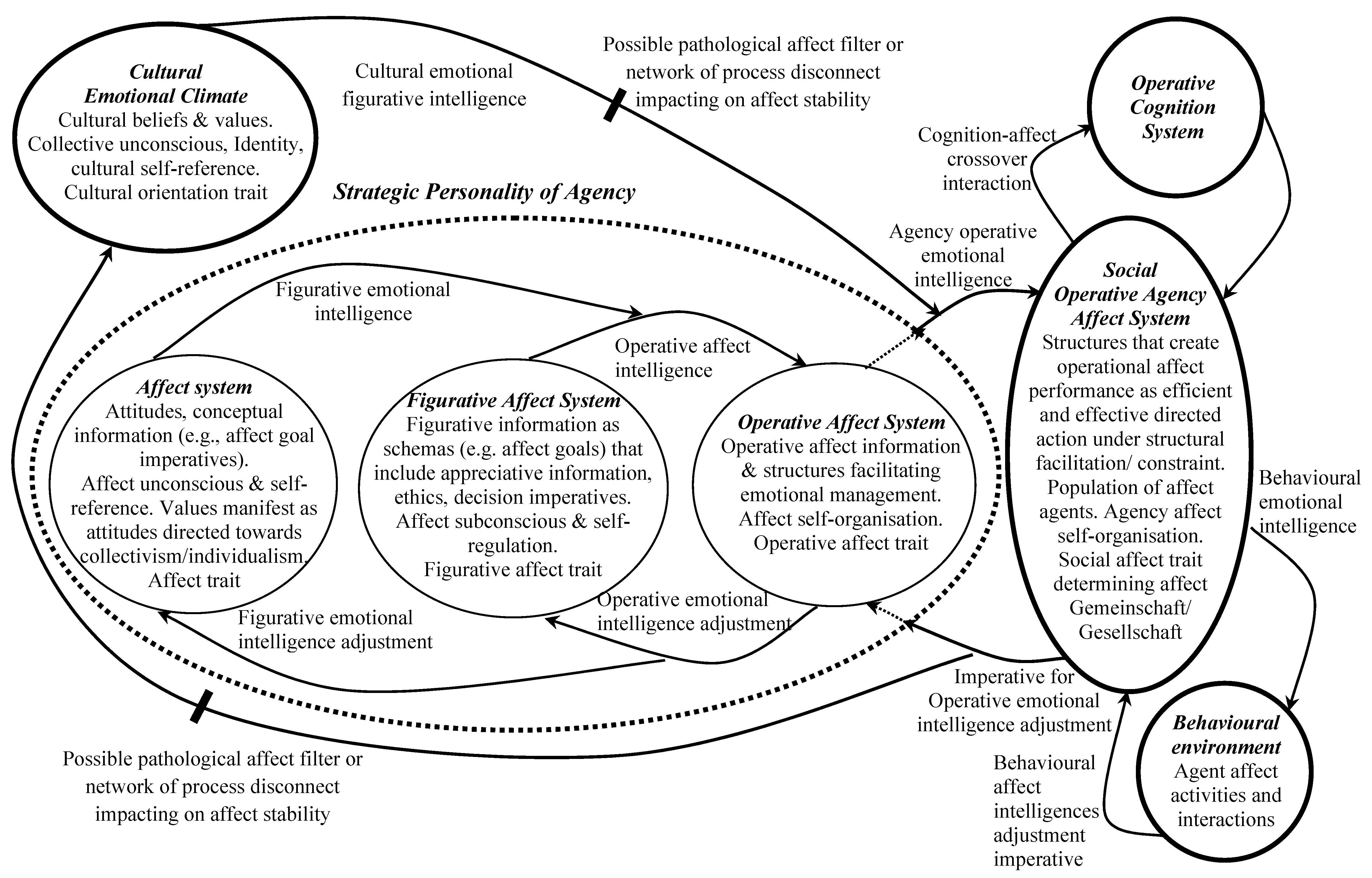

Table 1.
Two broad European supporting policy positions on European Development.
| Attitude Issue | New Europe | EVG |
|---|---|---|
| Iraq War | Mostly supporting | Mostly opposing |
| Integration of EU | Mostly widening | Mostly deepening |
| EU as challenge to US | Mostly opposing | Mostly supporting |
| Group Membership | UK, Italy, CCEE, Nordic States | France, Germany, Belgium, Luxembourg |
Table 2.
Propositional similarities and distinctions between the EU and ASEAN (Adapted from Koh [36]).
Table 2.
Propositional similarities and distinctions between the EU and ASEAN (Adapted from Koh [36]).
| Relating | Differences | ||
|---|---|---|---|
| Organisational Attribute | EU and ASEAN | EU ASEAN | |
| Regional organisation (RO) | Similar | Both are geopolitical ROs | |
| Purpose | Similar | Both started to promote regional peace | |
| Legal Personality | Similar | Enabling 3rd country partnerships | |
| Partnership agreements | Similar | With 3rd countries | |
| Accord on human rights | Similar | Both support principles of human rights | |
| Single economic market | Similar | Both pursue a single market initiative | |
| Commitment to integration goals | Similar | Variable Geometry |
ASEAN minus X |
| Commitment to common economic policy + custom union | Different | Yes | No |
| RO imperatives | Different | Yes | No |
| Common currency | Different | Optional | No |
| Decision making | Different | Voting | Consensus |
| RO agency | Different | Member selectivity | No |
| Influential secretariat | Different | European Commission | No |
Table 3.
Distinction between Regionalism and Regionalization (Source: Rautakivi & Yolles, 2020).
| Paradigm | Regionalization | Regionalism |
|---|---|---|
| Type of development process | Informal | Formal |
| Nature of development processes | Market | State |
| Basis of co-operation | Corporate /networks | State |
| Dialogue development | Intercorporate | Intergovernmental/Supranational |
| Mechanism | Trade & Investment | Treaties |
Table 4.
Strategic Comparative Distinctions between EU and ASEA.
| Paradigmatic Characteristics |
Europe | ASEAN |
|---|---|---|
| Orientation | Internal | External |
| Ideology | Neo-liberalism | Mercantilist |
| Type of Integration | Political integration | Economic Integration |
| The political economy premise | Co-operative Regionalism |
Zero-sum regionalization |
| Role of Institutions | Interdependent and need institutions to manage co –operation/international institutions may help to promote mutual trustees between states | Strong national institutions instead of international institutions |
| Legal Formality (Sign + ratify agreements, offer directions and orders) |
EU behalf of member states | Member states on behalf of ASEAN |
| Level of collective Actions | High | Low |
| Coherence | High | Low |
| Stability | Dynamic | Static |
| Unity | Moderate | Low |
| Economic integration By internal trade |
High 70% | low (less than)25% |
| Leading Country | Yes | No |
| Leadership | Yes | No |
Table 5.
Cognition Traits for Agency and the Strategic Personality.
| Agency Trait | Bipolar Type | Description |
|---|---|---|
| Cultural dimension of agency | Sensate | Reality is sensory and material, pragmatism is normal, there is an interest in becoming rather than being, and happiness is paramount. People are externally oriented and tend to be instrumental and empiricism is important. |
| Ideational | Reality is super-sensory, morality is unconditional, tradition is of importance, there is a tendency toward creation, and examination of self. | |
| Cognitive dimension of strategic personality | Intellectual Autonomy | People seen as autonomous, bounded entities who should find meaning in their own uniqueness and who are encouraged to express their internal attributes (preferences, traits, feelings and motives). Autonomy encourages individuals to pursue their own ideas and intellectual directions independently |
| Embeddedness | People are viewed as entities embedded in the plural agency. Meaning in life comes through social relationships, identifying with the group, participating in its shared way of life and striving towards its shared goals. Such values as social order, respect for tradition, security and wisdom are especially important. Embedded cultures emphasise maintaining the status quo and restraining actions or inclinations that might disrupt in-group solidarity or the traditional order. Embrace responsibility and duty and commit to shared goals. Connected with Transactional scripting that constitutes simple repetition and sameness | |
| Figurative dimension of strategic personality | Mastery + Affective autonomy |
Encourages active self-assertion to attain group or personal goals and to master, direct and change the natural and social environment. It is basically monistic in nature. + Affective autonomy refers to the seeking of egocentric or altruistic ends that respond to the meaningfulness in life, and involve purposes that are either dependent or independent of self, generating egoistic or altruistic fulfilment. |
| Figurative dimension of strategic personality | Mastery + Affective autonomy |
Encourages active self-assertion to attain group or personal goals and to master, direct and change the natural and social environment. It is basically monistic in nature. + Affective autonomy refers to the seeking of egocentric or altruistic ends that respond to the meaningfulness in life, and involve purposes that are either dependent or independent of self, generating egoistic or altruistic fulfilment. |
| Harmony | Trying to understand and appreciate rather than to direct or exploit. This orientation emphasizes the goals ‘unity with nature’, ‘protecting the environment’, and ‘world at peace’. It is basically pluralistic in nature | |
| Operative dimension of strategic personality | Hierarchy | People are socialized to take the hierarchical distribution of roles for granted and to comply with the obligations and rules attached to their roles. In hierarchical cultures, organisations are more likely to construct a chain of authority in which all are assigned well-defined roles. There is an expectation that individuals operate for the benefit of the social organisation. Sees the unequal distribution of power, roles and resources as legitimate. This has an implicit connection with power and power processes. |
| Egalitarianism | Seeks to induce people to recognize one another as moral equals who share basic interests as human beings. People are socialized to internalize a commitment to co-operate and to feel concern for everyone’s welfare. They are expected to act for others’ benefit as a matter of choice. Organisations are built on co-operative negotiation among employees and management. This has an implicit connection with service to the agency | |
| Social operative dimension of agency | Dramatising | Individual relationships to others are important, constituted as sequences of interpersonal events. Communication and narrative are important, as are individuals and their proprietary belief systems, and individual social contracts. Goal formation should be for individual benefit. Ideocentric agencies are important, operating through social contracts between the rational wills of its individual members |
| Patterning | Configurations are important in social and other forms of relationships. There is persistent curiosity. The social is influenced by relationships with individuals. Some importance is attached to symmetry, pattern, balance, and the dynamics of relationships. Goal seeking should be for collective benefit, and collective goal formation takes precedence over personal goal formation. Allocentric collectives are important, where the members operate subjectively |
Table 6.
Affect Traits for Agency and the Strategic Personality.
| Agency Trait | Bipolar Type | Description |
|---|---|---|
| Cultural emotional climate dimension of agency | Fear | The trait encourages an agent to seeks isolation due to fear, is non-cooperative due to insecurity and anxiety, may become aggression, or concerned due to being scared. |
| Security | This trait enables an agent to be trusting and confident, satisfied with things as they are, having solidarity with others, and full of encouragement and hope. | |
| Affect/emotional attitude dimension of strategic personality | Stimulation |
Context positive as an assertion for dominance in emotional attitude: those with this trait value are passionate, emotional and sensitive, full of joy and exuberance, tend to be delighted by experiences, seek exiting situations that might provide ecstasy, elation and joviality. They are also open, serene, intense, independent and quire creative. Context negative as a demand for conjoint balance with containment: those with this trait value tend to be angry and hostile, may tend to panic and paranoia, be susceptible to annoyance, rage, disgust and, grief. This may emerge as outburst from apparent containment. |
| Containment | This trait is consistent with dependability and restraint. It gives self-possession as well as self-containment, self-control, self-discipline, self-governance, self-mastery, self-command, moderateness and continence. | |
| Motivation activation dimension of strategic personality | Ambition | Aspiration and intention are significant attributes together with gaining enthusiasm and initiative. Aims and goals are important as well as desire, hope and wish. It promotes enterprise, and is consistent with craving or longing for something for which there is an appetite for. Ardour is important just as is aggressiveness and the killer instinct. |
| Protection | Safety and stability/security are important, as is a defensive shield that may provide immunity or salvation to shelter from the unknown. Safekeeping and conservation are important, and there is a need for insurance, preservation and safeguard. | |
| Emotion management dimension of strategic personality | Dominance | Control, domination and rule are of importance, these giving supremacy and hegemony. Seeking power is of value, as is pre-eminence in situations. This affect type supports sovereignty, ascendancy, authority and command over dominion, might have a susceptibility for narcissism and vanity. |
| Submission | Compliance is usually sought together with conformity, obedience, subordination and subjection. Allegiances are normal, as if deference and observance. Resistance to a situation is uncommon just as loyalty and devotion are. The trait encourages passiveness, fealty, resignation, homage and fidelity. | |
| Social operative affect dimension of agency | Missionary | The trait encourages the imposition of ideas on others. It encourages other to be a proponent of the ideas, by converting or heralding or promoting them to others. The trait can result an agent with this trait being a propagandist and revivalist. |
| Empathetic | This trait is accepting, compassionate, sensitive, sympathetic. |
Table 7.
Cognition and Affect Trait Relationship between Agency and its Embedded Personality.
| Agency System | Trait | Polar Value | Summary of Nature | Alternative Polar Value |
Summary of Nature |
|---|---|---|---|---|---|
| Cognition Type Agency | |||||
| Personality | Cognitive | Intellectual autonomy | Leads an agency towards individualism | Embeddedness | Centres on group identification |
| Figurative | Mastery + Affective Autonomy | Concerned with self-assertion | Harmony | Accept situations as they are | |
| Operative | Hierarchy | Supports ascription of individuals to given roles | Egalitarianism | Others are seen to be equal | |
| Sociocultural | Cultural | Sensate | Seeks material things like money or power | Ideational | Seeks cognitive values like friendship or love |
| Social | Patterning | Social relationship configurations, collective benefit, action delay through observation | Dramatising | Interpersonal relations, self-interest & individual benefit, action-oriented | |
| Affect Type Agency | |||||
| Personality | Affective emotional attitude | stimulation | May be context positive or negative | Containment | Supporting self-discipline and continuance |
| Figurative motivation activation | Ambition | Aspirations and goals | Protection | Safety or preservation | |
| Operative emotion management | Dominance | Control and supremacy | Submission | Compliance and subordination | |
| Sociocultural | Cultural emotion climate | Fear | Insecurity and uncooperative | Security | Trusting, solidarity, hopeful |
| Social | Missionary | Imposing and promoter | Empathetic | Accepting & sympathetic | |
Table 8.
Personality Mindsets Assigned as Individualist and Collectivist Classes.
| Affect Mindset | Trait | Cognition Mindset | Trait |
|---|---|---|---|
| Stimulation Oriented | Individualism/Intellectual Autonomy Oriented | ||
|
DS: Dominant Sanguine |
Stimulation |
HI: Hierarchical Individualism |
Intellectual Autonomy |
| Ambition | Mastery + Affective Autonomy | ||
| Dominance | Hierarchy | ||
|
MD: Moderate Sanguine |
Stimulation |
EI: Egalitarian Individualism |
Intellectual Autonomy |
| Ambition | Mastery + Affective Autonomy | ||
| Submission | Egalitarianism | ||
|
RM: Reformer Melancholic |
Stimulation |
HS: Hierarchic Synergism |
Intellectual Autonomy |
| Protection | Harmony | ||
| Dominance | Hierarchy | ||
|
SM: Subversive Melancholic |
Stimulation |
ES Egalitarian Synergism/ Social Anarchism |
Intellectual Autonomy |
| Protection | Harmony | ||
| Submission | Egalitarianism | ||
| Containment Oriented | Collectivism Orientated | ||
|
EC: Expansive Choleric |
Containment |
HP: Hierarchical Populism |
Embeddedness |
| Ambition | Mastery + Affective Autonomy | ||
| Dominance | Hierarchy | ||
|
DC: Defensive Choleric |
Containment |
HC: Hierarchical Collectivism |
Embeddedness |
| Protection | Harmony | ||
| Dominance | Hierarchy | ||
|
CP: Compliant Phlegmatic |
Containment |
EP: Egalitarian Populism |
Embeddedness |
| Ambition | Mastery + Affective Autonomy | ||
| Submission | Egalitarianism | ||
|
DP: Dormant Phlegmatic Fatalism |
Containment |
EC: Egalitarian Harmony Collectivism |
Embeddedness |
| Protection | Harmony | ||
| Submission | Egalitarianism | ||
Table 9.
Mindsets and their relative personality (3 traits) and agency (5 traits) distinctions.
| Affect Mindsets | Cognition Mindsets | ||||
|---|---|---|---|---|---|
| Mindset Types | Affect Traits | Mindset Types | Cognition Trait | ||
| Personality Traits | Agency Trait Options | Personality Traits | Agency Trait Options | ||
| Stimulation Oriented | Individualism Oriented | ||||
|
DS: Dominant Sanguine |
Stimulation |
Missionary Security |
HI: Hierarchical Individualism |
Intellectual Autonomy | Dramatising Sensate |
| Ambition | Mastery + Affective autonomy | ||||
| Dominance | Hierarchy | ||||
|
MD: Moderate Sanguine |
Stimulation | Missionary Security |
EI: Egalitarian Individualism |
Intellectual Autonomy | Dramatising Sensate |
| Ambition | Mastery + Affective autonomy | ||||
| Submission | Egalitarianism | ||||
| RM: Reformer Melancholic |
Stimulation | Missionary Security |
HS: Hierarchical Synergism |
Intellectual Autonomy | Patterning Sensate |
| Protection | Harmony | ||||
| Dominance | Hierarchy | ||||
| SM: Subversive Melancholic |
Stimulation | Fear Security |
ES: Egalitarian Synergism |
Intellectual Autonomy | Patterning Sensate |
| Protection | Harmony | ||||
| Submission | Egalitarianism | ||||
| Containment Oriented | Collectivism Oriented | ||||
|
EC: Expansive Choleric |
Containment | Fear Empathetic |
HP: Hierarchical Populism |
Embeddedness | Dramatising Ideational |
| Ambition | Mastery + Affective autonomy | ||||
| Dominance | Hierarchy | ||||
| CP: Compliant Phlegmatic |
Containment | Fear Empathetic |
EP: Egalitarian Populism |
Embeddedness | Dramatising Ideational |
|
Ambition |
Mastery + Affective autonomy | ||||
| Submission | Egalitarianism | ||||
| DC: Defensive Choleric |
Containment | Fear Missionary |
HC: Hierarchical Collectivism |
Embeddedness | Patterning Ideational |
| Protection | Harmony | ||||
| Dominance | Hierarchy | ||||
| DP: Dormant Phlegmatic Fatalism |
Containment | Fear Empathetic |
EC: Egalitarian Collectivism |
Embeddedness | Patterning Ideational |
| Protection | Harmony | ||||
| Submission | Egalitarianism | ||||
Disclaimer/Publisher’s Note: The statements, opinions and data contained in all publications are solely those of the individual author(s) and contributor(s) and not of MDPI and/or the editor(s). MDPI and/or the editor(s) disclaim responsibility for any injury to people or property resulting from any ideas, methods, instructions or products referred to in the content. |
© 2023 by the authors. Licensee MDPI, Basel, Switzerland. This article is an open access article distributed under the terms and conditions of the Creative Commons Attribution (CC BY) license (http://creativecommons.org/licenses/by/4.0/).
Copyright: This open access article is published under a Creative Commons CC BY 4.0 license, which permit the free download, distribution, and reuse, provided that the author and preprint are cited in any reuse.


