

Submitted:
23 May 2023
Posted:
25 May 2023
You are already at the latest version
Abstract
The European eel, Anguilla anguilla, was the most important fishery resource in European estuaries for centuries. More recently, most local stocks throughout the species' range have collapsed for a variety of reasons. This article focuses on historical records and the recent collapse in the Neretva estuary (Croatia), the most important eel fishery ground on the eastern Adriatic coast. Historical records were analyzed through an examination of various available databases, including scientific articles, technical literature, and gray literature. Additional descriptions were obtained using local ecological knowledge methodology and interviews with various stakeholders. The comparative analysis shows that the historical eel catch (the 1930s) under pristine habitat conditions should be estimated at 100 tons, officially recognized and additionally estimated. The decline in catches began in the 1960s and was associated with the massive reclamation of important eel lagoons for agriculture and port areas when officially recognized catches at state stations averaged 45 tons per year. The main reasons for this dramatic decline in eel fisheries and biological status in the Neretva estuary are a significant reduction of, an increase in recreational fishery, the establishment of invasive predatory fish species, and strong development of local demand in tourism. The results of this study indicate that the local eel population will rapidly become extinct in the future unless various measures are developed and applied to protect it, restrict fishing and market control, restore habitat, and control invasive and competing species.
Keywords:
European eel
; Croatia
; historical and recent catch
; Neretva Estuary
1. Introduction
The European eel, Anguilla anguilla, was for centuries the most important fish in European estuaries. For various reasons, populations on European coasts have recently reached their low historic low [1]. The results of recent projections indicate that (i) habitat loss plays an important role in the decline of European eel; (ii) the viability of the global stock is at risk unless appropriate conservation measures are taken; (iii) recovery of spawning escapement requires a significant reduction in fishing mortality; and (iv) recruitment recovery may not be possible unless reproductive performance is improved [2]. The European Council adopted a regulation (EC 1100/2007) requiring member states to develop national eel management plans for the recovery of the eel stock and set a specific target of 'at least 40% of silver eel biomass above the best estimate of escapement, that would have existed prior to anthropogenic impacts [3]. The targeting and effectiveness of such measures can be improved by understanding the ecological processes underlying population dynamics and the abiotic and biotic factors that influence them, particularly at the local level [4].
The situation in the most important eel habitat in the eastern Adriatic Sea, the Neretva Estuary, is characterized by a similarly severe decline, and the total catch was estimated at only two tons in 2021 [5]. Before the major human interventions, in the period 1930-1940, according to the available data, the official statistics mentioned 75 tons of purchased silver eel per year [6]. This period can be considered as the natural pristine state of the eel population in the Neretva estuary. The period from 1960 to 1970 was characterized by large-scale land reclamation in the main eel fishing areas, and after that the catches started to decrease. Annual catches in this period ranged from 68.5 tons in 1961 to 46.3 tons in 1969, representing a sharp decline [7]. The later period from 1970 to 2015 and to the present followed a similar trend of declining catches in the commercial (fall-winter) fishery [5]. More recently, the threat to local eel populations has been exacerbated by the tremendous increase in invasive species such as Largemouth bass (Micropterus salmoides) in freshwater areas [8] and Atlantic blue crab (Callinectes sapidus) in brackish water ecosystems [9]. which either feed on or compete with eels for food. This article describes the historical trends and recent collapse of the European eel fishery in the Neretva estuary (Croatia) based on available published data and a survey of local fishermen, and explains the main reasons for the decline of the eel fishery and the poor status of the local eel population.
2. Materials and Methods
The compilation of historical data on eel fishery in the Neretva Estuary, middle Eastern Adriatic, Croatia (43°01'55.3 "N 17°27'05.2 "E) was carried out through the analysis of available scientific articles, various professional articles, grey literature, local newspapers and reports. In parallel, the available statistical data from the various governments operating on the eastern Adriatic coast during the last 300 years were examined. In the search for the possible causes of eel decline in Croatia, various aspects of this process were considered, such as changes in water properties and water surface, land reclamation, changes in salinity and temperature, demography, fishing pressure, evolution of fishing gear in terms of type and number, marketing, processing, consumption and development of tourism.
Additional data were collected in 2023 using Local ecological knowledge (LEK) and citizen science methods obtained through interviews with various local stakeholders, including fishermen, restaurant owners, and government officials. Of the fishermen, two who are either commercial or recreational fishermen and who traditionally keep books and record their catches were selected for in-depth interviews. The commercial eel fisherman recorded the catch of silver eels in the Mala Neretva River area, while the recreational fisherman recorded the catch of yellow and silver eels in the Parila Lagoon area using traditional eel fishing gear. Both fishermen have written records of their eel catches in the period 2000-2023 and problems in this fishery sector in the last 20 years.
The historical original shape of the Neretva estuary and the water surface suitable as a habitat for eels were determined using a map from the 18th century. The present shape and surface of the water body was determined using satellite maps (google.com; March, 2023).
3. Results
3.1. Natural eel Habitats Loss
The total area of pristine lagoons and wetlands drained in the second half of the 20th century is shown in Table 1, based on the most recent evaluation and data published by [10]. The total area of drained pristine estuarine wetlands was 11,490 hectares and consisted mainly of typical Mediterranean lagoon ecosystems, followed by Mediterranean freshwater wetlands with low salinity, shallow lakes, small tributaries, and channels. The most important and productive pristine eel habitats were converted into agricultural land (lower left side of the Neretva estuary below the town of Opuzen) and into port, railroad and industrial areas (lower right side of the Neretva estuary, today the urban area of Ploče). These two former lagoon areas originally had an area of 2600 hectares and 1661 hectares, for a total of 4261 hectares of reclaimed natural lagoons. In the middle estuary, the smaller Kuti wetland (274 ha) was drained. The remaining drainage activities were carried out in the upper part of the estuary, where the Mediterranean fresh/saline water bodies predominate. The total restored area of these specific habitats was 6955 ha (Figure 1). The total area and specific area of estuarine habitats restored were based on estimated potential eel/silver eel production based on reported production in similar Mediterranean estuaries. The total estimated loss of eel biomass due to reclamation and disappearance of the original habitats is 157.4 tons compared to the eel biomass in the original habitats before anthropogenic activities in the Neretva estuary (Table 1).
3.2. Historical Captures
The overview of historical eel captures based on different articles and databases and recent captures based on field work and information from local stakeholders are presented in the Table 2 and Figure 2 and Figure 3.
Five different periods of the last 100 years are designed for the eel fishery in the Neretva estuary, taking into account the eel catch, the fishing gear used, the organized marketing and the changes in the ecosystem.
- The period from 1930-1940 was characterized by organized purchase of eel in the state station in town of Opuzen and its processing by drying or salting for sale in other markets. According to the available data, about 75 tons were purchased annually in the Neretva Delta. The annual sale of dried and salted eel was estimated at 20 tons, which corresponds to the amount of freshly caught eel (loss after cleaning and drying). In addition to the officially registered catches, recreational fishing with spears and longlines was also carried out during these years, but mostly for personal use, as resale was not possible. This period can be considered the pristine natural state of the eel population in the Neretva estuary, and the estimated catch of 100 tons of silver eel per year can be considered relatively reliable given the natural areas and their potential for eel growth.
- The period from 1960 to 1970 was characterized by large-scale reclamation of the main eel fishing areas below the town of Opuzen (Modrič lagoon and a number of salt lakes) and the town and port of Ploče (lagoons), and later also below the town of Metković, which was followed by a decline in catches in the 1970s. During this period, most of the catch was bought by state cooperatives, and a smaller part was used for personal needs through recreational fishing, as there was no tourism and restaurants.
- The period from 1970 to 1990 was characterised by a sharp decline in catches in commercial fisheries in the fall and winter, and interest in this type of hunting also declined. However, the increase in tourist activities and the beginning of restaurant and hotel operations (summer season) opened a new market for eel, so recreational fishing with pots, spears and longlines increased.
- The period from 1995 to 2013 was characterised by a further decrease in catches in commercial fisheries and the increase in the price of eel up to 20 €/kg, an increased interest in eel fishing with fish traps and small eel traps, as the number of these fishermen increased sharply due to the increasing number of new local retirees and the ban on eel hunting in Croatian protected areas (Lake Vransko). This is accompanied by an increasing demand for eel, uncontrolled catch of smaller and smaller eels and destruction of entire populations
- The period after 2013 and the official accession of Croatia to the EU follows a similar trend of decline in catches in commercial fisheries (autumn-winter) and even greater fishing effort (greater number of smaller, non-selective peaks), with similar effects as in the previous period. The price increase (now 30 €/kg) has also affected fishing in other areas of the Republic of Croatia, so recreational fishing has a significant negative impact on the eel stock. Due to increased controls by state institutions since 2020, the number of fishing gears used for recreational fishing (mainly small eel traps) has decreased significantly, but due to the high eel price, the fishing effort is still enormous, although eel catches are decreasing and the catch size is mostly 50-100 grams (Glamuzina et al., 2022). The number of eels under 30 grams has also declined significantly due to invasive species such as Largemouth bass in Kuti Lake [8] and blue crab in brackish water ecosystems [9] which either feed on or compete with eels.
Figure 2 provides a historical overview of European eel catches in the Neretva estuary from 1930 to the present, highlighting the differences between the pre- and post-land reclamation periods. The so-called "pristine conditions" that prevailed until the mid-1960s were characterized by an estimated annual catch of no more than 100 tons of silver eel in all fisheries and with all fishing gear. Catch levels in the official commercial eel fishery began to decline as early as the 1970s, followed by a decline in the recreational eel fishery. This declining trend has remained constant over the past 30 years and primarily affects the fall legal eel fishery as catches and interest in this type of eel fishery decline. Due to the increased price of eel, yellow eel catches in recreational fisheries are higher than in silver eel fisheries, although they remain at a relatively low level (Fig. 2). The period following Croatia's accession to the EU and the start of fisheries regulation under the Common Fisheries Policy (CFP) is shown in Figure 3, which indicates that the decline in eel catches has remained constant despite the application of various CFP measures (e.g., closure of the fishing season, better control).
3.3. Eel Catches of the Commercial and Recreational Fishers in the Period 2000–2023 in the Neretva Estuary (Middle Eastern Adriatic, Croatia)
Figure 4 shows the results of the database on commercial eel fisheries in the left arm of the Neretva estuary (Mala Neretva River) in the period 2000-2022, taking into account the concession for silver eels and the large eel fishing gear used at one site during this period. The average catch per season during this period was 443.6 kg, including seasons with gear problems and lower catches (2004, 2006, 2010, 2019). Excluding these years, the average catch per season was 490.5 kg of silver eels from this microhabitat, showing the current level of spawning biomass there. Results from this microhabitat indicate that silver eel catches have remained relatively stable over the past 20 years despite more intensive recreational fishing, likely due to the lack of significant new restoration work in the area. However, the fishermen interviewed pointed out problems with the increase in the population of the invasive Largemouth bass in recent years. This has already been mentioned [8] [11].
Figure 5 shows the annual catches of European eel in the Parila Lagoon area (Neretva estuary) by a recreational fisherman in the period 2000-2022, who primarily used traditional fish traps as fishing gear. The total catch of this fisherman during this period was 2219 kg of eel, of which yellow eel accounted for 1085 kg and silver eel for 1134 kg. The average annual total eel catch was 96.47 kg, of which 47.17 kg was yellow eel and 49.3 kg was silver eel per year. The trend in eel catches was almost stable during this period, with the exception of the last three years, which showed a decline. Fishermen attributed this decline to the significant increase in the population of Atlantic blue crab in Parila Lagoon, previously also described [9].
4. Discussion
This study provides, for the first time, organized historical data on eel fisheries in the main estuary of the eastern Adriatic Sea, as well as results of recent research and surveys describing the status of the local eel population and its fisheries. The decline of the local eel population and eel fishery is comparable to the situation in most European estuaries [12], including the estuaries and lagoons of the Mediterranean and the western Adriatic [1]. The most comparable is long-term records (1781–2013) of eel production in the Comacchio Lagoon (Italy), where similar land reclamation, among other reasons showed remarkable decline in catches in the last 40thy years [13].
This decline is generally attributed to various natural and anthropogenic factors [14], with the increase in commercial and artisanal fishing and habitat loss being the most important [15]. The decrease in the number of eel catches in the Neretva Estuary in the last fifty years has had an exponential trend, as a result of a series of anthropogenic activities, the most important of which are the large land reclamation in the Neretva delta that drastically reduced the areas of suitable habitats, introductions of invasive predatory and competitive species, increased demand in tourism and attractive prices followed by a strong increase in recreational fishing activities.The historical and current data on the eel stock in the Neretva estuary should be compared with similar lagoon systems of the western Adriatic (Italian coast), where the data are more accurate and reliable due to a long-term organized and controlled fishery. The historical estimate for the Comacchio lagoons in Italy, where only silver eels were fished in the 1970s and a maximum catch of 20.5 kg-ha-1 was recorded [16]. Moreover, the total eel biomass per ha was 75.85 kg, while silver eel production was 36 kg/ha, while the observed yield averaged 19.32 kg/ha [17]. Considering these data against the background of historical eel catches in pristine environments, it can be concluded that the total production of silver eels in the pristine habitats of the Neretva estuary was about 100 tons, compared to the officially recorded catch of 75 tons.
Estimated production of silver eels in the Bages-Sigean lagoon (France, Mediterranean coast) was 30 kg-ha-1 [18] and in the Frémur catchment (France, Atlantic coast) was 17-50 kg-ha-1 [19] [20] which was higher than the reported average of 1.5-20 kg-ha-1 in lagoons and 0.003-6.9 kg-ha-1 in freshwater systems [18]. Lagoons are more productive than freshwater ecosystems and favour higher growth rates, but also produce better male populations [21]. Mean annual production in colder Norwegian rivers was significantly lower than in Mediterranean lagoon ecosystems, with a mean annual production of 3.51 kg/he and a mean yield of 2.27 kg/he [22]. However, such colder river ecosystems do not exist in the Neretva estuary, but in the upper Neretva catchment, including the colder main streams, tributaries, and lakes located mainly in Bosnia and Herzegovina. As these waters are inhabited mainly by females [23]. This is an important issue for the future development of the National Eel Management Plan of Croatia and Bosnia and Herzegovina.
The main reasons for this decline in the Neretva estuary are: significant habitat loss due to land reclamation for agriculture and port construction, construction of dams and other water infrastructure, increase in fishing (especially recreational and illegal fishing) due to tourism demand and high number of recreational licences. However, the most obvious reason for the decline of the native eel is clearly habitat loss, which accounts for about 80%. For the Japanese eel (Anguilla japonica), habitat reduction due to human activities in 16 rivers in East Asia, including Japan, Korea, Taiwan, and China, was also the main reason for the decline, with 76.8% of the actual habitat area lost between the 1970s and 2010s. Widespread habitat loss, along with regional climate phenomena such as ENSO and overfishing, may play an important role in the decline of Japanese eel in East Asia [24]. Among other factors, the introduction and high incidence of the swim bladder parasite [5]. and pollution from agriculture, upstream industries, and mining [25]. have already been mentioned. More recently, the greatest threat is the increase in invasive and competing species, particularly the Atlantic blue crab and Largemouth bass [8,9,11].
However, despite evident overall decline, the facts that reports by local commercial and recreational fishers presented relatively stable catches at several micro-habitat levels in the Neretva Estuary, provide some optimistic future scenarios. This is in accordance with situation in the rivers of England and Wales where data collected suggested that despite a continent-wide decline in recruitment, eel stocks in some, perhaps many, rivers are probably near carrying capacity [26]. To support these optimistic scenarios, the main short-term measures should be better control of all types of fishing gear and activities, followed by better control of invasive species through fisheries and eradication projects. In the long term, the most important measures should be restoration of important habitats such as the Parila Lagoon and better management of dams in the upper reaches and on the Mala Neretva River in coordination with eel migration.
Looking at the future eel management plan for the Neretva estuary, it is clear that an important measure to reduce anthropogenic mortality, namely the migration of at least 40% of silver eel biomass to the sea based on pristine environment potentials is most likely not possible, due to massive habitat loss. It can be concluded that this measure should only be applied to current eel habitats and new estimates of escapement from present eel habitats. Future work should focus on a better understanding of the habitats currently available and their ecological status, as well as their accurate identification using GIS [27]. and a better understanding of the impact of invasive species on the local eel population from recruitment to spawning migration. For the future Eel Management Plan for the Neretva River Basin, which should have an international aspect (Bosnia and Herzegovina as a partner), several important actions should be proposed, such as research on current eel recruitment and potential increase of the glass eel population [28] to promote restoration of abundance in different habitats, a cooperative approach to local eel management, implementation of better fisheries and local market control, and improvement of available eel habitats.
Funding
This research was funded by University of Dubrovnik, Croatia, VIF fund for the research and science
Data Availability Statement
Not applicable here.
Acknowledgments
The author acknowledge support of local fishers from Neretva Estuary and respect their wish to be no named in this article.
Conflicts of Interest
No conflict of interest.
References
- Aalto, E., Capoccioni, F., Terradez Mas, J., Schiavina, M., Leone, C., De Leo, G., & Ciccotti, E. (). Quantifying 60 years of declining European eel (Anguilla anguilla L., 1758) fishery yields in Mediterranean coastal lagoons. ICES Journal of Marine Science 2016, 73, 101-110. [CrossRef]
- Bevacqua D, Melia P, Crivelli AJ, Gatto M, De Leo GA. Multi-objective assessment 705 of conservation measures for the European eel (Anguilla anguilla): an application to 706 the Carmargue lagoons. ICES Journal of Marine Science 2007, 64, 1483-1490. [CrossRef]
- European Union (EU). 2007. Council Regulation (EC) No. 1100/2007 “Establishing 819 measures for the recovery of the stock of European eel”.
- Aprahamian MW, Evans DW, Briand C, Walker AM, McElarney Y, Allen M. The changing times of Europe's largest remaining commercially harvested population of eel Anguilla anguilla L. J Fish Biol. 2021 99, 1201-1221. [CrossRef]
- Glamuzina, L., Pećarević, M., Dobroslavić, T., Tomšić, S., Glamuzina, B. . The study of European eel, Anguilla anguilla in the River Neretva estuary (Eastern Adriatic Sea, Croatia) using traditional fishery gear. Acta Adriatica 2022, 63, 35-44. [CrossRef]
- Morović, D. 1948. Godišnje kretanje jegulje i cipla u Donjoj Neretvi. (Annual trend of eel and mullets in Lower River Neretva). Ribarstvo Jugoslavije, 9, 83-86. (In Croatian).
- Morović, D. Quelques observations sur l’anguille, Anguilla Anguilla L., de la côte ori-entale de l’Adriatique. Bilješke-Notes Institute of Oceanography and Fisheries, Split. 1970, 27, 1-4.
- Mrakovčić, ., Kresonja M., Glamuzina, B., Petravić, J., Trgovčić, K. 2021. Structure and characteristics of the fish community in the Neretva Delta after the introduction of the Largemouth bass, Micropterus salmoides (Lacepède, 1802). 4 th CROATIAN SYMPOSIUM ON INVASIVE SPECIESwith International Participation / Jelaska, Sven D. (ur.). Zagreb: Croatian Ecological Society, 2021. str. 39-39.
- Glamuzina, L., A. Conides, G. Mancinelli, B. Glamuzina. . A Comparison of Traditional and Locally Novel Fishing Gear for the Exploitation of the Invasive Atlantic Blue Crab in the Eastern Adriatic Sea. J. Mar. Sci. Eng. 2021 9: 1019. [CrossRef]
- Erceg, J., 2003. Stanje hidromelioracijskih sustava na slivnom području Neretve- Donja Neretva, stručno-znanstveni skup- “Stanje i održivi razvoj hidromelioracijskih sustava u Hrvatskoj-Preduvjet razvoja poljoprivrede”, 28. i 29. listopada 2003., Zagreb.
- Petravić, J., Kresonja, M., Glamuzina, B., Mrakovčić, M. 2021.Dietary composition of the Largemouth bass, Micropterus salmoides (Lacepède, 1802) in the lower course of the Neretva River in Croatia. 4th CROATIAN SYMPOSIUM ON INVASIVE SPECIES with International Participation / Jelaska, Sven D. (ur.). Zagreb: Croatian Ecological Society, 2021. str. 40-40.
- Guhl, B., Stürenberg, FJ. & Santora, G. 2014. Contaminant levels in the European eel (Anguilla anguilla) in North Rhine-Westphalian rivers. Environ Sci Eur 26, 26. [CrossRef]
- Aschonitis, V., Castaldelli, G., Lanzoni, M., Rossi, R., Kennedy, C., and Fano, E. A. (2017) Long-term records (1781–2013) of European eel (Anguilla anguilla L.) production in the Comacchio Lagoon (Italy): evaluation of local and global factors as causes of the population collapse. Aquatic Conserv: Mar. Freshw. Ecosyst., 27: 502– 520. [CrossRef]
- Costa-Dias, S., E. Dias, J. Lobon-Cervia, C. Antunes & J. Coimbra. 2010. Infec-tion by Anguillicoloides crassus in a riverine stock of European eel, Anguilla anguilla. Fish. Man. Ecol.,17, 6: 485-492. [CrossRef]
- Dudgeon, D., A.H. Arthington, M.O. Gessner, Z. Kawabata, D.J. Knowler, C. Leveque, R.J. Naiman, A-H. Prieur-Richard, D. Soto, M.L.J. Stiassny & C.A. Sullivan. 2006. Freshwater biodiversity: importance, threats, status and conservation chal-lenges. Biol. Rev. Camb. Philos. Soc., 81(2):163-82. [CrossRef]
- De Leo G.A. and Gatto M., 1995. A size and age-structured model of the European eel (Anguilla anguilla L.). Can. J. Fish. Aquat. Sci., 52, 1351–1367. [CrossRef]
- Rossi, R. 1979. An estimate of the production of the eel population in the Valli of Comacchio (Po Delta) during 1974–1976. Italian Journal of Zoology, 46:3, 217-223. [CrossRef]
- Amilhat, E., H. Farrugio, R. Lecomte-Finiger, G. Simon and P. Sasal. 2008. Silver eel population size and escapement in a Mediterranean lagoon: Bages-Sigean, France. Knowl. Managt. Aquatic Ecosyst., 390-391. [CrossRef]
- Feunteun E., Acou A., Laffaille P. and Legault A., 2000. European eel (Anguilla anguilla): prediction of spawner escapement from continental population parameters. Can. J. Fish. Aquat. Sci., 57, 1627–1635. [CrossRef]
- Acou A., Gabriel G., Laffaille P. and Feunteun E., 2009. Differential production and condition indices of premigrant eels in two small Atlantic coastal catchments of France. In: Casselman J.M. and Cairns D.K. (eds.), Eels at the edge: science, status, and conservation concerns, Amer. Fish. Soc. Symp., 58, Bethesda, Maryland, 157–174.
- Panfili, J., M.-C. Ximénès, and A. J. Crivelli. 2011. Sources of Variation in Growth of the European Eel (Anguilla anguilla) Estimated from Otoliths. Canadian Journal of Fisheries and Aquatic Sciences. 51(3): 506-515. [CrossRef]
- Vollestad, L. A., & Jonsson, B. (1988). A 13-Year Study of the Population Dynamics and Growth of the European Eel Anguilla anguilla in a Norwegian River: Evidence for Density-Dependent Mortality, and Development of a Model for Predicting Yield. Journal of Animal Ecology, 57(3), 983–997. [CrossRef]
- Glamuzina, B., V. Bartulović, A. Conides, N. Zovko. 2008. Status populacije europske jegulje, Anguilla anguilla (Linnaeus, 1758) na području močvare Hutovo blato, Bosna i Hercegovina (Status of European eel population, Anguilla Anguilla (Linnaeus, 1758) in the wetlands of Hutovo blato (Bosnia and Herzegovina)). Proceedings. 43rd Croatian and 3rd International Symposium on Agriculture / Pospišil, Milan (ur.). Zagreb: Agronomski fakultet, 2008. 733-736.
- . [CrossRef]
- Bukvić, V., Dušak, V., Kučinić, M., Delić, A., Dulčić, J., Senta, I. and Glamuzina, B. (2011), Arsenic in the water, sediment and fish in the Neretva River Delta, Croatia. Journal of Applied Ichthyology, 27: 908-911. [CrossRef]
- Bark, A., Williams, B., and Knights, B. 2007. Current status and temporal trends in stocks of European eel in England and Wales. – ICES Journal of Marine Science, 64 (7), 1368–1378, . [CrossRef]
- García Manteca, P., Nores Quesada, C., Cuervo, N., Colubi, A., y García Flórez, L. (2015). Estimación del área húmeda, actual y potencial, disponible para la anguila europea (Anguilla anguilla) usando técnicas GIS. GeoFocus (Artículos), 16, p.41-60. ISSN: 1578-5157.
- Nzau Matondo, B.; Backory, L.; Dupuy, G.; Amoussou, G.; Oumarou, A.A.; Gelder, J.; Renardy, S.; Benitez, J.-P.; Dierckx, A.; Dumonceau, F.; et al. 2023. Space and Time Use of European Eel Restocked in Upland Continental Freshwaters, a Long-Term Telemetry Study. Fishes, 8, 137. [CrossRef]
Figure 1.
Morphology of the Neretva Estuary (Republic of Croatia) from 18th century and 20th century, before (left) and after (right) series of the human interventions.
Figure 1.
Morphology of the Neretva Estuary (Republic of Croatia) from 18th century and 20th century, before (left) and after (right) series of the human interventions.
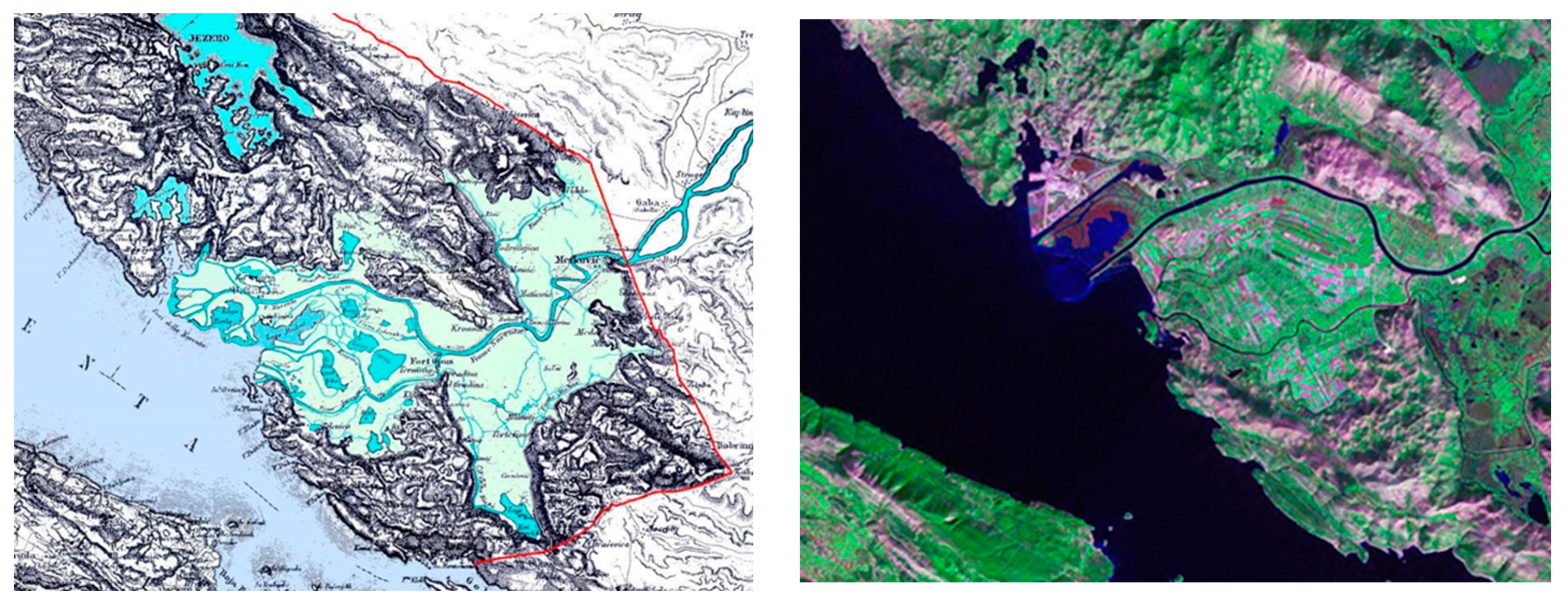
Figure 2.
Historical overview of the catches of the European eel, Anguilla anguilla, in the Neretva estuary from 1930 until today.
Figure 2.
Historical overview of the catches of the European eel, Anguilla anguilla, in the Neretva estuary from 1930 until today.
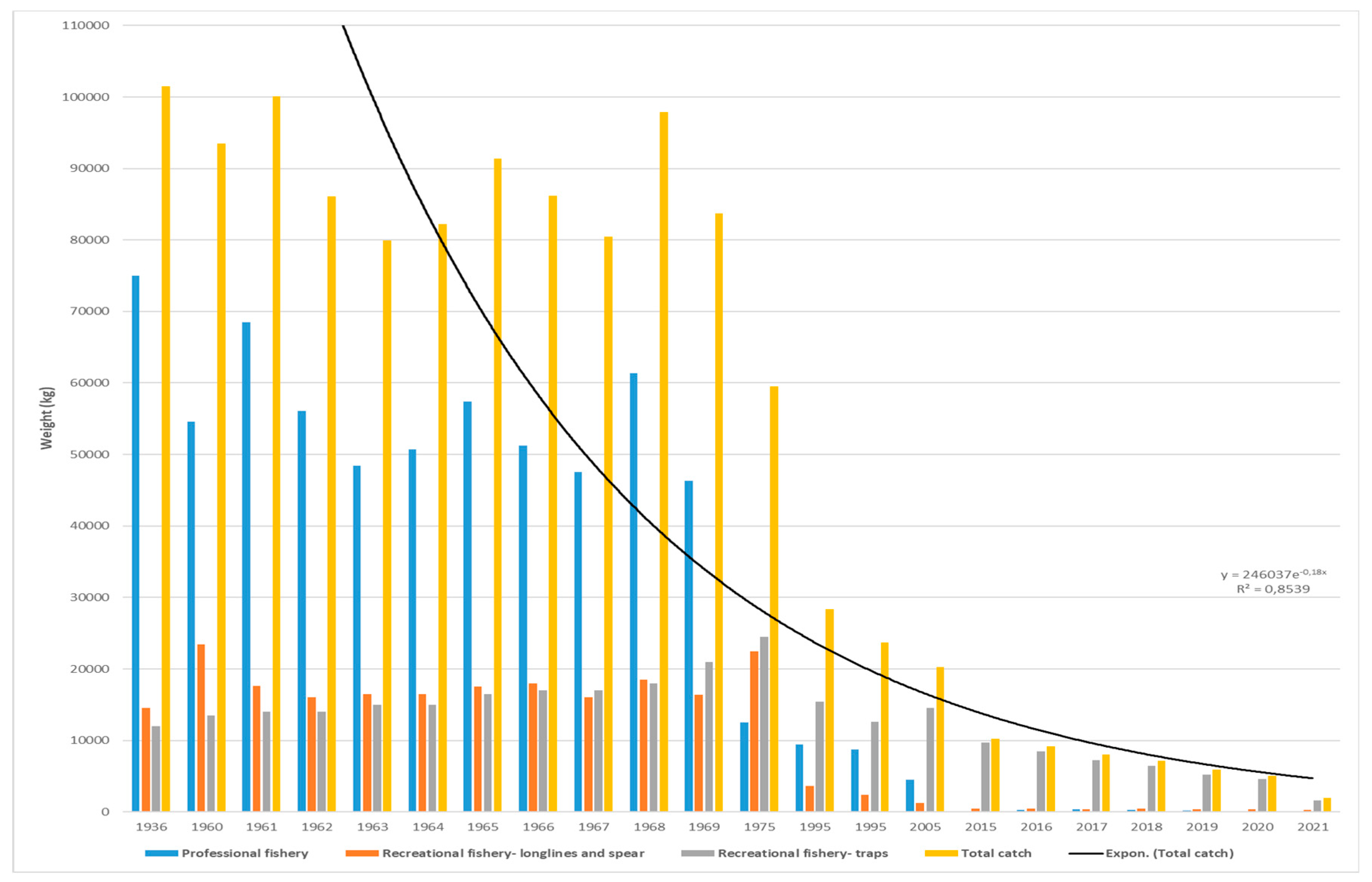
Figure 3.
Catches of European eel, Anguilla anguilla, in the Neretva Estuary, Croatia, after EU accession (2013) and adoption of the Common Fisheries Policy Regulation.
Figure 3.
Catches of European eel, Anguilla anguilla, in the Neretva Estuary, Croatia, after EU accession (2013) and adoption of the Common Fisheries Policy Regulation.
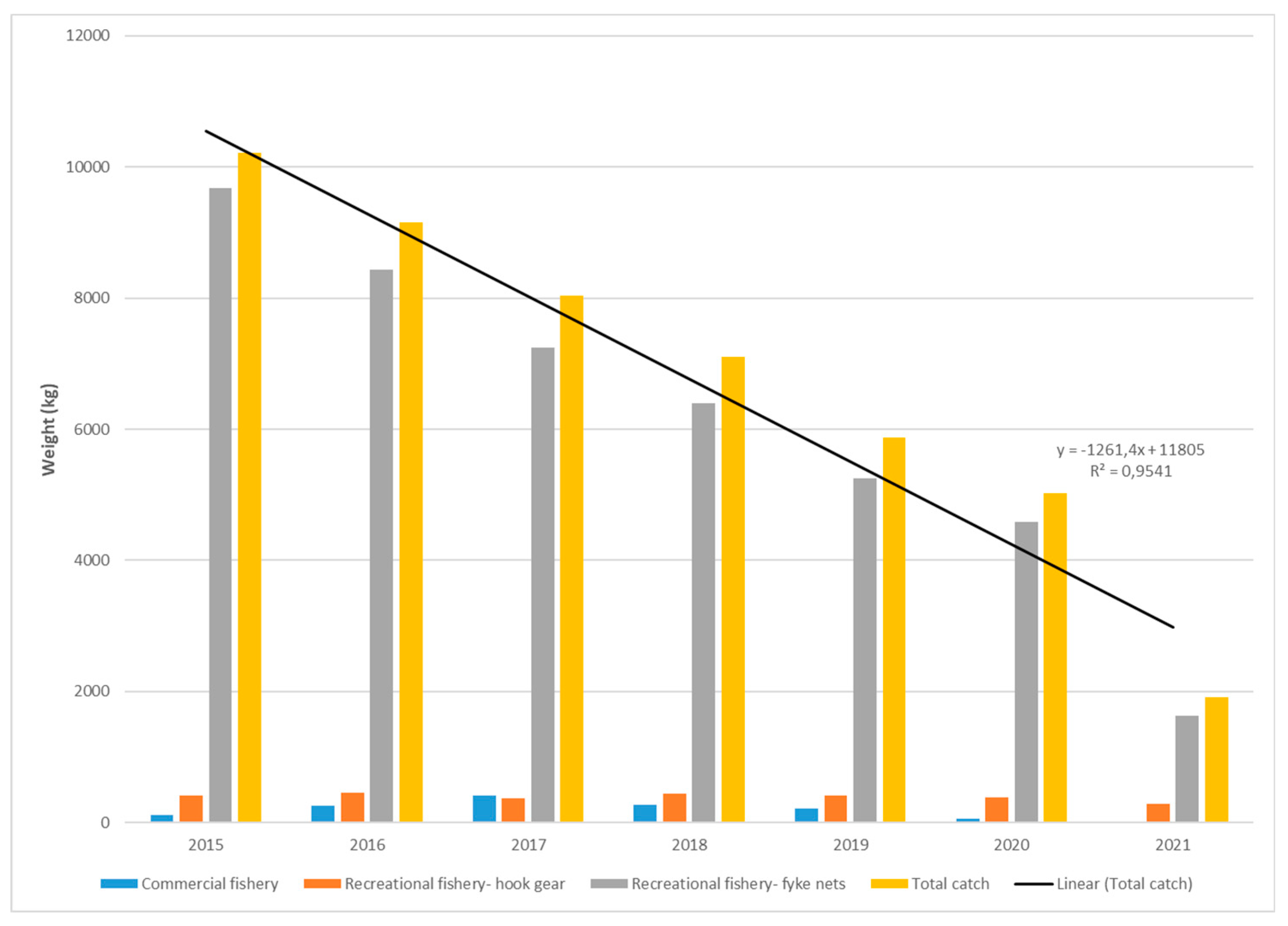
Figure 4.
Yearly catches of the European eel, Anguilla anguilla, of legal commercial fisher at one designated site for the catch of silver eel (September-March catch season) in the period 2000-2022.
Figure 4.
Yearly catches of the European eel, Anguilla anguilla, of legal commercial fisher at one designated site for the catch of silver eel (September-March catch season) in the period 2000-2022.
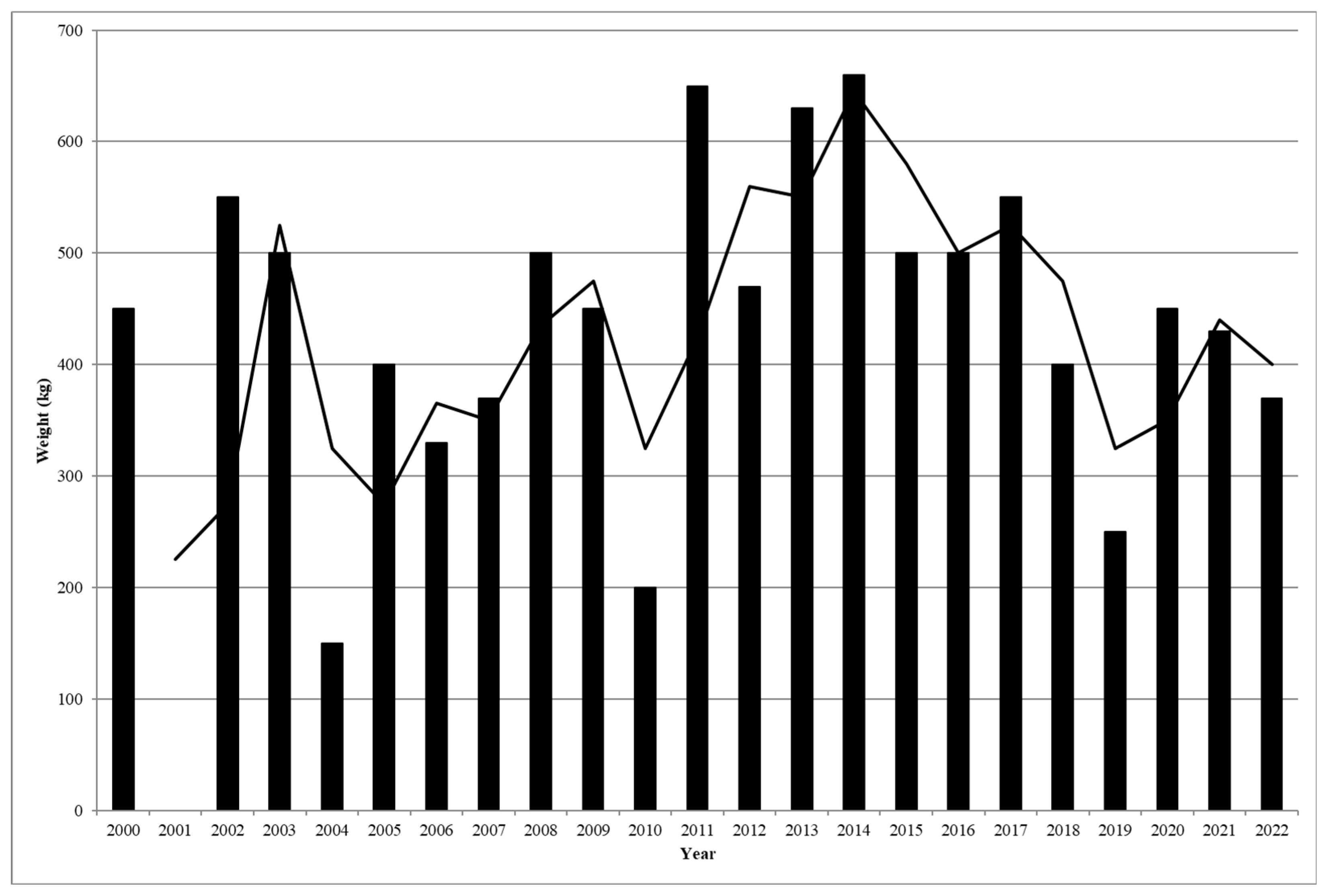
Figure 5.
Yearly catches of the European eel, Anguilla anguilla, in the Parila lagoon area (Neretva Estuary), of one recreational fisher in the period 2000-2022.
Figure 5.
Yearly catches of the European eel, Anguilla anguilla, in the Parila lagoon area (Neretva Estuary), of one recreational fisher in the period 2000-2022.
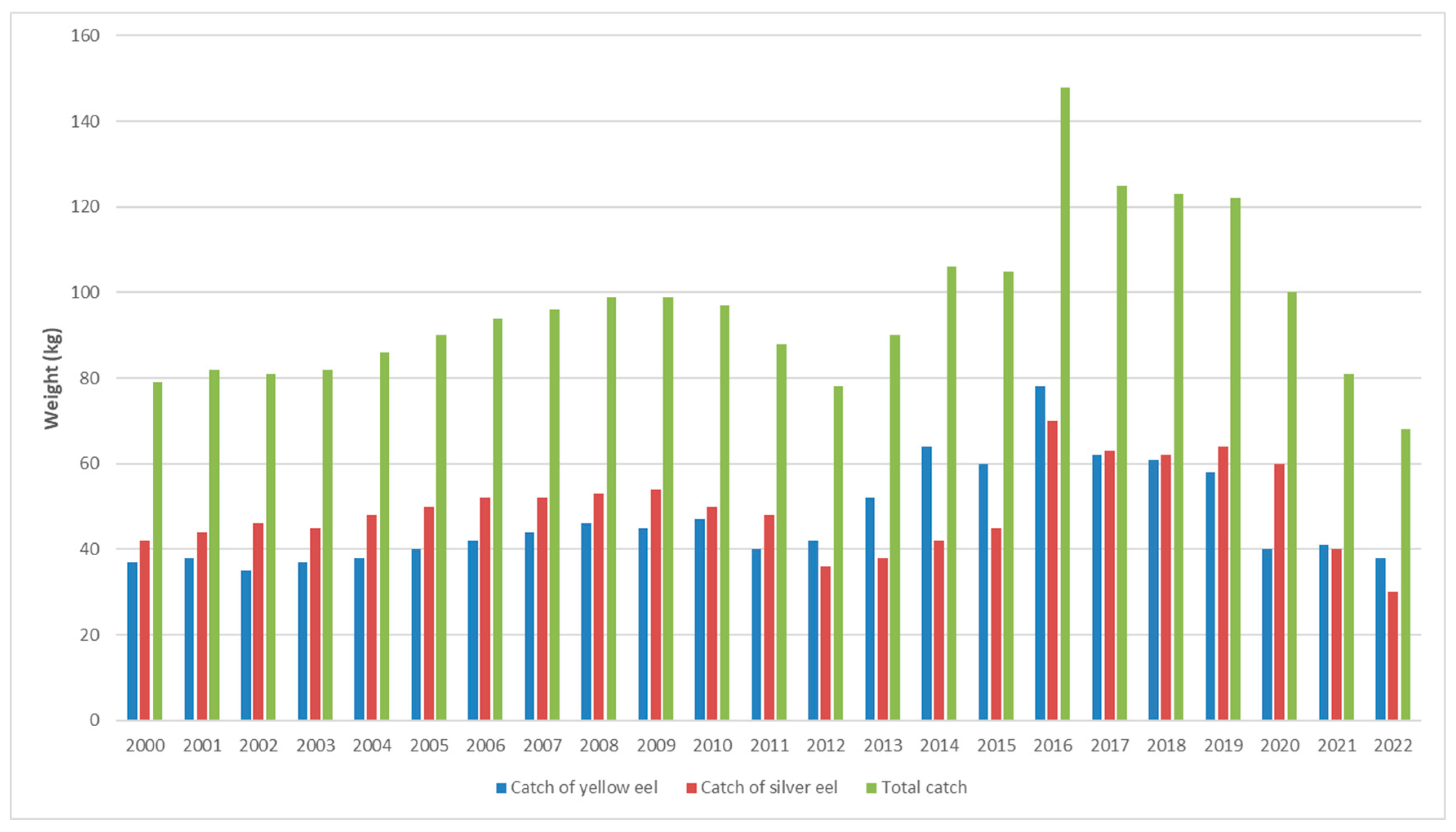

Table 1.
Total area of lagoons and wetlands reclamated during 20th century in the Neretva Estuary: reclamated habitat types, potential silver eel biomass per habitat and estimated silver eel biomass loss.
Table 1.
Total area of lagoons and wetlands reclamated during 20th century in the Neretva Estuary: reclamated habitat types, potential silver eel biomass per habitat and estimated silver eel biomass loss.
| Reclamation areas: habitat types | Total reclaimed area (hectare)* | Potential eel biomass (kg/ha)** | Estimated total lost eel biomass (kg-h) |
|---|---|---|---|
| Lower estuary (brackish 15-30 psu)) | |||
| Mediterranean lagoons (Town of Ploče area) | 1 661 | 20 | 33200 |
| Mediterranean lagoons (area bellow town of Opuzen) | 2 600 | 20 | 52000 |
| Middle estuary (brackish 10-20 psu) | |||
| Mediterranean lagoons- middle estuary (Kuti area) | 274 | 15 | 4100 |
| Upper estuary (0.3-5 psu) | |||
| Freshwater bodies | 616 | 10 | 6100 |
| Freshwater estuarine bodies | 1 867 | 10 | 18000 |
| Freshwater estuarine bodies- lakes, rivers and channels | 1 972 | 10 | 19000 |
| Other areas | |||
| Other smaller wetland areas (not divided to specific habitat type) | 2 500 | 15 | 25000 |
| Total | 11 490 | 157400 |
*The surface is based on data published by Erceg, 2003. **The eel biomass per hectare of different estuarine habitat types were used from different articles.
Table 2.
The overview of historical catches of the eel, Anguilla anguilla in the Neretva Estuary (Croatia).
Table 2.
The overview of historical catches of the eel, Anguilla anguilla in the Neretva Estuary (Croatia).
| Period | Average silver eel yearly capture(tons)* | Average yellow eel yearly capture (tons)** |
|---|---|---|
| 1930-1940 | 75 | 45 |
| 1960-1970 | 45 | 30 |
| 1980-1990 | 25** | 30 |
| 2010-2020 | 2 | 3 |
| 2022 | 1 | 2 |
* based on available databases and scientific articles and official statistics. ** estimated based on LEK methodology.
Disclaimer/Publisher’s Note: The statements, opinions and data contained in all publications are solely those of the individual author(s) and contributor(s) and not of MDPI and/or the editor(s). MDPI and/or the editor(s) disclaim responsibility for any injury to people or property resulting from any ideas, methods, instructions or products referred to in the content. |
© 2023 by the authors. Licensee MDPI, Basel, Switzerland. This article is an open access article distributed under the terms and conditions of the Creative Commons Attribution (CC BY) license (http://creativecommons.org/licenses/by/4.0/).
Copyright: This open access article is published under a Creative Commons CC BY 4.0 license, which permit the free download, distribution, and reuse, provided that the author and preprint are cited in any reuse.


