

Submitted:
18 May 2023
Posted:
18 May 2023
You are already at the latest version
Abstract
Prosocial behavior is vital for positive social development among adolescents, contributing to improved peer relationships, emotional well-being, and social competence. Gratitude, a positive emotion arising from recognizing and appreciating benefits received from others, has been identified as a potential contributor to adolescent prosocial behavior. This study aimed to investigate the mediating roles of social support and basic psychological needs in the relationship between gratitude and prosocial behavior among adolescents. A total of 390 middle school students participated in a longitudinal study, completing questionnaires assessing gratitude, social support, basic psychological needs, and prosocial behavior at two time points with a six-month interval. The results indicated that gratitude positively correlated with social support, basic psychological needs, and prosocial behavior. Structural equation modeling revealed that social support and basic psychological needs partially mediated the relationship between gratitude and adolescent prosocial behavior. Moreover, a chain-like mediation effect was observed, wherein social support influenced basic psychological needs, which in turn predicted prosocial behavior. These findings emphasize the importance of gratitude in fostering prosocial behavior among adolescents and highlight the mediating roles of social support and basic psychological needs in this relationship.
Keywords:
gratitude
; prosocial behavior
; social support
; basic psychological needs
; adolescence
1. Introduction
Prosocial behavior, defined as voluntary behavior intended to benefit others, plays a crucial role in positive social development among adolescents [1]. It is associated with improved peer relationships, enhanced emotional and social competence, and increased psychological well-being [2]. Thus, promoting prosocial behavior among adolescents is essential for fostering a supportive and positive social environment [2].
1.1. The Influence of Gratitude on Adolescent Prosocial Behavior
Gratitude, a positive emotion arising from recognizing and appreciating the benefits received from others, has been identified as a potential contributor to adolescent prosocial behavior [3,4]. Grateful adolescents tend to experience higher levels of positive affect and life satisfaction [3] and are more likely to engage in prosocial behaviors [5,6,7]. The experience of gratitude is thought to increase empathy and perspective-taking, thereby fostering a greater willingness to help others [8].
The Broaden and Build Theory of Positive Emotions, proposed by Fredrickson [9,10], suggests that each positive emotion serves a unique evolutionary purpose and adaptive function. Positive emotions not only broaden individuals’ momentary thought-action repertoires but also build enduring resources, including physical, intellectual, and social resources. Building upon this framework, Fredrickson [11] applied the theory to gratitude, highlighting how gratitude triggers thoughts and action tendencies that stimulate prosocial behaviors. Furthermore, this cognitive pattern is expansive, leading individuals to express their gratitude in creative ways and engage in prosocial behaviors towards not only benefactors but also strangers. Empirical studies have demonstrated a positive association between gratitude and prosocial behavior among adolescents [3,12,13]. However, the underlying mechanism of this relationship remains unclear. This study aims to fill this gap by examining the mediating roles of social support and basic psychological needs.
1.2. The Mediating Role of Social Support
Prosocial behavior occurs during interpersonal interactions, and the experience of social interactions can stimulate prosocial behavior [14]. Social support, an important personal resource, plays a significant role in maintaining and promoting physical and mental well-being. Individuals who perceive positive social environments and have close relationships experience a strong sense of belonging, which contributes to altruistic behavior [15]. Positive social support provides a favorable environment for practicing and developing prosocial behavior [16]. For instance, studies conducted at the classroom level have shown that adolescents with richer social support engage in more prosocial behavior and exhibit fewer antisocial behaviors [17].
Previous studies have found that social support mediates the relationship between gratitude and prosocial behavior. You et al. [18] found that social support mediated the relationship between gratitude and prosocial behavior among adolescents. Similarly, Bartlett and DeSteno [5] discovered that perceived social support partially mediated the relationship between gratitude and prosocial behavior. Therefore, we hypothesize that social support will mediate the relationship between gratitude and adolescent prosocial behavior.
1.3. The Mediating Role of Basic Psychological Needs
Self-determination theory posits that humans have three basic psychological needs: the need for competence, the need for autonomy, and the need for relatedness [19]. The need for autonomy refers to the need for individuals to have a certain degree of control over their behavior, while the need for relatedness refers to the need for individuals to experience a sense of belonging and support from their environment or others [20]. Lastly, the need for competence refers to the need for individuals to exert a meaningful effect on their environment [21]. The satisfaction of these three basic psychological needs is a source of happiness for individuals [22].
Individuals with higher levels of gratitude are more likely to employ various strategies to cope with difficulties, thereby satisfying their need for competence [23]. Kashdan, Mishra, Breen, and Froh [24] suggest that the key to gratitude lies in recognizing various acts of kindness, which can boost individuals’ confidence and sense of autonomy. According to the broaden-and-build theory of positive emotions [11], gratitude fosters the development of intimate friendships, fulfilling individuals’ need for relatedness. Thus, gratitude has a positive impact on basic psychological needs. The basic needs theory [25] further states that when basic psychological needs are met, they promote positive social behavior.
Emmons and McCullough [26] demonstrated in his study that when participants were asked to recall experiences related to gratitude, their responses included satisfying social relationships, such as friends’ generosity and parents’ kindness. This suggests that the experience of gratitude may lead to the satisfaction of basic psychological needs. Kashdan [24] and Chen et al. [27] found a positive causal relationship between gratitude and the satisfaction of basic psychological needs, indicating that higher levels of gratitude are associated with greater satisfaction of individuals’ basic psychological needs. Additionally, gratitude forms strong emotional bonds in social interactions [28], aligning with the perspective of the Find-Bind-Remind Theory, which highlights the important role of gratitude in establishing interpersonal relationships. This provides evidence that experiencing gratitude promotes the satisfaction of basic psychological needs. Tian et al. [29] demonstrated that adolescents’ self-reported satisfaction of basic psychological needs is related to their active participation in prosocial activities. Individuals with higher levels of satisfaction of basic psychological needs are more likely to engage in prosocial behaviors such as volunteering and donating to charitable organizations. Prentice and Sheldon [30] proposed that individuals who have their basic psychological needs met exhibit a greater tendency toward prosocial behavior compared to those whose needs are unfulfilled. In summary, basic psychological needs may serve as a mediating variable between gratitude and prosocial behavior among adolescents, suggesting that when adolescents experience feelings of gratitude, it enhances the satisfaction of their basic psychological needs, leading to an increase in prosocial behavior.
Furthermore, the satisfaction of individuals’ basic psychological needs also depends on the availability of supportive resources in the environment [31]. When individuals perceive more social support from significant others and have abundant interpersonal resources to utilize, their sense of competence increases, thereby enhancing the satisfaction of their basic psychological needs [32].
1.4. The Present Study
Although previous studies have focused on the relationship between gratitude, social support, basic psychological needs, and prosocial behavior from the perspective of positive psychology, most of them only discussed the relationship between two or three variables, and many studies used cross-sectional data, limiting the exploration of causal relationships. Therefore, the present study aims to investigate the relationship between gratitude and prosocial behavior among adolescents and examine the mediating roles of social support and basic psychological needs using longitudinal data to establish a more comprehensive understanding of these associations.
2. Materials and Methods
2.1. Participants and Procedure
The participants of this study consisted of 390 middle school students aged 11 to 18. They were recruited from four schools in the southwestern region of China. All participants completed two rounds of questionnaire surveys with a six-month interval. Of the total participants, 180 were male and 210 were female), with a mean age of 13.88 years (SD = 1.54) at the time of the first survey.
This research study obtained ethical approval from the Ethics Committee of Beijing Normal University. The data collection was conducted through a standardized questionnaire survey administered to the students during their regular classroom sessions. Prior to the survey, the purpose and procedures of the study were explained to the participants, and their voluntary participation was emphasized. Confidentiality and anonymity were maintained throughout the study, and participants were informed that their responses would be used for research purposes only. Written informed consent was obtained from both the participants and their parents or legal guardians prior to data collection.
2.2. Measures
Gratitude was measured using the Gratitude Questionnaire-6 (GQ-6) [33]. The GQ-6 is a self-report measure consisting of six items assessing the disposition to experience and express gratitude. Participants rate each item on a seven-point Likert scale, ranging from 1 (strongly disagree) to 7 (strongly agree).
Social support was measured using the Social Support Questionnaire [34]. This a self-report measure consisting of 20 items assessing the social support from five subcategories: companion, affirmative evaluation, intimacy, emotive support, and instrumental support. Participants rate each item on a seven-point Likert scale, ranging from 0 (completely disagree) to 4 (completely agree). The Cronbach’s α in the present study was .96.
To assess the level of basic psychological needs among adolescents, the Brief Basic Psychological Need Satisfaction Scale [35] was utilized. This scale consists of 9 items measuring autonomy, competence, and relatedness needs. Participants rated each item on a 7-point scale, ranging from 1 (completely disagree) to 7 (completely agree). Higher average scores indicate a higher level of basic psychological need satisfaction. The internal consistency of this scale in the current study was found to be satisfactory with a Cronbach’s α coefficient of 0.86.
The Prosocial Behavior Questionnaire, developed by Zhang and Kou [36], was used to assess adolescent prosocial behavior. The questionnaire consisted of 15 items, measuring prosocial behavior across four dimensions: altruism, rule compliance and public welfare, relatedness, and trait prosociality. Participants rated each item on a 7-point Likert scale, ranging from 1 (strongly disagree) to 7 (strongly agree). The Cronbach’s α coefficient for this scale in the current study was 0.95.
2.3. Data Analysis
Data was analyzed using SPSS and AMOS. Descriptive statistics were computed to examine the means, standard deviations, and correlations between the variables. Structural equation modeling (SEM) was employed to examine the mediating role of social support and basic psychological needs in the relationship between gratitude and adolescent prosocial behavior. Age and gender were included as covariates in all analyses. The significance level was set at p < .05.
3. Results
Descriptive statistics and correlations among the study variables are presented in Table 1. Gratitude was positively correlated with social support (r = .39, p < .001), basic psychological needs (r = .22, p < .001), and prosocial behavior (r = .25, p < .001). Social support was positively correlated with basic psychological needs (r = .21, p < .001) and prosocial behavior (r = .34, p < .001). Basic psychological needs was positively correlated with prosocial behavior (r = .38, p < .001).
3.1. Mediation Analysis
The first step in the mediation analysis involved testing the measurement model, which included social support (companion, affirmative evaluation, intimacy, emotive support, and instrumental support as latent variables), basic psychological needs (autonomy needs, competence needs, and relatedness needs as latent variables), and prosocial behavior (altruism, rule compliance and public welfare, relatedness, and trait prosociality as latent variables). The model exhibited good fit indices, with χ2/df = 2.59, CFI = .972, TLI = .960, RESMA [90% CI] = .064 [.052, .075].
In the second step, we examined the direct predictive model, specifically investigating the relationship between gratitude and prosocial behavior. The model exhibited good fit indices, with χ2/df =3.05, CFI = .981, TLI = .962, RESMA [90% CI] = .073 [.048, .098]. he results revealed a significant direct effect of gratitude on prosocial behavior (β = .25, p < .001). These findings indicate that higher levels of gratitude were associated with greater subsequent engagement in prosocial behavior among adolescents.
The third step involved testing the mediating role of social support and basic psychological needs in the relationship between gratitude and prosocial behavior. The model was shown in Figure 1, which exhibited good fit indices, with χ2/df =2.50, CFI = .970, TLI = .957, RESMA [90% CI] = .062 [.052, .073]. The results indicated that gratitude positively predicts social support (β = .41, p < .001) and basic psychological needs (β = .18, p < .001), social support positively predicts basic need satisfaction (β = .17, p < .001) and prosocial behavior (β = .23, p < .001), basic psychological needs positive predicts prosocial behavior (β = .35, p < .001). These findings suggest that social support and basic psychological needs partially mediated the relationship between gratitude and prosocial behavior among adolescents. Furthermore, the results demonstrated a chain-like mediation effect, wherein social support influenced basic psychological needs, which in turn predicted prosocial behavior.
4. Discussion
The present study aimed to examine the influence of gratitude on adolescent prosocial behavior, with a specific focus on the mediating roles of social support and basic psychological needs. Our findings revealed that gratitude at one time point positively predicted subsequent prosocial behavior among adolescents, indicating the importance of gratitude in promoting positive social engagement. Moreover, social support and basic psychological needs played mediating roles in the relationship between gratitude and prosocial behavior, and a chain mediation effect was observed.
Consistent with previous research [3,12], our study supports the positive association between gratitude and prosocial behavior among adolescents. Gratitude serves as a positive emotion that broadens individuals’ thoughts and actions, leading to increased prosocial behavior [11]. By recognizing and appreciating the benefits received from others, grateful adolescents develop empathy and perspective-taking abilities, which enhance their willingness to help others [8]. This finding emphasizes the importance of cultivating gratitude in interventions and programs aimed at promoting prosocial behavior among adolescents.
Social support was found to mediate the relationship between gratitude and prosocial behavior. Adolescents who perceive positive social environments and have close relationships are more likely to engage in prosocial behaviors [16]. The presence of supportive resources in the social environment contributes to the satisfaction of basic psychological needs, such as competence and relatedness [32]. Our study highlights the role of social support as a mechanism through which gratitude influences prosocial behavior, underscoring the importance of fostering supportive social networks and relationships for promoting prosociality among adolescents.
Furthermore, our study demonstrated that basic psychological needs mediated the relationship between gratitude and prosocial behavior. Gratitude enhances individuals’ satisfaction of basic psychological needs by promoting feelings of competence, autonomy, and relatedness [11,23]. Adolescents who experience higher levels of gratitude are more likely to engage in prosocial activities, as their needs for competence, autonomy, and relatedness are fulfilled [29]. This finding highlights the significance of addressing adolescents’ basic psychological needs in interventions targeting prosocial behavior promotion.
Importantly, our study identified a chain mediation effect, suggesting that social support and basic psychological needs sequentially mediate the relationship between gratitude and prosocial behavior. Gratitude not only directly influences prosocial behavior but also exerts its effects through the satisfaction of basic psychological needs, which is facilitated by social support. This finding provides a nuanced understanding of the underlying mechanisms through which gratitude operates to promote prosocial behavior among adolescents. Interventions that focus on enhancing gratitude, social support, and basic psychological needs may have a cumulative effect on fostering prosocial behavior.
While our study contributes to the literature on gratitude, social support, basic psychological needs, and prosocial behavior among adolescents, it is important to acknowledge several limitations. First, the study relied on self-report measures, which are subject to biases and limitations in capturing actual behavior. Future research should incorporate behavioral measures or observational data to provide a more comprehensive understanding of prosocial behavior. Second, the study utilized a longitudinal design, allowing for the examination of temporal relationships, but causal interpretations should be made cautiously. Experimental studies or intervention designs are needed to establish causal effects. Third, our sample consisted of adolescents in the high school setting, limiting the generalizability of findings to other age groups or contexts. Future research should explore the role of gratitude, social support, and basic psychological needs in diverse populations and developmental stages.
Despite these limitations, the present study holds important implications for both research and practice. It advances our understanding of the processes underlying the relationship between gratitude and adolescent prosocial behavior by identifying social support and basic psychological needs as mediating factors. These findings highlight the complex interplay between gratitude, social support, and basic psychological needs in promoting prosocial behavior among adolescents.
From a theoretical standpoint, our study contributes to the field of positive psychology by providing empirical evidence for the mechanisms through which gratitude influences prosocial behavior. The integration of the Broaden and Build Theory of Positive Emotions [9,10] and self-determination theory [19] offers a comprehensive framework for understanding the psychological processes underlying prosocial behavior. By identifying the mediating roles of social support and basic psychological needs, our study elucidates the pathways through which gratitude operates to foster prosocial behavior among adolescents.
Practically, our findings have important implications for interventions and programs aimed at promoting prosocial behavior among adolescents. By recognizing the positive impact of gratitude, practitioners can design interventions that cultivate gratitude as an emotional skill among adolescents. Strategies such as gratitude journals, gratitude letters, or gratitude exercises can be incorporated into educational settings, counseling programs, or community initiatives. Moreover, fostering supportive social environments and promoting the satisfaction of basic psychological needs should be considered in interventions targeting prosocial behavior. Strengthening social support networks and providing opportunities for adolescents to develop and maintain positive relationships can enhance their sense of belonging and encourage prosocial behaviors.
Additionally, our study sheds light on the role of social support and basic psychological needs in the context of prosocial behavior. The findings underscore the importance of considering the broader social and psychological factors that influence adolescents’ engagement in prosocial behaviors. Practitioners and educators can create environments that foster social support and promote the satisfaction of basic psychological needs by implementing peer mentoring programs, cooperative learning activities, and inclusive school climates. By addressing these factors, interventions can provide a comprehensive approach to cultivating prosocial behavior among adolescents.
Despite the contributions of this study, there are several avenues for future research. Firstly, further investigations should explore the underlying mechanisms through which social support and basic psychological needs influence prosocial behavior. Examining specific cognitive, emotional, and motivational processes can provide a more nuanced understanding of these relationships. Secondly, longitudinal studies with multiple time points can elucidate the long-term effects of gratitude, social support, and basic psychological needs on prosocial behavior. Understanding the developmental trajectories and stability of these variables can inform the design of interventions at different stages of adolescence. Lastly, the cultural and contextual factors that may influence the relationships among gratitude, social support, basic psychological needs, and prosocial behavior warrant further exploration. Comparative studies across diverse cultural backgrounds can enhance our understanding of the universality or cultural specificity of these associations.
In conclusion, our study highlights the positive influence of gratitude on adolescent prosocial behavior and uncovers the mediating roles of social support and basic psychological needs. By recognizing the importance of gratitude and its underlying mechanisms, interventions and programs can be tailored to foster prosocial behavior among adolescents. By creating supportive social environments and addressing adolescents’ basic psychological needs, practitioners and educators can contribute to the development of a positive and compassionate society. Further research is needed to deepen our understanding of these processes and their cultural implications.
Author Contributions
Conceptualization, Q.Y.; methodology, W.W.; data curation, W.W.; writing—original draft preparation, Q.Y.; writing—review and editing, P.W., X.X., L.Z. S.Z.; visualization, P.W.; supervision, W.W.; project administration, W.W.; funding acquisition, W.W. All authors have read and agreed to the published version of the manuscript.
Funding
This research was funded by The Humanities and Social Sciences Youth Foundation of Ministry of Education of China, Project No. 22YJC190023.
Institutional Review Board Statement
This study was approved by the Human Research Ethics Committee of Beijing Normal University (Protocol number: 201912220085). The procedures used in this study adhere to the tenets of the Declaration of Helsinki.
Informed Consent Statement
Informed consent was obtained from all subjects involved in the study.
Data Availability Statement
The data supporting the study’s findings are available from the corresponding author upon reasonable request.
Acknowledgments
We much appreciate the participants and research assistants involved in the present research.
Conflicts of Interest
The authors declare no conflict of interest.
References
- Eisenberg, N.; Morris, A. S. Children’s emotion-related regulation. In Advances in child development and behavior, Academic Press: San Diego, CA, US, 2002; Volume 30, pp. 189–229.
- Eisenberg, N.; Spinrad, T. L.; Knafo-Noam, A. Prosocial development. In R. M. Lerner, M. A. Easterbrooks, & J. Mistry (Eds.); Handbook of psychology; Developmental psychology, 2022; Volume 30, pp. 209–233.
- Froh, J. J.; Bono, G.; Emmons, R. Being grateful is beyond good manners: Gratitude and motivation to contribute to society among early adolescents. Motiv. Emot. 2010, 34, 144–157. [Google Scholar] [CrossRef]
- Ma, L. K.; Tunney, R. J.; Ferguson, E. Does gratitude enhance prosociality?: A meta-analytic review. Psychol. Bull. 2017, 143, 601–635. [Google Scholar] [CrossRef] [PubMed]
- Bartlett, M. Y.; DeSteno, D. Gratitude and prosocial behavior: Helping when it costs you. Psychol. Sci. 2006, 17, 319–325. [Google Scholar] [CrossRef] [PubMed]
- Froh, J. J.; Bono, G. Gratitude in children and adolescents: Development, assessment, and school-based intervention. In K. M. Sheldon, T. B. Kashdan, & M. F. Steger (Eds.); Designing Positive Psychology: Taking Stock and Moving Forward. 2016, pp. 191–209.
- Wood, A.; Froh, J.; Geraghty, A. Gratitude and well-being: A review and theoretical integration. Clin. Psychol. Rev. 2010, 30, 890–905. [Google Scholar] [CrossRef] [PubMed]
- McCullough, M.; Kilpatrick, S.; Emmons, R.; Larson, D. Is gratitude a moral affect? Psychol. Bull. 2001, 127, 249–266. [Google Scholar] [CrossRef]
- Fredrickson, B. L. What good are positive emotions? Rev. Gen. Psychol. 1998, 2, 300–319. [Google Scholar] [CrossRef]
- Fredrickson, B. L. The role of positive emotions in positive psychology: The broaden-and-build theory of positive emotions. Am. Psychol. 2001, 56, 218–226. [Google Scholar] [CrossRef]
- Fredrickson, B. L. Gratitude, like other positive emotions, broadens and builds. In The psychology of gratitude.; Series in affective science. Oxford University Press: New York, NY, US, 2004; pp. 145–166. [Google Scholar] [CrossRef]
- Layous, K.; Lyubomirsky, S. The how, why, what, when, and who of happiness: Mechanisms underlying the success of positive activity interventions. In Positive emotion: Integrating the light sides and dark sides.; Oxford University Press: New York, NY, US, 2014; pp. 473–495. [Google Scholar] [CrossRef]
- Zhang, D. The Relationship between Gratitude and Adolescents’ Prosocial Behavior: A Moderated Mediation Model. Front. Psychol. 2022, 13. [Google Scholar] [CrossRef]
- Cirelli, L. K.; Einarson, K. M.; Trainor, L. J. Interpersonal interactions influence the perception of musical emotions in infants. Emotion. 2014, 14, 391–403. [Google Scholar]
- Twenge, J. M.; Baumeister, R. F.; DeWall, C. N.; Ciarocco, N. J.; Bartels, J. M. Social exclusion decreases prosocial behavior. J. Pers. Soc. Psychol. 2007, 92, 56–66. [Google Scholar] [CrossRef]
- de Guzman, M. R. T.; Jung, E.; Anh Do, K. Perceived social support networks and prosocial outcomes among latino/a youth in the United States. Rev. Interam. Psicol. 2012, 46, 413–424. [Google Scholar]
- Bos, M. W.; Kret, M. E.; de Rooij, M.; van Honk, J. Giving behavior of adolescents: Intergenerational differences and the role of empathy and testosterone. Frontiers in Psychology. 2018, 9, 2483. [Google Scholar]
- You, S.; Lee, J.; Lee, Y. Relationships between gratitude, social support, and prosocial and problem behaviors. Curr. Psychol. 2022, 41, 2646–2653. [Google Scholar] [CrossRef]
- Ryan, R. M.; Deci, E. L. Self-determination theory and the facilitation of intrinsic motivation, social development, and well-being. Am. Psychol. 2000, 55, 68–78. [Google Scholar] [CrossRef] [PubMed]
- Reyes, V.; Unanue, W.; Gómez, M.; Bravo, D.; Unanue, J.; Araya-Veliz, C.; Cortez, D. Dispositional gratitude as an underlying psychological process between materialism and the satisfaction and frustration of basic psychological needs: A longitudinal mediational analysis. J. Happiness Stud. 2022, 23, 561–586. [Google Scholar] [CrossRef]
- Legault, L. The need for competence. In Encyclopedia of Personality and Individual Differences; Zeigler-Hill, V., Shackelford, T. K., Eds.; Springer International Publishing: Cham, 2017; pp. 1–3. [Google Scholar] [CrossRef]
- Deci, E. L.; Ryan, R. M. The “what” and “why” of goal pursuits: Human needs and the self-determination of behavior. Psychol. Inq. 2000, 11, 227–268. [Google Scholar] [CrossRef]
- Wood, A. M.; Maltby, J.; Gillett, R.; Linley, P. A.; Joseph, S. The role of gratitude in the development of social support, stress, and depression: Two longitudinal studies. J. Res. Personal. 2008, 42, 854–871. [Google Scholar] [CrossRef]
- Kashdan, T. B.; Mishra, A.; Breen, W. E.; Froh, J. J. Gender differences in gratitude: Examining Appraisals, Narratives, the Willingness to Express Emotions, and Changes in Psychological Needs. J. Pers. 2009, 77, 691–730. [Google Scholar] [CrossRef]
- Handbook of Self-Determination Research. ; Deci, E. L., Ryan, R. M., Series Eds.; Handbook of self-determination research.; University of Rochester Press: Rochester, NY, US, 2002; pp x, 470. [Google Scholar]
- Emmons, R.; McCullough, M. Counting blessings versus burdens: An experimental investigation of gratitude and subjective well-being in daily life. J. Pers. Soc. Psychol. 2003, 84, 377–389. [Google Scholar] [CrossRef]
- Chen, L. H.; Chen, M.-Y.; Tsai, Y.-M. Does gratitude always work? Ambivalence over emotional expression inhibits the beneficial effect of gratitude on well-being. Int. J. Psychol. J. Int. Psychol. 2012, 47, 381–392. [Google Scholar] [CrossRef]
- Gordon, A. K. Does gratitude mitigate the negative consequences of social support? Applied Psychology: Health and Well-Being. 2012, 4, 386–407. [Google Scholar]
- Tian, L.; Zhang, X.; Huebner, E. The effects of satisfaction of basic psychological needs at school on children’s prosocial behavior and antisocial behavior: The mediating role of school satisfaction. Front. Psychol. 2018, 9. [Google Scholar] [CrossRef] [PubMed]
- Prentice, M.; Sheldon, K. M. The nature of motivational goals: A focus on self-determination theory. In J. Heckhausen & H. Heckhausen (Eds.), Motivation and Action. 2015, pp 81–99.
- Leow, K.; Lynch, M. F.; Lee, J. Social support, basic psychological needs, and social well-being among older cancer survivors. Int. J. Aging Hum. Dev. 2019, 92, 100–114. [Google Scholar] [CrossRef] [PubMed]
- Moradi, M.; Sheikholeslami, R.; Ahmadzadeh, M.; Cheraghi, A. Social support, basic psychological needs and psychological well-being: Examining a causal model in employed women. Dev. Psychol. Iran. Psychol. 2014, 10, 297–309. [Google Scholar]
- McCullough, M. E.; Emmons, R. A.; Tsang, J.-A. The grateful disposition: A conceptual and empirical topography. J. Pers. Soc. Psychol. 2002, 82, 112–127. [Google Scholar] [CrossRef]
- Zou, H. Social support networks and peer relationships in middle school students. Journal of Beijing Normal University (Social Science Edition). 1999, 1, 34–42. [Google Scholar]
- La Guardia, J. G.; Ryan, R. M.; Couchman, C. E.; Deci, E. L. Within-person variation in security of attachment: A self-determination theory perspective on attachment, need fulfillment, and well-Being. J. Pers. Soc. Psychol. 2000, 79, 367–384. [Google Scholar] [CrossRef]
- Zang, Q. P.; Kou, Y. The dimension of measurement on prosocial behavior: Exploration and confirmation. Sociology Research. 2011, 26, 105–121. [Google Scholar]
Figure 1.
Multiple indirect effects model. All path coefficients were standardized coefficients. SS, social support; ES, emotion support; IS, instrumental support; Com, companion; AE, affirmative evaluation; Int, intimacy; BPN, basic psychological needs; RN, relatedness needs; CN, competence needs; AN, autonomy needs; PSB, prosocial behavior; Alt, altruism; RC, rule compliance; RP, relatedness prosociality; TP, trait prosociality. ***p < 0.001.
Figure 1.
Multiple indirect effects model. All path coefficients were standardized coefficients. SS, social support; ES, emotion support; IS, instrumental support; Com, companion; AE, affirmative evaluation; Int, intimacy; BPN, basic psychological needs; RN, relatedness needs; CN, competence needs; AN, autonomy needs; PSB, prosocial behavior; Alt, altruism; RC, rule compliance; RP, relatedness prosociality; TP, trait prosociality. ***p < 0.001.
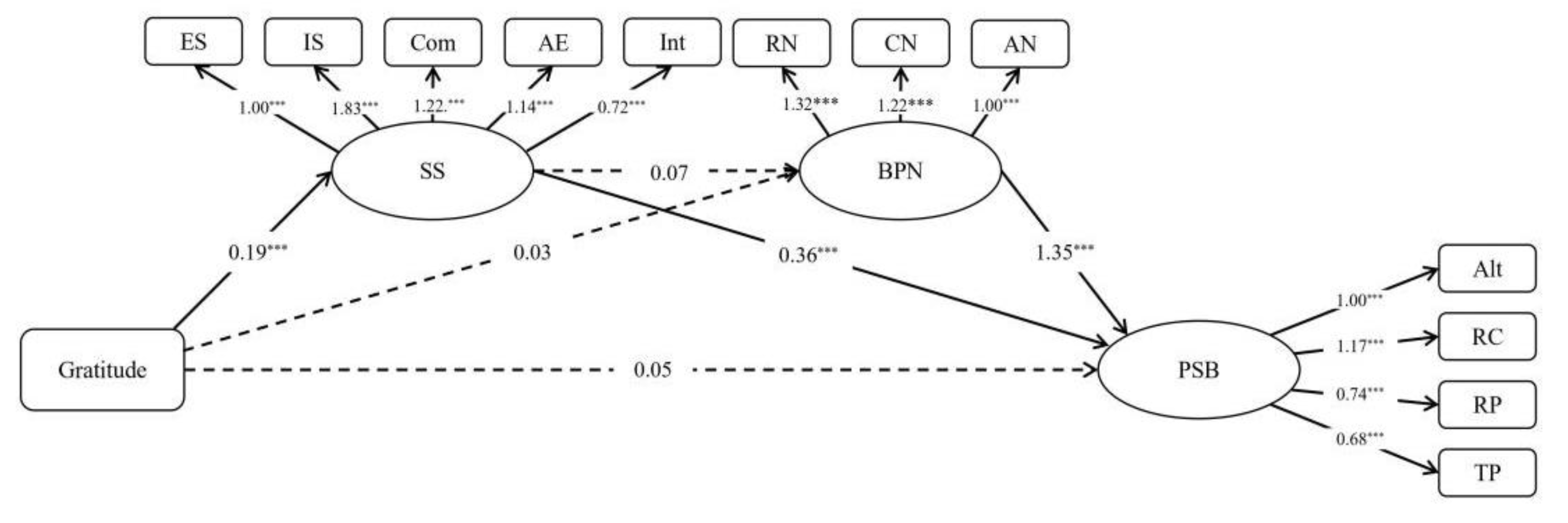

Table 1.
Pairwise correlations between variables.
| Variables | M±SD | 1 | 2 | 3 | 4 | 5 | 6 |
|---|---|---|---|---|---|---|---|
| 1. Sex | - | - | |||||
| 2. Age | 13.88±1.54 | .01 | - | ||||
| 3. Gratitude | 25.18±6.61 | .15** | .07 | - | |||
| 4. Social Support | 46.6±18.33 | .22*** | .02 | .39*** | - | ||
| 5. Basic Psychological Needs | 16.59±4.89 | .02 | -.09 | .22*** | .21*** | - | |
| 6. Prosocial Behavior | 7.54±17.63 | .12* | -.02 | .25*** | .34*** | .38*** | - |
* Note: *p < .05, **p < .01, ***p < .001.
Disclaimer/Publisher’s Note: The statements, opinions and data contained in all publications are solely those of the individual author(s) and contributor(s) and not of MDPI and/or the editor(s). MDPI and/or the editor(s) disclaim responsibility for any injury to people or property resulting from any ideas, methods, instructions or products referred to in the content. |
© 2023 by the authors. Licensee MDPI, Basel, Switzerland. This article is an open access article distributed under the terms and conditions of the Creative Commons Attribution (CC BY) license (http://creativecommons.org/licenses/by/4.0/).
Copyright: This open access article is published under a Creative Commons CC BY 4.0 license, which permit the free download, distribution, and reuse, provided that the author and preprint are cited in any reuse.


