
Submitted:
17 May 2023
Posted:
18 May 2023
You are already at the latest version
Abstract
After more than 20 years of market-oriented reforms, China's economy has developed significantly so far. Guangzhou, in particular, has been developing rapidly, with its urbanisation rate increasing and its gross domestic product climbing, all of which have prompted Guangzhou to pay more attention to the ecological aspects of its development. The Nansha Coastal Wetland Scenic Area, located in the southernmost part of Guangzhou, is the largest coastal wetland in Guangzhou and the largest habitat for migratory birds in the city, as well as an important exemplary ecological reserve in Guangzhou's "Road to Ecological Civilisation". With the inclusion of Nansha in the national development strategy of Guangzhou's "Southward Expansion", the conflict between ecological protection of coastal wetlands and urban development has become increasingly prominent.
In this regard, this study intends to use theoretical analysis, literature research, comparative analysis, fieldwork, data analysis and case studies to analyse the current state of the ecological environment in Nansha, explore the main problems in the process of its "southern development", and propose practical solutions for the construction and development of the ecological environment in Guangzhou, combining the theories of ecological economy, public goods and dissipative structure in Nansha. This paper is divided into seven chapters.
This paper is divided into seven chapters. Chapter 1 presents the significance, purpose, content, methodology and technical approach of the study. Chapter 2 defines the basic concepts and the characteristics of the terms "Nantuo", "Nansha New Area", "coastal wetland" and "Nansha Binhai Wetland Scenic Area". The terms "Nansha New Area", "coastal wetland" and "Nansha Coastal Wetland Scenic Area" are defined. The theoretical basis of ecological economy theory, public goods theory, dissipative structure theory and sustainable development theory is used to explain the importance of protecting wetlands. It also demonstrates the importance that countries attach to the conservation of wetland ecology through a review of domestic and international literature. Chapter 3 describes the formation process, development status, conservation content and conservation actions of the Nansha Binhai wetland. Chapter 4 analyses the apparent and invisible problems faced by the Nansha coastal wetlands. Chapter 5 draws lessons from the experience of wetland resources development and conservation in China and overseas. Chapter 6 presents recommendations and solutions to the existing wetland problems in the Nansha coastal area. Chapter 7 provides conclusions and outlook. The ecological vulnerability of the Nansha wetlands is obvious. The government has to speed up the construction of logistics, industries, railways and ports while protecting a large area of wetlands. In the conflict between industrial civilization and ecological civilization, maintaining the integrity of the Nansha wetland requires the participation of the whole society, so as to finally achieve a balance between economic development and ecological protection, providing important theoretical guidance for the protection of the ecological environment of the Nansha wetland, ecological planning and scenic area development under the development strategy of the "southern expansion" of Guangzhou's urban space.
Keywords:
Ecotourism
; Artificial wetland
; Nansha wetland
; Wetland conservation
1. Introduction and Background Information / Objectives of the Study
1.1. Background
In industrial societies, people have created unparalleled wealth and materials, which have not only provided us with advanced production tools, but also new challenges and problems, which have created contradictions and conflicts between man and nature. The continued emergence of unprecedented resource constraints, environmental degradation and ecological crises all suggest that replacing industrial civilisation with ecological civilisation is the only way for mankind to emerge from this crisis.
Since the 1960s, the importance attached to ecology and the environment has gradually penetrated into people's daily lives, and people have realised the importance they attach to the ecological environment and launched various ecological and environmental protection initiatives. In the country as a whole, environmental protection functions have been given attention and promotion by the government. In 1983, the concept of environmental protection was widely promoted as a long-term national policy. In 2007, the 17th National Congress of the Communist Party of China (CPC) further clarified that "an ecologically oriented value should be established in society as a whole.
Guangzhou is China's national core metropolis and a world-renowned seaport metropolis, leading the industrialisation and urbanisation of the Pearl River Delta. It is an important hub for the country's economy, finance, commerce and trade, shipping and convention, and is the region with the largest economic, economic and cultural radiation. Guangzhou achieved a GDP of $181 million (GDP) in 2016, with a per capita income of around US$20, 000, achieving an overall increase in GDP and realising a total citywide GDP of $134.91 billion, an increase of 8.5% year-on-year. The industrial structure was good, with 320 companies having set up their headquarters in Nansha and a new record of 1, 000 billion yuan in service sector output, with a ratio of 1.26:31.97:66.77 between the three industries.
In terms of investment in people's livelihood, the per capita disposable income of urban households reached RMB46, 600 and the per capita disposable income reached RMB19, 300. An additional 211.5400 urban jobs were created, greatly reducing the pressure on employment. The level of social security for urban residents increased by 89.41%, 166, 800 more affordable homes were built, and 1, 108, 000 more households used natural gas, giving effective protection to 56% of the population.
Across the country, the environment was effectively improved, with 312 days of atmospheric quality and an average PM2.5 concentration of 39 microns per square metre. The average PM2.5 concentration was 39 microns per square metre. The pollution control of water bodies has been stepped up continuously, with the Pearl River in Guangzhou still maintaining a Class IV status and the drinking water standard in urban areas reaching 100%. More than 3, 000 kilometres of green corridors have been built, and wetlands such as the Nansha Wetland, the Haizhu Wetland and the Huadu Lake have reached 42% forest coverage, realising green and low-carbon development.
Guangzhou ranks 5th in terms of overall strength, slightly behind Taipei City in Taiwan Province. Guangzhou has a resident population of 13.505 million, with 450.010 households and 2.74 persons per household per capita, of which 6.915.8 million (51.17%) are men, 6.582.9 million (48.76%) are women and 6.582.9 million (48.76%) are women, with a gender ratio of 105.08.
This year was also a year of accelerating urbanisation in China, with urbanisation levels reaching 71%, the highest in the country (Zhang Yuqin and Wu Xie, 2012). After the Asian Games, Guangzhou will accelerate its industrial restructuring, build a harmonious and stable society, promote "green ecology" and "low-carbon wisdom", and actively implement the urban development strategy of "southward expansion, northward optimization, eastward advancement and westward linkage". We will actively implement the urban development strategy of "expand in the south, optimize in the north, advance in the east and link up in the west", and integrate "landscape", "city", "field" and "seaside" into one, with natural, natural and natural resources. "It is a modern, natural and livable city.
Nansha is located at the southernmost tip of Guangzhou, west of the Pearl River estuary, in the Pearl River Delta, 28 kilometres from Hong Kong and 41 kilometres from Macau. It is 28 kilometres from Hong Kong and 41 kilometres from Macau. If we draw a circle around Nansha, a radius of more than 100 kilometres, we will have a population of 40 million in Shenzhen, Zhuhai, Guangzhou, Foshan and Dongguan, making up a total of 14 cities. Nansha New District has a planned area of 803 square kilometres, and by the end of 2015, the total regional production value was 133.37 billion yuan, with a tax revenue of 33.41 billion yuan; a fixed asset investment of 62.05 billion yuan was realised; of which, the total production of agriculture, forestry and animal husbandry was 8.402 billion yuan, and the total industrial production was 292.773 billion yuan; of which, the port passed 200 million 87 million tonnes of cargo and 11, 852, 000 TEUs of cargo; the city's domestic trade turnover was RMB87.5 billion, of which RMB17.075 billion; there were 9.86 million visitors and RMB2.62 billion of tourism in the year; the average wage of the urban resident population was RMB3, 830 and the average wage of the rural population was RMB2, 800.
In the process of development, Nansha and Guangzhou are facing outstanding problems such as resource constraints, environmental pollution and ecological deterioration, and people's demands and requirements for ecological civilisation are becoming increasingly urgent. For this reason, it is necessary to follow the path of "green ecological" development in accordance with the concept of socialist ecological civilization and in line with the regional, municipal and provincial conditions.
1.2. Significance of the Study
The Nansha New Area and Guangzhou as a whole must seriously implement the Central Government's policy of building a socialist ecological civilisation in accordance with its actual situation, and choose a "green" development path that is in line with its own regional, municipal and provincial conditions. The Nansha Coastal Wetland Scenic Area is located in the south of Guangzhou, covering an area of about 3, 400 hectares in Phase I and more than 6, 000 hectares in Phase II, and is one of the world's most famous tourist attractions. The wetlands are Guangzhou's rare "kidneys of the city", and together with the forest and the sea, they form the three largest ecosystems on earth, and are a resource on which human beings depend, both ecologically and economically.
What is the state of development and protection of the coastal wetlands in Nansha over the past few decades, and what should be the next step of development? On this basis, we will systematically analyse the main measures and achievements in the protection and development of Nansha coastal wetlands, identify the obvious problems and potential risks of Nansha coastal wetlands, analyse the causes of these risks, and provide a set of more targeted and operable strategies for strengthening the protection of Nansha coastal wetlands in the future, so as to maintain and promote the sustainable development of Nansha coastal wetlands. This will provide a scientific basis and technical support to maintain and promote the sustainable development of Nansha coastal wetlands, inspire the ecological civilisation of mankind, and guide the Nansha area and the entire Guangzhou city into a new stage of development.
The development of the new Nansha area in the south of Guangzhou, the upgrading of industries, the start of high-end industries on both sides of the Pearl River Delta, the rapid development of three major industries - Nansha port, emerging technologies and equipment manufacturing - as well as the construction of infrastructural support bases such as the automobile industry, shipyards, steel and petrochemicals, all need to be expedited. Under such circumstances, how to handle the relationship between the two is an issue that must be faced by the party committees and governments at all levels as well as the relevant functional departments.
The outcome of the project will provide scientific and rational policy recommendations for China's economic and social development, and provide a basis for decision-making on China's economic and social development.
Nansha New District has played a pivotal role in Guangzhou's "southern expansion", forming a "golden triangle" in the economic transformation of the Pearl River Delta, together with Qianhai in Shenzhen and Hengqin in Zhuhai. Located on the west bank of the Pearl River estuary, the Nansha coastal wetland is a shining pearl in the "Golden Triangle". If it can be further protected and utilised as a carrier, it will play a positive role in promoting the industrial and new urbanisation of the surrounding areas, bringing significant ecological effects as well as economic and social benefits. On this basis, a scientific and reasonable evaluation of the ecological system of our wetlands will be of great scientific value to the construction of our ecological environment.
1.3. Research Objectives
Based on the perspective of sustainable ecological values, we apply the theories of ecological economy, public goods, dissipative structure, sustainable development, etc., through a large number of international and domestic research on wetlands, and through comparison and generalisation, we obtain some useful experiences and inspirations to sort out the research status of coastal wetlands in Guangzhou, analyse the research results of coastal wetlands in Guangzhou, analyse the protection measures and effects of coastal wetlands in Guangzhou, and explore the research status of coastal wetlands in Nansha. The study also explores the potential problems and risks of Nansha coastal wetlands and their causes, and examines the conservation measures of Nansha coastal wetlands at both macro and micro levels, with a view to providing a scientific and credible basis and concrete practical guidance for the relevant departments of Guangzhou and Nansha New District to formulate sustainable development plans for Nansha coastal wetlands.
1.4. Research Content
This paper first discusses the background of the project, the significance and purpose of the study, the research methodology and the technical approach, explains some basic concepts, summarises the basic theories of the project, and reviews and judges the research literature on wetland conservation and development by domestic and foreign scholars. It then analyses the important contents, basic practices and effects of the Nansha coastal wetland by describing the formation and development of the coastal wetland in Guangzhou, and based on this, the problems and hidden dangers of the Nansha coastal wetland and the causes of the "bright" and "dark" problems. A more comprehensive and insightful analysis is presented. Drawing on international experience and lessons on the conservation and utilisation of wetlands, the study also examines the "four major conservation relationships", "five major regulatory tools", "four major institutional reforms", "four major conservation techniques", and "four major conservation techniques", In the five aspects of "four major protection techniques" and "timely implementation of the four major protections", a series of policies to enhance the protection of coastal wetlands in China are proposed in the aspects of "45444" respectively. A series of policies and measures to enhance the protection of coastal wetlands were proposed in the aspects of "45444", and relevant research results were obtained.
1.5. Research Methodology
In the implementation of the project, the author will insist on combining theory and practice, norms and empirical evidence, field research and theory, and qualitative and quantitative research. Research Methodology: Based on theories related to ecological economy, public goods, dissipative structure and sustainable development, the author will conduct a comprehensive evaluation of the ecological environment of the Nansha coastal wetlands, identify the feasibility and necessity of enhancing the ecological environment of the Nansha coastal wetlands, and determine the research targets, research directions and methods.
Documentary Approach: Through checking and collating policy documents related to the construction of ecological civilisation in recent times and relevant literature on wetland conservation in China and overseas, we will conduct a comprehensive understanding of the formation and current state of Nansha coastal wetlands, carefully screen relevant research on Nansha coastal wetlands, sort out relevant theories and concepts, and identify clear research themes.
Comparative study: To understand the development history, conceptual evolution, classification, conservation methods, development history, successes and failures of typical coastal wetland conservation and utilisation in the international arena, and to extract useful extracts from them, so as to provide a basis for Guangzhou City and Nansha District to develop coastal wetland conservation.
On-site research: Through on-site research, we will conduct an in-depth investigation into the geographical location, natural ecology, landscape pattern, industrial structure, protected areas, the current state of conservation work, its effects, shortcomings and causes, and at the same time combine the characteristics of my work in Nansha Marsh to obtain more data, so as to lay a solid theoretical and practical foundation for further in-depth development.
Data analysis method: Taking Guangzhou City and Nansha District as examples, I used Internet terminal equipment, major bookstores and libraries to collate and analyse data related to Nansha coastal wetlands obtained from field research and questionnaire surveys, and applied them to the article, so that the research results of the article are more scientific and reliable.
Case study method: The analysis of representative cases in the development and protection of Nansha's coastal wetlands, the continuous collection and comparison, the threading of needles and the identification of the nature of the problem. By analysing the superficial phenomena, the core ideas will be extracted and some regularities will be found to match with the project designed in this topic, providing stronger opinions and evidence for Nansha New District to build a new coastal city under Guangzhou's "southward expansion" strategy and for the protection and utilisation of wetland resources in Nansha. The project will also provide stronger advice and evidence for the conservation and utilisation of wetland resources in Nansha.
1.6. Technical Roadmap
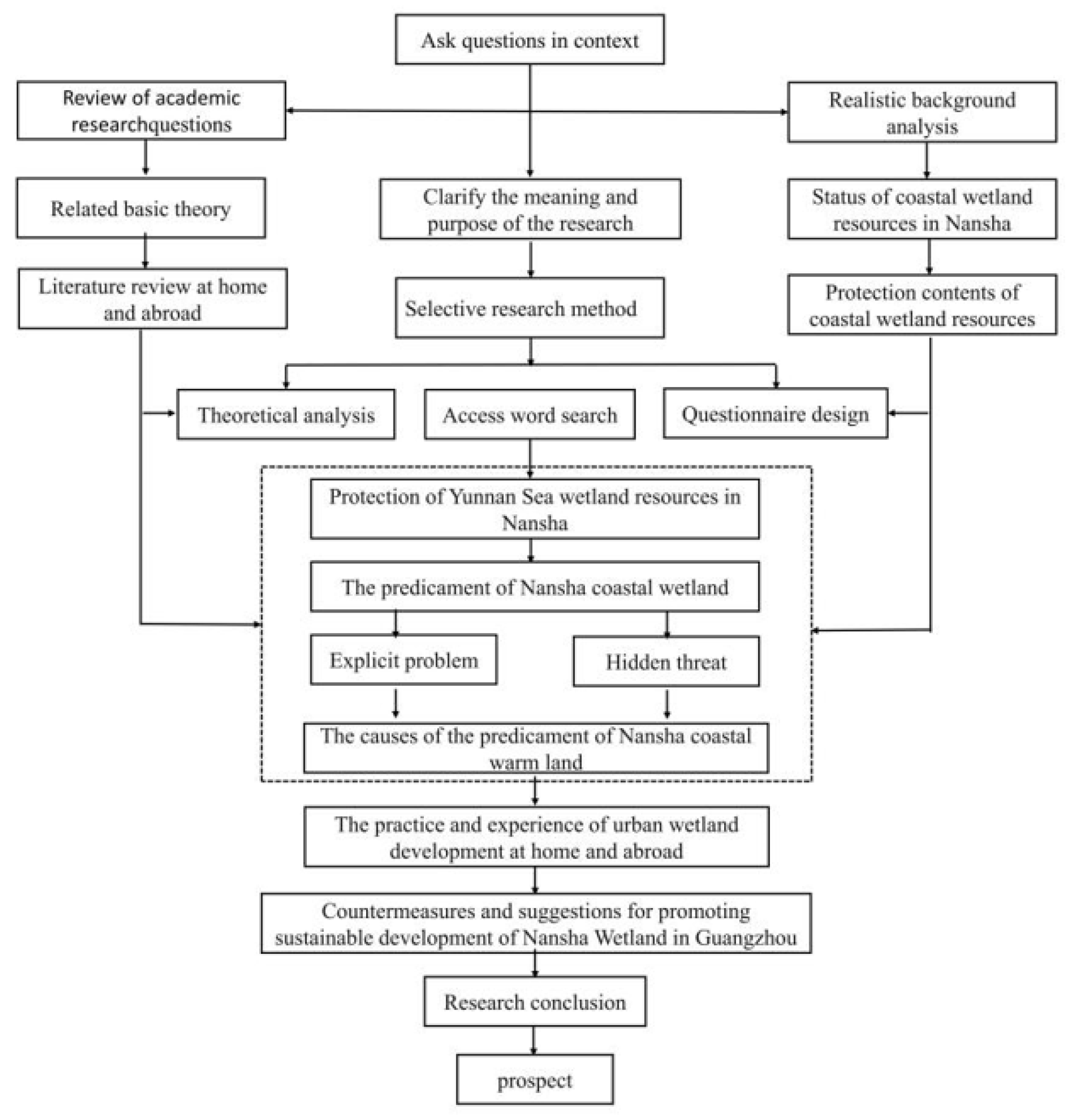
Figure 1.1.
Technical Roadmap.
2. Basic Theory and Literature Review
2.1. Definition of Basic Concepts
2.1.1. Guangzhou's Urban Development Strategy of "Southward Expansion”
For a long time in the past, Guangzhou was constrained by its administrative zoning, its spatial pattern was not scientific enough, its land resources were insufficient, its infrastructure was inadequate, and its ecological environment could not support its sustainable development. Guangzhou faces new opportunities and challenges in the face of economic globalisation, China's accession to the WTO, the rise of a knowledge-based economy and the emergence of an information society.
The restructuring of the Panyu and Huadu regions has given a new impetus to the development of the region and to the economic development of the surrounding areas. Guangzhou has optimised the spatial distribution of urban building sites under the overall development strategy of sustainable development.
In the year 2000, Guangzhou's spatial development strategy of "expanding to the south, optimising to the north, advancing to the east and linking to the west", which aims to turn the city into a regional centre metropolis and a mountainous ecological metropolis that is pleasant to live in and enjoyable to live in, is a timely and effective way to determine the direction and concept of its development, optimise its construction and operation, and guide and control it. A timely and effective approach has become the framework for Guangzhou's development.
The Guangzhou Municipal Committee has supplemented the "Central Adjustment" on the basis of the principles of "South to North, East to East and West to West", forming a new "Cross Policy "This change means that in the future, the Guangzhou Municipal Party Committee will be able to make a number of changes. Such a change means that the future of the city will move from "expansion" to "optimisation and upgrading". In 2012, Guangzhou proposed "one metropolitan area, two new cities and three sub-centres", of which the "metropolitan area" focuses on improving the spatial structure of the city, enhancing the spatial quality of the city, upgrading the status of the city, enhancing the influence of the city, enhancing the soft strength of the city's culture and enhancing the overall strength of the city. The "two new cities" are the new Nansha Binhai District and the new Eastern Scenic District. Huadu, Conghua and Zengcheng, as the platforms of the three sub-centres, will integrate urban and rural development, take over the redundant elements of the surrounding towns and promote the solution of the "three rural issues". On the basis of urban development, the city development strategy of "southward expansion, northward optimization, eastward advancement, westward linkage and central coordination" has been proposed. The expansion to the south is aimed at expanding the scope of strategic industries in Nansha Binhai New City and promoting the development of modern service industries and port industries.
In 2015, the Guangdong Free Trade Zone was officially launched, of which Nansha is one of the 60-square-kilometre areas. The new city district. Nansha has entered a critical stage in the development of a new national-level zone and free trade zone. Ren Xuefeng, a member of the Standing Committee of the Provincial Party Committee and Secretary of the Municipal Party Committee, made 13 speeches on Nansha at the 13th Standing Committee of the Communist Party of China in Guangzhou and made Nansha the second city of Guangzhou.
2.1.2. Nansha New Area
Nansha New District is located in the southernmost part of Guangzhou City, Guangdong Province. It is situated in the Pearl River Delta and is an essential route to the sea for Guangzhou, which gives it a unique location advantage. The Nansha New District has an excellent ecological environment, a strong agricultural base and great development prospects. It is of great strategic importance as it can provide a close link with Hong Kong and Macao through its radiation effect on the surrounding cities.
Nansha New District is located in the southern part of the Shawan Waterway in Guangzhou City and consists of six towns and three streets: Nansha Street, Longxu Street, Zhujiang Street, Henglei Town, Wanqinsha Town, Dagang Town, Huangge Town, Lanyuan Town and Dongyong Town. The total economic volume of the region reached 113, 307 million yuan in 2015, an increase of 13.3% year-on-year, while the total tax revenue and tax receipts amounted to 33, 471 million yuan, a decrease of 0.6%. Nansha New Town, which combines a coastal marsh, a Lingnan water township and a national forest park, is a veritable city by the sea. In the Nansha New District Development Plan, we will further enhance the ecological development of the city. In the Nansha New District Development Plan, we will further enhance the ecological development of the city, including the protection of water sources and the construction of an ecological system in the Lingnan area, including an ecological reserve, a landscape reserve and a greenland ecological system in the urban area. The aim is to expand the wetland resources in the Nansha waters and maintain their sustainable development, which requires the use of technology to regulate the ecological environment. According to the Tenth Five-Year Development Plan, Nansha will achieve a gross domestic product of 300 billion yuan by 2020, including 233 major projects with an investment of 546.9 billion yuan. In Guangzhou's 12th Five-Year Plan, Wang Yang suggested the Nansha New District as an entry point to the new Guangzhou.
2.1.3. Coastal Wetlands
In the scientific system, the science of wetlands is still in need of refinement, and its definition needs to be studied in depth. To date, there are nearly 60 different definitions (McComb A J, Davis J A, 1998). The USA was the first country to introduce and apply this concept. The concept of "wetlands" was first examined in the 1950s and defined to include, in addition to rivers, reservoirs, deep lakes and other fixed waters, shallow or broken waters in low-lying areas, as well as lakes and ponds.
Internationally, a wetland is defined as an area of water between terrestrial and aquatic zones, with the characteristics of both terrestrial and aquatic ecosystems; where the surface is covered by shallow water, or where the water surface changes around the surface; and where, from a resource science perspective, the water overlying the water body is no more than 6 m deep and has ecological value, whether natural or artificial, permanent or temporary, it can be considered A wetland. From a systems analysis perspective, these can be classified as semi-open or semi-enclosed.
According to the International Convention on Wetlands (1971), a "wetland" is a complex of natural, man-made, marshy, peaty, permanent, temporary, semi-pale, semi-saline, low water level below 6 m at low tide, natural, man-made, marshy, peaty, permanent, temporary, semi-pale, semi-saline water. complex water. Although the definition of wetlands in the International Convention on Wetlands is generally recognised worldwide, there is currently no worldwide consensus on the definition of this concept.
2.1.4. Nansha Binhai Wetland Area
The Nansha Marsh, located in the southernmost part of Guangzhou, is situated at the mouth of the sea along the Pearl River Delta and covers an area of nearly 10, 000 hectares. The Nansha Marshes are known as the "kidneys of Guangzhou" for their natural functions in wind protection, wave mitigation, soil conservation and weather control.
The Nansha Marshes are divided into two phases, the first phase is the Nansha Marshes and the second phase is bounded by the Nansha Lingxin Expressway. The second phase of the Nansha Marsh, known as the "10, 000-acre wetland", was completed in 2008 and now covers an area of over 6, 000 acres. The Nansha Marsh has been described as the largest marsh in the world. The first phase of Nansha Marsh is a central area for birds and mangroves, mainly to provide a habitat for birds, as well as an extracurricular classroom for students to learn about ecology and science; the second phase is an ecological tourism area, including ecological tourism, science education, culture and film, and leisure and holiday.
In recent years, with the country's concern for natural ecology, humanities and science, leisure and tourism, the Nansha Marsh scenic area has been favoured by domestic and international tourists for its rare bird and mangrove resources, and over the past ten years, it has gradually formed a "double holiday" in the Pearl River Delta. In the past decade or so, the "double holiday" trend of the "Pearl River Delta" has gradually developed, and gradually formed a "double holiday, double stay, double flight" trend. In order to build its own brand, Nansha Wetland is to carry out overall planning and engineering construction in accordance with world-class standards, and make it a comprehensive 5 A coastal and seascape area integrating humanities and regional culture, suitable for wilderness development, outdoor adventure, parent-child family and elderly leisure.
2.2. Relevant Basic Theories
2.2.1. Ecological Economy Theory
Ecological theory" is based on the principles of ecological economics, under the guidance of ecological economics theory, the economic activities of human production and consumption as the main content, the use of agricultural systems engineering, from the perspective of the integration of ecology and economy, from the perspective of the overall system and the upper and lower ecosystems and the mutual influence and constraints of productivity, the essence of the laws between nature and society to carry out It summarises the essence of the laws between nature and society, changes production and consumption patterns, and makes efficient use of all available resources (Allan Crowe, 2000)." Abstract: An 'eco-economy' is a goal-oriented, socially appropriate and ecologically sound form of economy. Ecological economy emphasises the integration of ecological and economic systems, the identification of common components, and the study of their integrated practices, in order to achieve overall harmony between ecological development, economy and society, and ultimately to realise the optimal form of ecology-economy. Like the ecological economy, it is a sustainable economic activity. It is not only a process of natural behaviour, but also a process of socio-economic activity. Its essence is the exchange of things between people and nature in the process of social production and labour, which means that it is a process of ecological-economic development with people's consciousness as the main will and human consciousness as the main body.
The rich variety of flora and fauna in the Nansha marsh is a good resource for making paper and for raising livestock. This is because the waters of the Nansha marsh are large and there are many fish, and because it is located at the junction of salt and fresh water, its meat is of good quality, with a taste not only of salt water but also of fresh water. There are also more than 10, 000 acres of lotus ponds, which produce fresh and tasty lotus roots for human consumption. In addition to this, there is a wealth of food such as shrimps, crabs, shellfish and algae, as well as some vegetation in the marshes, such as iron holly and dendrobium, which are all excellent medicinal herbs.
In this paper, we have evaluated the simulated market technique by means of a questionnaire, which was influenced by the design of the survey questions, the size of the survey sample, the overall level of awareness of the respondents and the level of economic development of the survey and the region, resulting in biased results. Therefore, in the thesis, we have used ecological economics, which better reflects the current state of the study area, instead of the current market-based technical economics, to conduct the analysis.
2.2.2. Public Goods Theory
A public good is a service or good that can be provided to one person or another without affecting the way another person consumes it, through the budget of the state.
The promotion of agricultural technology for public benefit usually includes the promotion of science, technology and agriculture, which includes various fields such as science and technology, agricultural technology and training technology (Chen Liang, 2012).
In order to promote the reform of China's agricultural technology promotion mechanism, it is particularly important to make full use of the existing hydrological and soil properties of wetlands to construct a diversified and multi-level wetland ecological agricultural technology promotion system. At present, agricultural science and technology parks are developing at a rapid pace in China, and new green ecological products are being produced with the technical support of science and technology parks. As a result of the national plan to integrate agro-technology parks with wetlands, the agro-technology parks will promote the development of wetland ecology technology. The Nansha District is working to promote the technological advancement of Nansha's marsh farmland and has established the Guangzhou Academy of Agricultural Sciences in Nansha to transform Nansha's marsh farmland into another important agricultural industry (Liu Zhanping, 2006).
During his inspection of Hainan in 2013, General Secretary Xi Jinping suggested that "the ecological environment is the most just, and the people are the happiest, the most just." This illustrates that the ecological environment is a public good that can improve people's quality of life and enrich their livelihoods.
The essence of ecological protection is to provide fresh air, clean water, safe agricultural products, rich local produce and beautiful ecological scenery for the people of Nansha and the whole of Guangzhou and even the entire surrounding area of Guangzhou, thus contributing to the survival and development of the general public and thus ensuring the healthy development of the Nansha wetlands.
2.2.3. Dissipative Structure Theory
Dissipative structure theory is a new discipline. Based on this, this project proposes a quantum information processing method based on quantum information, i.e. quantum information processing method (Zhao Xing, Zeng Guangming, 2005).
In order to maintain the ecological balance of wetlands, we must fundamentally change the reality by breaking the original ecological pattern and establishing a new ecological pattern that is compatible with it, in accordance with the socio-economic principles and from the ecological perspective, so as to achieve sustainable wetland construction (Zhang Taolin, Li Zhongpei, 2006). At present, with the economic development and population growth of Nansha, the high-density use and industrial development of Nansha area has overcrowded the area, and it is impossible to maintain its long-term stability and sustainability by its own function alone.
In order to explore the conservation of the ecological-economic system of wetlands by taking the dissipative structure as the starting point, we should introduce as much 'negative entropy' as possible and make reasonable adjustments to time, space, people, effectiveness, methods and structure in order to maximise its social and ecological benefits (Wu, Jifang and Xu, Baogen, 2003).
By adopting new techniques, introducing new species, retaining endemic species, rebuilding industries and reducing the interactions between species, the biomass of the Nansha wetland is enhanced, thereby promoting the development and conservation of the Nansha wetland. Through the study of the Nansha area, a development concept based on a circular economy is proposed to realise the reuse of resources and to reduce the emission of waste.
2.2.4. Sustainable Development Theory
Sustainable development is one of the guiding objectives of human society. After experiencing repeated damage to the earth's environment, the consumption of resources and the loss of land, people have come to a common understanding of the importance of sustainable development. In recent years, sustainable development research has progressed from being supported by a number of disciplines including ecology, economics, biology and sociology, to a science of sustainable development.
The protection of the Nansha Marshes cannot be based on current benefits alone, but rather on the creation of land around the sea, resulting in the shrinking of the marsh area and the deterioration of the ecosystem function, which in turn leads to the decline of the biodiversity of the marsh and the deterioration of the ecosystem function. Continued destruction will lead to a shortage of water resources in the Nansha area, and will have a detrimental effect on the ecological, economic and social co-ordination of the Nansha area. In the course of the "Southward Expansion" development process, the Nansha wetlands must not be allowed to suffer serious damage for the sake of immediate local interests, otherwise the southern coast of Guangzhou will be condemned by God and even affected for generations to come. Therefore, early protection of national wetlands and scientific development of this valuable wetland resource in Nansha must ensure its sustainable use.
2.3. Summary of Domestic and International Literature
2.3.1. A Review of Overseas Literature
In the 1990s, the University of Sydney (1999) conducted a large number of surveys and statistics on wetlands, and the results of these surveys were analysed and collated in detail. On this basis, a study was carried out on a model of wetland management based on a combination of artificial disturbance and artificial disturbance in the Ko Oladeo National Park, India, to achieve a comprehensive evaluation of artificial disturbance and wetland management. This project proposes to use GIS iterative analysis technology to obtain multi-element information through the iterative analysis of surface water volume, soil type, rainfall intensity and damage to wetland plants in Campion National Wetland Park, Warsaw, Poland, in order to provide a scientific basis for the protection of wetlands in China and to provide a scientific basis for the conservation of wetlands in China. The "marsh buffer bank" introduced by Shao Shenxia (2011) in the United States is able to convert the area of marsh land into cash, thus playing the role of a "money bank" for savings and loans. The conflict between urban development and the ecological environment has also led to concerns about marsh resources.
The results show that the ecosystem in the area has a positive effect on reducing urban greenhouse gas emissions and mitigating urban heat islands, and has important practical significance.
2.3.2. Summary of Domestic Literature
(1) Research on the concept of wetlands in China
Research on marshes has been conducted in China for a long time, but the literature on marshes has been slow to develop during the Shang and Zhou periods. From the 1950s onwards, the Wuhan Institute of Oceanography conducted an oceanographic study of the shallow lakes in the middle and lower Yangzi River. In 1960, the Changchun Institute of Geology of the Chinese Academy of Sciences, in conjunction with the Northeast Normal University, carried out a comprehensive geological survey of northeastern Tibet and the Hengduan Mountains. In 1960, the Nanjing Institute of Geology and Lakes conducted a survey of the major lakes in China. From 1979 to 1984, the State Oceanic Administration of China conducted a survey of the natural ecological resources of the country's coastal zones, and since then, the study of wetlands in China has gradually changed from lakes to marshes and extended to marine areas. The term "marsh" did not appear in the 1989 edition of the Dictionary. In 2000, the "Action Plan for the Protection of Wetlands in China" was compiled by the State Forestry Administration, with the participation of 17 departments. In June 2003, Heilongjiang Province issued the "Regulations on Heilongjiang's Marshes", which set an example for the legalisation of wetland protection nationwide. China was granted membership of the Standing Committee of the Convention on Wetlands for the first time. A comprehensive wetland conservation programme was launched in 2006.
(2) Research on domestic wetland parks
(3) In the past, there was only one direction of research on wetlands, but after research by scholars, it has become a combination of many fields such as biology, architecture, ecology, environmental protection and urban planning. In February 2005, the Zhejiang government invested 4.5 billion yuan in Hangzhou Xixi Wetland, the first national wetland park in China to have a large inland lake. In June 2005, a total of nine national wetland parks were established in China. In 2010, the State Forestry Administration issued the National Wetland Park Management Issuance (for Trial Implementation) and the National Wetland Park Acceptance Issuance (for Trial Implementation) to regulate them. By 2015, there were over 900 wetland parks in China, including 569 national (experimental) ones, with a total area of over 2.75 million mu. The Wetland Conservation and Restoration System Programme was published on 12 December 2016, further regulating the graded management system of wetlands and the mechanism for restoring and safeguarding the ecological environment.
2.3.3. A brief review of the literature
(1) Wetlands have become a new focus of international research in the fields of ecology, geography, botany and environmental science, and scholars from home and abroad have conducted in-depth analyses and studies on the functions, structures, uses and dynamics of wetlands from different perspectives and using different scientific research methods in an attempt to find reasonable ways to develop and protect wetlands. We need to learn from the successful experiences of foreign countries from various perspectives and formulate sound laws and regulations related to wetland protection so that they can be followed to a certain extent.
(2) Overseas, research on wetland parks is divided into two main types: natural and man-made.
(3) Natural wetland parks have a good ecological environment. Countries such as the USA, Germany, France and Japan are developing natural wetlands to meet people's recreational and leisure needs.
(4) An artificial wetland park is an area where wetland flora and fauna, aquatic life and water bodies are created by artificially modifying an otherwise fragile ecosystem. It not only provides a place for leisure and recreation, but also improves the air quality in certain areas, filters impurities and purifies sewage, thereby nourishing the soil and enhancing the urban landscape. In the USA, Germany, Japan, France and other countries there are also a large number of artificial marshes. The Xixi Wetland Park in Hangzhou, the Poyang Lake Wetland Park, the Xianghai Wetland Park and the Three Rivers Plain Wetland Park are typical examples of wetland parks.
(5) In the process of planning and constructing wetland parks, sufficient research should be conducted under the theoretical guidance of government departments. After reviewing domestic and international experiences in the construction and management of wetland parks, we have found a number of references for our country: (1) Wetland laws and regulations should be given sufficient attention, and various departments should cooperate with each other. (2) To raise capital through market-based approaches to achieve the goal of national co-ordination of development. (3) To protect the public's right to know and to promote public supervision and participation.
3. Nansha Coastal Wetlands and Their Conservation Status
3.1. Formation Process of Coastal Wetlands
3.1.1. Formation of the Coastal Wetlands
Between late 1984 and late 1996, the Guangzhou Nansha Reclamation and Development Company had completed more than 89, 000 mu of land, and more than 30, 000 mu of land in the Nansha area had been reclaimed for various industries and industrial development. After the reclamation, aquatic products such as roe fishes, ghost shrimps and green crabs began to be put in, and petal-less sea mulberries, candle grass, water reeds and wood reeds were also planted, along with crops such as papaya, lotus roots, bananas and star fruit, so that the earliest model of wetlands could be initially formed. Since 1993, GF has been reforested with mangroves, and in 2006, following the publication of the Regulations on the Protection of Wetlands in Guangdong, exemplary, innovative and creative construction was carried out in the area, and the wetlands in the area were restored accordingly. This is also the first time that Guangdong Province has explicitly legislated and protected wetlands.
3.1.2. Landscape Construction
In 1997, a 10, 000 mu trial of lotus roots was carried out in Nansha, but due to the saltwater interface of the Pearl River estuary, there was not enough fresh water for the growth of large scale lotus roots. In 1997, the Nansha Reclamation and Development Corporation set up a paradise next to Bay 20, Bay 19, using the sediment on the eastern side of Bay 19, piling up the sediment on the eastern side of Bay 19 to create a green island, and after stabilising it, began planting a small amount of mangrove forest. In 1999, a member of the public saw 200, 000 to 300, 000 parrots in a nearby forest, which immediately attracted the attention of the government. After a visit to the Netherlands, the senior management of the Nansha Land Surrounding Company and related experts found that Nansha was a major migration route for migratory birds and suggested that the Company could draw on the Dutch approach and experience in ecological conservation and the construction of the Nansha Wetland. As a result, extensive reclamation was carried out in the area, mangroves were planted, wooden walkways were built, rain shelters were constructed, viewing towers were built and footpaths were laid, gradually enhancing the scenic connotations of the Nansha coastal marsh.
3.1.3. Scenic Area Opening
The Nansha National Wetland Park was announced to the public in 2008, and the name has since spread. In May 2011, Nansha Marsh was named one of the "Eight New Landscapes of Guangzhou and Yangcheng", and in October 2011, it was awarded the 15th Best Sustainable Natural Landscape (Figure 3.1). In October 2011, it was named as one of the "Top Ten Tourist Attractions in Guangdong, China", in August 2012, it was named as one of the "Top Ten Scenic Spots in Guangdong", and in August 2012, it was named as a "Triple A Grade". 2016, it was named as one of the "Top Ten Most Beautiful Wetlands in Guangdong". In 2017, the Guangdong Environmental Protection Bureau established a teaching base for the "Nature Academy".
3.2. Current Development of the Coastal Wetland
3.2.1. Geographical Location
The Nansha Marsh is located at 113°33'07'-113'39'58'E and 22°26'55'-22°35'40'N. It is situated at the mouth of the three rivers, the Pearl River, in the southernmost part of Guangzhou, next to the Hongqi Canal to the west and bordering Zhongshan City. The Nansha Marsh is the largest and best ecological marsh in Guangzhou, with a well-developed water system, a 26.5 km long river channel, a meandering shoreline, a well-developed water system, the largest water area and the best ecological environment. The Nansha Marsh is located in the northern part of the country, in the south of the country, with abundant precipitation, high average annual temperature (21.81°C) and precipitation (1637 mm), and is a southern subtropical monsoon climate zone, which is suitable for birds and is an important migration route for migratory birds worldwide (Chen Guizhu, Peng Yougui, 2006). In terms of location, it is located within 100 km of Humen, Jiaomen, Hongqimen, Hengmen and Nansha Marsh, and within an hour's journey from Zhongshan, Shenzhen, Dongguan, Foshan and Zhuhai.
3.2.2. Natural Ecology
The Nansha Marsh is a unique mixture of salt and fresh water, mostly salt water in the first half of the year and salt water in the second half of the year, and in order to purify the sea, the vegetation is mostly red trees and some reeds. There are 15 species of mangroves, including salt fern, wood sorrel, autumn eggplant, red sea sorrel, sage, rugosa, sea lacquer, tung-flower tree and white bone loam, with nine species in seven families and nine genera. There are four species of semi-mangrove trees, namely Hibiscus, Hibiscus, Hibiscus and Hibiscus. At present, there are a variety of artificially cultivated mangrove species in China, which are rich in both land and water ecosystems and species resources, and also provide good habitats for wintering birds (Figure 3.1). The mangrove forest is also an ideal habitat for birds. In recent years, the development and protection of the Nansha wetlands has increasingly focused on creating and improving the ecological environment of the mangroves, with 1/3 of the wetlands being allocated to a large number of migratory birds, with over 100, 000 migratory birds entering the Nansha marsh each year to spend the winter. According to the information provided by the South China Institute of Rare Flora and Fauna, over 51% of the migratory birds in Guangzhou City spend their winters in Nansha Marsh, including the Oriental White Stork and White-tailed Sea Eagle, which are protected at the national level, and 17 species of Black-faced Spoonbills and White Spoonbills, which are protected at the national level, as well as 21 species of birds protected at the provincial level, etc. Nansha Marsh has gradually become a major feature of the Pearl River Delta region.It is a "migratory bird paradise" and a beautiful place to visit.

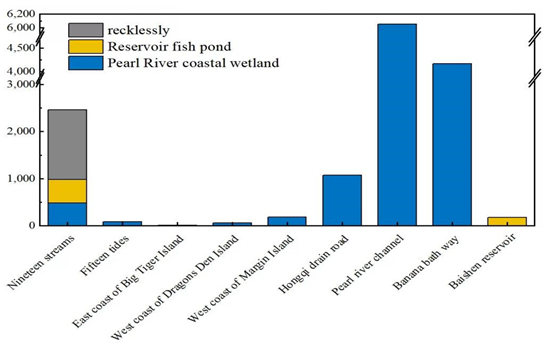
Table 3.1.
Basic overview of wetlands in Nansha New Area (hm² ).
3.2.3. Landscape Pattern
The first phase of Nansha Phase I is dominated by mangroves and reeds, on top of which the area can be visited by electric dinghies, and a single or two-person bicycle can be hired, allowing visitors to enjoy the rare mangroves, lush reed rafts, salty and light lotus ponds, spectacular bird breeding areas, and active bird feeding areas (see Figure 3.2). The marsh has a science museum and display room where visitors can learn more about the marsh and see samples of it. The park has a 3km banyan shade road and a 20m high observation deck, which is complemented by a mangrove coffee bar and a relaxation promenade, where you can look out over Nansha Harbour and the Nansha Marshes, or have a cup of coffee, perfectly blending the Nansha Marshes with the modern construction of the city. The second phase of the marsh is a breeding ground for fish and birds, providing them with rich ecological conditions. The first and second phases of the Nansha Marshes are connected by a five-hole bridge over which boats can pass unimpeded. In the process of urbanisation, the human impact on urban wetlands is becoming more and more pronounced, so the wetland ecosystem in the Nansha area should be scientifically laid out spatially. It is a 'migratory bird paradise' and a beautiful place to be.
3.2.4. Economic Overview
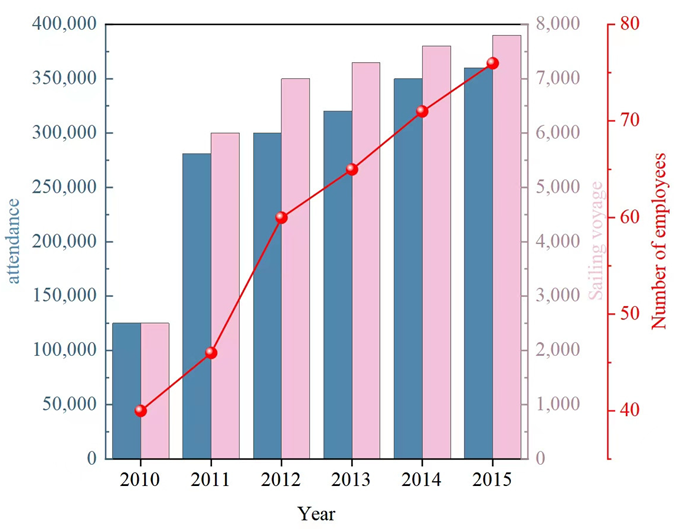
Since 2010, the Nansha Marshes have been gaining acceptance and are gradually being developed as an important eco-tourism destination in the Pearl River Delta and throughout Guangdong Province. The town of Wanqinsha, located in the Nansha Marshes, is one of the only provincial-level seaside towns in the Nansha District with a distinctly southern Lingnan waterfront feel. The town has a total administrative area of 319.1 square kilometres, of which 45.96 square kilometres is under the Pearl River Management Area, of which 126.38 square kilometres is outside the Pearl River Management Area, 146.74 square kilometres is under water, and 126.38 square kilometres is under other land. Some useful information was obtained through the release of 1, 000 questionnaires and 950 valid questionnaire surveys were obtained. In Nansha Marsh, 40% of people aged 25-40, 30% of people aged 40-59, 20% of people aged 60 and 10% of people aged 10-25, which shows that Nansha Marsh is not very attractive to young people and more people choose middle-aged and elderly people. The other 70% felt that Nansha Marsh was not very touristy, 20% felt that it had unique sightseeing features and 10% felt that it was not very attractive.
As for whether they would visit the Nansha Marsh in the future, only 20% said they would, 70% said they would not and 10% said they had the opportunity. There must be a tourism product that meets the market requirements.
Table 3.2.
Statistics on the operation of the Nansha Wetland.
3.2.5. Industry Characteristics
In order to ensure that industrial development and urban development in the coastal areas of Nansha does not cause damage or encroachment on the wetlands, the development and utilisation of eco-agriculture in the coastal areas has been the focus. The Nansha area has adopted a rotational approach to marsh planting, with different planting years for the same marsh plants. Farmers rotate their planting according to their planting habits, not only to maintain the soil of the marsh, but also to improve the adaptability of the surrounding marsh to the vegetation. The practices accumulated by Nansha farmers on their cultivated land have profoundly changed the agricultural landscape of the Nansha area. Nansha has great scope for development, as well as the technology to maintain soil nutrition and the ability to preserve it. However, most of the farmers in Nansha still use it in a primitive way or by virtue, which not only generates a lot of fertility, but also flows into the natural water with the rainwater from the ground and then into various rivers, resulting in serious pollution of the water environment. Therefore, Nansha needs to enhance education on agricultural knowledge, increase the efficiency of fertiliser use and reduce the pollution of water resources. In addition, the use of mangrove ponds as artificial wetland systems is also a viable option for ecological farming in Nansha.
The feed in the ponds can attract more birds and bird droppings can provide a variety of fish in the ponds, while the birds in the ponds can be mitigated by artificial intervention. In addition, Nansha has a relatively well-developed fish pond technology. In contrast to mangroves or ordinary ponds, the mangrove planting and breeding system is based on the artificial transformation of the ponds by planting mangroves, and on top of this, the breeding and cultivation of fish fry, shrimp fry, crab fry and other aquatic products. After the mangroves have improved the quality of the water bodies, the fish and lobster production in the planted ponds has increased significantly, as has their overall ecological role.
3.3. Elements of Wetland Conservation
3.3.1. Water Conservation
Wetlands are important for maintaining the overall water resources of the region because of their strong sorptive capacity and water storage capability. At the same time, wetlands also have the function of containing water. When there is a lack of water resources on the ground, the flow of water from the wetland is transformed into surface water from the bottom upwards, thus exerting a regulating effect on rivers and streams. In addition, the wetland is able to decompose pollutants and remove impurities from the water, making the water source more pure.
In addition, other types of marshes in Nansha, such as rice paddies, lotus root fields, embankment beaches, reed beds, mangrove respiratory roots and fish ponds, have a storage capacity of 22, 848.67hm2, or 42.9%. According to the data, the total volume of wastewater generated in Nansha waters in 2015 was 2.841 billion t, including 752 million t of industrial wastewater and 1.894 billion t of domestic wastewater, most of which was discharged directly into Nansha waters or into the Shizhao and Lingding Oceans. Some data show that an acre of mangrove can absorb 151 to 261 kg of nitrogen and 11 to 22 kg of phosphorus, and this is for one year. A large number of aquatic plants have the function of decomposing pollutants, and in an artificial wetland covered with aquatic plants, the total nitrogen is 2.16 kg/(hm2d) and the total phosphorus is 0.22 kg/(h) (Zhang Jiayao and Xia Shenglin, 1998). Based on the above results, the ability of the wetlands in the Nansha wetland to mitigate total nitrogen and total phosphorus in river water bodies was estimated, which provides a scientific basis for mitigating eutrophication in near-shore water bodies and preventing and controlling red tides.
3.3.2. Land Resource Conservation
The Nansha Marsh can enhance the local ecological environment, improve the local climate and also prevent the loss of terrestrial resources to the sea. Through physical changes such as evapotranspiration, the wetlands and vegetation can maintain atmospheric humidity and precipitation in the newly reclaimed area, thus maintaining the reduction of water and soil moisture loss in the ecosystem cycle.
3.3.3. Conservation of Plant Resources
There are 318 species of higher plants in the Nansha wetland, belonging to 90 families, with angiosperms accounting for 76.8%, ferns for 20% and gymnosperms for 3.2% (Table 3.3).
3.3.4. Protection of Animal Resources
The Nansha Wetland is a diverse area and one of the most concentrated areas of endangered species in Guangdong. In Nansha, 34.60% of fish, 30.40% of birds, 19.60% of benthic animals, 6.10% of reptiles, 5.10% of mammals and 4.20% of amphibians are found in the area. As of 2015, the Pearl River estuary has become an important endangered species in China and has been upgraded to a national level reserve (She & Guo Xingmin, 2003), but little is known about the current status and problems of the reserve (She & Guo Xingmin). The promotion of the Chinese sturgeon nature reserve and the establishment of an ecological demonstration base in the South China Sea fully demonstrates the legitimate protection of Chinese sturgeon in China and is important for maintaining the ecological environment, enhancing species diversity and promoting biological reproduction in the Nansha waters. The Nansha area is dominated by grass carp, spinning heart fish, carp, carp and flower fish, in addition to more than 20 species of shrimp, crab and shellfish, with a total annual production of 4.14x10⁴ tonnes of aquatic products. The Nansha Marsh area is rich in species and family groups, with species recorded in 81 family groups and 1, 186 species, representing 11.01% and 11.01% respectively, of the species available in 2015. Of these, 52 species, or 54.2% of all birds, were winter migrants; 48 of these, or about 36. 5%, and 10 species, or about 9. 3%, were summer migrants. The Nansha Marshes are so large that the local authorities in the Nansha area have designated the area from 16 to 20 as a wild bird area where poaching of any kind is strictly prohibited. They also work with the police stations in Guangdong Province to conduct occasional checks on nearby restaurants and hotels to ensure that no wildlife trafficking takes place.
3.3.5. Other Resources Protection
At present, there is very little data on the biodiversity of wetlands in China, especially on plankton, invertebrates and microorganisms, and research needs to be further strengthened. In the study of biodiversity, attention should be paid to the study of ecological landscapes, ecosystems and genetic resources. This is the diversity of genetic material. At the same time, various countries are conducting data on wetland biotypes, classifying plants and animals, and using accurate data to study the causes of the current decline in biological and plant diversity and make corresponding countermeasures. With the overexploitation of fisheries resources and unreasonable fishing in the Pearl River estuary, the fishery resources in the Pearl River estuary have been reduced and the marine ecological environment has deteriorated, causing a large number of fishing activities to shift from the Pearl River estuary to deeper waters. The Nansha Marshes, with its many rivers and well-developed water networks, is an ideal environment for fish, crabs, shrimps and other shellfish to grow and breed. There are 37 species of fish, including 16 marine species, 4 estuarine species, 1 migratory species and 16 freshwater species. According to the requirements of the scenic area, all fishing must be stopped to meet the needs of migratory birds in winter. In addition, there are 67 species in the Nansha Marsh, belonging to 36 families.
3.4. Protection of Coastal Wetlands
3.4.1. Main Files
With the rapid development of Guangzhou and accelerated urbanisation, the wetland space has shrunk, and residents' waste has been arbitrarily landfilled, encroaching on the wetlands, destroying them and polluting them, generating a large amount of pollution and contamination and bringing serious challenges to the wetland ecosystem. In order to further strengthen the protection of coastal wetlands and safeguard their ecological safety, as well as to solve the existing ecological problems, the Guangzhou Municipal Office of Legislative Affairs, together with the Guangzhou Forest Park Administration, has formulated the "Regulations on the Protection of Wetlands in Guangzhou (Draft for Comments)" (hereinafter referred to as "Draft Comments"), which provides a legal basis for the protection of coastal wetlands. This provides a legal basis for the protection of coastal wetlands.
3.4.2. Basic Measures
The Draft provides for all the functions of the forest ecosystem in Guangzhou and the regulation of the forest ecosystem, forest ecosystems and forest ecosystems in "Article 6". The Regulations will provide a solid legal basis for the protection and conservation of mangrove resources in the nearshore waters of Nansha, as well as for illegal hunting in bird sanctuaries and vigorous enforcement against the behaviour of trappers. The 21 Wetland Park Zoning Management provides for the division of the park into different types of wetland protection areas, which will be monitored, maintained and protected; restoration and rehabilitation areas, which will only play a maintenance and restoration role; science demonstration areas, which will mainly focus on science education and the demonstration of science knowledge; ecotourism in the area without changing the original ecological environment; and the management of the service area, as well as the reception and Management. In the draft opinion, "Article 25 Basic Requirements for Wetland Utilisation", it is proposed that the use of wetland resources for production and operation, tourism, scientific research and development, and science popularisation and research should be consistent with the wetland planning, and should not cause damage to the wetland ecosystem, nor damage the living environment of wild animals and plants at will, and should be consistent with the wetland's It should be consistent with the capacity of the wetland to support resources and the environment. In the draft submission, the "Article 37 Wetland Ecological Compensation Mechanism" also clearly states that the people's governments of Guangzhou city and district shall establish a mechanism to compensate the ecological benefits of wetlands, so that owners of wetland resources whose legitimate rights and interests have been infringed upon shall be appropriately compensated for their production and livelihood, and appropriate arrangements shall be made. When carrying out comprehensive compensation for wetlands in Guangzhou, a special compensation fund should be allocated to compensate for the ecological benefits of wetlands, taking into account the economic and social development of the local area.
3.4.3. Positive Effects
In "Article 7 on Scientific and Technical Support for Wetland Protection", the Guangzhou Municipal and Regional People's Governments should conduct scientific research on the ecological environment of wetlands and publicise it through scientific research methods, so as to provide technical support for their protection in coastal areas. In "Article 8 Public Services and Community Participation", the proposal promotes and enhances public awareness of wetland protection. The proposal also calls on the Ministry of Education to include knowledge about wetlands in the teaching content of schools, starting with young children, in order to raise their awareness of wetlands. The draft "Article 28 Prohibited Unauthorised Activities" clearly states that without permission, no one and no unit shall arbitrarily enclose the sea and fill up wetlands; no fish ponds shall be dug; no river sand shall be mined; no arbitrary excavation and no arbitrary burning shall be carried out; and no drainage channels or water traps shall be built to protect water sources in marshes; The arbitrary collection of endangered wildlife and animals and the indiscriminate felling of forest trees are prohibited; hunting and collecting wild animals and birds are prohibited. The introduction of this regulation has played a great role in restraining the behaviour of citizens. It can clearly define the bottom line of citizens' damage to the ecological environment, and is also conducive to the protection of water, animal and plant resources.
3.4.4. Development Potential
In "Article 7 on scientific and technical support for the protection of wetlands" of the Opinions, the people's governments of Guangzhou and the region should conduct scientific research on the ecological environment of wetlands and publicise it through scientific research methods, so as to provide technical support for their protection in coastal areas. In "Article 8 Public Services and Community Participation", the proposal promotes and enhances public awareness of wetland protection. The proposal also calls on the Ministry of Education to include knowledge about wetlands in the teaching content of schools, starting with young children, in order to raise their awareness of wetlands. The draft "Article 28 Prohibited Unauthorised Activities" clearly states that without permission, no one and no unit shall arbitrarily enclose the sea and fill up wetlands; no fish ponds shall be dug; no river sand shall be mined; no arbitrary excavation and no arbitrary burning shall be carried out; and no drainage channels or water traps shall be built to protect water sources in marshes; The arbitrary collection of endangered wildlife and animals and the indiscriminate felling of forest trees are prohibited; hunting and collecting wild animals and birds are prohibited. The introduction of this regulation has played a significant role in restraining the behaviour of citizens, as it clearly defines the bottom line of damage to the ecological environment and facilitates the protection of water resources, animal resources and plant resources.
4. The Dilemma Faced by the Nansha Coastal Wetland and Its Causes
4.1. Obvious Problems
In recent years, with the rapid development of Guangzhou's industries and the increasing number of immigrants, Nansha has been expropriated in the process of "southward expansion", causing great damage to the wetlands in particular. Existing wetlands were heavily utilised for urban expansion and public service construction, and the irrational land use of the land was transformed into arable land, exacerbating its degradation (Yang Y. Xing, 2002). As the available area continues to shrink and the ecological environment is destroyed, the degree of marshification becomes lower and lower, with the consequence that the degree of marshification becomes lower and lower, eventually resulting in the extinction of a large number of animals and fauna. At present, the biggest problems facing the Nansha wetlands are the loss of wetland area and arable land, the migration of large numbers of birds from the Nansha wetlands, and the serious pollution of water quality and extinction of rare species.
4.1.1. Increased Eutrophication of Water Bodies
The Nansha Marshes are located at the confluence of the three rivers in the Pearl River estuary. With the development of industries and towns in the Pearl River Delta region and the pursuit of GDP, a large amount of domestic sewage, industrial wastewater and fertiliser and pesticides from agricultural fields are discharged into the Pearl River basin. The Nansha Marshes in this confluence are also inevitably polluted to a certain extent. The 2015 Guangdong Water Resources Communiqué shows that Guangdong's annual wastewater discharge is as high as 12.001 billion tonnes, more than half of the province's wastewater discharge, with 85.62% of its wastewater discharge, of which 62.94% comes from the Pearl River Delta region. On the other hand, due to the rapid development of maritime transport in the Pearl River Region, which is one of the most important means of transport, the frequent occurrence of oil spills from ships' holds, overflowing of water from the bottom of ships' holds and collisions with tankers have caused a large amount of oil slicks to accumulate on the surface of the sea, obstructing the normal communication between the atmosphere and the sea, causing a large amount of oil slicks to accumulate and causing damage to the marine ecosystem in the near-shore waters, resulting in damage to the ecological environment in the near-shore waters The Nansha sea area has a total area of 7, 238 hm2. The Nansha sea area has a scale of 7, 238hm2 , but two-thirds of it is intensively farmed, resulting in low dissolved oxygen content, high organic matter content, and high phosphorus and nitrogen content. With the discharge of seawater and the mutual conversion with the surrounding sea area, it leads to an increase in the organic matter content of the surrounding sea area, which in turn leads to an increase in the organic matter content of the water body, and further leads to the eutrophication of the water body.
4.1.2. Excessive Reclamation and Modification
Over the past 20 years, the Nansha Marshes have evolved into a tourist attraction, and the rational use of the marshes has proven that reasonable land reclamation is beneficial to the conservation of the marshes. In the 1950s, with Guangzhou's rapidly growing population and limited land no longer able to meet the needs of the people, the Guangzhou government made the decision to build a 'Big Nansha'. According to data, between 1969 and 1977, the Nansha Islands lost 1, 230 hectares of coastline, adding 887 hectares to the coastline. Not only was this detrimental to the preservation of soil and soils in the estuarine and coastal areas, but it also had a serious impact on the survival of wetland vegetation such as mangroves and reeds in the Nansha area, forcing many birds and aquatic creatures to migrate in search of new living space. However, at present, the legislation on wetland protection near Nansha is still at a preliminary stage. Some of the existing coastal zones and coastal strips have been severely damaged by land acquisition and demolition, and have caused serious ecological damage to the coastal zone ecosystem. Such excessive mining will also have a great impact on the climate of the Nansha sea and may even cause the sea to overflow. Therefore, in the process of land reclamation and improvement, the lack of a guiding plan has led people to chase after economic profits without thinking about the sustainable development and use of land, and they will eventually pay the price for their actions.
4.1.3. Increasing Sedimentation
Sedimentation is a very common ecosystem in marshes, caused mainly by the scouring of the marsh by river water and by external forces. Under natural selection, sediment can allow plants that are better adapted to their environment to undergo differences in their physiological structure or functional changes, and eventually, through selection, some plants can be allowed to survive. The rapid urbanisation process has led to the over-utilisation of agricultural land and increased soil erosion as a result of the extensive regeneration of towns and cities. Timely dredging and desilting of the subsoil is by far the best method of dredging. The Nansha Coastal Marsh, the largest artificial wetland in Guangdong Province, also suffers from sediment deposition in its waterways, which affects tourist navigation and requires frequent sediment removal. Located at the entrance to the Pearl River, the Nansha Marsh is bound to produce sediment, which will cause an increase in land area and hence land weight, resulting in a significant increase in the heavy metal content and moisture content of the soil. Over time, the hydrology, soils, fish, flora and fauna of the Nansha wetlands have changed.
4.1.4. Expanding Coastal Erosion
The Nansha Marshes at the mouth of the Pearl River are responsible for protecting thousands of mu of farmland from tsunami during the typhoon season in August. However, the coastal marshes along the southern coast of China, especially near Nansha, are more seriously eroded. In the Pearl River estuary, there are dozens of dredging and excavating vessels in the process. As some of the vessels are unlicensed vessels, there are no corresponding management measures, resulting in the loss of silt resources in the Pearl River estuary, especially in times of typhoons, which poses a great threat to people's lives and livelihoods. In addition, due to the low level of civilisation on the shore, people have been harvesting mangrove trees, making the shore or river banks unprotected, causing the Nansha shore to be washed away by seawater, and several collapses have occurred in the last decade, posing a great danger to people's lives. The massive inflow of seawater every winter has caused serious pollution to the fresh water in the area, and the erosion of the coastal towns caused by human activities has also had an impact on the fresh water resources in the Nansha area. The Nansha area is a vast marsh, however, due to frequent human activities, soil erosion in the near-shore waters of the Pearl River estuary is becoming increasingly serious and there is an urgent need to strengthen erosion control.
4.1.5. Blind Pursuit of Economic Interests
The Pearl River estuary is the most important fishing resource area in the South China Sea. In recent years, because of people's blind pursuit of fishing profits, many fishermen have increased their fishing gears and equipped themselves with various fishing tools, as well as increasing the number of fisheries, and using unreasonable fishing methods such as electric net fishing and bomb frying, all of which have led to serious damage to natural economic fish resources, a decline in catches, and a single species of fish of smaller size. This has led to a decline in fish catches and a reduction in the size and diversity of fish species. These phenomena may lead to the gradual extinction of nationally protected animals such as Chinese beluga whales and Chinese sturgeon from the Pearl River estuary in the future. In addition, there has been a decline in the number of other species in the wetlands as a result of illegal capture and fishing. In the Nansha Marshes, where more than 100, 000 migratory birds spend the winter each year, thugs often capture wild birds by means of gluing, mending nets, electronic bird trapping and cage rolling in order to make huge profits, and then sell them to restaurants at very high prices for ill-gotten gains. In Guangdong Province, the fishing season is closed from April 1st to June 1st every year, but during this period some unscrupulous fishermen still engage in illegal fishing, causing great damage to the ecology of the sea.
4.2. Hidden Problems
4.2.1. Invasive Alien Species
Invasion of exotic species is an important factor in the degradation of wetland ecosystems and the decline of species populations. Mikania micrantha is the world's largest 'plant killer', native to the United States and South America, spreading throughout Asia and distributed throughout the world. it was first discovered in Hong Kong in 1919 and Shenzhen in 1984, and has developed rapidly over the years since then, spreading throughout the Pearl River Delta by 2015. It is the culprit behind the eutrophication of the Pearl River estuary. Originally from South America, it was introduced to China in 1901 to meet the demand for pig breeding in China. However, due to its strong adaptive capacity and rapid reproduction, it spreads rapidly to the Pearl River estuary at a rate of 100% in the Yangtze River, causing animals in the water to suffocate and die due to lack of breath, blocking the river and posing a major threat to waterway transportation. The impact of marine sediments on the growth of submarine sediments and the ecosystem has been a cause of widespread concern.
Currently, there are more than 60 species that pose a significant threat to China's agricultural and forestry production, 43 of which are exotic species. A large number of exotic species have entered the Nansha area, causing significant damage to the local ecological environment and posing a serious threat to people's livelihoods. The first phase of the Nansha Coastal Marsh covers an area of more than 6, 000 acres and uses wind, water currents, flora and fauna and human behaviour to thrive in the Nansha Marsh swamp, costing tens of millions of dollars each year, but a proven way of managing the problem has yet to be found, putting enormous financial pressure on the companies involved.
4.2.2. Migratory Birds Blocked in Transit
Over the past decade or so, bird populations in our country have been declining. Asia has the worst situation of any continent, with its numbers declining by more than 50%. Hundreds of migratory birds come from the north to winter in the Nansha Marshes each year, some dying of starvation and weather halfway through the winter, but many more are hunted and killed. The China Wildlife Conservation Organisation's 2015 report shows that 40% of Chinese people eat wildlife and see it as a natural need, not an illegal practice. In Guangdong, known as "Guangdong Cuisine", a lotus bird can be fried in broth and sold for hundreds of yuan a plate. With the need, there was a market, and in the face of huge profits, people started hunting lotus birds in large numbers, and now they are rarely seen. At present, there are eight main north-to-south migration routes around the world, of which the eastern, central and western routes each have three routes passing over our heads. Migratory birds are at great risk on these routes because of the higher terrain in western China and the lower terrain in the east. The urban areas are very polluted, which poses a risk to migrating birds on the eastern route. The "Central Route" passes through the mountains of central China, crisscrossing north and south to form a narrow gorge, also known as the "Millennium Bird Route", during which many poachers have been preparing for a long time and are waiting to strike. Other tactics include radio broadcasts of bird calls in agricultural areas to attract birds and then wait for an opportunity to kill them, and the use of food as bait, with hooks and trawls to catch birds. With the continued development of the Nansha Marshes, the creation of a new yacht route, the cutting down of a red tree and the cutting down of a reed bank have resulted in the reed bank area being transformed from a secluded area to an open area, and with the expansion of the water surface, some of the shallow beaches are shrinking in size. (Table 4.1).
4.2.3. Damage to the Surroundings
The Nansha coastal marsh is located between the 18th and 19th wells of Nansha, adjacent to the river, and can provide sufficient water for surrounding cultivation, planting and farming. The town of Xinken is one of these small towns and although it is not very populated, it is a good place for tourism and therefore has millions of visitors. In order to protect the ecology of the Nansha area, a wetland reserve has been established, which, in addition to breeding and planting, also has an impact on the surrounding area. Nansha is a coastal town and the seafood here is so good and abundant that many tourists choose to pick it here and then process it in their hotels for gatherings. This opportunity has led to the emergence of many seafood-based restaurants in the town of Xinken. The restaurants in the 15th and 19th surges are built right on the river surges, without any sewerage or rubbish, only the sewage is discharged onto the river surges, while domestic rubbish is discarded at will. Other green areas have been converted into commercial properties, with skyscrapers occupying the original wetlands. The town of Wanqinsha is the largest fishing port in Guangzhou, with over 40, 000 residents, and is also a key port in Guangzhou's "southern expansion" strategy. There is a lot of seafood in Nansha, but electrofishing is often done in groups, with dozens of boats gathering together, killing fish, shrimps, crabs, bacteria and fish eggs in the Pearl River estuary.
4.2.4. Erosion by Urban Construction
The Nansha area is obsessed with economic development and has built many new playgrounds and developed many new property projects along riversides, lakesides, reservoirs and marshes, which is one of the reasons why the marshes have been severely affected. With the acceleration of urbanisation in China, large-scale water conservancy and hydropower projects have emerged in the process of urbanisation in China, and the various problems that have emerged in the process of urbanisation in China, such as the destruction of various phenomena in the process of urbanisation and the damage to the ecological environment of rivers, lakes and wetlands, have all had a certain impact on the ecological environment of wetlands. Nansha New Town, with Jiao Men as its administrative core, is vigorously developing new areas, converting existing green space into real estate; a transportation line on Long Xuan Island occupies an area of over 10, 000 hectares. The completion of the Nansha port has also caused the destruction of a large area of wetland; the storage, transportation and distribution station for petrochemicals on Xiaohu Island has caused a large amount of arable land to be lost to arable use.
4.3. Causes of the Dilemma
4.3.1. Causes of Ideological Understanding
Research on the Nansha wetlands has lagged behind, and there is still a significant gap between the wetlands and those in other regions. The lack of understanding of this issue has led to a lack of in-depth knowledge of the ecological environment in this region, resulting in serious damage and overuse of the area. To a large extent, the problems with the wetlands are mainly due to problems in people's thinking and understanding. Because of their eagerness to pursue immediate interests, people have overused wetland resources to meet their immediate needs without thinking about future development. Therefore, it is necessary to change the early concept of wetland conservation and adhere to the principle of conservation before development. In the past 20 years, with the development of agriculture and industry, the quality of life and the quality of life of people have been improving as the population continues to grow, and people's understanding of wetlands has become increasingly blurred. In addition, the surrounding towns and villages are mainly engaged in agriculture, livestock and fishery industries, and have insufficient knowledge of the laws and regulations on wetland protection and ecological construction, making people's knowledge of wetland protection and ecological construction and other aspects seriously inadequate.
4.3.2. Planning and Design Reasons
To carry out reasonable planning, development and protection of coastal wetlands, it is necessary to combine regional culture, ecological concepts, aesthetic views, biological principles, ecotourism concepts and natural observation science to form an area suitable for coastal wetlands. In the planning and construction of the Nansha Wetland, the principle of "bird-oriented, leisure and recreation-oriented" has been adhered to. Therefore, around the park, there is an asphalt road of about 6 kilometres and a shade path of about 5 metres, which is enough for visitors to take a leisurely walk here and enjoy the scenery at the edge of the park, and it is also enough. It is enough for visitors to take a leisurely stroll and enjoy the scenery at the edge of the park, and it can also become a walking green island. However, as the Nansha Wetland has become more and more famous, a number of bicycles have been added to the area for visitors to ride, and a number of electric cars have even been purchased, so that the area has a new business model to suit the different needs of the people of the wetland. Along with this comes the issue of capacity for tourist attractions.
4.3.3. Reasons for Property Rights Protection
The recognition of wetland rights is an important goal in the construction of ecological civilisation. The development and construction of Nansha wetlands requires a comprehensive understanding of the distribution of resources in Nansha wetlands, the characteristics of the types of wetlands in Nansha, the status of water resources, and the resources of wild animals and plants. The guiding ideology, principles and evaluation of the effectiveness of conservation and utilisation are explained in detail, and ecological protection must be given first priority at all times, with development and construction taking second place, and with adequate analysis of market returns and estimates of investment capital. We assisted the Nansha Land Bureau in conducting a survey and investigation of the natural features of the Nansha Islands, and in collecting and collating the land ownership certificates of the Nansha Islands. To assist the Forestry Bureau in the preparation of the "Status Form for Land Ownership Confirmation in Nansha Islands" for the purpose of land ownership confirmation in Nansha Islands.
4.3.4. Reasons for Input Security
Upon completion of the Nansha Marsh Phase I project, the Phase II project will be initiated and Nansha District will be responsible for the investment. Phase II covers an area of over 6, 000 mu and has not been well invested. The Nansha Municipality only invested a few million dollars on the basis of the second phase, without taking into account the specific conditions and needs of the landscape. This has resulted in a huge amount of resources being wasted. This amount of money is clearly not enough. The second phase will take up a much larger area, with millions of dollars being spent on greenery alone. However, there is a lack of funding support from the local government for reclamation enterprises and it is very difficult to invest the money. The wetlands in the first phase of Nansha are still the first choice of tourists and a tourist destination. For the Nansha Marsh, the largest maintenance cost is the cost of the park's greenery, which costs tens of millions of dollars a year in addition to most of the Mikania micrantha. In addition, one of the main problems with the development and exploitation of the Nansha Marsh is the lack of high quality human resources.
4.3.5. Reasons for Departmental Co-Ordination
Nansha Wetland Tourism Development Ltd. is managed by a diverse range of organisations and bodies, including those with different aims and interests, and even religious beliefs. In the course of the massive development of wetland tourism, many problems of inadequate supervision, overstaffing and waste of resources have arisen, and the most obvious problem is the lack of co-ordination in management, with duplication of effort between departments. As one of the four state-owned enterprises in the Nansha area, Nansha Land Surrounding is of great importance to the development and management of the Nansha wetlands. It is this relationship of affiliation that has resulted in a cumbersome and inefficient workflow between the two companies, and a detachment from the traditional state-owned enterprises that has resulted in the current development of a single element of tourism in the Nansha wetlands. Nansha is surrounded by a marsh suitable for tourism development and a sound plan is essential for the healthy development of tourism. Another issue that needs to be resolved is the conflict of interest between tourism stakeholders, including: tourists and managers in the tourism product; tourism managers in the revenue generated by the destination; and tourists and managers in the destination. It is because of these conflicts that many projects cannot be implemented and are therefore put on hold. Therefore, in the planning and construction of the Nansha wetland tourism area, the interests of all parties must be clearly positioned, the powers between the head office and branches must be reasonably delineated, and practical solutions must be proposed as a basis for the development of wetland ecotourism, and the relationship between the various departments must be co-ordinated before the purpose of wetland tourism can be realised.
4.3.6. Reasons for Management Oversight
"Prior to the 12th Five-Year Plan, the State's insufficient supervision of the State's ecological compensation fund and infrastructure projects resulted in the inability of local governments to match the fund and to reasonably allocate the increased wetland administration organisation and staff, particularly with regard to the financial operating costs of the organisation, and the lack of supervision and operation of the organisation. At the same time, there is a lack of a dedicated department to track the allocation, availability and use of the Wetland Development Fund, and to verify the availability and effectiveness of the Fund.
At present, the characteristics and conservation objectives of wetlands in the Nansha area are not clear, and there is no scientific delineation and classification. At present, wetland management in Nansha still exists in a "fragmented" and "three-legged" situation, with a high concentration of land, land, water, flora and fauna, agriculture and other factors, making it difficult to achieve a clear delineation of rights and responsibilities between the various levels of management. At the same time, there are also situations where a single resource is divided into multiple departments for governance based on personal interests and the pursuit of economic benefits, which makes it impossible to effectively deal with some of the problems encountered in development, thus causing disorder and disorganisation in some government departments. To achieve this goal, the natural landscape and tourism resources in the reserve must be developed effectively, and a sound monitoring system must be established so that investment can be guaranteed and invested in the protection of wetlands.
5. Insights into the Protection and Development of Wetland Resources Abroad
5.1. Overseas Wetland Conservation and Development Practices
5.1.1. Practices in the USA
In the USA, the federal, state and local governments have adopted a three-tiered approach to wetland conservation, and have formed a series of multi-level legal systems. In the United States, the construction of hydraulic projects is superior to that of China, and in some marshes near the mouth of the Mississippi River, changes in river levels can be effectively regulated by artificially regulating river changes; in the Gulf of Mexico, where many drilling wells have been shut down, the United States values the preservation of marshes above all else. The United States has been increasing its protection of marshes for reasons of storing energy and preventing seawater and marsh pollution, and after a marsh has been used or destroyed, there is a need to rebuild a marsh to match it in order to make it sustainable. The United States has the highest rate of vehicle emissions in the world. Since the oil spill in the Gulf of Mexico, marsh wetlands along the Mexican coast have been declining at an average annual rate of about 1%, which has attracted international attention. The US has placed greater emphasis on the study of coastal wetlands because it believes that resorts, tourist attractions, children's waterparks and large-scale national wetland parks can be developed here, and so various regulations show the importance the US places on valuing and maintaining them.
In the US, the implementation of ecological compensation for wetlands has been subject to strict legislative requirements. The smooth operation of this system relies on market forces. Through market-based operations, more private capital can be attracted to the conservation of wetlands, thus ensuring the smooth implementation of a range of conservation projects. Moreover, the US has a robust legal framework and a research team has been established to study and fund these projects. The US Wetland Conservation Program, for example, includes a Wetland Conservation Program, a Wildlife Habitat Incentives Program, a Nature Reserve Program, a Wetland Management Program, a Grassland Conservation Program, a Farmland Protection Program, and a Conservation Technical Assistance Program. Although there are a large number of administrative agencies in the US ecosystem, the relationship between them is very clear, and the relationship between them is very close, and the relationship between them is very close, and the relationship between them is very close, and the relationship between them is very close, and the relationship between them is very close, and the relationship between them is very close, and the relationship between them is very clear, and the relationship between them is very close, and the relationship between them is very close. The introduction of the above-mentioned Acts has demonstrated the high level of concern for wetland development and protection in the US.
5.1.2. Japanese Practice
The protection of coastal wetlands in Japan began before legislation was enacted, for example, the Endangered Wildlife Protection Act, the Nature Park Act, the Natural Environment Protection Act, the Bird and Animal Protection and Hunting Act, the Environmental Impact Assessment Act, the Natural Regeneration Promotion Act, the Pollution Control Act and the Public Health Relief Act, all of which are statutory measures to protect coastal wetlands.
In the Japanese ecosystem, in addition to relying on government mandates, there is also a high level of concern and active participation by the local public, resulting in a lack of human resources dedicated to wetland ecosystems. The Japanese government values the ideas of the public, so before they legislate, they seek the views of the public and then pass on their policies to the public, allowing them to express different views and discuss how to weigh the interests together, so that they can fully exploit the influence of individuals, enterprises, research institutes and environmental protection, and ultimately, they give the public an opportunity and a place to participate. Moreover, this committee is mainly made up of academics and Vaticans, so that when disputes arise between the government and the people, they can be resolved through this committee, thus reducing conflicts between the two sides.
5.1.3. The Practice in the UK
In the UK, the use and exploitation of state-owned marsh resources is closely regulated, whereas in other countries the privatisation of marsh resources is practised and is difficult to achieve through national legislation and regulation. The management and protection of privately owned wetlands is mainly achieved through administrative contracts with the government or through government procurement.
According to the UK Daily Mail, the British public currently has a high ecological awareness of wetland protection and use. A dam is being planned at the mouth of the River Severn, which straddles the south-west coast of England and Wales, but it is located on a 20, 000-acre area of natural moorland in England, which is used by migrating birds over the winter, and which has a large amount of tidal water and a large variety of life. Local authorities in the UK plan to build a turbine powered by high water levels and wave speeds to generate electricity in the Severn Estuary, filling the area and constructing a 17 metre breakwater to do so. However, this plan was opposed by many as it would have reduced the size of the marsh and, if implemented, would have raised the water level of the marsh, most likely causing it to become higher and higher, thus resulting in fewer fish, fewer crabs and a loss of foraging opportunities for the birds. In 2010, the UK government decided to suspend this proposal because of disagreements between the two sides. A National Park Authority was set up to address this issue in the UK's Lakes region, combining ecological and civilisation building. This has provided the local authorities in the UK with the theoretical basis for the effective protection and use of the ecological environment in the area. In the UK, wetland-based soil and water conservation systems, nature reserves, wetland management agreements and government procurement systems are all protected accordingly. Through sound legislation and institutions, the UK can achieve efficient protection and rational use of marsh resources.
5.1.4. Brazilian Practice
The Pantanal Marsh in Brazil is the largest marshland in the world, with 25, 010, 000 hectares of land. The ecosystem consists of five different species: wetlands, Amazon, savanna, and Atlantic forests. From the end of the 19th century, the Pantanal was mainly a pastoral area made up of large tracts of land. In the 1970s, the Brazilian government encouraged the development of the western part of the Pantanal by offering tax breaks to all those who bought property in the region. Once this policy was in place, the Brazilian people were able to buy large tracts of private land at very low prices, at very low prices. The Pantanal was developed in a native state, much like that of the Amazon grasslands, and the harmony between government, nature and farming allowed for the development of forests that had been burned for grazing, but had retained their original species and miraculously survived. The Brazilian government has set clear requirements for new farms to have a natural forest of only 30% of the land area, with no cutting of trees, no hunting and no clearing. If there are no natural trees, they have to buy another natural tree to make up for it. It is thanks to the Brazilian government's wetland regulations and comprehensive enforcement measures that the world's largest marsh has been effectively protected.
5.2. Some Useful Insights
5.2.1. Establishing A Wetland Ecological Compensation System and Improving Departmental Functions
At present, the ecological restoration of the Nansha Marsh is still dependent on a single government fund, and the lack of market-based capital operations has significantly increased the financial pressure on it, and there is a serious deviation from an open market, which is prone to similar problems. In order to establish this system, specific provisions should be made on the main participants, the procedures for participation and the rights and responsibilities of each party, and legislation should be used to provide legal guarantees for market-oriented forms of ecological compensation. The US ecological compensation mechanism is backed by national legislation and financial support. The Guangdong Forestry Department should be the competent authority for the Nansha wetlands, and all construction and protection of wetlands should be subject to environmental impact assessment before implementation. Secondly, the Nansha District Land and Resources Bureau, Water Resources Bureau, Forestry Administration, Meteorological Administration and other relevant units should be consulted and supervised.
5.2.2. Protecting Wetland Landscapes by Emphasising Resource Development
In recent years, the combined effects of global warming and human over-exploitation have resulted in a rapid decline in the water capacity of the Nansha marsh wetlands, a sharp decline in the area of farmland, frequent rodent and pest infestations in the grasslands, and significant damage to the fish and bird habitat. The oil spill in the Gulf of Mexico also reminds us that we should be cautious in the exploitation of natural resources, as irrational man-made activities can bring devastating consequences to the ecosystem. In this regard, the Nansha region should pay close attention to the protection of the area and provide it with a suitable living environment in order to maintain the ecological balance of the area and enhance its own regulatory capacity.
5.2.3. Emphasis on Eco-Tourism to Recreate the Cultural Characteristics of the Lingnan Water Village
Nansha is a region of intertwined rivers and extensive waters, and the fishing culture is a major feature of the coastal area of Nansha, which should be inherited and developed. The regional, open and compatible nature of the Lingnan water village and its subtropical location make it very suitable for the development of coastal tourism. The Nansha Wetland should be developed in accordance with the actual local conditions and learn from the advanced experience of foreign countries in tourism and cultural industries. The wetland is also a place where you can enjoy a variety of sightseeing modes, such as boat tours, battery-operated tours and bicycle rides, without damaging the local ecological environment and as an effective service, thus enhancing the economic benefits of the area.
5.2.4. Develop Wetland Protection Regulations and Raise Citizens' Awareness of Environmental Protection
Many farmers uproot mangroves for short-term gains, without regard for their own safety. There are no restrictions on such destruction and devastation. Under the traditional notion of domination, the state must pass legislation to control the environmental behaviour of farmers. The increasing problems of environmental pollution, land sprawl and environmental damage in Nansha require that the governance process be guided by the public interest in order to regulate and standardise the governance and environmental protection behaviour of farmers.
5.2.5. Develop Coastal Wetland Eco-Tourism and Enhance the Level of Wetland Landscape Transformation
The Nansha coastal wetland is characterised by its unique "red trees", "green grass", "lotus ponds", "banyan shade paths" and other features, especially the "banyan shade paths". "It is one of the "eight new scenic spots in Yangcheng". On the basis of the wetlands in Nansha, this project intends to use "Tin Hau" as the core, "Nansha Wetland The project is intended to integrate the culture of the Nansha Wetland with the "wetland", with the "Nansha Wetland", the "Hundred Kwai Garden" and the "Waterfowl World" as the core, and with the surrounding hotels and guesthouses, etc. The Nansha Wetland eco-tourism will be developed with "special features". In order to build a new coastal eco-tourism city and a new coastal scenic city, Nansha needs to focus on the protection of the wetlands, supplemented by scientific development and construction, and turn it into a high-quality eco-tourism area with dining, accommodation, entertainment and sightseeing. The Nansha government should invest more in the transformation of tourism facilities such as catering, accommodation, tourism, transportation and shopping as soon as possible. At the same time, the Nansha wetlands should be maintained as a good ecological environment and its reputation and influence in the world should be enhanced in order to better serve tourists from all over the world. The Nansha area is an important factor affecting the quality of its ecological environment.
5.2.6. Implementing Tree Planting and Ditching Projects to Properly Treat Environmental Pollution
The application of this method to waste water treatment has become a major concern for the environmental protection industry. The use of gravel, coarse sand and fine sand on both sides of the ditch and the planting of bamboo-leaved eyebright, plantain, water calamus and water tongcai can adsorb pollutants in the water body, which has purified the water body of the Pearl River Estuary and sunk the pollutants in the water body.
The Nansha wetland has a wide variety of vegetation, with meandering ditches, ample water storage and large areas of reed rapids for sewage treatment; in addition, nearly 2, 000 hectares of mangroves have been planted in the Nansha marsh. The planting of a large area of mangrove along the tidal fringes, embankment edges and shoreline will not only help to prevent wind and soil damage, but also help to purify the marine environment, thus solving the environmental problems in the waters around Nansha.
6. Suggestions for Strengthening the Protection of the Nansha Coastal Wetlands
6.1. Correctly Addressing the "Four Conservation Relationships”
6.1.1. The Relationship between Conservation and Planning
Ecological protection should be based on the basic principles of giving priority to ecology, rational use and maintaining species diversity. Planning should take conservation as a prerequisite and be guided by it, rather than planning and then conservation. In recent years, with unreasonable human exploitation and urbanisation, the ecosystem of wetlands has been severely damaged, including the biodiversity of waterfowl, aquatic organisms and terrestrial plants, and the scope and types of wetlands are shrinking. At present, there is a lack of systematic and comprehensive conservation studies on the Nansha wetlands in the Nansha area, and the development model is only oriented towards "redemption and protection", resulting in the destruction of many representative wetlands by human activities. Therefore, in the course of the development of Guangzhou's "southern expansion", a scientific ecological assessment of the Nansha coastal wetlands must be conducted in order to improve the ecosystem and general layout of the Nansha area, and to consider the development of Nansha New Town from the perspective of the ecological environment.
6.1.2. The Relationship between Conservation and Restoration
Ecological restoration and rehabilitation of wetlands has been carried out in China since the 1970s. In this process, there is a certain degree of coordination between ecological, social and economic aspects. Although the Nansha District has lagged behind in restoring and rehabilitating wetlands, the Nansha government has insisted on using the power of the media to promote the restoration and rehabilitation of wetland ecology. The Nansha District has integrated wetland protection and restoration, not only for the inner lakes and rivers, but also for the ecology from Jinzhou to Longxiu Island. Due to the typhoon many years ago, Nansha's crops were extremely damaged, causing huge economic losses, and in this restoration and protection, the ecosystem of the Nansha District has become more solid.
6.1.3. The Relationship between Conservation and Development
Between the protection and utilisation of wetlands, the first priority is to put protection in the first place, to harmonise the resources of the city with the economic, ecological and social aspects of the wetlands, and to integrate ecological protection with social development and ecology in order to achieve sustainable ecological and economic development. The concept of differentiated development is protected. The Nansha area is currently undergoing a period of 'plundering' of resources and the relationship between 'conservation' and 'development' needs to be properly addressed in order to achieve sustainable development. The Nansha Marshes are rich in exploitable resources, such as the large number of petal-less sea mulberries, which have great potential for application; the more than 10, 000 reed ponds, where reeds can be used for weaving, brooms and livestock; and the ornamental lotus flowers, which are small but edible. Given the complexity of the ecological environment of the Nansha Marsh, the rational development and utilisation of its resources should not only avoid excessive harvesting of mangroves, reeds and lotus plants for profit, but also rationalise the exploitation of its rare functions and characteristics to find the best combination of benefits and conservation.
6.1.4. The Relationship between Conservation and Legislation
The Nansha coastal wetlands have been severely damaged and polluted, and have long-term, complex characteristics. In determining 'minimum quality' standards for wetlands and in the protection and management of coastal wetlands, greater emphasis should be placed on the 'rule of law', which is guided by the 'rule of law'. Administrative guidance is achieved by complementing the relevant functions in the coastal wetland area. At present, Guangzhou's coastal wetlands legislation is still in its infancy, and lagging legislation, imperfect legislation and lack of legislation have become important factors limiting its proper and efficient use. Guangzhou City has published the "Regulations on the Protection of Wetlands in Guangzhou City (Draft for Comments)", which will, to a certain extent, improve the management of wetlands by the relevant departments in Nansha District, and will also strengthen the management of wetlands.
6.2. Combined Use of the "Five Regulatory Tools”
6.2.1. Public Opinion and Publicity
It is therefore necessary to educate the public about the wetlands and to raise their awareness of the legal system and protection, so that they can set an example and develop the qualities of civilisation, love for the ecology, care for the environment and protection of the environment from a young age. Today, Nansha Marsh has been designated as a centre of scientific popularisation and technological demonstration in Nansha. The Nansha region has mobilised forestry, agriculture, water, electricity, light, border, communications and other departments to step up publicity on wetland conservation and organise activities such as Wetland Conservation Day and Global Wetland Conservation Day. To make it easier for people to borrow books, the library has increased the number of books on wetlands, or used urban buses to post posters on stations and buses about wetlands, and also created a direct route for people to come to Greater Nansha and participate in scientific education activities. At the same time, the government has to actively organise citizen participation in activities related to the care of wetlands, such as "Meet 10, 000 migratory birds, send my love" to protect a migratory bird in Nansha. A volunteer station has been set up in Nansha to promote scientific knowledge of wetlands to the public.
6.2.2. Educational Training Tools
The Nansha District Education and Research Office is responsible for organising university students and environmentalists in the Nansha area to promote wetland conservation and related knowledge in the area. At the same time, the Nansha Wetland Publicity Materials have been produced, and students have been organised to watch popular science films such as Migratory Birds and The Amazing Nansha Wetland as a class. Students can also make use of the school's "second classroom" to go into the wetlands to conduct field surveys to enhance their knowledge and understanding of the wetlands from visual, auditory and tactile perspectives. At the same time, a class committee can be formed to publicise the wetlands to students and teachers through campus radio stations, classroom blackboards, library photo exhibitions, student handbills, teaching building windows, cultural columns, or through various means such as WeChat, Weibo and QQ. In schools, multimedia can be used to create a wetland ecology education network, with a variety of forms of ecology education through animation, pictures and text. At the same time, there is also a need to provide wetland ecology training for teachers and staff to enhance their ecological skills. World Wetland Day, the "Science Free Tour", the "Science Day Tour", the "Nansha Wetland Bird Week Nansha Wetland" and "Nansha Wetland Tree Planting Festival" to promote science education in the Nansha Wetland. The Nansha Marshes has joined hands with universities to launch "off-campus study", "off-campus classroom" and "children's science" as the starting point for "off-campus The programme has been developed in collaboration with universities.
6.2.3. Market-Based Economic Instruments
These can be divided into two categories: 'command and control' and 'economic incentives' through economic incentives. On the ecological side, wetlands are protected through legislation, regulations and administrative measures; on this basis, economic restoration of wetlands is carried out through market prices and taxes. The Nansha government should play a market-regulated role by imposing discharge charges on polluting units; users are charged for the central management of pollution. Secondly, the Nansha government should regulate the environment through financial subsidies, and provide "preferential" credit at a lower rate than the market price to companies that take the initiative to reduce the quality of the environment, the quality of the environment and the quality of the environment. In order to promote the implementation of environmental laws, the Nansha government has introduced an incentive scheme that allows for the imposition of 'fines for violations' on those who fail to comply with environmental regulations.
6.2.4. Legal and Institutional Measures
In terms of the management system, a professional wetland management organisation should be established from the top down, in line with the trend of change. In the process of development and construction in Nansha, the lack of co-ordination between the government and enterprises has led to a lack of clarity in the responsibilities of various departments, abuse of power, unclear responsibilities and mutual accountability. They disagree on which department is responsible for monitoring, with some arguing that one department in Nansha District is responsible for monitoring, . This paper suggests that there is a need for a unified planning of our wetlands, especially in the whole country and in all regions, and that corresponding regulations should be formulated on this basis. At present, all European countries have established wetland ecological governance bodies to regulate the development and use of wetlands through legislation and regulations. To this end, Nansha should define the term 'wetland' in the Wetland Conservation Law to prevent it from conflicting with other relevant laws and regulations. To ensure the effective implementation of the Wetland Protection Act, legislative assurance is required. The rights of law enforcement officers must be safeguarded in practice. In addition, it will help people to establish the right ecological values, raise their awareness of the environment and the protection of wetlands, and clarify their responsibilities and rights.
6.2.5. Administrative Interventions
At present, there is no legislation in China that clearly defines this, but scholars believe that management of the area must be established on the basis of management illegality, and that if there is no illegality, one should not be responsible for the management of the area. The Nansha District follows the current administrative penalty system for wetlands and the relevant regulations to deal with them in an efficient and timely manner, which can effectively solve the problems of long, inefficient and slow civil procedures in general. When the relevant legal provisions on wetland protection are not sound, certain administrative measures should also be taken. For example, various departments in the Nansha area can impose compulsory measures on companies that arbitrarily damage the wetland environment in accordance with the law; in the case of illegal discharge or smuggling, the Nansha government can require the Nansha government to stop production, cease production, or even revoke their operating permits, while making full use of the government's functions to strengthen the At the same time, the government should make full use of its functions to strengthen the protection of the ecological environment around Nansha.
6.3. Effectively Promote the "Four Institutional Reforms"
6.3.1. Reform of the Input System
Based on the current state of the Nansha Wetland, the maintenance and renewal of the wetland landscape signs, wooden walkways and public toilets, the addition of vegetation spraying and other protective measures within the site; the establishment of a new waste recycling station for the Nansha 19 Chung to collect household waste and the construction of new water gate facilities to replace the existing wetland waters; the addition of waste water treatment facilities on the west bank of Nansha, which can effectively reduce water pollution and gradually restore the ecological environment of the area. This will reduce water pollution and gradually restore the ecological environment of the area. In order to reverse this situation, the Nansha government must clarify the relationship and differences between investment and conservation, and on the basis of persistent reform and innovation, combine investment and conservation in order to truly achieve effective maintenance of the wetland ecosystem. Therefore, Nansha must continue to reform and innovate, and be brave enough to break through the rules and regulations, rather than just investing in construction funds. We should make full use of the policy and institutional advantages of the NDC, strictly follow the laws and regulations on wetlands, exercise strict control over land use, avoid abusing our authority, and make full use of this function according to the advantages and characteristics of the Nansha New Area itself.
6.3.2. Reform of the Compensation System
The global ecological crisis has become more serious, and there is a disparity between the rich and the poor, as well as the plundering of resources, all of which have a great deal to do with sustainable development. The construction of an ecological compensation system for wetlands cannot rely solely on the protection of the ecological environment to achieve adjustment and compensation for the ecological environment. Under the guidance of the national "wetland compensation" policy, the State invested RMB 410 million in 2010 and 2011 to implement the "wetland protection subsidy" project, which has achieved remarkable results. To this end, the Nansha wetland ecological compensation system should focus on "economic people" and make full use of various methods such as finance, taxation, market operation and compensation allocation to achieve harmony between the ecology and economy of the Nansha wetland and promote the transition from "management-oriented" to "compensation-oriented". To achieve harmony between the ecology and economy of the Nansha wetlands, the Nansha wetlands system has been transformed from a "management-based" to a "compensation-based" system. In order to effectively alleviate the current problems of the Nansha wetlands, and to better meet the development and living needs of Nansha residents and enhance the protection of the Nansha wetlands, it is necessary to build a wetland ecological compensation system that is suitable for our national conditions, based on existing trials and relevant policy measures.
6.3.3. Reform of the Regulatory Mechanism
In the past, various departments in the Nansha area have been operating in a "combination of regulations" manner, without a guiding and co-ordinating function. The governance of the Nansha area requires a highly professional and integrated governance organisation. The functions of the government should be changed and integrated governance should be implemented to prevent conflicts of interest and blind spots in governance arising from the division of functions. Secondly, as the Nansha wetland tourism industry is a mixed industry, especially as a new type of tourism operator, there is a need to strengthen its management. In order to develop the tourism industry, we must follow the principles of "honesty, trade, integrity, honesty and quality", actively cooperate with the Nansha Tourism Bureau, do our own work and not harm the legitimate rights and interests of tourists, and if it is because of the financial losses brought to tourists by the company, we must be responsible for the company and provide corresponding compensation. This will enable the Nansha Wetland tourism industry and tourists to monitor and control each other. At the same time, the tourism industry should be monitored for improper development and compensated for damage to the wetlands. In addition to monetary penalties for damage to the ecological environment of the Nansha wetlands caused by the unreasonable development and use of the wetlands by tourism operators, fines should also be handed over to the local wetland authorities. In addition, a positive competition mechanism should be introduced to prevent abuse of power and concentration of power. Thirdly, the rights and interests of the various groups in the Nansha area should be given due attention. Public monitoring of ecotourism in wetlands should be strengthened, and the uncivilised behaviour of tourists should be included in the credit system of tourists, so as to avoid excessive malicious and malicious damage to the ecological environment, and to ensure the rights of the public to travel, while at the same time clarifying their responsibility to protect the environment.
6.3.4. Early Warning Mechanism Reform
With the rapid development of China's economy, the wetland ecosystem has been severely damaged by factors such as reclamation, wetland destruction, water pollution, indiscriminate killing of wildlife, industrial wastewater discharge and global climate change. Changes in wetland resources in different areas of the Nansha region, regional development and construction, and the growth and development of organisms (vegetation) can all be dynamically monitored in a modern, high technology marsh ecosystem. The wetlands in Nansha are currently undergoing rapid destruction, degradation and exploitation, and there is a pressing need for sustainable management and rational development and use of the wetlands. The relevant authorities in the Nansha region should pay close attention to the development of the wetlands and make adequate forecasts for any abnormalities that may arise during the development process, so that they have the capacity to respond to emergencies before they arrive. In addition, it is only through continuous research that we can deepen our understanding of the early warning mechanism and truly grasp the development patterns of the wetland ecosystem, and initiate scientific early warning management of its change patterns and specific changes to avoid sudden environmental disruptions.
6.4. Effective Use of the "Four Conservation Technologies"
6.4.1. Wetland Ecological Engineering Models and Management Techniques
The entry of a large number of industries into Nansha will result in air pollution, soil erosion and the occupation of wetland resources, hence the need to build an ecological barrier in Nansha and to monitor wetland vegetation.3 S applied research techniques are increasingly used in wetland resource development, wetland type surveys, wetland ecological value assessment and monitoring, and wetland dynamic monitoring. In recent years, with the investment of more and more advanced automatic instruments, more and more observation data are transferred to computers in real time, providing more scientific research and analysis tools for researchers to grasp the ecological evolution of the Nansha area more precisely. As the pace of Guangzhou's "southward expansion" accelerates, the impact of human activities on the Nansha marsh is increasing, and the quality of the marsh's water environment has significantly decreased, indicating that the marsh's self-purification is weakening. The construction of artificial wetlands not only contributes to the urban landscape, but also allows for the treatment of urban wastewater and the reduction of pollution, mainly through environmental management eco-engineering and technology in the form of wetland wastewater treatment construction engineering and management techniques. Despite the fact that the industrial and domestic waste in Nansha has reached the standard, the large amount of domestic waste and household waste it generates makes it produce more domestic waste than it can handle on its own, thus exacerbating its pollution of the wetland, which needs to be treated in depth in order to reduce the impact on the ecosystem.
6.4.2. Wastewater Treatment Design and Technical Methods
The use of artificial wetland technology for wastewater treatment is a new trend in urban and industrial wastewater treatment where costs are high. Artificial wetlands have gradually replaced traditional wastewater treatment technologies in many areas and have gained recognition for their low cost and effective treatment capacity. Since the 1990s, the technology has been promoted and developed in countries such as Europe, the USA, Australia and Japan. An artificial marsh is a community of plants and animals that resembles a natural marsh and has a role in water and soil conservation and climate regulation. Artificial wetlands have been used extensively in the Nansha area to treat wastewater in small and medium-sized cities and villages, and to treat rivers and streams in the vicinity of Nansha, improving the quality of water for people's lives. The construction of large scale artificial wetlands will not only improve the greenness of Nansha to a certain extent and alleviate the heat island phenomenon, but also enhance the ecological environment of the Nansha area to a certain extent, creating a new urban environment for its construction and development. Artificial wetland sewage treatment is a kind of sewage treatment technology that is being further applied, which is of great significance to the development of ecological land and rational urban development, and is also fully in line with our national conditions. In recent years, Nansha District has paid great attention to wetland wastewater treatment, extending from urban domestic wastewater to industrial wastewater, waste and livestock breeding and other highly polluted wastewater treatment, involving an increasingly wide range of fields, and the relevant technologies are gradually maturing and are expected to be industrialised, with broad development prospects.
6.4.3. Wetland Protection and Restoration Technologies
Ecological restoration is not just a simple restoration of a species to its original state, it is a comprehensive restoration after an in-depth study of the structure, function, biodiversity and continuity of its internal system. In the current international and domestic studies, the use of park greening should be increased and incorporated into the park greening system and its integration into the park greening system. In the process of "southward expansion", the first issue to be addressed in Guangzhou is to strengthen the attention to the wetland ecological corridor. The Nansha Marsh Ecological Corridor is an important corridor that combines sand control, wind control and sand consolidation, soil and water conservation, bank strengthening, pollutant filtering, biodiversity protection and green corridors. At the intersection of the corridors, green islands or green areas can be built to serve as recreational and resting places for people, as well as resting places for animals. Restoration of wetlands should be enhanced while causing great damage to their ecosystems.
6.4.4. Information Technology and Network Platforms
Work on wetlands in the Nansha region has only just begun, and knowledge of their function, role and value is not yet sufficiently advanced, and past research and studies are relatively outdated. In China, as the human population continues to grow, the area of marshes is shrinking and expanding, and the problem of polluted marshes is becoming increasingly prominent; in 1949, the area of marshes in the Sanjiang Plain dropped dramatically from 5, 345, 100 mu in 1949 to 1, 977, 000 mu in 1995 ("Li Yongwen", "Shi Benlin"). To this end, the Nansha area should adopt scientific and informative means to construct a wetland information collection and processing system based on multiple perspectives, levels and dimensions, and a "multiple pipeline" that can access wetland-related information from multiple perspectives, levels and dimensions, so as to accelerate the scientific development of the Nansha wetland and accumulate more knowledge and knowledge about the area for the people of the future. This will accelerate the scientific development of the Nansha wetlands and accumulate more knowledge and knowledge about the area for future generations. With the rapid development of the Internet, there is a need to build an information system for the Nansha wetlands, to process all kinds of useful data in the background, and to integrate them through web-based geo-information technology, so as to play a positive role in promoting the future policy and planning of the Nansha government. At present, the Nansha wetlands are mainly used for WeChat, and through various media, they are informed of relevant news and developments in a timely manner.
6.5. Timely Implementation of the "Four Protection Actions”
6.5.1. Wetland Surroundings Remediation Actions
With the development of Guangzhou's "Southward Expansion" and "Greater Nansha", the introduction of major projects and townships and the rapid urbanisation of Nansha, there has been a continuous increase in the amount of land available for construction in Nansha, which has taken up a large amount of marsh and led to the degradation of coastal wetlands. For example, the construction of the "Dragon's Den" in the central and northern sections of Nansha Port will occupy a large amount of land and land, while the construction of the "Deep Water Port" in the southern section will turn a large amount of sandy beach into water. In order to maintain the ecological environment around the Nansha wetlands and to combat water pollution, we have targeted the removal of silt and riverbed rubbish from the rivers in Nansha and salvaged rubbish and floating materials from the water; protected the coast around the Nansha marsh and planted some red trees to strengthen the coast; restored the seagrass and sea grass areas, controlled the rate of eutrophication in the Pearl River harbour and improved the ecological environment of the Pearl River estuary waters; and The town's environmental cleanliness has been enhanced by cleaning up household rubbish, construction rubbish and weeds, and by recycling household rubbish; an experiment in "ecological drainage" has been launched in Xinken Township, making full use of the natural conditions and natural conditions of Xinken Township, and on this basis, an experiment in "ecological drainage" has been vigorously launched by excavating the river and building The "eco-discharge system" will be used as the basis for the trial of "eco-discharge", taking into account the natural conditions of the area and the natural conditions.
6.5.2. Wetland Development Initiatives
Wetlands are one of the most economically valuable natural ecosystems in the world, earning approximately US$16, 000 per year, and as reeds are a relatively common aquatic plant in wetlands, they can be used as a breakthrough for three-dimensional development, thus realising the principle of reed production as the mainstay, complemented by aquaculture. It is recommended that suitable vegetation is selected for the marsh area with attention to different colour combinations. In addition, the three-dimensional development of the Nansha marsh should adhere to the concept of "pollution-free ecological farming", which means that aquatic products should be strictly controlled and the use of pesticides should be avoided on the basis of protecting the ecological environment. This is to ensure the safety of aquatic resources. There are six sluice gates in the Nansha Marsh, which are responsible for replacing water sources in the landscape. They need to keep an eye on the water level and replace water sources as they rise and fall to ensure the cleanliness of water sources.
6.5.3. Wetland Bird Protection Actions
The Nansha government should strengthen its efforts to popularise science and technology in the Nansha wetlands and organise the general public and university students to participate in the conservation of the wetlands. Through publicity to the people of Nansha, it should enhance the awareness and understanding of the people of Nansha and the importance they attach to the wetlands, increase their awareness of the wetlands, and promote their participation in their conservation and maintenance. These wild creatures are extremely economically productive, with nearly 100, 000 migrating birds currently coming to Nansha for the winter each year. Not only do some people poach birds here and sell them to restaurants, but even local people in Nansha poach birds to eat. Now, the Nansha District Government has designated a no-hunting zone around the newly-opened area and organises a regular patrol team to stop those poachers from poaching. In addition to stepping up the investigation and punishment of these phenomena, publicity on these phenomena should also be enhanced to raise public awareness of bird protection and to eradicate the phenomenon of man-made destruction of the wildlife environment at its root. In addition, the Nansha District will also strengthen the monitoring of noise, as birds are resistant to noise, so in order not to disturb the normal life of birds, fireworks are prohibited in the newly reclaimed areas. The Nansha government should strengthen the supervision and management of industrial wastewater to prevent untreated industrial wastewater from flowing into rivers and polluting birds' drinking water. If left unchecked, the natural food chain will be disrupted, resulting in birds running out of food or migrating due to hunger. The government should impose a strict fishing ban every year, and penalties should be increased for citizens who fish illegally. Driven by economic profit, some people will inevitably break the law, and this requires the improvement of our relevant laws and regulations. The Nansha Management Committee should conduct publicity on wild birds through television, the internet, newspapers and magazines to enhance public awareness of wild birds. The government should make full use of social forces to launch various activities to protect wild animals, such as the Wetland Bird Week, activities to release wild birds and fish, and seminars on the protection of wild animals. On this basis, more wildlife knowledge was provided to the general public and their awareness of wildlife protection was enhanced.
6.5.4. Wetland Messenger Action
"It aims to mobilise university students, environmental groups and conservation enthusiasts across the country to make full use of their holidays and spare time to protect and promote wetlands without causing disruptions to their work and studies. The aim is to raise public awareness of wetlands and the need to protect and care for them. Under the theme of "Wetland Guardians", we are actively participating in various activities in the university community based on the universities. "The "Nansha Marsh Cup", the first debate competition for university students in Guangzhou, was held at various universities in Guangzhou. Through the powerful media, the competition has helped more students to learn about Yangcheng, love Guangdong and have a deeper understanding of the wetlands in Nansha, thus enhancing their love for the wetlands. In May 2015, a university in Nansha District organised a reading survey for 20 teachers, students and librarians to visit the Nansha Coastal Wetland Park, and launched a reading essay on "Wetland Knowledge - Action - Perception - Reflection". The "Love and Responsibility" Wetland Walk poetry competition, "The Wetland in Me" calligraphy and photography competition, etc. aimed to stimulate the interest of students and students in wetland conservation, enhance public awareness of wetland conservation, strengthen public awareness of wetland conservation and popularise knowledge of nature conservation. The aim is to stimulate the interest of students and pupils in wetland conservation, enhance public awareness of wetland conservation, and popularise knowledge of nature conservation. In addition, Guangzhou No. 47 Secondary School, Dongguan No. 3 Sunshine Primary School and Shunde Bi Guiyuan Secondary School also organised volunteer trips to the Nansha Marshes to distribute leaflets on mangroves and birds of prey to remind people of the importance of the marshes, and a questionnaire on the marshes to help people understand the conservation of the marshes. A free tour guide was provided to visitors to give them a more direct experience of the development of the Nansha Marshes and its rich natural landscape, thus increasing their awareness of the Nansha Marshes. At the launch of the 2016 World Volunteer Day - Bird Watching Festival, Guangzhou Nansha Marshes also received enthusiastic participation from volunteers from many regions across China, providing a new way of thinking and approach to promote the construction of ecological civilisation in Nansha Marshes and promoting the popularity and spread of ecological civilisation construction and sustainable development in China.
7. Basic Conclusions and Prospects
7.1. Basic Conclusions
The Nansha area is located in the middle of the Pearl River Delta and is within one hour's reach of all major cities in the Pearl River Delta, thus Guangzhou has an important strategic position in the rational development and development of the Greater Nansha. In accordance with the strategic requirements of the Guangzhou government to "build a new Guangzhou", the rational development and construction of tourism should be a key component of the future development of the Nansha New Area, taking into account the rich tourism resources and the economic development of the Nansha New Area.
The article concludes the following:
(1) In the process of Guangzhou's "southern expansion", it is necessary to rationalise the thinking and correctly grasp the common interests of "Nansha New Area", "coastal wetland" and "Nansha coastal wetland". "(2) The common interests of Nansha
(2) The idea of tourism development in Nansha is to adopt an ecology-based approach, carry out ecological planning and theoretical analysis of the city and its landscape, focus on the creation of a tourism culture and the culture of Sha Tin and the water village, and use sustainable development as a guiding principle to co-ordinate urban and rural areas and strengthen economic and tourism exchanges with neighbouring cities.
(3) In the future, Nansha New Town will become a world-renowned waterfront resort and a focus of global attention. The tourism industry in Nansha should follow the concept of integrating ecological and urban development, and on the basis of sustainable development, maintain the original natural scenery and construct a greening system in the process of developing and maintaining scenic spots, so as to both maintain its own ecology and enhance its own tourism industry in the process of promoting the development of tourism in Nansha New Town.
7.2. Prospects
Since China officially signed the Convention on Wetlands, studies on wetland conservation and development have been conducted throughout the country, and the general public has been mobilised to work together in this area. At a conference on the 20th anniversary of China's signing of the Convention on Wetlands, Hui Liangyu proposed a policy of "focusing on energy conservation, ecological protection and restoration, and promoting ecological protection and ecological conservation at the same time", incorporating it into the scope of ecological protection and making it closely linked to China's ecological protection so that Our country's ecological environment and economy have reached a new level.
The Standing Committee of Guangzhou City has endorsed the Strategic Plan for the Construction of Guangzhou Nansha Smart Island, which clearly defines the overall development goals up to 2020. This indicates that Nansha will remain at the centre of the "southern expansion of Guangzhou" and will continue to play a central role in the next one to two decades. The Strategic Plan specifies the objective of building a "smart island", with Guangdong, Hong Kong and Macao as the base, and "Guangdong", "Hong Kong" and "Macao" as the basis. Nansha will become a "Smart City" and a "Smart City" based on "Guangdong", "Hong Kong" and "Macao", and supported by "smart" technologies. The "City of Wisdom".Nansha New District is the frontline of Guangzhou's "development to the south", and is also the key to Guangzhou's integration with the international community and the promotion of "early and pilot implementation" in Hong Kong and Macao. The study intends to formulate a pragmatic plan, clarify the functions of various departments, strengthen public participation, and actively seek support from national, provincial and municipal policies, so as to build a sound "Nansha Smart Island" as the core, with Hong Kong and Macao as the backing, and the "Free Trade Zone" as the backing, and provide quality professional and technical personnel to the Nansha New Area and introduce them into the "green" field. We will also introduce them to the field of "green environmental protection" and develop the concept of "green low-carbon and green environmental protection".
The author believes that in the future, Nansha New District will continue to improve the information system and network of the tourism industry, and combine modern information technology and technology such as mobile internet, big data and social networking to meet the increasing needs of people for internet and make it easier for people to experience the changes brought about by mobile business. Based on the characteristics and resource advantages of Nansha's tourism industry and drawing on the successful experience of international smart tourism, it will be developed into a new growth point for tourism development, allowing people to have better access to information about Nansha when they are out and about, allowing the Nansha government to make better use of this information, and better provide resources for Nansha's This will enable the Nansha government to make better use of this information and provide technical assurance for the development of Nansha's resources and ecological protection, so that it can be more accurately positioned, better planned, more rationally developed, more harmoniously developed, and more consistently developed, so that Nansha New District, the sub-centre of Guangzhou, can truly become a new coastal city suitable for living and life in the context of the "southern expansion" of Guangzhou.
7.3. Issues to Be Explored
In collecting important information and data on the Nansha Wetland Scenic Area, especially in the in-depth study and sorting out the conflicting issues between wetland development and conservation, the author has identified a number of issues that need further study in the future:
- (1)
- The quantitative linkage between the conservation of the Nansha Marsh Scenic Area and the local social and economic development of the Nansha District is illustrated.
- (2)
- The general and specific aspects of the development of "Territorial Tourism" and "Ecotourism" in Nansha District.
- (3)
- The variable relationship between the direction of urban development in Guangzhou and the direction of urban development in Nansha, and the linkage between the direction of urban development and the direction of urban development.
References
- Z.; Ma; L.; Gou; D.; Hong; Q.; Fai; L.K.; Xiong, B. The Impact of Urban Development on Wetland Conservation. Sustainability 2022, 14. [CrossRef]
- Rheault, G.; Lévesque, E. Diversity of plant assemblages dampens the variability of the growing season phenology in wetland landscapes. Ph.D. Thesis, Raphaël Proulx, 2021. [CrossRef]
- Shiting; Qi, Yijie; Tang, Zhiqiong; Zheng, Qi; Wang;Xinyi; Zhang, Jingfang; Chen;haosheng; Ye, Zixu, Chen. Ecological niche analysis of macrobenthos dominant species in Nansha wetland, Guangzhou. Wetl. Sci. Manag. 2021, 13–17.
- Xinke, Y.; Guodong, H.; Lulu, Z.; ZhangChunxia; LiuCaixiu, Jia Xiaorong. Bibliometric Analysis of Wetland Ecological Compensation Research in China. For. Landsc. Sci. 2021, 62–69.
- Answer to a reporter on the "Guidelines for the Purification of Water Floods in Artificially Moistened Lands" by the Department of Water and Sanitation, Ministry of Health and Emergency. Urban Roads Flood Control 2021, 3–7.
- Lingyun, Y.; Shenhui, L.; Xueyao, J.; Xiaoxue, S., Li, R. Ecological Problems and Protection Countermeasures of Mangrove Wetland in Guangdong-Hong Kong-Macao Greater Bay Area. Acta Sci. Nat. Univ. Pekin. 2019, 782–790. [CrossRef]
- Chongxian, C.; Yu, X.; Xiaohao, Y., Strategies for coping with sea level rise in agricultural areas of Nansha District, Guangzhou. Landsc. Archit. 2020, 10–25.
- Yingxia, W.; Xuancai, S.; Peng, X.; Tei, S.; Sun, J. Visual Analysis of Wetland Conservation Studies in China Based on Knowledge Mapping. The study of the visualization of the Chinese Yuandi Baozuo 2020, 16, 47–52.
- Yuanyuan, S.; Junwei, Z.; Mu, R. City Development and Wetlands Protection in China. Zhu Vironmental Sci. 2018, 381–388.
- Gao manjuan; Mao kaize; Huang zhengwen; Wang yujie, Cheng xiping. Research on Progress of Ecotourism based on Biodiversity Conservation. J. West China For. Sci. 2021, 36–40.
- Zhiyong, W. Research on the evaluation of the impact of engineering construction on the ecological function of wetlands - taking the Pingtan and Minjiang Estuary Water Resources Allocation Project in Fujian Province as an example. For. Surv. Des. 2018, 74–79.
- Wang, C. Research on the degradation and restoration methods of mangrove wetlands—Taking the mangrove wetlands of Nansha Wetland Park in Guangdong and the mangrove wetlands in Zhanjiang as examples. Art Sci. Technol. 2019, 174–176.
- Ni, Q.; Songjun, X.; Penghua, Q.; Yan, S.; Anyi, N., Xu, G. Species Diversity and Spatial Distribution Pattern of Mangrove in Nansha Wetland Park, Guangzhou, Guangdong Province, China. Ecol. Environ. Sci. 2017, 27–35.
- Zhang, Y. Wetland protection and restoration methods in wetland park construction. Contemp. Hortic. 2023, 115–117.
- Haoyu, L.; Yisheng, P.; Jiajian, L.; Shugong, W., Chen, G. Current state of mangrove floristic composition and characteristics of communities on the eastern coast of Guangdong Province. Acta Ecol. Sin. 2016, 252–260.
- Weiwei, L.; Dongjin, H.; Weibin, Y.; Wei, H.; Shihong, X.; Dongliang, H., Yan, S. Bibliometric Analysis of China’s Coastal Wetland Studies during 1957–2015. Wetland Science Management 2016, 50–55.
- Sheng, Q., Ye, Y. Research advance of mangrove wetlands models. Chin. J. Ecol. 2020, 1330–1337.
- Jingbo, Z.; Xiangzhao, T. Yongping Wei: How urban Luo Di Hui Fluoro Huan Xie Xie. Jingjing Shao Li 2013, 26–32.
- Zhu, D.J. China's Poverty 3.0: Poverty Development in the Margins of the Sang Xiong Civilization - 10 Initiatives for Deepening the Study of the Sang Xiong Civilization in China. Contemp. Qing 2011, 4–8.
- Jingxian, L.; Yihang, D., Cai Ailing:Change Characteristics of Coastal Wetlands in the Pearl River Delta under Rapid Urbanization. Wetl. Sci. 2019, 267–276.
Figure 3.1.
Location of the Nansha Binhai Wetland in Guangzhou (Source: Google Maps).
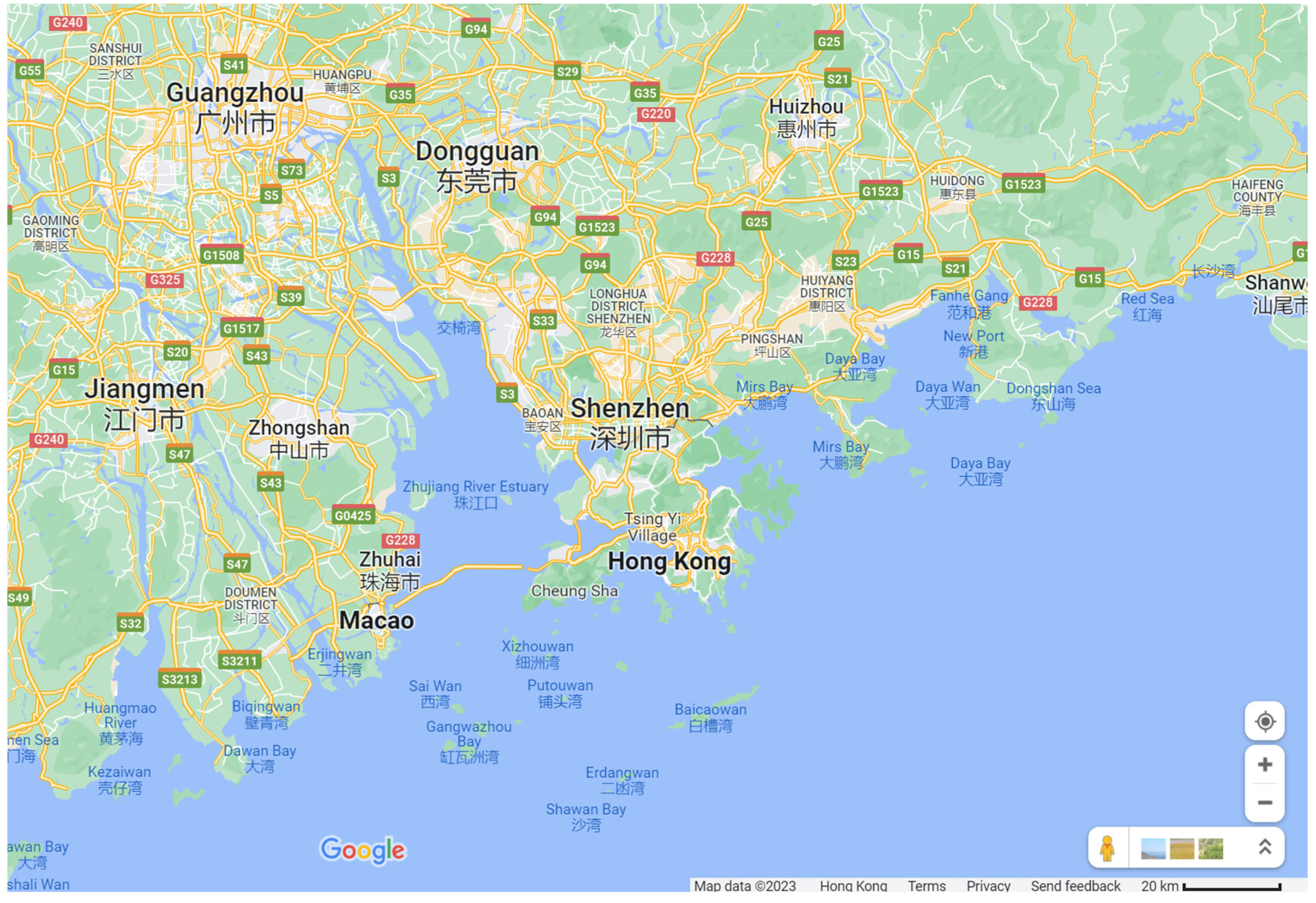
Figure 3.2.
Map of the Nansha coastal wetland.
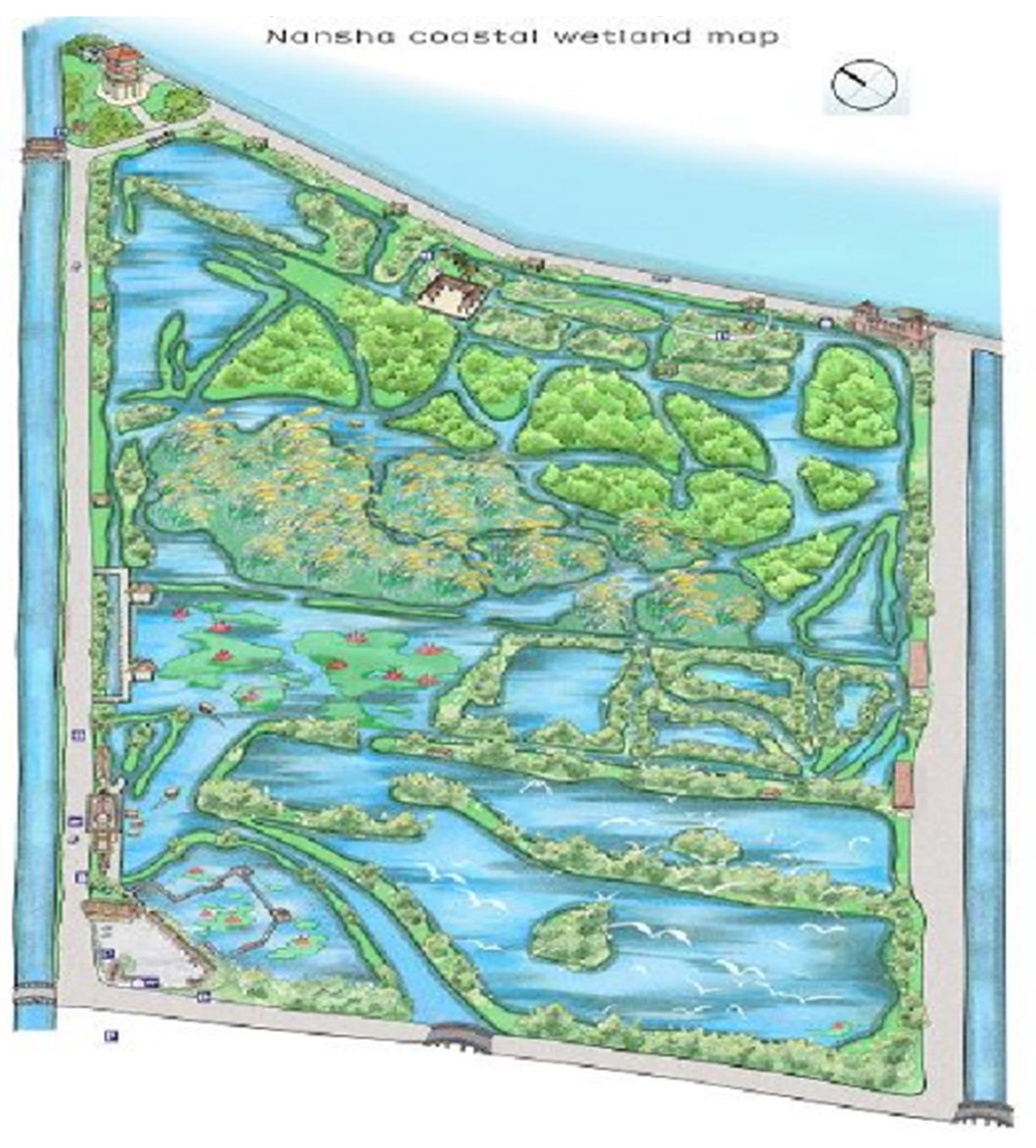
Table 3.3.
Plant resources of Nansha wetland (2015). Note: Mangroves include 10 species of eight families of true mangroves and six species of four families of semi-mangroves. The results show that there are 8 different species of shady grasses with a total of 29 species in the Nansha Marsh; the results show that there are 20 species in the three Suihua communities; the results show that there are 20 sandy vegetation with 14 species of vegetation; three typical mangrove forests, including Tongfa tree, autumn eggplant and petaless sea mulberry, have a planting area of 120 hm2 and an annual uptake of 24, 085 g/m2 , and their ecological value is much higher than that of the general green grassland. The mangrove-based wetland vegetation in Nansha has leaves that can use sunlight for photosynthesis and deliver fresh oxygen to the southern part of Guangzhou, and its root system can adsorb heavy metal elements from water bodies, purifying and desalinating them. The wide variety of vegetation not only has good ecological significance, but also has high ornamental value. By matching the large and small landscapes with each other, the contrast between distant and close landscapes, the landscape effect of the whole scenic spot is greatly improved.
Table 3.3.
Plant resources of Nansha wetland (2015). Note: Mangroves include 10 species of eight families of true mangroves and six species of four families of semi-mangroves. The results show that there are 8 different species of shady grasses with a total of 29 species in the Nansha Marsh; the results show that there are 20 species in the three Suihua communities; the results show that there are 20 sandy vegetation with 14 species of vegetation; three typical mangrove forests, including Tongfa tree, autumn eggplant and petaless sea mulberry, have a planting area of 120 hm2 and an annual uptake of 24, 085 g/m2 , and their ecological value is much higher than that of the general green grassland. The mangrove-based wetland vegetation in Nansha has leaves that can use sunlight for photosynthesis and deliver fresh oxygen to the southern part of Guangzhou, and its root system can adsorb heavy metal elements from water bodies, purifying and desalinating them. The wide variety of vegetation not only has good ecological significance, but also has high ornamental value. By matching the large and small landscapes with each other, the contrast between distant and close landscapes, the landscape effect of the whole scenic spot is greatly improved.
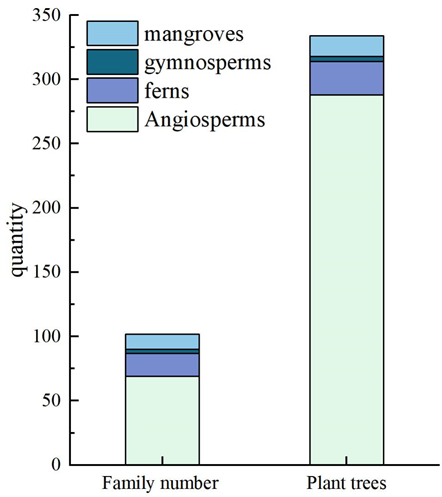
Table 4.1.
Proportion of birds inhabiting the Nansha wetland.
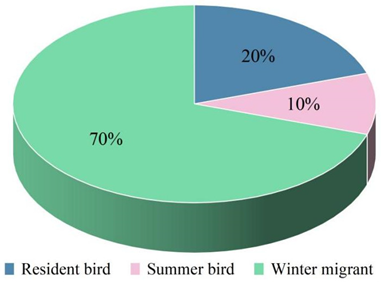
Disclaimer/Publisher’s Note: The statements, opinions and data contained in all publications are solely those of the individual author(s) and contributor(s) and not of MDPI and/or the editor(s). MDPI and/or the editor(s) disclaim responsibility for any injury to people or property resulting from any ideas, methods, instructions or products referred to in the content. |
© 2023 by the authors. Licensee MDPI, Basel, Switzerland. This article is an open access article distributed under the terms and conditions of the Creative Commons Attribution (CC BY) license (http://creativecommons.org/licenses/by/4.0/).
Copyright: This open access article is published under a Creative Commons CC BY 4.0 license, which permit the free download, distribution, and reuse, provided that the author and preprint are cited in any reuse.


