

Submitted:
16 May 2023
Posted:
16 May 2023
You are already at the latest version
Abstract
: The paper aims to present a conceptual framework for developing territorial development strategies based on crowdsourcing technologies to enhance intangible heritage, setting this framework within the context of Italian inner areas defined by a policy framework oriented towards the territorial development of marginal areas. For this reason, the work intends to provide the necessary background information for the development of such strategies, examining the technological aspects, a precise definition of the concept of intangible heritage, the application of a socially innovative strategy for marginal territories, and a framework of strategic actions necessary to implement solutions capable of involving local communities from the bottom up and ensuring a widespread redistribution of the benefits in the development of these technologies. The paper's objective is, therefore, to bridge the gap between different debates: technological innovation, the enhancement of intangible heritage, and territorial development based on socially innovative strategies, providing a key information framework for experts and scholars who intend to approach these topics or develop projects based on these tools and objectives.
Keywords:
crowdsourcing
; intangible heritage
; territorial development
; Italian inner areas
; socially innovative strategies
1. Introduction: crowdsourcing, intangible heritage valorisation and territorial development
Intangible cultural heritage is deeply rooted in local communities' territories and shared culture, and it has already garnered attention from local, national, and international institutions and scholars [2]. This article has built upon the idea of valorising such heritage and establishing a system through the development of a digital infrastructure capable of gathering information on cultural activities, their historical evolution, and the elements that classify them as expressions of cultural significance at various levels and scales [3]. The critical technological tool here is crowdsourcing: opening the platform to allow for the collection of data and information by the local community to emerge the social relevance of intangible heritage, validating the impact of heritage on local identity to empower relations and sustain new economic development opportunities [6]. To achieve these opportunities, however, it is necessary to design open platforms capable of including as many members and local community stakeholders to include them in social-innovation-based territorial development strategies [10]. This should combine the expression of intangible heritage by the various actors involved in local dynamics, making it accessible to different types of audiences and potential users through coordinated communication and local engagement actions [11,12].
Moreover, this can generate impacts that sustain the cultural value of productive activities in the territories while valorising the heritage to attract new residents and achieve strategic outcomes in the urban regeneration of marginal areas [13,14]. An open crowdsourcing platform may allow for additional elements of intangible heritage that are tangential to the starting heritage to be included. Connecting the dots between expressions of intangible heritage in adjacent territories to generate links through the construction of a shared repository of data and information able to sustain new economic activities and social interactions based on the strengthening of the network infrastructure of intangible heritage and the significant reinforcement of the local identity [15,16,17].
1.1. Methodological framework
The research question this paper addresses is: How can we develop effective strategies for leveraging crowdsourcing technologies to enhance intangible heritage and support territorial development in marginal areas? Based on the attempt to answer this question, the paper aims to outline a conceptual framework for cultural innovation and territorial development strategy based on intangible heritage crowdfunding tools. The framework aims to sustain bottom-up development processes by involving local communities, strengthening relationships, and creating opportunities to enhance cultural heritage. The idea and the choice of the Italian inner area context have originated from a project proposal prepared by the National Research Council of Italy, Institute for Sustainable Economic Growth (CNR-IRCrES) as part of the application to achieve the funding of the M1C3 - Investment 2.1 "Attrattività dei borghi” (tr. Attraction of villages), as part of the Italian Government's National Recovery and Resilience Plan [18]. The proposal aimed to create a geo-referenced information system on the intangible cultural heritage of local communities, linked to the places of the territory, to be tested on a particularly significant cultural area such as that from the site of the Municipality of Alessandria del Carretto (CS) and more generally of the Pollino National Park. Beyond the particular context, this model applies to territories with the characteristics of the Italian inner areas. To this end, in this paper, we have dedicated a section to an in-depth description of their structural and marginal features [19].
From a methodological perspective, the research presented in this paper is the outcome of two distinct activities and corresponding methods. Firstly, an extensive literature review on the application of crowdsourcing to intangible heritage valorisation projects was conducted. Secondly, an analysis of the evolution of policies and treaties that have shaped the concept of intangible heritage was carried out, drawing on a vast array of grey literature. The interactions, model design, and feedback collection from stakeholders and researchers involved in the project outlined above further enriched the research. As such, the research practice results from a blend of research activities developed during the design process of the project proposal, interactions, and bibliographic research, which led to a "reflection in action" [20]. The research activities provided a concrete opportunity to learn during the research action, studying a methodology of analysis and restitution of the different cultural elements that contribute to the definition of economic, historical, architectural, landscape, and anthropological characteristics, particularly in inner areas. All the cultural elements were organised thematically and typologically according to the following five categories borrowed from the UNESCO Convention for the Safeguarding of the Intangible Cultural Heritage: oral traditions and expressions, including language, as a vehicle of intangible cultural heritage; performing arts, such as music, dance, and theatre; social customs, rituals, and festive events; knowledge and practice relating to nature and the universe; and knowledge and techniques, such as craftsmanship and traditional work.
Concerning this background, the following section explores the concept of crowdsourcing and its application in cultural innovation, with a particular focus on digital tools. The third section provides an overview of the policy framework for valuing intangible heritage, including the UNESCO Convention for the Safeguarding of Intangible Cultural Heritage, as well as other international policy frameworks. The fourth section presents a conceptual model to apply crowdsourcing for intangible heritage and territorial development. The fifth section discusses the challenges and opportunities for leveraging crowdsourcing to promote intangible heritage and territorial development, including strategies for scaling up and sustaining crowdsourcing initiatives. The paper concludes by summarising the main findings and contributions, as well as implications for policy and practice, limitations, and future research directions.
2. Crowdsourcing as a Tool for Cultural Innovation
2.1. Definition and Principles of Crowdsourcing
Despite the lack of a universal definition, crowdsourcing has become an increasingly popular phenomenon, used in various industries and sectors, including healthcare, education, government, and entertainment. Its adaptability and flexibility enable it to be utilised in a wide range of situations, from generating new ideas and designs to solving complex problems and engaging stakeholders. The term "crowdsourcing" is composed of two distinct words: "crowd", which refers to the collective individuals who engage in the initiatives, and "sourcing", which encompasses various procurement practices that seek to identify, evaluate, and involve suppliers of goods and services. Following this framework, scholars such as Jeff Howe assert that crowdsourcing is a commercial practice that involves delegating a particular task or project to a group of individuals, commonly referred to as "the crowd" [21]. Crowdsourcing is a term coined by Jeff Howe to describe a diverse range of activities that take on different forms, including the creation of user-generated content (such as Wikipedia), crowdfunding to fund projects (such as Kickstarter), collaborative problem-solving through online platforms (such as InnoCentive), information gathering (such as Google Maps), and the production of goods and services (such as Threadless). [23, 24]. The flexibility of crowdsourcing makes it an effective and powerful practice, but it also presents challenges in defining and categorising it. Although there have been efforts to develop a theoretical knowledge base, it still needs to be fully established. For instance, Brabham defines crowdsourcing and creates a typology of it, and Vukovic provides a general overview of various characteristics of crowdsourcing, including the kind of crowd that can participate, the incentive schema, the different variants of crowdsourcing initiatives, or the requirements of a crowdsourcing initiative [27], and Geiger develops a taxonomy using different examples. However, there is no agreed-upon definition of crowdsourcing, as it is viewed from various perspectives. For example, some definitions focus on its problem-resolution potential [29, 30], while others see it as a means of promoting innovation in the business development process of organisations [31,25]. The systematic review conducted by Hossain and Kauranen analysed 346 articles, revealing an intriguing division of the motivations of crowds, which are considered critical factors in crowdsourcing.
Given that crowdsourcing encompasses a wide range of purposes, from simple to complex, the motivations of crowds can vary considerably depending on the nature of the task. In certain crowdsourcing activities, such as Wikipedia and open-source software development, crowds are intrinsically motivated [33]. Intrinsic motivation is also prevalent in citizen journalism, citizen science, and public participation in state and community building. On the other hand, crowds engage in micro-tasking as crowd labour to obtain financial returns in exchange for the micro-tasks they perform [34]. When the task is complex, extrinsic motivations are more prevalent than intrinsic motivation. Additionally, motivations in intermediary crowdsourcing platforms appear to be primarily extrinsic [35].
2.2. Application of Crowdsourcing to Intangible Heritage
One significant contribution of crowdsourcing in cultural heritage preservation is the engagement of local communities in the preservation process. By involving local communities, crowdsourcing enables a collaborative approach to cultural heritage preservation. This approach recognises that cultural heritage is not only the preserve of experts and scholars but also belongs to the communities that created it. By involving communities, crowdsourcing empowers them to take ownership of their cultural heritage and participate in its preservation. Crowdsourcing also enables the collection and sharing of cultural heritage data. One of the most famous examples of the application of crowdsourcing to intangible heritage is the "Citizen Archivist" program launched by the US National Archives and Records Administration (NARA) in 2010 [36]. The program invites volunteers to transcribe and tag historical records, making them more accessible to researchers and the public. Another example is the “Europeana 1914-1918” project [37], which crowdsourced stories, photos, and other artefacts related to the First World War. These projects demonstrate how crowdsourcing can facilitate the collection and dissemination of cultural heritage data, thereby enhancing access and understanding of cultural heritage. One of the main benefits considered in crowdsourcing for cultural heritage preservation is that it can help to overcome resource constraints [38]. Many cultural institutions lack the staff and funding to undertake large-scale digitisation and preservation projects. Crowdsourcing can enable these institutions to tap into the knowledge and skills of a global community of volunteers willing to contribute their time and expertise to these efforts [39]. Crowdsourcing can also enhance cultural activities by facilitating greater participation and engagement among audiences. For example, crowdsourcing can collect user-generated content, such as photos and videos, from visitors to cultural sites and events. This content can then be shared online, creating a more interactive and participatory experience for audiences. For example, the " Smithsonian Digital Volunteers: Transcription Center" project at the Smithsonian National Museum of Natural History used crowdsourcing to transcribe handwritten field notes from historical expeditions. Volunteers worldwide can access the notes online and help transcribe them, making the information more accessible to researchers and the public [40]. Crowdsourcing can also be used to involve audiences in the creation of new exhibits and programming. For example, the San Francisco Museum of Modern Art used crowdsourcing to create an exhibition called "Snap + Share," which explored the relationship between photography and social media. The museum invited visitors to submit their photos and ideas for the exhibit, and some of these submissions were incorporated into the final exhibition [41]. When we talk about crowdsourcing applied to the enhancement of cultural heritage, there are also several issues to consider, as noted by Trevor Owens [42]. The term "crowd" can be misleading, as most successful crowdsourcing projects do not rely solely on large and anonymous groups of people. Rather, these projects often rely on the participation of engaged members of the public who are passionate about the subject matter. The success of these projects is built upon a long tradition of volunteerism and civic engagement in creating and developing public goods [43]. Trevor Owens raises a valid question about the definition of "sourcing" and its association with work and value. Merriam Webster's definition of crowdsourcing1 helps to clarify this relationship further: "the practice of obtaining needed services, ideas, or content by soliciting contributions from a large group of people and especially from the online community rather than from traditional employees or suppliers." However, the keyword in this definition is "outsourcing." Crowdsourcing is a concept originally invented and defined in the business world, and it is important to reconsider the implications when applying it to cultural heritage. As Owens notes, the definition of crowdsourcing in cultural heritage contexts may be more complex and nuanced than its definition in the business world. We must carefully consider the unique aspects of cultural heritage when utilising crowdsourcing methods. Constantinidis' contribution sheds light on the challenges of engaging people in crowdsourcing cultural heritage and the importance of designing appropriate engagement strategies. His discussion on the potential of digital preservation strategies for safeguarding cultural heritage is of particular significance, wherein he emphasises the need for key influential people, called change agents, especially in regions threatened by social and political instability [45], citing his experience working in Afghanistan. One such strategy involves using photos of cultural heritage sites that visitors and local Afghan people upload to either Google Maps/Earth or a dedicated (GIS) website, which can be used to reconstruct destroyed heritage digitally. The digital reconstruction of lost heritage can also be undertaken through crowdsourcing efforts, as demonstrated by the Mosul Project [46].
3. Policy Framework for Valuing Intangible Heritage
3.1. The Evolution of UNESCO's Framework on Intangible Heritage
The United Nations Educational, Scientific, and Cultural Agency (UNESCO) provides an essential institutional framework concerning cultural heritage policies, which is considered an essential reference point for any work on this matter. The institution is widely acknowledged for its dedication and achievements in conserving cultural heritage. Specifically, this paper aims to examine UNESCO's involvement in shaping policies related to intangible heritage, a relatively new notion intricately linked with material cultural heritage. [47]. In its effort to safeguard cultural heritage, UNESCO took a significant step by adopting the Convention for the Protection of the World Cultural and Natural Heritage during its 17th General Conference on November 16, 1972. The convention's primary objective was to create a comprehensive list of sites, including historical centres, monuments, and landscapes, that required protection and development. Despite criticism, this convention signified a significant milestone in UNESCO's political and scientific endeavours related to cultural heritage. However, certain countries raised concerns that the convention was founded on a Eurocentric model of heritage and did not appreciate the value of their cultural expressions [48]. The issue of preserving folklore and oral traditions were raised early on, just one year after the World Heritage Convention was established when the government of Bolivia urged UNESCO to include a protocol to protect such intangible cultural heritage in future international agreements. The subject sparked scientific debate in the 1980s, and various expert commissions engaged in the discussion. Ultimately, this conversation led to the Convention for the Safeguarding of the Intangible Cultural Heritage of 2003. This convention marked an important milestone in UNESCO's efforts to protect cultural heritage, particularly intangible cultural heritage, and provided an essential framework for safeguarding such heritage on a global scale [49]. Throughout the last decade of the 20th century, UNESCO made crucial decisions and gained significant experiences that emphasised the importance of protecting intangible heritage for all societies worldwide. Additionally, the organisation recognised the need for an integrated approach in this field. In 1989, UNESCO adopted the recommendation on the Safeguarding of Traditional Culture and Folklore, which defines folklore as creations based on traditions expressed by a cultural community or individuals and recognised as reflecting the community's cultural and social identity. This recommendation represented the first international legal instrument to regulate intangible cultural heritage. It covers various aspects of cultural heritage, including definition, identification, preservation, diffusion, guardianship, and international cooperation [50]. In the early 1990s, UNESCO made significant strides in safeguarding intangible cultural heritage. In 1992, the World Heritage Committee broadened the World Cultural Heritage category to encompass Cultural Landscapes. They established new criteria to recognise properties as "combined works of nature and man of outstanding universal value" and identified three main categories. The first category refers to landscapes intentionally designed and created by humans for aesthetic and prestige purposes, often featuring monumental, civil, or religious buildings, such as large parks and gardens. The second category comprises landscapes that have organically evolved with human cultures, originating from social, economic, administrative, or religious motivations. These landscapes may have lost their connection with humans at some point or continue to maintain it. The third category is the "associative cultural landscape," which involves landscapes with strong relationships between natural elements and the symbolic imagery of human cultures, including religious, artistic, and historical elements. These landscapes may have little or no material evidence but hold significant cultural and historical value. These criteria expanded UNESCO's ability to recognise and safeguard cultural heritage sites, acknowledging the complex and intertwined relationship between humans and their environments [51]. In 1993, the Living Human Treasures Program was launched, aiming to preserve cultural values by recognising those individuals with unique knowledge and skills in traditional crafts or cultural practices. These master artisans transmit their knowledge orally within their social group or community, ensuring that their cultural heritage is passed down from generation to generation. The success of this program served as an inspiration for the development of the 2003 Convention for the Safeguarding of Intangible Cultural Heritage, which recognises the importance of individuals transmitting cultural elements within a community. [52]. In 1995, UNESCO evaluated the impact of its previous recommendation on the Safeguarding of Traditional Culture and Folklore among States Parties. This evaluation was presented in 1999 at the Smithsonian Institution, underscoring the recommendation'srecommendation's importance in shaping global cultural heritage policies. The Living Human Treasures Program and the subsequent Convention for the Safeguarding of Intangible Cultural Heritage mark significant steps forward in recognising and preserving cultural heritage beyond the physical objects and structures commonly associated with cultural heritage [53]. In 1994, the World Heritage Committee expanded the definition of World Heritage and its List with the adoption of the Global Strategy. This aimed to reflect better the full range of cultural and natural treasures of the planet, beyond just the material heritage, and recognise sites that demonstrated human presence on that territory, including aspects related to cultural interaction, coexistence, and the creative sphere the communities concerned [54]. From 1997 to 2005, the Masterpieces Program established a world list of unique examples of intangible cultural heritage, promoting awareness of its value among UNESCO States Parties and inspiring the 2003 Convention for the Safeguarding of Intangible Cultural Heritage. The World Masterpieces list has since merged with the Representative List of Intangible Cultural Heritage [55]. In 1999, the Conference "A Global Assessment of the 1989 Recommendation on the Safeguarding of Traditional Culture and Folklore: Local Empowerment and International Cooperation" produced a five-year evaluation by experts in anthropology, law, and economics, among other fields. This effort focused on placing communities at the centre of attention as bearers of intangible cultural heritage and preserving traditions [56]. The Universal Declaration on Cultural Diversity was unanimously approved by UNESCO in 2001, right after the September 11 attacks. The declaration considers cultural diversity as a "common heritage of humanity" that is as necessary for people as biodiversity is for nature. It advocates for respect for the dignity of individuals who carry this culture and emphasises that cultural diversity is not a static heritage but a complex process that needs to be preserved and transmitted to future generations. This declaration foreshadowed the key principles of the 2003 Convention on the Safeguarding of Intangible Cultural Heritage [57]. In 2003, the Convention for the Safeguarding of the Intangible Cultural Heritage was signed in Paris and entered into force three years later. This convention defines "intangible cultural heritage" as practices, representations, expressions, knowledge, skills, and associated objects that communities, groups, and sometimes individuals recognise as part of their cultural heritage. This intangible cultural heritage is constantly recreated by communities in response to their environment, promoting respect for cultural diversity and human creativity. It includes performing arts, social practices, festive events, ceremonies, knowledge, and craft knowledge that are in close interrelation with the physical and social environment of the communities. The intangible heritage consists of three elements: practice, the bearer community, and the element's significance. The convention reflects a redefinition of heritage as a complex entity whose interpretative key must be found in the groups and human communities involved [58]. Moreover, the diversity of expressions creates the definition of heritage rather than adherence to a descriptive standard. A monument, a landscape, a historical centre, or a single square are no longer perceived only as isolated examples of excellence of the material heritage of humanity but have acquired a new dimension precisely through the concept of intangible heritage, seen as a source of identity, creativity, and cultural diversity. In addition, while the UNESCO World Heritage List includes properties that demonstrate exceptional universal value for intangible heritage, the 2003 Convention provides for a representative list, which may consist of the elements that communities and groups consider representative of their identity, as well as an urgent safeguard list, in which to include the elements at risk of extinction for which immediate action must be required. Finally, the Paris Convention provides for the creation of a national inventory of intangible cultural heritage, as well as the protection, promotion and transmission of this heritage to future generations, encouraging the active participation of communities, groups and individuals involved in safeguarding their intangible heritage; More specifically, the convention stipulates that the identification of intangible heritage elements shall be based on the "participation of relevant communities, groups and non-governmental organisations" (art. 11 b) [2]. It is important to note that even during the preparation of national applications for inclusion in the Intangible Cultural Heritage List, the community responsible for carrying the intangible element must take several actions to preserve and transmit the element. This is a strict criterion required for applying (ICH-3), and the community is expected to provide ad hoc training. The training focuses on the role of different actors involved in the inventory process. It is community-based, with at least one-third of the participants expected to be community members. The workshops aim to train community members in ethnographic research techniques, enabling them to participate in the identification process not only as researcher's informants but also as full-fledged researchers, thereby recognising and legitimising their expertise [60,61].
3.2. Faro Convention and Heritage Communities
The Council of Europe Framework Convention on the Value of Cultural Heritage for Society, known as the Faro Convention, adopted in 2005 [62], formally recognises, for the first time, the central role of individuals and groups organised in communities in the process of identifying, preserving, and transmitting intangible cultural heritage; The right to establish "heritage communities" is therefore very explicitly defined. Article 2(b) states: "a heritage community is made up of a group of persons who attach value to specific aspects of the cultural heritage, and who wish, within the framework of public action, to support them and pass them on to future generations". More generally, the vision behind the Faro Convention essentially sums up the Council of Europe's mission in the cultural field: to favour European citizens in their relationship with their common heritage; This is highlighted in Article 2(a), which refers to "a set of resources inherited from the past that people identify, regardless of who owns them, as a reflection and expression of their evolving values, beliefs, knowledge and traditions. It encompasses all aspects of the environment that are the result of interaction over time between populations and places." So: resources, properties, values, and knowledge, together with populations, traditions, environment, and places. All concepts also refer to a potential economic profile of cultural heritage on a territorial scale, following European policies that indicate sustainable management, including cultural heritage, as a strategic choice. Finally, Part III of the Faro Agreement (Shared responsibility towards cultural heritage and public participation) where in Article 11, it is called for the construction of joint projects, sharing knowledge and functions between public authorities, experts, owners, investors, businesses, non-governmental organisations, and civil society. A centred and useful indication for our discourse, precise in organisational terms for public action, as it should translate, in the private sphere, into the assignment of roles of responsibility to bodies that involve all the parties involved and, in the public sphere, to project teams transversal to the various bodies. In summary, the 1989 UNESCO Convention began to introduce the concept of intangible cultural heritage, while the 2003 UNESCO Convention provided a more precise definition of this term and established instruments for preserving and promoting intangible cultural heritage. Finally, the 2005 Council of Europe Convention at Faro recognised the central role of the community in safeguarding intangible cultural heritage. It provided a broader definition of this term, emphasising the fundamental role of heritage communities in transmitting knowledge and practice to subsequent generations and, simultaneously, including external actors as an integral part of the capitalisation processes, including researchers: "this inclusion sounds like an expected recognition: cognitive and communicative mediation cannot be considered external and false to a heritage endowed with intrinsic value, but an integral part of its expressive value and its identifying and regenerative power for collective memory" [63].
4. A conceptual framework to apply Crowdsourcing for Territorial Development in Italian Inner Areas
In this section, we present a framework of digital valorisation of intangible heritage as a driver for economic and social development at the territorial level. In the composition of our analysis framework, we have considered the so-called internal Italian areas, territories rich in intangible cultural heritage but at risk of disappearing due to strong depopulation flows. Despite this reference, we aim to create a basic framework readily applicable to other contexts whose peculiarities are not related to the characteristics of specific territories or intangible cultural heritage. We thought about this particular type of territory because the presence of intangible cultural assets in rapidly deteriorating demographic areas implies the risk of a loss of historical and anthropological knowledge hand in hand with the dispersion of the communities living in these areas. An intervention for the protection and enhancement of these activities would have a double value: to prevent the loss of a cultural asset and to help the survival of the communities of people who animate the activities based on intangible cultural assets. The use of crowdsourcing allows us to go beyond mere conservation of the memory of the cultural heritage, actively involve the community in its defence, and strengthen the identity of the territory through this participation, inserting a first significant brake on its dissolution. The rest of the section will describe the framework structure and the possible socio-economic effects.
4.1. The context of our proposal: Italian inner areas as the territorial development target
The National Strategy for Inner Areas (SNAI) represents one of the three strategic options for programming European Union funds for the 2014-2020 cycle. Launched in December 2012 by the then Minister of Territorial Cohesion Fabrizio Barca, it represents an attempt to counter the decline of a large part of the territory of our country, far from service centres, characterised by phenomena of ageing, depopulation and economic decline [64](Figure 1). The National Strategy for Inner Areas (SNAI) aims to address the issue of depopulation in the inland areas of Italy. This has been achieved through a national map that identifies municipalities based on their distance from the centres where primary education, health, and transportation services are available [65]. The strategy covers 1,077 municipalities (which represents 13% of all Italian municipalities) and is divided into 72 project areas distributed across all regions of Italy. The total population of the areas covered by SNAI is 2,072,718, representing 3.4% of the country's population, while the total land area is 51,366 sq km (16.7% of Italy's territory).
To achieve its goals, the SNAI follows an experimentalist approach, using co-planning techniques that encourage collective learning and participation from all levels of government and citizens. The planning process places municipalities at the centre of decision-making, as they are the institutional level closest to citizens. These municipalities work together in contiguous aggregations, creating permanent territorial systems where functions and services are exercised in the association. This allows for the effective implementation of public services and the promotion of investment projects for local development. The strategy aims to rebuild the conditions for exercising citizenship rights in these areas by acting on the levels of essential health, education, and mobility services and promoting measures for local development [66]. For the first time, the problem of inner areas is brought into focus at the main level, and a project for the country is built around it, converging EU and ordinary resources. It is designed at the national level and then defined by the regions and local actors [67]. The Strategy for Inner Areas represents a political and cultural challenge. This ambitious initiative defines specific territorial development objectives and new policy problems, providing a detailed description and outlining a perspective for its treatment, putting new tools into action, mobilising skills, and attempting to experiment with the place-based approach [68]. The SNAI has been instrumental in identifying those areas characterised by sustained demographic decline and physical remoteness from primary service hubs, such as hospitals, schools, and railways. However, it is worth noting that Italian inner areas are also endowed with significant natural and cultural assets, which make them unique and appealing destinations. As acknowledged by the SNAI itself, tourism has been identified as a critical sector for the local development of these areas [69, 70]. This sector has witnessed rapid growth in recent decades. It is expected to grow exponentially, thus becoming a crucial driver for economic growth, job creation, and wealth generation, especially if connected with sustainable development strategies based on the valorisation of cultural heritage [71,72]. The case of Italian inner areas is a compelling example of how regions not typically viewed as tourist destinations can leverage their untapped natural and cultural resources to spur development, revitalising their economies and triggering regeneration processes [73].
4.2. Basic framework of intervention: a structured interaction between experts, local communities and external audiences
The conservation and enhancement of intangible cultural heritage begin with the establishment of a Digital Documentation Center (DDC), serving as a focal point for experts, stakeholders, and the local community to foster a shared approach in alignment with the principles of the Faro Convention (Figure 2).
The initial phase of the process inherently entails researching, studying, and acquiring pre-existing documentary collections (generated and preserved by universities, museums, archives, and other documentation centres, as well as those owned by independent researchers). Simultaneously, new documentation on the relevance of intangible heritage is actively promoted. The cataloguing of these documents will form the core foundation of the DDC, enabling the discernment of the historical and cultural attributes of the intangible heritage subject to intervention. The cataloguing and reconstruction of the event's evolution are intricately linked with establishing a digital database comprising documents associated with the event. This Information System facilitates the correlation of diverse document types (official records, descriptive texts, photographs, and historical films), allowing for the narration of events that can be tailored according to users' requirements, such as specific timeframes or particular formats of the collected documents.
Crowdsourcing plays a pivotal role in shaping the structure of the documentation centre during this phase. The information system design offers a direct access channel for the community, serving as a pathway through which members can contribute their documents about the event. Moreover, it provides an opportunity to gather first-hand testimonies regarding people's involvement and the progressive development of such involvement over time. This aligns with the insights shared by Artese and Gagliardi, emphasising the importance of community contributions [74,75].
Establishing such a communication channel enables the resolution of diverse challenges associated with document collection and preservation efforts concerning intangible heritage. It initiates community engagement that can unfold in an organic and ongoing manner, preventing it from being unintentionally steered solely by experts entrusted with studying the event. Consequently, a wealth of nuanced descriptions about the role of intangible heritage in the region can be amassed, capturing the first-hand perceptions of community members. An additional benefit arising from this mode of data collection is economic: the direct and continuous acquisition of information eliminates the need to organise field campaigns to gather testimonies. This circumvents the difficulties inherent in identifying suitable interviewees and the time constraints typically associated with such campaigns [76].
The active participation of individuals through crowdsourcing procedures brings about an additional benefit by encouraging them to recognise the significant role that intangible heritage plays in shaping public life. Moreover, it triggers a mechanism of gratification, as contributors directly contribute to enriching the historical narrative of intangible heritage. These crucial aspects form the foundation for fostering a sense of community centred around intangible heritage, establishing and nurturing a sense of territorial identity with which individuals can readily identify. It is important to note that this process does not involve indulging in nostalgic sentiments, promoting contrived picturesque notions, fabricating traditions, or artificially socialising living practices [77]. The creation of the DDC, achieved through the meticulous collection and organisation of documents, alongside the implementation of the information system, fulfils the primary responsibility of the experts. However, it does not mark the culmination of the process to enhance the intangible heritage. The accumulated documents must be accessible to the public, employing various approaches tailored to the desired usage of the material. The DDC must adapt its range of services according to the specific audience it intends to engage with regarding intangible heritage.
Initially, the creation of the DDC primarily targets an audience of experts who can greatly benefit from the cultural enrichment derived from the collected and organised documents. These resources prove invaluable for reconstructing the development and history of the intangible heritage. Among the audience, we find historians, anthropologists, sociologists, and other professionals who require suitable support and resources to pursue their respective fields of study. Nonetheless, as previously highlighted, establishing the DDC should not confine itself solely to the crystallisation of the intangible heritage. Instead, it should function as a tool to open the community to a broader audience. It should stimulate curiosity among individuals, inviting them to explore and appreciate this unique aspect of the region. This engagement encourages people to actively partake in experiences associated with the intangible heritage, forging a deeper connection with their surroundings [78]. The creation of the DDC through the collection and schematisation of documents and the implementation of the information system completes the primary role of the experts. However, it does not conclude the process of enhancing the intangible heritage. The collected documents must be made available to the public in different ways related to the type of use you want to promote for the material. DDC will have to modulate the offer of services based on the audience to which it will present the intangible heritage. The creation of the DDC is primarily aimed at an audience of experts who can benefit from the cultural enhancement work carried out on the collected and schematised documents, which is useful for reconstructing the development and history of the intangible heritage. This audience includes various figures, including historians, anthropologists and sociologists, profiles to which adequate support must be provided. However, as we have mentioned previously, the creation of the DDC must not be limited to an operation of crystallisation of the intangible heritage. However, it must be a tool for opening the community to a wider audience whose curiosity must be stimulated in knowing a peculiar element of the territory, inviting them to live the experiences linked to the intangible heritage.The tools to reach these audiences must be differentiated in purpose but coincide in structure. The development of the Information System within the DDC makes the collected material accessible to a multitude of people at a distance via the web. The structure of the Information System will make it possible for experts to access the documents collected following different paths, united by a single dimension such as, for example, the methods of participation of the population over time or the changes linked to a specific aspect of the intangible heritage, or on the contrary by crossing these characteristics and allowing to isolate details that scholars consider of particular interest for their studies. For this reason, the Information System will have to be designed to have references also towards the outside world, to documents and materials similar to those that describe the intangible heritage of the territory. However, the same elements, recalibrated in a different way and with a greater focus on the current condition of the intangible heritage, can be used to raise awareness and promote the territory, becoming a tool for the invitation to participate to which we referred previously. Communication in this must be focused more on the "captivating" elements of cultural heritage, describing what these mean for the community, describing the sense of participation of the territory and its inhabitants in feeding and keeping the event alive and creating the preconditions for which heritage is no longer an element known and appreciated only in a specific territory but also, albeit minimally, shared externally. The sharing of materials organised by the Information System is central to the organisational framework but cannot ignore the presence of a physical contact point. For both types of audiences referred to, it is necessary to implement a physical point of contact. For experts, it means offering the possibility of viewing the original documents collected, allowing them to analyse the "raw material" that makes up the DDC, and offering them spaces, tools and assistance to study them at their best. At the same time, for the general public, a physical space acts as a point of reference in a visit to the territory whose purpose is to deepen the knowledge of the intangible heritage. It becomes central to organise the DDC in such a way as to offer these services in a complementary way to the digital service only. Crowdsourcing plays an important role also in this phase because it allows the development and affirmation of the intangible heritage beyond its original boundaries. The possibility of offering information or materials related to the intangible heritage must also be organised to have an incoming flow of materials and contents. Experts who come into contact with the DDC can provide elements for deepening the study of intangible heritage, providing new interpretative elements of historical documents, helping to contextualise elements of change and contributing to broadening the analysis of the historical and social role of heritage concerning territory. These new elements will strengthen the documentary collection of the DDC and expand the elements of knowledge closely linked to the intangible heritage. On the other hand, the general public will be encouraged to describe their personal experience linked to the intangible heritage, providing new elements related to how people outside the community of origin experience the intangible heritage and providing an autonomous and personal description of the event. The DDC plays a central role: it must collect and implement with the rest of the documents the contributions that will come from the two different audiences, selecting them so that the cultural value of the intangible heritage is not diluted with contributions from experts who excessively shift the focus of analysis nor that the stories of experiences lived by the general public risk to make the characteristics of the heritage more indistinct. A selection of this type requires trained personnel who can independently manage and expand the DDC. The task of training, at least initially, the heads of the DDC is a further important contribution to the project of the experts involved in the collection and cataloguing of the material: through this function, they will have to help the local stakeholders to make the DDC a permanent institution, capable at the same time to dialogue with research centres and universities and to promote the intangible heritage in the area, a cultural and social reference point for the community. The framework structure was presented regarding a single community with its intangible heritage, but our horizon of analysis, as mentioned above, concerns the so-called internal areas. The same scheme can be expanded to involve other communities in the same area, concentrating efforts on coordinating actions to enhance and promote crowdsourcing and, at the same time, on the separation of experiences related to intangible heritage linked to each community. The purpose of this scheme expansion is to create a network of communities capable of enhancing what the common area offers from a cultural and naturalistic point of view but simultaneously capable of enhancing individual communities without encouraging competitive behaviour among them.
4.3. Expected social and economic impact of framework implementation
In this section, we will analyse the economic and social impact of the proposed framework. In particular, we will base our analysis on UNESCO indicators relating to the economic and social participation effects of the promotion of cultural activities, focusing on those that can be directly applied to a local context referring to the valorisation of intangible cultural heritage (Figure 3).
In terms of the economic aspect, our analysis will primarily focus on "Cultural employment," which entails quantifying the individuals directly engaged in managing the cultural activity under examination, as well as those involved in closely related events and the associated services generated by these initiatives [80]. As for the social dimension, we will consider "Participation in identity-building cultural activities" and "Participation in going-out cultural activities." These metrics gauge the extent of community involvement in activities that contribute to shaping cultural identity and the level of public engagement in cultural events tied to the intangible heritage at the core of our analysis [81].
The framework's objective is to optimise these indicators, taking into account the initial premise of our analysis: to facilitate the advancement of intangible cultural heritage, which serves as a key factor in fostering a distinct local community identity. In this regard, the utilisation of crowdsourcing within the DDC structure is crucial in encouraging widespread community involvement in shaping an identity profile. However, it is important to note that the promotion and valorisation of heritage encompass a broader range of contributions beyond crowdsourcing, as we will explore further.
When analysing the framework's impact, it is essential to consider the broader contextual conditions of the locality. The effectiveness of the presented framework heavily relies on the available infrastructure, considering the digital nature of the documentation centre and the aspiration to engage diverse audiences in sharing experiences related to cultural heritage, both in virtual and physical realms. However, when discussing the potential outcomes, we must always begin with the assumption that the undertaken actions are adjusted according to the existing circumstances. It is important to recognise that changes can be fostered, but ultimate decisions cannot be solely determined locally.
A primary and direct consequence is intimately tied to establishing the DDC: the digitisation and virtual dissemination of the accumulated material do not signify the abandonment of a physical space for the documentation centre. The DDC's headquarters will be essential for preserving the historical documents collected, allowing interested individuals to safely access and peruse them, and housing the servers required for storing, categorising, and sharing digitised documents. The design of the DDC's headquarters will valorise the documentation centre by establishing a reading room and the necessary IT facilities for executing planned activities. It will be situated in an existing building within the town, initiating a path of urban revitalisation by repurposing an abandoned structure suited for this purpose. This will provide the community with a natural meeting place synonymous with the foundational element for constructing community identity. Alongside the involvement of the documentation centre in community dynamics, establishing a physical location also necessitates the presence of individuals responsible for managing services directly linked to the documentation centre. These individuals will work on-site, ensuring the project's continuity and development, initially under the guidance of experts and eventually autonomously.
In addition to establishing a physical headquarters that strengthens the bond between the community and the intangible heritage, the DDC must adopt an appropriate legal framework that grants it full autonomy in managing activities related to intangible heritage events. It should not be merely an appendage of other local stakeholders. As mentioned earlier, the newly formed entity must maintain connections with local entities, starting with the municipality. However, its primary focus should be promoting the enhancement of intangible heritage and establishing links with other cultural institutions. It should encourage the participation of community members and outsiders in intangible heritage events while promoting new events. Care must be taken to maintain the essence of cultural heritage and the sense of community the project aims to foster.
The autonomy of the entity responsible for managing the DDC also entails a commitment to reduce dependence on financial support from local institutions. The documentation centre should position itself as a cultural institution seeking collaborations with similar knowledge-producing entities. It should strive to become a partner for universities and research centres, engaging in research projects that leverage its expertise in disciplines such as anthropology and history to explore the characteristics of intangible heritage. Similarly, sociological aspects relating to the heritage's integration into the community's social fabric should be addressed. Participation in such projects would attract funding for DDC management and require the active involvement of specialised personnel, enabling the centre to break free from isolation and become part of the scientific community.
The cultural management of intangible heritage also involves efforts to entice and invite experts to analyse the collected documents on-site. The DDC should provide tools and spaces for material analysis, generating a stream of specialised visitors who further establish the centre's reputation as a culturally significant institution deserving of attention.
The role of the DDC, as discussed in the previous section, encompasses communication efforts aimed at introducing the intangible heritage to a broader audience, inviting them to participate in related events and share in the experience. A well-executed communication strategy would attract a diverse audience interested in the intangible heritage, eager to learn about and become part of it, even if only briefly. This would generate cultural tourism centred around intangible heritage. To further support this flow of tourists, activities beyond the intangible heritage's strict scope can be promoted, such as showcasing the surrounding territory or organising cultural events like literary and film festivals. These events would predominantly cater to cultural interests, emphasising specific elements of the community. The objective, therefore, is to leverage the enhancement of the intangible heritage to foster "quality tourism" that not only focuses on maximising attendance during specific dates but distributes the influx of visitors throughout the year, promoting a more balanced and consistent development of the region and avoiding sudden spikes in visitation.
Sustained and diversified visitor flows, whether "experts" or "general tourists," contribute to the growth of essential tourism support services such as hospitality and catering. This presents an opportunity for urban regeneration by creating "Scattered Hotels" (Albergo diffuso), which repurpose vacant homes and buildings resulting from waves of depopulation in the town. These properties are transformed into accommodations distributed throughout the village but managed as cohesive hotel. Additionally, a range of services closely tied to the activities promoted by the DDC would be developed. These may include managing tourist services in the area, organising cultural events proposed by the DDC, and providing facilities proper to those arriving in the community to work on documents, such as offering coworking spaces that provide suitable environments for "expert" visitors to conduct their research on-site.
In summary, the framework will have a socio-economic impact if the planned activities are implemented, with a sustained and active involvement of individuals from the local community in the work activities associated with the intangible heritage, beginning with the DDC. The complete success of the framework relies on certain conditions, mainly the stabilisation of visitor flows, which would enable the planned activities to operate consistently rather than being contingent on isolated events. Equally important is the potential effect of these activities on reversing the population decline in the relevant areas. The framework can be successful if the activities directly and indirectly linked to cultural heritage can reverse these population trends and transform the involved villages into destinations rather than solely points of departure.
4. Discussion
The recent development of a geo-referenced information system focused on intangible cultural heritage, closely tied to specific locations within the territory, has provided us with a real opportunity to explore a methodology for analysing and preserving various cultural elements that contribute to the economic, historical, architectural, landscape, and anthropological characteristics of Italian inner areas, such as that of the Municipality of Alessandria del Carretto (CS) and, more generally, of the Pollino Park. This includes raising awareness and engaging younger generations in their cultural heritage, encompassing festivals, devotional expressions, traditional techniques and agricultural products, local cuisine, and knowledge of craft techniques. Sustainable development of territories, the integrated and systemic enhancement of local resources, and the interpretation or depiction of place meanings are consistent themes in research related to cultural heritage and landscapes. In this context, the practical and conceptual aspects bring visibility and substance to territorial investigations, reaffirming the dual value of tangible and intangible cultural heritage in terms of identity and economic significance. These cultural elements possess a relational nature and derive meaning from their close connection to the local community, the historical background of the places, and the surrounding landscape. The identification and understanding of this heritage find practical applications in promotion and preservation, transmitting the values associated with sites, and fostering awareness among younger generations about the integrated heritage. This integrated heritage encompasses the intricate relationship between intangible values and physical spaces, including the territory, sites, monuments, and artworks. Consequently, we need to adopt a cognitive model that establishes a methodological principle of linking the container to the content, an object or collection to the building that houses it, and the artefact to the archaeological area or historical urban plan tied to the ritual aspects of traditional festivals. This knowledge-building process must overcome the tendency to focus solely on monumental complexes and natural binding sites, shifting towards a more comprehensive heritage that comprises cultural and natural elements of varying but equally valuable qualities. These elements gain specific scientific significance through their reciprocal functional and structural relationships and their connections to the historical, social, anthropological, and landscape contexts they represent. Consequently, a holistic and interdisciplinary research approach becomes essential. Viewing the territory as a whole, shaped by natural processes and human activities, necessitates the integration of various fields of knowledge when selecting cultural heritage sites for study and intervention. Evidently, this approach also opens up possibilities for specific local policy interventions that aim to be as sustainable as possible for the involved territories. Effective interventions require innovative visions and tools from both social and economic perspectives. The identification and understanding of this heritage find concrete applications in promotion and preservation, emphasising transmitting the values associated with sites and raising awareness among younger generations about the integrated heritage, as previously described. Implementing these interventions should involve negotiations with local authorities, ensuring close consultation and shared decision-making with the respective communities. As researchers, we must acknowledge that we are not solely engaged in pure research but rather in the preparation of research interventions and the enhancement of cultural heritage, which inevitably involves political, scientific, informative, and institutional challenges. Research on heritage can be characterised as impure research [82], representing a clash or collaboration between key stakeholders: researchers, community representatives, administrators, and other relevant actors (the crowd). Integrated approaches to protecting, preserving, and conserving tangible and intangible cultural heritage require a distinctive methodology. This methodology must begin with comprehensive knowledge of local history and the values attributed to cultural heritage by the community, which can be seen as a mental construct. Additionally, it should encompass the phases of interaction between nature and culture that have shaped the territory into its current form. The anthropological approach to the concept of culture and the shift in social sciences towards process-oriented perspectives, rather than focusing solely on individual objects, have significantly contributed to redefining heritage as a complex entity comprising interdependent expressions. The key to interpreting this entity lies within the groups and human communities involved. As Marc Augé highlighted, "The place, the anthropological place, is simultaneously the principle of meaning for those who inhabit it and the principle of intelligibility for the one who observes it." Therefore, the territory, with its heritage communities, assumes strategic importance, built upon the sharing of infrastructural, economic, and cultural resources. It is interpreted through various criteria such as historical, economic, geographical, landscape, environmental, and anthropological factors. These criteria encompass traditions, festivals, devotional expressions, agricultural techniques and products, traditional local cuisine, knowledge and craft techniques.
Today, offering the practical opportunity for direct community involvement plays a crucial and innovative role in sustainable development projects focused on cultural heritage. Communities can actively participate in the social transformation of the territory, starting from the preliminary phases. Documenting tangible and intangible heritage, collecting data and information directly, and identifying complementary and sustainable development paths are integral to a participatory methodological approach. Through this approach, people can identify and communicate the resources and values they consider necessary. This highlights the importance of crowdsourcing for cultural heritage. This push towards social innovation entails a change in perspective and policies within this strategic sector. It stimulates the involved communities to actively utilise new tools, especially by granting control over access to and using culturally and economically valuable data to those who have generated and transmitted it over time.
5. Concluding remarks
In conclusion, the recent development of a geo-referenced information system focused on intangible cultural heritage provides a concrete opportunity to study and apply methodologies for analysing and preserving cultural elements in marginal mountain areas. Sustainable development and the integrated enhancement of local resources are key considerations in cultural heritage and landscape research. These efforts' practical and conceptual dimensions bring visibility and substance to territorial investigations, recognising the dual value of tangible and intangible cultural heritage.
The identification and understanding of cultural heritage find practical applications in promoting, preserving, and transmitting values, especially among younger generations. Adopting a holistic and interdisciplinary research approach allows for a comprehensive understanding of the territory and its heritage communities. The impure nature of heritage research necessitates collaboration and negotiation between researchers, community representatives, administrators and other stakeholders. Integrated approaches to protection, preservation, and conservation require a distinctive methodology encompassing local history, community values, and the relationship between nature and culture. The territory, with its heritage communities, is strategically important and relies on the shared utilisation of resources across various criteria. Emphasising direct community involvement and a participatory approach facilitates sustainable development projects and enables the identification and communication of necessary resources and values through crowdsourcing. To achieve social innovation in this sector, policies and perspectives need to evolve towards new ways of rethinking their role [84,85], in our case, empowering communities and granting them control over valuable data. By doing so, we can ensure the active and responsible stewardship of cultural heritage for future generations.
Acknowledgements
The authors express sincere gratitude for the valuable collaboration and support of the Institute of Applied Mathematics and Information Technologies of the CNR, and specifically to my colleagues Isabella Gagliardi and Maria Teresa Artese for their invaluable contributions and assistance throughout the project. Their expertise and dedication have greatly enhanced the quality of this work.
| 1 |
References
- Vecco, M. A definition of cultural heritage: From the tangible to the intangible. Journal of cultural heritage 2010, 11, 321–324. [Google Scholar] [CrossRef]
- UNESCO, ICH. Basic Texts of the 2003 Convention for the Safeguarding of the Intangible Cultural Heritage; UNESCO: Paris, France, 2020 Available at: https://ich.unesco.
- Debarbieux, B., & Munz, H. A. Scaling heritage. The construction of scales in the submission process of alpinism to UNESCO’s intangible cultural heritage list. International Journal of Heritage Studies 2019, 25, 1248–1262.
- Bessière, J. Local development and heritage: Traditional food and cuisine as tourist attractions in rural areas. Sociologia ruralis 1998, 38, 21–34. [Google Scholar] [CrossRef]
- Pollice, F. (2003, September). The role of territorial identity in local development processes. In P.
- Claval, M. P. Pagnini, & M. Scaini (Eds.), The cultural turn in geography. Proceedings of the conference Gorizia Campus (pp. 107–117). Trieste: EUT. Retrieved , 2023 from https://www.openstarts.units.it/bitstream/10077/841/1/b3pollic. 8 May.
- Tricarico, L., & Geissler, J. B. The food territory: cultural identity as a local facilitator in the gastronomy sector, the case of Lyon. City, territory and Architecture 2017, 4, 16.
- MacCallum, D. (Ed.). (2009). Social innovation and territorial development. Ashgate Publishing, Ltd.
- Van Dyck, B., & Van den Broeck, P. (2013). Social innovation: a territorial process. The international handbook on social innovation: collective action, social learning and transdisciplinary research. Edward Elgar, Cheltenham, UK. [CrossRef]
- Tricarico, L., Jones, Z. M., & Daldanise, G. Platform Spaces: When culture and the arts intersect territorial development and social innovation, a view from the Italian context. Journal of Urban Affairs 2022, 44, 545–566.
- Tricarico, L., De Vidovich, L., & Billi, A. (2021). Situating social innovation in territorial development: a reflection from the Italian context. In New Metropolitan Perspectives: Knowledge Dynamics and Innovation-driven Policies Towards Urban and Regional Transition Volume 2 (pp. 939-952). Springer International Publishing.
- Chitty, G. (Ed.). (2016). Heritage, Conservation and Communities: Engagement, participation and capacity building. Taylor & Francis. Chitty, G. (Ed.).
- Onciul, B., Stefano, M. L., & Hawke, S. (Eds.). (2017). Engaging heritage, engaging communities (Vol. 20). Boydell & Brewer.
- Tweed, C., & Sutherland, M. Built cultural heritage and sustainable urban development. Landscape and urban planning 2007, 83, 62–69.
- Simeon, M. I., & Martone, A. (2014). Relationships between heritage, intangible capital and cultural and creative industries in Italy: a framework analysis for urban regeneration and territorial development. In Advanced Engineering Forum (Vol. 11, pp. 149–156). Trans Tech Publications Ltd.
- Ciolfi, L., Damala, A., Hornecker, E., Lechner, M., Maye, L., & Petrelli, D. (2015, June). Cultural heritage communities: Technologies and challenges. In Proceedings of the 7th International Conference on Communities and Technologies (pp. 149-152).
- Silberman, N., & Purser, M. (2012). Collective memory as affirmation: People-centered cultural heritage in a digital age. In Heritage and Social Media (pp. 13-29). Routledge.
- Burkey, B. From bricks to clicks: How digital heritage initiatives create a new ecosystem for cultural heritage and collective remembering. Journal of Communication Inquiry 2022, 46, 185–205. [Google Scholar] [CrossRef]
- https://pnrr.cultura.gov.it/misura-2-rigenerazione-di-piccoli-siti-culturali-patrimonio-culturale-religioso-e-rurale/2-1-attrattivita-dei-borghi/.
- Basile, G., & Cavallo, A. Rural identity, authenticity, and sustainability in Italian inner areas. Sustainability 2020, 12, 1272.
- Schön, D. A. Knowing-in-action: The new scholarship requires a new epistemology. Change: The Magazine of Higher Learning 1995, 27, 27–34. [Google Scholar] [CrossRef]
- Howe, J, et al. The rise of crowdsourcing. Wired magazine 2006, 14, 1–4.
- Howe J. Crowdsourcing: how the power of the crowd is driving the future of business. UK: Business Books, 2008.
- Vukovic M, Bartolini C. Towards a research agenda for enterprise crowdsourcing. In: Tiziana M, Bernhard S (eds) Leveraging applications of formal methods, verification, and validation. Lecture Notes in Computer Science 6415. Berlin/Heidelberg: Springer, 2010, pp. 425–434.
- Schenk, E, Guittard C. Crowdsourcing: what can be outsourced to the crowd, and why? Technical Report. Available at: http://halshs.archives-ouvertes.fr/halshs-00439256/.
- Brabham, DC. Crowdsourcing as a model for problem-solving: an introduction and cases. Convergence: The International Journal of Research into New Media Technologies 2008, 14, 75–90. [Google Scholar] [CrossRef]
- Brabham, DC. Crowdsourcing: a model for leveraging online communities. In: Delwiche A, Henderson J (eds) The Routledge handbook of participatory culture (in press).
- Vukovic, M. Crowdsourcing for enterprises. In: Proceedings of the 2009 Congress on Services – I. Washington, DC, USA: IEEE Computer Society, 2009, pp. 686–692.
- Geiger D, Seedorf S, Schader M. Managing the crowd: towards a taxonomy of crowdsourcing processes. In: Proceedings of the seventeenth Americas conference on information systems, Detroit, Michigan, 4–7 August.
- Doan A, Ramakrishnan R, Halevy AY. Crowdsourcing systems on the Worldwide Web. Communications of the ACM 2011, 54, 86–96.
- Brabham, D.C. Moving the crowd at iStockphoto: the composition of the crowd and motivations for participation in a crowdsourcing application. First Monday 2008, 13, 1–22. [Google Scholar] [CrossRef]
- Burger-Helmchen T, Penin J. The limits of crowdsourcing inventive activities: what do transaction cost theory and the evolutionary theories of the firm teach us? In: Workshop on Open Source innovation, Strasbourg, France, 2010.
- Hossain, M; Kauranen, I. Crowdsourcing: a comprehensive literature review. Strategic Outsourcing: An International Journal 2015, 8, 2–22. [CrossRef]
- Hossain, M. "Users' motivation to participate in online crowdsourcing platforms." 2012 International Conference on Innovation Management and Technology Research. IEEE, 2012.
- Chandler, D., Kapelner, A. "Breaking monotony with meaning: Motivation in crowdsourcing markets." Journal of Economic Behavior & Organization 90 (2013): 123-133.
- Jeppesen, L. B., & Lakhani, K. R. Marginality and problem-solving effectiveness in broadcast search. Organisation Science 2010, 21, 1016–1033.
- Liu, H. K. Crowdsourcing: Citizens as co-producers of public services. Policy & Internet 2021, 13, 315–331. [Google Scholar]
- Roiu, C. I. Searching, Learning, Gaming-Engaging students with Europeana’s digital archives. International Journal of Advanced Statistics and IT&C for Economics and Life Sciences 2020, 10, 14–22. [Google Scholar]
- Zhang, H., Leung, X. Y., Bai, B., & Li, Y. Uncovering crowdsourcing in tourism apps: A grounded theory study. Tourism Management 2021, 87, 104389.
- Zhang, X., Zhang, W., Zhao, Y. C., & Zhu, Q. Imbalanced volunteer engagement in cultural heritage crowdsourcing: a task-related exploration based on causal inference. Information Processing & Management 2022, 59, 103027.
- Gunther, A., Schall, M., & Wang, C. H. The creation and evolution of the Transcription Center, Smithsonian Institution's digital volunteer platform. Collections 2016, 12, 87–96.
- Economou, M.; Meintani, E. Promising beginnings? Evaluating museum mobile phone apps. In Proceedings of the Conference Given in the Congress ' Rethinking Technology in Museums, Emerging Experiences', University of Limerick, Limerick, Ireland, 26–27 May 2011. Available online: http://eprints.gla.ac.uk/104173/ (accessed on 13 March 2023).
- Owens, T. Digital cultural heritage and the crowd. Curator: The Museum Journal 2013, 56, 121–130. [Google Scholar] [CrossRef]
- Stiglitz, J. E. Knowledge as a global public good. Global public goods: International cooperation in the 21st century 1999, 308, 308–325. [Google Scholar]
- Constantinidis, D. Crowdsourcing culture: Challenges to change. Cultural heritage in a changing world 2016, 215–234. [Google Scholar]
- APAA. Association for the Protection of Afghan Archaeology. Available at: http:// www.apaa.info/ (Accessed: March 17, 2023).
- The Economist (2016) Introducing "RECOVR mosul", the Economist's first VR experience. The Economist Newspaper. Available at: https://www.economist.com/prospero/2016/05/20/introducing-recovr-mosul-the-economists-first-vr-experience (Accessed: March 17, 2023).
- Lorenzetti, E., Maiellaro N., Mapping the tangible and intangible elements of the historical buildings and spaces, CNR-IRCrES Working Paper 2/2020, Istituto di Ricerca sulla Crescita Economica Sostenibile, 2020.
- https://www.unesco.org/en/legal-affairs/recommendation-concerning-protection-national-level-cultural-and-natural-heritage.
- https://www.wipo.int/export/sites/www/tk/en/docs/1982-folklore-model-provisions.pdf.
- https://www.unesco.org/en/legal-affairs/recommendation-safeguarding-traditional-culture-and-folklore.
- https://whc.unesco.org/archive/1992/whc-92-conf002-12e.pdf.
- https://ich.unesco.org/doc/src/00031-EN.pdf.
- Seitel, Peter, ed. Safeguarding Traditional Cultures: A Global Assessment. Washington, D.C.: Center for Folklife and Cultural Heritage, Smithsonian Institution, 2001.
- https://whc.unesco.org/archive/global94.htm#debut.
- https://ich.unesco.org/doc/src/Proclamation_guide-2000_version-EN.pdf.
- https://ich.unesco.org/doc/src/00111-EN.pdf.
- https://en.unesco.org/about-us/legal-affairs/unesco-universal-declaration-cultural-diversity.
- UNESCO, ICH. Basic Texts of the 2003 Convention for the Safeguarding of the Intangible Cultural Heritage; UNESCO: Paris, France, 2020 Available at: https://ich.unesco.org/en/convention.
- Bortolotto C. (2013), Partecipazione, antropologia e patrimonio, in “La partecipazione nella salvaguardia del patrimonio culturale immateriale: aspetti etnografici, economici e tecnologici, Associazione per la Salvaguardia del Patrimonio Culturale Immateriale (ASPACI), Progetto E.CH.I. Etnografie italo-svizzere per la valorizzazione del patrimonio immateriale, 2007-2013, p. 4.
- https://ich.unesco.org/doc/src/ICH-03-2024-EN.doc.
- https://www.aess.regione.lombardia.it/wp-content/uploads/2015/11/ReportASPACI2_ISBN_web.pdf.
- https://www.coe.int/it/web/venice/faro-convention.
- Padiglione, V., & Broccolini, A. “Uscirne insieme”. Farsi comunità patrimoniale. AM Antropologia Museale 2017, 13, 37–39.
- De Rossi, A. (2019). Riabitare l'Italia: le aree interne tra abbandoni e riconquiste. Donzelli editore.
- https://www.agenziacoesione.gov.it/lacoesione/le-politiche-di-coesione-in-italia-2014-2020/strategie-delle-politiche-di-coesione/strategia-nazionale-per-le-aree-interne/.
- Calvaresi, C. (2015). Una strategia nazionale per le aree interne: diritti di cittadinanza e sviluppo locale. Territorio, (2015/74).
- Anzera, G., & De Guglielmo, C. SNAI: Un approccio allo sviluppo tra governance multilivello e cambiamento istituzionale. Rivista Trimestrale di Scienza dell’Amministrazione Studi di Teoria e Ricerca Sociale 2018, 4.
- Barca, F., McCann, P., & Rodríguez-Pose, A. The case for regional development intervention: place-based versus place-neutral approaches. Journal of regional science 2012, 52, 134–152.
- Brandano, M., & Mastrangioli, A. Quanto è importante il turismo nelle aree interne italiane? Un’analisi sulle aree pilota. EYESREG 2020, 10, 1–6.
- Lucatelli, S. La strategia nazionale, il riconoscimento delle aree interne. Territorio 2015, (2015/74).
- OCSE (2022), OECD Tourism Trends and Policies 2016, Paris: OECD Publishing. Available at: https://www.oecd.org/cfe/tourism/oecd-tourism-trends-and-policies-20767773.htm.
- Daldanise, G. From place-branding to community-branding: A collaborative decision-making process for cultural heritage enhancement. Sustainability 2020, 12, 10399. [Google Scholar] [CrossRef]
- Scaffidi, F. Soft power in recycling spaces: Exploring spatial impacts of regeneration and youth entrepreneurship in Southern Italy. Local Economy 2019, 34, 632–656. [Google Scholar] [CrossRef]
- Artese M. T. & Gagliardi I. (2015) "Terminologia agroalimentare del Patrimonio Immateriale AESS: un’applicazione informatica per la strutturazione dei termini attraverso lessici e thesauri disponibili online." in La terminologia dell'agroalimentare 10 (2015): 45.
- Artese M. T. & Gagliardi I. (2017) Inventorying Intangible Cultural Heritage on the Web: a Life-cycle Approach. International Journal of Intangible Heritage Vol. 12 (2017).
- Gherardini, F., Santachiara, M., & Leali, F. Enhancing heritage fruition through 3D virtual models and augmented reality: an application to Roman artefacts. Virtual Archaeology Review 2019, 10, 67–79.
- Prayag, G., & Del Chiappa, G. Nostalgic feelings: motivation, positive and negative emotions, and authenticity at heritage sites. Journal of Heritage Tourism 2021, 1–16.
- Smith, L. (2006). Uses of heritage. Routledge.
- UNESCO (2014). Culture for development indicators. Available at: https://en.unesco.org/creativity/activities/cdis.
- Tricarico, L., Missikoff, C., & Fulghesu, F. Spunti per un'agenda territoriale su educazione e cultura: contesti di apprendimento inclusivi e pratiche di innovazione sociale. Archivio di studi urbani e regionali 2022, 133, 130–154. [CrossRef]
- Seitsonen, O. Crowdsourcing cultural heritage: public participation and conflict legacy in Finland. Journal of Community Archaeology & Heritage 2017, 4, 115–130. [Google Scholar]
- Clemente, P. (1993): "La ricerca nella prospettiva del 'patrimonio culturale' demo-etno-antropologici: Appunti per una discussione". In Llorenç Prats i Canals and Montserrat Iniesta i González (coords.), El patrimonio etnológico: Actas del VI Congreso de Antropología. Tenerife 1993. Santa Cruz de Tenerife: Asociación Canaria de Antropología, pp. 13–38.
- Augé, M. (1995). Non-Places: Introduction to an Anthropology of Supermodernity. Translated by John Howe. London: Verso. V: London.
- Bragaglia, F., & Krähmer, K. 'Art Barricades' and 'Poetic Legitimation For squatted spaces: Metropolis, Rome and Cavallerizza Reale, Turin. Tracce urbane. Rivista italiana transdisciplinare di studi urbani 2018, (4).
- Busacca, M., & Paladini, R. Creativity and Social Capital: The Pillars of Venice’s Success in the New European Bauhaus Programme. Social Sciences 2022, 11, 545.
- Belle’, B. M. (2021). Unused public buildings and civic actors. a new way to rethink urban regeneration processes. In New Metropolitan Perspectives: Knowledge Dynamics and Innovation-driven Policies Towards Urban and Regional Transition Volume 2 (pp. 898-904). Springer International Publishing.
Figure 1.
The figure displays a map of the Italian inner areas as defined by the National Agency for Territorial Cohesion. These areas are highlighted in varying shades of green, with a greater intensity indicating a higher level of territorial isolation and limited access to services. In contrast, urban areas are represented by brown and red colours. The authors created the map; more details are at https://politichecoesione.governo.it/.
Figure 1.
The figure displays a map of the Italian inner areas as defined by the National Agency for Territorial Cohesion. These areas are highlighted in varying shades of green, with a greater intensity indicating a higher level of territorial isolation and limited access to services. In contrast, urban areas are represented by brown and red colours. The authors created the map; more details are at https://politichecoesione.governo.it/.
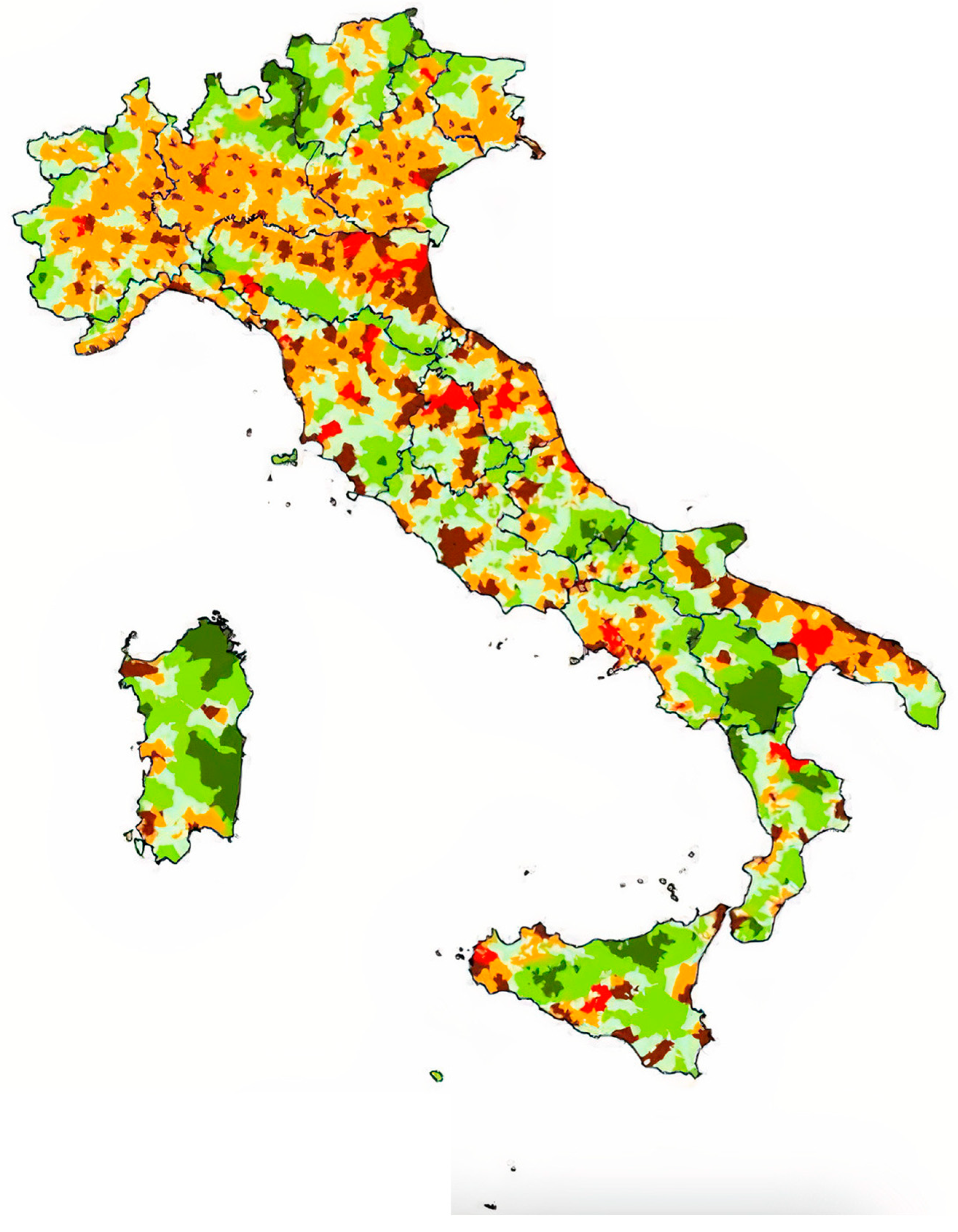
Figure 2.
The figure depicts the sequence and interconnections of the implementation phases within the analytical framework. The actions are categorised into three main areas: the establishment of the DDC (represented by the blue boxes), the utilisation of crowdsourcing (illustrated by the green boxes), and the expansion of community engagement beyond the DDC (depicted by the orange boxes). The authors have elaborated on this visual representation.
Figure 2.
The figure depicts the sequence and interconnections of the implementation phases within the analytical framework. The actions are categorised into three main areas: the establishment of the DDC (represented by the blue boxes), the utilisation of crowdsourcing (illustrated by the green boxes), and the expansion of community engagement beyond the DDC (depicted by the orange boxes). The authors have elaborated on this visual representation.
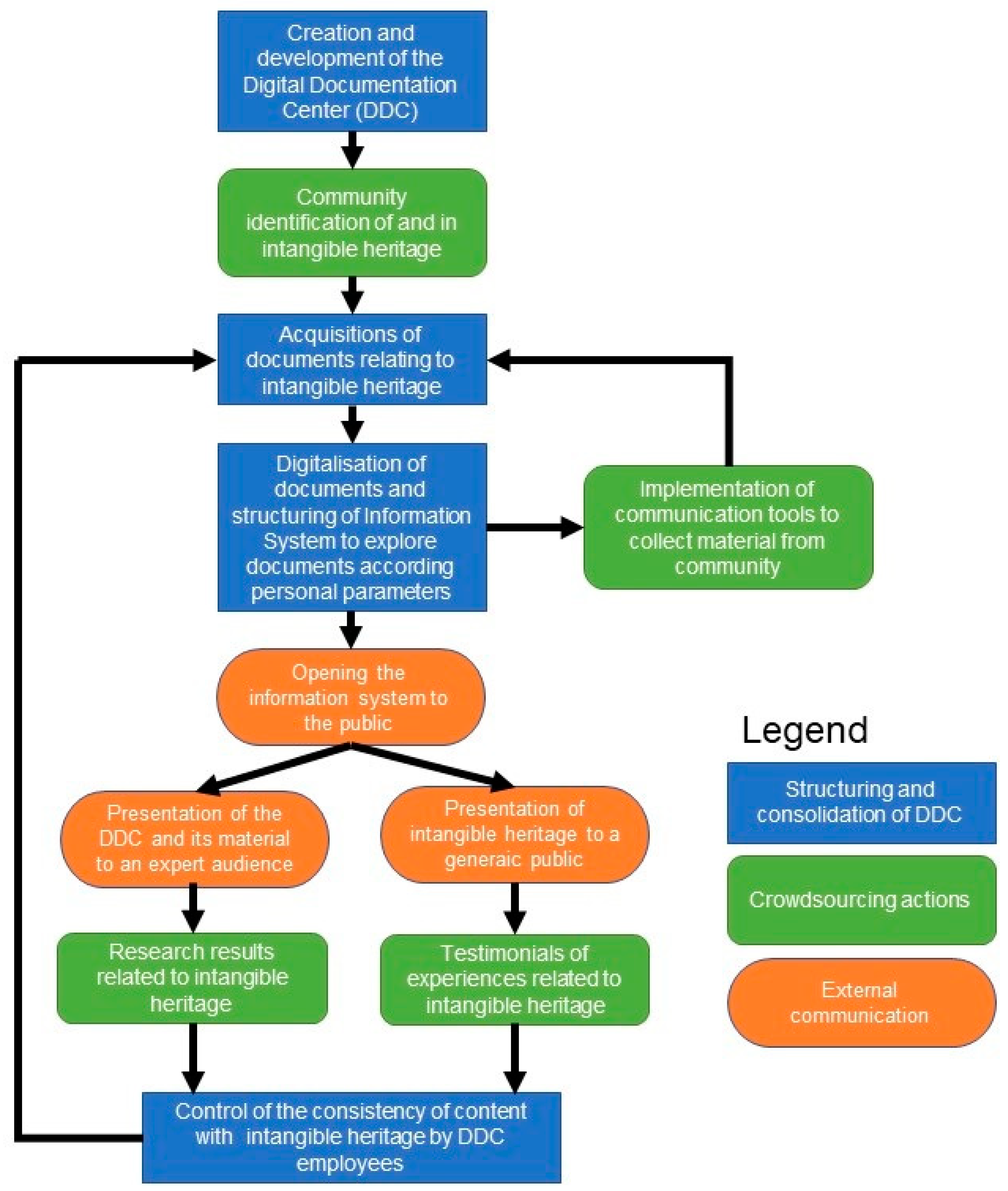
Figure 3.
UNESCO indicators considered in the socio-economic analysis of the framework (blue boxes), reworking to adapt the indicators to the local context (green boxes), tools directly linked to the considered indicators (orange boxes).
Figure 3.
UNESCO indicators considered in the socio-economic analysis of the framework (blue boxes), reworking to adapt the indicators to the local context (green boxes), tools directly linked to the considered indicators (orange boxes).
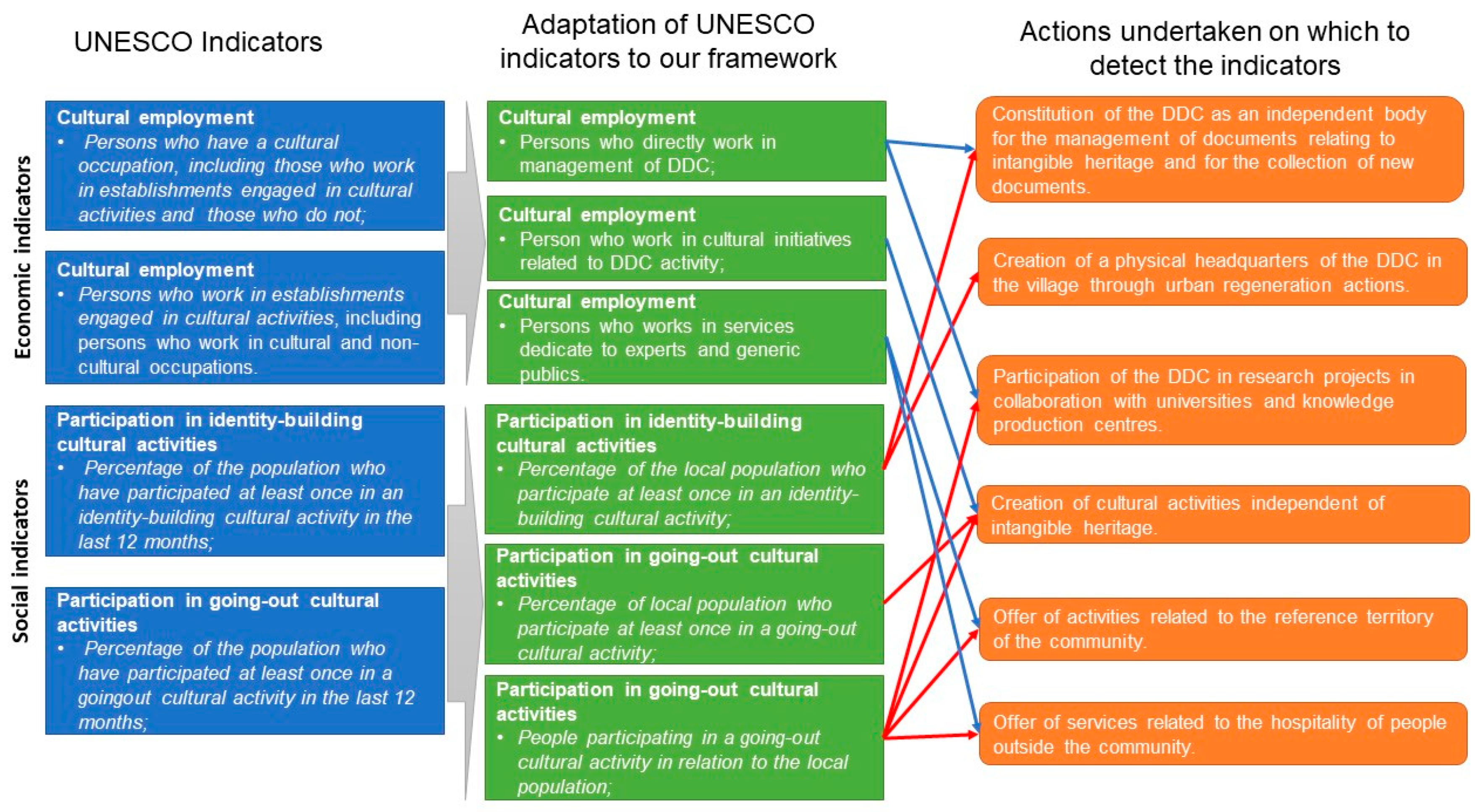
Disclaimer/Publisher’s Note: The statements, opinions and data contained in all publications are solely those of the individual author(s) and contributor(s) and not of MDPI and/or the editor(s). MDPI and/or the editor(s) disclaim responsibility for any injury to people or property resulting from any ideas, methods, instructions or products referred to in the content. |
© 2023 by the authors. Licensee MDPI, Basel, Switzerland. This article is an open access article distributed under the terms and conditions of the Creative Commons Attribution (CC BY) license (http://creativecommons.org/licenses/by/4.0/).
Copyright: This open access article is published under a Creative Commons CC BY 4.0 license, which permit the free download, distribution, and reuse, provided that the author and preprint are cited in any reuse.


