

Submitted:
22 February 2025
Posted:
24 February 2025
You are already at the latest version
Abstract
Internationally, there is a modern understanding of cultural heritage including Maritime/Underwater Cultural Heritage (MUCH)- not merely as a passive relic of the past, but as a transformative driver for sustainable growth and innovation. The paper discusses the position of maritime cultural heritage (MUCH) in relation to the Smart Specialization Strategies (S3) and its evolving role as a driver of sustainable growth, particularly within the context of the blue economy and smart specialization strategies (S3) in Europe. It, then, focuses on the Greek context, where UCH-driven activities, particularly soft Multi-Use (MU) activities that combine UCH, diving tourism, and nature conservation, are gaining momentum, especially within Marine Protected Areas (MPAs). Despite the growing interest, there is a lack of data, regulations, and a clear strategy for such activities, although the draft "National Spatial Strategy for the Marine Space" (issued in 2022) suggests promoting low-impact diving tourism incorporating UCH. The research paper examines the benefits and barriers to implementing UCH-driven MUs, recommending the use of Maritime Spatial Planning (MSP) to address challenges. It suggests that integrating UCH with nature conservation and diving tourism in soft MUs could support a sustainable blue economy, balancing cultural, ecological, social and economic goals, and fostering innovation through S3 on a regional level.
Keywords:
Smart specialization strategies
; Maritime cultural heritage
; Underwater cultural heritage
; Multi-use
; Maritime Spatial Planning
; Diving tourism
; Nature conservation
; Regions
; Innovation
1. Introduction
Culture, including cultural heritage (CH), has increasingly been recognized as a key driver of sustainable and societal development, particularly through its integration into tourism sector strategies across various European regions [1,2,3,4,5]. This recognition highlights the modern understanding of cultural heritage-including Underwater Cultural Heritage (UCH)- not merely as a passive relic of the past, but as a transformative driver for sustainable growth and innovation. This transformation approach is in line with the of EU’ regional and innovation policy agenda and with its associated concept of Smart Specialization Strategies (S3) [6].
The S3 term was added into the EU Cohesion Policy vocabulary during the programming period 2014-2020. Its primary objective was to guide investment decisions through the identification of key strategic priorities of the region’s sustainable growth and competitiveness (prioritization) based on evidence-driven and participation processes (participation) related to the actual needs and regional strengths and opportunities of the locality (localization) [7,8].
Whilst the S3 strategies of the 2014-2020 programming period, have introduced valuable mechanisms to foster growth, they are not without limitations. One of the primary criticisms of S3 is its strong focus on technological innovation and high-tech sectors, often at the expense of non-technological forms of innovation, such as social, cultural or the ones related to creative industries. These biases overlook regions that may lack robust technological infrastructure but are rich in cultural, social, or environmental assets capable of driving innovation. [9,10,11]. It is not surprisingly that the only and only 9% of European regions which have integrated cultural and creative industries and/or cultural heritage into their S3 during the 2014-2020 period belong to Southern EU countries, reflecting their territorial diversity and cultural wealth [10,12].
In addition, the framework has often been criticized as economically driven, with limited integration of goals related to the European Green Deal or the Sustainable Development Goals (SDGs), the latter aiming to reinforce social cohesion, environmental protection and a green growth [13,14]. The emerging challenges and policy developments at both the global and EU levels have prompted the inclusion of social innovation and green innovation as increasingly central elements of the EU’s cohesion and competitiveness policy. Therefore, a “shift in policy logic from S3 to smart specialization strategies for sustainable and inclusive growth (S4+)” [14] was endorsed in the 2021–2027 Multiannual Financial Framework (MFF). Strategies now prioritize community well-being, social cohesion, and inclusive development, ensuring that innovation benefits all segments of society. In 2024, Marasco et al. [12] argued that Cultural Creative Industries and cultural heritage are pivotal in advancing this new S4 logic as they foster social and environmental innovations. They add that, sustainable tourism models, or/and the digitization of heritage for broader accessibility, advocate the Multi-purpose dimension of space, thus providing more opportunities for all in contrast to pure technological practices. This directly aligns also with the Communication on Sustainable Blue Economy which underscores the economic impact of CH in coastal and maritime regions [15]. By integrating CH into S3 strategies, regions with strong maritime and coastal identity can leverage cultural tourism, marine biotechnology, and digital tools to boost economic growth while ensuring sustainability and social cohesion.
Maritime (incl. underwater) cultural heritage (MUCH), as a key component of CH, is increasingly recognized as an enabler of sustainable development [16]. MUCH represents a unique and underutilized regional asset with significant potential for contributing to sustainable blue economy and heritage tourism development [17]. UCH sites, such as ancient shipwrecks, submerged cities, and underwater archaeological landscapes, offer invaluable insights into human history and cultural evolution. Beyond their academic and historical value, these sites can drive economic growth through tourism, education, and cultural industries [18]. Underwater archaeological sites attract divers, researchers, and cultural tourists, creating opportunities for local businesses, including dive operators, tour guides, and hospitality providers. Additionally, MUCH can stimulate the development of related industries, such as underwater robotics, conservation technologies, and heritage management services [19]. The preservation of underwater sites plays a key role in marine conservation by safeguarding biodiversity and raising awareness of the maritime environment. This emphasizes the environmental sustainability aspect of MUCH’s contribution to regional development. Moreover, MUCH is closely tied to the region’s diverse economic profile, as various regional sectors coexist and are interconnected. This diverse economic profile across various sectors fosters innovation by maintaining inter-sectoral cognitive differences and promoting effective knowledge transfer and interactive learning via interlinked supply chains [11,20,21]. Evidently, MUCH can be positioned as a multi-purpose tool in the S3 practice that integrates cultural preservation, tourism, environmental sustainability and digitalization innovation in the region’s pathway to growth [17,20,21].
Another key element of criticism is that Smart Specialization Strategies (S3) reinforce existing inequalities between regions [21,22]. Wealthier, more technologically advanced regions are better positioned to capitalize on the S3 framework due to their established infrastructure, advanced human capital, previous collaborating experience and robust innovation ecosystems. These regions can more easily identify and exploit “niche” areas of competitive advantage, effectively engaging diverse stakeholders in the entrepreneurial discovery process (EDP) and securing EU funding for research and development [20,23,24].
Conversely, less-developed regions, particularly those with weaker institutional frameworks, limited innovation capacities, lack of collaboration culture, struggle to engage effectively in the EDP. They often face challenges such as limited access to skilled labor, weaker networks between key stakeholders, lack of trust and evidence of no synergies or a collaborative network followed by lack of financial resources, which hinder their ability to benefit from the S3 framework [25]. In 2023, Kramer et al. [9] in their analysis of key parameters of S3, found that many regions (amongst them, the Greek ones) continue to lag behind in implementing successful S3 initiatives. This is attributed to structural weaknesses in governance and a fragmented innovation landscape. For instance, regional disparities in Greece are exacerbated by uneven access to research institutions, insufficient collaboration between public and private sectors, and a lack of coordinated strategies to promote innovation across sectors with the huge territorial differences between the capital region and the other regions [26].
Governance and stakeholder coordination are critical, especially in sectors like the blue economy and MUCH, where multiple actors with often conflicting interests must work together. This includes governmental bodies, academic institutions, private sector entities, and local communities, all of which have varying priorities and levels of influence [27]. The complexity of managing these diverse interests is further complicated by the need for cross-sectoral and multi-level governance structures, which are often not accustomed to collaborating in less-advanced regions.
This research paper seeks to lay the groundwork for a stronger complementarity between Underwater Cultural Heritage (UCH) practices and local economic development through smart specialization strategies (S3), positioning UCH as a versatile, Multi-purpose tool. The research has two main components:
a) A review of the approaches taken by various European regions toward smart specialization in relation to UCH, examining also if they are promoting UCH-driven multi-use initiatives, and
b) A targeted research project in Greece, evaluating, through a co-development process with stakeholders, the potential for the co-existence of UCH with diving tourism and nature conservation. The benefits and possible innovation created from this Multi-use setting could encourage regions to adopt UCH-driven smart specialization strategies. Besides, Multi-use is an innovative tool, by its definition The multi-use approach is a creative and innovative solution that fosters positive coordination and win-win outcomes, as long as Maritime Spatial Planning (MSP) adopts a nexus, assemblage, and resilience-thinking perspective [28,29,30].
Although MUCH holds significant potential for sustainable development and the green transition, its integration into regional development strategies has been limited to date. The 2021–2027 period marks a notable shift with a greater focus on Cultural Heritage (CH) and the blue economy, yet MUCH remains underutilized in concrete terms. Our desk research, based on the dataset from the Smart Specialization Platform (S3P), confirms this finding. The analysis of the term "Cultural Heritage" as a keyword in the smart specialization priorities of various European regions shows that 46 EU regions have included the term. This is out of 243 NUTS entities (EU regions) and 22 non-EU regions referenced in the database, as of January 2025. Of course, there has been a 50% increase in the inclusion of “Cultural Heritage” in S3 approaches compared to the previous programming period [24]. However, when attempting to link this research to the concept of the blue economy, the scope is limited to just 36 regions (Table 1).
When exploring the significance of ’MUCH’ in S3 strategies, it’s important to recognize that the term is not typically part of the standard S3 policy terminology, nor is it directly associated with economic classification or the expected European Innovation Ecosystem (EIC). However, an effort was made to explore its relevance within sectors tied to the EIC, such as tourism and Creative and Cultural Industries (CCI). Searching for terms like ’cultural tourism’ or ’CCI’ did lead to an increase in related results, but the connection to the focus of this article remains limited, as some of the regions identified are neither coastal nor insular.
Nevertheless, this study has shown that, even within the strategic priorities of S3, which focus on areas such as the blue economy, CCI, cultural tourism, or cultural heritage, there is no explicit mention of the term ’maritime heritage’ or ’MUCH.’ This underscores the argument for better recognizing the potential of MUCH within both the blue economy and tourism sectors of the European Innovation Ecosystem (EIC), particularly for coastal and island regions in the EU. To better understand the emphasis on cultural heritage within the blue economy priorities of S3, a comparison of two datasets was carried out. The goal was to identify regions that appear in both datasets. Once again, most of these regions are concentrated in southern EU countries, with Italy leading the way (9 regions combining both cultural heritage and blue economy priorities), followed by France and Spain (Fig.1).
Of course, just because both terms appear in a region’s priorities doesn’t necessarily mean they are interconnected in policy or practice. A closer review of policy documents is needed to confirm if cultural heritage and specifically maritime cultural heritage is being integrated into blue economy initiatives. As an example, the S3 of Lazio region in Italy, a well-known region advocate of the blue economy, the Economia del Mare (Blue Economy) is prioritized. There is a recognition of the importance of the maritime economy, including coastal tourism, logistics, marine biotechnology, and renewable offshore energy. Lazio has highlighted the importance of multi-use marine spaces by developing platforms that integrate various maritime activities. However, while the region recognizes the value of a multi-use approach to marine space and prioritizes cultural and creative industries within its Smart Specialization Strategy (S3), there is limited evidence of cultural heritage—particularly maritime cultural heritage—being incorporated into the broader marine-based economic strategies of this multi-use approach [31].
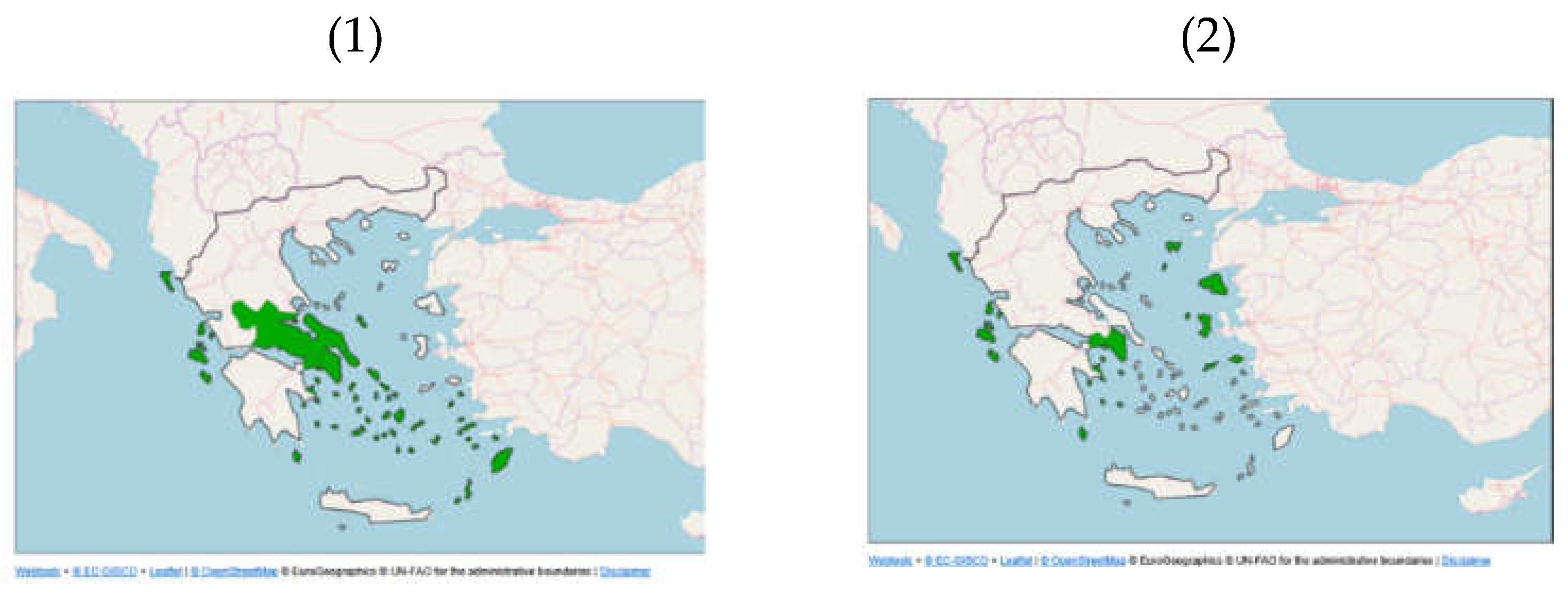
In the Greek context (Fig.2), even in areas where both cultural heritage and the Blue Economy are considered priorities, there is limited evidence of clear policy measures linking the two. For instance, consider the Smart Specialization Strategy (S3) of the Region of Central Greece, where cultural heritage and MUCH specifically, is emphasized within the tourism sector, but not as part of Blue Economy initiatives. A notable example is the Alonissos Underwater Museum, an innovative project included in the S3 strategy, which underscores the economic potential of underwater cultural heritage (UCH) in regional development. Opened in 2020, the museum enables divers to explore the Peristera shipwreck, a 5th-century BC merchant vessel near Alonissos. This initiative successfully merges UCH preservation with diving tourism, highlighting how maritime cultural assets can contribute to a sustainable Blue Economy [32]. Despite its clear maritime focus, the Alonissos Underwater Museum is categorized under tourism development rather than as part of the Blue Economy. This classification further highlights the policy disconnect between underwater cultural heritage (UCH) and broader maritime economic strategies, especially considering that the region, though coastal and partly island, is mainly a mainland region.
Figure 1.
Regions prioritizing the term cultural heritage and blue economy, in their S3, data based on the dataset of S3 CoP observatory , January 2025.
Figure 1.
Regions prioritizing the term cultural heritage and blue economy, in their S3, data based on the dataset of S3 CoP observatory , January 2025.
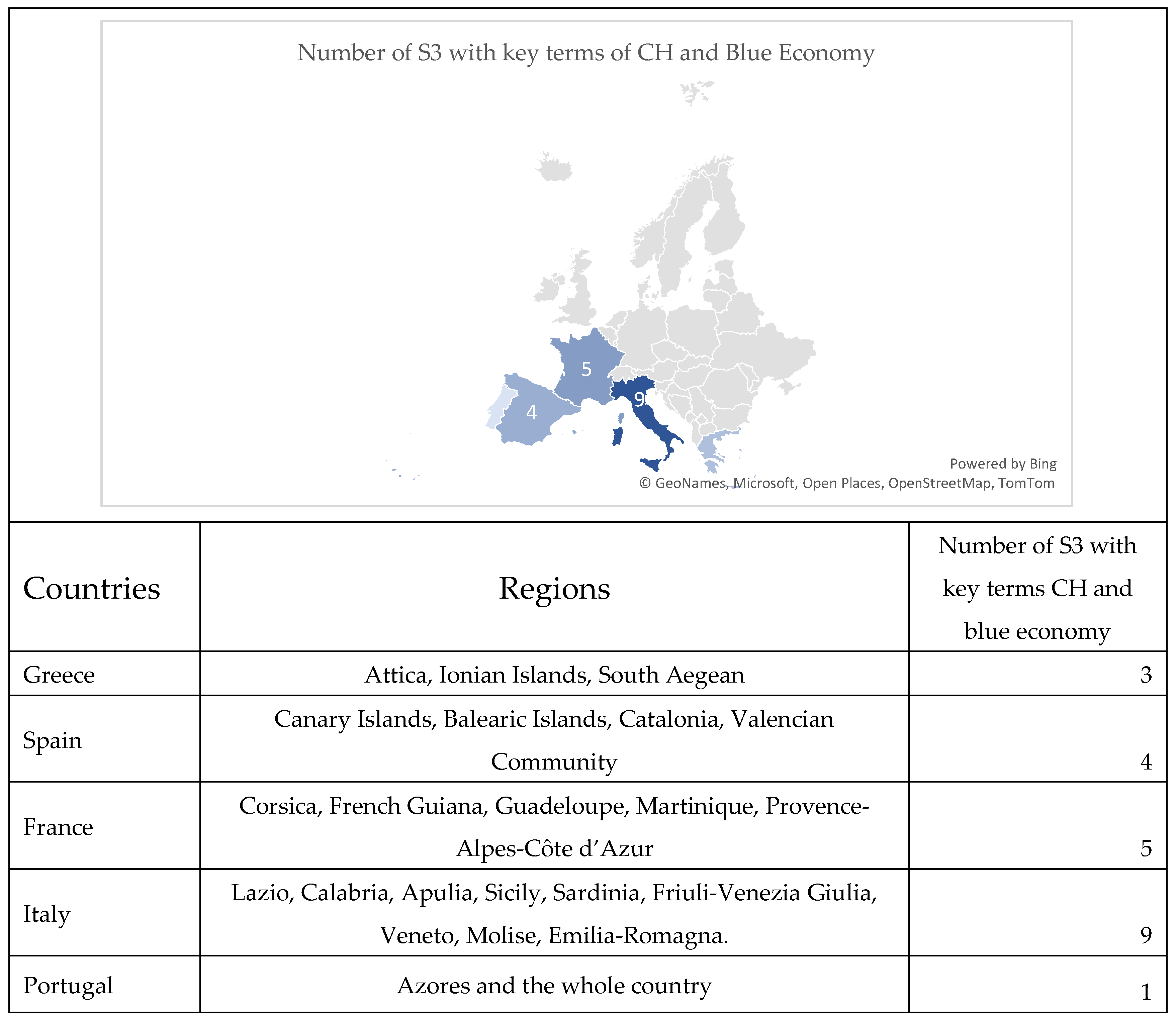
Figure 2.
Greek regions prioritizing the term cultural heritage (1) and regions prioritizing blue economy (2) to their S3 based on the dataset of S3 CoP observatory , January 2025.
Figure 2.
Greek regions prioritizing the term cultural heritage (1) and regions prioritizing blue economy (2) to their S3 based on the dataset of S3 CoP observatory , January 2025.
This concrete linkage is recognized by research community and is emphasized in Horizon funding projects such as Blue Culture Technology Excellence Hubs in EU Widening Member States (BCT Hubs) project [19]. This project aims to establish excellence hubs offering innovative solutions for the sustainable protection, restoration, valorization, management, accessibility, and promotion of UCH. Each hub collaborates with stakeholders from research, academia, businesses, the public sector, and societal actors, following a quadruple helix approach. There it acknowledges once more the emphasis on MUCH in the region of Central Creece as the first Underwater Accessible Cultural Heritage (UWCH) sites of ancient wrecks with cargo of Amphoras globally, the adoption or creation of new technologies for protection and all-inclusive accessibility of UWCH sites and the new concept of the Knowledge Awareness Centres (KACs) and a finally a vibrant ecosystem around the notions of protection–promotion–inclusiveness–behavioral change–local business development of MUCH.
The analysis highlights a significant gap in the explicit integration of maritime cultural heritage (MUCH) into the Smart Specialization Strategies (S3) of EU coastal and island regions, despite its potential within both the Blue Economy, the cultural tourism and cultural heritage sectors. While multiple regions in Southern Europe—including Italy, France, Spain, Greece, and Portugal—prioritize both themes in their S3 frameworks, there is little evidence that they are effectively interconnected in policy or practice. The case studies of Lazio (Italy) and Central Greece exemplify this disconnection, where Blue Economy initiatives focus on marine technology, coastal tourism, and multi-use marine spaces for energy and agriculture, but rarely integrate cultural heritage—let alone maritime cultural heritage—into these strategies.
The exclusion of maritime cultural heritage (MUCH) from Smart Specialization Strategies (S3) raises the question of whether this is due to governance inefficiencies, or a deliberate policy choice driven by economic priorities and sectoral competition. Governance weaknesses in EU coastal and island regions, particularly in Southern Europe, result in fragmented stakeholder networks, weak inter-institutional coordination, and a lack of formal mechanisms to connect maritime industries, tourism, and cultural heritage, suggesting an administrative failure rather than intentional exclusion. At the same time, policymakers often prioritize economic sectors with immediate returns, such as shipping, marine biotechnology, and coastal tourism, viewing MUCH as secondary or non-essential within the Blue Economy. Additionally, conservation efforts may be perceived as conflicting with commercial interests like maritime construction, offshore energy, and mass tourism, making its integration more complex. Economic pressures further shape regional S3 priorities, favoring sectors with clear economic metrics and aligning strategies with global investment trends, which makes it difficult for cultural heritage initiatives to compete for funding. This raises concerns about whether the S3 framework itself is structurally biased against heritage-related initiatives. Understanding whether this exclusion is rooted in governance inefficiencies or deliberate policy decisions is critical to identifying effective strategies that can enhance the integration of maritime cultural heritage into regional innovation and development frameworks and on the same time advocate the Multi-use aspect [33,34,35] of marine and island areas.
2. Materials and Methods
The methodological research process used to conduct the desk and field research, is illustrated in Figure 3. It consists of four steps:
Step 1 - Literature Review. The literature review aimed to explore the status of co-existence of three key activities: Underwater Cultural Heritage (UCH), Diving Tourism (DT), and Nature Conservation (NC). It encompassed a wide range of sources including scientific articles, national and regional reports, policy documents, laws, and regulations, as well as national and international projects related to the Multi-use of the sea. The review also gathered information from various practitioners such as archaeologists, planners, divers, maritime tourism experts, environmental NGOs, academia, fishers, and researchers. This comprehensive investigation sought to provide insights into the following interconnected fields : a./Regions where the multi-use setting under study (UCH-DT-NC) was already implemented; b./Mapping of related practitioners and researchers (archaeologists, planners, divers, fishers, entrepreneurs, maritime tourism experts, environmental NGOs, academia, researchers…); c./Analysis of the status of Multi-use at the regional and local levels ; d./ Identification of factors - acting as drivers, added values, barriers, and impacts-both positive and negative-that influence the success or failure of the Multi-use setting and e./ detailed description of the factors, that may either constrain or foster the development of the Multi-use setting.
Step 2- Development of the Research Query. Based on the literature regarding the DABI tool and its application, the key factors influencing the development of the Multi-use (MU) model, were classified as follows (Table 1). DABI factors were then further classified into the following categories: political (incl. institutional, regulatory, or administrative), economic (incl. financial), social, technical, and environmental (Zaucha et al., 2016). This classification allowed for a comprehensive understanding of the factors that either facilitate or hinder the development of the MU setting.
Then, an online survey, including both open and closed questions, was linked to the initial data collection and processing system. Subsequently, a fully structured questionnaire was designed concerning the prospects for harmonious coexistence of UCH - diving tourism – and nature/biodiversity conservation, through the implementation of a Multi-use setting. Firstly, basic anonymous information from the recipients of the questionnaire was asked, concerning type of stakeholder, previous experience on a Multi-use project (e.g. UCH and tourism) either of a plan or of a realized project, in Greece or elsewhere.
Through the online survey, recipients were asked through closed questions, to evaluate and rate by a five-point Likert scale several factors if they act as Drivers, Added Values, Barriers and Impacts (1-absent, 2-not relevant, 3-low priority, 4-very important and 5-extremely important). An example of a closed question related to Drivers was: “On a scale of 1 to 5, how important is the enhancement of the eco-tourism product in the blue economy for promoting the successful coexistence of underwater cultural heritage (UCH), diving tourism (DT), and/or nature conservation (NC)?”A similar closed question about Added Values was: “On a scale of 1 to 5, how important is the diversification of the locally offered tourist products and the extension of the tourist season as an added value resulting from the coexistence of diving tourism, UCH, and/or nature conservation, near or within Marine Protected Areas (MPAs)?” Additionally, an example of a closed question addressing Barriers was: “On a scale of 1 to 5, how significant is the lack of approved Marine Protected Area Management Plans as an obstacle to the successful coexistence of diving tourism, underwater cultural heritage (UCH), and nature conservation, near or within a MPA?” A similar question focusing on the Impacts of the above Multi-use was: “On a scale of 1 to 5, how important are potential conflicts with other economic activities (e.g., fishing, maritime transport, etc.) as negative effects of the coexistence of diving tourism, UCH, and nature conservation?”
The survey also included open-ended questions, such as: “Please share any additional thoughts, ideas, or opinions on the factors that drive this specific Multi-use in marine spaces.”

Table 1.
Classification of factors that either facilitate or hinder the development of the MU setting.
Table 1.
Classification of factors that either facilitate or hinder the development of the MU setting.
| Drivers | Factors that promote, support, facilitate, or strengthen the development of the MU. | Political, economic, social, technical, environmental |
| Added Values | Benefits or positive effects that arise from the implementation or enhancement of the MU. | Political, economic, social, technical, environmental |
| Barriers | Factors that negatively affect or prevent the development of the MU. | Political, economic, social, technical, environmental |
| Impacts | Negative effects associated with the establishment or strengthening of the MU. | Political, economic, social, technical, environmental |
Step 3- Research Analysis and Results
The survey gathered input from a broad range of stakeholders and practitioners, including government institutions, academia, research organizations, tourism entrepreneurs, NGOs, local governments, fishers, diver associations, and experts (Table 2). It was designed to be inclusive and multi-level, engaging participants at international, national, regional, and local levels. Conducted in May 2023, the survey invited 50 stakeholders, whilst 34 responded, yielding a 68% response rate.
The research aimed to identify and rank factors related to the MU “UCH-DT-NC”. First, participants ranked each DABI factor and suggested additional factors or actions that could help promote the MU. Second, the data was automatically collected and organized into Excel tables. Third, diagrams were created based on the Excel data, with color coding: political factors were marked in red, social and technical factors in light blue and dark blue accordingly, economic factors in orange and environmental factors in light green. Finally, all responses to open-ended questions were reviewed and presented.
Step 4 - Conclusions and Policy Recommendations
The survey results were analyzed to identify key factors among Drivers, Added Values, Barriers and Impacts, influencing Multi-use (MU) settings. These results were evaluated as for their potential association with S3. This led to policy recommendations aimed at balancing Underwater Cultural Heritage, Diving Tourism, and Nature conservation in the Eastern Mediterranean, with a focus on the Regional (NUTS3) level.
3. Results
As already mentioned, the stakeholders’ responses and insights led to the identification of key economic, political/regulatory, social, environmental, and technical factors that either support or challenge the Multi-use between UCH, diving tourism, and nature conservation. It also highlighted both the positive and negative impacts of these factors on implementing this Multi-use approach for maritime spaces.
3.1. Most Important Drivers Fostering the Development of the MU Under Study, by Factor
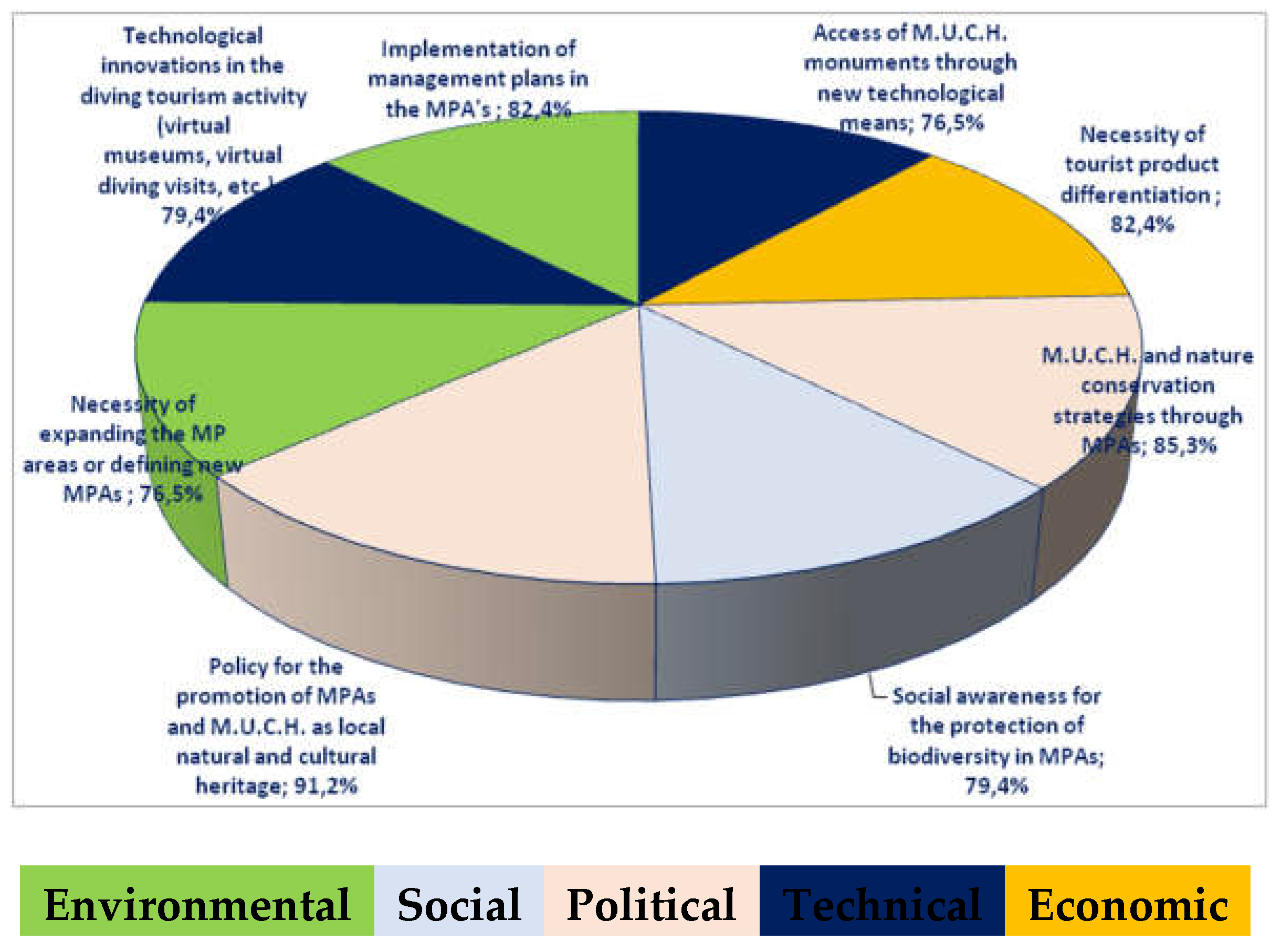
In terms of driving forces (Fig.4), several political and regulatory factors were found to strongly promote the UCH-driven Multi-use (incl. Diving tourism, and nature conservation). Notably, the “Policy for the promotion of MPAs and UCH as local natural and cultural heritage (interconnection of natural and cultural capital)” was considered extremely or very important by 91.2% of stakeholder representatives, while “the harmonization of U.C.H. and nature/biodiversity conservation strategies through MPAs” was viewed as extremely or very important by 85.3% of stakeholders.
Key environmental factors also emerged, with the “necessity of expanding MPA areas or defining new MPAs (based on the EU biodiversity strategy)” considered extremely or very important by 76.5% of respondents. Additionally, the “possible implementation of management plans in Marine Protected Areas” was deemed extremely or very important by 82.4% of stakeholders.
In terms of technical drivers, the “facilitation of access to UCH through new technological means (e.g., virtual diving visits, etc.)” was rated as extremely or very important by 76.5% of stakeholders, while the “integration of technological innovations in diving tourism activities (virtual museums, virtual diving visits )” was considered extremely or very important by 79.4% of respondents.
Additionally, a key economic factor identified was “the necessity of differentiating the locally offered tourist product” which was considered extremely or very important by 82.4% of stakeholder representatives. Finally, the social driving forces were less important, with “social awareness for the protection of biodiversity in MPAs” being regarded as extremely or very important by 79.4% of stakeholders.
The most important drivers fostering the development of the Multi-use setting under assessment, by factor (environmental, technical, social, political, and economic), according to stakeholders who rated them as "extremely important" to "very important," are displayed in the following Table 3.
Figure 4.
Stakeholders’ responses - Most important drivers fostering the development of the MU under study, by factor. (“extremely important” to “very important”), Source: Own elaboration by the authors.
Figure 4.
Stakeholders’ responses - Most important drivers fostering the development of the MU under study, by factor. (“extremely important” to “very important”), Source: Own elaboration by the authors.
3.2. Most Important Added Values of the MU Under Study, by Factor
The added value (positive impacts) of developing the MU under study, as perceived by stakeholders, is outlined in Figure 5. These positive impacts encompass a range of social, economic, and environmental factors, as detailed below:
3.2.1. Social Added Value
The Social added value, was analysed as follows:
Awareness and capacity building of the local community about UCH and its connection with local history and tradition, with 91.2% of stakeholders considering this factor extremely or very important.
Awareness and capacity building of the local community regarding environmental protection within MPAs, viewed as extremely or very important by 85.3% of stakeholders.
Addressing the risks of damage to UCH monuments, recognized by 82.4% of stakeholders as a crucial impact.
The effective cooperation between tourism enterprises and management organizations for managing, protecting, and sustainably utilizing MPAs, was also rated as extremely or very important by 82.4% of stakeholders.
Strengthening cultural identity and social cohesion in coastal and island communities, identified by 79.4% of stakeholders as a highly significant positive impact.
3.2.2. Economic Added Values
Enhancement of local income through the introduction of new tourist services, considered extremely or very important by 82.4% of stakeholders.
Diversification of the locally offered tourist product and extension of the tourist season, seen as an important economic benefit by 79.4% of stakeholders.
3.2.3. Environmental Added Values
Raising tourists’ awareness of the environmental problems threatening the seas, was considered extremely or very important by 85.3% of stakeholders.
Leveraging private funds and strengthening the national and regional public budget for the protection of UCH and the natural environment, recognized as a positive environmental impact by 79.4% of stakeholders.
These factors collectively underscore the multifaceted benefits that the development of the MU under study could bring to local communities, economies, and the environment.
3.3. Most Important Barriers that Hinder the Development of the MU Under Study, by Category of Factor
The research identified political/regulatory barriers (Fig.6) as the most significant obstacles to the development of the MU under assessment, with less emphasis on social, economic, or technical/environmental barriers. Key political/regulatory barriers include: a. limited coordination between authorities at various levels (Ministry of Culture, local authorities, chambers), with 85.3% of stakeholders viewing this as extremely or very important barrier; b. Lack of approved MPA Management Plans (Natura 2000), considered extremely or very important by 82.4% of stakeholders; c. Absence of an institutionalized national strategy for the protection and utilization of UCH, highlighted by 79.4% of stakeholders; d.Lack of public support for local entrepreneurship in coastal/small island areas, also seen as extremely or very important by 79.4% of stakeholders. Other notable political/regulatory barriers include:
- Absence of structures for education and training of the local population in coastal/small island areas, with 76.5% of stakeholders identifying this as a critical issue.
- The current national institutional framework considered a barrier by 73.5% of stakeholders.
In addition to political/regulatory barriers, two social factors were also considered as important challenges:
- Limited awareness among the local community about the value of UCH and the importance of protecting both cultural heritage and the natural environment, flagged by 73.5% of stakeholders.
- Limited experience and knowledge of best practices, which could help stakeholders understand the real benefits of this integrated marine space usage, noted by 70.6% of stakeholders.
- Lastly, an economic barrier identified was the lack of sufficient financial incentives, seen as a critical issue by 70.6% of stakeholders.
3.4. Most Important (Negative) Impacts of the Development of the MU Under Study, by Category of Factor
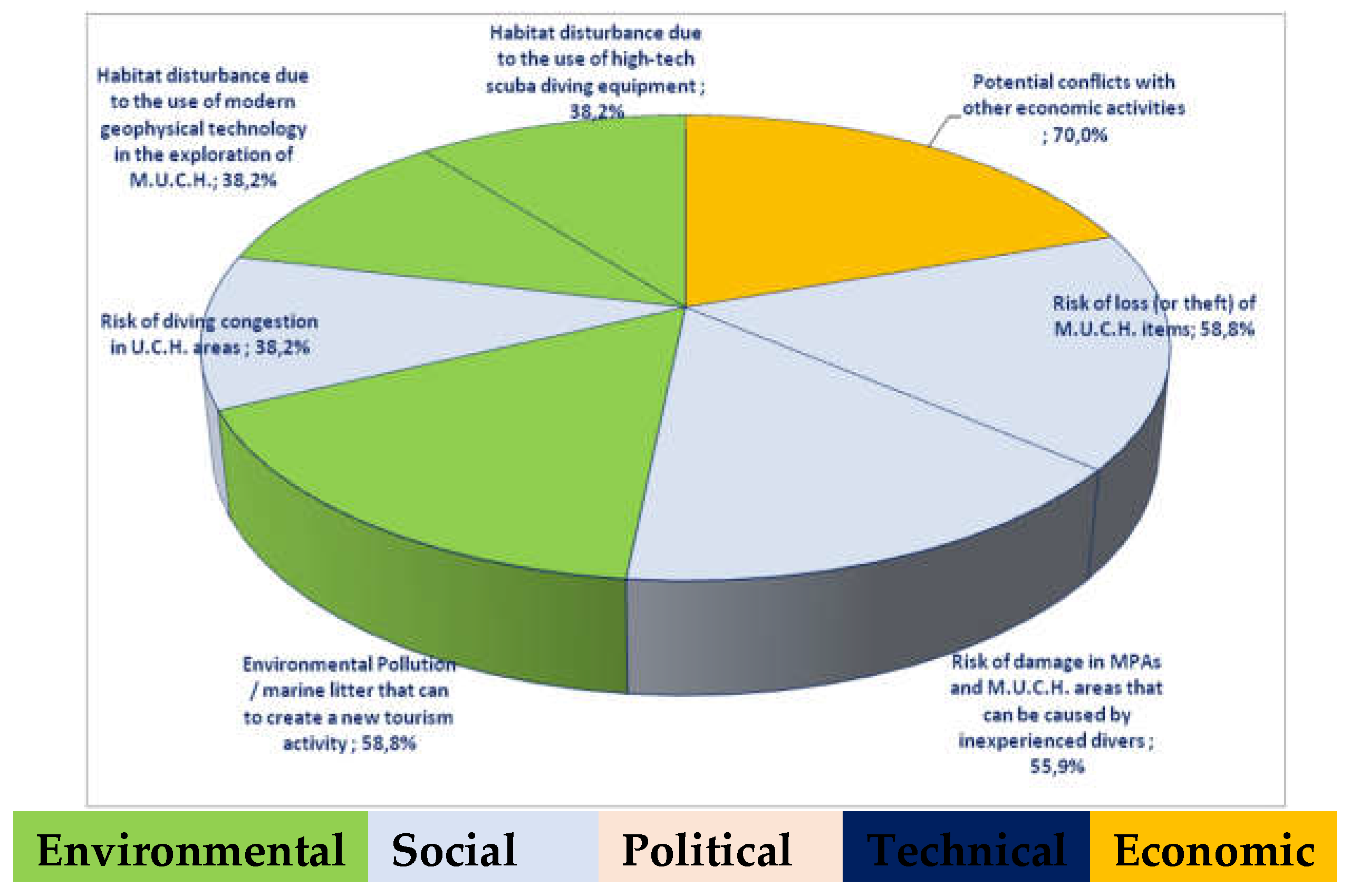
The research identified the "potential conflicts with other economic activities" (e.g., fishing or maritime transport) as the most significant negative impact of the MU under study (Fig.7). A substantial 70.0% of the respondents considered this factor to be extremely or very important. Other social and environmental negative effects were viewed with less concern, though still significant. These included:
- The risk of loss or theft of UCH items, with 58.8% of stakeholders considering it extremely or very important.
- The risk of damage to Marine Protected Areas (MPAs) and UCH sites due to inexperienced divers, which was deemed extremely or very important by 55.9% of the stakeholders.
- Environmental pollution and marine litter generated by new tourism activities, that 58.8% of stakeholders also considered an extremely or very important negative effect.
Figure 6.
Stakeholders’ response on the barriers hindering the development of the MU under study, by factor (“extremely important” to “very important”), Source: Own elaboration by the authors.
Figure 6.
Stakeholders’ response on the barriers hindering the development of the MU under study, by factor (“extremely important” to “very important”), Source: Own elaboration by the authors.
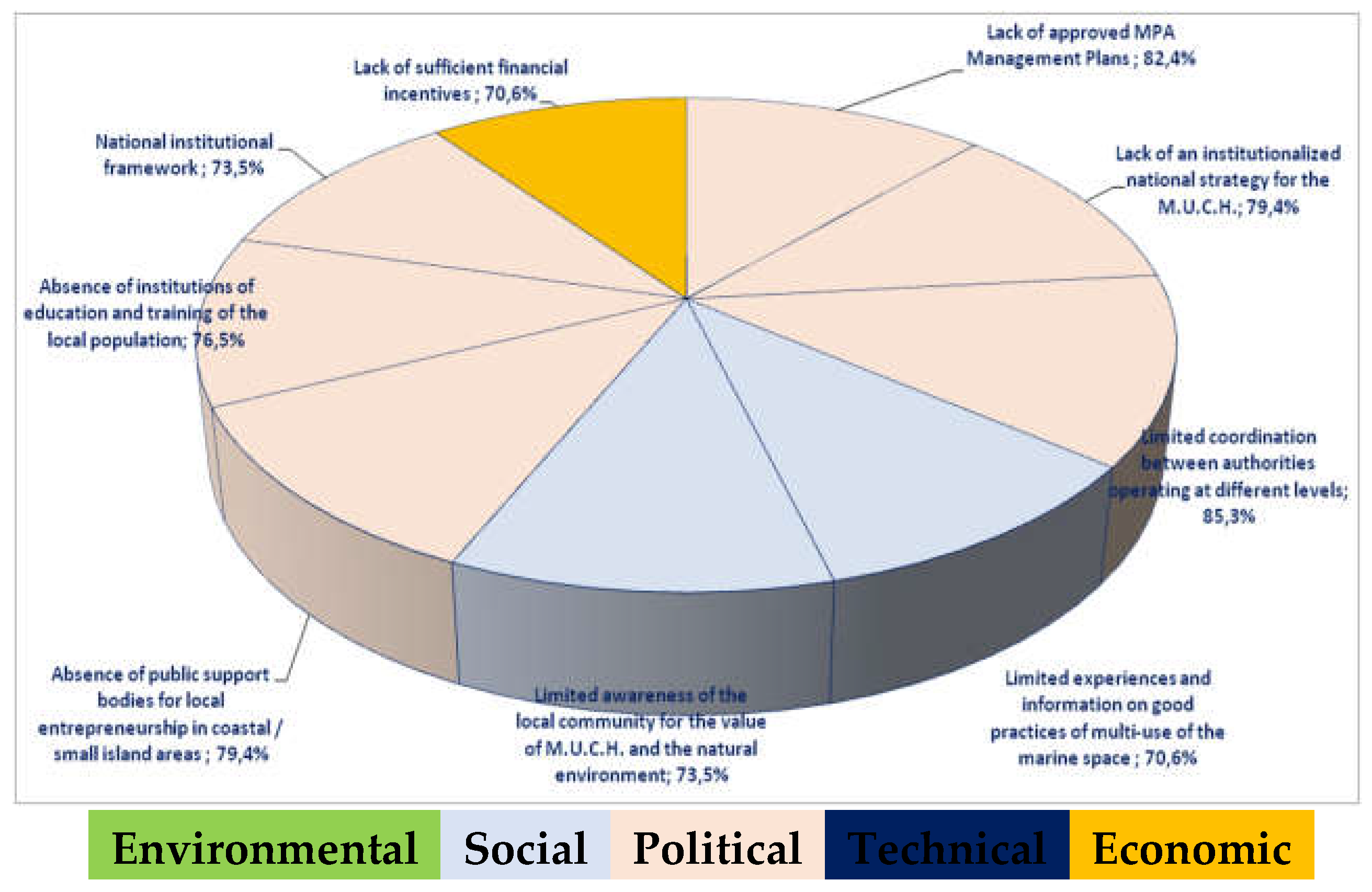
Figure 7.
Stakeholders’ responses on the negative) impacts of the development of the MU under study, by factor (“extremely important” to “very important”) Source: Own elaboration by the authors.
Figure 7.
Stakeholders’ responses on the negative) impacts of the development of the MU under study, by factor (“extremely important” to “very important”) Source: Own elaboration by the authors.
3.5. Drivers and Barriers that Foster or Hinder the Development of the MU under Study, by Group of Stakeholders
The driving forces and the barriers that foster or hinder the development of the MU under assessment by factor (environmental, technical, social, political and economic) were as follows, according to group of stakeholders.
Local authorities identified economic factors as the most important driving force, with 96.7% of stakeholders considering these factors as extremely or very important. Environmental and technical factors followed, with 66.7% of stakeholders highlighting them as key drivers. Regarding barriers, local authorities indicated that economic factors posed the greatest obstacle to MU development, with 100% of stakeholders viewing these as highly significant barriers. Environmental and political/regulatory factors were also seen as important barriers, with 78% and 77.8% of representatives, respectively, acknowledging their significance.
Government authorities emphasized technical, economic, and environmental factors almost equally as driving forces for MU development, with 58.3%, 57.5%, and 55.3% of stakeholders, respectively, ranking them as extremely or very important. In terms of barriers, governmental representatives saw social factors (68.8%) and political/regulatory factors (63.9%) as the most significant obstacles.
Academics and researchers pointed to technical and environmental factors as the most crucial driving forces, with 92.3% and 87.2% of stakeholders, respectively, considering them extremely or very important. As for barriers, they identified political/regulatory and social factors as the most significant, with 72.6% and 68.9% of stakeholders, respectively, viewing these factors as crucial obstacles.
Experts and consultants regarded technical, environmental, and political factors as nearly equally important drivers for MU development, with 83.3%, 83.3%, and 77.1% of stakeholders, respectively, marking these as highly significant. The most critical barriers, according to experts, were economic and political/regulatory factors, with 94.4% and 85.2% of stakeholders, respectively, considering them as very important.
The scuba divers community highlighted political, technical, and economic factors almost equally as the main driving forces for MU development, with 76.5%, 75%, and 75% of stakeholders, respectively, identifying these factors as extremely or very important. For barriers, the scuba divers community most frequently pointed to political and economic factors, with 68.5% and 58.3% of representatives, respectively, citing them as the most significant obstacles.
Finally, NGOs identified technical, environmental, and political factors as the primary driving forces, with 58.3%, 55.6%, and 53.1% of stakeholders, respectively, acknowledging these factors as highly important. Regarding barriers, NGOs most frequently noted social factors (68.8%) as the main impediment to development, followed by economic, political, and environmental factors, each cited by 63.9% of stakeholders.
This summary provides a detailed view of the diverse perspectives across stakeholder groups regarding the key driving forces and barriers impacting the development of the UCH-Diving Tourism-Nature Conservation MU.
3.6. Added Values and (Negative) Impacts of the MU Under Study, by Group of Stakeholders
The positive and negative effects of developing the Multi-use under study, are categorized by environmental, technical, social, political, and economic factors and the different stakeholder groups reported the following:
Local public authorities identified significant positive impacts across the above categories. Specifically, 93.3% of stakeholders viewed the economic and environmental effects as highly positive, 91.7% rated technical impacts positively, and 83.3% highlighted the social benefits. The primary negative impact, as reported by local public authorities, was economic, with 66.7% of stakeholders recognizing the potential for conflicts with other economic activities (e.g., fishing, maritime transport) as a critical concern.
Government authorities, on the other hand, emphasized the social, economic, and environmental positive impacts, with 73.6%, 65%, and 60% of stakeholders, respectively, considering these factors to be highly positive. In terms of negative impacts, governmental representatives focused more on environmental concerns (58.3%), followed by social and economic issues, which were each rated as significant negative effects by 50% of stakeholders.
Finally, social positive effects were most strongly recognized by groups such as the scuba diving community, experts/consultants, academics/researchers, and NGOs. These groups reported the social benefits of the MU as extremely important or very important in 95.8%, 91.7%, 80.8%, and 73.6% of responses, respectively. Conversely, the most significant negative impacts identified by these groups were primarily economic, with less emphasis on environmental and social concerns.
4. Discussion
The results of this research underline the key drivers, barriers, added values, and negative impacts related to the integration of Underwater Cultural Heritage (UCH), diving tourism, and nature conservation into a Multi-use (MU) setting. These insights align with and expand upon previous studies concerning the governance, economic priorities, and sectoral competition affecting maritime spaces. Among the critical observations is the strong political and regulatory support for the promotion of MPAs and UCH as interconnected elements of natural and cultural heritage [36].
This aligns with European policy frameworks that highlight the sustainable use of marine resources, involving the European Biodiversity Strategy. Nevertheless, significant governance challenges endure, despite the regulatory support. We may refer to some major barriers: limited inter-institutional coordination, fragmentation among stakeholders, absence of cohesive national/regional strategies for the co-existence of UCH with other sea uses. These challenges underpin existing literature on governance inadequacies in EU coastal and island regions, particularly in Southern Europe, where weak institutions impede the effective implementation of maritime Multi-use initiatives.
The marginalization of maritime cultural heritage (MUCH) in relation to the Smart Specialization Strategies (S3) as analyzed by the authors of this paper, raises the question regarding whether this results from bureaucratic shortcomings or vigilant policy choices spotlighting high-revenue economic sectors. Governance limitations, including fragmented stakeholder networks and a deficiency of institutionalized instruments for cross-sector collaboration, are all significantly contributing to this marginalization. This echoes findings from preceding studies, arguing that cultural heritage initiatives often struggle to fit within the economic or monetary-centric priorities of the Blue Economy. Decision makers and legislators frequently emphasize sectors such as shipping, marine biotechnology, and offshore wind energy, which deliver instant economic returns, lowering culture and heritage-related initiatives to inferior importance. Economic concerns or strictly monetary considerations are further complicating the incorporation of UCH into regional development frameworks.
The research identified financial constraints as a major barrier, with deficient incentives and funding mechanisms restraining local businesses in coastal and island communities. This aligns with research indicating that Smart Specialization Strategies (S3) favor sectors with clear economic metrics and strong compatibility with global investment trends. Hence, MCH and UCH initiatives face challenges in capturing funding and institutional support, underlining the perception that conservation and heritage management are contradictory to economic development.
Despite these constraints, the paper reveals significant positive impacts associated with the MU framework. Social added values, particularly in promoting awareness and education regarding UCH and nature conservation, arose as key benefits. The consolidation of cultural identity and social cohesion in coastal and island communities further underlines the non-economic values when integrating UCH into broader marine governance strategies and MSP. This encourages previous research advocating for a more holistic approach to maritime spatial planning (MSP), where cultural and natural heritage are considered as fundamental to sustainable regional development.
From an economic viewpoint, substantial opportunities are the “diversification of the locally offered tourist product” and consequently the “extension of the tourist season”. These findings emphasize the economic sustainability of heritage-based tourism, particularly in regions looking for the transition from mass tourism towards more sustainable and ”niche” tourism offerings. The incorporation of technological innovation, such as virtual diving experiences and virtual museums, further sustains this transition by expanding accessibility to UCH sites and strengthening the visitor’s experience without provoking additional pressures on marine ecosystems.
However, the research also detects potential negative impacts that should be mitigated. Conflicts with other maritime activities, such as fisheries and maritime transport, pose a significant challenge, necessitating vigorous regulatory frameworks to balance contesting interests. Additionally, concerns regarding nature degradation, marine litter, and the potential damage of the UCH sites from non-accredited divers highlight the need for strict management measures and comprehensive stakeholder engagement.
Future research should explore mechanisms for enhancing institutional coordination and stakeholder collaboration in maritime spatial planning (MSP), given the identified governance and economic challenges. Moreover, the existing literature showed that there is a need for comparative analyses of successful multi-use initiatives across different regions. These could offer valuable insights into good practices for integrating cultural heritage into regional innovation frameworks. Additionally, further research is needed to examine whether the marginalization of UCH in relation to S3 strategies is structurally embedded within the policy framework or if it can be addressed through targeted support and policy revisions. The UNESCO but also the European Commission could here play a decisive role [37] probably in the next IOC-UNESCO and DGMARE joint roadmap.
Another important avenue for research is the role of financial instruments in supporting UCH conservation and sustainable tourism development. Exploring alternative funding models, such as public-private partnerships, crowdfunding, or EU-funded grants, could provide practical solutions to address the economic barriers identified in this study.
Finally, interdisciplinary studies incorporating marine ecology, cultural heritage management, and tourism economics would offer a more comprehensive understanding of how MU frameworks can be optimized.
5. Conclusions
This paper emphasizes that, while there is a strong market preference for high-revenue economic sectors with strong demand of exclusivity in marine spaces - particularly in coastal zones - often at the expense of conservation areas, insights from stakeholders highlight that there is significant potential for UCH conservation through the development of UCH-driven multi-use settings. It seems that this potential can be realized with emphasis in the following cases:
- when interdependent natural and cultural capital are effectively reconnected [36], allowing also for a sustainable blue economy through heritage tourism.
- when sustainable practices are integrated into the planning and management of coastal and marine spaces, ensuring that both ecological integrity and economic development are prioritized simultaneously. This involves adopting approaches that balance commercial use with conservation efforts, such as ecosystem-based management and adaptive co-management strategies that involve local communities, businesses, and government stakeholders.
These strategies could help pave the way for mutually beneficial outcomes, such as fostering sustainable tourism, reducing the environmental footprint of marine activities, and ensuring long-term resilience of coastal ecosystems. By bringing together various stakeholders with a shared vision of sustainable development of the ocean and the sea, UCH-driven Multi-use settings could be optimized in a socially innovative way, to support the blue economy while preserving the health of marine and coastal environments.
The authors propose using UCH-driven MUs as a tool for the sustainable use of marine space. This approach supports the social and cultural aspects of the blue economy and promotes an ecosystem-based and a people-centered strategy for Maritime Spatial Planning (MSP), which, in turn, may enhance its enforceability.
Another key takeaway message is that incorporating socio-cultural values in MSP [38,39], can support its evolution into a mechanism that both fosters and regulates market forces. In this sense, the primary challenge for MSP is finding the right balance between market-driven and non-market considerations and their respective outcomes. Such a framework, may be understood as the interplay between commercial interests and conservation efforts that requires a nuanced approach balancing economic growth with long-term sustainability, ensuring that MCH (with emphasis on submerged heritage) is not only preserved but also leveraged as an asset for regional sustainable economic development.
Author Contributions
For research articles with several authors, a short paragraph specifying their individual contributions must be provided. The following statements should be used “Conceptualization, S-S.K., N.M. and D.I; methodology, S-S.K., N.M. and D.I; software, D.I.; validation, S-S.K., N.M. and D.I ; formal analysis, S-S.K., N.M. and D.I; investigation, S-S.K., N.M. and D.I ; resources, S-S.K., N.M. and D.I ; data curation, N.M and D.I; writing—original draft preparation, S-S.K., N.M. and D.I ; writing—review and editing, S-S.K and N.M; visualization, N.M and D.I ; supervision, S-S.K.; project administration, S-S.K.; funding acquisition, S-S.K. All authors have read and agreed to the published version of the manuscript.” Please turn to the CRediT taxonomy for the term explanation. Authorship must be limited to those who have contributed substantially to the work reported.
Funding
“This research received no external funding”
Data Availability Statement
The data presented in this study are available on request from the corresponding author since they are partly created within the Research project “Developing an observation network for MCH/UCH in Greece” (HER-SEA) funded by the Hellenic Foundation for Research and Innovation, grant number A.II. 44180/13.02.2022. The corresponding author (S.S.K.) is principal investigator of the Project. No funding has been received to cover the publication fees of this paper.
Acknowledgments
In this section, you can acknowledge any support given which is not covered by the author contribution or funding sections. This may include administrative and technical support, or donations in kind (e.g., materials used for experiments).
Conflicts of Interest
“The authors declare no conflicts of interest.”
Abbreviations
The following abbreviations are used in this manuscript:
| MCH | Maritime Cultural Heritage |
| UCH | Underwater Cultural Heritage |
| S3 | Smart Specialization Strategies |
| MSP | Maritime Spatial Planning |
| MPA | Marine protected Area |
| ND | Nature conservation |
| DT | Diving tourism |
| MU | Multi-use of the sea |
References
- Communication from the Commission to the European Parliament, the Council, the European Economic and Social Committee and the Committee of the Regions. (2014), Towards an integrated approach to cultural heritage for Europe. Brussels: European Commission.
- European Committee of the Regions. Opinion of the European Committee of the Regions — Cultural heritage as a strategic resource for more cohesive and sustainable regions in the EU (2018/C 361/06). Official Journal of the European Union, C 2018, 361, 31–36.
- European Commission (2018). A new European agenda for culture, Publications Office of the European Union. https://eur-lex.europa.eu/legal-content/EN/TXT/PDF/?uri=CELEX%3A52018DC0267.
- Council of the European Union. Council conclusions on the EU Work Plan for Culture 2023–2026 (2022/C 466/01). Official Journal of the European Union, C 2022, 466, 1–9, https://eur-lex.europa.eu/legal-content/EN/TXT/PDF/?uri=CELEX%3A52022XG1227(01.
- ESPON2020 (2022). HERIWELL: Cultural heritage as a source of societal well-being in European regions — Final report. ESPON Programme. https://www.espon.eu/heriwell.
- European Commission: Joint Research Centre, Reid, A., Steward, F. and Miedzinski, M., (2023). Aligning smart specialisation with transformative innovation policy – Lessons for implementing challenge-led missions in smart specialisation, /: Office of the European Union, https://data.europa.e.
- Foray, D. In response to ‘six critical questions about smart specialization’. Eur Plan Stud 2019, 27, 2066–2078. [Google Scholar] [CrossRef]
- Foray, D.; Eichler, M.; Keller, M. Smart spe cialization strategies—insights gained from a unique European policy experiment on innovation and industrial policy design. Rev. Evol. Political Econ. 2021, 2, 83–103. [Google Scholar] [CrossRef]
- Kramer, J. P. , Galdiga, L., Sirtori, E., Foray, D. and Brökel, T. (2023). Analysis of key parameters of Smart Specialisation Strategies (S3). Smart Growth Matrix meeting, EU, DG REGIO.
- European Commission: Directorate-General for Regional and Urban Policy. (2021), Study on prioritisation in smart specialisation strategies in the EU – Final report, Publications Office, 2021, https://data.europa.eu/doi/10.2776/60867.
- Gustafsson, C.; Stanojev, J. Circular Economy Concepts for Cultural Heritage Adaptive Reuse Implemented Through Smart Specialization Strategies. In The STS Conference Graz 2019 Proceedings, 6-7 May, 2019, Graz, Austria, 2019; pp. 415–436.
- Marasco, A.; Lazzeri, G.; Tartari, M.; Uboldi Sand Sacco, P.L. Revisiting the CCIs-tourism nexus: insights from Smart Specialisation Strategies. Eur. J. Cult. Manag. Polic. 2024, 14, 12393. [Google Scholar] [CrossRef]
- Radovanovic, N. and Stevanovic Carapina, H., (2024), Green transition and Smart Specialisation in the Western Balkans, Publications Office of the European Union, Luxembourg. [CrossRef]
- McCann, P.; Soete, L. Place-based innovation for sustainability, Publications Office of the European Union, Luxembourg, 2020, ISBN 978-92-76-20392-6. [CrossRef]
- European Commission (2021), Communication from the Commission to the European Parliament, the Council, the European Economic and Social Committee and the Committee of the Regions: A new approach for a sustainable blue economy in the EU—Transforming the EU’s blue economy for a sustainable future (COM/2021/240 final). Publications Office of the European Union. https://eur-lex.europa.eu/legal-content/EN/TXT/?uri=CELEX%3A52021DC0240.
- Kyvelou, S.S.; Ierapetritis, D.G. Maritime Cultural Heritage as a contributor to blue economy : Stakeholders’ insights on the potential of UCH-driven Multi-use of the sea. HER-SEA HFRI Project 2022-2024, Athens, 2024, pp.
- Kyvelou, S.S.; Henocque, Y. How to Incorporate Underwater Cultural Heritage into Maritime Spatial Planning: Guidelines and Good Practices; European Commission, European Climate, Infrastructure and Environment Executive Agency Unit D.3—Sustainable Blue Economy: Brussels, Belgium, 2022; ISBN 978-92-95225-51-0. [Google Scholar]
- European Commission: Directorate-General for Education, Youth, Sport and Culture (2019), European framework for action on cultural heritage, Publications Office, https://data.europa.eu/doi/10.2766/949707.
- Papadimitriou, K. , Papathanasiou, V. , Manglis, A., & Fourkiotou," Volos, Greece., A. (2024). Open access data in maritime spatial planning: The challenge of underwater cultural heritage mapping in Greece. Paper presented at the 1st International Conference "Widening the Big Blue Horizon: Introducing Innovative Technologies & Sustainable Strategies in Underwater Cultural Heritage. [Google Scholar]
- Stanojev, J.; Gustafsson, C. Smart Specialisation Strategies for Elevating Integration of Cultural Heritage into Circular Economy. Sustainability 2021, 13, 3685. [Google Scholar] [CrossRef]
- OECD Maximising synergies between tourism and cultural and creative sectors. Discussion Paper for the G20 Tourism Working Group. 2022b, Available at: https://t4.org/cfe/leed/OECD-G20-TWG-Discussion-Paper-Tourism-Cultural-Creative-Sectors.pdf.
- European Commission: Directorate-General for Regional and Urban Policy (2021), Study on prioritisation in smart specialisation strategies in the EU – Final report, Publications Office, 2021, https://data.europa.eu/doi/10.2776/60867.
- McCann, P.; Ortega-Argilés, R. Smart specialisation, entrepreneurship and SMEs: Issues and challenges for a results-oriented EU regional policy. Small Bus. Econ. 2016, 46, 537–552. [Google Scholar] [CrossRef]
- Rivas, M.; Cappellano, F. (2020). Linking Cultural Heritage to Smart Specialisation Strategies. ROCK project - Regeneration and Optimization of Cultural heritage in creative and Knowledge cities. 2020; H2020-SC5-2016-2017 GA 730280. [Google Scholar]
- Rodríguez-Pose, A. Institutions and the fortunes of territories. Regional Science Policy & Practice 2020, 12, 371–386. [Google Scholar]
- European Commission, Directorate General for Research and Innovation, (2023), Regional Innovation Scoreboard 2023 – Regional profiles Greece, available online at https://ec.europa.eu/assets/rtd/ris/2023/ec_rtd_ris-regional-profiles-greece.pdf?utm_source=chatgpt.com.
- Balland, P.A.; Boschma, R.; Crespo, J.; Rigby, D.L. Smart specialization policy in the European Union: relatedness, knowledge complexity and regional diversification. Regional Studies 2018, 53, 1252–1268. [Google Scholar] [CrossRef]
- Regione, L. (2021). PR FESR Lazio 2021-2027: Adozione del documento di aggiornamento "Smart Specialisation Strategy (S3) Regione Lazio", /: della Giunta Regionale n. 997 del 30 dicembre 2021). Regione Lazio. https://www.lazioeuropa.it/app/uploads/2022/05/2021-9887.pdf, 2021. [Google Scholar]
- Lacroix, D.; Pioch, S. The multi-use in wind farm projects: More conflicts or a win-win opportunity? Aquat. Living Resour. 2011, 24, 129–135. [Google Scholar] [CrossRef]
- Winder, G.M.; Le Heron, R. Assembling a Blue Economy moment? Geographic engagement with globalizing biological-economic relations in multi-use marine environments. Dialogues Hum. Geogr. 2017, 7, 3–26. [Google Scholar] [CrossRef]
- Kyvelou, S.S.; Ierapetritis, D. Discussing and Analyzing “Maritime Cohesion” in MSP, to Achieve Sustainability in the Marine Realm. Sustainability 2019, 11, 3444. [Google Scholar] [CrossRef]
- Smith, H. ‘Parthenon of shipwrecks’: Greece opens its first underwater museum. The Guardian, 2.8.2020. https://www.theguardian.com/world/2020/aug/02/parthenon-of-shipwrecks-greece-opens-its-first-underwater-museum.
- Stancheva, M.; H Stanchev, J. Zaucha, E. Ramieri and T. Roberts. Supporting Μulti-use of the Sea with Maritime Spatial Planning. The Case of a Multi-use Opportunity Development - Bulgaria, Black Sea. Marine Policy 2022, 136, 104927. [Google Scholar] [CrossRef]
- Kyvelou SS, I.; Ierapetritis, D.G. Fisheries sustainability through soft multi-use maritime spatial planning and local development co-management: potentials and challenges in Greece. Sustainability 2020, 12, 2026. [Google Scholar] [CrossRef]
- Kyvelou, S.S.I. , Ierapetritis, D.G. (2021). Fostering spatial efficiency in the marine space, in a socially sustainable way: Lessons learnt from a soft multi-use assessment in the mediterranean. Front. Mar. Sci. 2021, 8, 613721. [Google Scholar] [CrossRef]
- Kyvelou, S.S.; Chiotinis, M. Reconnecting Natural and Cultural Capital: Historical Viewpoints and Emerging Planning Strategies in the Marine Space. In Proceedings of the Mo.Na: Monuments in Nature: A Creative Co-Existence, International Conference, Athens, Greece, 7–9 July 2021. [Google Scholar]
- UNESCO, Convention on the protection of the Underwater Cultural heritage, THIRTEENTH MEETING OF THE SCIENTIFIC AND TECHNICAL ADVISORY BODY (P.M.), (A.M.), Tunis, Tunisia. 7 May.
- Barianaki, E.; Kyvelou, S.S.; Ierapetritis, D.G. How to Incorporate Cultural Values and Heritage in Maritime Spatial Planning: A Systematic Review. Heritage 2024, 7, 380–411. [Google Scholar] [CrossRef]
- Banela, M.; Kyvelou, S.S.; Kitsiou, D. Mapping and Assessing Cultural Ecosystem Services to Inform Maritime Spatial Planning: A Systematic Review. Heritage 2024, 7, 697–736. [Google Scholar] [CrossRef]
Figure 3.
Methodological framework to investigate the coexistence of UCH, diving tourism and nature/biodiversity conservation and associations with S3. Source: Own elaboration by authors.
Figure 3.
Methodological framework to investigate the coexistence of UCH, diving tourism and nature/biodiversity conservation and associations with S3. Source: Own elaboration by authors.
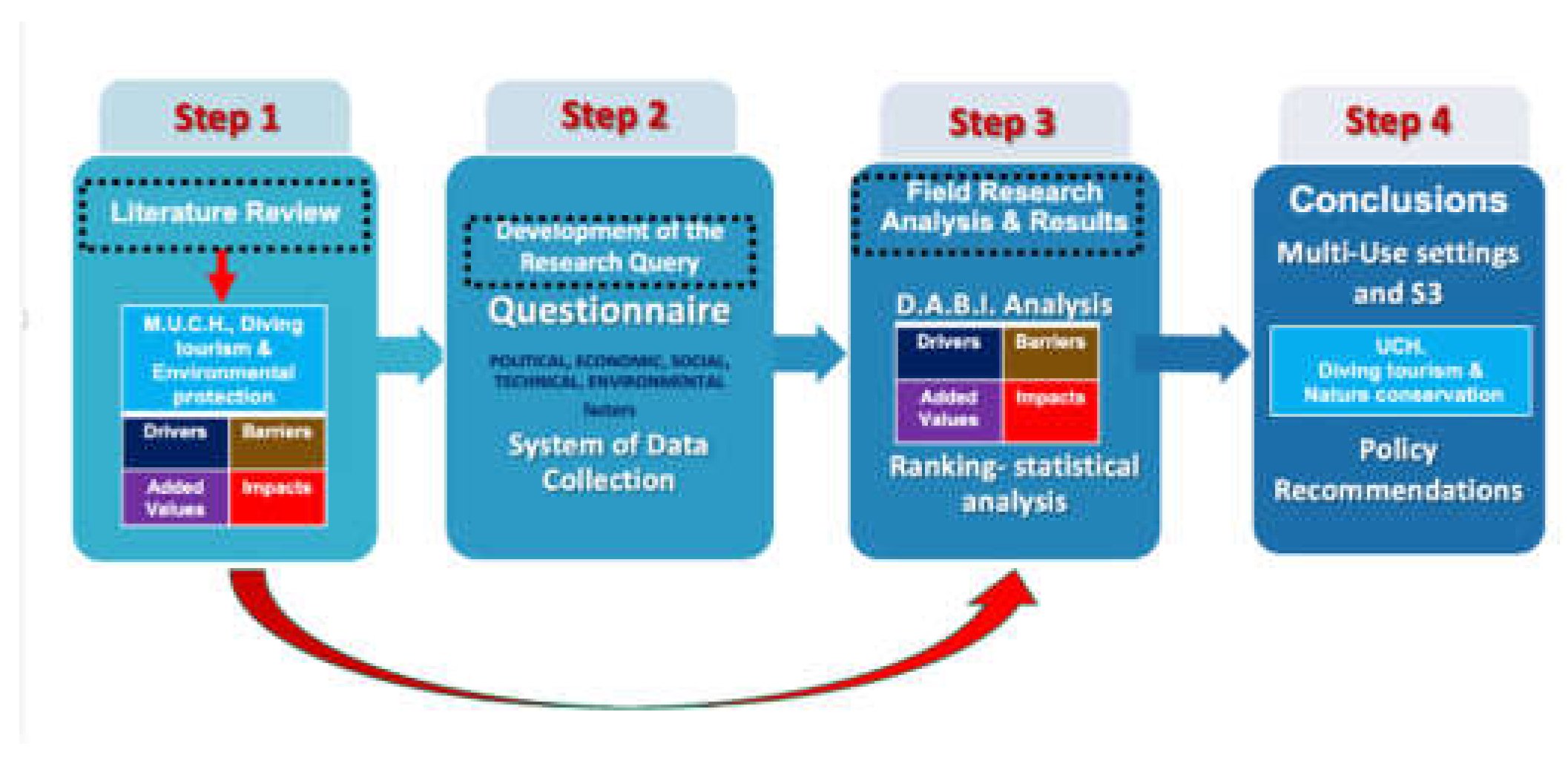
Figure 5.
Stakeholders’ response on the added values from the MU under study, by factor (“extremely important” to “very important”). Source: Own elaboration by the authors.
Figure 5.
Stakeholders’ response on the added values from the MU under study, by factor (“extremely important” to “very important”). Source: Own elaboration by the authors.
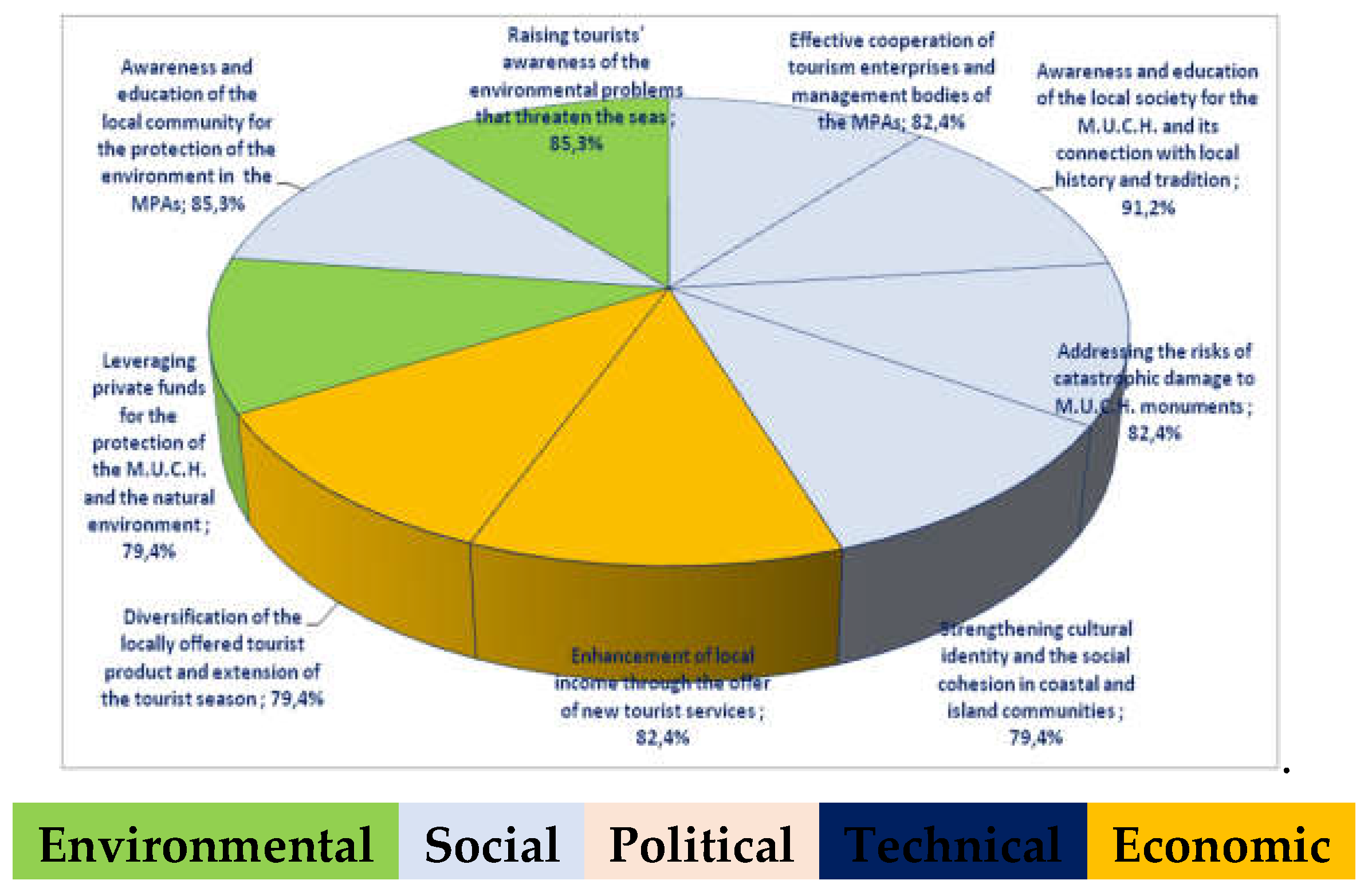
Table 1.
Number of Regions prioritizing the term cultural heritage, blue economy, cultural tourism and CCI to S3.
Table 1.
Number of Regions prioritizing the term cultural heritage, blue economy, cultural tourism and CCI to S3.
| Category of Search | Number of Regions |
| Blue economy | 36 |
| Cultural Heritage | 46 |
| Cultural tourism | 59 |
| Creative and Cultural Industries | 96 |
Source : Dataset of S3 CoP observatory , January 2025 (some regions are presented to all of these categories).
Table 2.
Breakdown of stakeholders participating in the research.
| Type of Stakeholder | Number of participating entities and persons | Percentage (%) of participating entities and persons |
| Central Government (State-Ministries-State Agencies) | 4 | 11,8% |
| N.G.Os (environmental and cultural) | 4 | 11,8% |
| Local Authorities (Regional/Local Government) | 3 | 8,8% |
| Scuba divers (Scuba Diver Associations and diving experts) | 4 | 11,8% |
| Academia (Science-Research-Universities) | 13 | 38,2% |
| Experts (Independent experts-consultants) | 6 | 17,6% |
| Total | 34 | 100,0% |
Source: Elaboration by the authors
Table 3.
Preferred actions by stakeholders and estimated potential of S3 related innovation.
| Kind of factors | Actions | Percentage of stakeholders rating “extremely or very important” | Potential innovation related to S3 YES/NO |
| Political- Regulatory |
Joint promotion of MPAs and UCH sites, as reconnection of natural and cultural capital. | 91.2% of stakeholders | YES |
| Integration of UCH and nature/biodiversity conservation strategies through MPAs. | 85.3% of stakeholders | YES | |
| Environmental | Need for expanding MPAs or establishing new MPAs (in line with the European biodiversity strategy). | 76.5% of stakeholders | - |
| Existing potential for implementing management plans in MPAs. | 82.4% of stakeholders | - | |
| Technical |
Enhancing access to UCH monuments through new technological methods (e.g., virtual diving tours, etc.) | 76.5% of stakeholders | YES |
| Incorporation of technological innovations in diving tourism (virtual museums, virtual diving tours, etc.): | 79.4% of stakeholders | YES | |
| Economic |
Importance of differentiating the locally offered tourism products. | 82.4% of stakeholders | YES |
| Social |
Social awareness for the protection of biodiversity in MPAs, capacity building on why and how to protect biodiversity. Development of monitoring tools for the health of the sea. | 79.4% of stakeholders | YES |
Disclaimer/Publisher’s Note: The statements, opinions and data contained in all publications are solely those of the individual author(s) and contributor(s) and not of MDPI and/or the editor(s). MDPI and/or the editor(s) disclaim responsibility for any injury to people or property resulting from any ideas, methods, instructions or products referred to in the content. |
© 2025 by the authors. Licensee MDPI, Basel, Switzerland. This article is an open access article distributed under the terms and conditions of the Creative Commons Attribution (CC BY) license (http://creativecommons.org/licenses/by/4.0/).
Copyright: This open access article is published under a Creative Commons CC BY 4.0 license, which permit the free download, distribution, and reuse, provided that the author and preprint are cited in any reuse.


