

Submitted:
12 May 2023
Posted:
12 May 2023
You are already at the latest version
Abstract
The contribution of academics and researchers to the discussion around sustainable rural development planning and its impact on rural communities has grown exponentially in recent years. Understanding trends in sustainable rural development research requires considering the different factors involved and affecting people from a holistic approach. This review examines, through bibliometric studies, the scientific knowledge generated on sustainable rural development planning in the last 50 years, analyzing 6,895 articles published in journals between 1970 and 2020. The results reveal the existence of three clusters and an important growth is observed to respond to the continuous needs in relation to sustainable rural development. This research shows the evolution of a new approach for the planning of sustainable rural development projects in postmodernity: Working with People (WWP). This WWP model, as a conceptual framework from social learning has been validated as a novel proposal in numerous contexts. The bibliometric analysis shows an evolution "From Putting the Last first" to "Working with People in Rural Development" research and the contributions of influential teachers such as Chambers and Cernea. These bibliometric analyses demonstrate the correct approach of WWP model, and open new fields of research in the planning of sustainable rural development projects.
Keywords:
rural development
; sustainable development
; planning
; working with people
1. Introduction
The concept of rural development has been evolving significantly since the mid-1960s until today, moving away from a traditional approach based on the idea of modernisation, according to which all societies evolve in a linear manner from a non-rational and technologically limited state, to a rational and technologically advanced state. This transition represents a move from a traditional society to a modern one [1].
Since the initial development strategies, in approximately 1965 some French rural areas linked the concept of development with planning, in the sense of driving policies of a centralist character and with a modernising spirit.
It was in the 1970s and 1980s when this idea of rural development started to evolve towards a more local perspective centred around people, such that this concept which was previously associated with economic growth and modernisation started to gain a qualitative dimension, which started to value the quality and sustainability of growth [2].
This change was accompanied by regional planning, which in Europe especially represented a bottom-up approach, with new approaches which started to replace the traditional top-down approach from the previous decades.
The 1990s marked a definitive leap in terms of the aforementioned, with what is known as the LEADER community initiative in Europe. This represents the structural birth of an endogenous planning approach with a new way of thinking which emerges from the decline of the so-called modern project and the arrival of postmodernity [3,4], replacing sectoral approaches with territorial rural development, which involves respect for the environment and achieving sustainability.
The planning that took place since the 1990s until the present day in Europe as a result of this Leader approach, has not had a methodological comparison in other parts of the world. It is since the second decade of the 21st century that new methodological approaches appear, reflected by more modern methods than those that are being developed in the 27 European countries and which consider people as the central part of sustainable development with planning that is adequate for this new step forward [5]
Elsewhere, the growth of powerful tools for data processing now enables access to the databases of scientific publications and quantitative research, which has previously been described briefly. Within the multitude of databases for analysing the evolution of the rural development concept based on its authors and the influence of these at a global level, the methodology implemented by the CSIC Cybermetrics Lab [6,7] introduces a new approach for classifying universities. This CSIC (Cybermetrics Lab) Web ranking is supported by Google Scholar (GS) and Scopus (Elsevier).
Scopus has more than 30,000 indexed records and enables the quick and transparent analysis of excellence in research [8] and is used for bibliometric analysis. Google Scholar (GS) shows the level of impact based on the number of citations for each publication, and although it is not reflected in impact records and therefore lacks the quality control of many publications, it is a great help for disseminating information and analysing the impact that the most influential authors can have on other researchers. In many countries, the circulation of this relevant study, which reaches thousands of people, is not always covered by the indexed journals. The highly cited authors generally have profiles on Google Scholar and other institution websites or social platforms, which means the relative impact of these influential authors can be estimated as GS is an alternative or complementary resource to the leading databases [9]. Furthermore, studies show that in all areas of knowledge, Google Scholar (GS) citations are a superset of WoS and Scopus, representing substantial additional coverage which is of interest [10]. GS finds a significantly higher number of citations than WoS and Scopus in all subject areas, as it includes many other documents. Approximately half (between 48%-65% depending on the subject) of the GS citations are from journal articles and the other half of the documents are doctoral theses or master’s theses (in universities’ repositories), books or chapters from books, conference proceedings, unpublished materials (such as pre-prints) and other types of documents.
Studies [8,10,11,12] confirm very solid correlations between GS, WoS and Scopus in all categories, despite the greater number of additional citations found in GS. This information is therefore very interesting for evaluating the impact of the research [12,13].
Furthermore, the GS citations are particularly useful when there are reasons to believe that the documents not covered by WoS or Scopus are important for an evaluation [10], as is the case for rural development. Therefore, in the three development stages of the rural development concept, the bibliometric analysis carried out using the publications indexed by Scopus was complemented to a level of excellence by Web of Science (WoS). A complementary analysis was provided by Google Scholar (GS) to show the evolution and dissemination of the knowledge acquired from the most influential authors on rural development in the last 50 years.
2. Materials and Methods
A bibliometric analysis is carried out as a widespread and precise technique for examining large volumes of scientific data, understanding the interconnection between subjects and showing the current situation regarding a research topic based on different analyses: citation, co-citation and co-authorship [14].
The collection of data for bibliometric analysis was carried out using the internationally recognised digital platforms which offer high quality standards (Scopus & WoS) [12] and are the main tools used in this analysis [13]. The articles were selected using keywords, which is an established way of effectively analysing knowledge and getting a general understanding of the study [12], within the period 1970-2022. The following steps were followed:
Phase 1: Firstly, the publications were extracted based on the first group of subject keywords (Step 1 in Fig. 1) from the Scopus database in September 2022. The search criteria was based on the “rural development” keyword featured in the title itself, the abstract or in the keywords within the scientific texts. During this phase, 106,472 documents were discovered. The “planning” keyword was used as a second filter, selecting 6,894 indexed documents which contained the two related terms “rural development planning”. This first set of articles were published between 1970 and 2022, as previously explained. Furthermore, using the same group of keywords, the data was compiled separately for Web of Science (WoS), obtaining a second group of 1,031 articles within the same period between 1970 and 2022. Finally, citation data from Google Scholar (GS) was used as a way to complement the analysis and identify the most relevant documents. For this citation data from Google Scholar, the free software “Publish or Perish” [14], was used as a practical way of extracting more data from GS and complementing the analysis [8].
Phase 2: The bibliographic records were downloaded for the searches so that they could be analysed for each of the periods between 1970 and 2022, as previously explained: 634 publications in period 1 (1970-89), 1889 publications in period 2 (1990-2009) and 4371 publications in period 3 (2010-2022). Names and affiliations, titles, keyword categories and lists of references were downloaded.
Phase 3: To improve the credibility and validity of the study’s results, data cleansing and refinement was carried out. The number of citations in the research articles was the criteria for improving the reliability of the results, which is a usual practice for data cleansing in this type of study [15]. Articles with either a single or no citations at all are eliminated, because of the low impact they have on establishing the intellectual roots of the field of study.
Phase 4: In the following phase, keyword co-occurrence analysis and clustering was carried out [16,17]. From the overall base of 6,894 indexed documents, this co-occurrence analysis identified the main research topics and trends in the area of rural development planning. Furthermore, scientific mapping was performed for a spatial representation of the relationships [18].
VOSviewer [19,20] software version 1.6.7 was used for the bibliometric analysis, which can import original databases from the ISI WoS and Scopus in a CSV format, in order to visualise and analyse trends. With the help of the software, the different bibliometric techniques used in the analysis of bibliometric performance for analysing the frequency of words and citations [10]; analysis of co-occurrence and clustering of keywords [16,17], and scientific mapping [18] were combined. This process of summarising and cleansing the data is described in Figure 1, and the search results for each step are shown in the table.
3. Results of the bibliometric analysis
In this section, we provide a bibliometric analysis of the publications related to the evolution of rural development. The distribution of publications and citations, the sources that cite the publications and the most cited articles are presented in the first section at a global level. Section 3.1. shows the evolution of the most active articles and journals, section 3.2. shows the most influential authors and section 3.3. includes an analysis of the co-occurrence and clustering of keywords. Finally, in section 3.4., the bibliometric analysis is complemented by one of the most advanced models, “Working with People”.
3.1. General indicators for activity and scientific publications
The study has identified 6,894 articles published in 1,512 journals between 1970 and 2022, which contain the keywords “planning” and “rural development”. An ongoing increase in the quantity of articles during the analysed period between 1970-2022 is observed (Fig. 2). Specifically, in the third period (2010-2023), the quantity of articles published on the subject has seen significant exponential growth, which shows a growing interest and intense scientific debate at an international level regarding rural development planning.
These numbers confirm how research in this field is having a growing impact and especially in the last decade between 2010-2022 (Figure 2). The analysis also shows a great diversity of journals of impact, rather than being limited to a few journals, which demonstrates the interdisciplinary focus of rural development planning. The data shows that 160 journals contain 50% of the publications. The most cited journal is Land Use Policy, followed by Landscape and Urban Planning and Journal of Rural Studies. Table 1 shows the journals ordered according to the total % of citations received (TC). Land Use Policy, Sustainability & Journal of Rural Studies stand out based on the number of articles. This data demonstrates that these journals play an especially important role within the general debate on rural development planning, although there are many others that are also highly multidisciplinary and of great importance. The key ones to highlight are: World Development, Sociologia Ruralis, Journal of Cleaner Production, Science of the Total Environment, Habitat International, Journal of Environmental Management, Community Development Journal, European Planning Studies.
It is evident that the articles play a central role within the scientific debate on rural development planning, with the weight of the total number of citations (TC) being very high (83%). However, there are cases of books from relevant authors that are not indexed but are heavily cited and are highly influential as they are studies within Google Scholar (GS), providing substantial additional coverage to the publications in WoS and Scopus.

Table 1.
This is a table. Tables should be placed in the main text near to the first time they are cited.
Table 1.
This is a table. Tables should be placed in the main text near to the first time they are cited.
| Document type | TP1 | % TP | TC1 | % TC |
|---|---|---|---|---|
| Article | 4645 | 68,45% | 78190 | 83,49% |
| Book | 16 | 0,24% | 2250 | 2,40% |
| Book Chapter | 70 | 1,03% | 174 | 0,19% |
| Conference Paper | 1813 | 26,70% | 4517 | 4,82% |
| Review | 242 | 3,57% | 8516 | 9,09% |
| Total, general | 6786 | 100,00% | 93647 | 100,00% |
1 TP: Total publications; TC: Total citations.
3.2. Analysis of influential authors by periods
This sub-section presents analysis based on historical periods. The most influential articles, journals and authors are analysed for each of these.
3.2.1. First period 1970-89: introduction and the first influential authors
For this first period, during the process of selecting the “planning” and “rural development” keywords, 634 articles published in Scopus and 28 articles in JCR were identified. In this period, the researchers highlight the problems encountered in terms of planning and implementing rural development projects in the 1960s, typically of a large scale and with external funding from experiences of USAID and the World Bank [21]. During the 1960s in Europe and the United States, processes for involving the inhabitants of rural areas were not considered in development planning. Considered as being backwards, the rural regions were seen as being incapable of developing on their own [22,23].
These projects are implemented based on a traditional approach in terms of the rural development concept, relating to the idea of modernisation [1]. It is in the 1970s and 1980s that this idea of rural development starts to evolve to a more local perspective centred around people, which meant that the concept that was previously associated with economic growth and modernisation started to gain a qualitative dimension that placed greater value on the quality and sustainability of growth [2]. In the 80s and 90s, numerous debates emerge regarding the term “endogenous development”, especially in Europe [24,25], recognising the importance of local participation and the creation of new local organisation structures [26] in the development process.
The first works [27,28] related to Integrated Rural Development therefore emerged, as a new planning concept which emphasises the need for an integrated approach and the need for greater participation in the design of development programmes. They start to talk about ideas regarding the mobilisation of people and taking into account the needs of the diverse social groups, as well as establishing links between them [29]. However, in this phase the studies are limited to theories and strategic considerations for the implementation of rural development policies [30,31].
To help planners and managers implement the first development strategies based on centralist and modernising policies, tools for monitoring and evaluating projects were developed, some of which are widely used such as the Logical Framework Approach [32].
The concept is also enriched by so-called community development, as a form of intentional, planned and targeted change relating to theories of social change, as well as decision-making by the rural community itself [33,34]. Other researches put the emphasis on people, highlighting the importance of “learning from experience” [35], as a way of improving the effectiveness of rural development projects and programmes. These authors show the limitations of the conventional, technical and quantitative models, and start to consider the need for alternative approaches as useful avenues for rural development [29,34,36]. Table 3 shows the citations of these most influential references.
3.2.2. Second period 1990-2009: transition based on the human dimension.
Within this period, 1,889 articles published in Scopus were identified, of which 189 articles are JCR which contain the “planning” and “rural development” keywords. In the 1970s, it was believed that rural development projects were at the forefront of initiatives to improve rural livelihoods. However, subsequent evaluations and studies showed rural development projects in a bad light [37]. In response to the poor results, this second period saw extensive debate on how to improve rural development planning, with new approaches and methodologies for working with communities, promoting people’s participation.
Robert Chambers is one of the most influential authors, and based on his extensive intellectual and practical work he considered the need for the rural development planners to take on a more humble role, listening and learning from the population [38]. He appeals to the scientific community, development professionals and policy makers from an ethical and practical point of view [39], explaining the mistakes in development practice and calling for changes in learning methods, behaviours and values to prioritise people, especially the poor, weak and vulnerable [40,41]. His call for participation has materialised in practical methodologies, which have been used by researchers and professionals across the world (Musyoki, 2022), with his famous “Participatory Rural Appraisal” (PRA) [42] and “Putting the first last” [43] slogan standing out. Ian Scoones, a student of Chambers from the same Institute of Development Studies at the University of Sussex, is another influential author from this period, with methodologies that integrate the rural population’s knowledge in the planning process [44,45].
Cernea is another important author and since the early 1990s his work “Putting people first: sociological variables in rural development” addresses the adequacy and entry points of sociological knowledge in the planning of development projects. His work presents new emerging approaches for integrating sociological knowledge in the design and implementation of development programmes and projects [46], opening up a new field of research based on the social components of sustainability. With his "Putting people first” slogan, he highlights the lack of recognition for the role of “social actors” within sustainability, condemning environmental problems due to the lack of consideration of human aspects, rather than because of economic or technical factors. This is therefore a precursor for considering sustainability based on the three dimensions (social, economic, ecological) [47], along with other planners who incorporate the notion of care and respect based on an integrated vision [48].
In his work “People first”, Burkey [49] complements Chambers’ work by developing new participative methodologies for rural development planning and implementation, incorporating new principles such as sustainability, awareness, local control, cooperation and autonomy. The approaches relating to endogenous development, theories on innovation and social learning, involving networks of actors in different rural contexts [50] are enriched at this stage. Other authors developed participatory methodologies applied to rural development [49] and incorporated the so-called social learning [51,52,53] to overcome social conflicts in the planning of sustainable rural development using new skills demanded by planners [39,54,55].
However, the big change in Europe in the 1990s was driven by the Leader community initiative, combining the birth of an endogenous planning approach with a new way of thinking born out of the decline of the so-called modern project and the arrival of postmodernity [56]. These influential authors, along with many others [57,58,59,60], contribute to an expansion of sustainable rural development, as an area of great interest for professionals, managers and researchers, with a broad discourse that integrates areas of knowledge and seeks alternative paths based on methodologies and practices [61].
Sectoral approaches are being replaced by territorial rural development, which entails a respect for the environment and the search for territorial balance. The approaches and ways of life based on sustainability are beginning to be seen as new ways of moving towards rural development, based on an intersectoral and multidisciplinary approach [62,63]. In this second period, this new approach to planning in the European Union develops a culture of evaluation of rural planning, especially in the context of the LEADER initiative, based on methodologies aimed at developing skills and empowering the population [64,65], generating social learning [59], improving governance and the sustainability of rural development [66,67].
In general, the research in this period concludes that, although there is not a single model for planning rural development projects, planning through dialogue [68], and social learning [59], they represent a major challenge for the renewal of models and shaping new bottom-up development trajectories. In the early 1990s, few would have anticipated the expansion of applied social science and the recognition it would have received in rural development planning [46]. The most influential references and their citations are shown in Table 4.
3.2.3. Third period 2010-2022: maturity and new approaches.
The planning that has taken place in Europe since the 1990s until the present day, as a result of the LEADER approach, has had no methodological parallel in other parts of the world. In this third period (2010-2023), there has been significant growth in the number of articles published on the subject, showing a growing interest, and broadening the intense scientific debate at an international level that emerged in the previous period. In this period, 4,371 articles published in Scopus were identified, of which 808 are JCR which contain the “planning” and “rural development” keywords.
In this period, it is from the second decade of the 21st century (2020) where new methodological approaches appear, reflected in more advanced methods than those that are being implemented in the 27 European countries and which consider people as the central focus of sustainable development with adequate planning to this new path [69,70].
In this period [71], the concept of integrated rural development is renewed based on new rural governance linked to spatial planning, and the development of skills, reinforcing the importance of integrating the public-private sectors as well as mobilising local actors when it comes to sustainability.
The principles of the LEADER programme in the EU are applied to other contexts, as transnational rural development experiments [72,73,74,75], addressing new governance challenges for policy transformation. In this period, new concepts such as resilience applied to rural communities emerge within the framework of urban-rural development relations, to achieve sustainable rural communities that are capable of surviving in the face of external factors [76]. Major topics are debated in relation to the knowledge economy, local entrepreneurship, social capital, innovation based on social learning, participatory planning [70,77,78], social structures and partnerships [80] for the coordination of rural development projects and policies. Other researchers [81], focus on analysing and understanding the changes in the rural environment in the context of the new knowledge economy.
There is continued interest in sustainable rural development planning and there is demand for new professionals who are capable of articulating bidirectional planning processes, with top-down and bottom-up models [79]. Following the Bologna Agreement, new programmes for training professionals in this field emerge within the EHEA [78,79,82] from both universities in the European Union and further afield. Some of these programmes combine planning models with political, social, technical, economic and environmental aspects in a novel way, for managing and evaluating projects and programmes in order to prepare professionals so that they are capable of providing integrated solutions and global challenges in international contexts with increasing urban-rural relations [78].
Through the initial stage, transition and maturity of this evolutionary process of sustainable rural development, new planning models emerge in the context of increasing urban-rural integration [83,84]. These models consider that sustainable development and rural prosperity cannot be achieved with substantial inequalities between people from rural and urban regions [85].
Amongst these new planning methods, the “Working With People” model emerges as the result of GESPLAN’s 30 years of experience in the planning of sustainable rural development projects in Europe and emerging countries. The WWP model emerges as an alternative to the modern project and is the outcome of the evolving process of sustainable rural development, integrating the previous methodological approaches based on the logic of participation [42,46,86], planning as social learning [51,87], the formulation and creation of plans, and project management models that integrate behavioural competences [88,89,90,91,92].
Building on the conceptual foundations of Chambers’ “Putting the last first", Cernea’s "Putting people first” and J. Friedmann’s "Planning as social learning", “Working with people” takes a new step towards connecting knowledge and action through a common project, which in addition to the technical-economic value of production (the goods and services it generates), prioritises the people that are involved in the project. The expression “Working with people” goes beyond a “technical” vision of the project, emphasising people’s behaviours in a context in which planners work together, requiring planners to have a particular social awareness and solid social ethics, in addition to technical and contextual skills [5].
The conceptualisation of the WWP model arises precisely from “Working with people”, based on reality and the exchange of knowledge between people, with the researchers identifying themselves as development professionals. It responds to the very essence of rural development research, which arises from direct, face-to-face experience with people in the location where the fieldwork takes place [43].
With this approach, the WWP model, based on the theory of planning as social learning (Friedmann, 1993), is rooted in the action itself, in the form of the development project and its practical knowledge, connecting the different forms of knowledge. The WWP model involves reflection with people, knowledge and action, with the “researcher” being part of the planning team and even the project director themselves, “working with people”.
Many of these experiences are published in the form of articles, so that there is a transfer of people’s learning to the scientific community’s knowledge system and also to the public and private agents as well as development policy managers. These experiences, based on the three components of the WWP model (ethical-social, technical-entrepreneurial and political-contextual) have generated different methodological applications in Latin America and Europe in relation to social innovation and sustainable rural development [83,89,91,93], the sustainability of food production systems and rational consumption [90]; sustainable entrepreneurship [89,94,95]; the FAO principles for Responsible Investment in Agriculture (RAI principles), the Voluntary Guidelines on the Responsible Governance of Land Tenure [92,96,97,98] and project-based governance for sustainability [99]. These WWP applications have effectively validated the joint decision-making processes, public-private partnerships, sustainability in projects, change of mindset amongst governments and financiers, contributing to the improvement in people’s quality of life. However, although local knowledge is considered essential in rural development processes [75], in many cases there is still a disconnect with action. It is therefore a significant challenge to ensure that local knowledge influences decision-making [43].
Table 5.
Documents published and number of citations (period 2010-20202).
| Authors | Title | Year | Source title | Cited by |
|---|---|---|---|---|
| Shucksmith, M. | Disintegrated rural development? Neo-endogenous rural development, planning and place-shaping in diffused power contexts | 2010 | Sociologia Ruralis | 241 |
| Li, Y., Westlund, H., Liu, Y. | Why some rural areas decline while some others not: An overview of rural evolution in the world | 2019 | Journal of Rural Studies | 235 |
| Neumeier, S. | Social innovation in rural development: identifying the key factors of success | 2017 | Geographical Journal | 149 |
| Long, H., Tu, S. | Rural restructuring: Theory, approach and research prospect | 2017 | Acta Geographica | 89 |
| Cazorla, A., de los Ríos, I., Salvo, M. | Working With People (WWP) in rural development projects: A proposal from social learning | 2013 | Cuadernos de Desarrollo Rural | 41 |
| Ryser, L., Halseth, G. | Rural economic development: A review of the literature from industrialized economies | 2010 | Geography Compass | 37 |
| Frank, K.I., Reiss, S.A. | The Rural Planning Perspective at an Opportune Time | 2014 | Journal of Planning Literature | 25 |
3.3. Analysis of the co-occurence of keywords and clustering
In this section, a keyword co-occurrence analysis is carried out, based on the associations that are established between the keywords, enabling the identification of key themes and trends in a particular area of research [17]. This analysis complements citation analysis, which has an intrinsic bias towards older studies [16].
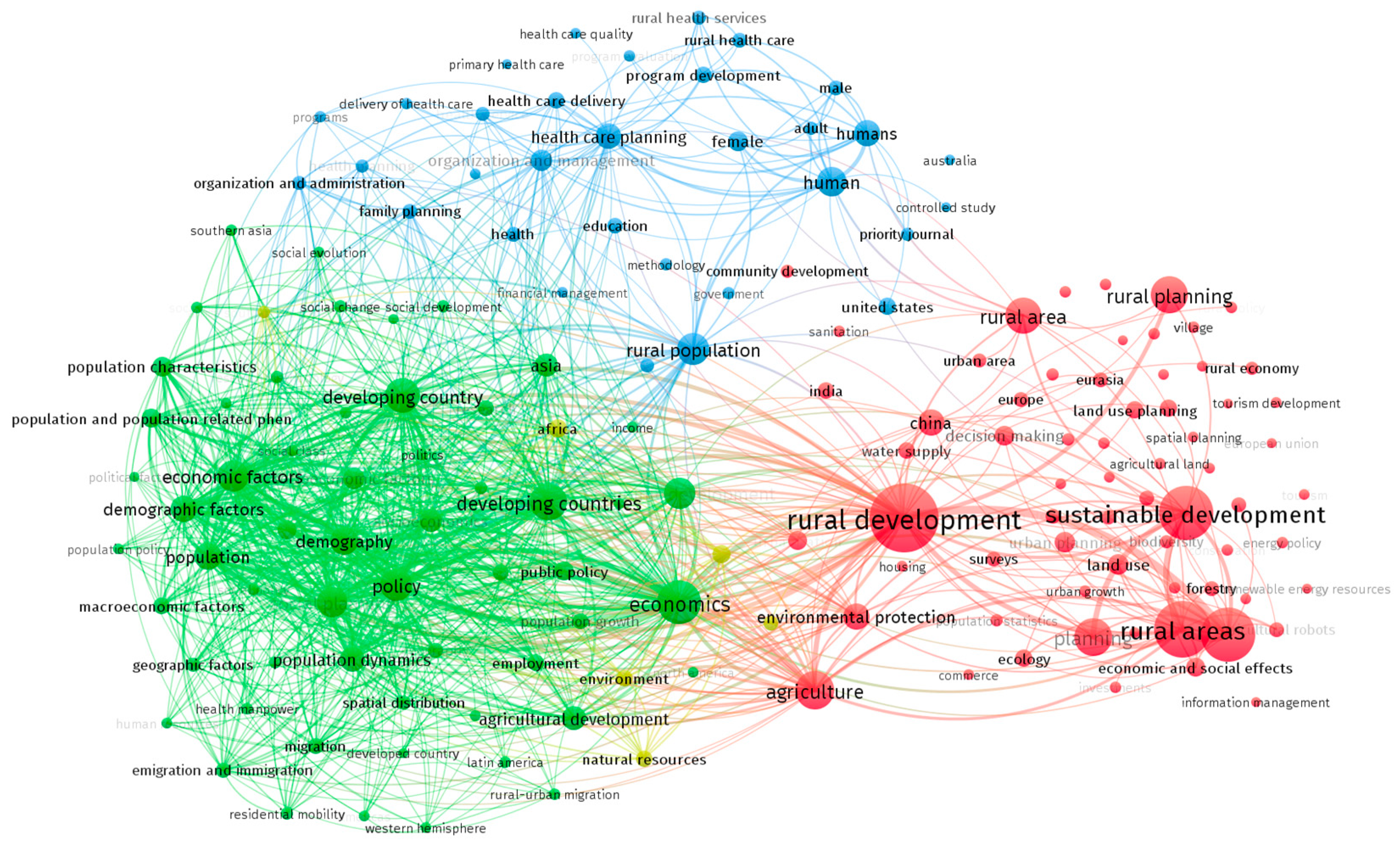
For the purpose of the co-occurrence analysis, we firstly extracted the keywords from each of the articles selected for our dataset and analysed them with VOSViewer. Keywords that appeared at least 100 times were kept, resulting in 197 keywords that represented the main set of connected key terms. The clustering technique has been used to highlight the keyword grouping. The network of co-occurrence links between these keywords is presented through network diagrams and keyword density (Fig. 3). In the network, each keyword is represented as a circle, with the size of the circle being proportional to the number of publications in which the term is found. Each colour represents a set of words grouped in a cluster, with the length of the curved lines demonstrating the approximate connection of the term’s repetition and the thickness shows the strength of the relationship between the subject areas or keywords.
The results show how the researchers’ contributions to rural development planning can be divided into three main clusters (Figure 3 and Table 6).
Figure 3.
Network diagram of co-occurrence of keywords.
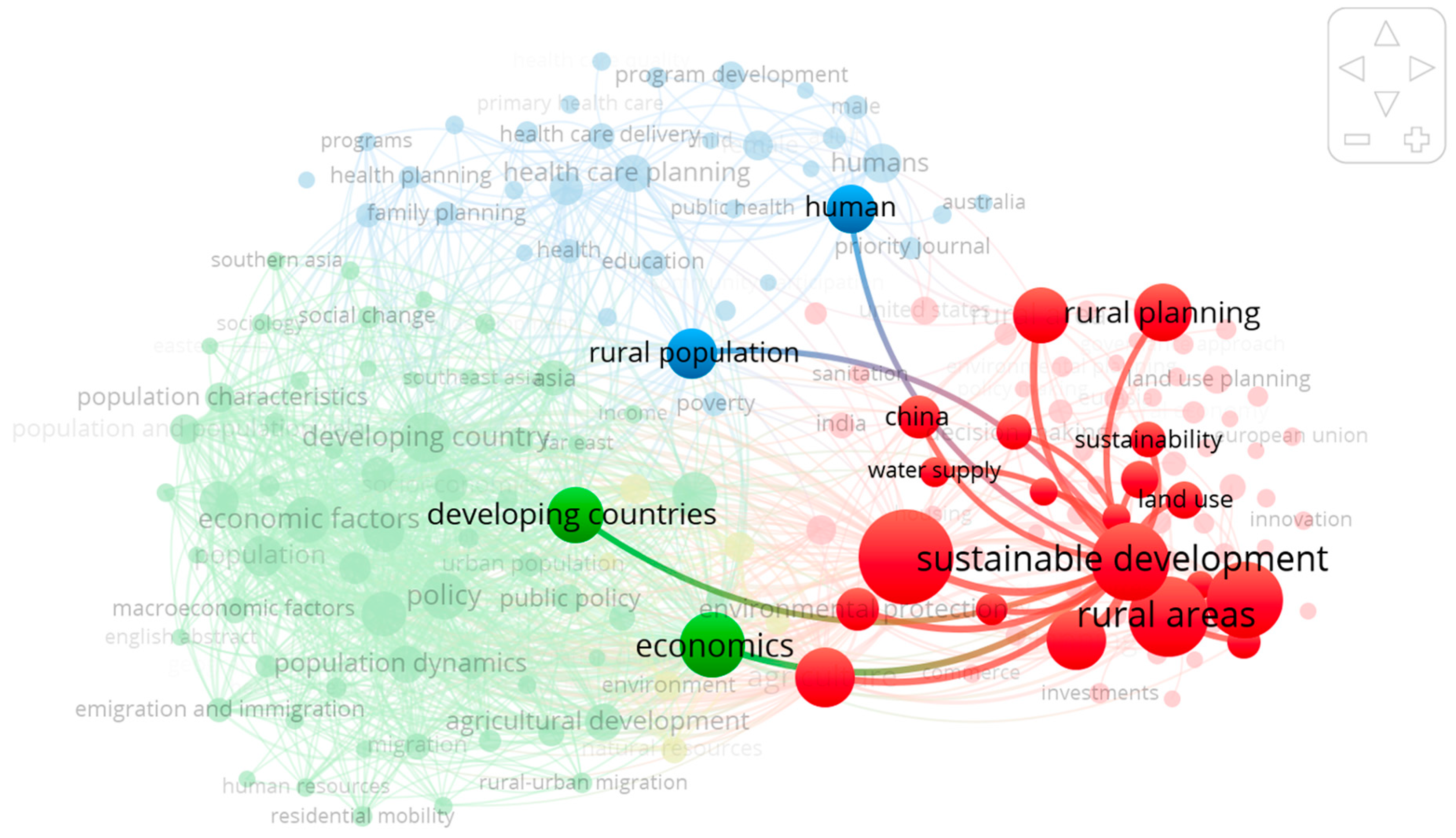
Red cluster: represents a group relating to sustainable rural development planning, with 40% of the keywords and 47% of co-occurrence links. In this group, the keywords rural planning, environmental planning, rural development, urban planning, participatory approach, sustainable development, regional planning and land use planning, governance approach, are particularly related through the introduction of related models and approaches. This group shows links to the social and economic aspects of the other clusters. This network is shown in the Figure 4.
Figure 4.
Red Cluster network diagram of co-occurrence of keywords.
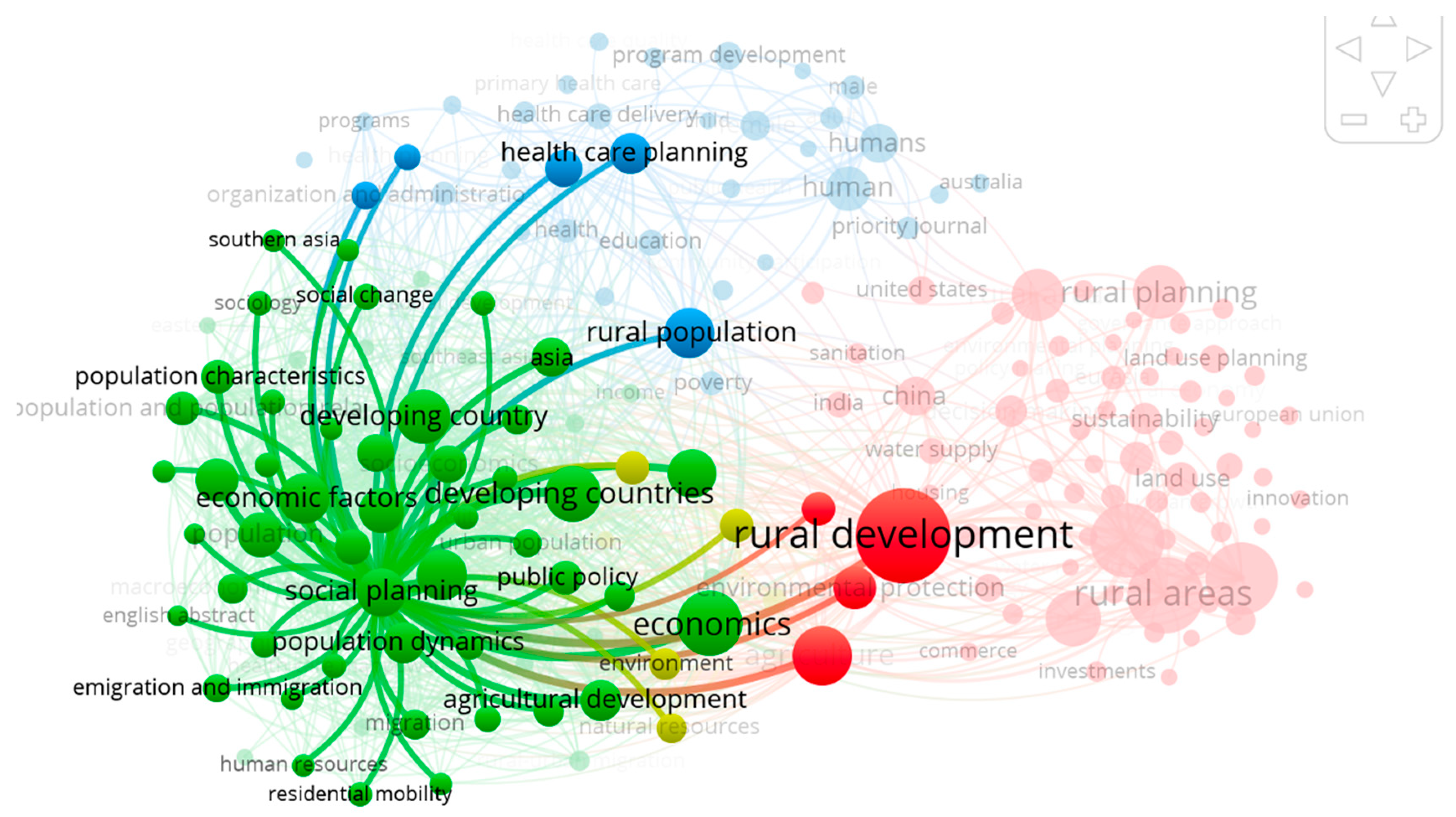
The Green cluster regarding social planning, social and economic dynamics in developing countries represents the most extensive group with 46% of the keywords and 40% of the co-occurrence links. It is the group in which the keywords rural social planning, economic development, Economic factors, developing countries, social development, are particularly related. A detail of this this cluster is shown in the Figure 5
Figure 5.
Green cluster network diagram.
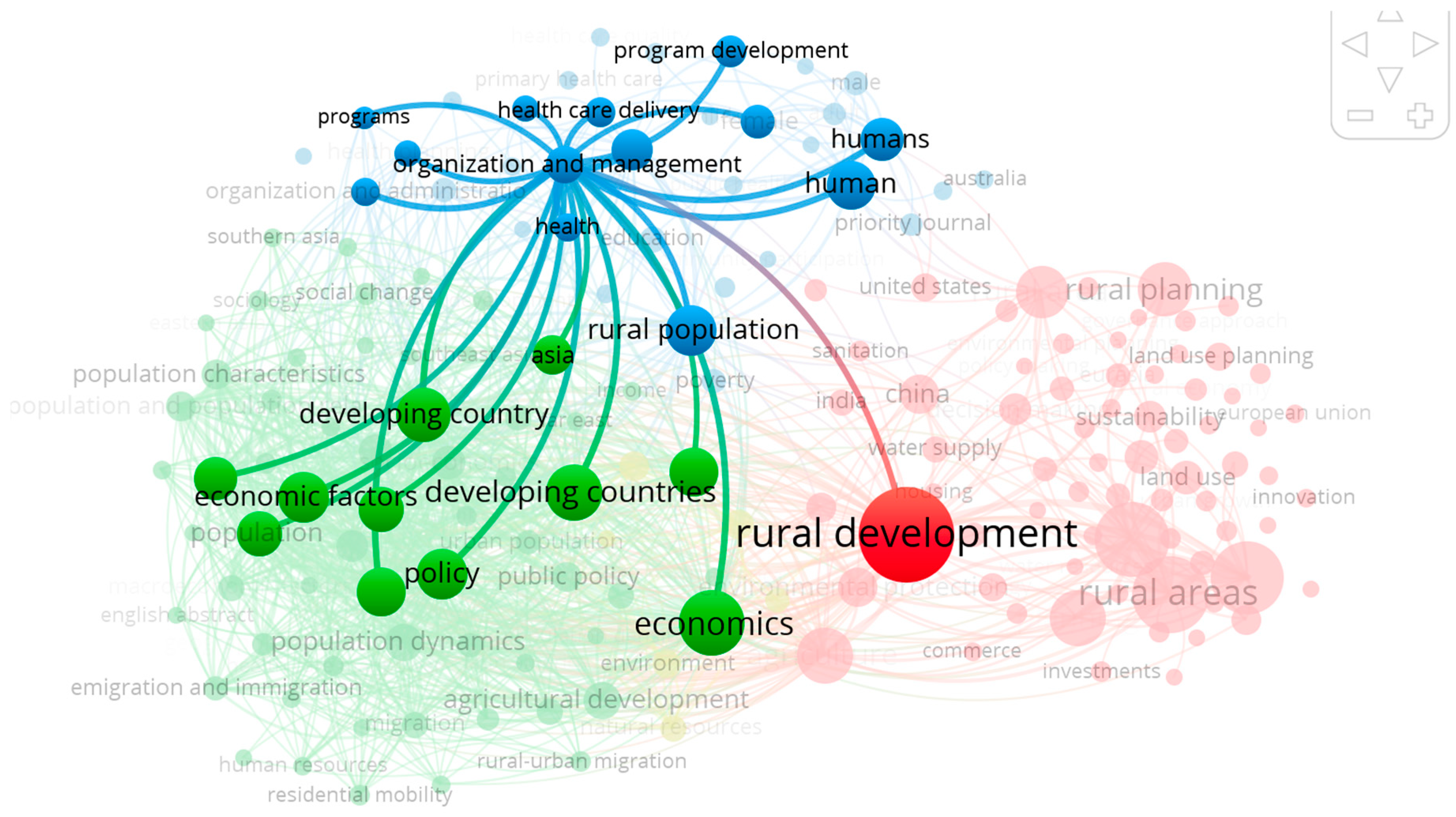
Blue cluster: relating to project and programme management, governance, and the human dimension in relation to rural development. It represents the smallest of the clusters, with 13.64% of the keywords and 11.78% of the co-occurrence links. The keywords organization and management, human resources, project management, governance approach, rural population, health care planning, community development are particularly related (Figure 6).
Figure 6.
Blue cluster network diagram.
3.4. “From Putting the Last first” to “Working with People” in Rural Development research
Finally, this section includes a complementary analysis of the keyword co-occurrence, in relation to the three dimensions of the WWP model [5]. These three dimensions (ethical-social, technical-entrepreneurial and political-contextual) should be present in all projects designed and planned using the WWP model, with interactions and overlaps between them through the social learning processes. The results of this analysis are shown in the following table, which identifies the key themes and research trends relating to the three dimensions of the WWP model.
Ethical-social component: This represents a group with 25.86% of the keywords and 22% of the co-occurrence links. This “ethical-social” cluster includes keywords relating to the behaviours, attitudes and values of the people involved in rural development projects and programmes. It also includes keywords relating to the social aspects of planning and the population’s participatory processes.
Technical-entrepreneurial component: This represents a group with 24.14% of the keywords with 20.48% of the co-occurrence links. This group is made up of keywords relating to the implementation and management of projects, such as investment units and “technical” instruments that generate goods and services for rural development. It also includes keywords relating to public and private economic activities (such as agriculture, tourism, etc.), and technical innovations in relation to rural development projects.
Political-contextual component: This is the largest group consisting of 50% of the keywords, relating to public-administrative planning and rural development policies: rural development policy, governance approach, environmental planning, land use planning, regional planning, developing countries.
To complement this analysis, the clustering technique has also been used to highlight the influence of the “Working with people” model in the field of rural development. The Figure 7 represents the visualisation of the network that emerges from the 2,860 documents in Google Scholar (GS), Scopus (Elsevier) and WoS, which include the keywords “Working with people" and "rural development".
Figure 7.
Network diagram of “Working with People and "Rural Development" keywords.
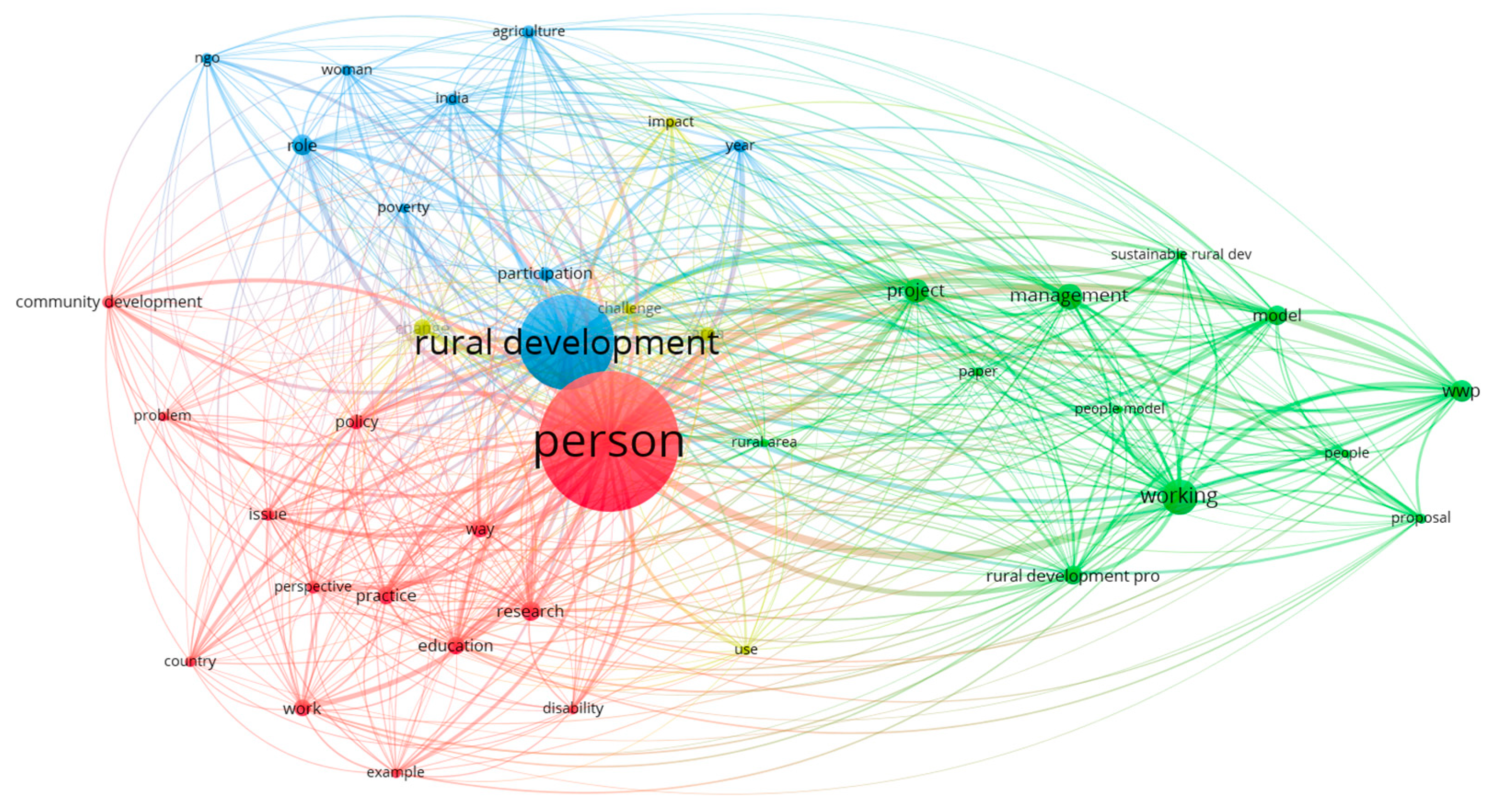
The cloud map shows the number of occurrences of the keywords “Working with people” and “rural development”. Three clusters are observed, in which “people” stand out as the central factor linking the three dimensions. This leads us to reaffirm that people are the focus of the studies relating to the WWP model as a conceptual proposal based on social learning for rural development projects.
4. Conclusions
Analysing the evolution of published articles, a significant increase can be observed to respond to the ongoing needs relating to sustainable rural development. The WWP model has been validated as a proposal in numerous contexts, integrating the social learning conceptual framework (Friedmann, 1993) and the contributions from influential teachers such as Chambers and Cernea.
Based on the integration of its three dimensions (ethical-social, technical-entrepreneurial and political-contextual) which are present in every WWP project, it works based on the core assumption that all effective learning arises from the experience of changing reality.
It involves going a step further in active participation, towards “working with people” and creating joint actions that integrate experienced knowledge and expert knowledge in the formulation and management of development projects, providing mutual learning between the population and the planning team.
To guarantee these social learning spaces and processes, it is necessary to have an adequate appreciation of values, to perceive other people’s qualities and understand their points of view. Once again, this leads us to affirm that the ethics and behaviours of the people involved should form the basis of the new methodological approaches such as the WWP model, with people considered as the focal point of sustainable rural development.
Author Contributions
The authors have contributed jointly in all phases of this research.
Funding
This research received no external funding.
Institutional Review Board Statement
Not applicable.
Informed Consent Statement
Not applicable.
Data Availability Statement
Publicly available datasets were analysed in this study. This data can be found here: https://www.scopus.com, https://www.webofscience.com/wos/woscc/basic-search.
Acknowledgments
The authors acknowledge the technical support provided by the CSIC-Cybermetrics Lab Department (research group belonging to the Consejo Superior de Investigaciones Científicas) and Leiden University's Center for Science and Technology Studies (CWTS).
Conflicts of Interest
The authors declare no conflict of interest.
References
- Taylor, P.J. The error of developmentalism in human geography» in Horizons in Human Geography (Gregory, D. y Walford, R., eds.). Londres, Macmillan, 1989, 303-319.
- Pike, A.; Rodríguez-Pose, A. Y Tomaney, J. What Kind of Local and Regional Development and for Whom? Regional Studies 2007, 41, 1253–1269. [Google Scholar] [CrossRef]
- Murdoch, J.; Pratt, A. Rural studies: modernism, postmodernism and the "post rural". Journal of Rural Studies 1993, 9, 411–427. [Google Scholar] [CrossRef]
- Philo, C. Postmodern rural geography? A reply to Murdoch and Pratt. Journal of Rural Studies 1993, 9, 429–436. [Google Scholar] [CrossRef]
- Cazorla, A.; De los Ríos, I.; Salvo, M. Working with People (WWP) in Rural Development Projects: A Proposal from Social Learning. Cuad. Desarro. Rural 2013, 10, 131–157. [Google Scholar]
- Aguillo, I.; Bar-Ilan, J.; Levene, M.; Ortega, J. Comparing university rankings. Scientometrics 2010, 85, 243–256. [Google Scholar] [CrossRef]
- Aguillo, I.F. Is Google Scholar useful for bibliometrics? A webometric analysis. Scientometrics 2012, 91, 343–351. [Google Scholar] [CrossRef]
- Harzing, A.W.; and Alakangas, S. Google Scholar, Scopus and the Web of Science: a longitudinal and cross-disciplinary comparison. Scientometrics 2016, 106, 787–804. [Google Scholar] [CrossRef]
- Mas-Bleda, A.; Thelwall, M.; Kousha, K.; Aguillo, I.F. Do highly cited researchers successfully use the social web? Scientometrics 2014, 101, 337–356. [Google Scholar] [CrossRef]
- Martín-Martín, A.; Orduna-Malea, E.; Thelwall, M.; López-Cózar, E.D. Google Scholar, Web of Science, and Scopus: A systematic comparison of citations in 252 subject categories. Journal of informetrics 2018, 12, 1160–1177. [Google Scholar] [CrossRef]
- Harzing, A.W. K.; van der Wal, R. Google Scholar as a new source for citation analysis. Ethics in Science and Environmental Politics 2008, 8, 61–73. [Google Scholar] [CrossRef]
- Prins, Ad A. M.; Costas, R., van Leeuwen, Thed N., Eds.; Wouters, P.F. Using Google Scholar in research evaluation of humanities and social science programs: A comparison with Web of Science data, Research Evaluation 2016; Volume 25, Issue 3, July, Pages 264–270. [Google Scholar] [CrossRef]
- Mikki, S. Comparing Google Scholar and ISI Web of Science for earth sciences. Scientometrics 2009, 82, 321–331. [Google Scholar] [CrossRef]
- Harzing, A.W. (2007). Publish or Perish Retrieved from. http://www.harzing.com/pop.htm.
- Garcia-Lillo, F.; Claver-Cortés, E.; Marco-Lajara, B.; Úbeda-García, M. Mapping the Intellectual Structure of Research on ‘Born Global’ Firms and INVs: A Citation/Co-citation Analysis. Manag Int Rev 2017, 5, 631–652. [Google Scholar] [CrossRef]
- Donthu, N.; Kumar, S.; Mukherjee, D.; Pandey, N.; Lim, W.M. How to Conduct a Bibliometric Analysis: An Overview and Guidelines. J. Bus. Res. 2021, 133, 285–296. [Google Scholar] [CrossRef]
- Effendi, D.N.; Irwandani; Anggraini, W. ; Jatmiko, A.; Rahmayanti, H.; Ichsan, I.Z.; Rahman, M.M. Bibliometric Analysis of Scientific Literacy Using VOS Viewer: Analysis of Science Education. J. Phys. Conf. Ser. 2021, 1796, 012096. [Google Scholar] [CrossRef]
- Merigo, J.M. & Yang, J.B. Accounting research: A bibliometric analysis. Australian Accounting Review 2017, 27, 71–100. [Google Scholar]
- Van Eck, N.J.; Waltman, L. Software survey: VOSviewer, a computer program for bibliometric mapping. Scientometrics 2010, 84, 523–538. [Google Scholar] [CrossRef]
- Van Eck, N.J.; Waltman, L. 2014. Visualizing bibliometric networks. Measuring scholarly impact (pp.285– 320). Cham: Springer. [CrossRef]
- Morss, E.R. Implementing rural development projects: Lessons from AID and World Bank Experiences. Routledge. 2019.
- Friedmann, J. and Alonso, W. Regional Policy: Readings in Theory and Applications; M.I.T. Press: Cambridge, UK, 1975. [Google Scholar]
- Friedmann, J. Planning as Social Learning; Institute of Urban and Regional Development: Berkeley, CA, USA, 1981; Available online: https://escholarship.org/uc/item/0q47v754 (accessed on 3 February 2018).
- Musto, S. Search of a new paradigm. En S. (. Musto,. In Endogenous Development: A Myth or a Path? (págs. 5-18). Berlin: EADI Books. 1985. [Google Scholar]
- Haan, H.; Van Der Ploeg, J. Endogenous Regional Development in Europe: Theory, Method and Practice. Brussels: European Commission.
- Stöhr, W.; Taylor, D.R. F. (1981). Development from above or below? The dialectics of regional planning in developing countries.
- Leupolt, M. Integrated rural development: key elements of an integrated rural development strategy. Sociologia ruralis 1977, 17, 7–28. [Google Scholar] [CrossRef]
- Livingstone, I. On the concept of ‘integrated rural development planning’in less developed countries. Journal of Agricultural economics 1979, 30, 49–53. [Google Scholar] [CrossRef]
- Ruttan, V.W. Integrated rural development programs: a skeptical perspective. International Development Review 1975, 17, 9–16. [Google Scholar]
- Griffin, K. Policy options for rural development. Oxford Bulletin of Economics and Statistics 1973, 35, 239–274. [Google Scholar] [CrossRef]
- Zimmerman, L.J. Non-monetary capital formation and rural development. World Development 1975, 3, 411–419. [Google Scholar] [CrossRef]
- Coleman, G. Logical framework approach to the monitoring and evaluation of agricultural and rural development projects. Project Appraisal 1987, 2, 251–259. [Google Scholar] [CrossRef]
- Anyanwu, C.N. The technique of participatory research in community development. Community Development Journal 1988, 23, 11–15. [Google Scholar] [CrossRef]
- Hague, W. (1975) Towards a Theory of Rural Development. UN Asian Development Institute.
- Hulme, D. Learning and not learning from experience in rural project planning. Public Administration and Development 1989, 9, 1–16. [Google Scholar] [CrossRef]
- Morss, E.R.; Gow, D.D. Implementing Rural Development Projects: Lessons from AID and World Bank Experiences, Boulder. 1985. [Google Scholar]
- Hulme, D. Projects, politics and professionals: alternative approaches for project identification and project planning. Agricultural Systems 1995, 47, 211–233. [Google Scholar] [CrossRef]
- Chambers, R. In Search of Professionalism, Bureaucracy and Sustainable Livelihoods for the 21st Century’, IDS Bulletin 1991, 22.4: 5–11. [CrossRef]
- Chambers, R.; and Conway, G. Sustainable rural livelihoods: practical concepts for the 21st century. Institute of Development Studies (UK). 1992. [Google Scholar]
- Chambers, R. The Self-Deceiving State, IDS Bulletin 1992, 23.4: 31–42. [CrossRef]
- Chambers, R. All Power Deceives, IDS Bulletin 1994, 25.2: 14–26. [CrossRef]
- Chambers, R. Participatory rural appraisal (PRA): Challenges, potentials and paradigm. World development 1994, 22, 1437–1454. [Google Scholar] [CrossRef]
- Chambers, R. Putting the first last. Rugby: Intermediate Technology Publications. 1997.
- Scoones, I.; and Thompson, J. Beyond farmer first: rural people's knowledge, agricultural research and extension practice. Intermediate Technology Publications. 1994. [Google Scholar]
- Scoones, I. Livelihoods perspectives and rural development. The journal of peasant studies 2009, 36, 171–196. [Google Scholar] [CrossRef]
- Cernea, M.M. Putting people first: sociological variables in rural development. No. BOOK. Oxford University Press. USA. 1991.
- Cernea, Michael M. The sociologist's approach to sustainable development. Finance and development 1993, 30, 11–13.
- Ramos, A. ¿Por qué la conservación de la naturaleza? Discurso leído en el acto de recepción de la Real Academia de Ciencias Exactas, Físicas y Naturales, Madrid. 1993. [Google Scholar]
- Burkey, S. People first: a guide to self-reliant participatory rural development. 1993. [Google Scholar]
- Murdoch, J. Networks - A new paradigm of rural development. 2000. [Google Scholar]
- Friedmann, J. Toward and Non-Euclidean Mode of Planning. Journal of American Planning Association”, 482, Chicago. 1993. [Google Scholar]
- Pretty, J. Towards a learning paradigm: new professionalism and institutions for a sustainable agriculture. Beyond Farmer First: Rural people's knowledge, agricultural research and extension practice. 1994. [Google Scholar]
- Pretty, J.N.; Guijt, I.; Thompson, J.; Scoones, I. (1995). Participatory learning and action–A trainers guide.
- Leeuwis, C. 2000. T: Reconceptualizing participation for sustainable rural Development: Towards a negotiation approach.
- Cazorla, A. (Ed.) Planning Experiences in Latin America and Europe. Colegio de Postgraduados: Texcoco, México, 2015.
- Cazorla, A.; De los Ríos, I.; Díaz-Puente, J. The LEADER community initiative as rural development model: Application in the capital region of Spain. Agrociencia 2005, 39, 697–708. [Google Scholar]
- Barke, M.; and Newton, M. The EU LEADER initiative and endogenous rural development: the application of the programme in two rural areas of Andalusia, southern Spain." Journal of rural studies 1997, 13.3: 319-341.
- Bruckmeier, K. LEADER in Germany and the discourse of autonomous regional development. Sociologia ruralis 2000, 40, 219–227. [Google Scholar] [CrossRef]
- High, C.; Nemes, G. Social learning in LEADER: Exogenous, endogenous and hybrid evaluation in rural development. Sociologia ruralis 2007, 47, 103–119. [Google Scholar] [CrossRef]
- Vidal, R.V.V. Rural development within the EU LEADER+ programme: new tools and technologies. AI & society, 2009; 23, 575–602. [Google Scholar]
- Ray, C. Towards a meta-framework of endogenous development: repertoires, paths, democracy and rights. Sociologia ruralis 1999, 39, 522–537. [Google Scholar] [CrossRef]
- Ellis, F.; Biggs, S. Evolving themes in rural development 1950s-2000s. Development policy review 2001, 19, 437–448. [Google Scholar] [CrossRef]
- Renting, H.; Rossing, W.A.; Groot, J.C.; Van der Ploeg, J.D.; Laurent, C.; Perraud, D. Exploring multifunctional agriculture. A review of conceptual approaches and prospects for an integrative transitional framework. Journal of environmental management 2009, 90, S112–S123. [Google Scholar]
- Cazorla, A.; De los Ríos, I.; Díaz-Puente, J. The LEADER community initiative as rural development model: Application in the capital region of Spain. Agrociencia 2005, 39, 697–708. [Google Scholar]
- Díaz-Puente, J.M.; Cazorla, A.; De Los Ríos, I. Empowering communities through evaluation: Some lessons from rural Spain. Community Dev. J. 2009, 44, 53–67. [Google Scholar] [CrossRef]
- Boswell, M. ; and Ivonne Audirac. Rural sustainable development: A new regionalism." Rural Sustainable Development in America 1997, 271. [Google Scholar]
- Marsden, T.; Bristow, G. Progressing integrated rural development: a framework for assessing the integrative potential of sectoral policies. Regional Studies 2000, 34, 455–469. [Google Scholar] [CrossRef]
- Murray, M. Planning Through Dialogue for Rural Development: The European Citizens' Panel Initiative. Planning, Practice & Research 2008, 23, 265–279. [Google Scholar]
- Cazorla, A. (Ed.) Planning Experiences in Latin America and Europe. Colegio de Postgraduados: Texcoco, México, 2015.
- Cazorla, A.; De los Ríos, I. Rural Community Management in the Global Economy: A planning model based on innovation and Entrepreneurial Activity. In Rural Communities in the Global Economy: Beyond the Classical Rural Economy Paradigms; Nicolae, I., De los Ríos, I., Vasile, A., Eds.; Eds.; Nova Science Publishers, Inc.: New York, NY, USA, 2017; pp. 1–22. [Google Scholar]
- Shucksmith, M. Disintegrated rural development? Neo-endogenous rural development, planning and place-shaping in diffused power contexts. Sociologia ruralis 2010, 50, 1–14. [Google Scholar] [CrossRef]
- De los Ríos, I.; Díaz-Puente, J.; Cadena-Iñiguez, J. The Initiative LEADER as a model for rural development: Implementation to some territories of México. Agrociencia 2011, 45, 609–624. [Google Scholar]
- De los Ríos, I.; Cadena, J.; Díaz, J.M. Creating local action groups for rural development in México: Methodological approach and lessons learned. Agrociencia 2011, 45, 815–829. [Google Scholar]
- Stratta, R.; De los Ríos, I. Developing Competencies for Rural Development Project Management through Local Action Groups: The Punta Indio (Argentina) Experience. In International Development; Appiah-Opoku, S., Ed.; InTech: London, UK, 2017; Chapter 8, pp. 153–172. [Google Scholar]
- Šūmanea, S.; Kunda, I.; Knickel, K.; De los Rios, I.; Rivera, M. Local and farmers’ knowledge matters! How integrating informal and formal knowledge enhances sustainable and resilient agriculture. J. Rural Stud. 2018, 59, 232–241. [Google Scholar] [CrossRef]
- Li, Y.; Westlund, H.; Liu, Y. Why some rural areas decline while some others not: An overview of rural evolution in the world. Journal of Rural Studies 2019, 68, 135–143. [Google Scholar] [CrossRef]
- Neumeier, S. Social innovation in rural development: identifying the key factors of success. The geographical journal 2017, 183, 34–46. [Google Scholar] [CrossRef]
- Cazorla-Montero, A.; de los Ríos-Carmenado, I.; Pasten, J. Sustainable development planning: master’s based on a project-based learning approach. Sustainability 2019, 11, 6384. [Google Scholar] [CrossRef]
- Cazorla, A.; De los Ríos, I.; Díaz-Puente, J.M. How to prepare planners in the Bologna European education context: Adapting Friedmann’s planning theories to practical pedagogy. In Insurgencies and Revolutions. Reflections on John Friedmann’s Contributions to Planning Theory and Practice; Rangan, H., Kam, M., Porter, L., Chase, J., Eds.; Routledge Publisher: New York, NY, USA, 2017; pp. 46–58. [Google Scholar]
- Long, H.; Tu, S. Rural restructuring: Theory, approach and research prospect. Acta Geographica Sinica 2017, 72, 563–576. [Google Scholar]
- Ryser, L.; Halseth, G. Rural economic development: A review of the literature from industrialized economies. Geography Compass 2010, 4, 510–531. [Google Scholar] [CrossRef]
- Frank, K.I.; Reiss, S.A. The rural planning perspective at an opportune time. Journal of Planning Literature 2014, 29, 386–402. [Google Scholar] [CrossRef]
- Cazorla, A.; Negrillo, X.; Montalvo, V.; De Nicolas, V.L. Institutional Structuralism as a Process to Achieve Social Development: Aymara Women’s Community Project Based on the Working with People Model in Peru. J. Sociol. Soc. Welf. 2018, 45, 55. [Google Scholar] [CrossRef]
- Dobšinská, Z.; Šálka, J.; Sarvašová, Z.; Lásková, J. Rural development policy in the context of actor-centred institutionalism. Journal of Forest science 2013, 59, 34–40. [Google Scholar] [CrossRef]
- De los Ríos, I.; Rivera, M.; García, C. Redefining rural prosperity through social learning in the cooperative sector: 25 years of experience from organic agriculture in Spain. Land Use Policy 2016, 54, 85–94. [Google Scholar] [CrossRef]
- Oakley, P. The concept of participation in development. Landscape and urban planning 1991, 20, 115–122. [Google Scholar] [CrossRef]
- Friedmann, J. Regional Development and Planning: The Story of Collaboration. Int. J. Reg. Sci. 2001, 24, 386–395. [Google Scholar] [CrossRef]
- IPMA. Individual Competence Baseline; Version 4.0; International Project Management Association (IPMA): Nijkerk, The Netherlands, 2015. [Google Scholar]
- De los Ríos-Carmenado, I.; Ortuño, M.; Rivera, M. Private–Public Partnership as a Tool to promote entrepreneurship for Sustainable Development: WWP Torrearte Experience. Sustainability 2016, 8, 199. [Google Scholar] [CrossRef]
- Fontana, A.; De los Ríos, I.; Villanueva, J.; Lloa, J.; Santander, D. Sustainability of a Food Production System for the prosperity of Low-Income Populations in an Emerging Country: Twenty Years of Experience of the Peruvian Poultry Association. Sustainability 2018, 10, 4035. [Google Scholar] [CrossRef]
- Sastre-Merino, S.; Negrillo, X.; Hernández-Castellano, D. Sustainability of Rural Development Projects within the Working with People Model: Application to Aymara Women Communities in the Puno Region, Peru. Cuad. Desarro. Rural 2013, 10, 219–243. [Google Scholar]
- Bugueño, F.; De los Ríos, I.; Castañeda, R. Responsible Land Governance and Project Management Competences for Sustainable Social Development. The Chilean-Mapuche Conflict. Int. J. Econ. Financ. Issues 2017, 7, 202–211. [Google Scholar]
- Ortuño, M.; De los Ríos, I.; Sastre-Merino, S. The Development of Skills as a Key Factor of the Cooperative System: Analysis of the Cooperative of Artisan Women Tejemujeres-Gualaceo-Ecuador from the WWP Model. Sustainability 2022, 14, 16233. [Google Scholar] [CrossRef]
- López, M.; Cazorla, A.; Panta, M.D. P. Rural entrepreneurship strategies: Empirical experience in the Northern Sub-Plateau of Spain. Sustainability 2019, 11, 1243. [Google Scholar] [CrossRef]
- Guerrero, J.P. S.; De los Ríos Carmenado, I.; González, M.L. Management of entrepreneurship projects from project-based learning: Coworking startups project at UPS Ecuador. In Case Study of Innovative Projects-Successful Real Cases. IntechOpen. 2017. .
- Avila Ceron, C.A.; De los Rios, I.; Martín, S. Illicit crops substitution and rural prosperity in armed conflict areas: A conceptual proposal based on the Working with People model in Colombia. Land Use Policy 2018, 72, 201–214. [Google Scholar] [CrossRef]
- Castañeda, R. Avila, C.; De los Ríos-Carmenado, I., Ed.; Domínguez, L. & Gomez, S. Implementing the voluntary guidelines on the responsible governance of tenure of land, fisheries and forests from the working with people model: lessons from Colombia and Guatemala, The Journal of Peasant Studies 2022. [Google Scholar] [CrossRef]
- Aliaga, R.; De los Ríos-Carmenado, I.; San Martín Howard, F.; Calle Espinoza, S.; Huamán Cristóbal, A. Integration of the Principles of Responsible Investment in Agriculture and Food Systems CFS-RAI from the Local Action Groups: Towards a Model of Sustainable Rural Development in Jauja, Peru. Sustainability 2022, 14, 9663. [Google Scholar] [CrossRef]
- Herrera, A.T.; De los Ríos-Carmenado, I. & Martínez-Almela, J. Project-based governance framework for an agri-food cooperative. Sustainability 2018, 10, 1881. [Google Scholar]
Figure 1.
Phases of the analysis process.
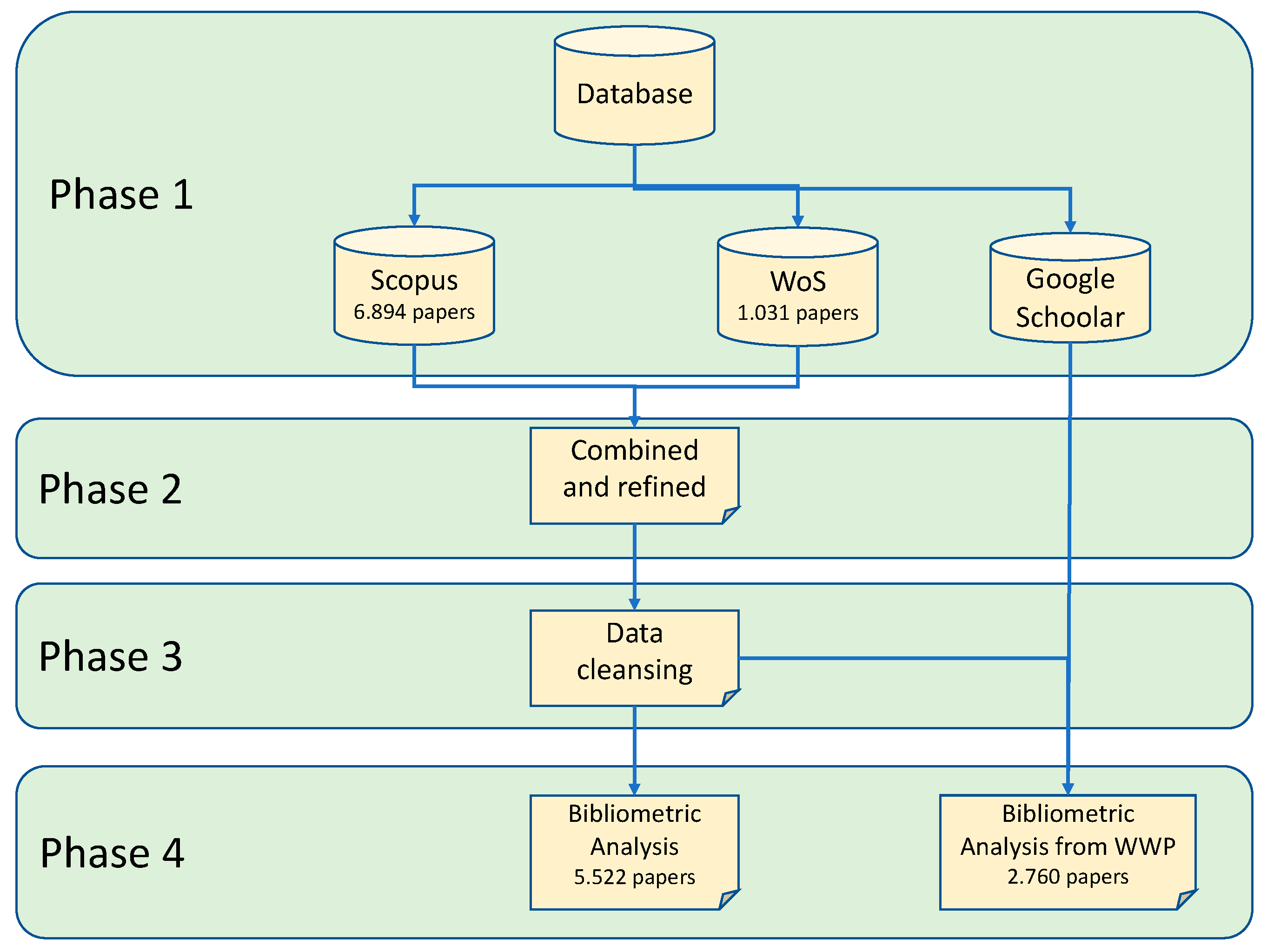
Figure 2.
Distribution of Scopus and WoS publications by year from 1970-2022 (2 March).
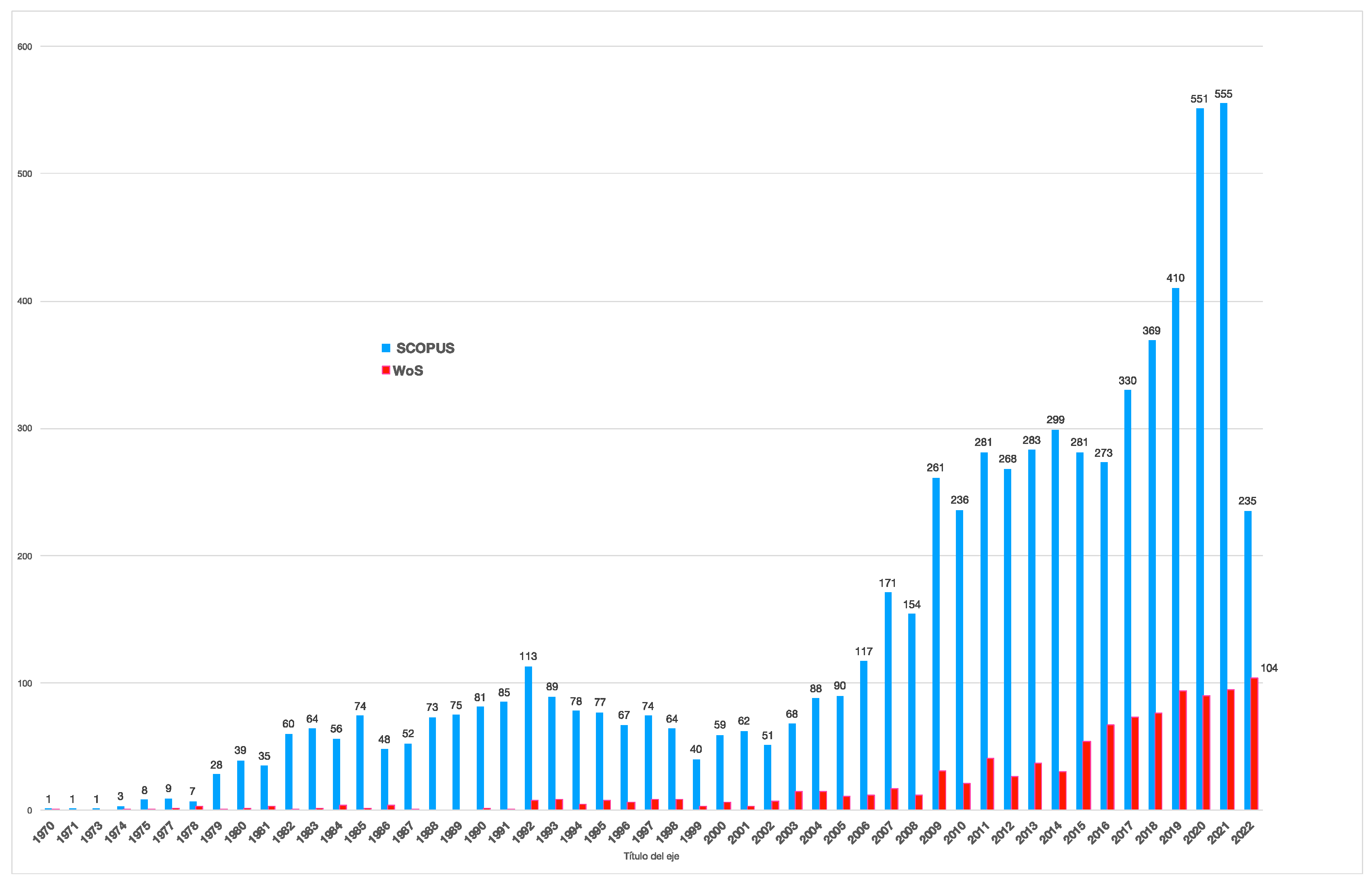
Figure 3.
Distribution of Scopus and WoS publications by by historical stages (2 March).
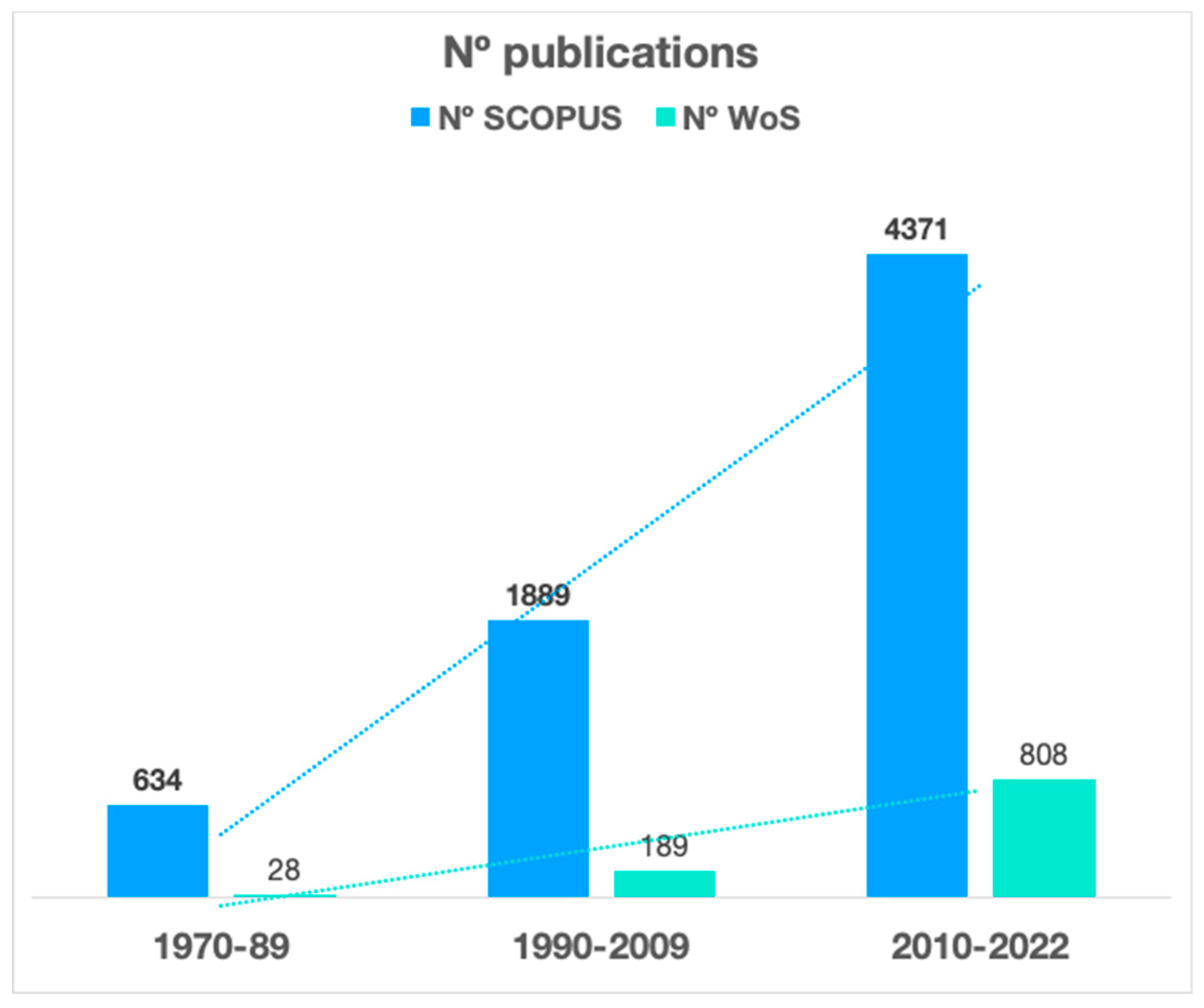
Table 1.
Search results by steps.
| 1st selection Scopus |
2nd selection WoS |
3rd. data cleansing | 4th bibliometric analysis |
|
|---|---|---|---|---|
| Rural development and planning | 6.894 | 1.031 | 5.522 | 5.522 |
1 Selection of papers was made from keywords.
Table 2.
Top 25 most cited journals Scopus y WoS.
| Journal | WoS | Scopus | Total | |||
|---|---|---|---|---|---|---|
| TP1 | TC | TP | TC | TC | % TC | |
| Land Use Policy | 52 | 1622 | 125 | 4756 | 6378 | 17,9% |
| Landscape and Urban Planning | 14 | 1419 | 70 | 4739 | 6158 | 17,3% |
| Journal of Rural Studies | 23 | 715 | 125 | 3657 | 4372 | 12,3% |
| World Development | 5 | 523 | 20 | 2630 | 3153 | 8,9% |
| Sociologia Ruralis | 8 | 619 | 25 | 1372 | 1991 | 5,6% |
| Journal of Cleaner Production | 7 | 200 | 43 | 1311 | 1511 | 4,2% |
| Science of the total Environment | 5 | 125 | 47 | 1378 | 1503 | 4,2% |
| Journal of Geographical Sciences | 8 | 410 | 50 | 1034 | 1444 | 4,1% |
| Sustainability | 48 | 277 | 113 | 1098 | 1375 | 3,9% |
| Habitat International | 7 | 161 | 28 | 899 | 1060 | 3,0% |
| Journal of Environmental Management | 8 | 264 | 25 | 647 | 911 | 2,6% |
| Applied Geography | 5 | 130 | 12 | 718 | 848 | 2,4% |
| Agricultural Systems | 5 | 174 | 13 | 498 | 672 | 1,9% |
| Biomass & Bioenergy | 6 | 134 | 25 | 529 | 663 | 1,9% |
| Geoforum | 5 | 132 | 16 | 524 | 656 | 1,8% |
| Regional Environmental Change | 6 | 113 | 3 | 495 | 608 | 1,7% |
| European Planning Studies | 6 | 113 | 21 | 332 | 445 | 1,3% |
| International Regional Science Review | 9 | 61 | 19 | 331 | 392 | 1,1% |
| Mountain Research and Development | 7 | 170 | 17 | 195 | 365 | 1,0% |
| I.J. Of Environmental R. & Public Health | 5 | 31 | 34 | 245 | 276 | 0,8% |
| Computers and Electronics In Agriculture | 8 | 93 | 12 | 160 | 253 | 0,7% |
| Cuadernos de Desarrollo Rural | 6 | 91 | 6 | 68 | 159 | 0,4% |
| European Countryside | 11 | 58 | 19 | 100 | 158 | 0,4% |
| Land | 28 | 114 | 4 | 10 | 124 | 0,3% |
| Third World Planning Review | 4 | 19 | 8 | 73 | 92 | 0,3% |
1 TP: Total publications; TC: Total citations.
Table 3.
Documents published and number of citations (period 1970-89).
| Authors | Title | Year | Source title | Cited by |
|---|---|---|---|---|
| Coleman, G. | Logical framework approach to the monitoring and evaluation of agricultural and rural development projects | 1987 | Project Appraisal | 63 |
| Hulme, D. | Learning and not learning from experience in rural project planning | 1989 | Public Administration and Development | 34 |
| Anyanwu, C.N. | The technique of participatory research in community development | 1988 | Community Development Journal | 22 |
| Morss, E.R., Gow, D.D. | Implementing rural development projects: lessons from AID and World Bank experiences. | 1985 | World Bank experiences. | 13 |
| Livingstone, I. | On the concept of ‘integrated rural development planning’ in less developed countries | 1979 | Journal of Agricultural Economics | 12 |
| Leupolt, M. | Integrated rural development: key elements of an integrated rural development strategy | 1977 | Sociologia Ruralis | 11 |
Table 4.
Documents published and number of citations (period 1990-2009).
| Authors | Title | Year | Source title | Cited by |
|---|---|---|---|---|
| Chambers, R. | Whose reality counts? Putting the first last | 1997 | Whose reality counts? Putting the first last | 2029 |
| Chambers, R. | The origins and practice of participatory rural appraisal | 1994 | World Development | 1376 |
| Murdoch, J. | Networks - A new paradigm of rural development? | 2000 | Journal of Rural Studies | 473 |
| Renting, H, Rossing, W.A.H., Groot, J.C.J., Van der Ploeg, J.D. | Exploring multifunctional agriculture. A review of conceptual approaches and prospects for an integrative transitional framework | 2009 | Journal of Environmental Management | 341 |
| Brandon, K.E., Wells, M. | Planning for people and parks: Design dilemmas | 1992 | World Development | 304 |
| Ellis, F., Biggs, S. | Evolving themes in rural development 1950s-2000s | 2001 | Development Policy Review | 254 |
| Leeuwis, C. | Reconceptualizing participation for sustainable rural Development: Towards a negotiation approach | 2000 | Development and Change | 226 |
| Burkey, S. | People first: a guide to self-reliant participatory rural development | 1993 | People first: a guide to self-reliant participatory rural development | 224 |
| Cernea, M.M. | Putting people first: sociological variables in rural development. Second edition | 1991 | Putting people first: sociological variables in rural development. | 132 |
| High, C., Nemes, G. | Social learning in LEADER: Exogenous, endogenous and hybrid evaluation in rural development | 2007 | Sociologia Ruralis | 111 |
| Ray, C. | Towards a meta-framework of endogenous development: Repertoires, paths, democracy and rights | 1999 | Sociologia Ruralis | 100 |
| Bruckmeier, K. | LEADER in Germany and the discourse of autonomous regional development | 2000 | Sociologia Ruralis | 63 |
| Barke, M., Newton, M. | The EU LEADER initiative and endogenous rural development: The application, of the programme in two rural areas of Andalusia, Southern Spain | 1997 | Journal of Rural Studies | 59 |
| Perez, J.E. | The LEADER programme and the rise of rural development in Spain | 2000 | Sociologia Ruralis | 56 |
| Cazorla, A. De los Ríos, I &. Díaz-Puente, J.M. | The LEADER community initiative as rural development model: Application in the capital region of Spain | 2005 | Agrociencia | 37 |
| Diaz-Puente, J.M., Yage, J.L., Afonso, A. | Building evaluation capacity in Spain: A case study of rural development and empowerment in the European union | 2008 | Evaluation Review | 26 |
| Marsden, T., Bristow, G. | Progressing integrated rural development: A framework for assessing the integrative potential of sectoral policies | 2000 | Regional Studies | 21 |
| Hulme, D. | Projects, politics and professionals: Alternative approaches for project identification and project planning | 1995 | Agricultural Systems | 20 |
| OECD | Better policies for rural development | 1996 | Better policies for rural development | 13 |
| Vidal, R.V.V. | Rural development within the EU LEADER+ programme: new tools and technologies | 2009 | AI and Society | 8 |
| Murray, M. | Planning through dialogue for rural development: The European citizens' panel initiative | 2008 | Planning Practice and Research | 5 |
Table 6.
Most occurrence keywords.
| Keywords and Cluster | % Links strength | % Occurrences | % Nº keywords |
|---|---|---|---|
| Green Cluster | 59,81% | 40,46% | 46,10% |
| Social Planning | 29,63% | 18,86% | 25,97% |
| Economic Development | 9,21% | 7,44% | 3,90% |
| Rural Development Policy | 6,91% | 4,68% | 5,84% |
| Developing Countries | 6,59% | 4,75% | 3,25% |
| Social Development | 3,88% | 2,67% | 5,19% |
| Economic factors | 3,60% | 2,07% | 1,95% |
| Red Cluster | 28,59% | 47,76% | 40,26% |
| Rural Planning | 8,56% | 16,29% | 12,99% |
| Environmental Planning | 5,38% | 5,91% | 7,79% |
| Rural Development | 3,74% | 7,16% | 3,25% |
| Urban Planning | 3,52% | 4,23% | 5,19% |
| Participatory Approach | 3,12% | 2,64% | 5,19% |
| Sustainable Development | 1,81% | 4,76% | 1,30% |
| Regional Planning | 1,41% | 4,46% | 1,30% |
| Land Use Planning | 0,93% | 2,00% | 2,60% |
| Governance Approach | 0,12% | 0,31% | 0,65% |
| Blue cluster | 11,59% | 11,78% | 13,64% |
| Organization And Management | 3,64% | 2,91% | 4,55% |
| Human Resources | 2,52% | 2,90% | 1,95% |
| Rural Population | 1,81% | 1,64% | 0,65% |
| Project Management | 1,71% | 2,48% | 4,55% |
| Health Care Planning | 1,25% | 1,10% | 0,65% |
| Governance Approach | 0,37% | 0,34% | 0,65% |
| Community Development | 0,29% | 0,41% | 0,65% |
| Total General | 100% | 100% | 100% |
Table 7.
Search results by steps.
| Topic | Authors | Nº documents |
|---|---|---|
| “Putting the last first" and "rural development" | Chambers, R. | 7.730 |
| "Putting people first" and "rural development" | Cernea, MM | 3.730 |
| “Working with people" and "rural development" | Cazorla A. De los Ríos, I. | 2.860 |
| “Planning as social learning” | Friedmann, J. | 230 |
1 Selection of papers was made from keywords.
Disclaimer/Publisher’s Note: The statements, opinions and data contained in all publications are solely those of the individual author(s) and contributor(s) and not of MDPI and/or the editor(s). MDPI and/or the editor(s) disclaim responsibility for any injury to people or property resulting from any ideas, methods, instructions or products referred to in the content. |
© 2023 by the authors. Licensee MDPI, Basel, Switzerland. This article is an open access article distributed under the terms and conditions of the Creative Commons Attribution (CC BY) license (https://creativecommons.org/licenses/by/4.0/).
Copyright: This open access article is published under a Creative Commons CC BY 4.0 license, which permit the free download, distribution, and reuse, provided that the author and preprint are cited in any reuse.


