

Submitted:
09 May 2023
Posted:
10 May 2023
You are already at the latest version
Abstract
As a first step a unification of the gravitational with the electromagnetic interaction within a classical framework is proposed. It is based on a V5-geometry, with x5 = q/m. The sole source term is mechanical stress energy, positioned along x5. The trajectories of test-bodies are placed in V4 (x5 = const)-slices. The resulting field equation couples a geometric G-tensor to mechanical stress energy, its momentum with respect to V5 and the change of this momentum with proper time τ. The following step proceeds to the quantization of space-time to enable the formalization of elementary particles und strong interaction. This is complimented by the inclusion of spin and the weak force, leading finally to a grand total equation, the stationary version of which corresponds to Schroedinger´s equation, the instationary version to the Einstein equation of General Relativity.
Keywords:
Unification
; Geometry
; Quantization
; GUT
; ToE
Introduction
Four fundamental forces in nature have been identified: gravitation, electromagnetism, weak interaction and strong interaction. In electromagnetism electricity and magnetism had been unified in the 19th century by James C. Maxwell. Weak interaction and electromagnetism were formally unified as electro-weak interaction by Abdus Salam and Steven Weinberg in the sixties of the 20th century. Together with the quark model quantum chromodynamics had been developed into the standard model of particle physics. What was left aside in this model was gravitation. It plays a major role in another standard model, the cosmological one, based on the General Theory of Relativity. There have been many attempts to bridge the gap.
In the more recent past, tendencies success fully introduced group theory calculus into elementary particle physics, but the group theoretical tools seem to defy, for the time being, the integration of gravitational phenomena. Other attempts hope that String Theory may finally deliver the solution.
Geometric Unification of Classical Gravitational and Electromagnetic Interaction in Five Dimensions: a Modified Approach
Apart from the successful unification of the electric and the magnetic forces themselves, the-two fundamental interactions out of the remaining four attracting the most and most prolonged attention for unification attempts, are the gravitational and the electromagnetic ones. Pre-relativity phenomenology presented very little scope for such "attempts”, and only the description of gravitation by the Theory of General Relativity seemed to offer a promising basis: the geometric replacement of natural forces by manifold curvature. Thus, already rather soon after the introduction of General Relativity, first unification possibilities were explored. Einstein himself spent the main part of his later working life, searching for a real unification between gravitation and electromagnetism.
There is no need to go into detail with regard to the individual contributions to the unification at tempts between gravitation and electromagnetism (our main concern in this section). A variety of excellent reviews exists, being the result of or again a source for others [l,2]. One can distinguish basically two lines of approach: the affine connection method in four dimensions (space-time manifold) and the five dimensional manifold with its additional dimension being the ratio q/m (charge/mass).
The majority of present day theoreticians consider all past attempts as having been unsuccessful. This is certainly true for those yielding e.g., charged particle trajectories from the geodesic equations, which have no resemblance to reality (e.g., Einstein's affine connection theory). But other, more successful approaches are equally rejected on the grounds that either their unification emanates into already known physical structures and therefore renders itself meaningless (Weyl; his unified theory resulted in the established Maxwellian equations and therefore presented nothing excitingly new), or that the achieved unification was not a true one. Most of the five-dimensional theories are dismissed for the latter reason. It is argued, that a 5th dimension is physically unobservable. Another criterion is the non-total elimination of a characteristic electromag netic part of the stress energy tensor, which is practically true for any of the past attempts. However, the rejection arguments are nowadays open to debate again. Some authors [3] argue that a true unification has already been achieved by the incorporation of electromagnetic terms into the stress energy tensor in Einstein's field equation; on the other hand the (4 + n) -dimensionality concept sees a revival in gauge theoretical unification attempts of the "electroweak" with the strong force.
This section presents a new approach to the unifica tion of the gravitational with the electromagnetic interaction on a geometrical basis in 5 dimensions. Its results have been published previously [4], but are no longer available on a regular basis, since the journal (Zeitschrift für Naturforschung) has ceased to exist. Therefore the bulk of the article is repeated here.
Initially, only classical phenomena are considered. The criteria to be met for a "true" unification are defined. By taking these criteria and an elevated "principle of equivalence" as theoretical basis and a V5-manifold with x5 = q/m as tool, one is lead to a qualitative, heuristic outline of the whole unification concept. After its presentation the formulated results are laid down in a separate paragraph with an interpretation of the new resulting field equation.
Heuristic Concept
The criteria for a true unification between gravitation and electromagnetism are the following:
(a) Both interactions have to be described by the same field equation, relating all field effects to the same source terms. If the unification is placed on a geometric basis, one and the same geometric structure must serve as a medium for the description of all these field effects.
(b) On a geometric basis all forces have to be replaced by a coupling of a single type main source term to geometry. No special remaining terms relating to one or the other non-unified descriptions are permitted.
(c) All dimensions of an n-dimensional manifold, presenting the geometrical framework, must be in some way physically observable. There are two principal lines of approach conceivable: a phenomenological one, based on geometry, and a more axiomatic one. Both lead to the same consequences. Let us first consider the phenomenological one.
The concept of force itself seems to be at the root of the present day split into four different types of interaction. Therefore to abandon it and place the description of physical effects on directly observable quantities, i.e. dimensions and energy, is a pre-condition for unification. This is exactly, what General Relativity does: the gravitational force is replaced by the coupling of curvature of a space-time manifold to an energy source term. It is therefore likely that only geometrical attempts for unification will be successful. As a consequence, the electromagnetic "force" as well has to be replaced by a cou pling of a manifold curvature to an energy source term. Both the manifold, in which the action takes place, and the source have to be common to gravi tational and electromagnetic events. This excludes immediately the V4-geometry of General Relativity as a unification basis and indicates for that at least a five-dimensional manifold. The common source has to be energy (related), bare of any specific terms with reference to one or the other interaction type.
The more axiomatic approach is outlined as follows: Let us postulate an "elevated principle of equivalence": "If an observer in a (special) inertial frame (i.e. a Faraday cage) is travelling in an 'accelerating' field, he can neither distinguish, whether he is moving in a gravitational or an electromagnetic or any other field, nor whether he is subjected to an apparent field (of any kind) due to acceleration of a reference frame."
This principle is a sufficient basis, to arrive with at the same conclusions, as the phenomenological approach did.
The following model in a V5-manifold offers itself: We have three space-like, one time-like dimension and x5 with (q/m) as affine parameter. Test-bodies and energy sources (masses, etc.) reside along x5 according to their (q/m)-value in four-dimensional slices V4 (x5 = const). Each V4 has its own space-time geometry. Let us for simplicity assume that a test-body or a source does never change position with respect to x5 (in V4(x5 0) only "neutral" test bodies move). For one and the same source term at a specific x5 the strength of the curvatures of the various V4's is normally different. Thus the V4's may appear "blown-up" or "contracted" with reference to each other and probed by the trajectories of test-particles, due to the gross curvature of the whole V5. Equally the gross curvature of the V5 changes, and thus the relative blow-up or contraction of the V4's to each other, when the source is positioned at a different x5. There is no real difference between a test-body and a source; their roles can be played by one and the same entity, and in mutual interactions of several test-bodies they are both at the same time. Thus we can postulate:
The curvature of the entire V5 geometry is dependent on the stress energy of a source and the position of the source along x5.
This is not quite all. As will be seen in the quanti tative results, curvature may also be coupled to the velocity of certain types of sources. Table 1 gives possible combinations test-body/source.
For the Illustration of the above, let us pick the most general example, where both test-body and source are "charged". The source A resides at x5 = a. Thus the entire V5 is curved initially with respect to the strength and the position value a. If A would reside at x5 = b a the gross curvature of the V5 would be different. A test-body C moves in a V4(x5 = c). In general c a. The trajectory of C is dependent on the curvature of V4 (c). A test-body D at x5= dc (=a) would move in a different curved V4 and thus project a different trajectory.
In traditional language the above means: the trajectory of a test-body with mass mt1 and charge qt1 under the influence of a source with mass ms1 and charge qs1 changes, when the source is replaced by one with and ; or: the tra jectory of a test-body with mt1 and qt1 under the influence of a source with ms1 and qs1 is different from that of a test-body with and under the influence of the same source.
How does the general structure of a V5 look like? Figure 1 illustrates that a five-dimensional universe is a flat sheet, or rather an assembly of an infinite number of V4 sheets piled onto each other. It is not infinite in the x5-direction, since the maximum observed and for the time being theoretically possible value for x5 is (e/me), the ratio of the electron's charge over its mass. Therefore the regions I and II in Figure l are physically meaningless.
Figure 2 shows space-time curves (particle tra jectories e.g.) for constant time. The V5, subjected to the influence of a source, somewhere situated along x5, accommodates test-particles moving in various V4 planes. The gross curvature of the V5 determines the "blowing-up" of trajectories in the V4's along x5. Thus, each geometry is coupled to one and the same source exactly as in General Relativity, only the coupling constants and the weight of the x5-position change along x5.
Figure 3 depicts the case qs = 0. If a source is situated at x5 = 0 the V5 is flat and all V4's are curv ed in parallel (only "gravitation"). If a test-body is placed at x5 = 0 it will always move on a geodesic, entirely determined by the strength of the source alone, independent of the position of the source and almost negligible with respect to the adjacent ones along x5 as "rest-curvature".
As was already obvious from Fig. l, the V5-univers is divided into two sectors, a positive and a negative (with respect to x5 assignment). If a source curves the positive sector a certain way, this curvature will be repeated inversely in the negative sector (repulsion and attraction) (s. Figure 4).
What has been achieved so far? The model eliminates the concept of charge, by postulating that test-bodies and sources posses only mass or energy, positioned along a fifth dimension at various locations (charge eliminated by geometric concept). The electromagnetic force has been eliminated by coupling of the curvature of a five-dimensional manifold to "neutral" strength and position of such a source (always "neutral", only stress energy).
The unification criteria will be revisited after the quantitative presentation in the following.
Quantitative Results
The mathematically tedious construction of the new unified field equation shall not be outlined in detail here. Three main points have been observed:
(i) the quantitative presentation of the theory has to follow rigorously the heuristic expectations;
(ii) it has to result in Einstein's field equation for the case x5 = 0;
(iii) the "electromagnetic" part of the stress energy tensor had to be reduced to its "mechanical" parts only, by extracting the charge and incorporating it into x5 .
Thus the new unified field equation can be ex-pressed in the following way (without explicit indices):
T is the purely mechanical stress energy, u the 4-velocity of a test body, an interval of proper time,
with the various terms in κ2 and κ3 resulting from the old electromagnetic stress energy part.
G is the curvature tensor of the V5 manifold. It can be constructed by the usual well known relations from General Relativity, i.e. the Riemannian tensor for V5, the corresponding connection coefficients and the metric
with
x=xi and i = 1,2,3,4,5
x4 time-like, x5 "charge"-like (q/m),
15 metric coefficients gμν ..
For the construction of G and the derivation of the geodesic equation one can either start from the global V5 and end up at the various or particular V4's or from the V4's and build up the global V5 geometry. Both approaches, which are complementary, may make use of a method, developed by Arnowitt, Deser and Misner [5], briefly ADM-method, which connects a Vn to a Vn-1. For the Riemann tensor this looks like (with explicit indices):
With
K is called the extrinsic curvature operator, n a normal vector, dn would be the vectorial difference, generated by K, after transporting n parallel within a hyper-surface. Thus K relates the intrinsic curvature in a Vn-1 to the global extrinsic curvature of the Vn itself;
eμ being a basis.
We can interpret the unified field equation as follows: The curvature of a V5-manifold under the action of a unified gravitational/electromagnetic field depends on a mechanical stress energy tensor T, i.e. on its absolute value, its momentum with respect to x5 and the change of this momentum with proper time.
This is a somewhat unexpected result and differs entirely in shape from the purely gravitational Ein stein equation. However, some assumptions and simplifications have been introduced along the lines of the development of the equation and these are briefly recalled here.
T was assumed to be fixed along x5, therefore has to be applied to T, rendering the source part dependent on a stress energy flux, corresponding when multiplied by x5 to the classical magnetic forces arising from the movement of charges in traditional descriptions. If T is assumed to be changing along x5, one would always have to con-sider . This is e. g. important in ionization processes and mass conversion. In the first case the affine parameter in a geodesic equation is most likely x4, resulting in a trajectory of a test-body as a geodesic in a V4. In the second case x5 could be affine parameter as well, resulting in the trajectory of a test-body changing its charge or mass during the interval under consideration.
The other assumption was that κ2 and κ5 were to be considered uniform in any of the directions. This may be true for most cases; in general, however, they should be presented as indexed tensors, their components differing according to possible anisotropies within a specific coordinate frame.
Elementary Particles and Strong Interaction
Further unification now has to proceed along the same lines as above: on a geometric basis. But it would have to include quantum theoretical elements. This means, the present field equation would have to be modified to include the quantization of geometry itself.
Heuristic Postulates
(a) The manifold in question, including space-time, has to be is quantized.
(b) Elementary particles with a rest mass m0 > 0 are described as geometric entities, i.e. resonant structures of the quantized manifold, in which energy is trapped. These particles must be solutions of a quantum equation, relating trapped energy (rest mass) and topology.
(c) The quantum nature of the manifold becomes apparent only at short distances, i.e. in the “long” connection a correspondence principle becomes obvious, serving for the transition from microscopic quantum limits to macroscopic continuum physics.
Un-quantized systems exist only in generalization outside a certain limit. In reality nature is subjected to quantum rules. A geometric theory must reflect this. In the V5-theory, geometry has to be quantized and thus provide the very basis for any static and dynamic behavior within the system as being characteristically of quantum nature. Quantum effects will be directly related to quantum geometry.
If the V5 – manifold is quantized in geometrical terms (postulate (a)), the stress energy results from the agglomeration of any number and combination of quantized entities, e.g. nucleons or quarks. The quantum nature of the stress energy (“potential”) propagates itself into the surrounding “continuum” – up to sufficiently small distances! Thus the surrounding geometry shows a structure basically related to the entities “at the centre of it”.
An elementary particle can be defined as a certain amount of energy (rest mass), trapped in a highly curved resonant manifold configuration. Thus, if one takes into consideration a continuous manifold structure, when approaching smaller and smaller distances, i.e. reaching quantum conditions under inclusion of manifold quanta, “gravitational” (geometric-dynamical) interaction suddenly “jumps” into a quantum aspect of nature. Thus “gravitation” becomes the long range part of “strong interaction” for a heavy particle for example. For a “charged” particle the difference constitutes itself from the position of that particle along x5.
Definitions
Let
(a) being an event interval,
(b) the space-time (or manifold) number
(c) q the space-time (or manifold) quantum
(d) a space-time (or manifold) operator
In the quantum limit:
The following quantization rule is applied:
(11)
Quantum limit on the metric:
describes also an event:
Thus, an event dependent state of initially any kind can be expressed generally as:
This can be developed as:
(15)
with ω initially unknown.
The meaning of ψ:
which is the probability, that at the event within the “event space” (space-time manifold) the event is in the state |ψ>.
Clarification of : in geometric terms as metric corresponds to in quantum terms to a quantum event state, thus
To determine ω:
ω has to be related to the energy, trapped in events, or propagated along a world line; it therefore has to be found from the Einstein equation, which relates “event space” to (stress) energy.
Intermediate, semi-classical considerations, regarding the choice of a manifold metric
The choice – in principle – of the gik etc. is to be done arbitrary with a final restriction on at least one parameter, to suit the quantum condition (12). Thus only the choice of the final set is decisive: if. e.g., the time like part is chosen to be free, then one space like part is determined to fulfill the quantum condition et vice versa.
To carry through a full quantization, one has to define a quantum geometrical Hamiltonian, - an operator, which associates energy states with purely geometric entities: let us call it “Λ”.
Development of the Energy State Equation
Determining Λ and ω:
a) Λ
Λ carries the geometric information, which relates the manifold structure to energy states. It is therefore derived from Gμν (Einstein equation) under the observation of quantum rules:
b) ω
Gμν → (quantized) Λ
The remaining part of the Einstein equation, being capable of yielding information for ω, is the stress energy, thus fulfilling the requirements for ω, outlined above:
ω = 8πTμν
To carry through a meaningful and consistent quantum relation between Λ and T in analogy to the Einstein equation, it is more useful to make dependent on rather than on (without vector notation):
The transformation from r2 to r2 + Δr2 is done via the transformation matrix U:
U can be expanded as:
and with
K = -iΛ
(23)
For mathematical convenience we make the transition:
Δr2 → dr2
Thus
This is the instationary equation
Inserting the stationary terms leads to:
and finally to
the stationary equation.
To arrive at energy states one has to rewrite (28):
and Tμν being
leading to
and integrating
leads to
the energy state equation
with
Thus the volume V is the product of three factors; the factors can be three out of any combination of dimension elements of an n-dimensional manifold (e. g. dx1dx2dx4 or dx2dx3dx4 or dx1dx2dx3 etc.).
Remarks to Equation (28):
a) (28) corresponds to Schroedinger´s equation, relating energy states to a field potential.
b) (28) corresponds formally to Einstein´s equation, relating geometry (quantized) to stress energy (quantized).
Inclusion of Spin
Spin plays an important role in the quantum mechanical application of the unified field equation; it shall be look at in this section. Basis is still Equation (1) (without indices)
According to F. Hehl et al. [6] the stress energy tensor can be split into
with Tc mechanical stress energy
Ts spin angular momentum
Thus
if there is coupling between spin angular momentum and stress energy momentum, and the latter changes with time.
In case of weak coupling of
and
then
and the spin equation reduces to:
with complete decoupling of spin from any charge effects.
Inclusion of Weak Force
According to the Fermi Model [7] the interaction density for charged and neutral weak processes is
has to be found in the coupling constants κi, ji in T. LIweak then transforms to
u = uc + uw
uc correponds to u (originally purely electromagnetic).
leading finally to
Spin and Electro-Weak
The simplest case is a weak coupling between spin and charge:
By taking the stationary equation (28), one arrives at:
and
Grand Total
The energy state equation reads:
With all factors it transforms to:
Conclusions
Summarizing, one can say that a formalism has been proposed to describe the nature of gravitational and electromagnetic fields in a unified way. The resulting field-equation reduces to the Einsteinian in the absence of an electromagnetic field, thus enlarging the context of General Relativity. The basis of the unification is a V5-geometry coupled to a mechanical stress energy tensor, positioned along an x5-dimension. The affine parameter of the 5th dimension is the ratio (q/m), charge/mass.
Let us go back to the criteria for true unification.
(a) Evidently the first condition is fulfilled: one field equation, a common source term, one and the same geometric structure.
(b) Only the mechanical stress energy remains as source; electromagnetic contributions have been accounted for by the type of coupling to geometry, the stress energy momentum along x5 and the change with proper time of the latter.
(c) One could argue that x5 is physically un-observable. If we forget its derivation from electromagnetism, however, and regard it as true geometric dimension, it is observable, when going backwards from the field equation: the position, along which a purely mechanical source is situated in this dimension, is observable by interpretation of the geodesics of test-bodies under the influence of such a source. Inversely, when we know the position of a source, we can predict the movement of test-bodies at a specific position along x5. Thus the "depth" of x5 can be probed, i.e. observed.
In succeeding steps the quantization of the event space has been achieved leading to stationary and instationary equations, which correspond to the Schroedinger und Einstein equations respectively. With the inclusion of spin and the weak force a grand total description of elementary particles and their interactions can be described by geometrical means only. The discrete geometry in event space is the sum of quantized energy states, depending on their location in a V5 – manifold, their momentum relative to x5, the change of these momentums with proper time, and spin energies.
References
- Lichnerowicz, Theories Relativistes de la Gravitation et de l´Electromagnetisme, Masson et Cie (ed. 1955.
- L. Witten (ed.), Gravitation: An Introduction to Current Research, J. Wiley & Sons Inc. 1962.
- W. Misner et al., Gravitation, W. H. 1973.
- W. Osterhage, Geometric Unification of Classical Gravitational and Electromagnetic Interaction in Five Dimensions, Z. Naturforsch. 1980.
- R. Arnowitt et al., The Dynamics of General Relativity, in [2], p.
- F. W. Hehl et al., General Relativity with Spin and Torsion, Rev. Mod. Phys., Vol. 48, No. 19 July; 3.
- et al. 1983.
Figure 1.
Global 5-Dimensional Universe.
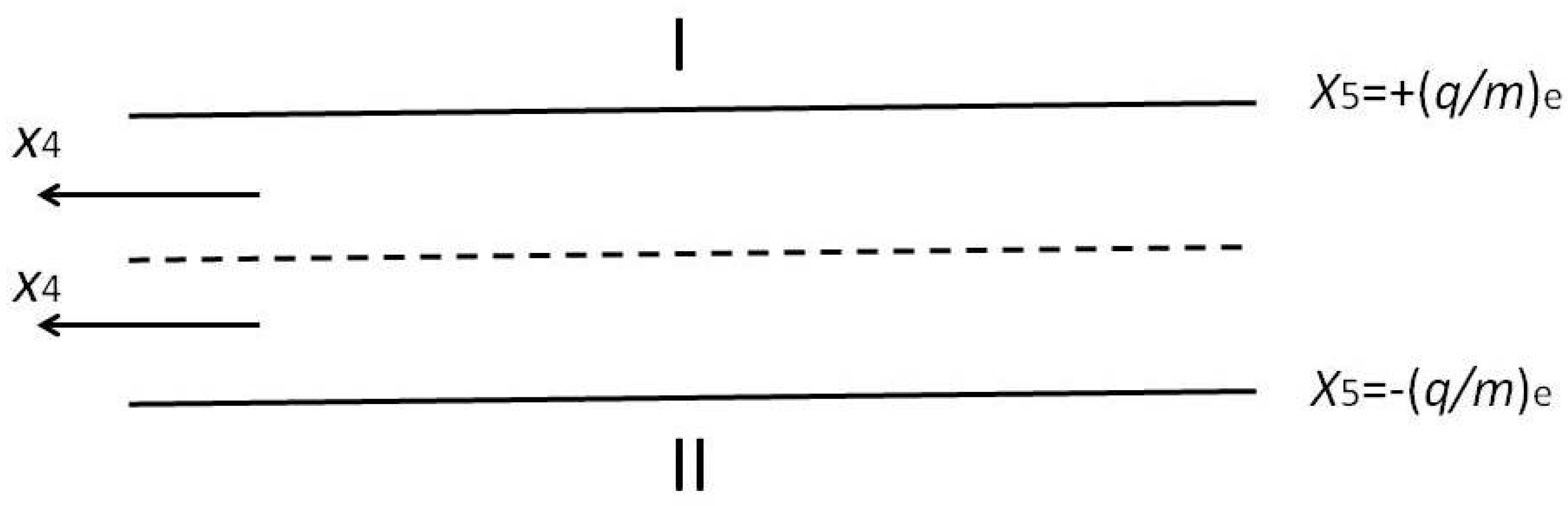
Figure 2.
Particle Trajectories for Constant Time in a Curved V5-Manifold.
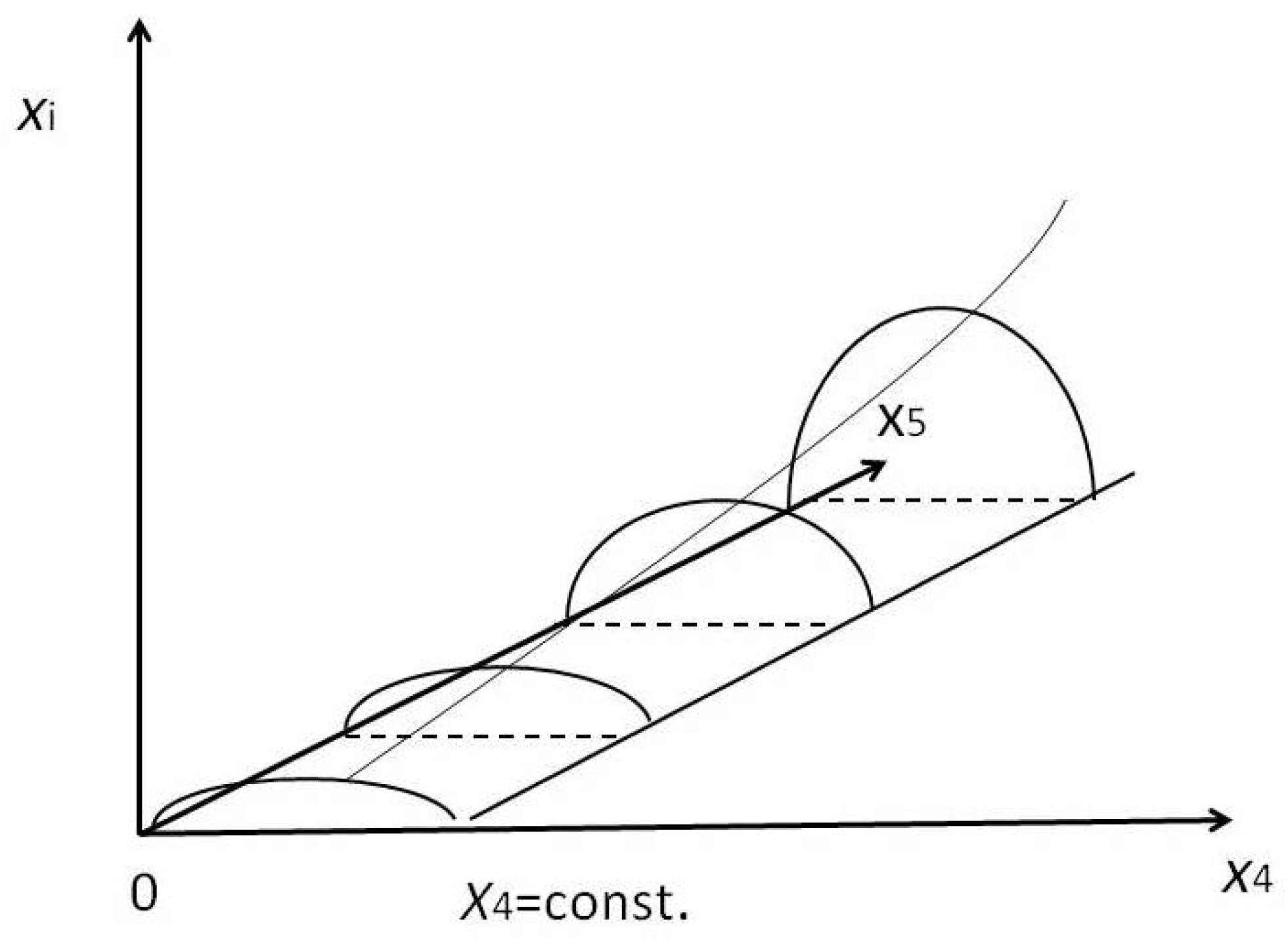
Figure 3.
Particle Trajectories in a Flat V5.
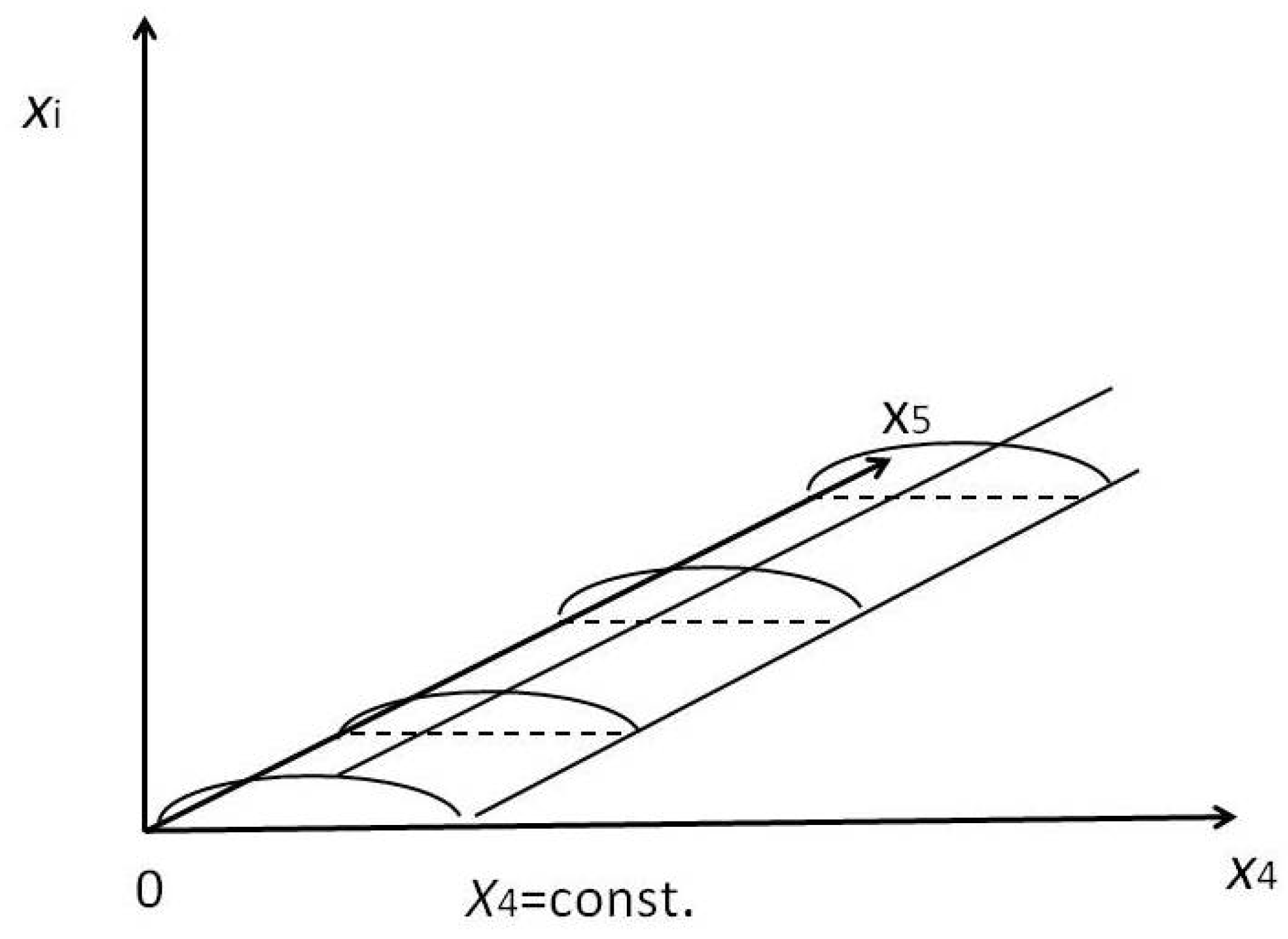
Figure 4.
Positive and Negative Sectors of the V5-Manifold under Curvature.
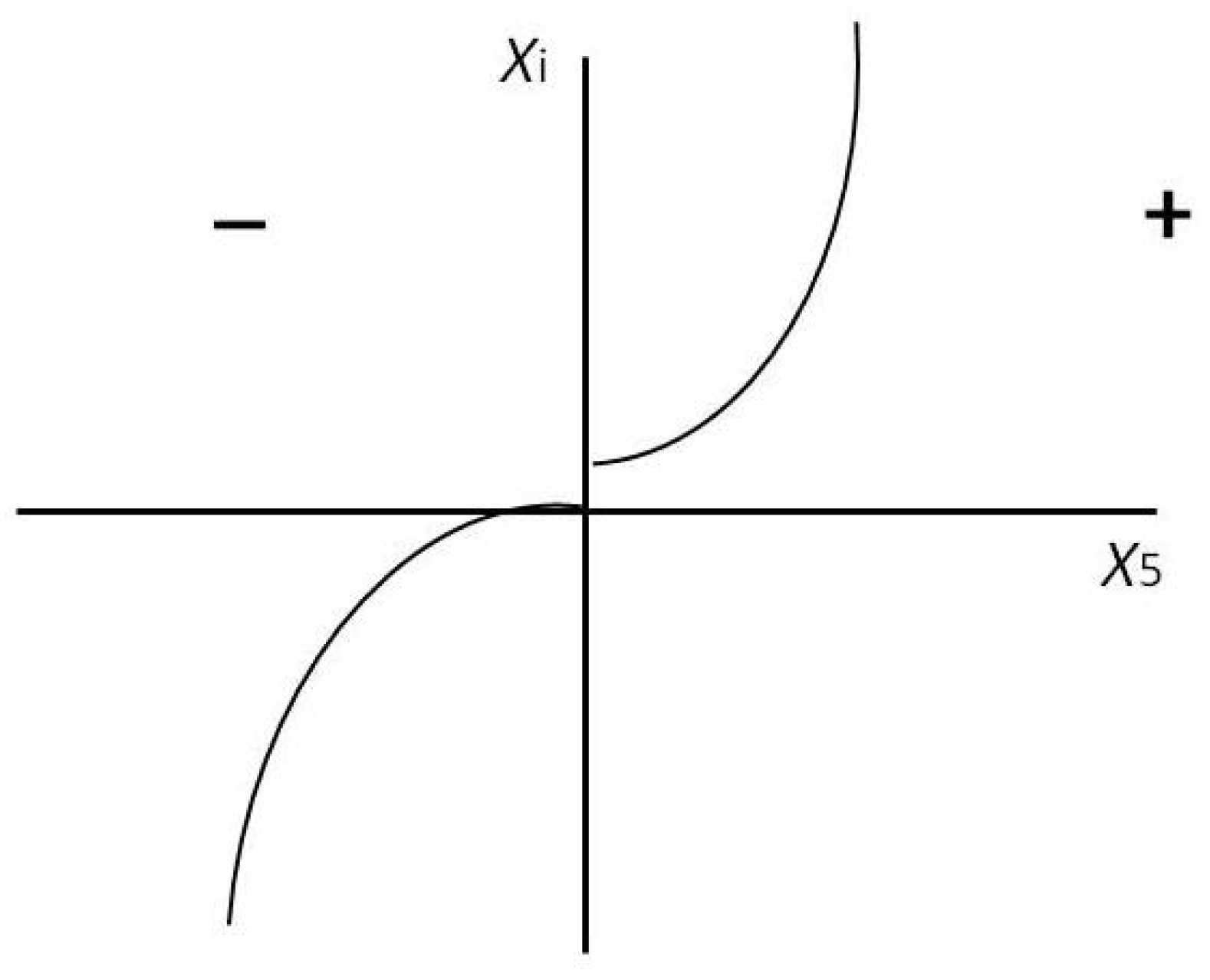

Table 1.
Terminology.
| Old | New | ||
|---|---|---|---|
| test-body | source | test-body | source |
| neutral | neutral | in V4(x5=0) | in V4(x5=0) |
| neutral | charged | in V4(x5=0) | in V4(x50) |
| charged | charged | in V4(x50) | in V4(x50) |
| charged | neutral | in V4(x50) | in V4(x5=0) |
Disclaimer/Publisher’s Note: The statements, opinions and data contained in all publications are solely those of the individual author(s) and contributor(s) and not of MDPI and/or the editor(s). MDPI and/or the editor(s) disclaim responsibility for any injury to people or property resulting from any ideas, methods, instructions or products referred to in the content. |
© 2024 by the author. Licensee MDPI, Basel, Switzerland. This article is an open access article distributed under the terms and conditions of the Creative Commons Attribution (CC BY) license (https://creativecommons.org/licenses/by/4.0/).
Copyright: This open access article is published under a Creative Commons CC BY 4.0 license, which permit the free download, distribution, and reuse, provided that the author and preprint are cited in any reuse.


