
Submitted:
08 May 2023
Posted:
09 May 2023
You are already at the latest version
Abstract
We summarize the results on electron transport in hybrid superconducting S/B/S' mesa-structure consisted of the oxide epitaxial S/B heterostructures, where S is the cuprate YBa2Cu3O 7-x superconductor, B – an interlayer with the spin dependent characteristics, and S’ is the Nb top superconductor. Josephson effect was observed manifested in appearance of oscillating Shapiro steps amplitudes with microwave signal power due to synchronization of junction self-generation of electromagnetic radiation and the external microwave probe signal. Triplet component of superconducting correlations emerged when the interlayer comprised two magnetic materials SrRuO3 and La0.7Sr0.3MnO3 with non-collinear magnetizations as well in the case of antiferromagnetic insulator Sr2IrO4 characterized by strong spin-orbit interaction. Thickness of the interlayer in the both cases considerably exceeded the coherence length of the magnetic spin active interlayer hinting on appearance of long-range proximity effect and spin-triplet superconducting current. Magnetic field dependences measured at dc, and the existence of the second harmonic in superconducting current–phase relation revealed by measurements at microwave frequencies will be discussed.
Keywords:
superconductivity
; Josephson effect
; hybrid heterostructures
; mesa-structure
; magnetic proximity effect
; triplet pairing
; spin-orbit interaction
1. Introduction
Two decades ago it was theoretically shown that near the interface, composed from ferromagnetic (F) and superconducting materials (S), spin-triplet superconducting correlations with nonzero spin projection may occur [1,2]. A distinctive feature of spin-triplet superconducting correlations is their insensitivity to the magnetic exchange field EEX which usually exceeds the thermal energy kBT (T is ambient temperature, kB is the Boltzmann constant) allowing penetration of superconducting correlations into a ferromagnet over much longer distances scaled in depths ξN=(ħD/kBT)½ as in normal metal N, than the characteristic length ξF=(ħD/Eex)1/2 of ferromagnet F, where D=vFl/3 is the diffusion coefficient, vF is the Fermi velocity, and l is the mean free path in the dirty limit. It makes spin-triplet superconducting pairing applicable for fabrication of superconducting devises with new functional characteristics. One of possibilities to generate spin-triplet superconducting correlations utilizes the coupling of superconducting electrode trough an interlayer (B) prepared of a ferromagnetic three-layer with spatially non-uniform magnetization in layers [2,3,4], or in a bilayer [5].
Anomalously long-range superconducting proximity effect was attributed first to generation of long-range triplet superconducting correlations experimentally observed during studies of the Andreev interferometer bridge type device made of Ho film with a spiral magnetization [6], and for a S/F/S structure with the CrO2 interlayer [7,8] exhibiting superconducting critical current. Further, these findings were confirmed in experimental studies of single-crystalline Co nanowires [9], as well for S/F/S structures with Heusler alloys [10], and when the magnetic interlayer had spiral magnetization [2]. Long-range spin-triplet superconducting currents were observed also in Josephson junctions in which the composite magnetic layers had non-collinear magnetization, particularly in the case of Co/Ru/Co synthetic antiferromagnet and two outer thin F-layers [11], as well for a ferromagnetic three-layer with Co film [12].
All above-mentioned studies were carried out on samples with a metal or simple oxide layers, such as CrO2. At the same time functional oxides, exhibiting very wide diversity of material properties which encompasses superconductivity, ferromagnetism, ferroelectricity, semiconducting and metallic behavior [13,14,15,16,17], give opportunities for development of superconducting heterostructures based on oxide thin films, comprising superconducting cuprates, ferromagnetic manganites, ruthenates, iridates with strong spin-orbit interaction (SOI), and interfaces formed from them. Complex oxide perovskites as superconducting cuprates and spin-active magnetic materials used as interlayer barrier offer interesting opportunities. First, exhibiting similar crystal structure, oxide perovskites allow fabrication high quality heterostructures with epitaxially grown layers and interfaces. Second, properly prepared magnetic active oxides could feature magnetic exchange energy – a parameter which can be tuned by means of varying the doping level [18]. Third, but not the last, the critical temperatures of cuprate superconductors is more than an order in magnitude larger than in usual metallic superconductors and performs much greater potential interest for applications in field of superconducting spintronics. Several groups contributed to search of long-range proximity effect which leads to spin-triplet superconducting correlations. In this connection the S/F heterostructures with interfaces made of a singlet superconductor and 100% spin polarized F-ferromagnetic manganite at first sight do not help to generate spin-triplet correlations. However, on one hand the authors of Refs. [19,20] reported on evidence of long-range triplet superconducting correlations based on studies of Andreev reflections in structures with La0.7Ca0.3MnO3 ferromagnetic interlayer. On other hand, experiments on similar structures did not reveal superconducting currents (beyond those transmitted through pinholes) [21,22].
It was proved theoretically that spin triplet superconducting current occurs in a composite ferromagnetic interlayer placed in between of two singlet superconductors. The magnetic interlayer consisting of three or more ferromagnetic layers ensure the conversion of the spin-singlet component of superconducting correlations to the spin-triplet correlations, as well the reverse process also took place [3,23]. The experiments on superconducting niobium structures with a composite Co-containing interlayer confirmed the possibility of such processes, although the questions concerning the mixing of compositions of metal layers remain unanswered [11,24]. The reciprocal effect of triplet superconducting correlations on superconducting characteristics of spin-singlet superconductor was studied in [25,26]. A spin-triplet superconducting current in the structures with a ferromagnetic interlayer, consisting of two ferromagnets FL/FR, was predicted for ballistic transport in asymmetric superconducting heterostructures S/FL/FR/S (without barriers reducing the transparency) with strongly differing thicknesses or exchange fields of the FL and FR ferromagnets [27]. The case of diffuse scattering was studied in [5,28] also showed the existence of spin-triplet superconducting component. Later, it was shown theoretically that the dominant second harmonic in the current–phase relation (CPR) of superconducting current performs the long-range superconducting proximity effect [4,5,29]. The largest superconducting proximity effect with both the first and second harmonics in CPR was predicted for the case of disorientation of magnetizations of FL and FR layers by an angle close to 90° and when a thickness of one of the F-ferromagnets is of order of the coherence length ξF. From data on the magnetic field dependence of critical current Ic it was concluded [30] that the second harmonic in CPR dominates in heterostructures if the interlayer is prepared from the magnetically active materials.
In this regard a composite manganite/ruthenate La0.7Sr0.3MnO3/SrRuO3 (LSMO/SRO) interlayer, exhibiting non-collinear magnetization, looks promising for a triplet type Josephson junction. Indeed, this allowed us to observe for the first time a superconducting current though the composite LSMO/SRO interlayer, consisting of two functional oxides, and confirm the presence of spin-triplet component of the superconducting current [31,32,33,34,35,36].
Another approach to obtain spin-triplet superconducting correlations is based on usage for the interlayer a material with the strong spin-orbit interaction [37,38,39]. It was predicted the SOI in ferromagnetic interlayer FSO of S/FSO/S junction results in a pure spin-triplet Cooper pairing state without singlet superconductivity [40,41,42,43]. However, this issue still needs to be checked. In theoretical study [44] spin-triplet pairing was predicted also for the case of S/NSO/S junction when ferromagnetic interlayer FSO is replaced by NSO - normal metal with SOI. The S/NSO interface for the case of strong SOI in NSO was analyzed in [45] predicting robust spin-triplet pairing due to proximity effect, which allows observation also the Josephson effect in a S/NSO/S junction.
The most of experimental studies of influence of SOI on characteristics of Josephson junctions were done using superconducting structures where S-electrodes were linked by a topological insulator under layer. An unconventional proximity effect was observed in a superconducting junction with Nb S-electrode contacting to magnetically Fe-doped topological insulator (Fe-Bi2Te2Se), and the zero bias conductance peak (ZBCP) with energy bands splitting was observed along with conductance oscillations under influence of microwaves [46]. In [47] it was suggested to replace the topological insulator by a material with SOI pushing on an extensive theoretical and experimental studies. The S/B/S junction with Al S-electrodes and InAs semiconductor B-interlayer was experimental studied in [48] and an asymmetry of interference pattern was observed being discussed under the suggestion of impact of strong SOI. The SOI affected also the superconducting current-phase relation (CPR) which deviates from usual periodicity. Particularly, a 4π-periodic behavior was analyzed for a Josephson junction with semiconductor wire weak link [47]. An unconventional CPR in Josephson junctions topological weak link materials were reported and analyzed in [49,50]. The case of a weak link made of a wire with SOI with 8π-periodic CPR was discussed in [51], in which possibility of appearance of a fractional ½ electron charge was attributed to SOI.
For a material to be utilized for B-interlayer with the strong SOI we choose the 5d transition metal oxide Sr2IrO4 [52,53,54,55]. This compound is known as a canted antiferromagnetic insulator with the band splitting [56,57]. The intrinsic crystal field with energy ~ 0.4 eV [56] splits the degenerate states of 5d electrons into eg and t2g bands, and the partially filled t2g band splits into Jeff=3/2 and Jeff=1/2 due to the strong SOI over the iridium ions. Unconventional properties of Sr2IrO4, and the interfaces with other oxides, particularly with the superconducting cuprate, were discussed in [58,59,60,61,62,63] in sense of opportunities for spin manipulation in a junction with the interlayer material with a weak magnetic moment.
In this review we present results of the comprehensive experimental studies of the both types junctions with spin-active interlayers. The paper is organized as follows, besides the Introduction in Section I, sample fabrication and measurements technique are given in Section II. In Section III with sub-section division we summarize experimental data and discuss the dc and microwave transport properties. Conclusions are given in Section IV.
2. Materials and Methods
Hybrid superconducting heterostructures have been fabricated in situ by laser ablation of a cuprate superconductor YBa2Cu3O7-δ (YBCO), known as a d-wave superconductor (Sd), and the interlayer, consisting either of SrRuO3 (SRO) and La0.7Sr0.3MnO3 (LSMO) bilayer, or the Sr2IrO4 (SIO) thin epitaxial films. The thicknesses of the films are indicated on caption of Figure 1a. The thicknesses of oxide films were controlled by the number of pulses of excimer Kr-laser with 248 nm wavelength. The bottom YBCO thin film and the composite SRO/LSMO interlayer for heterostructure was deposited at temperatures ranged 700-800°C in an oxygen atmosphere of 0.5-0.7 mbar [31,32,33,34]. The SIO thin film interlayer was deposited at the same range of temperatures in pure argon atmosphere with pressure 0.5 mbar [64]. Both, the YBCO Sd film and the composite interlayer were grown with the c-axis perpendicular to the substrate plane [32,33,34,35]. The crystalline parameters of the YBCO film in heterostructures with the magnetic-active interlayer were determined using the four-circle x-ray diffractometer, measuring 2θ/ω scans and rocking curves [32,35].
A protective Au thin film with thickness about 10 nm was deposited in situ at 30 °C in the PLD chamber. The superconducting top electrode Nb film with thickness about 200 nm was deposited ex situ by magnetron sputtering in argon atmosphere at room temperature, followed after the pre-sputtering of Au film [65]. Nb/Au/B/YBCO mesa-structures (MS) illustrated in Figure 1a had square shape and side sizes from L = 10 μm to 50 μm. Total five MS on a chip (see Figure 1b) were formed using optical lithography, reactive ion-plasma etching, and ion-beam etching at low ion accelerating voltages. Oxygen plasma treatments were performed after each lithography process to remove the remains of the resist. The SiO2 protective insulator layer was deposited by rf sputtering provided the DC current to flow in perpendicular direction to the B interlayer. An additional Nb film with a thickness of 200 nm was sputtered providing superconducting current transport through the DC wiring. Contact pads were made of gold films for four-point I-V curve measurements, schematically shown in Figure 1a. A chip with 5 MS with either composite interlayer LSMO/SRO – C-MS, or SIO film interlayer – S-MS is shown in Figure 1b. Thicknesses of interlayer films varied in the range 2–50 nm [31,32,33,34,35,36,60,61].
3. Results
3.1. DC transport characteristics
The results of experimental investigations of the hybrid heterostructures (M-MSs) of the Nb/Au/M/YBCO type, where M is a magnetically active material are presented in Figure2. In order to conclude whether a single magnetically active film used as a interlayer leads to superconducting current several magnetically active films were examined: the undoped LaMnO3 (LMO) manganite, as well the optimally doped compositions La0.7Ca0.3MnO3 (LCMO), and the LSMO. The optimum doping level implies an impurity concentration corresponding to the maximum of Curie temperature. The data of resistance measurements were compared with the results of calculations using quasi-classical equations of the theory of superconducting weak links [22].
Manganite M interlayer materials were studied for their temperature dependences of resistivity ρ(T). Obtained results for LMO, LCMO and LSMO are shown in Figure 2a. A transition in ρ(T) function at temperature TMI usually takes place not far from the Curie temperature TCU of magnetic film. As seen from Figure 2a the well pronounced metal-insulator transition for LCMO film occurs at T = 210 K. At higher temperatures T>TCU the ρ(T) behavior takes form of a thermally activated type, while at the lower temperatures T< 210 K it is rather a metallic-like. For Sr-doped manganite LSMO film the Curie temperature TCU is of order of 350 K and at T > 300 K and is not seen in Figure 2a. In the undoped manganite LMO the metal–insulator transition was not observed clearly enough, just a weak singularity is seen as a change in curvature of ρ(T) function. A significant rise of the LMO film resistivity by several orders in magnitude at low temperatures distinguishes the LMO from doped manganites LCMO and LSMO.
Using measurements of ferromagnetic resonance (FMR) changing the ambient temperature the Curie temperature of manganite films could be determined. Temperature dependences of FMR magnetic field H0 were measured frequency F= 9.76 GHz. Figure 2b demonstrates the evolution of FMR field H0 with temperature decrease for all three type of manganites, and a sharp drop in H0(T) functions took place at temperatures approaching TCU. A weak increase on H0(T) dependences at somewhat higher temperatures relative the TCU is seen well for LMO and LCMO films being explained by their temperature behavior of paramagnetic phase. As Curie temperature of LSMO is near 350 K its H0(T) dependence is shifted toward high temperatures. Obtained data for TCU values somewhat differ from those determined from susceptibility measurements of single crystalline manganites which are strongly dependent on the quality of crystalline films, strain, and the stoichiometry with respect to the oxygen content [66]. The TCU value for the undoped LMO was near 100 K. An appearance of ferromagnetism in the doped manganites (LSMO and LCMO) is described by the double exchange between Mn3+ and Mn4+ ions [67], while in manganites with low levels of doping the antiferromagnetic phase may occur due to super-exchange between Mn3+ ions. An important role in such interactions of Mn3+ and Mn4+ ions is played by the Jahn–Teller distortion [68,69]. Thus, the ferromagnetic phase exists even in the undoped stoichiometric antiferromagnetic LMO as well in the case of nonstoichiometric LaMnO3+δ. The strain in the thin film caused by the crystalline mismatch with the substrate [66] in LMO enhances the ferromagnetism analogously to the case of external pressure [69]. Figure 2c shows dependences of normalized (by R278 = R(T=278 K) resistance R/R278 vs. temperature for M-MS structures with all three types of manganite interlayers. At relatively high temperatures (T>150 K), the R/R278(T) dependences are determined first of all by the contribution of the resistivity of YBCO electrode, which R(T) dependence lays at relatively high resistance range. A small deviation from the linear R(T) behavior for M-MS with LSMO interlayer is related to it’s high Curie temperatures TCU > 300 K. A decrease in resistivity at T≤TCU is caused by impact resistivity of YBCO film which has transition temperature to the superconducting state at temperatures T≈80 K. A sharp drop of R(T) functions occurs at the temperature below superconducting transition T ≤ TC (amount 8.5 K) of Nb/Au electrode. Note, the superconducting transition of the Nb/Au electrode for the M-MS structures with LSMO interlayers demonstrates too weak change of R(T) function at low temperatures and was not observed. It is also seen that the contributions of resistances from the manganite M-interlayers and from superconductor/manganite interfaces are strongly manifested at the temperatures near the metal–insulator transition TMI, which is close to the Curie temperature TCU. In this case, the R(T) function and parameters TMI and TCU depend on the composition (stoichiometry and doping) of manganite interlayer. For M-MS with LSMO interlayer with high TCU values, the interlayer resistance, as well the resistance of Sd electrode YBCO film contributed to the R(T) at temperatures above superconducting transition T>TC. At low temperatures the M-MS structures with LSMO and LMO (in contrast to LCMO) M- interlayers exhibit an increase of resistance in R(T) with temperature lowering. The resistivity at T = 4.2 K of LCMO M-film deposited directly onto the substrate and amounted ρM=10–3 Ωcm contributes to resistivity of M-MS, characterized by value RMS =ρMdM = 10–9 Ωcm2 for the case of M-film thickness dM =10 nm. Note, the characteristic resistance of M-MS with LCMO thickness dM = 10 nm was RNS ≈2 10–4 Ω cm2 is much greater in experiment than the calculated one. Thus, we can conclude that the resistance of M-MS with the LCMO M-interlayer at low temperatures is determined mainly by the resistances of barriers I1 and I2 which originate between the interlayer and the adjacent superconducting film in M-MS, while the resistance of M-interlayer is relatively small and can be ignored. Taking into account the interface Au/M resistance, determined from additional measurements [70] and the total resistance of M/Sd structure it turns out that the S/M interface (here S is Nb/Au is superconducting bilayer as the mean free path of Au l ~ 100 nm is much thinner that Au film thickness dAu) has low transparency. Thus, the M-MS heterostructures could be modeled as S/I1/M/I2/Sd, in which the barriers I1 and I2 are the S/M and M/Sd interfaces, respectively. The superconducting S-electrode of Nb/Au bilayer is an ordinary superconductor with the s-wave symmetry of the order parameter, while the Sd electrode made of cuprate YBCO superconductor has a predominantly d-wave symmetry of order parameter pair potential. An example of conductivity temperature dependence σ(V) functions for M-MS with the dM = 10 nm thick LCMO interlayer are shown in Figure 2d, measured at 4 fixed temperatures. It is seen that conductivity decreases at low voltages and exhibits bending-like behavior around the voltage of superconducting eergy gap of Nb film. Superconducting correlations penetrate from the Nb/Au S-superconductor into the interlayer and modify the density of states. Importantly, no superconducting current exist in heterostructures with any of single manganite LMO, LCMO, or LSMO interlayer. Experimentally this was proved also by measurements reducing temperature well enough below temperature of liquid helium T < 4.2 K [22] down to T=0.3 K [71] and reducing also the interlayer thicknesses to dM = 5 nm. Note, an occasionally appearance of a superconducting critical current at small values of the M-interlayer thickness (dM < 5 nm) was proved is related to pinholes appearing in the structure [32]. Particularly, our measurements showed that pinholes lead to the absence of oscillatory dependences of the critical current and Shapiro step amplitudes vs. power of external microwave electromagnetic field. In MS S/Sd structures (Nb/Au/YBCO junctions) without additional interlayer [65] exhibited well pronounced superconducting current and Josephson effect, attributed to the spin-singlet pairing. The absence of superconducting current in M-MS is explained by very weak superconducting proximity effect at Sd/M interface of penetration of superconducting correlations with d-wave symmetry of YBCO Sd film to the manganite M-interlayer, or, more precisely, by the negligibly small value of the s-wave component, which also exists in YBCO and penetrates into the M interlayer into a depth equal to the electron mean free path l, small compared to the interlayer thickness dM [72]. Spin-singlet superconducting correlations in S/F/S structures are well known [73] when exchange interaction in ferromagnetic F interlayer does not prevent superconducting transport and observation Josephson effect, enabling to prepare so-called π- junctions [74]. The case of S/AF/S junctions with an antiferromagnetic AF-interlayer are less studied. In this connection it should be noted that the stoichiometric LMO is antiferromagnetic, however, a small deviation from stoichiometry of LMO thin film may lead to a weak ferromagnetism. This behavior is analogous to that observed for the M-MS with the LCMO M-interlayer.
The C-MS demonstrated rather different behavior. The temperature dependence of resistance R(T) of a typical C-MS (see Figure 3a) contains two parts, the both show decrease of resistance with cooling from room temperature down to T=4.2 K. Resistance drops correspond to transition to the superconducting state of Sd (YBCO) film and S (Au/Nb)film. Above the superconducting transition temperature for YBCO T≥TC (YBCO) the R(T) dependence exhibits a typical for the superconducting cuprate a metal type linear behavior. At temperatures T≤TC (Nb) below transition temperature Au/Nb electrode the C-MSs demonstrated superconducting critical current IC temperature dependence IC(T) as shown in Figure 3b.
The parameters of critical current densities jC=IC/S, S=L2 for several C-MSs with the composite interlayer LSMO/SRO are given in Table 1. An important parameter for Josephson junctions and for C-MS as well is the specific resistance RNS, where RN is the normal state resistance, is also presented in Table 1. Figure 3c shows the values of characteristic resistance RNS for 3 chips of C-MS obtained for all 5 mesa-structures with different size L. It can be seen that the values of RNS differ from chip to chip, but remain almost the same within a chip, having the same thickness of the LSMO and SRO films in the B-interlayer. In comparison with RNS values of YBCO/Au/Nb structures without B-interlayer [65] an insertion of composite LSMO/SRO interlayer results in significant decrease of RNS. To compare the resistive characteristics of the interfaces in mesa-structures with different interfaces we additionally prepared structures with a single ferromagnetic interlayer [34]. The value of RNS for structures with the SRO interlayer is almost three orders in magnitude smaller than for the structure with the LSMO interlayer [34]. Assuming that the specific resistance of the LSMO/Au interface does not exceed 1 μΩ cm2 [34], the high RNS values of the YBCO/LSMO/Au structures (RNS ~ 100 μΩ cm2) can be explained by the high resistance of the YBSO/LSMO interface. Thus, the transparencies of interfaces in C-MS: YBSO/SRO, SIO/LSMO and LSMO/Au are high enough and allow superconducting current to flow.
Superconducting critical current was observed for the C-MS with the total thickness of the composite interlayer up to 50 nm (see Table 1). Importantly, there were no superconducting current in structures with a single ferromagnetic interlayer (LSMO or SRO) with a thickness exceeding 5 nm, which is equal in order of magnitude to the coherence length ξF in magnetic film. Figure 3d demonstrates jC dependence vs. thickness of LSMO film for 3 thicknesses of SRO in composite B-interlayer in C-MS. The existence of the critical current and its the power-low decrease for composite interlayer exceeding thickness of 5 nm indicate the transport of spin-triplet superconducting correlations through the thick ferromagnetic interlayer [24,32]. However, a spread in the values of the critical current densities for different chips and within a chip noticeably exceeded the spread in the values of RNS.
Let us now to estimate the coherence length in the films forming the interlayer in C-MS. Since the electron mean free path l in oxide materials (SRO and LSMO) is quite small [75,76], we can assume that the electron transport is of a diffusion type exhibiting scattering from the SRO/LSMO interface due to the difference in the Fermi velocities. In the case of diffusion, the coherence length in a normal nonmagnetic material is ξN = (ћD/T)1/2, while its value in a ferromagnetic material is ξF = (ћD/Eex)1/2, where D = vFl/3 is the diffusion coefficient and vF is the Fermi velocity. We can estimate the mean free path l using the semi-empirical relation l = lph(R300 K/R4.2 K – 1), where lph is the phonon mean free path (about 0.4 nm for LSMO and 1 nm for SRO [76]). The measured R(T) dependences show that R300 K/R4.2 K ≈ 3 for SRO films grown on the (110)NGO substrate and R 300 K/R4.2 K ≈ 10 for LSMO films grown on (110)NGO substrate. This gives ξF ≈ 8 nm for LSMO and ξF ≈ 3 nm for SRO, respectively, both smaller than the thickness of the interlayer in C-MS.
Changing the interlayer from the composite SRO/LSMO one to a material with SOI also allowed to observe superconducting current in Nb/Sr2IrO4/YBCO mesa-structures (S-MS). The I-V curve and the differential resistance dependencies RD(I) = dV/dI at T=4.2 K are presented on Figure 4a. The dependences of RD(V) in larger scale at two temperatures: at T=4.2 K, and at T>TC of Nb are shown in Figure 4b. Singularities on RD(V) functions at the bias voltages equal to the voltage of Nb energy gap V=VΔ are seen very well. The variation of the central part of RD(V) with a dip caused by zero-bias conductance peak on the curve taken at T>TC is shown in Figure 4d. After deposition of the superconducting top electrode Nb film and wiring pattering, the transition temperature of the YBCO in the S-MS reduced to TC ≈61 K, affected by influence of ion-beam etching and oxygen migration at SIO/YBCO interface. The normal state resistivity of Nb/Au interface, studied earlier [65], gave RNS = 10−6 μΩcm2, corresponding to a transparency Γ≈1 which does not reduce the transparency of Γ = 10-2-10-3 [34].
Table 2 presents DC parameters of S-MS with dSIO=7 nm. The averaged values of specific resistivity RNS for 4 S-MS located on one chip with the same SIO thickness dSIO = 7 nm was estimated RNS ≈ 100 μΩcm2 at temperature T = 4.2 K. Note, an expected contribution to the total resistivity from SIO film calculated, taking experimental value ρdSIO = 7 103 μΩcm2, should be much higher [64]. This explains the difference in measured value of RNS from a simplified prediction and allows to argue that the tunneling is the main mechanism of electrical transport through the SIO/Au interfaces in the S-MS. Low transparency Γ= 3 10−5 of SIO/Au interface is also inherent to tunnel-like junctions. At the same time there exists a drop of resistivity around the biasing voltage V=0. The appearance of zero-bias conductance peak (ZBCP) was observed as shown in Figure 4d. This demonstrates that the SIO/YBCO interface is a transparent enough and it points on occurrence of low-energy states enabling coherent electron transport over them. Thus, for a model of S-MS structure the SIO/YBCO interface could be considered as NSO/S junction, where NSO is a normal metal with SOI, and S is a singlet superconductor. The parameters of S-MS (normal state resistance RN, and critical current IC) could be extracted from I-V characteristics measured at d.c. (see Figure 4a). For junction characterization experimental dependences of differential resistance RD = dV/dI from biasing current I are also useful. At temperatures near superconducting transition temperature TC of Nb film the critical current amplitudes IC were small and in order to determine the critical current values the RD(I) functions were used as described in [64], since the influence of low frequency fluctuations resulted in “rounded” I-V curves.
The experimental IC(T) function and the temperature dependence of the voltage at which the energy gap singularity VΔ on RD(V) takes place, caused by Nb electrode, the VΔ(T) dependence was obtained and it is shown in Figure 4c along with the normalized theoretical BCS temperature dependence of Nb energy gap. Taking into account the conductance G(V) rise at voltages V>10 mV, observed at low temperatures, the S-MS could be modeled as S/I/NSO/Sd junction. The rise of conductivity at voltages V >> VΔ is inherent to tunneling type of electron transport and for S-MS could be caused by existence of an insulating barrier I between SIO and Au/Nb superconducting S bilayer.
3.2. Magnetic field dependences.
Figure 5 show magnetic moment M(H) for Au/LSMO/SRO/YBCO heterostructure for in-plane and normal-to-plane directions of H-field at different temperatures. Measured by SQUID magnetometer the magnetization of LSMO film lies in the plane of the substrate, whereas the magnetization vector of the SRO film was directed at an angle of about 23° from the normal to the plane of the substrate. The LSMO is characterized by a coercive force of 20–30 mT and exchange energy of 2.3 meV [77] while the SRO has coercive force of the order of 1 T and an exchange energy of 13 meV [78].
Note, in order to turn the vector of the SRO magnetization and to make it collinear to the direction of LSMO magnetization, one needs to apply in-plane magnetic field of order 1 T [32]. So, this apparently confirms magnetic nature of the both SRO and LSMO films in the interlayer of C-MS. At these circumstances no superconducting current should be observe for the case of singlet pairing of superconducting correlations.
For the Josephson junction with superconducting current-phase relation IS=IC⋅sinϕ and uniform distribution of superconducting current density, the magnetic field dependence of critical current IC(H) is described by the sinc-function as the Fraunhofer diffraction pattern [79]. When the external field H through the cross-section SJ= LdJ, the magnetic permeability of the layers must be taken into account dJ= μ1 dLSMO+μ2 dSRO+λNb +λYBCO where λNb = 90 nm and λYBCO = 150 nm are the London penetration depths of the magnetic field for Nb and YBCO, respectively, and μ1,2 is the magnetic permeability of LSMO and SRO films, the Josephson junction produces flux Φ=μ0HSJ equal to magnetic flux quantum Φ0 =h/2e≈2.068×10-15 Wb then IC(H) demonstrates zeros. In experiment the measured magnetic field dependences of IC(H) of S-MS were markedly different from Fraunhofer pattern (see Figure 6a). This could be explained by difference of CPR from sinϕ, as reported for Josephson junctions with spin-triplet component. In this regard the magnetic field dependences are important. Moreover, the critical current was observed at considerably high levels of magnetic field up to 0.2 T (see Figure 6a).
A dependence IC(H) of superconducting critical current vs. magnetic field H for S-MS with SIO thickness dSIO=5 nm, L=40 μm is shown in Figure 6b. Magnetic field H was applied in parallel, using multi-turn thin amorphous mu-metal shield which reduces geomagnetic field about 10 times. It is seen that the maximum of total value of IC is located at H=0 and the shape of IC(H) deviates from the ordinary dependence of usual Josephson junction. There exists an asymmetry of IC(H) function relative the direction of applied magnetic field change (see Figure 6b). Positive IC+ and negative IC- critical current amplitudes are different, shown by a separate curve. Such a “large” Josephson junction behavior usually happens when junction size L exceeds the Josephson penetration depth λJ at least over 2 times, L>2λJ [79]. In our experimental case, on contrary, the S-MS is 4 times shorter L than Josephson penetration depth, which is estimated as λJ =170 μm. The difference ΔIC=IC++IC- and the IC amplitude defined at V=0, IC=(IC+ - IC-)/2 are given in Figure 6b. Theoretical Fraunhofer pattern IC(H) dependence is also given. The calculated level of magnetic field H1 at the first minimum of IC(H) Fraunhofer dependence could be fitted for discussed S-MS sample, using estimated value of H1=Φ0/μ0dJL≈4 Oe, where dJ=d+λNbctanh(dNb/2λNb)+λYBCOctanh(dYBCO/2λYBCO), taking magnetic field London penetration depths for YBCO and Nb at T=4.2 K λYBCO=150 nm, λNb = 90 nm, correspondingly. Note, for S-MS with dSIO=7 nm [64] with small superconducting current density jS and, as result, small critical current IC amplitude, the difference between positive IC+ and negative IC- critical currents amplitudes hardly could be identified experimentally. However, a difference between positive IC+ and negative IC- critical currents may point on anomalous Josephson effect with phase shift in CPR. Such behavior requires to meet specific conditions [82], for example, it happens in structures with splitting in spin bands due to influence of SOI [81,83]. Note, in our experiment conditions the level of applied magnetic field H was much smaller than that, required for Zeeman splitting. At the same time another interesting feature (will be discussed below) has been revealed in our experiment, which hints on possible influence of magnon-plasma wave interaction [84,85].
3.3. Microwave characteristics
The analysis of high frequency dynamics of critical current amplitudes and Shapiro steps taking place on the I–V curves under the action of applied microwave radiation indicates the lack of direct contacts (pinholes) between superconductors. The oscillations of Shapiro steps depending on the microwave power were observed and the amplitudes of these oscillations conformed well with the modified resistively shunted Josephson junction (MRSJ) model [65].
The amplitude of Josephson self-oscillations IJ is enhanced with biasing voltage V and frequency, obeying relation fJ=(2e/h)V. There exist a several limits for IJ rise with frequency fJ, e.g. superconducting energy gap, heating, and so on. At frequencies fJ approaching the critical frequency fC=(2e/h)ICRN function IJ(fJ) saturates in accordance of resistively shunted junction (RSJ) model [79]. The parameter fC of Josephson junction could be evaluated from I-V characteristics measured at d.c., but characterization at microwave frequencies remains important, particularly for our MS. In the case of C-MS with a relatively low fC the microwave studies were carried out in very wide frequency band. We registered Shapiro steps on the I-V characteristics registered at frequency of external signal fe>>fC at relatively low frequency fe=80 MHz for C-MS with IC=27.5 µA, RN=8 mΩ at T=4.2 K when external RF signal was weakly coupled with junction through air [36]. In spite of large impedance mismatch an occasional high-Q resonant coupling leads to good enough transmission of electromagnetic radiation from the open-ended coaxial output to the wiring leads. In the case of resonant coupling using additional print-on filters at desired frequency bands the impact of external noise is reduced.
Figure 7a demonstrated a family of I-V curves with Shapiro steps, registered at different levels of applied power of microwave signal at frequency fe=41 GHz which is about 500 times higher frequency than 80 MHz. Figure 7b shows the first (n=1) Shapiro step marked I1, and half-integer steps (n=1/2) for C-MS with parameters L= 10 μm, IC = 88 μA, and RN = 0.16 Ω. The maximum of the first Shapiro step was I1 = 94 μA and, correspondingly, the ratio I1/IC = 1.1 is in well agreement with the RSJ model. A deviation of the CPR from sinusoidal IS(ϕ)=IC⋅sinϕ, was obtained by measurements of critical current dependencies from magnetic field IC(H) [30].
In C-MS the s-wave Nb/Au superconducting S-electrode contacts the YBCO Sd -electrode via the Sr2IrO4 interlayer. The order parameter of YBCO superconductor could be described as a superposition of d-wave (Δd) and s-wave (Δs) components, in which Δ(θ)=Δdcos2θ+Δs, where θ is the angle between the quasiparticle momentum and the a-axis of the YBCO crystal structure. In the case of S/Sd junction between Nb/Au bilayer and the YBCO film, the CPR differs from the sinusoidal, particularly for the case of electron transport along the c-direction of the YBCO Sd film [65,86,87,88]:
where the amplitudes Ic1 and Ic2 are the critical currents for the first and the second harmonics in CPR. The ratio q=Ic2/Ic1 is used as a characteristic parameter for the second harmonic weight. The d-wave component order parameter (Δd) in YBCO superconducting electrode leads to unconventional superconducting CPR of the junction with the nonzero 2nd harmonic amplitude [65]. From calculations in [65] we learned that at small q≤0.5 the difference between Ic1 and the total IC is smaller than 20% and increases with q starting from q>0.5 [89]. The first harmonic Ic1 may originate from the minor s-wave component also existing in YBCO (Δs), and if Δd>>Δs,ΔNb the ICRN product for the case of a dominated 1st harmonic looks [65]:
where e is electron charge, ΔD*=πΔd[2ln(3.56Δd/kВTcNb)]-1, kВ is Boltzmann constant. For MS with VΔ(4.2 K)≈0.8 mV the parameters ΔNb/e≈Δs/e are also 0.8 mV and taking a typical estimate for Δd/e≈20 mV we get Ic1RN≈60 μV calculated by (2). It is twice larger than the experimentally obtained values of ICRN (see Table I), and close to the case of a S/Sd junction without interlayer in which the Sd electrode is contacting to s-wave S electrode in direction of YBCO c-axis [65]. Thus, inserting the Sr2IrO4 interlayer between YBCO and Au/Nb results in a reduction of Ic1RN product.
Is(ϕ)=Ic1sinϕ+Ic2sin2ϕ
Iс1RN≈ΔsΔNb/(eΔD*)
Note again, no superconducting current was registered in mesas with the ferromagnetic interlayers using 3d manganite materials La0.7Sr0.3MnO3, La0.7Ca0.3MnO3 or LaMnO3 [90]. Thus, specific properties of Sr2IrO4 which is 5d material with strong SOI should be taken into account [91]. Oxygen migration at Sr2IrO4/YBCO interface could play the decisive role for appearance of superconducting current in S-MS through the thick Sr2IrO4 interlayer (in comparison with the coherence length). According to experimental data [89] even a minor change in the oxygen content in Sr2IrO4 leads to a drastic change in the conductivity type of Sr2IrO4 at low temperature from activation to metallic.
As it was already shown in Figure 4d a difference of conductivity G(V) and the existence of ZBCP is well seen at T= 15.3 K, at the same time we’d like to note that evolution of conductivity G(V) started from higher temperatures, at least from T=48 K [64]. Existence of ZBCP in experimental data shows that the Sr2IrO4/YBCO interface is quite transparent and low energy states predicted for d-wave superconductor and Sr2IrO4 [45,63] could be relevant. When the SOI is taken into account at the Sr2IrO4/YBCO interface [92] a spin-triplet component of superconducting current occurs along with the long range proximity effect [44,45] and taking into account the oxygen changing at the adjacent part of Sr2IrO4 the latter becomes well conducting and theoretical models [8,9,44,45] for spin-triplet superconducting current in junctions with spin-singlet superconductors coupled by a normal metal with SOI could be applied.
Assuming presence of second harmonic, CPR takes form IS(ϕ)=IC1⋅sinϕ +IC2⋅sin2ϕ characterized by ratio q=IC2/IC1, which could be estimated by measurements of Shapiro steps heights vs. a=IRF/IC of applied microwave current IRF and utilizing the model [65] which takes into account the impact of both the junction capacitance C and q. At high frequency limit ω= fe/fC>1 and applied microwave currents IRF>IC the half-integer Shapiro steps may appear [93] if McCumber parameter βC= 2πfCRNC ~ 1. For the C-MS with d1 = 6 nm, d2 = 5.5 nm, and L = 10 μm measured at fe=41 GHz, T = 4.2 K Figure 6b shows dependencies of normalized amplitudes of critical current, first Shapiro step and half-integer subharmonic step amplitudes vs. a. From these data we estimated q =0.13 in C-MS.
High frequency dynamics of Josephson junctions with magnetic barriers depends also on propagation of electromagnetic waves. The influence of magnetic characteristics of Josephson junction barrier was considered and theoretically analyzed for S/I/F/S and S/F/I/F/S structures [84], as well for S/IF/S [85], where F is a ferromagnet, and IF is a ferromagnetic insulator. However, predicted deviations from ordinary theory [94] were not observed on S/IF/S structures in experiments [95,96]. At the same time, the existence of strong SOI, which was not taken in-to account [84,85], but exist in discussed S-MS structures may dramatically change high frequency the dynamics of electromagnetic waves propagation in Josephson strictures with magnetic barriers.
3.4. Resonance steps
In the case of S-MS the measurements of differential resistance dependences RD(V) under applied microwaves signal at fe= 50 GHz and different power P (see Figure 8a) showed sharp dips at the voltages VN =N⋅(h/2e)⋅fe, demonstrating the equidistant character due to Shapiro steps. At the same time, the dips of normalized RD/RN values are different for opposite polarities of bias voltage V. Figure 8a also illustrates the dependence RD(V) measured without microwave radiation (see the top track in Fig.8a). It can be seen that even a weak microwave power P with a 30-dB decay smoothens the RD(V) dependence. Additional information at low power level of probe microwave signal can give the measurements of detector response function. Figure 8b show I-V curve and the voltage dependence of synchronous detector response obtained at fe=50 GHz under P power weaker than that marked 30 dB in Fig.8a. It is seen that in addition to detector response function, strictly located at the voltage V-axis in correspondence to Josephson voltage-frequency relation, there exist other singularities. Switching off the microwave signal the singularities on I-V curve still took place. Applying an external magnetic field the singularities on RD(V) function changed the shape, keeping minima locations on V-axis fixed.
It is known that the influence of even weak magnetic field leads to appearance of resonant Fiske steps in I-V characteristic of a S/I/S tunnel junction (S is superconducting electrodes, and I is a non-magnetic insulator) [94,97] at voltages Vk =nΦ0c'/2L, where k is the number of resonant step, Φ0 is a magnetic flux quantum, c' = c(t/εΛ)1/2 is the Swihart velocity [98], c is the light velocity in vacuum, L is the junction width, t is the thickness of the insulator layer in the transmitting line with a dielectric permittivity ε, and Λ is the depth of magnetic field penetration into the layer and superconductors. In the case of a superconducting tunnel junction with an insulator characterized by magnetic properties, the penetration depth Λ becomes:
where μ is the magnetic permeability, and di and λLi (i = 1, 2) are the thicknesses of superconducting films and their London magnetic field penetration depths, respectively. The existence of strong SOI in the insulator B-layer (ISO) may change the dynamics of the propagation of electromagnetic waves in a S/ISO/S structure The location of resonant current steps with respect to the dc voltage V were determined from the minima of the differential resistance RD = dV/dI of S-MS under the magnetic field H. The dependence of RD(V) at the magnetic field H = –1.3 Oe is shown in Figure 9a with the I-V curve. A difference in voltage positions of singularity on RD(V) took place at V+1 = 42 µV and V-1= 51 µV marked by arrows. At voltages up to 200 µV (not shown in Figure 9a) differential resistance RD(V) demonstrates oscillations with magnetic field H which could be explain by the resonances Fiske steps at voltages Vk.
Λ=μt+ λL1 cotanh(d1/2λL1) + λL2 cotanh(d2/2λL2)
Figure 9b demonstrates magnetic field oscillating dependence of resonant current step amplitudes for numbers k=1, -1. Note, the asymmetry of Vk positions relative the voltage V=0 took place also for higher k numbers. Theoretical analysis of interaction of spin waves and plasma waves in Josephson junction with ferromagnetic insulator modeled as S/I/F/S or S/F/I/F/S media and its impact on Fiske singularities and a deviation from ordinary Fiske resonant behavior was made in [84,85]. The case of Josephson junction with a barrier made of antiferromagnetic insulator is less studied. It is worth to mention that spin waves in antiferromagnetic thin film has been examined in [99], and for antiferromagnetic spin dynamics in SIO [100].
Changing size L of S-MS the voltage positions Vk of resonances, as shown for the 1st and 2nd steps in Figure 9c, the Swihart velocity remained unchanged with a minor variation of expected VkL products, confirming the Fiske type resonance origin. The stable Vk voltage positions against magnetic field for higher k-numbers are given in Figure 9d. Note again, Fiske resonances in Josephson junctions with ferromagnetic metallic barrier interlayers [95] did not demonstrate deviations of Vk voltage positions from theory [79]. A minor Vk shifts were noticed in paper [96] and were explained by an influence of electromagnetic surrounding of Josephson junction [101]. In our experimental case the registered in S-MS structures shifts of Vk positions are rather more pronounced. Taking the experimental Fiske resonance position V1 allows us to estimate the Josephson junction’s plasma frequency fP~25 GHz which corresponds to dielectric constant ε~ 40 –45. This estimated value ε is of the same order of measured ones for SIO crystals [102] at higher temperatures than in our experiment and was explained by existence of Mott band and strong SOI properties [103] in Sr2IrO4.
3.5. Determination of the 2nd harmonic from CPR.
The information on CPR in a Josephson junction could be obtained from the dynamics of Shapiro steps by varying the power of microwave irradiation at high frequency limit fe>fC [38,55,64]. Calculations of both integer and half-integer Shapiro steps amplitudes were based on the Modified Resistive Shunted Junction (MRSJ) model which takes into account the second harmonic of the CPR and the finite capacitance C of Josephson junction which determines the McCumber parameter βС>1. In high-frequency limit hfe>2eIcRN the contribution of capacitance C on Shapiro step amplitude dependence vs. microwave power P (in terms of normalized RF current a [65]) is small and the shapes of the IC(a) and I1(a) dependences are mainly determined by the second harmonic of the CPR. If q≠0 the amplitudes of IC(a), I1(a), I2(a), I3(a) etc. are equal to a sum of the Bessel functions Jn taken with different phases [65]:

where we search for a maximum of the expression in square brackets depending on shift of the phases Θ between Josephson self-generation and external oscillations at probe frequency fe. In the equation (4) x=a/ω(ω22+1)1/2, ω=hfe/2eIcRN is a normalized frequency and a=I~/IC is a normalized amplitude of the external electromagnetic radiation [64]. As it follows from (4) in the case of large capacitance C or βС>1 the amplitudes of Shapiro steps are changed. Using the equation (4) it is possible to calculate the q values from minima level of the experimental dependence In(a)/Ic(0). At the first minimum ratio q=Ic(a)/[Ic(0)J0(2x)]. The impact of both the capacitance C and second harmonic of the CPR initiate fractional Shapiro steps with the amplitudes:

There is a variable-sign expression in square brackets of the equation (5). Therefore, the I1/2(а) dependence differs from the case of Josephson junction with small capacitance (βС<1): I1/2(а)~J1(2a/ω) [104]. The experimental data I1/2(а) can be fitted well if q <0. Negative q values (phase shift between first and second harmonics of the CPR) follows from theoretical calculations for S/Sd junctions with π/4 tilted c-axis of YBCO [87,105,106] and has been experimentally observed in bicrystal Josephson junctions [107]. However, even a small change of normalized frequency ω of the external electromagnetic radiation noticeably changes the shape of I1/2(a) dependence. This fact is explained by simultaneous influence on the process of fractional Shapiro step formation by the capacitance of Josephson junction and the second harmonic of the CPR q≠0 (the two first members in (5) which have different signs. Note, usually the parameter βС is determined from hysteresis on autonomous I-V curve without any external influence.
For studies not far from characteristic frequency fC=(ICRN)2e/h (h is Planck’s constant) of Josephson junction the S-MS measurements at microwave frequencies were carried out mm wave frequency band: either at fe=38 GHz, or fe=50 GHz. The voltage dependence of differential resistance dV/dI under applied microwaves at fe=50 GHz demonstrated both integer and fractional Shapiro steps which arise due to synchronization between Josephson self-oscillations and the external microwaves at voltages Vn,m=(n/m)hfe/2e [64]. Fractional Shapiro steps points on deviation from sin-type CPR and on the presence harmonics, particularly the second harmonic with IC2≠0. Figure 10a and Figure 10b show dependences of the first harmonic normalized amplitude i1=I1/IC (n=m=1), and the fractional (half-integer) i1/2=I1/2/IC (n=1, m=2) of Shapiro step vs. normalized microwave current a=IMW/IC(0) at fe=50 GHz. The dependences of i1(a) and i1/2(a) were calculated as well for different values of q=Ic2/Ic1 using the MRSJ model [46,102,106] and also are presented in Figure 10. Experimental data demonstrated well defined maximum for dependence i1(a) at microwave current a≈20 and less pronounce maximum at a≈80. Note, for q>0 the minima of theoretical function i1(a) do not reach level i1=0. For i1/2(a) dependence of fractional ½ step it is seen that experimental minima are shifted from zero level within measurements uncertainty indicated by the error bar. Deviation of experimental i1(a) dependence from theoretical could be attributed to contribution of higher harmonics in CPR. Note, the impact of large microwave power on non-stationary processes is not considered in the modified MRSJ model. Taking the maximal experimental amplitude of i1/2(a)≈0.3 the best fit to theory for the half-integer Shapiro step corresponds to the theoretical function calculated for q=0.3. The d-wave symmetry of YBCO superconducting electrode with order parameter amplitude Δd results in unconventional CPR with characteristic product of critical current -normal state resistance Iс2RN≈ Γ ΔNb/e [58] The contribution of 2nd harmonic in CPR for a S/Sd junction without interlayer barrier with the same electrical parameters as the discussed S-MS with L=40 μm gives Ic2≈20 nA for Γ =2⋅10-4, ΔNb/e=0.8 mV and RN =7.1 Ω at T=4.2 K. Note, using theoretical dependence for ratio IC1/IC vs. parameter q [65,89] and the estimated contribution of Ic2 gives negligibly small estimate q ≈ 3 10-3. The deviation of CPR from sinusoidal may originate due to appearance of low energy states at the SIO/YBCO interface, related to the coherent Andreev reflections [62,63,64,109,110]. Indeed, the S-MS demonstrated the ZBCP at temperatures T=4.2 K and T>TCNb which are associated with Andreev low energy states. At low temperatures tunneling behavior of conductivity takes place also at higher voltages V>10 mV. An asymmetry of G(V) dependence is also seen. Theoretical simulation [64] shows that the interface between cuprate superconductor Sd and SIO interlayer film could exhibit the both helical Majorana fermions and zero-energy flat edge states. It is hard to prove existence of Majorana fermions, but observed the ZBCP tells infavor of theory [64]. However, the origin of the ZBCP and the asymmetry in G(V) function in S-MS require additional studies.
4. Conclusions
We have experimentally observed spin-triplet superconducting current in two types of hybrid Nb/B/YBa2Cu3O7-x junctions with different B-interlayer properties. In the case of B-interlayer comprised all-oxide ferromagnetic bilayer SrRuO3/La0.7Sr0.3MnO3 (composite mesa-structures, C-MS) the long-ranged superconducting correlations occur due non-collinear directions of magnetizations in the layers with a total thickness up 50 nm. In the second type of junctions, the B-interlayer was made of antiferromagnetic insulator Sr2IrO4 with strong spin-orbit interaction (spin-orbit mesa-structures, S-MS). Although the transparences of interfaces in C-MS and S-MS differ more than two orders, the both exhibit the a.c. Josephson effect, confirmed by Shapiro steps appearance, and the results of microwave detector response measurements. A deviation from ordinary superconducting current-phase relation IS(ϕ)~sinϕ was observed. Particularly, a ratio of the second harmonic relative the first harmonic IS(ϕ) up to 0.5 was registered for C-MS while the first harmonic should dominate in usual Josephson junctions. The robust nature of spin-triplet superconducting correlations against external magnetic field H was revealed in C-MS by an extraordinary slow decay of critical current IC(H) function with increasing H. In S-MS junctions with low interface transparences superconducting current was observed in junctions with B-interlayer thickness up to 7 nm. Strong spin-orbit interaction featured in appearance of zero-bias-conductance-peak and anomalous d.c. Josephson effect, performing unequal amplitudes of critical currents against change of current biasing polarity. Reducing the thickness of Sr2IrO4 interlayer to 5 nm results in appearance of resonant current steps inherent to Fiske resonance demonstrating oscillating behavior with magnetic field.
Author Contributions
Conceptualization, K.C. and G.O.; methodology, K.C. and Yu.K.; software, A.P.; validation, A.P. and Yu.K., resources, G.O.; data curation, A.P.; writing—original draft preparation, K.C.; writing—review and editing, G.O.; visualization, A.P.; supervision, G.O.; project administration, K.C.; funding acquisition, G.O. All authors have read and agreed to the published version of the manuscript.
Funding
The activity by G.O. on microwave measurements was partially supported by Russian Science Foundation (project No. 23-49-10006).
Institutional Review Board Statement
Not applicable.
Informed Consent Statement
Not applicable.
Acknowledgments
The authors acknowledge I.V. Borisenko, G. Cristiani, A.I. Kalabukhov, P.V. Komissinsky, G. Logvenov, A.V. Shadrin for sample fabrication, V.V. Demidov, A.E. Sheyerman for conducting experimental measurements, D. Winkler for the useful discussions.
Conflicts of Interest
The authors declare no conflict of interest
References
- Bergeret, F. S.; Volkov, A. F.; Efetov, K. B. Long-Range Proximity Effects in Superconductor-Ferromagnet Structures. Phys. Rev. Lett. 2001, 86(18), 4096–4099. [Google Scholar] [CrossRef] [PubMed]
- Robinson, J. W. A.; Witt, J. D. S.; Blamire, M. G. Controlled Injection of Spin-Triplet Supercurrents into a Strong Ferromagnet. Science 2010, 329(5987), 59–61. [Google Scholar] [CrossRef] [PubMed]
- Houzet, M.; Buzdin, A. I. Long Range Triplet Josephson Effect through a Ferromagnetic Trilayer. Phys. Rev. B 2007, 76(6), 060504. [Google Scholar] [CrossRef]
- Trifunovic, L. Long-Range Superharmonic Josephson Current. Phys. Rev. Lett. 2011, 107(4), 047001. [Google Scholar] [CrossRef] [PubMed]
- Richard, C.; Houzet, M.; Meyer, J. S. Superharmonic Long-Range Triplet Current in a Diffusive Josephson Junction. Phys. Rev. Lett. 2013, 110(21), 217004. [Google Scholar] [CrossRef]
- Sosnin, I.; Cho, H.; Petrashov, V. T.; Volkov, A. F. Superconducting Phase Coherent Electron Transport in Proximity Conical Ferromagnets. Phys. Rev. Lett. 2006, 96(15), 157002. [Google Scholar] [CrossRef]
- Anwar, M. S.; Czeschka, F.; Hesselberth, M.; Porcu, M.; Aarts, J. Long-Range Supercurrents through Half-Metallic Ferromagnetic CrO2. Phys. Rev. B 2010, 82(10), 100501. [Google Scholar] [CrossRef]
- Keizer, R. S.; Goennenwein, S. T. B.; Klapwijk, T. M.; Miao, G.; Xiao, G.; Gupta, A. A Spin Triplet Supercurrent through the Half-Metallic Ferromagnet CrO2. Nature 2006, 439(7078), 825–827. [Google Scholar] [CrossRef]
- Wang, J.; Singh, M.; Tian, M.; Kumar, N.; Liu, B.; Shi, C.; Jain, J. K.; Samarth, N.; Mallouk, T. E.; Chan, M. H. W. Interplay between Superconductivity and Ferromagnetism in Crystalline Nanowires. Nat. Phys. 2010, 6(5), 389–394. [Google Scholar] [CrossRef]
- Sprungmann, D.; Westerholt, K.; Zabel, H.; Weides, M.; Kohlstedt, H. Evidence for Triplet Superconductivity in Josephson Junctions with Barriers of the Ferromagnetic Heusler Alloy Cu2MnAl. Phys. Rev. B 2010, 82(6). [Google Scholar] [CrossRef]
- Klose, C.; Khaire, T. S.; Wang, Y.; Pratt, W. P.; Birge, N. O.; McMorran, B. J.; Ginley, T. P.; Borchers, J. A.; Kirby, B. J.; Maranville, B. B.; Unguris, J. Optimization of Spin-Triplet Supercurrent in Ferromagnetic Josephson Junctions. Phys. Rev. Lett. 2012, 108(12). [Google Scholar] [CrossRef] [PubMed]
- Khaire, T. S.; Khasawneh, M. A.; Pratt, W. P.; Birge, N. O. Observation of Spin-Triplet Superconductivity in Co-Based Josephson Junctions. Phys. Rev. Lett. 2010, 104(13). [Google Scholar] [CrossRef] [PubMed]
- Bousquet, E.; Dawber, M.; Stucki, N.; Lichtensteiger, C.; Hermet, P.; Gariglio, S.; Triscone, J.-M.; Ghosez, P. Improper Ferroelectricity in Perovskite Oxide Artificial Superlattices. Nature 2008, 452(7188), 732–736. [Google Scholar] [CrossRef] [PubMed]
- Ohta, H.; Kim, S.; Mune, Y.; Mizoguchi, T.; Nomura, K.; Ohta, S.; Nomura, T.; Nakanishi, Y.; Ikuhara, Y.; Hirano, M.; Hosono, H.; Koumoto, K. Giant Thermoelectric Seebeck Coefficient of a Two-Dimensional Electron Gas in SrTiO3. Nat. Mater. 2007, 6(2), 129–134. [Google Scholar] [CrossRef] [PubMed]
- Ohtomo, A.; Hwang, H. Y. A High-Mobility Electron Gas at the LaAlO3/SrTiO3 Heterointerface. Nature 2004, 427(6973), 423–426. [Google Scholar] [CrossRef]
- Chen, Y. Z.; Trier, F.; Wijnands, T.; Green, R. J.; Gauquelin, N.; Egoavil, R.; Christensen, D. V.; Koster, G.; Huijben, M.; Bovet, N.; Macke, S.; He, F.; Sutarto, R.; Andersen, N. H.; Sulpizio, J. A.; Honig, M.; Prawiroatmodjo, G. E. D. K.; Jespersen, T. S.; Linderoth, S.; Ilani, S.; Verbeeck, J.; Van Tendeloo, G.; Rijnders, G.; Sawatzky, G. A.; Pryds, N. Extreme Mobility Enhancement of Two-Dimensional Electron Gases at Oxide Interfaces by Charge-Transfer-Induced Modulation Doping. Nat. Mater. 2015, 14(8), 801–806. [Google Scholar] [CrossRef]
- Trier, F.; Prawiroatmodjo, G. E. D. K.; Zhong, Z.; Christensen, D. V.; von Soosten, M.; Bhowmik, A.; Lastra, J. M. G.; Chen, Y.; Jespersen, T. S.; Pryds, N. Quantization of Hall Resistance at the Metallic Interface between an Oxide Insulator and SrTiO3. Phys. Rev. Lett. 2016, 117(9), 096804. [Google Scholar] [CrossRef]
- Dagotto, E.; Hotta, T.; Moreo, A. Colossal Magnetoresistant Materials: The Key Role of Phase Separation. Phys. Rep. 2001, 344(1–3), 1–153. [Google Scholar] [CrossRef]
- Kalcheim, Y.; Kirzhner, T.; Koren, G.; Millo, O. Long-Range Proximity Effect in La2/3Ca1/3MnO3/(100)YBa2Cu3O7 − δ Ferromagnet/Superconductor Bilayers: Evidence for Induced Triplet Superconductivity in the Ferromagnet. Phys. Rev. B 2011, 83(6), 064510. [Google Scholar] [CrossRef]
- Visani, C.; Sefrioui, Z.; Tornos, J.; Leon, C.; Briatico, J.; Bibes, M.; Barthélémy, A.; Santamaría, J.; Villegas, J. E. Equal-Spin Andreev Reflection and Long-Range Coherent Transport in High-Temperature Superconductor/Half-Metallic Ferromagnet Junctions. Nat. Phys. 2012, 8(7), 539–543. [Google Scholar] [CrossRef]
- van Zalk, M.; Brinkman, A.; Aarts, J.; Hilgenkamp, H. Interface Resistance of YBa2Cu3O7 − δ / La0.67Sr0.33MnO3 Ramp-Type Contacts. Phys. Rev. B 2010, 82(13), 134513. [Google Scholar] [CrossRef]
- Petrzhik, A. M.; Ovsyannikov, G. A.; Shadrin, A. V.; Konstantinyan, K. I.; Zaitsev, A. V.; Demidov, V. V.; Kislinskii, Yu. V. Electron Transport in Hybrid Superconductor Heterostructures with Manganite Interlayers. J. Exp. Theor. Phys. 2011, 112(6), 1042–1050. [Google Scholar] [CrossRef]
- Volkov, A. F.; Efetov, K. B. Odd Spin-Triplet Superconductivity in a Multilayered Superconductor-Ferromagnet Josephson Junction. Phys. Rev. B 2010, 81(14), 144522. [Google Scholar] [CrossRef]
- Khasawneh, M. A.; Khaire, T. S.; Klose, C.; Pratt Jr, W. P.; Birge, N. O. Spin-Triplet Supercurrent in Co-Based Josephson Junctions. Supercond. Sci. Technol. 2011, 24(2), 024005. [Google Scholar] [CrossRef]
- Leksin, P. V.; Garif’yanov, N. N.; Garifullin, I. A.; Fominov, Ya. V.; Schumann, J.; Krupskaya, Y.; Kataev, V.; Schmidt, O. G.; Büchner, B. Evidence for Triplet Superconductivity in a Superconductor-Ferromagnet Spin Valve. Phys. Rev. Lett. 2012, 109(5). [Google Scholar] [CrossRef] [PubMed]
- Zdravkov, V. I.; Kehrle, J.; Obermeier, G.; Lenk, D.; Krug von Nidda, H.-A.; Müller, C.; Kupriyanov, M. Yu.; Sidorenko, A. S.; Horn, S.; Tidecks, R.; Tagirov, L. R. Experimental Observation of the Triplet Spin-Valve Effect in a Superconductor-Ferromagnet Heterostructure. Phys. Rev. B 2013, 87(14), 144507. [Google Scholar] [CrossRef]
- Trifunovic, L.; Popović, Z.; Radović, Z. Josephson Effect and Spin-Triplet Pairing Correlations in S F1 F2 S Junctions. Phys. Rev. B 2011, 84(6), 064511. [Google Scholar] [CrossRef]
- Sperstad, I. B.; Linder, J.; Sudbø, A. Josephson Current in Diffusive Multilayer Superconductor/Ferromagnet/Superconductor Junctions. Phys. Rev. B 2008, 78(10), 104509. [Google Scholar] [CrossRef]
- Knežević, M.; Trifunovic, L.; Radović, Z. Signature of the Long Range Triplet Proximity Effect in the Density of States. Phys. Rev. B 2012, 85(9), 094517. [Google Scholar] [CrossRef]
- Pal, A.; Barber, Z. H.; Robinson, J. W. A.; Blamire, M. G. Pure Second Harmonic Current-Phase Relation in Spin-Filter Josephson Junctions. Nat. Commun. 2014, 5(1), 3340. [Google Scholar] [CrossRef]
- Ovsyannikov, G. A.; Sheyerman, A. E.; Shadrin, A. V.; Kislinskii, Yu. V.; Constantinian, K. Y.; Kalabukhov, A. Triplet Superconducting Correlations in Oxide Heterostructures with a Composite Ferromagnetic Interlayer. JETP Lett. 2013, 97(3), 145–148. [Google Scholar] [CrossRef]
- Khaydukov, Yu. N.; Ovsyannikov, G. A.; Sheyerman, A. E.; Constantinian, K. Y.; Mustafa, L.; Keller, T.; Uribe-Laverde, M. A.; Kislinskii, Yu. V.; Shadrin, A. V.; Kalaboukhov, A.; Keimer, B.; Winkler, D. Evidence for Spin-Triplet Superconducting Correlations in Metal-Oxide Heterostructures with Noncollinear Magnetization. Phys. Rev. B 2014, 90(3), 035130. [Google Scholar] [CrossRef]
- Sheyerman, A.; Ovsyannikov, G.; Kislinskii, Y.; Constantinian, K.; Shadrin, A. Current-Phase Relation of Superconductor-Ferromagnet-Superconductor Junctions with a Composite Interlayer. Solid State Phenom. 2015, 233–234, 737–740. [Google Scholar] [CrossRef]
- Sheyerman, A. E.; Constantinian, K. Y.; Ovsyannikov, G. A.; Kislinskii, Yu. V.; Shadrin, A. V.; Kalabukhov, A. V.; Khaydukov, Yu. N. Spin-Triplet Electron Transport in Hybrid Superconductor Heterostructures with a Composite Ferromagnetic Interlayer. J. Exp. Theor. Phys. 2015, 120(6), 1024–1033. [Google Scholar] [CrossRef]
- Ovsyannikov, G. A.; Constantinian, K. Y.; Demidov, V. V.; Khaydukov, Yu. N. Magnetic Proximity Effect and Superconducting Triplet Correlations at the Cuprate Superconductor and Oxide Spin Valve Interface. Low Temp. Phys. 2016, 42(10), 873–883. [Google Scholar] [CrossRef]
- Constantinian, K.; Ovsyannikov, G.; Kislinskii, Y.; Sheyerman, A.; Shadrin, A.; Kalabukhov, A.; Mustafa, L.; Khaydukov, Y.; Winkler, D. Spin-Triplet Superconducting Current in Metal-Oxide Heterostructures with Composite Ferromagnetic Interlayer. IEEE Trans. Appl. Supercond. 2016, 1–1. [Google Scholar] [CrossRef]
- Eschrig, M. Spin-Polarized Supercurrents for Spintronics: A Review of Current Progress. Rep. Prog. Phys. 2015, 78(10), 104501. [Google Scholar] [CrossRef]
- Linder, J.; Robinson, J. W. A. Superconducting Spintronics. Nat. Phys. 2015, 11(4), 307–315. [Google Scholar] [CrossRef]
- Horsdal, M.; Khaliullin, G.; Hyart, T.; Rosenow, B. Enhancing Triplet Superconductivity by the Proximity to a Singlet Superconductor in Oxide Heterostructures. Phys. Rev. B 2016, 93(22), 220502. [Google Scholar] [CrossRef]
- Bergeret, F. S.; Tokatly, I. V. Spin-Orbit Coupling as a Source of Long-Range Triplet Proximity Effect in Superconductor-Ferromagnet Hybrid Structures. Phys. Rev. B 2014, 89(13), 134517. [Google Scholar] [CrossRef]
- Jacobsen, S. H.; Linder, J. Giant Triplet Proximity Effect in π-Biased Josephson Junctions with Spin-Orbit Coupling. Phys. Rev. B 2015, 92(2), 024501. [Google Scholar] [CrossRef]
- Konschelle, F. Transport Equations for Superconductors in the Presence of Spin Interaction. Eur. Phys. J. B 2014, 87(5), 119. [Google Scholar] [CrossRef]
- Bergeret, F. S.; Volkov, A. F.; Efetov, K. B. Odd Triplet Superconductivity and Related Phenomena in Superconductor-Ferromagnet Structures. Rev. Mod. Phys. 2005, 77(4), 1321–1373. [Google Scholar] [CrossRef]
- Bobkova, I. V.; Bobkov, A. M. Quasiclassical Theory of Magnetoelectric Effects in Superconducting Heterostructures in the Presence of Spin-Orbit Coupling. Phys. Rev. B 2017, 95(18), 184518. [Google Scholar] [CrossRef]
- Reeg, C. R.; Maslov, D. L. Proximity-Induced Triplet Superconductivity in Rashba Materials. Phys. Rev. B 2015, 92(13), 134512. [Google Scholar] [CrossRef]
- Yano, R.; Koyanagi, M.; Kashiwaya, H.; Tsumura, K.; Hirose, H. T.; Sasagawa, T.; Asano, Y.; Kashiwaya, S. Unusual Superconducting Proximity Effect in Magnetically Doped Topological Josephson Junctions. J. Phys. Soc. Jpn. 2020, 89(3), 034702. [Google Scholar] [CrossRef]
- Sau, J. D.; Lutchyn, R. M.; Tewari, S.; Das Sarma, S. Generic New Platform for Topological Quantum Computation Using Semiconductor Heterostructures. Phys. Rev. Lett. 2010, 104(4), 040502. [Google Scholar] [CrossRef]
- Suominen, H. J.; Danon, J.; Kjaergaard, M.; Flensberg, K.; Shabani, J.; Palmstrøm, C. J.; Nichele, F.; Marcus, C. M. Anomalous Fraunhofer Interference in Epitaxial Superconductor-Semiconductor Josephson Junctions. Phys. Rev. B 2017, 95(3), 035307. [Google Scholar] [CrossRef]
- Domínguez, F.; Kashuba, O.; Bocquillon, E.; Wiedenmann, J.; Deacon, R. S.; Klapwijk, T. M.; Platero, G.; Molenkamp, L. W.; Trauzettel, B.; Hankiewicz, E. M. Josephson Junction Dynamics in the Presence of 2 π - and 4 π - Periodic Supercurrents. Phys. Rev. B 2017, 95(19), 195430. [Google Scholar] [CrossRef]
- Wiedenmann, J.; Bocquillon, E.; Deacon, R. S.; Hartinger, S.; Herrmann, O.; Klapwijk, T. M.; Maier, L.; Ames, C.; Brüne, C.; Gould, C.; Oiwa, A.; Ishibashi, K.; Tarucha, S.; Buhmann, H.; Molenkamp, L. W. 4π-Periodic Josephson Supercurrent in HgTe-Based Topological Josephson Junctions. Nat. Commun. 2016, 7(1), 10303. [Google Scholar] [CrossRef]
- Pedder, C. J.; Meng, T.; Tiwari, R. P.; Schmidt, T. L. Missing Shapiro Steps and the 8 π -Periodic Josephson Effect in Interacting Helical Electron Systems. Phys. Rev. B 2017, 96(16), 165429. [Google Scholar] [CrossRef]
- Moon, S. J.; Jin, H.; Kim, K. W.; Choi, W. S.; Lee, Y. S.; Yu, J.; Cao, G.; Sumi, A.; Funakubo, H.; Bernhard, C.; Noh, T. W. Dimensionality-Controlled Insulator-Metal Transition and Correlated Metallic State in 5 d Transition Metal Oxides Srn + 1IrnO3n + 1 ( n = 1, 2, and ∞ ). Phys. Rev. Lett. 2008, 101(22), 226402. [Google Scholar] [CrossRef] [PubMed]
- Witczak-Krempa, W.; Chen, G.; Kim, Y. B.; Balents, L. Correlated Quantum Phenomena in the Strong Spin-Orbit Regime. Annu. Rev. Condens. Matter Phys. 2014, 5(1), 57–82. [Google Scholar] [CrossRef]
- Schaffer, R.; Kin-Ho Lee, E.; Yang, B.-J.; Kim, Y. B. Recent Progress on Correlated Electron Systems with Strong Spin–Orbit Coupling. Rep. Prog. Phys. 2016, 79(9), 094504. [Google Scholar] [CrossRef] [PubMed]
- Gordon, E. E.; Xiang, H.; Köhler, J.; Whangbo, M.-H. Spin Orientations of the Spin-Half Ir 4+ Ions in Sr3NiIrO6, Sr2IrO4, and Na2IrO3 : Density Functional, Perturbation Theory, and Madelung Potential Analyses. J. Chem. Phys. 2016, 144(11), 114706. [Google Scholar] [CrossRef] [PubMed]
- Gim, Y.; Sethi, A.; Zhao, Q.; Mitchell, J. F.; Cao, G.; Cooper, S. L. Isotropic and Anisotropic Regimes of the Field-Dependent Spin Dynamics in Sr2IrO4 : Raman Scattering Studies. Phys. Rev. B 2016, 93(2), 024405. [Google Scholar] [CrossRef]
- Kim, Y. K.; Sung, N. H.; Denlinger, J. D.; Kim, B. J. Observation of a D-Wave Gap in Electron-Doped Sr2IrO4. Nat. Phys. 2016, 12(1), 37–41. [Google Scholar] [CrossRef]
- Hikino, S. Magnetization Reversal by Tuning Rashba Spin–Orbit Interaction and Josephson Phase in a Ferromagnetic Josephson Junction. J. Phys. Soc. Jpn. 2018, 87(7), 074707. [Google Scholar] [CrossRef]
- Ovsyannikov, G. A.; Grishin, A. S.; Constantinian, K. Y.; Shadrin, A. V.; Petrzhik, A. M.; Kislinskii, Yu. V.; Cristiani, G.; Logvenov, G. Superconducting Heterostructures Interlayered with a Material with Strong Spin–Orbit Interaction. Phys. Solid State 2018, 60(11), 2166–2172. [Google Scholar] [CrossRef]
- Petrzhik, A. M.; Cristiani, G.; Logvenov, G.; Pestun, A. E.; Andreev, N. V.; Kislinskii, Yu. V.; Ovsyannikov, G. A. Growth Technology and Characteristics of Thin Strontium Iridate Films and Iridate–Cuprate Superconductor Heterostructures. Tech. Phys. Lett. 2017, 43(6), 554–557. [Google Scholar] [CrossRef]
- Wang, H.; Yu, S.-L.; Li, J.-X. Fermi Arcs, Pseudogap, and Collective Excitations in Doped Sr2IrO4: A Generalized Fluctuation Exchange Study. Phys. Rev. B 2015, 91(16), 165138. [Google Scholar] [CrossRef]
- Takei, S.; Fregoso, B. M.; Galitski, V.; Das Sarma, S. Topological Superconductivity and Majorana Fermions in Hybrid Structures Involving Cuprate High-Tc Superconductors. Phys. Rev. B 2013, 87(1), 014504. [Google Scholar] [CrossRef]
- Chen, Y.; Kee, H.-Y. Helical Majorana Fermions and Flat Edge States in the Heterostructures of Iridates and High-TC Cuprates. Phys. Rev. B 2018, 97(8), 085155. [Google Scholar] [CrossRef]
- Petrzhik, A. M.; Constantinian, K. Y.; Ovsyannikov, G. A.; Zaitsev, A. V.; Shadrin, A. V.; Grishin, A. S.; Kislinski, Yu. V.; Cristiani, G.; Logvenov, G. Superconducting Current and Low-Energy States in a Mesa-Heterostructure Interlayered with a Strontium Iridate Film with Strong Spin-Orbit Interaction. Phys. Rev. B 2019, 100(2), 024501. [Google Scholar] [CrossRef]
- Komissinskiy, P.; Ovsyannikov, G. A.; Constantinian, K. Y.; Kislinski, Y. V.; Borisenko, I. V.; Soloviev, I. I.; Kornev, V. K.; Goldobin, E.; Winkler, D. High-Frequency Dynamics of Hybrid Oxide Josephson Heterostructures. Phys. Rev. B 2008, 78(2), 024501. [Google Scholar] [CrossRef]
- Ovsyannikov, G. A.; Petrzhik, A. M.; Borisenko, I. V.; Klimov, A. A.; Ignatov, Yu. A.; Demidov, V. V.; Nikitov, S. A. Magnetotransport Characteristics of Strained La0.7Sr0.3MnO3 Epitaxial Manganite Films. J. Exp. Theor. Phys. 2009, 108(1), 48–55. [Google Scholar] [CrossRef]
- Izyumov, Y. A.; Skryabin, Y. N. Double Exchange Model and the Unique Properties of the Manganites. Phys.-Uspekhi 2001, 44(2), 109–134. [Google Scholar] [CrossRef]
- Huang, Q.; Santoro, A.; Lynn, J. W.; Erwin, R. W.; Borchers, J. A.; Peng, J. L.; Greene, R. L. Structure and Magnetic Order in Undoped Lanthanum Manganite. Phys. Rev. B 1997, 55(22), 14987–14999. [Google Scholar] [CrossRef]
- Fita, I. M.; Szymczak, R.; Baran, M.; Markovich, V.; Puzniak, R.; Wisniewski, A.; Shiryaev, S. V.; Varyukhin, V. N.; Szymczak, H. Evolution of Ferromagnetic Order in LaMnO3.05 Single Crystals: Common Origin of Both Pressure and Self-Doping Effects. Phys. Rev. B 2003, 68(1), 014436. [Google Scholar] [CrossRef]
- Mieville, L.; Worledge, D.; Geballe, T. H.; Contreras, R.; Char, K. Transport across Conducting Ferromagnetic Oxide/Metal Interfaces. Appl. Phys. Lett. 1998, 73(12), 1736–1738. [Google Scholar] [CrossRef]
- Constantinian, K. Y.; Ovsyannikov, G. A.; Shadrin, A. V.; Kislinski, Y. V.; Petrzhik, A. M.; Kalaboukhov, A. S. Hybrid superconducting heterostructures with magnetic interlayers. Radioelectron. Nanosyst. Inf. Technol. 2021, 13(4), 471–478. [Google Scholar] [CrossRef]
- Kashiwaya, S.; Tanaka, Y. Tunnelling Effects on Surface Bound States in Unconventional Superconductors. Rep. Prog. Phys. 2000, 63(10), 1641–1724. [Google Scholar] [CrossRef]
- Petković, I.; Aprili, M.; . Barnes, S. E.; Beuneu, F.; Maekawa, S. Direct dynamical coupling of spin modes and singlet Josephson supercurrent in ferromagnetic Josephson junctions. Phys. Rev. B 2009, 80(22), 220502(R). [Google Scholar] [CrossRef]
- Ryazanov, V. V.; Oboznov, V. A.; Rusanov, A. Yu.; Veretennikov, A. V.; Golubov, A. A.; Aarts, J. Coupling of Two Superconductors through a Ferromagnet: Evidence for a Junction. Phys. Rev. Lett. 2001, 86(11), 2427–2430. [Google Scholar] [CrossRef] [PubMed]
- Cohn, J. L.; Neumeier, J. J.; Popoviciu, C. P.; McClellan, K. J.; Leventouri, Th. Local Lattice Distortions and Thermal Transport in Perovskite Manganites. Phys. Rev. B 1997, 56(14), R8495–R8498. [Google Scholar] [CrossRef]
- Kostic, P.; Okada, Y.; Collins, N. C.; Schlesinger, Z.; Reiner, J. W.; Klein, L.; Kapitulnik, A.; Geballe, T. H.; Beasley, M. R. Non-Fermi-Liquid Behavior of SrRuO 3 : Evidence from Infrared Conductivity. Phys. Rev. Lett. 1998, 81(12), 2498–2501. [Google Scholar] [CrossRef]
- Woodfield, B. F.; Wilson, M. L.; Byers, J. M. Low-Temperature Specific Heat of La1-xSrxMnO3+δ. Phys. Rev. Lett. 1997, 78(16). [Google Scholar] [CrossRef]
- Asulin, I.; Yuli, O.; Koren, G.; Millo, O. Evidence for Induced Magnetization in Superconductor-Ferromagnet Heterostructures: A Scanning Tunneling Spectroscopy Study. Phys. Rev. B 2009, 79(17), 174524. [Google Scholar] [CrossRef]
- Antonio Barone, G. P. Physics and Applications of the Josephson Effect; Wiley: New York, 2005. Wiley: New York.
- Constantinian, K. Y.; Ovsyannikov, G. A.; Petrzhik, A. M.; Shadrin, A. V.; Kislinskii, Yu. V.; Cristiani, G.; Logvenov, G. Resonant Current Steps in Josephson Structures with a Layer from a Material with Strong Spin–Orbit Interaction. Phys. Solid State 2020, 62(9), 1549–1553. [Google Scholar] [CrossRef]
- Constantinian, K. Y.; Petrzhik, A. M.; Ovsyannikov, G. A.; Shadrin, A. V.; Kislinskii, Y. V.; Cristiani, G.; Logvenov, G. Superconducting Heterostructure with Barrier with Strong Spin-Orbit Interaction. J. Phys. Conf. Ser. 2020, 1559(1), 012023. [Google Scholar] [CrossRef]
- Silaev, M. A.; Tokatly, I. V.; Bergeret, F. S. Anomalous Current in Diffusive Ferromagnetic Josephson Junctions. Phys. Rev. B 2017, 95(18), 184508. [Google Scholar] [CrossRef]
- Calder, S.; Pajerowski, D. M.; Stone, M. B.; May, A. F. Spin-Gap and Two-Dimensional Magnetic Excitations in Sr2IrO4. Phys. Rev. B 2018, 98(22), 220402. [Google Scholar] [CrossRef]
- Mai, S.; Kandelaki, E.; Volkov, A. F.; Efetov, K. B. Interaction of Josephson and Magnetic Oscillations in Josephson Tunnel Junctions with a Ferromagnetic Layer. Phys. Rev. B 2011, 84(14), 144519. [Google Scholar] [CrossRef]
- Hikino, S.; Mori, M.; Maekawa, S. Zero-Field Fiske Resonance Coupled with Spin-Waves in Ferromagnetic Josephson Junctions. J. Phys. Soc. Jpn. 2014, 83(7), 074704. [Google Scholar] [CrossRef]
- Komissinski, P. V.; Il’ichev, E.; Ovsyannikov, G. A.; Kovtonyuk, S. A.; Grajcar, M.; Hlubina, R.; Ivanov, Z.; Tanaka, Y.; Yoshida, N.; Kashiwaya, S. Observation of the Second Harmonic in Superconducting Current-Phase Relation of Nb/Au/(001)YBa2Cu3Ox Heterojunctions. Europhys. Lett. EPL 2002, 57(4), 585–591. [Google Scholar] [CrossRef]
- Blais, A.; Zagoskin, A. M. Operation of Universal Gates in a Solid-State Quantum Computer Based on Clean Josephson Junctions between d - Wave Superconductors. Phys. Rev. A 2000, 61(4), 042308. [Google Scholar] [CrossRef]
- Tanaka, Y.; Kashiwaya, S. Theory of the Josephson Effect in d -Wave Superconductors. Phys. Rev. B 1996, 53(18), R11957–R11960. [Google Scholar] [CrossRef] [PubMed]
- Goldobin, E.; Koelle, D.; Kleiner, R.; Buzdin, A. Josephson Junctions with Second Harmonic in the Current-Phase Relation: Properties of φ Junctions. Phys. Rev. B 2007, 76(22), 224523. [Google Scholar] [CrossRef]
- Petrzhik, A. M.; Ovsyannikov, G. A.; Shadrin, A. V.; Konstantinyan, K. I.; Zaitsev, A. V.; Demidov, V. V.; Kislinskii, Yu. V. Electron Transport in Hybrid Superconductor Heterostructures with Manganite Interlayers. J. Exp. Theor. Phys. 2011, 112(6), 1042–1050. [Google Scholar] [CrossRef]
- Korneta, O. B.; Qi, T.; Chikara, S.; Parkin, S.; De Long, L. E.; Schlottmann, P.; Cao, G. Electron-Doped Sr2IrO4 − δ ( 0 ≤ δ ≤ 0.04 ) : Evolution of a Disordered Jeff = 1/2 Mott Insulator into an Exotic Metallic State. Phys. Rev. B 2010, 82(11), 115117. [Google Scholar] [CrossRef]
- Horsdal, M.; Hyart, T. Robust Semi-Dirac Points and Unconventional Topological Phase Transitions in Doped Superconducting Sr2IrO4 Tunnel Coupled to t2g Electron Systems. SciPost Phys. 2017, 3(6), 041. [Google Scholar] [CrossRef]
- Seidel, P.; Siegel, M.; Heinz, E. Microwave-Induced Steps in High-Tc Josephson Junctions. Phys. C Supercond. 1991, 180(1–4), 284–287. [Google Scholar] [CrossRef]
- Coon, D. D.; Fiske, M. D. Josephson Ac and Step Structure in the Supercurrent Tunneling Characteristic. Phys. Rev. 1965, 138(3A), A744–A746. [Google Scholar] [CrossRef]
- Wild, G.; Probst, C.; Marx, A.; Gross, R. Josephson Coupling and Fiske Dynamics in Ferromagnetic Tunnel Junctions. Eur. Phys. J. B 2010, 78(4), 509–523. [Google Scholar] [CrossRef]
- Pfeiffer, J.; Kemmler, M.; Koelle, D.; Kleiner, R.; Goldobin, E.; Weides, M.; Feofanov, A. K.; Lisenfeld, J.; Ustinov, A. V. Static and Dynamic Properties of 0, π, and 0 − π Ferromagnetic Josephson Tunnel Junctions. Phys. Rev. B 2008, 77(21), 214506. [Google Scholar] [CrossRef]
- I.O. Kulik. JETP Lett. 1965, 2 (84).
- J. C. Swihart. J. Appl. Phys. 1961, 32 (461).
- Boardman, A. D.; Nikitov, S. A.; Waby, N. A. Existence of Spin-Wave Solitons in an Antiferromagnetic Film. Phys. Rev. B 1993, 48(18), 13602–13606. [Google Scholar] [CrossRef]
- Bahr, S.; Alfonsov, A.; Jackeli, G.; Khaliullin, G.; Matsumoto, A.; Takayama, T.; Takagi, H.; Büchner, B.; Kataev, V. Low-Energy Magnetic Excitations in the Spin-Orbital Mott Insulator Sr 2 IrO 4. Phys. Rev. B 2014, 89(18), 180401. [Google Scholar] [CrossRef]
- Monaco, R.; Costabile, G.; Martucciello, N. Influence of the Idle Region on the Dynamic Properties of Window Josephson Tunnel Junctions. J. Appl. Phys. 1995, 77(5), 2073–2080. [Google Scholar] [CrossRef]
- Chikara, S.; Korneta, O.; Crummett, W. P.; DeLong, L. E.; Schlottmann, P.; Cao, G. Giant Magnetoelectric Effect in the Jeff = 1/2 Mott Insulator Sr2IrO4. Phys. Rev. B 2009, 80(14), 140407. [Google Scholar] [CrossRef]
- Hu, J. Microscopic Origin of Magnetoelectric Coupling in Noncollinear Multiferroics. Phys. Rev. Lett. 2008, 100(7), 140407. [Google Scholar] [CrossRef]
- Komissinskiy, P.; Ovsyannikov, G. A.; Borisenko, I. V.; Kislinskii, Yu. V.; Constantinian, K. Y.; Zaitsev, A. V.; Winkler, D. Josephson Effect in Hybrid Oxide Heterostructures with an Antiferromagnetic Layer. Phys. Rev. Lett. 2007, 99(1), 017004. [Google Scholar] [CrossRef] [PubMed]
- Barash, Yu. S. Quasiparticle Interface States in Junctions Involving d -Wave Superconductors. Phys. Rev. B 2000, 61(1), 678–688. [Google Scholar] [CrossRef]
- Löfwander, T.; Shumeiko, V. S.; Wendin, G. Andreev Bound States in High- T c Superconducting Junctions. Supercond. Sci. Technol. 2001, 14(5), R53–R77. [Google Scholar] [CrossRef]
- Riedel, R. A.; Bagwell, P. F. Low-Temperature Josephson Current Peak in Junctions with d -Wave Order Parameters. Phys. Rev. B 1998, 57(10), 6084–6089. [Google Scholar] [CrossRef]
- Lu, C.; Quindeau, A.; Deniz, H.; Preziosi, D.; Hesse, D.; Alexe, M. Crossover of Conduction Mechanism in Sr2IrO4 Epitaxial Thin Films. Appl. Phys. Lett. 2014, 105(8), 082407. [Google Scholar] [CrossRef]
- Gor’kov, L.; Kresin, V. Giant Magnetic Effects and Oscillations in Antiferromagnetic Josephson Weak Links. Appl. Phys. Lett. 2001, 78(23), 3657–3659. [Google Scholar] [CrossRef]
- Kornev, V. K.; Karminskaya, T. Y.; Kislinskii, Y. V.; Komissinki, P. V.; Constantinian, K. Y.; Ovsyannikov, G. A. Dynamics of Underdamped Josephson Junctions with Non-Sinusoidal Current-Phase Relation. Phys. C Supercond. Its Appl. 2006, 435(1–2), 27–30. [Google Scholar] [CrossRef]
Figure 1.
(a) Cross-section of the MS with thickness of layers: Yba2Cu3O7-x dYBCO =60–70 nm, Sr2IrO4 film dSIO = 5–7 nm, La0.7Sr0.3MnO3 dLSMO =3 –15 nm, Sr2IrO4 dSRO =4 – 10 nm. (b) Photo from top of substrate with 5 MSs. Adopted from [59,65].
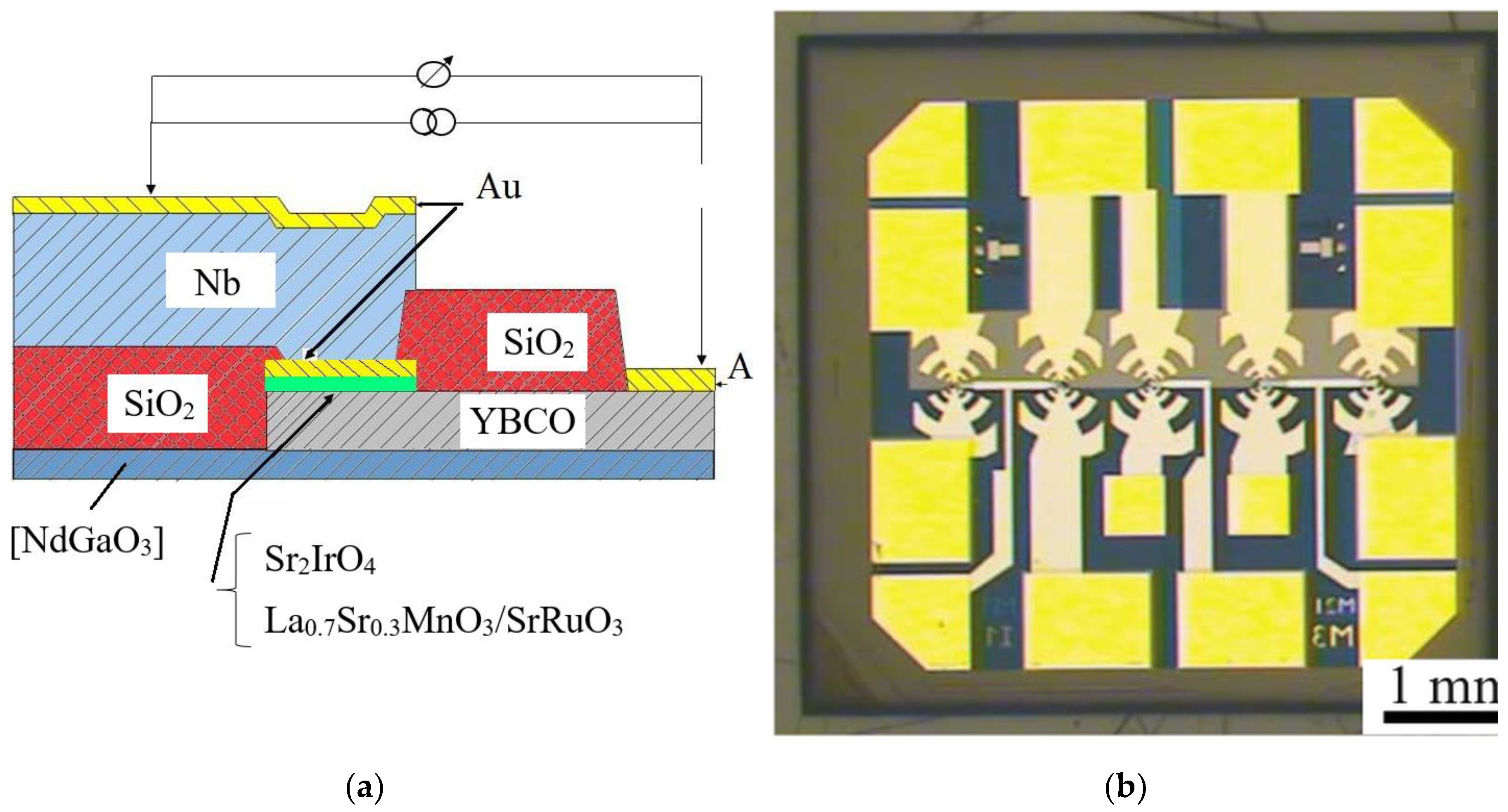
Figure 2.
(a) Temperature dependences of resistivity of the single manganite films deposited directly onto substrate. (b) Temperature dependences of ferromagnetic resonance field H0, measured at F= 9.76 GHz for manganite films: red point LMO; blue triangular – LCMO; green square – LSMO. The Curie temperature TCU was determined at the point of transition from a weak growth (characteristic of a paramagnetic phase) to a sharp drop in H0(T): TCU(LMO) = 150 K; TCU(LCMO) = 200 K; TCU(LSMO) = 370 K. (c) Temperature dependences of the normalized R(T)/R(T=278 K) resistance of M-MS with manganite interlayers: blue dash–dot LMO; green dashes LCMO; red solid line LSMO. Local maxima correspond to metal-insulator transition. (d) A family of plots of the conductivity σ vs. voltage V for M-MS with LCMO interlayer measured at various temperatures within T=4.2 – 10.5 K interval. Adopted from [22].
Figure 2.
(a) Temperature dependences of resistivity of the single manganite films deposited directly onto substrate. (b) Temperature dependences of ferromagnetic resonance field H0, measured at F= 9.76 GHz for manganite films: red point LMO; blue triangular – LCMO; green square – LSMO. The Curie temperature TCU was determined at the point of transition from a weak growth (characteristic of a paramagnetic phase) to a sharp drop in H0(T): TCU(LMO) = 150 K; TCU(LCMO) = 200 K; TCU(LSMO) = 370 K. (c) Temperature dependences of the normalized R(T)/R(T=278 K) resistance of M-MS with manganite interlayers: blue dash–dot LMO; green dashes LCMO; red solid line LSMO. Local maxima correspond to metal-insulator transition. (d) A family of plots of the conductivity σ vs. voltage V for M-MS with LCMO interlayer measured at various temperatures within T=4.2 – 10.5 K interval. Adopted from [22].
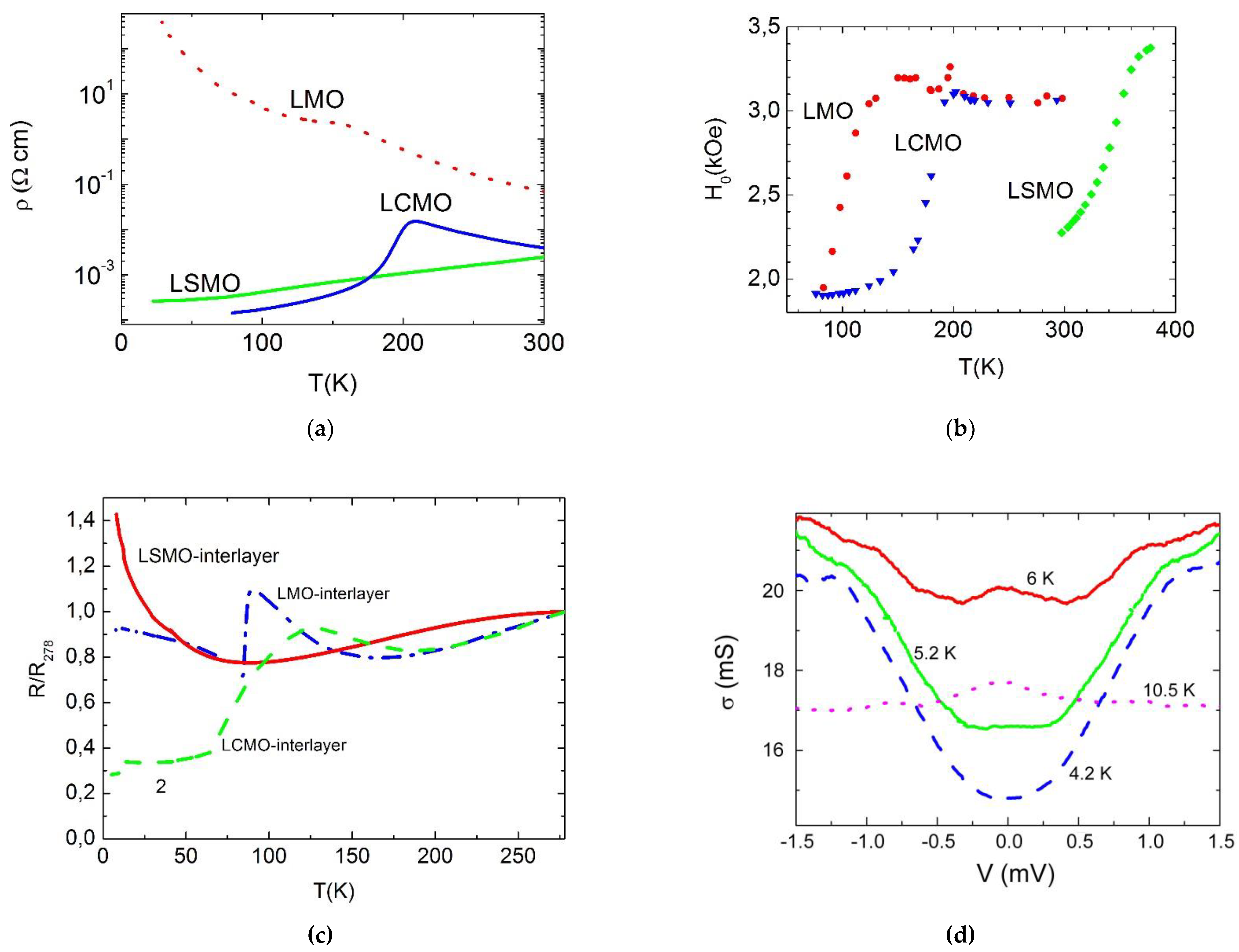
Figure 3.
C-MS: (a) Temperature dependence of R(T) C-MS for L=10 µm, dLSMO=3 nm dSRO=5.5 nm, (b) Temperature dependence of critical current IC(T). (c) Size-L dependence of characteristic resistance RNS for 15 C-MS indicating reproducibility of the samples. (d) Critical current density jc dependence on dLSMO for fixed dSRO=4.5-23 nm. Adopted from [31,34].
Figure 3.
C-MS: (a) Temperature dependence of R(T) C-MS for L=10 µm, dLSMO=3 nm dSRO=5.5 nm, (b) Temperature dependence of critical current IC(T). (c) Size-L dependence of characteristic resistance RNS for 15 C-MS indicating reproducibility of the samples. (d) Critical current density jc dependence on dLSMO for fixed dSRO=4.5-23 nm. Adopted from [31,34].
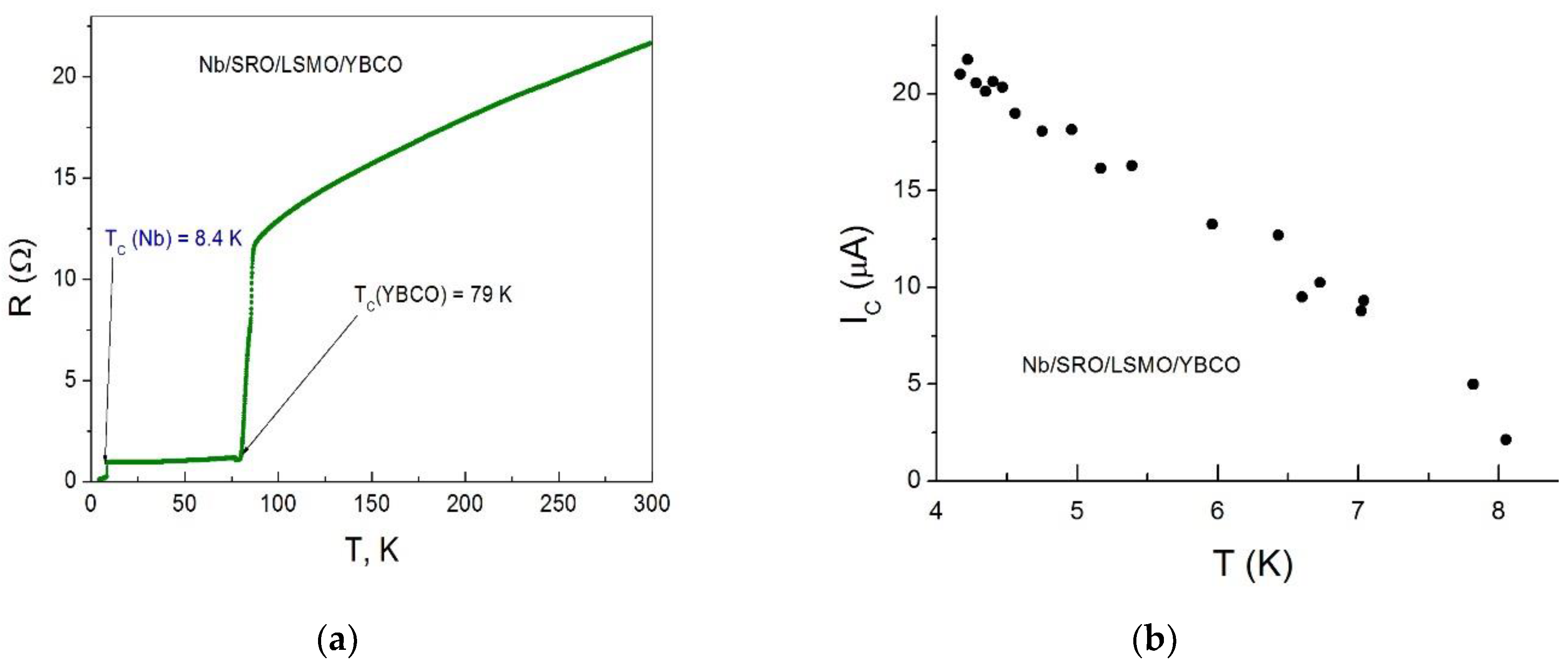
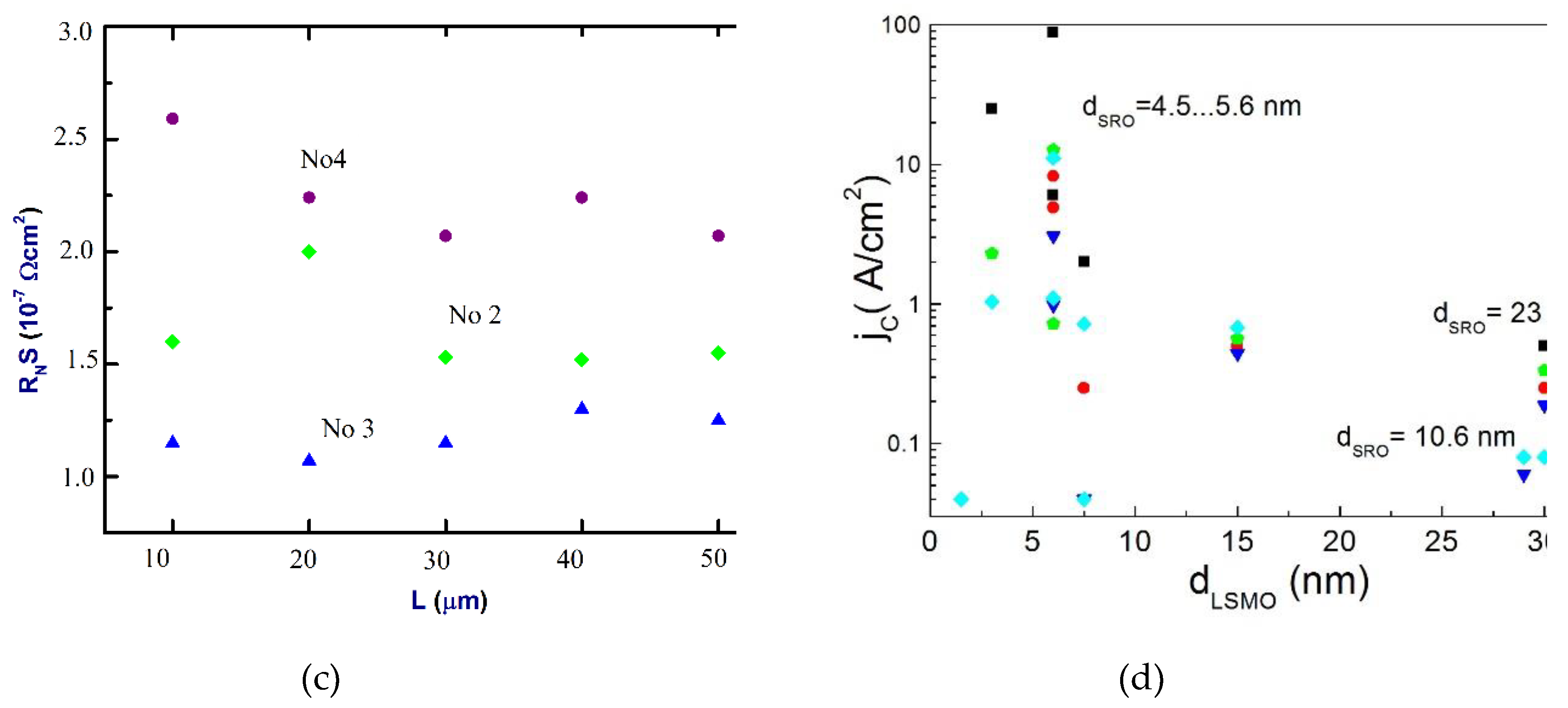
Figure 4.
S-MS d = 7 nm: (a) I-V curve and current dependence of differential resistance dV/dI(I). The critical current IC is determined by the local maxima of dV/dI. (b) Singularities on RD =dV/dI (V) caused by the energy gap of the Nb electrode shown by arrow at T = 4.2 and 8.4 K. (c) Temperature dependences of the normalized critical current IC and gap voltage VΔ. A solid line is the BCS dependence of the energy gap vs. temperature. (d) Voltage dependence of conductivity G(V) for S-MS with L = 40μm at temperatures T = 4.2 and T=15.3 K. Adopted from [64].
Figure 4.
S-MS d = 7 nm: (a) I-V curve and current dependence of differential resistance dV/dI(I). The critical current IC is determined by the local maxima of dV/dI. (b) Singularities on RD =dV/dI (V) caused by the energy gap of the Nb electrode shown by arrow at T = 4.2 and 8.4 K. (c) Temperature dependences of the normalized critical current IC and gap voltage VΔ. A solid line is the BCS dependence of the energy gap vs. temperature. (d) Voltage dependence of conductivity G(V) for S-MS with L = 40μm at temperatures T = 4.2 and T=15.3 K. Adopted from [64].
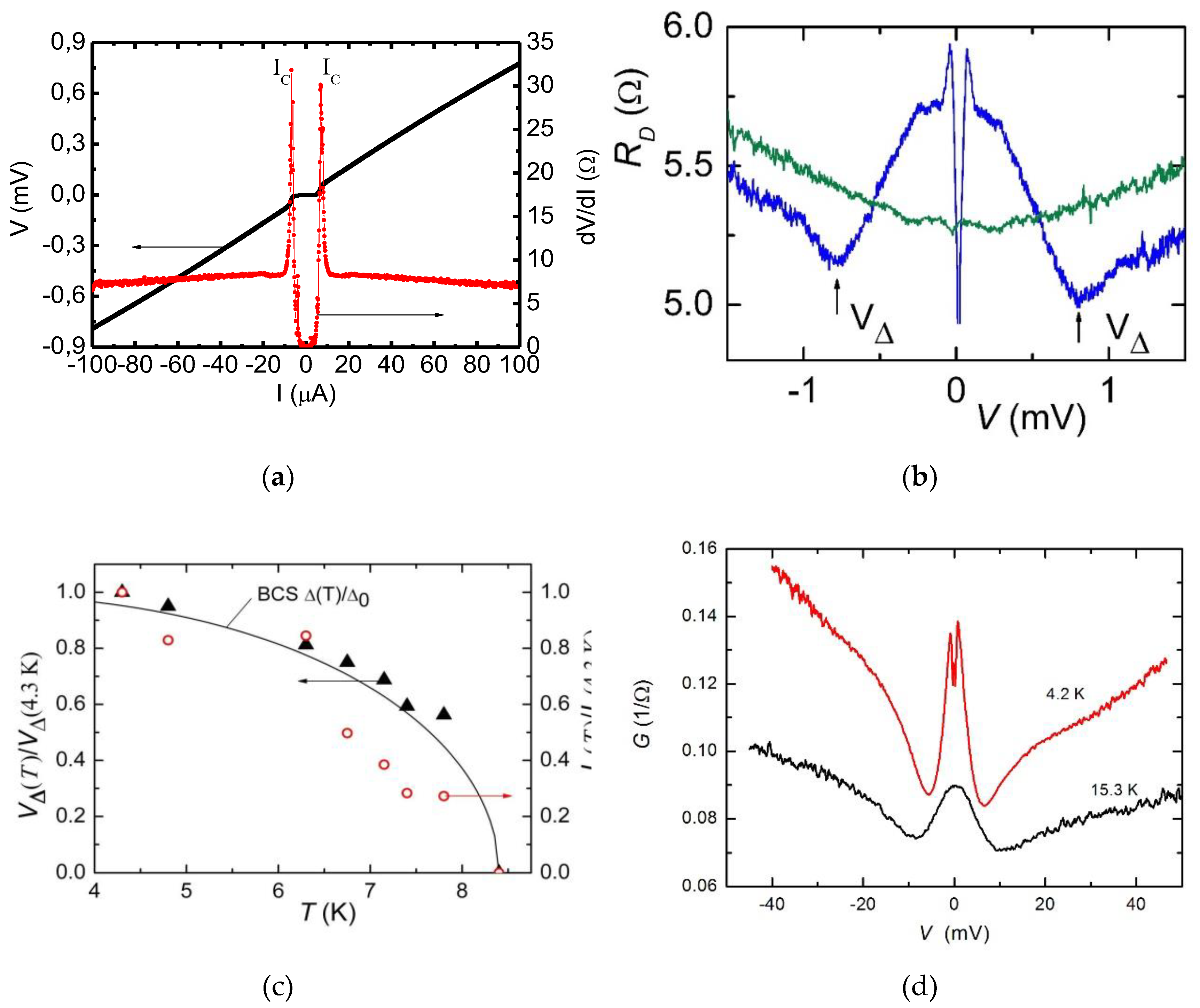
Figure 5.
(a) Magnetic field dependence of the in-plane magnetic moment at the two temperatures at T=80 K and T=200 K for Au/LSMO/SRO/YBCO/LAO heterostructure. (b) The same dependence at T = 100 K for magnetic field applied normal to the substrate surface. Adopted from [32].
Figure 5.
(a) Magnetic field dependence of the in-plane magnetic moment at the two temperatures at T=80 K and T=200 K for Au/LSMO/SRO/YBCO/LAO heterostructure. (b) The same dependence at T = 100 K for magnetic field applied normal to the substrate surface. Adopted from [32].
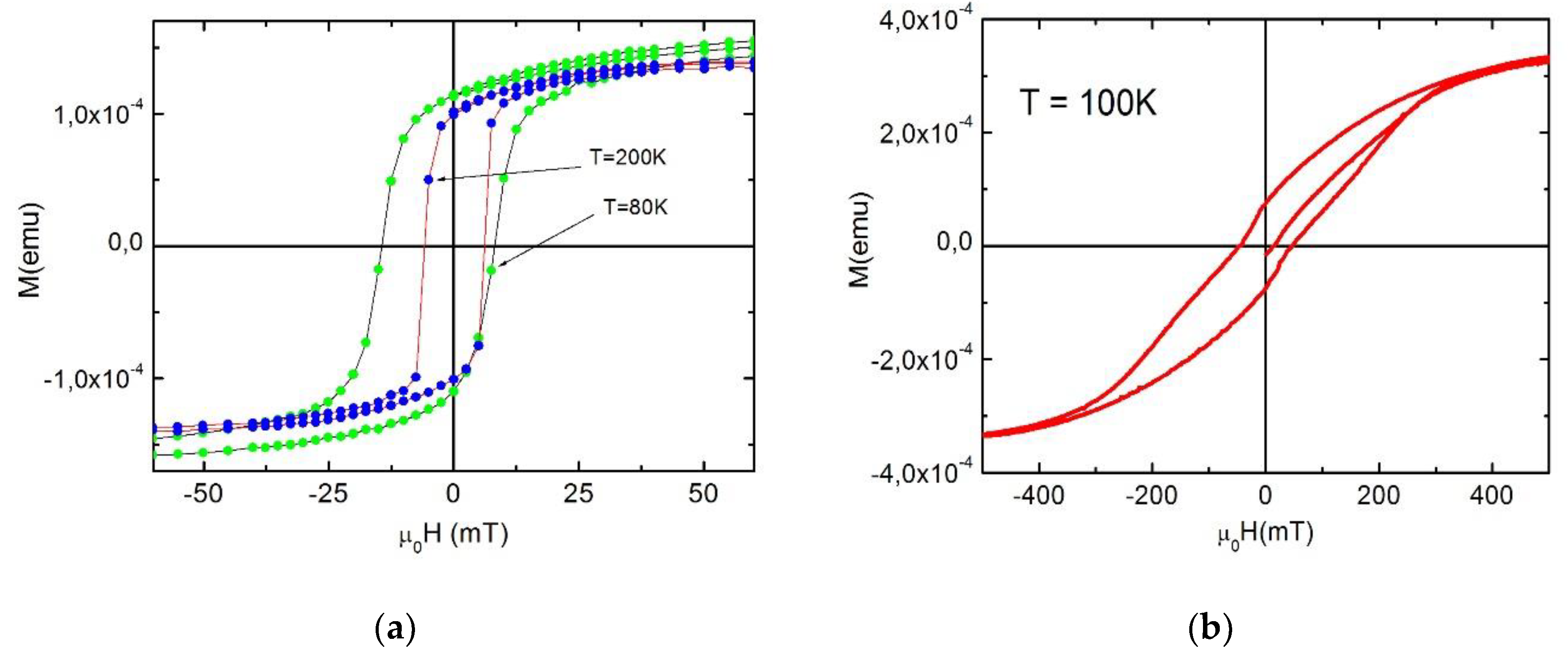
Figure 6.
(a) Magnetic field dependence of critical current for С-MS. (b) Magnetic field dependence of critical current of S-MS for two direction of current biasing. An asymmetry of IC is clearly observed. Adopted from [34,80,81].
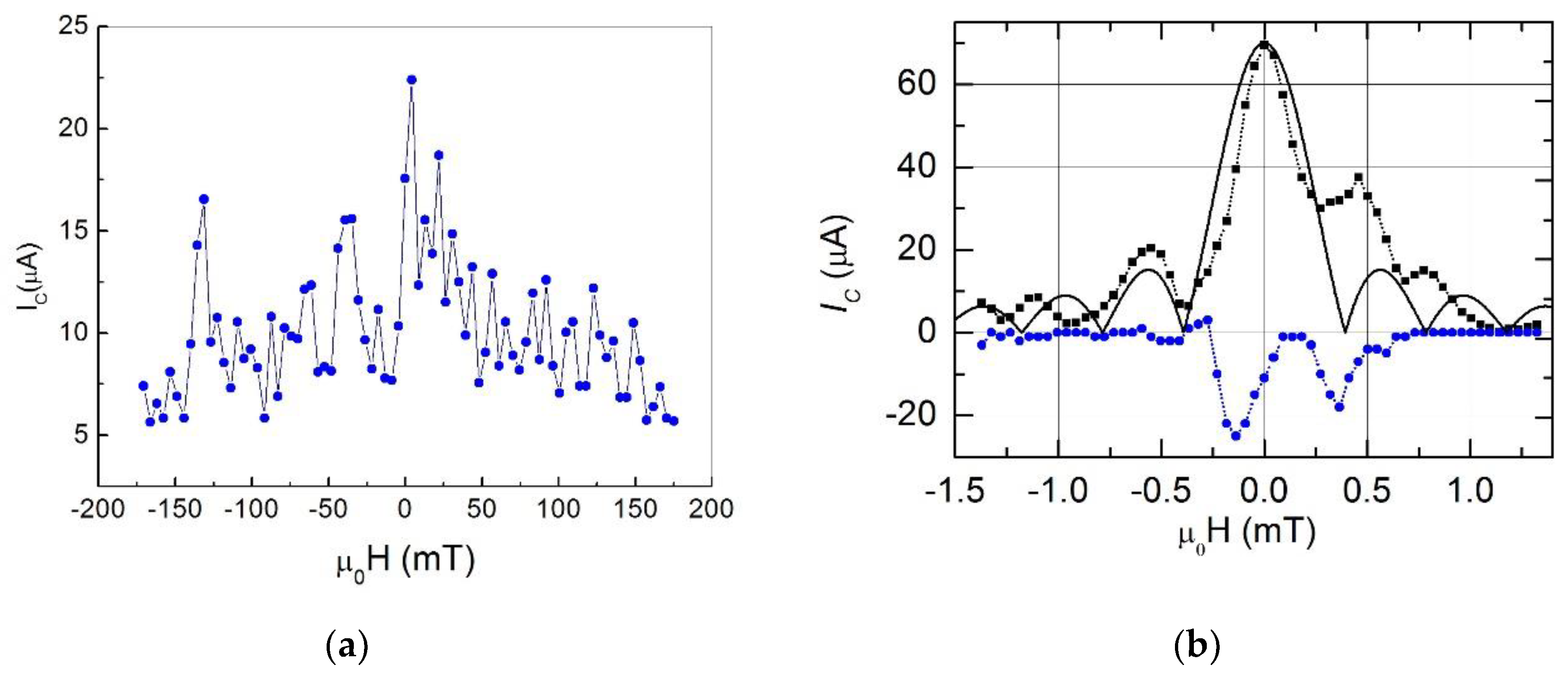
Figure 7.
(a) Integer and fractional Shapiro steps in the I-V curves if monochromatic high frequency (41 GHz) radiation is applied. (b) Second harmonic of the superconducting current-phase relation |q|=Ic2/Ic1= -0.13 is calculated within Modified Resistive Shunted Junction (MRSJ) model [31,36].
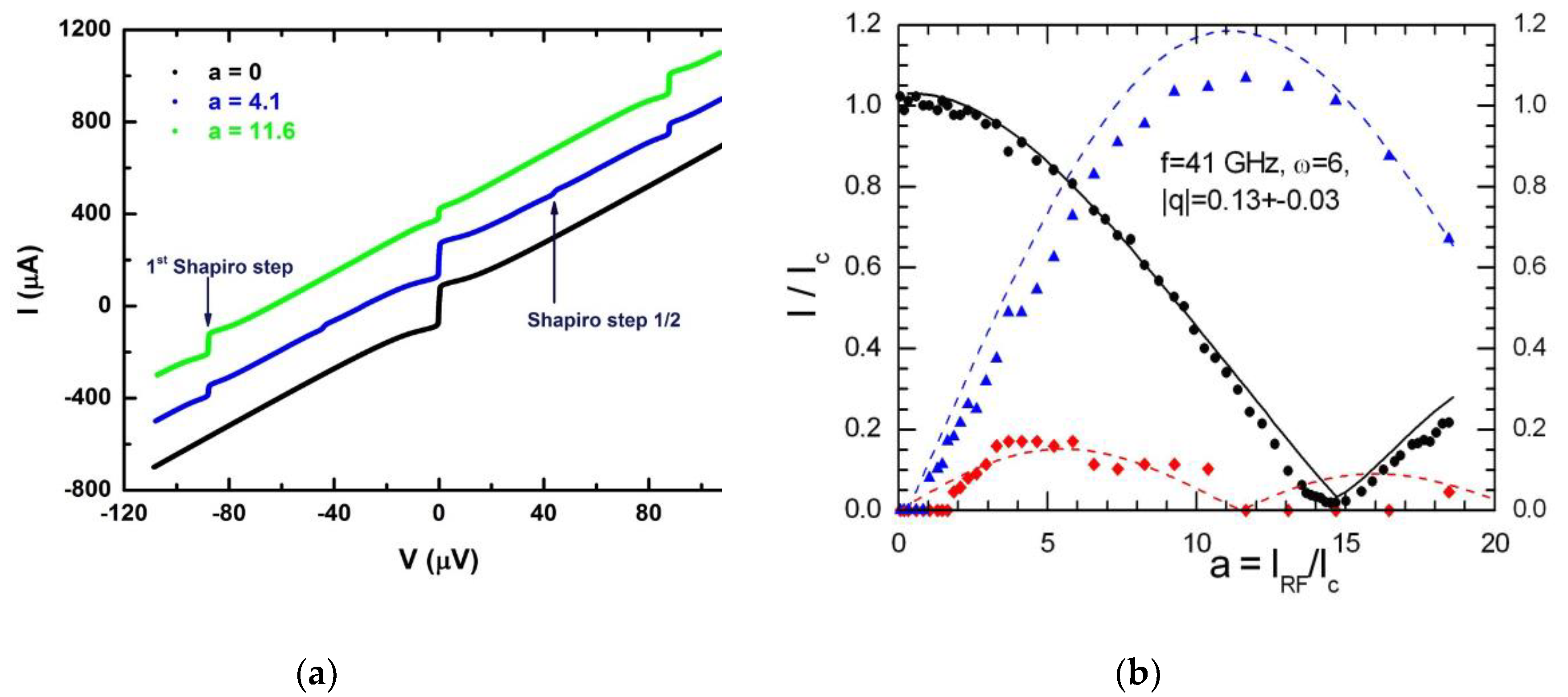
Figure 8.
(a) Differential resistance RD normalized to RN versus voltage V under electromagnetic radiation at f =50.09 GHz for S-MS with L = 40 μm with a shift along the ordinate axis and an attenuator introduced decay in the radiation power P from 30 dB and further from 20 to 8 dB with a step of 1 dB. Arrows point Shapiro step numbers N, N=0 corresponds to the critical current. The top curve was measured without microwave radiation; (b) I-V curve and detector response at 50 GHz for S-MS with d=5 nm. Adopted from [80].
Figure 8.
(a) Differential resistance RD normalized to RN versus voltage V under electromagnetic radiation at f =50.09 GHz for S-MS with L = 40 μm with a shift along the ordinate axis and an attenuator introduced decay in the radiation power P from 30 dB and further from 20 to 8 dB with a step of 1 dB. Arrows point Shapiro step numbers N, N=0 corresponds to the critical current. The top curve was measured without microwave radiation; (b) I-V curve and detector response at 50 GHz for S-MS with d=5 nm. Adopted from [80].
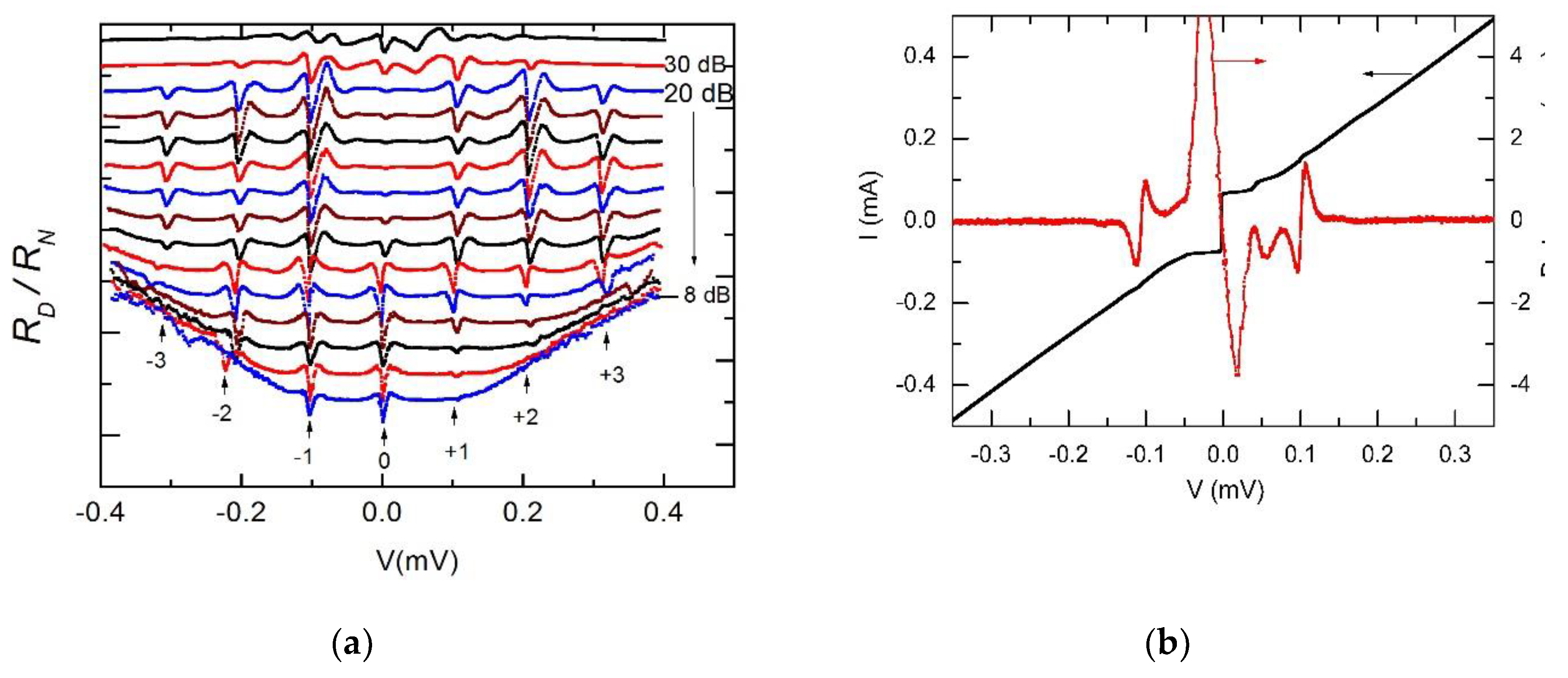
Figure 9.
(a)I-V curve (black), and RD(V) (red) plotted at H= -2.7 Oe. Arrows point on Fiske resonance voltage positions for k=1; (b) Average critical current IC = (IC+ + IC–)/2 (squares) and amplitude of Fiske steps I+1(H) versus magnetic field for k = +1 at V = +39 μV with theoretical Fraunhofer curve IC(H) (solid line); (c) The normalized by k the LVk product vs. size L. Red symbols correspond to Fiske number k=1, blue to k=2. d)Fiske steps in the H–V plane with their numbers k. Adopted from [80,81].
Figure 9.
(a)I-V curve (black), and RD(V) (red) plotted at H= -2.7 Oe. Arrows point on Fiske resonance voltage positions for k=1; (b) Average critical current IC = (IC+ + IC–)/2 (squares) and amplitude of Fiske steps I+1(H) versus magnetic field for k = +1 at V = +39 μV with theoretical Fraunhofer curve IC(H) (solid line); (c) The normalized by k the LVk product vs. size L. Red symbols correspond to Fiske number k=1, blue to k=2. d)Fiske steps in the H–V plane with their numbers k. Adopted from [80,81].
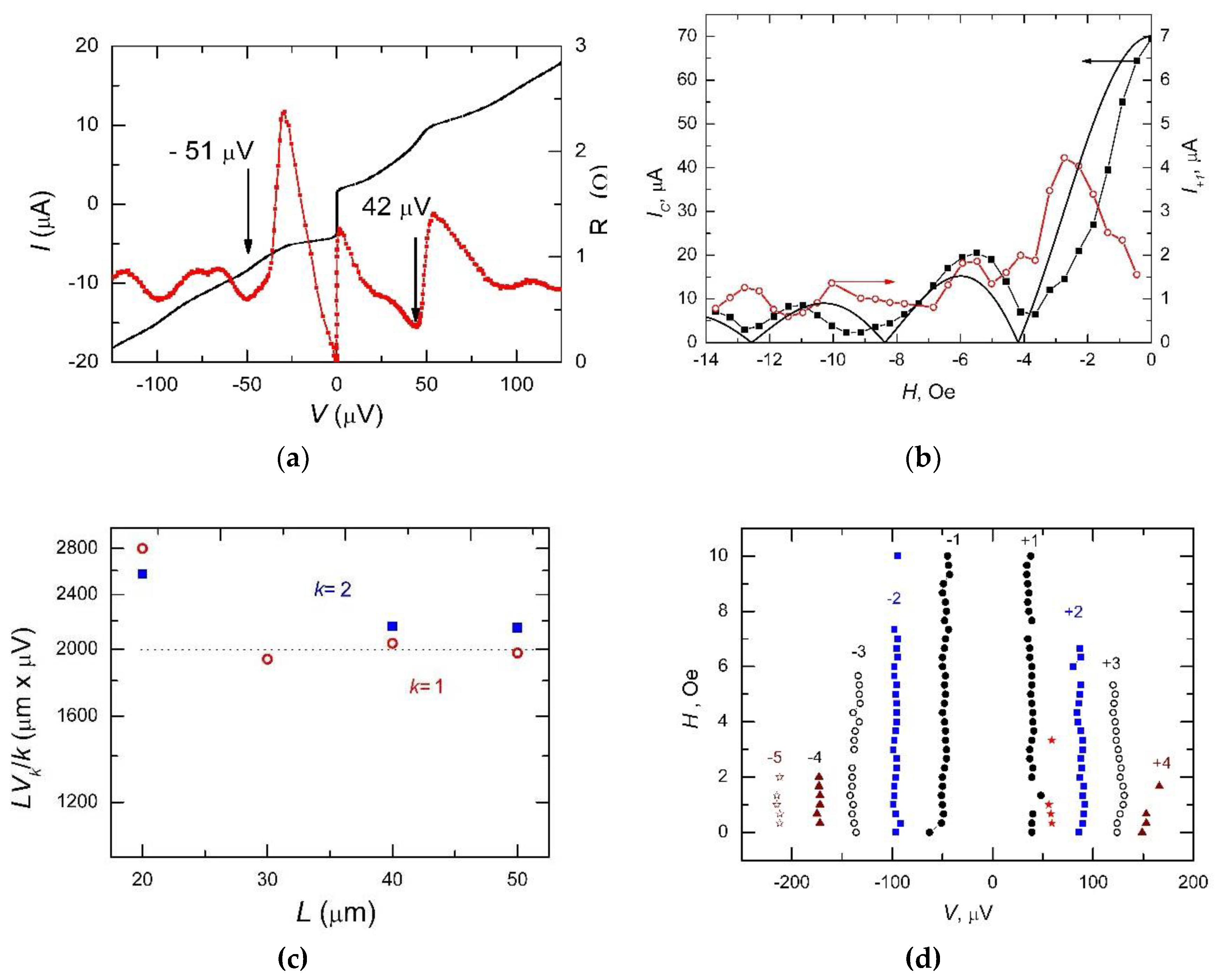
Figure 10.
(a) Normalized amplitudes of the first i1=I1(a)/IC(0) Shapiro step. Theoretical curves were calculated taking a=IMW/IC as a fitting parameter for ratios q= IC2/IC1=0, 0.3, 0.5, 1 and McCumber parameter βC=1. Error bar is indicated by ±Δi1 ; (b) Normalized amplitudes of half-integer Shapiro steps i1/2=I1/2(a)/IC(0). Error bar is indicated by ±Δi1/2. Theoretical curves were calculated for q= 0.2, 0.3, 0.5, 1 and βC=1. Adopted from [80,81].
Figure 10.
(a) Normalized amplitudes of the first i1=I1(a)/IC(0) Shapiro step. Theoretical curves were calculated taking a=IMW/IC as a fitting parameter for ratios q= IC2/IC1=0, 0.3, 0.5, 1 and McCumber parameter βC=1. Error bar is indicated by ±Δi1 ; (b) Normalized amplitudes of half-integer Shapiro steps i1/2=I1/2(a)/IC(0). Error bar is indicated by ±Δi1/2. Theoretical curves were calculated for q= 0.2, 0.3, 0.5, 1 and βC=1. Adopted from [80,81].
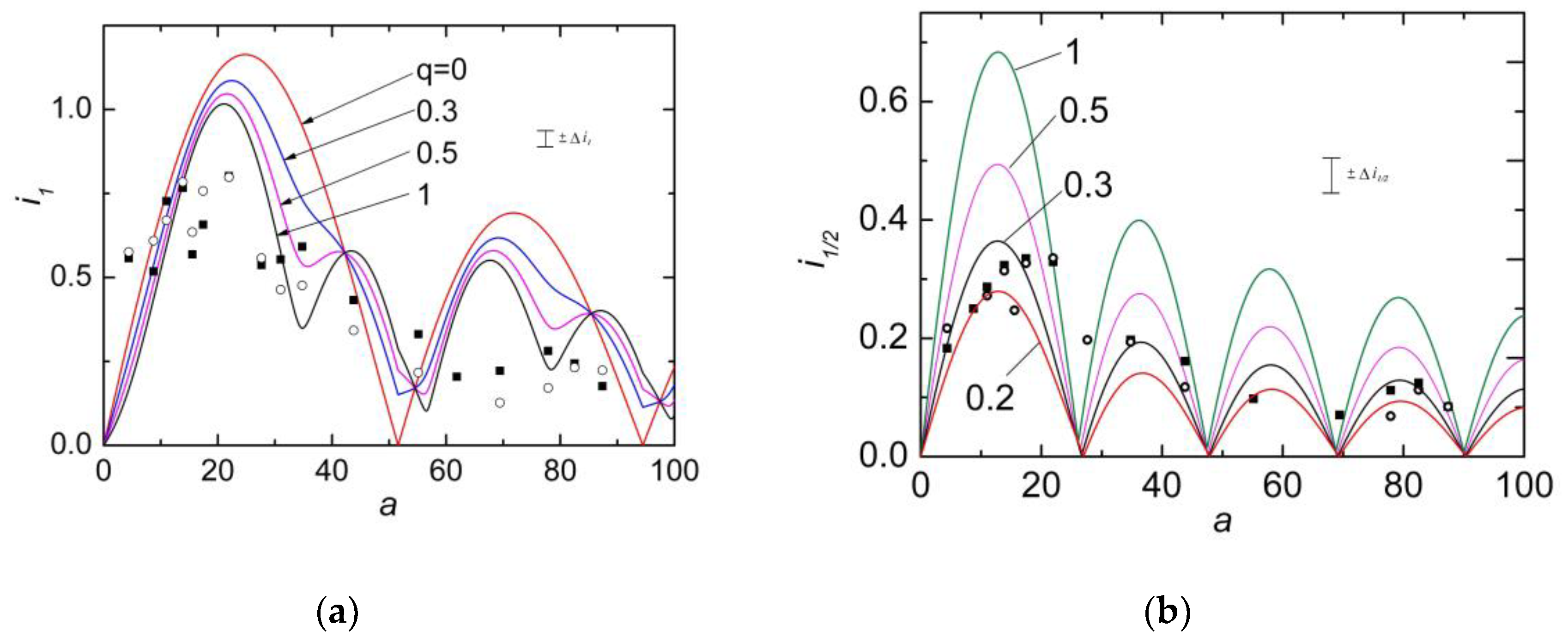

Table 1.
DC parameters of C-MS.
| Number | dSRO, nm | dLSMO, nm | L, μm | RNS, μΩcm2 | jC A/cm2 |
|---|---|---|---|---|---|
| 1 | 14 | 0 | 20 | 0.11 | 0 |
| 2 | 0 | 2 | 20 | 120 | 0 |
| 3 | 4.5 | 3 | 50 | 0.45 | 0.75 |
| 4 | 8.5 | 3 | 10 | 0.13 | 25 |
| 5 | 8.5 | 6 | 10 | 0.16 | 88 |
| 6 | 5.6 | 15 | 50 | 0.20 | 1.1 |
| 7 | 10 | 9 | 30 | 0.15 | 2.2 |
dSRO and dLSMO are the thicknesses of the SRO and LSMO films correspondingly; L is the linear size of the C-MS, jc is the critical current density, RN is the normal resistance, and S = L2 is the C-MS area.
Table 2.
DC parameters of S-MS with thickness of SIO interlayer dSIO=7 nm.
| Number | L, μm | RNS, μΩcm2 | jC, A/cm2 | ICRN,μV | λJ,μm |
|---|---|---|---|---|---|
| 1 | 50 | 125 | 0.75 | 32 | 725 |
| 2 | 40 | 114 | 25 | 43 | 600 |
| 3 | 30 | 94 | 88 | 31 | 645 |
| 4 | 20 | 83 | 13 | 10 | 1065 |
L is the linear size of mesa-structures, jc is the critical current density, RN is the normal resistance, and S = L2 is the mesa-structure area.
Disclaimer/Publisher’s Note: The statements, opinions and data contained in all publications are solely those of the individual author(s) and contributor(s) and not of MDPI and/or the editor(s). MDPI and/or the editor(s) disclaim responsibility for any injury to people or property resulting from any ideas, methods, instructions or products referred to in the content. |
© 2023 by the authors. Licensee MDPI, Basel, Switzerland. This article is an open access article distributed under the terms and conditions of the Creative Commons Attribution (CC BY) license (http://creativecommons.org/licenses/by/4.0/).
Copyright: This open access article is published under a Creative Commons CC BY 4.0 license, which permit the free download, distribution, and reuse, provided that the author and preprint are cited in any reuse.


