

Submitted:
04 May 2023
Posted:
05 May 2023
You are already at the latest version
Abstract
This comprehensive treatise is written for the special occasion of the author’s 70th birthday. It presents his lifelong endeavors and reflections with original reasoning and re-interpretations of the most critical and misleading issues in thermodynamics; since now, we have the advantage to look at the historical developments more comprehensively and objectively than the pioneers. Starting from Carnot (grand-father of thermodynamics-to-be) to Kelvin and Clausius (fathers of thermodynamics), and other followers, the most relevant issues are critically examined and put in historical and contemporary perspective. From original reasoning of energy forcing and displacement to logical-proofs of the fundamental laws, to ubiquity of thermal motion and heat, and indestructibility of entropy, including new concept of “thermal roughness” and inevitability of dissipative irreversibility, to “dissecting Carnot true reversible-equivalency” and critical concept of “Carnot-Clausius heat-work equivalency (CCHWE)” regarding interchangeability of heat and work, and to demonstrating “no hope” for the “challengers” of the Second Law of thermodynamics, among others, are offered. It is hoped that the novel contributions presented will enhance comprehension and resolve some of the fundamental issues, as well as promote collaboration and future progress.
Keywords:
Thermodynamics
; Fundamental Laws
; Second Law of Thermodynamics
; Carnot Equality
; Carnot-Clausius Heat-Work Equivalency
; Thermal Roughness
; Irreversibility
; Work Potential and Exergy
; Perpetual Motion Machines
1. Introduction
♦ ♦ ♦
“If your theory is found to be against the second law of thermodynamics, I give you no hope; there is nothing for it but to collapse in deepest humiliation.” – Arthur Eddington
Impasse: “Perhaps, after all, the wise man's attitude towards thermodynamics should be to have nothing to do with it. To deal with thermodynamics is to look for trouble.”
Anecdotal Laws of Thermodynamics (LT) [bracketed terms added]:♦[0LT]: You must play the game [equilibrium]. ♦[1LT]: You can't win [conservation]. ♦[2LT]: You can't break even [dissipation]. ♦[3LT]: You can't quit the game [0K impossible]. –Thermodynamics-WikiQuote
“The Second Law of thermodynamics can be challenged, but not violated - Entropy can be decreased, but not destroyed at any space or time scales. […] The self-forced tendency of displacing nonequilibrium useful-energy towards equilibrium, with its irreversible dissipation to heat, generates entropy, the latter is conserved in ideal, reversible processes, and there is no way to self-create useful-energy from within equilibrium alone, i.e., no way to destroy entropy.” –[2ndLaw.mkostic.com]
This treatise aims to present the lifelong endeavors and reflections, including additional, original reasoning and interpretations by this author, regarding the fundamental issues of Thermodynamics and especially as related to the subtle Second Law of Thermodynamics (2LT) [1]. It is written for the Special Issue of Entropy journal dedicated to this author’s 70th Birthday [2].
Science and technology have evolved over time on many scales and levels, so we now have the advantage to look at its historical developments more comprehensively and objectively than the pioneers. As Anthony Legget, a Nobel laureate, commented [3], “Mathematical convenience versus physical insight […] that theorists are far too fond of fancy formalisms which are mathematically streamlined but whose connection with physics is at best at several removes […] heartfully agreed with Philippe Nozieres that ‘only simple qualitative arguments can reveal the fundamental physics’.” In that regard, mostly physical and simple qualitative insights will be examined and emphasized here.
The goal has been to examine and scrutinize the ambiguous and challenging issues in thermal science and to present some novel contributions, with the hope to resolve a number of unsettled issues, and to encourage constructive criticism and collaboration for further progress. More specific and elaborate publications by this author and others are anticipated in the future.
In addition to the original interpretations, the following, more specific and novel concepts are offered here: synergy of conjugate energy forcing-and-displacement; logical-proof of the fundamental laws; inevitable thermal-roughness concept; unfeasibility of entropy destruction; Carnot-Clausius heat-work equivalency; the impossibility of the 2LT violation at any space and time scale (for which ThD macro-properties are defined), without exception, among others.
The diverse and perplexing terminology and definitions (in different branches of science) contribute to further ambiguity and confusion, and sometimes misunderstanding. Due to the lack and inadequacy of specific scientific vocabulary, some thermodynamic terminology is emphasized and synergized here by uncommon connotations, by using “dashed-attributes” with the respective nouns, “quoting words” and similar, in order to emphasize thermodynamic-meaning, as distinction from the meaning of the common terminology. The selected assertions are emphasized throughout this treatise under “Key-Points” while questionable (deficient) statements and misrepresentations are underscored as “Challenge-Points” and “False-Points,” respectively.
Thermodynamics, as the science of energy and entropy, is the most fundamental discipline, and as such, it encompasses all existence in space and transformations in time, in nature. Due to the complexity of the diverse natural and artificial systems and processes, the fundamental laws often appear elusive and sometimes mystified. It is hoped that the logical reasoning presented here will contribute to improved comprehension of the fundamental concepts and related laws of thermodynamics and nature.
The fundamental Laws of Thermodynamics (LT) are the fundamental laws of nature, and they are considered to be axiomatic and experiential without proof, as never experienced otherwise, or as self-evident postulates. Due to the very complex micro- and macro-structures and their intricate interactions, it would be impossible to deterministically prove the Laws, but they could be reasoned logically, and their general validity inferred in principle, as it will be deduced here.
Since all existence is in principle mechanistic and physical, it will be demonstrated here that the LT are generalized extensions of the fundamental Newton’s Laws (NL) of mechanics. The First Law of Thermodynamics (1LT) is the generalized law of the conservation of energy, and the Second Law of Thermodynamics (2LT) describes the forcing tendency of nonequilibrium, useful-energy (or work-potential, WP) for its displacement and irreversible dissipation to heat with entropy generation, towards mutual equilibrium.
The content of this treatise is presented in several Sections. In the next Section . 2, “Energy forcing and displacement,” the related concepts are pondered. The “force or forcing” is nonequilibrium energy tendency to displace or redistribute (or to extend) from its higher to lower energy density (or energy-intensity) towards mutual equilibrium with uniform properties. Then, the Section 3, “Reasoning logical-proof of the fundamental laws,” reveals the concept of energy displacement as the mechanistic phenomenon in general, where the elementary particles (including “field-equivalent” particles) or bulk systems (consisting of elementary particles), mutually interact along shared displacement (with equal, respective action-reaction forces), thereby conserving energy during their interactive, mutual displacement. Then, in Section 4, “Ubiquity of thermal motion and heat, thermal roughness, and indestructability of entropy,” this author’s comprehension of related phenomena is further advanced by defining concept of “thermal roughness” and reasoning impossibility of entropy destruction, among others. In Section 5, “Carnot maximum efficiency, reversible equivalency, and work potential,” the Sadi Carnot’s ground-breaking contributions of reversible processes and heat-engine cycles’ maximum-efficiency is put in historical and contemporary perspective, and it is argued that the Carnot’s contributions are among the most important developments in natural sciences. In the succeeding Section 6, named here “Carnot-Clausius Heat-Work Equivalency” concept, a notion of true “heat-work interchangeability,” is articulated and named here, as an essential consequence of “true” reversible equivalency. Lastly, Section 7, “‛No Hope’ for the Challengers of the Second Law of thermodynamics,” presents this author’s compelling arguments that “entropy can be reduced (locally, when heat is transferred out of a locality), but it cannot be destroyed by any means on any space or time scale of interest.” Entropy, as the “final transformation” cannot be converted to anything else nor annihilated, but only transferred with heat and irreversibly generated with heat generation due to work dissipation, including Carnot “thermal work-potential” dissipation. Relevant conclusions are presented at the end.
Selected Abbreviations and Notes (in logical order for usage convenience):
ThD: Thermodynamics (Carnot’s concept of “maximum power [work] from heat” in 1824, name coined in 1854 by William Thompson, named Lord Kelvin).
ThM: Thermal motion (“vis-viva”: Lomonosov 1738, Count Rumford (Benjamin Thompson) 1798, Brown 1827, Clausius 1857, Maxwell & Boltzmann 1859).
ThT: Thermodynamic (absolute) temperature (1848 W. Thompson (Lord Kelvin): based on the Carnot concept via the IG derivation).
ThP; Thermal Particles are conserved physical particles, like atoms, molecules, electrons, and similar, that undergo thermal interactions via chaotic thermal-motion and collisions.
ThVP; Thermal Virtual-Particles [as named here] are non-conserved dynamic particles (as opposed to physical ThP) and they increase with entropy increase, i.e., with increase of thermal randomness of the physical-ThP.
NThVP: Number of Thermal Virtual-Particles, ThVP.
nth: Number of thermal moles is the number of ThVP per the Avogadro’s number, i.e., nth= NThVP/NA.
Self- or spontaneous is a self-driven process within the interacting systems, without any external forced-influence, i.e., without any “external compensation.”
Dissipation is any “frictional” conversion of work or work-potential (WP) into heat or thermal energy, with diminished remaining useful WP, resulting in irreversible energy degradation and commensurate entropy generation.
Irreversibility is “irreversible transformation”, or something permanently changed, without possibility to fully (or “truly”) reverse all interacting systems back by any means. It should not be confused with local change back to the original condition by “compensation” from elsewhere [4].
Thermal-Roughness (and Thermal friction) [as named here] are the underlying cause and source of unavoidable irreversibility (2LT) since absolute-0K temperature is unfeasible (3LT), i.e., perpetual, real “smooth surface” is impossible due to perpetual and unavoidable, dynamic ThM of ThP.
Reversibility or Reversible Equivalency is an ideal concept, represented by ideal processes without any energy degradation (with maximum possible efficiency or without irreversible dissipation) so that their output and input are truly-equivalent and may self-reverse-back completing a cycle, or may perpetually repeat back-and-forth in any manner, therefore, effectively representing “dynamic (quasi-) equilibrium” [5].
Carnot cycle is an ideal, reversible cycle (with maximum possible, 100% 2LT-efficiency) consisting of reversible heat transfers and isentropic work transfers, extracting maximum WP between the two reservoirs at high and low temperatures. Therefore, as the ‘work-extraction measuring-device’, its cyclic-efficiency is the measure of the WP between the two reservoirs only, i.e., it is dependent on the two temperatures only, and it is not dependent on its design or mode of operation (independent on the quasi-stationary cyclic path or any other, reversible stationary-process-path).
CtEf: Carnot Efficiency (a.k.a. Carnot Cycle Theorem) is the maximum possible, reversible cycle-efficiency interacting within the high-and-low temperature reservoirs (ηmax=ηC=WC/QH=[1-QL/QH]rev =FC(TH,TL)=1- TL/TH).
CtEq: Carnot Equality [as named here, to resound the integral Clausius Equality, being its precursor] is the heat-temperature ratio equality for reversible cycles between any two thermal reservoirs (QL/QH = TL/TH, or QH/TH =QL/TL=Qref/Tref =Q/T=constant).
CsEq: Clausius Equality of cyclic-integral for any reversible cycle (Cycle Integral[dQ/T]=0 is deduced from the Carnot Equality, CtEq).
CCHWE: Carnot-Clausius Heat-Work Equivalency,” [as emphasized and named here] is a generalized concept of heat-work interchangeability as an essential consequence of ‘true’ reversible equivalency.
WP: Work-potential or maximum-possible useful-energy of a nonequilibrium system with regard to its reference equilibrium (i.e., Carnot’s motive power of heat, sometimes work for short), or related free-energy, or exergy (where the surrounding reference is standardized).
IG: Ideal gas (PV/(t+C)=k Clapeyron in 1834; PV=nRT Renault in 1845).
1NL: First Newton Law of equilibrium motion or resting inertia.
2NL: Second Newton Law of forced change of momentum or acceleration.
3NL: Third Newton Law of action and equal reaction (duality of balanced forces and conservation of momentum).
0LT: Zeroth Law of Thermodynamics (temperature uniqueness of thermal equilibrium).
1LT: First Law of Thermodynamics or First Law for short (energy conservation; 1843 Joule, 1847 Helmholtz).
2LT: Second Law of Thermodynamics or Second Law for short (nonequilibrium useful-energy dissipation with entropy generation towards equilibrium; 1824 Carnot, 1850 Clausius, 1851 Thompson, 1854 Clausius theorem (dQ/T), 1865 Clausius entropy, 1874 Clausius formal statement of 2LT, 1867 Maxwell’s Demon, 1876 Gibbs free energy in Chemical ThD).
3LT: Third Law of Thermodynamics (impossibility of [thermal] emptiness [impossible absolute-0K nor to stop thermal motion]; 1906 Nernst).
4LT: Forth Law of Thermodynamics (impossibility of evolution forever, “growth without decay” is impossible; selective and self-reproductive evolution is extending inevitable irreversibility. NOTE the 4LT is evolving in many forms and it is still to-be-defined!).
PMM0 or PM: Perpetual-motion machine of the 0th kind (or “Perpetual [free] motion” in short) that violates the irreversible dissipation or friction (impossibility of free perpetual motion without dissipative resistance).
PMM1: Perpetual-motion machine of the 1st kind that violates the 1LT (impossibility of creating energy from nowhere).
PMM2: Perpetual-motion machine of the 2nd kind that violates the 2LT (impossibility of self-creating useful-energy or WP from within equilibrium).
PMM3: Perpetual-motion machine of the 3rd kind that violates the 3LT (impossibility of converting all heat to work since absolute-0K temperature is unachievable).
PMM4: Perpetual-motion machine of the 4th kind that violates the 4LT (impossibility of evolution forever without decay, or similar: NOTE the 4LT is evolving in many forms and it is still to-be-defined!).
2. Energy Forcing and Displacement
Mass-energy of material systems (or energy for short) is nonuniformly distributed (or displaced) within the systems’ energy-space (or displacement space, or displacement or extensity for short), with non-uniform energy-density, i.e., energy per unit of its displacement space (or energy intensity or energy-force, or force for short). The displacement is the energy extensive property, and by definition, it is the conjugate with its energy-force, see Table 1.
There is natural, directional forced-tendency to displace energy from higher to lower intensity and during such a process (displacing energy from higher to lower intensity locality), it equalizes the energy intensity (or energy density) while asymptotically approaching, the stable mutual-equilibrium of balanced forcing and infinitesimal fluxes within all interacting systems.
Namely, an acting particle (or body, a bulk of particles in general) with higher energy density interacting with a body at lower energy density, the two being in non-equilibrium (non-equal energy densities), will act upon to displace its energy (acting body’s energy) onto a resisting (reacting) body, resulting in decreasing acting-body energy and energy-density (“figuratively decelerating”) while increasing the reacting body’s energy and energy-density (“figuratively accelerating”) until the energy density of the interacting bodies equalize and forcing-interactions cease, when mutual state of stable equilibrium is reached, without further energy displacement.
This natural phenomenon is the meaning and origin of forced-tendency (definition of forcing or force), as well as the meaning of the energy-displacement, i.e., description and formulation of the Laws of mechanics and thermodynamics. There is a deep meaning behind the vocabulary and description of the fundamental concepts to be elaborated elsewhere.

Table 1.
Typical Energy Intensive and Extensive Conjugate Properties (Energy-Force and Energy-Displacement).
Table 1.
Typical Energy Intensive and Extensive Conjugate Properties (Energy-Force and Energy-Displacement).
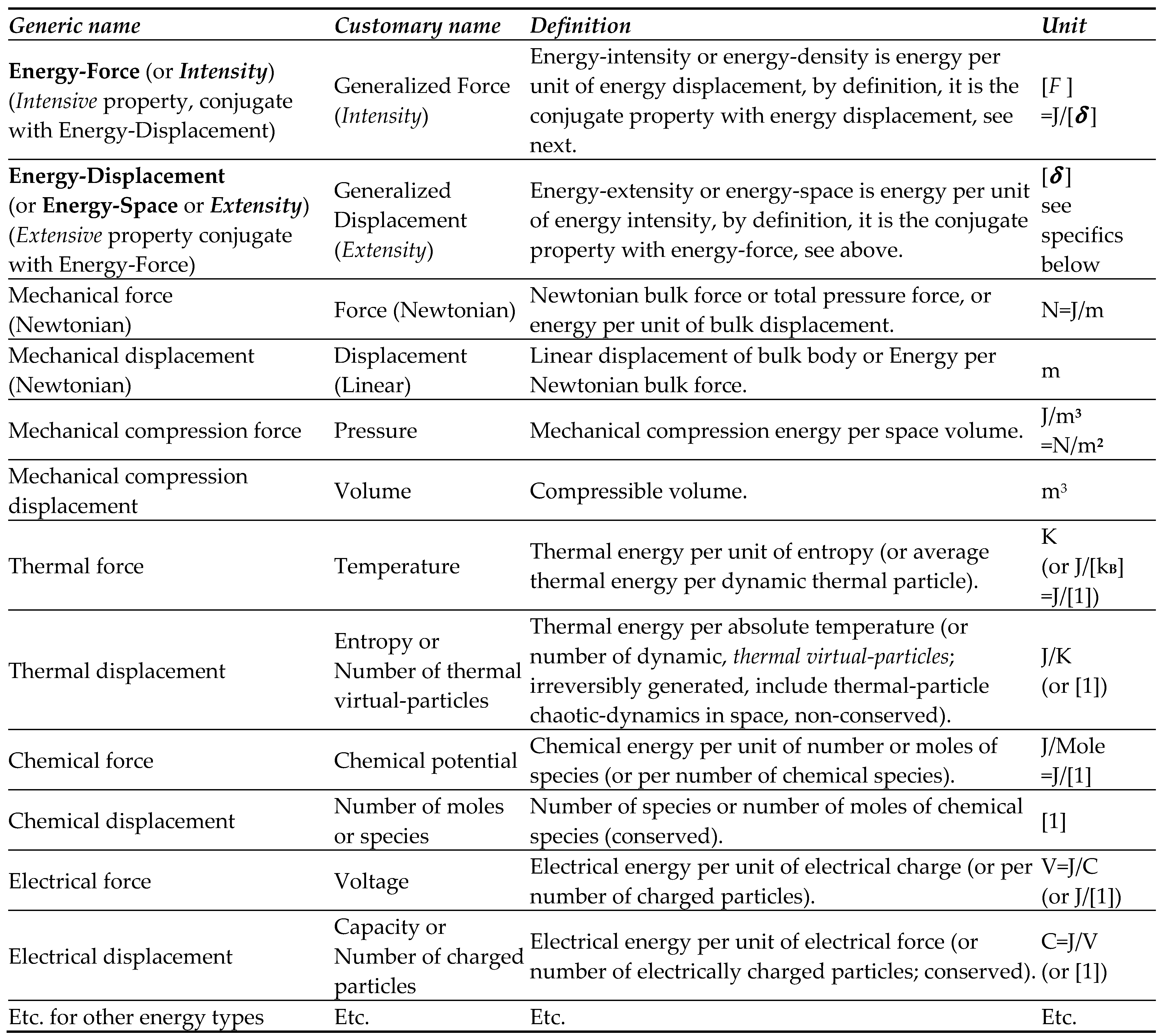
NOTE that all but thermal energy-displacements are conserved, while thermal displacement (entropy or number of thermal virtual-particles, NThVP) is irreversibly generated due to dissipation of all other energy types to heat.
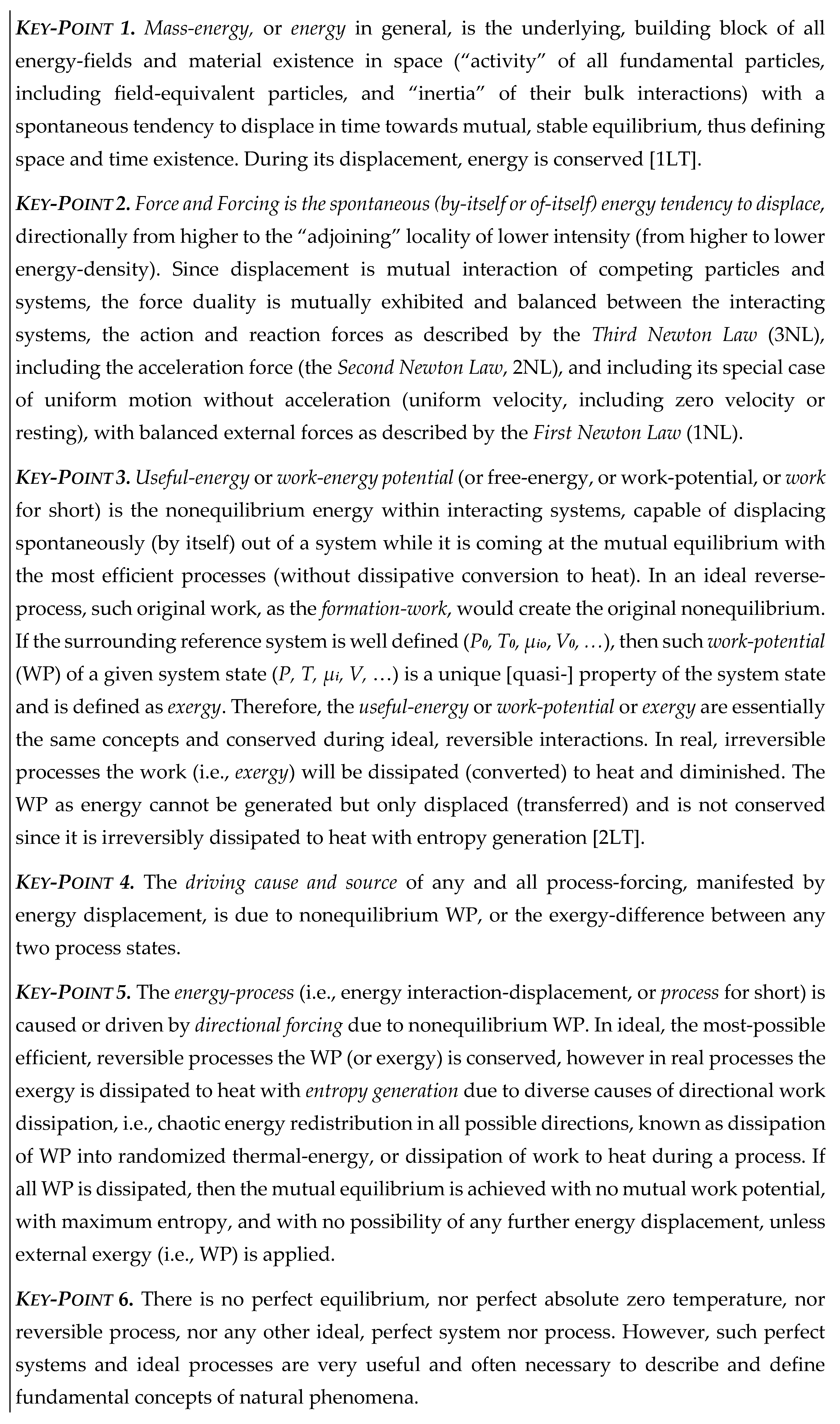
3. Reasoning Logical-Proof of the Fundamental Laws
The two fundamental Laws of Thermodynamics (1LT and 2LT) are believed to be empirical and axiomatic without proof. However, they are mechanistic in nature and in principle are more general consequences of the Newtons’ law of motions, see Figure 1. The three Newton’s Laws (NL) of forces-and-motions are holistic in a sense that the 2NL of motion is also the 3NL of action-reaction-equality when the inertial forces are included, and the 1NL of inertia is a special case of the 2NL when external force is zero.
It may be deduced that, due to equality of acting and reacting forces along the same mutual displacement, the energy transferred by acting-force displacement must be equal to the energy of the opposing, reacting-force displacement — that is, the interactively displaced (or transferred) energy from acting to reacting particle or body will be conserved. In the absence of the opposing reaction-forces there will be no energy transfer. This will be true in general since all elementary and/or bulk interactions are additive, regardless of complexity of system structure or types of interactions (also forced-fields could be represented by relevant “equivalent particles,” like photons, etc.).
Furthermore, it is reasoned here that the energy directional-transfer (2LT) is due to a particle or body forcing-action onto another particle or body resisting to change its existential ‘inertial-state’, by equal reacting force in opposite direction (the 3NL) along a mutual displacement.
As shown on Figure 1, since the Action-force, FA, is balanced by (equal magnitude to) Reaction-force, FR, (the 3NL, including inertial force – the 2NL) along the shared, interaction-displacement, dLA= dLR, then, the amount of “action energy out” would equals to the amount of “reaction energy into”, i.e., the energy is conserved during any and all interactions (First Law of thermodynamics, 1LT):
For “free motion” or “free expansion” no energy transfer (energy is conserved within), i.e.,
Figure 1.
Reasoning Concepts of Forcing and Energy Displacement: Energy of a particle (or equivalent field-particle) [Left] or bulk body [Right] will not change without forced interactions, i.e., Interactive-Forcing (Action-Reaction) and Energy-Displacement (energy transfer-and-conservation). A particle or bulk-body in motion will uniformly move [Left] or freely expand [Right] unless interacting and exchanging energy with another particle or body. Elementary particle or ideal body interactions are reversible, but real, collective bulk-structure interactions of bounded collective-particles are irreversible due to dissipation of collective-bulk, macro-energy within interacting micro-structures made up of interacting particles or equivalent field-particles.
Figure 1.
Reasoning Concepts of Forcing and Energy Displacement: Energy of a particle (or equivalent field-particle) [Left] or bulk body [Right] will not change without forced interactions, i.e., Interactive-Forcing (Action-Reaction) and Energy-Displacement (energy transfer-and-conservation). A particle or bulk-body in motion will uniformly move [Left] or freely expand [Right] unless interacting and exchanging energy with another particle or body. Elementary particle or ideal body interactions are reversible, but real, collective bulk-structure interactions of bounded collective-particles are irreversible due to dissipation of collective-bulk, macro-energy within interacting micro-structures made up of interacting particles or equivalent field-particles.
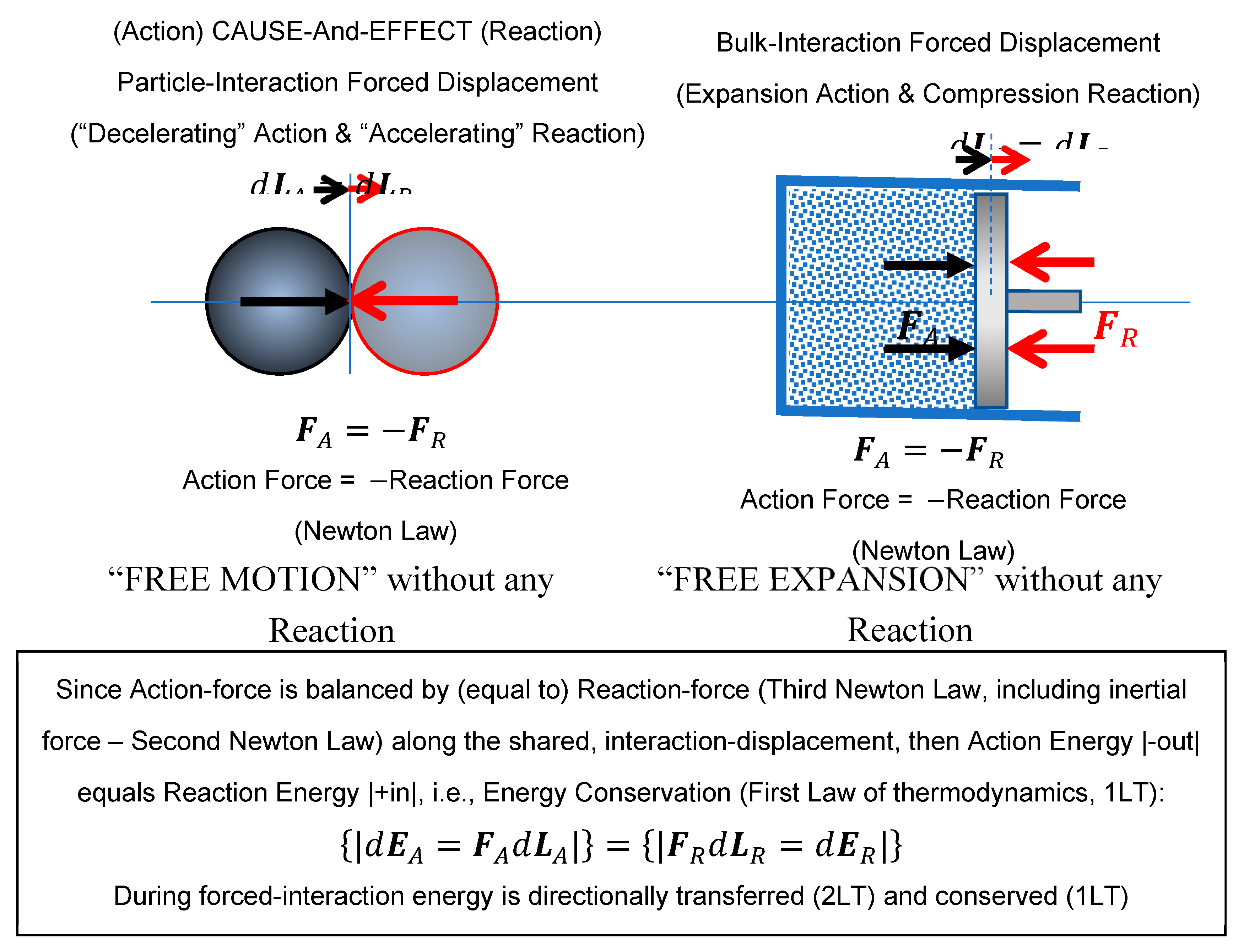
Therefore, during the mutual (shared and equal) displacement the acting body will be transferring its energy onto the reacting body, the two being the same, in principle, the product of equal action and reaction force (including process inertial forces) and equal mutual displacement. Therefore, the directional energy transfer and dissipation (2LT) and energy conservation (1LT), are consequence of the fundamental Newton’s Laws of mechanics, and not empirical as commonly postulated, see Figure 1.
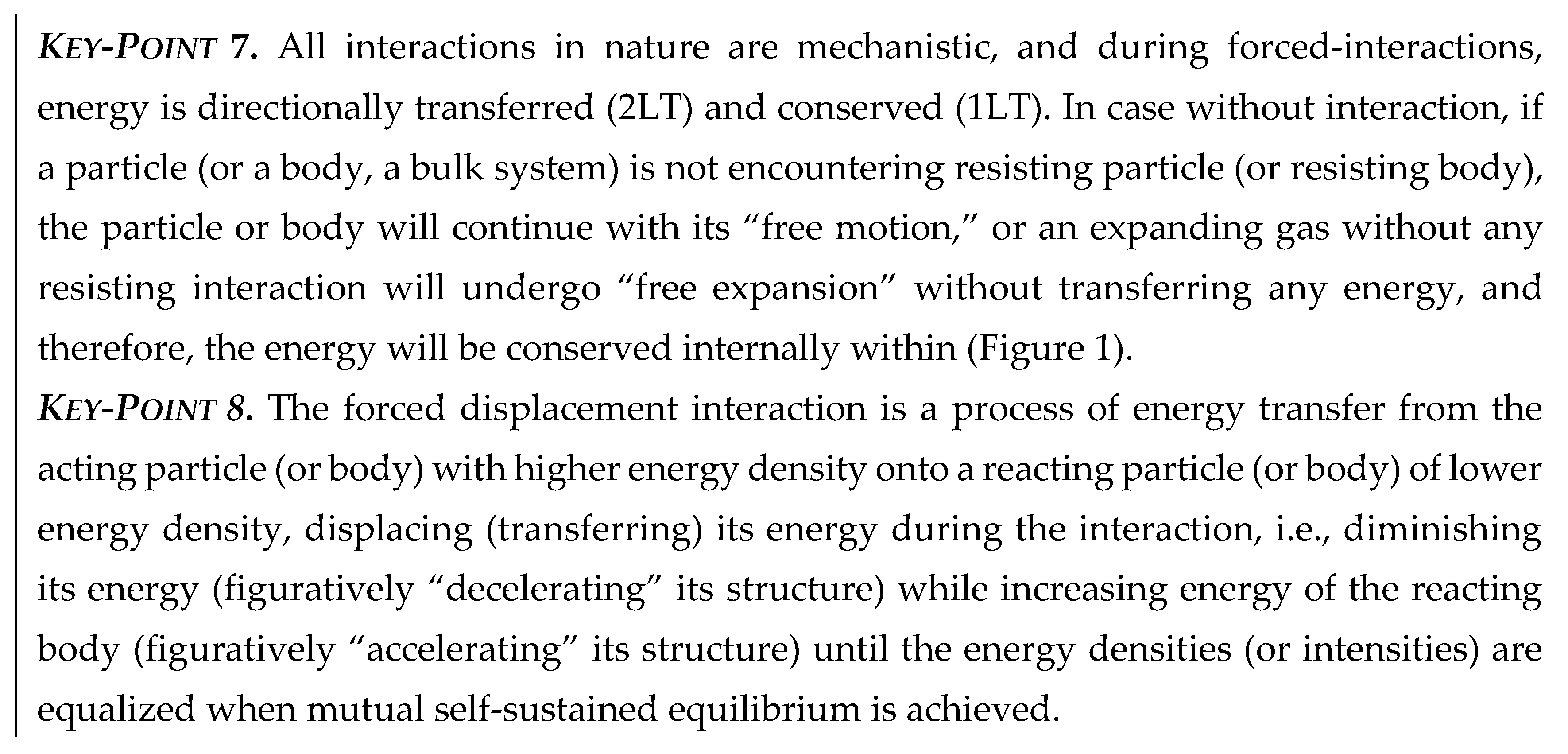
4. Ubiquity of Thermal Motion and Heat, Thermal Roughness, and Indestructibility Of Entropy
4.1. Ubiquity of Thermal-Motion and Heat
The thermal-motion (ThM) and heat are ubiquitous since any work-potential (WP) transfer or storage (hence all processes) will be impeded and in part irreversibly dissipated to heat (in principle, increasing ThM and thermal energy, i.e., temperature and/or entropy) caused by different types of “dissipative-frictions,” ultimately instigated by “thermal roughness” (as reasoned, defined and named here) due to the existing, chaotic ThM of thermal particles (ThP). Furthermore, since the ThM cannot be ceased (i.e., zero absolute temperature is unattainable; the 3LT), the dissipative irreversibility is unavoidable in general (the 2LT), contributing to further ubiquity of heat and related thermal phenomena, for all processes without exception.
Entropy is elusive and sometimes puzzling with temperature since both tend to increase with heat generation and storage, and with heat transfer. However, more entropy, more thermal space more non-conserved, thermal virtual-particles, ThVP (as defined and named here), even if physical thermal particles, ThP, are conserved. The increase of ThM energy and its extensive randomness (entropy) is, in principle, complemented with higher average of ThM energy per physical thermal-particle (the higher temperature).
The ThM may be ideally intensified (i.e., thermal energy and temperature increased) by reversible work over conserved thermal-space (or conserved entropy), and in reverse when work is extracted (thermal energy and temperature are decreased), while thermal space (entropy) is also conserved (see the CCHWE in Section 6 and elsewhere).

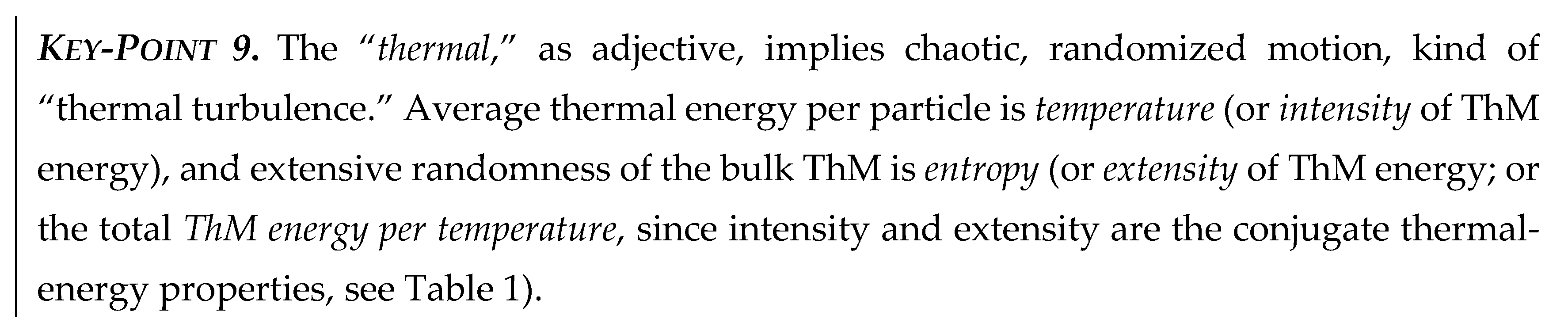
Thermal energy (or stored-heat or energy of ThM) is transferred (or displaced) as heat via ThM and thermal-collisions, from the ThP at a higher temperature on-average, to the ThP at a lower temperature on-average, by means of random “poking or jiggling” of ThP, across a real or imaginary boundary, without the need for physical ThP to be displaced across, similarly as the AC electrical energy is displaced (but in an orderly, wavy or cyclic manner, not like the chaotic thermal energy) from one electron to another, without need for electron displacement per se.
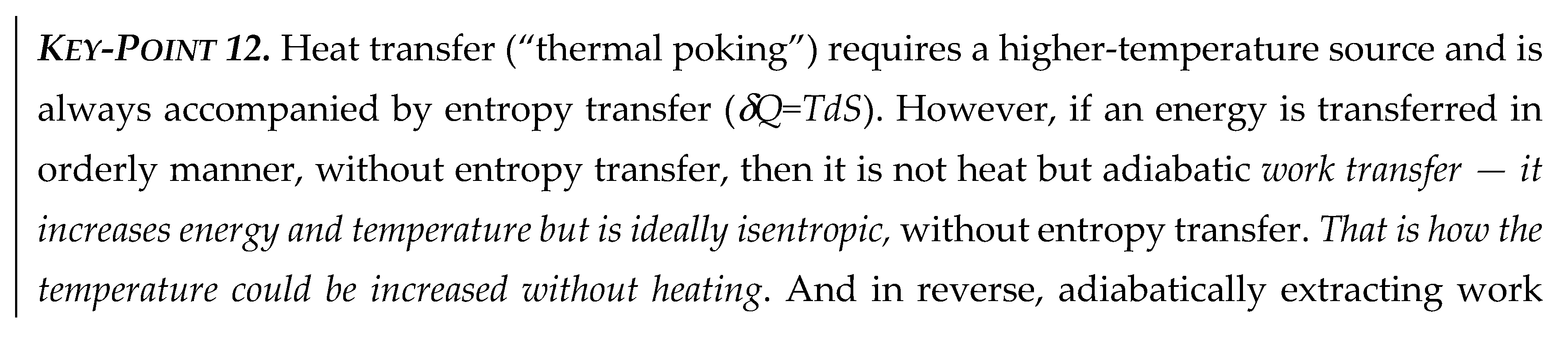
Temperature is thermal-intensity or thermal-force, i.e., particle-average thermal-motion energy per thermal particle, like atom, molecule, electron or similar.
Entropy is thermal displacement-space, defined as ThM energy per unit of its intensity (temperature), i.e., ‘thermal-space randomness’ of chaotically-moving thermal-particles, that is, “randomly traversed-space” by thermal particles, (randomness of both, space-directions and dynamic-motions), due to thermal collisions, and it may be represented by non-conserved “thermal virtual-particles, ThVP.”

We now define the number of “thermal virtual-particles” NThVP, which may be considered as the “particle dimensionless entropy,” i.e.:
NThVP=S/kB = ln(W )=Uth/(kB⋅T).
Then, we may define the number of “thermal moles” nth, which may be considered as the “molar dimensionless entropy,” i.e.:
nth= NThVP /NA =S/(kBNA) =S/Ru
Where, S is entropy; Uth is the internal thermal-energy; Ω is the number of the “possible thermal, microscopic states”; NA is the Avogadro’s number; kB is the particle Boltzmann constant; and Ru is the molar, universal gas constant.
The number of thermal virtual-particles, NThVP, is non-conserved, as opposed to conserved number of physical thermal-particles, NThP (like atoms, molecules, electrons, and similar). The former increases with entropy, i.e., with increase of thermal randomness.

Heat Q, and work W, are considered as “energies in-transfer," as process-quantities and not as properties, since after being stored within a system they “lose identities” and increase the system “internal energy (U or E), as if they are not distinguishable after being stored.
However, this author does not agree with such and similar accounts [7] since the quality of such internal energies is not the same (i.e., different WPs and entropies; the 2LT). Namely, storing the same amounts of heat or work results in different system states, with different entropy, volume, etc., regardless that amount of total internal energies is the same (energy conserved, the 1LT; but not the same quality nor WP, the 2LT).
For example, if heat Q′ is stored at constant volume to a system at initial state (Ui, Vi, Si, ...), the final state will be (U′=Ui+Q′, V′=Vi, S′≠ Si, …), however, if the same amount of work W′′=Q′ is reversibly stored instead, the final state would be different (U′′=Ui+W′′=U′, V′′≠ V′, S′′=Si, …). If the processes are reversed back to the original initial state, it would be ideally possible to retrieve the original work W′′ from U′′ but that work could not be obtained from U′ (even though U′= U′′), which proves that the internal energies U′ and U′′ are not the same quality (not the same states, different WPs and exergies; the 2LT), regardless being the same quantity (same U-amounts; the 1LT).
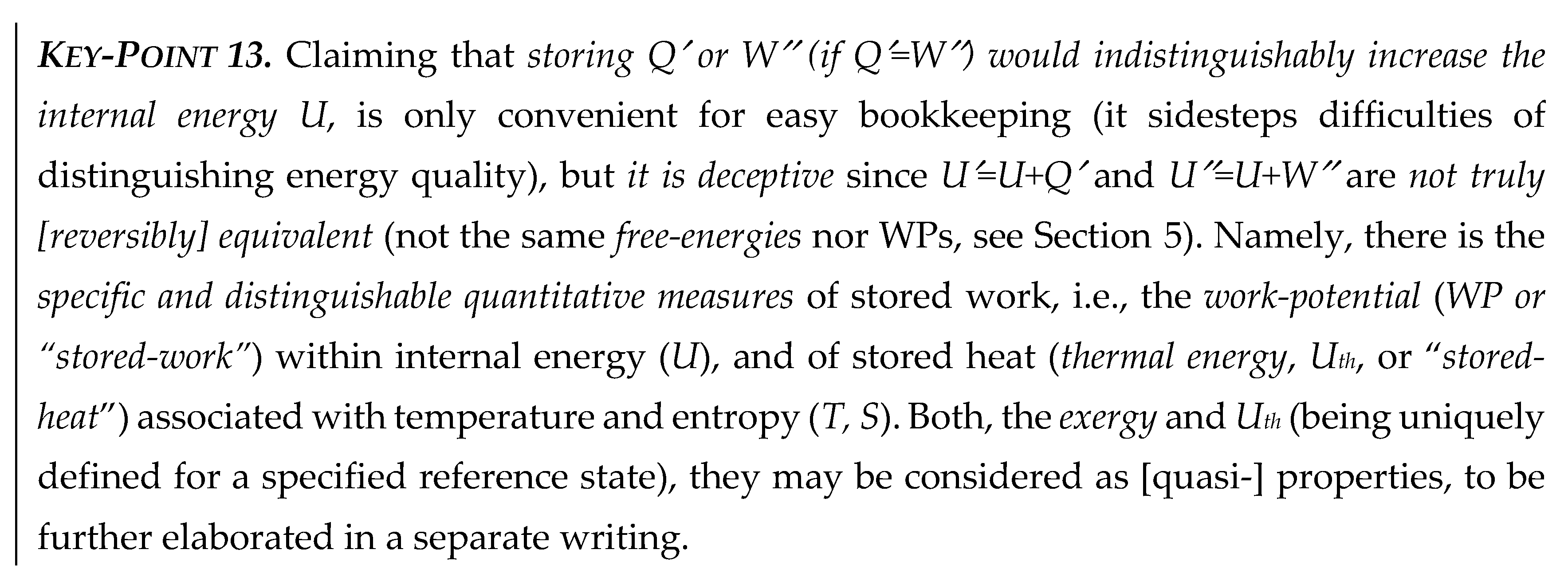
Additional difficulties of distinguishing internal energy types are due to coupled dualities (conjugate multitude) of internal energy types. If work or/and heat are stored, even when U is quantitatively the same, the other properties that characterize its quality and true equivalency (like V, S, and others in more complex systems), are not the same. Furthermore, heat and work are interchangeable as demonstrated by the Carnot cycle and the Carnot-Clausius Heat-Work Equivalency (CCHWE), as defined and named here (Section 6). For example, the ideal gas energy of thermal motion, NkBT, manifests also as mechanical compression energy PV, as expressed by its equation of state: PV≡ NkBT, see Section 6.1.
4.2. Thermal Roughness and Thermal Friction
The “Thermal Roughness” and “Thermal Friction” are defined and named here as new concepts, as the underlying cause and source of inevitable irreversibility since absolute-0K temperature is unfeasible (3LT). No ideal systems nor frictionless processes are possible due to unavoidable thermal-motion (ThM) of thermal-particles (ThP). Even “superconductivity” at lower temperature must be at least infinitesimally irreversible since any energy flow must interact and be affected, regardless of the extent (even if infinitesimally), by the chaotic ThM collisions of the ThP, the latter being the cause and source of related EM thermal radiation. It is impossible to have a perpetual “smooth boundary surface” due to unavoidable, dynamic and chaotic ThM of the ThP, see Figure 2.
Figure 2.
Thermal Roughness and Thermal Friction are the underlying cause and source of unavoidable irreversibility (2LT) since absolute-0K temperature is unfeasible (3LT), i.e., perpetual “smooth surface” is impossible. No ideal systems nor frictionless processes are possible (even “superconductivity” must be infinitesimally irreversible) due to unavoidable interference with EM thermal radiation due to thermal motion and collisions.
Figure 2.
Thermal Roughness and Thermal Friction are the underlying cause and source of unavoidable irreversibility (2LT) since absolute-0K temperature is unfeasible (3LT), i.e., perpetual “smooth surface” is impossible. No ideal systems nor frictionless processes are possible (even “superconductivity” must be infinitesimally irreversible) due to unavoidable interference with EM thermal radiation due to thermal motion and collisions.
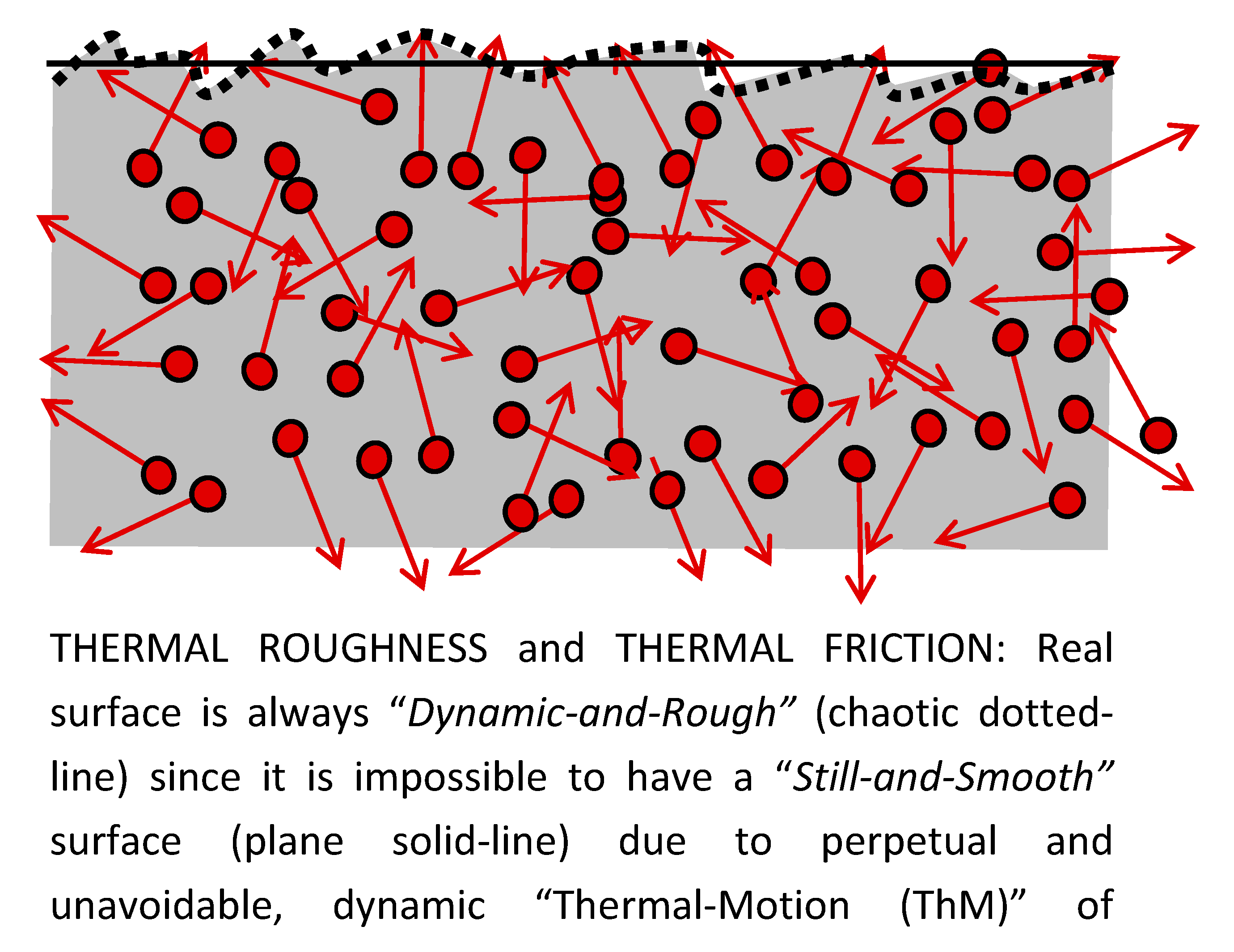
It is remarkable that all existing useful energy, quantified by the WP, the cause and source of process-forcing and energy displacement, dissipatedly convert to thermal motion (i.e., generated heat and entropy). In turn, the latter is the cause and source of the “thermal roughness” and thermal friction. Furthermore, all “other dissipations” are ultimately caused by the underlying “thermal friction”, by dynamic “thermal roughness” due to chaotic ThM (random fluctuations of ThP).
4.3. Indestructibility of Entropy
All transformations or processes are caused by the nonequilibrium work-potential (WP) and are accompanied by energy forced-displacement, either as work (in an orderly way) or as heat (via chaotic ThM and thermal collisions, including the “Carnot WP of heat,” see Section 5).
Ideally, in limit, the heat and work could be displaced or transferred in reversible processes without any dissipative loss of the WP, like in ideal Carnot cyclic processes. Heat is transferred at infinitesimal temperature difference so that entropy transfer from a thermal source is the same as into a thermal sink (either the thermal reservoirs or the system); therefore, the entropy is conserved. Similarly, the adiabatic, reversible work transfers are ideal processes without any dissipation of WP to heat, i.e., they are not associated with entropy and therefore isentropic.
However, all real processes are caused and accompanied by displacement and dissipation of WP. If no WP to displace, there would be no process-forcing (no process would be possible) as in a self-sustained, perpetual equilibrium. The dissipation of WP is not an “annihilation loss” per se, but its conversion and degradation of work to heat, accompanied with entropy generation, the latter commensurate with WP dissipation per relevant absolute temperature, often figuratively named as “work-loss” or degradation of useful energy.
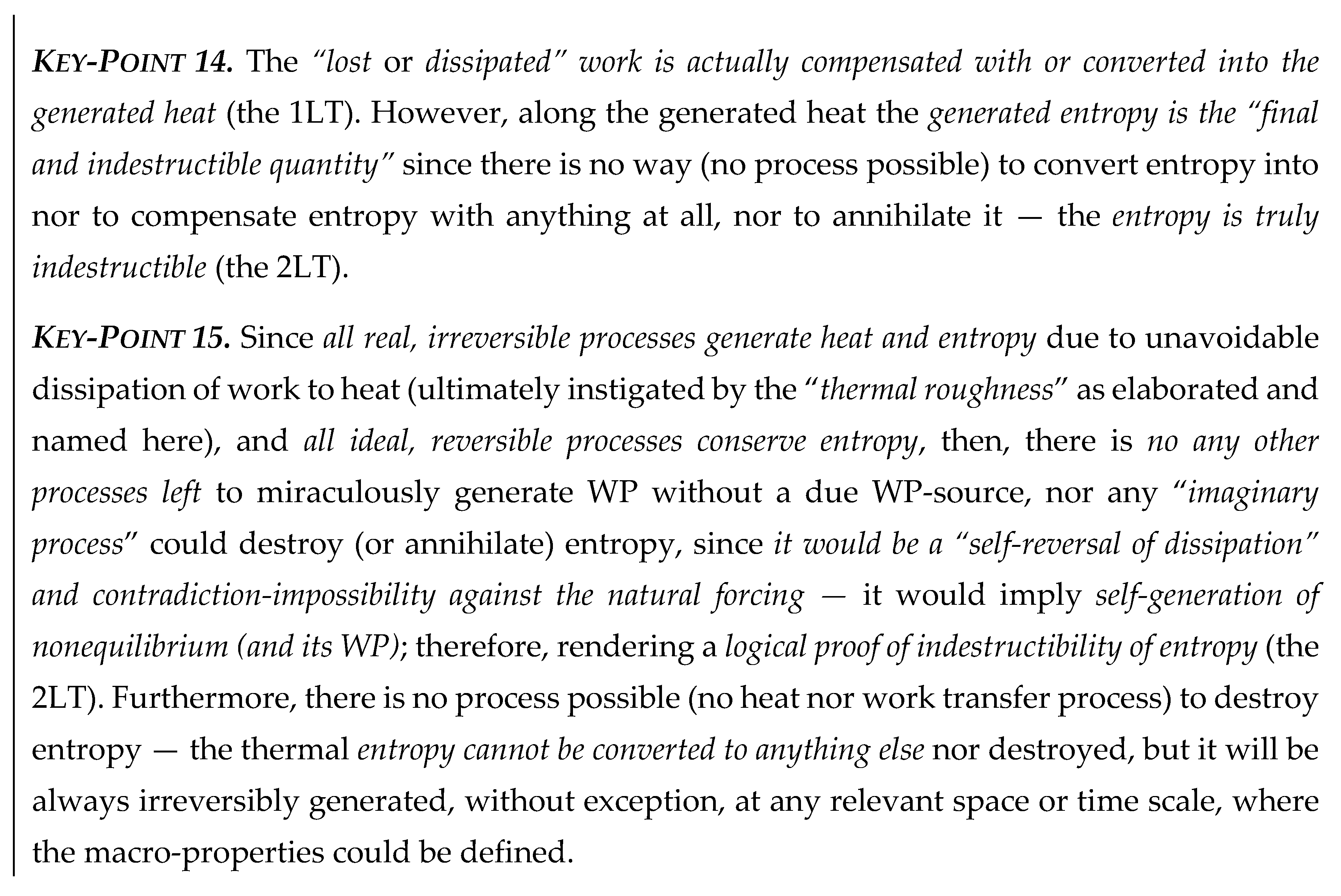
Irreversibility, I, is the “irreversible loss” of the WP, or more accurately the work dissipative conversion to generated-heat, I=WLOSS= Wdiss= Qgen,). The work dissipation is directly related to the entropy generation, Sgen, at relevant reference, absolute temperature, Tref, (the Gouy-Stodola correlation, Equation (5)). The work dissipation and related entropy generation are the two sides of the same coin (“half empty vs. half full”), i.e.,
{I=[WLOSS≡Wdiss]=Qgen}=Tref⋅Sgen ≥ 0
In ideal, thermodynamically reversible processes the WP and entropy are “re-organized” and conserved, while in real, irreversible processes the WP, as cause and source of forced energy displacement, is transferred and expended (diminished), due to its dissipation (i.e., dissipative conversion) to heat with entropy generation.
A nonequilibrium (i.e., its WP) may be increased only by forcing on the expense of another WP, as a necessary WP-source. During such forced interactions the WP in ideal reversible processes would be reorganized and conserved (1LT & 2LT), or, in part, it would irreversibly dissipate to heat, i.e., the WP would be irreversibly diminished (2LT) — however, the totality of energy (WP and generated-heat) would be conserved (1LT, again). Therefore, there is no way to self-create nonequilibrium work-potential against the natural forcing towards equilibrium. The former would be contradiction of the latter.
5. Carnot Maximum Efficiency, Reversible Equivalency, and Work Potential
5.1. Carnot Cycle Maximum Efficiency: Proof by Contradiction-Impossibility
It is intention here to put, in historical and contemporary perspective, the Sadi Carnot’s revolutionary discovery of “reversible processes and maximum-possible efficiency of heat-engine cycles,” and to show that the Carnot’s contributions are among the most important developments in natural sciences, see Key-Pt. 16 and Figure 3. Only, based on his ingenious and far-reaching reasoning, that the reversible processes and cycles are equally and the most efficient, it was possible later, for Clausius and Kelvin, and other Carnot’s followers, to discover critical concepts and laws, and to establish Thermodynamics (ThD) as a new discipline of natural sciences.
Figure 3.
Carnot Equality [as named here], Q/Q0=T/T0, or Q/T=constant, for reversible cycles (different from Carnot Theorem), is much more important than what it appears at first. It is probably the most important correlation in Thermodynamics and among the most important equations in natural sciences. Carnot’s ingenious reasoning unlocked the way (for Kelvin, Clausius and others) for generalization of “thermodynamic reversibility,” definition of absolute thermodynamic temperature and a new thermodynamic property “entropy” (Clausius Equality is generalization of Carnot Equality), as well as the Gibbs free energy, one of the most important thermodynamic functions for characterization of electro-chemical systems and their equilibriums, resulting in formulation of the universal and far-reaching Second Law of Thermodynamics (2LT) [9,10,11,12,13].
Figure 3.
Carnot Equality [as named here], Q/Q0=T/T0, or Q/T=constant, for reversible cycles (different from Carnot Theorem), is much more important than what it appears at first. It is probably the most important correlation in Thermodynamics and among the most important equations in natural sciences. Carnot’s ingenious reasoning unlocked the way (for Kelvin, Clausius and others) for generalization of “thermodynamic reversibility,” definition of absolute thermodynamic temperature and a new thermodynamic property “entropy” (Clausius Equality is generalization of Carnot Equality), as well as the Gibbs free energy, one of the most important thermodynamic functions for characterization of electro-chemical systems and their equilibriums, resulting in formulation of the universal and far-reaching Second Law of Thermodynamics (2LT) [9,10,11,12,13].
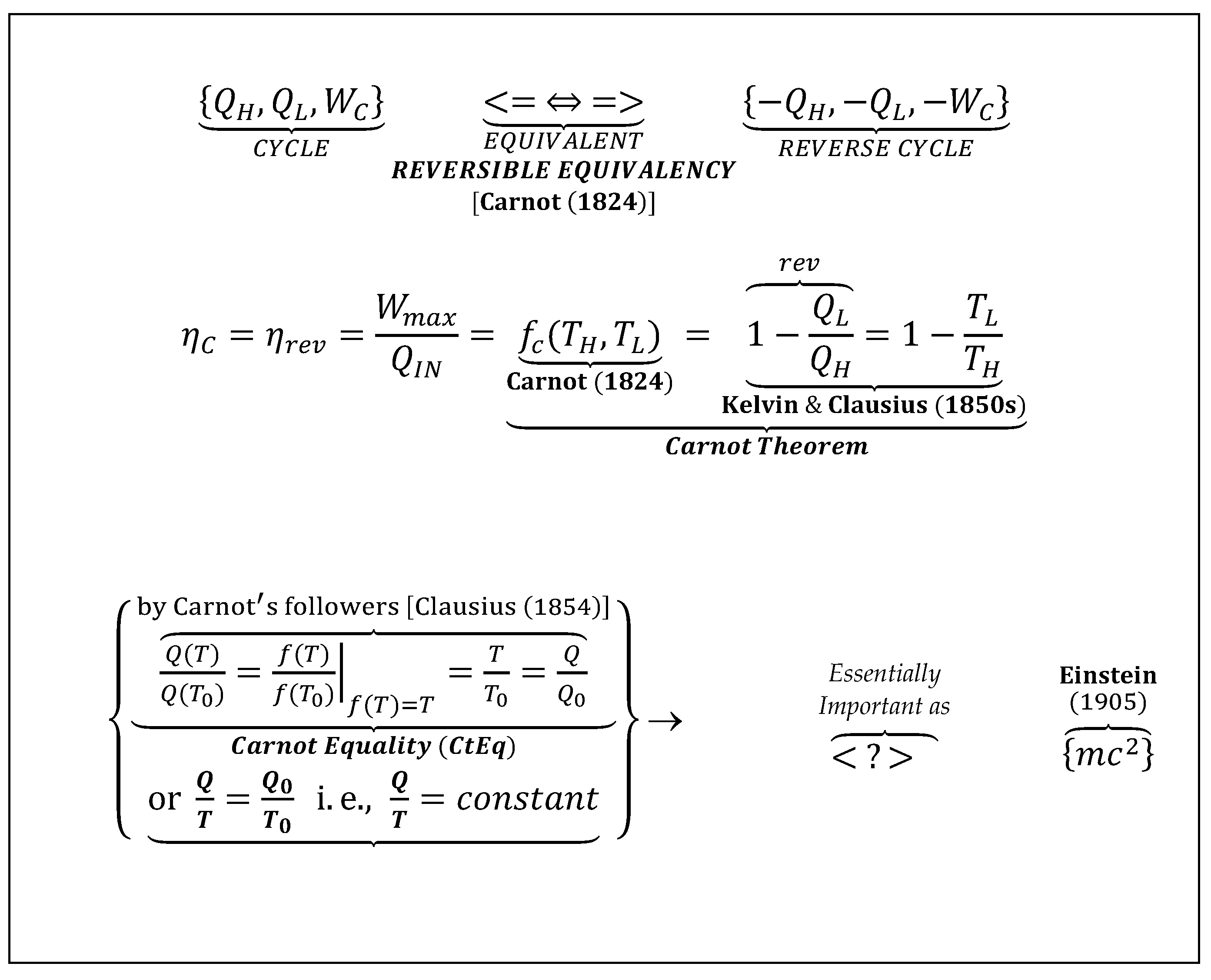

The invaluable concepts of “thermodynamic reversible equivalency” and concept of useful “work potential” were formalized later by others; however, all are based on the original discovery of Sadi Carnot. Long before the inception of Thermodynamics, even before the [First] Law of energy conservation was established, Sadi Carnot, in 1824, affirmed the following [8]:
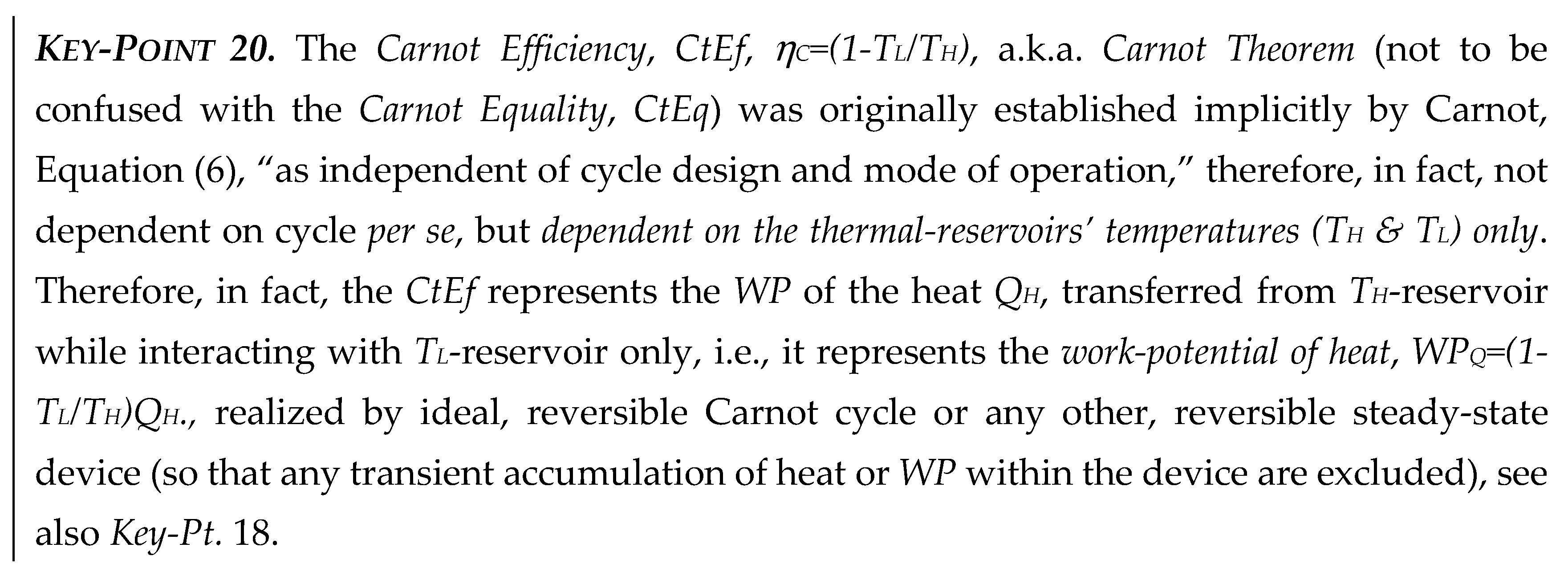
“The motive power of heat is independent of the agents employed to realize it; its quantity is fired solely by the temperatures of the bodies between which is effected, finally, the transfer of the caloric”, i.e.,
Where, ηC is the Carnot cycle efficiency, maximum possible and equal for any and all reversible cycles. The cycle is converting heat, QH, from high-temperature thermal-reservoir at TH, extracting cycle work, WC, and passing heat to a low-temperature thermal-reservoir at TL.
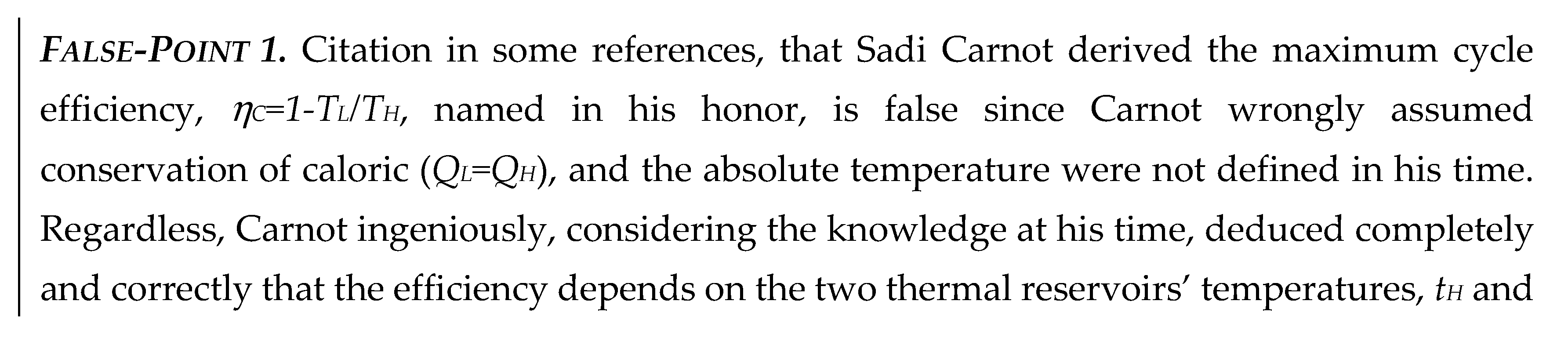
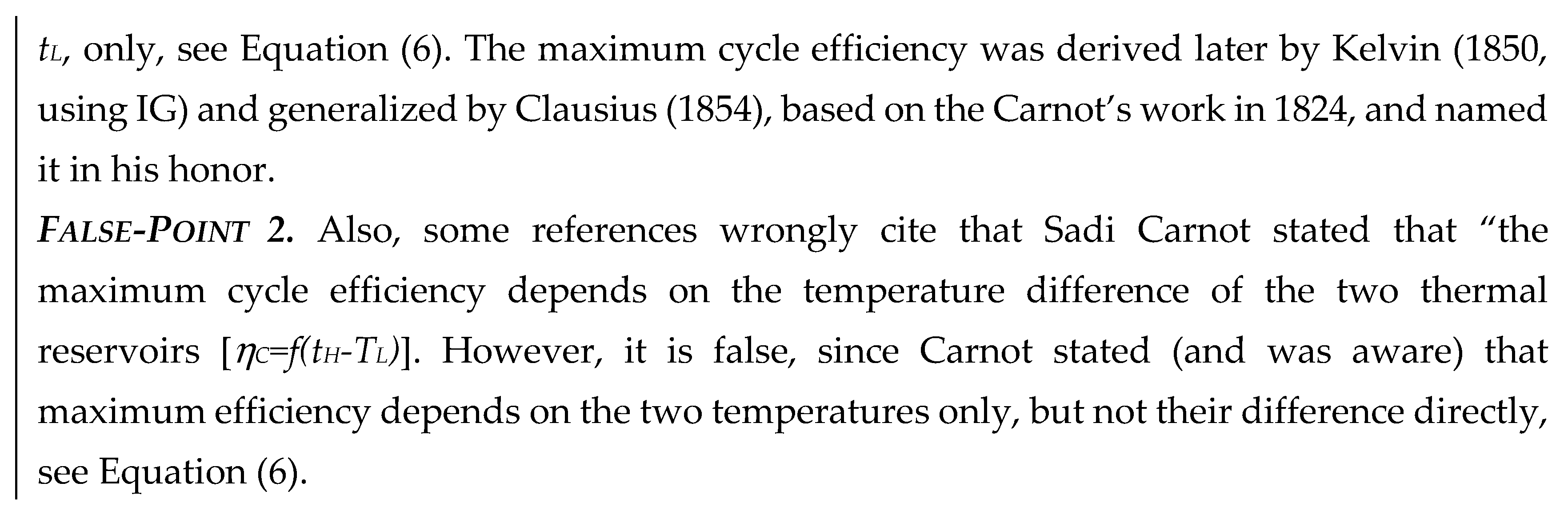
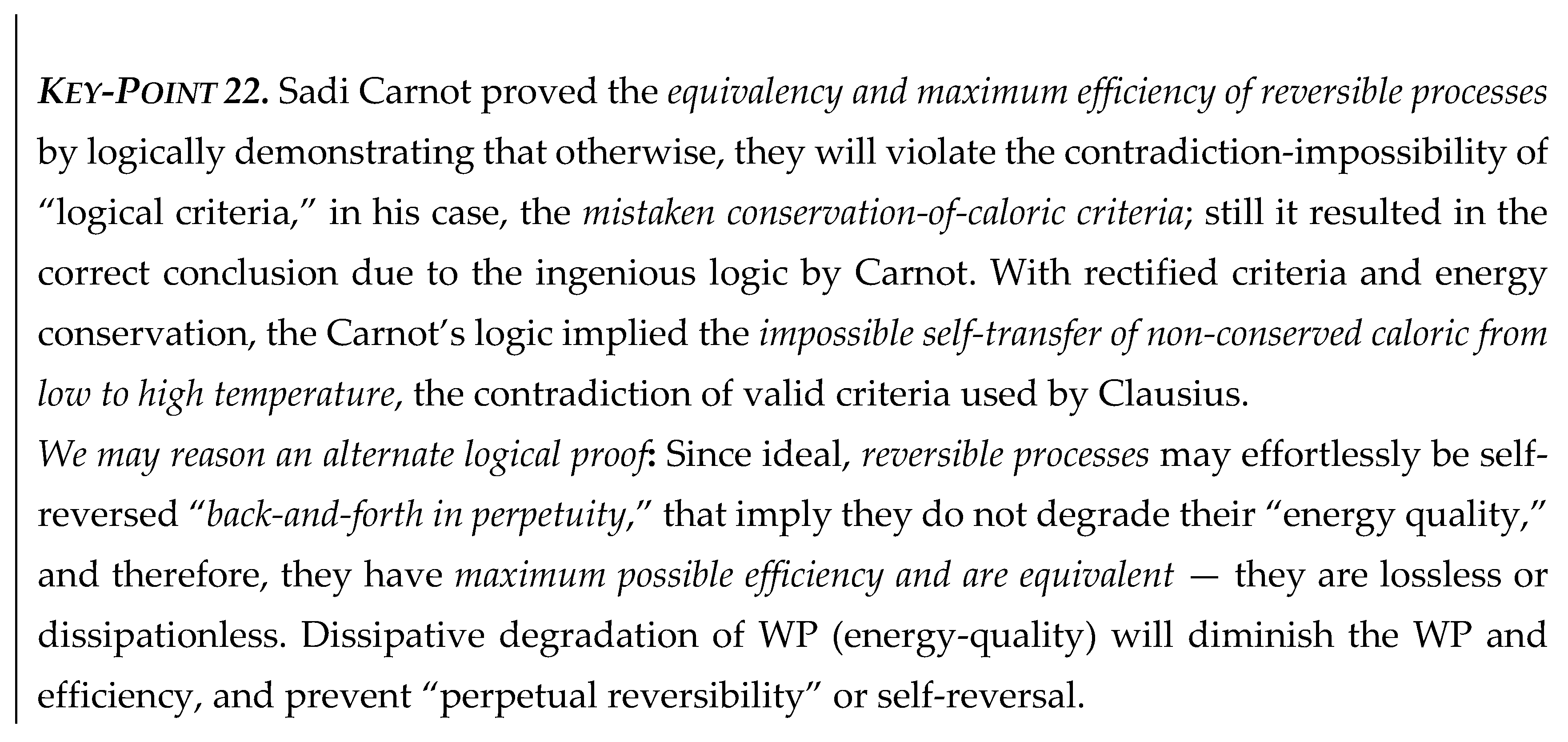
Sadi Carnot reasoned and proved the reversible cycle, maximum efficiency based on logical “contradiction-impossibility” as emphasized next (see Key-Pt. 17). He also detailed accurately how to accomplish the ideal cycles. The specifics and consequences of Sadi Carnot’s ingenious reasoning with his complete and accurate discoveries were presented in his, now famous publication [8] and elsewhere, including this author’s prior publications [9,10].
“Maximum efficiency” definition:
Maximum thermodynamic efficiency of a work-producing process (or set of processes) is when “maximum-possible work” is obtained (or extracted), equal to the respective work-potential (WP) of a system (or thermal reservoir) initial state (or input) with respect to its final state (or output), usually in equilibrium with a reference surrounding state; or when “minimum-possible work” is supplied to create the same initial state, with the same original WP from the same equilibrium state; i.e., when there is no work-dissipation to heat of any kind during such reversible processes (or set of processes).
The “maximum cyclic-process efficiency” is defined in the same manner since it consists of several reversible processes, and it expresses WP of an energy-source system [thermal reservoir at higher temperature] per unit of energy [heat] consumed when reversibly interacting with a reference, energy-sink system [thermal reservoir at lower temperature].
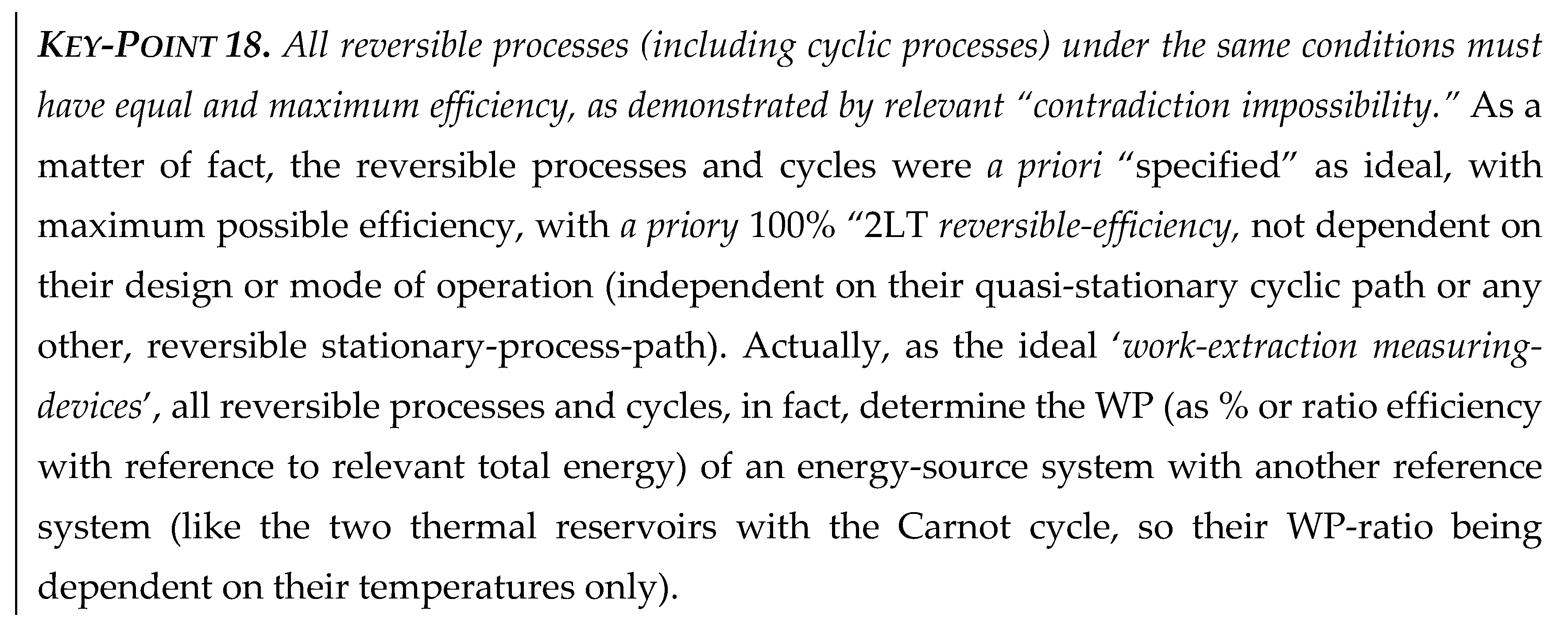
The two, extracted and supplied works (or “work out” and “reverse-work into” a system), related to the same system nonequilibrium state and its respective equilibrium with the same reference surrounding system, must be maximum-possible and minimum-required, and both must be the same for all respective reversible-processes, as a matter of “contradiction impossibility,” see Key-Pt. 17 and elsewhere [8,9,10].
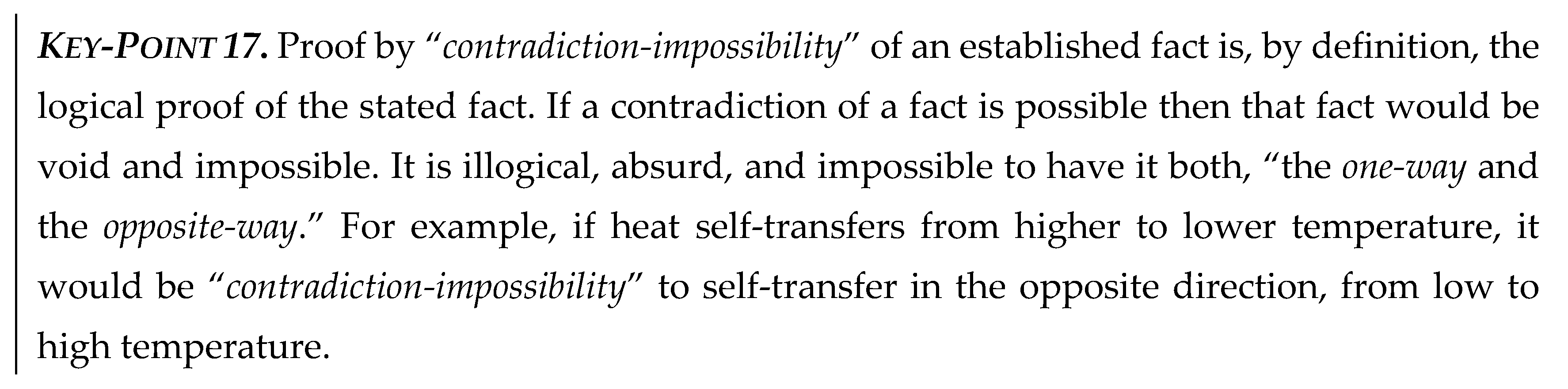
Otherwise, if a reversible process (including a cyclic process) with a smaller reversible, extraction-work would be possible (with smaller efficiency than another reversible process), as if a part of the possible (original) WP were mysteriously vanished in ideal process or cycle. Furthermore, its “reverse-process” (with its smaller work input would be more efficient), would then have a higher efficiency than the other’s, or with the other’s larger work, it could create a higher WP state than the original, as if such WP difference was a miraculous GAIN, created without due WP source, see Figure 6.
Likewise, if the reverse-process (with smaller reversible-work) is coupled with another power-process, to use its higher maximum-work, it would result in spontaneous heat transfer from a lower to higher temperate (a contradiction impossibility of known fact). It would be equivalent to generation of nonequilibrium from within equilibrium, or producing work from a single thermal reservoir, or destruction of entropy; see relevant explanations with supporting Figures in [8,9,10].
Or, as ingeniously reasoned by Sadi Carnot, that “such coupling of two different efficient reversible-cycles would result in impossible creation of caloric.” Carnot’s reasoning methodology was ingenious and far-reaching, and his final conclusions were accurate, regardless of his erroneous assumption of conservation of caloric.
For example, if the heat is in fact always spontaneously transferred from a higher to lower temperature, then spontaneous heat transfer in reverse direction, from a lower to higher temperature would not be possible, as the matter of contradiction-impossibility. The similar is true for any spontaneous energy displacement (energy transfer) against the respective energy force. A process spontaneity has a meaning for a process to be possible to proceed by itself (i.e., self-driven process “in self-physical, certain-direction, whatever it may be”) without any external influence or another external compensation. The external influence or compensation may be an external power-process, or it may even be another internal, “conjugate power-process” or its tendency to drive as-an-external process, like thermoelectrical phenomena, or thermomechanical or other elusive-like processes, influenced by gravity and other forced fields. Such mutually associated phenomena and processes may delude ‘existence of miraculous processes,” resembling impossible contradiction which they are actually not.
5.2. Carnot Cycle, Carnot Efficiency, and Carnot Equality
All related discoveries of the most important concepts of thermodynamics, after Carnot’s 1824 publication [8], regarding the reversible equivalency and maximum efficiency of reversible processes, in one way or another, were based on Carnot’s work. Namely, the absolute, thermodynamic temperature (not dependent on material of a thermometer nor its design; and not to be confused with the equivalent but not the same concept of ideal-gas absolute temperature), the entropy concept, the Second Law of thermodynamics, and the Gibbs free energy concept, among others. The Carnot Equality (CtEq) is specifically defined and named next (Figure 3 and elsewhere), to be distinguished from the well-known Carnot Efficiency (CtEf), the latter also known as the Carnot (Cycle) Theorem.
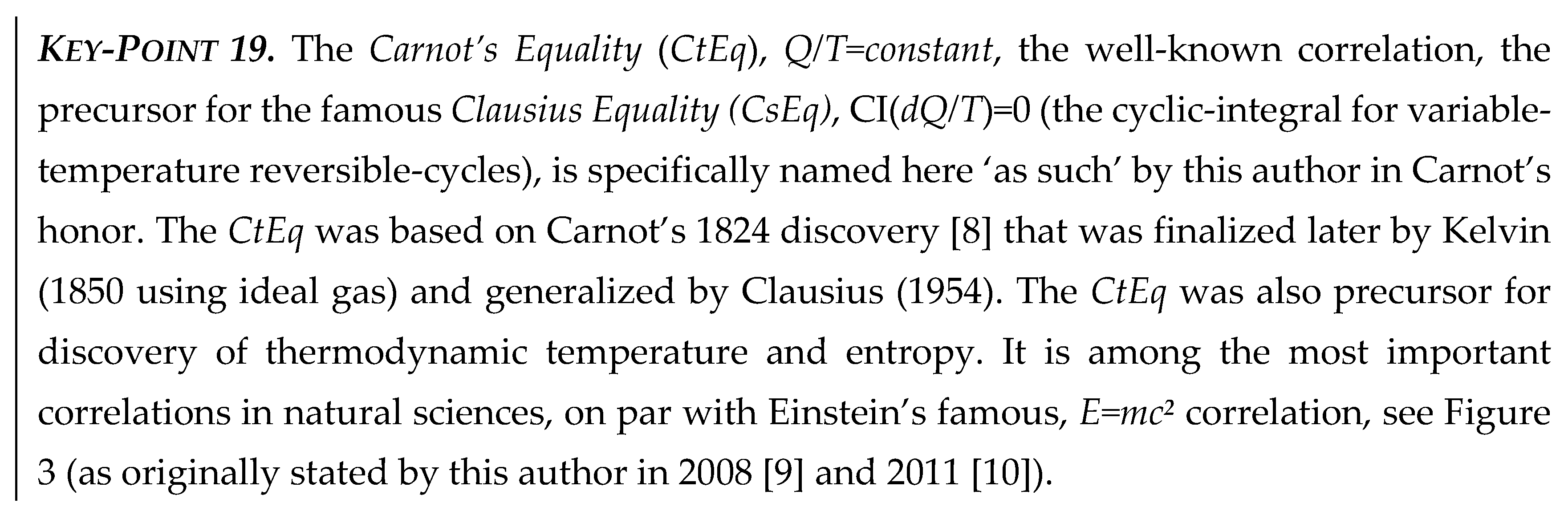
Looking to reason the maximum possible efficiency of steam [heat] engines was a challenging mission, at the time when their efficiencies were below 5%, and neither nature of heat nor the concept of work were known. Sadi Carnot mistakenly assumed, as many thought in his time, that heat was a weightless and indestructible caloric fluid. Indeed, the conservation of caloric was experimentally established within the calorimetric measurements. Furthermore, at that time, the difference between heat input and output in heat engines was negligible and within the experimental errors, due to extraction of rather small work ratio (was only several percent of heat input), so assuming the conservation of engines’ caloric appeared to be realistic at that time. The Carnot’s reasoning (possibly and luckily instigated by the contradictory misconceptions at the time) that the heat engine concept has to be similar to the water-wheel’s and that the “motive power” [work] is extracted by “falling [lowering] temperature of conserved-caloric [heat]”, the way the power has been obtained by lowering the elevation of the conserved-water, falling through a water-wheel, see [8], related contemporary discussions by this author [9,10], and elsewhere.
Consequently, Sadi Carnot reasoned that the maximum power efficiency has to be function of temperature difference, although not directly linear (as sometimes misquoted), and that such “available temperature difference has to be the source of the motive power.” Then, he ingeniously concluded that any available temperature difference has to be utilized for increasing the amount of engine power and not to be “waisted” for heat transfer per se, since during the real heat transfer at finite temperature difference no motive power [work] is extracted, and therefore, all work potential related to such temperature difference would be vanished.
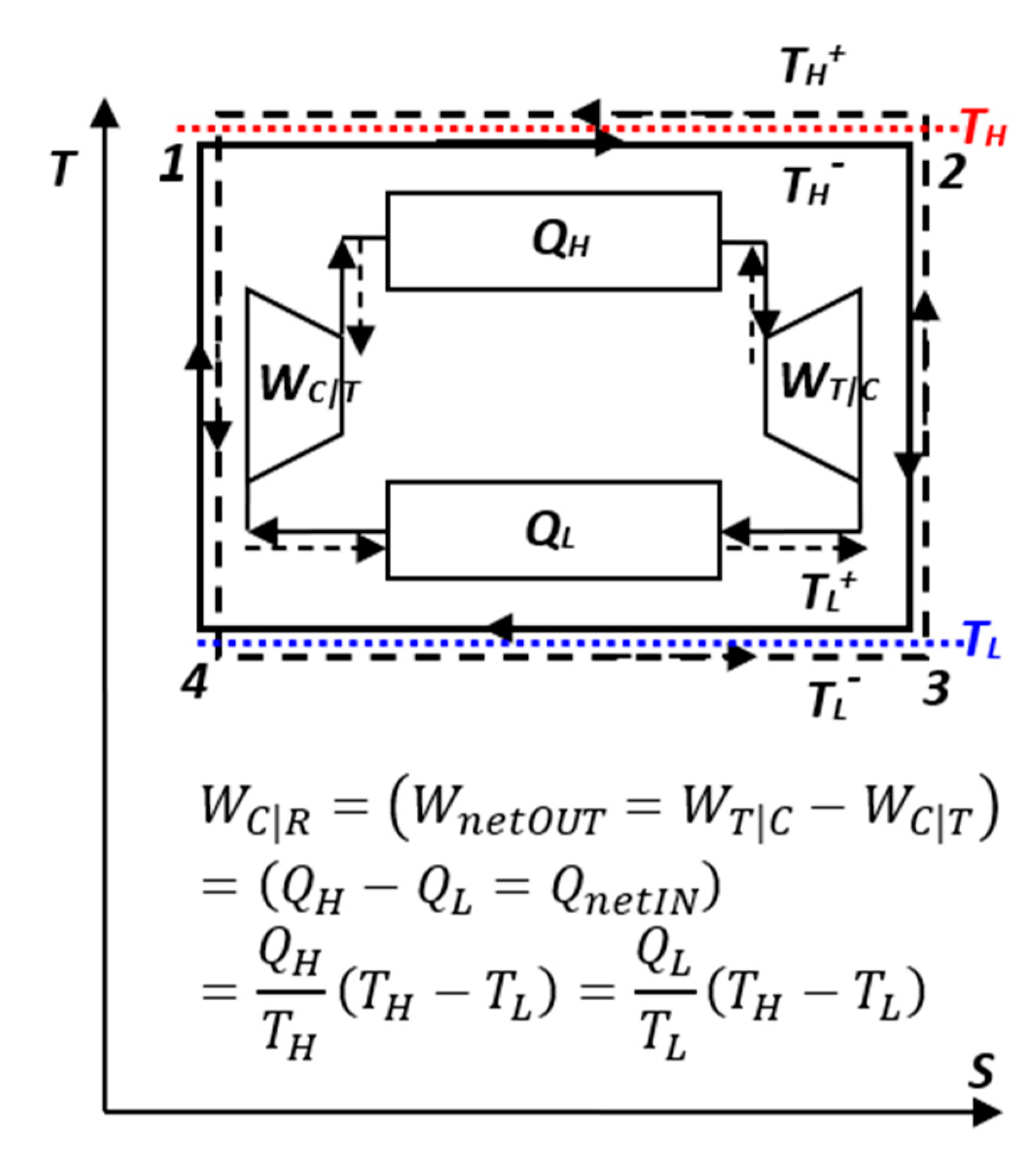
Therefore, to maximize a cycle efficiency the heat transfer has to be at ‘as little temperature difference as possible’, i.e., at infinitesimally small difference and in limit isothermal at the temperature of the respective heat reservoirs. And then Carnot reasoned that, to accomplish such isothermal heat transfer for the most efficient, ideal engine cycle, the working medium temperature has to be adjusted by frictionless adiabatic processes, for its temperature to be infinitesimally-smaller than the high-temperature of thermal-source reservoir and infinitesimally-higher than the low-temperature of thermal-sink reservoir, so that heat would be passing from the high to the low temperature between the thermal reservoirs with the assistance by the adiabatic processes, while the actual heat transfer would be reversible, at the infinitesimal temperature differences at each thermal reservoir. Therefore, the ideal Carnot cycle would comprise two isothermal and two perfect-adiabatic [isentropic] processes, see Figure 4 (solid lines).
Figure 4.
Carnot [Steam-Power] Cycle (solid lines): heat QH at TH is reversibly converted to work WC=WT-WC and to QL at TL; and Carnot Reverse-Cycle (dashed lines with reversed directions): work WCR= W|C -W|T and heat QL at TL, are converted to QH at TH. Thermal reservoirs’ high TH and low TL temperatures (dotted lines). T=Turbine, C=Compressor, |X=Reverse of any X-quantity. All quantities are positive magnitudes [9, 10].
Figure 4.
Carnot [Steam-Power] Cycle (solid lines): heat QH at TH is reversibly converted to work WC=WT-WC and to QL at TL; and Carnot Reverse-Cycle (dashed lines with reversed directions): work WCR= W|C -W|T and heat QL at TL, are converted to QH at TH. Thermal reservoirs’ high TH and low TL temperatures (dotted lines). T=Turbine, C=Compressor, |X=Reverse of any X-quantity. All quantities are positive magnitudes [9, 10].
On Figure 5, the conversion of heat and/or internal energy to work is presented in general, for a process from a “High-intensity Energy Source System (HESS, or H-reservoir)” at a higher temperature TH, to a “Low-intensity Energy Reference System (LERS or L-reservoir)” at a lower temperature TL, for an open or closed, steady-state or quasi-steady cyclic-process, respectively, including the irreversible loss of work potential to heat with entropy generation.
Figure 5.
Converting Heat and Internal Energy to Work: In any steady-state process or quasi-steady cyclic-process, entropy input SH , with heat QH (and with mass mH if any) at TH > TL , and if any irreversible generated entropy Sgen within, must be discharged with heat QL (and with mass mL if any), as entropy SL at TL. For ideal reversible process, is ‘not a loss but necessity’, reducing maximum efficiency below 100%, like in Carnot cycles (Carnot Equality). For real processes, irreversible work loss, = = , is due to dissipation of work to heat. For closed-mass and cyclic-processes, mL=mH=0, and for adiabatic turbine (QH|L=0), WOUT = EmH – EmL.
Figure 5.
Converting Heat and Internal Energy to Work: In any steady-state process or quasi-steady cyclic-process, entropy input SH , with heat QH (and with mass mH if any) at TH > TL , and if any irreversible generated entropy Sgen within, must be discharged with heat QL (and with mass mL if any), as entropy SL at TL. For ideal reversible process, is ‘not a loss but necessity’, reducing maximum efficiency below 100%, like in Carnot cycles (Carnot Equality). For real processes, irreversible work loss, = = , is due to dissipation of work to heat. For closed-mass and cyclic-processes, mL=mH=0, and for adiabatic turbine (QH|L=0), WOUT = EmH – EmL.
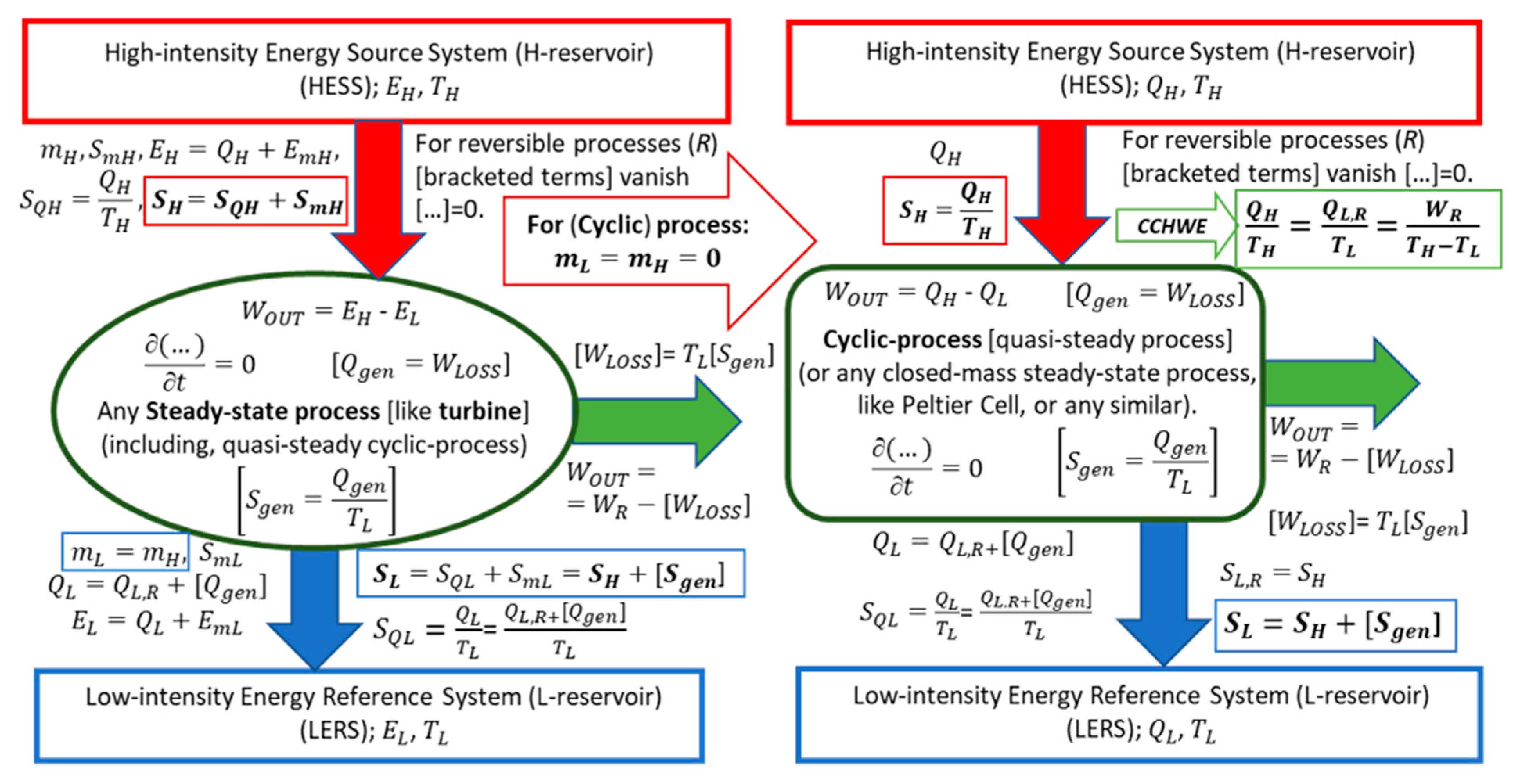
It is important to state that for any ideal reversible cycle, the reversible is “not a loss” (as often incorrectly cited in the literature) but the necessity as demonstrated by the reversible Carnot Cycle (Carnot Equality, CtEq; see also Carnot-Clausius Heat-Work Equivalency, CCHWE, in Section 6). However, in real irreversible-processes, unavoidable, so-called work ‘loss’, WLOSS=Wdiss=Qgen=TLSgen (the Gouy-Stodola correlation), is due to dissipation of work (Wdiss) into the generated heat (Qgen). Note that work as useful energy cannot be lost per se (1LT) but is dissipated, i.e., irreversibly converted to heat as degraded form of energy. Additionally, for closed-mass and cyclic-processes, mL=mH=0 and for adiabatic turbine (QH|L=0), WOUT= EmH– EmL, see Figure 5.

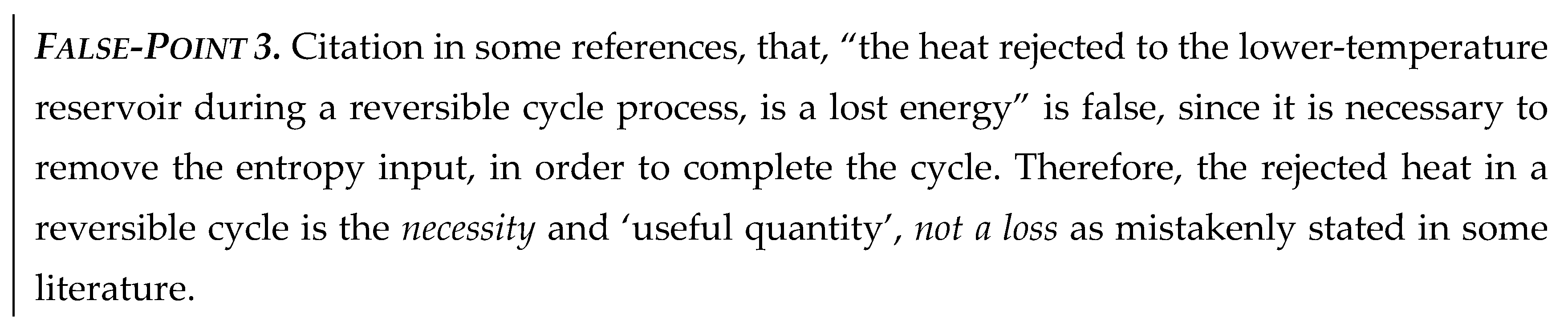
Therefore, for a steady-state processes in general (including the quasi-state cyclic processes); no transient accumulation of any property, ∂[…]/∂t=0, a working system has to be “compensated thermally” (by transferring out the entropy supplied to the system, i.e., for a reversible cycle {SH =QH/TH }IN ={QL/TL=SL}OUT, which demonstrate a logical proof of the Carnot equality), and also to be “compensated mechanically” (by bringing a cyclic process to the initial volume), before repeating the cycle. Therefore, the heat rejected during a reversible cycle process, QL,R =TLDSR, is the necessity and therefore ‘useful quantity’, not a loss as sometimes mispresented, see False-Pt. 3.
However, the irreversible “dissipation loss of WP” is unnecessary and should be minimized to increase efficiency. Therefore, the maximal cyclic work, WC = QH - QL,R < QH, i.e., the Carnot cycle efficiency, ηC, is always smaller than 100% but bigger than areal cycle efficiency, η, i.e.,
η = (WC-WLOSS)/QH <{ηC = WC/QH = 1- (TL/TH)} <100%.
The Equation (7) represents the so-called 1LT energy conversion efficiency, not to be confused with the 2LT reversible efficiency, {η2LT=η/ηC} < {ηC,2LT=1=100%=ηR,2LT}. The curled term on the right of the inequality being the perfect 100% 2LT reversible efficiency for the Carnot cycle or any reversible process.
5.3. Carnot ‘Reverse-Cycle’ and Thermodynamic ‘Reversible Equivalency’
Furthermore, if the working medium temperatures in the Carnot cycle are adiabatically adjusted in reverse, to be infinitesimally-higher than the high-temperature reservoir and infinitesimally-lower than the low-temperature reservoir, see Figure 4 (dashed lines), then, the heat will be effectively-transferring in reverse, from low to high temperature reservoirs (from TL to TH) while external work would be consumed. Therefore, all processes and energy flows would be in reverse direction, resulting in the “Carnot reverse-cycle” with regard to the original [power-producing] “Carnot cycle”, with infinitesimally different or in limit all equivalent, respective properties and energy flows, but in reverse directions, see Figure 4 and Equation (8). Such reverse cycles will provide cooling (refrigeration) of the low temperature reservoir (any ambient; A/C or refrigeration cycle) and/or heating of the high temperature reservoir (any ambient; heat-pump cycle), by effectively transferring heat from low to high temperature with utilization of external work.
Sadi Carnot [8] introduced the concept of reversible processes and cycles in 1824, as discussed above and elsewhere, and as expressed by Equations (6) & (8):

The important concept of “thermodynamic reversible equivalency” is generalized and depicted on Figure 6 and presented elsewhere.
The following Key-Points are articulated to further emphasize and summarize relevant facts and consequences of the “thermodynamic reversible equivalency.”
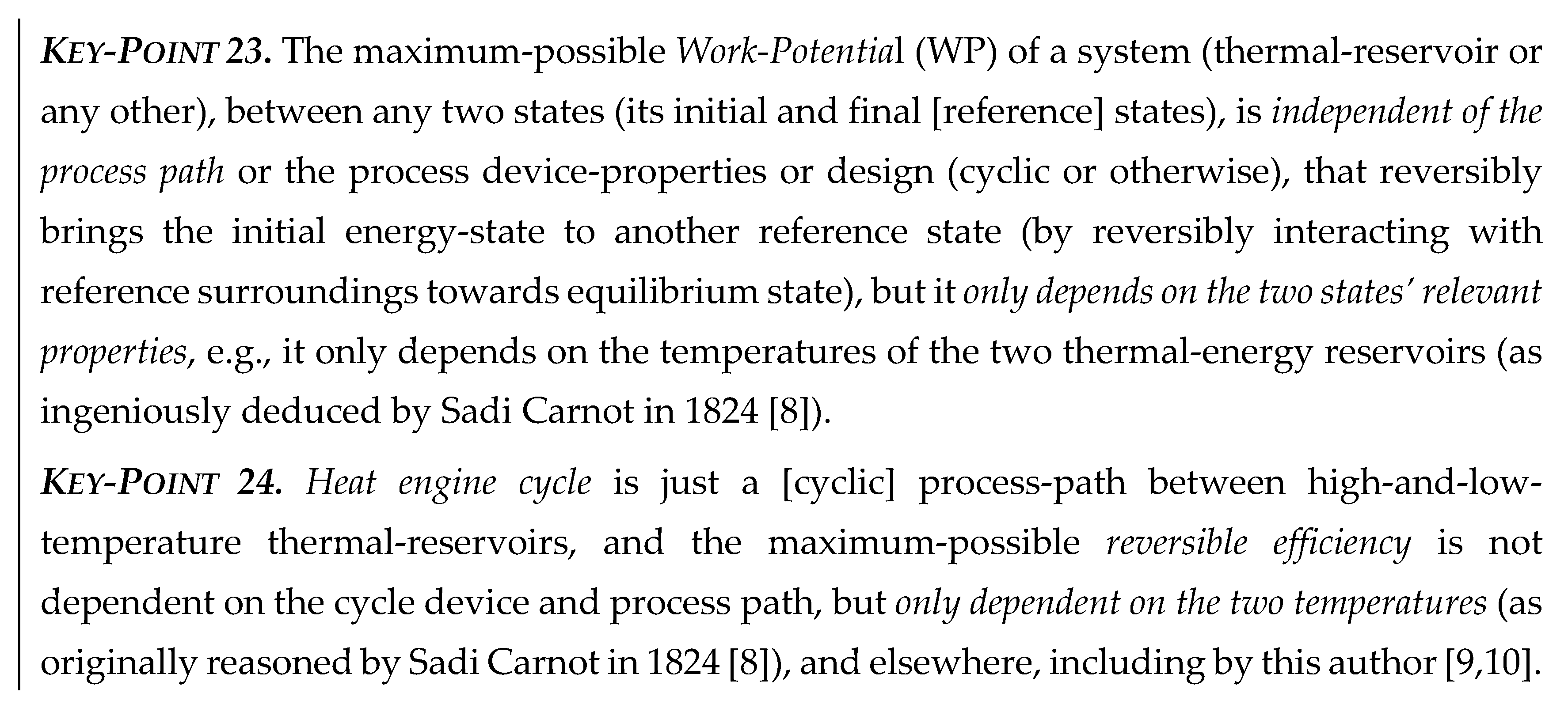
Figure 6.
Reversible Equivalency: Formation of “non-equilibrium state” requires “formation work-energy,” ideally all stored as “state work-potential (WP)” to be retrieved back in an ideal reversible process (Fig-Center, “Reversible Equivalency”: ideal formation-work equal to work-potential). Due to irreversible dissipation of work to heat (Work-LOSS), real formation work-in is bigger than stored WP, and retrieved useful work-out is smaller (Fig-Left). Formation of non-equilibrium state with less than its WP or getting more useful-work than WP would require a “miracle Work-GAIN” without due WP-source (violation of 2LT), being against natural forcing and existence of equilibrium, thus impossible (Fig-Right). Therefore, all reversible processes must be maximally and equally efficient [10, 16].
Figure 6.
Reversible Equivalency: Formation of “non-equilibrium state” requires “formation work-energy,” ideally all stored as “state work-potential (WP)” to be retrieved back in an ideal reversible process (Fig-Center, “Reversible Equivalency”: ideal formation-work equal to work-potential). Due to irreversible dissipation of work to heat (Work-LOSS), real formation work-in is bigger than stored WP, and retrieved useful work-out is smaller (Fig-Left). Formation of non-equilibrium state with less than its WP or getting more useful-work than WP would require a “miracle Work-GAIN” without due WP-source (violation of 2LT), being against natural forcing and existence of equilibrium, thus impossible (Fig-Right). Therefore, all reversible processes must be maximally and equally efficient [10, 16].
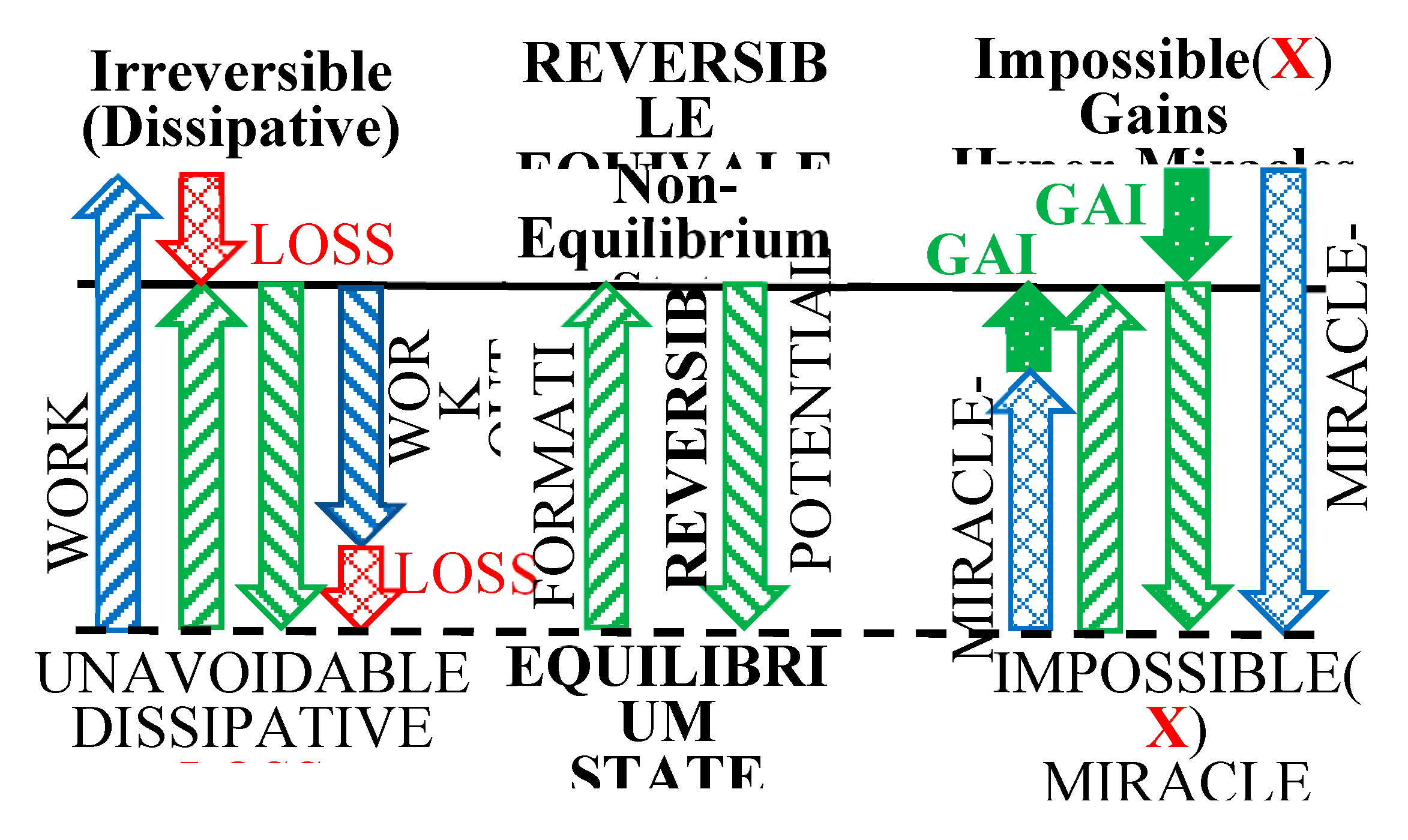
The true-equivalency, like in frictionless mechanics, is conserved during ideal, reversible processes, but in real processes, the forced energy displacement towards equilibrium is accompanied by the useful-energy or work-potential degradation due to its irreversible dissipation to heat with entropy generation, as elaborated in Section 4.3 and elsewhere.
5.4. Work-Potential, Formation-Work, and Exergy
The formation (or creation) of non-equilibrium WP, requires forcing of energy displacement on the expense of another non-equilibrium WP, where the non-equilibrium WP is displaced or transferred (along with entropy transfer with heat, if any), both ideally conserved (reversible equivalency), but in part or in whole the WP dissipates to heat with irreversible entropy generation, at any space and time scale (for which ThD macro-properties are defined), without exception.
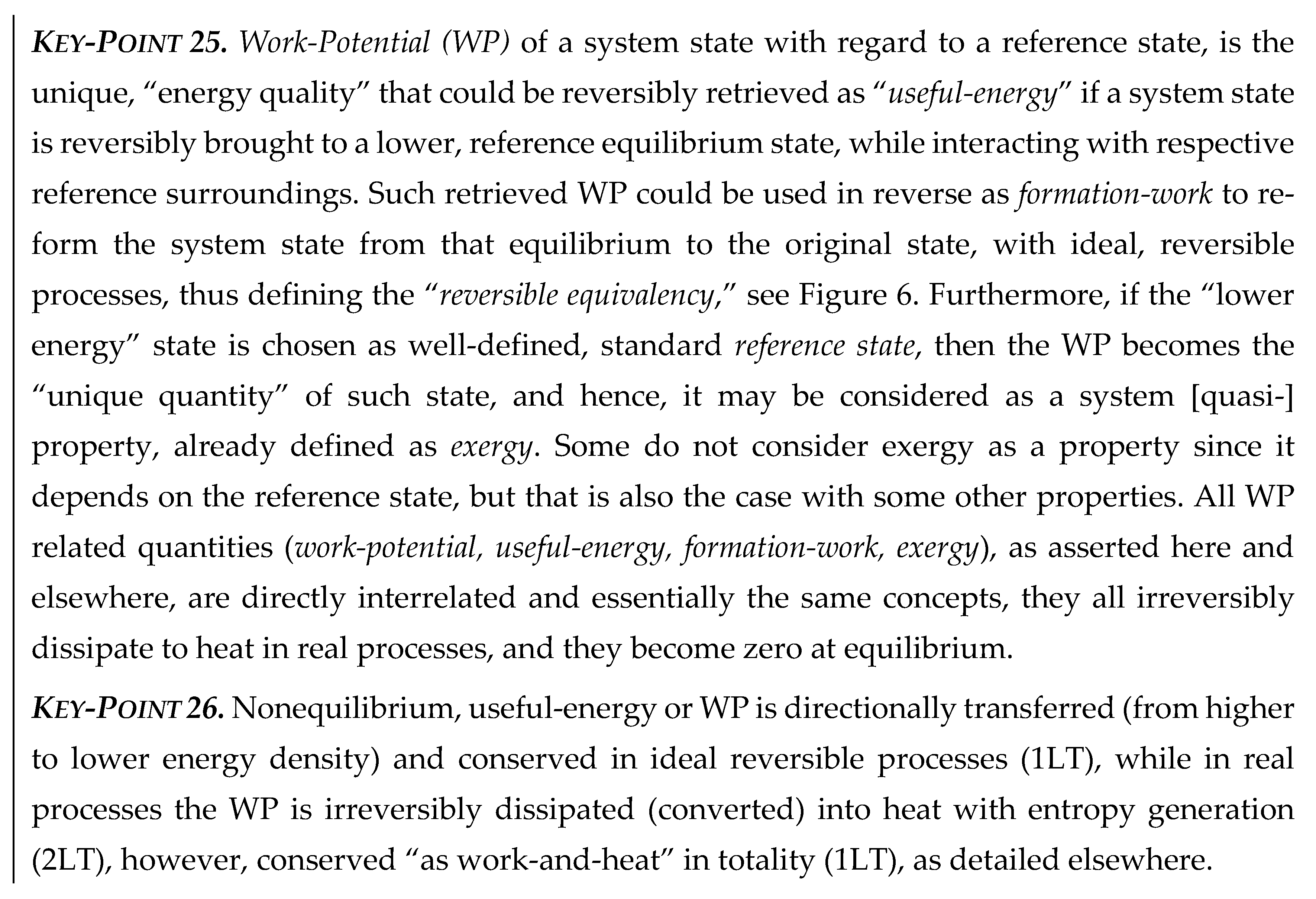
6. Carnot-Clausius Heat-Work Equivalency (CCHWE) Concept
Carnot-Clausius Heat-Work Equivalency (CCHWE), as named and ‘highlighted’ here, establishes interchangeability and equivalency between heat and work., see Figure 7. It is based on the early work of Carnot (1824) [8], that “all reversible processes and cycles have equal and maximum efficiency for the given thermal reservoirs’ temperatures, regardless of device and mode of operation,” and among others, including Thomson (Kelvin) and Clausius’ meticulous work, around 1850’s [11,12].
Clausius “struggled,” in his “Mechanical Theory of Heat” [12] (Ch. IV: Principle of the Equivalence of Transformations), to fully decern the Carnot’s postulates, and to finalize his ‘transformations’, i.e., “when heat is reversibly transferring from high temperature and in part releasing [converting to] work, and in part transferring to heat at low temperature.”
Clausius’ reasoning was ingenious like Carnot’s, with debatable particulars, but with accurate final deductions of the “transformations′ equivalence-values,” with the f(t)=1/T integration factor, that resulted in the definition of new property, the entropy (the ‘missing transformation’) and definition of the quantitative correlation of the Second Law of Thermodynamics (2LT), including the Clausius Equality (CsEq) for reversible cycles, and Clausius Inequality for all real, irreversible cycles, the latter include entropy generation caused by work dissipation to heat, due to irreversibilities of different kinds.
Figure 7.
Carnot-Clausius Heat-Work Equivalency (CCHWE) [as named here], established interchangeability and equivalency between ‘Heat-and-Work’, based on the early work of Carnot (1824), that all reversible processes and cycles have equal and maximum efficiency, and among others, Kelvin and Clausius’ meticulous work, around 1850’s, that finalized the Thermodynamic temperature, Reversible cycle efficiency, Carnot Equality, Clausius (In)Equality, Entropy, and generalized the Second Law of Thermodynamics [2LT].
Figure 7.
Carnot-Clausius Heat-Work Equivalency (CCHWE) [as named here], established interchangeability and equivalency between ‘Heat-and-Work’, based on the early work of Carnot (1824), that all reversible processes and cycles have equal and maximum efficiency, and among others, Kelvin and Clausius’ meticulous work, around 1850’s, that finalized the Thermodynamic temperature, Reversible cycle efficiency, Carnot Equality, Clausius (In)Equality, Entropy, and generalized the Second Law of Thermodynamics [2LT].
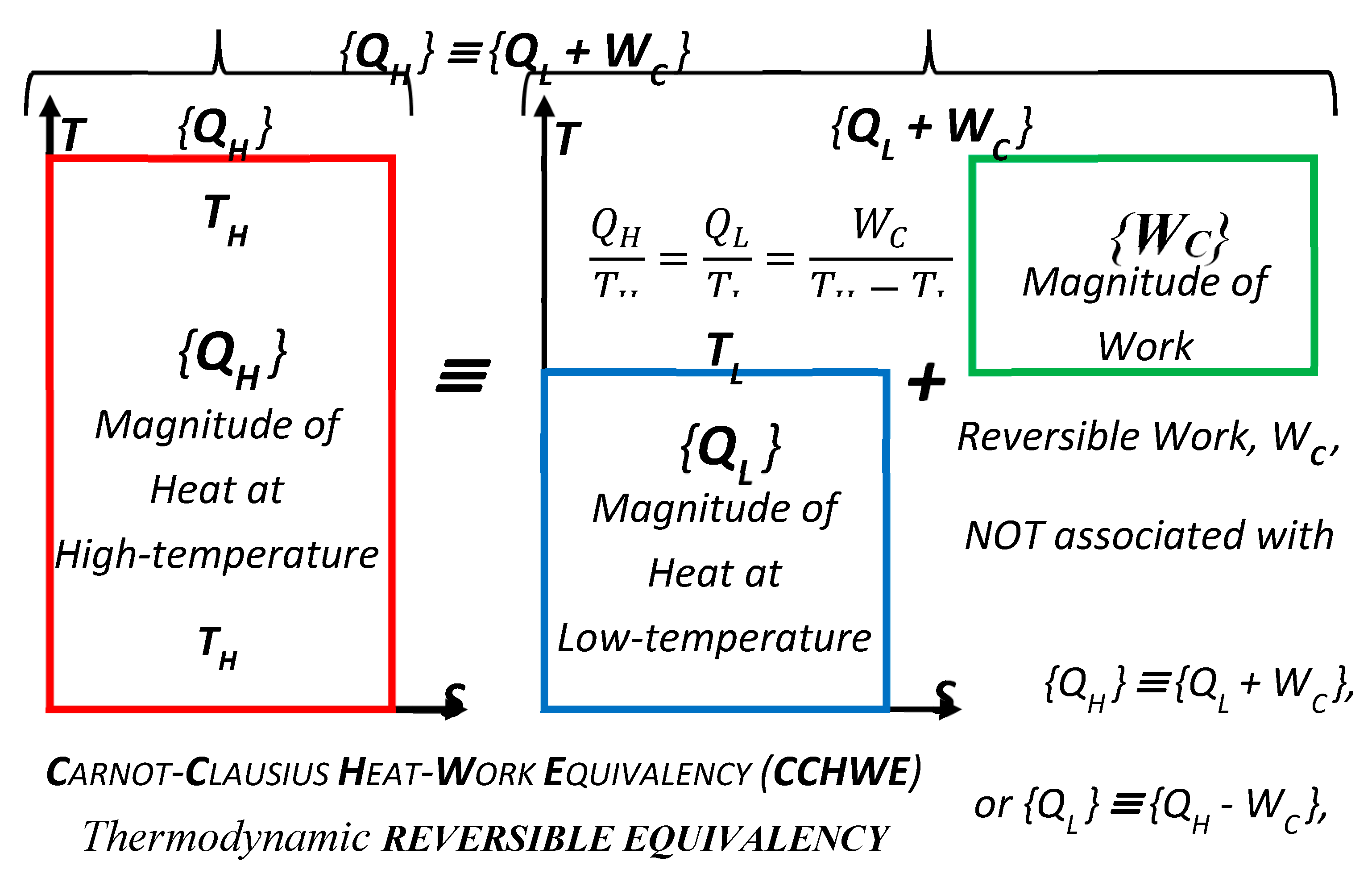
Due to reversible equivalency, as originally devised by Carnot [8] (see Key-Pt. 16 and Equation (8)), elaborated by Clausius [12], and re-interpreted in the Section 5 (Equation (8) and Figure 6), it is evident that heat and work are interchangeable and truly (reversibly) equivalent as follows:

The above correlations are much more important than they appear at first, since they represent the “heat-work reversible equivalency” in general, for all reversible steady-state processes not only for cycles (see Figure 7). Namely, heat QH at high temperature TH is equivalent with sum of heat QL at lower temperature TL and Carnot work WC, Equation ((9) Left); or any other relevant rearrangement, Equation ((9) Center or Right), along with the reversible Carnot Equality, as formalized and named here, Figure 3 and Equation (10).
It is important to emphasize again that the CCHWE is not only valid for reversible cycles, but in general. The cycles are ‘used’ to demonstrate maximum efficiency, but the latter is independent on the cycle design and mode of operation, therefore not dependent on the cycle per se, as implicitly postulated by Carnot, “maximum work is obtained by any reversible cycle, independent form the medium used or mode of operation, is dependent only on the temperatures of the two heat reservoirs [hence, not dependent on the cycle but the reservoirs’ properties/temperatures only].”
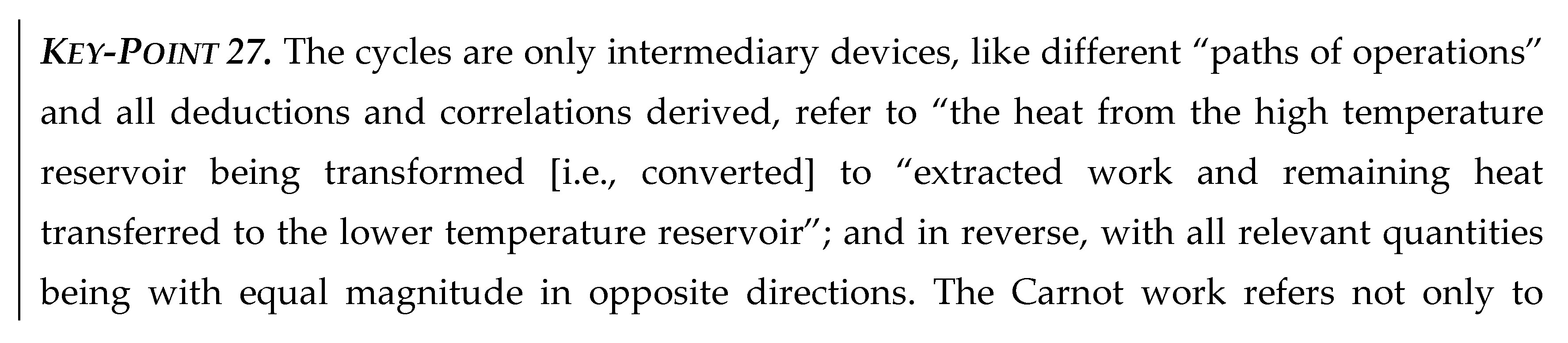

The CCHWE is demonstrated by Carnot cycle (and other power cycles along with the reverse-refrigeration cycles), where the Carnot cyclic-work (WC) and rejected heat at lower temperature (QL) are obtained from heat at higher temperature (QH) alone; and in-reverse, where the utilized work in refrigeration reverse-cycles (WC) is added (in)to a heat at low temperature (QL), resulting in the heat at higher temperature (QH) alone, see Figure 7.
The above correlations, Equations (9) and (10), the latter in simple arithmetic form for constant temperature of the thermal reservoirs, will require proper integration for thermal systems with variable temperatures, the way the Carnot Equality (named and highlighted here, see Sectison 5.2), is generalized with the integral form in the Clausius Equality.
6.1. Ideal Gas Equation of State and CCHWE Confirmation
Ideal gas equation of state: Ideal gas (IG) is composed of many randomly moving, hypothetical massive point-particles that undergo elastic collisions but without any other particle interactions. Regardless of its simple structure, the IG is a good approximation of the behavior of many real gases in many applications. The IG energy consists of random- or thermal-motion (ThM) of its particles. It may be expressed as its thermal energy [EIG ≡ EThM]=Eth=N(kBT)=nRuT, where, N is number of particles, kB [J/K] is the Boltzmann constant (or energy-temperature conversion factor), and T is particle-average absolute temperature, i.e., (kBT) is the particle average energy, n is number of moles, and Ru is the universal, molar gas constant.
All systems allow storage and transfer of ubiquitous thermal energy (since the ThM cannot be averted, even absolute-0K cannot be achieved, the 3LT); however, the rigid systems do not allow storage of mechanical compression energy like gases. More complex systems with relevant structures may allow storage and transfer of other energy types; like electrical charging, magnetization, chemical or nuclear reactions, and similar.
The ThM of IG particles along with temperature also exhibit the pressure on any hypothetical or real boundary surface and, therefore, its energy may also be represented as mechanical (pressure) energy: [EIG ≡ EThM ]=Eme=PV, where P is mechanical pressure (defined as relevant energy per unit of volume), and V volume of IG. Therefore, we may express the IG equation of state (i.e., the constitutive correlation of its mechanical and thermal properties), as the equivalence (“≡”) of the two forms of the same energy (Equation (11)).
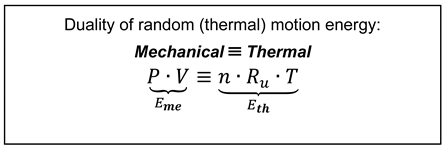
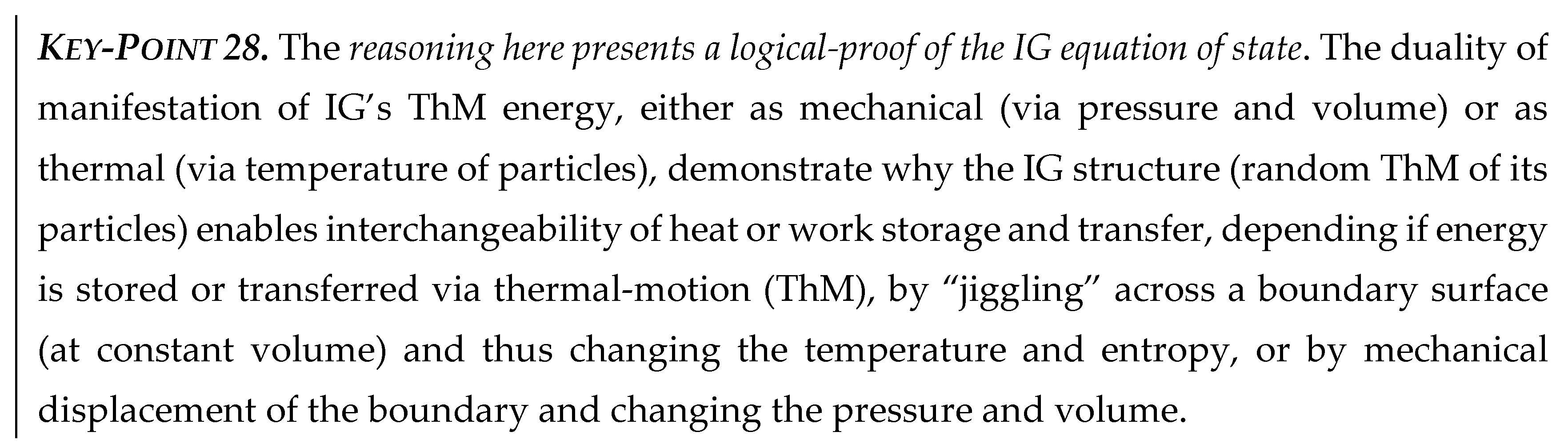
However, due to duality of the ThM, the P & T are conjugate-and-interrelated via the IG equation of state, Equation (11). Similarly, real gases (including steam; called simple [thermo-] compressible substances) allow thermal and mechanical energy storage and transfer, and manifest duality and interchangeability of heat and work, as formulated and named here, see next.
Carnot-Clausius Heat-Work Equivalency (CCHWE) confirmation: The CCHWE will be demonstrated and confirmed using IG for its simplicity. Furthermore, since the correlations for the reversible equivalency are, in principle, valid in general, regardless of intermediary, working system or mode of its operation (any reversible process or cyclic path are equivalent), the results obtained with IG will be, in principle, valid in general.
As stated before, the reversible Carnot cycle (Figure 4 and Figure 8) is the “measuring yardstick” of related equivalencies of all relevant input and output quantities, see next.
Figure 8.
Carnot cycle with ideal-gas: Isothermal expansion and compression’s works result in cycle net-work out, while adiabatic expansion and compression’s works cancel out, but they change temperatures required for reversible heat transfer.
Figure 8.
Carnot cycle with ideal-gas: Isothermal expansion and compression’s works result in cycle net-work out, while adiabatic expansion and compression’s works cancel out, but they change temperatures required for reversible heat transfer.
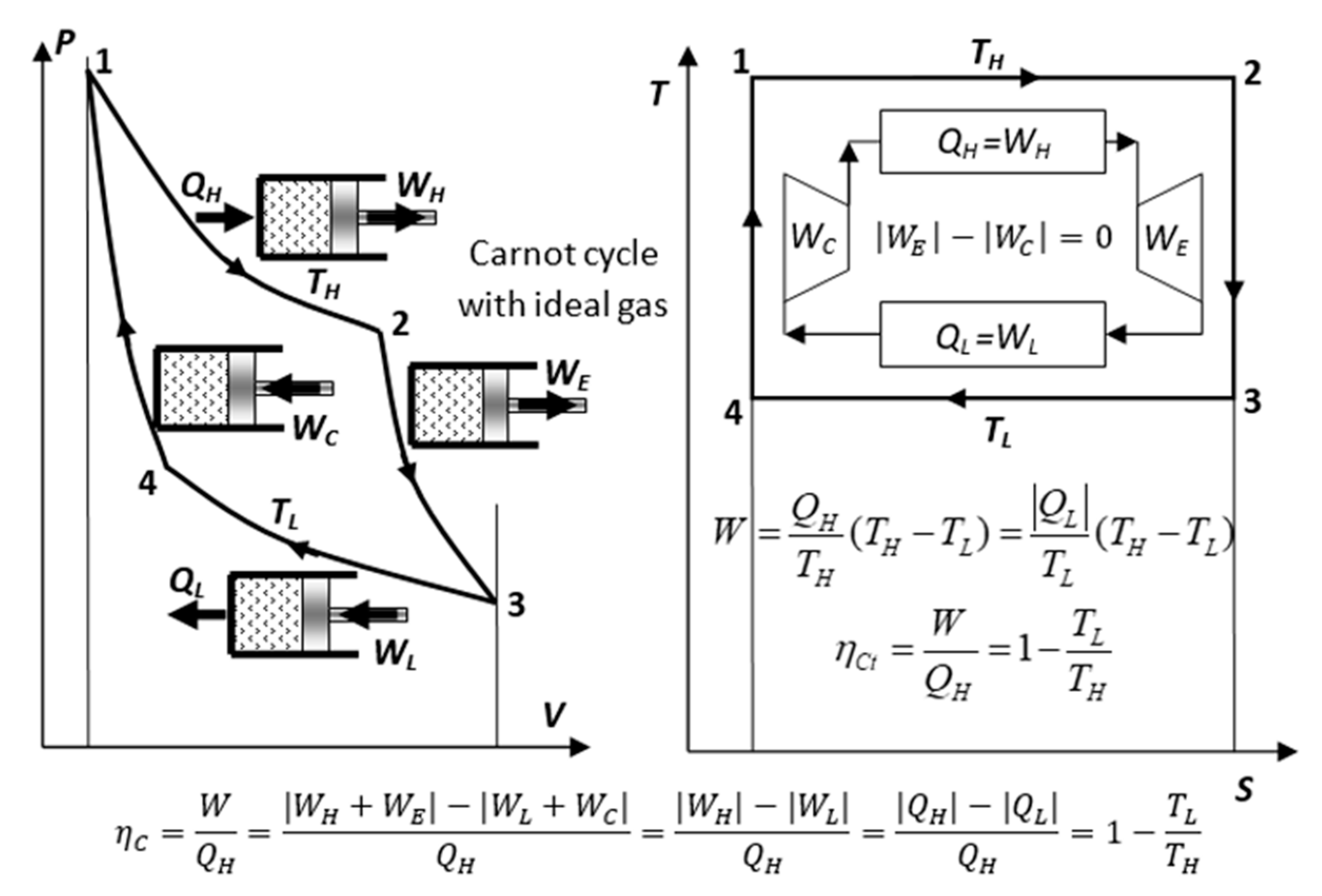
The reversible Carnot cycle also comprises isothermal processes where heat is entirely (100%) converted to work (QH=WH) while increasing volume and entropy (process 1-2), or in reverse, where work is entirely (100%) converted to heat (WL=QL) while decreasing volume and entropy (process 3-4). Note, that the isothermal ideal-gas heating is accompanied with the expansion work-out equal to heat-in, WH=QH), while the quantity of its internal energy is unchanged. However, its quality is degraded (part of its work potential replaced with heat), as manifested by the increase of entropy (i.e., U=constant, but decrease of the WP and free energy G=U-TS)!
Furthermore, the Carnot cycle comprises reversible adiabatic processes where internal energy (stored heat in IG) is entirely (100%) converted to work, -Cv(TL -TH)=W23, by lowering temperature and increasing volume (process 2-3), or in reverse, where work is entirely (100%) reversibly converted to internal energy (stored heat in IG), W41 =Cv(TH -TL), by increasing temperature and decreasing volume (process 4-1).
Note that the reversible, adiabatic works have equal magnitudes (|W23|=|W41|) and cancel out for the whole cycle (they have the main purpose to change temperature levels for reversible heat transfer to be possible). Consequently, the net cycle work is the result of the isothermal works’ difference due to the respective temperature difference, W=|WH|-|WL|=(TH -TL)|DS|, while exchanging the same entropy in-and-out, |DS12|=|DS34|=|DS|, so that entropy cancels out, enabling the completion of the cycle (note that the isentropic works do not contribute to the entropy balance). For more details and all specific equations, see Table 1 in [10, p.344].
7. “No Hope” for the Challengers of the Second Law of Thermodynamics
“It is hard to believe that a serious scientist nowadays, who truly comprehends the Second Law and its essence, would challenge it based on incomplete and elusive facts […] However, sometimes, even highly accomplished scientists in their fields do not fully realize the essence of the Second Law of thermodynamics [10,13,14,15,16,17,18].”
As already stated, this treatise [1], written for a special occasion [2], is presenting this author’s lifelong endeavors and reflections [6,7,9,10,13,14,15,16,17,18], including additional, original reasoning and interpretations, regarding the fundamental issues of thermodynamics, and especially as related to the subtle Second Law of thermodynamics (2LT), as well as to put certain physical and philosophical concepts in historical and contemporary perspective.
In this section, a number of related issues are presented and emphasized with several Key-Points, including a Deceptive Example (Section 7.1), “Three Primary-deception structures” of the 2LT, classified by this author (Section 7.2), and critical discussions on the two selected publications by avid challengers of the 2LT, one recent publication, challenging the 2LT [19], and another, self-claimed as a ‘landmark paper’, experimentally challenging the validity of the 2LT [20], see Section 7.3 below.
A small, but adventurous and stanch group of creative scientists and inventors-to-be, named here as “2LT Challengers,” are ‘bravely’ challenging the 2LT universal validity, often based on a fact that they have been successful in achieving a perpetual non-equilibrium (with limited work-potential, WP, but without perpetual work production), using innovative and creative methods and processes, and hoping to utilize it to ‘somehow’ perpetually produce work (useful-energy) from within the environment alone, as a single thermodynamic reservoir in equilibrium.
However, nobody has been successful to achieve spontaneous and sustained conversion (stationary or cyclic) of the surroundings’ (thermal) energy to useful work, nor to provide reliable evidence (comprehensive energy and entropy ‘accounting’) of achieving a sustainable, overall process efficiency higher than the Carnot's maximum possible (which is zero from a single thermal reservoir only).
7.1. “Perpetual-Motion Watch” Deceptive Example
We may “wishfully hypothesize” miraculous processes to achieve impossible outcomes by overlooking elusive but critically important phenomena. We will present here one trivial example that may appear to be a “perpetual-motion watch”, in order to demonstrate, that without full knowledge what is inside a ‘black-box’, it may deceive some to “jump to unjustified conclusions” without due comprehension.
If a watch is running for years without supplying any energy from outside, it may appear without knowing what is inside the watch, that it somehow runs by self-creating energy (PMM1) or that it somehow produces useful-energy from the surroundings as a single thermal reservoir (PMM2, self-creating WP), see Figure 9, with pictured a real watch with 5-10 years battery life.
It would be wrong to hypothesize that the useful work is perpetually supplied by heat from the surroundings alone (a violation of the 2LT), or that the work is somehow miraculously generated from nowhere (a violation of the 1LT).
Figure 9.
“Perpetual-motion-like” watch with 5-10 years battery life. As if its battery lasts forever. We could mistakenly hypothesize (as if we have proved experimentally), that it works without using energy (PMM1, 1LT violation), or it consumes energy from the surroundings’ thermal reservoir alone (PMM2, 2LT violation).
Figure 9.
“Perpetual-motion-like” watch with 5-10 years battery life. As if its battery lasts forever. We could mistakenly hypothesize (as if we have proved experimentally), that it works without using energy (PMM1, 1LT violation), or it consumes energy from the surroundings’ thermal reservoir alone (PMM2, 2LT violation).

Similarly, many other subtle electro-chemical and other interactions at different time and space scales may allude to violation of the fundamental laws, especially for near-reversible processes with negligible frictional and other dissipations, resembling “perpetually self-running watch” on Figure 9, running for years without any supply of energy from the outside. Some near-ideal processes, with apparent perpetual-motions, may appear to work without energy consumption or be ‘mistakenly hypothesized’ to somehow, spontaneously produce work from surrounding equilibrium only.
Since the 1LT of energy conservation appears more intuitive and the 2LT is more elusive, the inventors-to-be or even some seasoned researchers may mistakenly hypothesize the spectacular inventions that violate the 2LT. We should be very careful to avoid premature and sensational hypotheses based on inadequate experiments and incomplete analyses.
7.2. Three “Primary Deception Structures” of Hypothetical Violation of the Second Law of Thermodynamics
(1) First-deception structures (or “dynamic [quasi-] equilibrium”) is about confusing the notion of “perpetual free-motion (or free-oscillation)” without load (without extracting useful-energy but self-sustaining unavoidable dissipation), with notion of “perpetual motion machine” of perpetually producing useful-work without due WP source. It was named “dynamic [quasi-] equilibrium” and it has been discussed in more detail by this author in ([16,17] (Appendix 1)) and elsewhere.
(2) Second-deception structures (or “structural [quasi-] equilibrium”) is about creation of “systems with perpetual non-equilibrium properties” with transient, limited WP (like non-uniform temperature or pressure, or EM charge, and similar), to be somehow miraculously utilized for “perpetual self-creation of useful-work” from within an equilibrium-surroundings alone, thus without due, perpetual WP source [20], see Section 7.3. The former, a perpetual “non-equilibrium system state,” with limited WP energy, is not at all the same as a “self-creation of perpetual work” from within an equilibrium, or having a more efficient perpetual-cycle than the Carnot cycle. It would be against the forcing-direction of energy-displacement, from higher to lower energy-density (it would be a PPM2); and it would defy the very existence of equilibrium (it would be the equilibrium’s “contradiction impossibility”). It is called “structural [quasi-] equilibrium” and it has been discussed in more detail by this author in [14,15,16,17,18] and elsewhere.
(3) Third-deception structures (or “persistent-currents quasi-equilibrium”) is about certain “persistent currents” phenomena with self-perpetual, like “dissipate-and-reverse” processes (like the Brownian motion, and the Meisner effect, as a process-reverse to [(micro) irreversible] dissipation of the “superconducting persistent currents” or non-superconducting “persistent currents in metal rings” [19], and similar), that appear to perpetually micro-dissipate-and-reverse WP within their locality in equilibrium, as if they “quasi-reversibly dissipate-to-themselves” or self-create WP for its own dissipation; and thus, as if they violate universal validity of the 2LT, regardless of not producing any useful energy.
The challengers argue that such phenomena, in principle, ‘disapprove’ the 2LT universal validity, and could potentially, with future innovations be used as PMM2 to produce useful-energy while violating the 2LT [19, 20, with large number of references therewith]. However, the existence of such structures in quasi-equilibrium, since they do not produce perpetual work from within an equilibrium, is not justification for valid violation of the 2LT.

Therefore, the quasi-static (or quasi-equilibrium) phase-change of real systems in equilibrium with its surroundings are, ideally reversible processes and could perpetually be reversed back-and-forth with infinitesimal change of respective intensive properties, i.e., they are virtually irreversible within their self-sustained, perpetual virtual equilibrium. Similarly, the persistent-currents equilibrium (as the Third-deception structures) may be virtually irreversible (or near-reversible) within their self-sustained and perpetual, virtual [quasi-] structural-equilibrium. Such structures do not self-produce perpetual work nor perpetually destroy entropy, and therefore do not violate the 2LT, as speculated in [19,20].
Therefore, spontaneous displacement of energy from lower to higher energy density, in opposite direction from natural forcing and self-creation of non-equilibrium, would be like forcing in one direction with acceleration in opposite direction. Such wishful thinking would be the natural contradiction impossibility. It would negate stable equilibrium existence and will imply self-creation of WP with entropy destruction. Consequently, a non-equilibrium, the source of WP and forcing, cannot be generated (contradiction impossibility of unavoidable dissipation), but only could be transferred and ideally conserved, while in realty a WP will tend to dissipate to heat (within complex microstructure and fluctuating micro-processes), towards a mutual macro equilibrium.
As the fundamental laws of nature and thermodynamics are expended from simple systems in physics and chemistry, to different space and time scales and to much more complex systems in biology, life and intelligent processes, there are more challenges to be comprehended and understood. There is a need to better discern the fundamental concepts at different scales and complex systems, like diverse and more complex and self-sustained “structural equilibriums,” without net-fluxes at scale of interest, but with non-uniform concentration-potentials under coupled force fields; e.g., hydrostatic pressure and adiabatic temperature distributions in gravity field, charge and species concentration distributions in electromagnetic or chemical fields, as well as, to differentiate between transient and “near stationary” processes under influence of known and stealthy boundary and field conditions.
7.3. “Experimental Test of a Thermodynamic Paradox” Demystified
Professor Sheehan, an avid 2LT challenger, who organized several 2LT conferences and wrote extensively regarding the validity and violations of the 2LT, was claiming in their landmark paper [20, also in references therewith] that, “There are now roughly three dozen theoretical proposals for its violation in the mainstream scientific literature, more than half of which have resisted resolution as of this date. There are also experiments which purport to violate the 2LT, and not all of these have been discounted. My experiments in particular, published in Found. Physics in 2014 [20], have not been disproved or shown to be in error in any meaningful way.”
It is reasoned and argued here that the claims in the landmark paper by Sheehan et al. [20], are misplaced and over-stretching. Even if ‘more than half” of the challenges “have resisted resolution as of today” the other half have been disavowed and none has been verified to date. Especially problematic are incomplete, misleading, and biased experimental results, as if the challengers are not comprehending or ‘conveniently ignoring’ the very fundamentals and essence of the 2LT.
Specifically, the last two concluding sentences of the Sheehan’s et al. paper [20], were, “In summary, Duncan’s temperature difference has been experimentally measured via differential hydrogen dissociation on tungsten and rhenium surfaces under high temperature blackbody cavity conditions. We know of no credible way to reconcile these results with standard interpretations of the second law.” The claim of ‘black-body cavity conditions’ is questionable since it should be of much larger size than the devices inside. But, even if within a black-body cavity, the existence of stationary nonuniform properties (nonuniform temperatures, etc.) will not violate the 2LT of thermodynamics.
The last sentence of the paper is rather speculative, since the paper results describe a non-homogeneous, structural equilibrium established after externally imposed non-equilibrium (by heating the container tube to a very high temperatures). However, the 2LT, as classically stated for simple compressible substances for heat-work interactions only (where temperature is uniform at equilibrium). In general, the 2LT describes process conditions during spontaneous directional displacement of mass-energy (cyclic or stationary extraction of work), accompanied with irreversible generation (production) of entropy due to partial dissipation of work potential to thermal heat, which was not tested at all by the reported experiments, but only hypothetical and wishful claims stated. After all, before the 2LT-violation claims are stated, the reliable criteria for the 2LT-violation, including proper definition and evaluation of entropy balances (very important), should be established based on full comprehension of the fundamental Laws of nature.
Even more problematic is the Authors’ claim that their experiments “point to physics beyond the traditional understanding of the second law,” to justify their belief regarding the possibility of the 2LT violation, without due clarification and justification. The experiments relate to a special system with non-uniform temperature distribution due to dissociation/recombination, but do not represent a black-body cavity, and especially do not relate to the essence of the 2LT verification nor violation, as detailed below:
- Most of the fundamental formulations of the phenomenological, classical thermodynamics (called “standard thermodynamics” in the last sentence in Section 2 in the paper [20]), are reasoned and derived for the “simple compressible thermodynamic system,” the latter structure allows for heat and mechanical work interactions and storage only, but not other interactions, as well as for the ideal, black body cavities, with uniform thermodynamic properties in equilibrium (uniform temperatures and pressures in such simple material structures and systems). The experimental system described in the paper is not nearly closed to the ideal black-body cavity, and the described, dissociation/recombination interactions between heterogeneous devices within a controlled isothermal tube (of the same order of magnitude size as the devices inside), are much more complex than simple thermo-mechanical interaction of simple compressible system in ideal black-body cavity.
- The stationary quasi-equilibriums (with non-uniform properties) are abundant in nature, and do not violate the 2LT at all. For example, hydrostatic pressure distribution in a container, or adiabatic atmospheric temperature distribution, or non-uniform distribution of other properties in a stationary equilibrium, in gravity, electromagnetic or chemical fields, like the presented results. I called the above a “structural equilibrium” (sustainable equilibrium but with non-uniform properties), as opposed to ideal thermodynamic equilibrium (with uniform properties) between the simple compressible systems with boundary heat and work interactions only, immune from any other structure or field interactions. This is one of several other problems of the paper’s judgments and conclusions.
-
The statements in Section 6. Discussion in the paper [20], “Within the traditional understanding of the second law, stationary temperature differentials such as those reported should not be possible.” This statement is arbitrary and not justified, see also comments above. Likewise, “Second, the temperature differences in DP experiments generated Seebeck voltages that can drive currents—and did, through their thermocouple gauges—thus, were capable of performing work like a heat engine.” This is pure speculation, since we do not know what kind of stationary process will re-establish if a heat engine (HE) or electrical load is interfaced to utilize temperature or Seebeck voltage differences within the described system and devices.A simple question arises: why the Authors have not experimentally verified their hypothesis, if a stationary work extraction would be possible from within an environment in equilibrium? Such straightforward experiments could and should have been performed to check out experimentally such a critical hypothesis. Based on classical thermodynamics, which allows transient processes, after an initial non-equilibrium is externally imposed (as in the paper experiments), the appropriate, stationary structural equilibrium with properties-gradients will establish as in the paper, but stationary process with perpetual work extraction outside of an equilibrium is not possible, without external perpetual work source.
- The last two concluding sentences of the paper were, “In summary, Duncan’s temperature difference has been experimentally measured via differential hydrogen dissociation on tungsten and rhenium surfaces under high temperature blackbody cavity conditions. We know of no credible way to reconcile these results with standard interpretations of the second law.” The assumptions and conclusions are misleading and unjustified, as specifically described above.
The Authors [19,20] (and a number of other “Challengers” of the 2LT) often misinterpret the fundamental laws, present elusive hypotheses, and perform incomplete, biased experiments, always short of simple confirmation of their 2LT violation claims. The Authors’ implication that with creative devices, “Challengers’ Demons” (like Maxwell Demon; see Ref. [17]), it is possible to imbed them to a macro-equilibrium environment and extract stationary ‘useful work’, are philosophically and scientifically unsound. Such a magic and wishful ‘demons’, if possible and inserted as a ‘black box’ in a system or environment at equilibrium, to create a steady-state (stationary) work-extracting process from within such equilibrium, would be in opposite direction of existing natural forces, and also be a ‘catastrophically unstable’ processes with a potential to ‘syphon’ all existing mass-energy in an infinitesimal-size singularity with infinite mass-energy potential, a super black-hole-like. If it were ever possible, we would not exist ‘as we know it’ here and now!
8. Conclusions
As already stated, this comprehensive treatise [1], written for a special occasion [2], presents this author’s lifelong endeavors and reflections [6,7,9,10,13,14,15,16,17,18], including original reasoning and re-interpretations, regarding the fundamental issues of thermodynamics, and especially as related to the subtle Second Law of thermodynamics (2LT), as well as to put certain physical and philosophical concepts in historical and contemporary perspective, see Section 1 (Introduction, which ends with the Selected Abbreviations and Notes). The main content of this treatise was presented in the following Sections:
In Section 2, “Energy forcing and displacement,” the related concepts have been pondered. The “force or forcing” is nonequilibrium energy tendency to displace or redistribute (or to extend) from its higher to lower energy density (or energy-intensity) towards mutual equilibrium with uniform properties. Typical, energy intensive and extensive conjugate-properties (energy-force and energy-displacement) were presented in Table 1. All but thermal energy-displacements are conserved, while thermal-displacement (entropy or number of thermal virtual-particles, NThVP, as defined and named here) is irreversibly generated due to dissipation of all other energy types to heat.
Then, in Section 3, “Reasoning logical-proof of the fundamental laws,” the concept of energy forced-displacement as the mechanistic phenomenon in general was reaffirmed. The elementary particles (including “field-equivalent” particles) or bulk systems (consisting of elementary particles), mutually interact along shared displacement (with equal, respective action-reaction forces), thereby conserving energy during their interactive, mutual displacement. Since all existence is in principle mechanistic and physical, it was demonstrated here that the Laws of thermodynamics (LT) are generalized extensions of the fundamental Newton’s Laws (NL) of mechanics. The First Law of thermodynamics (1LT) is the generalized law of the conservation of energy, and the Second Law of thermodynamics (2LT) describes the forcing tendency of nonequilibrium, useful-energy (or work-potential, WP) for its displacement and irreversible dissipation to heat with entropy generation, towards mutual equilibrium.
In Section 4, “Ubiquity of thermal motion and heat, thermal roughness, and indestructability of entropy”, this author’s comprehension of related phenomena has been further advanced by defining a new concept of “thermal roughness” and reasoning impossibility of entropy destruction, among others. Entropy, as the “final transformation” cannot be converted to anything else nor annihilated, but only transferred with heat and irreversibly generated with heat generation due to work dissipation, including Carnot “thermal work-potential” dissipation.
The “thermal roughness” and related “thermal friction” were defined and named here as new concepts, as the underlying cause and source of inevitable irreversibility since absolute-0K temperature is unfeasible (3LT). Since all real, irreversible processes generate heat and entropy due to unavoidable dissipation of work and/or WP to heat (ultimately instigated by the “thermal roughness” as elaborated and named here), and all ideal, reversible processes conserve entropy, then, there is no other processes left to miraculously generate WP without a due WP-source. Furthermore, no “imaginary process” could destroy (or annihilate) entropy, since it would be a ‘self-reversal of dissipation’ impossibility and contradiction-impossibility against the natural forcing — it would imply self-generation of nonequilibrium (and its WP); therefore, rendering a logical proof of indestructibility of entropy (the 2LT).
In the following, Section 5, “Carnot maximum efficiency, Reversible equivalency, and Work potential” the Sadi Carnot’s ground-breaking contributions of reversible processes and heat-engine cycle maximum-efficiency was put in historical and contemporary perspective. Furthermore, it has been argued that the Carnot’s contributions are among the most important developments in natural sciences.
The proof by “contradiction-impossibility” of an established fact is, by definition, the logical proof of the stated fact. If a contradiction of a fact is possible then that fact would be void and impossible. It is illogical, absurd, and impossible to have it both, “the one-way and the opposite-way.” For example, if heat self-transfers from higher to lower temperature, it would be “contradiction-impossibility” to self-transfer in the opposite direction. All reversible processes (including cyclic processes) under the same conditions must have equal and maximum efficiency, as demonstrated by relevant “contradiction impossibility.”
As a matter of fact, the reversible processes and cycles were a priori “specified” as ideal, with maximum possible efficiency, with a priory 100% “2LT reversible-efficiency,” not dependent on their design or mode of operation (independent on their quasi-stationary cyclic path or any other, reversible stationary-process-path). Actually, as the ideal ‘work-extraction measuring-devices’, all reversible processes and cycles determine, not their efficiency per se, but in fact, they determine the WP (as % or ratio efficiency with reference to relevant total energy) of an energy-source system with another reference system (like the two thermal reservoirs with the Carnot cycle, so their WP-ratio being dependent on their temperatures only). The Carnot’s Equality (CtEq), Q/T=constant, the well-known correlation, the precursor for the famous Clausius Equality (CsEq), CI(dQ/T)=0 (the cyclic-integral for variable-temperature reversible-cycles), was specifically named here ‘as such’ by this author in Sadi Carnot’s honor and to resample the CsEq name.
In the succeeding Section 6, named here “Carnot-Clausius Heat-Work Equivalency (CCHWE) concept”, a notion of ‘true’ heat-work interchangeability has been enlightened and named here, as an essential consequence of thermodynamic reversible equivalency.
The correlations, QH ≡ WC + QL and QH/TH=QL/TL=WC/(TH - TL), Equations ((9) & (10)), are much more important than they appear at first, since they represent the “heat-work reversible equivalency and interchangeability” in general, for all reversible steady-state processes not only for cycles (see Figure 7). Namely, heat QH at high temperature TH is equivalent with sum of heat QL at lower temperature TL and Carnot work WC.
The energy of thermal-motion (ThM) of ideal-gas (IG) particles, EThM=Eth=N(kBT)=nRuT, along with temperature also exhibit the pressure on any hypothetical or real boundary surface and, therefore, its energy may also be represented as mechanical (pressure) energy: EThM =Eme=PV. Therefore, we may express the IG equation of state (i.e., the constitutive correlation of its mechanical and thermal properties), as the equivalence (“≡”) of the two forms of the same energy, PV ≡ nRuT, thus rendering its logical proof.
Thermal-transformers were named and discussed by this author in 2004 [6], revisited later [10], and reiterated here in Section 6. It could be functioning as an ideal, “reversible thermal-transformer.” Namely, the reversible heat transfer from higher TH to lower TL temperature with W, Carnot cycle work output; or in reverse, the reversible heat transfer from lower TL to higher TH temperature with W, Carnot cycle work input. Likewise, the real thermal-transformers, power and refrigeration cycles (including heat-pump cycles), also transfer heat from any to any temperature level, except for reduced efficiency due to unavoidable dissipation of WP to generated heat and entropy (Equations (5) & (7)).
Lastly, in Section 7, “‛No Hope’ for the Challengers of the Second Law of thermodynamics,” this author’s compelling arguments were presented, that “entropy can be reduced (locally, when heat is transferred out of a locality), but it cannot be destroyed by any means on any space or time scale of interest. A “Perpetual-Motion Watch” was presented as a trivial, deceptive example. Furthermore, three primary-deception structures (PDS), of hypothetical violation of the 2LT were classified by this author: First-PDS (or “dynamic [quasi-] equilibrium”), Second-PDS (or “structural [quasi-] equilibrium”), and new, Third-PDS (or “persistent-currents quasi-equilibrium”). And, lastly, critical discussions on the two selected publications by avid challengers of the 2LT, one recent publication challenging the 2LT [19], and another, self-claimed as a ‘landmark paper’, experimentally challenging the validity of the 2LT [20], were presented.
The Challengers misinterpret the fundamental laws, present elusive hypotheses, and perform incomplete and misleading, biased experiments, always short of straightforward confirmation of their 2LT violation claims. That is why all resolved, Challengers’ paradoxes and misleading violations of the 2LT to date, have been resolved in the favor of the 2LT and never against. We are still to witness a single, still open Second Law violation, to be verified and utilized.
The violation of the 2LT should be the last and not the first hypothesis to justify an unsolved phenomenon. It appears that the Challengers are misusing the elusive ‘Entropy Law’ (2LT): "Whoever uses the term 'entropy' in a discussion always wins since no one knows what entropy really is, so in a debate one always has the advantage" [As lamented by John von Neumann]. It would be more probable to assume that such structures are infinitesimally irreversible (or near-reversible) and very-slowly approaching true equilibrium while negligibly exhausting its own WP, or even hypothesize that they may be driven by negligibly-stealthy, yet-to-be-discovered “cold fusion” like energy within atomic nucleus, or some stealthy WP from within or from the surroundings.
This treatise is concluded with the following:
Furthermore, the time and spatial integrals of micro quantities must result in macro quantities, for the conservation laws to be valid. Therefore, claiming violation of the 2LT on micro-scale or special processes is questionable and due to lack of full comprehension of the 2LT, or due to lack of proper ‘tooling’ (conceptual, analytical, numerical, or experimental limitations), or sometimes may be due to a desire for unjustified attention.
In reality, all processes must be at least infinitesimally irreversible, including underlining processes at equilibrium, the latter being an ideal state. The underlying mass-energy structures and processes within the ‘finest micro scales’ are more complex and undetected at our present state of tooling and mental comprehension. However, their integral manifestation at macroscopic level, are more realistically observable and reliable, thus being the ultimate ‘check-and-balance’ of microscopic and quantum hypotheses.
The fundamental physical laws are independent from any system structure or scale, and they should take primacy over any special analysis based on approximations and limitations of modeling of system, its properties, and processes; and especially if based on ‘thought experiments’ [17]. After all, micro- and sub-micro simulations and experimental analyses are also based on the fundamental Laws, and therefore, they cannot be used to negate those fundamental Laws. As the fundamental laws of nature and thermodynamics are expanded from simple systems in physics and chemistry, to different space and time scales and to much more complex systems in biology, life and intelligent processes, there are more challenges to be comprehended and understood [16].

References
- NOTE: This comprehensive treatise is written for the special occasion of the author’s 70th birthday [2]. It presents his lifelong endeavors and reflections with original reasoning and re-interpretations of the most critical and misleading issues in thermodynamics. Only selected and this author’s relevant publications are referenced, since the goal was not to review the vast thermodynamic literature.
- Entropy Special Issue "Exploring Fundamentals and Challenges of Heat, Entropy, and the Second Law of Thermodynamics: Honoring Professor Milivoje M. Kostic on the Occasion of His 70th Birthday" https://www.mdpi.com/journal/entropy/special_issues/70th.
- Leggett, A.J. Reflections on the past, present and future of condensed matter physics. Sci. Bull. 2018, 63, 1019–1022.
- NOTE: Irreversibility is “irreversible transformation”, or something permanently changed, without possibility to fully (or “truly”) reverse all interacting systems back to the original condition by any means. It should not be confused with local change back to the original condition by “compensation” from elsewhere (increase or decrease due to transfer of relevant quantity from or into a local system if interacting with its surroundings). For example, the work-potential (WP) is irreversibly reduced by converting it to heat accompanied with related irreversible entropy generation (or entropy production). There is no way to fully reverse these irreversibilities, without exception, at any space or time scale. However, such prior irreversibilities may be compensated locally by transferring work into or heat with entropy out of a local system, on the expense of the surrounding systems’ relevant quantities, while inevitably producing further irreversibilities (further permanent dissipation of WP accompanied with heat and entropy generation).
- NOTE: Reversibility or Reversible Equivalency is an ideal concept, represented by ideal processes without any energy degradation (with maximum possible efficiency or without irreversible dissipation) so that its final and initial states are truly-equivalent and may self-reverse-back completing a cycle, or may perpetually repeat back-and-forth in any manner, therefore, effectively representing “dynamic (quasi-) equilibrium”. In fact, any process that perpetually self-sustain its own macro-structure, regardless if stationary or dynamic, or it is with perpetual uniform or non-uniform macro-properties), is in equilibrium or quasi-equilibrium, respectively; and, it is in its own right reversible, since, as a matter of concept, “reverse-process perpetuity and reversible equivalency” is the definition of reversibility.
- Kostic, M. Irreversibility and Reversible Heat Transfer: The Quest and Nature of Energy and Entropy. In Proceedings of the IMECE2004, Anaheim, CA, USA, 13–20 November 2004; ASME: New York, NY, USA, 2004.
- Kostic, M. Nature of Heat and Thermal Energy: From Caloric to Carnot’s Reflections, to Entropy, Exergy, Entransy and Beyond. Entropy 2018, 20, 584.
- Carnot, S. Reflections on the Motive Power of Heat; Thurston, R.H., Translator; Chapman & Hall, Ltd.: London, UK, 1897; Available online: https://sites.google.com/site/professorkostic/energy-environment/sadi-carnot (accessed on 30 April 2023).
- Kostic, M. Sadi Carnot’s Ingenious Reasoning of Ideal Heat Engine Reversible Cycles, 4th IASME/WSEAS International Conference on ENERGY, ENVIRONMENT, ECOSYSTEMS and SUSTAINABLE DEVELOPMENT (EEESD'08), Algarve, Portugal, June 11-13, 2008. WSEAS-EEESD08_588-357Kostic-Sadi_Carnot_Ingenious_Reasoning.pdf.
- Kostic, M. Revisiting the Second Law of Energy Degradation and Entropy Generation: From Sadi Carnot’s Ingenious Reasoning to Holistic Generalization. AIP Conf. Proc. 2011, 1411, 327. http://niu.edu/kostic/_pdfs/Second-Law-Holistic-Generalization-API.pdf (accessed on 30 April 2023). [CrossRef]
- Thomson, W. (Lord Kelvin). On the Dynamical Theory of Heat. Transactions of the Royal Society of Edinburgh, March 1851, and Philosophical Magazine IV. 1852. https://zapatopi.net/kelvin/papers/.
- Clausius, R. The Mechanical Theory of Heat; Macmillan: London, UK, 1879; pp. 21–38, 69–109, 212–215.
- Thermodynamics - A section of Entropy (mdpi.com).
- Dissecting the 2nd Law Challenges - Kostic Web (google.com) (accessed on 30 April 2023).
- Kostic, M., Challenges to the Second Law Challengers: Reflections on the Universal Validity of the Second Law of Thermodynamics, Presentation at the Second Law Symposium, San Diego, 2016. (Accessed on 30 April 2023).
- Kostic, M., The Second Law and Entropy Misconceptions Demystified. Entropy 2020, 22, 648 * (Full-text HTML online * PDF). https://www.mdpi.com/1099-4300/22/6/648 * https://www.ncbi.nlm.nih.gov/pmc/articles/PMC7517180/.
- Kostic, M. Maxwell's Demon and its Fallacies Demystified. [Appendix 1: https://1drv.ms/b/s!AvKZKm6xP_zxkJkuIDPWCyMvXZhoSA]. [CrossRef]
- Kostic, M., “Heat Flowing from Cold to Hot without External Intervention” Demystified: Thermal-Transformer and Temperature. arXiv:2001.05991.
- Nikulov, A. The Law of Entropy Increase and the Meissner Effect. Entropy 2022, 24, 83. [CrossRef]
- Sheehan, D.P. et al., Experimental Test of a Thermodynamic Paradox, Found Phys (2014) 44: 235-247. [CrossRef]
Disclaimer/Publisher’s Note: The statements, opinions and data contained in all publications are solely those of the individual author(s) and contributor(s) and not of MDPI and/or the editor(s). MDPI and/or the editor(s) disclaim responsibility for any injury to people or property resulting from any ideas, methods, instructions or products referred to in the content. |
© 2023 by the authors. Licensee MDPI, Basel, Switzerland. This article is an open access article distributed under the terms and conditions of the Creative Commons Attribution (CC BY) license (http://creativecommons.org/licenses/by/4.0/).
Copyright: This open access article is published under a Creative Commons CC BY 4.0 license, which permit the free download, distribution, and reuse, provided that the author and preprint are cited in any reuse.


