

Submitted:
26 April 2023
Posted:
03 May 2023
You are already at the latest version
Abstract
Medium polarity plays a crucial role in charge-transfer processes and electrochemistry. The added supporting electrolyte in electrochemical setups, essential for attaining the needed electrical conductivity, sets challenges for estimating medium polarity. Herein, we resort to Lippert–Mataga–Ooshika (LMO) formalism for estimating the Onsager polarity of electrolyte organic solutions pertinent to electrochemical analysis. An amine derivative of 1,8-naphthalimide proves to be an appropriate photoprobe for LMO analysis. An increase in electrolyte concentration enhances the polarity of the solutions. This effect becomes especially pronounced for low-polarity solvents. Measured refractive indexes provide a means for converting Onsager to Born polarity, which is essential for analyzing medium effects on electrochemical trends. This study demonstrates a robust optical means, encompassing steady-state spectroscopy and refractometry, for characterizing solution properties important for charge-transfer science and electrochemistry.
Keywords:
Stokes’ shift
; dipole
; absorption
; fluorescence
; refractometry
1. Introduction
1.1. Background
Medium polarity strongly affects the behavior of charged and dipolar species. The solvation in condensed media governs the dynamics of processes involving charge transfer (CT), ranging from intramolecular redistribution of electron density to heterogeneous CT at electrode surfaces [1]. Polarity depends on the susceptibility of the medium to polarize under electric field, and it affects various properties of the solvated species, such as their solubility, reactivity, electrochemical potentials, and spectral transitions [2,3,4,5,6,7,8,9,10].
Born polarity, accounting for the solvation energy of charges and inversely proportional to the solvent dielectric constant, provides a good quantitative description of medium effects on electrochemical potentials, CT driving forces and outer-sphere reorganization energy [11,12,13]. In fact, not only solvent polarity, but also the concentration of the supporting electrolyte (Cel) significantly affects experimentally obtained electrochemical potentials [14,15]. Dissolved ionic species do modulate solution polarity. (1) Dissolving electrolyte comprising kosmotropic ions in aqueous media tends to decrease its polarity [16,17]. (2) Chaotropic ions, on the other hand, can increase the polarity of solutions, especially those composed of low-polarity solvents [18,19,20,21,22,23].
Capacitance measurements offer a robust means for determining dielectric constants of non-conducting solvents and materials [24,25]. Adding electrolytes to the solvents for attaining the conductivity needed for electrochemical measurements, however, presents challenges. Since media polarity affects optical transition to and from highly polarized states, molecular photoprobes offer a convenient handle for examining the polarity of electrolyte solutions that solvated species experience. Such optical reporters account for the polarity of only the media that is immediately around the solvation cavity. Nevertheless, such estimates of “localized” polarity are considerably more valuable for molecular and nanometer-scale systems than the average bulk properties of the solutions.
As important as Born polarity is for characterizing medium effects on long-range CT and on reduction and oxidation processes, it fails when it comes to optical transitions involving changes in electric dipole moments. Conversely, the Onsager reaction-field theory provides a good model for quantifying solvation of dipoles [26]. Based on the Onsager model, the work of Wolfgang Lippert, Mitsuo Mataga, and Yasuteru Ooshika provides a means for estimating differences between the electric dipoles of ground and the emissive excited states [27,28,29,30].
The Lippert–Mataga–Ooshika (LMO) formalism is invaluable for extracting information about excited-state dipoles from absorption and emission spectra recorded for media with different polarity [31,32,33]. Conversely, resorting to coumarin 153 (C153), we recently demonstrated the utility of employing the LMO formalism in reverse for characterizing the polarity of electrolyte solutions essential widely used in analytical electrochemistry [34]. The inherently large dipole change upon photoexcitation makes chromophores with emissive CT states particularly attractive for LMO analysis which justifies our choice for C153. Nevertheless, the excited-state behavior of C153 limits its utility for LMO analysis to solutions that are more polar than dichloromethane (CH2Cl2). This outcome warrants the search for different photoprobes that allow analyzing a broad ranges of medium polarity pertinent to electrolyte solutions important for electrochemistry, and most of all, improved understanding of what consists a good photoprobe for LMO analysis.
Herein, we demonstrate the utility of 4-dimethylamino-N-phenyl-1,8-naphthalimide (ANI-Ph) for spectroscopic estimations of the Onsager polarity of electrolyte solutions in solvents ranging from relatively polar acetonitrile (CH3CN) to medium-polarity chloroform (CHCl3). The measured refractive indexes of the electrolyte solutions allow us to extract their Born polarities from the LMO-determined Onsager ones, since the former have pertinent importance for electrochemical applications,. Density-functional theory (DFT) reveals the electronic characteristics of the ground and excited states of ANI-Ph, which elucidates the chromophore features needed for LMO analysis. With well selected photoprobes, therefore, this optical method proves promising for determining the polarity of electrolyte solutions.
1.2. Born polarity vs. Onsager polarity: What’s the difference?
Three sources of polarization govern medium polarity: (1) orientational polarization, Pμ, reflecting on the ability of the solvent electric dipoles to orient along the applied field; (2) vibrational polarization, Pν, depending on the field-induced redistribution of the positively charged solvent nuclei; and (3) electronic polarization, Pe, accounting for the field-induced shifts in the electron density of the solvent molecules [35]. Numerous scales for quantification of medium polarity have emerged through the years that rely on bulk solvent characteristics such as static dielectric constant, ε, and index of refraction, n [2,3]. While ε accounts for medium Pμ, Pν and Pe, n depends only for Pe. That is, when the applied electric field oscillates too fast for the medium dipoles and nuclei to move and react to it, the polarity depends only on Pe, and thus n2 is referred to as optical or dynamic dielectric constant.
Born solvation energy, ΔGB, represents the stabilization of a spherical charge with a radius, r, in a medium with dielectric constant, ε [11]:
where z is the charge of the solvated species, qe is the elementary charge, ε0 is the vacuum permittivity and fB is the Born polarity of the solvating media:
Accounting for ΔGB is essential for understanding the medium effects on CT processes involved, for example, in electrochemistry and (photo)redox catalysis. For example, fB is a part of the Rehm-Weller equation for characterizing the thermodynamics of photoinduced CT [13,36], and as the Pekar factor, fB is essential for estimating the outer-sphere, or medium, CT reorganization energy [12,37].
When opposite charges are too close within the same solvation cavity forming a dipole, ΔGB cannot quantify their solvation energy, warranting the use of the Onsager model instead. It accounts for the mutual polarization of dipolar species and the surrounding solvent. The Onsager model includes electrostatic terms arising from the permanent dipole moment and the volume of the solvated species. It defines the Onsager polarity, fO, encompassing Pμ, Pν and Pe, as:
and fO accounting for Pe only is:
Thus, to extract the effects of the prominent polarizability arising from Pμ when it is far greater than Pν, i.e., |Pμ| >> |Pν|, the expression for the Onsager reaction-field polarity becomes [28]:
The Onsager model assumes point-dipole approximation. That is, it treats the solute dipole as a point in the center of the spherical cavity. Nevertheless, this approximation still proves fairly applicable and extends to hydrogen-bond-forming solvents and non-polar media [28,38,39]. Moreover, the Onsager reaction-field polarity relates to the Born polarity by considering solely the static dielectric constant:
The Stokes' shift refers to the energy difference between the maximum of the absorption emission spectral bands originating from transitions between the ground and the same excited state of a chromophore. It represents the energy differences between Franck-Condon (FC) and relaxed electronic states. This relaxation often involves intramolecular charge redistribution. As a response to the thus induced changes in the electric fields localized around a chromophore following optical transitions, Pμ of the medium describes its reorganization around the solvation cavity. That is, as the orientation of the molecules of the solvating media does not change around the solute during light absorption and emission, it only reaches equilibrium during the relaxation of the FC states. Hence, the extent of stabilization of the relaxed states depends on the dipoles of the solvent molecules and their ability to reorient under applied electric field. This feature allows the LMO formalism to relate the Stokes' shifts (Δ), obtained from absorption and emission spectra, to the Onsager polarity of the media (eq. 2c):
where Δμ is the difference between the magnitudes of the dipoles of the emissive excited state (μ*) and the ground state (μ0), i.e., Δμ = |μ*| – |μ0|; and Δ0 is the Stokes’ shift for non-polar media with equal static and dynamic dielectric constants, i.e., ε = n2.
The LMO formalism relies on two types of solvent effects: (1) stabilization of the FC ground state after the radiative deactivation, i.e., S0(FC)→S0, and (2) stabilization of the FC excited state to its emissive structure after the photoexcitation. Therefore, it is important to combine LMO with other experimental and theoretical techniques in order to extract meaningful information about the electronic properties of a molecule from the dependence of its Stokes’ shift on solvent polarity.
2. Results
2.1. Selection of a Photoprobe
The LMO analysis does not account for changes in dipole orientation. That is, a principal assumption is that μ* and μ0 are parallel and point in the same direction, i.e., Δμ = |Δμ|, where |Δμ| is the magnitude of the vector difference between the two dipole moments. That is, |Δμ| = |μ* – μ0| or |Δμ|2 = |μ*|2 + |μ0|2 – 2 |μ*| |μ0| cos(α), where α is the angle between the ground and excited-state dipoles. For chromophores that show good linearity of Δ vs. fO(ε, n2) it is important for α to be as small as possible, i.e., α→0, or ideally, α = 0. Estimating the angle between that μ* and μ0 to characterize such chromophores, requires alternative methods such as quantum-mechanical calculations.
Another assumption of the LMO analysis is that the dipole change, Δμ, is invariant to the medium polarity, i.e., Δμ is introduced as a constant to the slope of the linear dependence of Δ vs. fO(ε, n2) (eq. 4). Considering the reaction field inside the solvation cavity warrants an increase in the solute dipole with an increase in medium polarity. Because the ground and excited-state dipole are different, such polarity-induced increase will also be different and preclude any invariance of Δμ to fO(ε, n2). Therefore, it is common to observe non-linear behavior of Δ vs. fO(ε, n2), especially with lowering the solvent polarity [32,40]. Accounting for these consideration makes it crucial to define the LMO “working range” of a photoprobe where the polarity-induced change of Δμ is minimal and Δ vs. fO(ε, n2) shows linearity within the experimental uncertainty.
Selecting photoprobes that manifest large Δμ values enhances the sensitivity of the LMO analysis since it increases the slope of the linear dependence of Δ vs. fO(ε, n2) (eq. 4). Chromophores with emissive CT states present and excellent choice, therefore, and voltage-sensitive dyes appear quite attractive for such applications. Nevertheless, a decrease in medium polarity may destabilize the CT state and elevate its energy level above that of a locally-excited (LE) state. Such change in the nature of the emissive states usually results in alterations in the shapes of the spectral bands and proves detrimental for the LMO analysis because of changes in the orientation and the magnitude of the excited-state dipoles, μ*.
Therefore, we focus on ANI-Ph that has a fluorescent excited state with a moderate CT character. The natural transition orbitals (NTOs) for photoexcitation and radiative deactivation are delocalized predominantly over the three naphthalimide rings, with some extension over the dimethylamine (Figure 1). Solvent polarity has negligible effect on the NTOs, not only for acetonitrile, but also for the least polar we select for this study – i.e., chloroform. Also, the ground- and excited-state dipoles are practically parallel, with ~2.7º angle between them that appear invariant to solvent polarity (Table 1).
The difference between the magnitudes of the excited- and ground-state dipoles is less than 4 D. Nevertheless, Δμ increases by only 10% upon transition from chloroform to the relatively polar N,N-dimethylformamide, DMF (Table 1). Despite the small Δμ, its minimal solvent dependence, along with the almost parallel orientation of μ* and μ0, makes ANI-Ph an attractive candidate for analyzing medium polarity using the MLO formalism.
2.2. Onsager Polarity of Electrolyte Solutions
In the presence of electrolyte in the solvating media, Pμ encompasses the ability of the cations and anions to move and reorganize around the solvation cavity along with the reorientation of the solvent dipoles. Therefore, LMO analysis can provide information about the Onsager polarity of electrolyte solutions in the vicinity of the solvation cavity of the photoprobe, i.e., ANI-Ph.
In pertinence to organic analytical electrochemistry, we focus on solutions of tetrabutylammonium hexafluorophosphate (N(n-C4H9)4PF6) as a broadly used supporting electrolyte in six solvents with different polarity: CHCl3, CH2Cl2, 1,2-dichloroethane ((CH2Cl)2), benzonitrile (C6H5CN), DMF and CH3CN (Table 1). We vary the electrolyte concentration, Cel, from 25 to 200 mM.
Absorption and emission spectra of ANI-Ph in the neat solvents, i.e., Cel = 0, provide a practical means for examining the performance of this dye as an LMO photoprobe and calibrate the linear dependence of its Δ on fO(ε, n2). Prior to extracting Stokes’ shifts for LMO analysis, it is key to transfer the measured absorption, A(λ), and fluorescence, F(λ), spectra from wavelength to energy scales by implementing transition-dipole-moment (TDM) corrections: i.e., A() = A(λ)–1 and F() = F(λ)–5 [41]. Such transformations change not only the relative spacing between the data points along the abscissa axes, but also the shapes of the spectra.
Solvent polarity mainly affects the fluorescence of ANI-Ph, while inducing only slight variations in its absorption (Figure 2a-c). This finding suggests that the solvating media have similar effects on the ground, S0, and the Franck-Condon (FC) excited states, S1(FC), in order to minimally affect the energy of the S0→S1(FC) transition depicted by the absorption spectra. In contrast, polar solvents stabilize the emissive excited state, S1, more than they do the FC ground state, S0(FC), as the solvatochromism of the fluorescence spectra, S1→S0(FC), indicates (Figure 2c).
While the polarity dependence of the absorption and the fluorescence maxima, (Amax) and (Fmax), respectively, tends to deviate slightly from linearity (Figure 2c), the Stokes’ shifts of ANI-Ph manifest a strong linear correlation with the Onsager polarity of the neat solvents we use, i.e., R2 = 0.99 (Figure 2d). The slope from the linear fit allows extracting the ratio between Δμ2 and r3, i.e., Δμ2 r–3 = 0.027 e2Å–1 (Figure 2d). Considering the DFT calculated Δμ is about 3.5 D = 0.73 e Å (Table 1), the effective radius, r, of ANI-Ph amounts to 2.7 Å. This value of r is twice smaller than the DFT estimation of the ANI-Ph radius, i.e., a0 = 5.4 Å. This discrepancy is consistent with the deficiency of the spherical approximation for the solvation cavity that the theory implements [15,35].
The effects of electrolyte concentration, Cel, on the optical properties of ANI-Ph show the same trends as the effects of solvent polarity. Increasing Cel from 0 to 200 mM causes bathochromic shifts that are larger for the fluorescence than the absorption (Figure 3a,b). This difference between the effects on the absorption and the emission leads to an increase in the ANI-Ph Stokes’ shift with an increase in Cel. The slope and intercept from the linear fit of Δ vs. fO(ε, n2) for neat solvents (Figure 2d) allows us to estimate the Onsager polarity for the different electrolyte organic solutions using eq. 4 (Figure 3c,d). Increasing the concertation of the supporting electrolyte enhances the medium polarity that the dissolved molecular fluorophore experiences (Figure 3d). Lowering solvent polarity enhances these Cel effects (Figure 3).
2.3. Born Polarity of Electrolyte Solutions
The Onsager reaction field, at equilibrium and optimally, follows the direction of the dipole. The different components of the medium polarization, however, do not exhibit the same dynamics when responding to the changes in the orientation and magnitude of solvated dipoles. The electronic polarization, Pe, as related to the medium polarizability and the dynamic dielectric constant, n2, pretty much “instantaneously” follows the dipole changes that optical transitions produce. The response of the vibrational and orientational ”olar’zations, Pν and Pμ, of the solvating media, however, is in the picosecond time domain and even slower, which is comparable with the relaxation of FC to optimal-geometry states. The LMO formalism, accounting for the difference between dipoles of relaxed excited and ground states, therefore, encompasses only the “slow” Pν and Pμ components of the Onsager polarity of the solvating medium, i.e., fO(ε, n2) (eq. 2c).
To account for polarity effects on solvation of charged species, which is important for CT and electrochemistry, it is crucial to include all components of medium polarization. To complement the results for fO(ε, n2) from the LMO studies, therefore, we resort to concurrent measurements of the refractive indices of the electrolyte solutions in order to obtain the dynamic-dielectric component of the Onsager function, fO(n2), which accounts solely for Pe (eq. 2c).
The added electrolyte only slightly perturbates the refractive indices and fO(n2) of the neat solvents (Figure 4a,b). Therefore, the electronic polarization and polarizability of the comprising ions, N+(n-C4H9)4 and PF6–, are quite similar to those of the used organic solvents. Following the fine electrolyte dependence of n reveals that for some solvents, such as CH3CN, increasing Cel slightly enhances n2 and fO(n2). It indicates that the solvated electrolyte ions are more polarizable than these particular solvents. An increase in Cel in other solvents, such as C6H5CN, on the other hand, slightly decreases n2 and fO(n2) of the solutions, which is indicative of solvents having larger polarizability than the electrolyte ions.
3. Discussion
Increasing electrolyte concentration in organic solvents appears to enhances the solution polarity accounting for the orientational and vibrational polarization, i.e., fO(ε), fO(ε, n2) and fB(ε) that depend on the static dielectric constant. Previous reports show that adding salts to aqueous media decreases the static dielectric constant [16,17]. Conversely, adding electrolytes to organic solutions tends to increases their polarity [18,19,20,21,22,23]. These opposing effect originate from the nature of interaction between the electrolyte ions and the solvent molecules.
Salts comprising kosmotropic ions enforce the three-dimensional structure of solvating media, such as water, and impede the rotation of the solvent molecules and the orientation of their dipoles along permeating electric fields. An increase in charge density of ions exerts similar suppression of the free rotation of dipolar solvent molecules. Decreasing the size or increasing the charge of ions enhances the strength of the electric field around them. It induces electrofreezing of dipolar solvent molecules around the solvation cavity of ions with high charge density [42].
When specific interactions between electrolyte ions and solvent molecules lack, permeating electric fields reorganize the charged species. It enhances to the orientational polarization and the static dielectric constant of the solutions without compromising the contributions from the solvent molecules. Therefore, adding an electrolyte comprising ions with small charge density, including chaotropes, increases the static dielectric constant of solutions, especially when the solvent molecules have small electric dipoles [34]. As a supporting electrolyte, N(n-C4H9)4PF6 comprises singly charged ions with relatively large van der Waals radii, i.e., small charge density, precluding strong electrostatic interactions with organic solvents broadly used in electrochemistry. It is consistent with the observed increase in fO(ε, n2) induced by increasing Cel (Figure 3d). Furthermore, lowering solvent polarity makes this Cel-induced trend especially pronounced (Figure 3d).
The effect of the organic electrolyte, N(n-C4H9)4PF6, on the polarizability and fO(n2) of organic solvents is negligibly minute (Figure 4a,b). Therefore, the dependence of fO(ε) on Cel shows trends quite similar to those of fO(ε, n2) vs. Cel (Figure 3d and 4c). This similarity extends to the Cel dependence of fB(ε) (Figure 4d). Overall, fO(ε) and fB(ε) have similar dependence on ε (Figure 5a). Nevertheless, the relationship between fO(ε) and fB(ε) is by no means linear (Figure 5b). Thus, while optical methods provide a good means for estimating Onsager polarity of the media, it is important to convert it to the Born polarity when analyzing solvation of charged species (eq. 3).
Static dielectric constants provide a facile “convenient” means for estimating medium polarity. Nevertheless, ε is not linearly proportional to the solvation energy of dipoles and charges, as the inverse dependence of Born polarity on ε illustrates (eq. 1b). For example, changing the solvent from toluene to CH2Cl2 can have stronger impacts on spectroscopic and electrochemical properties than changing from CH2Cl2 to CH3CN. That is, transitions from toluene to CH2Cl2 and from CH2Cl2 to CH3CN enhance ε by about a factor of four. Nevertheless, the former increases fB(ε) by about 0.3, and the latter – only by about 0.1. The effects of electrolyte concertation reflect these considerations of the nonlinear relationship between ε and the solvation energy. Lowering solvent polarity enhances the effects of Cel. Furthermore, the initial additions of electrolyte, up to about 100 mM, induces the largest increase in the solution polarity (Figure 3d and Figure 4c,d).
4. Conclusions
Optical methods, including steady-state spectroscopy and refractometry, provides a facile means for quantifying medium polarity. Selection of a fluorescent photoprobe with electronic properties that confine within the restrictions of the LMO analysis is key for reliable extraction of information about solution polarity from absorption and emission spectra. Conversion between different solvation models, i.e., from Onsager to Born models, broadens the applicability of the results obtained from optical spectroscopy to electrochemical and charge-transfer analysis.
Supplementary Materials
The following supporting information can be downloaded at the website of this paper posted on Preprints.org. Materials (Figure S1: 1H NMR spectrum of ANI-Ph); and Methods, including: Refractometry (Table S1: Refractive indexes of the electrolyte solutions), Optical Spectroscopy (Figures S2–S6: Absorption and emission spectra of ANI-Ph in different solvents with Cel from 0 to 200 mM), Computational Analysis (Figure S7: Structure of ANI-Ph; Figure S8: NTOs for the optical transitions of ANI-Ph in different solvents; and Table S2: XYZ atomic coordinates for optimized structures of ANI-Ph different solvents).
Author Contributions
Conceptualization, V.V.; methodology, V.V. and O.O.; software, O.O.; validation, V.V. and O.O.; formal analysis, O.O.; investigation, O.O.; resources, V.V.; data curation, O.O.; writing—original draft preparation, V.V. and O.O.; writing—review and editing, V.V. and O.O.; visualization, O.O.; supervision, V.V.; project administration, V.V.; funding acquisition, V.V. All authors have read and agreed to the published version of the manuscript.
Funding
This research was funded by the USA National Science Foundation (grant numbers CHE 1800602 and CHE 2154609), and the American Chemical Society Petroleum Research Fund (grant number 60651-ND4).
Conflicts of Interest
The authors declare no conflict of interest.
References
- Derr, J.B.; Tamayo, J.; Clark, J.A.; Morales, M.; Mayther, M.F.; Espinoza, E.M.; Rybicka-Jasinska, K.; Vullev, V.I. Multifaceted aspects of charge transfer. Phys. Chem. Chem. Phys. 2020, 22, 21583–21629. [Google Scholar] [CrossRef]
- Katritzky, A.R.; Fara, D.C.; Yang, H.; Tämm, K.; Tamm, T.; Karelson, M. Quantitative Measures of Solvent Polarity. Chem. Rev. 2004, 104, 175–198. [Google Scholar] [CrossRef]
- Spange, S.; Weiß, N.; Schmidt, C.H.; Schreiter, K. Reappraisal of Empirical Solvent Polarity Scales for Organic Solvents. Chemistry–Methods 2021, 1, 42–60. [Google Scholar] [CrossRef]
- Schein, C.H. Solubility as a Function of Protein-Structure and Solvent Components. Bio-Technol. 1990, 8, 308–315. [Google Scholar] [CrossRef]
- Tedder, J.M. Which Factors Determine the Reactivity and Regioselectivity of Free-Radical Substitution and Addition-Reactions. Angew. Chem. Int. Edit. 1982, 21, 401–410. [Google Scholar] [CrossRef]
- Espinoza, E.M.; Clark, J.A.; Soliman, J.; Derr, J.B.; Morales, M.; Vullev, V.I. Practical Aspects of Cyclic Voltammetry: How to Estimate Reduction Potentials When Irreversibility Prevails. J. Electrochem. Soc. 2019, 166, H3175–H3187. [Google Scholar] [CrossRef]
- Karmakar, N.K.; Pandey, S.; Pandey, R.K.; Shukla, S.S. Solvatochromism: a tool for solvent discretion for UV-Vis spectroscopic studies. Appl. Spectrosc. Rev. 2021, 56, 513–529. [Google Scholar] [CrossRef]
- Ryu, H.G.; Mayther, M.F.; Tamayo, J.; Azarias, C.; Espinoza, E.M.; Banasiewicz, M.; Lukasiewicz, L.G.; Poronik, Y.M.; Jezewski, A.; Clark, J. , et al. Bidirectional Solvatofluorochromism of a Pyrrolo[3,2-b]pyrrole-Diketopyrrolopyrrole Hybrid. J. Phys. Chem. C 2018, 122, 13424–13434. [Google Scholar] [CrossRef]
- Jones, G., II; Vullev, V.I. Medium Effects on the Stability of Terbium(III) Complexes with Pyridine-2,6-dicarboxylate. J. Phys. Chem. A 2002, 106, 8213–8222. [Google Scholar] [CrossRef]
- Larsen, J.M.; Espinoza, E.M.; Hartman, J.D.; Lin, C.-K.; Wurch, M.; Maheshwari, P.; Kaushal, R.K.; Marsella, M.J.; Beran, G.J.O.; Vullev, V.I. Building blocks for bioinspired electrets: molecular-level approach to materials for energy and electronics. Pure Appl. Chem. 2015, 87, 779–792. [Google Scholar] [CrossRef]
- Born, M. Volumes and heats of hydration of ions. Z. Phys. 1920, 1, 45–48. [Google Scholar] [CrossRef]
- Marcus, R.A.; Sutin, N. Electron Transfers in Chemistry and Biology. Biochim. Biophys. Acta 1985, 811, 265–322. [Google Scholar] [CrossRef]
- O'Mari, O.; Vullev, V.I. Electrochemical analysis in charge-transfer science: The devil in the details. Curr. Opin. Electrochem. 2022, 31, 100862. [Google Scholar] [CrossRef] [PubMed]
- Bao, D.; Millare, B.; Xia, W.; Steyer, B.G.; Gerasimenko, A.A.; Ferreira, A.; Contreras, A.; Vullev, V.I. Electrochemical Oxidation of Ferrocene: A Strong Dependence on the Concentration of the Supporting Electrolyte for Nonpolar Solvents. J. Phys. Chem. A 2009, 113, 1259–1267. [Google Scholar] [CrossRef] [PubMed]
- Bao, D.; Ramu, S.; Contreras, A.; Upadhyayula, S.; Vasquez, J.M.; Beran, G.; Vullev, V.I. Electrochemical Reduction of Quinones: Interfacing Experiment and Theory for Defining Effective Radii of Redox Moieties. J. Phys. Chem. B 2010, 114, 14467–14479. [Google Scholar] [CrossRef]
- Asaki, M.L.T.; Redondo, A.; Zawodzinski, T.A.; Taylor, A.J. Dielectric relaxation of electrolyte solutions using terahertz transmission spectroscopy. J. Chem. Phys. 2002, 116, 8469–8482. [Google Scholar] [CrossRef]
- Gavish, N.; Promislow, K. Dependence of the dielectric constant of electrolyte solutions on ionic concentration: A microfield approach. Phys. Rev. E 2016, 94. [Google Scholar] [CrossRef]
- Paljk, Š.; Klofutar, C.; Lubej, M. Dielectric studies of some tri-n-alkylammonium nitrates and perchlorates in benzene solutions at 298.15 K. J. Chem. Soc., Faraday Trans. 1 1984, 80, 1957–1964. [Google Scholar] [CrossRef]
- Gestblom, B.; Svorstol, I.; Songstad, J. Dielectric-Properties of Solutions of Some Onium Salts in Dichloromethane. J. Phys. Chem. 1986, 90, 4684–4686. [Google Scholar] [CrossRef]
- Wang, P.M.; Anderko, A. Computation of dielectric constants of solvent mixtures and electrolyte solutions. Fluid Phase Equilibr. 2001, 186, 103–122. [Google Scholar] [CrossRef]
- Sigvartsen, T.; Songstad, J.; Gestblom, B.; Noreland, E. Dielectric-Properties of Solutions of Tetra-Iso-Pentylammonium Nitrate in Dioxane-Water Mixtures. J. Solution Chem. 1991, 20, 565–582. [Google Scholar] [CrossRef]
- Sigvartsen, T.; Gestblom, B.; Noreland, E.; Songstad, J. Conductometric and Dielectric Behavior of Solutions of Tetrabutylammonium Perchlorate in Solvents of Low and Medium Permittivity. Acta Chem. Scand. 1989, 43, 103–115. [Google Scholar] [CrossRef]
- Cachet, H. From the bulk electrolyte solution to the electrochemical interface. Condens. Matter Phys. 2017, 20, 33701. [Google Scholar] [CrossRef]
- Breitung, E.M.; Vaughan, W.E.; McMahon, R.J. Measurement of solute dipole moments in dilute solution: A simple three-terminal cell. Rev. Sci. Instrum. 2000, 71, 224–227. [Google Scholar] [CrossRef]
- Hu, J.; Xia, B.; Bao, D.; Ferreira, A.; Wan, J.; Jones, G.; Vullev, V.I. Long-Lived Photogenerated States of α-Oligothiophene-Acridinium Dyads Have Triplet Character. J. Phys. Chem. A 2009, 113, 3096–3107. [Google Scholar] [CrossRef] [PubMed]
- Onsager, L. Electric moments of molecules in liquids. J. Am. Chem. Soc. 1936, 58, 1486–1493. [Google Scholar] [CrossRef]
- Lippert, E. Dipole moment and electronic structure of excited molecules. Z. Naturforsch. 1955, 10a, 541–545. [Google Scholar] [CrossRef]
- Mataga, N.; Kaifu, Y.; Koizumi, M. Solvent Effects Upon Fluorescence Spectra and the Dipolemoments of Excited Molecules. B. Chem. Soc. Jpn. 1956, 29, 465–470. [Google Scholar] [CrossRef]
- Kakitani, T.; Mataga, N. New Energy-Gap Laws for the Charge Separation Process in the Fluorescence Quenching Reaction and the Charge Recombination Process of Ion-Pairs Produced in Polar-Solvents. J. Phys. Chem. 1985, 89, 8–10. [Google Scholar] [CrossRef]
- Ooshika, Y. Absorption Spectra of Dyes in Solution. J. Phys. Soc. Jpn. 1954, 9, 594–602. [Google Scholar] [CrossRef]
- Varghese, A.; Akshaya, K.B. Application of Fluorescence in Solvatochromic Studies of Organic Compounds. In Reviews in Fluorescence 2017, Geddes, C.D., Ed. Springer International Publishing: Cham, 2018; pp. 99-121. [CrossRef]
- Poronik, Y.M.; Baryshnikov, G.V.; Deperasinska, I.; Espinoza, E.M.; Clark, J.A.; Agren, H.; Gryko, D.T.; Vullev, V.I. Deciphering the unusual fluorescence in weakly coupled bis-nitro-pyrrolo[3,2-b]pyrroles. Commun. Chem. 2020, 3, 190. [Google Scholar] [CrossRef]
- Derr, J.B.; Tamayo, J.; Espinoza, E.M.; Clark, J.A.; Vullev, V.I. Dipole-induced effects on charge transfer and charge transport. Why do molecular electrets matter? Can. J. Chem. 2018, 96, 843–858. [Google Scholar] [CrossRef]
- Mayther, M.F.; O’Mari, O.; Flacke, P.; Bhatt, D.; Andrews, S.; Vullev, V.I. How Do Liquid-Junction Potentials and Medium Polarity at Electrode Surfaces Affect Electrochemical Analyses for Charge-Transfer Systems? J. Phys. Chem. B 2023, 127, 1443–1458. [Google Scholar] [CrossRef]
- Upadhyayula, S.; Bao, D.; Millare, B.; Sylvia, S.S.; Habib, K.M.M.; Ashraf, K.; Ferreira, A.; Bishop, S.; Bonderer, R.; Baqai, S. , et al. Permanent Electric Dipole Moments of Carboxyamides in Condensed Media: What Are the Limitations of Theory and Experiment? J. Phys. Chem. B 2011, 115, 9473–9490. [Google Scholar] [CrossRef]
- Rehm, D.; Weller, A. Kinetics of Fluorescence Quenching by Electron and H-Atom Transfer. Israel J. Chem. 1970, 8, 259–271. [Google Scholar] [CrossRef]
- Pekar, S.I. Local quantum states of the electron in an ideal ionic crystal. Zh. Eksp. Teor. Fiz. 1946, 16, 341–348. [Google Scholar]
- Vlassiouk, I.; Smirnov, S. Electric Polarization of Dilute Polar Solutions: Revised Treatment for Arbitrary Shaped Molecules. J. Phys. Chem. A 2003, 107, 7561–7566. [Google Scholar] [CrossRef]
- Kirkwood, J.G. The Dielectric Polarization of Polar Liquids. J. Chem. Phys. 2004, 7, 911–919. [Google Scholar] [CrossRef]
- Song, H.; Wang, K.; Kuang, Z.; Zhao, Y.S.; Guo, Q.; Xia, A. Solvent modulated excited state processes of push–pull molecule with hybridized local excitation and intramolecular charge transfer character. Phys. Chem. Chem. Phys. 2019, 21, 3894–3902. [Google Scholar] [CrossRef] [PubMed]
- Angulo, G.; Grampp, G.; Rosspeintner, A. Recalling the appropriate representation of electronic spectra. Spectrochim. Acta A 2006, 65, 727–731. [Google Scholar] [CrossRef] [PubMed]
- Daniels, I.N.; Wang, Z.X.; Laird, B.B. Dielectric Properties of Organic Solvents in an Electric Field. J. Phys. Chem. C 2017, 121, 1025–1031. [Google Scholar] [CrossRef]
Figure 1.
Structure of ANI-Ph, along with the natural transition orbitals (NTOs) for optical absorption, S0→S1(FC), and emission, S1→S0(FC), as obtained using the Hartree-Fock (HF) approach with a 6-31G(d,p) basis set and configuration-interaction-singles (CIS) method for the excited states. The NTOs were computed for CH3CN and CHCl3 as the integral equation formalism variant of the polarizable continuum model (IEFPCM) implements. The optimized electric dipoles of the ground and excited states differ by 3.30 D and 3.60 D for CHCl3 and CH3CN (Table 1).
Figure 1.
Structure of ANI-Ph, along with the natural transition orbitals (NTOs) for optical absorption, S0→S1(FC), and emission, S1→S0(FC), as obtained using the Hartree-Fock (HF) approach with a 6-31G(d,p) basis set and configuration-interaction-singles (CIS) method for the excited states. The NTOs were computed for CH3CN and CHCl3 as the integral equation formalism variant of the polarizable continuum model (IEFPCM) implements. The optimized electric dipoles of the ground and excited states differ by 3.30 D and 3.60 D for CHCl3 and CH3CN (Table 1).
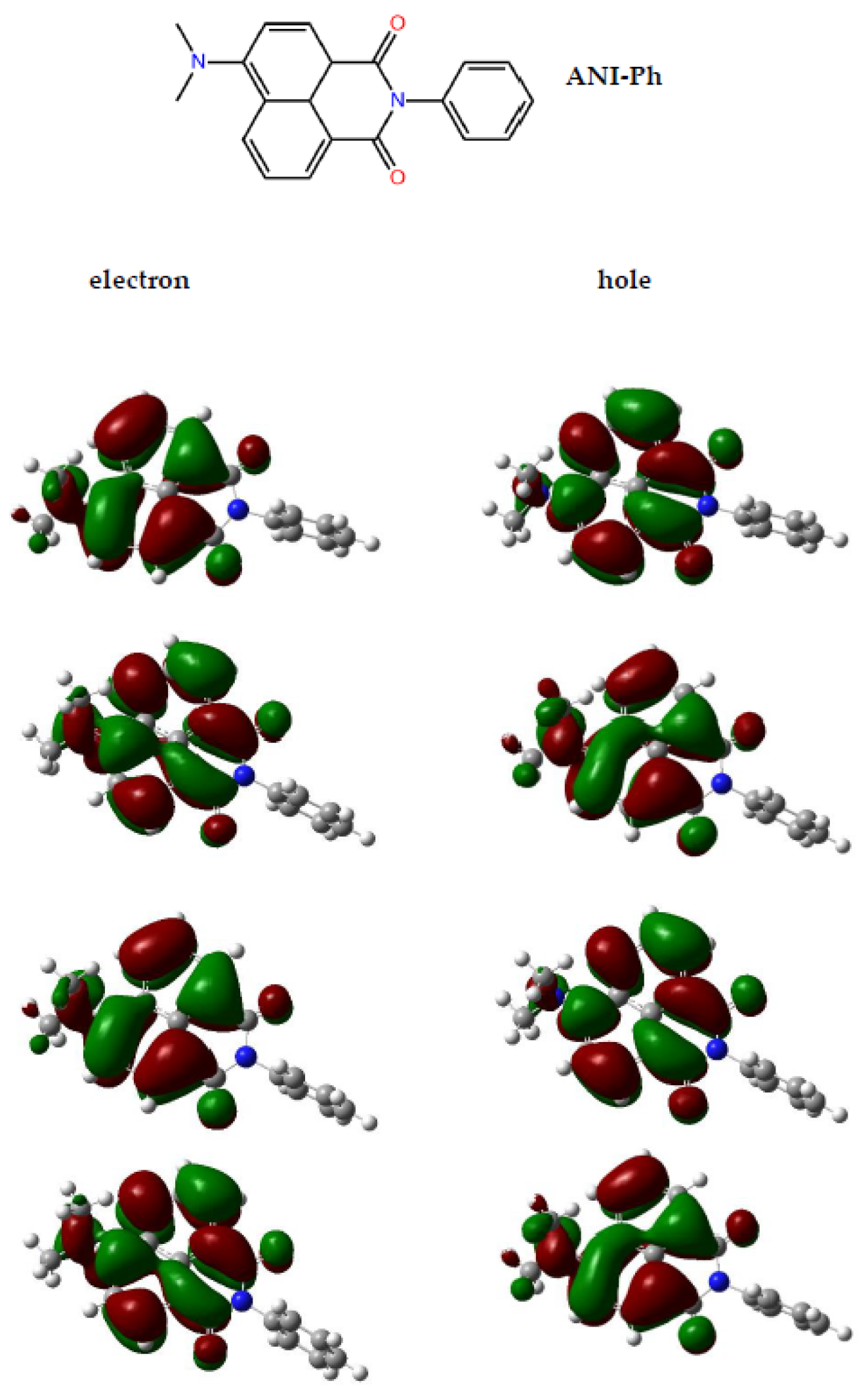
Figure 2.
Steady-state optical spectra of ANI-Ph, along with the obtained Stokes’ shifts, Δ, for neat solvents. (a) Absorption and fluorescence spectra of ANI-Ph in different solvents corrected for the energy abscissa scale (λex = 421 nm). (b) Deconvolution of the absorption and fluorescence spectra of ANI-Ph for CHCl3 and CH3CN as a sum of Gaussians. The Gaussians with the predominantly largest amplitudes (the second from the spectral crossing point) are used for estimating the spectral maxima and the Stokes’ shifts. (c) Dependence of the absorption and fluorescence maxima of ANI-Ph on solvent polarity. (d) Linear fit of Δ vs. fO(ε, n2) for the neat solvents, i.e., Cel = 0, along with the values of |Δμ|2 r–3, extracted from the slope, and Δ0, extracted from the intercept.
Figure 2.
Steady-state optical spectra of ANI-Ph, along with the obtained Stokes’ shifts, Δ, for neat solvents. (a) Absorption and fluorescence spectra of ANI-Ph in different solvents corrected for the energy abscissa scale (λex = 421 nm). (b) Deconvolution of the absorption and fluorescence spectra of ANI-Ph for CHCl3 and CH3CN as a sum of Gaussians. The Gaussians with the predominantly largest amplitudes (the second from the spectral crossing point) are used for estimating the spectral maxima and the Stokes’ shifts. (c) Dependence of the absorption and fluorescence maxima of ANI-Ph on solvent polarity. (d) Linear fit of Δ vs. fO(ε, n2) for the neat solvents, i.e., Cel = 0, along with the values of |Δμ|2 r–3, extracted from the slope, and Δ0, extracted from the intercept.
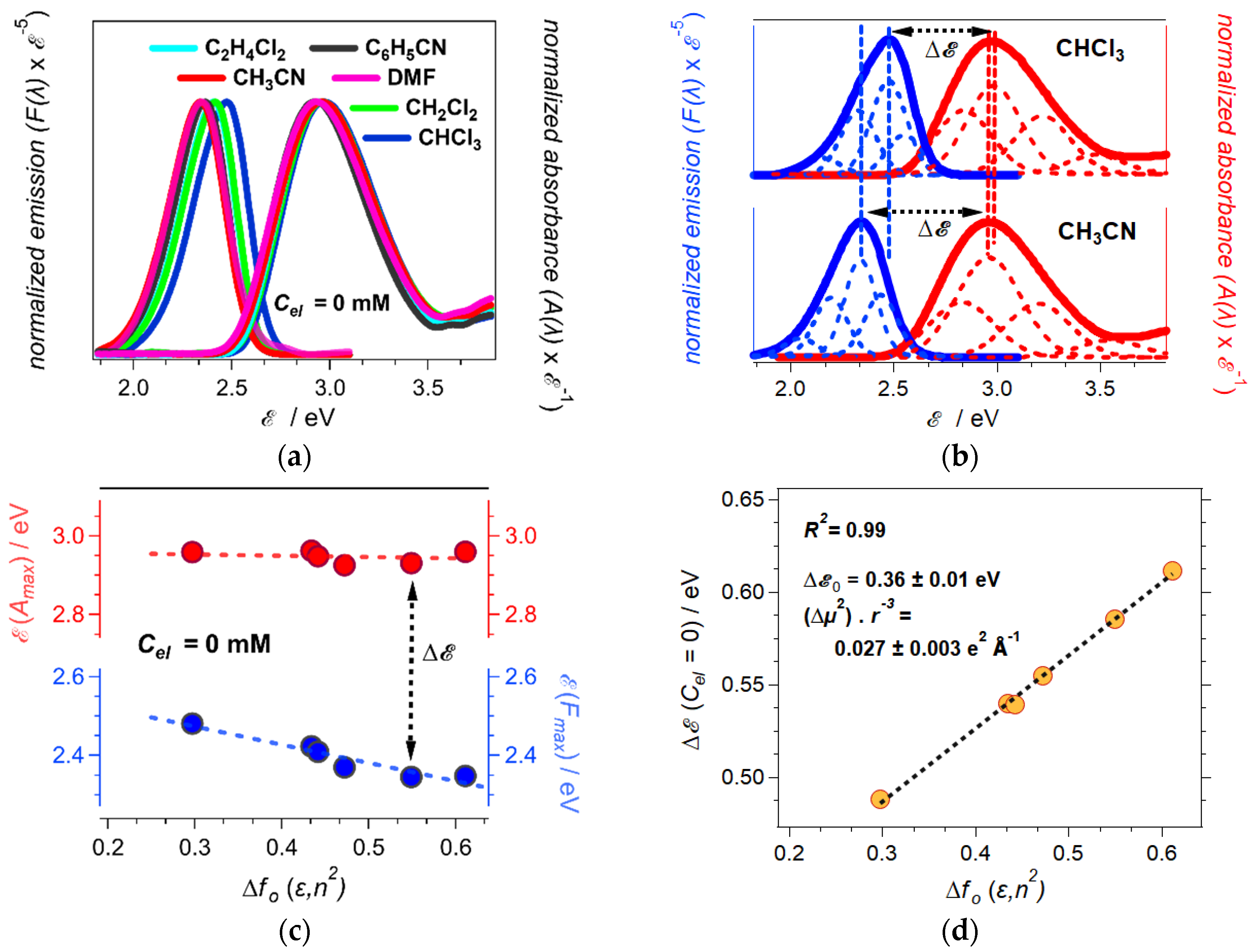
Figure 3.
Effects of electrolyte concertation, Cel, on solution polarity as determined from the LMO formalism (eq. 4). (a) Normalized absorption spectra of ANI-Ph for CHCl3 in the presence of different concentrations of N(n-C4H9)4PF6. (b) Normalized fluorescence spectra of ANI-Ph for CHCl3 in the presence of different concentrations of N(n-C4H9)4PF6 (λex = 421nm). (c) Dependence of the absorption and fluorescence maxima of ANI-Ph in CHCl3 on Cel. (d) Dependence of the Onsager polarity, fO(ε, n2), of the electrolyte solutions on Cel for the six different solvents (C3H7NO = DMF). The values of fO(ε, n2) for the different solvents and Cel are obtained by introducing the Stokes’ shifts, Δ, in eq. 4, along with the slope and the intercept that the linear analysis for neat solvents produces (Figure 2d).
Figure 3.
Effects of electrolyte concertation, Cel, on solution polarity as determined from the LMO formalism (eq. 4). (a) Normalized absorption spectra of ANI-Ph for CHCl3 in the presence of different concentrations of N(n-C4H9)4PF6. (b) Normalized fluorescence spectra of ANI-Ph for CHCl3 in the presence of different concentrations of N(n-C4H9)4PF6 (λex = 421nm). (c) Dependence of the absorption and fluorescence maxima of ANI-Ph in CHCl3 on Cel. (d) Dependence of the Onsager polarity, fO(ε, n2), of the electrolyte solutions on Cel for the six different solvents (C3H7NO = DMF). The values of fO(ε, n2) for the different solvents and Cel are obtained by introducing the Stokes’ shifts, Δ, in eq. 4, along with the slope and the intercept that the linear analysis for neat solvents produces (Figure 2d).
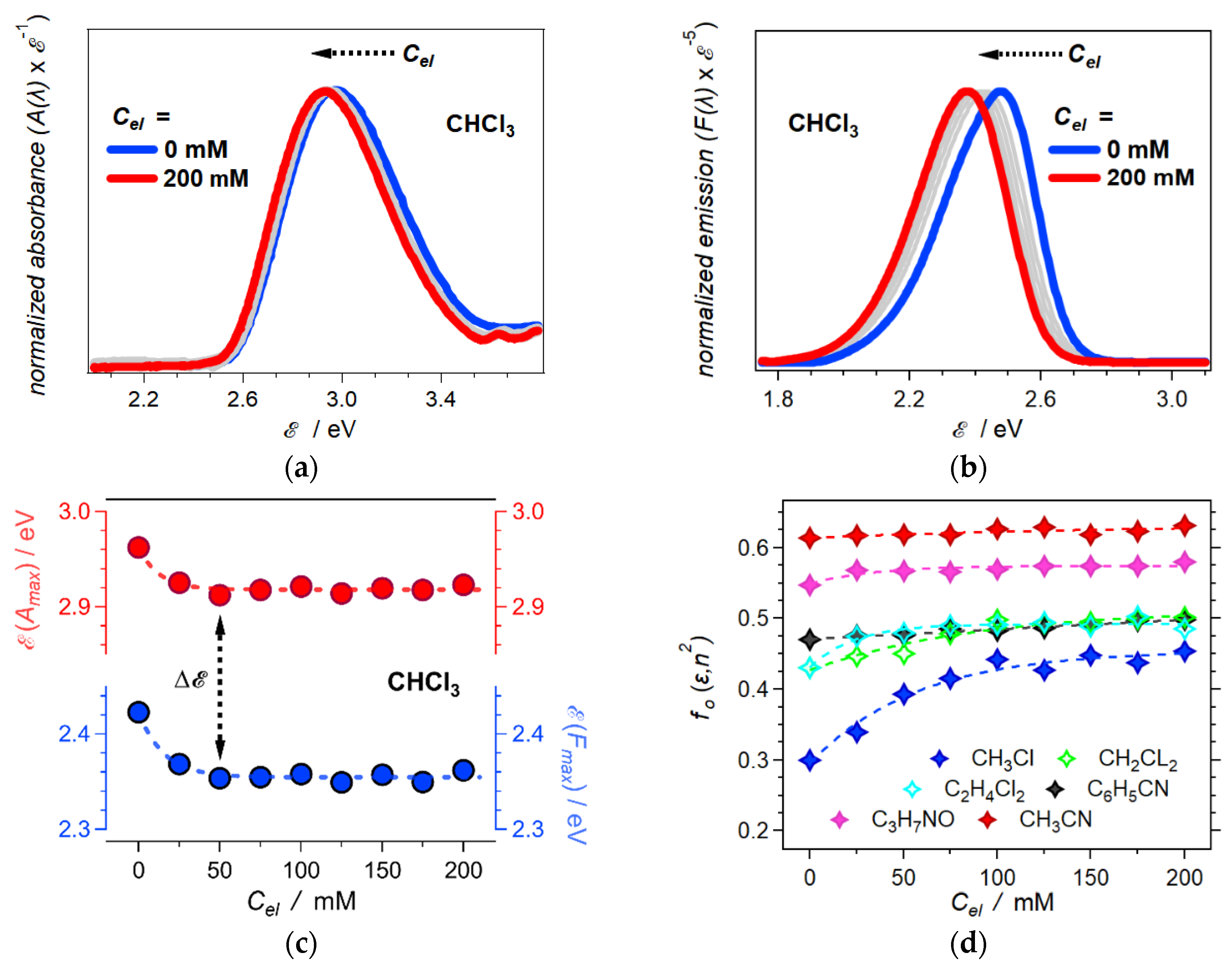
Figure 4.
Resulting refractometry measurements and their Onsager polarity components (C3H7NO = DMF). (a) Experimental index of refraction for Cel = 0 → 200 mM. (c) Onsager polarities of the static dielectric, ε, obtained from LMO analysis, eq. 2c. (d) Dependence of the Born polarity, fB, on electrolyte concentration, Cel calculated from the relation eq 3a.
Figure 4.
Resulting refractometry measurements and their Onsager polarity components (C3H7NO = DMF). (a) Experimental index of refraction for Cel = 0 → 200 mM. (c) Onsager polarities of the static dielectric, ε, obtained from LMO analysis, eq. 2c. (d) Dependence of the Born polarity, fB, on electrolyte concentration, Cel calculated from the relation eq 3a.
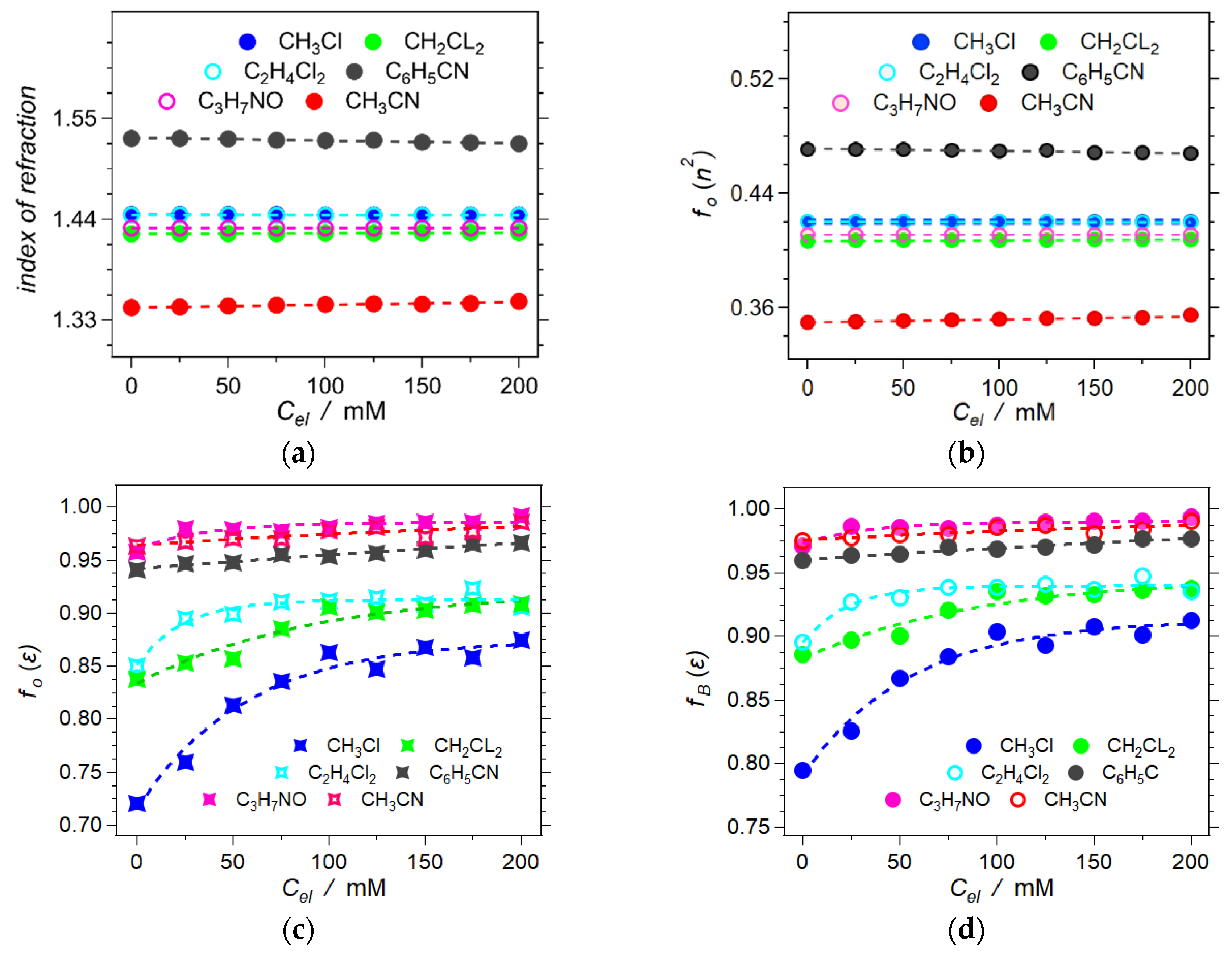
Figure 5.
Relationship between the Born polarity, fB(ε), and the Onsager polarity, fO(ε), originating from the static dielectric properties of the media. (a) Dependence of the Born and Onsager polarities on the static dielectric constant. (b) Graphical representation of the relationship between fB(ε) and fO(ε).
Figure 5.
Relationship between the Born polarity, fB(ε), and the Onsager polarity, fO(ε), originating from the static dielectric properties of the media. (a) Dependence of the Born and Onsager polarities on the static dielectric constant. (b) Graphical representation of the relationship between fB(ε) and fO(ε).
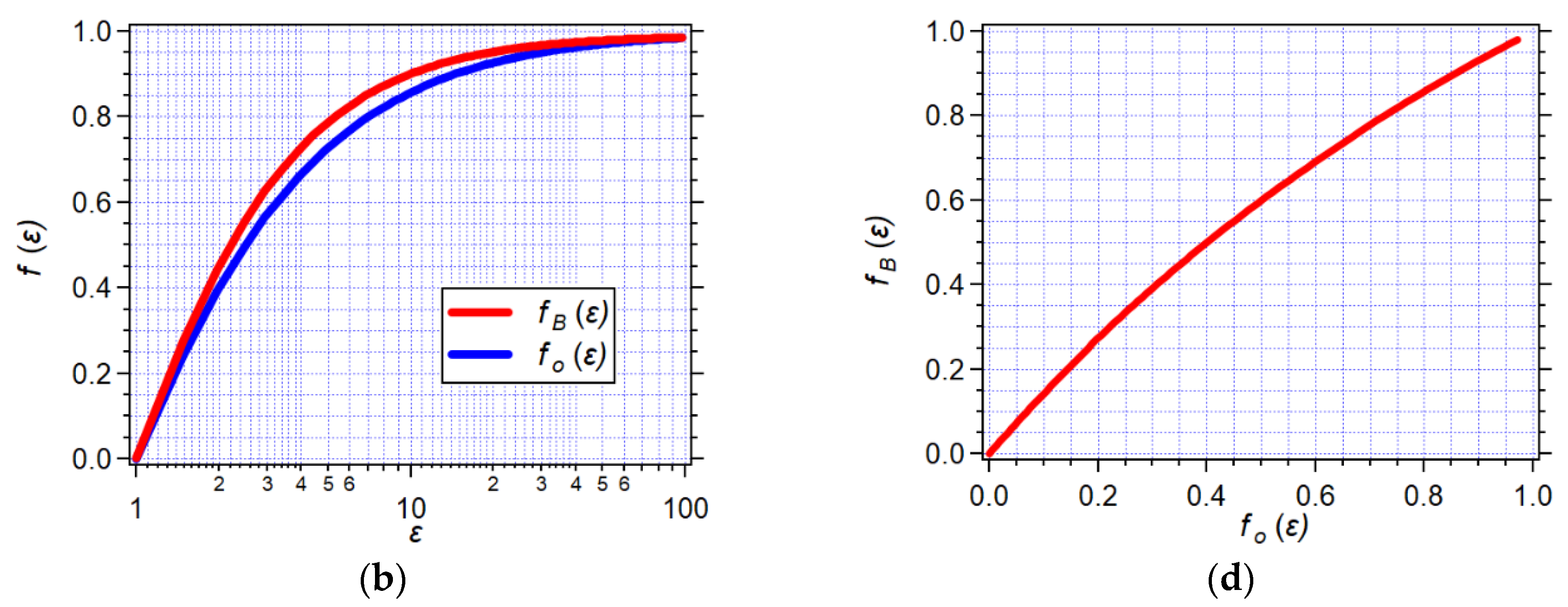

Table 1.
Permanent electric dipole moments of the ground and the excited state of ANI-Ph, obtained from Hartree-Fock calculation at the 6-31+g(d,p) basis set in the Polarizable Continuum Model (PCM) using the integral equation formalism variant (IEFPCM).
Table 1.
Permanent electric dipole moments of the ground and the excited state of ANI-Ph, obtained from Hartree-Fock calculation at the 6-31+g(d,p) basis set in the Polarizable Continuum Model (PCM) using the integral equation formalism variant (IEFPCM).
| solvent | fO(ε, n2) a | |μ0| / D b | |μ*| / D b | α / deg c | Δμ / D d | |Δμ| / D e | |μ0| / D b |
|---|---|---|---|---|---|---|---|
| CHCl3 | 0.29 | 6.67 | 9.97 | 2.7 | 3.30 | 3.32 | 0.29 |
| CH2Cl2 | 0.43 | 7.07 | 10.41 | 2.7 | 3.34 | 3.36 | 0.43 |
| (CH2Cl)2 | 0.44 | 7.11 | 10.49 | 2.7 | 3.38 | 3.40 | 0.44 |
| C6H5CN | 0.47 | 7.29 | 10.87 | 2.7 | 3.58 | 3.60 | 0.47 |
| DMF | 0.55 | 7.33 | 10.95 | 2.7 | 3.62 | 3.64 | 0.55 |
| CH3CN | 0.61 | 7.33 | 10.93 | 2.7 | 3.60 | 3.62 | 0.61 |
a Onsager polarity determined from eq. 2c. bMagnitudes of the ground and excited-state dipoles, i.e., μ = |μ|.cAngle between μ0 and μ*. dDifference between the magnitudes of μ0 and μ*, i.e., Δμ = |μ*| – |μ0|. eMagnitudes of the vector differences between μ0 and μ*, i.e., |Δμ| = |μ* – μ0|, which is equivalent to |Δμ|2 = |μ*|2 + |μ0|2 – 2 |μ*| |μ0| cos α. μ0 and μ* are practically colinear, with an angle between them less than 3º, |Δμ| ≈ Δμ.
Disclaimer/Publisher’s Note: The statements, opinions and data contained in all publications are solely those of the individual author(s) and contributor(s) and not of MDPI and/or the editor(s). MDPI and/or the editor(s) disclaim responsibility for any injury to people or property resulting from any ideas, methods, instructions or products referred to in the content. |
© 2023 by the authors. Licensee MDPI, Basel, Switzerland. This article is an open access article distributed under the terms and conditions of the Creative Commons Attribution (CC BY) license (http://creativecommons.org/licenses/by/4.0/).
Copyright: This open access article is published under a Creative Commons CC BY 4.0 license, which permit the free download, distribution, and reuse, provided that the author and preprint are cited in any reuse.


