

Submitted:
29 April 2023
Posted:
30 April 2023
You are already at the latest version
Abstract
The aim of this paper is to provide a new perspective on the conditions for the multiple dimensions of concerns, and to understand why some wind power projects run smoothly while others lead to unexpected outcomes due to local resistance. The paper described how multiple community concerns about wind power project planning can be described using conflict management theory and by using different procedures to handle tangible and intangible concerns. Policy recommendations are given on how: to minimise overflowing and the risk of the conflicts; to avoid “boxing” community concerns in categories; to give more attention to the intangible and less calculable concerns; to secure appropriate and early planning with proactive involvement of local communities.
Keywords:
Wind power planning
; community concerns
; controversies
; overflowing
; citizen participation
1. Introduction
Denmark has the stated aims of becoming non-reliant on fossil fuels by 2050, and a 70% reduction in CO2 emissions by 2030. A specific goal is to quadruple the renewable energy production from land-based wind and solar, which in 2020 and 2021 were both above 17 TWh. More than 90% of the renewable electricity production comes from wind turbines due to the abundance of wind resources in the country, especially along the west coast. To achieve this goal, Denmark will need to make huge investments in both wind and solar power plants. Onshore wind energy is the most mature and efficient renewable technology in terms of the Levelised Cost of Energy (LCOE), while solar power from photovoltaic panels is catching up.
The majority of EU citizens (83%) including danes (85%) support a minimum percentage of renewable energy for example wind energy due to concerns for climate change and global warming [1,2]. Yet, both wind turbines and large areas of PV-panels inevitably represent significant socio-technical change, and therefore also the risk of conflicts over concerns from local communities. Thus, in a recent mapping of vacant space for renewables, only 5 municipalities out of 98 were able to utilise the potential space for wind power [3,4].
The existing literature has offered valuable insights into the reasons for community concerns and resistance against wind power deployment, but it has provided only a limited understanding of the different dimensions of concerns about wind turbine development. Moreover, it appears that different concerns have different conditions when they ‘meet’ the institutionalised planning process. Therefore, the aim of this paper is to provide a new perspective on the conditions for the multiple dimensions of concerns, and to understand why some wind power projects run smoothly while others lead to unexpected outcomes due to local resistance.
The paper considers three Danish wind farm developments with different planning difficulties from “smooth” to intensified resistance and conflicts between local communities and the planning authority (in Denmark: the municipality), even though the official procedures for public participation have been followed with full respect for the rule of law. To better understand the different planning pathways, we use a research framework where social acceptance is viewed from a conflict management theory perspective and its focus on the uniqueness and different dimensions of conflicts. We use this theory to build a ‘typology of community concerns’ that underlines how some concerns are more readily ‘calculable’ and thus ‘tangible’, while others are qualified as ‘unquantifiable’ and thus ‘intangible’. Our typology and discussion are inspired by Callon’s notion of framing and overflowing [5,6,7]. By doing this, we illuminate how the framing of the planning system prefers to consider specific types of tangible concerns, while more intangible concerns are neglected, and how this leads to overflowing, i.e., escalating conflicts - conflicts that can arguably be related to a ‘systemic’ issue of the planning procedure of renewables as it is institutionalised and practised in Denmark [8].
To guide our research on conflicts building up during planning procedures between the planning authority (here the municipality) and local communities, we have posed the following three research questions:
- How can concerns over wind turbine development be described in accordance with the type of conflict they represent?
- Why do certain concerns overflow to, e.g., newspapers and social media?
- How can planning authorities avoid the overflowing of certain concerns?
After this introduction, section 2 describes different dimensions of conflicts, i.e., structural conflicts, instrumental conflicts, conflicts of interest and conflicts of values [9]. Section 3 then outlines a typology of (in)tangible community concerns. This sets the foundation for a two-stage analysis in section 4. First, we present the three cases, based on the conflict typology. Second, we describe how authorities frame and respond adequately to tangible concerns, but not to intangible concerns. Thirdly, we show how inadequate responses to intangible concerns lead to overflowing and in turn conflicts that result in resource draw and delay.
Section 5 then discusses the results, from theoretical perspectives leading to conclusions and policy recommendations in section 6.
Inappropriate consideration of the local community and its concerns and values often leads to severe conflicts that escalate and spread in several directions, whereby the number of unhappy community members increases [10,11].
Generally, conflicts can be defined as disagreements, dissensus, or struggles between two or more parties (opponents), which cause stress for or between the parties concerned (modified from Vindeløv (pp. 57-86) [9]. Behind this definition lies an assumption that conflict is the normal basic social attribute for potential change in modern societies. Moreover, conflicts often escalate and follow distinct trajectories, as both a metaphor and a method to diagnose a conflict as represented in the conflict ladder by Hammerich and Frydensberg [12] and Glasl [13]. The conflict ladder describes a series of escalating steps with increasingly destructive intensity, from disagreement into open hostility and finally polarisation (Table 1).
Conflicts evolve whenever incompatible activities occur, and when there is a perceived divergence of interest, or a belief that the parties’ current aspirations cannot be achieved simultaneously [14]. While conflicts at the lower steps can be managed if countermeasures are taken in due time, they become increasingly difficult to solve when the conflict moves from step 3 to 4, where dialogue is abandoned (Table 1). However, all conflicts are unique and have their own characteristics depending on both the issue and how it is being handled. This suggests that a constructive approach to conflicts at the earliest stages might avoid escalation into deadlocks, leading to the broader advantage of delivering renewable technologies and low-carbon societies [15].
The uniqueness of all conflicts calls for a more nuanced view, and conflicts between tangible concerns (e.g., issues of substance, instrumental concerns and interests) should be distinguished from intangible concerns (i.e., procedural issues, issues of relationships, social and human values) [16] (pp. 28-30, 35-37, 154). For example, economic interests are more tangible because they can be negotiated using a non-zero-sum thinking approach (a situation where one's win does not necessarily mean another's loss, and one's loss does not necessarily mean that the other party wins), and calculation is made possible. Social values, on the other hand, are subtle, harder to calculate, and thus more ‘intangible’ as they do not easily translate into monetary value. Such qualitative values can best be comprehended and appreciated through dialogue.
Inspired by Vilhelm Aubert’s work [17], Vindeløv describes different dimensions of conflicts [9] (pp. 66-69). We have adapted these dimensions to make them more operational for different dimensions of concerns regarding wind farm projects and their siting (Table 2).
Aubert already argued for the usefulness of distinguishing between different dimensions of conflicts, as conflicts over values, for instance, should not be treated as a conflict of something else:
“As conflicts of value concern aspects of one’s identity, they cannot successfully be subject to negotiation or the application of power [17]. The way forward is when parties acknowledge the value-based aspect of the conflict and try to understand it. Thus, the aim is to understand both one’s own values and those of others, and the means to do this is dialogue” [8] (p. 69).
In other words, while conflicts originating from tangible concerns can be approached through negotiation, intangible conflicts need to be approached through methods that emphasise constructive communication interaction: dialogue, deliberation, and learning [20].
The notion of framing and overflowing was introduced in 1998 by Callon in his seminal work on market construction [5]. To shed light on how market transactions occur, the framing of an emerging product or technology is seen as a prerequisite for mobilising and assembling a coalition/network around a product. In the case of wind power planning, for example, spokespersons for the project must use framing tools (e.g., public hearing rules and regulations or calculations, projections, and visualisations in the Environmental Impact Assessment (EIA)). They also need to invest resources (time and money) that can associate the wind project siting with certain qualities that can mobilise a broader network around it.
However, the nature of framings is often contested because they are never just innocent facts. Instead, for something to be framed, it must be simplified and ‘blackboxed’, as the potentially many qualities of the thing must be bracketed and disentangled. However, such simplification/framing is prone to power struggles, as the very act of framing is an exercise of power, as certain actors, issues, and concerns will have to be included within the frame at the expense of others that are left outside the framing [21,22,23].
In wind power planning, framing is often related to “who is allowed to participate, how their voices are heard, how the various positions are negotiated, and how the project plan is adapted to the views expressed” [7]. As national planning institutions (and their public hearing processes) produce certain framings (e.g., a legalistic framing), they can also be rejected by local communities. In these cases, the issues may travel (overflow) to other settings (e.g., social media), escalating the conflict [10]. As put by Callon, “transformation of an issue into well-identified problems – which can be addressed by planning specific actions – is never completely consensual nor total” and “framing and overflowing can be conceived as a participation process based on analysing power relations and controversies” [24] (p. 48). In the context of wind power planning, “Overflows might arise when other actors do not conform to what was expected from them: parties that were not invited to the table invite themselves in or start to carry out their own alternative scenario” [7].
We will use this framing and overflowing lens to shed some light on the impossibility of reducing people’s often multidimensional concerns into quantifiable risks. Moreover, we understand framing in a very narrow sense as the way the planning system frames which concerns are legitimate and which concerns are not.
2. Materials and Methods
To form a foundation for comparison of concerns between wind power cases, we have selected three Danish wind farm projects: Nørrekær Enge, Ovnbøl and Ulvemosen (Table 3).
Nørrekær Enge was selected as a reference since it received hardly any complaints from neighbours. The two projects from Varde Municipality (Ovnbøl and Ulvemosen) were selected because they are very alike in terms of the ownership model (local businesspeople and farmers) and approval procedure (the same local authority), technology (size and model of wind turbines), but demonstrate different levels and conflict dimensions.
To get a systematic overview of the concerns expressed in the three cases, we manually collected the following material:
- Coverage in the local press via the Danish media search engine, InfoMedia (articles and letters to the editor), in the period from when the wind turbine site was publicly known until the wind turbines were in operation. No distinction has been made between whether the author is a journalist affiliated (interviews or part of running commentary) with the media or a private person.
- Materials made available by the local municipal authorities regarding case management (objections, enquiry, and complaints).
- Quotes from media articles concerning the wind turbine siting.
- Hearing statements from neighbours about the planned wind turbine siting.
- The city council assessments of the hearing responses from the neighbours and potential adjustments this might give rise to.
The collected material has been analysed qualitatively by means of Atlas.it using 21 codes to categorise citations on concerns (Table 4). The codes have been formulated by first reading all the material in one of the cases and continuously updating these in the analysis of the remaining cases. The first step in the analysis has been to code the entire empirical material qualitatively and create a list of citations where each citation and argument has been assigned in accordance with codes. The next step is filtration of each document to make sure that each code only counts as one per document. This procedure allows for a quantitative analysis that could otherwise be biased due to multiple appearances of the same subject in the same document or even due to technical difficulties for Atlas.it in handling e.g., page shift. The third and final step in the analysis has been a primary sorting into 4 categories (Table 4). How the municipalities frame the public hearing responses was analysed with a focus on how different types of concerns are addressed and categorised by the municipality.
3. Results and Discussion
3.1. Case: Nørrekær Enge – staying low on the conflict ladder
The Nørrekær Enge wind farm (2008-9) was subject to a remarkably low number (2) of local concerns expressed during the public hearing, although it was well covered by local media (35 articles), placing the development of the wind park low on the conflict ladder (step 1). The wind farm is sited in the Northern part of Denmark in a meadowy and relatively sparsely populated area close to the Limfiord, which is an area where conditions are optimal for wind power. The site constituted a large repowering project, replacing 77 smaller and old turbines with 13 wind turbines. Nørrekær Enge wind farm was also the first Danish site to issue ownership shares in the wind farm to local neighbours inside a radius of 4.5 km of the turbines. Approximately 60 citizens accepted this option to buy shares. The offer to buy shares was given by the developer even before the legislation of the Danish Renewable Energy Act (2009) introduced four different schemes to enhance ‘social acceptance’ of wind power in Denmark – including a mandatory offering of 20% shares to locals inside a radius of 4.5 km [26]. Table 3 lists the number of different concerns expressed by locals in hearings and in the media (several codes can occur in each document). The low number of complaints is mirrored in the sparse media coverage, which only reported on factual activities around the planning and development process.

Table 5.
Number of codes - Nørrekær Enge.
| Nørrekær Enge | Incoming responses to public hearing: 2 | Number of articles in local press: 35 |
| Type of concerns | Counted codes | Counted codes |
| Instrumental (tangible) | 2 | 10 |
| Interest (tangible) | 1 | 1 |
| Values (intangible) | 0 | 2 |
| Personal (intangible) | 0 | 0 |
Concerns explained
Instrumental concerns (tangible): One neighbour objected to the placement of the turbines too close to the small city of Bollerup, including his property, due to concerns about shadow flickering (estimated to be 10.5 hours per year on his property). A group of citizens expressed their expectation that issues about low frequency noise from the turbines should be investigated before the plans were finally adopted. Finally, during the construction phase one neighbour complained in relation to annoyance from heavy traffic.
Interests (tangible): The same group that was concerned with low frequency noise also expressed interest in the possibility of buying shares in the wind park.
Values (intangible): The value complaints expressed were only related to the visual impact of the wind turbines. The group of citizens mentioned above argued against the three western-most turbines, amongst other things due to consideration of an impaired view to the local Church. They argued that only the alternative suggestion (i.e., with a reduced number of turbines) would live up to appropriate landscaping and cultural-historical considerations.
Personal (intangible): A group of citizens expressed their expectation that health issues about low frequency noise from the turbines should be investigated before the plans were finally adopted. The neighbour mentioned under instrumental concerns also expressed concerns about low frequency noise. At this time low frequency noise had recently emerged among opponents’ arguments against wind turbines.
3.2. Case: Ovnbøl – ‘by the book’ and on time despite considerable protests
Climbing several steps up the conflict ladder (step 4), the Ovnbøl wind farm was not well received by the local community. The Ovnbøl wind farm is sited in Varde municipality close to the North Sea in Southern Denmark, where four turbines replaced 16 older ones in the vicinity. In spring 2011, the municipal thematic plan and the EIA was concluded, and despite local protests, Ovnbøl wind farm was connected to the grid in 2012 without delay. As it appears from Table 6, this project encountered more problems compared to Nørrekær Enge wind farm and triggered different types of concerns.1
Concerns explained
Instrumental (tangible): The most expressed concern was noise from the wind turbines, especially at night. Also, scepticism towards the legal framework on noise regulations was expressed. Some of the noise issue was directed towards low frequency noise, and the uncertainty about how this might affect people (low frequency noise is also regulated by the Danish legislation). After noise, citizens were concerned about the wind turbines’ visual dominance in the landscape, and how they might impact on scenic values. Finally, possible flickering from the blades raised some concerns.
Interests (tangible): Neighbours expressed concerns about the sufficiency of compensation for reduced house prices, and the fear of ‘serfdom’, i.e., of being unable to move away from the area due to price drops from the neighbouring wind park.
Values (intangible): Especially the media coverage demonstrated a distrust in both the municipality and the developers. Many of the contributions talked about a democratic deficit, claiming that the municipality was not safeguarding the rights of the local community. This is illustrated by the following citations:” [...] the city council needs to think carefully before they make the final decision - and not just fall into line, because a wind turbine company [developer] wants to cash in money”. And: "It appears that the city council only favours commercial interests and not those of the citizens”.
Personal (intangible): In several instances the media coverage was characterised by emotional communications, where both the municipality and the developer were described as untrustworthy. This is illustrated by the following citation: "The model pictures [visualisations] are sheer manipulation and downplay the enormous impact of the wind turbines on nature”, and “why try to sell owner shares to a wind turbine project […] that has not yet been approved by Varde city council?”.
The concerns related to low frequency noise and health could also fall into this category, but we found no reports of people feeling sick, and connecting it to low frequency noise from the wind turbines. Nonetheless, noise and low frequency noise from wind turbines were a debated issue leading to anxiety among neighbours.
3.3. Case: Ulvemosen – procedural errors and conflicts
Moving even further up on the conflict ladder to step 5, and with all communication eventually transferred to the court, we find Ulvemosen wind farm, also in Varde municipality, not far from the Ovnbøl wind farm. It demonstrates an even more conflict-ridden progress, with procedural errors and significant delay. The municipality received an application from the developer in 2013 to replace 10 older wind turbines in the vicinity. However, the statutory EIA report was eventually rejected by the National Board of Appeal in 2014 due to significant legal shortcomings, particularly because of inadequate accounting for the visual impact, not abiding by the distance requirements, and not accounting sufficiently for the short- and long-term effects on the groundwater. As a result, construction, which had already been initiated (accepted by Varde municipality, but at the developers’ own risk) was halted right after casting the 10 foundations. This caused significant delay, but in 2016 construction resumed after a new and corrected EIA was completed and finally approved in 2015.
Concerns explained
Instrumental (tangible): Noise was one of the primary instrumental concerns among the neighbours, and one of them argued that by putting noisy wind turbines in the area, the “municipality forces citizens to relocate”. The visual impact was expected to look like “white mastodons” or a “Berlin Wall” of “giant turbines” and claimed to create a “barrier in the landscape”, spoiling the experience of “wild nature and the beautiful view over the fields”.
Interest (tangible): Concerns were centred around the possible negative impact on the value of houses close to the wind turbines. Many contributions in the media talked about houses that would become unsellable, and that the taxation authorities could not be trusted to give fair compensation. Others talked about “being tied to our property like a chained dog with turbine noise, flickering, and potential health risks for the next 30 years or the rest of our lives”.2
Values (intangible): The process handling by the municipality was criticised for imposing unwanted technology changes on the community, and the hearing process was alleged to be a mockery, with accusations about conspiracies and a democratic deficit in the municipality. Other value-based concerns were linked to the issue about uncertainty regarding the scientific rigour and validity behind the ‘facts’ that they were presented with, particularly regarding the health impacts of noise and flickering. Lastly, other value-based concerns related to the loss of the ‘sense of place’. This was expressed by a family who feared that they could not use their garden with a small pond, “which we walk to every day to enjoy nature and the tadpoles”. Another family lamented the loss of their “little paradise [..] Never again will we be able to enjoy the morning sun in the yard”.
Personal (intangible): Wind turbine noise and flickering were repeatedly expressed as a health concern. For instance, a citizen was “concerned about the impacts on neighbours in regard to noise, low frequency noise and flickering, and the result of long-term impact from the turbines”. Another citizen raised concern not only that the developer was responsible for noise calculations, but also that neighbours to large wind turbines must “fight and struggle on a daily basis to make their life hang together without breaking down”. Consequently, the neighbours wanted the City Council to wait for the results from an ongoing Danish national investigation on the impact of wind turbines on human health (report by the Danish Cancer Society [27]. A citizen rhetorically asked what the planners and politicians meant by notions such as ‘a good life’, health considerations, empowerment, and issues of public participation, arguing that these official expressions were in conflict with the municipality’s actual arrogant and authoritarian attitude.
3.4. Framing: One-dimensional responses from authorities
As shown by our analysis, Ulvemosen was ridden with procedural errors, which partly explains the high level of resistance and conflict, but a lot of the intangible concerns were also about how the citizens’ participation was framed and whether legitimate concerns were being considered appropriately. In the following, we will provide some brief examples of how the planning process and the institutionalised hearing system have difficulties in handling intangible and less calculative concerns that fall ‘outside’ the hearing system framing. Our aim is to address a ‘systemic’ issue relating to the hearing process as it is institutionalised and practised in Denmark. Ovnbøl is thus more exemplary in terms of illustrating the practices of the hearing system. The point with this analysis is to demonstrate that only following the statutory procedures for public participation may be the root of the problem. For example, when intangible concerns are not framed appropriately in state procedures, and when the local authorities settle with this, citizens lose trust in the system, as expressed both by the incoming responses during the public hearing phase and by the tense debate in the local press [28].
The processing of the hearing responses in the Ovnbøl and Ulvemosen wind parks demonstrates a very meticulous process, which can be described in short as following these steps: 1) The municipality planners grouped all incoming comments in specific categories (see example from Ovnbøl (Table 7). 2) Each category was assessed with respect to the impact of specific concerns and whether adjustments to the project were necessary. This could, for example, address concerns about the low frequency noise and its impact on children’s learning, and whether this had been scientifically documented. 3) For each category, a statement was made of whether ‘engendered adjustments’ to the project were recommended. 4) The recommendation was forwarded to the city council for approval or rejection. 5) The decision by the municipality council was published as a “Resumé of the incoming contributions to the Municipal Plan, (Amendment 03, local plan 18.10.L01 in the case of Ovnbøl), including the city council’s evaluation of these”. This document was published on the municipality’s webpage and mailed directly to individuals who had responded during the hearing process.
3.5. Overflow: Response from authorities is perceived as inadequate
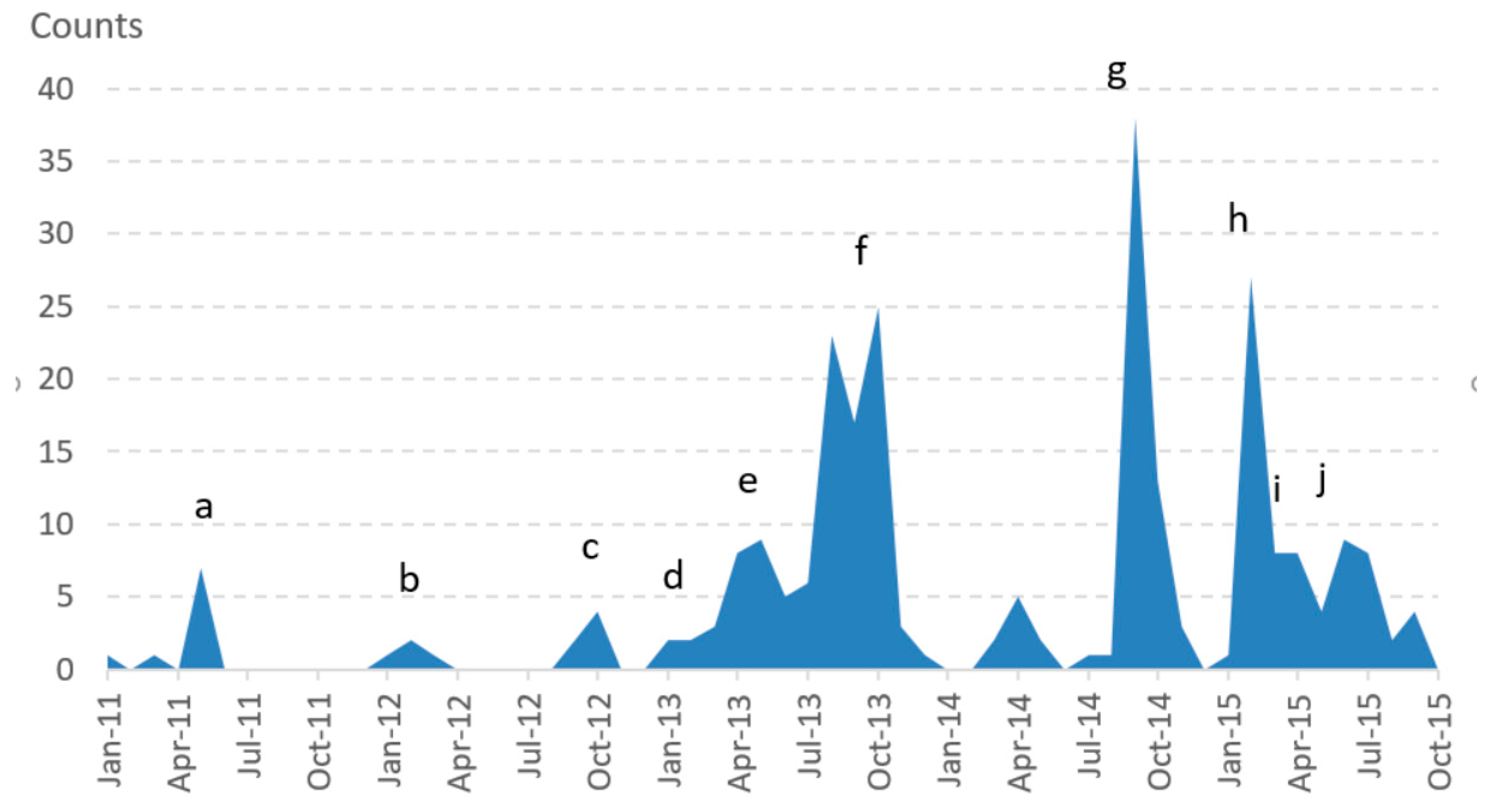
Since the Ulvemosen wind power project is the most conflict-ridden of the three investigated, we use this to demonstrate how the conflict builds up and overflows to local media, where criticism towards the decision process and distrust in the authorities is expressed. Thus, we will illustrate how the opponents use other channels than the statutory/planning system framing, because their intangible concerns fall outside this framing. Figure 1 shows the numbers of articles and letters to the editor in the local press as a function of time. Incidents and public information are marked, from the first time the local community got information about the project (Figure 1a, Table 9). It appears that local newspapers were increasingly used by opponents to express their concerns and dissatisfaction. Generally, the opponents voiced their concerns in the local newspapers (overflow), while the authorities and local politicians were as good as silent and only used the statutory framing in the planning system, such as announcements on the municipality homepage and hearings as instruments for communication.
After the initial public meeting (idea-phase) (Figure 1a), the first significant peak in the number of articles in newspapers was recorded when the municipality bureaucracy (Department for Planning and Technique) initiated the statuary 8-week hearing process (Figure 1e). The local newspapers continuously published letters of concern to the editor and articles throughout this hearing period, and right up until the day when the project was approved by the city council (Figure 1f). During this period two members of the city council decided to publicly announce that they had voted against the approval due to the increasing resistance from the local community.
For a period, only a few articles were published describing the progress of the project, but this changed abruptly when the EIA was declared void by the National Board of Appeal (Figure 1g). Many of the articles in the local newspaper expressed the view that this proved that the city council was biased in favour of the developer, and therefore could not be trusted (Figure 1g). In particular, the EIA’s visualisations of the impact on neighbouring properties were problematised and deemed to be untrustworthy or even manipulated. An amendment to the EIA addressing the shortcomings pointed out by the National Board of Appeal was completed and a new 8-week hearing process was initiated (Figure 1 h-j). Again, critical letters to the editor and articles were published by opponents, but with little effect, as the project had already been approved by the municipality, although with severe delay.
Our analysis also shows how intangible concerns are excluded from the planning system frames in terms of what is a legitimate concern and what is not. Issues that can be calculated or measured are more easily framed by the planning system, and thus included as a basis for decision making. However, when it comes to issues that cannot be solved by reference to a statute in the law or where calculations are not easily made, these concerns easily become ‘unruly’ and hard to frame. Framing and overflowing in the cases studied in this work mostly relate to how community responses are categorised in the planning documents, but also relate to what is known as ‘externalities’ (both negative and positive) that may emerge whenever a framing is too constraining or excludes something that should be included.
In other words, framing relates mostly to how the authorities categorise the answers to hearings coming from the local community. Issues of power and politics lie inherently in such categorising: who has the power to define (frame) what the concerns are, and which to include as worthy of a response/solution, and which are to be put into the ‘miscellaneous’ category? Overflowing in the shape of increased opposition and conflict and/or overflowing to the media happens when the community cannot recognise their concerns among the official framing of concerns, i.e., their concerns overflow to a domain where the authorities have little legitimacy and thus control over, for example, social media, which is a powerful mobiliser of resistance [11].
4. Conclusions
In this paper we initiate our analysis of three Danish wind power projects by asking three questions. The first questions consider how concerns over wind turbine development can be described in accordance with the type of conflict they represent. To answer this, we have described how multiple community concerns about wind power project planning can be described using conflict management theory and by using different procedures to handle tangible and intangible concerns.
Then we answer the question about why certain concerns overflow to, e.g., newspapers and social media by showing how the authorities avoid giving answers to expressed community concerns because they are difficult to quantify and thus also difficult to solve instrumentally, for example, when assessing economic compensation for a loss involving place attachment issues. This is not a deliberate procedure imposed by the authority (here the municipality), but rather a reflection of an insufficient ‘legalistic framing’ and an insufficient democratic dialogue between all relevant actors. Intangible concerns are best handled by dialogue; however, the planning system is not helpful in facilitating such dialogue. What conflict theory also shows is that the experience of ‘falling outside the framing’ leads to distrust that further escalates the conflict between the local community, the municipality and developer.
Furthermore, we have described how Ulvemosen wind power project ran into a ‘perfect storm’ of concerns that overflowed to the local newspapers, where opponents raised critical voices and frustrations. We describe several reasons for this: Firstly, non-tangible concerns were not considered as a basis for decision making by the authorities. Secondly, the EIA was declared void by the National Board of Appeal, which confirmed the local community in its suspicions about unfair and undemocratic processes where the regional authorities did not appear to be impartial. To make the situation even more polarised, the opponents in Ulvemosen consulted with those who had fought against the neighbouring and preceding Ovnbøl wind power project. We show how distrust built up during the approval process, leading to accusations about collusion, and to conspiracy theories such as: “we are witnessing photo manipulation in order to make the visual impact seem less problematic”. It also led to a problematic demotion of the otherwise recognised EIA to an instrument used “to conceal or distort the negative impacts on the environment”. Thus, the distrust in the process was expressed as accusations about concealed information and an undemocratic process, where capital interests overrule local social values.
The opportunity to engage in dialogue during the planning process crumbled because the local community felt left out and marginalised. Even though the first public hearing (idea-phase. Figure 1a) preceded the 8-week hearing period by one year, the local community had the experience of being invited to participate very late in the process; at least, for something so concrete, 8 weeks may not allow for deliberation and debate between legitimate actors with different values and personal concerns. Therefore, stronger municipality efforts in engaging the local community already during the idea-phase might have proved fruitful. The reality was that the members of the local community became suspicious when they realised that several years of “black-boxed” planning had been going on prior to this 8-week public hearing. This explains why not only intangible concerns overflowed to both the traditional and social media, but also tangible concerns, because the inappropriate procedural handling of concerns led to a general distrust.
Policy recommendations to avoid overflowing
Minimise overflowing: It is imperative to minimise overflowing as it increases the risk of the conflicts spinning out of control when the debate is transferred to platforms such as social media, where they escalate and often lead to distrust and even more problematic (and expensive) conflicts in both current and preceding wind power planning.
Avoid “boxing” community concerns in categories: Our study illustrates the planning system’s categorisation of people’s concerns into boxes, some of which can be dealt with, and some that are left largely unnoticed (boxed into the ‘miscellaneous’ category). Yet, such framing has socio-material effects on which voices (and concerns) come to matter and which do not. We thus recommend treating framing and overflowing as a matter of participation, where power relations and controversies can be deliberately debated, and the local community can object to framings that produce marginalising effects when, for example, intangible and non-quantifiable concerns are neglected.
Politicians and authorities should reflect on their own agency: Overflowing cannot be entirely avoided, but we argue that policymakers and regulators should reflect more carefully on their own agency in producing conflict in the green transition: How they make the framing also has effects on the ensuing conflicts. Thus, more attention to the intangible and less calculable concerns is recommended, otherwise their marginalisation will remain engrained in the planning system and continue to produce uncontrollable overflowing in the form of conflict.
Appropriate and early planning with proactive involvement of local communities with potential for development of renewables: New spaces for discussion and participation may evolve from such re-categorisation and re-framing so that wind farm projects do not spin out of control. The key here is to avoid the instrumentalisation of intangible concerns, such as social or human values.
Funding
This research was funded by Strategic Research Council Denmark, grant number 1377-00058A.
Conflicts of Interest
The authors declare no conflict of interest
References
- Viden om Vind. 2017. Available online: https://videnomvind.dk/wp-content/uploads/2020/03/Hvordan-lever-danskerne-med-vindmoeller-pa%CC%8A-land.pdf (accessed on April 2023).
- Eurobarometer. 2007. Available online: https://europa.eu/eurobarometer/surveys/detail/620 (accessed on April 2023).
- Energistyrelsen. 2018. Available online: https://ens.dk/sites/ens.dk/files/Analyser/landvind_potentialemodellen_20181001.pdf (accessed on April 2022).
- Ingeniøren (2022). Interaktivt kort: Her er den ledige plads til flere vindmøller på land. 2. September 2022.
- Callon, M. (ed.) (1998). The embeddedness of economic markets in economics (pp. 1-32), In The Laws of the Markets.. Oxford: Blackwell Publishers/The Sociological Review.
- Callon, M. (ed.) (1998). An Essay on Framing and Overflowing: Economic Externalities Revisited by Sociology (pp. 244-269). In The Laws of the Markets. Oxford: Blackwell Publishers/The Sociological Review.
- Jolivet, E.; Heiskanen, E. Blowing against the wind – An exploratory application of actor network theory to the analysis of local controversies and participation in wind energy. Energy Policy 2010, 38, 6746–6754. [Google Scholar] [CrossRef]
- Clausen, L.T.; Rudolph, D.; Nyborg, S. The good process or the great illusion? A spatial perspective on public participation in Danish municipal wind turbine planning. J. Environ. Policy Plan. 2021, 23, 732–751. [Google Scholar] [CrossRef]
- Vindeløv, V. (2012). Reflexive Mediation, Conflicts and their escalation. DJØF Publishing.
- Borch, K. Mapping Value Perspectives on Wind Power Projects: The Case of the Danish Test Centre for Large Wind Turbines. Energy Policy 2018, 123, 251–258. [Google Scholar] [CrossRef]
- Borch, K.; Munk, A.K.; Dahlgaard, V. Mapping wind-power controversies on social media: Facebook as a powerful mobilizer of local resistance. Energy Policy 2020, 138, 1–10. [Google Scholar] [CrossRef]
- Hammerich, E. & Frydensberg, K. (2014). Konflikt og kontakt - om at forstå og håndtere konflikter. ISBN13:9788770703291.
- Glasl, F. (1982). The process of conflict escalation and roles of third parties. In: Bomers, G.B.J., Peterson, R.B. (eds). Conflict Management and Industrial Relations (pp. 119-140). Springer, Dordrecht.
- Deutsch, M. (). The Resolution of Conflict. Am. Behav. Sci. 1973, 17, 248–248. [Google Scholar] [CrossRef]
- Barry, J. & Ellis, G. (2013). Beyond consensus? Agonism, republicanism and a low carbon future. In Devine-Wright, P. (Ed.), Renewable Energy and the Public: From NIMBY to Participation (pp. 29-42). Taylor and Francis - Balkema.
- Daniels, S. E. & Walker, G. B. (2001). Working Through Environmental Conflict:The Collaborative Approach (Chapter 3). Prageer Publishers.
- Aubert, V. Competition and dissensus: two types of conflict and of conflict resolution. J. Confl. Resolut. 1963, 7, 26–42. [Google Scholar] [CrossRef]
- Terrell, T. D. (2002). Noneconomic values. https://chalcedon.edu/resources/articles/noneconomic-values (accessed April 2022).
- Devine-Wright, P. Rethinking NIMBYism: The role of place attachment and place identity in explaining place-protective action. J. Community Appl. Soc. Psychol. 2009, 19, 426–441. [Google Scholar] [CrossRef]
- Walker, G., Daniels, E., Emborg, J. (2015). Public participation in environmental policy decision making. In Anders Hansen, A. & Cox, R. (Eds), The Routledge Handbook of Environment and Communication. pp. 111-130. [CrossRef]
- Callon, M. (1986). Some elements of a sociology of translation: Domestication of the scallops and the fishermen of St Brieuc Bay. In Law, J. (Ed.), Power action and belief: A new sociology of knowledge? (pp. 196-233). Routledge & Kegan Paul, London.
- Çalışkan, K. & Callon, M. (2009). Economization, part 1: shifting attention from the economy towards processes of economization. Economy and Society, 38(3), 369–398.
- Çalışkan, K. & Callon, M. (2010). Economization, part 2: a research programme for the study of markets. Economy and Society, 39(1), 1–32.
- Callon, M. Civilizing markets: Carbon trading between in vitro and in vivo experiments. Account. Organ. Soc. 2009, 34, 535–548. [Google Scholar] [CrossRef]
- Energistyrelse (2023). https://ens.dk/service/statistik-data-noegletal-og-kort/data-oversigt-over-energisektoren (accessed April 2023).
- Anker, H. T., Jørgensen, M. L. (2015). Mapping of the legal framework for siting of wind turbines - Denmark. IFRO Report; No. 239.
- Poulsen, A. H. et al. (2019). Impact of Long-Term Exposure to Wind Turbine Noise on Redemption of Sleep Medication and Antidepressants: A Nationwide Cohort Study. Environmental Health Perspectives, 127(3), 37005.
- Kirkegaard, J. K. & Nyborg, S. (2021). ANT Perspective on Wind Power Planning and Social Acceptance—A Call for Interdisciplinarity. In A critical approach to the social acceptance of renewable energy infrastructures (pp.105-121). Cham: Springer International Publishing.
| 1 | In this site, one of the four turbines was closer to residences than the statutory minimum distance, which meant that the status of the buildings as habitation was abolished in agreement with the owner, who received compensation. |
| 2 | Referring to the feudal serfdom-like institution (“stavnsbaandet”) introduced in Denmark in 1733 that bonded men of a certain age to live on the estate where they were born in accordance with the wishes of the estate owners and the military. |
Figure 1.
Number of articles and letters to editors in the local press over time concerning the Ulvemosen siting. The last recording was 3 months after the final approval of the project. Only very few appearances concerning the siting were registered after this date. Labels indicate different incidents during the approval process (see Table 9).
Figure 1.
Number of articles and letters to editors in the local press over time concerning the Ulvemosen siting. The last recording was 3 months after the final approval of the project. Only very few appearances concerning the siting were registered after this date. Labels indicate different incidents during the approval process (see Table 9).
|
Step 1: Disagreement Unhappiness due to uncertainty and concerns regarding the matter. The disagreement has not yet evolved into a conflict. Step 2: Distrust: feelings of exclusion and distrust evolve Motives and characters of the opponent are called into question. Suspicion of foul play. Step 3: The problem expands The matter becomes general with references to, e.g., ‘always’ or ‘never’. Old, concluded conflicts are brought in. The conflict spreads in several directions. Step 4: Dialogue is abandoned Alliances are made and people with no actual interests get involved through, e.g., petitions or assistance from organised opponents. Squabbling evolves and the number of opponents grows. Step 5: A matter of principles Enemy images evolve and the matter is black-or-white. The matter is often taken to court. Step 6: Open hostility The matter evolves into a battlefield with demonstrations, civil disobedience, and malicious damage. Step 7: Polarisation Communities are split into opponents and proponents. You are either with us or against us. Eventually individuals must leave the area to avoid harassment. |
Table 2.
Different dimensions of conflicts applied to wind farm projects and their siting (inspired by Vindeløv) [9].
Table 2.
Different dimensions of conflicts applied to wind farm projects and their siting (inspired by Vindeløv) [9].
| 1) Instrumental concerns are tangible issues that consider technical features (size, output, noise), regulations and procedures. 2) Interest concerns are tangible and economic issues both for the owners of the technical installation (cost structure, profits, financing etc.) and for stakeholders who live in the vicinity, but with no economic shares (economic compensation, compulsory acquisition, and legal rights such as right/ability to object). 3) Value concerns are intangible and concepts which are often referred to as “social values” or “human values” to distinguish them from economics.[18] Value concerns include social capital as well as the subjective aspects of the citizens' well-being, such as their ability to participate in making decisions that affect them (democratic and procedural issues). Value concerns can also arise when new developments disrupt pre-existing emotional attachments and threaten place-related identity, referred to as place attachment [19]. Finally, this dimension includes concerns about the loss of cultural values and moral or ethical beliefs. 4) Personal concerns encompass intangible inner qualities such as individual life ability and appreciations of life. Thus, personal anxiety about technologies, risk and health perceptions is considered a type of concern in this category |
Table 3.
Stem data from the three onshore wind farm projects studied [25].
Table 3.
Stem data from the three onshore wind farm projects studied [25].
| Wind farm project | Capacity (MW) |
Rotor dimension (m) |
Hub height (m) |
Municipality | Commissioned |
| Nørrekær Enge | 13 x 2.3 | 93 | 80 | Aalborg/ Vesthimmerland |
July 2009 |
| Ovnbøl | 4 x 3.0 | 101 | 90 | Varde | Dec. 2012 |
| Ulvemosen | 10 X 3.3 | 117 | 94 | Varde | Nov. 2017 |
Table 4.
Concerns expressed (codes) and how they are assigned to each of the four categories of concerns used in the analysis.
Table 4.
Concerns expressed (codes) and how they are assigned to each of the four categories of concerns used in the analysis.
| Type of concern (code) | Type of concern (code) |
|---|---|
| Instrumental (Tangible) • Size of wind turbines • Noise • Flickering (shadows from wings) • Threats towards Annex IV species • Visual discomfort • Environmental impact assessment • Building permission • Planning procedure |
Values (Intangible) • Amenity value • Political views • Place attachment • Democratic values (also procedural) • Moral/ethical |
| Interests (Tangible) • Ownership • Compensation • Legal right |
Personal (Intangible) • Health perception • Risk perception • Loyalty • Previous experience with authorities and/or developers • Neighbour conflicts |
Table 6.
Number of codes - Ovnbøl.
| Ovnbøl | Incoming responses to public hearing: 36 | Number of articles in local press: 68 |
| Type of concerns | Number of codes | Counted codes |
| Instrumental (tangible) | 81 | 48 |
| Interest (tangible) | 25 | 17 |
| Values (intangible) | 69 | 32 |
| Personal (intangible) | 76 | 28 |
Table 7.
Number of codes in the case of Ulvemosen.
| Ulvemosen | Incoming responses to public hearing: 48 | Number of articles in local press: 245 |
|---|---|---|
| Type of concerns | Number of codes | Counted codes |
| Instrumental (tangible) | 272 | 118 |
| Interest (tangible) | 87 | 37 |
| Values (intangible) | 269 | 155 |
| Personal (intangible) | 282 | 173 |
Table 8.
How the municipality categorised the concerns expressed in the public hearing and the associated accommodative adjustments in connection with the Ovnbøl project.
Table 8.
How the municipality categorised the concerns expressed in the public hearing and the associated accommodative adjustments in connection with the Ovnbøl project.
| Hearing response category | Engendered adjustments (summary) |
| Noise | Implementation of noise monitoring programme |
| Low frequency noise | None |
| Loss of amenity value | None |
| Loss of (property) value and compensation | None - belongs under the independent Taxation Authority |
| Shadowing | Maximum of 10 hours/year |
| Animal welfare | None |
| Annex IV species | None |
| Light flash (air traffic warning) nuisances | None |
| Health | None |
| Other | None |
Table 9.
Incidents of public outreach to the local community referring to Figure 1.
Table 9.
Incidents of public outreach to the local community referring to Figure 1.
|
|
|
|
|
|
|
|
|
|
Disclaimer/Publisher’s Note: The statements, opinions and data contained in all publications are solely those of the individual author(s) and contributor(s) and not of MDPI and/or the editor(s). MDPI and/or the editor(s) disclaim responsibility for any injury to people or property resulting from any ideas, methods, instructions or products referred to in the content. |
© 2023 by the authors. Licensee MDPI, Basel, Switzerland. This article is an open access article distributed under the terms and conditions of the Creative Commons Attribution (CC BY) license (http://creativecommons.org/licenses/by/4.0/).
Copyright: This open access article is published under a Creative Commons CC BY 4.0 license, which permit the free download, distribution, and reuse, provided that the author and preprint are cited in any reuse.


