

Submitted:
28 April 2023
Posted:
29 April 2023
You are already at the latest version
Abstract
The positive impact of nature on human health has been explored by researchers. Although studies have indicated that olfaction and odors have an impact on both memory and health, re-search on the odor perception in relation to perceived health is scarce. A recent study found that the naturenatural scent from stem cuttings and potted plants of a specific rose-scented geranium Pelargonium
graveolens, ‘Dr. Westerlund,’Westerlund’ had positive effects on stress-related mental disorders. reduction. Essential oils from many
Pelargonium species, in particular ‘Dr. Westerlund’, are known to have phytochemical properties and pharmacological activities. No study has, so far, explored and identified the chemical com-pounds and the sensory perception of these compounds in stem cuttings and the potted ´Dr. Westerlund´ plantplants. Such knowledge would be an important
contribution forto an increased understanding of the effects of plants’ chemical odor properties on human well-being and link this to the expressed perceived scents. Resulting sensory profiles of P.This study aimed to identify the sensory profile and suggest responsible chemical compounds of Pelargonium graveolens ´Dr. Westerlund´ as a potted plant and as stem cuttings were reported, as well as´. The sensory and chemical analysis results revealed sensory profiles of Pelargonium graveolens ´Dr. Westerlund´s, and suggestions for the chemical compounds that are attributed to the sensory profiles. Further studies are recommended to investigate the odor experience of scented pelargonium species in relation to various levels ofcorrelation between volatile com-pounds and possible stress hormones. reduction in humans.
Keywords:
sensory profile
; chemical profile
; gas chromatography
; odor identification
; Dr. Westerlund
; Pelargonium graveolens
1. Introduction
The positive impact of nature on human health and well-being is presently gaining momentum and has been studied from numerous perspectives. The phenomenon is thus presently receiving great scientific and societal interest and several researchers have explored the health benefits of people who reside in natural environments [1,2], nature’s capacity to reduce stress [3,4], as well as to restore cognitive functions and facilitate mental recovery. Thus, improving psychological health [5,6,7]. Until today several positive health effects have been identified and linked to different components of contact with nature: a) due to reduced exposure to noise and air pollution; b) facilitating mental and physical stress reduction; c) physical activity; d) strengthening the immune system; and f) through social contacts [8]. Further, several studies on “forest bathing” have also reported health benefits through sensory stimulation, an integrated process including all the senses i.e., sight, smell, touch, sound, and taste [9,10]. When separating the visual, auditory, and olfactory stimuli on stress reduction, odors, as opposed to sight and sound, were viewed as having a more profound effect on stress [4]. This finding is congruent with previous results supporting stress-reducing effects e.g., “green odours” [11] and the odor of lavender [12]. Findings suggest that the auditive has been identified as a dominating sense. Still, it is of importance to pay further attention to additional sensory nature originated stimuli supporting human health and well-being, such as in stress reduction.
Studies have additionally indicated that olfaction and odors have a significant impact on human memory [13,14,15,16]. In a recent study by Pálsdóttir et al. [17], it was found that nature scent (soil, wood, dried straw, conifer needles, and vegetation), specifically in rose-scented geranium Pelargonium graveolens, ‘Dr. Westerlund,’ elicited positive associations, emotions, and physical reactions among participants recovering from stress-related mental disorders. In this specific study, the pelargonium plants were made available as potted plants with which participants could engage in activities, such as propagation, re-potting, watering, and trimming the plants. The findings further suggest that experiencing the smell of pelargonium (described as e.g., apple, peppermint, orange, rose, eucalyptus, and citrus) may facilitate perceived stress-reduction and support mental recovery. Yet, to our understanding, no study has explored and identified the chemical compounds and the sensory perception of these compounds in ´Dr. Westerlund´. Such knowledge would be an important contribution to further increase an understanding of the effects that plants´ chemical odor properties can have on human health and well-being, and link this to the expressed perceived scents. The plant species Pelargonium sp. comprises a wide variety of aromatic plants and are known to have, e.g., phytochemical properties and pharmacological activities. Particularly, the rose-scented specie Pelargonium graveolens is a commercially important plant in the form of essential oil and extracts in the perfumery and cosmetic industries [18].
A variety of chemical compounds are produced from plants during growth and development. Some of the compounds are volatile and named biogenic volatile organic compounds (BVOCs). They play important roles in plant growth, development, reproduction, and defence, as well as being highly responsible for the odor composition of the plants [19]. Flowers, stems, and leaves release BVOCs to attract insects and animals for their own reproduction; however, as described previously, these compounds have also been shown to promote health and well-being [9]. Sensory science is a methodology “to evoke, measure, analyse and interpret those responses to products as perceived through the senses of sight, smell, touch, taste, and hearing” [20]. By using the analytical sensory methodology, i.e. non-subjective methods, especially the method of quantitative descriptive analysis, the odor profile of Pelargonium graveolens ‘Dr. Westerlund’ could be developed. This is done by developing the descriptors of the odor, i.e., of the BVOCs, and then by the use of a scale, evaluating the intensity of each descriptor. The panelists are selected due to their highly sensitive senses and then trained on the task. Due to the low concentration (ppb) in the air, the amounts of BVOCs collected directly from the air are insufficient for chemical analysis. Sampling techniques, including solid-phase micro-extraction (SPME) and static headspace (SHS), coupled with gas chromatography and mass spectrometry (GCMS), help to collect and analyze the BVOCs emitted from the leaves. These techniques are considered simple and fast. Solid-phase microextraction (SPME) has been widely employed in odor and flavor analysis because of the fast and solvent-free sample preparation, its high sensitivity, and the possibility of automation. This technique is routinely used in headspace (HS) analysis of volatiles from different sample types: environmental, biological, and foodstuffs [21]. Relating the descriptors from the sensory odor profile to the identified chemical compounds will increase the understanding of which BVOCs in Pelargonium graveolens ´Dr. Westerlund´ that may have an impact on human well-being and health. The odor profile may additionally function as an input to the horticultural industry by increasing customers’ understanding of the breadth of plant odor and how these are linked to health and well-being.
This study aimed to develop a sensory profile by the use of quantitative descriptive analysis to describe the sensory perception and find suggestions for the responsible chemical compounds by a qualitative analysis of the volatile compounds, analysed by gas chromatography and mass spectrometry, present in Pelargonium graveolens ´Dr. Westerlund´ as a potted plant, leaves, and stem cuttings.
2. Results
2.1. Sensory Analysis
Figure 1 shows the sensory odor profiles of the samples as mean values from the panelists’ assessments, error bars are showing the standard error of means. The profiles show distinct odor characteristics of citrus, lemon balm, spearmint, rose, green odors, and cedar. The one and only characteristic differing between the samples was soil, marked in the figure by *. This difference was expected since the soil appeared only in the potted plant sample, the difference was statistically significant, p < 0.05.
2.2. Chemical Analysis
The chemical compounds of the Pelargonium graveolens ´Dr. Westerlund´ found in the headspace and identified by the GC-MS and the MassHunter Software library are presented in Table 1. Moreover, the retention times, retention indexes, and the Chemical Abstracts Service (CAS) numbers are provided. In Table 2 the alkane standards used for determination of retention indices in Table 1 are shown.
2.3. Sensory and Chemical Analysis
The sensory attributes, along with the sensory definitions and suggested chemical explanations, are provided in Table 3. Both sensory and chemical analyses shows that the only difference between samples is the soil odor, which appears for samples “in a pot” and not for stem cuttings and leaves. Furthermore, the odor descriptors of the proposed chemical compounds are shown in the table, including these descriptors’ origin from the MS library and from literature. For identification, the CAS-numbers are also given. Most of the identified chemical compounds are commonly used in different food applications.
The resulting data show that mainly citrus, lemon, and campherous volatile compounds were found to be attributed to the specific odor of Pelargonium graveolens ´Dr. Westerlund.´ Further, Alpha-Guaiene was identified as being attributed to the earthy odor.
3. Discussion
This study aimed to develop the sensory profile describing the sensory perception and find suggestions for the correlating chemical compounds of rose-scented Pelargonium graveolens ´Dr. Westerlund´ as a potted plant and stem cuttings by sensory and chemical analyses. The intention is to use these results as an input for a future study, where the chemical compounds will be quantified and to a higher extent be correlated to the sensory results as well as to health effects. It has been shown by Pálsdóttir et al. [17] that the Pelaronium graveolens ´Dr. Westerlund´ elicited positive emotions and memories, as well as reduced the perceived stress among patients suffering from stress-related mental disorders. The results are supported by earlier findings e.g., Shirzadegan et al. [24] who illustrated decreased anxiety when using the geranium essential oil and Matsumoto et al. [25] who demonstrated that the distinct notes of citrus and floral scent could support stress reduction. Findings such as these highlight the need to increase the understanding of the underlying factors explaining these perceived benefits and the physiological reaction that might reduce stress. The impact of the volatiles on stress is to be further investigated when quantifying the chemical compounds found in Pelargonium graveolens ‘Dr. Westerlund’. This study contributes by analyzing the sensory experiences of Pelargonium graveolens ‘Dr. Westerlund’ by using a trained sensory panel, resulting in a sensory profile. Such a profile, to our knowledge, has not been published elsewhere. The presented sensory profile may function as an important tool in not only a health-related context, but it may also be highly important for horticultural stakeholders in developing consumer- oriented descriptive terms when communicating a plant’s unique odor composition and how these are linked to health and well-being. This may also be of importance for the odor/scent industry in the development of new products, such as essential oils and hydrolates, for the support of human health and well-being.
In connection with the evaluation conducted by the analytical sensory panel, the volatile compounds in Pelargonium graveolens ´Dr. Westerlund’ were then identified by GC-MS analyses to determine a possible molecular background of the perceived odors and thereby form a foundation for future investigations concerning whether these compounds could be responsible for the perceived well-being. The volatile compounds identified in this study are in line with previous studies, such as those by Taherpour et al. [26], Rajeswara Rao et al. [27], and Dabiri et al. [28] who analyzed volatile oil extracts from different varieties of pelargoniums. The most common use of these extracts is essential oils, but only a few studies have used natural fragrances from plants as the current one, e.g., Sowndhararajan and Kim [29]. In the present study, quantification was not possible in the chosen experimental set-up, and it should be noted that variations in the chemical composition may occur due to seasonal changes, geographical location, growing and weather conditions, etc. [30,31,32].
Table 2 suggests the chemical compounds that are attributed to and elicit the perceived sensory experience of Pelargonium graveolens ´Dr. Westerlund.´ As previously described, plant odors are often complex, comprising a great variety of aromatic compounds [33,34] which, as a consequence, contributes to the difficulty in securely linking chemical compounds to specific odors. Therefore, the presented results and suggestions are to be considered an important contribution to the human experience of natural odor, specifically those elicited by Pelargonium graveolens ´Dr. Westerlund’. The suggestions were the results of comparisons of, on the one hand, the sensory definitions and, on the other hand, descriptions of volatiles in the ‘Handbook of Flavor ingredients’ [22] and the MS-library. Surprisingly and although the specific mass numbers for geraniol were used, the substance could not be identified in the sample; this would have been expected, as other studies have shown this to be a common compound in the odor of many pelargonium species. However, there are seasonal variations in the volatile compounds in all types of pelargonium species, as well as large differences in the amount of geraniol in flowers and other parts of the plant, where the flowers contain the largest amount. The highest yield of volatile compounds is normally found during the summer period [35]. In this study stem and leaves were used, and the plants were cultivated and sold in a greenhouse environment. These factors may be explanations for the non-detectable amount of geraniol. Further, it may be noted that in an acidic environment, geraniol may convert to the cyclic terpene α-terpineol [36].
By using internal standards, both the quantitative and qualitative identification would improve; however, the analysis in this study was done to find possible chemical candidates for explanation of the sensory profile. For a full explanation, a gas chromatography – olfactometry (GC-O) could be another successful way to analyze the volatiles [37]. GC-O is a powerful method for the analysis of sensorially perceivable volatile components, by the inclusion of both a chemical analysis in the form of gas chromatography and sensory assessors who analyze each component that is seen in a chromatogram for its odor characteristics [38]. Only a few studies, if any, have analyzed both the chemical constituents of fresh, or oil from, pelargonium varieties and the perceivable odor of the volatiles. Nonetheless, there are some studies that list the aroma characteristics, but these studies have not performed any sensory analyses themselves; instead, they use the literature for this purpose, e.g., Gauvun et al. [39].
As mentioned, the studies by Pálsdóttir et al. [17], Fekri et al. [40], and Shirzadegan et al. [24] reported decreased stress and anxiety in humans as a result of pelargonium volatiles. Lis-Balchin and Roth [41] showed that geranium oil could be applied for muscle relaxation. Other studies have shown the origin of bioactive compounds from a diverse group of pelargoniums that may be used in different areas [41,42]. For example, monoterpenes are potentially effective for pest-management [42]; methyl eugenol is microbiologically active and may be used in food preservation and in household products [41]. Phytol, sabinene, β-caryophyllene, linalool, and camphor are known for their analgesic and anti-inflammatory potentials [30]. Essential oils from rose-scented geranium have a wide range of usages, e.g., they are commonly used in the cosmetic and perfumery industry [40], but they can also be effectively used to reduce anxiety [24,43]. The use of a living plant material is not as common but could be an alternative to achieve stress reduction, as it also gives the dimensions of handling and taking care of the plant [43]. This could be especially important in nature-based therapies for humans [45,46,47] or for the public in their everyday life [10]. A recent study reveals that the perception of odor pleasantness is universal, as it can be predicted by the physiochemical properties of the molecules, rather than the cultural aspects [48]. This means that the findings of the current study could apply to a larger population than just the Swedish population recovering from stress-related mental disorders.
4. Materials and Methods
4.1. Samples
For the sensory and chemical analysis, altogether 16 samples of the plant Pelargonium graveolens ´Dr. Westerlund’ were used for the analysis. The plants were propagated and sold by a local grower in the south Sweden region, produced in early winter and harvested during the fall. All plants have only been exposed to growing conditions in greenhouses and not been exposed to outdoor settings with natural daylight and varied temperatures.
The samples were put into plastic buckets with lids. A resealable hole in the lid was opened by the assessor to take a deep sniff for the sensory evaluation. The samples were from Pelargonium graveolens ´Dr. Westerlund´:
- Plants in a pot with soil
- Stem cuttings with leaves
The samples were put in buckets for a minimum of two hours before the analysis to concentrate the volatile compounds in the headspace.
4.2. Sensory Analysis
The group making up the sensory panel was selected and trained according to the ISO (International Standard Organization) standard 8586-2:2008. The panel comprised nine assessors who were trained to perform a quantitative descriptive analysis, which is an analytical sensory method for developing sensory profiles of products in a non-subjective way. During training, reference samples were presented, and the sensory descriptors were developed and defined in consensus by the panelists (see Table 1).
During the first out of two training sessions the first step was to present two samples of Pelargonium graveloens ‘Dr Westerlund’, one in a pot and one with stem cuttings and leaves. The samples were kept in buckets with lids in which a small part could be opened to take a sniff. The nine assessors took their own notes on their individual perceptions of the odours. As a second step the panelists gathered and decided in consensus which descriptors that should be used, a definition of each descriptor was then developed. Reference examples such as different citrus fruits and a piece of cedar wood were available to help the assessors to reach consensus in the attribute definitions.
During the second training session, the panel trained on how to rate descriptor intensities, see ISO 13299: 2016 (Sensory analysis—Methodology—General guidance for establishing a sensory profile). In this study an unstructured line scale anchored with weak at 5% of the scale and strong at 95% of the scale [49]. At the end of the training session all 16 Pelargonium graveloens ‘Dr Westerlund’ plants were included. Thereafter, the assessments were performed in duplicate, in randomized order. The panelists were instructed to sniff and breathe in the arm fold to neutralize the senses. The software Eye Question, Netherlands, was used for sensory data collection.
Each assessor signed up for participation after being informed about the products and the terms of participation: voluntary participation, freedom to leave the test with out giving a reason, and the right to refrain from answering specific questions. The procedure followed the Swedish Ethics Review Act which applies to research carried out in Sweden and if the research includes processing of sensitive personal data. This study includes questions about odour perception which, according to the Data Protection Ordinance, are not classified as sensitive personal data. According to General Data Protection Regulation (GDPR), no responses to any of the questionnaires used in this study include information that can be traced to or used to identify any individual.
4.3. Chemical Analysis
Headspace sampling of the biogenic volatile organic compounds (BVOC) was performed using solid phase microextraction (SPME). Sampling at ambient temperature (20 °C) was done in two steps: First, headspace sampling from leaves (weighing about 2 mg) that was rolled and placed in 15 ml vials and second from plants placed in 30 l plastic buckets, where three replicates were performed. To find the most suitable sampling time, 5, 10, and 40 minutes were tested. Based on assessing the peak height of the chromatograms, the sampling time for the vials was 10 minutes, and for the buckets 40 minutes. To control the emission of volatiles from the plastic material in the buckets, blank sampling was performed. The SPME-holder, the fibers - 50/30 μm (DVB/CAR/PMDS), and the 15 ml vials were all purchased from Supelco (Bellafonte, PA, U.S.A.). The fibers were conditioned according to the supplier’s instructions prior to their use. The SPME fiber with the sample was inserted directly into the GC injector for thermal desorption for 10 minutes and was then removed. The GC/MS instrument was an Agilent 7890B, coupled with an Agilent 5977B Mass spectrometer (MS) (Agilent Technologies, Inc., CA, U.S.A). The GC was equipped with an HP-5ms Ultra inert column (length 30 m). Flow was set to 1.5 ml / min with helium gas, and the inlet was programmed to 230 °C, splitless mode. The oven was programmed as follows: initial 40 °C hold for 4min, temperature ramp, rate 6 °C / min, end at 230 °C and hold for 2 min. Mass spectra were generated in the electron ionization (EI) mode at 70 eV, with the scan range of m / z 40-300 and a scan rate of 100 spectra / s. The temperature of the quadropole was 150 °C, and the ion source temperature was 230 °C. Data were processed using Agilent MassHunter Analysis 8.0 (Agilent, USA).
4.4. Data Evaluation
The scales used in the sensory analysis were converted into numerical numbers corresponding to a scale running from 0 to 100. Sensory data were analyzed by calculating descriptive statistics such as the mean values, standard deviations, standard errors etc. Means and standard deviations are shown in the results section. The data were further subjected to a two-way analysis of variance (ANOVA), with samples and measurements as fixed effects. Significant differences (p < 0.05) were calculated between the samples via the Tukey’s Post Hoc pairwise comparison test (IBM SPSS, version 26).
Chemical data were subjected to the Mass Hunter Software library, where possible chemical compounds were suggested. Further, the suggested compounds were compared to literature sources [22] and databases [23] to ensure identification. This was done qualitatively by picking those compounds described similarly in the literature and by the panelists. The sensory results and descriptions were then compared with the resulting chemical compounds, and suggestions were made for the chemical compounds responsible for the sensory experience. Retention times and retention indexes are given for the suggested compounds.
5. Conclusions
This study provide new knowledge and suggested explanations for the odour of Pelargonium graveloens ‘Dr Westerlund’. Main findings and results of the presented study provide sensory profiles of Pelagonium graveolens ´Dr. Westerlund´ as a potted plant and as stem cuttings were reported, as well as suggestions for chemical compounds that are attributed to the sensory profiles. The following suggestions were reported: limonene (citrus odor), para-cymene (lemon balm), camphene (spearmint), 4-Methyl-2-(2-methylprop-1-en-1-yl), tetrahydro-2H-pyran (rose), citronellyl formate (green), camphene (cedar), and alpha-guaiene (soil). Further studies are recommended to investigate the odor experience of the scented pelargonium species in relation to stress reduction in humans, measuring the neural activity of the brain when exposed to chemical compunds of Pelargonium graveolens ´Dr. Westerlund´. Further we suggest a study where the odor experience is simultaneously investigated in combination with gas chromatography, e.g., gas chromatography – olfactometry. It is of imporance to understand the relation bewteen odours and human health and well-being and this study identifies the sensory profile of Pelagonium graveolens ´Dr. Westerlund´, that scent has been recognised as stress-reducing.
Author Contributions
Conceptualization, K.W., AM.P and S.S; methodology, K.W. and L.M..; software, K.W. and L.M..; validation, K.W.; formal analysis, K.W.; investigation, K.W. and L.M.; resources, K.W., AM.P. and S.S.; data curation, K.W. and L.M..; writing—original draft preparation, K.W. and L.M..; writing—review and editing, K.W., AM.P., S.S and L.M..; visualization, K.W..; project administration, AM.P. and S.S. All authors have read and agreed to the published version of the manuscript.
Funding
This research received no external funding.
Institutional Review Board Statement
The study was conducted in accordance with the Declaration of Helsinki, and followed the Swedish Ethics Review Act which applies to research carried out in Sweden and if the research includes processing of sensitive personal data. This study includes questions about odor perception which, according to the Data Protection Ordinance, are not classified as sensitive personal data. According to General Data Protection Regulation (GDPR), no responses to any of the questionnaires used in this study include information that can be traced to or used to identify any individual.
Informed Consent Statement
Informed consent was obtained from all subjects involved in the study.
Data Availability Statement
Data is available upon request.
Acknowledgments
Many thanks to Per Magnusson, lab technician at Kristianstad University, to Henric Djerf, senior lecturer at Kristianstad University, for invaluable help and advice with the chemical analyses.
Conflicts of Interest
The authors declare no conflict of interest.
References
- Hartig, T., Mitchell, R., De Vries, S., Frumkin, H. Nature and health. Annu Rev Public Health 2014, 35:207–228. [CrossRef]
- Mitchell, R., Popham, F. Effect of exposure to natural environment on health inequalities: an observational population study. Lancet 2008, 372:1655–1660. [CrossRef]
- Sudimac, S., Sale, V., Kühn, S. How nature nurtures: Amygdala activity decreases as the result of a one-hour walk in nature. Molecular Psychiatry 2022. [CrossRef]
- Hedblom, M., Gunnarsson, B., Iravani, B., Knez, I., Schaefer, M., Thorsson, P., Lundström, J.N. Reduction of physiological stress by urban green space in a multisensory virtual experiment. Sci Rep 2019, 9(1):1–11. [CrossRef]
- Tyrväinen, L., Ojala, A., Korpela, K., Lanki, T., Tsunetsugu, Y., Kagawa, T. The influence of urban green environments on stress relief measures: A field experiment. J Environ Psychol 2014, 38:1–9. [CrossRef]
- Ulrich, R.S., Simons, R.F., Losito, B.D., Fiorito, E., Miles, M.A., Zelson, M. Stress recovery during exposure to natural and urban environments. J Environ Psychol 1991, 11(3):201–230. [CrossRef]
- van den Berg, A.E., Maas, J., Verheij, R.A., Groenewegen, P.P. Green space as a buffer between stressful life events and health. Soc Sci Med 2010, 70(8):1203–1210. [CrossRef]
- Tyrväinen, L., Bauer, N., O´Brien, L. Impacts of forests on human health and wellbeing. FOREST EUROPE, Liaison Unit Bratislava: Human Health and Sustainable Forest Management 2019, by L´. Marušáková, M. Sallmannshoferet, et al. FOREST EUROPE Study.
- Antonelli, M., Donelli, D., Barbieri, G., Valussi, M., Maggini, V., Firenzuoli, F. Forest volatile organic compounds and their effects on human health: a state-of-the-art review. Int J Environ Res and Public Health 2020, 17(18), 6506. [CrossRef]
- Bentley, P.R., Fisher, J.C., Dallimer, M., Fish, R.D., Austen, G.E., Irvine, K.R., Davies, Z.G. Nature, smell and human wellbeing. Ambio 2023. [CrossRef]
- Fujita, S., Ueki, S., Miyoshi, M., Watanabe, T. Green odor inhalation by stressed rat dams reduces behavioral and neuroendocrine signs of prenatal stress in the offspring. Horm Behav 2010. 58:264–441. [CrossRef]
- Toda, M., Morimoto, K. Effect of lavender aroma on salivary endocrinological stress markers. Arch Oral Biol 2008, 53:964–968 . [CrossRef]
- Parker, A., Ngu, H., Cassaday, H.J. Odour and Proustian memory: reduction of context-dependent forgetting and multiple forms of memory. Applied Cognitive Psychology: J App Res Mem Cogn 2001, 15(2):159–171. [CrossRef]
- Dinh, H.Q., Walker, N., Hodges, L.F., Song, C., Kobayashi, A. Evaluating the importance of multi-sensory input on memory and the sense of presence in virtual environments. In Proceedings IEEE Virtual Reality (Cat. No. 99CB36316) 1999, March: pp. 222–228. [CrossRef]
- Pointer, S.C., Bond, N.W. Context-dependent memory: colour versus odour. Chem Senses 1998, 23(3):359–362. [CrossRef]
- Olofsson, J.K., Josefsson, M., Ekström, I., Wilson, D., Nyberg, L., Nordin, S., Larsson, M. Long-term episodic memory decline is associated with olfactory deficits only in carriers of ApoE-e4. Neuropsychologia 2016, 85:1–9. [CrossRef]
- Pálsdóttir, A.M., Spendrup, S., Mårtensson, L., Wendin, K. Garden smellscape–experiences of plant scents in a nature-based intervention. Front Psychol 2021, 12. [CrossRef]
- Saraswathi, J., Venkateshi, K., Banurao, N., Hilal, M.H., Roja Rani, A.R. Phyopharmacological importance of Pelargonium spices. J Medici Plants Res 2011, 5(13):2587–2598. [CrossRef]
- Kegge, W., Pierik, R. Biogenic volatile organic compounds and plant competition. Trends Plant Sci 2010, 15(3):126–132. [CrossRef]
- Stone, H., Sidel, J.L. Introduction to sensory evaluation. Sensory Evaluation Practices (Third Edition). 2004. Academic Press, San Diego, 1–19.
- Feijó Barreira, L.M., Duporté, G., Rönkkö, T., Parshintsev, J., Hartonen, K., Hyrsky, L.,.... Riekkola, M.L. Field measurements of biogenic volatile organic compounds in the atmosphere using solid-phase microextraction Arrow. Atmos Meas Tech 2018, 11(2):881–893. [CrossRef]
- Furia, T.E. Handbook of Flavor Ingredients: 2019. Volume I. CRC Press. Boca Raton, Florida, USA.
- The Good Scents Company Information System. 2022. URL http://www.thegoodscentscompany.com.
- Shirzadegan, R., Gholami, M., Hasanvand, S., Birjandi, M., Beiranvand, A. Effects of geranium aroma on anxiety among patients with acute myocardial infarction: A triple-blind randomized clinical trial. Complement Ther Clin Prac 2017, 29:201–206. [CrossRef]
- Matsumoto, T., Kimura, T., Hayashi, T. Aromatic effects of a Japanese citrus fruit—yuzu (Citrus junos Sieb. ex Tanaka)—on psychoemotional states and autonomic nervous system activity during the menstrual cycle: a single-blind randomized controlled crossover study. BioPsychoSocial medicine 2016, 10(1), 1-11.
- Taherpour, A., Maroofi, H., Kheradman, K. Chemical composition of the essential oil of Pelargoniumquercetorum Agnew. of Iran. Nat Prod Res 2007, 21(1):24–27. [CrossRef]
- Rajeswara Rao, B.R., Sastry, K.P., Saleem, S.M., Prakasa Rao, E.V., Syamasundar, K.V., Ramesh, S. Volatile flower oils of three genotypes of rose-scented geranium (Pelargonium sp.). Flavour Frag J 2000, 15(2):105–107. [CrossRef]
- Dabiri, M., Sefidkon, F., Yousefi, M., Bashiribod, S. Volatile components of Pelargonium roseum R. Br. J Essent Oil-Bear Plants 2011, 14(1):114–117. [CrossRef]
- Sowndhararajan, K., Kim, S. Influence of fragrances on human psychophysiological activity: with special reference to hu man electroencephalographic response. Scientia Pharmaceutica 2016, 84:724–751. [CrossRef]
- Tembeni, B., Oyedeji, O.O., Manene, C.N., Oyemitan, I.A., Oyedeji, A.O. Anti-inflammatory, Analgesic Activity and Toxicity of Two Pelargonium inquinans Ait Essential Oils: Wild and Cultivated. J Essent Oil-Bear Plants 2019, 22(5):1252–1264. [CrossRef]
- Verma, R.S., Rahman, L.U., Verma, R.K., Chauhan, A., Singh, A. Essential oil composition of Pelargonium graveolens L’Her ex Ait. cultivars harvested in different seasons. J Essent Oil Res 2013, 25(5):372–379. [CrossRef]
- Rajeswara Rao, B.R., Bhattacharya, A.K., Singh, K., Kaul, P.N., Mallavarapu, G.R. Comparative composition of cornmint oils produced in north and south India. J Essent Oil Res 1999, 11(1):54–56. [CrossRef]
- Baldwin, I.T. Plant volatiles. Curr Biol 2010, 20(9): R392–R397. [CrossRef]
- Knudsen, J.T., Eriksson, R., Gershenzon, J., Ståhl, B. Diversity and distribution of floral scent. Bot Rev 2006, 72(1):1–120. [CrossRef]
- Jeddou, K B., Benchennouf, A., Jancheva, M., Grigorakis, S., Lydakis-Simantiris, N. 2017. Seasonal variation effects on essential oil contend and composition of Pelargonium graveolens cultivated in Greece, Crete. Proceedings of the International Conference “Climate Changing Agriculture”, Chania, Greece: 146-150.
- Eggersdorfer, M. Terpenes. Ullmann’s Encyclopedia of Industrial Chemistry 2000. [CrossRef]
- Brattoli, M., Cisternino, E., Dambruoso, P.R., De Gennaro, G., Giungato, P., Mazzone, A., Tutino, M. Gas chromatography analysis with olfactometric detection (GC-O) as a useful methodology for chemical characterization of odorous compounds. Sensors 2013, 13(12):16759–16800. [CrossRef]
- Johnson, A.J., Hjelmeland, A.K., Heymann, H., Ebeler, S.E. GC-Recomposition-Olfactometry (GC-R) and multivariate study of three terpenoid compounds in the aroma profile of Angostura bitters. Sci Rep 2019, 9(1):1–8. [CrossRef]
- Gauvin, A., Lecomte, H., Smadja, J. Comparative investigations of the essential oils of two scented geranium (Pelargonium spp.) cultivars grown on Reunion Island. Flavour Frag J 2004, 19(5):455–460. [CrossRef]
- Fekri, N., El Amir, D., Owis, A., AbouZid, S. Studies on essential oil from rose-scented geranium, Pelargonium graveolens L’Hérit. (Geraniaceae). Nat Prod Res 201, 1–5. [CrossRef]
- Lis-Balchin, M., Roth, G. Composition of the essential oils of Pelargonium odoratissimum, P. exstipulatum, and P.× fragrans (Geraniaceae) and their bioactivity. Flavour Frag J 2000, 15(6): 391–394. [CrossRef]
- Baldin, E.L., Aguiar, G.P., Fanela, T.L., Soares, M.C., Groppo, M., Crotti, A.E. Bioactivity of Pelargonium graveolens essential oil and related monoterpenoids against sweet potato whitefly, Bemisia tabaci biotype B. J Pest Sci 2015, 88(1):191–199. [CrossRef]
- Fakari, R.F., Tabatabaeichehr, M., Kamali, H., Fakari, F.R., Naseri, M. Effect of inhalation of aroma of geranium essence on anxiety and physiological parameters during first stage of labor in nulliparous women: a randomized clinical trial. J Caring Sci 2015, 4(2):135–141. [CrossRef]
- Relf, P.D. Human issues in horticulture. People Plant Relationships. HortTechnology 1992, 2(2): 159–171.
- Grahn, P., Ottosson, J., Uvnäs-Moberg, K. The oxytocinergic system as a mediator of anti-stress and restorative effects of induced by nature: the calm and connection theory. Front Psychol 2021, 12:617814. [CrossRef]
- Li, Q. Effect of forest bathing (shinrin-yoku) on human health: A review of the literature. Santé Publique 2019, S1(HS1):135–143. [CrossRef]
- Pálsdóttir, A.M., Sempik, J., Bird, W., van den Bosch, M. Using nature as a treatment option. 4.1, pp. 125–131. In: M. van den Bosch, and W. Bird (eds). Oxford Textbook of Nature and Public Health 2018, OUP, UK.
- Arshamian, A., Gerkin, R.C., Kruspe, N., Wnuk, E., Floyd, S., O´Meara, C., Rodriguez, G.G., Lundström, J.N., Mainland, J.D., Majid, A. The perception of odor pleasantness is shared across cultures. Curr Biol 2022, 32, 2061–2066. [CrossRef]
- Lawless, H.T., Heymann, H. Sensory evaluation of food: principles and practices (Vol. 2). New York: Springer, 2022.
Figure 1.
Sensory odor profiles of Pelargonium graveolens ´Dr. Westerlund´. Green reflects the whole potted plant and yellow represents the stem cuttings. The * indicates statistically significant difference between Pelargonium graveloens ‘Dr Westerlund’ in a pot and Pelargonium graveloens ‘Dr Westerlund’ stem cuttings in the attribute soil.
Figure 1.
Sensory odor profiles of Pelargonium graveolens ´Dr. Westerlund´. Green reflects the whole potted plant and yellow represents the stem cuttings. The * indicates statistically significant difference between Pelargonium graveloens ‘Dr Westerlund’ in a pot and Pelargonium graveloens ‘Dr Westerlund’ stem cuttings in the attribute soil.
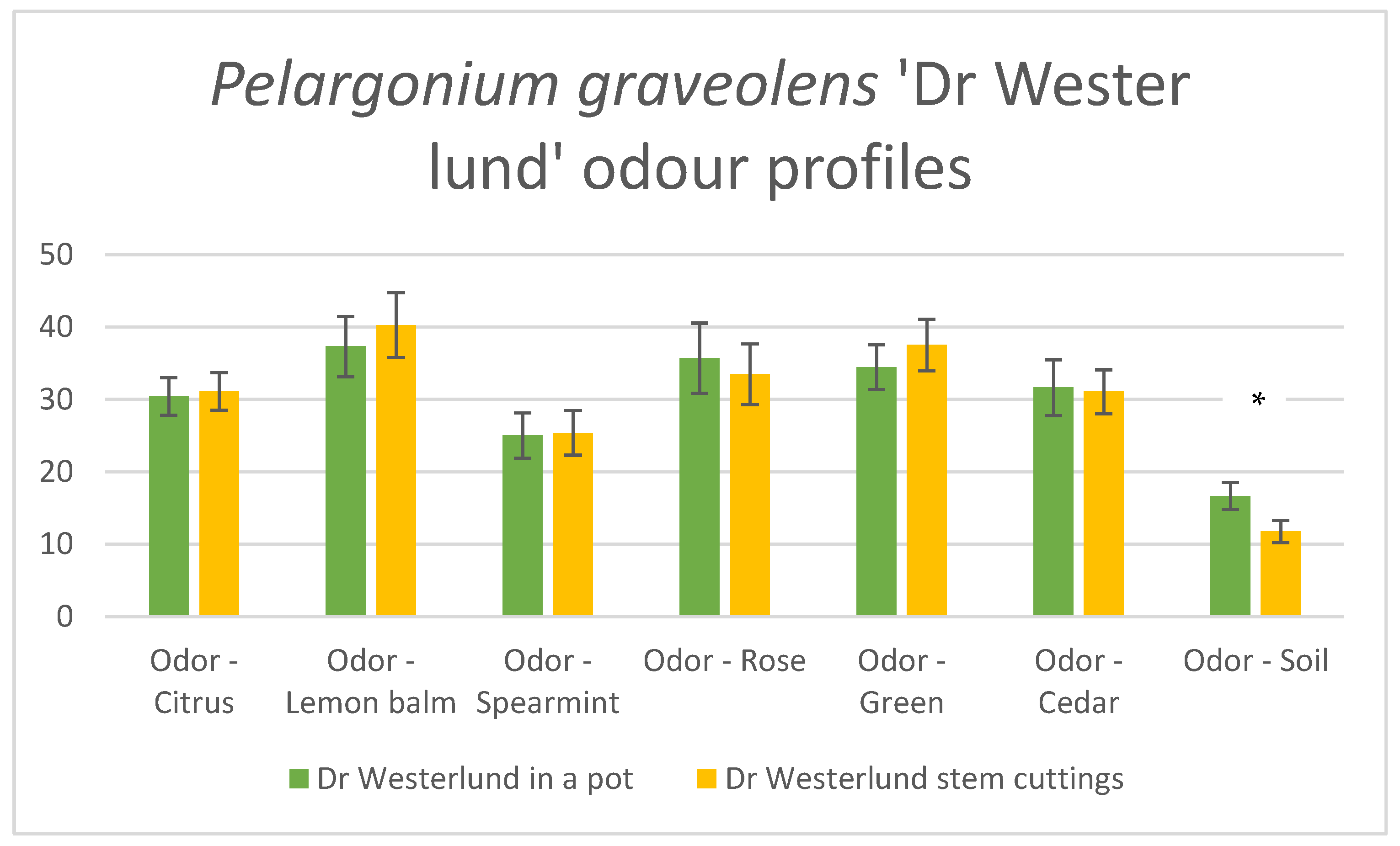

Table 1.
Chemical Compounds found in the Pelargonium graveolens ´Dr. Westerlund´ samples.
| Name: Chemical compound | Retention time (minutes) |
Retention index | Formula: Chemical Compound | CAS number |
|---|---|---|---|---|
| alpha-pinene | 14.30 | 1447 | C10H16 | 80-56-8 |
| Camphene | 14.81 | 1476 | C10H16 | 79-92-5 |
| Para-cymene | 16.87 | 1580 | C10H14 | 99-87-6 |
| Alpha -terpineol | 16.98 | 1585 | C10H18O | 98-55-5 |
| Limonene | 16.99 | 1793 | C9H13NO3 | 5989-27-5 |
| Cyclohexanol | 17.92 | 1678 | C12H22O | 108-93-0 |
| 4-Methyl-2-(2-methylprop-1-en-1-yl)tetrahydro-2H-pyran | 19.12 | 1696 | C10H18O | 3033-23-6 |
| Cyclohexanone | 20.31 | 1757 | C10H18O | 108-93-0 |
| Citronellol | 21.71 | 1829 | C10H20O | 106-22-9 |
| Citronellyl formate | 22.80 | 1882 | C11H20O2 | 105-85-1 |
| Copaene | 25.49 | 2366 | C15H24 | 3856-25-5 |
| Caryophyllene | 26.50 | 2445 | C15H24 | 13877-93-5 |
| Alpha- Guaiene | 26.75 | 2464 | C15H24 | 3691-12-01 |
| (-)-Aristolene | 26.93 | 2478 | C15H24 | 6831-16-9 |
| Aromadendrene | 27.17 | 2496 | C15H24 | 72747-25-2 |
| Humulene | 27.21 | 2499 | C15H24 | 6753-98-6 |
| 3 furopelargone A | 29.67 | 2690 | C15H22O2 | 1143-45-9 |
Table 2.
Alkane standards used for determination of retention indices.
| Alkane (no of C) | Alkene standard retention time (minutes) |
Retention index |
|---|---|---|
| heptane (7) | 2.96 | 810 |
| octane (8) | 3.39 | 973 |
| nonane (9) | 4.22 | 1054 |
| decane (10) | 5,65 | 1118 |
| undecane (11) | 7.59 | 1170 |
| dodecane (12) | 9.53 | 1221 |
| tridecane (13) | 11.29 | 1273 |
| tetradecane (14) | 12.86 | 1327 |
| pentadecane (15) | 14.28 | 1383 |
| hexadecane (16) | 15.57 | 1445 |
| heptadecane (17) | 16.78 | 1510 |
| octadecane (18) | 17.93 | 1581 |
| nonadecane (19) | 19.02 | 1656 |
| eicosane (20) | 20.06 | 1735 |
| heneicosane (21) | 21.05 | 1819 |
| docosane (22) | 22.00 | 1906 |
| tricosane (23) | 22.92 | 1998 |
Table 3.
Sensory attributes, their definitions, and suggested chemical compounds. Chemical formulas and CAS numbers are given in Table 1.
Table 3.
Sensory attributes, their definitions, and suggested chemical compounds. Chemical formulas and CAS numbers are given in Table 1.
| Sensory Attribute | Definition1 | Chemical compound2 | Description3,4,5 |
|---|---|---|---|
| Citrus | Citrus fruit, including peel | Limonene | Citrus, orange, fresh, sweet3,5 Lemon-like odor, free from campherous and terpene notes4 |
| Lemon balm | The whole plant | Para-cymene | Fresh, Citrus, Terpene, Woody, Spicy3,5 Citrusy aroma and reminiscent of lemon4 |
| Spearmint | Odor of green mint | Camphene | Camphoraceous, cooling, piney, woody with terpy nuances. It has citrus and green minty and green spicy notes3,5 Terpene, camphorous flavor4 |
| Rose | Rose water | 4-Methyl-2-(2-methylprop-1-en-1-yl)tetrahydro-2H-pyran | Fragrance found in roses and rose oil3 Rose oxide, powerful geranium top note4 |
| Green | Meadow with grass and nettles | Citronellyl formate | Sweet, green, waxy, floral, apricot, citrus, fruity and mandarin3 Fruity and rose-like odor4 |
| Cedar | Cedar tree | Camphene | Camphoraceous, cooling, piney, woody with terpy nuances3 Terpene, camphorous flavor4 |
| Soil | Soil | Alpha-Guaiene | Sweet, woody, dry guaiac wood, spicy, powdery3,5 Earthy and spicy aroma and woody flavor4 |
Disclaimer/Publisher’s Note: The statements, opinions and data contained in all publications are solely those of the individual author(s) and contributor(s) and not of MDPI and/or the editor(s). MDPI and/or the editor(s) disclaim responsibility for any injury to people or property resulting from any ideas, methods, instructions or products referred to in the content. |
© 2023 by the authors. Licensee MDPI, Basel, Switzerland. This article is an open access article distributed under the terms and conditions of the Creative Commons Attribution (CC BY) license (http://creativecommons.org/licenses/by/4.0/).
Copyright: This open access article is published under a Creative Commons CC BY 4.0 license, which permit the free download, distribution, and reuse, provided that the author and preprint are cited in any reuse.


