

Submitted:
14 July 2025
Posted:
15 July 2025
You are already at the latest version
Abstract
Panamanian Geisha coffee is globally renowned for its exceptional quality and distinctive sensory profile. To identify the volatile organic compounds (VOCs) responsible for its quality and analyze their correlation with sensory attributes, samples were subjected to rigorous sensory evaluation by a panel of Q-Graders, adhering to Specialty Coffee Association (SCA) protocols. Using HS-SPME-GC-MS methodology, 172 VOCs were identified in 16 roasted samples. Eleven VOCs were identified as significantly impacting the final product quality. Cis-ocimene, acetol, and 2,5-dimethyl-3(2H)-furanone exhibited substantial positive correlations with aroma, acidity, and balance. Cis-ocimene, a monoterpene, contributes floral and herbal notes, while furans, such as 2,5-dimethyl-3(2H)-furanone, provide sweet and caramelized characteristics. Additionally, acetol influences the perception of malty and sweet notes, reflecting the development of the roasting process. Results confirm that chemical-sensory relationships are multidimensional and depend on complex interactions among chemical compounds generated during the roasting process. Furthermore, the use of dual chromatographic columns with different polarities (Supelcowax 10 and SH Rxi-5HT) enhanced the identification and quantification of key VOCs. Canonical correlation analysis proved invaluable for interpreting complex chemical-sensory data, offering advantages over traditional multivariate methodologies. The robust scientific framework established for understanding and enhancing specialty coffee quality yielded practical implications for producers and roasters.
Keywords:
roasted coffee
; sensory evaluation
; HS-SPME-GC-MS
; chemometrics
; volatile compounds
1. Introduction
Specialty coffee represents a distinct segment in the global market, characterized by its exceptional quality and standardized procedures encompassing cultivation, processing, and delivery to the consumer. These coffees are distinguished by their superior sensory attributes compared to conventional commercial coffees [1,2,3,4]. In global production, countries such as Brazil, Vietnam, Colombia, Indonesia, Ethiopia, Honduras, India, Peru, Uganda, and Guatemala dominate the market [5]. While Panama is not among the major global producers, it has achieved exceptional recognition for its Geisha (Coffea arabica) variety coffee production, currently considered one of the best-awarded specialty coffees worldwide.
Coffee quality assessment is based on rigorous sensory analysis performed by certified cuppers [6,7]. This process involves evaluating ten attributes: fragrance and aroma, flavor, aftertaste, acidity, body, balance, uniformity, clean cup, sweetness, and absence of defects. Each attribute is evaluated using a standardized numerical scale, whose sum determines the final score that defines the quality of the coffee [8,9]. The first five attributes are intrinsically related to the coffee’s physicochemical properties, while uniformity, clean cup, and sweetness reflect the quality of green coffee processing during harvest and post-harvest [10]. The cupper’s evaluation is crucial for the industry, as it determines the quality and commercial value of the product in international markets [11].
Among the quality parameters evaluated, aroma is one of the most significant, establishing a direct correlation with volatile organic compounds (VOCs) generated during the roasting process [12]. These compounds originate from specific precursors, such as sugars, nitrogenous compounds (including caffeine, trigonelline, free amino acids, and proteins), and phenolic compounds (5-CQA and total phenols) [13], which undergo chemical transformations during roasting through Maillard reactions, sugar decomposition, lipid oxidation, hydrolysis, and pyrolysis [14]. This complex process generates over a thousand volatile compounds [15], although it is estimated that only 30 to 50 of these are determinants in coffee’s aromatic profile [8,16]. The predominant VOCs belong to specific chemical groups, such as furans, pyrazines, ketones, pyrroles, and phenols, each contributing characteristic aromatic notes [12,17]. It is essential to note that variations in the concentration of the same compound can result in different sensory characteristics [18].
For the characterization of the volatile fraction, solid-phase microextraction (SPME) coupled with gas chromatography-mass spectrometry (GC-MS) has been established as a reference technique [19]. SPME is based on analyte absorption/adsorption and desorption processes using a specific coating fiber [20,21]. This methodology offers significant advantages, including high reproducibility, fiber reusability, and the absence of organic solvents [22], which facilitates more comprehensive VOC identification in complex matrices, such as coffee [23].
Given coffee’s chemical complexity and impact on sensory quality, it is essential to employ advanced analytical tools to identify determinant compounds. Chemometrics has proven particularly useful in this context, enabling the multivariate analysis of chemical data and the discrimination of multiple instrumental variables. This approach has facilitated the establishment of correlations between coffee’s chemical composition (volatile and non-volatile) and various parameters such as roasting time, process type, and storage time [24,25,26,27,28]. Additionally, predictive quality models based on volatile composition have been developed [3,29,30]. Although seldom used in chemometric analyses, CCA is the most suitable multivariate technique for establishing correlations between two sets of variables, particularly when multicollinearity is expected among variables within each set [31].
Panamanian Geisha coffee has achieved international recognition for its distinctive floral, citrus, and fruity aromatic notes, achieving exceptional prices in global auctions. However, available information about its chemical composition is limited [32,33,34]. Therefore, this study focuses on identifying and characterizing VOCs in Panamanian Geisha coffee, pioneering the implementation of CCA to quantify their correlation with the sensory attributes that determine its exceptional quality.
2. Results and Discussion
2.1. Identification of Volatile Compounds in Panamanian Geisha Coffee
172 VOCs were identified in 16 samples analyzed of Arabica coffee var. Geisha (Table 1). The compounds were clustered according to the functional group to which they belong, giving a total of thirteen groups including twenty-eight pyrazines, twenty-three terpenes, nineteen ketones, sixteen N-heterocycle, fifteen fatty acids, twelve esters, eleven furans, ten aromatic compounds, nine aldehydes, eight alcohols, five lactones, five phenol and four organic acids among others.
The main functional groups and volatile compounds responsible for the sensory attributes of coffee arabica var. Geisha are detailed below.
2.1.1. N-Heterocyclic Compounds - Pyrazines
Twenty-eight pyrazines were identified in this study, with 2-methylpyrazine, 2,5-dimethylpyrazine, 2,6-dimethylpyrazine, and 2,3,5-trimethylpyrazine showing the highest relative peak areas within this functional group. Seven n-alkylpyrazines are considered key compounds with strong olfactory properties in coffee, including 2-ethyl-3-methylpyrazine, 2,5-dimethylpyrazine, 2,6-dimethylpyrazine, 2,3-dimethylpyrazine, and 2,3,5-trimethylpyrazine [35]. These compounds contribute nutty, fruity, chocolatey, and roasted notes23. However, not all pyrazines provide favorable fragrances; compounds such as 5H-5-methyl-6,7-dihydrocyclopentapyrazine, 3-ethyl-2,5-dimethyl-pyrazine, and 2-ethyl-5-methylpyrazine, identified in this study, impart earthy characteristics considered negative descriptors in coffee [12].
Other nitrogen-containing heterocyclic compounds identified included pyridine, 1H-pyrrole-2-carboxaldehyde, 2-acetyl pyrrole, and indole, which contribute roasted, burnt, fungal, and rancid characteristics [36,37]. Pyrroles form through aldose-alkylamine reactions involving reducing sugars and amino acids via glucose-alanine or glucose-proline/hydroxyproline condensation [38]. Caffeine, the primary VOC within the N-heterocyclic group, contributes to the beverage’s bitterness and body [39].
2.1.2. Terpenes
Terpenes, structurally diverse aromatic compounds with intense olfactory impressions, were present in all 16 Geisha coffee samples analyzed. Monoterpenes constituted the second-largest VOC group, comprising 23 compounds, including limonene, linalool, and α-ocimene, contributing citrus, floral, and fruity characteristics [1,7]. Compounds such as geraniol and α-terpineol provide sweet, fruity, floral, and herbal notes [36,40]. In Panamanian Geisha coffee, linalool showed the highest percentage area and was present in most analyzed samples, consistent with previous studies of eight Panamanian Geisha coffee samples [34].
2.1.3. Aldehydes and Ketones
Ketones account for 20% of the volatile compounds contributing to the roasted coffee aroma, forming during pyrolysis in the final roasting stage [38,41]. These compounds impart floral and fruity characteristics, along with pleasant acidity, and are reported to be indicators of coffee quality [8]. Nineteen ketones were identified, including 3,3-dimethyl-2-butanone, 2,3-pentanedione, and furaneol, which contribute sweet, caramel, buttery, and fruity notes [17,42].
Eight aldehydes were identified, including benzaldehyde, 5-acetoxymethyl-2-furaldehyde, and 2-methylbutanal, which provide sweet, almond, fruity, and chocolate characteristics [17,38]. Aldehydes and ketones typically account for 1-6% of coffee compounds, contributing to the positive attributes of roasted coffee [40]. These aldehydes are crucial for forming aromatic compounds, such as higher alcohols and esters, through the activity of alcohol dehydrogenase [43].
2.1.4. Esters
Esters, associated with positive coffee attributes [12], form during roasting through Maillard reactions between carboxylic acids and alcohols, contributing fruity, floral, and herbal notes [44]. Twelve esters were identified, including ethyl acetate, isoamyl acetate, methyl salicylate, and furfuryl pentanoate, with most showing relative peak areas below 1%.
2.1.5. Furans
Furans, cyclic ethers primarily formed from carbohydrates (glucose, fructose, lactose) through Maillard browning reactions [38], also develop through polyunsaturated fatty acid oxidation, ascorbic acid decomposition at high temperatures, and thermal degradation of amino acids [45,46]. Along with pyrazines, furans are significant constituents of roasted coffee aroma [47,48].
Eleven furan compounds were identified, with 2-furamethanol, 5-methyl furfural, and furfural showing the highest areas (8-15% on Supelcowax 10 column and 12-21% on SH Rxi-5HT column), comparable to reported data from ten Arabica coffee samples from South America, Central America, and Indonesia (25-41% in roasted coffee) [40]. These compounds contribute caramel, toasted bread, sweet, and almond notes [7,38].
2.1.6. Fatty Acids
Lipids constitute 8-17% of roasted coffee and significantly contribute to its aroma [49]. Fifteen VOCs were identified, including palmitic acid, linoleic acid, myristic acid, and ethyl lactate. These compounds provide sweet, fruity, and waxy characteristics. The relative peak area for fatty acids was below 2%.
2.1.7. Organic Acids and Phenols
Sensory acidity and sweetness correlate with organic acids like acetic, malic, citric, lactic, formic, chlorogenic, and quinic acids [50,51]. Four VOCs were identified, including acetic, isovaleric, and crotonic acids, which contribute to notes of vinegar, onion, sour, and fermented notes [7,37,52]. Five phenols were identified, with 2-methoxy-4-vinylphenol as the primary compound, consistent with other studies [15,38], imparting intense spice aromas to coffee [15].
2.2. Sensory Evaluation
The sensory evaluation of Panamanian Geisha coffee considered ten attributes according to the SCA protocol. Table 2 presents the mean scores from eight panelists for fragrance/aroma, flavor, aftertaste, acidity, body, balance, uniformity, clean cup, sweetness, overall impression, and the average score for each sample.
The total scores for Geisha variety coffee samples ranged from 86.21 to 89.44, placing them in the “excellent” category of specialty coffee according to SCA standards. Aroma, a key contributor to quality, scored between 8.07 and 8.56. Acidity, representing coffee vibrancy, ranged from 8.11 to 8.61, establishing itself alongside sweetness, body, and aroma as one of the most significant attributes in sensory quality [43,45,53]. No defects were detected in the evaluated samples, indicating the absence of unpleasant palate characteristics. All samples underwent identical roasting, grinding, and preparation conditions, resulting in maximum scores for uniformity, clean cup, and sweetness attributes, positively impacting the final scores [15].
2.3. Chemometric Analysis
The random function implemented in R software selected six VOCs that maximized the correlation with coffee sensory quality for each chromatographic column (Table 3).
Table 4 presents the significance test results using Wilks’ Lambda statistic with Rao’s F-approximation, a commonly employed method in Canonical Correlation Analysis (CCA) for coffee samples. It considers both chromatographic columns used in the research.
For VOCs obtained through the Supelcowax 10 column, the Wilks’ Lambda was extremely small (4.607x10⁻⁶), with a highly significant p-value 1.674x10⁻⁶ (p< 0.001), indicating that the first set of canonical relationships is highly significant, thus rejecting the null hypothesis that the combined variables have no significant impact on group differentiation. The presence of a second significant pattern (Lambda = 3.12x10⁻³, p = 0.007) suggests that these chemical-sensory relationships are multidimensional, where different chemical compounds interact in a complex manner to determine various aspects of coffee quality.
VOCs obtained using the SH Rxi-5HT column showed an extremely low Wilks’ Lambda value (8.505x10⁻⁶), indicating strong evidence that variable combinations have significant differences between groups. The p-value of 5.96x10⁻⁶ (p< 0.001) allows rejection of the null hypothesis, suggesting that the evaluated chemical characteristics significantly affect coffee quality in both cases.
The relative abundance of the 11 volatile compounds in the coffee under study, according to % relative area, was α-ocimene A32, 0.37%; Acetol A37, 1.33%; 2,5-dimethyl-3(2H)-furanone A64, 0.36%; Ethanone, 1-(2-furanyl) A65, 2. 76%; Ethanone, 1-(1-methyl-1H-pyrrol-2-yl) A82, 0.34%; 1-(6-Methyl-2-pyrazinyl)-1-ethanone A88, 1.51%; 2,5-dimethyl-3(2H)-furanone A12, 0. 89%; 2-furanmethanol A15, 13.56%; 2-cyclopenten-1-one, 3-ethyl-2-hydroxy A46, 0.41%; 4H-pyran-4-one, 2,3-dihydro-3,5-dihydroxy-6-methyl A48, 2.36%; 2-methoxy-4-vinylphenol A67, 10.77%; Myristic acid, ethyl ester A69, 0.02%.
The contribution of these 11 compounds to the chemical content of the volatile fraction of Geisha coffee is 34.68%. All these compounds have an herbal, fruity, sweet, and caramelized aroma and taste, which were the notes reported by the tasters during the sensory evaluation of these samples.
Only two of these 11 volatile compounds were found in samples of other Arabica varieties [29,30], which distinguishes the sensory quality of Geisha coffee from that of other Arabica coffee varieties.
Figure 1 depicts relationships between the main volatile organic compounds (VOCs) in Geisha coffee and its sensory attributes.
In the biplot of panel a) Figure 1., we can interpret that the compounds cis-ocimene (A32), Ethanone, 1-(2-furanyl) (A65), 2,5-dimethyl-3(2H)-furanone (A64), and Acetol (A37) showed significant positive correlations with sensory attributes such as aroma, balance, and acidity. The positive correlation of these compounds with the attributes suggests that they contribute to a complex and balanced sensory profile. cis-ocimene (A32) is a monoterpene that imparts characteristic floral and herbal notes to the aromatic profile. Its presence indicates high-altitude coffees or processing methods that effectively preserve the more delicate, volatile compounds. The furanic compounds, represented by Ethanone, 1-(2-furanyl) (A65) and 2,5-dimethyl-3(2H)-furanone (A64), are products of the Maillard reaction during roasting [45,46,47,48]. The former contributes toasted and caramelized notes, while the latter adds distinctive sweet and caramelized aromatic characteristics typical of roasted coffee. The concentration of these compounds is directly related to the development of the roasting process and the formation of complex flavors. Acetol (A37), a product of thermal degradation during roasting, influences the perception of sweet and malty notes, further contributing to the body sensation in the beverage. Its presence and concentration are indicators of the intensity of the roasting process.
The synergistic interaction among these compounds defines the complexity of the coffee’s sensory profile, establishing a balance between fresh, floral, toasted, and caramelized notes, which is crucial for the overall quality of the beverage. The evaluation of the coffee’s chemical profile reveals a strong positive correlation between cis-ocimene (A32) and 2,5-dimethyl-3(2H)-furanone (A64). This association is particularly relevant as it suggests a complementary interaction between a terpene compound associated with floral notes (cis-ocimene) and a furanic compound that provides sweet and caramelized notes (2,5-dimethyl-3(2H)-furanone). This correlation could explain the characteristic aromatic complexity of high-quality coffees, where floral and sweet notes blend harmoniously.
The Canonical Correlation Analysis (CCA) revealed that several chemical attributes were highly correlated with the notes described by the tasters for the characteristics of aroma, balance, and acidity, including floral, fruity, herbal, and citrus notes. The CCA also showed a significant negative association between the compounds Ethanone, 1-(1-methyl-1H-pyrrol-2-yl) (A82), and 1-(6-Methyl-2-pyrazinyl)-1-ethanone (A88) with the sensory attributes of coffee. This inverse relationship suggests that higher concentrations of these compounds, derived from pyrroles and pyrazines, respectively, may adversely affect the sensory perception of the coffee, possibly due to their contribution to intense aromatic notes associated with over-roasting or defects in the thermal process. Some compounds from the pyrazine group may be indicative of lower quality coffees [44,54].
The CCA also revealed a homogeneous dispersion pattern of the samples along the two canonical axes, suggesting a diverse but consistent chemical composition in terms of compounds in the Supelcowax 10 column. However, sample 1 exhibits distinctive behavior by positioning outside the central cluster, highlighting a singular chemical composition. This deviation of sample 1 from the general pattern indicates the presence of an unusual chemical fingerprint, either due to the presence of specific compounds or significant variations in the concentrations of polar compounds. These differences in its chemical profile are reflected in unique sensory attributes that differentiate it from the other samples analyzed.
In the biplot panel b) of Figure 1, the CCA for the VOCs on the SH Rxi-5HT column shows a strong association between the sensory attributes of aroma, balance, body, and flavor, which are positively correlated with 4H-pyran-4-one, 2,3-dihydro-3,5-dihydroxy-6-methyl (A48), and Myristic acid, ethyl ester (A69). This correlation suggests that these compounds are crucial for the desirable essential characteristics of coffee. 4H-Pyran-4-one, 2,3-dihydro-3,5-dihydroxy-6-methyl (A48), has been identified in various foods, including garlic oil, rose tea, heated pears, and mango. It is considered that this compound is flavorless in its pure form and does not possess a bitter attribute [55].
The compounds 2-methoxy-4-vinylphenol (A67), 2-furanmethanol (A15), and 2-cyclopenten-1-one, 3-ethyl-2-hydroxy (A46) exhibit a high correlation among themselves, as well as a negative correlation with sensory characteristics along canonical components 1 and 2, suggesting their undesired contribution to the overall sensory profile of the coffee. 2-methoxy-4-vinylphenol is known to contribute smoky and spicy aromatic notes, which enhance the complexity of the coffee [56]. On the other hand, 2-cyclopenten-1-one, 3-ethyl-2-hydroxy is generally associated with aromas that can be described as sweet, caramelized, and slightly toasted. Compounds of the cyclopentenone often add nuances reminiscent of caramel, honey, and nutty notes. Meanwhile, 2-furanmethanol is associated with caramelized smells and sweet flavors.
The compound 2,5-dimethyl-3(2H)-furanone (A12) shows a negative correlation with canonical component 2 and a slightly positive correlation with component 1, suggesting that the elevated presence of these compounds could indicate problems in the roasting or storage process.
3. Materials and Methods
This study followed the standardized procedures used in international cupping events of the Specialty Coffee Association of Panama (SCAP). The primary interest was to correlate the volatile compounds of coffee, serving as chemical markers, with the sensory evaluations made by expert tasters. 16 roasted coffee samples were used for sensory analysis, and their volatile composition was analyzed using solid-phase microextraction combined with gas chromatography coupled to mass spectrometry (SPME-GC-MS). Canonical correlation analysis (CCA) was used for chemometric analysis.
3.1. Chemicals and Reagents
The analytical work employed a Supelco 50/30 µm DVB/CAR/PDMS (divinylbenzene/carboxen/polydimethylsiloxane) mixed fiber and a reference Standard C7-C33 Qualitative Retention Time Index Standard (Restek, Pennsylvania, EE.UU.).
3.2. Sample Collection
All samples in this study are coffee of the species Coffea arabica var. Geisha were cultivated in the province of Chiriqui, Panama. The samples represent the agro-ecological zones where this coffee variety is produced, collected within the polygon bounded by 8°54’03.6”N, 82°43’58.8”W, and 8°45’22”N, 82°36’45”W, which is approximately 183.25 km2. The altitude of the farms ranged from 1300 to 1850 meters above sea level, where this type of coffee variety, classified as specialty coffee, develops best. The average temperature ranged from 15°C to 19°C. Sixteen samples were collected, and the post-harvest process was naturally fermented at a medium roasting level using a Probat sample roaster (Probat BRZ-2, Germany). The roasting profile was as follows: initial temperature, 160°C; development time ratio, 11%; total time, 7 minutes and 45 seconds; and exit temperature, 180 °C. The grinder was EK43, set to 8.5 in the opening, the standard particle size established for the coffee industry. SCAP producers supplied these in vacuum-sealed packages.
3.3. Headspace Solid-Phase Microextraction Gas Chromatography-Mass Spectrometry (HS-SPME-GC-MS) for Identifying Volatile Compounds in Geisha Coffees
Volatile organic compounds (VOCs) in Geisha coffee samples were analyzed using headspace solid-phase microextraction coupled with gas chromatography-mass spectrometry (HS-SPME-GC-MS). The analytical procedure involved weighing 2.5 ± 0.010 grams of ground roasted coffee sample into a 40 mL amber vial with a rubber septum cap. Samples were equilibrated for 10 minutes at 65°C with agitation at 600 rpm. VOCs were extracted using a 1 cm long mixed fiber (50/30 µm DVB/CAR/PDMS, Supelco, Bellefonte, PA, EE.UU). The extraction was performed manually for 45 minutes at 65°C, with each sample analyzed in triplicate [52].
The SPME-adsorbed volatiles were thermally desorbed and introduced into a GC-MS-QP2010 SE Single Quadrupole GC-MS system (Shimadzu, Milan, Italy). Chromatographic conditions, modified from Caporasso’s method [52], were as follows: Injection port temperature: 250°C, Mode: splitless, Carrier gas: UHPC-grade helium, Flow rate: 0.8 mL/min, and Pressure: 33.6 kPa. Compound separation was achieved using two columns of different polarities: Supelcowax 10 (100% polyethylene glycol, 30m × 0.25 mm ID × 0.25 µm) and SH Rxi-5HT (5% dimethylsiloxane, 30m × 0.25 mm ID × 0.25 µm). The temperature program consisted of the following steps: Initial temperature, 40°C (5-minute hold); First ramp, 2°C/min to 160°C (5-minute hold); and Second ramp, 9°C/min to 230°C (5-minute hold). MS conditions included: Ionization mode: EI (70 eV), Ion source temperature: 225°C, Interface temperature: 275°C, Scan range: 35-500 m/z, Scan speed: 1666 amu/s35.
Compound identification was performed by comparing mass spectra with commercial libraries (NIST 14 Mass Spectral Data, USA) using an 85% similarity threshold as the acceptance criterion and the ADAMS library (MS data library, Adams version 4 [57]). Linear Retention Indices (LRI) were calculated using a C7-C33 Qualitative Retention Time Index Standard (Restek, Pennsylvania, USA). The results of the chromatographic analyses were expressed as a percentage of normalized relative area of each compound to the total peak area of the GC/MS chromatogram [15].
3.4. Sensory Evaluation
A sensory evaluation was conducted using quantitative descriptive analysis. The sensory evaluation was conducted at the Lamastus Estates Cupping Room in Boquete, Chiriquí, Panama. Eight Q-Grader panelists trained in the SCAP cupping protocol [9] conducted sensory analysis, comprising two women and six men aged between 30 and 60 years. All evaluators have previous experience judging the Best of Panama event, including more than 100 samples annually. Ten attributes were evaluated: fragrance/aroma, flavor, aftertaste, acidity, body, balance, sweetness, clean cup, uniformity, and overall impression. Each attribute was scored on a 0-10 scale, with the sum of all ten sensory indicators comprising the final score for each sample. All samples were processed under identical conditions for roasting, grinding, and cup preparation. The beverage preparation was carried out according to the protocol established by SCAP; 8.25 grams of freshly ground coffee were weighed, and 125 mL of water at 96 °C was added. After 3 minutes, the judges broke the cup. They proceeded to evaluate the different attributes mentioned above. The samples were placed for evaluation in groups of two farms per table; within each table, the order of the samples was randomized. Ultimately, the judges discussed the scores of each coffee, verifying that the level of dispersion was the lowest among the judges.
3.5. Chemometric Analysis
Canonical Correlation Analysis (CCA) was applied to examine the relationships between volatile organic compounds (VOCs) in Geisha coffee and its sensory attributes, including aroma, flavor, aftertaste, acidity, body, and balance, using R software (RStudio v.2022.12.0). Due to the limited sample size of 16 and a large number of chemical compounds analyzed; it was not feasible to evaluate CCA for all compounds simultaneously. Therefore, we adopted a systematic approach to assess potential relationships. Our methodology randomly selected six variables from the total chemical compounds analyzed (X group) and six sensory variables (Y group), then calculated CCA for each combination. The significance of these associations was assessed through Wilk’s Lambda test using the p.asym function from R’s CCP package, where rho represented r2 values, n denoted the sample size, p the number of X group variables (compounds), and q the number of Y group variables (sensory attributes). Ten thousand iterations were performed, and combinations with the lowest p-values for the first row of Wilk’s Lambda test results were selected. The analysis utilized normalized peak areas representing the percentage area relative to the total chromatogram area obtained from both Supelcowax 10 and SH Rxi-5HT columns in GC-MS.
4. Conclusions
Aroma is one of the most significant attributes in determining the quality of coffee, and it is closely related to its volatile composition. The 172 VOCs identified in 16 samples of roasted Arabica coffee variety Geisha were clustered according to their functional group in twenty-eight pyrazines, twenty-three terpenes, nineteen ketones, sixteen N-heterocycle, fifteen fatty acids, twelve esters, eleven furans, ten aromatic compounds, nine aldehydes, eight alcohols, five lactones, five phenols, and four organic acids, among others. A panel of experts evaluated the sensory quality, and CCA was used to establish the correlation structure with the data obtained by GC-MS. It is worth noting that using two types of columns with different polarities enables the acquisition of a more detailed profile of the volatile composition of a complex matrix, such as coffee. Eleven compounds exhibited a significant relationship with the canonical variables, accounting for a substantial proportion of the shared variance in the perception of coffee quality. These chemical-sensory relationships are multidimensional, indicating that their complex interaction enables the determination of various aspects of coffee quality, resulting in a complex and balanced sensory profile. These results are consistent with the attributes mentioned by the panelists, such as fruity, herbal, floral, and citric notes that stand out in Panamanian Geisha coffee, which is attributed to the synergistic interaction of the volatile compounds. CCA proved invaluable for interpreting complex chemical-sensory relationships, offering advantages over traditional univariate and multivariate methodologies, which are special cases of CCA. The findings emphasize the role of VOCs in shaping the sensory profile of this highly valued coffee, thereby establishing a robust scientific foundation for understanding and enhancing specialty coffee quality. This is particularly relevant for the understudied Panama Geisha coffee, which has recently gained notoriety in the global market. The results also have practical implications for producers and roasters, providing tools to maximize the value and sensory perception of this coffee variety in international markets.
Author Contributions
Conceptualization, S.M., A.V., A.S., R.Q., P.G., J.G. and M.R.; methodology, S.M., A.V., A.S., J.G. and M.R.; software, P.G. and R.Q.; validation, S.M. and A.S.; formal analysis, S.M., A.V., A.S., R.Q., P.G., J.G. and M.R.; investigation, S.M., A.V., A.S., R.Q., P.G., J.G. and M.R; resources, S.M., A.V., A.S., J.G. and M.R; data curation, S.M., A.V., A.S., R.Q. and P.G.; writing—original draft preparation, S.M., A.V., A.S., R.Q. and P.G.; writing—review and editing, S.M., A.V., A.S., R.Q., P.G., J.G. and M.R; visualization, S.M., A.V., A.S., R.Q. and P.G; supervision, A.V., A.S., R.Q. and P.G; project administration, S.M. A.V. and A.S.; funding acquisition, A.V. and P.G.
Funding
This research was funded by the National Secretariat of Science and Technology (SENACYT) through the New Researchers Call 2021, project code APY-NI-2021-09, and the SENACYT National Research System (SNI).
Institutional Review Board Statement
Not applicable.
Informed Consent Statement
Not applicable.
Data Availability Statement
Data are available from the authors upon reasonable request.
Acknowledgments
The authors express their gratitude to the National Secretariat of Science and Technology (SENACYT), the Natural Resources Research Center (CIRN) of the Autonomous University of Chiriqui (UNACHI), the Pharmacognostic Research Center of Panamanian Flora (CIFLORPAN), and the School of Chemistry at the Faculty of Natural and Exact Sciences, University of Panama (UP). Additionally, we extend our thanks to the Specialty Coffee Association of Panama (SCAP).
Conflicts of Interest
The authors declare that they have no conflicts of interest.
Abbreviations
The following abbreviations are used in this manuscript:
| CCA | Canonical Correlation Analysis |
| DVB/CAR/PDMS | Divinylbenzene/Carboxen/Polydimethylsiloxane |
| GC-MS | Gas Chromatography-Mass Spectrometry |
| HS | Headspace |
| LRI | Linear Retention Index |
| NIST | National Institute of Standards and Technology |
| RT | Retention Time |
| SCAP | Specialty Coffee Association of Panama |
| SPME | Solid Phase Microextraction |
| VOCs | Volatile Organic Compounds |
References
- Piccino, S.; Boulanger, R.; Descroix, F.; Shum, A.; Sing, C. Aromatic Composition and Potent Odorants of the “Specialty Coffee” Brew “Bourbon Pointu” Correlated to Its Three Trade Classifications. Food Res. Int. 2013, 61, 264–271. [Google Scholar] [CrossRef]
- Sepúlveda, W. S.; Chekmam, L.; Maza, M. T.; Mancilla, N. O. Consumers’ Preference for the Origin and Quality Attributes Associated with Production of Specialty Coffees: Results from a Cross-Cultural Study. Food Res. Int. 2016, 89, 997–1003. [Google Scholar] [CrossRef]
- Agnoletti, B. Z.; Folli, G. S.; Pereira, L. L.; Pinheiro, P. F.; Guarçoni, R. C.; da Silva Oliveira, E. C.; Filgueiras, P. R. Multivariate Calibration Applied to Study of Volatile Predictors of Arabica Coffee Quality. Food Chem. 2022, 367, 130679. [Google Scholar] [CrossRef] [PubMed]
- Córdoba, N.; Moreno, F. L.; Osorio, C.; Velásquez, S.; Fernandez-Alduenda, M.; Ruiz-Pardo, Y. Specialty and Regular Coffee Bean Quality for Cold and Hot Brewing: Evaluation of Sensory Profile and Physicochemical Characteristics. LWT. 2021, 145, 111363. [Google Scholar] [CrossRef]
- Torga, G. N.; Spers, E. E. Perspectives of Global Coffee Demand. In Coffee Consumption and Industry Strategies in Brazil: A Volume in the Consumer Science and Strategic Marketing Series; Elsevier. 2020, 21–49.
- Costa, B. D. R. Brazilian Specialty Coffee Scenario. In Coffee Consumption and Industry Strategies in Brazil: A Volume in the Consumer Science and Strategic Marketing Series; Elsevier. 2020, 51–64.
- Seninde, D. R.; Chambers, E. Coffee Flavor: A Review. Beverages. 2020, 6(3), 44. [Google Scholar] [CrossRef]
- Laukaleja, I.; Kruma, Z. Quality of Specialty Coffee: Balance between Aroma, Flavour and Biologically Active Compound Composition: Review. Res. Rural Dev. 2018, 240–247. [Google Scholar]
- SCA. A Specialty Coffee Association Resource Protocols and Best Practices; 2018.
- Lingle, T. R.; Menon, S. N. Cupping and Grading-Discovering Character and Quality. In The Craft and Science of Coffee; Elsevier. 2017, 181–203.
- Wilson, A. P.; Wilson, N. L. W. The Economics of Quality in the Specialty Coffee Industry: Insights from the Cup of Excellence Auction Programs. Agric. Econ. 2014, 45(S1), 91–105. [Google Scholar] [CrossRef]
- Toledo, P. R. A. B.; Pezza, L.; Pezza, H. R.; Toci, A. T. Relationship Between the Different Aspects Related to Coffee Quality and Their Volatile Compounds. Compr Rev Food Sci Food Saf. 2016, 15(4), 705–719. [Google Scholar] [CrossRef]
- Girma, B.; Sualeh, A. A Review of Coffee Processing Methods and Their Influence on Aroma. Int. J. Food Eng. Technol. 2022, 6(1), 7–16. [Google Scholar] [CrossRef]
- Tarigan, E. B.; Wardiana, E.; Hilmi, Y. S.; Komarudin, N. A. The Changes in Chemical Properties of Coffee during Roasting: A Review. In IOP Conf. Ser.: Earth Environ. Sci.; IOP Publishing Ltd. 2022, 974(1), 012115. [Google Scholar] [CrossRef]
- Catão, A. A.; Mateus, N. de S.; Garcia, C. da C.; da Silva, M. C.; Novaes, F. J. M.; Alves, S.; Marriott, P. J.; da Silva, A. I. Coffee-Roasting Variables Associated with Volatile Organic Profiles and Sensory Evaluation Using Multivariate Analysis. Appl. Food Res. 2022, 2(2), 100223. [Google Scholar] [CrossRef]
- Cordoba, N.; Fernandez-Alduenda, M.; Moreno, F. L.; Ruiz, Y. Coffee Extraction: A Review of Parameters and Their Influence on the Physicochemical Characteristics and Flavour of Coffee Brews. Trends Food Sci Technol. 2020, 96, 45–60. [Google Scholar] [CrossRef]
- Yang, N.; Liu, C.; Liu, X.; Degn, T. K.; Munchow, M.; Fisk, I. Determination of Volatile Marker Compounds of Common Coffee Roast Defects. Food Chem. 2016, 211, 206–214. [Google Scholar] [CrossRef]
- Bona, E.; Da Silva, R. S. D. S. F. Coffee and the Electronic Nose. In Electron. Noses Tongues Food Sci; Academic Press. 2016, 31–38.
- Hernandes, K. C.; Souza-Silva, É. A.; Assumpção, C. F.; Zini, C. A.; Welke, J. E. Matrix-Compatible Solid Phase Microextraction Coating Improves Quantitative Analysis of Volatile Profile throughout Brewing Stages. Food Res. Int. 2019, 123, 75–87. [Google Scholar] [CrossRef]
- Kamgang Nzekoue, F.; Angeloni, S.; Caprioli, G.; Cortese, M.; Maggi, F.; Marconi, U. M. B.; Perali, A.; Ricciutelli, M.; Sagratini, G.; Vittori, S. Fiber-Sample Distance, An Important Parameter to Be Considered in Headspace Solid-Phase Microextraction Applications. Anal Chem. 2020, 92(11), 7478–7484. [Google Scholar] [CrossRef] [PubMed]
- Shirey, R. E. SPME Commercial Devices and Fibre Coatings. In Handbook of Solid Phase Microextraction; Elsevier. 2012; 99–133.
- Billiard, K. M.; Dershem, A. R.; Gionfriddo, E. Implementing Green Analytical Methodologies Using Solid-Phase Microextraction: A Review. Molecules 2020, 25(22). [Google Scholar] [CrossRef] [PubMed]
- Yuwono, S. S.; Hanasasmita, N.; Sunarharum, W. B.; Harijono. Effect of Different Aroma Extraction Methods Combined with GC-MS on the Aroma Profiles of Coffee. In IOP Conference Series: Earth and Environmental Science, IOP Publishing. 2019, 230 (1), 012044.
- Borém, F. M.; Abreu, G. F. de; Alves, A. P. de C.; Santos, C. M. dos; Teixeira, D. E. Volatile Compounds Indicating Latent Damage to Sensory Attributes in Coffee Stored in Permeable and Hermetic Packaging. Food Packag Shelf Life. 2021, 29, 100705. [Google Scholar] [CrossRef]
- Giacalone, D.; Degn, T. K.; Yang, N.; Liu, C.; Fisk, I.; Münchow, M. Common Roasting Defects in Coffee: Aroma Composition, Sensory Characterization and Consumer Perception. Food Qual Prefer. 2019, 71, 463–474. [Google Scholar] [CrossRef]
- Fassio, L. O.; Malta, M. R.; Liska, G. R.; Alvarenga, S. T.; Sousa, M. M. M.; Farias, T. R. T.; Pereira, R. G. F. A. Sensory Profile and Chemical Composition of Specialty Coffees from Matas de Minas Gerais, Brazil. J. Agric. Sci. 2017, 9(9), 78. [Google Scholar] [CrossRef]
- Barbosa, M. de S. G.; Scholz, M. B. dos S.; Kitzberger, C. S. G.; Benassi, M. de T. Correlation between the Composition of Green Arabica Coffee Beans and the Sensory Quality of Coffee Brews. Food Chem. 2019, 292, 275–280. [Google Scholar] [CrossRef]
- Bressanello, D.; Marengo, A.; Cordero, C.; Strocchi, G.; Rubiolo, P.; Pellegrino, G.; Ruosi, M. R.; Bicchi, C.; Liberto, E. Chromatographic Fingerprinting Strategy to Delineate Chemical Patterns Correlated to Coffee Odor and Taste Attributes. J Agric Food Chem. 2021, 69(15), 4550–4560. [Google Scholar] [CrossRef]
- Ribeiro, J. S.; Augusto, F.; Salva, T. J. G.; Ferreira, M. M. C. Prediction Models for Arabica Coffee Beverage Quality Based on Aroma Analyses and Chemometrics. Talanta. 2012, 101, 253–260. [Google Scholar] [CrossRef]
- Ribeiro, J. S.; Augusto, F.; Salva, T. J. G.; Thomaziello, R. A.; Ferreira, M. M. C. Prediction of Sensory Properties of Brazilian Arabica Roasted Coffees by Headspace Solid Phase Microextraction-Gas Chromatography and Partial Least Squares. Anal Chim Acta. 2009, 634(2), 172–179. [Google Scholar] [CrossRef]
- Uurtio, V., Monteiro, J. M., Kandola, J., Shawe-Taylor, J., Fernandez-Reyes, D., & Rousu, J. A tutorial on canonical correlation methods. ACM Comput. Surv. (CSUR) 2017, 50(6), 1–33.
- Vega, A.; De León, J. A.; Reyes, S. M.; Gallardo, J. M. Modelo Matemático Para Determinar La Correlación Entre Parámetros Fisicoquímicos y La Calidad Sensorial de Café Geisha y Pacamara de Panamá. Inf. Tecnol. 2021, 32(1), 89–100. [Google Scholar] [CrossRef]
- Vega, A.; De León, J. A.; Reyes, S. M.; Miranda, S. Y. Componentes Bioactivos de Diferentes Marcas de Café Comerciales de Panamá. Relación Entre Ácidos Clorogénicos y Cafeína. Inf. Tecnol. 2018, 29(4), 43–54. [Google Scholar] [CrossRef]
- Santamaría, N.; Meléndez, F.; Arroyo, P.; Calvo, P.; Sánchez, F.; Lozano, J.; Sánchez, R. Olfactory Evaluation of Geisha Coffee from Panama Using Electronic Nose. Chemosensors. 2023, 11(11), 559. [Google Scholar] [CrossRef]
- Mortzfeld, F. B.; Hashem, C.; Vranková, K.; Winkler, M.; Rudroff, F. Pyrazines: Synthesis and Industrial Application of These Valuable Flavor and Fragrance Compounds. Biotechnol. J. 2020, 15(11), 2000064. [Google Scholar] [CrossRef]
- Bressanello, D.; Liberto, E.; Cordero, C.; Sgorbini, B.; Rubiolo, P.; Pellegrino, G.; Ruosi, M. R.; Bicchi, C. Chemometric Modeling of Coffee Sensory Notes through Their Chemical Signatures: Potential and Limits in Defining an Analytical Tool for Quality Control. J Agric Food Chem. 2018, 66(27), 7096–7109. [Google Scholar] [CrossRef]
- Elhalis, H.; Cox, J.; Frank, D.; Zhao, J. The Role of Wet Fermentation in Enhancing Coffee Flavor, Aroma, and Sensory Quality. Eur. Food Res. Technol. 2021, 247(2), 485–498. [Google Scholar] [CrossRef]
- Dippong, T.; Dan, M.; Kovacs, M. H.; Kovacs, E. D.; Levei, E. A.; Cadar, O. Analysis of Volatile Compounds, Composition, and Thermal Behavior of Coffee Beans According to Variety and Roasting Intensity. Foods. 2022, 11(19), 3146. [Google Scholar] [CrossRef] [PubMed]
- Barbosa, M. de S. G.; Francisco, J. S.; dos Santos Scholz, M. B.; Kitzberger, C. S. G.; Benassi, M. de T. Dynamics of Sensory Perceptions in Arabica Coffee Brews with Different Roasting Degrees. J Culin Sci Technol. 2019, 17(5), 453–464. [Google Scholar] [CrossRef]
- Zakidou, P.; Plati, F.; Matsakidou, A.; Varka, E. M.; Blekas, G.; Paraskevopoulou, A. Single Origin Coffee Aroma: From Optimized Flavor Protocols and Coffee Customization to Instrumental Volatile Characterization and Chemometrics. Molecules. 2021, 26(15), 4609. [Google Scholar] [CrossRef]
- Mahmud, M. M. C.; Shellie, R. A.; Keast, R. Unravelling the Relationship between Aroma Compounds and Consumer Acceptance: Coffee as an Example. Compr Rev Food Sci Food Saf. 2020, 19(5), 2380–2420. [Google Scholar] [CrossRef]
- Sunarharum, W. B.; Williams, D. J.; Smyth, H. E. Complexity of Coffee Flavor: A Compositional and Sensory Perspective. Food Res. Int. 2014, 62, 315–325. [Google Scholar] [CrossRef]
- Bressani, A. P. P.; Martinez, S. J.; Sarmento, A. B. I.; Borém, F. M.; Schwan, R. F. Organic Acids Produced during Fermentation and Sensory Perception in Specialty Coffee Using Yeast Starter Culture. Food Res. Int. 2020, 128, 108773. [Google Scholar] [CrossRef]
- Toci, A. T.; Farah, A. Volatile Fingerprint of Brazilian Defective Coffee Seeds: Corroboration of Potential Marker Compounds and Identification of New Low Quality Indicators. Food Chem. 2014, 153, 298–314. [Google Scholar] [CrossRef]
- Batool, Z.; Xu, D.; Zhang, X.; Li, X.; Li, Y.; Chen, Z.; Li, B.; Li, L. A Review on Furan: Formation, Analysis, Occurrence, Carcinogenicity, Genotoxicity and Reduction Methods. Crit. Rev. Food Sci. Nutr. 2021, 61(3), 395–406. [Google Scholar] [CrossRef]
- Kim, Y. J.; Choi, J.; Lee, G.; Lee, K. G. Analysis of Furan and Monosaccharides in Various Coffee Beans. J Food Sci Technol. 2021, 58(3), 862–869. [Google Scholar] [CrossRef]
- Petisca, C.; Pérez-Palacios, T.; Farah, A.; Pinho, O.; Ferreira, I. M. P. L. V. O. Furans and Other Volatile Compounds in Ground Roasted and Espresso Coffee Using Headspace Solid-Phase Microextraction: Effect of Roasting Speed. Food Bioprod. Process. 2013, 91(3), 233–241. [Google Scholar] [CrossRef]
- Vezzulli, F.; Lambri, M.; Bertuzzi, T. Volatile Compounds in Green and Roasted Arabica Specialty Coffee: Discrimination of Origins, Post-Harvesting Processes, and Roasting Level. Foods. 2023, 12(3), 489. [Google Scholar] [CrossRef] [PubMed]
- Böger, B. R.; Mori, A. L. B.; Viegas, M. C.; Benassi, M. T. Quality Attributes of Roasted Arabica Coffee Oil Extracted by Pressing: Composition, Antioxidant Activity, Sun Protection Factor and Other Physical and Chemical Parameters. Grasas y Aceites. 2021, 72(1), e394. [Google Scholar] [CrossRef]
- Demianová, A.; Bobková, A.; Lidiková, J.; Jurčaga, L.; Bobko, M.; Belej, Ľ.; Kolek, E.; Poláková, K.; Iriondo-DeHond, A.; Dolores del Castillo, M. Volatiles as Chemical Markers Suitable for Identification of the Geographical Origin of Green Coffea Arabica L. Food Control. 2022, 136, 108869. [Google Scholar] [CrossRef]
- Poisson, L.; Blank, I.; Dunkel, A.; Hofmann, T. Poisson, L.; Blank, I.; Dunkel, A.; Hofmann, T. The Chemistry of Roasting-Decoding Flavor Formation. In The Craft and Science of Coffee, Academic Press. 2017, 273–309.
- Caporaso, N.; Whitworth, M. B.; Cui, C.; Fisk, I. D. Variability of Single Bean Coffee Volatile Compounds of Arabica and Robusta Roasted Coffees Analysed by SPME-GC-MS. Food Res. Int. 2018, 108, 628–640. [Google Scholar] [CrossRef]
- Figueiredo, L. P.; Borem, F. M.; Ribeiro, F. C.; Giomo, G.; Taveira, J. H. da S.; Malta, M. R. Fatty Acid Profiles and Parameters of Quality of Specialty Coffees Produced in Different Brazilian Regions. Afr J Agric Res. 2015, 10(35), 3484–3493. [Google Scholar]
- Toci, A. T.; Azevedo, D. A.; Farah, A. Effect of Roasting Speed on the Volatile Composition of Coffees with Different Cup Quality. Food Res. Int. 2020, 137, 109546. [Google Scholar] [CrossRef]
- Chen, Z., Xi, G., Fu, Y., Wang, Q., Cai, L., Zhao, Z.,... & Ma, Y. Synthesis of 2, 3-dihydro-3, 5-dihydroxy-6-methyl-4H-pyran-4-one from maltol and its taste identification. Food Chem. 2021, 361, 130052.
- Dorfner, R., Ferge, T., Kettrup, A., Zimmermann, R., & Yeretzian, C. Real-time monitoring of 4-vinylguaiacol, guaiacol, and phenol during coffee roasting by resonant laser ionization time-of-flight mass spectrometry. J. Agric. Food Chem. 2003, 51(19), 5768–5773.
- Adams, R. P. Essential Oil Components by Chromatography/Quadrupole Mass Spectrometry. Diablo Analytical: California 2007.
Figure 1.
Biplot of Canonical Correlation Analysis. a) Biplot representing the attributes evaluated by Q-Graders and the VOCs obtained using a Supelcowax 10 column in GC-MS analysis. b) Biplot representing the attributes evaluated by Q-Graders and the VOCs obtained using an SH Rxi-5HT column in GC-MS analysis.
Figure 1.
Biplot of Canonical Correlation Analysis. a) Biplot representing the attributes evaluated by Q-Graders and the VOCs obtained using a Supelcowax 10 column in GC-MS analysis. b) Biplot representing the attributes evaluated by Q-Graders and the VOCs obtained using an SH Rxi-5HT column in GC-MS analysis.
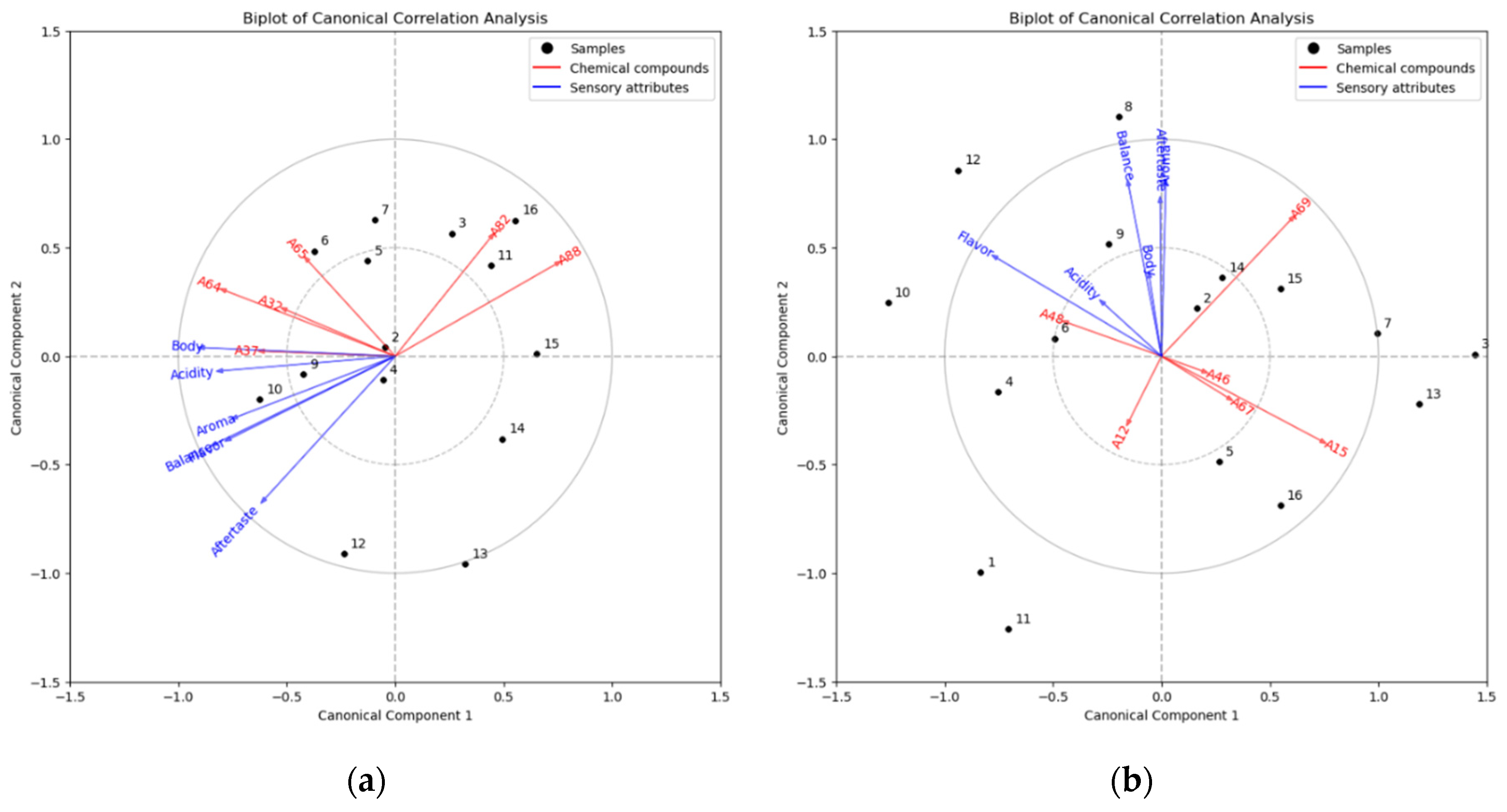

Table 1.
Volatile compounds identified in Panamanian Geisha coffee using HS-SPME-GC-MS.
| *RT a (min) | Compound name | N° CAS | odor descriptor b |
formula | LRI Supelcowax 10 c |
LRI SH Rxi-5HT d |
|---|---|---|---|---|---|---|
| Alcohol | ||||||
| 4.71 | Ethanol | 64 - 17 - 5 | - | C2H6O | <1010 | |
| 6.00 | 1,3-butanediol | 107 - 88 - 0 | - | C4H10O2 | <810 | |
| 6.43 | 4-methyl-2-pentanol | 108-11-2 | pungent, alcoholic | C6H14O | <810 | |
| 6.51 | 2-butanol | 78 - 92 - 2 | sweet, apricot | C4H10O | <810 | |
| 12.31 | 2-methyl-1-pentanol | 105 - 30 - 6 | - | C6H14O | 1136.0 | |
| 12.31 | 2-ethylbutanol | 97 - 95 - 0 | sweet, musty, alcoholic | C6H14O | 948.1 | |
| 23.29 | Acetol | 116 - 09 - 6 | pungent, sweet, caramellic, ethereal | C3H6O2 | 1297.0 | |
| 41.52 | 2,3-butanediol | 513 - 85 - 9 | fruity, creamy, buttery | C4H10O2 | 1572.2 | <810 |
| 78.28 | Hexadecanol | 36653 - 82 - 4 | waxy, clean, greasy, floral, oily | C16H34O | 2377.6 | |
| Aldehyde | ||||||
| 2.33 | Acetaldehyde | 75 - 07 - 0 | pungent, ethereal, aldehydic, fruity | C2H4O | <1010 | |
| 4.29 | 2-methylbutanal | 96 - 17 - 3 | musty, cocoa, phenolic coffee, nutty, malty, fermented, fatty alcoholic | C5H10O | <1010 | |
| 37.47 | Benzaldehyde | 100 - 52 - 7 | sharp, sweet, bitter, almond, cherry | C7H6O | 1506.1 | |
| 41.24 | 5-acetoxymethyl-2-furaldehyde | 10551 - 58 - 3 | baked, bread | C8H8O4 | 1296.4 | |
| 44.82 | 2-furancarboxaldehyde | 23074 - 10 - 4 | - | C7H8O2 | 1626.8 | |
| 52.89 | Cumaldehyde | 122 - 03 - 2 | Spicy, green, cumin-like with green herbal spice, nuances | C10H12O | 1765.2 | |
| 54.79 | (E, E)-2,4-decadienal | 25152 - 84 - 5 | oily, cucumber, melon, citrus, pumpkin, nut, meat | C10H16O | 1798.6 | |
| 61.21 | Benzene acetaldehyde | 4411 - 89 - 6 | sweet, narcissus, cortex, beany, honey, cocoa, nutty radish | C10H10O | 1917.6 | |
| Aromatic compound | ||||||
| 26.96 | 2-ethyl-p-xylene | 1758 - 88 - 9 | - | C10H14 | 1350.6 | |
| 56.57 | (1-butylheptyl)benzene | 4537 - 15 - 9 | - | C17H28 | 1831.3 | |
| 58.63 | trimethyl pentanyl diisobutyrate | 6846 - 50 - 0 | - | C16H30O4 | 1869.0 | |
| 58.62 | Benzenemethanol | 100 - 51 - 6 | - | C7H8O | 1869.2 | |
| 58.78 | (1-ethylnonyl)benzene | 4536 - 87 - 2 | - | C17H28 | 1872.0 | |
| 60.36 | Benzeneethanol | 60 - 12 - 8 | - | C8H10O | 1901.3 | |
| 61.54 | (1-pentylheptyl)benzene | 2719 - 62 - 2 | - | C18H30 | 1923.9 | |
| 61.96 | (1-butyloctyl)benzene | 2719 - 63 - 3 | - | C18H30 | 1932.1 | |
| 70.28 | (1-ethylundecyl)benzene | 4534 - 52 - 5 | - | C19H32 | 2082.9 | |
| 78.69 | Coumaran | 496 - 16 - 2 | - | C8H8O | 2400.9 | |
| Ester | ||||||
| 2.97 | isopropenyl acetate | 108 - 22 - 5 | ethereal, acetic, fruity, sweet, berry, grape, skin | C5H8O2 | <1010 | |
| 3.91 | Ethyl acetate | 141 - 78 - 6 | - | C4H8O2 | <1010 | |
| 12.29 | isoamyl acetate | 123 - 92 - 2 | sweet, fruity, banana | C7H14O2 | 1135.8 | |
| 19.33 | Furfuryl methyl ether | 13679 - 46 - 4 | coffee roasted, coffee | C6H8O2 | 1240.4 | |
| 27.06 | Glycidyl methyl ether | 930 - 37 - 0 | - | C4H8O2 | 1352.2 | |
| 34.62 | 1,2-ethanediol, diacetate | 111 - 55 - 7 | green, floral, estery, alcoholic | C6H10O4 | 1463.3 | |
| 35.23 | Furfuryl pentanoate | 36701 - 01 - 6 | C10H14O3 | 1212.1 | ||
| 38.87 | 2-butanone, 1-(acetyloxy) | 1575 - 57 - 1 | - | C6H10O3 | 1528.9 | |
| 38.91 | Furfuryl acetate | 623 - 17 - 6 | sweet, fruity, banana, horseradish | C7H8O3 | 1529.5 | 987.0 |
| 52.59 | Methyl salicylate | 119 - 36 - 8 | - | C8H8O3 | 1759.9 | |
| 72.70 | phenoxyethanol | 122-99-6 | rose, balsamic, cinnamyl | C8H10O2 | 2141.5 | |
| 73.74 | Hexahydrofarnesyl acetone | 502 - 69 - 2 | C18H36O | 1844.69 | ||
| Fatty acids | ||||||
| 8.73 | Ethyl 2-methylbutanoate | 7452 - 79 - 1 | Fruity, estry, and berry with fresh tropical nuances | C7H14O2 | 1073.6 | |
| 9.45 | ethyl isovalerate | 108 - 64 - 5 | Sweet, diffusive, estry, fruity, sharp, pineapple, apple, green, and orange | C7H14O2 | 1073.6 | |
| 26.40 | ethyl lactate | 97 - 64 - 3 | Sweet, fruity, acidic, etherial with a brown nuance | C5H10O3 | 1342.5 | |
| 26.67 | Vinyl butyrate | 123 - 20 - 6 | - | C6H10O2 | 1346.4 | |
| 38.60 | vinyl propionate | 105-38-4 | - | C5H8O2 | 1524.4 | |
| 47.48 | diethyl succinate | 123-25-1 | mild, fruity, cooked, apple, ylang | C8H14O4 | 1671.4 | |
| 55.57 | β-methylcrotonic acid | 541 - 47 - 9 | green, phenolic, dairy | C5H8O2 | 1813.0 | 931.6 |
| 58.88 | Hydrocinnamic acid, ethyl ester | 2021 - 28 - 5 | hyacinth, rose, honey, fruity, rum | C11H14O2 | 1873.9 | |
| 71.85 | Myristic acid, ethyl ester | 124 - 06 - 1 | sweet, waxy, violet orris | C16H32O2 | 1792.1 | |
| 75.88 | Palmitic acid, ethyl ester | 628 - 97 - 7 | soft, waxy | C18H36O2 | 2252.8 | 1987.1 |
| 75.90 | Hexadecanoic acid, methyl ester | 112 - 39 - 0 | oily, waxy, fatty, orris | C17H34O2 | 1920.6 | |
| 76.73 | palmitic acid | 57 - 10 - 3 | waxy, fatty | C16H32O2 | 1960.3 | |
| 80.33 | linoleic acid | 60 - 33 - 3 | - | C18H32O2 | 2138.8 | |
| 81.04 | Linoleic acid ethyl ester | 544-35-4 | mild, fatty, fruity oily | C20H36O2 | 2527.4 | 2139.1 |
| 80.36 | Linolelaidic acid, methyl ester | 2566-97-4 | - | C19H34O2 | 2140.1 | |
| Furan | ||||||
| 18.88 | 2-pentyl furan | 3777 - 69 - 3 | fruity, green, earthy, beany, vegetable, metallic | C9H14O | 1234.0 | |
| 19.35 | 2-propanoyl furan | 3194-15-8 | fruity | C7H8O2 | 998.0 | |
| 20.59 | 2,5-dimethyl-3(2H)-furanone | 3188 - 00 - 9 | sweet, solvent, bready, buttery, nutty | C5H8O2 | 1261.0 | <810 |
| 34.09 | Furfural | 98 - 01 - 1 | sweet, woody, almond, bread baked | C5H4O2 | 1455.4 | 820.4 |
| 36.50 | Ethanone, 1-(2-furanyl) | 1192 - 62 - 7 | sweet, balsamic, almond, cocoa, caramellic, coffee | C6H6O2 | 1491.1 | 899.5 |
| 40.94 | 5-methyl furfural | 620 - 02 - 0 | spicy, caramellic, maple | C6H6O2 | 1562.7 | 952.1 |
| 42.39 | 2,2’-Bifuran | 5905 - 00 - 0 | - | C8H6O2 | 1586.5 | |
| 46.59 | 2-Furanmethanol | 98 - 00 - 0 | alcoholic, chemical, musty, sweet, caramellic, bready, coffee | C5H6O2 | 1656.4 | 852.3 |
| 47.59 | Furan, 2-(2-furanylmethyl)-5-methyl | 13678 - 51 - 8 | C10H10O2 | 1673.2 | ||
| 58.26 | (2E)-3-(2-furyl)-2-methyl-2-propenal | 108576 - 21 - 2 | C8H8O2 | 1862.6 | ||
| 80.67 | 5-hydroxymethylfurfural | 67 - 47 - 0 | fatty, buttery, musty, waxy, caramellic | C6H6O3 | 2509.6 | 1229.2 |
| Ketone | ||||||
| 3.42 | 2-pentanone | 107-87-9 | sweet, fruity, ethereal, winey, banana, woody | C5H10O | <810 | |
| 5.21 | 1-hydroxy-2-butanone | 5077 - 67 - 8 | sweet, coffee, musty, grain, malty, butterscotch | C4H8O2 | <810 | |
| 5.99 | 2,3-butanedione | 431 - 03 - 8 | buttery, sweet, creamy, pungent, caramellic | C4H6O2 | 1014.0 | |
| 6.56 | 2-hidroxi-3-pentanone | 5704 - 20 - 1 | truffle, earthy, nutty | C5H10O2 | <810 | |
| 9.14 | 2,3-pentanedione | 600-14-6 | buttery, nutty, toasted, caramellic, buttery | C5H8O2 | 1082.4 | <810 |
| 12.20 | 3-penten-2-one | 3102 - 33 - 8 | - | C5H8O | 1134.3 | |
| 12.81 | 2,3-hexanedione | 3848 - 24 - 6 | sweet, creamy, caramellic, buttery, fruity, jammy | C6H10O2 | 1143.6 | |
| 12.33 | Ethanone, 1-cyclopropyl | 765 - 43 - 5 | - | C5H8O | 1136.3 | |
| 12.97 | 2,4-dimethyl-3-pentanone | 565 - 80 - 0 | - | C7H14O | 1146.1 | |
| 13.38 | 3,4-hexanedione | 4437 - 51 - 8 | buttery, almond, toasted, almond, nutty, caramellic | C6H10O2 | 1152.4 | |
| 20.99 | 1,2-cyclopentanedione, 3-methyl | 765 - 70 - 8 | sweet, caramellic, maple, sugar, coffee, woody | C6H8O2 | 1020.0 | |
| 22.21 | Acetoin | 513 - 86 - 0 | sweet, buttery, creamy, dairy, milky, fatty | C4H8O2 | 1281.6 | |
| 38.29 | 2,3-dimethyl-2-cyclopenten-1-one | 1121 - 05 - 7 | - | C7H10O | 1519.3 | |
| 38.55 | 3,3-dimethyl-2-butanone | 75 - 97 - 8 | - | C6H12O | 1523.6 | |
| 55.28 | (E)-β-damascenone | 23726 - 93 - 4 | apple, rose, honey, tobacco, sweet | C13H18O | 1807.5 | |
| 59.43 | 2-cyclopenten-1-one, 3-ethyl-2-hydroxy | 21835 - 01 - 8 | Sweet, brown, caramellic, maple, brown sugar, rum, whiskey | C7H10O2 | 1884.1 | 1111.8 |
| 59.93 | (E)-furfural acetone | 41438 - 24 - 8 | - | C8H8O2 | 1893.2 | |
| 65.04 | 4-hydroxy-3-methyl acetophenone | 876 - 02 - 8 | - | C9H10O2 | 1991.3 | |
| 67.24 | Furaneol | 3658 - 77 - 3 | sweet, cotton, candy, caramellic, strawberry, sugar | C6H8O3 | 2030.2 | 1073.2 |
| Lactones | ||||||
| 36.07 | 2,5-dimethyl-3(2H)-furanone | 62873 - 16 - 9 | milky, fatty, lactonic | C6H8O2 | 1484.8 | |
| 44.02 | Butyrolactone | 96 - 48 - 0 | creamy, oily, fatty, caramellic | C4H6O2 | 1613.3 | 895.6 |
| 63.04 | Maltol | 118 - 71 - 8 | sweet, caramellic, cotton, candy, jammy, fruity, bread, baked | C6H6O3 | 1952.8 | 1102.6 |
| 68.53 | 2(3H)-furanone, 5-acetyldihydro | 29393 - 32 - 6 | - | C6H8O3 | 2052.6 | |
| 76.37 | 4H-pyran-4-one, 2,3-dihydro-3,5-dihydroxy-6-methyl | 28564 - 83 - 2 | - | C6H8O4 | 2275.1 | 1142.3 |
| N-heterocycle | ||||||
| 13.07 | 1-methyl pyrrole | 96 - 54 - 8 | smoky, woody, herbal | C5H7N | 1147.6 | |
| 15.06 | Pyridine | 110 - 86 - 1 | sour fishy, ammoniacal | C5H5N | 1178.0 | <810 |
| 22.16 | 1H-pyrrole-2-carboxaldehyde, 1-ethyl | 2167 - 14 - 8 | burnt, roasted, smoky | C7H9NO | 1035.5 | |
| 41.49 | Piracetam | 7491-74-9 | - | C6H10N2O2 | 1299.9 | |
| 45.62 | Ethanone, 1-(1-methyl-1H-pyrrol-2-yl)- | 932 - 16 - 1 | earthy | C7H9NO | 1640.1 | |
| 48.23 | 1-ethyl-2-pyrrolidinone | 2687 - 91 - 4 | - | C6H11NO | 1683.9 | |
| 49.81 | 4(H)-pyridine, N-acetyl | 67402 - 83 - 9 | green, nut, skin, sulfurous, burnt, cocoa, corn | C7H9NO | 1710.9 | |
| 62.59 | 2-methyl quinoxaline | 7251 - 61 - 8 | toasted, coffee, nutty, fruity | C9H8N2 | 1944.3 | |
| 63.46 | 2-acetyl pyrrole | 1072 - 83 - 9 | musty, nutty, coumarinic | C6H7NO | 1960.9 | 1059.2 |
| 64.18 | 4(1H)-quinazolinone | 491 - 36 - 1 | - | C8H6N2O | 1974.8 | |
| 66.19 | 1H-pyrrole-2-carboxaldehyde | 1003 - 29 - 8 | musty, beefy, coffee | C5H5NO | 2012.1 | 1014.1 |
| 66.55 | 2-pyrrolidinone | 616 - 45 - 5 | - | C4H7NO | 2018.4 | |
| 71.02 | 1H-pyrrole-2-carboxaldehyde, 1-methyl | 1192 - 58 - 1 | - | C6H7NO | 2095.7 | |
| 73.62 | Caffeine | 58 - 08 - 2 | - | C8H10N4O2 | 2409.8 | 1832.5 |
| 79.13 | 3-pyridinol | 109 – 00 - 2 | - | C5H5NO | 2425.4 | |
| 79.57 | Indole | 120 - 72 - 9 | pungent, naphthyl, fecal, animal, musty | C8H7N | 2449.9 | 1283.5 |
| Organic acids | ||||||
| 18.43 | Crotonic acid | 638 - 10 - 8 | - | C7H12O2 | 1227.6 | |
| 34.60 | Acetic acid | 64 - 19 - 7 | - | C2H4O2 | 1463.0 | <810 |
| 43.89 | 4-hydroxybutyric acid | 591 - 81 - 1 | - | C4H8O3 | 1611.1 | |
| 48.22 | isovaleric acid | 503 - 74 - 2 | Cheese, dairy, acidic, sour, pungent, | C5H10O2 | 1683.8 | 894.1 |
| Phenol | ||||||
| 13.95 | p-cresol | 106 - 44 - 5 | - | C7H8O | 1161.0 | |
| 38.99 | 2-acetylresorcinol | 699 - 83 - 2 | - | C8H8O3 | 1264.9 | |
| 66.74 | 4-ethyl guaiacol | 2785 - 89 - 9 | spicy, smoky, bacon, phenolic, clove | C9H12O2 | 2021.7 | |
| 74.52 | 2-methoxy-4-vinyl phenol | 7786 - 61 - 0 | spicy, clove, carnation, phenolic, peppery, smoky, woody, powdery | C9H10O2 | 2191.2 | 1307.1 |
| 77.24 | 2,4-di-tert-butylphenol | 96-76-4 | - | C14H22O | 2318.2 | |
| Pyrazine | ||||||
| 13.06 | 4,6-dimethylpyrazine | 1558 - 17 - 4 | - | C6H8N2 | 909.07 | |
| 17.25 | Pyrazine | 290 – 37 - 9 | pungent, sweet, corn, roasted, hazelnut | C4H4N2 | 1210.6 | <810 |
| 18.87 | 2-ethyl-3-methylpyrazine | 15707 - 23 - 0 | nutty, peanut, musty, corn, raw, earthy, bready | C7H10N2 | 991.3 | |
| 20.47 | 2-methylpyrazine | 109 - 08 - 0 | nutty, cocoa, roasted, chocolate, peanut, green | C5H6N2 | 1256.7 | 811.6 |
| 24.10 | 2,5-dimethylpyrazine | 123 - 32 - 0 | cocoa, roasted, nutty, beefy, roasted, beefy, woody, grassy, medicinal | C6H8N2 | 1308.8 | 903.0 |
| 24.56 | 2,6-dimethylpyrazine | 108 - 50 - 9 | ethereal, cocoa, nutty, roasted, meaty, roasted, meaty, beefy, brown, coffee, buttermilk | C6H8N2 | 1315.6 | 903.22 |
| 25.01 | Ethylpyrazine | 13925 - 00 - 3 | peanut butter musty, nutty, woody, roasted, cocoa | C6H8N2 | 1322.1 | 905.3 |
| 25.70 | 2,3-dimethylpyrazine | 5910 - 89 - 4 | nutty, nut, skin, cocoa, peanut, butter, coffee, walnut, caramellic, roasted | C6H8N2 | 1332.2 | |
| 27.53 | 2-acetyl-3-methylpyrazine | 23787 - 80 - 6 | nutty, nut, flesh, hazelnut, roasted | C7H8N2O | 1107.1 | |
| 28.40 | 2-ethyl-6-methylpyrazine | 13925 - 03 - 6 | roasted, potato | C7H10N2 | 1371.7 | 988.1 |
| 28.74 | 2-ethyl-5-methylpyrazine | 13360 - 64 - 0 | coffee, beany,, nutty,, grassy, roasted | C7H10N2 | 1376.7 | 991.0 |
| 29.52 | 2,3,5-trimethylpyrazine | 14667 - 55 - 1 | nutty, nut, skin, earthy, powdery, cocoa, potato, baked potato, peanut, roasted peanut, hazelnut, musty | C7H10N2 | 1388.1 | 993.2 |
| 30.57 | N-propilpyrazine | 18138 - 03 - 9 | green, vegetable, nutty, hazelnut, barley, roasted, barley, corn | C7H10N2 | 1403.5 | |
| 31.91 | Vinylpyrazine | 4177 - 16 - 6 | nutty | C6H6N2 | 1423.3 | |
| 32.35 | 2,5-dimethyl-3-ethylpyrazine | 13360 - 65 - 1 | potato, cocoa, roasted, nutty | C8H12N2 | 1429.9 | 1070.2 |
| 33.16 | 2,3-diethylpyrazine | 15707 - 24 - 1 | raw, nutty, pepper, bell pepper | C8H12N2 | 1441.2 | |
| 33.39 | 2,5-diethylpyrazine | 13238 - 84 - 1 | nutty, hazelnut | C8H12N2 | 1445.2 | |
| 33.43 | 2,6-diethylpyrazine | 13067 - 27 - 1 | nutty, hazelnut | C8H12N2 | 1445.7 | |
| 33.54 | 4-methylpyrrolo [1,2-a]pyrazine | 64608 - 60 - 2 | - | C8H8N2 | 1188.8 | |
| 33.72 | 2-methyl-6-propyl pyrazine | 29444 - 46 - 0 | burnt, hazelnut, nutty | C8H12N2 | 1450.0 | |
| 35.29 | 2-methyl-6-vinyl- pyrazine | 13925 - 09 - 2 | hazelnut, nutty | C7H8N2 | 1473.2 | |
| 35.62 | 3,5-diethyl-2-methylpyrazine | 18138 - 05 - 1 | nutty, meaty, vegetable | C9H14N2 | 1478.2 | 1150.8 |
| 36.87 | 2,3,5-trimethyl-6-ethylpyrazine | 17398 - 16 - 2 | - | C9H14N2 | 1496.6 | |
| 41.95 | (1-methylethenyl) pyrazine | 38713 - 41 - 6 | caramellic, chocolate, nutty, roasted | C7H8N2 | 1579.2 | |
| 43.14 | 5H-5-methyl-6,7-dihydrocyclopentapyrazine | 23747 - 48 - 0 | earthy, potato, baked potato, peanut, roasted peanut | C8H10N2 | 1598.7 | 1126.9 |
| 45.90 | 2,3-dimethyl-5-isopentylpyrazine | 18450 - 01 - 6 | green, floral | C11H18N2 | 1645.0 | |
| 47.78 | 1-(6-Methyl-2-pyrazinyl)-1-ethanone | 22047 - 26 - 3 | roasted coffee, cocoa, popcorn | C7H8N2O | 1676.4 | |
| 48.75 | 2-methyl-5-(1-propenyl) pyrazine | 18217 - 82 - 8 | - | C8H10N2 | 1692.6 | 1180.6 |
| Terpene | ||||||
| 11.46 | 2,6-dimethyl-2-cis-6-octadiene | 2609 - 23 - 6 | - | C10H18 | 1123.0 | |
| 14.54 | β-myrcene | 123 - 35 - 3 | peppery, terpenic, spicy, balsamic, plastic | C10H16 | 1170.1 | |
| 16.24 | D-limonene | 5989 - 27 - 5 | citrus, orange, fresh, sweet | C10H16 | 1196.0 | |
| 19.03 | β-trans-ocimene | 3779 - 61 - 1 | sweet, herbal | C10H16 | 1236.2 | |
| 21.22 | limonene | 138 - 86 - 3 | citrus, herbal, terpenic, camphoreous | C10H16 | 1022.9 | |
| 20.09 | β-cis-ocimene | 3338 - 55 - 4 | warm, floral, herbal, sweet | C10H16 | 1251.2 | 1044.3 |
| 21.67 | Terpinolen | 586 - 62 - 9 | sweet, fresh, pine, citrus, woody, lemon, peel | C10H16 | 1273.9 | |
| 22.82 | α-ocimene | 502 - 99 - 8 | fruity, floral, cloth, laundered, cloth | C10H16 | 1044.3 | |
| 28.04 | (E,Z)-alloocimene | 7216 - 56 - 0 | - | C10H16 | 1366.4 | |
| 33.25 | L-α-terpineol | 10482 - 56 - 1 | lilac, floral, terpenic | C10H18O | 1184.9 | |
| 34.44 | (E)-linalool oxide (furanoid) | 34995 - 77 - 2 | floral | C10H18O2 | 1460.7 | 1081.2 |
| 34.52 | (Z)-linalool oxide (furanoid) | 5989 - 33 - 3 | earthy, floral, sweet, woody | C10H18O2 | 1461.9 | 1065.6 |
| 34.85 | Carvomenthenal | 29548 - 14 - 9 | spicy, herbal | C10H16O | 1206.9 | |
| 39.76 | Linalool | 78 - 70 - 6 | citrus, orange, floral, terpenic, waxy, rose | C10H18O | 1543.3 | 1096.3 |
| 47.52 | Citral | 106 - 26 - 3 | sweet, citrus, lemon, lemon peel | C10H16O | 1672.0 | |
| 48.49 | α-terpineol | 98 - 55 - 5 | pine, terpenic, lilac, citrus, woody, floral | C10H18O | 1688.3 | 1185.2 |
| 49.07 | Geranyl formate | 105 - 86 - 2 | fresh, rose, neroli, rose, tea rose, green | C11H18O2 | 1698.0 | |
| 49.09 | cis- geranyl acetate | 141 - 12 - 8 | floral, rose, soapy, citrus, dewy, pear | C12H20O2 | 1698.4 | |
| 52.07 | Geranyl acetate | 105 - 87 - 3 | floral, rose, lavender, green, waxy | C12H20O2 | 1750.7 | |
| 54.55 | cis-geraniol | 106 - 25 - 2 | sweet, natural, neroli, citrus, magnolia | C10H18O | 1794.3 | 1224.2 |
| 56.38 | 2,6-octadien-1-ol, 2,7-dimethyl- | 22410 - 74 - 8 | - | C10H18O | 1827.9 | |
| 56.35 | 2,6-dimethyl-octa-2,6-dien-1-ol | C10H18O | 1827.3 | - | ||
| 57.21 | Geraniol | 106 - 24 - 1 | sweet, floral, fruity, rose, waxy, citrus | C10H18O | 1843.1 | 1251.9 |
| Others | ||||||
| 2.08 | 1,2-propanediamine | 78 - 90 - 0 | - | C3H10N2 | <1010 | |
| 5.36 | heptane, 2,2,4,6,6-pentamethyl- | 13475 - 82 - 6 | - | C12H26 | <1010 | |
| 34.62 | N-acetyl-L-alanine | 97 - 69 - 8 | - | C5H9NO3 | 1463.3 | |
| 40.96 | Difurfuryl ether | 4437 - 22 - 3 | coffee, nutty, earthy | C10H10O3 | 1292.60 | |
| 57.66 | Mequinol | 150 - 76 - 5 | - | C7H8O2 | 1851.5 | |
| 51.53 | (+)-δ-cadinene | 483 - 76 - 1 | thyme, herbal, woody, dry | C15H24 | 1741.3 | 1523.1 |
| 73.62 | Caprolactam | 105 - 60 - 2 | amine, spicy | C6H11NO | 2168.2 |
a Retention time (RT) corresponds to the VOCs identified using the Supelcowax 10 column, except for VOCs identified exclusively with the SH Rxi-5HT column. b See the following references: 1, 3, 7, 12, 15, 18, 34, 54. c Calculated liner retention index (LRI) for volatile compounds using the Supelcowax 10 column. d Calculated liner retention index (LRI) for volatile compounds using the SH Rxi-5HT column.
Table 2.
Average scores of attributes evaluated in 16 Geisha coffee samples by eight Q-Grader panelists following the SCAP cupping protocol.
Table 2.
Average scores of attributes evaluated in 16 Geisha coffee samples by eight Q-Grader panelists following the SCAP cupping protocol.
| sample | Fragance/ Aroma |
Flavor | Aftertaste | Acidity | Body | Balance | Uniformity | Clean Cup | Sweetness | Overall | score |
|---|---|---|---|---|---|---|---|---|---|---|---|
| 1 | 8.50 | 8.42 | 8.47 | 8.42 | 8.36 | 8.75 | 10 | 10 | 10 | 8.53 | 89.44 |
| 2 | 8.39 | 8.36 | 8.31 | 8.44 | 8.39 | 8.58 | 10 | 10 | 10 | 8.25 | 88.72 |
| 3 | 8.31 | 8.44 | 8.33 | 8.42 | 8.36 | 8.64 | 10 | 10 | 10 | 8.31 | 88.81 |
| 4 | 8.36 | 8.25 | 8.17 | 8.28 | 8.31 | 8.39 | 10 | 10 | 10 | 8.08 | 87.83 |
| 5 | 8.17 | 8.08 | 8.14 | 8.33 | 8.33 | 8.44 | 10 | 10 | 10 | 8.14 | 87.64 |
| 6 | 8.39 | 8.36 | 8.25 | 8.33 | 8.33 | 8.58 | 10 | 10 | 10 | 8.28 | 88.53 |
| 7 | 8.31 | 8.39 | 8.31 | 8.42 | 8.36 | 8.67 | 10 | 10 | 10 | 8.33 | 88.78 |
| 8 | 8.50 | 8.44 | 8.33 | 8.61 | 8.56 | 8.58 | 10 | 10 | 10 | 8.36 | 89.39 |
| 9 | 8.44 | 8.39 | 8.31 | 8.47 | 8.39 | 8.67 | 10 | 10 | 10 | 8.44 | 89.11 |
| 10 | 8.42 | 8.39 | 8.28 | 8.33 | 8.47 | 8.50 | 10 | 10 | 10 | 8.31 | 88.69 |
| 11 | 8.47 | 8.14 | 8.31 | 8.42 | 8.19 | 8.50 | 10 | 10 | 10 | 8.42 | 88.44 |
| 12 | 8.53 | 8.31 | 8.25 | 8.47 | 8.28 | 8.61 | 10 | 10 | 10 | 8.44 | 88.89 |
| 13 | 8.42 | 8.47 | 8.39 | 8.53 | 8.42 | 8.64 | 10 | 10 | 10 | 8.42 | 89.28 |
| 14 | 8.56 | 8.47 | 8.42 | 8.53 | 8.33 | 8.64 | 10 | 10 | 10 | 8.42 | 89.36 |
| 15 | 8.16 | 8.13 | 8.03 | 8.16 | 8.22 | 8.22 | 10 | 10 | 10 | 7.97 | 86.88 |
| 16 | 8.07 | 7.89 | 7.89 | 8.11 | 8.00 | 8.25 | 10 | 10 | 10 | 8.00 | 86.21 |
Table 3.
VOCs obtained by GC-MS using a Supelcowax10 and SH Rxi-5HT column, related to sensory quality.
Table 3.
VOCs obtained by GC-MS using a Supelcowax10 and SH Rxi-5HT column, related to sensory quality.
| Column Type | VOCs | Code a |
|---|---|---|
| Supelcowax 10 column | α-ocimene | A32 |
| Acetol | A37 | |
| 2,5-dimethyl-3(2H)-furanone | A64 | |
| Ethanone, 1-(2-furanyl) | A65 | |
| Ethanone, 1-(1-methyl-1H-pyrrol-2-yl) | A82 | |
| 1-(6-Methyl-2-pyrazinyl)-1-ethanone | A88 | |
| SH Rxi-5HT column | 2,5-dimethyl-3(2H)-furanone | A12 |
| 2-furanmethanol | A15 | |
| 2-cyclopenten-1-one, 3-ethyl-2-hydroxy | A46 | |
| 4H-pyran-4-one, 2,3-dihydro-3,5-dihydroxy-6-methyl | A48 | |
| 2-methoxy-4-vinylphenol | A67 | |
| Myristic acid, ethyl ester | A69 |
a Assigned code for each VOCs for canonical correlation analysis (CCA).
Table 4.
Selection of canonical variables relating VOCs to the sensory quality of Panama Geisha coffee using two types of columns in GC-MS.
Table 4.
Selection of canonical variables relating VOCs to the sensory quality of Panama Geisha coffee using two types of columns in GC-MS.
| Wilks’Lambda | F-approximation | ||||
|---|---|---|---|---|---|
| Column Supelcowax 10 | Canonical variate | stat | approx | p-value | R2 |
| 1 | 4.607x10⁻⁶ | 8.704 | 1.674x10⁻⁶ | 0.999 | |
| 2 | 3.124x10⁻³ | 2.991 | 7.408x10⁻³ | 0.989 | |
| 3 | 1.463x10⁻¹ | 1.038 | 4.636x10⁻¹ | 0.803 | |
| 4 | 4.124x10⁻¹ | 0.838 | 5.920x10⁻¹ | 0.640 | |
| 5 | 6.988x10⁻¹ | 0.785 | 5.515x10⁻¹ | 0.543 | |
| 6 | 9.908x10⁻¹ | 0.083 | 7.794x10⁻¹ | 0.096 | |
| Column SH Rxi-5HT | 1 | 8.505x10⁻⁶ | 7.496 | 5.960x10⁻⁶ | 0.999 |
| 2 | 1.542x10⁻² | 1.666 | 1.234x10⁻¹ | 0.941 | |
| 3 | 1.359x10⁻¹ | 1.093 | 4.220x10⁻¹ | 0.844 | |
| 4 | 4.738x10⁻¹ | 0.686 | 7.122x10⁻¹ | 0.633 | |
| 5 | 7.900x10⁻¹ | 0.500 | 7.359x10⁻¹ | 0.381 | |
| 6 | 9.242x10⁻¹ | 0.738 | 4.125x10⁻¹ | 0.275 |
Disclaimer/Publisher’s Note: The statements, opinions and data contained in all publications are solely those of the individual author(s) and contributor(s) and not of MDPI and/or the editor(s). MDPI and/or the editor(s) disclaim responsibility for any injury to people or property resulting from any ideas, methods, instructions or products referred to in the content. |
© 2025 by the authors. Licensee MDPI, Basel, Switzerland. This article is an open access article distributed under the terms and conditions of the Creative Commons Attribution (CC BY) license (https://creativecommons.org/licenses/by/4.0/).
Copyright: This open access article is published under a Creative Commons CC BY 4.0 license, which permit the free download, distribution, and reuse, provided that the author and preprint are cited in any reuse.


